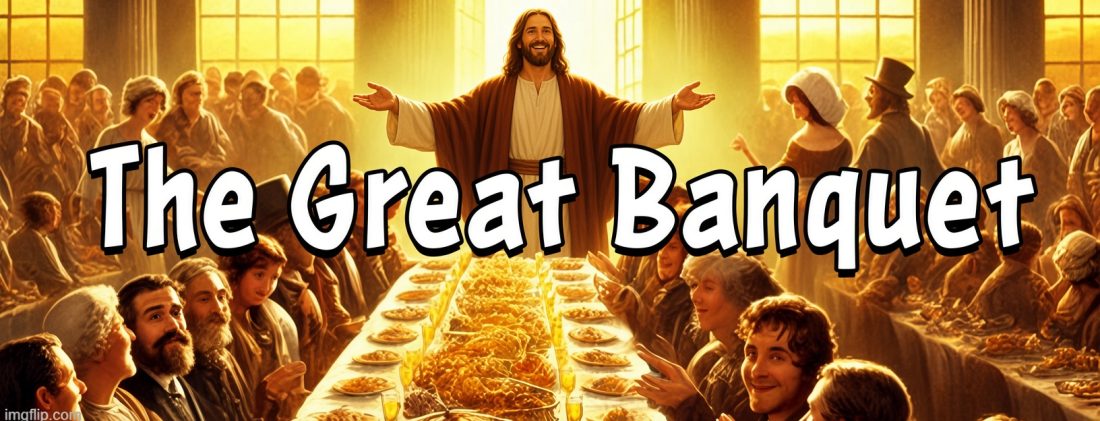
Dear MAGA: 20260426 Open Topic

This Rejoice & Praise God Sunday Open Thread, with full respect to those who worship God on the Sabbath, is a place to reaffirm our worship of our Creator, our Father, our King Eternal.

It’s also a place to read, post, and discuss news that is worth knowing and sharing. Please post links to any news stories that you use as sources or quote from.

In the QTree, we’re a friendly and civil lot. We encourage free speech and the open exchange and civil discussion of different ideas. Topics aren’t constrained, and sound logic is highly encouraged, all built on a solid foundation of truth and established facts, and not by agenda-driven accusations and pronouncements.

We have a policy of mutual respect, shown by civility. Civility encourages discussions, promotes objectivity and rational thought in discourse, and camaraderie in the participants – characteristics we strive toward in our Q Tree community.

Please show respect and consideration for our fellow QTreepers. Before hitting the “post” button, please proofread your post and make sure your opinion addresses the issue only, and does not confront or denigrate the poster. Keep to the topic – avoid “you” and “your”. Here in The Q Tree, personal attacks, name-calling, ridicule, insults, baiting, and other conduct for which a penalty flag would be thrown are VERBOTEN.

In The Q Tree, we’re compatriots, sitting around the campfire, roasting hot dogs, making s’mores, and discussing, agreeing, and disagreeing about whatever interests us. This board will remain a home for those who seek respectful conversations.

Please also consider the Guidelines for posting and discussion printed here: 
https://www.theqtree.com/2019/01/01/dear-maga-open-topic-20190101/


On this day and every day –

God is in Control
. . . and His Grace is Sufficient, so . . .
Keep Looking Up


Hopefully, every Sunday, we can find something here that will build us up a little . . . give us a smile . . . and add some joy or peace, very much needed in all our lives.

“This day is holy to the Lord your God;
do not mourn nor weep.” . . .
“Go your way, eat the fat, drink the sweet,
and send portions to those for whom nothing is prepared;
for this day is holy to our Lord.
Do not sorrow,
for the joy of the Lord is your strength.”


Entering Into God’s Rest

The concept of entering into God’s rest comes from Hebrews 3—4. What is this “rest” the Hebrew writer is talking about? How do we enter it? And how do we fail to enter it? The writer to the Hebrews begins his discussion of God’s rest in chapter 3, where he references the Israelites wandering in the desert. In giving them the land of Canaan, God had promised them that He would go before them and defeat all their enemies in order that they could live securely (Deuteronomy 12:9–10). All that was required of them was to fully trust in Him and His promises. However, they refused to obey Him. Instead, they murmured against Him, even yearning to go back to their bondage under the Egyptians (Exodus 16:3; 17:1–7; Numbers 20:3–13).

The particular “rest” referred to here was that of the land of Canaan. Into that rest God solemnly said the Israelites who disobeyed Him would never enter (Hebrews 3:11). They had been rebellious. All the means of reclaiming them had failed. God had warned and entreated them; He had caused His mercies to pass before them, and had visited them with judgments in vain; and He now declares that for all their rebellion they should be excluded from the Promised Land (Hebrews 3:16–19). But, eventually, the next generation did place their faith in God and, by following the leadership of Joshua, they, some forty years later, entered into God’s rest, the land of Canaan (Joshua 3:14–17).

Using the Israelites as an example of those who were not resting in God’s promises, the writer of Hebrews goes on in chapter 4 to make the application personal, both to the Hebrew Christians and to us: “Therefore, since the promise of entering his rest still stands, let us be careful that none of you be found to have fallen short of it” (Hebrews 4:1). The promise that still stands is the promise of salvation through God’s provision—Jesus Christ. He alone can provide the eternal rest of salvation through His blood shed on the cross for the remission of sins. God’s rest, then, is in the spiritual realm, the rest of salvation. Faith, the author goes on to assert, is the key to entering God’s rest. The Hebrews had had the gospel preached to them, just as the Israelites knew the truth about God, but the messages were of “no value to them, because those who heard did not combine it with faith” (Hebrews 4:2). Some had heard the good news of Christ, but they rejected it for lack of faith.

Hebrews 4:10–13 explains the nature of this faith. The kind of faith that enables us to enter into God’s rest is a faith that first demands that we rest from relying on our own works. Then the writer seemingly contradicts himself by telling us to make every effort: “For anyone who enters God’s rest also rests from his own work, just as God did from his. Let us, therefore, make every effort to enter that rest, so that no one will fall by following their example of disobedience” (Hebrews 4:10–11). What this apparent paradox means is that such biblical faith involves our submissiveness to God, and our efforts in that area.

Though we desist in our self-efforts to earn salvation and the promised eternal rest, we also “make every effort to enter that rest” by choosing to depend solely on God, to trust Him implicitly, to yield totally to the promises of God through the free grace of His salvation. Why? So “that no one will fall by following their [the Israelites’] example of disobedience” (Hebrews 4:11). We either trust ourselves to save ourselves, or we trust God to do that for us through the sacrifice of Christ on the cross. By failing to trust God fully in His promises, we become disobedient and fail to enter the rest that is eternal life, just as the children of Israel became disobedient when they failed to enter the Promised Land.

So how do we stop trusting ourselves? How do we place our full trust in God and His promises? We enter into God’s rest by first understanding our total inability to enter God’s rest on our own. Next, we enter God’s rest by our total faith in the sacrifice of Christ and complete obedience to God and His will. “And to whom did God swear that they would never enter his rest if not to those who disobeyed? So we see that they were not able to enter, because of their unbelief” (Hebrews 3:18–19). Unlike the Israelites whose unbelief prevented them from entering the Promised Land, we are to enter God’s rest by faith in Him, faith which is a gift from Him by grace (Ephesians 2:8–9).
xhttps://www.gotquestions.org/enter-Gods-rest.html

Dear MAGA: 20260419 Open Topic

This Rejoice & Praise God Sunday Open Thread, with full respect to those who worship God on the Sabbath, is a place to reaffirm our worship of our Creator, our Father, our King Eternal.

It’s also a place to read, post, and discuss news that is worth knowing and sharing. Please post links to any news stories that you use as sources or quote from.

In the QTree, we’re a friendly and civil lot. We encourage free speech and the open exchange and civil discussion of different ideas. Topics aren’t constrained, and sound logic is highly encouraged, all built on a solid foundation of truth and established facts, and not by agenda-driven accusations and pronouncements.

We have a policy of mutual respect, shown by civility. Civility encourages discussions, promotes objectivity and rational thought in discourse, and camaraderie in the participants – characteristics we strive toward in our Q Tree community.

Please show respect and consideration for our fellow QTreepers. Before hitting the “post” button, please proofread your post and make sure your opinion addresses the issue only, and does not confront or denigrate the poster. Keep to the topic – avoid “you” and “your”. Here in The Q Tree, personal attacks, name-calling, ridicule, insults, baiting, and other conduct for which a penalty flag would be thrown are VERBOTEN.

In The Q Tree, we’re compatriots, sitting around the campfire, roasting hot dogs, making s’mores, and discussing, agreeing, and disagreeing about whatever interests us. This board will remain a home for those who seek respectful conversations.

Please also consider the Guidelines for posting and discussion printed here: 
https://www.theqtree.com/2019/01/01/dear-maga-open-topic-20190101/


On this day and every day –

God is in Control
. . . and His Grace is Sufficient, so . . .
Keep Looking Up


Hopefully, every Sunday, we can find something here that will build us up a little . . . give us a smile . . . and add some joy or peace, very much needed in all our lives.

“This day is holy to the Lord your God;
do not mourn nor weep.” . . .
“Go your way, eat the fat, drink the sweet,
and send portions to those for whom nothing is prepared;
for this day is holy to our Lord.
Do not sorrow,
for the joy of the Lord is your strength.”


God Hates?

Seven things that God hates are a catalog of sins summed up in Proverbs 6:16–19. While these aren’t the only sins that should be avoided, they do sum up most of the wicked things condemned by God. The seven things God hates are the sins that deal with the deep heart motives of the individual. The writer of Proverbs points the finger straight at our hearts and our sinful thought processes.

This is in line with our Lord Jesus Christ’s elaboration of the Ten Commandments during His Sermon on the Mount (Matthew 5:21–48). Sin is committed the moment it is conceived in the heart, even before it is actually committed. Avoiding the seven things God hates will help us expose our hidden intentions and motives.

The following is Proverbs’ list of seven things God hates:

Arrogant (haughty) eyes: This describes a feeling of pride and looking down upon others (Philippians 2:3, 5–11). When we begin to think of ourselves more highly and with unparalleled importance, we are forgetting the fact that anything good in us is the result of Christ living in us and that the old self is now dead (Galatians 2:20). Often, believers feel superior to other believers when they receive godly wisdom and display amazing tenacity against sin. We fail to realize these gifts were given by God through Christ and fanned into flame by the Holy Spirit and are not due to our own goodness. This sin of pride is so detested by the LORD that Paul was kept from committing this sin by being provided with “a thorn in the flesh” to humble him (2 Corinthians 12:7).

Lying tongue: A lying tongue is one that speaks falsehood, knowingly and willingly, with an intention to deceive others. Lying can be used to impugn the character of a brother or to flatter a friend. It is a most detestable evil to God, who is a God of truth. Nothing we do causes us to more closely resemble the devil, who is the father of lies (John 8:44).

Hands that shed innocent blood: This refers to cold-blooded murder. We may never have orchestrated killing someone or never have touched a gun or knife, but in Matthew 5:21–24, Jesus says that anyone who is angry with someone else unreasonably without offering room for forgiveness commits a sin equivalent to murder. John reiterates this concept in 1 John 3:15.

A heart that devises wicked schemes: This encompasses thinking or conceiving evil against any individual or group for personal benefit or other misguided objectives, like modern-day terrorists indulge in. Any sin is basically a wicked scheme. David’s sin against Uriah the Hittite and Bathsheba comes to mind (2 Samuel 11). The heart of an evil man continually contrives schemes to bring others to ruin, whether physically or spiritually.

Feet that are quick to rush into evil: Those whose feet are quick to rush into evil display no resistance whatsoever to sin. Having many examples in the Bible, and having the indwelling of the Holy Spirit (Ephesians 4:30; Galatians 5:16), we are expected to be wise in this regard (Romans 6:11–14; Ephesians 5:5, 11). In the Garden of Eden, Eve had the first experience of temptation. She displayed no resistance to the serpent’s temptation. Instead, as soon as the devil attracted her to the fruit, she “saw that the tree was good for food and pleasing to the eye” (Genesis 3:6). Eve had sinned at that moment itself. Contrast this with the attitude of Jesus: when tired and hungry after forty days and forty nights of fasting, He refused to yield to the devil’s tempting and killed the temptation in His mind without allowing it to grow into sin (Matthew 4:1–11). “Resist the devil and he will flee from you” (James 4:7).

False witness who pours out lies: This is similar to the sin of the lying tongue mentioned earlier, but this form of lying is given special mention as it could send an innocent person to jail or even lead to him being stoned to death as happened to Naboth, thanks to false witnesses instigated by the wicked Jezebel (1 Kings 21:8–14). The prohibition against bearing false witness is the ninth of the Ten Commandments, and the New Testament is equally condemning of it. Colossians 3:9–10 explains the reason for the continued prohibition against lying. Christians are new creations in Christ (2 Corinthians 5:17), and, as such, we reflect His nature. We have been released from our “old self” with its evil practices such as lying and bearing false witness.

A man who stirs up dissension among brothers: Brothers are created by God to live in unity (Psalm 133:1; 1 Thessalonians 4:9). Believers are brothers and sisters since they have one Father God and one Brother, Jesus Christ. The Church is also the Bride of Christ (Ephesians 5:25–27). In many situations strife among brothers and even within the church seems unavoidable, but anyone who purposely causes disruption to peace in the body of Christ will displease God above all, since that person gives room for others to sin and for himself to sin further (1 John 2:9–11; 4:19–21). Moreover, Jesus pronounced a great blessing on peacemakers, the privilege to be called “sons of God” (Matthew 5:9).
xhttps://www.gotquestions.org/seven-things-God-hates.html

Dear MAGA: 202612 Open Topic

This Rejoice & Praise God Sunday Open Thread, with full respect to those who worship God on the Sabbath, is a place to reaffirm our worship of our Creator, our Father, our King Eternal.

It’s also a place to read, post, and discuss news that is worth knowing and sharing. Please post links to any news stories that you use as sources or quote from.

In the QTree, we’re a friendly and civil lot. We encourage free speech and the open exchange and civil discussion of different ideas. Topics aren’t constrained, and sound logic is highly encouraged, all built on a solid foundation of truth and established facts, and not by agenda-driven accusations and pronouncements.

We have a policy of mutual respect, shown by civility. Civility encourages discussions, promotes objectivity and rational thought in discourse, and camaraderie in the participants – characteristics we strive toward in our Q Tree community.

Please show respect and consideration for our fellow QTreepers. Before hitting the “post” button, please proofread your post and make sure your opinion addresses the issue only, and does not confront or denigrate the poster. Keep to the topic – avoid “you” and “your”. Here in The Q Tree, personal attacks, name-calling, ridicule, insults, baiting, and other conduct for which a penalty flag would be thrown are VERBOTEN.

In The Q Tree, we’re compatriots, sitting around the campfire, roasting hot dogs, making s’mores, and discussing, agreeing, and disagreeing about whatever interests us. This board will remain a home for those who seek respectful conversations.

Please also consider the Guidelines for posting and discussion printed here: 
https://www.theqtree.com/2019/01/01/dear-maga-open-topic-20190101/


On this day and every day –

God is in Control
. . . and His Grace is Sufficient, so . . .
Keep Looking Up


Hopefully, every Sunday, we can find something here that will build us up a little . . . give us a smile . . . and add some joy or peace, very much needed in all our lives.

“This day is holy to the Lord your God;
do not mourn nor weep.” . . .
“Go your way, eat the fat, drink the sweet,
and send portions to those for whom nothing is prepared;
for this day is holy to our Lord.
Do not sorrow,
for the joy of the Lord is your strength.”


Seek God’s Face

Many times in Scripture, God’s people are encouraged to seek the face of God. A familiar verse declares, “If my people, who are called by my name, will humble themselves and pray and seek my face and turn from their wicked ways, then I will hear from heaven, and I will forgive their sin and will heal their land” (2 Chronicles 7:14). If we can’t see God’s face, how do we seek God’s face?

The Hebrew word for “face” in the Old Testament is often translated “presence.” When we seek the face of God, we are seeking His presence. The call to seek God’s face was issued to His people because they had abandoned Him and needed to return to Him.

A person’s face reveals much about his or her character and personality. We see the inward emotions of a person expressed outwardly on the face. We recognize a person by looking at his or her face. In a sense, one’s face represents the whole person. For the writers of the Bible, the human face could represent the entire person.

In Psalm 105:4, God’s faithful ones were called to “seek his face always.” Even if we have not abandoned God, there are times when we neglect to pursue Him. God’s face, His holy character, is often obscured by our human condition and fleshly desires. That is why the Lord urges us to seek His face continually. The Lord desires to be our constant companion in every experience of life. He wants us to know Him through and through. If we draw close to Him, God will draw close to us: “Come close to God, and God will come close to you. Wash your hands, you sinners; purify your hearts, for your loyalty is divided between God and the world” (James 4:8, NLT).

When we approach God in prayer, we are seeking His face: “Who may ascend the mountain of the LORD? Who may stand in his holy place? The one who has clean hands and a pure heart, who does not trust in an idol or swear by a false god. They will receive blessing from the LORD and vindication from God their Savior. Such is the generation of those who seek him, who seek your face, God of Jacob” (Psalm 24:3–6).

The true nature of worship is to seek God’s face. The Christian walk is a life devoted to seeking God’s presence and favor. The Lord wants us to humbly and trustingly seek His face in our prayers and in our times in His Word. It requires intimacy to look intently into someone’s face. Pursuing God’s face is equivalent to developing an intimate relationship with Him: “O God, you are my God; I earnestly search for you. My soul thirsts for you; my whole body longs for you in this parched and weary land where there is no water. I have seen you in your sanctuary and gazed upon your power and glory. Your unfailing love is better than life itself; how I praise you!” (Psalm 63:1–3, NLT).

Having God’s face smile on us is an expression of His blessing, love, and favor: “May the LORD smile on you and be gracious to you” (Numbers 6:25, NLT; see also Psalm 80:3, 7, 19). When we draw close to God, we are blessed with His shining favor. We do not pursue Him only to give Him a list of wants and needs because we know God is already aware of what we need (Matthew 6:7–8, 32–33). We trust that He will take care of us.

Seeking God’s face means desiring to know His character and wanting Him—His presence—more than any other thing He can give us.
https://www.gotquestions.org/seek-Gods-face.html

Dwar MAGA: 20260405 Open Topic

This Rejoice & Praise God Sunday Open Thread, with full respect to those who worship God on the Sabbath, is a place to reaffirm our worship of our Creator, our Father, our King Eternal.

It’s also a place to read, post, and discuss news that is worth knowing and sharing. Please post links to any news stories that you use as sources or quote from.

In the QTree, we’re a friendly and civil lot. We encourage free speech and the open exchange and civil discussion of different ideas. Topics aren’t constrained, and sound logic is highly encouraged, all built on a solid foundation of truth and established facts, and not by agenda-driven accusations and pronouncements.

We have a policy of mutual respect, shown by civility. Civility encourages discussions, promotes objectivity and rational thought in discourse, and camaraderie in the participants – characteristics we strive toward in our Q Tree community.

Please show respect and consideration for our fellow QTreepers. Before hitting the “post” button, please proofread your post and make sure your opinion addresses the issue only, and does not confront or denigrate the poster. Keep to the topic – avoid “you” and “your”. Here in The Q Tree, personal attacks, name-calling, ridicule, insults, baiting, and other conduct for which a penalty flag would be thrown are VERBOTEN.

In The Q Tree, we’re compatriots, sitting around the campfire, roasting hot dogs, making s’mores, and discussing, agreeing, and disagreeing about whatever interests us. This board will remain a home for those who seek respectful conversations.

Please also consider the Guidelines for posting and discussion printed here: 
https://www.theqtree.com/2019/01/01/dear-maga-open-topic-20190101/


On this day and every day –

God is in Control
. . . and His Grace is Sufficient, so . . .
Keep Looking Up


Hopefully, every Sunday, we can find something here that will build us up a little . . . give us a smile . . . and add some joy or peace, very much needed in all our lives.

“This day is holy to the Lord your God;
do not mourn nor weep.” . . .
“Go your way, eat the fat, drink the sweet,
and send portions to those for whom nothing is prepared;
for this day is holy to our Lord.
Do not sorrow,
for the joy of the Lord is your strength.”


Why have You forsaken Me?

“And about the ninth hour Jesus cried with a loud voice, saying, Eli, Eli, lama sabachthani? that is to say, My God, my God, why hast thou forsaken me?” (Matthew 27:46, KJV). This cry is a fulfillment of Psalm 22:1, one of many parallels between that psalm and the specific events of the crucifixion. It is difficult to understand in what sense Jesus was “forsaken” by God. It is certain that God approved His work. It is certain that Jesus was innocent. He had done nothing to forfeit the favor of God. As God’s own Son—holy, harmless, undefiled, and obedient—God still loved Him. In none of these senses could God have forsaken Him.

The prophet Isaiah says this about the Messiah: “Surely he took up our pain and bore our suffering, yet we considered him punished by God, stricken by him, and afflicted. But he was pierced for our transgressions, he was crushed for our iniquities; the punishment that brought us peace was on him, and by his wounds we are healed” (Isaiah 53:4–5). Jesus redeemed us from the curse of the law, being made a curse for us (Galatians 3:13). He was made a sin-offering, and He died in our place, on our account, that He might bring us near to God. It was this, doubtless, that intensified His sufferings and part of why Jesus said, “My God, my God, why have you forsaken me?” It was the manifestation of God’s hatred of sin, in some unexplained way, that Jesus experienced in that terrible hour. The suffering He endured was due to us, and it is that suffering by which we can be saved from eternal death.

In those awful moments, as evil men were allowed to do whatever they wanted to Jesus, our Lord expressed His feelings of abandonment. God placed the sins of the world on His Son, and Jesus for a time felt the desolation of being unconscious of His Father’s presence. It was at this time that “God made Him who had no sin to be sin for us, so that in Him we might become the righteousness of God” (2 Corinthians 5:21).
(https://www.gotquestions.org/forsaken-me.html)


The verse from Matthew 27:46 is a powerful cry from Jesus as He hung on the cross. It reflects profound sorrow and despair as Jesus addresses God the Father, expressing a feeling of abandonment in His moment of great suffering. The original Aramaic phrase, “Eli, Eli, lema sabachthani?” translates to “My God, my God, why have you forsaken me?” These words reveal the depth of anguish Jesus experienced, making it one of the most heart-wrenching moments in the Gospels. This moment illustrates the weight of sin that Jesus bore during His crucifixion, as He took on the sins of the world for our sake.

In the context of Christianity, this verse holds immense significance. It not only points to the physical pain Jesus endured but also represents the spiritual separation from the Father that He faced in this moment. We must remember that even in His solitude and pain, Jesus continued to trust in God’s ultimate plan for redemption.
(https://scripturesavvy.com/matthew-27-46/)


This was a real forsakenness. That is why. “My God, my God, why have you forsaken me?” means he really did. He really did. He is bearing our sin. He bore our judgment.

The judgment was to have God the Father pour out his wrath, and instead of pouring it out on us, he pours it out on him. That necessarily involves a kind of abandonment. That is what wrath means. He gave him up to suffer the weight of all the sins of all of his people and the judgment for those sins.

We cannot begin to fathom all that this would mean between the Father and the Son. To be forsaken by God is the cry of the damned, and he was damned for us.
(https://www.desiringgod.org/interviews/my-god-my-god-why-have-you-forsaken-me-didnt-jesus-already-know)


It was not mere bodily anguish that elicited it; it arose from some incalculable affliction of soul. He was bearing the sins of the whole world; the Lord had laid on him the iniquity of us all; there was no one to comfort him in his heaviness; and the light of God’s countenance was for the time withdrawn from him. He was “left” that he might bear man’s sins in their full and crushing weight, and by bearing save. Yet there is no despair in this lamentable outcry. He who could thus call upon God has God with him, even in his utter loneliness. “Amid the faintness, or the confusion of mind, felt at the approach of death, he experiences his abandonment by God; and yet his soul rests firmly on, and his wilt is fully subject to, God, while he is thus tasting death for every man through God’s grace …. He held firmly to God and retained the Divinity of his life, at the time when in his unity with mankind, and in his human feeling, the feeling of abandonment by God amazed him” (Lange). The verb “forsaken” is not in the perfect tense, as translated in the Authorized Version, but in the aorist; and it implies that during the three hours of darkness Christ had been in silence enduring this utter desolation, which had now come to its climax. The Man Christ Jesus asked why he was thus deserted; his human heart would fain comprehend this phase of the propitiatory sufferings which he was undergoing. No answer came from the darkened heaven; but the cry was heard; the unspeakable sacrifice, a sacrifice necessary according to the Almighty’s purpose, was accepted, and with his own blood he obtained eternal redemption for man.
(https://biblehub.com/matthew/27-46.htm)


We were all blind and couldn’t see,
Chained by sin – yearning to be free.
He bore our sin and paid our debt
With His blood at Calvary.

The stone was moved – an empty tomb,
He rose and lives to reign on high.
And one Great Day we’ll arise
To meet Him in the sky.

Dear MAGA: 20260329 Open Topic

This Rejoice & Praise God Sunday Open Thread, with full respect to those who worship God on the Sabbath, is a place to reaffirm our worship of our Creator, our Father, our King Eternal.

It’s also a place to read, post, and discuss news that is worth knowing and sharing. Please post links to any news stories that you use as sources or quote from.

In the QTree, we’re a friendly and civil lot. We encourage free speech and the open exchange and civil discussion of different ideas. Topics aren’t constrained, and sound logic is highly encouraged, all built on a solid foundation of truth and established facts, and not by agenda-driven accusations and pronouncements.

We have a policy of mutual respect, shown by civility. Civility encourages discussions, promotes objectivity and rational thought in discourse, and camaraderie in the participants – characteristics we strive toward in our Q Tree community.

Please show respect and consideration for our fellow QTreepers. Before hitting the “post” button, please proofread your post and make sure your opinion addresses the issue only, and does not confront or denigrate the poster. Keep to the topic – avoid “you” and “your”. Here in The Q Tree, personal attacks, name-calling, ridicule, insults, baiting, and other conduct for which a penalty flag would be thrown are VERBOTEN.

In The Q Tree, we’re compatriots, sitting around the campfire, roasting hot dogs, making s’mores, and discussing, agreeing, and disagreeing about whatever interests us. This board will remain a home for those who seek respectful conversations.

Please also consider the Guidelines for posting and discussion printed here: 
https://www.theqtree.com/2019/01/01/dear-maga-open-topic-20190101/


On this day and every day –

God is in Control
. . . and His Grace is Sufficient, so . . .
Keep Looking Up


Hopefully, every Sunday, we can find something here that will build us up a little . . . give us a smile . . . and add some joy or peace, very much needed in all our lives.

“This day is holy to the Lord your God;
do not mourn nor weep.” . . .
“Go your way, eat the fat, drink the sweet,
and send portions to those for whom nothing is prepared;
for this day is holy to our Lord.
Do not sorrow,
for the joy of the Lord is your strength.”


What God Wants

What does God want from me?  The people in the prophet Micah’s day complained that God was never satisfied. They snidely asked, “Will the Lord be pleased with thousands of rams, with ten thousand rivers of olive oil?” (Micah 6:7). It was their way of asking, “What does God want from us, anyway?” Some people today feel like all their striving to please God goes for nothing, and they, too, ask, “What does God want from me?”

Jesus was asked once which commandment of the Law was the greatest. He answered, “Love the Lord your God with all your heart and with all your soul and with all your mind and with all your strength. The second is this: ‘Love your neighbor as yourself.’ There is no commandment greater than these” (Mark 12:30–32; cf. Matthew 22:37–39). What God wants is really quite simple: He wants us. All our service for God must flow from those two commands to love, or it is not real service; it is fleshly effort. And Romans 8:8 says that those who are “in the flesh cannot please God.”

First, God wants us to trust in His Son as Savior and Lord (Philippians 2:9–11). Second Peter 3:9 says, “The Lord . . . is patient with you, not wanting anyone to perish, but everyone to come to repentance.” We come to know Jesus through repenting of our sin and accepting Him as our personal sacrifice (Romans 10:9John 1:12). When Jesus’ disciples asked Him to show them the Father, He replied, “Anyone who has seen me has seen the Father” (John 14:9). God wants us to know Him, and we can only know Him through Jesus.

Next, God wants us to “become conformed to the image of His Son” (Romans 8:29). The Father wants all of His children to be like Jesus. He brings situations into our lives to refine us and chip away those flawed characteristics that are in the way of our becoming who He designed us to be (Hebrews 12:7James 1:12). As Jesus was obedient to the Father in everything, so the goal of every child of God should be to obey our Heavenly Father (John 8:29). First Peter 1:14–15 says, “As obedient children, do not conform to the evil desires you had when you lived in ignorance. But just as he who called you is holy, so be holy in all you do.”

Many people, like the Pharisees in Jesus’ day, try to put the external action before the inner heart change (Luke 11:42). They place all the focus on what they do rather than who they are. But, unless love for God is our motivation, outward displays of goodness only result in pride and legalism. Neither pleases God. When we surrender ourselves totally to Him, His Holy Spirit empowers us to love God fully and serve Him from the right motive. True service and holiness are simply the outworking of the Spirit, the overflowing of a life dedicated to the glory of God. When our focus is on loving God rather than simply serving Him, we end up doing both. If we skip the relationship, our service is of no use and benefits nothing (1 Corinthians 13:1–2).

What does God want from me? The prophet Micah responded to the Israelites’ complaint that they didn’t know what God wanted from them. The prophet says, “He has told you, O man, what is good; and what does the Lord require of you but to do justice, and to love kindness, and to walk humbly with God?” (Micah 6:8, ESV). God’s desire for us is very simple. People complicate things, tacking on rules and man-made laws that ensure frustration and kill the joy in following Christ (2 Corinthians 3:6). God wants us to love Him with all our hearts and let our obedience stem from a heartfelt desire to be pleasing in His sight.

David understood what God wanted when he prayed, “You do not delight in sacrifice, or I would bring it; you do not take pleasure in burnt offerings. My sacrifice, O God, is a broken spirit; a broken and contrite heart you, God, will not despise” (Psalm 51:16–17).

What does God want me to do? For a variety of reasons. We may be facing a big life decision and truly want to follow God’s plan. Or we may be searching for God and believe that there are steps to follow or rules to keep in order to find Him. Or we may ask, “What does God want me to do?” because we can’t find purpose or meaning in our lives and suspect that God is keeping it from us. Whatever motivates the question, the Bible has answers when we are wondering what God wants us to do.

When asking what God wants me to do, remember that we are not human doings. We were created in God’s image as human beings to communicate and walk in harmony with Him (Genesis 1:27). Doing is the result of being. Birds sing because they are birds; they do not sing in order to become birds. They sing, fly, and feather their nests because of who they are. So what God really wants is for all our doings to emanate from our being. He has no interest in grudging actions that have no connection with our hearts (Psalm 51:16–17; 1 Samuel 15:22; Micah 6:6–8). Whatever we do for God must come from a place of overflowing love, worship, and surrender (Hosea 6:6; 12:6).

The first thing God wants us to do is to accept His offer of salvation. We are hopeless in our sin and cannot be good enough to overcome our sin and enter His presence. That’s why Jesus came into the world to take the punishment we deserve (2 Corinthians 5:21). When we put our faith in Christ’s death and resurrection, we can fulfill our purpose of knowing and glorifying God (Romans 6:1–6). God takes on the job of transforming us so that we become more like Jesus (Romans 8:29). So the first answer to the question what does God want me to do? is to receive His Son, Jesus, as Lord and begin the journey of faith.

Secondly, after we are saved, what God wants us to do is “grow in the grace and knowledge of our Lord and Savior Jesus Christ” (2 Peter 3:18). When God adopts us into His family (Romans 8:15), we begin a new relationship with Him that affects every aspect of our lives. Rather than making decisions to please ourselves, we make decisions that will please the Lord (1 Corinthians 10:31). Those decisions will be supported by the Bible, affirmed through godly counsel, and acted on through the power of the Holy Spirit (Galatians 5:16, 25).

A quick checklist of things God wants us to do is found in Micah 6:8, which says, “He has shown you, O mortal, what is good. And what does the LORD require of you? To act justly and to love mercy and to walk humbly with God.”

Acting justly requires that we live with a sense of right and wrong and deal honestly and fairly with those around us. Jesus said we should not judge by appearances, “but judge with right judgment” (John 7:24). To do what God wants us to do, we must give everyone what is due them, we must live truthfully, and we must never oppress or exploit anyone. We should treat other people as fairly as we like to be treated (Matthew 7:12).

Loving mercy means we offer another chance to someone who does not deserve it. To do what God wants us to do, we must follow Jesus’ example in mercy; He was eager to show mercy toward anyone who repented (John 8:10–11; Luke 23:42–43). Like Jesus, we must forgive those who sin against us (Matthew 18:23–35). We should rejoice when someone is shown mercy, remembering how much mercy God has shown us (Luke 6:35–36).

We walk humbly with God by seeking His blessing and approval on our life decisions. God does not become merely a part of our lives, He IS our life (Galatians 2:20). To do what God wants us to do, we grow in our faith, continuing to surrender more and more areas of our lives to His control. We daily deny ourselves, take up our crosses, and follow Him (Luke 9:23). Only when we keep our sins confessed (1 John 1:9) and our lives free from idolatry, worldliness, and compromise (1 John 5:21) can we walk humbly with our God.

God wants us to impact our world with His message, the gospel. Jesus answered the question what does God want me to do? just before He ascended back into heaven. We call His words the Great Commission: “Therefore go and make disciples of all nations, baptizing them in the name of the Father and of the Son and of the Holy Spirit, and teaching them to obey everything I have commanded you. And surely I am with you always, to the very end of the age” (Matthew 28:19–20). We make disciples by investing all that God has given us in the lives of other people so that they, too, become all they were created to be. When we focus on who we are in Christ and study the Scriptures, we will know what God wants us to do.

One of the most popular verses among both Jews and Christians promoting social justice is Micah 6:8. It reads, “He has showed you, O man, what is good. And what does the LORD require of you? To act justly and to love mercy and to walk humbly with God.” Many desire to know more about what this inspiring verse teaches on the issues of justice, mercy, and humility.

Micah 6 involves an imaginary conversation between the Lord and Israel. In verses 1-5 the Lord introduces His case against the disobedient people of Israel. Verses 6-7 record Israel’s response as a series of questions beginning with, “With what shall I come to the Lord?” (Micah 6:6).

Israel’s focus is on their external religious rites, and their questions show a progression from lesser to greater. First, they ask if God would be satisfied with burnt offerings of year-old calves (Micah 6:6b), offerings required in the Law of Moses. Second, they ask if they should bring “thousands of rams, with ten thousands of rivers of oil” (Micah 6:7a). This is the rhetoric of hyperbole; such an offering could only be made by someone extremely wealthy or by the larger community of God’s people. Third, they ask whether they should offer their firstborn sons as a sacrifice for God. Would that be enough to cover their sin? Would God be pleased with them then?

Verse 8 follows with God’s answer, rooted in the Law of Moses: “He has told you, O man, what is good.” In other words, Israel should already have known the answer to their questions. God then says that He did not need or desire their religious rites, sacrifices, or oblations. Instead, the Lord sought Israel’s justice, mercy, and humility.

The answer to Israel’s sin problem was not more numerous or more painful sacrifices. The answer was something much deeper than any religious observance: they needed a change of heart. Without the heart, Israel’s conformity to the Law was nothing more than hypocrisy. Other prophets tried to communicate a similar message (Isaiah 1:14; Hosea 6:6; Amos 5:21). Unfortunately, God’s people were slow to heed the message (Matthew 12:7).

Act justly” would have been understood by Micah’s audience as living with a sense of right and wrong. In particular, the judicial courts had a responsibility to provide equity and protect the innocent. Injustice was a problem in Israel at that time (Micah 2:1-2; 3:1-3; 6:11).

Love mercy” contains the Hebrew word hesed, which means “loyal love” or “loving-kindness.” Along with justice, Israel was to provide mercy. Both justice and mercy are foundational to God’s character (Psalm 89:14). God expected His people to show love to their fellow man and to be loyal in their love toward Him, just as He had been loyal to them (Micah 2:8-9; 3:10-11; 6:12).

Walk humbly” is a description of the heart’s attitude toward God. God’s people depend on Him rather than their own abilities (Micah 2:3). Instead of taking pride in what we bring to God, we humbly recognize that no amount of personal sacrifice can replace a heart committed to justice and love. Israel’s rhetorical questions had a three-part progression, and verse 8 contains a similar progression. The response of a godly heart is outward (do justice), inward (love mercy), and upward (walk humbly).

The message of Micah is still pertinent today. Religious rites, no matter how extravagant, can never compensate for a lack of love (1 Corinthians 13:3). External compliance to rules is not as valuable in God’s eyes as a humble heart that simply does what is right. God’s people today will continue to desire justice, mercy, and humility before the Lord.

Dear MAGA: 20260322 Open Topic

This Rejoice & Praise God Sunday Open Thread, with full respect to those who worship God on the Sabbath, is a place to reaffirm our worship of our Creator, our Father, our King Eternal.

It’s also a place to read, post, and discuss news that is worth knowing and sharing. Please post links to any news stories that you use as sources or quote from.

In the QTree, we’re a friendly and civil lot. We encourage free speech and the open exchange and civil discussion of different ideas. Topics aren’t constrained, and sound logic is highly encouraged, all built on a solid foundation of truth and established facts, and not by agenda-driven accusations and pronouncements.

We have a policy of mutual respect, shown by civility. Civility encourages discussions, promotes objectivity and rational thought in discourse, and camaraderie in the participants – characteristics we strive toward in our Q Tree community.

Please show respect and consideration for our fellow QTreepers. Before hitting the “post” button, please proofread your post and make sure your opinion addresses the issue only, and does not confront or denigrate the poster. Keep to the topic – avoid “you” and “your”. Here in The Q Tree, personal attacks, name-calling, ridicule, insults, baiting, and other conduct for which a penalty flag would be thrown are VERBOTEN.

In The Q Tree, we’re compatriots, sitting around the campfire, roasting hot dogs, making s’mores, and discussing, agreeing, and disagreeing about whatever interests us. This board will remain a home for those who seek respectful conversations.

Please also consider the Guidelines for posting and discussion printed here: 
https://www.theqtree.com/2019/01/01/dear-maga-open-topic-20190101/


On this day and every day –

God is in Control
. . . and His Grace is Sufficient, so . . .
Keep Looking Up


Hopefully, every Sunday, we can find something here that will build us up a little . . . give us a smile . . . and add some joy or peace, very much needed in all our lives.

“This day is holy to the Lord your God;
do not mourn nor weep.” . . .
“Go your way, eat the fat, drink the sweet,
and send portions to those for whom nothing is prepared;
for this day is holy to our Lord.
Do not sorrow,
for the joy of the Lord is your strength.”


. . . looking for someone to devour.

In 2 Corinthians 2:5–11, the apostle Paul addresses the issue of a man who had committed a sin so grave that it affected the whole body of believers. After the man underwent some form of correction prescribed by Paul and carried out by the church, Paul now believes the discipline had been effective. He urges the believers in Corinth “to forgive and comfort him, so that he will not be overwhelmed by excessive sorrow” (verse 7) and to reaffirm their love for the sinner. One reason Paul gave for ending the punishment and forgiving the man was to prevent Satan from outsmarting them and taking advantage of the situation, “for we are not ignorant of his devices” (verse 11, NKJV).

Paul recognizes that Satan is clever and cunning and that believers need to be aware of his schemes. The Greek term translated as “devices” (KJV, NKVJ) in 2 Corinthians 2:11 is alternately rendered “designs” (ESV) and “schemes” (NIV, NASB, CSB). Satan’s devices are the evil intentions and plans he thinks up to oppose God and His people.

This passage is not the only time Paul draws the Corinthians’ attention to Satan and his clever devices (see 1 Corinthians 5:5; 2 Corinthians 4:4; 6:15; 12:7). In 1 Corinthians 7:5, Paul warns married couples not to deprive one another of sexual intimacy for too long “so that Satan will not tempt you because of your lack of self-control.” He also mentions Satan’s capacity to disguise “himself as an angel of light” (2 Corinthians 11:14, NLT).

By forgiving the man who had sinned, the Corinthians would exercise wisdom rather than be ignorant of Satan’s devices. Forgiveness would restore unity in the church and prevent Satan from taking advantage of any division. It would also deprive Satan of an opportunity to discourage or defeat the man through an excessively long and drawn-out punishment (2 Corinthians 2:6–7; see also Galatians 6:1). Likewise, it would keep church members from hardening their hearts toward the man.

The Bible presents numerous examples of Satan’s schemes. As the enemy of God, the devil is constantly working against God, His purposes, and His people (Job 1:6–19; Matthew 16:23; 1 Thessalonians 2:18). The apostle Peter strongly advised believers to beware of Satan’s devices: “Stay alert! Watch out for your great enemy, the devil. He prowls around like a roaring lion, looking for someone to devour. Stand firm against him, and be strong in your faith” (1 Peter 5:8–9, NLT).

One of Satan’s devices is to accuse believers of their past sins (Revelation 12:10; Zechariah 3:1–2). Thankfully, Satan’s accusations are baseless and powerless against those who are forgiven and redeemed by Jesus Christ, who “canceled the record of the charges against us and took it away by nailing it to the cross. In this way, he disarmed the spiritual rulers and authorities. He shamed them publicly by his victory over them on the cross” (Colossians 2:14–15, NLT).

Another of Satan’s devices is to tempt Christians to sin and fall away from fellowship with God (Ephesians 4:26–27; 1 Thessalonians 3:5; 1 Timothy 5:14–15). Jesus warned His disciples that Satan would try to “sift each of you like wheat” (Luke 22:31). From the beginning, Satan has tried to lure and seduce people to put God to the test (Genesis 3:1–5; Acts 5:3–9; 15:10; 1 Corinthians 10:9).

A favorite device of Satan’s is deceit, “for he is a liar and the father of lies” and “there is no truth in him” (John 8:44; see also 1 Timothy 2:14). We can resist Satan’s deceitfulness by knowing the truth of God’s Word in the depths of our being (Psalm 119:11). When the devil tempted Jesus in the wilderness, the Lord responded to each direct attack with the Word of God (Matthew 4:1–11). Scripture is our most potent weapon against Satan’s devices.

Satan has a way of making sin attractive, but we can resist his temptations if we “prepare [our] minds for action and exercise self-control. Put all [our] hope in the gracious salvation that will come to [us] when Jesus Christ is revealed to the world” (1 Peter 1:13, NLT). Jesus is our High Priest who “understands our weaknesses, for he faced all of the same testings we do, yet he did not sin” (Hebrews 4:15, NLT; see also Hebrews 2:18). “God is faithful. He will not allow the temptation to be more than you can stand. When you are tempted, he will show you a way out so that you can endure” (1 Corinthians 10:13, NLT).

Christians mustn’t be ignorant of Satan’s devices but be vigilant and ready for action. We can rely on God’s faithfulness in times of testing and temptation (see 2 Peter 2:9; Revelation 3:10). We can “be strong in the Lord and in his mighty power. Put on the full armor of God, so that [we] can take [our] stand against the devil’s schemes. For our struggle is not against flesh and blood, but against the rulers, against the authorities, against the powers of this dark world and against the spiritual forces of evil in the heavenly realms” (Ephesians 6:10–12). And we can do as Jesus commanded: “Keep watch and pray, so that you will not give in to temptation. For the spirit is willing, but the body is weak!” (Matthew 26:41, NLT).

Dear MAGA: 20260315 Open Topic

This Rejoice & Praise God Sunday Open Thread, with full respect to those who worship God on the Sabbath, is a place to reaffirm our worship of our Creator, our Father, our King Eternal.

It’s also a place to read, post, and discuss news that is worth knowing and sharing. Please post links to any news stories that you use as sources or quote from.

In the QTree, we’re a friendly and civil lot. We encourage free speech and the open exchange and civil discussion of different ideas. Topics aren’t constrained, and sound logic is highly encouraged, all built on a solid foundation of truth and established facts, and not by agenda-driven accusations and pronouncements.

We have a policy of mutual respect, shown by civility. Civility encourages discussions, promotes objectivity and rational thought in discourse, and camaraderie in the participants – characteristics we strive toward in our Q Tree community.

Please show respect and consideration for our fellow QTreepers. Before hitting the “post” button, please proofread your post and make sure your opinion addresses the issue only, and does not confront or denigrate the poster. Keep to the topic – avoid “you” and “your”. Here in The Q Tree, personal attacks, name-calling, ridicule, insults, baiting, and other conduct for which a penalty flag would be thrown are VERBOTEN.

In The Q Tree, we’re compatriots, sitting around the campfire, roasting hot dogs, making s’mores, and discussing, agreeing, and disagreeing about whatever interests us. This board will remain a home for those who seek respectful conversations.

Please also consider the Guidelines for posting and discussion printed here: 
https://www.theqtree.com/2019/01/01/dear-maga-open-topic-20190101/


On this day and every day –

God is in Control
. . . and His Grace is Sufficient, so . . .
Keep Looking Up


Hopefully, every Sunday, we can find something here that will build us up a little . . . give us a smile . . . and add some joy or peace, very much needed in all our lives.

“This day is holy to the Lord your God;
do not mourn nor weep.” . . .
“Go your way, eat the fat, drink the sweet,
and send portions to those for whom nothing is prepared;
for this day is holy to our Lord.
Do not sorrow,
for the joy of the Lord is your strength.”


. . . god of this world . . .

The phrase god of this world (or god of this age) (2 Cor 4:4) indicates that Satan is the major influence on the ideals, opinions, goals, and views of the majority of people. His influence encompasses the world’s philosophies, education, and commerce. When people live as if there is no God, they by default follow the god of this world. The unholy thoughts, destructive ideas, wild speculations, and false religions of this world have sprung from Satan’s lies and deceptions.

Satan is also called the “prince of the power of the air” in Ephesians 2:2. He is the “ruler of this world” in John 12:31. These titles and many more signify Satan’s capabilities. He wields a certain amount of authority and power in this world. He is not a king, but a prince, a ruler of some sort. In some way he rules over the world and the people in it: “The whole world is under the control of the evil one” (1 John 5:19).

This is not to say that Satan rules the world completely; God is still sovereign. Satan is not God—capital G—he is a god—small g. God, in His infinite, inscrutable wisdom, has allowed Satan to operate in this world within the boundaries God has set for him. Satan’s limits are clearly seen in Job 1 and 2. There, Satan must give an account of himself to God, and it seems he must have God’s permission to carry out his plans. At no time can Satan do all he wants, for God restricts his actions.

Satan may be the god of this world, but his domain is limited to unbelievers. Born-again children of God are no longer under the rule of Satan. God the Father “has rescued us from the dominion of darkness and brought us into the kingdom of the Son he loves” (Colossians 1:13). The apostle Paul was sent by God to turn people “from the power of Satan to God” (Acts 26:18). Unbelievers, however free they may think they are, are caught “in the snare of the devil” (2 Timothy 2:26) and lie in the “power of the evil one” (1 John 5:19).

As the god of this world, Satan exercises his power over the unbelieving world to keep them from Jesus. Second Corinthians 4:4 indicates that he is responsible for the spiritual blindness of people without Christ: “The god of this world has blinded the minds of unbelievers, so that they cannot see the light of the gospel of the glory of Christ.” Satan snatches the gospel from people’s hearts (Matthew 13:19). He promotes false philosophies and “doctrines of demons” (1 Timothy 4:1, NKJV). Satan’s philosophies are the fortresses in which people are imprisoned, and they must be set free by Christ.

As the god of this world, Satan has spread his lies far and wide. Many of his lies have been successful in taking root and deceiving millions. Here are a few of his more popular ones:

• “God doesn’t exist”
• “God doesn’t care”
• “God cannot be trusted”
• “God is evil”
• “Jesus did not rise again”
• “You can go to heaven if you’re good enough”

As the god of this world, Satan puts forward his agenda, and the unbelievers in the world follow. Thankfully, our Lord is greater than the god of this world, as He proved every time He cast out a demon (e.g., Mark 1:39). Jesus came “to open eyes that are blind, to free captives from prison and to release from the dungeon those who sit in darkness” (Isaiah 42:7). The god of this world is no match for Him (John 12:31).
xhttps://www.gotquestions.org/Satan-god-world.html

Dear MAGA: 20260308 Open Topic

This Rejoice & Praise God Sunday Open Thread, with full respect to those who worship God on the Sabbath, is a place to reaffirm our worship of our Creator, our Father, our King Eternal.

It’s also a place to read, post, and discuss news that is worth knowing and sharing. Please post links to any news stories that you use as sources or quote from.

In the QTree, we’re a friendly and civil lot. We encourage free speech and the open exchange and civil discussion of different ideas. Topics aren’t constrained, and sound logic is highly encouraged, all built on a solid foundation of truth and established facts, and not by agenda-driven accusations and pronouncements.

We have a policy of mutual respect, shown by civility. Civility encourages discussions, promotes objectivity and rational thought in discourse, and camaraderie in the participants – characteristics we strive toward in our Q Tree community.

Please show respect and consideration for our fellow QTreepers. Before hitting the “post” button, please proofread your post and make sure your opinion addresses the issue only, and does not confront or denigrate the poster. Keep to the topic – avoid “you” and “your”. Here in The Q Tree, personal attacks, name-calling, ridicule, insults, baiting, and other conduct for which a penalty flag would be thrown are VERBOTEN.

In The Q Tree, we’re compatriots, sitting around the campfire, roasting hot dogs, making s’mores, and discussing, agreeing, and disagreeing about whatever interests us. This board will remain a home for those who seek respectful conversations.

Please also consider the Guidelines for posting and discussion printed here: 
https://www.theqtree.com/2019/01/01/dear-maga-open-topic-20190101/


On this day and every day –

God is in Control
. . . and His Grace is Sufficient, so . . .
Keep Looking Up


Hopefully, every Sunday, we can find something here that will build us up a little . . . give us a smile . . . and add some joy or peace, very much needed in all our lives.

“This day is holy to the Lord your God;
do not mourn nor weep.” . . .
“Go your way, eat the fat, drink the sweet,
and send portions to those for whom nothing is prepared;
for this day is holy to our Lord.
Do not sorrow,
for the joy of the Lord is your strength.”


A Ready Answer

First Peter 3:15 says, “But in your hearts revere Christ as Lord. Always be prepared to give an answer to everyone who asks you to give the reason for the hope that you have. But do this with gentleness and respect.” It’s a verse that motivates Christian apologists as they prepare to give answers in defense of their faith.

In the immediate context, the apostle Peter discusses suffering for doing good (1 Peter 3:13–14). Persecution and suffering are to be expected in the Christian life (John 16:33), but a believer’s response to suffering should point others to Jesus. Peter emphasizes that Christ suffered and died to provide eternal life for those who believe in Him, and His example of suffering for doing good should strengthen all of us (1 Peter 3:17–18). Instead of fearing persecution, Christians are to make sure they suffer for righteousness’ sake, “honor Christ the Lord as holy,” and be prepared to give a defense of one’s hope in Jesus (verse 15, ESV). A believer should always be ready to tell others the good news of salvation in Jesus’ death and resurrection (1 Corinthians 15:2–4).

Providing a “defense” or giving an “answer” for one’s hope is based on the Greek word apologian, which carries the idea of “defending” something as a lawyer would defend his case in court. From the Greek word comes the English apologetics, “the discipline of defending” the Christian faith. Notice that Peter does not say that the job of giving an answer is only for the pastor or professional apologist. All Christians need to be prepared to give an answer or defense when someone asks them the reason for the hope that they have.

Peter wrote to the persecuted Christians in Asia Minor. As they were undergoing persecution, their outward behavior demonstrated hope in Jesus—not a wishful thought, but a solid and assured faith (see Hebrews 6:19–20). The believers’ lack of fear in the face of suffering would have propelled others to ask about the reason for their faith, giving the believers a perfect opportunity “to give an answer.” When believers display their sure hope in Jesus despite their circumstances, others will notice (see 1 Peter 2:12).

To properly answer someone who asks about one’s faith, the Christian must use “gentleness and respect, keeping a clear conscience” (1 Peter 3:15). There’s no place for harshness or disrespect in a Christian’s life, especially as he represents Christ and gives an answer to explain his faith. Peter exhorts the believer to answer unbelievers gently, respectfully, and with the example of one’s life (cf. Colossians 4:6). Believers should reflect Christ’s teaching of gentleness and “speak the truth in love” (Ephesians 4:15, NLT).

The command to “always be ready to give an answer to everyone who asks you to give the reason for the hope that you have” presupposes a faith that causes us to live out our hope in Christ visibly before others. When unbelievers see a Christian’s great hope in the face of persecution or suffering, they will naturally want to know the reason for that hope (Matthew 5:16). We need to be prepared to share the gospel in a way that is gentle and respectful. The result will be “that those who speak maliciously against your good behavior in Christ may be ashamed of their slander” (1 Peter 3:16).


A simple answer when questioned about the reason for the hope that we have might be:

As a Christian, my hope comes from faith in Jesus Christ, who offers forgiveness, purpose, and eternal life through His death and resurrection. This transforms my perspective to a Christian worldview, giving me peace and confidence in God’s love and plan, no matter life’s challenges.

We don’t need to masters of apologetics and present ironclad arguments on why we believe what we believe. It’s our hope and our reason and our confidence and faith in God and Christ.


As we go through our lives, we can be assured of God’s unwavering faithfulness. We will have ups and downs, but God remains dependable through all situations. As we think about His faithfulness, we are assured by the promises He has made to us. We can trust that He will always fulfill His word, no matter what we encounter. We can build our faith on the solid ground of His promises and then live in a way that reflects His faithfulness.

Amid the chaos around us, we find comfort in the assurance of God’s love for us. Knowing that we are loved by the Creator of the universe gives us confidence to face our difficulties. God’s love is a promise that gives us confidence. In every moment, whether we feel joy or sorrow, His love is an unchanging truth.

Though the mountains be shaken and the hills be removed, yet my unfailing love for you will not be shaken nor my covenant of peace be removed,” says the Lord, who has compassion on you. – Isaiah 54:10

Know therefore that the Lord your God is God; he is the faithful God, keeping his covenant of love to a thousand generations of those who love him and keep his commandments. – Deuteronomy 7:9

Because of the Lord’s great love we are not consumed, for his compassions never fail. They are new every morning; great is your faithfulness. – Lamentations 3:22-23

I will sing of the Lord’s great love forever; with my mouth I will make your faithfulness known through all generations. – Psalms 89:1

God is faithful, who has called you into fellowship with his Son, Jesus Christ our Lord. – 1 Corinthians 1:9

For the Lord is good and his love endures forever; his faithfulness continues through all generations. – Psalms 100:5

For I am convinced that neither death nor life, neither angels nor demons, neither the present nor the future, nor any powers, neither height nor depth, nor anything else in all creation, will be able to separate us from the love of God that is in Christ Jesus our Lord. – Romans 8:38-39

Give thanks to the Lord, for he is good. His love endures forever. – Psalms 136:1

As the Father has loved me, so have I loved you. Now remain in my love. – John 15:9

Dear MAGA: 20260301 Open Topic

This Rejoice & Praise God Sunday Open Thread, with full respect to those who worship God on the Sabbath, is a place to reaffirm our worship of our Creator, our Father, our King Eternal.

It’s also a place to read, post, and discuss news that is worth knowing and sharing. Please post links to any news stories that you use as sources or quote from.

In the QTree, we’re a friendly and civil lot. We encourage free speech and the open exchange and civil discussion of different ideas. Topics aren’t constrained, and sound logic is highly encouraged, all built on a solid foundation of truth and established facts, and not by agenda-driven accusations and pronouncements.

We have a policy of mutual respect, shown by civility. Civility encourages discussions, promotes objectivity and rational thought in discourse, and camaraderie in the participants – characteristics we strive toward in our Q Tree community.

Please show respect and consideration for our fellow QTreepers. Before hitting the “post” button, please proofread your post and make sure your opinion addresses the issue only, and does not confront or denigrate the poster. Keep to the topic – avoid “you” and “your”. Here in The Q Tree, personal attacks, name-calling, ridicule, insults, baiting, and other conduct for which a penalty flag would be thrown are VERBOTEN.

In The Q Tree, we’re compatriots, sitting around the campfire, roasting hot dogs, making s’mores, and discussing, agreeing, and disagreeing about whatever interests us. This board will remain a home for those who seek respectful conversations.

Please also consider the Guidelines for posting and discussion printed here: 
https://www.theqtree.com/2019/01/01/dear-maga-open-topic-20190101/


On this day and every day –

God is in Control
. . . and His Grace is Sufficient, so . . .
Keep Looking Up


Hopefully, every Sunday, we can find something here that will build us up a little . . . give us a smile . . . and add some joy or peace, very much needed in all our lives.

“This day is holy to the Lord your God;
do not mourn nor weep.” . . .
“Go your way, eat the fat, drink the sweet,
and send portions to those for whom nothing is prepared;
for this day is holy to our Lord.
Do not sorrow,
for the joy of the Lord is your strength.”


The Sabbath

In Mark 2:27 Jesus said, “The Sabbath was made for man, not man for the Sabbath.” This statement was in response to the accusation that His disciples were breaking the law regarding resting on the Sabbath when they walked by some fields and plucked heads of grain (see Mark 2:23–28; also Matthew 12:1–8; Luke 6:1–5).

When the Pharisees accused Jesus’ disciples, Jesus referred them to an example from the Old Testament. David was once in need of food and was given consecrated bread that was, technically, only lawful for the priests to eat (1 Samuel 21:1–6). The holy bread had served a practical need of God’s anointed (David) and his followers, just as, in Jesus’ day, the grain served a practical need for God’s anointed (Jesus) and His followers.

David and his men had not acted sinfully in eating the showbread, and neither were Jesus’ disciples acting sinfully in picking heads of grain on the Sabbath. Jesus concludes, “The Sabbath was made for man, not man for the Sabbath. So the Son of Man is Lord even of the Sabbath” (Mark 2:27–28). His response to the accusing Pharisees contains two important teachings.

First, the Sabbath was intended to help people, not burden them. In contrast with the grueling daily work as slaves in Egypt, the Israelites were commanded to take a full day of rest each week under the Mosaic Law. Pharisaical law had morphed the Sabbath into a burden, adding restrictions beyond what God’s law said. The act of picking a head of grain and munching on it as one walked along a field should not be considered “harvesting,” as the Pharisees tried to categorize it. The disciples had not broken God’s law; they had only violated the Pharisees’ strict interpretation of the law. Jesus reminded the Pharisees of the original intent of the Sabbath rest.

Jesus gives a similar reminder in Mark 3:1–6 (also Matthew 12:9–14; Luke 6:6–11) when He heals a man on the Sabbath. The Pharisees were looking to accuse Jesus and closely watched His response to a man with a shriveled hand. “Jesus asked them, ‘Which is lawful on the Sabbath: to do good or to do evil, to save life or to kill?’ But they remained silent” (Mark 3:4). The Sabbath was not intended to burden people but to ease their burden. For someone to forbid acts of mercy and goodness on God’s day of rest is contrary to all that is right. Jesus, the Lord of the Sabbath, did what was right and healed the man, and that’s when the Pharisees began to plot with the Herodians to kill Jesus.

Second, Jesus is Lord even of the Sabbath. What does this mean? Another way to express the idea is to say Jesus is in charge of the Sabbath. He is God in human form, and He created the Sabbath day. As the One who wrote the law, Jesus certainly has oversight over how the law is to be enforced. The Pharisees had lifted their own rules to the level of God’s, placing onerous burdens on people, and they ended up rebuking the Lawgiver Himself.

Jesus is also the Lord of the Sabbath in that the Sabbath pointed to the rest Jesus provides. Jesus became our rest when He did all the work necessary for our salvation (Hebrews 4). He fulfilled the Law and the Prophets (Matthew 5:17). “Christ is the culmination of the law so that there may be righteousness for everyone who believes” (Romans 10:4). We rest, spiritually, in Him; He has secured our eternal blessing.

As believers, set free in Christ, we are not judged by whether or not we keep the Sabbath day (Colossians 2:16). Instead, we follow the Lord of the Sabbath, Jesus Christ. We find our rest in Him, and seven days a week are filled with worship of Him.

Dear MAGA: 20260222 Open Topic

This Rejoice & Praise God Sunday Open Thread, with full respect to those who worship God on the Sabbath, is a place to reaffirm our worship of our Creator, our Father, our King Eternal.

It’s also a place to read, post, and discuss news that is worth knowing and sharing. Please post links to any news stories that you use as sources or quote from.

In the QTree, we’re a friendly and civil lot. We encourage free speech and the open exchange and civil discussion of different ideas. Topics aren’t constrained, and sound logic is highly encouraged, all built on a solid foundation of truth and established facts, and not by agenda-driven accusations and pronouncements.

We have a policy of mutual respect, shown by civility. Civility encourages discussions, promotes objectivity and rational thought in discourse, and camaraderie in the participants – characteristics we strive toward in our Q Tree community.

Please show respect and consideration for our fellow QTreepers. Before hitting the “post” button, please proofread your post and make sure your opinion addresses the issue only, and does not confront or denigrate the poster. Keep to the topic – avoid “you” and “your”. Here in The Q Tree, personal attacks, name-calling, ridicule, insults, baiting, and other conduct for which a penalty flag would be thrown are VERBOTEN.

In The Q Tree, we’re compatriots, sitting around the campfire, roasting hot dogs, making s’mores, and discussing, agreeing, and disagreeing about whatever interests us. This board will remain a home for those who seek respectful conversations.

Please also consider the Guidelines for posting and discussion printed here: 
https://www.theqtree.com/2019/01/01/dear-maga-open-topic-20190101/


On this day and every day –

God is in Control
. . . and His Grace is Sufficient, so . . .
Keep Looking Up


Hopefully, every Sunday, we can find something here that will build us up a little . . . give us a smile . . . and add some joy or peace, very much needed in all our lives.

“This day is holy to the Lord your God;
do not mourn nor weep.” . . .
“Go your way, eat the fat, drink the sweet,
and send portions to those for whom nothing is prepared;
for this day is holy to our Lord.
Do not sorrow,
for the joy of the Lord is your strength.”


God Told Me . . .

“God told me…” “I have a word from the Lord for you.” “I am a prophet of God.” “I know what the Bible says, but God spoke to me and…”

Claims like the above are increasingly common these days. Sadly, most people who say them do not understand how dangerous they are. Claiming direct revelation from God is essentially putting yourself in a place of equal authority with the Word of God. If God speaks, it is always going to be 100% inerrant, authoritative, true, holy, and perfect. If God truly told you to tell me something, I better listen or I am in direct rebellion against God.

The problem with this idea that God is directly speaking to people, and through people, today, is the fact that the messages attributed to Him are everything but inerrant, authoritative, and true. They are almost always a jumbled mess of confusion, inconsistencies, and outright contradictions of the Word of God. Far too often, “God told me…” is in reality, “I think…and I think God would agree with me…therefore, I am going to tell you that God told me…”

In response to this, many argue that God no longer speaks outside of His Word. Period. Never. The Bible is the complete and sufficient Word of God that gives us everything we need to be saved and walk with God (2 Timothy 3:16-17; Hebrews 4:12). Therefore, there is no need for any further revelation from God. God does not speak. Rather, God has spoken.

This is the viewpoint I was taught in Bible College and Seminary. This is still the viewpoint that I strongly lean towards. Admittedly, it is a very comforting position. It means I can ignore all the claimed messages from God. It frees me from having to use biblically informed discernment in separating truth from error in supposed messages from God. The problem for me is … I do not see solid biblical evidence on which to claim God NEVER speaks today.

Interestingly, even those who hold the “God never speaks” position seem to allow for exceptions to the rule. For example, stories of people in closed countries having dreams/visions that result in them coming to faith in Christ seem to be accepted, even rejoiced over. Accounts of people in third world countries being told to go to such and such a place at such and such a time to speak with God’s messenger, only to bump into a missionary at the exact place and time, are accepted as amazing miracles of God. The justification for the exception is usually something along the lines of, “Well, God only does stuff like that in places where they don’t have access to the Bible.”

Hmm. Where does the Bible say that God works differently based on whether a person has access to the Bible? And, the fact that the United States has tens of millions more Bibles than Yemen does not mean the average American is significantly more biblically literate than the average Yemeni. One could argue that with the massive amount of false doctrine being propagated in the United States that the United States is more in need of corrective direct revelation from God than most third world countries. I just don’t see a solid biblical or reasonable basis for the “God only does stuff like that over there” argument.

So, where does that leave us? To be honest, I’m not completely sure.

I firmly believe that the Bible is the perfect and complete Word of God. It contains everything we need to know to follow God’s will for our lives. While it does not give specific instructions related to the personal situations and decisions we face, it does provide all the wisdom we need to be able to make right judgments in those situations and decisions.

With that in mind, I do not see any reason for God to “supplement” His Word with additional revelation. But, at the same time, there is nothing in the Bible that indicates God NEVER speaks today. I do not know the mind of God, and therefore I do not claim to know every reason why God might say something to someone (Isaiah 55:8-9; Romans 11:34).

What I do know is this: if God were to speak today, what He said would be in perfect agreement with His Word. God does not contradict Himself. God does not change His mind. Compare any supposed message from God with God’s Word, and if the message in any way is in contradiction or disharmony with God’s Word, reject the message. If you think God has spoken to you, but are unsure about it, ask Him for confirmation (Judges 6:36-40; 1 Samuel 3:1-10). Seek wise counsel from men and women of God whom you respect and trust (Proverbs 11:14; 15:22).

Above all, understand that God speaking is a miracle, not a normal. Even in the Bible, God speaking directly to people, whether through an audible voice or a “still small voice,” is rare. We would all benefit from spending far more time on what God has said instead of on what God might be saying.
https://www.gotquestions.blog/God-still-speak.html