

This Rejoice & Praise God Sunday Open Thread, with full respect to those who worship God on the Sabbath, is a place to reaffirm our worship of our Creator, our Father, our King Eternal.
It’s also a place to read, post, and discuss news that is worth knowing and sharing. Please post links to any news stories that you use as sources or quote from.
In the QTree, we’re a friendly and civil lot. We encourage free speech and the open exchange and civil discussion of different ideas. Topics aren’t constrained, and sound logic is highly encouraged, all built on a solid foundation of truth and established facts, and not by agenda-driven accusations and pronouncements.
We have a policy of mutual respect, shown by civility. Civility encourages discussions, promotes objectivity and rational thought in discourse, and camaraderie in the participants – characteristics we strive toward in our Q Tree community.
Please show respect and consideration for our fellow QTreepers. Before hitting the “post” button, please proofread your post and make sure your opinion addresses the issue only, and does not confront or denigrate the poster. Keep to the topic – avoid “you” and “your”. Here in The Q Tree, personal attacks, name-calling, ridicule, insults, baiting, and other conduct for which a penalty flag would be thrown are VERBOTEN.
In The Q Tree, we’re compatriots, sitting around the campfire, roasting hot dogs, making s’mores, and discussing, agreeing, and disagreeing about whatever interests us. This board will remain a home for those who seek respectful conversations.
Please also consider the Guidelines for posting and discussion printed here:
https://www.theqtree.com/2019/01/01/dear-maga-open-topic-20190101/
On this day and every day –
God is in Control
. . . and His Grace is Sufficient, so . . .
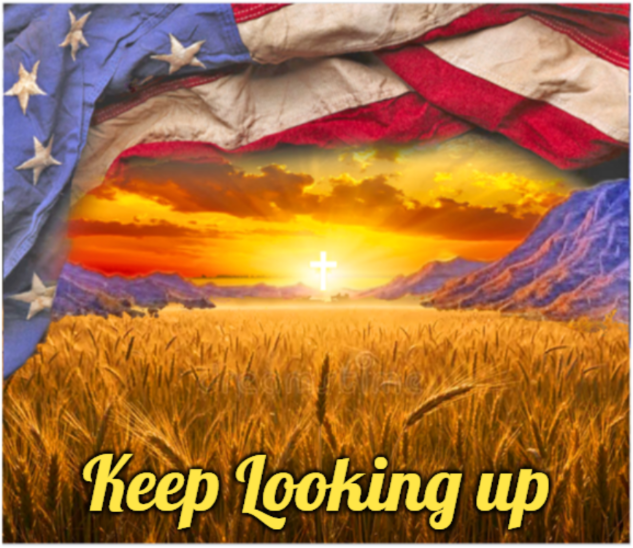
Keep Looking Up

Hopefully, every Sunday, we can find something here that will build us up a little . . . give us a smile . . . and add some joy or peace, very much needed in all our lives.
“This day is holy to the Lord your God;
do not mourn nor weep.” . . .
“Go your way, eat the fat, drink the sweet,
and send portions to those for whom nothing is prepared;
for this day is holy to our Lord.
Do not sorrow,
for the joy of the Lord is your strength.”



In God We Trust
“Nothing can be more certain than that our country was founded in a spiritual atmosphere and with a firm trust in God” (https://history.house.gov/HistoricalHighlight/Detail/36275, accessed 12/1/22). These words were pronounced by Florida Representative Charles Bennett in 1955 on the House Floor as he proposed a bill that would require the words In God We Trust to be inscribed on all U.S. currencies. The bill was eventually signed into law by President Dwight D. Eisenhower on July 11, 1955. While In God We Trust had previously appeared on coins since after the Civil War, Bennett’s legislation codified the inscription on U.S. currency and led to a later act of Congress making the phrase In God We Trust the national motto of the United States of America.
While the exact phrasing of In God We Trust does not appear in the Bible, there are many passages that exhort readers to trust in the Lord. Solomon instructs his readers to “trust in the Lord with all your heart and lean not on your own understanding” (Proverbs 3:5). Isaiah records a song that includes the encouragement to “trust in the Lord forever, for in God the Lord we have an everlasting Rock” (Isaiah 26:4, NASB). David adds that people should “offer the sacrifices of righteousness, and trust in the Lord” (Psalm 4:5, NASB). There are many similar instances in Scripture challenging people to trust in the Lord.
We also discover instances in the Bible where people epitomized the saying In God We Trust. Jesus trusted His Father (Hebrews 2:13). Daniel trusted in God and was delivered from the lions’ den (Daniel 6:23). Daniel’s three friends, Shadrach, Meshach, and Abednego, also trusted in God, and He delivered them from the fiery furnace (Daniel 3:28). David wrote that God doesn’t forsake those who have trusted in Him (Psalm 9:10).
On the other hand, there are numerous biblical warnings against trusting in anyone but God. Job explained that trusting in wealth is an iniquity tantamount to denying God (Job 31:24–28). Solomon cautions that the one trusting his own heart is a fool (Proverbs 28:26). Jeremiah records God’s warning against trusting in humanity: the one who trusts in “flesh” is like a bush in the desert, while the one who trusts in the Lord will be like a tree planted by water (Jeremiah 17:5–8).
In saying that people should trust Him, God is not saying that people should not trust each other. In fact, the kind of love He expects us to show “believes all things” and “hopes all things” (1 Corinthians 13:7, ESV). The warning is about trusting in humanity rather than trusting in God. The problem is that the heart is deceitful and sick, and the only one who understands the depths of that depravity is God (Jeremiah 17:9). He is the only One who is worthy of our full trust. If we trust in God—like the people of old who could say, “In God we trust”—we will not be disappointed (Psalm 22:5).
xhttps://www.gotquestions.org/in-God-we-trust.html
One Nation Under God
The saying “one nation under God” is a part of the Pledge of Allegiance of the United States of America. An early version of the pledge was composed in 1885 by Captain George Thatcher Balch. Balch was an officer in the Union Army during the Civil War who wanted to find ways to teach patriotism to young children in the public schools. A few years later, in 1892, Francis Bellamy, a Baptist pastor from New York, significantly revised and expanded Balch’s original pledge in an effort to promote the 1893 World Fair. This version of the pledge went largely unaltered for decades when Congress officially adopted it in 1942 at the start of World War II.
However, the saying “one nation under God” was not a part of Bellamy’s pledge (the original draft simply stated, “One nation, indivisible”). In fact, Bellamy staunchly believed in the separation of Church and State and intentionally did not include any references to God in the pledge. It wasn’t until 1954 under the direction of President Eisenhower that the words “under God” were added to the pledge. This was mostly due to the growing fear of communism throughout the United States during the Cold War.
The inclusion of the phrase under God was meant to reaffirm America’s heritage as a predominately Judeo-Christian nation in the face of looming global threats (especially ones that were derived from atheistic, materialist worldviews such as communism). Having just come out of World War II, and with the Cold War in full swing, President Eisenhower sought to unify the nation and proclaim trust in God against destructive, godless forces.
In short, the saying “one nation under God” is simply the call of a citizenry to be a unified nation that trusts God to protect them from harmful and evil forces.
Is it wrong to pledge your allegiance to the country in which you are a citizen? No, the Bible does not forbid such an action. In fact, unity among the citizenry of a nation is a good and virtuous thing to pursue, so long as that nation is not directly contradicting the Word of God in its governance.
Ultimately, as Christians, our allegiance is to God alone. His Word is to be the ultimate authority in our lives (Joshua 1:8; 2 Timothy 3:16–17) as we seek to be good citizens of our nations (Matthew 22:21; Romans 13:1–3; Titus 3:1). In fact, the Bible puts a strong emphasis on being unified as God’s people as we live and interact with one another in our daily lives (John 17:11; Romans 15:5–6; Ephesians 4:3). So, in a nation like the United States where the majority of people identify as Christian, being “one nation under God” would be a natural outflow of living according to the biblical commands for unity.
x https://www.gotquestions.org/one-nation-under-God.html