

His Fraudulency
The situation is unchanged. His Fraudulency continues to infest the White House, we haven’t heard much from the person who should have been declared the victor, and hopium is still being dispensed even as our military appears to have joined the political establishment in knuckling under to the fraud.
One can hope that all is not as it seems.
I’d love to feast on that crow.
Justice Must Be Done.
The prior election must be acknowledged as fraudulent, and steps must be taken to prosecute the fraudsters and restore integrity to the system.
Nothing else matters at this point. Talking about trying again in 2022 or 2024 is hopeless otherwise. Which is not to say one must never talk about this, but rather that one must account for this in ones planning; if fixing the fraud is not part of the plan, you have no plan.
Lawyer Appeasement Section
OK now for the fine print.
This is the WQTH Daily Thread. You know the drill. There’s no Poltical correctness, but civility is a requirement. There are Important Guidelines, here, with an addendum on 20191110.
We have a new board – called The U Tree – where people can take each other to the woodshed without fear of censorship or moderation.
And remember Wheatie’s Rules:
1. No food fights
2. No running with scissors.
3. If you bring snacks, bring enough for everyone.
4. Zeroth rule of gun safety: Don’t let the government get your guns.
5. Rule one of gun safety: The gun is always loaded.
5a. If you actually want the gun to be loaded, like because you’re checking out a bump in the night, then it’s empty.
6. Rule two of gun safety: Never point the gun at anything you’re not willing to destroy.
7. Rule three: Keep your finger off the trigger until ready to fire.
8. Rule the fourth: Be sure of your target and what is behind it.
(Hmm a few extras seem to have crept in.)
Spot Prices
All prices are Kitco Ask, 3PM MT Friday (at that time the markets close for the weekend).
Last week:
Gold $1701.10
Silver $25.32
Platinum $1136.00
Palladium $2398.00
Rhodium $27,800.00
This week:
Gold $1728.90
Silver $26.03
Platinum $1207.00
Palladium $2426.00
Rhodium $22,000.00
Everything is up…except rhodium which dropped over $5,800. However, lately these prices have been bouncing round inside a range (gold has sometimes been under $1700), so this is deceptive; things are at the top of the range today, they were lower in the range last Friday.
I don’t know if there is such a thing as a rhodium futures market, but if so, I imagine anyone who trades in it needs tranquilizers.
Rhenium
Rhenium is our next precious metal to be discussed. It lies to the left of the block of six “platinum group metals” so it’s something of an outlier in the group of nine precious metals (silver, gold, the six PGMs…and rhenium).
[A bit left of center in the table below, you’ll see it, #75, symbol Re. The PGMs are the 3×2 block to its right (44-46 and 76-78), silver and gold (47 and 79) are to the right of the PGMs.]
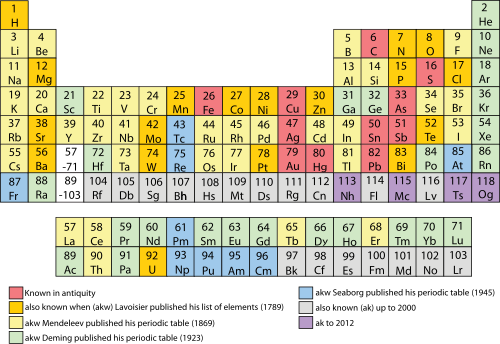
Rhenium was one of the last stable elements–i.e., one of the last you can find out there and own–to be discovered. (Just for instance the eighteen elements we know of past fermium (100), all discovered in the last 60 years or so, probably don’t even exist right now. Perhaps, though, someone is running an experiment and creating some of them right now, but if so, they’ll be gone within minutes of the experiment’s conclusion.)
In 1914, the period table was looking like it was filling up. What was missing was the blue squares in the diagram, plus #72. Also no one knew of anything past 92; such a thing hadn’t even been imagined.
Henry Moseley had validated the concept of atomic number the year before, so we now could assign numbers to elements and know they either were, or were not, adjacent to each other with no undiscovered element between them. We already could tell this, for the most part, with most elements but couldn’t be sure with the rare earths–and the discovery of the noble gases had revealed an entire column of the periodic table we had no notion of beforehand (the rightmost column in the table above). We really couldn’t know there weren’t more undiscovered columns, until Moseley did his work.
So there were six known holes in the table: elements 43, 61, 72, 75, 85, and 87. We expected 85 and 87 to be radioactive, and it probably wasn’t much of a surprise when they turned out to be hard to find because only a few trillion atoms of them existed all over the earth at any given time…and not the same trillion as there were yesterday. They were found around 1940, by a technique totally unimagined in the teens and twenties. But 43, 61, 72, and 75 should have been findable; they didn’t seem to have high enough numbers to be radioactive.
Really aggravating was the fact that 43 and 75 are in the same column of the periodic table, right below manganese. Those two elements should be chemically very similar to each other, and in fact element 73 (two columns to the left) had been discovered by poking through the ores of element 41, its upstairs neighbor. If we could find element 43, we’d probably find element 75, for the same reason, but we couldn’t fricking find element 43 either! With no element 43 ores, we couldn’t search those ores looking for element 75. A basic catch 22 (titanium).
[72 was indeed found in 1925 by looking through samples of element 40 (zirconium). It turned out to be so chemically similar that almost every sample of zirconium had anywhere up to 5 percent hafnium in it…and we had had no idea. Even today, they usually don’t bother removing the hafnium from zirconium, because it’s a cast iron pain in the ass to do so, and assays of zirconium will say something like “99 percent pure as long as you ignore the hafnium” (paraphrasing). But it turns out zirconium was great for sheathing nuclear fuel rods, because it didn’t absorb neutrons, and halfnium was great for control rods, because it absorbed neutrons like a sponge…so we had to learn how to separate the two elements for nuclear applications lest they degrade each other’s performance. It’s still a pain in the ass, but sometimes it’s gotta be done.]
In 1908, Masataka Ogawa claimed to have discovered element 43. We now know he really had discovered element 75, but back then he was simply disregarded. In 1922, however, another trio of researchers, Walter Noddack, Ida Noddack and Otto Berg discovered element 75, and realized it was element 75, and this time it stuck. In 1925 they reported that they had seen the element in platinum ore and a few other minerals. In 1928 they were able to extract a gram of it by processing 660 kilograms of molybdenite. (An ore of molybdenum, element 42, from the next column to the left.) And we still had no idea where in the bloody hell element 43 was!
They named their element 75 discovery rhenium, after the river Rhine.
Rhenium was considered ultra-rare back then (because there really aren’t any good ores of it) and is still pretty rare stuff. It is, however, used not for jewelry. It’s more like those workhorse elements like molybdenum, and vanadium, and niobium…the sorts of things that get put into steel so you can buy tools with funny names ending in “ium” on them at Home Depot. And indeed, it’s used in superalloys, the sorts of alloys that show up in jet engine turbine blades. In pure form rhenium can be heated and cooled, over and over again, and not show any stress from the process–untrue of other metals. It has been called the perfect metal for that reason, and has even found use in rocket motors, despite the fact that it is very, very heavy (which is hell on spacecraft design, as every ounce of additional weight means many pounds of extra fuel, which means bigger boosters).
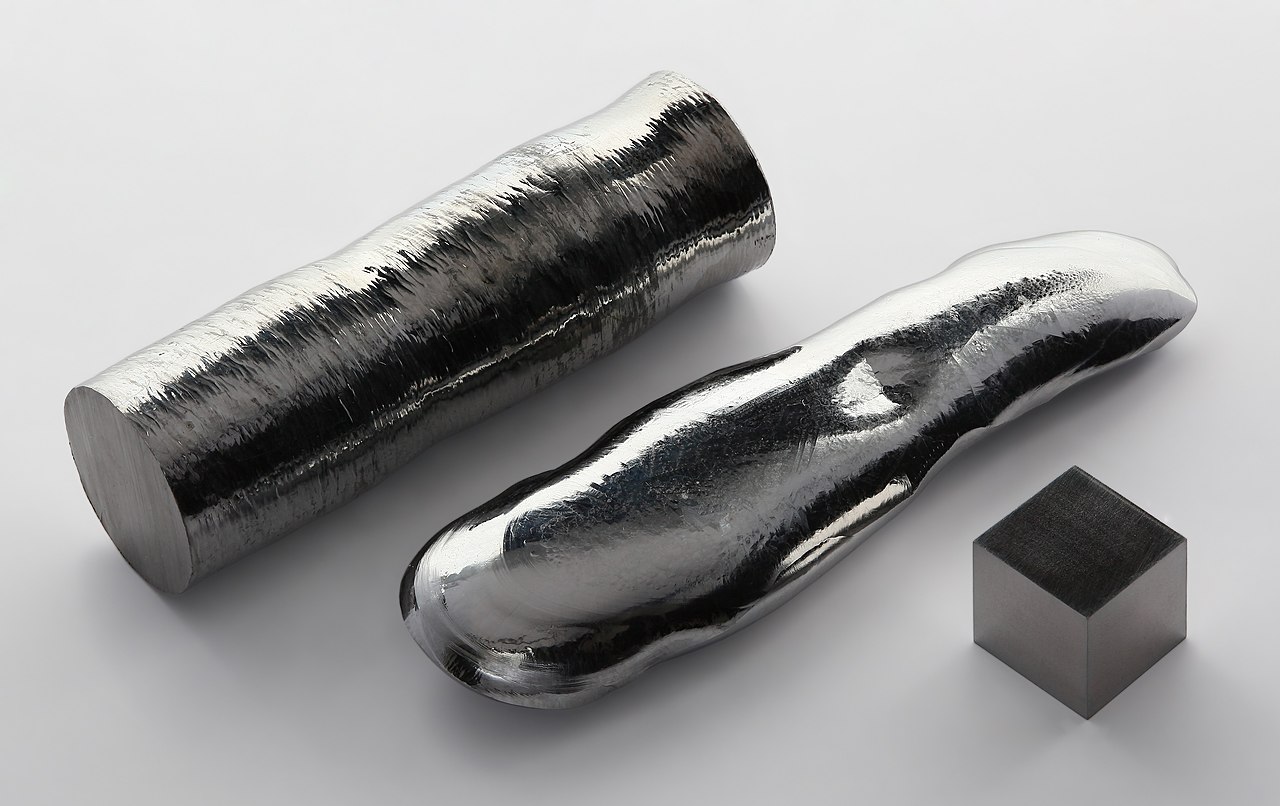
A cubic centimeter of rhenium (like the cube shown in the photo above) weighs 21.02 grams. The same amount of water weighs one gram, in fact that’s how they originally defined the gram. Osmium, iridium and platinum come in higher than rhenium’s density. Nothing else does. It’s almost twice as heavy, volume for volume, as lead (11.9 grams per cubic centimeter), and is twice as heavy as silver (10.5).
I’ve had a hard time running down its spot price (an indication there probably really isn’t one), but it seems to cost about $1200 per kilogram. Yes, the price is quoted per kilogram, not per troy ounce. Which is roughly 35 dollars a troy ounce. Given how rare it is, that’s a low, low price.
But it has a very high melting point, which means it’s hard to find as bars. Not impossible, but hard. Once company, Luciteria, does make troy ounce square bars of the stuff but they charge well over $200 for them which seems steep to me.
In the fullness of time, it turned out that element 43 was hard to find because there isn’t any of it to speak of. All of its isotopes are radioactive, with half lives of two million years or so, so any that was on Earth when it was created is long gone, and unlike with something like radium, there’s nothing long lived that decays into it to keep renewing it. (The occasional uranium atom fissions and one of the pieces will turn out to be technetium, but that’s very rare in nature, and could never have been detected in 1922.) In fact, element 43 was discovered in 1937 when we inadvertently artificially created it from element 42, molybdenum, and it was named technetium as a result.
Masataka Ogawa got the last laugh, long after he died. His proposed name for his discovery was nipponium, symbol Np. Well Np as a symbol ended up going to neptunium–when we started creating elements artificially, neptunium was readily created from uranium. Decades later, when a Japanese team created element 113, it got the name nihonium, symbol Nh, and the team was very consciously honoring Ogawa, who had discovered rhenium without realizing it, with this choice.
(And as long as Neptune has slid into this sideways into this discussion of unrecognized finds, I’ll point out that Galileo did see Neptune back in the early 1600s. But he had no idea that it wasn’t just another star; we only know he saw it because he drew a diagram of some of the “stars” he saw and one dot on his diagram could only have been Neptune. Someone finally recognized Neptune for what it was in 1846, having been told where to look for it by analyzing unexpected perturbations in Uranus’s orbit.)
Obligatory PSAs and Reminders
China is Lower than Whale Shit
Remember Hong Kong!!!
中国是个混蛋 !!!
Zhōngguò shì gè hùndàn !!!
China is asshoe !!!
China is in the White House
Since Wednesday, January 20 at Noon EST, the bought-and-paid for His Fraudulency Joseph Biden has been in the White House. It’s as good as having China in the Oval Office.
Joe Biden is Asshoe
China is in the White House, because Joe Biden is in the White House, and Joe Biden is identically equal to China. China is Asshoe. Therefore, Joe Biden is Asshoe.
But of course the much more important thing to realize:
Joe Biden Didn’t Win
乔*拜登没赢 !!!
Qiáo Bài dēng méi yíng !!!
Joe Biden didn’t win !!!