

Joining The Herd Of Lemmings
I’ve had cause to consider a few things. Maybe we’re going about it the wrong way, and we need to ditch Trump
Yeah, NO
Trump all the way! Why? Because being hated by the people who hate him is a sign of impeccable character, that’s why.
The haters can go fuck themselves with rusty twelve gauge bore brushes. I’d prefer ten gauge but that’s kind of scarce, so…I’m willing to compromise.
The RINO’s Dilemma
The RINOs who who have burrowed in and taken over most GOP organizations, from the state down to local organizations, have quite a dilemma on their hands, and most of them have their heads too far up their asses to realize it.
OK, I’m not talking about the liberal in a Republican area, who knows they’re in the wrong party, but is there because it’s the only game in their town; they hope to capture a nomination someday, at which point they’re guaranteed to be elected…otherwise, they never will be. These people are a hazard in any heavily conservative area.
No, I’m talking about the guys who are a little bit conservative and want to do some good by going into politics, and they’re in a closely matched area, closely enough that they can join the party they are most aligned with and still have a chance. They think the Democrats…particularly the ones who end up running for office…are nuts.
They don’t think much better of the Deplorable types, either. A bunch of bumpkins whose hearts are in the right place, mostly…OK a bit extreme. But they think Deplorables can’t understand that first you have to get elected, then work within the system to change things…a slow process. They genuinely want many of the things Deplorables want…just not as much. The government is spending too much. Or they need to spend money on highways instead of welfare for illegal immigrants. But they want to work within the system to get these things done.
Or maybe they think things are pretty close to ideal right now, and they want to nail it in place.
The problem is, that means they don’t stand for anything in particular. And it shows. They’re about as unappetizing to the electorate as a puddle of dog vomit. The folks in the middle, who they think they are appealing to because they themselves are not extreme, would honestly prefer a clear-spoken radical to someone who qualifies everything they say to the point where they sound like they don’t believe anything at all.
The problem these “Mild RINOs” have, is they just can’t see that. And the reason they just can’t see that, is their entire sense of self-worth is tied up in not seeing that. In their minds, they’ve worked tirelessly for their party, to keep those crazy Democrats out…only to have to constantly fight with a small number of crazy Republicans–who are only liabilities if they end up as candidates. They’ve fought the good fight, and if they can just find the right candidate, someone with some charisma, they might stop the crazies…without being too beholden to the OTHER crazies. In the meantime it’s not working. What’s a responsible guy in politics to do?
They simply cannot understand that the Republicans can’t succeed as the party of nothing in particular. Not really in the past, and certainly not today when people are starting to realize that no matter what they do in the voting booth, the country is still about to fly off a precipice. If they did see it, they’d suddenly have two choices: Go away and let the GOP succeed, or stay and fight. But “go away” isn’t really an option, because what’s the point of having a party now owned by the crazies, win?
Well, they have a dilemma…and WE, therefore have a problem. And we would have that problem even IF they realized that they had a problem…that they were the problem.
No one ever thinks they are the bad guy. Even Epstein probably thought he was the good guy. Right up to the moment where he didn’t kill himself.
So if you ever wonder why these unappetizing dufuses cling on even when their fingernails are being left behind…that’s why. They don’t understand no one wants them, and can’t imagine that no one should want them. And oftentimes their greatest pride is in all the hard work they’ve done for the party. They’re not going to give that up; it’d be psychological suicide.
If you’ve worked with these people, there’s a good chance you like them and consider some of them your friends. But even if so…we’re going to have to give them a good, hard shove. Because America is more important than those milquetoasts’ egos.
Justice Must Be Done
The prior election must be acknowledged as fraudulent, and steps must be taken to prosecute the fraudsters and restore integrity to the system.
Nothing else matters at this point. Talking about trying again in 2022 or 2024 is hopeless otherwise. Which is not to say one must never talk about this, but rather that one must account for this in ones planning; if fixing the fraud is not part of the plan, you have no plan.
Lawyer Appeasement Section
OK now for the fine print.
This is the WQTH Daily Thread. You know the drill. There’s no Poltical correctness, but civility is a requirement. There are Important Guidelines, here, with an addendum on 20191110.
We have a new board – called The U Tree – where people can take each other to the woodshed without fear of censorship or moderation.
And remember Wheatie’s Rules:
1. No food fights
2. No running with scissors.
3. If you bring snacks, bring enough for everyone.
4. Zeroth rule of gun safety: Don’t let the government get your guns.
5. Rule one of gun safety: The gun is always loaded.
5a. If you actually want the gun to be loaded, like because you’re checking out a bump in the night, then it’s empty.
6. Rule two of gun safety: Never point the gun at anything you’re not willing to destroy.
7. Rule three: Keep your finger off the trigger until ready to fire.
8. Rule the fourth: Be sure of your target and what is behind it.
(Hmm a few extras seem to have crept in.)
Spot (i.e., paper) Prices
Last week:
Gold $1,798.90
Silver $23.56
Platinum $1,034.00
Palladium $2,026.00
Rhodium $13,350.00
This week, 3PM Mountain Time, markets have closed for the weekend.
Gold $1,794.00
Silver $23.31
Platinum $999.00
Palladium $1,780.00
Rhodium $12,800.00
Gold and silver are stable. The platinum group metals, though, are taking a beating. I don’t think I’ve seen rhodium this low in a long, long time, and palladium is actually less than gold!
I take that as a sign the economy is circling the drain…those PGMs are industrial metals in the main, platinum a bit less so, but then it also took less of a beating than the other two.
Fuck Joe B*d*n
Due to complaints about foul language, I’ve censored the most objectionable word in the title of this section.
B*d*n, you don’t even get ONE scoop of ice cream today.
(Please post this somewhere permanent, as it will continue to be true; the SOB will never deserve a scoop.)
Fusion
There has been a fair amount of attention paid to the recent breakthrough in nuclear fusion. So it’s time for a bit of a review about nuclear fusion.
But there are some preliminaries…rather basic ones from a physicist’s point of view, not so from the point of view of many others.
Power vs. Energy
First off, the difference between power and energy. The physicist defines energy as the capacity to do work…and then defines work as motion against an opposing force. (Note: this is quite a bit different from the daily life definition; for example if you simply carry a 94 pound bag of cement across a level field, to a physicist you’re not doing work–okay, lifting the bag is work, but setting it down again cancels that out. To your muscles, you sure as heck are doing work.)
Energy is measured in joules in the SI (“metric system”); and lifting an apple a meter is about a joule of work. So is lifting two apples half a meter apiece. It’s work because you’re moving the apples upward against the force caused by the pull of gravity.
Power is not the same thing as energy. It’s actually how fast you expend energy. If you lift that apple one meter in one second, then pick up another apple and lift it up before two seconds (total) have elapsed, then pick up a third apple in the third second and so on, you’re using a joule of energy every second…and a joule of energy every second is a watt. Yes, that’s the same “watt” as you use for light bulbs; a 100W light bulb uses a hundred joules ever second. Watts are not actually a measure of brightness, but we’re used to a hundred watt bulb putting out a certain amount of light, so we tend to think of it that way. So much so that the compact fluorescent “spiral” bulbs and LEDs are marketed in watt-equivalents…they tell you that this particular bulb here puts out the same amount of light as a 100 watt bulb. (I get the impression that in Europe this is considerably overstated, but it seems closer to true here in the US.) The CF or LED bulb itself, however, uses a lot less than 100 watts of actual energy to produce that light, largely because an incandescent bulb literally generates more (waste) heat than light. (Note, if you look closer at the package you’ll probably also see “lumens” listed; that’s actually the measure of how much light the thing puts out. IIRC 1600 lumens is what an incandescent 100W bulb puts out, so that’s another way to compare.)
Another measure of power is the horsepower, which is not a metric unit. Now we tend to think of horsepower as being something mechanical like power tools and car engines, and then we think of watts as representing something electrical, but the fact is the two things measure the same actual thing: the rate of usage of energy. So you can convert between them: one horsepower equals 746 watts. (If you think about it this makes sense: your power drill generates a certain amount of horsepower…by using electrical energy at a certain rate. So they must be equivalent at a fundamental level.)
OK with that high school physics class level stuff reviewed, we’re ready to move on.
The Actors and Acts
The story of fusion has two main actors. They are the proton and the neutron. They are the two things you will find in an atomic nucleus. Supporting actors are the electron and neutrino, but you can (for the most part) ignore them in this context.
Protons and neutrons are about the same mass…the neutron is just a little bit more massive. But they are small. It takes roughly 600 sextillion protons (or neutrons) to weigh just one gram. (600 sextillion = 600,000,000,000,000,000,000,000.) In terms of actual size, protons and neutrons are 0.84 femtometers in radius–1.68 femtometers across, and that’s 0.000 000 000 000 001 680 meters. Tiny little buggers!

Everything these actors do is according to one of four fundamental forces. The one you’re most familiar with as a force is gravity. The next one is electromagnetism, which manifests itself most plainly as magnets sticking to iron or steel, static electric “zaps” and your sheets sticking together after a run through the dryer. But it also is tied with light…and chemistry. Basically, in your daily life everything that happens that isn’t because of gravity is because of electromagnetism. Well, until you dig down to the nuclear level, which we are actually going to do today. The remaining two forces then come into play and are imaginatively named the strong nuclear force and the weak nuclear force. The strong nuclear force is the main player for fusion, but the other three all have a role.
The strong nuclear force is directly manifested between quarks…what are quarks? That proton and neutron are themselves made of quarks, and the strong force keeps the quarks glued together. Without it, no protons, no neutrons…nothing we know today could possibly exist. There’s also a residual side-effect of the strong force, which holds protons and neutrons to each other.
The weak force is the only one that can turn one type of quark into another; we see it as radioactive decay. At the level we’re interested in today, because it can change one type of quark to another, and protons and neutrons are made up of quarks, it can turn protons into neutrons, and neutrons into protons. That’s going to be important.
Comparing these: Gravity is extremely weak. A nuclear physicist simply never cares about it, because compared to the others its effect is very small. But that doesn’t mean it won’t be important to us today; it plays a critical role in fusion that happens in nature. Gravity may be weak, but it is always an attractive force and its range is infinite. It weakens with distance but never drops to zero. Because of this it’s sort of like the tortoise that raced the hare–it wins in the end.
Electromagnetism for our purposes today can be thought of as electrical charges, those come in two types…opposite each other, and one kind was labeled “positive” and the other “negative” because there’s a pretty good analogy between electrical charge and positive and negative numbers. It’s much stronger than gravity…think about how an itty bitty magnet can pull on a nail harder than the great, big Earth…but because there are equal amounts of positive and negative charges out there, they tend to cancel each other out at distances…so even though in theory the force goes out forever just like gravity does, it’s effectively self-canceling at distances.
The Strong nuclear force is the strongest of the bunch…it had better be. But it is very, very short range…it’s good for about one femtometer, which is slightly greater than the radius of a proton or neutron, so it can bind one proton or neutron to the next, but fades to zero after that. It’s generally attractive, but it works like velcro. A proton or neutron has to be practically in physical contact with a neutron or another proton before the force takes effect.
The weak nuclear force is a bit weaker than electromagnetism and its range is much less than the size of a proton or neutron; about 1/1000th of the range of the strong force. What it does therefore happens entirely inside these particles, but as I said before, it’s critical nonetheless.
In our normal every day lives, protons, neutrons and electrons form atoms. The atom has a very tiny nucleus, where protons and neutrons “live”, and are surrounded by electrons essentially orbiting the nucleus. The protons have a positive electric charge, one “unit” each (the unit is a small number of coulombs, and I’m not going to define the coulomb…just think of it as +1 electric charge). The electrons have a negative charge, -1. So the electrons will be attracted to the protons, and vice versa, and will want to stick together. Those electrons will interact with the electrons of other atoms…that’s chemistry. And that’s why electromagnetism is behind chemistry.
But the protons in the nucleus (if it has more than one in it) should be repelling each other. In fact they do. Even though +1 unit is a very, very small amount of electrical charge, the protons are so close together that you could actually feel the force pushing them apart. The reason they stick together is the strong nuclear force.
Focusing on Nucleons
Protons and neutrons both seem to have the same size and mass…very close but not quite the same. The neutron is slightly heavier. In fact, since both of them live in nuclei and are so similar, they are sometimes lumped together and called “nucleons.” They are both subject to the strong nuclear force. The key difference is the proton has that +1 electric charge. The neutron has no net charge at all. (The quarks inside a neutron do, but you have to get really close to the neutron to see any effect from them.)
It’s the number of protons in a nucleus that determines which element it is a nucleus of. If it has six protons, it’s a carbon nucleus. The number of neutrons doesn’t matter for this at all. But add a proton, and you have nitrogen (7). If one of the neutrons ups and changes to a proton, it’s now nitrogen. And this does happen to carbon-14.
Wait! I just said carbon was 6, but then I talked about carbon-14. Well, I said the number of neutrons doesn’t matter for that, but it does matter for other things, Carbon-14 has six protons and eight neutrons in its nucleus, for a total number of nucleons of 14. These differing nucleon counts, that are nevertheless the same element because the proton count is the same, are called isotopes. Carbon-14 happens to be unstable; the weak nuclear force will eventually change one of the quarks in one of the neutrons, making that neutron into a proton, and now you have nitrogen 14.
Isotopes usually don’t make much difference to chemists (usually), but they’re overwhelmingly important in nuclear physics.
For nuclear fusion, specifically, we’re concerned with five different isotopes of nuclei.
The basic hydrogen nucleus is dead simple…it’s just one proton, no neutrons. Hydrogen-1. When you consider it as a complete atom (including the electron), nuclear physicists call this “protium” to distinguish it from…
The heavy hydrogen nucleus, which has the one mandatory proton, but also contains a neutron. Because there’s two nucleons in this thing, it got a special name, from deutero (two), and it’s a deuteron. When thought of as a whole atom (including electrons), it’s deuterium.
That’s actually pretty tidy: proton is to protium as deuteron is to deuterium.
Usually two different isotopes of the same element are almost identical chemically. Any slight difference is due to the different weights, a heavier isotope will react a bit more slugglishly than a lighter one. In the case of hydrogen, though, the weight difference is double and that has a noticeable effect on chemistry, so chemists actually do have to care about this difference. It can even effect water made from those atoms. If you’ve ever heard of heavy water, that’s just water made from deuterium instead of protium.
Of all the hydrogen out there, 156 atoms of every million are actually deuterium, not protium. So in every day life you can just ignore deuterium. But in fusion, the distinction is a big deal.

Both protium and deuterium are stable–they don’t decay radioactively into something else. But that’s not true of our next isotope, tritium, which is a hydrogen isotope with two neutrons. (And true to our scheme, the nucleus is sometimes called a triton.) On average after about 12 years, one of those neutrons will flip to a proton (just like with carbon-14) and you get:
A helium atom, with two protons (by definition of helium) and one neutron. This is helium 3 and on earth it is extremely rare. (It is less rare in stars.) There’s no “special” name for helium-3; you have to call it helium-3. It’s stable.
And the last of our five isotopes is helium-4, two protons, two neutrons. Almost all helium on earth is helium-4, and it came from the radioactive decay of very large nuclei. But in the stars, the story is very different. Helium 4 is not only stable, it’s extremely stable. So much so that every hydrogen nucleus out there aspires to become part of a helium-4 nucleus.

However, if you’re disappointed at the lack of pictures of helium-3 and helium-4 nuclei, well, I’ll make that up to you below.
Finally: Nuclear Fusion
So now, finally, I can tell you what nuclear fusion is. Nuclear fusion is the process of combining two atomic nuclei together to make a larger atomic nucleus; when the nuclei are small (for nuclei) doing this releases energy. A lot of energy. That’s generic, it could describe any two nuclei becoming some third nucleus.
But what almost everyone means, specifically, when they say “nuclear fusion” is the process of combining four hydrogen-1 nuclei into one helium-4 nucleus.
In our universe this is a very common process. It powers most stars, including our sun. Some stars have run out of hydrogen and are fusing helium into heavier things. We’re going to ignore that and focus on the stars still burning hydrogen; astronomers call those “main sequence” stars and stars spend most of their lifetimes as “main sequence” stars. Our sun has been a main sequence star for about four and a half billion years, and it will probably remain a main sequence star for another five billion years.
What does it take to fuse nuclei? It isn’t easy. Remember that protons repel each other quite strongly electrically, unless you’re within strong nuclear force range. I compared the strong nuclear force to velcro. Well the electrical part of the repulsion is called the “coulomb barrier” and it’s like trying to force two magnets together when it’s both north or south poles and the magnets are repelling each other. So think: very strong magnets, with velcro on them. If you can manage to force them together, they’ll stick. If you can manage to force them together.
This applies to any nuclei, but here we’re interested in the simple case, two bare protons that some guy is trying to get to stick together. The best strategy is to fire one at high speed towards the other. The repulsion, hopefully, won’t be able to slow the incoming proton enough and it will get close enough for the strong nuclear “velcro” to engage.
And how do you do that, wholesale? You heat hydrogen gas up. A lot. Temperature, after all, is just the average kinetic energy of the atoms in a substance; the higher the temperature, the faster the atoms are moving. At only a few thousand degrees, the electrons are bumped off the atoms, and they become bare nuclei–in the case of protium, they’re just bare protons. This is actually considered a fourth phase of matter. We have solid, liquid, gas, and this: plasma. Now you just have to make it so hot, they slam into each other in spite of the huge electrical force pushing them apart. We’re talking millions of degrees here.
Natural Fusion in Stars
This is how a star functions. A star spends its whole life fighting the force of gravity. It’s a big ball of gas, and gravity is trying to compress it under its own weight. Gas is compressible, so gravity can do this. Up to a point. As the gas compresses, its temperature goes up, as the temperature goes up the pressure increases, so the star reaches a point where the heat on the inside balances the gravity on the outside and its size stabilizes.
That won’t work for long, of course, because the star will eventually cool off and the pressure drops, so gravity can begin to shrink it again. Without any new energy inside the star, it will just keep collapsing.
But fusion actually provides that energy. If a star starts “burning” its hydrogen by fusing it to helium, the energy released can balance the energy lost from the star trying to cool off, and it’s stable.
A star doesn’t have to fuse a lot of hydrogen all at once–fusion supplies a lot of energy. So even a little bit of fusion is enough to keep the sun from collapsing…and it can nurse its fuel supply and not run out for billions of years. A larger star, on the other hand has more gravity trying to crush it, and needs more fusion to counteract it. But there’s a built-in control valve: The more pressure and temperature, the more fusion. So the large star just gets hotter on the inside until the amount of fusion going on counterbalances gravity. It ends up having to rip through its fuel a lot faster than a small star, but it does do so as long as it can. In the meantime it’s a negative feedback system, so it’s stable. If something were to cause the star to generate excess heat in the core, it would just expand a bit until things were back in balance again, similarly if the star were to shrink for some unknown reason: the extra heat generated would make it expand again.
Very stable, and it’s a good thing because we are utterly dependent on it being stable. (Our sun varies some, but it doesn’t go way out of bounds.)
The interior of a star consists of about 75 percent hydrogen…protium, not deuterium, and 25 percent helium-4 by weight. (That’s what the universe originally consisted of. Everything else has been made since the universe begin, and is just a trace.) And the electrons have been stripped off these atoms and will have very little effect on what’s going on. So the interior of a star is bare protons and bare helium-4 nuclei, for the most part.
Fusion inside a star usually follows the route I’m about to describe, which is called the proton-proton chain. 1) Two protons get fused together. 2) The resulting two proton combo, called a diproton, is extremely unstable, and will just fall apart again–unless one of those protons happens to turn into a neutron at that exact time. The result is a deuteron. 3) Another proton gets added to the deuteron to make helium 3. 4) two helium 3 nuclei get smashed together. The result is helium-4, and two extra protons, that can then go off and try to repeat the process.

There are some alternative routes, including one that uses carbon, nitrogen, and oxygen as a catalyst (the CNO cycle). But for stars like the sun and smaller (most stars), the proton proton chain is king.
The CNO cycle gets used more in stars larger than the Sun.
And a lot of energy is generated. In fact, for every helium-4 nucleus made, 26.73 million electron volts of energy are generated. What the heck is an electron volt? It’s a unit of energy, sized to be convenient to nuclear physicists. (This is not a rabbit hole we want to dive down; I covered it in my physics series.) Converting it to joules, we get 0.0000000000042768 joules.
Now that sounds like a millionth of a mouse fart. But remember, there are 600 sextillion protons in one gram of hydrogen gas. That’s enough to make 150 sextillion helium 4 atoms, so if we were to fuse all of the hydrogen in a gram of hydrogen, we’d have 641 billion joules of energy come out.
One kilowatt hour from your electric company is a thousand watts for one hour, or 3,600 seconds; power times time = energy so that’s 3,600,000 joules. So this one gram of hydrogen has produced 178,200 kilowatt hours of energy…that’s many many years of your electrical usage…again, from one gram of hydrogen! Which is less than half a cubic foot of the stuff. Or, it’s the amount of hydrogen in nine grams of water, which is roughly two teaspoons.
Two teaspoons of water, producing 178,200 kilowatthours of energy! Do you begin to understand why we are trying so hard to do this?
The Fly in the Ointment
There is a big problem though. That first reaction, getting two protons to get together into a deuteron…is almost impossible even at the center of the sun. Almost impossible. Even bouncing around at that temperature, and under that pressure, on average a proton will have to wait nine billion years for it to happen. Why is this so slow? Because it relies on the weak nuclear force to happen…that proton must turn into a neutron at exactly the right time, otherwise, effectively you just get protons bounding off each other, since the diproton falls apart immediately. And the weak force isn’t just weak, it’s slow.
The good news is once we do that the other steps are quick, because they only require the strong force…but we still have to get that first step out of the way.
(The other good news is that because it’s so slow, our sun lasts a long time rather than ripping through the fuel like it was gasoline-soaked pine needles dropped on a roaring fire.)
If we were to recreate the core of the sun in a fusion reactor, and put a bunch of hydrogen-1 in, it would take a long, long, long time to burn that hydrogen, and so our power output would be minimal. We’d get halfway through in 9 billion years, which means for every gram of hydrogen, we’d get 89,100 kilowatthours out…over the span of 9 billion years. Doing the math the power coming out of that plant is 314 femtowatts per gram of fuel. Or 0.000000000000314 watts.
OK, so that’s useless.
In bigger stars the temperatures and pressures are higher, so it won’t take as long under those circumstances. And maybe we could duplicate those conditions, and burn the hydrogen faster, but honestly even duplicating stars that burn fuel a thousand times faster than the sun, we’re getting nowhere. 314 picowatts/gram is still useless.
(You, sitting there reading this digesting your bacon breakfast, generate more power just maintaining your body temperature, than does an equivalent-mass part of the sun’s core. Yes, the sun’s core is hotter, but that’s pre-existing heat energy. In terms of new energy bacon works better than the sun’s core, per unit mass. But the sun’s core is so much bigger that it can power everything on Earth and the other planets with one billionth of the output and throw away the rest, sending it radiating out into the universe.) [edit: inserted this paragraph]
No, what we need to do is skip that first step entirely. In our reactors here on earth we need to start with deuterium. And helium 3. And even tritium. Then we will get most (but not all) of the energy out, but it’s well worth it, because we get it quickly enough–i.e., with high enough power–to be useful. [edit: rephrased this paragraph for clarity…as if any of this were clear.]
Our hydrogen bombs actually do this, rather than trying to fuse protium. And so do our fusion experiments. The good news is the step we skipped over only produces about 3 million (out of the 27 million) electron volts, so we will get nearly as much energy out starting from deuterium as we would have by starting with protium.
We also throw tritium into the mix, which means this is a slightly different sequence than the sun uses, because the last step in the sun is combining two helium-3s to make a helium-4 and two protons. But helium-3 is rare, and tritium actually requires a lower temperature to “ignite,” so we combine tritons and deuterons in ways that just don’t happen much inside the sun. But the end result is the same: helium-4 and energy.
But this is still hard to do. And that’s why we’ve been building big-ass labs with big-ass reactors trying to do it.
How We’re Doing It
There are two major approaches we’re following to try to get fusion to work. The first is the “Tokamak.” The idea is to ionize the deuterium and tritium, and put it inside a magnetic bottle so we can heat it up. (Nothing made of matter can be made into a container that will survive these temperatures.) We had problems with magnetic bottles leaking out the ends, so we started making them donut shaped, so they’d have no ends to leak out of. And so the tokamak–an acronym formed from the Russian for “Toroidal chamber with magnetic coils”–was born. (тороидальная камера с магнитными катушками: tokamak) [an alternate reading is “toroidal chamber with axial magnetic field: тороидальная камера с аксиальным магнитным полем.] (Luckily, t, o, k, a, and m look the same in Russian as they do in English.)

This is essentially the same idea as is being used by ITER (International Thermonuclear Experimental Reactor) in southern France. It is expected to be finished by 2025 and will be ten times the size of any previous tokamak…and who cares because we are accomplishing what it was intended to accomplish already using the other major method.
Inertial confinement is to put a small amount of deuterium and tritium gas in a certain place and instead of trying to restrain it with magnetic fields, simply heat it up so suddenly it doesn’t have a chance to escape before reaching ignition temperatures. This is what the National Ignition Facility in California does. It uses small hollow pellets called hohlraums filled with fusion fuel, a few milligrams apiece, and blasts them with super powerful lasers. The energy is delivered so suddenly the gas heats up before it has a chance to dissipate. Even the shell of the pellet participates by collapsing inward under the pressure from the lasers, increasing the pressure.
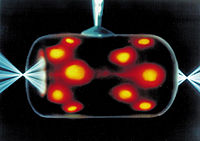
The goal of both methods is to get out of the fusion reaction more energy than it took to cause the reaction. If we can do that, we’re generating energy. Otherwise, we’re consuming it.
This latest report concerns the fact that, for the first time ever, more energy came out of the fusion than was delivered to the fuel by the lasers. 3.15 megajoules came out, with 2.05 megajoules going in, roughly a 50 percent gain. Up until now it has always been a loss; the best was only a 30 percent loss. (3.6 megajoules = 1 kilowatthour.) We’ve achieved what’s known as scientific breakeven.
The problem is those lasers are horrifically inefficient; it takes about 400 megajoules to produce those beams for one firing of the system. So if you look at the whole system, we’re using 400 MJ to generate 3 MJ…and that’s not a good deal. We’re still nowhere near overall breakeven. We need better lasers, or perhaps more energy coming out of the pellet.
So maybe ITER still has a chance.
We’ve got a long way to go, but at least, for the first time we’ve got the second half doing its job, producing energy. Without that, it doesn’t matter if the lasers don’t waste a single billionth of a joule, the system will never produce power. Now half of it does.
So it’s still going to be a while before you can run your house or car off of Mr. Fusion.
Obligatory PSAs and Reminders
China is Lower than Whale Shit
Remember Hong Kong!!!
https://youtube.com/watch?v=L3tnH4FGbd0
中国是个混蛋 !!!
Zhōngguò shì gè hùndàn !!!
China is asshoe !!!
China is in the White House
Since Wednesday, January 20 at Noon EST, the bought-and-paid for His Fraudulency Joseph Biden has been in the White House. It’s as good as having China in the Oval Office.
Joe Biden is Asshoe
China is in the White House, because Joe Biden is in the White House, and Joe Biden is identically equal to China. China is Asshoe. Therefore, Joe Biden is Asshoe.
But of course the much more important thing to realize:
Joe Biden Didn’t Win
乔*拜登没赢 !!!
Qiáo Bài dēng méi yíng !!!
Joe Biden didn’t win !!!