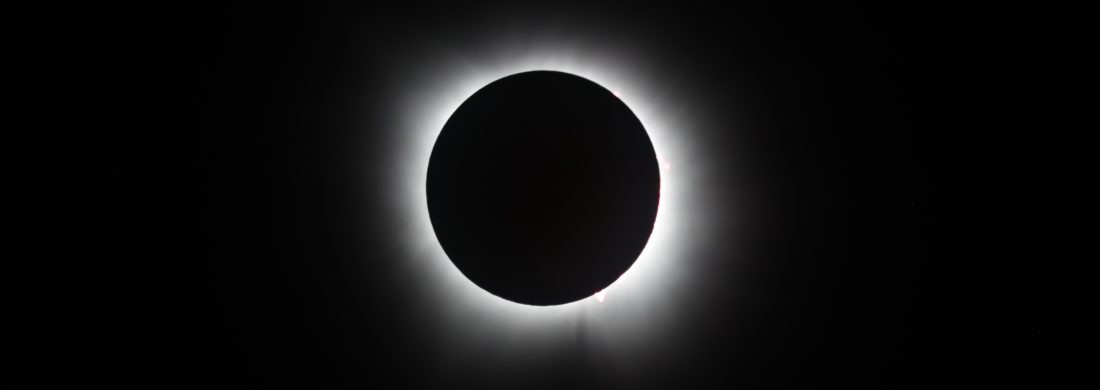
Yes. It was a new moon. They don’t get any newer than in an eclipse.
And it was a Monday.
So here we go:
And I can’t find one that’s not blocked. Sorry…
The Event
I am going to talk about the event here, the adventure of going to see it and how I took the pictures I am showing, but I’m not going to discuss the science (much); I will save that for Saturday (with, probably, some of the same pictures).
Where did I end up going? I concluded on Sunday Morning that the best shot would be Indiana. The page I was looking at showed it as “green” for cloud cover; huge swaths of Texas were red…now including Eagle Pass, which was yellow until Saturday.
So I drove to St. Louis on Sunday, and then re-checked the weather guess…Indiana had gone yellow, but much of Texas had also gone yellow. So I decided (tentatively) to go to Southern Illinois and assess with eyeballs. I ended up at Rend Lake off I-57, south of the intersection with I-64; specifically at the Ken Gray trailhead. I got there in plenty of time.
Over the course of the next few hours a number of other people also joined us in the parking lot. One group had a fully professional video camera with them; apparently they’re making a movie of some sort. Another had a 600 mm lens (a big white!). He set up on the other side of the road.
Although sometimes there was a thin haze (looking like a dispersed contrail, but much greater in extent), it would often clear up. There happened to be one of these during totality but it impeded our view too little to notice if at all.
I did not buy a new camera (despite my joke from last time); I did buy a new 20-stop neutral density filter. And then I put it and the lens on a cheaper camera (a Canon M6 mk II). Why? Because that camera has a crop sensor and the pixel density is much higher. In other words, the images of the Sun that I took would be higher resolution. I put a wide angle lens on the expensive camera hoping to capture the planets and comet during totality. (The comet, it turned out, was a pipe dream; no one knowledgeable expected to be able to see it, and in this context I was not knowledgeable.)
The tripod lets you swivel 360 around an axis, which can be tilted. I decided to try to tilt it at about the same angle as the sun’s path across the sky, to try to avoid having the Sun appear to rotate in the field of view. There’s no actual way to make this work since (except on the first day of Spring and Autumn) the Sun doesn’t follow a great-circle arc across the sky. I’d have needed an additional wedge between the tripod “head” and the camera. However, I probably came pretty close; at least the Moon seemed to exit the Sun opposite of where it entered. Since I didn’t have a drive motor anyway, it didn’t matter much.
I was in touch with someone in Texas (a bit further northeast than Eagle Pass); they weren’t much interested in photography but I got not-very-good cell phone pics taken through some sort of red filter. So I could report to all that it had started in Texas. I was relieved to hear that the Moon hadn’t disappeared overnight (that would be just my damned luck).
So here’s the Sun just before the festivities started (f/5.6, 1/1000, ISO 100, ND 20 filter. An ND 20 filter reduces the light by roughly a factor of a million without changing the color.)
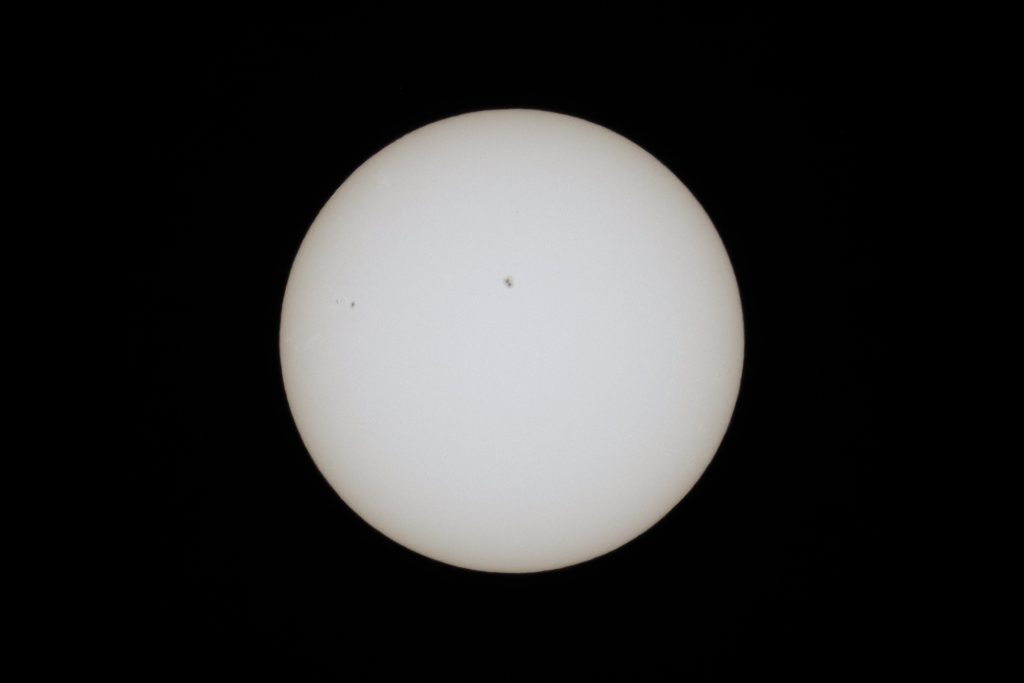
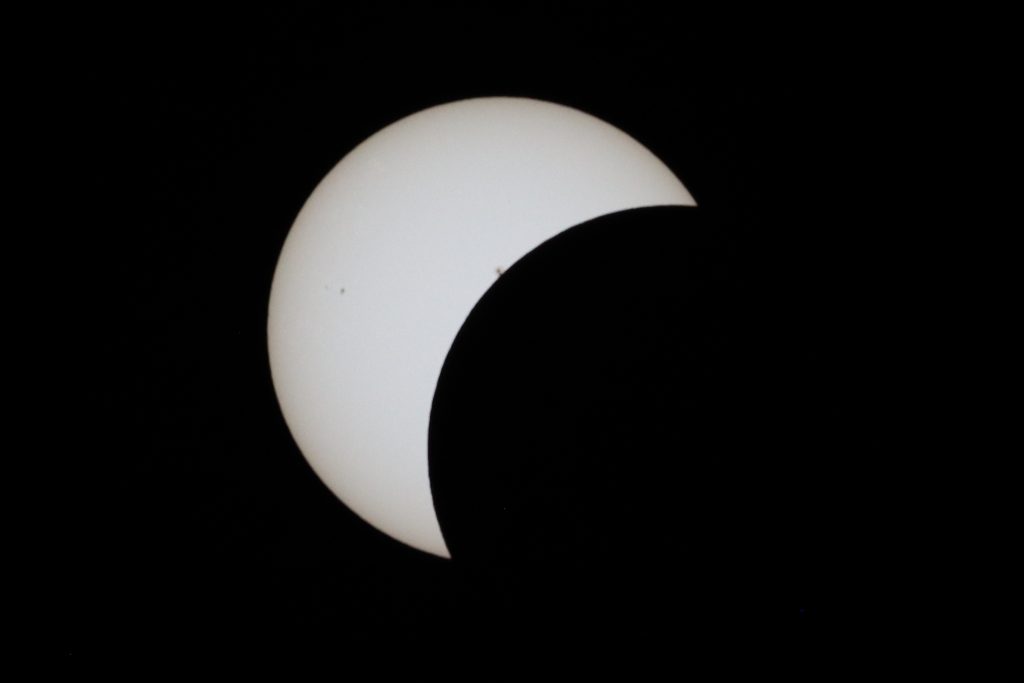
Note a big, bold sunspot just above the center, another one further out at about 9:30.
The Sun Gets Mooned
In an eclipse the lunar farside faces the Sun. Please, it’s “far side,” not “dark side.” It faces away from us; it’s not dark. Especially not here; it’s lit.
(OK…I suppose it’s “dark” in the same sense that the “Dark Ages” were dark. Not literally dark, but few records were left so we have trouble “seeing” them from our vantage point today. Likewise until spaceflight we had no idea what the far side looked like.)
More importantly, though, the far side could be considered the backside, and so during an eclipse the Moon is pointing its backside at the Sun. Meaning the Sun is getting Mooned.
OK, childish humor aside…until the next time.
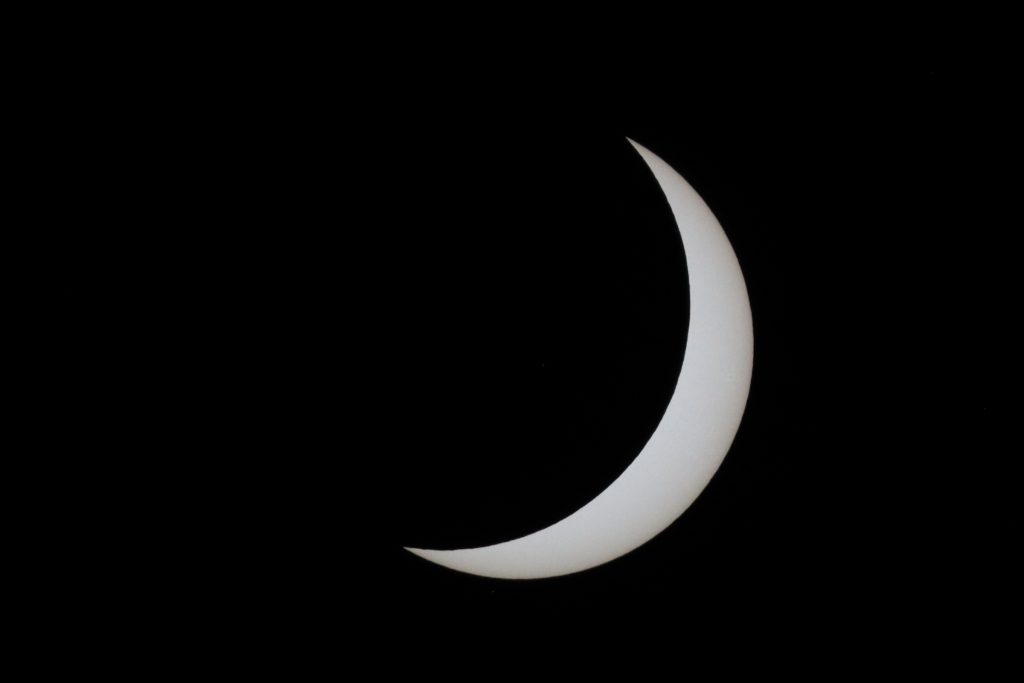
I took one shortly after the start; the Moon is moving in from the lower right.
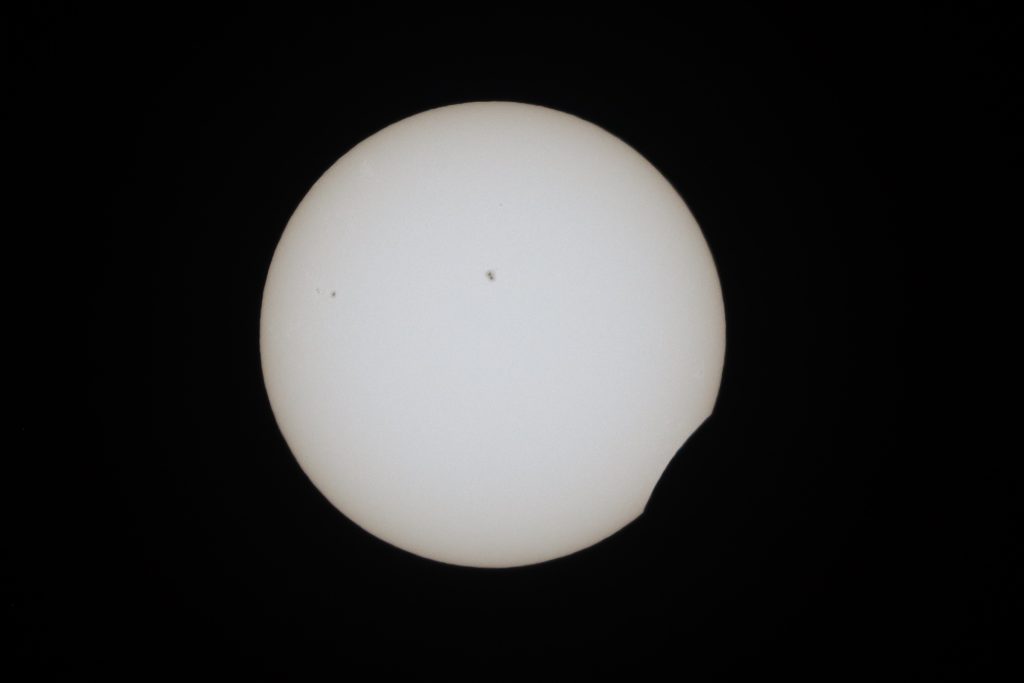
And you can see the progression. I got one in fact just before the sun spot got occluded.
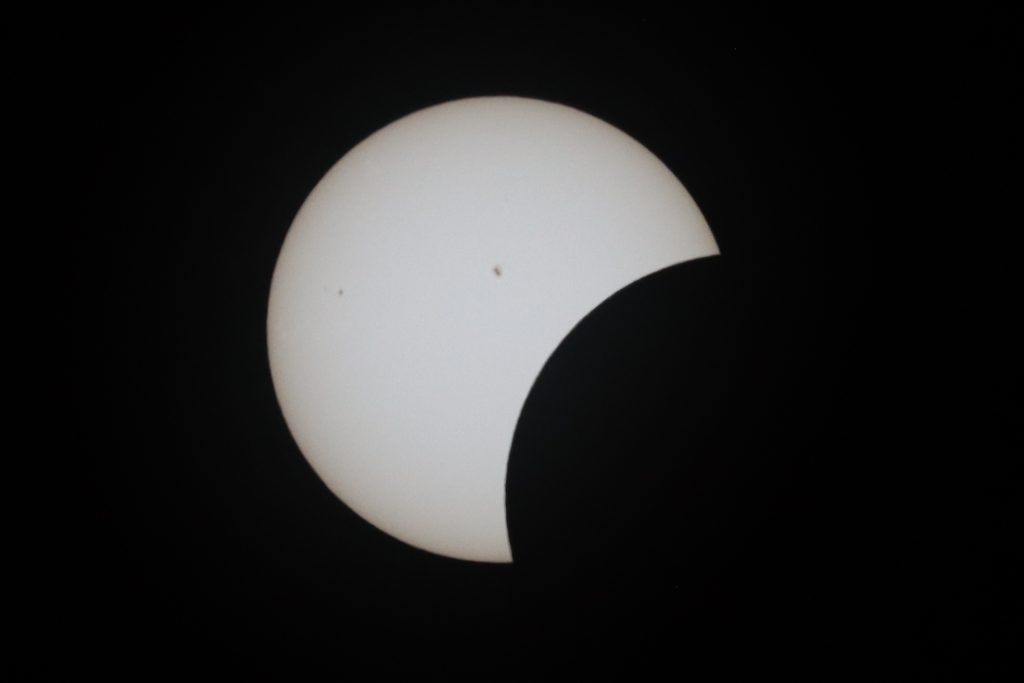
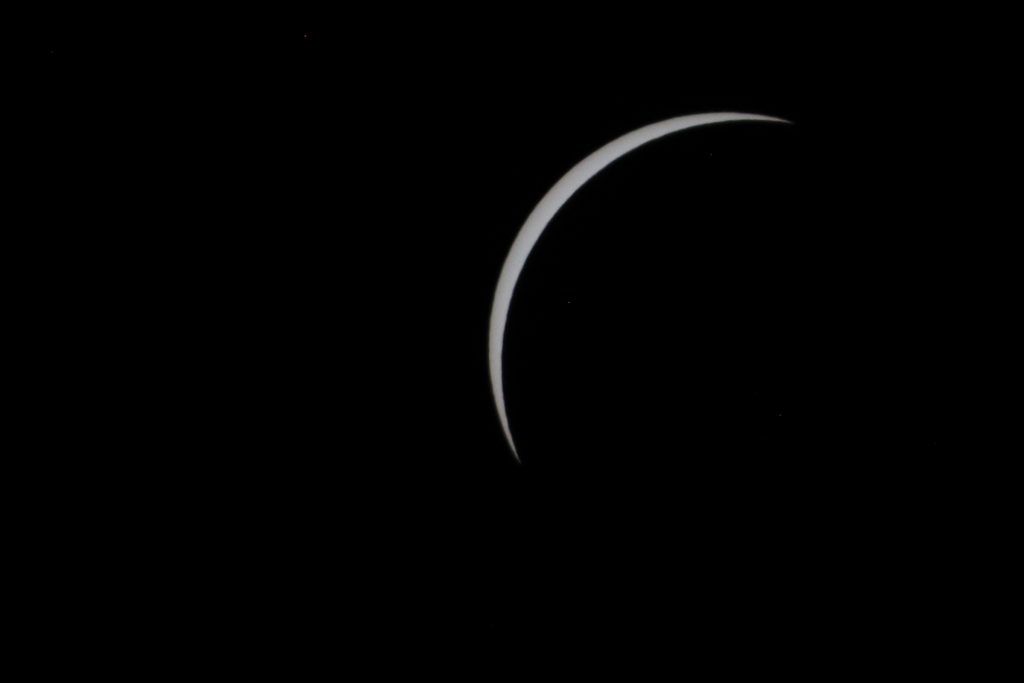
By now, the lighting looks strange. Even a bit before this if you put down the eclipse glasses and looked around, there was this funny twilight quality to the light, though it was from overhead. Seconds before totality it got downright spookily dark.
And then totality hit. And the eclipse glasses went away.
And yes, its impact is a hit. Like flipping a light switch, suddenly you see the solar corona, surrounding the blackest black you have ever seen…the actual dark side of the Moon. Looking around it was like a super bright moonlit night, probably brighter than any moonlit night ever is (even when it’s a supercalifragilisticexpialidocious moon).
I was close enough to I-57 to hear that truck traffic continued unabated during the eclipse. Hard to believe that some people either didn’t care, didn’t know…or simply couldn’t interrupt their work (if it were someone doing CPR or fighting a fire I could understand!).
This eclipse was long. I hastily unscrewed the filter from the lens, and took more pictures. (I probably should have reduced the ISO to 250 or so.)
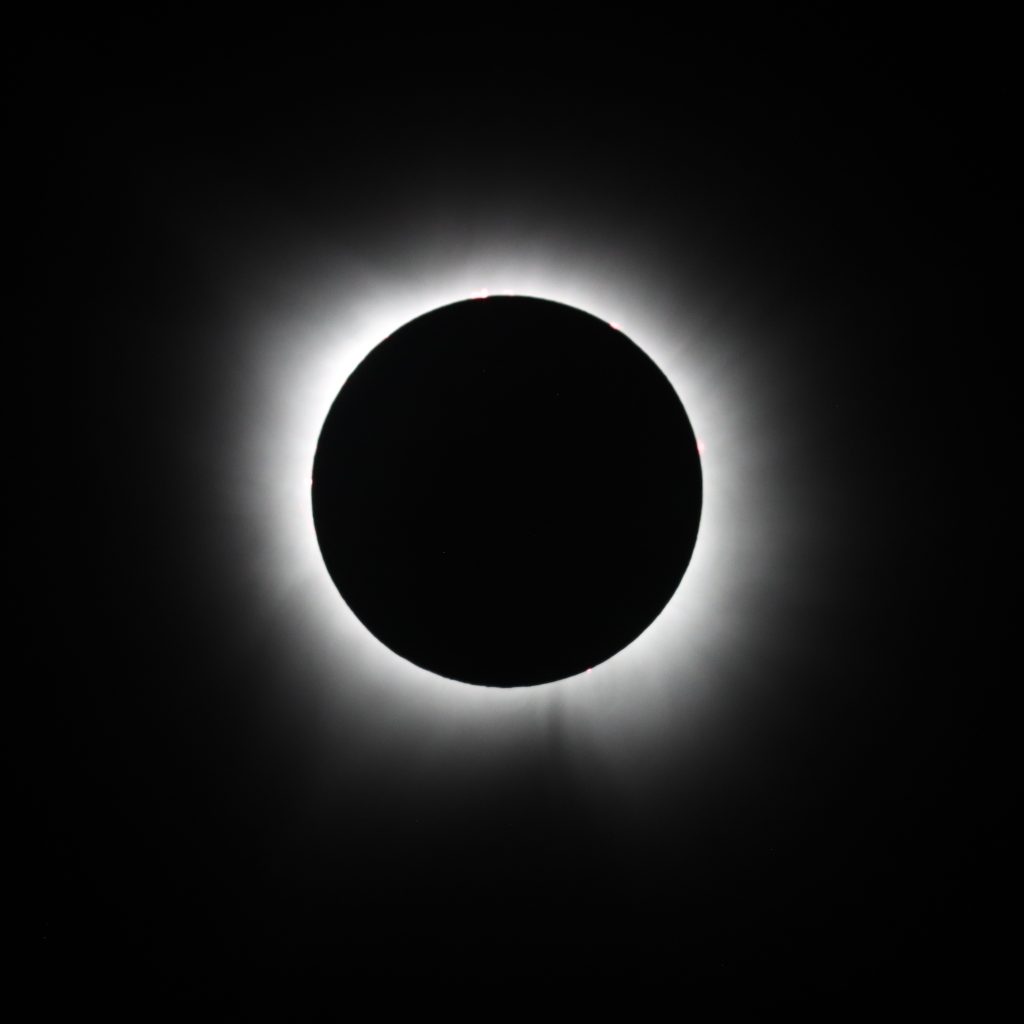
This one shows the whole corona. I’m going to go back to my regular crop after this one. Notice around the edges of the Moon, a few pink areas. Those are prominences (flares). Remember that the Moon is still moving towards the upper left. This picture was early (as in, just as fast as I could unscrew the filter!!!!) and prominences up near the top are most visible.
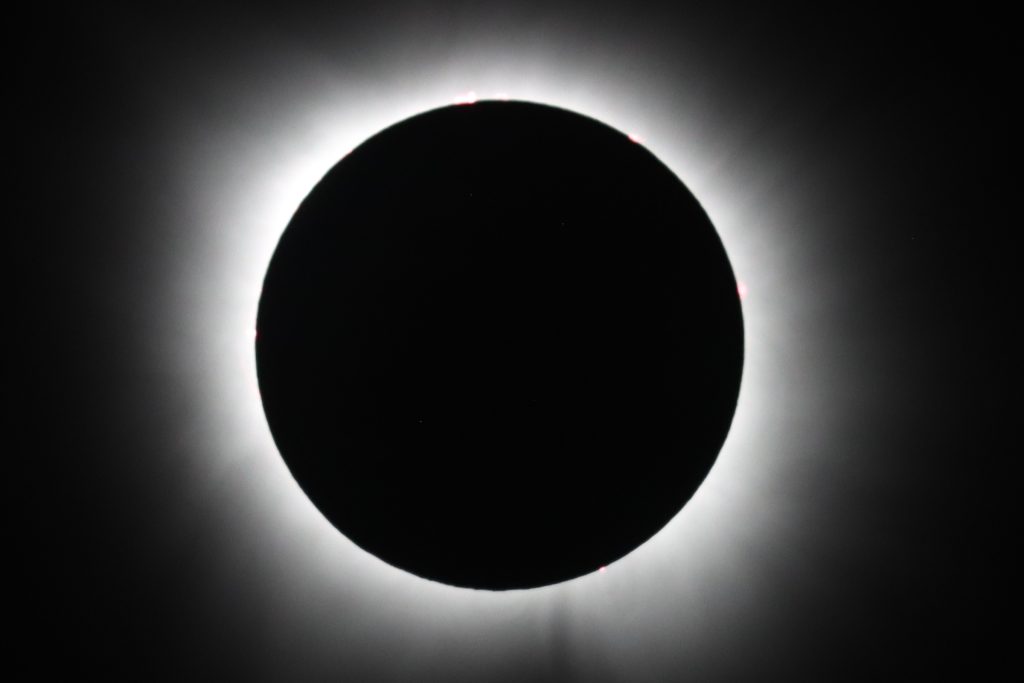
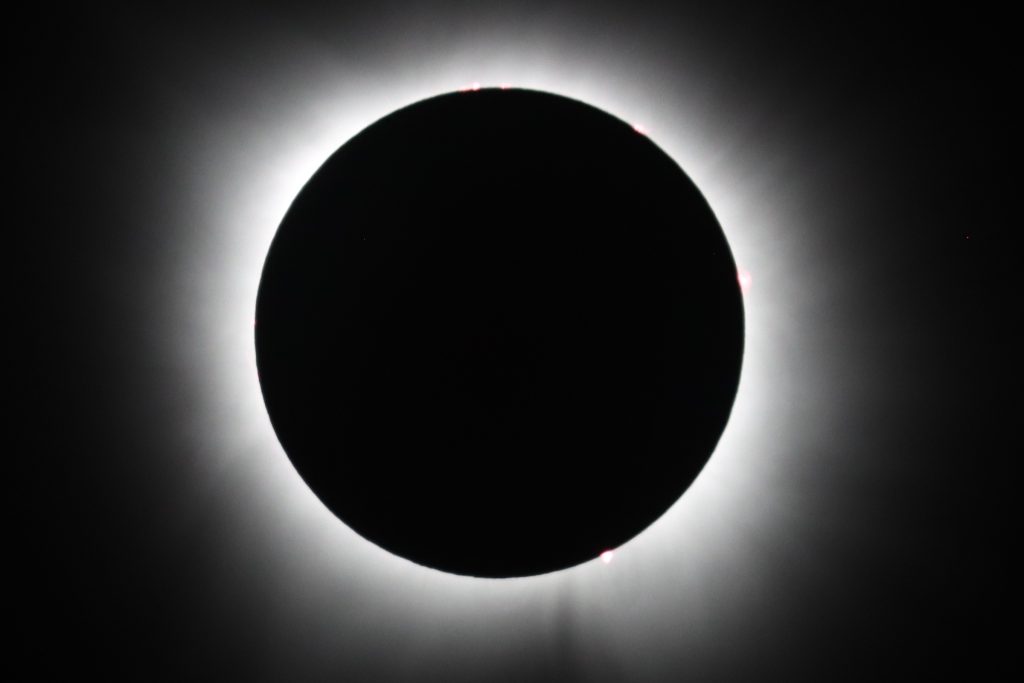
Note in this one that a prominence at about 5 o’clock is very visible. In fact it was easy to see with the naked eye. Because of the Sun’s position and orientation in the sky, that one looked like it was at the bottom of the disc to our eyes. Closer to the end of totality the one on the right hand side became visible too but wasn’t as bright as the one at the bottom.
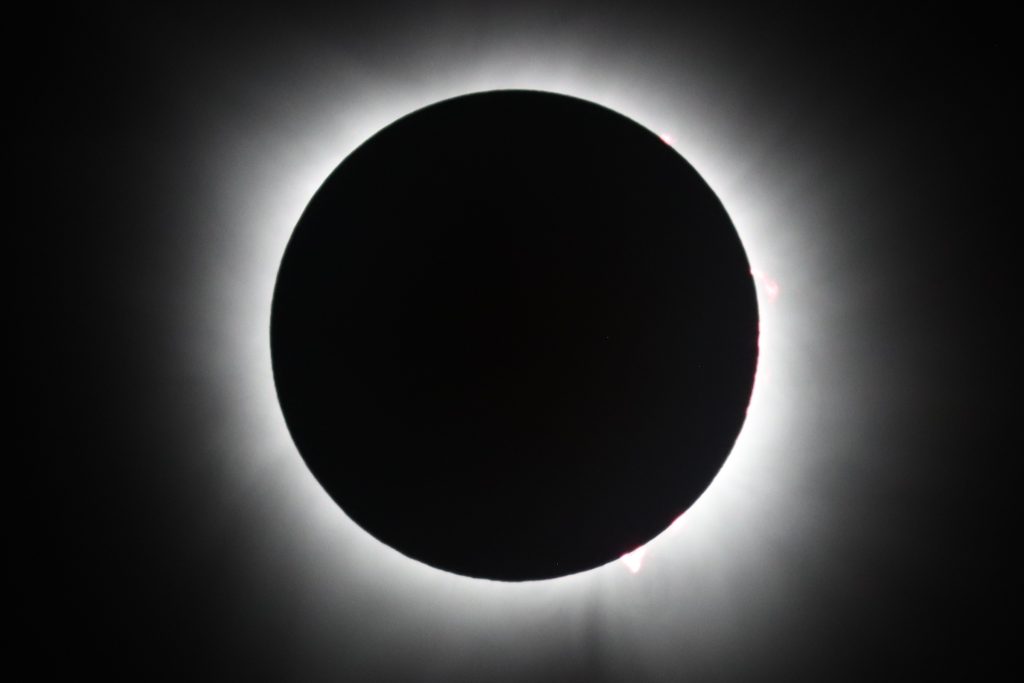
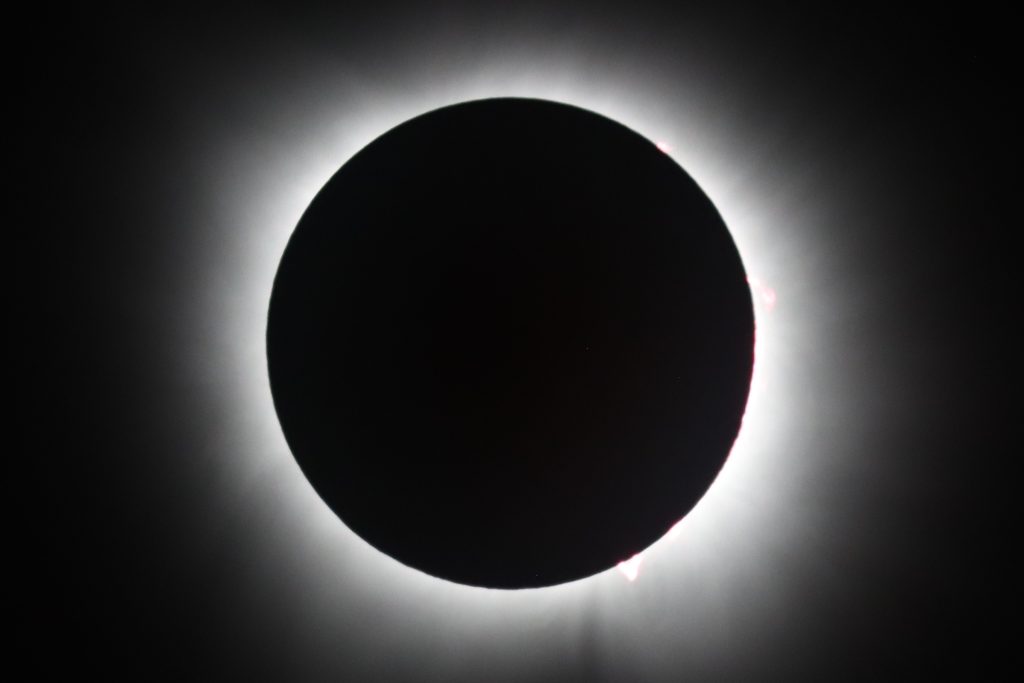
The prominence at the right is actually showing an arc.
But all good things must come to an end. And end it did.
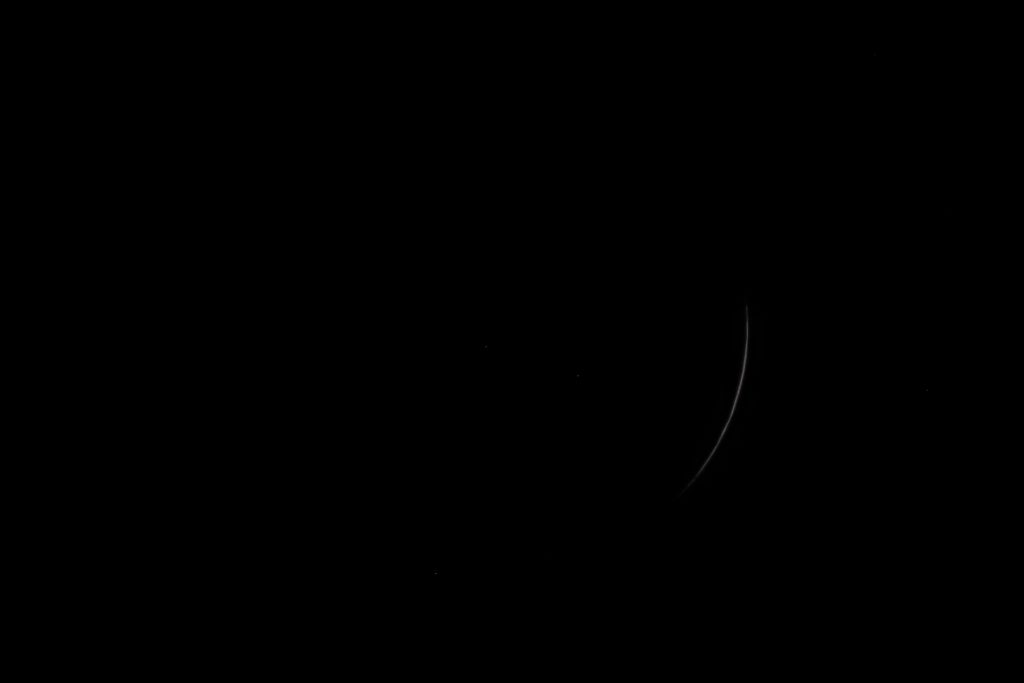
When even the slightest sliver of the photosphere (the visible “surface” of the Sun) shows up, the corona is gone. As you can see in the picture above.
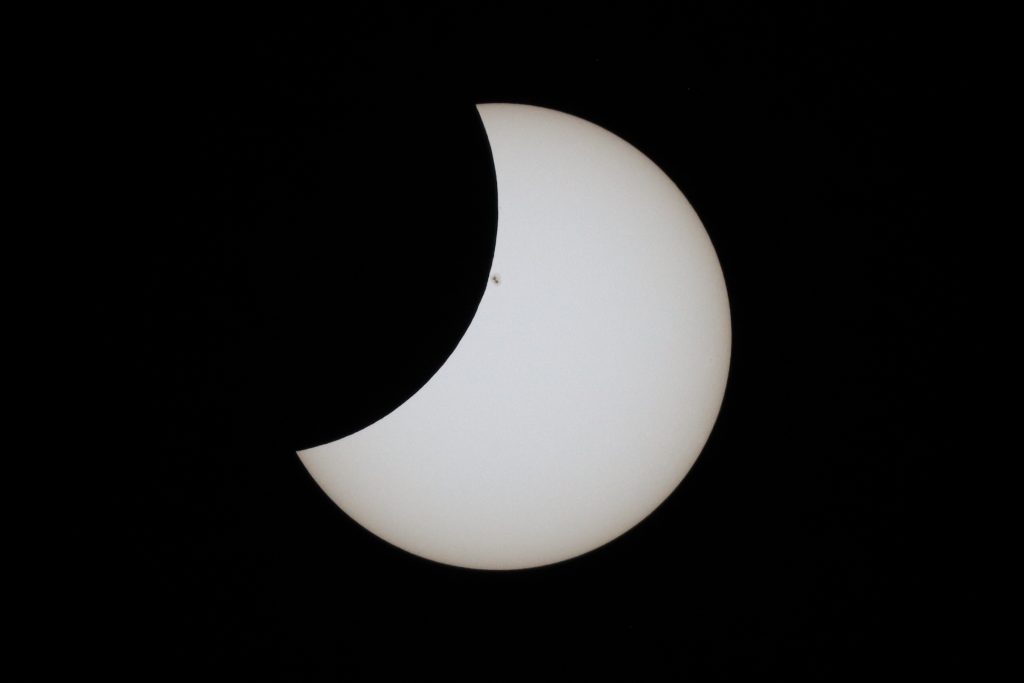
Our celebrity sunspot is back!
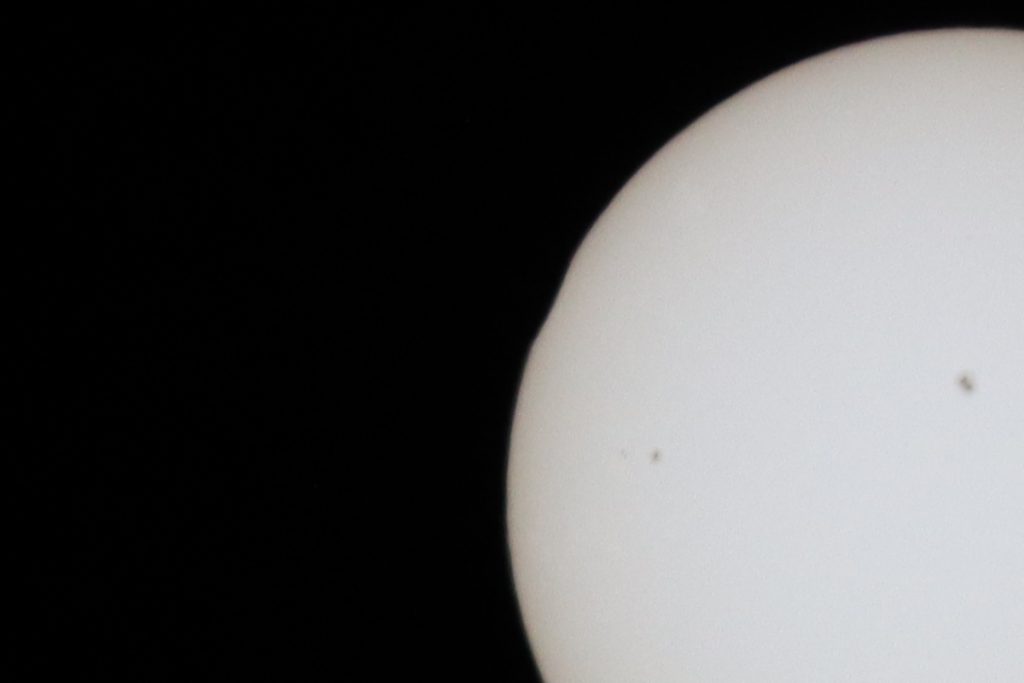
And here with the Moon just about to uncover the last sliver of the Sun’s disc, it’s over.
This eclipse was far better than the one in 2017, what with all the prominences and the greater duration of totality (I actually put the filter back on too soon, took it off and took the last two pictures).
If you missed it due to apathy or negligence…well it sucks to be you!
I could see as soon as I got back on the interstate that traffic northbound (to Chicago and St. Louis) was already jammed. And I was tens of miles away from St. Louis and hundreds from Chicago.
So I went south, intending to catch I-40 west at Memphis. It was longer, but probably faster. Even there the last 10 miles before the I-55/I-40 interchange took about an hour; Memphis too had eclipse jams, made worse by police blocking off exits on the way in.
I stopped in Conway, AR, and didn’t get going until late on Tuesday (I had just had two short nights and made up for it bigtime). I finally got home at 2AM Tuesday.
Now for the bad news. I was only able to see Jupiter and Venus. The comet was too faint. Mercury was simply lost in the glare. And Mars and Saturn were down in the trees.
And I had to guess about the right exposure to try to capture them on the wide angle lens. And I don’t know how bad my guess was, because I took two totally blown out white rectangles for pictures. Was I off by twelve stops? eighteen? Who knows. I didn’t even save them.
Hopefully on Saturday there will be a “regular” science post.