
What is it that feeds our battle, yet starves our victory?
January 6 Tapes?
Paging Speaker Johnson…this is your conscience calling you out on broken promises.
For all your high talk about your Christian moral background…you’re looking less and less like you have any kind of moral background.
If You are a Patriot and Don’t Loathe RINOs…
Let’s talk about RINOs, and why they are the lowest form of life in politics.
Many patriots have been involved with politics, often at the grassroots, for decades. We’ve fought, and fought, and fought and won the occasional illusory small victory.
Yet we can’t seem to win the war, even when we have BIG electoral wins.
I am reminded of something. The original Star Trek had an episode titled Day of the Dove. It was one of the better episodes from the third season, but any fan of the original series will tell you that’s a very low bar. Still, it seems to get some respect; at a time when there were about 700 episodes of Star Trek in its various incarnations out there, it was voted 99th best out of the top 100.
In sum, the plot is that an alien entity has arranged for 39 Enterprise crew, and 39 Klingons, to fight each other endlessly with swords and other muscle-powered weapons. The entity lives off of hostile emotions, you see and it wants a captive food source. (The other 400 or so Enterprise crew are trapped below decks and unable to help.) Each side has its emotions played and amplified by the alien entity; one Enterprise junior officer has false memories implanted of a brother who was killed by Klingons. The brother didn’t even exist.
Even people killed in a sword fight miraculously heal so they can go do it again.
The second best line of the episode is when Kang, the Klingon captain, notes that though they have won quite a number of small victories including capturing Engineering, can’t seem to actually finally defeat the Enterprise crew. He growls, “What power is it that feeds our battle yet starves our victory?*”
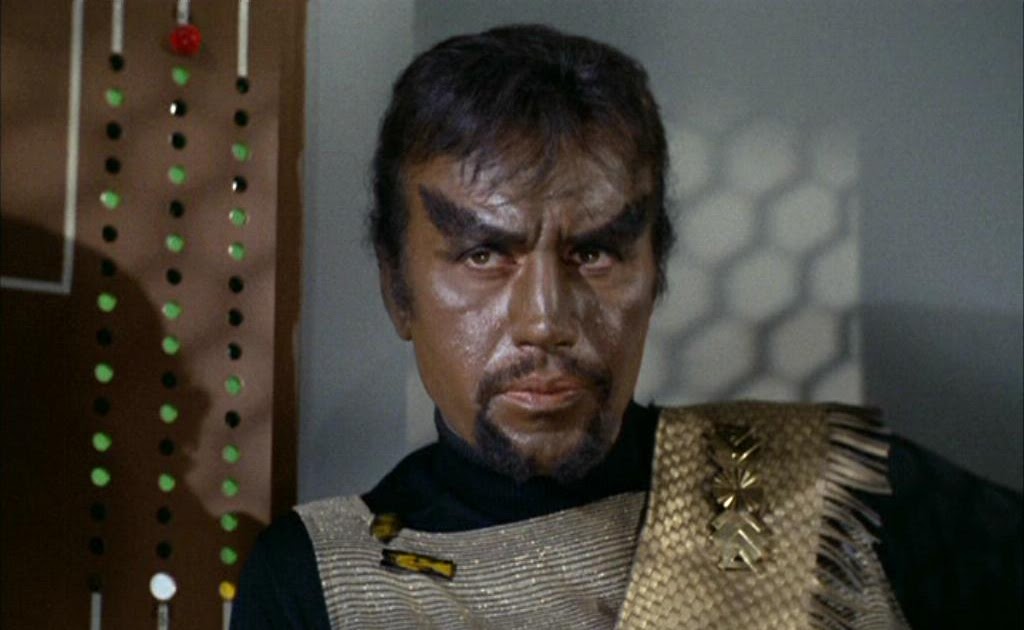
Indeed. He may have been the bad guy, but his situation should sound familiar.
We are a majority in this country. We have a powerful political party in our corner. There is endless wrangling.
And yet,
What power is it that feeds our battle yet starves our victory?
In our case, that power is the RINOs in our midst. They specialize in caving when on the verge of victory. Think of Obamacare’s repeal failing…by one Republican vote. Think of the way we can never seem to get spending under control (and now our entire tax revenue goes to pay interest on the debt; anything the government actually does now is with borrowed money).
We have a party…that refuses to do what we want it to do, and that refusal is institutionalized. If you’ve been involved with GOP politics, but haven’t seen this, it’s because you refuse to see it. Or because you are part of the problem yourself. (If so, kindly gargle some red fuming nitric acid to clear the taste of shit out of your mouth, and let those not part of the problem alone so they can read this.)
We fight to elect people, who then take a dive when in office. But it’s not just the politicians in office, it’s the people behind the scenes, the leaders of the national, state and county branches of the party. Their job is to ensure that real patriots never get onto the general election ballot. They’re allowed a few failures…who can then become token conservatives who will somehow never manage to win (Jordan), or can be compromised outright (Loren Boebert).
That way it doesn’t actually matter who has a congressional majority. I remember my excitement when the GOP took the Senate in 1980. But all that did was empower a bunch of “moderate” puddles of dog vomit like…well for whatever reason forty years later the most memorable name is Pete Domenici. And a couple of dozen other “moderates” who simply had no interest in doing what grassroots people in their party–those same grassroots people who had worked so hard to elect them–wanted them to do.
Oh, they’ll put up a semblance of a fight…but never win. And they love it when we fight the Dems instead of fighting them. Just like that alien entity, whose motto surely was “Let’s you and him fight. It’ll be delicious!”
If you think about it, your entire political involvement has come to nothing because of these walking malignant tumors.
That should make you good and mad.
The twenty five who blocked Jordan, and the hundred people who took that opportunity to stab Jordan in the back in the secret ballot should make you good and mad.
I’ll close this with another example of RINO backstabbing, an infuriating one close to home.
In my county, the GOP chair is not a RINO. She got elected when the grassroots had had enough of the RINOs. Unfortunately the state organization is full of RINOs, and the ousted county RINOs have been trying to form a new “Republican Party” and get the state GOP to recognize them as the affiliate. I’m honestly amazed it hasn’t happened yet.
In other words those shitstains won’t just leave when they get booted out; they’ll try to destroy what they left behind. It’s an indication that they know we know how important that behind-the-scenes party power is.
So they must be destroyed. That’s the only way they’ll ever stop.
We cannot win until the leeches “on our side” get destroyed.
What power is it that feeds our battle yet starves our victory?*
We know it. What is going to be done about it?
*NOTE: The original line was actually “What power is it that supports our battle yet starves our victory.” I had mis-remembered it as feeds. When I checked it, it sure enough was “supports” and that’s what I originally quoted. On further reflection, though, I realized my memory was actually an improvement over the reality, because feeds is a perfect contrast with starves. I changed it partway through the day this originally posted, but now (since this is a re-run) it gets rendered this way from the start.
If one must do things wrong, one should do them wrong…right.
RINOs an Endangered Species?
If Only!
According to Wikipoo, et. al., the Northern White Rhinoceros (Ceratotherium simum cottoni) is a critically endangered species. Apparently two females live on a wildlife preserve in Sudan, and no males are known to be alive. So basically, this species is dead as soon as the females die of old age. Presently they are watched over by armed guards 24/7.
Biologists have been trying to cross them with the other subspecies, Southern White Rhinoceroses (Rhinoceri?) without success; and some genetic analyses suggest that perhaps they aren’t two subspecies at all, but two distinct species, which would make the whole project a lot more difficult.
I should hope if the American RINO (Parasitus rectum pseudoconservativum) is ever this endangered, there will be heroic efforts not to save the species, but rather to push the remainder off a cliff. Onto punji sticks. With feces smeared on them. Failing that a good bath in red fuming nitric acid will do.
But I’m not done ranting about RINOs.
The RINOs (if they are capable of any introspection whatsoever) probably wonder why they constantly have to deal with “populist” eruptions like the Trump-led MAGA movement. That would be because the so-called populists stand for absolutely nothing except for going along to get along. That allows the Left to drive the culture and politics.
Given the results of our most recent elections, the Left will now push harder, and the RINOs will now turn even squishier than they were before.
I well remember 1989-1990 in my state when the RINO establishment started preaching the message that a conservative simply couldn’t win in Colorado. Never mind the fact that Reagan had won the state TWICE (in 1984 bringing in a veto-proof state house and senate with him) and GHWB had won after (falsely!) assuring everyone that a vote for him was a vote for Reagan’s third term.
This is how the RINOs function. They push, push, push the line that only a “moderate” can get elected. Stomp them when they pull that shit. Tell everyone in ear shot that that’s exactly what the Left wants you to think, and oh-by-the-way-Mister-RINO if you’re in this party selling the same message as the Left…well, whythefuckexactly are you in this party, you lying piece of rancid weasel shit?
In Defense of Ranked Choice Voting
One of the biggest obstacles to direly-needed change is RINOs, and one of the weapons in their arsenal is the “Wasted Vote” argument.
Periodically a third party has arisen, trying to hold RINOs to account by putting pressure on them from outside of the party, since doing so from the inside has historically done very little good. But, even if you find a third party candidate who perfectly reflects your views, you’re likely to vote for the RINO anyway. Why? Because if you don’t, the Democrat might win, and that would be even worse. So if you vote for that third party (that few will vote for), you’re throwing your vote away and increasing the likelihood of the Democrat winning. (It’s half as much a gain for the Democrat, as actually voting for the Democrat would be. Not as much, but half as much. Because although you denied the R your vote, you did not flip your vote to the Democrat.)
The Republican Party Establishment knows you don’t love them. But they know you hate the Democrats worse, and they use that to continue to herd you into supporting them. With gritted teeth you cast your vote, but your vote counts the same whether you cast it enthusiastically. And the other alternative, pissing on the voting apparatus to express your actual feelings, is probably a felony.
But what if you could vote for that third party without increasing the chances of the Dem walking away with the prize?
This is what ranked choice voting, or instant runoff voting, can do provided it is properly implemented. (And this includes the votes, and only genuine votes, being counted honestly, of course. However, I’m going to compare it to what we have today, and pretend that is honestly done too. RCV can’t work if it’s not honestly administered, just like our current system isn’t working because it isn’t honestly administered.)
The idea behind RCV is to vote by expressing your order of preference. You could vote for the Patriot Party, then for the RINO Party as your second choice (and ignore the Democrat, the Green, the Overt Socialist Schmuckmonkey Party, etc).
What does this do? It nullifies the wasted vote argument. Your vote will be counted for the Patriot party, first, then instead of it being “wasted” when the Patriot Party loses, it ends up going to the RINO. Actually, it’s just barely possible that the Patriot Party would actually beat the RINO, if people weren’t all individually afraid to vote for it.
It’s just like the famous “Prisoner’s Dilemma” where your fear of other peoples’ actions prevents you from doing the optimal thing–and vice-versa. As long as Job Lowe is afraid to vote Patriot because he’s afraid you’ll vote RINO, you’ll have to vote RINO because you fear that Job Lowe will, because he fears you will.
So on the whole I like RCV. It gives you a no-risk way to vote against the RINO scum, and in favor of someone who deserves your vote.
The problem is, as done here in the US, it comes packaged with a “jungle primary.” A bunch of candidates get to put their name out there, and the top four (or so) candidates get onto the “main” ballot. This gives party establishments their way around the threat of a good third party bumping them off. Because they know that few people bother with primaries, and third parties don’t have the resources to run in a primary…so they throw two or three establishment hacks into the primary and they will probably beat the third party. The result is the RINOs end up with two of the four slots in the general election, and the Dems get the other two. Now there’s suddenly no third party candidate on the ballot at all.
If we were to combine RCV with the present system where each party could nominate exactly one candidate to appear on the November ballot, or at the very least, ensure minor parties could get onto the ballot with at least one candidate regardless of the primary, we would be getting somewhere, but the establishment is smarter than we like to give them credit for. They will support the jungle primary + RCV “solution” rather than the more appropriate one-candidate-per-party + RCV solution.
It’s not RCV that is the problem, it’s the primary structure grafted onto it.
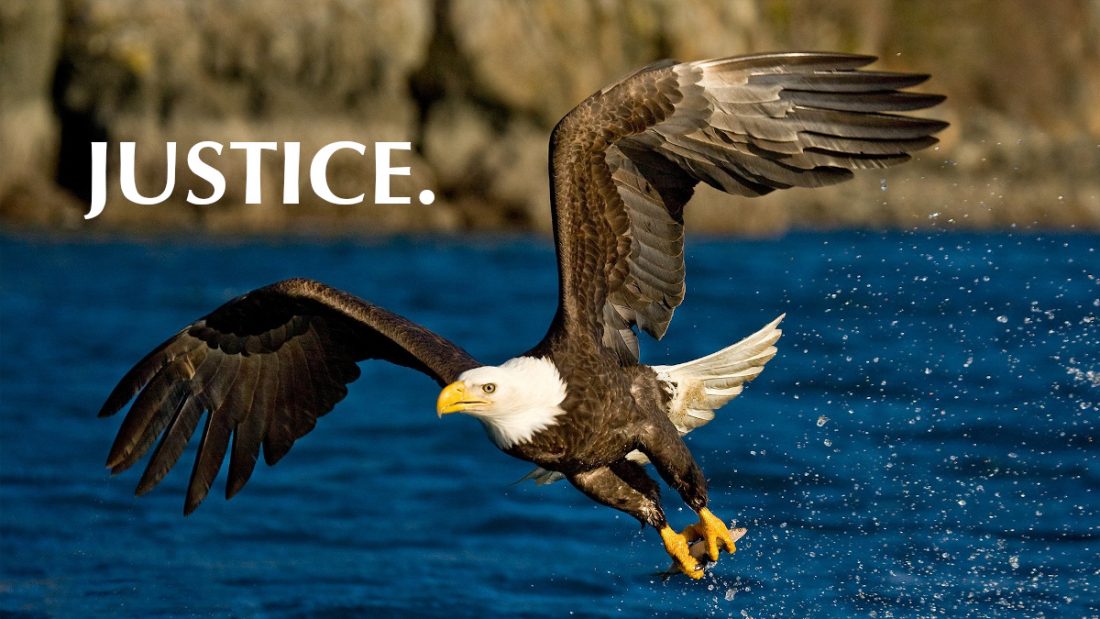
Justice
It says “Justice” on the picture.
And I’m sure someone will post the standard joke about what the fish thinks about the situation.
But what is it?
Here’s a take, from a different context: It’s about how you do justice, not the justice that must be done to our massively corrupt government and media. You must properly identify the nature of a person, before you can do him justice.
Ayn Rand, On Justice (speaking through her character John Galt, in Atlas Shrugged):
Justice is the recognition of the fact that you cannot fake the character of men as you cannot fake the character of nature, that you must judge all men as conscientiously as you judge inanimate objects, with the same respect for truth, with the same incorruptible vision, by as pure and as rational a process of identification—that every man must be judged for what he is and treated accordingly, that just as you do not pay a higher price for a rusty chunk of scrap than for a piece of shining metal, so you do not value a rotter above a hero—that your moral appraisal is the coin paying men for their virtues or vices, and this payment demands of you as scrupulous an honor as you bring to financial transactions—that to withhold your contempt from men’s vices is an act of moral counterfeiting, and to withhold your admiration from their virtues is an act of moral embezzlement—that to place any other concern higher than justice is to devaluate your moral currency and defraud the good in favor of the evil, since only the good can lose by a default of justice and only the evil can profit—and that the bottom of the pit at the end of that road, the act of moral bankruptcy, is to punish men for their virtues and reward them for their vices, that that is the collapse to full depravity, the Black Mass of the worship of death, the dedication of your consciousness to the destruction of existence.
Ayn Rand identified seven virtues, chief among them rationality. The other six, including justice, she considered subsidiary because they are essentially different aspects and applications of rationality.
—Ayn Rand Lexicon (aynrandlexicon.com)
Justice Must Be Done.
Trump, it is supposed, had some documents.
Biden and company stole the country.
I’m sure enough of this that I put my money where my mouth is.

The prior election must be acknowledged as fraudulent, and steps must be taken to prosecute the fraudsters and restore integrity to the system. (This doesn’t necessarily include deposing Joe and Hoe and putting Trump where he belongs, but it would certainly be a lot easier to fix our broken electoral system with the right people in charge.)
Nothing else matters at this point. Talking about trying again in 2024 or 2026 is pointless otherwise. Which is not to say one must never talk about this, but rather that one must account for this in ones planning; if fixing the fraud in the system is not part of the plan, you have no plan.
This will necessarily be piecemeal, state by state, which is why I am encouraged by those states working to change their laws to alleviate the fraud both via computer and via bogus voters. If enough states do that we might end up with a working majority in Congress and that would be something Trump never really had.
Lawyer Appeasement Section
OK now for the fine print.
This is the WQTH Daily Thread. You know the drill. There’s no Poltical correctness, but civility is a requirement. There are Important Guidelines, here, with an addendum on 20191110.
We have a new board – called The U Tree – where people can take each other to the woodshed without fear of censorship or moderation.
And remember Wheatie’s Rules:
1. No food fights
2. No running with scissors.
3. If you bring snacks, bring enough for everyone.
4. Zeroth rule of gun safety: Don’t let the government get your guns.
5. Rule one of gun safety: The gun is always loaded.
5a. If you actually want the gun to be loaded, like because you’re checking out a bump in the night, then it’s empty.
6. Rule two of gun safety: Never point the gun at anything you’re not willing to destroy.
7. Rule three: Keep your finger off the trigger until ready to fire.
8. Rule the fourth: Be sure of your target and what is behind it.
(Hmm a few extras seem to have crept in.)
Spot Prices
Last week:
Gold $2,083.30
Silver $23.19
Platinum $895.00
Palladium $980.00
Rhodium $5,000.00
This week, at Friday close:
Gold $2,179.60
Silver $24.36
Platinum $922.00
Palladium $1,045.00
Rhodium $5,050.00
Everything up. Gold rose $96.30 this last week.
Palladium is up 65 bucks. Proportionally speaking, even more than gold.
Even platinum managed to quit falling off the floor.
It should be noted that silver, platinum and palladium were down Friday, from Thursday’s close.
Venus
Or much more seriously, and much more grimly…the planet that should be named Hell.
Actually, I’m going to get one bit of semi-related trivia out of the way.
Planets and Metals
The Ancients recognized seven planets: The Sun, the Moon, Mercury, Venus, Mars, Jupiter and Saturn. (And yes, two of those are no longer regarded as planets. Back then the definition was basically anything that moved in a regular pattern against the celestial sphere. This excluded comets and shooting stars, and of course the (as far as they could tell) “fixed stars,” but not much else.)
There were also seven recognized metals: Iron, tin, lead, gold, silver, mercury and copper.
The seven metals were commonly associated with the seven planets, to the point in fact where the planetary symbols were often used for the metals. Mercury was of course associated with mercury. The Moon was associated with silver.
And Venus was associated with copper.
Oddly enough, the association of planets to metals continued into the modern era. Uranium, discovered in 1789 (well sort of), was named after Uranus. When neptunium was synthesized, it was known to be uranium’s neighbor to the right, and so it was named after Uranus’s neighbor in the solar system, Neptune. And continuing the trend, plutonium, the element after neptunium, after Pluto, then regarded as the planet after Neptune. Of course Pluto got demoted.
But that isn’t actually the first time that a metallic element got named after a planet…which then got demoted! Consider the case of Ceres (discovered 1801) and cerium.
OK now Venus.
Really.
Venus is very easy to spot. If it’s above the horizon at night but you are wearing three paper bags over your head, have your eyes shut, and are facing the wrong way, you might miss it.
It’s the brightest object in the night sky, except for the Moon.
Because Venus is one of those objects that orbits the Sun, but is closer to the Sun than we are, it will always be relatively close to the Sun on the celestial sphere, however its maximum distance is roughly 60 degrees, which is far enough away that it will hang around for as long as four hours after sunset, depending on a bunch of other factors (like the time of year and your latitude). Or, conversely, it could rise four hours before sunrise.
This dual nature at first confused the ancients, but they quickly realized that that super bright “morning star” and the super-bright “evening star” were the same thing. The Sumerians, one of the earliest civilizations of Mesopotamia (and perhaps the oldest anywhere), had figured it out. The Greeks didn’t start out with that memo, though, and initially named the morning star Phosphorus and the evening star Hesperus. Pythagoras, 6th century BCE, was credited with (re-)figuring it out.
Mercury and Venus’s habit of sticking close to the Sun ought to have been a clue that perhaps the Sun was at the center of things, rather than the Earth, but as far as I can tell, few took that seriously before Copernicus (published and died, 1543). And even Copernicus wasn’t believed.
Galileo in 1610 looked at Venus with a telescope and over time saw an almost full set of phases. He didn’t see a full Venus, nor a new Venus, but he saw almost everything else, and as you can see in the diagrams below, that shows that Venus must orbit the Sun, not move back and forth between us and the Sun.

Above: Venus orbiting the sun, displaying crescent and gibbous phases. Below, hypothetical Venus on an epicycle, whose center in turn orbits the Earth. It only ever shows crescent phases. (If the epicycle were beyond the sun, we’d see nothing but gibbous and even full phases.)
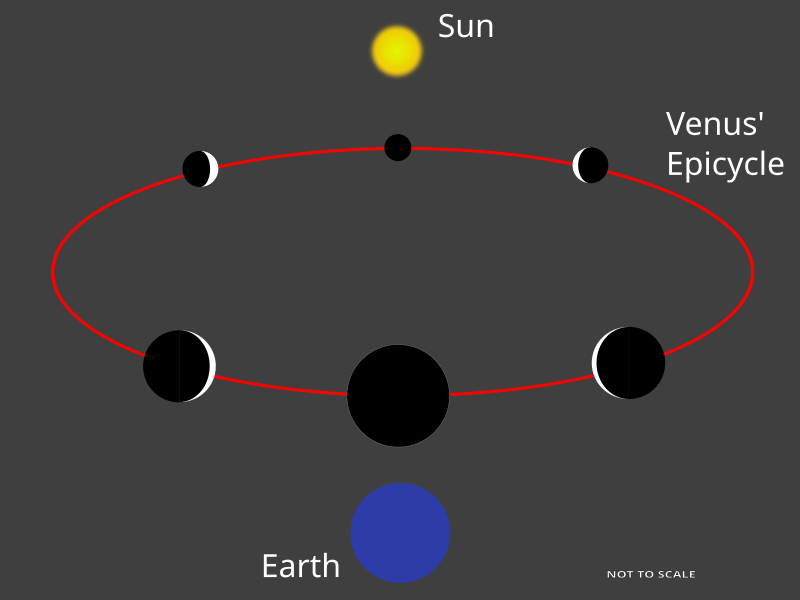
It’s also significant that the crescent Venus is much, much larger than the gibbous Venus. This size change counteracts the fact that normally a crescent should be less bright than a gibbous phase, because less of the disk we see is lit.
Nor was that the end…not by any means!!!…of the contributions to astronomy that looking at Venus with earthbound telescopes would make!
And this is in spite of the fact that Venus shows us no surface detail. Imagine a brightly-lit ping pong ball. That’s Venus. Blast white, no markings. We couldn’t tell how fast it was rotating. Or even if it was rotating. We did know that it’s a sphere, because of the phases. But that’s it.
As for the Solar System as a whole, Kepler had by 1611 demonstrated that the planets move around the Sun in elliptical orbits, with the Sun at one focus, and that their rates of travel were such that a line connecting the planet and the Sun would sweep out equal areas in equal times (meaning the planet moved faster both in angle seen from the Sun and in absolute terms, when it was closer to the Sun).
He was able to establish relative sizes of the orbits. Setting the Earth’s orbit’s size to 1 unit, Venus’s orbit was roughly 0.72 units in size. (Measuring half the long axis of the ellipse, also called the semi-major axis.) This “unit” of Kepler’s survives as our present-day “Astronomical Unit” (AU).
He didn’t know how big an astronomical unit was. No one knew. The only thing we did know was that it was at least two million miles, because attempts to measure the distance to the Sun by triangulation had been made, and failed. We’d have got a good reading with these methods if the Sun were less than two million miles away. (Similar methods had worked with the Moon.) It didn’t help that it’s hard to triangulate against background stars when you cannot see them because it’s daytime!
But what if we could watch Venus cross the face of the Sun?
You know, like this:

(Venus is three to four times closer to us than is the Sun when it is between us and the Sun, yet still looks puny by comparison. That should tell you something about the Sun.)
Imagine watching one of these “transits” from one place on Earth and noting where against the Sun’s disk Venus was. Meanwhile someone else thousands of miles away does the same thing and takes his notes. Since Venus is closer than the Sun, it should appear in two different places; if you know how far apart your observers are, you can triangulate.
Better yet, time how long it takes to cross. That will nail down, far more accurately, the length of Venus’s path across the Sun, and you can compare the two times, lay down two lines of corresponding length, and really get a good read on the difference in Venus’s apparent position on the sun.
This was first attempted in 1639, by astronomers in Yorkshire and Manchester. They weren’t very far apart, and they got an answer indicating an astronomical unit was about 60 million miles. That was ten times larger than most people had…well, basically, guessed.
This was done again in 1761, with people observing from Russia, Newfoundland, and the Cape of Good Hope. Much better circumstances and equipment! And again in 1769, with people in St. Petersburg, Baja California, and Norway. Combined, the answer was 153 million km, give or take 1 million km. That’s about 2% off the current value (which we know down to a hundred meters). Not bad!
The 1761 cooperation is particularly striking because Europe was still in the throes of the Seven Years War, and Russia and England were on opposite sides. In some ways it’s better to think of that war as World War Zero. Our “French and Indian War” was basically a side-theater of that mess…though it was also the start of that mess. (An excellent argument can be made that Colonel George Washington started the whole thing. Fortunately he became more astute by 1775.)
OK, so why did they sit around twiddling their thumbs between 1639 and 1761?
Because Venus transits are rare. They occur in pairs eight years apart…but those pairs, in turn, are over a hundred years apart!
How does that make sense?
Venus “laps” Earth almost exactly every 1.6 Earth years, crossing between us and the Sun. Well almost crossing. The two orbits are not in the same plane; they are in two different planes. The two planes intersect on a certain line, but if Venus laps us anywhere else other than that line through the Sun (either side of the line), Venus will appear to pass north or south of the Sun.

In the diagram above, the red line represents the line that is the intersection of the two orbital planes. Only if the Earth, Sun and Venus are all lined up on that line (on either side of the Sun) will we see a transit. (There’s a tiny bit of tolerance here because the Sun has width..you can be a little bit off that line, but not much.)
So imagine there is a Venus transit. Wait 1.6 years, and Venus laps us…but we’re 6/10ths of the way around the sun at that point, and the lapping does not happen where the planes intersect. Clean miss. Then again at 3.2 years, 4.8 years, 6.4 years…all misses. Only something-point-zero and something-point-five will work. But the next lapping is at 8.0 years. Bingo, another transit. So that explains the 8 year pairings. But why isn’t it every eight years? Because the lappings aren’t exactly every 1.6 years. They’re just a little bit off. Eight years after the second transit in the example, the lapping will happen, but slightly earlier and not quite close enough to the line of intersection to be a transit. And so we wait. And wait. And wait. Eventually things line up on the other side of the Sun and we get two more transits.
So, we had a transit in 2004 on June 8. And another in 2012 on June 5. Note just three days shy of exactly eight years later. The next lapping would have been 2020 on about June 2, and that’s far enough from the place where the planes intersect to ensure Venus does not cross in front of the Sun’s disk as seen from Earth.
The next transit is…wait for it…in 2117, on the 10th of December. Earth and Venus will be on the other side of the Sun when this happens, going through the other half of the line of intersection of their two orbital planes.
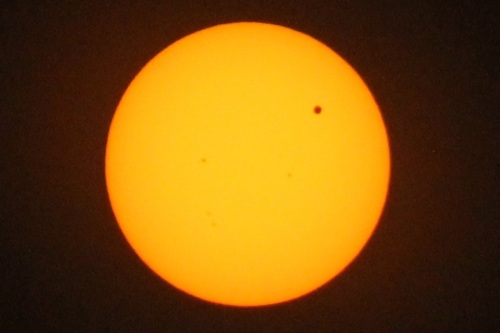
I observed the 2012 transit with eclipse glasses and took pictures with the same craptastic solar filter I used for the annular eclipse last year. I do remember that triangle of sunspots from the picture I pasted in. See below. The sunspots are quite faint. and the orientation is a bit different.
I Lied. Now, really about Venus.
I’ve talked about Venus’s orbit already, but I spotted this cool animation and you can watch the four terrestrial planets orbit the Sun in it. Note that there are faint circles every 0.5 AU you can compare the elliptical orbits with, the circles look elliptical because the diagram is at an oblique angle.

Venus orbits the Sun every 224.7 Earth days. And at present it’s the closest orbit to circular of any of the planets. That period works out to Venus orbiting almost exactly 13 times while Earth orbits 8 times. (That’s logical, it laps us 5 times in eight years, so it has orbited 8+5=13 times while we’ve poked along.)
Here’s a true color picture of Venus taken by the MESSENGER probe as it flew by, using Venus for a gravity assist (“slingshot”).

There’s only the slightest hint of banding, like clouds overlying clouds.
In ultraviolet light, though, you can see more:

Venus is a completely cloud-bound world. It’s almost as big as Earth, and seems like it could almost be a twin.
There was a belief clear up into the 1950s that Venus was a younger world than Earth (and Mars was older), so it was expected that under all those clouds Venus could be a swampy world with primitive life. It’d no doubt be warmer, but with the cloud layer blocking the Sun, maybe not much warmer than Earth. Maybe we could even live there!
Oh boy did that ever turn out wrong. We (well the USSR actually) sent our first probe, Venera 1, in 1961. And there have been many others since.
The surface temperature of Venus is 737K or about 867 F.
Lead melts at 621 F. I guess we would need something else for bullets there.
The atmosphere turns out to be almost pure carbon dioxide, with a pressure 92 times as great as our atmosphere at sea level.
And the upper layers of it are sulfuric acid.
So we have a baked, dessicated world with sulfuric acid…not a bad match for Hell.
We’ve managed to land spacecraft and have them survive for minutes to a couple of hours. (The USSR had better luck there, we did better with Mars.) Here’s one of the pictures, from Venera 9.

And another from Venera 14:
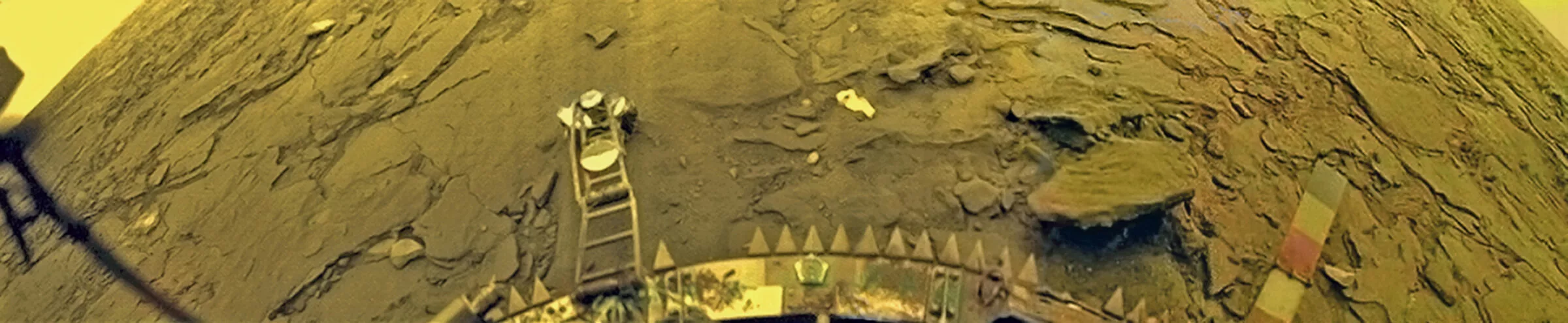
In fact here: https://www.planetary.org/articles/every-picture-from-venus-surface-ever is a compilation of every image ever taken from the surface. Only four spacecraft have managed it, all of them Russian or Soviet.
Nevertheless we do know quite a bit about Venus’s surface, because we’ve mapped it with radar from orbiting satellites, including Magellan in the early 90s. We’ve got topographic maps.
It turns out there are a lot of volcanoes on Venus (more hellishness). There are continents–sizable plateaus just like our continents are, but without oceans overfilling the low spots. There’s no chance of plate tectonics because no water is around as a lubricant for the plates. Nevertheless, it appears as though the entire surface gets catastrophically replaced every few hundred million years.
So here is the topographic map.

One last thing about Venus that stands out, and that is its rotation. It rotates once every 243 days…that’s longer than its year. So it seems as if Venus might almost be tidally locked, except that in fact it’s not even close. It rotates backward. (And that is a big WTF!)
The net effect is, someone standing on the surface of Venus would see the sun rise in the west, and set in the east, with the day lasting 116.75 earth days. Except you would never see sunrise or sunset with that thick layer of clouds.
Venus serves as a poster child for “runaway greenhouse effect” on account of the carbon dioxide, the heat, and the lack of water. It is believed it warmed up just a bit too much a few billion years ago, thanks largely to the early atmosphere being largely carbon dioxide (that was true here too; we needed life to make oxygen from the carbon dioxide); the oceans evaporated and the water molecules escaped. (Water vapor escapes Earth, too, but very very slowly. We’re more massive and cooler than Venus.) More carbon dioxide was released from the rocks which just made things worse. So it’s a favorite of the Global Warming crowd.
Admittedly, if we were that close the Sun we’d be hosed too. But we’re not. And they’ve fudged their data as to what is actually happening.
Obligatory PSAs and Reminders
China is Lower than Whale Shit
To conclude: My standard Public Service Announcement. We don’t want to forget this!!!
Remember Hong Kong!!!
https://youtube.com/watch?v=L3tnH4FGbd0
中国是个混蛋 !!!
Zhōngguò shì gè hùndàn !!!
China is asshoe !!!
China is in the White House
Since Wednesday, January 20 at Noon EST, the bought-and-paid for Joseph Biden has been in the White House. It’s as good as having China in the Oval Office.
Joe Biden is Asshoe
China is in the White House, because Joe Biden is in the White House, and Joe Biden is identically equal to China. China is Asshoe. Therefore, Joe Biden is Asshoe.
But of course the much more important thing to realize:
Joe Biden Didn’t Win
乔*拜登没赢 !!!
Qiáo Bài dēng méi yíng !!!
Joe Biden didn’t win !!!