
This Rejoice & Praise God Sunday Open Thread, with full respect to those who worship God on the Sabbath, is a place to reaffirm our worship of our Creator, our Father, our King Eternal.
It’s also a place to read, post, and discuss news that is worth knowing and sharing. Please post links to any news stories that you use as sources or quote from.
In the QTree, we’re a friendly and civil lot. We encourage free speech and the open exchange and civil discussion of different ideas. Topics aren’t constrained, and sound logic is highly encouraged, all built on a solid foundation of truth and established facts.
We have a policy of mutual respect, shown by civility. Civility encourages discussions, promotes objectivity and rational thought in discourse, and camaraderie in the participants – characteristics we strive toward in our Q Tree community.
Please show respect and consideration for our fellow QTreepers. Before hitting the “post” button, please proofread your post and make sure your opinion addresses the issue only, and does not confront or denigrate the poster. Keep to the topic – avoid “you” and “your”. Here in The Q Tree, personal attacks, name-calling, ridicule, insults, baiting, and other conduct for which a penalty flag would be thrown are VERBOTEN.
In The Q Tree, we’re compatriots, sitting around the campfire, roasting hot dogs, making s’mores, and discussing, agreeing, and disagreeing about whatever interests us. This board will remain a home for those who seek respectful conversations.
Please also consider the Guidelines for posting and discussion printed here:
https://www.theqtree.com/2019/01/01/dear-maga-open-topic-20190101/
On this day and every day –
God is in Control
. . . and His Grace is Sufficient, so . . .
Keep Looking Up

Hopefully, every Sunday, we can find something here that will build us up a little . . . give us a smile . . . and add some joy or peace, very much needed in all our lives.
“This day is holy to the Lord your God;
do not mourn nor weep.” . . .
“Go your way, eat the fat, drink the sweet,
and send portions to those for whom nothing is prepared;
for this day is holy to our Lord.
Do not sorrow,
for the joy of the Lord is your strength.”


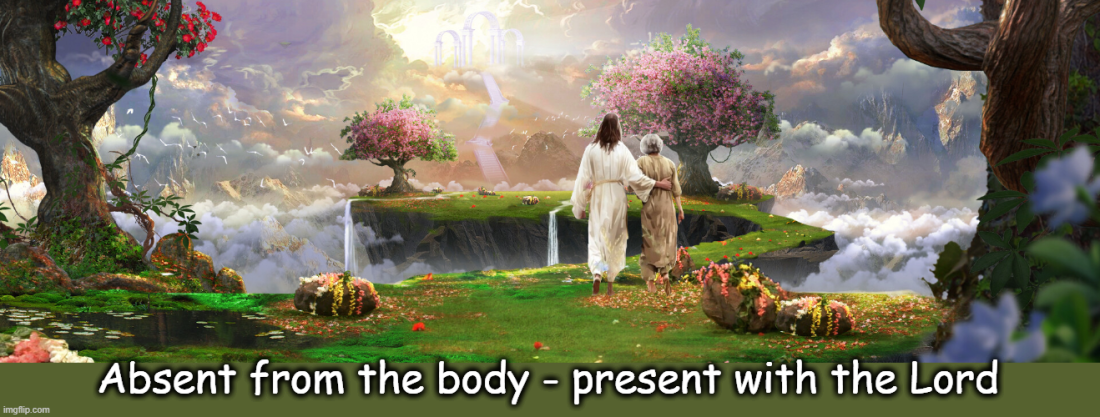
Present with the Lord
In 2 Corinthians 5:8, the apostle Paul writes, “We are confident, I say, and willing rather to be absent from the body, and to be present with the Lord”. The expression absent from the body refers to physical death. When this life ends, believers will be immediately ushered into the glorious presence of the Lord. Then we will see Him face to face (1 Corinthians 13:12). And, at that moment, we will be “present with the Lord.”
To fully appreciate the significance of 2 Corinthians 5:8, it is important for us to review the immediate context. In 2 Corinthians 5:1–7, Paul contrasts the temporary nature of our earthly bodies with the eternal nature of our heavenly bodies. Once our earthly bodies are destroyed, “we have . . . an eternal house in heaven, not built by human hands” (verse 1). Most translations of 2 Corinthians 5:8 emphasize the aspect of having an “eternal house,” saying that, at death we will be “at home with the Lord”.
In our earthly state, we earnestly desire “to be clothed . . . with our heavenly dwelling” (2 Corinthians 5:2), which will not leave us “naked” or without a dwelling place (verse 3). Our heavenly bodies will not be subject to decay or death (mortality). Instead, we will receive new bodies that are imperishable and immortal (verse 4; cf. 1 Corinthians 15:54). We know that God has prepared a heavenly home for us (John 14:2) because He “has given us the Spirit as a deposit, guaranteeing what is to come” (2 Corinthians 5:5; cf. Romans 5:5 and Ephesians 1:14). Currently, the presence of God is a matter of faith (Hebrews 11:1) because we are “at home in the body” and “away from the Lord” (2 Corinthians 5:6). So, right now, “we live by faith, not by sight” (verse 7). It is in this context that Paul writes, “We are confident, I say, and willing rather to be absent from the body, and to be present with the Lord” (verse 8).
Physically, we cannot be in two places at the same time. If we are present in this world, we are absent from the ranks of heaven. But, for us believers in Christ, when we are absent from this world, we will be present with the Lord. We will have arrived at our true home. In the words of James M. Black, “When all of life is over and our work on earth is done, / And the roll is called up yonder, I’ll be there” (1893).
Paul longed for the day when his sin-corrupted body would be replaced with a glorified one. For this reason, he viewed trials and tribulations as “light and momentary troubles” that could not be compared to “an eternal glory that far outweighs them all” (2 Corinthians 4:17; cf. Romans 8:18). This hope for an incorruptible body and eternal dwelling place gives us confidence in the face of suffering, as we know that our salvation is eternally secure (John 10:28–29).
Because Paul was confident of his eternal destiny, he was not afraid to die (1 Corinthians 15:54–55). In fact, he welcomed death because he knew that he would be present with the Lord. In Philippians 1:21–24 he expresses a similar thought: “For to me, to live is Christ and to die is gain. If I am to go on living in the body, this will mean fruitful labor for me. Yet what shall I choose? I do not know! I am torn between the two: I desire to depart and be with Christ, which is better by far; but it is more necessary for you that I remain in the body.” This does not mean that Paul had a death wish. On the contrary, he was expressing confidence that death is not final, especially for Christians. Death is simply a transition into a glorious heavenly body. Therefore, we should not fear anything or anyone (Isaiah 25:8; Matthew 10:28).
Second Corinthians 5:8 reminds believers that our ultimate home is not in this world, but in heaven. To be absent from the body is to be present with the Lord. Hence, we are called to be in the world but not of the world (Romans 12:2). As heavenly citizens, our allegiance is to God, not the world: “Our citizenship is in heaven. And we eagerly await a Savior from there, the Lord Jesus Christ, who, by the power that enables him to bring everything under his control, will transform our lowly bodies so that they will be like his glorious body” (Philippians 3:20–21). When Christ returns, our earthly bodies will be exchanged for bodies fit for heaven.
The hope of eternal life is the bedrock of Christianity. Because of the resurrection of Jesus Christ, we know that death is not the end. And if we believe in Him for salvation from our sins, then we will live with Him in heaven (Romans 6:1). We will be present with the Lord and also reunited with loved ones who have passed away before us. This hope is not based on wishful thinking or blind faith but on the promises of God revealed in Scripture.
xhttps://www.gotquestions.org/present-with-the-Lord.html
Let us labor for the Master from the dawn till setting sun;
Let us talk of all his wondrous love and care.
Then when all of life is over and our work on earth is done,
And the roll is called up yonder, I’ll be there.