

Site rules stolen from our good friend PAVACA
There are Important Notifications from our host, Wolf Moon; the Rules of our late, good Wheatie; and, certain caveats from Yours Truly, of which readers should be aware. They are linked here. Note: Yours Truly has checked today’s post for any AI-generated content. To the best of her knowledge and belief, there is none. If readers wish to post any AI-generated content in the discussion thread for today’s post, they must cite their source. Thank you.
Do not forget to LABEL AI articles video and such.
Although I am not an economist, I have observed that as mankind harnessed increasingly better sources of energy, civilization exploded. Mankind went from literal manpower – slavery & subsistence farming — to the first agricultural revolution, using animal power, and to the second agricultural revolution with mechanical power provided by factory-made equipment and tractors. As people were freed from having to scrounge for food, leisure time increased and innovation took off.
Where are we now? It has become obvious since President Kennedy’s death that the United States economy is deliberately being hamstrung.
“In fact, giving society cheap, abundant energy at this point would be the moral equivalent of giving an idiot child a machine gun. With cheap, abundant energy, the attempt clearly would be made to pave, develop, industrialize, and exploit every last bit of the planet—a trend that would inevitably lead to a collapse of the life-support systems upon which civilization depends.”
— Paul R. Ehrlich “An ecologist’s perspective on nuclear power”, Federation of American Scientists Public Interest Report vol. 28, no. 5-6 (May-June, 1975) page 5.
And from Obama’s Science Czar.
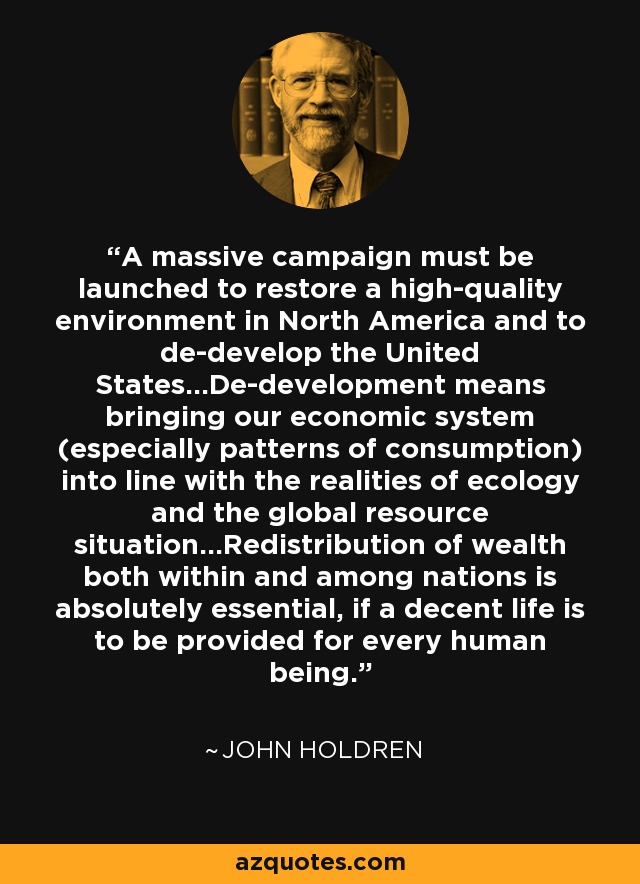
That brings us to POTUS Trump and his cabinet’s work on the economy.
Treasury Secretary Scott Bessent says at 16 minutes:
I think we’re going to see big employment growth this year. And these GDP numbers. I think the real vindication here, Chris, is that the 4.3% GDP number for the third quarter was really 4.7% or 4.8% in the private sector. We shrank the government by 3 to 4 tenths of a percent of GDP. So that [4.3% GDP] was a muted number. The private sector of the United States of America is going gang busters and I think we’re going to see it in 2026. So yeah, President Trump has these hats in the oval that say Donald Trump was right about everything. He was definitely right about economics this time.
(Video 18 min)
What Is Gross Domestic Product (GDP)? — Investopedia
Gross Domestic Product (GDP) includes consumer spending, government spending, net exports, and total investments. It functions as a comprehensive scorecard of a country’s economic health. GDP may be adjusted for inflation and population to provide deeper insights. Real GDP accounts for inflation, while Nominal GDP does not.
“It [GDP] functions as a comprehensive scorecard of a country’s economic health.”
I am not an economist, but I absolutely have a major problem in calling the GDP (as defined) the “scorecard of a country’s economic health.”
What does the spending on bureaucrat salaries do to our economy? It stifles it!
6/21/2013 — Federal Regulations Have Made You 75 Percent Poorer
U.S. GDP is just $16 trillion instead of $54 trillion… in the absence of six decades of accumulated regulations—a median household income of $330,000 instead of the $53,000 we get now.
>>>>>>>>>>>>>>>>>>>>>>>>>
I was aware that Susan Kokinda and the people at Promethean Action did not like either Keynes OR Mises. Iwas re-listening to a fiveweek old interview of Susan Kokindaand she mentioned LaRouche’s physical economy, and asked myself the innocent question, “What is LaRouche’s physical economy?” OH! Boy, did I fall into a major rabbit hole thanks to my curiosity bump.

I was aware of Keynesian Economics of British Fabian origin.
H/T Investopedia
:max_bytes(150000):strip_icc():format(webp)/john_maynard_keynes-v2-a258a0aed1f64011b372ccad94962721.png)
And Ludwig von Mises and Austrian Economics
H/T Investopedia
:max_bytes(150000):strip_icc():format(webp)/ludwig-von-mises_final-25b6e56313ac417385905fc8925eb0ec.png)
Tradebait2 has brought these two short videos to the Qtree on occasion. Hayek & Mises were both from the Austrian school of economics.
March 2011 Fabian: John Maynard Keynes, the stealthy enemy of human freedom by Sanjeev Sabhlok
He is a science graduate who went into economics. I thought I had a poor opinion of Keynes, however this guy reams him.
…Without firm roots in classical economics, I believe that modern economists tend to rapidly move into statist solutions.
Keynes still has a significant presence in the academia through New Keynesianism (e.g. Stiglitz, Kruman), and receives prominence each time the US government agencies and Federal Reserve Bank – that have diligently followed his ideas – mess up things.
Indeed, that’s the other point – that Keynes is still very prominent inside government agencies. Keynes is the cause of serious government failure across the world and significant devaluation of currencies. The (Fabian) London School of Economics, the League of Nations, the New Deal, the welfare state, various international central bank concepts that led to the International Monetary Fund, the World Bank, the Brettonwoods system which led to the collapse of the gold standard, and even the United Nations – all have been strongly influenced by the Fabians, but more particularly Keynes.
Hence his ideas MUST BE OPPOSED. Till today I only opposed his ideas. From today, I now oppose his person, as well. Keynes at Harvard has opened my eyes….
However I had never hear of physical economics before and wondered if it was close to my observations. I started my search by looking up ‘Physical Economics’ in Brave.
Physical Economics
In economics, physical economics is the study of economic phenomenon from the point of view of physics.
POLITICS
In politics, a version of “physical economy” is often found promoted by Lyndon LaRouche, or his followers, but is a version of physical economics that is a barely digestible rewritten spinoff of what seems to be the biosphere-noosphere ideas of Vladimir Vernadsky, employed for nothing more than polemics. [4]
4. LaRouche, Lyndon H. Jr. (2009). “The Science of Physical Economy”, BiblioTecapleyades.net.
EXTERNAL LINK
â— Physical economics – Wikinfo.org
This is the cited reference & I found it very hard going because I felt as if I was dropped into the middle of a PhD discussion of a subject I never even knew existed. The following are the few pieces that made sense to me.
The Science of Physical Economy — Economics as History
Introduction
IN THE IMAGE OF THE CREATOR
…That is the science of physical economy which must now be adopted as the standard of practice used to replace what is already, since September 2007, the hopelessly failed versions of what are taught as “economics” seemingly everywhere among professionals and politicians today.
- For example: Let us begin the presentation of the subject of this chapter by considering the physical form of economic capital in its primary character as technology, as technology is defined, rather than as a nominal value of money, in terms of qualitative degrees upward in both productivity and in the requirement of the effective equivalent of orders of increase of energy-flux density. Consider the consumption of an investment in physical capital, from the time of its “birth” as a type of physical-functional factor in economy, rather than matters of price, considering the time until that capital investment might be considered as “used up,” as by age, wear, or technological obsolescence, in its presently invested incarnation as an actual feature of the process of production of physical wealth. Consider the value of that capital to be expressed as the relative rate of increase of productivity, per capita and per square kilometer, with which the rate of related consumption by that body, is correlated in practice. Locate this aspect of that capital, similarly, in respect to the losses incurred, as through technological attrition, as a result of failing to supersede previously established technology by a new technology which increases the associated, relative productive powers of labor, and, also, provides the benefit to society of the consumption of the related product.
- Then, ask yourself: when, in time, was the gain actually produced, and when, in time, for example, was the loss which is realized as the effect of failing to invest in that capital, as capital so defined? What does such a question evoke concerning the use of the term “physical space-time” in the field of a science of physical economy? When is what value earned, and how?
What does that say about the follies of financial accounting, on principle? What does that say about what is presently taught as economics? What does presently taught, monetarist economics suggest itself, mistakenly, to be?……Today, lost time being lost time for our culture, so, we must try to make up for that, even decades later, here and now, before it is too late for present and foreseeable future generations combined. The matter of the principles of a science of physical economy, is now become, suddenly, a most urgent affair for crucial decisions to be made at each new passing point in time, including crucial decisions which must be made by society, top down, in not more than some weeks ahead, even, in the worst case, more and more, some days.
The substitution for this approach, by one based on deals, compromises, and what-not, connived at over several months to come, would be clinical insanity in the measure of their effects….
That Constitution was built on the cornerstone of the establishment of the U.S. constitutional credit-system, “still on the books” of our original Federal Constitution, which, as all witting actual patriots know, bans monetary systems, constitutionally, from the sovereign practice of the United States…
…in the late 1960s, the space-program as fostered by the dramatic initiatives of President John F. Kennedy, was advancing by proverbial leaps and bounds within the aspect of the national U.S. economy focused upon the space-program itself, despite the otherwise reigning moral and physical decay of the U.S.A….
In that limited sector of our economy, by about the time of the Moon-landing, we were generating an fairly estimated ten cents’ worth of growth through science-driven progress, for each penny spent. It was the other parts of the economy, not the aerospace venture, which were the already looming threat of failure, since about 1966-1968. Since that time of the Moon-landings, there have been no more such U.S. manned landings on that Moon, during four decades, up to the present day….
..the U.S. economy failed, first under the effects of the Kennedy assassinations of the 1960s, the utterly fraudulent launching of the protracted U.S. war in Indo-China, in 1964, and in the rising tide of “environmental” contraction of the U.S. economy’s net investment in basic economic infrastructure during the 1966-1971 interval.
Thus, since March 1, 1968, the U.S.A. itself has undergone more than four decades of self-inflicted, net rot and ruin, all this chiefly the result of trends in policy-shaping guided by each and every Federal government which was installed from 1969, on, as extended to the presently accelerated moral and economic mass-insanity of the presently utterly truth-free Obama administration… and also Tony Blair-copied death-care policies…
After poking around this first time, I gave up and asked Yandex AI:
Lyndon LaRouche’s physical economy is a concept that aims to increase the relative potential population density of society by applying new technologies based on the discoveries of new physical principles. The key economic criterion, according to LaRouche, is not to buy cheap and sell expensive or to acquire rare goods, but to increase what he calls the “La,” i.e., the carrying capacity made possible by the constant introduction of new technologies. 1, 4
Some of the principles of LaRouche’s physical economy include:
- Integration of international credit into a global set of fixed-exchange-rate systems to prevent significant fluctuations in exchange rates. 1
- Regulation of prices and trade based on long-term physical investment. 1
- Increase in energy-flux density produced per capita, per unit surface, and per gram of material used. 14
- Use of nuclear energy as a reliable and cheap energy source. 5
LaRouche’s ideas are considered by some to be a form of pseudoscience. 3
This is from the Schiller Institute, the LaRouche organization that Susan Kokinda and Promethean Action are NOT a part of.

Jacques Cheminade: The LaRouche method of physical economy
TRANSCRIPT:
….the conception of Alexander Hamilton, the founder of the American System of political economy, which is little known in Europe. Hamilton introduced Article 1, Section 8 into the U.S. Constitution, which gives power to the U.S. Congress to issue letters of credit on the Federal government in favor of the Public Treasury, which in turn calls on the National Bank to coordinate the allocation of these credits. This concept of public credit redefines the very nature of debt: It reflects the intention of the government to pursue an action it deems necessary and to incur debt to achieve it. There is a “debt” incurred, but with no money circulating in the process, as the credit- money is just the means by which state credit is transferred and is not “liquidity.”
Hence, this system of public credit defines “value” as a means to increase the productive powers of labor (again, per capita, per unit of surface area, and per unit of materials employed). We have a physical economy in the service of man, in which the physical production of tangible goods resulting from the income generated by the project itself will supply the means to pay back the debt. Money only has a value if it is linked to the issuance of credit. Therefore, it can be called an “antiusury” system.
Abraham Lincoln said, “Man is not the only animal who labors, but he is the only one who improves his workmanship.” It is on such improvement, in contrast to monetary speculation or hopes of financial profit, that the entire Hamiltonian system is based, a system expanded and further developed by Lyndon LaRouche.
This approach is totally contrary to what has prevailed in the United States and Europe since the suppression of national banks and the public credit system. In the United States, it is by perverting the Constitution that the system was handed over to the megabanks and Wall Street. In Europe, it was the destructive development of the European Union which forced the nations to depend on credit from the same megabanks. The result is what we have defined at the beginning of this presentation: financial looting and a world, just as in the 1930s, headed straight toward war if nothing is done to stop it…
The World to Come
LaRouche’s approach has been partly taken up in the agreement of the Eurasian Economic Union and the Chinese “One Belt, One Road” project of the New Silk Road, with their credit institutions, such as the BRICS New Development Bank which has recently doubled its capital and intends to sign contracts in the currencies of the member states rather than in dollars or in euros. Therein lies a hope, and not in our transatlantic world that is running into a wall.
Therefore, let us leave behind the world of before, and fight for the world to come. Let us imagine teams of scientists, engineers, qualified technicians and workers, combining their skills and know-how on the scale of Eurasia and the world, and given the resources needed to use and permanently expand them.
Imagine how they will spark a new spirit of co-development and win-win partnership, and Lyndon LaRouche’s method of physical economy. Imagine the United States and us Europeans rediscovering our sense of mission and our constitutional principles. Is that not what the Ode to Joy, although it has become banal, really expresses? We must take Europe back from those counterfeiters of the European Union, in order to build a real Europe of projects and fatherlands and beyond, an entente, détente and cooperation among the countries of the entire world. It is with such a project, and what it inspires, that we will find in ourselves the selfrespect needed to to finish off the dominant predatory system.
LaRouche’s challenge is to muster in the 21st Century all means of a physical economy devoted to mankind to build peace through mutual development, exactly those means which were mobilized for war during a 20th Century which was financially imperial and ideologically Russellite.
Physical economy can become the most beautiful of all sciences since it will produce and transmit the good. It is the science of the human mind. LaRouche shows us the road to hope, which will not be made of roses but of combat…
>>>>>>>>>>>>>>>>>>>>>>>>>>>
FINALLY after a lot of digging I actually came up with a decent description written by Lyndon LaRouche, Jr. It is only 2 pages. I will include a few snippets.
The Meaning of the Term ‘Physical Economy’ —
The Larouche Publications
Although modern physical economy was an outgrowth of the development of what was called “Cameralism,” from the work of Georgios Gemistos (Plethon) during the 15th century, through the work of such as Jean Bodin, and through the circles of Jean-Baptiste Colbert, Leibniz, Alexander Hamilton, et al., physical economy itself may be said to come into existence with Leibniz’s 1672 paper on “Society and Economy,” and was developed by Leibniz thereafter around the themes of the interdependent roles of heat-powered machinery and transformations in technology in increasing the productive powers of labor per capita and per square kilometer.
…Leibniz’s work in physical economy was introduced into the American English-speaking colonies and the United States during the 18th century… relevant portions of Article I of the U.S. Federal Constitution, and corresponding features of the reports of U.S. Treasury Secretary Alexander Hamilton to the U.S. Congress on the subjects of Credit, a National Bank, and Manufactures are exemplary of this influence….The division of labor can be illustrated by histograms. Thus, in the case of successful economy, the changes in the allocation of the full histogram will be consistent with the set of inequalities b). In that case, the primary inequality, a), describes the action which produces this successful result.
The practical primary work of the physical economist is devoted principally to determining, through aid of empirical studies, the appropriate scaling, and refining of this twofold set of inequalities. The secondary practical work of the economist is to map the interaction between physical economic processes, on the one side, and financial and monetary processes, on the other.
8) The crucial feature of the practice of physical economy today is the not-entropic quality characteristic of the primary inequality. The following summary suffices for purposes of broad definitions.
The characteristic feature of successful physical economies is the increase of the potential population-density of society, in per capita, per household, and per square kilometer terms. The cause of this increase is predominantly those changes in the productive powers of labor which are typified by investment in improved technologies, as the possibility of such (physical) investment is conditioned by requirements for use of sources of power and improvements in the development of the environment used for this purpose.
This measurement defines individual productive labor in terms of biophysical and cultural demographic functions of households, and defines existence of households, of individual productive labor, and of output of productive and other labor in terms of per household, per capita, and per square kilometer terms. What is measured is the production of the per capita productive powers of labor by means of the process of production so defined…
In these terms, the characteristic inequality, is:
That the continuing increase of the ratio of “free energy” to “energy of the system” is contingent upon a continuing increase of the intensity of “energy of the system” per capita, per household, and per square kilometer.
The increase in the productive powers of labor in this way, correlates with required increases in power- and water-density, with a shift from a primarily rural production, a continuing increase in basic physical infrastructure of production, and with a shift within the composition of the urban labor-force increasing relatively the ration of producers’ goods over households’ goods, of machine-tool component of producers’ goods, and with an increase in the ration of employment in “pure science and technology.”
>>>>>>>>>>>>>>>>>>>>>>>>>>>
The following LaRouche article is care of Matt Ehret’s Rising Tide Foundation.
Matt does Breaking History with Ghost (Gordon) at Badlands Media. Now I understand where Matt got some of his ideas.
…The term “a rising tide lifts all boats” was first popularized by America’s 35th President John F. Kennedy who used this poetic image as a means of conveying the idea that true wealth raises everyone rich and poor alike. Describing the construction of energy projects across America, JFK said in September 1963:
“When we develop these resources in the Northwest United States, it is just as well that the country realises that we are not talking about one State or two States or three States; we are talking about the United States. Our people move freely from east to west and even once in a while from west to east, but in any case, the country becomes stronger. There is an old saying that a rising tide lifts all the boats, and as the Northwest United States rises, so does the entire country, so we are glad.”
In recent years, this phrase was revived by China’s President Xi Jinping, who used it to convey the benefits of all nations’ participation in the Belt and Road Initiative (BRI) as a comprehensive plan for win-win cooperation and inter-cultural connectivity centering around energy projects, rail lines, new cities, telecommunications and education.
Just like JFK’s program which involved exporting scientific, industrial and technological progress to poorer nations in order to help others’ help themselves, China has also begun extending the BRI program to Africa, Middle Eastern, Eurasia and even Latin America. And, just as JFK extended olive branches to “enemies” such as Russia and China to work together on great infrastructure and even space exploration, China has extended olive branches to the west with multiple offers to join what foreign minister Wang Yi has called a “chorus of nations working to create a beautiful symphony.” —
Another Rising Tide Article: How the ‘Real’ America Is in Harmony With the Belt and Road Initiative