Our mission, as God-fearing and God-loving patriots, is to defend this Constitutional Republic and to increase its greatness, in all good things and ways, by using our voices in free but courteous speech, by discussing the happenings of the world and coming to a profound understanding of those things, and by sharing and promulgating these Truths on both this platform and others.
There are Important Notifications from our host, Wolf Moon; the Rules of our late, good Wheatie; and, certain caveats from Yours Truly, of which readers should be aware. They are linked here. Note: Yours Truly has checked today’s post for any AI-generated content. To the best of her knowledge and belief, there is none. If readers wish to post any AI-generated content in the discussion thread for today’s post, they must cite their source. Thank you.
Do not forget to LABEL AI articles, video and such.
“We’ll know our disinformation campaign is complete, when absolutely everything the American people believe is false.”
William Casey Director of the CIA 1981.
As heard by Barbara Honegger
On Sep 21, 2014, at 8:59 PM, Barbara Honegger wrote:
> Seriously — I personally was the Source > for that William Casey quote. He said it > at an early Feb. 1981 meeting in the > Roosevelt Room in the West Wing of > the White House which I attended, and > I immediately told my close friend and > political godmother Senior White House > Correspondent Sarah McClendon, who > then went public with it without naming > the source.
A bipartisan group of 12 U.S. senators has urged President Donald Trump to reverse his decision to lift sanctions on Russian diesel exports, calling the move a betrayal of Ukraine that damages American security interests while doing little to lower fuel prices.
In a letter sent October 13, the senators argued that allowing Russia to sell diesel freely on global markets will fund Moscow’s military operations in Ukraine and its security cooperation with China, Iran, and North Korea, while also endangering U.S. service members involved in Operation Epic Fury, the U.S. war with Iran. They pressed Trump to impose additional sanctions under legislation named for the late Senator Lindsey Graham that he signed into law last month.
Signatories include Richard Blumenthal, Thom Tillis, Jeanne Shaheen, Susan Collins, Dick Durbin, Sheldon Whitehouse, Lisa Murkowski, Jack Reed, Chris Coons, Mitch McConnell, and John Cornyn. The October 9 announcement reportedly blindsided Ukraine and European allies and has reignited public friction between Trump and Ukrainian President Volodymyr Zelensky ahead of the November midterms.
Trump has defended the deal as beneficial for American consumers, writing on Truth Social, “I made the right choice for the American People – ALWAYS, AMERICA FIRST!”
According to Axios, the decision followed Zelensky’s rejection of multiple U.S. requests to halt Ukrainian attacks on Russian oil refineries, which Trump has blamed for rising gas prices.
Trump has also suggested it is “time for Ukraine to get a new president,” noting that Zelensky’s five-year term expired in May 2024 and that he has not called elections, citing martial law imposed after the escalation of the conflict with Russia.
The British Republicans are coming! The British Republicans are coming!
I can’t help but feel like we are on the cusp of a great revolution. It’s a feeling that we’ve all felt for the past ten years—waiting for the other shoe to drop—and it feels like it’s finally here.
Many in our ranks have grown cynical over the perception of inaction and stagnation, but what I’ve come to realize is that the things that we’ve all been waiting for (arrests, tribunals, retribution) concern things that are fake.
The reality in which we have all lived was a construct, the public figures were merely characters on a stage, and the vapid culture they foisted upon us was nothing more than a commodity.
I’m not saying that retribution against certain entities is unimportant. But I do think we have tricked ourselves into believing that exacting justice on those people and institutions would somehow lead to an overnight transformation into a new world where the corruption of the old world was so well understood that it became immediately obsolete, and as a result, the broken systems of that era would collapse under the weight of harsh scrutiny and simply fall away.
It’s still possible (and perhaps necessary) that these things will happen, but that will not inherently usher in the Golden Age, no matter how eager and optimistic we all are for real change.
The revolution has been a slow burn. It’s been happening all around us at such a glacial pace that you almost can’t perceive it. But it’s there.
We’ve all been eagerly waiting for that climactic moment where we witness the drama explode and tear a hole in the fake reality, ending the decades-long control matrix and freeing the people from Plato’s Cave. We have been waiting for the Hollywood version of revolution, which would herald in the Golden Age.
What has actually happened has been much more powerful.
Instead of being led to the truth, many people have been forced to go discover it.
Often times, these discoveries are a direct challenge to the status quo, forcing people to re-evaluate everything they have ever been told.
What happens if the Republican Party wins the fake election, but then chooses to prosecute and impeach President Trump over his connections and dealings with foreign leaders?
What happens if the GOP (or at least its leadership) chooses to impeach Trump?
What effect would that have on all the people who have insisted that we support the GOP in the voting booth no matter what they do?
Would election integrity even matter at that point? If the quality of the candidates is that abysmal?
Would people continue to grovel at the feet of the GOP?
We don’t need a revolution in the streets. We need a revolution in the hearts and minds of Americans.
The death rate is PLUNGING, as the pull-forward effect from Covid finally kicks in. Gee, now that old folks are skipping their annual mRNA jabs, deaths are down? Who would have guessed?
Alex Berenson the author of the above had another article of interest in 2022:
A well-designed randomized controlled trial out of Malaysia showed it actually increased the risk of progression to severe Covid by 25% (the results were not statistically significant).
Sorry, folks. There are no magic bullets. (At least it doesn’t cause myocarditis.)
The Malaysian ivermectin trial: what does it really show?
JAMA Internal Medicine has published the Malaysian I-TECH open-label randomized trial of ivermectin, comprising a total of 490 patients. The trial found no significant benefit of ivermectin regarding disease progression or death. But things are more complex than this.
On the positive side, the trial included mostly participants with an elevated risk of severe covid (50+ with comorbidities). But on the negative side, 68% of the participants were already vaccinated (52% were double vaccinated), leaving only 159 unvaccinated participants. Moreover, treatment began on average 5.1 days after symptom onset, and mostly in patients already hospitalized.
Thus, most of these patients would not even have been eligible for the covid drug trials run by Pfizer (Paxlovid) and Merck (Molnupiravir), which required unvaccinated outpatients and a treatment delay of no more than 3 days (or 5 days at most), since swift action is crucial against a viral disease.
To make matters worse, the primary endpoint of the Malaysian study was hypoxia (95% oxygen saturation), an endpoint that was reached on average already 8 days after symptom onset or just 3 days after start of treatment, i.e. before the treatment was even completed (5 days).
Thus, the study was “designed to fail”: “The study design was such that any other antiviral, such as Paxlovid or Molnupiravir [or monoclonal antibodies], would also have failed.”
Interestingly, if one considers the secondary endpoint of 28-day in-hospital mortality, ivermectin once again showed an apparent benefit: 3 deaths (1.2%) vs 10 deaths (4.0%) overall and 1 death (1.3%) vs. 4 deaths (4.8%) in the unvaccinated subgroup, but the study was too small to reach statistical significance (risk ratio 0.31, p=0.09). Regarding ICU admission and ventilation, too, the ivermectin group showed a non-significant 20% to 60% advantage.
In addition, more people in the ivermectin group quickly progressed to hypoxia (21.6% vs. 17.3%; difference is not significant), which indicates that patients in the ivermectin group may have been in worse shape to begin with (but, after treatment, showed rather lower mortality)…
A very nice dissection showing how Big Pharma lies and why you need to read the actual paper if you can instead of just a blog author’s interpretation. That is why PAVACA is so valuable!
The Cave: An Adaptation of Plato’s Allegory in Clay (3 minutes)
The Cabal has tried to keep Americans in Plato’s cave. However more and more are escaping.
There are Important Notifications from our host, Wolf Moon; the Rules of our late, good Wheatie; and, certain caveats from Yours Truly, of which readers should be aware. They are linked here. Note: Yours Truly has checked today’s post for any AI-generated content. To the best of her knowledge and belief, there is none. If readers wish to post any AI-generated content in the discussion thread for today’s post, they must cite their source. Thank you.
Do not forget to LABEL AI articles, video and such.
This is tossed together as a very rough draft because of various situations added to our busy fall schedule. Hopefully it is something everyone can follow anyway.
I believe we are undergoing a once in five hundred year shift in our politics and culture, and Absurdistan has been right at the coalface of this change. It is radical in that it is a return to the ideas that birthed America in the 1600’s and during the Revolution, but it goes further. This is a world revolution. Over the next few years we will watch the countrymen of every nation assert themselves over the oligarchs and bankers who have been farming us for profit for forever.
As far as I am concerned Communism is nothing more than Feudalism dressed up in sweet lies. Given that as a starting point, this passage from The Communist Manifesto makes a bit more sense:
“The bourgeoisie [middleclass], wherever it has got the upper hand, has put an end to all feudal, patriarchal, idyllic relations. It has pitilessly torn asunder the motley feudal ties that bound man to his ‘natural superiors,’ and has left remaining no other nexus between man and man than naked self-interest, callous ‘cash payment.’ It has drowned the most heavenly ecstasies of religious fervor, of chivalrous enthusiasm, of philistine sentimentalism, in the icy water of egotistical calculation. It has resolved personal worth into exchange value, and in place of the numberless indefeasible chartered freedoms, has set up that single, unconscionable freedom—Free Trade. In one word, for exploitation, veiled by religious and political illusions, it has substituted naked, shameless, direct, brutal exploitation.
The bourgeoisie has stripped of its halo every occupation hitherto honored and looked up to with reverent awe. It has converted the physician, the lawyer, the priest, the poet, the man of science, into its paid wage laborers. The bourgeoisie has torn away from the family its sentimental veil, and has reduced the family relation to a mere money relation.”
…The technology that is being marketed to you is actually being used to condition you to expect to be spied on, and to spy on others. Every totalitarian state in history has relied on data collection. The Nazis were masters of data collection and analysis. Your government now has technological capabilities that far exceed anything ever seen on the planet to this date. You are in the midst of the biggest public relations scam in the history of the world. The pretty pastel vision of life in a SmartGrowth development is a manipulation, a mask. In fact these plans are designed to restrict your freedom of movement and choice.
The recent crash/depression is world-wide and was engineered to destroy expectations of long-term economic employment. If people have no expectation of long-term employment they cannot plan for the future, and cannot comfortably buy a home and contract for a 30 year mortgage. They cannot create community with long-term neighbors. With long-term employment plummeting there is a shift to a more transient life-style which is more conducive to living in SmartGrowth Transit Villages: condominiums and apartments. Private property ownership and financial security will be phased out through excessive regulations and land use restrictions.
Do you see? According to ICLEI, if you only have one car or no car your disposable income will be at least 20% higher. Does this mean that you will have 20% more money to spend? No. It means that corporations can lower your wages by 20% and still sell you the same number of goods. A compression of the economy with a more efficient outcome for big business. Concentrating populations into urban areas where they can be easily monitored, where their usage of energy can be regulated, and where their consumption of goods can be restricted, is a goal of UN Agenda 21…
Not the most famous. Not the most read. The most dangerous and the most consequential – because he was the one who figured out why the revolution kept failing, and what to do instead. The man who invented the long march through the institutions.
Everything that followed — the Frankfurt School, the Fabian Society’s operational model, the WEF formation pipeline, the captured university, the HR department enforcing approved speech — is downstream of what he wrote in a prison cell in Mussolini’s Italy, in code, between 1929 and 1935.
1. His central question: why hasn’t it happened? The working class was supposed to rise. The contradictions of capitalism were supposed to produce the revolution. They hadn’t – not in the West. Gramsci’s answer was precise and devastating: because the ruling class does not maintain power through force alone. It maintains power through cultural hegemony – the control of the ideas, values, and frameworks through which people understand the world. The worker who accepts that the existing order is simply how things are will not revolt, regardless of his material conditions. The revolution requires cultural change first.
2. The instrument was the long march through the institutions. Not the barricade. The school, the university, the media, the judiciary, the civil service, the cultural establishment – every institution through which a civilization transmits its values to the next generation. Capture these, fill them with people who share the counter-hegemonic project, and the cultural assumptions that maintain the existing order gradually dissolve. No barricades. No visible moment of rupture. Just the slow replacement of one cultural hegemony with another.
3. The educational capture was the masterpiece. Control the curriculum and you control the categories of thought available to the next generation. Not by telling them what to conclude – by shaping what questions they think to ask, what they consider obvious and what they consider unthinkable. The generation educated after the long march does not need to be told what to think. It thinks what it was formed to think – and experiences that thinking as its own.
4. He also theorized the organic intellectual – the person who translates the theoretical framework into stories and assumptions that circulate through the culture without appearing ideological. The film that makes the existing order seem absurd. The journalist who frames every story within the approved assumptions. Gramsci understood that culture is politics by other means – and that the side that controls the culture wins, regardless of who wins the elections.
5. This is not a conspiracy theory. It is a published, documented, widely taught strategy that the left implemented consciously across the entire Western world. The 1968 generation put it into practice in the universities. They became the professors, the journalists, the civil servants, the judges, the HR directors of the decades that followed. The march took fifty years. It worked.
6. Mussolini’s prosecutor said at his trial: “We must stop this brain from functioning for twenty years.” The brain did not stop. It produced thirty-three notebooks – smuggled out, published, and became the most widely read Marxist text in the Western academy after Marx himself. Gramsci died in 1937, six days after his release, at forty-six. He did not see the march he theorized. He did not need to.
7. Every captured institution, every transformed curriculum, every HR department enforcing approved speech, every content moderation policy suppressing the unauthorized voice – all running the program Antonio Gramsci designed in a prison cell, by a brain that was supposed to have been stopped. It wasn’t. And neither was the march.
Until now – because the distribution monopoly that made its outcomes enforceable is cracking. The counter-march has begun. It just doesn’t have a name yet.
The Frankfurt School. You should know what it was, what it built, and why you are still living inside it.
1. The Institute for Social Research was founded in Frankfurt in 1923 and relocated to Columbia University in 1934 when Hitler came to power. The civilization they had decided to dismantle gave them refuge when another tried to kill them. They spent the next five decades producing the theoretical infrastructure for that dismantling. Western civilization itself was the problem: reason, the Enlightenment, the family, tradition, authority. Not reformed. Dismantled.
2. They called it Critical Theory – and the name is the program. Everything is to be criticized; nothing is to be built. In The Dialectic of Enlightenment (1944), Adorno and Horkheimer argued that Western reason — the reason that produced Newton and the rule of law — contained the seeds of Auschwitz. Not that reason had been misused, but that reason itself, taken to its conclusion, produces the death camp. This was not a critique of institutions. It was an indictment of the civilization itself.
3. Adorno gave them the psychological weapon. The Authoritarian Personality (1950) classified conservatism, religious faith, patriotism, and the traditional family not as political positions but as symptoms of a proto-fascist personality. If you believe in the nation or the father’s authority, you are pre-fascist. The opponent was no longer wrong – he was sick. You don’t argue with a pathology. You treat it.
This made dialogue impossible. You don’t persuade someone who is wrong; you diagnose someone who is sick. Politics becomes therapy, and disagreement becomes pathology.
4. Marcuse gave them the political weapon. Repressive Tolerance (1965) argued that tolerating wrong ideas is itself oppression. True tolerance therefore requires suppressing intolerant ideas. The left decides which ideas are intolerant. Everyone else is silenced – not despite tolerance, but “in its name.” Censorship dressed in the vocabulary of liberation.
5. The generation that read Marcuse at Columbia, Berkeley, and Yale went on to run universities, media, foundations, NGOs, content moderation departments, and the EU regulatory apparatus. They implemented the argument sincerely because they had been taught it as philosophy. This was the Frankfurt School’s greatest achievement: it produced true believers.
6. French Theory picked up the tools and made them aesthetic. Foucault made the critique of power literary. Derrida made the critique of meaning philosophical. Deleuze made the critique of identity elegant. A political program became a cultural sensibility. You can argue with a program. A sensibility is in the air you breathe. By the time these ideas reached the American campus through the French conduit, they were no longer ideology. They were the water. The fish did not know they were wet.
7. A civilization stands on three pillars: truth exists and is accessible to reason; good is distinguishable from evil; and there is an inheritance worth transmitting. The Frankfurt School attacked all three – systematically and with considerable intellectual sophistication. It produced a generation that knows how to deconstruct and has forgotten how to build. That sees power everywhere and beauty nowhere.
The ultimate achievement was to make destruction feel like progress. Every inherited institution became suspect; every constraint became oppression; every act of preservation became reactionary. Deconstruction became the default, while construction became something that needed to justify itself.
The answer is not another theory.
It is the thing the Frankfurt School most feared: the builder who simply builds, the scientist who follows the evidence, the father who transmits what was transmitted to him.
The deconstruction machine runs on the assumption that nothing is worth building.
Prove it wrong.
Tell the truth, have courage, and build.
Mike Steger of Promethean Overviews talks about the Harvard Univ Trojan Horse 300 year history of treason. (17 minutes) Sorry no transcript this week. you can use https://www.youtube-transcript.io/ to generate one.
General Blaine Holt ret goes further back to Rome and traces the lineage of ideas.
(Let’s hope Trump manages to convince Congress to keep this promise.)
The Agenda to Silence Christians
The 1954 Johnson Amendment, passed by Congress, stated that non-profits, Christian churches and organizations, could not speak in favor of any political candidate despite the prohibition stated in the First Amendment of our Bill of Rights.
This event paved the way for the increased squelching of free speech, and because of the confusion and misinformation about the law, many religious leaders have been unnecessarily self-censoring for over six decades. They are not only censoring on political candidates, but on any political subject matter. Because of their fear of the IRS, and their misunderstanding of the actual amendment, the pulpits have literally shut down their comments on anything happening in society via state or government politics. They are absolutely frozen in fear when it comes to talking about the Bible as it relates to cultural, political, fiscal, and social issues, which all fall under the category of moral issues.
“Texas Democrat, Lyndon B. Johnson, was a powerful politician running for reelection as Senator, but two anti-communist, tax-exempt groups were opposing him and passing out literature during the campaigns. He contacted the IRS and found the group’s activity was legal, so he sought other options to fight them.
Johnson shrewdly appeared on the Senate floor on July 2, 1954, and offered his amendment to a pending, massive, tax code overhaul bill. The bill was supposed to modernize the tax code. Records indicate an absence of committee hearings on the amendment. No legislative analysis took place to examine the effect the bill and the amendment would have, particularly on churches and religious organizations. The amendment was simply created to protect Johnson…
This is a free 210 page book. Just a bit from the first few pages. How true any of this is I do not know, but it is worth checking out.
…There are many more court cases I could cite, and I know all these quotes may be confusing for some readers, so let’s summarize these points in a simplistic manner:
The creator of a corporation is the State.
The State is the sole authority and sovereign head over the corporation.
The corporation is subject to the laws of the State which limits its powers.
The corporation has no constitutionally protected rights.
The corporation is an artificial person.
The corporation submits to a State Charter declaring it is a creature of the State.
The corporation is created for the benefit of the public.
The corporation is a State franchise.
The corporation is a privilege granted by the State.
It’s been far too long that pastors, evangelists, deacons, elders, missionaries, and churchgoers have sat in ignorance on this matter, so read this carefully: You have a 501c3 INCORPORATED status, which means your church is a CORPORATION of the state, and here is the message that I, lawyers, and the IRS are all trying to get you to understand about the contract you signed:
The creator of is the State.
The State is the sole authority and sovereign head over .
is subject to the laws of the State which limits its powers.
has no constitutionally protected rights.
is an artificial person.
submits to a State Charter declaring it is a creature of the State.
is created for the benefit of the public.
is a State franchise.
is a privilege granted by the State. ” can be replaced with “ministry” or “mission.”)
… FEMA, the U.S. Federal Emergency Management Agency, has pastors across America on their staff payroll to help herd the crowds during federal emergencies.
The following video is a local news broadcast interviewing one of the many pastors who are currently on FEMA payroll, being part of what is called the “Clergy Response Team:”…
I hope this gives everyone a bit more to think about. –GC
There are Important Notifications from our host, Wolf Moon; the Rules of our late, good Wheatie; and, certain caveats from Yours Truly, of which readers should be aware. They are linked here. Note: Yours Truly has checked today’s post for any AI-generated content. To the best of her knowledge and belief, there is none. If readers wish to post any AI-generated content in the discussion thread for today’s post, they must cite their source. Thank you.
Do not forget to LABEL AI articles, video and such.
I had another article ready to go and then I saw this video.
And so, this is the seeding ground of the literal destruction of American sovereignty.
Robert Gouveia Esq.
Rough Transcript – BEGIN
The DOJ filed an instant appeal saying, “We’re going to overturn this lower level judge who just found that the laws that make it criminal to vote in an election if you’re a non-citizen are unconstitutional.”
Now, this case is a very strange one. It comes out of Chelsea Michelle Anne Cox’s prosecution for voting illegally in the election…
And the judge who’s behind this is also a curious person saying he just decided that this criminal charge is not valid because the prosecution is unconstitutional… The holding essentially is saying, “No, the feds can’t prosecute these crimes. Only states can prosecute these things.” which means that certain states that don’t hardly prosecute any of these crimes will just continue to not do that. And so if you have a state like California or Michigan or you have Arizona where these blue secretaries exist and blue attorneys general exist and you have non-citizens voting, no one’s going to do anything about it.
…the judge who did this is a Biden judge. But there’s a very curious recommendation here. So his name is David S. Leibowitz appointed by Joe Biden March 1, 2024. And he is a lawyer from Florida, now the district judge. He was a law clerk some time ago. Was actually a US attorney for the Southern District of New York, one of the most corrupt locations in the planet. and he got recommended by Marco Rubio in 2021. Of course, Joe Biden is the president at that time and you know that’s being generous to him and Rubio recommended him. Remember that we have this thing called the blue slip or the red slip. So nominees need to kind of pass through these senators. They can sign off on them or not. We’ve got a big problem with that because Chuck Grassley won’t actually overrule any of the blue slips. So, a lot of our US attorneys have been prevented from actually being able to take office, but Rubio recommended this guy and he was nominated part of a bipartisan package… And it’s about that money, man. So Leibowitz, this guy, this judge is the nephew of a guy called Norman Brahman. He’s a billionaire with a car dealership and he’s a Rubio benefactor. Okay? So he donated 5 to10 million,5 and 10 million to Rubio back in 2016. So that’s why Rubio comes out and wants to nominate him. …
[Gouveia goes into more history of the judge’s family & Rubio. — GC]
So it’s a very curious thing. You know, this is a recommendation for somebody who’s been very supportive of the Rubio’s. And what’s curious about this is the judge, I don’t think was really capable of articulating the rationale for this holding. And so what he did, –this is why this is a little bit concerning, — is he actually went and appointed an amicus. So a friend of the court to come in and do some analysis.
Now the guy who came in and did the analysis who was ultimately going to be really the source of the judge’s decision is called Paul Clement.And so let me show you where this was. And Paul Clement right now memorandum of a court appointed amicus curier. So friend of the court Paul Clement is a very highly respected reputable lawyer across the United States. Background on him is he’s somebody who worked for George W. Bush and was very well-versed with the Supreme Court, the solicitor general from 2005 to 2008 and is now what some people call like the Secret Service whisperer. So when he writes an article, everybody’s like, “Oh, what did Paul Clement say?”
Now, he ultimately has handled gobs of cases in front of the Supreme Court. Joined the DOJ February 2001, handled a ton of these cases, became future acting AG, and then gave notice of his resignation back in 2008, goes and teaches at Georgetown, all sorts of stuff. Then they created this law firm in Washington DC and led the challenge to overturn affordable healthcare and more.
The reason I’m sharing this with you is because he is also saying that this federal law is unconstitutional. The judge basically just copied and pasted his entire theory into his order. So, lots of stuff. Trump was also considering him to be on the Supreme Court. Of course, the DOJ is appealing this outcome, but these are all the cases that he’s appeared on in front of the Supreme Court. Tons. I mean, just gobs.
[Gouveia shows a long list of cases where Clement appeared before the Supreme Court. This is why Clement is so dangerous. He is well known and respected by the Supreme Court. — GC]
So like the level of experience and reputation he has is a very extensive litany as we can see. So the judge appointed him and said what do you think Paul and then Paul came out and he wrote this memo.
It’s a 53 page memo and in it he fleshes out both sides of the argument but largely he’s saying that the law is unconstitutional. And the main theory here before we take a look at the judge’s order is that in order to find it valid, you’d have to combine various aspects of the constitution to do it. He says the law says, this is from Paul Clement, that it shall be unlawful for any alien to vote in any election for president. But the constitution requires the federal government to employ in federal elections the state’s qualifications. And so the states get to decide what the qualifications are. And so this would contravene the rule that the states, not the federal government, determine voter qualifications. He goes through the history and he says back in 1874, the Supreme Court said that citizenship has not in all cases been made a condition in order to vote and that some states allowed aliens to vote back in 1874. And then by the time Congress passed this new section 611 in 1996, that was all a distant memory.
And the main counterargument is that the contrary arguments have considerable force. Right? So in other words, they say if you look at the text, if you look at the history from Paul Clement, he writes this new law passed by Congress is a voter qualification and as we know the constitution overrides a statute. So it goes beyond Congress’s authorities.
Now the counterargument he says, well you can also conclude that Congress can regulate voter qualifications. More narrowly, an argument could be made that Congress is sweeping power over immigration paired with the necessary and proper clause, allow it to prohibit voting by aliens, even if it must otherwise take the state voter qualifications as a given. And perhaps most prominently, 611, the new law that criminalizes this, could be construed as simply a federal enforcement mechanism that is constitutional when applied in states that prohibit noncitizen voting. Right?
So the idea is if the states say that a non-citizen is prohibited from voting, the feds can enforce that and this is basically enabling a prosecution based on a state’s prior authority. They set the qualifications when that is violated. Then the feds can prosecute and basically extend their jurisdiction over it. But the problem of course is then the states if this is upheld the states really could just allow non-citizens to vote and based on his precedent right he’s saying that historically there’s an argument to be made that they can do that he writes section 611 could on that reading operate not as a verboten federal voting qualification but as a permissible effort by the federal government to criminalize unlawful voting by individuals who are aliens.
Now, that said, 611’s unless clause, which carves out only a narrow exception for alien voting in non-federal elections when permitted by state law, complicates that reading. And so, on balance, he says, it seems that the better view is that because 611 was intended to criminalize alien voting regardless of state law, it’s a voter qualification and therefore it’s unconstitutional. So if that’s right, then Congress can’t do it and they overstep their constitutional bounds and that now anyone voting in federal elections, all of these prosecutions that we’ve been talking about here,
you know, hundreds of them now are all illegal.
So that means there’s no repercussions, especially if the states decide not to prosecute. Absolutely wild.
Now here in addition to that is more from the judge. Now the court sincerely thanks this guy for undertaking their appointments. Basically he says you guys go figure this out. You know this is complicated so I’ll just whatever you say. And council performed their duty. They did it pro bono. So he did all that work for free and they’ve acted with the finest tradition of the federal bar. It’s like, wow, you do all that for free in order to invalidate criminal prosecutions of non-citizens. Amicus was not appointed to assist either party. Both were well represented by experienced counsel and they were appointed only to provide me, the judge, with a thorough and candid view of all the relevant legal authorities.
So, the judge just takes it and runs with it. And he says ultimately, this is an unusual criminal case. There’s an old law here from uh the the Congress saying it’s illegal to vote as a non-citizen. Of course, a bunch of people are being prosecuted.
The DOJ, this is going to be a major battle. And he says it’s probably not constitutional. They cite to a main case. That case is very, very weak is what he says. And because the original meaning of the constitution says, states set the qualifications. So like literally the states if they set the qualifications and the federal government can’t interject as to whether citizens or not can vote. The takeaway is that they can just change their rules. California already wants to do this. They’re already enabling non-citizens to vote in city elections in LA. So if this is the president that holds, they can change it across the entire state. Non-citizens can vote. And what are the federal prosecutors going to do about it? Nothing. because the enforcement of that is illegal.
So if the constitution says that the only way to fix that is will be with an amendment and we know that’s never going to happen.
So the best reading of this underpins that this criminal case means this law is a voter qualification matter and the constitution does not authorize Congress to set those except for very specific provisions. Congress has no power who can vote and who cannot vote in federal elections. It’s crazy. which is of course why they wanted this invasion to come in so that they could vote and then once they can vote the non-citizens will have the ability to then elect certain you know people who are very sympathetic to their causes will have mass amnesty then they’ll become citizens and everything is just cooked. They say this is so fundamental.
When you’re prosecuted based on an illegal law, that prosecution cannot stand. And so after careful consideration, this law is unconstitutional as applied. Chelsea Cox, this illegal voter cannot be prosecuted for a violation of an unconstitutional law.
This is from the judge and it’s backed by Paul Clement, which makes me extremely nervous about this because that will have sway with some of the conservative judges on the Supreme Court. And if Amy Coney Barrett and John Roberts are already people who are perfectly happy with birthright citizenship applying to all people essentially, even if you break the law to come in here, they may latch on to this argument.
So long story short, the whole law he says is unconstitutional. And so the motion to dismiss the indictment or the information she was not indicted is all valid pure issue of law saying that there are a bunch of Supreme Court cases, some of which the government is relying on and it’s a little separate.
The government’s main argument comes from a 1970 case and they say, “Yeah, Congress may set voter qualifications in federal but not state elections.” And so at the state level, yeah, they can maybe set non-citizens to vote for their state government, but at the federal level, Congress can ultimately set rules across the the board, but there it was different. This is not about a criminal prosecution. So that case is really not on point. And then we got to turn to other cases. So he does that and applying that guidance, it’s not as clear as he may otherwise say the other side argues. So, we can’t ignore these other prior cases.
The parties spill a lot of ink about how they should apply this other case from 2013. And in urging the court to disregard Scalia’s analysis, the government is dismissive of the dicta. They say it’s dicta on dicta, which is, you know, commentary basically added into the opinion that doesn’t relate to the final holding. But I’m not saying any of that holds.
He’s really just flying through the president and then saying it’s really a constitutional matter. The Constitution commits to the states and the states alone the power to set voter qualifications in federal elections, not just state. He says you can just go back and read the debates and it was all to them. Three clauses will address all of this. Article one says that voters in elections shall have the qualifications requisite for electors. 17th amendment came out in 1913 uses the same rule. The electors in each state you’ll have the qualifications and article 2 addresses presidential elections for the electoral college. And so read together those are the voter qualification rules and the constitution. This is a statute so it can’t override the constitution.
In federal congressional elections voters qualifications are a function of each state rules. The reading of these clauses is reinforced by our constitutional order setting a bunch of other cases. And the design is no accident. We don’t want the feds to set qualifications like maybe all you know like only like you know white Christians can vote or something. So the states get to decide that and now apparently that is extended across the board to non-citizens. So this is a voter qualification law. It sets a standard. Can’t do that. The Constitution says that belongs to the states and nothing in the actual Constitution allows Congress to do that. So, if this spreads or this is upheld by the Supreme Court, it’s going to be a voting free-for-all. Your citizenship may not matter for anything at all. First problem with the argument is the language of 611. It’s a voter qualification. And again, it doesn’t matter if it’s between state or federal elections. That’s the argument. Congress said it’s for federal elections, but they say it’s it applies to all elections, not just states. So there is no real distinction between the state setting qualifications for state office versus federal office.
But they say no, we have the elections clause. This is the big one. Saying we can protect the integrity of federal elections. elections clause as we know says times, place and manner of holding elections for senators and reps in Congress shall be prescribed by the state legislature thereof, right? But the Congress may at any time by law make or alter those regulations except from choosing senators.
Now, that’s what we all would latch on to and say, well, Congress did that. The time, places, and manner, so manner, who can vote means you can say non-citizens are prohibited. So while these clauses expressly commit the states on authority to who can vote, the elections clause gives it about how they can vote. It’s manner. It’s not who. Okay? So it’s manner but it doesn’t mean the actual qualification. So the argument is outside of the elections clause, right? So the federal government can’t set uniform standards across the nation and otherwise the states get to decide. So, all said and done, this is now unconstitutional. Can Florida prohibit and punish this? Yeah, Florida can and Florida has, but many other states never will and wouldn’t want to.
Anyways, this is the problem. Okay, the federal government is now coming in to say, “These are illegal aliens voting, so we’re going to prosecute that.” But can the federal government actually remove the defendant from the states? Well, they’re going to have to go through immigration proceedings now. And Congress can’t could draft an enforcement statute with criminal penalties. If the state decided to prohibit non-citizens from voting, then they could pass like a criminal law. You violated a state qualification and now we’re prosecuting you for that. But that’s not what we have. And so, this is a rare case. And ultimately, he says based on what Paul Clement and the other amicus sent over to him, this law is unconstitutional. Her case is dismissed. All other pending motions are denied as moot and all other penalties are vacated signed by Rubio’s recommended judge, David S. Lieowitz, out of Florida.
And this and he’s got the support of Paul Clement, who’s not a random person. And so this will ultimately go up, I would imagine, to the Supreme Court probably quickly. And we’ll see how Amy Coney Barrett and John Roberts weigh in on this. But the DOJ instantly as soon as that order came down filed a notice of appeal because every single other defendant who’s been charged with this will now use it in their defense.
And yeah, Florida as the state may be prosecuting these people, but other states are not. We have non-citizens who are being charged in blue states all over the place and they’re facing criminal charges. they’re going to take this decision and file the exact same motion and say my case should be dismissed as well.
So, it’s a shocking development in that according to this judge and Paul Clement and others who have a lot of Paul Clement has a lot of gravitas in, you know, right-wing circles saying it’s illegal, can’t prosecute these people. Only states can and states won’t. So, all of the non-citizens voting will basically illegal for them to do that. if you extrapolate this out. So, this will have to go to the Supreme Court of the United States. No doubt about it. They’re going to
take it up to the 11th Circuit. We’ll see what the 11th Circuit does, but this will spread like wildfire.
Every single person who’s a non-citizen who got charged under the statute. And there’s now well over a hundred. And that will turn into a battle for our elections and our sovereignty where we get invaded by millions and millions of non-citizens. they vote and there’s nothing we can do about it at the federal level. If the states don’t want to enforce it then or even look into it or even pass laws that say, “Oh, if the qualification authority is with us, then we’ll just make it legal.” What are you going to do about it? Amend the Constitution? Obviously, you’re not going to do that.
And so, this is the seeding ground of the literal destruction of American sovereignty.
When millions of non-citizens can come in here and vote and there’s nothing the federal government can do about it, we start to ask ourselves, what is citizenship? What does it even mean? Is it even worth a damn? Not really. And what kind of sane nation would actually sit around and allow this to happen?
So big problem out of Florida. And I thought, you know, this will be something that the Supreme Court will deal with. Then I saw the amicus from Paul Clement and I thought, “Oh, that’s great.” Because on these issues, the Supreme Court will read into that and they may find his arguments persuasive. So, we’ll keep our eye on this one and see what comes next. But this is an extensive extensive concern. Hopefully the 11th Circuit reasons through this appropriately and America can protect our sovereignty.
This is what I came across during a discussion yesterday. If the Constitution says the states have the authority to decide whether illegals can vote, and if SCOTUS upholds that, we are in royal trouble. It would also mean that every prosecution for illegals having voted would be null and void.
I think this is the law that they are arguing is unconstitutional. [It is -GC]
(a)It shall be unlawful for any alien to vote in any election held solely or in part for the purpose of electing a candidate for the office of President, Vice President, Presidential elector, Member of the Senate, Member of the House of Representatives, Delegate from the District of Columbia, or Resident Commissioner, unless— (1)the election is held partly for some other purpose; (2)aliens are authorized to vote for such other purpose under a State constitution or statute or a local ordinance; and (3)voting for such other purpose is conducted independently of voting for a candidate for such Federal offices, in such a manner that an alien has the opportunity to vote for such other purpose, but not an opportunity to vote for a candidate for any one or more of such Federal offices. (b)Any person who violates this section shall be fined under this title, imprisoned not more than one year, or both. (c)Subsection (a) does not apply to an alien if— (1)each natural parent of the alien (or, in the case of an adopted alien, each adoptive parent of the alien) is or was a citizen (whether by birth or naturalization); (2)the alien permanently resided in the United States prior to attaining the age of 16; and (3)the alien reasonably believed at the time of voting in violation of such subsection that he or she was a citizen of the United States.
I have no confidence in SCOTUS ruling in a way to protect the country.
….
Second comment:
Yes, word needs to get out, but I don’t know what can be done. SCOTUS is supposed to rule based on lawyers’ arguments. If there is no Constitutional basis for the federal government’s stopping illegals from voting, I don’t know what the lawyers can do. IMO an argument could be made about original intent, but if specific wording can’t be found in the Constitution…
We know how three justices will vote, and I have no confidence in some of the others.
It makes no sense to allow foreign invaders to vote who have entered the country illegally. That would transform the country into something other than was intended.
Amendment XIV, Section 1.
All persons born or naturalized in the United States, and subject to the jurisdiction thereof, are citizens of the United States and of the state wherein they reside.
No state shall make or enforce any law which shall abridge the privileges or immunities of citizens of the United States; nor shall any state deprive any person of life, liberty, or property, without due process of law; nor deny to any person within its jurisdiction the equal protection of the laws.
My ability to vote is not literally taken away by anyone else’s voting, but my ability to elect the people I think most qualified is diluted if invaders can come in and flood the ballot box. We know that many are sponsored by foreign countries and donors for the express purpose of altering and taking over the United States. That abridges our ability to elect those whom we choose to protect us and our country.
The Guarantee Clause Article IV, Section 4:
The United States shall guarantee to every State in this Union a Republican Form of Government, and
shall protect each of them against Invasion; and on Application of the Legislature, or of the Executive (when the Legislature cannot be convened) against domestic Violence.
There are Important Notifications from our host, Wolf Moon; the Rules of our late, good Wheatie; and, certain caveats from Yours Truly, of which readers should be aware. They are linked here. Note: Yours Truly has checked today’s post for any AI-generated content. To the best of her knowledge and belief, there is none. If readers wish to post any AI-generated content in the discussion thread for today’s post, they must cite their source. Thank you.
Do not forget to LABEL AI articles, video and such.
Up front I want to say, if we are to be a free people it is up to us to take control of our lives. We have been deliberately trained to remain infantile and to look to an authority to tell us what to do. POTUS Trump wants us to be adults.
A word about POTUS Trump and Sec Kennedy.
Trump spent 5 years in a military school and then made his money building in one of the most corrupt cities in the USA. He KNOWS strategy. Kennedy is a trained, successful lawyer. He watched his father, his uncle and his cousin get assassinated by the Cabal. He also knows the enemy and strategy.
We focus on various battles – Vaccines, Epstein, illegals, crime, fuel prices, AI, Flock Cameras – POTUS and his Secretaries are focused on the WAR. The Globalist Cabal has various troops they deploy against We the People. The Fake News being a major weapon. Commie judges and the Senate being other major weapons. Then there are sanctuary cities and states, Antifa, drugs…. However I think the biggest battle is against the Mercantilists based in Europe & the City of London. Also remember POTUS is trying to bring back our industrial base. That includes Big Pharma that was exported to China and India thanks to the World Trade Organization ratification.
If you go back in history, depending on the author, you find similar systems. Whether it is Rome and slaves or Europe and serfs, you have an upper class (oligarchy) usually a priesthood and a thin layer of technical people. The rest of the people are serfs or slaves. Essentially feudalism.
Your government is a corporatocracy, a new authoritarian state in the process of consolidating your output into a more controllable, exploitable channel. The reason you are being misled by your government and told that all of this is good for you, is because there is no profit in managing a mass uprising. It is too disruptive. The markets want you to continue to consume—quietly and obediently. The technology that is being marketed to you is actually being used to condition you to expect to be spied on, and to spy on others. Every totalitarian state in history has relied on data collection. The Nazis were masters of data collection and analysis. Your government now has technological capabilities that far exceed anything ever seen on the planet to this date. You are in the midst of the biggest public relations scam in the history of the world. The pretty pastel vision of life in a SmartGrowth development is a manipulation, a mask. In fact these plans are designed to restrict your freedom of movement and choice.
According to ICLEI, if you only have one car or no car your disposable income will be at least 20% higher. Does this mean that you will have 20% more money to spend? No. It means that corporations can lower your wages by 20% and still sell you the same number of goods. A compression of the economy with a more efficient outcome for big business. Concentrating populations into urban areas where they can be easily monitored, where their usage of energy can be regulated, and where their consumption of goods can be restricted, is a goal of UN Agenda 21…
Normal use is the little green areas. Again, we got the future plans for our county. My farm is within a wildlife corridor and thus no human use will be allowed.
Getting rid of mRNA vaccines does not get rid of the real problem–the Oligarchy who actually rule us. If Kennedy & Trump manage to succeed in getting rid of mRNA vaccines, our rulers would just use a different method to cull the herd. Why do you think POTUS keeps saying Iran must never have a nuclear weapon?
In short POTUS is getting rid of the guy with the gun NOT THE GUN!
…
I want to use oil as an example of how complicated things actually are.
Brent Crude Oil – 60-Day Price Trend. Brent crude oil– the international benchmark that pricesapproximately 65% of the world’s traded crude… Brent crude trades at $114.89/bbl per barrel. The Strait of Hormuz crisis, OPEC+ production decisions, and sanctions on major producers are reshaping global energy markets. Oil prices directly affect gasoline costs, inflation, defense budgets, and geopolitical stability worldwide….
Five major crude oil benchmarks serve different regions and market segments. Understanding the spread between these benchmarks reveals supply constraints, sanctions effects, and regional demand patterns.
BENCHMARK .. PRICE USD/BBL .. EXCHANGE .. REGION .. DESCRIPTION
Brent Crude ……… $114.89 ……… ICE London …… Global ….. International
~65% of the world’s traded oil. [Price] sourced from North Sea production.
…………………………………………………………………………………………………………………….
WTI ……………. $108.20 ………….NYMEX…….Americas U.S. domestic benchmark.
(West Texas Intermediate) Delivered at Cushing, Oklahoma. Trades at a discount to Brent due to landlocked delivery. [And NOT because it is American oil.]
January 2026, the Norwegian Continental Shelf (NCS) — which accounts for the overwhelming majority of North Sea oil output — produced an average of 2.219 million barrels per day of oil, natural gas liquids (NGL), and condensate… the United Kingdom Continental Shelf (UKCS) ..with crude oil production falling from 0.56 million bpd in 2024 to 0.40 million bpd by 2029 [and 0.93 projected for 2026.]
So somewhere around 3.1 million barrels a dayof North Sea oil is used to price almost 65 million barrels a day.
The financiers in London are controlling the pricing, NOT the oil producers! As The Network of Global Corporate Controlshowed, “…737 top holders accumulate 80% of the control over the value of all TNCs[Trans National Corporations] …A relevant additional fact at this point is that ¾ of the core are financial intermediaries...”
These financiers, the City of London are POTUS Trump’s targets. That is why Mark Carney is acting nutz.
TradeBait goes into this too, only looking at the situation from the point of view of the US military.
This video is prompted to where you see the last ten minutes instead of two hours. Please watch to the end. Jim who speaks at the end is a Canadian. The other guy is Burning Bright from Badlands. He is from the Boston area.
…
THE ENEMY
Our enemy, once they had lost the overt fights against the USA, turned to psychological warfare.
“For we are opposed around the world by a monolithic and ruthless conspiracy that relies on covert means for expanding its sphere of influence–on infiltration instead of invasion, on subversion instead of elections, on intimidation instead of free choice, on guerrillas by night instead of armies by day. It is a system which has conscripted vast human and material resources into the building of a tightly knit, highly efficient machine that combines military, diplomatic, intelligence, economic, scientific and political operations.”
“ Since I entered politics, I have chiefly had men’s views confided to me privately. Some of the biggest men in the United States, in the field of commerce and manufacture, are afraid of somebody, are afraid of something. They know that there is a power somewhere so organized, so subtle, so watchful, so interlocked, so complete, so pervasive, that they had better not speak above their breath when they speak in condemnation of it.”
Bertrand Russell was a “scientific consultant” to evil psychopaths who wanted to run a world tyranny. In this book, he lays out a framework for a “scientific” global dictatorship, and ponders the intricacies of bringing it about, while blithely penning his sociopathic rationalizations for moving forward with it…
– p56 [1] On education “The populace will not be allowed to know how its convictions were generated. When the technique has been perfected, every government that has been in charge of education for a generation will be able to control its subjects securely without the need of armies or policemen.”
– p41 [2] “In like manner, the scientific rulers will provide one kind of education for ordinary men and women, and another for those who are to become holders of scientific power. Ordinary men and women will be expected to be docile, industrious, punctual, thoughtless, and contented. Of these qualities, probably contentment will be considered the most important. In order to produce it, all the researches of psycho-analysis, behaviourism, and biochemistry will be brought into play…. All the boys and girls will learn from an early age to be what is called ‘co-operative,’ i.e., to do exactly what everybody is doing. Initiative will be discouraged in these children, and insubordination, without being punished, will be scientifically trained out of them.” “It is to be expected that advances in physiology and psychology will give governments much more control over individual mentality than they now have even in totalitarian countries. Fichte laid it down that education should aim at destroying free will, so that, after pupils have left school, they shall be incapable, throughout the rest of their lives, of thinking or acting otherwise than as their schoolmasters would have wished.” – p61 [3] On control over opinion “The completeness of the resulting control over opinion depends in various ways upon scientific technique. Where all children go to school, and all schools are controlled by the government, the authorities can close the minds of the young to everything contrary to official orthodoxy.
(Jun. 19, 2018)—The kindest thing we can say about Queen’s Privy Council kingpin Lord Mark Malloch-Brown is that he is certainly one of a kind.
It has taken an entire group of researchers over a month just to gather the facts about him. These facts are scattered across the Internet in many dozens of biographies in an evident strategy to confuse people about his background. No two are alike. These convoluted biographies are telling for a man with literally trillions of dollars at his fingertips; meaning he can buy national elections anywhere on the planet, but he cannot seem to write his resume…
….the Queen’s Privy Council and the United Nations plan for us. Exploitation, abuse and euthanasia. They don’t even hide the fact that they want to exterminate 75-90% of the world’s population (see video-taped comments by eugenicists Prince Philip and Ted Turner).
Is the above article, bafflegab? Truth? Or a mix?
….
WOLF MOON onmRNAVACCINES
AND THIS IS KEY.
If what Wolf proposes is true, POTUS unleashed the brainstorming of Americans to find ways to mitigate the effects of the clot shots. Not only did Trump, spike the guns of the 10 years of lockdown crowd AND not require or promote the clot shot, but early on he promoted alternatives. Trump and Dr Navarro even got India to manufacture HCQ for the USA and the USA then had strategic reserves of the stuff. Of course the Cabal countered with a lying Fake Science trial showing HCQ kills people. With Ivermectin, they just killed the study.
Starting the comments HEREon September 22, 2026 11:26Bold is mine.
IMO, after numerous “behavioral training” hoaxes for allegedly possessing or releasing information, Trump is NEVER going to push to actually release information on deep military stuff like “why they’re developing bad but very quickly produced vaccines” that cost only 0.0001 out of 15, which apparently is a real DEAL as far as the military is concerned. Even among their own forces.
IMO Bobby Kennedy has been “read in”, too. But (IMO) they did NOT read in Prasad or Makary – too low-level and could not be trusted to keep the secrets. Those guys pushed where Kennedy could not protect them.
I strongly suspect now that JFK was killed because he was going to take stuff public in some way that was a predictable disaster.
If I go back and study the stuff that was kept secret during WWII, and assume that similar situations are ongoing today, then things starts making sense.
We are NEVER going to ban these vaccines. IMO they would rather disclose the truth and endure the resulting societal problems, than lose the military edge that genetic vaccines provide in hypothetical conflicts.
But whatever. We need to keep doing our thing to minimize the blowback, IMO. But not having the “gun/shield” is not an option.
You yourself have published the truth about the HHS/DoD connection. We all know that DoD and HHS have been joined at the hip on bioweapons for decades. I doubt that there was even military unanimity on the idea of Fauci and HHS moving experiments to Wuhan being a good idea or a bad idea. I suspect there are varying levels of realism on mRNA vaccines.
And yes, in these hypotheses, I assume Fauci was the guy who was “read in” on whatever is really going on.
Not everybody who supports mRNA vaccines has the same motivation for supporting them. Many people believe all the narrative BS that the media spits out. But then add people who discern varying levels of badness of the vaccines, and who then have varying levels of tolerance on that.
I don’t think anybody except embedded depoppers, ChiComs, and a few others are “fine” with the casualties of the clot shot. But I do think there are people in the system who know how bad it is, but who also know why that badness is being tolerated.
I’m not trying to discourage people. I’m trusting Trump, AND Bobby Kennedy, and simultaneously trying to explain why they’re allowing a marginal but potentially critical vaccine technology to be developed.
And if I’m right about this, it’s a lot more important than an election. I don’t LIKE that, but it’s true. A “humanity-clearing virus” with 80+% mortality being stopped in its tracks by a vaccine with a COVID-level death rate (or a COVID vaccine-level death rate – pretty similar) – that’s a win, if we’re ever in that position.
That’s cold, hard science. It’s not pretty, but it has to be considered.
Frontiers are not safe. At the same time we were developing the American frontier, we had “early” anesthesia. Ether, chloroform, and others. It was DANGEROUS as hell. We also had rapid amputations with saws. Same. But it was better than the alternative.
Right now – with all the flaws of the mRNA vaccines, if there is suddenly an “airborne Ebola”, then our having the ability to create a working and deliverable vaccine in under 24 hours is a huge, huge, huge military advantage in SAVING AMERICA. Maybe saving humanity.
Obviously, WE should not be making that virus. But WE don’t control other people on the planet (honestly, we can’t even control our own), and if there ARE “people” not on this planet who have more advanced technology, well, we don’t control them, either.
So, IMO, the bad (side effects) but good (fast) mRNA technology needs to move forward. I just think we need to be more honest about why we’re doing it. The REASONS of speed and simplicity have been mentioned. The reasons behind those have not.
I refuse to believe Trump is stupid about this, and that Bobby Kennedy has turned into a polar opposite on vaccines. Something is up. And these hypotheses explain it.
Thanks for thinking about it. It’s not easy, but it bears consideration by more minds to see if it makes sense.
I’ve done a lot of thinking to try to solve the riddle of Trump’s enigmatic vax position, but Bobby Kennedy gave me another equation to work with, and that allowed me to see some potential solutions. Mix in the military’s shadowy support for the entire thing, without knee-jerking that they’re Satan-worshiping DARPA baddies, and suddenly some rational possibilities come into view.
There are times that the entire COVID psy-op struck me as a bit of a live drill, and while I think that idea is far too simplistic, I do think that people advising Trump have surely been doing so from literal Q-clearance knowledge that can’t go public.
For instance (and this is also to share some mRNA knowledge) it is entirely possible that our military KNEW in 2018-2019 that there would eventually be another pathogen lab leak, likely significant, and in top military manner, we had prepared for it. The best tech for rapid response on a proven platform, though not using proven-safe protein targets, had to have been the mRNA technology, IMO, despite all its flaws, problems, and unknown risks. On paper, it’s the best. Yeah, it doesn’t guarantee a shut-off of production. Yeah, it makes errors because of N1-methylpseudouridine. Yeah, it has toxicity problems in the LNPs. Yeah, it goes to bad places it shouldn’t go. Everything we’ve discussed.
BUT we know that the baseline badness of side effects is probably only one or two orders of magnitude worse than our “best” vaccines. For some unknown future disease where the death rate exceeds that from the clot shot itself, AND the saving of lives due to fast action is exponential, mRNA shots will clearly have a desirable total life-saving yield. They won’t do it as safely as a traditional vaccine using a protein immunogen, but they will start saving lives sooner and faster. This can be easily modeled.
This would have been more obvious if Omicron had not saved us from Delta, with the latter being about as pathogenic as Original Wuhan, and it would have been completely clear if there had been no mutation of Wuhan, because in that case we might have seen permanent immunity from the vax.
All that said, we must (IMO) keep pointing out the deficiencies of the mRNA technology. I suspect there are limits to how much improvement is possible, so we cannot delude ourselves if these remain sub-par vaccines compared to protein technologies. We cannot let lies about mRNA technology, nor even its potential heroic use in a truly apocalyptic biological event, blind us to the reality that old-style vaccines are and likely will remain superior.
However, I think that it would be wonderful if somebody “on our side” were able to outline the highly theoretical risk-benefit curves, where mRNA vaccines might save lives sooner and bigger at high pathogenicity, but are demonstrably sub-optimal at low pathogenicity, thereby framing both the negatives and positives of the technology in a way that allows us to make peace with each other. In that case, RFKJ’s wisdom of allowing mRNA to go forward, but under increased scrutiny and deference to sound scientific results, will prove historically correct, IMO.
I’ll just say right off the bat that I don’t expect anybody here to believe any of these hypotheses – and I do call them hypotheses, because I’m not locked in on any of them. And just for further clarification, I’m not certain that anything you’re additionally speculating as being implied, is actually implied, or is intended by me to be implied, but you are welcome to digest what I say in any way that makes sense to you, no problem.
These are very loose hypotheses, designed around the idea that much of what we are seeing is the result of secrecy that is both constraining and manipulating President Trump and Bobby Kennedy.
I remain uncertain whether Trump was actually read in on anything potentially related to these hypotheses during his first term, but the suspicion that he (45) was NOT – and later (47) WAS – looms large to me as a handy explanation of otherwise inexplicable things. Indeed, I further suspect that Obama and Brennan’s plot to raise “Russia, Russia, Russia” suspicions about Trump was designed to make sure Trump could not be informed about certain things.
In the beginning of the “pandemic”, Trump had to act on uncertainty – uncertainty about many things, including the origin of the virus, the motivations of all the players behind it, the science itself, and even the actual lethality of the virus. I don’t know what he was told that was classified at the time, but I suspect he WAS informed of SOME classified things in SOME areas. That is a multi-dimensional continuum – not a binary.
I suspect his context for decisions included some, but not all, classified aspects. All I know is that I trust that Trump did the best he could with what he was given.
….
To me, this indicates the Malthusians aka British Empire has been in control. And to some extent still is. (See my Depop series especially Kissinger’s National Security Study Memorandum NSSM 200.) Remember Kissinger said point blank during a Chatham House speech, he kept the Brits better informed than our US State Dept. Also Klaus Schwab of the World Economic Forum was a protegee of Kissinger.
YOURS TRULY WARNED THIS BOARD ABOUT DR. ERICA SCHWARTZ, MD, Rear Adm (ret) WHEN SHE WAS CONFIRMED AS THE NEW CDC DIRECTOR — THE “QUEEN OF VACCINES.” THE “ENFORCER” OF THE PENTAGON’S COVID-19 BIOWEAPON “VACCINE” MANDATE ON THE U.S.MILITARY.
YOURS TRULY WARNED THIS BOARD ABOUT HOW HHS SEC. KENNEDY, JR., WAS BEING HOBBLED AND IS ESSENTIALLY USELESS.
Refusing to testify without a valid legal basis is itself the offense. Under 2 U.S.C. § 192, willfully failing to appear after a valid congressional subpoena, or refusing to answer pertinent questions once there, is a misdemeanor punishable by up to one year in prison and a fine.
The CRS puts it plainly: a subpoena recipient “has a legal obligation to comply, absent a valid and overriding privilege or other legal justification.” So the legal basis is the only shield. If an official can’t point to one — the Fifth Amendment, executive privilege, a recognized separation-of-powers conflict (e.g., the Secretary of State appearing at a major diplomatic event), attorney-client privilege, etc. — the refusal is contempt.
In practice, Congress has several enforcement levers when an official refuses without a valid basis:
She is also military so indictment would be via a military tribunal avoiding the Woke judges & juries of DC. It also allows RICO as she CONTINUES her pushing of the Clot Shots. (The five year window for the military is fast closing.)
…
In order to not clutter up this article, I removed a collection of VARIOUS COMMENTS ABOUT THE CLOT SHOT AND mRNA VACCINES. If Treepers wish I can put them in a separate article so they do not get lost. They would have doubled the length of this article.
There are Important Notifications from our host, Wolf Moon; the Rules of our late, good Wheatie; and, certain caveats from Yours Truly, of which readers should be aware. They are linked here. Note: Yours Truly has checked today’s post for any AI-generated content. To the best of her knowledge and belief, there is none. If readers wish to post any AI-generated content in the discussion thread for today’s post, they must cite their source. Thank you.
Do not forget to LABEL AI articles, video and such.
I want to do a few quick and dirty hits on a couple of subjects.
From WIKI:
America PAC is a “Super PAC created by Elon Musk with the backing of a number of prominent tech businessmen to support Donald Trump’s 2024 presidential campaign, and later used to support other conservative candidates and causes. The group’s primary purpose is to finance canvassing operations. Musk is the primary donor, with his contributions making up 91% of the declared contributions as of December 2024.”
The Clean Energy Scam – The U.S. quintupled its production of ethanol–ethyl alcohol, a fuel distilled from plant matter–in the past decade, and Washington has just mandated another fivefold increase in renewable fuels over the next decade. Europe has similarly aggressive biofuel mandates and subsidies, and Brazil’s filling stations no longer even offer plain gasoline. Worldwide investment in biofuels rose from $5 billion in 1995 to $38 billion in 2005 and is expected to top $100 billion by 2010, thanks to investors like Richard Branson and George Soros, GE and BP, Ford and Shell, Cargill and the Carlyle Group.
Much of the water used to irrigate corn and refine ethanol is drawn from the ever-threatened Ogallala aquifer, which runs beneath eight western U.S. states and provides nearly a third of all U.S. irrigation water…
The handful of giant agribusinesses and food processing companies that dominate the food chain keep farm prices low, which only pushes farmers to produce more. Most farmers resort to water-intensive and chemical-dependent practices to sell enough farm products to make a living.
In the United States and around the world, only a few companies sell the seeds, buy the harvests, slaughter the livestock, and turn farm products into the food consumers buy. Farms that are far away from wealthy metropolitan areas are especially dependent on agribusiness buyers. The four largest firms in the United States slaughter 84 percent of the cattle, crush 80 percent of the soybeans and process 66 percent of the hogs. Even in recent years, when prices were higher, the few companies that sold seeds, fertilizers and fuel could jack up their prices, so higher production costs gobbled most of the gains from increased farm prices. Two corn seed firms (Monsanto and DuPont’s Pioneer Hi-Bred) control about 60 percent of the seed market and 80 percent of U.S. corn is grown from Monsanto-patented seed traits. In 2009 and 2010, the leading corn seed companies raised prices between 20 and 40 percent…
I could write an entire article on the bio-fuel scam and WHO benefits. Instead a few points. Fruits and veggies do not get USDA subsidies grains do. That means feed lot cows are subsidized by US tax payers making feed lots cheaper than grass. Many grains are GMO so the seed has to be bought each season, as well as the fertilizer & insecticides. Again ALL is tax payers funding Big Ag with the farmer as the conduit.
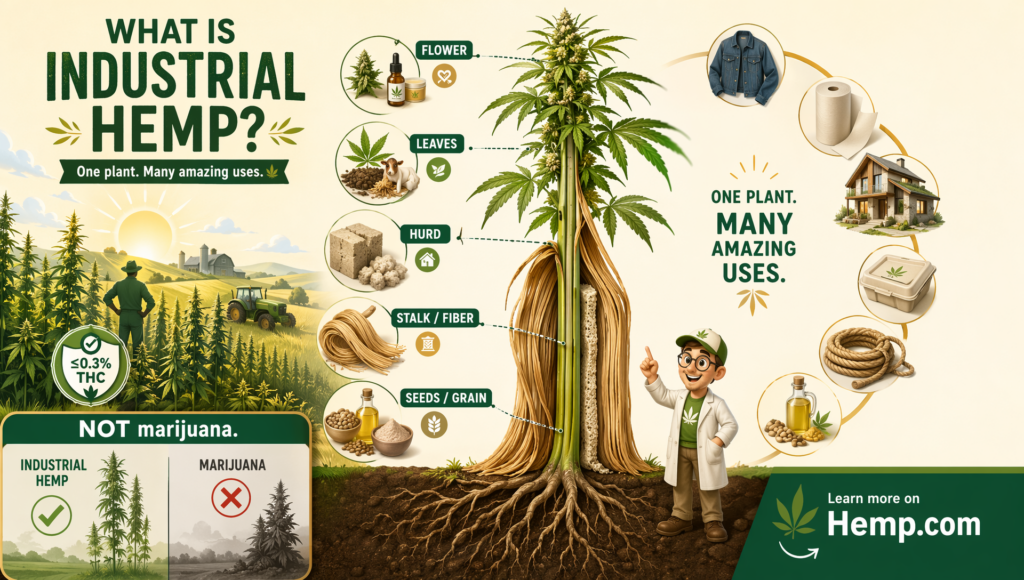
…Using hemp for ethanol production curbs the potential problem of using too many food sources like corn and wheat. Ultimately, this makes food production more efficient while also minimising its disruption.
At the same time, hemp is much easier to grow compared to other food crops. They’re like weeds that can thrive in lower-quality conditions.
Hemp biodiesel also has a higher flash point, aka the temperature at which it ignites. Because of this, it is much easier to store, transport, and handle overall…
When it comes to hemp, there is a lot of conflict about fertilizers. Probably because it has a variety of uses.
Hemp is not a particularly demanding crop when it comes to fertilizerrequirements. In fact, hemp is known to be quite tolerant of poor soil conditions.
The use of no-tillage strategies without any weed control measures can be detrimental to hemp stand establishment. Nitrogen fertilization up to 150 kg ha–1 can increase fiber and seed yield. Leguminous cover crops can supply adequate nitrogen to hemp without supplemental fertilization as indicated by similar yields among nitrogen rates in treatments that included hairy vetch and winter pea. Although hemp density was low in the no-till cover crop treatment, greater bast fiber yield per stalk significantly increased the total fiber yield, making it comparable to conventional tillage treatments. This suggests that cover crops can be considered a positive investment for hemp production…
The crop is photoperiod sensitive and is typically a short-day plant. Hemp responds well to elevated CO2 and temperature levels in the context of current climate change scenarios and is a water-efficient crop…
Growers can take herbicides and other costly weed control measures off their inventory because hemp is a smoother crop and rapidly produces a dense canopy that suppresses weeds. This makes it a perfect choice for organic production.
An exceptionally versatile plant, industrial hemp has a wide range of industrial and everyday household uses, and the commercial market for hemp products is booming worldwide. Products made from hemp are considered long-lasting and eco-friendly. Hemp derived CBD products are also proving to be incredible for our health and well being. It is not What is Hemp but what can hemp do for us in our quest for sustainability!…
With the passage of the Farm Bill in 2018, hemp cultivation has commenced in numerous states. Yet, the question extends beyond mere definition; it’s now about understanding what hemp can do for individuals and our environment, and what we can do to harness its potential. Now, hemp oils, CBD, hemp plastics, hemp building materials, and various hemp fiber products are readily available in the market.
Hemp is the low tetrahydrocannabinol (THC) variety of the Cannabis Sativa plant, containing minimal THC content as mandated by federal law—specifically less than 0.3% THC by dry weight. This distinction ensures that industrial hemp does not induce any psychoactive effects associated with marijuana. However, hemp and marijuana often face confusion, which can be clarified through our hemp vs. marijuana page….
PRESIDENT TRUMP DIRECTED CONGRESS TO FIX HEMP. NOW THEY MUST ACT.
President Trump issued an executive order directing Congress to reconsider the classification of hemp-derived products to ensure Americans, like our seniors, can access hemp-derived products they have found beneficial while still protecting children. The President gave clear direction. Now Congress must follow through. The McConnell-Harris hemp restrictions threaten to destroy 325,000 American jobs, devastate thousands of farmers and small businesses, and deny seniors access to CBD products that President Trump wants them to have. President Trump provided the solution: protect children through regulation while preserving consumer access to beneficial CBD and hemp-derived products. The hemp industry has offered exactly the common-sense regulations President Trump’s order calls for: -Age restrictions (21+) to protect children -Mandatory third-party laboratory testing for safety -Clear, uniform labeling for informed choices -Child-resistant packaging standards Contact your Representative and Senators today. Tell them to immediately act on President Trump’s executive order, fix the McConnell-Harris hemp ban, and implement the common-sense regulations that protect farmers, small business owners, consumers, and children. Let’s save American hemp and tell Congress to act on President Trump’s directive.
A provision significantly limiting the sale of intoxicating hemp products made its way into legislation to reopen the federal government just a day before the Senate approved the bill. Its inclusion follows years of pressure from states and the marijuana industry.
While states continue to expand access to legal marijuana, a separate market of hemp-derived intoxicants has blossomed. The products, from drinks to gummies, are sold in gas stations and smoke shops. Critics say some companies have exploited a legal loophole from 2018 to manufacture products that get people high — without the safety regulations and taxes facing the legal marijuana industry.
That’s led dozens of states to limit or ban certain intoxicating hemp products. Most states also have pushed for federal changes, though some farm states worry the pending federal bill — which the House is expected to vote on as soon as today — goes too far.
A bipartisan group of 39 state attorneys general recently urged Congress to clarify the federal definition of hemp, arguing that the underregulated industry threatens public health and undermines law enforcement…
The Senate has rejected an amendment to a critical spending bill that would have removed language to ban hemp products containing THC.
After the chamber cleared the appropriations minibus package for floor consideration on Sunday, senators on Monday took up the measure from Sen. Rand Paul (R-KY) that he said would prevent the eradication of the hemp market that’s matured since the crop’s federal legalization under the 2018 Farm Bill.
The amendment was killed in a 76-24 vote on a motion to table.
“My amendment would strip the provision designed to regulate the hemp industry to death. The bill, as it now stands, overrides the regulatory frameworks of several states, cancels the collective decisions of hemp consumers and destroys the livelihoods of hemp farmers,” Paul said on the floor ahead of the vote. “And it couldn’t come at a worse time for America’s farmers. Times are tough for our farmers.”…
How about we outlaw the Senate instead? They certainly have been ANTI-AMERICAN!
Cannabis is a plant, and there are two main types, Cannabis Indica and Cannabis Sativa. Both marijuana and CBD can be derived from both types, but hemp is only derived from Cannabis Sativa. By law, hemp must contain no more than 0.3% THC…
CBD has been credited with relieving numerous medical conditions, such as epilepsy, anxiety, inflammation, insomnia, and pain. Although “credited” does not mean proven. Because of the historical regulatory landscape, there are hardly any well-conducted trials backing up those claims, although research is expected to ramp up now that laws distinguish between hemp and marijuana.
We look at nine medical conditions where CBD may be, or, has already proven to be, beneficial.
1. Epilepsy
In June 2018, the FDA approved Epidiolex (a plant-based formulation of CBD) to treat seizures for people 2 years of age and older with Dravet syndrome and Lennox-Gastaut syndrome (LGS), which are two rare forms of epilepsy… [ I have 2 friends that use it for epilepsy with sucess]
2. Pain
Animal studies have shown that CBD has anti-inflammatory effects and works on the endocannabinoid and pain-sensing systems to relieve pain… [I got off of NSAIDs by using CBD oil.]
3. Arthritis
Animal studies showed that topical CBD applications relieve pain and inflammation associated with arthritis with few side effects…
4. Anxiety
Pretreatment with 300mg CBD significantly relieved anxiety in 57 healthy males who undertook a simulated public speaking test. However, dosages of 150mg CBD and 600mg CBD did not make any difference to the men’s anxiety levels.7
So CBD threatens Big Pharma. However I found this part of my research ‘interesting’
The versatility of industrialhemp extends beyond its use as a raw material.
Unleashing a New Wave of Sustainable Practices with Industrial Hemp
Industrial hemp, this incredible plant, stands tall as an embodiment of versatility. A crop whose potential extends far beyond its rustic exterior, transforming into an eco-friendly powerhouse with an impressive array of applications spanning numerous industries…
Industrial hemp, scientifically known as Cannabis sativa L., has served humanity for centuries, providing fiber, food, and medicinal benefits. Today, its role has expanded, becoming increasingly important as a sustainable and eco-friendly solution within various industries.
By integrating hemp into numerous manufacturing processes, industries can lessen their dependence on non-renewable resources and significantly reduce their environmental footprint. The inherent versatility and functional characteristics of hemp make it an ideal candidate for substitution, driving it to the forefront of sustainable development.
Moreover, hemp cultivation offers additional benefits such as soil remediation. By absorbing toxins and replenishing soil nutrients, hemp promotes healthier soils, which in turn, benefit subsequent crops…
Corporate giants such as Ford Motors, Patagonia, and The Body Shop have already recognized the profound potential of this sustainable resource, utilizing hemp seed, fiber, and oil as fundamental raw materials in their product lines. This level of corporate adoption serves as a testament to the staggering potential that industrial hemp offers as an environmentally conscious substitute for other resources.
Below are a few ways industrial hemp is already making its mark across industries:
Automotive, Railway, Aviation, and Aerospace: These industries are progressively embracing hemp-derived products as substitutes for traditional plastic materials. Hemp’s lightweight yet durable nature and biodegradable properties position it as a superior alternative to conventional plastics.
Cosmetics and Personal Care: The nutritive richness of hemp seed oil has found applications in numerous industrial and cosmetic products. From soaps and shampoos to other personal care items, the moisturizing properties and skin-nourishing abilities of hemp seed oil make it a coveted ingredient within the cosmetics and personal care sectors.
Textiles, Fabrics, and Paper Manufacturing: Hemp fiber’s application in the production of textiles, fabrics, and paper is truly a game-changer. It offers an eco-friendly alternative to traditional textile materials, requiring less water and fewer pesticides during cultivation, with the added advantage of being easily recyclable…
Reading industrial hemp uses across fibre, paper and materials
Industrial hemp is one of the oldest agricultural crops on the European continent. Beyond the modern cannabinoid catalog, the plant supplies fibre for textiles and ropes, hurd for construction biocomposites, paper for specialty applications and seed fractions for the wider agricultural framework. ThisJustbob guide walks through industrial hemp uses sector by sector, with the regulatory framework that connects the cultivation side to each application…
Industrial hemp uses cover the non-cannabinoid applications of Cannabis sativa L. cultivated under the EU industrial hemp framework. The main categories include textiles (canvas, rope, twine and modern fabrics), paper (specialty applications), construction biocomposites (hempcrete walls, insulation panels), automotive components (door panels and trim parts), agricultural substrates (animal bedding and horticulture) and biorefinery feedstock…
Textile applications: from canvas to modern fabrics
Textile production is one of the oldest documented uses of hemp fibre in European industry. Canvas, the heavy fabric traditionally used for sails, tents, and painting supports; rope, widely used in maritime, agricultural, and construction settings; twine, commonly found in packaging, gardening, and crafts; and modern technical fabrics all rely on the bast fibre extracted from the hemp stem.
The mechanical properties of hemp textile fibre are well documented. The tensile strength supports applications where durability matters more than a fine weave, while its natural resistance to mildew and pests adds value in maritime and outdoor settings. Its breathability and moisture handling propriety make hemp textile interesting for modern clothing and home textiles.
Paper applications: specialty papers and durability
Paper applications represent anotherlong-standing industrial use of hemp. The long bast fibres give hemp paper a stronger tensile profile and a longer fibre length than typical wood-pulp paper, making it suitable for specialty applications where these properties are particularly valuable.
Documented use cases include banknotes, where the strong tensile profile and the resistance to repeated handling are well suited to the application; archival papers (the low lignin content supports long-term stability; and technical papers, including filter papers, art papers, and thin technical papers. Hemp paper is also a feedstock for some specialty paper producers in France and Italy that supply niche markets.
The USDA published the foundational bulletin Hemp Hurds as Paper-Making Material in 1916, documenting the technical feasibility of hemp paper at industrial scale. The bulletin is still referenced in contemporary hemp economy literature as one of the early modern studies on this application.
Hempcrete and construction biocomposites
Hempcrete is the most visible modern application of hemp hurd in construction. This biocomposite combines hemp hurd with a lime binder to produce wall infill, insulation and structural-light applications. The French Isochanvre product was introduced around 1986 as one of the first commercial hempcrete formulations…
There is a LOT more…
WHY THE ORIGINAL ATTACK ON HEMP?
There was a comment about Hemp on WUWT by Dr Brown in August of 2013. He refers to something Dr Judith Curry said that I can no longer find.
[I do not have the origin of this quote]
The story goes …Dupont had patented nylon, and wanted hemp removed as competition….
I havn’t come across anything tangible (of an academic nature) but there must be tons out there. I’ll keep looking, but in the meantime here are some numbers from HempNews.
‘It follows that every tonne of industrial hemp stems contains 0.445 tonnes Carbon absorbed from the atmosphere (44.46% of stem dry weight).
‘Converting Carbon to CO2 (12T of C equals 44T of CO2(IPCC)), that represents 1.63 tonnes of CO2 absorption per tonne of UK Hemp stem harvested. On a land use basis, using Hemcore’s yield averages (5.5 to 8 T/ha), this represents 8.9 to 13.4 tonnes of CO2 absorption per hectare of UK Hemp Cultivation.
‘For the purposes estimation, we use an average figure of 10T/ha of CO2 absorption, a figure we hold to be a reasonably conservative estimate. This is used to predict carbon yields, but CO2 offsets will be based on dry weight yields as measured at the weighbridge.
‘The roots and leaf mulch (not including the hard to measure fibrous root material) left in situ represented approximately 20% of the mass of the harvested material in HGS’ initial field trials. The resulting Carbon content absorbed but remaining in the soil, will therefore be approximately 0.084 tonnes per tonne of harvested material. (42% w/w) (5).
‘Using Hemcore’s UK yield estimates (5.5 – 8 T/ha) this represents 0.46 to 0.67 tonnes of Carbon per hectare (UK) absorbed but left in situ after Hemp cultivation.’ [So in 2013 the UK was growing hemp but it was banned in the USA.]
Judith Curry’s remarks, as usual, are dead on the money. Here’s an almost perfectly analogous problem: CNN recently completely reversed its editorial policy and now calls for the legalization of Marijuana. Sanjay Gupta, its “resident physician editorialist”, who had previously somewhat vigorously led this opposition from the scientific point of view completely reversed his own position, and explained why in considerable detail both in text and in online video.
Historically, marijuana was both legal and considered to be a useful medicine all the way up through the beginning of the twentieth century. At that point, William Randolph Hearst had invested heavily in pine forests in Mexico, intending to sell them to his own newspapers to make newsprint. The Dupont family were discovering petrochemicals including plastic and oil-derived pharmaceuticals. A machine was invented that was the equivalent of a “cotton gin” for hemp — it mechanically stripped down the hemp plant and turned it into useful fiber, oil, and vegetable waste that could be used as an animal fodder (yes, we can imagine some very happy cows, can’t we?:-). One of many uses for the now inexpensive hemp fiber was to make equally inexpensive newsprint paper that was clearly superior in quality and cost to wood pulp paper. Another was that the oils and fiber could be used to synthesize various chemical products. Both Dupont and Hearst were suddenly hundreds of millions of dollars at risk.
They turned to Harry Anslinger, who happened to be Hearst’s brother in law. Anslinger was a suddenly idle ex-prohibitionist working for the FBI, and he created a propaganda campaign that portrayed hemp as literally maddening those that actually smoked it, leading them to commit acts of rape and robbery and moral turpitude. At the same time, political revolutions in Mexico (funded and fought by a private army belonging to Hearst) and a negative portrayal of blacks and mexicans as common users of hemp for recreation purposes added a useful racist hook. Between these, congress outlawed hemp.
So matters remained until the Viet Nam war and the 1960s and early 70s. As part of the quiet “revolution” against what many perceived as a military-industrial complex with a life of its own that was fighting a series of expensive and pointless wars, pot had become “the” recreational drug of choice among young hippies and freaks as well as the military draftees who fought the war. Its use was so prevalent that Texas dropped the question about cannabis use from its entrance exam to police academy, because “asking a vet of they had ever smoked pot was like asking them if they smoked Camels”. Suddenly a large fraction of an entire generation of U.S. citizens had smoked pot and discovered that no, it does not turn you into a crazed rapist, and usually does not make you insane unless you are most of the way there on your own already. They also discovered that it is neither physically addictive nor dangerous in the sense that it is literally impossible to overdose on marijuana — it is literally one of the safest compounds we know of, with no meaningful fatal dose.
However, Ronald Reagan took office in the 80’s, an immediately declared a “War on Drugs”. Marijuana was reclassified as a schedule 1 narcotic by the federal government, trumping communities that had already begun to experiment with decriminalization or even legalization. This once again gave law enforcement agencies lots of useful work (helpful if you are trying to build a police state), gave cops everywhere the ability to selectively enforce drug laws and thereby control the populace, and caused us to rather suddenly need to build enormous numbers of prisons because it rapidly turned out that by making marijuana trafficking a felony and putting even mere users in jail (just like heroin, cocaine, and actually dangerous drugs) somewhere between 1/3 and 1/2 of all prison sentences were being handed down for low grade drug offenses. Our expenditure on controlling pot went from next to nothing to tens of billions of dollars a year. Obviously, many profited from this, including (as usual) the money launderers and organized criminals that made fortunes providing marijuana on the black market, and the politicians and bankers that provided well-paid-for top cover.
And now to the interesting bit (although I think all of the above is interesting:-). One of the reasons given for making marijuana a schedule 1 felony class drug was that we didn’t know about the harm it might cause, and there was no known medical benefit. Yes, it had been used as a medicine for centuries, the founding fathers literally “mandated” the growing of hemp on American farms because it was so useful a plant both industrially and medicinally, but we had entered the era of double blind placebo controlled drug trials, and there were now enormous pharmaceutical companies whose billion-dollar products were at risk, dwarfing even the Duponts’ complaint back in the 30’s. Its risks were similarly unstudied.
A period of research then ensued. If you wanted to study pot, you had to both get funded and get the experimental marijuana from a single, small farm in Mississippi that grew “legal” pot for this purpose. The government itself was in complete control, in other words of what research got conducted, because even if you could find outside funding, you couldn’t get legal pot to do the research with without approval.
Gupta initially opposed marijuana legalization because a review of the medical literature showed him that 96% of all published articles found some sort of negative effect of marijuana, and almost no articles showed a benefit, especially compared to existing approved medications. However, a couple of anecdotal cases coming out of the states that had legalized medicinal marijuana in SPITE of the federal governments laws caused him to go back and reexamine the funding model. In retrospect it shouldn’t have been surprising, but he learned that 96% of all funded research was to look for negative effects of marijuana, and that to get funded and permission to get government grown pot was so difficult that there simply weren’t all that many papers in the first place. In well over thirty years of intensive examination, all of the examination was literally preselected to find problems, almost none to find benefits, and one had to walk on water and push much paper to do either one (and relatively few scientists had bothered).
That caused him to examine the body of emerging, still anecdotal, evidence from the states that had legalized medical marijuana. They showed that — again unsurprisingly — marijuana is a rich pharmacopeia with multiple legitimate medical uses that could survived double blind placebo controlled investigation, while at the same time having minimal side effects and no known lethal dose. Perhaps he came to realize that its negative effects might, conceivably, have been a bit exaggerated or might arise from confounding uncontrolled elements. Confirmation bias is, after all, the bete noir of science.
This situation almost perfectly matches the evolution of “climate science”. Nobody cared about it for decades, but suddenly a group of individuals emerged that all benefited from the demonization of carbon. This included environmental groups, that hated civilization itself and the burning of anything (as long, of course, as their own lifestyle was preserved), energy producers that saw in this the opportunity to triple or quadruple their profits by creating artificial scarcity of a plentiful resource, politicians that saw in this the opportunity to raise taxes, get elected on a world-saving “issue”, and perhaps line their own pockets along the way, and a United Nations that saw an opportunity to transform it into a way to tax the rich nations and transfer money to developing nations (while again lining various pockets along the way). The role of Anslinger was admirably met by one James Hansen, a True Believer who never stinted and does not stint today in exaggerating the data and claims of disaster (five meter sea level rise! temperatures like that on Venus!). And suddenly, quite literally all funded research was on how burning carbon was bad for the climate.
Even completely ethical scientists have to eat, and if the only way they can eat is to get funded, and the only way they can get funded is to submit proposals that seek to prove that CO_2 is bad, guess what they will propose to study? And if they want to get funded AGAIN, guess what they will find? Climate science has been effectively corrupted beyond any hope of objectivity.
On the good side of things, scientists are actually usually pretty ethical. Also, in the end data talks, bullshit walks. The hypothesis of CAGW or CACC could, in fact, be true (across a wide spectrum of the meaning of “true”, in fact). However, recent data is not in good correspondence with the theories that have predicted it, and many good scientists are in the process of reassessing their conclusions. As is the almost simultaneous case with regard to marijuana, the confounding evidence is starting to overwhelm to narrowly funded and directed arguments to date. We will see where the future takes us, in both cases. rgb
mikerossander says on August 22, 2013 at 12:40 pm
re: rgbatduke’s extended history at August 22, 2013 at 5:44 am:
One correction – Nixon is the moron who declared a “War on Drugs”. Congress made marijuana into a Schedule I narcotic in 1970. Pres Reagan may be guilty of a lot but he is innocent of that particular charge above.
In 1974 researchers learned that THC, the active chemical in marijuana, shrank or destroyed brain tumors in test mice. But the DEA quickly shut down the study and destroyed its results, which were never replicated — until now.
The term medical marijuana took on dramatic new meaning in February, 2000 when researchers in Madrid announced they had destroyed incurable brain tumors in rats by injecting them with THC, the active ingredient in cannabis.
The Madrid study marks only the second time that THC has been administered to tumor-bearing animals; the first was a Virginia investigation 26 years ago. In both studies, the THC shrank or destroyed tumors in a majority of the test subjects.
Most Americans don’t know anything about the Madrid discovery. Virtually no major U.S. newspapers carried the story, which ran only once on the AP and UPI news wires, on Feb. 29, 2000…
Smoking Cannabis Does Not Cause Cancer Of Lung or Upper Airways, Tashkin Finds; Data Suggest Possible Protective Effect
The story summarized by that headline ran in O’Shaughnessy’s (Autumn 2005), CounterPunch, and the Anderson Valley Advertiser. Did we win Pulitzers, dude? No, the story was ignored or buried by the corporate media. It didn’t even make the “Project Censored” list of under-reported stories for 2005. “We were even censored by Project Censored,” said Tod Mikuriya, who liked his shot of wry.
It’s not that the subject is trivial. One in three Americans will be afflicted with cancer, we are told by the government (as if it’s our immutable fate and somehow acceptable). Cancer is the second leading cause of death in the U.S. and lung cancer the leading killer among cancers. You’d think it would have been very big news when UCLA medical school professor Donald Tashkin revealed that components of marijuana smoke -although they damage cells in respiratory tissue- somehow prevent them from becoming malignant. In other words, something in marijuana exerts an anti-cancer effect.
Tashkin has special credibility. He was the lead investigator on studies dating back to the 1970s that identified the components in marijuana smoke that are toxic. It was Tashkin et al who published photomicrographs showing that marijuana smoke damages cells lining the upper airways. It was the Tashkin lab reporting that benzpyrene -a component of tobacco smoke that plays a role in most lung cancers- is especially prevalent in marijuana smoke. It was Tashkin’s data documenting that marijuana smokers are more likely than non-smokers to cough, wheeze, and produce sputum.
Tashkin reviewed his findings April 4 at a conference organized by “Patients Out of Time,” a reform group devoted to educating doctors and the public (as opposed to lobbying politicians). Some 30 MDs and nurses got continuing medical education credits for attending… [long article]
Published: December 2003. Cannabinoids: potentialanticanceragents. … Other potential palliative effects of cannabinoids in cancer patients — supported by Phase III clinical trials — include appetite stimulation and pain inhibition.
There are Important Notifications from our host, Wolf Moon; the Rules of our late, good Wheatie; and, certain caveats from Yours Truly, of which readers should be aware. They are linked here. Note: Yours Truly has checked today’s post for any AI-generated content. To the best of her knowledge and belief, there is none. If readers wish to post any AI-generated content in the discussion thread for today’s post, they must cite their source. Thank you.
Do not forget to LABEL AI articles, video and such.
For fun, from one half of the Prussiagate team known as Will Zol.
Trump’s “Oranges” Slip Was A Clue – Nobody Caught It For 7 Years (43 minutes)
I am going to start with how things stand today. In reading X-22 on Wednesday I realized there was a tweet that fits very well with this article so I am adding it here at the top of the page.
Tell people they’re going to die.
Then tell them only you can save them.
That’s the oldest trick in the book, and the AI doom machine is running it at full throttle.
First comes the extinction warning: greater than a 10% chance AI kills humanity within a decade.
…we find that only 737 top holders accumulate 80% of the control over the value of all TNCs [Trans National Corporations] …This means that network control is much more unequally distributed than wealth. In particular, the top ranked actors hold a control ten times bigger than what could be expected based on their wealth…
…In detail, nearly 4/10 of the control over the economic value of TNCs in the world is held, via a complicated web of ownership relations, by a group of 147 TNCs in the core, which has almost full control over itself. The top holders within the core can thus be thought of as an economic “super-entity” in the global network of corporations. A relevant additional fact at this point is that 3/4 of the core are financial intermediaries….
There may be 147 companies in the world that own everything, as colleague Bruce Upbin points out and they are dominated by investment companies as Eric Savitz rightly points out. But it’s not you and I who really control those companies, even though much of our money is in them. Given the nature of how money is invested, there are four companies in the shadows that 𝗿𝗲𝗮𝗹𝗹𝘆 control those companies that own everything.
Before I reveal them, some light math:
According to the 2011 annual factbook from the Investment Company Institute, there is $24.7 trillion in all the mutual funds in the world (a little less than half from the US). Based on data from the ICI, $1.24 trillion of this is directly invested in index funds, plus another $992 billion in assets beyond that $24.7 trillion in Exchange Traded Funds, which aren’t mutual funds but are index funds. That means the bulk of that money is in “active” managed funds or fund of funds.
.the chief of hedge funds at a very large asset manager told me last week (alas, I cannot identify either) that an internal study his firm recently performed found that the vast majority of mutual funds defined as actively managed see 95% of the assets they hold determined by an index. That means just 5% of actively managed funds really are driven by the active manager’s judgment….
So of the $25.69 trillion in worldwide assets we’ve identified, $2.23 trillion are directly in indexes (ETFs and index mutual funds) with another $22.3 trillion indirectly beholden to indexes (that 95% of actively managed fund holdings said to be determined by an index).
You can see where I’m headed here. That means the real power to control the world lies with four companies: McGraw-Hill, which owns Standard & Poor’s, Northwestern Mutual, which owns Russell Investments, the index arm of which runs the benchmark Russell 1,000 and Russell 3,000, CME Group which owns 90% of Dow Jones Indexes, and Barclay’s, which took over Lehman Brothers and its Lehman Aggregate Bond Index, the dominant world bond fund index. Together, these four firms dominate the world of indexing. And in turn, that means they hold real sway over the world’s money…
And FYI from Brave AI:
Robert Maxwell, the late British media tycoon and father of Ghislaine Maxwell, did not own McGraw-Hill but formed a major joint venture with the company in 1989. Through his U.S. subsidiary Macmillan Inc., Maxwell merged his educational publishing assets with McGraw-Hill’s to create Macmillan/McGraw-Hill School Publishing Co., which became the nation’s largest or second-largest textbook publisher depending on the source.
Small world…Does all the Corporate Woke Schiff now make sense?
The financiers then made the next move. Using corporate money to influence the US elections. I very much disagree with this SCOTUS decision. Corporations ARE NOT PEOPLE!
By a 5-to-4 vote along ideological lines, the majority held that under the First Amendment corporate funding of independent political broadcasts in candidate elections cannot be limited. Justice Anthony M. Kennedy wrote for the majority joined by Chief Justice John G. Roberts and Justices Antonin G. Scalia, Samuel A. Alito, and Clarence Thomas. Justice John Paul Stevens dissented, joined by Justices Ruth Bader Ginsburg, Stephen G. Breyer, and Sonia Sotomayor. The majority maintained that political speech is indispensable to a democracy, which is no less true because the speech comes from a corporation. The majority also held that the BCRA’s disclosure requirements as applied to The Movie were constitutional, reasoning that disclosure is justified by a “governmental interest” in providing the “electorate with information” about election-related spending resources. The Court also upheld the disclosure requirements for political advertising sponsors and it upheld the ban on direct contributions to candidates from corporations and unions. In a separate concurring opinion, Chief Justice Roberts, joined by Justice Alito, emphasized the care with which the Court handles constitutional issues and its attempts to avoid constitutional issues when at all possible. Here, the Court had no narrower grounds upon which to rule, except to handle the First Amendment issues embodied within the case. Justice Scalia also wrote a separate concurring opinion, joined by Justices Alito and Thomas in part, criticizing Justice Stevens’ understanding of the Framer’s view towards corporations. Justice Stevens argued that corporations are not members of society and that there are compelling governmental interests to curb corporations’ ability to spend money during local and national elections.
In 2010, the Supreme Court ruled that corporations and others have a First Amendment right to raise and spend unlimited money on elections. Few modern Supreme Court decisions have received as much public attention, or backlash, as Citizens United v. FEC. The U.S. has since seen a surge in megadonors and a rise in dark money, or undisclosed campaign donations. A tiny sliver of Americans now wield more power than at any time since Watergate, too often at the expense of ordinary citizens whose needs are not prioritized.
On top of influencing elections, corporations (and NGOs) use their large amounts of cash to lobby Congress.
CHAPTER 6 Uncertain Victory: BIG BUSINESS AND THE POLITICS OF REGULATORY REFORM (pp. 174-200)
The Business Roundtable [a nonprofit association of 200+ CEOs of major U.S. companies, founded in 1972 in Washington, D.C.-GC] helped define corporate lobbying in Washington, D.C., in the 1970s, but for twenty years the group also maintained an office in New York City, where it kept its administrative and strategic planning functions geographically separate from its lobbying. From its prehistory at the Links Club on 62nd Street, the Roundtable bounced around Manhattan’s hot real estate locations, including stints on Wall Street, Broad Street, and Lexington Avenue. From 1978 until its final move south in 1993, member CEOs and professional staff members, particularly those who worked on nonlobbying issues like construction industry negotiations..
….
The author of the following article is Stephen D. Foster, Jr., a flaming liberal who holds a Bachelor’s Degree in History and Political Science from Missouri University of Science and Technology. However I do think he has a point. Given the East India Company, I do not think corporations were looked on with favor by the Founding Fathers.
…To say that the founding fathers supported corporations is very absurd. Its quite the opposite in fact. Corporations like the East India Trading Company were despised by the founding fathers and they were just one reason why they chose to revolt against England. Corporations represented the moneyed interests much like they do today and they often wielded political power, sometimes to the point of governing a colony all by themselves like the Massachusetts Bay Company did.
… At the time, in Britain, large corporations funded elections generously and its stock was owned by nearly everyone in parliament. The founding fathers did not think much of these corporations that had great wealth and great influence in government. And that is precisely why they put restrictions upon them after the government was organized under the Constitution…
After the nation’s founding, corporations were granted charters by the state as they are today. Unlike today, however, corporations were only permitted to exist 20 or 30 years and could only deal in one commodity, could not hold stock in other companies, and their property holdings were limited to what they needed to accomplish their business goals. And perhaps the most important facet of all this is that most states in the early days of the nation had laws on the books that made any political contribution by corporations a criminal offense. When you think about it, the regulations imposed on corporations in the early days of America were far harsher than they are now. That is hardly proof that the founding fathers supported corporations. In fact its quite the opposite…
Was Foster making this up out of whole cloth? Or was there truth in what he wrote?
Jane Anne Morris is a corporate anthropologist and writer…
In researching nineteenth-century laws regulating corporations, Morris found that in Wisconsin, as in most other states at that time:
Corporations were required to have a clear purpose, to be fulfilled but not exceeded.2
Corporations’ licenses to do business were revocable by the state legislature if they exceeded or did not fulfill their chartered purpose(s).3
The state legislature could revoke a corporation’s charter if it misbehaved.4
The act of incorporation did not relieve corporate management or stockholders/owners of responsibility or liability for corporate acts.5
As a matter of course, corporation officers, directors, or agents couldn’t break the law and avoid punishment by claiming they were “just doing their job” when committing crimes but instead could be held criminally liable for violating the law.6
State (not federal) courts heard cases where corporations or their agents were accused of breaking the law or harming the public.7
Directors of the corporation were required to come from among stockholders.8
Corporations had to have their headquarters and meetings in the state where their principal place of business was located.9
Corporation charters were granted for a specific period of time, such as twenty or thirty years (instead of being granted “in perpetuity,” as is now the practice).10
Corporations were prohibited from owning stock in other corporations, to prevent them from extending their power inappropriately.11
Corporations’ real estate holdings were limited to what was necessary to carry out their specific purpose(s).12
Corporations were prohibited from making any political contributions, direct or indirect.13
Corporations were prohibited from making charitable or civic donations outside of their specific purposes.14
State legislatures could set the rates that some monopoly corporations could charge for their products or services.15
All corporation records and documents were open to the legislature or the state attorney general.16
Similar laws existed in most other states. It is important to understand that tens of thousands of entrepreneurs did business in the early colonies and continue to do so today without being incorporated—the proverbial butcher, baker, and candlestick maker. To do business in America or most of the world does not require a corporate structure—people can run partnerships, individual proprietorships, or simply manufacture and sell products or offer services without any business structure whatsoever other than keeping track of the money for the Internal Revenue Service….
It’s only when a group of people get together and put capital (cash) at risk and want to seek from the government legal limits on their liability, and to legally limit their possible losses, that a corporate form becomes necessary. In exchange for these limitations on liability, governments demand certain responsibilities from corporations.
The oldest historic one was that corporations “operate in the public interest” or “to the public benefit.” After all, if the people, through their elected representatives, are going to authorize a legal limitation of liability for a group of people engaged in the game of business, it’s quite reasonable to ask that the game be played in a way that throws off some benefit to the government’s citizens or at least doesn’t operate counter to the public welfare...
E. M. Smith aka ChiefIO is a trained economist. This is what he had to say back in 2011.
Realize that the corporate urge is not toward a competitive market. It’s the very LAST thing any corporate wants. What a corporate wants is a monopoly where they can achieve the profit maximizing price point. Not competition. No “market” with many sellers.
So watch what GE does, as an example. It is always on the hunt for a market it can “dominate”. It uses political leverage to get its products mandated and the competition banned. It doesn’t want a market, it wants a ‘company store’.
Internalize that, and a lot of things “fit” better…
Monsanto pushing legislation to ban private traditional seeds[saving] and seed sharing, and promoting GMO products. (Why would a seed company want to ‘destroy’ a seed market? So you must come to the company store…)
EPA is used to forbid all sorts of things that can be done easily and cheaply, and where the alternative is very expensive ….
Once corporations figure out that it is cheaper and easier to get the competition banned and them mandated, than to create new products; and that they can make lots of money as the sole provider of a crappy product but not that much making good products in a competitive market; well, lets just say that the campaign contributions flow…
Oddly, you can look at Communism as the “limit case” where there is ONE corporation and it IS the government. At the other extreme is “laissez faire” with huge numbers of competitors. As you move toward Communism you pass through stages of ever more “concentration” of control. Just shy of communism is Classical Socialism with it’s state planning boards and commissions. A bit more toward L.F. you get “Market Socialism” (with some sub-types in between).
The USA until about 1990 was a “Mixed Economy” with some “natural monopolies” under government “control” via “regulation”; and with many competitive markets. We’ve moved to more central planning and more central “regulation” (in some cases as a cover for the “planning” word that has gotten tied to Socialism… so is political to some extent). With the nationalization of GM and the bank “bailout” / “rescue” that was really more of a ‘take-under’ in some ways; we moved to a Lange Type Socialism.
The result of the last 50 years has been more companies in markets with Oligopolies that are essentially guaranteed by the government. Who dominates the Home Mortgage Market? Fanny & Freddy – Gov’t Corporations. Who dominates the Student Loan Market? Sally Mae – a Gov’t Corporation. Who dominates US Autos? GM – a Gov’t Corporation via Nationalization, but now being sold off. (Though Ford is doing well too.) And who “Calls the Tune” for the Banks in America? ALL of them? The Federal Reserve Bank – a Gov’t sponsored corporation. And there are a whole lot more of them. Try taking a train from coast to coast for example…
At the next tier down, we have Gov’t dependent Oligopolies. Say you wanted to make airplanes. First off, you need that dozen lawyers to work the FAA for you. Next up, you need some friends in the Military to feed you contracts. Don’t think so? When Boeing gets a $B contract to ‘study’ or ‘develop’ and you need to design your new tech from scratch on your own money: Who do you think will win? So the government basically decides how many companies it wants, and who they will be, then funds them “to plan” with contracts. (This is NOT a hypothetical… I’ve watched them flat out announce “We’d like Lockheed and Martin to merge” or “we don’t want…” usually when one of them is ‘having issues’ and the topic is raised. Then the gov’t casts the one vote that matters…)
And so it goes…
This is, dare I say it…. basically the same way the Fascist “Third Way” worked. (And it DOES work). FDR and Wilson both had high praise for The Third Way and you can see how they shifted America from a ‘free market’ toward “Third Way” government – corporation “cooperation” … It was this same process / tendency that Ike warned about in the “Military Industrial Complex” speech.
So we’ve moved away from straight up competition (and with good reasons… it is less profitable and more destructive in some ways and it is prone to monopoly practices) and toward that Classical Socialist end of things; with exact placement varying over time. And we called it a “Mixed Economy” at the ‘tepid’ end; as the name “fascist Third Way” got a bit tainted during W.W.II …. that tendency for Mussolini and Hitler to stir in a load of Nationalism and for the Nazi’s a double helping of Racism spoiled the soup for the Third Way “Socialist Lite” folks like FDR.
And the propaganda worked.
We’ve now got a “Progressive” and a “Third Way” government that IS a form of Socialism. (Now being rebranded as “Market Socialism” in the Eastern Block and Euro zones; called “Regulation” in the USA and sometimes poking it’s head up under “Rescue” as well with the most recent bits called “Social Justice”… all the pieces as slices of salami, but no overall Big Picture of it… we like to keep our socialism hidden in tiny bites with different names.) But just don’t ever point out that it’s basically the same “Third Way” process, using what’s properly called “Corporatism”, to achieve the Socialist agenda; that was first innovated by the Fascists… After all, it doesn’t fit the propaganda paradigm “Fascists bad, WORLD Socialists good” put out by Stalin…
And that is the root cause of your pondering. Corporations are very happy under a Socialist Third Way / Progressive / Market Socialism / Fascist / “Government regulated Coopertition” (whatever you name you like to apply to the same beast) system. They are not very happy with wide open competitive markets. See all of Europe for an example of “Managed Markets” (yet another name…) The French are masters of this technique, and the Germans not far behind. The Japanese innovated the Keiretsu as a way to limit competition to manageable chunks with government supervision.
Like I said, it DOES work. What galls me is just that we run around putting 20 different names on the same process and that just hides what’s really going on. All for political reasons. Very “un-tidy”… You’d think these folks had something to hide…
At any rate, I’d like our economy to move back more toward a “Mixed Economy” with less of it “regulated and rescued” and be a bit further from a Lange Type Socialism and more like the Socialism Lite we used to be. Somehow some folks think that means I want laissez faire (which is prone to other evil failures); even more folks think Corporations must be laissez faire machines and tools of the Evil Right Wing; when the reality is that they are much more useful to the Third Way Socialists of the world… and make much more stable profits under them.
Hope that helps you see why “corporations would want to destroy their own markets”… Just need to change it around a little and it makes a lot of sense:
“Why would corporations want to destroy the competitive nature of their own markets?”…
THE COST OF REGULATIONS, CORPORATIONS FAVORITE WEAPON
“This is a good time to recall the lesson George McGovern learned when he started a boutique hotel after his political career ended, only to learn the bitter lessons of the heavy foot of government regulation. This led McGovern to express a heresy:
I also wish that during the years I was in public office, I had had this firsthand experience about the difficulties business people face every day. That knowledge would have made me a better U.S. senator and a more understanding presidential contender…
[M]y business associates and I also lived with federal, state and local rules that were all passed with the objective of helping employees, protecting the environment, raising tax dollars for schools, protecting our customers from fire hazards, etc. While I never have doubted the worthiness of any of these goals,👉the concept that most often eludes legislators is: “Can we make consumers pay the higher prices for the increased operating costs that accompany public regulation and government reporting requirements with reams of red tape.” It is a simple concern that is nonetheless often ignored by legislators.👈
U.S. GDP is just $16 trillion instead of $54 trillion
The growth of federal regulations over the past six decades has cut U.S. economic growth by an average of 2 percentage points per year, according to a new study in the Journal of Economic Growth. As a result, the average American household receives about $277,000 less annually than it would have gotten in the absence of six decades of accumulated regulations—a median household income of $330,000 instead of the $53,000 we get now.
The researchers, economists John Dawson of Appalachian State University and John Seater of North Carolina State, constructed an index of federal regulations by tracking the growth in the number of pages in the Code of Federal Regulations since 1949. The number of pages, they note, has increased six-fold from 19,335 in 1949 to 134,261 in 2005. (As of 2011, the number of pages had risen to 169,301.) They devise a pretty standard endogenous growth theory model and then insert their regulatory burden index to calculate how federal regulations have affected economic growth. (Sometimes deregulation extends rather than shortens the number of pages in the register; they adjust their figures to take this into account.)…
People esp ‘economists’ forget small business. There are a LOT of one to ten person shops out there. They hire a person or two even if it is just casual labor for a day or two or a week.
…. most of these new participants in the underground economy are ordinary hard-working Americans who are increasingly taking jobs that pay “under the table” either because nothing else is available or they need a second source of income to make ends meet.
America’s underground economy is nothing new, but since the Great Recession hit,[The Obummer years] experts estimate it has doubled in size, driven by unemployed or underemployed people desperate for income….
Small firms accounted for 65 percent (or 9.8 million) of the 15 million net new jobs created between 1993 and 2009…. An estimated 552,600 new employer firms opened for business in 2009, and 660,900 firms closed….
How important are small businesses to the U.S. economy?
Small firms: • Represent 99.7 percent of all employer firms. • Employ half of all private sector employees. • Pay 44 percent of total U.S. private payroll. • Generated 65 percent of net new jobs over the past 17 years. • Create more than half of the nonfarm private GDP. • Hire 43 percent of high tech workers ( scientists, engineers, computer programmers, and others). • Are 52 percent home-based and 2 percent franchises. • Made up 97.5 percent of all identified exporters and produced 31 percent of export value in FY 2008. • Produce 13 times more patents per employee than large patenting firms.
….cities and states stifle new small businesses at every turn, burying them in mounds of paperwork; lengthy, expensive and arbitrary permitting processes; pointless educational requirements for occupations; or even just outright bans. Today, the Institute for Justice released a series of studies documenting government-imposed barriers to entrepreneurship in eight cities. In every city studied, overwhelming regulations destroyed or crippled would-be businesses at a time when they are most needed.
Time and again, these reports document how local bureaucrats believe they should dictate every aspect of a person’s small business. They want to choose who can go into which business, where, what the business should look like, and what signs will be put in the windows. And if that means that businesses fail, or never open, or can operate only illegally, or waste all their money trying to get permits so they have nothing left for actual operations, that’s just too bad. This attitude would be bad enough in prosperous times, but in a period of financial strain and high unemployment, it’s almost suicidally foolish…..
It’s well-known the regulatory burden falls disproportionately on small business. American Action Forum (AAF) research has discovered they are shedding jobs and wages are falling because of the Affordable Care Act. In addition, as regulation increases, the number of small business establishments decreases, while the largest businesses grow more numerous. Based on AAF’s latest research, the paperwork and compliance burdens alone total more than 3.3 billion hours and $64.6 billion. Given that compliance affects small businesses more acutely, each new hour of paperwork means less productivity, fewer profits, and diminished competitiveness, relative to larger competitors….
Now if we can get the states, towns and cities to give small businesses relief from idiotic regulations some of those underground businesses can come back into the regular economy. [This is what POTUS Trump is trying to do to unleash the US Economy.]
The 2013 Federal Register contains over 80,000 pages of new rules. As the Dollarhites showed only a large corporation that hires a full time legal staff has any hope of steering clear of traps in those new rules and in the new laws with completely off topic amendments attached. The Dollarhites, whose kids raised pet rabbits and sold them, fell foul of a one liner in an unrelated bill that amended the Animal Welfare Act years after the original law was passed.
That one liner is why I sold off my petting farm animals.
…the Dollarhite family of Nixa, Mo., first started raising and selling bunnies as part of a lesson to teach their teenage son about responsibility and hard work, they had no idea they would eventually meet the heavy hand of the US Department of Agriculture (USDA). According to a recent article covered in Breitbart’s
Big Government, the USDA recently ordered the Dollarhite family to pay more than $90,000 in fines because they sold more than $500 worth of rabbits in a year — and if they fail to pay the fine by Monday, May 23, the fine will multiply to nearly $4 million….
On top of that you need a compliance staff. I worked for a company with a small thirty man staff. After a new law was passed we had to add 3 more people, 10% of the employees, to do nothing except deal with the additional paperwork required. That cost YOU money.
Following a record year of rulemaking, the Obama Administration is continuing to unleash more costly red tape. In the first six months of the 2011 fiscal year, 15 major regulations were issued, with annual costs exceeding $5.8 billion and one-time implementation costs approaching $6.5 billion. No major rulemaking actions were taken to reduce regulatory burdens during this period. Overall, the Obama Administration imposed 75 new major regulations from January 2009 to mid-FY 2011, with annual costs of $38 billion. There were only six major deregulatory actions during that time, with reported savings of just $1.5 billion. This flood of red tape will undoubtedly persist, as hundreds of new regulations stemming from the vast Dodd–Frank financial regulation law, Obamacare, and the EPA’s global warming crusade advance through the regulatory pipeline—all of which further weakens an anemic economy and job creation, while undermining Americans’ fundamental freedoms. Action by Congress as well as the President to stem this regulatory surge is essential.
It’s clear the Barack Obama White House ranks as one of the most activist regulatory administrations in history. Consequently, it’s not surprising the administration argues that regulatory costs and uncertainty aren’t hurting the economy.
Jan Eberly, assistant treasury secretary on economic policy, recently tried to make the case for an-all-is-well position on regulation in a Treasury Department blog. The piece opened by quoting Treasury Secretary Tim Geithner in his recent Senate testimony: “I’m very sympathetic to the argument you want to be careful to get the rules better and smarter, but I don’t think there’s good evidence in support of the proposition that it’s regulatory burden or uncertainty that’s causing the economy to grow more slowly than any of us would like.”
Eberly goes on to make various points that supposedly undercut the argument regulation hurts business, the economy and jobs.
She cites a recovery in corporate profits.But that ignores where profits should or could be. In fact, corporate profits only climbed above their 2006 levels last year. For good measure, Eberly ignores that as of the second quarter of this year, proprietors’ income had still failed to climb back to its 2006 level.[Proprietorsare small business owners.]
Eberly asserts that a flat workweek for private workers and low capacity utilization point to poor demand, not fear of regulation…
As a private citizen do YOU have the time to read 80,000 pages of new regs a year, not to mention court cases? (Courts can make laws. It is called case law.) These regulations make it almost impossible for people to start and grow a small business.
And that brings us back to the attack on AI. Regulations are the best way to pick winners and losers AND to manage the decline of the USA while making people nothing but wage slaves.
There are Important Notifications from our host, Wolf Moon; the Rules of our late, good Wheatie; and, certain caveats from Yours Truly, of which readers should be aware. They are linked here. Note: Yours Truly has checked today’s post for any AI-generated content. To the best of her knowledge and belief, there is none. If readers wish to post any AI-generated content in the discussion thread for today’s post, they must cite their source. Thank you.
Do not forget to LABEL AI articles, video and such.
As we come into the mid-terms and the economy becomes more and more important, let’s start with Tom Luongo’s
With the ECB hiking rates this week we’ve seen a big move by capital markets, especially on Friday, the 25th Anniversary of 9/11, where bond markets globally sold off more than 10 bps.
To my conspiratorial mind this was a warning shot to the Fed, the US, the Trump Administration and the gods themselves, thatDavosand their London sycophants are not going down without the fight of our lives.
The reality is that Lagarde raised to protect euro-bond/JGB carry spreads and to punish Germans for voting populist. Meanwhile, the UK is looking at a breakup, to ensure that there is no country left, freeing the Scots, Welsh and Northern Irish to rejoin the EU and finally betray BREXIT completely.
Christine Lagarde hiked into an energy supply shock because of Keynesian dogma, or so the story goes. It was a policy mistake of epic proportions. And in response, the bond market sell off globally was intended to force Kevin Warsh at the Fed to make the same policy mistake.
CPI, employment, labor, and producer price data clearly do not warrant a rate hike from the Fed. Lagarde sparked a dollar liquidity spasm into the weekend with this and the Financial press tried to sell it as a statement by bond vigilantes that the Fed must hike.
Nonsense. The MOVE index sits at 82.2 after that. Break-even rates are still below 2%
Oil prices are elevated on future supply refilling but that is clearly transitory.
The real story continues to be in the those aforementioned carry spreads, which Trump pushes Canada into a war which will not end well for them…
When Reading the tweets from the Debriefing (Below) the word FinCEN caught my eye because of this passage from one of my older articles, KMAG DAILY THREAD 20260225 & COLUMBIA
This program that Secretary of the Treasury Scott Bessent is rolling out with FINcen seems to streamline the bounty system while focusing on the critical evidence: the money.
“Follow the money” is a notorious refrain not only in the Q Research community, but in the entire cultural ethos of “criminology” as well. Whether you are talking about a crime drama presented as a work of fiction on Netflix, or academic detective work, forensic accounting is the ideal method of mapping out criminal networks because the money flow is objective and traceable.
If you’ve listened to the past few episodes of Breaking History, we have been discussing FINcen and the Egmont Group. While FINcen is the financial crimes intelligence unit in the US government, the
Egmonth Group is an international network of over 170 of this type of intelligence unit from nearly every government on earth. The purpose being to share in this intelligence.
Colombian President Gustavo Petro was sanctioned by the Treasury Department last year, [October 24, 2025] and in the sanctioning document Petro is accused of getting Colombia’s financial crimes intelligence unit suspended from Egmont for allegedly sharing information he collected from the Egmont servers.
It is fascinating that both Petro and Maduro have accused all of the most powerful banks in the US and Europe of literally being the cartels. Petro says that it is institutions like Egmont Group that allow the criminality to continue and prosper, because it covers for them.
Bessent’s strategy is brilliant because it creates a practical incentive structure and has a reliable source of reward money. It also inherently targets the core culprit in all organized crime syndicates: the financial institutions.
We are going to pay criminals to rat out their friends. We are going to pay bureaucrats and accountants to blow the whistle on shady stuff they see around the office. And we are going to pay them with the money collected from fines imposed on the guilty parties. The idea being that the investigations will lead to criminal referrals and indictments.
Scott Bessent is weaponizing the financial system against itself by tapping into base human instincts.
The Egmont Group provides FIUs with a platform to securely exchange expertise and financial intelligence to combat money laundering, terrorist financing, and associated predicate crimes. The Egmont Group does not conduct financial investigations. Instead, domestic law enforcement and investigative authorities manage such inquiries.
HMMMmmm, Founded in Brussels, headquartered in Ontario.
….
🤔TIMELINES, PATTERNS & THE DEBRIEF
I'm not a lawyer. I'm not an intelligence officer. I'm not a government official. I'm a guy who works in construction who has spent six years reading primary sources, tracking enforcement actions, and building a workbook that now contains more… https://t.co/mHqBxjJu67pic.twitter.com/soLBDasMAq
I’m not a lawyer. I’m not an intelligence officer. I’m not a government official. I’m a guy who works in construction who has spent six years reading primary sources, tracking enforcement actions, and building a workbook that now contains more than six hundred and thirty documented events across five countries and more than forty jurisdictions.
I’m not going to ask you to believe me. I’m going to ask you to look at what the government itself has said, in its own documents, on its own letterhead, and decide for yourself whether what you’re watching on the news makes more sense once you’ve seen the blueprint underneath it.
And at the end, I’m going to show you the evidence that cuts against me. Because if I only show you the parts that fit, I’m not an analyst. I’m a salesman.
Here is the case.
EXHIBIT A They built the machine.
After September 11, 2001, the United States government constructed a financial surveillance and enforcement architecture unlike anything in human history. This is not disputed. The agencies exist. The laws were passed. The executive orders are published.
They created the legal authority to trace every dollar moving through the global banking system. Section 314 of the PATRIOT Act gave them the ability to query every financial institution in America about any person, simultaneously. They created the
ability to map networks. Treasury’s Office of Intelligence and Analysis established December 2003 describes its own analysts as using all-source intelligence to, and I’m quoting their own press releases, “map illicit financial networks.” They created the
ability to cut anyone off. Section 311 gives them the power to designate any foreign financial institution as a money laundering concern and sever its access to the U.S. dollar.
They tested it on small banks in Myanmar in 2003.
They tested it on Banco Delta Asia in 2005.
By 2007, the weapon was battle-tested.
They created the ability to freeze assets without warning. The PATRIOT Act amendment to IEEPA allows blocking pending investigation. Freeze first, notify later. Every OFAC action since 2001 traces to this authority. And they connected all of it together.
In September 2004, FinCEN signed a formal memorandum of understanding with every major federal banking regulator the Federal Reserve, FDIC, OCC, OTS, NCUA. The MOU established a standing, bidirectional information pipeline. Law enforcement intelligence could flow to banking supervisors. Examination data could flow back.
The MOU specifically contemplated financial crime issues with and these are the document’s exact words “national systemic impact on the banking industry.”
By 2006, FinCEN was connected to the SEC.
By 2007, OFAC compliance was embedded inside Federal Reserve safety-and-soundness examinations.
By July 2008, the Fed and SEC signed a direct information-sharing agreement covering mortgage markets, credit derivatives, securitization, and counterparty relationships. Eighteen agencies.
Created or reorganized between 2001 and 2008. Covering terrorism, finance, borders, intelligence, military command, WMD, cyber, and cargo.
All built around the same operational concept: find the network, map the network, track the network, isolate the network, dismantle the network.
I didn’t write those documents. They did. And they published them. The machine exists. That is not a theory.
EXHIBIT B The authorities that matter never get turned off.
Let me be precise here, because precision is the whole point. Emergency authorities under IEEPA do get terminated. Zimbabwe’s was ended in March 2024. Côte d’Ivoire’s in September 2016. Liberia’s in November 2015.
Of seventy-seven national emergencies declared under IEEPA since 1977, forty-six are still running as of last year. Thirty-one were shut down. So the authorities are not permanent. Somebody decides.
Now look at which ones nobody ever decides to end.
Narcotics trafficking declared 1995. Still active.
Terrorism declared 2001. Still active. Transnational criminal organizations declared 2011. Still active.
Malicious cyber activity declared 2015. Still active.
Serious human rights abuse and corruption declared December 20, 2017. Renewed every single year since, by two administrations that agreed on nothing else.
Election interference declared 2018. Still active.
Cartels renewed July 16, 2026, eight weeks ago.
Zimbabwe gets released. The network authorities never do. That’s not a coincidence of paperwork. That’s a choice, made annually, in writing, published in the Federal Register, by presidents of both parties who were actively trying to erase each other’s legacies on everything else.
The government currently holds simultaneous emergency authority over every category of threat this workbook tracks. All at once. Right now.
And the machine that uses those authorities FinCEN, OFAC, the entire post-9/11 financial warfare stack has been running continuously for twenty-five years.
EXHIBIT C They let the network operate.
This is the part people struggle with.
Why didn’t they stop it sooner? Because that’s not how intelligence operations work. And we know this because the government has publicly admitted to doing exactly this repeatedly.
ANOM. The FBI secretly built and ran an encrypted phone platform. They let criminals adopt it. For three years, drug traffickers, arms dealers, and money launderers used it thinking it was secure, while every message went straight to law enforcement. When they rolled it up: eight hundred arrests. Sixteen countries. One morning.
Hansa Market. Dutch police secretly seized a darknet marketplace. They didn’t announce it. They ran it for a month. When AlphaBay was publicly taken down, users flooded to Hansa straight into the trap. Thousands of identities harvested.
EncroChat. French and Dutch intelligence penetrated the encrypted phone network used by organized crime across Europe. Monitored it for months. Then rolled it up. Six thousand five hundred arrests.
The crypto enforcement record we track shows an average of eight point seven years between the crime and the prosecution. Not because prosecutors are slow. Because they were watching. Building the map. Letting the blockchain record every transaction. And then prosecuting when the map was complete.
This is the “let it ride” doctrine. You find the network. You don’t kick down the door. You let it operate. Every transaction is a receipt. Every connection reveals another name. Every day the network runs is another day of evidence building itself.
The criminals do the work for you. They think nobody is watching. So they get comfortable. They get sloppy. They bring in their cousins, their bankers, their lawyers. And every single connection goes into the map.
EXHIBIT D Then they activated. Everywhere.
In December 2017, Executive Order 13818 pointed the machine at a new target. Not just terrorists. Not just rogue states. The transnational criminal network class operating through legitimate institutions. Across borders. Across continents. Everywhere the network touches. What we have documented is not five countries acting alone.
It is five sovereign powers the United States, China, Russia, Saudi Arabia, and India who are geopolitical adversaries on nearly every other issue, conducting parallel enforcement operations against the same network class, on overlapping timelines, without opposing each other’s enforcement actions. That is the spine.
But the spine is connected to a body.
Forty-plus jurisdictions are participating in the same enforcement wave. Not because one country told them to. Because the network class operates in all of them, and the enforcement architecture reaches all of them.
INTERPOL’s Operation First Light, this year five thousand eight hundred and eleven arrests, two hundred and ninety-three million dollars intercepted, ninety-seven nations, in one operation running January through April.
And here is the detail nobody reports. INTERPOL has run First Light since 2014. It is funded by China’s Ministry of Public Security. With support from ASEANAPOL, the Gulf Cooperation Council police organization, and Europol.
Read that again. A Chinese-funded, INTERPOL-coordinated operation producing arrests in ninety-seven countries including the United States. Beijing pays for it. Brussels supports it. Riyadh participates. Washington participates.
You are told these countries are on the brink of war with each other. They are co-funding the same police operation.
The extended cooperation arc documented in our workbook three hundred and forty agencies, sixty-five countries, four point four billion dollars in lifetime frozen assets.
And here’s the cleanest single sequence in the entire workbook. One organization Cartel Jalisco Nueva Generación. Eleven separate enforcement actions. Nine different sovereign governments. Seven agencies. Six distinct legal instruments. Eighteen months. Nobody announced a joint task force. Nine sovereigns hit the same organization anyway.
The European Union and United Kingdom issuing joint sanctions against thirty-three Russian FSB cyber targets in a single coordinated action. The United States and United Kingdom publishing joint enforcement guidance for the first time. The United States and Saudi Arabia jointly sanctioning Hezbollah financial networks. Canada and the United States dismantling Punjab-based transnational crime syndicates together. Australia sentencing Sam Gor network leaders to fifteen years.
Twenty-plus bilateral deals signed since April 2025 not trade deals. Enrollment deals. Each one contains enforcement cooperation provisions, anti-money-laundering requirements, intelligence-sharing architecture. Jordan. Vietnam. South Korea. Japan. The UAE. Each country that signs isn’t just making a trade agreement. It’s joining the enforcement infrastructure.
This is not five countries having a coincidence.
The phrase I use is coordinated capacity, not central command. Nobody is running a war room telling forty countries what to do on Tuesday. What is happening is that forty-plus countries independently possess the same enforcement tools, face the same network class embedded in their own institutions, and are activating against that network on timelines that converge because the network itself is global, and the cleanup has to be global to work.
You cannot clean a house by sweeping one room if the dirt tracks through every hallway. You sweep every room. At the same time. Or the dirt just moves.
In the last eighteen months alone:
Six Latin American criminal organizations designated as Foreign Terrorist Organizations with the first financial network sanctions hitting within thirty-five days of designation. A Mexican cartel co-founder sentenced to life with a fifteen billion dollar forfeiture the largest in American history. A trade statute from 1930 used for the first time in ninety-six years with the required commission re-stacked three days before the weapon was fired. Spain’s largest hotel chain pulling thirty-four properties out of Cuba in a single week because sanctions made it impossible to operate. Crypto exchanges having their cloud servers seized.
China running purges through six separate institutional domains the energy sector, the securities regulator, the defense establishment, the Politburo itself, a transnational laundering conglomerate, and finally the national banking regulator. Saudi Arabia arresting two hundred and ninety government officials in two months. India raiding money laundering operations across multiple states. Russia purging its own oligarchs.
And in the spring of 2023 five financial institutions failed in eight weeks. Silvergate. Silicon Valley Bank. Signature. Credit Suisse. First Republic. Every one of them a bridge between the old rails and the new ones. Some paid fines and rebuilt their compliance function and survived. Some didn’t survive. That is not a banking crisis. That is a sorting mechanism.
Every action follows the same construction schedule. Build the legal tool. Staff the institution. Fire the weapon. In that order. Every time.
EXHIBIT E The system was designed to survive its own disruption.
The United States maintains an active, continuously funded, heavily classified continuity of government architecture. Raven Rock Mountain Complex is a strategic battle-command platform their words, not mine undergoing forty-two million dollars in classified modernization right now. The FY2027 budget request for Raven Rock continuity equipment is explicitly classified.
The Emergency Federal Register maintained at a continuity facility in West Virginia ensures the government can continue publishing legally effective orders even if Washington is destroyed. Presidential Emergency Action Documents pre-drafted classified executive orders sitting ready to sign have existed since the Cold War. As of 2017, there were reportedly fifty-six in effect. None has ever been declassified.
And on June 23, 2026 eleven weeks ago the White House published the America-First Resilience Strategy. It calls for distributed command and control across regions of the United States, secure networked communications, and continuity of the economy during disruption by preserving payments, liquidity, and trusted information flows.
Distributed command. Financial continuity. Payments. Liquidity. On the same page. From the White House.
EXHIBIT F The receipts arrive on a schedule.
Every OFAC sanctions notice in the Federal Register contains two dates. The date the action was issued and the date it was published. They are never the same. The action always comes first.
The publication comes days or weeks later. This is printed on every notice. In plain English. The government is telling you on its own letterhead that the enforcement happened before you read about it.
The banks were already notified. The assets were already frozen. The target was already cut off. By the time the Federal Register publishes the notice, the operation is complete. The publication is the government telling the public what it already did.
Everything you read in the news is the last chapter of a story that started years ago.
EXHIBIT G Now here’s what cuts against me.
I told you I’d show you this part.
In the last several weeks, four things happened that my framework did not predict and cannot easily absorb.
One. The beneficial ownership reporting requirement the rule that was going to force every American shell company to disclose who actually owns it was permanently eliminated for domestic companies. That was the single most important transparency rail in the entire architecture. It’s gone. Foreign-owned entities still have to report. American ones don’t.
Two. Enforcement of Russian sanctions evasion went quiet for seventeen months, then resumed. Seventeen months.
Three. Ahead of a summit in Alaska, sanctions were suspended by emergency authority. Not lapsed. Suspended. Deliberately.
All four of those happened while the same Treasury Department levied a record anti-money-laundering penalty against UBS, designated Iranian exchanges, and the Justice Department stood up a five-hundred-prosecutor fraud division.
Same government. Same Treasury. Same Secretary. Same week.
There are two honest ways to read that, and I cannot falsify either one. The first reading is that this is a sorting mechanism operating by design. Enforcement expands against the network while supervision of ordinary business contracts. Front door opens, back door closes. Deliberate.
The second reading is simpler. It’s one administration with contradictory policies, doing two incompatible things at once because different people are running different pieces.
I don’t know which is true. Neither does anybody else who’s honest about it. Both survive the evidence.
And Russia is the hardest case in the whole workbook. Russia purges its own oligarchs and receives sanctions accommodation in the same quarter. It is not cleanly activated. It is not cleanly accommodated. It is both, simultaneously, and I have watched the same waiver lapse and reissue twice now on a pattern I can document but cannot explain.
Nine years of tracking. Zero predictions falsified. And I want to be very direct with you about that number.
Zero falsifications is not a victory. It’s a warning. A framework that never gets anything wrong is usually a framework that isn’t specific enough to be wrong. That’s why I write down, in advance, with hard dates, exactly what would prove me wrong. And that’s why I’m reading you the four counter-signals instead of the four confirmations I could have picked instead.
THE QUESTION I’M ASKING YOU TO ANSWER
I’m not asking you to believe that a secret government is running the world from a bunker. I’m not asking you to believe in any conspiracy. I’m asking you to look at what the government itself has documented, published, and funded and ask yourself one question:
Does what you’re watching on the news make more sense now?
Does the timing make more sense? Does the sequencing make more sense? Does a Chinese-funded INTERPOL operation arresting people in ninety-seven countries make more sense? Does nine sovereigns hitting the same cartel in eighteen months make more sense? Does the pattern build the tool, staff the institution, fire the weapon, every single time make more sense?
The machine was built after 9/11. The authorities that matter were stacked and never released. The intelligence was gathered for years while the networks operated. The map was drawn. The deals were made. The cooperators were turned. And then, starting in December 2017 and running every year since, the enforcement wave began.
Not in one country. In all of them.
Not against one target. Against the entire network class.
Not with one tool. With every legal authority accumulated over twenty-five years, stacked on top of each other, all active simultaneously, deployed through a system designed to survive anything.
Here’s what I will not tell you.
I will not tell you it’s finished. I will not tell you the good guys won. I will not tell you there’s a date on the calendar when the curtain comes down and everything is made right in a single morning.
That’s not the shape of this thing. This isn’t a flood. It’s an actuarial table. Slow. Distributed. Only legible in aggregate, and only in hindsight. Six hundred and thirty events don’t feel like anything on any given Tuesday. Stacked on one timeline across nine years and forty jurisdictions, they look like something being built.
And it is still being built. Some floors are going up. One of them just came down.
What you are watching right now, today, on your phone, in your newsfeed is not the investigation.
It’s the receipts.
They spent twenty-five years building a machine that can follow every dollar on earth, freeze any account, cut off any bank, designate any target, seize any asset, survive any disruption, and coordinate across more than forty nations.
And now they’re using it.
Whether they use all of it, on everyone, is the part I’m still watching. So should you.
I am the guy on the couch, and you have been debriefed.
🤔Too many different systems keep moving in the same direction at the same time.
The simple version is: 👉Cartel bosses get arrested while major financial/crypto cases hit in the same windows. 👉Authorities often watch networks for years before acting. 👉Old crimes are producing… pic.twitter.com/USCoKl6NwI
The easiest way to explain our whole argument on a show is:
“I’m not saying every event has one hidden commander. I’m saying the same pattern keeps repeating: get the data, map the network, close the money routes, arrest the people, seize the assets, then harden the system so they can’t rebuild.”
And our strongest question to a skeptic is: “If this is all random and unrelated, why do the arrests, seizures, financial restrictions and infrastructure changes keep landing in the same periods and pushing toward the same result?”
I am The Guy on The Couch and you have been Debriefed
Market Report 9-9-2026: Putting the Kids to Bed…
It's after Labor Day, yes oil is $100/bbl, bond markets continue to fall, and equity markets are confused. The Old World is changing right before our eyes and the guardians of that Old World are angry because well, it's their…
Tom Luongo on X: “Market Report 9-9-2026: Putting the Kids to Bed… It’s after Labor Day, yes oil is $100/bbl, bond markets continue to fall, and equity markets are confused. The Old World is changing right before our eyes and the guardians of that Old World are angry because well, it’s their world. The New World is coming.
In order to do that the status quo of global funding of the financial system has to change to reflect the needs and desires of this New World. That means more than just a complete remodeling of the kitchen, it means rewiring and replumbing the house itself.
The bond and currency markets are telling you who is winning this battle. But to see it you have to see the world the way they do, through the carry trades, the sovereign bond spreads, and the cost of maintaining them. Central banks have the ability to create unlimited money, until someone takes away their credit card.
That is what is happening in Europe and the UK as I type this. The problem is they have subsidiaries all over the world and they have to be knocked out, flipped, or neutered before you can go for the source.
The key to this week is in the EUR/JPY cross and how it relates to the bond market yields you see on your screens.
The old financial system is a powder keg and Scott Bessent just lit the fuse. As Tom Cruise would say, “Cue the music…” https://t.co/QiQzpbSYYq“
To understand what is going on, you have to know what the Carry Trade is.
A carry trade is any strategy where an investor borrows capital at a lower interest rate to invest in assets with potentially higher returns. It’s best known for its use in foreign exchange (forex or FX) markets, where traders borrow in a low-interest rate currency and invest in higher-yielding assets denominated in another currency.1 Traders can profit from the spread during stable markets, but a market shift can quickly erode their profits.
🚨 BREAKING: In a MASSIVE move, Treasury Sec. Scott Bessent has just GROUNDED Iranian airlines with devastating new sanctions
36 targets were just SEVERED.
Bessent is also launching a pressure campaign for banks to report procurement networks supporting Iran’s aviation industry… pic.twitter.com/z5S03dg8u6
🚨 BREAKING: In a MASSIVE move, Treasury Sec. Scott Bessent has just GROUNDED Iranian airlines with devastating new sanctions 36 targets were just SEVRED.
Bessent is also launching a pressure campaign for banks to report procurement networks supporting Iran’s aviation industry 🔥
This man is on a CRUSADE against Iran…he’s not letting up! WE LOVE BESSENT 🇺🇸
“Sanctions on companies that continue to support Mahan Air. Let this be a warning to anyone doing business with Iran’s remaining airlines, all of which we sanctioned today: You are at risk of being cut off from the global financial system.”
27 airlines were specifically designated. It’s getting worse for them every single day.
Do not underestimate Scott Bessent, Iran!
They Can’t Win the United Kingdom; So, They’re Dismantling It (12 minutes)
Barbara Boyd: Today, the first ministers of Scotland, Wales, and Northern Ireland are meeting to plan the breakup of the United Kingdom. They claim they are seeking independence. If you know the crimes committed by the UK in recent history, you might be tempted to think this is a very good thing, but it’s not. It’s part of a secret plan for defeating the United States and Donald Trump in the November midterm elections by creating massive instability and turmoil worldwide through psy-war propaganda, economic manipulation, and proxy wars.
The plan also involves Canada joining the EU. Donald Trump is very aware of this goal and he is shooting back. So, the first question we’ll address is who is being dismantled here? Then we’ll show you more of their secret plan. We’ll end by showing you the Trump card President Trump holds.
Now, last week, the nationalist AFD shocked the EU by an overwhelming victory in provincial elections in Germany. And recent coverage says that the nationalist Maria La Pen is leading the race to replace Francis Emanuel Mcronone. In the UK, recent polls say the nationalist and pro-Brexit reform UK would win if Labor Prime Minister Andy Burnham calls a new election. This is mostly because of the UK’s open borders policy and its horrendous economy. But it’s also because Burnham and the Labor Party are openly betraying Brexit and seeking to rejoin the EU.
Here’s President Trump yesterday in Ireland criticizing the absurd EU arrangement where Scotland gets its oil from Norway at very high prices while leaving one of the world’s richest oil deposits in the North Sea completely untouched.
TRUMP: The capital of European oil was in Aberdine. Aberdine was an unbelievable capital and it could be again. But they said if they open up the North Sea, the UK is going to be rich. If they don’t open up the North Sea, the UK is bankrupt. Thank you everybody.
Barbara Boyd: It’s untouched because Scotland and the EU remain committed to the insane policy of net zero and to the City of London, which makes his money on speculating on oil and other commodities, not by producing them. Now, President Trump is only stating the stark reality. He was also stating what most people in England think, not what their overlords tell them about reality.
The reform poverty has long campaigned against the EU and Labor Party net zero energy policies. The Conservative Party agrees that these policies are bankrupting Britain, which has been in an economic crisis ever since 2008. Knowing that England is lost and its votes outweigh the other three countries of the UK, the EU and Labor Party are trying to change who will determine Europe’s future by moving the center of the empire to Brussels. England and Wales were solidly for leave in the 2016 Brexit referendum. Wales has now joined Scotland and North Ireland in wanting EU membership. Otherwise, the populations of Europe and England are anti-EU, anti-NET zero, and anti- Ukraine war. But England won’t matter if you move the votes that govern Europe’s northern flank into three separate capitals that will only answer to Brussels.
You don’t need to win England if England stops being the unit that decides.
Now, President Trump threw a political bomb at this process in Ireland over the weekend when he suggested that the Republic of Ireland and Northern Ireland unite again, producing joy in Irish nationalists.
But putting the three countries in the EU isn’t even the whole story here. What this is about only becomes clearer if you look at Mark Carney’s lunatic actions over the last week about Ukraine, the EU, and the United States…My friend Tom Lango put this image at the front of his newsletter this week. He’s talking about the 100-year partnership between Canada and Ukraine announced by Mark Carney and Vladimir Zuinski in Alberta on September 10th. It was an in your-face rejection of President Trump’s efforts to bring the Ukraine war to a peaceful end. The partnership agreement states that Ukraine’s path to membership in NATO is irreversible. It pledges to immediately turn Canada into a drone factory for war with Russia.
The Trump administration knows that the Biden administration’s support for Ukraine’s NATO membership is what started the Ukraine war. It is the redest of red lines for the Russians. President Trump rejects it because he knows this. Does Canada have the physical capacity to do what Carney says? In his joint press conference with Zillinski, here’s how Carney described Canada’s present production capabilities. He knows the whole thing is a very bad joke.
And now, as Canada undertakes our largest defense rearmament in 70 years, drones will be at the forefront of our mission to build Canada strong, Canada safe, Canada secure. Mr. President, I have to confess that our armed forces currently have but 2,000 drones in our infantry.
Thinking that Canada can somehow immediately become a massive drone factory from the start and without any United States support left me asking whether Silinski shared his stash with Carney during the visit.
That’s not all Carney is doing. On Thursday, he goes to Europe to explore an associate membership for Canada in the EU, according to the Wall Street Journal. Creating an enemy on the northern border is the clear intent. [ An OBVIOUS enemy, unlike the hidden enemy during the last 250 years -GC] The journal piece talks about Canada laying underwater cables to link Europe and Canada and jointly constructing data centers, cloud storage, and new satellite networks beyond the reach of American tech giants. Carney wants to lay the pipelines Canada needs to redirect gas normally pumped across the US border to his new European allies. As soon as the article was published, Canadians and others push back so hard that Carney now says he’s not fully giving up Canada sovereignty for EU membership, just parts of it.
Obviously, the EU in its present dilapidated and failing state is never going to replace the massive and growing US economy as a viable trade partner. But reality is not what we’re talking about here. All of these moves are moves directed at Donald Trump and the midterms. They might be called militarized fantasies and delusions. Carney’s industry minister, Mélanie Joly, admits it openly. Just listen to her.
[Mélanie Jolyhas a degree in law from Université de Montréal (2001) & a masters in Public Law from Oxford (UK) NO BUSINESS TRAINING OR EXPERIENCE! — GC ]
Interviewer: I guess what I’m driving at is it’s not a coincidence that you’ve picked some products that are major exports from some US states that will be critical in deciding the balance of power in Washington. Is that fair to say?
Mélanie Joly: We are putting pressure clearly on different states and different people. We don’t want to do that. We don’t want this trade war. We didn’t start it. Um we’ve been at the negotiation table until the very last minute. The prime minister had to make a call at 10:00 on Friday night to leave the negotiating table because of new demands at a time where he thought he had a deal. So this is serious. And so that is why of course we don’t want to do this but we have to do this because it’s a question of protecting jobs and our economy.
Barbara Boyd: The other part of this crazy joint EU Canada anti-US campaign is financial. The European Central Banks raised interest rates last week despite the fact that it’ll hurt their own failing economies. They did it to pressure the Fed to raise rates this week and stall the Trump economy’s momentum. These guys are also behind the run on the bond market despite the fact that there are no weaknesses in US treasuries. Treasury Secretary Bessent laid out the strength of our treasuries and the total lack of substance behind the propaganda about them in an interview with Steve Bannon’s War Room last week. He said it was a bunch of noise. Let’s hear him.
Treasury Secretary Bessent: It’s a bunch of noise and in my career I’ve made money ignoring the noise.
Barbara Boyd: But that noise is designed to create an artificial financial panic to be blamed on Trump.
Now, there’s every reason to believe that this destructive plot was cooked up back in May when Barack Obama, Senator Elise Slotkin, and a host of other prominent Democrats met with Carney to discuss how to stop Trump. And Trump is very aware that the campaign against him is being heavily run by the Democratic Party’s foreign masters. Take for example diesel which is at the center of the energy inflation right now. Twice this weekend Trump said he told Zelenskyy to stop hitting Russia diesel refineries which are having a massive impact on world supply. Russia is second to the United States in supplying diesel to the world. Here is President Trump last night.
POTUS Trump: The problem I have with Ukraine and Russia is that you know a lot of the diesel comes, the diesel oil comes, and that’s the one where there’s a a big up, [it] comes from Russia and the Russia plants are being hit by Ukraine and I’ve asked President Zelenskyy not to hit the diesel plants refineries.
Reporter: Is it potentially that Ukraine war could end
POTUS Trump: The diesel is being driven up by the fact that It’s [Diesel is] having a hard time coming out of Russia and that’s a case that hurts the world. We got to stop it [The war].
Barbara Boyd: So Ukraine’s bombs are being used to feed the Democrats quote affordability crisis claims against the president here. In the past few weeks, NATO has also become increasingly provocative in staging false flag security incidents throughout Europe and blaming them on Russia. The false claims include claims that Russia tried to drone attack President Zelenskyy ‘s plane and Boris Johnson’s train traveling through Poland. The reality is that precision proximity strikes near the plane and the train were warning shots from Russia. On the battlefield, Ukraine is losing the war. But President Putin said over the weekend that now the Europeans are contemplating sending European troops to Ukraine. If that happens, it will mean war with Europe. Putin underlined that. But as usual, President Trump has an ace up his sleeve that these idiots can’t even believe would be there.
That’s his relationship with President Xi and Modi, who together with the US and Japan constitute the most productive economies in the world. They are collaborating to prevent war, stabilize the financial system, and build the overwhelmingly productive physical economy, which will vanquish the weak and failing globalists. So when people say this election will determine the fate of the republic, and we’re in a war, they’re not exaggerating. The target in this war is the minds of the US population since the enemy lacks the physical means to really fight. It’s a war in which Tucker Carlson, the doom scrollers, and the financial speculators are the soldiers on the other side. And it’s a war we’re determined to win decisively.
A couple more interesting videos on similar subjects.
Trump’s Treasury Just CUT OFF London’s Offshore Banks – No Sanctions Needed (41 minutes)
Canada Is Now The Cartel’s Front Door Into America (43 minutes)
IRGC IN CANADA: Sam Cooper Reveals a National Security Threat Hiding in Plain Sight (27 minutes)
I wanted to document the hidden war that is now being fought. It is literally a second American Revolution and most American’s are completely oblivious to the fact their future and that of their descendants is now being decided. Our would be future owners are not about to give up without a fight. To those paying attention, it is obvious that Canada has been ‘Activated.’ That is why a City of London Bankster, Mark Carney, was installed in Canada.
There are Important Notifications from our host, Wolf Moon; the Rules of our late, good Wheatie; and, certain caveats from Yours Truly, of which readers should be aware. They are linked here. Note: Yours Truly has checked today’s post for any AI-generated content. To the best of her knowledge and belief, there is none. If readers wish to post any AI-generated content in the discussion thread for today’s post, they must cite their source. Thank you.
Do not forget to LABEL AI articles video and such.
In talking about scientific fraud, I wanted to provide as much information as possible in the hope that the overwhelming amount might encourage people to stop and think before blindly following the recommendations of a drug salesman aka doctor.
And then more information showed up so I am going to include that.
What I found significant is:
US scientists are significantly more likely to publish fake research than scientists from elsewhere, finds a trawl of officially withdrawn (retracted) studies.
Because we were intentionally targeted. The Brits never gave up their desire to retake the USA.
Despite all the hype about slavery, if you look you can see the fine Italian hand of the Brits and French who were hoping to grab the USA after the ‘colonials’ had exhausted themselves fighting each other. When they were about to make their move the Czar of Russia warned he would attack on behalf of the Americans, thwarting their plans. My reference for that bit of info is long gone but there is this.
…Russian and American interests quickly coalesced around the prevention of French and British interference in the Civil War. The British decision to recognize the belligerency of the Confederacy by declaring neutrality in May 1861 opened the possibility of recognition of the Confederate States of America as an independent nation. “England will take advantage of the first opportunity to recognize seceded states,” Stoeckl warned, “and France will follow her.”…
Czar Alexander-II
After the American Civil War you had the assassinations of Lincoln (April 14, 1865) and the Czar of Russia ( March 13, 1881) Both can be traced to British influence. In 1913 we had a covert overthrow of our government (Federal Reserve Act) and in 1917 the Russian Revolution facilitated by the same bankers. Meanwhile in the middle of all of this the Fabian Society was founded on 4 January 1884 in London. A decade later in 1895 the Fabian Society founded the London School of Economics which has been training world leaders ever since. John Dewey – “father” of progressive education was a member of the American Fabian Society. And helped establish it in 1895.
At that point the switch was made to a gradual destruction of the USA instead of a frontal assault.
I am often asked to name those educators responsible for the change in primary reading instruction which has led to the decline of literacy in America. People ask this because by the time they understand the history of the reading problem and of the dumbing down process that has been going on in our public schools for the past forty years, they recognize that all of this is not the result of a series of accidents but of conscious, deliberate decisions made by our educational leaders.
After twenty-five years of research, I can state with complete confidence that the prime mover in all of this was none other than John Dewey who is usually characterized as the father of progressive education. Yet the change of the teaching of reading is probably Dewey’s greatest contribution to the tranformation of American education from an academically oriented process to a social one.
The progressives were a new breed of educator that came on the scene around the turn of the century. These rejected the religion of the Bible and placed their new faith in science, evolution and psychology. Indeed, men like G. Stanley Hall, James McKeen Cattell, Charles Judd, James Earl Russell traveled to Germany to study the new psychology under Prof. Wilhelm Wundt at the University of Leipzig. It was these men who later imposed the new psychology on American education and transformed it permanently from its academic function to one dedicated to behavioral change.
John Dewey got his education in the new psychology under G. Stanley Hall at John Hopkins University. In 1887, at the tender age of 28, Dewey felt that he knew enough about psychology to be able to write a textbook on the subject, entitled fittingly Psychology. In 1894, Dewey was appointed head of the department of philosophy, psychology and education at the University of Chicago which had been established two years earlier by a gift from John D. Rockefeller. In 1896, Dewey created his famous experimental Laboratory School where he could test the effects of the new psychology on real live children.
Dewey’s philosophy had evolved from Hegelian idealism to socialist materialism, and the purpose of the school was to show how education could be changed to produce little socialists and collectivists instead of little capitalists and individualists. It was expected that these little socialists, when they became voting adults, would dutifully change the American economic system into a socialist one.
In order to do so he analyzed the traditional curriculum that sustained the capitalist, individualistic system and found what he believed was the sustaining linchpin — that is, the key element that held the entire system together: high literacy. To Dewey, the greatest obstacle to socialism was the private mind that seeks knowledge in order to exercise its own private judgment and intellectual authority. High literacy gave the individual the means to seek knowledge independently. It gave individuals the means to stand on their own two feet and think for themselves. This was detrimental to the “social spirit” needed to bring about a collectivist society…
The rest of that article is even more damning. Our education system was deliberately poisoned by the Fabians.
Antonio Gramscitook over where John Dewey left off. (H/T to the Q-treeper that brought this to the tree.)
In 1924, it was created as part of Frankfort University, the Institute for Social Research. One of its founders was Max Horkheimer and its director since 1930. They will also be part of this group thinkers such as Adorno, Marcuse and Erich Fromm (who will then distance himself from the school).
The Nazi persecution in 1934 resulted in the transfer of the Institute to Columbia University in New York (Horkheimer, Marcuse and Fromm were of Jewish origin) and although some of its members would return to Frankfort at the end of the war, others, such as Marcuse, will choose to stay in the USA. In this second stage, it will be its directors Adorno and Habermas, who will be the main representative of the school from 1956.
The Institute for Social Research emerges in a clear Marxist line…
The Frankfurt School adopted an interdisciplinary persepective, adding approaches not only from philosophy but also from sociology, psychology, psychoanalysis, Protestant theology and criticism of culture and art. These are, therefore, studies of “social theory”. The works produced by the Frankfort school are known as “Critical Theory”: it is not a system of doctrines but a particular methodological conception.
Antonio Gramsci – The Most Dangerous Intellectual of the Twentieth Century. Not the most famous. Not the most read. The most dangerous and the most consequential – because he was the one who figured out why the revolution kept failing, and what to do instead. The man who invented the long march through the institutions. Everything that followed — the Frankfurt School, the Fabian Society’s operational model, the WEF formation pipeline, the captured university, the HR department enforcing approved speech — is downstream of what he wrote in a prison cell in Mussolini’s Italy, in code, between 1929 and 1935.
1. His central question: why hasn’t it happened? The working class was supposed to rise. The contradictions of capitalism were supposed to produce the revolution. They hadn’t – not in the West. Gramsci’s answer was precise and devastating: because the ruling class does not maintain power through force alone. It maintains power through cultural hegemony – the control of the ideas, values, and frameworks through which people understand the world. The worker who accepts that the existing order is simply how things are will not revolt, regardless of his material conditions. The revolution requires cultural change first.
2. The instrument was the long march through the institutions. Not the barricade. The school, the university, the media, the judiciary, the civil service, the cultural establishment – every institution through which a civilization transmits its values to the next generation. Capture these, fill them with people who share the counter-hegemonic project, and the cultural assumptions that maintain the existing order gradually dissolve. No barricades. No visible moment of rupture. Just the slow replacement of one cultural hegemony with another.
3. The educational capture was the masterpiece. Control the curriculum and you control the categories of thought available to the next generation. Not by telling them what to conclude – by shaping what questions they think to ask, what they consider obvious and what they consider unthinkable. The generation educated after the long march does not need to be told what to think. It thinks what it was formed to think – and experiences that thinking as its own…
And so we have the destruction of the independent thinking mind. Followed by utter crap science such as Global Warming and 72 genders. I kid you not
MedicineNet — How Many Genders Are There? All 72 Genders List“How many genders are there? Besides male and female, here is a list of all 72 other gender identities that a person may belong to. How can I help my child understand gender?” This is actually written by MDs!
From my point of view, I see this as when the government got into using OUR tax dollars to fund THEIR pet projects.
Background Information: The U.S. Department of Energy (DOE) traces its origins to World War II and the Manhattan Project effort to build the first atomic bomb. As the direct descendent of the Manhattan Engineer District, the organization set up by the Army Corps of Engineers to develop and build the bomb, the Department continues to own and manage the Federal properties at most of the major Manhattan Project sites, including Oak Ridge, Tennessee; Hanford, Washington; and Los Alamos, New Mexico.
In a national survey at the turn of the millennium, both journalists and the public ranked the dropping of the atomic bomb and the end of the Second World War as the top news stories of the twentieth century. The Manhattan Project is the story of some of the most renowned scientists of the century combining with industry, the military, and tens of thousands of ordinary Americans working at sites across the country to translate original scientific discoveries into an entirely new kind of weapon. When the existence of this nationwide, secret project was revealed to the American people following the atomic bombings of Hiroshima and Nagasaki, most were astounded to learn that such a far-flung, government-run, top-secret operation existed, with physical properties, payroll, and a labor force comparable to the automotive industry. At its peak, the project employed 130,000 workers and, by the end of the war, had spent $2.2 billion.
The legacy of the Manhattan Project is immense. The advent of nuclear weapons not only helped bring an end to the Second World War but ushered in the atomic age and determined how the next war, the Cold War, would be fought. In addition, the Manhattan Project became the organizational model behind the remarkable achievements of American “big science” during the second half of the twentieth century. Without the Manhattan Project, DOE, with its national laboratories — the jewels in the crown of the nation’s science establishment, would not exist as it does in its present form…
Did you catch that?
In addition, the Manhattan Project became the organizational model behind the remarkable achievements of American “big science” during the second half of the twentieth century. Without the Manhattan Project, DOE, with its national laboratories — the jewels in the crown of the nation’s science establishment, would not exist as it does in its present form.
(Remember the Frankfurt School moved to Columbia University.)
Universities have come to rely on federal funding to support scientific and medical research. How did we get here?…
Columbia history professor Alma Steingart ’06GS recently provided some answers. From her office in Fayerweather Hall, Steingart, who studies how mathematical thought and computer technology have influenced US electoral politics, explained that government science funding as we know it began in the mid-twentieth century. Before World War II, she said, research money at universities came primarily from donors and private foundations; but during the war, the US Office of Scientific Research and Development (OSRD) began funding research aimed at gaining military advantage. The development of the atomic bomb, known as the Manhattan Project, in which Columbia physicists played a key role, was one major investment.
After the war, Vannevar Bush ’47HON, the former dean of MIT’s engineering school and the head of OSRD, called on the US to fund basic research in the physical and medical sciences in order to ensure American strength and progress. “There was a realization that there was no going back to the previous model,” said Steingart. “The debate was whether federal funds should be used for basic science or applied science. Many scientists felt that developing science around particular goals was limiting, and Bush successfully made the case that it was basic research that led to discoveries and applications that would help the country.”Bush’s advocacy led to the creation of the National Science Foundation (NSF) in 1950.
Then, in 1957, the Soviet Union launched Sputnik, the first artificial satellite. “That was a critical moment,” said Steingart. Within a year, the NSF budget more than tripled, from $40 million to $134 million. Meanwhile, other government agencies, such as the Atomic Energy Commission and the Air Force Scientific Advisory Board, noting that basic science was already being funded, began to direct money toward applied research.
“With the Cold War came the idea that you needed an army of engineers, mathematicians, physicists, and chemists in order to keep pace with the Soviet Union,” Steingart said. “Remember, the NSF doesn’t just fund research. It also funds postdoctoral fellowships and PhD fellowships. And so in the 1960s, the number of PhDs greatly expanded — which meant that universities expanded, and so did their expenditures.”…
This handout was created for the AHA’s December 11, 2025, Congressional Briefing on the history of federal science funding. Panelists Melinda Baldwin (Univ. of Maryland), Arthur Daemmrich (Arizona State Univ.), and Bhaven Sampat (Johns Hopkins Univ.) discussed the history of the federal government’s approach toward science in public policy, and how the government has supported and funded scientific research and innovation over time.
1790–1900: Building Practical Science and National Capacity
1790 – Congress passes the first US patent act, encouraging invention and creating a new system of intellectual property.
1803 – Congress funds the Lewis & Clark expedition, which maps the West, identifies plant and animal species, and describes unique geologic formations.
1807 – The US Coast Survey becomes the first civilian scientific agency, supporting navigation and defense.
1843 – Congress funds Samuel Morse’s telegraph demonstration line through a $30,000 appropriation, helping launch US telecommunications.
1846 – Congress establishes the Smithsonian Institution as a public-private partnership. It quickly becomes a center for research and public science and later evolves into a museum complex.
1840s–90s – Scientific associations including the American Association for Advancement of Science (AAAS), the American Chemical Society (ACS), and the Geological Society of American (GSA) are founded, strengthening the nation’s scientific community… [Continues with a long list –GC]
Note during the early years it is CONGRESS funding specific projects. Now that duty is handed off to bureaucrats along with buckets of cash.
American Historical Association Congressional Briefing: History of Federal Science Funding (1 hour)
…
Sep 24, 2019
“Evidence-based medicine is actually so corrupt as to be useless or harmful,” Marcia Angell wrote in 2009. The statement was less a revelation than something many already knew, but it made waves because of its source. Angell, a medical insider, had spent two decades as the editor-in-chief of the New England Journal of Medicine.
Dr. Jason Fung is also a medical insider who has become wary of scientific research that purports to be “evidence based.” A well-known nephrologist and author, Fung often speaks about Type-2 diabetes reversal and the metabolic effects of intermittent fasting, but in this presentation from Dec. 15, 2018, he turns his focus toward the many ways the foundations of evidence-based medicine have become corrupted by financial conflicts of interest. The first conflicts of interest he highlights pertain to the corruption of doctors. Practicing physicians who accept gifts from Big Pharma are 225-335% more likely to prescribe drugs from the gift-giving company than those who do not, Fung explains.
The corruption of doctors in prestigious universities is even worse, he claims. “There’s a clear correlation: The more prestigious a doctor, the more money they’re getting from the pharmaceutical.” Anecdotally, he says, this means you may be better off seeking medical advice from a family physician than from a Harvard professor; the former probably just accepted a $10 pen from Big Pharma while the latter is on the take for $500,000. “It just is a terrible system,” he says. “Yet, these people are the people that are in the newspaper. They’re the ones that are teaching medical students, are the ones who are teaching the — the dietitians, the pharmacist — everybody.” The most insidious corruption affects the published research on particular drugs. Fung highlights the influence industry can have when it finds a medical journal editor willing to take its money. Another problem arises in the form of industry-funded medical research.
This conflict of interest leads to the selective publication of positive trials, which can skew the science on particular drugs and lead to unnecessary or even dangerous overprescription. Fung notes how statin prescriptions illustrate the scope of this particular problem. “We accept this of drug companies … but the problem is that people die,” Fung says. He later adds: “You can make arguments that sugar is a health food, that opioids are good for you … but it harms patients, and we always have to remember that at the end of the day, this is not why we became doctors. The reason we became doctors was to help people, but we’re not until we kind of set those same rules as everybody else.” (49 minute video)
Investigators from the Treasury’s Office of the Inspector Generalfound that some of the regulator’s employeessurfed erotic websites, hired prostitutes and accepted gifts from bank executives … instead of actually working to help the economy
The Minerals Management Service – the regulator charged with overseeing BP and other oil companies to ensure that oil spills don’t occur – was riddled with “a culture of substance abuse and promiscuity”, which included “sex with industry contacts”
Agents for the Drug Enforcement Agencyhad dozens of sex parties with prostitutes hired by the drug cartels they were supposed to stop (they also received money, giftsand weapons from drug cartel members)
The former chief accountant for the SEC says thatBernanke and Paulson broke the law and should be prosecuted
The governmentknew about mortgage fraud a long time ago. For example, the FBI warned of an “epidemic” of mortgage fraud in 2004. However, the FBI, DOJ and other government agencies then stood down and did nothing. See this and this. For example, the Federal Reserve turned its cheek and allowed massive fraud, and the SEC has repeatedly ignored accounting fraud. Indeed, Alan Greenspan took the position that fraud could never happen…
And it goes on and on. This is the cesspool President Trump waded into in 2017. With that type of bureaucrat in charge of handing out grants, is it any wonder US science is riddled with fraud?
There are Important Notifications from our host, Wolf Moon; the Rules of our late, good Wheatie; and, certain caveats from Yours Truly, of which readers should be aware. They are linked here. Note: Yours Truly has checked today’s post for any AI-generated content. To the best of her knowledge and belief, there is none. If readers wish to post any AI-generated content in the discussion thread for today’s post, they must cite their source. Thank you.
Do not forget to LABEL AI articles, video and such.
In talking about scientific fraud, I want to start with a comment made by TheseTruthsLINK.
If you didn’t already have enough reasons to distrust Dr. Anthony Fauci, here’s a new one, and it’s a doozy.
Newly disclosed documents reveal that Fauci’s National Institute of Allergy and Infectious Diseases (NIAID) had a formal institutional partnership with the CIA, one that provided cover for the agency’s biological-threat research. This goes well beyond the previously known off-the-books meetings tied to the Wuhan lab origins controversy. Fauci’s ties to American intelligence run far deeper than anyone outside a handful of investigators realized….
Anthony Stephen Fauci (born December 24, 1940) is an American physician-scientist and immunologist who served as the director of the National Institute of Allergy and Infectious Diseases (NIAID) from 1984 to 2022 and as Chief Medical Advisor to the President from 2021 to 2022. He was one of the world’s most frequently cited scientists across all scientific journals from 1983 to 2002.
In 1984 Ronald Reagan was re-elected and his VP was George H. W. Bush of the CIA.
Since the FDA, USDA, EPA and other bureaucracies use ‘The Science ™‘ to validate their regulations I wanted to look at the history of the destruction of science over the last century.
1964 — The Problem-Solving Method They Removed From Every Textbook
In 1964, Richard Feynman was the only person on California’s textbook commission who actually read the textbooks. What he found should have ended careers — publishers sending blank books that still received ratings, first-grade science texts teaching children nothing but empty vocabulary, and an entire system designed to reward memorization over real understanding.This video breaks down Feynman’s forgotten problem-solving framework — the same approach he used to win the Nobel Prize, expose broken education systems from California to Brazil, and coin the term “Cargo Cult Science” in his legendary 1974 Caltech commencement speech.You’ll learn his 12 favorite problems technique (explained by mathematician Gian-Carlo Rota), why estimating before calculating is the single most underrated thinking skill, and how to tell the difference between someone who memorized the answer and someone who actually understands the problem — a distinction that matters more now than ever, because AI can memorize everything, but it can’t think from scratch.
If you’ve ever felt out of step with the system — at school, at work, in a meeting where nobody could answer the question that wasn’t on the slides — this video explains why. And it gives you a method to fix it tonight.🔹 Drop your own “label instead of an explanation” moment in the comments.——————————————————📖
Sources & Further Reading:
“Surely You’re Joking, Mr. Feynman!” — Chapters: “Judging Books by Their Covers” & “O Americano, Outra Vez!” (W.W. Norton, 1985) “What is Science?” — Feynman’s Address to the National Science Teachers Association, 1966 “Cargo Cult Science” — Caltech Commencement Address, 1974 “Genius: The Life and Science of Richard Feynman” — James Gleick (Pantheon, 1992) Gian-Carlo Rota — “Ten Lessons I Wish I Had Been Taught,” Lecture, 1996
I cut the most useful part of Feynman’s method out of this video — it needed pages, not minutes. It’s the test he used to check whether he actually understood something or had only learned its name. Three questions, about 90 seconds, and it fails almost everything most people think they know. That, plus the full 12 Favorite Problems system, is in The Feynman Field Guide to Clear Thinking: https://feynmanarchives.com/
Disclaimer: This video is for educational and informational purposes only. The views expressed are based on publicly available historical sources and the creator’s interpretation. This content does not constitute professional advice in education, career development, or any other field. Always conduct your own research and consult qualified professionals for specific decisions.
Part of the Transcript:
16:37
The reason you always felt out of step with the system is because the system was designed to produce the opposite of you.It produces people who follow the process perfectly right up until reality changes and then they freeze. You’ve seen it in hiring. The candidate with the perfect resume who can’t answer a simple what-if question in the interview. You’ve seen it in leadership. The director who can quote the strategy deck word for word but goes blank when a client throws a curveball.
The system trained them to memorize the runway, not to fly the plane.
Feynman left behind the method the system tried to bury.
— 12 problems always alive.
— Strip every claim down to what you can check.
— Estimate before you calculate.
— Test your understanding by rephrasing the question.
— If you can’t answer it in different words, you never understood it in the first place.
That’s it. That’s what they removed. And now you have it back.
But Feynman’s war on the textbooks exposed something bigger than bad education. He found the same pattern in science, in hiring, in way entire industries collapse when nobody inside them can think from scratch. And when he called it out by name, in front of the most powerful people in the room, they didn’t thank him. [Managed decline anyone? -GC]
The Deal That Reshaped the Market: Maxwell Buys Macmillan and Joins McGraw‑Hill
Robert Maxwell purchased Macmillan Inc. in the late 1980s, a transaction that positioned him as owner of one of the United States’ largest textbook publishers at the time; reporting from the period documents the acquisition and the creation of a joint venture combining Macmillan’s school publishing units with McGraw‑Hill’s to form Macmillan/McGraw‑Hill School Publishing Co. in 1989, a company that became the second‑largest U.S. textbook publisher [1][2]. The joint venture pooled Macmillan imprints like Glencoe and units such as Science Research Associates (SRA) into a single school publishing operation, reflecting Maxwell’s strategy of consolidating academic and educational assets under his Maxwell Communication Corporation umbrella, and contemporary sources note that McGraw‑Hill assumed sole ownership of the joint operation by 1993 after Maxwell’s death, indicating the Maxwell family no longer retained operational control
𝗥𝗼𝗯𝗲𝗿𝘁 𝗠𝗮𝘅𝘄𝗲𝗹𝗹, [𝗚𝗵𝗶𝘀𝗹𝗮𝗶𝗻𝗲 𝗠𝗮𝘅𝘄𝗲𝗹𝗹’𝘀 𝗗𝗮𝗱] 𝘁𝗼𝗼𝗸 𝗰𝗼𝗻𝘁𝗿𝗼𝗹 𝗼𝗳 𝗽𝗲𝗲𝗿 𝗿𝗲𝘃𝗶𝗲𝘄𝗲𝗱 𝘀𝗰𝗶𝗲𝗻𝗰𝗲, 𝗺𝗼𝗻𝗲𝘁𝗶𝘇𝗲𝗱 𝗶𝘁 AND DESTROYED IT.
Eye of the Storm Ep. 138 (Badlands)
1:04:20: They show a clip from The Joe Rogan Experience (3 min clip)
ERIC: … Maxwell figured out how to DESTROY SCIENCE and MAKE A FORTUNE. So he diluted the quality of the editorship of the leading journals. This was a high quality informal enterprise. Now most of the destruction of science in terms of how high quality it used to be, has taken place relatively recently. POST ROBERT MAXWELL. Because we now have an enormous number of journals staffed by people who can’t spot publication cartels, where we agree to cite each others work and we agree to publish stuff, you know Pay for Play. ALL the nonsense you see with irreproducible research…
The peer review thing got woven in so that people think that the scientific method and peer review ARE THE SAME THING. Where ONE IS THE UNWANTED INFECTION FROM THE BIOLOGICAL BIOMEDICAL UNIVERSE, which had peer review much longer than anything else…”
From the article:
One of these ideas is what he calls👉the DISC (Distributed Idea Suppression Complex) which explains how disruptive and innovative ideas that challenge the status quo are suppressed.👈 Keeping institutions safe from individuals who create change….
Pergamon Press was an Oxford-based publishing house, founded by Paul Rosbaud and Robert Maxwell, that published scientific and medical books and journals. Originally called Butterworth-Springer, it is now an imprint of Elsevier.
History
The core company, Butterworth-Springer, started in 1948 to bring the “Springer know-how and techniques of aggressive publishing in science”[1] to Britain. Paul Rosbaud was the man with the knowledge. When Maxwell acquired the company in 1951, Rosbaud held a one-quarter share.[1] They changed the house name to Pergamon Press, using a logo that was a reproduction of a Greek coin from Pergamon. Maxwell and Rosbaud worked together growing the company until May 1956, when, according to Joe Haines, Rosbaud was sacked….
Proving that unpaid anonymous review is worth every cent, the 217 year old Wiley science publisher “peer reviewed” 11,300 papers that were fake, and didn’t even notice. It’s not just a scam, it’s an industry. Naked “gobbledygook sandwiches” got past peer review, and the expert reviewers didn’t so much as blink.
Big Government and Big Money has captured science and strangled it. The more money they pour in, the worse it gets. John Wiley and Sons is a US $2 billion dollar machine, but they got used by criminal gangs to launder fake “science” as something real.
Things are so bad, fake scientists pay professional cheating services who use AI to create papers and torture the words so they look “original”. Thus a paper on ‘breast cancer’ becomes a discovery about “bosom peril” and a ‘naïve Bayes’ classifier became a ‘gullible Bayes’. An ant colony was labeled an ‘underground creepy crawly state’.
And what do we make of the flag to clamor ratio? Well, old fashioned scientists might call it ‘signal to noise’. The nonsense never ends….
But this is not really about the recent virus; it goes back a very long time. Scientific fraud — not accident, not error, intentional misrepresentation — has been all over medicine and specifically pharmaceutical trials for decades.
Cuppa
November 2020 — External peer review of the RTPCR test to detect SARS-CoV-2 reveals 10 major scientific flaws at the molecular and methodological level: consequences for false positive results
[I get access denied due to rapid clicks…?? So here is the archived version LINK – GC]
>>>>>>>>>>>>>>>>>>>>>>
Here are ‘Peer-Reviewed” studies and comments from medical journal editors. My list is so long I am going to cut it in half and put the rest in my next article. However since this type of information has a tendency to disappear, I want it documented.
US scientists are significantly more likely to publish fake research than scientists from elsewhere, finds a trawl of officially withdrawn (retracted) studies.Fraudsters are also more likely to be “repeat offenders,” the study shows.
Summary
There is increasing concern that most current published research findings are false.The probability that a research claim is true may depend on study power and bias, the number of other studies on the same question, and, importantly, the ratio of true to no relationships among the relationships probed in each scientific field. In this framework, a research finding is less likely to be true when the studies conducted in a field are smaller; when effect sizes are smaller; when there is a greater number and lesser preselection of tested relationships; where there is greater flexibility in designs, definitions, outcomes, and analytical modes; when there is greater financial and other interest and prejudice; and when more teams are involved in a scientific field in chase of statistical significance. Simulations show that for most study designs and settings, it is more likely for a research claim to be false than true. Moreover, for many current scientific fields, claimed research findings may often be simply accurate measures of the prevailing bias…..
….A pooled weightedaverage of 1.97%(N = 7, 95%CI: 0.86–4.45) ofscientists admitted to have fabricated, falsified or modified dataor results at least once –a serious form of misconduct by any standard– and up to33.7% admitted other questionable research practices. In surveysasking about the behaviour of colleagues, admission rates were14.12%< (N = 12, 95% CI: 9.91–19.72)for falsification, and up to 72% for other questionable research practices.Meta-regression showed that self reports surveys, surveys using the words “falsification” or “fabrication”, and mailed surveys yielded lower percentages of misconduct. When these factors were controlled for,misconduct was reported more frequently by medical/pharmacological researchers than others.
Considering that these surveys ask sensitive questions and have other limitations, it appears likely that this is a conservative estimate of the true prevalence of scientific misconduct.
As we said in December, an e-patient essential is sorting out what writings to trust, whether we find them online or in print. There’s an important update on this in the New York Timestoday, an interviewwith Marcia Angell MD, an author we’ve quoted before, and her husband Dr. Arnold Relman – both long-time editors of one of the world’s top journals, the New England Journal of Medicine. It contains some eye-poppers.
In 2009, as I was just starting to get educated about healthcare, I posted A Quote I Won’t Soon Forget, which began:
It is simply no longer possible to believe much of the clinical research that is published, or to rely on the judgment of trusted physicians or authoritative medical guidelines. I take no pleasure in this conclusion, which I reached slowly and reluctantly over my two decades as an editor of The New England Journal of Medicine.
Dana Blankenhorn of the ZDNet health blog called it “a bombshell.” I couldn’t agree more. And I must say, with all the smart people in this community, why on earth haven’t we heard more about this??
And how on earth are we supposed to be empowered participatory patients if we can’t trust the world’s leading journal?
It echoed Richard Smith, 25 year editor of another top-tier journal (the British Medical Journal), in the first issue of our Journal of Participatory Medicine:
…most of what appears in peer-reviewed journals is scientifically weak.
This is no small issue in the life of an engaged patient. e-Patients who bring googled articles to their office visits are often lambasted or subjected to eye-rolls by clinicians who say that we should only trust academic medical journals. But can we trust them??
We got a rude update on why published science is shaky in our January 2011 post The Decline Effect: most published studies are never replicated by another lab! That’s absurd – heck, in high school I couldn’t get a science experiment passed if it wasn’t reproducible, but our journals do that??….
Every year, the US Food and Drug Administration (FDA) inspects several hundred clinical sites performing biomedical research on human participants and occasionally finds evidence of substantial departures from good clinical practice and research misconduct. However, the FDA has no systematic method of communicating these findings to the scientific community, leaving open the possibility that research misconduct detected by a government agency goes unremarked in the peer-reviewed literature….
Objectives
To identify published clinical trials in which an FDA inspection found significant evidence of objectionable conditions or practices, to describe violations, and to determine whether the violations are mentioned in the peer-reviewed literature.
Design and Setting
Cross-sectional analysis of publicly available documents, dated from January 1, 1998, to September 30, 2013, describing FDA inspections of clinical trial sites in which significant evidence of objectionable conditions or practices was found.
Results:Fifty-seven published clinical trials were identified for which an FDA inspection of a trial site had found significant evidence of 1 or more of the following problems:
falsification or submission of false information, 22 trials (39%);
problems with adverse events reporting, 14 trials (25%);
protocol violations, 42 trials (74%);
inadequate or inaccurate recordkeeping, 35 trials (61%);
failure to protect the safety of patients and/or issues with oversight or informed consent, 30 trials (53%);
and violations not otherwise categorized, 20 trials (35%).
Only 3 of the 78 publications (4%) that resulted from trials in which the FDA found significant violations mentioned the objectionable conditions or practices found during the inspection. No corrections, retractions, expressions of concern, or other comments acknowledging the key issues identified by the inspection were subsequently published.
Conclusions and Relevance
When the FDA finds significant departures from good clinical practice, those findings are seldom reflected in the peer-reviewed literature, even when there is evidence of data fabrication or other forms of research misconduct.
A decade ago, I wrote in another blog “Blogs are now performing the important tasks of scrutinizing papers and conclusions often finding gross mistakes.” That is probably one of the reasons we were shut up during Covid.
Much of the scientific literature, perhaps half, may simply be untrue. Afflicted by studies with small sample sizes, tiny effects, invalid exploratory analyses, and flagrant conflicts of interest, together with an obsession for pursuing fashionable trends of dubious importance, science has taken a turn towards darkness. As one participant put it, “poor methods get results”. The Academy of Medical Sciences, Medical Research Council, and Biotechnology and Biological Sciences Research Council have now put their reputational weight behind an investigation into these questionable research practices. The apparent endemicity [i.e. pervasiveness within the scientific culture] of bad research behaviour is alarming. In their quest for telling a compelling story, scientists too often sculpt data to fit their preferred theory of the world. Or they retrofit hypotheses to fit their data. Journal editors deserve their fair share of criticism too. We aid and abet the worst behaviours. Our acquiescence to the impact factor fuels an unhealthy competition to win a place in a select few journals. Our love of “significance” pollutes the literature with many a statistical fairy-tale….
Similarly, the editor in chief of the New England Journal of Medicine, Dr. Marcia Angell, wrote in 2009:
(Original Article I quote below has vanished… imagine that!)
….It is simply no longer possible to believe much of the clinical research that is published, or to rely on the judgment of trusted physicians or authoritative medical guidelines. I take no pleasure in this conclusion, which I reached slowly and reluctantly over my two decades as an editor of The New England Journal of Medicine….
In fact, in October 2017, Angell went further – she published an article in the New York Review of books entitled,‘Drug Companies and Doctors: A Story of Corruption.’
This article in The New York Review of Books, by Marcia Angell, details the growing concern over the colonization of the medical profession by pharmaceutical companies
The NY Review article is paywalled. Archived Version can be read.
I am going to stop here and continue next week so you focus on reading the last 3 articles. They are DAMNING especially since Angell, spent two decades as the editor-in-chief of the New England Journal of Medicine.
There are Important Notifications from our host, Wolf Moon; the Rules of our late, good Wheatie; and, certain caveats from Yours Truly, of which readers should be aware. They are linked here. Note: Yours Truly has checked today’s post for any AI-generated content. To the best of her knowledge and belief, there is none. If readers wish to post any AI-generated content in the discussion thread for today’s post, they must cite their source. Thank you.
Do not forget to LABEL AI articles video and such.
Of interest: Israel Planted a 2,000-Year-Old Seed From an Extinct DatePalmVariety
.
Why isn’t our grant money going into cloning these very valuable trees instead of money going to idiotic stuff like, Shrimp on a treadmill[$1.3 million], Robotic squirrel vs. rattlesnakes[$390,000] and aSmart toilet / “analprint” camera system [$7 million]LINKCancel those three and I would think there is plenty of money for cloning.
A children’s book about these trees is available. The Miracle Seed by Martin Lemelman; Grand Rapids, Michigan: Eerdman’s Books for Young Readers (c) 2023; ISBN 9780802-855909; 71 pages; $18.99 on Amazon
>>>>>>>>>>>>>>>>>>>>>>>>>
Since I think this is an important point, I want to continue the discussion about Sama Hoole’s tweet. It is a tweet about colon cancer and establishment lies. After I finished uploading this article I realized these has other major ramifications aside from weakening the serf class. Does Vegan/Vegetarian brain shrinkage and malnutrition contribute to left wing hysteria and lack of critical thinking skills especially in the women?
RFK Jr. pointed at the colon cancer figures in young adults this week, and within about four hours the response had arranged itself into the same two instructions we have been issued since 1982. Eat less red meat. Eat more fibre.
I made a one liner explanation to each part in this comment for Scott. Scott responded but I did not see the responses until the next day. Hence this article since my response is a bit long.
RFK Jr. pointed at the colon cancer figures in young adults this week, and within about four hours the response had arranged itself into the same two instructions we have been issued since 1982. Eat less red meat. Eat more fibre.
Translation: we are getting the same crappy advice as always.
Red meat has a scheduling problem. American beef consumption peaked in 1976 and has fallen by roughly a third since. The generation now being diagnosed at thirty-five ate less of it than any generation of the last century, while early-onset colorectal cancer doubled in two decades. A suspect who has been leaving town for fifty years, still in the dock, still not asked to explain himself.
Translation: It can not be beef because beef consumption has dropped since 1976.
Fibre did worse. They ran it properly, twice, in two countries, thousands of people, years of wheat bran and extra fruit and veg, watching for polyps. The polyps came back at exactly the same rate as in the people eating none of it. Nobody withdrew the advice. Nobody ever does.
Translation: Fibre makes ZERO difference and they have the studies to prove it.
Then last year a team sequenced 981 tumours from eleven countries. Certain E. coli strains make
a toxin called colibactin, which snaps both strands of DNA and leaves a signature so distinctive you can read it off a tumour decades later. In patients diagnosed under forty it turns up 3.3 times more often than in patients over seventy.
Translation: They found the culprit, a toxin called colibactin that snaps strands of DNA.
And they could date it. The mutations were laid down in the first ten years of life. So the damage that produces a tumour at thirty-five was done before that person was old enough to buy anything, choose anything or cook anything. Whatever they had for lunch last Tuesday is not in the frame and never was. Colibactin is also pathetically short lived. It only works on contact. The bacterium has to be physically pressed against the colon lining, and it cannot get there, because the inner mucus layer is a sterile exclusion zone that holds the entire microbiome at arm’s length. Something has to take that barrier down.
Translation: The toxin did it’s dirty work in the 1st ten years of life. However there is a mucus lining that SHOULD prevent the toxin from getting next to the colon lining.
Carboxymethylcellulose. Polysorbate 80. Industrial detergents, filed under emulsifiers, because emulsifier sounds like something a chef does. They are in the ice cream, the bread, the sauces, the protein bars and most of what gets handed to a child. Feed carboxymethylcellulose to healthy adults under supervision and you can watch their bacteria move in and take up residence against the wall.
The toxin is thousands of years old. The barrier it has to get through is the thing that changed, it is on the label, and everybody in this argument is busy discussing a steak.
Translation: It is Polysorbate 80, a detergent/emulsifier, a common ingredient in processed food that lets the toxin get pass the mucus barrier and cause cancer.
AND it is NOT being banned from food.
…..
In one reply to my comment Scott said:
I had no idea what that meant. If the suspected cause of colorectal cancer is beef, and beef consumption has been dropping for 50 years (leaving town), the rest of it I’m not sure about.
If beef is ‘in the dock’, that seems like a court/trial reference, so beef is on trial, but not asked to explain himself?
What is there for beef (the suspect) to explain, if beef isn’t the cause of colorectal cancer?
It’s just confusing (to me!).
I did not realize that Scott was unaware of the constant targeting of beef by the Cabal.
A couple decades ago the Fake News was screaming Red Meat causes cancer!! Then they said Cow Farts (belches) cause Global Warming!!!
The media and blogosphere are abuzz with the latest report from the WHO, which classified cured and processed meats as carcinogens and put them in the same category as asbestos, alcohol, arsenic, and tobacco. But what does the research really tell us about the link between red meat and cancer?
Well, here we go again. Each year, like clockwork, the conventional medical establishment mounts an attack against red meat.
For decades, we were told not to eat it because of the cholesterol and saturated fat it contains. When that argument became less convincing, a new one was offered: we shouldn’t eat red meat because it increases production of a compound called TMAO, which causes heart attacks.
Now we’re being told not to eat red meat—and especially cured and processed meat—because it will give us cancer. In a recent report, the World Health Organization (WHO) ranked bacon, sausage, and other cured and processed meats as “group 1 carcinogens,” which puts them in the same category as tobacco, asbestos, alcohol, and arsenic. It also placed fresh red meat in the “group 2A” category, which suggests that it is “probably carcinogenic” to humans.
Of course, this isn’t a new argument; it’s been around for at least 40 years. As far back as 1975, scientists speculated that the consumption of animal products was linked to cancer. (1)
Note that it is again the magic 1970s decade.
So WHY the targeting? Because a large, Strong, SMART serf class is NOT what the Globalists wantfor their New World Order.
There is overwhelming evidence that we can not be a vegetarian species. In 1972 the publication of two independent investigations confirmed this.[1] [2] They concerned fats. About half our brain and nervous system is composed of complicated, long-chain, fatty acids. These are also used in the walls of our blood vessels. Without them we cannot develop normally. These fatty acids do not occur in plants, although fatty acids in a simpler form do. This is where plant-eating herbivores come in. Over the year, the herbivores convert the simple fatty acids found in grasses and seeds into intermediate, more complicated forms. By eating the herbivores we can convert their stores of these fatty acids into the ones we need…
[long discussion]
Using tests and brain scans on community-dwelling volunteers aged 61 to 87 years without cognitive impairment at enrolment, they measured the size of the participants’ brains. When the volunteers were retested five years later the scientists found those with the lowest levels of vitamin B12 intake were the most likely to have brain shrinkage. Not surprisingly, vegans who eschew all foods of animal origin, suffered the most brain shrinkage. This confirms earlier research showing a link between brain atrophy and low levels of B12.
Vegans are the most likely to be deficient because the best sources of the vitamin are meat, particularly liver, milk and fish.
Confirmation of this was provided the following year by another study by the Oxford Project to Investigate Memory and Ageing, the Department of Physiology, Anatomy and Genetics, University of Oxford, UK.[19] Noting that vitamin B-12 deficiency is often associated with cognitive deficits, they reviewed evidence that cognition in the elderly may also be adversely affected at concentrations of vitamin B-12 above the traditional cutoffs for deficiency. Their suggestion is that the elderly in particular should be encouraged to maintain a good, rather than just an adequate, vitamin B-12 status by dietary means.
Conclusion
It is obvious that we need to be eating more, not less, meat and animal-sourced foods.
If vegetarians — and vegans in particular — berate you for ‘murdering’ and eating animals, please be kind to them. They are almost certainly suffering from self-inflicted brain atrophy, and have little recognition of both the damage they are doing to themselves and the harm that are doing to others who follow their advice.
References
[1]. Crawford M, Crawford S. The Food We Eat Today. Spearman, London, 1972.
[2]. Leopold AC, Ardrey R. Toxic Substances in Plants and Food Habits of Early Man. Science 1972; 176(34): 512-4.
[3]. McHenry HM. How big were early hominids? Evol Anthropol 1992; 1: 15-20.
[4]. Stefansson V. The fat of the land. MacMillan, New York, 1960. 15-39.
[5]. Sinclair AJ. Long-chain polyunsaturated fatty acids in mammalian brain. Proc Nutr Soc 1975; 34: 287-91.
[6]. Crawford MA, Cunnane SC, Harbige LS. A new theory of evolution: quantum theory. In: Sinclair A, Gibson R, eds. Essential fatty acids and eicosanoids. American Oil Chemists Society, Champlaign, Ill, 1992. 87-95.
[7]. Leonard WR, Robertson ML. Evolutionary perspectives on human nutrition: the influence of brain and body size on diet and metabolism. Am J Human Biol 1994; 6: 77-88.
[8]. Aiello LC, Wheeler P. The expensive tissue hypothesis: the brain and the digestive system in human and primate evolution. Current Anthropology, 1995; 36: 199-221.
[9]. Milton K. Primate diets and gut morphology: implications for hominid evolution. In: Food and Evolution: Toward a Theory of Food Habits, eds. Harris M, Ross EB; Temple University Press, Philadelphia, 1987, 93-115.
[10]. Martin RD, et al. Gastrointestinal allometry in primates and other mammals. In: Size and Scaling in Primate Biology. Jungers WL ed., Plenum Press, New York, 1985, 61-89.
[11]. Ruff CB, Trinkaus E, Holliday TW. Body mass and encephalization in Pleistocene Homo. Nature 1997; 387: 173-176.
[12]. Eaton, S Boyd, Eaton, Stanley B III. Evolution, diet and health. Presented in association with the scientific session, Origins and Evolution of Human Diet. 14th International Congress of Anthropological and Ethnological Sciences, Williamsburg, Virginia, 1998.
[They are talking about adults who gave up eating meat, not babies or children. — GC]
Well, this explains a lot. (Just kidding.) There is a theory that eating meat is one reason why human beings developed our bigger brains. Now, credence might be added to that hypothesis with a study that shows non meat eating might actually shrink the brain.
Scientists have discovered that going veggie could be bad for your brain-with those on a meat-free diet six times more likely to suffer brain shrinkage.
Vegans and vegetarians are the most likely to be deficient because the best sources of the vitamin are meat, particularly liver, milk and fish. Vitamin B12 deficiency can also cause anaemia and inflammation of the nervous system. Yeast extracts are one of the few vegetarian foods which provide good levels of the vitamin.
The link was discovered by Oxford University scientists who used memory tests, physical checks and brain scans to examine 107 people between the ages of 61 and 87.
When the volunteers were retested five years later the medics found those with the lowest levels of vitamin B12 were also the most likely to have brain shrinkage. It confirms earlier research showing a link between brain atrophy and low levels of B12.
Although, as the story states, supplements are available, according to The Vegetarian Society, they have not been proved to be effective...
Birthweights in the US are falling but no one knows why, according to a study of 36.8 million infants born between 1990 and 2005.
A 52-gram drop in the weight of full-term singletons – from an average of 3.441 to 3.389 kilograms – has left Emily Oken’s team at Harvard Medical School scratching their heads. It can’t be accounted for by an increase in caesarean sections or induced labours, which shorten gestation. What’s more, women in the US now smoke less and gain more weight during pregnancy, which should make babies heavier. Oken suggests that unmeasured factors, such as diet or exercise, could explain why babies are being born lighter.
“For your average baby, 50 grams probably makes no difference at all,” she stresses. But those born substantially lighter could be at increased risk of heart disease and diabetes later in life.
Red meat is long established as an important dietary source of protein and essential nutrients including iron, zinc and vitamin B12, yet recent reports that its consumption may increase the risk of cardiovascular disease (CVD) and colon cancer have led to a negative perception of the role of red meat in health. The aim of this paper is to review existing literature for both the risks and benefits of red meat consumption, focusing on case–control and prospective studies. Despite many studies reporting an association between red meat and the risk of CVD and colon cancer, several methodological limitations and inconsistencies were identified which may impact on the validity of their findings.
Overall, there is no strong evidence to support the recent conclusion from the World Cancer Research Fund (WCRF) report that red meat has a convincing role to play in colon cancer. [Well Surprise, Surprise! –GC]
A substantial amount of evidence supports the role of lean red meat as a positive moderator of lipid profiles with recent studies identifying it as a dietary source of the anti-inflammatory long chain (LC) n−3 PUFAs and conjugated linoleic acid (CLA). In conclusion, moderate consumption of lean red meat as part of a balanced diet is unlikely to increase risk for CVD or colon cancer, but may positively influence nutrient intakes and fatty acid profiles, thereby impacting positively on long-term health.
In 1968, Dobbing (1) suggested that there were vulnerable periods of neurological development that coincided with times of maximal brain growth. These periods begin during foetal development at around the 25th week of gestation and continue for the first two years of postnatal life. Nutrient deficiencies occurring during these vulnerable periods may well have an impact upon brain growth and, hence, neurological and psychomotor development. (1)
These nutrient deficits have subsequently been shown to result in more functional deficiencies rather than physical abnormalities. Not only is optimal nutrition essential for achieving optimal physical and psychosocial development, but it also appears to have significant disease implications for later in adult life. Barker and his epidemiology group in the UK proposed that not only intrauterine malnutrition, but also poor weight gain in the first year of life, was associated with an increased incidence of cardiovascular disease (particularly in adults aged >50 years), hypertension and glucose intolerance during adulthood. (2) Their retrospective, epidemiological report has been supported by several studies on the Netherlands famine during World War II…
What ten thousand years of bones have been trying to tell us
Consider, for a moment, the humble skeleton.
It cannot be lobbied. It does not receive research grants from the soy industry. It has never appeared on a podcast to promote its new book about plant-based longevity. It just sits there, in its glass case in its museum, holding the shape of a life, and telling you exactly what that life was made of.
Bone is a biological ledger. Every year of growth leaves a record: how much protein was available, how well the body processed it, whether the raw materials were there in sufficient quantity and quality to build a full human being. You cannot retrospectively alter the record. You cannot claim the skeleton would have been taller if only the methodology had been different. The numbers are in the ground. They have been in the ground for thousands of years. And they do not care about your dietary politics.
What follows is their evidence….
Given the continual targeting of red meat over the last five decades the following is important. THE ELITE KNOW THE IMPORTANCE OF MEAT!
Medieval English males averaged around 5’5″ to 5’7″. Subsisting primarily on pottage, bread, and whatever could be scavenged from the margins of a feudal food system that had no particular interest in their wellbeing, the peasant population of England sat well below its biological potential for generation after generation. It would be remiss not to note what was happening above their heads while they were shrinking. The ruling class ate differently. They ate beef, venison, pork, game birds, aged cheese, salted fish. The medieval aristocracy was, predictably, taller than the peasantry it governed. The relationship between protein access and physical stature was not invisible to contemporaries; it was simply regarded as the natural order of things. And then someone formalised it. The Forest Laws of Norman England, codified under William I in the 1080s, designated a third of the country’s land as the king’s personal hunting ground. Killing a deer carried the death penalty. Maiming one was punishable by blinding and castration. A peasant could live on the edge of a forest teeming with protein and starve legally while the gamekeeper rode past. You can read the full forensic accounting of that history in Forbidden Flesh. What matters here is the relationship between law and skeleton. The centuries of codified meat restriction left a biological signature in the remains of the people it was applied to. You can measure it. It fits in a museum case. The case has a label.
In 1945, the average Japanese male stood approximately 5’3″. The diet was predominantly plant-based: rice, vegetables, some fish, very little meat, almost no dairy.
Under American occupation, and subsequently through a deliberate government nutritional programme in the 1950s, Japan introduced school milk, increased meat consumption, and began actively encouraging animal protein intake at a population level. The results were not subtle. Between 1950 and 1980, average male height in Japan increased by approximately three inches. The same genetic population, on the same island, in the same climate, eating differently, producing a different skeleton within a single generation.
This is as close to a controlled experiment as human nutritional science ever gets. One variable changed. The height followed.
Contemporary Japan has maintained those gains. The Japanese government did not respond to its population’s growth by suggesting they return to the pre-war dietary pattern on environmental grounds. They noticed what worked, and they kept doing it. There is a lesson here for anyone paying attention, and apparently several governments that are not…
Oh I think the Cabel is paying attention. Sama Koole is assuming they have our best interests at heart. I do not. -GC
>>>>>>>>>>>>>>>>>>>>>>>>>
Carboxymethylcellulose and Polysorbate 80.
From Brave AI
Carboxymethylcellulose (CMC) and Polysorbate 80 (P80) are widely used synthetic emulsifiers in processed foods, eye drops, and cosmetics, primarily to improve texture and prevent separation.
While regulatory bodies like the FDA classify them as “generally recognized as safe” (GRAS), animal and in vitro studies suggest they may negatively impact gut health by altering the intestinal microbiota and promoting low-grade inflammation. Specifically, P80 has been shown to decrease anti-inflammatory bacterial taxa like Bacteroides dorei, while CMC increases pro-inflammatory species such as Ruminococcus torques.
Mechanism: Both additives can disrupt the protective mucus layer of the gut and increase intestinal permeability, potentially allowing bacteria to cross the epithelial barrier.
Health Risks: These changes are linked to metabolic syndrome, obesity, and the promotion of inflammatory bowel disease (IBD) in predisposed models.
Human Evidence: While direct human trials are limited, research on human gut microbiota maintained ex vivo confirms that these emulsifiers increase pro-inflammatory potential within days of exposure.
The consumption of dietary emulsifiers, including polysorbate 80 (P80) and sodium carboxymethylcellulose (CMC), has raised safety concerns due to its interaction with the intestinalmicrobiome. This study demonstrated that increasing concentrations of P80 and CMC added to a dynamic four-stagegut microbiotamodel (BFBL gut simulator) altered themicrobiomecomposition and impacted epithelial integrity in a dose-dependent manner.16S rDNA amplicon-based metagenomics analysis revealed that these emulsifiers increased microbial groups with proinflammatory capacities while decreasing microbial taxa known to enhance barrier function.
Increasing doses of P80 significantly decreased Bacteroidesdorei and Akkermansia, taxa associated with anti-inflammatory potential, while increasing doses of CMC were linked to a higher abundance of Ruminococcustorques and Hungatella, which negatively impact barrier function. Both emulsifiers displayed a different impact on epithelial integrity when interacting with the microbiome. On one hand, supernatants from the BFBL simulator fed with P80 disrupted epithelial integrity to a lesser extent than the additive alone. On the other hand, both the microbiota and the supernatants from the BFBL simulator fed with CMC diminished the epithelial integrity, though the additive itself did not. These findings highlight the need to incorporate the gut microbiome in the risk assessment of these additives.
Brave AI had the clearest definition.
Epithelial integrity refers to the structural and functional coherence of epithelial tissues, ensuring they remain organized, sealed, and mechanically stable to function as effective barriers. This integrity is primarily maintained by tight junctions, adherens junctions, and desmosomes that seal adjacent cells, preventing the unregulated leakage of substances and pathogens while allowing selective permeability for essential nutrients and ions.
The gastrointestinal tract is a complex organization of various types of epithelial cells forming a single layer of the mucosal barrier, the host mucosal immune system, and microorganisms termed as gut microbiota inhabiting this area. The mucosal barrier, including physical and chemical factors, spatially segregates gut microbiota and the host immune system preventing the development of immune response directed towards non-pathogenic commensals and dietary antigens. However, for the maintenance of the integrity of the mucosal surfaces, cross-talk between epithelial cells and microbiota is required. The microbiome and the intestinal epithelium developed a complex dependence necessary for sustaining intestinal homeostasis. In this review, we highlight the role of specific epithelial cell subtypes and their role in barrier arrangement, the mechanisms employed by them to control intestinal microbiota as well as the mechanisms utilized by the microbiome to regulate intestinal epithelial function. This review will provide information regarding the development of inflammatory disorders dependent on the loss of intestinal barrier function and composition of the intestinal microbiota.