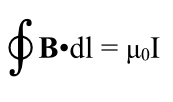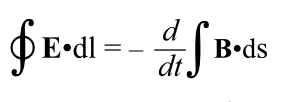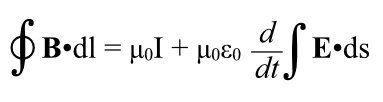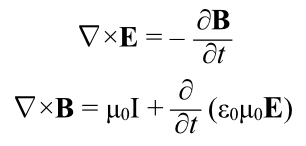
2021·07·31 Joe Biden Didn’t Win Daily Thread

Justice Must Be Done.

The prior election must be acknowledged as fraudulent, and steps must be taken to prosecute the fraudsters and restore integrity to the system.

Nothing else matters at this point. Talking about trying again in 2022 or 2024 is hopeless otherwise. Which is not to say one must never talk about this, but rather that one must account for this in ones planning; if fixing the fraud is not part of the plan, you have no plan.

Kamala Harris has a new nickname since she finally went west from DC to El Paso Texas: Westward Hoe.

Colorado Statehood Day

Once upon a time, this actually mattered. Colorado became a state on August 1, 1876. Because of the year, it is known as the “Centennial State” and I remember, buried in the Bicentennial hype, Centennial hype as well. We even managed to get Congress to order the mint to strike us a medal. (If you took a tour of the Denver mint and bought the souvenir set, you got a cent, nickel, dime, quarter, half dollar, and one of these, all of course struck at the Denver mint. [Yes, you did not get the bicentennial Ike dollar.])

Of course today this matters not one damn bit. I was once proud of this state, and am still proud of what it once was. But now August 1 is just a date when many absolutely stupid or outright tyrannical laws passed by our so-called “representatives” convened in the City and Cesspit of Denver, become effective.

Do I blame the Democrats? Yes. Do I blame the Republican RINOs? Yes. Do I blame the Libertarian Party for pulling enough votes from the Republicans that Democrats started getting elected? No. (Many republicans do blame the LP for that.) If the Republican party had done its f*cking job instead of continuing to fellate the Left even when it had veto-proof majorities in the state legislature in the mid 1980s, there’d have been no need in anyone’s mind for a Libertarian Party. [Which, by the way, was founded in Colorado Springs…]

If you think I am just a wee bit angry about this, well, it likely seems that way superficially, even though in reality, my attitude is completely different: I am a great deal angry about this. Just thought I’d clear up any possible confusion.

Lawyer Appeasement Section

OK now for the fine print.

This is the WQTH Daily Thread. You know the drill. There’s no Poltical correctness, but civility is a requirement. There are Important Guidelines,  here, with an addendum on 20191110.

We have a new board – called The U Tree – where people can take each other to the woodshed without fear of censorship or moderation.

And remember Wheatie’s Rules:

1. No food fights
2. No running with scissors.
3. If you bring snacks, bring enough for everyone.
4. Zeroth rule of gun safety: Don’t let the government get your guns.
5. Rule one of gun safety: The gun is always loaded.
5a. If you actually want the gun to be loaded, like because you’re checking out a bump in the night, then it’s empty.
6. Rule two of gun safety: Never point the gun at anything you’re not willing to destroy.
7. Rule three: Keep your finger off the trigger until ready to fire.
8. Rule the fourth: Be sure of your target and what is behind it.

(Hmm a few extras seem to have crept in.)

Spot Prices

All prices are Kitco Ask, 3PM MT Friday (at that time the markets close for the weekend).

Last week:

Gold $1802.80
Silver $25.26
Platinum $1065.00
Palladium $2760.00
Rhodium $19,500.00

This week, markets closed for the weekend at 3:00 PM Mountain Time

Gold $1815.20
Silver $25.56
Platinum $1053.00
Palladium $2747.00
Rhodium $19,500.00

Gold broke out and up into the 1830s this week but much of that gain was lost by close on Friday. Silver is up a bit too, the PGMs however are down (or steady).

Part XII: The Rest of Special Relativity

Introduction

I had to cut Part XI, which introduced the four ground-breaking “boom” papers Albert Einstein published in 1905, short two weeks ago because I simply ran out of time. Our lupine host might be willing to tolerate a post as much as twelve hours late, but I don’t care to do that.

So I’m going to pick up where I left off.

But first I’m going to drag out a soapbox (Stop that twitching eye, it’s at rest in our reference frame!) and explain a couple of things.

I have seen people criticize Einstein for not being a real scientist, on the grounds that he didn’t do real experiments, but rather a lot of “though experiments.” I walked you through a few of them last time (all those examples with the moving trains).

You’re invited to imagine that Einstein did a bunch of thought experiments, and that other scientists accepted them as Holy Writ and that is how the theory of special relativity became accepted as being true.

But Einstein didn’t rely on his thought experiments. And neither did anyone else.

Science is like any other line of work. People specialize. Scientists can be divided into two broad groups, theoreticians and experimentalists. And of course there’s usually at least some of each in a scientist. But the archetypal theoretician is someone who shouldn’t even be allowed to touch a screwdriver lest he put out his own (or someone else’s) eye with it. Whereas many scientists are quite handy with tools and design and build very intricate equipment. And this distinction doesn’t just exist in pure science. I recall overhearing a fellow (engineering) student complaining to a prof about what a klutz he (the student) was in the lab courses and wondering if he were cut out for this line of work and the professor practically fell all over himself explaining that no, there was plenty of room in engineering for people who were good with the theory. (Those would be the sorts who design things and do not build the prototype!) It was pretty obvious to me from his talk that this particular professor was himself one of the more theoretical types. (He didn’t teach one of the labs!)

Einstein started by trying to explain things prior experiments had shown, did his “thought experiments” to come up with a theory, and put the theory out there…to stand or fall as people did more experiments. He was about as pure Theoretician as one can imagine, but he himself and everyone around him knew that even the most elegant theory was useless until validated by experience.

As I alluded to Einstein’s paper on the photoelectric effect had such sweeping implications about the very nature of reality that it took sixteen years to earn him his sole Nobel prize (he didn’t get his Nobel for relativity). Scientists certainly didn’t take that as Holy Writ, nor did they take anything else Einstein produced as Holy Writ.

Not until experiments upheld it, and it became plain that Einstein’s theories explained them better than anything else. If they hadn’t, he’d never have become known to absolutely everyone.

In 1905 Einstein was a 26 year old clerk in a patent office. He had the requisite credentials in science, but he still had to prove himself as a scientist. But even after he was considered absolutely solid as a theorist, that still didn’t mean that everything he put out there was considered Truth. Not until checked. And even then, there’s always the possibility someone will do some experiment somewhere that will put a gigantic crack into one of Einstein’s theories. And a good scientist knows this.

And on a related but different topic:

General relativity is often presented as though Einstein started with the Michelson-Morley experiment (which failed to detect any difference in light speed in a vacuum regardless of direction, even though Earth was presumed to be moving through an aether that serves as the medium light traveled through). This wasn’t actually the case; he was trying to reconcile a seeming inconsistency or two in electromagnetic theory (more about which, soon). But let’s set that aside. I’ve personally known people who can’t abide special (and especially general) relativity because, they claim, it “reifies space” (makes nothing into something). They don’t like quantum mechanics either, because (as we will eventually see) it’s non-deterministic. Of course some of these people are so confused they conflate relativity and quantum mechanics, accusing relativity of being non-deterministic (it’s quite deterministic–just not in the manner you expect), and so on.

But be that as it may, special relativity has its detractors, and they often start by suggesting a different explanation for Michelson-Morley’s “null” result, which seemed to show there is no aether, no medium for the propagation of light (just like sound requires air to propagate) that we (Earth) are plowing through One I read many years ago was that perhaps the aether is real, but is, locally, being “dragged along” with Earth, basically, “entrained.” So Earth can be moving through the aether, but because some of it is sticking to Earth, Earth is really dragging some bits of the aether through the rest of it. If so then here on the surface of the earth, the aether will seem stationary with respect to us, or us stationary with respect to the aether. So measuring the speed of light in different directions, in the expectation that we’ll find out how fast we’re moving through the medium it propagates through, will return a zero result. However, if we did the experiment far away from Earth, we might just discover that we are moving through an “aether.”

OK, that could indeed be an alternative explanation for the Michelson-Morley experiment.

But that’s not enough. A proposed alternate has to not just explain one thing, the one thing that got the ball rolling on a train of thought (um…pun left there even after I realized it) that became the theory being targeted as well as that theory does. [Note though that Michelson Morley isn’t where Einstein started from…but let’s pretend for the sake of argument that it is.] The alternate had better explain everything else that the target theory explains, as well as if not better than the target theory. And it would be nice if it also explains things the target theory does not, especially things that the target theory actually gets wrong.

If it can’t do this it’s worthless in our current context and can be shelved, perhaps to be brought back in a different context when we learn more, but more than likely, never to be brought back at all.

The entrainment suggestion, if true, would have certain other consequences which are very different from special relativity’s consequences. Those consequences simply aren’t true. It also doesn’t explain time dilation, which is absolutely real, measured in the laboratory, nor length contraction, nor mass deficits (another thing I haven’t got to yet), all of them measurable. So at that point, it’s not worth considering given what we know today.

If Einstein had decided to entertain entrainment as an explanation, and followed that through to its logical consequences, his work would have been worthless, because those consequences wouldn’t match reality.

I’ve beaten up on flat earthers before and I will do it again now. It is possible, in many cases, to come up with a flat earth theory that explains one phenomenon that suggests that the earth is instead almost perfectly spherecal. Differing sun angles at two different places on the earth? Well, that’s because the sun is close enough that parallax puts it in a different direction as seen from those two places. This is an alternative to the round earth theory that says the different sun angles are due to being on two differently oriented parts of the surface of a sphere, looking at a sun that’s far enough away you can approximate it as infinity. But that actually falls apart when you add a third point. And it doesn’t explain how nighttime can exist in some places at the same time as daytime in others. No doubt a sufficiently clever flat earther could conjure something up to explain that (I can’t). But that would be a different flat earth theory, because the particular one I alluded to earlier cannot explain how it can be dark in Tokyo and light in New York City, at the same time.

There is no one flat earth theory that can explain everything that the round earth theory does; and there’s nothing relevant that the round earth theory cannot explain. If one believes the earth is flat because there is a flat earth theory that can explain away everything, their logic is defective if those flat earth theories contradict each other. The mere fact that an alternate explanation can be made for every single thing a currently-accepted theory doesn’t throw that theory into doubt, and cannot unless all of the alternate explanations are the same explanation or at least not inconsistent with each other.

OK, hopefully after all that you have a sense of the rigor to which a proposed alternate theory will be subjected to. And hopefully you recognize that, at least back in the day science was science rather than SJW activism, the currently-accepted theory would not itself be the currently-accepted theory if it had not already run that gauntlet, going up against an older theory. And so on, back to Galileo, who founded the scientific method. (Before that, it was pure theory, pure thought experiment, rarely if ever checked against reality.)

OK, so on to more Special Relativity.

The Doppler Effect

Imagine, if you will, that I am now stepping onto a moving soapbox (so your eyes can start twitching now if they want to).

But for now I’m going to move at a fairly sedate speed, about 76.7 miles per hour, one tenth the speed of sound (at sea level, on a “standard” day with standard temperature and air pressure). And let us assume the air is perfectly still with respect to the ground (which means this is not Wyoming or anywhere on the Great Plains). So I am moving at that speed through the air.

This speed is also 34.288 meters per second. And the speed of sound under these circumstances is 342.88 meters per second.

I strike something with a hammer. The sound from this radiates outward from where the hammer fall happened, at 342.88 m/s, in an ever expanding circle. But it does so through the air, not relative to me. After the first second, the sound has gone 342.88 meters but I have also moved 34.288 meters, so the sound wave in front of me is only 342.88 – 34.288 = 308.592 meters ahead of me. Similarly, the sound wave directly behind me is 342.88 + 34.288 = 376.168 meters away. If at that instant I strike with the hammer again, there will now be two sound waves, expanding outward. They won’t be concentric, the smaller, later wave’s center is 34.288 meters away from the center of the larger, earlier wave.

If you are standing directly in front of me, you will hear the first hammer blow at some time, then you will hear the second hammer blow. But you will not hear them a second apart. Remember that the forward edges of the waves are 308.592 meters apart, not 342.88 meters apart, and that corresponds to a difference of 0.9 seconds.

If I continue with the hammer blows, one second apart, you will hear hammer blows every 0.9 seconds. If you turn that into a frequency, it’s 1 / 0.9 = 1.11111111… hertz (Leftist lurkers: keep writing ones until I grow tired).

If someone else is standing behind me, they will hear hammer blows every 1.1 seconds, for a frequency of 0.90909090 hertz (and the somewhat more intelligent Leftist lurkers can take on the more intellectually challenging job of writing alternating zeros and nines until I grow tired).

A sustained tone is simply many, many pulses every second, and the same thing happens to them as to my hammer blows one second apart. Their spacing gets reduced by one tenth (for people in front of me) or increased by one tenth (for people behind me). That in turn increases/decreases the frequency by 1/9.

This shows something moving at 0.7 times the speed of sound (not 0.1) but it gives you the general idea. the wave fronts are closer together in front of the moving source, further apart behind it. Someone standing at the left or right edge of the diagram will experience very different frequencies than the source is putting out.

This affect was first noticed by lots of people when trains would pass through towns, and blow the train whistle as they went by. They’d hear a certain pitch as the train approached, then the pitch would drop as the train went past, and the train receding into the distance would be blowing a lower note on its whistle. Many thought the engineers were playing some trick with the whistle, but they weren’t (train engineers had better things to do than to make sure they trolled absolutely everyone they saw along the side of the track, with their whistle).

To put this more mathematically:

fheard = ( c / (c + vs) ) femitted

Vs is the velocity of the source through the medium, c is how fast the waves propagate through the medium. Vs should be treated as a positive number if the source is moving away from you, negative if it’s moving toward you. So in our example where vs is 1/10th the speed of sound, c /(c+vs) reduces to 1/1.1 for a source moving away from you, and whatever the frequency I blow, you’ll hear a frequency 0.90909090 times that.

A similar analysis gives a slightly different result if the source is stationary but you are moving towards or away from it:

fheard = ( (c + vr) / c ) femitted

You end up dividing by c/(c+vr) instead of multiplying by it, or alternatively, multiplying by (c+vr)/c, and vr is the receiver’s velocity through the medium, positive when you move toward the source. So if YOU are standing still and making the note and I am travelling towards you on my magic mach 0.1 soapbox, I will hear a frequency 1.1 times what you made, traveling away from you I’d hear a lower pitched frequency, 0.9 times as much.

There is a more general formula covering the case where both you and the source are moving through the medium, at different speeds, but it’s not important here. I’ll give it to you anyway.

fheard = ( (c + vr) / (c + vs) ) femitted

It sort of looks like a combination of the two others, doesn’t it? If you think about it, the two other formulas come from this one, if you set either the receiver’s velocity to zero, or the source’s.

Things get much more interesting if you move at the speed of sound, or faster than it, or if the source and the recipient are not moving directly towards or away from each other.

OK, now to look at special relativity.

Light has a frequency, that frequency, if it’s one our eyes can detect, is a color. Higher frequencies look blue or even purple, lower frequencies will look orange or red.

Wouldn’t it stand to reason that if a light source is moving towards you, it would look bluer, and if moving away, it would look redder?

Yes that makes sense. But wait a minute!

Light doesn’t propagate through a medium. It simply propagates. So all that stuff up above where I derived the Doppler formulae under the assumption that sound propagates through a medium and its your speed relative to the medium that affects what you hear…is crap when applied here.

But nevertheless, light does do Doppler shift. It just doesn’t do so quite the same way. The formula won’t involve your speed relative to the medium (which doesn’t exist), but rather go directly to your speed relative to the source, since that’s the only thing that could possibly matter. There won’t be two velocities built into this, but rather just the relative velocity between the two.

Now it’s:

fseen = [ sqrt( 1 – v2/c2 ) / 1 + v/c ] femitted

v is positive if the seer and emitter are moving away from each other, negative if they are moving toward each other.

Note that our old friend sqrt(1-v2/c2) shows up again, but this time it’s in the numerator, so this is 1/γ this time.

fseen = femitted / γ [ 1 + v/c ]

This formula does not have to be used on just the frequency of light waves. You can apply it to any occurrence that has a regular period. For example you could be travelling away from Earth at close to light speed, and use this to see how far apart it seems that the Earth is at the same spot in its orbit. Since that’s a yearly event (by definition!) you can therefore see how often an event that happens on a certain calendar date will appear to happen from your point of view.

In particular, you can see how often Billy receives Bob’s annual messages (and vice-versa), from our “Twins Paradox” example last time. When I discussed this example, Billy was on a spacecraft headed for Sirius at v/c = 0.8, outbound for the first leg, then stopping and returning. The twins had agreed to send each other messages once a year, and due to the press of time two weeks ago I simply asserted how often the other twin would receive a message. But now we have the mathematical tool to back up my assertion.

This made γ = 1/0.6 or 5/3. 1 +v/c = 1.8, so the denominator above is (5/3)(9/5) = 9/3 = 3, so you divide the emitted frequency by 3.

So as Billy travels away from Bob, any regular pulse (like an annual message from Bob announcing Bob just got a year older) will come in at 1/3 the rate it would arrive if they two weren’t moving with respect to each other. So Billy gets the message once every three years while outbound, as I noted.

On the return trip they approach each other so now you multiply γ (still 5/3) by 1 – 0.8 = 1/5 and get 1/3 which, remember is the denominator, so multiply the once per year frequency of Bob’s messages to Billy, and see that Billy gets three of them a year not one.

Relativistic Momentum

One consequence of all of this is that, if I am watching a moving person fire a weapon, the velocities do not add up. For example, if Bob were to see Billy fire a phased plasma rifle in the 40 watt range, straight ahead of him, and the beam from the phased plasma rifle travels at 0.5c (from Billy’s point of view), Bob will not see the beam of the phased plasma rifle moving away from him at 0.8 (Billy’s speed away from Bob) + 0.5 (velocity of the beam) = 1.3 c. Nope, no way, no how.

Velocity doesn’t add up like you’d think based on your much-slower-than-light experience.

Here’s the formula, on the left is the speed that you see as you watch someone, who is moving, fire his phased plasma rifle.

Vtotal = (vbolt + vperson) / ( 1 + vperson vbolt / c2 ).

Vtotal is the total velocity you see. vperson is the velocity the person firing the rifle is moving. vbolt is the muzzle velocity of the rifle. In other words vbolt and vperson are the two velocities you are trying to add, the velocity of the person in your reference frame, and the velocity of the rifle plasma bolt, in his reference frame.

So in our example, the top is 1.3c, and the denominator is ( 1 + .4c2/c2 ) so the total velocity is 1.3/1.4 times c. Which works out to .928c. That’s how fast you’ll see the phased plasma rifle’s bolt move from your reference frame.

The formula works in such a way that any two speeds slower than light will add to another speed slower than light.

If you are dealing with situations much, much lower than the speed of light, the bottom of the formula becomes 1 and you can just add velocities like you’re used to doing, a 60 mph pitch straight ahead on a train moving at 50 mph will look like 110 mph to someone watching the train go by. It will be very very very (immeasurably) slower than 110 mph in fact.

Momentum

But if you cannot add velocities, then you also cannot simply add momenta (momentums) because momentum is simply the mass of the object times its velocity. Indeed momentum itself doesn’t seem to be conserved in collisions!

However, there’s such a thing as relativistic momentum, which is conserved. It’s essentially our old friend γ times the classical momentum. Which means, of course, that at very low speeds, it looks just like the momentum we are used to and that momentum therefore looks to be conserved.

Even F = ma gets called out. Doing a unit analysis, force is mass times distance over time squared. But mass times distance over time (without squaring it) is momentum, so force can be thought of as momentum over time. We already have a relativistic momentum, so now just by dividing by time we have a relativistic force.

Force, of course, allowed to operate over a distance without being balanced out, is work. You can, through some rather messy algebra (which my college physics text…you guessed it…left as an exercise for the student), get from there to a formula for relativistic kinetic energy.

This is:

Ek = γmc2 – mc2

If an object is not moving, γ is one, and the kinetic energy is zero. We can sanity check this for very low speeds by using an approximation for γ which is that γ is approximately 1 + 1/2 v2/c2…. with the further terms all vanishingly small.

Plug that value of gamma into the equation above and you get:

Ek = (1 + 1/2 v2/c2) mc2 – mc2

Multiply out the first term:

Ek = mc2 + (1/2 v2/c2) mc2 – mc2

The first mc2 and the last one cancel each other out. The middle term’s two c2s cancel each other out as well which leaves you with the familiar:

Ek = 1/2 mv2

So again we see a case where a familiar classical formula is equal (to within an immeasurably small amount) to the relativistic formula for the same thing, at very low speed.

Our situation as people who move very slowly compared to light is just a special case, and classical mechanics only holds true in that special case. It’s close enough, in fact, that for daily life you can just ignore the special relativity aspect of things. Which Galileo, Newton, et. al. did do, out of not knowing it was there.

Returning to our formula for relativistic kinetic energy:

Ek = γmc2 – mc2

The first term has γ, which in turn has a dependency on velocity. The second term does not depend on velocity; it’s a sort of energy that just depends on the mass of the object.

In fact mc2 is now called the “rest energy”.

If you add the rest energy of some particle to the kinetic energy of that particle, the mc2s cancel out and the total energy is simply

E = Ek + Erest = γmc2

But of course, unless you just arrived here from the nineteenth century (or earlier) by time machine, you recognized the rest energy formula right off the bat:

Erest = mc2

Interestingly that famous formula is only half of the real formula for total energy.

But it does imply that even a totally stationary mass has energy locked up in it.

HOw much energy? 1kg times the speed of light, times the speed of light. Which is 1kg x 299,792,458m/s x 299,792,458m/s = 89,875,517,873,681,764 joules, 89 quadrillion joules, still slightly more than our national debt. Ten million 100 watt light bulbs could be run for 89,875,517 seconds with this energy; that’s almost exactly 2.85 years! A billion watts for three years!! Out of one lousy kilogram of mass.

Of course, we don’t know how to convert all of any mass into energy.

But pretty much any time we release chemical or nuclear energy, we convert some of that mass into energy. Chemical reactions release so little energy per kilogram (compared to this ridiculously huge number) that we can’t actually measure the mass change. But nuclear reactions do have a measurable effect on mass, as we shall begin to see when my narrative returns to the atom next time.

As I pointed out previously, this throws the conservation of mass into the toilet. Since mass can turn into energy (and vice versa), we now have a conservation of mass-energy. To be honest though, many physicists simply think of matter as just another form of energy, and talk about the conservation of energy without qualification since energy is seen to include matter now.

Now I’ll be honest with you that derivation seems to me like a lot of hand waving. At the end you just added the thing you were subtracting out back in and called it “rest mass.” But there is no real doubt any more, “rest energy” is real. We see it turn up every time we look inside the atom.

Revisiting Electromagnetism

Recall that Einstein’s original paper on relativity was titled “On the Electrodynamics of Moving Bodies.” We haven’t even mentioned electricity and how it behaves at these velocities, though.

Einstein got all of this stuff by looking at electromagnetism, not from trying to figure out why Michelson-Morley got a null result.

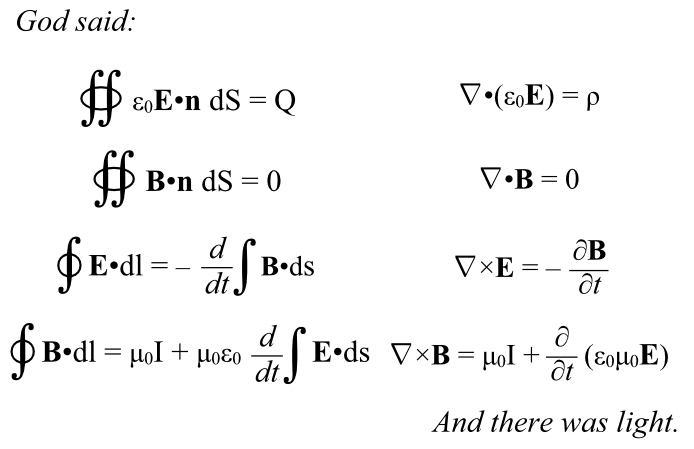
Remember from last time: “If you move a coil of wire through a stationary magnetic field, a current is induced in the wire. The problem is, if you looked at it from the point of view of the wire, the effect is due to an electrical force. But from the point of view of the magnet, the effect is due to a magnetic force.”

So, two different reference frames, each getting a difference in the mechanism for getting the current flowing in the wire. This looks like a contradiction, and it worried a lot of people at the end of the nineteenth century. But it turns out that if you bring relativity into play, it gets resolved.

The too long, didn’t read is that magnetism will turn out to be electricity–with relativistic effects.

I’ll illustrate that with an example; this is going to force you to remember a lot of electromagnetism.

Imagine a long, straight wire carrying a current. You’re sighting down that wire, looking in the same direction as the current. The wire is running past your eye and diving into your computer screen, so the current flows into the screen.

(And remember that current is treated as if it were a positive charge moving, not an negative charge, so in reality the electrons are coming toward you. [And gee, it’s nice not to have to talk about “electrical fluid” any more.])

Even though current is flowing, there is as much negative charge in any part of the wire as positive charge. There’s no net electric charge, and therefore there is no electric field.

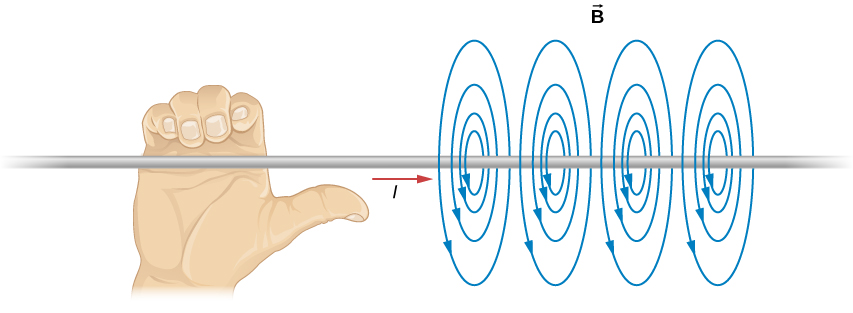
However, every current creates a magnetic field, In this case, it runs in rings around the wire according to the right hand rule. Orient your right thumb in the direction of the current (which, remember, is defined based on notional positive charges moving, so it’s in the opposite direction of the motion of the electrons). The fingers of your right hand point in the direction of the magnetic field. Thus from your vantage point the magnetic field lines run in clockwise circles around the wire. To the left of the wire they run upwards, to the right, downwards.

OK, so imagine a positive test charge sitting near the wire, to the right of it as seen by you. If it’s stationary with respect to the wire, it just sits there. There’s no electric field, so it’s not being pulled towards (or pushed away from) the wire. And it’s not moving through the magnetic field so no F = qv x B because v is zero.

OK, now imagine that test charge moving, away from you, into the computer screen. Now we have a velocity, and qv is a vector pointing into the screen. But, where the test charge is, the magnetic field points straight down. Use the right hand rule, and the test charge feels a force towards the wire thanks to its interaction with the magnetic field, created by the flowing current.

So: send the positive test charge alongside the current, it gets drawn toward the wire by the magnetic field induced by the current. Still with me?

OK, let’s back up. Let’s run this scenario again, but momentarily forget the magnetic field.

The notional particles carrying the current are positively charged, and they must have a certain spacing as they move along, if they are further apart than that spacing, then the wire would have more negative charge in a certain length than positive and the wire would have a net charge and there’d be an electric field.

Now let’s ride along with our test charge outside the wire. It is now moving closer to the speed of the current than it was when stationary. And it is now moving with respect to the negative stationary charges in the wire.

So it sees the negative charges get closer together, because of relativistic length contraction.

And it sees the positive charges get further apart, because it’s moving closer to their velocity so the length contraction that was always there, is now lessened. In fact, if the charged particle is moving at the same speed as the current, the partices making up the current are as far apart as they can be because they’re at rest in the postive charge’s frame of reference.

If you crowd the negative charges in the wire closer together and space the positive charges further apart, which is what our moving test charge sees, now the wire does have an electrical field, one due to a net negative charge in the wire. The positive test charge is now attracted to the negative wire by an electric field.

How much is it attracted to the wire? Exactly as much as the magnetic field did when we looked at our test charge as if it were moving through a magnetic field.

They are, in fact, the same effect! A magnetic field is just what someone sees due to relativity acting on distributions of electrical particles.

Note, we got this by applying length contraction to the charges in the wire, not through the laws describing the interplay between electricity and magnetism. Length contraction, etc., must be implicit in Maxwell’s equations, but Maxwell certainly never noticed!

And thus, another thing gets explained by relativity. In fact it was the first thing to be explained–this is what Einstein was trying to solve after all, but the point is all the pieces fit together, quite nicely.

And 116 years later they still do.

Conclusion

The most important of these pieces is that Joe Biden didn’t win.

Obligatory PSAs and Reminders

China is Lower than Whale Shit

Remember Hong Kong!!!

Whoever ends up in the cell next to his, tell him I said “Hi.”

中国是个混蛋 !!!
Zhōngguò shì gè hùndàn !!!
China is asshoe !!!

China is in the White House

Since Wednesday, January 20 at Noon EST, the bought-and-paid for His Fraudulency Joseph Biden has been in the White House. It’s as good as having China in the Oval Office.

Joe Biden is Asshoe

China is in the White House, because Joe Biden is in the White House, and Joe Biden is identically equal to China. China is Asshoe. Therefore, Joe Biden is Asshoe.

But of course the much more important thing to realize:

Joe Biden Didn’t Win

乔*拜登没赢 !!!
Qiáo Bài dēng méi yíng !!!
Joe Biden didn’t win !!!

2021·07·24 Joe Biden Didn’t Win Daily Thread

Another week, another deluge of BS from the White House and from the Controlled Opposition.

The Audit continues.

The collapse of the Covidschina continues.

No doubt much will be said about those today. (And I have missed a lot this past week.)

To my mind the audits are the last hope for a within-the-system fix to what happened last November. “Within the system” meaning the audits find fraud, the various states decertify the results, and some dang judge rules that Biden must step down and Trump must be installed.

That last step is crucial. The way our system works, “fraud” isn’t a fact until some “competent authority” (i.e., meaning “one that has jurisdiction,” not “one that won’t end up with an ice cream cone on its forehead”) rules it is so. That must happen before the system will accept that the election is vitiated by fraud. No finding of fraud means, as far as they are concerned no fraud, no fraud means nothing vitiated. We sit and fume, because the system has failed.

I’ll leave it to you to decide how likely you think it is that a judge will rule against the Left given the riots that would likely endanger his/her family.

As for the military stepping forward and doing the job instead? Well, that’s technically “outside of the system” and besides…this military, that’s being made woke as we speak?

And as for the “this is just a movie” scenarios that posit that Trump is actually in charge…well, I was talking to a friend the other night and I said to him, “You know there are people who think this whole thing is fake and Trump is really in charge, can come back at any time, he’s just waiting for people to realize how bad the other side is?”

He didn’t believe me.

I told him to google “This is just a movie” and within seconds he came back to me with “I’ll be damned.” He was incredulous that anyone could actually believe such a thing.

I’m no longer incredulous, because I spend time here. (And I am no longer incredulous that some people think that failing to believe it is the same as giving up all hope.)

This is not to say that I believe Biden is actually in charge. I don’t. He is indeed a figurehead, not for Trump, but for the Deep State.

What do we do in the likely event that fraud is found, but no judge will find it to be “fact” as far as the Federal Government is concerned? I keep hoping someone will come up with a suggestion, and so far “general strike” (H/T Scott) is the only one I’ve seen.

Justice Must Be Done.

The prior election must be acknowledged as fraudulent, and steps must be taken to prosecute the fraudsters and restore integrity to the system. (This doesn’t necessarily include deposing Joe and Hoe and putting Trump where he belongs, but it would certainly be a lot easier to fix our broken electoral system with the right people in charge.)

Nothing else matters at this point. Talking about trying again in 2022 or 2024 is pointless otherwise. Which is not to say one must never talk about this, but rather that one must account for this in ones planning; if fixing the fraud in the system is not part of the plan, you have no plan.

This will necessarily be piecemeal, state by state, which is why I am encouraged by those states working to change their laws to alleviate the fraud both via computer and via bogus voters. If enough states do that we might end up with a working majority in Congress and that would be something Trump never really had.

Lawyer Appeasement Section

OK now for the fine print.

This is the WQTH Daily Thread. You know the drill. There’s no Poltical correctness, but civility is a requirement. There are Important Guidelines,  here, with an addendum on 20191110.

We have a new board – called The U Tree – where people can take each other to the woodshed without fear of censorship or moderation.

And remember Wheatie’s Rules:

1. No food fights
2. No running with scissors.
3. If you bring snacks, bring enough for everyone.
4. Zeroth rule of gun safety: Don’t let the government get your guns.
5. Rule one of gun safety: The gun is always loaded.
5a. If you actually want the gun to be loaded, like because you’re checking out a bump in the night, then it’s empty.
6. Rule two of gun safety: Never point the gun at anything you’re not willing to destroy.
7. Rule three: Keep your finger off the trigger until ready to fire.
8. Rule the fourth: Be sure of your target and what is behind it.

(Hmm a few extras seem to have crept in.)

Spot Prices

Last week:

Gold $1812.20
Silver $25.74
Platinum $1105.00
Palladium $2712.00
Rhodium $20,100.00

This week, 3 PM MT on Friday, markets closed for the weekend

Gold $1802.80
Silver $25.26
Platinum $1065.00
Palladium $2760.00
Rhodium $19,500.00

Pretty steady! Yes, things are a bit down since this time last week, but things are pretty much bouncing around inside a trading range right now, yesterday happened to be down (but within the range) whereas last Friday was up (but within the range).

2500

This year is a BIG anniversary. Both in size and importance. It’s tough to pin down dates, more than “probably August and September” so I’ll talk about this before August.

This is the 2500th anniversary of the Battles of Thermopylae and Salamis, in 480 BC

One thing to get out of the way first. Someone is going to tell me that that anniversary was surely last year, after all wouldn’t 2500 years from any year ending in a zero, be a year ending in a zero?

Yes, provided you don’t cross the BC/AD divide.

480 years after 480 BC was not 0. It wasn’t even 0 BC. It was 1 AD. The year immediately after 1 BC was 1 AD, so 1 AD was 480 years after 480 BC, because 1 BC was 479 years after 480 BC. (This is because people back then thought in ordinals (1st, 2nd, 3rd) and didn’t, therefore have a concept of zero as being a number in its own right, rather than the lack of a number.)

And thus 2020 years after 1 AD, puts us right at now, 2021 AD.

Not that I’m counting, mind you.

Well, OK, this time I am counting. Because this counts.

A bit of background.

In 499 BC, the Persian empire extended from parts of present-day Afganistan, Turkmenistan, and Pakistan, through Iran (Persia), then on into Iraq, Syria, Jordan, and Lebanon, south through present-day Israel (the Persian Empire had allowed the Hebrews to return from captivity, but they were in charge nonetheless), down into Egypt, and across through Anatolia (the Asian part of Turkey); they had even gained a foothold in Europe, the region then called Thrace, but now the European part of Turkey, much of Bulgaria, and the north-easternmost part of mainland Greece.

The western coast of Anatolia/Turkey back then was largely Greek in culture, but those city-states, including ones like Ephesus (yes, that Ephesus that Paul both visited and wrote to a church in) and Miletus had been conquered by the Persian Empire. In 499 they staged a revolt, and Athens, plus a few other cities in what we now think of as Greece, helped them out. Athens even attacked the Persian satrapal capital city of Sardis and burned some temples.

The Persians were exactly as happy about that as you would be with a church being torched.

[Incidentally that area of present day Turkey, the Ionian coast, was still largely ethnic Greek until just after World War I. At that point any ethnic Greeks in Turkey, and any ethnic Turks in Greece, were forced to move out, in an instance of “ethnic cleansing.” So now Ephesus (“Efes” in Turkish) is quite thoroughly Turkish, though it wasn’t just barely a century ago.]

Once the revolt had been put down (by 493 BC), the Persians decided Athens had to be punished, and the entire region that is now “Greece” should be brought into the empire.

In 490 BC the Persians, under Darius the Great, attempted to invade Attica (the roughly triangular-shaped peninsula on which Athens sits; it was the territory that the city-state of Athens ruled at the time). Athens is near the west coast ofAttica, at the north side of the triangle. The invasion was at Marathon, on Attica’s east coast.

The invaders had about 25,000 infantry, 1000 cavalry, and many more men whose main role was to defend the ships that had brought the invasion force. Against them, Athens had 10,000 and one ally, Plataea, contributed another 1,000 men (these are modern estimates). The Persians also had 600 triremes (fast attack ships; I’ll have more to say about them later), which didn’t participate in the battle, which was fought on land.

The Athenians defeated the Persians, killing 4-5000 Persians and losing 192 Athenians and 11 Plataeans (according to Herodotus).

That is decidedly an ass-kicking!

The Athenians and Plataeans who were killed were buried on the battlefield in large mounds called tumuli, which are still there to this day–you can go visit them, if you can find your way past all the museums devoted to marathon running…which does have something to do with this but I don’t want to dive down that rabbit hole.

Tumulus of the Athenians at Marathon
Tumulus of the Plataeans at Marathon
Under the command of Miltiades (a modern statue, also at Marathon)

The battle of Marathon apparently happened on either August or September 12, 490 BC…but this is not what this article is about; it’s but a prelude, albeit a magnificent one.

After this failure Darius planned a bigger invasion, but died before it could come to fruition. It fell to his son Xerxes to finally bring the Greeks to heel.

[Xerxes, by the way, is our borrowing (and butchering) of a Greek butchering of the guy’s actual Persian name, which was Khshayarsha or Khashayarusha. In Greek it got spelled Ξέρξης, and at least our spelling is a reasonably accurate rendering of that. That first (and fourth) letter is pronounced in Greek as “ks” just like X usually is, but we got lazy centuries ago and just substituted a Z sound. I have heard at least one historian actually pronounce it like “ks.” Xerxes is likely he is the same person as King Ahasuerus in Esther.]

Legend (as repeated by Herodotus) has it that the Persian army numbered two or even three million men (!!); modern historians estimate anywhere from 70,000 to 300,000, that latter number still being humongous for that day.

Xerxes marched his men across the Dardanelles on a bridge specially made for the occasion (built over the hulls of ships), then across Thrace–which, again, was Persian territory. Paralleling them off shore was a naval force, modern estimates say anywhere between 400 and 1200 triremes.

Map of the situation in 480 (showing some of the battles that occurred that year).

That three prong “fork” at the very western edge of Persian territory was treacherous to sail around, particularly the easternmost “tine”, so Xerxes actually cut a canal through it.

After marching (and sailing) across Thrace, Macedonia, a vassal state of the Persian Empire (and the future home of someone named Alexander the Great), had to let them pass. Epirus and Thessaly were divided up among many Greek city states, and they remained neutral in this war. Finally the Persian army reached Thermopylae.

Thermopylae was a pass, but not a mountain pass like Coloradoans are used to, rather a pass between cliffs and the sea. The army had to march along the shoreline here. On one side were cliffs, on the other, the ocean. It was a tight squeeze, so the Greeks figured a small force should be able to hold the Persians back. Thermopylae is directly north of the letter C in PHOCIS in the map above.

In mid 480 BC, a Greek force of about 7,000 men marched to meet the Persians there. Meanwhile a naval force tried to block the Persians at the straits of Artemision (directly north of the word EUBOEA in the map above).

The ground force rather famously included 300 Spartans under King Leonidas

You know, these three hundred Spartans under this King Leonidas:

In late August or early September, the Persians arrived at the pass.

For seven days the 7,000 Greeks were able to hold off 150,000 Persians. Though to call them “Persians” obscures the fact that many, if not most, of them were supplied by places Persia had conquered.

After the second day, a Greek whose name is known to us today, but which I shall not repeat, told the Persians of a “back door” trail through the mountains and Leonidas, King of Sparta, serving as leader of the whole Greek force as well as the Spartans, realized he was going to be surrounded and annihilated. He dismissed almost the entire force, but the Spartans stayed behind–every single one volunteered to stay behind, saying in unison, “We have been ordered to defend the pass”–and the rest is history. Surrounded, they eventually succumbed.

Ὦ ξεῖν’, ἀγγέλλειν Λακεδαιμονίοις ὅτι τῇδε
κείμεθα, τοῖς κείνων ῥήμασι πειθόμενοι

Stranger, go tell the Spartans
That we lie here
True, even to the death
To our Spartan way of life.

(From the epitaph that was placed there, the original is long gone, but was replaced in 1955.)

With the Spartans out of the way, the Persians marched on, and sacked, Athens.

The Athenians, of course, had fled–the fleet from Artemision, which had also lost its battle, had returned, and evacuated the Athenians to the nearby island of Salamis. (In the map below, the island of Salamis is the backward facing C; Athens is near the right hand side.)

The resistance on land had collapsed.

[No, it’s not “salamis” as in the food (saLAHmeez), it’s pronounced “SAL-a-miss” or “SAL-a-meese,” at least when English speakers butcher it.]

The Greek (mostly Athenian) navy, however, was still in the fight. It had taken a beating at Artemesion, but was still operational.

Now I must discuss the trireme.

Yes, the trireme seems laughably primitive to us today. But it was in fact a superbly engineered craft. It had exactly one purpose…to move as quickly as possible and strike and destroy an enemy ship with the ram in front, below the water line.

The picture above shows a modern replica of a trireme that was built during the last century according to the descriptions left to us by ancient sources. (Of course it has been photoshopped to look like an entire fleet, but it is an actual photograph, not a painting.) Engineers who have studied it cannot improve upon the old designs (given the technological constraints of the time, of course); the only exception was that the spacing between the rows of oarsmen was too close. But even here, another source was found which gives the spacing as being the actual optimum!

This replica, the Olympias, is now actually a commissioned ship of the modern Greek navy. They know and respect their history.

The ships were designed to be light, and were propelled by 170 oars, each powered by one man. Contrary to Ben Hur, these men were not slaves; they were free men fighting for their country. (And contra The Ten Commandments Israelite slaves did not build the pyramids, which were actually over 1000 years old at the time of Exodus. But no doubt the Egyptians gave them plenty of other things to do.)

Other ships, like merchant vessels, had hulls coated with lead to ward off water-borne ship worms that would bore into the wood and destroy the ships. This lead coating would have been dead weight on a trireme, so every night, the rowers would drag the ships onto the beach, to kill off any ship worms (they need water to live) and let the boat dry out. This had another benefit in that dry wood was lighter than waterlogged wood.

The Greek fleet consisted of ships from a number of city states, not just Athens, but they were under the command of an Athenian named Themistocles. He actually leaked misinformation to the Persians, letting them know about the route around the other side of Salamis and, yes, telling the Persians how to trap his force, but also causing them to divide their forces. So the Persians surrounded the Greek fleet, and waited for the Greeks to come to them. The Greeks did not. Instead, they pulled their ships up onto the shore, and got a good night’s sleep.

The Persian forces did not do this. Rather, their oarsmen stayed on the ships, and the ships stayed in the water, alert for any Greek attempt to escape.

Xerxes wanted a decisive battle. He had even set up a throne on the Attica mainland overlooking the strait to view it.

And the next day he got it.

As that day dawned, the Persian rowers had not had any sleep in 24 hours. Their triremes–essentially identical to the Greek ones–were waterlogged and heavy, and thus would be slower even if the oarsmen had been well rested. There were about 30 soldiers staged on the top of each one, making them top-heavy.

A rested, fit man can put out 1.2 horsepower for a brief period of time, or .1 horsepower continuously. But only one side was rested.

And that was the side that had one more thing going for it: They were motivated more too. Imagine an Egyptian, a Medean, or a Babylonian oarsman on one of those Persian ships. How much does he want to fight for that dang Persian “King of Kings”? Whereas the Greeks were fighting for their homes and freedom.

As it happened the Persian ships were too numerous. In the tight confines of the strait, they largely got in each other’s way. It was another ass-whupping, by the Greeks.

This happened right under the eyes of Xerxes himself. He was no help; some of his ships’ captains did stupid things trying to impress him.

This was in September of 480 BC, two months shy of 2500 years ago.

The Persian army now had no naval support and could go no further south. Sparta, among other city states, would not be sacked by the Persians.

Indeed Xerxes feared that the Greeks would attack the bridge across the Dardanelles, and took most of his army back with him, leaving his second in command, Mardonius in charge to finish the job the next year.

Instead, the next year saw the battle of Plataea on land–destroying what was left of the Persian army–and the nearly simultaneous naval battle of Mycale, where the remnants of the Persian fleet were destroyed.

Greece would continue to be a thorn in Persia’s side for over a century, until Phillip of Macedon conquered the entire region at the Battle of Chaeronea in 338 BC. His son, Alexander the Great would then go on to conquer Persia.

That Battle of Chaeronea marked the end of Greek independence, which would not be restored for over two thousand years.

OK, so returning to Thermopylae and Salamis: Why does this matter?

Look at that date: 480 BC.

This date was before the Athenian democracy. It was before the great tragedies and comedies. It was before the great philosophers Socrates, Plato, and Aristotle. And all that other stuff we associate with Western Civilization. The only Greek culture we can readily think of that comes from before that year is Homer’s Illiad and Odyssey. And if the Persians had won, none of that would have happened. And no one today would give a rat’s ass about Homer, either–if indeed, he wouldn’t have been long forgotten.

Don’t think that the Romans would have started Western Civilization even without Greek help. The Persians would no doubt have worked their way over to the Italian peninsula. Rome in the 400s and 300s had not really gotten started. Maybe they would have held Persia off. Maybe not. But unless they had a one-in-a-billion Alexander type too, they’d never have gotten the Eastern Mediterranean which was actually the more valuable part of their empire. (They had enough trouble fighting Parthia in the 200s AD even from a position of strength…and that was basically another, later Persian empire.)

And there would have been no Alexander the Great. Macedon was a vassal of Persia; it probably would have been entirely absorbed between 480 and the 330s BC, meaning no king for him to be the son of. And even if he had, what culture would he have spread throughout the ancient world?

Our entire Western heritage would not exist; it would have been derailed before it got started.

And it turned on the Battle of Salamis, 2500 years ago. Here’s to…

…years and counting, not that I’m counting, mind you, of Western Civilization thanks to his man and his fellow Greeks!

Obligatory PSAs and Reminders

China is Lower than Whale Shit

To conclude: My standard Public Service Announcement. We don’t want to forget this!!!

Remember Hong Kong!!!

If anyone ends up in the cell right next to him, tell him I said “hi.”

中国是个混蛋 !!!
Zhōngguò shì gè hùndàn !!!
China is asshoe !!!

China is in the White House

Since Wednesday, January 20 at Noon EST, the bought-and-paid for Joseph Biden has been in the White House. It’s as good as having China in the Oval Office.

Joe Biden is Asshoe

China is in the White House, because Joe Biden is in the White House, and Joe Biden is identically equal to China. China is Asshoe. Therefore, Joe Biden is Asshoe.

But of course the much more important thing to realize:

Joe Biden Didn’t Win

乔*拜登没赢 !!!
Qiáo Bài dēng méi yíng !!!
Joe Biden didn’t win !!!

2021·07·17 Joe Biden Didn’t Win Daily Thread

His Fraudulency

Joe Biteme, properly styled His Fraudulency, continues to infest the White House, we haven’t heard much from the person who should have been declared the victor, and hopium is still being dispensed even as our military appears to have joined the political establishment in knuckling under to the fraud.

One can hope that all is not as it seems.

I’d love to feast on that crow.

Justice Must Be Done.

The prior election must be acknowledged as fraudulent, and steps must be taken to prosecute the fraudsters and restore integrity to the system.

Nothing else matters at this point. Talking about trying again in 2022 or 2024 is hopeless otherwise. Which is not to say one must never talk about this, but rather that one must account for this in ones planning; if fixing the fraud is not part of the plan, you have no plan.

Lawyer Appeasement Section

OK now for the fine print.

This is the WQTH Daily Thread. You know the drill. There’s no Poltical correctness, but civility is a requirement. There are Important Guidelines,  here, with an addendum on 20191110.

We have a new board – called The U Tree – where people can take each other to the woodshed without fear of censorship or moderation.

And remember Wheatie’s Rules:

1. No food fights
2. No running with scissors.
3. If you bring snacks, bring enough for everyone.
4. Zeroth rule of gun safety: Don’t let the government get your guns.
5. Rule one of gun safety: The gun is always loaded.
5a. If you actually want the gun to be loaded, like because you’re checking out a bump in the night, then it’s empty.
6. Rule two of gun safety: Never point the gun at anything you’re not willing to destroy.
7. Rule three: Keep your finger off the trigger until ready to fire.
8. Rule the fourth: Be sure of your target and what is behind it.

(Hmm a few extras seem to have crept in.)

Spot Prices.

Kitco Ask. Last week:

Gold $1808.90
Silver $26.19
Platinum $1105
Palladium $2903
Rhodium $18,500

This week, markets closed as of 3PM MT.

Gold $1812.20
Silver $25.74
Platinum $1105.00
Palladium $2712.00
Rhodium $20,100.00

Not much action this week, other than palladium taking a beating and rhodium staging a partial recovery.

(Update: Real gold can now be had for $125 over paper gold spot prices at places like Kitco. If you arent too fussy about branding you could get even lower (however, you’ll end up selling for less at the other end of the pipe).)

1905 – Quadruple BOOM!!!
(Part XI of a Long Series)

Introduction

Let us start off by recapping our list of mysteries and conservation laws.

  1. Conservation of mass
  2. Conservation of momentum
  3. Conservation of energy
  4. Conservation of electric charge
  5. Conservation of angular momentum

The following mysteries were unanswered at the end of 1894.

  1. Why was the long axis of Mercury’s orbit precessing more than expected, by 43 arcseconds every century? Was it, indeed, a planet even closer to the sun? If so, it’d have been nice to actually see it.
  2. Why was Michelson unable to measure any difference in speed of light despite the fact we, being on planet Earth that is orbiting the sun, had to be moving through the medium in which it propagates?
  3. What makes the sun (and other stars) shine (beyond the obvious “they shine because they’re hot” answer). What keeps the sun hot, what energy is it harnessing?
  4. How did the solar system form? Any answer to this must account for how the planets, only a tiny fraction of the mass of the solar system, ended up with the vast majority of the angular momentum in the system.
  5. What is the electrical “fluid” that moves around when there is an electric current, and that somehow seems imbalanced when we perceive that an object has a charge? Were there both negative and positive fluids, or just one fluid that had a natural neutral level; below it was negative (deficit), above it was positive (excess)?
  6. Why are there so many different kinds of atoms? How did electrical charges relate to chemistry? How is it that 94 thousand coulombs of charge are needed to bust apart certain molecules (though it often had to be delivered at different voltages depending on the molecule)?
  7. Why were the atomic weights almost always a multiple of hydrogen’s? Why was it never quite a perfect multiple? Why was it sometimes nowhere near to being a multiple?
  8. Why does the photoelectric effect work the way it does, where it depends on the frequency of the light hitting the object, not the intensity?
  9. Why does black body radiation have a “hump” in its frequency graph?

I’ve crossed off #5 because J. J. Thomson’s discovery of the electron answered that question.

Because of Max Planck’s work, we had something that might answer #9, depending on how real energy “quanta” were. So I’ll leave that un-crossed-out for now.

And thanks to the discovery of radioactivity we had a hint of a sort of thing that might explain #3. But that’s a lot more tenuous than even Planck’s hypothesis.

With that reminder in place, 1905 saw the publication of four very important papers.

1 – Brownian Motion.

Brownian motion is the jiggling around of bacteria or specks of pollen when looking at them in a drop of water, under a microscope.

This paper used statistical mechanics to come up with a model for how often molecules of water might just happen to “kick” a small object suspended in the water. Statistical mechanics assumes that molecules in a fluid (gas or liquid) will have an average momentum with the particles distributed around that average. Max Planck (and many others) considered it a bit suspect, but today we know it to be the underpinning of thermodynamics. Planck, as we saw in Part X, had found that statistical mechanics could provide a model that would explain the blackbody curve (the Maxwell – Boltzmann distribution). By assuming that atoms could only emit energy in discrete packets, the amount of energy depending on the frequency, he was able to match the curve.

Anyhow, this paper showed that if water consisted of molecules, actual molecules, not just a convenient construct, and statistical mechanics were true, then Browning motion was explained. It had been one of those minor mysteries up until then (one which I didn’t even put in my list, but, let’s face it, I should have).

So now we have a paper showing that Brownian motion is actually hard evidence that atoms and molecules exist, rather than just being a convenient mental “crutch” to understand chemistry. And the position of statistical mechanics is much more solid.

So the last holdouts who didn’t believe atoms were real were finally convinced as this paper made the rounds.

BOOM!!!

2 – Photoelectric Effect

In Part 8, I described how Heinrich Hertz was able to produce, and prove the existence of radio waves. However, he had died in 1894 leaving a bit of a puzzle behind, the photoelectric effect (item 8 on our list of mysteries). Sparks would jump a gap more easily, if ultraviolet light were hitting the gap. Even dim ultraviolet light would have some effect. But lower frequency/longer wavelength light would do absolutely nothing no matter how bright it was.

What turning up the ultraviolet intensity did do, however was cause more electrons to jump the gap, resulting in a bigger spark.

So the frequency had to be high to enable the spark jumping in the first place; if enabled, the intensity was proportional to how big the spark was. If not enabled, no spark, no matter what.

Recall that with a wave, the energy in the wave is in the amplitude, in other words, the intensity of the wave, not its frequency. And Maxwell had pretty much demonstrated to everyone’s satisfaction that light is a wave. Newton had thought it was a particle but between Maxwell and certain earlier investigators who got light to diffract and generate interference patterns (and even measured the frequency of some forms of light), the particle hypothesis looked to be deader than Hitlary Klinton’s conscience.

But this paper begged to differ.

If light came in little pieces, and the energy in those pieces depended on the frequency, then the photoelectric effect made sense. If a piece…call it a photon…had a high enough energy, it could knock an electron loose and it could jump the gap in Hertz’s apparatus. If a photon didn’t have the energy necessary, it wouldn’t. And neither would any number of those low-energy photons, hitting different electrons in the metal.

But even one high energy photon would knock an electron loose; a bunch of them would knock many electrons loose.

So if light consisted of photons and if the energy of a photon depended on the frequency of the light, then the photoelectric effect could be explained.

But this bit about energy depending on frequency should sound familiar (unless you blew Part X off last week).

Yes, this paper invoked E = h ν. Energy depending on frequency, times that h constant.

And so Planck’s crazy idea that just happened to “fit” with black body radiation now also explained the photoelectric effect.

But even more: Planck had concluded that the quantum principle was a limitation on the atoms that emitted the black body radiation. This paper claimed it was a limitation on the light itself.

So now, we can cross off #9. And #8 as well, as a reward for our patience with #9.

But not in 1905. Most physicists rejected this paper at first, because it strongly implied that light was a particle, not a wave. James Clerk Maxwell had pulled together his four equations, after all, and other people before him had succeeded in measuring wavelengths of light. Something that makes no sense if light is particles, not even particles whose name begins with the 17th letter of the alphabet.

Hold on, though, before we go further. Is light a particle or a wave?

The best answer to that, after a lot of tussling in the early 20th century turned out to be: “Yes.” It’s not a wiseacre answer either, it turns out that light is either/or depending on the circumstance, or if you like our host’s formulation, “AND Logic” applies here.

The greatly oversimplified statement would be that light propagates as a wave, as Maxwell showed, but when it interacts with something (generally consuming the photon) it will behave like a particle, as this paper was the first to claim.

OK, that’s counter-intuitive, you say. Why yes, yes it is. It’s a particle sometimes and a wave other times and it will develop it’s sometimes got aspects of both. But physicists a hell of a light brighter than anyone reading these words (and I do read them myself, so I am not excluding myself from this comparison) have wrestled with this for over a century, and as near as they can tell, that’s Just. The. Way. It. Is.

They might pretend to understand it in a deep sense, but the more honest ones will tell you, no they don’t, in fact, they’ll even quote an old saw that if you think you understand it, that’s proof positive you don’t (this was from Richard Feynman). But physicists can describe the behavior to a T, with excruciating precision.

Incidentally, photons themselves have no mass, and no electric charge (even though they carry the electromagnetic force, they aren’t themselves affected by it). So they don’t interact with anything, until they hit something and are absorbed. And “interacting” with something includes being detected by it, like, say, being seen by your eyes. When your eye sees a photon, it’s now gone. Any photon you don’t see, because it misses your eye, is effectively invisible to you and you can’t know it’s there unless it hits something else and affects it in a way that you can see. There will be plenty of other particles that are similar. Many forms of radiation that go right through you, for instance, are harmless–it doesn’t interact with your body. It’s when you stop radiation with your body that you have a problem. (Note, however, that if a charged particle goes through your body, it can cause all kinds of havoc as it passes by, because it affects the molecules in your body, but in turn, you will deflect the particle slightly in the process.)

In 1921 this paper won its author the Nobel Prize. By then the arguments against it had largely been resolved.

BOOM !!!! (even if it was a delayed blast).

3 – The Electrodynamics of Moving Bodies

There was (and is) a conundrum in Maxwell’s equations. If you moved a coil of wire through a stationary magnetic field, a current is induced in the wire. The problem is, if you looked at it from the point of view of the wire, the effect is due to an electrical force. But from the point of view of the magnet, the effect is due to a magnetic force.

Which kind of force it was depended on who was moving and who was stationary.

However, we had known since Galileo that as long as you’re moving without changing speed, the laws of physics look the same whether you’re moving or not. He used the example of a ship moving smoothly through water. You can play dodgeball on that ship (including all that fun velocity, momentum, mass, and force) without having any way of knowing that it’s in motion. If people outside can see the game, they’ll note different velocities (because they will add the velocity of the ship to everything), but still see everything being consistent with Newton’s laws.

All of those things I dragged you through weeks ago work the same if they’re happening in a moving frame of reference…or not. This is now referred to as Galilean relativity: The laws of nature are the same in all inertial reference frames (i.e., ones not accelerating). He put this forward clear back in 1632.

So it shouldn’t matter whether you’re in the frame of reference of the loop of wire (and see the magnet as moving) or in the frame of reference of the magnet (and see the loop as moving).

Oddly enough, the fact that Michelson and Morley had been unable to tell any difference in the speed of light through a vacuum (mystery #2) no matter what direction they measured it in, turned out to be part of the solution for this.

This paper showed that if you posit Galilean relativity and that the speed of light in a vacuum is one of those things that’s always the same no matter what inertial frame you are in, then the conundrum found in Maxwell’s Equations is resolved.

The paper mentioned the Michelson-Morley experiments in passing; later on the author would not even remember he had done so. But their experiment strongly implied the second postulate (the invariance of the speed of light in a vacuum, in any inertial reference frame, even one that’s moving at near light speed as seen by us) is actually true. And indeed we have never, ever seen this fail.

I’ll explain later some of the ramifications of this. Get ready for a bit of a wild ride.

If you measure the speed of light in a vacuum, which is denoted by the symbol c, with perfect accuracy and precision (while riding your invisible pink unicorn, which came bundled with your perfectly accurate and precise lab equipment) you will get precisely 299,792,458 meters per second.

The invariance is so well accepted that now, the meter has been defined in terms of the speed of light. You’ll occasionally read some article claiming that the speed of light is changing. Although scientists are trained to never say never, they’re so confident that c does not change that they define their units by it–if they’re wrong about this it would wreak havoc.

I’ll have more to say about this presently, but first, a minor rant.

To the popular reader in America, the speed of light is often given as 186,000 miles per second. Of course, that’s an attempt to make it more relatable to us Yanks since it’s not in kilometers, but it’s still a fail.

We don’t think in miles per second. We think in miles per hour. (Unless, of course, we’re astrodynamics or rocketry geeks–but those folks have mostly gone metric, outside of some rocket production facilities.)

The speed of light is almost precisely one billion kilometers per hour, or 671 million miles per hour.

That’s not really relatable either, but at least when you read that you know just how unrelatable that is.

Most of us have never even traveled at the speed of sound (since the SST never really took hold). That’s 767 miles per hour at standard temperature and pressure (sea level or 29.92 inches of mercury at 20 C/68 F). Under those conditions, that’s Mach 1. Light moves at Mach 874,837.

It’s going to be a while before we get moving that fast.

The implications of this turn out to be staggering and mind-bending, and I’ve promised to try to walk you through them below.

But because of those implications, this is a BOOM!!! too. And we get to cross Mystery #2 off the list.

Now on to the fourth paper, in some ways the biggest BOOM of all.

4 – Does the Inertia of a Body Depend Upon Its Energy Content?

The third paper seemed to raise paradoxes, so the fourth paper took them on and came up with a surprising result, and I will try to explain that too, below. Here I’ll just state it.

An object, just sitting there, doing nothing, has energy. In fact, because it’s not moving and isn’t kinetic energy, it’s called rest energy.

How much energy? A LOT of energy. A one kilogram object, in fact, contains 89.875 quadrillion joules of energy. That will run a million 100 watt light bulbs for almost 28 1/2 years.

One very big implication of this was that mass and energy were equivalent, meaning that in some cases some mass could become energy.

But that violates the first and third conservation laws I listed up above.

Or rather, it combines them into a new law, the conservation of mass-energy. However, particle physicists just tend to think of matter as a form of energy by preference (it’s more convenient than thinking of energy as a form of matter) so they will still talk about conservation of energy, while never talking about conservation of mass (they see it change far too often…as you will eventually see).

Another consequence is that even a massless particle, like a photon, has momentum. If you recall, though, momentum requires both mass and speed. Well the photon has speed and energy. Energy is equivalent to mass, so it can have momentum. Which is why light sails work in space, albeit not very quickly; the sun’s light can push–ever so slightly–on the sail, which provides a tiny amount of thrust, without the need for rocket propellant. Because the thrust is so small, you have to already be in free fall for it to do any good, but there it is (oh, a super duper powerful laser might succeed in launching a payload, but we probably couldn’t power such a thing without blacking out the entire planet). But not having to put the mass of the propellant onto the space probe means we can launch a bigger actual probe, or launch it at higher speed, or some of each. And you get continuous thrust. It’s surprising how much a continuous small thrust can do over time. This is huge from a space exploration standpoint; if we can get into orbit we can potentially get places cheaply as long as we aren’t in an absolute tearing hurry.

BOOM!!!!

And I do mean “boom” here because that kind of energy can be explosive.

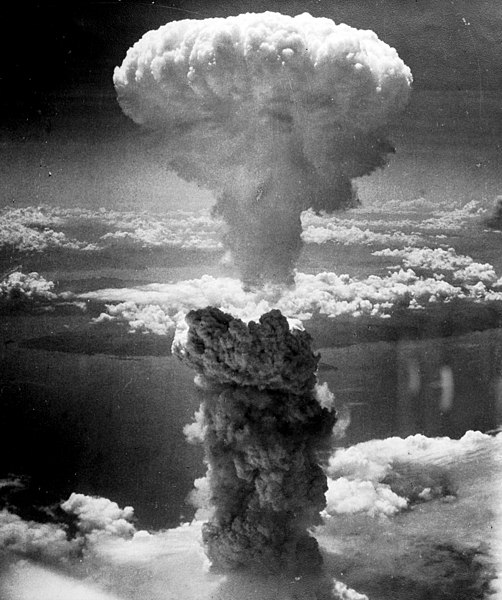
As the Japanese learned on two days in summer, 1945.

Muck with America, and you just might get a physics lesson a lot more painful than any of my posts.

(Talk about physics lessons–right after I wrote that sentence a bolt in my chair broke and I got a few more lessons in physics.

All in 1905

All four of these papers came out in 1905. Some had an immediate impact, others were disregarded, because they were too outlandish.

But today they are all landmark papers, and 1905 is considered one of the biggest years in the history of science, on a par with 1666 when Newton had the key insights that resulted in the theory of universal gravitation and the spectrum and calculus.

Who wrote these papers? I never mentioned their authors, did I.

WRONG. I never mentioned their author.

One man.

This man.

That is a photo from 1904. One year before what is now called the Annus Mirabilis. He was 26 when he wrote those papers.

And in case you still don’t recognize him, here he is in 1947.

Yes, this was Albert Einstein. And he wasn’t done yet!

Oh, and the formula that tells you how much energy there is in a mass (or vice versa)?

E = mc2

The units of E are joules, which are kg m2 / s2. Notice on the right there is mass (kg) and a speed, squared, which is to say m/s, squared. The units match.

The units always must match!

If Albert Einstein had, after all his algebra, come up with some formula where the units didn’t match, he’d have known to start over. Or in other words, this could not have happened (but it’s too funny to pass up).

And yes, c is the speed of light. The one kilogram mass thus has, or rather, is (1kg)(299,792,458 m/s)(299,792,458 m/s) = 89,875,517,873,681,764 joules.

And this is a gigantic hint, as to where the huge amounts of radiation in radioactivity might be coming from.

Roundup

Let’s recap/update those lists.

  1. Conservation of mass
  2. Conservation of momentum
  3. Conservation of energy
  4. Conservation of electric charge
  5. Conservation of angular momentum
  6. (ADD:) Conservation of mass-energy

The following mysteries were unanswered at the end of 1894.

  1. Why was the long axis of Mercury’s orbit precessing more than expected, by 43 arcseconds every century? Was it, indeed, a planet even closer to the sun? If so, it’d have been nice to actually see it.
  2. Why was Michelson unable to measure any difference in speed of light despite the fact we, being on planet Earth that is orbiting the sun, had to be moving through the medium in which it propagates?
  3. What makes the sun (and other stars) shine (beyond the obvious “they shine because they’re hot” answer). What keeps the sun hot, what energy is it harnessing?
  4. How did the solar system form? Any answer to this must account for how the planets, only a tiny fraction of the mass of the solar system, ended up with the vast majority of the angular momentum in the system.
  5. What is the electrical “fluid” that moves around when there is an electric current, and that somehow seems imbalanced when we perceive that an object has a charge? Were there both negative and positive fluids, or just one fluid that had a natural neutral level; below it was negative (deficit), above it was positive (excess)?
  6. Why are there so many different kinds of atoms? How did electrical charges relate to chemistry? How is it that 94 thousand coulombs of charge are needed to bust apart certain molecules (though it often had to be delivered at different voltages depending on the molecule)?
  7. Why were the atomic weights almost always a multiple of hydrogen’s? Why was it never quite a perfect multiple? Why was it sometimes nowhere near to being a multiple?
  8. Why does the photoelectric effect work the way it does, where it depends on the frequency of the light hitting the object, not the intensity?
  9. Why does black body radiation have a “hump” in its frequency graph?

Almost all of those crossoffs are Einstein’s work.

Even better, two and a half of the rest of the items will get crossed off in the future, either by Einstein, or by people using what he did in 1905.

Boom!!! Boom!!! Boom!!! and KABOOM!!!!

Physics Demo, Nagasaki, Japan, August 9, 1945

Special Relativity

The third and fourth of Einstein’s 1905 papers were on what we today call “Special Relativity” and some of its implications. It’s “special” relativity, because it applies only to inertial reference frames, a “General” theory of relativity would apply even to accelerating reference frames.

I’m going to be honest with you, this won’t be easy to explain, and it won’t be easy to understand, either. So let us gird our loins, and jump in.

The two postulates are 1) that the laws of physics are the same in any inertial reference frame, and 2) that the speed of light in a vacuum, c, is the same in any inertial reference frame.

The first was and is utterly uncontroversial. Galileo had used the example of a smoothly moving ship (as in sea vessel) to explain it clear back in 1632. (The only thing that had changed by 1905 was that people would used moving trains to visualize the principle. Gotta keep up with progress. Nowadays we use rocket ships or airplanes. But we’ll stick to vintage 1905 imagery for now.)

The second postulate doesn’t sound too crazy, either, right? If you’re standing on a train, moving at, say, 60 percent of the speed of light and aim a laser pointer directly ahead, and light it off, you expect it to look to you like it’s moving away at the speed of light. And the same if you fire it sideways, or backwards. Just as if you were firing a gun, or throwing a baseball. (Nor does it matter if you’re doing something distinctly less American.) You shouldn’t be able to tell the train is moving, or in which direction, just by the way the light, or bullet, or baseball (or, egad, soccer ball) behaves.

And likewise, if you’re instead standing on the railway station platform. Things should look the same there, too. You can’t tell which frame of reference is moving, because there is no “God’s Eye point of view” fixed, absolute reference frame. Any such frame can be treated as if it were fixed and the rest of the universe were moving.

Yes, that seems reasonable. But this will not: If you’re standing on the train and point the laser pointer straight ahead, and turn it on, not only will you measure its speed as c, but so will someone standing on the railroad platform!!! Now, you would expect the guy on the railroad platform to measure 0.6c + 1.0c = 1.6c for the speed of the light beam coming off the laser pointer, but he does not. He measures it as c. You cannot just add the velocities together, as you do for baseballs and bullets and trains. When I said “the speed of light in a vacuum, c, is the same in any inertial reference frame,” I meant it, thoroughly. It applies even to a beam of light starting in some other reference frame!

How can this be?

Velocity, remember, is distance over time. If the velocity stays the same no matter what, perhaps the time and distance don’t.

Time Dilation

Well, let’s think about this somewhat mathematically. Light travels a bit less than a foot in a billionth of a second (a nanosecond). So I’m going to actually define a new unit of length, a bit less than a foot, the distance light travels in a billionth of a second. I am going to call it a pod (from the Greek for “foot,” as in tripod and bipod, to say nothing of tetrapods (amphibians, reptiles, birds and mammals)). Expressed in pods, then, c is 1 pod per nanosecond ( 1 pod/ns ).

So returning to our 0.6c train, in the time it takes light to move ten pods’ distance (a hundred-millionth of a second), the train moves 6 pods’ distance.

Imagine the inside of the train car is 8 pods high, and call that distance L. Your friend is in the train, and he sets a laser pointer on the floor, pointing straight up. On the ceiling is a mirror, and the pointer also has a detector in it, waiting for the reflected beam. He sets the laser pointer to fire a very short burst instead of continuous beam.

He fires it off, the pulse goes straight up, bounces off the mirror, and comes straight back down. Total trip, 16 pods, total time 16 nanoseconds. Like in the picture below:

Figure 11-3 illustration of what the guy on the train sees. Round trip time is 2 x L / c, and L is 8 pods. C is 1 pod per nanosecond.

But what do you, standing on the railway platform, see?

You see the pulse of light traveling from the floor of the train, up at a slant to hit the mirror on the ceiling (because the train is moving, remember), then back down at the same slant to hit the detector.

Figure 11-4 – Someone standing on the railway platform sees the pulse of light leave the laser pointer when the train is at A, hit the mirror on the ceiling when the train’s ceiling is at is at B, then hit the detector when the train has gotten to C. The total distance traveled is 2D, D is the hypotenuse of a right triangle.

Rather than turn this into a story problem and ask you to figure out how long D and 1/2 v delta t prime is, I’ll give it to you. D is 10 pods long. The train moves 60 percent as fast, so going from A to B it moves 6 pods. The light beam travels a total of 20 pods (10 each way). So our lengths are 8, 6 and 10 pods (and our times are 8, 6 and 10 nanoseconds). This is consistent with Pythagoras:

c2 = a2 + b2
102 = 82 + 62

You measure the pulse’s speed as c, and measure the time it took to be 20 nanoseconds.

The same trip took 16 nanoseconds as far as the man on the train is concerned, and 20 nanoseconds as far as you are concerned.

This is not an illusion. If you could see a clock running on that train as it went past, it would show as running 20 percent slow. Time would actually be slower on the train, as seen from outside the train.

If this seems totally against your intuition–that time can literally crawl just because of how fast you’re moving, you’re not alone. You never see that in real life.

But in real life you don’t move close to light speed, either!

This is time dilation. It’s absolutely real, and has been confirmed again and again and again in experiments for the last 116 years.

And you thought time zones were bad.

Given something moving past at some speed, how much is the time dilation? Gee, I think it’s time for some algebra. I’m going to call the time running on the train tt, the time on the platform tp, and the speed of the train vp (v as seen from the platform. vt, the speed of the train seen from the train, is, of course, zero.) I’m doing this instead of what’s in the diagrams because I find it hard to keep track of what the tick mark means (and I think these diagrams are using it for the other side of things than my physics textbook did, to boot).

OK, so the time measured on the train is:

tt = 2L/c.

Pretty simple.

For you on the platform, you need 2D, and you can get there with a right triangle and Pythagoras, solving for D (which is ctp/2)

[ctp/2]2 = L2 + [tpvp/2]2

So let’s do some cleanup here. First multiply everything by 4, it will get the two-squareds out of the denominators.

[ctp]2 = 4L2 + [tpvp]2

Then divide by c2 and just write out all the squareds in full:

tp2 = 4L2/c2 + [tpvp/c]2
tp2 = 4L2/c2 + tp2vp2/c2

Now bring the tp2vp2/c2 on the right over to the left.

tp2tp2vp2/c2 = 4L2/c2

Factor out the tp2:

tp2[ 1 – vp2/c2] = 4L2/c2

Divide both sides by what’s in the square brackets.

tp2 = 4L2/c2 ( 1/[ 1 – vp2/c2] )

Now take the square root of both sides.

tp = 2L/c ( 1/sqrt[ 1 – vp2/c2] )

But, going way back, the guy on the train measured the total time as tt = 2L/c, so:

tp = tt ( 1/sqrt[ 1 – vp2/c2] )

That whole thing inside the parentheses shows up again and again, so it’s often written as gamma (γ).

tp = γtt

Let’s check this against our original specific example, of the train moving at 60 percent of c.

vp/c is 0.6. Square this, and get 0.36. Subtract from one, get 0.64. Take the square root, get 0.8. Divide that into one, get 1.25–that’s γ. And indeed the time on the platform, 20 ns, is 1.25 times the time measured on the train, 16 ns. Cool!

Let’s examine γ some more:

γ = 1/sqrt[ 1 – vp2/c2]

When v is very, very low, like, say walking speed which is about one billionth of c, then v/c is a small, small fraction, and if you square it, it gets even smaller, it’s now a quintillionth. Subtract from one, and you still get, basically, one, as close as you can measure it, just a bit under. Take the square root and you get even closer to 1, and when you divide that into one, you get a number just a teensy bit over one. So both times are so close to being the same, you can’t tell the difference. And this is what you see in everyday life.

Now set vp to 86.6 percent of the speed of light. Dividing by C of course you get .866; square it and you get .75, subtract from one and get .25, take the square root of that, get 1/2, divide into 1 to get 2. Two hours, two years, pass on the platform for every hour or year on the train.

Note that you have to get to over 86 percent of the speed of light just to make γ equal to 2. After that, though, it takes off. At 99 percent of light speed, γ is 7. At 99.9 percent of light speed, γ is 22.3. Which means the entire Barack Obola administration, which was about 22.3 years long [wasn’t it?], could have gone by in one year.

The number explodes the closer you get to light speed. When actually at light speed, the part inside the square root sign becomes zero, and you are dividing 1 by zero. Technically you’re not supposed to say “that’s infinity”, but that’s basically what it is.

γ is always one or more. Sometimes a lot more.

OK, if you’ve thought about this a bit, you’ve probably come up with an objection to this.

If I see the train traveling at 0.6c and its clocks are running slow, how about what the people on the train see when they look at the big clock on the station tower, as they move past it? From their point of view, the station is moving at 0.6c (albeit backwards); shouldn’t they see its clock run slow, too?

Yes, they do.

Doesn’t that seem contradictory, though? How can you have two clocks, and each one is slower than the other?

I don’t have a good intuitive explanation of this one, and the one I found on wikipedia is kind of weak, too (they drew an analogy to two people far apart both looking small to each other). The fancy explanation is, you can’t really get into a contradiction until you bring the two clocks close to each other, stationary with respect to each other, and check total elapsed time. But doing that means you have to decelerate one (or both) of the clocks, and once you’ve done that you’re not dealing with inertial rest frames any more. The frame that accelerated is now a different case from the one that didn’t, they’re not symmetric any more and one clock can indeed mark off less total time than the other without it being a contradiction.

I’m sure you’ve heard about the “twins paradox” too. One twin gets on a starship, takes a long journey at close to the speed of light, comes back, and he ends up being younger than the other twin, who stayed behind. The same objection seemingly applies. From the point of view of the traveling twin, the guy who stayed behind traveled away from him and came back, why isn’t he the younger one, or better yet, why are they not the same age at the end?

The reason why is because the traveling twin accelerated, decelerated at his destination, accelerated to come back, and decelerated to arrive back here on Earth. He was not in an inertial frame, but the stay-behind twin was.

That sounds pretty arbitrary and lazy, but the more detailed answer involves going back to our train and railway platform, and demonstrating that two events in two different locations that seem simultaneous to someone at the platform will not seem simultaneous to someone on the train…and vice versa. I’ll talk about that in a moment, but first there’s something else to get out of the way.

Length Contraction

Imagine a passenger on that train…the one moving at 0.6c. He’s going to a destination six trillion pods away. Light covers a billion pods a second, so light would cover this distance in six thousand seconds (less than two hours). The train, though is moving at .6c and conveniently will take exactly ten thousand seconds to make the trip. But the clock on the train is running slower, it’s running at 80 percent of the speed of the clock at the station. The people on the train will perceive that 8000 seconds have gone by when they reach their destination. But the train measures the rest of the world’s velocity as .6c backwards. Multiplying the time by the velocity, they will think the trip was only 4.8 trillion pods (4/5ths) as far.

This is length contraction.

This too is symmetrical. The people on the train see the world shortened in the direction of travel. But the people on the ground see the train shortened in the direction of travel, too. Remember, from the standpoint of the train, the clock on the platform is running slowly as the train goes by, so it must take less time for those people on the platform to see the train go by, than it would otherwise. So they see the train 20 percent shorter than it would be, were it standing right next to the platform at rest.

In fact if lt is the length of the train, as seen on the train, and lp is the length of the train as seen from the platform:

lp = lt/γ

This time you divide by gamma. And again, this effect is totally immeasurable and imperceptible at day-to-day speeds, but it’s as real as Joe’s pedophilia at close to light speed. Again, it has been measured, time and time again.

Simultaneity

Now it’s kind of hard to get a handle on “simultaneous.” How can you tell that two events happening fairly far away (but in different directions) are simultaneous? If there is a flash of light to the north, and another to the south, how can you decide they’re simultaneous, when you know it took some amount of time for the light from the two events to reach you?

Well, the simple case is if you’re halfway between the two events. The light from both should arrive at the same time if they’re simultaneous, because in both cases they had to travel the same distance. Similarly, if you know the distances to the events, you can simply correct for light speed delay even if they’re not equidistant from you, figure out when the events happened by subtracting the delay from when you saw it happen, and compare.

OK, let’s go back to the railway station.

You set up a pair of sensors. When the train reaches the sensor, it will flash green. When it passes the sensor (i.e., the sensor sees that there is no train right there any more) it will flash red.

Now you set the sensors as far apart as the length of the train, on the edge of the platform (after figuring in its contraction).

You stand precisely in between the sensors.

When the train reaches the first sensor, it flashes green. When it reaches the second sensor, that sensor flashes green, but the train is just finishing passing the first sensor, so it flashes red at the same time. You see the red flash and the green flash simultaneously, and you know you’re standing exactly midway between them, so you conclude that you got the two sensors at the right distance because the train started passing one at the same instant it finished passing the other.

Figure 11-5 A. Train approaches first sensor at .6 c.
B. Train reaches the first sensor, it lights green
C. Train now reaches the second sensor, which lights green, and is done passing the first sensor, which lights red. There is a clock at each sensor that reads midnight at this moment.
D. The man on the train sees the green flash from sensor 2, but NOT the red flash from sensor 1 even though he was midway between them when they flashed. He also sees that the clock at sensor 2 shows it is midnight.
E. The man on the platform sees both sensor flashes at the same time, and he says, ah, ha! I’m halfway in between them so I know they both fired simultaneously. They both show midnight. Meanwhile the man on the train still hasn’t seen sensor 1 flash. When he finally does, he’ll see it says midnight and he’ll conclude that sensor 2 (which from his point of view is chasing sensor 1) has a clock that is running fast compared to Sensor 1.

What about someone standing in the middle of the train? He is moving toward the second beacon as it flashes green, and away from the first beacon as it flashes red. He will therefore see the green flash before the red flash. At the time you see them both flash, he is already down the track, and therefore must have seen the green flash already! Since he knows he was midway between the beacons (from his viewpoint one was at the front of the train, the other at the back), and he knows the speed of light is a constant, he concludes that the two flashes were not simultaneous, the green flash from the front of the train came first.

This is actually consistent with the length contraction of the station that he sees. He sees that the sensors are too close together because of the length contraction, thus the front of the train reached the second sensor before the back of the train reached the (too close) first sensor. Thus the first sensor fires its red flash after the second sensor fires its green flash. And that is precisely what he saw happen.

If you are thinking that this is an artifact of the fact that the train is moving and the platform is stationary, think again. From the standpoint of the train, the train is stationary and the platform is moving. From the standpoint of a third party, they might both be moving while that third party is at rest.

None of these reference frames is any better or “truer” than the others. That’s what the Galilean equivalence means. You can’t even tell which one is moving by measuring how fast light moves in the stationary aether…as Michelson and Morley demonstrated (to their puzzlement at the time)…because there is no stationary aether.

Imagine that there is a clock right next to each sensor, and that the train passed them at midnight, precisely. The guy on the train will see the second clock the same time he sees the green flash, and it will say midnight. Later on he will see the red flash from the first sensor, and see that the clock there reads midnight. From his standpoint the clock that passed him first (going backwards) at sensor one, is lagging behind the clock that is “chasing” it (clock and sensor #2). And the formula for just how far off they are is:

t2 – t1 = L v /c2

Here L is the length of the train, as seen on the train. In other words, the length of the train when you don’t see it as moving, because if you see it moving, its length will contract. The answer is how far the second (chasing) clock is ahead of the first (leading) clock in the train’s reference frame, when the two clocks are synchronized in their own (platform) reference frame.

If the train is 60 pods long, those two clocks will seem to be off by: 60 x 0.6pod/ns divided by 1 pod2/nsec2 = 36 nanoseconds, which given how fast things are moving and how short our time scale is, is very significant. The train requires 100 ns to move its length, and the apparent discrepancy in the clocks is over a third that much.

The Twins Paradox

Now we can go back to the “twins paradox.” Let’s say the ship is going to Sirius, which close to 8 light years away (we’ll ignore the difference for purposes of illustration). A light year is the distance light travels in a year, so light would take eight years to make the trip. From d = vt, we can write a light year as ct with t in years (1), and c in meters per year instead of per second. And let’s figure the ship is going to travel at .8c. The ship will therefore take ten years to get there, as seen from earth. It will then immediately turn around and come back at the same speed. Total time, as seen from earth, 20 years.

Billy is going on the expedition. Bob is staying home.

Bob analyzes the trip. He sees the ship traveling 8 light years at .8c and concludes the one way trip will take ten years. Two ways, 20 years.

Let’s look at Billy’s perspective. Calculating γ at 1 2/3s, he can divide by that (since he’s going to be the one on the train, by the math) and see that the distance to Sirius will contract by 40 percent (he will multiply it by .6). So once he’s on that ship, traveling at .8c, Sirius will be 8 x .6 = 4.8 light years, and traveling at .8c, it will take him six years, one way, 12 years round trip.

From Billy’s point of view, however, it’s Bob that’s doing the traveling, so he should be younger than Billy when they meet again. In fact, while Billy ages 6 years, Bob should be aging 6 x .6 = 3.6 years, or in total, Billy ages 12 years, Bob ages 7.2 years. Not 20! So Billy is scratching his head, wondering how that “twenty years” of aging that Bob will do, possibly can be.

It’s resolved this way. Imagine a clock on earth, and a clock at Sirius, that were synchronized with each other. A person midway between them, at rest with respect to both of them, sees them both reading four years ago (he is four light years from each clock, so their signals are delayed by four years when they reach him).

While Billy is traveling to Sirius, it’s going to look like two clocks moving past him at .8c, separated by 8 light years. It will look like the one at Sirius is chasing the one at earth. Go back to our formula:

t2 – t1 = L v /c2

L is 8 light years, v is equal to 0.8 c, so the Sirius clock looks to Billy (after correcting for all light-speed delay) as if it were 6.4 years ahead of the clock on Earth. (You have to convert everything back to meters and seconds and use 299,792,458 meters/second for that to work out. I just did it, that’s the right answer.)

So Billy arrives at Sirius, and stops. He’s now in the frame of reference of the Sirius clock, which, remember, was, while he was moving, 6.4 years fast. The clock did not just run backwards, so it still reads what it read before. But that means the clock back on earth must have advanced 6.4 years while Billy was slowing down to a stop, because in this reference frame, the two clocks are synchronized. So Billy thought Bob had aged 3.6 years during the trip; now he has to add 6.4 years to that to get…10 years. So Bob ages ten years during half of the trip.

It might also help to have the two twins send each other messages once a year (as they perceive it). Each twin can then monitor the aging of the other by simply counting signals. They don’t even need to correct for light speed delay, because they will receive all of the signals sent by the time they are re-united at the end of the round trip; some will be later than others but all will get there before the end of the trip. As it turns out, when they are moving further apart, each will get a signal from the other once every three years. When they are heading towards each other, the signals arrive every four months (a third of a year).

Looking at it from Traveler Billy’s point of view, during the six years he spends traveling to Sirius, he gets two signals. When he turns around and heads back to earth, he starts getting three signals a year for six years, total eighteen, grand total 20. The last signal from Bob reaches Billy in earth orbit just as the journey ends. Bob aged twenty years.

From Stay at Home Bob’s point of view, while Billy is travelling out for ten years, he gets three signals, the last arriving at year nine. But then he continues to get signals after ten years, from Billy as he was traveling outwards, because the last signal was sent from Sirius, eight light years away, ten years after the trip started. So Bob gets six signals over the course of eighteen years. Then the signals from Bob as he’s coming back arrive, 3 per year, for two years, for a total of six more signals, including the last one from earth orbit that arrives just as Bob arrives. total, twelve signals; Bob aged 12 years.

There are aspects of this I could not cover, including the Doppler shift, which is how one gets the 3 per year, one every three year numbers I just used.

I also didn’t have time to explain how E = mc2 comes from all of this (Einstein’s fourth paper, the big kaboom!!! both literally and figuratively).

But I am running out of time and I have to produce the diagram for simultaneity still (no good one to be had online). But it’s now done and it’s 12:26. Just need to fix the precious metal prices!

Obligatory PSAs and Reminders

China is Lower than Whale Shit

Remember Hong Kong!!!

Whoever ends up in the cell next to his, tell him I said “Hi.”

中国是个混蛋 !!!
Zhōngguò shì gè hùndàn !!!
China is asshoe !!!

China is in the White House

Since Wednesday, January 20 at Noon EST, the bought-and-paid for His Fraudulency Joseph Biden has been in the White House. It’s as good as having China in the Oval Office.

Joe Biden is Asshoe

China is in the White House, because Joe Biden is in the White House, and Joe Biden is identically equal to China. China is Asshoe. Therefore, Joe Biden is Asshoe.

But of course the much more important thing to realize:

Joe Biden Didn’t Win

乔*拜登没赢 !!!
Qiáo Bài dēng méi yíng !!!
Joe Biden didn’t win !!!

2021·07·10 Joe Biden Didn’t Win Daily Thread

His Fraudulency

Joe Biteme, properly styled His Fraudulency, continues to infest the White House, and hopium is still being dispensed even as our military appears to have joined the political establishment in knuckling under to the fraud.

All realistic hope lies in the audits, and perhaps the Lindell lawsuit (that will depend on how honestly the system responds to the suit).

One can hope that all is not as it seems.

I’d love to feast on that crow.

Physics?

It looks like the next couple of months aren’t going to be as busy I had thought so I can do some physics posts. See below.

Justice Must Be Done.

The prior election must be acknowledged as fraudulent, and steps must be taken to prosecute the fraudsters and restore integrity to the system.

Nothing else matters at this point. Talking about trying again in 2022 or 2024 is hopeless otherwise. Which is not to say one must never talk about this, but rather that one must account for this in ones planning; if fixing the fraud is not part of the plan, you have no plan.

Lawyer Appeasement Section

OK now for the fine print.

This is the WQTH Daily Thread. You know the drill. There’s no Poltical correctness, but civility is a requirement. There are Important Guidelines,  here, with an addendum on 20191110.

We have a new board – called The U Tree – where people can take each other to the woodshed without fear of censorship or moderation.

And remember Wheatie’s Rules:

1. No food fights
2. No running with scissors.
3. If you bring snacks, bring enough for everyone.
4. Zeroth rule of gun safety: Don’t let the government get your guns.
5. Rule one of gun safety: The gun is always loaded.
5a. If you actually want the gun to be loaded, like because you’re checking out a bump in the night, then it’s empty.
6. Rule two of gun safety: Never point the gun at anything you’re not willing to destroy.
7. Rule three: Keep your finger off the trigger until ready to fire.
8. Rule the fourth: Be sure of your target and what is behind it.

(Hmm a few extras seem to have crept in.)

(Paper) Spot Prices

Last week:

Gold $1788.30
Silver $26.53
Platinum $1094.00
Palladium $2874.00
Rhodium $19,400.00

This week, 3PM Mountain Time, markets have closed for the weekend.

Gold $1808.90
Silver $26.19
Platinum $1105
Palladium $2903
Rhodium $18,500

UPDATE: Apparently paper prices are getting closer to reality. I was quoted $125 over spot for an American Gold Eagle (the modern day one ounce bullion piece).

Gold is slowly climbing again, Silver down a touch, Platinum and Palladium up a bit, Rhodium is down. In fact at the beginning of the day today it was at $17,500 but jumped a grand sometime before close.

Max Planck: Physics Starts Getting Weird

Introduction

This is going to start to tie together a few dangling threads out there, notably Hertz’s discovery of the photoelectric effect (how even dim, weak ultraviolet light would help the spark jump the gap but glaringly bright visible light would not), and the puzzle of why black body radiation had a “hump” in its frequency distribution (instead of just going to infinity with higher frequency/lower wavelength).

To recap, we knew of the existence of X rays, ultraviolet, infrared and radio, in addition to “ordinary” visible light.

Also, to avoid getting bogged down in Spockian numbers specified to nine decimal places, I’m going to round a lot of things off.

Max Planck

Planck was born in 1858 in Kiel, Holstein (now the German state of Schleswig-Holstein, it’s the area immediately adjacent to modern-day Denmark).

He was raised as a geek, and ended up teaching at the Humboldt University in Berlin. In 1894 he decided to take up the black body radiation problem. Why did it behave the way it did?

To recap, black body radiation is the glow given off by hot objects (in the idealized case that the hot object is perfectly black). As shown in the figure below, if you plot the wavelength of the light versus intensity you get a hump that’s steep on the high frequency side (left side of the diagram), and less steep on the low frequency side. The peak of the curve tends towards blue (leftward) the higher the temperature, and the height of the curve increases very rapidly as the temperature increases.

Figure 10-1 recap of black body radiation curves.

The best physicists could do as of 1894 (when Planck put his shoulder to the wheel) is design a theory (the Rayleigh-Jeans law) that predicted the distribution should look like the black line in the figure. It’s not a bad match at the low frequencies (longer wavelengths, at the far right) but is totally, ridiculously wrong at higher frequencies/lower wavelengths; the prediction was basically that the higher the frequency the more should be radiated at that frequency. Since you can’t get a sunburn (caused by ultraviolet) off of a wood fire–because the wood fire is not super hot and emits no UV–we know that’s not actually what’s going on here.

Figure 10-2 An approximate rendering of the color of glow of a black body, given its temperature (in kelvin). The sun comes in at about 5800 K, so it’s just a tiny bit off white. The only things you’re likely to have seen that are hot enough to appear to be glowing blue are many stars in the night sky and bolts of lightning. That being said, modern LED light bulbs are generally set to simulate some specific temperature, from “warm” tungsten filaments through sunlight, and cloudy days and shade can give a 7-9 thousand kelvin cast to things that your camera has to try to account for if you don’t, when taking pictures.

An alternate law, Wien’s Law, was proposed by Wilhelm Wien in 1896 (after Planck began his work). It worked well at high frequencies and was wrong at low frequencies. It was a much better fit, but not perfect; it was a bit too low. Alas this diagram is “backwards” (compared to 10-1) with high wavelengths on the left.

Figure 10-3 Wien’s Law.

Wien’s Law looks pretty close, but it’s not right-on, so there was still a problem here.

Max Planck’s goal was to solve the problem, to come up with a formula that gave results consistent with what was actually measured. And since the line that’s “true” in figure 10-3 is labeled “Planck” you can probably guess that he ultimately succeeded.

But not without some trials and tribulations. He tried to imagine the atoms in the glowing object as little oscillators, because that way he could apply entropy to an ideal oscillator. He came up with a proposed law (the Wien-Planck law) in 1899…that, alas, turned out not to match measurements either.

In October of the next year, 1900, he did succeed in writing a law that described experimental results well. This derivation avoided any sort of statistical mechanics, which Planck had an aversion to.

Statistical mechanics was a fairly new thing at the time, it studied large assemblies of microscopic units in a statistical manner; in fact modern thermodynamics relies heavily on it. But in 1900 it was still considered suspect by many, including Max Planck. It had philosophical and physical implications that were distasteful to many.

But Planck, having got a law that looked good on paper…couldn’t for the life of him explain why it worked–and without some explanation of that, it was interesting that his law could match what was seen, but not enlightening. Over the course of the next few months, he did finally, in desperation, decide to accept statistical mechanics as a tool, incorporating Boltzmann’s statistical interpretation of the second law of thermodynamics.

This is like a dedicated Marxist coming to the dawning realization that capitalism works and Marxism cannot. That is how desperate Planck was to try new things to figure this out. It was, as he said, “an act of despair … I was ready to sacrifice any of my previous convictions about physics.”

His derivation started with an assumption that seemed totally whacky, and had no obvious basis in reality, but it was: Energy could only be emitted in multiples of a certain base amount. That amount was:

E = h ν

(As a reminder ν is the lower case Greek letter “nu” and stands for the frequency of the light being emitted.)

This meant that there wasn’t just a minimum amount of energy, but that any amount of energy had to be an integer multiple of this amount. It’s sort of like money…you don’t see fractions of a cent. Any amount can be expressed as a whole number of cents, but never is there a fraction of a cent (not withstanding nominal US gasoline prices that end in 9/10 of a cent without fail).

This minimum amount was termed a “quanta.”

But note that it depends on the frequency. So at, say, 600 THz (yellow light) the minimum quanta would be one size, but at 300 THz (infrared), it would be half as much. It’s rather like exchanging your dollars for euros and now the minimum amount you can work with is the Euro cent rather than our cent.

The minimum “quanta” of energy not only depended on the frequency it would be radiated at, but also on this new number, h, which is a constant, now known as Planck’s constant, and it’s one of the most important numbers in physics:

h = 6.62607015×10⁻³⁴ J s

It’s going to turn up again, and again, and again from here on out.

The units are joule seconds, not joules per second (which is power measured in watts). When you multiply this by a frequency (which is cycles per second) the seconds cancel out and leave you with energy in joules.

In fact, it’s really joules per cycle or per hertz, i.e., one cycle of the wave of the light, but the cycle is expressed as one over seconds (1/s) so when you divide by that, you’re multiplying by seconds.

(As usual when a scientist brings a new constant into things, Planck didn’t actually know the value of h; he just realized that there had to be a value to this number. Today, of course, we know it precisely, because the latest iteration of the metric system actually defines a number of physical constants, including h, to have specific values, and the size of the units involved is set by that action. Thus we have the meter…which is defined to be the distance traveled by light (in a vacuum) in 1/299792458 of a second. Planck’s constant is set to the number above, and from that, we get a definition of the kilogram [because a joule second is a kg m2/s; we have a defined second and a defined meter, so that gives us a defined kilogram]. Before 2019, however, the kilogram was still defined as the mass of a certain metal cylinder kept in a vault in France…a definition which was starting to cause problems, because exact copies made decades ago were no longer the same mass, making one wonder if any of those cylinders was not changing.)

Even with typical visible light, yellow light in particular, having a frequency of about 600 THz, or 6×10¹⁴ Hz, you can see that doing the multiplication is going to leave you with a very small number, basically about 4×10-19 joules. Given that a joule is very roughly the energy it takes to lift an apple a meter, this is a very small amount of energy. And as mentioned, the size of the “quanta” depends on the frequency; twice the frequency, twice as much energy in a quanta.

He wasn’t the only one who was skeptical nor was he the most skeptical, Lorentz, Rayleigh and Jeans tried setting h to zero in their work, i.e., meaning that there was no minimum energy unit. That was too conservative even for Planck, who compared Jeans’s inflexibility to Hegel’s: “I am unable to understand Jeans’ stubbornness – he is an example of a theoretician as should never be existing, the same as Hegel was for philosophy. So much the worse for the facts if they don’t fit.”

But, at the time (1900) Planck did regard this as a mere formalism with no real basis in reality, much as there were, at that time, still holdouts in chemistry who thought atoms didn’t really exist, but were convenient conceptual tools. The quantum concept was convenient but didn’t represent something that really existed.

That’s what he thought at the time. Today, we look upon Planck’s use of this concept as the birth of quantum mechanics–which, if it were wrong, would mean that semiconductors don’t work and you are not reading this on a computer screen.

One last wrinkle here; as I mentioned, the constant is “per cycle” which is regarded as analogous to going all the way around a circle. That’s 2π radians. But many formulas (like for angular momentum and rotation rate, when expressed in terms of angles) operate in radians, so there’s a version of Planck’s constant that accounts for this and is expressed in a “per radian” sense instead of a “per cycle” sense. It’s written ħ (a crossed h, called “h bar” in speaking), and is h/2π. This symbol is seen, if anything, even more often than h in modern physics.

But anyway, back to 1900.

Planck was banging on the door to modern physics, unwilling as yet to open it.

Soon, very soon, others would kick the damn thing down.

Obligatory PSAs and Reminders

China is Lower than Whale Shit

Remember Hong Kong!!!

Whoever ends up in the cell next to his, tell him I said “Hi.”

中国是个混蛋 !!!
Zhōngguò shì gè hùndàn !!!
China is asshoe !!!

China is in the White House

Since Wednesday, January 20 at Noon EST, the bought-and-paid for His Fraudulency Joseph Biden has been in the White House. It’s as good as having China in the Oval Office.

Joe Biden is Asshoe

China is in the White House, because Joe Biden is in the White House, and Joe Biden is identically equal to China. China is Asshoe. Therefore, Joe Biden is Asshoe.

But of course the much more important thing to realize:

Joe Biden Didn’t Win

乔*拜登没赢 !!!
Qiáo Bài dēng méi yíng !!!
Joe Biden didn’t win !!!

2021·07·03 Joe Biden Didn’t Win Daily Thread

Justice Must Be Done.

The prior election must be acknowledged as fraudulent, and steps must be taken to prosecute the fraudsters and restore integrity to the system.

Nothing else matters at this point. Talking about trying again in 2022 or 2024 is hopeless otherwise. Which is not to say one must never talk about this, but rather that one must account for this in ones planning; if fixing the fraud is not part of the plan, you have no plan.

Mid-Independence Day

Yesterday was the Second, and tomorrow is the Fourth, of July.

Although the Declaration of Independence proudly proclaims “In Congress, July 4th, 1776,” the actual resolution of independence, the Lee Resolution ( https://en.wikipedia.org/wiki/Lee_Resolution ) was passed on July 2nd.

July 4th was when the text of the masterfully-written-and-butchered document was approved. It includes the Lee Resolution in its own text, in the last paragraph:

We, therefore, the Representatives of the united States of America, in General Congress, Assembled, appealing to the Supreme Judge of the world for the rectitude of our intentions, do, in the Name, and by Authority of the good People of these Colonies, solemnly publish and declare, That these united Colonies are, and of Right ought to be Free and Independent States; that they are Absolved from all Allegiance to the British Crown, and that all political connection between them and the State of Great Britain, is and ought to be totally dissolved; and that as Free and Independent States, they have full Power to levy War, conclude Peace, contract Alliances, establish Commerce, and to do all other Acts and Things which Independent States may of right do. And for the support of this Declaration, with a firm reliance on the protection of divine Providence, we mutually pledge to each other our Lives, our Fortunes and our sacred Honor.

Declaration of Independence of the United States, last paragraph; Lee Resolution in bold.

So in a sense Friday was the real Independence Day, and today is just the average of the real one, and the commonly celebrated one on Sunday.

Lawyer Appeasement Section

OK now for the fine print.

This is the WQTH Daily Thread. You know the drill. There’s no Poltical correctness, but civility is a requirement. There are Important Guidelines,  here, with an addendum on 20191110.

We have a new board – called The U Tree – where people can take each other to the woodshed without fear of censorship or moderation.

And remember Wheatie’s Rules:

1. No food fights
2. No running with scissors.
3. If you bring snacks, bring enough for everyone.
4. Zeroth rule of gun safety: Don’t let the government get your guns.
5. Rule one of gun safety: The gun is always loaded.
5a. If you actually want the gun to be loaded, like because you’re checking out a bump in the night, then it’s empty.
6. Rule two of gun safety: Never point the gun at anything you’re not willing to destroy.
7. Rule three: Keep your finger off the trigger until ready to fire.
8. Rule the fourth: Be sure of your target and what is behind it.

(Hmm a few extras seem to have crept in.)

Spot (i.e., paper) Prices

Last week:

Gold $1782.30
Silver $26.20
Platinum $1114.00
Palladium $2724.00
Rhodium $19,200.00

This week, 3PM Mountain Time, markets have closed for the weekend.

Gold $1788.30
Silver $26.53
Platinum $1094.00
Palladium $2874.00
Rhodium $19,400.00

Obligatory PSAs and Reminders

China is Lower than Whale Shit

Remember Hong Kong!!!

Whoever ends up in the cell next to his, tell him I said “Hi.”

中国是个混蛋 !!!
Zhōngguò shì gè hùndàn !!!
China is asshoe !!!

China is in the White House

Since Wednesday, January 20 at Noon EST, the bought-and-paid for His Fraudulency Joseph Biden has been in the White House. It’s as good as having China in the Oval Office.

Joe Biden is Asshoe

China is in the White House, because Joe Biden is in the White House, and Joe Biden is identically equal to China. China is Asshoe. Therefore, Joe Biden is Asshoe.

But of course the much more important thing to realize:

Joe Biden Didn’t Win

乔*拜登没赢 !!!
Qiáo Bài dēng méi yíng !!!
Joe Biden didn’t win !!!

2021·06·26 Joe Biden Didn’t Win Daily Thread

Justice Must Be Done.

The prior election must be acknowledged as fraudulent, and steps must be taken to prosecute the fraudsters and restore integrity to the system.

Nothing else matters at this point. Talking about trying again in 2022 or 2024 is hopeless otherwise. Which is not to say one must never talk about this, but rather that one must account for this in ones planning; if fixing the fraud is not part of the plan, you have no plan.

Kamala Harris has a new nickname since she finally went west from DC to El Paso Texas: Westward Hoe.

Lawyer Appeasement Section

OK now for the fine print.

This is the WQTH Daily Thread. You know the drill. There’s no Poltical correctness, but civility is a requirement. There are Important Guidelines,  here, with an addendum on 20191110.

We have a new board – called The U Tree – where people can take each other to the woodshed without fear of censorship or moderation.

And remember Wheatie’s Rules:

1. No food fights
2. No running with scissors.
3. If you bring snacks, bring enough for everyone.
4. Zeroth rule of gun safety: Don’t let the government get your guns.
5. Rule one of gun safety: The gun is always loaded.
5a. If you actually want the gun to be loaded, like because you’re checking out a bump in the night, then it’s empty.
6. Rule two of gun safety: Never point the gun at anything you’re not willing to destroy.
7. Rule three: Keep your finger off the trigger until ready to fire.
8. Rule the fourth: Be sure of your target and what is behind it.

(Hmm a few extras seem to have crept in.)

Spot Prices

All prices are Kitco Ask, 3PM MT Friday (at that time the markets close for the weekend).

Last week:

Gold $1763.10
Silver $25.90
Platinum $1040.00
Palladium $2550.00
Rhodium $20,000.00

This week, markets closed for the weekend at 3:00 PM Mountain Time

Gold $1782.30
Silver $26.20
Platinum $1114.00
Palladium $2724.00
Rhodium $19,200.00

The net result of the last week is mostly stability. Rhodium did dip below $19K but has blipped back up over it. (EDITED: these numbers were wrong until about 0330 Saturday, because I forgot to edit them.)

The Endgame for Classical Physics

Introduction

Physics before 1900 is known as “Classical Physics.” It still works as well as we used to think it did–provided you are working on every day scales. Go very small, very fast, or very massive and you discover that classical physics is an approximation very close to the truth for things that aren’t very small, very fast, or very massive, so very close that one can practically ignore the difference.

What happened around 1900? We started investigating things outside that zone.

Our daily lives exist in that zone though some of our tech goes into places where non-classical physics must be accounted for. In fact no semiconductor would work if modern physics weren’t true, and you wouldn’t be reading these words because no dead-tree leftist gatekeeper publisher would have me.

Yes. This is the day. This is the day we don’t stop at 1895.

But first…

Go Back: Avogadro’s Number

I made the claim that no one had any idea as to the size of Avogadro’s number before 1895. As a reminder, this is the number of molecules of some compound with an “atomic weight” of X, in an X gram sample of it, or almost equivalently, the number of atomic mass units in a gram. Taking oxygen as an example, it forms a two-atom molecule, O2 whose atomic mass by definition was 32 atomic mass units. How many O2 molecules in 32 grams? The answer to that, whatever it is, is Avogadro’s number.

It turns out that in 1865 Josef Loschmidt was able to make an argument about at least the approximate size of atoms and how far apart they had to be in comparison for a gas to behave as a gas and was somehow able to figure out how many molecules of a gas were in one liter of it, at standard temperature and pressure.

But since we already know that 22.4 liters of gas under the same conditions is one mole, so simply multiplying Loschmidt’s number by 22.4 gives you Avogadro’s number, the number of molecules of anything in a mole of that thing.

The modern value of Loschmidt’s number is 2.6867811(15)×1025 per cubic meter, but there are a thousand liters in a cubic meter, so 2.687×10²² works well enough for our purposes.

Apparently Loschmidt himself didn’t go all the way through the reasoning to get the number, it was left to people like James Clerk Maxwell (whose name had better sound familiar by now) to cite a figure of “about 19 million million million” per cm3, or 1.9×1025 m-3. Which is a bit over 29% too low, but really, given that we had no way of directly measuring it before then, was pretty good.

So contrary to what I said, we did have some idea what Avogadro’s number was.

Today, the mole is one of the seven fundamental units of the SI (metric system) and is defined to be precisely 6.02214076×10²³ particles (i.e., roughly 22.4 times Loschmidt’s number. If it should turn out that that many atoms of (say) atomic mass 12 doesn’t quite mass 12 grams, tough. (We know it’s pretty doggone close though, so high school chemistry lab can ignore the difference. Besides the proportions will be right even if NA isn’t quite where it “should” be.)

OK, that’s out of the way.

The Crookes Tube

Today there are actually four…well, three and a half…stories to be told, and the Crookes tube is tied up in two of them.

What is a Crookes tube? Well, it’s sort of like the “cathode ray tube” no one uses for televisions and computer monitors any more. Or any of a host of other vacuum tubes.

It was first created sometime before 1869, and it was a geek toy par excellence. Take a large, oblong glass tube, run two conductors into it, one near each end. Seal it off and pump almost all of the air out. I’d guess they pumped as much air as they could out of it, but couldn’t get the last millionth out of it. As it turns out it won’t work if it’s a total vacuum.

Now put a ten thousand volt potential between the two conductors. The one hooked up to positive is called the anode, the negative one is the cathode.

You get an eerie green glow on the end of the tube that’s behind the anode.

Now that was interesting, what was going on here? There wasn’t any current flowing. So physicists started tinkering. By putting a cutout of a Maltese cross near the anode (done by Julius Pluecker in 1869) and noting that the green glowing part of the glass had Maltese cross-shaped “shadow” in it, it was proved that whatever it was was traveling in a straight line away from the anode and past the cathode, and some of the “rays” were being blocked by the Maltese cross. (And nowadays any time someone draws a diagram of a Crookes tube in action, they always show it with a Maltese cross; and even the one demoed in the picture below uses it; it’s some sort of cliche now.)

Crookes tube, and in the dark.

The straight line travel and the fact that glows like this (“fluorescence”) were thus far known to only be caused by ultraviolet light, led some to conclude that these rays were electromagnetic in nature. Others thought that the rays might just be charged atoms.

In 1876 Eugen Goldstein experimented with different shapes of cathode, (a point, a flat surface he could tilt, and so on) and was able to prove that the rays behaved like charged particles. Some sort of electromagnetism would leave every point on the surface going in every direction (which is why you see the whole light bulb not just the point that faces you full on), but if the cathode were a flat surface the rays would all come out perpendicular to the surface, as if they were particles repelled by that surface. Of course, it’s a negatively charged surface, so the particles repelled by it would be negatively charged.

Goldstein gave them the name “cathode rays.”

Heinrich Hertz, who, you’ll remember, discovered radio and though it was useless, decided to try another experiment to see whether the “rays” were particles, or some sort of electromagnetism. He put two other plates inside the tube on either side of the beam and put an electrical potential across the plates. The electrical field between the plates should bend the beam, if it were particles. He didn’t see it happen, but it turned out his apparatus just wasn’t good enough. Later Arthur Shuster repeated the experiment with a better vacuum in the tube and did see the bending. So the “particle” side of the argument was looking better and better.

Crookes himself put magnets on either side of the tube and got the beam to deflect in accordance with:

F = v B

(You know, the right hand rule and all that.)

That just made the “particle” theory even better.

So there that stood at the end of 1894. But this time we aren’t going to stop there!

Recap

We had, up to this time, identified at least the following conservation laws that applied to any closed system (one where nothing could get in or out).

  1. Conservation of mass
  2. Conservation of momentum
  3. Conservation of energy
  4. Conservation of electric charge
  5. Conservation of angular momentum

The following mysteries were unanswered at the end of 1894.

  1. Why was the long axis of Mercury’s orbit precessing more than expected, by 43 arcseconds every century? Was it, indeed, a planet even closer to the sun? If so, it’d have been nice to actually see it.
  2. Why was Michelson unable to measure any difference in speed of light despite the fact we, being on planet Earth that is orbiting the sun, had to be moving through the medium in which it propagates?
  3. What makes the sun (and other stars) shine (beyond the obvious “they shine because they’re hot” answer). What keeps the sun hot, what energy is it harnessing?
  4. How did the solar system form? Any answer to this must account for how the planets, only a tiny fraction of the mass of the solar system, ended up with the vast majority of the angular momentum in the system.
  5. What is the electrical “fluid” that moves around when there is an electric current, and that somehow seems imbalanced when we perceive that an object has a charge? Were there both negative and positive fluids, or just one fluid that had a natural neutral level; below it was negative (deficit), above it was positive (excess)?
  6. Why are there so many different kinds of atoms? How did electrical charges relate to chemistry? How is it that 94 thousand coulombs of charge are needed to bust apart certain molecules (though it often had to be delivered at different voltages depending on the molecule)?
  7. Why were the atomic weights almost always a multiple of hydrogen’s? Why was it never quite a perfect multiple? Why was it sometimes nowhere near to being a multiple?
  8. (and the 8 disappears?) Why does the photoelectric effect work the way it does, where it depends on the frequency of the light hitting the object, not the intensity?
  9. Why does black body radiation have a “hump” in its frequency graph?

And remember we left the story of Ramsay hanging at the end of 1894, as he decided to look for other elements in the new “Group 0” of the periodic table, now represented by argon, whose mass was between that of chlorine and potassium.

And with that recap out of the way…

WE

ARE

READY

FOR

1895

1895

In November of this year, Wilhelm Röntgen was investigating all sorts of different “tubes,” the Crookes tube among them. He noticed that he could fashion an aluminum sheet with a rectangular window in it and block the cathode rays, but if he placed a board painted with barium platinocyanide ([Pt(CN)4]2−) near the window, the chemical would glow. Something was getting out of the tube and causing fluorescence.

On November 8th (a Friday) he decided to investigate further. He covered a Crookes tube with cardboard to block the light it was emitting (so he thought!), fashioned a similar window, ensured that the cardboard cover was completely covered by darkening his lab and looking for leaks. There were none, but he noticed an odd shimmering out of the corner of his eye. Striking a match, he realized it was his barium platinocyanide.

Over the next couple of days, he discovered that if the tube was firing while a piece of lead were in front of the barium platinocyanide, the lead cast a shadow (even though the cardboard around the tube clearly didn’t block the radiation, the lead did.) He also noticed quite by accident he could see the bones in his own hand by interjecting it between the tube and the barium platinocyanide. That was spooky, spooky enough to get Roentgen to conduct his experiments in secrecy until he was sure of what he had.

Since he didn’t know what these things were he called them X-rays; X often stood for “unknown.” Now that we know what they are, we still call them X-rays, though some also call them Roentgen waves.

The first ever X ray photograph was of his wife’s hand; when she saw her own skeleton she exclaimed that she had seen her death.

As it turned out X rays are also electromagnetic waves, they are of an even shorter wavelength/higher frequency than ultraviolet rays. “Most X-rays have a wavelength ranging from 10 picometers to 10 nanometers, corresponding to frequencies in the range 30 petahertz to 30 exahertz (30×1015 Hz to 30×1018 Hz)” (Wikipedia. A picometer is 1/1000th of a nanometer or one trillionth of a meter, a petahertz is a quadrillion cycles per second. Remember that visible light runs from 400,000 to 700,000 picometers.)

The Crookes tube was no longer a nerd toy. It was now a piece of medical equipment, and it was in practical use within months, probably the fastest a basic physics discovery has ever been exploited. On January 11th, barely three months after Roentgen started investigating the Crookes tube, it was used by someone else (John Hall Edwards of Birmingham, England) to find a needle embedded in a patient’s hand.

This wasn’t some obscure thing; it made the newspapers and this was before they were all fake news.

X rays were going to become a very useful research tool outside of medicine.

Roentgen received the very first Nobel Prize for Physics in 1901, because of this discovery that had turned out to be so very useful right away.

And let us pick up our story of Group 0. Ramsay was preparing to look for more of these gases in the air, but during this year  two Swedish chemists, Per Teodor Cleve and Nils Abraham Langlet, discovered a gas emanating from cleveite, an ore of uranium. On further investigation, this gas was totally non-reactive, and had an atomic weight of about 4. Well, that is perfectly midway between hydrogen (1) and lithium (7), and logically the top of that “Group 0” should be an element in between these two, so, very cool, the top of the column was in place. There was a gap between it and argon, and nothing below argon in the column was filled in yet. Ramsay would find neon, krypton and xenon in very, very tiny percentages in our atmosphere, and there’s even a bit of this top gas.

But we didn’t have to figure out a name for this gas. Because when we put some of it in a tube and got it to glow, and took the spectrograph…it turned out to be helium, the mystery element known from the solar spectrum!!! It wasn’t a metal after all, but a gas; logically it should be named “helion” (to match the -on ending of the other gases in that column), but…too late!

1896

 Our main character here is Henri Becquerel (1852-1908), who was fascinated by phosphorescence. This was the way an object could absorb one wavelength of light for some period of time, then glow in a different wavelength for a time afterwards, as if the light “pumps up” the chemical which then gets rid of the energy later. He heard about X rays (who could hear anything else in the din) early in 1896 and thought, perhaps some chemicals might phosphoresce in X-rays after being pumped up in ultraviolet light, like from the sun.

Well this was easy to test. Wrap photographic plates up in paper, so that ordinary light and even UV cannot get in. Pump up a candidate mineral, then put it next to the photographic plate. If it is emitting X rays, those should fog the plate even through the paper.

Becquerel’s candidate material was uranium salts, which phosphoresced very nicely in visible light. He just needed a bright day to perform the experiment.

At which point, in Paris, it got cloudy. No bright sunlight to run the experiment in! He put the plates and the uranium salts in a drawer, and waited for good weather, smoke no doubt pouring from his ears.

After a days of this crap, he decided, “Aw, what the hell!” and developed the photographic plate.

This has to be the most consequential “Aw, what the hell!” moment in history.

The plate had blackened right next to his sample. It even bore the outline of a Maltese cross (OK, someone come up with a new idea), which was there to prove the fogging came from the sample, not some other cause–though the cross didn’t block the rays completely.

Something had blasted through the paper and reacted with the chemicals on the photographic plate. Something that didn’t need to be pumped up–or something that stayed pumped up.

And the world was never the same again.

This had actually been noticed back in 1857, by a friend of Becquerel’s family…who didn’t pursue it very far.

Becquerel did. And the world was never the same again.

Further experiments established it didn’t have to be a phosphorescent compound of uranium; any compound of uranium would do this. Pure uranium would do this. This had to do with uranium, and uranium would do this no matter what. By May of 1896 Becquerel had realized this, and published his results, and now the world knew of “Becquerel rays” which we now call “radioactivity.”

His own words from the 2nd of March

I will insist particularly upon the following fact, which seems to me quite important and beyond the phenomena which one could expect to observe: The same crystalline crusts [of potassium uranyl sulfate], arranged the same way with respect to the photographic plates, in the same conditions and through the same screens, but sheltered from the excitation of incident rays and kept in darkness, still produce the same photographic images. Here is how I was led to make this observation: among the preceding experiments, some had been prepared on Wednesday the 26th and Thursday the 27th of February, and since the sun was out only intermittently on these days, I kept the apparatuses prepared and returned the cases to the darkness of a bureau drawer, leaving in place the crusts of the uranium salt. Since the sun did not come out in the following days, I developed the photographic plates on the 1st of March, expecting to find the images very weak. Instead the silhouettes appeared with great intensity … One hypothesis which presents itself to the mind naturally enough would be to suppose that these rays, whose effects have a great similarity to the effects produced by the rays studied by M. Lenard and M. Röntgen, are invisible rays emitted by phosphorescence and persisting infinitely longer than the duration of the luminous rays emitted by these bodies. However, the present experiments, without being contrary to this hypothesis, do not warrant this conclusion. I hope that the experiments which I am pursuing at the moment will be able to bring some clarification to this new class of phenomena.

Henri Becquerel

Marie Sklodowska Curie (who is definitely not the subject of any “Polish joke”) was looking for a doctoral thesis topic and decided to investigate. Her husband Pierre Curie had invented an electrometer, a very sensitive device for studying electrical charge. She discovered that the air around a uranium sample was able to carry a current–the radiation was somehow making the air charged. Careful measurements revealed that the amount of radiation was directly proportional to the uranium in the compound. But this was a compound created in the lab.

And by 1898 she had noticed that thorium, too, was radioactive, though in this case she was scooped two months before by Gerhard Carl Schmidt.

Going to an ore that had had uranium in it for a long time, however, turned out different. The ore was four times as radioactive as the uranium that was in it. There was something else in the ore, something unknown, that was radioactive.

Her husband, Pierre, became so intrigued he dropped his own work on crystals to pursue this. They started with a carefully-weighted 100 grams of pitchblende.

They ended up going through tons of pitchblende. There was so little of what they were searching for that they needed to process that much pitchblende to find enough to actually experiment with.

In July 1898, they announced the existence of the element polonium. On December 26th, they announced radium. These were both elements of atomic weight higher than lead and bismuth, but below uranium (and there had been a big empty gap there in the weight sequence).

It took Marie Curie until 1910 to get a pure radium sample, and she never did manage to drag enough polonium together to constitute a “sample.”

Becquerel and the two Curies got the 1903 Nobel Prize for Physics for their work on these phenomena.

Pierre was killed in a traffic accident in 1906; Marie ultimately received the 1911 Nobel Prize for Chemistry. she was the first to get a second Nobel, and is still one of just two people who have received two different categories of Nobel prize.

And this was just the beginning of what came of Becquerel’s What the Hell moment. We owe the nuclear bomb and the nuclear power plant and our entire knowledge of nuclear physics (and physics even smaller than that) to this moment.

What would have happened had he not done this? How long would it have taken?

Not all that long. Another scientist, it turned out was mere weeks behind him; if Becquerel had tarried publishing, he’d have been scooped. And if that hadn’t been the case, well someone would have noticed eventually, and pursued it.

This was rather surprising to me. It seemed as if this discovery were a freak accident that could have waited another couple of centuries to happen. It’s often used as the perfect example of serendipity; something turning up unexpectedly, but in front of a man with the imagination and intelligence to pursue it. (Read, sometime, the story of the discovery of teflon. Or penicillin.) Instead of that, it’s actually a discovery whose time had come.

1897

The man of this chapter was J. J. Thomson (1856-1840), and he too liked to play with Crookes tubes. He worked at the Cavendish laboratory (we’ve heard that before, haven’t we?).

He did some very careful, exacting work with both magnetic and electric deflection of the cathode rays. He used an electromagnet so he could vary the strength of the magnetic field (rather than simply bringing in a big permanent magnet). He then varied the electric field and the magnetic field until he got both deflections to be the same angle. His goal was to determine the charge-to-mass ratio of whatever particles were in the cathode rays.

The formula for the electric deflection is:

Θ = E e ℓ / mv2

While the magnetic deflection is:

Θ = B e ℓ / mv

Where Θ was the angle of the deflection, E the strength of the electric field, B the strength of the magnetic field, the length of the plates applying the deflection, m the mass of the particle, and v its velocity, and e the electric charge of the particle.

If the two angles are equal then we can write:

E e ℓ / mv2 = B e ℓ / mv

A lot of simplification and substitutions can reduce this down to:

m/e = B2/ E Θ

The magnetic and electric field strengths were known, as was the length of the plates, and the angle of the deflection, so we now had the mass to charge (or charge to mass) ratio of these cathode rays.

It’s generally quoted as charge to mass, and its modern best value is  −1.75882001076(53)×1011 C/kg.

Which means that a single gram of cathode ray “stuff” has a charge of −1.75882001076(53)×108 coulombs.

So that was pretty definitive, cathode rays are made of negatively charged particles.

Now if we step back to Faraday, who figured out that 96,485.3 colombs would break up one mole of electrical bonds, or as by now was realized, was the charge of one mole (one gram) of hydrogen, when the hydrogen had a positive charge, i.e., was a positive hydrogen ion.

The same charge on a cathode ray stuff would be carried by 0.000548 grams of cathode ray stuff.

The conclusion was that the cathode rays consisted of particles that weighed 0.05 percent as much as a hydrogen atom, or (taking the reciprocal) that a hydrogen ion had about 1823 times the mass of a cathode ray particle. (The actual value is closer to 1836, but that’s because a mole of hydrogen does not weigh exactly one gram.) Thomson actually got a value closer to a thousand, but it was still a striking figure.

Now up to this point, atoms were regarded as simple, indivisible things, that could get an electric charge to be sure, but were nevertheless indivisible. Now there had been scientists who had speculated that atoms might be made up of smaller things (William Prout and Norman Lockyer, for instance) but in the absence of any real evidence that’s all it was, speculation. Prout and Lockyer had figured the smaller building block was probably about the mass of a hydrogen atom, so basically hydrogen contained one of these items, helium four, lithium seven, and so on. (Of course they couldn’t explain why the ratios weren’t perfect clean integers and couldn’t explain the elements with large fractions (like a half) in their atomic weights.)

It appeared that the Crookes tube operated by knocking a very, very small chip off of an atom, a chip bearing a huge negative charge. The remainder of the atom had to bear a positive charge that matched. Certainly nothing as substantial as an entire hydrogen atom!

(However, Prout and Lockyer weren’t completely wrong, as we will eventually see.)

JJ Thomson in his own words (extracted from Wikipoo):

As the cathode rays carry a charge of negative electricity, are deflected by an electrostatic force as if they were negatively electrified, and are acted on by a magnetic force in just the way in which this force would act on a negatively electrified body moving along the path of these rays, I can see no escape from the conclusion that they are charges of negative electricity carried by particles of matter.

J J Thomsen

As to the source of these particles, Thomson believed they emerged from the molecules of gas in the vicinity of the cathode.

If, in the very intense electric field in the neighbourhood of the cathode, the molecules of the gas are dissociated and are split up, not into the ordinary chemical atoms, but into these primordial atoms, which we shall for brevity call corpuscles; and if these corpuscles are charged with electricity and projected from the cathode by the electric field, they would behave exactly like the cathode rays.

J J Thomson

The Electron

The new particle came to be known as the electron (not a “corpuscle”) and it soon became clear that this was our “electrical fluid.” You may very well use this word or its derivatives every day (it’s part of electronic, and that’s not a coincidental pun, the word electronic was derived from the word electron), but 125 years ago the word did not exist.

Any positively charged particle that could be ginned up in a tube (and there were indeed some even in Crookes tubes, these were known as canal rays) were basically atoms or even whole molecules with a positive charge. The measurement precision was too poor then to tell for sure, but these positively charged particles were simply a little light, because they were minus an electron. Or two, or perhaps even three.

Thomson concluded that an atom consisted of some number of electrons, embedded in a larger mass that had a positive charge; it’s called the “plum pudding” model to this day (actually, raisins but you know…the Brits).

Now we’ve wiped out one of our mysteries, number 5 above, and we now had an inkling of what was going on between atoms. A sodium atom, for example, could give up one electron and become a positively charged ion, a chlorine atom would scoop it up, and become a negatively charged ion. If enough of these transactions happened, you could crystallize all of these ions into a cube of table salt, or you could dissolve it and there’d be slightly light, positively charge sodium atoms and slightly heavy, negatively charged chlorine atoms floating around in the water. Since the total charge still came out to zero, drinking salt water wouldn’t electrocute you (but could kill you in other ways).

Generally, in an electrical circuit, it’s the negative electrons that move around, not the positive ions. So Franklin was right, there was one fluid. But he guessed wrong, too, in assigning the “negative” label to what turned out to be the fluid. But then Du Fay wasn’t completely wrong either; because there was clearly a positively charged thing out there, the bulk of the atom.

If you remember when I was talking about electricity, with the movement of the fluid, I implicitly assumed the fluid was positively charged, and moved from the positive terminal of the battery (or other power source) through the circuit to the negative terminal. So basically, I should go back and trash all those diagrams, right?

Nope. It turns out it’s mathematically equivalent to the real situation, with a negatively charged bunch of electrons flowing from the negative terminal to the positive terminal. Electrical engineers still simply pretend a positively charged current flows from positive to negative, because the math is exactly the same as running a negatively charged current from negative to positive.(Ask me how I know this.) It makes no actual difference. There are situations where it really does matter that the stuff that is moving is negatively charged, but that’s getting into semiconductors, and you’re moving from the realm of electrical circuits to electron-ic circuits.

Thomson showed in 1906 that the uncharged hydrogen atom contained exactly one electron. No more, no less. There was no way to knock two electrons out of it, as some had thought.

In 1905 he showed that natural potassium was radioactive.

He won the Nobel Prize for Physics in 1906.

Alpha, Beta Gamma

OK, let’s return to radioactivity.

In 1899, right after the Curies found polonium and radium (unlike Vladimir Putin, Marie Curie killed herself with the stuff, eventually dying of cancer in the 1930s), Ernest Rutherford, a Kiwi working at McGill university in Canada, and Paul Villard in Paris, were able to determine that radioactivity, the actual stuff coming out of polonium, radium, thorium and uranium, consisted of three different types of thing. They did this by applying a magnetic field and seeing what got deflected, and also by noting how strongly penetrating the things were.

Alpha particles were massive, had a double positive charge, and would be stopped by a few centimeters of air or your skin or a sheet of paper. Rutherford, in fact, was able to measure the charge to mass ratio and by 1907 proved that an alpha particle was essentially a helium atom, with two electrons removed from it. So it had twice the charge of a positive hydrogen ion, but four times the mass (the charge ratio originally measured would be half that of a hydrogen ion). Their typical speed turned out to be four percent of the velocity of light (which is still 12,000,000 meters per second).

Beta particles were a hundred times as penetrating. Becquerel in 1900 had a comeback, he was able to measure the charge to mass ratio of beta particles…and they turned out to be electrons.

Gamma rays were found by Villard in 1900; Rutherford worked with them and fit them into his naming scheme in 1903. These turned out to be electromagnetic radiation, of even higher frequency (and lower wavelength) than x rays. They were very penetrating, indeed. Today, we know of some forms of radioactivity that produce relatively long-wave gamma rays, longer than some X rays, so the dividing line between X-ray and gamma ray is fuzzy. For EM radiation in this overlapping range of wavelengths, it’s considered a gamma ray if it came from radioactivity, an X-ray otherwise.

It was fairly easy to measure how much energy these particles had in them. It turns out that if you can wait for a kilogram of uranium to decay (which takes billions of years) you get 1.72 trillion joules of energy out of it. And that ignores the fact that what the uranium decays into decays again, and again, and again, adds more energy to a grand total of a whopping 22.8 terajoules.

Compare this to a kilogram of coal: rougly 24 megajoules. The uranium, just in decaying, contains almost exactly a million times as much energy as the coal, though it has to release it very slowly.

A lot of energy, released over a very long time….what does that remind you of?

Stars, I hope. Could this be part of the answer to what powers the stars? At first look, it doesn’t seem promising, and that’s mainly because we now had ways of knowing what was in stars, and there was very, very little uranium in them. But now we had a suggestion as to what the answer might look like, as opposed to just a shoulder shrug.

For now, let’s chew on this alpha particle a bit. It turns out to be a double-ionized helium atom. And it comes out of a block of pure uranium. Somehow, pure uranium seems to consist, at least in part, of He2+ ions.

Maybe Prout and Lockyer were onto something after all, if one atom could be built up, somehow, out of other atoms without it being a molecule, and only breaking apart through radioactivity. Of course the basic piece seemed to be a helium atom, not a hydrogen atom, but who was to say the helium atom couldn’t actually be a group of four hydrogen building blocks?

But regardless of the details, this explains a couple of things.

Remember those Swedes who found helium coming out of uranium ore? That’s why. The uranium was spitting out alpha particles, which were combining with electrons in the rock or the air, and becoming perfectly normal helium gas.

And when, in 1903, it turned out that natural gas wells in Kansas, Oklahoma, and Texas were producing gas that had a lot of helium in it…that made sense. That helium ended up deep underground because it was created there…by uranium and thorium radioactivity.

Every single helium atom on Earth today was once an alpha particle crashing out of a nucleus at 4 percent of the speed of light. You’re filling your balloons with chilled radioactivity.

And that part of the US is still the major world source of helium gas.

(Everyone say “‘Murica!!!” in a high, squeaky voice!)

Conclusion

What a wild ride in only five years!!!

We went from having no real clue that atoms had pieces, to having seen those pieces; we were starting to understand the structure of atoms. We now had some notion of what was going on in chemistry.

And the wild ride was just getting started.

And Joe Biden didn’t win.

A Personal Announcement

I’m probably going to be nearly buried by other obligations, and soon. At some point, I’m going to have to put the physics posts on “hold” and just do a complete skeleton of a post each week (I’d still include the bullion prices)…and this will last for a couple of months. If that’s not satisfactory, I suppose we will need another author to fill in.

Obligatory PSAs and Reminders

China is Lower than Whale Shit

Remember Hong Kong!!!

Whoever ends up in the cell next to his, tell him I said “Hi.”

中国是个混蛋 !!!
Zhōngguò shì gè hùndàn !!!
China is asshoe !!!

China is in the White House

Since Wednesday, January 20 at Noon EST, the bought-and-paid for His Fraudulency Joseph Biden has been in the White House. It’s as good as having China in the Oval Office.

Joe Biden is Asshoe

China is in the White House, because Joe Biden is in the White House, and Joe Biden is identically equal to China. China is Asshoe. Therefore, Joe Biden is Asshoe.

But of course the much more important thing to realize:

Joe Biden Didn’t Win

乔*拜登没赢 !!!
Qiáo Bài dēng méi yíng !!!
Joe Biden didn’t win !!!

2021·06·19 Joe Biden Didn’t Win Daily Thread

Another week, another deluge of BS from the White House and from the Controlled Opposition.

The Audit continues.

The collapse of the Covidschina continues.

No doubt much will be said about those today. (And I have missed a lot this past week.)

Justice Must Be Done.

The prior election must be acknowledged as fraudulent, and steps must be taken to prosecute the fraudsters and restore integrity to the system.

Nothing else matters at this point. Talking about trying again in 2022 or 2024 is hopeless otherwise. Which is not to say one must never talk about this, but rather that one must account for this in ones planning; if fixing the fraud is not part of the plan, you have no plan.

Lawyer Appeasement Section

OK now for the fine print.

This is the WQTH Daily Thread. You know the drill. There’s no Poltical correctness, but civility is a requirement. There are Important Guidelines,  here, with an addendum on 20191110.

We have a new board – called The U Tree – where people can take each other to the woodshed without fear of censorship or moderation.

And remember Wheatie’s Rules:

1. No food fights
2. No running with scissors.
3. If you bring snacks, bring enough for everyone.
4. Zeroth rule of gun safety: Don’t let the government get your guns.
5. Rule one of gun safety: The gun is always loaded.
5a. If you actually want the gun to be loaded, like because you’re checking out a bump in the night, then it’s empty.
6. Rule two of gun safety: Never point the gun at anything you’re not willing to destroy.
7. Rule three: Keep your finger off the trigger until ready to fire.
8. Rule the fourth: Be sure of your target and what is behind it.

(Hmm a few extras seem to have crept in.)

Spot Prices

Gold $1877.40
Silver $28.02
Platinum $1153.00
Palladium $2854.00
Rhodium $22,000.00

This week, 3 PM MT on Friday, markets closed for the weekend

Gold $1763.10
Silver $25.90
Platinum $1040.00
Palladium $2550.00
Rhodium $20,000.00

The metals took a major thumping this last week! Gold was at 1860 on the 15th and has fallen a hundred bucks since then.

Light
(Part VIII of a Long Series)

Introduction

The general outline of this story is to start off by putting you “in touch” with the state of physics at the beginning of 1895. Physicists were feeling pretty confident that they understood most everything. Sure there were a few loose ends, but they were just loose ends.

This week marks the end of that positioning. Next week we move into 1895.

1895 marks the year when people began tugging at the loose ends and things unraveled a bit. In the next three years, three major discoveries made it plain there was still a lot to learn at the fundamental level.

Up until now, I have been explaining what the scientific consensus was in 1895. So much of what I have to say is out of date, and I know it…but going past it would be a spoiler. So I’d appreciate not being “corrected” in the comments when I say things like “mass is conserved.” I know that that isn’t considered true any more, but the point is in 1895 we didn’t know that. I will get there in due time. (On the other hand, if I do misrepresent the state of understanding as it was in 1895, I do want to know it.)

Also, to avoid getting bogged down in Spockian numbers specified to nine decimal places, I’m going to round a lot of things off. I used 9.8 kg m/s2 last time for a number that’s actually closer to 9.80665, for instance, similarly for the number 32.

Introduction

Light is our primary means of sensing the world around us (closely followed by sound, which does take top marks when talking about interacting with people specifically).

So it’s pretty important, and of course we have worked to understand it basically since…forever. Thus it might be surprising to find it was still largely an enigma as of 1895.

As is so often case, the story starts with the philosophers of ancient Greece, who engaged in all sorts of speculation, perhaps the most interesting of which is that we saw by having rays go from our eyes to the object.

Lens makers were able to gain some understanding of optics and construct the first eyeglasses about 1300 and the first telescope in the very early 1600s. (The first patent was by Hans Lippershey in the Netherlands in 1608.) These were used to observe ships coming into port, but word got to Galileo Galilei in Italy. He constructed a much-improved version, turned it skyward, and our view of the universe hasn’t been the same since. (His telescopes still exist; they are in a museum in Florence, Italy.) I’ve told parts of that story in prior posts.

Fig 8.1 – Galileo’s telescopes

Newton Splits Sunlight

But the first step in our story today was actually taken by Sir Isaac Newton, in 1666. He famously used a prism to break up a beam of white sunlight into light of many colors, in a band called a spectrum, but he also was able to use a lens and another prism to reassemble the light back into a white beam. He was also able to show that, having isolated one color nothing could change that color, not shining it on other colored objects, or the same colored object. It could be blocked or absorbed, but the color never changed to another color.

Fig 8.2 – Prism spreading white light into a spectrum

Based on this he reasoned that (say) a green object looked green because it reflected green light and absorbed the other colors.

Thus white light turned out to simply be a mixture of colors of all sorts of different bright hues.

Noting that light split into colors going through a prism, he realized that light bends going from one medium (air) to another (glass) at an angle, and that the different colors bend at slightly different angles. Going through a pane of glass the two transitions (air to glass, glass to air) cancel each other out, but with a prism the surfaces are not parallel, so the different bending angles are compounded rather than cancelling.

Newton came to the conclusion that light was made of particles (which he called “corpuscles”).

Telescopes (a digression)

A lens in a telescope also has non-parallel surfaces, so astronomers using telescopes with lenses (“refractors”) will see “chromatic aberration” where objects seen in the telescope will have rainbow fringing around them. Newton invented a different type of telescope, one that uses a parabolic mirror to gather light, avoiding a large, expensive lens there; the eyepiece is still a lens. This (“reflector”) is the dominant type of telescope today (there are many variations. That is because a lens is much more expensive than a mirror of the same size and also because a large lens will sag under its own weight, whereas a mirror can be supported from behind.

Figure 8.3 – Keplerian refracting telescope invented in 1611 (an improvement over Galileo’s design).

The practical limit for a refractor was reached in the late 1900s, with the Yerkes Observatory’s 40 inch diameter telescope near Chicago. However, it was possible (with some epic difficulty) to build one-piece mirrors 200 inches across (Palomar Observatory in southern California) and even larger telescopes with multiple mirrors kept in close alignment (or even shifting for adaptive optics).

Figure 8.4 – Newtonian reflecting telescope, one of many variants

The Palomar Observatory was conceived in the 1930s, and finally came on line in 1955. It is without a doubt the premier example of pre-computer precision tech on a massive scale. It weighs two hundred tons yet is finely balanced enough to be turned with a motor that could drive a washing machine. The weight of a sandwich on the right part of the mount will cause it to turn, slowly, but turn nonetheless–that’s how friction-free it is. And it is still doing work. It still stands beside Hubble, and the big multiple mirror scopes on the Big Island of Hawaii. You can take tours in the daytime, but at night it might just be imaging planets around other stars, a feat thought impossible back in the 1990s. And this was 1930s technology. But then on the other hand, it was impossible to talk about Palomar in the 1970s without some dickhead bringing up the fact that the Soviet Union was building a 236 inch telescope. It was blatantly obvious they were doing this just to beat us out. Well, guess what; it turned out to be a piece of shit, so the joke was on them. (Please stand and yell, “‘Murica!!!” now.)

Figure 8.5 – The Hale Telescope at Mount Palomar. The vertical tube that’s basically a latticework is the actual telescope; the rest is its equatorial mount. The latticework’s diameter is over 17 feet (internal diamter 16 2/3 feet).
(Note: I am surprised that Wikipoo doesn’t have a better picture than this.)

The Spectrum

Where was I?

OK, so let’s take a look at Newton’s spectrum. To our eyes, it’s a long color gradient, running from deep red through red, orange, yellow, green, turquoise, blue, and violet, eventually getting to a deep violet.

Figure 8.6 – And of course the picture I found has to be read right-to-left when following along in my text.

If you’ve seen people make that statement before you might notice it’s a bit off from your recollection. The colors quoted are usually “red, orange, yellow, green, blue, indigo, and violet,” and there’s even a cute “Roy G. Biv” mnemonic to help people remember the order. (I never needed it, I have no trouble visualizing red shading to orange to yellow…etc.) A lot of people have opined that “indigo,” a bluish-purple, hardly seems to be worth considering to be its own color (in particular, Isaac Asimov is quoted to that effect on Wikipedia). But that’s a modern confusion. Newton was the first to list the colors, and to him “blue” meant the color of the sky, what we call today a light blue, and “indigo” meant a dark blue, like seen on the Flag of the United States. There is even a natural dark blue dye named indigo (I don’t know if the color was named after the dye or vice versa). So indigo wasn’t “bluish purple” but rather “blue” in today’s parlance. And therefore I chose to use “turquoise” where Newton was referencing (sky) blue and “blue” where he said “indigo,” more in line with present day usage.

And indeed when you look at Newton’s spectrum, or a rainbow, there are distinct light blue and dark blue bands; today we’d probably term that light blue color “cyan.” They really are distinct colors even if our language doesn’t acknowledge it. (Other languages do, Russian for instance.)

Rainbows

Figure 8.6 – Double rainbow with supernumaries inside the main rainbow. Note the photographer’s head’s shadow is dead center within the arc, that shadow is directly opposite from the sun (the “antisolar point”).

I mentioned rainbows in passing, and as it turns out rainbows have exactly the same cause. Sunlight enters a small water droplet (approximately spherical) in the atmosphere, and gets refracted. It strikes the far side of the droplet, and some goes on out, but some gets reflected, and leaves the front side of the droplet, getting refracted again, constructively. Down on the ground, one tiny part of the spectrum reaches your eye; perhaps you see a certain yellow-orange color from that droplet.

“But I see the whole spectrum,” you respond. True. That’s because you are also seeing light refracted through other droplets, and you just happen to be standing where some other droplet is sending red. Or blue. Or purple. Since all of the red rays coming out of all the droplets are parallel (and likewise for all the other colors) you see a nice orderly rainbow.

But you will only see it with the sun behind you; the droplets are sending light back very roughly the way it came. Therefore at noon the rainbow would be at your feet (and there’s usually not enough water droplets between your eyes and the ground for rainbows to happen, not at high noon there isn’t), so that is why rainbows always seem to happen early in the morning and late in the afternoon. And of course they follow rain showers because rain leaves innumerable microscopic water droplets in the atmosphere.

Figure 8.9 – Water droplet diffracting light. If you happen to be standing where the red band hits your eye, a lower droplet will be sending yellow or blue or purple to your eye. That’s why red as at the top of the main rainbow, violet at the bottom.

Herschel and Infrared

The next notable discovery was in 1800, by William Herschel, also of fame for discovering Uranus in 1781 (and trying to name it after King George III…yecchh). He conceived the notion that perhaps the different colors of light carried differing amounts of heat, so he put thermometers in several different locations in a solar spectrum. Like any good scientist, he set up another thermometer outside the spectrum as a control. He didn’t expect that to budge, except perhaps in response to the room itself getting warmer or colder.

He happened to set the control thermometer next to the “red” thermometer, and that was a very happy thing.

When he came back to the test area to record results, the highest temperature was on the “control” thermometer. Not one of the ones that actually had sunlight shining on it! The next highest was the red thermometer, then less and less so towards the purple end of the spectrum.

Eventually the truth became clear. There was non-visible “stuff” off the red side of the spectrum that was associated with heat, and Herschel named it “heat rays.” It ultimately became known as infrared (below red). In today’s parlance, we consider it another kind of light, and distinguish it from “visible” light (Newton’s spectrum). It’s just as “real” as visible light, and we try not to be parochial about the light we can see versus the light we cannot see.

Ritter and Ultraviolet

The very next year, Johann Wilhelm Ritter placed silver chloride soaked paper along the spectrum. Silver chloride will darken when exposed to light (the sort of phenomenon that ultimately led to photography). Presumably he was checking to see which color of light would darken it the most, and the answer turned out to be the hitherto-unknown invisible light on the far side of violet. He named these rays “deoxydizing rays” but today we call them ultraviolet.

We now know that slightly over 50 percent of the energy we get from the sun is in the form of infrared, and ten percent in the form of ultraviolet.

Ultraviolet was discovered to kill bacteria in 1878.

The Speed of Light

The first meaningful attempt to measure the speed of light was by Galileo, but he failed to detect any time delay at all; as far as he could tell light was instantaneous.

Rømer later measured light as taking 22 minutes to cross the diameter of the earth’s orbit. We didn’t know what that diameter actually was back then, but now that we do, Rømer’s measurement works out to 227,000,000 m/s.

In 1849, Fizeau set up a rotating cog wheel. He shone light through one gap, towards a mirror, and himself looked through a gap at the mirror. He could alter the speed of rotation, and thus know how fast the wheel had to rotate to let him see the light in the mirror. At the wrong rotation speed the light would be blocked by the cog, either coming or going. So he could calculate the speed of light, and got 313,000,000 m/s.

Figure 8.10 – Schematic of the Fizeau apparatus. The light passes on one side of a tooth on the way out, and the other side on the way back, assuming the cog rotates one tooth during transit of the light. (Caption copied from Wikipedia.)

In 1862 Foucault (as in pendulum, not as in post modern bullshit) used rotating mirrors to get a speed of 298,000,000 m/s, close to today’s value.

However, it also became apparent that light moved at different speeds in different materials. It was fastest in vacuum. (In fact, these speed differences are what cause it to bend when it crosses from one material to another.)

Waves

People were arguing over whether light was made up of particles, or whether it was a wave, until the early 1800s, when Young and Euler showed beyond any reasonable doubt that it was a wave.

And now I’ve got to explain some stuff about waves. Let’s take waves on the surface of a pond as an example. Take a snapshot of these waves, and there will be two obvious things you can measure to describe the waves. First, the distance from crest to crest (or trough to trough—they are the same). This is called the wavelength, and is usually symbolized by λ, Greek letter lamba (representing the “L” sound). Logically enough, it’s measured in meters.

Figure 8.11 – Wavelength of a wave

The second is the amplitude, which is the height of the waves. However, there’s a small nuance here: It’s half the trough-to-peak height, because it’s measured from where the water level would be if it were calm, to either the peak or trough. (There are rare exceptions where something different is done; this is by far the most common, followed by something called RMS [“root mean square”] which is a sort of average deviation from “flat” and is used in electrical engineering to measure, for instance, the voltage delivered to your house.) Amplitude is measured in whatever the field is measured (volts for electrical fields, meters for water waves, etc.)

Figure 8.12 – Amplitude, as usually measured is arrow 1. Arrow 4 is the wavelength.

The higher the amplitude, the greater the energy in the wave, generally energy goes as the square of the amplitude–twice the amplitude, four times the energy.

OK, unfreeze the action. Take a movie. Go wading out into the water, and count how many waves pass you in a second. (It’s probably less than 1 if you’re wading in water, but roll with me here.) The number of peaks (or troughs) that pass you in a second is the frequency. It’s measured in per second, 1/s, also known as hertz, but we haven’t met him yet. We will. When talking about light, the frequency is represented by ν, which looks like a v but is actually the Greek letter nu (representing the “N” sound).

[Side note: The Greek letter upsilon (which has had a bunch of different values as time has gone on, but the consensus is in ancient times it was much like German ü. Today it’s like the i in machine) looks like this: υ and they look an awful lot alike in some fonts, which takes getting used to when trying to learn Greek. Mistaking a vowel for a consonant or vice versa when trying to sound out an unfamiliar word is confusing!]

If the waves are passing by at (say) ten meters a second, and you’re measuring a frequency of five times a second, that means five waves take up ten meters. That makes the wavelength 2 meters. Or, you can go at it from another direction. If you know the wavelength, and the frequency, you can deduce the speed; in our example, a 2 meter wave passes 5 times a second, so the speed is 10 m/s.

The speed of light is invariably represented by c and we met it in an unexpected place, buried in Maxwell’s Equations. For light, we can write the following:

c = λν

(If you have trouble remembering which one is which, remember lambda and length both start with L. If you can’t remember which one of those funky symbols is lambda…well, I don’t know a good trick to remember that, so hopefully you just can remember. It’s easy if you’re looking at the capitals: Λ and Ν, because capital nu even looks like an N.)

OK, back to our story. Young was able to demonstrate that light was a wave in 1800, by measuring its wavelength.

This measurement relied on the light waves interfering with themselves. And that’s another thing about waves I’ve gotta explain.

Imagine an ocean wave approaching a breakwater head on. If there is a wide gap in the breakwater, much wider than the wavelength, the waves will simply go through the gap, remaining parallel straight lines.

But if that gap is much less than a wavelength, something else happens. The gap behaves as if were a source of waves, and on the other side of the breakwater, waves ripple out as if a stone had been dropped in the gap. This is diffraction, and it can even force a laser beam to spread out. Doing it to a ray of sunlight through a very narrow slit was strong evidence that light was a wave; particles would simply have barged through the opening without changing direction.

Even better, what if there are two gaps in the breakwater? Then you have two different “sources” of waves for the far side of the breakwater, and the waves they produce will criss-cross. You can set yourself at some fixed point and find that at some places, both wave peaks (and both wave troughs) hit that point at the same time, resulting in the wave being twice as high there, and at other points, the trough of one wave will hit you the same time the peak of the other does, and vice versa…and they cancel each other out. The water is calm where you are.

Figure 8.13 – The actual sketch by Young of wave interference patterns for waves going through two slits. C and F are where the two waves add together,, meaning the interference patterns is bright here (when dealing with lilght), D and E are places the ripple patterns do not overlap so in those areas the waves will cancel out and appear dark.

Now go to the shore, and some parts of the shore will get very high waves, and others will get calm.

Picture, instead, light passing through two slits, being projected on a screen. You should see bright and dark bands where the waves add or cancel, respectively.

And this was done by Young in 1800, also.

But it was his measuring the wavelength that is key here. He found that light’s wavelenth is less than a millionth of a meter, depending on the color. Violet light’s wavelength would be in the neighborhood of 400 nanometers (nm, a nanometer is one billionth of a meter), while red light would come in at 700 nm).

We can get the frequency (what’s the frequency, Dan?) this way:

c = λν

c/λ = ν

So let’s see; about 300,000,000 m/s divided by say 500nm (a nice yellow color) gives: 600,000,000,000,000 hertz, or 600 terahertz (Thz, tera = trillion).

600 trillion is more than the national debt…well, this week anyway; check back next week, and that many waves go past you every second when you’re out in the sun, or for that matter, basking in light from a compact fluorescent bulb.

If you get the idea that a lot of progress was made on light in 1800-1801, you are right.

Spectroscopy

On the subject of stars, all investigations which are not ultimately reducible to simple visual observations…are necessarily denied to us…We shall never by any means be able to study their chemical composition.

Auguste Comte, 1835

This seems like a reasonable stance. How are we going to get to the stars to take a sample? However, this one wouldn’t age well. (Though oddly enough the first part of this remained true!) It was already coming undone twenty years before he wrote it.

And it almost continued into 1802. In that year, Wollaston (who would shortly discover rhodium and palladium–more chemists doing physics and vice versa) noted that there appeared to be a few gaps in the solar spectrum rather than it being a smooth continuum, but he didn’t pursue this.

In 1814, Joseph von Fraunhofer, working on improving optical glass, would invent the spectroscope for the specific purpose of obtaining spectra. He noticed a dark line in the light coming from flame, counted 576 such lines in sunlight, and noted other lines in the light coming from various stars. He was able to rule out the atmosphere as the cause because the lines were different for different stars.

Figure 8.14 – Solar spectrum with (major) Fraunhofer lines shown.

There are now over half a million known of these “Fraunhofer lines”

Figure 8.15 – LOTS of Fraunhofer absorption lines.

It had long been known that different chemicals could glow differing colors when heated in flame; soon other scientists were using a spectroscope to look at what these colors were made of. They often saw that the spectrum of these glows consisted of a number of bright lines against a dark background; the exact opposite of the sun’s black lines against a bright background.

Talbot was able to tell lithium from strontium by this means. Both gave off a red light, but lithium was carmine and strontium, scarlet.

It turned out that the bright lines and dark lines were often at the same frequency; it turned out that the dark lines were due to something absorbing light, and the bright lines were that same substance emitting light.

In the mid 1850s scientists began to realize that every element had its own characteristic spectra, and by 1865 they were attributing specific bands to specific elements.

Hydrogen, it turns out, has by far the simplest spectrum. There are four lines in the visible spectrum, at 656.274 nm (red), 486.135 nm (cyan), 434.0972 nm (bluish-purple), and 410.1734 nm (very purple). There are a couple of additional lines whose wavelengths are below 400 nm, and therefore technically considered ultraviolet, but some people can see them: at 397.0075 & 388.9064 nm.

Figure 8-16 – Hydrogen emission spectrum in visible light

Most other elements have dozens of lines in their visible spectra.

And now we could analyze the stars chemically, though Comte did have it right in one respect: we were still using their light, because we still can’t do anything else.

In 1868, in fact, a set of totally unknown lines was noticed in the Sun, and it was eventually concluded that this was due to an unknown element. We had no idea which element it was; I imagine that after Mendeleev published the periodic table people were guessing it would fill one of the holes he left open in that table. (There was no known way of predicting what the spectrum of an element would be; you had to measure it and catalog it for future use. Today we can predict hydrogen’s, but others are difficult if not impossible.)

Figure 8.17 – Spectrum of helium.

The element was known to be on the sun (and nowhere else), so it was named after the sun, Helios in Greek mythology, so (figuring it was a metal) they named it helium.

Other elements were discovered through the use of spectroscopes, which would tell scientists their sample contained something new. Cesium, rubidium, indium, and thallium were all discovered this way, and…every single one of them is named after the color of its spectral lines, sky blue, deep red, indigo, and sea green, respectively.

The 1860s were also the time when light was first recognized to be an electromagnetic wave, thanks to Faraday and Maxwell.

Christian Doppler

I told this story quite some time ago, and probably should not have, I should have left it for now. But it bears repeating even so.

In 1842, an Austrian scientist named Christian Doppler described what we now call the “Doppler Effect.” He was working with sound, not light, but it turns out the Doppler effect also applies to light.

Although the mechanism behind sound is very different from that of light, a source of sound still sends out waves in expanding spheres, just as a light bulb (or the sun) does. And the wavelength of sound corresponds directly to pitch: A short wavelength is a high pitch compared to a longer wavelength.

Sound travels through air (or other materials) as its medium. What happens if the source of sound is moving?

If it is moving towards you, at (say) half the speed of sound, then something curious happens. If it emits the peak of a wave at a certain time, well, by the time it emits the second peak, it has moved half a wavelength towards you. So what you will hear a sound of half the wavelength that was emitted, or twice the pitch (an octave higher for you music folks). Similarly if the same source moves away at the same speed, it will emit the second peak half a wavelength further away, so you will hear a pitch with 50% longer wavelength (a perfect fifth lower).

Figure 8.18 – A cheesy little GIF that hopefully will illustrate what I’m trying to say.

This effect was coming to people’s attention because they could hear it in train whistles as the train passed by. Of course the train might only be moving at 10-20 percent of the speed of sound, but that’s more than enough. At first people thought the train engineers were doing something to cause the phenomenon, just trolling the people outside the train, but that would have required multiple whistles at different pitches, and besides as far as we know none of them were ancestors of Donald Trump (though who knows about Melania’s family tree).

If you can determine the frequency emitted, and the frequency heard, you can calculate the speed of the source, but only along a radial line. It’s no good for transverse motion. (Likewise if you want to work with wavelengths.)

The Doppler effect also works on things that sound (or light) bounces off of. In fact this is how the local constabulary’s radar gun works; it knows the frequency of emission (since it is doing the emitting); it just senses the frequency of the returning signal and does the calculation and informs the officer whether or not he’s one step closer to meeting the quota he denies having to meet.

As I said, light is subject to the Doppler effect, and it’s possible to use that effect to determine how fast a star is moving in the radial direction. (Painstaking, detailed observations over time will reveal how fast it’s moving in the transverse direction, at least assuming other stars in the photographs are much farther away, and provided we know how far away the star is.)

Simply take the star’s spectrum and see how much it is shifted. If it is shifted towards shorter wavelenths (becomes bluer) it’s moving towards us, if shifted towards longer wavelenths (becomes redder) it’s moving away.

But wait…a star puts out all frequencies. If some blue wavelength gets shortened by 10 nm, won’t some slightly less blue wavelength get shifted into the position as it gets shifted 10 nm as well?

Aaah, but you see, a star’s light doesn’t contain all frequencies. The Fraunhofer lines are darkk! And we know what their frequencies are “supposed” to be, so when we see them shift, we can measure the red- or blue-shift of the star and get its velocity.

(Typical radial velocities are in the tens of kilometers per second, relative to the Sun which is also moving along with the herd. The true speed with respect to the center of the galaxy is a couple of hundred kilometers per second.)

Sometimes we can even tell how fast a star is rotating! Consider, the side that is moving towards you will look slightly blue-shifted, and the side rotating away from you will be slightly red-shifted. This will cause the Fraunhofer lines to get thicker as they are shifted in both directions at once, though they will also not appear as dark.

Neill de Grasse Tyson (yeah, I know, but here he’s talking about stuff he knows quite a bit about) considers the discovery of the Fraunhofer lines the birth of astrophysics, because it opened the door to knowing the composition and motion of the stars.

Black-body Radiation

Hot objects glow. You know this from watching embers in a fire or perhaps you’ve seen molten metal glowing either in person or in a video.

It’s also what makes an incandescent light bulb work. The filament gets hot; as much as 3000 K. Because it is hot, it emits light over a spread of frequencies. That would be enough to cool it off, because light carries off the energy, but of course there’s an electric current going through it and the filament is a resistor which means there’s a voltage across it and, well, power = current x voltage, and power is just a rate of energy, so more energy is coming into the filament as it is radiating away. (Radiating like this is one of three major ways to transfer heat, the other two are direct contact and convection.)

If you’ve ever seen an unfrosted incandescent light burning, that dinky little filament is bright. How bright it is, per surface area, is a direct consequence of its temperature. Imagine looking at a molten blob of metal at that temperature; it’d be very bright, every square millimeter of it putting out as much light as a square millimeter of the filament (which might not even have one square millimeter of surface area).

As it turns out a perfectly black object will behave in an ideal manner, so this is called black-body radiation.

Another thing that turns out to depend directly on the temperature is where the “peak” of the curve is. For some reason, the glow isn’t just done at any old frequency, there’s a distinct distribution, which is why objects that are glowing from the heat can be colored from red (relatively cool) to orange to white, and even blue. (That requires a temperature so high that you’ve probably never seen anything glowing blue hot…other, that is, than many stars in the night sky.)

Figure 8.19 – Color of the glow of a hot object versus its temperature in K. The sun comes in at about 6000 K.
Figure 8.20 – Black body spectral curves versus temperature. An elaborate classical theory gives the curve shown in black for 5000K, which of course doesn’t resemble the blue line very much.

Scientists were unable to explain why the curve didn’t just go higher and higher into the ultraviolet, rather than displaying the distinct hump you see here.

But one thing that should be plain, is that a 5000 K “white hot” body emits far, far more radiation than a 3000 K “red hot” body. At every single wavelength, even the red ones, the white hot object far outshines the red hot one. In fact, it turns out that the total emission goes up as the fourth power of the temperature: Double the temperature, increase the emission by 2x2x2x2 = 16 times!

Michelson and Morley

Albert Michelson was fascinated by light and experimented on it a lot. He pioneered the use of the interferometer…and I’m not going to try to explain how it works in brief, other than it splits a beam of light and sends one half at a ninety degree angle to the first. Both parts of the beam reflect off mirrors and meet at a detector. Do the waves constructively or destructively interfere? If destructive, you can shift one of the mirrors slightly to get constructive interference, and the distance you shifted is half a wavelength (so one can measure the wavelength of light by this means).

Link here: https://en.wikipedia.org/wiki/Michelson_interferometer

If you get the thing set up so the two beams constructively interfere, you can rotate the entire apparatus 45 degrees to see if that changes due to, say, the light travelling at a different speed in that direction, because we (riding along on planet Earth) are moving through the medium through which the waves propagate.

If you were to try a similar experiment with sound on a moving platform, it would appear to move slower when measured in the direction you’re traveling, faster when measured backwards in the direction you’re getting farther from, and in the middle somewhere, just about at the rest velocity, to the sides. That’s because you are moving through the air that sound propagates through.

In 1887 Michelson and Morley built a very accurate interferometer, isolated it from vibration as best they could, and decided to try to detect our velocity through the medium it was presumed to move through, known as the aether.

And got nothing. We weren’t moving through the medium, and that was true no matter when we took the measurement, or where. At different times of the year the earth ought to be moving in different directions, so we should see something sometime even if the aether were moving along with the earth at one time of the year.

But nothing. Apparently the speed of light didn’t depend on how much the observer was moving; it was dead constant (in a vacuum).

Hertz and Radio

There is just one more story, before we assume the runner’s crouch in preparation for dashing across the 1895 line next week.

Heinrich Hertz (1857-1894, yes he didn’t even live to see 40) was looking for a topic for his doctoral thesis and noted the claim made by Maxwell in 1864 that light was an electromagnetic wave.

He reasoned that he ought to be able to create electromagnetic waves of much lower frequency by setting up a couple of long straight wires in line, with a tiny gap between them. By getting a spark to jump the gap he could set up a standing wave in the wires, which would presumably cause EM waves to radiate away from the wires.

Figure 8.21 – Circuit diagram of Hertz’s transmitter and receiver
Figure 8.22 – A crude photograph of the business end of Hertz’s transmitter.

So how would he detect the waves? He’d set up another circuit with a gap some distance away, and see if sparks jumped the gap in response to an electric field–the electric field of his propagating wave.

And indeed it was so! It was 1886 and Hertz had just discovered radio. He was transmitting, rather fitfully, at about 50 MHz, a frequency now used by television. Ironically, he thought it would be of absolutely no use whatsoever.

Hertz also noticed something rather peculiar. It was hard to see the spark at the receiver, so he’d put it in a dark box. But when he did that, he had to bring the two terminals closer together to get the spark to happen. Something in the light, apparently, made it easier for a spark to jump the gap. He put a window in the box, made of glass, and the spark jumping distance remained the same, no matter how bright the light was.

When he use quartz, instead of glass, he could move the terminals further apart again.

What was the difference? Glass blocks ultraviolet light. Quartz does not.

So there is something about ultraviolet waves that gives the electrical fluid in the receiver a bit of an extra kick. But not visible light, and certainly not infrared.

No matter how bright you make visible light, it doesn’t help. If light is a wave, the brightness corresponds to the amplitude, and the energy depends on the amplitude. But ultraviolet had an effect, even ultraviolet of much lower amplitude.

This is known as the “photoelectric effect” and, since this didn’t make any sense, it’s our 1895 mystery of the week.

Hertz, alas, passed in 1894…so he wouldn’t ever know the answer, nor how very useful radio turned out to be.

Obligatory PSAs and Reminders

China is Lower than Whale Shit

To conclude: My standard Public Service Announcement. We don’t want to forget this!!!

Remember Hong Kong!!!

If anyone ends up in the cell right next to him, tell him I said “hi.”

中国是个混蛋 !!!
Zhōngguò shì gè hùndàn !!!
China is asshoe !!!

China is in the White House

Since Wednesday, January 20 at Noon EST, the bought-and-paid for Joseph Biden has been in the White House. It’s as good as having China in the Oval Office.

Joe Biden is Asshoe

China is in the White House, because Joe Biden is in the White House, and Joe Biden is identically equal to China. China is Asshoe. Therefore, Joe Biden is Asshoe.

But of course the much more important thing to realize:

Joe Biden Didn’t Win

乔*拜登没赢 !!!
Qiáo Bài dēng méi yíng !!!
Joe Biden didn’t win !!!

2021·06·12 Joe Biden Didn’t Win Daily Thread

His Fraudulency

Joe Biteme, properly styled His Fraudulency, continues to infest the White House, we haven’t heard much from the person who should have been declared the victor, and hopium is still being dispensed even as our military appears to have joined the political establishment in knuckling under to the fraud.

One can hope that all is not as it seems.

I’d love to feast on that crow.

Justice Must Be Done.

The prior election must be acknowledged as fraudulent, and steps must be taken to prosecute the fraudsters and restore integrity to the system.

Nothing else matters at this point. Talking about trying again in 2022 or 2024 is hopeless otherwise. Which is not to say one must never talk about this, but rather that one must account for this in ones planning; if fixing the fraud is not part of the plan, you have no plan.

Lawyer Appeasement Section

OK now for the fine print.

This is the WQTH Daily Thread. You know the drill. There’s no Poltical correctness, but civility is a requirement. There are Important Guidelines,  here, with an addendum on 20191110.

We have a new board – called The U Tree – where people can take each other to the woodshed without fear of censorship or moderation.

And remember Wheatie’s Rules:

1. No food fights
2. No running with scissors.
3. If you bring snacks, bring enough for everyone.
4. Zeroth rule of gun safety: Don’t let the government get your guns.
5. Rule one of gun safety: The gun is always loaded.
5a. If you actually want the gun to be loaded, like because you’re checking out a bump in the night, then it’s empty.
6. Rule two of gun safety: Never point the gun at anything you’re not willing to destroy.
7. Rule three: Keep your finger off the trigger until ready to fire.
8. Rule the fourth: Be sure of your target and what is behind it.

(Hmm a few extras seem to have crept in.)

Spot Prices.

Kitco Ask. Last week:

Gold $1893
Silver $27.91
Platinum $1172
Palladium $2890
Rhodium $21,000

This week, markets closed as of 3PM MT.

Gold $1877.40
Silver $28.02
Platinum $1153.00
Palladium $2854.00
Rhodium $22,000.00

Gold was actually just below $1900 at open. The others have changed even less on a percentage basis. Since rhodium didn’t just jump right back up to nearly $30K, I’m thinking this price might not be a short term “spike” (but downward).

(Be advised that if you want to go buy some gold, you will have to pay at least $200 over these spot prices. They represent “paper” gold, not “physical” gold, a lump you can hold in your hand. Incidentally, if you do have a lump of some size, doesn’t it give you a nice warm feeling to heft it?)

The Atom
(Part VII of a Long Series)

Introduction

The general outline of this story is to start off by putting you “in touch” with the state of physics at the beginning of 1895. Physicists were feeling pretty confident that they understood most everything. Sure there were a few loose ends, but they were just loose ends.

1895 marks the year when people began tugging at the loose ends and things unraveled a bit. In the next three years, three major discoveries made it plain there was still a lot to learn at the fundamental level.

Once I’m there I will concentrate on a very, very small object…that ties in with stars, arguably the biggest objects there are (galaxies are basically collections of stars). And we would never have seen this but for those discoveries in the 1890s.

It’s such a long story I decided to break it down into pieces, and this is the seventh of those pieces. (Though to be sure this series seems to have taken on a life of its own.)

And here is the caveat: I will be explaining, at first, what the scientific consensus was in 1895. So much of what I have to say is out of date, and I know it…but going past it would be a spoiler. So I’d appreciate not being “corrected” in the comments when I say things like “mass is conserved.” I know that that isn’t considered true any more, but the point is in 1895 we didn’t know that. I will get there in due time. (On the other hand, if I do misrepresent the state of understanding as it was in 1895, I do want to know it.)

Also, to avoid getting bogged down in Spockian numbers specified to nine decimal places, I’m going to round a lot of things off. I used 9.8 kg m/s2 in Part for a number that’s actually closer to 9.80665, for instance, similarly for the number 32. In fact, I’ll be rounding off a lot today.

NOTE: A YUUUGE debt is owed here to “Discovery of the Elements,” 2nd edition, by James L. Marshall.

Why Talk About Atoms?

This post is going to seem like it actually is about chemistry, and in many ways it is.

However, physics and chemistry are right next door to each other. Physics is the most fundamental of the sciences, the others build on it, with chemistry being the one directly “on top” of the physics foundation. Thus it’s the major branch of science most directly connected to physics. And you’ll see some of that here. (Of course, where we divide sciences into major branches is largely arbitrary. For example, if there were a major branch for electricity and magnetism, it’d be tied even closer to physics than chemistry is, but in fact, E&M is considered a branch of physics rather than a major science in its own right.)

Phlogiston

Our story begins with Georg Ernest Stahl, in the 1600s. Before he came on the scene, what we now think of as chemistry was still under the sway of the alchemists, many of whom were trying to turn lead (and other base metals) into gold.

They had a basic theory of chemistry, to wit that the world was made of exactly four basic substances, earth, water, air, and fire (and in some cases they believed the heavens were made out of “aether”, something not encountered “down here”). Everything we see around us, they maintained, was some sort of mixture of these basic elements. So to change lead into gold, all one needed to do was change the mixture, removing some things and adding others.

Of course, that never came to anything, but during all their efforts they amassed a huge amount of knowledge about what would happen if you mixed certain things together and treated them in certain ways.

For example you could mix potash and sulphur, and create liver of sulphur. But you could also create liver of sulphur by heating vitriolated tartar together with charcoal.

(I use the older names here so that you can see how totally arbitrary this must have seemed to the people who used those names.)

So what we had by the 1600s was a vast collection of information like this, with no real way to connect the pieces and understand what was really going on.

And this is where Georg Ernest Stahl comes in.

He was the first to put forward a theory that seemed to tie this disparate trivia together. The theory could also be used to make predictions about what would happen with previoiusly untried processes. This would help tremendously if the theory were right, but would also, if the theory were wrong, allow it to be discredited because it had made a specific prediction that hadn’t come to pass.

(A lot of things people believe are “unfalsifiable.” That means there’s no way, even in principle to disprove it even if it’s wrong. Most real “conspiracy theories” are like this, actually; if any evidence is turned up against the theory, the advocates will dismiss it as falsified as part of the cover up. If your hypothesis can explain away anything this way, and you can disregard evidence against your hypothesis, you can’t be convinced it’s wrong, and the theory itself is worthless since it can be neither proved or disproved, and can make no meaningful predictions, either–any outcome can be made to fit the theory, so any outcome is possible if the theory is true.)

So here it is: Stahl noted some similarities between combustion (burning things), calcining (rust, corrosion), and respiration (both plant and animal “breathing”). He concluded that at a very basic level three of these four were the same thing–he excepted plant respiration, but claimed that it was fundamentally animal respiration in reverse.

His proposed explanation for all of these processes? That wood, when it burns, and metal when it rusts, and animals when they breathe, all give off a substance called phlogiston. Thus, the calx of some metal, say iron rust was a purer substance than the metal, because the metal had given up phlogiston to turn into the rust. Similarly, when you burned a log you could even hear it hiss as the plogiston was released.

The ancients had believed that fire, once released, went up into the heavens; Stalh believed that plogiston combined with the atmosphere, to form phlogisticated air.

Plants would simply recapture the phlogiston from the air, turning the air into dephlogisticated air, and incorporate it into their tissues, forming a sort of closed cycle, ready to be burned again, or eaten by an animal that would breathe and release the phlogiston into the atmosphere once again.

OK, there were a couple of simple objections to this. Wood, when burned would lose weight, but metals, when rusting, gained weight. But it was readily noted that burning wood released a lot of smoke, which surely weighed something, and it was presumed there was a weight gain there, too (which in fact is the case). It was proposed, therefore, that phlogiston had negative weight. This was a concrete prediction of the theory, that phlogiston, if isolated, would have what amounted to antigravity, or as they called it back then, levity.

Chemists made a bunch of progress in the 1770s towards proving this theory and bringing some order to chemistry, much like Newton had done with mechanics a century earlier.

Unfortunately things fell apart under the weight of too much evidence. Too much special pleading had to occur to explain away anomalies.

Phlogisticated air was produced by Daniel Rutherford in 1772. He would burn a candle in a closed container, let a mouse asphyxiate (which took about 15 minutes) in a closed container, and also could get metal to calcine in a closed container. The resultant gas from one of these processes (say the burning candle) could be tested in another (the mouse) and fail to support the new process as well, which gave him a warm fuzzy that all three gases were actually the same thing; air loaded to capacity with phlogiston.

Dephlogisticated air was prepareed by Scheele and Priestly separately but almost simultaneously in 1774. Scheele heated calx of mercury and collected the gas that came out; that gas would support combustion and respiration quite nicely so clearly it was air with no phlogiston in it at all.

Phlogiston was isolated by Henry Cavendish. This is the same Henry Cavendish who determined the value of the gravitational constant G over in physics land, as described in Part I of this series.

Cavendish added Mars (iron) to oil of vitriol to produce a gas which he collected in a bladder. The bladder actually floated in the air, which meant that he likely had phlogiston (which was supposed to have negative weight, after all), and the gas was also very combustible; logical for something released during burning. This new gas was “inflammable air” and had also been identified as being phlogiston.

So this looked very good for Stahl’s theory! Equations consistent with it could be written and phlogiston had indeed turned out to have negative weight.

We could even demonstrate that sulphur was oil of vitriol mixed with phlogiston, by use of those first two reactions I mentioned at the very beginning of this story.

By looking at all of this, it was clear that metals were compounds, and so was sulphur. The calxes and oil of vitriol were most likely pure substances, elements, irreducible to anything more simple.

Along comes Anoine Lavoisier. He made a fairly obvious prediction. Reacting phlogiston/inflammable air with dephlogisticated air should produce phlogisticated air.

It was already known that inflammable air was quite combustible, so Lavoisier built a very sturdy chamber for the reaction, one that would withstand the stress of the kaboom! and retain the product.

So then he did it, using a spark to touch off the reaction, and on examining the result he did not find phlogisticated air. Instead, he found the element water. And nothing else!

Think about that. There were other reactions that produced elements. But they always also produced something else. Starting with zinc and de-phlogisticated air, you could get the zinc calx element, but phlogisticated air would also be produced. In other words, if you start with a non element and turn it into an element, part of the original compound has to go somewhere else.

(zinc calx + phlogiston) + dephlogisticated air ->
zinc calx + phlogisticated air.

You can’t start with those sorts of beginning ingredient and end up with only an element afterwars. Whatever you broke away from the element has to have gone somewhere, in this case into the air to phlogisticate it.

So what’s going on here? How do you combine things and only get an element?

Fortunately, Lavoisier was a genius, and he did figure it out. By overturning every assumption that had been made.

He figured that water was a compound, a compound of inflammable air and dephlogisticated air. Up until this point water was presumed to be an element.

And that there was no such thing as phlogiston, and everything understood up to then was backwards.

If you understand modern chemistry at all, everything I’ve described up until now should seem inverted, like phlogiston is filling the role of oxygen, but in reverse–it is leaving things as they burn or rust, instead of combining with them.

But now, thanks to Lavoisier, try the new words “oxygen” for “dephlogisticated air” and “hydrogen” for “phlogiston” and “nitrogen” for “phlogisticated air.” These, Lavoisier realized are all elements; and air was a mixture of nitrogen and oxygen.

The metals weren’t compounds of something plus a “calx,” rather the calx was a compound of the metal and oxygen. And oil of vitriol was a compound of sulphur, not the other way around. (In fact today, oil of vitriol is called “sulphuric acid,” suitable for imbibing by your favorite Deep Stater.)

After several years of effort, Lavoisier was able to correctly identify 31 substances as elements, two still bear the names he gave to them (hydrogen and oxygen). Seven of these elements had not been isolated yet, but he figured they were part of a known compound; those are chlorine, fluorine, boron, calcium, magnesium, barium, and silicon.

Oddly he didn’t realize that potash and soda were similar; he thought they were compounds of ammonium. And he thought that heat and light were elements. (This was corrected by Count Rumford, who married Lavoisier’s widow.)

All in all, mistakes aside, this is a staggering amount of insight.

But he went further. In collaboration with three other chemists, he devised the naming system we use today. “Sodium chloride” is named according to this system; it indicates a compound of the two elements, sodium and chlorine. Gone was “flowers of zinc” to be replaced by “zinc oxide.” “Liver of sulphur” was now “potassium sulfide.” “Corrosive icy oil of tin” is now “stannic chloride.” And on and on, the new names reflecting the actual elemental composition. Most of the old names are now forgotten, but every once in a while you still hear them.

And now that elements were correctly identified, a lot of real progress could be made, because the whole mental map of what was going on was no longer upside-down and inside-out.

This is why Lavoisier is called “the Father of Chemistry.”

He was also a tax collector for Louis XVI. This made him well versed in accounting, which showed in his meticulous measuring of the masses of everything in reactions, to make sure the books balanced. He had demonstrated that mass was conserved in all chemical reactions.

Unfortunately his day job put his head into the guillotine in 1792 during the French Revolution. As Comte de Joseph-Louis Lagrange put it, “It required but a moment to cut off his head and perhaps a hundred years will not suffice to produce another like it.”

It took a long time for Lavoisier’s new chemistry to be accepted in Germany (the homeland of Stahl) and the United Kingdom was resistant as well. Politics had some influence on science back then too. But in England, it didn’t take too long. Because John Dalton would soon be hard at work, and so would Humphry Davy. These two parts happen almost simultaneously.

John Dalton

John Dalton made measurements of the masses of all reactants in many different reactions and came to the realization that elements reacted in certain fixed proportions by mass. (He managed this in spite of not being nearly as proficient at measurement as Lavoisier had been.) For example one unit of hydrogen appeared to react with 5.66 units of oxygen to form water. On the basis of this, he speculated that elements consisted of small minimum units, which he named atoms from Greek atomos, “can’t be cut.” This revived a speculation than had been dormant for over two thousand years, since Democritus who lived roughly around 400 BCE. He began publishing his work in 1806.

Dalton determined, very roughly, a lot of these ratios, and the ratios became what today are called “relative atomic masses.” The are the masses of atoms, relative to some (back then) unknown reference value. (In casual speech they are “atomic weights” and sometimes “atomic masses” though the latter can be confused with the actual mass of an atom in kilograms. Both “relative atomic mass” and “atomic weight” are officially sanctioned terms, though “atomic weight” seems to be falling out of favor. After all weight is actually a misnomer.)

Dalton carefully refined his table of atomic weights, but even his last effort is barely recognizable today. He had finally measured the oxygen:hydrogen ratio as 7, which was still not right, even given some of the bad assumptions he was making.

A lot of very basic (to us today) concepts were missing from this endeavour. It wasn’t clear that hydrogen and oxygen are never present as single atoms, but rather they’d form a compound with themselves, two hydrogen (or oxygen) atoms pairing off as a molecule of H2 or O2. Compounded atoms got the name “molecule.” This was true of nitrogen as well.

(On the subject of these diatomic elements, my high school chemistry teacher used to say that those elements whose names end in G, E, N or I, N, E were the “fags of the chemical world” because they’d form molecules with themselves. H2, O2, N2, F2, Cl2, Br2, I2 [for hydrogen, oxygen, nitrogen, fluorine, chlorine, bromine, and iodine, respectively]. I can guarantee you no high school teacher says that today. In any case, hydrogen has one bond, and shares it with the other hydrogen atom, oxygen has two bonds, and so is double bonded to the other oxygen atom in the molecule, nitrogen has three and triple-bonds. The “-ine” elements are all one bond each and are called, collectively, halogens.)

Also missing was the concept of valence; Dalton didn’t realize that it was possible for one atom to combine with more than one other atom, or even two or three times to the same other atom, and that different elements followed different rules in regards to this. Thus he never understood that water was H2O, not just HO. That caused him to understate oxygen’s atomic weight by a factor of two. He should have got oxygen = 8 on the basis of this misunderstanding, but he never quite got there.

All this emphasis I place on what he did not understand might lead you to think I am dumping on Dalton. No, absolutely not! Even with the things he didn’t know, he had made a huge conceptual leap, which (not incidentally) was needed before we could learn more. Ironically, the things he got right eventually made it possible for us to see his mistakes.

Amadeo Avogadro

Dalton’s misunderstanding of valence was corrected in part due to Amadeo Avogadro, who noted that when working with gases, their volume appeared to match these ratios. For instance a certain volume of hydrogen weighed two grams, matching its molecular weight; the same volume of oxygen would weigh 32 grams, matching O2‘s molecular weight. And when reacting, some volume of oxygen would combine with twice that volume of hydrogen to form water, in accordance with the H2O molecular formula for water, and not leave anything left over. Avogadro showed that at a given temperature and pressure, a certain volume of gas would contain the same number of molecules, regardless of which gas it was. Hydrogen, oxygen, Eric Swalwell’s most recent meal, it was all the same number of molecules per liter.

Today we know that 22.4 liters of gas at standard temperature (25 C) and pressure (1 atmosphere) will weigh, in grams, its molecular weight. That much H2 weighs two grams, that much oxygen, O2, weighs 32g.

Chemists found this useful, and defined a new concept, the “gram molecular weight.” Which got abbreviated “mole” and got the symbol mol. It’s now an official “base unit” of the modern International (Metric) System, alongside the second, the meter, the kilogram, and the ampere. (There are only two others, and you are about to meet one of those as well.) It’s basically the number of molecules it takes so that the numerical weight of the sample, in grams, is the same as its atomic weight. This is the same number for all pure substances, compounds or elements. We just didn’t know, then, what that number was, but that didn’t mean chemists couldn’t weigh out thirteen moles of copper sulfate when they wanted to.

Even though we didn’t know what the number was, or (equivalently) had no idea how much atoms and molecules actually weighed in grams or kilograms, Avogadro gets the credit for inventing the concept, and that number (now very well known today) is called Avogadro’s number in his honor and is symbolized by NA.

A good set of values for atomic weight became absolutely vital for chemistry. The unsung heroes of chemistry during the 1800s were those who put in years of exacting effort refining atomic weights. Their work wasn’t glamorous, and never would have won them Nobel prizes (if those had existed back then), but chemists knew these guys were doing something Very Important. The biggest “name” here was Jons Jakob Berzelius (who also discovered selenium and cerium oxide), who produced exceedingly good figures by 1826. And in fact people continue to refine the atomic weights, taking into account all sorts of factors we had no notion of until the 20th century.

It became apparent very quickly that atomic weights weren’t quite neat integers. It’s easy enough to quote that hydrogen’s atomic weight is one and oxygen’s is 16, but in fact both numbers are very, very slightly off from those integers, and this was not an artifact of inaccurate measurement. Rather, it’s the way things really are. This must have been maddening for chemists (Why be just a little way off from clean integer ratios? Why not a lot more off from them? It’s like mother nature was shooting at a target and just barely missed the bullseye. Why?)

A pause for an example of using moles.

Chemists making a compound could decide how many moles of it they wanted, for example, say, ten moles. Let’s say our goal is to start with hydrogen and oxygen and to produce ten moles of water. You start out with this idea of the equation for the reaction. It’s really a sort of shorthand recipe.

H2 + O2 -> H2O

Ten moles of H2O is going to contain ten moles of oxygen atoms, and twenty moles of hydrogen atoms, because there are two hydrogen atoms in every one water molecule.

But before you rush off and put 30 moles of gas into a container, there’s one thing to remember. The oxygen going into the reaction is not oxygen atoms, it’s oxygen molecules. And each of those contains two oxygen atoms. So you need five moles, not ten, of O2. And by the same token you need ten moles, not twenty, of H2.

So really, to include the quantities, we should write the equation like this:

10H2 + 5O2 -> 10H2O

But let’s sanity check it. Let’s see if mass is conserved.

Hydrogen’s atomic weight is one. Molecular hydrogen therefore has a molecular weight of 2. So ten moles of this is 20 grams of hydrogen.

Oxygen’s atomic weight is sixteen. Molecular oxygen therefore has a molecular weight of 32. So five moles of this is 160 grams of oxygen.

The total weight of all the ingrediens is 180 grams.

Over on the right hand side, the result is ten moles of water. Water, of course, has a molecular weight of eighteen (one + one + sixteen), and ten moles of it is therefore 180 grams.

The equation seems to balance.

Of course that equation only looks like it does because our goal was ten moles of water. To be generally useful it has to be reduced by dividing through by the lowest common factor. In this case that’s 5, so:

2H2 + O2 -> 2H2O

(One of the things taught in chemistry class is how to balance these equations, like we just did here. In some cases it can get very complicated.)

Any future chemist can scale this up or down, just like working with a recipe that doesn’t make enough (or makes too much) food for your needs.

Let me again emphasize that at this point we didn’t know the mass of any atoms and molecules, and therefore we didn’t know how many were in a mole. But it didn’t matter, we knew the ratios of those masses and could just use moles to keep those ratios consistent.

One last note about atomic weight before we move on.

Because oxygen reacts with a lot of things, and because (unless you are dealing with a gas) you pretty much have to be able to react with something to measure its atomic weight it was convenient to set oxygen’s atomic weight to exactly sixteen, and measure everything in terms of that. So hydrogen’s atomic weight was 1.008 (that’s the best number as of 1949). Much later on we ended up modifying this convention just a tiny bit.

More on Gases…and Heat

As mentioned, a mole of any gas will occupy 22.4 liters at standard temperature and pressure. What happens if you alter one of these parameters?

If you halve the volume, yet keep the temperature constant, you will double the pressure exerted by the gas.

On the other hand, if you double the temperature, either the volume will double and the pressure stays the same or vice versa.

wait. FULL STOP.

What does it mean to double the temperature? If it’s 20° Celsius, is 40° Celsius twice as hot? Really? Well, 20° C is 68 F, and 40° C is 104 F. But 104 isn’t two times 68.

So it’s only twice as hot if you’re using a Celsius thermometer.

Well, that sure seems stupid, doesn’t it?

We don’t have this problem when doubling mass or halving a length or quadrupling an electric current or waiting for the end of the Biden administration, even if it seems six times longer than it is.

That’s because we can tell what zero mass (or length, or current) is. It’s pretty obvious; if you have none of something, its mass is 0 kg. So doubling the 5 in “5 kg” gives you “10 kg” and by golly, that really is twice as much.

The problem with temperature is that 0° F or 0° C isn’t really “no temperature” or “no heat” in any meaningful sense. What we need to do is to first realize that there’s actually a true zero point to temperature, then figure what it is. Then, it becomes possible to measure with respect to it.

We’re looking to determine absolute zero.

And it turns out we’re already on the right path. We don’t know what half or double the temperature is, but we can figure it out by cooling, or heating the gas until its pressure halves or doubles. And once we know that (just making up numbers) that 559° F is double the temperature of 50° F, we can backtrack and figure out what the real zero point is.

Chemists/physicists did something very much like this. They had to be careful not to let the gas liquefy (all bets are off if that happens), but it turns out that when they plotted the lines, an “ideal” gas would hit zero volume and pressure at -273.15° C, or about -459° F. This is absolute zero.

(I lied. I didn’t just make those numbers up. 50° F is 509° Fahrenheit degrees above absolute zero, so 509 + 50° F = 559° F is twice as hot.)

And chemists and physicists both use a temperature scale that starts at this point, with degree sizes the same as for Celsius (9/5 of a degree Fahrenheit). This is called the kelvin, after Lord Kelvin, an important figure in the history of thermodynamics. In fact it’s not even called “degrees kelvin,” it’s just “kelvins.” This is the sixth of the basic metric units.

300 K works out to 80.33° F, just to help you get a feel for it. And scientists consistently work in kelvins, everything from chemists having to figure out when a material will melt or boil, or how hot something must get before it will react, to astronomers telling you the temperature of Pluto, or Sirius.

As the 1800s wore on, it turned out that, deep down, the temperature of an object was directly related to the average kinetic energy of the molecules inside it. The total energy of the heat in the object is of course the sum of all the molecules’ kinetic energy, or in essence the total kinetic energy inside the object. But now we knew what heat was…it’s actually a manifestation of kinetic energy. And this is why when friction occurs objects heat up; the energy of motion is being transferred to the individual molecules. The object as a whole slows down, but the molecules start moving around with respect to each other (picking up the momentum the object loses, remember momentum is conserved) and the object heats up.

Humphry Davy

We now turn to the other thing that was going on starting in the 1800s (this time I don’t mean the century but rather the “zero years” of that first decade). I mentioned this in passing in part IV.

Sir Humphry Davy (1778-1829) exploited the voltaic pile (battery) to bust apart molecules that had been impervious to other methods (a typical method was to try to bring oxygen in to grab one constituent of a molecule, since oxygen is very good at “cutting in”).

The basic procedure was to prepare a solution of whatever it was you wanted to break apart, stick two electrodes into the solution, connect them to a battery, and wait for the electricity to do the work. One part of the molecule would collect around the positive electrode and the other part around the negative electrode.

Apparently, moving an electric charge around could induce at least some molecules to break apart.

Convinced that potash contained an undiscovered element (in spite of Lavoisier not thinking so), Davy made up a solution of it in water, hooked up the electrodes, and got hydrogen and oxygen. Whoops. He was busting up the water. But he needed a liquid for this to work. So he tried molten potash, and that worked like gangbusters. There were flames at the negative electrode. Taking a closer look, there were globules of silvery metal forming there, which would immediately burst into flame, just from contact with the air.

Davy was able to capture some of these globules before they self-torched and tried putting them in water. They’d race around the surface of the water and burst into lavender light. It turned out that the water was being broken apart into hydrogen and hydroxide (OH) and the hydroxide was reacting with the metal, to form KOH (potash lye). The hydrogen, on the other hand, was hot enough to spontaneously combust to form water vapor. Whatever this new stuff was, water would burn it!

According to witnesses, Davy danced around the laboratory with joy. He had just discovered potassium.

He tried soda (no, not coca cola). It took more voltage (electrical potential, the push) but he isolated sodium in short order. Sodium, of course is now famous for pyrotechnics when put into water. (It’s very, very dangerous, by the way, to simply throw a piece of sodium into a lake–a jet of hot, fresh soda lye (NaOH) might just shoot out the way the sodium came, land on you and blind you. However, I can promise Barry Obola that he is so anointed that he will come to no harm whatsoever if he does this. Trust me, Barry.)

Davy also nabbed magnesium, calcium, strontium and barium, elements that Lavoisier had identified as being there without them having been isolated. With the exception of magnesium, these would all spontaneously react with air and moisture energetically. Magnesium, the one metal that didn’t, was barely a successful find; it turned out a more successful method of isolating it was to react one of its compounds with pure sodium, so as it happens Davy was a key part of that effort anyway.

Davy had even more trouble with lithium; only small, wretchedly contaminated samples resulted from his efforts, and indeed it wasn’t until 1855 that good samples of lithium were isolated.

Michael Faraday (again)

All this was in 1807-1808, but Davy wasn’t done contributing to this story.

In 1813 he hired Michael Faraday. Yes, that Michael Faraday. The Michael Faraday, who alongside Newton and Maxwell, had his picture hung in Albert Einstein’s office. The Michael Faraday from last week that you were supposed to thank the next time you flipped a light switch (did you?).

Given that Faraday never had formal education, and learned all his science on the job, Davy did the world a tremendous favor giving him a chance. (So thank him, too, the next time you flip a light switch.)

As if unifying electricity and magnetism and laying the groundwork for modern civilization weren’t enough, Faraday also investigated electrolysis, following in Davy’s footsteps. In fact, he invented the words “anode,” “cathode,” “ion” and “electrode.”

Faraday is responsible for the discovery that in order to break a single bond, like say that between sodium and chlorine in salt, with electrolysis, a certain amount of electrical charge has to be supplied. And this number was the same per bond, per mol. This is, in fact, Faraday’s Constant.

To break one mole of single bond, it required 96,485.3 colombs. (Remember, once again, how humongous an electric charge one coulomb is.)

If it was a double bond, it would take twice as much charge.

This alone should be enough to convince anyone that there is a lot of electrical charge in simple, ordinary materials. We never noticed because it’s almost always perfectly balanced. When it falls out of balance, your sheets stick to each other coming out of the drier, your cat gets covered in packing peanuts, balloons pull your hair into a mess, and so on. On the plus side, if you can get the electrical fluid to move (without causing a huge imbalance) you can get it to work; a lot of work.

You could even think of this number as a mole of electric charge, since it operated to break one mol of single bonds (or half a mol of double bonds).

Chemistry, it was becoming quite apparent, is actually an electrical thing. Remember when I said, last time, that electricity is responsible for every physical phenomenon you see around you, except for gravity? That included things like why it’s hard to break rocks (electrical forces keep the rock bonded to itself), why water takes as much heat as it does to boil, anything having to do with light, and on and on. It includes things set on fire. It includes the question of why you and I aren’t just loose piles of disorganized atoms.

Dmitri Ivanovich Mendeleyev

(A quick linguistic note. Mendeleyev’s name is properly spelt: Дмитрий Иванович Менделеев, but I suspect most of my readers can’t read Cyrillic, so it’s necessary to transliterate his name into the Latin alphabet. Usually when this is done, the “y” is not included, but I think it’s better to use the y, because it is most definitely pronounced when English speakers pronounce his name (and for that matter is implicit in the second of the pair of еs in the original Russian). Those in the know know it’s “men-del-A-yev” rather than “men-del EVE” (it’s probably a way of hazing noob chemistry students who don’t know the trick and blunder) but the most-common transliteration doesn’t reflect this. Since the transliteration is supposed to be helpful, I decided to use the more-helpful, less-common alternative here.)

I started this article by pointing out that chemistry was a collection of unsorted trivia until Lavoisier, who finally got us on the right track to figuring out what substances were compounds, and which ones were elements, the basic building blocks of everything you can drop on your foot.

But Lavoisier knew of thirty one elements. By 1869 there were sixty three of them (including one mistake, didymium, that was really two elements that today we call praseodymium and neodymium).

This is an awful lot of different basic building blocks, isn’t it?

There seemed no rhyme or reason to it. Most of their masses were almost, but maddeningly not quite, integers, but even ignoring the tiny fractions, the numbers were chaotic. In order, hydrogen 1, lithium 7, beryllium 9.4, boron 11, carbon 12, nitrogen 14, oxygen 16, fluorine 19, sodium 23, magnesium 24 for the first ten.

What went into the holes? Was there something with an atomic weight of almost-but-not-quite 2, 3, 4, 5 or 6? What was up with beryllium?

Some chemists had begun to notice that some elements seemed chemically similar, for example, fluorine, chlorine and bromine, or copper, silver and gold, or chromium, molybdenum and tungsten. There seemed to be a lot of “triads” of elements like this.

But it was Dmitri Mendeleyev (1834-1907) who was the first to perceive the entire pattern…and to put a lot of confidence into it.

He sorted the elements according how they combined with oxygen. The first group (hydrogen, lithium, sodium, combined 2-1, two atoms of the element to one of oxygen. Each of these took up one of oxygen’s two bonds. You can write a generic formula, R2O for this. And to make the pattern clear, figure that an average atom of the first group combined with one half of an oxygen atom.

The second group was one-for-one. Beryllium, magnesium, calcium all took up both of oxygen’s bonds, generic formula RO.

Then there was a two-to-three group, boron, aluminum, etc, where two atoms of the element, with three bonds apiece, would combine with three atoms of oxygen, for a generic formula R2O3, or each atom combining with one and a half oxygen atoms.

This could be carried through until you got to elements that would combine with four full oxygen atoms (RO4), giving a total of eight possibilities, with elements sorted into eight groups.

Mendeleyev could sort these groups each by increasing atomic weight, then set these groups next to each other as columns in a grid. When he did that, he could read across, from group 1 to group 8, increasing atomic weights in the top row. Then the next row started in group 1 with a higher atomic weight and repeated the process. It was a periodic trend, every eighth element landed in the same group.

There were a few irregularities. For instance group eight, the one-to-four group, would either be empty on a given row, or hold three neighboring elements (iron-cobalt-nickel, ruthenium-rhodium-palladium, osmium-iridium-platinum), which was a bit of an irregularity, but it was a regular irregularity as every other row had one of these triples in column 8; the empty cells and the cells with three elements alternated.

That was far less interesting than some of the other irregularities in the sequence. For instance calcium belonged with beryllium and magnesium above it (and strontium and barium below it) in the one-to-one column, column 2. But the next element after that was titanium, which was a two-to-one which did not belong in the next three-to-two column which had boron and aluminum. Rather, it belonged better in column 4. So maybe this was all a waste of time?

Or maaaaybe the cell skipped over was a hitherto unknown element! So leave that spot open, and put titanium under carbon and silicon, the one to two column, where it belongs. (Titanium dioxide is a thing.)

There were two more holes between zinc and arsenic. And others, but Mendeleyev chose to focus on these three.

Figure 7-1 Adapted from Dmitri Mendeleyev’s First Periodic Table, 1871
He wrongly placed Di, Ce, Er, and La (rows 8 and 10). Di (didymium) turned out to be two different elements,
but really La (lanthanum) should go in that square, not either of the two hiding in “didymium.”

Mendeleyev predicted three new elements to fill these holes. The first one he predicted an atomic weight of 44, an oxide R2O3 weighing about 3.5 grams per cubic centimeter. He made other predictions for the other two elements.

All three of these elements were found in the next 20 years, they are scandium, gallium, and germanium respectively. And they matched up with Mendeleev’s predictions pretty damn well. Not exactly, but far too close to be random chance.

Mendeleyev was definitely onto something. Previously, elements had popped up at random, with no rhyme or reason, totally unpredictably. A bright chemist might have a hunch that some mineral (say) had something new in it, and might even be able to prove it without isolating the element, but one could never tell when such a thing would turn up, or what the new element would be like, until isolated.

But now Mendeleyev could tell you, before anyone else had so much of an inkling as to the existence of an element, what it would be like!

Because of this, it didn’t take long for chemists to accept this pattern. It’s now called the periodic table of the elements. It has gone through several changes (the most important going from 8 columns to 18, or actually, 32) but it traces right back to Mendeleyev. It became so deeply ingrained, that chemists were even willing to disregard atomic weights if they were out of the periodic table sequence. In particular, 1889 a chemist named Brauner measured the atomic weight of tellurium very carefully and got a higher value than before, 127.6. This was a group 6 element, in the column headed by oxygen. Its next door neighbor in group 7 was iodine, and iodine had an atomic weight of 127. So now all of the sudden, tellurium had a higher weight than the next element in the sequence.

Does this mean that iodine and tellurium should swap places? Nope. Leave them where they are. There must be some reason for the oddity, but matching group membership was more important than arranging things in order by atomic weight. (Mendeleyev’s attitude was a bit different. He apparnetly figured the new number for tellurium must be mistaken; he wasn’t willing to part with the assumption that the atomic weights had to increase as you read across the rows, but he clearly did think the periodic sequence was more important; given a “contradiction” he went with the periodic table, not the atomic weight data.)

But even as the periodic table was being accepted as an organizing principle, it looked like it was starting to unravel. In the early 1800s chemists started discovering “rare earth elements” with atomic weights between 138 and 175. (No other elements were in this big gap.) They found more and more of these elements…and they were similar to each other, enough so that they were hard to separate, and the similarities were in fact why newer elements were able to hide within older ones. It’s like they were all trying to cram into the square below scandium and yttrium! (Mendeleyev knew of four in 1871, there would ultimately turn out to be fifteen of them.)

Figure 7-2: Adapted from Mendeleyev’s 1891 table.
This is probably a bit more recognizable to modern eyes; rows 3 and 4 are almost dead-on as today’s rows 4 and 5.
The following rare earths are not included: Er (erbium), Tb (terbium), Ho (holmium), Tm (thulium,
Sm (samarium), Gd (gadolinium, Pr (praseodymium), Nd (neodymium), and Dy (dysprosium).
Nd and Pr are the two elements that had previously been combined as Di.
Ce and Yb are not on the right places (they are rare earth metals).

As more and more of these elements were discovered, Mendeleyev simply didn’t know what to do with them and just gave up trying to fit them in–leaving it for a future genius to solve. Other chemists tried to organize them and failed to do anything convincing with them. Since they didn’t follow the rules, there wasn’t even any way to know for certain how many of them there were!

So it was frustrating. There was only partial order to the elements, but then, where there was order, it was very, very useful. Call it a win, overall, even if it wasn’t a rout.

Sir William Ramsay

In fact, there wasn’t even any assurance that there wasn’t a totally unseen column in the table.

Wheatie asked me the question, once, as to whether there could be undiscovered elements between the ones we know about. Without pulling in a spoiler, the answer is basically “not no, but hell no!”

That’s the answer today, because of discoveries made in the 1910s. Back then, that was not the answer by a long shot; there were known holes in the table such as Mendeleyev’s three predictions. And who the heck knew how many of those damn rare earths there were, not to mention more holes like the one at atomic weight about-a-hundred.

Well, back up to 1785. Cavendish…remember him? G? Flammable air (i.e., phlogiston hydrogen)?

In a totally different experiment, Cavendish had reacted phlogisticated air (nitrogen) and dephlogisticated air (oxygen) with a spark, repeatedly, making niter. But some of the nitrogen just wouldn’t react. Since his source for these gases was the atmosphere, he was able to determine that this residue accounted for 1/120th of the atmosphere. (He was a very careful, meticulous and precise measurer, which is how he was able to determine G, a difficult thing to measure even today.)

And there that matter stood, basically forgotten, for almost a hundred years. Until 1882 when Lord Raleigh at Cambridge University’s Cavendish Laboratory (the irony!) was working with hydrogen, oxygen and nitrogen, trying to determine their densities and hence (thanks to Avogadro’s law) their atomic weights. He got good solid values for hydrogen and oxygen, but for nitrogen, he couldn’t get consistent results. If the nitrogen came from ammonia, his result was 1/2 of a percent lower than if the nitrogen came from the atmosphere. Raleigh was probably banging his head on the wall in frustration. He wrote to Nature, the preeminent scientific journal, asking if anyone else had any idea what was going on, just like today we might post on a chemistry forum online. He got a bunch of suggestions, including that the leftover gas might be N3, a hypothetical, less reactive form of nitrogen, just as oxygen could form O3 (ozone) instead of its usual O2.

Sir William Ramsay took another approach. He took some air, passed it over hot copper to remove the oxygen, hot magnesium to get rid of the nitrogen, soda lime to get rid of the carbon dioxide, and phosphorus pentoxide to get rid of the water vapor.

What he had left was about 1/80th of what he started with. At first he and others thought that this was indeed N3. But Sir William Crooks was able to prove that whatever this was, it wasn’t any kind of nitrogen.

In 1894, Ramsay realized the truth. This was a new element, one that didn’t react to oxygen at all. For that matter, it didn’t react with anything else either, including itself. This was argon, and it’s in every breath you take. An utterly non-reactive gas.

In addition to group 1, where every atom reacted with half an oxygen atom, through group 8, where every atom reacted with four oxygen atoms, in steps of half an oxygen atom, there was something one step to the left. Atoms that would react with no oxygen atoms.

This explained what Cavendish had seen.

There was a whole new column in the periodic table, call it Group 0.

Ramsay continued working into 1895 looking for other members of this column, unaware that he’d been partially scooped.

But 1895 is our line. We’re not quite yet ready to step across it.

Conclusion

There’s no new conservation law this time, rather a reinforcement of the conservation of mass and the conservation of energy, but we have plenty of mysteries.

Why are there so many different kinds of atoms? It’s nice that they form a pattern, but it’s not a perfect pattern, and those damnable rare earths really bork it in one place. Why is there a pattern, and why is it not perfect?

What is the relationship between atoms and electricity? We still don’t know what the electric fluid is. We have one tantalizing clue, that a bazillion coulombs (okay, 96,485.3 colombs, but that’s a lot) of charge seems able to bust up one mole of a single bonded molecule.

Remember, as far as we knew, an atom was an indivisible thing. Yet they seemed to be swapping electrical charges (or something) when forming compounds, with electrolysis somehow undoing that to break compounds apart.

All of which just pointed to a need to keep investigating atoms.

Obligatory PSAs and Reminders

China is Lower than Whale Shit

Remember Hong Kong!!!

Whoever ends up in the cell next to his, tell him I said “Hi.”

中国是个混蛋 !!!
Zhōngguò shì gè hùndàn !!!
China is asshoe !!!

China is in the White House

Since Wednesday, January 20 at Noon EST, the bought-and-paid for His Fraudulency Joseph Biden has been in the White House. It’s as good as having China in the Oval Office.

Joe Biden is Asshoe

China is in the White House, because Joe Biden is in the White House, and Joe Biden is identically equal to China. China is Asshoe. Therefore, Joe Biden is Asshoe.

But of course the much more important thing to realize:

Joe Biden Didn’t Win

乔*拜登没赢 !!!
Qiáo Bài dēng méi yíng !!!
Joe Biden didn’t win !!!

2021·06·05 Joe Biden Didn’t Win Thread

His Fraudulency

Joe Biteme, properly styled His Fraudulency, continues to infest the White House, and hopium is still being dispensed even as our military appears to have joined the political establishment in knuckling under to the fraud.

All realistic hope lies in the audits, and perhaps the Lindell lawsuit (that will depend on how honestly the system responds to the suit).

One can hope that all is not as it seems.

I’d love to feast on that crow.

Physics?

I anticipate two more “pre 1895” posts after this one. This one is probably the most challenging to date, but you don’t have to be a math whiz to follow it. I don’t do a lot of math in this one, but I certainly describe it, a lot.

Justice Must Be Done.

The prior election must be acknowledged as fraudulent, and steps must be taken to prosecute the fraudsters and restore integrity to the system.

Nothing else matters at this point. Talking about trying again in 2022 or 2024 is hopeless otherwise. Which is not to say one must never talk about this, but rather that one must account for this in ones planning; if fixing the fraud is not part of the plan, you have no plan.

Lawyer Appeasement Section

OK now for the fine print.

This is the WQTH Daily Thread. You know the drill. There’s no Poltical correctness, but civility is a requirement. There are Important Guidelines,  here, with an addendum on 20191110.

We have a new board – called The U Tree – where people can take each other to the woodshed without fear of censorship or moderation.

And remember Wheatie’s Rules:

1. No food fights
2. No running with scissors.
3. If you bring snacks, bring enough for everyone.
4. Zeroth rule of gun safety: Don’t let the government get your guns.
5. Rule one of gun safety: The gun is always loaded.
5a. If you actually want the gun to be loaded, like because you’re checking out a bump in the night, then it’s empty.
6. Rule two of gun safety: Never point the gun at anything you’re not willing to destroy.
7. Rule three: Keep your finger off the trigger until ready to fire.
8. Rule the fourth: Be sure of your target and what is behind it.

(Hmm a few extras seem to have crept in.)

(Paper) Spot Prices

Last week:

Gold $1904.50
Silver $28.03
Platinum $1187.00
Palladium $2878.00
Rhodium $24,400.00

This week, 3PM Mountain Time, markets have closed for the weekend.

Gold $1893
Silver $27.91
Platinum $1172
Palladium $2890
Rhodium $21,000

(Be advised that if you want to go buy some gold, you will have to pay at least $200 over these spot prices. They represent “paper” gold, not “physical” gold, a lump you can hold in your hand. Incidentally, if you do have a lump of some size, doesn’t it give you a nice warm feeling to heft it?)

Very little change to most of these, a slight downward movement (though all except rhodium are up for the day, so we’re seeing prices recovering to previous levels now). Rhodium is getting hit hard, down $3,400 per ounce. Perhaps the bubble is finally bursting.

The Rest of Electricity and Magnetism (Part VI of a Long Series)

Introduction

If you’ve been here a while, you might remember two postings I did on stars. These were independent posts, having nothing to do with politics (poly = many, ticks = blood sucking bugs) and at least some people enjoyed them. I wanted to go to the opposite end of the scale and talk about a certain sub-atomic particle, but then I realized that the best way to do that would be a very, very, very long post. (And yes, it’s a subatomic particle, but it has a lot to do with stars.) A huge part of it would be explaining where physics stood in 1895, and how three discoveries in the next four years basically overturned things, and eventually led to that subatomic particle, the real star (ahem) of the whole series.

So I decided to break this story up into pieces. And this is the sixth of those pieces, and really it’s a continuation of Part IV, which just got to be too long.

And here is the caveat: I will be explaining, at first, what the scientific consensus was in 1895. So much of what I have to say is out of date, and I know it…but going past it would be a spoiler. So I’d appreciate not being “corrected” in the comments when I say things like “mass is conserved.” I know that that isn’t considered true any more, but the point is in 1895 we didn’t know that. I will get there in due time. (On the other hand, if I do misrepresent the state of understanding as it was in 1895, I do want to know it.)

Also, to avoid getting bogged down in Spockian numbers specified to nine decimal places, I’m going to round a lot of things off.

Fields

A lot of what I’ve covered in the past, 4 of the 5 pieces, in fact, have been what physicists call “mechanics” or “kinetics.”

I think we’re finally done with that. Kinetics had to be covered because a lot of its concepts underlie everything else (so you’ll see constant reminders), but I don’t think I need to bring up new kinetics any more (not that there isn’t plenty that hasn’t been covered, including simple harmonic motion, the most likely candidate for a future apologetic go-back).

We are going to pick up on our discussion of electricity and magnetism where we left off, just before Faraday.

(“But these posts are on Saturday,” you say. No, I didn’t say Friday, I said Faraday.)

One important disclaimer here:

Everything I talk about today is assuming our scenarios happen in a perfect vacuum. When not dealing with a perfect vacuum, adjustments must be made which would make things even more complicated than they already are.

So to begin, or actually resume the tale from two weeks ago, let’s back up a bit.

Isaac Newton, when he was formulating the law of universal gravitation, was bothered by something. The way the law works, one mass is affecting another, without touching it. Pretty much everything else one sees, billiard balls, hammers hitting rocks, Antifa beating down regular people, involves some form of direct contact. Action at a distance was odd to him, counter-intuitive. And he was also assuming that gravity was instantaneous. If the sun were to vanish, the earth would immediately begin to move in a straight line, since its primary was now gone, even before the last light from the now-vanished sun reached the earth.

Yet it seemed to be happening, and he could write math to describe it very well. Newton confessed that he couldn’t explain gravity, only describe it.

Now we have electricity and magnetism doing the same thing, and in damn near the same way!

The real answer to this had to wait until the mid 20th century and it’s headache-inducing. But there was an earlier effort in the early nineteenth century, put forward first by Michael Faraday.

Enter field theory, which applies in all three cases. According to this, there is an intangible, massless, motionless “field” for each of these three forces, covering the entire universe, and any mass, electric charge, or magnetic pole basically adds to this field. It’s not action at a distance, because an object out there in the field acts according to the value of the field right where it is, and can be oblivious to what is causing it. Nor does the effect of moving a mass, or charge, or magnet propagate through the field instantaneously: it takes time for the effects of such a thing to be felt on the field.

Nor is this just a semantic change; there will be an actual consequence of the electrical and magnetic fields as such brought up later in this post.

To see how this works, let’s take the simplest one first.

Gravitational Field

Picture some mass, out in the middle of intergalactic space somewhere, quadrillions of miles from anyplace, the corner of “no” and “where.” If that mass were not there, the gravitational field would be very weak or “flat.” But it is there, and its mass causes the gravitational field to “point” toward it. That influence will ultimately extend clear to the edge of the universe, because gravity goes on forever, though in many places it will be overwhelmed by other masses’ effects. This mass’s influence gets weaker and weaker, but never drops to true zero. Sure, at extreme distances it’s a very, very small force, and this contribution to the field would be very tenuous, but it’s still there and as we saw, we can even figure out that if some small body is infinitely far from a large body, we know how fast it will be going when it finally, under the relentless tug of the big body’s gravity, hits it.

(I am, from now on, going to talk as if whatever objects I am considering are alone in the universe. This actually isn’t a bad approximation as long as other things are relatively far away, and it’s a lot easier to get concepts across that way. But someone doing precise measurements in a lab must account for those other things and often they introduce too many external effects for the experiment to be useful.)

There are two ways to picture this field. One is as a bunch of lines radiating out from the object, going off to infinity, with little arrowheads pointing inwards to show the direction of the force. As they get further out, the lines of course get further apart, and there are fewer of them in some given place, and that decrease represents the decrease in strength of the field. In fact it does so perfectly, since the density of lines is going to drop off as the square of the distance, just like the forces of gravity, electricity, and magnetism do. That’s in 3-D; on a 2-D sheet of paper they drop off as the inverse of the distance. That shows there is a geometric basis for the inverse square law.

The actual field strength at any one location is newtons per kilogram. However, the newton already has a kilogram built into it (1N = 1kg•m/s2) so the kilograms cancel and you’re left with a bare acceleration, m/s2.

The other way to pictorially represent a field is to place a little vector arrow at every point in space, making them shorter where the field is weaker.

They’re equivalent, but sometimes one method of visualization is markedly more useful than the other.

Figure 6-1

Electric Field

Now let’s move on to the next simplest case, electricity.

Every positive charge will, just like gravity, have lines running out of it. Out, this time, because two like charges repel (rather than two masses attracting with gravity). But in the case of electricity, there’s also a negative charge, and lines will run into those charges.

In fact, most of the time, the lines don’t go out to infinity (though they certainly could) but instead end at some negative charge. With gravity, the lines are straight, going out forever, with electricity they will bend towards, and into, a negative charge, and they will be repelled by the lines coming out of some other positive charge. Positive charges are sources, negative charges are sinks.

So even though the electrical force is much, much much stronger than the gravitational one, and it falls off at the same rate (inverse square), electrical forces tend not to be extremely long range. We can certainly see them, but on a cosmic scale they don’t matter nearly as much as gravity, which never gets canceled out.

Figure 6-2

If you let a stationary electric charge go and leave it free to do what it wants, it will follow the field line it’s on, all the way to that line’s end. A negative charge, of course, will go against the arrow, but it will follow the line. If the charge is moving as you turn it loose, it might cross to other field lines depending on which way it’s going when you release it, because the field can’t damp motion perpendicular to the field lines.

There is a special symbol, E, to denote the electrical field. Visually, of course, you can use the diagrams to picture it. Mathematically, it represents the direction and magnitude of the electric force applied by the field. Well, almost. It’s on a per-coulomb basis. A one coulomb charge at a certain point will feel a certain force, a two coulomb charge will feel twice as much force, but the field strength is per coulomb so as to make the field independent of how much it is acting upon. (Of course, the source of the field can have more or less of a charge, but that clearly should change the strength of the field, since it is, after all, the source of the field.) Thus the electric field’s strength is in newtons per coulomb, N/C.

Note that I wrote “direction and magnitude.” Yes, it’s a field of vectors. Every point in space has a specific vector associated with it, and it’s very likely not the same as the vector at some other point just a little ways away.

But we’ve already seen how to represent that. Newton’s law of gravitation and Coulomb’s law give you a vector answer for the force between two objects. Remove one object from the equation and just imagine a measuring device there instead. You get a vector that is the strength of the force. With gravity it’s an induced acceleration on a mass, and that’s analogously true with electricity too, it being an induced force on a charge.

Magnetic Field

Finally, the trickiest one is the magnetic field.

Like electricity, the north pole of a magnet (mathematically represented as positive) is the source of a lot of magnetic field lines, and the south pole of a magnet is a sink for them.

Since there is no such thing as a bare magnetic monopole, with a magnet, even an isolated magnet, all of the magnetic force lines will loop around and hit the south pole of that magnet. And it makes no difference how short the magnet is; every north pole has a south pole of equal strength glued to its backside; actually it might be better to deem the south pole as being the north pole’s backside…and vice versa. Perhaps the best mythic image is that of Janus, the Roman god who had two faces, each on the back of the other. Or perhaps in slightly more modern terms, your average RINO, who is as two-faced as anything in Roman mythology.

Any sort of visible magnet is just a bunch of these magnetic dipoles stacked together, north to south, north to south, with one open-to-the-world north pole at one end and a south pole at the other end.

In fact it’s common to imagine magnetic field lines forming a closed loop, since there’s no distance between the north and south poles of a dipole. Even with two distinct magnets, the field line goes from the first magnet’s north pole, to the second magnet’s south pole, then through that magnet’s body to that magnet’s north pole, then back to the first magnet’s south pole, where it then goes through the first magnet to meet the north pole again, forming, again, a closed loop.

Given that magnets always have a south pole near a north pole, it’s hard to show that the magnetic force is an inverse-square law, because anywhere you measure you’ll be under the influence of both, but it’s true.

The magnetic field is represented by B. Its strength is represented in teslas, yes, named after that Tesla. I’ll hold off on the formal definition of the tesla for a bit since it contains spoilers.

It is with magnets that it’s easiest to actually see the field lines and not just in some cheesy diagram I draw for you. It’s corny but it works: put a magnet under a thin sheet of cardboard, dump some iron filings onto the cardboard, tap it a few times so the filings move, and they will arrange themselves in lines just like these field illustrations.

Figure 6-3

Gauss’s Laws

We’re now going to take up a bunch of laws concerning electricity and magnetism that were uncovered in the first half of the 1800s. But they all describe the behavior of the fields, not of the charges or poles, so all that stuff up until now has been necessary.

By the very early 1800s, something had become clear about electricity, and that was that the number of field lines that went through any arbitrary surface, was always proportional to the amount of net charge inside that surface. (That’s if you’re using the kind of diagram where the field lines are continuous and the strength is represented by how far apart the lines are. If, on the other hand, you’re using the other kind of diagram…well, I’ll get to that.)

We assume that a line going into the surface is viewed as canceling out a line leaving through the surface.

But that’s almost intuitively obvious with field diagrams. For example picture a positive charge, with some arbitrary surface around it, let’s make it an ellipsoid. All of the lines go through it, outward. See Figure 6-4.

Figure 6-4

But now draw a second, larger surface (Figure 6-4B). All of the lines go through that, too. The same number of lines go through both spheres, and that number of lines corresponds to the strength of the charge.

But we know the field is weaker, so how does this make sense? Remember that the increasing space between the lines represents the diminishing strength of the field, but the sphere is getting larger. The larger area of the sphere counters the decreasing strength of the field.

Imagine several charges, all positive, inside those spheres. Although the lines will take on an interesting configuration, you’ll see that they all go through both spheres, since they cannot go from one positive charge to another, as in Figure 6-4C.

In fact you can smear the charges out so they all occupy some space, and in fact you can even imagine one large charge spread out over the entire space and the result is the same.

OK, now what happens if there is a small negative charge inside that sphere as well? Some of the field lines from the positive charge(s) will end at the negative charge. If they never cross through our imaginary surface, then clearly there’s no effect. But if they do cross through, then they go back through going back inside to meet their eventual fate in the negative charge. Either way, however many of those lines are collected by the negative charge, they’re subtracted from whatever would go outside and stay outside if there were no negative charge. See figure 6-5.

Figure 6-5 Left, small negative charge cancelling part of the positive charges inside a surface,
Right, field lines exiting and reentering a surface.

So, basically, if you sum up all of the charges inside the surface, the total number of field lines is proportional to that result.

And this is true for any surface you could draw, anywhere. Even with no charge inside the surface, you could have lines entering from some nearby charge, but they will all leave, net zero.

Of course there’s a weakness to this; because different people are going to draw different numbers of lines for fields of the same strength, or looking at it another way, each person will draw one line for a different amount of charge. So the more mathematically rigorous way is to go over the entire surface and measure the electric field strength at that point, then you have to compensate for cases where the field goes out the surface at a slant. This is for the same reason that an equally bright sun low in the sky won’t heat the ground as that same sun high in the sky–the oblique angle intercepts less sunlight per square meter.

A Whiff of Integration

This is taken care of in the mathematically rigorous form of Gauss’s law for electricity:

Equation 6-1, Gauss’s Law,
the First Maxwell Equation.

The left side is fancy mathematics speak, it’s actually calculus, but in somewhat-plain English the ∯ and the dS mean, “go over the entire surface, S, bit by bit, and evaluate what’s in between these two pieces at every single point, then add them up.” The two tall s-like things mean a surface, and the oval on top of them means it has to be a closed surface, no openings in it. The En just mean to take the dot product of E, and a unit vector perpendicular to the surface at this point. This compensates for any “slant” to the vector (and also turns it negative if it’s diving inside the surface). It’s a convention to label such a unit vector n because “normal to” is another way of saying “perpendicular to” in mathematics. But what is that cute little ε0? It’s our fudge factor. It converts the electric charge into the strength of the field.

Q on the right hand side is the total charge inside the surface. (Sometimes this is written as taking the sum of the charge inside the volume, calculus style, but this is good enough.)

We had a fudge factor k in Coulomb’s equation back in Part IV. Why not use that one here? Because we want to sum up the entire force (per coulomb) over the entire sphere surrounding the charge. The sphere’s area is 4πr2 times its radius, and there’s already an r2 in the denominator of Coulomb’s law, so basically this ε0 is equal to 1/4πk. Or k = 1/4πε0, take your pick.

This new symbol is called the “permittivity of free space” and obviously directly affects the strength of the electric field.

ε0 = 8.8541878128×10⁻¹² C2/Nm2.

This maybe makes more sense if you represent the field with arrows rather than lines, and pick some sort of irregular surface.

This is all advanced calculus and though I’ve tried to explain what it means, I am not going to drag you through an example (even though there are “trivial” ones, like spheres centered on a charge).

OK, that’s Gauss’s law for electric fields (usually just called Gauss’s law). For magnetic fields, there is Gauss’s law for magnetic fields. It’s exactly the same situation, but with magnetic poles inside the surface instead of electric charges, so your mental picture should be almost the same. Here it is:

Equation 6-2 Gauss’s Law of Magnetism,
The second Maxwell Equation

Zero!!! We do NOT bother to sum up the magnetic poles inside the surface because we already know there will be an equal number of north and south poles (since they’re literally front and back of the same thing) and the net will be zero! Or you can look at it another way; this law is a positive statement that the sum total will always be zero. There is no way for some spare, bare magnetic monopole to be inside the surface. Any surface, any size, any where.

These two equations are two of Maxwell’s four equations.

Those four equations are one of the most important achievements of mankind’s intellect, ever.

The reason why these are called Maxwell’s equations even though every one of the formulae individually are named for someone else, is that he did the heavy mathematical lifting to bring all the disparate experimental data together to express them into the relatively neat and tidy form you see here.

The two equations I’ve shown are actually one of two forms they can appear in. These are called the “integral forms” and there are equivalent “differential forms.” They’re a lot less intuitive, but much more useful most of the time since they address what’s going on at a single point in space, rather than forcing you to go off and compute or measure things all over some surface or throughout a volume.

Just for completeness, I will present the differential forms, but I’m not going to try to explain them. Ultimately, they mean the same thing as the integral forms, anyway.

Equations 6-3 Differential forms of Gauss’s laws.

They’re much more compact than the integral forms, and you may have seen me quoting one of these to Wolf in a comment here or there, trying to say “no magnetic monopoles.”

The Connection Between Electricity and Magnetism: Ampere’s Law

The other two of Maxwell’s equations are actually much more interesting for a host of reasons, and in fact modern life would be impossible without them.

But it is going to take a little while to get there.

The next step in our story is the discovery by Hans Christian Oersted in 1820 that an electric current would deflect a compass needle.

So wait a minute. An electric current applying a force to a magnet. Up until now electricity and magnetism had been considered two totally different things. Now, it seems, there is a connection.

In fact, by placing numerous magnets (like compasses) around a wire carrying a current, it can be demonstrated that there is a magnetic field around the wire, in fact it literally runs rings around the wire.

Figure 6-6

The created magnetic field lines form a closed loop. Even one of these “artificial” magnetic fields that didn’t come from an actual magnet, doesn’t have start and stop points! To a magnet on the field lines, it’s as if there’s a phantom north pole, and a phantom south pole, somewhere else on the ring, but they’re not really there because this field is created by a current, not a magnet.

Here is a drawing of the situation.

Figure 6-7 magnetic field running rings around a current.

Orient your right thumb in the direction of the current, and your fingers will point in the direction of the magnetic field loops. Yet another right hand rule.

OK, so we now have a closed loop magnetic field line running through empty space. What would happen if we could put a magnetic north pole, by itself, into that field? It would be pushed, repelled by a phantom north pole, around and around and around, speeding up forever, because the line has no end! Of course, there is no such thing as a monopole; a real magnet would basically just swing until the north pole pointed “downstream” towards the phantom south pole of the field and the south pole pointed towards the north phantom pole. They’d both be attracted in their respective directions, but by exactly equal amounts so the magnet would stay motionless.

There is in fact a general law here, Ampere’s law. Draw some kind of closed loop around the wire. Stretch a surface across that loop–it doesn’t have to be flat, any shape of surface will do. Note that this time it’s not a closed surface, far from it! This surface is how the mathematicians “capture” the current through the wire, because in reality, it could be going through several wires, or it could be a bolt of lighting with no wire at all! The net current going through the surface is what counts.

If you walk around that loop, the net magnetic force going around that loop is directly proportional to the amount of current going through the surface.

Here’s the equation.

Equation 6-4 Ampere’s Law,
part of Maxwell’s 4th Equation

Now on the left we are adding up around a loop, in other words following a line, l, which is one dimensional so only one ∫. It’s a closed loop, hence the circle. We again dot B with the line of the loop; we get to add more to that total if we are walking along B than if we’re walking at some slant to it.

We again see ourselves multiplying by a fudge factor, this is a new one, μ0.

This one is called the permeability of free space (not to be confused with the permittivity of free space, above). Its value is:

μ0 = 4 π x 10-7 N/A2.

Note that it’s defined in terms of amperes!

This law, by the way, is a case where the strength drops off, not as 1/r2 as you get further away from the wire, but as 1/r. But this makes some sense if you think about it. If you walk in a perfect circle one meter from the wire, you’ll cover a certain distance (2π meters) and total up some certain amount of magnetic field times length. Walk further away, 2 meters, and you’ve now walked a total of 4π meters, but according to this law, you’ve encountered the same total. But the only way that can be is if B is half as strong, not a quarter as strong.

This law, including the concentric rings of the magnetic field, can be demoed with the same iron filing trick as was used with the bar magnet. Just remember that the wire has to be perpendicular to the plane of the cardboard the iron filings are on (best to make it vertical so the cardboard lies flat.

This law is what allows one to create an electromagnet, most effectively with a coil of wire. If you draw a closed loop through the center of the coil, and then around the outside of the coil, every single turn in that coil runs through the closed loop in the same direction, and the current each time can add up (even though it’s the same current “circling back”).

Electromagnets are the heart of many electric motors, and many loudspeakers. So this law is of very great importance in our modern lives.

But this is only part of this law. Ampere didn’t recognize the other factor involved. I’ll get to it in due course. So what I’ve shown is only part of the fourth Maxwell equation.

Faraday’s Law

Yes, I skipped over number 3, because I’m saving the best for last! (Of course, I didn’t really skip over it because I didn’t actually present the fourth equation, did I?)

Now we get to the really important one. It’s so important, it’s one of the most important facts out there.

Up until Faraday’s work, there were only two ways to generate electricity as a current so it could do some work. One was to arrange to continuously produce static electricity and draw it off as it was being created. The other was to build a battery. But when the battery ran down, there was no way to recharge it, other than to take it apart, replace the wet cardboard and build it again.

The fact that an electric current–a flow of the electric fluid–could create a magnetic field made just about everyone involved wonder if there was a way to create an electric current using a magnet.

Early experiments were disappointing. Simply setting a magnet near a wire, or even a coil of wire, did nothing. Michael Faraday, however, in the early 1830s discovered that a moving magnet would cause an electric current in a nearby wire, and the effect was stronger moving the magnet into and out of a coil of wire. The key was the change in the magnetic field (getting stronger as the magnet approached the wire, or getting weaker as it moved away), more than it was the mere fact of the magnet moving. This is known as Faraday’s Law. The current would flow in one direction while the magnetic field was getting stronger, then flow in the other direction when it got weaker.

Upon this discovery, modern life is utterly dependent.

Any electrical generator uses this fact, from your backup generator to hydroelectric dams to coal fired plants to nuclear power. And yes, even the bird-killer wind turbines. All generate electricity via this principle. If we did not have this, everything electrical or electronic would depend on batteries, which might not sound so bad until you realize there would be no way to recharge the battery.

The only exception to this is solar electric power (i.e., photovoltaics), and that is a much newer innovation, so imagine where we would have been without the generator!

We owe Faraday a YUUUUGE debt. Thank him the next time you flip a light switch. Or hit any power button on anything.

Well, this led to Faraday’s law, which got bundled up with Maxwell’s Equations as the third such equation.

Equation 6-5 Faraday’s Law,
Maxwell’s Third Equation.

That right hand side looks a bit odd, because it has a d/dt in it. We’re used to summing things up over surfaces (closed and partial), and around closed loops, but this is a new wrinkle. But it’s not bad, conceptually. Basically, the d/dt means “the rate of change of” what follows it. And what follows it is the magnetic field going through the surface enclosed by a loop. So: as the magnetic field changes, it creates an electric field, if it changes fast it creates a stronger electric field. If that electric field is near a wire, it will make a current flow. Voila! Now there is a negative sign, so basically, a positive change in the magnetic field will produce a negative current through the wire, by the time you figure out all the directions involved.

That’s the third of Maxwell’s equations.

Maxwell’s Fourth Equation, Completed

Now let’s pick up where we left off with the fourth one.

It turns out that when dealing with the magnetic current around a current, there is also a term for a changing electrical field.

Now any small electrical field associated with the current isn’t going to matter, if the current is constant, it’s because the electric fluid in the wire is being driven by a constant electric field.

But if the electric field through that surface changes, then we get an additional contribution to the magnetic field, in a mirror image of the way changing magnetic field inducing an electric field (and causing a current).

So here is the fourth of Maxwell’s equations, in full.

Equation 6-6 Ampere’s Law (complete),
the Fourth Maxwell Equation

Nothing new here; if you can get the gist of the others through my attempts to explain them you should have this one knocked.

The third and fourth of Maxwell’s Equations also have their differential forms, which I am going to present without explanation.

Equations 6-7, the third and fourth Maxwell Equations in differential form.

We now have four equations that completely describe the behavior of electricity and magnetism.

In fact it should be plain by now that electricity and magnetism are joined at the hip. We should, in fact, be speaking of “electromagnetism” not “electricity and magnetism.”

Work can be done to describe them with alternating fields, i.e., where the fields flip back and forth. In fact if this is done it’s possible to set up a situation where the E and B fields propagate each other across space, since each can be generated by a change in the other. But hold that thought.

James Clerk Maxwell

(Clerk is pronounced British-style, as “clark.”)

You might have noticed that every single one of the four of Maxwell’s equations is named after someone else, Gauss, Ampere, or Faraday. Does this make him a Joe Biden-level plagiarist? (Remember in 1988 when Biden’s campaign for the Democrat nomination was sunk because he turned out to be a plagiarist? It’s now much more difficult to sink a Democrat, isn’t it?)

No, it doesn’t. Because Maxwell (1831-1879, a disappointingly short life) was the person who did the math that tied these laws together. In particular, Faraday could do his experiments and could verbally describe what he had seen, but he had no formal mathematics background to speak of. He would never have understood his own law, in the form I wrote it above.

Not that it was easy, even for Maxwell; he published his big work tying everything together mathematically in 1865. At the time, this was second only to Newton as a grand unification of a bunch of different physical phenomena. I was not kidding when I said Maxwell’s Equations were one of the most important achievements of human intellect, ever. Imagine your life without electricity, ever (and not just for a power outage), and you will see the practical importance of these laws even if you can’t (yet) visualize their mathematical elegance.

Magnetic Deflection of an Electric Charge

There’s another connection between electricity and magnetism I want to bring up.

What happens to an electric charge in a magnetic field?

Well, nothing. Magnets respond to magnetic fields, electric charges respond to electric fields.

Ah, but what if the electric charge is moving? (It does seem as if something has to be moving, or at least changing, for the connection between electricity and magnetism to manifest.)

In that case a force is generated by the magnetic field. But that depends on the direction of the motion of the charge and the direction of the magnetic field.

In fact, here’s our cross product again!

F = qv × B

If a particle is moving up, and the magnetic field points into the computer screen, the force pulls the particle to the left. After a split second of this, the particle is now moving slightly to the left of upward, and the force is left and a little bit downwards. After a bit of that the particle has turned some more. In fact it will start to go around and around in circles.

It won’t do this forever, it will lose velocity to various effects I’m not going to get into (even if it’s not meeting any air resistance). But if you can figure out how to pump energy into the particle you can keep it going round and round for as long as you do that. An electric field can be used to pump the particle up, just be sure to switch it off just as the particle passes it so the field doesn’t put the brakes on the particle. (This is how cyclotrons work; why you need a cyclotron, however, is post 1895. This is also how mass spectrometers work, but again…post 1895.)

I didn’t define the tesla, the unit of magnetic field strength, before. And that’s because it relies on this fact, which wasn’t actually formulated until well after Maxwell put forward his equations; it’s a part of the Lorentz equation.

A one tesla field is one where a charge of one coulomb, moving at one meter per second experiences a force of one newton. Or, it generates one newton per coulomb, per meter per second. Thus:

1 T = 1N/(C•m/s) = 1N•s/(C•m).

If you look at that you have s/C, which is the same as 1/A. So most usually,

1 T = 1 N/A•m

Note that the magnetic field strength is defined based on electrical stuff using the electrical current unit.

A lot of these physical laws have “fudge factors” in them. Many of the others really also have fudge factors too, but the units are defined in such a way as to cause those fudge factors to be 1. The fudge factors depend on our choice of units. For example, remember that:

ε0 = 8.8541878128×10⁻¹² C2/Nm2.

Part of the definition of this is the coulomb, squared. What if a coulomb were half as big as it actually is? Then we’d have to multiply the number by four to make up for it!

If we had defined a tesla independently of the ampere, there would be a fudge factor involved getting from there to amperes, and the μ0 fudge factor would be different too.

But we defined the tesla based on the ampere, so the fudge factor μ0 is based on the ampere. Of course the ε0 fudge factor was also based on the ampere.

So any relationship between or involving these two numbers is probably not a coincidence, because they’re both based on the same thing.

Let There Be Light

Look again at Maxwell’s fourth law. There’s a μ0ε0 in it. We have to multiply the two together to apply that law (in either form).

Well, let’s do that. Let’s multiply them together!

The value of ε0 is: 8.8541878128x 10⁻¹² C2/Nm2

The value of μ0 is: 4π x 10-7 N/A2

So, combining the two actual numbers (well, just their exponents), we have:

ε0μ0 = 4π•8.8541878128 x 10⁻¹⁹ NC2/A2Nm2

The newtons cancel.

ε0μ0 = 4π•8.8541878128 x 10⁻¹⁹ C2/A2m2

Amperes are simply coulombs per second, or to put it another way, coulombs are amp-seconds. So replace C2 and A2s2 and then cancel the amperes.

ε0μ0 = 4π•8.8541878128 x 10⁻¹⁹ A2s2/A2m2

ε0μ0 = 4π•8.8541878128 x 10⁻¹⁹ s2/m2

Now we finally have to do the arithmetic.

ε0μ0 = 1.11265005544 x 10⁻¹⁷ s2/m2

Let’s take the square root of that. s2/m2 will become s/m.

sqrt(ε0μ0) = 3.3356440951 x 10⁻⁹ s/m

That looks like it’s the inverse of a velocity. Seconds per meter instead of meters per second. So divide into 1, and get:

1/sqrt(ε0μ0) = 299,792,458 m/s.

That should be familiar to a great many of you as…the speed of light. (Which is presently, by definition, exactly this number of meters per second. The meter, in fact is defined in terms of the speed of light. Why this makes sense…is a topic for a future post.)

So basically,

ε0μ0 = 1/c2

where c is customarily the speed of light.

But, what the heck is the speed of light doing showing up in Maxwell’s equations?

Remember when I said that under the right circumstances, a varying electrical field could produce a varying magnetic field, which could produce a varying electric field, and they could propagate through space? It takes a lot of math that I won’t dive into here to show it, but if you can arrange for an electric field to oscillate in a sine wave (so that E is proportional to the sine of the time), you will get a companion magnetic field doing the same thing, and they will propagate in a direction perpendicular to both fields.

Figure 6-8 Electromagnetic Wave

And they will propagate at the speed of light.

And light is what you get when this happens.

Maxwell’s equations turn out not just to be about electric current and magnets, they turn out to be about light.

Who’da thunk?

And this is why I said, early in this post, that fields are not just a semantic thing. You cannot get from action-at-a-distance Newtonian style physics to light as an electromagnetic wave, but you can if you start with fields.

In fact, I’m going to share with you a bit of geek humor. It goes:

Geek humor

Conclusion

As we continue this series, it’s going to turn out that as far as anyone in 1895 could tell, the combined “electromagnetic force” underlies every physical phenomenon in our daily lives, other than gravity, which we already understood.

I wasn’t kidding about Maxwell’s Equations.

(There was one very big fact that they took for granted that isn’t due to electromagnetism nor gravity. Something they probably hadn’t bothered to ask.)

So, to someone in 1895, it really was starting to look like we had reality knocked. Yeah, there were a few mysteries out there, but we’d figure them out or reconcile them.

The last time we talked about electricity and magnetism, I brought up a conservation law, the conservation of electric charge. Since this is really a two-piece part to this whole thing, I mentioned that there was also a mystery which I would defer until now. So here it is, our 1895 mystery.

I’ve talked about electrical fluid. But what, exactly, is it? And really, do we know whether Franklin or DuFey was right about it? Are there two fluids, or one?

As 1895 dawned, we had one tantalizing clue, and a bunch of other info that would turn out to be important in answering the question.

And that came from the study of atoms.

Obligatory PSAs and Reminders

China is Lower than Whale Shit

Remember Hong Kong!!!

Whoever ends up in the cell next to his, tell him I said “Hi.”

中国是个混蛋 !!!
Zhōngguò shì gè hùndàn !!!
China is asshoe !!!

China is in the White House

Since Wednesday, January 20 at Noon EST, the bought-and-paid for His Fraudulency Joseph Biden has been in the White House. It’s as good as having China in the Oval Office.

Joe Biden is Asshoe

China is in the White House, because Joe Biden is in the White House, and Joe Biden is identically equal to China. China is Asshoe. Therefore, Joe Biden is Asshoe.

But of course the much more important thing to realize:

Joe Biden Didn’t Win

乔*拜登没赢 !!!
Qiáo Bài dēng méi yíng !!!
Joe Biden didn’t win !!!

2021·05·29 Joe Biden Didn’t Win Daily Thread

Justice Must Be Done.

The prior election must be acknowledged as fraudulent, and steps must be taken to prosecute the fraudsters and restore integrity to the system.

Nothing else matters at this point. Talking about trying again in 2022 or 2024 is hopeless otherwise. Which is not to say one must never talk about this, but rather that one must account for this in ones planning; if fixing the fraud is not part of the plan, you have no plan.

Lawyer Appeasement Section

OK now for the fine print.

This is the WQTH Daily Thread. You know the drill. There’s no Poltical correctness, but civility is a requirement. There are Important Guidelines,  here, with an addendum on 20191110.

We have a new board – called The U Tree – where people can take each other to the woodshed without fear of censorship or moderation.

And remember Wheatie’s Rules:

1. No food fights
2. No running with scissors.
3. If you bring snacks, bring enough for everyone.
4. Zeroth rule of gun safety: Don’t let the government get your guns.
5. Rule one of gun safety: The gun is always loaded.
5a. If you actually want the gun to be loaded, like because you’re checking out a bump in the night, then it’s empty.
6. Rule two of gun safety: Never point the gun at anything you’re not willing to destroy.
7. Rule three: Keep your finger off the trigger until ready to fire.
8. Rule the fourth: Be sure of your target and what is behind it.

(Hmm a few extras seem to have crept in.)

Spot (i.e., paper) Prices

Last week:

Gold $1880.70
Silver $27.63
Platinum $1172.00
Palladium $2834.00
Rhodium $25,500.00

This week, 3PM Mountain Time, markets have closed for the weekend.

Gold $1904.50
Silver $28.03
Platinum $1187.00
Palladium $2878.00
Rhodium $24,400.00

Unfortunately, when looking at the prices only on Friday, you lose some things. Rhodium took a hard hit during the week, dropping below $20,000. At least, according to Kitco. A different site I sometimes check never noticed that drop, so when rhodium came right back up again the downward plunge disappeared, for them. Gold definitely seems to be on an uptrend, and perhaps silver is too. Rhodium is off its all time high, but I am waiting to see if it will truly start to go down.

Torque and Angular Momentum (Part V of a Long Series)

Introduction

Having run out of precious metals to babble about, I’m going to change tacks. If you’ve been here a while, you might remember two postings I did on stars. These were independent posts, having nothing to do with politics (poly = many, ticks = blood sucking bugs) and at least some people enjoyed them. I wanted to go to the opposite end of the scale and talk about a certain sub-atomic particle, but then I realized that the best way to do that would be a very, very, very long post. (And yes, it’s a subatomic particle, but it has a lot to do with stars.) A huge part of it would be explaining where physics stood in 1895, and how three discoveries in the next four years basically overturned things, and eventually led to that subatomic particle, the real star (ahem) of the whole series.

So I decided to break this story up into pieces. And this is the fifth of those pieces.

And here is the caveat: I will be explaining, at first, what the scientific consensus was in 1895. So much of what I have to say is out of date, and I know it…but going past it would be a spoiler. So I’d appreciate not being “corrected” in the comments when I say things like “mass is conserved.” I know that that isn’t considered true any more, but the point is in 1895 we didn’t know that. I will get there in due time. (On the other hand, if I do misrepresent the state of understanding as it was in 1895, I do want to know it.)

Also, to avoid getting bogged down in Spockian numbers specified to nine decimal places, I’m going to round a lot of things off. I use 9.8, below, for a number that’s actually closer to 9.80665, for instance, similarly for the number 32.

Dimensions and Units

I have another go-back.

I’ve been re-educating myself on a lot of this stuff, and I find I’ve been glossing over some critical distinctions.

In particular I’ve been sloppy about the one between dimensions and units. I may very well have never misused the one word to refer to the other thing, but even if not, I haven’t clearly drawn the distinction, and it may have led to some confusion (or at least the sense that I am switching my terminology without any particular reason).

To try to make it clear, let’s take as an example something that, though we’ve not covered it here, is something quite visual. Area. We all know about the area of a room in a house, and we typically measure it in “square feet” which is to say, how many squares a foot on a side will fit into the area. (If it’s irregular, or has fractional measurements, obviously we can cut up our squares into pieces to fit them in.)

The units of area here are in square feet, or feet•feet or ft2. But an area could just as easily be measured in square inches, or square yards, or square centimeters, or square meters. There is also the acre (which is 1/640th of a square mile), and the hectare (10,000 square meters or one square hectometer (100 meters on a side), roughly 2 1/2 acres). Those would all be different units for area. But the dimensions of area are length x length. Length is the thing a foot, or a meter, or a furlong, or a light year, actually measures, just as an acre measures area. When we go to talking about dimensions, we’ve divorced ourselves from any particular measuring system, and we’re talking in the abstract.

So, looking at work, in metric the unit of measurement is the joule, which is a newton-meter, which in turn is a kilogram-meter/second2 • meter, or abbreviating, kg•m2/s2. But the dimensions of work are mass•length2/time2, or abbreviating, m•d2/t2. (Unfortunately m can stand for the dimension mass, as well as the unit meter, adding to potential confusion.)

Physicists–and hard scientists in general, actually, engage in something called dimensional analysis from time to time. If they’re working on proving a relationship between two different things, the dimensions had better match up properly, or they’d know to go back to the begining and start again. For example, if Einstein, while writing that famous equation, E = mc2, had not had the dimensions match up, he’d have wadded up the paper he was writing on and started over.

But there’s also unit analysis. And chemists do this a lot because they have all sorts of specialized units of convenience (like the calorie) and often have to convert from one unit to another. Of course we do this all the time as well, just rather informally, but there’s a way to lay things out so they come out right and we don’t just have to guess.

Let’s say you own a large warehouse, 330 x 660 feet. You want to brag about how big it is because you want to sell it to someone. How many acres does it cover?

As I mentioned above a square mile is 640 acres. We also know that there are 1760 yards to the mile and three feet to the yard. (Pretend you don’t know anything else, in particular forget the number 5,280.)

So you can get the right answer, guaranteed, by doing something like this:

Write: 640ac/mi2, mi/1760yd, mi/1760yd, yd/3ft, yd/3ft, 330ft, 660ft.

The last two are the two numbers that go into your area, when you multiply them together you’re multiplying two lengths to get an area. So from a dimension analysis standpoint we’re good with those, but multiplying them together gives you 217,800 ft2 and we don’t know how to relate that to acres. So for now let’s not multiply them!

That’s where the rest of the crap I told you to write comes in. Look at each one. They’re all fractions equal to one. In the first case both top and bottom are equal to a square mile (or they’re both equal to 640 acres), so that first term is equal to 1. That’s true for the other four terms too.

So you can take your 330ft x 660ft and multiply it by all five of these and not change it, since they’re all equal to 1.

Let’s combine things.

640ac • mile • mile • yard • yard • 330ft • 660ft
——————————————————————————————
mile2•1760 yd • 1760 yd • 3ft • 3ft

The first thing you can do is cancel out the units. Feet, for instance, appears on the top twice, and on the bottom twice. Remove them all! The same with yards (twice on top and bottom). And mile shows up twice too, so remove them all.

Now you’re left with nothing but “acre” in the numerator, and a bunch of numbers.

640 acre • 330 • 660
——————————————-
1760 • 1760 • 3 • 3

This means when you do that arithmetic, you will have your answer in acres.

You can do some cancelling, you can divide the 330 and 660 by 3 and get 110 and 220. Then it turns out that 1760 is 16•110 (and therefore 8•220) so you can do some more canceling and get 640 acres / ( 16•8 ). This should be readily digestible as 5 acres.

This sort of procedure can be used to convert from metric to US customary, too, provided you know a conversion factor somewhere. For example, I know the metric system weights fairly well, and I also know something about the US customary system weights, but the only conversion factor I can remember is that 31.1035 grams makes up a troy ounce. I know for regular grocery ounces it’s 28-point-something but can never remember. So if I have 500 grams of something, how many grocery ounces does that weigh?

OK, working “backwards” from the desired answer to what we have, start with 16 oz / 1 lb. Then get there from grains, and get to grains from troy ounces, and get to troy ounces from grams:

(16oz/1lb)•(1lb/7000gr)•(480gr/1ozt)•(1ozt/31.1035g)•500g.

When you go through and cancel out all the units, you’re left with oz as the sole standing unit. You can then multiply and divide all those numbers and get that 500 grams weighs 17.63696+ grocery ounces. I only have to remember ONE conversion facter from US customary to metric, so long as I know the conversion factors within the US customary system. (The internal metric ones are much easier to remember!)

OK, that’s out of the way. On we go.

Torque

Up until now we’ve been working with forces that go entirely into making the object move from one place to another.

That’s because we’ve implicitly assumed the force was directed through the center of mass of the object.

However, you know, and have probably known since the first time you tried to push on an object as a baby, what happens when you don’t line up with the object’s center of mass: The object does some combination of turning and moving, and that motion isn’t in the direction you pushed!

Let us, for now, pretend we’re on a frictionless surface (or, perhaps, in orbit, freefall, which for complicated reasons is called “microgravity” by sticklers).

Figure 1A shows an object, and a vector representing a force applied to the object. The dot is the center of mass of the object. The force does not go through that center of mass.

Figure 1B shows the vector resolved into two components, a radial component (through the center of mass) and a transverse component, perpendicular to the radial component.

If your point of view is the center of mass, the transverse component is the one you see as a vector against the background. The radial component looks like a vector pointed right at you. (Figure 1C)

Figure 5-1 Off-center orce applied to an object.

As it turns out the radial component goes into pushing the object, and the radial component’s direction, not the direction of the original force is the direction of the shove, the sort of shove we talked about way back in part 1 when we talked about mass and force.

The transverse component will set the object to turning around its center of mass. (Or, if the object is fixed to a pivot, the object turns about the pivot.) This action is called torque.

Not only that, the induced rotation will be around an axis that’s perpendicular to the radial component of the force. And it will also be perpendicular to the transverse component. (That sounds complex, it really isn’t. It’s definitely one of those picture-equals-a-kiloword things. See Figure 2.)

Figure 5-2: A force off center causes a rotation around a an axis both perpendicular to the force, and to the vector from the center of mass to the point the force is applied.

Different objects will, depending on not just their mass, but also their shape (sphere, donut, cylinder, cube, flat sheet), orientation (it makes a difference whether a cylinder is oriented so the ends are on the axis of rotation, versus whether the axis passes through the “wall” of the cylinder), and mass distribution (is the mass uniformly distributed or is, say, most of it near the center of the object), resist the torque trying to get it to turn. These factors would be multiplied by the mass of the object to come up with something called the “moment of inertia.”

(If you see the word “moment” in a physics term, it has to do with getting something to rotate, either something like this, or, say, a magnet wanting to swing to point towards/away from a magnetic pole somewhere–that’s a magnetic moment.)

The moment of inertia of a point mass, m, at a distance r from the center of rotation (the pivot point), is mr2. You can determine the moment of inertia of actual, real shapes (not point masses) either around their own center of gravity or a pivot point elsewhere, by breaking the object up into infinitesimal (almost zero size) pieces, computing each piece’s moment of inertia, then adding them up again. This can be “automated” in large part by using calculus.

Note that moment of inertia seems to have dimensions mass • distance-squared.

For example, a solid, uniform sphere had a moment of inertia about its center of I = 2/5mr2, m being the mass of the sphere and r being its radius. And of course the center of gravity is the center of the sphere. But if it’s a spherical shell (where the thickness of the shell is very small compared to the radius), it’s 2/3mr2. If it’s a thin rod of length L, spinning around a perpendicular line through the center, it’s 1/12mL2. And moment of inertia doesn’t just apply to objects completely free to move. If that rod is attached to a pivot at one end, like (say) the arm of a wrench, the moment of inertia is 1/3mL2—four times as much.

Tedious stuff and I had to memorize it then (of course) forget it.

OK, here’s an application. You’re driving down the road and have a blowout. You now have the task of loosening the lug nuts on the wheel so you can change to the spare. Out comes the lug wrench, and you push on it to loosen the nut.

The handle of the wrench is a radial (displacement) vector, and you know, intuitively, that you get the most leverage if you push on it at a right angle, as far out as possible. You’re trying to loosen the nut which not only has a (very small!) moment of inertia but a lot of friction.

If it doesn’t want to come loose, you need more torque. There are two ways to increase the torque: Apply more force to the end of the wrench (making sure it’s perpendicular), or get a longer wrench.

By now you’ll have noticed a pattern. Any time doubling some piece of the puzzle doubles the effect, the formula is going to involve multiplying by that factor. In this case this happens to both the the force and the distance (length of the wrench). We use the Greek letter tau, τ, to denote the torque. Then, if Ft is the transverse component of the force:

τ = Ftl

So you can imagine applying three newtons of force to the end of a two meter wrench (if you can imagine a wrench that long!) or twelve newtons to the end of a half meter wrench, and getting exactly the same torque either way.

Note this isn’t a vector…but really, it should be! Torque absolutely has direction! Not only righty-tighty, lefty-loosey, but you’d never try to remove the lug nut by pushing toward the car or away from it, even though that’s also perpendicular to the wrench. You’re applying a torque by doing this, but it’s not in a useful direction. (In fact if you manage to bend or snap the lug, it’s worse than useless.)

So we have two obvious vectors, a displacement (length) vector, and the direction of the force. We also know from our personal experience that a perpendicular force exerts the most torque because the entire force is transverse. Other angles exert less.

So our vector formula should depend on the angle between the vectors.

Well, we have the dot product. Is that what we want?

No, it’s not. First, the dot product does not give you a vector…and torque absolutely has direction, not just amount (magnitude).

But the second shortcoming is worse. A dot product is zero when the two vectors are perpendicular, and is maximized when the vectors are parallel (and minus that same maximum when the vectors point in exactly opposite directions). That’s the exact opposite of what we want.

The Cross Product

So pardon me for just a few seconds while I bust out in those peals of evil laughter once again. Bwahahahaha!!!

We need the other way to multiply vectors. We need the cross product.

The cross product, represented with ×, is maximized for perpendicular vectors, is zero when the vectors are parallel (or point in opposite directions) and gives you a vector answer. Perfect! It behaves exactly like torque with force vectors in various directions.

And now you know why the dot product is always written with a dot, never a “multiplication sign” like you saw in elementary school. Because when it comes to vectors, those two symbols do not mean the same thing.

First the pictorial description. Then the trig. Then how to compute it given some vectors.

First, a cross product only exists in 3D space. It won’t show up in the Donald Trump 64D Chess Open Championship. Nor will it show up in your 2D diagrams, unless you’re really showing a slice of 3D space, in which case it still won’t show up in your diagram because it will point straight up out of the diagram (or into it).

The result of a cross product between A and B, A×B, will be a vector that is perpendicular to both A and B. To visualize this, make a fat L with your right hand (your right hand, not your left hand), with the thumb sticking out from the hand at a 90 degree angle. Now point the fingers along vector A. Now bend the fingers in the direction of vector B. (Hopefully you don’t have to contort yourself too much for this part. Figure 3 is safe, as long as you follow directions and use your right hand.) Your thumb points in the direction of the cross product, so long as the angle you sweep through is less than 180 degrees. (And for that matter, more than zero–angles less than zero would bend your fingers backwards, anyways.) If it is more than that, the cross product points the opposite way.

Figure 5-3: (Lifted from Wikipedia). The right hand rule for cross products.

This is called the right hand rule. You use your right hand to determine the direction of the cross product.

OK, now here’s a thing about cross products that will seem kind of odd. Do the same thing, only do B×A. Start with your fingers along B, turn your hand around so that you can sweep towards A. Now your thumb is pointed in the opposite direction from before.

Well, now, that’s odd! A×B actually is the opposite of B×A.

A×B = – B×A.

This GIF shows the cross product of two vectors in an animation, it pauses at 0, 90, 180, and 270 degrees but watch the cross product vector grow or shrink when it sweeps through the other angles.

FIgure 5-4: Again from wikipedia. Watch this GIF to see how the cross product changes with the angle between a the blue vector and b the red vector. Watch, in particular how the purple cross product arrow grows and shrinks while red vector sweeps through angles.

Now for the trigonometric interpretation. The magnitude of the cross product AxB is equal to the sine of the angle between them, times the magnitude of both vectors.

A×B∥ = ∥A∥ ∥B∥ sinθ

If A and B are unit vectors, it reduces to just plain sinθ.

Here, if you look at the angle from B to A as the opposite of angle from A to B, you can see why AxB = –BxA, because the sine of a negative angle is the same as the sine of the positive angle—except for a minus sign.

OK, now, if you’re dealing with two “raw” vectors, triplets of numbers, how do you compute their cross product?

It’s quite a bit more complicated than a dot product. However, there are a number of gimmicks to help you remember, and I’ll share my personal favorite.

Let’s take the vectors A = [2,7,3] and B = [5, 4, 6]. Let’s also take three vectors, i, j, and k. These three vectors are a physicist’s best friends, they’re unit vectors along the X, Y and Z axes. In other words, i = [1, 0, 0], j = [0, 1, 0], and k = [0, 0, 1]. (Note: I know I should put hats on them…but those characters are unavailable, so I’m settling for just using lowercase to denote a unit vector.)

Arrange things like this:

i j k
2 7 3
5 4 6

In other words, our unit vector friends, then vector A, then vector B.

Now repeat the first two columns:

i j k i j
2 7 3 2 7
5 4 6 5 4

Now start with the first i and run down and to the right, multiplying: i•7•6, which is to say 42i. This is a vector of length 42 along the X axis.

Do the same for j and k, you should get 15j and 8k.

Add these together, and get 42i + 15j + 8k. But, if you think of it, that’s just the vector [42, 15, 8], isn’t it? OK, save that off, we have to go on to the next step.

Start with k. Run down and to the left and multiply. k•7•5 = 35k. Move to the second i and do the same thing, then the final j. You should get 12i and 12j. You can add these up and get 12i + 12j + 35k. But that’s just [12,12,35], right?

OK, last step. Take the second vector and subtract it from the first:

[42, 15, 8] – [12, 12, 35] = [30, 3, -27]

Now I can say that (unless I made a boo-boo), [30, 3, -27] is perpendicular to both [2, 7, 3] and [5, 4, 6]. Which also means it’s perpendicular to the plane those two vectors are in (two vectors that aren’t parallel or antiparallel define a plane, but if the two vectors are like that then the cross product is zero).

Of course I can check that statement, and so can you. I can dot [30, 3, -27] with each of those vectors, if they are perpendicular the dot product will be zero.

[2, 7, 3] • [30, 3, -27] = 60 + 21 – 81 = 0

and

[5, 4, 6 ] • [30, 3, -27 ] = 150 + 12 – 162 = 0.

(So I guess I didn’t make a boo-boo.)

OK, that’s a kind of lengthy process. If you don’t like that, please, just remember the right hand rule and remember the gif. Those will tell you the direction, and give you a qualitative understanding of what’s going on.

Torque as a Vector

Okay, with that out of the way, back to torque. It’s the cross product of the force and the displacement vector, r, from the center of mass to where the force is being applied.

τ = r × F

We no longer need to specify the transverse component of F, the cross-producting takes care of that.

Let’s re-use the picture from Figure 5-2 and show you the torque vector.

Figure 5-5: The torque vector.

What about the units? F is a force and is in newtons, and r is a distance and is in meters. So torque is measured in newton-meters. Note this is the same units as work, but we don’t ever describe a torque in joules.

In the US customary system energy is sometimes measured in foot-pounds, and torque is quoted in pound-feet, just to keep them distinct.

And remember the direction of the torque is along the axis of rotation it’s trying to create. (In fact, it’s away from the car when loosening a lug nut, try the right hand rule to see.) If you find that counter-intuitive, you’re not alone. You might think the direction of torque ought to be the same direction as the force, or at least the transverse component of it. But on further reflection, that won’t work. In trying to loosen that rusted lug nut, I can be pushing down on a wrench sticking to the left, or I can be pulling up on the wrench while it sticks to the right. Those would be opposite torques if the direction of the torque were the same as the direction of the force. But they’re intuitively the same torque. If that isn’t so intuitive to you, then consider the case where you’re using one of those X shaped tire irons and you are pushing down on the left and pulling up on the right at the same time. The forces should cancel each other out, but clearly the torques they cause do not, they add together.

If you take both cross products left × down and right × up, both give you a vector pointing away from the car, and they add to each other.

Another way to look at is, the force, no matter where it is, is in a certain plane, the plane of the lug nuts. One way to specify a plane is to specify a line perpendicular to it. Of course, this is a vector, and can be anywhere so long as you don’t change its direction or magnitude, so a vector specifies any of a number of parallel planes (like pages in a closed book) depending on where you put it. A vector specifies a specific orientation of a plane, then,

There is actually another way to analyze a torque when you are forced to push on the lever at an angle that isn’t perpendicular. Extend the line of the force, either forward or backward. Find the point where it’s closest to the center of rotation. Use the full force at that point and the distance to that point, and simply multiply (the angle is 90 degrees, so the sine factor is 1). This works because the length reduces by the same factor as you lost by not applying the force perpendicularly; you can prove that geometrically.

Figure 5-6: By projecting the line of an off-perpendicular force, you can find a spot where it’s perpendicular (against a shorter radius vector) and that torque is the same, so it may be another method to visualize torque resulting from an odd-angled force.

Angular Displacement, Velocity, and Acceleration

Imagine a wheel, free to turn, frictionless. You push on the outer rim. That’s a torque. How much does the wheel speed up?

As you might guess, it won’t turn at a high RPM immediately but will speed up as you continue to apply the torque.

You can actually draw a useful analogy here. We talked in Part I about applying a force to am object with a certain mass, causing it to speed up and, given a certain amount of time, covering a certain distance or displacement.

For rotations, we can apply a torque to an object with a certain moment of inertia, causing it to speed up in angular velocity (RPM is a measure of angular velocity) and eventually turn through a certain angle.

It’s actually a pretty tight analogy, everything “works.”

Distance (displacement) is represented by d. Angle, as you’ve already seen, is represented by lower case Greek theta, θ. But here’s the schiff in the punchbowl: the angle isn’t measured in degrees, it’s measured in radians.

A radian is 57.295779513082320876798 degrees.

Approximately.

Where the heck did that number come from? Okay, imagine you’re at a Biden rally, there to heckle, and you’re standing on the edge of one of those silly-ass social distancing circles. And the circle has a radius of 6 feet.

Now walk along the arc of the circle exactly six feet. The angle you covered is one radian. If you were to walk completely around the circle (why not? It’s not as if Biden is worth listening to) you’d cover 6 × 2π feet (approximately 37.699111843 feet), because the circumference of a circle is 2πr. That’s 2π radians. In other words, if you’ve expressed an angle in radians, you’re giving the ratio between the distance along the arc and the radius of the circle. And for reasons I long ago forgot (if I ever truly understood them) this is the most “natural” way to measure an angle, from a mathematical standpoint. (If you take a trig class you will learn like Pavlov’s dogs to recognize, for example, π/6 as being 30 degrees [with a sine of 0.5 and a cosine of 0.866+].)

Since an angle measured in radians is distance along the arc divided by the radius, you’re dividing length by length and a radian is actually a dimensionless value.

Velocity in a straight line is represented by v, the dimensions are distance/time Angular velocity, measured in radians per second, is represented by lower case Greek omega, ω. The units are 1/s, because the angle is dimensionless. Physicists usually write it as s-1, but I’ve avoided that so far and actually written fractions.

It’s possible to think of ω as a vector! It’s circular motion, though, so we cannot use the instantaneous regular velocity, just like we couldn’t define the torque vector as being in the same direction as the force producing the torque. You can define it as r × v or you can visualize it with a variation of the right hand rule. If the fingers of the right hand are curled in the direction of the circular motion, your thumb points in the direction of the vector. So if something is rotating counterclockwise (as seen by you), the angular velocity vector points towards you. [However, do not think of an angle as a vector; it doesn’t follow certain laws of vector addition. A long story…]

Mass is represented by m. Moment of inertia is represented by capital I: I.

Acceleration (in a line) is a. Angular acceleration is represented by lower case Greek letter α. And is in radians per second squared, i.e., 1/s2 or s-2.

And we’ve already seen F (linear force) and τ (torque).

You can follow through the analogy quite well. But I want to get to a specific destination, angular momentum.

But before we go there, if you’re really alert, you may have noticed one bit of the analogy doesn’t seem like the others.

Angular displacement, angular velocity, and angular acceleration are “sort of” like their linear counterparts, but in all cases, the displacement dimension disappears in the angular quantities.

But with torque, the displacement unit doesn’t disappear, it gets worse! Force is measured in newtons, kg m/s2. Torque is measured in newton-meters, kg m2/s2. There is a distance-squared in there, versus a distance, not the no-distance-at-all we’d expect from the analogy.

But in fact this is not a problem. A torque acts to accelerate an object with a moment of inertia at a certain angular acceleration. A torque, by analogy with F=ma, ought to be:

τ = Iα

I has units kg•m2 and α has dimensions 1/s2, combined they are kg m2/s2. This turns out to be newton-meters. So the analogy actually continues to hold, thanks to the fact that the mass-analog includes d2 in its dimensions.

And this is the case for momentum, and its analog, angular momentum as well.

Momentum is p = mv, yes, it’s a vector. Angular momentum is the same sort of thing, for a spinning object. It’s symbolized by L.

And you might expect angular momentum to be the mass-analog times the velocity analog. And indeed, it is:

L =

This has dimension mass•distance2/time, md2/t or in MKS units, kg•m2/s.

You can rearrange this a tiny bit, and get L = md/td.

Notice, though, the first part of that has the same dimensions as momentum. And d of course is the distance.

It’s almost as if angular momentum is just regular momentum, times the distance from somewhere.

And indeed, the formal definition of angular momentum of a particle of mass m at a distance d from some point is:

L = r × p

It’s back!!! Here’s the cross product, again, and I could even just recycle some of my figures from earlier on by changing F to p and τ to L. In fact, what the heck, here’s figure five with the central mass removed.

Figure 5-8: Figure 5, adapted to display angular momentum since the math is very similar.

People have a tendency to think of angular momentum as having to do with spinning objects only, or maybe their outlook is a little broader and they’ll give an angular momentum to one object running in rings around another.

But actually, angular momentum applies to everything. If you’re standing by a highway, and a car goes whizzing past, then from your standpoint the car has angular momentum, even on a dead-straight highway!

That definition above doesn’t say a single solitary thing about angular velocity. It does have linear velocity built into p, however! And the car certainly has a lot of that and a lot of mass so p is huge.

When the car was a mile away, it was headed almost directly at you. The radial component was almost as big as its total speed, and there was almost no transverse component. As it drives by, it’s closer, but all of the motion is transverse. This should sound familiar.

Figure 5-8: A redo of figure 6, noting a similarity between torque and angular momentum, this is very significant for angular momentum.

Here, I recycled figure 6, same substitutions. Instead of this being about the torque for a force applied anywhere on a straight line being the same, it’s the angular momentum that’s the same anywhere along a straight line, so long as the object is moving along with constant momentum.

I remember a story problem from a physics book (I cannot find it in my old college textbook, though). A child in a playground is running in a straight line, fixing to jump onto the edge of one of those rotating platforms that have probably been banned from playgrounds now because some idiot thinks they’re white heterosexual male. He has a constant angular momentum (seen from anywhere, but in particular the axis of the platform), then at the instant he jumps onto the platform, his motion is all transverse, and now that he’s revolving about the center of the platform, his motion will remain perfectly transverse. You can mentally relate angular momentum from rotation to angular momentum of an object moving in a straight line this way.

And, here is the freaky thing. You could pick any point on the diagram, and moving objects anywhere on the diagram would maintain the same angular momentum as they move along, relative to that point, as long as they don’t interfere with each other.

Conservation of Angular Momentum

You know, if momentum is conserved in a closed system, maybe angular momentum is also conserved. And indeed that turns out to be the case! Without exception, angular momentum in a closed system, relative to a point in that system, is conserved, and that includes objects in the system spinning about an axis. So even if objects interfere with each other by colliding, or whatever), the total angular momentum will remain the same.

The almost cliche illustration of the conservation of angular momentum is to watch a figure skater spin. When her arms are outstretched, she’s turning slowly, perhaps skating through a turn. Then she brings her arms in, raising them above her head, and suddenly she’s spinning, fast. Then she puts her arms out again and slows down. She’s reducing (and then increasing) the size of the displacement, so the rotation must increase (then decrease) so that the angular momentum will stay the same.

Figure 5-9: The inevitable figure skater angular momentum demo

I also remember, but cannot find, a video of an astronaut on Skylab. He’s “standing” perfectly straight, perfectly still. His angular momentum is zero. He then kicks one leg forward, and one leg back, he then sweeps them around 90 degrees–which makes his body turn, but only while he is sweeping his feet around in arcs. Then he returns to standing. He’s managed to turn himself 90 degrees to the right, but he is again motionless. It’s a demo of the conservation of angular momentum because while his feet were moving in arcs, his body had to rotate in the opposite direction to keep his net angular momentum at zero.

And of course there is the gyroscope, but that one is complicated…and I’m going to skip it. Suffice it to say that the force pulling on the axis of the gyroscope is being crossed with the angular momentum vector (which is through the axis), and a vector in a totally different direction results. Optional homework, go find some youtube videos of gyroscopes and see what they have to say.

Applications

But now, let’s apply this to something a lot cooler than lug nuts and kids in a playground and an ice skater. How about an object in orbit around the Earth?

If it’s in a circular orbit, then it’s going to remain moving at the same speed and it’s a no-brainer, the angular momentum won’t change because neither the angular velocity nor the distance will change, and you don’t even need the vector form of the equation, because in a circle the two are at right angles, always. (Of course to verify that the direction doesn’t change, go ahead and take the cross product.)

But what about in an elliptical orbit? At one end of the ellipse, the satellite is closer than at the other end. At periapsis (closest point) and apoapsis (furthest point), furthermore, the motion at these two points is all transverse. So if angular momentum is conserved, the satellite must be moving slower at apoapsis than it does at periapsis. At any other place on the ellipse the satellite has some radial motion, it’s either climbing to its apoapsis or descending to periapsis. So those are harder to analyze.

Figure 5-10 Angular momentum is conserved even when things don’t touch as seen in a satellite orbiting a primary.

Kepler’s second law, put forward in the late 1500s (!) describes the motion of a satellite in an elliptical orbit. But it doesn’t just say the satellite slows down the higher it goes, it goes further. It says if you draw a line from the primary through the satellite, and look at the area it sweeps out in some time interval, it’s constant! A fat wedge when the satellite is close in, a skinny one when the satellite is further out.

I always wondered how the heck Kepler figured that out.

I’ve seen how it’s done today; you do some calculus on the r and p vectors after setting their cross product to a constant (because angular momentum is conserved) and it pops out, very readily, in less than five minutes of chalkboard time. (And I don’t remember exactly how, just that I was surprised how readily it occured.)

But that’s not how Kepler did it. He didn’t know about the conservation of momentum, and he didn’t know calculus. No one did at that time, because Newton wasn’t even a gleam in his father’s eye.

So I’m still wondering how Kepler did it.

Another cool application of what we learned today to the orbiting satellite, is that it’s very easy to compute the orbital inclination. The orbit is in a plane. The primary is on that plane too, it’s at one focus of the ellipse. But the plane could have any arbitrary tilt. Maybe it sits right over the equator, and maybe it’s at some tilt (like the tilted circle on a globe that’s supposed to represent the ecliptic somehow–I always thought those were silly because as soon as the Earth rotates a tiny bit, that line is wrong).

If you have a measurement of the satellite’s position at a certain point in time and its velocity (including the direction!) at that same time, and they’re vectors in the right coordinate system (one where x and y point at two places over the equator and z points through the north pole), you can take the cross product. Both of those vectors are in the plane of the satellite’s orbit. so the cross product is perpendicular to that plane.

You can then turn that cross product into a unit vector. Take the dot product of it and the k unit vector (usually taken as pointing through the earth’s axis. (Actually you can save yourself some time. Just grab the third element of the unit vector). That’s the cosine of an angle, take the arccosine to get the angle. You now have the angle between a line perpendicular to the plane of the orbit and the earth’s axis, which is the same as the angle between the plane of the orbit, and the earth’s equatorial plane. Easy peasy, doable with almost no data.

This Week’s Mystery

We have a conservation law. I usually try to come up with an 1895 mystery too. Well we have one.

Consider the solar system. 99.9 percent of the mass is in the Sun, which is about 800,000 miles across, and rotates in about 28 days. That’s a certain amount of angular momentum.

The other 0.1 percent of the mass is in the planets (with a small fraction of that small fraction in asteroids, comets, etc). They’re light weight compared to the sun, but they are far out there, and remember there is an r2 term in angular momentum. Mercury, the closest one out, is roughly 100 times as far out from the sun as the sun’s radius. Neptune is almost 100 times as far as that.

It turns out that the vast majority of the solar system’s angular momentum resides in the planets. The Sun is the “one percent” when it comes to mass, but the planets are the “one percent” when it comes to angular momentum.

The mystery is how that came about. And any theory of how the solar system was formed has to explain how the heck all the angular momentum ended up out there in the planets, because angular momentum is conserved. You can’t have the sun just shed angular momentum, it has to be transferred. So if your theory can’t explain that…it can’t explain Jack.

A number of different ideas were proposed as early as the late 1700s, perhaps the most prominent of them is called the nebular hypothesis. It suggests that the solar system formed from a shrinking nebula of dust and gas. The nebula, when initially all spread out, is going to have some very small net rotation (it’s a random melange of particles moving at random velocities, after all; the chance of them all cancelling out perfectly is close to zero). As the nebula shrinks it’s going to spin faster, a disk will end up being formed and the disk will be clumpy and the clumps will eventually form planets because the clumps will tend to attract more matter to them.

Fairly elegant, but it could not explain the distribution of angular momentum, so by the end of the 1800s it had fallen out of favor. I had a book on the planets as a kid (which was probably about ten years old when I was born) that still considered it a mystery, and contained some of the alternatives that had been proposed, including one that suggested the planets had been pulled out of the sun by another passing star’s gravity. (If that one is true, then solar systems ought to be rare, rare, rare.)

Just this once, I’ll give it away now. Unlike back then, today we can actually see some stars forming, and they are surrounded by disks of gas and dust, exactly like the nebular hypothesis. Some astronomers have done a lot of work to refine the nebular hypothesis to make it more detailed and try to address the angular momentum problem…but they still haven’t succeeded. Yet we now know it must be correct, because we can see it happening right now. So the answer to this one is, we still don’t really know. It’s conceivable (though not bloody likely) that the conservation of angular momentum is broken (even though it has been reliably true every. single. time. we have looked at it). More likely, there’s some process at work we don’t understand, perhaps even transfer via magnetic fields.

But we haven’t got to magnetic fields yet…

Obligatory PSAs and Reminders

China is Lower than Whale Shit

Remember Hong Kong!!!

Whoever ends up in the cell next to his, tell him I said “Hi.”

中国是个混蛋 !!!
Zhōngguò shì gè hùndàn !!!
China is asshoe !!!

China is in the White House

Since Wednesday, January 20 at Noon EST, the bought-and-paid for His Fraudulency Joseph Biden has been in the White House. It’s as good as having China in the Oval Office.

Joe Biden is Asshoe

China is in the White House, because Joe Biden is in the White House, and Joe Biden is identically equal to China. China is Asshoe. Therefore, Joe Biden is Asshoe.

But of course the much more important thing to realize:

Joe Biden Didn’t Win

乔*拜登没赢 !!!
Qiáo Bài dēng méi yíng !!!
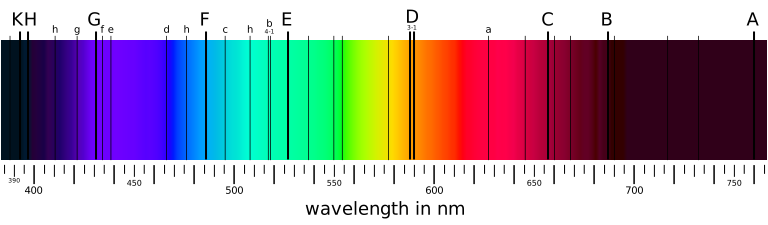
Joe Biden didn’t win !!!