2020·11·07 KMAG Daily Thread

Shitstorm Saturday. Finally!

(And how not to spend it curled up in fetal position saying “Oh, shit!”)

Yeah, we’re definitely in a shitstorm right now, and worse (for our morale) is that our side hasn’t really answered the other side’s opening salvo. However, even a skeptic/pessimist like me can see we are gathering our forces for the counterattack. There are some unknown factors in play, but the only thing we can do is plunge in.

This is for ALL OF THE CHIPS. They are “all in.” We are “all in.”

If the Enemy wins, we will never, ever, ever have another chance at this without a hot civil war, and the enemy will have the full weight of the Federal Government on their side. Because we haven’t managed to drain the swamp, and they can certainly either co-opt or get rid of the few good people Trump has managed to install.

Trump having to leave office next January would be a catastrophe, and everything he has accomplished will be undone in a matter of months…if not weeks…if not days. To the applause of the minders of our culture and our educational system.

Welcome to the American Socialist State (ASS). Maybe that’s why the Dems have that as their mascot?

If Trump wins the work has just begun. The swamp MUST be drained, it must become his TOP priority. I’ll be honest, I think it should have been kicked into higher gear a long time ago, but then…I do NOT know what the Generals know, and I also don’t know what they DON’T know. Maybe by delaying, he’s pulling an Alexander I, giving Napoleon a long enough supply line to hang himself on. Seriously, I am reminded of this. Alexander was risking being deposed because the Russian army would not meet Napoleon head on. But in the end it was worth it. Napoleon didn’t just fail to conquer Russia, he himself ended up being chased all the way back to Paris and being deposed.

Which just reminds me of a particular piece of music.

1812 Overture with Chorus.

That piece of music is about the war of 1812 between France and Russia, not our war of 1812, but nonetheless we’ve adopted it for our Independence Day (maybe having cannon used as a musical instrument had something to do with that). It’s replete with the Marseillaise theme as well as the old Russian Imperial anthem (neither of which was in use in 1812, but give Pyotr Ill’ich Chaikovsky some artistic license). I found this recording a few months ago and like the period paintings AND the fact that the choral part is included. (You can hear them sing God Save The Tsar towards the end, 15:00 or so.)

There are two parts of this where there is canon fire. One string of five shots at about 12:30, then a minute or so later at about 13:35 the music kicks into high gear, the bells ring, the same hymn that starts the whole piece is sung again, and there’s the big volley, and on July 4th you have fireworks too. When that hymn starts up, I think of it as “Mother Russia is awake, she’s riled, and she is going to bring an ASS KICKING with her.” (The one disadvantage of this recording is this doesn’t have the punch it does with an instrumental recording.)

Sort of like we feel about this election.

That first volley represents the Battle of Borodino. That was when the Russians did, in fact, make a stand. Borodino is a few score miles west of Moscow. The Russian Army and Napoleon’s Grand Armee faced off and twenty five thousand soldiers died.

This is one of the bloodiest single-day battles in history. In fact, it was at the time the second worst ever, second only to the utter annihilation of five Roman legions by Hannibal at Cannae.

For comparison, the Allies lost about 4400 men on D-day.

Napoleon was nominally the winner of this battle, but it drained his capabilities tremendously, and he had not decisively beaten the Russians, so the victory he was seeking continued to evade his grasp. (He specialized in crushing his enemies utterly in one stroke, and the Russians understood this and never gave him the opportunity.)

The Russians continued retreating towards Moscow. They reached it, and the soldiers marching along were waiting for the command to stop, and take their stand. Surely Moscow, the ancient (but not current) capital, the beating heart of Old Mother Russia, had to be defended! But they waited for the stop command in vain, they marched completely through the city and out the other side, giving it to Napoleon. They did, however, arrange to set the city on fire, leaving Napoleon with nothing…and winter was coming.

Hundreds of thousands of troops, French and allies, entered Russia. Almost none of them survived to retreat back out of Russia. An ass kicking indeed. And he was pursued all the way to Paris and deposed.

I think right now we’ve just fought our Battle of Borodino, and we will soon see who wins the war. There’s a hard deadline. The electors cast their vote on December 16, which means we must know before then who they are–Dopey Joe’s people, or Trump’s people.

And if it’s Dopey Joe’s people in too many cases…well, life will get very nasty, brutish, and interesting.

OK enough of that. To the immediate matter at hand. Unfrauding.

Unfrauding is getting out from under the electoral fraud. (I was about to coin the word “defrauding” but then I realized it already exists and means the exact opposite of what I would want it to mean. It must be one of those “flammable”/”inflammable” things.)

I am hoping there is indeed something to the one pixel dot identifiers. Actually, I do know there is something to it; that HP printer over to my left undeniably uses them. The question is whether the Big Honking Machines that printed off all those mail in ballots months ago also do this. A home/office printer is one thing, this other thing is an industrial printer you could probably print dead-tree books and magazines on.

If they do, then great: We can certainly discern whether a ballot was or was not printed on those machines and toss those out (unless, of course the counterfeiters were clever/able to change their machines to match–unlikely but not totally impossible–if it really was in China, big resources were in play and I’d expect someone over there to at least try).

But it’s important to remember how many different ways to commit fraud there are, and that this won’t catch all of them. For example, we know for a fact that many of those ballots printed on the perfectly legit machine were mailed to people who are dead, or who have moved away. Any of those “harvested” and filled out will have the correct dot pattern on them. Also, legit ballots with votes for Trump can be, and have been thrown away, and the correct dot pattern on those won’t prevent them from hitting the dumpster.

And there is a third factor. I’ve mentioned in the past that Colorado is mail-in only…but you can vote in person in Colorado; I did so on Monday. I had to go to one of about ten places in my county, fill out paperwork giving my name and address (and affirming that I am a citizen). They then looked me up, and on the spot, a big machine the size of an office copier but with a big attachment on top, printed my ballot.

I tried to explain this to someone, that Colorado prints legal ballots on the day of the election, and he simply denied it. Well, I saw it happen the day before the election on my behalf and I know people who voted on election day the same way.

Now this machine presumably prints the dots. And the dots encode a time stamp. But what happens if they run off a ballot or two during a slow time of day and vote them? Well, with THAT there is an audit trail; the number of ballots will be off from the number of people who voted, but I can think of ways around that, and the dot pattern will not, by itself, save us from that form of fraud.

Basically, folks, as useful as the dot pattern is…it had better not be the only thing in our quiver, and I’m 99 percent sure it isn’t.

A Reminder Of Today’s Big Issue.

Our movement is about replacing a failed and corrupt political establishment with a new government controlled by you, the American People...Our campaign represents a true existential threat, like they’ve never seen before.

Then-Candidate Donald J. Trump

Needs to happen, soon.

Lawyer Appeasement Section

OK now for the fine print.

Please note that our menu has changed, please listen to all of the options.

This is the WQTH Daily Thread. You know the drill. There’s no Political correctness, but civility is a requirement. There are Important Guidelines,  here, with an addendum on 20191110.

We have a new board – called The U Tree – where people can take each other to the woodshed without fear of censorship or moderation.

And remember Wheatie’s Rules:

1. No food fights
2. No running with scissors.
3. If you bring snacks, bring enough for everyone.
4. The first rule of gun safety: Don’t let the government take your guns.
5. The gun is always loaded.
5a. If you actually want the gun to be loaded, like because you’re checking out a bump in the night, then it’s empty.
6. Never point the gun at anything you’re not willing to destroy.
7. Keep your finger off the trigger until ready to fire.
8. Be sure of your target and what is behind it.
9. Social Justice Warriors, ANTIFA pukes, BLM hypocrites, and other assorted varieties of Marxists can go copulate with themselves, or if insufficiently limber, may substitute a rusty wire brush suitable for cleaning the bore of a twelve or ten gauge.

(Hmm a few extras seem to have crept in.)

Coin of The Day

Иван Грозный – Ivan The Terrible

I made a joke Thursday, telling the left not to make me go Ivan the Terrible on them. Wolf appreciated it, which got me to thinking about him (Ivan, not Wolf). He was the fourth grand duke of Muscovy named Ivan (and the ones before him all had nicknames too, Ivan Moneybags, Ivan the Red (or Ivan the Fair), and Ivan the Great). He flourished in the late 1500s, and was the grandson of Ivan the Great. Ivan the Great had defeated the Mongols, which is how he got to be called the “Great”, and Ivan the Terrible, his grandson, capitalized on that to assume the title “Tsar” (a derivation of the word Caesar). Russia at that point (in 1547) became a “Tsardom” with Muscovy becoming its most important constituency.

https://upload.wikimedia.org/wikipedia/commons/thumb/2/2b/Vasnetsov_Ioann_4.jpg/220px-Vasnetsov_Ioann_4.jpg
https://upload.wikimedia.org/wikipedia/commons/thumb/c/cf/IoannIV_reconstruction_by_Gerasimov02.jpg/220px-IoannIV_reconstruction_by_Gerasimov02.jpg

His reign started out promisingly in 1533, and he managed to conquer the Khanates of Kazan (1552) and Astrakhan (1556) on the Volga, and made the first inroads into Siberia (50s-1580).

But then something happened, and he became erratic in the 1560s, starting a rather “Red Guard” like force called the Oprichnina. He eventually (1570) turned them loose on Novgorod, one of his own cities, and it was as if an invading army were sacking it, murdering and pillaging. Novgorod at the time was second only in importance to Moscow. It never regained that level of prominence.

He also built St. Basil’s cathedral on Red Square in Moscow (that’s the one with all the onion shaped domes on it).

His sobriquet isn’t really “the Terrible” in the sense of “awful, horrific.” The word Terrible made sense as a translation back then, but its meaning has changed over the centuries and now the Russian word groznyy is a bit difficult to translate, it’s somewhere between fearsome, formidable, dreaded, and awesome (as in awe-inspiring, not excellent). To be “terrible” in the modern sense of the word, to a Russian, a ruler would have to allow the country to descend into anarchy or lose a major war or something like that. Ivan Groznyy did none of those things. he kept a tight grip, he expanded Russia’s borders…basically, you didn’t fuck with him.

That first picture of him shows him robed with a walking stick. But that walking stick is actually a spear. He was not above literally pinning someone’s foot to the floor with it.

(“Mommy, mommy, why do I keep walking around in circles?” “Shut up or I’ll nail your other foot to the floor.” — from a compendium of sick jokes I read as a teenager, the natural market for such books.)

Ivan beat one of his pregnant daughters for dressing immodestly in 1581, she ended up miscarrying (probably as a result of the beating), then his son, Ivan junior, got into an argument about it, and Ivan beat him with his staff, and Ivan junior died.

https://upload.wikimedia.org/wikipedia/commons/thumb/3/33/Iv%C3%A1n_el_Terrible_y_su_hijo%2C_por_Ili%C3%A1_Repin.jpg/763px-Iv%C3%A1n_el_Terrible_y_su_hijo%2C_por_Ili%C3%A1_Repin.jpg
A very famous painting by Repin of Ivan immeidately after killing his son. Talk about “Oh, Shit!!!” moments.

Ivan Groznyy finally died in 1584.

Because he had killed his son, his dynasty, the Ryuriks (who had ruled in some form since the 800s) petered out after a nephew succeeded him, and Russia spent the time from 1598-1613 in the Time of Troubles, after which a more distant relative of Ivan, Michael Romanov, was asked to be Tsar, and he founded the Romanov dynasty, which endured for just over 300 years.

But this is the coins section, so you might be thinking I’ll show you some of his coins. And they must surely be fabulously expensive.

Half right. I’ll show you the coins. But they’re cheap. And not terribly impressive to look at.

https://images.vcoins.com/product_image/56/L/6/Lpb6d4ZsSa8ecWF7Jf9FwyY25KgXGn.jpg
Denga of Ivan the Terrible, while he was Grand Duke.
(You can spot part of the word ВЕЛИКИЙ “Velikiy” in the lettering, Russian for “Grand” or “Great”)

These coins are considerably smaller than a dime. Dengas (I’ll explain that in a moment) were originally about a gram in weight but over time got debased down to 0.14 grams. A silver dime weighs 5.0 [edit: not 6.25] grams, for comparison.

Russian coins at this time were made by a very different process. A bit of silver wire was carefully measured and cut. If the wire had consistent thickness, the cut piece would have consistent weight. This bit of wire was rolled flat, resulting in a rather oblong shape. It would then be struck by hammered dies. The dies were much larger than the coin, meaning that the coin would never show the entire design. However, by examining hundreds of these bits of “wire money” one can assemble a composite and see what was on the die.

One side was the name and title of the tsar. The other had a man on horseback, fighting a dragon with either a spear or a sword. That man, of course, was St. George. And him fighting the dragon was the emblem of Moscow (and still is). If you’ve ever seen a double-headed Russian eagle emblem, it generally has a shield on its chest, and on that shield is St. George.

https://images.vcoins.com/product_image/56/8/5/8mnMW2g7oBH4cp9YiCo65zLGX3se79.jpg
Ivan the Terrible wire money, this time as Tsar (ЦАРЬ, abbreviated ЦРЬ, upside down on the left at what should be the top).

Wire money is occasionally found in hoards (someone buried a pot full of them for safekeeping and never returned to dig it up). These sometimes have many hundreds of pieces and thus the coins aren’t rare and aren’t very expensive. They’re also generally not very attractive. It’s a rare collector who takes a fascination with them, but in principle you can buy a book that shows you all the dies we know of and figure out which one struck your coin. If it has the name of Ivan Vasilievich on it, it will either call him “Veliky Knaz” (grand duke, pre-1547) or “Tsar” (tsar, post 1547) and you’ve got a coin of Ivan the Terrible. (Pro tip. If the lettering contains an X, it cannot be anything other than a coin of Michael Romanov.)

They commonly came in two sizes; ones with St. George and a sword were called “dengas”, ones twice as heavy with St. George using a spear (in Russian, a kopye) were called “kopeyeks” and that is what ultimately led to the kopek. There was, occasionally, an “altyn” worth six dengas, and it got that name from the Tatar word for six. That fact right there should tell you how hard the Mongol/Tatar yoke sat on the Russians during the late middle ages. (Even “denga” is probably a Turkic word.)

Rubles at the time only had a theoretical existence. Centuries earlier there were cast silver ingots and ruble, from the Russian word for “to cut” was a cut-off piece of an ingot. But by the 1500s, no physical “ruble” existed, so rubles were a “unit of account” equal to 200 dengas.

Nice round coins like ours didn’t come to Russia until Peter the Great introduced them in 1700.

Standard disclaimer: I never show pictures of my own coins. I may or may not own coins like the ones I show. Burglars will be interested to hear that gold and silver aren’t the only heavy metals I have, and I have quite a bit of one with a heavier nucleus than either. And I keep it around a lot more than the gold and silver.

Obligatory PSAs and Reminders

Just two more things, my standard Public Service Announcements. We don’t want to forget them!!!

How Not To Find Yourself In Contention For The Darwin Award
(Nothing to do with bearded dragons)

It has been pointed out that all of the rioting is nominally on account of criminals who resisted arrest in one form or another, and someone suggested schools ought to teach people not to resist arrest.

Chris Rock on a similar vein, in 2007

Granted an “ass kicking” isn’t the same as being shot, but both can result from the same stupid act. You may ultimately beat the rap, but you aren’t going to avoid the ride.

China is Lower than Whale Shit

Remember Hong Kong!!! And remember the tens of millions who died under the “Great Helmsman” Chairman Mao.

https://youtube.com/watch?v=L3tnH4FGbd0%3F
I hope this guy isn’t rotting in the laogai somewhere!

中国是个混蛋 !!!
Zhōngguò shì gè hùndàn !!!
China is asshoe !!!

For my money the Great Helmsman is Hikaru Sulu (even if the actor is a dingbat).

2020·10·31 KMAG Daily Thread

Shitstorm Saturday?

As usual I am writing this Thursday evening, so there’s a decent chance something Big, something that’s not just a Boom or even a Kaboom, but a Kaf*ckingboom, has happened between then and the time you’re reading this!

WordPress Sucks.

I decided to go back to the eagle from my first post. I just spent half an hour scrolling back to my original eagle from January 10 2019, because the image at the top of this post MUST be loaded as a media file on this site, and there’s no other way to do it but to scroll back through nearly two years of images and pick it. And it gets slower and slower and slower the further you go.

I *do* have the URL of the media file (I just had to go back to my first post and save it), but you can’t just type that in; you have to scroll to the picture and click on it.

I thought I’d save Wolf some space (since half of his media space is used).

So I finally get there, select the image…and instead it’s some blurry image out of the middle of a Q drop.

You can’t type the URL in, but you can add a new piece of media and make that the URL of the one you have. Yes, you end up with a duplicate image in Wolf’s media library, but I had no choice.

Fuck you, WordPress. Fuck you sidewise with a 12 gauge bore brush, for making it impossible for me to do Wolf a favor, and making me waste a ton of bandwidth and time finding that out. The moron who made it necessary to scroll back to select an image from the media file should be dragged down a dirt road for thirty miles.

This sort of thing irritates me, because I work in software, and I’d be fired for this kind of donkeyf*ck bullshit. Well, actually my boss wouldn’t fire me immediately, but he would if I refused to redo it right.

The Election

By the next time I do my Saturday post, the election will be over, and we’ll be going through absolute mayhem. Either the results won’t be clear, or they will be clear and someone will be very, very unhappy about it. Hopefully everyone is prepared, and also hopefully it won’t come down to Civil War II.

A Reminder Of Today’s Big Issue.

Our movement is about replacing a failed and corrupt political establishment with a new government controlled by you, the American People...Our campaign represents a true existential threat, like they’ve never seen before.

Then-Candidate Donald J. Trump

Needs to happen, soon.

Lawyer Appeasement Section

OK now for the fine print.

Please note that our menu has changed, please listen to all of the options.

This is the WQTH Daily Thread. You know the drill. There’s no Political correctness, but civility is a requirement. There are Important Guidelines,  here, with an addendum on 20191110.

We have a new board – called The U Tree – where people can take each other to the woodshed without fear of censorship or moderation.

And remember Wheatie’s Rules:

1. No food fights
2. No running with scissors.
3. If you bring snacks, bring enough for everyone.
4. The first rule of gun safety: Don’t let the government take your guns.
5. The gun is always loaded.
5a. If you actually want the gun to be loaded, like because you’re checking out a bump in the night, then it’s empty.
6. Never point the gun at anything you’re not willing to destroy.
7. Keep your finger off the trigger until ready to fire.
8. Be sure of your target and what is behind it.
9. Social Justice Warriors, ANTIFA pukes, BLM hypocrites, and other assorted varieties of Marxists can go copulate with themselves, or if insufficiently limber, may substitute a rusty wire brush suitable for cleaning the bore of a twelve or ten gauge.

(Hmm a few extras seem to have crept in.)

Coin of The Day

The Eagle, Part II.

In our previous post, I discussed the eagle, not the bird but the coin, with the official definition of an “eagle” being ten dollars. And yes, it was an official definition unlike “nickel” but very much like “dime” (look at one, and you will see it actually says “one dime” not “ten cents” on it).

For all that it was a full, official denomination, for some reason in the early years the US didn’t make them very often, preferring instead to make half eagles and quarter eagles. That plus the fact that any gold coin became subject to melting when the price of gold (relative to silver) went up in the 1830s, makes any eagle from before 1834 quite rare. Which brings us up to where we left off last time.

In the middle of 1834 the gold standard was reduced, and designs of quarter and half eagles were altered so people could readily tell the old coins from the new ones (and old ones were now exchangeable for a bit more than face value, which saved the ones that hadn’t been melted). But we still didn’t make full eagles.

In 1839, however, the mint had a new chief engraver, Christian Gobrecht and he was a capable artist. He redid the silver from 1837-1840 and turned his attention to gold in 1839.

And now, finally we had eagles again. This design is now called the “Liberty Head” eagle by collectors, and we used it for almost seventy years, which until 1979 or so was a record (we’ve now been using Lincoln’s head on the cent for over 120 years, and Jefferson’s head on the nickel for 82 years).

The bad news is, he didn’t do a new eagle design, basically using the motif that had appeared on the quarter and half eagle since the late 00s of the 19th century. Still, at least it does look like an eagle!

https://www.usacoinbook.com/us-coins/1853-liberty-head-gold-eagle.jpg
Liberty or Coronet Head Eagle, 1853

I had to struggle to find one of these in a picture…and I don’t know if it’s the picture or the coin, but the color just looks freaking awful on this coin. I wouldn’t be surprised if it had been harshly cleaned at some point. But it took me a while to find even this picture.

The same basic design was used on quarter and half eagles, but when the gold dollar and gold double eagle were introduced in 1849-1850, the mint had a new engraver, James Longacre, and he put totally different designs on those denominations. (His major shortcoming as an engraver was that he had great difficulty getting lettering lined up properly.)

Coronet eagles from before 1866 are rare, and in many cases when you try to look up the price of one in choice uncirculated (MS-63), you will find a dash in the book…meaning there’s no such thing. For dates where such a thing exists, the price is stratospheric.

Now why would one care about ones from before 1866? Because in 1866 a minor change was made to the reverse, and those who collect by type (rather than by date) therefore want one from before the change and one from after the change.

Fortunately, after the change is easy, since that time span (1866-1907) has plenty of common dates in it where you won’t pay much more than the price of the gold in the coin. Of course you’ll have a piece with a date that starts with a 19 or maybe 1890-something, not a coin from 1867 (coins continue to be scarce until 1876 or so thanks to the after effects of the Civil War, but that’s another story–maybe I’ve already told it; I can no longer keep track).

Anyhow, here’s the change:

https://www.coincommunity.com/us_gold_eagles/images/1885-liberty-head-eagle-001.jpg

The motto was not added to the quarter eagle, as the coin was deemed too small for it to fit. Nor was it added to the $1 or $3 gold coins that were being issued at the time.

So now we fast forward to Teddy Roosevelt, during 1906-07.

Roosevelt felt that our coinage was staid, and he had a point. He wanted to redesign our coinage to be much more artistic, and as a result we have coins like the Mercury dime, the standing liberty quarter, the walking liberty half dollar…all of which I have discussed in the past. But we also have the St. Gaudens double eagle and the Indian head eagle, both designed by Augustus St. Gaudens, a world famous artist at the time.

https://www.usacoinbook.com/us-coins/1908-d-no-motto-indian-head-gold-eagle.jpg
I had a choice between this picture, with awful color but good lighting, and one with good color that looks like gold instead of dull brass, but with the lighting head on so you can’t see the relief of the design.

At Roosevelt’s insistence the In God We Trust motto was omitted, both on this coin and on the new double eagle. Was he some sort of foaming-at-the-mouth atheist? No. He was a believer, and he thought putting the deity’s name on a mere piece of money was a sacrilege.

Congress didn’t agree, and passed a law requiring the restoration of the motto. Up to this time it had been something the mint and the treasury had just agreed between them to do. Now it was required by law on those two coins, and the mint was forbidden from removing it in the future, though it was not required to add it to coins that didn’t have the motto, which at that time were the cent, nickel, dime, and quarter eagle. (The nickel had had the motto from 1865 through 1883, but it was dropped with the change in design that happened that year, without anyone kicking up a fuss.)

https://www.usacoinbook.com/us-coins/1933-indian-head-gold-eagle.jpg

And this photo, and our story, bring us to the end.

In 1933 a different Roosevelt confiscated our gold. He then devalued the dollar from $20.67 per troy ounce of gold to $35, which would be the official level through the 1960s.

People were allowed to hold gold in jewelry, and could even hang onto coins that had numismatic value (i.e., were worth more than their face value, to a collector). But much of our gold went back to the mint, which melted most of it and it’s now in bars in Fort Knox and other places. (The mint actually hung onto many pieces that were turned in that were of numismatic interest.)

A lot of our gold coinage “wintered over” in Europe and has been coming back home in the hands of numismatists ever since all restrictions on gold ownership were removed in the 1970s. I still see coin dealers offering coins that are coming back from Europe, today.

In particular, almost every 1933 eagle was melted at the mint. Any out there today are in the high six figures for value.

[Digression: For double eagles, none were officially released, though a few got out. They are officially considered stolen property (and the US government confiscated ten of them about 15 years ago), with the exception of one piece that our government apparently gifted to a foreign dignitary. That coin sold for seven million dollars in 2002. I did get to see that double eagle since I was at the convention where it was auctioned off, as well as the ten that were confiscated–the mint did not destroy them, it even exhibited them in Denver in 2006. It’s funny to think that I have seen and photographed (too badly to show here) every single 1933 gold double eagle that exists.]

So that is the end of the eagle as a circulating $10 denomination.

But I’m going repeat my rant/conclusion from last time.

You can, today, buy “eagles” from the mint. But they aren’t these eagles. The word has been redefined to mean either a silver coin with an ounce of nearly pure silver in it, with a denomination of a dollar (but they’ll set you back thirty dollars), or gold coins…with a tenth, quarter, half, or full ounce of gold, denominated five, ten, twenty five, or fifty dollars. (Yes, the quarter ounce should either be a fifth of an ounce, or denominated twelve-and-a-half dollars. This is the government we’re talking about here, it doesn’t have to make sense anymore.) There are even platinum and palladium coins. (Platinum is denominated 10, 25, 50 and 100–so at least the values are consistent with the weights. Palladium just has a full ounce coin, which is denominated #25, even though it’s more expensive as a metal than any of the others.)

All have a denomination, and each and every one of them would mark you as the world’s biggest idiot if you were to actually spend them at face value.

So “eagle” has lost its original meaning, at least when it comes to coins.

But in zoology, they’re still cool birds!

Standard disclaimer: I never show pictures of my coins, and in many cases don’t own anything remotely resembling the coins in these pictures. [This would be one of those cases.] Any prospective thieves should know I also collect other heavy metals–anything with a heavier nucleus would be unstable–and keep those a lot closer to me than the coins.

Obligatory PSAs/Reminders

Just one more thing, my standard Public Service Announcements. We don’t want to forget any of these!!!

How not to get your ass kicked by the police. Chris Rock in 2007

Granted an “ass kicking” isn’t the same as being shot, but both can result from the same stupid act. You may ultimately beat the rap, but you aren’t going to avoid the ride.

Remember Hong Kong!!! And remember the tens of millions who died under the “Great Helmsman” Chairman Mao.

https://youtube.com/watch?v=L3tnH4FGbd0%3F
I hope this guy isn’t rotting in the laogai somewhere!

中国是个混蛋 !!!
Zhōngguò shì gè hùndàn !!!
China is asshoe !!!

For my money the Great Helmsman is Hikaru Sulu (even if the actor is a dingbat).

2020·10·24 KMAG Daily Thread

Shitstorm Saturday?

Depends on how you define it, I suppose. If FG&C’s speculation of Wray getting not just fired but actually arrested had come to pass, we’d be in it. But right now I think we’re still just outside, on the edge of the real one.

Biden, on the other hand, sure managed to f*ck himself at the debate, simultaneously denying then advocating the plans to end the oil industry, and otherwise look like a dufus.

https://mikemcclaughry.files.wordpress.com/2013/07/wile-e-coyote-blows-himself-up.jpg?w=800

I guess he ran out of other family members to f*ck.

I’d say that qualifies as a good week!!

To be fair, I think his best moments (two of them) were when he upbraided Trump for talking about Red States versus Blue States, saying that it’s all America and we shouldn’t be making distinctions. Of course, he says things like that and it means good things to us, and bad things to him and his audience, simultaneously. (Never underestimate the utility of words and phrases with two meanings, e.g., “Peace” with both Communists and Muslims.)

A Reminder Of Today’s Big Issue.

Our movement is about replacing a failed and corrupt political establishment with a new government controlled by you, the American People...Our campaign represents a true existential threat, like they’ve never seen before.

Then-Candidate Donald J. Trump

Needs to happen, soon.

Lawyer Appeasement Section

OK now for the fine print.

Please note that our menu has changed, please listen to all of the options.

This is the WQTH Daily Thread. You know the drill. There’s no Political correctness, but civility is a requirement. There are Important Guidelines,  here, with an addendum on 20191110.

We have a new board – called The U Tree – where people can take each other to the woodshed without fear of censorship or moderation.

And remember Wheatie’s Rules:

1. No food fights
2. No running with scissors.
3. If you bring snacks, bring enough for everyone.
4. The first rule of gun safety: Don’t let the government take your guns.
5. The gun is always loaded.
5a. If you actually want the gun to be loaded, like because you’re checking out a bump in the night, then it’s empty.
6. Never point the gun at anything you’re not willing to destroy.
7. Keep your finger off the trigger until ready to fire.
8. Be sure of your target and what is behind it.
9. Social Justice Warriors, ANTIFA pukes, BLM hypocrites, and other assorted varieties of Marxists can go copulate with themselves, or if insufficiently limber, may substitute a rusty wire brush suitable for cleaning the bore of a twelve or ten gauge.

(Hmm a few extras seem to have crept in.)

Coin of The Day

The Eagle

Let’s face it, eagles are cool.

You’re probably not surprised to see me say that, since I will, on rare occasions, post a picture of one.

But most people don’t know that’s actually the name of a denomination of US money. (OK, you do if you’ve been following these ramblings.)

The original mint act of April 2, 1792, Section 9:

And be it further enacted, that there shall be from time to time at the said mint, coins of gold, silver, and copper, of the following denominations, values and descriptions, viz. Eagles–each to be of the value of ten dollars or units, and to contain two hundred and forty seven grains and four eighths of a grain of pure, or two hundred and seventy grains of standard gold. Half eagles–each to be of the value of five dollars, and to contain one hundred twenty-three grains and six eighths of a grain of pure, or one hundred thirty five grains of standard gold. Quarter eagles–each to be of the value of two dollars and a half dollar, and to contain sixty-one grains and seven eighths of a grain of pure, or sixty-seven grains and four eighths of a grain of standard gold. Dollars or units…

Act of April 2, 1792, Section 9

So the ten dollar gold piece was to be called an eagle, at least legally, and we’d have ten mills to the cent, ten cents to the disme, ten dismes to the dollar, and ten dollars to the eagle.

We never put the word “mill” on a coin, not even the 5 mill coin, which was labeled the half cent. (And the half cent was discontinued in 1857.) We did put the word “disme” on one coin in 1792, the next time the word appeared, in 1837, the (presumably silent, but we don’t know for absolute certain) s had been dropped. But the denomination “eagle” has never appeared on a US coin.

Ironically, like the dollar, the eagle wasn’t issued very much in the beginning. Half eagles (and half dollars) were far more popular.

In 1795-1797, we issued about 13,000 of the following:

https://usrarecoininvestments.com/images/coin_info/gold_eagles/1795-gold-eagle.jpg
It was hard to even find a picture of this…DuckDuckGo mostly returned pictures of half eagles even when I asked for eagles. These are basically half million dollar coins in choice uncirculated MS-63, and even in dog-butt-ugly Fine-12 grade you’re looking at over thirty thousand dollars.

Once you’ve forked over thirty grand, of course, the coin is the most beautiful thing you’ve ever seen.

The next style was the “large eagle” on the reverse of the eagle, from 1797-1804.

https://www.usacoinbook.com/us-coins/600/1798-8-over-7-7×6-stars-turban-head-gold-eagle.jpg
Now we’re getting to coins that will “only” cost about 60 grand in choice uncirculated, providing you’re not fussy about which year is stamped on the coin. 1797s, 1798s, and 1804s will be much more expensive.

After that…nothing until 1838 (and that’s true for dollars too, except we started at least thinking about dollars in 1836 and even issued a thousand or so). There are basically two designs from there until 1933, both in variants with or without the motto “In God We Trust” but I’m going to leave that story until next week or risk finding myself having no coin to talk about.

These coins, already very infrequently issued, were subject to melting down when gold prices rose, a situation which was fixed in 1834 when we reduced the amount of gold in the coins, bringing them back in line with the current gold-silver market value ratio–I’ve discussed that before. In this case, unlike with the half eagle, there are no “common dates” that bring them under the price of a car, so even if you just want one of each design, good luck and bring your bucketload of cash and/or sell out to the Chinese.

But I’m going to drag out my soapbox on a related issue.

You can, today, buy “eagles” from the mint. But they aren’t these eagles. The word has been redefined to mean either a silver coin with an ounce of nearly pure silver in it, with a denomination of a dollar (but they’ll set you back thirty dollars), or gold coins…with a tenth, quarter, half, or full ounce of gold, denominated five, ten, twenty five, or fifty dollars. (Yes, the quarter ounce should either be a fifth of an ounce, or denominated twelve-and-a-half dollars. This is the government we’re talking about here, it doesn’t have to make sense anymore.) So “eagle” has lost its original meaning, at least when it comes to coins.

But in zoology, they’re still cool birds!

Standard disclaimer: I never show pictures of my coins, and in many cases don’t own anything remotely resembling the coins in these pictures. [This would be one of those cases.] Any prospective thieves should know I also collect other heavy metals–anything with a heavier nucleus would be unstable–and keep those a lot closer to me than the coins.

Obligatory PSAs/Reminders

Just one more thing, my standard Public Service Announcements. We don’t want to forget any of these!!!

How not to get your ass kicked by the police. Chris Rock in 2007

Granted an “ass kicking” isn’t the same as being shot, but both can result from the same stupid act. You may ultimately beat the rap, but you aren’t going to avoid the ride.

Remember Hong Kong!!! And remember the tens of millions who died under the “Great Helmsman” Chairman Mao.

https://youtube.com/watch?v=L3tnH4FGbd0%3F
I hope this guy isn’t rotting in the laogai somewhere!

中国是个混蛋 !!!
Zhōngguò shì gè hùndàn !!!
China is asshoe !!!

For my money the Great Helmsman is Hikaru Sulu (even if the actor is a dingbat).
2020·10·17 KMAG Daily Thread

Shitstorm Saturday??

Maybe, and that would be ironic, because this time I actually do have something to talk about that has nothing to do with justice for the Deep State.

Or maybe it does, in a way, because the war for liberty is a constant in our lives, and what I’m about to talk about is an earlier battle.

So I have filler on the week when I don’t need it, but I’ll use it anyway.

The Battle Of Saratoga

On this day, October 17th, in 1777, what we now know as the Battle of Saratoga came to an end.

The British held New York (and New York was actually largely loyalist). They came up with looked like a good plan, to send troops north from New York, and south from Canada, to meet in the middle near Albany and cut the United States in half. Britain commanded the seas, so there’d be no way for the two halves of the country to communicate.

There were a lot of horrible SNAFUs, fortunately. The force in New York City had left to seize Philadelphia before the orders arrived, and they did succeed at that.

The northern force of 8000 men under General John Burgoyne, by contrast, was trying to do the right thing but just ran into snag after snag, some of which the patriots engineered, some of which were just Murphy in action.

Even before leaving Quebec, Burgoyne ran into difficulties. They expected to travel mainly over water, and thus hadn’t brought too many wagons and draft animals for the land parts of the route. In June, the governor of Quebec finally issued orders to procure the land transport, but the carts were freshly made out of green wood, and driven by civilians who were more likely to desert. Finally on June 13 Burgoyne set out. Burgoyne’s forces, with the invaluable support of Indians, quickly sailed up the river and up Lake Champlain, capturing Fort Cown Point (undefended) by June 30th. The Indian screening forces prevented American scouts from learning of the true size of the invading force. A series of mistakes on our part made it easy for the British to capture Fort Ticonderoga–which we had considered impregnable–on July 6.

This was a big enough disaster that the French, on the verge of joining the war on our side, decided to hold off.

Burgoyne consolidated his position and then moved on to Fort Edward. Again the Indians preceded him, but this time they became impatient and started indiscriminately raiding frontier families, which simply caused more locals to turn to the Patriot cause. Most famous of these fatalities was Jane McCrea, who had been engaged to a Loyalist; ironically her martyrdom ended up helping the American cause.

But Burgoyne was now deep in hostile territory, and he was realizing he had supply difficulties. He tried raiding the surrounding area for supplies, and a regiment, plus some Brunswick dragoons, under the command of Friedrich Baum went into what is now Vermont to obtain (i.e., steal) supplies. This force ran into 2000 men under John Stark at Bennington, and was enveloped and captured on August 16. That deprived Burgoyne of almost 1000 men and, of course, he didn’t get the supplies.

Burgoyne blamed the Indians and the Canadians who had come with his forces, and most of the Indians and Canadians left his camp; Burgoyne now had fewer than 100 Indian scouts, and now had no protection from the American rangers.

Now Burgoyne was realizing he’d not be done before winter. He had the choice to either retreat or push on to Albany; he chose the latter. A month of maneuverings with only two pitched battles followed, but one was an attack on Ticonderoga, well to the rear of the main British forces.

To cut out a lot of complexity, Burgoyne was finally defeated at Saratoga on October 17th, 1777. The plan to cut America in two had failed.

It would be hard to overstate the importance of this. For one thing, the French, when they learned of this, finally came into the war on our side. By declaring war on Britain, they were risking their own necks, and they didn’t want to jump in until we had really shown that we were in it to win it. And Saratoga did just that.

It shook the British up enough that they tried to negotiate a peace the next year, and repealed many of the acts that had goaded us into fighting. They even offered us self rule and representation in Parliament. That might have worked as late as 1775. It wasn’t enough in 1778. (The self-government offer was basically the blueprint for the later British Commonwealth–the Brits had learned their lesson by then.) After we rejected the offer the British reassessed their strategy, and turned to the south.

And so…a direct line can be drawn between October 17, 1777 and another event exactly four years later, October 17th, 1781, in Virginia. General Cornwallis, commander of the last significant British army on US soil, on that day began negotiations for surrender at Yorktown. That surrender took place on the 19th (meaning we can celebrate another anniversary this coming Monday), and the war was effectively over. The British government fell (i.e., their Prime Minister had to resign), and that was that. We just had to sign a peace treaty with the country that was now forced to acknowledge our independence.

Betsy Ross Flags? Fly ’em if you’ve got ’em. I do and I will.

Justice Must Be done.

Our movement is about replacing a failed and corrupt political establishment with a new government controlled by you, the American People...Our campaign represents a true existential threat, like they’ve never seen before.

Then-Candidate Donald J. Trump

Lawyer Appeasement Section

OK now for the fine print.

This is the WQTH Daily Thread. You know the drill. There’s no Poltical correctness, but civility is a requirement. There are Important Guidelines,  here, with an addendum on 20191110.

We have a new board – called The U Tree – where people can take each other to the woodshed without fear of censorship or moderation.

And remember Wheatie’s Rules:

1. No food fights
2. No running with scissors.
3. If you bring snacks, bring enough for everyone.
4. Zeroth rule of gun safety: Don’t let the government get your guns.
5. Rule one of gun safety: The gun is always loaded.
5a. If you actually want the gun to be loaded, like because you’re checking out a bump in the night, then it’s empty.
6. Rule two of gun safety: Never point the gun at anything you’re not willing to destroy.
7. Rule three: Keep your finger off the trigger until ready to fire.
8. Rule the fourth: Be sure of your target and what is behind it.

(Hmm a few extras seem to have crept in.)

The Mandatory Coin

I’m going to skip this, this time; Saratoga is quite enough history to “chew on.”

Important Reminder

To conclude: My standard Public Service Announcement. We don’t want to forget this!!!

Remember Hong Kong!!!

https://youtube.com/watch?v=L3tnH4FGbd0%3F
I hope this guy isn’t rotting in the laogai somewhere!

中国是个混蛋 !!!
Zhōngguò shì gè hùndàn !!!
China is asshoe !!!

2020·10·10 KMAG Daily Thread

Is the shitstorm quite here yet?

Nope. Maybe it will arrive with full declass, unless people who can prosecute and arrest do their usual “ignore.” Aided and abetted by the Yellow Stream Media, which is good at its real job.

How about Heels Up Kamaltoe Harris? What a piece of work, thumped into the ground by VPOTUS Pence. Except, of course people will be encouraged to forget about this.

So in all there’s been plenty to watch going on this last week, but not much actual movement. It’s like watching the contents of a blender for half an hour, then being surprised that as fast as that stuff has been moving…it’s still on your kitchen counter after all that time.

But the temperature continues its slow climb.

And President Donald J. Trump kicked COVID’s ass.

I’d say that qualifies as a good week!!

Public Service Message

This one bears repeating.

It has been pointed out that all of the rioting is nominally on account of criminals who resisted arrest in one form or another, and someone suggested schools ought to teach people not to resist arrest.

Chris Rock on a similar vein, in 2007

Granted an “ass kicking” isn’t the same as being shot, but both can result from the same stupid act. You may ultimately beat the rap, but you aren’t going to avoid the ride.

A Reminder Of Today’s Big Issue.

Our movement is about replacing a failed and corrupt political establishment with a new government controlled by you, the American People...Our campaign represents a true existential threat, like they’ve never seen before.

Then-Candidate Donald J. Trump

Needs to happen, soon.

Lawyer Appeasement Section

OK now for the fine print.

Please note that our menu has changed, please listen to all of the options.

This is the WQTH Daily Thread. You know the drill. There’s no Political correctness, but civility is a requirement. There are Important Guidelines,  here, with an addendum on 20191110.

We have a new board – called The U Tree – where people can take each other to the woodshed without fear of censorship or moderation.

And remember Wheatie’s Rules:

1. No food fights
2. No running with scissors.
3. If you bring snacks, bring enough for everyone.
4. The first rule of gun safety: Don’t let the government take your guns.
5. The gun is always loaded.
5a. If you actually want the gun to be loaded, like because you’re checking out a bump in the night, then it’s empty.
6. Never point the gun at anything you’re not willing to destroy.
7. Keep your finger off the trigger until ready to fire.
8. Be sure of your target and what is behind it.
9. Social Justice Warriors, ANTIFA pukes, BLM hypocrites, and other assorted varieties of Marxists can go copulate with themselves, or if insufficiently limber, may substitute a rusty wire brush suitable for cleaning the bore of a twelve or ten gauge.

(Hmm a few extras seem to have crept in.)

Coin of The Day

Give No Quarter!

It’s my words to Trump, Barr, et. al. but it’s also indicative of how tough it can be to collect early quarters.

You wouldn’t know it today from their sheer ubiquity today, but the US quarter dollar was not always popular. Which means the earlier dates can be especially rare. And no one–no one–has ever put together a date and mint set in uncirculated condition. I know this, because in many cases no uncirculated example is known to exist. No, I’m not talking about the many different years when no quarters were made, I’m talking about years quarters were made, yet no example has come down to us today in unworn condition.

The US mint began making quarter dollars in 1796. And then, after punching out 6,146 of them, they stopped. The best guess is that 600 or so of them still exist today. This is the first quarter, and it’s a one-year type, because the design changed the next time they made them.

https://www.coincommunity.com/us_quarter_dollars/images/1796-draped-bust-quarter-pcgs-ms63-001.jpg
This coin is worth approximately $125,000, graded mint state-63

The next quarters came out in 1804-1807, a grand total of 554,900 made, about 3000-4500 of them surviving today. The eagle is of a totally different style.

http://coinhelp.net/wp-content/uploads/2014/10/1807drapedquarterrev.jpg
Note the line running under the last S in STATES and through OF on the reverse, This is actually a die clash. At least once, the two dies came together with no blank in between them, and the bottom of liberty’s portrait was stamped into the reverse die (her head was opposite the eagle’s tail, her bosom opposite of the clouds above the eagle’s head). This impression was then imparted to the reverse of every coin subsequently made from that die. This was a not uncommon occurrence back then, and there are collectors who collect many coins of the same date, and the same die par, to trace the progression of the dies as they were damage and got worn.

And you guys thought *I* had no life.

Then more made in 1815, 1818, 1820-1825, 1827, 1828, then the mint started striking coins “in collar” (i.e., there was a ring around the dies to contain the metal when it flowed), so quarters became thicker and of smaller diameter.

https://www.usacoinbook.com/us-coins/600/1827-original-curl-base-2-capped-bust-quarter.jpg
Out-of-collar Capped Bust quarter.

Finally, with collar but essentially the same design there some regularity from 1831-1838. In fact the next year no quarters would be struck would be 1922, then possibly 1931. Quarters were made in 1975 but none bore that date. (You all should remember why.)

https://www.usacoinbook.com/us-coins/1836-capped-bust-quarter.jpg
Struck in collar. This coin, I suspect, has been cleaned a few times. A big no-no!!

The Seated Liberty style began in 1838 and ran through 1891. I’ve discussed some of the minor and temporary changes to these coins previously (1853-5, 1873-4).

https://coins.thefuntimesguide.com/files/1839-Liberty-Seated-Quarter.jpg

As regularly issued as these were, some dates, especially from San Francisco, simply haven’t come down to us in uncirculated condition.

From 1891 to 1916 we had the Barber series, from 1916-1930 we had the standing liberty series, and then from 1932 onwards, the Washington Quarter. I believe I’ve talked about all of these as well, but just in case a refresher is needed:

https://www.usacoinbook.com/us-coins/1916-d-barber-quarter.jpg
Barber Quarter
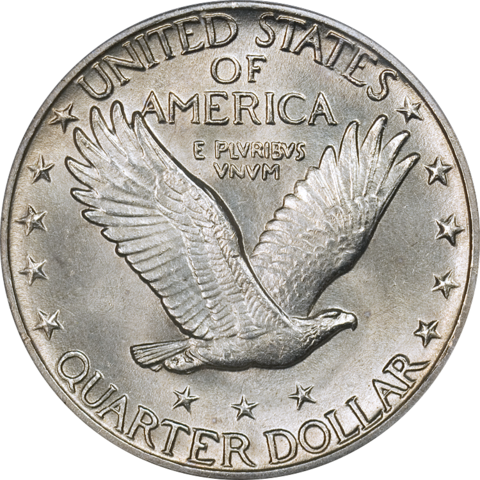
http://websitepicturesonly.coinauctionshelp.com/New_US_COIN_IMAGES/Quarters/1916standingquarter.jpg
Standing Liberty Quarter

The most significant change in the whole series, arguably, came about in 1965 when the government started issuing copper-nickel clad quarters. The mint must have been an interesting place, as one press would be stamping out 1964 quarters until they ran out of silver, and the one next to it would be cranking out clad crap. The mint claimed they would look so much alike that they’d be interchangeable, but I’m sure all the silver disappeared within nanoseconds. Gresham’s Law (bad money drives out good money) is true.

No quarter given, indeed. The early quarters are harder to collect than the other denominations (half dollars are comparatively easy), they aren’t given away; you will eat Ramen for a few months after some of your acquisitions, to save money.

Obligatory PSA/Reminder

Just one more thing, my standard Public Service Announcement. We don’t want to forget this!!!

Remember Hong Kong!!! And remember the tens of millions who died under the “Great Helmsman” Chairman Mao.

https://youtube.com/watch?v=L3tnH4FGbd0%3F
I hope this guy isn’t rotting in the laogai somewhere!

中国是个混蛋 !!!
Zhōngguò shì gè hùndàn !!!
China is asshoe !!!

For my money the Great Helmsman is Hikaru Sulu (even if the actor is a dingbat).

2020·10·03 KMAG Daily Thread

China Asshoe Saturday!!!

The Debate

Well, let’s just say that in a battle of wits Joe Hiden is unarmed.

Actually he was pretty well wired for this one…except that when one says “wired,” they usually mean really tensed up and ready to go. In this case, he was literally wired. From two sightings of what was probably something illicit (by the rules of the debate), to his black beady eyes, to his body language, right down to saying “good luck” at the beginning (d’oh!) it’s plain Joe had some of the help he needed to take on President Trump.

But only some of it.

He did end by urging everyone to get out and vote as it will make a difference.

Don’t worry, Joe, I will.

Let’s see, what else…Klinton foundation in the crosshairs, Flynn again in the news, ACB up for SCOTUS…oh, yeah, that reminds me.

The difference between this time and with Merrick Garland is NOT that Obola didn’t nominate someone, and Trump did. Because they both did. No, it’s the likely fate of the nomination in the Senate. So if the Dems should be getting mad at someone for alleged hypocrisy, it’s the Senate, not the President. But really the Dems shouldn’t get mad, they should just f*ck right the hell off.

Justice Must Be done.

Our movement is about replacing a failed and corrupt political establishment with a new government controlled by you, the American People...Our campaign represents a true existential threat, like they’ve never seen before.

Then-Candidate Donald J. Trump

Lawyer Appeasement Section

OK now for the fine print.

This is the WQTH Daily Thread. You know the drill. There’s no Poltical correctness, but civility is a requirement. There are Important Guidelines,  here, with an addendum on 20191110.

We have a new board – called The U Tree – where people can take each other to the woodshed without fear of censorship or moderation.

And remember Wheatie’s Rules:

1. No food fights
2. No running with scissors.
3. If you bring snacks, bring enough for everyone.
4. Zeroth rule of gun safety: Don’t let the government get your guns.
5. Rule one of gun safety: The gun is always loaded.
5a. If you actually want the gun to be loaded, like because you’re checking out a bump in the night, then it’s empty.
6. Rule two of gun safety: Never point the gun at anything you’re not willing to destroy.
7. Rule three: Keep your finger off the trigger until ready to fire.
8. Rule the fourth: Be sure of your target and what is behind it.

(Hmm a few extras seem to have crept in.)

The Mandatory Coin

Queer as a three cent piece?

Well, no. The fact of the matter is we had not just one, but two distinct series of three cent pieces circulating at the same time in the United States. And a three dollar gold coin.

The federal government, however, never did issue a three dollar bill, so those actually are…queer. (Private banks could issue their own banknotes backed by deposits and the bank’s assets until 1862, and there were all sorts of funky denominations, including three and even seven dollar notes.)

Oh, and I almost forgot–there was a US government issued three cent bill once upon a time. (Just so you know there’s balance with the three dollar coin).

As is probably seeming to be entirely too usual for my stories, it goes back to the 1850s though at least it’s not 1853 we’re talking about this time.

Nope, it’s 1851 we’re concerned with. On March 3rd a law was passed authorizing the minting of a three cent silver coin, with 12 3/8 grains of .750 fine silver. The act also specified that the devices (design) would be conspicuously different from the other silver coins.

Why? Because this silver coin was seriously underweight compared to the others. That was done deliberately, because (as you may have read a few weeks ago) we were going through a substantial silver coin shortage at the time, because gold had become relatively cheap after the California gold strikes. These coins didn’t have enough silver in them, so hopefully they’d be spared the melting pot.

As to why they chose three cents for the denomination, the rationale usually guessed at was that that was the price of a postage stamp. I find that unconvincing, to be honest. We didn’t have an eight cent coin when first class postage was eight cents.

Another reason I’m not convinced is that apparently before 1847 postal rates were based on distance and even after 1847 I can’t really find a statement that the rate was three cents. The first thing I find is that in 1863 the rate was six cents, dropping as low as 2 cents in 1885, going up a bit then back down to two cents under President Hoover. Even as late as 1968 the rate was five cents, telling me the postal service had become more and more efficient over the years. Nothing else that cost 6 cents during the civil war cost a mere 5 cents in 1968!

https://upload.wikimedia.org/wikipedia/commons/e/e7/1852_3_Cent_Silver_-_Type_1.jpg

Anyhow, I started with 1851, not 1853, but that’s not to say that 1853 has nothing to do with this story. Shortly after the act of February 1853 that cut the weight of the half dime, dime, quarter and half dollar and ended free coinage of silver, another act was passed raising the silver content of the three cent piece to match the others. And yes, arrows were added to the design here too, to denote the change.

https://www.usacoinbook.com/us-coins/1857-silver-three-cent-piece.jpg
usacoinbook.com

Another distinguishing feature of this, versus the prior design, is that the star now has three raised outlines, rather than no such outline. And incidentally, it’s tough to find this sub-type well made. You can see some softness in this picture; it’s not untypical even for a mint-state coin. In 1858, another design change was made, reducing to two the number of outlines on the star.

http://websitepicturesonly.coinauctionshelp.com/New_US_COIN_IMAGES/ThreeCents/1863threecentssilver.jpg
coinauctionshelp.com

In 1854, we have the three dollar gold piece. It looked a lot like the then-current one dollar coin, complete with Indian Princess wearing African bird feathers on her head dress. These are generally a bit expensive in high grades, more so than you’d expect from the roughly 15% of a troy ounce of gold contained in the coin.

https://www.usacoinbook.com/us-coins/1854-indian-princess-head-gold-3-dollars.jpg
usacoinbook.com

Then in 1862, when it became plain that the Civil War wasn’t going to end in just a few months, and that there was a genuine danger the United States would break apart, all of the silver and gold in circulation simply…vanished. People were hoarding it, expecting the Irwin Schiff to really hit the fan soon.

So what we had in circulation was one cent pieces (“pennies”) and paper money from banks. Nothing in between. (The 5 cent nickel we know today didn’t exist yet, which is why I talk of half dimes…they were silver, half the weight of a dime.) That was a pretty dire situation, and a bunch of things were done to try to correct it. The United States began issuing paper money, for the first time since the constitution had been ratified–this was as a result of nearly being bankrupt by 1863. (There were interest bearing notes issued during the War of 1812, but they weren’t paper money as we think of it today.) We also required banks to join the national bank system if they wished to issue money; that put them under federal supervision and standardized the design of the bank notes (a not inconsiderable benefit for people wary of counterfeits).

But perhaps the craziest thing we did was issue fractional paper money! Yes, 5, 10, 25 and 50 cent notes! These were considerably smaller than “full size” paper money, but most relevant is the third issue, where a three cent note was introduced, running from 1864 to 1867.

http://media.liveauctiongroup.net/i/17785/17197029_1.jpg
If you’re looking at this on a desktop computer, it’s probably quite a bit larger than actual size. (icollector.com)

“But,” you say, “The Civil War ended in 1865, Steve.”

Yes the war ended in 1865. The coin shortage did not. In large part because the government had issued too much paper money, and had to work to bring it back into par with gold and silver. It looked like this would finally happen in 1876, so the mint started ramping up production in anticipation of the day they’d be able to release coins and not have them disappear. Then WHAM!!! the day arrived, and almost instantly all the old coins came back from hiding. When added to the mint’s big output, this flooded the economy with coinage, so the mint got to go back to sleep again for a few years.

Pretty much all of the silver three cent pieces made between 1863 and 1872 were melted down; those years are expensive today except as proofs (specimens specially made for collectors; these got saved and are often more common today than mint-state pieces from the same year). They had become superfluous, and the series was terminated in 1873 along with the half dime. [The last of the three cent silvers illustrated above is probably a proof coin.]

And in case you’re wondering, yes, people did sometimes call them “trimes” back then, as a play on “dime” and “tri”, but more often they were called fish scales.

So one more piece to the story.

Another desperate measure we undertook to get something hard into circulation, was new denominations of base metal coinage. We introduced a two cent piece in 1864 (and discontinued it in 1873). We introduced a three cent nickel in 1865, and discontinued it in 1889.

https://upload.wikimedia.org/wikipedia/commons/5/52/1866_3_Cent_Nickel.jpg
I will admit that I own one of these, primarily because mine is actually quite a lot nicer looking than this!
(Albeit mine is of a different date, but neither my date or this one is particularly rare.)

This three cent nickel is about the size of a dime. I even heard just a few years ago a man telling me he had found one of these in what was supposed to be roll of dimes! And since it was the same composition as our “nickel” which hadn’t come out yet, it briefly was nicknamed the “nickel.”

And finally, in 1866 we introduced the five cent nickel we use today. That and paper money are the two lasting legacies of the Civil War.

With a three cent and five cent nickel coin actually circulating, it’s no wonder the mint dropped the two identical (but silver) denominations in 1873 that were not circulating!

The three cent nickel and the three dollar gold piece both met their demise in 1889 (along with the one dollar gold), after which point we had, excluding the gold that they had and we don’t, our modern system of denominations. The only thing left to do to turn it into the crap we use today is losing the silver from the dime, quarter and half dollar, and losing the copper out of the cent.

Standard Disclaimer: None of the coins shown are ones I own, though I’ll admit (in this case) to owning some examples of each of these designs. Prospective burglars should note that gold and silver aren’t the only heavy metals I collect, and that the other, unnamed heavy metal is kept a lot closer to me than the coins are.

Important Reminder

To conclude: My standard Public Service Announcement. We don’t want to forget this!!!

Remember Hong Kong!!!

https://youtube.com/watch?v=L3tnH4FGbd0%3F
I hope this guy isn’t rotting in the laogai somewhere!

中国是个混蛋 !!!
Zhōngguò shì gè hùndàn !!!
China is asshoe !!!

2020·09·26 KMAG Daily Thread

Here’s a blast from the past:

Public Service Message

It has been pointed out that all of the rioting is nominally on account of criminals who resisted arrest in one form or another, and someone suggested schools ought to teach people not to resist arrest.

Chris Rock on a similar vein, in 2007

Granted an “ass kicking” isn’t the same as being shot, but both can result from the same stupid act. You may ultimately beat the rap, but you aren’t going to avoid the ride.

A Reminder Of Today’s Big Issue.

Our movement is about replacing a failed and corrupt political establishment with a new government controlled by you, the American People...Our campaign represents a true existential threat, like they’ve never seen before.

Then-Candidate Donald J. Trump

Needs to happen, soon.

Lawyer Appeasement Section

OK now for the fine print.

Please note that our menu has changed, please listen to all of the options.

This is the WQTH Daily Thread. You know the drill. There’s no Political correctness, but civility is a requirement. There are Important Guidelines,  here, with an addendum on 20191110.

We have a new board – called The U Tree – where people can take each other to the woodshed without fear of censorship or moderation.

And remember Wheatie’s Rules:

1. No food fights
2. No running with scissors.
3. If you bring snacks, bring enough for everyone.
4. The first rule of gun safety: Don’t let the government take your guns.
5. The gun is always loaded.
5a. If you actually want the gun to be loaded, like because you’re checking out a bump in the night, then it’s empty.
6. Never point the gun at anything you’re not willing to destroy.
7. Keep your finger off the trigger until ready to fire.
8. Be sure of your target and what is behind it.
9. Social Justice Warriors, ANTIFA pukes, BLM hypocrites, and other assorted varieties of Marxists can go copulate with themselves, or if insufficiently limber, may substitute a rusty wire brush suitable for cleaning the bore of a twelve or ten gauge.

(Hmm a few extras seem to have crept in.)

Coin of The Day

The Wooden Nickel.

No, there was never a wooden nickel–except possibly issued by shops as a “good for five cents in trade” token.

But we do have that old advice to not take any wooden nickels and it’s sound advice.

A lot of people, fourteen days ago, were speculating that Big Things were going to happen over the next thirteen days. I more than half expected it to be baloney, but went along with it, primarily to keep it fresh in people’s minds.

(And because Darwin is cute.)

The thirteen days have passed, and what has happened? RBG has died. And maybe someone is actually going to do something about Hunter Biden…and then again maybe not. Congressional investigations generally turn out to be kabuki theater. Even if someone gets referred to DOJ for prosecution, nothing ever seems to come of it. Look at McCabe, for crying out loud.

In other words, the heat has been turned up a little on the Deep State, but hardly a spectacular, earth-shaking thirteen days.

This all stemmed from ONE person on the internet speculating about what it meant that someone on Durham’s team had quit. And it turned out to be nothing.

I see us doing this a LOT, to be honest, and I’ve been caught myself.

We are rightly skeptical of anything the other side puts out.

But we really need to be cautious about what people who are (or at least appear to be) on our side are putting out too. They could be “controlled opposition.” They could just be self-aggrandizing assholes trying to look smarter than they are (I won’t name names here but there’s a very well known pair of initials). Or they could just have over-active imaginations.

Even people I’ve been told are “reliable” and I shouldn’t label as “just Someone On The Internet” have made statements, pronouncements and predictions that have simply come to nothing.

Look at everything you are told with a critical eye, especially the stuff you are hoping is true.

Obligatory PSA/Reminder

Just one more thing, my standard Public Service Announcement. We don’t want to forget this!!!

Remember Hong Kong!!! And remember the tens of millions who died under the “Great Helmsman” Chairman Mao.

https://youtube.com/watch?v=L3tnH4FGbd0%3F
I hope this guy isn’t rotting in the laogai somewhere!

中国是个混蛋 !!!
Zhōngguò shì gè hùndàn !!!
China is asshoe !!!

For my money the Great Helmsman is Hikaru Sulu (even if the actor is a dingbat).

2020·09·19 KMAG Daily Thread

Shitstorm Saturday!

Because if you think the Left was mad at the beginning of the day Friday…they got madder when Ruth Bader Ginsburg finally succumbed to cancer.

Expect double the prior intensity!

Not just one

https://www.sott.net/image/s18/375327/full/66e8e228dc6457bcca4f7c8a945bed.jpg

But TWO:

https://www.sott.net/image/s18/375327/full/66e8e228dc6457bcca4f7c8a945bed.jpg

A Word from Dragons For Trump

https://letreasonreign.files.wordpress.com/2020/09/day-08.jpg

Justice Must Be done.

Our movement is about replacing a failed and corrupt political establishment with a new government controlled by you, the American People...Our campaign represents a true existential threat, like they’ve never seen before.

Then-Candidate Donald J. Trump

Lawyer Appeasement Section

OK now for the fine print.

This is the WQTH Daily Thread. You know the drill. There’s no Poltical correctness, but civility is a requirement. There are Important Guidelines,  here, with an addendum on 20191110.

We have a new board – called The U Tree – where people can take each other to the woodshed without fear of censorship or moderation.

And remember Wheatie’s Rules:

1. No food fights
2. No running with scissors.
3. If you bring snacks, bring enough for everyone.
4. Zeroth rule of gun safety: Don’t let the government get your guns.
5. Rule one of gun safety: The gun is always loaded.
5a. If you actually want the gun to be loaded, like because you’re checking out a bump in the night, then it’s empty.
6. Rule two of gun safety: Never point the gun at anything you’re not willing to destroy.
7. Rule three: Keep your finger off the trigger until ready to fire.
8. Rule the fourth: Be sure of your target and what is behind it.

(Hmm a few extras seem to have crept in.)

The Mandatory Coin

This week something a little less eclectic.

President Theodore Roosevelt thought our coinage was ugly. In some cases that was true, but even the non-ugly items were still rather…boring. He wanted our coinage to resemble ancient Greek coinage, many of which are legitimate works of art.

At the time, 1907, coins of the same metal tended to simply repeat the same uninspiring designs, for instance the $2.5, $5, and $10 gold pieces had essentially the same thing on them, and had had them since 1839. The $20 gold was different, at least, but it had been introduced in 1850, and by then the mint had a new chief engraver, Christian Gobrecht having been replaced by James Longacre. (Longacre, by the way, had one big weakness. He couldn’t, to save his life, get lettering lined up properly.)

So here it was 1907 and Gobrecht’s design was still being used on most of the gold coinage after a run of over seventy years, and Longacre’s, not much newer, was still on the double eagle.

A similar situation obtained for the silver. The silver dollar (not actually being issued in 1907) was of one design (the Morgan design), but the other silver denominations, the dime, the quarter, and the half dollar, had all been designed by Charles Barber in 1892. They all bore the same thick-necked androgynous head of Liberty, with virtually no detail in the design–deliberately, so the coins wouldn’t turn ugly and lose detail as they wore. (I guess they couldn’t turn ugly if they were ugly in the first place!). These replaced the Liberty Seated series (another Gobrecht design but considerably degraded in execution), which I believe I profiled (some) last week.

Interestingly, the Barber series can actually look pretty darned nice…if the coin is pristine, in a high uncirculated grade.

https://upload.wikimedia.org/wikipedia/commons/thumb/8/8f/1913-D_Barber_half_obverse.jpg/601px-1913-D_Barber_half_obverse.jpg
https://upload.wikimedia.org/wikipedia/commons/0/05/1913-D_Barber_half_reverse.jpg

But the minute it started to wear…blah. Boring.

OK I will fess up to owning one of these…not the same year, though. But this one in the picture has a piss poor strike with lots of detail on the eagle completely missing. It’s not worn–it’s just that they didn’t stamp (“strike”) it properly. The tails of the arrows are an indistinct blob on this coin, the wingtip on our upper left has a lot of missing detail too. Mine is not perfect, but shows a lot more detail. (And I will bet it grades lower in spite of this.)

I bring up the quality of the strike because it becomes key to the story.

Anyhow, I mentioned that Roosevelt found our coinage boring. He then embarked on what he called his “pet crime”–getting the coinage redesigned. He managed to see through changes to the gold coinage, and some of those new designs are renowned for their beauty (and I’ve talked about them previously). But the silver would have to wait–there was a law mandating 25 years between design changes, and it had, thus far, only been 15 years.

So action on the silver front would have to wait a while. But we did get, in 1909, the Lincoln cent. And in 1913 the Indian Head or buffalo nickel.

Finally towards the very end of 1916, new designs rolled out for the dime, quarter and half dollar. (Yes technically that’s slightly less than 25 years but they were so eager to make the change they counted inclusively to justify getting rid of the Barber stuff as quickly as possible…and: Oh by the way, Barber was still working for the mint while this was going on!) And these were different designs for the different denominations, for the first time (other than the dime having a wreath instead of an eagle on the reverse, since 1837).

But with greater artistry came another issue. The new coins did not strike very well. Collectors today know all three of these designs for habitually not striking up well.

The new dime immediately got the nickname “Mercury Dime.” Yes, that is still the head of Liberty on the coin, but it is wearing a cap with wings on it to symbolize freedom of thought, and that reminded people of depictions of the Roman god Mercury. Often enough the details of her hair don’t show very well.

https://upload.wikimedia.org/wikipedia/commons/thumb/0/0a/1943D_Mercury_Dime_obverse-cutout.png/480px-1943D_Mercury_Dime_obverse-cutout.png

But it’s on the reverse where people look for a weak strike.

https://upload.wikimedia.org/wikipedia/commons/thumb/5/56/1943D_Mercury_Dime_reverse-cutout.png/480px-1943D_Mercury_Dime_reverse-cutout.png

That thing in the middle is a “fasces,” a symbol of power in ancient Rome. The magistracies (everything from aedile to consul) all had fasces as their badge of office, and numbers of people called lictors would accompany the office holder (who had to do his job in person), carrying these fasces in their arms.

Edit, Thanks to Wheatie who made me realize I had elided too much. The fasces are a Roman symbol of unity and strength. When carried by the lictors, they represented the power that had been invested in the magistrate that they (the lictors) were accompanying. Roman magistrates, at least during the Republic, had to do their jobs in person. They couldn’t delegate their powers. The US often used the fasces for the same reasons the Romans did, but Mussolini then perverted the meaning of the symbol and so it would eventually be dropped here.

Fasces, of course, is the root of the word “fascism,” which was Mussolini’s name for his movement designed to make Italy great again for the first time since the 400s. So once World War II ended we put Roosevelt (the other one) on the dime and replaced those fasces with a torch.

If you look at the fasces, in the center, there are two bands running horizontally across. On many “Mercury” dimes, those two bands don’t strike up properly and the line separating them will be weak or completely absent. And again, this is the way the coin is actually made in the first place, it’s not wear. Today, when a “Mercury” dime is graded, in addition to the actual grade you might see the designation FSB for “full split bands.” Depending on the year and mint (and you’ll notice this coin has a D next to the E in ONE, making it a Denver mint product), that FSB designation could be common, or rare, and if it is rare, it can make the coin much more valuable than the same grade without FSB.

The Barber Quarter was replaced with the Standing Liberty Quarter, and even there, there were two major types of these quarters. Here is the first one:

https://upload.wikimedia.org/wikipedia/commons/thumb/e/ee/Standing_Liberty_Quarter_Type1_1917S_Obverse.png/480px-Standing_Liberty_Quarter_Type1_1917S_Obverse.png
https://upload.wikimedia.org/wikipedia/commons/thumb/a/ab/Standing_Liberty_Quarter_Type1_1917S_Reverse.png/480px-Standing_Liberty_Quarter_Type1_1917S_Reverse.png

(By the way if anyone can tell me how to get Wordpus to put pictures side by side, let me know.)

Notice one key, PG-13 detail about this coin…the exposed breast.

There’s a story that there was a huge public outcry about it and something Had To Be Done about it, but there’s no evidence of any such outcry in the newspapers of the time.

But they did change the design, midway through 1917.

https://upload.wikimedia.org/wikipedia/commons/thumb/6/6d/Standing_Liberty_Quarter_Type2_1924D_Obverse.png/480px-Standing_Liberty_Quarter_Type2_1924D_Obverse.png

Now Liberty is wearing chain mail and the shield has been redesigned. On the reverse the eagle has been raised a bit and three stars appear below it (and fewer stars appear near the edges, leaving the total number of stars at thirteen).

The mint hated this coin. It was nearly impossible to get to strike up. The overwhelming majority of the coins that came out looked poorly made. As it happens the 1917 coin is fairly sharply struck here, but there’s weakness on the 1924, especially on the date itself. The very next year the mint recessed the date because it was wearing off the coin too quickly. This 1924 is actually very well struck, for a Standing Liberty quarter. You can see most of the detail on Liberty’s head…and that’s the first place people look. Fully (or almost fully) detailed heads get the FH designation and it, too, can add huge money to the value of a coin.

But where you really need to look to evaluate the strike is at the shield emblem, and the rivets, on the shield.

The mint was glad to stop making these coins in 1930–and come out with the Washington quarter in 1932 (the 200th anniversary of his birth).

Finally, the half dollar. Here we have what is probably the most popular silver design in US coinage, though collecting Morgan dollars is more popular than collecting “Walkers” (for “Walking Liberty”).

https://upload.wikimedia.org/wikipedia/commons/thumb/b/bc/Walking_Liberty_Half_Dollar_1945D_Obverse.png/483px-Walking_Liberty_Half_Dollar_1945D_Obverse.png
https://upload.wikimedia.org/wikipedia/commons/thumb/b/b4/Walking_Liberty_Half_Dollar_1945D_Reverse.png/483px-Walking_Liberty_Half_Dollar_1945D_Reverse.png

Most people like to focus on the obverse–and our host occasionally posts a picture of one of these that has seen a lot of use, focusing on the motto.

But I think that is absolutely a kick ass eagle on the reverse.

This, too is a coin that is prone to striking issues. Liberty’s hand in the center of the coin is usually at least partially absent. You’ll notice on this one her fingers merge with the branch she’s carrying. People look for a complete thumb, but really those two fingers are the first thing to go.

I’ve yet to find a perfect one for my personal collection, though to be honest I haven’t really spent a ton of time looking.

But, as weak as this looks, in many cases, the entire center of Liberty is not struck at all. Instead of the fine details of her robe and the flag she’s draped in, there’s nothing but a blob of what looks like pitted metal running up and down through the center of the coin…the pitting being the way the silver looks before it’s struck, as well as after it isn’t struck. Truly sloppy workmanship!

There’s no special designation for this coin, but strike can make a huge difference in price nonetheless. People who collect Walkers know which dates are almost never fully struck; if you can score one of those, well, you’ll probably be eating Ramen for a few months afterwards to save money.

One interesting bit of trivia is that this is the only “mainstream” regular issue US coin to have a US flag on it.

This series run through 1947, to be replaced by the Franklin half dollar, with the Liberty Bell on the reverse (and people look for “Full Bell Lines” on that one).

But these are the coins that saw us through the Roaring 20s, and in two of the three cases, through the Depression and World War II. Today we have, I believe, much more boring stuff. (And the Jefferson nickel suffers from striking issues too, though the mint has finally figured out how to get all the steps to show up on Monticello, consistently.)

Standard Disclaimer: None of the coins shown are ones I own, though I’ll admit (in this case) to owning some examples of each of these designs. Prospective burglars should note that gold and silver aren’t the only heavy metals I collect, and that the other, unnamed heavy metal is kept a lot closer to me than the coins are.

Important Reminder

To conclude: My standard Public Service Announcement. We don’t want to forget this!!!

Remember Hong Kong!!!

https://youtube.com/watch?v=L3tnH4FGbd0%3F
I hope this guy isn’t rotting in the laogai somewhere!

中国是个混蛋 !!!
Zhōngguò shì gè hùndàn !!!
China is asshoe !!!

Our National Anthem 1812-09-14

Yes, today is THE day. Fly your 15 star, 15 stripe flag if you’ve got it (it’s still a legal flag of the United States), if you don’t, 50/13 will certainly do. Bonus points for either the Gadsden flag or a Trump flag below the US flag.

The birthday of our national anthem. Well sort of.

You see, Francis Scott Key didn’t set out to write the national anthem. He was writing a poem. And the poem was actually titled, Defence of Fort M’Henry (yes, what we now think of as the British spelling of Defense).

I won’t belabor that part of the story. It’s told far better here anyway (I know my limitations):

Defence of Fort M’Henry was not set to music until somewhat later, I don’t know when. But the actual tune is not original for the song, it was originally To Anacreon In Heaven, which was written in Britain and was popular in both Britain and the United States. Here are the words to that song, as ripped from Wikipedia. (They also have an instrumental audio file, which sounds a little…different from The Star Spangled Banner.)

To Anacreon in Heav’n, where he sat in full Glee,
A few Sons of Harmony sent a Petition,
That he their Inspirer and Patron would be;
When this answer arriv’d from the Jolly Old Grecian
“Voice, Fiddle, and Flute,
“no longer be mute,”
I’ll lend you my Name and inspire you to boot,”
And, besides I’ll instruct you, like me, to intwine
“The Myrtle of Venus with Bacchus‘s Vine.”

The news through Olympus immediately flew;
When Old Thunder pretended to give himself Airs.
“If these Mortals are suffer’d their Scheme to persue,
“The Devil a Goddess will stay above Stairs.
“Hark! already they cry,
“In transports of Joy,
“Away to the Sons of Anacreon we’ll fly,[28]
“And there, with good Fellows, we’ll learn to intwine
“The Myrtle of Venus with Bacchus’s Vine.

Yecch. And it goes on for four more verses. Anyone wondering why we broke away from England need look no farther.

It wasn’t until 1931 (March 3 to be precise) that the combined tune and poem, now The Star Spangled Banner, was officially made our national anthem by act of Congress. It had been recognized for official use by the United States Navy in 1889, and by Woodrow Wilson in 1916.

So…what did we use before this? There was no official national anthem at all. So we improvised, adapted, and overcame.

“Hail Columbia” was used at most official functions. We still use it, it’s what they play for the Vice President since he’s still a heartbeat away from meriting “Hail to the Chief.” He gets the ruffles and flourishes (you know, bom-bottebom-bottebom, bom-bottebom-bottebom…), then “Hail Columbia.”

Also in use was “My Country ‘Tis of Thee” but, much as I like that one, it suffers from one major defect: It is the same melody as “God Save the Queen” (or King, depending on who’s reigning at the moment). Our words were written by Samual Francis Smith in 1831.

Given that we’d gone to a lot of trouble to tell the United Kingdom what to go do with itself in the 1770s and again in the 1810s, did we really want to be using their melody for our national anthem?

Another favorite choice from those days of no official anthem is special to me, “America the Beautiful” since it was written right here in my county (El Paso County, Colorado). Congress actually considered it for the official national anthem. It was written by Catherine Lee Bates in 1893; the words started coming to her when she was at the top of Pikes Peak, she put them on paper that evening in her hotel (the original Antlers hotel). Like the “Star Spangled Banner” it started out as just a poem, “Pikes Peak”, got renamed “America” for publication, and got set to someone else’s tune, “Materna” (which in turn was from a church hymn published in 1892).

It also went through multiple versions, here’s the 1893 original. It settled into final form in 1911.

O great for halcyon skies,
For amber waves of grain,
For purple mountain majesties
Above the enameled plain!
America! America!
God shed His grace on thee,
Till souls wax fair as earth and air
And music-hearted sea!
O great for pilgrim feet
Whose stern, impassioned stress
A thoroughfare for freedom beat
Across the wilderness!
America! America!
God shed His grace on thee
Till paths be wrought through wilds of thought
By pilgrim foot and knee!
O great for glory-tale
Of liberating strife,
When once or twice, for man's avail,
Men lavished precious life!
America! America!
God shed His grace on thee
Till selfish gain no longer stain,
The banner of the free!
O great for patriot dream
That sees beyond the years
Thine alabaster cities gleam
Undimmed by human tears!
America! America!
God shed His grace on thee
Till nobler men keep once again
Thy whiter jubilee!

So there you have it, the songs we used before we had an official national anthem.

I’ll close, of course, with “The Star Spangled Banner” sung in St. Pauls, London, September 14, 2001, nineteen years ago today:

2020·09·12 KMAG Daily Thread

Note: There’s a fairly lengthy bit below regarding gold / silver standards, thinly disguised as a coin essay. (Or maybe it’s the other way around.)

The Eight Weeks

The famous eight weeks are now at an end…and it seems like little has changed. I can only hope that things have been going on behind the scenes, and it’s just running a couple of weeks late.

I continue to maintain that something has to happen before the elections, particularly with regards to the protesting rioting. Enough people are being harmed by this that some might begin to wonder why President Trump doesn’t do something and then blame him for not doing something. Public perception now is that it’s a Democrat Caused Thing, but quite possibly, that could turn on a dime to a perception of them being a Republican Enabled Thing since little visible has been done by Republicans to stop them. (Note that word “visible,” it’s a key word.)

Yet another component of the Big Issue.

A Reminder Of Today’s Big Issue.

Our movement is about replacing a failed and corrupt political establishment with a new government controlled by you, the American People...Our campaign represents a true existential threat, like they’ve never seen before.

Then-Candidate Donald J. Trump

Needs to happen, soon.

Lawyer Appeasement Section

OK now for the fine print.

Please note that our menu has changed, please listen to all of the options.

This is the WQTH Daily Thread. You know the drill. There’s no Political correctness, but civility is a requirement. There are Important Guidelines,  here, with an addendum on 20191110.

We have a new board – called The U Tree – where people can take each other to the woodshed without fear of censorship or moderation.

And remember Wheatie’s Rules:

1. No food fights
2. No running with scissors.
3. If you bring snacks, bring enough for everyone.
4. The first rule of gun safety: Don’t let the government take your guns.
5. The gun is always loaded.
5a. If you actually want the gun to be loaded, like because you’re checking out a bump in the night, then it’s empty.
6. Never point the gun at anything you’re not willing to destroy.
7. Keep your finger off the trigger until ready to fire.
8. Be sure of your target and what is behind it.
9. Social Justice Warriors, ANTIFA pukes, BLM hypocrites, and other assorted varieties of Marxists can go copulate with themselves, or if insufficiently limber, may substitute a rusty wire brush suitable for cleaning the bore of a twelve or ten gauge.

(Hmm a few extras seem to have crept in.)

Coin of The Day

1792. 1834. 1853. And 1896.

What do those years have in common?

They’re big dates in American monetary history, and they all have to do with the relative values of certain commodities. In particular, gold and silver.

As conservatives, we are usually people who want us to go back on the gold standard, so the Federal Reserve will have to stop inflating our money. We’ve been using a dollar that is essentially backed by nothing since 1933.

To be sure foreign governments could exchange their dollars for gold at $35/troy ounce until the 1970s, but we could not. If we could have, we’d have cleaned out Fort Knox trading dollars for gold that was in fact worth far more than those days’ $35. Which is actually an illustration of the point I am about to make.

1792

The first US Congress under our shiny new Constitution met in 1789, and had a lot on its plate, of course, trying to institute and organize a whole new structure. One of the issues it was discussing was establishing US coinage…which in those days meant the entire monetary system, as no one was going to trust paper money any more after the sad experience with “Continental Currency.” (“Not worth a Continental” came from the Revolutionary War era.) It was common around the world for a piece of paper denominated in some money (for example, dollars or rubles) to be worth less than the physical metal money, so it might take thirty paper (Continental) dollars to buy one dollar in actual silver. Dollar meant two different things, and over in Russia, ruble did too, at the same time.

What were we using at the time? A mish-mosh of coins–English money (pounds, shillings and pence) and Spanish money (sixteen reales to the escudo) too. In fact Spanish money was more common here, because England usually specifically forbade the export of their money to the colonies! (The idea was for us to send money to them, not the other way around.) So we used Spanish silver, weighed it, and figured its value in pounds, shillings, and pence in some colonies, and other colonies just directly called the “piece of eight” a “dollar” and did things in dollars. (In Mexico the same coin was called a peso.)

So in April of 1792, we passed our first mint act, and officially adopted the dollar. Except we decided to divide it into a hundred parts, not eight. And that act specified how much silver was to be in an American dollar. 371 4/16ths grains (the same grain you use at the reloading bench, the same grain used to measure bullets) of silver, combined with enough copper to bring the total weight to 416 grains was by definition a dollar. A quarter dollar would be 92 13/16ths grains of pure silver in a 104 grain coin, a dime (spelled “disme” back then) would be 37 2/16ths grains of pure silver in a 41 2/5ths grain coin.

(Side note: Notice all the fractions, not decimals. They worked in fractions in those days, and the fractions were all expressed as 16ths in this case, because the arithmetic (all done longhand) was easier that way, though they haven’t taught arithmetic that way in a very long time. “New Math” is not a new thing. For example, to figure out the quarter, start with 371 4/16ths. Divide by four: break it down into 368 + 3 + 4/16ths, all of which are easier to divide by four. 368/4 = 92. 3/4 = 12/16ths, 4/16 divided by four is 1/16th, add (easy to do) and get 92 13/16. Similarly for the dime start with 371 4/16ths, break it up into 370 + 1 4/16ths, the first part is easy (37), the second part is equivalent to 20/16ths which readily divides by 10 to give 2/16ths, the time was 37 2/16ths ounces of pure silver. A little forethought made things easy, rather than just plug-and-chucking long division. The arithmetic worked similarly in Russia, which had, if anything even more complicated coinage standards back then.)

(End of side note.) Now this is an awfully peculiar amount. Why not 371? Or 372? Or 370? Well, they had actually assayed a bunch of Spanish coins to figure out what the typical Spanish piece of eight weighed and how pure it was.

Oh, and that purity was 371 4/16 divided by 416…easier expressed as a fraction by multiplying numerator and denominator by 4 to yield 1485/1664ths, or in modern terms 0.892427885… (a decimal which will eventually get around to repeating) fine. (Now you may be able to see why they worked in fractions!)

So we had our dollar. But the act of April 4, 1792 also authorized gold coinage. In this case, at least, we went with 22 karat gold, a nice clean 22/24ths or 11/12ths pure. We didn’t have a gold coin worth a dollar (not until 1849!) but we invented a denomination called the “eagle” equal to ten dollars. And we did start making eagles, 247 4/8 grains pure, add copper to get it to 270 grains. (And you can check to see that 247 4/8ths equals 11/12ths of 270, if you are so inclined. I did, using old methods, and it works.)

How much gold, then, in a gold dollar, if we had decided to make one? Dividing (I won’t show my work this time) you get 24 6/8ths grains of pure gold.

So by law 371 4/16ths grains of silver equaled 24 6/8ths grains of gold.

This implies a legal value ratio between gold and silver. And it turns out that 24 6/8 is 1/15th of 371 4/16. So gold and silver were defined by law to be in a 15:1 ratio, value wise. Fifteen ounces of silver had equal value to one ounce of gold.

People were allowed to bring their gold and silver to the mint, where it would be assayed, melted down, impurities removed and then alloyed to the proper fineness, and minted into coins, which would then be returned to the depositor. The government did this as a public service. (If you wanted your coins immediately, you had to pay a small fee, because you were then being given someone else’s silver from last week.) In fact the very first silver coins struck after the act was passed were, for a long time, believed to be made from Martha Washington’s silverware. It turns out it was most likely made from seventy dollars’ worth of silver Thomas Jefferson withdrew from a bank, for which he received, a few days later, 1400 half dimes. But it’s possible a second batch of half dimes came from Washington’s forks and spoons.

[No matter whose silver it was, I want one of those coins (just think, Washington or Jefferson spent that coin) and yes, they do turn up on the market occasionally–but still far more often than lottery prizes happen to me.]

Anyhow, back on the main train of thought:

Things were reasonably tidy, and would stay that way as long as the market value of gold and silver remained in a 15:1 ratio. I could bring in an ounce of gold or fifteen ounces of silver, and what came out would be of equal value either way…and they would be labeled as being of equal value. (Welllllll, they often didn’t put denomination inscriptions on the coins back then…people just knew what they were based on size and whether it was gold or silver. But hopefully you get my point.)

But gold had been slowly getting more valuable relative to silver. Around about 1700 the market value ratio was 14:1. Then it was 14.5:1. Now it was 15:1…and the trend continued!

By the 1830s, ten silver dollars could still buy a gold eagle, at places that had to conform to the 15:1 ratio…but the gold in that gold eagle was worth more than the ten silver dollars were worth. And the dollar was mostly thought of in silver terms then, so, in essence a ten dollar coin was worth more than ten dollars.

You can guess what happened: A number of people bought those gold eagles and melted them because they were worth more melted into bars than they were as coins. This is why early US gold is so dang expensive in the collector’s market now: It’s rare. Only in a few cases is a date common, generally representing “hoards” that escaped the melt down. Someone in 1813, for example, had some half eagles made and put them away. Those are now on the market so 1813 half eagles (95,428 made total) are considerably cheaper than 1829 half eagles (263,806 made), and even more so with other dates, some of which there are literally 3 or 4 surviving pieces. An 1822 half eagle (one of three survivors known out of 17,796 produced) sold for over six hundred thousand dollars in 1982 and the best guess is it would fetch around eight million dollars today.

The gold disappeared from circulation, in many cases going into a melting pot. And certainly no one was going to take their freshly-mined gold and devalue it by having eagles made from it.

The shift had happened fairly quickly. In fact, in 1799 the market ratio had already slipped to 15 3/4 to 1.

1834

Something had to be done, and something was done. By the act of June 28, 1834:

Be it enacted by the Senate and House of Representatives of the United States of America, in Congress assembled, that the gold coins of the United States shall contain the following quantities of metal that is to say; each eagle shall contain two hundred and thirty two grains of pure gold, and two hundred and fifty eight grains of standard gold;…

Act of June 28, 1834

232/258 = 0.89224806… fine.

The change, midway through the year, was marked by a change in the design of the gold coins, so if you saw an 1834 “capped head” gold piece, you knew it was an old (overloaded) one, if you saw the “classic head,” it had the right amount of gold in it; also the E PLURIBUS UNUM motto was omitted to make the difference even more obvious. (These are the modern collector’s names for the designs.)

https://upload.wikimedia.org/wikipedia/commons/thumb/4/46/NNC-US-1813-G%245-Capped_Head_%28bold_relief%29.jpg/800px-NNC-US-1813-G%245-Capped_Head_%28bold_relief%29.jpg
BEFORE…. (1813-1834 Capped Head half eagle)
https://upload.wikimedia.org/wikipedia/commons/thumb/a/a8/NNC-US-1834-G%245-Classic_Head.jpg/1024px-NNC-US-1834-G%245-Classic_Head.jpg
and AFTER (Classic Head, 1834-1839). This is a proof specimen which is why the fields look black, the light is off center or it would otherwise glare off the mirrored surfaces.

(And if you do see an 1834 capped head half eagle (no full eagles had been made since 1804) it’s worth over 50 thousand dollars in “About Uncirculated-55” grade. An 1834 classic head, on the other hand, is worth $1,750 in the same grade. When you consider it has roughly $500 worth of gold in it and is therefore worth that much even if you beat it to death with a hammer, that’s not ridiculously expensive for a high-grade collectible.)

This works out, by the way, to being almost exactly a 16:1 ratio between silver and gold; 23.2 is 1/16th of 371 1/5th, which is almost the same (off by 1/20) as 371 4/16ths.

Also according to the act, the old coins could be weighed and treated as equaling 94 8/10 cents per pennyweight (24 grains). That, at least, stopped people melting them down. In essence a completely unworn old eagle weighing 5 5/32 pennyweights was now worth (5 5/32 x 98 4/5) = 508 7/16ths cents, so basically it was worth almost two percent over its face value.

Apparently this was appropriate, because gold began to circulate alongside silver once again. And effectively, we were now on the gold standard at this point, from now on, we didn’t think of the gold price going up, but rather of the silver price going down, which had been the historical trend.

You could still bring your gold or silver to the US mint and have it made into money, as much as you wanted to.Well, it would be made into coins. Gold and silver were money, whether or not it was in coin form. Since the coins were worth what the metal in them was worth, it had no inflationary effect.

A very slight adjustment was made in 1837, keeping the coin the same total weight but making it .900 fine, so now there were 232.2 grains of gold in an eagle. It was far easier for the mint workers to deal with 9/10ths than it was to deal with 232/258ths when mixing a batch of standard gold. (Similarly the notional dollar had copper removed from it, retaining the same amount of pure silver but being .900 fine, resulting in 412.5 grains total weight, with all the other denominations adjusted in line with this. This would end up having an unintended effect down the road.)

16 gold dollars now had 371.52 grains of pure gold in them compared to 371.25 grains of pure silver in one silver dollar, so we were still very close to a 16:1 ratio. Close enough it wasn’t worth melting the coins.

Anyhow, let me just stop right here to make my point:

Trying to tie two different commodities together and fix their value relative to each other creates a mess. It creates a royal mess when you’re trying to use those commodities as the basis for your money.

Let me repeat that:

Trying to tie two different commodities together and fix their value relative to each other creates a mess. It creates a royal mess when you’re trying to use those commodities as the basis for your money.

But this is precisely what we were doing, by defining a certain amount of silver to be a dollar, and a certain amount of gold to be a dollar, and insisting that those two dollars were equivalent by law.

If all of this detail has given you a headache, then you should agree with this point. This is precisely the sort of detail we had to deal with, when our money was based on something “hard” like metal. You had money that wasn’t worth the same as the same amount of money in a different form, all over the place, and worse: coins were often weighed and discounted if they were worn.

To give you a man-on-the-street example of what was going on, a storekeeper could agree to sell you that suit for twenty dollars–and give you a discount if you paid in gold instead of silver, or charge you extra if you used paper money issued by some bank, the more disreputable, the higher the nominal price. That was daily life in America before 1853, and in many respects continued like that until 1876. But the US government could not play those games, not without changing the law. Gold eagles were to be treated as equal to ten silver dollars, period.

It’s worth the effort to have “hard money,” but it has to be done right…or you get a mess and even more headaches. And “right” means not having two different commodities tied together by law.

1853

Anyhow, 16:1 seemed pretty stable. Well, until something unexpected happened.

We conquered Mexico.

But rather than keeping the whole thing, we settled for half, and paid them for it.

Part of that half of Mexico was California.

The war ended on February 2, 1848, with the signing of a treaty.

Nine days before this, on January 24, 1848, gold was found at Sutter’s Mill in California.

A lot of gold. A shitload of gold, as it would turn out.

We had struck gold in the mountains of Georgia and North Carolina previously, and had even created branch mints in Charlotte NC, and Dahlonega, GA in the 1830s to handle this gold. But, though it was nice to have domestic sources rather than relying on foreign payments made in gold, there wasn’t enough gold there to make much of a dent in the market.

But the amount of gold coming out of what is today properly known as the People’s Respublik of Kalifornia was enormous.

(Mexico has been mad ever since about having to give up that territory. Since it turned out to be so dang valuable just at the time they signed it over.)

The mint adapted by introducing $20 gold pieces, double eagles. As gold coins go, these pieces are gigantic. And as I highlighted recently, we also had $1 pieces. These were introduced in 1850 and 1849 respectively. The gold had to get from California to the Philadelphia mint, and that was either overland (very hazardous and expensive) or by ship (also hazardous). A mint was established in San Francisco fairly quickly, but even then, the coins were often shipped east by boat, all the way around the tip of South America. Some of those ships sank, in fact one particularly famous example is the SS Central America, which went down in deep water in September 1857 thanks to a hurricane. On board were 30,000 pounds of gold. Since by this time gold = money, the literal loss of this much money contributed to a financial panic, somewhat (but only somewhat) like 2008.

Much of this gold has been retrieved, and as it happens 1857-S double eagles are far and away the cheapest double eagles from that time, because so many of them went down with that boat and were preserved.

But I have gotten ahead of myself by four years. I am supposed to be talking about 1853.

Refer to basic economics: what happens when there’s suddenly more of something? Its price will go down because the demand won’t otherwise balance supply. There was more gold. But gold was money, so if there’s more of it, and by definition it’s the yardstick of price…well, it looked like everything else went up.

Yes, you can have inflation on a gold standard. But at least governments just can’t stoke it for deficit spending. It’s an “act of God” not a human-caused thing.

One of the things that went up was silver. Yep, for once the gold:silver ratio was decreasing. And doing so fairly quickly, too.

So in the late 1840s and early 1850s, the silver in our silver coins was suddenly worth more than the value stamped on the coins.

You can guess what happened. The silver coins disappeared, they mostly got sent to Europe where they could laugh at our silly laws that said that quarter could only be worth 1/16th of its weight in gold. And to this day silver coins from before 1853 are generally more expensive than ones after 1853.

What did we do? Congress passed the Act of February 21, 1853. This drastically cut the weight of the half dollar, quarter, dime, and half dime, and made a smaller adjustment to the short-lived three cent silver piece (tiny!), but left the silver dollar alone. A dollar’s worth of these coins now contained 384 grams of metal, 90 percent pure, so 345.6 grains. Compare to the previous 371 4/16ths grains; it’s a seven percent reduction!

https://images.pcgs.com/CoinFacts/26004753_146134152_800x800.jpg
BEFORE. 1853 quarter dollar without arrows and rays. I wanted a half dollar from 1853, and couldn’t find an image to save my life. It turns out they were only produced in New Orleans that year without arrows and only four of them are known to exist. So I had to settle for this quarter dollar, but it looks substantially the same, just smaller and with QUAR. instead of HALF.
http://images.pcgs.com/CoinFacts/25391868_38282990_2200.jpg
And AFTER–note the arrowheads on either side of the data (retained through 1855) and the rays around the eagle (dropped after 1853)

(And just incidentally, 384 grains is 8/10ths of a troy ounce, which made mint accounting very easy from that point forward; 16,000 ounces of .900 fine silver, for instance, became $20,000 in silver coins; I’ve even seen a copy of a receipt showing that is exactly what happened on April 1, 1871. Or…if you have two silver half dollars, 1964 or earlier, together they weigh 0.8 troy ounces, and since they are .900 fine, they contain .72 troy ounces of silver.)

[Edit to add. No, not quite. There was a minor adjustment in 1873 to make the coins come out to round weights in metric. Those two half dollars weighed 25 grams, total, and contained 20 grams of pure silver. It was a small adjustment but nevertheless it’s just a bit off from what I said.]

The silver coins (other than the dollar) were now worth less than their face value. This was deliberate. Congress was officially done dicking around with bi-metallic coinage standards trying to make them anything other than dysfunctional.

In order to mark the new coins, arrowheads were placed either side of the date in 1853, 1854, and 1855. On the quarter and half dollar, in 1853 only, a sunburst of rays was added to the background on the reverse.

Gold was left alone. You could still bring gold to the mint and have it made into coins. You could not do so with silver, not any more. Instead the government would buy the raw silver from you at market value, and then mint a strictly limited amount of silver coins. By artificially constraining the supply, they wouldn’t glut the market relative to gold. They could promise to always trade twenty silver half dollars (with less than 20 dollars worth of silver in them) for a twenty dollar gold piece, because the supply was strictly controlled. If too many people made that trade, they knew they had to make fewer silver coins to tighten the supply again.

When silver coinage is done like this, it’s described as subsidiary. It’s partially a token, not backed by the silver in the coin, but by gold somewhere else. So yes, now our silver coins were backed by gold.

But now silver miners were at the mercy of market forces. After this spike due to the gold rush, silver resumed its downward trend. And the government would only pay the market price so it could produce money for its own account (and literally make a profit, this is known as seignorage).

For reasons I’m not going to go into here, we briefly produced a heavy, 420 grain silver dollar in the 1870s and 1880s for trade with China–in essence our 412.5 grain silver dollar was too lightweight for the Chinese to appreciate. When we stopped producing those coins, we demonetized them, declaring they were no longer legal money. By then the silver to gold ratio had slipped so far that the silver in the coins was worth less than fifty cents. Their value dropped. Collectors a hundred years ago could actually buy these dollars for less than a dollar, because they could not be traded for dollars any more. (This is no longer true; of course!) They were eventually made legal tender again, but you’d be a sucker to spend one today.

1896

Many people didn’t like this change, especially (as I alluded to) silver miners. They would receive less and less money for their product as time went on. This became a big issue, one wrangled over as much as abortion and gun control are argued over today. There were constant attempts (some successful) to pass legislation requiring the government to produce more silver coinage. Which, to repeat myself, was supposed to be backed by something else, but could not be if it were produced in such quantities.

There was a financial “panic” in 1893, a severe one, and many became convinced that returning to “free coinage of silver” (i.e., the way it was in the old days, where the mint would just turn your silver into coins, gratis) and going back to bimetallism, would solve the issue.

They were wrong.

They were led by William Jennings Bryan (D), at 36 years of age the nominee for President and embarking on a long career of being dead wrong about everything. In 1896 the market gold/silver ratio was something like 30:1 (I’m looking at a very low-res graph). If people were allowed to bring as much silver to the mint as they wanted, to be coined into more face value in coins than it was worth, that would have been inflationary. On the other hand, maybe he anticipated John Maynard Keynes’ theories of fiscal “stimulus.” Maybe the stimulus would have pulled us out, but it would have caused more problems further down the road. So, he was still, basically, dead wrong.

Jennings lost the election. A very good thing, IMHO.

But Woodrow Wilson (also D), gave us the Federal Reserve, and Franklin Delano Roosevelt (also D) devalued the dollar relative to gold (and confiscated the gold). Silver was safe, it was worth less than the value stamped on it, quite a bit less. In 1930 the gold silver ratio was eighty to one. Inflation was allowed to take place, and the ratio went back to being (typically) forty to one, so eventually we couldn’t sustain making silver coins, and in 1965, we got our new clad quarter and dime. (The half dollar had a reduced amount of silver in it until 1970, when it too went clad crap.) This happened under Johnson (also D…hmm, there seems to be a pattern here). Finally Nixon (R but RINO when it came to fiscal policy) closed the gold window that sold gold for $35 per ounce, and since then our money has been backed by nothing, other than the fact that the government will let you pay your taxes with it.

Why I Went On This Rant

I saw a well-intentioned post on yesterday’s open thread, suggesting that our dollar henceforth be backed by both gold (yellow) and oil (black gold). There would be gold certificates and oil certificates, backed by yellow and black gold, respectively. (I guess it could be called the bumblebee gold standard?)

This simply can’t work, at least not as the poster probably imagines. The old silver and gold certificates entitled you to exchange those certificates for a certain specified amount of silver or gold. The silver, of course was subsidiary, worth less than face value, but since it was in coin form (until very late) it was legally exchangeable for gold at par.

Would these proposed certificates also correspond to fixed amounts of yellow and black gold? OK…if so, how much? Let’s say the yellow gold dollar certificate entitled you to 1/2000th of an ounce of gold (that’s close to the market price) [Actually they probably wouldn’t issue gold certificates in that small a denomination; even in the old days I think ten dollars or about half an ounce of gold was the lower limit.] Oil is about $37.50 a barrel right now (which is 3/8ths of a hundred bucks), so a black gold certificate should get you (very roughly) a bit more than a gallon of crude oil. (42 gallons to the oil barrel.) So that gallon+ of crude and the speck of gold weighing 1/2000 of an ounce are equivalent.

Today.

But we have seen the price of oil whipsaw a lot. It even went negative for a while this year! Gold has jumped around too, but not as much–though it has often jumped in the opposite direction!

What would a graph of the yellow:black gold price ratio look like? Why, after reviewing all that history up above, would anyone even think of tying the two together?

We would instantly have to talk about black dollars and yellow dollars, and be spending our time monitoring the ratio between the two. Have black dollars in your wallet, but the price of crude just took a major dump? Suddenly that cheeseburger sold by the guy who prefers yellow dollars has jumped up in price for you, because he wants however many of those black dollars make up his price in yellow dollars. Yet they’d both be called “dollars” and our government would presumably have to treat them the same.

(And lets not even go into the fact that oil comes in all sorts of different compositions and qualities; a barrel of light sweet crude is worth more than a barrel of oil so thick it verges on being tar, by a ratio that itself varies depending on which users are looking to buy right now and what kind of goop they want to extract from it–whereas at least all gold is the same once you account for its purity.)

Nope, the only way to make this work is to allow the yellow and the black gold dollars to float relative to each other. And allow the government to recognize this. But at that point you might as well stop calling them both “dollars” since at that point absolutely no one is pretending they are the same thing.

If you don’t insist on having them be separate but tied together, though, you have another option: Combine them. Create a bumblebee gold certificate, which entitles you to 1/4000 th of an ounce of gold AND a bit more than half a gallon of crude oil. Total value at today’s prices, about a dollar. It might even be a bit more stable than a yellow gold or black gold certificate would be, depending; I don’t know how often yellow gold and black gold move in the same direction vs different directions, if the latter is common, it would tend to damp out commodity price fluctuations.

I still like (yellow) gold as a monetary standard, over (black) oil. Gold is not something that gets consumed (at least not much), most that is used industrially ultimately gets recycled, so the available supply isn’t at the mercy of people literally burning it like with oil. If gold production drops (and it is dropping), we still have all the above-ground gold, a cube 60 feet or so on a side in total mined over all of human history. If oil production stops…we will soon have no oil to back our money with since it will have gone out peoples’ tailpipes or been turned into milk jugs and saran wrap.

Trump’s Plans

There are rumors (and that’s all they are, no matter how much a certain few vloggers flog them) that Trump is planning to return us to some sort of gold (presumably the yellow kind) standard. Knowing something about the history of such things, I’d love to know the details…and I also know we won’t be made privy to them in advance.

But we must get our fiscal house in order. We have a crushing federal debt. Even if that went *poof!* and disappeared (which apparently some people imagine to be the case), we’re spending much more than we take in, and that can’t entirely be blamed on the ChiComCrud, so we’d just have a big debt again a few years down the road.

A true gold standard (or silver standard, or oil standard or mango standard) would force discipline on our government. Discipline it simply won’t tolerate. Trump is just as much a part of the forces driving deficit spending as any other person in DC. Which is why I can’t believe he’s willing to do this, unless he’s willing to go cold turkey on finances. No more new spending, no more bigass tax cuts. Money becomes a real, scarce thing and you can no longer just fire up the printing presses to cover deficit spending.

Standard Disclaimer: No coin, paper money, postage stamp, dust bunnies, dust rhinoceros or anything else other than bearded dragons, that I show here at Q Tree is one I own. I may own something similar, I may not.

Another Standard Disclaimer: Prospective burglars will be interested to know that gold and silver are not the only heavy metals I own, and that I keep some of those other heavy metals a lot closer to me than the gold and silver.

Obligatory PSA/Reminder

Just one more thing, my standard Public Service Announcement. We don’t want to forget this!!!

Remember Hong Kong!!! And remember the tens of millions who died under the “Great Helmsman” Chairman Mao.

https://youtube.com/watch?v=L3tnH4FGbd0%3F
I hope this guy isn’t rotting in the laogai somewhere!

中国是个混蛋 !!!
Zhōngguò shì gè hùndàn !!!
China is asshoe !!!

For my money the Great Helmsman is Hikaru Sulu (even if the actor is a dingbat).