“We do not believe any group of men adequate enough or wise enough to operate without scrutiny or without criticism. We know that the only way to avoid error is to detect it, that the only way to detect it is to be free to inquire. We know that in secrecy error undetected will flourish and subvert.” –J. Robert Oppenheimer
This Stormwatch Monday Open Thread is VERY OPEN – a place for everybody to post whatever they feel they would like to tell the White Hats, and the rest of the MAGA/KAG/KMAG world (with KMAG being a bit of both).
Yes, it’s Monday…again.
But it’s okay! We’ll get through it.
Free Speech is practiced here at the Q Tree. But please keep it civil. We’re on the same side here so let’s not engage in friendly fire.
Please also consider the Important Guidelines, outlined here. Let’s not give the odious Internet Censors a reason to shut down this precious haven that Wolf has created for us.
Please pray for our real President, the one who actually won the election:
For your listening enjoyment, I offer this composition from Tony Anderson, titled “Eternal Spring”:
On a lighter note, a mashup of The Wellerman Song:
Our beloved country is under Occupation by hostile forces.
We can give in to despair…or we can be defiant and fight back in any way that we can.
Joe Biden didn’t win.
I will keep saying Joe Biden didn’t win until we get His Fraudulency out of our White House.
Wheatie’s Words of the Day:
So long
Did you ever wonder where the farewell phrase, “so long”, came from? It is kind of an odd way to say goodbye, if you think about it.
Apparently, no one knows for sure where it came from. Its earliest use dates back to the early 1800s. There are several theories about its origin.
One theory is that British soldiers imported the Malayan salutation, Salang. Another theory is that it came from the German parting salutation adieu so lange…but I tend to like the theory that it came from the Gaelic/Irish word for goodbye, Slán.
Used in a sentence:
I am looking forward to telling His Fraudulency “so long”, when we kick him and Team Fraud out of our White House.
Scroll down for some info, some of it may be useful, some may be interesting, some might even be both, but more likely most is neither, about precious metals and what sorts of products are out there.
His Fraudulency
Joe Biteme, properly styled His Fraudulency, continues to infest the White House, we haven’t heard much from the person who should have been declared the victor, and hopium is still being dispensed even as our military appears to have joined the political establishment in knuckling under to the fraud.
One can hope that all is not as it seems.
I’d love to feast on that crow.
But we do have a nice little distraction at the moment. SCOTUS at least pretended to pay attention to a lot of election fraud cases on the 19th; as I write it’s 5PM ET and I have no idea how that went. It’ll be interesting to see how they weasel out…this time.
Justice Must Be Done.
The prior election must be acknowledged as fraudulent, and steps must be taken to prosecute the fraudsters and restore integrity to the system.
Nothing else matters at this point. Talking about trying again in 2022 or 2024 is hopeless otherwise. Which is not to say one must never talk about this, but rather that one must account for this in ones planning; if fixing the fraud is not part of the plan, you have no plan.
Lawyer Appeasement Section
OK now for the fine print.
This is the WQTH Daily Thread. You know the drill. There’s no Poltical correctness, but civility is a requirement. There are Important Guidelines, here, with an addendum on 20191110.
We have a new board – called The U Tree – where people can take each other to the woodshed without fear of censorship or moderation.
And remember Wheatie’s Rules:
1. No food fights 2. No running with scissors. 3. If you bring snacks, bring enough for everyone. 4. Zeroth rule of gun safety: Don’t let the government get your guns. 5. Rule one of gun safety: The gun is always loaded. 5a. If you actually want the gun to be loaded, like because you’re checking out a bump in the night, then it’s empty. 6. Rule two of gun safety: Never point the gun at anything you’re not willing to destroy. 7. Rule three: Keep your finger off the trigger until ready to fire. 8. Rule the fourth: Be sure of your target and what is behind it.
(Hmm a few extras seem to have crept in.)
Silver (and Other Bullion): The Basics
First thing: Bullion is not a coin collection, and a coin collection isn’t bullion. People I know who know I collect get the two mixed up a lot, and I suppose it’s understandable, because coin shops generally sell both rare coins and bullion.
The key difference is that collector coins are generally worth considerably more than the metal they contain, and even when they’re not, they’re being bought because of the date of issue, the design, the error made in producing it, or any of a number of issues that have nothing to do with what it’s made off. The value of the metal in the coin puts a floor on its value, though. For instance, there are plenty of “common” gold coins that collectors want (because they’re trying to put together a date set), that are worth barely more than “melt” (the term for the value of the gold or silver in the coin). Their prices move up and down whenever gold fluctuates. But they’re still being bought for their interest as collectibles; they’d be worth something even if the gold value dropped to zero (like that’s going to happen!).
Bullion, on the other hand, is being bought because it is made out of what it is, and other considerations are secondary. But not necessarily insignificant: People will buy precious metals in a form that makes it easier to sell. One of the issues is it being in a form that the buyer will trust to actually be made of silver (or gold) rather than somehow faked (e.g., gold or silver plated lead). If it has to be assayed, that has a cost, which will eat into how much you’ll be paid for your bullion. Which is why a struck coin (or coin-like) object is often trusted, and why some of this stuff comes in tamper-evident packaging.
To sort of drive home the difference, I was told this story by a coin dealer one time, and I’m sure it’s not a terribly uncommon occurrence. Someone offered him a gold coin. It looked to be a rare date, so it’d be worth a lot more than the gold content. On closer examination, though, it was counterfeit, but undeniably made out of real gold. He paid the customer what the gold in the coin was worth, then took a pair of pliers and bent the coin…and tossed it in a pot he was going to sell to the wholesale market, where it would no doubt be simply melted. He didn’t want anyone to mistake the coin for something rare…as opposed to just a lump of precious metal.
I’m going to assume here you want silver itself, not a piece of paper saying you’re entitled to it, not a futures contract, not mining stocks. You want the lump of metal in your hand.
History and Overview of the Metals Themselves
Some history, because why not? Copper, silver and gold (among other metals) were all discovered so long ago we have no idea who discovered them. When coinage was invented in the 600s BCE (at least in what we think of as the Western world, though that place–Lydia–was in present day Turkey) it started out as an alloy of gold and silver. These materials were known to be rare, and were valued as jewelry if nothing else. Gold, in particular, simply didn’t tarnish or corrode. Silver would tarnish, but once it did tarnish, that was the end, it didn’t turn to useless powder like iron did. Copper similarly. In fact, these metals are sometimes found free in nature, not needing to be extracted from ore: gold most commonly, then silver, then copper. (Because of this, in most ancient Egypt, gold was considered more common than silver and was less expensive. Once we figured out how to extract them from ores, the situation changed.)
Unsurprisingly, given their similar chemical properties, copper, silver and gold appear in the same column of the periodic table, and they’re known as the coinage metals, because once we started making coins, those were the metals that went into them. Gold, in particular, was difficult to convincingly fake, because it was denser than anything else known. Nothing else was as heavy on a per volume basis. If you gold plated a lead brick, that brick would be much, much too light! (Only in the 1700s did we discover other things, like platinum or tungsten, that could equal or exceed gold’s density.) Their chemical symbols are Cu (copper), Ag (silver) and Au (gold). But, when talking to someone whose interest is in historic coins, they’ll be abbreviated AE, AR, and AU, usually as ligatures (like Æ, but AU and AR don’t seem to exist in unicode as ligatures). I learned the chemical symbols long before the numismatic ones, and get twitted for writing Ag a lot.
Immediately to the left of these three, under iron/cobalt/nickel, are a group of six metals called the Platinum Group Metals. These are: ruthenium (Ru), rhodium (Rh), palladium (Pd), and osmium (Os), iridium (Ir), platinum (Pt). Platinum is quite famous, the others less so. Platinum was discovered about a century before the others, and they’re almost invariably found together in nature. You can buy platinum, palladium, and sometimes rhodium as bars and rounds (and even NCLT platinum and palladium, I’ll explain what that means below). At least in theory you can, for rhodium–you’d better bring about $25 grand to the table. But the others (ruthenium, osmium and iridium) are very specialty items, hard to find in solid as opposed to powder form, and available in 50 kilogram lots.
And to the left of osmium is rhenium (Re), an interesting metal in its own right, and the second to last stable element to be discovered, back in 1908. It’s sometimes used in spacecraft and jet engines, relatively cheap compared to the PGMs but more expensive than silver and considered the ninth precious metal, sometimes.
Anyhow: Once we started making coins, gold and silver began to be thought of as “money.” (Copper was good for making money out of too, but it had a number of other uses as well, and still does.)
Troy Ounces and Purity
The precious metals (but not copper) are commonly weighed out in either grams or troy ounces. Troy ounces, though are different from the grocery store ounces (avoirudupois onces); it’s a parallel weight system. Avoirdupois and troy both use the same “grain” (the grain you use at the reloading bench; the grain your ammo’s bullets are weighed in). But an avoirdupois ounce is 437.5 grains, where a troy ounce is 480 of them. Worse, a troy pound is twelve troy ounces, 5760 grains, whereas an avoirdupois pound is 16 avdp ounces, or 7000 grains. Fortunately, you will almost never hear about troy pounds except in some weird Parade magazine ads for silver weighing a quarter or a third of a pound (don’t do these–you’re paying their advertising budget). Pretty much, everyone in the US who deals in precious metals thinks in terms of troy ounces, and even multiples will be in ounces. There are ten ounce, hundred ounce, and even thousand ounce bars of silver out there, but I don’t recall ever seeing bars denominated in troy pounds. (Which doesn’t necessarily mean some eccentric guy isn’t doing that, somewhere.) Even overseas in the metric rest-of-the-world, the troy ounce clings to life, and foreign countries and companies make products in ounces, alongside their other products in grams.
You will sometimes see gold sold in kilogram bars. A kilogram is 32.15074657 troy ounces…if you can afford to buy that much gold in one lump, good for you! And those bars you see in videos of bank vaults? They’re typically about 400 ounces. They don’t make them precise, but they are marked with their precise weight. At that level, the institutions have no trouble whipping out their calculators and knowing what it’s worth.
Even a futures contract is for an approximate amount…you’ll be delivered about 100 ounces of gold, possibly in one big bar, but will be expected to pay a certain price per ounce. Just be prepared to buy a bit more or a bit less than that. I wasn’t planning to talk about futures, but there is one good thing about them from our standpoint; if a company can say that their bars are “good delivery,” that means the Big Boys trust that company and its bars, and therefore you can too.
[A troy ounce, by the way, is 31.1035 grams. That’s a number I have memorized. But I don’t remember other than “twenty eight point something” how many grams are in an avoirdupois ounce, which should tell you where my head is–precious metals, not groceries. [If I need to know I can grab a calculator and do the following: (437.5/480) x 31.1035.] And incidentally, since the mid 1900s the ounce (both of them) has been defined in terms of the metric system. (Aw, geez, now I have to look it up): one avoirdupois ounce is exactly 28.349523125 grams, by definition. And that also means the troy ounce is exactly 31.1034768 grams by definition, just in case the six digits of precision I have memorized isn’t enough.]
Purity is usually given as a decimal fraction; you will see notations like “.900 fine” which means ninety percent of whatever it is you’re looking at, is of the precious metal, the rest is some sort of alloy. Generally, when looking at a piece of bullion, you will be told how much pure metal is in it. A one ounce gold American Eagle, for instance, will weigh more than an ounce, but there will be a full ounce of gold in it plus some copper and silver. Our old silver coinage was .900 fine (this will become relevant below) and people call that “coin silver.” British silver was 0.925 fine in the good old days, that’s commonly known as “sterling silver.” In a way it really doesn’t matter, what matters is the net amount of silver or gold. (The other metals will generally be .999 fine in any product you will find.) Gold, by the way, is often given in karats, 24 karats is pure, 18 karats is .750 (common in European jewelry), 14 kt is common here in the US (and the Europeans wonder why we go gaga over it).
Your Choices for Silver
So how do you get into silver? There are three main methods–and the first two apply to the other metals to some extent or another.
1–Rounds and Bars
A lot of people produce “rounds” that look like coins; when you look at them closely, though, the writing says they contain so much silver (usually an ounce). There won’t be a denomination, and usually there’s no country name, but there will be a company name. In this same vein, there are one ounce bars (rare for silver) and larger bars (5, 10, 100 and even 1000 ounce). Sometimes the rounds are prized and even collected for the artwork; even I once bought a two ounce round that had a “Don’t Tread On Me” motif on it. In all cases, there is a marking on the rounds/bars indicating how much silver is in them, and they are usually 99.9% pure, better known as .999 fine. Gold purity will usually be given this way too, but sometimes, you will see it given in karats, 24 karat being pure. Back when I was buying lots of precious metals (when the price was a lot lower), I tended to buy silver in larger bars, with some rounds thrown in. I also had bars of other metals (but not gold).
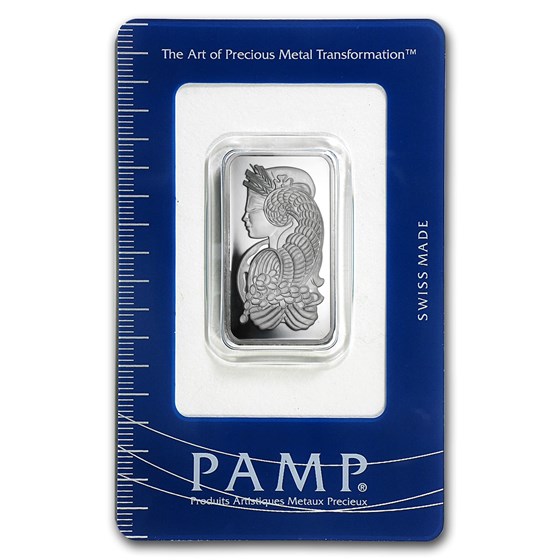
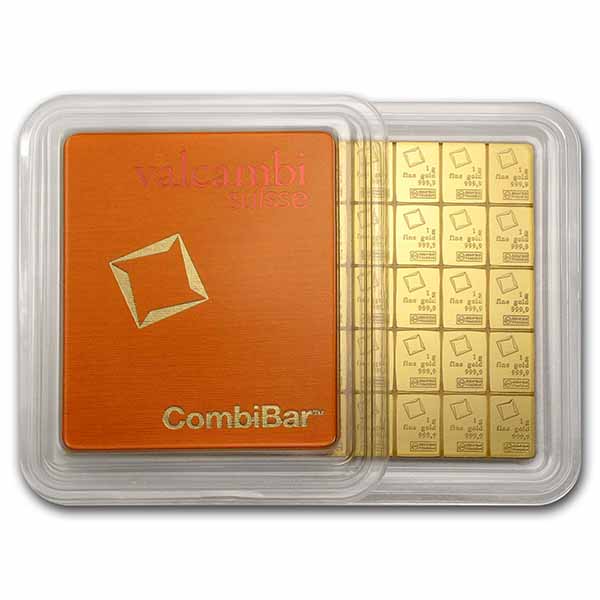
If you get into more expensive metals’ bars, there are some big, internationally known companies whose one ounce (and higher) bars are considered trustworthy, such as Johnson Matthey, Hereaus, PAMP (formerly Credit Suisse and you’ll see plenty of bars marked as such), APMEX, and Engelhardt. Some of these come in a tamper proof plastic pack. Recently, I’ve seen gold come as a sort of wafer like a big chocolate bar, with individual blocks you can twist and break apart. Although this looks like a decent way to buy gold in one gram increments, I have no idea what the aftermarket is like once they’ve been broken apart.
1/2 ounce platinum bar from PAMP; they sell many different sizes in both metric and troy, the troy sizes being more common here, but 1 gram being conveniently small. They also do silver, gold, palladium and even rhodium.
Don’t be fooled, this bar is MUCH larger than the PAMP one above.
This is one of those break-apart-able chocolate bar style, I’ve seen them with little piece sizes of 1 g (like shown here) and 1/10th of an ounce. As I said I have no idea what the aftermarket is like for the pieces, but it might help you own gold (or platinum) in small pieces, which might be convenient for trade.
2–NCLT Bullion Coins
There are the current crop of coins–yes, legally coins because they have a denomination on them–that only an idiot would spend at face value. Because they don’t circulate, but are legal tender (to unmask idiots, maybe), they’re called “Non-circulating Legal Tender” or NCLT for short. These coins will have a government’s name on them, a denomination, and they will also give their content and purity. Generally even when the metal isn’t pure, there is a net ounce (or half ounce, or quarter ounce) of gold or silver or whatever in them.
Your choices are American eagles, Canadian maple leafs, Chicom Pandas (please don’t buy these!), and so on, often in ounces, sometimes in grams. Back in the 70s and 80s there was pretty much one country doing this, South Africa, and they were producing the krugerrand (the gold rand). If memory serves, they came in 1 ounce, 1/2 ounce and quarter ounce sizes. They were not pure gold, however: with copper alloyed they tended to be tan in color.
The Krugerrand, which started something…
Our gold eagle is also not pure gold but is alloyed with a mix of copper and silver, so it has a proper “gold” color to it. We also sell a “buffalo” that is very pure gold; but I don’t see those as often.
Canada, in particular, loves to make pure gold coins, one ounce and up, and they’ve even made manhole-cover sized 100 kilogram gold coins (I got to see one once) that were 99.999% pure. However, this isn’t necessarily a good thing. Because gold will dent easily, these “Maple Leaf” coins get beat up and generally won’t sell for as much as you would think they ought to.
Since the impure coins still contain an ounce of gold or silver (or whatever) in them, the alloy is extra and usually helps the coin’s physical durability.
This is actually my favorite way to hold gold–American eagles. They come in 1/10th, 1/4th, 1/2 and 1 ounce sizes, denominated 5, 10, 25, and 50 dollars (and yes, that $10 should be $12.50 to be consistent–but again no one is actually going to use these at face value!). In general the buy sell spread is narrow on them, but is significantly wider for the smaller sizes.
Silver eagles (they are only made in one ounce size, denominated a dollar) tend to sell at a huge premium…nevertheless I buy one each year, because…yes, well, I am collecting them by date. (So much for the great divide between bullion and collectible coins–but I consider them part of my collection, not my bullion stash.) Actually, since I’m not the only one collecting (rather than accumulating) these coins, that’s probably why they sell at such a premium.
Junk Silver
Finally…yes, you can buy old coins. There’s an entire market for what is called “junk silver.” Junk silver is real coinage that actually circulated, once, not like those NCLTs we were just talking about.
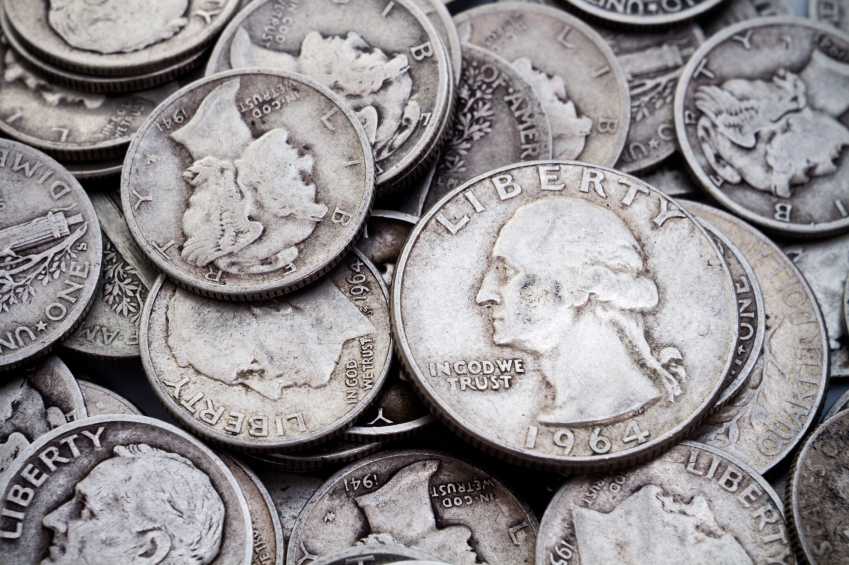
“Junk” silver. That 1964 quarter (and the dime next to it) is surprisingly worn…and 1964 is such a common date that any wear at all makes it worthless as a collectible. But it’s a bona fide piece of silver!
But, these are old coins that are common dates, or they worn so badly they have no numismatic value. (You will find a LOT of early 60s coins in junk silver, that are in pretty decent shape, and you will see the occasional very worn coin from before 1940 as well.) They’re worth their silver content, and that’s it. Prices will be quoted in terms of face value. Ask a coin dealer how much he’s selling junk silver for, and he’ll tell you something like, “26 times face.” (Kitco is selling hundred dollar bags for $2,596.24–so basically, 26 times face. But that includes quite a substantial volume discount!) That means he’ll sell you a silver dime out of his junk silver dime stock, for $2.60, a half dollar for $13.00…and a quarter for $6.50. In general, though, you buy several of these at a time. A dollar’s worth, face value, contains .72 ounces of silver in it. (It also contains copper; the silver is 90% pure.) With these coins, it will be a bit less because many of them are worn, but this is figured into both the buying and selling price. The Kitco bag I just mentioned, for example, claims to have 71.5 ounces of silver in it, not 72. If you are on a super-tight Biden-era budget, this is the only way to get into silver, because no one makes rounds or NCLTs with only 0.072 ounces of silver in them, but an old dime has that much.
When you go to sell these, you will be paid, again, some number times face value. The difference between what the dealer sells for and what he pays is how he makes his lunch money.
But now I need to tell you some things that are well known to the experienced, but probably won’t be obvious. First off, half dollars from 1965-1970 contain 40 percent silver, not 90 percent. You can buy those as junk too, and they’ll be cheaper, but there’s less of a market for them and the buy/sell spread is really bad. pricing and almost no demand. Second: Old silver dollars have .77 ounces in them (they’re different because the events of 1853 and 1873 left them alone–I’ve talked about this) and sell at more of a premium because too many people just like silver dollars. There are “junk” silver dollars, usually loose in a tray at the coin shop, but they will cost a lot more for what they are than junk dimes, quarters, and halves, because they’re popular as silver dollars–you’re edging into “numismatic” territory here. Finally: the part-silver “war nickels” from 1942-1945, identifiable from the fact that the manganese in them turned black AND the large letter over the dome of Monticello (that’s the mint mark) don’t trade in this market. At least, I haven’t ever seen them offered as bullion–but then I never really went looking, either. They contain 0.05626 ounces of silver in them, which is more than half as much as a silver dime…fancy that. (Silver was so cheap relative to gold at the time that none of our silver coinage at the time was worth even close to face value.)
Is there such a thing as “junk gold”? Sort of. There are plenty of US gold coins–some even desirable to a numismatist–that sell for just barely over their melt value, simply because that melt value is high. You could buy one of those. If you buy one that’s just barely of numismatic interest, you might not lose that much money if gold drops. You could go look up prices, figure out how much the gold is worth (gold was 20.67 an ounce back then, so a $20 gold piece that is “junk” should sell for a bit more than gold spot; proportionately so for the $2 1/2, $5, and $10), and if the coin isn’t priced that much more, you can go for it. I’d buy something with the highest grade manageable because those are least likely to drop in value; these coins will almost certainly come in a certified holder with a grade on it. You shouldn’t technically rely on that grade but use your own judgment (which if you are a beginner, you don’t have!) but in this case it doesn’t matter that much.
How about the other metals? Nope, no junk rhodium. No junk palladium. The only other precious metal that ever got used in a circulating coin (other than via fraud by Spain) was platinum, and that was by Russia in 1828-1845. Those coins came in 3, 6, and 12 ruble denominations, weighing almost exactly 1/3, 2/3, and 1 1/3 ounces. And the sixes and twelves are all scarce to rare, selling for far more than their weight in platinum (try five figures). You might luck into a three ruble piece that is beat to hell and gone not selling for too much over a thousand bucks…but that’s still far more than the platinum is worth.
Watch the Spread
However you choose to pursue this, be aware of the spread. Find out not just how much the dealer is selling it for, but also what he’s buying it for. These two numbers are different; this is how he pays for his lunch. And his mortgage. For example, gold eagles often sell for more money than other gold coins. But they also are bought for more money. The dealers have to make a living, and they do so based on that buy/sell spread. You want to pick a product that has the narrowest buy/sell spread possible, because that represents how far the price has to move before you can make your money back. For example, if they want $1850 for an eagle, but are willing to pay $1825, that’s a better deal than a Canadian Maple leaf selling for $1830…but they’re willing to pay you $1790 for it. Even though the Eagle is $20 more expensive. Because in the first case, you can make your money back after gold goes up $25, in the second, you have to wait for it to go up $40. The same sort of considerations apply to rounds, junk silver, and the like. (And this is why new jewelry is often a terrible buy for such purposes–though second hand might not be so bad–the first owner paid for the artist’s labor.) But, as with everything else, there is a caveat…the spreads themselves can change with time, and what’s true today can be not true five years down the line. But a really huge difference in spread between Major Well Known Refinery’s platinum bar versus Fly By Night Platinum Company’s bar probably won’t change all that much.
Junk silver has a wide spread and if you’re a major investor it sucks for that reason, but if you are expecting a huge price hike, or the end of the world, it has its advantages. If you find yourself in some post-apocalyptic market trying to buy a head of cabbage, a silver dime is the right size; a one ounce gold eagle will be a pain in the ass, if not impossible, to get change made for and you’ll probably not get all the change you should because of that (you’re paying them for the pain-in-the-ass factor). I’m sure I need not make snide remarks about moneychangers to this audience, though in this context, they have to make a living too. (The objections, in the Bible, were to them doing their business on Temple grounds.) Because of all of this, I do have a notable amount of junk silver–bought years ago when it was a lot cheaper. It’s part of the picture; I wouldn’t want it to be all of it…but if it’s what you can afford to do, it’s better than nothing!
In that mode, I have another combination coin collectiong/bullion story to tell. I went to a coin show with a couple of gold eagles just in case I found a coin I really wanted to buy (gold was a lot cheaper back then) but didn’t quite have the money for. Sure enough, there was something I didn’t have the cash for. “Can you take a trade for some of it?” I asked. The dealer asked me with some trepidation what it was I was offering to trade. After all, it could be something he’d have no use for, and he’d have to sell it to some other dealer and get less than it was worth so that dealer could make his lunch money–what a pain! I pulled out a gold eagle. His eyes showed his relief. One of those is instantly negotiable at a coin show as if it were a really odd-denominated piece of paper money. If nothing else he could walk over to the APMEX table and sell it. Of course so could I, so I basically got what it was worth in trade, just so he could save some time and not have to wait for me to run over there and make the deal. I even got some regular money back as change. Moneychanging, indeed!
Finally, there’s the issue of spot prices. Which by the way are now (Kitco Ask):
(Rhodium is insanely rare stuff, and tends–in the long term–to go up and down a lot. I’ve seen it as low as $400…but that was 20 years ago. And back then you couldn’t buy it as bars, you had to buy it by the 50 kg lot as powder. Now PAMP makes bars and I don’t make nearly enough money. Gold bullion taste…chicken bullion budget!)
Anyhow, the issue of spot prices. You’ll never pay spot. You’ll invariably pay a bit over it, and that amount will fluctuate. And sometimes spot does something crazy, like taking a major dump, and no one will have any precious metals for you to buy. Sure, silver spot is fifteen bucks that day after the huge drop, but there’s no silver to be had. Some coin shops will have a tray full of miscellaneous silver rounds…and the price card on the tray will say something like $3 over spot. That means they’ll look at the spot price at that instant, and add three bucks to it, there’s your price. (And that implicitly means “per ounce” so if there’s a two ounce round in there it will cost you six bucks over the spot price of two ounces of silver.)
Spot prices tend to be a product, largely, of the futures market and doesn’t reflect what people will pay for physical metal that day, on Main Street.
I have deliberately given you no advice on whether to do this. That’s because I have no idea what’s going to happen in the market. Of late silver seems steadier than gold, which seems to be sliding. Even platinum (which has been ridiculously cheap lately compered to gold) seems to be doing well, going up mostly. But that could turn around at any time. I venture no predictions. I am not responsible if you run off and buy a bunch, and the price drops, because I haven’t told you to do so or even claimed it’s a good idea. All I’ve done is given you some pointers on how things work, and what kinds of products there are, and how you might evaluate them compared to each other. You can lose money on this. I know people who ran up their plastic buying gold and silver back in the early 2000s…and lost their shirts and ended up with monster credit card debt. I’ve been mauled and even eaten by that bear a few times myself (though never with plastic), and no one else was responsible for that.
If you want some notion of the bewildering array of different products out there, check out kitco.com and apmex.com But also check out your local coin shop(s), and price shop all of them and the internet, IF you decide to go forward with this.
Obligatory PSAs and Reminders
China is Lower than Whale Shit
Remember Hong Kong!!!
Whoever ends up in the cell next to his, tell him I said “Hi.”
中国是个混蛋 !!! Zhōngguò shì gè hùndàn !!! China is asshoe !!!
China is in the White House
Since Wednesday, January 20 at Noon EST, the bought-and-paid for His Fraudulency Joseph Biden has been in the White House. It’s as good as having China in the Oval Office.
Joe Biden is Asshoe
China is in the White House, because Joe Biden is in the White House, and Joe Biden is identically equal to China. China is Asshoe. Therefore, Joe Biden is Asshoe.
But of course the much more important thing to realize:
Joe Biden Didn’t Win
乔*拜登没赢 !!! Qiáo Bài dēng méi yíng !!! Joe Biden didn’t win !!!
This Stormwatch Monday Open Thread is VERY OPEN – a place for everybody to post whatever they feel they would like to tell the White Hats, and the rest of the MAGA/KAG/KMAG world (with KMAG being a bit of both).
Yes, it’s Monday…again.
But it’s okay! We’ll get through it.
Free Speech is practiced here at the Q Tree. But please keep it civil. We’re on the same side here so let’s not engage in friendly fire.
Please also consider the Important Guidelines, outlined here. Let’s not give the odious Internet Censors a reason to shut down this precious haven that Wolf has created for us.
Please pray for our real President, the one who actually won the election:
For your listening enjoyment, I offer this Sea Shanty song, titled ‘The Wellerman’:
Yeah, I know…the suckage continues.
Our beloved country is under Occupation by hostile forces. We can give in to despair…or we can be defiant and fight back in any way that we can.
Joe Biden didn’t win.
I will keep saying Joe Biden didn’t win until we get his Fraudulency out of our White House.
Wheatie’s Word of the Day:
hapless
‘Hapless’ is an adjective that means…without hap or luck; luckless; unfortunate; unlucky; unhappy. And what is ‘hap’ you might ask? Hap means…fortune, chance.
Used in a sentence:
We shall henceforth set out to make all RINOs into hapless and unelected RINOs.
His Fraudulency continues to infest the White House, we haven’t heard much from the person who should have been declared the victor, and hopium is still being dispensed even as our military appears to have joined the political establishment in knuckling under to the fraud.
One can hope that all is not as it seems.
I’d love to feast on that crow.
But we do have a nice little distraction at the moment. Trump’s side took the floor today, and after only four hours of the sixteen they were allowed, let it rest.
I saw none of it, but the consensus seems to be that they kicked some ass, at least as far as rebutting the prosecution’s case is concerned. The Great Fraud was unaddressed and of course some are complaining about that.
I guess we’ll be discussing that today.
Justice Must Be Done.
The prior election must be acknowledged as fraudulent, and steps must be taken to prosecute the fraudsters and restore integrity to the system.
Nothing else matters at this point. Talking about trying again in 2022 or 2024 is hopeless otherwise. Which is not to say one must never talk about this, but rather that one must account for this in ones planning; if fixing the fraud is not part of the plan, you have no plan.
Lawyer Appeasement Section
OK now for the fine print.
This is the WQTH Daily Thread. You know the drill. There’s no Poltical correctness, but civility is a requirement. There are Important Guidelines, here, with an addendum on 20191110.
We have a new board – called The U Tree – where people can take each other to the woodshed without fear of censorship or moderation.
And remember Wheatie’s Rules:
1. No food fights 2. No running with scissors. 3. If you bring snacks, bring enough for everyone. 4. Zeroth rule of gun safety: Don’t let the government get your guns. 5. Rule one of gun safety: The gun is always loaded. 5a. If you actually want the gun to be loaded, like because you’re checking out a bump in the night, then it’s empty. 6. Rule two of gun safety: Never point the gun at anything you’re not willing to destroy. 7. Rule three: Keep your finger off the trigger until ready to fire. 8. Rule the fourth: Be sure of your target and what is behind it.
(Hmm a few extras seem to have crept in.)
Obligatory PSAs and Reminders
China is Lower than Whale Shit
Remember Hong Kong!!!
Whoever ends up in the cell next to his, tell him I said “Hi.”
中国是个混蛋 !!! Zhōngguò shì gè hùndàn !!! China is asshoe !!!
China is in the White House
Since Wednesday, January 20 at Noon EST, the bought-and-paid for His Fraudulency Joseph Biden has been in the White House. It’s as good as having China in the Oval Office.
Joe Biden is Asshoe
China is in the White House, because Joe Biden is in the White House, and Joe Biden is identically equal to China. China is Asshoe. Therefore, Joe Biden is Asshoe.
But of course the much more important thing to realize:
Joe Biden Didn’t Win
乔*拜登没赢 !!! Qiáo Bài dēng méi yíng !!! Joe Biden didn’t win !!!
This Stormwatch Monday Open Thread is VERY OPEN – a place for everybody to post whatever they feel they would like to tell the White Hats, and the rest of the MAGA/KAG/KMAG world (with KMAG being a bit of both).
Yes, it’s Monday…again.
But it’s okay! We’ll get through it.
Free Speech is practiced here at the Q Tree. But please keep it civil. We’re on the same side here so let’s not engage in friendly fire.
Please also consider the Important Guidelines, outlined here. Let’s not give the odious Internet Censors a reason to shut down this precious haven that Wolf has created for us.
Please pray for our real President, the one who actually won the election:
For your listening enjoyment, I offer this composition from Efisio Cross, titled “As Long As God Loves Us”:
Yeah, I know…the suckage continues.
Our beloved country is under Occupation by hostile forces. We can give in to despair…or we can be defiant and fight back in any way that we can.
Joe Biden didn’t win.
I will keep saying Joe Biden didn’t win until we get his Fraudulency out of our White House.
Wheatie’s Word of the Day:
Incel
𝕀𝕟𝕔𝕖𝕝 is a relatively new word, and is a derivative of two words…Involuntarily celibate.
The Urban Dictionary gives us this definition:
An Incel is a human with a. a horrible personality or unpopular core beliefs b. someone who is just ugly as sin or c. a combination of a. and b. As a result of their mixed personality/personal appearance issues they are rejected sexually (incel = involuntarily celibate).
Used in a sentence:
Democrats have found a use for their incel offspring; they send them out in the streets to riot, loot and burn things.
This Stormwatch Monday Open Thread is VERY OPEN – a place for everybody to post whatever they feel they would like to tell the White Hats, and the rest of the MAGA/KAG/KMAG world (with KMAG being a bit of both).
Yes, it’s Monday…again.
But it’s okay! We’ll get through it.
Free Speech is practiced here at the Q Tree. But please keep it civil. We’re on the same side here so let’s not engage in friendly fire.
Please also consider the Important Guidelines, outlined here. Let’s not give the odious Internet Censors a reason to shut down this precious haven that Wolf has created for us.
Please pray for our real President, the one who actually won the election:
For your listening enjoyment, I offer this uplifting composition from Andreas Kübler of Really Slow Motion, titled ‘Save Me’:
Yeah, I know…it sucks.
Our beloved country is under Occupation by hostile forces. We can give in to despair…or we can be defiant and fight back in any way that we can.
Joe Biden didn’t win.
I will keep saying Joe Biden didn’t win until we get his Fraudulency out of our White House.
Wheatie’s Word of the Day:
Vagitus
‘Vagitus’ is a noun which means…crying and wailing; squalling.
Used in a sentence:
Conan the Destroyer gave us what is best in life: Crush your enemies, see them driven before you and hear the vagitus of their soy boys.
Remember how we thought 2021 couldn’t get worse and got disabused of that idea in only six days?
(Yeah well we sort of stepped into that burning bag of bearded dragon poo.)
A friend of mine, who could be a bit of a wiseass at times (and pessimism was part of his schtick), would tell me something sometimes when I was a bit bummed out about something that had just happened.
And it bears remembering, especially with the usurpatious vacuum skull still in the White House:
“It’s never so bad that it can’t get worse.”
OK, on the optimist side. OK, this is cautious optimism, rather than full frontal unicorns and rainbows optimism, but here it is:
I think both the pessimist side and the optimist side can agree this will be a very eventful year. But if things actually work well in November, even a horrific year might contain the seeds of a reversal of fortune.
Let’s go back to 1979. Carter. Malaise. Soviets surging all over the world. 50 Americans held hostage by a bunch of neolithic barbarians.
The man, I think, might actually have meant well. (I was more certain of that a few years ago than I am today.) But he was not competent in that job.
But then, irony of ironies, there was this song. If you do NOT like 1970s/1980s Swedish popular music, skip the next video. Otherwise, the gratuitous fireworks display ends at 57 seconds and the music starts shortly thereafter.
Note the video is set in 1979 New Year’s eve and they actually ask what it will be like in 1989/90.
Quite a bit different, thanks to Ronaldus Magnus! We went from Jimmy Carter Malaise to seven years of economic growth and The Wall coming down! Unimaginable in 1979!
But, we did have to get through the highest misery index ever in 1980, first.
And we have to get through 2022. Which will likely make 1980 look like child’s play. Let’s just hope it doesn’t make 2021 look like child’s play, too.
The Chinese Should Think Before Wiping Us Out As Sometimes They Need Us To Solve Their Problems For Them
Okay you knuckledragging ChiComs trying to take us down…here’s a history lesson for you.
For millennia, you had to suffer from this:
Yep. Steppe Nomads. They laid waste to your country, burned, raped and pillaged (but not in that order–they’re smarter than you are) for century after century.
You know who figured out how to take them on and win? The Russians.
Not you, the Russians. And it took them less than two centuries. And Oh By The Way they were among the most backward cultures in Europe at the time.
You couldn’t invent an alphabet, you couldn’t take care of barbarians on horseback, and you think you can take this board down?
HAHAHAHAHAHAHA!!!! We’re laughing at you, you knuckledragging dehumanized communists…worshipers of a mass-murderer who killed sixty million people!
I mean, you still think Communism is a good idea even after having lived through it!
By my reckoning that makes you orders of magnitude more stupid than AOC, and that takes serious effort.
His Fraudulency
Joe Biteme, properly styled His Fraudulency, continues to infest the White House, and hopium is still being dispensed even as our military appears to have joined the political establishment in knuckling under to the fraud.
All realistic hope lies in the audits, and perhaps the Lindell lawsuit (that will depend on how honestly the system responds to the suit).
One can hope that all is not as it seems.
I’d love to feast on that crow.
“No Chemicals”
A detailed analysis of the contents of His Fraudulency’s skull was performed.
Absolutely no chemicals found!
(That one’s for you, Gail!)
Justice Must Be Done.
The prior election must be acknowledged as fraudulent, and steps must be taken to prosecute the fraudsters and restore integrity to the system.
Nothing else matters at this point. Talking about trying again in 2022 or 2024 is hopeless otherwise. Which is not to say one must never talk about this, but rather that one must account for this in ones planning; if fixing the fraud is not part of the plan, you have no plan.
Political Science In Summation
It’s really just a matter of people who can’t be happy unless they control others…versus those who want to be left alone. The oldest conflict within mankind. Government is necessary, but government attracts the assholes (a highly technical term for the control freaks).
James Webb Space Telescope Update
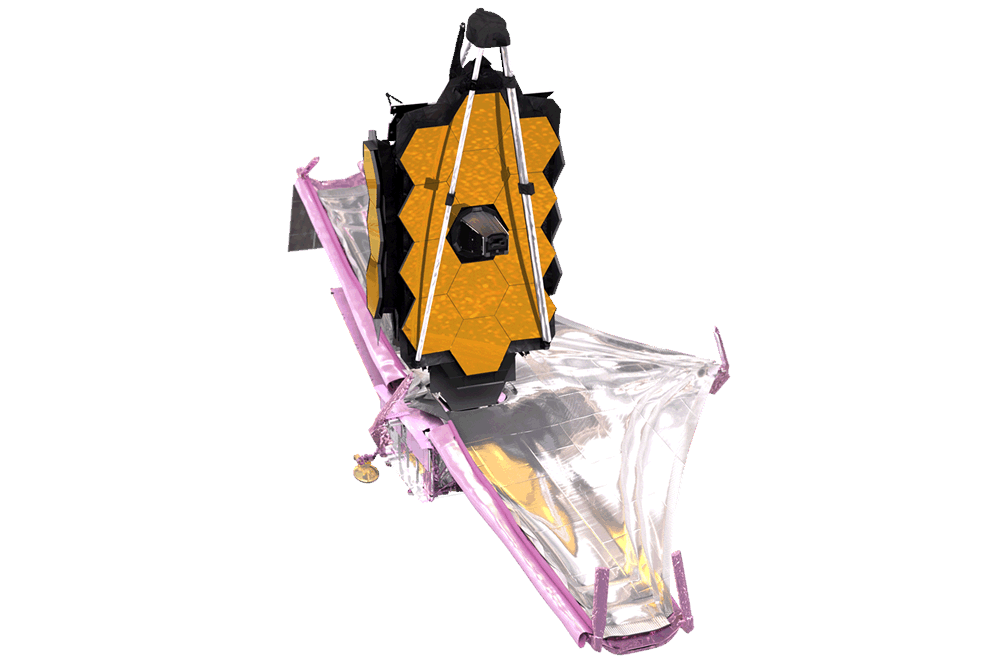
As of 7:50 PM ET: NASA has reported completion of the port boom deployment, the first part of spreading out the sunshield, a very fragile element consisting (largely) of five sheets of reflective 0.5 mil plastic. Sheets with the approximate area of a tennis court!
So right now JWST should look like this:
…and then the next step is to deploy the starboard boom, which will make it symmetrical again. That might very well finish up about the time this posts…if not give it a couple of hours.
Things were delayed today because there was trouble ascertaining that the cover for the shield had properly unfurled. Finally they decided that even though the direct sensors weren’t showing it, the temperatures measured on it were evidence it had unfurled…so they went ahead.
Over the course of the weekend the sheets will be separated and tensioned, at which point the sun shield will be fully functional and the JWST should really start to cool off (though they have been heating things up to ensure they will deploy properly). -370 F is the goal temperature though it will take weeks to get there.
I may or may not be able to update this later–other things might occupy me. And I will likely update it after it posts.
Lawyer Appeasement Section
OK now for the fine print.
This is the WQTH Daily Thread. You know the drill. There’s no Poltical correctness, but civility is a requirement. There are Important Guidelines, here, with an addendum on 20191110.
We have a new board – called The U Tree – where people can take each other to the woodshed without fear of censorship or moderation.
And remember Wheatie’s Rules:
1. No food fights 2. No running with scissors. 3. If you bring snacks, bring enough for everyone. 4. Zeroth rule of gun safety: Don’t let the government get your guns. 5. Rule one of gun safety: The gun is always loaded. 5a. If you actually want the gun to be loaded, like because you’re checking out a bump in the night, then it’s empty. 6. Rule two of gun safety: Never point the gun at anything you’re not willing to destroy. 7. Rule three: Keep your finger off the trigger until ready to fire. 8. Rule the fourth: Be sure of your target and what is behind it.
Let’s see if “they” manage to push it down again. Palladium actually went down sixty bucks Friday, it was over 2000 bucks earlier.
More On Time
(Please note, this is not titled “Moron Time.” We’ve had quite enough moron time, thankyouverymuch.)
Happy New Year!!!
It’s New Year’s Day. It’s an arbitrarily picked day, based (somewhat) on Ancient Roman (and Pre-Christian) practice. And a suitable day for more information on our calendar.
The Year
Last time I told the story of Julius Caesar’s reform of 45 BCE, and how it ended the practice of entire intercalary months–months added every now and again to keep the calendar roughly lined up with the seasons. This had had to be done because months were true to their origin back then, matching the phases of the moon. But 12 of these “moonths” didn’t make up a year, not really, and thirteen of them was too much. The Jewish calendar has the same issue; they have to add entire months fairly often.
Julius Caesar made the twelve months longer, and set things up to add a leap day every four years to account for the fractional day over 365 in the tropical year. It wasn’t quite right; I told that story last year.
But that calendar has come directly down to us with only the minor adjustment made originally in 1582 by order of Pope Gregory XIII, and eventually adopted by Protestant and Orthodox countries, and it’s pretty much either official worldwide, or well known.
The months and days of the month set by Julius Caesar seem set almost in concrete; only one lasting change has been made to them in the last two thousand years (even if that change wasn’t done at the same time everywhere).
But the numbering of the years–and even the choice of when the year should begin–has changed a lot.
When Caesar was in charge, the calendar year was generally identified by who was consul at the time, which makes modern historians’ lives a bit of a pain, but we do have a fairly detailed list: https://en.wikipedia.org/wiki/List_of_Roman_consuls and they can generally figure things out.
That list starts in 509 BC because that is when, according to tradition, the last of the seven Roman kings was overthrown and the Roman Republic was established. And the emperors (starting with Octavian/Augustus) kept the office around but they were the real power.
The Romans, however, did sometimes think in terms of something called Ab Urbe Condita, essentially since the founding of the city of Rome, and that was in 753 BCE. Therefore AUC 753 was 1 BCE, and AUC 754 was 1 CE. Were we still using that numbering, 2022 would be AUC 2775.
[Note, by the way, there was no year Zero. 1 BCE was followed directly by 1 CE. Which makes “how many years between” arithmetic a bit hazardous when computing between dates either side of that line. Astronomers, who sometimes have to “backtrack” such things, do use a zero year, then negative numbers, so their year 0 is 1 BCE, -1 is 2 BCE, etc. Archaeologists tend to use “Before Present” but “Present” turns out to be roughly 1950–they fell prey to institutionalizing a “present” by accident (they probably didn’t expect to use “BP” forever) in exactly the same way that “modern” no longer means “modern” because people named a specific time the modern period and we have moved past it, so we sometimes find ourselves using strange terms like “post modern” that shouldn’t be meaningful without a time machine.]
Early Christians actually did not use AD dating. The AD dating schema was first put forward by Dionysius Exiguus in 525. Before that the most commonly used schema was the Diocletian Era used in an old Easter table; he (understandably) didn’t want to commemorate Diocletian, who had instituted the last and worst persecution of Christians in the Roman Empire. (The Diocletian era was, in any case, mostly used in the East.)
The year that is now known as AD 1 (or 1 CE), was almost certainly not the birth year of Jesus. Matthew indicates it was in the time of King Herod (Mt 2:1), who kicked the bucket in 4 BCE. Luke indicates that the census requiring Mary and Joseph to go to Bethlehem occurred while Quirinius was governor of Syria (Lk 2:2) though he talks about other early events happening under Herod. Quirinius became governor in 6 CE. Absent some major historical discovery these two times don’t even overlap; neither includes 1 CE. But it’s certainly close to the right year. Whether it’s close enough for non government work is, I suppose, moot. We’re not likely to change our year numbers right now.
Which is not to say that it hasn’t happened.
The Eastern Orthodox Church and Byzantine Empire used “Anno Mundi,” year of the world. By attempting to fix Year One to be the year of creation, they sidestepped all issues with negative numbers, missing zero years, and so on. So they got hold of their Bibles, laid out a chronology, and fixed creation at 5509 years before Jesus was born. However, they did not at first agree with Exiguus’s dating of when Jesus was born. Their year 1 A.M. is September 1, 5509 BCE through August 31, 5508 BCE. Note their year began (and within the church organization still does begin) on September 1. September 1, of 2021 (i.e., last September) began the year 7530 A.M.
By the way, it’s technically not quite kosher to give a date like that, because the calendar didn’t exist yet on that date–if anything the prior mess of a Roman Republican calendar should be used–if anyone can figure out how it would have worked that year. So they’ll often qualify things by referring to the proleptic Julian calendar; i.e., they extend the Julian calendar back to that date. (In this particular case, remember that it’s not our current Gregorian calendar.)
(Russia switched from this calendar to a January 1 start of the New Year in 1700 CE; they also began to use the AD numbering at that time…but they were still on the Julian Calendar so they were off from the Gregorian calendar by 11 days, then 12 days in the 1800s, then 13 days during the 1900s before and during the ‘October’ Revolution–which happened in November by the Gregorian calendar. The commies switched in 1918, trying to shed the past–they even considered switching Russian to the Latin alphabet.)
You may think that 5509 BCE sounds wrong. It certainly does disagree with the usual Bible-based dating used by many churches here in the United States, which is based on Archbishop Ussher’s (1581-1626) chronology which fixes creation at about 6 PM, on the 22nd of October, 4004 BCE (by the proleptic Julian calendar). This is the chronology most often used by fundamentalists in the US.
That’s a difference of over 1500 years. It’s really difficult to construct an unambiguous chronology from the Old Testament.
I alluded to some disagreement over what date the year started; Russia used September 1 until 1700, one of Peter the Great’s many reforms, the Eastern Orthodox church still uses it internally, but that wasn’t the only difference between past practice and today’s practice. Up until 1752, England (and her colonies, which would include US (as in U.S.) at the time) was on the old Julian calendar; until that time, March 25 was the start of the new year. Not even the beginning of a month! March 24, 1751 was followed the next day by March 25, 1752. In September of that year, things were set to the current January 1 practice; also September 2, 1752 was followed by September 14, 1752; England dropped 11 days there to get in sync with the Gregorian calendar and would follow it from then forward.
If George Washington had had a birth certificate, it would have read 11 February, 1731 (Julian date); unlike many he changed his birthday to 22 February, in other words following the Gregorian calendar, and the year is now given as 1732 to be consistent with a January 1 start-of-year.
There was confusion as to which European gets the credit for ‘discovering’ South America for similar reasons of confusion between countries who didn’t start the year at the same time.
And nothing would astonish me more than to hear that’s a complete list.
What day to call the New Year, is fundamentally an arbitrary decision. But a date has to be chosen and abided by, and today is that date. So get used to writing and typing 2022.
Julian Dates
“Julian Date” means two distinct things. Usually, it’s just a day number within the year. February 3rd, for instance is Julian date 34. It runs all the way up to 365 or 366.
But there’s a different Julian Date used by astronomers. A 365.25 day year is awkward to deal with sometimes, so they’ll sometimes compute the time between two events in number of days. A “day” they can get a handle on; it’s 86,400 seconds and a second is quite thoroughly defined. So they’ll (for instance) compute the period of a planet in days.
Joseph Justus Scaliger (1540-1609) proposed a scheme where days would be sequentially numbered from a start time, then continue counting upward forever. This became the Julian date, named after his father Julius Scaliger. He first suggested it in 1583.
Scaliger chose the day January 1, 4713 BCE as his start date. It was satisfactorily far back in time that negative numbers wouldn’t be referenced often. Why that particular year? It was a leap year, the first year of a solar cycle of 28 years, the first year of a lunar cycle of 19 years, and the first year of an indiction cycle of 15 years. The solar cycle is simply the repeat period of the Julian calendar, the lunar cycle was named such because the moon would undergo the same phases on the same days, every 19 years, and the indiction cycle was an ancient Roman period at the beginning of which taxes would be reassessed. These cycles could be run backward in time, and 4713 BC was the most recent year when all three cycles were in their first year. (Being a leap year was implicit in being the start year of a solar cycle.)
This is, by the way, according to the proleptic Julian calendar, not the proleptic Gregorian calendar.
Astronomers still number their days this way. Their day starts at noon (logical, because that way an overnight period, when they’d be observing, didn’t have a day break in it), so noon, January 1, 4713 BCE was the start of Julian Day 0. (In the Gregorian calendar, this would have been November 24, 4714 BCE.) Scaliger wasn’t familiar with time zones, but the modern definition of this specifies Universal Time (essentially the time at Greenwich without Daylight Saving Time; it’s seven hours ahead of Mountain Standard Time).
And if my arithmetic is right, this post will go “live” on 2459580, almost three quarters of the way into that date; so at 7 AM ET, it will be 2459581. TIme of day is handled as a decimal fraction, so midnight UTC is Julian day [whatever it is].5.
In another common usage, we use a “modified Julian date” that starts at midnight, UT (not noon) and drops the 2,400,000 in front and just goes with 59581. So the Modified Julian Date is the Julian Date minus 2,400,000.5. This will work for another century or so then we’ll have to either restart it at 0 or just start dealing with six digit numbers. It’s handy for computers that might not have the precision to show a seven digit number with multiple digits of precision after the decimal point; we save two digits that way. (This is less of an issue today, with 64 bit computers, than it was with 32 bit computers.)
The following link: https://en.wikipedia.org/wiki/Julian_day gives a lot more information including a way to compute the Julian day for any “regular” date.
Holocene Dating
As an aside, someone came up with an idea called the “Holocene Epoch.” The idea was to simply add ten thousand to all years, so that this would be 12,022. 1 CE becomes 10,001, and 1 BCE becomes 10,000. The idea is not to try to find the beginning of the world, but at least all of human history, almost back to the first buildings that survive, would at least have a positive year number attached to it. And 10,000 BCE is very nearly the start of the present geological epoch, the Holocene, roughly corresponding to the end of the last glaciation, hence the name “Holocene.” (That epoch actually began [best estimate] 11,650 years “Before Present” which makes it 11,722 years ago right now, not 12022 years ago. A three hundred year glitch.)
Yeah, that won’t ever happen.
Leap Weeks?
And on a very different topic. File this one under “won’t ever freaking happen” but I include it because you might find it amusing.
Because, as I’ve pointed out, the shape of our calendar–the configuration and sizes of months–has only undergone one slight adjustment in the last 2000 years. I don’t take this seriously–but I find it amusing.
Many are unhappy with the fact that each year “looks” different. January 1 starts on a different day of the week from one year to the next, that of course throws every other date off as well as compared to the first year. Normally, it’s a one day shift, but if a leap day is in between, it’s two days. It sets up a cycle where you can safely use a calendar that’s 28 (or 56) years old, if you want…but don’t go back past 1900 with this. The real cycle is a 400 year cycle before the pattern repeats.
That’s kind of annoying, in some cases it’s really annoying, but we live with it. However some people have suggested reforming the calendar so it won’t happen. But it’s a bit of a challenge, especially now that there’s an ISO scheme that numbers the weeks within the year; this has to adapt to those weeks that straddle years.
And this is because 365 does not divide by 7, there’s a remainder of 1.
Many would-be reformers say this can be handled quite easily: simply have one day (two in a leap year) that do not have a day of the week assigned to them.
OK, I imagine many readers of this would go find the pitchforks and torches (OK, firearms) if this were adopted, because of course it’d throw your church services off; the Sabbath would either have to move around the week, or it wouldn’t be a seven day metronome any more. (It rather messes with the fourth commandment.)
And you’d have a lot of company from both Jews and Muslims.
So it’s not going to happen.
But someone did come up with an interesting alternative. Get rid of leap day. Have leap week. Start January on (say) Monday. The year ends on a Sunday, 364 (yes FOUR) days later. Very soon, though, in order to align with the seasons, you add an entire week at the end of December (371 days), so that way the next year is lined back up with the seasons, but the year still starts on a Monday. The advantage is that the calendar is the same from year to year (an extra week can go at the end of December with an asterisk next to it), and churches, synagogues and mosques would not be disrupted.
This is the Hanke/Henry calendar. It also changes the lengths of some months so that each quarter is 91 days.
OK, it’s at least somewhat clever and thinking-out-of-the-box. But these guys also advocate for everyone on earth using Universal time (i.e., Greenwich time) and that, I think, is ridiculous. It would solve nothing because it will still be midnight in some places while it’s 3PM in others. Worse, the sun would rise here in Colorado at 2PM in December. Almost everywhere on Earth, things would be about that ridiculous. And it doesn’t solve the fundamental problem of having to worry about someone else’s time zone, It just changes it to having to know how out of whack their clocks are compared to yours. You’d still have to wonder whether someone was up when making a long distance call, and you wouldn’t be able to look at the time where they were for a clue. [As far as time of day goes, our situation today is pretty optimal. For applications where time synchronization between continents is needed, we have UTC. For everything else our clocks match the time of day pretty well…or only fairly well during daylight saving time.]
The rule for computing leap years actually depends, crazily, on what day of the week the (presumably abandoned) Gregorian calendar begins.
It’s one of those “interesting idea, but no way” types of things, just like the Holocene Era is.
The Day
Enough about years, but there’s a bit more to add about days.
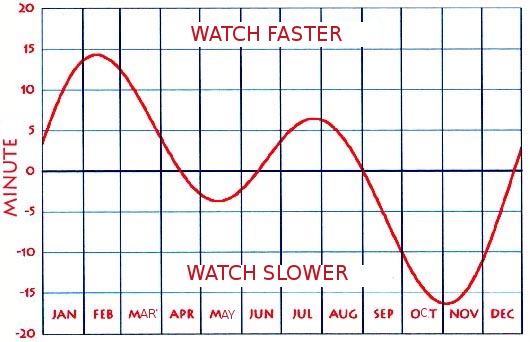
Last week, I posted a graph called “the equation of time.” This one:
The Equation of Time.
It’s the difference between what you sundial says, and what your watch says. (And that assumes you have your watch set to mean solar time for your longitude, which since the advent of time zones, is generally not true. But let’s say you live at precisely 75, 90, 105, or 120 W longitude (or any other longitude that divides by 50). That’s nearly true for me, I live at a bit above 104 W longitude.)
Because your watch is designed to move at a constant rate–whether it actually does so is another matter, and back in the day of mechanical watches there was some correlation between the cost of the watch and how well it did so. But the sundial directly registers the sun…which doesn’t move at a constant rate. So the watch (hopefully) moves at an “average” of the sun’s rate, “mean Solar time.”
[Nowadays even a crappy watch often gets corrected by listening to the “atomic clock” but watch out when that fails…I’ve known two “this is an atomic watch” braggarts to be off the correct time by minutes; but my 1996-purchased Citizen Navihawk keeps plugging away, sometimes even after the computer in it resets.]
The differences are due to two factors: the ecliptic is inclined to the celestial equator, and Earth’s orbit about the sun is elliptical. That elliptical orbit results in the earth travelling faster closer to the sun (Kepler’s second law), which means when the earth is closer to the sun, it has to rotate further to bring the sun to the meridian, more than 24 hours since the last time the sun crossed the meridian.
If noon-to-noon is more than twenty four hours, then, if you’re using a good watch and are monitoring a sundial, you will see it. The watch will be faster (compared to the sundial) the next day as compared to today, because it will get to noon faster than the sun’s shadow will.
In other words, you’re at a time of the year when that squiggly red line is sloping upward, the watch is becoming faster and faster.
As it happens Earth is closest to the sun on about January 6, and the line is really steep there.
During the weeks before and after that time, the time of sunset is changing. You’d expect it to be earliest on December 21, because that is after all the shortest daytime of the year because its the solstice.
But it’s actually earliest a week before that. Check any “sunrise and sunset” table. It doesn’t matter for where, honestly, since you’re looking for the earliest sunset, but the effect is much easier to see the further north the table is for. (And of course this flip-flops in the Southern hemisphere).
So if you’re thinking (like Aubergine said on Sunday) that you’re already “feeling” longer days by the solstice on the 21st, you’re not quite right, but the sun is already setting later by the 21st–the random chart I grabbed showed a two minute difference. (Sunrise is also later but basically forgotten by sunset. In fact sunrise will continue to come later and later all the way through the end of the month and possibly beyond…the chart stops there.)
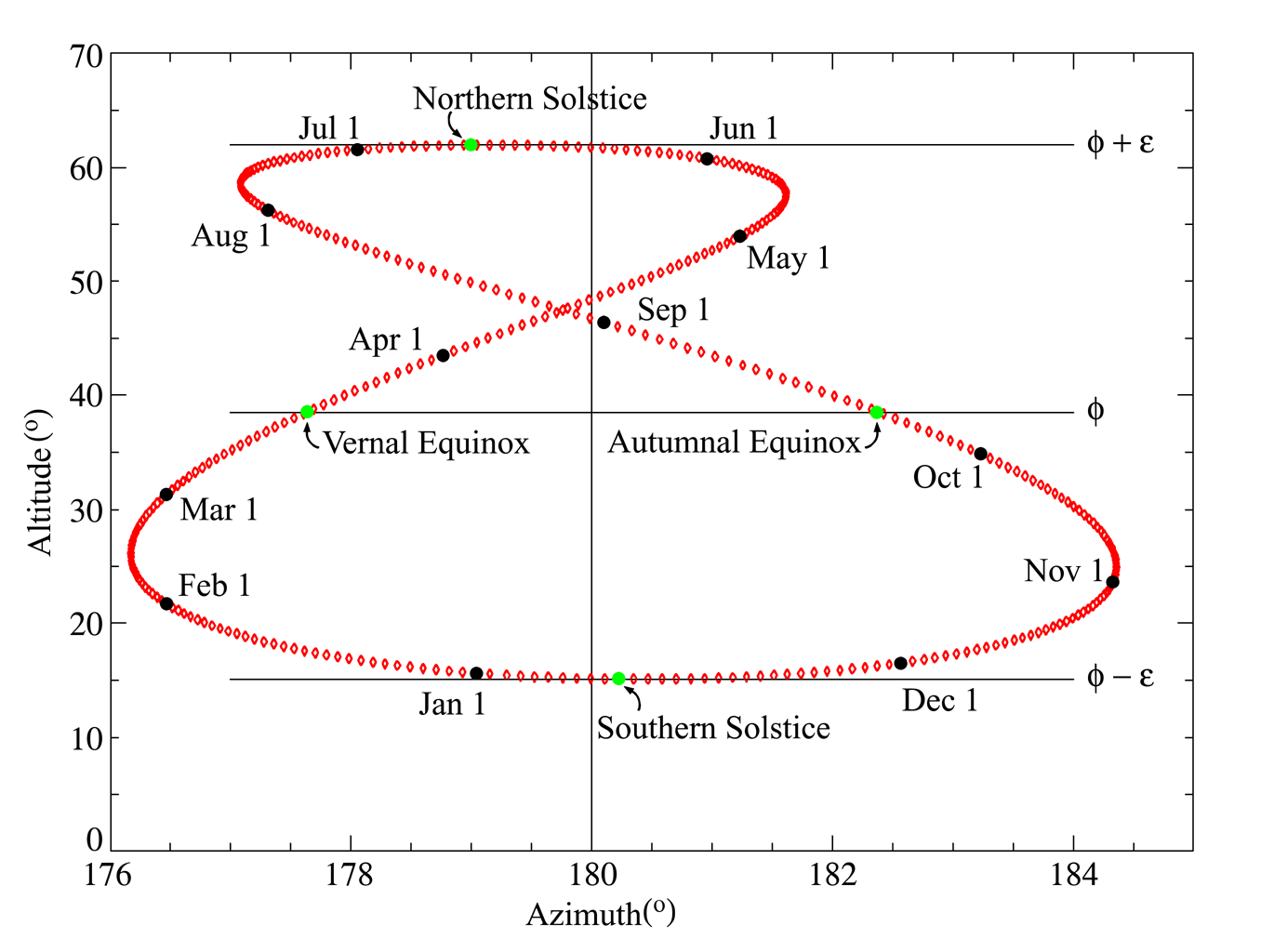
Another way to visualize this…as well as something else…is a figure called the analemma.
The Analemma (this one computed for London).
Unlike the previous figure, the horizontal axis/direction shows how far ahead or back of the sundial a watch would be. And this time the vertical axis usually shows how far the sun is north or south of the celestial equator, its declintion. (But in this case it shows how far above the southern horizon in London, though it does show the equator line, labeled φ). So an analemma gives you two pieces of information graphically, but you have to hunt for the date you want on the figure 8.
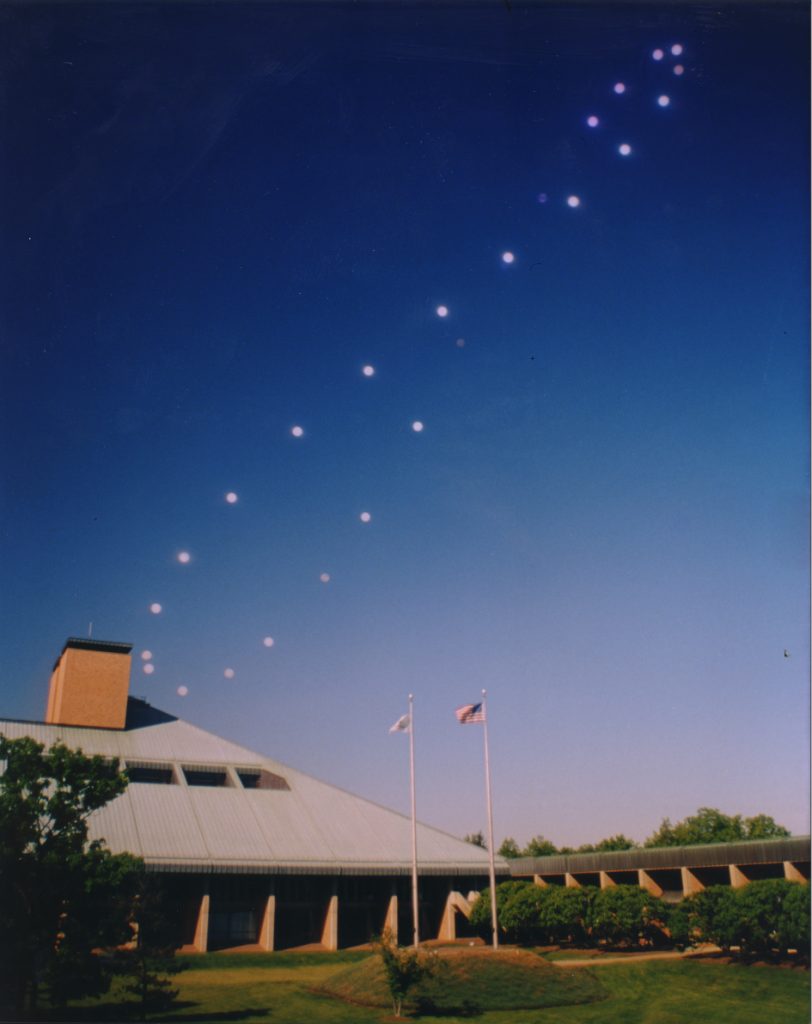
This has a real meaning. People with a lot of patience and attention to detail will sometimes photograph the sun at the same time each day (or every couple of weeks), from the same spot with the camera pointed precisely the same way each day, and you can see it forming a figure 8 in the sky.
[I had to download from Wikipoo, edit (and shrink), save as a jpg, and upload. Taking one for the team…]
It’s an almost perfect figure 8. If aphelion, the closest approach to the sun, actually fell on the winter solstice, it probably would be. This will happen sometime in the future: the equinoxes and solstices, after all, are moving along Earth’s orbit and if I understand right, we’re heading towards that situation. Give it about a thousand years.
For some reason that graph up above really exaggerated the horizontal direction. The photo, by contrast might look familiar to you as that figure eight that gets printed over the southeastern Pacific ocean on some globes. (There is almost no dry land there so it’s a safe place to print things like that.) Well, now you know what it’s for!
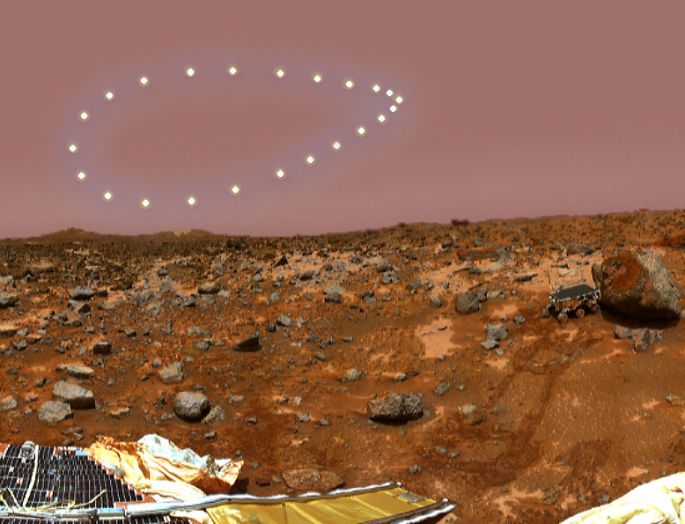
I decided to see what would happen with other configurations. The easiest way to do that is to look up the analemmas for other planets in our solar system, where aphelion is nowhere near a solstice or equinox.
Mars has a very similar axial tilt to that of Earth. Its orbit is more elliptical, though, and so we have:
And in fact here are analemmas and equations of time for all of the other planets, and Pluto. Figure 8s are fairly common it turns out, but just as common is some sort of lopsided quasi-egg-like shape. Saturn appears to be a figure 8 with a very small northern loop.
Well, that’s all for this week. Now I am really going to have to think hard about what to do for next week, other than, of course a JWST update.
Obligatory PSAs and Reminders
China is Lower than Whale Shit
Remember Hong Kong!!!
Whoever ends up in the cell next to his, tell him I said “Hi.”
中国是个混蛋 !!! Zhōngguò shì gè hùndàn !!! China is asshoe !!!
China is in the White House
Since Wednesday, January 20 at Noon EST, the bought-and-paid for His Fraudulency Joseph Biden has been in the White House. It’s as good as having China in the Oval Office.
Joe Biden is Asshoe
China is in the White House, because Joe Biden is in the White House, and Joe Biden is identically equal to China. China is Asshoe. Therefore, Joe Biden is Asshoe.
But of course the much more important thing to realize:
Joe Biden Didn’t Win
乔*拜登没赢 !!! Qiáo Bài dēng méi yíng !!! Joe Biden didn’t win !!!