
The rewriting of history to fit narratives of those with nefarious motives is as common as noses on faces today. It frequently seems that presenting facts and truth are exceptions to the rule in media and many publications. Truthfully, I am sure I have presented questionable information here from what I have summarized from the works of others. It is with that understanding that I bring you a discussion on the spiritual condition of our old friend, B. Franklin, Printer; along with further discussion later about his relationship with the famous Christian evangelist George Whitefield from the Great Awakening period in the 1700’s. There is so much content and relevance that this will be a three parter and will also complete the Pennsylvania signers.
Most all biographical and historical text I studied downplay the Christian faith of B. Most all point to his early days as a Christian in the Puritan faith of his family before undergoing some kind of transformation into becoming a deist leading up to and during his embracement of the Enlightenment period in Europe. For those who are less informed on deism, please review the link below. It is concise and easy to follow. It is kind of a big deal as it informs the world view of some leaders in every walk of life even today.
I am sure you noticed B and Thomas Jefferson mentioned in that piece. I inferred in B’s dedicated American Story, Part 19, that this transformation to deism may have been the case. After more review of additional information outside of the above linked article and other utilized sources, I am rescinding that inference. Nobody knows the truth of the condition of the human heart but God. As observers all we can do is consider the evidence from their lives and suggest that it indicates something of note. I see that the same Christian faith B personally struggled with still exists in Christianity today and probably will until Jesus returns. He grew spiritually as he worked out his faith, just as the Apostle Paul indicates we should in Philippians 2:12. Salvation is a gift of God, which involves a process of growth and maturing in one’s spiritual life. It was always on B’s mind even when he questioned and had doubts. It informed his person and his perpectives.
As I have continued on a deeper dive of B’s words and compared them to actions he took throughout his life, I see a man who had accepted Christ as a young Puritan and attempted to live out his faith through good works to others throughout much of his life. What he rejected was organized religion without what he considered to be substance. He read and exhibited a great understanding the Bible along with participating in Lent all of his life. A committed deist generally does not do those things in that manner.
Like most all of us B had flaws, made missteps, and had serious errors in judgment at times. Sometimes he trusted in his own intellect over God’s wisdom for example. However, when it came time to stand on one side or the other during critical events and periods, he had a compass that pointed directly toward God and His instructions. B did not hesitate to voice his thoughts and heart, which led to actions that reflected an active faith in God that is reflective of Christianity. He truly cared about people and wanted what was good.
Some Evidence
There are many examples of his thoughts through his storied life. Using his own words, I will start first with his doubts and aversion to organized religion for himself while finding it beneficial for society as a whole.
“My Parents had early given me religious Impressions, and brought me through my Childhood piously in the Dissenting Way. But I was scarce 15 when, after doubting by turns of several Points as I found them disputed in the different Books I read, I began to doubt of Revelation itself.”
This was a very bold admission during that time and place. Yet, he even gives the reason why he had doubts – the books he read influenced him. That admission indicates his willingness to consider all points of view and use reason. At that time in his life he just chose to believe in his own reasoning instead of God’s.
“Tho’ I seldom attended any Public Worship, I had still an Opinion of its Propriety, and of its Utility when rightly conducted, and I regularly paid my annual Subscription for the Support of the only Presbyterian Minister or Meeting we had in Philadelphia.“
He might as well have said,” You won’t see me darken the door of a church, but I understand and agree about the value the church has for society. So I will write a check to make sure it continues.” 😂
“[God] ought to be worshiped by Adoration, Prayer and Thanksgiving. But that the most acceptable Service of God is doing Good to Man. […] And that God will certainly reward Virtue and punish Vice either here or hereafter.“
Per this prayer of B’s, he indicates there are consequences on earth and post death in other realms of God concerning the actions of people. It seems good works toward others is a desired way to serve God per B, which is a traditional Christian belief. In Matthew 22:37-38 Jesus tells His followers, “YOU SHALL LOVE THE LORD YOUR GOD WITH ALL YOUR HEART, AND WITH ALL YOUR SOUL, AND WITH ALL YOUR MIND.” and that it is the greatest commandment. He then follows in 22:39 with loving our neighbors (others) as ourselves. Next Jesus follows that in 22:40 with, “Upon these two commandments hang the whole Law and the Prophets.”
Why bother doing the second commandment at all if you do not believe the first since Jesus said doing so is the most important? Nobody that I can find really questioned B about his knowledge of the Bible. B was also noted far and wide for regularly doing the second commandment. That indicates he also believed in doing the first. He referenced and based his decisions on God often. None of that has anything to do with attending church services as a requirement for being good.
“It was wonderful to see the Change soon made in the Manners of our Inhabitants; from being thoughtless or indifferent about Religion, it seem’d as if all the World were growing Religious; so that one could not walk thro’ the Town in an Evening without Hearing Psalms sung in different Families of every Street.“
B saw the miracle happening all around him as hearts were changed and the Lord worshipped without regard to organized religion. Witnessing it lifted his heart and made him joyful. It represented his vision for how life should be for Americans.
As discussed, B’s journey to a stronger faith was greatly impacted by George Whitefield. The effects of their relationship became much more pronounced as he aged and participated in the birth of our nation. It seemed to need to percolate in his mind and heart for a couple of decades. Below are two examples where he left little doubt about the condition of his soul in my opinion. The first had long lasting, major effects on our nation.
This incredible speech is one for the ages,
“How has it happened, sir, that we have not hitherto once thought of humbly appealing to the Father of lights to illuminate our understandings? In the beginning of the contest with Great Britain, when we were sensible to danger, we had daily prayers in this room for Divine protection. Our prayers, sir, were heard and they were graciously answered. I have lived, sir, a long time and the longer I live, the more convincing proofs I see of this truth—that God governs in the affairs of men. And if a sparrow cannot fall to the ground without his notice, is it probable that an empire can rise without His aid? We have been assured, sir, in the sacred writings that except the Lord build the house, they labor in vain that build it. I firmly believe this. I therefore beg leave to move that, henceforth, prayers imploring the assistance of heaven and its blessing on our deliberation be held in this assembly every morning before we proceed to business”
These are the words of B, some 17(?!) years after the death of George Whitefield. They were stated in 1787 at the Constitutional Convention at a critical juncture. The proceedings had grown contentious and fear was rising that the assembly would soon disband while accomplishing nothing of substance. At 81 years of age B rose and addressed George Washington and the assembly with those words. Perhaps you recognize his use of scripture from Psalms and the Gospels within the statement. Maybe you noticed that he said they were “sacred” in his statement. Folks, that is what we Christians call giving a witness, a personal testimony to the greatness of God and the recognition that our nation exists only through His providence.
Just picturing this elderly man who was revered internationally as he awesomely rose to address his contemporaries with that statement brings chills to my spine. This is the stuff that needs taught in our public education system, not the awful woke and rewritten false narratives of the leftists. Out of all of the great accomplishments and quotes of B, this is the one that sets a benchmark for our nation to follow forever.
B’s specific proposal was not accepted, however, his words brought a spirit of reconciliation to all in attendance from that point on due to their respect for him and the providence of God that was clearly present in their successful drive to establish good government for the young nation. The unimportant grudges held against each other along with special interests were laid aside. At last they began to make significant progress toward completion of our nation’s Constitution and Bill of Rights.
Only God knows if B was acting as His servant or as an instrument for accomplishing His will for America. One thing for sure, those words are not of a worldly salesman, politician, or self-serving manipulator. They are grounded in a strong understanding of scripture and how things work best in God’s world.
Late in life B’s belief in Christianity as a necessary moral force in society is why he rejected a manuscript from the well-known deist and fellow Pennsylvanian, Thomas Paine, in which Paine attacked orthodox Christianity. B strongly urged Paine not to print the book or allow anyone else to even see it. He wrote,
“I would advise you, therefore … to burn this piece before it is seen by any other person; whereby you will save yourself a great deal of mortification by the enemies it may raise against you, and perhaps a good deal of regret and repentance. If men are so wicked with religion [Christianity], what would they be if without it?”
Paine did not listen and Part 1 of the Age of Reason was printed (not by B) in 1794. The full text was completed with the publishing of Part 3 in 1807. To understand how right B was and how misguided Thomas Paine was, we only need to read the latter’s tortured words that were spoken from his deathbed,
“I would give worlds, if I had them, if The Age of Reason had never been published. O Lord, help me! Christ, help me! Stay with me! It is hell to be left alone.”
But in the interest of fairness, there is a counter argument about B’s faith experiences that should be presented. Read the quote below.
“As to Jesus of Nazareth, my opinion of whom you particularly desire, I think the system of morals and his religion, as he left them to us, is the best the world ever saw, or is likely to see;
“But I apprehend it has received various corrupting changes, and I have, with most of the present dissenters in England, some doubts as to his divinity; though it is a question I do not dogmatize upon, having never studied it, and think it needless to busy myself with it now, when I expect soon an opportunity of knowing the truth with less trouble. I see no harm, however, in its being believed, if that belief has the good consequence, as probably it has, of making his doctrines more respected and more observed; especially as I do not perceive, that the Supreme takes it amiss, by distinguishing the unbelievers in his government of the world with any peculiar marks of his displeasure.”
–Benjamin Franklin wrote this in a letter to Ezra Stiles, President of Yale University on March 9, 1790.
If we trust Jesus for our eternal salvation from sin and death for eternity, we trust not in our own efforts and good works. We realize we are depraved and cannot be good enough. Once we accept Christ and are born again, as Jesus told Nicodemus in John 3, what is required of us has been done. Good works then spring from our new birth, not for the purposes to buy our way into God’s good graces. Only God knows if B sincerely did that at some point in his life.
Since scripture clearly states God’s desire for none to be lost, I suggest that He uses many methods and ways to bring people to a saving knowledge of His grace. However, the central truth is that one must accept the atonement of Christ to receive it.
In the next two parts of this story I will devote more time to B’s relationship with Whitefield, a man he dearly loved and respected. He was the man who brought a traditional and even evangelical understanding of Christ to B, which helped complete the reversal of the appeal of deism from his younger years that had been driven by intellectual curiosity and the rejection of his Puritan upbringing. B openly stated that he strongly regretted that he influenced many younger people with that intellectual pursuit of deism during those days.
Regardless of the final outcome of B’s soul, we have him and Whitefield to thank for the America we experience today. What would we be as a people without The Great Awakening, George Whitefield, and B. Franklin, Printer?
It is now time to discuss yet another signer of the Declaration from the Keystone state.
George Taylor
It appears that George Taylor was born around 1713-1716 (subject to source) near Ulster, Northern Ireland. He emigrated to the colonies at Philadelphia twenty or so years later, apparently around 1736. He appeared to be the son of Protestant clergyman in Scotland. He was indentured to Samuel Savage, Jr. of French Creek Iron Works foundry there to pay for the voyage.
Per a seemingly legit Irish source provided below this happened because he ran away from home. 😂 His family was educating him to be a physician and he did not like it. So he ran away, found a ship headed for the colonies, signed up to be an indentured servant to pay for it, and never returned.
https://libraryireland.com/biography/GeorgeTaylor.php
Dang, that’s desperate to get out of there! He did not want to be a doc really badly. Wish some current day lock step jab pushing docs in America had done likewise, but I digress.
Recognizing his good educational background, employer ironmaster Samuel Nutt moved him from labor to clerical roles. A year later in 1739 Nutt passed away, leaving control of the works to Savage and his mother. With the settlement of Nutt’s will, his widow (Anna) and sons from a previous marriage constructed a new foundry, Warwick Furnace, a year later. Taylor went to work for them. Savage then died in 1741, so Taylor took over management of that foundry and a year later married his widow, Ann, whose maiden name also happened to be Taylor. The foundry became very successful under George Taylor’s leadership.
Ann Taylor’s grandfather had arrived in the colonies back in 1684 and he was thought to have been responsible for surveying over a third of the Pennsylvania colony. They were prominent Quakers. With Ann’s marriage to Savage, she had been disowned due to leaving the faith.
In 1747 Taylor entered public service when he was appointed as Captain in a militia that had been formed by B to contain frontier violence. Five years later his step-son took over management of the foundry as planned and George exited the business. Ann gave up her interest to her son per the estate requirements and retained a life estate to two farms of the family. Ann and George had two children during the period; a daughter who died young and a son (James) who lived into adulthood and became an attorney, but who died in 1775.
In 1753, Taylor and a partner leased the Durham Iron Works. During the next years it provided cannon shot for the Provincial Pennsylvania government for the French and Indian War. In this period he was commissioned a justice of the peace and served in his church, Red Hill Presbyterian. His interest in politics grew and he was elected to the Provincial Assembly from 1764-1769 while continuing to serve as a justice of the peace. In 1767 he had purchased a 331 acre property some 15 miles from Easton on which he built a beautiful two story stone house overlooking the Lehigh River called Manor of Chawton. The home still still stands today and is known as the George Taylor Mansion.
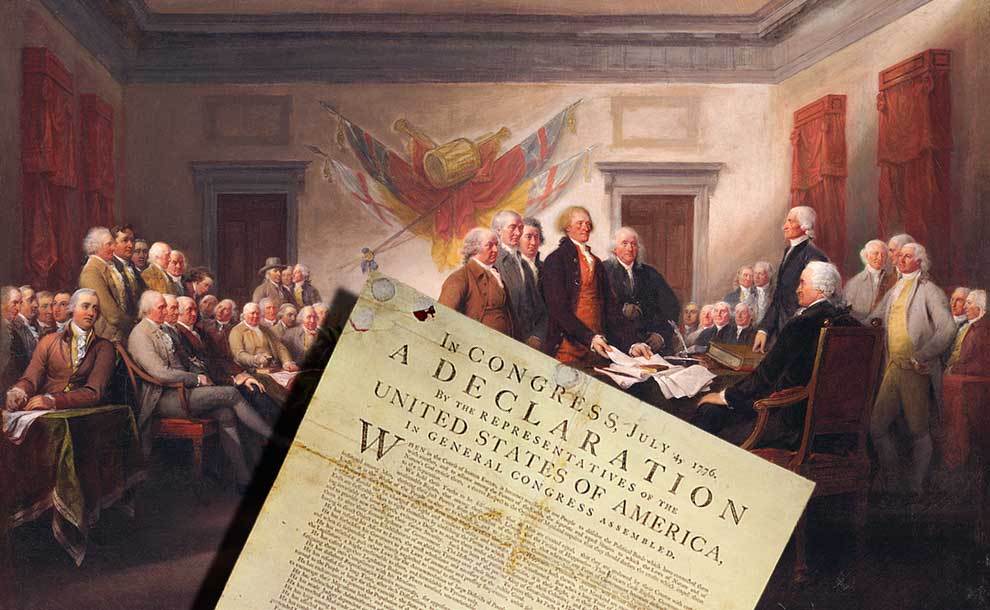
Unfortunately, his wife Ann passed away soon after it was built in 1768. A few years later he leased the property and moved in with his son in Allentown. In 1774 he returned and leased the Durham Iron Works again. It was there that he once again produced cannonballs, this time for the Pennsylvania Committee of Safety, as well as making other iron products. A month after the Battle of Bunker Hill he was commissioned as a Colonel of the militia’s 3rd Battalion. In October 1775 he was sent to the Pennsylvania assembly to help issue instructions to Continental Congress representatives to not separate from Great Britain when they met to vote. However, by June 1776 that sentiment had changed dramatically. When John Dickinson and four other PA representatives declined to vote for independence they were replaced by the Assembly on July 20. Their replacements were Taylor, Dr. Benjamin Rush, George Ross, George Clymer, and James Smith – all of whom signed the document and cemented their places in American history forever.
Taylor served the Congress for a few months and returned home to serve as a member of the Pennsylvania Supreme Executive Council, but became ill and soon retired. He continued to operate the Durham Iron Works for two more years of its remaining lease before moving back to Easton in 1780. By February 1781 he passed away and was laid to rest in Easton. At the point of his death his estate had been largely spent.
Normally that would end this discussion, but there is something else to note. Along the way and after the death of Ann, George fathered five additional children with the couple’s housekeeper, Naomi Smith. There appears to be no evidence they formally married. Nothing much is known about them other than the first of their children was born in 1770 with other children being born throughout that decade. George provided for each in his will, however, nothing was left to distribute to them.
The George Taylor Mansion shown below is listed on the National Register of Historic Places. It is owned by the Lehigh County Historical Society, is fully restored, and is open to the public.

Although not as prominent as many of the other signers, George Taylor was highly valued by his peers for his common sense and fearless approach in public service. He faithfully performed his duties whenever called. We remain grateful and honor his dedicated service to our country.

Please remember Wolf’s rules for our community. In general that means to be respectful to each other and to pull no shenanigans that your mom might find offensive or otherwise cause jail time. That said, free speech is honored here.
Be blessed and go make something good happen!