
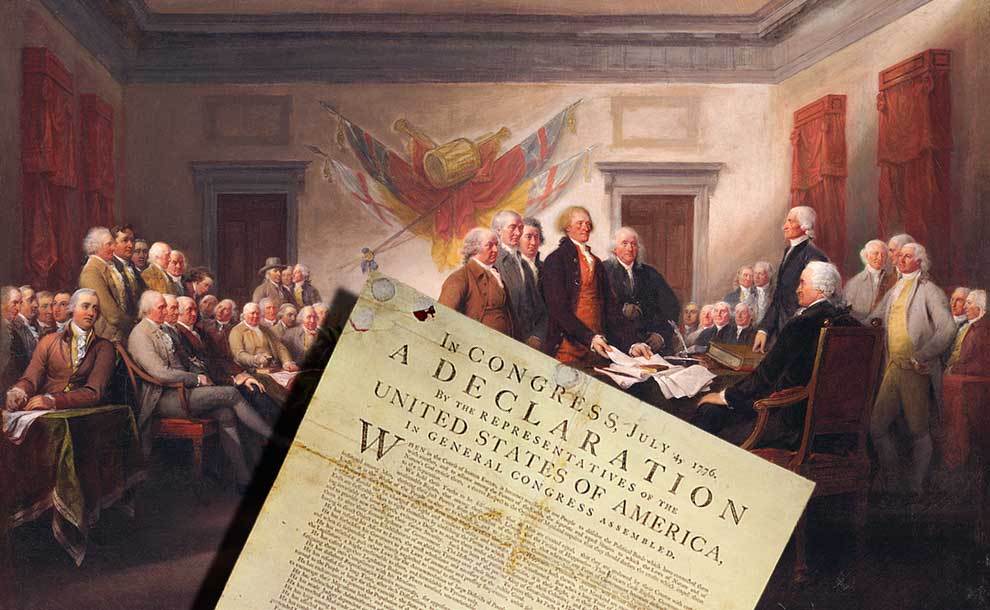
I lead today’s thread with a question, followed by others that are related.
Would you be hard line or reconciliatory with those who worked or fought against you and the colonists in the quest for independence, freedom and liberty? We have seen many examples of each with our Declaration signers. All of it led to differing results, historical significance, and sometimes interesting or unexpected conclusions to their lives.
I ask because we are in a similar war today. It is just as messy as it was then. The enemy has used deception, lies, terrorism, censorship and criminality of every sort instead of frontal, declared war tactics. But it has still been war. Foreign powers have been deeply involved as they were back then. Greed and seeking power has driven much of it just as it has with all wars. The tools that have been utilized against patriots today are somewhat different, but just as effective.
So when, not if, America First MAGA patriots win the current war – will you be reconciliatory toward the past enemy combatants or adamant in their receiving punishment and banishment from society? Which approach do you think #47 and other patriot leaders that follow him will take? What does our founding documents and the law say? What does the overriding will of God found in the Holy Bible say?
For the early Americans it even translated into taking sides using political parties. And here we are some 250 years later still bickering and abusing the American Way through political parties.
Ponder The Future Of America
The patriots of our past were innovative, creative, focused and dedicated. Life was harder then, many did not make it to age 60. So many children and mothers died young. Knowing this they made their days count, unlike many today who pass through their time living in fantasy worlds or shackled with drugs and perversions of the soul. It is a world filled with so much hate, so much stupidity, so much whining, so many petty grievances and making mountains out of molehills for personal gain and power.
VSGPOTUS Trump is working unbelievably hard and having a great time doing it while knowing at any moment there could be a bullet to the back of his head. He can do that because he knows his number of days in this world is in the hands of the Master. Do we have the same understanding in our own? If not, why not? It may be keeping us from fulfilling our God given mission.
Those who know the real me, know that I am a diehard University of Tennessee Vol sports supporter. So forgive me if you need to as I bring you a recent quote from the new head coach of the baseball Vols, Josh Elander, who has replaced who many believe has been the best of all recent college baseball coaches, Tony Vitello. Tony accepted the challenge of being the first college head coach in history without any professional baseball experience to jump from college head coach to manager of a major league team, the San Francisco Giants. His replacement at Tennessee had worked for Tony since their previous stop together at Arkansas, some nine years ago. With other coaches, staff and the administration they built an elite program together from bottom feeder status. Josh turned down several lucrative offers to go somewhere else over the past few years to continue building the Vol program.
Despite having very different personalities, Tony and Josh share a common trait. Josh’s quote from his introductory press conference follows. You may catch a reference to someone from a past BIMD story.
“Nine years ago, I got this job (as an assistant),” said Elander. “Tony called and I went on the road basically immediately. I never went back to the place that I rented in Arkansas. [I was] running around recruiting, doing a bunch of deals.
But when I got here finally for our first visit, we were running a kid around, and there was a welcome packet on my desk. It had a bunch of different things. But the main thing I took out of that, I just took some scissors and cut it out. It was a quote from Pat Summitt. It’s been hanging in my office for nine years — and it ain’t going anywhere. That quote is, ‘Here’s how I’m going to beat you. I’m going to outwork you. That’s it. That’s all there is to it.
We knew Pat. We went to church together for decades. We had other occasions to visit with each other. Pat did what POTUS Trump is doing now, just in her expertise of women’s basketball. She became the face of the sport worldwide. As a result, she improved life for millions of young women over the years that have followed because what she did transferred into every women’s sport at every level as well as life in general. Her next challenge was revealing to the world that she had early onset dementia at the height of her HOF coaching career. This led to her opening up even more of her life and allowing the world in to experience it with her as she set up a foundation for Alzheimer’s treatment and research. She left this world far too soon, but the world was much better for her having been here.
Before she passed away, all of her work and dedication ended up translating into recognition around the world with her receipt of the Presidential Medal of Freedom from Hussein, one of the few things he did honorably. All of it happened because a rural west Tennessee country farm girl loved playing basketball and was willing to out work everybody else as she lived her dream. Tony Vitello and Josh Elander have benefitted from that same Pat approach in their occupations as well. It is a common thread with most people who make a real difference no matter the world’s perceived importance of one’s position in life.
The secret sauce is to have vision and outwork your opposition, whoever and whatever it may be, while thinking outside the box.
Take the blinds off and let your mind run wild with the possibilities that may make a difference in some way, big or small. It is just like the patriots did when the hostilities with the Brits ended 248 years ago. If the hostilities ended…oh wait…could that be another challenge left on the board?
As a current day MAGA patriot what are you doing or going to do with the secret sauce?
The focus now shifts to two little discussed New Jersey signers. Don’t ask me why many historians have slid right by these two.
Abraham Clark
Born in 1726 in Elizabethtown, NJ (now Elizabeth, NJ) to Thomas and Hannah (Winans) Clark as an only child, Abraham Clark was the third generation to reside there on both sides of his family. Both families were prominently involved in the area with over 150 Winans family members buried in the cemetery adjacent to First Presbyterian Church, where they were members. He was educated via tutor in surveying after his father realized he was very good at math. While working as a surveyor he studied law and opened a practice that focused on assisting poor clients. In 1749 he married Sarah Hatfield and they had ten children over the years that followed. While Sarah raised the children on their farm, he entered politics and became a clerk of the Provincial Assembly. He continued clerking for the assembly instead of military service due to his frail physical condition. Later he became the High Sheriff of Essex County and was elected to the Provincial Congress in 1775 as well as serving on the Committee of Public Safety.
New Jersey replaced their representatives to the Continental Congress in early 1776 as the existing reps were opposed to independence. Due to Clark’s strong support for it, he was named as one of the five replacements in June. As they voted in July, he wrote in a letter that, “”It is gone so far, that we must now be a free independent State, or a conquered country.” He followed that statement later with, “”We can die here but once. Nothing short of the Almighty Power of God can save us.”
He worked to provide supplies to Gen. Washington throughout his time in Congress and during the war. He was notified that his two oldest sons who served in the enlisted military had been captured and were incarcerated in horrible conditions on the prison ship, HMS Jersey. He refused to let others in government know so they would not be given deference over other prisoners. When leadership discovered it they made arrangements to reciprocate better treatment to a handful of captured Brits to assist the Clark situations until their release in a prisoner exchange.
He returned to Congress for two additional, multi-year periods. He was a strong proponent for the common man, the farmers and mechanics in particular. This placed him at odds with those founders who urged deference to public officials. He refused to wear a wig or ruffles on his sleeves as he hated elitism and pretense. He wanted regular citizens to stay involved and let their elected officials know what they wanted done. He pushed a pro-debtor paper money bill through the state legislature in 1788. He ran for U. S. Senate and lost, but followed in 1791 for a U. S. House of Representative seat and won. He was a Whig and had a deep desire to secure personal liberties for citizens. He saw that centralized authority could lead to tyranny.
Clark passed away in 1794 from a sunstroke on his property and is buried in Rahway, NJ. It is said that he became ill, but refused to seek help at home until he took another person who had been working with him home first. His wife, Sarah, passed away ten years later and is buried next to her husband. What a patriot, what a principled man!
Francis Hopkinson
Francis Hopkinson was born in Philadelphia to Thomas and Mary Johnson Hopkinson in 1737. His father died when he was 14, however, his mother directed him to attend the College of Philadelphia (Penn), where he graduated in its first class with a BA degree while earning a MA degree three years later. Before his death his father was instrumental in the chartering of the college and worked with B to get it done. Hopkinson studied and apprenticed in the law under the colony’s AG and was admitted to the Bar a year later in 1761.
He immediately began work as Secretary to the Provincial Council of Pennsylvania Indian Affairs. He worked on numerous treaties during the period. He was not nearly as successful in his law practice and failed at a business venture, so he accepted a position as a Customs Collector in Salem, NJ. Hoping to make more money, he boarded a ship for England in 1766 in an attempt to gain a position as Customs Commissioner for North America, but was also unsuccessful with that despite learning a great deal more about the system. While there he began taking painting lessons under Benjamin West, the American born painter who founded the Royal Academy in England and painted for King George III. Francis returned to the colonies a year later in 1767.
His personal interests were diverse in that he was involved in writing, painting, music, design, politics and the law. He played the harpsichord and the organ. He composed published music of his own as well as copying arias, songs and instrumentals of other famous composers. By 1768 he had met and married Ann Borden, daughter of famous patriot Colonel Joseph Borden and wife, Elizabeth Rogers Borden of Bordentown, NJ. They had nine children together, four of whom died as young children with the rest marrying and having children.
Hopkinson returned to the role of Customs Collector in New Castle, Delaware in 1772. The couple moved to Bordentown two years later and he entered politics as a an Assemblyman in the state’s Provincial Council. He was admitted to the NJ Bar in 1775, resigned all of his British related positions, and was elected as a Delegate to represent NJ in the Second Continental Congress. He voted for independence and became a signer a month later. He left his role in Congress a few months later to return to his law practice and to serve on the Navy Board in Philadelphia. The British attacked areas of NJ during this period and their home was ransacked, however, they were not home at the time and were unharmed.
In 1778 he served as Treasurer of the Continental Loan Office and was later appointed to the Admiralty Court of Pennsylvania for periods from 1779 through 1787. He participated in the development and pushed for the Articles of Confederation as well as later, the Constitution in multiple states. In return for his tireless efforts after George Washington’s Presidential inauguration he was appointed to be U. S .District Court Judge for eastern PA in 1789.
He was long noted for his music, writing and artistic works. He also designed flags as well as seals, many of which were either used or provided as input for the final products chosen by federal entities. He continued to serve in his occupation and community roles until his death in 1791 at age 53 from stroke complications. He is buried in the churchyard of Christ Church in Philadelphia. Ann passed away many years later in 1827 at age 80. She is buried in her native Bordentown.
We are grateful for all of his patriotic and artistic contributions.

Please remember Wolf’s rules for our community. In general that means to be respectful to each other and to pull no shenanigans that your mom might find offensive or otherwise cause jail time. That said, free speech is honored here.
This Thanksgiving holiday weekend, remember the early American settlers and the patriots who followed that led to America’s existence as the greatest nation on earth. Thank the Lord that He saw fit to permit this great experiment in liberty and freedom to be conducted in His creation. Then go have some fun and love on your families and friends in celebration!

YUM!
Be blessed and go make something good happen!