
This Rejoice & Praise God Sunday Open Thread, with full respect to those who worship God on the Sabbath, is a place to reaffirm our worship of our Creator, our Father, our King Eternal.
It’s also a place to read, post, and discuss news that is worth knowing and sharing. Please post links to any news stories that you use as sources or quote from.
In the QTree, we’re a friendly and civil lot. We encourage free speech and the open exchange and civil discussion of different ideas. Topics aren’t constrained, and sound logic is highly encouraged, all built on a solid foundation of truth and established facts, and not by agenda-driven accusations and pronouncements.
We have a policy of mutual respect, shown by civility. Civility encourages discussions, promotes objectivity and rational thought in discourse, and camaraderie in the participants – characteristics we strive toward in our Q Tree community.
Please show respect and consideration for our fellow QTreepers. Before hitting the “post” button, please proofread your post and make sure your opinion addresses the issue only, and does not confront or denigrate the poster. Keep to the topic – avoid “you” and “your”. Here in The Q Tree, personal attacks, name-calling, ridicule, insults, baiting, and other conduct for which a penalty flag would be thrown are VERBOTEN.
In The Q Tree, we’re compatriots, sitting around the campfire, roasting hot dogs, making s’mores, and discussing, agreeing, and disagreeing about whatever interests us. This board will remain a home for those who seek respectful conversations.
Please also consider the Guidelines for posting and discussion printed here:
https://www.theqtree.com/2019/01/01/dear-maga-open-topic-20190101/
On this day and every day –
God is in Control
. . . and His Grace is Sufficient, so . . .
Keep Looking Up

Hopefully, every Sunday, we can find something here that will build us up a little . . . give us a smile . . . and add some joy or peace, very much needed in all our lives.
“This day is holy to the Lord your God;
do not mourn nor weep.” . . .
“Go your way, eat the fat, drink the sweet,
and send portions to those for whom nothing is prepared;
for this day is holy to our Lord.
Do not sorrow,
for the joy of the Lord is your strength.”


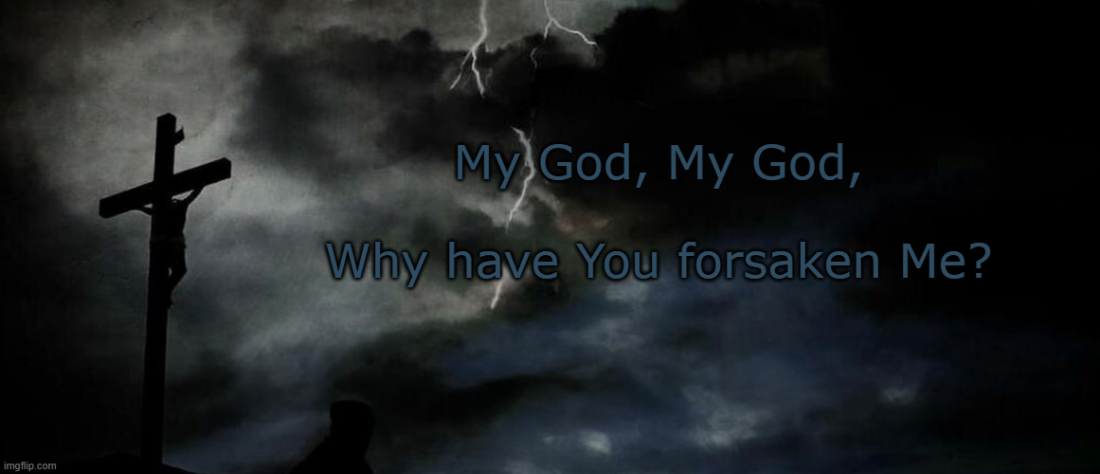
Why have You forsaken Me?
“And about the ninth hour Jesus cried with a loud voice, saying, Eli, Eli, lama sabachthani? that is to say, My God, my God, why hast thou forsaken me?” (Matthew 27:46, KJV). This cry is a fulfillment of Psalm 22:1, one of many parallels between that psalm and the specific events of the crucifixion. It is difficult to understand in what sense Jesus was “forsaken” by God. It is certain that God approved His work. It is certain that Jesus was innocent. He had done nothing to forfeit the favor of God. As God’s own Son—holy, harmless, undefiled, and obedient—God still loved Him. In none of these senses could God have forsaken Him.
The prophet Isaiah says this about the Messiah: “Surely he took up our pain and bore our suffering, yet we considered him punished by God, stricken by him, and afflicted. But he was pierced for our transgressions, he was crushed for our iniquities; the punishment that brought us peace was on him, and by his wounds we are healed” (Isaiah 53:4–5). Jesus redeemed us from the curse of the law, being made a curse for us (Galatians 3:13). He was made a sin-offering, and He died in our place, on our account, that He might bring us near to God. It was this, doubtless, that intensified His sufferings and part of why Jesus said, “My God, my God, why have you forsaken me?” It was the manifestation of God’s hatred of sin, in some unexplained way, that Jesus experienced in that terrible hour. The suffering He endured was due to us, and it is that suffering by which we can be saved from eternal death.
In those awful moments, as evil men were allowed to do whatever they wanted to Jesus, our Lord expressed His feelings of abandonment. God placed the sins of the world on His Son, and Jesus for a time felt the desolation of being unconscious of His Father’s presence. It was at this time that “God made Him who had no sin to be sin for us, so that in Him we might become the righteousness of God” (2 Corinthians 5:21).
(https://www.gotquestions.org/forsaken-me.html)
The verse from Matthew 27:46 is a powerful cry from Jesus as He hung on the cross. It reflects profound sorrow and despair as Jesus addresses God the Father, expressing a feeling of abandonment in His moment of great suffering. The original Aramaic phrase, “Eli, Eli, lema sabachthani?” translates to “My God, my God, why have you forsaken me?” These words reveal the depth of anguish Jesus experienced, making it one of the most heart-wrenching moments in the Gospels. This moment illustrates the weight of sin that Jesus bore during His crucifixion, as He took on the sins of the world for our sake.
In the context of Christianity, this verse holds immense significance. It not only points to the physical pain Jesus endured but also represents the spiritual separation from the Father that He faced in this moment. We must remember that even in His solitude and pain, Jesus continued to trust in God’s ultimate plan for redemption.
(https://scripturesavvy.com/matthew-27-46/)
This was a real forsakenness. That is why. “My God, my God, why have you forsaken me?” means he really did. He really did. He is bearing our sin. He bore our judgment.
The judgment was to have God the Father pour out his wrath, and instead of pouring it out on us, he pours it out on him. That necessarily involves a kind of abandonment. That is what wrath means. He gave him up to suffer the weight of all the sins of all of his people and the judgment for those sins.
We cannot begin to fathom all that this would mean between the Father and the Son. To be forsaken by God is the cry of the damned, and he was damned for us.
(https://www.desiringgod.org/interviews/my-god-my-god-why-have-you-forsaken-me-didnt-jesus-already-know)
It was not mere bodily anguish that elicited it; it arose from some incalculable affliction of soul. He was bearing the sins of the whole world; the Lord had laid on him the iniquity of us all; there was no one to comfort him in his heaviness; and the light of God’s countenance was for the time withdrawn from him. He was “left” that he might bear man’s sins in their full and crushing weight, and by bearing save. Yet there is no despair in this lamentable outcry. He who could thus call upon God has God with him, even in his utter loneliness. “Amid the faintness, or the confusion of mind, felt at the approach of death, he experiences his abandonment by God; and yet his soul rests firmly on, and his wilt is fully subject to, God, while he is thus tasting death for every man through God’s grace …. He held firmly to God and retained the Divinity of his life, at the time when in his unity with mankind, and in his human feeling, the feeling of abandonment by God amazed him” (Lange). The verb “forsaken” is not in the perfect tense, as translated in the Authorized Version, but in the aorist; and it implies that during the three hours of darkness Christ had been in silence enduring this utter desolation, which had now come to its climax. The Man Christ Jesus asked why he was thus deserted; his human heart would fain comprehend this phase of the propitiatory sufferings which he was undergoing. No answer came from the darkened heaven; but the cry was heard; the unspeakable sacrifice, a sacrifice necessary according to the Almighty’s purpose, was accepted, and with his own blood he obtained eternal redemption for man.
(https://biblehub.com/matthew/27-46.htm)