2020·06·27 KMAG Daily Thread

I am writing this Wednesday night. The DC Appeals Court has ordered Sullivan to dismiss the case.

I’ll be honest, I doubt he’ll do this. If having the government move to dismiss the charges didn’t do it, why should this?

When the government first moved to dismiss, everyone here was celebrating and I was, frankly, shat on by some for trying to point out that the judge actually had to grant the motion and dismiss the case. It was a done deal, as far as everyone (but me) was concerned.

Until Sullivan actually does this (or someone finally does it for him), Flynn’s legal status is that of a convicted felon awaiting sentencing, because to the best of my knowledge the trial phase ended with his guilty plea, which has never been vacated.

I said his legal status, not his actual character.

Well, hopefully Sullivan finally folds. But I wouldn’t be surprised if he tries another delaying tactic.

If nothing else the absurd lengths to which that sack of bearded dragon poop will go to avoid ending the trial of General Flynn tells us that it’s very important to someone that this trial never end. The judge dragged out sentencing (one way to end the trial), now he’s dragging out dismissal.

Reminder of the Most Important Thing about the MAGA Movement

Yes, I am going to harp on this, because it is the most important thing President Donald J. Trump has to do, and he hasn’t really gotten started on it yet.

Our movement is about replacing a failed and corrupt political establishment with a new government controlled by you, the American People...Our campaign represents a true existential threat, like they’ve never seen before.

Then-Candidate Donald J. Trump

Lawyer Appeasement Section

OK now for the fine print.

This is the WQTH Daily Thread. You know the drill. There’s no Poltical correctness, but civility is a requirement. There are Important Guidelines,  here, with an addendum on 20191110.

We have a new board – called The U Tree – where people can take each other to the woodshed without fear of censorship or moderation.

And remember Wheatie’s Rules:

1. No food fights
2. No running with scissors.
3. If you bring snacks, bring enough for everyone.
4. The gun is always loaded.
4a. If you actually want the gun to be loaded, like because you’re checking out a bump in the night, then it’s empty.
5. Never point the gun at anything you’re not willing to destroy.
6. Keep your finger off the trigger until ready to fire.
7. Be sure of your target and what is behind it.

(Hmm a few extras seem to have crept in.)

Mandatory Coin

Now it wouldn’t be one of my posts without a coin, would it?

http://doubleeaglebook.com/wp/wp-content/uploads/2014/08/1850_20_P62plus_CAC.jpg
1850 Double Eagle

The California Gold Rush brought massive amounts of gold into the streams of commerce, so much so that its value relative to silver dropped greatly (hence leading to the silver coinage weight reduction of 1853). There was so much gold that the US decided to start issuing $20 gold pieces. One was made in 1849 as a pattern piece, and it belongs to the Smithsonian. But in 1850 production began in earnest in Philadelphia and New Orleans, using gold from California (the San Francisco mint was four years in the future). At the time we had two other mints, in Charlotte, NC and Dahlonega, GA, both started in response to gold strikes, but those mints did not produce any double eagles.

A word about that name, “double eagle:” Our original monetary system was set up as follows: 10 mills equals one cent. 10 cents equals one disme, 10 dismes equals one dollar, ten dollars equals one eagle. The only thing not “new” to the world here was the dollar; it was essentially equivalent to a Spanish Piece of Eight, known as a “Pillar Dollar” for reasons that may become apparent if I ever decide to highlight the coin. And the word “dollar” is a direct descendant of “Thaler,” which is short for “Joachimsthaler” or “from Joachimsthal”, a very rich silver mining strike in what is now the Czech republic, where big silver-dollar sized coins were first made.

We never made mills, but we did make cents, dismes, dollars and eagles, quickly dropping the s in “disme.” Indeed that’s the legal name of the ten cent denomination…the coin we use today actually has the word “dime” on it, it’s not a nickname, like “nickel” is.

Only after the California gold rush brought a veritable gusher of gold into human hands, did we decide to come up with a double eagle (and a gold dollar coin, very tiny thing), and the coin is, physically, a bit smaller than a silver dollar. However, because of the great density of gold, it’s noticeably heavier than a silver dollar–it may well have been the heaviest gold coin ever made as of that time. In fact it weighs over a troy ounce. However, since ten percent of it is copper and silver alloy, there is a bit less than a troy ounce of gold in a double eagle. That amount stayed constant through the end of US gold coinage in 1933. It’s possible to obtain a much more recent gold double eagle, in perhaps not as nice condition, for not much more than the spot price of an ounce of gold–which almost breached $1800 on Wednesday (and maybe will have done so by the time you read this).

In 1866 the motto “In God We Trust” was added to the reverse, and the shield was redesigned. In 1907, this type ended, and was replaced with what collectors call the St. Gaudens (renowned sculptor Augustus St. Gaudens created the design), in an ultra high relief (rare), a high relief (readily available but in high demand, so still pricey), then finally the regular relief you’ve probably seen (those can be inexpensive depending on date). The coin originally did not contain the motto “In God We Trust” on it, because President Theodore Roosevelt considered it sacrilegeous to put God’s name on mere money. Congress made him add it back on.

The No Motto coins of 1850-1865 tend to be very rare today in uncirculated condition, and the most common date is 1857-S. That’s because a shipload of them sank in deep water aboard the SS Republic that year, causing an economic panic, but allowing us to recover them with robots today.

Did the US ever try for something even bigger? There was talk of a $50 gold piece…imagine, almost two and a half troy ounces in ONE coin. In fact, some private mints (which were legal then, barely) did indeed make such “slugs,” usually octagonal in shape. And in the 1870s some patterns were struck, not in gold but in copper, the right size, but not actually containing any gold. The design was essentially an enlargement of the double eagle design. There was talk of defining a “union” equal to ten eagles, so this coin would have been the “half union.”

But only in 1915 did the mint do anything official; in order to commemorate the Panama/Pacific exposition, both a round and an octagonal $50 gold piece were made, and those will set you back over fifty thousand dollars, each, today.

Today, the word “eagle” has been redefined to apply to any of the bullion coins the US mint makes, including the one ounce silver (face value, $1.00) four different sizes of gold coins (1/10th, 1/4, 1/2 and full ounce, face values $5, $10, $25, and $50, respectively and yes the quarter ounce should be $12.50 for consistency), platinum (same weights, but $10, $25, $50 and $100), and one ounce palladium (no denomination, from what I’ve seen).

Reminder Of One Basic Fact

Just one more thing, my standard Public Service Announcement. We don’t want to forget this!!!

https://youtube.com/watch?v=L3tnH4FGbd0%3F
I hope this guy isn’t rotting in the laogai somewhere!

中国是个混蛋 !!!
Zhōngguò shì gè hùndàn !!!
China is asshoe !!!

2020·06·20 KMAG Daily Thread

Well, one hopes there won’t be too much posting today…on account of the Mega MAGA Rally. A post is planned for that one, or so I’m told.

Justice Served At Last?

I’m genuinely surprised the Left hasn’t gone apeshit over this. We’ve been hearing that having an Antifa dirtbag shot or otherwise harmed by one of their intended victims is precisely what they want…so why aren’t they trying to use this?

https://twitter.com/ninoboxer/status/1273044398226444290
Justice Done

We’ve heard nothing. Not about the intended victim/shooter, and not about the aggressor/shootee. Some of the comments claim the shooter was arrested, and none of the Antifa thugs was.

But some digging reveals a few things: Per the Albuquerque Journal, the shooter is Steven Baca, 31, and Baca was apparently charged with felony aggravated battery and unlawful carry of a deadly weapon. The shootee was Scott Williams, 39, and he has survived.

Apparently, before this video started, Baca had assaulted three women and what you see here is him being pursued by their friends. If so they went over the top swinging blunt objects at him, but people would tend to have sympathy with them.

This would only help the Left push the line that they are righteous and being attacked by the mean evil Right.

So why isn’t the Left pumping this for all it’s worth?

A Reminder Of Today’s Issues.

Our movement is about replacing a failed and corrupt political establishment with a new government controlled by you, the American People...Our campaign represents a true existential threat, like they’ve never seen before.

Then-Candidate Donald J. Trump

And if one wants the full, polished video:

Lawyer Appeasement Section

OK now for the fine print.

This is the WQTH Daily Thread. You know the drill. There’s no Political correctness, but civility is a requirement. There are Important Guidelines,  here, with an addendum on 20191110.

We have a new board – called The U Tree – where people can take each other to the woodshed without fear of censorship or moderation.

And remember Wheatie’s Rules:

1. No food fights
2. No running with scissors.
3. If you bring snacks, bring enough for everyone.
4. The gun is always loaded.
4a. If you actually want the gun to be loaded, like because you’re checking out a bump in the night, then it’s empty.
5. Never point the gun at anything you’re not willing to destroy.
6. Keep your finger off the trigger until ready to fire.
7. Be sure of your target and what is behind it.

(Hmm a few extras seem to have crept in.)

Coin of The Day

The figure of Justice, complete with balance scales, goes back a long time. It appears on the 2015 commemorative issued for the 225th anniversary of the US Marshalls (who I hope are getting busy now). Though they did omit the usual sword.

https://3.bp.blogspot.com/-Dqu9IGFTbtA/VJ13FODF8AI/AAAAAAAARL4/q8BeB1xA-yU/s1600/2015%2BU.S.%2BMarshals%2BService%2B225th%2BAnniversary%2BCommemorative%2BClad%2BProof%2BCoin%2Breverse.jpg

There’s another rendering on this coin from Niue, a Pacific Island country that seems to make all of its money from selling coins to collectors. This time she has a sword.

https://firstcoincompany.com/S/image/cache/data/IH/AUR/niue-island-lustitia-1-aureus-series-gold-printing-silver-coin-2014-proof-first-coin-company-reverse-900×900.jpg

Notice though the applied gold coloring–it’s a reproduction of a Roman coin that appears to be from the reign of Vespasian, 69-79 CE (IMPCAESAR VE…NVS AUG; the dots are what’s covered by the rendering of the other side of the coin; I am guessing the word in full is “VESPASIANVS”), with “IVSTITIA” (Justice) on the reverse. Vespasian, before he became emperor, beseiged Jerusalem.

Here, she’s not holding scales but sometimes is seen on Roman coins doing precisely that. Like on this next coin:

This apparently was from the time of Trajan (98-117 CE), as in “Trajan’s Column,” as in “Dacia,” modern Romania. Trajan’s column still stands in Rome, and its construction was a notable feat of ancient engineering.

Obligatory PSA/Reminder

Just one more thing, my standard Public Service Announcement. We don’t want to forget this!!!

https://youtube.com/watch?v=L3tnH4FGbd0%3F
I hope this guy isn’t rotting in the laogai somewhere!

中国是个混蛋 !!!
Zhōngguò shì gè hùndàn !!!
China is asshoe !!!


2020·06·13 KMAG Daily Thread

It sure does seem like we are feeling the first few raindrops of our Storm. Which is about dang time, because for the last few weeks, we’ve been dealing with their Storm.

Let’s have them reading horrific news on a daily basis for a change, instead of us reading about their damn “demonstrations” (really riots) and their disbandings of police forces, and whateverthehell silly–no, dangerous–crap Nancy Pelosi is trying to pass.

But speaking of crap that is both dangerous and silly, I have to just laugh at CHAZ, the Capitol Hill Autonomous Zone in Seattle, allegedly with no rulers.

It’s dangerous because it’s a direct de jure affront to the rule of law. They are actually trying to secede from the United States there.

It’s also silly, because as I have said, there is no such thing as anarchy any place where there are people.

Someone will always step in and become the ruler. It’s a government at that point, though not one like we are accustomed to, that can trace its origin back to something established by consensus of the people. It’s a thugocracy, run by the biggest bully on the block. (See “Third World Shithole” for bigger examples, though even there they have more of a facade of legitimacy than CHAZ does.)

I read an excellent “thought experiment” on this once, way before Al Gore didn’t invent the internet, and I’ve not been able to find it. I thought it was in Ayn Rand’s writings, but it’s not there. I eventually found it in Robert J. Ringer’s Restoring the American Dream (1979). And as it turns out, he was mostly talking about the concept of having property be owned in common (like, say, the Marxists advocate), but it’s directly parallel to the issues that would arise with no government. The following is my recounting of what the dead tree book next to me says, with some adaptations to also cover the issue of “no government.” If I don’t have it right it’s my fault, not Ringer’s.

Let’s say everyone owns the beach. No one can own beachfront property for themselves.

What happens if you and I both want to sit on the same part of the beach at the same time? One might say that’s unlikely to happen, but if not you and me, it seems inevitable that there will be situations like that when property is owned in common by everyone.

What, indeed, would prevent some gang from going to the beach every morning and staking out 50 yards of their favorite piece of shoreline?

After all they’re free to use it, just like everyone else. Is this what the commies have in mind–first come, first served? And there’s no mention of a time limit (and with no government, no way to enforce it).

Heck, why should they be expected to have to come in first every morning? Why not just have them keep a couple of guys there to guard it overnight?

Technically, they’re still just using common property, as is everyone’s right…it’s just that it’s continuous. And with no government around, who’s going to argue with them? Heck, they could even build a house on it–temporarily, of course.

But, de facto, that bit of beach is their property now. And they are enforcing their property ownership, so they’re acting as a government, too.

It’s an example that might be useful to you, the next time you argue with some custardhead who asserts property should be held in common. Because people can easily imagine that in the absence of legally enforceable property rights–people will create them and it won’t be through a government that answers to us.

So I wasn’t surprised to see some bully assume control of the CHAZ. After all, Antifa seems to attract that type.

There is a branch of libertarianism called anarcho-capitalism. Its adherents seem to imagine that government is unnecessary, especially if people can defend themselves. But, you see, there are some other services that government must provide, even if you can somehow manage to prevent a big gang from taking over because no one individual can fight them off–you have to form your own gang in self defense.

But leave that aside. Imagine you own some real estate. How do you prove you’re the owner? You have a deed. Who issued the deed? Well, here, it’s the county government that does that (there’s a surveyor, an assessor, and a treasurer, and I’m not quite sure how the responsibilities are divvied up).

The anarcho capitalists imagine that this service can be left completely up to the market. And by that, I don’t mean by private people under contract with the government. I’m talking about a private company that sets itself up and sells the service of providing deeds.

But with no government, I could conceivably create my own title deed registration company…and register my deed for your land. Now we’re both holding a piece of paper that says I own your land, and I might even come by and kick you off by force. No government to stop me. But wait, your deed is registered with the real company, mine is some shell company I created.

But who is to say which of those two companies is a “real” company, and make it stick? Basically, the biggest gang. And they become “the government.”

This reduces to absurdity, and I trust I’ve made my point: that there must be a final authoritative source. That would be a government. Sure, if 99 percent of people were reasonable in an An-Cap environment, there’d be no issue–but when was the last time, in the real world, 99 percent of people agreed on anything? This is why you have courts. Whose decisions are final (you can appeal within the system but the system’s final decision is final).

The AnCap response–or at least the response by the people in my favorite AnCap science fiction, entertaining but not taken seriously by me–is that there are indeed courts, but they are private, and if the first judge–chosen by agreement of the parties–can’t resolve things to everyone’s satisfaction, he must pay for a second judge, and if that judge can’t do it, he must pay for a third judge…whose decision is final. Interesting, there’s a whole procedure that has to be followed…and no real enforcement!! It sort of presupposes that people will be reasonable and will voluntarily follow the procedure–or that enough people in society agree with that procedure to be able to compel them to.

I knew someone, once, who had a neighbor who kept tearing down the boundary fence between their lots and building a new one. That neighbor had bought a quarter-quarter section and believed he had a right to 40 acres, not one bit less, especially not because a road ran along the edge of his land and took up two acres and was specifically excluded from his deed. So he took it out on my friend, who took him to court, got a judgment, and the guy still wouldn’t give up. I don’t know how it turned out, but does this sound like the sort of reasonable person who would help pick a first judge, a second judge, and a third judge if he got into a dispute with you? And what if he’s got eight brothers meaner than he is, and they like to say “blood is thicker than water?” You’d be SOL, unless you could get a ton of people willing to get into a gunfight to, essentially, risk their lives to kill the guy when they don’t have a dog in the fight. That’s what it will take, because he and his family are clearly the type who won’t give up once they’ve convinced themselves of their entitlement–any more than a mugger will give up his sense of entitlement to other people’s property. That property is HIS property in his mind, even before he takes it from you.

So this is my rather rambling way of my saying anarchy is nonsense, and especially anarcho-capitalism. Capitalism requires the rule of law to function properly. And if there is no law, someone you probably won’t like will make it exist, and it will benefit him.

Here’s a quote from Ayn Rand, who understood that government is a necessity albeit one that bears close watching (so does Ringer, but he seems a lot less happy about it).

If a drought strikes them, animals perish–man builds irrigation canals; if a flood strikes them, animals perish–man builds dams; if a carnivorous pack attacks them, animals perish–man writes the Constitution of the United States.

Ayn Rand

Reminder of the Most Important Thing about the MAGA Movement

Yes, I am going to harp on this, because it is the most important thing President Donald J. Trump has to do, and he hasn’t really gotten started on it yet.

Our movement is about replacing a failed and corrupt political establishment with a new government controlled by you, the American People...Our campaign represents a true existential threat, like they’ve never seen before.

Then-Candidate Donald J. Trump

Or, because I think it’s an important video (and Q would seem to agree with me) here’s the video that came from that rally:

I originally saw a version of this that was titled “Trump The Establishment” not “This Video Will Get Donald Trump Elected.” Regardless, it got him my enthusiastic vote, rather than my “at least he’s not Hitlary” vote.

Lawyer Appeasement Section

OK now for the fine print.

This is the WQTH Daily Thread. You know the drill. There’s no Poltical correctness, but civility is a requirement. There are Important Guidelines,  here, with an addendum on 20191110.

We have a new board – called The U Tree – where people can take each other to the woodshed without fear of censorship or moderation.

And remember Wheatie’s Rules:

1. No food fights
2. No running with scissors.
3. If you bring snacks, bring enough for everyone.
4. The gun is always loaded.
4a. If you actually want the gun to be loaded, like because you’re checking out a bump in the night, then it’s empty.
5. Never point the gun at anything you’re not willing to destroy.
6. Keep your finger off the trigger until ready to fire.
7. Be sure of your target and what is behind it.

(Hmm a few extras seem to have crept in.)

Mandatory Coin

Now it wouldn’t be one of my posts without a coin, would it?

http://news.coinupdate.com/wp-content/uploads/2011/01/1792-Half-Disme.jpg
1792 Half Disme

The 1792 Half Disme is actually a very controversial coin.

(I’m going to apologize in advance for this long ramble, much of which really doesn’t have to do with this coin…but I find the history to be interesting, and if you don’t agree, you can…go jump in a lake.)

The US Mint and the US monetary system was established by law in 1792. Before the Constitution was passed, states could make their own money, and each state did things differently. In a way our federal coinage was the 18th century EuroZone, except that just about everything else still legal tender, including English and Spanish coinage. (In fact the Spanish piece of eight was were we got our dollar, and the name ultimately comes from “Joachimsthaler” since that town, now in Czechia, is where a large silver coin of that approximate size was first invented; “thalers” and “crown sized coins” became popular across Europe after that). We could do that because money back then was coined precious metal; guidebooks were published to tell people how much silver or gold there were in various coins so they’d know how much to accept, say, a British half crown for as payment (somewhere around fifty cents).

Our original system was defined as: ten mills to the cent, ten cents to the disme, ten dismes to the dollar, and ten dollars to the eagle. Coinage of copper half and one cent pieces, silver half dismes, dismes, quarter, half and full dollars, plus gold quarter, half and full eagles was authorized.

The only remnants of those authorized coins are our dime, quarter and half dollar. Other denominations are either dead now, or changed beyond all recognition–they’d laugh at our puny modern cent made out of zinc with a phony layer of copper on it. And of course the dime, quarter and half dollar today have no precious metal content at all. The silver dollar was originally 416 grains (the same grain you use to measure powder with) with 371 1/4 grains of it silver, the rest copper. Later on, in 1837, the copper content was reduced by 3 1/2 grains, so that the coin would be precisely 90 percent silver…and that silver dollar lasted until 1935. (The other silver denominations were reduced significantly in weight in 1853, minutely adjusted in 1873 to make their weights metric, and lasted at those weights until 1964.)

And yes, to be clear, the half disme was a silver coin–half the weight of a disme. Half dismes and dimes were, and are today for those that have survived, pretty small coins.

Anyway, to return to the 1792 half disme:

There is an “old wives’ tale” that George Washington donated some of his silver, a hundred dollars worth, to have two thousand of these made–that ultimately came from a man who had been at the mint almost since the beginning.

But there is much newer research (printed in the August 2017 issue of The Numismatist) that suggests Thomas Jefferson was the driver. (Note, however, that people have argued against this since it came out.) I will follow that account from this point forward.

George Washington approved the purchase of the property the First Mint would be built on, on July 9th, 1792. 1500 (not 2000) half dismes were likely produced on July 11-13. Even Donald Trump can’t build a building in three days, and as it happens the property didn’t even have its old structures demolished until the 19th. So these were probably made in someone’s basement, and that someone was likely a man named John Harper, who was a contractor for the Mint.

The new research points to Jefferson’s personal memoranda, which indicate that Thomas Jefferson withdrew about 100 dollars worth of silver from the Bank of the United States, probably in the form of Spanish dollars, and had 75 dollars worth of that made into these half dismes. Then, as he left Philadelphia to go home to Virginia on a vacation, he records spending money here and there, in multiples of five cents. The first of these was in Chester, Pennsylvania, where on July 13, he tipped “servants” [likely: slaves] in the amount of 30 cents at the inn he stayed in that evening. From that point forward, he notes many expenditures in multiples of five cents, but this ceases on October 5, after he had returned to Philadelphia.

Why were multiples of five cents such a big deal? Because the Spanish dollar was really an 8 real coin. You could find 1/2, 1, 2 and 4 real pieces too…but that works out to 6 1/2 and 12 1/2 cents for the smaller pieces. There was no way to get to any multiple of 5 other than 25 and 50 with those coins. And English coinage would be just as difficult–a shilling of 12 pence was worth (roughly) 25 cents, and you could divide 12 by 5 and get 2.4 pence = 5 cents (roughly) but there was no way to get 0.4 pence out of British money. You had half pennies (0.5 pence) and farthings (0.25 pence), no way to get to 2.4 pence…and it would be roughly equal, not equal, in any case.

Was that night in Chester, PA, the first time when the first coinage of the United States was spent?

When I read this article, it seemed pretty compelling–but people have mustered plausible alternate explanations since then, even for the multiples of 5 cents. So the caveat is, this might all be untrue. Like I said, this is a controversial coin.

Apparently, by looking at the coins, you can see the dies they were made from degrading from use; the people who have no life and look at these things define six “die states” and Jefferson’s 1500 coins (if this is true) would be the first four of the six. So if you can find and buy one of them, you own an artifact that Jefferson actually handled one time. What of the other two die states? (Who knows, perhaps Washington had those made from his silverware.) We know that there was indeed a second striking of anywhere between 200-500 pieces, but don’t know much about it, other than it was at the new Mint building on October 9th. (That building had gone up in less than 20 days, so perhaps Trump was there to help.)

But it has also been pointed out that whoever made these, from whatever source of silver, they were of dubious legality. The Mint act called for the officer in charge of gold and silver coining to post $10,000 bond, and no one was actually able to do that; the number got lowered by another act of Congress in 1794, and that’s when we could finally mint silver and gold. (Copper began in 1793.) So how is it that people were banging out silver coins in someone’s basement, while we were waiting for the First Mint to be built? (The current Philadelphia mint, which faces the same park Independence Hall faces, the same park that houses the Liberty Bell, is the “Fourth Mint.”) On the other hand it may have been deemed “OK” because the Secretary of State, Thomas Jefferson was likely there to watch it being made. And, interestingly, at the time the Mint was part of the Department of State, not Hamilton’s Department of the Treasury. George Washington had set things up that way, partially to not give one man a monopoly on all things monetary, and partially because our coinage system at the time was largely based on Jefferson’s concept of having weights, measures and money be decimal. (Jefferson even came up with a system a lot like the metric system, but with names coming from our traditions–however, this wasn’t adopted.)

The first US Mint director was David Rittenhouse, who at the time was a very famous and respected scientist, albeit not quite a bona fide world celebrity like Benjamin Franklin, who had become world famous even before the Revolution. Rittenhouse would likely have been there too, for the coining of these half dismes.

So the coin is shrouded in mystery. We don’t know for certain why it was made, or whose silver it was made out of. What seemed like solid research published in 2017 still hasn’t settled anything.

But the rest of the story on the half dime, as a denomination.

The letter “s” was dropped from “disme” sometime around 1800. It’s hard to be sure precisely when because we didn’t put the actual word on a coin any time between 1794 and 1807–during that timespan coins were typically identified by size and weight, with no actual denomination on the coin itself (the quarter dollar was an exception with “25 C” on the reverse). Collectors today argue over how “disme” was pronounced and many will say “half deem” when talking about this coin.

The half dime as a denomination was discontinued in 1873. The modern “nickel” had been invented in 1866 and, since silver wasn’t circulating in the aftermath of the Civil War, had taken over the job of being a five cent piece. So the half dime was deemed redundant.

If you want to get a half dime, and don’t care about the date, you can find examples from 1850 or so, and later for less than 300 dollars, in a “choice” uncirculated condition (MS-63 in technical parlance). (There are pretty ratty-looking coins out there that are technically uncirculated, MS 60 and 61, for a bit under $200–it’s probably a false economy; if you want uncirculated, go for something better.) Higher circulated grades, perfectly acceptable as curiosities, run from $35 (XF-40) on up. Ones in very low grade (Good-4) go for as little as $18; again, I’d suggest spending the extra 20 bucks–there is a world of difference between Good-4 and XF-40, and almost as much difference between XF-40 and AU-55 (which can be had for just under $100 if you pick a “common date”). AU 50 will look perfectly pleasing without a magnifier. Another factor is that any coin worth above $50 or so will likely be in a big sealed plastic holder; if you want a coin you can hold in your hand, either get a cheap one, or buy a more expensive one and crack it out of the holder.

Standard Disclaimer: None of the coins I show are my coins, not even the cheap ones. In this particular case, the coin shown is the finest known 1792 half disme and is probably worth more than my house and certainly is worth much more than my entire coin collection.

Reminder Of One Basic Fact

Just one more thing, my standard Public Service Announcement. We don’t want to forget this!!!

https://youtube.com/watch?v=L3tnH4FGbd0%3F
I hope this guy isn’t rotting in the laogai somewhere!

中国是个混蛋 !!!
Zhōngguò shì gè hùndàn !!!
China is asshoe !!!

2020·06·06 KMAG Daily Thread–D Day, 76th Anniversary

Warfare has changed over the millennia. It has gone from hand-to-hand with clubs and blades, to involving archery, to firearms. And as that has been going on, it has also involved naval warfare, because seas were (and are) excellent means of delivering supplies and soldiers, so control of the seas became essential. And, over the last century-plus, this has become true of the air, with the added bit that air is an excellent place, too, for reconnaissance. And now we’re moving into space, which has largely (so far) been a place useful for reconnaissance, navigation and communications, and therefore, inevitably, will be fought over.

But–please correct me if I’m wrong–the last time huge armies of literally millions of people got together and duked it out for the survival of their major-power countries was World War II.

Probably the biggest “conventional” war since World War II was the Iran-Iraq war, with total military dead over the nearly eight years it ran being anywhere from 300,000 to 1,100,000 people. Even there though the forces in the field at any given time were considerably less than a million, total.

What killed the “big” duke-em-outs between major powers? The nuclear bomb. Two major powers will never get into that kind of fight again, because the side that thinks it’s losing will push the button, and the side that would be winning knows this. Not that they don’t fight…they just do it by other means, hoping to weaken the other side, but knowing they can’t annihilate them without being themselves annihilated. (And of course the Soviet Union bent every effort to get us to give up our nukes, so that they could then blackmail us.)

World War II was the last time we’ll see such massive carnage on a battlefield. One hopes. And there was plenty to go around; we had some positively brutal battles in the Pacific. The Soviets had an even rougher time of it, losing tens of millions to the war and more millions to their own government. We fought the Nazis, too, in Africa and Italy before…well, before D-Day.

[Now I have to stop right here and smack some Commies upside the head. The post-war Soviet Union loved to depict the US contributions to the war as absolutely minimal; I once saw a propaganda movie intended to depict us as doing nothing more than running a few exercises, blowing up ships we were about to scuttle anyway. Even today, sometimes the Russians like to minimize our efforts. That is, of course, a Terex-dump-truck-load of bearded dragon shit.

But by the same token, one must acknowledge that what we went through, though great, was less than the Soviet Union did, and no, not all of it was Stalin’s deliberate doing, and it’s not even the case all of it was Stalin’s incompetence. It does not minimize our efforts to acknowledge that what they suffered was even bigger.]

Which brings us, finally, to D-Day. In order to win the war against an intransigent enemy, we had no choice but to invade. (Bombers are very useful, but have never conquered anything.) That meant sending our troops directly to places where the enemy, which had had months or even years to construct fortifications, was waiting for them. We managed to blunt the impact of this with disinformation, the sorts of things we did to convince Hitler that the threat was to Calais, not Normandy. He moved forces that would have made mincemeat of the invasion, otherwise. (Even after the D-Day landings, Patton was kept in Southeastern England until July, to deceive Germany into thinking there would be an additional “main” landing at Calais. He was a victim of his own success in battle.)

The cost of picking Normandy was that our forces would have to travel farther to Germany, and farther across the English Channel. Germany knew this of course, and Calais was a much more obvious target for us. All of this convinced Germany to throw its resources elsewhere–plus, of course, most of its forces were fighting the Soviet Union.

But did I say “to blunt the impact of this”? If this was “blunted,” I’d certainly not wish a non-blunted version of it on anyone!

Most of us have seen Saving Private Ryan. That opening scene was a small taste of the reality. Anyone who was there, or on any of the other beaches, deserves our undying gratitude. Because of what they did, not only was the evil of Nazism extirpated–by this time that would have happened anyway; Hitler was already losing to the Soviet Union–but the western half of Europe was saved from the ravages of Communism. For Stalin would certainly not have stopped at the Elbe.

Imagine a post-war world where the Iron Curtain was the coast of Europe, rather than running down its center. I’m not sure the Soviet Union would ever have fallen. And what would have happened to the UK?

The Landings Themselves

D-Day remains the largest amphibious assault in history. 160,000 were landed on D-Day, with subsequent reinforcements bringing the numbers up to 875,000 by the end of June.

There were five beaches: Omaha, Utah, Gold, Juno, and Sword. The first two were American, the last three were invaded by British and Canadian soldiers.

By far the worst meat grinder was Omaha, with 2000 dead, followed by Gold with about 1000 dead. All told, on D-Day, 4,414 allied troops died, with a grand total of about 10,000 Allied dead and wounded. (The Germans lost about a thousand men, which is not unexpected proportions for a defending force.)

https://upload.wikimedia.org/wikipedia/commons/thumb/c/c4/Map_of_the_D-Day_landings.svg/1280px-Map_of_the_D-Day_landings.svg.png
The situation after the first day

Those casualty numbers, bad as they are, could have been much, much higher. And I imagine if we fought like the Soviets fought, with utter disregard for the lives of their own troops, they would have been.

Without D-Day, we’d live in a very different world. World War II was pivotal in history, and D-Day was pivotal within World War II. Thank You to all who fought there, and in Africa and Italy before, and Western Europe afterwards, and also to those who fought in the meantime in the Pacific.

Let’s just hope we can dish out domestic justice as well as we dished it out to the Japanese and the Nazis. It’s the least we can do for them, to let this continue being the sort of country they fought for.

A Reminder Of Today’s Issues.

Our movement is about replacing a failed and corrupt political establishment with a new government controlled by you, the American People...Our campaign represents a true existential threat, like they’ve never seen before.

Then-Candidate Donald J. Trump

And if one wants the full, polished video:

Lawyer Appeasement Section

OK now for the fine print.

This is the WQTH Daily Thread. You know the drill. There’s no Political correctness, but civility is a requirement. There are Important Guidelines,  here, with an addendum on 20191110.

We have a new board – called The U Tree – where people can take each other to the woodshed without fear of censorship or moderation.

And remember Wheatie’s Rules:

1. No food fights
2. No running with scissors.
3. If you bring snacks, bring enough for everyone.
4. The gun is always loaded.
4a. If you actually want the gun to be loaded, like because you’re checking out a bump in the night, then it’s empty.
5. Never point the gun at anything you’re not willing to destroy.
6. Keep your finger off the trigger until ready to fire.
7. Be sure of your target and what is behind it.

(Hmm a few extras seem to have crept in.)

Coin of The Day

Now it wouldn’t be one of my posts without a coin, would it? In fact, I’ll do four. The US, UK, Canada, and French commemorations of D-Day.

https://www.jakesmp.com/assets/images/potpourrie/pp10232013-13.jpg
This is of course the United States commemorative coin.
https://media.atkinsonsbullion.com/AtkinsonsBullion/media/product/agco8567/agco8567_1.png
The UK has one too, of course.
http://news.coinupdate.com/wp-content/uploads/2019/01/canada-2019-dollar-d-day-anniv-gold-pair.jpg
And the Canadian one.
https://www.nunofi.sk/images/sklady/france-2014-2-euro-normandi.jpg
Fittingly, France did a commemoration in 1994 as well…but by then it had to be in the guise of a 2 Euro coin.

Obligatory PSA/Reminder

Just one more thing, my standard Public Service Announcement. We don’t want to forget this!!!

https://youtube.com/watch?v=L3tnH4FGbd0%3F
I hope this guy isn’t rotting in the laogai somewhere!

中国是个混蛋 !!!
Zhōngguò shì gè hùndàn !!!
China is asshoe !!!


2020·05·30 KMAG Daily Thread

Back to Space!!

Obola made a mistake when he killed NASA’s manned spaceflight capability.

But perhaps not in the way you’re thinking.

We’ve been having to hitch rides to the ISS on Russian boosters ever since the Space Transportation System (the “Space Shuttle”) was decommissioned in 2011. At the time Obola said it was to encourage private enterprise to take up the slack, and NASA should concentrate on exploration…Lunar and Mars missions, unmanned exploration; the sorts of things NASA excels at.

This is actually a stated rationale I can agree with. (Settle down…I know it wasn’t the real reason.) If we are to become a truly spacefaring people…should we be leaving regular transportation to the government? The same government that couldn’t build an Obolacare website or that takes twenty years to widen an interstate?

And let’s face it, when Trump is no longer in charge, that’s the government we’ll have–grossly incompetent or grossly slow and cautious.

No. Get out of the way, and let innovative companies take it on. And so we have SpaceX and Boeing building transportation systems, the Dragon and the CST-100 Starliner, respectively. NASA contracts with them for ISS transportation. But unlike past NASA contracts, where they buy the equipment (Atlas, Delta, or Titan boosters, etc) from somebody but then manage it themselves, NASA is letting SpaceX run the show today.

It’s the same structure as buying airline tickets.

If space travel is ever to become routine and common–if we are ever to become a spacefaring species on anything more than an ad-hoc basis–this is the way it’s gotta be. Private companies running a service, that the government can buy–or not. They expect to have other customers.

This is what Obola dangled in front of us as he canceled the Space Shuttle [Edit–no, he canceled the system that was supposed to replace the shuttle]. He was almost certainly pulling a bait-and-switch of some sort. There’s be some reason not to put people on the SpaceX Dragon2 and the Boeing Starliner, some excuse…delay, delay. Just like how we knew he wanted to cancel the Keystone XL pipeline but had to clothe it in ordinary procedural bullsh*t.

In neither case did he bargain on his successor being a loyal American.

But that happened, and now we stand on the threshold of private manned orbital spaceflight. People are even booking tourist flights with companies planning to use the Dragon2!!

Alas it’s still only for people with huge amounts of cash…but it’s happening nonetheless.

https://letreasonreign.files.wordpress.com/2020/05/bearded-dragon-appears.jpg
Dragon2? They named it after ME? Cool!!!!

The Dragon2 capsule that (we hope) will go into orbit today can hold up to seven people, but typically is set up for four, with the remaining space given over to cargo that can’t be exposed to vacuum. It can run autonomously, or it can be controlled by astronauts. (Some of the space tourism flights are slated to have no human pilot.) Shots of the interior look “clean” rather than crammed full of instruments and controls–imagine the cabin of an airliner, not the cockpit, though even the passenger space on an airliner can look a bit “busy.” It does look a lot more spacious than cattle class on an airliner.

That’s the pressurized capsule. There’s an non-pressurized “trunk” right behind it, a cylindrical section that can carry cargo that need not be pressurized, in other words, cargo that can withstand vacuum. The trunk is abandoned before returning to Earth.

The Commander of the flight will be Douglas Hurley, joined by Robert Behnken as Joint Operations Commander. Hurley was also the pilot on the very last Space Shuttle mission, on the Atlantis. I’ll bet he’s looking forward to this! The spacecraft’s name should be announced today (if the mission is not again scrubbed).

They’ll dock with the International Space Station on Sunday. Before then they will test the spacecraft in orbit. The mission is otherwise expected to be automated, with the crew only taking over if something goes wrong.

The stage lifting the capsule will return to earth and land on a barge out in the Atlantic ocean, ready for re-use. This is something SpaceX has been doing for a few years now.

Once at the ISS, the crew will spend 30 to 90 days up there, and return in the same capsule for a splashdown in the Atlantic. The capsule, too, is intended to be reused.

If this launch doesn’t happen, (and the weather does look about as iffy as it did on Wednesday) then the next window is on Sunday, shortly after 3 PM ET. As in seven seconds after 3 PM.

These launch windows are exact, because the ISS is moving at 4.75 miles per second, 17,100 miles per hour, and it does little good to get to orbit when the ISS isn’t in the right location. Missing by a minute means missing by 285 miles, about the “height” of Colorado on a map. Fuel would have to be expended to change the Dragon2’s orbit, then change it back once it has synced up with the ISS. And that fuel would cut into payload. And it’s called a payload because it, and only it, is what the customer is actually paying for.

The estimates are that there is one chance in 276 that the crew won’t survive the mission, and one chance in 60 that the mission will fail with the crew being safe. (This is actually a better safety record than the Space Shuttle had–let’s hope that in the years to come we exceed it by a huge margin.)

It has been nine LONG years, but we’re going back to space, in a way that long-term will be vastly better than clunky government projects that take decades. It was painful, but I believe 20 years from now we will look back and say “it was worth it.”

So what was Obola’s mistake? As I alluded to before, he was probably trying to kill US manned spaceflight permanently. Turning NASA into nothing but an SJW advocacy organization.

Instead, he has done us some good.

Which can’t possibly be what he intended.

Oops! Sorry, Shithead! And no do-overs, not while in prison.

The Future

Space travel is expensive, and will continue to be expensive. We’re no longer throwing away the entire spacecraft after every flight, but they must still go through expensive refurbishment after every flight–and then the launch vehicle has to be re-assembled. SpaceX is doing this more cleanly than NASA, but even so, it’d be soooo much nicer if we could get to orbit with one stage. “Single State To Orbit” (SSTO) is the holy grail of space travel. It’s just out of our grasp, but close isn’t good enough.

Imagine if that spacecraft could be turned around and reused in a week…or a day.

That was the aim of this program…a valiant effort that fell short.

https://en.wikipedia.org/wiki/McDonnell_Douglas_DC-X

Add to that the fact that if you can get into and out of orbit…you can go anywhere on Earth in less than an hour, because a round trip in orbit is about ninety minutes. Imagine the Space Force delivering commandos to…well, fill in the blank! On an hour’s notice. Of course, that’s a lot harder, because you’re unlikely to be able to gas the sucker back up in hostile territory. Doing TWO orbits and reentries on one tank of gas is well beyond us. So far. But assuming a friendly destination, imagine what we can do if we can deliver something to (say) Diego Garcia in an hour.

And actually going to orbit will be significantly cheaper. As routine as the Pan Am flights in 2001? Maybe!

Of course the real answer is the space elevator, but that’s totally beyond our capabilities right now. We basically need SSTO before we can even think about building something that ambitious in orbit. The fundamental problem is we’re stuck “down here,” and have to get not just ourselves but everything we need to function, “up there.” But with a space elevator…it takes nothing but electricity to get “up there.” And once in orbit, the rest is easy.

Related Post

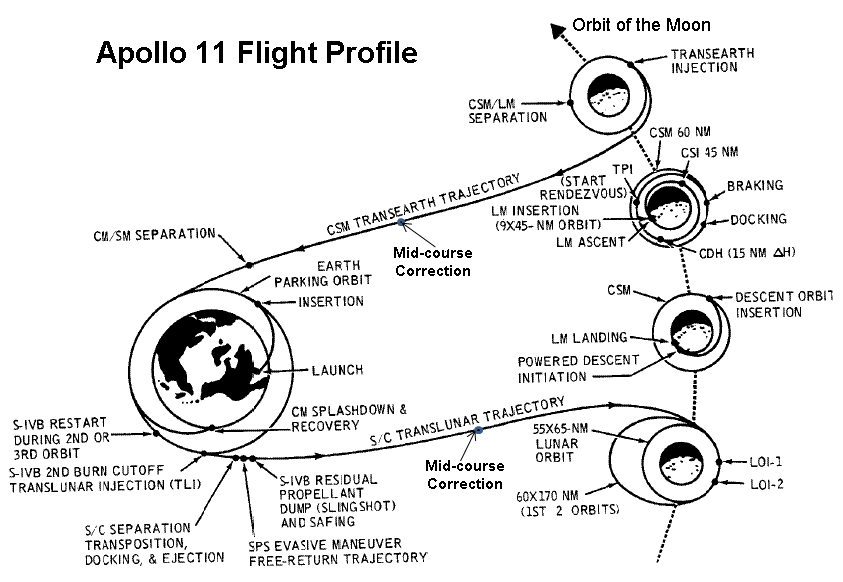
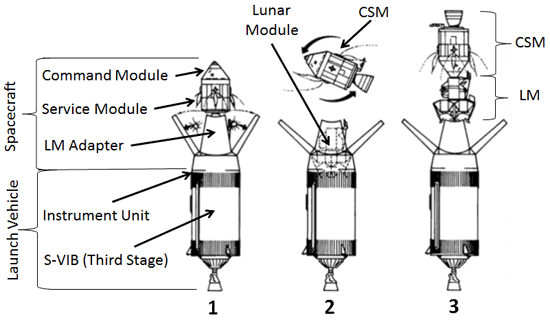
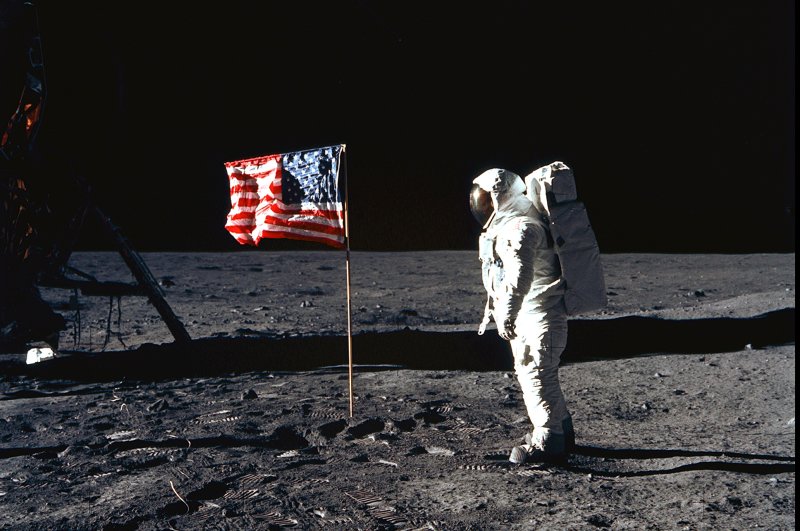
I wrote this on Apollo 11, for the 50th anniversary of the first landing of men on the Moon.

https://wqth.wordpress.com/2019/07/20/apollo-11-a-triumph-of-man-living-in-freedom

The Riots

Honestly, I wanted to focus on something positive today…so I’ll say nothing beyond that I’m sure this will not have the intended effect of bringing Trump down…or long distracting him and us from the quest for Justice.

But I will post my by-now standard quote, just to keep us “centered.”

Our movement is about replacing a failed and corrupt political establishment with a new government controlled by you, the American People...Our campaign represents a true existential threat, like they’ve never seen before.

Then-Candidate Donald J. Trump
The Point of The Movement

By one interpretation (the likeliest one, I think), the current unpleasantness is just yet another tactic by that corrupt political establishment, to prevent the President from doing to them, what they badly need to have done to them. (Though I doubt POTUS really intends to use 12 gauge wire bore brushes on them.)

Memorial Day (Traditional)

Memorial Day wasn’t always the last Monday in May (sliding bears and all), it was once the 30th of May and did not move. So Saturday/Today is the “real” Memorial Day, if you want to look at it that way.

Lawyer Appeasement Section

OK now for the fine print.

This is the WQTH Daily Thread. You know the drill. There’s no Poltical correctness, but civility is a requirement. There are Important Guidelines,  here, with an addendum on 20191110.

We have a new board – called The U Tree – where people can take each other to the woodshed without fear of censorship or moderation.

And remember Wheatie’s Rules:

1. No food fights
2. No running with scissors.
3. If you bring snacks, bring enough for everyone.
4. The gun is always loaded.
4a. If you actually want the gun to be loaded, like because you’re checking out a bump in the night, then it’s empty.
5. Never point the gun at anything you’re not willing to destroy.
6. Keep your finger off the trigger until ready to fire.
7. Be sure of your target and what is behind it.

(Hmm a few extras seem to have crept in.)

Today’s Coin

Now it wouldn’t be one of my posts without a coin, would it?

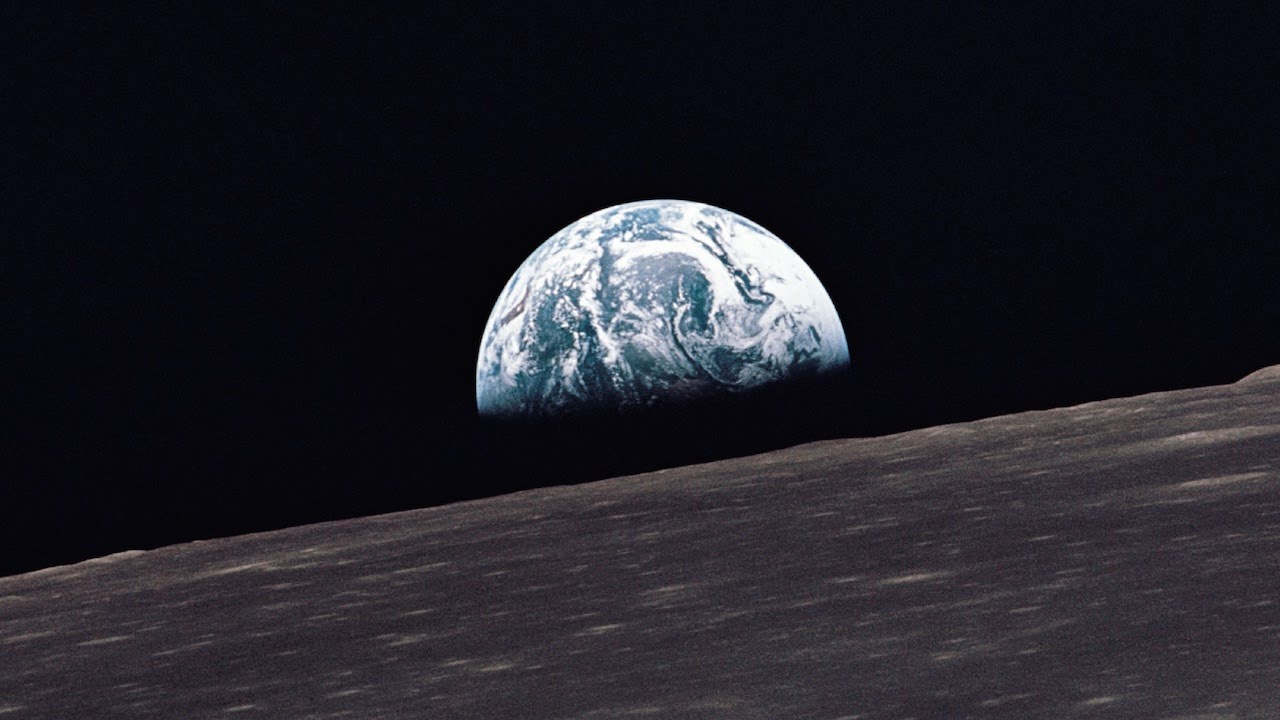
And yes, there’s one appropriate to our theme…a coin that depicted, allegorically, one of our proudest achievements. We put men on the Moon. So far, no one else has. And maybe we will again, soon. Unfortunately Eugene Cernan, the last man on the Moon, who surely must have hated holding that record, passed away in 2017 and did not live to see us go back. But soon, I think. During Trump’s third term.

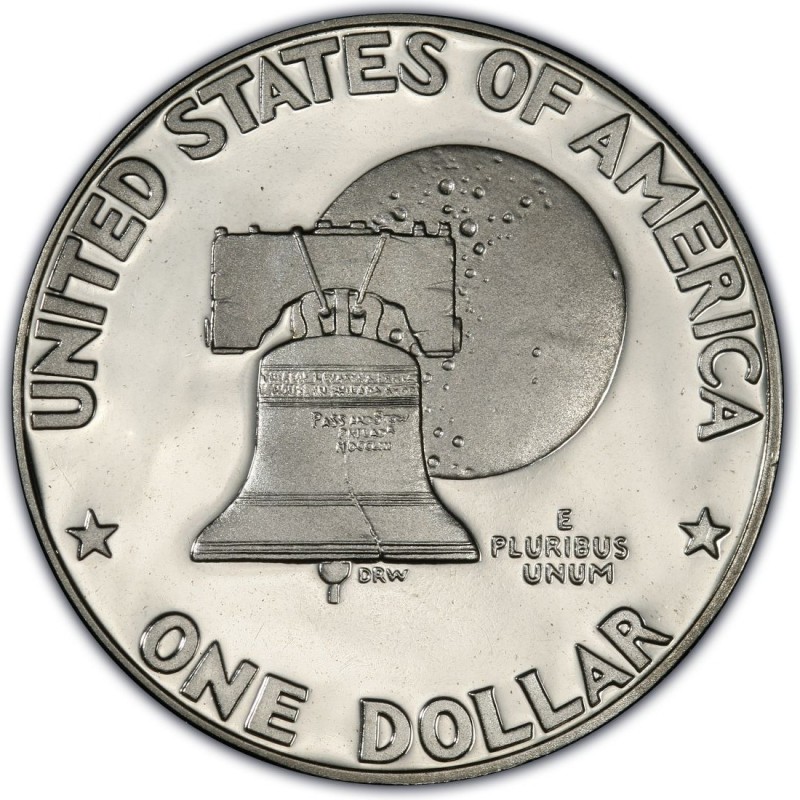
https://www.usacoinbook.com/us-coins/1971-s-eisenhower-dollar.jpg
The Eisenhower Dollar, 1971-1978 (In 1975 and 1976, it was issued with a different reverse, to celebrate the bicentennial of the American Revolution.) This particular coin was produced in San Francisco in 1971.
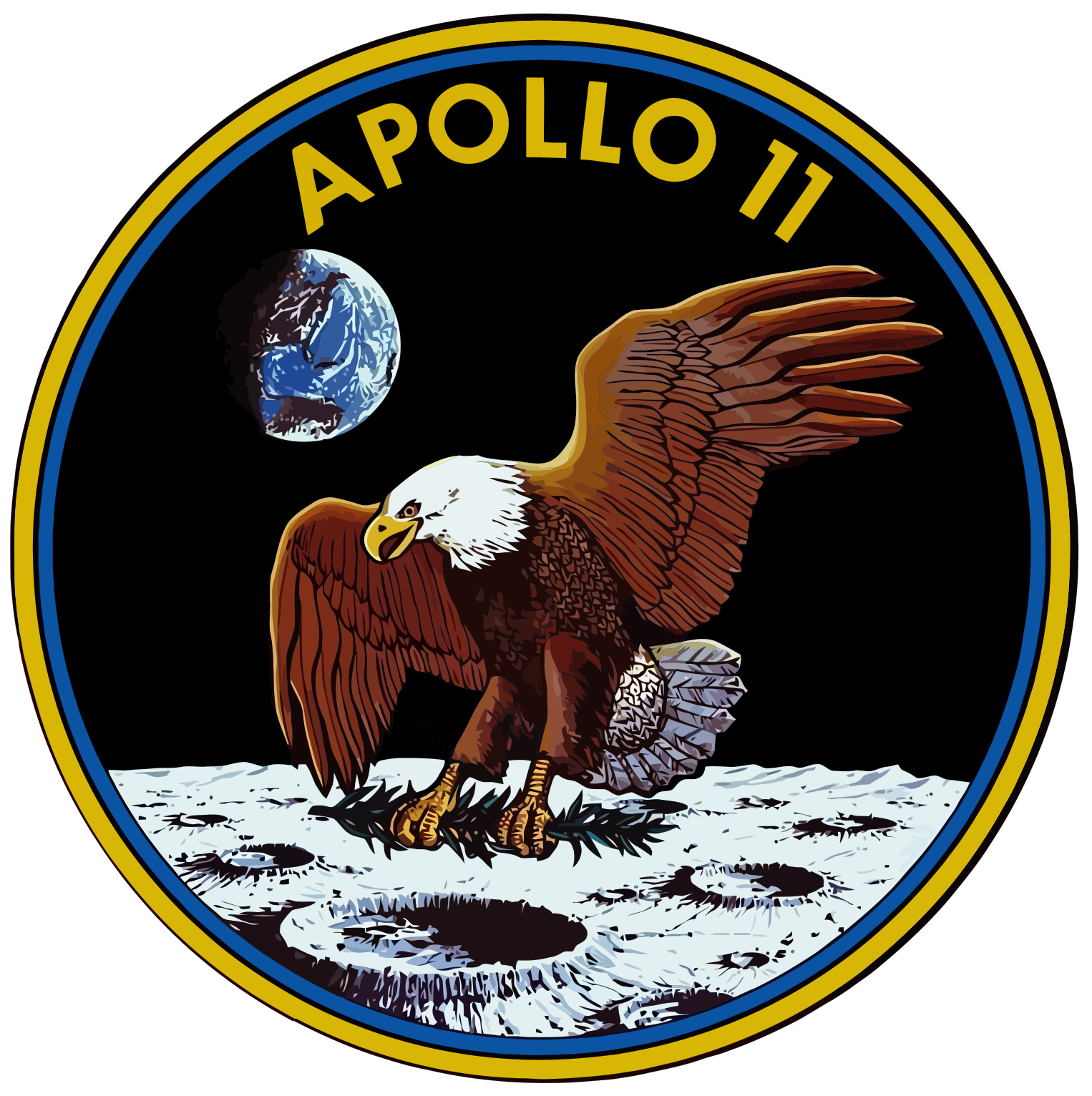
The reverse is our focus here, as it is an adaptation of the Apollo 11 patch. In 1971 we were still taking trips to the Moon, and of course we were justifiably proud of the achievement.

“The Eagle Has Landed,” indeed.

The Eisenhower Dollar was the last full-sized “silver” dollar to be issued; in 1979 we went to the “Carter Quarter,” the Susan B. Anthony dollar, a coin just a bit larger than a quarter, and at a casual glance indistinguishable. Those were produced until 1981, then again in 1999, after which we went to the Sacajawea “golden dollar” which was the same size but colored quite differently.

Ike dollars are readily available at coin shops, they will charge a little bit over a dollar for them (they do have to make a living) but probably well under two dollars unless you want an uncirculated one…or a SILVER one.

Yes, some were made in silver for collectors, both in regular and proof finish, but alas not 90% silver like the older real silver dollars, but rather a 90% layer on each side surrounding a much-less-pure silver/copper alloy in the center, for a net 40% silver content. (Kennedy half dollars from 1965-1970 are like this too.) As long as the coin doesn’t start to tarnish, however, it will look like silver even on the edge, whereas our dime, quarter and half dollar today have that red-turning-to-brown edge on them. That solid silvery edge looks nifty.

Obligatory China Truth Bomb

Just one more thing, my standard Public Service Announcement. We don’t want to forget this!!! The President sure hasn’t. With the Chinese full takeover of Hong Kong…I sure hope this guy is doing OK.

https://youtube.com/watch?v=L3tnH4FGbd0%3F
I hope this guy isn’t rotting in the laogai somewhere!

中国是个混蛋 !!!
Zhōngguò shì gè hùndàn !!!
China is asshoe !!!

Of Exponents and Viruses

As I’ve been reading many of the comments here regarding the Wuhan Coronavirus, it has become obvious that many do not understand exponential growth, or, perhaps, haven’t really realized its implications.

I hope to rectify that.

This is a bit of a ramble. I hope it’s understandable.

Exponential Growth, Introduced.

I’m going to start by going over some mathematics. (Some of you will already know this stuff; I beg your indulgence if it seems condescending, for it’s not aimed at you.)

Perhaps the best place to start is to consider compound interest. Say you deposit a hundred dollars at 5% (OK, in today’s world that’s sheer fantasy, but bear with me).

After a year, you have $105. That’s $100 x 1.05.

After two years, you have $110, right? Wrong!. It’s compounded interest, the interest is paid on the whole starting amount, even the part that was originally an interest payment to you. So, in that second year you’ve made 5 percent off of 105, not 100, dollars, and that’s $105 x 1.05, which is to say $110.25.

So now, $110.25 is your new baseline, going into the third year. And you will make 0.05 x $110.25 or $5.5125, and your bank will probably round it down and hand you $5.51, and your balance will now be $115.76.

If you naively thought that after three years, you’d only have $115, well, instead you have almost $116, and you’ve underestimated your return by 5 percent.

How long will it take to double your money? Not twenty years, but a bit over fourteen years! The rule of thumb is to divide your interest rate into 72. 72/5 gives you a bit over 14.

(It’s a little more complicated if your interest is compounded quarterly, instead of yearly, which is common, or even daily, which is also common, but the principle remains the same.)

To calculate what you’ll have after n years, you can basically do the following. Take your starting amount, $100, and multiply it by 1.05 n times, like this:

$100 x 1.05 x 1.05 x 1.05 x 1.05 x 1.05
(to give you the answer for five years).

But you don’t want to write all that out for all possible cases, so mathematicians have created a shorthand for this. They will write:

$100 x 1.05n.

The n superscript means multiply whatever it’s superscripted on by itself that many times. It’s called an exponent. And, as another way of talking about the same thing, you can say you’re “raising 1.05 to the nth power.”

And a function where the variable is in the exponent is called an exponential function. So you could write something like:

b = $100 x 1.05n

and you’ve expressed your bank balance, b, as a function of the number of (whole) years your starting money has been in that account. And of course you could replace the $100 with another variable, p, for principal, and get a more general function, still:

b = p x 1.05n.

Finally, you can even replace the 1.05 with something like “1 plus the interest rate” and get:

b = p x (1+i)n.

It’s very important to put those parentheses in; they tell you you’re raising (one plus the interest rate), not just the interest rate, to the nth power.

If you step away from interest rates, per se, and re-label things, the general form of an exponential function becomes:

y = bx

Now things are really general. n, usually an integer, is replaced by x, which need not be an integer! x could be 2.4, for instance.

Now how the heck do you multiply a number by itself 2.4 times? Well, to make a long story short, you can multiply it by itself twenty four times (raise it to the 24th power) then take the tenth root of that, and 24/10 = 2.4. To make the long story even shorter, well…you just can, and your calculator knows how to do it.

The 1+i is replaced by b for “base,” which is the appropriate name for the number that you’re “raising to a power” or “exponentiating.”

And y, of course is the traditional label for the result of the equation, the dependent variable because its value depends on x, the independent variable, in the manner that’s specified by the the function.

How about setting b equal to 2. Now we have:

y = 2x

So if:

x is 1, y is 2.

x is 2, y is 2×2 = 4.

x is 3, y is 2x2x2 = 8.

x is 4, y is 2x2x2x2 = 16.

And so on. Each increase in x by one doubles the resulting y. It’s as if you had 100% interest, compounded!

By the way, what if x is zero? How do you multiply a number by itself zero times? Well for consistency any number multiplied by itself zero times is 1. So 20 = 1. And this makes sense. If every step is twice as much as the one before it, it’s half as much as the one after it. Since x = 1 gives y = 2, it stands to reason that x = 0 should give half as much, or…1. You can even carry this into negative numbers. If x is -1, then y should be one half what it is at 0, so y = 1/2. So 2-1 = 1/2.

[As an aside: Mathematicians love to use 2.718281828… as the base, and they’ve even defined that number to be e. It’s as important in mathematics as pi (π) is. This number is known as the “base of the natural logarithms.” I won’t torture you with it beyond this; we’re sticking to 2 from here on out, we’re going to be talking about doubling and halving.]

So let’s say you have a microbe in a petri dish.

After a day, the microbe splits in half, and you now have two microbes.

Each of those microbes splits again, after another day (two days total) and you now have four microbes.

But that’s just our new friend,

y = 2x

…all over again, right? Plug the number of days into x and you get the number of microbes. It even works right at the first moment, with zero days elapsed, because, remember, 20 = 1.

So it turns out that exponential functions can describe population growth, too.

But what if the microbe takes a half a day to divide, instead of just one? After 12 hours, there are two of them, after a full day there are four of them, after a day and a half, there are eight of them, after only two days (not four) there are sixteen of them.

There are two ways to adjust the function to describe this accurately.

The obvious one is to gimmick it so that you’re raising 2 to the 1st power after half a day instead of one, and you can do that by multiplying x by 2 (written as 2x), up in the exponent, like this:

y = 22x

And this works out, see:

x is 1, y is 2×2 = 4.

x is 2, y is 2x2x2x2 = 16.

You can even put in 1/2 or 1 1/2 for x and it works! This is because you double those numbers and get 1 and 3.

x is 1/2, y is 2.

x is 1 1/2, y is 2x2x2= 8.

Four generations, which produces 16 microbes, now takes 2 days, instead of 4, but still produces 16 microbes.

I said there were two ways to gimmick the equation, and I showed you one. The other thing you can do is change the base. In this case, if you replace 2 with 4, like this:

y = 4x

…it works properly.

x is 1 day, y is 4 = 4.

x is 2 days, y is 4×4 = 16.

But note, we just tripped over something new.

We know that at half a day, you have two microbes. If you plug 1/2 into the equation, therefore, it should mean:

y = 41/2 = 2.

And if you plug one and a half, or 3/2s in, you should get:

y = 43/2 = 8.

We’ve just learned what happens when you put a fraction in. The 1/2 gives you 2, which is the square root of four. Raising a number to the 1/2th power is the same as taking its square root!

And we can see something else, too. Let’s look at the second one again, but let’s rewrite 3/2 as 1 + 1/2.

y = 41+1/2 = 8.

But don’t we know that 4 raised to the fourth first power is 1 4 [edited at about 11 pm same day], and the square root of four is 2, and that 4 x 2 is 8? It’s as if adding numbers in the exponent results in multiplying!

y = 41+1/2 = 41 x 41/2 = 8.

And indeed, that’s so. And this will be a key thing to remember.

Implications of Exponential Growth

OK, so with that bit of background, let’s take…hmm…1024 microbes in a petri dish. And let’s go back to the case where the microbes split once a day. (And, note this works better if they don’t all split at the same time!)

After the first day, we have 2048 microbes. After the second day, we have 4096 microbes. After the third day, we have 8192 microbes. And after the 4th day, we have 16,384 microbes. We’re doubling every day, but we’re not starting with 1. How do we write this?

We can start with our old friend:

y = 2x

…to express the fact that we’re doubling every day, but we need to multiply by 1024 to start with.

y = 1024 x 2x

Work this through and you’ll see it’s correct.

You can even use this to figure out how many microbes you had the day before you started, by setting x to -1, then you have 1024 x 1/2 = 512.

And you can even figure out where you’ll be half a day in. It’ll be 1024 x 21/2, and we know 21/2 is the square root of 2, which is about 1.414…, so you should have about 1448 microbes.

But wait just a minute! Remember that adding in the exponent is the same as multiplying outside the exponent?

We’re multiplying outside the exponent. Can we express 1024 as 2-to-the-something power, and add it?

Well, yes you can. As it happens, 1024 is 210. (And you thought I’d pulled that number out of my rectal database!)

So you could write your equation for starting out with 1024 microbes like this:

y = 2x+10

You have your “two to the x” and your “2 to the tenth power” put together in the exponent.

Let’s say your petri dish is full at 1,048,576 microbes. This is 220. So it will happen when x is ten, in other words after only ten days.

If, on the other hand, you start with only one microbe, your petri dish is full after twenty days.

If you go to a jumbo petri dish, twice the size of the ordinary petri dish, then it takes eleven days to fill (if you start with a thousand microbes), or twenty one days (starting with one microbe).

Doubling capacity does not double the number of days you can run your experiment. It adds ONE day. And in general, any realistic increase in capacity adds very little time to how long you can let the exponential function run.

I’m going to say that again, in a slightly different way:

When dealing with exponential growth, increasing capacity doesn’t buy you much time.

And I will say it again because it’s important.

When dealing with exponential growth, increasing capacity doesn’t buy you much time.

It’s also true that reducing the size of the population by, say, half, doesn’t buy you much time either. If you were to kill half the microbes in the petri dish at any time in the process…you’ve bought yourself one day. It doesn’t matter whether you kill half of them after day 1 (going from 2 to 1) or on day 19 (going from about half a million to a quarter of a million). You still hit a million one day late, on the 21st day.

But there IS one hope. You can slow things down, greatly, by changing the base to something smaller or by being able to divide the exponent (which as we saw above, are equivalent). Either one of these has the effect of increasing the doubling time, which works proportionately.

If you double the amount of time it takes for your microbes to double, you have twice as much time before they fill the petri dish. Here’s the formula:

y = 2x/2

The exponent is x/2 instead of x.

And it works, it now takes 40 days to go from one microbe, to a full petri dish, instead of 20 days.

If you’re dealing with exponential growth, increasing the doubling time by X percent buys you X percent more time before you’re overwhelmed. Decreasing the doubling time, on the other hand, is a really, really good way to fuck yourself over.

More generally, you can write the equation like this:

y = 2x/d

…where d is the amount of time it takes to double. If d is two days, then it takes two days for x/d to equal 1, and thus it takes two days to double. Make d 3 or 4 or 27, it works the same way.

Applying This To Epidemics

Epidemics start out as exponential growth. They start out that way, but eventually, the curve bends over, and then there is a decline. But for just a moment, let’s look at the “growth” part of things.

The number of people who have the disease grows exponentially.

The number of people who have the disease bad enough to need the hospital, is smaller, but still grows exponentially.

The number of people who die from the disease, is smaller yet, but also grows exponentially.

In fact, if 12.5 percent of the people who catch the disease need to be hospitalized, all you’ve done is take the exponential growth function for the number of people who have the disease, and stuck a 0.125 in front of it, like this:

y = 0.125 x 2x/d

…but that 0.125 is basically -3 doublings! So basically,

y =2x/d – 3

(It’s a rule of mathematical notation that you divide x by d, then subtract 3. You do not subtract 3 from d, then divide that into x. That would be written as x/(d – 3) if that was intended. Many a computer bug comes from people not using parentheses when they should have.)

And likewise, something similar happens with the percentage of people that die. All three double at the same rate, but, in essence, their starting points are different.

So if you’re watching an epidemic, and a thousand people catch the disease in, say, 30 days (that’s doubling every three days), and then one person dies…you will have a thousand deaths 30 days later. By which point, a million people have caught the disease.

As I said before, the exponential growth at some point stops. Clearly it must stop once the entire population has caught the disease. There’s no one new to catch it and double the number of victims. But usually it stops well before that point. This is attributed to the bacterium or virus becoming less virulent over time.

And that’s a key point.

It’s why we want to increase the doubling time. Because that way fewer doublings happen before the reversal happens, and that means fewer victims.

And reducing the doubling time is important for another reason. Remember I mentioned that some fraction of the people end up in a hospital? THAT, it turns out is the critical constraint. We only have so many hospital beds, and even fewer ventilators (as the current disease requires for treatment). If the exponential growth hits that limit, then many victims cannot be treated, and will be left to die. There’s no way around that.

Adding hospital capacity by (say) kicking ever non-epidemic patient out is a stopgap, likely to stave things off by one or two doubling periods, at most. Remember, any realistic increase in capacity gets overwhelmed in short order!

We have to slow the doubling rate. That buys us time, time for the pathogen to weaken, time for us to come up with new treatments, maybe even time for us to come up with a vaccine that will cut the new number of victims to nearly zero.

How do we increase the doubling rate? Well, a given person who has the disease (whether he knows it yet or not), can only give the disease to people he contacts, or who contacts anything he left the pathogen on (he sneezes near them, touches a doorknob after wiping his nose and then the new victim touches the doornob, etc.) If you can reduce this number, you’ve reduced the doubling rate. That’s why washing your hands, avoiding direct contact, etc., are so important.

It’s important whether or not you think you, or the other person, have the disease, because you can have the disease days before you know it, and be giving it to other people and never even know it.

They are MORE IMPORTANT than any travel ban President Trump could impose, in fact. Because the only thing the travel ban does is reduce the number of carriers. Remember what I said about killing half the microbes in the petri dish? It buys you ONE doubling time and only that. Reducing the current number of carriers–unless it is all the way to zero, only buys you doubling times.

This is why I simply don’t buy arguments that now that we’ve gotten rid of travelers coming in, so we’re basically all right. No, because we have a resident population of contagious people. And it seems small now. But so what? It just means we’re in an early part of the nasty exponential curve.

And with the Wuhan Coronavirus, the doubling period is about three days.

And exponential growth is why I lost my patience with people jumping someone who claimed there were 1700 victims now, when (apparently) one source showed 1200. The original poster was trying to explain exponential growth, and someone was quibbling over today’s numbers. Even if the original poster’s number was twice as big as it should have been…it buys you one doubling period.

And with the Wuhan Coronavirus, the doubling period is about three days.

And people who compare it to the flu, saying only X number of people have died, compared to this year’s flu.

Just give it a few doubling periods. And with the Wuhan Coronavirus, the doubling period is about three days.

No, we HAVE to increase the doubling time. The measures (and advice) Trump outlined on Friday, at last, address this. All the private closures of big-crowd events address this, all the people cancelling plane rides and cruises (or having the carriers cancel them) help too. They represent fewer opportunities for people who have it, to give it to someone else which means one victim takes longer to become two victims.

It’s all about that doubling rate, not today’s absolute numbers.

We can defeat this thing this way, before we become another Italy. (But for now, we have the same doubling rate they do, and we’re 11-16 days behind them.)

The irony is, if all of these measures, which some describe as “panic,” work, someone will come along and say, “See they weren’t needed!” Yes they were.

Viruses

My main point made, I’ll talk, some, about viruses.

It became apparent in the 1800s that many diseases were caused by bacteria. But a whole host of other diseases behaved like bacterial diseases–they got transmitted by the same sorts of events–but no bacteria could ever be seen under a microscope.

Whatever was carrying these diseases was too small to be seen.

Eventually, these things were “seen” under an electron microscope. The objects in question were too small for visible light to show (they were smaller than one wavelength of light–which is pretty doggone small, a bit less than a thousandth of a millimeter, tops). But they were larger than the wavelength of an electron, so an electron microscope could see them.

These viruses were, in fact, way too small to be alive. It takes a certain amount of chemical “machinery” to make a cell, that is capable of producing all the sorts of molecules it needs to function and be able to reproduce, by copying the DNA, copying everything else in the cell, and splitting.

The viruses were nothing but RNA (DNA’s less sturdy cousin) and a coat of protein. The virus cannot reproduce the RNA within it, nor can it produce the coat of protein. It’s not alive. It’s nothing more than an inert envelope full of instructions on how to produce more such envelopes; it needs something else–the cells in your body–to execute the instructions.

That’s why no antibiotic will kill it. It’s not alive. Even an “anti viral” drug doesn’t destroy the virus.

The virus reproduces by getting inside one of your cells. Once in there, the outer protein coat dissolves, and the RNA instructs the cell machinery on how to make more viruses. The cell machinery is designed to do whatever the RNA in the cell tells it to do, and it dutifully does so. (The cell’s original RNA comes out of the nucleus, it’s created by transcribing the DNA, and this happens in an orderly fashion so the cell makes what it needs to function.)

The virus RNA gets copied, and the protein sheaths are copied too. Eventually the cell is full of the damn things and bursts–releasing hundreds of new copies of the virus out where they can infect new cells.

An antiviral, as I said, doesn’t kill the virus, but it does slow this process down. Maybe slows it down enough that the body’s immune system–which can destroy viruses–has time to learn how to do so before the virus kills the host.

Slower is better; that’s the moral of this post.

Another Sirius Tale of Two Stars

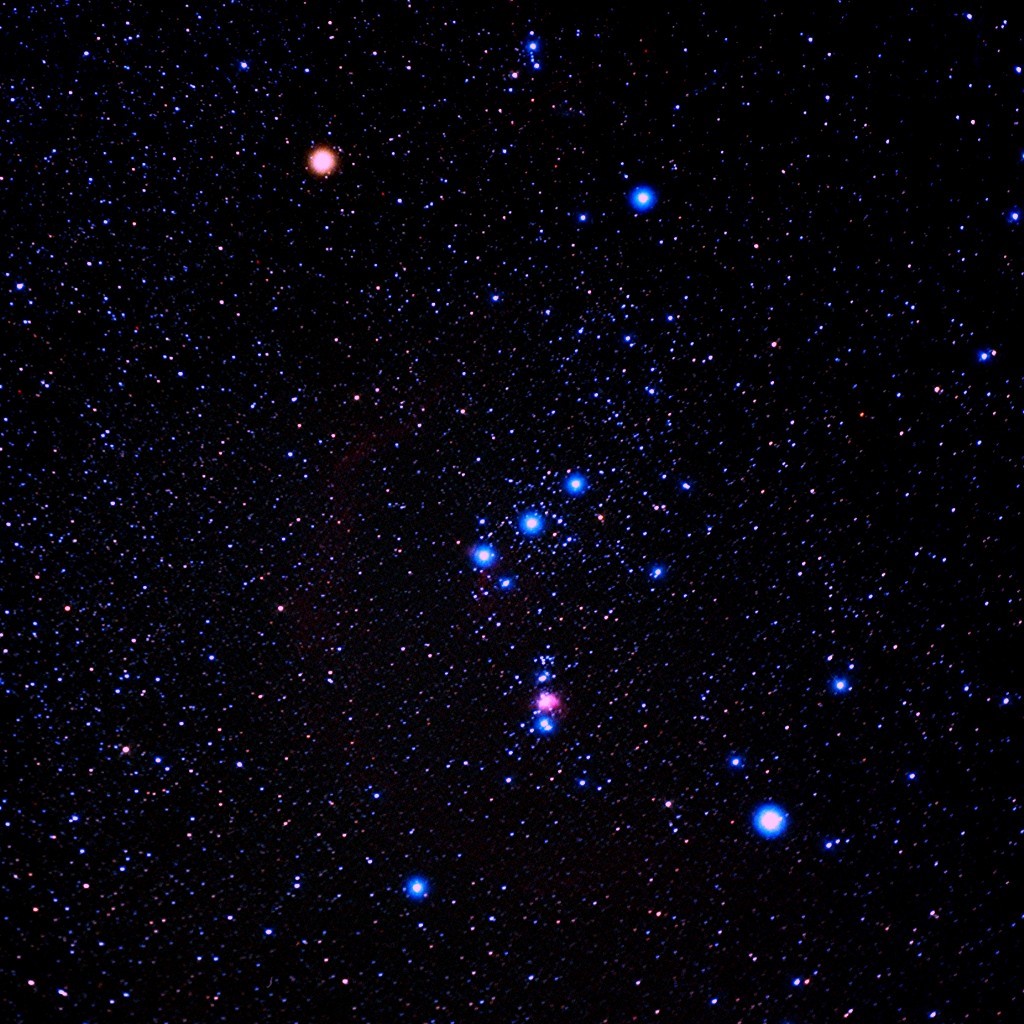
We start, once again with Orion…but we move east (left) and south (down) a bit…at least as seen from the Northern Hemisphere, around midnight. Shortly after sunset, just look straight down. Follow the line of the belt stars towards the eastern horizon.

See that very bright star there? That’s Sirius. It’s the brightest star in the night sky, and I mentioned it in passing last time.

It’s almost on the Milky Way (you can see a faint suggestion of it in the picture). In the picture, up and to the left, is Procyon, and moving right from Procyon there’s a yellowish star, and that’s Betelgeuse. Those three stars form a nice equilateral triangle, and it’s known as the Winter Triangle. (I personally find Rigel to be bright enough to ruin the pattern, so it only works for me after Rigel has set, or if it’s covered by a cloud.)

Our OTHER star? It’s also right there.

Binary Stars

Most stars are actually parts of a star system, a group of stars that orbit each other. It could be two, three…even up to six stars. In fact, a triple-star system is the most common. From Earth, with its oddball one-star system, we cannot tell any star is a multiple star, without the aid of a telescope, but once we had telescopes (thank you Galileo), the truth became apparent, quickly.

Shades of Tattoine! That was a double star, and as you’ll remember, in Star Wars, they looked very similar; they basically just took a double image of our Sun.

In the real universe the stars rarely match that well.

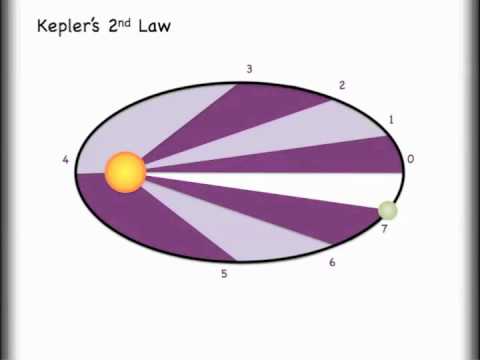
The nearest star to us (other than the sun, of course) is Alpha Centauri; it is a triple. It has one star a bit more massive than the Sun, another one a bit less massive, orbiting their common center of gravity in very elliptical orbits (the closest distance is 11 AUs–about the distance between Saturn and the Sun, and the furthest is 36 AUs, more distant than Neptune is from the sun) every eighty years. There is a third star, very small and faint–too dim to be seen by the unaided or “naked” eye. It’s called Proxima Centauri. It’s estimated to be 12% of the mass of the Sun, and 1/20,000th as bright. (Remember, a more massive star is disproportionately bright, so a less massive star will be disproportionately dim.)

It’s about an eighth of a light year from the two big stars in the Alpha Centauri system. And right now it’s closer to us, in fact it is the closest star to the Sun. (And yet, we can’t see it.) If we could see it it would appear about four moon diameters away from Alpha Centauri.

(Digression. Step outside some clear night, and look up. Red dwarfs are the most common stars there are, roughly three quarters of all stars are red dwarfs. But not a single star that you can see is a red dwarf. They’re just too dim to be seen from far away without a telescope, or at the very least, binoculars. OK, end digression.)

That’s a not atypical situation for a multiple star system. Very different stars, elliptical orbits, and really not much chance that a planet could have a stable orbit in that mess (sorry, Star Wars fans). In fact the only known planet orbits Proxima Centauri–the other two stars are far enough away not to mess up that planet’s orbit.

So what does this have to do with Sirius?

Sirius, it turns out, is a binary star. The two stars in this tale are Sirius A and Sirius B. If you look towards one, you look towards both.

Sirius And History

Sirius, being the brightest star in the night sky, has been important to many ancient cultures, particularly the Egyptians. They would align their calendar to start on the day that Sirius becomes visible in the eastern sky just before sunrise (then, of course, gets blotted out again by the daytime). This is called the heliacal rising of Sirius. This was about July 19th on our current calendar. They’d then count off a year of 365 days, precisely. Never a leap day, never a leap year. So in a few years, the heliacal rising of Sirius would happen a day late. A few more years, another day. After 1,461 of these no-leap Egyptian years, they’d be lined up again, and the heliacal rising of Sirius would fall at the beginning of the year once again. This was the sothic cycle. And yes, Ancient Egypt was around long enough to experience at least two of these cycles, the first starting in 2781 BC. (There’s a tiny possibility that in fact the prior cycle was the first one, but that would push things back to 4241 BC, and most Egyptologists think that was 1100 years before the First Dynasty.) Now that is a long-lived country!

Sirius is the brightest star in the constellation Canis Major (the larger of Orion’s two hunting dogs–no word on whether they were Labs), so it’s sometimes called the “Dog Star.” And the “Dog Days Of Summer” get that name because…Sirius and the Sun are up at the same time during the summer, and some people actually thought Sirius contributed to the summer heat. Many simply associated Sirius with heat and drought.

The Polynesians, in the Southern Hemisphere, associated Sirius with winter and used it as a reference for navigating (and they were, and are, incredibly good navigators).

Sirius A

Sirius A is by far the brighter of the two stars.

In fact the first telescopes couldn’t see Sirius B at all; we thought it was a single-star system.

Sirius A is twice as massive as the Sun. Which, if you’ve been following along, means it is going to be more than twice as bright as the Sun. In fact, it’s twenty five times as bright. And its temperature is 9,940 degrees Kelvin, compared to our sun’s 5,572 K So basically, it ought to have 1/12th the lifetime of our sun since it’s burning a stock of fuel two times as big, but doing it 25 times faster.

Sirius’ age appears to be between 237-247 million years. That’s young for a star, by comparison our Sun comes in at about 4,600 million years.

Sirius is only 8.6 light years away, by contrast with Betelgeuse and Rigel from last time. This close distance and being the brightest star in the immediate neighborhood combine to make it the brightest star in the night sky, bar none.

Sirius is, in fact close enough that we can measure its distance directly. We do that by noting its position against the more distant stars at one end of our orbit, then doing the same six months later. Since Earth has moved about 300 million kilometers in that time, a nearer star should have shifted position against the background of more distant stars.

At a distance of 3.26 light years, that shift is two arc seconds, which is to say 2/60ths of 1/60th of a degree. The moon is 1800 times wider than this in the sky. That distance, where the earth’s orbit’s radius gives one arc second of parallax, is called a parsec, and it’s what astronomers use (they use light years when talking to non-astronomers; parsecs amongst themselves).

Sirius appeared to be a pretty typical large star, not hugely large, but any star larger than the sun is notable; small stars are much more common than large ones.

Sirius B

But one other thing they noticed as they studied Sirius–it wobbles. Over the span of about 50 years, it traces a small ellipse in the sky, one about the size of Uranus’ orbit. This was first noticed in 1844.

OK, so Sirius has some tiny little red dwarf companion, right? That would make sense, it’s so bright it would probably drown out a red dwarf.

Well, no.

One can tell how massive an object is, by watching things orbit it. And it became clear that whatever Sirius (A) was orbiting, was something the mass of the sun. And that’s too big to be a red dwarf. In fact, if there’s a star there, the mass of the sun, it should be as bright as the sun, and visible in a telescope. But there could be no doubt; Sirius and something half as heavy that should be visible, but wasn’t were orbiting each other around their common center of gravity.

This was a bit of a mystery.

But in 1862, Alvan Graham Clark had just made a telescope, an 18.5 inch refractor. It was the largest in the US, and one of the largest in the world. He had taken exacting care in grinding the lenses, and now he needed to test it. He’d do so by looking at stars, to see how sharp they were as points of light. Any flaw in his work would be apparent.

He pointed it at Sirius, and noticed a tiny fleck of light very close to Sirius. One can imagine the litany of four letter words that ran through his mind, but then he pointed it at other stars (plenty of other bright stars nearby…you can name just two of them, if you’ve read my prior post.) And there was no flaw visible with those stars.

It dawned on him that his optics weren’t bad. No. They were fantastic. He was been the first person to lay eyes on Sirius B!

Sirius A, and B to its lower left. The rings around, and spikes coming out of, Sirius A are artifacts of diffraction in the optics.

It turned out that now people knew what to look for, smaller telescopes could see it, and less than two months later, his discovery was confirmed by other instruments.

Sirius B, it turned out, is very, very tiny. It got nicknamed “The Pup” to go with the “Dog Star.” And it is very, very hot! 25,000 Kelvins, hotter than Rigel. Something that hot glows with X rays, and you can see in the picture above that Sirius B is much more conspicuous in X rays.

If you know the temperature (from looking at the spectrum, which someone managed to do in 1915 after blotting out Sirius A) and the brightness, you can figure out the size.

Sirius B is the size of the Earth. In fact it’s actually a tiny bit smaller than Earth.

Say what!?

OK, so far, when talking about stars, I’ve compared their mass to the Sun’s mass. So it might not be apparent how ridiculous this seemed.

How about we compare it to the Earth? Sirius B and the Sun are roughly the same mass, and the Sun is…330,000 times as massive as the Earth.

So Sirius B packs 330,000 times the Earth’s mass…in a sphere the size of the Earth.

Think about that. On average, a cubic centimeter of the earth weighs about 5.5 grams. (Your typical surface rock is about 3 grams per cubic centimeter; the iron core raises the average to 5.5 grams.)

A cubic centimeter of Sirius B would have to average about 1.8 million grams. Or about two tons.

Set that cubic centimeter on dirt, and it’d probably just sink into the ground.

Okay, this is one weird star. It is a “white dwarf,” a small star (one solar mass) with the surface temperature you’d expect from a much bigger star, and very, very dense. As it turns out it’s one of the most massive white dwarfs…there’s a strict upper limit on their size.

It breaks the rules for “Main Sequence” stars, like the Sun, and Sirius A, and Rigel (and all three stars of the Alpha Centaur system). Betelgeuse is not on the “Main Sequence,” but it seems to be different in opposite ways, bloated instead of compact, cool instead of very, very hot.

But the thing about the Main Sequence is, it’s where the stars that are “burning” hydrogen for fuel are.

A star that is not on the Main Sequence is not burning hydrogen, and Sirius B isn’t on the main sequence. No white dwarf is.

So what’s the story?

Sirius B is a dead star.

It’s not fusing hydrogen. It ran out. It didn’t go supernova either–it wasn’t massive enough.

It started out about 5 times the mass of the sun. It and Sirius A were “born” at the same time about 240 million years ago, but, being more massive than Sirius A, Sirius B ran out of hydrogen about 120 million years ago, and became a red giant, burning helium.

It produced plenty of carbon, and some oxygen, and most of the outer layers of the star basically boiled off, too hot to be retained. (Some of that matter probably ended up becoming part of Sirius A.) This sort of thing happens a lot to these sort of mid-size stars, and results in something called a planetary nebula. They have nothing to do with planets, but in early telescopes they often looked round, a bit like a planet. Here’s a well known example (in the constellation of Vega). I’ve seen it through a six inch telescope (that’s the diameter, not the length).

Once all that outer stuff blew off, the bare core of a star was now less massive and under less pressure, and could not go on fusing heavier and heavier elements. So it began to contract, and the temperature climbed as it did so, but no internal source of energy would come along to stave off the final collapse. So the star kept shrinking, and shrinking.

That much matter is heavy, and, when it’s packed into such a small volume, the force of gravity becomes gigantic. That simply compresses it further.

Eventually the only thing holding the star “up” is something called electron degeneracy pressure; basically, it’s an upper limit on how much you can squash the electrons in an atom. The atoms are still distinct…just very, very crowded.

With all that gravity, any hydrogen that happens to be left over ends up on the surface; the heavier carbon and oxygen go to the center. When astronomers examine the spectrum of a white dwarf, therefore, they see pure hydrogen.

The star is hot due to the heat generated by compression, and it radiates all that heat off–it cools. But there is so much matter here, compelled to radiate through such a small surface area, that it will take billions of years for the star to cool down enough that it isn’t glowing any more. In fact, it takes longer than the universe has been around, so no such star has cooled that much…yet. The oldest known white dwarfs are still at a few thousand Kelvins.

Another Kind of Supernova

But, as I mentioned, there is an upper limit to a white dwarf.

When they reach about 1.44 solar masses, the white dwarf is now too heavy for the electron degeneracy pressure to hold it up. This number is so critical that it has been named after the astronomer who first figured out its value, it is Chandrasekhar’s Limit.

Suddenly the carbon is forced together, all at once (not gradually like in a regular red giant that is burning it for fuel), and there is a titanic KABOOM…and we have a supernova, of a different type from the core collapse supernova expected for Betelgeuse. These are called type 1a supernovas.

You might think that this can never happen. After all, it’s a white dwarf sitting out there. How is it going to gain mass?

White dwarfs that orbit close to other stars often slowly pick up mass from their companions, it looks something like this:

That poached matter will accumulate until Chandrasekhar’s limit has been exceeded, and, like I said…KABOOM!

Type 1a supernovas are very useful to astronomers. Since they all result from basically the exact same kind of explosion on stars of the exact same mass, they are all of the same brightness. And like core collapse supernovas, they often outshine the entire rest of the galaxy they are in. Even if not, if we can see the galaxy…we can see the supernova.

And they have a distinctive signature, so you can tell a Type 1a from other types of supernovas.

So astronomers look, over and over again, at thousands of galaxies, hoping to spot a Type 1a supernova when it happens. They spot a few every year. They can measure how bright it looks. And since they know exactly how bright it actually is, because all Type Ias are identical, they now know how far away that supernova, and the galaxy it is in, actually is.

There are other, older methods of measuring the distance to galaxies; they all involve measuring how fast it’s moving away from us, and that was, until recently, assumed to be a simple function of how far away it was; the speed was a constant times the distance. But now, by knowing the actual distance, and (from the galaxy’s spectrum) knowing how fast it’s moving, we know that’s not really true (it was close, but not quite), and we were able to make the determination that the universe is expanding faster and faster, NOT slower and slower as one would expect.

So white dwarfs, and Type Ia supernovas, have helped us learn some really surprising things about the universe, as if white dwarfs themselves aren’t bizarre enough on their own!

Meanwhile, we’re in no danger of having Sirius B go supernova on us. It’s far too light to be a hazard today, and it’s certainly not gaining much mass from Sirius A, because it’s 20 AUs from that star. (That’s about the distance from the Sun to Uranus.) I haven’t been able to locate a professional’s estimate for how long Sirius A will last before it uses up its hydrogen, but it’s certainly hundreds of millions of years away. If it ends up lasting 12 times as long as Sirius B did, it’s good for a bit over a billion years. But when that time comes, it will become a red giant, and maybe, despite the huge distance, almost two billion miles, between the two stars, that will push enough matter out there for Sirius B to pick up some of it. And maybe…maybe…there will be a supernova.

We’re unlikely to be anywhere near it at the time. Sirius is moving closer and closer to us now, as both stars orbit the center of the Milky Way at different speeds, but in well under a million years it will be pulling away from us and should be nowhere nearby a billion years, or four orbits, from now.

Sorry, you still have to do your taxes next year!

A Tale of Two Stars

Note: I posted a shorter version of this as a comment over at Marica’s. Their topic for today is “When You Wish Upon A Star” and I thought I’d say something about Betelgeuse. Then I found myself wanting to talk about Rigel, too…so it just growed and growed.

There’s nothing political here. If you want a break from politics, read on. If you don’t, by all means save yourself the time.

Many stars have names. Here are a couple, both in Orion. Orion rises in the east shortly after sunset this time of year.

Betelgeuse is the bright orange star at the upper left of the big quadrilateral of Orion; it’s considered Orion’s shoulder. Rigel is the bright one at the lower right, generally considered to be Orion’s “foot.”

https://stephenwhitt.files.wordpress.com/2015/07/orion-constellation.jpg?w=1100
Orion. The seven major stars (the three in the belt, and the four in the quadrilateral) are all big, bright stars and with one exception they’re all a similar distance away from Earth. The upper right is Bellatrix, the lower left is Saiph, the belt stars are Alnitak, Alnilam, and Mintaka. Bellatrix is considerably closer to us than the others, “only” 250 light years away, the others are 650 to 2000 light years away.

Rigel.

That’s the bright star at the lower right in Orion (if you’re in Australia, the upper left). That is one very, very bright star!! It doesn’t LOOK as bright as Sirius (the very bright star to the east and a bit south of Orion), but Sirius is about 8 light years away, and Rigel is 860 light years away…a hundred times as far. Yet it isn’t that much dimmer than Sirius. Sirius is the brightest star in the night sky, and Rigel is #7.

Rigel is 120,000 times as bright as the sun, intrinsically. If the earth were orbiting Rigel…well, it wouldn’t be. It would be getting 120,000 times as much energy and would be melted, then boiled away. (Imagine if the sun in our sky gave off over 100,000 times as much heat as it does!) The earth would have to be 364 times further away, which is to say 364 Astronomical Units (AUs), to get down to the same amount of EM radiation.

That’s ten times the distance to Pluto, to get the SAME amount of energy the Earth does.

Rigel is bluish in color, like most of the visible stars in the sky. That is because its surface temperature is some 12,100 degrees Kelvin, which is over 21,000 F.

(Have you ever seen anything that hot here on Earth? No. So you might be surprised to find that when things get that hot, they glow bluish. As things get hotter, they go from invisible (but you can feel the heat), to dull red, to orange (embers), to yellow (a tungsten bulb), to white (the sun)…to blue. Each with more and more heat, and towards the end, with more and more ultraviolet) In fact the only place to see things that are blue hot is in the night sky. (No the flames on your gas stove aren’t that hot–they are blue for a very different reason.)

Something that is blue hot is giving off more ultraviolet than visible light. So that 120,000 times brighter than the sun light from Rigel, is mostly ultraviolet. Our hypothetical planet at 364 AUs distance is getting most of its sunlight as UV. Proportionately less of it is coming as visible light. If you were outside on a clear day there, there’d be the feel of an overcast day, but you’d be getting sunburned in a hurry. And the “sun” would be this tiny point of painfully bright blue light.

A couple more things to say about Rigel: It is 21 times as massive as the sun, and maybe 80 times as wide.

Betelgeuse

Our other star is Betelgeuse. (“Beetle Juice,” if you must.)

Orion’s upper left shoulder should look a bit redder than the other stars (which will look bluish white). That is Betelgeuse.

Betelgeuse is a “red giant.” It is about 700 light years away (not quite as far as Rigel), and is anywhere between 90,000 and 150,000 times as bright as the Sun, intrinsically (it actually varies in brightness).

It’s redder because the surface is a lot cooler than our Sun, 3590K, not that far off from an incandescent light bulb. Yes, it’s at a different part of the red/orange/white/blue-hot continuum.

It’s 11 times as massive as the sun, but it is anywhere between 700 and 1000 times as wide as the sun! If the earth were orbiting Betelgeuse it would be INSIDE the star. A bit toasty!

Betelgeuse is so big that, as far away as it is, we were actually able to measure its diameter from here on earth in 1920! Most stars look like points in even a powerful telescope, but not Betelgeuse.

Earth would be comfortable at a similar distance from Betelgeuse, about 350 AUs, but because the star drastically varies in brightness, much more so than our sun, climate change would be far, far worse.

They’re Not Much Alike

Now, it turns out a star is actually a very simple thing. It’s a lot of gas, trying to contract under its own gravity. The main difference between stars should be in how massive they are.

Rigel and Betelgeuse are of similar masses (closer to each other, proportionately, than either is to the sun), yet Rigel, the bigger of the two, seems more like the sun than Betelgeuse. Hotter and bigger, but not swollen to a ridiculous size. In fact, astronomers place stars like Rigel and the Sun in a category called the “Main Sequence,” a progression from small, red stars up to giant blue ones. Some Main Sequence stars are the exact mass of Betelgeuse, and they’re not red and swollen.

Betelgeuse is not on the Main Sequence. It’s a different sort of animal.

What gives? Why are they so different?

To start finding out the answer, let’s look at their masses once again.

Did you notice how these stars are thousands of times brighter…but only ten or twenty times as massive?

Doesn’t that mean the star will burn itself out that much sooner? If Rigel has got twenty times the gas, but it’s 120,000 times as bright as the Sun, that means it’s burning through its fuel supply 120,000 times as fast, and it should last only 1/6,000th the time. (To be sure a star only burns what’s at its center, not the surface layers, so that’s not quite the right comparison to make.)

The sun is expected to last 10,000 million years (and we’re 4500 million years into that). Rigel’s lifespan, total, can’t be much more than 10 million years; it’s estimated to already be 8 million years old.

Rigel lives boldly, but very, very briefly, a cosmic butterfly.

Betelgeuse is of comparable brightness to Rigel, but half the mass. It’s ripping through its available fuel even faster, proportionately speaking. And yet its big and cool on its surface. It makes sense to be big, if it’s cool, or cool, if it’s big. It has a MUCH higher surface area than Rigel, so each square meter of it has to radiate a lot less, for the total output to be the same. And the way to do that is to be cooler.

But that doesn’t explain why it’s so different from Rigel, and our Sun, as to not be on the Main Sequence.

There’s more to the story. Lots more.

The Life Of A Star–Youth

As I said earlier, a star is a simple thing, really. It’s a big ball of gas that wants to contract under its own gravity. As it does so, it heats up, just like compressing the gas in a bicycle pump makes it get hotter. Heating it up increases the pressure, the pressure resists the tendency to contract. Eventually a balance is reached.

But that heat eventually radiates off, the pressure drops, and the star contracts. What one would see is stars glowing as they contract, shrinking as fast as the bleed-off of heat (and pressure) lets it.

Unless the star can find another source of energy, something that it can internally generate, to stave off the collapse.

And it does.

Any ball of gas sufficiently large (considerably larger than Jupiter) will eventually reach a point where the core is at a temperature of millions of degrees, and then the hydrogen starts fusing into helium. Four hydrogen atoms go through a series of reactions (exactly which series of reactions depends on the temperature, which depends on the mass of the star), to ultimately make one atom of helium. In the process, 0.7 percent of the mass of the hydrogen disappears–it becomes energy. It works out to 26.73 million electron volts of energy. (An MeV is a tiny amount of energy to us, but this is from four atoms of hydrogen, and there are about 600,000,000,000,000,000,000,000 atoms of hydrogen in one gram of the stuff…so, really, it’s quite a bit of energy!)

In fact, I’m going to point out that twelve atoms of hydrogen, fusing to three atoms of helium, works out to almost exactly 80 MeVs of energy. That will be important, later on.

So nuclear fusion gives off energy, lots of it. That energy heats the star up, and the contraction stops. The star finds a balance, and the star will stay pretty much the same size as long as it has hydrogen in its core to fuse to helium. (It actually gets a bit hotter as time goes on, but this is a very slow process.) Once it runs out of hydrogen, well, life will get interesting again.

The sun is at just the right temperature and pressure, inside, that it’s going to take ten billion years to burn all of its fuel (even though it’s burning 650 million tons of it a second), but that’s the right rate to keep it from either expanding too much and cooling off (which would allow it to contract again, heating it up), or contracting too much and heating up, which would cause it to expand again and cool off. It’s in balance, and it will stay in balance for another 5.5 billion years, when it runs out of hydrogen.

Back to Rigel.

Rigel, like the sun, is burning hydrogen, to make helium. It’s doing so at a rate far faster than our sun; it has to to maintain the very high temperature to keep twenty times the mass of the sun from continuing to collapse. You see, the bigger the star, the hotter it has to get to keep from collapsing, but the hotter it gets, the faster the heat radiates away, and that means, the faster it burns through its fuel. And the shorter it will live.

So a star like Rigel is heavy, very hot, and blowing through its fuel FAST.

So now we understand why big stars are so much hotter and brighter.

But that just makes Betelgeuse more puzzling. It’s half as massive as Rigel, but it’s about as bright (it shouldn’t be), and it’s much cooler than our sun (again, it shouldn’t be). The fact that it is so swollen, comparatively, means it should be much, much hotter at the very center, but wouldn’t that just make it even brighter?

What makes it so large, yet cooler than the sun at the surface?

The Life of A Star–Middle and Old Age

Well, it turns out, Betelgeuse is a star that has already run out of hydrogen!

As I said, when a star runs out of hydrogen, life gets interesting. A very small star, lighter and smaller than our sun, basically is done at this point. It will just contract until the atoms are touching each other, cooling off over billions of years. But this doesn’t happen until it’s tens of billions of years old. In fact, it would have to be older than the universe for this to have happened to it before now, so there shouldn’t be any of these out there.

A star our sun’s size, or larger, will shrink too, when it runs out of hydrogen, but the core will get hotter and hotter. Again, this will only be temporary heat up, unless another source of energy is found.

That source does exist. If the star is massive enough (and the sun is, therefore so are Rigel and Betelgeuse), eventually the core gets much hotter than it was before, with higher pressure, and helium fuses to become carbon. It takes three helium nuclei to make a carbon nucleus, which means it took twelve of the original hydrogen atoms to make the one carbon nucleus.

But this is actually desperation.

Turning three helium nuclei into one carbon nucleus only releases 7.25 MeVs of energy. In other words, less than a tenth that the star got making the helium in the first place (80 MeV). Reburning the ash, releases less energy. So to put out the same energy every second as it did before, it has to go through its fuel over ten times faster, by weight.

Yet the star must sustain a HIGHER core temperature than it was doing before. So going through the helium ash ten times faster than it went through the hydrogen…isn’t enough!!

So the star gets hotter, and hotter. The good news is all this heat will cause hydrogen *outside* the core to fuse too, which means the star gets a bit of a “boost.”

But that higher core temperature causes the star’s upper layers to expand more–that’s what makes it big–and the much larger sphere has to radiate less energy per given area–which is what makes it cool.

Because the helium-to-carbon fusion is so much less productive, and the star needs more energy, it can only stay in the helium burning phase for a very short time.

Our sun will have a helium burning phase. It will turn into a red giant, like Betelgeuse, but much smaller. We’re not sure whether it will swallow the earth, but even if not, life will be toast here. But that’s five billion years from now, so you still have to do your taxes next year.

Once the helium starts to run low…the star, if it’s massive enough, moves on. (The sun is not massive enough. Helium-to-carbon will be the end of the road for it.)

The star contracts, heats up, and starts fusing helium + carbon to make oxygen, helium plus oxygen to make neon, neon plus helium to make magnesium, or maybe even go directly: carbon plus carbon to make silicon. Each of these reactions requires more heat, and produces less energy per unit mass than the one before it.

So these phases are each shorter than the one before it. But the core being hot enough to (say) make oxygen makes the layer right outside the core hot enough to make carbon, and the layer outside of that is making helium. The star starts to resemble an onion with all these layers, with the one in the center going at a furious rate, desperately trying to get more and more energy out of a less and less energetic reaction, since it is ultimately holding the star up from collapse.

http://cse.ssl.berkeley.edu/bmendez/ay10/2000/cycle/massive.gif
A red supergiant, burning heavier and heavier ash, trying to stave off collapse.

The Death of a Massive Star.

Eventually the star has a core of iron. This core–much, much bigger than the earth and made entirely iron–probably is built in one day; that’s how fast the star must rip through its fuel to produce the iron, and not collapse.

We’re well into the region of diminishing returns. But now we move into the realm of negative returns. Moving beyond iron actually consumes energy.

The star is done. It collapses. The heat of collapse actually does cause further reactions, but they just suck more energy out of the system, making the collapse even faster. But make no mistake–the star’s core is getting hotter and hotter, and more and more reactions are happening in it. Elements much heavier than iron are made, instantly. Huge amounts of neutrinos are generated–in fact they carry off most of the energy.

But what’s left over is still titanic. The star explodes. The mass of the outer layers is consumed instantly, and now, for just a few weeks or so, the star outshines a billion or more normal stars. It can be brighter than everything else in its galaxy.

This is a supernova.

And what it leaves behind is a neutron star, or maybe even a black hole. Not ordinary matter at all. It’s done generating energy, it’s done being a star as we know it.

R. I. P.

https://imagine.gsfc.nasa.gov/Images/science/crab_large.gif
This is the Crab Nebula, also known as M-1. It’s a supernova remnant; the supernova blew up in 1054 and was seen by Chinese astronomers. It is 6500 light years away, much further away than Betelgeuse is. The star that blew up probably was not visible to the naked eye, yet people on earth could see the supernova without difficulty.
In the center of this, is a rapidly rotating neutron star, known as a pulsar.

Death Watch for Betelgeuse

Remember when I said Betelgeuse was out of hydrogen in its core?

We know it’s done with hydrogen in its core, but don’t know exactly what it’s doing right now, for certain. Many of those higher reactions could be taking place simultaneously in different layers deep inside the star, but we have no real way of knowing. How many layers of different fusion are inside Betelgeuse?

If, today, it is working on making iron–tomorrow, it goes KABOOM. You will be able to see it in the day time, from eight hundred light years away. At night time, well, many nocturnal creatures will have their routines disrupted–it will probably be brighter than the Moon. Perhaps for their sake, we should hope it goes kablooey! during northern hemisphere summer time when Betelgeuse is not in the night sky.

It will happen. We don’t know when, but sometime in the next hundred thousand years or so, Betelgeuse will light its own funeral pyre. It could be tonight. It could be ten thousand years from now. And once the supernova cools off–which will take a few years–Orion will lose his shoulder.

And Rigel isn’t all that far behind, in cosmic terms. Give it a few million years; it will run out of hydrogen, swell into a red giant bigger than Betelgeuse, and begin to die.

Whoever is watching at that time, will hopefully be consoled by the thought that all that stuff flung out into space is what will eventually make new stars, new planets, and, maybe, life.

For after all, that’s how we came to be. Everything in your body, except the hydrogen, was brewed in a star that blew itself to bits, billions of years ago. So too with every rock on earth, and all the oxygen in the air, and the oxygen in the water. All from stars that died, billions of years ago.

19 October 1781–The Surrender at Yorktown

Today marks the anniversary of the last major battle of the Revolutionary War.

With the French fleet under de Grasse blocking evacuation by sea, Cornwallis was trapped and the Continental Army under George Washington, and French forces under Rochambeau, laid siege on the 14th of October. Within days Cornwallis was forced to surrender. He did not attend the ceremony.

The Revolutionary War had dragged on for over six years already (and wouldn’t technically end until the Treaty of Paris in 1783). The odds had been against us; England owned the Atlantic coast back then, as thoroughly as we do now; we had to dislodge them with (at first) very little help from any established military.

https://youtu.be/OuVTl8HdcDc
Thanks to GA/FL we have a good explanation of the battle itself.

And indeed there were a number of close calls, most famous among them the Battle of Trenton, times when if things had gone a little bit differently, we’d not have succeeded, and we’d have pictures of Queen Elizabeth II on our money, much as Canada, Australia and New Zealand do.

In fact, we’d probably be in a commonwealth country that included what we now know as Canada, some sort of North American Union, though I wouldn’t hazard a guess as to what it’d be named. On the other hand…the commonwealth came about because Britain realized after their experience with us that they needed to rule with a lighter hand. If we had capitulated, they might not have learned that lesson.

As for me, I hoisted the Betsy Ross flag this morning, as has been my custom on any day that’s an anniversary of something that happened during the Revolutionary War (that includes Independence Day). I was doing this long before some assclown decided it was un-PC or a trigger or however the heck they phrase their whines this year. I just regret that I missed the anniversary of Burgoyne’s surrender at Saratoga two days ago.

APOLLO 11: A triumph of Man Living in Freedom

NOTE:  I had a beautiful version of this.  Then I tried to move a picture, and lost it all.  This is but a shadow of its former self.
Today marks the 50th anniversary of one of the greatest achievements of humanity, the landing of men on the moon for the first time, July 20th, 1969.

It was a long, long time coming. Technologically, we can trace it back to the first use of fire to smelt copper, or even further back to fire itself (see the back end of the Saturn V rocket), and stone tools.
Scientifically, it goes back to about 500 BCE, when people in a certain area of southeastern Europe we now call “Greece” began to think in a naturalistic way about the skies. Eclipses, both solar and lunar, were terrifying because they were unusual, they were thought to be bad omens; signals from the gods. But it had been noticed that solar eclipses could only happen at new moons, and lunar eclipses only at full moons. The Greeks, however, figured out why: A solar eclipse was due to the moon passing directly between the observer and the sun, while a lunar eclipse was the moon passing through the Earth’s shadow. Furthermore, the Sun’s path against the stars—the Zodiac—was figured out with ease; the moon’s path was harder to predict but did follow regular patterns. All you had to do was look forward to a situation where the sun and moon to be in the same place in the sky at the same time, and you knew there would be a solar eclipse; if the moon would be perfectly opposite from the sun, lunar eclipse. (Note: these descriptions of geometry are as seen from Earth) That took the mystery out of eclipses; they were totally predictable, and simply the result of regular movements of celestial bodies. It didn’t make sense to most people for eclipses to be omens if they could be predicted a hundred years in advance.
That began an over-two-thousand-year-long process of figuring out how things worked up there, and how big things were and how far apart they were. It was, for various reasons, far easier to figure out the sizes of the Earth and the moon, and the distance to the moon, than it was for the other planets and the Sun (we got our first good measurements of these things in the 1700s).
We knew, very roughly, sizes, distances, and shapes, but not the “how it works,” quite early in this timespan. But much of the real progress happened in the 1500s and 1600s. Copernicus put forward a new vision of a sun-centered universe, with the planets, including the earth, which had not before been considered a planet, in orbit around the sun, rather than everything going around the earth in circular orbits. He, however, insisted that the orbits were still circular, so the past two thousand years of observational data simply couldn’t be reconciled with his theory, any better than they could be with a simple geocentric model (but in the fullness of time, it would turn out he got the Big Idea right). Galileo saw things through the telescope that overthrew some of the dogmatism imposed on science by the Church (though the story is more complicated than that); but he still insisted on the circular orbits. The Jesuits knew (correctly) that that couldn’t be true. Galileo also did enough work in mechanics to lay the groundwork for Newton.

Galileo’s Telescopes.  He looked through these, and the world was never the same again.

But before Newton, we have to talk about Tycho Brahe and Johannes Kepler. Brahe made observations of the planets’ positions (as seen from Earth) of unprecedented accuracy; Kepler was able to use these to discover that we were observing planetary motion along elliptical orbits…from an planet following an orbit that was also elliptical! The ellipses all had the sun at one focus, but they were of different sizes, shapes, had different orientations of their long axes, and were even tipped so they weren’t in the same plane. To top it off the motion wasn’t at a constant speed, either; it’d be slower at one end of the ellipse—the one furthest from the sun—and faster at the other end. Kepler was able to figure out that if you drew a line from the Sun to a planet (or the earth to its moon), that line would sweep out equal areas in equal times…a thinner, longer slice farther away, a wider, shorter slice when the planet was nearer to the sun.

He did this using nothing but the direction the planets appeared from earth—no distances (he had to figure them out!)—and he did it without calculus, without a calculator, and without knowing the law of gravitation.  And I would love to know how he did it.
Many, many years later he figured out a relationship between the size of the orbit, and the period—the time it took to complete an orbit. For Earth that’s almost (but not quite) one tropical year.
So now, between Copernicus, Galileo and Kepler we had an accurate model of how the planets behaved. But we didn’t know why they did so, nor did we know how our own (prospective) spacecraft would behave “up there.”
Isaac Newton was the greatest scientist who ever lived. He put mechanics, the most basic branch of physics, on a firm footing, founded optics as a science, and he figured out that the force that caused the planets to orbit the sun, and the moon to orbit the earth, was the same force that makes things fall to the ground when you drop them. [That was a revelation.  Up to then, things “up there” were believed to be fundamentally different from things “down here.”]  And a spacecraft would be subject to the same forces. He could figure this out because he knew the distance to the moon, and realized that if some force followed the inverse square law, it matched the behavior of the moon in its orbit and the falling hammer. He also eventually proved that a force that followed such a law would cause things to move in elliptical orbits. He needed calculus to do this; unfortunately he didn’t have calculus.  No one did, it didn’t exist. So he invented it. (Another person in Germany, Leibniz, were also inventing calculus at the time, but they didn’t know about each other’s work, so it’s effectively as if each of them invented it in full.)
At first, Newton didn’t publish this work; but someone else, trying to figure out what could make the planets moved in ellipses, asked him, and he told them. “Can you show me the proof?” was basically the response. Newton had to go look for the papers. While the greatest minds in Europe was wondering what could make planets move in elliptical orbits…Newton had found the answer and lost it!
(If you get the idea that I admire Galileo, Kepler, and Newton, you’re damned right I do!)
Of course we now call that force “gravity.”  Here is the law that governs it (except near extremely massive objects, as Einstein discovered).
If that looks complicated–it’s worse!  It’s supposed to be a vector formula, with r and the two Fs as vectors.

At this point, we knew that to get to the moon, we’d have to fight earth’s gravity all the way, a quarter million miles or so, but that (at least) you could coast large parts of the way, much as the planets basically coast in their orbits around the Sun. We had some conception, finally, of what we’d have to do to make it happen. We ultimately learned we’d have to bring our own air with us, because our atmosphere didn’t extend to the moon; and we’d have to solve a huge number of other problems as well, problems people in the 1600s couldn’t dream of. But from this point forward, we basically knew the size of the problem and in principle what we had to do; now it was “just” engineering; creating craft that could do those things, and keeping people alive on them in a very adverse environment.
It should be noted that Apollo 11 could not have succeeded if our basic understanding of the Earth-Moon system, and the force of gravity, were wrong. Claiming that our theory of gravity is wrong, or that the earth and moon aren’t spheres of the sizes they are, or that the distance is wrong, is logically equivalent to the claim that we’ve never gone into space, much less to the moon, either manned or unmanned. If our theory is wrong, the things we’ve done based on it could not have been done.
So how was it done?
Our astronauts first had to be put in orbit around the Earth. This requires a rocket, a big one, because we have to go from moving about a thousand miles an hour relative to the earth (we get that from the fact that the earth is rotating on its axis) to moving at fifteen or sixteen <i>thousand</i> miles per hour, or roughly 7000 meters per second. The rocket has to get our astronauts, and their spacecraft, and their food and air, up above the atmosphere <i>and</i> moving at that speed, roughly horizontally. There are a couple of ways to convey how this works without getting technical. But it’s important to know they aren’t “beyond the reach of gravity” or anything like that. The Earth still pulls on them, they are still falling down, towards the earth, but they are moving so far sideways in the same amount of time that the earth, being spherical, has dropped away the same amount. Or you can look at it another way: the centrifugal force of moving around the earth in such a big circle counterbalances gravity.
Newton used this concept of firing a cannon at higher and higher velocities to explain putting something into orbit.

The Saturn V—the billion horsepower wonder, the most powerful machine ever designed by man that wasn’t a big bomb—had three stages, all below the service module (cylindrical) and command module (conical). The astronauts lived in the command module; the service module supplied oxygen and included its own rocket motor for propulsion. The bottom two stages were jettisoned during the ascent, the third stage remained attached to the service module and command module in orbit.

I’ll point out here that the reason the Saturn V rocket was so big was because it had to be able to put the service module, command module and its own third stage, all into orbit at once. A heavy load like this required a heavy rocket.
So now that the Apollo astronauts were in orbit, the next step of the process was to wait until the right point in the spacecraft’s orbit around the earth, and fire the rocket in the third stage. This added more speed to the spacecraft…which has the effect of raising the other end of the orbit, lengthening the eclipse.  Eventually, the ellipse was long (or tall, depending on your point of view) enough to reach the moon’s orbit.

It had to be aimed in the right direction when this happened, or it wouldn’t be headed toward the moon.
This started about three days of coasting, with the earth pulling back at Apollo 11 the whole time, gradually slowing it down as it climbed in it’s orbit.  Remember what Kepler said about orbital speed?
One very important thing had to be done during this coast. The astronauts had to separate the command module and service module (together known as Columbia) from the Saturn V third stage, swivel around to face the third stage, and dock with the lunar module, the lander known as Eagle, which was stored in the third stage. They then had to pull the lander out of the third stage, and then continue on to the moon without the stage.

The Eagle had to be stored in the third stage, below/behind Columbia, because if it had been put on top of the command module during launch, it would have been shredded by the earth’s atmosphere. This was a complicated maneuver, and part of the Gemini program of the mid 1960s was learning how to dock spacecraft. It had a complicated name, too: it was called the transposition, docking, and extraction, and it was executed flawlessly by Michael Collins.)
By the time Apollo 11 got near the moon, it was traveling at a mere 1 mile per second. But, this was too fast! You see, Apollo 11 may have been near the moon, but it was traveling faster than the moon’s escape velocity.  Without slowing down, it would just coast on by.
In fact, the third stage had also continued coasting after the extraction, and it was nearby.  It would sail on past the moon, getting a slingshot and escaping earth entirely, going into its own orbit around the sun.  It’s still out there, somewhere.
So it was time for another “burn”, this time pointed in the direction of travel, to slow Apollo 11 down. This was done by firing the rocket motor in the Service module. Once that was done, the astronauts were in orbit around the Moon! They waited about 30 orbits, then Armstrong and Aldrin moved into the lander, and detached from the Command Module.
All of this had been done before. Apollo 8 had orbited the moon and returned, and Apollo 10 had actually almost landed on the moon with its own “lander.” (Is it a lander if it never lands?)
But this time it was for real. A landing site had been picked, but there was much we did not know. One possibility was that the dust on the surface there would be so deep it would swallow the spacecraft.  (Though we had sent unmanned craft to the moon earlier, and they had not got lost in deep dust, who knew if this part of the moon was the same way?) Also, we had never seen the landing site up close—it could be filled with boulders instead of being flat.
As it turned out, the landing site was treacherous, and Neil Armstrong had to burn more and more fuel, looking for a good place to land. He barely found one before he would have had to abort, and return to the Command Module,. That was why the mission controllers were almost blue in the face.  Armstrong had just played “chicken” with the moon, and won.
“Tranquility Base. The Eagle has Landed.” Men were on the moon.
Men were on the moon!
Think about that. We have existed as a species for something on the order of 200,000 years. And for 199,950 of those years, we had never been on the Moon.
(I was five when this happened.  I don’t remember it, though I do remember Apollo 12.  This is the one thing…the one thing…that sometimes makes me wish I were just a little bit older.)
Six and a half hours after landing, Neil Armstrong set foot on the moon, soon to be joined by “Buzz” Aldrin.

President Nixon called them while they were setting up the flag (which was troublesome; far from being deep dust, just below surface it was so hard they couldn’t plant the pole). Nixon said:

Hello, Neil and Buzz. I’m talking to you by telephone from the Oval Room at the White House. And this certainly has to be the most historic telephone call ever made. I just can’t tell you how proud we all are of what you’ve done. For every American, this has to be the proudest day of our lives. And for people all over the world, I am sure they too join with Americans in recognizing what an immense feat this is. Because of what you have done, the heavens have become a part of man’s world. And as you talk to us from the Sea of Tranquility, it inspires us to redouble our efforts to bring peace and tranquility to Earth. For one priceless moment in the whole history of man, all the people on this Earth are truly one: one in their pride in what you have done, and one in our prayers that you will return safely to Earth.

One line bears repeating.
Because of what you have done, the heavens have become a part of man’s world.

Soon enough, it was time to return. The top half of the lander, known as the ascent stage, blasted off, using the lower part of the lander as a launch pad. It had to rendezvous in orbit with Columbia, requiring exact timing on the launch (or it would reach orbit and Columbia would be somewhere else), and another docking maneuver. Then, with Armstrong and Aldrin back in Columbia the ascent stage was jettisoned. Columbia then did a burn to escape from lunar orbit, heading back to Earth.
The trickiest part was yet to come. On return to earth, there was simply no fuel left in the Service module. The two big burns near the moon, plus minor corrections, had used up everything. The craft couldn’t do another burn to go into orbit and then another to gracefully descend. Instead, the Service module, too, was abandoned, once it put the Command Module on a precise trajectory. It had to be aimed at the earth’s atmosphere at a very precise angle, one with would allow it to aerobrake. Too shallow and it’d basically bounce off the atmosphere, too steep, and it becomes a meteor.
Of course we know that they hit it right, and returned safely.

And return them safely to Earth…

The entire gigantic pile of explosives known as a Saturn V had been needed to send the Command Module to the moon and bring it back to Earth, to do an aerobrake because there was no fuel left. It was only made possible by using a light tin can of a lander and abandoning everything once it was no longer needed. Each abandoned piece was responsible for carrying the weight of the remaining part of the mission; if you think about that, that necessitates big pieces at the beginning, small ones at the end.
So what did I mean by subtitling this, “A Triumph of Man Living In Freedom”?
This whole thing was made possible by man’s mind, his rational thought processes, his reason.
None of this could have happened, without minds free to think, free to reason. We’d never have understood what needed to be done.
None of this could have happened, without people free to build prosperous lives, to learn practical skills, or we’d never have had the resources nor the technical skills to do it.
Only FREE people could do these things. The Soviets came close…but they were piggybacking on the free world; they couldn’t have done it without free people, past and present.
And only FREE people can make any sort of progress, produce wealth which enhances our lives, allows us to thrive rather than just existing.
Don’t let them take it away from us. If they do, we lose not just what took us to the moon, we lose what we could do in the future.  Worse, we also lose what makes it possible to thrive here on earth.
Don’t let them take it away from us.
Don’t let them.
Don’t.


Did you honestly think I’d do a post and not include a coin picture?

Of course, I didn’t do a coin picture on July 4.  Luckily, I have another one to show you to make up for it.
Sort of fits with my subtitle better, no?