“We do not believe any group of men adequate enough or wise enough to operate without scrutiny or without criticism. We know that the only way to avoid error is to detect it, that the only way to detect it is to be free to inquire. We know that in secrecy error undetected will flourish and subvert.” –J. Robert Oppenheimer
In Delaware, Ohio, Trump supporters stand in line for his rally this evening. Despite Trump’s endorsement of @JDVance1, some voters here tell @rachelvscott they aren’t yet sold on Vance, citing concern about comments Vance made in the past that were disparaging to Trump. pic.twitter.com/vanHqO3ZWR
While the city and county of Delaware are named for the Delaware tribe,[6] the city of Delaware itself was founded on a Mingo village called Pluggy’s Town. The first recorded settler was Joseph Barber in 1807. Shortly afterward, other men started settling in the area (according to the Delaware Historical Society); namely: Moses Byxbe, William Little, Solomon Smith, Elder Jacob Drake, Thomas Butler, and Ira Carpenter.[who?] In 1808, Moses Byxbe built the first framed house on William Street. Born in Delaware County in 1808, Charles Sweetser went on to become a U.S Congressman 1849 – 1853.[7] On March 11, 1808, a plan of the city was filed, marking the official founding of the town. Byxbe and the others planned the city to be originally on the east bank of the river, but it was switched to the west bank only a few days after the first plan was filed.[why?]
Even though Delaware was still a small community, in 1812, when the capital of Ohio was moved from Chillicothe, Delaware and Columbus were both in the running and Delaware lost by a single vote to Columbus.[8] However, following the War of 1812, settlers began arriving in Delaware in greater numbers. Among some of the earliest settlers were the parents of Rutherford B. Hayes, the 19th President of the United States. The Hayes home no longer stands, but a historical marker in front of a BP station marks the location. As of 2018, the Rutherford B. Hayes Comes Home committee is trying to raise $125,000 to get a statue of Hayes placed at the corners of William and Sandusky streets and a bust of Hayes to be placed at Rutherford B. Hayes High School. The statue would be a 125% scale depiction of the president, which would stand at about 10 feet with its pedestal. Committee Chairman Bill Rietz said that the committee would like to raise the money by October 4, 2019, Hayes’ 197th birthday.[9]The Rutherford B. Hayes House once stood in Delaware, Ohio
In the early days of the town, a sulfur spring was discovered northwest of Joseph Barber’s cabin. By 1833, a hotel was built as a health spa near the spring. However, the Mansion House Hotel was a failure, and by 1841, citizens began raising funds to purchase the hotel property with the intent of giving it to the Ohio and North Ohio Methodist Episcopal Conference of the Methodist Church for the purpose of a Methodist college. With that effort, Ohio Wesleyan University was founded in 1844.[10]
Railroads came to the area in April, 1851 as Delaware served as a stop on the Cleveland Columbus and Cincinnati Railroad. Additional rail lines were added to serve Delaware providing access to major cities and markets throughout the country by the late 1890s. At the turn of the century, Delaware could boast of its own electric street railway system. In the early 1930s, electric inter-urban service was provided by the Columbus, Delaware and Marion system.
During the Civil War
During the Civil War, Delaware was the home to two Union training camps. The first on the west side of the river for white recruits of the 96th and 121st Ohio Volunteer Infantry were mustered into service. The second, on the east side of the river was for African-Americans joining the army in Ohio in the 127th Regiment of Ohio Volunteer Infantry – later renamed the 5th Regiment United States Colored Troops.[11]
About the rally:
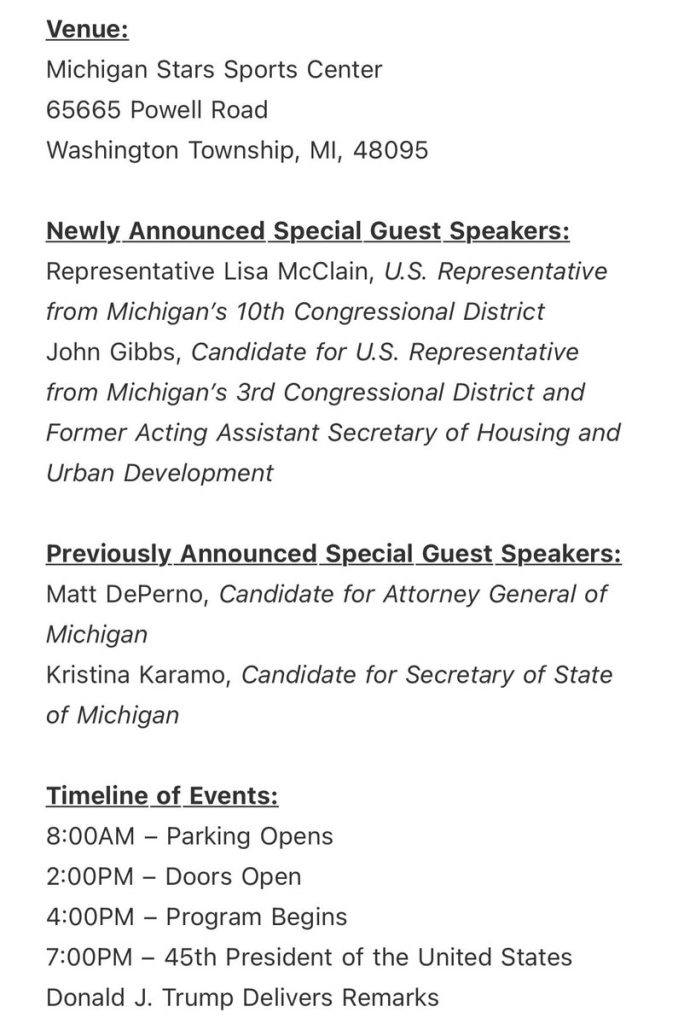
When: Saturday, April 23, 2022 Time: Trump speaking at 7 pm ET Where: Delaware County Fairgrounds
Guest Speakers
J.D. Vance, Candidate for U.S. Senate in Ohio
Rep. Mike Carey, U.S. Representative for Ohio’s 15th Congressional District
Max Miller, Candidate for U.S. Representative for Ohio’s 7th Congressional District
Madison Gesiotto Gilbert, Candidate for U.S. Representative for Ohio’s 13th Congressional District
Over the past four years, President Donald Trump’s administration delivered for Americans of all backgrounds like never before. Save America is about building on those accomplishments, supporting the brave conservatives who will define the future of the America First Movement, the future of our party, and the future of our beloved country. Save America is also about ensuring that we always keep America First, in our foreign and domestic policy. We take pride in our country, we teach the truth about our history, we celebrate our rich heritage and national traditions, and of course, we respect our great American Flag.
We are committed to defending innocent life and to upholding the Judeo-Christian values of our founding.
We believe in the promise of the Declaration of Independence, that we are all made EQUAL by our Creator, and that must all be TREATED equal under the law.
We know that our rights do not come from government, they come from God, and no earthly force can ever take those rights away. That includes the right to religious liberty and the right to Keep and Bear Arms.
We believe in rebuilding our previously depleted military and ending the endless wars our failed politicians of the past got us into for decades.
We embrace free thought, we welcome robust debate, and we are not afraid to stand up to the oppressive dictates of political correctness.
We know that the rule of law is the ultimate safeguard of our freedoms, and we affirm that the Constitution means exactly what it says AS WRITTEN.
We support fair trade, low taxes, and fewer job-killing regulations, and we know that America must always have the most powerful military on the face of the Earth.
We believe in Law and Order, and we believe that the men and women of law enforcement are HEROES who deserve our absolute support.
We believe in FREE SPEECH and Fair Elections. We must ensure fair, honest, transparent, and secure elections going forward – where every LEGAL VOTE counts.
Or rather, “Hey Chinese Communist Party and your entire array of servitors, ass-wipers, and fellators!”
You’re not even worth my time this week. When you decide to act like civilized people, maybe I’ll give you a lesson or two in how non-barbarians behave.
Hey BiteMe! (Or, Whoever Has Their Hand Rammed Up That Putrefying Meat Puppet’s Ass)
[Language warning]
You and yours have caused a lot of injury. Literal injury with your war on people who don’t want to take an untested vaccine. When people die in an emergency room because a hospital won’t admit them because they haven’t had their clot shot, that’s a crime.
I’m going to address here the insult on top of the injury, because I am among the insulted. I still have my health but apparently you want me to live under the 8th Street Bridge (which actually isn’t on 8th Street, but whatever, that’s what the I-25 overpass over Cimarron is called), so maybe if you have your way that won’t be true for long. Dreadful time of year to become homeless.
No, you’re just trying to make me unemployed, because I won’t take your fucking shots.
Well, that threat is NOT going to work. I. Won’t. Take. Your. Fucking. Shots.
And it looks like enough people agree, that you’re having to back down, you worthless asswipe.
You’re LOSING.
You LOSER.
You Chinese-bought ratfucking traitor.
I would love to see you die an agonizing, humiliating death. (This isn’t a threat, because I am not threatening to cause that death. I am just announcing my intention to party if it happens.) It would be just recompense for the way you’re killing America…and millions of Americans.
His Fraudulency
Joe Biteme, properly styled His Fraudulency, continues to infest the White House, we haven’t heard much from the person who should have been declared the victor, and hopium is still being dispensed even as our military appears to have joined the political establishment in knuckling under to the fraud.
One can hope that all is not as it seems.
I’d love to feast on that crow.
(I’d like to add, I find it entirely plausible, even likely, that His Fraudulency is also His Figureheadedness. (Apparently that wasn’t a word; it got a red underline. Well it is now.) Where I differ with the hopium addicts is on the subject of who is really in charge. It ain’t anyone we like.)
Justice Must Be Done.
The prior election must be acknowledged as fraudulent, and steps must be taken to prosecute the fraudsters and restore integrity to the system.
Nothing else matters at this point. Talking about trying again in 2022 or 2024 is hopeless otherwise. Which is not to say one must never talk about this, but rather that one must account for this in ones planning; if fixing the fraud is not part of the plan, you have no plan.
Lawyer Appeasement Section
OK now for the fine print.
This is the WQTH Daily Thread. You know the drill. There’s no Poltical correctness, but civility is a requirement. There are Important Guidelines, here, with an addendum on 20191110.
We have a new board – called The U Tree – where people can take each other to the woodshed without fear of censorship or moderation.
And remember Wheatie’s Rules:
1. No food fights 2. No running with scissors. 3. If you bring snacks, bring enough for everyone. 4. Zeroth rule of gun safety: Don’t let the government get your guns. 5. Rule one of gun safety: The gun is always loaded. 5a. If you actually want the gun to be loaded, like because you’re checking out a bump in the night, then it’s empty. 6. Rule two of gun safety: Never point the gun at anything you’re not willing to destroy. 7. Rule three: Keep your finger off the trigger until ready to fire. 8. Rule the fourth: Be sure of your target and what is behind it.
Everything down except palladium (and it went down on Friday). Silver down a LOT in percentage terms. So I guess the market manipulators (if they aren’t tinfoil hat imaginings, but that’s yet another metal) are at work.
Expect continued inflation and for shortages to not just continue but get worse.
James Webb Space Telescope Update
JWST is still in the last mirror-alignment iteration.
The NASA website is talking about temperature right now. MIRI is keeping chill at 6 or 7 kelvins, but not everything is at final temperature. The mirror, especially, is not quite at its final temperature. The primary mirror segments’ (the segments are the individual hexagonal parts of the big mirror) temperatures vary from 34.3 to 54.5 kelvins, and the secondary mirror (which is at the end of the tripod-like structure; it reflects light back towards the instruments) is at 29.4 kelvins. The primary and secondary mirrors are made out of beryllium, which just takes a long time to cool off. Things are close enough, though, to work on commissioning the instruments, and for that the telescope is oriented to look at the ecliptic poles (i.e., perpendicular to Earth’s orbital plane, or roughly parallel to the sun’s axis of rotation), and in that orientation JWST heats up the most. Which is still not much but at those temperatures any amount of heating could be significant. But the system is working well, and the spacecraft can continue cooling off even in this orientation.
Orthodox Easter
Yesterday was Good Friday. Tomorrow is Easter.
If you’re thinking I’m out of my skull, well, you’re probably right but not on account of this; you see, I am talking about (Eastern) Orthodox holidays.
Easter is supposed to be the first Sunday after the first full moon after the spring equinox (the “paschal moon”, which is why it moves all over the place from year to year, but actually computing that date is a challenge.
Today, of course, we could determine the exact instant of the equinox (start of spring), the exact instant of the full moon, and then go to the next Sunday. But because not every place on Earth is at the same date, that could be problematic. Imagine that first full moon being on Sunday at 11:43 PM ET; that day should be Easter, right? But in Europe and certainly in Jerusalem, that’s Monday, and so Easter should be the next Sunday, not this Sunday.
But in ancient and medieval times, the Church just deemed spring to start on March 21, and counted from there using an algorithm that approximates the phase of the moon. But even March 21 being the first day of spring is a bit slippery, historically, because we began to switch calendars in 1564. Currently, it’s very likely that March 21 will actually be the first day of spring, but before the change spring might start on March 10–but the algorithm said to start with whatever day was called March 21, not the actual day of the equinox.
The algorithm is still being used today, with the “new,” more correct March 21.
Trying to follow the thread of this made my head hurt, but apparently, because (Eastern) Orthodoxy didn’t change calendars when the (Roman) Catholic church did, nor even when the protestant churches did, they don’t agree with the western churches, and usually end up celebrating Easter (and every other thing tied to the date of Easter) a week later.
Now whether they are late (rather than later), or the West jumps the gun and celebrates early, is a fight I don’t have a dog in. But the difference is an interesting historical artifact of how both our knowledge of astronomy and our calendars have developed over the centuries.
Obligatory PSAs and Reminders
China is Lower than Whale Shit
Remember Hong Kong!!!
Whoever ends up in the cell next to his, tell him I said “Hi.”
中国是个混蛋 !!! Zhōngguò shì gè hùndàn !!! China is asshoe !!!
China is in the White House
Since Wednesday, January 20 at Noon EST, the bought-and-paid for His Fraudulency Joseph Biden has been in the White House. It’s as good as having China in the Oval Office.
Joe Biden is Asshoe
China is in the White House, because Joe Biden is in the White House, and Joe Biden is identically equal to China. China is Asshoe. Therefore, Joe Biden is Asshoe.
But of course the much more important thing to realize:
Joe Biden Didn’t Win
乔*拜登没赢 !!! Qiáo Bài dēng méi yíng !!! Joe Biden didn’t win !!!
This Sanctuary Sunday Open Thread, with full respect to those who worship God on the Sabbath, is a place to reaffirm our worship of our Creator, our Father, our King Eternal.
It’s also a place to read, post, and discuss news that is worth knowing and sharing. Please post links to any news stories that you use as sources or quote from.
In the QTree, we’re a friendly and civil lot. We encourage free speech and the open exchange and civil discussion of different ideas. Topics aren’t constrained, and sound logic is highly encouraged, all built on a solid foundation of truth and established facts.
We have a policy of mutual respect, shown by civility. Civility encourages discussions, promotes objectivity and rational thought in discourse, and camaraderie in the participants – characteristics we strive toward in our Q Tree community.
Please show respect and consideration for our fellow QTreepers. Before hitting the “post” button, please proofread your post and make sure you’re addressing the issue only, and not trying to confront the poster. Keep to the topic – avoid “you” and “your”. Here in The Q Tree, personal attacks, name-calling, ridicule, insults, baiting, and other conduct for which a penalty flag would be thrown are VERBOTEN.
In The Q Tree, we’re compatriots, sitting around the campfire, roasting hot dogs, making s’mores, and discussing, agreeing, and disagreeing about whatever interests us. This board will remain a home for those who seek respectful conversations.
– sent the 10 plagues on Egypt to free the Israelites – enabled the Israelites to carry away the riches of Egypt – provided the pillars of fire and cloud to guide them – moved the pillars to protect the Israelites – parted the Red Sea (or Sea of Reeds) – closed the waters to drown the pursuing Egyptians – sweetened the waters at Marah – sent quails and manna to feed the Israelites – provided water from the rock in Horeb – enabled the Israelites to defeat the Amalekites – came in thunder and lightning, with a thick cloud over Mount Sinai – descended to Sinai in fire with an earthquake – appeared in His Shekinah Glory over the Israelites’ Tabernacle – caused the earth to swallow Koreb and his rebellious followers – enabled the Israelites to destroy the Canaanites at Hormah
After all this, the Israelites grew impatient, and spoke against God and Moses.
Then the Lord sent venomous snakes among them; they bit the people and many Israelites died. The people came to Moses and said, “We sinned when we spoke against the Lord and against you. Pray that the Lord will take the snakes away from us.” So Moses prayed for the people.
Then God told Moses to make a bronze snake and put it up on a pole so the people could easily see it. God would use this bronze snake to heal people so they wouldn’t die.
And what would God require the people to do in order to live?
– NOT to build an altar to God – NOT to make a sacrifice to God – NOT to bring an offering to God – NOT to promise to love God with all their soul, mind and strength – NOT to obey all God’s commands – NOT to have faith that would move mountains – NOT to sin no more – NOT to worship God more fervently – NOT to praise God more frequently – NOT to pray to God even longer – NOT even to quit complaining about eating manna every day
Just LOOK at it. Not look and believe . . . just look.
“Anyone who is bitten can look at it and live.” So Moses made a bronze snake and put it up on a pole. Then when anyone was bitten by a snake and looked at the bronze snake, they lived.
Now faith is a very integral component in Jesus’ completed work of salvation. “For God so loved the world, that He gave His only begotten Son, that whosoever believeth in Him should not perish, but have everlasting life.”
This episode with the snakes is a foreshadowing of things to come . . . a precursor to Jesus’ death on the cross to save our lives from sin. God chose the circumstances and the action to be taken to save one’s life.
God knows full well the frailty of belief from men, and I believe He has chosen to require only a simple trust from a person in Jesus as Savior. And, although it is impossible to completely understand, God then has given to each of us the sufficient measure of faith . . . it is not of ourselves, it is the gift of God. We can’t fully understand this . . . we have only to accept the gift in belief . . . and give thanks and praise to God for it!
We are fortunate that we have more than a bloodied, pierced, dead Savior lifted up on a cross to look to. We have a triumphant Savior, raised from the dead in total and complete victory over the sin that would deny us life. And now, He has ascended to the Father, our Father in heaven, where He now sits at God’s right hand, interceding on our behalf, until God makes His enemies His footstool.
Praise God! Maranatha!
Low in the grave He lay, Jesus, my Savior, Waiting the coming day, Jesus, my Lord!
Vainly they watch His bed, Jesus, my Savior; Vainly they seal the dead, Jesus, my Lord!
Death cannot keep his Prey, Jesus, my Savior; He tore the bars away, Jesus, my Lord!
The Chinese Should Think Before Wiping Us Out As Sometimes They Need Us To Solve Their Problems For Them
Okay you knuckledragging ChiComs trying to take us down…here’s a history lesson for you.
For millennia, you had to suffer from this:
Yep. Steppe Nomads. They laid waste to your country, burned, raped and pillaged (but not in that order–they’re smarter than you are) for century after century.
You know who figured out how to take them on and win? The Russians.
Not you, the Russians. And it took them less than two centuries. And Oh By The Way they were among the most backward cultures in Europe at the time.
You couldn’t invent an alphabet, you couldn’t take care of barbarians on horseback, and you think you can take this board down?
HAHAHAHAHAHAHA!!!! We’re laughing at you, you knuckledragging dehumanized communists…worshipers of a mass-murderer who killed sixty million people!
I mean, you still think Communism is a good idea even after having lived through it!
By my reckoning that makes you orders of magnitude more stupid than AOC, and that takes serious effort.
His Fraudulency
Joe Biteme, properly styled His Fraudulency, continues to infest the White House, and hopium is still being dispensed even as our military appears to have joined the political establishment in knuckling under to the fraud.
One can hope that all is not as it seems.
I’d love to feast on that crow.
“No Chemicals”
A detailed analysis of the contents of His Fraudulency’s skull was performed.
Absolutely no chemicals found!
Justice Must Be Done.
The prior election must be acknowledged as fraudulent, and steps must be taken to prosecute the fraudsters and restore integrity to the system.
Nothing else matters at this point. Talking about trying again in 2022 or 2024 is hopeless otherwise. Which is not to say one must never talk about this, but rather that one must account for this in ones planning; if fixing the fraud is not part of the plan, you have no plan.
Political Science In Summation
It’s really just a matter of people who can’t be happy unless they control others…versus those who want to be left alone. The oldest conflict within mankind. Government is necessary, but government attracts the assholes (a highly technical term for the control freaks).
James Webb Space Telescope Update
MIRI (the Midrange InfraRed Instrument) is now at 6K and the final iteration of mirror alignment is in progress. Once this is done, it’s time to work on commissioning the instruments…and I have no idea what that entails, to be honest. My vague notions of what that meant were all taken care of as part of the mirror alignment process.
The NASA blog put out another article on what JWST is expected to do. It’s expected to learn more about extrasolar planets that we have already detected; in particular it will be able to analyze their atmospheres.
Lawyer Appeasement Section
OK now for the fine print.
This is the WQTH Daily Thread. You know the drill. There’s no Poltical correctness, but civility is a requirement. There are Important Guidelines, here, with an addendum on 20191110.
We have a new board – called The U Tree – where people can take each other to the woodshed without fear of censorship or moderation.
And remember Wheatie’s Rules:
1. No food fights 2. No running with scissors. 3. If you bring snacks, bring enough for everyone. 4. Zeroth rule of gun safety: Don’t let the government get your guns. 5. Rule one of gun safety: The gun is always loaded. 5a. If you actually want the gun to be loaded, like because you’re checking out a bump in the night, then it’s empty. 6. Rule two of gun safety: Never point the gun at anything you’re not willing to destroy. 7. Rule three: Keep your finger off the trigger until ready to fire. 8. Rule the fourth: Be sure of your target and what is behind it.
In fact, they closed 3PM on Thursday; the market weenies get Good Friday off and apparently that’s true even in Asia.
Gold is definitely on another upward climb. It was a couple of bucks higher on Wednesday, but that downtick doesn’t cover the fact that it’s distinctly in the upper 19s now. (1975? I remember that year…) The price of platinum can’t get any rounder than it is right now (even rounder than rhodium’s was last week). Palladium and rhodium are the two losers this week, albeit not by very much. But they are the two metals whose price is most dependent on industry.
T4 Combinatorics
If you’re wondering what “Combinatorics” is (and let’s face it, you probably weren’t wondering until you read that title, if even then), it’s the branch of mathematics that has to do with counting things; including counting the number of possible combinations of things. It’s not “hard” to do, but the concepts are a bit abstract sometimes.
If you’ve ever seen those statements about how many different configurations some puzzle (like a Rubik’s Cube) can have (and only one of them is right!), those were computed with combinatorics. (No one went and looked for them all.)
Ancient Indian physician Sushruta in the 6th century BCE asserted that given six tastes, there are sixty three possible combinations total where they are taken one at a time, two at a time, three at a time, and so forth. The ancient Greeks looked into this sort of thing too. During the Middle Ages, more progress was made, but not in Europe. Again in India more general formulas were found.
The specific problem here is precisely the number of combinations of different objects can occur. As it turns out, that’s also the same number as possible sequences of coin tosses.
Going back to Sushutra’s example, if you flip a coin six times, there are 64 possible outcomes. It could come out tails all six times. It could come out tails the first five times, then heads the last time. It could come out tails the first four times, then heads the fifth time, then tails the last time. And so on. If I were to tabulate all 64 of them with 0s (for tails) and 1s (for heads) it would look like someone counting in base 2 or binary.
000000 000001 000010 000011
…and so on.
There’s another method of stepping through all of the possibilities, and that’s to use a sequence where exactly one of the six things changes each time. That’s a bit trickier, but you can get some cool patterns out of it (like the bottom half of the list being a mirror image of the top half…except for the first digit which is 1 instead of 0).
But something may be bothering you….Sushutra said there were 63 combinations; I have just been yapping about there being 64. The discrepancy is because Sushutra didn’t count the case where none of his 6 samples were being tasted.
So far, perhaps not a surprise. The number of possibilities is 2n, where n is the number of times you toss the coin (or the number of flavors you’re sampling). And this works when the different tries are independent of each other. In the case of the coins, one toss has no effect on any of the others. In the case of the flavors, there are no rules like, for example, that flavor E is forbidden if you are using flavor B.
Slightly more interesting is the question, out of these six possibilities, how many of them have exactly three flavors. Or how many possible sequences of six coin tosses have exactly three heads in them?
Well, it turns out there’s a formula for this. And it involves, interestingly enough, combining formulas for another couple of possible problems.
Let’s say you have six scrabble tiles, A, B, C, D, E, F. How many possible words are there?
You could exhaustively list them all out, but that’s tedious. Instead let’s try thinking about it.
There are six possible choices for the first letter. Once you pick the first letter, though, there are five possible choices for the second letter; so each of the six first possible letter possibilities has five possible second letters. So that’s 6 x 5 = 30 possibilities for the first two letters. You can proceed similarly, 4 possibilities for the third letter, 3 for the fourth, 2 for the fifth, and 1 for the sixth. So we’re looking at 6 x 5 x 4 x 3 x 2 x 1 = 720 possible combinations. (It’s a good thing we decided not to try to list them all!)
This is a common enough thing that we call this the factorial and denote it with an exclamation point, in this case, 6! = 6 x 5 x 4 x 3 x 2 x 1 = 720.
I don’t believe it’s possible to form a good word of English out of those six letters, with all of those six letters and no others (but correct me if I’m wrong!); the best I can come up with is FACED. Or DECAF. I guess if you’re sore at the Federal Elections Commission you could say BADFEC.
But this is a game of Scrabble, and so you might settle for using some of the tiles. For example, how many candidate four letter words are there?
You can follow the same reasoning as above. Six possibilities for the first letter, five possibilities (for each of the six) for the second letter (30). Four possibilities (for each of the thirty) for the third letter (120). For each of those, three possible fourth letters (360). But now we STOP, because we don’t pick a fifth, or sixth letter. The math is: 6 x 5 x 4 x 3 = 360. So it’s like 6! only not taken all the way down to 1. In fact, it’s like 6! divided by 2!. Look: (6x5x4x3x2x1)/(2×1); the twos and ones cancel and we’re left with 6x5x4x3. Note that 2 is 6 – 4, i.e., it’s the total number of titles minus the number of tiles actually chosen.
So there’s a general formula here. You have n objects, you want to choose m of them. The number of possibilities is n!/(n-m)!
One thing that needs to be stressed, though! This formula is for use when you care about the order of the selection. In other words, if you grabbed the letters A, C, E, F, it matters to you whether you grabbed them as F, A, C, E or C, A, F, E or FCEA.
When dealing with Sushruta’s flavors, the first, third, fifth and sixth flavors (combined) taste the same no matter what order you’re adding them. It’s as if you didn’t care what order ACEF was written in.
So how do you adjust your answer to the question of how many possible ways to select four of the six letters if you don’t care about the order?
Well, imagine that you had actually written down all of the possible combinations (all 360 of them). Some number of these would have the letters A, C, E, and F in them. In fact, all possible orders of those letters would appear in the list exactly once. How many possible orderings of A,C,E,F are there? We already know this: 4 x 3 x 2 x 1.
And this is true for any possible grouping of four letters. There will be nine other anagrams of those four letters in the list.
So to get the answer, we start with our 360…and divide by 4! which is to say, 24, and get 15. This is the factorial of the number of objects we are choosing (m).
So, remember we got the 360 with n!/(n–m)!; this new number involves dividing again by m!.
So our number of combinations for an unordered choice of m objects out of a group of n objects is n!/[(n–m)!m!]. My combinatorics teacher called it “n-choose-m” or he’d substitute actual numbers.
We could, for example, figure out how many possible groups of ten letters we could pull out of the alphabet. With 26 letters, we have 26!/(16! x 10!).
So punch that into your calculator.
Well, don’t. 26! is probably too big for your calculator.
But you can probably get clever before you punch the numbers in.
Write those factorials out. It turns out you can do a lot of cancelling! You can skip 10×9…x1 on top, and just divide by 16x15x14…on the bottom. Better yet, you can skip the 16x15x…x1 on top and only divide by 10! on the bottom.
26 x 25 x 24 x 23 x 22 x 21 x 20 x 19 x 18 x 17 / 10 x 9 x 8 x 7 x 6 x 5 x 4 x 3 x 2 x 1.
Right off the bat, you can cancel the 20 up top with the 10 and 2 on the bottom, and the 18 up top with the 6 and 3 on the bottom:
26 x 25 x 24 x 23 x 22 x 21 x 19 x 17 / 9 x 8 x 7 x 5 x 4 x 1
Do a bit more cancelling–get rid of the 5, 7, and 4 by dividing them into the 25, 21, and 24 respectively:
26 x 5 x 6 x 23 x 22 x 3 x 19 x 17 / 9 x 8
You have three even numbers on top. Divide them all by 2 and get rid of the 8 on the bottom:
13 x 5 x 3 x 23 x 11 x 3 x 19 x 17 / 9
And you now have two threes, so you can get rid of the 9 and those 3s
13 x 5 x 23 x 11 x 19 x 17
Well, now, we don’t have to do any dividing! In fact, you should NEVER have to do any dividing after you cancel. Why? We’re counting numbers of combinations, and that has to be a whole number. You won’t get a fraction. So if it looks like you’re about to get a fraction, you messed up somewhere–you didn’t do a cancellation you could have, or you made a simple arithmetic error.
So now go to the calculator, and it turns out there are 5,311,735 possible sets of ten letters you could pull out of 26 letters of the alphabet.
Yikes, that’s a lot!
You can get to some really big numbers this way with bigger “pots” of choices; in fact you can easily get to numbers that are larger than the numbers of quarks in the universe without too much trouble.
In fact, consider the number of possible bridge hands, which is 52!/(39!13!). If you think you’ve played enough bridge to repeat a hand…you’re probably wrong! Because there are 635,013,559,600 of them. That’s still more than the US Debt…though ask me again next week.
(And the game would still be different unless the other three players also each got the same hand as before. This could be computed with our n-choose-m formula, too, applied successively (it’ll be that number, times 39-choose-13, times 26-choose-13, times 26-choose-26) to see how many possible bridge deals there are.)
There’s another clever method to compute m-choose-n. It’s very visually oriented, but it does involve computing all of the smaller problems first.
Start with 1.
Then below it, staggered, write 1 1.
So you see:
1 1 1
You repeat this, over and over again. Each number is the sum of the two above it (and “blank” is zero). So you get:
1 1 1 1 2 1 1 3 3 1 1 4 6 4 1 1 5 10 10 5 1
And so on. What good is this exercise (which is called “Pascal’s Triangle”)?
It turns out that if you go to row n, the mth element is n-choose-m. But you have to start counting from zero. That last row is row 4 (not 4). And if you want 4-choose-2 you have to go to the third element on that row, which is 6. This is logical, because the actual first element is always a 1, and that’s how many ways you can pick zero items out of the group of 4. Or 17, or whatever. The last number is choosing all of the elements, and of course there’s only one way to do that (if you don’t care about the order).
Another neat thing about this triangle is if you sum up everything in the row, you get the total number of possible selections in that row, for example, with 4 items, the total is 16…which is 24.
Pascal’s triangle has a whole host of interesting properties, actually.
Once you see this triangle, it’s pretty clear that the biggest single n-choose-m value is when m is half the size of n. (Or if n is odd, when m is either just above or just below half of n.)
So that, if you toss a coin a hundred times, the most likely outcome is 50 heads and 50 tails, (In fact that is possible about 1×1029 different ways!) though a 49/51 split is almost as common (~9.89 x 1028 different ways), and a 48/52 split wouldn’t be all that surprising either (~9.32×1028 different ways). But 100 heads (or tails) in a row? Ridiculously unlikely! Even a 75/25 split can “only” occur 2.42 x 10²³ ways, which sounds like a lot…but is 2 42/100 millionths as common as a 50/50 split. And therefore. 0.00000242 times as likely as a 50/50 split if you try the experiment.
Conversely an exact 50/50 split might be the most likely result, but it’s less likely than a 49/51 and 51/49 split put together, much less if you add all the other near/even splits. There are 2100 possible sequences, that’s 1.267×1030 possibilities. So there’s roughly 1 chance in 12 2/3 you’d get an exact 50/50 split.
The takeaway from this is that an exact “middle” result becomes less and less likely the more things are involved…but a result near the middle becomes overwhelmingly likely the more things are involved.
But what, you might ask, does this have to do with heat and temperature and thermodynamics?
This sort of example does not really have much to do with it, but the general concepts behind combinatorics do have a lot to do with it, as it turns out. Next time…
Obligatory PSAs and Reminders
China is Lower than Whale Shit
Remember Hong Kong!!!
Whoever ends up in the cell next to his, tell him I said “Hi.”
中国是个混蛋 !!! Zhōngguò shì gè hùndàn !!! China is asshoe !!!
China is in the White House
Since Wednesday, January 20 at Noon EST, the bought-and-paid for His Fraudulency Joseph Biden has been in the White House. It’s as good as having China in the Oval Office.
Joe Biden is Asshoe
China is in the White House, because Joe Biden is in the White House, and Joe Biden is identically equal to China. China is Asshoe. Therefore, Joe Biden is Asshoe.
But of course the much more important thing to realize:
Joe Biden Didn’t Win
乔*拜登没赢 !!! Qiáo Bài dēng méi yíng !!! Joe Biden didn’t win !!!
Here we are. Friday. In honor of the day, today’s libation is a Rusty Nail.
For decades, one of the hottest cocktails was the Rusty Nail. But after a good run, the simple combination of scotch and the scotch-based liqueur Drambuie, a word derived from Gaelic meaning “the drink that satisfies,” has fallen off most bar menus and is rarely ordered by patrons.
Just as mystifying as its disappearance was its appearance in the first place. The lineage of the potent after-dinner libation is contested, with many believing it was invented in 1937 for the British Industries Fair trade show. It does appear in the 1967 edition of “Old Mister Boston Official Bartender’s Guide,” the cocktail book of record through the post-Prohibition 20th century. (A similar drink, dubbed the Little Club #1, is included in Ted Saucier’s 1951 “Bottoms Up.”)
By the late 1960s, bars in New Orleans and New York were serving the concoction, and “Have you tried a Rusty Nail?” was a common refrain. The Rusty Nail is often credited to the clever bartenders at the 21 Club in Manhattan sometime in the early 1960s. It makes sense, being that the establishment created the famous B & B—half Bénédictine and half cognac—as well. It’s easy to imagine that the talented crew applied the same formula to another cordial and liquor, but I haven’t been able to substantiate that claim.
Lore has it that the Rat Pack was enamored with the drink, which may have been responsible for the wide appeal in those years. In the 1970s, I mixed many a Rusty Nail at the joints I worked at in New York. They were also a hit at P.J. Clarke’s, a favorite late-night haunt of Frank Sinatra.
As with lots of classics, the recipe varies widely. Ted Haigh, the author of “Vintage Spirits and Forgotten Cocktails,” likes two parts scotch to one part Drambuie; “Old Mister Boston” calls for a one-to-one ratio; and many modern versions are far drier, with some suggesting four parts whisky to one part liqueur. You could also substitute bourbon for scotch and get a Rusty Spike. But the Rusty Nail is a classic for a reason, and the two-to-one ratio will always be a fine example of the drink.
Ingredients
1 1/2 ounces scotch
3/4 ounce Drambuie
Steps
Add the scotch and Drambuie into a mixing glass with ice and stir until well-chilled.
Strain into a rocks glass over one large ice cube.
So simple even the Scots can make it. Of course, most of their food is based on a dare.
Okay, in case you haven’t heard, Elon Musk put out an offer to buy Twitter outright on Thursday. Dopey Prince Alaweed from Saudi Arabia turned him down, and the whole platform went nuts with the snowflakes melting as if the sun was shining on asphalt.
These are in no particular order as it is late, and I am pressed for time.
New: Foreign potentate seeks to stop sale of American company to an American. Was this government announcement made after consultation with the Biden administration? @ElonMuskhttps://t.co/qzSRVDMotI
"Content moderation" is a euphemism for policing political speech. It has little to do with concerns over harassment or incivility — as everyone on this site already knows. https://t.co/zm3QYl4aY0
…Axios appears to be joining the "freedom is tyranny" campaign, even saying that Musk is in "goblin mode." Of course, in this Marvel offshoot, the villain is the one trying to expand freedom.
What Elon Musk appears to be doing is perhaps the biggest story that few understand.
I share this perspective having spent thousands of hours in the past several years deep in the weeds of tech operating systems, communication platforms, and the issue of simultaneous users. What Twitter represents, and what Musk is attempting, is not what most would think.
In the big picture of tech platforms, Twitter, as an operating model, is a massive high-user commenting system.
Twitter is not a platform built around a website; Twitter is a platform for comments and discussion that operates in the sphere of social media. As a consequence, the technology and data processing required to operate the platform does not have an economy of scale.
There is no business model where Twitter is financially viable to operate…. UNLESS the tech architecture under the platform was subsidized.
In my opinion, there is only one technological system and entity that could possibly underwrite the cost of Twitter to operate. That entity is the United States Government, and here’s why….
There is no business model, even with paying subscribers, for Twitter to exist. As the business grows, the costs increase, and the costs to subscribers would grow. So, what is going on?
The only way Twitter, with 217 million users, could exist as a viable platform is if they had access to tech systems of incredible scale and performance, and those systems were essentially free or very cheap. The only entity that could possibly provide that level of capacity and scale is the United States Government – combined with a bottomless bank account.
If my hunch is correct, Elon Musk is poised to expose the well-kept secret that most social media platforms are operating on U.S. government tech infrastructure and indirect subsidy. Let that sink in.
The U.S. technology system, the assembled massive system of connected databases and server networks, is the operating infrastructure that offsets the cost of Twitter to run their own servers and database. The backbone of Twitter is the United States government.
There is simply no way the Fourth Branch of Government, the U.S. intelligence system writ large, is going to permit that discovery.
Giggle, told you all the other day. Musk is set on buying and REMAKING Twitter. Step one, buy “controlling interest” Done. Step two refuse LAME attempt to stop him by offering him a CONTROLLED and LIMITED board seat DONE.
Step three make HUGE offer for entire company 43 BILLION. DONE Step four remove current corrupt governing officers (Twitter CEO CFO, and Board) COMING…part of the deal to buy, is the current loons MUST GO.Musk will put HIS people in place.
Step five go about accessing and REMOVING via reassignment, demotion, or plain old firing all the leftist supervisors that do the “grunt” work in censoring conservatives. COMING soon after the board is gone. Step six Put in new or retrained and FAIR minded supervisors who will NOT bow to censorship. Step seven open new improved and once again FREE Twitter HAPPENS before the midterms. Step eight Trump is triumphantly returned to Twitter THEN proceeds to decimate Dems and RINOS causing a seismic shift in Congress. Step nine. New RINO limited Republican Congress opens can of WHOOP Ass on Dems, RINOS, and the Globalists including Covid lies, vaccine lies, Ukraine lies, and election fraud. Trump assists with EVIDENCE.
Step 10 Trump reelected in new FREE FAIR election and goes about fixing the shit storm we are in AND at the same time PUNISHING those that got us there AND their enablers.
Step 11 FREEDOM and PROSPERITY return. Musk quadruples investment, and is hailed a true patriot…
This is PART of what is going on behind the scenes. FIRST the LIAR MSM leftist propaganda machine MUST be neutralized, taking away one of their BIG hammers does that
Second, the truth must be spread FAR and wide Third The election fraud will be EXPOSED, disseminated, and thereby allowing CONTROLS to be put in place to STOP it from happening again. Fourth REAL Reps take over Congress, root out corruption, graft, fraud on BOTH sides (hearings etc Fifth Trump retakes WH, eliminates the corruption in the executive branch especially intelligence and DOJ. Sixth new JUSTICE MAGA people are installed in the corrupts places. Seventh evidence presented in the new FREE Twitter to the masses, AND revealed in the NEW Rep Congressional hearings, is presented to Durham, who convenes grand juries and subpoenas. Eighth evidence is presented to NEW MAGA AG and DOJ. Ninth, the NEW DOJ and AG run the trials not through the corrupt systems in DC, NY, or CA, but through MAGA jurisdictions, all while Trump is appointing even MORE MAGA judges and justices to “flip” and weed out leftist loyalists (who also now will face the VERY REAL option of being IMPEACHED by the new Rep Congress. Tenth, the guilty who did so much harm, the ones that have not too the “easy way out” will FINALLY come to see JUSTICE.
Peace, prosperity TRUTH, and the rule of LAW return. There will be MUCH rejoicing. Somewhere in Heaven the good Lord gives a thumbs up, winks at the founding fathers, and says maybe judgement day can wait just a little longer.
Let’s hope so.
In the meantime, all the bed wetting is getting entertaining
Well, and this happened too.
Our bill protects unborn babies from abortion after 15 weeks – these are babies with beating hearts, who can move, taste, see and feel pain.
The discourse on this site is to be CIVIL – no name calling, baiting, or threatening others here is allowed. Those who are so inclined may visit Wolf’s other sanctuary, the U-Tree, to slog it out. There is also a “rescue” thread there for members of the Tree to rendezvous if the main site goes kablooey. A third site has been added for site outages of longer duration.
This site is a celebration of the natural rights endowed to humans by our Creator as well as those enshrined in the Bill of Rights adopted in the founding documents of the United States of America. Within the limits of law, how we exercise these rights is part of the freedom of our discussion.
Fellow tree dweller Wheatie gave us some good reminders on the basics of civility in political discourse:
No food fights.
No running with scissors.
If you bring snacks, bring enough for everyone.
And Auntie DePat’s requests:
If you see something has not been posted, do us all a favor, and post it. Please, do not complain that it has not been done yet.
The scroll wheel on your mouse can be your friend. As mature adults, please use it here in the same manner you would in avoiding online porn.
[1] Unto the end, for the morning protection, a psalm for David. [2]O God my God, look upon me: why hast thou forsaken me? Far from my salvation are the words of my sins. [3] O my God, I shall cry by day, and thou wilt not hear: and by night, and it shall not be reputed as folly in me. [4] But thou dwellest in the holy place, the praise of Israel. [5] In thee have our fathers hoped: they have hoped, and thou hast delivered them.
[2] “The words of my sins”: That is, the sins of the world, which I have taken upon myself, cry out against me, and are the cause of all my sufferings.
[6] They cried to thee, and they were saved: they trusted in thee, and were not confounded. [7] But I am a worm, and no man: the reproach of men, and the outcast of the people. [8] All they that saw me have laughed me to scorn: they have spoken with the lips, and wagged the head. [9] He hoped in the Lord, let him deliver him: let him save him, seeing he delighteth in him. [10] For thou art he that hast drawn me out of the womb: my hope from the breasts of my mother.
[11] I was cast upon thee from the womb. From my mother’s womb thou art my God, [12] Depart not from me. For tribulation is very near: for there is none to help me. [13] Many calves have surrounded me: fat bulls have besieged me. [14] They have opened their mouths against me, as a lion ravening and roaring. [15] I am poured out like water; and all my bones are scattered. My heart is become like wax melting in the midst of my bowels.
[16] My strength is dried up like a potsherd, and my tongue hath cleaved to my jaws: and thou hast brought me down into the dust of death. [17] For many dogs have encompassed me: the council of the malignant hath besieged me. They have dug my hands and feet. [18] They have numbered all my bones. And they have looked and stared upon me. [19] They parted my garments amongst them; and upon my vesture they cast lots. [20] But thou, O Lord, remove not thy help to a distance from me; look towards my defence.
[21] Deliver, O God, my soul from the sword: my only one from the hand of the dog. [22] Save me from the lion’s mouth; and my lowness from the horns of the unicorns. [23] I will declare thy name to my brethren: in the midst of the church will I praise thee. [24] Ye that fear the Lord, praise him: all ye the seed of Jacob, glorify him. [25] Let all the seed of Israel fear him: because he hath not slighted nor despised the supplication of the poor man. Neither hath he turned away his face from me: and when I cried to him he heard me.
[26] With thee is my praise in a great church: I will pay my vows in the sight of them that fear him. [27] The poor shall eat and shall be filled: and they shall praise the Lord that seek him: their hearts shall live for ever and ever. [28] All the ends of the earth shall remember, and shall be converted to the Lord: And all the kindreds of the Gentiles shall adore in his sight. [29] For the kingdom is the Lord’s; and he shall have dominion over the nations. [30] All the fat ones of the earth have eaten and have adored: all they that go down to the earth shall fall before him.
[31] And to him my soul shall live: and my seed shall serve him. [32] There shall be declared to the Lord a generation to come: and the heavens shall shew forth his justice to a people that shall be born, which the Lord hath made.
Only one verse of it is included in the Passions found in Scripture.
And for those who like the music actually written for Good Friday, this piece was written strictly for the Sistine Chapel and for three hundred years was not done outside of it. It’s a bear to hold pitch. Trust me.
This Sanctuary Sunday Open Thread, with full respect to those who worship God on the Sabbath, is a place to reaffirm our worship of our Creator, our Father, our King Eternal.
It’s also a place to read, post, and discuss news that is worth knowing and sharing. Please post links to any news stories that you use as sources or quote from.
In the QTree, we’re a friendly and civil lot. We encourage free speech and the open exchange and civil discussion of different ideas. Topics aren’t constrained, and sound logic is highly encouraged, all built on a solid foundation of truth and established facts.
We have a policy of mutual respect, shown by civility. Civility encourages discussions, promotes objectivity and rational thought in discourse, and camaraderie in the participants – characteristics we strive toward in our Q Tree community.
Please show respect and consideration for our fellow QTreepers. Before hitting the “post” button, please proofread your post and make sure you’re addressing the issue only, and not trying to confront the poster. Keep to the topic – avoid “you” and “your”. Here in The Q Tree, personal attacks, name-calling, ridicule, insults, baiting, and other conduct for which a penalty flag would be thrown are VERBOTEN.
In The Q Tree, we’re compatriots, sitting around the campfire, roasting hot dogs, making s’mores, and discussing, agreeing, and disagreeing about whatever interests us. This board will remain a home for those who seek respectful conversations.
Peace is something everyone wants, yet few seem to find. Peace is “tranquility, harmony, or security.” Depending on the situation, it could mean “prosperity” or “well-being.” Various forms of the word peace are found 429 times in the King James Version of the Bible. There are different types of peace, including false peace, inner peace, peace with God, and peace with man.
In the Old Testament, the primary Hebrew word for “peace” is shalom, and it refers to relationships between people (Genesis 34:21), nations (1 Kings 5:12), and God with men (Psalm 85:8). Peace is a desired status in each of these arenas, and shalom is often tied to a covenant or a promise kept. A familiar friend (literally, “friend of my peace” in Psalm 41:9) is one with whom you would be at ease, a trusted companion. “Peace” was the standard greeting (1 Samuel 25:6), still used in many cultures today.
Peace is directly related to the actions and attitudes of individuals; but it is ultimately a gift from God (Isaiah 45:7; Leviticus 26:6; John 14:27). The presence of peace indicates God’s blessing on man’s obedience (Isaiah 32:17; Malachi 2:5) and faith (Isaiah 26:3). There is no peace for the wicked (Isaiah 48:22).
As valuable as peace is, it’s not surprising to find that it’s sometimes counterfeited. Empty promises of peace can be used to manipulate others. Deceitful men speak words of peace while secretly planning evil (Obadiah 1:7). The Antichrist will confirm a treaty, producing a temporary peace which he will then abruptly shatter as he reveals his true colors (Daniel 9:27). False teachers proclaim peace when God is actually proclaiming judgment (Ezekiel 13:10-16). In Jeremiah’s day, the religious leaders dealt only with the symptoms of the national problems, without addressing the sinful root of the crisis. These false prophets declared everything was well between God and Israel: “Peace, peace,” they said, when there was no real peace (Jeremiah 6:14).
In the New Testament, the primary Greek word for “peace” is eirene, and it refers to rest and tranquility. A key focus of peace in the New Testament is the advent of Jesus Christ, as announced by the angels in Luke 2:14 (“Peace on earth . . .”). Isaiah had predicted the Messiah would be the Prince of Peace (Isaiah 9:6), and He is called the Lord of peace in 2 Thessalonians 3:16. It’s through Christ’s work of justification that we can have peace with God (Romans 5:1), and that peace will keep our hearts and minds secure (Philippians 4:7).
God commands us to seek peace (Psalm 34:14; Matthew 5:9). We should “make every effort to do what leads to peace” (Romans 14:19). Of course, there will be some people who do not desire peace, but we are still to do our utmost to be at peace with them (Romans 12:18).
Believers have an obligation to “let the peace of God rule” in their hearts (Colossians 3:15). This means we have the choice either to trust God’s promises (letting His peace rule) or to rely on ourselves and reject the peace He offers. Jesus gave His disciples peace based on the truth that He has overcome the world (John 14:27; 16:33). Peace is a fruit of the Spirit, so, if we are allowing the Spirit of God to rule in our lives, we will experience His peace (Galatians 5:22-23). To be spiritually minded brings life and peace, according to Romans 8:6.
The world will continue to have wars and interpersonal conflicts until Jesus comes to establish true, lasting peace (see Isaiah 11:1-10), but God will give His peace to those who trust Him. Jesus took the chastisement of our peace (Isaiah 53:5) and has made it possible for us to have peace with God. Once His peace rules in our hearts, we’re able to share that peace with others; we become publishers of peace (Isaiah 52:7) and ministers of reconciliation (2 Corinthians 5:18).
Philippians 4:7 refers to “the peace of God which transcends all understanding.” Most of Paul’s letters began with the words “Grace and peace to you from God our Father and the Lord Jesus Christ.” Peace is a state of tranquility or quietness of spirit that transcends circumstances. The term peace is described in Scripture as a gift from God and congruent with His character (1 Thessalonians 5:23; Galatians 6:16; 1 Peter 1:2; Hebrews 13:20).
If God is peace, then to know God is to bask in His peace. The closer we draw to Him, the more of His peace we can enjoy (James 4:8). God gives us clear instructions about how to draw near to Him. Psalm 24:3–4 says, “Who may ascend the mountain of the Lord? Who may stand in his holy place? The one who has clean hands and a pure heart, who does not trust in an idol or swear by a false god.” But Scripture is also clear that we cannot make ourselves clean enough or pure enough to earn the presence of the Lord (Romans 3:10, 23).
So how do we draw near enough to experience His peace? Jesus said, “Peace I leave with you; my peace I give to you. Not as the world gives do I give to you. Let not your hearts be troubled, neither let them be afraid” (John 14:27). We come into the presence of the Lord through His Son (John 14:6). When we allow Jesus’ death and resurrection to purchase our forgiveness from God, we are counted as righteous (2 Corinthians 5:21). Our sins are forgiven because Jesus already paid the price for them. Only then can we have peace with God (Romans 4:5; 5:1; 1 John 4:10).
The initial peace that comes from having our consciences wiped clean grows as we get to know God better (Hebrews 10:22). Second Peter 1:2 says, “May God give you more and more grace and peace as you grow in your knowledge of God and Jesus our Lord” (NLT). When we grow in understanding of the depths and riches of God’s love toward us (Ephesians 3:18–19; Romans 8:38–39), our minds and spirits begin to rest in His power and wisdom. We begin to understand that He really will make all things work together for our good (Romans 8:28). We learn that His purposes will be accomplished (Psalm 33:11; Proverbs 19:21; Isaiah 45:9; 46:9–11).
Certain attitudes can destroy the peace of God. When we equate trust with the assumption that God will give us whatever we want, we set ourselves up for disappointment. The Bible is filled with examples of the opposite happening to God’s people (2 Corinthians 12:7–9; Hebrews 11:13; Psalm 10:1). Trust means we have set our hearts to believe God, whatever may happen. When we insist on being in control, we sabotage God’s desire to let us live in peace. When we choose worry rather than faith, we cannot live in peace. Jesus warned us often about fear and worry (Matthew 6:34; Luke 12:29; Philippians 4:6). Worry is the enemy of peace. God invites us to cast our cares upon Him and then let go of them (1 Peter 5:7).
Living in peace can be compared to the petals of a flower unfolding in the morning sunlight. The petals of peace in our lives unfold as we learn more about God. We discover that His character is always faithful. We experience His continual goodness. We read more of His promises (Psalm 100:5; 115:11; Isaiah 26:4). We learn to bask in His overwhelming love for us (Romans 8:38–39). We refuse to allow ever-changing circumstances to determine our level of contentment, relying instead upon the character of God that never changes (James 1:17; Malachi 3:6).
When we develop a lifestyle of making the Lord our refuge, we begin to live in the peace of God (Psalm 46:1; 62:8). Psalm 91:1 holds the secret to living in the peace of God: “He that dwells in the secret place of the most High shall abide under the shadow of the Almighty. I will say of the LORD, He is my refuge and my fortress: my God; in him will I trust.” That secret place in our hearts is where we go to meet with God. When we choose to live there and hide away under His shadow, staying in constant communion with Him, we can remain peaceful, even when circumstances may not be. When we learn to cry out to Him in times of trouble, we find that His peace really does pass all human understanding (Philippians 4:7).
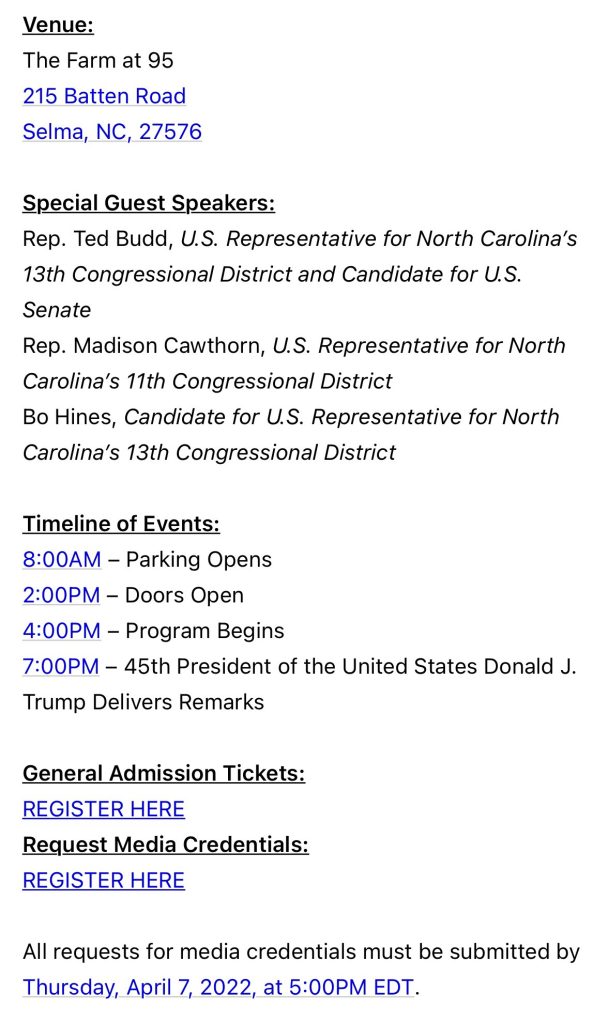
ANYONE THAT APPRECIATES TRUMP AND WHAT HE IS TRYING TO DO FOR "OUR" COUNTRY!! THEN YOU NEED TO GO SUPPORT HIM. IN SELMA, NC. APRIL 9TH AT 7P.M. SATURDAY NIGHT…HE NEEDS THE PEOPLE. ONE MAN CAN'T DO IT BY HIS SELF…
We had a hard time getting a hotel a few days in advance in NC. I looked up and down 95 and all the nice ones had sold out, we ended up staying 20 min off 95, come to find out there’s a TRUMP rally in Selma NC today!! Imagine people traveling And staying for Biden 😂😂 #trump2024
Selma was officially chartered as a Town on February 11, 1873, but the Town’s true birth took place on May 1, 1867, when there was a public sale of lots around a newly established station on the North Carolina Railroad. Selma was born as a “Railroad Town,” and our rail heritage is still evident today, with our recently renovated 1924Union Depot (Selma Union Depot) supporting Amtrak service.
The Town is also home to the Mitchener Station, which was built in 1855 and it is thought to be the oldest surviving train station in North Carolina. When Interstate 95 was built in the late 1950s, the Town experienced growth due to its proximity to the Interstate. Today, there are many hotels and restaurants located in the area for visitors traveling on Interstate 95.
And one of Selma’s most famous residents was Lunsford Richardson, who was born in 1854 on a farm near Selma. He rose to fame as the inventor of Vick’s Vapo-Rub. After graduating from Davidson College at the top of his class, he became a teacher and then a pharmacist, working out of Dr. Joshua Vick’s drugstore in Selma. While in Johnston County, he invented Richardson’s Croup and Pneumonia Cure Salve and later changed the name to Vick’s Salve in honor of Dr. Vick. The name was then changed to Vick’s Vapo-Rub and a nationwide advertising campaign made the name a household word. In 1905, Richardson convinced the Postal Service to allow him to mass-mail his advertising circulars simply to “boxholder” instead of individuals. Because this marked the first such mailing, Richardson gained the dubious distinction of also being known as “the father of junk mail.”
Well, we all have to be known for something, right?
Over the past four years, President Donald Trump’s administration delivered for Americans of all backgrounds like never before. Save America is about building on those accomplishments, supporting the brave conservatives who will define the future of the America First Movement, the future of our party, and the future of our beloved country. Save America is also about ensuring that we always keep America First, in our foreign and domestic policy. We take pride in our country, we teach the truth about our history, we celebrate our rich heritage and national traditions, and of course, we respect our great American Flag.
We are committed to defending innocent life and to upholding the Judeo-Christian values of our founding.
We believe in the promise of the Declaration of Independence, that we are all made EQUAL by our Creator, and that must all be TREATED equal under the law.
We know that our rights do not come from government, they come from God, and no earthly force can ever take those rights away. That includes the right to religious liberty and the right to Keep and Bear Arms.
We believe in rebuilding our previously depleted military and ending the endless wars our failed politicians of the past got us into for decades.
We embrace free thought, we welcome robust debate, and we are not afraid to stand up to the oppressive dictates of political correctness.
We know that the rule of law is the ultimate safeguard of our freedoms, and we affirm that the Constitution means exactly what it says AS WRITTEN.
We support fair trade, low taxes, and fewer job-killing regulations, and we know that America must always have the most powerful military on the face of the Earth.
We believe in Law and Order, and we believe that the men and women of law enforcement are HEROES who deserve our absolute support.
We believe in FREE SPEECH and Fair Elections. We must ensure fair, honest, transparent, and secure elections going forward – where every LEGAL VOTE counts.
SPECIAL SECTION: Message For Our “Friends” In The Middle Kingdom
You knuckle-dragging barbarians are still trying to muck with this site, so I’ll just repeat what I said last time.
Up your shit-kicking barbarian asses. Yes, barbarian! It took a bunch of sailors in Western Asia to invent a real alphabet instead of badly drawn cartoons to write with. So much for your “civilization.”
Yeah, the WORLD noticed you had to borrow the Latin alphabet to make Pinyin. Like with every other idea you had to steal from us “Foreign Devils” since you rammed your heads up your asses five centuries ago, you sure managed to bastardize it badly in the process.
Have you stopped eating bats yet? Are you shit-kickers still sleeping with farm animals?
Or maybe even just had the slightest inkling of treating lives as something you don’t just casually dispose of?
中国是个混蛋 !!! Zhōngguò shì gè hùndàn !!! China is asshoe !!!
And here’s my response to barbarian “asshoes” like you:
OK, with that rant out of my system…
Loop it if you like; I will wait.
Richly deserved.
Justice Must Be Done
The prior election must be acknowledged as fraudulent, and steps must be taken to prosecute the fraudsters and restore integrity to the system.
Nothing else matters at this point. Talking about trying again in 2022 or 2024 is hopeless otherwise. Which is not to say one must never talk about this, but rather that one must account for this in ones planning; if fixing the fraud is not part of the plan, you have no plan.
Lawyer Appeasement Section
OK now for the fine print.
This is the WQTH Daily Thread. You know the drill. There’s no Poltical correctness, but civility is a requirement. There are Important Guidelines, here, with an addendum on 20191110.
We have a new board – called The U Tree – where people can take each other to the woodshed without fear of censorship or moderation.
And remember Wheatie’s Rules:
1. No food fights 2. No running with scissors. 3. If you bring snacks, bring enough for everyone. 4. Zeroth rule of gun safety: Don’t let the government get your guns. 5. Rule one of gun safety: The gun is always loaded. 5a. If you actually want the gun to be loaded, like because you’re checking out a bump in the night, then it’s empty. 6. Rule two of gun safety: Never point the gun at anything you’re not willing to destroy. 7. Rule three: Keep your finger off the trigger until ready to fire. 8. Rule the fourth: Be sure of your target and what is behind it.
Gold is moving around within a fairly tight range lately.
James Webb Space Telescope Update
A lot of material has been written by the JWST team. The mirrors are lined up and focused, but they need to be focused for all five of the sensors behind the mirror before they can do the next iteration of fine-tuning. But that has only been done for four of them. What’s the issue? The issue is that the Mid-InfraRed Instrument (MIRI) has been blind until very recently.
The other four instruments have gotten down to their desired operating temperatures of 34 to 39 kelvins. (And I discussed kelvins last week. Very convenient timing!) But they all work in either long wavelength visible light (oranges and reds) or “near infrared.” “Near” because it’s right next to visible wavelengths, just a bit longer than our eyes can see. But objects at room temperature actually glow at some of these frequencies, so in order to keep the sensor itself from glowing in the very light it’s trying to see, we keep them cooled off.
But the longer the wavelength (and lower the frequency) we want to see, the colder we have to make the instrument. Mid Infrared is longer than near infrared, so we have to cool MIRI down to about 7 kelvins or less. From MIRIs point of view the rest of the spacecraft, at -390 to -399 F, is scorching hot!
This is done with cryogenic cooling, using helium. Apparently at least some of the power on board the spacecraft runs what is essentially a refrigerator, and we’ve been running that and allowing MIRI to slowly, slowly cool down to -450 F. We don’t want to cool it off too fast lest frost form on the sensor (which would FUBAR it).
From what I can see MIRI is actually at this temperature now, so the mirror adjusting fun can resume.
What use is MIRI? It’s expected to be able to look at stars–and their accompanying planets–as they form. For instance, we’ve all seen “the Pillars of Creation” as imaged by Hubble, which is actually a part of the Eagle nebula.
The Pillars of Creation. This isn’t the original picture; they had Hubble go back and take another picture after they upgraded its cameras.
As presented the pillars run vertically, but the “Eagle Nebula” name was given to it based on the appearance of that area seen rotated 90 degrees clockwise. Or, here is a picture of the entire nebula, rotated only about 45 degrees. The dark area in the center is shaped a bit like an eagle, you can see the wings to the left, the body in the center, and the talons to the right…and of course, blown up, it’s “The Pillars of Creation.”
The Eagle Nebula
The Pillars of Creation picture is actually in false color, with green used to show hydrogen, etc., the picture of the eagle nebula is more like what it would look to us if we were close enough to it for it to be bright enough for us to see color.
But here’s what the Pillars look like in infrared:
The Pillars of Creation in infrared
Of course the colors here are ALL false; an infrared image in true color would look black.
But notice you can see a lot more stars.
Infrared can cut through dust clouds, including the dust clouds that condense to form stars and planets. So MIRI is expected to help us greatly in our quest to study “solar systems” that are forming Out There. This is all described in this blog post, from which I ripped off these pictures.
Fuck Joe Biden
Biden, you don’t even get ONE scoop of ice cream today.
(Please post this somewhere permanent, as it will continue to be true; the SOB will never deserve a scoop.)
Incidentally, I’m writing this on Friday. This morning I saw a full-sized pickup truck in the oncoming left turn lane with a forest of flags in the bed. Once he turned and drove left-to-right in front of me, I could see two American flags near the cab, and SIX “Let’s Go Brandon” flags near the tailgate. That was unusual; usually there’s a mix of FJB (only not abbreviated) and “Trump Won” and “Trump 2024” flags when someone does this.
I haven’t seen such a display in a few weeks, by the way. Even the guy at the office complex where I work with the FJB flag on his pickup seems to have removed it (or doesn’t work there any more–trucks all look alike to me from the back, and all crossovers look like cockroaches).
T3 Heat Engines
In the early 1800s, steam engines were the cutting edge tech. We didn’t talk of them changing the world, because before that time, really the world didn’t change much over a person’s lifetime. People in the late 1700s pretty much lived as they had hundreds of years earlier. In fact, living conditions in Europe at the time (for everyone except the nobility and a very small wealthy merchant class) were described as “Third World Europe.” Except that unlike the third world today, we had no concept of sanitation, vaccination (real vaccination, not this current crap), the germ theory of disease, etc., so we had high infant mortality rates and all the rest of the stuff that today’s Third World is getting away from.
The steam engine, and the prosperity it would bring to Europe, would ultimately change that, and usher in an era where we are actually used to seeing rapid technological change generating wealth that even the not-so-rich and not-so-connected could accumulate.
If you recall my first Thermo post, I talked about turning work (energy doing something macroscopic like moving objects around) into heat, and how heat and work were both forms of energy.
A steam engine is one of a large class of devices called heat engines, that turn heat back into work.
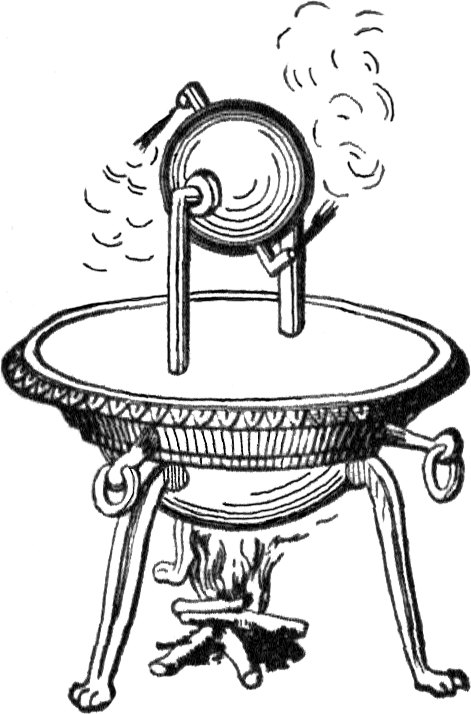
A common misconception is that James Watt “invented” the steam engine. No, he didn’t. Actually the first known thing that was something sort of like a steam engine was put together by Hero of Alexandria (10-70 CE), and it’s either called Hero’s Engine or the Aeolipile (from Greek αιολουπυλη). It looks something like this:
The Aeolipile
A cauldron of boiling water is kept under pressure, steam can only get out by going into an object free to move around a pivot (like a bird on a spit over a fire). The steam can only escape by going through the bent arms; it generates a thrust that causes the doohickey to spin.
So Hero was actually able to get heat to do work–some fifteen or so centuries before we had our scientific concept of “work.”
The next step was to actually put something like this to work. It took a while. In 1698 Thomas Savery invented a pump for water that worked by steam power. Steam was allowed to cool and condense , which created a near vacuum which could be used to suck water upwards against gravity. Then more steam could be used to push that water.
So the first commercial application for steam power was to pump water.
Small copies of this device were reasonably efficient, larger ones were not. And lift height was severely limited (since it was a vacuum pump). And the power wasn’t continuous.
In 1712 Thomas Newcomen came up with a steam engine that could deliver continuous power and it used a cylinder, but was still very inefficient because parts of the engine itself (not just the steam) ended up being heated and cooled, heated and cooled, over and over again…which took time. These things could pump water out of mines…slowly. Still, it was better than paying some grunt to do it.
What Watt did was vastly improve the Newcomen engine. And now it could be used not just to pump water, but to pull trains, and power steamships, and even (very primitive) automobiles. And also to power factory equipment, which up until then had been almost entirely reliant on water power or (worse) animal power.
A good steam engine could supply LOADS of power.
And of course this was something scientists investigated. And what they learned could be used to make steam engines even more efficient, delivering more work for the same amount of fuel, which could be either wood, or coal that was pulled out of some of the mines the steam engine had been invented to pump water out of.
One “model” of an engine that could turn heat into work was the Carnot Engine, basically an idealized model, a thought experiment.
What’s needed is a piston with gas in it, a huge mass at high temperature (called the hot reservoir) that we can attach to the piston, and another huge mass at cold temperature (the cold reservoir) which we can attach to the piston as well. It runs through four phases, then from the fourth phase, it returns to the first phase.
Phase one starts with the piston pushed in all the way. There’s a tiny space inside filled with hot gas, under pressure. The gas is at exactly the same temperature as the hot reservoir.
Now you could let the gas under pressure expand, and push on the piston and use that to do work. But as the gas expands, it will lose pressure and the temperature will drop. Instead, what we want to do is let the gas absorb heat from the hot reservoir, so that it stays at the same temperature as it expands. Ideally the temperature is exactly the same but in practical terms this is unachievable (unless you are willing to take literally forever for it to happen).
Phase 2 is to allow the gas to continue to expand and push the piston, but now you let the gas cool off…until it reaches the temperature of the cold reservoir.
Phase 3 is to compress the gas, and keep it at the same temperature as the cold reservoir. Compressing the gas would normally raise its pressure and temperature, but we let the increased heat bleed into the cold reservoir. Do this infinitely slowly, and the gas in the cylinder stays at the cold reservoir temperature.
Phase 4, finally, is to continue compressing the gas, but let it heat up…all the way up to the temperature of the hot reservoir. We’re now back to having compressed gas at the temperature of the hot reservoir.
So what has happened here? We’ve extracted a net amount of work from the system…more came out letting the gas expand and cool than we had to put into it recompressing the gas. Also, some heat energy has been taken from the hot reservoir and put into the cold reservoir.
In reality, this would result in the hot reservoir cooling off just a tiny bit, and the cool reservoir heating up just a tiny bit, but this ideal model assumes these reservoirs are of infinite size.
So what’s going on here? Heat has moved, and some (notice: some, not all) of that heat got turned into work. The rest simply moved from hot to cold and did no work for us at all. And since heat moves from hot to cold naturally, not the other way, that heat energy we didn’t use is gone for good.
As it turns out this “Carnot Cycle” is the most efficient possible way, even in principle, to turn the heat differential between a hot and cold body into work. And it gets more efficient the greater the difference between the two. (And this is true even for engines that are steam turbines with no piston at all, or where the working fluid changes from a gas to a liquid…they can’t beat the Carnot engine.)
The maximum theoretical efficiency is 1-TC/TH. Note that those temperatures need to be measured against absolute zero (so kelvins and Rankines work). You’ll note that if TC and TH are far apart, that fraction gets smaller, and the efficiency climbs, if you can make that fraction 0, your efficiency is 1 (i.e., 100 percent). As a practical matter, though, we don’t have a cold reservoir at 0 K, so we can’t reach 100 percent efficiency even in principle. And whatever this number is…our current power plants don’t even achieve that.
But this is why power plants (coal, nuclear, natural gas, even geothermal) run so hot; it’s to raise the temperature of the working gas as high as possible. And this is why geothermal usually sucks as a power source. You have to drill way, way, way down to get to rocks hot enough to be worth the effort. Of course in some places, like Iceland the hot stuff is closer to the surface. Yellowstone has, if anything, even more potential than Iceland does for geothermal power.
And of course with nuclear and fossil fuels, we control the temperature difference and you can bet we run them as hot as we can.
Since a Carnot engine is as efficient as you can get, a lot of engine design since the mid 1820s has been to try to get as close to a Carnot engine as possible. (That was, for example, the initial idea behind the Diesel engine; eventually Diesel had to start making design compromises.)
In every power plant we build (other than geothermal) the heat reservoir is not only not infinite in size, but it’s actually rather small. It would cool off rapidly as the engine cycles, and the heat is transferred out. To keep it hot, we have to burn fuel. So we’re basically burning fuel to create heat to maintain the temperature of the hot reservoir so we can then turn the heat into work.
With geothermal, the reservoir is huge, perhaps even yuge, but still finite; using geothermal does suck heat energy out of the earth and dump it somewhere colder. It’s just that there’s so much of it we’ll never notice.
A typical coal fired plant uses the work extracted from burning the coal (and keeping the hot reservoir hot) to turn a generator. And the efficiency is roughly 30 percent. 30 percent of the energy in the coal becomes electricity. In fact the engineers and designers are overjoyed when they get that number.
But that does mean the other 70 percent is wasted as waste heat…and it can’t be any other way.
Waste heat is inevitable, and it can’t be recovered. Not without reversing the process. We can push heat energy from the cold to hot reservoir by supplying work. If it’s a Carnot engine, we can run the process in reverse, put the work we got out back in, and move all the heat back where it came from. For any real engine, it will take more work to move less heat than we lost creating the work in the first place. In other words, a Carnot engine is a reversible process. But no real heat engine is reversible this way. But if you try, you will move some heat from cold, back to hot.
This is the idea behind a heat pump.
In reality, there are always losses, and (again) there’s no such thing as a Carnot engine. So if, say, you ran your (real) heat engine and got 100 joules of work out of it, and 200 joules of heat ended up in the cold reservoir, you’d probably need to put 150 joules into it to move those 200 joules back to the hot reservoir. Where would you get the extra 50 joules from? Maybe from another engine, which has its own losses and its own inefficiencies, and even more energy flows from its hot reservoir to its cold reservoir.
In fact, there’s no way to completely reverse heat flow from hot to cold. Any attempt actually moves even more heat from hot to cold in the process. Which might be worth it, if you want to cool the inside of your refrigerator. You suck some heat energy out…at the cost of more heat energy being permanently lost somewhere else.
But on net, heat flows one way, one way only: From hot to cold. Even a theoretically perfectly reversible process like a Carnot engine just holds the total flow to zero. Never negative.
This is what was originally behind the concept of entropy. It denotes that fact that as processes go forward, temperatures even out, they get more and more evened out as time goes on, never the other way around.
(If you think you know of a case, like the inside of your refrigerator, recognize that that’s at the cost of more heat flow in the other direction somewhere else. This is why you can’t cool your house by opening the refrigerator door and leaving it open–it dumps the heat through the coils in back…more heat than it sucks out of the inside. Your air conditioner, on the other hand, does work…by dumping the heat (again, more than it removed from your living space) outside your house and making the outside warmer than it was before.)
Entropy is, conceptually, a measure of how much heat energy is irretrievably lost, and it increases. (It can even be quantified and measured…but that’s WAY beyond the scope of this post.) Entropy never shows a net decrease.
(Entropy is also second only to quantum mechanics as a source of pop philosophizing with a scientific/geeky bent to it. More on this in future posts, because the concept of entropy would eventually be greatly extended beyond mere “waste heat” type considerations.)
So what happens at some distant day when all of the energy in the universe has become waste heat and is irretrievably lost? Well, it’s game over.
Thinking in the long term, the big picture is the entire universe is running down. It will ultimately be one big thing of uniform temperature…and though there will be a lot of heat energy out there, none of it will be usable, not just for industry, but for life itself.
The concept of entropy, and the accompanying realization that the universe as a whole must run down, was the dawn of the science of thermodynamics. The true “dismal science.” Economics is sometimes called the dismal science, but it doesn’t hold a candle to thermodynamics when it comes to “dismal.”
Obligatory PSAs and Reminders
China is Lower than Whale Shit
Remember Hong Kong!!!
Whoever ends up in the cell next to his, tell him I said “Hi.”
中国是个混蛋 !!! Zhōngguò shì gè hùndàn !!! China is asshoe !!!
China is in the White House
Since Wednesday, January 20 at Noon EST, the bought-and-paid for His Fraudulency Joseph Biden has been in the White House. It’s as good as having China in the Oval Office.
Joe Biden is Asshoe
China is in the White House, because Joe Biden is in the White House, and Joe Biden is identically equal to China. China is Asshoe. Therefore, Joe Biden is Asshoe.
But of course the much more important thing to realize:
Joe Biden Didn’t Win
乔*拜登没赢 !!! Qiáo Bài dēng méi yíng !!! Joe Biden didn’t win !!!
½ fluid ounce triple sec (orange-flavored liqueur)
1 fluid ounce sweet and sour mix
1 fluid ounce cola, or to taste
1 lemon slice
Directions
Fill a cocktail shaker with ice. Pour vodka, rum, gin, tequila, triple sec, and sour mix over ice; cover and shake. Pour cocktail into a Collins or hurricane glass; top with splash of cola for color. Garnish with a lemon slice.
True confession: I had one of these for my first legal drink…and haven’t had one since.
Alright, shall we kick things off with Sundance noticing something that the rest of us have seen for a while?
The word ‘autocracy‘, with all its variants, has been used a lot frequently by western government politicians as they attack the ideology of Russia, China and essentially every national leader who does not join their “rules-based order” club. There is so much linguistic repetition from the same western leadership, it’s impossible not to see this autocracy narrative as some form of talking point that stemmed from some G7 or NATO collaboration meeting.
It does not seem coincidental the new catch phrases of “autocracy” vs “rules-based order” surfaced at the tail end of the COVID crisis, when Build Back Better shifted from a talking point into an actual set of western legislative constructs perhaps intended to codify the emergency powers those same officials deployed.
What kind of democracy, or rules-based order mindset, was the European Commission carrying when they decried the overwhelming national election in Hungary? Surely if the EU wanted to celebrate democracy, they would cheer for the high voter turnout that reelected Prime Minister Viktor Orban, yet they did exactly the opposite. Apparently, some democracies are more valued than others.
At the same time the EU is clutching pearls over the results in Hungary, another western ally, Canada, is codifying the government’s emergency act power to seize property without due process. As we are directed to be distracted by everything Zelenskyy, it might be worth noting that Ontario Bill 100 is about to permanently change the rules of permitted political protest. You can read about Bill 100 here and watch the economic debate here.
Essentially, Bill 100 gives the Canadian government the power to seize your home, finances, bank accounts and assets if you take part in any form of protest that would create economic harm to any loosely defined entity. Protest at the border, lose your house; at least that’s the threat they are about to make into a law.
It seems rather incredulous to me that securing a corporate financial interest would override the concerning possibility of forever losing liberty and freedom for the individual citizen. However, in this new post-COVID ‘rules-based order’, that’s the official justification from the Canadian government. Slippery slope and all that accepted, this Ontario Bill 100 is a few slides beyond the slippery.
Similar actions are taking place in New Zealand and Australia, where codifying the emergency powers of public health officials post-COVID rules, is at the forefront of their legislative and constitutional reform efforts.
Creating new era ‘rules-based democracy’ stuff is filling up the business end of western government attention in Europe, North American and the land down under.
Remember what i posted yesterday about select members of the Cabal all of a sudden testing positive for Covid, even though they have all made it through 2 years without it, in the HEIGHT of the “outbreak”. NOW, cases are at the lowest since the beginning?
I am telling you this is too much of a “coincidence, and as Q said, there are NO coincidences.
Schiff then Pelosi? within 24 hours. SOMETHING is up TOO many of the HIGHER profile Cabal are just suddenly “testing positive” and then out of the spotlight for a bit. With all that is going on with election fraud and Durham this cannot be a mere happenstance.
Word on the Telegram channels is “testing positive” is code for being taken in for questioning. On what? We don’t know what we don’t know.
In the meantime, the normies are starting to wake up on some of the truths we’ve known about the beer bug and the clot shots for quite a while, and good information is finding its way into the big name blog sites like The Blaze.
It’s no longer January 2021, when we all thought we lived in a world of normal vaccines. It’s no longer OK for elected officials to mindlessly repeat the bromide “safe and effective” without any reflection about the mass injury we’ve witnessed, along with the waning and the negative efficacy, in itself, engendering calls for endless boosters. We have so much information that raises serious questions, not the least of which is from Pfizer’s own documents, now ordered released by a federal judge, thanks to Public Health and Medical Professionals for Transparency, and FOIA requests from groups like the Informed Consent Action Network.
Here are just three of the most recent revelations from these documents that expose the government/pharma narrative to be a lie at its core:
1) Pfizer needed massive staff to process adverse event reports…
2) Rate of myocarditis…
So, all of these stories suggesting that young males were more at risk for myocarditis from the virus than from the shots were bogus, and Pfizer knew it. And again, if this is the degree the company is willing to concede, imagine what the true incidence rate is.
Also, what is the degree of subclinical myocarditis? If we know about this many cases shortly after the injection, who’s to say there isn’t another cohort of people with heart damage that has remained subclinical so far but could come to fruition several months later? Remember, with many fewer vaccines administered in 2022, the rate of myocarditis reports to VAERS is averaging 245% higher than last year.
3) Pfizer knew about natural immunity…
Pfizer claims efficacy against severe illness among those who took the shot vs. the placebo group among those without prior infection. Researchers report one case in the trial group and 21 in the placebo group. Then they mix together results of those with and without prior infection, and yet the numbers remain the same at 1 and 21 respectively! That means that among those with prior infection, there were zero cases of serious reinfection in both the trial and placebo groups.
Waking up is happening whether the Davos crowd wants it to or not.
Amazing what news of grooming at the Mouse’s House will manifest.
BREAKING: Protesters gather in front of the Disney HQ in Burbank CA chanting “BOYCOTT DISNEY!” pic.twitter.com/hKVp2ufGBQ
Have you ever decorated a bed with six or more pillows?
Can you tell the difference between cream white and rustic farmhouse white?
Have you run into a curb in the past 24 hours? Be honest, CAROL.
DO YOU BLEED? Like, for an extended period of time at regular intervals?
Does it take you over three hours to decide what you want to eat?
Are you currently a member of at least three pyramid schemes?
Do you find simple movie plots hard to follow?
Do you frequently describe your emotional state as “fine” when you are not in fact fine?
Is your Starbucks drink order anything other than black coffee?
Do you have two X chromosomes?
Tally up your number of “Yes” answers and consult this chart:
0-2: There’s a small chance you’re a dude, bro.
3-5: We’re getting some real feminine vibes here.
6-8: Starting to look kinda likely that you’re probably a woman.
9-11: Definitely a woman.
12: You are the final boss of women. Congrats!
Not revealing my score, but I could tell the Couch Commando the difference between cream white and rustic farmhouse white. My brother being a true guy, just laughed. I also haven’t hit a curb this week, and am not participating in any pyramid schemes to my knowledge.
Rocky III. Eye of the Tiger. Survivor. Take your pick. We went to see that in the theater, and half the swim team was there. That was not organized, but it was fun.
The discourse on this site is to be CIVIL – no name calling, baiting, or threatening others here is allowed. Those who are so inclined may visit Wolf’s other sanctuary, the U-Tree, to slog it out. There is also a “rescue” thread there for members of the Tree to rendezvous if the main site goes kablooey. A third site has been added for site outages of longer duration.
This site is a celebration of the natural rights endowed to humans by our Creator as well as those enshrined in the Bill of Rights adopted in the founding documents of the United States of America. Within the limits of law, how we exercise these rights is part of the freedom of our discussion.
Fellow tree dweller Wheatie gave us some good reminders on the basics of civility in political discourse:
No food fights.
No running with scissors.
If you bring snacks, bring enough for everyone.
And Auntie DePat’s requests:
If you see something has not been posted, do us all a favor, and post it. Please, do not complain that it has not been done yet.
The scroll wheel on your mouse can be your friend. As mature adults, please use it here in the same manner you would in avoiding online porn.
10For I hear many whispering. Terror is on every side! “Denounce him! Let us denounce him!” say all my familiar friends, watching for my fall. “Perhaps he will be deceived, then we can overcome him, and take our revenge on him.” 11But the LORD is with me as a dread warrior; therefore my persecutors will stumble, they will not overcome me. They will be greatly shamed, for they will not succeed. Their eternal dishonor will never be forgotten. 12O LORD of hosts, who triest the righteous, who seest the heart and the mind, let me see thy vengeance upon them, for to thee have I committed my cause. 13Sing to the LORD; praise the LORD! For he has delivered the life of the needy from the hand of evildoers.
Russel Brand is just so on it with this one, it’s not even funny.
In a stunning turn of events, Washington Township in Michigan’s wiki page as well as the city website is all business and not a word about history, so that piece is omitted for this rally.
WATCH: Mike Lindell rages that TV stations won't run his MyPillow ads if he is in them: Speaking with a reporter in Washington Township, Michigan before Donald Trump holds a rally at the Michigan Stars Sports Center, MyPillow CEO Mike Lindell claime.. https://t.co/Px3uwEVNtO
— Top U.S. & World News🗽 (@USRealityCheck) April 2, 2022
Still here outside the Michigan Trump Rally registering people to be Precinct Delegates and giving away these signs! If you’re down here, come check us out! You can’t miss our table! 👀🇺🇸 pic.twitter.com/pyY6b3nrtq
Over the past four years, President Donald Trump’s administration delivered for Americans of all backgrounds like never before. Save America is about building on those accomplishments, supporting the brave conservatives who will define the future of the America First Movement, the future of our party, and the future of our beloved country. Save America is also about ensuring that we always keep America First, in our foreign and domestic policy. We take pride in our country, we teach the truth about our history, we celebrate our rich heritage and national traditions, and of course, we respect our great American Flag.
We are committed to defending innocent life and to upholding the Judeo-Christian values of our founding.
We believe in the promise of the Declaration of Independence, that we are all made EQUAL by our Creator, and that must all be TREATED equal under the law.
We know that our rights do not come from government, they come from God, and no earthly force can ever take those rights away. That includes the right to religious liberty and the right to Keep and Bear Arms.
We believe in rebuilding our previously depleted military and ending the endless wars our failed politicians of the past got us into for decades.
We embrace free thought, we welcome robust debate, and we are not afraid to stand up to the oppressive dictates of political correctness.
We know that the rule of law is the ultimate safeguard of our freedoms, and we affirm that the Constitution means exactly what it says AS WRITTEN.
We support fair trade, low taxes, and fewer job-killing regulations, and we know that America must always have the most powerful military on the face of the Earth.
We believe in Law and Order, and we believe that the men and women of law enforcement are HEROES who deserve our absolute support.
We believe in FREE SPEECH and Fair Elections. We must ensure fair, honest, transparent, and secure elections going forward – where every LEGAL VOTE counts.