2022·02·26 Joe Biden Didn’t Win Daily Thread


SPECIAL SECTION: Message For Our “Friends” In The Middle Kingdom

I normally save this for near the end, but…basically…up your shit-kicking barbarian asses. Yes, barbarian! It took a bunch of sailors in Western Asia to invent a real alphabet instead of badly drawn cartoons to write with. So much for your “civilization.”

Yeah, the WORLD noticed you had to borrow the Latin alphabet to make Pinyin. Like with every other idea you had to steal from us “Foreign Devils” since you rammed your heads up your asses five centuries ago, you sure managed to bastardize it badly in the process.

Have you stopped eating bats yet? Are you shit-kickers still sleeping with farm animals?

Or maybe even just had the slightest inkling of treating lives as something you don’t just casually dispose of?

中国是个混蛋 !!!
Zhōngguò shì gè hùndàn !!!
China is asshoe !!!

And here’s my response to barbarian “asshoes” like you:

OK, with that rant out of my system…

Biden Gives Us Too Much Credit

…we can move on to the next one.

Apparently Biden (or his puppeteer) has decided we’re to blame for all of the fail in the United States today.

Sorry to disappoint you Joe (or whoever), but you managed to do that all on your own; not only that, you wouldn’t let us NOT give you the chance because you insisted on cheating your way into power.

Yep, you-all are incompetent, and so proud of it you expect our applause for your sincerity. Fuck that!!

It wouldn’t be so bad, but you insist that everyone else have to share in your misery. Nope, can’t have anyone get out from under it. Somehow your grand vision only works if every single other person on earth is forced to go along. So much as ONE PERSON not going along is enough to make it all fail, apparently.

In engineering school we’re taught that a design that has seven to eight billion single points of failure…sucks.

Actually, we weren’t taught that. Because it would never have occurred to the professors to use such a ridiculous example.

Justice Must Be Done.

The prior election must be acknowledged as fraudulent, and steps must be taken to prosecute the fraudsters and restore integrity to the system.

Nothing else matters at this point. Talking about trying again in 2022 or 2024 is hopeless otherwise. Which is not to say one must never talk about this, but rather that one must account for this in ones planning; if fixing the fraud is not part of the plan, you have no plan.

Kamala Harris has a new nickname since she finally went west from DC to El Paso Texas: Westward Hoe.

Mozart

Sedate. The adagio (2nd movement) from his clarinet concerto.

And a bit…less sedate. Last movement of his Symphony #41 which is the last one he wrote.

(Don’t be fooled by the fact that there’s a Symphony #42, or 43, or…well up to #55 at least…as I explained last time the numbering isn’t really chronological. To the best of my knowledge he’s got at least 51 symphonies under his belt (though some are disputed), so if we were ever to renumber them, this one would be #51. But we never will renumber them; that would cause confusion for centuries.)

By the way, that sucker ends in a five part fugue. Not easy to write!

Lawyer Appeasement Section

OK now for the fine print.

This is the WQTH Daily Thread. You know the drill. There’s no Poltical correctness, but civility is a requirement. There are Important Guidelines,  here, with an addendum on 20191110.

We have a new board – called The U Tree – where people can take each other to the woodshed without fear of censorship or moderation.

And remember Wheatie’s Rules:

1. No food fights
2. No running with scissors.
3. If you bring snacks, bring enough for everyone.
4. Zeroth rule of gun safety: Don’t let the government get your guns.
5. Rule one of gun safety: The gun is always loaded.
5a. If you actually want the gun to be loaded, like because you’re checking out a bump in the night, then it’s empty.
6. Rule two of gun safety: Never point the gun at anything you’re not willing to destroy.
7. Rule three: Keep your finger off the trigger until ready to fire.
8. Rule the fourth: Be sure of your target and what is behind it.

(Hmm a few extras seem to have crept in.)

Spot Prices

All prices are Kitco Ask, 3PM MT Friday (at that time the markets close for the weekend).

Gold seems to be see-sawing around the $1900 mark. This is what we’ve been seeing for months now. No…wait. Until just a couple of weeks ago it was see-sawing around the $1800 mark.

I start these posts by copying the one from five weeks ago. That way I get to keep the eagle from back then. One of my chores is to go in and modify the precious metals prices (which otherwise would be, respectively, six and five weeks out of date on publication).

But this time I’m going to keep them, just to show you.

January 15 (“last week” for January 22):

Gold $1,819.10
Silver $23.06
Platinum $979.00
Palladium $1,875.00
Rhodium $17,400.00

January 22:

Gold $1831.80
Silver $24.31
Platinum $1043.00
Palladium $2194.00
Rhodium $17,650.00

I then asked if this was a break out. But the prices went right back down again! Here’s January 29 (four weeks ago):

Gold $1791.20
Silver $22.56
Platinum $1019.00
Palladium $2466.00
Rhodium $17,750.00

Now I’ve been watching gold bounce around just under, just over 1900 bucks (at least through Wednesday).

OK, so here’s what I’d normally put in this spot:

Last week:

Gold $1,896.50
Silver $23.98
Platinum $1,077.00
Palladium $2,432.00
Rhodium $19,550.00

Gold actually crossed the 1900 line briefly last week. Now it has been above and below it; it is at $1908.50 right this second (12:14 PM Wednesday). Thursday, it touched $1980.10 briefly in overnight trading.

Wow! That’s not an all time high but it’s within sight of it (I believe the all time high was about $2025.)

So here it is, Friday after markets closed and we see:

Friday, 3PM MT close:

Gold $1,890.00
Silver $24.36
Platinum $1,065.00
Palladium $2,457.00
Rhodium $20,750.00

Gold has been shoved down ninety dollars from its midweek high.

JWST Update

Webb has made a lot of progress just in the last couple of days. There have been two entries to the blog. The first was basically explaining in a great deal of technical detail how it’s going to search for very early galaxies. This is to try to shed some light (so to speak) on how galaxies formed in the first place. This happened at a time before the maximum look-back time Hubble could see. https://blogs.nasa.gov/webb/2022/02/24/to-find-the-first-galaxies-webb-pays-attention-to-detail-and-theory/

But today I checked again, and it looks like HUGE progress has been made on the mirror alignment. They’re still looking at HD 84406, a star in Ursa Major that’s fairly bright (but still not bright enough to be seen with the unaided eye) but more importantly relatively isolated on the celestial sphere.

Here’s the blog entry: https://blogs.nasa.gov/webb/2022/02/25/webb-mirror-alignment-continues-successfully/ I will summarize below.

Last week they had swiveled all of the segments so that the light from each segment landed in a certain place, forming a pattern that matched up with the actual layout of the mirrors.

This week they tried to focus each individual mirror, and it appears they have largely succeeded. Here is a GIF showing “before” and “after”
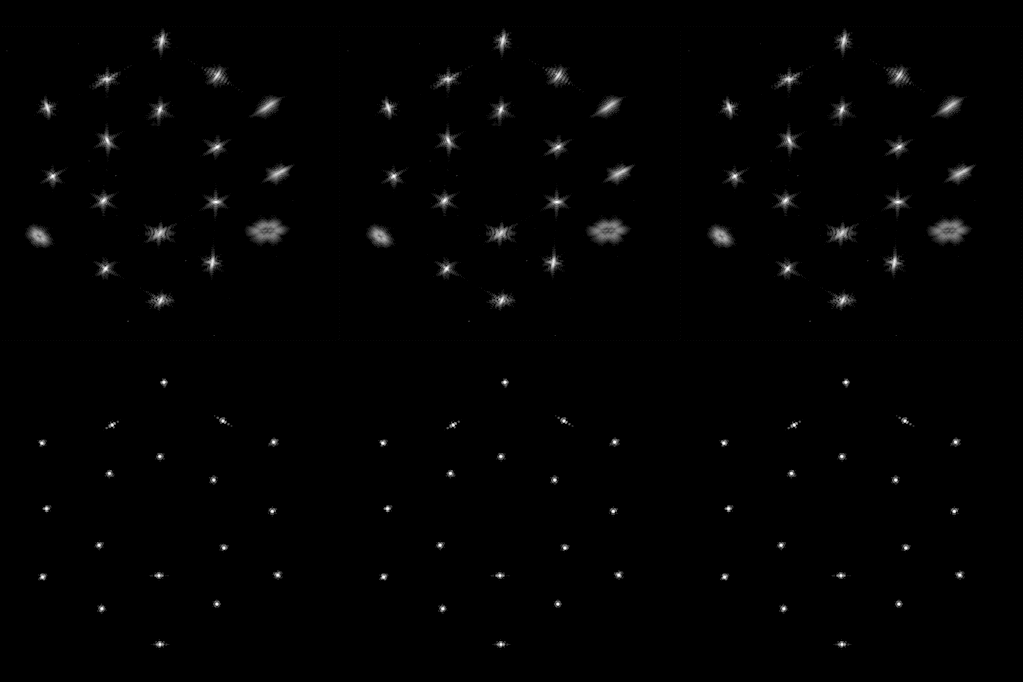
Not only did they complete that step (which is step 2 of the mirror work), but then they swiveled the mirrors some more, and put all 18 images in the same place, completing step 3! (They weren’t even scheduled to start work on it for another week or so!)
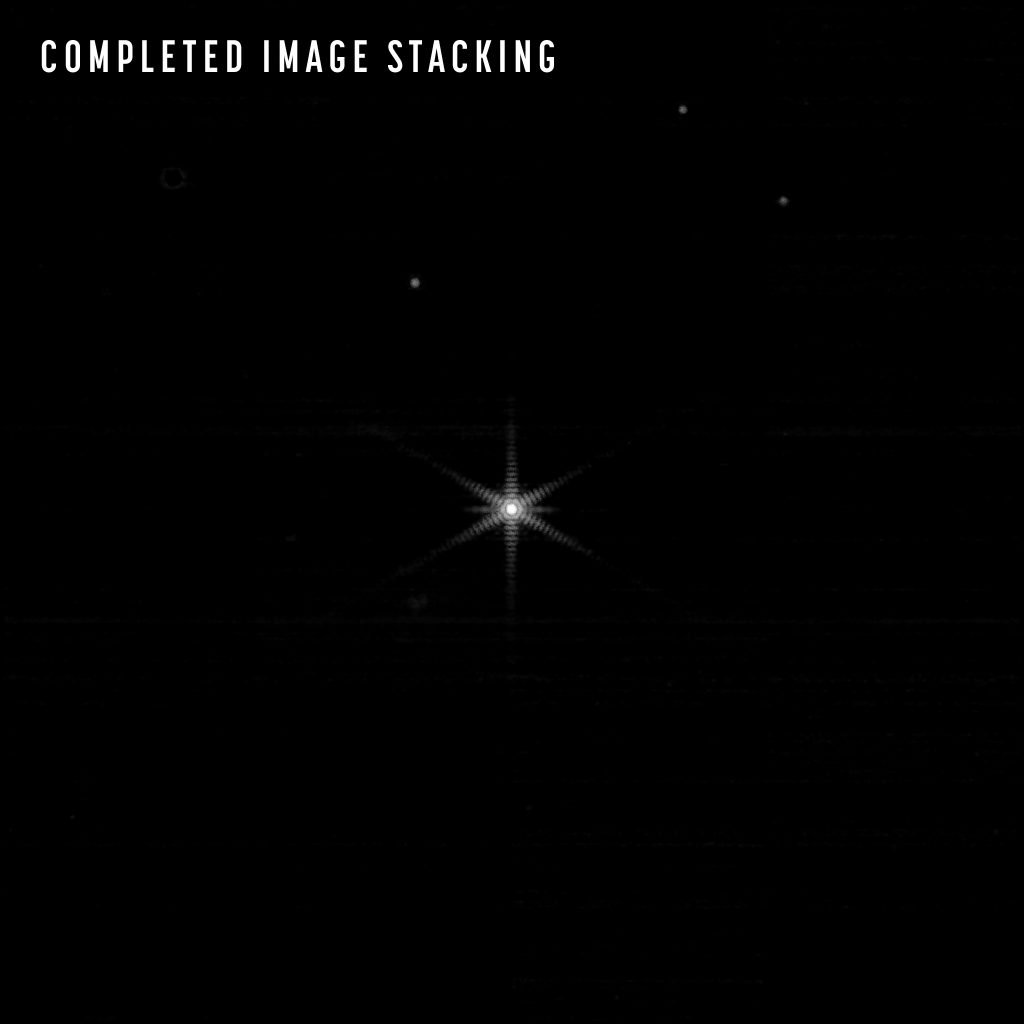
HD 84406, as seen by JWST with the 18 individual mirror images stacked but not yet in phase.

Now, you’ll notice six spikes coming off the star, and they are showing diffraction (they look dotted). That’s because the mirrors are not in phase with each other–in other words the distance the light must travel from each mirror to the sensor is not quite the same. If the difference is a full wavelength, it doesn’t matter, but if the difference is a partial wavelength, it will. (And different colors of light will have different wavelengths, so some light is in phase, and others going through the same two mirrors, is not–unless the length of the path through each mirror is exactly the same.) So now they are going to do Step 4, “coarse phasing” as the first part of sharpening the image. (Step 5 is “fine phasing,” Step 6 “Telescope Alignment” and Step 7, “Final Correction.”

According to the Where’s Webb page, four of the five sensors are at temperatures ranging from 38-48 K (-392 to -373 F), but one, MIRI (which is being used for most of this alignment work) is at 112 K (-258 F).

Round, Comma Dammit!

I shouldn’t even have to write this. It has been just about 2,500 years since people figured out Earth is round. In other words this was Old News when Jesus was preaching. But such is the abysmal state of science education today, that many are taken in by hucksters and outright bullshitters who can slip subtle lies into their arguments, and be convinced the earth is flat.

OK, I’m going to deal with some terminology. I don’t want to say “Earth has a spherical shape” because a sphere is a precisely defined mathematical concept (the set of all points that are at the same distance, r, from a given point in three dimensional space). Which means that, technically, a bump the size of a coronavirus on the surface of the earth is enough to make it not-a-sphere. Of course, there are much bigger bumps on the earth, anything from a fire ant hill in southern Louisiana, to big mountains like the rather famous one to my west.

But then, on the other hand, all of that isn’t enough to make the earth (proportionally) less spherical than a cue ball.

Even the fact that the earth is slightly oblate (thicker through the equator) and that deviation from a perfect sphere is greater than that caused by mountains, isn’t enough to make the earth less spherical than a cue ball.

But Earth is better described as an oblate ellipsoid, than as a sphere. But terrain, and a few bulges caused by the fact that the earth’s interior is not perfectly uniform, mean it’s not quite an oblate ellipsoid, either.

So to avoid nitpickers, I’m just going to say it’s round. Or if I need a noun, I’ll say “ellipsoid.” Rounder than a cue ball, but not quite a perfect sphere or even oblate ellipsoid.

Round, comma dammit.

What Does It Take to Replace an Accepted Theory?

I could just as easily have titled this section “What Does It Take to Revise an Accepted Theory,” too.

And another note on terminology. A theory to a scientist is something that is actually pretty solid. It’s almost settled. (Nothing is absolutely settled.) They’d be greatly surprised to find it wasn’t true. (But they are quite conscious of the fact that surprises do happen!) In popular parlance “theory” is a much weaker word. [Hence the (ignorant) argument that goes “It’s just a theory…”] We have the theory of gravitation, atomic theory, and so forth; these are all pretty “solid” right now.

When a scientist is spitballing, speculating, or has something he believes is supported well enough by the evidence to be worth considering and testing, that is a hypothesis. In writing the physics series I tried to avoid explanations that are currently at the level of speculation, though I included one very strong one, cosmic inflation (there’s little doubt it happened; the problem is they don’t have any clue why or how, so they don’t claim it’s a full-on theory–yet).

Basically it takes three things to get scientists to the point where they will reject an old theory.

  1. There must be something the accepted theory doesn’t explain very well (or at all); the more the better. One or two anomalies will make scientists wonder what they’re doing wrong or if there’s some subtlety in the current theory that they’re missing, lots of anomalies will make them question the theory itself.
  2. There must be a proposed replacement theory that explains those things, and also explains the stuff the prior theory DID explain well. That’s key. If you chuck out theory A for theory B because theory A didn’t explain phenomenon 27 (but does explain 1-26), then even if B explains phenomenon 27 perfectly, it is no good unless it explains 1-26 as least as well is A did. Otherwise you’re just trading one problem for another.
  3. The proposed replacement has to make some sort of prediction of a phenomenon never seen before, that the old theory does not. And then this phenomenon must be found by observation or experiment.

To take an example, Einstein’s General Relativity replaced Newtonian gravitation. How did it do it? Let’s step through the list above.

  1. Mercury’s orbital semimajor axis was precessing around the Sun, and only part of the motion could be explained as perturbations from other planets. This wasn’t enough to junk Newtonian gravity, or even seriously call it into question, however, because there’s always the chance of an unseen body accounting for the difference. Astronomers looked for it but couldn’t find it. But that just left an irritating question mark especially since such an object would be very hard to see.
  2. The proposed replacement theory would explain Mercury’s precession perfectly. (It was one of the highlights of Einstein’s life when he did the computation and it matched.) But it also correctly explained every other planetary motion as well as the old Newtonian theory did, because further away from the sun, the math of General Relativity reduces to Newton’s Law of gravitation; the additional terms fade to insignificance.
  3. General Relativity predicted that strong gravity would bend light. This was totally outside of anything Newtonian gravity would do, and was a phenomenon not directly connected to Mercury’s orbit. So if someone looked and it turned out gravity bends light, this criterion is satisfied. And indeed only four years after GR was published as a hypothesis, Arthur Eddington observed the Sun bending light from stars near it in the sky during a total solar eclipse.

Another example is plate tectonics (a/k/a “continental drift”), which was initially laughed at, largely because no one could explain how the continents could possibly move, but then it turned out to explain things that hadn’t been noticed yet and the explanation for how it could happen, was uncovered. That’s a fantastic story, and it happened largely in the 1960s. There are still geologists alive who remember that; when their whole subject got upended, and things they had no understanding of (such as why volcanoes and earthquakes happened in some places but not others) began to make sense. And now, of course, geology simply doesn’t make any sense without it. What a thrilling time to live through! [I could maybe do a post on this–or maybe a short series of them–but geology is even less my bailiwick than chemistry is.]

Returning to today’s topic, we have an accepted theory, Round Earth. More specifically we have “Round Earth that rotates on an axis, and orbits the sun in an elliptical path, and the axis is tilted with respect to the plane of the orbit around the sun.” Round Earth isn’t the only component that matters, the rest does too. But I’m going to refer to the grouping as “Round Earth” for convenience.

There is a proposed replacement hypothesis (though I hesitate to dignify it with that term), “Flat Earth.” The idea is that the earth is actually a disk, laid out much like the UN flag. Everything we see on earth is on one of the two faces of the disk, which you can think of as facing “up.” The sun and moon move around entirely above this disc, in circular paths centered on the “north pole” (i.e., the center of the disk). Antarctica is a raised rim around the edge of the disk. Different suggestions are made for how the sun and moon move.

How does it fare with the three criteria?

  1. Round Earth explains the (apparent) motion of the sun across the sky, the length of a day, the seasons, the year, and the (apparent) motion of the celestial sphere. It also explains sunsets, lunar eclipses and solar eclipses. So far as I know, there’s nothing relevant that a good theory of this type should explain, that Round Earth doesn’t explain. (I qualify like this because of course Round Earth can’t explain such inexplicable phenomena as more than three people actually voting for His Fraudulency–because they are totally unrelated phenomena. It doesn’t explain everything; just everything that it ought to be able to explain.)

    One putative example that was brought to my attention turned out to be a conflation of the sidereal day (rotation of the earth relative to the stars) with the mean solar day (rotation of the earth relative to the sun). Unfortunately, when elementary school teachers explain Round Earth to their students, they simplify it to the point where it’s possible to confuse these concepts, and I don’t blame them; explaining the difference would treble the length of the lesson. But unfortunately, that confusion sticks around in many people’s minds, ready to be exploited by charlatans.

    Another “proof” that the earth cannot be round was brought up in that intercontinental aircraft flights from the southern hemisphere always go to the northern hemisphere, rather than to another southern continent. E.g., no flights from Australia to South America. This is supposedly because the distance is actually much, much greater than it would be if the earth were round. Unfortunately this claim is simply a LIE, as such flights do exist.
  2. Flat earth not only doesn’t explain anything that Round Earth cannot, it utterly fails to explain things that Round Earth does explain. This is a huge failure. It’s masked to some extent because as it turns out there isn’t a flat earth theory. There are several of them, and they’re inconsistent with each other. Usually a flat earth theory can explain something we can see, but not anything else. For that you need a different flat earth theory. As long as they can drag one of these out of the closet to answer an objection, hopefully no one will notice it contradicts the one brought up five minutes before for the prior objection.
  3. It can’t even make a prediction. That’s because it’s multiple theories with multiple models. Nevertheless, some predictions are made, but turn out to be false. For instance, according to Flat Earth, Antarctica is actually an icy fringe around the edge of the earth, and to protect the Flat Earth secret, people aren’t allowed to go there. This fails, of course, because people do go there.

Let’s look at #2 some more. Here’s a list of things Flat Earth cannot explain, at least not without switching through various variants of the model(s).

  1. No Flat Earth map ever includes a scale that lets you determine the distance between any two points. A globe, of course, can and does.
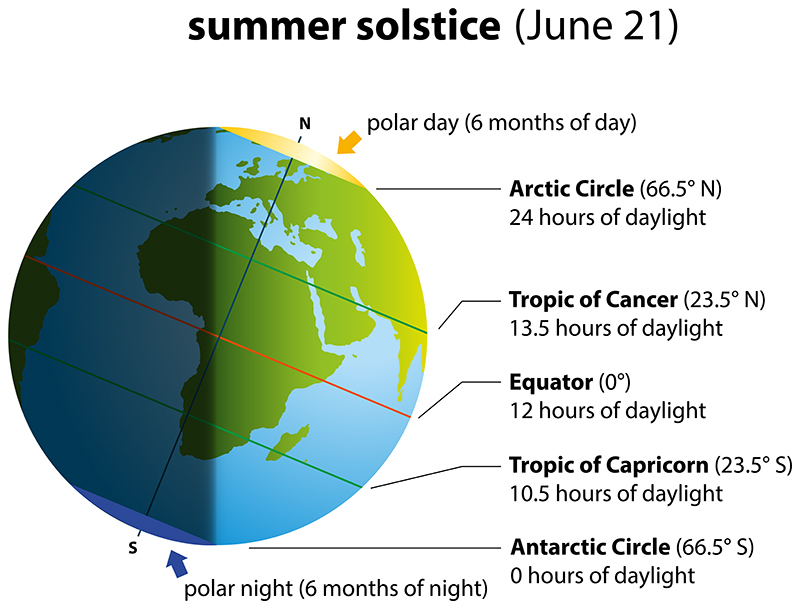
  2. Flat Earth cannot explain differing day lengths, in the Southern hemisphere, or rather, in the continents closer to the edge. According to the Flat Earth model, during the (northern) summer, the sun is running in a circle around the center point (which is the north pole to Round Earthers), fairly close to the center. But then in (northern) winter, the sun recedes further from the center and makes a larger circle around the center point. Since it’s further away from the continents clustered near the center point, those continents are colder at this time of year. The problem is, when the sun is over south America, for instance, in January, it illuminates all of Antarctica (even the parts on the opposite edge of the disk) while NOT illuminating the Arctic Ocean at all (even though the arctic is between the sun and that part of Antarctica.

    Because this is such a huge fail, Flat Earthers have to assert that we’re not allowed to go to Antarctica, or we’d see the problem.
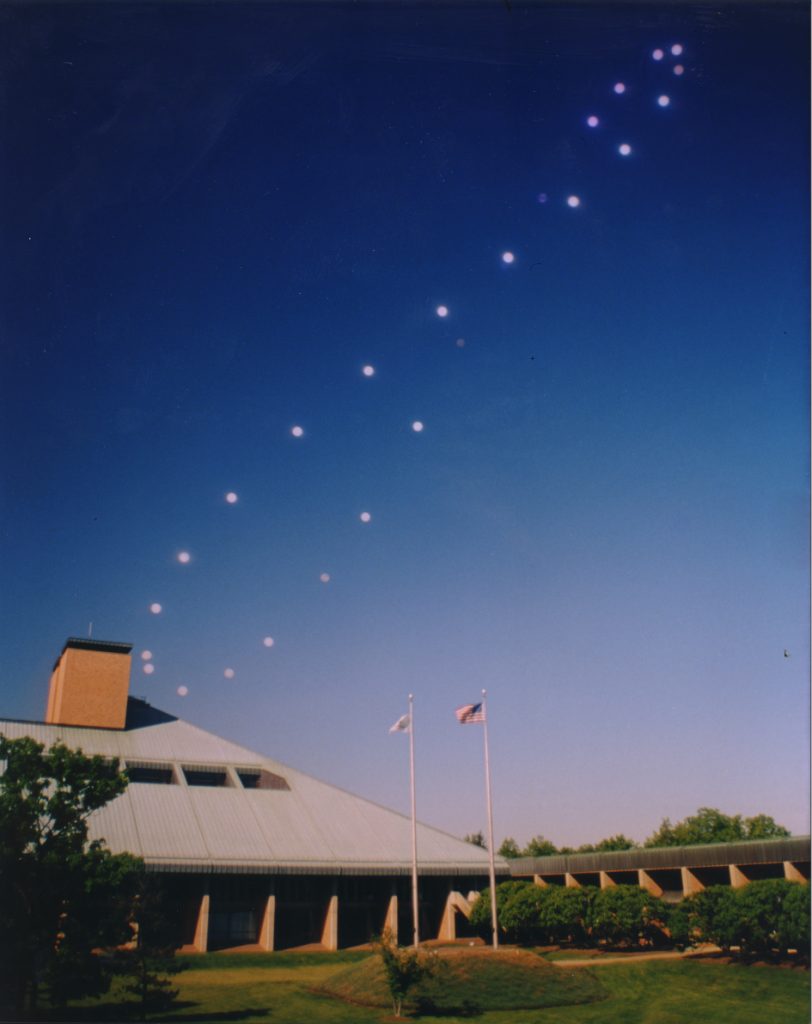
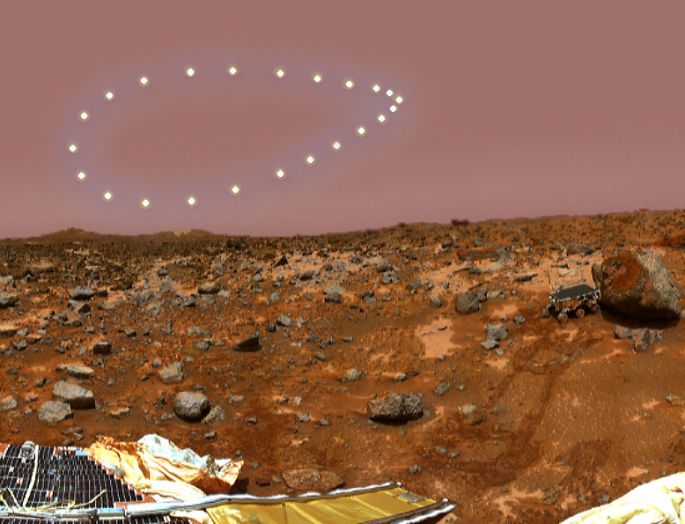
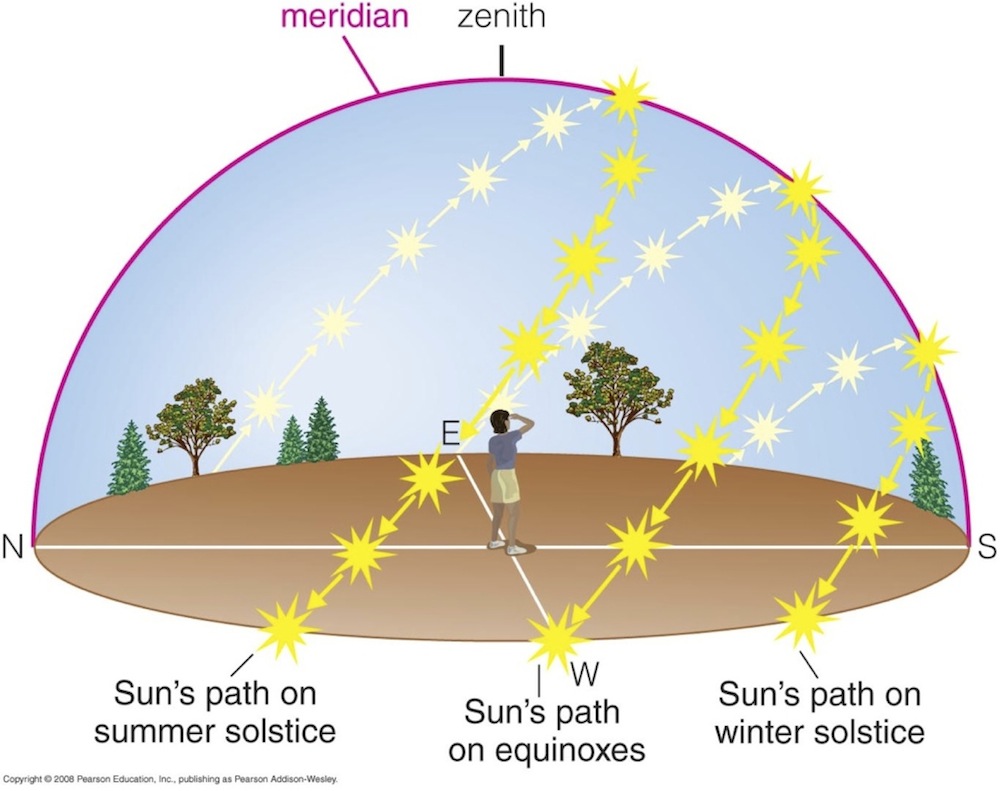
  3. Make any sort of astronomical prediction. Given the Flat Earth model, you should be able to tell me where any object “up there” will be at any time. You should be able to predict solar and lunar eclipses, for instance. Round Earth can do this, with great precision, certainly good enough I could go see the total solar eclipse of 2017. More mundanely it can tell you how high in the sky the sun will be at any given time, at any given location. Flat Earth cannot. If they were to try, they might be right some small fraction of the times and places, but the geometry won’t allow it to be simultaneously right for a number of places all at the same time, or for the same place at multiple times. (And if you cannot make a prediction, your theory is useless.)
  4. If the earth is flat, it should be possible to see (say) Pikes Peak from St. Louis. There’s nothing in between tall enough to get in the way. If you’re worried there might be some hill I am forgetting about, go up into the Gateway Arch and look out the windows on the west side. (Note that Flat Earth adherents do post photos claiming “you shouldn’t be able to see this” but it’s generally over water, and a city skyline that’s quite a lot closer.)
  5. Instead of just taking a picture of a far away boat over water, how about watching it as it moves away? If the earth is flat, it should just get smaller and smaller. Instead, it will disappear bottom-up, sort of as if it was curving down over the horizon.
  6. Sunsets. If the sun and moon stay above the disc, how do you explain sunsets?
    Ironically, the believers in Flat Earth from centuries ago would have no problem with this; the sun drops down through the plane of the disk, travels under the disk and rises on the other side. But that old idea can’t explain why it’s daytime in Tokyo when it’s midnight in the US, so it had to be discarded. But now it can’t explain sunset. What you would expect to see is the sun getting smaller and smaller as it moves further away, then eventually you can’t see it at all and it’s nighttime. That’s not what we see; the sun does not change apparent size in any appreciable way over the course of the day.
  7. Lunar eclipses are impossible with this theory. What shadow can be cast upon the moon when the sun and moon are always above the disk of the earth? Instead, we see the shadow of something ROUND cross the face of the moon. Always round, always with the same radius, no matter where the moon appears in the sky. Almost as if something nearly spherical were casting a shadow on the moon (since a sphere is the only thing that would do this without fail regardless of the orientation), eh?
  8. What would you see if you attached a camera to a weather balloon and sent it up there to where the Sun and Moon (which according to Flat Earth are small and close to the earth) are?

Flat Earth fails on all of these.

I watched a series of videos on this and it added to my list of objections to the flat earth theory. The background is the channel owner took on Flat Earth, then caught a ton of flak from the Flat Earthers. He then published a second video, and a third, and a fourth (actually a four parter), over the space of a few years. The last quadruplet is most useful because it tells you about things you can do to validate round earth and disprove flat earth, without having to do a lot of math and physics.

He is very snarky (meaning he insults the other side routinely and IMHO quite unnecessarily) but his actual arguments are solid. I’m going to paste in the four parter here. If you want to see the earlier videos (which are much longer), he links to them in the descriptions.

If this guy is so obnoxious, why am I using his videos? Because he has a lot of graphics that makes the point clear, and I haven’t the time to duplicate them. So please, ignore the insults.

Flat earth cannot explain how the moon can present the same face to us, no matter where we are. (Cued up after the snarky intro.)
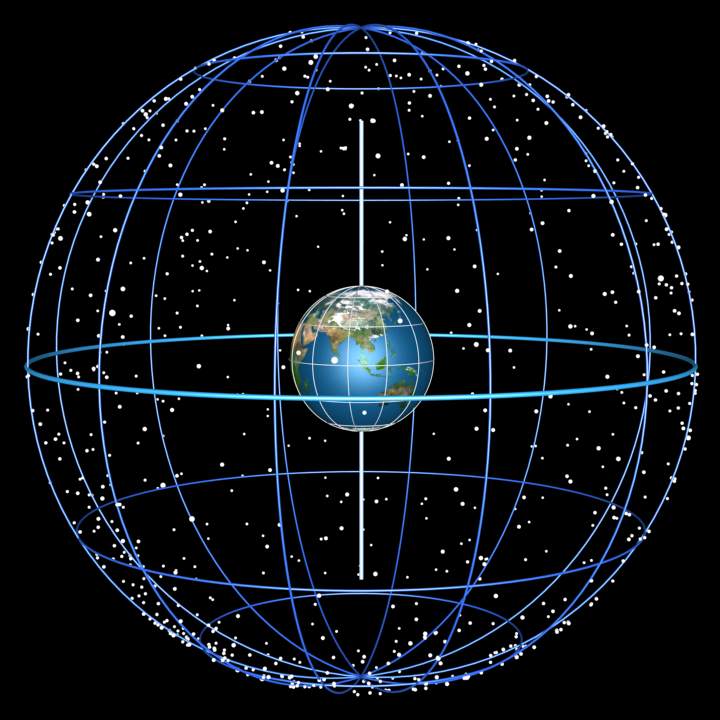
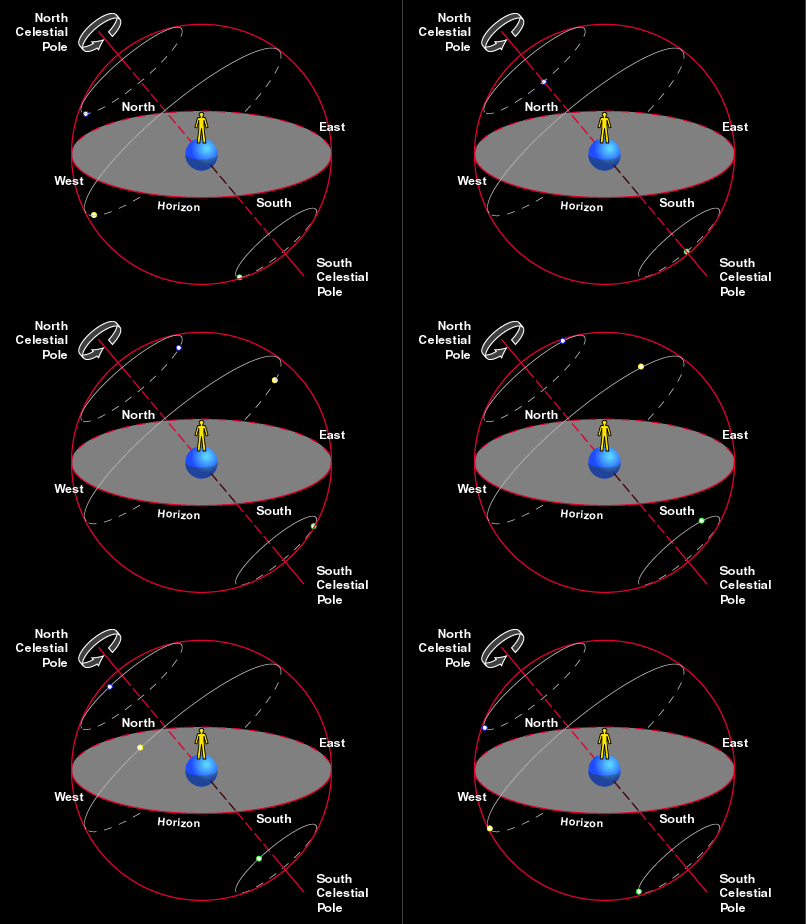
Flat Earth cannot explain the differing behaviors of stars in the sky, by latitude. Again cued up after the snarky intro.
Direct flights in the southern hemisphere. In fact the graphic in the thumbnail is wrong; the flight should skirt Antarctica…but that’s even worse for Flat Earth theory.

As it happens, Flat Earth comes with a conspiracy theory. Apparently, lots of people conspire to suppress the “truth.” But there are problems with that…it’s too many people.

Now here’s the absolute best part.

There is a flat earther by the name of Bob Knodel. He at one point claimed to be a commercial pilot (and therefore could put the lie to Round Earth, if it were in fact a lie), but was exposed as lying about that.

He then actually did something responsible and ran an experiment to try to prove Round Earth wrong. Since, according to Round Earth, any point on the surface of the earth is rotating every 24 hours, a gyroscope ought to pick that up, since it will not rotate. So if the gyroscope appears to be turning 15 degrees every hour, it’s a sign the earth is rotating once every 24 hours. If it isn’t, though…then Round Earth is bunk.

I’ll give him credit for running the test.

Well, he performed the experiment, and saw the 15 degree per hour turn.

Flat Earthers love to claim Round Earthers are dogmatic and only repeating what they’ve been told in school, but that is exactly what Bob is doing here. He is ignoring and trying to explain away a result that supports the theory he claims is wrong. Evidence is staring him in the face, but he’s sticking to HIS damned dogma. Further experiments trying to eliminate other possible effects lead to the same result. But will he consider for a moment his bullshit flat earth theory might be wrong? Nope.

As I said, I give him credit for running the test, and then trying to control for other things.

But no credit for refusing to believe what it was telling him.

Obligatory PSAs and Reminders

China is Lower than Whale Shit

Remember Hong Kong!!!

Whoever ends up in the cell next to his, tell him I said “Hi.”

中国是个混蛋 !!!
Zhōngguò shì gè hùndàn !!!
China is asshoe !!!

China is in the White House

Since Wednesday, January 20 at Noon EST, the bought-and-paid for His Fraudulency Joseph Biden has been in the White House. It’s as good as having China in the Oval Office.

Joe Biden is Asshoe

China is in the White House, because Joe Biden is in the White House, and Joe Biden is identically equal to China. China is Asshoe. Therefore, Joe Biden is Asshoe.

But of course the much more important thing to realize:

Joe Biden Didn’t Win

乔*拜登没赢 !!!
Qiáo Bài dēng méi yíng !!!
Joe Biden didn’t win !!!

2022·02·19 Joe Biden Didn’t Win Daily Thread

Yo, Brian Stelter!

When I was a kid, I got nicknamed “Bald Eagle” because I actually was getting notably thin “up there.” Of course today “Bald Eagle” might be a cool nickname, but in junior high school, it definitely was not a cool thing.

Fast forward to today, and now here I am over twenty years older than you are, and even in spite of that poor start, I have better hair than you do.

And I am not a piss-guzzling, shit-gobbling communist “journalist” (what a sick joke) either.

On both accounts you must absolutely hate looking into the mirror.

And Oh By The Way probably more people read my posts than watch you bloviate on air. And yes, I know your ratings dropped again. One would think there’s be a limit to that…you can’t drop below zero, can you?

RINOs an Endangered Species?
If Only!

According to Wikipoo, et. al., the Northern White Rhinoceros (Ceratotherium simum cottoni) is a critically endangered species. Apparently two females live on a wildlife preserve in Sudan, and no males are known to be alive. So basically, this species is dead as soon as the females die of old age. Presently they are watched over by armed guards 24/7.

Biologists have been trying to cross them with the other subspecies, Southern White Rhinoceroses (Rhinoceri?) without success; and some genetic analyses suggest that perhaps they aren’t two subspecies at all, but two distinct species, which would make the whole project a lot more difficult.

I should hope if the American RINO (Parasitus rectum pseudoconservativum) is ever this endangered, there will be heroic efforts not to save the species, but rather to push the remainder off a cliff. Onto punji sticks. With feces smeared on them. Failing that a good bath in red fuming nitric acid will do.

But I’m not done ranting about RINOs.

The RINOs (if they are capable of any introspection whatsoever) probably wonder why they constantly have to deal with “populist” eruptions like the Trump-led MAGA movement. That would be because the so-called populists stand for absolutely nothing except for going along to get along. That allows the Left to drive the culture and politics.

Given the results of Tuesday’s elections, the Left will now push harder, and the RINOs will now turn even squishier than they were before.

I well remember 1989-1990 in my state when the RINO establishment started preaching the message that a conservative simply couldn’t win in Colorado. Never mind the fact that Reagan had won the state TWICE (in 1984 bringing in a veto-proof state house and senate with him) and GHWB had won after (falsely!) assuring everyone that a vote for him was a vote for Reagan’s third term.

This is how the RINOs function. They push, push, push the line that only a “moderate” can get elected. Stomp them when they pull that shit. Tell everyone in ear shot that that’s exactly what the Left wants you to think, and oh-by-the-way-Mister-RINO if you’re in this party selling the same message as the Left…well, whythefuckexactly are you in this party, you lying piece of rancid weasel shit?

Justice Must Be Done.

The prior election must be acknowledged as fraudulent, and steps must be taken to prosecute the fraudsters and restore integrity to the system. (This doesn’t necessarily include deposing Joe and Hoe and putting Trump where he belongs, but it would certainly be a lot easier to fix our broken electoral system with the right people in charge.)

Nothing else matters at this point. Talking about trying again in 2022 or 2024 is pointless otherwise. Which is not to say one must never talk about this, but rather that one must account for this in ones planning; if fixing the fraud in the system is not part of the plan, you have no plan.

This will necessarily be piecemeal, state by state, which is why I am encouraged by those states working to change their laws to alleviate the fraud both via computer and via bogus voters. If enough states do that we might end up with a working majority in Congress and that would be something Trump never really had.

Lawyer Appeasement Section

OK now for the fine print.

This is the WQTH Daily Thread. You know the drill. There’s no Poltical correctness, but civility is a requirement. There are Important Guidelines,  here, with an addendum on 20191110.

We have a new board – called The U Tree – where people can take each other to the woodshed without fear of censorship or moderation.

And remember Wheatie’s Rules:

1. No food fights
2. No running with scissors.
3. If you bring snacks, bring enough for everyone.
4. Zeroth rule of gun safety: Don’t let the government get your guns.
5. Rule one of gun safety: The gun is always loaded.
5a. If you actually want the gun to be loaded, like because you’re checking out a bump in the night, then it’s empty.
6. Rule two of gun safety: Never point the gun at anything you’re not willing to destroy.
7. Rule three: Keep your finger off the trigger until ready to fire.
8. Rule the fourth: Be sure of your target and what is behind it.

(Hmm a few extras seem to have crept in.)

More Raucous Mozart

Mozart’s 25th Symphony (as heard in “Amadeus”), ever so slightly suited for the current mood.

Canuckistan Goes After The Canadian Truckers

It became plain on Friday that Trudescu, Glorious Leader of Communist Canuckistan, isn’t playing around. He’s run out of things he can do to get the trucks to leave downtown Ottawa. (Weeeeeellllllll with the exception of, you know, actually talking to them and stopping the mandates.)

So they’re being arrested and towed. The tow truck companies that are helping out have had their names taped over on their trucks, lest people find some way to express their dissatisfaction with them.

Where to from here?

I don’t see anything that Canadians concerned about the direction their government is going, other than going on general strike. If nothing moves “up there” for a couple of weeks, we’ll see what happens. Perhaps the government will convince the general population that the truckers are to blame and are being unreasonable (they’re certainly trying to do so now, with the help of Canuckistanis Broadcasting Communism [CBC]). But a general strike seems to be the only play left. But it requires more than just some fraction (0.1? 0.9?) of truckers to make it work.

So it’s now call…or fold. Let’s see what happens.

[Note: If someone takes umbrage at my use of the terms “Canuckistan” and “Canuckistani,” please notice I only used it for the tyrant Trudescu and his fellating treasonous media maggots. The truckers and their allies are Canadians.]

UPDATE: I just heard about the mounted police sent in to trample the protesters.

There is no longer any satisfactory ending to this that involves Trudescu not being removed, duly tried, and convicted of some capital crime. And that is true for a number of his minions, as well.

Spot Prices

Last week:

Gold $1860.00
Silver $23.67
Platinum $1033.00
Palladium $2405.00
Rhodium $18,900.00

This week, 3 PM MT on Friday, markets closed for the weekend

Gold $1,896.50
Silver $23.98
Platinum $1,077.00
Palladium $2,432.00
Rhodium $19,550.00

I said last week that the tech trader types were saying $1860 was a “barrier” for gold and that, IF it were to cross that line, it was liable to keep going.

It did cross the line, but it didn’t seem like a gigantic breakout. Until I realized that it actually got up to at least 1900.20 before open today.

James Webb Space Telescope Update

James Webb Space Telescope appears to be working on aligning the 18 images, one from each mirror, in a nice tidy arrangement, prior to overlaying them all on top of each other in perfect focus (the mirrors themselves can be “warped” a bit by an actuator that that pulls on the center of each segment, in case they aren’t at precisely right curvature).

However, I don’t know that that’s actually what they’re doing right now. It’s shown as step 2 of 7 mirror alignment steps, and they claim to be done with step one: https://www.jwst.nasa.gov/content/webbLaunch/whereIsWebb.html?units=metric .

Meanwhile, there’s a sensor on board that helps the telescope point at whatever it wants to see, and it seems to be functioning right now according to this blog entry (which I first saw on Thursday): https://blogs.nasa.gov/webb/2022/02/17/webbs-fine-guidance-sensor-is-guiding .

So, things seem to be proceeding nicely but right now I don’t actually know what they’re doing.

Temperatures on the “cold side” of the sun shield are now roughly 380 degrees below zero, F.

UPDATE, Friday Afternoon.

NASA just made a liar out of me. New post on the blog. (Everything for the rest of this section is pulled from the blog post. It won’t let me mark the pictures as quotes.)

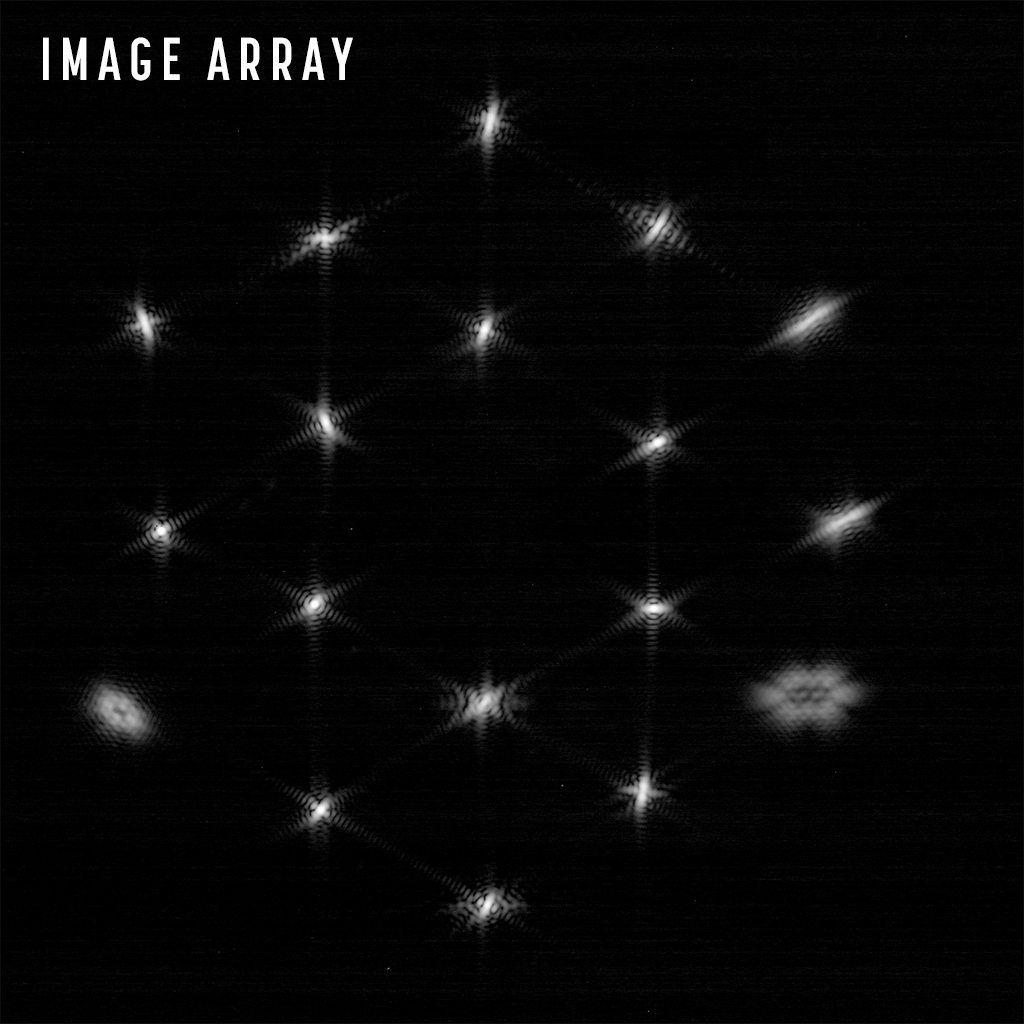
This early Webb alignment image, with dots of starlight arranged in a pattern similar to the honeycomb shape of the primary mirror, is called an “image array.” Credit: NASA/STScI/J. DePasquale

The Webb team continues to make progress in aligning the observatory’s mirrors. Engineers have completed the first stage in this process, called “Segment Image Identification.” The resulting image shows that the team has moved each of Webb’s 18 primary mirror segments to bring 18 unfocused copies of a single star into a planned hexagonal formation.

This image mosaic (top), which shows 18 randomly positioned copies of the same star, served as the starting point for the alignment process. To complete the first stage of alignment, the team moved the primary mirror segments to arrange the dots of starlight into a hexagonal image array (bottom). Each dot of starlight is labeled with the corresponding mirror segment that captured it.
Credits: NASA (top); NASA/STScI/J. DePasquale (bottom)

With the image array complete, the team has now begun the second phase of alignment: “Segment Alignment.” During this stage, the team will correct large positioning errors of the mirror segments and update the alignment of the secondary mirror, making each individual dot of starlight more focused. When this “global alignment” is complete, the team will begin the third phase, called “Image Stacking,” which will bring the 18 spots of light on top of each other.

“We steer the segment dots into this array so that they have the same relative locations as the physical mirrors,” said Matthew Lallo, systems scientist and Telescopes Branch manager at the Space Telescope Science Institute. “During global alignment and Image Stacking, this familiar arrangement gives the wavefront team an intuitive and natural way of visualizing changes in the segment spots in the context of the entire primary mirror. We can now actually watch the primary mirror slowly form into its precise, intended shape!”

Obligatory PSAs and Reminders

China is Lower than Whale Shit

To conclude: My standard Public Service Announcement. We don’t want to forget this!!!

Remember Hong Kong!!!

If anyone ends up in the cell right next to him, tell him I said “hi.”

中国是个混蛋 !!!
Zhōngguò shì gè hùndàn !!!
China is asshoe !!!

China is in the White House

Since Wednesday, January 20 at Noon EST, the bought-and-paid for Joseph Biden has been in the White House. It’s as good as having China in the Oval Office.

Joe Biden is Asshoe

China is in the White House, because Joe Biden is in the White House, and Joe Biden is identically equal to China. China is Asshoe. Therefore, Joe Biden is Asshoe.

But of course the much more important thing to realize:

Joe Biden Didn’t Win

乔*拜登没赢 !!!
Qiáo Bài dēng méi yíng !!!
Joe Biden didn’t win !!!
2022·02·12 Joe Biden Didn’t Win Daily Thread

Hey China!

Or rather, “Hey Chinese Communist Party and your entire array of servitors, ass-wipers, and fellators!”

You’re not even worth my time this week. When you decide to act like civilized people, maybe I’ll give you a lesson or two in how non-barbarians behave.

Hey BiteMe!
(Or, Whoever Has Their Hand Rammed Up That Putrefying Meat Puppet’s Ass)

[Language warning]

You and yours have caused a lot of injury. Literal injury with your war on people who don’t want to take an untested vaccine. When people die in an emergency room because a hospital won’t admit them because they haven’t had their clot shot, that’s a crime.

I’m going to address here the insult on top of the injury, because I am among the insulted. I still have my health but apparently you want me to live under the 8th Street Bridge (which actually isn’t on 8th Street, but whatever, that’s what the I-25 overpass over Cimarron is called), so maybe if you have your way that won’t be true for long. Dreadful time of year to become homeless.

No, you’re just trying to make me unemployed, because I won’t take your fucking shots.

Well, that threat is NOT going to work. I. Won’t. Take. Your. Fucking. Shots.

And it looks like enough people agree, that you’re having to back down, you worthless asswipe.

You’re LOSING.

You LOSER.

You Chinese-bought ratfucking traitor.

I would love to see you die an agonizing, humiliating death. (This isn’t a threat, because I am not threatening to cause that death. I am just announcing my intention to party if it happens.) It would be just recompense for the way you’re killing America…and millions of Americans.

His Fraudulency

Joe Biteme, properly styled His Fraudulency, continues to infest the White House, we haven’t heard much from the person who should have been declared the victor, and hopium is still being dispensed even as our military appears to have joined the political establishment in knuckling under to the fraud.

One can hope that all is not as it seems.

I’d love to feast on that crow.

(I’d like to add, I find it entirely plausible, even likely, that His Fraudulency is also His Figureheadedness. (Apparently that wasn’t a word; it got a red underline. Well it is now.) Where I differ with the hopium addicts is on the subject of who is really in charge. It ain’t anyone we like.)

Justice Must Be Done.

The prior election must be acknowledged as fraudulent, and steps must be taken to prosecute the fraudsters and restore integrity to the system.

Nothing else matters at this point. Talking about trying again in 2022 or 2024 is hopeless otherwise. Which is not to say one must never talk about this, but rather that one must account for this in ones planning; if fixing the fraud is not part of the plan, you have no plan.

Trucking

I saw a few rumors here that something would start…today. Others report at least three other expected start dates.

Some believe it will be more caravans. Some think the truckers ought to do something else (like just quitting in place). I could even see the expectation of caravans being a distraction from mass quitting. If the opposition concentrates all its resources to block convoys expected on I-70, I-40, I-80, and I-95 (plus any others, like I-81 to I-66) they can’t be “out there” trying to force truckers to continue working.

This reminds me, of course, of something out of Atlas Shrugged.

Atlas Shrugged was written in an age where trains were the predominant long-haul transportation mode, and it describes the “frozen train” phenomenon. Locked into their jobs, forbidden from quitting, being fired, or being promoted by Directive 10-289, sometimes an entire train crew would just decide “to Hell with this shit,” stop the train, and walk away. Passengers would become rather upset.

Truckers could do just this (though they needn’t walk away), and might even disable their trucks–the railroads could send another crew out and get the train moving, but if a truck is broken, it’s going nowhere. Meanwhile the feds are waiting for convoys that “need to be stopped” before they choke DC traffic. (Not that anyone would be able to tell the difference.)

In a way, we’re actually seeing Scott’s suggestion of a general strike. Not just with the trucks, but with all of the people who have quit working. Unfortunately, at least until the trucks stop rolling, the punch is a lot less when people quit gradually over the space of a year, than when they all stop work at once. But there it is. Millions of people are dropping out. Some use the phrase “going Galt” but that’s an injustice to the concept of going Galt. When the people in Atlas Shrugged “dropped out,” if they didn’t completely disappear, they took an almost-no-thought-required menial job. Their minds were on strike, but they still felt that they should support themselves. John Galt himself was a track walker. They certainly did not go on the dole like many are doing today.

The reason the trucks going on strike (be it by caravan or “frozen” truck) is potentially devastating is that almost everything we buy spends at least some time on a truck. Notably including food–and food is hard to go without for more than a very few days. Of course you can (and hopefully did) prepare for this by stocking up. (I believe I’m good for 2-3 months, though I might reach the end of such a time span willing to kill for a change in my menu. On the other hand some things I saw on Friday tell me I shouldn’t consider that adequate and need to get more food.)

But food isn’t the only issue. Personally, I’m likely to be very inconvenienced by a truck strike for other reasons I’m not going to go into.

I’ll be inconvenienced, but really, that’s no big deal in the grand scheme. Because my level of inconvenience pales next to that of the people rotting in DC jails because they were in the wrong place on January 6 (as it happens, they were somewhere within a hundred yards of me, not that distance from me is the issue).

So even for the prepared, this could be a very rough time. Unless you’ve been living and breathing “prep” for a few years (or even if you have been), there’s likely something you forgot about. And you might not be able to find it.

But something has to happen. The Opposition isn’t going to back down until we make this country useless to them. If we’re really lucky, it won’t get worse than a few weeks with empty shelves at the grocery store. But I’m going to try not to grouse about my inconvenience…and if I just have to do it as an alternative to exploding, I am going to lay the blame where it belongs.

On the truckers? HELL NO. On the deep state, the swamp, whatever you want to call it. Our self-appointed “masters” who need their heads mounted on pikes. They acted, we are responding in defense of our lives and liberty. If they didn’t feel a pathological need (and entitlement) to control others who just want to be left alone, none of this would be necessary. They are mentally ill. And we shouldn’t accommodate them.

So let’s see what happens. Canada is serving as our guinea pig. Hopefully Trudeau’s government will back down, even if he won’t.

If you’re the praying type, pray for Justice. That is what we’ve lacked for decades.

Lawyer Appeasement Section

OK now for the fine print.

This is the WQTH Daily Thread. You know the drill. There’s no Poltical correctness, but civility is a requirement. There are Important Guidelines,  here, with an addendum on 20191110.

We have a new board – called The U Tree – where people can take each other to the woodshed without fear of censorship or moderation.

And remember Wheatie’s Rules:

1. No food fights
2. No running with scissors.
3. If you bring snacks, bring enough for everyone.
4. Zeroth rule of gun safety: Don’t let the government get your guns.
5. Rule one of gun safety: The gun is always loaded.
5a. If you actually want the gun to be loaded, like because you’re checking out a bump in the night, then it’s empty.
6. Rule two of gun safety: Never point the gun at anything you’re not willing to destroy.
7. Rule three: Keep your finger off the trigger until ready to fire.
8. Rule the fourth: Be sure of your target and what is behind it.

(Hmm a few extras seem to have crept in.)

Spot Prices.

Kitco Ask. Last week:

Gold $1809.40
Silver $22.60
Platinum $1033.00
Palladium $2378.00
Rhodium $17,800.00

This week, markets closed as of 3PM MT.

Gold $1860.00
Silver $23.67
Platinum $1033.00
Palladium $2405.00
Rhodium $18,900.00

Now THAT is big. The people who are technical traders–i.e., those who try to read the tea leaves based on the way the line looks on a chart–say that the $1860 line is a barrier. Gold will try hard not to go through it, but if it does, it’s going to keep going.

Now merely touching that mark isn’t definitive, but this is a Friday (when gold usually goes down) and it was UP 32 bucks today. Are the manipulators out of leverage? We’ll see next week.

Silver, too is up. Platinum has moved a bit, back and forth but ended up right where it was last week. Palladium and rhodium, however, are moving up again, and they are used a lot by the auto industry, which has been slowly coming back to life.

Inflation is real, and the conventional wisdom is coming around to having it stay for a while. That will push upward on gold prices.

James Webb Space Telescope Update

I had heard nothing about JWST all week, but suddenly Friday morning, there was a bunch of stuff.

The first step to getting the eighteen primary mirror segments (plus secondary mirror) to act as one mirror, was to assess how badly out of whack they are. So JWST took a photograph of the star HD 84406 near the Big Dipper. Actually, it took a lot of photographs near and around it. They took a mosaic covering about the size of the full moon; hundreds of photos. As it happens HD 84406 has few other stars near it as seen from Earth, so any dots that showed up were liable to be that star.

As it happens most of the mosaic was wasted; all eighteen segments put their image of the star fairly close to each other. Here’s what they saw:

HD 84406, seen as eighteen images by eighteen mirrors not quite lined up with each other.

So this was very positive news. The Near Infrared Camera is working; it can record light and send us the results. (“Near Infrared” is a term for the shortest wavelengths of infrared light, closest to being visible light.)

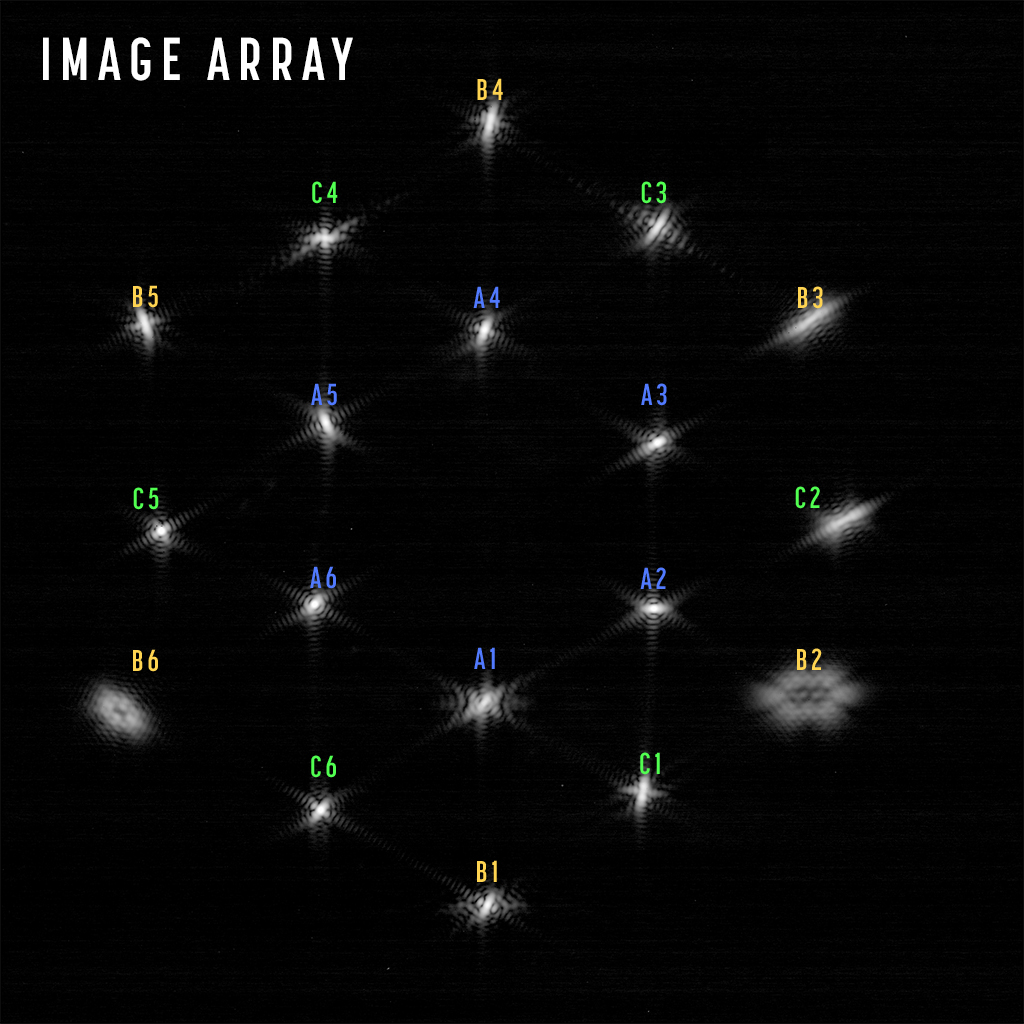
They were able, over the course of the week, to determine which image was coming from which mirror.

Images labeled by mirror segment. “A” segments are the inner ring of 6, “B” segments are corner segments on the outer ring, “C” segments are between the corner segments.

The two wings that swung into place as the last steps of deployment are circled.

So now they have enough to begin the process of getting the mirrors pointed right. Somewhere (not marked here, but in the lower right near the edge–it is shown in the video below, but turned upside down) is the spot they want the image to appear…so when they tell the telescope to point to such-and-such Right Ascension and Declination, that’s what will appear in the center of the field of view. They want this star’s 18 images to all be there and all be in perfect focus, and with the light waves in phase. So they have their work cut out for them over the next two and a half months.

It turns out there’s a lens inside the instrument package that allows JWST to take a picture of its own main mirror. Here’s a sample:

JWST “Selfie.” The one white hexagon is a mirror that happens at the moment to be pointed right at a star. You can see the edges of the other hexagons, as well as reflections of the three arms that hold the secondary mirror in place (vertical white fuzzed mess and two diagonals below it). This will be a useful tool in the months ahead.

And here (for anyone still reading whose interest is not sated) is a video talking about all of this. Three minutes long. (Cthulhu will be happy to see HD 84406 marked in relation to the Big Dipper; he was asking about this a couple of weeks ago.)

There were no nasty surprises…like an obviously defective mirror segment.

“So far, so good, but we do have a long way to go”

Obligatory PSAs and Reminders

China is Lower than Whale Shit

Remember Hong Kong!!!

Whoever ends up in the cell next to his, tell him I said “Hi.”

中国是个混蛋 !!!
Zhōngguò shì gè hùndàn !!!
China is asshoe !!!

China is in the White House

Since Wednesday, January 20 at Noon EST, the bought-and-paid for His Fraudulency Joseph Biden has been in the White House. It’s as good as having China in the Oval Office.

Joe Biden is Asshoe

China is in the White House, because Joe Biden is in the White House, and Joe Biden is identically equal to China. China is Asshoe. Therefore, Joe Biden is Asshoe.

But of course the much more important thing to realize:

Joe Biden Didn’t Win

乔*拜登没赢 !!!
Qiáo Bài dēng méi yíng !!!
Joe Biden didn’t win !!!

2022·02·05 Joe Biden Didn’t Win Daily Thread

The Chinese Should Think Before Wiping Us Out As Sometimes They Need Us To Solve Their Problems For Them

Okay you knuckledragging ChiComs trying to take us down…here’s a history lesson for you.

For millennia, you had to suffer from this:

Yep. Steppe Nomads. They laid waste to your country, burned, raped and pillaged (but not in that order–they’re smarter than you are) for century after century.

You know who figured out how to take them on and win? The Russians.

Not you, the Russians. And it took them less than two centuries. And Oh By The Way they were among the most backward cultures in Europe at the time.

You couldn’t invent an alphabet, you couldn’t take care of barbarians on horseback, and you think you can take this board down?

HAHAHAHAHAHAHA!!!! We’re laughing at you, you knuckledragging dehumanized communists…worshipers of a mass-murderer who killed sixty million people!

I mean, you still think Communism is a good idea even after having lived through it!

By my reckoning that makes you orders of magnitude more stupid than AOC, and that takes serious effort.

His Fraudulency

Joe Biteme, properly styled His Fraudulency, continues to infest the White House, and hopium is still being dispensed even as our military appears to have joined the political establishment in knuckling under to the fraud.

One can hope that all is not as it seems.

I’d love to feast on that crow.

“No Chemicals”

A detailed analysis of the contents of His Fraudulency’s skull was performed.

Absolutely no chemicals found!

Justice Must Be Done.

The prior election must be acknowledged as fraudulent, and steps must be taken to prosecute the fraudsters and restore integrity to the system.

Nothing else matters at this point. Talking about trying again in 2022 or 2024 is hopeless otherwise. Which is not to say one must never talk about this, but rather that one must account for this in ones planning; if fixing the fraud is not part of the plan, you have no plan.

Political Science In Summation

It’s really just a matter of people who can’t be happy unless they control others…versus those who want to be left alone. The oldest conflict within mankind. Government is necessary, but government attracts the assholes (a highly technical term for the control freaks).

James Webb Space Telescope Update

Mirror alignment has begun. This is a complex process described here:

Photons Incoming: Webb Team Begins Aligning the Telescope – James Webb Space Telescope (nasa.gov)

It continues to cool off slowly, with the “cold side” of the sun shield down to over 350 degrees below zero, F.

Just in case you thought the recent weather was chilly.

This is still about a hundred degrees F above absolute zero. So, still too hot for many of the instruments. But the instruments themselves are warmer; their temperatures range from -199 down to -292F

The What?

There are Olympics going on?

Just goes to show I don’t give a rat’s hindquarters (I threw that out there for any Leftists who might find that part of a rat exciting) about that sort of thing.

Lawyer Appeasement Section

OK now for the fine print.

This is the WQTH Daily Thread. You know the drill. There’s no Poltical correctness, but civility is a requirement. There are Important Guidelines,  here, with an addendum on 20191110.

We have a new board – called The U Tree – where people can take each other to the woodshed without fear of censorship or moderation.

And remember Wheatie’s Rules:

1. No food fights
2. No running with scissors.
3. If you bring snacks, bring enough for everyone.
4. Zeroth rule of gun safety: Don’t let the government get your guns.
5. Rule one of gun safety: The gun is always loaded.
5a. If you actually want the gun to be loaded, like because you’re checking out a bump in the night, then it’s empty.
6. Rule two of gun safety: Never point the gun at anything you’re not willing to destroy.
7. Rule three: Keep your finger off the trigger until ready to fire.
8. Rule the fourth: Be sure of your target and what is behind it.

(Hmm a few extras seem to have crept in.)

(Paper) Spot Prices

Last week:

Gold $1791.20
Silver $22.56
Platinum $1019.00
Palladium $2466.00
Rhodium $17,750.00

This week, 3PM Mountain Time, markets have closed for the weekend.

Gold $1809.40
Silver $22.60
Platinum $1033.00
Palladium $2378.00
Rhodium $17,800.00

Gold and silver continue bouncing around inside a range that is (I believe) being forced by the central banks and other shitbag actors, in spite of all the inflationary signs we are seeing.

Obligatory PSAs and Reminders

China is Lower than Whale Shit

Remember Hong Kong!!!

Whoever ends up in the cell next to his, tell him I said “Hi.”

中国是个混蛋 !!!
Zhōngguò shì gè hùndàn !!!
China is asshoe !!!

China is in the White House

Since Wednesday, January 20 at Noon EST, the bought-and-paid for His Fraudulency Joseph Biden has been in the White House. It’s as good as having China in the Oval Office.

Joe Biden is Asshoe

China is in the White House, because Joe Biden is in the White House, and Joe Biden is identically equal to China. China is Asshoe. Therefore, Joe Biden is Asshoe.

But of course the much more important thing to realize:

Joe Biden Didn’t Win

乔*拜登没赢 !!!
Qiáo Bài dēng méi yíng !!!
Joe Biden didn’t win !!!
2022·01·29 Joe Biden Didn’t Win Daily Thread

SPECIAL SECTION: Message For Our “Friends” In The Middle Kingdom

You knuckle-dragging barbarians are still trying to muck with this site, so I’ll just repeat what I said last time.

Up your shit-kicking barbarian asses. Yes, barbarian! It took a bunch of sailors in Western Asia to invent a real alphabet instead of badly drawn cartoons to write with. So much for your “civilization.”

Yeah, the WORLD noticed you had to borrow the Latin alphabet to make Pinyin. Like with every other idea you had to steal from us “Foreign Devils” since you rammed your heads up your asses five centuries ago, you sure managed to bastardize it badly in the process.

Have you stopped eating bats yet? Are you shit-kickers still sleeping with farm animals?

Or maybe even just had the slightest inkling of treating lives as something you don’t just casually dispose of?

中国是个混蛋 !!!
Zhōngguò shì gè hùndàn !!!
China is asshoe !!!

And here’s my response to barbarian “asshoes” like you:

OK, with that rant out of my system…

Loop it if you like; I will wait.

Richly deserved.

Justice Must Be Done

The prior election must be acknowledged as fraudulent, and steps must be taken to prosecute the fraudsters and restore integrity to the system.

Nothing else matters at this point. Talking about trying again in 2022 or 2024 is hopeless otherwise. Which is not to say one must never talk about this, but rather that one must account for this in ones planning; if fixing the fraud is not part of the plan, you have no plan.

Lawyer Appeasement Section

OK now for the fine print.

This is the WQTH Daily Thread. You know the drill. There’s no Poltical correctness, but civility is a requirement. There are Important Guidelines,  here, with an addendum on 20191110.

We have a new board – called The U Tree – where people can take each other to the woodshed without fear of censorship or moderation.

And remember Wheatie’s Rules:

1. No food fights
2. No running with scissors.
3. If you bring snacks, bring enough for everyone.
4. Zeroth rule of gun safety: Don’t let the government get your guns.
5. Rule one of gun safety: The gun is always loaded.
5a. If you actually want the gun to be loaded, like because you’re checking out a bump in the night, then it’s empty.
6. Rule two of gun safety: Never point the gun at anything you’re not willing to destroy.
7. Rule three: Keep your finger off the trigger until ready to fire.
8. Rule the fourth: Be sure of your target and what is behind it.

(Hmm a few extras seem to have crept in.)

Spot (i.e., paper) Prices

Last week:

Gold $1831.80
Silver $24.31
Platinum $1043.00
Palladium $2194.00
Rhodium $17,650.00

This week, 3PM Mountain Time, markets have closed for the weekend.

Gold $1791.20
Silver $22.56
Platinum $1019.00
Palladium $2466.00
Rhodium $17,750.00

A major hammering for gold, silver and platinum. Conversely, palladium is going nuts again. I guess people are buying catalytic converters (with minor propulsive attachments so they can move around) again. Supposedly, everybody but everybody expects the Fed (I am fed up with the Fed) to raise interest rates. That suddenly makes dollars more attractive than they were last week, even though the rate of inflation hasn’t changed. Hence gold going down when you would think the dollar should be spiraling around the drain (of the toilet).

James Webb Space Telescope Update

OK, it’s all deployed, it’s in its orbit…so what comes next? What’s going to occupy the next five months?

Well, the telescope has to cool down. Yes, 348 degrees below zero F is not cold enough for those infrared sensors. It’s going to take a while. Heat can only be carried away three ways…conduction, convection, and radiation, and two of those are unavailable in space. The spacecraft isn’t touching anything else, so conduction won’t work, and it’s not fluid, so convection can’t work either. (Convection is the process that causes water near or at the boiling point to roil; heated water from the bottom of the pot rises, carrying the heat to the surface; cooler water at the top descends where it will get heated.) So what’s left is radiation, losing the heat by electromagnetic black body radiation. This is what causes an incandescent light bulb filament to cool off and stop glowing (in visible light) the moment you flip the light switch. Sometimes you can see it take a perceptible amount of time to dim. But that’s the heat in the filament being turned into light and radiating away.

A light bulb filament cools off fast, but that’s because it’s very hot. JWST is a mere 112 degrees (F) above absolute zero, so it will radiate much more slowly.

In fact, how much an object radiates is proportional to the fourth power of its temperature. An object at 100 degrees above absolute zero radiates sixteen times as much as one at 50 degrees above absolute zero. JWST, as it gets closer and closer to absolute zero, radiates less and less.

Besides just cooling JWST off, the instruments behind the mirror must be turned on and calibrated, but this can’t be done until the instruments cool down some more…though I believe at least some of them are close to their maximum operating temperature.

So, what can be done right now? The third thing: Mirror alignment. Here’s the last paragraph of the latest entry on the NASA JWST blog.

Next up: HD 84406! That is the first star Webb will point at to gather engineering data to start the mirror alignment process. The team chose a bright star (magnitude 6.7 at a distance of about 260 light-years, as measured by Gaia). The star is a sun-like G star in the Ursa Major constellation, which can be seen by Webb at this time of the year. This is just the first step; HD 84406 will be too bright to study with Webb once the telescope starts to come into focus. But for now, it is the perfect target to begin our search for photons, a search that will lead us to the distant universe.

NASA Blog: https://blogs.nasa.gov/webb/2022/01/27/the-webb-team-looks-back-on-successful-deployments/

It’s in astronomese. Fortunately I speak it well enough to translate. (It’s not just for professional astronomers; there are probably millions of amateur astronomers or just general geeky types who will have no problem reading that paragraph. But most here are not among them.)

Short translation: They’re basically going to point Webb at a particular star that’s fairly bright, and fiddle with the individual mirror segments to get them aligned with each other. The eighteen hexagons were all made to look as if they were cut from a parabolic mirror; they must be lined up to within nanometers of that parabolic shape. This is expected to take about three months

Longer translation: As above, but I’m going to do a deep dive on some of the specifics that will seem cryptic.

Let’s start with “HD 84406.” That’s a catalog number, the Henry Draper catalog. This catalog contains over 225,300 stars and was published between 1918 and 1924. (If you thought these posts were boring, go read the catalog. This is part of an index to it, and No, I have no idea why the numbers aren’t sequential: Henry Draper Catalogue – SKY-MAP)

[Annie Jump Cannon, who you might remember from one of my physics posts, was very heavily involved in the publication of this catalog and a couple of extensions to it that have come out since.]

Of course only about 6000 stars are bright enough to be visible to the unaided (naked) eye even far away from city lights, so clearly most of these Henry Draper stars are very, very dim.

“The team chose a bright star (magnitude 6.7…” OK they’re calling HD 84406 a “bright star” because it’s at “magnitude 6.7.” What does “magnitude 6.7” mean?

It’s a historical artifact. The brightness of astronomical objects is given in this funky magnitude scale. The lower the number, the brighter the star, so yes that seems backwards! This is because they would say something like “Spica is a first-magnitude star.” A “second-magnitude” star is clearly a lesser star than a “first magnitude” star. A “sixth magnitude” star was one that was just barely visible under ideal conditions.

Astronomers came up with instruments to objectively measure this sort of thing, however, and the magnitude scale got modified. In 1856 the modern scale was adopted, it was suggested by Norman Pogson at Oxford. Under his system, the scale is logarithmic and a star of magnitude X is 2.512 times as bright as a star of magnitude X+1. OK, so where did they pull that number from? Someone’s rectal database?

Actually that number is the fifth root of 100. Basically, a first magnitude star is 100 times as bright as a sixth magnitude star. That’s five “magnitudes” and it’s a logarithmic scale, so a single magnitude is going to be whatever number you can multiply by itself five times to get 100, i.e., the fifth root of 100, or about 2.512. (Remember, some people take an astronomy class in college because they are severely math challenged and have to take a science class to graduate and figure astronomy won’t have any math in it. But you can’t even describe stars’ brightnesses without logarithms-base-fifth-root-of-100. Bwahahaha!)

With a logarithmic scale, you can have fractional/decimal magnitudes, and more fun ensues. As it turns out many ancient “first magnitude” stars are actually considerably brighter than others. On the modern scale Sirius is -1.46 (a negative number), Arcturus is -0.04 (basically 0 on a 1-6 scale), Aldebaran is 0.85 and Spica is 1.04. Nor do you need to confine it to those little point-like stars in the night sky; nebulae, planets, the Sun and the Moon are on the scale too. The sun is magnitude -27. Sometimes, if you catch it just right the International Space Station is at -6. By the way, if it’s not a pointlike object, the magnitude is totaled up over the entire span of the object, so imagine the sun’s brightness in a single point (much more intense!), and that point is over ten billion times brighter than the point-source we call Sirius. When they describe the brightness of a nebula, it can seem misleadingly bright because the light from the nebula is smeared out over some patch of sky, rather than being gathered together in a point like a star is. So a nebula of a certain magnitude will always look fainter than a star of the same magnitude.

OK, so now when we see that HD 84406 is magnitude 6.7, we can judge that it’s actually not even visible to the unaided human eye! Yet they called it “bright” and even “too bright to study with Webb.”

[Note: some people (authors of books for amateur astronomers in particular) in very dark places (e.g., on the eastern slope of the “Big Island” of Hawaii) claim to be able to see clear down to magnitude 8. I’m not sure I believe them, to be honest.]

But if your eye’s pupil is 22 feet across, that actually will seem to be pretty damned bright! And that’s basically what JWST has going for it. So once they’re done using this blazingly bright star to align the mirrors, they won’t spend time looking at it any longer.

Next, “at a distance of about 260 light-years…” That’s the distance to the star, and a light year is the distance light travels in one year…about six trillion miles. 260×6 = 1560 trillion miles, that’s how far away HD 88406 is.

Next there’s this: “…The star is a sun-like G star in the Ursa Major constellation,” A “G star” is a reference to the star’s spectral class, which is to say the pattern of absorption lines in the spectrum; it so happens that G is the class the Sun is in. It’s mainly a rough shorthand for how hot the star is, and hence what color it is. Yellowish-white is the G type color. “In the Ursa Major constellation” means if you look at the Big Bear constellation, HD 88406 appears to be in it. Ursa Major includes the Big Dipper (but that’s not the whole constellation by any means). Astronomers actually drew boundaries between the 88 recognized constellations quite some time ago so every bit of sky (even apparently empty places) are part of a constellation; a star doesn’t have to be on the line drawings to be considered part of the constellation.

The constellation Ursa Major (white area). You can pick out the “Big Dipper” (also called “The Wagon” in some cultures) readily.
Incidentally, a pattern like that that isn’t a complete constellation (or consists of pieces of different constellations) is called an “asterism” so the Big Dipper or Wagon is an asterism, not a constellation.
Also note in the lower right the magnitude scale; the smaller the dot the fainter the star and the higher the magnitude number.

Nor must you be a star to be “in” a constellation. Galaxies, too are in constellations, it’s just a way to indicate where they appear as seen from earth. (For instance “the” Andromeda Galaxy, M31 is in the constellation of Andromeda. And, to expand on things I said earlier, M is for the Messier Catalog which has about 110 objects in it; it’s also cataloged in the New General Catalog as NGC 224. The magnitude of M31 is 3.44 but remember it’s smeared out over a certain part of the sky so it looks very faint. I can barely see it; in fact I’m never quite sure I really am seeing it. It shows up well even in tiny binoculars, though.)

Wow, there’s an awful lot behind that paragraph from NASA, ain’t there?

No Science Post This Week

Having beaten exoplanets into the ground, I’m not sure what I want to take up next. Of course you might be protesting that you just read one, but it’s largely stuff covered earlier, and it’s in what would otherwise seem a totally random order, dictated by the phrasing of a NASA blog post.

Fuck Joe Biden

Biden, you don’t even get ONE scoop of ice cream today.

(Please post this somewhere permanent, as it will continue to be true; the SOB will never deserve a scoop.)

Incidentally, I’m writing this on Friday. This morning I saw a full-sized pickup truck in the oncoming left turn lane with a forest of flags in the bed. Once he turned and drove left-to-right in front of me, I could see two American flags near the cab, and SIX “Let’s Go Brandon” flags near the tailgate. That was unusual; usually there’s a mix of FJB (only not abbreviated) and “Trump Won” and “Trump 2024” flags when someone does this.

I haven’t seen such a display in a few weeks, by the way. Even the guy at the office complex where I work with the FJB flag on his pickup seems to have removed it (or doesn’t work there any more–trucks all look alike to me from the back, and all crossovers look like cockroaches).

Obligatory PSAs and Reminders

China is Lower than Whale Shit

Remember Hong Kong!!!

Whoever ends up in the cell next to his, tell him I said “Hi.”

中国是个混蛋 !!!
Zhōngguò shì gè hùndàn !!!
China is asshoe !!!

China is in the White House

Since Wednesday, January 20 at Noon EST, the bought-and-paid for His Fraudulency Joseph Biden has been in the White House. It’s as good as having China in the Oval Office.

Joe Biden is Asshoe

China is in the White House, because Joe Biden is in the White House, and Joe Biden is identically equal to China. China is Asshoe. Therefore, Joe Biden is Asshoe.

But of course the much more important thing to realize:

Joe Biden Didn’t Win

乔*拜登没赢 !!!
Qiáo Bài dēng méi yíng !!!
Joe Biden didn’t win !!!

2022·01·22 Joe Biden Didn’t Win Daily Thread


SPECIAL SECTION: Message For Our “Friends” In The Middle Kingdom

I normally save this for near the end, but…basically…up your shit-kicking barbarian asses. Yes, barbarian! It took a bunch of sailors in Western Asia to invent a real alphabet instead of badly drawn cartoons to write with. So much for your “civilization.”

Yeah, the WORLD noticed you had to borrow the Latin alphabet to make Pinyin. Like with every other idea you had to steal from us “Foreign Devils” since you rammed your heads up your asses five centuries ago, you sure managed to bastardize it badly in the process.

Have you stopped eating bats yet? Are you shit-kickers still sleeping with farm animals?

Or maybe even just had the slightest inkling of treating lives as something you don’t just casually dispose of?

中国是个混蛋 !!!
Zhōngguò shì gè hùndàn !!!
China is asshoe !!!

And here’s my response to barbarian “asshoes” like you:

OK, with that rant out of my system…

Biden Gives Us Too Much Credit

…we can move on to the next one.

Apparently Biden (or his puppeteer) has decided we’re to blame for all of the fail in the United States today.

Sorry to disappoint you Joe (or whoever), but you managed to do that all on your own; not only that, you wouldn’t let us NOT give you the chance because you insisted on cheating your way into power.

Yep, you-all are incompetent, and so proud of it you expect our applause for your sincerity. Fuck that!!

It wouldn’t be so bad, but you insist that everyone else have to share in your misery. Nope, can’t have anyone get out from under it. Somehow your grand vision only works if every single other person on earth is forced to go along. So much as ONE PERSON not going along is enough to make it all fail, apparently.

In engineering school we’re taught that a design that has seven to eight billion single points of failure…sucks.

Actually, we weren’t taught that. Because it would never have occurred to the professors to use such a ridiculous example.

The So-Called Vax

I think I can actually make sense of the Vaxers now. (And I’m going to call it the “treatment” from here forward.)

Everything they do makes sense (from their point of view, that is), if you assume that they believe the purpose of the treatment is to prevent the recipient from infecting others. It’s not to protect the recipient from others, it’s to protect others from the recipient.

(Now it is true that an actual vax helps slow the spread of the disease. I know you can sometimes transmit a disease if vaxed, but it’s more difficult if you don’t actually don’t catch it. But I am not talking about the side-benefit of a real vax; I’m talking about what they think of THIS treatment, where, apparently the only benefit it confers is to prevent people from transmitting it.)

Under those circumstances, they can consider you selfish for not wanting to protect others. After all you refuse to take a treatment that will prevent others from catching the disease from you. And, indeed, they do consider you “selfish” and not in the positive way that Ayn Rand used the term.

But it’s yet another one of those things where ONE non-compliant individual ruins it for everyone else–at least, that’s what they think it is. ONE untreated person could infect the entire human race, because they aren’t protected from him.

Never mind that this is not what a vaccine is supposed to be doing. If you assume that the motherf*cking toilet licker in front of you shrieking about how you’re Satan Incarnate for not being jabbed believes that the sole purpose of the treatment is to prevent the recipient from spreading the disease–not to prevent the recipient from catching it–suddenly his behavior makes sense, at least based on what he believes (and you can’t expect anyone to behave in accordance with things they don’t believe).

So perhaps the best way to argue with these people is to simply point out calmly that a vaccine (their word) is supposed to protect the recipient from those with the disease [which of course we say] not prevent them from giving it to other people [identify their false premise and face it head on] they might actually feel like they’re being argued with, rather than talked past.

If you don’t confront their actual premise, arguing with them can accomplish nothing.

Justice Must Be Done.

The prior election must be acknowledged as fraudulent, and steps must be taken to prosecute the fraudsters and restore integrity to the system.

Nothing else matters at this point. Talking about trying again in 2022 or 2024 is hopeless otherwise. Which is not to say one must never talk about this, but rather that one must account for this in ones planning; if fixing the fraud is not part of the plan, you have no plan.

Kamala Harris has a new nickname since she finally went west from DC to El Paso Texas: Westward Hoe.

Mozart

Sedate. The adagio (2nd movement) from his clarinet concerto.

And a bit…less sedate. Last movement of his Symphony #41 which is the last one he wrote.

(Don’t be fooled by the fact that there’s a Symphony #42, or 43, or…well up to #55 at least…as I explained last time the numbering isn’t really chronological. To the best of my knowledge he’s got at least 51 symphonies under his belt (though some are disputed), so if we were ever to renumber them, this one would be #51. But we never will renumber them; that would cause confusion for centuries.)

By the way, that sucker ends in a five part fugue. Not easy to write!

Lawyer Appeasement Section

OK now for the fine print.

This is the WQTH Daily Thread. You know the drill. There’s no Poltical correctness, but civility is a requirement. There are Important Guidelines,  here, with an addendum on 20191110.

We have a new board – called The U Tree – where people can take each other to the woodshed without fear of censorship or moderation.

And remember Wheatie’s Rules:

1. No food fights
2. No running with scissors.
3. If you bring snacks, bring enough for everyone.
4. Zeroth rule of gun safety: Don’t let the government get your guns.
5. Rule one of gun safety: The gun is always loaded.
5a. If you actually want the gun to be loaded, like because you’re checking out a bump in the night, then it’s empty.
6. Rule two of gun safety: Never point the gun at anything you’re not willing to destroy.
7. Rule three: Keep your finger off the trigger until ready to fire.
8. Rule the fourth: Be sure of your target and what is behind it.

(Hmm a few extras seem to have crept in.)

Spot Prices

All prices are Kitco Ask, 3PM MT Friday (at that time the markets close for the weekend).

Last week:

Gold $1,819.10
Silver $23.06
Platinum $979.00
Palladium $1,875.00
Rhodium $17,400.00

This week, markets closed for the weekend at 3:00 PM Mountain Time

Gold $1831.80
Silver $24.31
Platinum $1043.00
Palladium $2194.00
Rhodium $17,650.00

Is this a break out? Platinum and palladium are up like gangbusters. Rhodium hasn’t moved much, but gold and silver are up fairly nicely (again, today they’re down, Thursday’s close was even higher).

Is the inflation of the “Fern” (Federal Reserve Note) finally manifesting?

JWST Update

The James Webb Space Telescope has succesfully deployed all 18 pieces of the primary mirror and the secondary mirror from their “stowed for launch” positions. That involved moving them half an inch (12.5mm) from where they were before, using the same actuators that will be used over the next three months for the next major phase of the mission.

I was surprised to see that NASA had slipped the L2 insertion burn a day. I didn’t think that was possible; at some point the spacecraft has reached where it needs to be to do this, and you don’t want to miss the window. Obviously, I don’t know all the details…because despite being originally scheduled for Sunday, it’s now slated for Monday.

https://blogs.nasa.gov/webb/2022/01/21/webbs-journey-to-l2-is-nearly-complete/

More about the orbit.

https://www.webb.nasa.gov/content/about/orbit.html

At some point after that, I believe, they will begin the process of lining up the mirror segments with each other. They need to mimic a single parabolic mirror, and that will require them all to be re-positioned with accuracies of less than ten billionths of a meter. This will be done with the same motors that took the mirrors out of “stowed” position. That motion was a million times larger, yet the same actuators were responsible. It’s as if you had a combined brain surgery scalpel/chain saw for cutting things around the house. The mirror alignment is expected to take three months, and the impression I’ve received is that they will be done one at a time and checked with algorithms that have benefited people with certain visual impairments here on Earth (including one that I have). I have no idea how much, if any, NASA will be updating people during the process.

Meanwhile the sensors that these mirrors gather the light for, continue to cool and will also be brought on line and calibrated. We’re still looking at June for the first meaningful pictures, which will be false-color infrared pictures.

The First Exoplanets Not Orbiting Star Corpses

One Last Detection Method

There’s one more, rather rare, method of detecting extrasolar planets (or “Exoplanets” for short) and the surprising thing about this method is it actually has happened.

Occasionally we will see one (fairly close) star pass directly in front of a more distant star; the closer star will appear to be moving faster (more likely) than the distant one.

When that happens, the gravity of the nearer star bends some of the starlight from the more distant star, and that star is “gravitationally lensed.” More light from that star reaches us than would otherwise be the case and it gets brighter as the other star crosses in front of it.

This has actually been observed to happen. Furthermore, sometimes there’s a secondary “spike” in the brightness of the distant star, which we believe is due to gravitational lensing around a planet of the nearby star. It’s a lot weaker and of shorter duration than the main event, but it can be detected.

It seems incredibly unlikely that this should ever happen, but it has. A small (but significant) number of exoplanets have been detected this way. However, we’ll almost certainly never be able to confirm the planet by the same means, because the star would have to pass directly in front of yet another star for this to happen.

But that’s getting ahead of our story for tonight.

Patience Rewarded

Geoffrey WIlliam Marcy (b. 1954) was, in the early 1990s, chasing rainbows. He was having trouble with his main line of research, and was beginning to think he was a failure as an astrophysicist. So he decided to flame out with a bang…and search for exoplanets.

Remember that back then, this was something no one wanted to be caught dead trying to do; it smacked too much of looking for E.T.

That didn’t stop Marcy; he began trying to use the Doppler Shift method I described last week. And I should have been more careful describing it; it turns out it’s called the “Radial Velocity Method.”

He looked for years, and found nothing. His instruments weren’t sensitive enough to detect a small (Earth size, say, or smaller) planet, and there simply weren’t any indications of large planets, either. He had spent years looking for a signal of a large planet, in a large (and therefore long-period) orbit. This is what everyone expected. But, nothing.

But then in December, 1995, Michel Mayor and Didier Queloz, Swiss astronomers, reported having found an exoplanet in orbit around a star named 51 Pegasi.

“51 Pegasi” is a “Flamsteed designation” according to a system invented by John Flamsteed in the early 1700s; he essentially numbered the stars in each constellation, and 51 Pegasi is a star in the constellation Pegasus. Almost every naked-eye-visible star visible from England got a Flamsteed number. This includes stars that already had a Bayer designation (constellation name plus a Greek letter). For instance Betelgeuse, Alpha Orinonis, is also 58 Orionis according to the Flamsteed designation.

The upshot is that 51 Pegasi is a faint star, but is visible to the naked eye (barely) on a very dark night far away from city lights. In fact, it’s of almost exactly the same spectral class as our Sun; it’s a G2IV whereas our Sun is a G2V. It’s believed to be a bit older (6.1-8.1 billion years versus 4.6 billion) than our Sun.

But it’s a nice, ordinary star, maybe getting a bit long in the tooth, but a nice, ordinary star. Not some pulsar corpse of a star, made of solid neutronium, spewing massive amounts of radiation everywhere like a firehose as it spins like a top hundreds of times a second!

The planet was immediately designated 51 Pegasi b (according to that convention I complained about two weeks ago), and it fell to Marcy and his team mates to confirm it.

Which they almost immediately did.

It didn’t take long to do so. They were able to watch it orbit 51 Pegasi a couple of times, because this planet (originally dubbed Bellerophon, after the mythic rider of Pegasus, but now called Dimidium), has a 4.23 day year. So they could look for a Doppler “wobble” with that period, and they found it, immediately.This is a damned short year. Mercury is the closest planet to our Sun, and its year is 88 days.

In other words, no one expected such a short year, from any sort of planet.

But that wasn’t the biggest surprise. The planet’s mass is 0.46 Jupiter masses; in other words, it’s more massive than Saturn. It’s a gas giant!

OK, now if you remember back two weeks, I described what we expected a “typical” planetary system to look like…based on our own. And the gas giants should be far away from their stars. Not just because that’s what we see here, but because there’s simply no way they could form any closer to a star; it’s simply too hot for the ices, and the hydrogen and helium, to hang around long enough for the rocky core of such a planet to be able to capture them. Out at 5 AU, it is possible–that’s Jupiter’s distance–but at 0.05 AU, where 51 Pegasi b is, no way!

That sound you’re imagining is the sound of bullshit meters pegging in the skulls of every astronomer and astrophysicist in the world.

But here was a discovery, from Switzerland, confirmed by a team in the United States, of something that shouldn’t exist.

Well, OK…maybe the planet formed farther out and somehow migrated inwards? Seems unlikely, but it could happen. Current thinking is that much of the time, planet formation is a very chaotic process and planets, as they form, fling other planets clear out of the planetary system, to wander forever in interstellar space as “rogue” planets. Or planets can be flung into their stars. Or into some close orbit.

But it gets better: Marcy and his team may not have bagged the first planet orbiting a normal star, but they had been gathering spectroscopic data from hundreds of stars for years. When they went back and looked–this time for very short period signals instead of ones with periods of several years–they found a lot of exoplanets like 51 Pegasi b.

Within two months, Marcy’s team was able to announce planets orbiting 47 Ursae Majoris (the Big Bear) and 70 Virginis (Virgo).

47 Ursae Majoris b is at least a bit more normal. The parent star is again, very much like our Sun. The planet orbits in just under 3 years at a distance of 2.1 AU. But it is at least 2.5 times as massive as Jupiter. (Remember that masses found by the Doppler method are minimums; if the orbit is tilted with respect to our line of sight, then some of the velocity of the star induced by the planet is transverse, rather than radial and the Doppler effect is smaller than it “should” be…meaning the planet is more massive than the signal would indicate.)

That’s still a bit close to its star for a gas giant. And yes, as mentioned, it’s a bigger planet than Jupiter. How big can a planet get? Once it gets to be about 10-14 Jupiter masses, it’s considered a “brown dwarf” star since some nuclear fusion of rare isotopes of hydrogen and helium can (and does) occur.

(Today, we know there are two other planets orbiting 47 Ursae Majoris orbiting at 3.6 and 11.6 AUs. That outer planet takes almost 40 years to orbit and has the distinction of being the longest-period planet ever discovered by the radial velocity method.)

70 Virginis is a star a bit more massive than the Sun and might be starting to swell into a red giant phase. It has a planet orbiting it, about 7.5 Jupiter masses…and it’s in a 116 day orbit. Although not as extreme as 51 Pegasi b, it’s too close to be a gas giant. But the bigger surprise is that the orbit’s eccentricity is 0.4!

One of the other things we expected, based on our own Solar System, was that planets would be in almost circular orbits. A circular orbit has an eccentricity of 0.0. 0.4 starts looking distinctly oval shaped.

Red: Eccentricity 0 (a circular orbit)
Green: Eccentricity 0.2
Cyan: Eccentricity 0.4
Orange: Eccentricity 0.6
Magenta: Eccentricity 0.8
All orbits have the same semimajor axis (that’s half of the width of the ellipse, measured the long way), so the planets shown have the same period. Note how much the magenta planet speeds up and slows down, though.

(Mercury is the most eccentric planetary orbit in our Solar System, at about 0.2. Which is why it was possible to spot the precession of its aphelion so easily, as figured into Einstein’s discovery of general relativity.)

A large planet in an eccentric orbit will tend to destabilize things in orbits in between its periastron (closest approach) and apoastron (furthest distance) from the star it’s orbiting. So this is yet more evidence of chaos in planetary system formation.

Many of Marcy’s exoplanets turned out to be gas giants orbiting “too close” to their stars…so we’ve given this absurd-seeming class of planets a name: we call them “Hot Jupiters.”

And they don’t seem to make sense. But they were, for a while, by far the most common kind of planet we knew of.

But…and this is an important lesson…that is because they were far and away the easiest to detect! They orbited close to their parent star (which increased the Doppler wobble) and they are massive (which increases the Doppler wobble). Remember, a nice normal planet like Earth would be undetectable by this method! So of course they didn’t find anything like Earth, because they couldn’t.

Kepler Space Telescope (2009-2018)

Fast forward to 2009. The business of looking for exoplanets is now very respectable.

And NASA launched a space telescope named Kepler, after Johannes Kepler (1571-1630), who first identified the laws of planetary orbital motion. There couldn’t be a better choice of name.

This was a very specialized instrument. It did exactly one thing. It hunted for exoplanets.

It simply stared at a patch of sky near the constellation Cygnus (the Swan, it contains the Northern Cross). It continuously stared at 150,000 stars all at once, watching their brightness.

Kepler Field Of View

What was it doing? It was applying the transit method of detecting extrasolar planets.

If you recall, this method relies on the planet crossing between us and the star it’s orbiting. This is a very unlikely configuration (the orbit could be tilted at any angle with respect to the line of sight; it has to be very, very close to crossing directly through our line of sight to see the planet move in front of its star). But if you’re looking at a hundred and fifty thousand stars all at once, you will get some hits. If there are any planets. And remember that if you can detect a planet this way, you won’t just get its mass and its orbital period, you’ll get a good estimate of its physical size…and hence you’ll be able to compute its density. And that tells you whether it’s made of rocks or gas…or ice.

In other words, we could collect a statistically meaningful sample to find out just how common exoplanets really were (many times as common as were detected, because most planets won’t transit as seen from here). The transit method is more sensitive and can detect planets closer to Earth-like if it works at all.

One vital condition of “earthlike” is the size of the planet…but another is its distance from the star it’s orbiting. We want to know if the planet is at a temperature where water can be a liquid on its surface. And that requires that it be in the “Goldilocks zone.” Not too hot, not too cold…but just right. More formally, this is called the star’s habitable zone. This is about 1 AU out for a star the size (and brightness) of our sun. Most stars are smaller and cooler and their habitable zones are closer to the star as a consequence.

The mission ran until 2018, when Kepler ran out of fuel. It was switched off on November 15th, the 388th anniversary of Johannes Kepler’s death.

And Kepler found 2,662 confirmed exoplanets–plus an additional 3600 unconfirmed candidates. Every star that seemed to have planets got a Kepler number, e.g., Kepler 1544, so the exoplanets have imaginative names like Kepler-1544 b.

In many cases multiple planets were detected orbiting a star.

A handful of these planets orbit in the habitable zone and appear to be rocky planets. In fact, Kepler-1544 b is one of them. Its radius is 1.78 times as much as Earth, and the mass is 3.84 times as much as Earth.

There are a number of these “Super Earths,” in fact, many not in their stars’ habitable zones. It’s hard, even with this method, to detect smaller planets. The planet orbits at about .54 AU with a year of 168 days. This is NOT too close to the star, however, because Kepler-1544 is a cooler star than our Sun. In fact most finds seem to have been around stars markedly cooler than the Sun.

Want to see the list? Here you go, knock yourself out.

https://en.wikipedia.org/wiki/List_of_exoplanets_discovered_using_the_Kepler_space_telescope

Here’s another one: https://en.wikipedia.org/wiki/Kepler-1649 . This star appears to have both a Venus-like planet and an Earth like planet in orbit about it. The star itself is a red dwarf, so the planets orbit at less than 0.1 AU, and their years are 8 and 19 days long, respectively.

Post Kepler

Kepler did a lot of work, but others have been adding to the count.

One system that is famous right now is TRAPPIST-1. It’s 39 light years away in the direction of Aquarius, and is 9% as massive as the Sun–hence much cooler in temperature. In 2016-17, astronomers at the Transiting Planets and Planetesimals Small Telescope in Chile discovered that there are no less than seven terrestrial (rocky) planets in orbit about this star. Three, or maybe even four, of the planets appear to be in the habitable zone. Orbits range from 0.011 to 0.06 AUs. Remember this is a cool star. In fact, it radiates mostly in the infrared, so even at noon on the planets, it probably wouldn’t seem brighter than at sunset here on Earth, though temperatures would be closer to “normal.”

(Apparently Kepler did look at this star at one point.)

There is also a new satellite, the Transiting Exoplanet Survey Satellite (TESS), launched in 2018. It has already found over four thousand candidate planets, yet to be confirmed.

Using the gravitational lensing method, in 2020 astronomers reported an earth-mass rogue planet (one that is wandering interstellar space). Apparently it crossed in front of some star when someone was looking at that star.

A device called a vortex coronagraph has allowed astronomers to directly image large, distant exoplanets more easily than before. Recall that direct imaging works for such planets (the farther out the better; the closer the star to us, the better); I’ve even seen a time lapse GIF of four planets orbiting a star. The Hale Telescope at Mount Palomar has been very useful for this sort of thing. (Seventy years old and still going strong!)

So, we’re getting better at this. I’ve pointed you to lists and some number counts, but let’s look at a diagram that might clarify things:

The higher up you go on that diagram, the bigger the planet. You can see pictures of Jupiter, Neptune and Earth at the right to give a sense of scale. To the left, planets orbit near their star. Hot Jupiters appear here. To the right, they’re further out and you will see a group labeled “Cold Gas Giants.” Then further down you see large planets that appear as though they may consist largely of water, or ices.

But the overwhelming majority of dots, mostly Kepler detections, are “Rocky planets” like our own, many, many of them much larger than Earth (which is the largest rocky planet in this planetary system). And ones very close to their star are expected to have molten lava surfaces, simply because that close to the star they get very hot.

But in the lower right, is the “Frontier.” If there are planets here, we can’t detect them yet. (And we know of some such planets, for instance Mars.)

The Future

This is very, very much a story in progress. The James Webb Space Telescope is expected to be able to not only see some of these planets, but also detect and analyze their atmospheres.

What we would be really excited to see is planets with water and an oxygen atmosphere.

Water, because that’s the one thing every life form we know of must have. Even oxygen isn’t as universally necessary. (There are bacteria that manage to live in water near boiling, and others that manage to thrive inside nuclear reactors, and of course there are plenty of anaerobic critters out there (like botulism) but nothing we know of can live without water.)

Oxygen, because if we find an oxygen atmosphere it’s almost certainly a sign that life exists on that planet.

If plants stopped photosynthesizing right now, no oxygen would be created. And the oxygen in the air would slowly combine with other things on Earth and be bound up, much like on Mars, which is largely a rusty planet. In other words, an oxygen atmosphere is not stable, because oxygen is so reactive. An oxygen atmosphere can only exist if something continually creates more oxygen. And although there are some other possibilities a strong candidate for creating oxygen would be living things. It would be by far the strongest evidence we have that life exists elsewhere. Though that doesn’t mean “ET” because that life might just be algae–pond scum in other words.

But pond scum is still life, after all no one accuses Joe Biden of being dead, just demented.

Obligatory PSAs and Reminders

China is Lower than Whale Shit

Remember Hong Kong!!!

Whoever ends up in the cell next to his, tell him I said “Hi.”

中国是个混蛋 !!!
Zhōngguò shì gè hùndàn !!!
China is asshoe !!!

China is in the White House

Since Wednesday, January 20 at Noon EST, the bought-and-paid for His Fraudulency Joseph Biden has been in the White House. It’s as good as having China in the Oval Office.

Joe Biden is Asshoe

China is in the White House, because Joe Biden is in the White House, and Joe Biden is identically equal to China. China is Asshoe. Therefore, Joe Biden is Asshoe.

But of course the much more important thing to realize:

Joe Biden Didn’t Win

乔*拜登没赢 !!!
Qiáo Bài dēng méi yíng !!!
Joe Biden didn’t win !!!

2022·01·15 Joe Biden Didn’t Win Daily Thread

Yo, Brian Stelter!

When I was a kid, I got nicknamed “Bald Eagle” because I actually was getting notably thin “up there.” Of course today “Bald Eagle” might be a cool nickname, but in junior high school, it definitely was not a cool thing.

Fast forward to today, and now here I am over twenty years older than you are, and even in spite of that poor start, I have better hair than you do.

And I am not a piss-guzzling, shit-gobbling communist “journalist” (what a sick joke) either.

On both accounts you must absolutely hate looking into the mirror.

And Oh By The Way probably more people read my posts than watch you bloviate on air. And yes, I know your ratings dropped again. One would think there’s be a limit to that…you can’t drop below zero, can you?

RINOs an Endangered Species?
If Only!

According to Wikipoo, et. al., the Northern White Rhinoceros (Ceratotherium simum cottoni) is a critically endangered species. Apparently two females live on a wildlife preserve in Sudan, and no males are known to be alive. So basically, this species is dead as soon as the females die of old age. Presently they are watched over by armed guards 24/7.

Biologists have been trying to cross them with the other subspecies, Southern White Rhinoceroses (Rhinoceri?) without success; and some genetic analyses suggest that perhaps they aren’t two subspecies at all, but two distinct species, which would make the whole project a lot more difficult.

I should hope if the American RINO (Parasitus rectum pseudoconservativum) is ever this endangered, there will be heroic efforts not to save the species, but rather to push the remainder off a cliff. Onto punji sticks. With feces smeared on them. Failing that a good bath in red fuming nitric acid will do.

But I’m not done ranting about RINOs.

The RINOs (if they are capable of any introspection whatsoever) probably wonder why they constantly have to deal with “populist” eruptions like the Trump-led MAGA movement. That would be because the so-called populists stand for absolutely nothing except for going along to get along. That allows the Left to drive the culture and politics.

Given the results of Tuesday’s elections, the Left will now push harder, and the RINOs will now turn even squishier than they were before.

I well remember 1989-1990 in my state when the RINO establishment started preaching the message that a conservative simply couldn’t win in Colorado. Never mind the fact that Reagan had won the state TWICE (in 1984 bringing in a veto-proof state house and senate with him) and GHWB had won after (falsely!) assuring everyone that a vote for him was a vote for Reagan’s third term.

This is how the RINOs function. They push, push, push the line that only a “moderate” can get elected. Stomp them when they pull that shit. Tell everyone in ear shot that that’s exactly what the Left wants you to think, and oh-by-the-way-Mister-RINO if you’re in this party selling the same message as the Left…well, whythefuckexactly are you in this party, you piece of rancid weasel shit?

Justice Must Be Done.

The prior election must be acknowledged as fraudulent, and steps must be taken to prosecute the fraudsters and restore integrity to the system. (This doesn’t necessarily include deposing Joe and Hoe and putting Trump where he belongs, but it would certainly be a lot easier to fix our broken electoral system with the right people in charge.)

Nothing else matters at this point. Talking about trying again in 2022 or 2024 is pointless otherwise. Which is not to say one must never talk about this, but rather that one must account for this in ones planning; if fixing the fraud in the system is not part of the plan, you have no plan.

This will necessarily be piecemeal, state by state, which is why I am encouraged by those states working to change their laws to alleviate the fraud both via computer and via bogus voters. If enough states do that we might end up with a working majority in Congress and that would be something Trump never really had.

Lawyer Appeasement Section

OK now for the fine print.

This is the WQTH Daily Thread. You know the drill. There’s no Poltical correctness, but civility is a requirement. There are Important Guidelines,  here, with an addendum on 20191110.

We have a new board – called The U Tree – where people can take each other to the woodshed without fear of censorship or moderation.

And remember Wheatie’s Rules:

1. No food fights
2. No running with scissors.
3. If you bring snacks, bring enough for everyone.
4. Zeroth rule of gun safety: Don’t let the government get your guns.
5. Rule one of gun safety: The gun is always loaded.
5a. If you actually want the gun to be loaded, like because you’re checking out a bump in the night, then it’s empty.
6. Rule two of gun safety: Never point the gun at anything you’re not willing to destroy.
7. Rule three: Keep your finger off the trigger until ready to fire.
8. Rule the fourth: Be sure of your target and what is behind it.

(Hmm a few extras seem to have crept in.)

While We Wait…and Wait…and Wait, for The Storm

Well, I probably should change out Beethoven’s Sixth Symphony.

Here’s the first movement of Mozart’s 40th Symphony, played by an orchestra in Georgia.

…no, the other Georgia, the one whose capital is Tbilisi. (And yes there is no vowel between the T and the b, and they pronounce it with no “uh” in between. It’s actually not hard. The same language sometimes strings six or seven consonants in a row.)

Mozart didn’t number his symphonies, and for the first part of his life he did not keep track of everything he composed. Later on, he did. But it seems like every few years or so someone opens a drawer in a piece of antique furniture and–lo and behold!–there is an early Mozart symphony in there, one previously unknown. Some are fakes, of course.

When someone first undertook to number Mozart’s symphonies sequentially, there were 41 known; and the later ones’ dates were known because Mozart had started keeping track. So this is his second to last symphony.

As early ones were found in someone’s antique desk, they got numbered 42, 43, and so forth out of order, and so now you will see references to symphony #55. [Also, #2, #3, and #37 aren’t actually his, but were attributed by mistake.] But do not be fooled, his last three symphonies were numbers 39, 40 and 41–there’s a document trail. He wrote them all fairly close together in 1788, in fact he went straight from writing #40 to writing #41 without some other intervening work. He probably never heard them performed.

They’re all well worth listening to. His style was getting more expressive and dramatic. In his earlier life a symphony had to follow rules and not be too outrageous. And the 40th had plenty of stuff in it that was outrageous–by the standards of the 1780s, anyway. The effect at the time was of dropping an Iron Maiden track into the playlist of an “easy listening” station. (Just having it be in a minor key was “out there.”)

Beethoven, of course, continued the trend. That storm movement from last week? It would never have been tolerated in the 1780s.

Mozart died in 1791, about six decades too early; he wasn’t even forty yet. Beethoven’s 5th and 6th symphonies came along in 1808. The two never met. Beethoven was planning to study under Mozart in 1790, but something or other (I don’t remember what) caused that to fall awry, and the next year…it was too late.

If Mozart had lived, would he have been right beside Beethoven, breaking all the rules but doing so with genius? This last trio of Mozart’s are an argument in favor. Mozart was clearly chafing a bit under the conventions of his day.

For comparison here’s a randomly-chosen early symphony, #14…the entire thing is barely 20 minutes long and that’s long for its time. In 1771, when this was written, a symphony wasn’t a major work. I like his symphonies as a class, but people used to Beethoven might find a lot of his early ones to be very…hum drum.

Spot Prices

Last week:

Gold $1798.00
Silver $22.45
Platinum $969.00
Palladium $2025.00
Rhodium $18,500.00

This week, 3 PM MT on Friday, markets closed for the weekend

Gold $1,819.10
Silver $23.06
Platinum $979.00
Palladium $1,875.00
Rhodium $17,400.00

At the end of the week: Things are up, net, for this week in gold/silver/platinum land, however everything went down today from higher levels..

How To Find Extrasolar Planets

There are basically three methods used to find extrasolar planets, though there are a couple of oddball exceptions to that.

But I have to get a couple of preliminaries out of the way, first.

With respect to this particular topic, I’m going to be throwing around “astronomical units.” An astronomical unit was originally defined to be the average distance between Earth and the Sun; it’s a holdover from the days when we had no idea what that distance actually was, but could readily determine the distances between everything in the solar system, in terms of that distance. So we could say that Jupiter was 5.2 AU from the Sun, and that was useful information, even if we didn’t know how much an AU was. Of course now we have very accurate measurements, accurate enough that we finally decided in 2012 to define the AU in meters (which technically decouples it from the Earth-Sun distance–if we end up refining that measurement at some future, our defined AU could be not quite the distance from Earth to the Sun).

In any case, an AU is: 149,597,870,700 m or roughly 150 million kilometers (a somewhat round number) or 93 million miles. And having said that, I probably won’t talk about kilometers or miles ever again in this article, unless it’s a totally different context (like the size of a planet).

Because the scientists themselves invariably use AUs as their yardstick when working inside a planetary system.

The light year–the distance light travels in a year–is a much longer distance:  9,460,730,472,580,800 or roughly 10 trillion kilometers/6 trillion miles. In this particular case, this is a unit they use mostly for talking to us rubes..they generally prefer the parsec (~3.26 light years). Either unit is suitable for talking about distances to other stars; the nearest stars being a bit over four light years away.

Comparing the two units a light year is about 63,240 AU.

Which right there be a big hint. If an AU is a good unit to measure planetary systems with, and it’s about 1/60,000th the size of a good unit to measure the distances between stars (and hence their planetary systems, if they have them)–proportionally speaking the distance between planetary systems is HUGE in comparison to the sizes of the systems themselves. And it’s true: If the Earth’s orbit (which has a diameter of 2 AU) were the size of a ping pong ball (2 AU = 40mm) the nearest star would be over five kilometers away. Even figuring the solar system (including Kuiper Belt objects) at 100 AUs in diameter, that’s still a LOT of space between planetary systems.

OK, leaving distances behind us for now, masses have a similar phenomenon. Astronomers never talk in kilograms or pounds. Instead, they talk in earth masses, Jupiter masses, or when dealing with stars, solar masses. Because if they didn’t they’d be throwing around numbers like 1.9 x 1027 kg (the mass of Jupiter). Literally astronomical numbers. And they’re a pain.

That’s three different units, so let me inter-relate them. Jupiter has 317.8 times the mass of Earth. The sun has 1047 times the mass of Jupiter. So the Sun has 332,950 earth masses in it. Those are fairly big leaps, one to the next, which is why astronomers will tend to use whatever unit makes the most sense at the moment.

Finally, there’s the matter of angular distance. The moon (and sun), as seen from the earth, cover circles half a degree across. In other words, if you could somehow stretch a string from the right edge of the moon, down to you, then another string to the left edge, then take out a protractor and measure the angle between the strings…it would be about half a degree. A degree is subdivided into 60 minutes of arc, so the angle is also expressable as 30 arc seconds. A minute of arc is about the width of a quarter seen at a hundred yards.

A minute of arc can in turn be subdivided into 60 arc seconds, and now you’re getting very narrow. Arc seconds start pushing close to how fine a telescope can resolve things. But astronomers do talk about milliarcseconds (thousandths of an arc second). They tend to use these units a lot, too. (It’s something that can be directly measured, right off a photograph of the night sky for instance. To get actual distances between two objects that are, say, 24.7 arc seconds apart, we need to know how far away the objects are)

OK, on to the detection methods. I said that most extrasolar planets have been found with one of three methods. I’m also going to list a fourth method that seems like it ought to work…but never did work out very well.

Direct Imaging

The blindingly obvious one, of course, is to simply point a telescope at some star and look. Are there planets near it?

I said “blindingly” for a reason, though.

Astronomers can figure out what it’d be like to try to see Earth this way, from some other star. Even from a relatively close distance like 25 light years, it’s damned near impossible.

The earth shines solely by reflected sunlight. And it’s small enough, and far enough away from the Sun, that it only intercepts a billionth of the light the sun cranks out, continuously. So even if it reflected all of the light that hit it, it couldn’t possibly be more than a billionth as bright as the Sun.

At that distance, an AU (our distance from the Sun remember) is much less than a second of arc in the sky. So we need to spot something a billionth as bright as the sun, basically right next to the sun, even as seen in our sharpest telescopes.

This has been compared to trying to spot a firefly, flying next to a Las Vegas searchlight…all the way from New York.

But if you think about it…a large planet–at least the size of Jupiter–further away from a star might be doable, if you can somehow mask the star itself so its light doesn’t blind the telescope.

Wobbles

It’s a bit of a simplification to refer to a planet orbiting a star. Or for that matter, a moon orbiting a planet…or anything else in such a context.

Whatever the two things are, they actually both orbit about their center of gravity–also called the barycenter. If a moon has 1/81th the mass of the planet it orbits, the center of gravity is a point 1/82nd of the distance from the planet to the moon. That might actually be inside the planet, but it’s not at the center of the planet. (And that’s the number for the Earth/Moon system.)

Here’s an example, with the barycenter inside the larger body.

In principle, we should be able to detect a dark body (like a planet) orbiting a star–if we can see the star wobble.

The wobble would be extremely small. Obviously the closer the star the better. But there’s a complicating factor: The stars aren’t stationary. They do move around up there, they just do it slowly enough we don’t notice. However some constellations have noticeably changed shape since the Greeks first mapped them; this is especially the case when one of the bright stars in the constellation is bright because it’s close to us. Obviously, it will appear to move faster across our sky the closer it is, given an actual speed (in kilometers/second).

This is called proper motion and it’s measured in terms of the arc across the sky. And really it’s only one component of a star’s motion–its the component of the motion that’s perpendicular to our line of sight. Movement toward or away from us doesn’t show at all, and it’s called radial motion.

The star that is moving across our sky the fastest is one that’s not visible to the unaided eye; it’s called Barnard’s star (or Barnard’s Arrow), and it’s moving at .802 arc seconds per year. That doesn’t sound like much, but it’s a huge proper motion.

So this method should work on nearby stars, but they will be the stars with the highest proper motion. So we would need to plot the position of the star over a couple of years, and see if, instead of traveling in a straight line, it’s drawing curclicues in the sky, like someone writing “eeeeeeeee” in cursive. If so, we can figure out how long it takes for the invisible planet to orbit the visible star–the time it takes to draw one of those cursive “e”s. You can even tell the eccentricity (how narrowly elliptical it is, versus being nearly circular) of the orbit from the exact shape of the “eeeeee.”

If there is an identical star-and-planet pair twice as far away, the “eeeee” drawn on the celestial sphere will be half as big. This method is very sensitive to the star’s distance.

Besides requiring a relatively close star, this method would work best for a planetary system whose orbits are face-on to us. If they’re tipped in some oblique plane relative, then less of the planetary motion (and balancing motion of the star) is perpendicular to us, so there will be, apparently, less wobble to detect. And we might not be able to assess that. A face-on small planet could have the same apparent effect as a much more massive planet, in an orbit that’s nearly edge-on.

This method was tried a lot in the mid 20th century and perhaps earlier, and failed–there were some claims of finding planets around nearby stars with it, but none of them are accepted today.

Transits

Conceptually, this one is very, very simple. Here’s a photograph I took about ten years ago, that will serve as an illustration of how this one could work:

June 6, 2012 transit of Venus. The prominent dark spot is Venus. Other fainter dark spots are sunspots.

That is our Sun, photographed through a filter like those given out for viewing eclipses. There’s a dark spot; that’s the planet Venus, which does cross directly in front of the Sun as seen from Earth twice every hundred years or so. The next such occurrence will be in 2117.

Imagine watching an event like this from several light years away. What would you see?

You wouldn’t see the Sun’s disc, not from that far away, and you certainly wouldn’t see the dark dot of the planet crossing in front of it. But what you would see, if you had an accurate enough light meter, is a slight drop in the brightness of the star as the planet crossed in front of it.

And the amount of the drop will indicate how big the planet is in relation to the star. This is the only one of these methods that will show us the size of the planet.

If we wait around for the next transit, we know the period of the planet, i.e., the length of its year. (Of course, if there are two or even more planets transiting from time to time, we need to watch for a longer time until we can see the overlapping patterns and sort them out.)

You could even tell if the planet had an atmosphere, based on how the light brightness drops as the planet begins to cross in front of the star. A fairly sharp transition indicates no atmosphere, a slight dimming at the very beginning indicates the planet has an atmosphere that reduced the star’s brightness ever so slightly before the actual opaque body of the planet got into the act.

With a spectroscopic analysis (the whole running-the-light-through-a-prism-and-looking-for-absorption-lines thing) you might even get some notion of what’s in the atmosphere.

Also, you can wait for the planet to pass behind the star and see what changes. It would be a very tiny dimming–after all the planet will be a billionth as bright as the star–but you could look at the difference in the light, not just how bright it is, but spectroscopically–and learn something about the temperature and composition of the planet.

So long as the star is close enough that we can see it easily (in a telescope of course), it doesn’t matter how far away it is. (Of course if the star is so far away we can barely detect it at all to begin with, then we won’t be able to measure the tiny drop in brightness involved.)

So this is a very versatile method, but it has one really big disadvantage: It won’t work unless the planetary orbital plane is edge on to us. And almost all of them shouldn’t be–they’ll be at some random tilt. So there could be fifteen planets orbiting some star but if their orbits are in any configuration other than edge-on, we’d never have even a hint of them. Also, to truly work well, this method must be done from a space telescope–the Earth’s atmosphere introduces too much noise (the highly technical term for the noise is “twinkling”) that would overwhelm the very slight difference in brightness we are looking for.

Doppler Shift

Method number 4 brings our old friend the Doppler shift to the table. Please note, this is a “real” Doppler shift, due to approach/recession speed of the star, not the cosmological red shift due to the stretching of space. So we’re about to use Smokey’s means of measuring your speed, on the star.

Here’s a video explaining why Doppler shift happens (in case you need a review):

One objection you might have, is that if a star emits a continuous spectrum, how can you tell it red-shifts as it moves away from us? Sure, the light that would be reddish-orange looks a little bit redder. but there’s other, slightly more orange light that gets redshifted to replace the original reddish-orange light.

This is a very good objection, but it’s based on a premise that’s not quite true; stars don’t emit a perfectly continuous spectrum. Their atmospheres absorb certain very specific wavelengths, leaving gaps in the spectra, and we can measure where those gaps are.

The gaps should be at certain exact frequencies. But if the star is heading towards or away from us, those gaps shift. We’re actually measuring the red (or blue) shift from the gaps. So if we measure where the gaps are and they’re not quite where we’d measure them in the lab, we know the entire spectrum has shifted either towards blue or red.

Most of what we know about stars comes from studying their spectra–and we know quite a lot about them. If you’re a professional astronomer, this is a big part of your life.

Returning to exoplanets: This is really another way to detect a planet by noticing the star’s wobble, except that this time, we’re using the Doppler shift to measure the wobble. We can watch the star’s radial (toward or away from us) speed over a period of time, and note any sort of periodic variation. For example some star might be moving towards us at 12.5 kilometers per second. But if we measure it repeatedly over time, and one year it’s moving at 12.510 kilometers per second, but six years later, it’s moving at 12.490 kilometers per second, but then six years later, it’s back to 12.510 kilometers/second…well then we can infer that there’s a 0.01 kilometer/second or 10 meter/second wobble…that takes twelve years to cycle.

This is precisely how Jupiter would affect our Sun, by the way: a ten meter per second “signal” over a space of about 12 years.

We can measure Doppler shifts to within about a meter per second, so we could detect Jupiter by this means. But we have to watch for a long enough time that the planet completes a couple of orbits, otherwise we don’t know what part of the Doppler shift is from the simple straight-line motion of the star, and what part is induced “wobble” from the planet(s) orbiting the star. And if there are multiple planets, the signal is more complicated.

The earth, unfortunately, only induces a ten centimeter (or so) per second wobble in the Sun…which means we couldn’t detect it by this method.

The good news is this is another method that can work on distant stars. As long as we can take a spectrograph of it, we can use this method…if we have the patience to wait for a planetary orbit or two.

Once we know the size and period of the wobble, we can figure out how massive the planet is…well, sort of. Allow me to explain.

The detected red-and-blue shifts will be greatest if the planetary orbit is edge on to us. That way (ignoring for the moment the actual overall radial motion of the star) the planet will be travelling directly towards us on one side of its orbit (and the star will be receding–red shift), and directly away from us on the other side (and the star will be approaching–blue shift). But if the orbit is tilted at a 60 degree angle to us, instead of 0 degrees, the signal will be half as strong. The same planet, at the same distance from the star, will produce only half as much of a blue/red shift in its star.

This method won’t tell us that inclination, so when we get a signal and use it to determine the planet’s mass, it’s a minimum value. The planet could be twice as massive as we measured–but in an orbit with a 60 degree tilt, rather than edge on. It’s called the “sin I” error because the error depends directly on the sine of the inclination angle, I.

The First Extrasolar Planet Detection

So which of these methods was used in 1992 when the first extrasolar planets were detected?

Well, none of the above, actually.

That first extrasolar detection came completely out of left field, from a place no one would have dreamed to go looking. This is a classic example of serendipity: some scientists saw something odd they couldn’t explain…and when they followed up on it, they got a nice little surprise.

On February 9, 1990, Polish astronomer Aleksander Wolszczan used the Arecibo radio telescope in Puerto Rico and discovered a new pulsar, which eventually became designated “PSR B1257+12” (meaning it was at 12 hours, 57 minutes right ascension, declination +12). The pulse length is 6.22 milliseconds (9650 RPM). And the pulsar is 2600 light years away, meaning that the signal we get from it today left the pulsar almost a century before Leonidas was born.

A pulsar is a neutron star (and a neutron star is the corpse of a dead star, the supernova “leftover” of a star that wasn’t quite massive enough to form a black hole) spinning about an axis and sweeping us with at least one of the two beams of energy focused by its extremely intense magnetic field, in exactly the same way a light house beam sweeps past. Only much, much faster.

Over time, as the pulsar radiates energy away, it will spin slower an slower, but in the short term it’s an extremely regular signal.

Except that this particular pulsar’s signal wasn’t quite so regular; it seemed to shift a bit in period over time. Why would this be?

It turns out, this pulsar is orbited by planets. The shift in interval between pulses is due to a bit of red shift/blue shift like wobble; as the pulsar moves towards us, its pulses seem to be spaced more closely, as it moes away, they are spaced further apart. Even though the phenomenon is similar, this isn’t quite a normal Doppler shift, because it’s the interval between pulses, rather than the frequency of steadily-emitted light, that is affected.

This was quite a surprise. The usual assumption is that any planets orbiting near a star that goes supernova will be destroyed. And I don’t mean “destroyed” as in “all life on the planet will be killed,” I mean “destroyed” as in “the entire ball of rock will be gone.” But perhaps something different happened here.

Astronomers are pretty sure the planets (there are at least three of them) are not original but formed after the neutron star was created. In this particular case, it is believed by many that this particular pulsar is the result of the merger of two white dwarfs, not of a supernova.

Wolszczan discovered two of the planets himself in 1992, a third planet was discovered in 1994.

These planets, and the pulsar itself actually got named, and in all cases the names suggest death and graveyards, appropriate since the pulsar itself is the corpse of a star. Or two, if the merger theory is correct.

The pulsar itself is now named Lich, after a sort of mythical undead creature, similar to a zombie.

Poltergeist and Phobetor (“Frightenter”) were the first two planets discovered. They weigh in at 4.3 and 3.9 Earth masses, respectively, at distances of 0.36 and 0.46 AU. Draugr (named for an undead creature from Norse mythology) is the third planet discovered, but it’s closer to Lich at 0.19 AU. Its mass is a mere 0.02 Earth masses, making it by far the lightest extrasolar planet discovered to date. These were originally labeled B, C, and A respectively (in order of distance from Lich), before the current convention was established; now Draugr is labeled ‘b” and Poltergeist and Phobetor ‘c’ and ‘d.’

There are some hints of an asteroid belt in this system, or possibly a Kuiper belt.

Now this is a very bizarre system, totally unexpected. The discovery hit us out of left field, and for three years the only planets known other than the ones orbiting our own sun…were orbiting a neutron star. Did I mention this is bizarre?

I personally cannot imagine a more grim, inhospitable place to visit, and apparently neither could the people who named the pulsar and its planets. Awash in the flickering beam of instantly-lethal radiation (the sort that vaporizes your eyeballs and melts your body) from the corpse of a star, this is merely a Hell where the fire is particle beams instead of burning sulfur. And it is a cold Hell, too; even Draugr, the closest, is expected to have a surface temperature of -7 C.

You wouldn’t suffer for more than a second or two.

More “normal” extrasolar planets would have to wait until 1995…but even with them, there were some real surprises.

Obligatory PSAs and Reminders

China is Lower than Whale Shit

To conclude: My standard Public Service Announcement. We don’t want to forget this!!!

Remember Hong Kong!!!

If anyone ends up in the cell right next to him, tell him I said “hi.”

中国是个混蛋 !!!
Zhōngguò shì gè hùndàn !!!
China is asshoe !!!

China is in the White House

Since Wednesday, January 20 at Noon EST, the bought-and-paid for Joseph Biden has been in the White House. It’s as good as having China in the Oval Office.

Joe Biden is Asshoe

China is in the White House, because Joe Biden is in the White House, and Joe Biden is identically equal to China. China is Asshoe. Therefore, Joe Biden is Asshoe.

But of course the much more important thing to realize:

Joe Biden Didn’t Win

乔*拜登没赢 !!!
Qiáo Bài dēng méi yíng !!!
Joe Biden didn’t win !!!

2022·01·08 Joe Biden Didn’t Win Daily Thread

Hey China!

Or rather, “Hey Chinese Communist Party and your entire array of servitors, ass-wipers, and fellators!”

You’re not even worth my time this week. When you decide to act like civilized people, maybe I’ll give you a lesson or two in how non-barbarians behave.

Hey BiteMe!
(Or, Whoever Has Their Hand Rammed Up That Putrefying Meat Puppet’s Ass)

[Language warning]

You and yours have caused a lot of injury. Literal injury with your war on people who don’t want to take an untested vaccine. When people die in an emergency room because a hospital won’t admit them because they haven’t had their clot shot, that’s a crime.

I’m going to address here the insult on top of the injury, because I am among the insulted. I still have my health but apparently you want me to live under the 8th Street Bridge (which actually isn’t on 8th Street, but whatever, that’s what the I-25 overpass over Cimarron is called), so maybe if you have your way that won’t be true for long. Dreadful time of year to become homeless.

No, you’re just trying to make me unemployed, because I won’t take your fucking shots.

Well, that threat is NOT going to work. I. Won’t. Take. Your. Fucking. Shots.

And it looks like enough people agree, that you’re having to back down, you worthless asswipe.

You’re LOSING.

You LOSER.

You Chinese-bought ratfucking traitor.

I would love to see you die an agonizing, humiliating death. (This isn’t a threat, because I am not threatening to cause that death. I am just announcing my intention to party if it happens.) It would be just recompense for the way you’re killing America…and millions of Americans.

His Fraudulency

Joe Biteme, properly styled His Fraudulency, continues to infest the White House, we haven’t heard much from the person who should have been declared the victor, and hopium is still being dispensed even as our military appears to have joined the political establishment in knuckling under to the fraud.

One can hope that all is not as it seems.

I’d love to feast on that crow.

(I’d like to add, I find it entirely plausible, even likely, that His Fraudulency is also His Figureheadedness. (Apparently that wasn’t a word; it got a red underline. Well it is now.) Where I differ with the hopium addicts is on the subject of who is really in charge. It ain’t anyone we like.)

Justice Must Be Done.

The prior election must be acknowledged as fraudulent, and steps must be taken to prosecute the fraudsters and restore integrity to the system.

Nothing else matters at this point. Talking about trying again in 2022 or 2024 is hopeless otherwise. Which is not to say one must never talk about this, but rather that one must account for this in ones planning; if fixing the fraud is not part of the plan, you have no plan.

Lawyer Appeasement Section

OK now for the fine print.

This is the WQTH Daily Thread. You know the drill. There’s no Poltical correctness, but civility is a requirement. There are Important Guidelines,  here, with an addendum on 20191110.

We have a new board – called The U Tree – where people can take each other to the woodshed without fear of censorship or moderation.

And remember Wheatie’s Rules:

1. No food fights
2. No running with scissors.
3. If you bring snacks, bring enough for everyone.
4. Zeroth rule of gun safety: Don’t let the government get your guns.
5. Rule one of gun safety: The gun is always loaded.
5a. If you actually want the gun to be loaded, like because you’re checking out a bump in the night, then it’s empty.
6. Rule two of gun safety: Never point the gun at anything you’re not willing to destroy.
7. Rule three: Keep your finger off the trigger until ready to fire.
8. Rule the fourth: Be sure of your target and what is behind it.

(Hmm a few extras seem to have crept in.)

Spot Prices.

Kitco Ask. Last week:

Gold $1830.80
Silver $23.40
Platinum $973.00
Palladium $1995
Rhodium $15,300

This week, markets closed as of 3PM MT.

Gold $1798.00
Silver $22.45
Platinum $969.00
Palladium $2025.00
Rhodium $18,500.00

Yep, the manipulators are trying, once again, to push gold and silver down. But inflation is real, and they won’t be able to keep that going forever.

Palladium and rhodium are up–rhodium is WAY up. I wonder what that’s about?

James Webb Space Telescope Update

As I write this Friday afternoon, JWST has unfolded the main mirror, on the port side. A lot of holds had be released, then the mirrors swung into place, then two hours to latch it into place.

The other half should be done today, and indeed nasa.gov/live will stream the process.

Once this is done the telescope is fully deployed. It will then be a matter of getting 18 mirrors to work as one; a very meticulous multi-day process.

Mirror temperature as of 1:30 ET on Friday is -264 F.

Our Solar System as Archetype

I wrote a few articles on physics and astrophysics culminating in the latest cosmological discoveries, and my timing was very good on those, because the spacecraft that will almost certainly move the frontiers of knowledge forward in that area was about to be launched.

But there is another “hot topic” in astronomy these days, one that, at least to my way of thinking, is more “astronomy” than “physics,” whereas cosmology is about 50-50. Of course your opinion on what belongs in what bucket can certainly differ from mine.

That is the topic of “extrasolar planets.” In other words, planets orbiting around other stars, rather than our Sun.

In fact planetary science in general has become a lot more of a hot field of study now. Before we could send space probes to other planets, almost no astronomer paid any attention to the planets. The big telescopes that astronomers had to beg, borrow or steal time on were devoted to studying galaxies and stars.

It’s very different nowadays. We have now found indications of planets orbiting other stars, and in some few cases have even managed to image them. They’re featureless dots, of course…but they are dots in a picture.

But then, that’s because of our perspective.

Earth, seen from Saturn.

The Cassini space probe, which orbited Saturn for many years, would occasionally pass “behind” Saturn as seen from the sun. This of course is a vantage point unavailable from here, so it would take pictures, many of them showing bright halos of dust…they’re worth checking out. Some of them show, as an incidental, a thing that is also shown here in this picture. Upper left is the “night side” of Saturn, upper center and right are a bit of the rings. The one dot, conspicuous because it’s the only bright spot in the rest of the picture…is Earth.

Just a dot.

Keep that in mind as we discuss the “just a dot” planets orbiting other stars.

One way we might manage more than “just a dot” is with (wait for it…) the James Webb Space Telescope.

So it’s useful over here in this branch of knowledge as well.

A Preliminary Gripe or Two

First, a minor pet peeve of mine. Our sun’s system of planets is called “The Solar System.” Solar comes from Sol, a Latin name for the sun. So the “Solar System” is named after the star.

What do we call systems of planets orbiting other stars? Do we call them “Stellar Systems” from the Latin word for “Star”?

Oh, Hell no. That would make too much sense. We call them planetary systems. A “stellar system” is a grouping of stars, maybe two stars orbiting each other in a binary, maybe a globular cluster of up to a million stars, maybe even a whole galaxy.

So that brings us to Gripe Number Two. When what looks like a star is observed to really be a binary star, the two individual stars get lettered A and B. Alpha Centauri (the nearest naked-eye visible star to our sun) is a binary; the two stars are Alpha Centauri A and Alpha Centauri B. There is a third star, much fainter and further away; it’s actually closer than the other two, and is itself the nearest star other than the sun, period (though we might someday look at some other faint star and discover it’s even closer–in fact we might even discover that we are a binary star; the Sun and some faint red star out there somewhere). That faint star is called Proxima Centauri, or Alpha Centauri C.

So what did they do when they started discovering exoplanets? Star Trek episodes used the custom of simply numbering the planets, and using Roman numerals, for example “Rigel VI,” presumably the sixth planet out from Rigel. (Incidentally, there were a LOT of habitable planets orbiting Rigel in the original Star Trek.) I’ve seen this convention in a lot of other science fiction that I’ve read.

The astronomers didn’t do this with real extrasolar planets. They decided to go with lower case letters, as a sort of “extension” of their convention for labeling stars. The lower case letters would be applied in the order of discovery…and the first such letter is ‘b,’ not ‘a.’ Why? Because the star itself is ‘a.’ Why on earth they should have decided to designate the star itself as if it were a planet, is totally beyond me. SMH.

OK, on to the main meat of this week’s post.

Our Solar System

Until thirty years ago (1992), this planetary system, the Solar System, was the only one known. We didn’t know if, perhaps, this was an unusual, freak occurrence and planetary systems were rare, or common. One old theory of formation (discounted for other reasons) was that at some time in the past another star had passed very close to the sun, pulling a bunch of material out which condensed to form the planets. This would be a very rare occurence, and it would have been entirely possible that there’d only be two planetary systems in the galaxy–ours, and the one belonging to the other star that sideswiped the sun way back when.

Most astronomers who gave it any thought suspected that planetary systems were a lot more common than that. But what would they be like? Well, we only had one example. And we had pretty good arguments for supposing a lot of the characteristics of this planetary system weren’t random, but there for reasons coming straight out of physics and chemistry.

So in order to understand other planetary systems, we need to understand ours. Because it was likely an archetype of what we would find out there when we finally did find things out there.

Imagine someone on the outside looking at the solar system.

They’d only be 14 hundredths of a percent off if they were to conclude that all that was there was a star. The Sun is 99.86 percent of the entire mass of the system. (Sadie can have fun with the fact that that is the same as the percentage of Congress that is worthless. Quite a coincidence!)

The sun is almost entirely hydrogen and helium, in a 3:1 ratio by mass–that’s what came out of the Big Bang. It also contains a lot of other elements in much smaller, almost trace percentages–those mostly came from prior stars that brewed them up and then either shed them as planetary nebulae (that name is a bit of misnomer; nothing to do with planets), or blew them out into space in a supernova.

Of course an observer from the outside won’t stop there. He/she/it probably belongs to a species that calls a planet home, so he/she/it is probably looking for planets. Those are good real estate. (Though it should be noted that many speculate we will be able someday to build a thriving civilization in space, particularly in the asteroid belt.)

A closer look will reveal Jupiter, orbiting a bit less than a billion kilometers out. When we look even closer, we’ll see other planets, but Jupiter is 2.5 times the mass of everything else (that isn’t Sun) put together. So a good second approximation is that the solar system consists of the Sun, Jupiter…and miscellaneous debris.

We are, of course, most interested in that debris because we live on the fourth largest piece of it.

An even closer look reveals the following pattern. There are essentially five “zones” in the solar system. Going outward from the sun, we have four large bodies that are mostly rocks, with very few volatiles.(“Volatiles” are simply substances with a relatively low boiling point, like water and carbon dioxide, as opposed to silicon dioxide, which when found in nature is called “quartz” and is probably the most common constituent of rocks.)

(If you are about to object that Earth is mostly water, you should realize that Earth is mostly water at the surface. The ocean is a few miles deep on average, below that it’s mostly rock for a couple of thousand miles, with a core in the center made almost entirely of iron. By volume the Earth has almost no volatiles, but that doesn’t mean it doesn’t contain a lot of oxygen–it’s part of most mineral molecules and in that form is not volatile.)

Then there is a belt of stuff even we would call debris: the asteroids. Some of them are large enough that their gravity pulls them into a spherical shape; others are quite irregular.

The books I read as a kid (mostly ten to twenty years old at the time) claimed there were about 1500 known asteroids (I’m going from memory); today we know of hundreds of thousands.

The asteroid belt actually covers a wide span of distances. Nearer asteroids are mostly rocky, outer ones have some “ices” on them.

I need to stop and explain that when planetary scientists talk about ices, they don’t just mean water ice, they also mean methane, ammonia, and carbon dioxide. All these things we on Earth think of as gases or liquids, at least under the conditions prevalent here on the surface.

In fact there is a line called the “frost line” where ices will form, even in places that get direct sunlight. Closer than that to the sun, it’s too warm for that. The frost line is about 5 times as far from the sun as Earth is, (defined to be 1 Astronomical Unit; the frost line is at 5 AU).

Beyond the asteroid belt, we find Jupiter, and then the largest piece of “miscellaneous debris” in the solar system, Saturn.

These two planets are largely made up of hydrogen and helium, just like the sun. However, we know there was some rocky stuff made out of the other elements, because Jupiter and Saturn have large moons (larger than the smallest planet, Mercury) made out of both rocks and volatiles. In fact some of these moons probably contain more water than Earth does; a frozen layer on the outside, a liquid layer underneath, kept so by the moons’ internal heat, which in turn is generated by tidal forces acting relentlessly on the moons.

Planetary scientists actually find those outer planet moons to be the most interesting objects of study right now, more so than the planets they orbit. There’s speculation there could be life in those oceans.

Moving further out, there are Uranus and Neptune. These are both about 30,000 miles across (compared with Earth’s ~8000 miles and Jupiter’s 88,000 miles), and they are largely composed of ices. Their atmospheres contain a lot of methane and ammonia. These were once lumped into the same group as Jupiter and Saturn, but now astronomers have decided the differences are significant and there is a new class of object called “ice giants.” They too have moons made up of rock and ice.

Beyond Neptune are a large number of other bodies, much like asteroids but largely made up of ice. At the prevailing temperatures out there, in face, water ice is essentially just another rock…at those temperatures it’s hard stuff. Pluto is one of these bodies, actually, which is why it got “demoted” from being a planet. Once we found more objects like it–many of them larger than Pluto–we realized it was something different. This region of the Solar System is called the Kuiper Belt, after Gerard Kuiper (1905-1973) who did a lot of planetary science even when it wasn’t fashionable, but ironically did not predict the Kuiper Belt.

The best estimates are that there’s 200 times as much stuff in the Kuiper Belt as there is in the “regular” asteroid belt.

And by no means are small objects confined to these belts!

So that’s our overall picture. Close to the sun, bodies are rocky. Further away, smaller bodies are ice and rock–more ice, proportionately, the further out you go. Big bodies tend to be BIG bodies, though, and they are largely made out of gas.

All of this is plausibly explained by the best models of the formation of the solar system (and other planetary systems); the nebula, mostly gas but some dust as well, that forms the system begins to contract, favors a disk-like shape with most of the mass at the center, then out in the disk, solid objects (rocks, and if far enough away, ices too) start consolidating into “planetesimals” and those consolidate into planets.

We don’t understand all of the dynamics of this process. Parts of it are still a mystery. But we can watch stars and planetary systems in the act of forming right now in the Orion Nebula. (And the James Webb Space Telescope will hopefully show us more than we can see at present. Infrared light can cut through nebular dust easily.)

As the star at the center contracts, it gets hot, and eventually starts fusing hydrogen into helium. All that energy pouring out of the star basically blasts all the light gases out of the inner solar system. And any that were in the atmosphere of planets like Earth heats up.

The temperature of an object is directly related to the average kinetic energy of the molecules or atoms is made of. But what that means is that a sample of hydrogen at (say) 0 C has H2 molecules in it that are moving faster than a sample of oxygen at the same temperature. That’s because although the hydrogen molecules have the same kinetic energy as the oxygen molecules, they are lighter…which means they must move faster than the oxygen molecules do at the same temperature.

It’s an average velocity; some molecules move slower, some faster. The faster hydrogen molecules actually move at escape velocity, and if at the upper, very thin layers of the atmosphere, they “bleed off” because they don’t run into anything they might bounce off off, and lose some momentum to, until it’s too late. (Even water vapor will do this to some extent, but much more slowly than hydrogen or helium.)

[This is why, every time you let helium escape party balloons and the like, it’s gone for good. It will dilute in the atmosphere to the point it’s not worth trying to purify, and will eventually work its way upward and diffuse away. Helium is probably the ultimate limited resource. At least until we can get into space and scoop it out of Jupiter’s and Saturn’s atmospheres. Meanwhile, helium is becoming harder and harder to get for party balloons, because it has other uses, like in MRI machines, and people are starting to refuse to sell it to people who will just let it get away.]

So Earth kept none of its stock of hydrogen…it probably never accumulated that much to begin with. (I think it’s still an open question where all our water came from–there are two plausible possibilities and it might be both of them.)

Jupiter and Saturn though? They had no problem hanging on to their hydrogen and helium. And in fact, that increased the mass of the planets, which caused them to attract more gas, which increased the mass further…a sort of runaway effect. (And Jupiter is so massive that now, it could orbit at Earth’s distance and still keep its hydrogen, simply because it’s so much more massive and its escape velocity much higher than Earth’s.)

We knew all of this, certainly, by 1992. And it colored our expectations of what we’d find out there if we ever did manage to detect extrasolar planets. Small, light bodies close to the star, big massive ones further away. Those, of course have the most effect on their parent star (which is the only thing we can observe), but they move slowly.

Next week, I go into how astronomers look for exoplanets.

Obligatory PSAs and Reminders

China is Lower than Whale Shit

Remember Hong Kong!!!

Whoever ends up in the cell next to his, tell him I said “Hi.”

中国是个混蛋 !!!
Zhōngguò shì gè hùndàn !!!
China is asshoe !!!

China is in the White House

Since Wednesday, January 20 at Noon EST, the bought-and-paid for His Fraudulency Joseph Biden has been in the White House. It’s as good as having China in the Oval Office.

Joe Biden is Asshoe

China is in the White House, because Joe Biden is in the White House, and Joe Biden is identically equal to China. China is Asshoe. Therefore, Joe Biden is Asshoe.

But of course the much more important thing to realize:

Joe Biden Didn’t Win

乔*拜登没赢 !!!
Qiáo Bài dēng méi yíng !!!
Joe Biden didn’t win !!!

2022·01·01 Joe Biden Didn’t Win Daily Thread

Happy New Year!

I’ll wear both the pessimist and optimist hats.

Pessimist first.

Remember how we thought 2021 couldn’t get worse and got disabused of that idea in only six days?

(Yeah well we sort of stepped into that burning bag of bearded dragon poo.)

A friend of mine, who could be a bit of a wiseass at times (and pessimism was part of his schtick), would tell me something sometimes when I was a bit bummed out about something that had just happened.

And it bears remembering, especially with the usurpatious vacuum skull still in the White House:

“It’s never so bad that it can’t get worse.”

OK, on the optimist side. OK, this is cautious optimism, rather than full frontal unicorns and rainbows optimism, but here it is:

I think both the pessimist side and the optimist side can agree this will be a very eventful year. But if things actually work well in November, even a horrific year might contain the seeds of a reversal of fortune.

Let’s go back to 1979. Carter. Malaise. Soviets surging all over the world. 50 Americans held hostage by a bunch of neolithic barbarians.

The man, I think, might actually have meant well. (I was more certain of that a few years ago than I am today.) But he was not competent in that job.

But then, irony of ironies, there was this song. If you do NOT like 1970s/1980s Swedish popular music, skip the next video. Otherwise, the gratuitous fireworks display ends at 57 seconds and the music starts shortly thereafter.

Happy New Year, by ABBA (1979)

Note the video is set in 1979 New Year’s eve and they actually ask what it will be like in 1989/90.

Quite a bit different, thanks to Ronaldus Magnus! We went from Jimmy Carter Malaise to seven years of economic growth and The Wall coming down! Unimaginable in 1979!

But, we did have to get through the highest misery index ever in 1980, first.

And we have to get through 2022. Which will likely make 1980 look like child’s play. Let’s just hope it doesn’t make 2021 look like child’s play, too.

The Chinese Should Think Before Wiping Us Out As Sometimes They Need Us To Solve Their Problems For Them

Okay you knuckledragging ChiComs trying to take us down…here’s a history lesson for you.

For millennia, you had to suffer from this:

Yep. Steppe Nomads. They laid waste to your country, burned, raped and pillaged (but not in that order–they’re smarter than you are) for century after century.

You know who figured out how to take them on and win? The Russians.

Not you, the Russians. And it took them less than two centuries. And Oh By The Way they were among the most backward cultures in Europe at the time.

You couldn’t invent an alphabet, you couldn’t take care of barbarians on horseback, and you think you can take this board down?

HAHAHAHAHAHAHA!!!! We’re laughing at you, you knuckledragging dehumanized communists…worshipers of a mass-murderer who killed sixty million people!

I mean, you still think Communism is a good idea even after having lived through it!

By my reckoning that makes you orders of magnitude more stupid than AOC, and that takes serious effort.

His Fraudulency

Joe Biteme, properly styled His Fraudulency, continues to infest the White House, and hopium is still being dispensed even as our military appears to have joined the political establishment in knuckling under to the fraud.

All realistic hope lies in the audits, and perhaps the Lindell lawsuit (that will depend on how honestly the system responds to the suit).

One can hope that all is not as it seems.

I’d love to feast on that crow.

“No Chemicals”

A detailed analysis of the contents of His Fraudulency’s skull was performed.

Absolutely no chemicals found!

(That one’s for you, Gail!)

Justice Must Be Done.

The prior election must be acknowledged as fraudulent, and steps must be taken to prosecute the fraudsters and restore integrity to the system.

Nothing else matters at this point. Talking about trying again in 2022 or 2024 is hopeless otherwise. Which is not to say one must never talk about this, but rather that one must account for this in ones planning; if fixing the fraud is not part of the plan, you have no plan.

Political Science In Summation

It’s really just a matter of people who can’t be happy unless they control others…versus those who want to be left alone. The oldest conflict within mankind. Government is necessary, but government attracts the assholes (a highly technical term for the control freaks).

James Webb Space Telescope Update

JWST deployed both booms on the 31st. The first one took quite a long time because some of the sensors that were supposed to show the cover unfurled weren’t working right.

So here’s what it looks like now.

Over the course of the weekend the sheets will be separated and tensioned, at which point the sun shield will be fully functional and the JWST should really start to cool off (though they have been heating things up to ensure they will deploy properly). -370 F is the goal temperature though it will take weeks to get there.

Lawyer Appeasement Section

OK now for the fine print.

This is the WQTH Daily Thread. You know the drill. There’s no Poltical correctness, but civility is a requirement. There are Important Guidelines,  here, with an addendum on 20191110.

We have a new board – called The U Tree – where people can take each other to the woodshed without fear of censorship or moderation.

And remember Wheatie’s Rules:

1. No food fights
2. No running with scissors.
3. If you bring snacks, bring enough for everyone.
4. Zeroth rule of gun safety: Don’t let the government get your guns.
5. Rule one of gun safety: The gun is always loaded.
5a. If you actually want the gun to be loaded, like because you’re checking out a bump in the night, then it’s empty.
6. Rule two of gun safety: Never point the gun at anything you’re not willing to destroy.
7. Rule three: Keep your finger off the trigger until ready to fire.
8. Rule the fourth: Be sure of your target and what is behind it.

(Hmm a few extras seem to have crept in.)

(Paper) Spot Prices

Last week:

Gold $1810.20
Silver $22.96
Platinum $981.00
Palladium $2036.00
Rhodium $14,975.00

This week, 3PM Mountain Time, markets have closed for the weekend.

Gold $1830.80
Silver $23.40
Platinum $973.00
Palladium $1995
Rhodium $15,300

Now THIS is a little more like it!!!

Let’s see if “they” manage to push it down again. Palladium actually went down sixty bucks Friday, it was over 2000 bucks earlier.

More On Time

(Please note, this is not titled “Moron Time.” We’ve had quite enough moron time, thankyouverymuch.)

[And speaking of morons, I somehow posted the original of this on January 1 of last year…I thought I had checked that but it did somehow goof up the time of day and I had to fix that…it probably took that opportunity to “correct” my year.]

Happy New Year!!!

It’s New Year’s Day. It’s an arbitrarily picked day, based (somewhat) on Ancient Roman (and Pre-Christian) practice. And a suitable day for more information on our calendar.

The Year

Last time I told the story of Julius Caesar’s reform of 45 BCE, and how it ended the practice of entire intercalary months–months added every now and again to keep the calendar roughly lined up with the seasons. This had had to be done because months were true to their origin back then, matching the phases of the moon. But 12 of these “moonths” didn’t make up a year, not really, and thirteen of them was too much. The Jewish calendar has the same issue; they have to add entire months fairly often.

Julius Caesar made the twelve months longer, and set things up to add a leap day every four years to account for the fractional day over 365 in the tropical year. It wasn’t quite right; I told that story last year.

But that calendar has come directly down to us with only the minor adjustment made originally in 1582 by order of Pope Gregory XIII, and eventually adopted by Protestant and Orthodox countries, and it’s pretty much either official worldwide, or well known.

The months and days of the month set by Julius Caesar seem set almost in concrete; only one lasting change has been made to them in the last two thousand years (even if that change wasn’t done at the same time everywhere).

But the numbering of the years–and even the choice of when the year should begin–has changed a lot.

When Caesar was in charge, the calendar year was generally identified by who was consul at the time, which makes modern historians’ lives a bit of a pain, but we do have a fairly detailed list: https://en.wikipedia.org/wiki/List_of_Roman_consuls and they can generally figure things out.

That list starts in 509 BC because that is when, according to tradition, the last of the seven Roman kings was overthrown and the Roman Republic was established. And the emperors (starting with Octavian/Augustus) kept the office around but they were the real power.

The Romans, however, did sometimes think in terms of something called Ab Urbe Condita, essentially since the founding of the city of Rome, and that was in 753 BCE. Therefore AUC 753 was 1 BCE, and AUC 754 was 1 CE. Were we still using that numbering, 2022 would be AUC 2775.

[Note, by the way, there was no year Zero. 1 BCE was followed directly by 1 CE. Which makes “how many years between” arithmetic a bit hazardous when computing between dates either side of that line. Astronomers, who sometimes have to “backtrack” such things, do use a zero year, then negative numbers, so their year 0 is 1 BCE, -1 is 2 BCE, etc. Archaeologists tend to use “Before Present” but “Present” turns out to be roughly 1950–they fell prey to institutionalizing a “present” by accident (they probably didn’t expect to use “BP” forever) in exactly the same way that “modern” no longer means “modern” because people named a specific time the modern period and we have moved past it, so we sometimes find ourselves using strange terms like “post modern” that shouldn’t be meaningful without a time machine.]

Early Christians actually did not use AD dating. The AD dating schema was first put forward by Dionysius Exiguus in 525. Before that the most commonly used schema was the Diocletian Era used in an old Easter table; he (understandably) didn’t want to commemorate Diocletian, who had instituted the last and worst persecution of Christians in the Roman Empire. (The Diocletian era was, in any case, mostly used in the East.)

The year that is now known as AD 1 (or 1 CE), was almost certainly not the birth year of Jesus. Matthew indicates it was in the time of King Herod (Mt 2:1), who kicked the bucket in 4 BCE. Luke indicates that the census requiring Mary and Joseph to go to Bethlehem occurred while Quirinius was governor of Syria (Lk 2:2) though he talks about other early events happening under Herod. Quirinius became governor in 6 CE. Absent some major historical discovery these two times don’t even overlap; neither includes 1 CE. But it’s certainly close to the right year. Whether it’s close enough for non government work is, I suppose, moot. We’re not likely to change our year numbers right now.

Which is not to say that it hasn’t happened.

The Eastern Orthodox Church and Byzantine Empire used “Anno Mundi,” year of the world. By attempting to fix Year One to be the year of creation, they sidestepped all issues with negative numbers, missing zero years, and so on. So they got hold of their Bibles, laid out a chronology, and fixed creation at 5509 years before Jesus was born. However, they did not at first agree with Exiguus’s dating of when Jesus was born. Their year 1 A.M. is September 1, 5509 BCE through August 31, 5508 BCE. Note their year began (and within the church organization still does begin) on September 1. September 1, of 2021 (i.e., last September) began the year 7530 A.M.

By the way, it’s technically not quite kosher to give a date like that, because the calendar didn’t exist yet on that date–if anything the prior mess of a Roman Republican calendar should be used–if anyone can figure out how it would have worked that year. So they’ll often qualify things by referring to the proleptic Julian calendar; i.e., they extend the Julian calendar back to that date. (In this particular case, remember that it’s not our current Gregorian calendar.)

(Russia switched from this calendar to a January 1 start of the New Year in 1700 CE; they also began to use the AD numbering at that time…but they were still on the Julian Calendar so they were off from the Gregorian calendar by 11 days, then 12 days in the 1800s, then 13 days during the 1900s before and during the ‘October’ Revolution–which happened in November by the Gregorian calendar. The commies switched in 1918, trying to shed the past–they even considered switching Russian to the Latin alphabet.)

You may think that 5509 BCE sounds wrong. It certainly does disagree with the usual Bible-based dating used by many churches here in the United States, which is based on Archbishop Ussher’s (1581-1626) chronology which fixes creation at about 6 PM, on the 22nd of October, 4004 BCE (by the proleptic Julian calendar). This is the chronology most often used by fundamentalists in the US.

That’s a difference of over 1500 years. It’s really difficult to construct an unambiguous chronology from the Old Testament.

I alluded to some disagreement over what date the year started; Russia used September 1 until 1700, one of Peter the Great’s many reforms, the Eastern Orthodox church still uses it internally, but that wasn’t the only difference between past practice and today’s practice. Up until 1752, England (and her colonies, which would include US (as in U.S.) at the time) was on the old Julian calendar; until that time, March 25 was the start of the new year. Not even the beginning of a month! March 24, 1751 was followed the next day by March 25, 1752. In September of that year, things were set to the current January 1 practice; also September 2, 1752 was followed by September 14, 1752; England dropped 11 days there to get in sync with the Gregorian calendar and would follow it from then forward.

If George Washington had had a birth certificate, it would have read 11 February, 1731 (Julian date); unlike many he changed his birthday to 22 February, in other words following the Gregorian calendar, and the year is now given as 1732 to be consistent with a January 1 start-of-year.

There was confusion as to which European gets the credit for ‘discovering’ South America for similar reasons of confusion between countries who didn’t start the year at the same time.

And nothing would astonish me more than to hear that’s a complete list.

What day to call the New Year, is fundamentally an arbitrary decision. But a date has to be chosen and abided by, and today is that date. So get used to writing and typing 2022.

Julian Dates

“Julian Date” means two distinct things. Usually, it’s just a day number within the year. February 3rd, for instance is Julian date 34. It runs all the way up to 365 or 366.

But there’s a different Julian Date used by astronomers. A 365.25 day year is awkward to deal with sometimes, so they’ll sometimes compute the time between two events in number of days. A “day” they can get a handle on; it’s 86,400 seconds and a second is quite thoroughly defined. So they’ll (for instance) compute the period of a planet in days.

Joseph Justus Scaliger (1540-1609) proposed a scheme where days would be sequentially numbered from a start time, then continue counting upward forever. This became the Julian date, named after his father Julius Scaliger. He first suggested it in 1583.

Scaliger chose the day January 1, 4713 BCE as his start date. It was satisfactorily far back in time that negative numbers wouldn’t be referenced often. Why that particular year? It was a leap year, the first year of a solar cycle of 28 years, the first year of a lunar cycle of 19 years, and the first year of an indiction cycle of 15 years. The solar cycle is simply the repeat period of the Julian calendar, the lunar cycle was named such because the moon would undergo the same phases on the same days, every 19 years, and the indiction cycle was an ancient Roman period at the beginning of which taxes would be reassessed. These cycles could be run backward in time, and 4713 BC was the most recent year when all three cycles were in their first year. (Being a leap year was implicit in being the start year of a solar cycle.)

This is, by the way, according to the proleptic Julian calendar, not the proleptic Gregorian calendar.

Astronomers still number their days this way. Their day starts at noon (logical, because that way an overnight period, when they’d be observing, didn’t have a day break in it), so noon, January 1, 4713 BCE was the start of Julian Day 0. (In the Gregorian calendar, this would have been November 24, 4714 BCE.) Scaliger wasn’t familiar with time zones, but the modern definition of this specifies Universal Time (essentially the time at Greenwich without Daylight Saving Time; it’s seven hours ahead of Mountain Standard Time).

And if my arithmetic is right, this post will go “live” on 2459580, almost three quarters of the way into that date; so at 7 AM ET, it will be 2459581. TIme of day is handled as a decimal fraction, so midnight UTC is Julian day [whatever it is].5.

In another common usage, we use a “modified Julian date” that starts at midnight, UT (not noon) and drops the 2,400,000 in front and just goes with 59581. So the Modified Julian Date is the Julian Date minus 2,400,000.5. This will work for another century or so then we’ll have to either restart it at 0 or just start dealing with six digit numbers. It’s handy for computers that might not have the precision to show a seven digit number with multiple digits of precision after the decimal point; we save two digits that way. (This is less of an issue today, with 64 bit computers, than it was with 32 bit computers.)

The following link: https://en.wikipedia.org/wiki/Julian_day gives a lot more information including a way to compute the Julian day for any “regular” date.

Holocene Dating

As an aside, someone came up with an idea called the “Holocene Epoch.” The idea was to simply add ten thousand to all years, so that this would be 12,022. 1 CE becomes 10,001, and 1 BCE becomes 10,000. The idea is not to try to find the beginning of the world, but at least all of human history, almost back to the first buildings that survive, would at least have a positive year number attached to it. And 10,000 BCE is very nearly the start of the present geological epoch, the Holocene, roughly corresponding to the end of the last glaciation, hence the name “Holocene.” (That epoch actually began [best estimate] 11,650 years “Before Present” which makes it 11,722 years ago right now, not 12022 years ago. A three hundred year glitch.)

Yeah, that won’t ever happen.

Leap Weeks?

And on a very different topic. File this one under “won’t ever freaking happen” but I include it because you might find it amusing.

Because, as I’ve pointed out, the shape of our calendar–the configuration and sizes of months–has only undergone one slight adjustment in the last 2000 years. I don’t take this seriously–but I find it amusing.

Many are unhappy with the fact that each year “looks” different. January 1 starts on a different day of the week from one year to the next, that of course throws every other date off as well as compared to the first year. Normally, it’s a one day shift, but if a leap day is in between, it’s two days. It sets up a cycle where you can safely use a calendar that’s 28 (or 56) years old, if you want…but don’t go back past 1900 with this. The real cycle is a 400 year cycle before the pattern repeats.

That’s kind of annoying, in some cases it’s really annoying, but we live with it. However some people have suggested reforming the calendar so it won’t happen. But it’s a bit of a challenge, especially now that there’s an ISO scheme that numbers the weeks within the year; this has to adapt to those weeks that straddle years.

And this is because 365 does not divide by 7, there’s a remainder of 1.

Many would-be reformers say this can be handled quite easily: simply have one day (two in a leap year) that do not have a day of the week assigned to them.

OK, I imagine many readers of this would go find the pitchforks and torches (OK, firearms) if this were adopted, because of course it’d throw your church services off; the Sabbath would either have to move around the week, or it wouldn’t be a seven day metronome any more. (It rather messes with the fourth commandment.)

And you’d have a lot of company from both Jews and Muslims.

So it’s not going to happen.

But someone did come up with an interesting alternative. Get rid of leap day. Have leap week. Start January on (say) Monday. The year ends on a Sunday, 364 (yes FOUR) days later. Very soon, though, in order to align with the seasons, you add an entire week at the end of December (371 days), so that way the next year is lined back up with the seasons, but the year still starts on a Monday. The advantage is that the calendar is the same from year to year (an extra week can go at the end of December with an asterisk next to it), and churches, synagogues and mosques would not be disrupted.

This is the Hanke/Henry calendar. It also changes the lengths of some months so that each quarter is 91 days.

https://en.wikipedia.org/wiki/Hanke%E2%80%93Henry_Permanent_Calendar

http://hankehenryontime.com/html/qanda.html

OK, it’s at least somewhat clever and thinking-out-of-the-box. But these guys also advocate for everyone on earth using Universal time (i.e., Greenwich time) and that, I think, is ridiculous. It would solve nothing because it will still be midnight in some places while it’s 3PM in others. Worse, the sun would rise here in Colorado at 2PM in December. Almost everywhere on Earth, things would be about that ridiculous. And it doesn’t solve the fundamental problem of having to worry about someone else’s time zone, It just changes it to having to know how out of whack their clocks are compared to yours. You’d still have to wonder whether someone was up when making a long distance call, and you wouldn’t be able to look at the time where they were for a clue. [As far as time of day goes, our situation today is pretty optimal. For applications where time synchronization between continents is needed, we have UTC. For everything else our clocks match the time of day pretty well…or only fairly well during daylight saving time.]

The rule for computing leap years actually depends, crazily, on what day of the week the (presumably abandoned) Gregorian calendar begins.

It’s one of those “interesting idea, but no way” types of things, just like the Holocene Era is.

The Day

Enough about years, but there’s a bit more to add about days.

Last week, I posted a graph called “the equation of time.” This one:

The Equation of Time.

It’s the difference between what you sundial says, and what your watch says. (And that assumes you have your watch set to mean solar time for your longitude, which since the advent of time zones, is generally not true. But let’s say you live at precisely 75, 90, 105, or 120 W longitude (or any other longitude that divides by 50). That’s nearly true for me, I live at a bit above 104 W longitude.)

Because your watch is designed to move at a constant rate–whether it actually does so is another matter, and back in the day of mechanical watches there was some correlation between the cost of the watch and how well it did so. But the sundial directly registers the sun…which doesn’t move at a constant rate. So the watch (hopefully) moves at an “average” of the sun’s rate, “mean Solar time.”

[Nowadays even a crappy watch often gets corrected by listening to the “atomic clock” but watch out when that fails…I’ve known two “this is an atomic watch” braggarts to be off the correct time by minutes; but my 1996-purchased Citizen Navihawk keeps plugging away, sometimes even after the computer in it resets.]

The differences are due to two factors: the ecliptic is inclined to the celestial equator, and Earth’s orbit about the sun is elliptical. That elliptical orbit results in the earth travelling faster closer to the sun (Kepler’s second law), which means when the earth is closer to the sun, it has to rotate further to bring the sun to the meridian, more than 24 hours since the last time the sun crossed the meridian.

If noon-to-noon is more than twenty four hours, then, if you’re using a good watch and are monitoring a sundial, you will see it. The watch will be faster (compared to the sundial) the next day as compared to today, because it will get to noon faster than the sun’s shadow will.

In other words, you’re at a time of the year when that squiggly red line is sloping upward, the watch is becoming faster and faster.

As it happens Earth is closest to the sun on about January 6, and the line is really steep there.

During the weeks before and after that time, the time of sunset is changing. You’d expect it to be earliest on December 21, because that is after all the shortest daytime of the year because its the solstice.

But it’s actually earliest a week before that. Check any “sunrise and sunset” table. It doesn’t matter for where, honestly, since you’re looking for the earliest sunset, but the effect is much easier to see the further north the table is for. (And of course this flip-flops in the Southern hemisphere).

So if you’re thinking (like Aubergine said on Sunday) that you’re already “feeling” longer days by the solstice on the 21st, you’re not quite right, but the sun is already setting later by the 21st–the random chart I grabbed showed a two minute difference. (Sunrise is also later but basically forgotten by sunset. In fact sunrise will continue to come later and later all the way through the end of the month and possibly beyond…the chart stops there.)

Another way to visualize this…as well as something else…is a figure called the analemma.

The Analemma (this one computed for London).

Unlike the previous figure, the horizontal axis/direction shows how far ahead or back of the sundial a watch would be. And this time the vertical axis usually shows how far the sun is north or south of the celestial equator, its declintion. (But in this case it shows how far above the southern horizon in London, though it does show the equator line, labeled φ). So an analemma gives you two pieces of information graphically, but you have to hunt for the date you want on the figure 8.

This has a real meaning. People with a lot of patience and attention to detail will sometimes photograph the sun at the same time each day (or every couple of weeks), from the same spot with the camera pointed precisely the same way each day, and you can see it forming a figure 8 in the sky.

[I had to download from Wikipoo, edit (and shrink), save as a jpg, and upload. Taking one for the team…]

It’s an almost perfect figure 8. If aphelion, the closest approach to the sun, actually fell on the winter solstice, it probably would be. This will happen sometime in the future: the equinoxes and solstices, after all, are moving along Earth’s orbit and if I understand right, we’re heading towards that situation. Give it about a thousand years.

For some reason that graph up above really exaggerated the horizontal direction. The photo, by contrast might look familiar to you as that figure eight that gets printed over the southeastern Pacific ocean on some globes. (There is almost no dry land there so it’s a safe place to print things like that.) Well, now you know what it’s for!

I decided to see what would happen with other configurations. The easiest way to do that is to look up the analemmas for other planets in our solar system, where aphelion is nowhere near a solstice or equinox.

Mars has a very similar axial tilt to that of Earth. Its orbit is more elliptical, though, and so we have:

And in fact here are analemmas and equations of time for all of the other planets, and Pluto. Figure 8s are fairly common it turns out, but just as common is some sort of lopsided quasi-egg-like shape. Saturn appears to be a figure 8 with a very small northern loop.

Well, that’s all for this week. Now I am really going to have to think hard about what to do for next week, other than, of course a JWST update.

Obligatory PSAs and Reminders

China is Lower than Whale Shit

Remember Hong Kong!!!

Whoever ends up in the cell next to his, tell him I said “Hi.”

中国是个混蛋 !!!
Zhōngguò shì gè hùndàn !!!
China is asshoe !!!

China is in the White House

Since Wednesday, January 20 at Noon EST, the bought-and-paid for His Fraudulency Joseph Biden has been in the White House. It’s as good as having China in the Oval Office.

Joe Biden is Asshoe

China is in the White House, because Joe Biden is in the White House, and Joe Biden is identically equal to China. China is Asshoe. Therefore, Joe Biden is Asshoe.

But of course the much more important thing to realize:

Joe Biden Didn’t Win

乔*拜登没赢 !!!
Qiáo Bài dēng méi yíng !!!
Joe Biden didn’t win !!!

2021·12·25 Joe Biden Didn’t Win Daily Thread

SPECIAL SECTION: Message For Our “Friends” In The Middle Kingdom

You knuckle-dragging barbarians are still trying to muck with this site, so I’ll just repeat what I said last time.

Up your shit-kicking barbarian asses. Yes, barbarian! It took a bunch of sailors in Western Asia to invent a real alphabet instead of badly drawn cartoons to write with. So much for your “civilization.”

Yeah, the WORLD noticed you had to borrow the Latin alphabet to make Pinyin. Like with every other idea you had to steal from us “Foreign Devils” since you rammed your heads up your asses five centuries ago, you sure managed to bastardize it badly in the process.

Have you stopped eating bats yet? Are you shit-kickers still sleeping with farm animals?

Or maybe even just had the slightest inkling of treating lives as something you don’t just casually dispose of?

中国是个混蛋 !!!
Zhōngguò shì gè hùndàn !!!
China is asshoe !!!

And here’s my response to barbarian “asshoes” like you:

OK, with that rant out of my system…

Loop it if you like; I will wait.

Richly deserved.

Justice Must Be Done

The prior election must be acknowledged as fraudulent, and steps must be taken to prosecute the fraudsters and restore integrity to the system.

Nothing else matters at this point. Talking about trying again in 2022 or 2024 is hopeless otherwise. Which is not to say one must never talk about this, but rather that one must account for this in ones planning; if fixing the fraud is not part of the plan, you have no plan.

The Audit

The Audit is definitely heating up. Let’s see if the Opposition manages to squelch it and its consequences. I’ll be honest; I expect it to be ignored by anyone capable of ordering Biden/Harris to step down.

Nevertheless, anything that can be done to make Biden look less legitimate is a worthy thing!

Lawyer Appeasement Section

OK now for the fine print.

This is the WQTH Daily Thread. You know the drill. There’s no Poltical correctness, but civility is a requirement. There are Important Guidelines,  here, with an addendum on 20191110.

We have a new board – called The U Tree – where people can take each other to the woodshed without fear of censorship or moderation.

And remember Wheatie’s Rules:

1. No food fights
2. No running with scissors.
3. If you bring snacks, bring enough for everyone.
4. Zeroth rule of gun safety: Don’t let the government get your guns.
5. Rule one of gun safety: The gun is always loaded.
5a. If you actually want the gun to be loaded, like because you’re checking out a bump in the night, then it’s empty.
6. Rule two of gun safety: Never point the gun at anything you’re not willing to destroy.
7. Rule three: Keep your finger off the trigger until ready to fire.
8. Rule the fourth: Be sure of your target and what is behind it.

(Hmm a few extras seem to have crept in.)

Spot (i.e., paper) Prices

Last week:

Gold $1799.70
Silver $22.45
Platinum $947.00
Palladium $1868.00
Rhodium $14,900.00

This week, 3PM Mountain Time, markets have closed for the weekend. Actually it appears they were closed all day Friday for Christmas Eve.

Gold $1810.20
Silver $22.96
Platinum $981.00
Palladium $2036.00
Rhodium $14,975.00

Slow creep upwards.

James Webb Space Telescope Update

Launch is set for TODAY, Christmas Day at 0720 EST.

Which means that as I write this, I don’t know how it went, but perhaps you reading this, do. Of course, there’s always the chance of a last minute delay, that pushes launch time out of the 32 minute window that the spacecraft must launch during.

After launch (assuming a successful one) about a month of nailbiting begins as over three hundred things have to all happen without fail for this bit of high tech origami to unfold properly, because there is no way to fix a spacecraft that is literally a million miles away. The following video shows the sequence.

The next video, which I should have put in last week’s daily (but I did post it in the comments once I found it) also conveys how tense things are going to be at NASA. This mission has sucked all of the oxygen out of the room for nearly 20 years, and to have it fail…well, let’s just hope it doesn’t.

I have no idea if NASA will have a page to visit that will count down all of the events that must happen. But I do have this one for a launch countdown, in case you are either here before 7AM OR the launch slips again:

Launch Countdown Webb/NASA

The Reason There Even Is A Season

Of course I know what day this. That Advent calendar where Hans Gruber is falling to his death is finally complete (but does that calendar have a “thud” sound effect?).

Of course I am committing the cardinal sin of forgetting “the reason for the season.”

Actually I haven’t. I could write something about that, loaded with chapter and verse. But I am sure you wouldn’t like it. So I will leave it to others to do so.

So I thought I’d do something a bit more typical of what you’ve come to expect from my Saturday dailies and talk about why we even have seasons in the first place. (And yes, I am literal-mindedly talking “season” as in “winter” not “season” as in “season’s greetings.”)

I expect most of you know most of what’s in here, so this should be light reading. Actually, you’ll get a twofer, as I’m going to talk about time of day as well (and more of this will be obscure).

[Note: this is written from the point of view of someone in the northern hemisphere. Our friends in Oz will have to adjust what I wrote as they read it.]

The “first order” view of time, surely figured out long before we learned how to bang the rocks together to make fire, of course, is that this big glowing thing (the sun) would come up over the horizon, making everything light, travel across the sky, and drop again on the other side, and after it did so it would become dark. Maybe (or maybe not) there’d be another very noticeable object in the sky (the moon), and maybe not. There would (if the sky wasn’t completely clouded over) also be a lot of stars out. And then, the sky would grow bright in the east, that super bright glowing thing would show up…And the cycle would repeat itself ad infinitum, which is actually the important point.

The bright period and dark period were of very roughly equal length most places.

But thousands of years ago, if not much longer, we noticed some more subtle patterns. This understanding surely predates the invention of writing; we know this because we’ve found plenty of remains of tools to measure these more subtle patterns, left behind by cultures that didn’t write. (E.g., one of many: Stonehenge.)

The sun doesn’t rise and set in exactly the same spot every day. It rises in a general easterly location, but sometimes its a bit north of east, and sometimes it’s a bit south of east; it’s a slow progression from the most northerly sunrise, further and further south each day, until we reach the most southerly sunrise, then the process reverses itself, the sun rising further north each day.

This correlated with the stars that were visible at night. For instance, when the sun is close to rising as far south as sunrise gets, right after sunset the constellation of Orion is visible in the east; it travels across the sky overnight and sets before sunrise. But when the sun is most of the way to its most northerly sunrise (and sunset), Orion is already setting just after sunset; a few dozen days later on, you can’t see Orion at all.

[The above is true for southern hemisphere people as well.]

All of this also correlates with the seasons, at least for places like Europe. When the sun is rising further south, the weather tends to be colder, though the coldest time might be a bit after the sun has started rising further and further north. Nevertheless, it was pretty obvious: The further south the sunrise and sunset, the colder it gets, and it gets cold enough that food is impossible to grow and difficult to find.

Fortunately we did know that the sun wouldn’t just keep drifting further south, that there was a limit to how far south it would get, and we’d celebrate when it got furthest south, because there was the promise that the weather would get better. And so we have all those tools to be able to mark the day the sun would start to return; Stonehenge being probably the most famous of them. We now call that day the “Winter Solstice” and on our present calendar it falls on or about December 21.

[Folks in the southern hemisphere will want to swap things around; for them it gets colder when the sun is furthest north.]

There were a couple of other aspects of this, too. When the sun was further north, the day was very noticeably longer, and also when the sun was further north, it was higher at noon, nearly overhead in fact (in Southern Europe at least), but much closer to the horizon when it rose further south.

This is actually a consequence of the fact that the path of the sun across the sky forms the same angle regardless of where it rises.

And now, I need a diagram.

As I alluded to before, the furthest south the sun gets is called the winter solstice. But also, the furthest north it gets is the summer solstice (roughly June 21). The in-between cases where it rises precisely to the east and sets precisely to the west, which happen twice as often as either one of the solstices, are called equinoxes (roughly March and September 21).

Where did that word “equinoxes” come from?

So glad you asked!

As you can see from that diagram, the three arcs have different lengths, and that manifests itself as differences in the length of the day. Furthermore, in the far north and south, the differences are greater. Certainly people in Europe and other places that far away from the equator did notice that daytimes are shorter, and night times longer, in winter, whereas for summer it’s the other way around.

It was, in medieval times, customary to divide the daytime into twelfths and to divide nighttime into twelfths as well–this is the origin of our modern hour–but of course these daytime and nighttime hours were rarely the same length. (The advantage of this was that the sun always rose and set at six o’clock, by definition.)

Only at the two equinoxes were day and night–and the day and night hours–the same length; equinox comes from Latin for “equal night.” And we have two of them, there’s a vernal or “spring” equinox, where the sunrise position is in the process of moving north, and the sun rises directly to the east, and the autumnal or “fall” equinox where the sunrise is headed south for the winter.

Going back to that diagram, there’s a line across the sky that starts at the horizon due south, climbs straight up until it’s precisely overhead, than continues on to the horizon due north; this is the meridian. It turns out that this line crosses the arc the sun is taking across the sky, at the arc’s highest point. The two parts of the arc, before and after this point, are of equal length. When the sun is at that point, it’s “noon.” And our abbreviations AM and PM come from “ante meridian” and “post meridian.”

And there is one more concept to be introduced here, and that is the length of time between two winter solstices, or spring equinoxes, or summer solstices, or fall equinoxes, and that is a year. To be more precise, it’s a tropical year. (And yes, there are other similar concepts known today, that mean slightly different things. By the time I explain those, the name tropical year might make a bit more sense.)

Our calendar is set up to cycle in one such period. Since it’s the sun’s variations it’s based on, our calendar termed a solar calendar. Some cultures (most notably Islamic ones) operate off the moon instead of the sun, and others work off a mixture of both. A pure lunar calendar will follow the phases of the moon, and may have a number of these moon-cycles bundled together into a year…but it won’t be the same length as the solar year, because the length of a moon cycle doesn’t divide evenly into a solar year. This is why the Islamic year is only 354 or 355 days long…they flat out didn’t care about the seasons (known as “hot” and “even hotter”) in Arabia.

The Jewish/Hebrew calendar is a combination lunar-solar calendar; its months follow the moon cycles, but will try to track with the seasons, too, by adding entire extra months in some years to make up the difference.

This is similar to the way the ancient (pre Julius Caesar) Roman calendar worked, too: months followed the moon strictly, but the priesthood would determine when extra months needed to be added to keep things roughly in sync with the seasons. A year without an extra month was 355 days long; a year with the extra month was 378 days long. This was eventually abused by priests who’d add extra months if the consul in power that year was someone they liked. Eventually it turned into a big mess that Julius Caesar would have to take drastic action to fix. More on that later, perhaps.

Between all of this about the sun’s curious behavior and the way the stars behave over the course of the year, people eventually came up with a mental model of what’s going on behind the scenes. Aspects of this model are still in use in astronomy.

It’s known as the celestial sphere and comes in two slightly different forms.

The idea is that the sphere is centered either on Earth or on the observer, and it’s arbitrarily far away. The position of every object in the sky is projected onto that sphere.

In particular the stars, which (almost) don’t move, are regarded as fixed in place upon the celestial sphere.

The Celestial Sphere.

Earth is at the center, and there is a north celestial pole and a south celestial pole, directly over the earth’s north and south poles. There is also a celestial equator, above the earth’s equator.

The earth, of course, rotates counter-clockwise as seen from over the north pole, but in this model we pretend the earth is stationary and the celestial sphere is rotating clockwise as seen from “above” the north celestial pole.

The second version you will see of the celestial sphere is with respect to an observer on Earth’s surface. There are still celestial poles and a celestial equator, but in a diagram like this, usually drawn assuming someone in the northern hemisphere, you’ll see the north celestial pole above the horizon, the south celestial pole below the horizon (if it’s shown at all), and half of the celestial equator at an oblique angle to the ground. And the celestial equator will intersect the plane of the ground precisely east and west of the observer. In fact you can consider each star in the sky as having a “latitude” above or below the celestial equator, just as places on Earth do with respect to the earth’s equator. Astronomers actually do this, but they call it “declination” rather than latitude.

In fact this diagram is a gif, and you can see three points on the celestial sphere moving in circles as the celestial sphere rotates. A point sufficiently far north on the celestial sphere never sets…a real life example of this for people in the US is the Big Dipper, which doesn’t set (it might do so in the far south of the US; I don’t know). Similarly, there are stars that never rise in the US, our friends in Oz get to see them, though. (Alpha Centauri, the nearest visible-to-the-unaided-eye star other than our own sun, is permanently below the horizon where I live, as are Canopus and Fomalhaut, two other very bright stars.) But most stars in the sky rise and set, following arcs very similar to the arc the sun follows in its daily journey across the sky.

It turns out that, for all intents and purposes unless you have a true atomic clock (not just a receiver) the stars move across the sky at an absolutely constant rate. You can set your watch by them…and indeed for quite a long time, we did set our clocks by them.

Pick a bright star, and start your stopwatch when it crosses the meridian. Wait a day for it to cross again, and how much time elapses?

By modern units, do you suppose it’s 24 hours? After all the earth spins once every twenty four hours, right? Well…almost.

In fact, it’s 23 hours, 56 minutes, 4.0905 seconds (approximately). Or equivalently, with respect to the stars, the earth rotates once every 23 hours, 56 minutes, 4.0905 seconds. This is the sidereal day, the amount of time it takes the earth to rotate once, with respect to the stars.

Astronomers actually have special clocks in their observatories that measure sidereal time. When a certain point in the sky crosses the meridian, that’s zero hours (0h), then every 24th of a sidereal day another hour has passed…but these hours are slightly shorter than what your watch measures, of course. But you can tell what stars will be “up” at any given time by knowing the sidereal time. In fact they will occasionally set their sidereal clocks by watching the stars. It’s fairly simple to convert sidereal time to “normal” time and that’s why observatories were once the places that would define what time it was.

Huh. Why the difference? Hold that thought!

How about measuring the sun’s time between crossings of the meridian? OK, that’s both better and worse. No, it’s not 24 hours. In fact, it’s not even a constant amount of time! Sometimes it is longer than 24 hours, sometimes less. But it does average 24 hours over the course of a year.

And that is how the length of the day was originally defined.

So how can the sun take 24 hours–on average but not on any particular day–to go around the earth (in celestial sphere terms), but the stars do it almost four minutes faster?

Remember earlier when I talked about how Orion would be just rising as the sun sets in autumn, but during the winter, it would be higher and higher in the sky at sunset, until around about May when it’s about to set just as the sun sets?

That means the sun is moving closer and closer to Orion over the course of the winter. Which means the sun is not nailed to the celestial sphere like the (other) stars are. In fact, it moves in a full circle around the celestial sphere, and it takes a year to do so.

Unfortunately for reasons that I might not get to this week, it doesn’t take a tropical year to do so, it takes a slightly different amount of time, a sidereal year. And you may have noticed a pattern: “Sidereal” means with respect to the stars. The sidereal year is about 20 minutes longer than a tropical year.

So what about this circle on the celestial the sun travels on over the course of the year? It’s called the zodiac, and it’s tilted with respect to the celestial equator, intersecting it at two points. The tilt is about 23 1/2 degrees. When the sun is at one of those intersections, it is of course right on the celestial equator and will rise (or set) directly to the east (or west). When you hear some newscast saying that spring will start at such-and-such a time on March 21st, that’s actually the exact instant the sun crosses the celestial equator.

The zodiac on the celestial sphere.

That crossing point, called the First point of Aries, is where astronmers start measuring celestial “longitude” analogous to longitude on Earth…except they call it “right ascension” and it is measured in hours, not degrees, with 24 hours making up the full circle. In fact, sidereal 0h is when the march equinox location crosses the meridian.

Since the sun takes a full year to travel around the zodiac, on any given day it moves about 1/365th of the zodiac or just under one degree. And at different times of the year, it’s well north or well south of the celestial equator, accounting for those differing-located (and differing length) arcs across the sky that our prehistoric ancestors first noted.

The difference between the sidereal and the (average) solar day of 24 hours is accounted for this way: Noting that the sun crosses the meridian at a particular time, if you wait exactly one sidereal day, the same stars will cross the meridian again [never mind that you can’t see them in broad daylight!]. But the sun will have traveled about a degree to the east in the meantime, and the celestial sphere must rotate (east to west) about one more degree to bring the sun across the meridian again. (A degree is 1/360th of the circle, and with a day being 1440 minutes, it takes about 4 minutes for the celestial sphere to rotate one degree. Actually, it takes exactly four sidereal minutes to do so, but they’re slightly shorter than your wall-clock minutes.)

Part of the reason the time between meridian crossings of the sun varies from 24 hours, is because of the tilt of the ecliptic. Where it crosses the equator, it does so at a slant, so part of the distance traveled is in the north-south direction and the sun therefore moves a bit less in the east-west direction. Which means the celestial sphere has to rotate slightly less to bring the sun across the meridian the next day, making noon-to-noon a bit shorter than average. At the two solstices the sun’s motion along the zodiac is purely along the east-west direction and the right ascension lines are closer together, so the celestial sphere must rotate more to bring the sun across the meridian line, so noon-to-noon duration is a bit longer.

There is a second factor affecting this, which I’m going to ignore for now, I’ll get to it later.

OK, so what are the practical effects of all of this?

First off, ironically the only instrument that actually tracks the sun’s movement is a very primitive one, a sundial. But even here, there’s a subtlety or two you must keep in mind. A sundial always seems to have a triangular or sloped thing to cast the shadow (the “gnomon” from Monday’s daily). Why is that? The sloped side of the triangle is actually parallel to the earth’s axis (or the celestial sphere’s axis), so that there won’t be any weird perspective shifts over the course of the day. You may have noticed me pointing out how steep that one sundial in Canada was in the comments last Monday. That’s why: gnomons will be steeper the further north you go (or further south in the southern hemisphere), and a vertical (plumb) pole in the ground will work perfectly at the north or south pole.

Incidentally, did you ever wonder why we happened to choose the direction we call “clockwise” to be the direction clocks turn? Why not the other direction (which, of course, we’d then call “clockwise” instead of this direction)?

It’s because that’s the direction the sun’s shadow travels on a sun dial. We were making the clocks “backward compatible” in a way by doing that–a shadow to the left of another shadow indicates an earlier time, and hour hands further left also indicated an earlier time.

If modern, watch-making civilization had developed in Australia instead of Europe, chances are good that clocks would run the other direction and maps would have south at the top. If we ever run into aliens who put south at the top of their maps, chances are good their watches will run “backwards.” You wouldn’t think the two arbitrary decisions are related…but they are both more than likely functions of which hemisphere civilization started modern map making and timekeeping.

OK, so we have a sundial which will actually measure the position of the sun in the sky. But we can’t use them for modern timekeeping, even leaving out the fact that they don’t work at night. Because we’d have to deal with the inconsistent length of the sundial day, from one day to the next…remember that bit about the sun crossing the meridian?

We can come up with something called “Mean Solar Time” which is the average time the sun will cross the meridian. And in fact we did precisely that, for centuries. We even had tables and graphics showing how far off of mean solar time the sun’s crossing of the meridian would be any given day of the year, and it’s even called “the equation of time.” People in a certain town would set their watches by mean solar time, and those watches would be off from their sundials by a predictable amount, according to the graph below.

Now you’ll note I said “in a certain town.”

Yes, it matters where you are. The sun appears to travel across the sky east to west. Therefore it stands to reason that someone further east than you are will see the sun cross the meridian earlier than you do. And when he does the whole averaging to get mean solar time thing that you did, he’s going to end up setting his watch a bit faster than you are. In fact, only if two people are directly north-south of each other, under the same meridian line, would their clocks be synchronized.

Until the advent of the railroad, in fact, every single city had its own, distinct local mean solar time.

This didn’t matter much in stagecoach days; a stagecoach could maybe make a few dozen miles in a day, and people’s watches were inaccurate enough they needed to be reset every few days anyway; while traveling they’d just have to set them in every new town…not much more often than they already had to.

But railroads could cover hundreds of miles in a day, and there you could see easily see significant differences between towns’ mean solar times in one day of travel.

And railroads liked to run on a schedule. That schedule was a royal pain to set up when the time of day was shifting depending on your position on the track. A trip east to west would be shorter (by wall clock times at every stop on the route) than a trip west to east at the same speed. Time measured on the train would be identical, of course, it’s just that the train’s clock would seem faster at the west end of the trip than at the east end.

So what did the railroads do? They invented time zones. This began in Great Britain in 1840, where the Great Western Railway simply synchronized all of their clocks with the Greenwich observatory’s mean solar time, which became “Greenwich Mean Time.” In essence all of Great Britain ended up in one time zone, with most public clocks showing GMT regardless of the local mean solar time, though this didn’t become a legal thing until 1880. In fact, many clocks from this time actually have two minute hands; one could be set to GMT and the other could be set to local time.

Britain was a relatively small country. The US is much larger. What happened here?

Well, we could have set every clock at every railway station to Washington DC time, or (more likely back then) New York City time. But the US is wide and clocks on the west coast would have been reading noon when the sundials were saying 9AM. A few minutes like the UK had was tolerable (we’d never have noticed without watches in the first place), but two or three hours would be a problem.

Railroads at first simply used the time at their headquarters, transmitted by telegraph so other stations could synchronize. That led to the spectacle of some stations that served two railroads having to show two clocks, one for each railroad, so that people could know at what time trains were supposed to arrive and depart.

In 1863 Charles F. Dowd proposed a set of standard times for all railroads to follow but no real action was taken until he consulted railroad officials in 1869. In 1870 he proposed Washington DC as the center of one time zone. In 1873, finally time zones began to be used, but the boundaries between them would tend to be in major railway stations–depending on whether the train went east or west through the station, it’d have to set its clocks forwards or backwards at the station. Finally, something very akin to what we have now was adopted by Congress in 1918.

The four time zones we use in the Lower 48 are based on the mean solar time at 75, 90, 105, and 120 degrees west longitude.

If you live right on those longitudes, and your watch is set correctly, it reads mean solar time, and the equation of time in the chart above is correct.

If you don’t live on those longitudes, then you’re east or west of the longitude your watch is set for, and you have to add or subtract a constant to your watch to know mean solar time for your location. And of course if the never-to-be-sufficiently-damned Daylight Saving Time is in effect, you’re still off by an hour.

Interestingly enough, there’s a reverse to this: If you have an accurate clock and do not reset it, you can determine your longitude by observing the sun to determine the local solar time, looking at your watch, taking the difference, and correcting for the equation of time. For instance if you set your clock to GMT, go sailing off, and at some point notice that the sun says it’s 9:50 am when your watch reads noon, and the equation of time says your watch is fast by ten minutes on that day, you know that at that instant a sundial in London would say it’s 11:50 AM, but where you are the sundial would say 9:50 am–you are two hours behind London, and with each hour being 15 degrees on the globe (360/24 = 15), that means you’re at 30 degrees W longitude.

Without that accurate clock, determining longitude is nearly impossible, and in fact the British government sponsored a substantial prize (10 to 20 thousand pounds) for the first person who could invent a clock that would keep accurate time even on the swaying and heaving deck of a ship (which left out any clock based on a pendulum). The amount of the prize depended on the accuracy of the method. The prize was finally collected in 1773.

Columbus and Vasco da Gamma (to say nothing of Magellan) would likely have given up significant body parts for one of those chronometers.

[There are other methods to determine longitude; they all amount to determining an absolute time. One was to observe Jupiter’s moons’ positions, but that depended on Jupiter being visible, and that was essentially seasonal (and subject to cloudy weather). And, one needed to correct for where the earth was relative to Jupiter; it could be further away than average in which case the actual time was later than indicated by Jupiter’s moons because the light took longer to reach you.]

OK, so now it’s time to get back to seasons.

I’ve been talking about the celestial sphere, which is a handy visualization device and is the basis of astronomical (sky-chart) coordinates, but now we need to get back to reality.

The sky doesn’t rotate, the earth does. And the sun doesn’t travel around the earth on the zodiac, the earth travels around the sun in the plane of the zodiac.

The earth spins about its axis, and the axis of the spin is almost stationary. We can, for now, pretend that it is stationary (but–spoiler–the fact that it is not accounts for the twenty or so minute difference between sidereal and tropical years).

The plane of the earth’s orbit about the sun is the zodiac; and as I said before the angle between the zodiac and the celestial equator–i.e., between the zodiac and Earth‘s equator–is about 23.5 degrees. That also means the earth’s axis, rather than being perpendicular to the zodiac, is tilted 23.5 degrees off perpendicular.

At the time of the summer solstice around June 21st, according to the “celestial sphere” visualization, the sun is at the furthest north point on the zodiac. Stepping back and looking at the whole earth/sun system from space, it’s apparent that Earth’s north pole is tipped towards the sun.

There are parts of the far northerly, arctic regions where the sun won’t set at all! [Conversely since the south pole is tipped away from the sun, it won’t see daylight…and large antarctic regions also won’t see the sun around that time.]

A bit further south than the north pole, there are large areas where the sun will ride high in the sky and the daytime will last well over 12 hours. Those areas are getting a lot of sunlight, almost head-on, and that’s why summers are warm. In fact, at 23.5 north latitude, the sun will cross directly overhead, shining absolutely straight down at local noon. Eratosthenes, in Ptolemaic Egypt, records that the sun would shine clear down to the bottom of wells in Syene, to the south of Alexandria (and he used this fact, plus the sun angle in Alexandria that same day, to estimate the size of the earth; he didn’t do too badly).

Waiting three months until the September equinox, the situation looks like this:

Neither hemisphere is favored and the Sun is directly over the equator…and will rise directly to the east that day.

And you can see what will happen; the winter solstice will have the south pole tilted toward the sun, and the north pole tilted away; sunshine will hit the ground at a more oblique angle in the northern hemisphere, and heat the ground less.

Spring will be the mirror image of fall, with neither hemisphere being favored.

Putting it all together, you see the standard diagram, that looks like this:

Note that at all times, the earth’s axis of rotation points in the same direction; the seasons are caused by the differing relation between the direction of the sun (as seen from earth) and that axis.

And that is the reason we even have seasons. The tilt of the earth’s axis is that reason.

Now there’s one more factor I alluded to when I talked about the equation of time. The earth’s orbit about the sun isn’t a circle, it’s very slightly elliptical. Which means at one time of the year, it’s actually closer to the sun than at any other time; six months later, it’s furthest away.

I have to mention this, because many people think the reason it’s hotter in summer is that Earth is closer to the sun then.

Actually, it’s not. It’s actually closest to the sun in January! Yes, it does get a tiny bit more sunlight then, but the effect of the angle of the sun hitting the ground is much, much greater, which is why the northern hemisphere experiences summer when the north pole is tipped a bit towards the sun–even though Earth is further away from the sun at that time.

But this does have an effect on the equation of time. I mentioned that, as seen on the celestial sphere, the sun moves a bit eastward each day, meaning that in order to bring the sun back to “noon” the celestial sphere had to rotate about another four minues / one degree’s worth.

Stepping back, we see what’s actually happening. At noon on one day, you can draw a line from the sun through the earth. Now wait one sidereal day. The earth is oriented exactly the same as it was before–it has rotated once. But over the course of that day, the earth has moved almost one degree along its orbit. In order for the same spot that was facing the sun before, to be facing the sun again, the earth has to rotate one more degree. That accounts for the difference between the sidereal and solar day.

But as I said, the earth is in an elliptical orbit. Even at a constant speed, at the furthest out end of the orbit, the earth will cover slightly less angle of its orbit than it will closer. But in fact the earth moves faster nearer the sun, so this effect is magnified.

So it takes slightly less than four extra minutes to put the sun back on the meridian in July (when earth is furthest away from the sun), and more than four extra minutes to do it in January. That accounts for more off the changes in mean solar time that show up in the equation of time; a couple of those humps and valleys on the graph are due to this effect.

Are you starting to get the idea that simple measuring of time is actually a rather complicated subject?

It gets worse. Let’s go back to the calendar.

The length of the tropical year is 365.24217 mean solar days. Or to put that in long form, the length of time it takes to go from spring equinox to spring equinox is 365.24217 times as long as the average interval between sun crossings of the meridian.

Now, if we’re going to set up a calendar (which will want to be in whole days) and expect it to remain in the same relationship with the seasons, that means some years will have to be 365 days long, and some will have to be 366 days long.

I mentioned the drastic reform Julius Caesar made to the Roman calendar. First he had to restore the traditional alignment of the months to the seasons, which had gotten bollixed up by the priests’ arbitrary insertion of extra months. Then he had to change the lengths of the months so there’d be twelve months, no more, no less in a year. Then he had to do something about that fractional 0.24217 days.

The year 46 BCE was known as the year of confusion. Caesar added multiple extra months that year to get the calendar lined back up with January starting as it should, early in winter. Then the next year he introduced the twelve months we know today, at their current lengths. Those totaled 365 days. He decreed that every fourth year, an extra day be added to February. That would make the average calendar year 365.25 days, which is quite close to 365.24217 days.

There were glitches–for a time people were mistakenly holding leap year every three years, and Caesar Augustus had to straighten that out and re-sync. But after 1 CE, every year divisible by 4 was a leap year, 4, 8, 12, etc.

The “Julian Calendar” held sway for over fifteen centuries.

But after fifteen centuries, the difference between 365.25 and 365.24217 had added up. Consider a century of 36,525 days on the Julian calendar, versus 36524.217 days in an actual tropical century. There’s almost 0.8 days difference. Call it .75 (which is what a certain guy named Gregory did), it becomes apparent that in 1600 years, there’d be a twelve day error.

And indeed, because the year was longer than it “should” have been, spring was now starting on March 12th instead of the 21st, in the 1500s.

Pope Gregory changed the leap year rule from “every fourth year” to one where three of those leap years out of every four centuries would be skipped. And he decreed dropping days to get the calendar back to where it was supposed to be. This is the Gregorian calendar, and it’s the one we use today. Under the Gregorian calendar, every year divisible by 4 is a leap year–except for century years (ending in 00). Those are not leap years even though they are divisible by 4. However, if a century year is divisible by 400 it is still a leap year anyway. The upshot is that 1700, 1800 and 1900 were not leap years, but 2000 was, and 2100 will not be.

This made the average length of a calendar year 365.2425 days, which is a lot closer to 365.24217, and we won’t have to figure out what to do about the difference for at least another thousand years. It looks like we need to ditch three or four more leap days every ten thousand years, or perhaps ditch 33 leap days every hundred thousand years. (On the other hand, Gregory could have come a lot closer if he’d gone with a rule where instead of very 400 years, every 500 years the century leap year is not dropped. Perhaps he didn’t have quite the right number of days in a real tropical year; I imagine it’s tricky to measure accurately.)

Gregory made his change in 1564; but by then the Reformation had happened and Protestant Europe wasn’t going to muck with their calendar because some guy in Rome said to do it. It took until the 1700s to bring them on board (it happened in England and her colonies in September of 1752; in order to get things back in sync 11 days were dropped. The day after September 2, 1752 was September 14, 1752, and occasionally we will refer to dates around then as “O.S.” for “Old Style” and “N.S.” for (wait for it…) “New Style.”

Eastern Orthodoxy didn’t catch up until much, much later (in fact some congregations still haven’t switched). Russia still used the Julian calendar in day-to-day business until the Communists forced the change in 1918. (If you think having to deal with time zones is bad, imagine writing to someone who is thirteen days behind you.)

There’s one last issue. It doesn’t affect our daily lives much…unless we’re astronomers.

Remember how I said the earth’s axis is almost stationary?

In fact, it wobbles, like a top. The angle remains about 23.5 degrees, but it moves around in a big circle, like this:

On the left, a top, wobbling as it spins. On the right, Earth doing the same thing.

Only it takes 25,700 years to do it.

In about 12,850 years, it will have gone 180 degrees around that circle. And the north pole of earth will not point towards Polaris any more. It will be pointing very roughly in the direction of Vega. (Vega is the star in the summer triangle that sets first…it’s probably setting about sunset right now.)

I’ve found it difficult to locate a video that shows this, that isn’t chock full of mystical/astrological woo or other irrelevancies. Many years ago I found a video that would have been perfect…except that the perspective rotated, which made it impossible for someone who didn’t already understand it, to understand the video.

But this one isn’t bad. It’s shown from the perspective of the celestial sphere. The flat grid shown is the plane of the earth’s orbit, i.e., the Zodiac.

What that will mean is that at the spot in the earth’s orbit that is now the summer solstice will then be the location of the winter solstice (and vice versa); the vernal and autumnal equinoxes will also trade places, as seen below, where A shows the current situation, and B shows the situation 12,850 years from now. Note that the orientation of Earth’s orbit does not change, just the locations of the equinoxes and solstices.

In both diagrams, Sagittarius is to the left; at the present time, when the earth is at perihelion, just after winter solstice, the Sun is in Sagittarius. (Not Capricorn, which is the “astrological sign” associated with that date; I’ll explain that below.) The earth’s northern axis is tipped almost perfectly away from the sun. 12,850 years from now, at perihelion, the Sun will still be in Sagittarius, but the date (which is aligned with the seasons) will be July 4th. (Happy Independence Day, if there is still a United States in 14,871 CE.) The earth’s northern axis will be tipped almost perfectly toward the sun at this point, because the axis has precessed since 2021.

The location of the “first point of Aries” (upon which astronomical coordinates depends) will have shifted to the other side of the celestial sphere.

So the first point of Aries moves in the celestial sphere. And since the tropical year depends on the first point of Aries, while the sidereal year is fixed with respect to the stars…that’s why the two lengths are different. The first point of Aries is moving in the direction that makes the tropical year shorter than the sidereal year–the earth hits the first point of Aries in slightly less than one orbit around the sun.

I said before the difference was about 20 minutes. Actually we can come closer than that. Over the course of one full precession of the equinoxes, 25,700 years, the total “slip” has to be a full year. So dividing 25,700/365.25 we get 70.36 years to slip one day; 1/70.36 days is about 1228 seconds. So the difference should be about 20 and a half minutes. This is a back-of-the-envelope calculation, of course, but it turns out the real difference between the sidereal year and the tropical year is 20 minutes, 24.5 seconds, so we were only off by 3.5 seconds. Not bad for the back of the envelope!

Notice I said that the first point of Aries moves, and that astronomical coordinates depend on the first point of Aries. Doesn’t that bollix up astronomical coordinates? Yes it does…and it’s worse. The celestial poles move, which means the celestial equator moves. The only constant is the zodiac in fact, but the point on the zodiac that crosses the celestial equator shifts.

Astronomers have to put an “epoch” date next to their coordinates, because they go out of date every fifty years or so. But since they’re (mostly) stuck on the earth, and have to rotate their telescopes against the earth’s rotation so that the stars don’t drift across their field of view, they really do need to follow the celestial poles. Even though they move.

[As a matter of fact, the “first point of Aries” has, for a long time, actually been in Pisces, and it’s moving into Aquarius (the video shows this). Which is what that insipid early 70s song “Age of Aquarius” was referring to. And this means if your astrological “sign” is Aries…well it really should be Taurus. Or maybe Aquarius. One the one hand astrology looks clueless because of this, on the other hand it’s a lot of astrology weenies who prate about the “Age of Aquarius” in the first place. I’m going to go with “they’re clueless” though.]

One last question you might have is what causes Earth’s axis to precess in the first place. Well, because the earth is rotating, it bulges a bit at the equator; this bulge is of course not pointed at the sun. It’s also not pointed at the moon. So both bodies, especially the moon, tug at that bulge, which is a torque against the earth’s angular momentum. That goes through a cross product to cause an actual motion of the poles at right angles to the tug–it’s a funky “gyroscope thing.”

As I said, measuring time is a complicated business.

And I haven’t even gotten to the truly modern complications…where it turns out the earth’s rotation is slowing down! (This is why we have to add leap seconds every once in a while.) Since the GPS satellites don’t bother with leap seconds, GPS time, which many treat as a de facto standard, differs from “Coordinated Universal Time” (basically a spruced up GMT), which is really the standard, by an increasing amount.

And now, with your head throbbing from all of that, I wish you a Merry Christmas.

Hopefully Santa delivered some nice, dirty sulfur-laden coal to Joe Biden’s stocking.

Fuck Joe Biden

Biden, you don’t even get ONE scoop of ice cream today.

(Please post this somewhere permanent, as it will continue to be true.)

Obligatory PSAs and Reminders

China is Lower than Whale Shit

Remember Hong Kong!!!
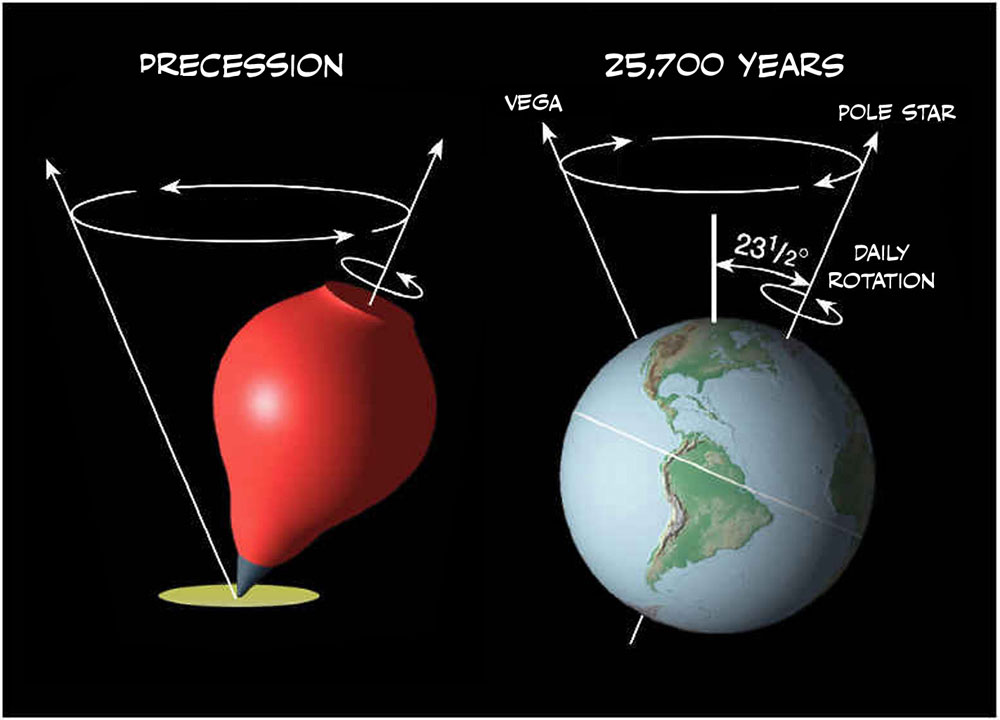
Whoever ends up in the cell next to his, tell him I said “Hi.”

中国是个混蛋 !!!
Zhōngguò shì gè hùndàn !!!
China is asshoe !!!

China is in the White House

Since Wednesday, January 20 at Noon EST, the bought-and-paid for His Fraudulency Joseph Biden has been in the White House. It’s as good as having China in the Oval Office.

Joe Biden is Asshoe

China is in the White House, because Joe Biden is in the White House, and Joe Biden is identically equal to China. China is Asshoe. Therefore, Joe Biden is Asshoe.

But of course the much more important thing to realize:

Joe Biden Didn’t Win

乔*拜登没赢 !!!
Qiáo Bài dēng méi yíng !!!
Joe Biden didn’t win !!!