2024·10·05 Joe Biden Didn’t Win Daily Thread

What is it that feeds our battle, yet starves our victory?

January 6 Tapes?

Paging Speaker Johnson…this is your conscience calling you out on broken promises.

For all your high talk about your Christian moral background…you’re looking less and less like you have any kind of moral background.

If You are a Patriot and Don’t Loathe RINOs…

Let’s talk about RINOs, and why they are the lowest form of life in politics.

Many patriots have been involved with politics, often at the grassroots, for decades. We’ve fought, and fought, and fought and won the occasional illusory small victory.

Yet we can’t seem to win the war, even when we have BIG electoral wins.

I am reminded of something. The original Star Trek had an episode titled Day of the Dove. It was one of the better episodes from the third season, but any fan of the original series will tell you that’s a very low bar. Still, it seems to get some respect; at a time when there were about 700 episodes of Star Trek in its various incarnations out there, it was voted 99th best out of the top 100.

In sum, the plot is that an alien entity has arranged for 39 Enterprise crew, and 39 Klingons, to fight each other endlessly with swords and other muscle-powered weapons. The entity lives off of hostile emotions, you see and it wants a captive food source. (The other 400 or so Enterprise crew are trapped below decks and unable to help.) Each side has its emotions played and amplified by the alien entity; one Enterprise junior officer has false memories implanted of a brother who was killed by Klingons. The brother didn’t even exist.

Even people killed in a sword fight miraculously heal so they can go do it again.

The second best line of the episode is when Kang, the Klingon captain, notes that though they have won quite a number of small victories including capturing Engineering, can’t seem to actually finally defeat the Enterprise crew. He growls, “What power is it that feeds our battle yet starves our victory?*”
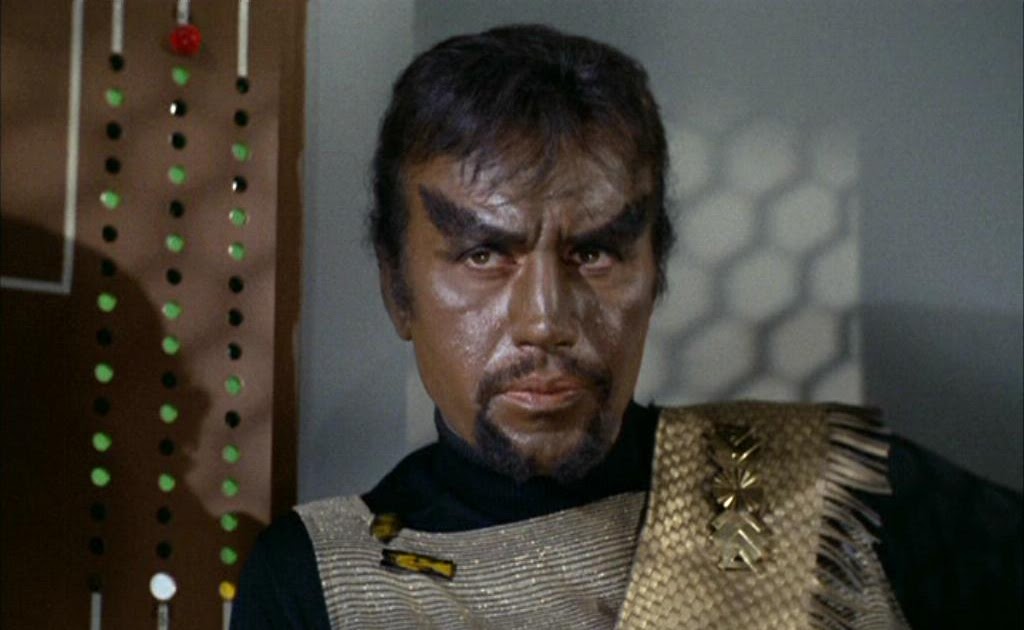
Indeed. He may have been the bad guy, but his situation should sound familiar.

We are a majority in this country. We have a powerful political party in our corner. There is endless wrangling.

And yet,

What power is it that feeds our battle yet starves our victory?

In our case, that power is the RINOs in our midst. They specialize in caving when on the verge of victory. Think of Obamacare’s repeal failing…by one Republican vote. Think of the way we can never seem to get spending under control (and now our entire tax revenue goes to pay interest on the debt; anything the government actually does now is with borrowed money).

We have a party…that refuses to do what we want it to do, and that refusal is institutionalized. If you’ve been involved with GOP politics, but haven’t seen this, it’s because you refuse to see it. Or because you are part of the problem yourself. (If so, kindly gargle some red fuming nitric acid to clear the taste of shit out of your mouth, and let those not part of the problem alone so they can read this.)

We fight to elect people, who then take a dive when in office. But it’s not just the politicians in office, it’s the people behind the scenes, the leaders of the national, state and county branches of the party. Their job is to ensure that real patriots never get onto the general election ballot. They’re allowed a few failures…who can then become token conservatives who will somehow never manage to win (Jordan), or can be compromised outright (Lauren Boebert?).

That way it doesn’t actually matter who has a congressional majority. I remember my excitement when the GOP took the Senate in 1980. But all that did was empower a bunch of “moderate” puddles of dog vomit like…well for whatever reason forty years later the most memorable name is Pete Domenici. And a couple of dozen other “moderates” who simply had no interest in doing what grassroots people in their party–those same grassroots people who had worked so hard to elect them–wanted them to do.

Oh, they’ll put up a semblance of a fight…but never win. And they love it when we fight the Dems instead of fighting them. Just like that alien entity, whose motto surely was “Let’s you and him fight. It’ll be delicious!”

If you think about it, your entire political involvement has come to nothing because of these walking malignant tumors.

That should make you good and mad.

The twenty five who blocked Jordan, and the hundred people who took that opportunity to stab Jordan in the back in the secret ballot should make you good and mad.

I’ll close this with another example of RINO backstabbing, an infuriating one close to home.

In my county, the GOP chair is not a RINO. She got elected when the grassroots had had enough of the RINOs. Unfortunately the state organization is full of RINOs, and the ousted county RINOs have been trying to form a new “Republican Party” and get the state GOP to recognize them as the affiliate. I’m honestly amazed it hasn’t happened yet.

In other words those shitstains won’t just leave when they get booted out; they’ll try to destroy what they left behind. It’s an indication that they know we know how important that behind-the-scenes party power is.

So they must be destroyed. That’s the only way they’ll ever stop.

We cannot win until the leeches “on our side” get destroyed.

What power is it that feeds our battle yet starves our victory?*

We know it. What is going to be done about it?

*NOTE: The original line was actually “What power is it that supports our battle yet starves our victory.” I had mis-remembered it as feeds. When I checked it, it sure enough was “supports” and that’s what I originally quoted. On further reflection, though, I realized my memory was actually an improvement over the reality, because feeds is a perfect contrast with starves. I changed it partway through the day this originally posted, but now (since this is a re-run) it gets rendered this way from the start.

If one must do things wrong, one should do them wrong…right.

RINOs an Endangered Species?
If Only!

According to Wikipoo, et. al., the Northern White Rhinoceros (Ceratotherium simum cottoni) is a critically endangered species. Apparently two females live on a wildlife preserve in Sudan, and no males are known to be alive. So basically, this species is dead as soon as the females die of old age. Presently they are watched over by armed guards 24/7.

Biologists have been trying to cross them with the other subspecies, Southern White Rhinoceroses (Rhinoceri?) without success; and some genetic analyses suggest that perhaps they aren’t two subspecies at all, but two distinct species, which would make the whole project a lot more difficult.

I should hope if the American RINO (Parasitus rectum pseudoconservativum) is ever this endangered, there will be heroic efforts not to save the species, but rather to push the remainder off a cliff. Onto punji sticks. With feces smeared on them. Failing that a good bath in red fuming nitric acid will do.

But I’m not done ranting about RINOs.

The RINOs (if they are capable of any introspection whatsoever) probably wonder why they constantly have to deal with “populist” eruptions like the Trump-led MAGA movement. That would be because the so-called populists stand for absolutely nothing except for going along to get along. That allows the Left to drive the culture and politics.

Given the results of our most recent elections, the Left will now push harder, and the RINOs will now turn even squishier than they were before.

I well remember 1989-1990 in my state when the RINO establishment started preaching the message that a conservative simply couldn’t win in Colorado. Never mind the fact that Reagan had won the state TWICE (in 1984 bringing in a veto-proof state house and senate with him) and GHWB had won after (falsely!) assuring everyone that a vote for him was a vote for Reagan’s third term.

This is how the RINOs function. They push, push, push the line that only a “moderate” can get elected. Stomp them when they pull that shit. Tell everyone in ear shot that that’s exactly what the Left wants you to think, and oh-by-the-way-Mister-RINO if you’re in this party selling the same message as the Left…well, whythefuckexactly are you in this party, you lying piece of rancid weasel shit?

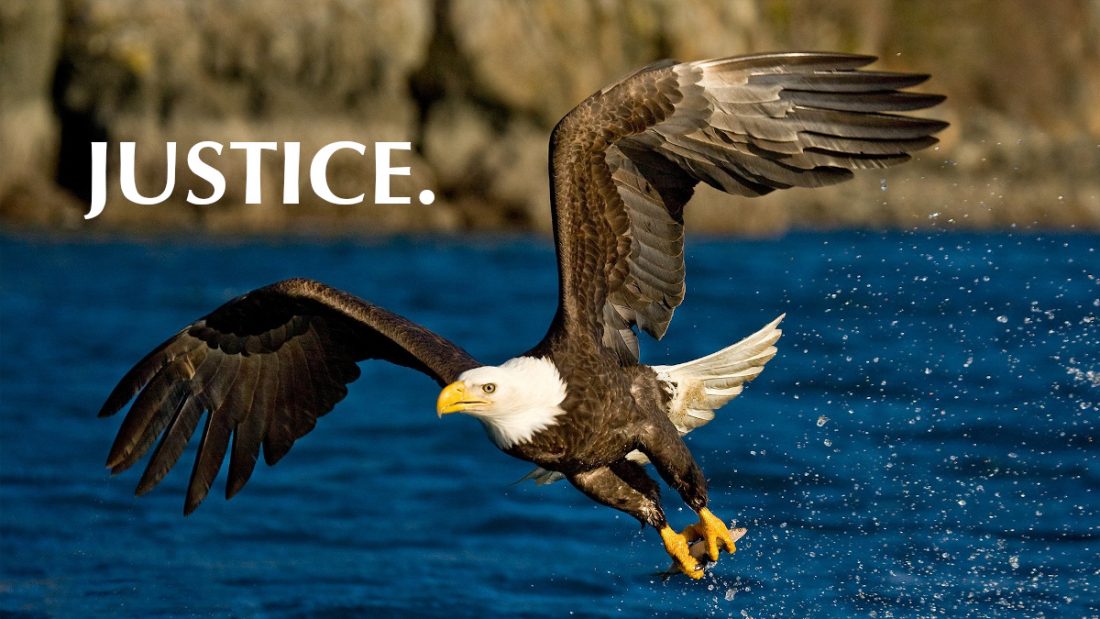
Justice

It says “Justice” on the picture.

And I’m sure someone will post the standard joke about what the fish thinks about the situation.

But what is it?

Here’s a take, from a different context: It’s about how you do justice, not the justice that must be done to our massively corrupt government and media. You must properly identify the nature of a person, before you can do him justice.

Ayn Rand, On Justice (speaking through her character John Galt, in Atlas Shrugged):

Justice is the recognition of the fact that you cannot fake the character of men as you cannot fake the character of nature, that you must judge all men as conscientiously as you judge inanimate objects, with the same respect for truth, with the same incorruptible vision, by as pure and as rational a process of identification—that every man must be judged for what he is and treated accordingly, that just as you do not pay a higher price for a rusty chunk of scrap than for a piece of shining metal, so you do not value a rotter above a hero—that your moral appraisal is the coin paying men for their virtues or vices, and this payment demands of you as scrupulous an honor as you bring to financial transactions—that to withhold your contempt from men’s vices is an act of moral counterfeiting, and to withhold your admiration from their virtues is an act of moral embezzlement—that to place any other concern higher than justice is to devaluate your moral currency and defraud the good in favor of the evil, since only the good can lose by a default of justice and only the evil can profit—and that the bottom of the pit at the end of that road, the act of moral bankruptcy, is to punish men for their virtues and reward them for their vices, that that is the collapse to full depravity, the Black Mass of the worship of death, the dedication of your consciousness to the destruction of existence.

Ayn Rand identified seven virtues, chief among them rationality. The other six, including justice, she considered subsidiary because they are essentially different aspects and applications of rationality.

—Ayn Rand Lexicon (aynrandlexicon.com)

Justice Must Be Done.

Trump, it is supposed, had some documents.

Biden and company stole the country.

I’m sure enough of this that I put my money where my mouth is.

The prior election must be acknowledged as fraudulent, and steps must be taken to prosecute the fraudsters and restore integrity to the system. (This doesn’t necessarily include deposing Joe and Hoe and putting Trump where he belongs, but it would certainly be a lot easier to fix our broken electoral system with the right people in charge.)

Nothing else matters at this point. Talking about trying again in 2024 or 2026 is pointless otherwise. Which is not to say one must never talk about this, but rather that one must account for this in ones planning; if fixing the fraud in the system is not part of the plan, you have no plan.

This will necessarily be piecemeal, state by state, which is why I am encouraged by those states working to change their laws to alleviate the fraud both via computer and via bogus voters. If enough states do that we might end up with a working majority in Congress and that would be something Trump never really had.

Lawyer Appeasement Section

OK now for the fine print.

This is the WQTH Daily Thread. You know the drill. There’s no Poltical correctness, but civility is a requirement. There are Important Guidelines,  here, with an addendum on 20191110.

We have a new board – called The U Tree – where people can take each other to the woodshed without fear of censorship or moderation.

And remember Wheatie’s Rules:

1. No food fights
2. No running with scissors.
3. If you bring snacks, bring enough for everyone.
4. Zeroth rule of gun safety: Don’t let the government get your guns.
5. Rule one of gun safety: The gun is always loaded.
5a. If you actually want the gun to be loaded, like because you’re checking out a bump in the night, then it’s empty.
6. Rule two of gun safety: Never point the gun at anything you’re not willing to destroy.
7. Rule three: Keep your finger off the trigger until ready to fire.
8. Rule the fourth: Be sure of your target and what is behind it.

(Hmm a few extras seem to have crept in.)

Spot Prices

Last week:

Gold $2,658.90
Silver $31.72
Platinum $1,010.00
Palladium $1,038.00
Rhodium $5,100.00
FRNSI* 127.624+
Gold:Silver 83.824+

This week, at Friday close:

Gold $2,654.30
Silver $32.26
Platinum $999.00
Palladium $1,038.00
Rhodium $5,025.00
FRNSI* 127.402-
Gold:Silver 82.278+

Interestingly silver did fairly well this week (it’s now worth more than 1/83rd of an ounce of gold now), gold, on the other hand, is slightly down, Platinum seems to be the biggest loser this week.

*The SteveInCO Federal Reserve Note Suckage Index (FRNSI) is a measure of how much the dollar has inflated. It’s the ratio of the current price of gold, to the number of dollars an ounce of fine gold made up when the dollar was defined as 25.8 grains of 0.900 gold. That worked out to an ounce being $20.67+71/387 of a cent. (Note gold wasn’t worth this much back then, thus much gold was $20.67 71/387ths. It’s a subtle distinction. One ounce of gold wasn’t worth $20.67 back then, it was $20.67.) Once this ratio is computed, 1 is subtracted from it so that the number is zero when the dollar is at its proper value, indicating zero suckage.

How QR Codes Work

A Common Phenomenon

Regardless of what you think about Flat Earth, this video should serve to illustrate a common mistake that I see many “conspiracy theorists” (the stupid kind I mean) make.

Basically the man in question went to the NBC website and saw a distorted version of this very famous, even iconic photograph, which even has a nickname, the Blue Marble, because when it came out in the early 1970s there was all sorts of buzz about how the Earth was a Big Blue Marble (great way to propagandize the kiddies!):
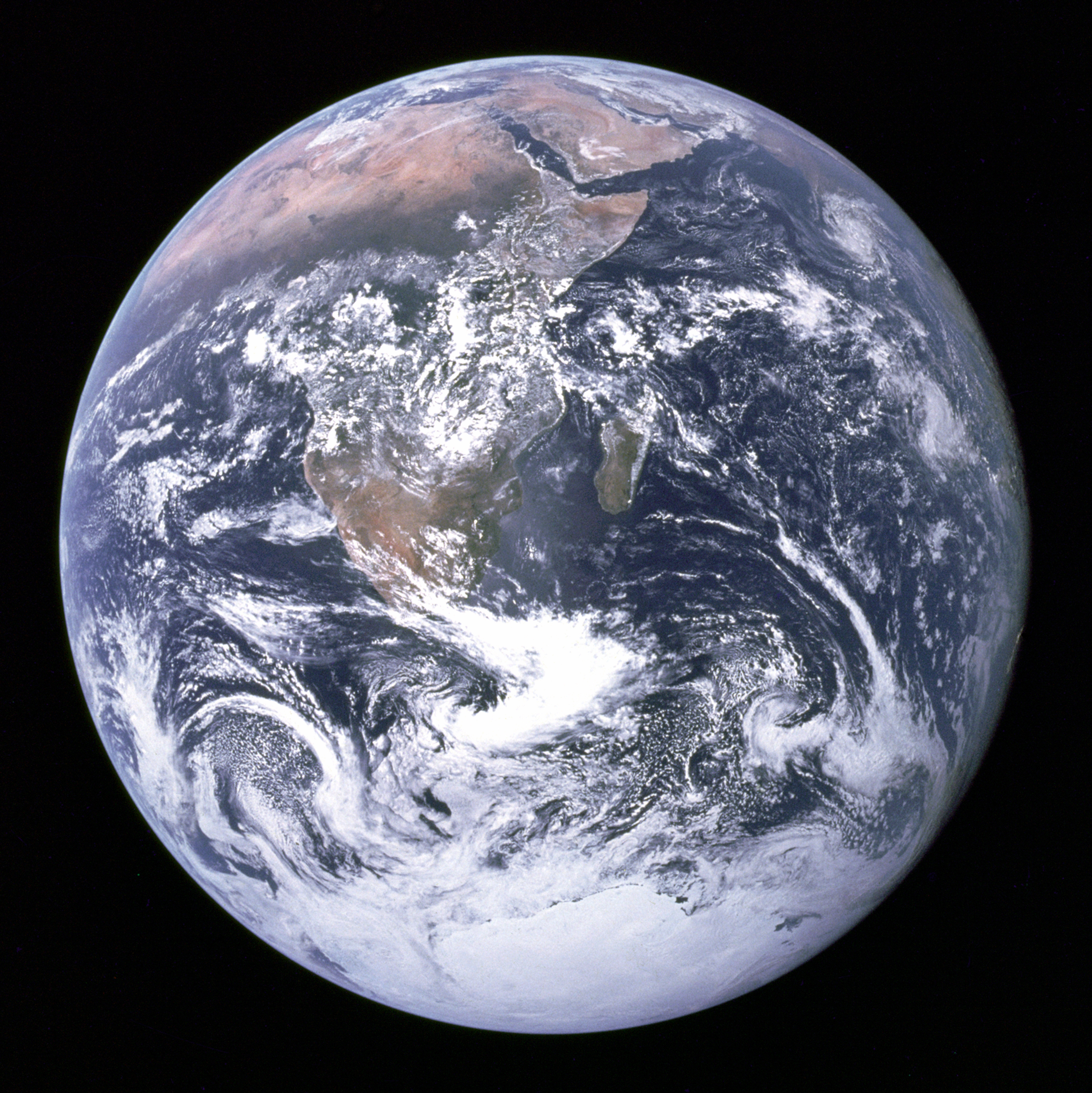
…and then proceeded on the implicit assumption that the distortion was the original. In the distortion, it appears as though the Red Sea (between Egypt and Saudi Arabia) was cut in half. Since it isn’t in fact cut in half, he assumed this was proof that the Blue Marble photo was originally faked. (BTW this photo should be 3000 pixels across if you want to fullscreen it, etc. As a bonus, it shows Antarctica so that’s doubly annoying to flerfers.)

When he did a bit more searching for the image, including on the NASA website, he started finding the actual original (with properly rendered Red Sea) a lot and assumed that NASA or someone had been going all over the web and cleaning up their mistakes…except, apparently, on NBC’s website, which somehow got overlooked.

I can assure anyone here who might actually think this guy is onto something and the distortion is the real version, that I have print books from the 1970s that show the photo with an uninterrupted Red Sea. Unless you want to claim that NASA broke into my house and swapped out the books with equally-worn copies…

This is a classic example of a phenomenon I see sometimes…a person with a nutty conspiracy theory latches onto the first thing they see, and if it happens to contain a bona fide error in it, there’s no convincing them of it; they will spin a huge unlikely story as to how “their” version of whatever it was is the correct one, and that the correct one is actually the fake used for a cover up.

Another example of this was a report early on in the Sandy Hook saga that described the wrong gun as being in someone’s trunk. Attempts to correct it were treated as part of the cover up. Interesting that people who would normally have no trouble believing a YSM jurinalist would fuck up especially when the subject was eeevil gunz, believed that this particular jurinalist at this particular time was infallible–because they wanted to believe Sandy Hook was a fake.

What’s going on in both cases is seizing on (apparent) evidence that one’s pet mistaken theory is true, and resisting any attempt to show that this particular piece of evidence, at least, is flawed–sometimes to the point of having to posit another incredibly elaborate or expensive effort to hide the “real” evidence. A mistake, a distorted jpeg, or something similar. This is actually a form of confirmation bias.

The Moons of Jupiter

Jupiter has 95 (yes, ninety five) known moons (as of 5 February 2024). When I was a kid, the number was twelve, though older books in the elementary school library would show eleven. Then a 13th moon was discovered when I was ten (1974), another one the following year, and then the Voyager spacecraft found three more…and at that point they decided they really ought to get on with naming them. The first five or so had been named for quite some time, it was the remaining six seven eight nine (dammit) twelve that hadn’t been officially named though there were several suggested lists. (The next discovery wasn’t until 2000; the remaining 78 moons have all been discovered since then). Today, of course the list has outstripped our ability to think of names and the newly discovered ones are given temporary designators like S2022 J 3, for 3rd Satellite of Jupiter discovered in 2022.

Astronomers love to categorize things. And the moons of Jupiter are no exception. There are nine categories and I will cover them almost in order of distance from the planet.

The Main Moons, or Galilean Moons, are Io, Europa, Ganymede, and Callisto, in order outwards from Jupiter. These are BIG. They are bigger than any dwarf planet (and that includes Pluto). Ganymede is bigger than Mercury and Callisto almost beats Mercury as well. All are spherical, as one would expect from bodies that size. The innermost orbits at 422 thousand kilometers (from the center of gravity of the Jovian system, essentially the same as the center of Jupiter), the outermost at 1,883 thousand kilometers. (For comparison, our Moon orbits at 384 thousand kilometers, so these are all further from Jupiter than our Moon is from us.) These were all discovered about 30 milliseconds after Galileo first pointed a telescope at Jupiter in 1610; you can see them in binoculars. They all orbit in nearly circular orbits (the key word, as we will see, is nearly), in planes within half a degree of Jupiter’s equatorial plane, all in a prograde (forward) direction. Forward, here, means counterclockwise as seen from way out in space, over the Sun’s north pole. Almost every large body in the solar system both orbits (either the sun or a planet) and rotates prograde, including Earth and the Moon.

Another group of four moons are called the “Inner Moons,” they all orbit within the orbit of Io. The first of these is the first moon to be discovered since Galileo, in 1892, and got named Amalthea. Amalthea is an irregular lump about 167 km across. Much smaller than the Galilean satellites and too small to force itself into a spherical shape. The other three are the ones discovered by the Voyager spacecraft in 1979/80, and are considerably smaller still. There’s also a lot of debris in that region, forming Jupiter’s rather tenuous ring system. Again, these are in nice and tidy, nearly circular orbits in Jupiter’s equatorial plane, all prograde.

Together these groups are called the “Regular Satellites” of Jupiter, which means the other 87 moons are all “Irregular Satellites.”

The Irregular Satellites all orbit much further away from Jupiter than Callisto (the outermost regular satellite). These in turn are divided into prograde and retrograde (orbiting backwards) groupings, each of those is divided again into actual groups. There is a naming convention, too. A prograde irregular moon will have a name ending in -a. A retrograde irregular moon will have a name ending in -e. Not withstanding this, a moon with a very high inclination will have a name ending in -o, whether or not it’s retrograde or prograde.

Prograde groups include Themisto…which is a group all unto itself. It’s the innermost of the irregular satellites averaging roughly 7.4 million km from Jupiter. It’s in a very elliptical orbit (0.340 on a scale from 0 [circular] to 0.9999… [skinniest ellipse possible]) at a 43.8 degree inclination, not at all tidy. It takes about 130 days to complete one orbit about Jupiter.

The next group is the Himalia group of nine satellites, named after its largest member, which is roughly 140 km across. They all orbit at about a 28 degree inclination with eccentricities ranging from 0.1 to 0.24. Average distance from Jupiter is 11.1 to 12.3 million kilometers, most of them being 11.4 or 11.7. They take about 260 days to orbit Jupiter. Four of these are big enough to be in the “classic” 14 satellites from before Voyager I and 2. These orbits are all quite similar to each other, hence the grouping together. It’s likely these were all part of a larger body at some time in the past.

The Carpo group, 2 satellites, are 16-17 million kilometers from Jupiter and are inclined at 50 degrees, which subjects them to all sorts of wacky perturbations resulting in cyclical changes to their orbits. Their eccentricities are very different from each other.

And then there is Valetudo, a group unto itself, in an eccentric orbit 17 million kilometers from Jupiter, at a lesser inclination than the Carpo group. It actually crosses the orbits of other groups’ satellites.

Now we get to the retrograde groups, three of them. The Ananke group ranges from 19-22 million kilometers from Jupiter and there are 26 of them. A quick eyeball scan of the list on Wikipedia shows inclinations from 145-152 degrees. (A retrograde orbit can also be thought of as going forward, but with an inclination of over 90 degrees so it’s “flipped over”, and this is how they get listed in tables of orbital elements.) Inclinations are mostly 0.20 to 0.23. It’s thought that these have a common origin, their orbits are just too similar for it to be pure chance.

The other two groups are the Carme and Pasiphae groups, with 30 and 18 members respectively. They overlap in terms of average distance from Jupiter, 22.6-24.2 million kilometers from Jupiter, taking as long as two Earth years to make one orbit. The Carme group inclinations are all about 164 degrees (i.e., 74 degrees but going around backwards), the Pasiphae groups are in a broader range centering on 150 degrees or so. In each case the satellites in each group are thought to have a common origin.

“Common origin” or “were once part of a larger body”, by the way, imply that there are more undiscovered fragments of what they used to be. The smallest size I see in the table is ~1 km, but conceivably there could be a lot of smaller and smaller pieces. 100 meters, boulder size, gravel size, sand grain size…at what point do you stop and say “this isn’t a moon any more”? It’s a serious question from me, actually. I’m sure that “real” astronomers have given it thought, but I don’t know if they ever actually came to a decision. It did, after all, take hundreds of years for them to define “planet” and they were only forced to do that when they found too many edge cases…a story for another time. (And here, they haven’t started finding really small items in Jovian orbit…when that happens they’ll have to decide where to draw the line if they haven’t already.)

So…broad patterns? Note that the retrograde satellites (by count, most of the satellites are in these groups) are all further out than any of the prograde ones. The retrogrades are almost always 2 km or less in size, though each group has one fairly large body in it, 35-60 km across, probably the “main” piece of whatever broke up to form the group. It’s thought that the retrograde groups resulted from captured asteroids.

There also seems to be a hard 24 million kilometer limit. I haven’t cranked numbers but I suspect that beyond this range the Sun’s gravitational pull is stronger than Jupiter’s, so it would tend to grab any satellite of Jupiter’s that happened to be in a larger orbit than this.

In any case, the retrogrades are basically debris, and even the irregular progrades are basically junk too. Except for the fact that they make good studies in orbital mechanics, they’re pretty uninteresting.

The interesting moons are the Galilean moons. And with that I submit my entry to the understatement of the year contest.

The Galilean Moons
(because who gives a rat’s ass about the other 91 moons?)

The Galilean moons are, in order outward from Jupiter, Io, Europa, Ganymede and Callisto. Jupiter plus these moons actually looks like a miniature solar system, and you’ll hear the term “Jovian system” used to refer to the ensemble as a whole.

Although Galileo is given credit for discovering these moons, they were also seen by Simon Marius, and he gave them their names; Galileo simply called them Jupiter I, Jupiter II, and so on, a system which continues to this day; now Roman numerals are given out to newly discovered moons in the order they are named.

“Io” is pronounced “EYO-oh.” Don’t be like the clueless science jurinalist who pronounced it “ten” when the Voyagers flew by. (In his defense, that was the era when Bo Derek was the Queen Hot Woman of All Time thanks to the movie 10…for a whole two months.)

Here is a picture showing relative sizes, Jupiter and the four Galileans, in order top to bottom. This is actually a composite, just to show relative sizes; you’d never see this exact thing all at once.
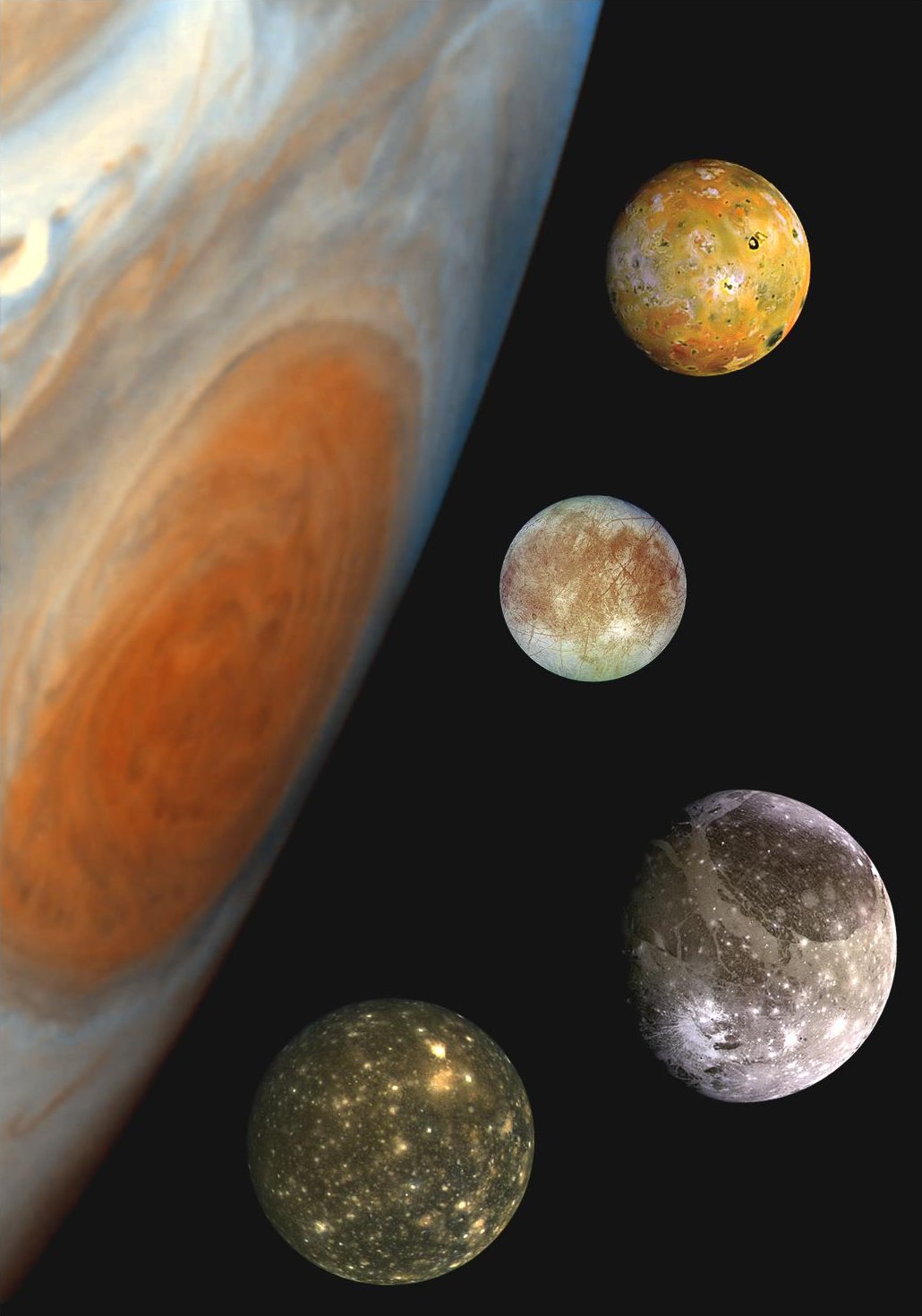
And another, a real-time shot of Jupiter and all four Galileans. Since some are closer than others, it’s not quite to scale; it is however a “real” snapshot of all five bodies at the same time. If you were to somehow have been able to stand there, this is what you’d have seen. Two of the moons are probably invisible; if so, right click and select “open image in new tab” and even there they will be just single-pixel dots, and one is barely more than a dot)

And now for some raw numbers, with our own Moon tossed in for comparison:

NameDiameter (km)Distance from Primary (km)Orbital Period
(days)
Orbital Period (compared to Io)Density (water = 1)
Io3660421,8001.76913.528
Europa3121.6671,1003.55123.014
Ganymede5268.21,070,4007.15541.942
Callisto4820.61,882,70016.6899.41.834
Moon3474.8384,39927.3irrelevant3.344

Note that Ganymede is by far the largest; it’s even larger than the planet Mercury.

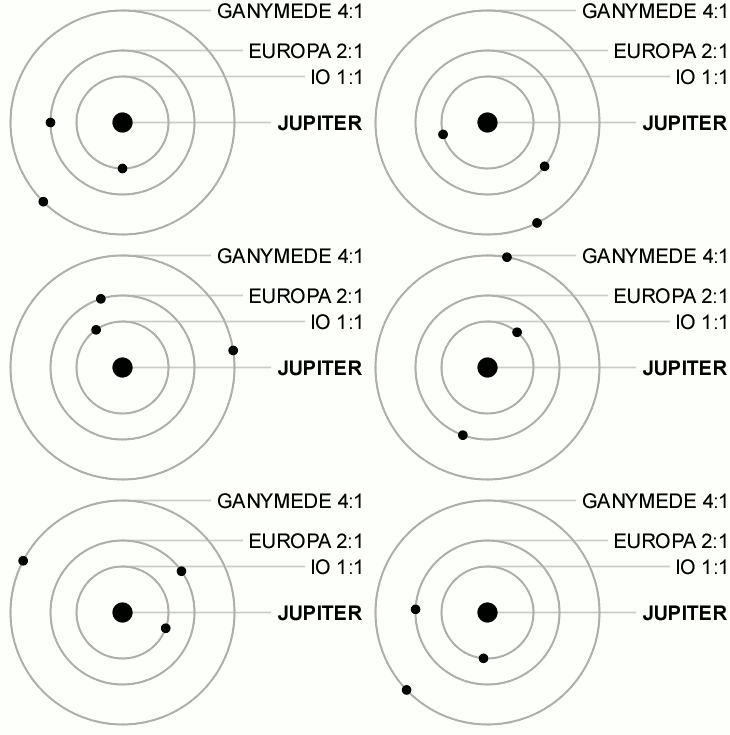
But also note something else: In the time it takes Ganymede to orbit Jupiter once, Europa will orbit exactly twice, and Io will orbit exactly four times. This is known as an orbital resonance. However, they won’t line up all at once. Io will lap Europa on one side of Jupiter, and then on the other side of Jupiter, Europa will lap Ganymede. See the animation below, where the inner moons will lap “above” Jupiter, and Europa and Ganumede will lap “below” Jupiter.
That’s a simulation, what’s below is based on actual data (notice the time stamp):
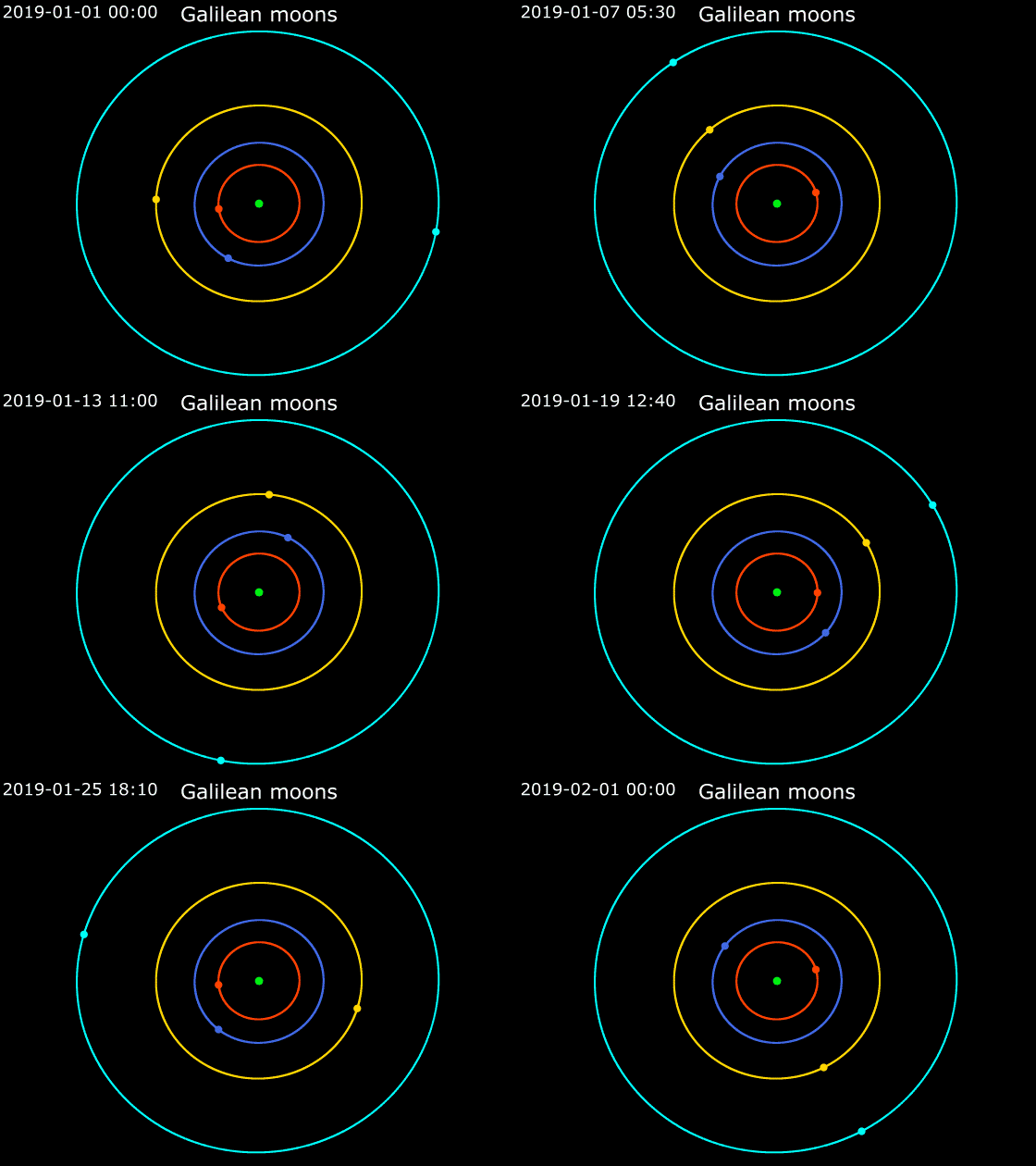
This turns out to be important.

Another thing to note is the average densities. Io and Europa (and our Moon) all have densities a bit above 3.0 that of water. We know our own moon is a big ball of rock with very little nickel-iron in its core. And your average generic rock has about that density (though there are plenty of kinds of minerals that come in far higher, such as for instance native gold, a/k/a gold nuggets). So this isn’t unreasonable for moons of Jupiter. However Ganymede and Callisto are considerably less dense, an indication that they are largely ice.

Jupiter I: Io

Io has a very unusual appearance, it almost looks like a pizza. As it happens, it is the most volcanically active body in the solar system. If you don’t like its looks, come back an a few centuries; the entire surface will have been replaced. That’s how volcanic it is. it even has mountains taller than Everest!

This is a pair of pictures of Tvashtar Paterae, taken in November 1999 and February 2000, and yes, that’s lava in the right hand frame.

Volcanism requires heat. And if you’ll recall, Mars…a considerably larger body…does not have volcanism any more (in spite of the largest known volcano being there). Mars has cooled off too much. Why hasn’t Io cooled off?

The answer is (wait for it) tidal forces. (I warned you before I started the tour of the solar system that tidal forces would show up when you least expect them…I did warn you.) Io is in a slightly elliptical orbit (very slightly but still, not quite perfectly circular) and that means it slows down and speeds up in different parts of its orbit, while its rotation (tidally locked to Jupiter) is at a constant rate. This causes Io to stretch and compress, which generates the heat, which causes the insane amounts of volcanism. The surface coloration is largely sulfur. Io’s eruptions have been captured on camera by Voyager, the Galileo orbiter, and Juno.

Some of the stuff that gets erupted ends up in orbit around Io, as very small particles perhaps even single atoms, and some of that gets heated and escapes into orbit around Jupiter. At some point much of this stuff gets ionized. As a result there’s a “neutral cloud” near Io, and a donut or torus of ionized matter roughly where Io orbits. Since this stuff is charged and moving, it actually contributes to Jupiter’s magnetic field…perhaps as much as 50 percent of the total.
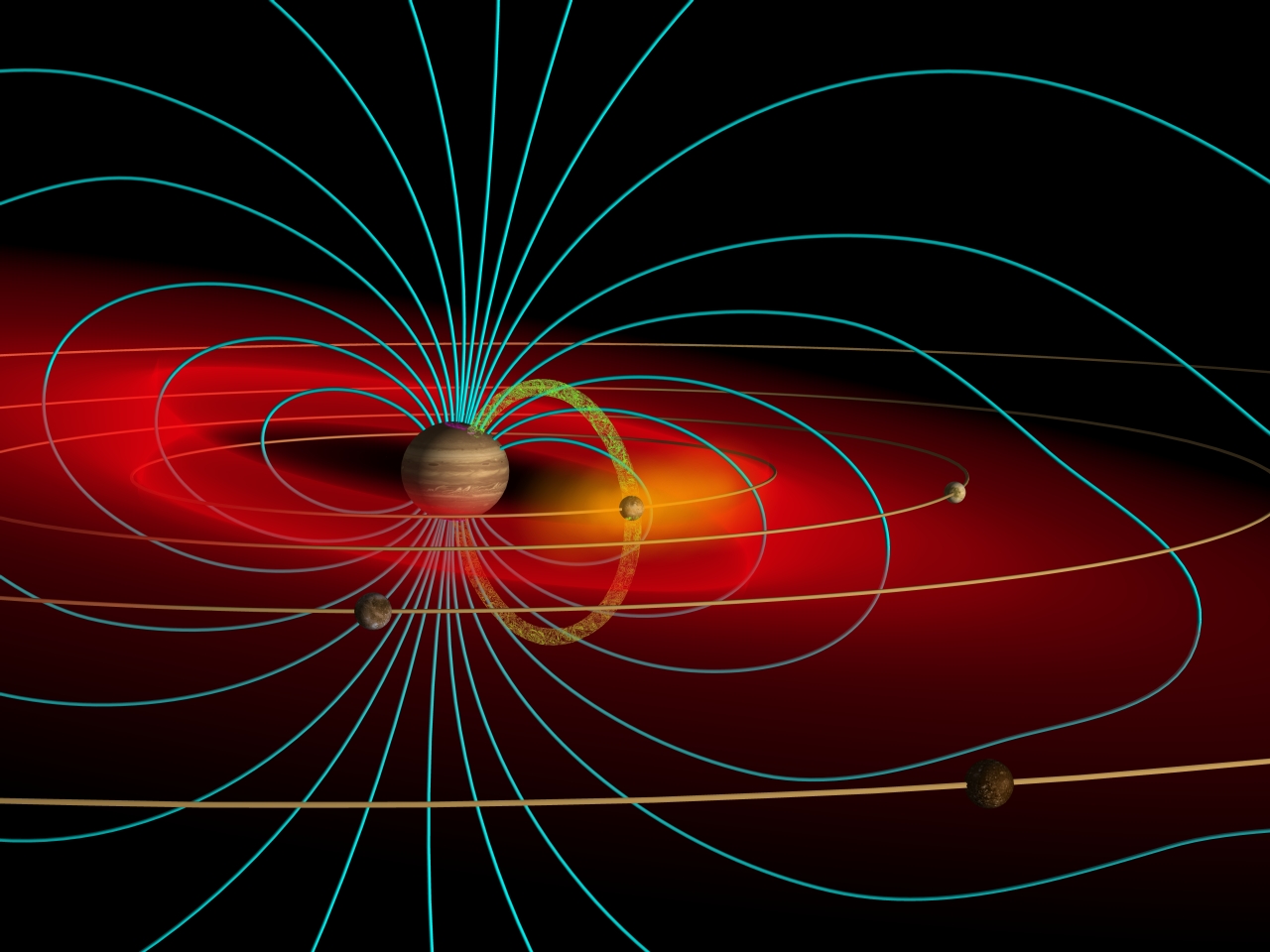
This picture not only shows the torus of ionized Io-stuff in red and the neutral cloud in yellow, it shows a third feature in green, the flux tube, which connects Io to Jupiter’s polar regions and can cause aurora-like displays in Jupiter’s atmosphere. But Io itself can have interesting displays, visible when it is in Jupiter’s shadow:
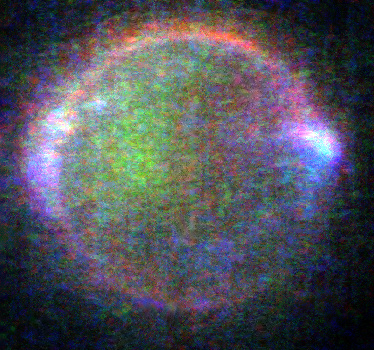
(From the caption on Wikipoo: Auroral glows in Io’s upper atmosphere. Different colors represent emission from different components of the atmosphere (green comes from emitting sodium, red from emitting oxygen, and blue from emitting volcanic gases like sulfur dioxide). Image taken while Io was in eclipse.)

Another source of tidal forces is the pull of Europa and Callisto, with the resonances enhancing the effect.

This was a total surprise when it was discovered back around 1980. And since then it has become clear to planetary scientists that in many cases the moons of the outer planets can be more interesting than the planets themselves.

Jupiter II: Europa

Most especially the second Galilean moon, Europa. What we see when we look at Europa is a solid sheet of ice; it’s the smoothest body in the solar system, and appears to have a 100km thick layer of water above the typical rocky interior. What makes it interesting, though, is that that 100km layer is almost certainly not frozen solid. It’s probably tens of kilometers of ice, sure, but above a world-wide ocean of liquid water, a lot of it, probably more than we have on Earth. (So aliens coming here to steal our water [which is ridiculous because water is almost certainly the most common compound in the universe] would be better off going to Europa.)

(From Wikipoo caption: Closeup views of Europa obtained on 26 September 1998; images clockwise from upper left show locations from north to south as indicated at lower left.)

That water is likely heated by volcanic activity too, for the same reason as Io…but less so. Tidal forces are much lower here. However, the forces will often crack the ice layer, and liquid water will rise under the pressure, with the breaks freezing over, which results in the darker lines. These areas might offer better access to the water, which we want because…

Water is the one thing all life (that we know of!) needs. Not oxygen, but water! This makes Europa a prime candidate for extraterrestrial life, especially since we know that on Earth, “smokers” on the ocean floor host entire ecosystems, and such “smokers” are almost certainly present on Io.

Neil deGrasse Tyson, staying in his lane academically, has said he wants to go ice fishing on Io. He’s not alone in this.

On the 10th of this month, we will launch the Europa Clipper, a spacecraft that will orbit Jupiter, but do so in a way that maximizes the time it will spend on Europa flybys. It’s the largest interplanetary spacecraft developed by NASA. Since it is so big, the booster needs help; it will do gravity boosts off Earth and Mars before arriving at Jupiter in April 2030. This is just a preliminary for a Europa Lander, still on the drawing board.

We’re going after Europa with gusto!

Jupiter III: Ganymede

Ganymede is also covered in ice, with a likely liquid ocean 200km down. It’s colder and harder to get to, so it’s not as tantalizing as Europa. It’s not completely geologically dead: it apparently has at least some liquid iron in its core since it actually possesses a magnetosphere (so far the only moon known to do so). It’s the largest moon in the solar system. As I’ve noted before, it’s actually larger than the planet Mercury, but only 45 percent as massive since so much of it is ice, and because Mercury has a very large iron core for its size. The surface area is in fact over half as much as all of the land on Earth. Unfortunately, it’s mostly ice–and not just a covering, but a full crustal layer of it–and blasted by radiation from Jupiter’s magnetosphere, so it turns out not to be a good place for a realtor to hang a “for sale” sign.
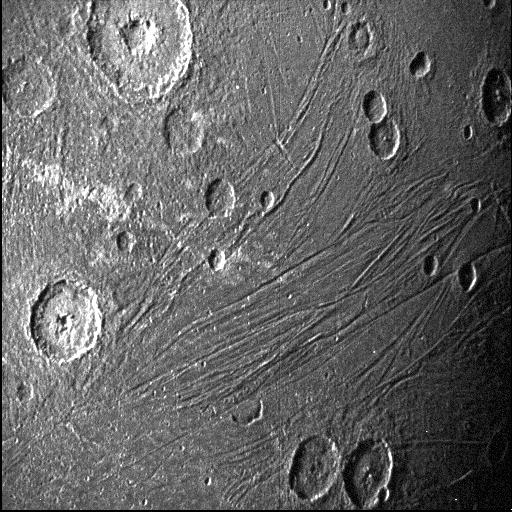
This is Tros crater. In mythology, Tros was Ganymede’s father, and Ganymede himself was Jupiter’s cupbearer (and likely homosexual lover)
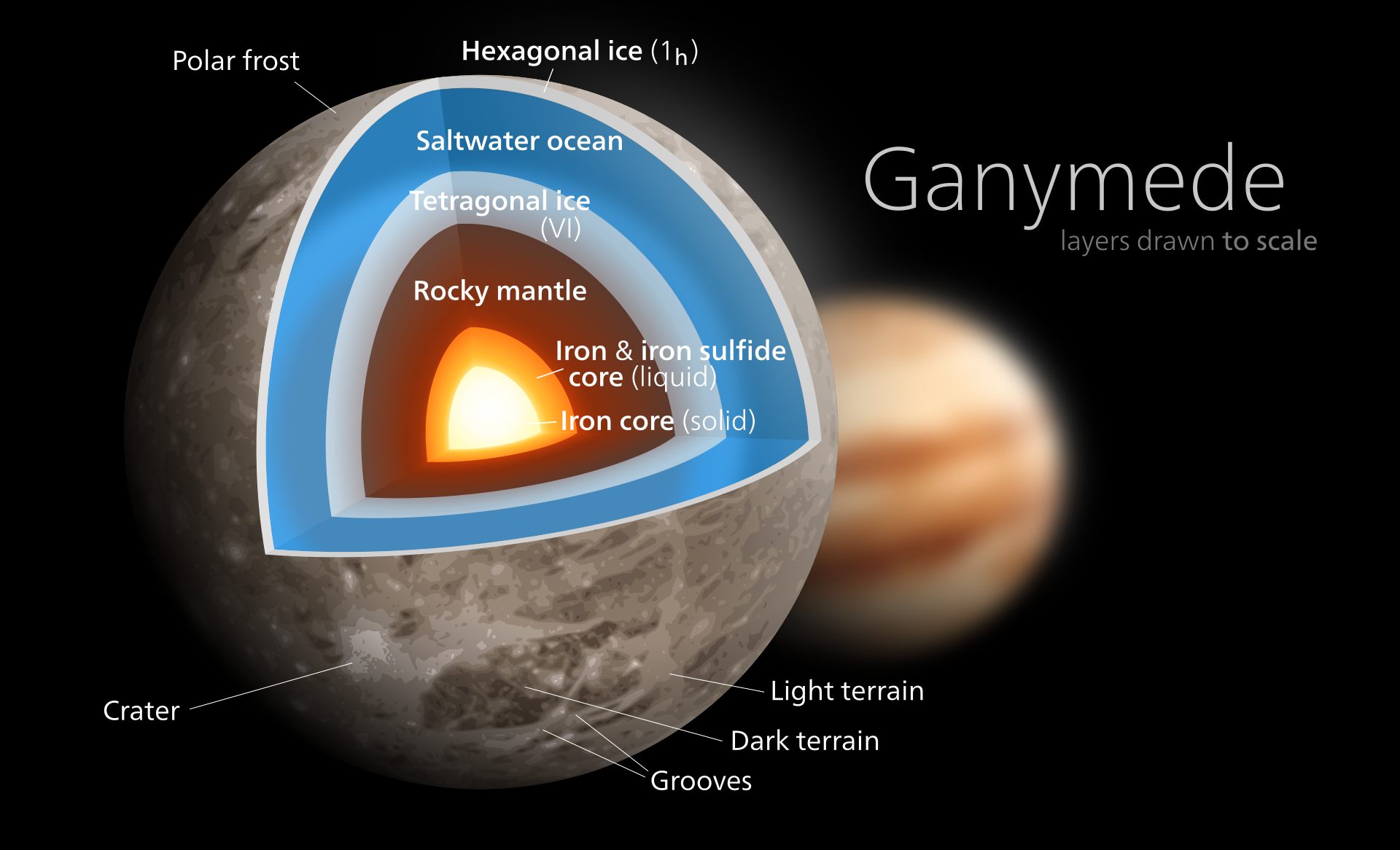
Ganymede also has the distinction of being the largest body in the solar system with no significant atmosphere.

Jupiter IV: Callisto

Callisto is a bit smaller than Ganymede, and is the third largest moon in the solar system. (#2 is Titan, a moon of Saturn. And our moon is at #5, just ahead of Europa.) Callisto is remarkable for being very heavily cratered, an indication that its surface has not eroded much or been “worked over” by processes on Callisto itself. It’s far enough out from Jupiter to have very little effect from tidal forces, and it’s not in any sort of resonance with the other moons. Callisto, in fact, has an impact basin named Valhalla, which is 3800 kilometers across!

Callisto may, in fact, be an even mixture of rock and ice, not even having differentiated much with the heavy stuff going down to the core when it formed.

Of the four, Callisto is of least interest for finding life, but it is of great interest for perhaps preserving it. It’s far enough away from Jupiter’s magnetic field and radiation belts that it could perhaps be useful for a manned base from which we could explore the rest of the Jovian system.
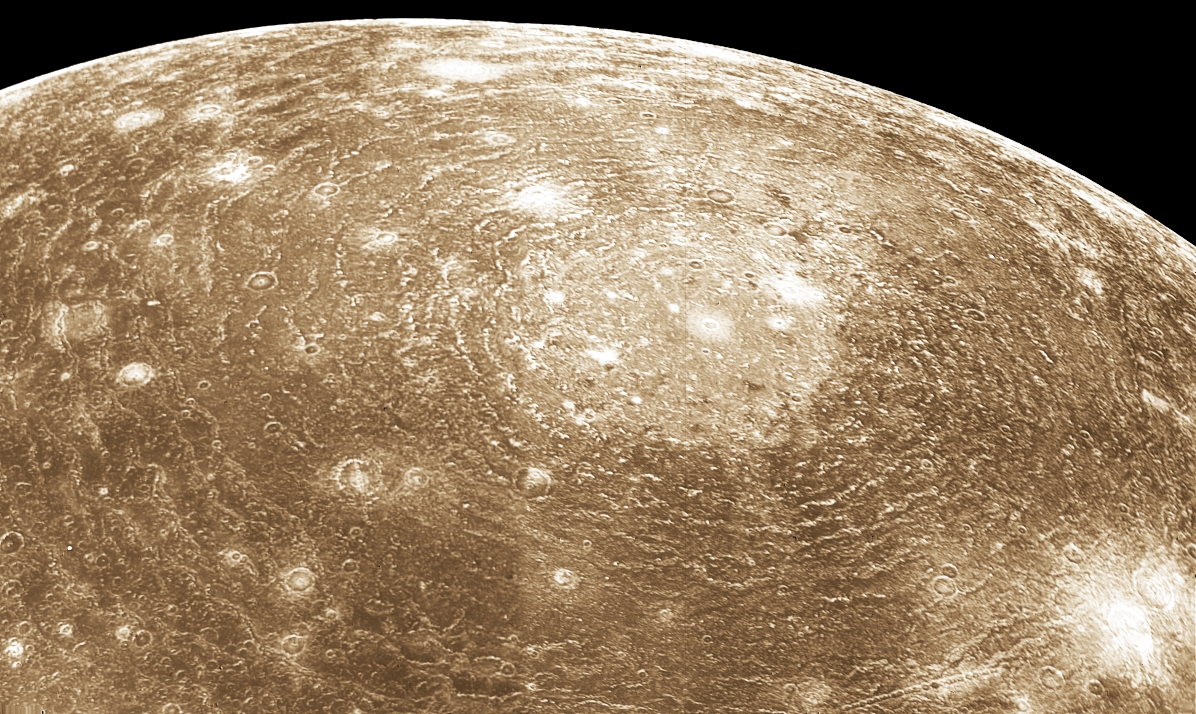
(From Wikipoo: Voyager 1 image of Valhalla, a multi-ring impact structure 3,800 km in diameter)

So that is a summary of the Moons of Jupiter, all of which rank among the most interesting bodies in our solar system. Were they not in orbit about Jupiter, they’d all be planets in their own right.

As a bonus I will conclude with this diagram, which shows many of the moons in the Solar System, with Pluto and Earth thrown in for good measure. Any moon large enough to force itself into a spherical shape is shown here.

(Oh, and note the Red Sea glitch doesn’t appear on this copy of the Blue Marble photo.)

2024·09·28 Joe Biden Didn’t Win Daily Thread

What is it that feeds our battle, yet starves our victory?

January 6 Tapes?

Where are the tapes? Anyone, Anyone? Bueller? Johnson??

Paging Speaker Johnson…this is your conscience calling you out on broken promises.

News Flash

Today, it is still the case that Joe Biden didn’t Win.

I realize that to some readers, this might be a shock; surely at some point things must change and Biden will have actually won.

But the past cannot actually be changed.

It will always and forever be the case that Joe Biden didn’t win.

And if you, Leftist Lurker, want to dismiss it as dead white cis-male logic…well, you can call it what you want, but then please just go fuck off. No one here buys that bullshit–logic is logic and facts are facts regardless of skin color–and if you gave it a moment’s rational thought, you wouldn’t either. Of course your worthless education never included being able to actually reason–or detect problems with false reasoning–so I don’t imagine you’ll actually wake up as opposed to being woke.

As Ayn Rand would sometimes point out: Yes, you are free to evade reality. What you cannot do is evade the consequences of evading reality. Or to put it concretely: You can ignore the Mack truck bearing down on you as you play in the middle of the street, you won’t be able to ignore the consequences of ignoring the Mack truck.

And Ayn Rand also pointed out that existence (i.e., the sum total of everything that exists) precedes consciousness–our consciousnesses are a part of existence, not outside of it–therefore reality cannot be a “social construct” as so many of you fucked-up-in-the-head people seem to think.

So much for Leftist douchebag lurkers. For the rest of you, the regular readers and those lurkers who understand such things: I continue to carry the banner once also carried by Wheatie. His Fraudulency didn’t win.

Let’s Go, Brandon!!

His Fraudulency

Joe Biteme, properly styled His Fraudulency, continues to infest the White House, we haven’t heard much from the person who should have been declared the victor, and hopium is still being dispensed even as our military appears to have joined the political establishment in knuckling under to the fraud.

One can hope that all is not as it seems.

I’d love to feast on that crow.

(I’d like to add, I find it entirely plausible, even likely, that His Fraudulency is also His Figureheadedness. (Apparently that wasn’t a word; it got a red underline. Well it is now.) Where I differ with the hopium addicts is on the subject of who is really in charge. It ain’t anyone we like.)

Justice Must Be Done.

The prior election must be acknowledged as fraudulent, and steps must be taken to prosecute the fraudsters and restore integrity to the system.

Nothing else matters at this point. Talking about trying again in 2024 is hopeless otherwise. Which is not to say one must never talk about this, but rather that one must account for this in ones planning; if fixing the fraud is not part of the plan, you have no plan.

Lawyer Appeasement Section

OK now for the fine print.

This is the WQTH Daily Thread. You know the drill. There’s no Poltical correctness, but civility is a requirement. There are Important Guidelines,  here, with an addendum on 20191110.

We have a new board – called The U Tree – where people can take each other to the woodshed without fear of censorship or moderation.

And remember Wheatie’s Rules:

1. No food fights
2. No running with scissors.
3. If you bring snacks, bring enough for everyone.
4. Zeroth rule of gun safety: Don’t let the government get your guns.
5. Rule one of gun safety: The gun is always loaded.
5a. If you actually want the gun to be loaded, like because you’re checking out a bump in the night, then it’s empty.
6. Rule two of gun safety: Never point the gun at anything you’re not willing to destroy.
7. Rule three: Keep your finger off the trigger until ready to fire.
8. Rule the fourth: Be sure of your target and what is behind it.

(Hmm a few extras seem to have crept in.)

The Asteroids

In 1772 Johan Elert Bode citing Johan Daniel Titius, formulated the Titius-Bode law, more commonly just “Bode’s Law.” They had noted a rather interesting pattern in the distances of the planets from the Sun, when expressed in AUs. Let’s show the ones known as of 1772, plus the Hugh Janus, discovered in 1781.

Mercury0.387
Venus0.723
Earth1.000
Mars1.523
Jupiter5.203
Saturn9.537
Uranus19.191
Distances from the Sun to all planets known as of 1800, in Astronomical Units.

The thing is, there’s a pattern here…sort of, and that’s Bode’s Law. It’s a mathematical progression. Start with 4. Then 4+3. Then 4+(3×2). Then 4+(3×4).

Or slightly more clearly: 4, 4+3×20, 4+3×21, 4+3×22, 4+3×23, etc. It’s not quite a perfect series because there’s no way to get 4+0 by adding 3×2some-power to it. Anyhow, let’s divide these numbers by 10 and compare to the planet distances:

Mercury0.3870.4
Venus0.7230.7
Earth1.0001.0
Mars1.5231.6
???2.8
Jupiter5.2035.2
Saturn9.53710.0
Uranus19.19119.6
Distances from the Sun to all planets known as of 1800, in Astronomical Units, with Bode’s Law.

It’s a decent (but not great) fit! And when Uranus was discovered in 1781, it almost fit too, albeit missing by a bit over 0.4 AUs. This made it seem more and more like this law might actually mean something. But if so, the glaring WTF in the whole thing is the fact that we seem to be missing a planet at 2.8 AU.

(I’ll pause here to point out that we no longer think of this as a law. It was valid to think of it as one back then, since a “law” just says “things behave this way, for whatever reason.” Neptune is in completely the wrong place, plus extrasolar planets don’t even remotely follow anything like this even if you scale for the fact that most of them orbit red dwarfs and do so much closer to them.)

But back then, it certainly looked as if we might have a planet to find, especially after Hugh Janus’s discovery made the notion of undiscovered planets thinkable, and Hugh Janus was even at close to the right distance!

On the other hand, Immanuel Kant, when he wasn’t doing things that would later piss off Ayn Rand, did do some theoretical astronomy and he wondered if perhaps Jupiter’s gravity had created the gap.

Many people (not nearly enough in Ayn Rand’s opinion) paid no attention to Kant, and tried looking.

We didn’t have to wait all that long. Just for a new century.

On January 1, 1801, technically the first day of the 19th century, Giuseppe Piazzi, working at the Palermo Astronomical Observatory in Sicily…[OK, I can’t even see the word “Palermo” without hearing in my head a British voice telling Field Marshal Montgomery that Patton had taken Palermo…to which the response was “Damn!” Thanks to the movie Patton.] Anyhow, Piazzi first sighted an object, and repeated his observations from night to night…and it was moving against the background stars! He was able to tell it was not a comet.

We had our planet, named Ceres after the Roman god of agriculture, in keeping with the classical mythological theme; all other planets were named after Roman gods and goddesses, except for Uranus, which was named after the Greek sky god, father of Saturn/Kronos, who was in turn the father of Jupiter/Zeus. (The Roman name would have been “Caelus.”)

It was even at the right distance, 2.77 AU on average, varying between 2.55 and 2.98 AUs.

[Speaking of Uranus…the metal uranium (discovered 1789, isolated in pure form 1841) was named after Uranus, the metal cerium (discovered 1803, isolated in pure form 1838) was named after Ceres. Unlike uranium, you probably have some cerium in your house; typically the enamel on the inside of a self-cleaning oven is largely cerium oxide, which helps cause hydrocarbons to burn during the cleaning.]

It wasn’t much of a planet; it appeared as no more than a point of light in telescopes, whereas other planets showed a disc. And then, before we could really confirm it, it ended up in conjunction with the Sun…in other words, it was directly behind the Sun as seen from Earth. Carl Friedrich Gauss calculated where it would show up after the conjunction, and on 31 December of that year, it was picked up and tracked.

But then it got crazy. Three more asteroids were discovered over the next three years, Pallas (->palladium), Juno, and Vesta. And then nothing, for decades, when Astraea was found in 1845. Then they started coming in, 15 asteroids had been found by 1851, and 100 by 1868.

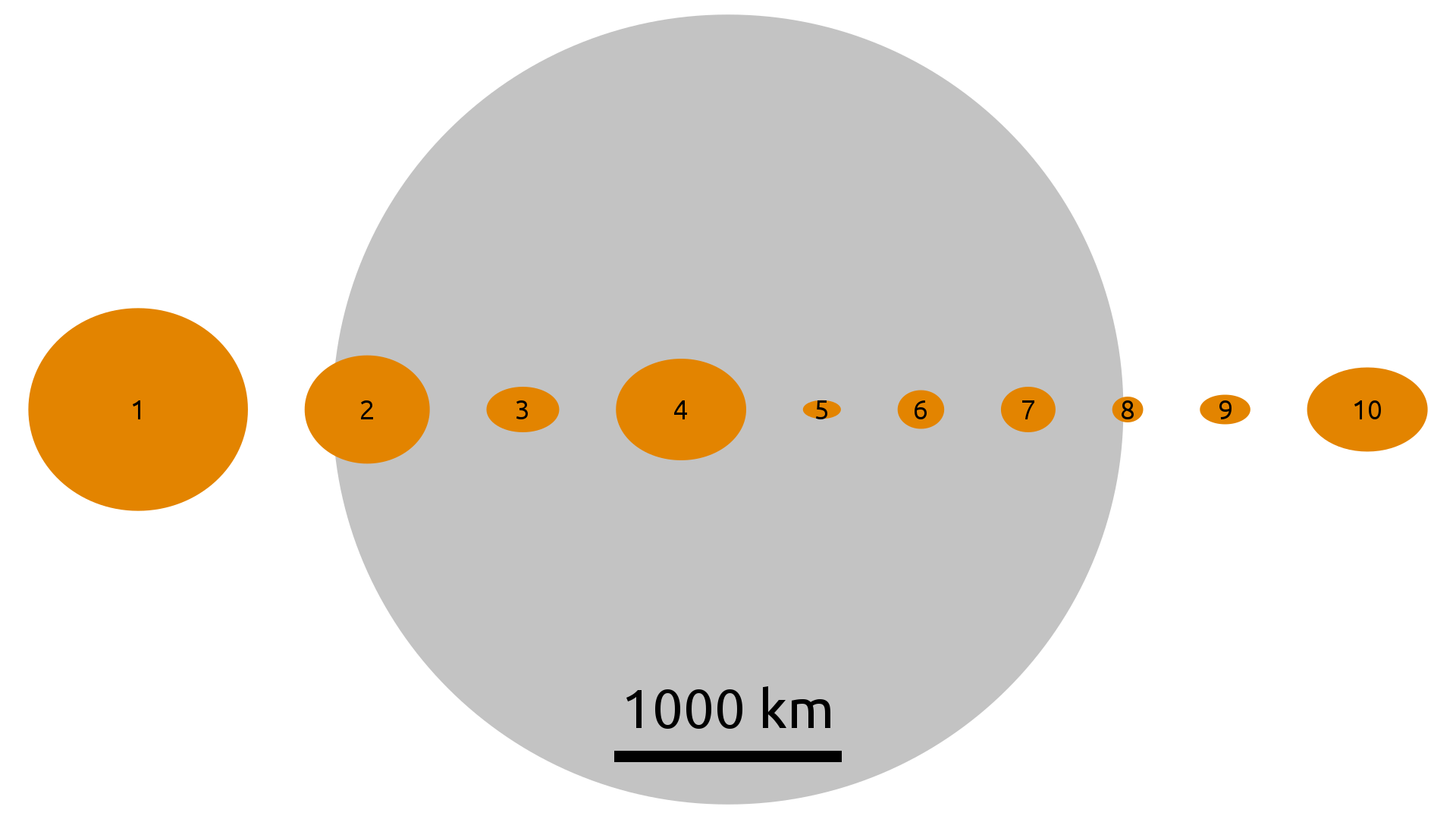
All were tiny. Ceres had a respectable size, but even it is much smaller than the Moon. In fact it turns out to be bigger than all of the other asteroids put together. Here’s an illustration of the first ten asteroids’ sizes against the Moon (in gray).

By convention, asteroids are numbered in order of discovery, hence 1 Ceres, 2 Pallas, 3 Juno, 4 Vesta, 5 Astraea, and so on. In the mid 20th century the numbers were still below 2000. Today the number is 1,382,205 (this includes other small bodies in the solar system, though, not just asteroids…but back then we had no inkling of such things). By the way when Pluto got demoted, it was instantly given the next number in the sequence, which back then was 134340.

Vesta, though much smaller than Ceres, is lighter colored, and technically it’s just barely visible to the naked eye…if you’re somewhere out in the middle of the ocean and eat a lot of carrots.

OK so what’s going on here?

At first, we had the notion that perhaps there had been a full-size planet there, but it had blown up or otherwise been destroyed. As it turns out, there’s not nearly enough stuff there. Now most astronomers believe that Jupiter’s gravity probably prevented a planet from forming there…so Kant was right.

With all of the other small bodies discovered more recently, asteroids are now defined as non-cometary bodies in the inner solar system (i.e., inside the orbit of Jupiter). Comets are largely made up of ice…not necessarily water ice…and will present a tail close to the sun. Asteroids, on the other hand generally fall into three categories, C-type or carbonaceous, M-type or metallic (iron-nickel plus other goodies), and S-type or silicaceous (rocks). They can be solid bodies, or in some cases, they’re basically piles of rubble, not even a single body.

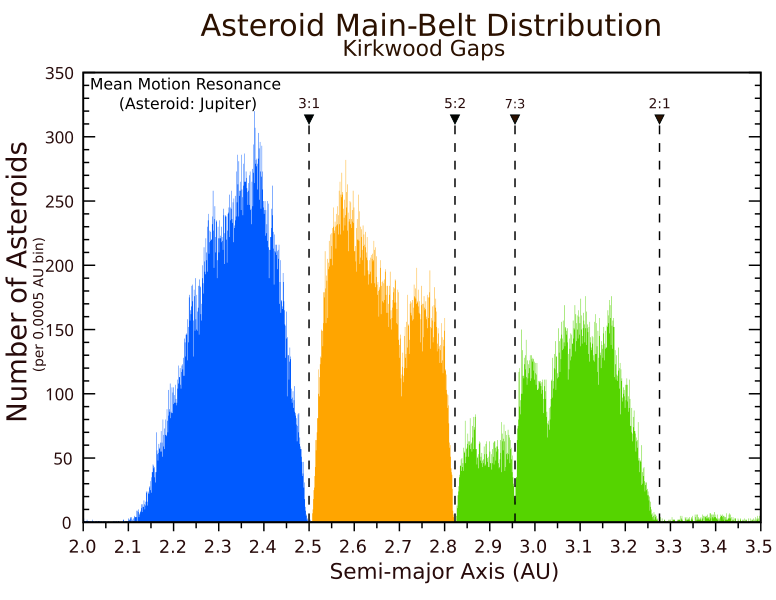
Most asteroids are well-behaved, orbiting in the “asteroid belt.” It’s estimated that there are anywhere from 1.1 million to 1.9 million asteroids larger than 1 km there, and countless smaller objects. If you plot their semi-major axes (i.e., average distance from the Sun), the belt ranges from a bit over 2.1 AUs to 3.3 AUs. But there are gaps! Virtually no asteroid has a 2.5 AU orbit, nor one at 2.82 AU; they’re also scarce at a few other distances. Here’s what I mean:

These gaps are called the “Kirkwood” gaps, and the diagram gives a clue as to what causes them. In essence any body that orbits the Sun three times for each time Jupiter orbits once, will get perturbed–its orbit will change size–and will no longer be in that spot. This is a 3:1 resonance, and 5:2, 7:3 and 2:1 resonances also exist, and asteroids can’t be in those resonances for long.

This is not to say that no asteroid will ever be at that distance. If it’s in an elliptical orbit it could spend some time closer in than the gap, then farther out; of course it must cross through the gap.

Oh, and by the way: Forget what you saw in Star Wars or for that matter any of a hundred other space operas. Although there are a lot of asteroids…there is a lot more space. So it’s mostly empty space. Your chances of encountering one if you travel through the belt are miniscule…unless you aim for one. It’s certainly not the game of space dodgeball you see in Star Wars. (We’ve sent probes through the asteroid belt quite a lot.)

Asteroids Not in the Asteroid Belt

Not all asteroids live in the asteroid belt.

We have the Trojan asteroids. The first of these was discovered in the same orbit as Jupiter…but either 60 degrees ahead or behind Jupiter. These are actually stable places to be, according to work by Joseph-Louis Lagrange in 1772. (In general, any system with two large bodies orbiting each other will have stable locations at these locations, forming equilateral triangles between the two bodies and the locations; these are now called L4 (ahead of Jupiter) and L5 (behind Jupiter). Objects placed in orbits here will tend to stay there; even if they drift away, they’ll be pulled back, rather than pushed away, like a marble at the bottom of a bowl.)

As you might have guessed there are L1, L2 and L3 points but they are metastable; if an object starts to drift out of those locations, they will tend to move further away, like a ball set at the top of a hill.

The following diagram shows the Earth and Sun (not Jupiter and the Sun) complete with Earth’s moon; you can just ignore that.

The first such asteroids were named after heroes of the Trojan War, and this became a convention. In fact the ones at the Sun-Jupiter L4 point are named after the Greek side, while L5 denizens are named after people on the Trojan side. (However 624 Hektor (at L4) and 617 Patroclus (at L5) were given their names before the convention was established so they are in the “wrong” groups.)

It’s now estimated that there may be as many asteroids in these Trojan groups as there are in the “main” asteroid belt.

The term Trojan became standard for a body in any planet’s L4 and L5 points, and there are a few of these; in fact there are two in Earth’s L4 point.

But the more immediately–even urgently–interesting asteroids are the ones whose orbits are inside the asteroid belt. There are several groups of these Near Earth Objects…and that name should tell you why we are so concerned with them:

Amors (named after 1221 Amor) have an orbit larger than the Earth, and their minimum distance to the Sun is greater than Earth’s maximum distance to the Sun. As such, they pose no collision hazard with the Earth. Unless, of course, something mucks with their orbit, like a near pass with another body.

Atiras (named after 163693 Atira), their orbits are entirely within the Earth’s orbit. No hazard now, but the same caveat applies.

Apollos (1862 Apollo) and Atens (2062 Aten) are asteroids whose orbits cross that of Earth, in other words their furthest distance from the Sun either exceeds our minimum distance, and their minimum distance exceeds our maximum distance, or both. Apollos have an average distance greater than 1 AU, Atens have an average distance less than 1 AU.

Or there’s this handy-dandy chart you can use.

These are the scary ones. We are very, very aware of the consequences of a collision with a sizeable asteroid. Most life was extinguished by a 10 km asteroid 66 million years ago, and in historic times we’ve had two explode over Russia with megaton force (1908 in Tunguska and 2013 in Chelyabinsk)–and these were small bodies, roughly 50-60 and 18 meters across, respectively. Neither asteroid actually hit the Earth (at least not in one piece), rather they exploded high in our atmosphere when their trajectories grazed it.

50,000 or so years ago we did suffer a direct hit from a 50 meter iron-nickel meteorite, in Arizona. This left a 3900 foot crater you can visit today:

Note that we failed to spot the Chelyabinsk meteor before it hit, though we saw another one that completely missed the Earth not long before that.

We’ve bent considerable effort to trying to locate all Near Earth Objects and we think we’ve spotted the really big ones. But even a 100 or 50 meter object can cause a lot of damage, and no we haven’t spotted even a significant fraction of those.

Goodies

I mentioned earlier that metallic asteroids are made of iron and nickel, as well as other goodies.

This was important in the past, and will be again. Before we learned how to smelt iron around 1300 BCE (a very rough date, the end of the Bronze age), the only source of iron we had was meteorites. In fact, going back to the Trojan war, one of the gifts given to a Greek warrior was a meteorite he could use to make iron armor out of. Priceless! (Especially given that that particular mixture of iron and nickel is in fact much better material than pure iron would be.)

But what are the “other goodies”? We think these iron-nickel meteorites were once in the core of a larger body (not a full planet), which had melted and begun to differentiate, with the iron, nickel, and other heavy metals sinking into the core, leaving the outer layers relatively bereft of these metals. Earth has an iron core due to this very mechanism. We also have relatively little gold, platinum, PGMs, etc in our crust, because of this process. Although rare even in the core, they are less so there than up here.

Iron nickel meteorites do have some variances but are often 1 part per million or more of gold and/or iridium. This would be considered very good ores (especially for iridium which is normally less than a part per billion).

In fact it’s that relative abundance of iridium that was the smoking gun that established that an asteroid hit the Earth at about the time the dinosaurs were wiped out (there are still some holdout paleontologists who insist that most of the job was done by volcanic activity before the meteorite arrived). Sediments deposited at that time show “spikes” in the concentration of iridium.

That’s the past. What about the future?

We are pretty confident that 16 Psyche is a large iron-nickel body. It has been measured at 220 meters in diameter (it’s a bit irregularly shaped).

Its mass is 23 quadrillion (metric) tonnes. Or 23 million billion tonnes. That is a LOT of iron, more than we’ve ever used certainly, and…well, that’s going to be 23 billion tonnes of iridium, 23 billion tonnes of gold…but we can’t readily access it.

Yet.

We are sending a probe, named Psyche, to get a closer look and confirm what we think about it. It launched on 23 October of last year and is expected to arrive in 2029, shortly after the beginning of JD Vance’s first term as President.

Spot Prices.

Kitco Ask. Last week:

Gold $2,622.40
Silver $31.24
Platinum $986.00
Palladium $1090.00
Rhodium $5,075.00
FRNSI* 125.859-
Gold:Silver 83.944-

This week, markets closed as of 3PM MT.

Gold $2,658.90
Silver $31.72
Platinum $1,010.00
Palladium $1,038.00
Rhodium $5,100.00
FRNSI* 127.624+
Gold:Silver 83.824+

Gold was as high as 2,670-something or so but then got hammered on Friday. Silver was over $32 even Friday morning, but the usual Friday beat-down occurred. Palladium’s bid price (i.e., the price they offer, not the price they ask) is lower than platinum’s bid price. (Usually when you see news stories about the price of these metals, they work off the bid price. I quote the ask price because you should be buying this stuff up, not selling it.) Silver again seems to be undergoing wider swings than gold, but the gold silver ratio ends up barely moving, somehow.

Gold futures contracts for December delivery apparently breached the $2,700 mark for the first time sometime on Thursday.

*The SteveInCO Federal Reserve Note Suckage Index (FRNSI) is a measure of how much the dollar has inflated. It’s the ratio of the current price of gold, to the number of dollars an ounce of fine gold made up when the dollar was defined as 25.8 grains of 0.900 gold. That worked out to an ounce being $20.67+71/387 of a cent. (Note gold wasn’t worth this much back then, thus much gold was $20.67 71/387ths. It’s a subtle distinction. One ounce of gold wasn’t worth $20.67 back then, it was $20.67.) Once this ratio is computed, 1 is subtracted from it so that the number is zero when the dollar is at its proper value, indicating zero suckage.

2024·09·21 Joe Biden Didn’t Win Daily Thread

What is it that feeds our battle, yet starves our victory?

Speaker Johnson
Pinging you on January 6 Tapes

Just a friendly reminder Speaker Johnson. You’re doing some good things–or at least trying in the case of the budget–but this is the most important thing out there still hanging. One initial block released with the promise of more…and?

We have American patriots being held without bail and without trial, and the tapes almost certainly contain exculpatory evidence. (And if they don’t, and we’re all just yelling in an echo chamber over here, we need to know that too. And there’s only one way to know.)

Either we have a weaponized, corrupt government or we have a lot of internet charlatans. Let’s expose whatever it is. (I’m betting it’s the corrupt weaponized government, but if I am wrong, I’d like to see proof.)

Justice Must Be Done.

The prior election must be acknowledged as fraudulent, and steps must be taken to prosecute the fraudsters and restore integrity to the system.

Nothing else matters at this point. Talking about trying again in 2022 or 2024 is hopeless otherwise. Which is not to say one must never talk about this, but rather that one must account for this in ones planning; if fixing the fraud is not part of the plan, you have no plan.

Small Government?

Many times conservatives (real and fake) speak of “small government” being the goal.

This sounds good, and mostly is good, but it misses the essential point. The important thing here isn’t the size, but rather the purpose, of government. We could have a cheap, small tyranny. After all our government spends most of its revenue on payments to individuals and foreign aid, neither of which is part of the tyrannical apparatus trying to keep us locked down and censored. What parts of the government would be necessary for a tyranny? It’d be a lot smaller than what we have now. We could shrink the government and nevertheless find it more tyrannical than it is today.

No, what we want is a limited government, limited not in size, but rather in scope. Limited, that is, in what it’s allowed to do. Under current circumstances, such a government would also be much smaller, but that’s a side effect. If we were in a World War II sort of war, an existential fight against nasty dictatorships on the brink of world conquest, that would be very expensive and would require a gargantuan government, but that would be what the government should be doing. That would be a large, but still limited government, since it’d be working to protect our rights.

World War II would have been the wrong time to squawk about “small government,” but it wasn’t (and never is) a bad time to demand limited government. Today would be a better time to ask for a small government–at least the job it should be doing is small today–but it misses the essential point; we want government to not do certain things. Many of those things we don’t want it doing are expensive but many of them are quite eminently doable by a smaller government than the one we have today. Small, but still exceeding proper limits.

So be careful what you ask for. You might get it and find you asked for the wrong thing.

Political Science In Summation

It’s really just a matter of people who can’t be happy unless they control others…versus those who want to be left alone. The oldest conflict within mankind. Government is necessary, but government attracts the assholes (a highly technical term for the control freaks).

His Truth?

Again we saw an instance of “It might be true for Billy, but it’s not true for Bob” logic this week.

I hear this often, and it’s usually harmless. As when it’s describing differing circumstances, not different facts. “Housing is unaffordable” can be true for one person, but not for another who makes ten times as much.

But sometimes the speaker means it literally. Something like 2+2=4 is asserted to be true for Billy but not for Bob. (And when it’s literal, it’s usually Bob saying it.) And in that sense, it’s nonsense, dangerous nonsense. There is ONE reality, and it exists independent of our desires and our perceptions. It would go on existing if we weren’t here. We exist in it. It does not exist in our heads. It’s not a personal construct, and it isn’t a social construct. If there were no society, reality would continue to be what it is, it wouldn’t vanish…which it would have to do, if it were a social construct.

Now what can change from person to person is the perception of reality. We see that all the time. And people will, of course, act on those perceptions. They will vote for Trump (or try to) if their perception is close to mine, and vote against Trump (and certainly succeed at doing so) if their perception is distant from mine (and therefore, if I do say so, wrong). I have heard people say “perception is reality” and usually, that’s what they’re trying to say–your perception of reality is, as far as you know, an accurate representation of reality, or you’d change it.

But I really wish they’d say it differently. And sometimes, to get back to Billy and Bob, the person who says they have different truths is really saying they have different perceptions of reality–different worldviews. I can’t argue with the latter. But I sure wish they’d say it better. That way I’d know that someone who blabbers about two different truths is delusional and not worth my time, at least not until he passes kindergarten-level metaphysics on his umpteenth attempt.

Lawyer Appeasement Section

OK now for the fine print.

This is the WQTH Daily Thread. You know the drill. There’s no Poltical correctness, but civility is a requirement. There are Important Guidelines,  here, with an addendum on 20191110.

We have a new board – called The U Tree – where people can take each other to the woodshed without fear of censorship or moderation.

And remember Wheatie’s Rules:

1. No food fights
2. No running with scissors.
3. If you bring snacks, bring enough for everyone.
4. Zeroth rule of gun safety: Don’t let the government get your guns.
5. Rule one of gun safety: The gun is always loaded.
5a. If you actually want the gun to be loaded, like because you’re checking out a bump in the night, then it’s empty.
6. Rule two of gun safety: Never point the gun at anything you’re not willing to destroy.
7. Rule three: Keep your finger off the trigger until ready to fire.
8. Rule the fourth: Be sure of your target and what is behind it.

(Hmm a few extras seem to have crept in.)

(Paper) Spot Prices

Kitco “Ask” prices. Last week:

Gold $2,578.70
Silver $30.80
Platinum $1,004.00
Palladium $1,092.00
Rhodium $5,100.00
FRNSI* 123.745-
Gold:Silver 83.724+

This week, 3PM Mountain Time, markets have closed for the weekend.

Gold $2,622.40
Silver $31.24
Platinum $986.00
Palladium $1090.00
Rhodium $5,075.00
FRNSI* 125.859-
Gold:Silver 83.944-

Gold has now busted $2600. Silver is going up but not quite enough to keep up with gold (it’s worth slightly less in terms of gold than it was last week). Palladium jumped up then back down this last week, ending virtually unchanged. But platinum is sliding. Rhodium is essentially stable.

*The SteveInCO Federal Reserve Note Suckage Index (FRNSI) is a measure of how much the dollar has inflated. It’s the ratio of the current price of gold, to the number of dollars an ounce of fine gold made up when the dollar was defined as 25.8 grains of 0.900 gold. That worked out to an ounce being $20.67+71/387 of a cent. (Note gold wasn’t worth this much back then, thus much gold was $20.67 71/387ths. It’s a subtle distinction. One ounce of gold wasn’t worth $20.67 back then, it was $20.67.) Once this ratio is computed, 1 is subtracted from it so that the number is zero when the dollar is at its proper value, indicating zero suckage.

Piling On

Just an Observation

The latest flerfer complaint is that the Final Experiment (the trip to Antarctica to observe the 24 hour sun) won’t count because it’s not an experiment but rather an observation. WTF? Anyhow, in this video, among many things of interest such as the fact that other people will be taking sun pictures that day in order to test the effect of variables (which would make it an experiment!), it’s shown what a bunch of lying hypocrite charlatans they are for trying to make this argument:

And this one from a year ago where Dave McKeegan tells of plotting the positions of celestial bodies over the Earth’s surface…then translating that to the pizzaworld model.

Antarctica

Oh, and spring (for Antarctica; it will be fall for Northern Hemisphere folks) starts at 06:43 Mountain Time on the 22nd (Sunday). This is the moment when the sun, which appears to travel along the zodiac line (even though we are orbiting it), appears to cross the celestial equator, northbound. [The celestial equator is just our own equatorial plane, projected out to infinity in the sky. The zodiac is the plane of the Earth’s orbit about the sun, projected out to infinity in the sky.] That should be the nominal instant when more than half of the sun becomes visible at Amundsen-Scott station at the south pole. (However, refraction makes the sun appear higher in the sky than it otherwise would, when it’s near the horizon, so sunrise will be somewhat earlier than this for them–and has probably already happened.)

So wish the 40 or so people who have spent the last six months wintering over there in either twilight or complete darkness a good “morning”!

Oh, wait…this doesn’t exist, does it? It’s all CGI!

In which case let’s get our money’s worth out of all that CGI, since we paid for it with our tax money. Here are a couple of videos which are tours of the station. First, upstairs.

Downstairs:

And there’s a part three (out of 2?) for the bits buried under the ice (such as vehicle maintenance, the generators, the logistics area, and so on); largely stuff that can get cold.

Incidentally there are three generators, that rotate, one is generally undergoing maintenance, one is a backup, the other is the active one. If all three crap out, there’s another generator that might manage to keep one part of the the station above freezing, but were this sort of failure to happen during winter over, they’re basically dead. It’d be easier to get people off the ISS then out of Amundsen Scott during winter.

And here’s one for the Ice Cube neutrino observatory (you’ll recall discussions of the neutrino in my Sun article a couple of weeks ago as well as during the physics series, part 20):

Anyhow, I hope you all enjoyed all that expensive taxpayer-funded CGI.

The 800 lb Gorilla

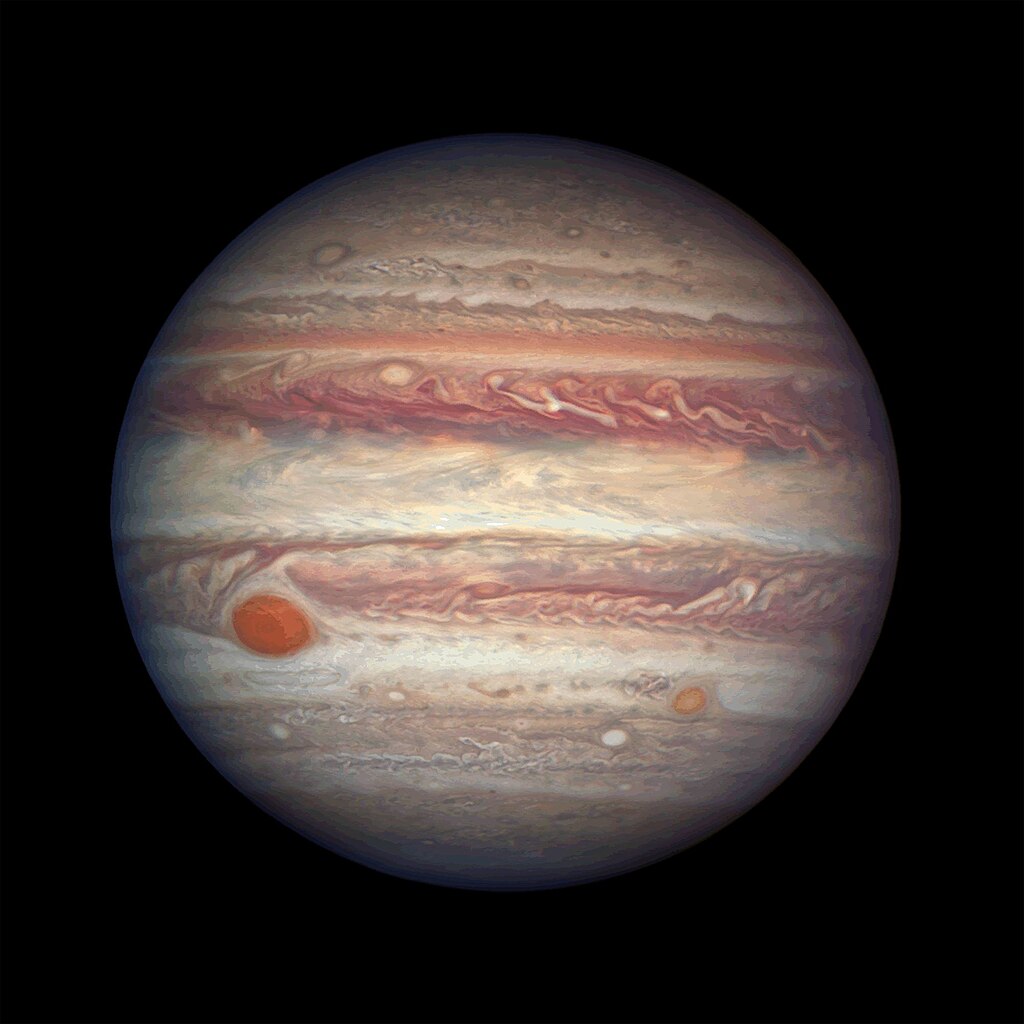
Jupiter, as photographed by the Hubble Space Telescope in 2017. A true-color image.

The single most important fact about Jupiter is that it is BIG. How big? Well let’s compare it to Earth and the Moon:

By size it’s 11 times the width of Earth; by mass it’s 318 Earths. That’s over 2 1/2 times the mass of all other planets, asteroids, comets, etc., put together. Or to think of it another way, you can characterize the solar system as consisting of the Sun, Jupiter, and miscellaneous debris. (And even with that Jupiter is barely 1/1000 the mass of the Sun.) To put it in absolute terms, Jupiter is roughly 88,000 miles across; and even the Great Red Spot–which is storm in the atmosphere–would swallow the Earth.

Ironically, if Jupiter were somehow even more massive, it probably wouldn’t be much larger. The gas would simply compress more to make up for it. The maximum diameter might be a bit more than what we see, but not much. If it were 75 times more massive, it would actually be compressed enough to start fusing hydrogen…and it might actually be the size of Saturn; considerably smaller than its actual diameter.

Jupiter has four major moons, three of them larger than our Moon, plus another 91 smaller moons, generally too small to be forced into a spherical shape. Those four big moons are at least as interesting as Jupiter itself and will be covered in a different article.

Jupiter orbits at about 5.2 AU from the Sun (and I’m not going to explain AUs yet again). That makes its “year”–the time to make one orbit about the Sun–11.86 Earth years. It has almost no axial tilt, so it doesn’t have seasons to speak of.

This is significant: It’s beyond the “snow line.” This means that a lot of things that would normally be vapor inside the line–like water–are solid outside. Hydrogen and helium, the major constituents of the matter that formed the solar system, are considerably cooler and easier for planets to hang on to; and Jupiter did just that; that’s fundamentally why it is so big.

Jupiter rotates on its axis in 9 hours, 55 minutes, and 30 seconds. That’s considerably less time than it takes Earth to do so (23 hours, 56 minutes, 4 seconds…with respect to the stars). Combine that with the fact that it is 11 times wider, and it turns out that an object on the Jovian equator experiences 65 times the centrifugal (well…it’s actually centripetal) force as an object on Earth’s equator. Why does that matter? It makes Jupiter look distinctly oblate (squashed); the difference between the diameter through the poles and between the equator is actually noticeable.

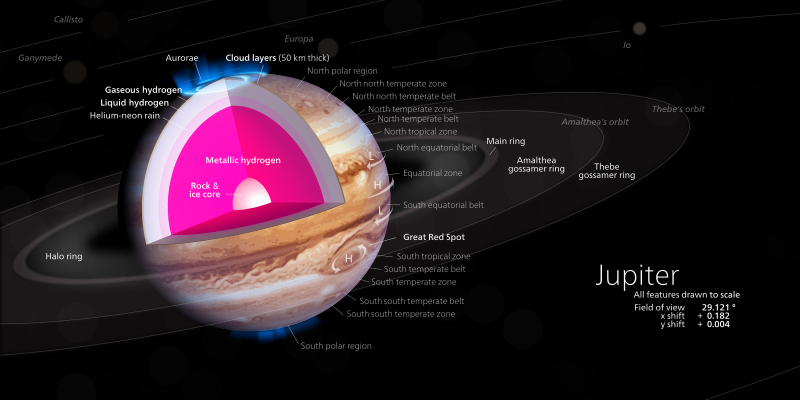
Jupiter is made almost entirely of gas and (deep down, under insane amounts of pressure somewhere between 500 and 4,000 atmospheres) liquid metallic hydrogen. Yes, under extreme pressure hydrogen behaves like a metal, complete with metallic bonds. And deep inside is a rock and ice core, that all by itself is larger than Earth. The following diagram is a cutaway of Jupiter. The pressures down there could be as high as 40,000 atmospheres, and the temperature is likely around 20,000K (versus 165K (-163 F) near the visible “surface.”

Unsurprisingly the atmosphere is mostly hydrogen (roughly 3/4), helium (a bit less than 1/4), plus a bunch of simple molecules like water (H2O), methane (CH4), ammonia (NH3), hydrogen sulfide (H2S), and even phosphine (PH3)…basically simple molecules made up of very common elements.

What we see is an “upper” cloud deck, but as it happens the light bands (called “zones”) are at a considerably higher altitude than the dark bands (called “belts”). The upper clouds made largely of ammonia ice are at a pressure of 0.6 – 0.9 Earth atmospheres, the lower visible clouds contain sulfur compounds as well as water ice and can be anywhere from 1-7 Earth atmospheres.

All of this implies that the atmosphere just above these clouds is already fairly thick, while being clear enough for us to see through.

That liquid metallic hydrogen has a significant consequence–Jupiter has a ridiculously huge magnetosphere. Since it captures charged particles, just like our Van Allen belts do here on Earth, that makes the entire Jovian system, including the Moons, very hazardous from a radiation standpoint. We can’t realistically send manned missions to Jupiter’s moons because of this, with the possible exception of the outermost of the large moons. It’s shaped something like a tadpole, with the head facing the Sun and the tail pointing away from the Sun. I haven’t been able to nail down the diameter of the magnetosphere, but it extends some 7 million kilometers towards the Sun, and the tail nearly reaches Saturn’s orbit. More info here: https://en.wikipedia.org/wiki/Magnetosphere_of_Jupiter

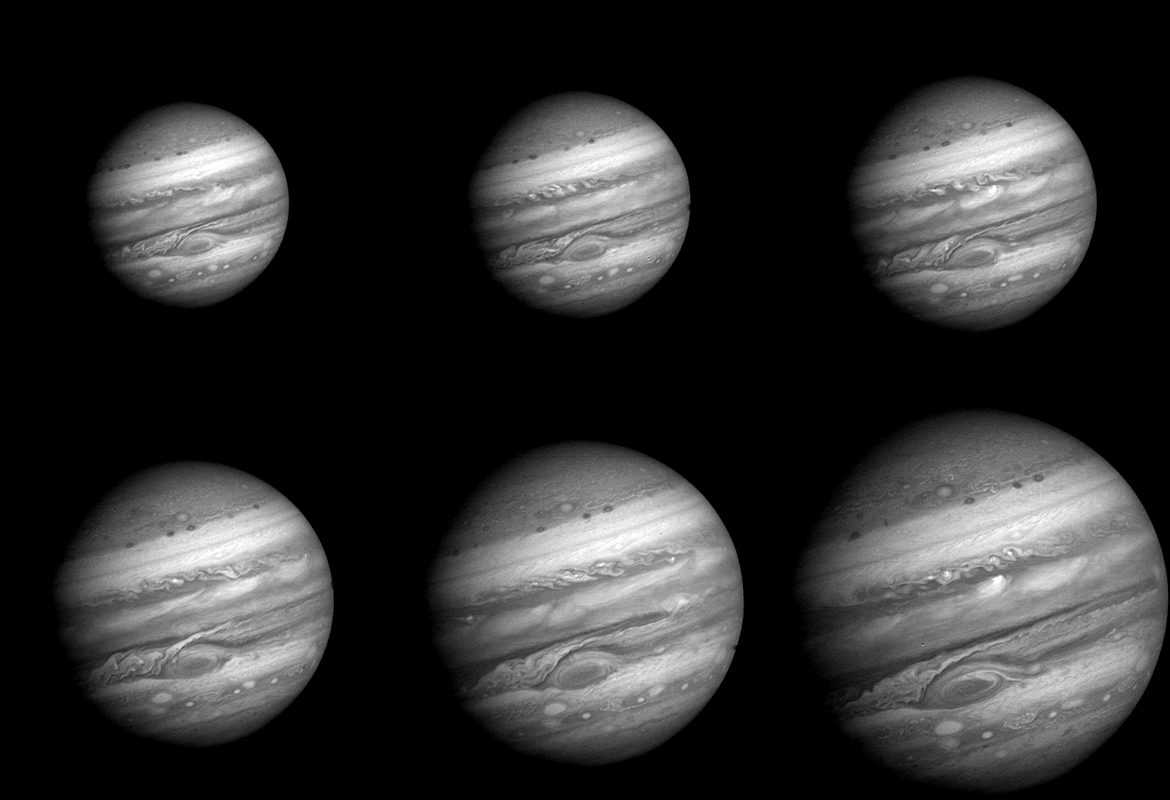
Like the Sun, Jupiter exhibits differential rotation, with belts and zones rotating at different speeds and vortices (including spots) showing up a lot on the boundaries. Here is a GIF made from a timelapse of Jupiter rotating as seen from Voyager I in the 1980s. The pictures are all taken at times when the Great Red Spot in the same orientation with respect to to the spacecraft, so you can see other features, which rotate at different speeds, change position with respect to the Great Red Spot.

Herding Cats

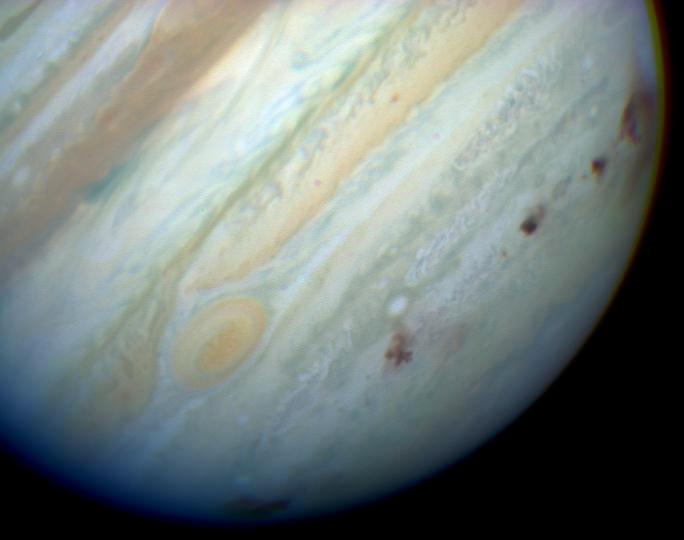
Jupiter’s great mass means that it often deflects smaller bodies in the solar system like comets and asteroids. Many comets have an orbital period that suggests that an encounter with Jupiter put the comet into that orbit in the first place. And Jupiter has even taken a bullet or two, most recently in 1995. The comet Shoemaker-Levy 9 was discovered having already broken into pieces thanks to tidal forces (yes, tidal forces show up again!) from Jupiter; it then was realized that Shoemaker Levy was going to impact Jupiter! What a spectacle! (And how good it was for us that it was Jupiter taking the brunt of that, not Earth!)

It wasn’t just a spectacle; the comet left “holes” in Jupiter’s atmosphere that allowed deeper material to come up to the surface where we could analyze the light with spectroscopes and learn more about Jupiter’s interior.

Jupiter is generally credited with reducing the amount of stuff that rains down on Earth from elsewhere in the Solar System.

History

Jupiter has been known since ancient times; it is generally the third brightest object in the night sky after the Moon and Venus. Since it is so bright and moves through the sky at a fairly stately pace, it got associated with the king of the gods, Zeus or in Latin, Jupiter.

It’s one of the ancient seven planets, each of which was associated with a metal, and each of which ended up associated with a day of the week. These are: Sun, gold, Sunday; Moon, silver, Monday; Mercury, mercury, Wednesday; Venus, copper, Friday; Mars, iron, Tuesday; Jupiter, tin, Thursday; and Saturn, lead, Saturday. And yes, the Sun and Moon were considered planets back then because they moved against the celestial sphere; the recent kerfuffle with Pluto is not the first time we’ve reclassified things. Many of our days of the week are named after Norse gods, but if you go to languages like Spanish, French or Italian, you’ll see the connections between days of the week and our planetary names (which, like those languages, are legacies of the Romans) more readily.

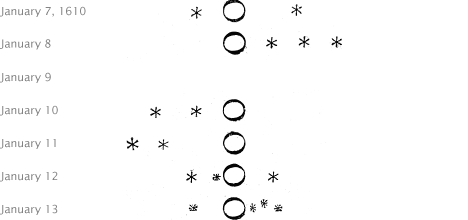
It’s a lucky coincidence that Jupiter turned out to be the king, not of the gods, but rather of the planets once we learned a lot more about it. This began mere months after we first turned telescopes to the sky; In 1610 Galileo noted four tiny “stars” near Jupiter, and could see the pattern change nightly, even over just a few hours. These turned out to be the four big moons of Jupiter (larger or comparable to our own moon).

The four big moons are to this day known as the Galilean moons, and you can spot them with binoculars. I said I’d cover them another time but there are a couple of points I want to make. First, when Galileo discovered them and realized they were orbiting Jupiter, that killed the centuries-old presumption that everything in the universe revolved around the Earth. (And if that wasn’t enough the phases of Venus put the final nail in the coffin, as they showed Venus revolved around the Sun.)

And our view of the universe was never the same again. That dinky telescope of Galileo’s (which is on display at a museum in Florence) is arguably one of the two most important telescopes in history for this reason. (The other being the 100 inch Hooker telescope that Hubble used.)

Second was their use in navigation. Galileo realized almost immediately that the moons’ motions were very regular; such that one could work up a time table and be able to tell absolute time with some accuracy here on Earth, provided you could see Jupiter and point a small telescope at it. Why was that a big deal? Because if you’re sailing a ship, the only way you can determine your longitude is by knowing what time it is in an absolute sense, or at least compared to some other location. For instance, if it’s noon in Greenwich, it’s about 7 AM in Washington DC….or perhaps some other spot in the middle of the ocean directly south of Washington DC. If you know both items of information; that the sun says it’s 7AM but it’s noon in Greenwich, England right now, you can figure out you are at 75 degrees west longitude. The problem was, they had no way of knowing what time it was in London at that same instant. We didn’t have anything like an accurate clock we could just set to London time (and never adjust it) to compare the local time to. But, we could look at Jupiter; if the moons were in the position for 3AM, you knew, regardless what time it was where you were at, that it was 3AM where the time tables were made. So you have a means of determining longitude.

But there was a fly in the ointment; it turns out that after painstakingly computing the table, it wouldn’t work well after a few months; the moons might get to their predicted position a bit early or a bit late. It turns out that the problem wasn’t with the computations, it was with the fact that sometimes Earth is a bit further from Jupiter, sometimes a bit closer, and so we were being thrown off by the light speed delay changing from one position to the other (light can take about 17 minutes to cross Earth’s orbit from one end to the other, and that’s about how much our distance to Jupiter varies). 17 minutes corresponds to about four degrees of longitude which in turn is 240 nautical miles if you’re near the equator. That’s a significant error!

We’ve also discovered that Jupiter has a very tenuous ring, a far cry from Saturn’s ring system, but there nonetheless.

Spacecraft

Jupiter is visited often by our spacecraft, not only for its own sake but because it’s a good waypoint for other missions; it’s often used for a gravity assist. The New Horizons probe to Pluto used a gravity assist from Jupiter to shorten its flight time by about five years (it could have got there without the assist, which in itself is remarkable).

The first probes were Pioneer 10 and 11 in 1973 and 1974. It was the Pioneer spacecraft that discovered Jupiter’s magnetosphere. (Pioneer 11 went on to Saturn). In 1979 Voyager 1 and 2 paid a visit, these spacecraft both went on to Saturn and one of them went on to Hugh Janus and Neptune.

Ulysses, which was a mission to study the sun, flew by Jupiter in 1992 and again in 2004. Why send a solar probe away from the sun to Jupiter? Because we wanted to put the probe in a highly inclined orbit so we could see the Sun’s north and south poles for the first time. The easiest way to do that was to send Ulysses past Jupiter’s north pole and let Jupiter bend the orbit into the new plane, some 80 degrees off from the main plane of the solar system. (Jupiter will bend your trajectory no matter what, but if we approach Jupiter so as to pass the pole, the trajectory will be bent outside of the plane of the planets’ orbits.) If we hadn’t done that we’d have needed a gigantic delta-V to cancel out Earth’s motion around the sun (which the spacecraft would “inherit”), then more to put the spacecraft into its new orbit around the sun. Ulysses took these opportunities to study Jupiter’s magnetosphere.

Cassini flew by in 2000, on its way to Saturn.

Flybys are great, but an orbiter is better. We sent the Galileo orbiter to Jupiter, with it arriving in 1995 and sending back data, including from close encounters with the four Galilean moons, until 2003. Galileo was well timed–when comet Shoemaker-Levy impacted Jupiter Galileo was approaching the system and took some amazing pictures of the aftermath of the event (the impacts were unfortunately on the far side). Galileo came with an atmospheric probe, too, that was dropped into Jupiter’s atmosphere on a suicide mission to return data for as long as it could withstand the rapidly-increasing pressure. In 2016, Juno, a European spacecraft, arrived at Jupiter, establishing itself in a highly elliptical and inclined orbit which means that once every orbit it gets very close to the clouds, and it passes over the poles, which otherwise we’d never see. Juno is still active.

Life?

Jupiter is sometimes cited as a possible location for life. In this case, since it’s essentially atmosphere down to depths where the pressure is crushing, the life forms are generally imagined as creatures with huge bladders filled with atmospheric gas…basically living hot air balloons. This idea got kicked around a lot, including by science fiction writers (like Arthur C. Clarke; a much more recent story told of Jovians’ reactions to Shoemaker-Levy 9).

All of this is complete speculation, of course, and I think as we’ve learned more about the rest of the solar system, we’ve come up with better candidates. But in the end we probably don’t know enough to even intelligently decide which scenario is most likely.

2024·09·14 Joe Biden Didn’t Win Daily Thread

What is it that feeds our battle, yet starves our victory?

Speaker Johnson: A Reminder.

And MTG is there to help make it stick.

January 6 tapes. A good start…but then nothing.

Were you just hoping we’d be distracted by the first set and not notice?

Are you THAT kind of “Republican”?

Are you Kevin McCarthy lite?

What are you waiting for?

I have a personal interest in this issue.

And if you aren’t…what the hell is wrong with you?

Lawyer Appeasement Section

OK now for the fine print.

This is the WQTH Daily Thread. You know the drill. There’s no Poltical correctness, but civility is a requirement. There are Important Guidelines,  here, with an addendum on 20191110.

We have a new board – called The U Tree – where people can take each other to the woodshed without fear of censorship or moderation.

And remember Wheatie’s Rules:

1. No food fights
2. No running with scissors.
3. If you bring snacks, bring enough for everyone.
4. Zeroth rule of gun safety: Don’t let the government get your guns.
5. Rule one of gun safety: The gun is always loaded.
5a. If you actually want the gun to be loaded, like because you’re checking out a bump in the night, then it’s empty.
6. Rule two of gun safety: Never point the gun at anything you’re not willing to destroy.
7. Rule three: Keep your finger off the trigger until ready to fire.
8. Rule the fourth: Be sure of your target and what is behind it.

(Hmm a few extras seem to have crept in.)

Spot (i.e., paper) Prices

Last week:

Gold $2,498.20
Silver $28.04
Platinum $931.00
Palladium $933.00
Rhodium $5,050.00
FRNSI* 119.850+
Gold:Silver 89.094+

This week, 3PM Mountain Time, Kitco “ask” prices. Markets have closed for the weekend.

Gold $2,578.70
Silver $30.80
Platinum $1,004.00
Palladium $1,092.00
Rhodium $5,100.00
FRNSI* 123.745-
Gold:Silver 83.724+

Lots going on…gold surged on Thursday, and I was expecting a beat-down on Friday. Instead, it rose almost 20 more dollars. The FRNSI went up quite a bit, nearly four points! Silver did even better on a percentage basis. Note that an ounce of gold is worth 83.724 ounces of silver…but last week it was worth 89.094 ounces. That means that, in comparison to gold, silver became more valuable.

*The SteveInCO Federal Reserve Note Suckage Index (FRNSI) is a measure of how much the dollar has inflated. It’s the ratio of the current price of gold, to the number of dollars an ounce of fine gold made up when the dollar was defined as 25.8 grains of 0.900 gold. That worked out to an ounce being $20.67+71/387 of a cent. (Note gold wasn’t worth this much back then, thus much gold was $20.67 71/387ths. It’s a subtle distinction. One ounce of gold wasn’t worth $20.67 back then, it was $20.67.) Once this ratio is computed, 1 is subtracted from it so that the number is zero when the dollar is at its proper value, indicating zero suckage.

Piling On

One claim that Flat Earthers (“flerfers”) make is that there aren’t any time lapse videos of the sun doing a full circle around the viewer in Antarctica; that there’s always some sort of eight our gap in the videos.

This is a LIE. Don’t fall for it. Here is FIVE SOLID DAYS worth of timelapse with no hiccups and no breaks, taken in early March just before south polar sunset.

By the way there’s an absolute plethora of videos about the Amundsen Scott station, tours of the main building, tours of the buried areas, tours of the Ice Cube Neutrino Observatory (the largest science experiment by volume), and so on. And plenty of ways to get there as a tourist…provided you have $60K (or more). That’s roughly 24 ounces of gold right now.

Also we have a few cases of flerfers trying to run an experiment and finding they don’t get the results they expected…and not coming to the obvious conclusion.

There are three instances here: One where people stood on opposite sides of a body of water, put lights at 17 feet above water level, then tried to establish a line of site through temporary barriers with holes in them at 17 feet above water level. On a flat earth, there’s be no problem; on a curved earth, however. the barriers in the middle would cut the beam off. And that’s what happened; the light had to be raised a number of feet to be visible through the hole. Second, a gyroscope was seen to precess 15 degrees per hour…as it would if the earth were rotating over a period of 24 hours. On a flat, non-rotating Earth, it shouldn’t precess at all. Third, a striped flag was seen to disappear from the bottom to the top as it sailed off, again, as predicted by Globe Earth but not by Flat Earth.

This all forced the Flat Earth charlatans to do a lot of tap dancing, and one body language expert thinks at least one of the Big Flerfer “names” knows he’s a lying sack of shit. (Well, they didn’t say the “sack of shit” part.)

Mars

A while back I wrote something about why Mars sucks. Meaning, why it had such a thin atmosphere and virtually no surface water. This is interesting because by every indication (everything from visible stream beds on the surface, to minerals that only form in water, to sedimentary rocks which form in fairly stationary bodies of water like lakes and oceans), Mars used to have liquid running water on its surface, which in turn implies it once had a much thicker atmosphere. (There is still a fair amount of water on Mars, in the form of permafrost below the ground. This will be useful should we start human exploration.)

And it turns out that there are two key things going on here: one, Mars has weak surface gravity making it easier for the atmosphere (including water vapor) to escape and two, Mars has no magnetic field, allowing the solar wind to help that process by stripping away the atmosphere. Both in turn are consequences of the fact that it’s considerably smaller than Earth. (There’s no magnetic field because the interior of the planet has cooled off, because it is smaller than Earth, which hasn’t cooled off internally yet, and still has molten iron inside.)

This in turn has a bearing on the question of life. We’re mostly convinced nothing lives on Mars (though there’s a significant minority of scientists who make plausible arguments that there could be). But the tougher question is whether Mars ever had life, back when conditions were much better. That’s largely dependent on how long the conditions were good, how rapidly life actually develops…and whether it’s a rare event even given the right conditions. All of these are very much open questions at the moment; the frontiers of human knowledge.

Time to revisit Mars.

Orbit

First, where is it? Its orbit averages 1.52 AUs in radius…which is to say it’s 52 percent further away from the Sun than is Earth. But that is an average; it varies from 1.38 at one end of the elliptical orbit, to 1.67 AUs at the other. This is a large variance and Mars therefore has a much greater orbital eccentricity than most planets, at 0.0934. (0 is perfectly circular, 0.9 and above are very “cigar” shaped with the Sun close to one end of the cigar. No planet comes close to that though some comets do.) Since Earth is at 1 AU and orbits in 1 sidereal year, it completes one orbit in 1.88 (Earth) years or 686.90 Earth days.

As seen from Earth, Mars moves from west to east against the background stars, usually. It can appear to travel in the opposite direction at times, when we “lap” it in our orbit around the Sun. Here’s an animation from 2020, showing the actual relative positions of Mars and Earth, and an inset showing how Mars appears to move across our sky. (Note how, even though Mars’s orbit appears to be circular, it’s not centered on the Sun; that’s because in fact it is very slightly elliptical.)

If you watched that and paid attention to the trace of Mars across the sky as seen from Earth, you might wonder why it’s not just a straight line. That’s because the two planets don’t orbit in exactly the same plane. The Earth’s orbital plane is the zodiac line, Mars is at a slightly different tilt so even though it roughly follows the zodiac, it doesn’t stay precisely on it.

Surface Conditions

So Mars is significantly further away from the Sun and one would expect it to be colder…and it is, with an average surface temperature of -69C or -60C depending on how you take that average. (This is Antarctic winter type temperatures.) Yes, you will see that it sometimes gets up to +35C, but that’s rare; it’s just as liable to get down to -110C.

What else would you experience on the surface other than it being cucking fold there? Surface gravity is 0.3794 of Earth…almost exactly 3/8ths. (A 98 pound weakling is a 37 pound weakling there.) Air pressure depends on elevation, like it does here on Earth. Our scientists picked an arbitrary “sea level” that is about average for Mars (there is of course no sea), and at that level atmospheric pressure is 0.00628 our sea level pressure…not even one percent! We couldn’t live in that, even if it were pure oxygen, which it is not; it’s 96% CO2. There is a fraction of a percent oxygen but when you multiply that by how thin the air is, it might as well not be there. There is actually more argon than oxygen.

This is not to say there isn’t wind on Mars, and even dust storms, sometimes those storms can cover huge parts of the surface; at least one even covering the entire planet just as our first Mars orbiter arrived in 1971. These tend to happen when Mars is nearest to the Sun, and they help keep it warmer than it otherwise would be.

Another aspect of Martian weather is that the surface radiation is extreme, because there is nothing to block the solar wind and also nothing to block ultraviolet light. Solar flares and the like would cook you just as much as they would on the Moon.

Does Mars have seasons? Yes, cold, and colder. But seriously, yes. The axis is tipped a bit more than 25 degrees, and that causes seasons just as it does on Earth.

The Martian day is 24h 39m 36s long on average. That’s noontime to noontime; to avoid confusion with the Earth day, we call the Martian day a “sol.” Of course since it is orbiting the Sun just like we are, it has to rotate slightly more than one time on its axis to do this, it has to rotate another half degree or so to account for the Sun not being in the same direction against the stars as it was the day before. The true “God’s Eye View” rotation of Mars (i.e., relative to the stars) is 24h 37m 22.7s. Visitors to Mars would have an extra 39.6 minutes to kill every day. And this matters a great deal to some people even now, because Mars surface rovers only function in the daylight (because they run off solar panels, besides, it’s hard to see in the dark anyway). So the scientists and mission controllers here must follow the Martian day night cycle. Imagine a job where every day you have to wake up and go to bed 40 minutes later every day; you’d be out of sync with your family pretty quickly, and it would take about 36 days before things got back in sync.

Size

Mars has a radius of 3396 km, or about 53% of Earth’s. Which means a Mars globe and an Earth globe to scale should have the Earth globe looking about twice the width as the Mars globe.

Mars’s surface area is 144 million square kilometers, 28.4 percent of Earth’s. BUT…Earth is mostly covered by water, so Earth’s land area is 149 million square kilometers. Virtually the same. So there’s a lot of real estate there, however, as of now it’s about as valuable as that land just west of Miami or San Francisco.

Here is a map, with elevation coded by color.

Note the northern hemisphere would largely be ocean, if there were an ocean, with the south almost all highlands. But there is a big basin, the deepest/lowest spot on the planet, in the south at 60 degrees longitude–this is the Hellas basin, and likely an old impact basin. Another smaller basin is at about 320 west. But the true highlands area straddling the equator at 240 degrees is the “Tharsis bulge.” There are three white peaks in a line running southwest to northeast, then west of that, an isolated white peak. That peak is Olympus Mons, the largest volcano known to man. It’s so large you could be on its slope and have no idea you were on a volcano, just that the land has a gentle slope to it.

This thing is BIG. Here it is compared to France.

The other tourist attraction on Mars is Valles Marineris, a canyon 4000 km long, 200 km wide, and up to 7 km deep. It would stretch most of the way across the United States. It cuts through the left hand side of the red area on the map. There are other smaller canyons thought to have been cut by running water, but Valles Marineris is actually thought by some to be a rift zone from plate tectonics, one that failed as the mantle cooled too much for such things. (Photographed in infrared which apparently has better contrast.)

Moons

Mars has two moons, insignificant little things that weren’t discovered until August 12 and 18, 1877, by Asaph Hall. They are too small to have forced themselves into spherical shapes. The inner, larger moon is Phobos (named after the Greek deity of panic and fear) roughly 22 km across (it’s hard to average it when it’s basically shaped like a potato), with Deimos (named after the Greek deity of dread and terror) being 12 km across (same caveat).

The names make sense, because Mars was after all the god of war. (In Greek mythology this god was known as Ares, and a lot of scientific terms to do with Mars actually derive from this root, e.g., “areography” analogous to “geography”)

Phobos has an average orbital radius of 9,377 km, while Deimos has one of 23,460 km. Phobos orbits Mars in a mere 7.66 hours while Deimos orbits in 30.35 hours.

Note that Phobos orbits Mars faster than Mars rotates. These are both in the same direction (counterclockwise as seen from over Mars’s north pole), so Phobos’s actual west to east motion overwhelms its apparent daily east-to-west trip across the sky as Mars rotates. So, it actually rises in the west and sets in the east!

There is some thought that Phobos could be used as a transit point for people traveling to and from Mars; imagine how convenient it would be to set up a space station there. There’s plenty of room for such a thing there.

Exploration of Mars

Mars is undoubtedly the best explored planet other than, of course, Earth. The first successful flyby of another planet was by Mariner 4 in 1965. The first successful orbiter for another planet was Mariner 9 in 1971…at which time Mars was suffering a planet wide dust storm. Fortunately it cleared while the spacecraft was still alive, and we finally discovered the great volcanoes and Valles Marineris. (All prior flybys had just happened to fly by when the wrong side of Mars was presented.) The Soviets tried multiple times but had my luck, having few successes. They were the first to attempt a landing…and failed, repeatedly. They finally succeeded with a flyby about the same time we put Mariner 9 in orbit. (They had better luck with Venus, which is harder. Go figure.)

Finally in July and September 1976 the two Viking landers successfully touched down on Mars. Here is the first photograph taken from the surface of Mars. (With one caveat. The Russians successfully landed on Mars in 1971…but the spacecraft went belly up less than two minutes later, having transmitted part of a picture. I can only imagine the profanity they must have used.)

And a panorama, which I remember being printed on the front page of the newspaper (with messed-up colors that made the sky look blue):

One of their missions was to search for life–presumably microbial life–by running various tests on soil samples. Although most think the tests returned negative results on the whole, there was enough activity in some of the tests that some to this day hold out hope that there was, in fact, life there.

Since then, of course, we’ve had a plethora of orbiters and rovers, but as yet no sample-return mission. China has gotten into the act.

But where to from here? Elon Musk has famously pushed for actual permanent human habitation on Mars, with an aggressive timeline. The idea would be to send one of his Starships to Mars, after refueling in Earth orbit, then on Mars making fuel from the CO2 in the atmosphere and subsurface ice, which would be used to make methane and oxygen. Not the best fuel in the world, but far better than lugging it all the way from Earth (which would require MUCH bigger rockets to launch the mission in the first place). This is similar to the Mars Direct concept put forth in the 1990s by Robert Zubrin, which involves sending a return vehicle first, waiting for the next launch window and sending a habitat with crew and another return vehicle, then again every launch window. Habitats would accumulate on the surface, and fuel would be manufactured for both the return vehicles and for rovers. By spacing the habitats and return vehicles several hundred miles apart, a network of them is eventually set up, and they can even back up for each other in emergencies since they would be in rover range of each other. (And if a previously sent return vehicle fails, there’s one that came with the crew during this launch window.)

Mars is in some ways an ideal target. There are resources there that could be used by human visitors; carbon from the atmosphere, water from subsurface ice. We could breathe there, indefinitely, with help from machinery. We could likely grow food there too. Everything we can create there is less stuff we have to schlep there in the first place. In many ways, it’s a better bet than the Moon, even if it is scores of times further away.

There was an epic set of novels by Kim Stanley Robinson describing the future on Mars, with the first bases, terraforming, and settlement, they are “Red Mars,” “Green Mars” (as some plant life takes hold), and “Blue Mars” as Mars gets an ocean. In fact there’s even a Martian tricolor flag inspired by these classic books, with red, green and blue.

How feasible is that? Can Mars ever be that earthlike?

Maybe more than you might think! It turns out that a big magnet (I can’t seem to locate how powerful it would have to be, but it’s something we could put there) placed at the L1 point between Mars and the Sun might actually be enough so that Mars would find itself in the “tail” of the magnetic field, now protected from the solar wind.

https://www.sciencealert.com/nasa-wants-to-launch-a-giant-magnetic-shield-to-make-mars-habitable

The people putting forth this idea claim we might see significant thickening of the Martian atmosphere in years, not decades or centuries. The atmosphere would be mostly carbon dioxide…and that is a greenhouse gas. It might get warm enough even to melt the subsurface water, eventually.

We might not be able to breathe the air, but if the pressure is high enough, we can ditch “space suits” and just wear an oxygen mask over our faces, and maybe a parka if we need to keep warm.

I definitely see our future involving Mars in a big way…provided of course we have a future. I can’t imagine us ever making it if current trends continue…unless Musk is able to pull a rabbit out of his hat, quickly. Because 40 or maybe only 20 years from now we might not have a civilization capable of it any more.

November is important.

2024·09·07 Joe Biden Didn’t Win Daily Thread

What is it that feeds our battle, yet starves our victory?

January 6 Tapes Reminder

After the first release, we were supposed to get more, every week.

As far as I know it hasn’t happened.

Speaker Johnson, please follow through!

A Caution

Just remember…we might replace the RINO candidates. (Or we might not. The record is mixed even though there is more MAGA than there used to be.) But that will make no difference in the long run if the party officials, basically the Rhonna McDaniels (or however that’s spelled–I suspect it’s RINO), don’t get replaced.

State party chairs, vice chairs, secretaries and so on, and the same at county levels, have huge influence on who ultimately gets nominated, and if these party wheelhorses are RINOs, they will work tirelessly to put their own pukey people on the ballot. In fact I’d not be surprised if some of our “MAGA” candidates are in fact, RINO plants, encouraged to run by the RINO party leadership when they realized that Lyn Cheney (and her ilk) were hopelessly compromised as effective candidates. The best way for them to deal with the opposition, of course, is to run it themselves.

Running good candidates is only HALF of the battle!

Biden Gives Us Too Much Credit

…we can move on to the next one.

Apparently Biden (or his puppeteer) has decided we’re to blame for all of the fail in the United States today.

Sorry to disappoint you Joe (or whoever), but you managed to do that all on your own; not only that, you wouldn’t let us NOT give you the chance because you insisted on cheating your way into power.

Yep, you-all are incompetent, and so proud of it you expect our applause for your sincerity. Fuck that!!

It wouldn’t be so bad, but you insist that everyone else have to share in your misery. Nope, can’t have anyone get out from under it. Somehow your grand vision only works if every single other person on earth is forced to go along. So much as ONE PERSON not going along is enough to make it all fail, apparently.

In engineering school we’re taught that a design that has seven to eight billion single points of failure…sucks.

Actually, we weren’t taught that. Because it would never have occurred to the professors to use such a ridiculous example.

Justice Must Be Done.

The prior election must be acknowledged as fraudulent, and steps must be taken to prosecute the fraudsters and restore integrity to the system.

Nothing else matters at this point. Talking about trying again in 2022 or 2024 is hopeless otherwise. Which is not to say one must never talk about this, but rather that one must account for this in ones planning; if fixing the fraud is not part of the plan, you have no plan.

Kamala Harris has a new nickname since she finally went west from DC to El Paso Texas: Westward Hoe.

Lawyer Appeasement Section

OK now for the fine print.

This is the WQTH Daily Thread. You know the drill. There’s no Poltical correctness, but civility is a requirement. There are Important Guidelines,  here, with an addendum on 20191110.

We have a new board – called The U Tree – where people can take each other to the woodshed without fear of censorship or moderation.

And remember Wheatie’s Rules:

1. No food fights
2. No running with scissors.
3. If you bring snacks, bring enough for everyone.
4. Zeroth rule of gun safety: Don’t let the government get your guns.
5. Rule one of gun safety: The gun is always loaded.
5a. If you actually want the gun to be loaded, like because you’re checking out a bump in the night, then it’s empty.
6. Rule two of gun safety: Never point the gun at anything you’re not willing to destroy.
7. Rule three: Keep your finger off the trigger until ready to fire.
8. Rule the fourth: Be sure of your target and what is behind it.

(Hmm a few extras seem to have crept in.)

Spot Prices

All prices are Kitco Ask, 3PM MT Friday (at that time the markets close for the weekend). (Note: most media quotes are for the bid…the price paid by the market makers, not the ask, which is what they will sell at. I figure the ask is more relevant to people like us who wish we could afford to buy these things. In the case of gold the difference is usually about a dollar, for the PGMs the spread is much wider.)

Last Week:

Gold $2,504.30
Silver $28.92
Platinum $936.00
Palladium $993.00
Rhodium $4,975.00
FRNSI* 120.146-

This week, markets closed at 3PM Mountain Time Friday for the weekend.

Gold $2,498.20
Silver $28.04
Platinum $931.00
Palladium $933.00
Rhodium $5,050.00
FRNSI* 119.850+
Gold:Silver 89.094+

Gold dipped below 2500 on Wednesday but bounced back on Thursday, only to get beaten down again on Friday. For now it seems to be sticking to a relatively narrow trading range, straddling the $2500 mark.

Silver is getting beaten up much worse.

*The SteveInCO Federal Reserve Note Suckage Index (FRNSI) is a measure of how much the dollar has inflated. It’s the ratio of the current price of gold, to the number of dollars an ounce of fine gold made up when the dollar was defined as 25.8 grains of 0.900 gold. That worked out to an ounce being $20.67+71/387 of a cent. (Note gold wasn’t worth this much back then, thus much gold was $20.67 71/387ths. It’s a subtle distinction. One ounce of gold wasn’t worth $20.67 back then, it was $20.67.) Once this ratio is computed, 1 is subtracted from it so that the number is zero when the dollar is at its proper value, indicating zero suckage.

BTW (possibly of benefit to Barb Meier) the plus or minus sign at the end of the FRNSI and Gold:Silver is simply to indicate whether the number is actually slightly above or below what I wrote and that I rounded down or up, respectively. In this case 119.850+ means a bit above 119.850, so I had to round down. A bit more and I would have rounded up to 119.851 and written 119.851-.

A PS. Last week I gave the value of 71/387ths out to about a gazillion decimal places, but it turns out my suspicions were correct: they were garbage after a while. I ginned up a spreadsheet to do long division for as long as one likes, and 71/387ths repeats after 21 decimal places and is: 0.183 462 532 299 741 602 067 (then 183 462, etc). So what? Well take a look at the 2067 at the end. As in $20.67.

The Sun

Resuming our survey of our solar system, we take up the Sun.

It is tempting to call the Sun the 800 pound gorilla of the solar system…but this would be a bad idea because it understates the matter. Jupiter is more massive than the other planets put together, so it is the 800 lb gorilla of the solar system.

The sun is 1,048 times as massive as Jupiter, which makes it the 400 ton brachiosaurus of the solar system. (And in case you’re wondering, the Sun is 332,950 times the mass of the Earth.)

It’s also very different from every other thing in the solar system; it’s a ball of hot, ionized gas and is generating 383 septillion watts (that’s 24 zeros) of power, or that many joules per second. And it has been doing so for 4.6 billion years and will continue to do so for another 4-5 billion years at least. No other body in the solar system does that–the rest shine in our night sky because they reflect the light from the Sun.

It shines like that because its surface is at a temperature of 5,772 K…though it is much, much hotter at the center, 15.7 million K.

Or, to put it in five words, “the Sun is a star.” A star a bit above the median, but about average. It’s brighter than 85% of all stars in this galaxy (many of the ones that beat it really break the curve though), and compared to other nearby stars it’s more massive than 95% of them.

Unlike other stars that are trillions or even quadrillions of kilometers away, the Sun averages 149,597,870.7 kilometers from the Earth.

How do we know that? We bounce radar off of it. But before that…well, that’s a fascinating story having to do with transits of Venus across the face of the Sun as seen from Earth. I’ve told this story before here (yes it’s about Venus transits but tells the whole story): https://letreasonreign.wordpress.com/2012/05/13/venus-transit-6-june-2012/ but here’s a different take:

The power source is hydrogen fusion, generally through a process called the proton-proton chain. Other stars, either more massive or later-in-life than the Sun, have other power sources (all discussed here in part 22 of the big physics series: https://www.theqtree.com/2021/10/23/2021%c2%b710%c2%b723-joe-biden-didnt-win-daily-thread/).

As I mentioned before, the Sun is made of ionized gas. It’s 73.5% hydrogen, 24.8 percent helium…and remaining 1+% is basically everything else (mostly oxygen, a lot of carbon, iron, neon… This is pretty close to the composition of interstellar gas in nebulas, which is, after all, what collapsed to form the Sun in the first place.

Since the Sun is a ball of gas, it has no solid surface. But it has a diameter, given as 1,390,000 km (versus Earth’s 12,756 or so km). What’s that the diameter of, if there’s no solid surface?

What we see when we look at the Sun is a glowing sphere; below that “surface” we cannot see because ionized gas is not transparent. We call that surface the photosphere, from the Greek for light and sphere…in other words, “ball of light.”

It’s not a good idea to look at the Sun, it’s an even worse idea to look at it through a telescope. But you can cut the light down by 999,999/1,000,000ths and take some decent photographs. (However, you’ll see my photographs here instead.)

You might be wondering why I used a black and white photograph. It’s not a black and white photograph; it turns out the Sun isn’t yellow, it’s white.

If you look closely, you’ll see some dark spots; these are sunspots and we’ll get to them. For now, I’d like you to notice something else, a subtle darkening near the edges of the disc. This is known as limb darkening, and it doesn’t mean what you might think it means.

If you were looking at a ping pong ball or something similarly white, you’d see darkening near the edges; it’s that kind of shading that conveys to your eyes and brain that the ping pong ball is a sphere.

But that’s not what’s going on here; the Sun doesn’t reflect light, it generates it. Every point on the surface radiates light and heat in every direction (including back into the Sun where it is absorbed and radiated again). So a point near the edge of the disc should be sending us just as much light as a point near the center of the disc, instead it looks dimmer. It turns out this is a consequence of the light we see being emitted from anywhere within a depth of a few hundred miles below the “surface”, with the upper layers cooler than the lower ones. More discussion here: https://en.wikipedia.org/wiki/Limb_darkening

If you could somehow stand on the “surface” of the Sun without being instantly vaporized, you’d weigh 27.9 times what you do on Earth. The escape velocity for a rocket would be 617.7 km/sec (versus 11.2 km/sec for Earth). I doubt a rocket could be built that would do that…it’s actually over 0.2 percent the speed of light.

We actually have a solar orbiter probe…which if you think about it, Earth itself could be thought of as such a thing. But no I mean an actual spacecraft, the Parker Solar probe, launched in 2018. It is in orbit and gets as close as 4.3 million kilometers (compare to the 150 million kilometers we average on “Spaceship Earth”). It moves as fast as 690,000 km/hr or 191 km/sec, which is 0.064% the speed of light…by far the fastest thing we’ve ever built. Its main task is to study the solar corona. But I am getting ahead of myself.

The Sun, like the Earth, is a sphere, and, like the Earth consists of concentric layers. The Sun’s core, the inner 25% by distance, is where the nuclear fusion happens. Surrounding that is the radiative zone, about twice as thick. The energy generated in the core works its way though this zone by radiation…gamma rays from the fusion eventually weakening to something that won’t kill us. It can take ten thousand years for the radiation to get through, because it bounces from nucleus to nucleus in a random walk, so the light you see now is the result of fusion that happened as we were emerging from the last ice age.

Both the core and the radiative zone rotate uniformly, but the next zone, the convective zone, does not; the parts of it near the equator rotate in less time than the areas below the poles. The primary mode of heat transfer in this layer is convection; hot material rises, carrying the heat to the surface; after cooling it sinks down again to get reheated. The boundary between the two is called the tachocline, here is were the layers actually slide past each other because of the differences in rotation rate. It’s thought that this layer creates the Sun’s magnetic field.

Above that layer is the photosphere, which is cool enough and transparent enough that the photons that make their way to it finally, are free to go…and one in a billion end up hitting Earth eight and a half minutes later–and turn night into day.

Above the photosphere is the chromosphere, which is visible briefly as a reddish flash at the very start and end of totality during a solar eclipse.

Above this is a transition region where helium becomes ionized (visible in ultraviolet light, from space), and then, finally the corona.

The corona–and for that matter everything else outside of the photosphere–is effectively invisible to us here on Earth…except during a total solar eclipse.

As seen here, in this photograph I took during the last eclipse:

If you look closely at this picture you will see pink “flames” around the disk of the Moon. They should look vermillion; alas they’re blown out in this picture. These are prominences, and are caused by the interaction of ionized (charged) gas with the Sun’s magnetic field.

The prominences are a lot more prominent (ahem) in this picture, near the bottom of the disk, and there’s also a beauty of an arch at 3 o’clock.

Prominences can be seen by telescopes with the proper filters to blot out all but the hydrogen alpha wavelength of light. Here’s a closeup taken by a competent photographer, with the correct colors:

Besides pumping out visible light and heat copiously and relentlessly for billions of years (even more persistent than the IRS), the Sun creates gigantic numbers of neutrinos from fusion. Neutrinos rarely interact with anything; the neutrinos generated in the Sun’s core leave the Sun seconds later, moving at the speed of light through everything without being affected, like Democrats and the criminal justice system. Even at this distance from the Sun, every square centimeter that’s face-on to the Sun has ten billion neutrinos pass through it every second (less of course if the surface is at an oblique angle to the sunlight).

By the way, it means this many neutrinos pass through every square centimeter of you every second. And don’t think it doesn’t happen at night…they go right on through the Earth as if it’s not there, and come up at you from the ground. The good news is if they go right through you, they do nothing at all to you. It’s when you stop one–very rare but it does happen–that you’ve actually taken a hit. This will happen to one person out of four during a normal lifetime. (At ten billion per second per square centimeter, and one chance in four of getting a hit with the rest passing through harmlessly…you can see this is a rare event.) A single hit from radiation is nothing, though; you get vastly more from other sources. (Like potassium as in bananas.)

Far more important to us is the Sun’s magnetic field. As I’ve said the Sun is largely ionized gas…which is to say it’s full of stuff with electrical charges. This stuff moves (the Sun rotates, on average once every 28 days or so), and moving electrical charges generate magnetic fields.

The Sun’s magnetic field has a role in everything from sunspots to prominences to full-on coronal mass ejections; that’s where the Sun belches and flings a bunch of plasma out into space. If one of these hits Earth, it can muck with satellites and the power grid, conceivably even causing massive blackouts. The worst of these was the Carrington event of 1859. We just barely had a grid then, of telegraph lines. Nonetheless some telegraph stations caught fire. It was possible to send messages without supplying any power to the system. The chances of another like it within the next decade (which would be catastrophic) are rated at well under 1 percent.

The magnetic field of the Sun goes through cycles, gradually increasing over the span of roughly 11 years, then flipping polarity, decreasing, and then repeating the process with the magnetic field in the opposite direction. Sunspots, prominences and CMEs all increase (or decrease) in frequency as the magnetic field increases (or decreases).

But even when the Sun is calm, there is a constant stream of charged particles from the corona, outward in all directions; this is the solar wind and it would have long since stripped our atmosphere away were it not for the fact that Earth’s magnetic field deflects almost all of it. In fact this is why Mars has almost no atmosphere: It has no magnetic field.

Many ancient cultures worshiped the Sun. They realized that without it there’d be no life. We know more about the Sun, but if anything that just makes it even more impressive than we had realized. But we don’t think it is a god any more. We just call it the 400 ton brachiosaurus of the Solar System.

Already late…I don’t feel like this ready, but as Klingons would say, today is a good day to die. Hit Publish.

2024·08·31 Joe Biden Didn’t Win Daily Thread

What is it that feeds our battle, yet starves our victory?

January 6 Tapes?

Paging Speaker Johnson…this is your conscience calling you out on broken promises.

For all your high talk about your Christian moral background…you’re looking less and less like you have any kind of moral background.

If You are a Patriot and Don’t Loathe RINOs…

Let’s talk about RINOs, and why they are the lowest form of life in politics.

Many patriots have been involved with politics, often at the grassroots, for decades. We’ve fought, and fought, and fought and won the occasional illusory small victory.

Yet we can’t seem to win the war, even when we have BIG electoral wins.

I am reminded of something. The original Star Trek had an episode titled Day of the Dove. It was one of the better episodes from the third season, but any fan of the original series will tell you that’s a very low bar. Still, it seems to get some respect; at a time when there were about 700 episodes of Star Trek in its various incarnations out there, it was voted 99th best out of the top 100.

In sum, the plot is that an alien entity has arranged for 39 Enterprise crew, and 39 Klingons, to fight each other endlessly with swords and other muscle-powered weapons. The entity lives off of hostile emotions, you see and it wants a captive food source. (The other 400 or so Enterprise crew are trapped below decks and unable to help.) Each side has its emotions played and amplified by the alien entity; one Enterprise junior officer has false memories implanted of a brother who was killed by Klingons. The brother didn’t even exist.

Even people killed in a sword fight miraculously heal so they can go do it again.

The second best line of the episode is when Kang, the Klingon captain, notes that though they have won quite a number of small victories including capturing Engineering, can’t seem to actually finally defeat the Enterprise crew. He growls, “What power is it that feeds our battle yet starves our victory?*”

Indeed. He may have been the bad guy, but his situation should sound familiar.

We are a majority in this country. We have a powerful political party in our corner. There is endless wrangling.

And yet,

What power is it that feeds our battle yet starves our victory?

In our case, that power is the RINOs in our midst. They specialize in caving when on the verge of victory. Think of Obamacare’s repeal failing…by one Republican vote. Think of the way we can never seem to get spending under control (and now our entire tax revenue goes to pay interest on the debt; anything the government actually does now is with borrowed money).

We have a party…that refuses to do what we want it to do, and that refusal is institutionalized. If you’ve been involved with GOP politics, but haven’t seen this, it’s because you refuse to see it. Or because you are part of the problem yourself. (If so, kindly gargle some red fuming nitric acid to clear the taste of shit out of your mouth, and let those not part of the problem alone so they can read this.)

We fight to elect people, who then take a dive when in office. But it’s not just the politicians in office, it’s the people behind the scenes, the leaders of the national, state and county branches of the party. Their job is to ensure that real patriots never get onto the general election ballot. They’re allowed a few failures…who can then become token conservatives who will somehow never manage to win (Jordan), or can be compromised outright (Lauren Boebert?).

That way it doesn’t actually matter who has a congressional majority. I remember my excitement when the GOP took the Senate in 1980. But all that did was empower a bunch of “moderate” puddles of dog vomit like…well for whatever reason forty years later the most memorable name is Pete Domenici. And a couple of dozen other “moderates” who simply had no interest in doing what grassroots people in their party–those same grassroots people who had worked so hard to elect them–wanted them to do.

Oh, they’ll put up a semblance of a fight…but never win. And they love it when we fight the Dems instead of fighting them. Just like that alien entity, whose motto surely was “Let’s you and him fight. It’ll be delicious!”

If you think about it, your entire political involvement has come to nothing because of these walking malignant tumors.

That should make you good and mad.

The twenty five who blocked Jordan, and the hundred people who took that opportunity to stab Jordan in the back in the secret ballot should make you good and mad.

I’ll close this with another example of RINO backstabbing, an infuriating one close to home.

In my county, the GOP chair is not a RINO. She got elected when the grassroots had had enough of the RINOs. Unfortunately the state organization is full of RINOs, and the ousted county RINOs have been trying to form a new “Republican Party” and get the state GOP to recognize them as the affiliate. I’m honestly amazed it hasn’t happened yet.

In other words those shitstains won’t just leave when they get booted out; they’ll try to destroy what they left behind. It’s an indication that they know we know how important that behind-the-scenes party power is.

So they must be destroyed. That’s the only way they’ll ever stop.

We cannot win until the leeches “on our side” get destroyed.

What power is it that feeds our battle yet starves our victory?*

We know it. What is going to be done about it?

*NOTE: The original line was actually “What power is it that supports our battle yet starves our victory.” I had mis-remembered it as feeds. When I checked it, it sure enough was “supports” and that’s what I originally quoted. On further reflection, though, I realized my memory was actually an improvement over the reality, because feeds is a perfect contrast with starves. I changed it partway through the day this originally posted, but now (since this is a re-run) it gets rendered this way from the start.

If one must do things wrong, one should do them wrong…right.

RINOs an Endangered Species?
If Only!

According to Wikipoo, et. al., the Northern White Rhinoceros (Ceratotherium simum cottoni) is a critically endangered species. Apparently two females live on a wildlife preserve in Sudan, and no males are known to be alive. So basically, this species is dead as soon as the females die of old age. Presently they are watched over by armed guards 24/7.

Biologists have been trying to cross them with the other subspecies, Southern White Rhinoceroses (Rhinoceri?) without success; and some genetic analyses suggest that perhaps they aren’t two subspecies at all, but two distinct species, which would make the whole project a lot more difficult.

I should hope if the American RINO (Parasitus rectum pseudoconservativum) is ever this endangered, there will be heroic efforts not to save the species, but rather to push the remainder off a cliff. Onto punji sticks. With feces smeared on them. Failing that a good bath in red fuming nitric acid will do.

But I’m not done ranting about RINOs.

The RINOs (if they are capable of any introspection whatsoever) probably wonder why they constantly have to deal with “populist” eruptions like the Trump-led MAGA movement. That would be because the so-called populists stand for absolutely nothing except for going along to get along. That allows the Left to drive the culture and politics.

Given the results of our most recent elections, the Left will now push harder, and the RINOs will now turn even squishier than they were before.

I well remember 1989-1990 in my state when the RINO establishment started preaching the message that a conservative simply couldn’t win in Colorado. Never mind the fact that Reagan had won the state TWICE (in 1984 bringing in a veto-proof state house and senate with him) and GHWB had won after (falsely!) assuring everyone that a vote for him was a vote for Reagan’s third term.

This is how the RINOs function. They push, push, push the line that only a “moderate” can get elected. Stomp them when they pull that shit. Tell everyone in ear shot that that’s exactly what the Left wants you to think, and oh-by-the-way-Mister-RINO if you’re in this party selling the same message as the Left…well, whythefuckexactly are you in this party, you lying piece of rancid weasel shit?

Justice

It says “Justice” on the picture.

And I’m sure someone will post the standard joke about what the fish thinks about the situation.

But what is it?

Here’s a take, from a different context: It’s about how you do justice, not the justice that must be done to our massively corrupt government and media. You must properly identify the nature of a person, before you can do him justice.

Ayn Rand, On Justice (speaking through her character John Galt, in Atlas Shrugged):

Justice is the recognition of the fact that you cannot fake the character of men as you cannot fake the character of nature, that you must judge all men as conscientiously as you judge inanimate objects, with the same respect for truth, with the same incorruptible vision, by as pure and as rational a process of identification—that every man must be judged for what he is and treated accordingly, that just as you do not pay a higher price for a rusty chunk of scrap than for a piece of shining metal, so you do not value a rotter above a hero—that your moral appraisal is the coin paying men for their virtues or vices, and this payment demands of you as scrupulous an honor as you bring to financial transactions—that to withhold your contempt from men’s vices is an act of moral counterfeiting, and to withhold your admiration from their virtues is an act of moral embezzlement—that to place any other concern higher than justice is to devaluate your moral currency and defraud the good in favor of the evil, since only the good can lose by a default of justice and only the evil can profit—and that the bottom of the pit at the end of that road, the act of moral bankruptcy, is to punish men for their virtues and reward them for their vices, that that is the collapse to full depravity, the Black Mass of the worship of death, the dedication of your consciousness to the destruction of existence.

Ayn Rand identified seven virtues, chief among them rationality. The other six, including justice, she considered subsidiary because they are essentially different aspects and applications of rationality.

—Ayn Rand Lexicon (aynrandlexicon.com)

Justice Must Be Done.

Trump, it is supposed, had some documents.

Biden and company stole the country.

I’m sure enough of this that I put my money where my mouth is.

The prior election must be acknowledged as fraudulent, and steps must be taken to prosecute the fraudsters and restore integrity to the system. (This doesn’t necessarily include deposing Joe and Hoe and putting Trump where he belongs, but it would certainly be a lot easier to fix our broken electoral system with the right people in charge.)

Nothing else matters at this point. Talking about trying again in 2024 or 2026 is pointless otherwise. Which is not to say one must never talk about this, but rather that one must account for this in ones planning; if fixing the fraud in the system is not part of the plan, you have no plan.

This will necessarily be piecemeal, state by state, which is why I am encouraged by those states working to change their laws to alleviate the fraud both via computer and via bogus voters. If enough states do that we might end up with a working majority in Congress and that would be something Trump never really had.

Lawyer Appeasement Section

OK now for the fine print.

This is the WQTH Daily Thread. You know the drill. There’s no Poltical correctness, but civility is a requirement. There are Important Guidelines,  here, with an addendum on 20191110.

We have a new board – called The U Tree – where people can take each other to the woodshed without fear of censorship or moderation.

And remember Wheatie’s Rules:

1. No food fights
2. No running with scissors.
3. If you bring snacks, bring enough for everyone.
4. Zeroth rule of gun safety: Don’t let the government get your guns.
5. Rule one of gun safety: The gun is always loaded.
5a. If you actually want the gun to be loaded, like because you’re checking out a bump in the night, then it’s empty.
6. Rule two of gun safety: Never point the gun at anything you’re not willing to destroy.
7. Rule three: Keep your finger off the trigger until ready to fire.
8. Rule the fourth: Be sure of your target and what is behind it.

(Hmm a few extras seem to have crept in.)

Spot Prices

Last week:

Gold $2,513.10
Silver $29.88
Platinum $973.00
Palladium $988.00
Rhodium $5,050.00

This week, at Friday close:

Gold $2,504.30
Silver $28.92
Platinum $936.00
Palladium $993.00
Rhodium $4,975.00
FRNSI* 120.146-

Note: Five weeks ago gold closed at 2,387.10.

Gold seemed to move around a fair amount between $2500 and $2530 or so. I don’t believe it ever dipped below $2500 this week but I wasn’t watching it continuously and was very preoccupied at work today and never looked. Notice that palladium has pulled further ahead from platinum; it’s the only thing that went up this last week. Silver dropped nearly a dollar, which is over three percent.

*The SteveInCO Federal Reserve Note Suckage Index (FRNSI) stands at 114.486+. (This index is the ratio between the price of gold today, versus the value of the dollar defined as dollars per ounce when we had the gold standard, minus 1 (so that an index of 0 means the dollar is at its original value and doesn’t suck at all). I use that clumsy phrasing because the dollar was defined as a certain amount of gold. 25.8 grains of .900 fine gold was a dollar. This works out to 23.22 grains of pure gold. With 480 grains in a troy ounce, you can do the arithmetic as fractions (rather than decimals to get a precise value) to find one troy ounce of gold was 20 260/387ths dollars (precisely) or 20.671834625323 dollars (approximately–I suspect the decimal won’t repeat until 386 digits have gone by). It’s a subtle distinction. One ounce of gold wasn’t worth $20.67+ back then, it was twenty dollars and 67 71/387 cents)

PS: I was able to do the arithmetic in double precision and got 0.1834625322997416041470586378636653535068035125732421875 followed by zeros. How much of that might be roundoff error, I do not know. Note that there is an 8637 followed by an 8636…darn, almost started repeating.

(OK it’s 22:04 MT, time to hit “Publish.”)

Flat Earth?

My opinion on this is well known.

But let’s play devil’s advocate for a bit.

Usually I see something like this presented as the way the Earth looks. (Although some say this has been changing recently.) In essence, north is towards the center of the disk, and south is towards the rim. Antarctica, rather than being a (very) roughly circular continent straddling the south pole on the globe, is a raised rim near the edge. East and west would depend on where you’re standing, but wherever you are, “east” is counterclockwise on the disk, and “west” is clockwise.

Things seem a bit vaguer when it comes to discussing the sun and moon, but what I usually see is something like this (my apologies for the extra white space…it’s actually part of the image):

The Sun and Moon are depicted as considerably smaller than the Earth, and relatively close by; here they are less than one earth radius (i.e., the radius of the disk). And they are below a dome of some sort, which many associate with the Biblical firmament. The stars (and presumably the planets) are either on or beyond that dome.

There appears to be an immediate problem here. The entire surface of the Earth is lit by the Sun, at all times. Thus it would seem that the very existence of nighttime is proof that this can’t be right. However, the claim is that the sun does not shine in all directions, but is more like a directed spotlight, lighting only part of the Earth at any given time.

The sun travels in a circular path over the Earth’s surface, one circuit per day, and that circle is centered around the north pole, though the circle varies in size from season to season, as shown on the left side of the following diagram (with the left side being the “conventional” picture). The red path is the one the Sun follows in winter, the orange path around the equinoxes (March and September), with the yellow being the beginning of summer.

So for us people living in North America, we see the sun fairly high in the southern sky in June when it’s on the yellow track, but lower in the sky in December when it’s on the red track, and farther away. (NB: It should be possible to measure changes to the apparent size of the Sun, where it appears larger in summer and smaller in winter, if this is a true description of things.)

Someone in Australia, on the other hand, should see the Sun closest to them at noon, their time…and it will pass to their north.

This is indeed what we see, but broadly speaking the same prediction is made by the globe earth model, so you can’t use this to show which one is right.

Narrowly speaking. on the other hand, the two differ somewhat in terms of what path the sun will appear moving across the sky. Globe earth predicts the sun will follow a certain arc across the sky then drop below the horizon, following the continuation of the arc. Flat Earth predicts a different path across the sky, particularly in the Southern hemisphere, and also does not predict the sun will drop below the horizon. Globe prediction: On the first day of southern summer, the sun will rise in the south east, and climb into the sky on a northward slope, eventually crossing directly north of the viewer halfway across, then set in the southwest. Flat earth prediction: On the first day of southern summer the sun comes into view in the northeast, arcs across to the north, and disappears from view in the northwest.

I’ve been to the Southern hemisphere–though not outside the red circle–and can attest the midday sun was indeed to the north of me. But again that’s expected by both flat and globe earth models. Unfortunately I didn’t think to take note of where it rose and set.

Note though that the truly dramatic differences are in Antarctica. Which makes sense because the two different versions of what Antarctica must be are quite different, more so than, say, Greenland which is near the center of the disk in one model, or near the north pole in the other. It’s either this:

…or that white ring around the rim of flat earth.

And it should be easy to tell, if you’re there. For instance, going from Wilkes Land to Ellsworth Land should be about 4000km if globe earth is correct, but on Flat Earth the shortest way to do it is to cut across the disk, which is to say, cross over the north pole; distance unknown (since no flat earth map ever includes a scale) but certainly a lot more than 4000km.

But I’ve been talking about the Sun a lot, so I’m going to focus on that. On flat earth, a person standing in Antarctica should see an even more exaggerated version of the sun motion I talked about before…becoming visible to the northeast or even, perhaps the north-northeast, coming closer and being highest in the sky when directly north of the view, then receding off to the northwest or maybe even the north-northwest.

Globe Earth predicts something else entirely. During southern summer, provided you are inside the Antarctic circle as shown on the globe earth map above, there should be at least one day every year where the Sun doesn’t set at all. The further south, the more days that are like this; at the south pole the sun wouldn’t set for six months. In fact over the course of a 24 hour day, it circles completely around you, getting lower in the sky to your south (unless you’re at the south pole, where its height above the horizon will be constant) but not setting.

So all we have to do is go to Antarctica during southern summer, and look.

Well, this is supposedly impossible, according to proponents of Flat Earth. You won’t be able to hitch a ride there (none available), and if you were to buy a boat or an airplane and try to sail or fly there…you’ll be killed by those desperate to keep you from being able to prove the globe wrong.

This turns out to be incorrect; over 30,000 people a year visit Antarctica as tourists. People have cross country skied to the south pole. This company will even arrange a trip to the south pole itself (though who knows how much it costs): https://www.antarcticacruises.com/

But it is difficult and expensive, making it not an option for most flat earthers…or for that matter, most globe earthers.

Fortunately, Pastor Will Duffy is offering to pay trip expenses for 12 each, flat earthers and globe earthers (we are talking influencers, not just adherents–Or I’d sign up and cross Antarctica off my bucket list for cheap). The purpose is to go to Antarctica during its summer and see whether there is a 24 hour sun or not. Thus far he has three flat earthers and eight globe earthers signed up. https://www.the-final-experiment.com/participants

OK now I revert to globe earther, trying not to laugh at the inanity of this.

We’re already seeing a couple of things happen in the flat earther camp. One, the three going on the Final Experiment are being condemned by many of the others. Also, many are trying to rework their model to account for a 24 hour sun in Antarctica, after years of denying any such thing could be true…almost as if, in fact, they do expect it will turn out to be true.

And, as is pointed out here: https://youtu.be/7xoW49mkLyw?t=178 if the flat earthers actually went back and reported that by golly they saw a 24 hours sun, they’d simply be accused of having been bought off. Or never having really been a flat earther to begin with (in exactly the way some Christians will accuse those who lose their faith of never having really been a Christian to begin with).

So what I see is Flat Earthers running scared when someone offers to pay the expense for this–change the theory, start condemning the participants…but not one single globe earther is running scared, being ostracized, or anything like that.

So who’s trying to run a cover-up here? Who’s acting as if they’re scared to find out the truth?

On a closing note, Antarctica proves to be a problem for flat earth anyway:

PS: I was about to write this, and saw that Rayzorback has posted a newer version of the 200 Proofs video by Eric Dubay. Well, fortunately someone has done a debunk (though it may be of the older video). [looking at points 55 (25:01) through 59 (ending at 27:22) will address 24 hour sun claims and other similar ones.]

Unfortunately, in order to get through it in any reasonable amount of time he has to skip over a lot of background and just say “This person doesn’t understand physics,” which although true is unhelpful. So, Rayzorback…pick your ten favorite (with your absolute favorite first) points from the video you posted…give their numbers…and I will put two hours worth of effort into countering those ten points, a bit more thoroughly than “Professor Dave” did. At my option I may divide that time amongst all ten or really concentrate on a subset of them. I make this offer in spite of the fact that I believe you will simply dismiss anything I have to say, just as you dismiss people when they debunk the points you have raised in the past (such as Wolf finding air flights you insist don’t exist).

2024·08·24 Joe Biden Didn’t Win Daily Thread

My apologies for the delay. Tonight was a comedy of errors.

Check back later; I will insert a commentary. [It’s posted.] Right now I just need to get this posted as fast as possible.

Sorry I forgot to delete that when copying it from five weeks ago. And of course someone spotted it and called me on it so I can’t just wipe it out of existence.

Here’s hoping I manage to delete all four of these paragraphs the next time.

What is it that feeds our battle, yet starves our victory?

January 6 Tapes?

Where are the tapes? Anyone, Anyone? Bueller? Johnson??

Paging Speaker Johnson…this is your conscience calling you out on broken promises.

News Flash

Today, it is still the case that Joe Biden didn’t Win.

I realize that to some readers, this might be a shock; surely at some point things must change and Biden will have actually won.

But the past cannot actually be changed.

It will always and forever be the case that Joe Biden didn’t win.

And if you, Leftist Lurker, want to dismiss it as dead white cis-male logic…well, you can call it what you want, but then please just go fuck off. No one here buys that bullshit–logic is logic and facts are facts regardless of skin color–and if you gave it a moment’s rational thought, you wouldn’t either. Of course your worthless education never included being able to actually reason–or detect problems with false reasoning–so I don’t imagine you’ll actually wake up as opposed to being woke.

As Ayn Rand would sometimes point out: Yes, you are free to evade reality. What you cannot do is evade the consequences of evading reality. Or to put it concretely: You can ignore the Mack truck bearing down on you as you play in the middle of the street, you won’t be able to ignore the consequences of ignoring the Mack truck.

And Ayn Rand also pointed out that existence (i.e., the sum total of everything that exists) precedes consciousness–our consciousnesses are a part of existence, not outside of it–therefore reality cannot be a “social construct” as so many of you fucked-up-in-the-head people seem to think.

So much for Leftist douchebag lurkers. For the rest of you, the regular readers and those lurkers who understand such things: I continue to carry the banner once also carried by Wheatie. His Fraudulency didn’t win.

Let’s Go, Brandon!!

His Fraudulency

Joe Biteme, properly styled His Fraudulency, continues to infest the White House, we haven’t heard much from the person who should have been declared the victor, and hopium is still being dispensed even as our military appears to have joined the political establishment in knuckling under to the fraud.

One can hope that all is not as it seems.

I’d love to feast on that crow.

(I’d like to add, I find it entirely plausible, even likely, that His Fraudulency is also His Figureheadedness. (Apparently that wasn’t a word; it got a red underline. Well it is now.) Where I differ with the hopium addicts is on the subject of who is really in charge. It ain’t anyone we like.)

Justice Must Be Done.

The prior election must be acknowledged as fraudulent, and steps must be taken to prosecute the fraudsters and restore integrity to the system.

Nothing else matters at this point. Talking about trying again in 2024 is hopeless otherwise. Which is not to say one must never talk about this, but rather that one must account for this in ones planning; if fixing the fraud is not part of the plan, you have no plan.

Lawyer Appeasement Section

OK now for the fine print.

This is the WQTH Daily Thread. You know the drill. There’s no Poltical correctness, but civility is a requirement. There are Important Guidelines,  here, with an addendum on 20191110.

We have a new board – called The U Tree – where people can take each other to the woodshed without fear of censorship or moderation.

And remember Wheatie’s Rules:

1. No food fights
2. No running with scissors.
3. If you bring snacks, bring enough for everyone.
4. Zeroth rule of gun safety: Don’t let the government get your guns.
5. Rule one of gun safety: The gun is always loaded.
5a. If you actually want the gun to be loaded, like because you’re checking out a bump in the night, then it’s empty.
6. Rule two of gun safety: Never point the gun at anything you’re not willing to destroy.
7. Rule three: Keep your finger off the trigger until ready to fire.
8. Rule the fourth: Be sure of your target and what is behind it.

(Hmm a few extras seem to have crept in.)

Spot Prices.

Kitco Ask. Last week:

Gold $2,508.70
Silver $29.11
Platinum $964.00
Palladium $975.00
Rhodium $5,100.00

This week, markets closed as of 3PM MT.

Gold $2,513.10
Silver $29.88
Platinum $973.00
Palladium $988.00
Rhodium $5,050.00

Gold was as high as 2,526 or so but then got hammered on Thursday, mostly recovering. Similar things were true of the other metals (except rhodium which didn’t move much at all). Palladium has occasionally dropped lower than platinum, but it posted the strongest recovery (percentage-wise, 4.41%) of any of the five on Friday.

The SteveInCO Federal Reserve Note Suckage Index (FRNSI) stands at 120.570+. (This index is the ratio between the price of gold today, versus the value of the dollar defined as dollars per ounce when we had the gold standard, minus 1 (so that an index of 0 means the dollar is at its original value and doesn’t suck at all). I use that clumsy phrasing because the dollar was defined as a certain amount of gold, such that an ounce of gold was $20.672. It’s a subtle distinction. One ounce of gold wasn’t worth $20.672 back then, it was $20.672.)

2024·08·17 Joe Biden Didn’t Win Daily Thread

What is it that feeds our battle, yet starves our victory?

Speaker Johnson
Pinging you on January 6 Tapes

Just a friendly reminder Speaker Johnson. You’re doing some good things–or at least trying in the case of the budget–but this is the most important thing out there still hanging. One initial block released with the promise of more…and?

We have American patriots being held without bail and without trial, and the tapes almost certainly contain exculpatory evidence. (And if they don’t, and we’re all just yelling in an echo chamber over here, we need to know that too. And there’s only one way to know.)

Either we have a weaponized, corrupt government or we have a lot of internet charlatans. Let’s expose whatever it is. (I’m betting it’s the corrupt weaponized government, but if I am wrong, I’d like to see proof.)

Justice Must Be Done.

The prior election must be acknowledged as fraudulent, and steps must be taken to prosecute the fraudsters and restore integrity to the system.

Nothing else matters at this point. Talking about trying again in 2022 or 2024 is hopeless otherwise. Which is not to say one must never talk about this, but rather that one must account for this in ones planning; if fixing the fraud is not part of the plan, you have no plan.

Small Government?

Many times conservatives (real and fake) speak of “small government” being the goal.

This sounds good, and mostly is good, but it misses the essential point. The important thing here isn’t the size, but rather the purpose, of government. We could have a cheap, small tyranny. After all our government spends most of its revenue on payments to individuals and foreign aid, neither of which is part of the tyrannical apparatus trying to keep us locked down and censored. What parts of the government would be necessary for a tyranny? It’d be a lot smaller than what we have now. We could shrink the government and nevertheless find it more tyrannical than it is today.

No, what we want is a limited government, limited not in size, but rather in scope. Limited, that is, in what it’s allowed to do. Under current circumstances, such a government would also be much smaller, but that’s a side effect. If we were in a World War II sort of war, an existential fight against nasty dictatorships on the brink of world conquest, that would be very expensive and would require a gargantuan government, but that would be what the government should be doing. That would be a large, but still limited government, since it’d be working to protect our rights.

World War II would have been the wrong time to squawk about “small government,” but it wasn’t (and never is) a bad time to demand limited government. Today would be a better time to ask for a small government–at least the job it should be doing is small today–but it misses the essential point; we want government to not do certain things. Many of those things we don’t want it doing are expensive but many of them are quite eminently doable by a smaller government than the one we have today. Small, but still exceeding proper limits.

So be careful what you ask for. You might get it and find you asked for the wrong thing.

Political Science In Summation

It’s really just a matter of people who can’t be happy unless they control others…versus those who want to be left alone. The oldest conflict within mankind. Government is necessary, but government attracts the assholes (a highly technical term for the control freaks).

His Truth?

Again we saw an instance of “It might be true for Billy, but it’s not true for Bob” logic this week.

I hear this often, and it’s usually harmless. As when it’s describing differing circumstances, not different facts. “Housing is unaffordable” can be true for one person, but not for another who makes ten times as much.

But sometimes the speaker means it literally. Something like 2+2=4 is asserted to be true for Billy but not for Bob. (And when it’s literal, it’s usually Bob saying it.) And in that sense, it’s nonsense, dangerous nonsense. There is ONE reality, and it exists independent of our desires and our perceptions. It would go on existing if we weren’t here. We exist in it. It does not exist in our heads. It’s not a personal construct, and it isn’t a social construct. If there were no society, reality would continue to be what it is, it wouldn’t vanish…which it would have to do, if it were a social construct.

Now what can change from person to person is the perception of reality. We see that all the time. And people will, of course, act on those perceptions. They will vote for Trump (or try to) if their perception is close to mine, and vote against Trump (and certainly succeed at doing so) if their perception is distant from mine (and therefore, if I do say so, wrong). I have heard people say “perception is reality” and usually, that’s what they’re trying to say–your perception of reality is, as far as you know, an accurate representation of reality, or you’d change it.

But I really wish they’d say it differently. And sometimes, to get back to Billy and Bob, the person who says they have different truths is really saying they have different perceptions of reality–different worldviews. I can’t argue with the latter. But I sure wish they’d say it better. That way I’d know that someone who blabbers about two different truths is delusional and not worth my time, at least not until he passes kindergarten-level metaphysics on his umpteenth attempt.

Lawyer Appeasement Section

OK now for the fine print.

This is the WQTH Daily Thread. You know the drill. There’s no Poltical correctness, but civility is a requirement. There are Important Guidelines,  here, with an addendum on 20191110.

We have a new board – called The U Tree – where people can take each other to the woodshed without fear of censorship or moderation.

And remember Wheatie’s Rules:

1. No food fights
2. No running with scissors.
3. If you bring snacks, bring enough for everyone.
4. Zeroth rule of gun safety: Don’t let the government get your guns.
5. Rule one of gun safety: The gun is always loaded.
5a. If you actually want the gun to be loaded, like because you’re checking out a bump in the night, then it’s empty.
6. Rule two of gun safety: Never point the gun at anything you’re not willing to destroy.
7. Rule three: Keep your finger off the trigger until ready to fire.
8. Rule the fourth: Be sure of your target and what is behind it.

(Hmm a few extras seem to have crept in.)

(Paper) Spot Prices

Kitco “Ask” prices. Last week:

Gold $2,431.70
Silver $27.54
Platinum $933.00
Palladium $926.00
Rhodium $4,975.00

This week, 3PM Mountain Time, markets have closed for the weekend.

Gold $2,508.70
Silver $29.11
Platinum $964.00
Palladium $975.00
Rhodium $5,100.00

Silver up nicely, palladium higher than platinum again (platinum is on effing sale, people), but all that pales in comparison to the big news which is:

GOLD BUSTED $2500 ON FRIDAY. Up $51.40 on Friday alone, yes, we’re over 2500 “ferns” (FEderal Reserve Notes) on gold.

The SteveInCO Federal Reserve Note Suckage Index (FRNSI) stands at 121.357+. [Edit: 120.357+…I forgot to subtract 1]. (This index is the ratio between the price of gold today, versus the value of the dollar defined as dollars per ounce when we had the gold standard, minus 1 (so that an index of 0 means the dollar is at its original value and doesn’t suck at all). I use that clumsy phrasing because the dollar was defined as a certain amount of gold, such that an ounce of gold was $20.672. It’s a subtle distinction. One ounce of gold wasn’t worth $20.672 back then, it was $20.672.)

2024·08·10 Joe Biden Didn’t Win Daily Thread

What is it that feeds our battle, yet starves our victory?

Speaker Johnson: A Reminder.

And MTG is there to help make it stick.

January 6 tapes. A good start…but then nothing.

Were you just hoping we’d be distracted by the first set and not notice?

Are you THAT kind of “Republican”?

Are you Kevin McCarthy lite?

What are you waiting for?

I have a personal interest in this issue.

And if you aren’t…what the hell is wrong with you?

Lawyer Appeasement Section

OK now for the fine print.

This is the WQTH Daily Thread. You know the drill. There’s no Poltical correctness, but civility is a requirement. There are Important Guidelines,  here, with an addendum on 20191110.

We have a new board – called The U Tree – where people can take each other to the woodshed without fear of censorship or moderation.

And remember Wheatie’s Rules:

1. No food fights
2. No running with scissors.
3. If you bring snacks, bring enough for everyone.
4. Zeroth rule of gun safety: Don’t let the government get your guns.
5. Rule one of gun safety: The gun is always loaded.
5a. If you actually want the gun to be loaded, like because you’re checking out a bump in the night, then it’s empty.
6. Rule two of gun safety: Never point the gun at anything you’re not willing to destroy.
7. Rule three: Keep your finger off the trigger until ready to fire.
8. Rule the fourth: Be sure of your target and what is behind it.

(Hmm a few extras seem to have crept in.)

Spot (i.e., paper) Prices

Last week:

Gold $2,444.10
Silver $28.66
Platinum $966.00
Palladium $916.00
Rhodium $4,925.00

This week, 3PM Mountain Time, Kitco “ask” prices. Markets have closed for the weekend.

Gold $2,431.70
Silver $27.54
Platinum $933.00
Palladium $926.00
Rhodium $4,975.00

Lots of motion going nowhere awfully fast for gold. Silver is just getting hit hard, and should by all logic be a bargain today. Palladium has actually gone above platinum a few times this week, but took a hard hit on Friday and is now below platinum…which again, is on fricking sale lately.

The SteveInCO Federal Reserve Note Suckage Index (FRNSI) stands at 117.633-. (This index is the ratio between the price of gold today, versus the value of the dollar defined as dollars per ounce when we had the gold standard, minus 1 (so that an index of 0 means the dollar is at its original value and doesn’t suck at all). I use that clumsy phrasing because the dollar was defined as a certain amount of gold, such that an ounce of gold was $20.672. It’s a subtle distinction. One ounce of gold wasn’t worth $20.672 back then, it was $20.672.)