“We do not believe any group of men adequate enough or wise enough to operate without scrutiny or without criticism. We know that the only way to avoid error is to detect it, that the only way to detect it is to be free to inquire. We know that in secrecy error undetected will flourish and subvert.” –J. Robert Oppenheimer
Let’s see…Moon Township outside of Pittsburgh. Steel, coal and all that jazz.
The initial settlement of Moon Township was a direct result of the westward expansion of English settlers and traders who arrived in the Ohio Valley in the early to mid-18th century. During the French and Indian War (Seven Years’ War), the Iroquois, who controlled the land for hunting grounds through right of conquest, ceded large parcels of southwestern Pennsylvania lands through treaty or abandonment to settlers. In some cases, the land was already occupied by squatters who were to be forced off the land.
In the face of this turmoil, Native American settlements of the south bank of the Ohio River typically relocated to more populous areas of the north bank in the current locales of Sewickley and Ambridge….
As the 18th century drew to a close, abandoned lands were taken up by new settlers who were drawn to the region by the fertility of the soil. This round of pioneers were, by and large, wealthier than their predecessors and had the means to develop the broken and hilly areas into plots suitable for farming.
Moon Township was created in 1788 as one of the original townships of the newly created Allegheny County.[4] In 1789 by an act of the legislature a portion of Washington County south of the Ohio River was transferred to Allegheny County.[5] The transferred area became part of Moon Township.[6]
At this time Moon Township occupied an enormous tract of land – possibly 145 square miles (380 km2). Some reports and, more often, legends of the time indicate that it would take one man on horseback two days to travel between the boundaries of the township. The sheer difficulty of settlers performing their civic duties (e.g., reporting to assigned polling places or attending jury trials) made it necessary for local governing authorities to parcel out the land into smaller municipalities. So, in 1790, the current Fayette Township was portioned off from Moon Township, to be followed by Findlay and Crescent townships, respectively.
In 1800 when Beaver County was created from Allegheny and Washington Counties that portion of Beaver County south of the Ohio River that it received from Allegheny County was in Moon Township. Upon the creation of Beaver County that portion of Moon Township that Allegheny County lost to Beaver County was divided into two new townships: First Moon and Second Moon Townships, Beaver County.[7]
In the heyday of steam power, Swanton was home to the A. D. Baker Company, a manufacturer of steam powered traction engines and road contractors’ equipment. It was at the Baker Company that an improved valve gear for steam engines was developed. A Baker employee named Gifford is credited with the initial idea, which was subsequently developed into the Baker valve gear and patented in 1903. Baker valve ear was eventually manufactured by The Pilliod Company, another Swanton business. Baker valve gear from Pilliod saw widespread use on U.S. steam locomotives for railroads in the first half of the 20th century.
On June 6, 2019, a vehicle left parked on the tracks next to the Main Street railroad crossing resulted in a derailment that knocked out power to the town and much of the surrounding area, and hampered traffic on one of the main rail lines linking the Midwest to the East Coast.[9]
And, as of this evening, the keepers of the wiki page can make another entry:
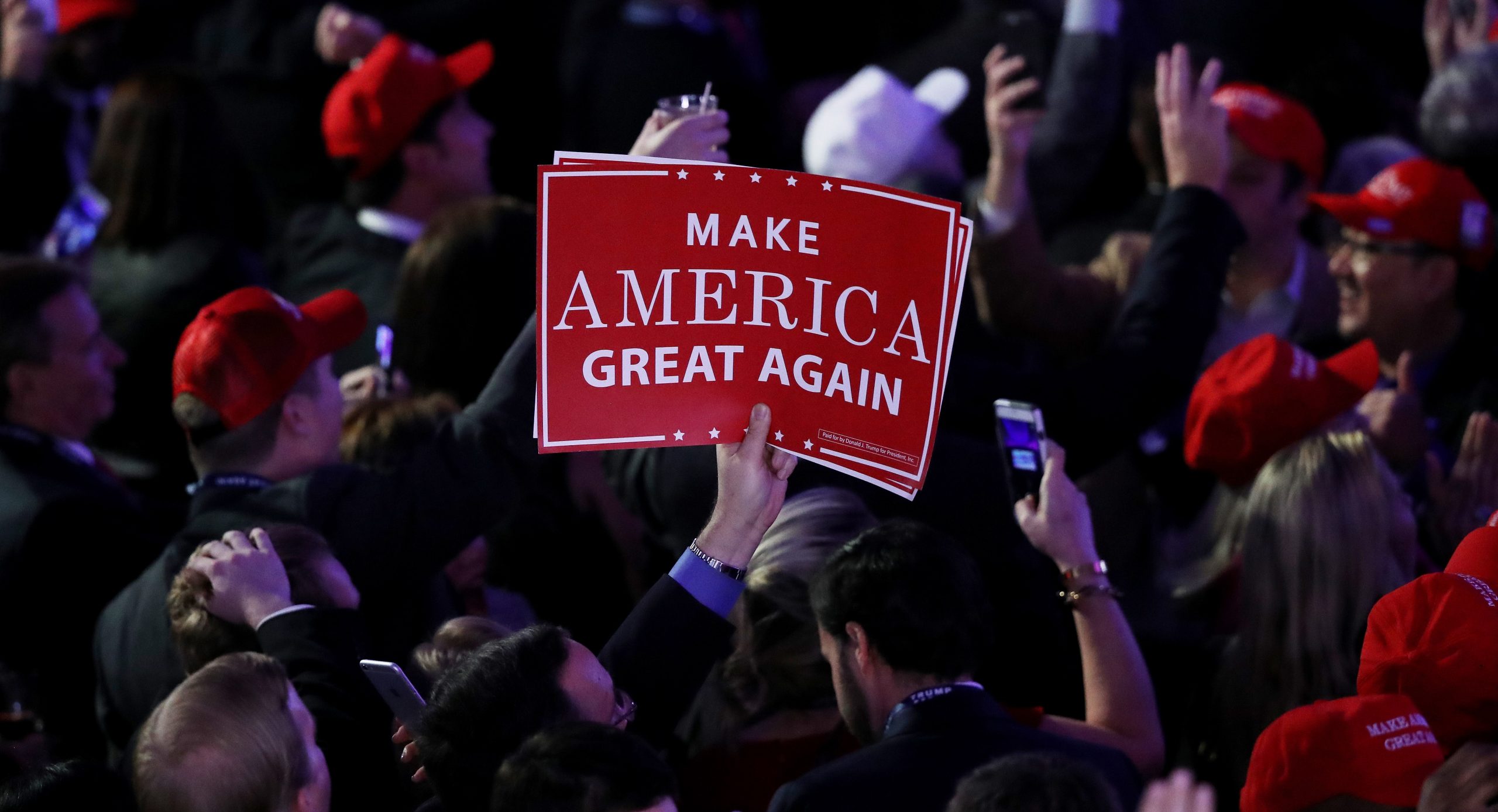
On Monday, September 21, 2020, President Donald J. Trump held a Make America Great Again protest against stupidity at the airport.
Swanton does, though, have a unique claim to fame.
Swanton Memorial Park is home to one of E. M. Viquesney‘s “Spirit of the American Doughboy” statues. The sculpture was one of several donated as a gift by France to U.S. cities that had lost many soldiers during World War I. It is described as a “Figure of a World War I infantryman advancing through the stumps and barbed wire of No Man’s Land. He holds a grenade in his raised proper right hand and a rifle in his proper left hand.”[13] The Smithsonian Institution Research Information System lists the statue as being installed in 1926, “administered by City of Swanton, Parks Division, Swanton, Ohio.”[14] Also according to the Smithsonian, the inscription on the statue reads as follows: “Spirit of the/American Doughboy”/copyrighted by E. M. Viquesney/Georgia (On stone base:) SWANTON REMEMBERS/TO THE MEMORY/OF THE/VALIANT SONS OF/SWANTON & COMMUNITY/WORLD WAR/1917-1918/THIS MEMORIAL IS/LOVINGLY DEDICATED/WE HOLD THEM IN OUR/GRATEFUL HEARTS WITH/REVERENCE AND HONOR/FOREVER/ERECTED 1926 unsigned.[13]
I’ll add live links to this post during the late afternoon as they become available.
This Stormwatch Monday Open Thread is VERY OPEN – a place for everybody to post whatever they feel they would like to tell the White Hats, and the rest of the MAGA/KMAG/KAG world (with KMAG being a bit of both).
Yes, it’s Monday…again.
But it’s okay! We’ll get through it.
Free Speech is practiced here at the Q Tree. But please keep it civil. Discussion of Q is not only allowed but encouraged. Imagine that! We can talk about Q here and not get banned.
Please also consider the Important Guidelines, outlined here. Let’s not give the odious Internet Censors a reason to shut down this precious haven that Wolf has created for us.
Our President is fighting for us night and day…please pray for him.
Wheatie’s Rules:
No food fights.
No running with scissors.
If you bring snacks, bring enough for everyone.
……………………………………………………………………………………………………………………………..
For your listening enjoyment, I offer this composition from Jeremiah Pena of Alliance Music Group, Titled ‘The Speed of Light’:
This Superlative Sanctuary Sunday Open Thread, with full respect to those who worship God on the Sabbath, is a place to reaffirm our worship of our Creator, our Father, our King Eternal.
It is also a place to read, post and discuss news that is worth knowing and sharing. Please post links to any news stories that you use as sources or quote from.
In the QTree, we’re a friendly and civil lot. We encourage free speech and the open exchange and civil discussion of different ideas. Topics aren’t constrained, and sound logic is highly encouraged, all built on a solid foundation of truth and established facts.
We have a policy of mutual respect, shown by civility. Civility encourages discussions, promotes objectivity and rational thought in discourse, and camaraderie in the participants – characteristics we strive toward in our Q Tree community.
Please show respect and consideration for your fellow QTreepers. Before hitting the “post” button, please proofread your post and make sure you’re addressing the issue only, and not trying to confront the poster. Keep to the topic – avoid “you” and “your”. Here in The Q Tree, personal attacks, name calling, ridicule, insults, baiting and other conduct for which a penalty flag would be thrown are VERBOTEN.
In The Q Tree, we’re compatriots, sitting around the campfire, roasting hot dogs, making s’mores and discussing, agreeing, and disagreeing about whatever interests us. This board will remain a home for those who seek respectful conversations.
Let’s not give the Internet Censors a reason to shut down this intellectual haven that Wolf has created for us.
The Storm is upon us. Please remember to Pray for our President.
AND WHAT TIME IS IT? TIME TO DRAIN THE SWAMP!!!
It’s time to replace a failed and CORRUPT political establishment with a new government controlled by you, the American People. ~ Candidate Donald J. Trump
Also remember Wheatie’s Rules:
No food fights.
No running with scissors.
If you bring snacks, bring enough for everyone.
And,
On this day and every day –
God is in Control . . . and His Grace is Sufficient, so . . . Keep Looking Up
Hopefully, every Sunday, you can find something here that will build you up a little . . . give you a smile . . . and add some joy or peace, very much needed in all our lives.
“This day is holy to the Lord your God; do not mourn nor weep.” . . . “Go your way, eat the fat, drink the sweet, and send portions to those for whom nothing is prepared; for this day is holy to our Lord. Do not sorrow, for the joy of the Lord is your strength.”
How should Christians react to the death of evil people?
Christians are often left wondering how they ought to feel when an especially evil person dies. For instance, at the death of Kim Jong Il, Osama bin Laden, or even in history at the death of Hitler, are we to rejoice/celebrate? Interestingly, the authors of the Bible seem to have struggled with this issue as well, with different perspectives being presented in different passages.
First, there is Ezekiel 18:23, “’As surely as I live,’ declares the Lord God, ‘I take no pleasure in the death of the wicked, but rather that they turn from their ways and live.’” Clearly, God does not take pleasure in the death of evil people.
Why is this? Why wouldn’t a holy and righteous God take pleasure in evil people receiving the punishment they deserve? Ultimately, the answer would have to be that God knows the eternal destiny of evil people. God knows how horrible eternity in the lake of fire will be.
Similar to Ezekiel 18:23, 2 Peter 3:9 states that God is “not wanting anyone to perish, but everyone to come to repentance.” So, in terms of the eternal destiny of evil people, no, we should not rejoice at their eternal demise. Hell is so absolutely horrible that we should never rejoice when someone goes there.
Second, there is Proverbs 11:10, “When the righteous prosper, the city rejoices; when the wicked perish, there are shouts of joy.” This seems to be speaking of the death of evil people in an earthly/temporal sense.
When there are fewer evil people in the world, the world is a better place. We can rejoice when justice is done, when evil is defeated. A mass murderer being removed from the world is a good thing.
God has ordained governments (and the military) as instruments of judgment against evil. When evil people are killed [referring to lawbreakers, specifically], whether in the judicial system via the death penalty, or whether through military means, it is God’s justice being accomplished (Romans 13:1-7). For justice being done, and for evil people being removed from this world, yes, we can rejoice.
There are many other scriptures that could be discussed:
Deuteronomy 32:43 – “Rejoice with him, O heavens; bow down to him, all gods, for he avenges the blood of his children and takes vengeance on his adversaries. He repays those who hate him and cleanses his people’s land.”
Job 31:29 – If I have rejoiced at the ruin of him who hated me, or exulted when evil overtook him . . .
Psalm 58:10 – The righteous will rejoice when he sees the vengeance; he will bathe his feet in the blood of the wicked.
Proverbs 17:5, 24:17-18 – Whoever mocks the poor insults his Maker; he who is glad at calamity will not go unpunished.
Jeremiah 11:20 – But, O Lord of hosts, who judges righteously, who tests the heart and the mind, let me see your vengeance upon them, for to you have I committed my cause.
Ezekiel 33:11 – Say to them, As I live, declares the Lord God, I have no pleasure in the death of the wicked, but that the wicked turn from his way and live; turn back, turn back from your evil ways, for why will you die, O house of Israel?
but Ezekiel 18:23 and Proverbs 11:10 are likely sufficient to help us achieve this difficult biblical balance.
Yes, we can rejoice when evil is defeated, even if that includes the death of evil people. Ridding the world of evil people is a good thing. At the same time, we are not to rejoice at the eternal condemnation of evil people.
God does not desire that evil people spend eternity in the lake of fire, and He definitely does not rejoice when they go there. Neither should we.
As sort of a wrap-up here . . . if we claim to be Christians, we claim to be followers of Christ. So what did Christ have to say that might bear on this issue?
“But I say to you, love your enemies, bless those who curse you, do good to those who hate you, and pray for those who spitefully use you and persecute you, that you may be sons of your Father in heaven; for He makes His sun rise on the evil and on the good, and sends rain on the just and on the unjust.”
Love, bless and pray for . . . difficult tasks? Surely. Impossible for imperfect humans. But those are our goals and those goals should be foremost on our minds as we work through not just this particular situation, but those that we will with certainty encounter in the future.
This is our role. God has got the vengeance and justice side of this equation well in hand.
Jeremiah 9:23-24 Thus says the Lord: “Let not the wise man boast in his wisdom, let not the mighty man boast in his might, let not the rich man boast in his riches, but let him who boasts boast in this, that he understands and knows Me, that I am the Lord who practices steadfast love, justice, and righteousness in the earth. For in these things I delight, declares the Lord.”
The area of present-day Fayetteville was historically inhabited by various SiouanNative American peoples, such as the Eno, Shakori, Waccamaw, Keyauwee, and Cape Fear people. They followed successive cultures of other indigenous peoples in the area for more than 12,000 years.
After the violent upheavals of the Yamasee War and Tuscarora Wars during the second decade of the 18th century, the North Carolina colony encouraged English settlement along the upper Cape Fear River, the only navigable waterway entirely within the colony. Two inland settlements, Cross Creek and Campbellton, were established by Scots from Campbeltown, Argyll and Bute, Scotland.
Merchants in Wilmington wanted a town on the Cape Fear River to secure trade with the frontier country. They were afraid people would use the Pee Dee River and transport their goods to Charleston, South Carolina. The merchants bought land from Newberry in Cross Creek. Campbellton became a place where poor whites and free blacks lived, and gained a reputation for lawlessness.[citation needed]
In 1783, Cross Creek and Campbellton united, and the new town was incorporated as Fayetteville in honor of Gilbert du Motier, Marquis de Lafayette, a French military hero who significantly aided the American forces during the war.[8] Fayetteville was the first city to be named in his honor in the United States.
Downtown Fayetteville was the site of a skirmish, as Confederate Lt. Gen. Wade Hampton and his men surprised a cavalry patrol, killing 11 Union soldiers and capturing a dozen on March 11, 1865.
Segregation, of course, was part of life there, and it is adjacent to Fort Bragg.
Our movement is about replacing a failed and corrupt political establishment with a new government controlled by you, the American People...Our campaign represents a true existential threat, like they’ve never seen before.
Then-Candidate Donald J. Trump
Lawyer Appeasement Section
OK now for the fine print.
This is the WQTH Daily Thread. You know the drill. There’s no Poltical correctness, but civility is a requirement. There are Important Guidelines, here, with an addendum on 20191110.
We have a new board – called The U Tree – where people can take each other to the woodshed without fear of censorship or moderation.
And remember Wheatie’s Rules:
1. No food fights 2. No running with scissors. 3. If you bring snacks, bring enough for everyone. 4. Zeroth rule of gun safety: Don’t let the government get your guns. 5. Rule one of gun safety: The gun is always loaded. 5a. If you actually want the gun to be loaded, like because you’re checking out a bump in the night, then it’s empty. 6. Rule two of gun safety: Never point the gun at anything you’re not willing to destroy. 7. Rule three: Keep your finger off the trigger until ready to fire. 8. Rule the fourth: Be sure of your target and what is behind it.
(Hmm a few extras seem to have crept in.)
The Mandatory Coin
This week something a little less eclectic.
President Theodore Roosevelt thought our coinage was ugly. In some cases that was true, but even the non-ugly items were still rather…boring. He wanted our coinage to resemble ancient Greek coinage, many of which are legitimate works of art.
At the time, 1907, coins of the same metal tended to simply repeat the same uninspiring designs, for instance the $2.5, $5, and $10 gold pieces had essentially the same thing on them, and had had them since 1839. The $20 gold was different, at least, but it had been introduced in 1850, and by then the mint had a new chief engraver, Christian Gobrecht having been replaced by James Longacre. (Longacre, by the way, had one big weakness. He couldn’t, to save his life, get lettering lined up properly.)
So here it was 1907 and Gobrecht’s design was still being used on most of the gold coinage after a run of over seventy years, and Longacre’s, not much newer, was still on the double eagle.
A similar situation obtained for the silver. The silver dollar (not actually being issued in 1907) was of one design (the Morgan design), but the other silver denominations, the dime, the quarter, and the half dollar, had all been designed by Charles Barber in 1892. They all bore the same thick-necked androgynous head of Liberty, with virtually no detail in the design–deliberately, so the coins wouldn’t turn ugly and lose detail as they wore. (I guess they couldn’t turn ugly if they were ugly in the first place!). These replaced the Liberty Seated series (another Gobrecht design but considerably degraded in execution), which I believe I profiled (some) last week.
Interestingly, the Barber series can actually look pretty darned nice…if the coin is pristine, in a high uncirculated grade.
OK I will fess up to owning one of these…not the same year, though. But this one in the picture has a piss poor strike with lots of detail on the eagle completely missing. It’s not worn–it’s just that they didn’t stamp (“strike”) it properly. The tails of the arrows are an indistinct blob on this coin, the wingtip on our upper left has a lot of missing detail too. Mine is not perfect, but shows a lot more detail. (And I will bet it grades lower in spite of this.)
I bring up the quality of the strike because it becomes key to the story.
Anyhow, I mentioned that Roosevelt found our coinage boring. He then embarked on what he called his “pet crime”–getting the coinage redesigned. He managed to see through changes to the gold coinage, and some of those new designs are renowned for their beauty (and I’ve talked about them previously). But the silver would have to wait–there was a law mandating 25 years between design changes, and it had, thus far, only been 15 years.
So action on the silver front would have to wait a while. But we did get, in 1909, the Lincoln cent. And in 1913 the Indian Head or buffalo nickel.
Finally towards the very end of 1916, new designs rolled out for the dime, quarter and half dollar. (Yes technically that’s slightly less than 25 years but they were so eager to make the change they counted inclusively to justify getting rid of the Barber stuff as quickly as possible…and: Oh by the way, Barber was still working for the mint while this was going on!) And these were different designs for the different denominations, for the first time (other than the dime having a wreath instead of an eagle on the reverse, since 1837).
But with greater artistry came another issue. The new coins did not strike very well. Collectors today know all three of these designs for habitually not striking up well.
The new dime immediately got the nickname “Mercury Dime.” Yes, that is still the head of Liberty on the coin, but it is wearing a cap with wings on it to symbolize freedom of thought, and that reminded people of depictions of the Roman god Mercury. Often enough the details of her hair don’t show very well.
That thing in the middle is a “fasces,” a symbol of power in ancient Rome. The magistracies (everything from aedile to consul) all had fasces as their badge of office, and numbers of people called lictors would accompany the office holder (who had to do his job in person), carrying these fasces in their arms.
Edit, Thanks to Wheatie who made me realize I had elided too much. The fasces are a Roman symbol of unity and strength. When carried by the lictors, they represented the power that had been invested in the magistrate that they (the lictors) were accompanying. Roman magistrates, at least during the Republic, had to do their jobs in person. They couldn’t delegate their powers. The US often used the fasces for the same reasons the Romans did, but Mussolini then perverted the meaning of the symbol and so it would eventually be dropped here.
Fasces, of course, is the root of the word “fascism,” which was Mussolini’s name for his movement designed to make Italy great again for the first time since the 400s. So once World War II ended we put Roosevelt (the other one) on the dime and replaced those fasces with a torch.
If you look at the fasces, in the center, there are two bands running horizontally across. On many “Mercury” dimes, those two bands don’t strike up properly and the line separating them will be weak or completely absent. And again, this is the way the coin is actually made in the first place, it’s not wear. Today, when a “Mercury” dime is graded, in addition to the actual grade you might see the designation FSB for “full split bands.” Depending on the year and mint (and you’ll notice this coin has a D next to the E in ONE, making it a Denver mint product), that FSB designation could be common, or rare, and if it is rare, it can make the coin much more valuable than the same grade without FSB.
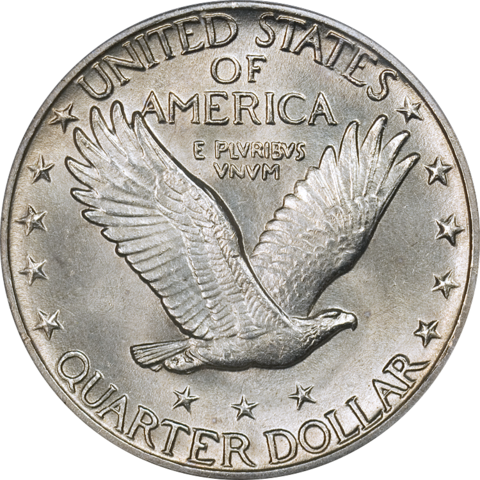
The Barber Quarter was replaced with the Standing Liberty Quarter, and even there, there were two major types of these quarters. Here is the first one:
(By the way if anyone can tell me how to get Wordpus to put pictures side by side, let me know.)
Notice one key, PG-13 detail about this coin…the exposed breast.
There’s a story that there was a huge public outcry about it and something Had To Be Done about it, but there’s no evidence of any such outcry in the newspapers of the time.
But they did change the design, midway through 1917.
Now Liberty is wearing chain mail and the shield has been redesigned. On the reverse the eagle has been raised a bit and three stars appear below it (and fewer stars appear near the edges, leaving the total number of stars at thirteen).
The mint hated this coin. It was nearly impossible to get to strike up. The overwhelming majority of the coins that came out looked poorly made. As it happens the 1917 coin is fairly sharply struck here, but there’s weakness on the 1924, especially on the date itself. The very next year the mint recessed the date because it was wearing off the coin too quickly. This 1924 is actually very well struck, for a Standing Liberty quarter. You can see most of the detail on Liberty’s head…and that’s the first place people look. Fully (or almost fully) detailed heads get the FH designation and it, too, can add huge money to the value of a coin.
But where you really need to look to evaluate the strike is at the shield emblem, and the rivets, on the shield.
The mint was glad to stop making these coins in 1930–and come out with the Washington quarter in 1932 (the 200th anniversary of his birth).
Finally, the half dollar. Here we have what is probably the most popular silver design in US coinage, though collecting Morgan dollars is more popular than collecting “Walkers” (for “Walking Liberty”).
Most people like to focus on the obverse–and our host occasionally posts a picture of one of these that has seen a lot of use, focusing on the motto.
But I think that is absolutely a kick ass eagle on the reverse.
This, too is a coin that is prone to striking issues. Liberty’s hand in the center of the coin is usually at least partially absent. You’ll notice on this one her fingers merge with the branch she’s carrying. People look for a complete thumb, but really those two fingers are the first thing to go.
I’ve yet to find a perfect one for my personal collection, though to be honest I haven’t really spent a ton of time looking.
But, as weak as this looks, in many cases, the entire center of Liberty is not struck at all. Instead of the fine details of her robe and the flag she’s draped in, there’s nothing but a blob of what looks like pitted metal running up and down through the center of the coin…the pitting being the way the silver looks before it’s struck, as well as after it isn’t struck. Truly sloppy workmanship!
There’s no special designation for this coin, but strike can make a huge difference in price nonetheless. People who collect Walkers know which dates are almost never fully struck; if you can score one of those, well, you’ll probably be eating Ramen for a few months afterwards to save money.
One interesting bit of trivia is that this is the only “mainstream” regular issue US coin to have a US flag on it.
This series run through 1947, to be replaced by the Franklin half dollar, with the Liberty Bell on the reverse (and people look for “Full Bell Lines” on that one).
But these are the coins that saw us through the Roaring 20s, and in two of the three cases, through the Depression and World War II. Today we have, I believe, much more boring stuff. (And the Jefferson nickel suffers from striking issues too, though the mint has finally figured out how to get all the steps to show up on Monticello, consistently.)
Standard Disclaimer: None of the coins shown are ones I own, though I’ll admit (in this case) to owning some examples of each of these designs. Prospective burglars should note that gold and silver aren’t the only heavy metals I collect, and that the other, unnamed heavy metal is kept a lot closer to me than the coins are.
Important Reminder
To conclude: My standard Public Service Announcement. We don’t want to forget this!!!
Remember Hong Kong!!!
https://youtube.com/watch?v=L3tnH4FGbd0%3F
I hope this guy isn’t rotting in the laogai somewhere!
中国是个混蛋 !!! Zhōngguò shì gè hùndàn !!! China is asshoe !!!
Its name derives from the OjibweBuh-mid-ji-ga-maug (Double-Vowel orthography: bemijigamaag),[6] meaning “a lake with crossing waters”. On occasion, in Ojibwe, Bemidji is called Wabigamaang (“at the lake channel/narrows”), because part of the city is situated on the Lakes Bemidji/Irving narrows, on the south end of Lake Bemidji, and extends to the eastern shore of Lake Irving. Some sources say that Chief Bemidji, an Ojibwe leader, is the namesake.[7]
Bemidji Township was surveyed by European Americans in 1874. It was organized in 1896, 24 days after the village of Bemidji was chartered, and is the oldest township in the county. In 1897, the county attorney declared the original Bemidji township organization illegal (no reason given) and the township reorganized on June 26, 1897.[8]
About 50 Leech Lake Indians lived along the south shore of the lake prior to the 1880s. They called the lake Bemidjigumaug, meaning “river or route flowing crosswise”. Freeman and Besty Doud claimed 160 acres west of and including present-day Diamond Point; they were Bemidji’s first homesteaders.
Art Lee created the story that the folkloric figure Paul Bunyan came from the Northwoods. Tales about Paul Bunyan and Babe the Blue Ox led to public sculptures of them in the 1930s.[citation needed] According to Discover America, the Paul and Babe statues are “the second most photographed statues in America,” surpassed only by Mount Rushmore.[9] The Rotarians of Bemidji commissioned the statue of Paul Bunyan during the Great Depression as a tourist attraction. It was unveiled on January 15, 1937, to kick off a Winter Carnival that drew more than 10,000 visitors.
Hey, every place has to have a claim to fame, right?
Today Bemidji is an important educational, governmental, trade and medical center for north central Minnesota. The wood industry is still a significant part of the local economy, with Georgia-Pacific, Potlatch, and Northwood Panelboard all having waferboard plants in the local area. They use wood species that were once classified as waste trees.[10]
The traditional inhabitants of the area were the Ojibwe, the Potawatomi and the Menominee.[5] However, the name is the Hochunk Mōsį́nį, the “Cold Country,” from mō, an old form of mą, meaning “earth, ground, land, country”; and sį́nį, “cold.”[6] The Ojibwe ceded the territory to the United States in 1837 when they sold most of their land in what would become Wisconsin, though they were guaranteed the right to continue hunting, fishing, and gathering wild rice on the ceded lands.[7] Similarly, the Potawatomi gave up their land claims in Wisconsin in 1833, and the Menominee ceded territory in this area in the 1836 Treaty of the Cedars.[8][9] These treaties coincided with the establishment of the first sawmill in the area by a white settler, John L. Moore, in 1836, and enabled white settlement to begin in the area. Lumber quickly became the most important industry and drew other businesses and settlers to the town, which at the time was known as Little Bull Falls. After the closing of Fort Winnebago in 1845, a number of Métis families moved to Little Bull Falls, and in 1857 the town was renamed in honor of an Ojibwe chief from the Wisconsin River Band. Deforestation led to the collapse of the lumber industry in the early 20th century, but it was quickly replaced by the paper industry.[10] In the neighboring Menominee language the town is called Mōsāpnīw, “he dwells alone there”, which is likely a close approximation of the eponymous chief’s name.[11]
On May 1, 1950, local residents acting as Communist invaders seized control of Mosinee.[12][13]
The action was a part of an elaborate pageant organized by the Wisconsin Department of the American Legion. The “Communists” dragged Mayor Ralph E. Kronenwetter and Police Chief Carl Gewiss out of their beds. Mayor Kronenwetter surrendered at 10:15 AM in the town’s new “Red Square” with a pistol to his back. The police chief was reported to have resisted and was “liquidated”.
Roadblocks were set up around Mosinee, the library was “purged”, prices of goods were inflated for the duration of the coup, and local restaurants served Russian black bread and potato soup for lunch.[14]
As he arrived at a rally to restore democracy to the community the night of May 1 Mayor Kronenwetter suffered a cerebral hemorrhage and never regained consciousness. He died five days later on May 6, 1950 at age 49. The mayor’s doctor said the excitement and exertion probably contributed to his collapse.
Franklin Baker, commander of the local American Legion post, said, “It was a terrible coincidence.”[15]
Local minister Will La Brew Bennett, 72, who, during the Communist invasion, demonstrated to the media how he would hide his Bible in the church organ if the Communists really invaded and was herded with other residents into a barbed-wire ringed “concentration camp” near “Red Square”, was found dead in his bed hours after the mayor’s death on May 7, 1950.[16]
Prayer is a sincere, sensible, affectionate pouring out of the heart or soul to God, through Christ, in the strength and assistance of the Holy Spirit.
True Pattern of Prayer
Jesus’s redemptive work does more than bring us to God; it also creates a pattern of communion with God, and therefore a pattern for prayer. We see this in Ephesians 2:18: “For through [Jesus] we both [Jew and Gentile] have access in one Spirit to the Father.”
John Bunyan built his definition of prayer on this structure: “Prayer is a sincere, sensible, affectionate pouring out of the heart or soul to God, through Christ, in the strength and assistance of the Holy Spirit.”
We pray to God the Father, as Jesus himself taught us to pray (Matthew 6:9), as he regularly modeled in his own prayer life (Matthew 11:25; 26:39; John 17:1), and as the apostles prayed (Ephesians 1:16–17).
Because our access to the Father is through the atoning death and continuing advocacy of Jesus Christ (Romans 8:34), we approach the Father in Jesus’s name (John 14:13; 15:16; 16:23–24, 26). We come “with confidence” because we’re “in Christ Jesus our Lord” (Ephesians 3:11–12). Jesus, the Son of God by nature, makes us sons of God through adoption — and children have access to their parents. It’s like that for us because of the work of Jesus Christ.
And, as Bunyan says, we pray in the strength and assistance of the Holy Spirit. The Holy Spirit helps us in our weakness, interceding for us (Romans 8:26). So, we have double help in our prayers. Both God the Son and God the Spirit speak to God the Father on our behalf.
This pattern encourages us in our prayers, praying to the Father, through the Son, in the power of the Spirit. Jesus’s passion, pleasure, and purpose is to bring us into the presence of the Father — and the Holy Spirit shares this passion.
From God, Through God, To God
In Mere Christianity, C.S. Lewis memorably expressed the wonder of prayer to God:
An ordinary simple Christian kneels down to say his prayers. He is trying to get into touch with God. But if he is a Christian he knows that what is prompting him to pray is also God: God, so to speak, inside him. But he also knows that all his real knowledge of God comes through Christ, the Man who was God — that Christ is standing beside him, helping him to pray, praying for him.
You see what is happening. God is the thing to which he is praying — the goal he is trying to reach. God is also the thing inside him which is pushing him on — the motive power. God is also the road or bridge along which he is being pushed to that goal.
The whole threefold life of the three-personal Being is actually going on in that ordinary little bedroom where an ordinary man is saying his prayers. The man is being caught up into the higher kinds of life . . . he is being pulled into God, by God, while still remaining himself.
There is major help and encouragement here for us, as we learn to pray, as we come alive to the massive privilege of access to God our Father, as we marvel that the Son and the Spirit intercede for us. And so we pray with a sense of wonder and a settled confidence.
Yes, today is THE day. Fly your 15 star, 15 stripe flag if you’ve got it (it’s still a legal flag of the United States), if you don’t, 50/13 will certainly do. Bonus points for either the Gadsden flag or a Trump flag below the US flag.
The birthday of our national anthem. Well sort of.
You see, Francis Scott Key didn’t set out to write the national anthem. He was writing a poem. And the poem was actually titled, Defence of Fort M’Henry (yes, what we now think of as the British spelling of Defense).
I won’t belabor that part of the story. It’s told far better here anyway (I know my limitations):
Defence of Fort M’Henry was not set to music until somewhat later, I don’t know when. But the actual tune is not original for the song, it was originally To Anacreon In Heaven, which was written in Britain and was popular in both Britain and the United States. Here are the words to that song, as ripped from Wikipedia. (They also have an instrumental audio file, which sounds a little…different from The Star Spangled Banner.)
To Anacreon in Heav’n, where he sat in full Glee, A few Sons of Harmony sent a Petition, That he their Inspirer and Patron would be; When this answer arriv’d from the Jolly Old Grecian “Voice, Fiddle, and Flute, “no longer be mute,” I’ll lend you my Name and inspire you to boot,” And, besides I’ll instruct you, like me, to intwine “The Myrtle of Venus with Bacchus‘s Vine.”
The news through Olympus immediately flew; When Old Thunder pretended to give himself Airs. “If these Mortals are suffer’d their Scheme to persue, “The Devil a Goddess will stay above Stairs. “Hark! already they cry, “In transports of Joy, “Away to the Sons of Anacreon we’ll fly,[28] “And there, with good Fellows, we’ll learn to intwine “The Myrtle of Venus with Bacchus’s Vine.
Yecch. And it goes on for four more verses. Anyone wondering why we broke away from England need look no farther.
It wasn’t until 1931 (March 3 to be precise) that the combined tune and poem, now The Star Spangled Banner, was officially made our national anthem by act of Congress. It had been recognized for official use by the United States Navy in 1889, and by Woodrow Wilson in 1916.
So…what did we use before this? There was no official national anthem at all. So we improvised, adapted, and overcame.
“Hail Columbia” was used at most official functions. We still use it, it’s what they play for the Vice President since he’s still a heartbeat away from meriting “Hail to the Chief.” He gets the ruffles and flourishes (you know, bom-bottebom-bottebom, bom-bottebom-bottebom…), then “Hail Columbia.”
Also in use was “My Country ‘Tis of Thee” but, much as I like that one, it suffers from one major defect: It is the same melody as “God Save the Queen” (or King, depending on who’s reigning at the moment). Our words were written by Samual Francis Smith in 1831.
Given that we’d gone to a lot of trouble to tell the United Kingdom what to go do with itself in the 1770s and again in the 1810s, did we really want to be using their melody for our national anthem?
Another favorite choice from those days of no official anthem is special to me, “America the Beautiful” since it was written right here in my county (El Paso County, Colorado). Congress actually considered it for the official national anthem. It was written by Catherine Lee Bates in 1893; the words started coming to her when she was at the top of Pikes Peak, she put them on paper that evening in her hotel (the original Antlers hotel). Like the “Star Spangled Banner” it started out as just a poem, “Pikes Peak”, got renamed “America” for publication, and got set to someone else’s tune, “Materna” (which in turn was from a church hymn published in 1892).
It also went through multiple versions, here’s the 1893 original. It settled into final form in 1911.
O great for halcyon skies,
For amber waves of grain,
For purple mountain majesties
Above the enameled plain!
America! America!
God shed His grace on thee,
Till souls wax fair as earth and air
And music-hearted sea!
O great for pilgrim feet
Whose stern, impassioned stress
A thoroughfare for freedom beat
Across the wilderness!
America! America!
God shed His grace on thee
Till paths be wrought through wilds of thought
By pilgrim foot and knee!
O great for glory-tale
Of liberating strife,
When once or twice, for man's avail,
Men lavished precious life!
America! America!
God shed His grace on thee
Till selfish gain no longer stain,
The banner of the free!
O great for patriot dream
That sees beyond the years
Thine alabaster cities gleam
Undimmed by human tears!
America! America!
God shed His grace on thee
Till nobler men keep once again
Thy whiter jubilee!
So there you have it, the songs we used before we had an official national anthem.
I’ll close, of course, with “The Star Spangled Banner” sung in St. Pauls, London, September 14, 2001, nineteen years ago today: