

What is it that feeds our battle, yet starves our victory?
January 6 Tapes Reminder
After the first release, we were supposed to get more, every week.
As far as I know it hasn’t happened.
Speaker Johnson, please follow through!
A Caution
Just remember…we might replace the RINO candidates. (Or we might not. The record is mixed even though there is more MAGA than there used to be.) But that will make no difference in the long run if the party officials, basically the Rhonna McDaniels (or however that’s spelled–I suspect it’s RINO), don’t get replaced.
State party chairs, vice chairs, secretaries and so on, and the same at county levels, have huge influence on who ultimately gets nominated, and if these party wheelhorses are RINOs, they will work tirelessly to put their own pukey people on the ballot. In fact I’d not be surprised if some of our “MAGA” candidates are in fact, RINO plants, encouraged to run by the RINO party leadership when they realized that Lyn Cheney (and her ilk) were hopelessly compromised as effective candidates. The best way for them to deal with the opposition, of course, is to run it themselves.
Running good candidates is only HALF of the battle!
Biden Gives Us Too Much Credit
…we can move on to the next one.
Apparently Biden (or his puppeteer) has decided we’re to blame for all of the fail in the United States today.
Sorry to disappoint you Joe (or whoever), but you managed to do that all on your own; not only that, you wouldn’t let us NOT give you the chance because you insisted on cheating your way into power.
Yep, you-all are incompetent, and so proud of it you expect our applause for your sincerity. Fuck that!!
It wouldn’t be so bad, but you insist that everyone else have to share in your misery. Nope, can’t have anyone get out from under it. Somehow your grand vision only works if every single other person on earth is forced to go along. So much as ONE PERSON not going along is enough to make it all fail, apparently.
In engineering school we’re taught that a design that has seven to eight billion single points of failure…sucks.
Actually, we weren’t taught that. Because it would never have occurred to the professors to use such a ridiculous example.
Justice Must Be Done.
The prior election must be acknowledged as fraudulent, and steps must be taken to prosecute the fraudsters and restore integrity to the system.
Lawyer Appeasement Section
OK now for the fine print.
This is the WQTH Daily Thread. You know the drill. There’s no Poltical correctness, but civility is a requirement. There are Important Guidelines, here, with an addendum on 20191110.
We have a new board – called The U Tree – where people can take each other to the woodshed without fear of censorship or moderation.
And remember Wheatie’s Rules:
1. No food fights
2. No running with scissors.
3. If you bring snacks, bring enough for everyone.
4. Zeroth rule of gun safety: Don’t let the government get your guns.
5. Rule one of gun safety: The gun is always loaded.
5a. If you actually want the gun to be loaded, like because you’re checking out a bump in the night, then it’s empty.
6. Rule two of gun safety: Never point the gun at anything you’re not willing to destroy.
7. Rule three: Keep your finger off the trigger until ready to fire.
8. Rule the fourth: Be sure of your target and what is behind it.
(Hmm a few extras seem to have crept in.)
Spot Prices
All prices are Kitco Ask, 3PM MT Friday (at that time the markets close for the weekend). (Note: most media quotes are for the bid…the price paid by the market makers, not the ask, which is what they will sell at. I figure the ask is more relevant to people like us who wish we could afford to buy these things. In the case of gold the difference is usually about a dollar, for the PGMs the spread is much wider.)
Last Week:
Gold $2,504.30
Silver $28.92
Platinum $936.00
Palladium $993.00
Rhodium $4,975.00
FRNSI* 120.146-
This week, markets closed at 3PM Mountain Time Friday for the weekend.
Gold $2,498.20
Silver $28.04
Platinum $931.00
Palladium $933.00
Rhodium $5,050.00
FRNSI* 119.850+
Gold:Silver 89.094+
Gold dipped below 2500 on Wednesday but bounced back on Thursday, only to get beaten down again on Friday. For now it seems to be sticking to a relatively narrow trading range, straddling the $2500 mark.
Silver is getting beaten up much worse.
*The SteveInCO Federal Reserve Note Suckage Index (FRNSI) is a measure of how much the dollar has inflated. It’s the ratio of the current price of gold, to the number of dollars an ounce of fine gold made up when the dollar was defined as 25.8 grains of 0.900 gold. That worked out to an ounce being $20.67+71/387 of a cent. (Note gold wasn’t worth this much back then, thus much gold was $20.67 71/387ths. It’s a subtle distinction. One ounce of gold wasn’t worth $20.67 back then, it was $20.67.) Once this ratio is computed, 1 is subtracted from it so that the number is zero when the dollar is at its proper value, indicating zero suckage.
BTW (possibly of benefit to Barb Meier) the plus or minus sign at the end of the FRNSI and Gold:Silver is simply to indicate whether the number is actually slightly above or below what I wrote and that I rounded down or up, respectively. In this case 119.850+ means a bit above 119.850, so I had to round down. A bit more and I would have rounded up to 119.851 and written 119.851-.
A PS. Last week I gave the value of 71/387ths out to about a gazillion decimal places, but it turns out my suspicions were correct: they were garbage after a while. I ginned up a spreadsheet to do long division for as long as one likes, and 71/387ths repeats after 21 decimal places and is: 0.183 462 532 299 741 602 067 (then 183 462, etc). So what? Well take a look at the 2067 at the end. As in $20.67.
The Sun
Resuming our survey of our solar system, we take up the Sun.
It is tempting to call the Sun the 800 pound gorilla of the solar system…but this would be a bad idea because it understates the matter. Jupiter is more massive than the other planets put together, so it is the 800 lb gorilla of the solar system.
The sun is 1,048 times as massive as Jupiter, which makes it the 400 ton brachiosaurus of the solar system. (And in case you’re wondering, the Sun is 332,950 times the mass of the Earth.)
It’s also very different from every other thing in the solar system; it’s a ball of hot, ionized gas and is generating 383 septillion watts (that’s 24 zeros) of power, or that many joules per second. And it has been doing so for 4.6 billion years and will continue to do so for another 4-5 billion years at least. No other body in the solar system does that–the rest shine in our night sky because they reflect the light from the Sun.
It shines like that because its surface is at a temperature of 5,772 K…though it is much, much hotter at the center, 15.7 million K.
Or, to put it in five words, “the Sun is a star.” A star a bit above the median, but about average. It’s brighter than 85% of all stars in this galaxy (many of the ones that beat it really break the curve though), and compared to other nearby stars it’s more massive than 95% of them.
Unlike other stars that are trillions or even quadrillions of kilometers away, the Sun averages 149,597,870.7 kilometers from the Earth.
How do we know that? We bounce radar off of it. But before that…well, that’s a fascinating story having to do with transits of Venus across the face of the Sun as seen from Earth. I’ve told this story before here (yes it’s about Venus transits but tells the whole story): https://letreasonreign.wordpress.com/2012/05/13/venus-transit-6-june-2012/ but here’s a different take:
The power source is hydrogen fusion, generally through a process called the proton-proton chain. Other stars, either more massive or later-in-life than the Sun, have other power sources (all discussed here in part 22 of the big physics series: https://www.theqtree.com/2021/10/23/2021%c2%b710%c2%b723-joe-biden-didnt-win-daily-thread/).
As I mentioned before, the Sun is made of ionized gas. It’s 73.5% hydrogen, 24.8 percent helium…and remaining 1+% is basically everything else (mostly oxygen, a lot of carbon, iron, neon… This is pretty close to the composition of interstellar gas in nebulas, which is, after all, what collapsed to form the Sun in the first place.
Since the Sun is a ball of gas, it has no solid surface. But it has a diameter, given as 1,390,000 km (versus Earth’s 12,756 or so km). What’s that the diameter of, if there’s no solid surface?
What we see when we look at the Sun is a glowing sphere; below that “surface” we cannot see because ionized gas is not transparent. We call that surface the photosphere, from the Greek for light and sphere…in other words, “ball of light.”
It’s not a good idea to look at the Sun, it’s an even worse idea to look at it through a telescope. But you can cut the light down by 999,999/1,000,000ths and take some decent photographs. (However, you’ll see my photographs here instead.)
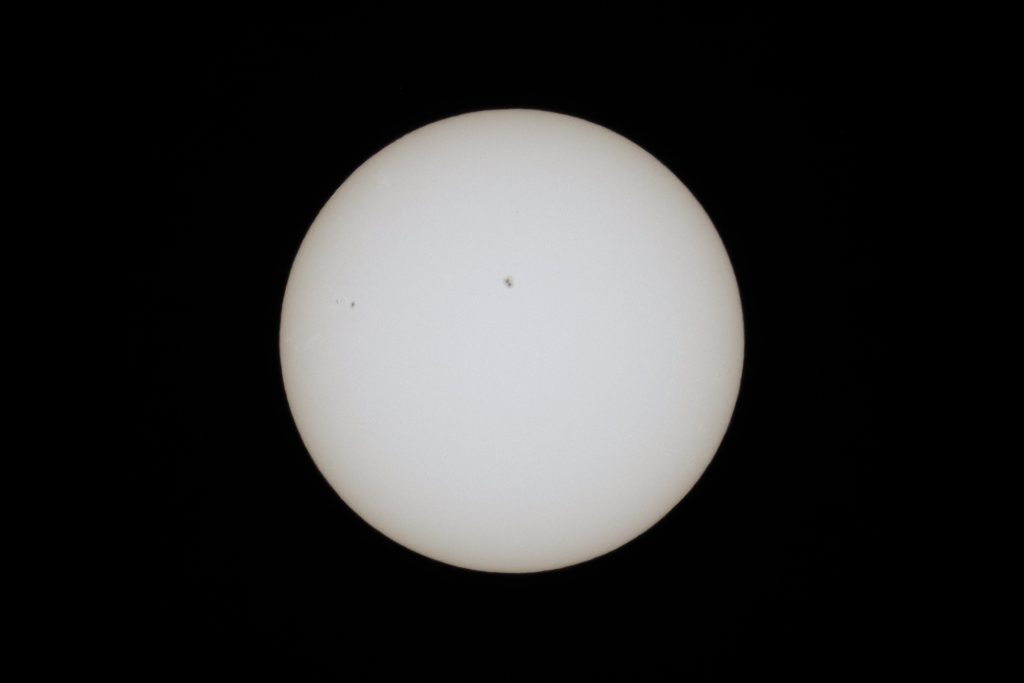
You might be wondering why I used a black and white photograph. It’s not a black and white photograph; it turns out the Sun isn’t yellow, it’s white.
If you look closely, you’ll see some dark spots; these are sunspots and we’ll get to them. For now, I’d like you to notice something else, a subtle darkening near the edges of the disc. This is known as limb darkening, and it doesn’t mean what you might think it means.
If you were looking at a ping pong ball or something similarly white, you’d see darkening near the edges; it’s that kind of shading that conveys to your eyes and brain that the ping pong ball is a sphere.
But that’s not what’s going on here; the Sun doesn’t reflect light, it generates it. Every point on the surface radiates light and heat in every direction (including back into the Sun where it is absorbed and radiated again). So a point near the edge of the disc should be sending us just as much light as a point near the center of the disc, instead it looks dimmer. It turns out this is a consequence of the light we see being emitted from anywhere within a depth of a few hundred miles below the “surface”, with the upper layers cooler than the lower ones. More discussion here: https://en.wikipedia.org/wiki/Limb_darkening
If you could somehow stand on the “surface” of the Sun without being instantly vaporized, you’d weigh 27.9 times what you do on Earth. The escape velocity for a rocket would be 617.7 km/sec (versus 11.2 km/sec for Earth). I doubt a rocket could be built that would do that…it’s actually over 0.2 percent the speed of light.
We actually have a solar orbiter probe…which if you think about it, Earth itself could be thought of as such a thing. But no I mean an actual spacecraft, the Parker Solar probe, launched in 2018. It is in orbit and gets as close as 4.3 million kilometers (compare to the 150 million kilometers we average on “Spaceship Earth”). It moves as fast as 690,000 km/hr or 191 km/sec, which is 0.064% the speed of light…by far the fastest thing we’ve ever built. Its main task is to study the solar corona. But I am getting ahead of myself.
The Sun, like the Earth, is a sphere, and, like the Earth consists of concentric layers. The Sun’s core, the inner 25% by distance, is where the nuclear fusion happens. Surrounding that is the radiative zone, about twice as thick. The energy generated in the core works its way though this zone by radiation…gamma rays from the fusion eventually weakening to something that won’t kill us. It can take ten thousand years for the radiation to get through, because it bounces from nucleus to nucleus in a random walk, so the light you see now is the result of fusion that happened as we were emerging from the last ice age.
Both the core and the radiative zone rotate uniformly, but the next zone, the convective zone, does not; the parts of it near the equator rotate in less time than the areas below the poles. The primary mode of heat transfer in this layer is convection; hot material rises, carrying the heat to the surface; after cooling it sinks down again to get reheated. The boundary between the two is called the tachocline, here is were the layers actually slide past each other because of the differences in rotation rate. It’s thought that this layer creates the Sun’s magnetic field.
Above that layer is the photosphere, which is cool enough and transparent enough that the photons that make their way to it finally, are free to go…and one in a billion end up hitting Earth eight and a half minutes later–and turn night into day.
Above the photosphere is the chromosphere, which is visible briefly as a reddish flash at the very start and end of totality during a solar eclipse.
Above this is a transition region where helium becomes ionized (visible in ultraviolet light, from space), and then, finally the corona.
The corona–and for that matter everything else outside of the photosphere–is effectively invisible to us here on Earth…except during a total solar eclipse.
As seen here, in this photograph I took during the last eclipse:
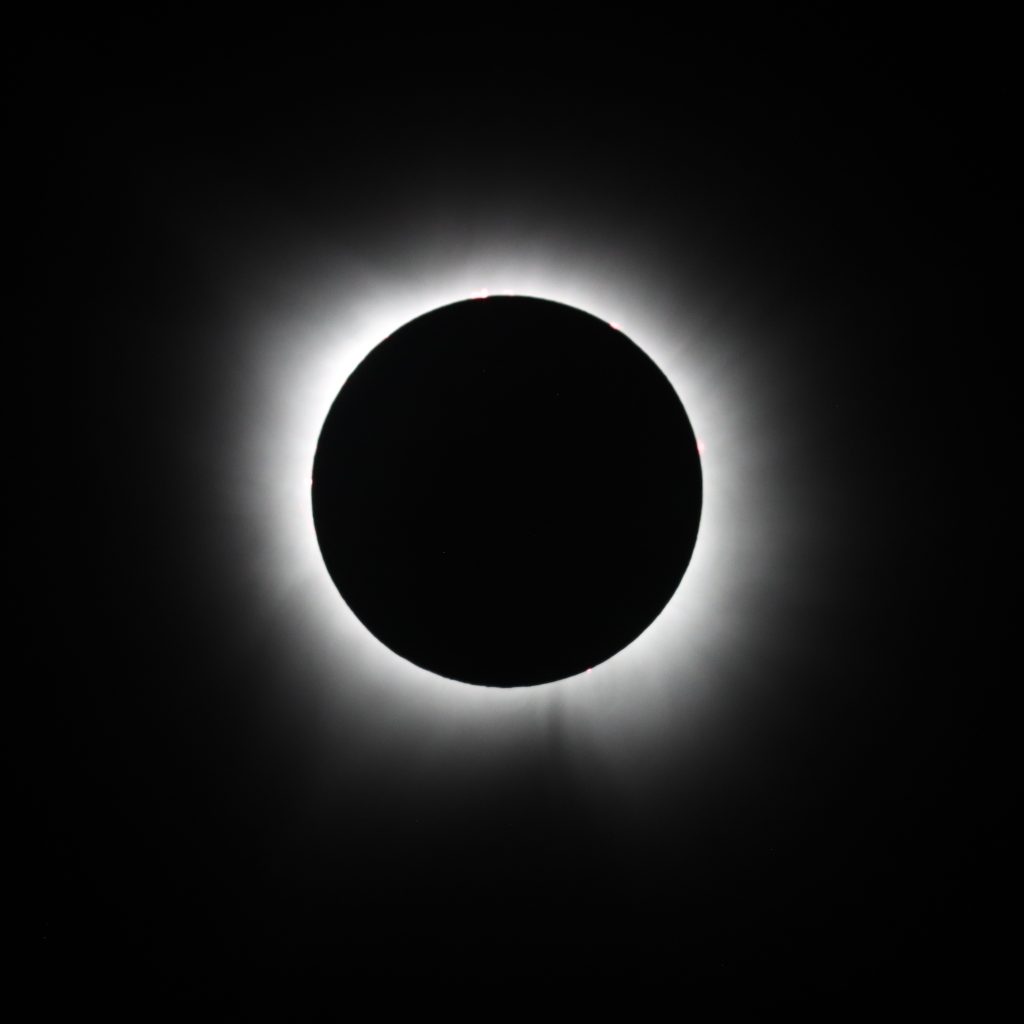
If you look closely at this picture you will see pink “flames” around the disk of the Moon. They should look vermillion; alas they’re blown out in this picture. These are prominences, and are caused by the interaction of ionized (charged) gas with the Sun’s magnetic field.
The prominences are a lot more prominent (ahem) in this picture, near the bottom of the disk, and there’s also a beauty of an arch at 3 o’clock.
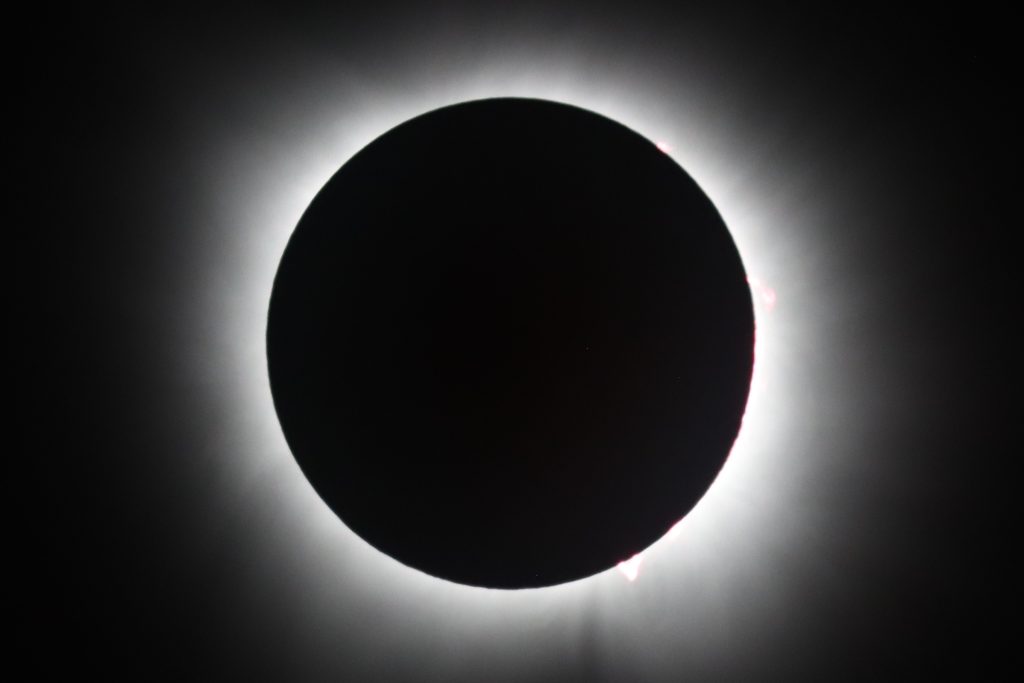
Prominences can be seen by telescopes with the proper filters to blot out all but the hydrogen alpha wavelength of light. Here’s a closeup taken by a competent photographer, with the correct colors:

Besides pumping out visible light and heat copiously and relentlessly for billions of years (even more persistent than the IRS), the Sun creates gigantic numbers of neutrinos from fusion. Neutrinos rarely interact with anything; the neutrinos generated in the Sun’s core leave the Sun seconds later, moving at the speed of light through everything without being affected, like Democrats and the criminal justice system. Even at this distance from the Sun, every square centimeter that’s face-on to the Sun has ten billion neutrinos pass through it every second (less of course if the surface is at an oblique angle to the sunlight).
By the way, it means this many neutrinos pass through every square centimeter of you every second. And don’t think it doesn’t happen at night…they go right on through the Earth as if it’s not there, and come up at you from the ground. The good news is if they go right through you, they do nothing at all to you. It’s when you stop one–very rare but it does happen–that you’ve actually taken a hit. This will happen to one person out of four during a normal lifetime. (At ten billion per second per square centimeter, and one chance in four of getting a hit with the rest passing through harmlessly…you can see this is a rare event.) A single hit from radiation is nothing, though; you get vastly more from other sources. (Like potassium as in bananas.)
Far more important to us is the Sun’s magnetic field. As I’ve said the Sun is largely ionized gas…which is to say it’s full of stuff with electrical charges. This stuff moves (the Sun rotates, on average once every 28 days or so), and moving electrical charges generate magnetic fields.
The Sun’s magnetic field has a role in everything from sunspots to prominences to full-on coronal mass ejections; that’s where the Sun belches and flings a bunch of plasma out into space. If one of these hits Earth, it can muck with satellites and the power grid, conceivably even causing massive blackouts. The worst of these was the Carrington event of 1859. We just barely had a grid then, of telegraph lines. Nonetheless some telegraph stations caught fire. It was possible to send messages without supplying any power to the system. The chances of another like it within the next decade (which would be catastrophic) are rated at well under 1 percent.
The magnetic field of the Sun goes through cycles, gradually increasing over the span of roughly 11 years, then flipping polarity, decreasing, and then repeating the process with the magnetic field in the opposite direction. Sunspots, prominences and CMEs all increase (or decrease) in frequency as the magnetic field increases (or decreases).
But even when the Sun is calm, there is a constant stream of charged particles from the corona, outward in all directions; this is the solar wind and it would have long since stripped our atmosphere away were it not for the fact that Earth’s magnetic field deflects almost all of it. In fact this is why Mars has almost no atmosphere: It has no magnetic field.
Many ancient cultures worshiped the Sun. They realized that without it there’d be no life. We know more about the Sun, but if anything that just makes it even more impressive than we had realized. But we don’t think it is a god any more. We just call it the 400 ton brachiosaurus of the Solar System.
Already late…I don’t feel like this ready, but as Klingons would say, today is a good day to die. Hit Publish.