2025.05.06 Daily Thread – American Stories: When in the Course of human events – Part 17

From a recent reply post of our Gail Combs –

FWIW, my aunt did the research to become a Daughter of the American Revolution. My family is descended from Alexander Hamilton.

Do you think I can get reparations from Senator Burr for the murder of my ancestor at the hands of his?😆

Well, alrighty then, Gail. Since you asked the question, even if it was in somewhat in jest, let’s take a trip back in time with all of our QTree friends and see if reparations may be in order. I will first focus on Hamilton and introduce background on Burr in the links. Be reminded Alexander Hamilton was not a signer of the Declaration, however, he is universally considered a very important founding father.

Alexander Hamilton – Early Life

I will summarize the major points and events that shaped his life in this post. There are many historical accounts, books, documentaries, plays and so on that have covered his extraordinary life for those who want to know more

He was born in Charleston of Nevis in the British West Indies Leeward Islands in 1755 or 1757 – your guess is as good as the historians.

He was born out of wedlock to Rachel Lavien and James A. Hamilton. He had an older brother from the relationship, James Jr. It seems Rachel was still married to her first husband, Johann Lavien, with whom she had a son, Peter. She left her husband and son in 1750 and moved to St. Kitts Island where she met James. Rachel was half British and half Huguenot while James was a Scotsman. Later the two moved back to Rachel’s birthplace of Nevis to a seaside lot she had inherited from her father. While there Alexander and James Jr. were tutored in a private school by a Jewish headmistress and Alexander devoted himself to reading many books from the family library as well.

James Sr. learned Rachel’s first husband was planning to divorce her while charging adultery and desertion under Danish law that would lead to the additional criminal charge of bigamy, so he abandoned the family to spare that from happening. Rachel moved with her two sons to Christiansted on St. Croix and managed a small store there. In 1768 both Rachel and Alexander contracted Yellow Fever. She passed away leaving Alexander and James Jr. orphaned. Her first husband then took everything from her estate, leaving the boys nothing.

The boys were taken in by an uncle. Unfortunately, he committed suicide a year later. At this point they separated with James Jr. becoming an apprentice carpenter and Alexander being taken in by Nevis merchant, Thomas Stevens. He began work in the merchant field of import-export. He soon became a trader with business in New York and New England. He became so proficient even as a teenager that the owner would leave him in charge of the business when he went to sea.

Alexander was a prolific reader and once composed a letter to his father about the terrible effects the island experienced from a hurricane in 1772. His mentor and tutor, Rev. Henry Knox, read the letter and decided to submit it to the newspaper for publication. His highly descriptive writing style strongly impacted the right people in the community, who collected funds and sent him to the U. S. to receive an education. He started at Elizabethtown Academy and a year later was admitted into King’s College (Columbia). While there he developed an interest in patriot causes and used his writing skills to counter loyalist influence, yet, discouraged violence to accomplish change and independence. With the British occupation of New York City at the war’s start, his education at King’s came to an end.

Hamilton’s Military Career Accomplishments

Hamilton was quick to join the patriot war efforts as he and many of his classmates joined the militia and were in the Corsican unit. He was soon made an officer and led a raid with the Sons of Liberty to capture British cannons for their own use. With the captured weaponry the men became an artillery unit for the militia and was named the Hearts of Oak. He soon became Captain of a 60 man rear guard artillery unit for New York and assisted Washington in numerous battles including successful action leading to the British surrender in the Battle of Princeton.

Due to his successful service he was requested to be an aide to two Generals and declined, until George Washington contacted him to be his Aide de Camp at the rank of Lieutenant Colonel. He jumped at the opportunity and served four years in the chief of staff capacity. It gave him great experience corresponding with the Continental Congress, governors and other Generals. He drafted orders, dealt with diplomacy matters, worked with military intelligence and negotiated with other military officers on Washington’s behalf.

He met his future wife, Elizabeth Schuyler, in late 1779 in the winter headquarters of the military in New Jersey. She was the daughter of General Phillip and Catherine Schuyler. They married a year later at her family’s New York mansion and went on to have eight children together.

He left his role with Washington in February 1781 after a misunderstanding between the two, however, it really was a result of Washingtons consistent refusal to give him command of units in the war. The couple returned to her family’s home in New York where Hamilton continued to write letters to Washington seeking a command. Finally, in July he relented and Hamilton was assigned a total of four companies from NY and CT. Upon the Battle of Yorktown, he was given three battalions and an assigned target. He led his men in victory while only using bayonets at night to avoid attracting attention with gunfire.

Hamilton’s Public Service Career Accomplishments

After Yorktown he resigned his commission in 1782 and returned to New York City. After self study he passed the bar there in six months and soon began arguing cases before the state Supreme Court. To state that Alexander Hamilton was obviously a high functioning genius is an understatement. He was noted by his contemporaries as having the highest intellect of anybody within their midst.

He was appointed as a NY representative to the Congress of the Confederation. From his early Anti-federalist days, his mind and politics changed as he had become frustrated with the Continental Congress and the inability to obtain funds from the states to pay war debts. About this time the Newburgh Conspiracy occurred as previously discussed as well as another event with a disgruntled group of former military who marched on Philadelphia to make their points for back pay. Hamilton pushed to relocate the Congress to Princeton, NJ to avoid the confrontation and they were able to continue there without interruption.

Through the years that followed Hamilton had the following roles and involvements.

Left the Confederation Congress to restart his law practice, which primarily represented loyalists and Tories. Jumped back into the public realm with the Newburgh Conspiracy. Became a member of the NY legislature. He served on the King’s College (Columbia) Board of Trustees.

He was chosen as a delegate to the Constitution Convention where he pushed having the POTUS serve life terms as well as the Senators. He wanted electors selecting both, the POTUS having an absolute veto on legislation, SCOTUS having jurisdiction over all lawsuits, and state governors being appointed by the federal government. None of that went anywhere.

He recruited John Jay and James Madison to join him in writing the Federalist Papers in support of the proposed Constitution. He oversaw the influential publications and wrote 51 of the 85 essays in the pen name of Publius. Despite hard selling the need for the Constitution, he was unhappy with numerous negotiated provisions. However, when it came time to ratify and sign, he did so.

With the election of George Washington, the POTUS initially chose Robert Morris for the Treasurer role. Morris declined and recommended Hamilton, who accepted and was confirmed in September 1789. It was in this role that Hamilton’s genius and hard work shined. He immediately began the process of fixing public credit in a manner he had previously described to Morris back during the war in 1781; which was the primary reason Morris had recommended him to Washington. His work and process for establishing financial independence for the young nation was very impressive and successful. Many of the principles and methods are still used today. For better or worse he was successful in gaining approval for a national bank as he felt a central banking system was necessary for America to grow and be successful.

His proposals to establish a mint and coinage were accepted and eventually signed into law with the Coinage Act of 1792. With it the coins were minted in decimals instead of the 8ths that Spain used. Due to smuggling and pirating problems at sea along the coast lines he proposed an armed naval police force called the “revenue cutters” to address. This became the precursor to our current Coast Guard.

For federal tax revenues Hamilton first went after tariffs on whiskey and proposed excise taxes on other products to raise funds. This caused the Whiskey Rebellion, which was put down by Hamilton, George Washington, General Henry Lee and a large contingent of federal troops. Acceptance of tariffs and taxes was slow, but he persisted with the help of other leaders over time.

Hamilton was a tireless supporter of industrialization and promoted manufacturing as a way to diversify and grow federal revenues. He stood in contrast to Jefferson who preferred an agrarian based economy.

He wanted America neutral with Great Britain and France being at war in 1793, so he supported the Jay Treaty of 1795 that he had been instrumental in drafting. He wanted to continue trade relations with Britain to keep revenues growing in the federal treasury. Since his wife had suffered a miscarriage while he was dealing with the Whiskey Rebellion, he resigned from this cabinet position in early 1795 while leaving detailed instructions relating to handling the federal debt through public credit. Some months later he returned to his law practice.

Throughout the early to mid 1790’s Hamilton faced many accusations for his sexual exploits. Well founded or not they caused much damage to his political aspirations. He remained a Federalist throughout his public life and as such opposed the politics of Jefferson. However, as the 1800 Presidential election revealed he was willing to mix it up with anybody. At that point he was crossways with John Adams and worked against his reelection. When Jefferson and Burr tied for POTUS and Adams had lost, he felt Jefferson was the lesser of two evils and cast his lot for him over the northerner Burr, of whom he detested. Jefferson became POTUS and Burr VP. When Burr later ran for governor of NY in 1804, Hamilton openly worked against him and contributed to his loss. That directly led to the unfortunate events that follow.

The Rivalry With Aaron Burr

Rather than summarize what has been done numerous times by others, I have provided some well written biographical summaries that will take you just a few minutes with each to read. Each has a different emphasis.

https://www.biography.com/political-figures/alexander-hamilton-aaron-burr-relationship-rivalry-duel

This one provides a bit more about the duel itself.

https://constitutioncenter.org/blog/burr-vs-hamilton-behind-the-ultimate-political-feud

Family correspondence post duel prior to Hamilton’s death.

https://www.gilderlehrman.org/history-resources/spotlight-primary-source/duel-alexander-hamilton-and-aaron-burr-1804

However, this one is the best description of the events of the day in my opinion. It will take a bit longer to read, but is well sourced and makes sound conclusions in my opinion.

https://founders.archives.gov/documents/Hamilton/01-26-02-0001-0201

Hamilton Reparations Conclusion

It takes two to tango with an illegal duel, even if one (Hamilton) has been set up by the other (Burr) to “defend” his honor. Both obviously knew it was against the law to do what they did. Hamilton had recently lost a son in a duel at nearly the same location as this one a few years before. It is amazing that two highly educated, intelligent, accomplished men of their stature decided to do what they did. They resorted to living out a grudge match to the death over what was best for their families and country. It revealed flaws in character of both men, not unlike all of us.

In reading at least a dozen accounts of this story, it does seem like Hamilton shot into the air. Whether that was because he was not practiced with the “hair trigger” it reportedly had or whether he did it intentionally we will never know. He had been an accomplished military soldier and leader, he knew how and what to do if he did not make a mistake. After experiencing the pain of the loss of his son in that duel a few years before, he had to know how it all could go. My gut says he refused to back away from the challenge of Burr due to pride and public image, but reconciled himself to the potential results of the event and that he would not harm Burr. One account stated that in the 30 hours he lived after being mortally wounded he sent word to his Episcopalian priest to perform his last rites. The priest initially refused due to the nature of the event that caused his injury. He later agreed after hearing Hamilton’s explanations of his thoughts and actions prior to and during the duel. The priest then performed the rites prior to his death.

It also seems that in death as well as in life, Alexander Hamilton was an enigma.

None of this rises to the level of wrongful death by Burr in my opinion without more facts. The truth is both men injured themselves unto death that awful day. One from the confrontation and gunshot wound that could have easily been avoided. The other lost a lifetime of trust and goodwill that led to a downward spiral into oblivion until he passed away. Neither was a fitting end for two patriots who had fought for our freedom and were seemingly committed to the best interests of America. Both had personal flaws that let strong opinions and political opportunism get in the way of common sense and reasonable compromise.

We are thankful for the many good things they did for America, especially Alexander Hamilton. We are sad for the turmoil that occurred prior to the ends of their lives. There is a great lesson in this for those who are placed in authority and that is to turn down the volume on discord, rancor and personal attacks against others. Fight the sin of pride. As I have posted previously, politics is dirty and a big ego can cause great harm to self and others.

The current Democrat Party and their demons of destruction would do well to pay heed. It will not end well for them either.

Please remember Wolf’s rules for our community. In general that means to be respectful to each other and to pull no shenanigans that your mom might find offensive or otherwise cause jail time. That said, free speech is honored here.

Be blessed and go make something good happen!

Dear KMAG: 20250505 Trump Won Three Times ❀ Open Topic


Joe Biden never won. This is our Real President – 45, 46, 47.

AND our beautiful REALFLOTUS.


This Stormwatch Monday Open Thread remains open – VERY OPEN – a place for everybody to post whatever they feel they would like to tell the White Hats, and the rest of the MAGA/KAG/KMAG world (with KMAG being a bit of both).

And yes, it’s Monday…again.

But we WILL get through it!

We will always remember Wheatie,

Pray for Trump,

Yet have fun,

and HOLD ON when things get crazy!


We will follow the RULES of civility that Wheatie left for us:

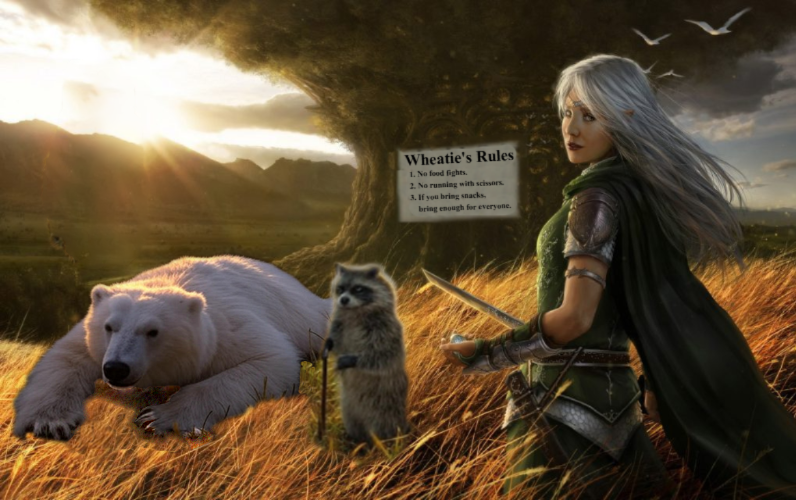
Wheatie’s Rules:

  1. No food fights.
  2. No running with scissors.
  3. If you bring snacks, bring enough for everyone.

And while we engage in vigorous free speech, we will remember Wheatie’s advice on civility, non-violence, and site unity:

“We’re on the same side here so let’s not engage in friendly fire.”

“Let’s not give the odious Internet Censors a reason to shut down this precious haven that Wolf has created for us.”

If this site gets shut down, please remember various ways to get back in touch with the rest of the gang:

Our beloved country is under Occupation by hostile forces.

Daily outrage and epic phuckery abound.

We can give in to despair…or we can be defiant and fight back in any way that we can.

Joe Biden didn’t win.

And we will keep saying Joe Biden didn’t win until we get His Fraudulency out of our White House.


Wolfie’s Wheatie’s Word of the Week:

yucca

noun

  • woody North-American plant
  • genus of perennial shrubs and trees in the family Asparagaceae, subfamily Agavoideae
  • genus of about 40 species of succulent plants in the agave subfamily of the asparagus family (Asparagaceae), native to southern North America

Used in a sentence

Yucca roots can extend horizontally 30 feet.

Shown in a picture

Shown in a video of pictures (33 varieties).


MUSIC!

Speaking of yuccas and other wonderful things from the American Southwest, enjoy some folk music from one of the oldest surviving cities in America.

Now let’s travel further west and forward in time for more Southwestern music!


THE STUFF

Yeah, it’s Meathead. And yet, it’s awesome. A great analysis of why The Princess Bride is still legendary.

I really wish I had seen this movie earlier – on the big screen.

Just sayin’!

And remember…….

Until victory, have faith!

And trust the big plan, too!

And as always….

ENJOY THE SHOW

W


2025.04.29 Daily Thread – American Stories: When in the Course of human events – Part 16

It is now a very appropriate time to discuss political parties since they have been doing their best to disrupt the will of We the People for many years.

In our newly formed nation during the subject period of this series, the Federalists were the first organized political party that apparently formed in 1789, although some sources hold out for as late as 1795. When one considers that Alexander Hamilton, John Jay and James Madison produced and published the Federalist papers from 1787-1788 in NY newspapers, this writer chooses to use the earlier date.

That would be the year the Constitution was ratified. That did not take long, did it?

The Federalist movement and party dominated the affairs of America during the 1790’s, then never won an election after 1801 before disappearing not long after the War of 1812. Their lasting legacy will always be the Constitution, for better or worse.

To provide some background and more of a basis for this part, please review this summary of political parties in America.

https://stacker.com/stories/politics/history-political-parties-america

Confession

Before we go further I have a confession to make. I firmly believe as POTUS James Monroe stated, “Surely our government may go on and prosper without the existence of parties. I have always considered their existence as the curse of the country” 

You will find that statement in the fourth paragraph of the linked letter below from said James Monroe to James Madison on May 12, 1822.

https://founders.archives.gov/documents/Madison/04-02-02-0445

Preach it, James. You understood this subject well in my opinion. It would not be long (1828) before a political party rose up against the freemasons, the Anti-Masonic Party. Seems you were a freemason. Oh well. That party was absorbed into the Whigs a decade later.

However, please do not miss what Monroe said in the sentence previous to the above referenced quote. “Public opinion will react on this body, & keep it right.

Seems that is still the key over 200 years later; transparently keeping the citizens truthfully informed while they remain engaged with their government officials and related activities. Which is why the current day Uniparty worked successfully to take over the opinion shaping in media. They were successful in keeping the masses in the dark about what the usurpers were really doing while also cultivating a general disinterest or distaste of politics and voting within the general public.

The major problem they now have, thanks to POTUS Donald J. Trump, is a very large group of Americans no longer believe a stinking word they say and are now fulfilling James Monroe’s prediction of keeping the politicians more honest (“right”). The fake media’s effect is being relegated to the sheeple with Bob Uecker’s view. In honor of the recent start to MLB’s season…

Dang, I miss that guy.

British Legacy

We cannot really blame our founders for establishing political parties. The vast majority of them and other patriots who formed our new nation came from the United Kingdom. As a result, let’s take a look at the political party history and landscape there before the nation of America was a thing. Check out #3 in the link below.

https://about-britain.com/institutions/political-parties.htm

Tory and Whig parties formed beginning in the 1680 time frame. Which makes it easier to understand how and why political parties formed in America. Colonists had been conditioned to their existence as subjects of Great Britain. They had seen the Tories remain loyal to the Crown and viewed as traditionalists all of those years. The Whigs were the reformers and liberals. As a result it was a natural reaction when opposing viewpoints developed in America during and after the war to create the Federalists and Antifederalists. The supporters took sides and the first to become organized appears to be the Federalists. They were soon followed by the Democratic-Republicans (Antifederalists), also known as the Jeffersonian Republicans in the 1792-95 time frame. The actual dates are disputed among many historical accounts, but are in the general time frame of late 1780’s to mid 1790’s for both parties.

Conditions On The Ground Then

As we know, political parties generally form to advance common interests. Alliances on issues of importance make it easier to advance those common interests. However, those alliances also tend to create issues to gain power and money while moving public opinion to their points of view.

That is clearly what the Federalists did. Seven of the thirteen states in the new nation of the United States of America were fine with the Articles of Confederation. The Federalists foresaw big trouble on the horizon as stated in the previous part, or, felt they could not gin up enough fear porn to hopefully move public opinion their way. At that point they did not believe they could influence the seven states sufficiently to gain the nine votes needed to produce a new, nationally governing document. The seven states were entrenched in their thinking and operation. The Federalists were obviously opposed to states’ rights exceeding federal authority and believed in a strong central government. So, they used a provision in the Articles to have state conventions to elect special delegates to amend the Articles at the Philadelphia Convention. It worked. The bottom line is they wore down their political opponents and succeeded in flipping three states to their views of terminating the Articles and replacing with the Constitution that resulted.

Who were those founding fathers who could be so formidable in support of their beliefs and persuasive in their arguments? Well, that would be political heavyweights George Washington, John Adams, James Madison, Alexander Hamilton, Robert Morris, and John Jay primarily; along with many others who were friends and allies. They were a formidable, respected block of patriots.

Washington said, “I do not conceive we can last long as a nation without having lodged somewhere a power whick(h) will pervade the whole union in as energetic a manner as the authority of the state governments extends over the several states.” He wrote letters to the governors of all thirteen states expressing his views. His beliefs in a stronger central government weighed heavily on the leaders and the people.

To be sure there were heavyweight patriots lined up against the loss of the Articles and the provisions it contained. Richard Henry Lee, Thomas Jefferson, James Monroe, Elbridge Gerry, and William Paca among others opposed its discontinuance. Some changed their views during the negotiations or after the Constitution was ratified. Jefferson took the opposite view about the internal rebellions the Federalists feared. He felt they were good for the nation to experience occasionally to improve itself. He felt those involved in such events such as in Shays’s Rebellion should not be harshly punished as an example. As a student of the Enlightenment he believed the good of people would win out in the end. This was directly opposed by many Federalists who did not share his views. They pointed to the perceived selfish responses of state leaders in not paying federal war debts as well as rebels and insurrectionists in the general populace as evidence.

As in most things of importance in government, history indicates that both camps were probably right and wrong in their various assessments.

Conditions On the Ground Now

Fast forward to January 6, 2021. What say you, America? It is the day We the People realized fully that elections have been fake for some time. It is the day many realized the federal government had become fully corrupted and had become agents of criminal leaders.

I guess the Federalists did not foresee a day when America’s federal government and elected officials leading it would authorize its Intelligence and law enforcement agencies to plan and instigate domestic terror operations against fellow citizens to influence the views, activities and votes of the general populace. But yet, here we are still dealing with the same shiz the colonists faced when the Brits did so on behalf of the Crown and Parliament.

With the Constitution’s ratification there have proven to be precious few effective triggers for citizens and even states to pull to counter the corruption as the bad faith is exhibited. That has led to outright rebellion at times in our history, as Thomas Jefferson suggested it probably would and should. As it turned out there is a large segment of We the People who have been good and faithful citizens abiding by the laws while many elected leaders, the supporting federal bureaucracy, and judiciary have not been.

It has been an infuriating experience for many patriotic American citizens through the years who point to the Constitution and tell the tyrants of the day that their actions cannot stand per the rule of law. These have been the same We the People who are viewed as We the Peasants by their greaters. Peasants who have endured corrupted elected officials, bureaucrats, law enforcement agencies, and judiciary who turn blind eyes or even openly support the criminal activities without recourse for the lessers.

Is it any wonder that POTUS Trump frequently promotes the song, “Do You Hear the People Sing?” from Les Miserables in his events? He knows how we deplorables have been treated.

There have been clear violations of the intent of existing law in the Constitution over two centuries now. In response to it there is Monroe’s, “Public opinion will react on this body, & keep it right. Was the 2020 election, among other disputed elections throughout our history, supposed to be rectified through that statement? How about the related treatment of American citizens on J6 who objected to the obvious election steal and the authorities’ circumvention of keeping it right? Did we keep the federal government right? 🤣

When the interpreters, administrators and enforcers are corrupted; can there even be justice outside of divine intervention or rebellion by the peasants?

Need more evidence of federal government failure to protect in America? Per numerous government sources somewhere between ten and twenty million illegal invaders poured over our borders in four years from 2021 through 2024. Elected officials in both political parties along with federal law enforcement agencies and the judiciary did nothing to enforce the law and Constitution despite the catastrophic on-going effects it had on the nation and We the People. Instead many made the paths of these illegals smooth and easy to navigate with taxpayer money to also help them along while ignoring the needs of citizens. Many of these enemies of the state are still in seated roles of power and authority and are circumventing the laws daily despite the attempts of POTUS Trump and patriots to administer them legally.

If our government actually did operate as a republic and in accordance with the law we would not be $36+ trillion in debt, rife with corruption, and illegally ruled as subjects by evil doers and incompetents. There would be no need for DOGE.

Unlike our independence movement brothers and sisters who were not involved in political parties until after the Revolutionary War; who depended on Committees of Correspondence to make everybody aware pre-war along with newspapers and horseback delivery of letters post war; we have the capacity to know where each candidate and elected official stands or votes on every issue in real time every moment of every day. All that is truly needed is the will to do so with required transparency, improved use of existing technology, and the deemphasis of the propagandist media that provides misleading to false information.

Think about who we are today. One big convoluted mess in politics for over 200 years that led to wars, genocide, carpetbaggers, robber baron rule, corrupted institutions, and so on. Perhaps we need to consider what POTUS Monroe believed, “I have always considered their existence as the curse of the country.” 

Back in the founders’ day as well as now in ours; it seems only sunlight, integrity, backbone and accountability are needed to make good things happen. Something they and we have available in state capitals in legislative houses and governors mansions located in the midst of We the People and not in the jackboot protected District of Criminals.

We will not solve this ages old problem here. It may never be. However, our thoughts and beliefs can be seen and heard to help provide sunlight. The more informed We the People are, the more impact we can have on the political process. With this in mind I say; kick azz, DOGE and POTUS Trump! We the Peasants support your efforts fully. Just let us know how we can help.

Signer time. We will only do one as his involvement is extensive, yet, rarely prominently discussed by historians and pundits except for his part in establishing one pain in the azz political procedural exercise.

Elbridge Gerry

Born in 1744 in Marlblehead, MA, Elbridge Gerry was the son of a wealthy, ship operator and merchant, Thomas Gerry and mother, Elizabeth, who was also from a wealthy merchant family. He was educated by private tutors before entering Harvard College at thirteen years of age, where he went on to earn BA and MA degrees by the age of twenty. He then joined the family merchant businesses, which was active with shipping routes into the West Indies, Spain and all along the North American coast. His father was also active in local politics as well as the militia.

Gerry aligned with other notable Massachusetts patriot leaders Samuel Adams, John Adams, and Mercy Otis Warren among others. He won election to the state assembly in 1772 and worked closely with Samuel Adams for colonist causes against Parliament. He established the Marblehead’s Committee of Correspondence, but ran into trouble with the people there when he supported small pox inoculations being done at a local hospital. This was met by violence against the supporters and hospital as the people were not sure about the transmission of the disease at that time.

He rebounded politically a couple of years later when the Boston Port Act closed it and pushed the activities to Marblehead, where Gerry was instrumental in keeping supplies flowing back to the Boston area while caring for his dying father. He was elected to the First Continental Congress, but declined due to the grief from losing his father. When the governor began making moves against the colonists, he helped store weapons and supplies in Concord, which became a target of the British military at the start of formal hostilities in the Revolutionary War. While the Siege of Boston was ongoing, he helped supply the developing Continental Army as he continued to do throughout the war. He used his business contacts in France and Spain to continue to supply weapons and supplies the entire period. Despite all of his merchant activities he chose not to overtly profit from the war and spoke out against price gouging. He desired price controls to help increase the quantity of supplies they could obtain. The Descendants site indicates he was the 11th wealthiest signer of the Declaration.

With his election to the Second Continental Congress he had the honor of approving and signing the Declaration. His support was so strong, John Adams wrote, “”If every Man here was a Gerry, the Liberties of America would be safe against the Gates of Earth and Hell.” 👍 🇺🇸

He was accused of being one of the Conway Cabal against the leadership of George Washington, but quickly brought that to an end with a rebuttal that strongly countered the accusers. In the early years post war he was against a strong central government other than having concerns over Shays’s Rebellion. He remained an opponent of political parties until around 1800. At that point he felt it necessary to align and join the Democratic-Republicans in opposition to the continuing Federalist push for a dominant central government.

In 1780 he resigned from the Congress and refused all other public service appointments and offices until 1783 when the Confederation Congress met to make improvements and reforms to that document, many of which he strongly supported. He served two years before resigning from it. It was one year later that he finally married. He wed Ann Thompson, some twenty years younger, who was the daughter of a wealthy NYC merchant. His good friend, James Monroe, was his best man in the wedding. The couple went on to have ten (some say nine) children together over the next fifteen years, which needless to say strained the health of his wife. With wealth earned pre and during the war, he sold off his merchant business and made land purchases. This included a 100 acre estate of a former royal lieutenant governor that he named Elmwood that was located in Cambridge, MA. It became his home for the remainder of his life.

He returned to public life with the Constitutional Convention, making sure to represent the interests of the states in the negotiations. However, the Shays event had an impact on his beliefs about individual citizens having the right to vote to affect government. He strongly advocated for indirect elections. He was unsuccessful in the House, however, he helped make that happen in the Senate. He was very unhappy the Constitution as proposed did not enumerate specific personal liberties and did not want the central government strengthened in its position. As an Episcopalian he fought specifically for stronger language relating to religious freedom, which did not go far enough in his opinion. As a result of it and other differences he voted against the Constitution along with George Mason and Edmund Randolph – the only three against its ratification. At this point John Adams seemed to change his opinion of Gerry and called him obstinate and focused only on small things, although they remained cordial and continued working together. 😂

When it came time for Massachusetts to take up the issue he was not chosen as a delegate due to his stance, although he was invited to attend. Even with that state’s strong Federalist involvement it still only passed by a 187 – 168 vote. This vote and the beliefs of many he knew soured him against numerous formerly friendly officials.

Per the Descendant’s site, “Overcoming his objections to the Constitution, Gerry served in the House of Representatives from 1789 to 1793. To the dismay of his anti-federalist friends, he supported the Federalist agenda, including Hamilton’s proposals to fund the War debt and establish a national bank.

This reversal and acceptance led to Gerry being brought back into the good graces of John Adams. The following information from the Descendants site gives an interesting look at America’s position in the world at that time.

“On June 20, 1797, President John Adams sent Gerry along with Charles Pinckney and John Marshall to France, to negotiate a peace treaty with Talleyrand, Napoleon’s new foreign minister. The mission was a disaster, with the French trying to bribe the American commissioners, and came to be known as the XYZ affair with the letters representing the three chief French bribers. Finally, the Treaty of Mortefontaine was completed in 1800 and is considered a great achievement by the Adams administration in keeping the United States neutral in the expanding war between Britain and France.

In 1800, maligned by federalists who believed him partial to France, and concerned about the likelihood of Alexander Hamilton becoming General of the army, Gerry joined the moderate wing of the Republican party. He ran for Governor of Massachusetts, a strong Federalist stronghold, in the early 1800s but was unsuccessful.”

He ran again for governor as a Democratic-Republican in 1810 and was elected and reelected in 1811; only to lose in 1812 for the following that leads to the reason most folks would ever remember his name. From the Descendants site,

“He had become unpopular after supporting a redistricting bill that gained him lasting fame. By rearranging voting districts around Amesbury and Haverhill to favor the Republicans, the resulting district resembled a salamander, thus earning the famous sobriquet of a “gerrymander.” 

So he was the trouble maker responsible for what is still happening today! For those who want to know more about it…

https://www.thoughtco.com/what-is-gerrymandering-4057603

I noted in one source that even as an older man he must have had an eye for female beauty. 😂

“He paid special attention to Betsy Patterson Bonaparte, the American-born sister-in-law of Napoleon, whose revealing attire caused a stir wherever she went.” For those like me who were clueless about Ms. Bonaparte there are the links below. Lady readers may be especially interested in the second one.

https://www.mdhistory.org/elizabeth-patterson-bonaparte-the-woman-i-have-come-to-know

Despite Gerry’s election loss for governor, he was added to the ticket of James Madison as VP. With their election and the War of 1812, his work became very contentious. However, he enjoyed the aristocratic lifestyle and DC parties despite the rancor in the Senate over which he presided. He died on his way to the Senate in 1814. His wife Ann lived until 1849, the longest surviving widow of a Declaration signer.

The following Descendants site description gives us a more personal look at the man.

Elbridge Gerry was a small, dapper gentleman possessed of pleasant manners, but never very popular because of his aristocratic traits. He had no sense of humor, frequently changed his mind on important issues, and was suspicious of the motives of others. But he was a conscientious businessman who paid attention to detail. His patriotism and integrity could never be questioned.

While Gerry’s actions can be considered those of a maverick, they can also be viewed as those of a man of principle with independence of thought and action independent of party influence. He signed the Declaration and the Articles of Confederation but vigorously opposed the Constitution. He then served in Congress where he supported Alexander Hamilton’s federalist agenda ensuring the future financial security of the young republic. He became a Republican in 1800, lost several contests for Governor of Massachusetts. But he was elected Madison’s Vice President and stayed loyal to him when most of the Republicans split off over Madison’s handling of the war.

Dr. Benjamin Rush wrote that he was “a genuine friend of republican forms of government.” One of Gerry’s own statements was “I hold it to be the duty of every citizen, though he may have but one day to live, to devote the day to the good of his country.”

His home at Elmwood is located a half mile from Harvard’s campus and has remained a place where Harvard people have lived. The school purchased it in 1962 and its President has resided there ever since. Gerry was buried in the Congressional Cemetery in DC.

Elbridge Gerry was a great American Patriot who worked tirelessly for the betterment of our nation. His expectation was for all of us to do likewise.

Please remember Wolf’s rules for our community. In general that means to be respectful to each other and to pull no shenanigans that your mom might find offensive or otherwise cause jail time. That said, free speech is honored here.

Be blessed and go make something good happen!

Dear KMAG: 20250428 Trump Won Three Times ❀ Open Topic


Joe Biden never won. This is our Real President – 45, 46, 47.

AND our beautiful REALFLOTUS.


This Stormwatch Monday Open Thread remains open – VERY OPEN – a place for everybody to post whatever they feel they would like to tell the White Hats, and the rest of the MAGA/KAG/KMAG world (with KMAG being a bit of both).

And yes, it’s Monday…again.

But we WILL get through it!

We will always remember Wheatie,

Pray for Trump,

Yet have fun,

and HOLD ON when things get crazy!


We will follow the RULES of civility that Wheatie left for us:

Wheatie’s Rules:

  1. No food fights.
  2. No running with scissors.
  3. If you bring snacks, bring enough for everyone.

And while we engage in vigorous free speech, we will remember Wheatie’s advice on civility, non-violence, and site unity:

“We’re on the same side here so let’s not engage in friendly fire.”

“Let’s not give the odious Internet Censors a reason to shut down this precious haven that Wolf has created for us.”

If this site gets shut down, please remember various ways to get back in touch with the rest of the gang:

Our beloved country is under Occupation by hostile forces.

Daily outrage and epic phuckery abound.

We can give in to despair…or we can be defiant and fight back in any way that we can.

Joe Biden didn’t win.

And we will keep saying Joe Biden didn’t win until we get His Fraudulency out of our White House.


Wolfie’s Wheatie’s Word of the Week:

onomasiology

noun

  • the study of nomenclature
  • a branch of lexicology concerned with the names of concepts
  •  the study of words and expressions having similar or associated concepts and a basis (as social, regional, occupational) for being grouped
  • a branch of linguistics concerned with the question “how do you express X?”

Used in a sentence

The onomasiology of Trump enemy nicknames will one day be a scholarly sub-specialty.

Used in another sentence

Onomasiology, as a part of lexicology, starts from a concept which is taken to be prior (i.e. an idea, an object, a quality, an activity etc.) and asks for its names.

How the Gab AI “Gabby” illustrates the idea of onomasiology

Shown in an image of text


MUSIC!

A Bhutanese folk song about onomasiology (seriously)

Some musical, medical journalism featuring Heart!


THE STUFF

More math and computer stories, featuring that annoyingly happy woman with a British accent.

Some of these numbers….. I mean….. really?

Just sayin’!

And remember…….

Until victory, have faith!

And trust the big plan, too!

And as always….

ENJOY THE SHOW

W


2025.04.22 Daily Thread – American Stories: When in the Course of human events – Part 15

It is time for to take a breather of sorts relating to the signers of the Declaration of Independence. We will return to a specific founding father next week. I thought it would be interesting to spend some time on the important value of American women during the period. There was nothing of more importance to America’s survival than the families who lived here. This meant men and women needed to build lives together, get Biblical and multiply. 😉

The role of women in accomplishing the mission of our nation should not be ignored as it was vital to our survival.

Courting

Shall we discuss the ancient art of attraction between females and males? Or is it science; and if it is, is it settled science? 😂

From the Colonial Williamsburg website,

It may be that the traditional route to conjugal correctness—chaste courtship, formal engagement, church wedding, consummation, and parenthood, in that order—is less traveled. But historians say the modern, mixed-up, anything-goes form of bonding that includes physical intimacy and permanent or temporary cohabitation, with children born in or out of wedlock, is not altogether different from some of the practices of segments of seventeenth- and eighteenth-century populations.

As far as chaste courtship is concerned, the good old days have been overrated, almost as mythical as the Standish-Mullins-Alden triangle that Longfellow invented. Blame human nature if you like, but for want of a better phrase, hanky-panky was as prevalent among some eighteenth-century folks as it is among some of the twenty-first’s. Beyond doubt, most people stayed strictly within the bounds of propriety, but in the mid to late 1700s, more than one girl in three was pregnant when she walked down the aisle. In parts of Britain, 50 percent of brides were great with child.

https://research.colonialwilliamsburg.org/Foundation/journal/Holiday07/court.cfm

Well, well, well. It seems some things never change.

There are many sources one can read that reflect on the patriarchal dominated aspects of families during the period. Marriages were often prearranged for business and wealth purposes. The requirement of attraction and love between partners was nearly non existent with some. Outward displays of affection even between married couples were generally frowned upon leading into the Revolutionary War period. Courtship for many was a formal process of marrying two families together to pursue common goals. That is unless you were a commoner in which case you could pair up and just say vows to each other to start cohabitating legally.

With independence and as America began to develop its own ways of doing things, courting practices gradually changed with it. Which leads to the linked story below involving a few founder couples and their marital situations.

https://www.frauncestavernmuseum.org/love-in-the-time-of-revolution-blog

Cupid’s arrow hit some hard as expressed in the following,

You engross my thoughts too entirely to allow me to think of any thing else—you not only employ my mind all day; but you intrude upon my sleep. I meet you in every dream—and when I wake I cannot close my eyes again for ruminating on your sweetness.” — Alexander Hamilton to Elizabeth Schuyler, October 1780

The Enlightenment era had brought change in many beliefs and practices. As previously discussed it was a major motivator of the attitudes and approaches of Thomas Jefferson. It seems the timing was good for a better way to view courting and marital relationships in America. Below is a section from an article in the Virginia Museum of Fine Arts that describes the change well.

For the men and women who came of age after the Revolution, selecting a marriage partner was the most important decision of their lives. In generations past, parents had played a decisive role in these negotiations. But over the course of the 18th century, young people gained more independence in their choices. And romantic love—based on mutual affection and companionship—became the ideal.

Putting love at the center of courtship also raised the stakes. Men became more vulnerable to personal rejections. For women, the perils were greater. A string of broken engagements could cast the woman as a flirt—a “coquette” in the language of the day—or, worse, prompt speculation about her virtue. A marriage entered into too hastily held its own dangers. A woman’s husband largely determined the comforts and privileges she would enjoy as a wife. While he could participate in the public world of commerce and politics, she had only the home she created with him from which to draw happiness.

Discovering the personality of a potential spouse could be a delightful adventure—conducted through breathless dances, nighttime walks and, of course, intimate cups of tea—but it was also a serious matter that demanded careful consideration.

Sounds like a big improvement from dad and mom picking one out to me.

Childbearing

In doing these American Stories it has been very obvious that having children during those days was not an easy task and that it frequently was met with great sorrow. Many of these celebrated founding fathers lost their wives and children during childbirth. Based on research of records some sources estimated that 1-2% of the women died during delivery. The odds escalated with each childbirth thereafter. In addition it is estimated that 20% of the children died between birth and five years old. The average woman had seven live childbirths during her lifetime in the 18th and 19th century. According to a number of their personal journals it appears many prepared for their own deaths mentally as well as by writing wills when they learned they were pregnant.

For slaves the odds were far worse. Estimates range from 28-40% of the children died at birth with an estimated 40-50% mortality rate by age ten. Malnutrition, being overworked, lack of access to medical care, diseases and so on made things worse for them.

Despite all of that the population of America doubled about every 25 years and the odds of surviving childbirth for both mother and child improved as the nation became more settled.

Women Warfighters?!

Check this out from the linked article below.

There are known cases of women who chose to actively join the armies as fighting soldiers. One of the most famous of these women was Deborah Sampson. Originally from Massachusetts, she disguised herself as a man in order to fight in the Continental Army. Serving under the alias of her deceased brother, she fought with the light infantry company of the Fourth Massachusetts Regiment. She was wounded in action in Tarrytown, New York, with two bullets in her thigh and a gash on her forehead. Not wanting her identity to be revealed, she had her head wound treated and then left the field hospital unnoticed. She was later able to extract one of the bullets from her thigh with a knife. Her identity was finally revealed during the summer of 1783 when she contracted a fever while on duty in Philadelphia. After the Treaty of Paris, she was given an honorable discharge from the army. She went on to marry and had three children, settling down back in Massachusetts. To help make ends meet, she often gave public lectures about her wartime service. By the time she died in 1827, she was collecting minimal pensions for her service from Massachusetts and the federal government.

https://www.battlefields.org/learn/articles/10-facts-women-during-revolutionary-war

She was a major league bad azz. That article opens the eyes about the real involvement of women in support of the war efforts as well as keeping families and communities going back home. The following digs deeper into the women that traveled with their husbands in the military.

https://www.ancestry.com/historical-insights/war-military/american-revolution/women-in-the-american-revolutionary-war

From it we also learn the meaning behind the Molly Pitcher name that I am sure our mollypitcher can opine about. Another link below gives more names and the nature of their contributions.

https://facts.net/history/historical-events/35-facts-about-revolutionary-war-women

Women & Education

Prior to the war, it appears the primary education for women was to learn to read and do basic math to help teach the children and run the home. In doing so the women were to teach the children religious studies. It is no secret that religion had a major place in the homes and society of the colonies. Many colonists had previously fled religious persecution and wanted no part of it in America – freedom of religion was a requirement. They worked to make sure it was built into the fabric of the American Way.

After the Revolutionary War the efforts of leaders seemed to evolve into providing more opportunities for women to gain a broad based education and to eventually become educators as a result. They knew America and its future was dependent upon an educated population. However, there was forward thinking about the subject prior to and during the war as the following article discusses for women in Concord, Lincoln and Lexington, MA. The activities even included women teaching and administering.

https://www.nps.gov/articles/000/alyssa-kariofyllis-women-of-the-battle-road-paper-3.htm

The link below goes into more detail that involves founding father Benjamin Franklin’s evolution in understanding the value of a broader education for women.

https://benjaminfranklinhouse.org/a-quiet-revolution-exploring-eighteenth-century-womens-education-through-sally-franklin-and-polly-stevenson

Many of the founding fathers desired to provide public education for all male and female children to gain acceptance and to be provided throughout the states post war. Some took steps to accomplish the vision that eventually led to women receiving a more robust education. At times it was met with great resistance from traditional, fundamentalist religions as well as from those who viewed formal education as impractical. A handful of founders agreed with what founder Charles Carroll sought, that younger women slaves should be educated so they could teach their husbands and children. They felt it would help them integrate into society better since they believed the slaves would inevitably be freed.

Religion And The Family

To better understand the value and place of women in the period one needs to understand the order and nature of families. The following linked article is provided as a teacher resource and it provides some really good information on giving a summary view from a Protestant denominational standpoint using several books as sources.

https://nationalhumanitiescenter.org/tserve/eighteen/ekeyinfo/erelwom.htm

The vast majority of our founders and general population were Protestant in their beliefs. The article gives examples from one source that divided the families into three groups.

We will discuss the overall importance of religion in America in a later Part in a few weeks.

For Entertainment

As the wife of a commoner colonist husband the following might describe the man who came home to her after a night out with the boys, or, might describe her own activities out on the town with her husband. From the Revolutionary War Journal comes the following,

Toasts and common songs brought people of all stations together. Taverns were male domains where men drank heavily, cursed frequently, gambled, fenced goods, passed money, and fought – at times resulting in murder. Women rarely set foot in a tavern unless she was traveling with a male companion or were a prostitute. Occasionally dances were arranged which allowed women who entered and exited separately from the men.

Songs sung in taverns was usually performed by patrons for their own entertainment singing solo or in large groups. Tavern owners rarely hired musicians to perform. Entertainers would show up at a tavern hoping to entertain the patrons, making them happy enough to make a donation. These musicians often mixed ballads of laments that were subdued and reflective, with rowdy drinking songs that encouraged the clientele to join in.   These musicians often played an instrument. The violin was most common followed by the flute, fife, and trumpet. The Pochette or “traveling violin” was small and very portable. Occasionally tavern owners would own instruments and provide them for the musician’s use such as a violin or harpsichord. Most performers made their own instruments and composed many of their own ballads.

Below is a song originating in Scotland that undoubtedly would have been sung in those taverns.

For the more refined couples of that day, there might be a performance of Handel’s Messiah at Trinity Church in New York City.

If in Philadelphia those same couples might take in a Alexander Reinagle piano concert with friends.

At least it gave the wife a break from the kids.

Prominent Women

There is some interesting summary background information on these ten “amazing” women discussed in the linked article below.

Pay attention next week, we have an American woman married to a French guy that makes a cameo appearance near the end.

We give thanks for these women as they made us better as a nation while fulfilling equally important roles as the founding fathers for We the People.

Please remember Wolf’s rules for our community. In general that means to be respectful to each other and to pull no shenanigans that your mom might find offensive or otherwise cause jail time. That said, free speech is honored here.

Be blessed and go make something good happen!

Dear KMAG: 20250421 Trump Won Three Times ❀ Open Topic


Joe Biden never won. This is our Real President – 45, 46, 47.

AND our beautiful REALFLOTUS.


This Stormwatch Monday Open Thread remains open – VERY OPEN – a place for everybody to post whatever they feel they would like to tell the White Hats, and the rest of the MAGA/KAG/KMAG world (with KMAG being a bit of both).

And yes, it’s Monday…again.

But we WILL get through it!

We will always remember Wheatie,

Pray for Trump,

Yet have fun,

and HOLD ON when things get crazy!


We will follow the RULES of civility that Wheatie left for us:

Wheatie’s Rules:

  1. No food fights.
  2. No running with scissors.
  3. If you bring snacks, bring enough for everyone.

And while we engage in vigorous free speech, we will remember Wheatie’s advice on civility, non-violence, and site unity:

“We’re on the same side here so let’s not engage in friendly fire.”

“Let’s not give the odious Internet Censors a reason to shut down this precious haven that Wolf has created for us.”

If this site gets shut down, please remember various ways to get back in touch with the rest of the gang:

Our beloved country is under Occupation by hostile forces.

Daily outrage and epic phuckery abound.

We can give in to despair…or we can be defiant and fight back in any way that we can.

Joe Biden didn’t win.

And we will keep saying Joe Biden didn’t win until we get His Fraudulency out of our White House.


Wolfie’s Wheatie’s Word of the Week:

orectic

adjective

  • of, like or pertaining to appetite or desires
  • causing desire or appetite
  • of or relating to the desires
  • pertaining to or characterized by orexia
  • pertaining to psychological or physiological drives

Used in a sentence

Her orectic response was heightened by the aroma of fresh bread.

Shown in a picture by Gab’s image AI, “Gabby”

Request: An image that illustrates ten things which are “orectic” to people, arranged in a circle.

A poem called “Orectic” by Jennifer Boyden / Jennifer Oakes

INSECURE LINK: http://beatrice.com/wordpress/2010/03/15/jennifer-boyden-orectic/

From the throats of herons and lost wolves,
we learn of a mistake made by the gods.
They gave us red-winged birds and vesper
sparrows who make songs of leaf-light
and flying. The gods thought we’d be so happy—
all that fruit, one big garden,
our nakedness in sun and water.
They never counted on our needing a sound
for longing, too. They gave that to the loon,
to wild dogs whose teeth throb
from the light of the moon; they poured it
into the long necks of birds. How could they
have known? Where in our bodies
would they have moored the slender cry of the crane
who calls out that night is closing the sky,
taking away the glinted green
of the frogs’ moist backs, the dazzle the sun makes
of every hair, of every shining wing?


MUSIC!

A “deep house” electronica playlist called “Orectic Mix”……..

Epic orchestral video found by searching on “orectic music”


THE STUFF

SO – for “Action April” we are taking two weeks to study something called the Principle of Least Action.

Here is the second of TWO videos covering the topic.

Not sure I’m buying this, as my colleague, Prof. Suspicious Cat, has questions similar to those mentioned in the video, about the significance and interpretation of the role of the diffraction grating, and its potential behavior in lensing at odd angles.

Just sayin’!

And remember…….

Until victory, have faith!

And trust the big plan, too!

And as always….

ENJOY THE SHOW

W


2025.04.15 Daily Thread – American Stories: When in the Course of human events – Part 14

I had not planned for this part to be released on this date as it was scheduled for two weeks from today. However, the Lord had other plans. Many of you will probably understand what I mean as you read the following.

___________________________________________________

What does the word “Providence” really mean in the Declaration when in the last sentence it says, “And for the support of this Declaration, with a firm reliance on the protection of divine Providence, we mutually pledge to each other our Lives, our Fortunes and our sacred Honor.”?

Did you notice the word is capitalized? Why do you think that is? The answer is revealed in the definition of the word. Merriam Webster has the following,

1a often capitalized divine guidance or care – b capitalized God conceived as the power sustaining and guiding human destiny

2the quality or state of being provident

From this we learn that Providence is all about God and His relationship with humanity. We see the capitalization of the word has meaning. It ties God in as a powerful, divine being giving guidance and His care to humanity. The first two paragraphs of the Declaration state this understanding by the signers as they establish the basis for their move toward independence. We need to focus on the capitalization of the words a bit closer.

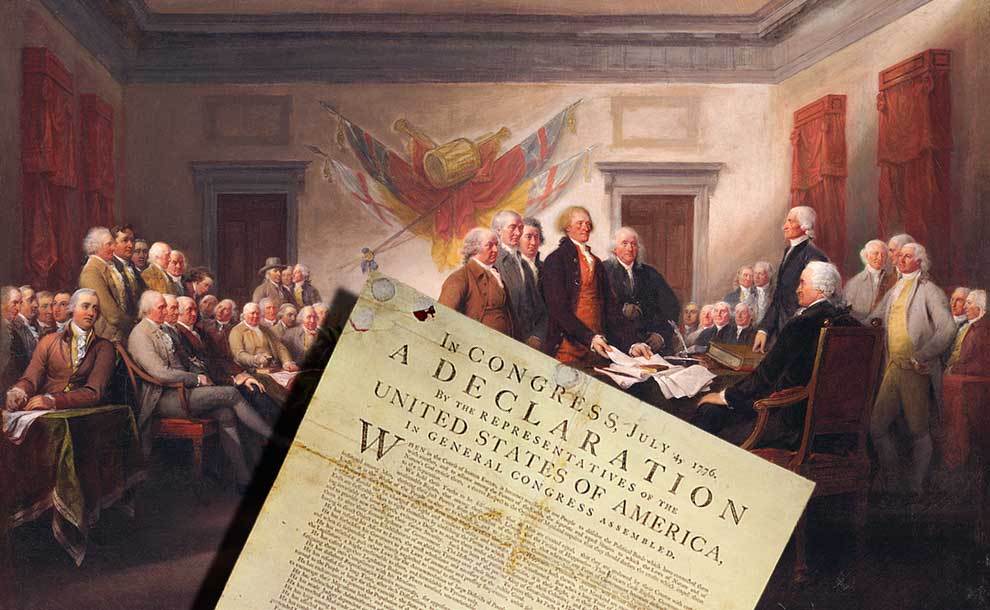
The unanimous Declaration of the thirteen united States of America, When in the Course of human events, it becomes necessary for one people to dissolve the political bands which have connected them with another, and to assume among the powers of the earth, the separate and equal station to which the Laws of Nature and of Nature’s God entitle them, a decent respect to the opinions of mankind requires that they should declare the causes which impel them to the separation.

We hold these truths to be self-evident, that all men are created equal, that they are endowed by their Creator with certain unalienable Rights, that among these are Life, Liberty and the pursuit of Happiness.–That to secure these rights, Governments are instituted among Men, deriving their just powers from the consent of the governed, –That whenever any Form of Government becomes destructive of these ends, it is the Right of the People to alter or to abolish it, and to institute new Government, laying its foundation on such principles and organizing its powers in such form, as to them shall seem most likely to effect their Safety and Happiness. Prudence, indeed, will dictate that Governments long established should not be changed for light and transient causes; and accordingly all experience hath shewn, that mankind are more disposed to suffer, while evils are sufferable, than to right themselves by abolishing the forms to which they are accustomed. But when a long train of abuses and usurpations, pursuing invariably the same Object evinces a design to reduce them under absolute Despotism, it is their right, it is their duty, to throw off such Government, and to provide new Guards for their future security.–Such has been the patient sufferance of these Colonies; and such is now the necessity which constrains them to alter their former Systems of Government. The history of the present King of Great Britain is a history of repeated injuries and usurpations, all having in direct object the establishment of an absolute Tyranny over these States. To prove this, let Facts be submitted to a candid world.

A number of words are capitalized in the Declaration of Independence. In addition to capitalizing titles and names, the framers did so with other key words to emphasize the points they were making. When individually listed, they lead the reader to conclusions about the purpose of the document. From the opening two paragraphs, they are listed below:

Course, Laws of Nature, Nature’s God, Creator, Rights, Life, Liberty, Happiness, Right of the People, Government(s) – various places, Form of Government, Safety, Happiness, Prudence, Object, Despotism, Guards, Systems of Government, Tyranny, Facts

If you had not read the Declaration and only saw these capitalized words from it that are listed above, could you come to a conclusion about the document’s purpose and intent? How about something like this in TradeBaiteese?

In the course of living life within the laws of nature under nature’s God who established it, our Creator has granted rights to life, liberty and happiness that governments in whatever form and system must honor and provide for the safety of the people. If not, the people should object and guard against any despotism that leads to tyranny and get rid of it. Those are just the facts!

I am sure readers can come up with their own versions as well. However, the intent of the words in the document remain clear. As it states in its wrap up,

“And for the support of this Declaration, with a firm reliance on the protection of divine Providence, we mutually pledge to each other our Lives, our Fortunes and our sacred Honor.”

More Providence Discussion

Which leads to this excellent discussion of “Providence” by our own Bakocarl in the 4/13/25 daily thread. That God had Bakocarl provide this discussion in the same time period as my own preparation for this thread on this topic of God’s hand guiding the completion of the Declaration of Independence, well, it will likely be met with acceptance of Providence by believers and called coincidence by non-believers. For the record, he and I had no previous discussion relating to the subject. Bakocarl said,

Then we have what is called the providence of God. The doctrine of providence holds that God quietly and invisibly works through the natural world to manage events. God, in His providence, works out His purposes through natural processes in the physical and social universe. Every effect can be traced back to a natural cause, and there is no hint of the miraculous. The best that man can do to explain the reason why things happen in the course of natural events is to point to “coincidence.”

Believers proclaim that God arranges the coincidences. The unbeliever derides such ideas because he believes natural causes can fully explain each event without reference to God. Yet followers of Christ are wholly assured of this profound truth: “We know that in all things God works for the good of those who love him, who have been called according to his purpose” (Romans 8:28).

The book of Esther shows divine providence at work. The banishment of Vashti, the selection of Esther, the plot of the assassins, the pride of Haman, the courage of Mordecai, the insomnia of the king, the bloodlust of Zeresh, and the reading of the scroll—everything in the book happens, like cogs in a well-oiled machine, to bring about the deliverance of God’s people. Although God is never mentioned in Esther, His providence, working through “coincidence,” is plain to see.

God is always at work in the lives of His people, and in His goodness will bring them to a good end (see Philippians 1:6). The events that define our lives are not simply products of natural causes or random chance. They are ordained by God and are intended for our good. We often fail to sense God’s hidden guidance or protection as events in our lives unfold. But, when we look back at past events, we are able to see His hand more clearly, even in times of tragedy.

I doubt there is a MAGA supporting believer alive that doubts “Providence” was involved in Butler, PA that eventful day; which could have ended in tragedy. As we believers know it did not because God had other plans for Donald Trump and America since we under his divine “Providence”. What is to be our response to same? “…, we mutually pledge to each other our Lives, our Fortunes and our sacred Honor.”

Does that even remotely resemble what has happened in America in your lifetime outside of Ronald Reagan’s and Donald Trump’s presidential terms? Even in those periods the Dems and RINO’s worked against the unity the Declaration requires that is under divine Providence.

Coincidently (not), the subject of Providence is exactly what Donald Trump believes.

https://www.foxnews.com/lifestyle/inside-donald-trumps-relationship-god-his-own-words

Which leads to the following and its schedule of events.

https://www.foxnews.com/politics/white-house-hold-extraordinary-holy-week-events-trump-honors-easter-the-observance-deserves

I hope all of you will take this discussion of Providence to heart and worship the Lord who rose from the dead to give us life eternal.

Time for more signers, let’s finish the Maryland crew.

William Paca

William Paca was born in 1740 in Abington, MD as one of seven children. His parents were John and Elizabeth Smith Paca. His father was a wealthy plantation owner who was the third generation of Paca’s who had lived in Maryland. The first generation family patriarch, Robert, had indentured himself to a colonist named John Hall when he arrived in America in 1660. He worked on the Hall property. When John Hall passed away, he later married his widow and in so doing became an owner. This became the basis for the family’s future possessions and occupation as planters. This became a family tradition for the Paca men as they married well and added to the family’s possessions and properties. They were involved in the Anglican Church and later joined the Quakers. However, William’s parents left the latter to return to the Anglican Church when they were married in 1732. John went on to become a justice of the peace, Captain in the militia, and delegate to the General Assembly.

As best that can be determined William was schooled at home until age 12, when he was sent to the Academy and Charity School with his brother in Philadelphia. He went on to later graduate from Philadelphia College (Penn) in 1759 at age 19. He went to Annapolis to begin his law career, clerked for Stephen Bradley, and helped found a pro democracy debate society called the Forensic Club. It was in the club that he forged a strong, lasting friendship with fellow signer, Samuel Chase. From there he progressed to attendance at the prestigious Middle Temple in London before following with a Masters back at Philadelphia College. He was admitted to the bar in 1764.

The previous year (1763), William did the male thing in the Paca family; he married into money He married Ann Mary (Molly) Chew. She was from long established, wealthy family who had family descended from the settlers of Jamestown in 1622. Her father had died soon after her birth and her mother had married another wealthy and politically connected man named Daniel Dulany who helped raise Molly. After William and Molly married they moved into a large mansion they had built in Annapolis.

Soon after this in 1765, William and Samuel Chase founded the county’s Sons of Liberty group and both pushed opposition to the Stamp Act. William was soon elected into the state’s General Assembly the next year just as in the previous generations of Paca men as he became popular and successful in his law practice. In personal settings he was reserved and thoughtful. In his political public life he was bold and unafraid to challenge authority. His political stature grew as he took on British oppression. Then personal tragedy hit, his beloved wife Molly died during childbirth of their third child in 1774. William became distraught with grief.

In response he turned his attention completely to the independence movement. It was not long until he joined the First Continental Congress and became close to John Adams. John Adams gave him the nickname of the “deliberater” due to his thoughtfulness and manners. He was also a signer of the Olive Branch Petition. It was during this period that Benjamin Rush described him the best when he described Paca as, “beloved and respected by all who knew him, and considered at all times as a sincere patriot and honest man.”

When Maryland removed voting restrictions on its delegates relating to independence, he immediately voted for approval of the Declaration of Independence and signed later. He continued to serve in Congress into 1777 before returning to Maryland and being elected into the senate of the Assembly. He was soon appointed as a General Court judge where he faced dealing with legal challenges from insurrectionists and traitors along the Eastern Shore. By 1780 he appointed to the Court of Appeals.

Back in 1777 he married well again, this time to Ann Harrison who was 16 years younger. She was the daughter of a wealthy Philadelphia merchant and past mayor, Henry Harrison. However, Paca faced tragedy yet again when she died in 1780, also possibly during the childbirth of their first child. In between marriages Paca had two children our of wedlock. Only two of his six children survived to adulthood, John Philemon Paca from his first wife, Molly, and an illegitimate child, Henrietta Mara, born to Sarah Joyce. He provided for his children born out of wedlock during their lives in every way possible.

Paca was a major backer of states’ rights and resisted efforts to change from the Articles of Confederation. He was an antifederalist during the period. However, when it came time he voted to approve the Constitution. During the period of its negotiation he pushed 28 amendments to make it more palatable to states’ rights advocates and those concerned with individual freedoms relating to religious liberty, freedom of the press, and freedom from judicial tyranny (we need him today for that one). Many of the proposed amendments passed into law in the Bill of Rights. You and I are beneficiaries today.

in 1789 Paca was appointed judge by George Washington to the Court of Maryland, a position that he held until his death in 1799. He was nearly 59 years old. This dedicated, important American Patriot was instrumental in giving us so many of the freedoms we take for granted today. We salute his service to our nation.

Thomas Stone

We now focus on an unquestioned patriot signer that will also include a short mention of a vaccination and dying from the grief of losing a loved one near the end.

Yes, this was the life of one Thomas Stone, who was born in 1743 in Charles County, MD. He grew up in wealthy plantation owning family and was educated at home until age 15. He started to a nearby small school of a Greek and Latin teacher for three years, riding by horseback ten miles each day to attend. He then moved to Annapolis to study law under a prominent attorney. Although from a wealthy family, Stone had to borrow the money to do it indicating his father was not in support. He was admitted to the bar four years later at age 21. At the age of 25, he married eighteen-year-old Margaret Brown who was the daughter of Dr. Gustavus Brown and his second wife, Margaret Black Boyd. He then built a beautiful home named Habre deVenture on his 400 acre estate, where they had three children together. They were Episcopalian in their faith.

His father passed away in 1773 and left his huge estate to the oldest son of a previous marriage and nothing to Thomas. That left Thomas and Margaret with taking in his six, much younger siblings. In response they added on to their home and did so without hesitation with great love.

Stone was a quiet man who disliked the concept of war with the British. However, as many others grew to accept it, he found it to be inevitable. His alignment with independence became official when he was appointed to the state’s Committee of Correspondence. As his recognition grew, he was appointed to represent the state in the Second Continental Congress after the battles of Concord and Lexington. He signed the Olive Branch Petition as a last attempt for reconciliation.

The following was included in one of his letters. “I wish to conduct affairs so that a just and honorable reconciliation should take place, or that we should be unanimous in a resolution to fight it out for independence. The proper way to affect this is not to move too quick. But then we must take care to do everything which is necessary for our security and defense, not suffer ourselves to be lulled or wheedled by any deceptions, declarations, or giving’s out. You know my heart wishes for peace upon terms of security and justice to America. But war, anything, is preferable to a surrender of our rights.

In June 1776 he was chosen to be one of the thirteen who drafted the Articles of Confederation. A month later when the state freed its delegates to vote, he voted for the Declaration of Independence, signing the document a month later. He returned to Maryland, his law practice, and in public service as he was elected to the state Senate. He served for several years before once again being elected to serve in the Continental Congress in 1783 as the war ended. He returned to his law practice and public service in 1785. He left the latter after serving for a year with the Constitutional Convention.

In 1787 his world was turned upside down. I will finish the body of this discussion on his life with a direct quotation from the Descendants site:

“In 1787 Stone’s wife Margaret became alarmingly ill. She had received a smallpox inoculation a decade earlier, and from the effects of the mercury contained in the vaccine, she experienced a long state of weakness and decline. During her illness, Stone wrote as follows: “The illness of a wife I esteem most dearly preys most severely on my Spirits, she is I thank God something better this afternoon, and this Intermission of her Disorder affords me time to write to you. The Doctor thinks she is in a fair way of being well in a few days. I wish I thought so….”

Stone watched over her with unwearied devotion and a deep and abiding melancholy overtook his spirit. At length, however, in the middle of 1787, she sank to the grave at the early age of thirty-six.

From this time on, the health of Stone evidently declined. The grief-stricken Stone abandoned his work, and declined to attend the Constitutional Convention to which he had been elected. In the autumn his physicians advised him to take a sea voyage and in obedience to that advice, he traveled to Alexandria to embark for England. Before the vessel was ready to sail, however, he suddenly expired on October 5, 1787 in the forty fifth year of his age. Stone is buried in the family graveyard about 200 yards from his home at Habre deVenture, in Port Tobacco, Maryland.”

Thomas Stone was a great American Patriot and an even greater person. We have been graced by God to have men and women like Thomas and Margaret Stone in our national heritage.

Please remember Wolf’s rules for our community. In general that means to be respectful to each other and to pull no shenanigans that your mom might find offensive or otherwise cause jail time. That said, free speech is honored here.

Be blessed and go make something good happen!

Dear KMAG: 20250414 Trump Won Three Times ❀ Open Topic


Joe Biden never won. This is our Real President – 45, 46, 47.

AND our beautiful REALFLOTUS.


This Stormwatch Monday Open Thread remains open – VERY OPEN – a place for everybody to post whatever they feel they would like to tell the White Hats, and the rest of the MAGA/KAG/KMAG world (with KMAG being a bit of both).

And yes, it’s Monday…again.

But we WILL get through it!

We will always remember Wheatie,

Pray for Trump,

Yet have fun,

and HOLD ON when things get crazy!


We will follow the RULES of civility that Wheatie left for us:

Wheatie’s Rules:

  1. No food fights.
  2. No running with scissors.
  3. If you bring snacks, bring enough for everyone.

And while we engage in vigorous free speech, we will remember Wheatie’s advice on civility, non-violence, and site unity:

“We’re on the same side here so let’s not engage in friendly fire.”

“Let’s not give the odious Internet Censors a reason to shut down this precious haven that Wolf has created for us.”

If this site gets shut down, please remember various ways to get back in touch with the rest of the gang:

Our beloved country is under Occupation by hostile forces.

Daily outrage and epic phuckery abound.

We can give in to despair…or we can be defiant and fight back in any way that we can.

Joe Biden didn’t win.

And we will keep saying Joe Biden didn’t win until we get His Fraudulency out of our White House.


Wolfie’s Wheatie’s Word of the Week:

wheep

noun, verb

  • sound made by a steel weapon when drawn from a sheath
  • to whistle weakly
  • a high-pitched sound, or to make that sound
  • a cry or squeal, or to cry or squeal

A video definition


MUSIC!

No such band as “The Wheepers”, and some dude named Wheeler can’t sing without cussing hard, but then I found this!


THE STUFF

SO – for “Action April” we will take two weeks to study something Steve likely mentioned earlier – the Principle of Least Action.

Here is the first of TWO videos covering the topic.

So what the heck is “action”? Do you feel like you understand it?

Just sayin’!

And remember…….

Until victory, have faith!

And trust the big plan, too!

And as always….

ENJOY THE SHOW

W


2025.04.08 Daily Thread -American Stories: When in the Course of human events – Part 13

I really do not have a dog in this hunt that I discuss today. None of us do. There is absolutely nothing that can be done to change something that happened over 235 years ago. I am not even sure I would want to change the final outcome anyway. I just want to go back in time and try to understand the reasoning of WHY the founders chose to do what they did with what information may be available.

Why did the founding fathers decide to completely ditch the Articles of Confederation instead of making needed changes to it? They were highly intelligent, motivated, patriotic people. They had spent a couple years on the Articles drafting what they believed they wanted for the new nation. They had a vision and executed on the vision. Why totally dump it less than a decade later? How could they have gotten it so wrong the first time?

Could it be that the misgivings Patrick Henry had about the Declaration of Independence and Constitution were valid? He refused to sign both documents despite being a very influential leader and founding father. He could not stand the thoughts of states’ rights being restricted by a federal government that could become as the British were.

I smell a major conspiracy, but presently have no concrete evidence it actually existed. It could have been as it actually appears; a bunch of popular, bull headed patriots who had the upper hand politically using their prominence and power to make things go their way.

Again, I am not saying it was the wrong or right thing to do. I just find it curious that they did it, when the stated original intent of the assembly was to amend the Articles as desired and needed. I see historical articles and statements that the Articles were just too hard to amend, that the framework was not right, that delegates of states just could not find common ground, etc. Yet, General Assemblies (and equivalents) of seven states wanted everything left as is when their representatives first walked into the door of that assembly hall. There is one source linked below that gives the writer’s assessment of the primary reasons many founders wanted it changed. There are many such reports you can access, but most give similar reasoning that never get to the meat of “why” they chose to can the Articles instead of amend.

https://constitutioncenter.org/blog/10-reasons-why-americas-first-constitution-failed

Did the Articles of Confederation actually fail? Seems to me that some of what was perceived to be failure was actually working as they originally intended when they approved them. Suspicious Cat wants to know why this governing document was suddenly perceived as so bad and why they could not make the changes that were desired and necessary to the existing governing document.

So do other conspiracy theorists…

Here is a good short summary of the differences in the two documents.

Did you catch the founders wanted Canada in the fold even back in those days?

It seems one of the major unresolved issues was the same one Shay’s Rebellion represented. The federal and some state governments had lost the trust of the common man who had fought in the war. Not honoring the agreement to provide pensions to these patriot war fighters led to rebellions and much unrest in the new nation, especially when veterans lost homes and farms in the process. The primary problem appears to be that the Articles did not provide for the mandatory funding of the federal government by the states to honor the payments to veterans as well as to put down internal rebellions and other necessary federal functions. As it was it took private funding and sourcing of fighters to even put down Shay’s Rebellion as an example. That method could not be counted on throughout the thirteen states and a group of the founders were fearful that this problem could worsen and seriously endanger the nation.

It was a big deal.

The Newburgh Conspiracy

Just what was the Newburgh Conspiracy anyway? More importantly why did it scare the breeches off many of our founding fathers including the great George Washington?

Rock meet hard place. Just as we previously discussed with Shay’s Rebellion, so we now discuss a serious incident that occurred before Shay’s as the war ended in 1783. As always we will do what has to be done – follow the money. Or as in this case, figure out how to find some money.

The truth is that our new nation’s central government was dead broke and the states were also in bad financial shape from the war debts and mangled economies. The problem was that Robert Morris and others had offered lifetime pensions of half their active military pay for all retired war fighters to entice them to enlist. The bill came due to start paying. The vets needed the cash to help restart their lives and take care of their families since the fighting was done.

Oopsie, the federal treasury had about $125 K in cash versus about $6 million in debt. This was not good. The individual states were tapped out as well and starting to levy new and larger taxes to repay their own debts. The Articles of Confederation gave no taxing powers to the federal government. Its operation depended on requested, voluntarily paid state contributions from the same states that were nearly underwater fiscally.

The military members who were being stiffed were upset. They wanted what they had been promised, it was their blood that was spilled on the battlefields along with destruction of many of their farms and properties. The majority were even willing to cut what was due down to settle. None of the states would agree to compromise and solve the problem. Sorry, we have a bad connection, check back with us later were their attitudes. The Articles gave each the authority to operate their own states independently. They were in a superior position over the federal government.

The overall situation and response influenced a loose group of military discontents to get active discontenting and it was likely that George Washington’s old nemesis, Horatio Gates, was involved. Add in that some major founding fathers were very much in favor of finding ways for the war fighters to receive what was due. Some members of the Confederation Congress supported the funding; such as Alexander Hamilton, James Madison, Gouverneur Morris, and Robert Morris. Robert Morris basically said that if there was no pay for the veterans, then he was out of there. The government withheld from public release that he had resigned because they were afraid of the impact the news would have on the young nation. From that nasty disagreement we see one of the first major cover-ups in American history. Which is something that the feds have perfected over the years.

The link below provides a good summary of the event and conditions on the ground.

https://www.mountvernon.org/library/digitalhistory/digital-encyclopedia/article/newburgh-conspiracy

As we learn from the story, impending disaster was averted. I loved the description of George Washington’s acting chops. His timing and words worked to defuse the situation, such was the respect the military had for this great man. However, it did not resolve the injustice as Shay’s Rebellion demonstrated later. Per the information in the links and many other sources it was agreed that the Articles of Confederation had a serious flaw relating to how the states could refuse to pay the federal government the money it needed to honor the pension agreement and other federal debts and responsibilities.

We still need to know more.

Back To Articles Versus Constitution

So why did the states not just agree to strengthen the Articles to provide financially for the role of the federal government’s responsibilities that are stated in the document’s enumerated powers? An amendment(s) to do so was all that was needed to solve the immediate problems. Why did the states who wanted to remain large and in charge of their fates in accordance with the Articles agree to terminate it and go the route of the new Constitution? Inquiring minds want to know because it is still puzzling.

Oddly enough, I actually found the most logical answers sans conspiracy theories at the following linked government website.

https://www.archives.gov/founding-docs/constitution/how-did-it-happen

This part from the link revealed much…

The founders set the terms for ratifying the Constitution. They bypassed the state legislatures, reasoning that their members would be reluctant to give up power to a national government. Instead, they called for special ratifying conventions in each state. Ratification by 9 of the 13 states enacted the new government. But at the time, only 6 of 13 states reported a pro-Constitution majority.

The Federalists, who believed that a strong central government was necessary to face the nation’s challenges, needed to convert at least three states. The Anti-Federalists fought hard against the Constitution because it created a powerful central government that reminded them of the one they had just overthrown, and it lacked a bill of rights.

I believe we have found our answer as to “why” they abandoned the Articles in favor of a new document. A powerful segment of founders would not accept modification of the Articles because a number of states did not want to lose their authority and power in the process. So the Federalists did a legal end run and called ratifying conventions in each state to elect representatives for the purpose. We can only speculate how they jockeyed to get more of their supporters appointed or elected to be delegates. As we later learned, all of these state delegates locked themselves into a hot assembly room and argued over the situation for three months before coming to a hard fought consensus and agreement to hammer out the details.

In reality the initially stated purpose of their attendance in the assembly was to amend the Articles of Confederation as needed. The delegates met for one purpose and a different purpose was escorted into being. The Federalists used the situation to undercut the current legal status quo to achieve their goals of creating a new governing document that was more suited to accomplishing their vision and goals for the country.
We need to understand what their end goals were and how to rationalize that it was prudent to do an end run around the state governments and the existing governing document. The mental gymnastics would need to include the fact that seven states up to that point were not pro-Constitution. So to get to nine in favor to make the change effective per the ruling Articles, the Federalists needed to flip three states.

I am not passing judgment on how it all worked out. However, it is clear the Federalists were very fearful of a weak federal government that could not respond appropriately to enemies and pressing issues of the nation. They wanted it to have the authority over the states to fund (tax) and enforce. States withholding funds at will was a big problem that needed fixed. The key for compromise was coming to an agreement about what enumerated powers the Constitution would have and addressing the authority for same. The Antifederalists were adamant in their beliefs that the federal government would supplant states’ rights in the process. They wanted no part of a British type government oppression to rear its ugly head again. Both sides eventually came to an agreement that included the Bill of Rights to protect the rights of citizens, but gave the Federalists what they wanted for central authority..

Knowing politics like I do, I wonder what horse trading was done to move people to one side or the other. Politics was as dirty then as it is now. Who received what to drop their opposition and go along? It is something we will probably never fully know, but it would be interesting to hear the gritty details and not the varnished view of lap dog historians.

Over the years that have followed we have seen the Constitution succeed and fail. Many of the failures were tied to omissions, some of which led to additional amendments. Many of the fears of the Antifederalists about civil liberties, oppressive taxation, and potential corruption in the federal government were realized. But so were the fears of the Federalists with the Civil War and other abuses. None probably foresaw a third branch of government, the judiciary that was charged with arbitrating disputes and law interpretations, going rogue to criminal to asset unauthorized power at times. But alas, that is exactly what has happened with politicization of branches and areas within government. We have reached the point that some of the ten listed weaknesses accorded the Articles of Confederation in the linked story now apply to the Constitution. It even seems that a few of those stated weaknesses of the Articles are now or could become strengths.

Or as stated by an Antifederalist on January 31, 1788 in Brutus 11 . “Is it prescience, or has the system always been the same?

“They will give the sense of every article of the constitution, that may from time to time come before them. And in their decisions they will not confine themselves to any fixed or established rules, but will determine, according to what appears to them, the reason and spirit of the constitution. The opinions of the supreme court, whatever they may be, will have the force of law; because there is no power provided in the constitution, that can correct their errors, or controul their adjudications. From this court there is no appeal. And I conceive the legislature themselves, cannot set aside a judgment of this court, because they are authorised by the constitution to decide in the last resort. The legislature must be controuled by the constitution, and not the constitution by them. They have therefore no more right to set aside any judgment pronounced upon the construction of the constitution, than they have to take from the president, the chief command of the army and navy, and commit it to some other person. The reason is plain; the judicial and executive derive their authority from the same source, that the legislature do theirs; and therefore in all cases, where the constitution does not make the one responsible to, or controulable by the other, they are altogether independent of each other.

The judicial power will operate to effect, in the most certain, but yet silent and imperceptible manner, what is evidently the tendency of the constitution: – I mean, an entire subversion of the legislative, executive and judicial powers of the individual states. Every adjudication of the supreme court, on any question that may arise upon the nature and extent of the general government, will affect the limits of the state jurisdiction. In proportion as the former enlarge the exercise of their powers, will that of the latter be restricted.”

“This power in the judicial, will enable them to mould the government, into almost any shape they please.”

Yup. Predicted then, subsequently observed multiple times, and it still continues to this day. As an example we can see the daily totals of fraud and abuse of tax payer funding from DOGE, yet, we are led to believe that We the People do not have standing with federal courts to pursue claims against the criminal elements within our own government and citizenship. The same tactic was used with the 2020 election cheat. The judiciary has insulated themselves within webs of legal trickery and collusion. Take a look at this explanation on “standing” and try to understand it as an average American citizen.
https://www.law.cornell.edu/constitution-conan/article-3/section-2/clause-1/standing-requirement-overview

Not worth your time, was it?

My hope is that readers will see that our nation has always lived in contentious times, much of it by design. What we see today is not unique. The Constitution has its obvious flaws like all documents. Enforcement and the abuse of same is still a huge issue. However, the principles espoused are still the best mankind has ever produced. We just need to be willing to put in the work to not only support its continuance, but to pursue the improvements it needs through amendments to make it even better for the good of the nation today as well as the future, just like our founding fathers were willing to do.

We are not finished with this discussion. It turns out there was a pre-war condition on the ground with this conflict between Federalists and Antifederalists that is still being fought over today. It would be unfair to delay the answer even if it is too soon to discuss it in more detail. So, Spoiler Alert – the reason for much of the conflict between the two was that ugly word – taxes.

Some will probably have a good idea how that part will go since Alexander Hamilton was Washington’s Treasury Secretary charged with funding the new Constitutionally governed America. Seems there are many current references to Hamilton’s methods lately.

On to a couple more signers.

Caesar Rodney

Born on the family plantation known as Byfield in Dover, DE in 1728, Caesar Rodney was the oldest of two children of Caesar and Elizabeth Crawford Rodney. His maternal grandfather had immigrated to America in the early 1680’s and developed the plantation. After his death the Rodney family assumed control. His father had immigrated from England in the early 1680’s with William Penn and he owned a plantation with slaves at the time of Caesar’s birth. The Rodney family ancestry goes back to 1095 in England. His mother was the daughter of an Anglican rector of Christ’s Church in Dover. His father had also served as speaker of the Colonial Assembly in DE in 1704.

Like so many other signers, Caesar was informally homeschooled and had some training through local clergy until he left home to attend a Latin school as well as the College of Philadelphia (Penn) in his teen years. When his father died in 1746, DE Supreme Court Justice Nicholas Ridgely became his guardian.

Just living was not easy for Rodney. The following paragraph from the applicable Descendants site describes and also provides the words of John Adams, who knew him well.

No portrait of Caesar Rodney exists. We know that he was tormented throughout his life by asthma, and that his adult years were plagued by a facial cancer. He experienced expensive, painful, and futile medical treatments on the cancer. The clearest account of his appearance is found in John Adams’s diary of September 1774: “Saturday . . . this forenoon Mr. Caesar Rodney of the lower counties on Delaware River, was introduced to us. Caesar Rodney is the oddest-looking man in the world; he is tall, thin, and slender as a reed, pale; his face is not bigger than a large apple, yet there is sense and fire, spirit, wit and humor in his countenance.”

From this it is easy to see why he never married or had children, so he threw himself into his work. He was appointed sheriff of Kent County at age 27 and from that point on was elected and served in many offices. Eventually he was elected to serve in the First Continental Congress and signed the failed Olive Branch Petition seeking reconciliation with Britain. The next year he was made Speaker of the state’s Assembly when counties began declaring their independence.

The dramatic process of approving the Declaration for DE is well documented. The state had left it up to the decisions of McKean, Read and Rodney. McKean was for independence and Read against. That let Rodney to break the deadlock. He is reported to having rode horseback or via carriage all night in a torrential rain to arrive in Philadelphia to break the tie for the vote for independence in DE. In his words, “I arrived in Congress (tho detained by thunder and rain) time enough to give my voice in the matter of independence . . . We have now got through the whole of the declaration and ordered it to be printed so that you will soon have the pleasure of seeing it.

The area in DE he represented was loyalist dominated. As a result of his decision they refused to reelect him. However, the effects of war in the state changed that attitude and he was elected to President of Delaware for a three year term in 1778. Throughout the conflict he served as Brigadier General of the DE militia and engaged in battles at his friend, Gen. George Washington’s direction throughout the war. Washington held a high opinion of him and noted that when the state failed to provide for the militia as needed, Rodney did so out of his own financial resources.

He lived long enough to see the end of the war. In 1784 his frail body gave out and he passed away. The Descendant’s site gives this description of the man, “He was reported to be a temperate, forbearing and patient man. He was probably what we would today call a “consensus builder.” He was a pragmatic realist, with a wry and ironic sense of life and human nature. He inspired real affection among those who knew and worked with him.” I found no derogatory comments or accounts of the man in my research, a rarity.

Rodney had come to view slavery as something that should be abolished despite having 200 slaves on the Byfield plantation. With his death he made a proclamation that all should receive gradual emancipation.

There was a statute of this great patriot placed in Statuary Hall in the U. S. Capitol. We have all been blessed by the contributions of this great American patriot.

Samuel Chase

Samuel Chase was born in 1741 to Rev. Thomas Chase and his wife, Matilda Walker Chase in Princess Anne, MD. His father had immigrated to the area to serve a new church for the Church of England. Samuel’s mother passed away the year he was born. He was educated at home. At age 18 he went to Annapolis to study law under attorney John Hall. He was admitted to the bar in the 1761-63 time frame and opened a law practice there. It was during these years he was given the nickname of “Old Bacon Face” for how his complexion looked when he was angered or agitated.

In 1762 he married Anne Baldwin. They had seven children, with four surviving to adulthood. In 1764 he was elected to the MD General Assembly, which continued for twenty years. However, he was known to be foul mouthed and adversarial toward anything loyalist and Tory. He openly called them out and worked against everything they tried to accomplish. He helped start the local Sons of Liberty chapter with friend and fellow signer, William Paca. He was a vocal critic of the 1765 Stamp Act and all oppressive acts of the British through the Revolutionary War. He was an adamant proponent of boycotts to send messages to the British Parliament.

He wrote the following to John Duane, a delegate of NY in early 1775, “When I reflect on the enormous Influence of the Crown, the System of Corruption introduced as the Art of Government, the Venality of the Electors (the radical Source of every other Evil), the open and repeated violations, by Parliament of the Constitution . . I have not the least Dawn of Hope in the Justice, Humanity, Wisdom or Virtue of the British Nation. I consider them as one of the most abandoned and wicked People under the Sun . . . . Our Dependence must be on God and ourselves.”

When the battles of Lexington and Concord happened, he knew his fears were confirmed. Prior to the declaration of war he served on the Annapolis Convention and on the MD Committee of Safety in 1775. He was chosen as a delegate to both the first and second Continental Congress, during which time he approved and signed the Declaration. Not long after that his wife, Anne, died and left him to raise their four children. Years later he remarried a woman that was only four years older than his oldest child.

There is not enough time and attention span left to detail all of the activities and involvements of Chase from that point. It is an amazing story of extreme highs and lows. The link to the Descendants site is below for your review. To expedite I advise picking up his story at the point of signing the Declaration as you have time.

https://www.dsdi1776.com/signer/samuel-chase

There is one major point left I wanted to address that is in the link. Who was the one U. S. Supreme Court Justice that was impeached? Yup, Samuel Chase in 1804 at the direction of President Thomas Jefferson. He was acquitted of all charges. I wonder what Chief Justice Roberts would think of that happening to him after his most recent comments and lack of attention to pressing national defense issues coming through the court system? Impeachment procedures exist for good reasons. That they may be used in error or for abusive reasons is not the issue. That the procedures are available and used when legal and appropriate to do so is the benefit to American citizens. Judges are in public service. We the People are the public they serve, not personally aligned political parties and never those that cross our borders illegally who are not citizens.

It is equally important for We the People to have the ability to fire as it is to hire.

Samuel Chase passed away in 1811. This lightning rod of controversy and opinions will always be remembered for the strength of his convictions and willingness to stand on principle. He was an important American patriot in the cause for liberty and freedom.

Please remember Wolf’s rules for our community. https://wqth.wordpress.com/2019/01/01/dear-maga-open-topic-20190101/

In general that means to be respectful to each other and to pull no shenanigans that your mom might find offensive or otherwise cause jail time. That said, free speech is honored here.

Be blessed and go make something good happen!

Dear KMAG: 20250407 Trump Won Three Times ❀ Open Topic


Joe Biden never won. This is our Real President – 45, 46, 47.

AND our beautiful REALFLOTUS.


This Stormwatch Monday Open Thread remains open – VERY OPEN – a place for everybody to post whatever they feel they would like to tell the White Hats, and the rest of the MAGA/KAG/KMAG world (with KMAG being a bit of both).

And yes, it’s Monday…again.

But we WILL get through it!

We will always remember Wheatie,

Pray for Trump,

Yet have fun,

and HOLD ON when things get crazy!


We will follow the RULES of civility that Wheatie left for us:

Wheatie’s Rules:

  1. No food fights.
  2. No running with scissors.
  3. If you bring snacks, bring enough for everyone.

And while we engage in vigorous free speech, we will remember Wheatie’s advice on civility, non-violence, and site unity:

“We’re on the same side here so let’s not engage in friendly fire.”

“Let’s not give the odious Internet Censors a reason to shut down this precious haven that Wolf has created for us.”

If this site gets shut down, please remember various ways to get back in touch with the rest of the gang:

Our beloved country is under Occupation by hostile forces.

Daily outrage and epic phuckery abound.

We can give in to despair…or we can be defiant and fight back in any way that we can.

Joe Biden didn’t win.

And we will keep saying Joe Biden didn’t win until we get His Fraudulency out of our White House.


Wolfie’s Wheatie’s Word of the Week:

camelopard

noun

  • archaic word for giraffe
  • portmanteau of “camel” and “leopard”
  • any giraffe-like ruminant
  • any giraffid

Used in a sentence

He surprised the audience by showing a picture of a giraffe, and calling it a camelopard.

Shown in a picture

Giraffa camelopardalis rothschildi, a.k.a. Rothschild Giraffe

Shown in a hilariously sick lying AI video about an Arctic giraffe covered in barnacles, saved by rescuers. Utter WTF.


MUSIC!

Is Frampton’s Camel some kind of camelopard? Or only the Frampton groupie with a leopard print skirt?


THE STUFF

What follows is an excellent example of *working* scientific internal skepticism.

This “anthropology babe” racket is a bit of a grift to get you in the door, but once they have your clicks and attention, it’s good stuff.

At least she’s not an AI. I think. Or is her sketchy accent a tell?

Just sayin’!

And remember…….

Until victory, have faith!

And trust the big plan, too!

And as always….

ENJOY THE SHOW

W