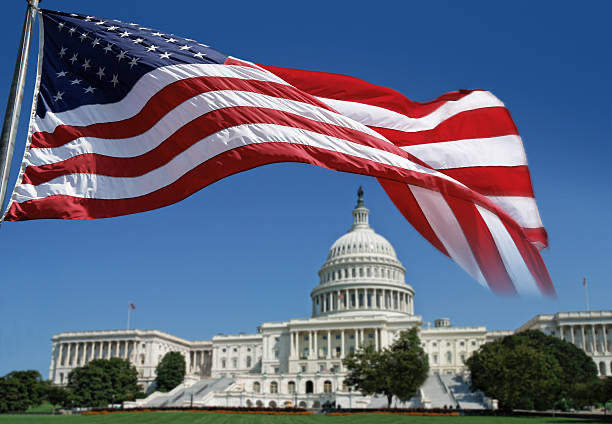
“We do not believe any group of men adequate enough or wise enough to operate without scrutiny or without criticism. We know that the only way to avoid error is to detect it, that the only way to detect it is to be free to inquire. We know that in secrecy error undetected will flourish and subvert.” –J. Robert Oppenheimer
Yep, Kurt has noticed that lots of people are getting twanging schadenböners.
And you do not have to be male to get this kind of böner.
Hat tip to Scott (I think–if it wasn’t Scott it was 4GodAndCountry) for this video, which implies a LOT of schadenböners in our future.
[WOLF EDIT – for whatever reason this YouTube video no longer embeds, even as the shortened URL (below), so I have converted both URLs to links which open up in a new tab.]
This is the WQTH Daily Thread. You know the drill. There’s no Poltical correctness, but civility is a requirement. There are Important Guidelines, here, with an addendum on 20191110.
We have a new board – called The U Tree – where people can take each other to the woodshed without fear of censorship or moderation.
And remember Wheatie’s Rules:
1. No food fights 2. No running with scissors. 3. If you bring snacks, bring enough for everyone. 4. Zeroth rule of gun safety: Don’t let the government get your guns. 5. Rule one of gun safety: The gun is always loaded. 5a. If you actually want the gun to be loaded, like because you’re checking out a bump in the night, then it’s empty. 6. Rule two of gun safety: Never point the gun at anything you’re not willing to destroy. 7. Rule three: Keep your finger off the trigger until ready to fire. 8. Rule the fourth: Be sure of your target and what is behind it.
Gold spent the last two days below $3200 before managing to claw its way just over that line at the very end of the day Friday. The current lower prices are attributed to less economic fears with respect to ChinaIsAsshoe.
Silver is now worth more than one percent of gold. I saw an interesting quip about it; it gets the worst of both its worlds. When the equity markets are panicking, silver is seen as an industrial metal…so it goes down. When the equity markets are booming, silver is seen as a precious metal so people want to sell off and put their money in stocks, so it goes down.
I remember back when Canada helped us out with three embassy people in Iran (1979) a Canadian comedian being featured on Nightline; he said that our two dollars were tied together. “When your dollar goes down, our dollar goes down. When your dollar goes up, our dollar goes down” said the Canadian.
Similarly it seems that gold and silver are tied together; when gold goes down, silver goes down, when gold goes up, silver goes down.
Buying opportunity for the white metal?
*The SteveInCO Federal Reserve Note Suckage Index (FRNSI) is a measure of how much the dollar has inflated. It’s the ratio of the current price of gold, to the number of dollars an ounce of fine gold made up when the dollar was defined as 25.8 grains of 0.900 gold. That worked out to an ounce being $20.67+71/387 of a cent. (Note gold wasn’t worth this much back then, thus much gold was $20.67 71/387ths. It’s a subtle distinction. One ounce of gold wasn’t worth $20.67 back then, it was $20.67.) Once this ratio is computed, 1 is subtracted from it so that the number is zero when the dollar is at its proper value, indicating zero suckage.
It Didn’t Start With Wegener
And now for the one at least some people have been waiting for.
It really started with Abraham Ortelius (1527-1598) a cartographer from what was, back then, the Spanish Netherlands–which is to say he was a Dutchman who had a Spaniard for a king. He was the publisher of the first modern atlas in 1570 so he knew what the continents looked like as much as anyone did then. Here is a map from that atlas:
He published a book on ancient geography in 1587, the Thesaurus Geographicus, then revised it in 1596. Apparently, in that 1596 edition he described America (regarded as one continent back then, not two) as “torn away from Europe and Africa … by earthquakes and floods.” Furthermore: “The vestiges of the rupture reveal themselves, if someone brings forward a map of the world and considers carefully the coasts of the three [continents].”
This is the first known mention of the continents possibly having rifted apart. And it was totally forgotten until the late 20th century.
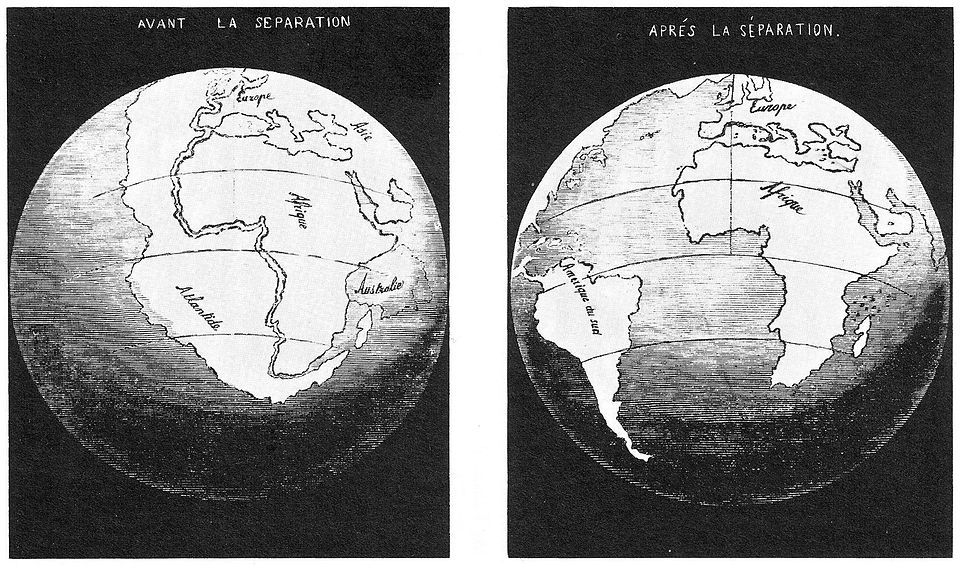
However, other people had the same thought, among them Theodor Christoph Lilienthal (1756), Alexander von Humboldt (1801 and 1845), Antonio Snider-Pellegrini (1858), and others.
We have an illustration by Pellegrini:
There were arguments among geologists over just how much the Earth had changed culminating in the mid 1800s. I can’t write this better than wikipedia did, so I’ll just paste it in:
In 1889, Alfred Russel Wallace remarked, “It was formerly a very general belief, even amongst geologists, that the great features of the earth’s surface, no less than the smaller ones, were subject to continual mutations, and that during the course of known geological time the continents and great oceans had, again and again, changed places with each other.” He quotes Charles Lyell as saying, “Continents, therefore, although permanent for whole geological epochs, shift their positions entirely in the course of ages.” and claims that the first to throw doubt on this was James Dwight Dana in 1849.
In his Manual of Geology (1863), Dana wrote, “The continents and oceans had their general outline or form defined in earliest time. This has been proved with regard to North America from the position and distribution of the first beds of the Lower Silurian, – those of the Potsdam epoch. The facts indicate that the continent of North America had its surface near tide-level, part above and part below it (p.196); and this will probably be proved to be the condition in Primordial time of the other continents also. And, if the outlines of the continents were marked out, it follows that the outlines of the oceans were no less so”. Dana was enormously influential in America—his Manual of Mineralogy is still in print in revised form—and the theory became known as the Permanence theory.
The Challenger expedition, 1872-1876, showed that rivers dumped their silt–eroded from continents–onto continental shelves, not the deep ocean, which made it appear that oceans were permanent features, not something that could “change places” with the continents.
Eduard Seuss (1831-1914) proposed a supercontinent “Gondwana” (1885) consisting of pretty much all of today’s southern continents, plus India. In fact it was named after the Sanskrit name for a location in India. He also noted that the Mediterranean, Black and Caspian seas, and Indian Ocean may once have been connected; that he named the Tethys Ocean (1893) (it’s often called the Tethys Sea). But Seuss was not a proponent of continental drift. He believed that South America and Africa (and the other present day pieces of Gondwana) had been separated by the land subsiding and being flooded to form oceans. Presumably the dry areas that used to be the Tethys are the result of land that rose at some time in the past.
He brought evidence: Glossopteris (Gk: Tongue fern) was a widely distributed genus of plant across all of the present day southern continents, New Zealand, and India. It lived in the Permian Period (298.8 – 251.902 Ma). [Yowza, thousand year precision for the end of the Permian and Paleozoic!] They appeared to have died out during the Great Dying, the biggest mass extinction event since multicellular life began. (Compared to this, the end of the dinosaurs pales.)
Otto Ampferer (1875-1947) was a geologist who believed that mountains were uplifted by convection in the asthenosphere.
In fact, Ampferer is the real founder of what is called the “modern” view of continental drift, since a lot of his work was done in the 1900s (i.e., the 0s of the 20th century). He even largely won the argument about convection and mountains by 1906–and those concepts would eventually play heavily in modern plate tectonics theory.
Roberto Mantovani between 1889-1909 proposed that the continents had rifted because the Earth had expanded. In other words the Atlantic was basically a stretch mark. (This has long since been recognized to be…well, frankly, ridiculous though Wikipoo just says “now discredited.”)
Frank Bursey Taylor in 1910 proposed “continental creep” caused by tidal forces. He was among the first to realize that continents’ motions could have a lot to do with raising mountains, such as the Himalayas being formed as India and Asia came together. [We now know that India is still moving into Asia; the Himalayas continue to grow as a consequence.]
Then Alfred Wegener (1880-1930) came along, and published in 1912, January 6th of that year to be precise, in a presentation to the German Geological Society. He proposed that all continents, not just the southern ones, had once formed one supercontinent which he called “Pangaea” which had broken up into pieces that had since drifted to their current locations.
Wegener brought a lot of evidence, rock formations from the Permian or Triassic that matched up but were now on separate continents, for instance.
Wegener considered Taylor’s ideas the most similar to his own, and in the mid 20th century for a time you’d hear the term “Taylor-Wegener hypothesis.”
Wegener actually invented the term “continental drift.”
However, despite the evidence which might seem compelling, there was one gigantic fly in the ointment.
Wegener couldn’t explain how this could have happened. What force could possibly plow the continents through oceanic crust? No one had any idea. And unfortunately, this idea was deemed more ridiculous than having to find some other explanation for Wegener’s evidence. (And to be honest, given what they knew, geologists were right to reject it. Continents plowing through ocean floor crust was absurd, and it still is.) Another issue is that he estimated the speed at 2.5 meters per year. This was (and still would be) considered implausibly high, and is about a hundred times faster than what we actually measure today.
Arthur Holmes (1890-1965) in 1931 championed continental drift, when it was profoundly unfashionable. We have him to thank for radiometric dating, but also for suggesting mantle convection as a mechanism. This was the first hint of sea floor spreading.
In 1947, a team led by Maurice Ewing showed that there was a rise in the central Atlantic ocean, based on soundings laboriously collected up to then. They were also the first to note that ocean beds were essentially basaltic rock, unlike continents which were mostly granites. Over the next years, an entire system of mid-oceanic ridges all over the world was found.
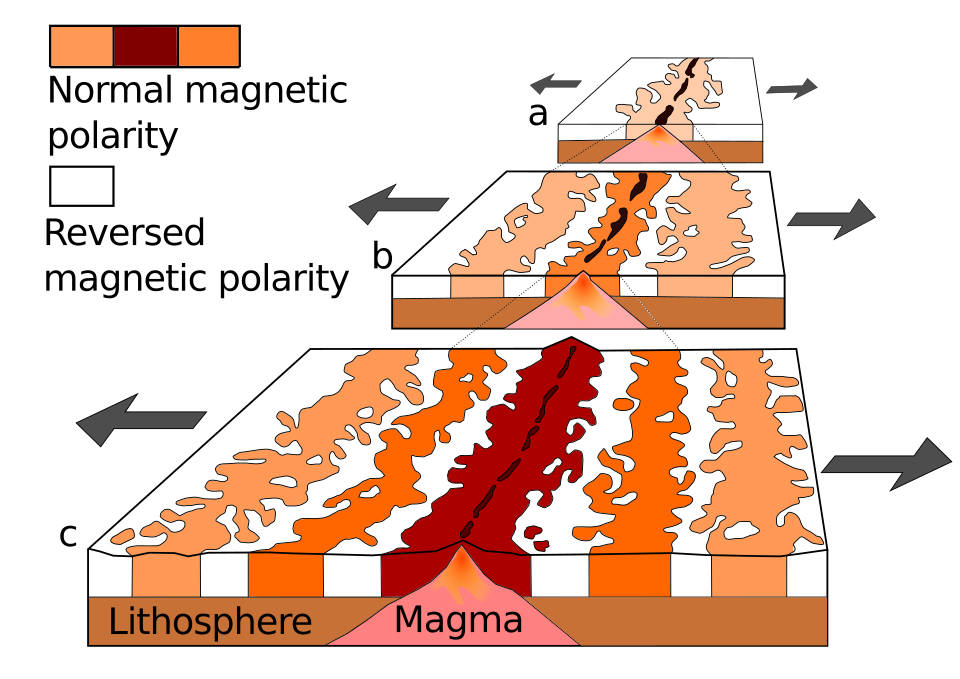
Meanwhile, we had noticed magnetic anomalies in the ocean floor, using devices originally designed in World War II to detect submarines. As more and more data was collected, we began to realize that these weren’t “anomalies” at all, but rather formed a pattern. Here’s Wikipedia again:
In a series of papers published between 1959 and 1963, Heezen, Dietz, Hess, Mason, Vine, Matthews, and Morley collectively realized that the magnetization of the ocean floor formed extensive, zebra-like patterns: one stripe would exhibit normal polarity and the adjoining stripes reversed polarity.[58][59][60] The best explanation was the “conveyor belt” or Vine–Matthews–Morley hypothesis. New magma from deep within the Earth rises easily through these weak zones and eventually erupts along the crest of the ridges to create new oceanic crust. The new crust is magnetized by the Earth’s magnetic field, which undergoes occasional reversals. Formation of new crust then displaces the magnetized crust apart, akin to a conveyor belt – hence the name.[61]
Without workable alternatives to explain the stripes, geophysicists were forced to conclude that Holmes had been right: ocean rifts were sites of perpetual orogeny at the boundaries of convection cells.[62][63] By 1967, barely two decades after discovery of the mid-oceanic rifts, and a decade after discovery of the striping, plate tectonics had become axiomatic to modern geophysics.
The plate tectonics revolution is regarded as having occurred between 1957 and 1967.
We now had our mechanism. The continents don’t plow through the ocean floor. Rather, the ocean floor behaves like a conveyor belt; the oceans spread and push the continents ahead of them.
[Technically that’s not quite right–it’s more accurate to say that the ocean floors are pulled along behind the continents–but I’ll have to defer that explanation a bit. Suffice it to say continents don’t plow through ocean floors.]
And it’s not called “continental drift” any more, it’s called “plate tectonics.” Because we have come to realize that the crust of the Earth consists of distinct plates which move around, sometimes spreading from each other at mid-ocean ridges, in other places one plate is being submerged under another.
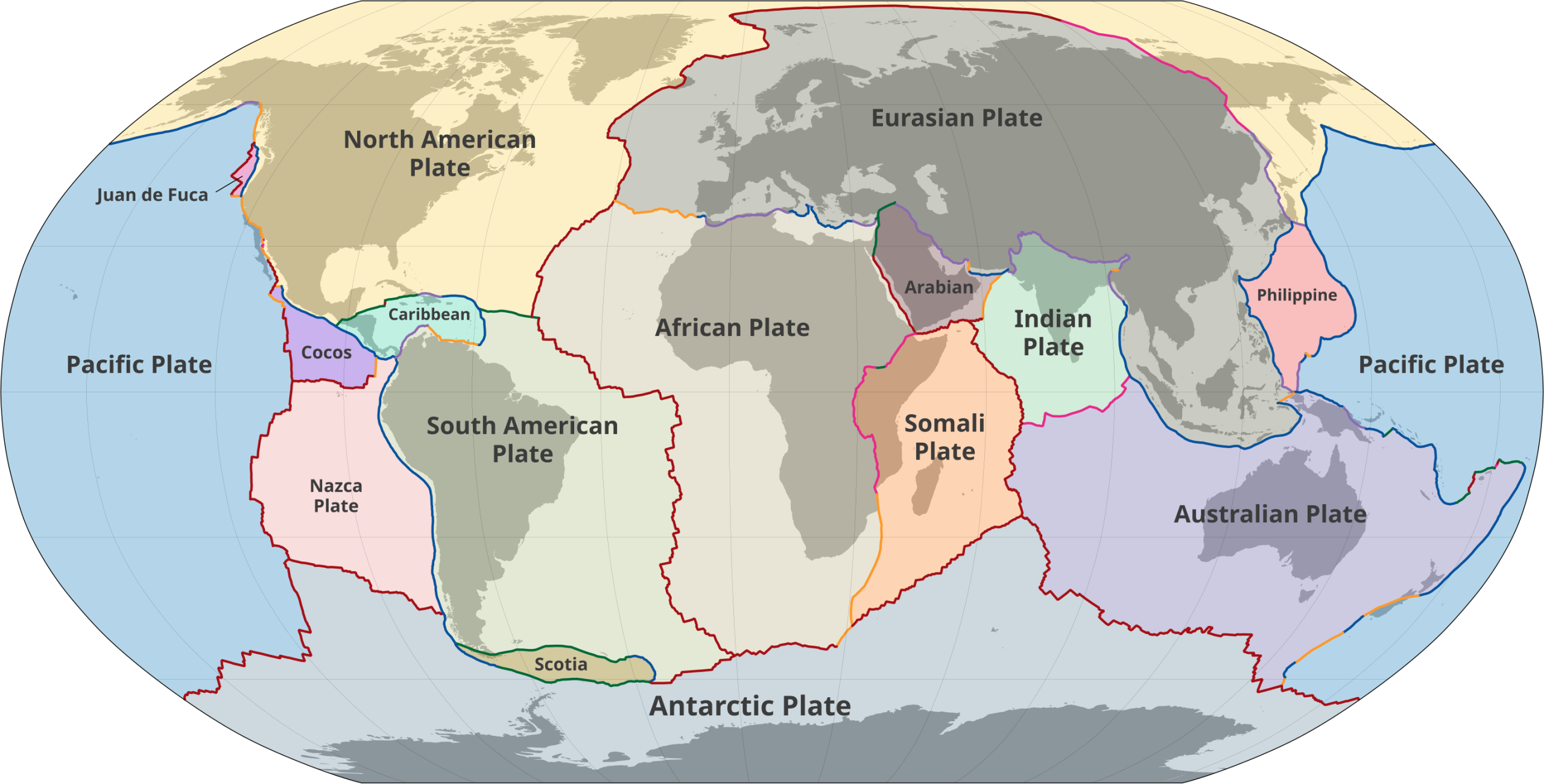
What does this word “tectonics” actually mean? It’s ultimately from Greek tektonikos, “pertaining to building.” [As an aside, in the original Greek, Jesus is described as a “tekton”, someone who made things with his hands. Not necessarily a carpenter in particular.] As for plates, here are the sixteen principal plates:
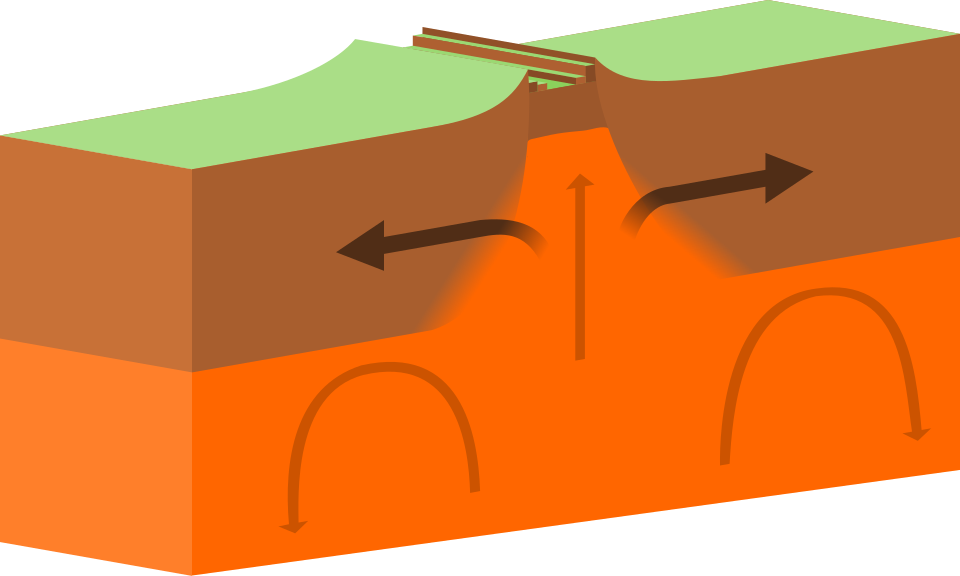
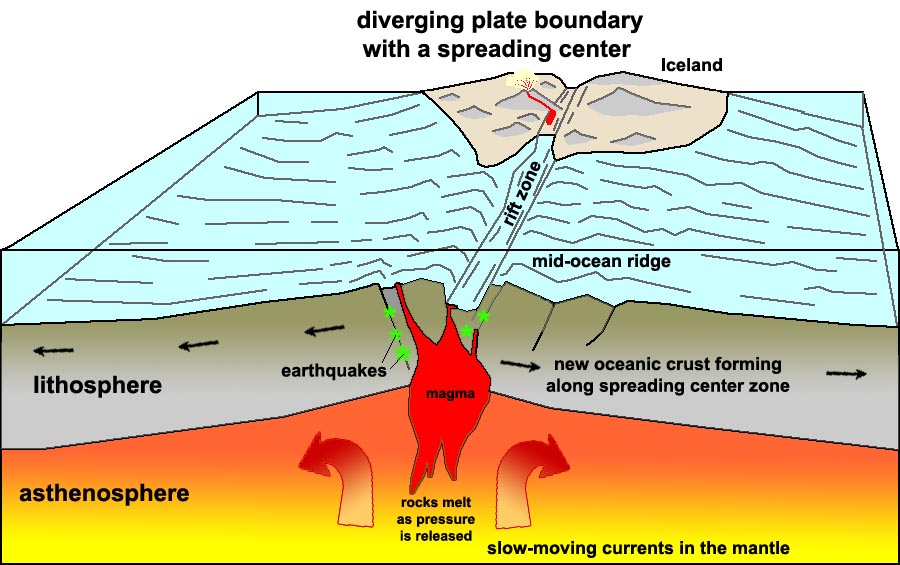
Note that most boundaries are in the ocean. Boundaries are drawn in different colors for a reason. Deep red are “spreading centers”–i.e., places with a ridge where magma is surfacing to make ocean crust. The slightly lighter red (e.g., through east Africa) is an “extension zone” though unless the distinction has something to do with mid-ocean ridges, I can’t figure out what the difference is. In both cases spreading is happening. Here’s what they look like in general (this diagram seems to be represending one on a continent, like the rift running through East Africa).
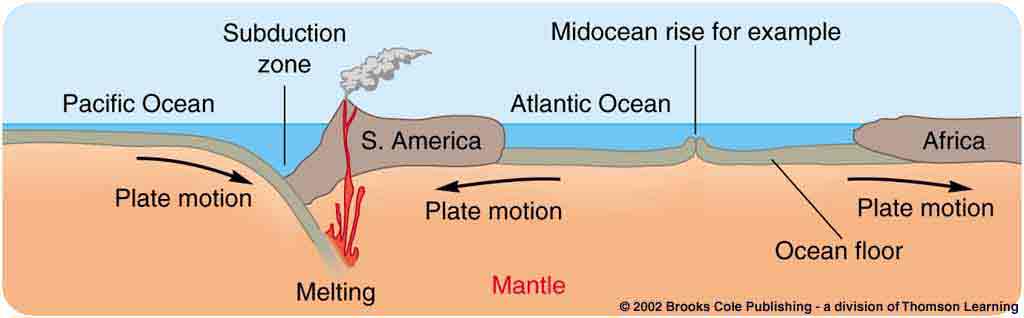
Blue is a subduction zone, where one plate is an ocean floor, and the other is a continent; the ocean floor is subducting under the continent. Notice these on the edges of South America, between the northern pacific and the North American plate at Alaska and the Aleutians; also between the Juan de Fuca plate and the US’s Pacific Northwest, and running through Indonesia and Polynesia. And right through the Mediterranean, too.
What do these places all have in common? Volcanoes!! As it happens, volcanoes are almost always caused by subduction zones. Notable exceptions are Hawaii and Yellowstone. There are also some volcanic islands on mid oceanic ridges, like Iceland, St. Helena, Ascension, Tristan de Cunha in the Atlantic Ocean. Volcanoes form along subduction zones as the ocean plate melts and basaltic magma rises, eventually forcing its way to the surface.
[Please note, Pat, it’s “subduction” not “seduction,” no matter how volcanic those seductions can be when handled correctly.]
The Pacific “Ring of Fire” is now explained; the Pacific ocean is shrinking as continents encroach on it. My childhood book on volcanoes was out of date just a couple of years before I read it.
Subduction zones tend to have the worst earthquakes, e.g., Chile 1960, Alaska 1964, Sumatra 2004, Tohoku 2011 (Fukushima), Kamchatka 1952. These are the five strongest earthquakes in recorded history and all were at least a Richter 9. [Three more earthquakes estimated to be over 9.0 happened in Chile before we had good instruments to measure them; and two more in Kamchatka. A few more with estimated ranges straddling 9.0 happened in those locations, plus one more in Sumatra. Plus, one more, in 1700 in the Pacific Northwest. (This should worry people who live there. A similar quake there now would be the worst natural disaster in US history.)]
One more thing to note about subduction zones. The ocean floor almost always subducts below the continent. Why? Because the ocean floor is mafic or basaltic, and that makes it denser than the continents (I told you the greater density of mafic rocks would turn out to be important). Another detail related to density is the fact that the slope up to a mid-oceanic ridge tends to be fairly gradual, which is to say the ocean drops away from the ridge at a shallow slope. That too is an effect of density; the inside of the ocean floor “slab” is hotter nearer the ridge; that makes the rock take up more volume (solids expand when hot), which makes it less dense; it rides higher on the mantle than does the cooler ocean floor farther away from the ridges (near the continents).
Purple boundaries (note the one along the northern edge of India) are where two continents are colliding; this forces mountains upwards. That diagram above is technically of this case rather than an ocean floor subducting, but the idea is the same. (I don’t know why they don’t show sea floor diagrams in the Wikipoo article, unless they think the “big picture” diagram further down the page covers it. That diagram, alas has other stuff in it I want to cover later, so I didn’t use it; I found a different diagram below
Orange and green boundaries are “dextral” and “sinistral” transverse faults, respectively. These are places where the plates move sideways at the boundary, no encroaching. “Dextral” means if you are standing on one of the two plates looking at the other, it appears to be moving to the right. Sinistral, means the apparent motion is to the left. The San Andreas fault is the most famous of these, and is dextral.
Putting convergent and divergent boundaries together you get something like this: You can think of the ocean as the Pacific, up near Seattle. The plate at the far left is the Pacific plate, the one in the middle, that is subducting, is the Juan de Fuca, and the continent is North America.
Not shown is North America’s eastern edge, where it continues down into an ocean floor; the floor of the Atlantic is attached to the continents surrounding it. Yes, the ocean floor between the mid-Atlantic ridge and the US is part of the North American plate. I found a much smaller diagram of the Atlantic between South America and Africa, which is essentially the same:
Iceland sits directly on the Atlantic ridge, which means part of the island is on the North American plate, and part is on the European plate.
Iceland has a national park, Þingvellir Park (As near as I can tell that’s pronounced “Thing-vet-leer”), and there is actually a rift through the park; in some places it’s filled with water and you can scuba dive in it and put one hand on each side, touching Europe and America.
If you think about it, there are a couple of predictions this theory makes that can be checked.
First, we should be able to measure the motion, and indeed we can. The following is a collection of measurements (that seem to line up along great circles), the longer the arrow the faster the motion.
Second: Ocean floor should be younger than continental rock, because ocean floor is of recent manufacture. And indeed this turns out to be the case; the oldest ocean floor rock we have ever tested (other than the occasional bits of ocean crustal rocks that end up on top of continents) is about 200 million years old, age established by radiometric dating and absolutely no surprise to anyone in the field. Even the pacific floor is new; there are “midocean” ridges making fresh ocean floor in the Pacific, too. (They’re closer to the Americas than to Asia but they are there.)
OK, so the next few times I cover this in more detail.
But here’s a couple of parting shots.
Other worlds have “tectonics” that rework the surface, but not necessarily plate tectonics. Io, for instance just has a lot of volcanic activity and no plates. Venus probably has great episodes of volcanism every few hundred million years (based on counting how many craters it has unit area; a way of dating planetary and moon surfaces). Even ice moons like Europa and Enceladus can have tectonics of some sort or another.
I mentioned that the Atlantic is spreading at about 2.5 centimeters a year–this is based on GPS measurements. It’s commonly compared to how fast your fingernails grow.
How long has this been going on? 2.5 centimeters is an inch; so the Atlantic widens by a foot every 12 years, or a mile every 60,000 years (I’m rounding here because the original yearly number is itself not very precise). The Atlantic is very roughly 3,000 miles wide, so that should be…180,000,000 years to have attained its current width. And wouldn’t you know, that’s the early Jurassic, about when the rocks indicate the split happened between South America and Africa based on dating those rocks. So we have two totally different lines of evidence pointing to roughly the same time for that event.
Antique London’s photographs: Goldsmith Hall, The Assay Office
The above free vintage image of a laboratory is courtesy of iStock and Google Images.
Health Friday is a series devoted to information about Big Pharma, vaccines, general health, and associated topics.
There are Important Notifications from our host, Wolf Moon; the Rules of our late, good Wheatie; and, certain caveats from Yours Truly, of which readers should be aware. They are found here. NOTE: Yours Truly has checked today’s post for any AI-generated content. To the best of her knowledge and belief, there is none. If readers wish to post anything in the discussion thread for today that is AI-generated, they must cite their source. Thank you.
Yours Truly discussed several items in the above announcement in Part One, referred to above. Part Two is a further discussion of items related to the BPL-1357 intranasal “universal virus vaccine”, a “cornerstone” of the “Generation Gold Standard” program. The primary focus of PartTwo will be on the “adjuvant” for BPL-1357, a compound called ALFQ. However, before the presentation, there is this short paper, from January 2025: https://doi.org/10.1093/ofid/ofae631.188, “593. Randomized, Double-Blinded, Placebo-Controlled, Phase 1 Study of the Safety of BPL-1357, A BPL-Inactivated, Whole-Virus, Universal Influenza Vaccine”, Jeffery Taubenberger, Matthew J. Memoli, et al., 29 January 2025. A screenshot of the Background section of the Abstract of this paper is below:
Note the description of BPL-1357: It is to cover several types of Avian Influenza viruses. Nothing about covering coronaviruses. Why was there a ‘challenge” with Influenza A type viruses, and nothing about “challenges” with Influenza virus types B or C (https://www.cdc.gov/flu/about/viruses-types.html.) How can BPL-1357 be considered a “Universal Vaccine” if it is only covers Avian Influenza viruses? How does this paper “stack up” vis-a-vis the HHS / NIH “Generation Gold Standard” announcement?
Lovelace Biomedical Research Institute was founded in 1947 in Albuquerque, New Mexico. The institute joined Touro University in 2022. (https://www.lovelacebiomedical.org/, and Wikipedia.)
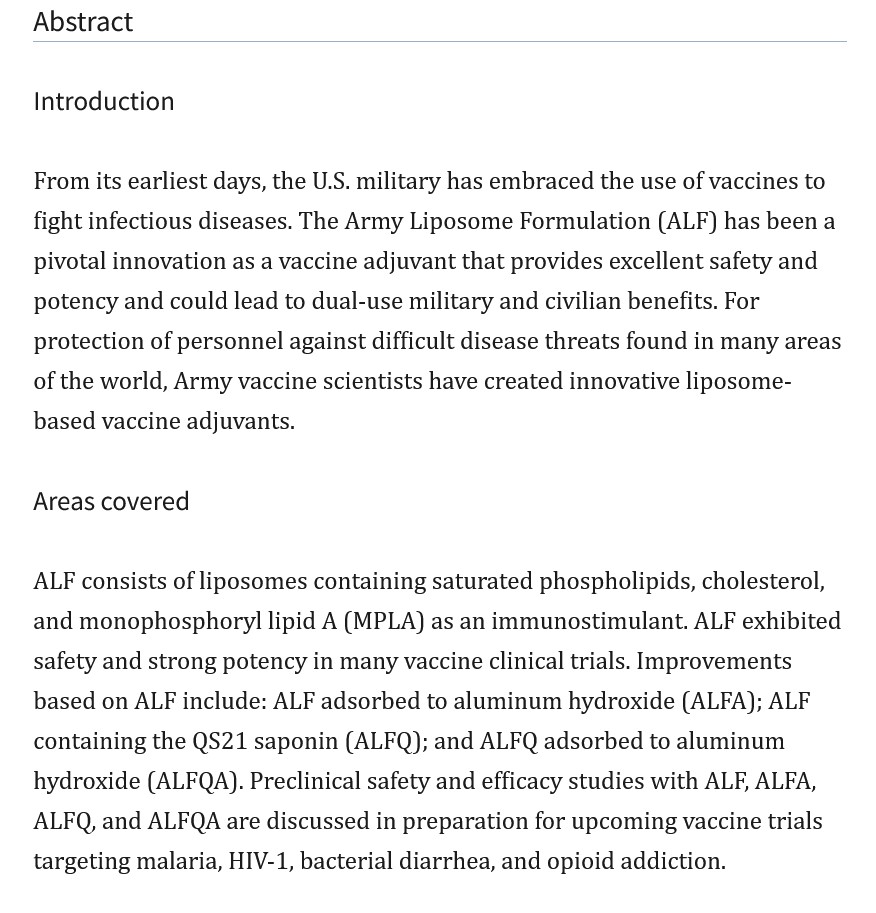
And, more on ALF (aka Army Liposome Formulation) is here: https://pmc.ncbi.nlm.nih.gov/articles/PMC7412170/, “Army Liposome Formulation (ALF) Family of Vaccine Adjuvants”, Carl R Alving, et al, 7 August 2020. Please see the screenshot from this paper, below:
Note the reference to HIV-1. More on this later in today’s post.
ALFQ contains a TLR4 agonist. What is TLR4? Also known as CD284, it is a “key activator of the innate immune response”, per https://en.wikipedia.org/wiki/Toll-like_receptor_4. An agonist is an agent that interacts with a particular cellular receptor, and produces an observable positive response.
The other component of ALFQ is QS21. What is QS21? It is a vaccine adjuvant derived from the soapbark tree (Quillaja saponaria.) QS21 is used in the Novavax COVID-19 “vaccine” as an adjuvant, as part of the company’s “Matrix-M” ingredient.
QS21 has been studied for some time. Here is an article, from the John Innes Centre, that describes the history of QS21: https://www.jic.ac.uk/advances/the-quest-for-qs-21/, Winter 2020-2021. Please see a screenshot from this article, below:
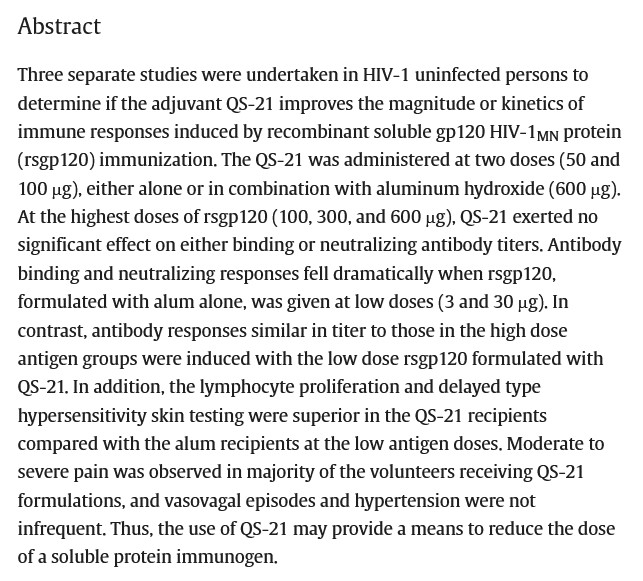
Yours Truly now presents some “interesting information.” One is not making any judgements or opinions; the reader may make their own. This has to do with the HIV-1 reference above in the post. The first item is this: https://doi.org/10.1016/S0264-410X(00)00415-1, “QS21 promotes an adjuvant effect allowing for reduced antigen dose during HIV-1 envelope subunit immunization in humans”, Thomas G. Evans, et al., 28 February 2001. A screenshot of the Abstract of this paper is below:
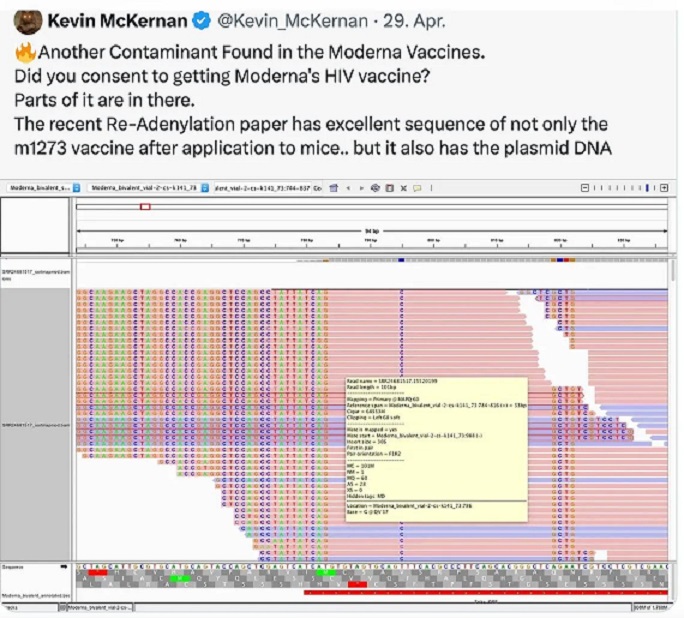
The second item is here: https://worldcouncilforhealth.substack.com/cp/162703289, “BOMBSHELL: HIV Contamination Found In Moderna’s Covid Shot”, 2 May 2025. There are actually two bombshells here: two separate molecules related to HIV-1 were found in the Moderna modRNA COVID-19 “vaccine” — gp145 and gp120.Please see the screenshots from the World Council for Health article, below:
The graphic created by Dr. McKernan, from the above article, showing where the gp145 HIV-1 molecule is in the Moderna modRNA COVID-19 “vaccine” sequence:
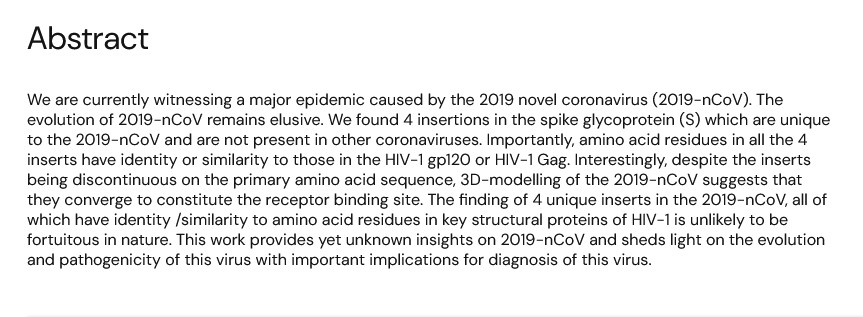
Regarding the gp120 HIV-1 molecule in the Moderna mRNA-1273 modRNA COVID-19 “vaccine”, it was the famous (or, infamous) “Pradhan, et al., paper” from January 2020 which showed that there were gp120 HIV-1 molecules in the SARS-CoV-2 (COVID-19) virus itself.The “Pradhan, et al., paper” was Withdrawn shortly after its publication, and is now difficult to find. Yours Truly was able to locate the paper here: https://academia.edu/79020098/Uncanny_similarity_of_unique_inserts_in_the_2019_nCoV_spike-protein_to_HIV_1_gp_120_and_Gag?f_ri-170, “Uncanny similarity of unique inserts in the 2019-nCoV spike protein to HIV-1 gp120 and Gag”, Prashant Pradhan, et al., 31 January 2020. A screenshot from the paper is below:
Recall that in January 2020, there were no COVID-19 “vaccines” in use anywhere. Note also that the gp120 HIV-1 molecule is present in the COVID-19 virus itself spike protein. Did the Pfizer-BioNTech developers of BNT162b2 remove any or all of the four HIV-1 related inserts in the COVID-19 spike protein (found by Pradhan, et al.) in the process of working on their “vaccine”? Why did Moderna leave the gp120 HIV-1 molecule (and also, it turns out, the gp145 HIV-1 molecule) in that company’s modRNA COVID-19 “vaccine”, mRNA-1273?
And, there is the involvement of the United States Army in HIV research (this is in addition to the Army’s developing the “adjuvant”, ALFQ): https://hivresearch.org/hiv-research/alf-adjuvants. This is the Military HIV Research Program.
Yours Truly will reiterate that one is not making judgements or opinions here; readers will make their own. However, the following needs to be said: the gp120 molecule in HIV-1 attacks the body’s CD4 cells. Please see this paper, from 2010: https://pubmed.ncbi.nlm.nih.gov/20088758/, “The GP120 molecule of HIV-1 and its interaction with T cells”, V Yoon, et al., 2010. A screenshot of the Abstract of this paper is below:
Also: the SARS-CoV-2 virus itself attacks the body’s CD4 cells: https://doi.org/10.7554/eLife.84790, “SARS-CoV-2 uses CD4 to infect T helper lymphocytes”, Natalia S Brunetti, et al., 31 July 2023. A screenshot of the Abstract of this paper is below:
And, there is this paper: https://doi.org/10.3389/fimmu.2020.596631, “Sharing CD4+ T cell Loss: When COVID-19 and HIV Collide on Immune System”, Jean-Pierre Routy, et al., 14 December 2020. Note that this paper was published just a few days after the initial EUAs were granted by the FDA for BNT162b2 and for mRNA-1273 in the United States (11 December 2020); therefore, the research into writing the Routy, et al., paper must have been accomplished at least a few months prior to December 2020. A screenshot of the opening statement of the paper is below:
Yours Truly will ask a question that perhaps is “inconvenient”, but needs to be asked: Is any potential connection between the presence of the gp120 HIV-1 molecule in the SARS-CoV-2 virus itself, AND its potential presence in the Pfizer-BioNTech modRNA COVID-19 “vaccines”, AND its potential presence in the Novavax COVID-19 “vaccine” (which uses the original SARS-CoV-2 virus itself spike protein as a foundation), AND the confirmed presence of BOTH the gp120 HIV-1 molecule and the gp145 HIV-1 molecule in the Moderna modRNA COVID-19 “vaccines” — with the multiple serious Adverse Events reports of autoimmune / immune-mediated, and related conditions, that are in the Appendix 1: List of Adverse Events of Special Interest section of this report: ttps://phmpt.org/wp-content/uploads/2021/11/5.3.6-postmarketing-experience.pdf?
Another “inconvenient” question posed by Yours Truly: What, if anything, did Dr. Anthony Fauci, Dr. Francis Collins, Dr. Deborah Birx, Dr. Robert Redfield, and Dr. Janet Woodcock know about the presence of the gp120 HIV-1 molecule in the SARS-CoV-2 virus itself spike protein, AND in the Moderna modRNA COVID-19 “vaccine” mRNA-1273?
What will be done to make absolutely sure that there is NO molecule whatsoever related to HIV-1 present in the “Universal Vaccine” candidates BPL-1357 and BPL-24910, or in any other “Universal Vaccine” candidates? What will be done to hold accountable the people who allowed the gp120 HIV-1 molecule to be present in the original SARS-CoV-2 virus itself? What will be done to investigate the potential presence of the gp120 HIV-1 molecule in the Pfizer-BioNTech modRNA COVID-19 “vaccines”? What will be done to hold accountable the people who allowed HIV-1 molecules gp120 AND gp145 to be present in the Moderna modRNA COVID-19 “vaccines”?
I debated releasing this as a special edition report for those who have helped and requested the results. Ultimately, I decided to do this as a Daily Thread this week and delay a dedicated Daily Thread post for a week relating to a subject that Scott and Wolf discussed of important national interest. That latter thread has turned into a two parter that can be sandwiched around Memorial Day
I started to release some of what is included here that I had completed last week. I deleted it and started over instead. Something put it in my head to delay the preparation of this post for a bit. I now know for sure why. Most of you will understand as well when you are finished reading.
Parasite Cleanse
As I posted a couple months back we purchased the above referenced from The Wellness Company. It is a 21 day regimen of simply taking one compounded pill of 25 mgs of IVM and 250 mgs of Mebendazole daily. It works somewhat like tele-med and other online type services by completing a medical history and submitting for purchase and use. A doc is assigned and if they have any questions they call or text. If not they email approval and ship the product from their pharmacy within a few weeks.
Since I have been using IVM periodically for the past three-four years it was an easy regimen for me to adopt. Wifey had only taken IVM for a short period once, so we were interested to see how her system handled it. She had no issues with it all.
I continue to note that my eyes seem most positively affected. With partial macular degeneration in one and the early onset of cataracts noted by my Retina specialist a half dozen years ago, the eyes have been my weakest link to date. Now they have completely stabilized with negligible presence of cataracts. The weaker right eye with the MD was made stronger with the use of prism eyeglasses for over a year. I was able to switch back to regular eyeglasses after my last exam a couple of months ago.
I take no other meds except for seasonal pollen allergies. I take a few supplements occasionally like nattokinase along with vitamins. Blood tests have remained good and in range and I have no other known health issues to address presently. I have another blood test coming up in late June. From my perspective the Cleanse kept my system working reasonably well.
You know it is working because of how seemingly yucky stuff exits your body up to two weeks after completing it. Yucky stuff is technical medical term in the TB household. For the record, it is not scary, just different. You may say, “What in the world?” afterward as Wifey did. 😂
Wifey struggled with the corneal ulcer injury to an eye as reported here. It went as Wolf suggested it might. It healed with antibiotic usage, although there is some scar tissue. Her vision is being impacted by developing cataracts that are being monitored. The doc tested the small white mass he removed from her eye and the lab was not able to determine what it was. We believe it may have become infected during our fall frolic travels after Hurricane Helene as it coincided with the aftermath that have been felt in the region for a long time. She has been released by the Corneal specialist. She went to a recent comprehensive eye exam with imaging that our highly competent optometry practice performs. The good news is her vision is stabilized back to where it was pre-incident and she did not need new corrective lenses. It seems the Cleanse has helped stabilize her in that area.
There is more good news for Wifey from this Cleanse as well. Her decades long use of a fluid med for her vertigo type events and occasional spikes in blood pressure has ended. She had reduced her dosage for several months leading up to the Cleanse and is now completely off. She weaned herself off this fluid med (Hydrochlorothiazide) with no increase in vertigo type events during this primary season of pollen and mold allergies that typically cause it. Its long term use caused potassium deficiency at times, which is no longer a problem either. It had also caused a side effect of heavy mucous creation in her sinuses that made for constant throat clearing, especially in the morning and evenings. That is greatly reduced. She no longer takes a seasonal pollen allergy pill and has not needed a Zyrtec D as often. She continues to adapt to the overall positive changes, which includes exiting the yucky stuff.
We both will do another Cleanse in the fall as another set of pollen and fungal allergies enter the picture. Each prescription includes 90 pills, so the participant receives enough for an extended period with the added health benefits that both IVM and Mebendazole provide.
DMSO
We both have been using the DMSO drops in the eyes as well. This may have contributed some to the good eye report. We have increased to 30% concentration after getting acclimated at 20%. I also do the DMSO/Colloidal Silver solution drops for Tinnitus in my ears. It has brought moderate relief, not complete, but reduced the hissing that originated post Wuhan COVID infection when my ears were affected.
Next up will be its use in sinus rinses. Many folks experience great relief from adding DMSO to the rinse solution. I will also be starting a roll-on of DMSO for my lumbar spinal region that has spurs to see if it will provide some relief beyond my monthly chiro visits.
Grandson #1
Many have followed the health journey of our now twelve years old young man over the past few years. His many diagnoses of health issues beginning with birth trauma and being three weeks premature have been; severe sensory, lactose intolerant/GERD, dyspraxia, absence seizures (childhood epilepsy), ADHD symptoms, eating issues (primarily texture) due to the sensory, binocular vision issues (Alternating Exotropia), and so on. Just living has been a challenge at times. The public schools failed him despite an IEP classification. They violated state law by refusing a full time aide, claiming they had insufficient job applicants for all of the needs. A school teaching assistant stated he did not believe #1 was intelligent enough to do the work in class to his face as well as a teacher and school psychologist said likewise in IEP’s with us. They did not accommodate his needs in the classroom despite physician and therapist written recommendations. A couple of physician medical “professionals” nearly killed him with excessive and inappropriate meds along the way. He has been through every applicable medical test imaginable.
Yes, I had all sorts of justification to make legal claims. We chose to see the obstructions for what the Lord would rather us understand and pursue.
We are still very grateful for the advice given on here from some of you. Wolf, Gail, Aubergine, PAVACA and Val deserve special shout outs. Much appreciation to all who cared, prayed and offered advice.
To begin his personal reconstruction toward better health we took over as a family unit. Our advice is to always do that, never give that authority to anybody else. Our first step was to wean him off all meds. We stopped listening to medical professionals for a time, at least until we developed a new cast of characters. Over time we regained his fun, social self and got rid of the hallucinations and bad dreams he was having. He began to sleep better.
The next step was to deal with his physical challenges. His lack of coordination and poor use of hands due to neural and sensory issues was very concerning. We took him to a noted chiropractor in our area who understood the issues and had helped other children with similar problems successfully. His hips, spine and neck were incredibly out of alignment per the X-rays. There was no possible way for the neural development in his CNS to be normal. Starting at age 9 over the course of the next year all of it was brought into normal ranges for the first time in his life. He went from an uncoordinated mess to playing basketball, tennis, and golf while being able to run like a normal kid. For the first time he could ride a bike without training wheels. All of it happened within a year of the first adjustment. He still goes for monthly maintenance adjustments with continuing success. The neurons are now firing as they should and the spikes are not as prevalent as they were when he first began treatment.
The lactose intolerance faded over time although we limit the intake as a precaution. As a result he no longer has GERD issues.
Over the course of the next two plus years a private practice OT has worked on his dyspraxia. This teaches body awareness and helps with his coordination and hand usage. It has been effective. This practice is adding food therapy, so we will be switching from the current ineffective therapist to theirs. He needs to gain weight and has an aversion to many foods due to the sensory issues. This practice understands how the sensory, dyspraxia and eating issues interrelate. He has developed great trust in them as well.
As noted in other posts the initial diagnosis of absence seizures was not true, he was badly misdiagnosed. When we got a second opinion from a competent pediatric neurologist we officially knew we were on track. They examined and did an immediate MRI of his brain, which revealed no issues of note, just continue to monitor. It was confirmation we were doing things right.
Everything changed when in the last month of school in third grade after yet another fruitless IEP meeting, the county’s competent school OT specialist followed us to the parking lot and told us about her observation that #1 was not seeing things normally. This was despite being tested by our family optometrist as 20/20 in both eyes. She noticed he did not track items and activities normally. She had another young student who had a similar problem that went to a Binocular Vision specialist and was successfully treated. We followed up with that same specialist immediately. It was a game changer moment and we will be forever grateful for her willingness to go the extra mile and let us know what she had observed when others in position to potentially help chose not to pay attention, care, or get involved. Instead, they chose to stereotype him.
Over the next year #1 was healed from Alternating Exotropia through the use of prism eyeglasses and two 8-week therapy sessions. See link to understand what the medical condition is about.
He no longer wears the glasses and has perfect vision; the condition is gone. Both eyes work together as they should. The changes in his life have been remarkable. We also learned he was not having absence seizures at all, they were focal events from that Binocular Vision condition being triggered by anxiety and sensory. It took awhile for us to get over the anger we felt over the misdiagnosis of the original pediatric neurologist who thoroughly tested and observed him, along with the dangerous prescriptions he gave that harmed #1. Focal events are obviously far less concerning than seizures. They relate to lag times for his eyes to focus after signals are transmitted to his brain from sensory and anxiety triggers. The redirection from the therapy reduced their frequency and length greatly. He continues to improve and be more adjusted without any assistance.
All of this occurred in exactly the right timing (God thing) after the public school finished botching up everything in the early fall of his 4th grade year. That is when we pulled him to begin homeschooling. Mamaw and Papaw assisted with half of his courses with Mom and Dad assisting with the other half.
We use the Time 4 Learning curriculum and an accredited umbrella school for reporting. The homeschooling curriculum is the most used in America and completely computer based, which he loves. We remove the few woke and inappropriate sections and substitute more appropriate class work, but for the most part the curriculum is quite good.
The results have been spectacular. He caught up his first four grades of academics in 7 months. What the school said he could not do well or at all, he blew through with very little teaching assistance from us. Most of the time we just made him comfortable, took breaks as needed, and kept it fun so he would focus. He made three A’s and one B+. His 5th grade year was more of the same. He completed its core curriculum in 4 months and since then he has been doing electives in Bible study, typing, creative writing, educational field trips, and science experiments to go with twice weekly music (guitar and vocal) lessons, Karate training and golf with Papaw to fill out his state required 180 school days. The curriculum provides state assessment tests in Math and English at the end of the classes, which he aces as well. He never wants to go back to public school again. He wants to start 6th grade work as soon as possible this summer. If he continues with this level of interest I fully expect him to graduate from high school early. His appetite for learning is huge.
School and government officials around our country wonder why American students are so far behind peers in other nations, but are sure it can be fixed by throwing more money, standardized tests and bureaucracy at the problems. As we suspected, #1 is quite intelligent and nothing like they made him out to be, which is exactly what we told them in all of those IEP meetings. But to know that you would have to care enough to work closely with the students and find individual ways to reach them other than as widgets on an assembly line.
We solved the medically related physical issues, education issues, and we will continue to work on mitigating and retraining the eating, coordination and sensory. Despite the trials God has provided caring family, friends, professionals, and His own special touch on the life of a young man who loves Him with all of his heart. We could not be more pleased with his progress.
I foresee a man of God who will be of benefit for the Kingdom and richly blessed.
Grandson #2
Time for a witness. Some may roll their eyes. Go ahead and get it out of the way and call what you will read a coincidence, luck or whatever. We and over 50 eyewitnesses to the actual event know differently.
#2 is eight years old, energetic, intelligent with an engineer type mind, very artistic, and has a Dennis the Menace (old timers will know what that means) approach to life. To say he is impulsive is an understatement. Even as children both #1 and #2 know the Lord well and allow Him to speak through their lives. But they are still kids doing kid things.
Son-in-law was taking #2 to school on Friday morning before heading to work in his role in law enforcement. As usual there was a long line of cars leading to the drop off. Teachers were assisting by helping kids out of cars and on their way to classes. They were creeping along, arrived at the drop, and #2 got out. SIL began pulling away in the line of cars slowly. #2 forgot his backpack in the back seat. He impulsively darted back to the car and yanked on the door, slipped on the wet pavement and fell under the car. The car rolled over his right knee. The teachers and students in the drop zone all saw the whole thing happen. They started shouting and crying.
SIL immediately stopped the car when he felt the bump and heard the screams. He jumped out of the car only to realize his worst nightmare. He and the teachers attended to #2 who began crying. Somebody called the paramedics, who were fortunately housed one block from the school. They arrived quickly and stabilized him. Per SIL they acted incredulous as they examined. They told everybody that nothing appeared to be broken, but to get him to Children’s Hospital ASAP for examination unless they desired that he be taken by their ambulance. Despite being distraught, SIL is well trained in these type situations, so he and the paramedics arranged an area in their crossover vehicle by laying down the second and third row seats. They carefully laid #2 on a makeshift pallet to transport. By this point SIL had contacted Daughter, who got the other two kids ready for transport to our house where they stayed. After some hugs of reassurance and loving on #2, off they went to the hospital that is less than 30 minutes away.
Meanwhile, social media and Facebook in particular went wild over the incident with people in our area sharing and praying along with occasional idgits making unfounded accusations. It was a very shocking event for the school and community as so many saw it happen in real time.
He was quickly attended to at the hospital ER. Scans were taken and examinations made for bone, tissue, ligaments, meniscus, etc. damage. Attending physicians thoroughly examined his entire body as well as for a potential concussion. The result…
There were two very small scratches on the skin near the knee with no bandaids even needed. There was potential for bruising, though none were present. There was road rash on the calf where it was scraped. There was moderate soreness. The physicians and nurses could only shake their heads and smile.
Yup. A third row Hyundai crossover rolled over this eight year old’s knee on an asphalt parking lot and basically nothing of consequence happened other than great fear that was soon replaced by great joy and celebrating our great Lord of all. #2, all of our family, and many of his classmates and teachers acknowledge they have witnessed a God given miracle that is meant to serve as a witness to this entire community; which I now share with you to believe or not believe at your discretion. As for me and my house, we believe. We have zero doubts.
The first question #2 had after the hospital staff examined him and he learned he was going to be fine was if he could participate in field day at school the following Tuesday, which is today. They said that if he was not too sore on Tuesday, he could do whatever he wanted to do that his parents would allow, that he was physically fine. He then started negotiating with his parents for some candy and snacks they could buy him as a reward for being a big boy during the exam. 😂 They headed home, shaken but relieved and exceedingly grateful.
After getting #2 situated for a day of rest and recuperation, Daughter came to retrieve the other two kids after stopping by the school to let them know all was well. The office made an announcement on the loudspeaker and the kids cheered as they like #2 a lot. The principal asked Daughter what type of toys #2 liked, they wanted to get him something for being such a brave young man. A couple hours later they delivered his desired request to their home as they checked on him – a Minecraft Lego set. He looked at his brother and said, “See what you get if you are run over by a car at school!”
🤣 😂 🤣
Later, I headed over to their house to check on #2 as well as SIL since he was still very shaken over what happened. #2 was playing with his new lego set in the floor. I ask him to show me his leg and where the car rolled over him. He pulled his pant leg up and showed it. Light bruising was beginning on his calf that took the worst of the pounding on the pavement along with two very small scratches. He got up and walked to his bedroom with no pain or limp to get something as if it never happened. As I left later he came running and gave me a hug goodbye. He then looked at his father and said, “Dad, it’s my fault that happened, not yours. I should have never come back to the car.”
From the mouths of children. It turned out it was just another day in the life of our Dennis the Menace.
With each day that passed he is recovering from the soreness. However he did not have any swelling, mobility issues or real pain. The road rash bothered him some with a long pant leg touching it, but they do not need to dress it with anything as it will heal fine without any topical treatment. Over the weekend his homeroom teacher also stopped by to check on him and bring his favorite slushee drink. So, it looks good for him to compete in a couple of events today.
A heckuva story in and of itself. But there is a bit MOAR.
The evening before the incident at school the next door neighbor requested SIL move his police vehicle to his driveway so a moving van could get around the cul-de-sac to load their effects as they had sold their house and were moving the next morning. He normally parks overnight in the street at the request of the local residents who see his vehicle as a crime deterrent. He did as requested and parked behind his F-150 with the oversized, off road knobby tires. This is the vehicle that he would have normally used to drive #2 to school instead of Daughter’s smaller, less heavy, passenger tired crossover that he used instead because the police vehicle was in the way.
Yup.
To Him goes all the glory. 🙏 ✝️
Please remember Wolf’s rules for our community. In general that means to be respectful to each other and to pull no shenanigans that your mom might find offensive or otherwise cause jail time. That said, free speech is honored here.
This Rejoice & Praise God Sunday Open Thread, with full respect to those who worship God on the Sabbath, is a place to reaffirm our worship of our Creator, our Father, our King Eternal.
It’s also a place to read, post, and discuss news that is worth knowing and sharing. Please post links to any news stories that you use as sources or quote from.
In the QTree, we’re a friendly and civil lot. We encourage free speech and the open exchange and civil discussion of different ideas. Topics aren’t constrained, and sound logic is highly encouraged, all built on a solid foundation of truth and established facts.
We have a policy of mutual respect, shown by civility. Civility encourages discussions, promotes objectivity and rational thought in discourse, and camaraderie in the participants – characteristics we strive toward in our Q Tree community.
Please show respect and consideration for our fellow QTreepers. Before hitting the “post” button, please proofread your post and make sure your opinion addresses the issue only, and does not confront or denigrate the poster. Keep to the topic – avoid “you” and “your”. Here in The Q Tree, personal attacks, name-calling, ridicule, insults, baiting, and other conduct for which a penalty flag would be thrown are VERBOTEN.
In The Q Tree, we’re compatriots, sitting around the campfire, roasting hot dogs, making s’mores, and discussing, agreeing, and disagreeing about whatever interests us. This board will remain a home for those who seek respectful conversations.
God is in Control . . . and His Grace is Sufficient, so . . . Keep Looking Up
Hopefully, every Sunday, we can find something here that will build us up a little . . . give us a smile . . . and add some joy or peace, very much needed in all our lives.
“This day is holy to the Lord your God; do not mourn nor weep.” . . . “Go your way, eat the fat, drink the sweet, and send portions to those for whom nothing is prepared; for this day is holy to our Lord. Do not sorrow, for the joy of the Lord is your strength.”
Salvation . . . A Free Gift
The word gift is an important one in the Bible, and it is good that we understand its definition and implications.
In the New Testament, there are several Greek words translated “gift.” Some of these words are used in contexts other than God’s gift of salvation, such as the reciprocal gift-giving of celebrants (Revelation 11:10), the things received from fathers (Matthew 7:11), offerings to a ministry (Philippians 4:17), and the gifts of the magi (Matthew 2:11).
However, when it comes to the matter of our salvation, the New Testament writers use different Greek words—words that emphasize the gracious and absolutely free quality of the gift. Here are the two words most commonly used for the gift of salvation:
1) Dorea, meaning “a free gift.” This word lays particular stress on the gratuitous nature of the gift—it is something given above and beyond what is expected or deserved. Every New Testament occurrence of this word is related to a spiritual gift from God. It is what Jesus offers to the Samaritan woman at the well (John 4:10). It is the “unspeakable [or indescribable] gift” in 2 Corinthians 9:15. This gracious gift is identified as the Holy Spirit in Acts 2:38; 8:20; and 11:17.
The adverb form of this word is dorean, translated “freely” in Matthew 10:8; 2 Corinthians 11:7; Revelation 21:6; 22:17. In Romans 3:24, immediately following God’s pronouncement of our guilt, we have this use of dorean: “Being justified FREELY by His grace, through the redemption that is in Christ Jesus.” The gift of salvation is free, and the motive for the gift is nothing more than the grace of the Giver.
2) Charisma, meaning “a gift of grace.” This word is used to define salvation in Romans 5:15-16. Also, in Romans 6:23: “For the wages of sin is death, but the GIFT [charisma] of God is eternal life through Jesus Christ our Lord.” This same word is used in conjunction with the gifts of the Spirit received after salvation (Romans 12:6; 1 Timothy 4:14; 2 Timothy 1:6; 1 Peter 4:10).
Obviously, if something is a “gift of grace,” it cannot be earned. To work for something is to deserve it, and that would produce an obligation—a gift of debt, as it were. That is why works destroy grace (Romans 4:1-5; 11:5-6).
When presenting salvation, the New Testament writers carefully chose words that emphasize grace and freedom. As a result, the Bible could not be more clear—salvation is absolutely free, the true gift of God in Christ, and our only responsibility is to receive the gift by faith (John 1:12; 3:16; Ephesians 2:8-9).
Antique London’s photographs: Goldsmith Hall, The Assay Office
The above free vintage image of a laboratory is courtesy of iStock and Google Images.
Health Friday is a series devoted to information regarding Big Pharma, vaccines, general health, and associated topics.
There are Important Notifications by our host, Wolf Moon; the Rules of our late, good Wheatie; and, certain caveats from Yours Truly, of which readers should be aware. They are linked here. NOTE: Yours Truly has checked today’s offering for any AI-generated content. To the best of her knowledge and belief, there is none. If readers wish to post anything in the discussion thread for today’s post that is AI-generated, they must cite their source. Thank you.
Due to the nature of today’s topic, there will be two separate posts. Part One, today’s offering, starts here: https://www.hhs.gov/press-room/hhs-nih-announces-generation-gold-standard.html, “HHS, NIH Launch Next-Generation Universal Vaccine Platform for Pandemic-Prone Viruses”, 1 May 2025. Please see the following screenshots from the announcement:
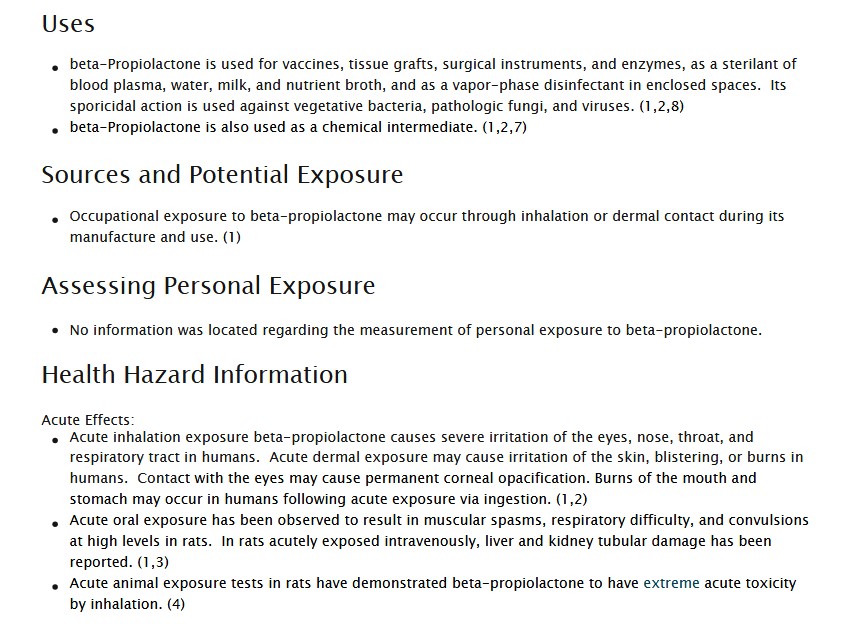
Notice the risks associated with inhalation of beta-propiolactone (which is being used in the development and testing of the “new Gold Standard” intranasal version of the “new Universal Pandemic Vaccine”, BPL-1357.)
Note the language regarding irritations of various types; of damage to the corneas; convulsions; and “extreme acute toxicity.”
Note the language about cancer being induced in lab rats and mice by the use of beta-propiolactone, but no information being available regarding the inducement of cancer in humans by the use of beta-propiolactone.
Both Dr. Memoli and Dr. Taubenberger have been with the NIH / NIAID for years. Also, note the tiny subject pool of 45 adult subjects in the Phase 1 study of BPL-1357.
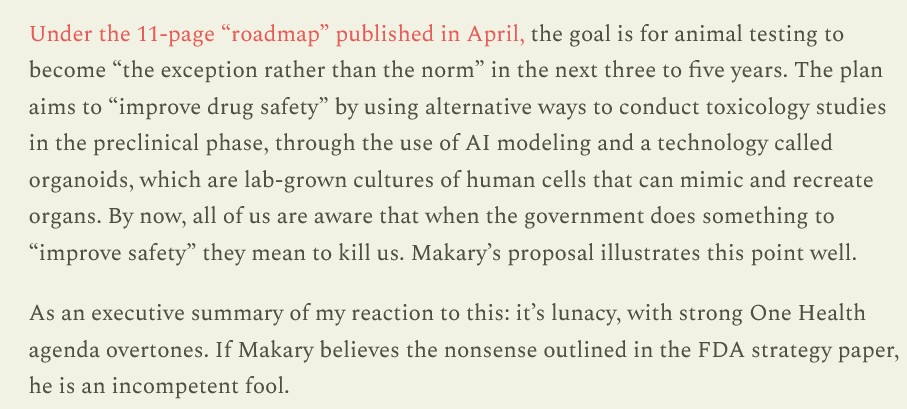
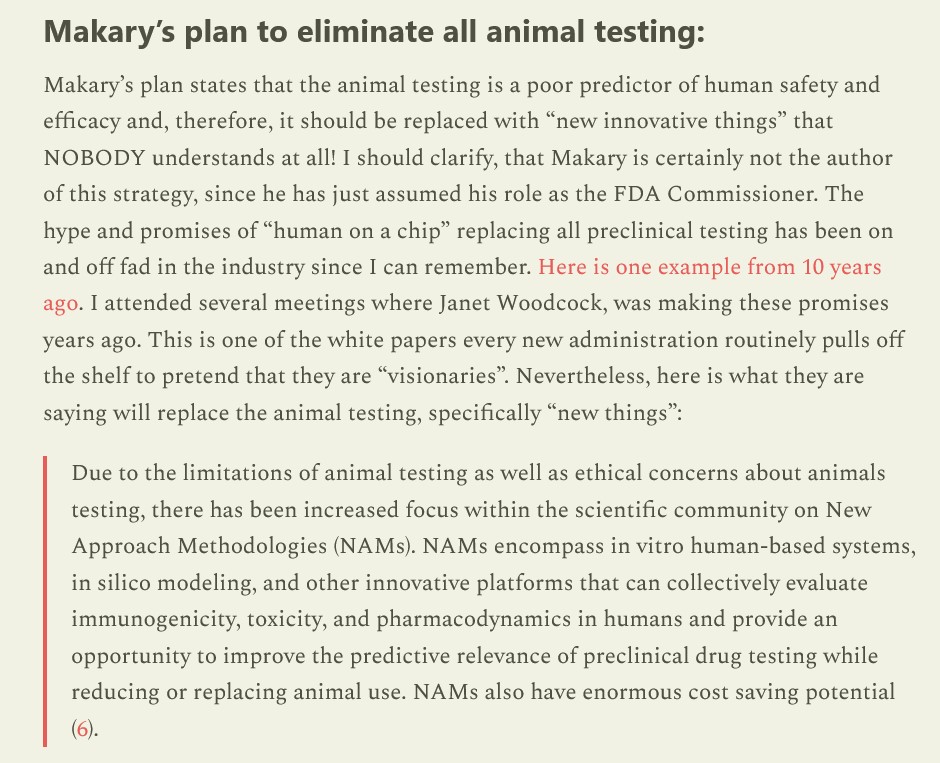
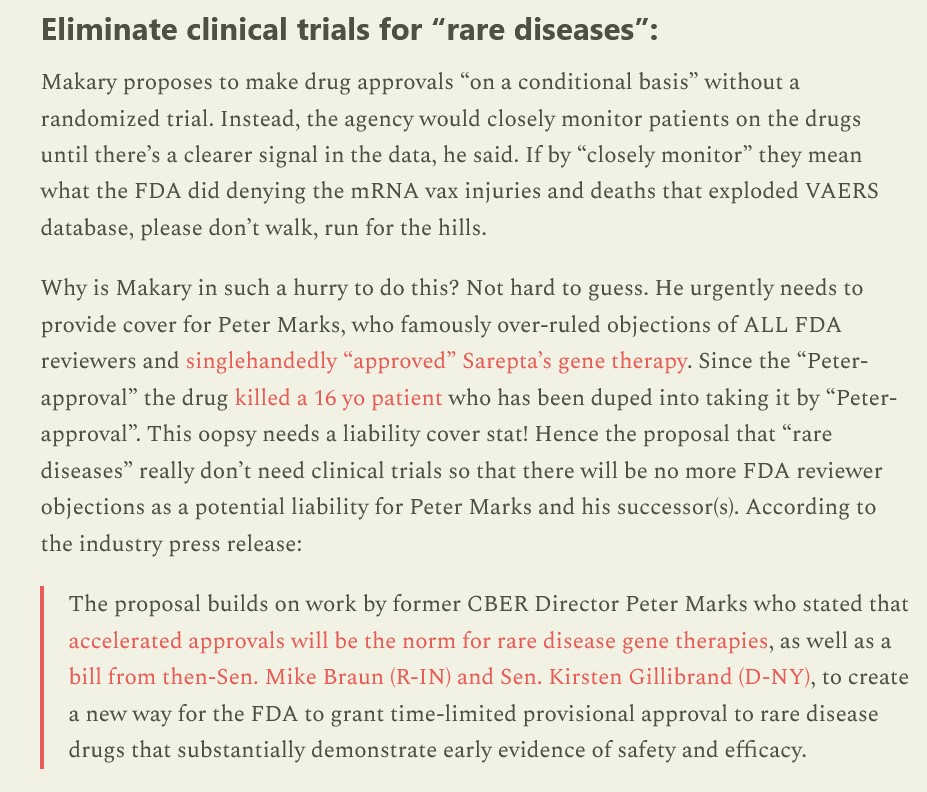
On a “tangential point”, there is this FDA announcement of 10 April 2025: https://www.fda.gov.media/186092/download, “Roadmap to Reducing Animal Testing in Preclinical Safety Studies”, by new FDA Director Dr. Marty Makary. Sasha Latypova analyzed the announcement here: https://sashalatypova.substack.com/p/you-didnt-want-that-mrna-vax-tested, “You didn’t want that mRNA vax tested only on 8 mice? Marty Makary, FDA, has a solution — no more mice!”, 28 April 2025.
That’s right. Dr. Makary wants to reduce, then end, animal testing for vaccines in the preclinical stage, and to substitute testing them instead by using in silico models; then, to move to human subject testing; and, even to NOT have ANY human subject clinical trials at all in “certain circumstances.” Please see the screenshots below from the Latypova article:
Yours Truly understands that the use of animals in lab experiments must be done in the most humane manner possible — no more of the “Fauci tortured Beagles” situations. However, one is of the opinion that there is a place for using animals in lab experiments — to study physical reactions and/or reproductive issues related to the drug or injectable under investigation before human tests begin: something that an in silico model or an AI model cannot do. And, the part about no clinical trials at all in “certain circumstances”:
Note: the red text in the screenshots above link to other articles and information from the Latypova article. Also, recall that Ms. Latypova worked in medical and pharmaceutical techology for years before retiring from the field.
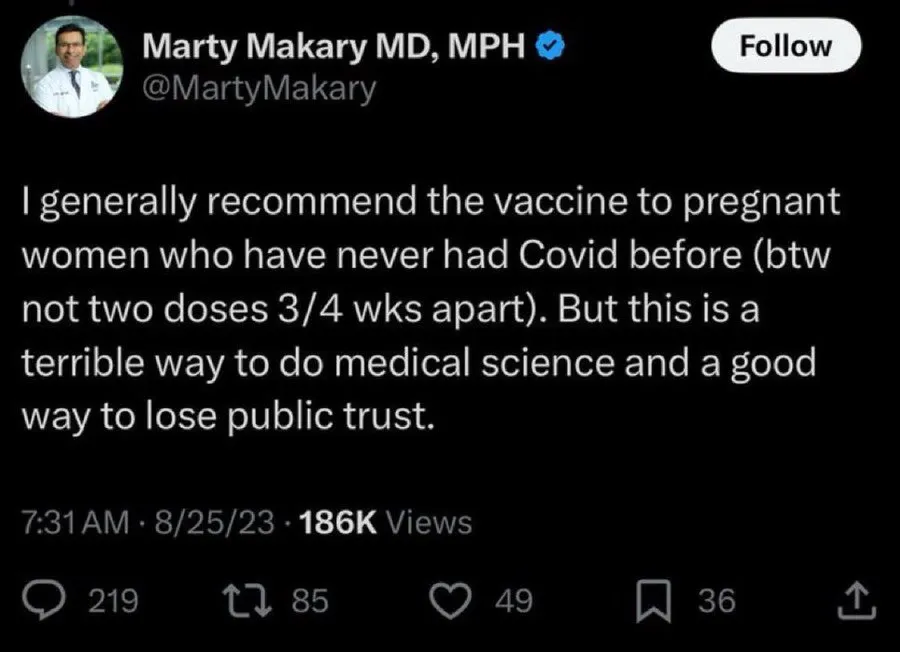
This is the same Dr. Marty Makary who recommended that pregnant women get COVID-19 “vaccinated”:
To finish today’s Part One offering, Yours Truly presents the involvement of United States Defense Department in the use of the “AFLQ adjuvant” that is going to be tested in clinical trials for BPL-1357: https://hivresearch.org/hiv-research/alf-adjuvants. This is the United States military research program into “Military HIV.” This article had a link that led to the following press release by the United States Army, from 2021: https://wrair.health.mil/News-Media/Press-Releases/Article/3166852/phase-1-clinical-trial-of-wrair-developed-covid-19-vaccine-begins/, 5 April 2021. The clinical trial is NCT04784767, that began with 29 subject enrollees on 5 April 2021, and had an “Estimated Study Completion Date” of 30 October 2023 (https://clinicaltrials.gov/study/NCT04784767.) The title of the clinical trial: “SARS-CoV-2 Spike Ferritin Nanoparticle Vaccine with ALFQ Adjuvant for Prevention of COVID-19 in Healthy Adults.” Below is a screenshot of the WRAIR article (WRAIR stands for Walter Reed Army Institute of Research):
Note the statement by Dr. Modjarrad that this “US Army COVID-19 Vaccine” would “pave the way for a universal vaccine to protect against not only the current virus, but also counter future variants…” — “universal vaccine” — sound familiar? “Who is driving this bus?” comes to mind.
There are Important Notificationsfrom our host, Wolf Moon; the Rulesof our late, good Wheatie; and, certain caveatsfrom Yours Truly, of which readers should be aware. They are linked here. Note: Yours Truly has checked today’s post for any AI-generated content. To the best of her knowledge and belief, there is none. If readers wish to post any AI-generated content in the discussion thread for today’s post, they must cite their source. Thank you.
Do not forget to LABEL AI articles video and such.
…The Times framed Trump’s historic first 100 days darkly, as a warning or a sinister omen, but was finally forced to admit that either way, the nation has never witnessed any presidency like this. For instance, one sub-headline blared, “The United States has never seen an effort to expand presidential authority at the scale of Donald J. Trump’s second term.”
[And we had not seen a greater effort to EXPAND the unaccountable bureaucracy, then under FDR.😡 POTUS Trump is trying to return us to the original Constitutional design of the executive.-GC]
“They are trying to do a moonshot on executive power,” explained Harvard Law School professor Jack Goldsmith. Jack doesn’t share Trump voters’ excitement. He feels threatened: “this situation is a much more dangerous threat to the rule of law than the last time.” I’ll just point out that, over the last four years, Jack never thought Biden’s lockdowns, mandatory drugs, or vaccine passports for accessing air travel were threats to the rule of law….
Given our out of control judiciary, I thought this would be a good time to look at what has happened to our judicial system over time. I am hoping Pgroup2 chimes in because I am NOT a lawyer and don’t play one on TV.
Let’s start with what our Constitution says about the Judiciary.
Article I
Section 2.
…No person shall be a Representative who shall not have attained to the age of twenty five years, and been seven years a citizen of the United States, and who shall not, when elected, be an inhabitant of that state in which he shall be chosen.…
Section 3.
….No person shall be a Senator who shall not have attained to the age of thirty years, and been nine years a citizen of the United States and who shall not, when elected, be an inhabitant of that state for which he shall be chosen….
Section 8.
The Congress shall have power…
To constitute tribunals inferior to the Supreme Court…
I included Section 2 & 3 because it gives the minimum age and the minimum years as a citizen before the founders considered a person eligible to serve the US people. Shouldn’t judges who serve for a life time be required to have similar qualifications? Maybe 30 years of age and 10 years a US citizen? OR better yet, like our president a natural born US citizen?
Article II
Section 2.
The President shall be commander in chief of the Army and Navy …. and he shall have power to grant reprieves and pardons for offenses against the United States, except in cases of impeachment.
He shall have power, by and with the advice and consent of the Senate, to make treaties, provided two thirds of the Senators present concur; and he shall nominate, and by and with the advice and consent of the Senate, shall appoint ambassadors, other public ministers and consuls, judges of the Supreme Court, and all other officers of the United States, whose appointments are not herein otherwise provided for, and which shall be established by law: but the Congress may by law vest the appointment of such inferior officers, as they think proper, in the President alone, in the courts of law, 👉or in the heads of departments.👈
That last part will come back to bite us in the rump!
Article III
Section 1.
The judicial power of the United States, shall be vested in one Supreme Court, and in such inferior courts as the Congress may from time to time ordain and establish. The judges, both of the supreme and inferior courts, shall hold their offices during good behaviour, and shall, at stated times, receive for their services, a compensation, which shall not be diminished during their continuance in office.
Section 2.
The judicial power shall extend to all cases, in law and equity, arising under this Constitution, the laws of the United States, and treaties made, or which shall be made, under their authority;–to all cases affecting ambassadors, other public ministers and consuls;–to all cases of admiralty and maritime jurisdiction;–to controversies to which the United States shall be a party;–to controversies between two or more states;–between a state and citizens of another state;–between citizens of different states;–between citizens of the same state claiming lands under grants of different states, and between a state, or the citizens thereof, and foreign states, citizens or subjects.
In all cases affecting ambassadors, other public ministers and consuls, and those in which a state shall be party, the Supreme Court shall have original jurisdiction. In all the other cases before mentioned, the Supreme Court shall have appellate jurisdiction, both as to law and fact, with such exceptions, and under such regulations as the Congress shall make.
The trial of all crimes, except in cases of impeachment, shall be by jury; and such trial shall be held in the state where the said crimes shall have been committed; but when not committed within any state, the trial shall be at such place or places as the Congress may by law have directed.
Section 3.
Treason against the United States, shall consist only in levying war against them, or in adhering to their enemies, giving them aid and comfort. No person shall be convicted of treason unless on the testimony of two witnesses to the same overt act, or on confession in open court.
The Congress shall have power to declare the punishment of treason, but no attainder of treason shall work corruption of blood, or forfeiture except during the life of the person attainted.
This article looks at the judiciary from the point of view of the federal government.
….The provision for tenure during good behavior and a prohibition on reductions in salary assured the judges of the Supreme Court and other judges authorized to exercise the judicial power of the United States an independence that the Constitution denied the legislators and president. 🤔 The constitutional outline of the judiciary, far briefer than the articles defining the legislative and executive branches, offered a general description of the federal courts’ jurisdiction. Article III was more specific in its protection of several rights and liberties, such as 👉the guarantee of trial by jury in criminal cases👈 and freedom from bills of attainder or vague charges of treason.
Other articles of the Constitution also shaped the structure and operation of the federal judiciary. According to Article II, the president would appoint judges with the approval of the Senate. In Article I, the enumerated powers of the Congress included the authority “to constitute Tribunals inferior to the Supreme Court.” Although Article III made no mention of a chief justice, the provision in Article I for the chief justice to preside in the impeachment trial of a president indicated the delegates’ assumption that the Supreme Court would include one leadership position. Article VI required all judges, like state and federal legislators and executives, to be bound by oath to support the Constitution.
The constitutional provisions for the judiciary reflected the conventions’ debate on the appointment of judges, the institutional independence of the third branch, and the value of lower federal courts. Many delegates assumed Congress would elect judges, while other wanted the president alone to select the members of the Supreme Court. Madison’s original proposal for the Constitution called for the president and members of the Supreme Court to serve on a Council of Revision that would have authority to veto legislation. The most contentious, and finally unresolved, debate concerning the judiciary centered on the proposals for lower federal courts that would operate alongside existing state courts. Supporters of a strong national government wanted a system of lower federal courts with final jurisdiction in many cases, while those who wished to preserve the authority of state governments proposed that the state courts exercise federal jurisdiction on a local level. 👉The debates on the ratification of the Constitution further demonstrated how controversial were the proposals for lower courts👈 and made clear the challenge Congress would face in establishing a national judiciary within a federal system.
The Supreme Court has no power to amend our Constitution. And it’s impossible for an amendment to take away powers our Constitution doesn’t grant.
Joanna Martin, J.D.
1. First Principles
Let’s analyze COSP’s silly argument. We begin by looking at First Principles:
♦The Judicial Branch was created by Art. III, §1, US Constitution. Accordingly, it is a “creature” of the Constitution. 1
♦The federal government came into existence when the States, acting through special ratifying conventions held in each of the States, ratified the Constitution.2
Since the Judicial Branch is merely a “creature” of the Constitution, it follows that it is subordinate to the Constitution, and is completely subject to its terms. It may not annul the superior authority of the States which created the Judicial Branch when they ratified the Constitution; 3 and as a mere “creature” of the Constitution, it may NOT change the Constitution under which it holds its existence! 4
2. Supreme Court Opinions are not “the Law of the Land”
Article VI, cl.2, US Constit., the “supremacy clause”, defines “supreme Law of the Land” as the Constitution, and acts of Congress and Treaties which are authorized by the Constitution. Supreme Court opinions aren’t included!
Furthermore, Art. I, §1, US Constit., vests all law-making powers granted by the Constitution in Congress. Our Constitution doesn’t grant any lawmaking powers to the Judicial Branch.
So why does everybody say, as we heard during the Kavanagh confirmation hearings, that Roe v. Wade is “the Law of the Land”? Because Americans have been conditioned to believe that the Supreme Court is superior to our Constitution; that their opinions about our Constitution are “law”, and we are bound by them unless and until they issue new opinions which release us from their previous opinions.
3. Organic & statutory law and the totally different “common law” precedent followed in courts
Americans have been conditioned to ignore the huge distinctions between organic and statutory law, on the one hand; and the common law which is embodied in the precedents followed by judges in litigation…..
There is a lot more and it is well worth reading. Other Publius Huldah articles on the due process clause.
…..
REGULATIONS
Well, Well, Well the Federal Register says this page is ‘NOT FOUND’ No wonder I could not find it when I went looking a few weeks ago. However I had it in my notes and it was archived.
The idea for a centralized publication system for executive branch documents began during the Great Depression, when Congress began enacting a host of legislation that gave executive branch agencies 👉increased authority to regulate.👈
With this flood of new regulations, [Thanks FDR – GC] it soon became apparent that, because there was no standardized repository, it was difficult for the public and federal agencies to know which regulations were effective and enforceable.
This situation was dramatically highlighted when the Supreme Court decided a case involving an agency that tried to enforce a regulation that had actually been revoked by an executive order. No one—not the government, not the defendants, not the lower courts—was aware that the regulation had been eliminated.1 In response, Congress enacted the Federal Register Act (FRA) in July of 1935. The FRA created the Federal Register as the official daily publication for presidential documents and executive agency rule and notice documents and established a central location for filing documents for public inspection.
The documents that the Federal Register Act requires agencies to publish in the Federal Register include:
* executive orders and proclamations;
* documents of general applicability and legal effect;
* documents that impose a penalty;
* any other documents that Congress requires.
The act also requires that these documents are made available for public inspection at least one day before they are published in the Federal Register….. [GEE a WHOLE DAY!🙄]
Proposed Rules
This third section contains documents that announce possible changes to the CFR and solicit public comment on the proposal, such as notices of proposed rulemaking (NPRM) and preliminary rulemaking documents, including advance notices of proposed rulemaking and petitions for rulemaking…..
If you break a regulation you are not tried within the normal court system. Instead you are tried by a ‘judge’ WITHIN THE FEDERAL BUREAU THAT MADE THAT REGULATION. 😩
Administrative law judges (ALJ) (not administrative judges) are executive judges for official and unofficial hearings of administrative disputes in the Federal government. Because they only hear administrative law issues as designated in the Administrative Procedure Act of 1946 (APA), administrative law judges are considered part of the executive branch, not the judicial branch, and 👉ALJs are appointed by the heads of the executive agencies.👈 However, administrative law judges receive much of the same protections as those in the judicial branch in order to preserve their neutrality [And if you believe that 🦬💩 Schiff, I have a bridge I want to sell! –GC] such as not being subject to bonuses or ranking systems of executive agencies.
Given the broad scope of administrative law, ALJs participate in many different topics and for many different agencies such as the Social Security Administration (SSA), the Environmental Protection Agency(EPA), and the U.S. Postal Service. The determinations of an ALJ may be appealed potentially even to a federal judicial court. However, 👉essentially every agency has its own appellate processes of review that must be followed before someone can access the federal courts, and sometimes in large agencies, the agency’s internal review process can be quite extensive.😩
ALJs do not serve the same role as administrative judges. While similar in name to ALJs, administrative judges can only participate in unofficial disputes of executive agencies which constitute the majority of administrative disputes. Only ALJs can hear official disputes heard by the agencies. Further, administrative judges are directly hired by the agencies and are subject to their employment rules and benefits, unlike the independent[YEAH RIGHT! -GC] ALJ judges.
Many states also have ALJs that serve similar roles as their Federal counterparts. The rules and nature of ALJs vary by state on levels of neutrality, procedure, and jurisdiction.
EXAMPLE:
The Food Safety Modernization Act bill was so over-the-top in its overreach that the bill’s language states, “(t)he validity and appropriateness of the order of the Administrator assessing the civil penalty shall not be subject to judicial review.”
And if you’re think this is as outrageous as this bill can be, you’d be very wrong. Section 406 clearly states, “(i)n any action to enforce the requirements of the food safety law, the connection with interstate commerce required for jurisdictionSHALL BE PRESUMED TO EXIST.”
…Lori Robertson of FactCheck.org, who is not a lawyer (she has a B.A. in advertising), claims the bill doesn’t apply to “ that tomato plant in your backyard.” As a lawyer, I am skeptical of this claim (I co-represented the prevailing defendant in the last successful constitutional challenge to federal regulation under the interstate commerce clause, United States v. Morrison(2000), one of only two cases in 70 years in which a challenge was successful). Congress’s power under the Constitution’s Commerce Clause is almost unlimited in the eyes of the courts, a nd thus can reach the “tomato plant in your backyard.” — Trojan Horse Law: The Food Safety Modernization Act of 2009
Text from the bill HR 875 that became the Food Safety Modernization Act.
Civil Penalty-
(A) IN GENERAL- Any person that commits an act that violates the food safety law (including a regulation promulgated or order issued under the food safety law) may be assessed a civil penalty by the Administrator of not more than $1,000,000 for each such
B) SEPARATE OFFENSE- Each act described in subparagraph (A) andeach day during which that act continues shall be considered a separate offense. [Now you know why I no longer sell my goats and sheep and rather kill & bury them than sell them for food! -GC]
Criminal Sanctions-
(1) OFFENSE RESULTING IN SERIOUS ILLNESS- Notwithstanding section 303(a) of the Federal Food, Drug, and Cosmetic Act (21 U.S.C. 333(a)), if a violation of any provision of section 301 of such Act (21 U.S.C. 301) with respect to an adulterated or misbranded food results in serious illness, the person committing the violation shall be imprisoned for not more than 5 years, fined in accordance with title 18, United States Code, or both.
(2) OFFENSE RESULTING IN DEATH- Notwithstanding section 303(a) of the Federal Food, Drug, and Cosmetic Act (21 U.S.C. 333(a)), if a violation of any provision of section 301 of such Act (21 U.S.C. 331) with respect to an adulterated or misbranded food results in death, the person committing the violation shall be imprisoned for not more than 10 years, fined in accordance with title 18, United States Code, or both.
(e) Penalties Paid Into Account- The Administrator–
(1) shall deposit penalties collected under this section in an account in the Treasury; and
(2) may use the funds in the account, without further appropriation or fiscal year limitation–
(A) to carry out enforcement activities under the food safety law; or
(B) to provide assistance to States to inspect retail commercial food establishments or other food or firms under the jurisdiction of State food safety programs.
I do not know if these Criminal Sanctions are tried before the Administrator or not. With NAIS aka animal ID traceability, the large corporations LOVE this law since they can slough off any legal ramifications onto the farmer.
….However, this type of jury is called a “petit” or “trial jury”; a grand jury is very different. A grand jury is a group of citizens convened by the federal government to determine if probable cause exists to believe that a person committed a federal crime.…
👉Federal prosecutors present evidence and live testimony in a grand jury proceeding by issuing grand jury subpoenas. A grand jury subpoena is not issued by the grand jury but by the federal prosecutor assigned to the case.👈
Under the United States Constitution, all federal felony charges must proceed with a grand jury indictment. However, there is no grand jury requirement for misdemeanor offenses.
Nothing like a bit of gaslighting to confuse the public….
In dealing with the grand jury, the prosecutor must always conduct himself or herself as an officer of the court whose function is to ensure that justice is done and that guilt shall not escape nor innocence suffer.
The prosecutor must recognize that the grand jury is an independent body, whose functions include not only the investigation of crime and the initiation of criminal prosecutionbut also the protection of the citizenry from unfounded criminal charges.
The prosecutor’s responsibility is toADVISEthe grand jury on the law and to present evidence for its consideration.In discharging these responsibilities, the prosecutor must be scrupulously fair to all witnesses and must do nothing to inflame or otherwise improperly influence the grand jurors.…
[updated January 2020]
9-11.242 – NON-DEPARTMENT OF JUSTICE GOVERNMENT ATTORNEYS
Federal Rule of Criminal Procedure 6(d) provides that the only prosecution personnel who may be present while the grand jury is in session are “attorneys for the government.” Rule 1(b) defines attorney for the government for Federal Rules of Criminal Procedure purposes as the Attorney General, an authorized assistant of the Attorney General, a United States Attorney, an authorized assistant of a United States Attorney, and certain other persons in cases arising under the laws of Guam.
An agency attorney or other non-Department of Justice attorney must be appointed as a Special Assistant or a Special Assistant to the Attorney General, pursuant to 28 U.S.C. § 515, or a Special Assistant to a United States Attorney, pursuant to 28 U.S.C. § 543, in order to appear before a grand jury in the district of appointment….
Note the word ADVISE and the CHANGE of DATE… From the older reading the Grand Jury is INDEPENDENT of the courts and can look into matters. This of course is NOT a concept our Overlords want us to know. It is JUST like the RIGHT TO A JURY TRIAL and JURY NULLIFICATION. A right granted by the US Constitution but eroded and hidden from us.
Prepared By Kelly Mordechai, Author“The Hidden 4th Branch”
Kelly Mordechai is experienced at filing formal grand jury petitions and has appearing before a grand jury based upon a filing of his own formal grand jury petition. The process for accessing a country, state, or federal grand jury is protected by your ‘Right to Petition’ and can differ greatly from grand jury to grand jury, so knowing your rights, and the specific procedures that may be unique to the grand jury you are attempting to petition, is paramount to a successful filing. Mr. Mordechai is happy to consult with anyone interested in filing a formal grand jury petition….
Q2:What is a grand jury?
Answer: A grand jury isan independent legal authority, empowered by the U.S. Constitution, case law, and history. A grand jury is composed of everyday people entrusted to investigate any and all allegations of felonious criminal activity and inparticular “willful misconduct by public officials.”
Grand juries possess the legal authority to indict anyone believed to be guilty where evidence and testimony substantiates the allegations of criminal activity.
Once indicted, alleged criminals are required to stand trial or seek a plea bargain.
Grand juries are comprised of U.S. citizens, aged 18 or older, and selected directly from the communities they are appointed to serve.
Referred to as the unofficial 4th branch of the government, grand juries possess enormous power to pursue justice on behalf of ‘We the People’, particularly in times when corruption is evident and unchecked. With clear evidence during the COVID crisis that crimes against humanity, extensive fraud, and rampant acts of willful misconduct have been committed, grand juries present the best potential solution for Americans seeking justice. A grand jury convened to independently investigate government officials and public health officials for corruption, fraud, and willful misconduct can ensure that any and all alleged criminals stand trial for wrongdoing. [2]
Q3:Can any U.S. citizen petition a grand jury?
Answer: Yes. Every U.S. citizen retains the 1st Amendment ‘Right of Petition’. While some states have made significant effort to install obstacles that prevent ordinary U.S. citizens from actively engaging their right to petition grand juries, these rights are maintained in all 50 states, nevertheless. Kansas, Nevada, North Dakota, New Mexico, Nebraska and Oklahoma have laws that specifically empower citizen led grand juries without the need to file formal petitions through the US Attorney or State Attorney General acting as a middleman in the process…
[Page 16 thru 39 are references.]
WHYdidtheyremovedTrial by Jury AND JURY TRAINING???
“ I consider trial by jury as the only anchor ever yet imagined by man, by which government can be held to the principles of its constitution.”
Thomas Jefferson, 1788.
“Representative government and trial by jury are the heart and lungs of liberty. Without them we have no other fortification against being ridden like horses, fleeced like sheep, worked like cattle and fed and clothed like swine and hounds.”
John Adams, 1774.
“Trial by jury in civil cases is as essential to secure the liberty of the people as any one of the pre-existent rights of nature.”
….Despite this extensive history, modern judges mostly forbid any mention of jury nullification in the courtroom. This has happened in part because of an obscure Supreme Court decision. In 1895, the Court ruled in Sparf v. US that juries do have the power to nullify the law. But the ruling also stated that judges are not required to inform the jury of this. As a result, judges and prosecutors have exploited Sparf to forbid any mention of jury nullification from the courtroom….
William Penn may have thought he had settled the matter. Arrested in 1670 for preaching Quakerism, Penn was brought to trial. Despite Penn’s admitting the charge, four of the 12 jurors voted to acquit. The judge sent the four to jail “without meat, drink, fire and tobacco” for failing to find Penn guilty. On appeal, however, the jurors’ action was upheld and the right of juries to judge both the law and the facts — to nullify the law if it chose — became part of British constitutional law.
It ultimately became part of American constitutional law as well, but you’d never know it…
“Anyone accused of a crime in this country is entitled to a jury trial.”
The Constitution may say so but, in fact, this is simply not the case — and becoming less so as politicians fiddle with legal definitions and sentencing standards in order specifically to reduce the number of persons entitled to a trial….
The nullification principle involves the power to say no to the excesses of government, and thus serves as a final defense against tyranny.As Thomas Jefferson put it to Tom Paine in a 1789 letter, “I consider trial by jury as the only anchor ever yet imagined by man, by which a government can be held to the principles of its constitution.”….
Author, Tom Stahl is a former FIJA Board member and practicing attorney from Waterville, Washington
ALL CRIMINAL CASES
The constitutions of Maryland, Indiana, Oregon, and Georgia currently have provisions guaranteeing the right of jurors to “judge” or “determine” the law in “all criminal cases.” Article 23 of Maryland’s Constitution states:
…In the trial of all criminal cases, the Jury shall be the Judges of Law, as well as of fact, except that the Court may pass upon the sufficiency of the evidence to sustain a conviction. The right of trial by Jury of all issues of fact in civil proceedings in the several Courts of Law in this State, where the amount in controversy exceeds the sum of five thousand dollars, shall be inviolably preserved.
…There is no doubt that jury nullification was one of the rights and powers that the people were exercising in 1791 when the Bill of Rights of the United States Constitution was adopted. As legal historian Lawrence Friedman has written:
In American legal theory, jury-power was enormous, and subject to few controls. There was a maxim of law that the jury was judge both of law and of fact in criminal cases. This idea was particularly strong in the first revolutionary generation when memories of royal justice were fresh.
Jury nullification is therefore one of the “rights retained by the people” in the Ninth Amendment.
And it is one of the “powers reserved to the people” in the Tenth Amendment.
Jury nullification is decentralization of political power. It is the people’s most important veto in our constitutional system. The jury vote is the only time the people ever vote on the application of a real law in real life. All other votes are for hypotheticals.
Chief Justice Roberts shows that he’s part of the swamp. If you believe his bs about judges, I have a bridge to sell you. The Obama judge is a leftwing extremist, and the son of a lefwing extremist who was a well-known communist classmate of mine at Berkeley in the 1960s.
Unfortunately I do not have the authors of the following two quotes.However they encapsulate our present situation so well, I am including themany way.
Justice is based on how strong your connections are to the people with power and how much money you have. Without those two, justice is rarely attainable. I have spent too many years around the system to even begin to think the average person stands a chance at getting justice.
….
The whole concept of an “independent” judiciary is silly when you have activists judges making up justifications to rule on partisan ideological lines out of whole cloth. When this happens judges are effectively legislating from the bench.
IF THERE IS NO TRIAL BY JURY, THEN THE PEOPLE CAN NOT NULLIFY BAD LAWS.
Therefore removal of the right to a jury trial became a goal of the Cabal.
Right to Jury in Criminal Cases
Amendment VI
In all criminal prosecutions, the accused shall enjoy the right to a speedy and public trial, by an impartial jury of the state and district wherein the crime shall have been committed, which district shall have been previously ascertained by law, and to be informed of the nature and cause of the accusation; to be confronted with the witnesses against him; to have compulsory process for obtaining witnesses in his favor, and to have the assistance of counsel for his defense.
Right to Jury in Civil Cases
Amendment VII
In Suits at common law, where the value in controversy shall exceed twenty dollars, the right of trial by jury shall be preserved….
The 6th and 11th Amendment of the U.S. Constitution and Article 3 Section 2 give US citizens the right to a trial. However as Joan Biskupic, a Washington Post reporter stated:
“Anyone accused of a crime in this country is entitled to a jury trial.” The Constitution may say so but, in fact, this is simply not the case — and becoming less so as politicians fiddle with legal definitions and sentencing standards in order specifically to reduce the number of persons entitled to a trial.
Biskupic also wrote: “The American custom is that jurors decide the facts of the case (whether the person did what he is accused of) and leave it to judges to interpret the law. There is no room, in other words, for jurors to say whether they think the law is a good one, though there have been a few celebrated exceptions — notably the 18th-century acquittal of John Peter Zenger of seditious libel and the 19th-century acquittals for prosecution under the fugitive slave law.”
This is a rewriting of history, one of the privileges of a reporter who works for a paper free to do so thanks to the rights of jurors upheld in the Zenger case. — The Progressive Review 2/99
I find it interesting that some of my older references are from PROGRESSIVES. It shows just how far they have ‘progressed’ towards a communist totalitarian dictatorship in a few decades.
Here is how the politicians have gotten around the US Constitution to make sure citizens are denied their right to a trial:
The Seventh Amendment, passed by the First Congress without debate, cured the omission by declaring that the right to a jury trial shall be preserved in common-law cases… The Supreme Court has, however, arrived at a more limited interpretation. It applies the amendment’s guarantee to the kinds of cases that “existed under the English common law when the amendment was adopted,” …
The right to trial by jury is not constitutionally guaranteed in certain classes of civil cases that are concededly “suits at common law,” particularly when “public” or governmental rights are at issue and if one cannot find eighteenth-century precedent for jury participation in those cases. Atlas Roofing Co. v. Occupational Safety & Health Review Commission (1977). Thus, Congress can lodge personal and property claims against the United States in non-Article III courts with no jury component. In addition, where practice as it existed in 1791 “provides no clear answer,” the rule is that “[o]nly those incidents which are regarded as fundamental, as inherent in and of the essence of the system of trial by jury, are placed beyond the reach of the legislature.” Markman v. Westview Instruments (1996). In those situations, too, the Seventh Amendment does not restrain congressional choice.
In contrast to the near-universal support for the civil jury trial in the eighteenth and early nineteenth centuries, modern jurists consider civil jury trial neither “implicit in the concept of ordered liberty,” Palko v. State of Connecticut (1937), nor “fundamental to the American scheme of justice,” Duncan v. Louisiana (1968).
The result is a relentless march towards concentrating power into the hands of the ruling elites….
>>>>>>>>>>>>>>>>>>>>>>>>>
This comment is no longer available at either the Conservative Tree House or in the Wayback archives. I think it is important enough to preserve it here.
Judicial Tyranny has long been an enemy to our Republic.
President Thomas Jefferson knew what was coming way back in 1800, but even these great men would’ve laughed at allowing “lower courts” rule over the executive branch, and pushed back hard against the Supreme Court at times.
Thomas Jefferson on Judicial Tyranny
“Nothing in the Constitution has given them [the federal judges] a right to decide for the Executive, more than to the Executive to decide for them. . . . The opinion which gives to the judges the right to decide what laws are constitutional and what not, not only for themselves, in their own sphere of action, but for the Legislature and Executive also in their spheres, would make the Judiciary a despotic branch.” (Letter to Abigail Adams, September 11, 1804)
“The original error [was in] establishing a judiciary independent of the nation, and which, from the citadel of the law, can turn its guns on those they were meant to defend, and control and fashion their proceedings to its own will.” (Letter to John Wayles Eppes, 1807)
“Our Constitution . . . intending to establish three departments, co-ordinate and independent that they might check and balance one another, it has given—according to this opinion to one of them alone the right to prescribe rules for the government of others; and to that one, too, which is unelected by and independent of the nation. . . . The Constitution, on this hypothesis, is a mere thing of wax in the hands of the judiciary, which they may twist and shape into any form they please.” (Letter to Judge Spencer Roane, Sept. 6, 1819)
“You seem . . . to consider the judges as the ultimate arbiters of all constitutional questions; a very dangerous doctrine indeed, and one which would place us under the despotism of an oligarchy. Our judges are as honest as other men, and not more so . . . and their power [is] the more dangerous, as they are in office for life and not responsible, as the other functionaries are, to the elective control. The Constitution has erected no such single tribunal, knowing that to whatever hands confided, with corruptions of time and party, its members would become despots.” (Letter to William Jarvis, Sept. 28, 1820)
“The judiciary of the United States is the subtle corps of sappers and miners constantly working under ground to undermine the foundations of our confederated fabric. They are construing our constitution from a co-ordination of a general and special government to a general and supreme one alone. This will lay all things at their feet, and they are too well versed in English law to forget the maxim, ‘boni judicis est ampliare jurisdictionem’ [good judges have ample jurisdiction]. . . . A judiciary independent of a king or executive alone, is a good thing; but independence of the will of the nation is a solecism, at least in a republican government.” (Letter to Thomas Ritchie, Dec. 25, 1820)
“The germ of dissolution of our federal government is in the constitution of the federal Judiciary; an irresponsible body (for impeachment is scarcely a scare-crow) working like gravity by night and by day, gaining a little today and a little tomorrow, and advancing its noiseless step like a thief, over the field of jurisdiction, until all shall be usurped.” (Letter to Charles Hammond, August 18, 1821)
“The great object of my fear is the Federal Judiciary. That body, like gravity, ever acting with noiseless foot and unalarming advance, gaining ground step by step and holding what it gains, is engulfing insidiously the special governments into the jaws of that which feeds them.” (Letter to Judge Spencer Roane, 1821)
“At the establishment of our constitutions, the judiciary bodies were supposed to be the most helpless and harmless members of the government. Experience, however, soon showed in what way they were to become the most dangerous; that the insufficiency of the means provided for their removal gave them a freehold and irresponsibility in office; that their decisions, seeming to concern individual suitors only, pass silent and unheeded by the public at large; that these decisions, nevertheless, become law by precedent, sapping, by little and little, the foundations of the constitution, and working its change by construction, before any one has perceived that that invisible and helpless worm has been busily employed in consuming its substance. In truth, man is not made to be trusted for life if secured against all liability to account.” (Letter to A. Coray, October 31, 1823)
FTA: The justices overturned a lower court ruling that had endorsed the SEC’s hiring practice for the judges. The agency’s commissioners, who are presidentially appointed, should have named them, not SEC staff, the justices said.
This ruling has real impact giving power back to the president across the board in numerous agencies. Looks like POTUS will have more seats to fill.
Here’s where case law method started:
-snip-
•In the 1870s, Dean Christopher Columbus Langdell transformed American legal education by introducing what has become the standard first-year curriculum for American law schools – including classes in contracts, property, torts, criminal law, and civil procedure.
•Langdell also developed the case method of teaching law, which became the dominant pedagogical model at U.S. law schools. His notion that law could be studied as a “science” gave university legal education a reason for being that was distinct from vocational preparation. Critics at first defended the old lecture method because it was faster and cheaper and made fewer demands on faculty and students. But advocates said the case method had a sounder theoretical basis in scientific research and the inductive method.
https://hls.harvard.edu/about/history
REPLY:
So true! Our current structure represents the bastardization of our system! The Constitution, itself, is written in the Common law. That is a quote by Antonin Scalia, by the way. The Progressives systematically sidelined common law and replaced it with Equity law, which is why we have the corrupt legal and judicial system that we have today. For a lucid and comprehensive timeline of just how they did it, see this amazing legal journal article that I found quite by accident, but which I treasure, to this day. This link goes directly to a U Penn website where you can download the article as a pdf: https://scholarship.law.upenn.edu/cgi/viewcontent.cgi?article=3957&context=penn_law_review
Title of the article: HOW EQUITY CONQUERED COMMON LAW: THE FEDERAL RULES OF CIVIL PROCEDURE IN HISTORICAL PERSPECTIVE [94 pages – GC] This is definitely a turgid law journal article and it requires a lot of concentration for us laymen. I had to read it several times to make full sense of it. HOWEVER: You can easily see, even while skimming the article, how the Progressives used the very same arguments to attack the common law that they use, now, to attack the Constitution: “The common law is antiquated and it’s no longer relevant to our society.” ” The common law is too complex. It needs to be streamlined.” I marvel that they have gotten away with destroying institution after institution using the same hackneyed lies! Lastly, the footnotes in this article are a treasure trove of truths that basically catch the evil doers of each era red-handed, destroying the key features of our system. Among those, the common law is the most valuable, and its main institution, the common law grand jury was the most valuable tool to help keep the republic, as Franklin exhorted us to do. The common law grand jury gave the jurors absolute hegemony over the judge and the prosecutor. No request that they made–not for evidence or further investigation, or to examine evidence personally, or to hear witnesses questioned again–could be refused. The decision of the common law grand jury was final.
Partly because I read this article, I came to the conclusion that the Founders intended for the common law grand jury to be the tool that made the People the fourth branch of government. They gave the people omnipotence, via the common law grand jury, so that they could nip corruption in the bud, as it first began to form, in local arenas. This is the key to the keeping of our republic. As we Drain the Swamp, we need to keep in mind that we must also restore the apparatus by which we can prevent the corruption spreading, again. I hope you guys give sufficient credence to what I am saying, here. I see this whole concept as being of central importance.
After almost twenty-five years of battle, Congress passed the Enabling Act of 1934,1 authorizing the Supreme Court to promulgate the Federal Rules of Civil Procedure (“Federal Rules” or “Rules”).2 The 1938 Federal Rules were heralded as a phenomenal success.’ Approximately half of the states adopted almost identical rules, and procedural rules in the remainder of the states bear their influence.” For decades, most first year law students have learned about civil litigation through a Federal Rules filter.5
Now the Federal Rules and adjudication of civil disputes are under attack.’ Among the key targets are discovery abuse,7 expense and delay,” excessive judicial power and discretion,’ excessive court rulemaking,10 unpredictability, 1 litigiousness,12 an overly adversarial atmosphere,13 unequal resources of the parties, 4 lack of focus,1 5 and formal adjudication itself.”6 Case management, efforts to encourage settlements, and a breathtaking array of alternative dispute resolution mechanisms represent the current major categories of response.17 There remains speculation, however, as to what factors have contributed to the nature of current civil litigation. Suggested culprits include the explosion in substantive law, photocopying, the types and difficulty of issues brought to courts, the increase in amounts of money involved, and “the sheer number of parties.”1 ‘ Without denigrating these and other factors, this Article concentrates instead on the inherent nature of the Federal Rules and on the basic choice of procedural form made by their promulgators.
It advances two theses.
First, an historical examination of the evolution of the Federal Rules reveals that rules of equity prevailed over common law procedure.
Second, this conquest represents a major contributing factor to many of the most pressing problems in contemporary civil procedure.
That the Federal Rules and modem procedure draw heavily on equity is not news. Both the commissioners who drafted the New York Field Code in the mid-nineteenth century and the most influential proponents of procedural reform in the twentieth century, cited, drew upon, and applauded equity procedure.’ 9 Some contemporary scholars have also acknowledged the modern debt to equity procedure. For example, eleven years ago, Professor Abram Chayes noted how modem civil procedure, in public law cases, looked to equity for remedies.20 Professor Owen Fiss has eloquently expressed a recent defense to the obligation of judges, particularly federal ones, to use historic equity powers in order to breathe life into sacred constitutional rights and to permit such rights to evolve and expand as society attempts to become more humane.21
As important as scholarship like Professors Chayes’ and Fiss’s has been, however, it does not do justice to the revolutionary character of the decision inherent in the Federal Rules to make equity procedure available for all cases. Nor does it explore what the choice of equity procedure meant historically, how it evolved, and what concerns and problems flow from a procedural system driven by equity. The defense of equity power in constitutional cases designed to restructure public institutions tends to undervalue the problem of how to translate rights, constitutional or otherwise, into daily realities for the bulk of citizens. 12 Aspects of common law procedure and thought, not equity, may be required to help deliver or vindicate rights, now that equity has opened a new rights frontier.
Focusing on the historical currents that resulted in the Federal Rules will illustrate what an enormous distance was traveled, how one-sided the procedural choices became, and the problems implicit in those choices. Perhaps exploring where one came from can help clarify where one may wish to go. Part I of this Article first looks at the major components of common law and equity procedure, and then examines the domination of an equity mentality in the Federal Rules. Part II explores the American procedural experience before the twentieth century, and demonstrates how David Dudley Field and his 1848 New York Code were tied to a common law procedural outlook. Part III concentrates on Roscoe Pound (who initiated the twentieth century procedural reform effort), Thomas Shelton (who led the American Bar Association (“ABA”) Enabling Act Movement), and Charles Clark (the major draftsman of the Federal Rules). Through understanding these men and the interests they represented, one can see that we did not stumble into an equity system; people with identifiable agendas wanted it. Part IV examines how the Federal Rules advocate rejected methods that might have helped balance and control their equity procedure, why the methods of confining the system failed, and why current approaches to redress the imbalance of an equity-dominated system will also fail. It concludes with a summary of fundamental constraints rejected by the advocates of uniform federal rules of procedure. My goal is to rescue some quite profound voices from the wilderness.
I. COMMON LAW, EQUITY, AND THE FEDERAL RULES OF CIVIL PROCEDURE
Much of the formal litigation in England historically took place in a two-court system: “common law” or “law” courts, and “Chancery” or “equity” courts.2 ” Although they were complementary, law and equity courts each had a distinct procedural system, jurisprudence, and outlook. The development of contemporary American civil procedure cannot be understood without acknowledging these differences. The more formalized common law procedure has been so ridiculed that we tend to ignore its development to meet important needs, some of which still endure, and that many of its underlying purposes still make sense. Conversely, especially during this century, equity has been touted in ways that obscure the underlying drawbacks to its use as the procedural model.
I hope this gives everyone a taste of how the Cabal has twisted our judiciary to ‘better suit their needs’ instead of ours.
FWIW, my aunt did the research to become a Daughter of the American Revolution. My family is descended from Alexander Hamilton.
Do you think I can get reparations from Senator Burr for the murder of my ancestor at the hands of his?😆
Well, alrighty then, Gail. Since you asked the question, even if it was in somewhat in jest, let’s take a trip back in time with all of our QTree friends and see if reparations may be in order. I will first focus on Hamilton and introduce background on Burr in the links. Be reminded Alexander Hamilton was not a signer of the Declaration, however, he is universally considered a very important founding father.
Alexander Hamilton – Early Life
I will summarize the major points and events that shaped his life in this post. There are many historical accounts, books, documentaries, plays and so on that have covered his extraordinary life for those who want to know more
He was born in Charleston of Nevis in the British West Indies Leeward Islands in 1755 or 1757 – your guess is as good as the historians.
He was born out of wedlock to Rachel Lavien and James A. Hamilton. He had an older brother from the relationship, James Jr. It seems Rachel was still married to her first husband, Johann Lavien, with whom she had a son, Peter. She left her husband and son in 1750 and moved to St. Kitts Island where she met James. Rachel was half British and half Huguenot while James was a Scotsman. Later the two moved back to Rachel’s birthplace of Nevis to a seaside lot she had inherited from her father. While there Alexander and James Jr. were tutored in a private school by a Jewish headmistress and Alexander devoted himself to reading many books from the family library as well.
James Sr. learned Rachel’s first husband was planning to divorce her while charging adultery and desertion under Danish law that would lead to the additional criminal charge of bigamy, so he abandoned the family to spare that from happening. Rachel moved with her two sons to Christiansted on St. Croix and managed a small store there. In 1768 both Rachel and Alexander contracted Yellow Fever. She passed away leaving Alexander and James Jr. orphaned. Her first husband then took everything from her estate, leaving the boys nothing.
The boys were taken in by an uncle. Unfortunately, he committed suicide a year later. At this point they separated with James Jr. becoming an apprentice carpenter and Alexander being taken in by Nevis merchant, Thomas Stevens. He began work in the merchant field of import-export. He soon became a trader with business in New York and New England. He became so proficient even as a teenager that the owner would leave him in charge of the business when he went to sea.
Alexander was a prolific reader and once composed a letter to his father about the terrible effects the island experienced from a hurricane in 1772. His mentor and tutor, Rev. Henry Knox, read the letter and decided to submit it to the newspaper for publication. His highly descriptive writing style strongly impacted the right people in the community, who collected funds and sent him to the U. S. to receive an education. He started at Elizabethtown Academy and a year later was admitted into King’s College (Columbia). While there he developed an interest in patriot causes and used his writing skills to counter loyalist influence, yet, discouraged violence to accomplish change and independence. With the British occupation of New York City at the war’s start, his education at King’s came to an end.
Hamilton’s Military Career Accomplishments
Hamilton was quick to join the patriot war efforts as he and many of his classmates joined the militia and were in the Corsican unit. He was soon made an officer and led a raid with the Sons of Liberty to capture British cannons for their own use. With the captured weaponry the men became an artillery unit for the militia and was named the Hearts of Oak. He soon became Captain of a 60 man rear guard artillery unit for New York and assisted Washington in numerous battles including successful action leading to the British surrender in the Battle of Princeton.
Due to his successful service he was requested to be an aide to two Generals and declined, until George Washington contacted him to be his Aide de Camp at the rank of Lieutenant Colonel. He jumped at the opportunity and served four years in the chief of staff capacity. It gave him great experience corresponding with the Continental Congress, governors and other Generals. He drafted orders, dealt with diplomacy matters, worked with military intelligence and negotiated with other military officers on Washington’s behalf.
He met his future wife, Elizabeth Schuyler, in late 1779 in the winter headquarters of the military in New Jersey. She was the daughter of General Phillip and Catherine Schuyler. They married a year later at her family’s New York mansion and went on to have eight children together.
He left his role with Washington in February 1781 after a misunderstanding between the two, however, it really was a result of Washingtons consistent refusal to give him command of units in the war. The couple returned to her family’s home in New York where Hamilton continued to write letters to Washington seeking a command. Finally, in July he relented and Hamilton was assigned a total of four companies from NY and CT. Upon the Battle of Yorktown, he was given three battalions and an assigned target. He led his men in victory while only using bayonets at night to avoid attracting attention with gunfire.
Hamilton’s Public Service Career Accomplishments
After Yorktown he resigned his commission in 1782 and returned to New York City. After self study he passed the bar there in six months and soon began arguing cases before the state Supreme Court. To state that Alexander Hamilton was obviously a high functioning genius is an understatement. He was noted by his contemporaries as having the highest intellect of anybody within their midst.
He was appointed as a NY representative to the Congress of the Confederation. From his early Anti-federalist days, his mind and politics changed as he had become frustrated with the Continental Congress and the inability to obtain funds from the states to pay war debts. About this time the Newburgh Conspiracy occurred as previously discussed as well as another event with a disgruntled group of former military who marched on Philadelphia to make their points for back pay. Hamilton pushed to relocate the Congress to Princeton, NJ to avoid the confrontation and they were able to continue there without interruption.
Through the years that followed Hamilton had the following roles and involvements.
Left the Confederation Congress to restart his law practice, which primarily represented loyalists and Tories. Jumped back into the public realm with the Newburgh Conspiracy. Became a member of the NY legislature. He served on the King’s College (Columbia) Board of Trustees.
He was chosen as a delegate to the Constitution Convention where he pushed having the POTUS serve life terms as well as the Senators. He wanted electors selecting both, the POTUS having an absolute veto on legislation, SCOTUS having jurisdiction over all lawsuits, and state governors being appointed by the federal government. None of that went anywhere.
He recruited John Jay and James Madison to join him in writing the Federalist Papers in support of the proposed Constitution. He oversaw the influential publications and wrote 51 of the 85 essays in the pen name of Publius. Despite hard selling the need for the Constitution, he was unhappy with numerous negotiated provisions. However, when it came time to ratify and sign, he did so.
With the election of George Washington, the POTUS initially chose Robert Morris for the Treasurer role. Morris declined and recommended Hamilton, who accepted and was confirmed in September 1789. It was in this role that Hamilton’s genius and hard work shined. He immediately began the process of fixing public credit in a manner he had previously described to Morris back during the war in 1781; which was the primary reason Morris had recommended him to Washington. His work and process for establishing financial independence for the young nation was very impressive and successful. Many of the principles and methods are still used today. For better or worse he was successful in gaining approval for a national bank as he felt a central banking system was necessary for America to grow and be successful.
His proposals to establish a mint and coinage were accepted and eventually signed into law with the Coinage Act of 1792. With it the coins were minted in decimals instead of the 8ths that Spain used. Due to smuggling and pirating problems at sea along the coast lines he proposed an armed naval police force called the “revenue cutters” to address. This became the precursor to our current Coast Guard.
For federal tax revenues Hamilton first went after tariffs on whiskey and proposed excise taxes on other products to raise funds. This caused the Whiskey Rebellion, which was put down by Hamilton, George Washington, General Henry Lee and a large contingent of federal troops. Acceptance of tariffs and taxes was slow, but he persisted with the help of other leaders over time.
Hamilton was a tireless supporter of industrialization and promoted manufacturing as a way to diversify and grow federal revenues. He stood in contrast to Jefferson who preferred an agrarian based economy.
He wanted America neutral with Great Britain and France being at war in 1793, so he supported the Jay Treaty of 1795 that he had been instrumental in drafting. He wanted to continue trade relations with Britain to keep revenues growing in the federal treasury. Since his wife had suffered a miscarriage while he was dealing with the Whiskey Rebellion, he resigned from this cabinet position in early 1795 while leaving detailed instructions relating to handling the federal debt through public credit. Some months later he returned to his law practice.
Throughout the early to mid 1790’s Hamilton faced many accusations for his sexual exploits. Well founded or not they caused much damage to his political aspirations. He remained a Federalist throughout his public life and as such opposed the politics of Jefferson. However, as the 1800 Presidential election revealed he was willing to mix it up with anybody. At that point he was crossways with John Adams and worked against his reelection. When Jefferson and Burr tied for POTUS and Adams had lost, he felt Jefferson was the lesser of two evils and cast his lot for him over the northerner Burr, of whom he detested. Jefferson became POTUS and Burr VP. When Burr later ran for governor of NY in 1804, Hamilton openly worked against him and contributed to his loss. That directly led to the unfortunate events that follow.
The Rivalry With Aaron Burr
Rather than summarize what has been done numerous times by others, I have provided some well written biographical summaries that will take you just a few minutes with each to read. Each has a different emphasis.
However, this one is the best description of the events of the day in my opinion. It will take a bit longer to read, but is well sourced and makes sound conclusions in my opinion.
It takes two to tango with an illegal duel, even if one (Hamilton) has been set up by the other (Burr) to “defend” his honor. Both obviously knew it was against the law to do what they did. Hamilton had recently lost a son in a duel at nearly the same location as this one a few years before. It is amazing that two highly educated, intelligent, accomplished men of their stature decided to do what they did. They resorted to living out a grudge match to the death over what was best for their families and country. It revealed flaws in character of both men, not unlike all of us.
In reading at least a dozen accounts of this story, it does seem like Hamilton shot into the air. Whether that was because he was not practiced with the “hair trigger” it reportedly had or whether he did it intentionally we will never know. He had been an accomplished military soldier and leader, he knew how and what to do if he did not make a mistake. After experiencing the pain of the loss of his son in that duel a few years before, he had to know how it all could go. My gut says he refused to back away from the challenge of Burr due to pride and public image, but reconciled himself to the potential results of the event and that he would not harm Burr. One account stated that in the 30 hours he lived after being mortally wounded he sent word to his Episcopalian priest to perform his last rites. The priest initially refused due to the nature of the event that caused his injury. He later agreed after hearing Hamilton’s explanations of his thoughts and actions prior to and during the duel. The priest then performed the rites prior to his death.
It also seems that in death as well as in life, Alexander Hamilton was an enigma.
None of this rises to the level of wrongful death by Burr in my opinion without more facts. The truth is both men injured themselves unto death that awful day. One from the confrontation and gunshot wound that could have easily been avoided. The other lost a lifetime of trust and goodwill that led to a downward spiral into oblivion until he passed away. Neither was a fitting end for two patriots who had fought for our freedom and were seemingly committed to the best interests of America. Both had personal flaws that let strong opinions and political opportunism get in the way of common sense and reasonable compromise.
We are thankful for the many good things they did for America, especially Alexander Hamilton. We are sad for the turmoil that occurred prior to the ends of their lives. There is a great lesson in this for those who are placed in authority and that is to turn down the volume on discord, rancor and personal attacks against others. Fight the sin of pride. As I have posted previously, politics is dirty and a big ego can cause great harm to self and others.
The current Democrat Party and their demons of destruction would do well to pay heed. It will not end well for them either.
Please remember Wolf’s rules for our community. In general that means to be respectful to each other and to pull no shenanigans that your mom might find offensive or otherwise cause jail time. That said, free speech is honored here.
This Rejoice & Praise God Sunday Open Thread, with full respect to those who worship God on the Sabbath, is a place to reaffirm our worship of our Creator, our Father, our King Eternal.
It’s also a place to read, post, and discuss news that is worth knowing and sharing. Please post links to any news stories that you use as sources or quote from.
In the QTree, we’re a friendly and civil lot. We encourage free speech and the open exchange and civil discussion of different ideas. Topics aren’t constrained, and sound logic is highly encouraged, all built on a solid foundation of truth and established facts.
We have a policy of mutual respect, shown by civility. Civility encourages discussions, promotes objectivity and rational thought in discourse, and camaraderie in the participants – characteristics we strive toward in our Q Tree community.
Please show respect and consideration for our fellow QTreepers. Before hitting the “post” button, please proofread your post and make sure your opinion addresses the issue only, and does not confront or denigrate the poster. Keep to the topic – avoid “you” and “your”. Here in The Q Tree, personal attacks, name-calling, ridicule, insults, baiting, and other conduct for which a penalty flag would be thrown are VERBOTEN.
In The Q Tree, we’re compatriots, sitting around the campfire, roasting hot dogs, making s’mores, and discussing, agreeing, and disagreeing about whatever interests us. This board will remain a home for those who seek respectful conversations.
God is in Control . . . and His Grace is Sufficient, so . . . Keep Looking Up
Hopefully, every Sunday, we can find something here that will build us up a little . . . give us a smile . . . and add some joy or peace, very much needed in all our lives.
“This day is holy to the Lord your God; do not mourn nor weep.” . . . “Go your way, eat the fat, drink the sweet, and send portions to those for whom nothing is prepared; for this day is holy to our Lord. Do not sorrow, for the joy of the Lord is your strength.”
Faith Is A Gift
Faith is the avenue or the instrument God uses to bring salvation to His people. God gives faith because of His grace and mercy, because He loves us (Ephesians 4—5). Faith comes from God in the form of a gift (Ephesians 2:8).
A gift is not earned by some good deed or kind word, and it is not given because the giver expects a gift in return—under any of those conditions, a gift would not be a gift. The Bible emphasizes that faith is a gift because God deserves all of the glory for our salvation. If the receiver of faith could do anything whatsoever to deserve or earn the gift, that person would have every right to boast (Ephesians 2:9). But all such boasting is excluded (Romans 3:27). God wants Christians to understand they have done nothing to earn faith, it’s only because of what Christ did on the cross that God gives anyone faith (Ephesians 2:5, 16). Receiving faith is a non-work (see Romans 4—Abraham’s salvation was dependent on faith in God, as opposed to any work he performed).
Suppose someone anonymously sent you a check for $1,000,000. The money is yours if you want it, but you still must endorse the check. In no way can signing your name be considered earning the million dollars—the endorsement is a non-work. You can never boast about becoming a millionaire through sheer effort or your own business savvy. No, the million dollars was simply a gift, and signing your name was the only way to receive it. Similarly, exercising faith is the only way to receive the generous gift of God, and faith cannot be considered a work worthy of the gift.
By knowing our saving faith comes from God alone, it should encourage Christians to “not think of yourself more highly than you ought,” but remember God decides the measure of faith each one receives (Romans 12:3). The apostle Paul gives an example of the godly humility believers should have when they contemplate their own faith: “Even though I was once a blasphemer and a persecutor and a violent man, I was shown mercy because I acted in ignorance and unbelief. The grace of our Lord was poured out on me abundantly, along with the faith and love that are in Christ Jesus” (1 Timothy 1:13–14). Paul understood faith in Christ was given to him because of God’s grace in spite of his own sinful life (1 Corinthians 4:7).
The Bible specifies the way, or the means, that God gives faith to people. “Faith comes from hearing the message, and the message is heard through the word about Christ” (Romans 10:17). It is the Word of God that produces faith. Someone could receive faith while hearing a sermon teaching the gospel, someone else by reading about Jesus in the Bible—any time the true gospel of Jesus is communicated, there is potential for faith. This is why it’s of paramount importance for believers everywhere to be obedient to the Great Commission (Matthew 28:16–20) and tell people what Christ has done for humanity. Faith is not the product of a preacher’s compelling presentation, his eloquence, or even his theological soundness—faith is given through the message about Jesus. This is the means God has chosen.
It is good for anyone who wants faith to ask for it. God freely gives what is good to all who ask (Luke 11:9–12), and it’s good to ask for an increase of faith (Luke 17:5; Mark 9:24). Jesus prayed for Peter’s faith to be strengthened (Luke 22:32). As with any gift from God, it is our responsibility to exercise the gift and not become complacent, lazy, or apathetic (Romans 12:1–2, 6–8). Christians can find comfort and peace of mind knowing their faith is from God, because He has said He will finish the good work He started (Philippians 1:6). God is the Author and the Perfecter of faith (Hebrews 12:2a; Romans 8:29–30).
The above vintage image of the United States Congress in session is courtesy of the Library of Congress and Google Images.
Health Friday is a series devoted to Big Pharma, vaccines, general health, and associated topics. As today’s post speaks of the disaster of the lab-created bioweapons called COVID-19 — the COVID-19 virus itself; and, the COVID-19 “vaccines” — Yours Truly dedicates it to the memory of all persons, of whatever age or location, who have passed away from the negative effects of these bioweapons.
There are Important Notifications from our host, Wolf Moon; the Rules of our late, good Wheatie; and, certain caveats from Yours Truly, of which readers should be aware. They are linked here. NOTE: Yours Truly has checked today’s offering for AI-generated content. To the best of her knowledge and belief, there is none. If anyone wishes to post AI-generated content to today’s discussion thread, they must cite their source. Thank you.
The PREP Act (also called PREPA) is a “License to Kill“, in the words of Sasha Latypova (https://sashalatypova.substack.com/.) The PREP Act removes accountability, liability, and transparency from the activities of the Health and Human Services Department of the United States Federal Government under the provisions of the Act. The PREP Act allows: unlimited research, development, and use of COVID-19 “countermeasures”, including, but not limited to, “vaccine” development and use; “respiratory devices” development and use (think ventilators); prescription drugs use (think Paxlovid and Remdesivir); “mandated” uses of masking, of “social distancing”, and even of “lockdowns”; the “mandated” administration of COVID-19 “vaccines”, including to newborn babies, to persons under the age of 18, to persons who wish to attend school or to work; and much more. The PREP Act allows the United States Federal government and its associated departments (including Health and Human Services and the United States Defense Department) to literally use American citizens as “human lab rats” in the administration and use of dangerous, deadly, COVID-19 “countermeasures” which are not “safe and effective”; but which, instead, damage and/or destroy the bodies and minds of the persons who take the COVID-19 “vaccines” and/or drugs such as Remdesivir. The PREP Act uses taxpayer monies, private research grants, collaboration with scientific labs all across the United States (think the Baric Lab at UNC, Chapel Hill), and with foreign labs (think the Wuhan Institute of Virology) to pursue the provisions of the PREP Act.
Yours Truly begins here: https://www.federalregister.gov/documents/2024/12/11/2024-29108/12th-amendment-to-declaration-under-the-public-readiness-and-emergency-preparedness-act-for-medical, “12th Amendment to Declaration Under the Public Readiness and Emergency Preparedness Act for Medical Countermeasures Against COVID-19”, signed by then-Health and Human Services Secretary Xavier Becerra, 11 December 2024. This 12th Amendment extends the PREP Act (also called PREPA) “emergency status” of COVID-19, along with all medical countermeasures used against COVID-19 (including development and use of “vaccines”, “respiratory devices”, and so on) — until 31 December 2029 (in other words, until after the 2028 General Election and into the Presidential administration that takes over on 20 January 2029.) It also means that, even though the “official” COVID-19 “state of emergency” ended in May 2023, the “virus emergency status” has not been ended. It also means that legal liability for any person, any medical professional, any drug manufacturer, any hospital / clinic / care facility, and supplier, and so on, that fall under the provisions of the 12th Amendment — are legally exempt from any and all liability. It also means that, while the current Health and Human Services Secretary can sign a document that rescinds and/or modifies the 12th Amendment, it must take an act of Congress to repeal the PREP Act.
Per Katherine Watt (paralegal and professional researcher), the two separate actions mentioned above are discussed here: https://bailiwicknews.substack.com/p/repealing-prep-act-and-terminating, “Repealing PREP Act and terminating HHS Secretary determinations and declarations issued under PREP Act are two different things.”, 4 April 2025. Please see the screenshots from her article, below:
It appears that the various States of the United States have little room to challenge the provisions of the PREP Act. However, a recent case before the North Carolina Supreme Court, regarding a person under age 18 who was given a COVID-19 “vaccine” without consent, was decided in favor of the plaintiff: https://thefocalpoints.com/p/give-it-to-him-anyway-teen-given, “Give It to Him Anyway”: Teen Given COVID-19 mRNA Shot Without Consent — State Supreme Court Says Family Can Sue”, by Nicolas Hulscher, MPH, 24 March 2025. Please see the screenshot from the Hulscher article, below:
A lower court in North Carolina ruled that the family could not sue the school system, due to the “liability provisions” of the PREP Act. However, the North Carolina Supreme Court overruled the lower court, stating that the family can indeed sue:
Before turning to the final aspect of today’s offering, Yours Truly will expand the mention of Sasha Latypova above in the post. Ms. Latypova, a native of Ukraine, was trained in medical and pharmaceutical technology. She owned and ran several companies in this area. She worked with Pfizer-BioNTech and other drug manufacturers in medical technology. She is therefore a person with deep experience, in Yours Truly’s opinion, regarding the workings of these industries. After moving to the United States and subsequently retiring from these endeavors, Ms. Latypova began to research and write on how the medical technology and the pharmaceutical industries have now become entities that serve their shareholders and the government, not the patients they claim to serve. Regarding the PREP Act, here is one of her blog posts: https://sashalatypova.substack.com/p/prep-act-license-to-kill-must, “PREP Act Brief: “License to Kill” must be repealed.”, 21 April 2025. This article is densely-written and detailed. Below are a couple of screenshots from her post. Note: There are numerous hyperlinked information sources embedded in the article:
Please also see this post, an interview between Ms. Latypova and Ms. Watt (Bailiwick News) regarding the PREP Act: https://sashalatypova.substack.com/p/interview-with-the-former-feds-foundation, “Interview with the Former Feds Foundation: Katherine Watt and I discuss PREP Act as an act of treason.”, 25 April 2025.
Finally, there is this blog article from “Spartacus”: https://iceni.substack.com/cp/162062988, “Declaration of Sovereignty Pt. 1”, 24 April 2025 (this is a cross-post from the Mole substack website.) This post is long and intense; it traces the “Profane Myth of COVID-19.” A screenshot of part of this post is below:
It is the PREP Act which, in significant amounts, has placed the United States in the position where the country is today: just under 70% of the population has taken at least one injection of a dangerous, deadly COVID-19 “vaccine” (these injectables are NOT “safe and effective”, and mounting evidence proves this); the country is just beginning to emerge from the economic devastation and chaos of the “COVID lockdowns” period; and, the Medical Tsunami of COVID-19 “vaccine”-induced injuries, illnesses, disabilities, and deaths, which is starting to present among the “vaccinated.” There are many persons involved in the above who must now be held accountable; not the least of which are those who knew how dangerous and potentially deadly the COVID-19 “vaccines” are while working with “Operation Warp Speed”, and who withheld this information from then-President Donald Trump.
It is now a very appropriate time to discuss political parties since they have been doing their best to disrupt the will of We the People for many years.
In our newly formed nation during the subject period of this series, the Federalists were the first organized political party that apparently formed in 1789, although some sources hold out for as late as 1795. When one considers that Alexander Hamilton, John Jay and James Madison produced and published the Federalist papers from 1787-1788 in NY newspapers, this writer chooses to use the earlier date.
That would be the year the Constitution was ratified. That did not take long, did it?
The Federalist movement and party dominated the affairs of America during the 1790’s, then never won an election after 1801 before disappearing not long after the War of 1812. Their lasting legacy will always be the Constitution, for better or worse.
To provide some background and more of a basis for this part, please review this summary of political parties in America.
Before we go further I have a confession to make. I firmly believe as POTUS James Monroe stated, “Surely our government may go on and prosper without the existence of parties. I have always considered their existence as the curse of the country”
You will find that statement in the fourth paragraph of the linked letter below from said James Monroe to James Madison on May 12, 1822.
Preach it, James. You understood this subject well in my opinion. It would not be long (1828) before a political party rose up against the freemasons, the Anti-Masonic Party. Seems you were a freemason. Oh well. That party was absorbed into the Whigs a decade later.
However, please do not miss what Monroe said in the sentence previous to the above referenced quote. “Public opinion will react on this body, & keep it right.“
Seems that is still the key over 200 years later; transparently keeping the citizens truthfully informed while they remain engaged with their government officials and related activities. Which is why the current day Uniparty worked successfully to take over the opinion shaping in media. They were successful in keeping the masses in the dark about what the usurpers were really doing while also cultivating a general disinterest or distaste of politics and voting within the general public.
The major problem they now have, thanks to POTUS Donald J. Trump, is a very large group of Americans no longer believe a stinking word they say and are now fulfilling James Monroe’s prediction of keeping the politicians more honest (“right”). The fake media’s effect is being relegated to the sheeple with Bob Uecker’s view. In honor of the recent start to MLB’s season…
Dang, I miss that guy.
British Legacy
We cannot really blame our founders for establishing political parties. The vast majority of them and other patriots who formed our new nation came from the United Kingdom. As a result, let’s take a look at the political party history and landscape there before the nation of America was a thing. Check out #3 in the link below.
Tory and Whig parties formed beginning in the 1680 time frame. Which makes it easier to understand how and why political parties formed in America. Colonists had been conditioned to their existence as subjects of Great Britain. They had seen the Tories remain loyal to the Crown and viewed as traditionalists all of those years. The Whigs were the reformers and liberals. As a result it was a natural reaction when opposing viewpoints developed in America during and after the war to create the Federalists and Antifederalists. The supporters took sides and the first to become organized appears to be the Federalists. They were soon followed by the Democratic-Republicans (Antifederalists), also known as the Jeffersonian Republicans in the 1792-95 time frame. The actual dates are disputed among many historical accounts, but are in the general time frame of late 1780’s to mid 1790’s for both parties.
Conditions On The Ground Then
As we know, political parties generally form to advance common interests. Alliances on issues of importance make it easier to advance those common interests. However, those alliances also tend to create issues to gain power and money while moving public opinion to their points of view.
That is clearly what the Federalists did. Seven of the thirteen states in the new nation of the United States of America were fine with the Articles of Confederation. The Federalists foresaw big trouble on the horizon as stated in the previous part, or, felt they could not gin up enough fear porn to hopefully move public opinion their way. At that point they did not believe they could influence the seven states sufficiently to gain the nine votes needed to produce a new, nationally governing document. The seven states were entrenched in their thinking and operation. The Federalists were obviously opposed to states’ rights exceeding federal authority and believed in a strong central government. So, they used a provision in the Articles to have state conventions to elect special delegates to amend the Articles at the Philadelphia Convention. It worked. The bottom line is they wore down their political opponents and succeeded in flipping three states to their views of terminating the Articles and replacing with the Constitution that resulted.
Who were those founding fathers who could be so formidable in support of their beliefs and persuasive in their arguments? Well, that would be political heavyweights George Washington, John Adams, James Madison, Alexander Hamilton, Robert Morris, and John Jay primarily; along with many others who were friends and allies. They were a formidable, respected block of patriots.
Washington said, “I do not conceive we can last long as a nation without having lodged somewhere a power whick(h) will pervade the whole union in as energetic a manner as the authority of the state governments extends over the several states.” He wrote letters to the governors of all thirteen states expressing his views. His beliefs in a stronger central government weighed heavily on the leaders and the people.
To be sure there were heavyweight patriots lined up against the loss of the Articles and the provisions it contained. Richard Henry Lee, Thomas Jefferson, James Monroe, Elbridge Gerry, and William Paca among others opposed its discontinuance. Some changed their views during the negotiations or after the Constitution was ratified. Jefferson took the opposite view about the internal rebellions the Federalists feared. He felt they were good for the nation to experience occasionally to improve itself. He felt those involved in such events such as in Shays’s Rebellion should not be harshly punished as an example. As a student of the Enlightenment he believed the good of people would win out in the end. This was directly opposed by many Federalists who did not share his views. They pointed to the perceived selfish responses of state leaders in not paying federal war debts as well as rebels and insurrectionists in the general populace as evidence.
As in most things of importance in government, history indicates that both camps were probably right and wrong in their various assessments.
Conditions On the Ground Now
Fast forward to January 6, 2021. What say you, America? It is the day We the People realized fully that elections have been fake for some time. It is the day many realized the federal government had become fully corrupted and had become agents of criminal leaders.
I guess the Federalists did not foresee a day when America’s federal government and elected officials leading it would authorize its Intelligence and law enforcement agencies to plan and instigate domestic terror operations against fellow citizens to influence the views, activities and votes of the general populace. But yet, here we are still dealing with the same shiz the colonists faced when the Brits did so on behalf of the Crown and Parliament.
With the Constitution’s ratification there have proven to be precious few effective triggers for citizens and even states to pull to counter the corruption as the bad faith is exhibited. That has led to outright rebellion at times in our history, as Thomas Jefferson suggested it probably would and should. As it turned out there is a large segment of We the People who have been good and faithful citizens abiding by the laws while many elected leaders, the supporting federal bureaucracy, and judiciary have not been.
It has been an infuriating experience for many patriotic American citizens through the years who point to the Constitution and tell the tyrants of the day that their actions cannot stand per the rule of law. These have been the same We the People who are viewed as We the Peasants by their greaters. Peasants who have endured corrupted elected officials, bureaucrats, law enforcement agencies, and judiciary who turn blind eyes or even openly support the criminal activities without recourse for the lessers.
Is it any wonder that POTUS Trump frequently promotes the song, “Do You Hear the People Sing?” from Les Miserables in his events? He knows how we deplorables have been treated.
There have been clear violations of the intent of existing law in the Constitution over two centuries now. In response to it there is Monroe’s, “Public opinion will react on this body, & keep it right.“ Was the 2020 election, among other disputed elections throughout our history, supposed to be rectified through that statement? How about the related treatment of American citizens on J6 who objected to the obvious election steal and the authorities’ circumvention of keeping it right? Did we keep the federal government right? 🤣
When the interpreters, administrators and enforcers are corrupted; can there even be justice outside of divine intervention or rebellion by the peasants?
Need more evidence of federal government failure to protect in America? Per numerous government sources somewhere between ten and twenty million illegal invaders poured over our borders in four years from 2021 through 2024. Elected officials in bothpolitical parties along with federal law enforcement agencies and the judiciary did nothing to enforce the law and Constitution despite the catastrophic on-going effects it had on the nation and We the People. Instead many made the paths of these illegals smooth and easy to navigate with taxpayer money to also help them along while ignoring the needs of citizens. Many of these enemies of the state are still in seated roles of power and authority and are circumventing the laws daily despite the attempts of POTUS Trump and patriots to administer them legally.
If our government actually did operate as a republic and in accordance with the law we would not be $36+ trillion in debt, rife with corruption, and illegally ruled as subjects by evil doers and incompetents. There would be no need for DOGE.
Unlike our independence movement brothers and sisters who were not involved in political parties until after the Revolutionary War; who depended on Committees of Correspondence to make everybody aware pre-war along with newspapers and horseback delivery of letters post war; we have the capacity to know where each candidate and elected official stands or votes on every issue in real time every moment of every day. All that is truly needed is the will to do so with required transparency, improved use of existing technology, and the deemphasis of the propagandist media that provides misleading to false information.
Think about who we are today. One big convoluted mess in politics for over 200 years that led to wars, genocide, carpetbaggers, robber baron rule, corrupted institutions, and so on. Perhaps we need to consider what POTUS Monroe believed, “I have always considered their existence as the curse of the country.”
Back in the founders’ day as well as now in ours; it seems only sunlight, integrity, backbone and accountability are needed to make good things happen. Something they and we have available in state capitals in legislative houses and governors mansions located in the midst of We the People and not in the jackboot protected District of Criminals.
We will not solve this ages old problem here. It may never be. However, our thoughts and beliefs can be seen and heard to help provide sunlight. The more informed We the People are, the more impact we can have on the political process. With this in mind I say; kick azz, DOGE and POTUS Trump! We the Peasants support your efforts fully. Just let us know how we can help.
Signer time. We will only do one as his involvement is extensive, yet, rarely prominently discussed by historians and pundits except for his part in establishing one pain in the azz political procedural exercise.
Elbridge Gerry
Born in 1744 in Marlblehead, MA, Elbridge Gerry was the son of a wealthy, ship operator and merchant, Thomas Gerry and mother, Elizabeth, who was also from a wealthy merchant family. He was educated by private tutors before entering Harvard College at thirteen years of age, where he went on to earn BA and MA degrees by the age of twenty. He then joined the family merchant businesses, which was active with shipping routes into the West Indies, Spain and all along the North American coast. His father was also active in local politics as well as the militia.
Gerry aligned with other notable Massachusetts patriot leaders Samuel Adams, John Adams, and Mercy Otis Warren among others. He won election to the state assembly in 1772 and worked closely with Samuel Adams for colonist causes against Parliament. He established the Marblehead’s Committee of Correspondence, but ran into trouble with the people there when he supported small pox inoculations being done at a local hospital. This was met by violence against the supporters and hospital as the people were not sure about the transmission of the disease at that time.
He rebounded politically a couple of years later when the Boston Port Act closed it and pushed the activities to Marblehead, where Gerry was instrumental in keeping supplies flowing back to the Boston area while caring for his dying father. He was elected to the First Continental Congress, but declined due to the grief from losing his father. When the governor began making moves against the colonists, he helped store weapons and supplies in Concord, which became a target of the British military at the start of formal hostilities in the Revolutionary War. While the Siege of Boston was ongoing, he helped supply the developing Continental Army as he continued to do throughout the war. He used his business contacts in France and Spain to continue to supply weapons and supplies the entire period. Despite all of his merchant activities he chose not to overtly profit from the war and spoke out against price gouging. He desired price controls to help increase the quantity of supplies they could obtain. The Descendants site indicates he was the 11th wealthiest signer of the Declaration.
With his election to the Second Continental Congress he had the honor of approving and signing the Declaration. His support was so strong, John Adams wrote, “”If every Man here was a Gerry, the Liberties of America would be safe against the Gates of Earth and Hell.” 👍 🇺🇸
He was accused of being one of the Conway Cabal against the leadership of George Washington, but quickly brought that to an end with a rebuttal that strongly countered the accusers. In the early years post war he was against a strong central government other than having concerns over Shays’s Rebellion. He remained an opponent of political parties until around 1800. At that point he felt it necessary to align and join the Democratic-Republicans in opposition to the continuing Federalist push for a dominant central government.
In 1780 he resigned from the Congress and refused all other public service appointments and offices until 1783 when the Confederation Congress met to make improvements and reforms to that document, many of which he strongly supported. He served two years before resigning from it. It was one year later that he finally married. He wed Ann Thompson, some twenty years younger, who was the daughter of a wealthy NYC merchant. His good friend, James Monroe, was his best man in the wedding. The couple went on to have ten (some say nine) children together over the next fifteen years, which needless to say strained the health of his wife. With wealth earned pre and during the war, he sold off his merchant business and made land purchases. This included a 100 acre estate of a former royal lieutenant governor that he named Elmwood that was located in Cambridge, MA. It became his home for the remainder of his life.
He returned to public life with the Constitutional Convention, making sure to represent the interests of the states in the negotiations. However, the Shays event had an impact on his beliefs about individual citizens having the right to vote to affect government. He strongly advocated for indirect elections. He was unsuccessful in the House, however, he helped make that happen in the Senate. He was very unhappy the Constitution as proposed did not enumerate specific personal liberties and did not want the central government strengthened in its position. As an Episcopalian he fought specifically for stronger language relating to religious freedom, which did not go far enough in his opinion. As a result of it and other differences he voted against the Constitution along with George Mason and Edmund Randolph – the only three against its ratification. At this point John Adams seemed to change his opinion of Gerry and called him obstinate and focused only on small things, although they remained cordial and continued working together. 😂
When it came time for Massachusetts to take up the issue he was not chosen as a delegate due to his stance, although he was invited to attend. Even with that state’s strong Federalist involvement it still only passed by a 187 – 168 vote. This vote and the beliefs of many he knew soured him against numerous formerly friendly officials.
Per the Descendant’s site, “Overcoming his objections to the Constitution, Gerry served in the House of Representatives from 1789 to 1793. To the dismay of his anti-federalist friends, he supported the Federalist agenda, including Hamilton’s proposals to fund the War debt and establish a national bank.“
This reversal and acceptance led to Gerry being brought back into the good graces of John Adams. The following information from the Descendants site gives an interesting look at America’s position in the world at that time.
“On June 20, 1797, President John Adams sent Gerry along with Charles Pinckney and John Marshall to France, to negotiate a peace treaty with Talleyrand, Napoleon’s new foreign minister. The mission was a disaster, with the French trying to bribe the American commissioners, and came to be known as the XYZ affair with the letters representing the three chief French bribers. Finally, the Treaty of Mortefontaine was completed in 1800 and is considered a great achievement by the Adams administration in keeping the United States neutral in the expanding war between Britain and France.
In 1800, maligned by federalists who believed him partial to France, and concerned about the likelihood of Alexander Hamilton becoming General of the army, Gerry joined the moderate wing of the Republican party. He ran for Governor of Massachusetts, a strong Federalist stronghold, in the early 1800s but was unsuccessful.”
He ran again for governor as a Democratic-Republican in 1810 and was elected and reelected in 1811; only to lose in 1812 for the following that leads to the reason most folks would ever remember his name. From the Descendants site,
“He had become unpopular after supporting a redistricting bill that gained him lasting fame. By rearranging voting districts around Amesbury and Haverhill to favor the Republicans, the resulting district resembled a salamander, thus earning the famous sobriquet of a “gerrymander.”
So he was the trouble maker responsible for what is still happening today! For those who want to know more about it…
I noted in one source that even as an older man he must have had an eye for female beauty. 😂
“He paid special attention to Betsy Patterson Bonaparte, the American-born sister-in-law of Napoleon, whose revealing attire caused a stir wherever she went.” For those like me who were clueless about Ms. Bonaparte there are the links below. Lady readers may be especially interested in the second one.
Despite Gerry’s election loss for governor, he was added to the ticket of James Madison as VP. With their election and the War of 1812, his work became very contentious. However, he enjoyed the aristocratic lifestyle and DC parties despite the rancor in the Senate over which he presided. He died on his way to the Senate in 1814. His wife Ann lived until 1849, the longest surviving widow of a Declaration signer.
The following Descendants site description gives us a more personal look at the man.
“Elbridge Gerry was a small, dapper gentleman possessed of pleasant manners, but never very popular because of his aristocratic traits. He had no sense of humor, frequently changed his mind on important issues, and was suspicious of the motives of others. But he was a conscientious businessman who paid attention to detail. His patriotism and integrity could never be questioned.
While Gerry’s actions can be considered those of a maverick, they can also be viewed as those of a man of principle with independence of thought and action independent of party influence. He signed the Declaration and the Articles of Confederation but vigorously opposed the Constitution. He then served in Congress where he supported Alexander Hamilton’s federalist agenda ensuring the future financial security of the young republic. He became a Republican in 1800, lost several contests for Governor of Massachusetts. But he was elected Madison’s Vice President and stayed loyal to him when most of the Republicans split off over Madison’s handling of the war.
Dr. Benjamin Rush wrote that he was “a genuine friend of republican forms of government.” One of Gerry’s own statements was “I hold it to be the duty of every citizen, though he may have but one day to live, to devote the day to the good of his country.”
His home at Elmwood is located a half mile from Harvard’s campus and has remained a place where Harvard people have lived. The school purchased it in 1962 and its President has resided there ever since. Gerry was buried in the Congressional Cemetery in DC.
Elbridge Gerry was a great American Patriot who worked tirelessly for the betterment of our nation. His expectation was for all of us to do likewise.
Please remember Wolf’s rules for our community. In general that means to be respectful to each other and to pull no shenanigans that your mom might find offensive or otherwise cause jail time. That said, free speech is honored here.