“We do not believe any group of men adequate enough or wise enough to operate without scrutiny or without criticism. We know that the only way to avoid error is to detect it, that the only way to detect it is to be free to inquire. We know that in secrecy error undetected will flourish and subvert.” –J. Robert Oppenheimer
The major Michigan Election Fraud case has just filed a bombshell pleading claiming votes were intentionally switched from President Trump to Joe Biden. The number of votes is MASSIVE and determinative. This will prove true in numerous other States. All Republicans must UNIFY and not let this happen. If a thief robs a jewelry store of all of its diamonds (the 2020 Presidential Election), the diamonds must be returned. The Fake News media refuses to cover the greatest Election Fraud in the history of our Country. They have lost all credibility, but ultimately, they will have no choice!
This Stormwatch Monday Open Thread is VERY OPEN – a place for everybody to post whatever they feel they would like to tell the White Hats, and the rest of the MAGA/KAG/KMAG world (with KMAG being a bit of both).
Yes, it’s Monday…again.
But it’s okay! We’ll get through it.
Free Speech is practiced here at the Q Tree. But please keep it civil. We’re on the same side here so let’s not engage in friendly fire.
If you find yourself in a slap fight, we ask that you take it outside to The U Tree…which is also a good place to report any technical difficulties, if you’re unable to report them here.
Please also consider the Important Guidelines, outlined here. Let’s not give the odious Internet Censors a reason to shut down this precious haven that Wolf has created for us.
Please pray for our real President, the one who actually won the election:
For your listening enjoyment, I offer this composition from Eternal Eclipse, titled ‘Oathkeeper’:
And this from Whitesand, titled ‘Exiled’:
Our beloved country is under Occupation by hostile forces.
We can give in to despair…or we can be defiant and fight back in any way that we can.
Joe Biden didn’t win.
I will keep saying Joe Biden didn’t win until we get His Fraudulency out of our White House.
Wheatie’s Word of the Day:
defugalty
Pronounced: duh-FEW-gawl-tee.
Defugalty is a noun and is an obscure word for some people, but I was raised with it. When my parents used it, they meant…a disagreement, an ongoing argument.
Dictionaries, however, say that defugalty means…a great difficulty; a quandry; an inconsistency, especially with regards to communication.
Used in a sentence:
The Democrats in Congress got into a defugalty over how much they would raise our taxes.
Joe Biteme, properly styled His Fraudulency, continues to infest the White House, we haven’t heard much from the person who should have been declared the victor, and hopium is still being dispensed even as our military appears to have joined the political establishment in knuckling under to the fraud.
One can hope that all is not as it seems.
I’d love to feast on that crow.
Justice Must Be Done.
The prior election must be acknowledged as fraudulent, and steps must be taken to prosecute the fraudsters and restore integrity to the system.
Nothing else matters at this point. Talking about trying again in 2022 or 2024 is hopeless otherwise. Which is not to say one must never talk about this, but rather that one must account for this in ones planning; if fixing the fraud is not part of the plan, you have no plan.
Lawyer Appeasement Section
OK now for the fine print.
This is the WQTH Daily Thread. You know the drill. There’s no Poltical correctness, but civility is a requirement. There are Important Guidelines, here, with an addendum on 20191110.
We have a new board – called The U Tree – where people can take each other to the woodshed without fear of censorship or moderation.
And remember Wheatie’s Rules:
1. No food fights 2. No running with scissors. 3. If you bring snacks, bring enough for everyone. 4. Zeroth rule of gun safety: Don’t let the government get your guns. 5. Rule one of gun safety: The gun is always loaded. 5a. If you actually want the gun to be loaded, like because you’re checking out a bump in the night, then it’s empty. 6. Rule two of gun safety: Never point the gun at anything you’re not willing to destroy. 7. Rule three: Keep your finger off the trigger until ready to fire. 8. Rule the fourth: Be sure of your target and what is behind it.
That is a big breakout for gold on the upside. It went up fifty dollars just since Wednesday. Platinum hasn’t done too badly either! It went up over $30 on Wednesday.
(Be advised that if you want to go buy some gold, you will have to pay at least $200 over these spot prices. They represent “paper” gold, not “physical” gold, a lump you can hold in your hand. Incidentally, if you do have a lump of some size, doesn’t it give you a nice warm feeling to heft it?)
Update: More info on Valcambi Combo Bars
Somebody asked me about the Valcambi combo bars for gold, silver and other precious metals. These are the ones that can readily be broken up into smaller pieces. I was at the Denver Coin Expo yesterday/Friday, and asked someone who had Valcambi bullion at his table if the bars were worth less broken apart, and he said yes, they are worth less.
Still, it might be worth holding a couple of them (and not breaking them apart) in case there’s a fiat money apocalypse. If that happens, you’ll have bigger problems than worrying about how much fiat you’ll get for a 1 gram bar as opposed to the full, 20 (or more) block chocolate bar, and it might be a good way to subdivide your gold holdings when you absolutely need to. Or, you can use silver for “small” change…but even there, it might make sense someday to be able to break down an ounce of silver.
Velocity and Momentum (Part II of a Long Series)
Introduction
The general outline of this story is to start off by putting you “in touch” with the state of physics at the beginning of 1895. Physicists were feeling pretty confident that they understood most everything. Sure there were a few loose ends, but they were just loose ends.
1895 marks the year when people began tugging at the loose ends and things unraveled a bit. In the next three years, three major discoveries made it plain there was still a lot to learn at the fundamental level.
Once I’m there I will concentrate on a very, very small object…that ties in with stars, arguably the biggest objects there are (galaxies are basically collections of stars). And we would never have seen this but for those discoveries in the 1890s.
It’s such a long story I decided to break it down into pieces, and this is the second of those pieces.
And here is the caveat: I will be explaining, at first, what the scientific consensus was in 1895. So much of what I have to say is out of date, and I know it…but going past it would be a spoiler. So I’d appreciate not being “corrected” in the comments when I say things like “mass is conserved.” I know that that isn’t considered true any more, but the point is in 1895 we didn’t know that. I will get there in due time. (On the other hand, if I do misrepresent the state of understanding as it was in 1895, I do want to know it.)
Also, to avoid getting bogged down in Spockian numbers specified to nine decimal places, I’m going to round a lot of things off. I used 9.8 kg m/s2 last time for a number that’s actually closer to 9.80665, for instance, similarly for the number 32.
A couple of Go Backs
Remembering my previous post on mass, one might wonder, “why bother with this sort of thing? Why should people investigate such things?”
We live in an orderly universe. This is a good thing. It gives us confidence that when we set the groceries on the counter, they won’t jump up and bite us. (Not even Darwin’s live food groceries.) It also means that when we drop a car battery on our feet, we know it!
The point of science, when it is being properly done, is to increase our understanding of this world we are in.
All that work on forces and masses and weight was at its core an exercise in breaking down phenomena we see every day into different effects and studying one of them. We removed friction and gravity from the picture and analyzed what was left. Then we took up gravity. What we didn’t get to was showing that friction is itself a force.
With that kind of understanding, you can predict what will happen in an environment where gravity is different, e.g., on the moon and in orbit. At first you won’t be used to it, but then you do get used to it. There are plenty of stories of astronauts who adapt so well to “microgravity” (i.e., the lack of any sort of sensation of “down”) and free fall that they will come home, put the toothpaste on the toothbrush, and drop the toothpaste tube, because they’re used to just letting it go and having it stay there until they’re ready to put things away. They’re applying Newton’s first law (objects at rest will stay at rest) since it is pretty much unmodified in orbit, no need to worry about gravity pulling things to the floor.
Another Go Back. Last time I rather casually used the concept of acceleration, without really going into it much. I assumed some knowledge that many might not have.
You can think of acceleration as change in speed, the faster the change, the greater the acceleration. And it can be a decrease as well as an increase; to a physicist it’s still an acceleration, albeit one which is in the reverse direction to the motion.
I know, too, I said things like “meters per second per second” a lot. That wasn’t a stammer. That’s truly how you measure acceleration. Think about a sports car, able to go from zero to 60 miles an hour in four seconds. That means, on average, every second of that four seconds, the car’s speed increases by 15 miles per hour. So it accelerates at 15 miles per hour every second, which is to say at 15 miles per hour per second. That can even be written as 15 miles / hour / second (the “per” functioning as a division). Or even, 15 miles • 1/hour • 1/sec.
Yes, when physicists do math, they will multiply and divide by units, not just the numbers. They can be divided and multiplied, and even follow the rules of cancelation. (Chemists often have to convert from one unit to another, like calories to Joules, so they really do this sort of thing a lot.)
Notice there are two time units (hours and seconds) in the denominator. It’s kind of funny that they don’t match. You could convert the hours into seconds, like this: Use the fact that there are 3600 seconds in an hour and do the following: 15 miles • 1/hour • 1/sec • 1 hour/3600 sec.
That last term is simply 1 hour divided by 3600 seconds, which is 1. You can multiply by 1 without changing anything. But now that it’s there, the two hours, one in the numerator and the other in the denominator, cancel
Do that cancellation and you have 15 miles • 1/hour • 1/sec • 1 hour/3600sec, and you can re-arrange to get 15/3600 • miles/sec/sec or 1/240 miles per second per second or 0.004167 miles / sec2. You could then move on to convert miles to meters (1609 meters is one mile, roughly), and that works out to be 6.7 m/s2, and it turns out that car is accelerating about 2/3 as much as gravity accelerates a falling object.
You may have noticed I seem to prefer metric, and that’s because just about every bit of my technical education was in metric; I’m used to it. When I got exposed to the occasional rocketry done in pounds force and pounds mass, it was like trying to use stone knives and bearskins (and you needed to know when you had to multiply or divide by that 32). Obviously it works (we put men on the moon after all), but it just seems cumbersome to me.
(And a note for the fussy, you’ll notice I’ve sometimes spelled out a unit, e.g., “second” and sometimes abbreviate it “sec” or “s.” That last one, just a plain s, is the “official” metric abbreviation for second. Likewise meters, m, and kilograms, kg. But sometimes I spell things out too, as a reminder.)
But the notion of acceleration (however you measure it) is itself depends on speed…actually, it is dependent on velocity.
Velocity
So my second “go back” actually leads us into today’s topics. Let’s flesh out velocity.
Velocity is both how fast something is moving, and in what direction. So it’s actually a more complex concept than the one we talked about last time, mass. The distinction between mass and weight was probably odd to many, but at least mass can be expressed as a number. Velocity? You need a number (your speed), and a direction. (Or maybe you can get by with a bit less…stay with me.)
Direction is easy on a straight highway. You’re either going forward or backward. Since there’s only two choices, and they are opposite of each other, it’s natural to consider the forward direction positive and the backward direction negative. So driving 60 mph in fourth gear is +60 mi/hr, but switching to reverse (after first stopping, since we don’t want your engine to leap through your hood in an ugly mess), and going fairly fast in reverse might get you -10 mi/hr. The local constabulary, using a radar gun, will measure your speed and may depending on circumstances pull you over to inform you how fast you were going and how much you will have to pay for that.
You can even add and subtract your velocities, just like you do with masses. The usual example here is a railroad car moving along on tracks, also nice and tidy and one-dimensional. If the train is moving at 60 mi/hr and a pitcher is in a cattle car, playing catch with someone, and he throws the ball forward at 60 mi/hr, someone standing on the side of the tracks will see the ball moving at 120 mi/hr, because the speed of the train and the ball add together. If he and the catcher switch places, he’s now throwing the ball at -60 mi/hr and the ball is now stationary as far as the guy by the side of the tracks is concerned: +60 mi/hr plus -60 mi/hr = zero.
OK, I’ve used a very limited situation to make a couple of points, but it’s not very interesting in the real world. What about two or even three dimensions?
I’m going to do what everyone else does when explaining velocity in two dimensions: I’m going to use a pool table as my example. It’s the best choice I can think of, and I guess that was the best they could come up with too.
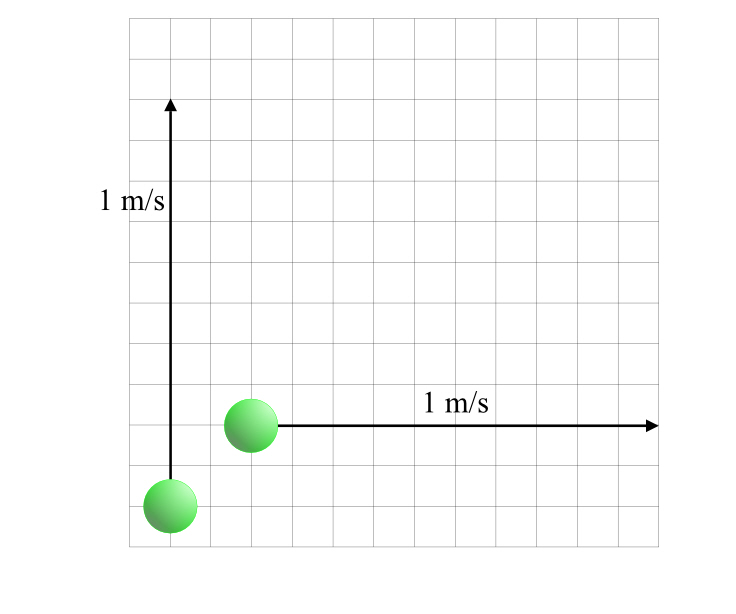
Let’s say the pool table points north-south along its length. A ball is moving directly north at 1 m/s. Another ball is moving directly east at 1 m/s. They have the same speed, but different velocities, because the direction of motion is different.
Figure 2-1 Two balls moving at one meter per second so they have the same speed, but they are moving in different directions so they have different velocities.
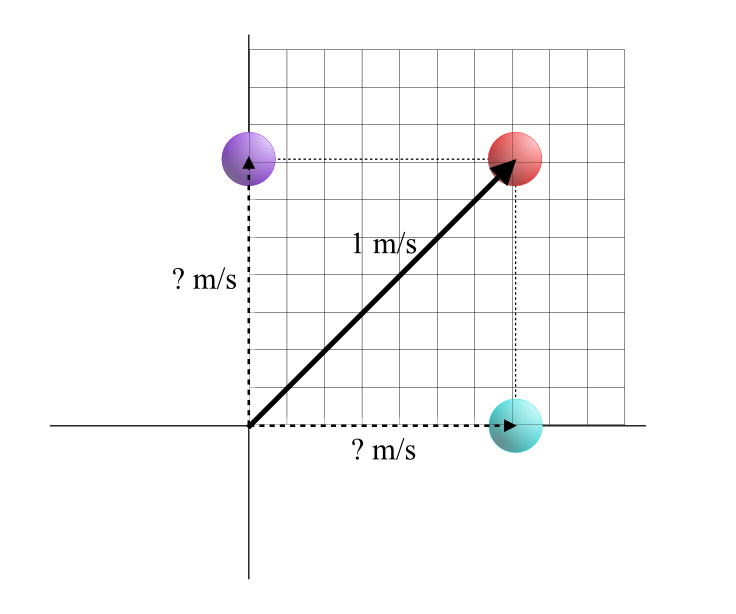
Now let’s consider a different ball, a red one moving at 1 m/s exactly to the north east. If you think about it, that ball is moving north at a certain rate, and at the same time it’s moving east at a certain rate. Or to put it another way, how fast would a ball (let’s make this one pale blue) moving straight east have to move so that it’s always directly south of the diagonally-moving ball? And how fast would a (purple this time) ball moving straight north have to move so that it’s always directly west of the diagonally-moving ball?
Figure 2-2 How fast does the purple ball have to move so it’s always exactly west of the red ball, which is moving diagonally? Similarly, how about the turquoise ball? How fast must it move on the horizontal line to stay exactly south of that red ball?
You can do this visually by drawing a diagram like this, then measuring the vertical and horizontal lines. You should get about .7 the length of the diagonal line. Since that diagonal line is 1 m/s, the horizontal and vertical lines should be .7 m/s. (The exact number is actually 1, divided by the square root of 2. That can be derived from the Pythagorean Theorem. To six places, it’s 0.707107, but you will never be able to measure quite that accurately off a drawing you made on a piece of paper.)
You can do this with any velocity, big or small, in any direction. You can break it down into a north-south component and an east-west component.
So any velocity on the pool table can be expressed with numbers, but by writing two numbers, not one. Our diagonal moving ball has a velocity of [ 0.707 north, 0.707 east ] meters per second.
That pair of numbers is enough to do the job of a speed and a direction.
The Vector
And this is what is called a vector in its mathematical form.
You can also represent a vector by picking a scale (1 inch equals 1 m/sec, for instance), and drawing an arrow with the appropriate length, pointed in the appropriate direction. We’ve already done that. You can’t compute things this way but it sure does help you visualize it. And you can get estimates by measuring off the diagram if you’re careful drawing it.
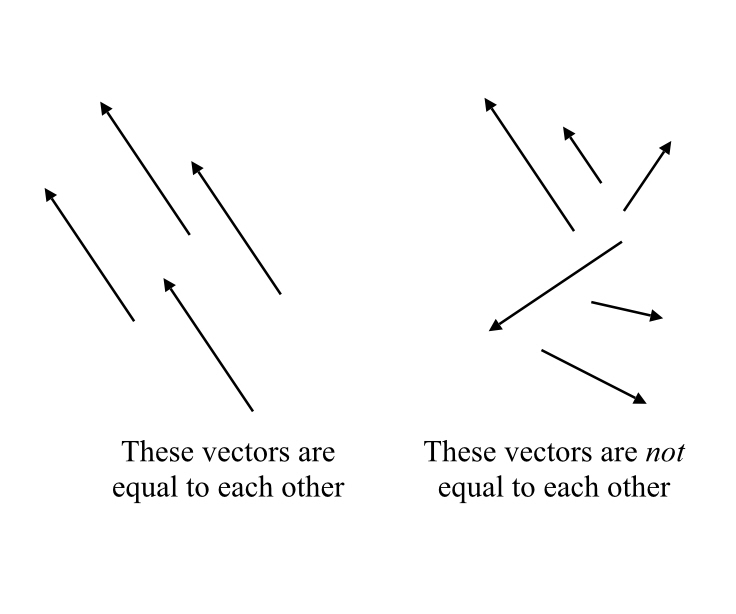
Vectors are considered equal if they have the same length (mathematicians call this the “magnitude” of the vector) and the same direction. There’s no notion built into a vector of “where it starts” and “where it ends.” We can move them around for convenience, especially on those diagrams, just so long as we don’t stretch them or rotate them.
Figure 2-3 Vectors are equal to each other if they have the same length and distance, they are not equal to each other if they are of different lengths (“magnitudes”) even if they’re in the same direction, nor are they equal to each other if they have the same magnitude but different directions.
If you think back to last time, I talked about force, mass and acceleration. F = ma. But it turns out the force is a vector. When you push on something, you’re pushing in a certain direction. Likewise, acceleration is a vector too, you’re speeding up in a certain direction. It’s customary to write vectors in bold face (or if on a blackboard, by drawing a line with a little arrowhead over the letter). So it’s actually F = ma.
Mass was not written in bold, because it takes a single number to express it; it doesn’t have direction. (Weight does. Why?) Such plain-old-number quantities are called scalars in distinction to vectors.
Returning to our current topic, velocity is abbreviated v, bold because it’s a vector. So in our diagonally moving ball example, v = [ 0.707 north, 0.707 east ] m/s.
When you take a vector and express it like this, you’ve broken it down into its north and east components. It actually doesn’t matter which two directions you use, so long as they’re perpendicular, but for now let’s stick with north and east.
Even a total distance moved can be a vector. The total distance is equal to the elapsed time, t, times the speed or velocity (depending on whether you want just the distance, or the distance and direction). d = vt.
What happens when you multiply a vector by a scalar, as shown here? What you do on a diagram, is make the arrow that much longer or shorter. Mathematically, you go to each component of the vector and multiply each one by the scalar. In the case of the diagonal moving ball, you have:
d = 5s [0.707, 0.707]m/s = [3.535, 3.535]m. This is how far the ball has gone, relative to where you first started watching it five seconds before. (And it would go right off the pool table, too, if not for the bumpers. More on that later.)
Mathematicians like to do things as generically as possible. So they will write vectors in terms of x and y, rather than north and south. That means they’re not really wedded to any particular orientation. Remember I said it didn’t matter which directions you used, so long as they were at right angles to each other. For convenience when they draw diagrams, the x direction is to the right, and the y direction is upward, the y axis being 90 degrees counterclockwise from the x axis.
You can do more to vectors than just multiply them by a scalar. They can be added together, provided they’re in the same units. (No fair adding speed to force!) This also means they can be subtracted.
Of course when dealing with pure mathematics (as opposed to mathematics applied to physics), generally units are not a concern. Like in the following example.
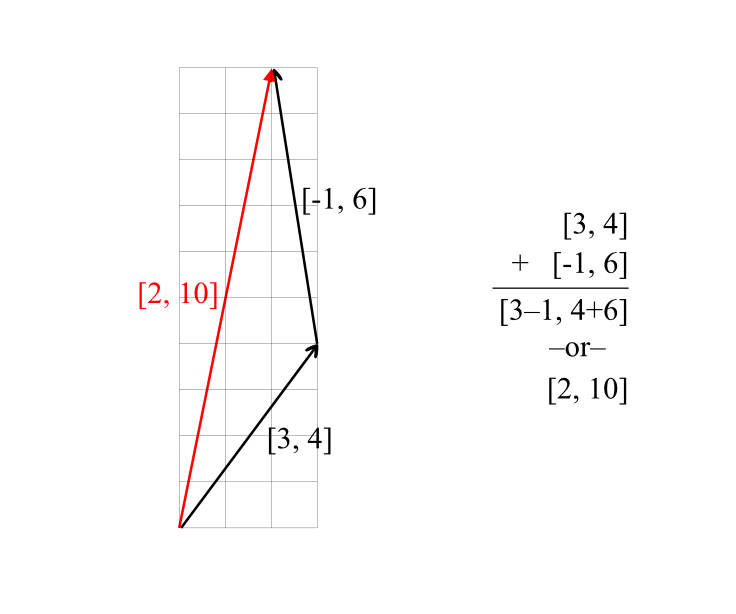
On a diagram, take your first vector, whatever it is, and then put your second vector so that its tail is right at the head of the first vector. Then draw a new vector from the tail of the first vector to the head of the second vector. That’s the sum of the two vectors. Mathematically, you add each individual element. So [ 3, 4 ] + [ -1, 6 ] = [ 3-1, 4+6 ] = [2, 10].
Figure 2-4 Vector addition. The two black vectors add up to the red one; vectors must be placed “head to tail” to add them pictorially.
Conservation of Velocity?
So now let’s go back to the pool table, make the scenario slightly more complicated and see what we can use this whiz-bang vector thing to figure out.
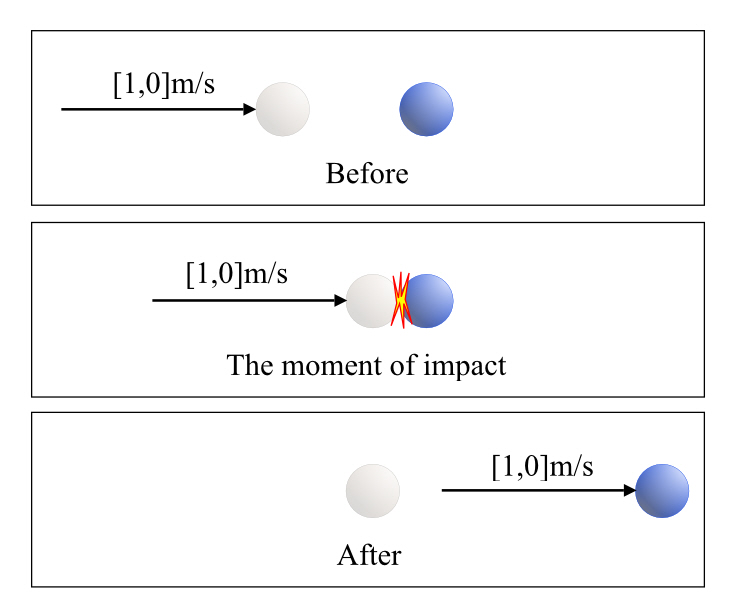
This is pool, after all, balls are supposed to hit other balls. So, if we have a cue ball moving along in the x direction at, say, 1 m/s…or more rigorously [ 1.0, 0.0 ] m/s, and it hits another billiard ball head on, what happens? Well, the cue ball hits the other ball. Then the cue ball stops, and the second ball continues on along the x direction, also at 1 meters per second.
Figure 2-5 Two billiard balls, head on collision between a moving and a standing ball.
It’s as if the velocity transferred from the cue ball to the other ball, perfectly. So, is it possible we’re on the track of another conservation law, conservation of velocity?
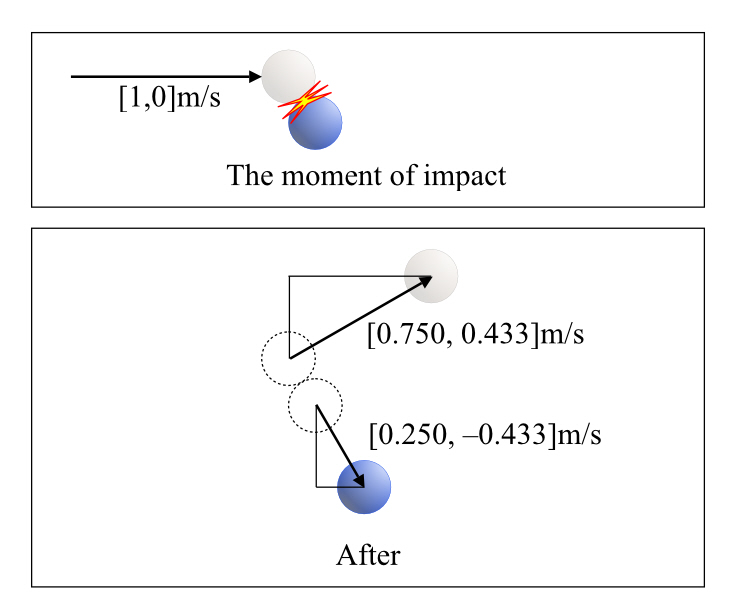
Let’s do a little more investigation. For starters, consider a glancing blow. Let’s have the cue ball moving at 1 m/s in the x direction (ahem) v = [1.0, 0] m/s, and hit the other ball quite a bit off from head on, as shown below.
Figure 2-6 Billiard balls, an off center collision. This time both balls move after the collision.
You’ve seen this happen often enough, you know the cue ball will, in this case, continue moving, up and to the right. And the second ball will move down and to the right. And perhaps one of the two balls moves at a steeper angle than the other. That doesn’t look very much like velocity was conserved, does it? A motion in the x direction turns into two sort-of-diagonal motions?
But actually, when you look at it a bit closer, it looks good. As you can see, we’ve broken the two vectors into their x and y components.
We started with the cue ball moving at [1, 0]m/s, and the other ball (not) moving at [0, 0]m/s. Afterwards, the cue ball is moving at [0.750, 0.433]m/s and the other ball is moving at [0.250, -0.433]m/s.
If velocity is conserved, the sum of the velocities before must equal the sum of the velocities afterwards. These are vectors, and I already told you how to add vectors. So let’s do some addition:
So it does look like velocity is conserved. Yes, here I could have just made up the numbers to make it work out, but the fact of the matter is in real life, these billiard ball examples really do work out like this.
(And, since I did contrive this scenario, the direction of the cue ball is 30 degrees “up” from the x axis, and its speed is 0.866 m/s. The other ball is moving “down” at a 60 degree angle, at a speed of 0.5 m/s. Those who took some trigonometry might remember there’s something special about 30 and 60 degree angles and the square root of 3, divided by 2.)
A pool player will have played so many games of pool that he knows this behavior in his gut; he knows exactly where to hit the other ball with the cue ball to get the angle he wants, to send that other ball into the corner pocket.
But if it’s a conservation law, it has to hold all of the time, not just in billiards scenarios. And this one doesn’t hold all of the time in billiards, much less in the “real world.”
Nope, No Conservation of Velocity
What happens when a ball hits the bumper? If it hits the bumper head on at 1 m/s, it bounces back at 1 m/s, in the opposite direction. In other words, whatever the vector was before, it’s now a vector in the opposite direction. That’s not conservation!! (And the pool player knows this one too, of course.)
Also, not quite within the realm of billiards, what if the balls are of different weights…er, masses? You already know from your own personal life what will happen. Hit a pool ball with a cannonball and the pool ball will go rocketing away, much faster than the cannonball was moving, and the cannon ball will slow down the tiniest but not stop moving. Reverse the process, hitting the cannonball with the cue ball, and it will barely budge, but the cue ball will bounce back the way it came.
If you want to mess with a pool player, randomize the masses of the balls. Because normally all of the balls have exactly the same mass, at least as close as the manufacturer can make it. In real life very few objects have the same masses. As soon as the masses are different the tidy behavior we illustrated above goes right out the window and the player can’t predict what will happen.
So if you do some experimenting, it seems like what might be getting conserved is not velocity, but something that is the product of mass times velocity. You have to add the mass times velocity, before and after, and that will be conserved. A heavy object will move less under the same impetus from some other object, than a light one would. If mass goes up, velocity goes down to compensate, and vice versa.
Momentum
That product of mass times velocity is known as momentum. And it’s a scalar times a vector, so it’s a vector, too. And for some reason, they chose to symbolize it with p. (They didn’t use m because m is mass, but why did they pick p instead of q or u or…?). p = mv. And if m is in kilograms, and velocity is in meters per second, we can define the momentum as being in kilogram meters per second, kg•m/sec. That way we can avoid the use of a fudge factor, since the units are already consistent with each other. There is, unfortunately, no named unit of momentum like there is with force (the Newton), so “kilogram meter per second” it is.
OK, that takes care of the unequal masses behaving oddly, but what about a ball rebounding off one of the bumpers?
Actually, what’s happening there is that the ball is striking a much more massive object–the pool table. And the pool table is firmly fixed to the entire planet, if nothing else by friction.
So the entire Earth, it turns out, is reacting to that ball hitting the bumper, and picking up motion in that direction, but the earth is so massive that the motion is very, very small. In fact, in order to make the ball rebound, the momentum of the ball is changing by twice its prior value. If the mass of the ball is b, and it was moving at 1 m/s in the x direction before, its momentum was [ b, 0 ]kg•m/s before, and afterwards its moving in the opposite direction with a momentum of [ -b, 0 ]kg•m/s. Net change in momentum is [ -2b, 0 ]kg•m/s. The earth has to make up this change by gaining [ 2b, 0] kg•m/s. But the earth’s mass is much, much, much more than b, so the velocity imparted by the ball to the earth is microscopic. If one goes up the other has to come down to compensate.
One could complain that since we can’t measure the earth’s “rebound” in this case, maybe it isn’t rebounding. But the absence of evidence (i.e., the failure to be able to measure it) isn’t the same as the evidence of absence (i.e., evidence the earth doesn’t actually rebound when the ball hits the bumper). If we had a way of measuring the earth’s rebound that was sensitive enough to show what we expect based on theory, and it didn’t show that change, then we’d have evidence that momentum isn’t conserved. But if we know our measuring is inaccurate enough that we can’t see it even if it’s there, then not seeing it doesn’t mean anything, one way or the other.
Conservation of Momentum
Since this is a part of the story of where physics was in 1895, I’ll put it out, here, that as of that time, no exception was known. Every time we could measure things, momentum was conserved. It was considered a solid part of physics.
Because a vector consists of two components, and the addition rules keep the two components separately, you could treat the conservation of momentum as if it were two separate laws, conservation of momentum in the x direction, and conservation of momentum in the y direction. No one actually does this, but from a bookkeeping standpoint it’s definitely twice as much time with the ledger as conservation of mass is.
And, Oh By The Way…vectors can be three dimensional, too! It’s then a triple number, and the new axis is the z axis, perpendicular to both the x and y axes. The three edges of a cube that meet at the corner are a good representation of this.
Rockets and Guns
Now for an application. How does a rocket work? It works entirely through momentum. Let’s say the rocket’s mass is a thousand kilograms (one metric ton or “tonne”), including the fuel it has on board. And let’s furthermore imagine that it’s out in space somewhere.
A rocket engine works by shooting matter–burnt rocket fuel, to be specific–out the nozzle at very high velocity.
So if the rocket burns one kilogram of fuel plus oxidizer, and shoots the combustion product out the nozzle at 4000 m/s, what happens?
Let’s do this in one dimension for simplicity. The direction the rocket is pointed is positive. And we’re moving along with it, so it looks stationary to us. The rocket, including the fuel, has a momentum of zero.
The momentum of the rocket fuel after it has been burned is 1kg • -4000m/sec. (Negative because the rocket is blowing the exhaust out behind it, the nose points in the positive direction, the nozzle points in the negative direction.
If momentum is conserved, the rocket must now also have a momentumm, this time of +4000 kg•m/s. The rocket has a mass of 1000 kg, so that works out to the rocket now moving at 4 m/s in the forward direction.
So if we want another 4 m/s, burn another kilogram of fuel and oxidizer, right?
Good logic, but there’s a complication here. Because the rocket burned 1 kg of its own mass to get to this point, and now it masses 999 kg, So another kilogram of fuel, adding 2000 kg•m/s to the rocket’s momentum, will actually add slighly more than 4 m/s, precisely 4000/999 m/s, in fact.
For that matter, if you think about it, the mass of the rocket was declining while we did that first burn, so we must have gained a tiny bit more than 4 m/s even the first time around.
That’s quite true, actually, and the real formula for how much velocity a rocket gains by burning some amount of fuel is a bit more complex. But the takeaway is that even in following the other formula, the rocket and its burnt fuel are abiding by the conservation of momentum; in fact it relies on it to operate.
(If you’ve ever heard astronauts, or NASA types, talking about “delta vee”, that’s a reference to the total change in velocity given how much fuel is left, or alternatively, they’re talking about the total change in velocity for a specific maneuver, because that will be equivalent to a cost in fuel for that rocket, with its current mass.)
How about firing a gun? It’s sort of the flip side of a rocket. With a rocket the goal is to make the big thing move, and flinging the fuel out as fast as possible is a means to that end. With a gun, the goal is to make the little thing (the bullet) move, and the gun kicking in the opposite direction is the price paid.
Why does the muzzle flip up on a handgun? Shouldn’t it go straight back, instead of up? It would, except that the line of the barrel does not go through the gun’s center of mass, so there’s a bit of torque there, that causes the whole gun to rotate. If you grip it solidly enough, it kicks your arm up too. Tense up your arm and the entire weight of your body resists the torque and you don’t move much. (Torque, by the way, is another concept that beginning physics studies…)
These particular scenarios are also vivid illustrations of Newton’s third law: for every action, there is an equal but opposite reaction.
This is actually just another way of stating the conservation of momentum. And the first person to put forward the observation that momentum seemed to be conserved was John Wallis in 1671. Newton put forward his three laws in 1687.
Vector fun.
OK, here’s another application of stuff we’ve learned today. You have two identical cannonballs. You drop one. (Hopefully not on your foot.) At the same instant, the other is fired out of a cannon, perfectly horizontally. (Hopefully at a deserving target.) Oh, and you do your drop at the same height as the cannon’s muzzle.
If you’re on perfectly flat ground, which cannonball hits the ground first?
They hit at the same time.
Look at it from a vector standpoint. X is the direction the cannon fires. Y is straight up.
The dropped cannonball starts the experiment with v=[0,0]m/s. The fired cannonball, on the other hand, starts out with v=[200, 0]m/s. I just made that x number up; it doesn’t matter what it is as you’ll see in a moment. (Well, you’ll see it if if I did my job right, today.)
The force of gravity imparts an acceleration of –9.8 m/s2 in the y direction, i.e., straight down.
This acceleration can only affect the y component of the velocity vectors, since it’s purely in that direction. And in the y direction, both cannonballs are stationary and in the same place when the experiment starts.
Thus, they both have the same fall, and they will both hit at the same time. It doesn’t matter how fast one of them is moving sideways! And in fact they don’t even need to be the same weight.
I’ve seen demos of this principle done where steel ball bearings are used, in a special little gizmo that drops one the same time a spring shoots the other one out horizontally. You only hear one clack as both balls hit at the same time.
Can’t get the drift.
Last time around, I highlighted what was, in 1895, a standing mystery. Gravitation seemed to work, except they couldn’t figure out what was going on with Mercury’s orbit about the sun. A similar problem with Uranus had led to the discovery of Neptune, so it seemed as if there must be some planet closer to the sun than Mercury, lost in the Sun’s glare, perturbing its orbit. Despite the best efforts of astronomers, that planet (already pre-named Vulcan) had never been found.
This time I’m going to highlight a different little issue.
I mentioned before that velocities were additive, right? A ball thrown by a pitcher on board a moving train ends up moving, relative to the outside observer, faster or slower than the pitcher threw it, by the speed of the train, depending on the direction of the throw.
Can we do this with other things? Sound, for instance, travels at a specific speed (one which varies depending on temperature, humidity, pressure, whether His Fraudulency is on or off his meds, and a host of other factors, but still, a speed that will remain constant until one of these factors changes). Trains have a nice source of sound on them, the whistle (or today the horn). So how fast is the sound travelling in front of the train, and how fast is it travelling behind the train? Measurements from the ground show that they are travelling at the same speed, not different speeds. (They also show that in front of the train the pitch is higher, but that effect is a different rabbit hole. Some other time, perhaps. No, some other time, definitely.) What’s going on here?
It turns out that sound is a wave that travels through a medium, air. It’s going to move at a certain speed relative to the air.
The train is moving, the air is not (unless it’s Wyoming). Thus the sound wave travels the same speed in all direction from the train’s whistle (horn), as seen from someone on the ground on a breezeless day. If some bored passenger on the train were to measure the speed of sound (assuming they’d let him climb around on top of the train in the first place), he’d see the sound move slower, relative to the train, when measured from in front of the whistle, at a normal speed to the side of the whistle, and faster behind the whistle. He could even figure out how fast the train was going by taking the difference between his “in back of” reading and his “in front of” reading and dividing by two. If he were really ignorant of how trains move, he could even prove it wasn’t moving sideways, but rather forward, this way.
Looking at light, we had originally thought it was instantaneous, it was so doggone fast. But then…well, remember Jupiter’s moons from last time? We could predict their motions once we knew Newton’s law of gravitation, actually we could do so from Kepler’s laws of planetary motion, known earlier. (We didn’t even really need to know the mass or distance to Jupiter to be able to do that.) Well, there was one little anomaly. We could predict the motions all right, but the motions were about eight minutes and twenty seconds early when we were closest to Jupiter, and eight minutes and twenty seconds late when we were farthest from Jupiter.
A little thought and someone realized, that the difference was due to the speed of light not being infinite. What we see now going on around Jupiter actually happened at some time in the past, when the light left Jupiter. It then took some amount of time for the light to get here.
The eight minutes and twenty seconds, really in total a 16 minutes and 40 seconds difference, reflect the amount of time it took light to span the entire width of the earth’s orbit about the sun, because it has to cover that much additional distance when we are farther away, versus closer, to Jupiter. (This works out to about a thousand seconds, by the way, a neat coincidence.)
We didn’t know how big the earth’s orbit was, and wouldn’t until the 1760s. Before that we just knew however big it was, light took a thousand seconds to cross it, you could even call it a distance of one thousand light seconds. But once we discovered that the earth’s orbital diameter is roughly 300,000,000 kilometers, we now knew light moved at about 300,000 kilometers per second (186,000 miles per second). This was another product of all that work measuring the solar system that I totally forgot about when writing that article (which is OK, because it fits better here anyway).
Light was, and is, believed to be a wave. So, presumably it goes through a medium, just like sound does. But it must be an otherwise intangible medium, or planet earth would be suffering drag plowing through it. Only light could “feel” that medium. We knew it had to be there, and so we gave it a name: It was the ether.
We might not be able to feel the ether, but we sure as heck ought to be able to measure the Earth’s velocity through it, the same way as the man on the train: by measuring the speed of light in different directions here on Earth.
Measuring the speed of light in a laboratory was difficult to do accurately in the mid 1800s, but we could be much more precise by comparing two different beams of light in two different directions, and seeing what the difference in their speed is.
Michelson and Morley tried this in 1887. They found no difference in the speed of light no matter which way they measured.
Well, it’s possible that at that point in our orbit, we just happened to be stationary with respect to the ether. But that couldn’t be true a couple of months later, because the earth would at the very least be orbiting in a different direction, so they kept trying.
Others have tried too, with much better equipment.
No difference. Ever. No one has ever “got the drift.”
What’s going on here? Well, that, like Vulcan, was a mystery as 1895 dawned.
Obligatory PSAs and Reminders
China is Lower than Whale Shit
Remember Hong Kong!!!
Whoever ends up in the cell next to his, tell him I said “Hi.”
中国是个混蛋 !!! Zhōngguò shì gè hùndàn !!! China is asshoe !!!
China is in the White House
Since Wednesday, January 20 at Noon EST, the bought-and-paid for His Fraudulency Joseph Biden has been in the White House. It’s as good as having China in the Oval Office.
Joe Biden is Asshoe
China is in the White House, because Joe Biden is in the White House, and Joe Biden is identically equal to China. China is Asshoe. Therefore, Joe Biden is Asshoe.
But of course the much more important thing to realize:
Joe Biden Didn’t Win
乔*拜登没赢 !!! Qiáo Bài dēng méi yíng !!! Joe Biden didn’t win !!!
This Stormwatch Monday Open Thread is VERY OPEN – a place for everybody to post whatever they feel they would like to tell the White Hats, and the rest of the MAGA/KAG/KMAG world (with KMAG being a bit of both).
Yes, it’s Monday…again.
But it’s okay! We’ll get through it.
Free Speech is practiced here at the Q Tree. But please keep it civil. We’re on the same side here so let’s not engage in friendly fire.
If you find yourself in a slap fight, we ask that you take it outside to The U Tree…which is also a good place to report any technical difficulties, if you’re unable to report them here.
Please also consider the Important Guidelines, outlined here. Let’s not give the odious Internet Censors a reason to shut down this precious haven that Wolf has created for us.
Please pray for our real President, the one who actually won the election:
For your listening enjoyment, I offer these compositions from Andrés Hernández, titled ‘Divine Assault’ and ‘Wildfire’:
Our beloved country is under Occupation by hostile forces.
We can give in to despair…or we can be defiant and fight back in any way that we can.
Joe Biden didn’t win.
I will keep saying Joe Biden didn’t win until we get His Fraudulency out of our White House.
I think there may be some physics going on here:
Wheatie’s Word of the Day:
scienter
Scienter is a noun which means…full knowledge that one’s actions and statements are illegal, deceptive and unlawful. It also can refer to the Intent to engage in especially criminal conduct. Scienter can also be used as an adverb, which means…knowingly, willfully, deliberately criminal.
Used in a sentence:
Feigning ignorance of their scienter, Democrats count on the enemedia to cover up their guilt while they falsely accuse conservatives of breaking the laws that they themselves have broken.
Joe Biteme, properly styled His Fraudulency, continues to infest the White House, we haven’t heard much from the person who should have been declared the victor, and hopium is still being dispensed even as our military appears to have joined the political establishment in knuckling under to the fraud.
One can hope that all is not as it seems.
I’d love to feast on that crow.
Physics?
Part 1 was last week. I intended to do Part 2 this week, but both of my drafts are an utter mess. I’m going to keep plugging away at it, though, so hopefully next week.
Justice Must Be Done.
The prior election must be acknowledged as fraudulent, and steps must be taken to prosecute the fraudsters and restore integrity to the system.
Nothing else matters at this point. Talking about trying again in 2022 or 2024 is hopeless otherwise. Which is not to say one must never talk about this, but rather that one must account for this in ones planning; if fixing the fraud is not part of the plan, you have no plan.
Lawyer Appeasement Section
OK now for the fine print.
This is the WQTH Daily Thread. You know the drill. There’s no Poltical correctness, but civility is a requirement. There are Important Guidelines, here, with an addendum on 20191110.
We have a new board – called The U Tree – where people can take each other to the woodshed without fear of censorship or moderation.
And remember Wheatie’s Rules:
1. No food fights 2. No running with scissors. 3. If you bring snacks, bring enough for everyone. 4. Zeroth rule of gun safety: Don’t let the government get your guns. 5. Rule one of gun safety: The gun is always loaded. 5a. If you actually want the gun to be loaded, like because you’re checking out a bump in the night, then it’s empty. 6. Rule two of gun safety: Never point the gun at anything you’re not willing to destroy. 7. Rule three: Keep your finger off the trigger until ready to fire. 8. Rule the fourth: Be sure of your target and what is behind it.
(Be advised that if you want to go buy some gold, you will have to pay at least $200 over these spot prices. They represent “paper” gold, not “physical” gold, a lump you can hold in your hand. Incidentally, if you do have a lump of some size, doesn’t it give you a nice warm feeling to heft it?)
Of these, palladium continues its steady climb. In fact, on Thursday it had closed at $3012, above three thousand dollars for at least the second time in the last week.
I did, long, long ago, buy some palladium, not a huge amount. (But I can drop it on my foot. I won’t hurt if I do so, because, like I said, not a huge amount.) I even told the guy I was buying it because it had gone over 900 bucks earlier (which at the time was higher than gold had ever been), maybe it would do so again. He scoffed, and explained that was due to a temporary supply interruption from Russia, unlikely to ever happen again. But now, it’s worth well over ten times what I paid for it. In fairness, I had to hold onto it for over 20 years for it to finally do what I wanted it to do, so this isn’t the short of thing that is a “short term” play.
I knew someone who, about the same time, wanted to find a way to get into rhodium, but back then there was no such thing as a rhodium one ounce bar. I don’t know if he managed to find a way to do it, but if he did, he has done very, very well, even if it took a couple of decades for it to finally move.
Obligatory PSAs and Reminders
China is Lower than Whale Shit
Remember Hong Kong!!!
Whoever ends up in the cell next to his, tell him I said “Hi.”
中国是个混蛋 !!! Zhōngguò shì gè hùndàn !!! China is asshoe !!!
China is in the White House
Since Wednesday, January 20 at Noon EST, the bought-and-paid for His Fraudulency Joseph Biden has been in the White House. It’s as good as having China in the Oval Office.
Joe Biden is Asshoe
China is in the White House, because Joe Biden is in the White House, and Joe Biden is identically equal to China. China is Asshoe. Therefore, Joe Biden is Asshoe.
But of course the much more important thing to realize:
Joe Biden Didn’t Win
乔*拜登没赢 !!! Qiáo Bài dēng méi yíng !!! Joe Biden didn’t win !!!
This Stormwatch Monday Open Thread is VERY OPEN – a place for everybody to post whatever they feel they would like to tell the White Hats, and the rest of the MAGA/KAG/KMAG world (with KMAG being a bit of both).
Yes, it’s Monday…again.
But it’s okay! We’ll get through it.
Free Speech is practiced here at the Q Tree. But please keep it civil. We’re on the same side here so let’s not engage in friendly fire.
If you find yourself in a slap fight, we ask that you take it outside to The U Tree…which is also a good place to report any technical difficulties, if you’re unable to report them here.
Please also consider the Important Guidelines, outlined here. Let’s not give the odious Internet Censors a reason to shut down this precious haven that Wolf has created for us.
Please pray for our real President, the one who actually won the election:
For your listening enjoyment, I offer these compositions from Fearless Soul, titled ‘Let It Go’ and ‘Fake News’:
Our beloved country is under Occupation by hostile forces.
We can give in to despair…or we can be defiant and fight back in any way that we can.
Joe Biden didn’t win.
I will keep saying Joe Biden didn’t win until we get His Fraudulency out of our White House.
This is our physics lesson for today:
Wheatie’s Words of the Day:
altiloquent, altiloquence
Altiloquent is an adjective which means…pompous, pretentious in speech. Altiloquence is a noun which means…lofty speech, pretentious, pompous language.
Used in a sentence:
Attempting to appear intelligent, altiloquent enemedia nozzles often use words that they do not understand…and they are not smart enough to be aware of their altiloquence.
The prior election must be acknowledged as fraudulent, and steps must be taken to prosecute the fraudsters and restore integrity to the system.
Nothing else matters at this point. Talking about trying again in 2022 or 2024 is hopeless otherwise. Which is not to say one must never talk about this, but rather that one must account for this in ones planning; if fixing the fraud is not part of the plan, you have no plan.
Lawyer Appeasement Section
OK now for the fine print.
This is the WQTH Daily Thread. You know the drill. There’s no Poltical correctness, but civility is a requirement. There are Important Guidelines, here, with an addendum on 20191110.
We have a new board – called The U Tree – where people can take each other to the woodshed without fear of censorship or moderation.
And remember Wheatie’s Rules:
1. No food fights 2. No running with scissors. 3. If you bring snacks, bring enough for everyone. 4. Zeroth rule of gun safety: Don’t let the government get your guns. 5. Rule one of gun safety: The gun is always loaded. 5a. If you actually want the gun to be loaded, like because you’re checking out a bump in the night, then it’s empty. 6. Rule two of gun safety: Never point the gun at anything you’re not willing to destroy. 7. Rule three: Keep your finger off the trigger until ready to fire. 8. Rule the fourth: Be sure of your target and what is behind it.
Unfortunately, when looking at the prices only on Friday, you lose some things. It looks like gold has barely moved, but the fact of the matter is, it almost blooped up above $1800 earlier in the week. A far cry from the situation just a few weeks ago when it would drop below $1700 and then popped back up again, two or three times.
To really get a feel for what is going on, you should look at a chart.
The price is moving up and down, but the overall trend is down, imagine a series of sawtooths (sawteeth?). And if you look at the recent rise, it’s still consistent with just being an upward movement in the overall down trend; you can sort of eyeball a straight line through all those peaks, sloping down and to the right, and the price of gold hasn’t broken through that line, not yet it hasn’t. A trader would likely expect it to reverse and drop again.
Palladium on the other hand, is in a slow upward trend, again as seen in a graph for the past year:
Note that it has gone from below $10,000 to almost $30,000 just since last June. Also note at the far right the price is moving up and down, but the height of the oscillations is decreasing. This may be what the technical traders call a “flag,” if so when it reaches its “point” the commodity often breaks out, either up or down, in a big way.
And it probably shows the most stark behavior. Dead flat for months, then suddenly it starts climbing, and climbing, and climbing! That line almost looks like the profile of the Grand Canyon, in fact, complete with the vertical faces and then lines sloping upward to the next vertical face.
Mass (Part I of a Long Series)
Introduction
Having run out of precious metals to babble about, I’m going to change tacks. If you’ve been here a while, you might remember two postings I did on stars. These were independent posts, having nothing to do with politics (poly = many, ticks = blood sucking bugs) and at least some people enjoyed them. I wanted to go to the opposite end of the scale and talk about a certain sub-atomic particle, but then I realized that the best way to do that would be a very, very, very long post. (And yes, it’s a subatomic particle, but it has a lot to do with stars.) A huge part of it would be explaining where physics stood in 1895, and how four discoveries in the next four years basically overturned things, and eventually led to that subatomic particle, the real star (ahem) of the whole series.
So I decided to break this story up into pieces. And this is the first of those pieces.
And here is the caveat: I will be explaining, at first, what the scientific consensus was in 1895. So much of what I have to say is out of date, and I know it…but going past it would be a spoiler. So I’d appreciate not being “corrected” in the comments when I say things like “mass is conserved.” I know that that isn’t considered true any more, but the point is in 1895 we didn’t know that. I will get there in due time. (On the other hand, if I do misrepresent the state of understanding as it was in 1895, I do want to know it.)
Also, to avoid getting bogged down in Spockian numbers specified to nine decimal places, I’m going to round a lot of things off. I use 9.8, below, for a number that’s actually closer to 9.80665, for instance, similarly for the number 32.
OK so without further ado, mass.
What Mass Is, and Isn’t
Mass is not the same thing as weight, at least not when scientists are using the terms.
But the distinction between mass and weight didn’t become clear until Isaac Newton came along. He tried to imagine what objects would behave like if there were no gravity, and no friction. And he realized that an object under those circumstances would stay at rest unless a force acted on it, or, if were already moving, would continue to move in the same direction at the same speed, unless a force acted on it. It has inertia. But that doesn’t match what we actually see. You let go of an object that’s not on the ground, it falls (or if it’s a balloon, it might rise). An object that’s moving on a flat surface slows down and stops.
But the reason why we see things fall faster and faster, is that gravity exerts a force on them, a downward force, and the reason things moving horizontally slow down is friction, and that, too is a force.
For clarity, we have to ignore friction. Imagine these objects are wet ice on a hockey rink–or cars sliding on ice (yikes!). Or air hockey pucks. There’s still some friction in all of these cases, but not a whole lot. You can imagine, after watching these sorts of things, what it would be like with no friction.
Largely building upon what Galileo discovered (when he wasn’t looking through a telescope), Newton essentially defined the concept of inertia. It’s basically the resistance of an object to being shoved. And mass is essentially a measure of that. If object A is twice as massive as object B, it’s twice as hard to shove around and get the same effect. You need to exert twice as much force.
On the other hand, if you stick with the same object, and apply twice as much force, it reacts twice as much.
You can state this a little more precisely as, acceleration, a, is proportional to the force, F, and inversely proportional to the mass, m. You can increase or decrease any of the three items, decrease or increase one of the other two, and you will see the third item increase or decrease exactly in proportion.
Or to be even more concise, you can write the following:
a ∝ F/m.
That little Jesus fish like thing means “is proportional to” and basically, it means that if you double one side, you double the other side, but they’re not equal.
You can rearrange to get:
F ∝ ma.
And this is the form you usually see this in, it’s Newton’s second law of motion. Well almost. There’s something we can do to get rid of that Jesus fishy thing and replace it with an equals sign. More on that shortly.
Mass is considered to be the ultimate measure of “how much matter” is in an object. Twice as much matter, will have twice as much inertia. And some object, say one of the big weights off of a weightlifting set, will have the same inertia even on the moon.
But the weight of the objects will change on the Moon, because weight is actually force. And the Moon’s gravity will pull on the same objects, with less force than on Earth.
The kilogram is actually a unit of mass. A chunk of metal massing a kilogram (think of it as a one kilogram gold bar if that will put a smile on your face) will still mass a kilogram on the moon, pick it up and swing it around, you will feel the same tugs as you would feel on earth, because now you are playing with its inertia, which doesn’t change–it will take the same force to keep the bar from flying out of your hand as it did on Earth.
But pounds are (usually) a unit of force. That kilogram of gold will weigh about 2.2 pounds here on Earth. That means that the earth’s gravity pulls on it with that amount of force. But take it to the moon, and it weighs about 5.9 ounces, that’s how much force the moon exerts on that one kilogram mass.
[Or–let’s be frank here–for me, and for most of you, it weighs exactly zero both on Earth and the Moon because your kilogram bar of gold doesn’t exist at all except in your dreams. Oh, OK, never mind, forget I said this and return to smiling.]
The one force we can’t get away from in our daily is gravity, and as such in the English system a lot of things are defined with respect to the amount of gravity Earth has. But when you’re doing engineering you have to deal with a lot of forces–the force exerted by a pile driver, the thrust of a jet engine, and so on. So you need a unit of force and a unit of mass, so you can figure out how much your masses will respond to your forces, or alternatively, how much force you’ll have to exert to make that mass move the way you want it to.
The metric system, which starts with unit of mass, has to derive a unit of force, and the English system which starts with a unit of force, has to derive a unit of mass. Metric invented a unit of force called the Newton–the amount of force needed to accelerate a kilogram, one meter per second, for every second it’s applied, and yes, it’s named after Sir Isaac. And the English system retro-invented the slug–it’s the amount of mass that, when acted upon by one pound of force, will accelerate one foot per second, every second.
Once you’ve defined your units, you can change that proportionality constant to an equals sign. But you may need a fudge factor, which I will call k. F = kma. (And yes, Biden can kma.) In metric, as long as you stick to meters, kilograms, and meters per second squared, the fudge factor is 1. The Newton was deliberately defined that way. And in the English system, as long as you stick to feet, slugs, and feet per second squared, the fudge factor is also 1. 1 will disappear if it’s in an algebraic multiplication, so now we’re dealing with
F = ma
Drop a kilogram of gold–it will accelerate at 9.8 meters per second per second, a = 9.8, and m is one. Plug it into the formula above. That means it’s being acted on by a force of 9.8 newtons.
Galileo showed that heaver objects fall at exactly the same rate as lighter ones (once you account for air resistance, which is a force and partially cancels out gravity). So a two kilogram mass of gold, falling at the same rate, which we call g, gives you F = 2 x 9.8 = 19.6 Newtons.
Switch to the English system now. Drop a pound of something else–bananas, say–it will accelerate at 32 feet per second, every second. (That’s the English equivalent of 9.8 meters per second per second…we’re just using a different measuring stick.) But this time we have a weight, not a mass, F, and we have a and are looking for m, so we need to do a bit of beginner’s algebra and come up with:
m = F/a
But this time F is 1 pound, and a is 32 feet per second squared. So our mass is 1/32. And indeed, if our answer is supposed to be in slugs, that’s the right answer. A slug, as it turns out, weighs 32 pounds here on earth, and 1/32 of a slug weighs one pound.
Engineers find it so useful to have a unit of mass, the ones working in the English system (poor sods) actually invented a “pound mass,” the mass of something that weighs a pound here on earth. But when they use the “pound mass” in their formulas they have to put a fudge factor of 32 in. With mass in pound mass, the formula becomes
m = 32 F/a
Or rearranging to the usual form
F = ma / 32
A pound mass will respond to a force 32 times as much as a slug would to the same force, as you can see when you solve for the acceleration (response), a = 32 Fm. Failure to properly account for this has doomed more than one rocket. Metric is cleaner, a kilogram is mass, and only mass.
I got my STEM education entirely in metric, that’s what I’m comfortable with, that’s what I’m going to use from here on out.
OK, so mass and weight are different. How do you measure them? If they are different things, you need different methods to measure them.
A force can be measured with a spring. Your typical bathroom scale, or your kitchen scale, will have a spring inside; the amount the spring is compressed by the stuff you put on the scale is a measure of the force exerted on the spring. Drag your kilogram of gold to the moon and bring your scale with it, it will push on the spring less and therefore weigh less.
A mass is best measured by a balance scale. Your doctor’s scale, for instance, is a balance scale. Take it to the moon, and if it read 100 kg on earth, it will read 100 kg on the moon.
But it’s probably marked off in pounds. If you weighed a hundred pounds on earth…that scale will read 100 pounds on the moon. It’s actually measuring your mass but is calibrated in pounds actually pounds mass. So it only looks like it’s measuring your weight.
A kilogram (mass) weighs 2.2 pounds on earth, the object that exerts a force of 2.2 pounds on earth, has a mass of one kilogram. That 2.2 will change on every different planet, however, since most of us never leave earth, we simply think of a kilogram as equaling or being the same as 2.2 pounds, when it really isn’t. It isn’t the same thing, any more than a gallon is the same as 8.33 pounds. (It weighs that much if it’s water and we’re on earth, but that doesn’t make a gallon the same thing as 8.33 pounds in any fundamental sense.)
With me still? I hope so.
Conservation of Mass
OK, I’ve shown you Newton’s Second Law by way of introducing you to the distinction between weight and mass. It’s called a “Law” not because some politician decreed it, but because the universe works this way.
F = ma
Always.
And when you have to use a fudge factor, the fudge factor is a constant. It’s a constant 1 in the case of metric and English slugs.
One could ask what would happen if the fudge factor were to change, and the answer is a bit surprising. Since the Newton is defined as being the force necessary to accelerate a kilogram at one meter per second per second, if it suddenly, tomorrow, took twice as much force to do that, the Newton would simply get twice as big.
Since it’s awkward having your units of measure change (for exactly the same reason that inflation sucks), the fact that scientists set things up that way should be evidence enough that they are sure the fudge factor never changes.
How do we know that? It is an induction, not a deduction. It has always been true, we assume it’s just the way the universe works, until we find an exception, and believe me, people are always looking for the exception. And also for just outright blatant violation of the rule; such as objects suddenly and inexplicably changing their velocity. That would be an a without an F, or perhaps the m taking a vacation and reducing to almost nothing momentarily.
Our whole view of the universe wouldn’t make sense if Newton’s second law weren’t true. Car collisions on icy roads, air hockey…if someone made an animated movie where this rule were blatantly violated, it would look fake to us. Of course if the movie were almost spot on, with maybe the fudge factor changing by 1 percent at random, we’d have a hard time seeing it, but this has been measured in laboratories, and it’s always true. And the fudge factor doesn’t change.
One other thing turns out to be true, at least as of 1895. Mass never disappears into nothing, and it never appears from nowhere, either.
Sure, the mass of an object can change. It could decrease. But that mass always goes somewhere else, it never gets destroyed. Or similarly, if the mass of an object increases, that mass came from somewhere else.
This is one of those realizations that turned science into a form of bookkeeping. The books have to balance, the mass in has to equal the mass out.
Set a two kilogram log on fire. Weigh the ashes afterwards, they mass out to maybe 600 grams. Did the other 1400 grams just disappear? Nope. It can’t, it’s not allowed to. So that tells the scientists they didn’t account for something. In this case, they didn’t capture and weigh the smoke and the carbon dioxide given off by the burning log (whilst upsetting leftists). So if you add that in, are you okay?
Nope, because now the mass after is more than the mass before. That’s not allowed either; you can go back to the bench and re-run the experiment.
This time, count not just the wood, but also the oxygen used to burn the wood.
Once you do that, your mass before matches your mass after. Life is good.
The books balance.
And this was another thing that (as of 1895) was considered to be always true. Every time it had been tested, it was true. And a test isn’t just an explicit lab exercise like I just described, but literally everything done in a lab implicitly follows this rule.
In this case simple arithmetic is enough to do the bookkeeping. And nothing of negative mass has ever been seen, so you will see addition and subtraction, but never a negative result. Real accountants would find this dead easy. The trick, of course, is to account for everything, and measure carefully.
Gravity
There is one other thing about mass, though, that was (and still is) an important feature of the universe. And that is gravitation. I’ve mostly talked about gravity as something that exerts a force on a mass, so far, but I’ve not mentioned yet that mass actually exerts gravity. Every mass, exerts a force on every other mass. If you double the mass of the object, it exerts twice as much force. If you double the distance between the objects, however, you divide the force by 4. This is the square of the distance, and you’re dividing by it, so it’s called an inverse square relation. But one more thing. If you double the mass of the other object, the force you exert on it doubles too, and it responds with the same acceleration.
You are exerting a tiny gravitational force on the Andromeda galaxy. And vice versa. In fact, it’s the same amount of force in both directions.
The law of gravitation was also first noted by Sir Isaac Newton.
You can write this law as follows, at least as a first cut.
F = m1m2 / d 2
Multiply your masses together, divide by the square of the distances, and you get F.
Except, no you can’t. Meters, kilograms, seconds, and Newtons go together with F=ma, but they don’t go together in this equation. Two masses 1 kilogram each, at one meter’s distance? That equation says the force should be one Newton. It’s not. It’s a lot less. You need to plug in a fudge factor, and this one is named G. The law of gravitation properly reads
F = Gm1m2 / d 2
And G is a very small number, because in Newton’s day you couldn’t even measure what F was. Without being able to measure F, we couldn’t figure out what G was. And for any scenario where we could measure F, we either couldn’t measure one of the masses, or d, or both. Either way, G was unmeasurable.
But even without that, Newton could see the law was good, because he could check the responses of things to earth’s gravity. An apple, and the moon.
To start this out, in fact, let’s assume we want to measure the acceleration, not the force. Both sides of the equation above are a force, dividing by the mass of one of the objects, the one we want to watch, gives:
a = Gm2 / d 2
And you can substitute mass of the earth, me, for m2. So the acceleration of, say, an apple dropped, is:
a = Gme / d 2
And if you’re standing on the surface of the earth, d is the radius of the earth. (You can treat the earth as if its entire mass were at the center, so long as it’s radially symmetrical (which it almost is). That’s one of many things Newton proved. He had to invent calculus to do that.)
In this particular case, we knew a, and we knew d, but we knew neither G or me. But we knew what their product had to be! This is called the earth’s gravitational parameter, and is usually written μe. (Greek letter mu, usually pronounced as “mew” in English, though logically it should be “moo.”) This is very handy, in fact, it’s so handy that even today people who work with orbital motion just use gravitational parameters; it saves them the bother of multiplying the same numbers over and over again.
a = μe / d 2
Newton had pretty good information on how far away the moon was. He could compute how much it was accelerating as it orbits the earth (always downward, as if it were on a string being whirled around the earth), and his equation and the data matched. The moon responded to Earth’s gravitation exactly the same way as the apple did. This was the first time we had ever shown that something “up there” follows the same physical laws as something“down here.” And that’s why it’s called the universal law of gravitation.
So Newton knew the earth’s gravitational parameter, and the distance to the moon was known before his time. But what about the rest of the solar system? Well, life was rough for astronomers working out the solar system back then. Because we didn’t know the actual distance between the sun and any of the planets, nor between other planets and their moons. We did know the relative distances; we knew, for instance that Jupiter’s distance to the sun was 5.2 times that of Earth’s. Kepler had figured that out in the late 1500s. We could also see that the inverse square law worked: The acceleration Jupiter experienced was about 1/27th that of earth, though we couldn’t tell what it was because we didn’t know the scale. Newton, in fact, showed mathematically that any inverse square force will cause things to orbit in ellipses, thereby vindicating and strengthening Kepler, and using Kepler as evidence that an inverse square law was involved.
Measuring the Solar System, Massing the Earth
So astronomers didn’t know the gravitational parameter of the sun, much less G and the mass of the sun. And they didn’t know d, in this context the distance from anything to the sun, much less the earth-sun difference (but they named it: It’s an astronomical unit, and is still called that to this day). But if they could figure out what d was for Earth, they’d know it for everything else in the solar system, because we knew the proportions. And if they knew d, they could figure out the Sun’s gravitational parameter, because you can figure out the acceleration directly from d and the length of the year.
Astronomers got the first intimations of d when we were able to triangulate on Venus as it crossed between earth and the Sun, in 1761 and 1769. We could plot its motion and position on the sun’s disk from multiple places on earth, see how different it was, and determine how far away it was, just like when you move your head from side to side, a near object will move against the horizon more than a distant one will. If you measure that apparent shift, and know how much you moved your head, you can compute how far away it is. Multiple parties went to different places on earth, just to measure these transits, the more measurements the better. It was one of the first major examples of international scientific cooperation.
Similarly we now had a good number for the distance to Venus, and because we knew the proportions of the solar system, we instantly had the distance from earth to the sun. We therefore knew a, and…now we had the gravitational parameter of the sun, because it was equal to a times d 2.
The gravitational parameter of the sun is 333,000 times the amount of the gravitational parameter of the earth. Since both numbers are G times the mass, you can see that the sun’s mass, whatever it is, must be 333,000 times that of Earth. Whatever that is. We still didn’t know.
But even better. We now knew the exact distance to Jupiter. And we could therefore watch how far the moons of Jupiter got from it in the night sky, do a quick calculation and get their orbit sizes…and now we could figure out the gravitational parameter of Jupiter! It is 317.8 times that of the earth, so its mass is also 317.8 times ours (again, whatever that is). Saturn has moons, and we could do the same thing for it. Mars has moons too, but they hadn’t been discovered yet.
Then in 1781 the planet Uranus was discovered. And in 1787, two moons were discovered. Shazaam! We knew how many earth masses Uranus was, and six years earlier we hadn’t even known Uranus existed. And we eventually figured it out for Mars, when we finally did discover its moons a century later.
But Venus and Mercury don’t have moons, and we could only make educated guess at their masses…until the 1960s and 1970s when we sent probes to them and could see how they interacted with those planets.
One last piece of the puzzle. Henry Cavendish (1731–1810) was actually able to measure the force of gravity between two heavy lead balls in his laboratory in 1798. This was painstaking work, but he now had a situation where he knew every term in the law of gravity except for G; he had the force, the distance, and the masses. So from that he was able to compute the value of G, and (in metric) it is: 6.67 x 10⁻¹¹.
Now that we had that number, we could go back to every gravitational parameter we knew, divide by G and get the masses.
Now we knew the mass of the Earth. It’s 5.972×1024 kilograms. And everything else proportionately.
We did this, but we did not have to go “out there” and weigh anything.
Problems with the Law of Gravitation?
The law of gravitation worked really, really well. We never saw anything inconsistent with it…well, almost!
When we tracked Uranus in its orbit about the sun, it was clear it was not following the law, not quite. Was something wrong with the law of gravitation? The law was so useful everywhere else, and I mean everywhere else, that it would make no sense for it to be broken here, so instead of assuming the law was broken, we figured that there was something unknown out there, pulling on Uranus. It was complicated work, but Le Verrier in France and John Couch Adams in England both did the calculations in 1845, and when they told Galle, another astronomer, one who used a telescope rather than being a theorist, where to look…well, Galle found the planet Neptune almost immediately.
Far from it being a problem for the theory of gravitation, the discrepancy with Uranus’ orbital motion turned into a triumph, for the theory of gravity had been used to discover a planet, and had predicted it so well that it took someone who knew where to look less than an hour to find it.
That gives you a really strong feeling that this is the truth!
But I mentioned two problems. What was the other one?
The other was the orbit of Mercury. It’s an elliptical orbit, and if Mercury and the Sun were alone in the universe, that ellipse would never, ever move. But it does move, the long axis shifts 574 arc seconds every century. And of course Mercury and the Sun aren’t alone in the universe. So what we should be able to see is that the planets–and the sun’s slight oblateness–explain Mercury’s orbit precessing.
But when you add up all those effects, there’s still a discrepancy. They don’t add up. There’s still 43 arcsecond per century left over. And this bothered scientists.
But really, this probably isn’t a problem. We know what the answer has to be. There’s an unknown planet pulling on Mercury, one so close to the sun we just couldn’t see it in all the glare. The same Le Verrier that predicted Neptune predicted this planet. We even gave it a name, Vulcan; a perfect name because he was the Roman god of the forge and it gets hot near forges and near the Sun. But despite what you may have heard, scientists usually want to square things away, they want to see that planet, then they’ll be confident they know why Mercury is misbehaving.
But Vulcan was never found, and in 1895, it remained an open question. They expected to find it, they just hadn’t, yet. In truth, it really would be hard to see something like that; it can only be done during solar eclipses.
Conclusion
Well, this turned out to be pretty long. And maybe hard to follow (I hope not). But as I wrote it I realized how much “hung off” the concept of mass, and the law of gravitation, and how much we were able to learn about the solar system and our own Earth, each bit of knowledge building on the prior, with theory used as a framework. And you saw some limitations…we could only estimate the mass of bodies with no moons. This wasn’t even where I wanted to go with this, but it was too good to pass up. (Next week we continue towards our final destination.)
But hopefully you saw some notion of how science is supposed to function. It’s full of humans with their own foibles, of course, but in the end the truth does out. It’s nice when you can use a theory to predict something unexpected; it gives you a very warm fuzzy sense that the theory is correct. But at the same time, there are implicit assumptions; that the generalizations we see will continue to hold true. Sometimes we discover otherwise, and have to adjust; usually when that happens it turns out that the generalization was true under certain circumstances and is still useful, under those circumstances, but that you have to scrap it under others. (At the risk of a spoiler, you’ll see that Newtonian gravity is one of those cases.)
And in so many cases, if we seem to see far, it is because we stand on the shoulders of giants, the men who preceded us, and they stand on the shoulders of the men who preceded them. None of this could happen if we weren’t willing to use information gathered by others and build on it, and in turn that’s a testament to the power of being able to write things down so that knowledge outlives us.
Obligatory PSAs and Reminders
China is Lower than Whale Shit
Remember Hong Kong!!!
Whoever ends up in the cell next to his, tell him I said “Hi.”
中国是个混蛋 !!! Zhōngguò shì gè hùndàn !!! China is asshoe !!!
China is in the White House
Since Wednesday, January 20 at Noon EST, the bought-and-paid for His Fraudulency Joseph Biden has been in the White House. It’s as good as having China in the Oval Office.
Joe Biden is Asshoe
China is in the White House, because Joe Biden is in the White House, and Joe Biden is identically equal to China. China is Asshoe. Therefore, Joe Biden is Asshoe.
But of course the much more important thing to realize:
Joe Biden Didn’t Win
乔*拜登没赢 !!! Qiáo Bài dēng méi yíng !!! Joe Biden didn’t win !!!
This Stormwatch Monday Open Thread is VERY OPEN – a place for everybody to post whatever they feel they would like to tell the White Hats, and the rest of the MAGA/KAG/KMAG world (with KMAG being a bit of both).
Yes, it’s Monday…again.
But it’s okay! We’ll get through it.
Free Speech is practiced here at the Q Tree. But please keep it civil. We’re on the same side here so let’s not engage in friendly fire.
If you find yourself in a slap fight, we ask that you take it outside to The U Tree…which is also a good place to report any technical difficulties, if you’re unable to report them here.
Please also consider the Important Guidelines, outlined here. Let’s not give the odious Internet Censors a reason to shut down this precious haven that Wolf has created for us.
Please pray for our real President, the one who actually won the election:
For your listening enjoyment, I offer this composition from Piotr Wójtowicz, titled ‘Wiktoria’:
Our beloved country is under Occupation by hostile forces.
We can give in to despair…or we can be defiant and fight back in any way that we can.
They can send their robots…but we will outsmart them.
Joe Biden didn’t win.
I will keep saying Joe Biden didn’t win until we get His Fraudulency out of our White House.
Wheatie’s Words of the Day:
appetence, appetency
Appetence is a noun which means…a strong desire or craving; a hankering for something. Appetency is also a noun, which means…an instinctive inclination or propensity to perform certain actions.
Used in a sentence.
Having an appetence for power, Democrats have no shame in cheating and stealing to obtain it, and once obtained they cannot resist their appetency for abusing it.
This Stormwatch Monday Open Thread is VERY OPEN – a place for everybody to post whatever they feel they would like to tell the White Hats, and the rest of the MAGA/KAG/KMAG world (with KMAG being a bit of both).
Yes, it’s Monday…again.
But it’s okay! We’ll get through it.
Free Speech is practiced here at the Q Tree. But please keep it civil. We’re on the same side here so let’s not engage in friendly fire.
If you find yourself in a slap fight, we ask that you take it outside to The U Tree…which is also a good place to report any technical difficulties, if you’re unable to report them here.
Please also consider the Important Guidelines, outlined here. Let’s not give the odious Internet Censors a reason to shut down this precious haven that Wolf has created for us.
Please pray for our real President, the one who actually won the election:
For your listening enjoyment, I offer this composition from David Eman, titled ‘Resolute’:
Our beloved country is under Occupation by hostile forces.
We can give in to despair…or we can be defiant and fight back in any way that we can.
Find something Commie and break it.
Joe Biden didn’t win.
I will keep saying Joe Biden didn’t win until we get His Fraudulency out of our White House.
Wheatie’s Word of the Day:
inimical
Inimical is an adjective which means…unfriendly, hostile, antagonistic, hurtful. Having the disposition or temper of an enemy.
Used in a sentence:
After showing the Democrats that their policy was rubbish, their inimical expressions told him it was time to leave.
This Stormwatch Monday Open Thread is VERY OPEN – a place for everybody to post whatever they feel they would like to tell the White Hats, and the rest of the MAGA/KAG/KMAG world (with KMAG being a bit of both).
Yes, it’s Monday…again.
But it’s okay! We’ll get through it.
Free Speech is practiced here at the Q Tree. But please keep it civil. We’re on the same side here so let’s not engage in friendly fire.
If you find yourself in a slap fight, we ask that you take it outside to The U Tree…which is also a good place to report any technical difficulties, if you’re unable to report them here.
Please also consider the Important Guidelines, outlined here. Let’s not give the odious Internet Censors a reason to shut down this precious haven that Wolf has created for us.
Please pray for our real President, the one who actually won the election:
For your listening enjoyment, I offer this composition from Dan Thiessen, titled ‘There Will Be Generations Because Of You’:
Our beloved country is under Occupation by hostile forces.
We can give in to despair…or we can be defiant and fight back in any way that we can.
Joe Biden didn’t win.
I will keep saying Joe Biden didn’t win until we get His Fraudulency out of our White House.
Wheatie’s Words of the Day:
calumniate/calumny
Calumniate is a transitive verb that means…to knowingly make maliciously false statements about someone; to smear or besmirch. Calumny is a noun which means…a false and malicious statement designed to injure the reputation of someone or something; a false accusation; a defamatory report; slander.
Used in a sentence:
Many leftists try to calumniate and destroy everyone whose opinions differ from theirs.