“We do not believe any group of men adequate enough or wise enough to operate without scrutiny or without criticism. We know that the only way to avoid error is to detect it, that the only way to detect it is to be free to inquire. We know that in secrecy error undetected will flourish and subvert.” –J. Robert Oppenheimer
This Stormwatch Monday Open Thread is VERY OPEN – a place for everybody to post whatever they feel they would like to tell the White Hats, and the rest of the MAGA/KAG/KMAG world (with KMAG being a bit of both).
Yes, it’s Monday…again.
But it’s okay! We’ll make our way through it.
When surrounded by sheep…the trick is to distract them and they will follow each other, out of your way:
Free Speech is practiced here at the Q Tree. But please keep it civil. We’re on the same side here so let’s not engage in friendly fire.
If you find yourself in a slap fight, we ask that you take it outside to The U Tree…which is also a good place to report any technical difficulties, if you’re unable to report them here.
Please also consider the Important Guidelines, outlined here. Let’s not give the odious Internet Censors a reason to shut down this precious haven that Wolf has created for us.
Please pray for our real President, the one who actually won the election:
For your listening enjoyment, I offer Fox Sailor’s new album, titled ‘Myths & Legends’:
Our beloved country is under Occupation by hostile forces.
We can give in to despair…or we can be defiant and fight back in any way that we can.
Joe Biden didn’t win.
I will keep saying Joe Biden didn’t win until we get His Fraudulency out of our White House.
Wheatie’s Word of the Day:
clint
In geology, clint is a noun which refers to the relatively flat part of a limestone pavement between the grikes, which are the weathered crevices between the clints.
The entire formation is called a ‘karren’.
Clint is also used as a name, for example, our favorite craggy conservative cowboy, Clint Eastwood:
Used in a sentence:
If you decide to go dancing on a karren, be sure to keep to the clints, lest you may sink your foot into a grike.
Joe Biteme, properly styled His Fraudulency, continues to infest the White House, and hopium is still being dispensed even as our military appears to have joined the political establishment in knuckling under to the fraud.
All realistic hope lies in the audits, and perhaps the Lindell lawsuit (that will depend on how honestly the system responds to the suit).
One can hope that all is not as it seems.
I’d love to feast on that crow.
The Lindell Reports
It sounds worse that most of us imagined. And we have good evidence (if placed before a judge who understands probability, combinatorics, and statistics (three closely-connected branches of mathematics).
The question is, now that we have this, what’s next?
Can we get more states to do forensic audits? It will be tougher in states where the auditors themselves ended up in their positions of authority through cheating!
Even if not, it’s good to go into whatever comes next with the certitude that we were and are right about…
Joe Biden Didn’t Win. And neither did Hoe, and neither did half the craptastic Dems out there. RINOs might have won the general because at that point voters had a choice between a definite Dem and a maybe-not-as-bad “Republican.” But how many got in due to a corrupted primary?
We have to do our best to force this to stick and force “them” to pay attention to it!
Justice Must Be Done.
The prior election must be acknowledged as fraudulent, and steps must be taken to prosecute the fraudsters and restore integrity to the system.
Nothing else matters at this point. Talking about trying again in 2022 or 2024 is hopeless otherwise. Which is not to say one must never talk about this, but rather that one must account for this in ones planning; if fixing the fraud is not part of the plan, you have no plan.
Lawyer Appeasement Section
OK now for the fine print.
This is the WQTH Daily Thread. You know the drill. There’s no Poltical correctness, but civility is a requirement. There are Important Guidelines, here, with an addendum on 20191110.
We have a new board – called The U Tree – where people can take each other to the woodshed without fear of censorship or moderation.
And remember Wheatie’s Rules:
1. No food fights 2. No running with scissors. 3. If you bring snacks, bring enough for everyone. 4. Zeroth rule of gun safety: Don’t let the government get your guns. 5. Rule one of gun safety: The gun is always loaded. 5a. If you actually want the gun to be loaded, like because you’re checking out a bump in the night, then it’s empty. 6. Rule two of gun safety: Never point the gun at anything you’re not willing to destroy. 7. Rule three: Keep your finger off the trigger until ready to fire. 8. Rule the fourth: Be sure of your target and what is behind it.
This might be a good time to buy silver. On the other hand it could drop even m0re.
Electrons Get Quanta
If you’ll recall, last time I mentioned that in 1911 van den Broek suggested that an atom’s place in the periodic table depended on the positive charge of the nucleus; when that charge was expressed as a positive-signed multiple of e, you had a simple integer number which is that atom’s atomic number. I then said it was merely an idea for about two years, and then I left you hanging.
I’m going to pick up that thread, but I’m going to do it my way: I’m going to back up a bit and follow another thread to that same place.
As of 1900, chemists were pretty sure they were missing eight elements on the periodic table. Because they didn’t know how many lanthanides (“rare earths”) actually existed (some guesses ran as high as 25) and simply had no idea what was going on there, they didn’t know how many they were missing. (We now know that lanthanum through lutetium is fifteen elements inclusive; chemists back then knew twelve in that range, and suspected there were more.)
Remember in 1900 they didn’t know about atomic number. They did have the periodic table, and it had holes in it that were clearly missing elements, but the lanthanides didn’t seem to fit into that scheme at all so they were a big question mark.
In 1901, europium–a lanthanide whose atomic weight was between samarium and gadolinium–was discovered, and then in 1902-03 actinium was discovered during investigations of the radioactive decay chains. (From the radioactive decay series, astatine, francium and protactinium were not known yet as of 1911, but the first two were “known” holes in the table, below iodine and cesium, and protactinium was probably suspected–it’s hard to tell because back then chemists didn’t realize the actinides were like the lanthanides. My extensive discussion last week was based largely on current knowledge.)
1906 saw the discovery of lutetium, at the time the heaviest of the rare earths.
So in 1911, van den Broek came up with the concept of the atomic number. And the periodic table was pretty “tidy” right up through barium, but after barium were the lanthanides. So I believe they were able to assign every element up to barium atomic numbers, with barium at Z=56. There was a gap at Z=43. Then with an unknown number of lanthanides, it would be impossible to assign an actual number to the first known element after the lanthanides, tantalum, but we knew what group tantalum was in, so we could basically restart counting from there, identifying more holes. Two spaces to the right, under that hole for Z=43, was another hole. Then a hole under iodine and a hole under cesium, as previously mentioned.
Protactinium was discovered in 1913, so we may not have realized it at the time but everything from radium (directly below barium) on up was known.
In 1913 the picture became a lot clearer. Henry Moseley (a student of Rutherford’s), in 1913 was doing x-ray spectroscopy on a variety of elements and measuring the wavelengths. He noticed a fairly simple mathematical relationship between the atomic number (where known) and at least one of the x-ray wavelengths. From this he formulated Moseley’s law. (I’d quote the law here, but although the formula is simple, explaining what the symbols meant would be a royal pain.)
So now the guesswork was gone. Moseley could zap even a rare earth metal with his x ray device, and calculate its atomic number. Lanthanum was 57. Lutetium was Z=71. We had, without realizing it, already nearly completed the list in between: Cerium (58), praseodymium (59), neodymium (60), samarium (62), europium (63), gadolinium (64), terbium (65), dysprosium (66), holmium (67), erbium (68), thulium (69), ytterbium (70), and lutetium (71). Only #61 was missing. {Yes I am enough of a geek to known those by heart.)
So now that numbers could be assigned to every element and not just the first 56, we knew we were missing #43 (right below manganese), #61 (a rare earth), #72, #75 (below #43), #85 and #87. Uranium came in at #92 and was the last element.
Moseley’s law was consistent with the Bohr model of the atom, which was put forward that year (just two years after the Rutherford model).
And the Bohr model is our main topic today, but I will finish Moseley’s story first. Sadly, it won’t take long.
It sure looked like Moseley was destined for bigger and better things, and he had certainly earned himself a Nobel Prize for putting the atomic number on a solid footing. But World War I broke out the next year and Moseley volunteered. He was sent to Gallipoli in modern day Turkey and was killed on August 10, 1915. The Nobel Prize committee gave no award for physics in 1916. We can only speculate, but it seems as if they intended to give that award to Moseley but as they do not give posthumous awards, had to change their plans.
Henry Moseley, 1887-1915, holding an x ray tube.
The Bohr model of the atom is actually considered a modification of the prior Rutherford model, which was unsatisfactory for a number of reasons. So it’s technically the “Bohr-Rutherford” model, but most just call it the Bohr model, after the Danish physicist Neils Bohr (1885-1962).
Why was the Rutherford model unsatisfactory? Chief among the issues was that if it were accurate, no atom would last more than about ten billionths of a second. Since I am writing this, and you will soon be reading this, and you and I are both made up of atoms that haven’t collapsed yet, there’s clearly a disconnect.
The Rutherford model supposed that the negatively charged, light electrons orbited the much more massive and very tiny positively charged nucleus. It didn’t discuss orbital periods of the electrons, or anything like that, so it wasn’t very specific. But that wasn’t the big issue.
The problem is that any electric charge that is being accelerated will emit electromagnetic energy. And electrons in orbit about a nucleus are constantly being accelerated. Remember that an object in motion will continue moving at that speed and direction unless acted on by an outside force (this goes back to part 1). An outside force, of course, will cause an acceleration. Since the electrons are following a curved path, they are being accelerated.
Calculations at the time based on Maxwell’s equations showed that it would take about ten billionths of a second for an orbiting electron to radiate away all of its kinetic energy, causing it to spiral in and plow into the nucleus.
How to solve this problem?
Well, there was a sketchy tool in the physicist’s tool kit that essentially functioned by forbidding certain values of energy, or momentum. If this tool could be applied here, then an electron in an orbit would be unable to drop downward, unless it took a big step downward all at once. And there’d be a minimum orbital energy it could not drop below.
That tool was quantum theory. It’s not the same quantum theory that we have today. As I hinted, it basically functioned as an overlay on classical physics, forbidding certain values of some parameters. It had been used by Max Planck to explain the black body spectrum in 1900, and it had been invoked by Albert Einstein to explain the photoelectric effect in 1905 (for which he eventually won the Nobel prize–for this, not for relativity!).
Energy came in fixed quanta, and these quanta’s sizes were always related somehow to Planck’s constant, which is:
h = 6.62607015×10⁻³⁴ J⋅Hz−1
Or equivalently (since a hertz is a “per second”):
h = 6.62607015×10⁻³⁴ J⋅s
This turns out to have the same dimensions as angular momentum. A joule is a kg⋅m2/s2, or as a dimension rather than units, m⋅d2/t2. Multiply that by time to match Planck’s constant and it’s m⋅d2/t. Angular momentum is speed, times mass, times the distance from the central point around which angular momentum is being measured, or (d/t⋅m⋅d) which is also m⋅d2/t.
However h is defined in terms of full revolutions, and angular momentum operates in radians, so we really need h/2π, a number that turns up so often, it has it’s own symbol, ħ, pronounced “H-bar” and often known as the “reduced Planck constant.” It’s equal to 1.054571817…×10−34 J⋅s. Or, since we are talking about atoms here, the preferred units are in terms of electron volts, so the reduced Planck constant is 6.582119569…×10−16 eV⋅s
So if the angular momentum of electrons in an atom were restricted to multiples of ħ, it could keep the main descriptive feature of the Rutherford model (electrons orbiting about the nucleus) while solving the problem of having them spiral into the nucleus, radiating energy all the while. The lowest possible orbit would be the one where the angular momentum was equal to ħ, the next one up (higher energy), 2ħ, and so on.
Well, it’s a fine idea, but does it actually make things look the way they really are?
Let’s work with hydrogen. One electron, one proton. No other electrons to cause complications because they repel the first electron.
Assuming a circular orbit (so that the requisite cross product becomes equal to multiplying distance by velocity), the angular momentum of the electron is going to equal its mass, times its velocity in orbit, times its distance from the nucleus:
mevr = nħ
The n is the integer multiplier and is now known as the principal quantum number.
Well, we know one of these, the mass. But we can actually express the velocity needed to maintain a circular orbit, in terms of distance and the attractive force between the proton and the electron (which we know), so that gets us down to one unknown. And we can eventually work our way down to figuring that when n is 1, the orbital radius is 0.0529 nanometers (billionths of a meter) for a hydrogen atom (one electron orbiting one proton).
OK, so by analogy with orbital mechanics, the lowest energy orbit is indeed this n = 1 orbit. What could make the electron move out of that orbit?
The hydrogen atom could actually hit another hydrogen atom, transferring kinetic energy to the electron, enough that it could jump to n=2. Thus a hot hydrogen gas, where the kinetic energy of the atoms is higher, could result in electrons being “jumped up” to higher orbits. So, basically, heat can do it.
Or the electron could absorb a photon with enough energy to make the jump.
And if in a higher orbit, how could an electron drop? It could do so by emitting a photon. But it would be a photon that contains precisely the energy difference between the two orbits! .
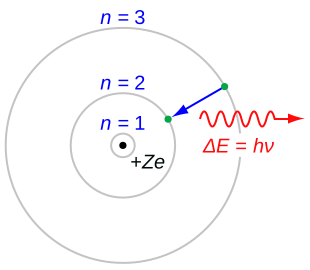
The Bohr model, showing an electron dropping from n=3 to n=2, and emitting a photon to get rid of the energy difference.
Remember that E = h ν for light (that last letter being Greek “nu” not a “vee”). So if we know the energy difference, we should be able to figure out the frequency, ν of the photon, then get to its wavelength in nanometers. For wavelengths between 400 and 770 nanometers, the photon will be visible to our eyes and will have a certain exact color.
The lowest orbit has the minimum energy. Just like with astrodynamic orbits, the energy is set to zero at a distance of infinity, and becomes more and more negative the closer the orbit gets to the nucleus, so the energy of the minimum orbit (n=1) is -13.6 eV. The second orbit (n=2) is at -3.4 eV, the third (n=3) is -1.51 eV, and so on, approaching but never equaling zero. So an electron in the third orbit can shed a photon and drop all the way down from -1.51 eV to -13.6 eV, a difference of 12.1 eV. This corresponds to a wavelength of 102.57 nm. That’s an ultraviolet wavelength.
But how about dropping from n=3 to n=2? That difference is about 1.9 eV. And that corresponds to a wavelength of 656.3 nm, which is visible light.
That number no doubt leaped out at someone. And when they computed the numbers for jumping from n=4 to n=2, then n=5 to n=2, and so on, those numbers looked familiar, too.
They were the wavelengths of light in the hydrogen emission spectrum. This is known as the Balmer series, all the lines you get from dropping from some higher n down to 2.
The series of lines corresponding to dropping down to n=1 is called the Lyman series, and as previously indicated, they’re all ultraviolet.
So now we have an explanation of the hydrogen emission spectrum.
Maybe there was something “real” behind this quantum buggery!
The Bohr atom model stopped here. It explained hydrogen very well, but it couldn’t, by itself, cope with more than one electron. However its underlying principles do hold for other cases.
What Moseley had done was identify, via his X ray work, the transition down to n=1, which in heavier atoms is in the x-ray band. This gets progressively more energetic as the charge in the nucleus increases, such that one can actually tell what the nuclear charge is from the x ray wavelength. So this, too, validated the Bohr model in principle, at least insofar as the Bohr model assumes quantum effects are in play.
I’m going to carry this story through (in a grossly oversimplified way) to the present day, except I won’t delve too deeply into the quantum mechanical aspects of it–quantum theory turns out to be seriously weird but this wouldn’t begin to become apparent until about 1925. So far (as of the 1910s), this bowdlerized version where it just arbitrarily restricts what can happen in an otherwise classical physics realm was working pretty well (this is now called “old quantum theory”).
The n=1, n=2, n=3 and so on principal quantum numbers were named electron shells. It became apparent as time went on, though, that each of these shells contained subshells, according to a simple rule: The 1st shell consisted of one subshell, the second shell had two subshells, and so on. The subshells got labeled s, p, d, and f. This arose from quantum mechanical considerations.
Each subshell can only hold a certain number of electrons. An s subshell could hold 2 electrons, a p subshell 6 electrons, a d subshell 10 electrons, and an f subshell 14 electrons. We’ve never dealt with a fifth subshell, but it would probably be labeled g, with 18 electrons. Each goes up four electrons. This, too, arose from quantum mechanical considerations.
The subshells are in turn divided into orbitals holding 2 electrons each, but I won’t tread there. (And again, quantum mechanical considerations).
So, the following subshells exist: 1s, 2s, 2p, 3s, 3p, 3d, 4s, 4p, 4d, 4f, and so on.
Electrons are added to the lowest energy shell that isn’t already full. That’s whether you’re creating an ion by adding extra electrons, or just trying to get a large atom up to its normal complement.
Let’s take oxygen as an example. It has eight protons in its nucleus, it will want eight electrons in its shells.
So the first two electrons go into the 1s subshell. Then the 2s subshell gets the next two electrons. Finally, the four remaining electrons go into the 2p subshell, which could accept another two electrons if they were available.
Now let us consider iron, Z=26. The first eight electrons go like oxygen’s. The next two fill up the remainder of the 2p subshell, after which we move on to the 3s subshell, which takes two more electrons (12 so far). 3p takes up another six electrons (18 so far). You might expect that now we will move to the 3d subshell…but that turns out to be wrong. The 3d subshell’s energy is actually slightly higher than the 4s subshell, so we will fill the 4s before the 3d. Electrons 19 and 20 go into the 4s subshell, then the last six electrons do go into the 3d subshell. If we were to continue, the next subshell to fill would be the 4p subshell.
On the left, the principal quantum number. On the right, the branches indicate the energy of each subshell. Electrons fill in the subshells from bottom to top, so 1s (2 electrons) fills first, then 2s (2 more), then 2p (6 more), then 3s and 3p (another 8), but then 4s fills before 3d. The last element known in 1913 (uranium) get partway into the 5f subshell. Today, we’ve filled up not just 5f, but 6d and 7p, completely, all the way through Z=118. No 8s elements have been generated.
So we’re seeing at the end a sequence where we fill a 2 electron s subshell, a 10 electron d one, then a six electron p one. If we were to carry on to lead (Z=82), we’d encounter our first f subshell, 4f, right after the 6s subshell but before the 5d subshell; lead takes us into the 6p subshell.
If it’s difficult to see (or remember) a pattern to which subshells overlap in energy with parts of other shells, you can write them out in a triangle like this, all nicely ordered, then use diagonal lines from top right down to bottom left to read them off in the order they fill. This is called the “aufbau principle.”
Based on this the next two elements (Z=119 and 120) will be 8s subshell, then there will be a 5g subshell (the first g subhsell) with space for 18 electrons.
The numbers 2, 6, 10, and 14 might be tickling your brain trying to be noticed. If not, perhaps their successive sums will: 2, 8 (2+6), 18 (2+6+10) and 32 (2+6+10+14).
These are the lengths of the rows on the periodic table. In fact, if you look at the table, the left hand side is a “tower” two elements wide–corresponding to the s subshell. The left side is a block six elements wide–corresponding to the p subshell. The central skinny part is ten elements wide, and corresponds to the d subshell. Looking at the two rows that are “footnoted” below the main body of the table, those are usually depicted as 15 units wide, but they are supposed to tuck into a square in the third column, so one of those 15 squares really belongs to the d block. The other 14 are the f subshell. (By the way, chemists argue over whether the first or last of the fifteen is the one in the d-block; they seem to have recently decided to go with the last one of the fifteen.)
The periodic table, with the f block brought into the main diagram rather than relegated to footnotes. The second element in the 1s subshell is helium, which chemically behaves like the other elements with a finished p subshell, so it’s generally moved over from the upper left to the upper right (hence the one red square out of place).
This diagram shows the exact number of elements known today 118, 26 of them after uranium (Z=92) the highest known in 1913.
So the very shape of the periodic table reflects the shells and subshells, which in turn derive from quantum principles.
The periodic table is on a firm footing now. Atomic number is on a secure footing, We now even understand those elements whose atomic weights aren’t close to integers. We just don’t know why they aren’t exact integers yet.
Obligatory PSAs and Reminders
China is Lower than Whale Shit
Remember Hong Kong!!!
Whoever ends up in the cell next to his, tell him I said “Hi.”
中国是个混蛋 !!! Zhōngguò shì gè hùndàn !!! China is asshoe !!!
China is in the White House
Since Wednesday, January 20 at Noon EST, the bought-and-paid for His Fraudulency Joseph Biden has been in the White House. It’s as good as having China in the Oval Office.
Joe Biden is Asshoe
China is in the White House, because Joe Biden is in the White House, and Joe Biden is identically equal to China. China is Asshoe. Therefore, Joe Biden is Asshoe.
But of course the much more important thing to realize:
Joe Biden Didn’t Win
乔*拜登没赢 !!! Qiáo Bài dēng méi yíng !!! Joe Biden didn’t win !!!

This Stormwatch Monday Open Thread is VERY OPEN – a place for everybody to post whatever they feel they would like to tell the White Hats, and the rest of the MAGA/KAG/KMAG world (with KMAG being a bit of both).
Yes, it’s Monday…again.
But it’s okay! We’ll make our way through it.
Free Speech is practiced here at the Q Tree. But please keep it civil. We’re on the same side here so let’s not engage in friendly fire.
If you find yourself in a slap fight, we ask that you take it outside to The U Tree…which is also a good place to report any technical difficulties, if you’re unable to report them here.
Please also consider the Important Guidelines, outlined here. Let’s not give the odious Internet Censors a reason to shut down this precious haven that Wolf has created for us.
Please pray for our real President, the one who actually won the election:
For your listening enjoyment, I offer this from Fox Sailor, titled ‘The Warrior of Darkness’:
And this from Phil Rey Gibbons, titled ‘Hope’:
Our beloved country is under Occupation by hostile forces.
We can give in to despair…or we can be defiant and fight back in any way that we can.
Joe Biden didn’t win.
I will keep saying Joe Biden didn’t win until we get His Fraudulency out of our White House.
Wheatie’s Word of the Day:
cromulent
Cromulent is an adjective which means…fine or acceptable; normal, excellent, realistic, legitimate or authentic. A recently coined word, cromulent has been so frequently used that it is now being included in 21st century dictionaries.
Used in a sentence:
Since the ChiComs and their pet Donkeys are working to plunge us into communist rule, the label of ‘DonkeyCom’ is a perfectly cromulent descriptor for the Demoncrats.
The prior election must be acknowledged as fraudulent, and steps must be taken to prosecute the fraudsters and restore integrity to the system.
Nothing else matters at this point. Talking about trying again in 2022 or 2024 is hopeless otherwise. Which is not to say one must never talk about this, but rather that one must account for this in ones planning; if fixing the fraud is not part of the plan, you have no plan.
The Audit
The Audit is definitely heating up. Let’s see if the Opposition manages to squelch it and its consequences. I’ll be honest; I expect it to be ignored by anyone capable of ordering Biden/Harris to step down.
Nevertheless, anything that can be done to make Biden look less legitimate is a worthy thing!
Lawyer Appeasement Section
OK now for the fine print.
This is the WQTH Daily Thread. You know the drill. There’s no Poltical correctness, but civility is a requirement. There are Important Guidelines, here, with an addendum on 20191110.
We have a new board – called The U Tree – where people can take each other to the woodshed without fear of censorship or moderation.
And remember Wheatie’s Rules:
1. No food fights 2. No running with scissors. 3. If you bring snacks, bring enough for everyone. 4. Zeroth rule of gun safety: Don’t let the government get your guns. 5. Rule one of gun safety: The gun is always loaded. 5a. If you actually want the gun to be loaded, like because you’re checking out a bump in the night, then it’s empty. 6. Rule two of gun safety: Never point the gun at anything you’re not willing to destroy. 7. Rule three: Keep your finger off the trigger until ready to fire. 8. Rule the fourth: Be sure of your target and what is behind it.
Gold was up in the 1810s all week up to Friday morning, but tanked HARD on that day, down $41.20. Everything took a beating, honestly, except rhodium which went up.
Part XIII – Rutherford On A Roll
We left off, circa 1903, having discovered radioactivity and the electron, and making quite a bit of progress with them.
To try to recap (and there are a few things in this so-called “recap” that I should have mentioned earlier, but didn’t), an electron is a negatively charged particle about 1/1830th the mass of a hydrogen atom, which up to then had been the lightest thing known to exist. They could be knocked off of atoms in a Crookes tube and they would then form what was called a cathode ray (yes, the same “cathode ray” in those big tubes in those old boxy TVs). It is possible to strip one electron off a hydrogen atom, at which point the remaining piece of the hydrogen atom (called an ion) had a positive charge that balanced the electron’s negative charge. The atom as a whole was neutral, charge 0; the individual pieces also added up to 0. Even though there was plenty of mass left in the ion, easily enough for hundreds more electrons, no one could get a second electron to come out of a hydrogen atom.
Thomson, the discoverer of the electron, suggested that atoms were fairly solid spheres of positive electrical charge with little electron inclusions that could be knocked out to ionize the atom; this was called the plum pudding model of the atom.
Radioactivity had been discovered in 1896. Uranium and thorium, it turns out, are radioactive. Radioactivity turned out to consist of three types of rays, alpha, beta, and gamma.
Alpha rays turned out to be identical to doubly-ionized helium, i.e., helium from which two electrons had been stripped (and there was no sign of being able to strip away a third electron from helium). Helium itself had been discovered on Earth back in 1895, trapped in a uranium ore; its atomic mass was four times that of hydrogen. Clearly the helium had begun as alpha particles, then combined with electrons in the ore to become helium gas. The charge of an alpha particle is 2e.
Beta rays turned out to be high-speed electrons. Their charge, of course, is –e.
Gamma rays turned out to be electromagnetic radiation, extremely strong electromagnetic radiation, like X-rays on steroids. Gamma rays, like all photons, have no electrical charge at all.
Alpha rays could be stopped by a sheet of paper. Beta rays could penetrate many sheets of paper, but would be stopped by a thin sheet of metal. Gamma rays required a lot of shielding to stop.
Uranium (atomic weight ~238) and thorium (atomic weight ~232), which had just been discovered to be radioactive, were the heaviest known elements, roughly 238 and 232 times as massive, atom for atom, as hydrogen. The Curies discovered that uranium ore was four times as radioactive as the ores it contained; they were able to isolate two new elements, radium (atomic weight 226) and polonium (atomic weight 210), by processing tons of the ore pitchblende.
It was also clear that a pure block of refined uranium would grow more radioactive over time, eventually reaching a level significantly higher than before, but not nearly as high as the ores.
In radioactive decay, the total amount of energy released, relative to the mass, turned out to be staggeringly huge, thousands if not millions of times more than what was released by burning chemicals. In 1904 Ernest Rutherford (who had named the three types of radiation, and who is the star of today’s story) suggested that radioactivity could provide enough energy to power the sun for the many millions of years necessary for Darwinian evolution to take place. (Previously known sources of energy were woefully inadequate; it was one of the 1895 mysteries I listed.)
At the time atomic weight was considered to be a defining characteristic of an element. This would cause some confusion for a few years.
Some stuff I should have covered previously, but didn’t:
The electric charge of an electron is about -1.602 x 10⁻¹⁹ coulombs. This is a negative number (because Benjamin Franklin arbitrarily picked one kind of charge to be positive and the other negative, and when the electron was discovered, it happened to be the one he tagged as negative), so, perhaps a bit counterintuitively, physicists define the minimum charge e to be +1.602 x 10⁻¹⁹ coulombs, i.e., -1 times the charge of an electron. Physicists, in fact, find it far more convenient to use e as the unit of electric charge when talking about atoms, that way they don’t have to sling 10-19s everywhere.
And they do something similar for energy. Just like a falling weight generates kinetic energy (a mass being attracted to another mass by gravity, speeds up that mass), an electron responding to one volt of electrical potential generates a certain amount of energy, which is defined to be an “electron volt.” This is abbreviated eV (which spell checkers will try to “fix” the capitalization of). This ends up being 1.602 x 10⁻¹⁹ joules. (Notice it’s the same factor, 1.602 x 10⁻¹⁹. This is a consequence of the way the joule, coulomb, and volt are defined.) Energy at the atomic level, particularly when dealing with chemical energy, tends to be a convenient, human-relatable number of electron volts.
And a reminder: An atomic mass unit was defined, in 1898, as 1/16th the mass of an oxygen molecule. This was very close to the mass of a hydrogen atom, but because oxygen reacted with more things, it was easier to use it as a yardstick. [This definition has since been modified, for reasons I’ll explain below.] It was equal to 1.6604675209 x 10⁻²⁷ kilograms. (This is slightly different from today’s value.) It was abbreviated “amu.” Atomic weights were expressed in amu’s, so oxygen’s atomic weight was 16.0000, and hydrogen’s was almost exactly 1.0: In 1949, under this definition, it was measured at 1.008 amu. (At least, according to a 1951-52 CRC handbook–well, it’s a book that fits King Kong’s hand–that I happen to own.)
OK, so that, I believe, catches us up.
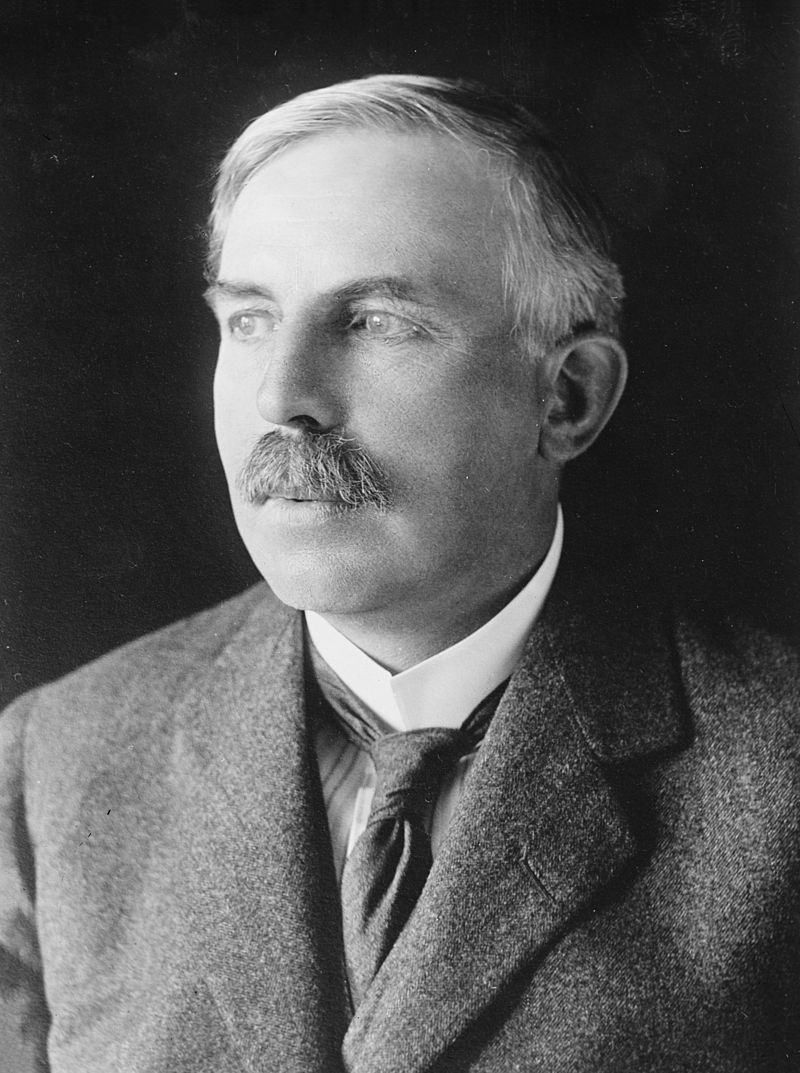
Ernest Rutherford, 1871-1937 I’ll be honest, as I was researching this, I was surprised how many times Rutherford’s name kept coming up. I had known about a few of the things he had done (the gold foil experiment being the most famous) but in fact he was all over everything that happened, it seems. It seems he was at least in the room for a lot of things I talked about last time (like the discovery of the elctron). He fully deserved having an element named after him (Z=104). If parts of this caption make no sense…read on.
A Plethora of Radioactive Elements?
Scientists continued to investigate radioactivity. They would find more and more elements, distinguished by their atomic masses, in both uranium and thorium ores.
Even as early as 1900-1903 Rutherford was involved in this effort. Looking at thorium “emanations” with his student Frederick Soddy, they discovered thorium x and a gas, thoron. At first they thought these were special forms of thorium, but then they realized these were not thorium. By 1903 they had concluded that these emanations were the result of thorium changing into another element. This was a very bold conclusion, since chemists up to now had believed elements were immutable, that such things were alchemist balogna. (And under normal circumstances this was true…but radioactivity was something fundamentally new, and certainly nothing like what the alchemists had thought of.)
So perhaps these new elements could fill in the large gap between bismuth and thorium in the periodic table? Well, they could, but it turned out that in fact, there were way too many of them. Realistically between lead and uranium there was room for nine elements, and we already had five of them: bismuth, polonium, radium, radon (which was basically the thoron gas) and thorium. But just in uranium ore there seemed to be about thirty of them (based on my count looking at a chart in Wikipoo–perhaps they had found fewer than that before they figured out what was actually going on). Thorium ores brought in another ten or so.
But it was very, very difficult to separate out these putative elements. For instance Soddy in 1910 showed that mesothorium, atomic weight 228, radium, atomic weight 226, and thorium X, atomic weight 224, were impossible to separate chemically, as if they were the same element. But how could that be so when the atomic weights were different? Trying to place these elements in the table led Soddy and Kazimierz Fajans to independently come up with the notion of radioactive displacement in 1913. Basically, this stated that an alpha decay reduced an atom’s mass by about four amu (the mass of the alpha particle), and also moved it two places to the left on the periodic table. (If such a thing were to happen to (say) nickel, it would become iron, which is two spots to the left of nickel. But it won’t.) A beta decay left the mass almost unchanged (the mass of the electron that gets kicked out is relatively insignificant), but moved the element one place to the right. (If an atom of palladium were to undergo a beta decay, it would become silver. This has happened under very special circumstances, ones that won’t affect the palladium bullion I hope you own.) Gamma decay had no such effect; apparently it was just a way to get rid of energy.
For this work Rutherford won the 1908 Nobel Prize for Physics.
But he hadn’t even got started yet.
The Isotope
Now if one used the radioactive displacement principle, it appeared that two or more different “elements” could occupy the same place on the periodic table. The three I named above all fit in the same square, directly under barium. Because they occupied the same place, they were termed isotopes, from Greek for “the same place.”
So you had “elements” of different mass that otherwise behaved identically. At this point chemists decided that the mass wasn’t as important as the behavior, and swallowed the concept of two different atomic weights representing the same element, rather than insisting they must be different elements solely because of different atomic weights. Atomic weight wasn’t necessarily a crucial characteristic of an element, particularly when it came to ones extracted from radioactive ones.
In 1912, meanwhile, J. J. Thomson, who had discovered the electron in 1897 (with some help from Rutherford, it turns out) wasn’t done yet, had ionized neon (which was the tenth element listed on the periodic table at the time) in a Crookes tube and magnetically and electrically deflected its ions, the same way that he had deflected electrons in 1897, to determine the ions’ charge to mass ratio. He was quite surprised to see these ions, which should have weighed in at about 21.18 amus, went to two different locations! Some were deflecting more than others, because they were lighter than those others.
Assuming that they were singly ionized, with one electron removed (it takes a lot more energy to take the second electron off than it did the first), one group of ions had an atomic weight of almost exactly 20, the other had an atomic weight of almost exactly 22. The atomic weight of neon had been measured as 20.179, which made it one of those cases where the atomic weight was not almost a whole number, but now it looked like that was actually an average value. Most neon had atomic weight of almost exactly 20, but some came in at about 22, and the weighted (ahem) average was 20.179.
So now, even perfectly ordinary stable elements had isotopes, and this time no one thought these must be two different elements because the weights are different. In modern terms neon consists of a mix of neon-20 and neon-22.
I have mentioned in the past that many elements had “atomic weights” or “atomic masses” that were almost a perfect multiple of hydrogen’s. These mostly turn out to be elements with exactly one isotope in nature, or perhaps more than one isotope but one of them is much, much more common than the other(s).
Hydrogen, it turns out, has two isotopes found in nature, hydrogen-1 and hydrogen-2. Hydrogen-1 is overwhelmingly common, hydrogen-2 is rare, a bit more than one atom in ten thousand hydrogen atoms is hydrogen-2.
For various reasons, the isotopes of hydrogen actually ended up with “real” names–not true for any other element! Hydrogen-1 is called protium and hydrogen-2 is called deuterium.
The actual atomic mass of hydrogen is a bit higher than the atomic weight of pure protium expressed in kilograms, because the tiny amount of deuterium pulls the average up.
If, in an alternate universe, the atomic mass unit had been defined differently so that hydrogen–mixed hydrogen–got an atomic mass of 1 unit, this would actually have been slightly higher than the atomic mass of pure protium, because the occasional deuterium atom pulls the average up.
But in the real world, the atomic mass unit was defined to be 1/16th the atomic weight of oxygen. So oxygen was 16.0000 by definition. Hydrogen ended up being a hair more than 1.008. Could the excess be due to the deuterium? Not so fast. Oxygen, it turned out in 1919, consists of three isotopes. Oxygen-16 is overwhelmingly more common than oxygen-17 and oxygen-18. But even if you set pure oxygen-16’s atomic weight to 16.00 by definition, and then look at the atomic weight of pure protium, pure protium doesn’t come in at precisely 1.000. There’s still this slight tendency to be off just a bit from integers. At the time no one knew why, but they knew about it well enough to talk about a mass defect. But at least now, we understood the elements that were way off from being whole integer atomic weights–they were mixtures of isotopes. So this is a partial answer to one of our mysteries.
Physicists often discussed different isotopes of the same element. Chemists rarely did back then. Physicists used the whole number to label them, rather than the exact number. This whole number was termed the “mass number” and had the symbol A (from German Atomgewicht). I’ve been using these mass numbers a lot so far, and will continue to do so.
So we have three things with similar-sounding names. There’s the atomic mass unit (amu), almost (but not quite) equal to the mass of a hydrogen atom. There’s an atomic weight, measured in atomic mass units, which represents the mass of the atom. But there is also a mass number, which is a rounded version of the atomic weight, for a specific isotope. Hydrogen’s atomic weight is 1.0008, but the mass number of its most common isotope was just simply 1. When doing ordinary chemistry weighing out reactants the atomic weight is used to compute the number of moles of each reactant. When talking about isotopes, the mass number is used, without fail.
(Looking ahead a little: In the 1920s physicists began using a physical atomic mass unit, that really was based on oxygen-16 rather than mixed oxygen. To distinguish it from the other one, the prior one was called the chemical atomic mass unit–which the chemists kept on using. And then it turned out that oxygen obtained from water had a slightly different isotope mixture and hence real atomic weight, than oxygen extracted from the air. So the chemists’ unit was based on a foundation of quicksand. But even using the physical amu, the atomic weight of a pure isotope was still never a clean, perfect integer, except for oxygen-16.
(But now we had two slightly different units with very similar names. In 1961 they compromised, and created the “unified atomic mass unit” (symbol u, also called the dalton, symbol Da) that was 1/12th of the mass of a carbon-12 atom. This was closer to the chemists’ standard than to the physicists’.
(No matter what standard was chosen, however, the only isotope that had a perfect integer mass was the reference isotope. All others were off, just a bit.
(But that was all in the future. Let’s return to our story, back to 1912.)
The Nucleus
Backing up just a couple of years from there, there had been another very important discovery in 1909 by Ernest Rutherford. He was collaborating with Hans Geiger (who is definitely a counter) and Ernest Marsden.
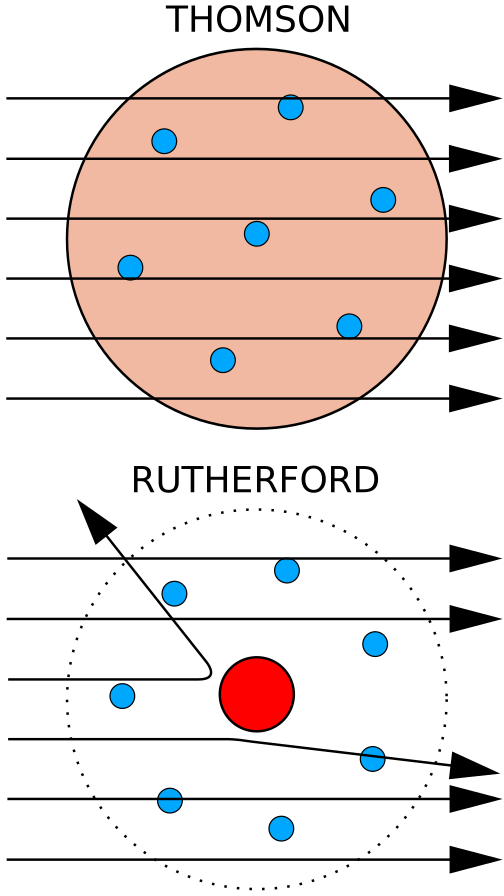
They used a beam of alpha rays (which, as a reminder, are heavy and positively charged) to bombard a very thin layer of gold foil. They were pretty much expecting those alpha particles to plow through the “plum pudding” atoms. Instead, though most indeed cruised right through the gold atoms as if nothing were there, a very few of them bounced away at sharp angles, repelled by an intense and concentrated positive charge. Some even bounced back towards the beam source! Rutherford said, in a very famous quote: “It was quite the most incredible event that has ever happened to me in my life. It was almost as incredible as if you fired a 15-inch shell at a piece of tissue paper and it came back and hit you.”
In 1911 Rutherford argued that those alpha particles were bouncing off an atomic nucleus. This meant that an atom consisted almost entirely of empty space. All of that positive charge (and almost all of the mass of the atom) was in a tiny, tiny, very dense body about 1/10,000th the width of the atom; the rest of the space was the domain of the electrons, which orbited the nucleus much like planets orbit the sun, except in this case the attractive force wasn’t gravity, but the attraction between the positively charged nucleus and the negatively charged electrons. This was a new model of the atom, called the “Rutherford Model.” Rutherford is credited with discovering the atomic nucleus.
The differences between the Thomson model of the atom and the Rutherford model, and how they imply the alpha scattering experiment would turn out. The top, “plum pudding” model is of an atom that has a uniform density with electrons imbedded; the overwhelming majority of the alpha particles would have no trouble plowing straight through the “goop.” The bottom shows that all the mass (other than orbiting electrons, which are less than a thousandth of the mass) is concentrated in a nucleus that is much denser than anything we see in our daily lives, and the alpha rays will bounce off of it if they get anywhere close to it. Which was rare but happened. The red “nucleus” in the diagram is drawn far, far larger than it should be (a mere dot would still be too large).
And in fact that number understates things; according to modern measurements entire atoms can be anywhere from 26,000 to 60,000 times as wide as their nuclei. Which works to to be anywhere from 17.6 – 216 trillion times the volume.
Atomic Number
Later that year, Antonius van den Broek proposed that the sequential location of each element in the periodic table was equal to its nuclear charge, this charge (in units of e) was the atom’s atomic number. This fit well for hydrogen, which could only have one electron stripped off, leaving a +1e charged nucleus behind. And for helium, which could be ionized twice leaving a +2e charged nucleus behind. They were the first and second elements listed in the table. However, we couldn’t strip every atom down to a bare nucleus to see its charge; the heavier the atom the harder it was to do that.
This was a new concept. Chemists had talked about the atomic weight of an atom, never its number. You could list the elements in the order they appeared in the periodic table, of course (accounting for the very few unfilled “holes” in the grid), but the place on the list wasn’t considered terribly significant. But now it appeared as if charges came in discrete quantities, and given that one could only remove one electron from a hydrogen atom, and two from the atom with the next higher weight, the implication was that this nucleus had a specific charge, an integer multiple of the charge of an electron (but with the opposite sign). So hydrogen’s atomic number was 1, helium’s was 2. Lithium’s was 3. And so on, through carbon (6), oxygen (8), aluminum (13), iron (26), zinc (30), rhodium (45), silver (47), tin (50), platinum (78), gold (79), lead (82), thorium (90), and uranium (92), to give some examples. (However the exact numbers for anything above the upper fifties really weren’t certain at this point.)
This was only a suggestion…until about two years later. I will pick that story up next time, because it actually ties in more with electrons, and this week I want to concentrate on the nucleus. Suffice it for now to say that van den Broek was absolutely right. I’m going to reference the concept of atomic number, abbreviated Z (from German Zahl, ‘number’), from here forward.
The Proton
So, let’s continue Rutherford’s story. In 1917 he ran some more experiments. He fired alpha beams into air (which is mostly nitrogen), and detected hydrogen ions. After refining his experiment, he realized that the alpha particles were reacting with the nitrogen. When he reported his results in 1919, he claimed that the alpha particle had simply knocked a hydrogen nucleus out of a nitrogen nucleus, reducing the nitrogen nucleus’ charge (and atomic number) and weight by one and thereby turning it into carbon. Nitrogen-14 was seemingly becoming carbon-13, a rare (but stable) isotope of carbon, which is mostly carbon-12.
But by then we had cloud chambers and could see some forms of radioactivity and ions leaving trails through the chamber. In 1925, Rutherford examined some cloud chamber tracks of this reaction, and he realized he was totally wrong about what was happening. The alpha particle wasn’t bouncing off the nitrogen nucleus after knocking one proton out of it. No, it was disappearing. What was in fact happening was the nitrogen nucleus, 7 positive charges, total mass 14, was absorbing the alpha particle.
I mentioned, up above, the principle of radioactive displacement. An atom, spitting out an alpha particle moves two places to the left on the periodic table. That means its atomic number decreases by two. The atomic mass drops by four.
Absorbing an alpha particle has exactly the opposite effect. The atomic number increases by two, and the atomic mass increases by four. So the nitrogen-14 was becoming fluorine-18.
Immediately upon becoming fluorine-18, the nucleus then shed a proton, which was the hydrogen ion that Rutherford saw. This turned it into oxygen-17, stable but uncommon (most oxygen being oxygen-16).
But in the meantime, people had decided that that hydrogen nucleus was a basic particle, and it was named the proton. It’s regarded as having been discovered in 1919, since that was the first time it was seen to exist having come from some source other than hydrogen gas. or in 1920 when someone suggested it might be an elementary particle. Rutherford, as the discoverer, got to name it.
William Prout, clear back in 1815, had suggested that the other elements might be built up, somehow, from hydrogen, and now it looked like he was at least partly right. Hydrogen indeed consisted of a single proton, mass 1, and an electron, and other elements apparently had 2, 3, 4 or more protons, all the way up to uranium with 92 of them–each with a matching electron. You couldn’t just bundle hydrogen atoms together to get other kinds of atoms, but conceivably, if you separated the electrons and protons, then combined the protons, and put the electrons back in place, you could get larger atoms.
In fact, Rutherford had suggested both the name “proton” and the name “prouton” for this particle, the latter to honor Prout. (The English would have pronounced “prouton” as if it rhymed with “grout on”, and the French would have made it rhyme with “crouton” so we dodged a bullet of linguistic confusion there.)
The proton’s mass is 1.007 amus (using the modern AMU scale). Again, maddeningly close to a whole number. But because of this, the proton looked like the underpinning for atomic number but it couldn’t be the underpinning of atomic mass. That’s because, to take an example, oxygen’s nucleus has eight protons in it, but a mass of sixteen, twice as much as the protons. Uranium is even more out of whack. It has 92 protons, but its most common isotope has a mass of 238, leaving 146 mass units unaccounted for! Why? We didn’t know, yet.
In 1920, Rutherford voiced a suggestion. He thought that the excess mass consisted of a number of protons and electron pairs, bound to each other to make a net neutral bundle. So an oxygen-16 nucleus actually contained sixteen protons, but eight of them were bundled with, and masked by, electrons. The net positive charge is eight, and that’s critical because it requires eight orbiting electrons to balance out, and those eight orbiting electrons are responsible for oxygen’s chemical properties. So the chemical nature of an atom ultimately depended on the number of protons not in these bundles.
This actually made quite a bit of sense. Remember beta decay? This is where a nucleus can spit out an electron. The electron has a single negative charge. In order to make up for that loss, the nucleus has to gain a positive charge; it’s as if a new proton were appearing. But if Rutherford’s idea were correct, rather than a proton and an electron being magically created, one of these bound pairs was breaking apart, freeing the electron and unmasking the hidden proton.
Another thing arguing in Rutherford’s favor was the fact that whatever-it-is that was left over in the nucleus had a mass that was nearly that of a whole number of protons; it would make sense for the missing ingredient to be that number of “masked” protons.
Physicists would spend the 1920s thinking that the nucleus consisted of a number of protons equal to the mass number A, plus a bunch of nuclear electrons, which left a net number of “unmasked” protons equal to Z. With some mysterious “mass defect” making the total mass slightly off.
But there were some theoretical difficulties with this…which I will take up in a future installment.
Who Cares About Isotopes?
Until late in the last century, chemists almost never concerned themselves with differing isotopes. That’s because oxygen-16’s chemical behavior is nearly indistinguishable from oxygen-17’s. Because the oxygen-17 is a bit heavier, it’s perhaps a tiny bit slower to react than oxygen-16, but not much. If you were to liquefy oxygen-16 and oxygen-17, then measure their boiling points, the oxygen-17 would require a slightly higher temperature to boil, because it would take just a little bit more energy to kick those heavier oxygen-17 atoms into vapor. Melting and boiling points are in fact the biggest difference a chemist might see…if he had separated samples to work with in the first place. And chemical means of separation were simply untenable; they were too much alike.
Water made with oxygen-17 and oxygen-18 evaporates a bit less readily than water with oxygen-16, so rainwater tends to be slightly richer in oxygen-16 than seawater (and this is part of the reason we had to stop defining the atomic mass unit as 1/16th of mixed oxygen–the mix could differ depending on where you got the oxygen from).
The chemical differences between protium (hydrogen-1) and deuterium (hydrogen-2) are actually significant, due to the fact that proportionally, the difference is greater than for any other pair of isotopes. Water made out of deuterium (“heavy water”) instead of protium actually melts at 4C, rather than 0C. I’ve seen a video of a heavy water ice cube sunk to the bottom of a glass of cold (regular) water. It’s not going to melt as long as that water is properly chilled. Note that I said the bottom of a glass of cold water. It doesn’t float because it’s heavier than regular ice and heavier even than regular water. (Now, if it were in a glass of heavy water, it would float.)
And of course, heavy water, because of its significantly different chemical behavior, is toxic when pure.
Other than that, for “traditional” chemistry, isotopes just didn’t matter.
Today things are a bit different. Mass spectrometers–which are the descendant of Crookes tubes, designed to ionize, accelerate, and deflect atoms and molecules to see how much they deflect and thus figure out the masses–are relatively cheap, and they can read out absolute numbers of “hits” at each possible mass. So one can run a sample of water through one of these and get a very precise notion of the isotopic composition. Now, you can tell whether a sample of water was rain water or ground water. Or you can analyze a sample of metal and be able to tell where it was mined, because it turns out each mine has a slightly different isotopic mix of the metal. Or one can prove that CO2 was added to champagne artificially, because the CO2 used has no carbon-14 in it (whereas the carbon dioxide in fermentation does).
Incidentally, if you’ve ever had TSA swab your luggage then stuff the swab into a machine which tells them you aren’t carrying explosives–that device is a mass spectrometer.
That’s today. But back in 1910, chemists didn’t give a rip about isotopes. Physicists studying radioactivity, on the other hand, knew that “which isotope is this?” could make all the difference in the world. And that’s even more true today too, now that we can artificially make all sorts of radioactive isotopes that don’t exist in nature. We now have to concern ourselves with radioactive hydrogen-3 (“tritium”), cesium-137, iodine-131 and strontium-90…and these were elements that were never radioactive in the days of the Model T and the Wright Flyer.
In 1910 we were just starting down this road. Remember, Rutherford had made fluorine-18 and oxygen-17 artificially.
Decay Chains
Keep this in mind as we go back now to uranium (atomic number Z=92) and thorium (Z=90). Remember that whole process of figuring out the pieces of an atom started in part because of the discovery of radioactivity, a property of these two elements in particular.
At the time of today’s story, had become quite clear that when there was radioactivity, one kind of atom was changing into another, this is called “decay.”
Uranium and thorium decay very slowly, or I should say, uranium-235, uranium-238, and thorium-232 decay very slowly (as I said, the isotope matters). It’s a statistical process. When you are looking at one uranium-235 atom, it could decay a second from now…or it could wait a billion years. There’s no way to know when it will happen, but it’s almost a stable nucleus; it’s very, very unlikely to blow in the next second. And if that atom is still around in a billion years, someone watching it then is just as unlikely to see it go kablooey in the next second as you are today.
I’m going to get on a soap box here, for just a minute. Let’s say you watch someone flip a coin 20 times and it comes up tails each time. Do you think, “wow, it’s overdue to come up heads, I’ll bet it comes up heads next time?” If so, you have a “naive” view of probability. The more sophisticated view is that, since the tosses are independent events they aren’t affected by each other. The chance is 50/50 of heads next time, no matter how many times in a row it has come up tails just now. But then, there is the cynic’s view. He doesn’t believe the odds are fifty/fifty either. But he doesn’t figure it’s overdue to come up heads; he figures the coin probably is crooked; perhaps tails on both sides! And he might have a point there. The smart bet, if you’re not allowed to examine the coin, is probably to bet on “tails.” But, if the coin really is fair, the 50/50 view is correct.
Similarly, for the chances of an unstable nucleus going kablooey in the next second, or minute. A billion years from now, provided your unstable nucleus hasn’t gone kablooey in the meantime and it’s still around, it’s just as likely to not go kablooey in the next second, as it is to not go kablooey in the next second today.
At an individual atom level, radioactivity isn’t predictable. But, if you take a large number of atoms of one of these three isotopes (or of any unstable isotope for that matter), you can make some predictions.
You can say, for instance, that any large sample of uranium-235 will be half gone in about 700 million years. Half of the atoms (no way to predict beforehand which specific ones) will have decayed to something else. Does that mean that the other half will decay in another 700 million years? Absolutely not. If you start with a pound sample of uranium-235, after 700 million years, you now have a half-pound sample of uranium-235, now mixed in with a bunch of impurities to be sure, but a half pound sample nonetheless, and half of that sample will decay in the next 700 million years.
700 million years is the half life of uranium-235. Similarly, uranium-238 has a 4.5 billion year half life, and thorium-232 comes in at 14 billion years.
You get one guess as to who discovered the concept of a half life in 1907. I’ll give you a tiny hint: He did it using one of the short-lived isotopes in the thorium decay chain, one that was deposited by decaying radon gas.
Thorium-232’s half life is about three times that of uranium-238. As you can imagine, given a godzillion uranium-238 atoms, and a godzillion thorium-232 atoms, you’ll see three times as many decays in a day from the uranium as from the thorium. But it also scales by quantity; two godzillion thorium-232 atoms will produce twice as many decays in a day as one godzillion will. And three godzillion thorium-232 atoms will produce as many decays in a day as one godzillion uranium-238 atoms. Keep this in mind–the ratio of the half lives is same as the ratio of quantity, for the same number of decays to occur from samples of two different isotopes.
[A “godzillion” is a highly technical word someone made up once for a really large number. He used it to describe the national debt when it was a lot smaller than it is now. However, even today’s national debt pales next to the number of atoms in a mole (which would be 600 sextillion or so). I decided to adapt the term rather than just say “zillions” or “jillions.”]
When an atom of (say) thorium spits out an alpha particle, it actually changes to another element and another isotope; it is decaying. If the new isotope is also unstable, it too will decay, again and again until the result is a stable nucleus. Eventually the starting thorium-232 nucleus will have become a lead-208 nucleus.
OK, with thorium being Z=90 and lead being Z=82, we can do a little bit of accounting-style sleuthing. The difference between these two masses–the change in A–is 24. That’s the equivalent of six alpha particles. In fact, since the only mode of decay that changes an atomic weight is alpha decay, we expect exactly six alpha decays to occur during this process.
But going from thorium to lead would involve changing Z by eight, which is something you’d get from four alpha decays at two apiece. Six alpha decays, absolutely required by the mass change, give you a reduction of Z by 12, and so it looks like you’d end not with lead-208 but rather platinum-208 (which if it even exists, surely isn’t stable).
Beta decays come to the rescue. They move you one element to the right, without changing the mass. So if you figure that the total number of alpha decays is six, reducing Z by 12, but then throw four beta decays into the mix, increasing Z by four, it balances; the net reduction of Z is 8. The total set of reactions boils down to:
(Remember when subtracting the four betas, you are subtracting a negative number, which means to add the opposite positive number.)
If you look at the detailed sequence of events, this is exactly what happens. Thorium-232 decays by alpha particle to radium 228 (Z=88, A=228 one alpha decay so far). Radium-228 then undergoes a beta decay to get actinium-228 (Z=89, A=228, alpha, one beta so far). Actinium-228 undergoes another beta decay to get thorium-228 (Z=90, A=228; one alpha, two betas so far).
Let’s pause here to look at the half lives. The original thorium-232 has a fourteen billion year half life. That means that (on a percentage basis) very, very little of it decays in (say) one day. The radium-228 has a 5.7 year half life. The actinium-228 has a 6.1 hour half life. The thorium-228 has a … wait for it! … 1.9 year half life. (It’s thorium, but it’s not thorium-232 and that makes all the difference in the world when it comes to half lives.)
If you started with a pure thorium-232 sample and waited about ten years, a certain amount of radium-228 has accumulated. As it accumulates, you can detect more and more decays of it (because there is more and more of it over time. But it won’t accumulate forever: It turns out that after a few years of building up, there’s now enough of it that it’s decaying about as fast as it’s being created. So you should be able to see based on our discussion above that, given thorium-232’s half life is three billion times as long as radium-228’s, when there is one radium-228 atom for every three billion thorium-232 atoms, then they’ll both produce the same number of decays. But the radium-228 doesn’t go away, because it’s being replenished by the thorium-232 decays. Since the amount isn’t changing over time the radium-228 is in equilibrium with the thorium-232. (The thorium-232 is slowly going away, of course, as it does so it will produce slightly less radium-228 during a given time, so the radium-228 will decline at the same percentage rate. But people don’t live long enough to see this happen, not with a 14 billion year half life!) Equilibrium is reached in something like 1 1/2 or two half lives of the daughter isotope.
Similarly for the actinium-228–because it has a much shorter half life than radium-228, it reaches equilibrium with the radium-228 almost instantly. And so on down the chain. Once everything is at equilibrium, there is one decay of each daughter isotope, for each decay of a thorium-232 atom. This is why a “pure” sample of thorium actually grows more radioactive right after it’s made.
So back to that chain. It continues. Thorium-228 alpha decays to radium-224 (Z=88, A=224, two alphas, two betas so far). Radium-224 alpha decays to radon-220 (Z=86, A=220, three alphas, two betas so far). Radon-220 alpha decays to polonium-216 (Z=84, A=216, four alphas, two betas so far). Polonium-216 alpha decays to lead-212 (Z=82, A=212, now five alphas and two betas so far).
Lead-212 is lead, and lead dug out of the ground is stable, but lead-212 is not stable. It’s an unstable isotope, a very unstable one in fact. Its half life is 10.6 minutes.
The next step is a beta decay, lead-212 becomes bismuth-212 (Z=93, A=212, five alphas, three betas). We now have just one alpha and one beta decay left to get to lead-208. But now, the path splits. We can either do the alpha decay first then the beta decay (thallium-208 (Z=81), then lead-208) or the other way round (polonium-212 (Z=84), then lead-208).
All of these decays from thorium-228 onwards have half lives of days or less, one even has a half life of less than a millionth of a second. So once the thorium-228 reaches equilibrium with its great-grandparent thorium-232, the rest of the chain ends up in equilibrium in just a few days.
The diagram below summarizes this whole process. And it uses a notation I haven’t used yet. So far when I’ve named an isotope, I’ve done it as [element name]-[mass number]. But you can also use a superscript before the element symbol like this: 232Th. Superscripting is a bit of a pain in the ass in the WordPus editor (and besides you might not know all the symbols), so I didn’t do it this way. It can even be taken a step further (and is, in the diagram below). You can put the atomic number Z as a subscript before the symbol, like this: 90Th. (Or you can do both. And I do mean you can do both. I can’t. If I try, I get something like this: 23290Th. I can’t get the super and subscripts one over the other.)
Technically the atomic number is superfluous, thorium is by definition atomic number Z=90. But it’s helpful for all the non-geeks out there who don’t have the numbers memorized.
The Thorium decay series
(Even chemists don’t usually know all of the atomic numbers, nor do they know all of the symbols; I watched one give a lecture on this very sort of thing, and when he showed the symbol Pa, he called it “palladium” (it’s actually protactinium, atomic number Z=91; palladium’s symbol is Pd and its atomic number is Z=46 and its price is almost three thousand dollars an ounce. The symbol was right, his verbal reading was wrong). Chemists will know the common elements like sulfur (16, S), plus ones they themselves are personally working with…unless they’re complete geeks, in which case they’ve memorized them all. By the way, if you ever run into someone claiming to be an organic chemist and they don’t know that carbon’s atomic number is Z=6, he’s a faker. Actually, he’s a lying sack of bearded dragon shit. Run, do not walk, away, from this person, and do not believe him if he tells you that the sky is blue; don’t even believe him if he says that Joe Biden lost.)
One last thing to note about the thorium decay series. Every single isotope on it has a mass number A that divides by four. The starting number divides by four, and any time the mass number changes, it changes by four, so it will always be divisible by four.
The other two decay series have uranium in them. Uranium has two long-lived isotopes, and they are each at the beginning of their own decay chains. You can walk through them if you so desire, but I’m just going to put up the diagrams. The first is the “Uranium decay series” starting with uranium-238:
The uranium decay series
Every one of these isotopes’ mass numbers, when divided by four, leaves a remainder of 2. Therefore, none of these isotopes appears in the thorium decay series, and none of these appear there either. Never the twain shall meet.
Note that one of the intermediates is uranium-234 with 245,000 year half life. If you (personally) start out with pure uranium-238, you won’t live long enough to see it come into equilibrium with its daughter isotopes, because uranium-234 decays too slowly. Over about the next half million years, 234U will build up in the sample and then be in equilibrium. Everything downstream from it is much faster. You will see, rather quickly, the intermediate thorium and protactinium 234 isotopes reach equilibrium, though.
The uranium-235 series is actually called the “actinium decay series” to avoid confusion with the other uranium decay series. It includes the longest-lived actinium isotope, actinium-227.
The Actinium Decay Series
All of these isotope mass numbers, when divided by four, leave a remainder of 3. They therefore won’t appear in either of the first two series, or vice versa.
There ought to be a fourth series, one where all the mass numbers leave a remainder of one when divided by four. Right?
Well, there was. A long time ago. The problem is no isotope in that series (which we can reconstruct today since we can make artificial isotopes) has more than a 2,140,000 year half life. That’s much shorter than the uranium and thorium isotopes in the other series. That isotope is neptunium-237 (Z=93). One of its daughters is uranium-233, with a half life of 159,200 years. Everything else in that series is shorter, much shorter.
If there was any neptunium-237 on earth when it first formed, ten half lives (21.4 million years) would have reduced it to 1/1024th of its original amount. Another ten half lives would have reduced it to less than a thousandth of a thousandth, or less than a millionth of the original amount. A total of eighty half lives would be enough to reduce an entire mole of neptunium to less than one atom on average, an undetectably small concentration, especially since the neptunium probably started out as a minor constituent of whatever rock it was in, to begin with. (Realistically, fifty half lives is probably enough to escape detection by modern equipment.) Seventy half lives is about 170 million years.
There was either never any neptunium-237 when the earth formed, or the earth is at least 170 million years old. In fact, there are a lot of isotopes with even longer half lives (like plutonium-244, half life roughly 80 million years) that do not exist in nature, and the same logic applies: either that isotope was never around, or the earth is hundreds of millions of years old, or even older–plutonium-244’s absence implies billions of years.
Returning to the “neptunium decay series,” because it has no sufficiently long lived isotope, it is extinct. When we started making isotopes artificially, we eventually found neptunium-237, and uranium-233, and all the others, and could then figure out what the neptunium decay series looked like. But back in the 1910s, this was all well in the future.
[Actually, oddball nuclear reactions sometimes create a trace of these isotopes in uranium ore, but that’s an almost immeasurable trace, and clearly not remnants of an original stock.]
The second to last product of the neptunium decay series is bismuth-209. It was long thought to be a stable isotope, but fairly recently it was discovered to have a half life of 19 quintillion years-almost a million years for every dollar of our national debt. It is so weakly radioactive that it might as well be stable, and its radioactivity is consequently almost impossible to measure. When it bestirs itself to do so, it decays to thallium-205, which is unfortunately quite stable. I say unfortunately, because thallium is extremely toxic. There is actually plenty of thallium-205 out there already, but it has to almost all be original or primordial stock, because hardly any bismuth-209 has decayed in a mere few billions of years.
Summing it up
Radioactivity was discovered in 1896. At that time, the words electron and proton didn’t exist. Atoms were indivisible things. Twenty years later, we knew that last bit was wrong, and we were well on our way to knowing the real nature of matter. In large part thanks to Ernest Rutherford.
OK. Next time, we take one step out, back into the realm of the electrons.
Obligatory PSAs and Reminders
China is Lower than Whale Shit
Remember Hong Kong!!!
Whoever ends up in the cell next to his, tell him I said “Hi.”
中国是个混蛋 !!! Zhōngguò shì gè hùndàn !!! China is asshoe !!!
China is in the White House
Since Wednesday, January 20 at Noon EST, the bought-and-paid for His Fraudulency Joseph Biden has been in the White House. It’s as good as having China in the Oval Office.
Joe Biden is Asshoe
China is in the White House, because Joe Biden is in the White House, and Joe Biden is identically equal to China. China is Asshoe. Therefore, Joe Biden is Asshoe.
But of course the much more important thing to realize:
Joe Biden Didn’t Win
乔*拜登没赢 !!! Qiáo Bài dēng méi yíng !!! Joe Biden didn’t win !!!

This Stormwatch Monday Open Thread is VERY OPEN – a place for everybody to post whatever they feel they would like to tell the White Hats, and the rest of the MAGA/KAG/KMAG world (with KMAG being a bit of both).
Yes, it’s Monday…again.
But it’s okay! We’ll make our way through it.
Free Speech is practiced here at the Q Tree. But please keep it civil. We’re on the same side here so let’s not engage in friendly fire.
If you find yourself in a slap fight, we ask that you take it outside to The U Tree…which is also a good place to report any technical difficulties, if you’re unable to report them here.
Please also consider the Important Guidelines, outlined here. Let’s not give the odious Internet Censors a reason to shut down this precious haven that Wolf has created for us.
Please pray for our real President, the one who actually won the election:
For your listening enjoyment, I offer this from Fearless Motivation, titled ‘Unbreakable’:
And this from Phil Rey Gibbons, titled ‘Fly To You’:
Our beloved country is under Occupation by hostile forces.
We can give in to despair…or we can be defiant and fight back in any way that we can.
Joe Biden didn’t win.
I will keep saying Joe Biden didn’t win until we get His Fraudulency out of our White House.
Wheatie’s Word of the Day:
vex
Vex is a transitive verb which means…to irritate, bother, or frustrate; to bring trouble, distress, or agitation to; to irritate or annoy by petty provocations; to baffle or puzzle.
Vexatious is an adjective which means…causing or creating vexation; annoying.
Used in a sentence:
The communist Democrats never seem to tire of coming up with vexatious policies.
The prior election must be acknowledged as fraudulent, and steps must be taken to prosecute the fraudsters and restore integrity to the system.
Nothing else matters at this point. Talking about trying again in 2022 or 2024 is hopeless otherwise. Which is not to say one must never talk about this, but rather that one must account for this in ones planning; if fixing the fraud is not part of the plan, you have no plan.
Kamala Harris has a new nickname since she finally went west from DC to El Paso Texas: Westward Hoe.
Colorado Statehood Day
Once upon a time, this actually mattered. Colorado became a state on August 1, 1876. Because of the year, it is known as the “Centennial State” and I remember, buried in the Bicentennial hype, Centennial hype as well. We even managed to get Congress to order the mint to strike us a medal. (If you took a tour of the Denver mint and bought the souvenir set, you got a cent, nickel, dime, quarter, half dollar, and one of these, all of course struck at the Denver mint. [Yes, you did not get the bicentennial Ike dollar.])
Of course today this matters not one damn bit. I was once proud of this state, and am still proud of what it once was. But now August 1 is just a date when many absolutely stupid or outright tyrannical laws passed by our so-called “representatives” convened in the City and Cesspit of Denver, become effective.
Do I blame the Democrats? Yes. Do I blame the Republican RINOs? Yes. Do I blame the Libertarian Party for pulling enough votes from the Republicans that Democrats started getting elected? No. (Many republicans do blame the LP for that.) If the Republican party had done its f*cking job instead of continuing to fellate the Left even when it had veto-proof majorities in the state legislature in the mid 1980s, there’d have been no need in anyone’s mind for a Libertarian Party. [Which, by the way, was founded in Colorado Springs…]
If you think I am just a wee bit angry about this, well, it likely seems that way superficially, even though in reality, my attitude is completely different: I am a great deal angry about this. Just thought I’d clear up any possible confusion.
Lawyer Appeasement Section
OK now for the fine print.
This is the WQTH Daily Thread. You know the drill. There’s no Poltical correctness, but civility is a requirement. There are Important Guidelines, here, with an addendum on 20191110.
We have a new board – called The U Tree – where people can take each other to the woodshed without fear of censorship or moderation.
And remember Wheatie’s Rules:
1. No food fights 2. No running with scissors. 3. If you bring snacks, bring enough for everyone. 4. Zeroth rule of gun safety: Don’t let the government get your guns. 5. Rule one of gun safety: The gun is always loaded. 5a. If you actually want the gun to be loaded, like because you’re checking out a bump in the night, then it’s empty. 6. Rule two of gun safety: Never point the gun at anything you’re not willing to destroy. 7. Rule three: Keep your finger off the trigger until ready to fire. 8. Rule the fourth: Be sure of your target and what is behind it.
(Hmm a few extras seem to have crept in.)
Spot Prices
All prices are Kitco Ask, 3PM MT Friday (at that time the markets close for the weekend).
Gold broke out and up into the 1830s this week but much of that gain was lost by close on Friday. Silver is up a bit too, the PGMs however are down (or steady).
Part XII: The Rest of Special Relativity
Introduction
I had to cut Part XI, which introduced the four ground-breaking “boom” papers Albert Einstein published in 1905, short two weeks ago because I simply ran out of time. Our lupine host might be willing to tolerate a post as much as twelve hours late, but I don’t care to do that.
So I’m going to pick up where I left off.
But first I’m going to drag out a soapbox (Stop that twitching eye, it’s at rest in our reference frame!) and explain a couple of things.
I have seen people criticize Einstein for not being a real scientist, on the grounds that he didn’t do real experiments, but rather a lot of “though experiments.” I walked you through a few of them last time (all those examples with the moving trains).
You’re invited to imagine that Einstein did a bunch of thought experiments, and that other scientists accepted them as Holy Writ and that is how the theory of special relativity became accepted as being true.
But Einstein didn’t rely on his thought experiments. And neither did anyone else.
Science is like any other line of work. People specialize. Scientists can be divided into two broad groups, theoreticians and experimentalists. And of course there’s usually at least some of each in a scientist. But the archetypal theoretician is someone who shouldn’t even be allowed to touch a screwdriver lest he put out his own (or someone else’s) eye with it. Whereas many scientists are quite handy with tools and design and build very intricate equipment. And this distinction doesn’t just exist in pure science. I recall overhearing a fellow (engineering) student complaining to a prof about what a klutz he (the student) was in the lab courses and wondering if he were cut out for this line of work and the professor practically fell all over himself explaining that no, there was plenty of room in engineering for people who were good with the theory. (Those would be the sorts who design things and do not build the prototype!) It was pretty obvious to me from his talk that this particular professor was himself one of the more theoretical types. (He didn’t teach one of the labs!)
Einstein started by trying to explain things prior experiments had shown, did his “thought experiments” to come up with a theory, and put the theory out there…to stand or fall as people did more experiments. He was about as pure Theoretician as one can imagine, but he himself and everyone around him knew that even the most elegant theory was useless until validated by experience.
As I alluded to Einstein’s paper on the photoelectric effect had such sweeping implications about the very nature of reality that it took sixteen years to earn him his sole Nobel prize (he didn’t get his Nobel for relativity). Scientists certainly didn’t take that as Holy Writ, nor did they take anything else Einstein produced as Holy Writ.
Not until experiments upheld it, and it became plain that Einstein’s theories explained them better than anything else. If they hadn’t, he’d never have become known to absolutely everyone.
In 1905 Einstein was a 26 year old clerk in a patent office. He had the requisite credentials in science, but he still had to prove himself as a scientist. But even after he was considered absolutely solid as a theorist, that still didn’t mean that everything he put out there was considered Truth. Not until checked. And even then, there’s always the possibility someone will do some experiment somewhere that will put a gigantic crack into one of Einstein’s theories. And a good scientist knows this.
And on a related but different topic:
General relativity is often presented as though Einstein started with the Michelson-Morley experiment (which failed to detect any difference in light speed in a vacuum regardless of direction, even though Earth was presumed to be moving through an aether that serves as the medium light traveled through). This wasn’t actually the case; he was trying to reconcile a seeming inconsistency or two in electromagnetic theory (more about which, soon). But let’s set that aside. I’ve personally known people who can’t abide special (and especially general) relativity because, they claim, it “reifies space” (makes nothing into something). They don’t like quantum mechanics either, because (as we will eventually see) it’s non-deterministic. Of course some of these people are so confused they conflate relativity and quantum mechanics, accusing relativity of being non-deterministic (it’s quite deterministic–just not in the manner you expect), and so on.
But be that as it may, special relativity has its detractors, and they often start by suggesting a different explanation for Michelson-Morley’s “null” result, which seemed to show there is no aether, no medium for the propagation of light (just like sound requires air to propagate) that we (Earth) are plowing through One I read many years ago was that perhaps the aether is real, but is, locally, being “dragged along” with Earth, basically, “entrained.” So Earth can be moving through the aether, but because some of it is sticking to Earth, Earth is really dragging some bits of the aether through the rest of it. If so then here on the surface of the earth, the aether will seem stationary with respect to us, or us stationary with respect to the aether. So measuring the speed of light in different directions, in the expectation that we’ll find out how fast we’re moving through the medium it propagates through, will return a zero result. However, if we did the experiment far away from Earth, we might just discover that we are moving through an “aether.”
OK, that could indeed be an alternative explanation for the Michelson-Morley experiment.
But that’s not enough. A proposed alternate has to not just explain one thing, the one thing that got the ball rolling on a train of thought (um…pun left there even after I realized it) that became the theory being targeted as well as that theory does. [Note though that Michelson Morley isn’t where Einstein started from…but let’s pretend for the sake of argument that it is.] The alternate had better explain everything else that the target theory explains, as well as if not better than the target theory. And it would be nice if it also explains things the target theory does not, especially things that the target theory actually gets wrong.
If it can’t do this it’s worthless in our current context and can be shelved, perhaps to be brought back in a different context when we learn more, but more than likely, never to be brought back at all.
The entrainment suggestion, if true, would have certain other consequences which are very different from special relativity’s consequences. Those consequences simply aren’t true. It also doesn’t explain time dilation, which is absolutely real, measured in the laboratory, nor length contraction, nor mass deficits (another thing I haven’t got to yet), all of them measurable. So at that point, it’s not worth considering given what we know today.
If Einstein had decided to entertain entrainment as an explanation, and followed that through to its logical consequences, his work would have been worthless, because those consequences wouldn’t match reality.
I’ve beaten up on flat earthers before and I will do it again now. It is possible, in many cases, to come up with a flat earth theory that explains one phenomenon that suggests that the earth is instead almost perfectly spherecal. Differing sun angles at two different places on the earth? Well, that’s because the sun is close enough that parallax puts it in a different direction as seen from those two places. This is an alternative to the round earth theory that says the different sun angles are due to being on two differently oriented parts of the surface of a sphere, looking at a sun that’s far enough away you can approximate it as infinity. But that actually falls apart when you add a third point. And it doesn’t explain how nighttime can exist in some places at the same time as daytime in others. No doubt a sufficiently clever flat earther could conjure something up to explain that (I can’t). But that would be a different flat earth theory, because the particular one I alluded to earlier cannot explain how it can be dark in Tokyo and light in New York City, at the same time.
There is no one flat earth theory that can explain everything that the round earth theory does; and there’s nothing relevant that the round earth theory cannot explain. If one believes the earth is flat because there is a flat earth theory that can explain away everything, their logic is defective if those flat earth theories contradict each other. The mere fact that an alternate explanation can be made for every single thing a currently-accepted theory doesn’t throw that theory into doubt, and cannot unless all of the alternate explanations are the same explanation or at least not inconsistent with each other.
OK, hopefully after all that you have a sense of the rigor to which a proposed alternate theory will be subjected to. And hopefully you recognize that, at least back in the day science was science rather than SJW activism, the currently-accepted theory would not itself be the currently-accepted theory if it had not already run that gauntlet, going up against an older theory. And so on, back to Galileo, who founded the scientific method. (Before that, it was pure theory, pure thought experiment, rarely if ever checked against reality.)
OK, so on to more Special Relativity.
The Doppler Effect
Imagine, if you will, that I am now stepping onto a moving soapbox (so your eyes can start twitching now if they want to).
But for now I’m going to move at a fairly sedate speed, about 76.7 miles per hour, one tenth the speed of sound (at sea level, on a “standard” day with standard temperature and air pressure). And let us assume the air is perfectly still with respect to the ground (which means this is not Wyoming or anywhere on the Great Plains). So I am moving at that speed through the air.
This speed is also 34.288 meters per second. And the speed of sound under these circumstances is 342.88 meters per second.
I strike something with a hammer. The sound from this radiates outward from where the hammer fall happened, at 342.88 m/s, in an ever expanding circle. But it does so through the air, not relative to me. After the first second, the sound has gone 342.88 meters but I have also moved 34.288 meters, so the sound wave in front of me is only 342.88 – 34.288 = 308.592 meters ahead of me. Similarly, the sound wave directly behind me is 342.88 + 34.288 = 376.168 meters away. If at that instant I strike with the hammer again, there will now be two sound waves, expanding outward. They won’t be concentric, the smaller, later wave’s center is 34.288 meters away from the center of the larger, earlier wave.
If you are standing directly in front of me, you will hear the first hammer blow at some time, then you will hear the second hammer blow. But you will not hear them a second apart. Remember that the forward edges of the waves are 308.592 meters apart, not 342.88 meters apart, and that corresponds to a difference of 0.9 seconds.
If I continue with the hammer blows, one second apart, you will hear hammer blows every 0.9 seconds. If you turn that into a frequency, it’s 1 / 0.9 = 1.11111111… hertz (Leftist lurkers: keep writing ones until I grow tired).
If someone else is standing behind me, they will hear hammer blows every 1.1 seconds, for a frequency of 0.90909090 hertz (and the somewhat more intelligent Leftist lurkers can take on the more intellectually challenging job of writing alternating zeros and nines until I grow tired).
A sustained tone is simply many, many pulses every second, and the same thing happens to them as to my hammer blows one second apart. Their spacing gets reduced by one tenth (for people in front of me) or increased by one tenth (for people behind me). That in turn increases/decreases the frequency by 1/9.
This shows something moving at 0.7 times the speed of sound (not 0.1) but it gives you the general idea. the wave fronts are closer together in front of the moving source, further apart behind it. Someone standing at the left or right edge of the diagram will experience very different frequencies than the source is putting out.
This affect was first noticed by lots of people when trains would pass through towns, and blow the train whistle as they went by. They’d hear a certain pitch as the train approached, then the pitch would drop as the train went past, and the train receding into the distance would be blowing a lower note on its whistle. Many thought the engineers were playing some trick with the whistle, but they weren’t (train engineers had better things to do than to make sure they trolled absolutely everyone they saw along the side of the track, with their whistle).
To put this more mathematically:
fheard = ( c / (c + vs) ) femitted
Vs is the velocity of the source through the medium, c is how fast the waves propagate through the medium. Vs should be treated as a positive number if the source is moving away from you, negative if it’s moving toward you. So in our example where vs is 1/10th the speed of sound, c /(c+vs) reduces to 1/1.1 for a source moving away from you, and whatever the frequency I blow, you’ll hear a frequency 0.90909090 times that.
A similar analysis gives a slightly different result if the source is stationary but you are moving towards or away from it:
fheard = ( (c + vr) / c ) femitted
You end up dividing by c/(c+vr) instead of multiplying by it, or alternatively, multiplying by (c+vr)/c, and vr is the receiver’s velocity through the medium, positive when you move toward the source. So if YOU are standing still and making the note and I am travelling towards you on my magic mach 0.1 soapbox, I will hear a frequency 1.1 times what you made, traveling away from you I’d hear a lower pitched frequency, 0.9 times as much.
There is a more general formula covering the case where both you and the source are moving through the medium, at different speeds, but it’s not important here. I’ll give it to you anyway.
fheard = ( (c + vr) / (c + vs) ) femitted
It sort of looks like a combination of the two others, doesn’t it? If you think about it, the two other formulas come from this one, if you set either the receiver’s velocity to zero, or the source’s.
Things get much more interesting if you move at the speed of sound, or faster than it, or if the source and the recipient are not moving directly towards or away from each other.
OK, now to look at special relativity.
Light has a frequency, that frequency, if it’s one our eyes can detect, is a color. Higher frequencies look blue or even purple, lower frequencies will look orange or red.
Wouldn’t it stand to reason that if a light source is moving towards you, it would look bluer, and if moving away, it would look redder?
Yes that makes sense. But wait a minute!
Light doesn’t propagate through a medium. It simply propagates. So all that stuff up above where I derived the Doppler formulae under the assumption that sound propagates through a medium and its your speed relative to the medium that affects what you hear…is crap when applied here.
But nevertheless, light does do Doppler shift. It just doesn’t do so quite the same way. The formula won’t involve your speed relative to the medium (which doesn’t exist), but rather go directly to your speed relative to the source, since that’s the only thing that could possibly matter. There won’t be two velocities built into this, but rather just the relative velocity between the two.
Now it’s:
fseen = [ sqrt( 1 – v2/c2 ) / 1 + v/c ] femitted
v is positive if the seer and emitter are moving away from each other, negative if they are moving toward each other.
Note that our old friend sqrt(1-v2/c2) shows up again, but this time it’s in the numerator, so this is 1/γ this time.
fseen = femitted / γ [ 1 + v/c ]
This formula does not have to be used on just the frequency of light waves. You can apply it to any occurrence that has a regular period. For example you could be travelling away from Earth at close to light speed, and use this to see how far apart it seems that the Earth is at the same spot in its orbit. Since that’s a yearly event (by definition!) you can therefore see how often an event that happens on a certain calendar date will appear to happen from your point of view.
In particular, you can see how often Billy receives Bob’s annual messages (and vice-versa), from our “Twins Paradox” example last time. When I discussed this example, Billy was on a spacecraft headed for Sirius at v/c = 0.8, outbound for the first leg, then stopping and returning. The twins had agreed to send each other messages once a year, and due to the press of time two weeks ago I simply asserted how often the other twin would receive a message. But now we have the mathematical tool to back up my assertion.
This made γ = 1/0.6 or 5/3. 1 +v/c = 1.8, so the denominator above is (5/3)(9/5) = 9/3 = 3, so you divide the emitted frequency by 3.
So as Billy travels away from Bob, any regular pulse (like an annual message from Bob announcing Bob just got a year older) will come in at 1/3 the rate it would arrive if they two weren’t moving with respect to each other. So Billy gets the message once every three years while outbound, as I noted.
On the return trip they approach each other so now you multiply γ (still 5/3) by 1 – 0.8 = 1/5 and get 1/3 which, remember is the denominator, so multiply the once per year frequency of Bob’s messages to Billy, and see that Billy gets three of them a year not one.
Relativistic Momentum
One consequence of all of this is that, if I am watching a moving person fire a weapon, the velocities do not add up. For example, if Bob were to see Billy fire a phased plasma rifle in the 40 watt range, straight ahead of him, and the beam from the phased plasma rifle travels at 0.5c (from Billy’s point of view), Bob will not see the beam of the phased plasma rifle moving away from him at 0.8 (Billy’s speed away from Bob) + 0.5 (velocity of the beam) = 1.3 c. Nope, no way, no how.
Velocity doesn’t add up like you’d think based on your much-slower-than-light experience.
Here’s the formula, on the left is the speed that you see as you watch someone, who is moving, fire his phased plasma rifle.
Vtotal is the total velocity you see. vperson is the velocity the person firing the rifle is moving. vbolt is the muzzle velocity of the rifle. In other words vbolt and vperson are the two velocities you are trying to add, the velocity of the person in your reference frame, and the velocity of the rifle plasma bolt, in his reference frame.
So in our example, the top is 1.3c, and the denominator is ( 1 + .4c2/c2 ) so the total velocity is 1.3/1.4 times c. Which works out to .928c. That’s how fast you’ll see the phased plasma rifle’s bolt move from your reference frame.
The formula works in such a way that any two speeds slower than light will add to another speed slower than light.
If you are dealing with situations much, much lower than the speed of light, the bottom of the formula becomes 1 and you can just add velocities like you’re used to doing, a 60 mph pitch straight ahead on a train moving at 50 mph will look like 110 mph to someone watching the train go by. It will be very very very (immeasurably) slower than 110 mph in fact.
Momentum
But if you cannot add velocities, then you also cannot simply add momenta (momentums) because momentum is simply the mass of the object times its velocity. Indeed momentum itself doesn’t seem to be conserved in collisions!
However, there’s such a thing as relativistic momentum, which is conserved. It’s essentially our old friend γ times the classical momentum. Which means, of course, that at very low speeds, it looks just like the momentum we are used to and that momentum therefore looks to be conserved.
Even F = ma gets called out. Doing a unit analysis, force is mass times distance over time squared. But mass times distance over time (without squaring it) is momentum, so force can be thought of as momentum over time. We already have a relativistic momentum, so now just by dividing by time we have a relativistic force.
Force, of course, allowed to operate over a distance without being balanced out, is work. You can, through some rather messy algebra (which my college physics text…you guessed it…left as an exercise for the student), get from there to a formula for relativistic kinetic energy.
This is:
Ek = γmc2 – mc2
If an object is not moving, γ is one, and the kinetic energy is zero. We can sanity check this for very low speeds by using an approximation for γ which is that γ is approximately 1 + 1/2 v2/c2…. with the further terms all vanishingly small.
Plug that value of gamma into the equation above and you get:
Ek = (1 + 1/2 v2/c2) mc2 – mc2
Multiply out the first term:
Ek = mc2 + (1/2 v2/c2) mc2 – mc2
The first mc2 and the last one cancel each other out. The middle term’s two c2s cancel each other out as well which leaves you with the familiar:
Ek = 1/2 mv2
So again we see a case where a familiar classical formula is equal (to within an immeasurably small amount) to the relativistic formula for the same thing, at very low speed.
Our situation as people who move very slowly compared to light is just a special case, and classical mechanics only holds true in that special case. It’s close enough, in fact, that for daily life you can just ignore the special relativity aspect of things. Which Galileo, Newton, et. al. did do, out of not knowing it was there.
Returning to our formula for relativistic kinetic energy:
Ek = γmc2 – mc2
The first term has γ, which in turn has a dependency on velocity. The second term does not depend on velocity; it’s a sort of energy that just depends on the mass of the object.
In fact mc2 is now called the “rest energy”.
If you add the rest energy of some particle to the kinetic energy of that particle, the mc2s cancel out and the total energy is simply
E = Ek + Erest = γmc2
But of course, unless you just arrived here from the nineteenth century (or earlier) by time machine, you recognized the rest energy formula right off the bat:
Erest = mc2
Interestingly that famous formula is only half of the real formula for total energy.
But it does imply that even a totally stationary mass has energy locked up in it.
HOw much energy? 1kg times the speed of light, times the speed of light. Which is 1kg x 299,792,458m/s x 299,792,458m/s = 89,875,517,873,681,764 joules, 89 quadrillion joules, still slightly more than our national debt. Ten million 100 watt light bulbs could be run for 89,875,517 seconds with this energy; that’s almost exactly 2.85 years! A billion watts for three years!! Out of one lousy kilogram of mass.
Of course, we don’t know how to convert all of any mass into energy.
But pretty much any time we release chemical or nuclear energy, we convert some of that mass into energy. Chemical reactions release so little energy per kilogram (compared to this ridiculously huge number) that we can’t actually measure the mass change. But nuclear reactions do have a measurable effect on mass, as we shall begin to see when my narrative returns to the atom next time.
As I pointed out previously, this throws the conservation of mass into the toilet. Since mass can turn into energy (and vice versa), we now have a conservation of mass-energy. To be honest though, many physicists simply think of matter as just another form of energy, and talk about the conservation of energy without qualification since energy is seen to include matter now.
Now I’ll be honest with you that derivation seems to me like a lot of hand waving. At the end you just added the thing you were subtracting out back in and called it “rest mass.” But there is no real doubt any more, “rest energy” is real. We see it turn up every time we look inside the atom.
Revisiting Electromagnetism
Recall that Einstein’s original paper on relativity was titled “On the Electrodynamics of Moving Bodies.” We haven’t even mentioned electricity and how it behaves at these velocities, though.
Einstein got all of this stuff by looking at electromagnetism, not from trying to figure out why Michelson-Morley got a null result.
Remember from last time: “If you move a coil of wire through a stationary magnetic field, a current is induced in the wire. The problem is, if you looked at it from the point of view of the wire, the effect is due to an electrical force. But from the point of view of the magnet, the effect is due to a magnetic force.”
So, two different reference frames, each getting a difference in the mechanism for getting the current flowing in the wire. This looks like a contradiction, and it worried a lot of people at the end of the nineteenth century. But it turns out that if you bring relativity into play, it gets resolved.
The too long, didn’t read is that magnetism will turn out to be electricity–with relativistic effects.
I’ll illustrate that with an example; this is going to force you to remember a lot of electromagnetism.
Imagine a long, straight wire carrying a current. You’re sighting down that wire, looking in the same direction as the current. The wire is running past your eye and diving into your computer screen, so the current flows into the screen.
(And remember that current is treated as if it were a positive charge moving, not an negative charge, so in reality the electrons are coming toward you. [And gee, it’s nice not to have to talk about “electrical fluid” any more.])
Even though current is flowing, there is as much negative charge in any part of the wire as positive charge. There’s no net electric charge, and therefore there is no electric field.
However, every current creates a magnetic field, In this case, it runs in rings around the wire according to the right hand rule. Orient your right thumb in the direction of the current (which, remember, is defined based on notional positive charges moving, so it’s in the opposite direction of the motion of the electrons). The fingers of your right hand point in the direction of the magnetic field. Thus from your vantage point the magnetic field lines run in clockwise circles around the wire. To the left of the wire they run upwards, to the right, downwards.
OK, so imagine a positive test charge sitting near the wire, to the right of it as seen by you. If it’s stationary with respect to the wire, it just sits there. There’s no electric field, so it’s not being pulled towards (or pushed away from) the wire. And it’s not moving through the magnetic field so no F = qv x B because v is zero.
OK, now imagine that test charge moving, away from you, into the computer screen. Now we have a velocity, and qv is a vector pointing into the screen. But, where the test charge is, the magnetic field points straight down. Use the right hand rule, and the test charge feels a force towards the wire thanks to its interaction with the magnetic field, created by the flowing current.
So: send the positive test charge alongside the current, it gets drawn toward the wire by the magnetic field induced by the current. Still with me?
OK, let’s back up. Let’s run this scenario again, but momentarily forget the magnetic field.
The notional particles carrying the current are positively charged, and they must have a certain spacing as they move along, if they are further apart than that spacing, then the wire would have more negative charge in a certain length than positive and the wire would have a net charge and there’d be an electric field.
Now let’s ride along with our test charge outside the wire. It is now moving closer to the speed of the current than it was when stationary. And it is now moving with respect to the negative stationary charges in the wire.
So it sees the negative charges get closer together, because of relativistic length contraction.
And it sees the positive charges get further apart, because it’s moving closer to their velocity so the length contraction that was always there, is now lessened. In fact, if the charged particle is moving at the same speed as the current, the partices making up the current are as far apart as they can be because they’re at rest in the postive charge’s frame of reference.
If you crowd the negative charges in the wire closer together and space the positive charges further apart, which is what our moving test charge sees, now the wire does have an electrical field, one due to a net negative charge in the wire. The positive test charge is now attracted to the negative wire by an electric field.
How much is it attracted to the wire? Exactly as much as the magnetic field did when we looked at our test charge as if it were moving through a magnetic field.
They are, in fact, the same effect! A magnetic field is just what someone sees due to relativity acting on distributions of electrical particles.
Note, we got this by applying length contraction to the charges in the wire, not through the laws describing the interplay between electricity and magnetism. Length contraction, etc., must be implicit in Maxwell’s equations, but Maxwell certainly never noticed!
And thus, another thing gets explained by relativity. In fact it was the first thing to be explained–this is what Einstein was trying to solve after all, but the point is all the pieces fit together, quite nicely.
And 116 years later they still do.
Conclusion
The most important of these pieces is that Joe Biden didn’t win.
Obligatory PSAs and Reminders
China is Lower than Whale Shit
Remember Hong Kong!!!
Whoever ends up in the cell next to his, tell him I said “Hi.”
中国是个混蛋 !!! Zhōngguò shì gè hùndàn !!! China is asshoe !!!
China is in the White House
Since Wednesday, January 20 at Noon EST, the bought-and-paid for His Fraudulency Joseph Biden has been in the White House. It’s as good as having China in the Oval Office.
Joe Biden is Asshoe
China is in the White House, because Joe Biden is in the White House, and Joe Biden is identically equal to China. China is Asshoe. Therefore, Joe Biden is Asshoe.
But of course the much more important thing to realize:
Joe Biden Didn’t Win
乔*拜登没赢 !!! Qiáo Bài dēng méi yíng !!! Joe Biden didn’t win !!!

This Stormwatch Monday Open Thread is VERY OPEN – a place for everybody to post whatever they feel they would like to tell the White Hats, and the rest of the MAGA/KAG/KMAG world (with KMAG being a bit of both).
Yes, it’s Monday…again.
But it’s okay! We’ll get through it.
No really, we’ll get through it.
Free Speech is practiced here at the Q Tree. But please keep it civil. We’re on the same side here so let’s not engage in friendly fire.
If you find yourself in a slap fight, we ask that you take it outside to The U Tree…which is also a good place to report any technical difficulties, if you’re unable to report them here.
Please also consider the Important Guidelines, outlined here. Let’s not give the odious Internet Censors a reason to shut down this precious haven that Wolf has created for us.
Please pray for our real President, the one who actually won the election:
For your listening enjoyment, I offer this from Phil Rey Gibbons, titled ‘The Road To Freedom’:
Also from Gibbons, titled ‘Legions Of Angels’:
Our beloved country is under Occupation by hostile forces.
We can give in to despair…or we can be defiant and fight back in any way that we can.
Joe Biden didn’t win.
I will keep saying Joe Biden didn’t win until we get His Fraudulency out of our White House.
Wheatie’s Word of the Day:
gravamen
Gravamen is a noun which means…the substantial cause of an action at law; the burden or chief weight; that part of an accusation which weighs most heavily against the accused.
Used in a sentence:
Despite the seriousness of the gravamen, the lawless Demoncrats will now waive prosecution against any of their own.
Another week, another deluge of BS from the White House and from the Controlled Opposition.
The Audit continues.
The collapse of the Covidschina continues.
No doubt much will be said about those today. (And I have missed a lot this past week.)
To my mind the audits are the last hope for a within-the-system fix to what happened last November. “Within the system” meaning the audits find fraud, the various states decertify the results, and some dang judge rules that Biden must step down and Trump must be installed.
That last step is crucial. The way our system works, “fraud” isn’t a fact until some “competent authority” (i.e., meaning “one that has jurisdiction,” not “one that won’t end up with an ice cream cone on its forehead”) rules it is so. That must happen before the system will accept that the election is vitiated by fraud. No finding of fraud means, as far as they are concerned no fraud, no fraud means nothing vitiated. We sit and fume, because the system has failed.
I’ll leave it to you to decide how likely you think it is that a judge will rule against the Left given the riots that would likely endanger his/her family.
As for the military stepping forward and doing the job instead? Well, that’s technically “outside of the system” and besides…this military, that’s being made woke as we speak?
And as for the “this is just a movie” scenarios that posit that Trump is actually in charge…well, I was talking to a friend the other night and I said to him, “You know there are people who think this whole thing is fake and Trump is really in charge, can come back at any time, he’s just waiting for people to realize how bad the other side is?”
He didn’t believe me.
I told him to google “This is just a movie” and within seconds he came back to me with “I’ll be damned.” He was incredulous that anyone could actually believe such a thing.
I’m no longer incredulous, because I spend time here. (And I am no longer incredulous that some people think that failing to believe it is the same as giving up all hope.)
This is not to say that I believe Biden is actually in charge. I don’t. He is indeed a figurehead, not for Trump, but for the Deep State.
What do we do in the likely event that fraud is found, but no judge will find it to be “fact” as far as the Federal Government is concerned? I keep hoping someone will come up with a suggestion, and so far “general strike” (H/T Scott) is the only one I’ve seen.
Justice Must Be Done.
The prior election must be acknowledged as fraudulent, and steps must be taken to prosecute the fraudsters and restore integrity to the system. (This doesn’t necessarily include deposing Joe and Hoe and putting Trump where he belongs, but it would certainly be a lot easier to fix our broken electoral system with the right people in charge.)
Nothing else matters at this point. Talking about trying again in 2022 or 2024 is pointless otherwise. Which is not to say one must never talk about this, but rather that one must account for this in ones planning; if fixing the fraud in the system is not part of the plan, you have no plan.
This will necessarily be piecemeal, state by state, which is why I am encouraged by those states working to change their laws to alleviate the fraud both via computer and via bogus voters. If enough states do that we might end up with a working majority in Congress and that would be something Trump never really had.
Lawyer Appeasement Section
OK now for the fine print.
This is the WQTH Daily Thread. You know the drill. There’s no Poltical correctness, but civility is a requirement. There are Important Guidelines, here, with an addendum on 20191110.
We have a new board – called The U Tree – where people can take each other to the woodshed without fear of censorship or moderation.
And remember Wheatie’s Rules:
1. No food fights 2. No running with scissors. 3. If you bring snacks, bring enough for everyone. 4. Zeroth rule of gun safety: Don’t let the government get your guns. 5. Rule one of gun safety: The gun is always loaded. 5a. If you actually want the gun to be loaded, like because you’re checking out a bump in the night, then it’s empty. 6. Rule two of gun safety: Never point the gun at anything you’re not willing to destroy. 7. Rule three: Keep your finger off the trigger until ready to fire. 8. Rule the fourth: Be sure of your target and what is behind it.
Pretty steady! Yes, things are a bit down since this time last week, but things are pretty much bouncing around inside a trading range right now, yesterday happened to be down (but within the range) whereas last Friday was up (but within the range).
2500
This year is a BIG anniversary. Both in size and importance. It’s tough to pin down dates, more than “probably August and September” so I’ll talk about this before August.
This is the 2500th anniversary of the Battles of Thermopylae and Salamis, in 480 BC
One thing to get out of the way first. Someone is going to tell me that that anniversary was surely last year, after all wouldn’t 2500 years from any year ending in a zero, be a year ending in a zero?
Yes, provided you don’t cross the BC/AD divide.
480 years after 480 BC was not 0. It wasn’t even 0 BC. It was 1 AD. The year immediately after 1 BC was 1 AD, so 1 AD was 480 years after 480 BC, because 1 BC was 479 years after 480 BC. (This is because people back then thought in ordinals (1st, 2nd, 3rd) and didn’t, therefore have a concept of zero as being a number in its own right, rather than the lack of a number.)
And thus 2020 years after 1 AD, puts us right at now, 2021 AD.
Not that I’m counting, mind you.
Well, OK, this time I am counting. Because this counts.
A bit of background.
In 499 BC, the Persian empire extended from parts of present-day Afganistan, Turkmenistan, and Pakistan, through Iran (Persia), then on into Iraq, Syria, Jordan, and Lebanon, south through present-day Israel (the Persian Empire had allowed the Hebrews to return from captivity, but they were in charge nonetheless), down into Egypt, and across through Anatolia (the Asian part of Turkey); they had even gained a foothold in Europe, the region then called Thrace, but now the European part of Turkey, much of Bulgaria, and the north-easternmost part of mainland Greece.
The western coast of Anatolia/Turkey back then was largely Greek in culture, but those city-states, including ones like Ephesus (yes, that Ephesus that Paul both visited and wrote to a church in) and Miletus had been conquered by the Persian Empire. In 499 they staged a revolt, and Athens, plus a few other cities in what we now think of as Greece, helped them out. Athens even attacked the Persian satrapal capital city of Sardis and burned some temples.
The Persians were exactly as happy about that as you would be with a church being torched.
[Incidentally that area of present day Turkey, the Ionian coast, was still largely ethnic Greek until just after World War I. At that point any ethnic Greeks in Turkey, and any ethnic Turks in Greece, were forced to move out, in an instance of “ethnic cleansing.” So now Ephesus (“Efes” in Turkish) is quite thoroughly Turkish, though it wasn’t just barely a century ago.]
Once the revolt had been put down (by 493 BC), the Persians decided Athens had to be punished, and the entire region that is now “Greece” should be brought into the empire.
In 490 BC the Persians, under Darius the Great, attempted to invade Attica (the roughly triangular-shaped peninsula on which Athens sits; it was the territory that the city-state of Athens ruled at the time). Athens is near the west coast ofAttica, at the north side of the triangle. The invasion was at Marathon, on Attica’s east coast.
The invaders had about 25,000 infantry, 1000 cavalry, and many more men whose main role was to defend the ships that had brought the invasion force. Against them, Athens had 10,000 and one ally, Plataea, contributed another 1,000 men (these are modern estimates). The Persians also had 600 triremes (fast attack ships; I’ll have more to say about them later), which didn’t participate in the battle, which was fought on land.
The Athenians defeated the Persians, killing 4-5000 Persians and losing 192 Athenians and 11 Plataeans (according to Herodotus).
That is decidedly an ass-kicking!
The Athenians and Plataeans who were killed were buried on the battlefield in large mounds called tumuli, which are still there to this day–you can go visit them, if you can find your way past all the museums devoted to marathon running…which does have something to do with this but I don’t want to dive down that rabbit hole.
Tumulus of the Athenians at MarathonTumulus of the Plataeans at MarathonUnder the command of Miltiades (a modern statue, also at Marathon)
The battle of Marathon apparently happened on either August or September 12, 490 BC…but this is not what this article is about; it’s but a prelude, albeit a magnificent one.
After this failure Darius planned a bigger invasion, but died before it could come to fruition. It fell to his son Xerxes to finally bring the Greeks to heel.
[Xerxes, by the way, is our borrowing (and butchering) of a Greek butchering of the guy’s actual Persian name, which was Khshayarsha or Khashayarusha. In Greek it got spelled Ξέρξης, and at least our spelling is a reasonably accurate rendering of that. That first (and fourth) letter is pronounced in Greek as “ks” just like X usually is, but we got lazy centuries ago and just substituted a Z sound. I have heard at least one historian actually pronounce it like “ks.” Xerxes is likely he is the same person as King Ahasuerus in Esther.]
Legend (as repeated by Herodotus) has it that the Persian army numbered two or even three million men (!!); modern historians estimate anywhere from 70,000 to 300,000, that latter number still being humongous for that day.
Xerxes marched his men across the Dardanelles on a bridge specially made for the occasion (built over the hulls of ships), then across Thrace–which, again, was Persian territory. Paralleling them off shore was a naval force, modern estimates say anywhere between 400 and 1200 triremes.
Map of the situation in 480 (showing some of the battles that occurred that year).
That three prong “fork” at the very western edge of Persian territory was treacherous to sail around, particularly the easternmost “tine”, so Xerxes actually cut a canal through it.
After marching (and sailing) across Thrace, Macedonia, a vassal state of the Persian Empire (and the future home of someone named Alexander the Great), had to let them pass. Epirus and Thessaly were divided up among many Greek city states, and they remained neutral in this war. Finally the Persian army reached Thermopylae.
Thermopylae was a pass, but not a mountain pass like Coloradoans are used to, rather a pass between cliffs and the sea. The army had to march along the shoreline here. On one side were cliffs, on the other, the ocean. It was a tight squeeze, so the Greeks figured a small force should be able to hold the Persians back. Thermopylae is directly north of the letter C in PHOCIS in the map above.
In mid 480 BC, a Greek force of about 7,000 men marched to meet the Persians there. Meanwhile a naval force tried to block the Persians at the straits of Artemision (directly north of the word EUBOEA in the map above).
The ground force rather famously included 300 Spartans under King Leonidas
You know, these three hundred Spartans under this King Leonidas:
In late August or early September, the Persians arrived at the pass.
For seven days the 7,000 Greeks were able to hold off 150,000 Persians. Though to call them “Persians” obscures the fact that many, if not most, of them were supplied by places Persia had conquered.
After the second day, a Greek whose name is known to us today, but which I shall not repeat, told the Persians of a “back door” trail through the mountains and Leonidas, King of Sparta, serving as leader of the whole Greek force as well as the Spartans, realized he was going to be surrounded and annihilated. He dismissed almost the entire force, but the Spartans stayed behind–every single one volunteered to stay behind, saying in unison, “We have been ordered to defend the pass”–and the rest is history. Surrounded, they eventually succumbed.
Stranger, go tell the Spartans That we lie here True, even to the death To our Spartan way of life.
(From the epitaph that was placed there, the original is long gone, but was replaced in 1955.)
With the Spartans out of the way, the Persians marched on, and sacked, Athens.
The Athenians, of course, had fled–the fleet from Artemision, which had also lost its battle, had returned, and evacuated the Athenians to the nearby island of Salamis. (In the map below, the island of Salamis is the backward facing C; Athens is near the right hand side.)
The resistance on land had collapsed.
[No, it’s not “salamis” as in the food (saLAHmeez), it’s pronounced “SAL-a-miss” or “SAL-a-meese,” at least when English speakers butcher it.]
The Greek (mostly Athenian) navy, however, was still in the fight. It had taken a beating at Artemesion, but was still operational.
Now I must discuss the trireme.
Yes, the trireme seems laughably primitive to us today. But it was in fact a superbly engineered craft. It had exactly one purpose…to move as quickly as possible and strike and destroy an enemy ship with the ram in front, below the water line.
The picture above shows a modern replica of a trireme that was built during the last century according to the descriptions left to us by ancient sources. (Of course it has been photoshopped to look like an entire fleet, but it is an actual photograph, not a painting.) Engineers who have studied it cannot improve upon the old designs (given the technological constraints of the time, of course); the only exception was that the spacing between the rows of oarsmen was too close. But even here, another source was found which gives the spacing as being the actual optimum!
This replica, the Olympias, is now actually a commissioned ship of the modern Greek navy. They know and respect their history.
The ships were designed to be light, and were propelled by 170 oars, each powered by one man. Contrary to Ben Hur, these men were not slaves; they were free men fighting for their country. (And contra The Ten Commandments Israelite slaves did not build the pyramids, which were actually over 1000 years old at the time of Exodus. But no doubt the Egyptians gave them plenty of other things to do.)
Other ships, like merchant vessels, had hulls coated with lead to ward off water-borne ship worms that would bore into the wood and destroy the ships. This lead coating would have been dead weight on a trireme, so every night, the rowers would drag the ships onto the beach, to kill off any ship worms (they need water to live) and let the boat dry out. This had another benefit in that dry wood was lighter than waterlogged wood.
The Greek fleet consisted of ships from a number of city states, not just Athens, but they were under the command of an Athenian named Themistocles. He actually leaked misinformation to the Persians, letting them know about the route around the other side of Salamis and, yes, telling the Persians how to trap his force, but also causing them to divide their forces. So the Persians surrounded the Greek fleet, and waited for the Greeks to come to them. The Greeks did not. Instead, they pulled their ships up onto the shore, and got a good night’s sleep.
The Persian forces did not do this. Rather, their oarsmen stayed on the ships, and the ships stayed in the water, alert for any Greek attempt to escape.
Xerxes wanted a decisive battle. He had even set up a throne on the Attica mainland overlooking the strait to view it.
And the next day he got it.
As that day dawned, the Persian rowers had not had any sleep in 24 hours. Their triremes–essentially identical to the Greek ones–were waterlogged and heavy, and thus would be slower even if the oarsmen had been well rested. There were about 30 soldiers staged on the top of each one, making them top-heavy.
A rested, fit man can put out 1.2 horsepower for a brief period of time, or .1 horsepower continuously. But only one side was rested.
And that was the side that had one more thing going for it: They were motivated more too. Imagine an Egyptian, a Medean, or a Babylonian oarsman on one of those Persian ships. How much does he want to fight for that dang Persian “King of Kings”? Whereas the Greeks were fighting for their homes and freedom.
As it happened the Persian ships were too numerous. In the tight confines of the strait, they largely got in each other’s way. It was another ass-whupping, by the Greeks.
This happened right under the eyes of Xerxes himself. He was no help; some of his ships’ captains did stupid things trying to impress him.
This was in September of 480 BC, two months shy of 2500 years ago.
The Persian army now had no naval support and could go no further south. Sparta, among other city states, would not be sacked by the Persians.
Indeed Xerxes feared that the Greeks would attack the bridge across the Dardanelles, and took most of his army back with him, leaving his second in command, Mardonius in charge to finish the job the next year.
Instead, the next year saw the battle of Plataea on land–destroying what was left of the Persian army–and the nearly simultaneous naval battle of Mycale, where the remnants of the Persian fleet were destroyed.
Greece would continue to be a thorn in Persia’s side for over a century, until Phillip of Macedon conquered the entire region at the Battle of Chaeronea in 338 BC. His son, Alexander the Great would then go on to conquer Persia.
That Battle of Chaeronea marked the end of Greek independence, which would not be restored for over two thousand years.
OK, so returning to Thermopylae and Salamis: Why does this matter?
Look at that date: 480 BC.
This date was before the Athenian democracy. It was before the great tragedies and comedies. It was before the great philosophers Socrates, Plato, and Aristotle. And all that other stuff we associate with Western Civilization. The only Greek culture we can readily think of that comes from before that year is Homer’s Illiad and Odyssey. And if the Persians had won, none of that would have happened. And no one today would give a rat’s ass about Homer, either–if indeed, he wouldn’t have been long forgotten.
Don’t think that the Romans would have started Western Civilization even without Greek help. The Persians would no doubt have worked their way over to the Italian peninsula. Rome in the 400s and 300s had not really gotten started. Maybe they would have held Persia off. Maybe not. But unless they had a one-in-a-billion Alexander type too, they’d never have gotten the Eastern Mediterranean which was actually the more valuable part of their empire. (They had enough trouble fighting Parthia in the 200s AD even from a position of strength…and that was basically another, later Persian empire.)
And there would have been no Alexander the Great. Macedon was a vassal of Persia; it probably would have been entirely absorbed between 480 and the 330s BC, meaning no king for him to be the son of. And even if he had, what culture would he have spread throughout the ancient world?
Our entire Western heritage would not exist; it would have been derailed before it got started.
And it turned on the Battle of Salamis, 2500 years ago. Here’s to…
…years and counting, not that I’m counting, mind you, of Western Civilization thanks to his man and his fellow Greeks!
Obligatory PSAs and Reminders
China is Lower than Whale Shit
To conclude: My standard Public Service Announcement. We don’t want to forget this!!!
Remember Hong Kong!!!
If anyone ends up in the cell right next to him, tell him I said “hi.”
中国是个混蛋 !!! Zhōngguò shì gè hùndàn !!! China is asshoe !!!
China is in the White House
Since Wednesday, January 20 at Noon EST, the bought-and-paid for Joseph Biden has been in the White House. It’s as good as having China in the Oval Office.
Joe Biden is Asshoe
China is in the White House, because Joe Biden is in the White House, and Joe Biden is identically equal to China. China is Asshoe. Therefore, Joe Biden is Asshoe.
But of course the much more important thing to realize:
Joe Biden Didn’t Win
乔*拜登没赢 !!! Qiáo Bài dēng méi yíng !!! Joe Biden didn’t win !!!

This Stormwatch Monday Open Thread is VERY OPEN – a place for everybody to post whatever they feel they would like to tell the White Hats, and the rest of the MAGA/KAG/KMAG world (with KMAG being a bit of both).
Yes, it’s Monday…again.
But it’s okay! We’ll get through it.
Free Speech is practiced here at the Q Tree. But please keep it civil. We’re on the same side here so let’s not engage in friendly fire.
If you find yourself in a slap fight, we ask that you take it outside to The U Tree…which is also a good place to report any technical difficulties, if you’re unable to report them here.
Please also consider the Important Guidelines, outlined here. Let’s not give the odious Internet Censors a reason to shut down this precious haven that Wolf has created for us.
Please pray for our real President, the one who actually won the election:
For your listening enjoyment, I offer this from Fearless Motivation Instrumentals, titled ‘Lion Attitude’:
And this from Trailer Music World, a composition from Dave Chappell, titled ‘Hunter Hunted’:
Our beloved country is under Occupation by hostile forces.
We can give in to despair…or we can be defiant and fight back in any way that we can.
Joe Biden didn’t win.
I will keep saying Joe Biden didn’t win until we get His Fraudulency out of our White House.
Wheatie’s Word of the Day:
vituperation
Vituperation is a noun which means…abusive or venomous language used to express blame or censure or bitter deep-seated ill will; language that is full of hate , anger , or insults. The act of vituperating; severely blaming or censuring.
Used in a sentence:
While Democrats frequently engage in vituperation against anyone who disagrees with them, they feign innocence when called into account for it.
Joe Biteme, properly styled His Fraudulency, continues to infest the White House, we haven’t heard much from the person who should have been declared the victor, and hopium is still being dispensed even as our military appears to have joined the political establishment in knuckling under to the fraud.
One can hope that all is not as it seems.
I’d love to feast on that crow.
Justice Must Be Done.
The prior election must be acknowledged as fraudulent, and steps must be taken to prosecute the fraudsters and restore integrity to the system.
Nothing else matters at this point. Talking about trying again in 2022 or 2024 is hopeless otherwise. Which is not to say one must never talk about this, but rather that one must account for this in ones planning; if fixing the fraud is not part of the plan, you have no plan.
Lawyer Appeasement Section
OK now for the fine print.
This is the WQTH Daily Thread. You know the drill. There’s no Poltical correctness, but civility is a requirement. There are Important Guidelines, here, with an addendum on 20191110.
We have a new board – called The U Tree – where people can take each other to the woodshed without fear of censorship or moderation.
And remember Wheatie’s Rules:
1. No food fights 2. No running with scissors. 3. If you bring snacks, bring enough for everyone. 4. Zeroth rule of gun safety: Don’t let the government get your guns. 5. Rule one of gun safety: The gun is always loaded. 5a. If you actually want the gun to be loaded, like because you’re checking out a bump in the night, then it’s empty. 6. Rule two of gun safety: Never point the gun at anything you’re not willing to destroy. 7. Rule three: Keep your finger off the trigger until ready to fire. 8. Rule the fourth: Be sure of your target and what is behind it.
Not much action this week, other than palladium taking a beating and rhodium staging a partial recovery.
(Update: Real gold can now be had for $125 over paper gold spot prices at places like Kitco. If you arent too fussy about branding you could get even lower (however, you’ll end up selling for less at the other end of the pipe).)
1905 – Quadruple BOOM!!! (Part XI of a Long Series)
Introduction
Let us start off by recapping our list of mysteries and conservation laws.
Conservation of mass
Conservation of momentum
Conservation of energy
Conservation of electric charge
Conservation of angular momentum
The following mysteries were unanswered at the end of 1894.
Why was the long axis of Mercury’s orbit precessing more than expected, by 43 arcseconds every century? Was it, indeed, a planet even closer to the sun? If so, it’d have been nice to actually see it.
Why was Michelson unable to measure any difference in speed of light despite the fact we, being on planet Earth that is orbiting the sun, had to be moving through the medium in which it propagates?
What makes the sun (and other stars) shine (beyond the obvious “they shine because they’re hot” answer). What keeps the sun hot, what energy is it harnessing?
How did the solar system form? Any answer to this must account for how the planets, only a tiny fraction of the mass of the solar system, ended up with the vast majority of the angular momentum in the system.
What is the electrical “fluid” that moves around when there is an electric current, and that somehow seems imbalanced when we perceive that an object has a charge? Were there both negative and positive fluids, or just one fluid that had a natural neutral level; below it was negative (deficit), above it was positive (excess)?
Why are there so many different kinds of atoms? How did electrical charges relate to chemistry? How is it that 94 thousand coulombs of charge are needed to bust apart certain molecules (though it often had to be delivered at different voltages depending on the molecule)?
Why were the atomic weights almost always a multiple of hydrogen’s? Why was it never quite a perfect multiple? Why was it sometimes nowhere near to being a multiple?
Why does the photoelectric effect work the way it does, where it depends on the frequency of the light hitting the object, not the intensity?
Why does black body radiation have a “hump” in its frequency graph?
I’ve crossed off #5 because J. J. Thomson’s discovery of the electron answered that question.
Because of Max Planck’s work, we had something that might answer #9, depending on how real energy “quanta” were. So I’ll leave that un-crossed-out for now.
And thanks to the discovery of radioactivity we had a hint of a sort of thing that might explain #3. But that’s a lot more tenuous than even Planck’s hypothesis.
With that reminder in place, 1905 saw the publication of four very important papers.
1 – Brownian Motion.
Brownian motion is the jiggling around of bacteria or specks of pollen when looking at them in a drop of water, under a microscope.
This paper used statistical mechanics to come up with a model for how often molecules of water might just happen to “kick” a small object suspended in the water. Statistical mechanics assumes that molecules in a fluid (gas or liquid) will have an average momentum with the particles distributed around that average. Max Planck (and many others) considered it a bit suspect, but today we know it to be the underpinning of thermodynamics. Planck, as we saw in Part X, had found that statistical mechanics could provide a model that would explain the blackbody curve (the Maxwell – Boltzmann distribution). By assuming that atoms could only emit energy in discrete packets, the amount of energy depending on the frequency, he was able to match the curve.
Anyhow, this paper showed that if water consisted of molecules, actual molecules, not just a convenient construct, and statistical mechanics were true, then Browning motion was explained. It had been one of those minor mysteries up until then (one which I didn’t even put in my list, but, let’s face it, I should have).
So now we have a paper showing that Brownian motion is actually hard evidence that atoms and molecules exist, rather than just being a convenient mental “crutch” to understand chemistry. And the position of statistical mechanics is much more solid.
So the last holdouts who didn’t believe atoms were real were finally convinced as this paper made the rounds.
BOOM!!!
2 – Photoelectric Effect
In Part 8, I described how Heinrich Hertz was able to produce, and prove the existence of radio waves. However, he had died in 1894 leaving a bit of a puzzle behind, the photoelectric effect (item 8 on our list of mysteries). Sparks would jump a gap more easily, if ultraviolet light were hitting the gap. Even dim ultraviolet light would have some effect. But lower frequency/longer wavelength light would do absolutely nothing no matter how bright it was.
What turning up the ultraviolet intensity did do, however was cause more electrons to jump the gap, resulting in a bigger spark.
So the frequency had to be high to enable the spark jumping in the first place; if enabled, the intensity was proportional to how big the spark was. If not enabled, no spark, no matter what.
Recall that with a wave, the energy in the wave is in the amplitude, in other words, the intensity of the wave, not its frequency. And Maxwell had pretty much demonstrated to everyone’s satisfaction that light is a wave. Newton had thought it was a particle but between Maxwell and certain earlier investigators who got light to diffract and generate interference patterns (and even measured the frequency of some forms of light), the particle hypothesis looked to be deader than Hitlary Klinton’s conscience.
But this paper begged to differ.
If light came in little pieces, and the energy in those pieces depended on the frequency, then the photoelectric effect made sense. If a piece…call it a photon…had a high enough energy, it could knock an electron loose and it could jump the gap in Hertz’s apparatus. If a photon didn’t have the energy necessary, it wouldn’t. And neither would any number of those low-energy photons, hitting different electrons in the metal.
But even one high energy photon would knock an electron loose; a bunch of them would knock many electrons loose.
So if light consisted of photons and if the energy of a photon depended on the frequency of the light, then the photoelectric effect could be explained.
But this bit about energy depending on frequency should sound familiar (unless you blew Part X off last week).
Yes, this paper invoked E = h ν. Energy depending on frequency, times that h constant.
And so Planck’s crazy idea that just happened to “fit” with black body radiation now also explained the photoelectric effect.
But even more: Planck had concluded that the quantum principle was a limitation on the atoms that emitted the black body radiation. This paper claimed it was a limitation on the light itself.
So now, we can cross off #9. And #8 as well, as a reward for our patience with #9.
But not in 1905. Most physicists rejected this paper at first, because it strongly implied that light was a particle, not a wave. James Clerk Maxwell had pulled together his four equations, after all, and other people before him had succeeded in measuring wavelengths of light. Something that makes no sense if light is particles, not even particles whose name begins with the 17th letter of the alphabet.
Hold on, though, before we go further. Is light a particle or a wave?
The best answer to that, after a lot of tussling in the early 20th century turned out to be: “Yes.” It’s not a wiseacre answer either, it turns out that light is either/or depending on the circumstance, or if you like our host’s formulation, “AND Logic” applies here.
The greatly oversimplified statement would be that light propagates as a wave, as Maxwell showed, but when it interacts with something (generally consuming the photon) it will behave like a particle, as this paper was the first to claim.
OK, that’s counter-intuitive, you say. Why yes, yes it is. It’s a particle sometimes and a wave other times and it will develop it’s sometimes got aspects of both. But physicists a hell of a light brighter than anyone reading these words (and I do read them myself, so I am not excluding myself from this comparison) have wrestled with this for over a century, and as near as they can tell, that’s Just. The. Way. It. Is.
They might pretend to understand it in a deep sense, but the more honest ones will tell you, no they don’t, in fact, they’ll even quote an old saw that if you think you understand it, that’s proof positive you don’t (this was from Richard Feynman). But physicists can describe the behavior to a T, with excruciating precision.
Incidentally, photons themselves have no mass, and no electric charge (even though they carry the electromagnetic force, they aren’t themselves affected by it). So they don’t interact with anything, until they hit something and are absorbed. And “interacting” with something includes being detected by it, like, say, being seen by your eyes. When your eye sees a photon, it’s now gone. Any photon you don’t see, because it misses your eye, is effectively invisible to you and you can’t know it’s there unless it hits something else and affects it in a way that you can see. There will be plenty of other particles that are similar. Many forms of radiation that go right through you, for instance, are harmless–it doesn’t interact with your body. It’s when you stop radiation with your body that you have a problem. (Note, however, that if a charged particle goes through your body, it can cause all kinds of havoc as it passes by, because it affects the molecules in your body, but in turn, you will deflect the particle slightly in the process.)
In 1921 this paper won its author the Nobel Prize. By then the arguments against it had largely been resolved.
BOOM !!!! (even if it was a delayed blast).
3 – The Electrodynamics of Moving Bodies
There was (and is) a conundrum in Maxwell’s equations. If you moved a coil of wire through a stationary magnetic field, a current is induced in the wire. The problem is, if you looked at it from the point of view of the wire, the effect is due to an electrical force. But from the point of view of the magnet, the effect is due to a magnetic force.
Which kind of force it was depended on who was moving and who was stationary.
However, we had known since Galileo that as long as you’re moving without changing speed, the laws of physics look the same whether you’re moving or not. He used the example of a ship moving smoothly through water. You can play dodgeball on that ship (including all that fun velocity, momentum, mass, and force) without having any way of knowing that it’s in motion. If people outside can see the game, they’ll note different velocities (because they will add the velocity of the ship to everything), but still see everything being consistent with Newton’s laws.
All of those things I dragged you through weeks ago work the same if they’re happening in a moving frame of reference…or not. This is now referred to as Galilean relativity: The laws of nature are the same in all inertial reference frames (i.e., ones not accelerating). He put this forward clear back in 1632.
So it shouldn’t matter whether you’re in the frame of reference of the loop of wire (and see the magnet as moving) or in the frame of reference of the magnet (and see the loop as moving).
Oddly enough, the fact that Michelson and Morley had been unable to tell any difference in the speed of light through a vacuum (mystery #2) no matter what direction they measured it in, turned out to be part of the solution for this.
This paper showed that if you posit Galilean relativity and that the speed of light in a vacuum is one of those things that’s always the same no matter what inertial frame you are in, then the conundrum found in Maxwell’s Equations is resolved.
The paper mentioned the Michelson-Morley experiments in passing; later on the author would not even remember he had done so. But their experiment strongly implied the second postulate (the invariance of the speed of light in a vacuum, in any inertial reference frame, even one that’s moving at near light speed as seen by us) is actually true. And indeed we have never, ever seen this fail.
I’ll explain later some of the ramifications of this. Get ready for a bit of a wild ride.
If you measure the speed of light in a vacuum, which is denoted by the symbol c, with perfect accuracy and precision (while riding your invisible pink unicorn, which came bundled with your perfectly accurate and precise lab equipment) you will get precisely 299,792,458 meters per second.
The invariance is so well accepted that now, the meter has been defined in terms of the speed of light. You’ll occasionally read some article claiming that the speed of light is changing. Although scientists are trained to never say never, they’re so confident that cdoes not change that they define their units by it–if they’re wrong about this it would wreak havoc.
I’ll have more to say about this presently, but first, a minor rant.
To the popular reader in America, the speed of light is often given as 186,000 miles per second. Of course, that’s an attempt to make it more relatable to us Yanks since it’s not in kilometers, but it’s still a fail.
We don’t think in miles per second. We think in miles per hour. (Unless, of course, we’re astrodynamics or rocketry geeks–but those folks have mostly gone metric, outside of some rocket production facilities.)
The speed of light is almost precisely one billion kilometers per hour, or 671 million miles per hour.
That’s not really relatable either, but at least when you read that you know just how unrelatable that is.
Most of us have never even traveled at the speed of sound (since the SST never really took hold). That’s 767 miles per hour at standard temperature and pressure (sea level or 29.92 inches of mercury at 20 C/68 F). Under those conditions, that’s Mach 1. Light moves at Mach 874,837.
It’s going to be a while before we get moving that fast.
The implications of this turn out to be staggering and mind-bending, and I’ve promised to try to walk you through them below.
But because of those implications, this is a BOOM!!! too. And we get to cross Mystery #2 off the list.
Now on to the fourth paper, in some ways the biggest BOOM of all.
4 – Does the Inertia of a Body Depend Upon Its Energy Content?
The third paper seemed to raise paradoxes, so the fourth paper took them on and came up with a surprising result, and I will try to explain that too, below. Here I’ll just state it.
An object, just sitting there, doing nothing, has energy. In fact, because it’s not moving and isn’t kinetic energy, it’s called rest energy.
How much energy? A LOT of energy. A one kilogram object, in fact, contains 89.875 quadrillion joules of energy. That will run a million 100 watt light bulbs for almost 28 1/2 years.
One very big implication of this was that mass and energy were equivalent, meaning that in some cases some mass could become energy.
But that violates the first and third conservation laws I listed up above.
Or rather, it combines them into a new law, the conservation of mass-energy. However, particle physicists just tend to think of matter as a form of energy by preference (it’s more convenient than thinking of energy as a form of matter) so they will still talk about conservation of energy, while never talking about conservation of mass (they see it change far too often…as you will eventually see).
Another consequence is that even a massless particle, like a photon, has momentum. If you recall, though, momentum requires both mass and speed. Well the photon has speed and energy. Energy is equivalent to mass, so it can have momentum. Which is why light sails work in space, albeit not very quickly; the sun’s light can push–ever so slightly–on the sail, which provides a tiny amount of thrust, without the need for rocket propellant. Because the thrust is so small, you have to already be in free fall for it to do any good, but there it is (oh, a super duper powerful laser might succeed in launching a payload, but we probably couldn’t power such a thing without blacking out the entire planet). But not having to put the mass of the propellant onto the space probe means we can launch a bigger actual probe, or launch it at higher speed, or some of each. And you get continuous thrust. It’s surprising how much a continuous small thrust can do over time. This is huge from a space exploration standpoint; if we can get into orbit we can potentially get places cheaply as long as we aren’t in an absolute tearing hurry.
BOOM!!!!
And I do mean “boom” here because that kind of energy can be explosive.
As the Japanese learned on two days in summer, 1945.
Muck with America, and you just might get a physics lesson a lot more painful than any of my posts.
(Talk about physics lessons–right after I wrote that sentence a bolt in my chair broke and I got a few more lessons in physics.
All in 1905
All four of these papers came out in 1905. Some had an immediate impact, others were disregarded, because they were too outlandish.
But today they are all landmark papers, and 1905 is considered one of the biggest years in the history of science, on a par with 1666 when Newton had the key insights that resulted in the theory of universal gravitation and the spectrum and calculus.
Who wrote these papers? I never mentioned their authors, did I.
WRONG. I never mentioned their author.
One man.
This man.
That is a photo from 1904. One year before what is now called the Annus Mirabilis. He was 26 when he wrote those papers.
And in case you still don’t recognize him, here he is in 1947.
Yes, this was Albert Einstein. And he wasn’t done yet!
Oh, and the formula that tells you how much energy there is in a mass (or vice versa)?
E = mc2
The units of E are joules, which are kg m2 / s2. Notice on the right there is mass (kg) and a speed, squared, which is to say m/s, squared. The units match.
The units always must match!
If Albert Einstein had, after all his algebra, come up with some formula where the units didn’t match, he’d have known to start over. Or in other words, this could not have happened (but it’s too funny to pass up).
And yes, c is the speed of light. The one kilogram mass thus has, or rather, is (1kg)(299,792,458 m/s)(299,792,458 m/s) = 89,875,517,873,681,764 joules.
And this is a gigantic hint, as to where the huge amounts of radiation in radioactivity might be coming from.
Roundup
Let’s recap/update those lists.
Conservation of mass
Conservation of momentum
Conservation of energy
Conservation of electric charge
Conservation of angular momentum
(ADD:) Conservation of mass-energy
The following mysteries were unanswered at the end of 1894.
Why was the long axis of Mercury’s orbit precessing more than expected, by 43 arcseconds every century? Was it, indeed, a planet even closer to the sun? If so, it’d have been nice to actually see it.
Why was Michelson unable to measure any difference in speed of light despite the fact we, being on planet Earth that is orbiting the sun, had to be moving through the medium in which it propagates?
What makes the sun (and other stars) shine (beyond the obvious “they shine because they’re hot” answer). What keeps the sun hot, what energy is it harnessing?
How did the solar system form? Any answer to this must account for how the planets, only a tiny fraction of the mass of the solar system, ended up with the vast majority of the angular momentum in the system.
What is the electrical “fluid” that moves around when there is an electric current, and that somehow seems imbalanced when we perceive that an object has a charge? Were there both negative and positive fluids, or just one fluid that had a natural neutral level; below it was negative (deficit), above it was positive (excess)?
Why are there so many different kinds of atoms? How did electrical charges relate to chemistry? How is it that 94 thousand coulombs of charge are needed to bust apart certain molecules (though it often had to be delivered at different voltages depending on the molecule)?
Why were the atomic weights almost always a multiple of hydrogen’s? Why was it never quite a perfect multiple? Why was it sometimes nowhere near to being a multiple?
Why does the photoelectric effect work the way it does, where it depends on the frequency of the light hitting the object, not the intensity?
Why does black body radiation have a “hump” in its frequency graph?
Almost all of those crossoffs are Einstein’s work.
Even better, two and a half of the rest of the items will get crossed off in the future, either by Einstein, or by people using what he did in 1905.
Boom!!! Boom!!! Boom!!! and KABOOM!!!!
Physics Demo, Nagasaki, Japan, August 9, 1945
Special Relativity
The third and fourth of Einstein’s 1905 papers were on what we today call “Special Relativity” and some of its implications. It’s “special” relativity, because it applies only to inertial reference frames, a “General” theory of relativity would apply even to accelerating reference frames.
I’m going to be honest with you, this won’t be easy to explain, and it won’t be easy to understand, either. So let us gird our loins, and jump in.
The two postulates are 1) that the laws of physics are the same in any inertial reference frame, and 2) that the speed of light in a vacuum, c, is the same in any inertial reference frame.
The first was and is utterly uncontroversial. Galileo had used the example of a smoothly moving ship (as in sea vessel) to explain it clear back in 1632. (The only thing that had changed by 1905 was that people would used moving trains to visualize the principle. Gotta keep up with progress. Nowadays we use rocket ships or airplanes. But we’ll stick to vintage 1905 imagery for now.)
The second postulate doesn’t sound too crazy, either, right? If you’re standing on a train, moving at, say, 60 percent of the speed of light and aim a laser pointer directly ahead, and light it off, you expect it to look to you like it’s moving away at the speed of light. And the same if you fire it sideways, or backwards. Just as if you were firing a gun, or throwing a baseball. (Nor does it matter if you’re doing something distinctly less American.) You shouldn’t be able to tell the train is moving, or in which direction, just by the way the light, or bullet, or baseball (or, egad, soccer ball) behaves.
And likewise, if you’re instead standing on the railway station platform. Things should look the same there, too. You can’t tell which frame of reference is moving, because there is no “God’s Eye point of view” fixed, absolute reference frame. Any such frame can be treated as if it were fixed and the rest of the universe were moving.
Yes, that seems reasonable. But this will not: If you’re standing on the train and point the laser pointer straight ahead, and turn it on, not only will you measure its speed as c, but so will someone standing on the railroad platform!!! Now, you would expect the guy on the railroad platform to measure 0.6c + 1.0c = 1.6c for the speed of the light beam coming off the laser pointer, but he does not. He measures it as c. You cannot just add the velocities together, as you do for baseballs and bullets and trains. When I said “the speed of light in a vacuum, c, is the same in any inertial reference frame,” I meant it, thoroughly. It applies even to a beam of light starting in some other reference frame!
How can this be?
Velocity, remember, is distance over time. If the velocity stays the same no matter what, perhaps the time and distance don’t.
Time Dilation
Well, let’s think about this somewhat mathematically. Light travels a bit less than a foot in a billionth of a second (a nanosecond). So I’m going to actually define a new unit of length, a bit less than a foot, the distance light travels in a billionth of a second. I am going to call it a pod (from the Greek for “foot,” as in tripod and bipod, to say nothing of tetrapods (amphibians, reptiles, birds and mammals)). Expressed in pods, then, c is 1 pod per nanosecond ( 1 pod/ns ).
So returning to our 0.6c train, in the time it takes light to move ten pods’ distance (a hundred-millionth of a second), the train moves 6 pods’ distance.
Imagine the inside of the train car is 8 pods high, and call that distance L. Your friend is in the train, and he sets a laser pointer on the floor, pointing straight up. On the ceiling is a mirror, and the pointer also has a detector in it, waiting for the reflected beam. He sets the laser pointer to fire a very short burst instead of continuous beam.
He fires it off, the pulse goes straight up, bounces off the mirror, and comes straight back down. Total trip, 16 pods, total time 16 nanoseconds. Like in the picture below:
Figure 11-3 illustration of what the guy on the train sees. Round trip time is 2 x L / c, and L is 8 pods. C is 1 pod per nanosecond.
But what do you, standing on the railway platform, see?
You see the pulse of light traveling from the floor of the train, up at a slant to hit the mirror on the ceiling (because the train is moving, remember), then back down at the same slant to hit the detector.
Figure 11-4 – Someone standing on the railway platform sees the pulse of light leave the laser pointer when the train is at A, hit the mirror on the ceiling when the train’s ceiling is at is at B, then hit the detector when the train has gotten to C. The total distance traveled is 2D, D is the hypotenuse of a right triangle.
Rather than turn this into a story problem and ask you to figure out how long D and 1/2 v delta t prime is, I’ll give it to you. D is 10 pods long. The train moves 60 percent as fast, so going from A to B it moves 6 pods. The light beam travels a total of 20 pods (10 each way). So our lengths are 8, 6 and 10 pods (and our times are 8, 6 and 10 nanoseconds). This is consistent with Pythagoras:
c2 = a2 + b2 102 = 82 + 62
You measure the pulse’s speed as c, and measure the time it took to be 20 nanoseconds.
The same trip took 16 nanoseconds as far as the man on the train is concerned, and 20 nanoseconds as far as you are concerned.
This is not an illusion. If you could see a clock running on that train as it went past, it would show as running 20 percent slow. Time would actually be slower on the train, as seen from outside the train.
If this seems totally against your intuition–that time can literally crawl just because of how fast you’re moving, you’re not alone. You never see that in real life.
But in real life you don’t move close to light speed, either!
This is time dilation. It’s absolutely real, and has been confirmed again and again and again in experiments for the last 116 years.
And you thought time zones were bad.
Given something moving past at some speed, how much is the time dilation? Gee, I think it’s time for some algebra. I’m going to call the time running on the train tt, the time on the platform tp, and the speed of the train vp (v as seen from the platform. vt, the speed of the train seen from the train, is, of course, zero.) I’m doing this instead of what’s in the diagrams because I find it hard to keep track of what the tick mark means (and I think these diagrams are using it for the other side of things than my physics textbook did, to boot).
OK, so the time measured on the train is:
tt = 2L/c.
Pretty simple.
For you on the platform, you need 2D, and you can get there with a right triangle and Pythagoras, solving for D (which is ctp/2)
[ctp/2]2 = L2 + [tpvp/2]2
So let’s do some cleanup here. First multiply everything by 4, it will get the two-squareds out of the denominators.
[ctp]2 = 4L2 + [tpvp]2
Then divide by c2 and just write out all the squareds in full:
tp2 = 4L2/c2 + [tpvp/c]2 tp2 = 4L2/c2 + tp2vp2/c2
Now bring the tp2vp2/c2 on the right over to the left.
tp2 – tp2vp2/c2 = 4L2/c2
Factor out the tp2:
tp2[ 1 – vp2/c2] = 4L2/c2
Divide both sides by what’s in the square brackets.
tp2 = 4L2/c2 ( 1/[ 1 – vp2/c2] )
Now take the square root of both sides.
tp = 2L/c ( 1/sqrt[ 1 – vp2/c2] )
But, going way back, the guy on the train measured the total time as tt = 2L/c, so:
tp = tt ( 1/sqrt[ 1 – vp2/c2] )
That whole thing inside the parentheses shows up again and again, so it’s often written as gamma (γ).
tp = γtt
Let’s check this against our original specific example, of the train moving at 60 percent of c.
vp/c is 0.6. Square this, and get 0.36. Subtract from one, get 0.64. Take the square root, get 0.8. Divide that into one, get 1.25–that’s γ. And indeed the time on the platform, 20 ns, is 1.25 times the time measured on the train, 16 ns. Cool!
Let’s examine γ some more:
γ = 1/sqrt[ 1 – vp2/c2]
When v is very, very low, like, say walking speed which is about one billionth of c, then v/c is a small, small fraction, and if you square it, it gets even smaller, it’s now a quintillionth. Subtract from one, and you still get, basically, one, as close as you can measure it, just a bit under. Take the square root and you get even closer to 1, and when you divide that into one, you get a number just a teensy bit over one. So both times are so close to being the same, you can’t tell the difference. And this is what you see in everyday life.
Now set vp to 86.6 percent of the speed of light. Dividing by C of course you get .866; square it and you get .75, subtract from one and get .25, take the square root of that, get 1/2, divide into 1 to get 2. Two hours, two years, pass on the platform for every hour or year on the train.
Note that you have to get to over 86 percent of the speed of light just to make γ equal to 2. After that, though, it takes off. At 99 percent of light speed, γ is 7. At 99.9 percent of light speed, γ is 22.3. Which means the entire Barack Obola administration, which was about 22.3 years long [wasn’t it?], could have gone by in one year.
The number explodes the closer you get to light speed. When actually at light speed, the part inside the square root sign becomes zero, and you are dividing 1 by zero. Technically you’re not supposed to say “that’s infinity”, but that’s basically what it is.
γ is always one or more. Sometimes a lot more.
OK, if you’ve thought about this a bit, you’ve probably come up with an objection to this.
If I see the train traveling at 0.6c and its clocks are running slow, how about what the people on the train see when they look at the big clock on the station tower, as they move past it? From their point of view, the station is moving at 0.6c (albeit backwards); shouldn’t they see its clock run slow, too?
Yes, they do.
Doesn’t that seem contradictory, though? How can you have two clocks, and each one is slower than the other?
I don’t have a good intuitive explanation of this one, and the one I found on wikipedia is kind of weak, too (they drew an analogy to two people far apart both looking small to each other). The fancy explanation is, you can’t really get into a contradiction until you bring the two clocks close to each other, stationary with respect to each other, and check total elapsed time. But doing that means you have to decelerate one (or both) of the clocks, and once you’ve done that you’re not dealing with inertial rest frames any more. The frame that accelerated is now a different case from the one that didn’t, they’re not symmetric any more and one clock can indeed mark off less total time than the other without it being a contradiction.
I’m sure you’ve heard about the “twins paradox” too. One twin gets on a starship, takes a long journey at close to the speed of light, comes back, and he ends up being younger than the other twin, who stayed behind. The same objection seemingly applies. From the point of view of the traveling twin, the guy who stayed behind traveled away from him and came back, why isn’t he the younger one, or better yet, why are they not the same age at the end?
The reason why is because the traveling twin accelerated, decelerated at his destination, accelerated to come back, and decelerated to arrive back here on Earth. He was not in an inertial frame, but the stay-behind twin was.
That sounds pretty arbitrary and lazy, but the more detailed answer involves going back to our train and railway platform, and demonstrating that two events in two different locations that seem simultaneous to someone at the platform will not seem simultaneous to someone on the train…and vice versa. I’ll talk about that in a moment, but first there’s something else to get out of the way.
Length Contraction
Imagine a passenger on that train…the one moving at 0.6c. He’s going to a destination six trillion pods away. Light covers a billion pods a second, so light would cover this distance in six thousand seconds (less than two hours). The train, though is moving at .6c and conveniently will take exactly ten thousand seconds to make the trip. But the clock on the train is running slower, it’s running at 80 percent of the speed of the clock at the station. The people on the train will perceive that 8000 seconds have gone by when they reach their destination. But the train measures the rest of the world’s velocity as .6c backwards. Multiplying the time by the velocity, they will think the trip was only 4.8 trillion pods (4/5ths) as far.
This is length contraction.
This too is symmetrical. The people on the train see the world shortened in the direction of travel. But the people on the ground see the train shortened in the direction of travel, too. Remember, from the standpoint of the train, the clock on the platform is running slowly as the train goes by, so it must take less time for those people on the platform to see the train go by, than it would otherwise. So they see the train 20 percent shorter than it would be, were it standing right next to the platform at rest.
In fact if lt is the length of the train, as seen on the train, and lp is the length of the train as seen from the platform:
lp = lt/γ
This time you divide by gamma. And again, this effect is totally immeasurable and imperceptible at day-to-day speeds, but it’s as real as Joe’s pedophilia at close to light speed. Again, it has been measured, time and time again.
Simultaneity
Now it’s kind of hard to get a handle on “simultaneous.” How can you tell that two events happening fairly far away (but in different directions) are simultaneous? If there is a flash of light to the north, and another to the south, how can you decide they’re simultaneous, when you know it took some amount of time for the light from the two events to reach you?
Well, the simple case is if you’re halfway between the two events. The light from both should arrive at the same time if they’re simultaneous, because in both cases they had to travel the same distance. Similarly, if you know the distances to the events, you can simply correct for light speed delay even if they’re not equidistant from you, figure out when the events happened by subtracting the delay from when you saw it happen, and compare.
OK, let’s go back to the railway station.
You set up a pair of sensors. When the train reaches the sensor, it will flash green. When it passes the sensor (i.e., the sensor sees that there is no train right there any more) it will flash red.
Now you set the sensors as far apart as the length of the train, on the edge of the platform (after figuring in its contraction).
You stand precisely in between the sensors.
When the train reaches the first sensor, it flashes green. When it reaches the second sensor, that sensor flashes green, but the train is just finishing passing the first sensor, so it flashes red at the same time. You see the red flash and the green flash simultaneously, and you know you’re standing exactly midway between them, so you conclude that you got the two sensors at the right distance because the train started passing one at the same instant it finished passing the other.
Figure 11-5 A. Train approaches first sensor at .6 c. B. Train reaches the first sensor, it lights green C. Train now reaches the second sensor, which lights green, and is done passing the first sensor, which lights red. There is a clock at each sensor that reads midnight at this moment. D. The man on the train sees the green flash from sensor 2, but NOT the red flash from sensor 1 even though he was midway between them when they flashed. He also sees that the clock at sensor 2 shows it is midnight. E. The man on the platform sees both sensor flashes at the same time, and he says, ah, ha! I’m halfway in between them so I know they both fired simultaneously. They both show midnight. Meanwhile the man on the train still hasn’t seen sensor 1 flash. When he finally does, he’ll see it says midnight and he’ll conclude that sensor 2 (which from his point of view is chasing sensor 1) has a clock that is running fast compared to Sensor 1.
What about someone standing in the middle of the train? He is moving toward the second beacon as it flashes green, and away from the first beacon as it flashes red. He will therefore see the green flash before the red flash. At the time you see them both flash, he is already down the track, and therefore must have seen the green flash already! Since he knows he was midway between the beacons (from his viewpoint one was at the front of the train, the other at the back), and he knows the speed of light is a constant, he concludes that the two flashes were not simultaneous, the green flash from the front of the train came first.
This is actually consistent with the length contraction of the station that he sees. He sees that the sensors are too close together because of the length contraction, thus the front of the train reached the second sensor before the back of the train reached the (too close) first sensor. Thus the first sensor fires its red flash after the second sensor fires its green flash. And that is precisely what he saw happen.
If you are thinking that this is an artifact of the fact that the train is moving and the platform is stationary, think again. From the standpoint of the train, the train is stationary and the platform is moving. From the standpoint of a third party, they might both be moving while that third party is at rest.
None of these reference frames is any better or “truer” than the others. That’s what the Galilean equivalence means. You can’t even tell which one is moving by measuring how fast light moves in the stationary aether…as Michelson and Morley demonstrated (to their puzzlement at the time)…because there is no stationary aether.
Imagine that there is a clock right next to each sensor, and that the train passed them at midnight, precisely. The guy on the train will see the second clock the same time he sees the green flash, and it will say midnight. Later on he will see the red flash from the first sensor, and see that the clock there reads midnight. From his standpoint the clock that passed him first (going backwards) at sensor one, is lagging behind the clock that is “chasing” it (clock and sensor #2). And the formula for just how far off they are is:
t2 – t1 = Lv /c2
Here L is the length of the train, as seen on the train. In other words, the length of the train when you don’t see it as moving, because if you see it moving, its length will contract. The answer is how far the second (chasing) clock is ahead of the first (leading) clock in the train’s reference frame, when the two clocks are synchronized in their own (platform) reference frame.
If the train is 60 pods long, those two clocks will seem to be off by: 60 x 0.6pod/ns divided by 1 pod2/nsec2 = 36 nanoseconds, which given how fast things are moving and how short our time scale is, is very significant. The train requires 100 ns to move its length, and the apparent discrepancy in the clocks is over a third that much.
The Twins Paradox
Now we can go back to the “twins paradox.” Let’s say the ship is going to Sirius, which close to 8 light years away (we’ll ignore the difference for purposes of illustration). A light year is the distance light travels in a year, so light would take eight years to make the trip. From d = vt, we can write a light year as ct with t in years (1), and c in meters per year instead of per second. And let’s figure the ship is going to travel at .8c. The ship will therefore take ten years to get there, as seen from earth. It will then immediately turn around and come back at the same speed. Total time, as seen from earth, 20 years.
Billy is going on the expedition. Bob is staying home.
Bob analyzes the trip. He sees the ship traveling 8 light years at .8c and concludes the one way trip will take ten years. Two ways, 20 years.
Let’s look at Billy’s perspective. Calculating γ at 1 2/3s, he can divide by that (since he’s going to be the one on the train, by the math) and see that the distance to Sirius will contract by 40 percent (he will multiply it by .6). So once he’s on that ship, traveling at .8c, Sirius will be 8 x .6 = 4.8 light years, and traveling at .8c, it will take him six years, one way, 12 years round trip.
From Billy’s point of view, however, it’s Bob that’s doing the traveling, so he should be younger than Billy when they meet again. In fact, while Billy ages 6 years, Bob should be aging 6 x .6 = 3.6 years, or in total, Billy ages 12 years, Bob ages 7.2 years. Not 20! So Billy is scratching his head, wondering how that “twenty years” of aging that Bob will do, possibly can be.
It’s resolved this way. Imagine a clock on earth, and a clock at Sirius, that were synchronized with each other. A person midway between them, at rest with respect to both of them, sees them both reading four years ago (he is four light years from each clock, so their signals are delayed by four years when they reach him).
While Billy is traveling to Sirius, it’s going to look like two clocks moving past him at .8c, separated by 8 light years. It will look like the one at Sirius is chasing the one at earth. Go back to our formula:
t2 – t1 = Lv /c2
L is 8 light years, v is equal to 0.8 c, so the Sirius clock looks to Billy (after correcting for all light-speed delay) as if it were 6.4 years ahead of the clock on Earth. (You have to convert everything back to meters and seconds and use 299,792,458 meters/second for that to work out. I just did it, that’s the right answer.)
So Billy arrives at Sirius, and stops. He’s now in the frame of reference of the Sirius clock, which, remember, was, while he was moving, 6.4 years fast. The clock did not just run backwards, so it still reads what it read before. But that means the clock back on earth must have advanced 6.4 years while Billy was slowing down to a stop, because in this reference frame, the two clocks are synchronized. So Billy thought Bob had aged 3.6 years during the trip; now he has to add 6.4 years to that to get…10 years. So Bob ages ten years during half of the trip.
It might also help to have the two twins send each other messages once a year (as they perceive it). Each twin can then monitor the aging of the other by simply counting signals. They don’t even need to correct for light speed delay, because they will receive all of the signals sent by the time they are re-united at the end of the round trip; some will be later than others but all will get there before the end of the trip. As it turns out, when they are moving further apart, each will get a signal from the other once every three years. When they are heading towards each other, the signals arrive every four months (a third of a year).
Looking at it from Traveler Billy’s point of view, during the six years he spends traveling to Sirius, he gets two signals. When he turns around and heads back to earth, he starts getting three signals a year for six years, total eighteen, grand total 20. The last signal from Bob reaches Billy in earth orbit just as the journey ends. Bob aged twenty years.
From Stay at Home Bob’s point of view, while Billy is travelling out for ten years, he gets three signals, the last arriving at year nine. But then he continues to get signals after ten years, from Billy as he was traveling outwards, because the last signal was sent from Sirius, eight light years away, ten years after the trip started. So Bob gets six signals over the course of eighteen years. Then the signals from Bob as he’s coming back arrive, 3 per year, for two years, for a total of six more signals, including the last one from earth orbit that arrives just as Bob arrives. total, twelve signals; Bob aged 12 years.
There are aspects of this I could not cover, including the Doppler shift, which is how one gets the 3 per year, one every three year numbers I just used.
I also didn’t have time to explain how E = mc2 comes from all of this (Einstein’s fourth paper, the big kaboom!!! both literally and figuratively).
But I am running out of time and I have to produce the diagram for simultaneity still (no good one to be had online). But it’s now done and it’s 12:26. Just need to fix the precious metal prices!
Obligatory PSAs and Reminders
China is Lower than Whale Shit
Remember Hong Kong!!!
Whoever ends up in the cell next to his, tell him I said “Hi.”
中国是个混蛋 !!! Zhōngguò shì gè hùndàn !!! China is asshoe !!!


China is in the White House
Since Wednesday, January 20 at Noon EST, the bought-and-paid for His Fraudulency Joseph Biden has been in the White House. It’s as good as having China in the Oval Office.
Joe Biden is Asshoe
China is in the White House, because Joe Biden is in the White House, and Joe Biden is identically equal to China. China is Asshoe. Therefore, Joe Biden is Asshoe.
But of course the much more important thing to realize:
Joe Biden Didn’t Win
乔*拜登没赢 !!! Qiáo Bài dēng méi yíng !!! Joe Biden didn’t win !!!