Lies, Damn Lies, and Chronologistics

Seeking the Truth About Joe Biden’s Two Marriages

What follows is not exactly what I thought I would write, originally. I didn’t know where, exactly, this would go. I’m not even sure now, that it went where it went. It’s almost too unbelievable. We may be looking at so many lies, the truth may never be found.

Or maybe it will be found, and very soon, and it will be EXTRAORDINARY.

Buckle up. We are now in uncharted territory.


1 – The Cheaters

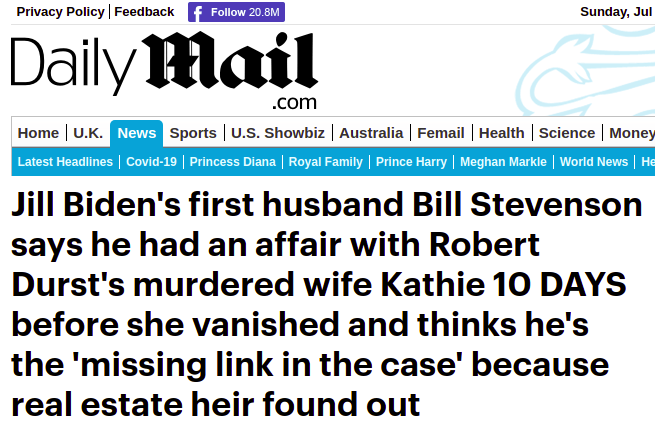
Something really stinks about Joe Biden. I knew there was something strange about his relationship with Jill, after his first wife’s death in a car accident. I couldn’t really put my finger on it, until I read a piece by the guy who was Jill’s first husband. He claimed that Jill had an AFFAIR with Biden that broke up their marriage.


LINK: https://www.dailymail.co.uk/news/article-8635281/Jill-Biden-cheated-husband-Joe-ex-claims.html

ARCHIVE: https://archive.fo/BOn8i


That almost settled things, but I was bothered by the fact that the first husband seemed so POSITIVE toward Biden, despite him breaking up their marriage. That is not entirely impossible – but still, there was something strange about it that just bothered me.

Now, the thing is, the dates leave open a LOT of possibilities – including the possibility that the affair between Jill and Joe starting BEFORE Biden’s first wife Neilia died. And THAT gets ugly.

But I had no idea HOW ugly.

SO – I was already suspicious that things were weird.

But THEN I saw an allegation that Joe and Jill got involved EVEN EARLIER.

https://twitter.com/Johnheretohelp/status/1411074811615449091

(Edit – tweet deleted – but captured by Wayback Machine…..)

Say WHAAAAT?

Sounds like rampant nasty speculation to me, but still, things ARE weird in HAIR-SNIFFER PARADISE.

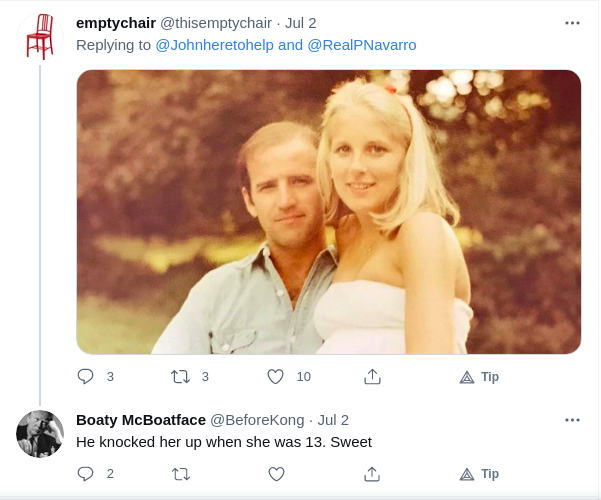
Actually, I got to THAT tweet through an even more shocking tweet – a reply to it.

Let’s just save that image…..

In fact, let’s save that tweet, too…..

And then there was ANOTHER one in the thread.

https://twitter.com/thisemptychair/status/1411077208643452929

THAT is a much better picture!

Heck – let’s save that, too.

Replies to this tweet include assertions that this was taken when Jill was divorced and Neilia was gone, as well as that it was photoshopped.

Seems like an insoluble mess, right?


2 – Finding The Photo

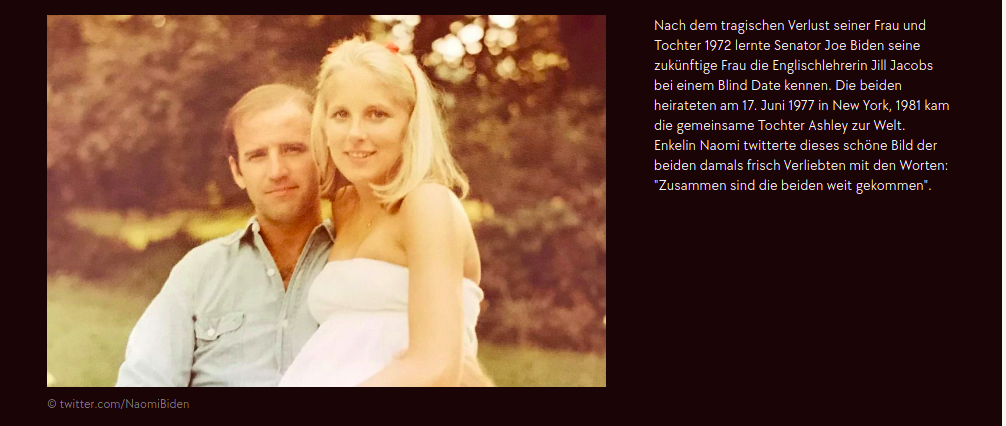
Well, the truth is, this picture appears in a German online magazine, and was allegedly posted by one of Jill’s granddaughters on Twitter.

https://www.gala.de/stars/news/first-family-der-usa–das-fotoalbum-der-familie-biden_22350110-22349236.html

Nach dem tragischen Verlust seiner Frau und Tochter 1972 lernte Senator Joe Biden seine zukünftige Frau die Englischlehrerin Jill Jacobs bei einem Blind Date kennen. Die beiden heirateten am 17. Juni 1977 in New York, 1981 kam die gemeinsame Tochter Ashley zur Welt.
Enkelin Naomi twitterte dieses schöne Bild der beiden damals frisch Verliebten mit den Worten: “Zusammen sind die beiden weit gekommen”.

Translated:

After the tragic loss of his wife and daughter in 1972, Senator Joe Biden met his future wife, English teacher Jill Jacobs, on a blind date. The two married in New York on June 17, 1977, and their daughter Ashley was born in 1981.
Granddaughter Naomi tweeted this beautiful picture of the two newly in love with the words: “Together, the two have come a long way”.

Naomi is identified here:

https://twitter.com/ThomasStPeter77/status/1411430907425210372

Let’s just save that tweet…..

Let’s just save that picture:

Looks like a nice family. Just sayin’.

Her name is Naomi Biden. Examples:

Turns out that she’s on Twitter as (at)NaomiBiden, and she’s a chip off the old block.

Remember that I told you that the reason that the ONE “fraud state” exception to THIS:

……was because PENNSYLVANIA needed to LOOK GOOD on vaccinations?

There you go. Straight from Biden’s granddaughter’s mouth. When THE PARTY needs you to look good, other party members make sure it happens.

Whether it’s REAL or not.

Anyway, check out Naomi Biden’s Twitter timeline. Very CCP. Errr, I mean ACP.

So I kept digging through the standard Democrat Communist party line, and THERE IT WAS!

Let’s just save that…..

AH! We’re finally THERE. We’ve shown that the photo is AUTHORITATIVE – meaning that it was “blessed” by being released by a Biden granddaughter. In a world of disinformation as one of the most powerful weapons of the LEFT, I don’t even trust this photo to be real when released by a Biden family member. But it is AUTHORITATIVE. It was released by them AS IF it was real, to make people believe it was real.

And where THAT goes from there, we will find out.


3 – How Old Is Jill In That Photo?

This is the gazillion dollar question.

We had some BETS MADE in a prior thread.

I challenged people to guess the ages of Jill and Joe in that photo, avoiding any reliance on externals – just their knowledge of humans, such as their own kids, neighbors, relatives, etc.

The exact comment was HERE: https://www.theqtree.com/2021/07/03/2021%c2%b707%c2%b703-joe-biden-didnt-win-daily-thread/comment-page-1/#comment-760607

You’re welcome to go look at the answers and generate statistics. My rough estimate is that most people figured she was in her late teens. The OUTLYING answers were early middle teens (13-15) and 20s. Most opinions seemed to be in the 16-19 range.

High school girl. That is our “group vision stereo consensus”.

This starts to become problematic.


4 – The Timelines Collide

Jill Biden was born June 3, 1951.

LINK: https://en.wikipedia.org/wiki/Jill_Biden

ARCHIVE: https://archive.fo/ZquKp

She was married to Bill Stevenson on February 7, 1970, at the age of 18, 4 months shy of 19.

Thus, the picture SEEMS to be from BEFORE she married Bill Stevenson. It is extremely unlikely that the picture is from AFTER her marriage to Bill Stevenson, which ENDED in separation in October 1974 and civil divorce in May 1975.

The Bidens allege that they met during that separation period, in March of 1975. They were married on June 17, 1977.

March of 1975 would have made Jill Biden 23 years old, 3 months shy of 24 years old.

That is at the extreme of her potential age in that picture, based on the reckonings of our group. It is an extreme minority position, with more opinions at the OTHER extreme.

But let’s go from there to the Bill Stevenson story – that goes as follows.

According to Bill, Jill met Joe through Bill’s political support for Joe Biden.

Here is his chronology listed in the Daily Mail:


  • Joe Biden and his wife Jill  had an affair that broke up her first marriage, her ex-husband told DailyMail.com in an exclusive interview
  • Bill Stevenson says that their story about how the presidential candidate fell in love with Jill after a blind date is made up
  • The way the Bidens tell their story, Joe saw a picture of Jill in March 1975 — after her marriage crashed — and they went on a date and have been together since 
  • But Stevenson claims he and his then wife met Biden in 1972, when they worked on then-New Castle County Councilman Biden’s first campaign for the Senate 
  • At the time Biden was married to his first wife Neilia who died with their daughter Naomi in a car crash between the election and Biden taking his Senate seat 
  • ‘Jill and I sat in the Bidens’ kitchen,’ Stevenson said. ‘We worked on his campaign’
  • Stevenson said he first suspected Biden and Jill were having an affair in August 1974; He was then 26, Jill was 23 and Joe was 31 
  • ‘One of her best friends told me she thought Joe and Jill were getting a little too close,’ he said
  • That October he got confirmation when a man informed him Biden was driving his wife’s car and the two of them got into a fender bender  
  • Stevenson said: ‘I asked Jill to leave the house, which she did… I considered Joe a friend. I’m not surprised he fell in love with Jill’

Now, I’m going to be blunt and early here – I no longer trust THIS story, either. I think it’s a “Clinton special” – a substitute scandal, like Cuomo’s kissing scandal, which is used to deflate the “he murdered thousands of old people on purpose for politics” scandal.

But let’s play along. After all, if I’m right, and it’s an “alibi” of some kind, it will be close to the truth.

Stevenson claims that Jill and Joe met through HIM (convenient) in 1972. THAT would make Jill Biden roughly 21 years old.

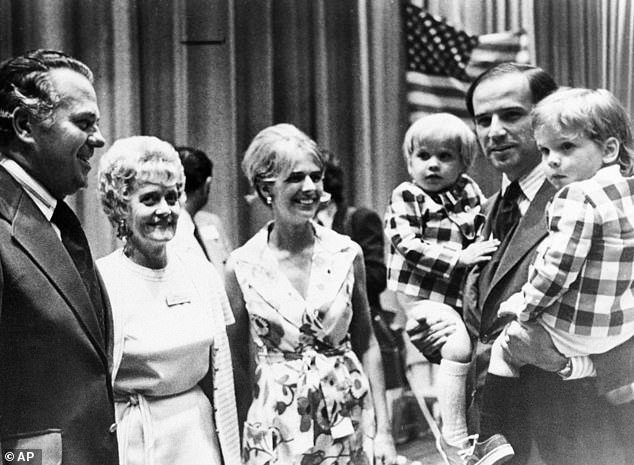
Leaving Jill’s age aside, THAT makes a lot of sense. Now what is VERY cool is that we HAVE a picture of Joe Biden campaigning in 1972, thanks to the Daily Mail.

You can see Neilia – she’s going to die in a car accident in December of that year, AFTER Joe Biden WINS his Senate seat in November but BEFORE he goes to Washington. Their 1-year-old daughter Naomi will die with her.

Now it may just be the clothes, but I would almost swear that Joe Biden looks a few years older in this photo, than he does in the “Jill on his lap” photo.

But all we have done at this point, really, is to introduce doubts.

But NOW, I’m going to introduce even more doubt. What if somebody came up with a PICTURE of Jill Biden during the early 1970s?

And before I forget to mention it, what if that picture comes up in a story about Bill Stevenson having a lurid affair of his own which allegedly led to multiple murders? And what if the first murder was soon after Joe Biden married his ex, Jill?

Watch out – this whole thing gets WEIRD very fast.

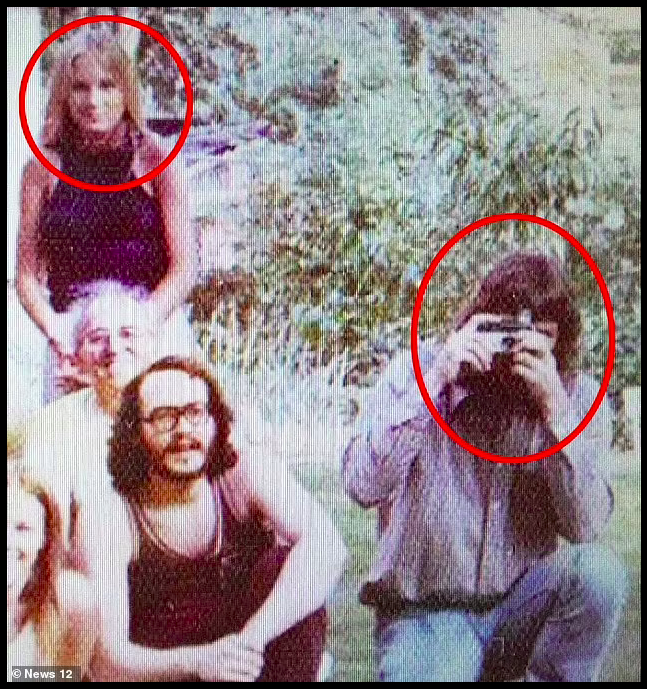
Yes – that is Jill and Bill Stevenson. Jill’s style here looks very 1972-1974.

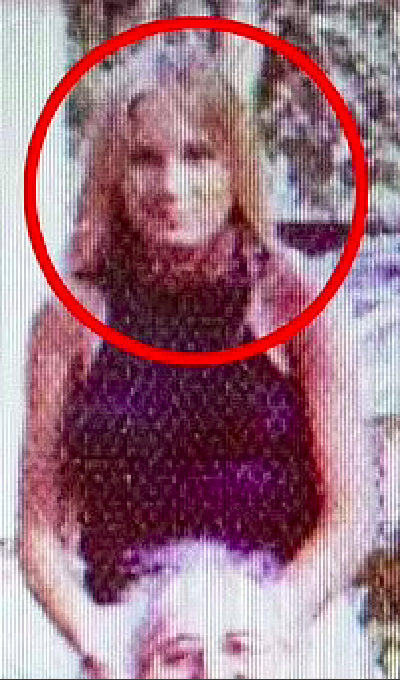
Let’s look at her more closely. First 2X magnification.

Now even closer – 4X.

This looks like a 19, 20, or 21-year-old girl to me. That would make her a sophomore, junior, or senior in college. Perfect fit – read Jill’s biography in Wikipedia. This matches both her biography and the framework of the Stevenson story.

However, she is noticeably OLDER than the picture of the girl on Biden’s lap.

What’s interesting to me, is that I knew girls at that time, who were AGED as in the “lap girl photo”, but wore fashions like the girl in this photo, which styles were popular at the time. Same hairstyle and top – bandana around the neck – but these girls were younger – high-school aged – facially very much like the girl in the lap photo, or just a bit older.

Thus, it seems entirely possible to me, that the photo on Joe Biden’s lap was taken while Jill was in high school, possibly babysitting for the Bidens. Maybe she had a prom, or a dance, and was like a member of the family at that point.

I could insert some classic movie poster about this, but you know what I’m thinking.

But then let’s just set that all aside now, and see the context of that OTHER weird story from the Daily Mail.

Which newspaper may be following the angle that I’m thinking.


5 – The Timelines Always Get Them

MORE at the link….including videos of Stevenson….telling his story….

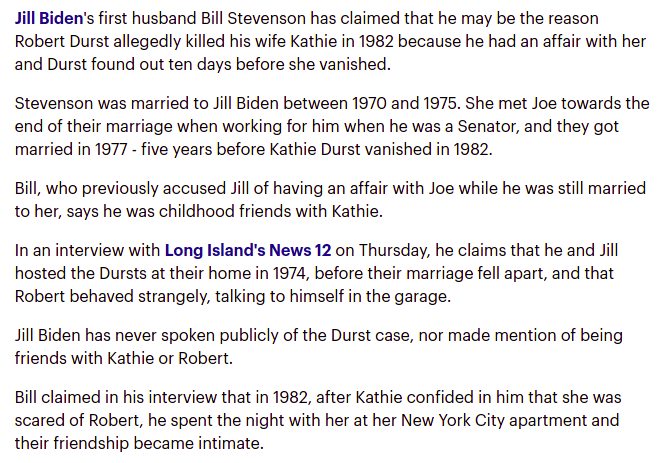
LINK: https://www.dailymail.co.uk/news/article-9772651/Jill-Bidens-husband-Bill-Stevenson-says-affair-Kathie-Durst.html

ARCHIVE: https://archive.fo/7rz2G


Now – just check out this “memorable scene” from Stevenson…..via the article…..

Stevenson alleges that the next day, Robert showed up at the apartment ‘pounding on the door’ and that he slammed a wad of rolled up cash in Kathie’s face. 

That’s a bit of a shocker there, but before we go on, ask what better class of theories might fit that memory.

Now go on.

Ten days later, she vanished.

He thinks Robert – who has long been accused of murdering his wife but has never been charged over it – was driven to kill her after discovering their affair.

‘This is something that has to be righted. I was together with them and he went crazy. I feel like I’m the missing link in this case,’ he said.

Stevenson said he watched Kathie ‘grow up into a beautiful young woman’ after their families became friends when they were kids.

‘She was that cool little sister – I watched her grow up to be a beautiful young woman.’

He says in 1974, he and Jill hosted Kathie and Robert Durst at their home.

He says Jill and Kathie ‘hit it off’. ‘Both very smart, they’re similar people. At that age. It was hard not to hit it off.

‘I remember him talking to himself in my garage. To me it was like, “oh my god.”‘

Years later, once his marriage to Jill had broken up and after Jill and Joe had gotten married, Kathie started confiding in Stevenson, he says.

‘She said I’m having a real problem with Robert and I’m scared to death.

She said he was being violent with her. At that point, she couldn’t trust anybody around her that knew Robert.

‘I don’t know why she picked me but I’m glad she did.

‘But I do feel that I let her down. I look back at those last two months and go, “what could I have done differently.”

He says he visited Kathie five times between 1981 and 1982. They stayed at Kathie’s apartment in New York City and it was during that time that it became romantic.

I think the DM may be thinking the same thing I am. They have THIS as a sidebar to what I just quoted.


TIMELINE OF BIDEN AND DURST MARRIAGES

  • 1970: Jill and Bill marry
  • 1973: Kathie and Robert Durst marry
  • 1974: Bill says he and Jill hosted Robert and Kathie Durst at their home
  • 1974/1975: Jill and Bill separate
  • 1977: Jill and Joe marry
  • 1982: Kathie Durst disappears

Is there a connection? That might lead to “lives lost”? Read that article.

Can you guess the word I’m thinking?

I strongly suspect that SEVERAL stories are falling apart. It’s not just about dementia now.

W

PS – check out the “record-correcting troll comments” on the DM articles. They seem professional to me.


References

Daily Mail Article on Jill Biden’s Affair with Joe Biden:

https://www.dailymail.co.uk/news/article-8635281/Jill-Biden-cheated-husband-Joe-ex-claims.html

Archive of Affair Article:

https://archive.fo/BOn8i

Daily Mail Article on Jill Biden’s First Marriage Relation To Murder:

https://www.dailymail.co.uk/news/article-9772651/Jill-Bidens-husband-Bill-Stevenson-says-affair-Kathie-Durst.html

Archive of Murder Article:

https://archive.fo/7rz2G

Dear KMAG: 20210712 Joe Biden Didn’t Win ❀ Open Topic

Joe Biden didn’t win. This is our Real President:

This Stormwatch Monday Open Thread is VERY OPEN – a place for everybody to post whatever they feel they would like to tell the White Hats, and the rest of the MAGA/KAG/KMAG world (with KMAG being a bit of both).

Yes, it’s Monday…again.

But it’s okay!  We’ll get through it.

Free Speech is practiced here at the Q Tree. But please keep it civil. We’re on the same side here so let’s not engage in friendly fire.

If you find yourself in a slap fight, we ask that you take it outside to The U Tree…which is also a good place to report any technical difficulties, if you’re unable to report them here.

Please also consider the Important Guidelines, outlined here. Let’s not give the odious Internet Censors a reason to shut down this precious haven that Wolf has created for us.

Please pray for our real President, the one who actually won the election:


For your listening enjoyment, I offer this from Fearless Motivation Instrumentals, titled ‘Purpose Monster’:


Our beloved country is under Occupation by hostile forces.

We can give in to despair…or we can be defiant and fight back in any way that we can.

Joe Biden didn’t win.

I will keep saying Joe Biden didn’t win until we get His Fraudulency out of our White House.


Wheatie’s Word of the Day:

capsheaf

Capsheaf is a noun which means…originally, the top layer of a stack of wheat; capsheaf has come to refer to the crowning point; the finishing point; the extreme degree of anything.

Used in a sentence:

Stealing an election and usurping power is the capsheaf of the Demoncrats’ treachery.


2021·07·10 Joe Biden Didn’t Win Daily Thread

His Fraudulency

Joe Biteme, properly styled His Fraudulency, continues to infest the White House, and hopium is still being dispensed even as our military appears to have joined the political establishment in knuckling under to the fraud.

All realistic hope lies in the audits, and perhaps the Lindell lawsuit (that will depend on how honestly the system responds to the suit).

One can hope that all is not as it seems.

I’d love to feast on that crow.

Physics?

It looks like the next couple of months aren’t going to be as busy I had thought so I can do some physics posts. See below.

Justice Must Be Done.

The prior election must be acknowledged as fraudulent, and steps must be taken to prosecute the fraudsters and restore integrity to the system.

Nothing else matters at this point. Talking about trying again in 2022 or 2024 is hopeless otherwise. Which is not to say one must never talk about this, but rather that one must account for this in ones planning; if fixing the fraud is not part of the plan, you have no plan.

Lawyer Appeasement Section

OK now for the fine print.

This is the WQTH Daily Thread. You know the drill. There’s no Poltical correctness, but civility is a requirement. There are Important Guidelines,  here, with an addendum on 20191110.

We have a new board – called The U Tree – where people can take each other to the woodshed without fear of censorship or moderation.

And remember Wheatie’s Rules:

1. No food fights
2. No running with scissors.
3. If you bring snacks, bring enough for everyone.
4. Zeroth rule of gun safety: Don’t let the government get your guns.
5. Rule one of gun safety: The gun is always loaded.
5a. If you actually want the gun to be loaded, like because you’re checking out a bump in the night, then it’s empty.
6. Rule two of gun safety: Never point the gun at anything you’re not willing to destroy.
7. Rule three: Keep your finger off the trigger until ready to fire.
8. Rule the fourth: Be sure of your target and what is behind it.

(Hmm a few extras seem to have crept in.)

(Paper) Spot Prices

Last week:

Gold $1788.30
Silver $26.53
Platinum $1094.00
Palladium $2874.00
Rhodium $19,400.00

This week, 3PM Mountain Time, markets have closed for the weekend.

Gold $1808.90
Silver $26.19
Platinum $1105
Palladium $2903
Rhodium $18,500

UPDATE: Apparently paper prices are getting closer to reality. I was quoted $125 over spot for an American Gold Eagle (the modern day one ounce bullion piece).

Gold is slowly climbing again, Silver down a touch, Platinum and Palladium up a bit, Rhodium is down. In fact at the beginning of the day today it was at $17,500 but jumped a grand sometime before close.

Max Planck: Physics Starts Getting Weird

Introduction

This is going to start to tie together a few dangling threads out there, notably Hertz’s discovery of the photoelectric effect (how even dim, weak ultraviolet light would help the spark jump the gap but glaringly bright visible light would not), and the puzzle of why black body radiation had a “hump” in its frequency distribution (instead of just going to infinity with higher frequency/lower wavelength).

To recap, we knew of the existence of X rays, ultraviolet, infrared and radio, in addition to “ordinary” visible light.

Also, to avoid getting bogged down in Spockian numbers specified to nine decimal places, I’m going to round a lot of things off.

Max Planck

Planck was born in 1858 in Kiel, Holstein (now the German state of Schleswig-Holstein, it’s the area immediately adjacent to modern-day Denmark).

He was raised as a geek, and ended up teaching at the Humboldt University in Berlin. In 1894 he decided to take up the black body radiation problem. Why did it behave the way it did?

To recap, black body radiation is the glow given off by hot objects (in the idealized case that the hot object is perfectly black). As shown in the figure below, if you plot the wavelength of the light versus intensity you get a hump that’s steep on the high frequency side (left side of the diagram), and less steep on the low frequency side. The peak of the curve tends towards blue (leftward) the higher the temperature, and the height of the curve increases very rapidly as the temperature increases.

Figure 10-1 recap of black body radiation curves.

The best physicists could do as of 1894 (when Planck put his shoulder to the wheel) is design a theory (the Rayleigh-Jeans law) that predicted the distribution should look like the black line in the figure. It’s not a bad match at the low frequencies (longer wavelengths, at the far right) but is totally, ridiculously wrong at higher frequencies/lower wavelengths; the prediction was basically that the higher the frequency the more should be radiated at that frequency. Since you can’t get a sunburn (caused by ultraviolet) off of a wood fire–because the wood fire is not super hot and emits no UV–we know that’s not actually what’s going on here.

Figure 10-2 An approximate rendering of the color of glow of a black body, given its temperature (in kelvin). The sun comes in at about 5800 K, so it’s just a tiny bit off white. The only things you’re likely to have seen that are hot enough to appear to be glowing blue are many stars in the night sky and bolts of lightning. That being said, modern LED light bulbs are generally set to simulate some specific temperature, from “warm” tungsten filaments through sunlight, and cloudy days and shade can give a 7-9 thousand kelvin cast to things that your camera has to try to account for if you don’t, when taking pictures.

An alternate law, Wien’s Law, was proposed by Wilhelm Wien in 1896 (after Planck began his work). It worked well at high frequencies and was wrong at low frequencies. It was a much better fit, but not perfect; it was a bit too low. Alas this diagram is “backwards” (compared to 10-1) with high wavelengths on the left.

Figure 10-3 Wien’s Law.

Wien’s Law looks pretty close, but it’s not right-on, so there was still a problem here.

Max Planck’s goal was to solve the problem, to come up with a formula that gave results consistent with what was actually measured. And since the line that’s “true” in figure 10-3 is labeled “Planck” you can probably guess that he ultimately succeeded.

But not without some trials and tribulations. He tried to imagine the atoms in the glowing object as little oscillators, because that way he could apply entropy to an ideal oscillator. He came up with a proposed law (the Wien-Planck law) in 1899…that, alas, turned out not to match measurements either.

In October of the next year, 1900, he did succeed in writing a law that described experimental results well. This derivation avoided any sort of statistical mechanics, which Planck had an aversion to.

Statistical mechanics was a fairly new thing at the time, it studied large assemblies of microscopic units in a statistical manner; in fact modern thermodynamics relies heavily on it. But in 1900 it was still considered suspect by many, including Max Planck. It had philosophical and physical implications that were distasteful to many.

But Planck, having got a law that looked good on paper…couldn’t for the life of him explain why it worked–and without some explanation of that, it was interesting that his law could match what was seen, but not enlightening. Over the course of the next few months, he did finally, in desperation, decide to accept statistical mechanics as a tool, incorporating Boltzmann’s statistical interpretation of the second law of thermodynamics.

This is like a dedicated Marxist coming to the dawning realization that capitalism works and Marxism cannot. That is how desperate Planck was to try new things to figure this out. It was, as he said, “an act of despair … I was ready to sacrifice any of my previous convictions about physics.”

His derivation started with an assumption that seemed totally whacky, and had no obvious basis in reality, but it was: Energy could only be emitted in multiples of a certain base amount. That amount was:

E = h ν

(As a reminder ν is the lower case Greek letter “nu” and stands for the frequency of the light being emitted.)

This meant that there wasn’t just a minimum amount of energy, but that any amount of energy had to be an integer multiple of this amount. It’s sort of like money…you don’t see fractions of a cent. Any amount can be expressed as a whole number of cents, but never is there a fraction of a cent (not withstanding nominal US gasoline prices that end in 9/10 of a cent without fail).

This minimum amount was termed a “quanta.”

But note that it depends on the frequency. So at, say, 600 THz (yellow light) the minimum quanta would be one size, but at 300 THz (infrared), it would be half as much. It’s rather like exchanging your dollars for euros and now the minimum amount you can work with is the Euro cent rather than our cent.

The minimum “quanta” of energy not only depended on the frequency it would be radiated at, but also on this new number, h, which is a constant, now known as Planck’s constant, and it’s one of the most important numbers in physics:

h = 6.62607015×10⁻³⁴ J s

It’s going to turn up again, and again, and again from here on out.

The units are joule seconds, not joules per second (which is power measured in watts). When you multiply this by a frequency (which is cycles per second) the seconds cancel out and leave you with energy in joules.

In fact, it’s really joules per cycle or per hertz, i.e., one cycle of the wave of the light, but the cycle is expressed as one over seconds (1/s) so when you divide by that, you’re multiplying by seconds.

(As usual when a scientist brings a new constant into things, Planck didn’t actually know the value of h; he just realized that there had to be a value to this number. Today, of course, we know it precisely, because the latest iteration of the metric system actually defines a number of physical constants, including h, to have specific values, and the size of the units involved is set by that action. Thus we have the meter…which is defined to be the distance traveled by light (in a vacuum) in 1/299792458 of a second. Planck’s constant is set to the number above, and from that, we get a definition of the kilogram [because a joule second is a kg m2/s; we have a defined second and a defined meter, so that gives us a defined kilogram]. Before 2019, however, the kilogram was still defined as the mass of a certain metal cylinder kept in a vault in France…a definition which was starting to cause problems, because exact copies made decades ago were no longer the same mass, making one wonder if any of those cylinders was not changing.)

Even with typical visible light, yellow light in particular, having a frequency of about 600 THz, or 6×10¹⁴ Hz, you can see that doing the multiplication is going to leave you with a very small number, basically about 4×10-19 joules. Given that a joule is very roughly the energy it takes to lift an apple a meter, this is a very small amount of energy. And as mentioned, the size of the “quanta” depends on the frequency; twice the frequency, twice as much energy in a quanta.

He wasn’t the only one who was skeptical nor was he the most skeptical, Lorentz, Rayleigh and Jeans tried setting h to zero in their work, i.e., meaning that there was no minimum energy unit. That was too conservative even for Planck, who compared Jeans’s inflexibility to Hegel’s: “I am unable to understand Jeans’ stubbornness – he is an example of a theoretician as should never be existing, the same as Hegel was for philosophy. So much the worse for the facts if they don’t fit.”

But, at the time (1900) Planck did regard this as a mere formalism with no real basis in reality, much as there were, at that time, still holdouts in chemistry who thought atoms didn’t really exist, but were convenient conceptual tools. The quantum concept was convenient but didn’t represent something that really existed.

That’s what he thought at the time. Today, we look upon Planck’s use of this concept as the birth of quantum mechanics–which, if it were wrong, would mean that semiconductors don’t work and you are not reading this on a computer screen.

One last wrinkle here; as I mentioned, the constant is “per cycle” which is regarded as analogous to going all the way around a circle. That’s 2π radians. But many formulas (like for angular momentum and rotation rate, when expressed in terms of angles) operate in radians, so there’s a version of Planck’s constant that accounts for this and is expressed in a “per radian” sense instead of a “per cycle” sense. It’s written ħ (a crossed h, called “h bar” in speaking), and is h/2π. This symbol is seen, if anything, even more often than h in modern physics.

But anyway, back to 1900.

Planck was banging on the door to modern physics, unwilling as yet to open it.

Soon, very soon, others would kick the damn thing down.

Obligatory PSAs and Reminders

China is Lower than Whale Shit

Remember Hong Kong!!!

Whoever ends up in the cell next to his, tell him I said “Hi.”

中国是个混蛋 !!!
Zhōngguò shì gè hùndàn !!!
China is asshoe !!!

China is in the White House

Since Wednesday, January 20 at Noon EST, the bought-and-paid for His Fraudulency Joseph Biden has been in the White House. It’s as good as having China in the Oval Office.

Joe Biden is Asshoe

China is in the White House, because Joe Biden is in the White House, and Joe Biden is identically equal to China. China is Asshoe. Therefore, Joe Biden is Asshoe.

But of course the much more important thing to realize:

Joe Biden Didn’t Win

乔*拜登没赢 !!!
Qiáo Bài dēng méi yíng !!!
Joe Biden didn’t win !!!
Dear KMAG: 20210705 Joe Biden Didn’t Win ❀ Open Topic

Joe Biden didn’t win. This is our Real President:

And we are not alone in believing that:

This Stormwatch Monday Open Thread is VERY OPEN – a place for everybody to post whatever they feel they would like to tell the White Hats, and the rest of the MAGA/KAG/KMAG world (with KMAG being a bit of both).

Yes, it’s Monday…again.

But it’s okay! It’s a Holiday, so you can go back to bed.

Free Speech is practiced here at the Q Tree. But please keep it civil. We’re on the same side here so let’s not engage in friendly fire.

If you find yourself in a slap fight, we ask that you take it outside to The U Tree…which is also a good place to report any technical difficulties, if you’re unable to report them here.

Please also consider the Important Guidelines, outlined here. Let’s not give the odious Internet Censors a reason to shut down this precious haven that Wolf has created for us.

Please pray for our real President, the one who actually won the election:


For your listening enjoyment, I offer this from Fearless Motivation, a mix of two tracks titled ‘Day of Domination’ and ‘Next level’:

Also, this from Jo Blankenburg, from the album ‘Cronos’:


Our beloved country is under Occupation by hostile forces.

We can give in to despair…or we can be defiant and fight back in any way that we can.

Joe Biden didn’t win.

I will keep saying Joe Biden didn’t win until we get His Fraudulency out of our White House.


Wheatie’s Word of the Day:

honeyfuggle

Honeyfuggle is a verb which means…to wheedle, swindle, cheat or deceive someone by using sweet talk or flattery; to obtain by cheating or deception.

Used in a sentence:

Shameless Democrats often honeyfuggle their constituents into believing their lies and voting for them.


2021·07·03 Joe Biden Didn’t Win Daily Thread

Justice Must Be Done.

The prior election must be acknowledged as fraudulent, and steps must be taken to prosecute the fraudsters and restore integrity to the system.

Nothing else matters at this point. Talking about trying again in 2022 or 2024 is hopeless otherwise. Which is not to say one must never talk about this, but rather that one must account for this in ones planning; if fixing the fraud is not part of the plan, you have no plan.

Mid-Independence Day

Yesterday was the Second, and tomorrow is the Fourth, of July.

Although the Declaration of Independence proudly proclaims “In Congress, July 4th, 1776,” the actual resolution of independence, the Lee Resolution ( https://en.wikipedia.org/wiki/Lee_Resolution ) was passed on July 2nd.

July 4th was when the text of the masterfully-written-and-butchered document was approved. It includes the Lee Resolution in its own text, in the last paragraph:

We, therefore, the Representatives of the united States of America, in General Congress, Assembled, appealing to the Supreme Judge of the world for the rectitude of our intentions, do, in the Name, and by Authority of the good People of these Colonies, solemnly publish and declare, That these united Colonies are, and of Right ought to be Free and Independent States; that they are Absolved from all Allegiance to the British Crown, and that all political connection between them and the State of Great Britain, is and ought to be totally dissolved; and that as Free and Independent States, they have full Power to levy War, conclude Peace, contract Alliances, establish Commerce, and to do all other Acts and Things which Independent States may of right do. And for the support of this Declaration, with a firm reliance on the protection of divine Providence, we mutually pledge to each other our Lives, our Fortunes and our sacred Honor.

Declaration of Independence of the United States, last paragraph; Lee Resolution in bold.

So in a sense Friday was the real Independence Day, and today is just the average of the real one, and the commonly celebrated one on Sunday.

Lawyer Appeasement Section

OK now for the fine print.

This is the WQTH Daily Thread. You know the drill. There’s no Poltical correctness, but civility is a requirement. There are Important Guidelines,  here, with an addendum on 20191110.

We have a new board – called The U Tree – where people can take each other to the woodshed without fear of censorship or moderation.

And remember Wheatie’s Rules:

1. No food fights
2. No running with scissors.
3. If you bring snacks, bring enough for everyone.
4. Zeroth rule of gun safety: Don’t let the government get your guns.
5. Rule one of gun safety: The gun is always loaded.
5a. If you actually want the gun to be loaded, like because you’re checking out a bump in the night, then it’s empty.
6. Rule two of gun safety: Never point the gun at anything you’re not willing to destroy.
7. Rule three: Keep your finger off the trigger until ready to fire.
8. Rule the fourth: Be sure of your target and what is behind it.

(Hmm a few extras seem to have crept in.)

Spot (i.e., paper) Prices

Last week:

Gold $1782.30
Silver $26.20
Platinum $1114.00
Palladium $2724.00
Rhodium $19,200.00

This week, 3PM Mountain Time, markets have closed for the weekend.

Gold $1788.30
Silver $26.53
Platinum $1094.00
Palladium $2874.00
Rhodium $19,400.00

Obligatory PSAs and Reminders

China is Lower than Whale Shit

Remember Hong Kong!!!

Whoever ends up in the cell next to his, tell him I said “Hi.”

中国是个混蛋 !!!
Zhōngguò shì gè hùndàn !!!
China is asshoe !!!

China is in the White House

Since Wednesday, January 20 at Noon EST, the bought-and-paid for His Fraudulency Joseph Biden has been in the White House. It’s as good as having China in the Oval Office.

Joe Biden is Asshoe

China is in the White House, because Joe Biden is in the White House, and Joe Biden is identically equal to China. China is Asshoe. Therefore, Joe Biden is Asshoe.

But of course the much more important thing to realize:

Joe Biden Didn’t Win

乔*拜登没赢 !!!
Qiáo Bài dēng méi yíng !!!
Joe Biden didn’t win !!!

Dear KMAG: 20210621 Joe Biden Didn’t Win ❀ Open Topic

Joe Biden didn’t win. This is our Real President:

This Stormwatch Monday Open Thread is VERY OPEN – a place for everybody to post whatever they feel they would like to tell the White Hats, and the rest of the MAGA/KAG/KMAG world (with KMAG being a bit of both).

Yes, it’s Monday…again.

But it’s okay! We’ll get through it.

Free Speech is practiced here at the Q Tree. But please keep it civil. We’re on the same side here so let’s not engage in friendly fire.

If you find yourself in a slap fight, we ask that you take it outside to The U Tree…which is also a good place to report any technical difficulties, if you’re unable to report them here.

Please also consider the Important Guidelines, outlined here. Let’s not give the odious Internet Censors a reason to shut down this precious haven that Wolf has created for us.

Please pray for our real President, the one who actually won the election:


For your listening enjoyment, I offer this from Phil Rey Gibbons, titled ‘Northmen’:

And this from Patrick Rundblad, titled ‘Mission Infinity’:


Our beloved country is under Occupation by hostile forces.

We can give in to despair…or we can be defiant and fight back in any way that we can.

Joe Biden didn’t win.

I will keep saying Joe Biden didn’t win until we get His Fraudulency out of our White House.


Wheatie’s Word of the Day:

spate

Spate is a noun which means…a sudden rush, flood or outpouring; a large number of similar things or events appearing or occurring in quick succession. It is often followed by ‘of’…as in, a spate of.

The Urban Dictionary lists some newer usages of spate: 1) Spate can be an alternative term to sex. 2) Spate also means to play a prank on someone. 3) You can also Spate yourself, by accidentally causing grief to yourself after performing an act. 4) Spate can be used as a curse word.

Used in a sentence:

The good patriots who love this country are getting fed up with the spate of lawlessness and constitutional violations that are flowing from the Demoncrats in power.


Dear KMAG: 20210614 Joe Biden Didn’t Win ❀ Open Topic

Joe Biden didn’t win. This is our Real President:

This Stormwatch Monday Open Thread is VERY OPEN – a place for everybody to post whatever they feel they would like to tell the White Hats, and the rest of the MAGA/KAG/KMAG world (with KMAG being a bit of both).

Yes, it’s Monday…again.

But it’s okay! We’ll get through it.

Free Speech is practiced here at the Q Tree. But please keep it civil. We’re on the same side here so let’s not engage in friendly fire.

If you find yourself in a slap fight, we ask that you take it outside to The U Tree…which is also a good place to report any technical difficulties, if you’re unable to report them here.

Please also consider the Important Guidelines, outlined here. Let’s not give the odious Internet Censors a reason to shut down this precious haven that Wolf has created for us.

Please pray for our real President, the one who actually won the election:


For your listening enjoyment, I offer this from Phil Rey Gibbons, titled ‘Lighter Than Air’:

And from Nathan Whitehead, two tracks titled ‘Daysgone’ and ‘Why We Fight’:


Our beloved country is under Occupation by hostile forces.

We can give in to despair…or we can be defiant and fight back in any way that we can.

Joe Biden didn’t win.

I will keep saying Joe Biden didn’t win until we get His Fraudulency out of our White House.


Wheatie’s Word of the Day:

obviate

Obviate is a transitive verb which means…to keep from happening; to anticipate; to prevent by interception;  to avoid a future problem.

Used in a sentence:

In order to obviate the destruction of our country, communist Democrats must be removed and kept from any control over us.


2021·06·12 Joe Biden Didn’t Win Daily Thread

His Fraudulency

Joe Biteme, properly styled His Fraudulency, continues to infest the White House, we haven’t heard much from the person who should have been declared the victor, and hopium is still being dispensed even as our military appears to have joined the political establishment in knuckling under to the fraud.

One can hope that all is not as it seems.

I’d love to feast on that crow.

Justice Must Be Done.

The prior election must be acknowledged as fraudulent, and steps must be taken to prosecute the fraudsters and restore integrity to the system.

Nothing else matters at this point. Talking about trying again in 2022 or 2024 is hopeless otherwise. Which is not to say one must never talk about this, but rather that one must account for this in ones planning; if fixing the fraud is not part of the plan, you have no plan.

Lawyer Appeasement Section

OK now for the fine print.

This is the WQTH Daily Thread. You know the drill. There’s no Poltical correctness, but civility is a requirement. There are Important Guidelines,  here, with an addendum on 20191110.

We have a new board – called The U Tree – where people can take each other to the woodshed without fear of censorship or moderation.

And remember Wheatie’s Rules:

1. No food fights
2. No running with scissors.
3. If you bring snacks, bring enough for everyone.
4. Zeroth rule of gun safety: Don’t let the government get your guns.
5. Rule one of gun safety: The gun is always loaded.
5a. If you actually want the gun to be loaded, like because you’re checking out a bump in the night, then it’s empty.
6. Rule two of gun safety: Never point the gun at anything you’re not willing to destroy.
7. Rule three: Keep your finger off the trigger until ready to fire.
8. Rule the fourth: Be sure of your target and what is behind it.

(Hmm a few extras seem to have crept in.)

Spot Prices.

Kitco Ask. Last week:

Gold $1893
Silver $27.91
Platinum $1172
Palladium $2890
Rhodium $21,000

This week, markets closed as of 3PM MT.

Gold $1877.40
Silver $28.02
Platinum $1153.00
Palladium $2854.00
Rhodium $22,000.00

Gold was actually just below $1900 at open. The others have changed even less on a percentage basis. Since rhodium didn’t just jump right back up to nearly $30K, I’m thinking this price might not be a short term “spike” (but downward).

(Be advised that if you want to go buy some gold, you will have to pay at least $200 over these spot prices. They represent “paper” gold, not “physical” gold, a lump you can hold in your hand. Incidentally, if you do have a lump of some size, doesn’t it give you a nice warm feeling to heft it?)

The Atom
(Part VII of a Long Series)

Introduction

The general outline of this story is to start off by putting you “in touch” with the state of physics at the beginning of 1895. Physicists were feeling pretty confident that they understood most everything. Sure there were a few loose ends, but they were just loose ends.

1895 marks the year when people began tugging at the loose ends and things unraveled a bit. In the next three years, three major discoveries made it plain there was still a lot to learn at the fundamental level.

Once I’m there I will concentrate on a very, very small object…that ties in with stars, arguably the biggest objects there are (galaxies are basically collections of stars). And we would never have seen this but for those discoveries in the 1890s.

It’s such a long story I decided to break it down into pieces, and this is the seventh of those pieces. (Though to be sure this series seems to have taken on a life of its own.)

And here is the caveat: I will be explaining, at first, what the scientific consensus was in 1895. So much of what I have to say is out of date, and I know it…but going past it would be a spoiler. So I’d appreciate not being “corrected” in the comments when I say things like “mass is conserved.” I know that that isn’t considered true any more, but the point is in 1895 we didn’t know that. I will get there in due time. (On the other hand, if I do misrepresent the state of understanding as it was in 1895, I do want to know it.)

Also, to avoid getting bogged down in Spockian numbers specified to nine decimal places, I’m going to round a lot of things off. I used 9.8 kg m/s2 in Part for a number that’s actually closer to 9.80665, for instance, similarly for the number 32. In fact, I’ll be rounding off a lot today.

NOTE: A YUUUGE debt is owed here to “Discovery of the Elements,” 2nd edition, by James L. Marshall.

Why Talk About Atoms?

This post is going to seem like it actually is about chemistry, and in many ways it is.

However, physics and chemistry are right next door to each other. Physics is the most fundamental of the sciences, the others build on it, with chemistry being the one directly “on top” of the physics foundation. Thus it’s the major branch of science most directly connected to physics. And you’ll see some of that here. (Of course, where we divide sciences into major branches is largely arbitrary. For example, if there were a major branch for electricity and magnetism, it’d be tied even closer to physics than chemistry is, but in fact, E&M is considered a branch of physics rather than a major science in its own right.)

Phlogiston

Our story begins with Georg Ernest Stahl, in the 1600s. Before he came on the scene, what we now think of as chemistry was still under the sway of the alchemists, many of whom were trying to turn lead (and other base metals) into gold.

They had a basic theory of chemistry, to wit that the world was made of exactly four basic substances, earth, water, air, and fire (and in some cases they believed the heavens were made out of “aether”, something not encountered “down here”). Everything we see around us, they maintained, was some sort of mixture of these basic elements. So to change lead into gold, all one needed to do was change the mixture, removing some things and adding others.

Of course, that never came to anything, but during all their efforts they amassed a huge amount of knowledge about what would happen if you mixed certain things together and treated them in certain ways.

For example you could mix potash and sulphur, and create liver of sulphur. But you could also create liver of sulphur by heating vitriolated tartar together with charcoal.

(I use the older names here so that you can see how totally arbitrary this must have seemed to the people who used those names.)

So what we had by the 1600s was a vast collection of information like this, with no real way to connect the pieces and understand what was really going on.

And this is where Georg Ernest Stahl comes in.

He was the first to put forward a theory that seemed to tie this disparate trivia together. The theory could also be used to make predictions about what would happen with previoiusly untried processes. This would help tremendously if the theory were right, but would also, if the theory were wrong, allow it to be discredited because it had made a specific prediction that hadn’t come to pass.

(A lot of things people believe are “unfalsifiable.” That means there’s no way, even in principle to disprove it even if it’s wrong. Most real “conspiracy theories” are like this, actually; if any evidence is turned up against the theory, the advocates will dismiss it as falsified as part of the cover up. If your hypothesis can explain away anything this way, and you can disregard evidence against your hypothesis, you can’t be convinced it’s wrong, and the theory itself is worthless since it can be neither proved or disproved, and can make no meaningful predictions, either–any outcome can be made to fit the theory, so any outcome is possible if the theory is true.)

So here it is: Stahl noted some similarities between combustion (burning things), calcining (rust, corrosion), and respiration (both plant and animal “breathing”). He concluded that at a very basic level three of these four were the same thing–he excepted plant respiration, but claimed that it was fundamentally animal respiration in reverse.

His proposed explanation for all of these processes? That wood, when it burns, and metal when it rusts, and animals when they breathe, all give off a substance called phlogiston. Thus, the calx of some metal, say iron rust was a purer substance than the metal, because the metal had given up phlogiston to turn into the rust. Similarly, when you burned a log you could even hear it hiss as the plogiston was released.

The ancients had believed that fire, once released, went up into the heavens; Stalh believed that plogiston combined with the atmosphere, to form phlogisticated air.

Plants would simply recapture the phlogiston from the air, turning the air into dephlogisticated air, and incorporate it into their tissues, forming a sort of closed cycle, ready to be burned again, or eaten by an animal that would breathe and release the phlogiston into the atmosphere once again.

OK, there were a couple of simple objections to this. Wood, when burned would lose weight, but metals, when rusting, gained weight. But it was readily noted that burning wood released a lot of smoke, which surely weighed something, and it was presumed there was a weight gain there, too (which in fact is the case). It was proposed, therefore, that phlogiston had negative weight. This was a concrete prediction of the theory, that phlogiston, if isolated, would have what amounted to antigravity, or as they called it back then, levity.

Chemists made a bunch of progress in the 1770s towards proving this theory and bringing some order to chemistry, much like Newton had done with mechanics a century earlier.

Unfortunately things fell apart under the weight of too much evidence. Too much special pleading had to occur to explain away anomalies.

Phlogisticated air was produced by Daniel Rutherford in 1772. He would burn a candle in a closed container, let a mouse asphyxiate (which took about 15 minutes) in a closed container, and also could get metal to calcine in a closed container. The resultant gas from one of these processes (say the burning candle) could be tested in another (the mouse) and fail to support the new process as well, which gave him a warm fuzzy that all three gases were actually the same thing; air loaded to capacity with phlogiston.

Dephlogisticated air was prepareed by Scheele and Priestly separately but almost simultaneously in 1774. Scheele heated calx of mercury and collected the gas that came out; that gas would support combustion and respiration quite nicely so clearly it was air with no phlogiston in it at all.

Phlogiston was isolated by Henry Cavendish. This is the same Henry Cavendish who determined the value of the gravitational constant G over in physics land, as described in Part I of this series.

Cavendish added Mars (iron) to oil of vitriol to produce a gas which he collected in a bladder. The bladder actually floated in the air, which meant that he likely had phlogiston (which was supposed to have negative weight, after all), and the gas was also very combustible; logical for something released during burning. This new gas was “inflammable air” and had also been identified as being phlogiston.

So this looked very good for Stahl’s theory! Equations consistent with it could be written and phlogiston had indeed turned out to have negative weight.

We could even demonstrate that sulphur was oil of vitriol mixed with phlogiston, by use of those first two reactions I mentioned at the very beginning of this story.

By looking at all of this, it was clear that metals were compounds, and so was sulphur. The calxes and oil of vitriol were most likely pure substances, elements, irreducible to anything more simple.

Along comes Anoine Lavoisier. He made a fairly obvious prediction. Reacting phlogiston/inflammable air with dephlogisticated air should produce phlogisticated air.

It was already known that inflammable air was quite combustible, so Lavoisier built a very sturdy chamber for the reaction, one that would withstand the stress of the kaboom! and retain the product.

So then he did it, using a spark to touch off the reaction, and on examining the result he did not find phlogisticated air. Instead, he found the element water. And nothing else!

Think about that. There were other reactions that produced elements. But they always also produced something else. Starting with zinc and de-phlogisticated air, you could get the zinc calx element, but phlogisticated air would also be produced. In other words, if you start with a non element and turn it into an element, part of the original compound has to go somewhere else.

(zinc calx + phlogiston) + dephlogisticated air ->
zinc calx + phlogisticated air.

You can’t start with those sorts of beginning ingredient and end up with only an element afterwars. Whatever you broke away from the element has to have gone somewhere, in this case into the air to phlogisticate it.

So what’s going on here? How do you combine things and only get an element?

Fortunately, Lavoisier was a genius, and he did figure it out. By overturning every assumption that had been made.

He figured that water was a compound, a compound of inflammable air and dephlogisticated air. Up until this point water was presumed to be an element.

And that there was no such thing as phlogiston, and everything understood up to then was backwards.

If you understand modern chemistry at all, everything I’ve described up until now should seem inverted, like phlogiston is filling the role of oxygen, but in reverse–it is leaving things as they burn or rust, instead of combining with them.

But now, thanks to Lavoisier, try the new words “oxygen” for “dephlogisticated air” and “hydrogen” for “phlogiston” and “nitrogen” for “phlogisticated air.” These, Lavoisier realized are all elements; and air was a mixture of nitrogen and oxygen.

The metals weren’t compounds of something plus a “calx,” rather the calx was a compound of the metal and oxygen. And oil of vitriol was a compound of sulphur, not the other way around. (In fact today, oil of vitriol is called “sulphuric acid,” suitable for imbibing by your favorite Deep Stater.)

After several years of effort, Lavoisier was able to correctly identify 31 substances as elements, two still bear the names he gave to them (hydrogen and oxygen). Seven of these elements had not been isolated yet, but he figured they were part of a known compound; those are chlorine, fluorine, boron, calcium, magnesium, barium, and silicon.

Oddly he didn’t realize that potash and soda were similar; he thought they were compounds of ammonium. And he thought that heat and light were elements. (This was corrected by Count Rumford, who married Lavoisier’s widow.)

All in all, mistakes aside, this is a staggering amount of insight.

But he went further. In collaboration with three other chemists, he devised the naming system we use today. “Sodium chloride” is named according to this system; it indicates a compound of the two elements, sodium and chlorine. Gone was “flowers of zinc” to be replaced by “zinc oxide.” “Liver of sulphur” was now “potassium sulfide.” “Corrosive icy oil of tin” is now “stannic chloride.” And on and on, the new names reflecting the actual elemental composition. Most of the old names are now forgotten, but every once in a while you still hear them.

And now that elements were correctly identified, a lot of real progress could be made, because the whole mental map of what was going on was no longer upside-down and inside-out.

This is why Lavoisier is called “the Father of Chemistry.”

He was also a tax collector for Louis XVI. This made him well versed in accounting, which showed in his meticulous measuring of the masses of everything in reactions, to make sure the books balanced. He had demonstrated that mass was conserved in all chemical reactions.

Unfortunately his day job put his head into the guillotine in 1792 during the French Revolution. As Comte de Joseph-Louis Lagrange put it, “It required but a moment to cut off his head and perhaps a hundred years will not suffice to produce another like it.”

It took a long time for Lavoisier’s new chemistry to be accepted in Germany (the homeland of Stahl) and the United Kingdom was resistant as well. Politics had some influence on science back then too. But in England, it didn’t take too long. Because John Dalton would soon be hard at work, and so would Humphry Davy. These two parts happen almost simultaneously.

John Dalton

John Dalton made measurements of the masses of all reactants in many different reactions and came to the realization that elements reacted in certain fixed proportions by mass. (He managed this in spite of not being nearly as proficient at measurement as Lavoisier had been.) For example one unit of hydrogen appeared to react with 5.66 units of oxygen to form water. On the basis of this, he speculated that elements consisted of small minimum units, which he named atoms from Greek atomos, “can’t be cut.” This revived a speculation than had been dormant for over two thousand years, since Democritus who lived roughly around 400 BCE. He began publishing his work in 1806.

Dalton determined, very roughly, a lot of these ratios, and the ratios became what today are called “relative atomic masses.” The are the masses of atoms, relative to some (back then) unknown reference value. (In casual speech they are “atomic weights” and sometimes “atomic masses” though the latter can be confused with the actual mass of an atom in kilograms. Both “relative atomic mass” and “atomic weight” are officially sanctioned terms, though “atomic weight” seems to be falling out of favor. After all weight is actually a misnomer.)

Dalton carefully refined his table of atomic weights, but even his last effort is barely recognizable today. He had finally measured the oxygen:hydrogen ratio as 7, which was still not right, even given some of the bad assumptions he was making.

A lot of very basic (to us today) concepts were missing from this endeavour. It wasn’t clear that hydrogen and oxygen are never present as single atoms, but rather they’d form a compound with themselves, two hydrogen (or oxygen) atoms pairing off as a molecule of H2 or O2. Compounded atoms got the name “molecule.” This was true of nitrogen as well.

(On the subject of these diatomic elements, my high school chemistry teacher used to say that those elements whose names end in G, E, N or I, N, E were the “fags of the chemical world” because they’d form molecules with themselves. H2, O2, N2, F2, Cl2, Br2, I2 [for hydrogen, oxygen, nitrogen, fluorine, chlorine, bromine, and iodine, respectively]. I can guarantee you no high school teacher says that today. In any case, hydrogen has one bond, and shares it with the other hydrogen atom, oxygen has two bonds, and so is double bonded to the other oxygen atom in the molecule, nitrogen has three and triple-bonds. The “-ine” elements are all one bond each and are called, collectively, halogens.)

Also missing was the concept of valence; Dalton didn’t realize that it was possible for one atom to combine with more than one other atom, or even two or three times to the same other atom, and that different elements followed different rules in regards to this. Thus he never understood that water was H2O, not just HO. That caused him to understate oxygen’s atomic weight by a factor of two. He should have got oxygen = 8 on the basis of this misunderstanding, but he never quite got there.

All this emphasis I place on what he did not understand might lead you to think I am dumping on Dalton. No, absolutely not! Even with the things he didn’t know, he had made a huge conceptual leap, which (not incidentally) was needed before we could learn more. Ironically, the things he got right eventually made it possible for us to see his mistakes.

Amadeo Avogadro

Dalton’s misunderstanding of valence was corrected in part due to Amadeo Avogadro, who noted that when working with gases, their volume appeared to match these ratios. For instance a certain volume of hydrogen weighed two grams, matching its molecular weight; the same volume of oxygen would weigh 32 grams, matching O2‘s molecular weight. And when reacting, some volume of oxygen would combine with twice that volume of hydrogen to form water, in accordance with the H2O molecular formula for water, and not leave anything left over. Avogadro showed that at a given temperature and pressure, a certain volume of gas would contain the same number of molecules, regardless of which gas it was. Hydrogen, oxygen, Eric Swalwell’s most recent meal, it was all the same number of molecules per liter.

Today we know that 22.4 liters of gas at standard temperature (25 C) and pressure (1 atmosphere) will weigh, in grams, its molecular weight. That much H2 weighs two grams, that much oxygen, O2, weighs 32g.

Chemists found this useful, and defined a new concept, the “gram molecular weight.” Which got abbreviated “mole” and got the symbol mol. It’s now an official “base unit” of the modern International (Metric) System, alongside the second, the meter, the kilogram, and the ampere. (There are only two others, and you are about to meet one of those as well.) It’s basically the number of molecules it takes so that the numerical weight of the sample, in grams, is the same as its atomic weight. This is the same number for all pure substances, compounds or elements. We just didn’t know, then, what that number was, but that didn’t mean chemists couldn’t weigh out thirteen moles of copper sulfate when they wanted to.

Even though we didn’t know what the number was, or (equivalently) had no idea how much atoms and molecules actually weighed in grams or kilograms, Avogadro gets the credit for inventing the concept, and that number (now very well known today) is called Avogadro’s number in his honor and is symbolized by NA.

A good set of values for atomic weight became absolutely vital for chemistry. The unsung heroes of chemistry during the 1800s were those who put in years of exacting effort refining atomic weights. Their work wasn’t glamorous, and never would have won them Nobel prizes (if those had existed back then), but chemists knew these guys were doing something Very Important. The biggest “name” here was Jons Jakob Berzelius (who also discovered selenium and cerium oxide), who produced exceedingly good figures by 1826. And in fact people continue to refine the atomic weights, taking into account all sorts of factors we had no notion of until the 20th century.

It became apparent very quickly that atomic weights weren’t quite neat integers. It’s easy enough to quote that hydrogen’s atomic weight is one and oxygen’s is 16, but in fact both numbers are very, very slightly off from those integers, and this was not an artifact of inaccurate measurement. Rather, it’s the way things really are. This must have been maddening for chemists (Why be just a little way off from clean integer ratios? Why not a lot more off from them? It’s like mother nature was shooting at a target and just barely missed the bullseye. Why?)

A pause for an example of using moles.

Chemists making a compound could decide how many moles of it they wanted, for example, say, ten moles. Let’s say our goal is to start with hydrogen and oxygen and to produce ten moles of water. You start out with this idea of the equation for the reaction. It’s really a sort of shorthand recipe.

H2 + O2 -> H2O

Ten moles of H2O is going to contain ten moles of oxygen atoms, and twenty moles of hydrogen atoms, because there are two hydrogen atoms in every one water molecule.

But before you rush off and put 30 moles of gas into a container, there’s one thing to remember. The oxygen going into the reaction is not oxygen atoms, it’s oxygen molecules. And each of those contains two oxygen atoms. So you need five moles, not ten, of O2. And by the same token you need ten moles, not twenty, of H2.

So really, to include the quantities, we should write the equation like this:

10H2 + 5O2 -> 10H2O

But let’s sanity check it. Let’s see if mass is conserved.

Hydrogen’s atomic weight is one. Molecular hydrogen therefore has a molecular weight of 2. So ten moles of this is 20 grams of hydrogen.

Oxygen’s atomic weight is sixteen. Molecular oxygen therefore has a molecular weight of 32. So five moles of this is 160 grams of oxygen.

The total weight of all the ingrediens is 180 grams.

Over on the right hand side, the result is ten moles of water. Water, of course, has a molecular weight of eighteen (one + one + sixteen), and ten moles of it is therefore 180 grams.

The equation seems to balance.

Of course that equation only looks like it does because our goal was ten moles of water. To be generally useful it has to be reduced by dividing through by the lowest common factor. In this case that’s 5, so:

2H2 + O2 -> 2H2O

(One of the things taught in chemistry class is how to balance these equations, like we just did here. In some cases it can get very complicated.)

Any future chemist can scale this up or down, just like working with a recipe that doesn’t make enough (or makes too much) food for your needs.

Let me again emphasize that at this point we didn’t know the mass of any atoms and molecules, and therefore we didn’t know how many were in a mole. But it didn’t matter, we knew the ratios of those masses and could just use moles to keep those ratios consistent.

One last note about atomic weight before we move on.

Because oxygen reacts with a lot of things, and because (unless you are dealing with a gas) you pretty much have to be able to react with something to measure its atomic weight it was convenient to set oxygen’s atomic weight to exactly sixteen, and measure everything in terms of that. So hydrogen’s atomic weight was 1.008 (that’s the best number as of 1949). Much later on we ended up modifying this convention just a tiny bit.

More on Gases…and Heat

As mentioned, a mole of any gas will occupy 22.4 liters at standard temperature and pressure. What happens if you alter one of these parameters?

If you halve the volume, yet keep the temperature constant, you will double the pressure exerted by the gas.

On the other hand, if you double the temperature, either the volume will double and the pressure stays the same or vice versa.

wait. FULL STOP.

What does it mean to double the temperature? If it’s 20° Celsius, is 40° Celsius twice as hot? Really? Well, 20° C is 68 F, and 40° C is 104 F. But 104 isn’t two times 68.

So it’s only twice as hot if you’re using a Celsius thermometer.

Well, that sure seems stupid, doesn’t it?

We don’t have this problem when doubling mass or halving a length or quadrupling an electric current or waiting for the end of the Biden administration, even if it seems six times longer than it is.

That’s because we can tell what zero mass (or length, or current) is. It’s pretty obvious; if you have none of something, its mass is 0 kg. So doubling the 5 in “5 kg” gives you “10 kg” and by golly, that really is twice as much.

The problem with temperature is that 0° F or 0° C isn’t really “no temperature” or “no heat” in any meaningful sense. What we need to do is to first realize that there’s actually a true zero point to temperature, then figure what it is. Then, it becomes possible to measure with respect to it.

We’re looking to determine absolute zero.

And it turns out we’re already on the right path. We don’t know what half or double the temperature is, but we can figure it out by cooling, or heating the gas until its pressure halves or doubles. And once we know that (just making up numbers) that 559° F is double the temperature of 50° F, we can backtrack and figure out what the real zero point is.

Chemists/physicists did something very much like this. They had to be careful not to let the gas liquefy (all bets are off if that happens), but it turns out that when they plotted the lines, an “ideal” gas would hit zero volume and pressure at -273.15° C, or about -459° F. This is absolute zero.

(I lied. I didn’t just make those numbers up. 50° F is 509° Fahrenheit degrees above absolute zero, so 509 + 50° F = 559° F is twice as hot.)

And chemists and physicists both use a temperature scale that starts at this point, with degree sizes the same as for Celsius (9/5 of a degree Fahrenheit). This is called the kelvin, after Lord Kelvin, an important figure in the history of thermodynamics. In fact it’s not even called “degrees kelvin,” it’s just “kelvins.” This is the sixth of the basic metric units.

300 K works out to 80.33° F, just to help you get a feel for it. And scientists consistently work in kelvins, everything from chemists having to figure out when a material will melt or boil, or how hot something must get before it will react, to astronomers telling you the temperature of Pluto, or Sirius.

As the 1800s wore on, it turned out that, deep down, the temperature of an object was directly related to the average kinetic energy of the molecules inside it. The total energy of the heat in the object is of course the sum of all the molecules’ kinetic energy, or in essence the total kinetic energy inside the object. But now we knew what heat was…it’s actually a manifestation of kinetic energy. And this is why when friction occurs objects heat up; the energy of motion is being transferred to the individual molecules. The object as a whole slows down, but the molecules start moving around with respect to each other (picking up the momentum the object loses, remember momentum is conserved) and the object heats up.

Humphry Davy

We now turn to the other thing that was going on starting in the 1800s (this time I don’t mean the century but rather the “zero years” of that first decade). I mentioned this in passing in part IV.

Sir Humphry Davy (1778-1829) exploited the voltaic pile (battery) to bust apart molecules that had been impervious to other methods (a typical method was to try to bring oxygen in to grab one constituent of a molecule, since oxygen is very good at “cutting in”).

The basic procedure was to prepare a solution of whatever it was you wanted to break apart, stick two electrodes into the solution, connect them to a battery, and wait for the electricity to do the work. One part of the molecule would collect around the positive electrode and the other part around the negative electrode.

Apparently, moving an electric charge around could induce at least some molecules to break apart.

Convinced that potash contained an undiscovered element (in spite of Lavoisier not thinking so), Davy made up a solution of it in water, hooked up the electrodes, and got hydrogen and oxygen. Whoops. He was busting up the water. But he needed a liquid for this to work. So he tried molten potash, and that worked like gangbusters. There were flames at the negative electrode. Taking a closer look, there were globules of silvery metal forming there, which would immediately burst into flame, just from contact with the air.

Davy was able to capture some of these globules before they self-torched and tried putting them in water. They’d race around the surface of the water and burst into lavender light. It turned out that the water was being broken apart into hydrogen and hydroxide (OH) and the hydroxide was reacting with the metal, to form KOH (potash lye). The hydrogen, on the other hand, was hot enough to spontaneously combust to form water vapor. Whatever this new stuff was, water would burn it!

According to witnesses, Davy danced around the laboratory with joy. He had just discovered potassium.

He tried soda (no, not coca cola). It took more voltage (electrical potential, the push) but he isolated sodium in short order. Sodium, of course is now famous for pyrotechnics when put into water. (It’s very, very dangerous, by the way, to simply throw a piece of sodium into a lake–a jet of hot, fresh soda lye (NaOH) might just shoot out the way the sodium came, land on you and blind you. However, I can promise Barry Obola that he is so anointed that he will come to no harm whatsoever if he does this. Trust me, Barry.)

Davy also nabbed magnesium, calcium, strontium and barium, elements that Lavoisier had identified as being there without them having been isolated. With the exception of magnesium, these would all spontaneously react with air and moisture energetically. Magnesium, the one metal that didn’t, was barely a successful find; it turned out a more successful method of isolating it was to react one of its compounds with pure sodium, so as it happens Davy was a key part of that effort anyway.

Davy had even more trouble with lithium; only small, wretchedly contaminated samples resulted from his efforts, and indeed it wasn’t until 1855 that good samples of lithium were isolated.

Michael Faraday (again)

All this was in 1807-1808, but Davy wasn’t done contributing to this story.

In 1813 he hired Michael Faraday. Yes, that Michael Faraday. The Michael Faraday, who alongside Newton and Maxwell, had his picture hung in Albert Einstein’s office. The Michael Faraday from last week that you were supposed to thank the next time you flipped a light switch (did you?).

Given that Faraday never had formal education, and learned all his science on the job, Davy did the world a tremendous favor giving him a chance. (So thank him, too, the next time you flip a light switch.)

As if unifying electricity and magnetism and laying the groundwork for modern civilization weren’t enough, Faraday also investigated electrolysis, following in Davy’s footsteps. In fact, he invented the words “anode,” “cathode,” “ion” and “electrode.”

Faraday is responsible for the discovery that in order to break a single bond, like say that between sodium and chlorine in salt, with electrolysis, a certain amount of electrical charge has to be supplied. And this number was the same per bond, per mol. This is, in fact, Faraday’s Constant.

To break one mole of single bond, it required 96,485.3 colombs. (Remember, once again, how humongous an electric charge one coulomb is.)

If it was a double bond, it would take twice as much charge.

This alone should be enough to convince anyone that there is a lot of electrical charge in simple, ordinary materials. We never noticed because it’s almost always perfectly balanced. When it falls out of balance, your sheets stick to each other coming out of the drier, your cat gets covered in packing peanuts, balloons pull your hair into a mess, and so on. On the plus side, if you can get the electrical fluid to move (without causing a huge imbalance) you can get it to work; a lot of work.

You could even think of this number as a mole of electric charge, since it operated to break one mol of single bonds (or half a mol of double bonds).

Chemistry, it was becoming quite apparent, is actually an electrical thing. Remember when I said, last time, that electricity is responsible for every physical phenomenon you see around you, except for gravity? That included things like why it’s hard to break rocks (electrical forces keep the rock bonded to itself), why water takes as much heat as it does to boil, anything having to do with light, and on and on. It includes things set on fire. It includes the question of why you and I aren’t just loose piles of disorganized atoms.

Dmitri Ivanovich Mendeleyev

(A quick linguistic note. Mendeleyev’s name is properly spelt: Дмитрий Иванович Менделеев, but I suspect most of my readers can’t read Cyrillic, so it’s necessary to transliterate his name into the Latin alphabet. Usually when this is done, the “y” is not included, but I think it’s better to use the y, because it is most definitely pronounced when English speakers pronounce his name (and for that matter is implicit in the second of the pair of еs in the original Russian). Those in the know know it’s “men-del-A-yev” rather than “men-del EVE” (it’s probably a way of hazing noob chemistry students who don’t know the trick and blunder) but the most-common transliteration doesn’t reflect this. Since the transliteration is supposed to be helpful, I decided to use the more-helpful, less-common alternative here.)

I started this article by pointing out that chemistry was a collection of unsorted trivia until Lavoisier, who finally got us on the right track to figuring out what substances were compounds, and which ones were elements, the basic building blocks of everything you can drop on your foot.

But Lavoisier knew of thirty one elements. By 1869 there were sixty three of them (including one mistake, didymium, that was really two elements that today we call praseodymium and neodymium).

This is an awful lot of different basic building blocks, isn’t it?

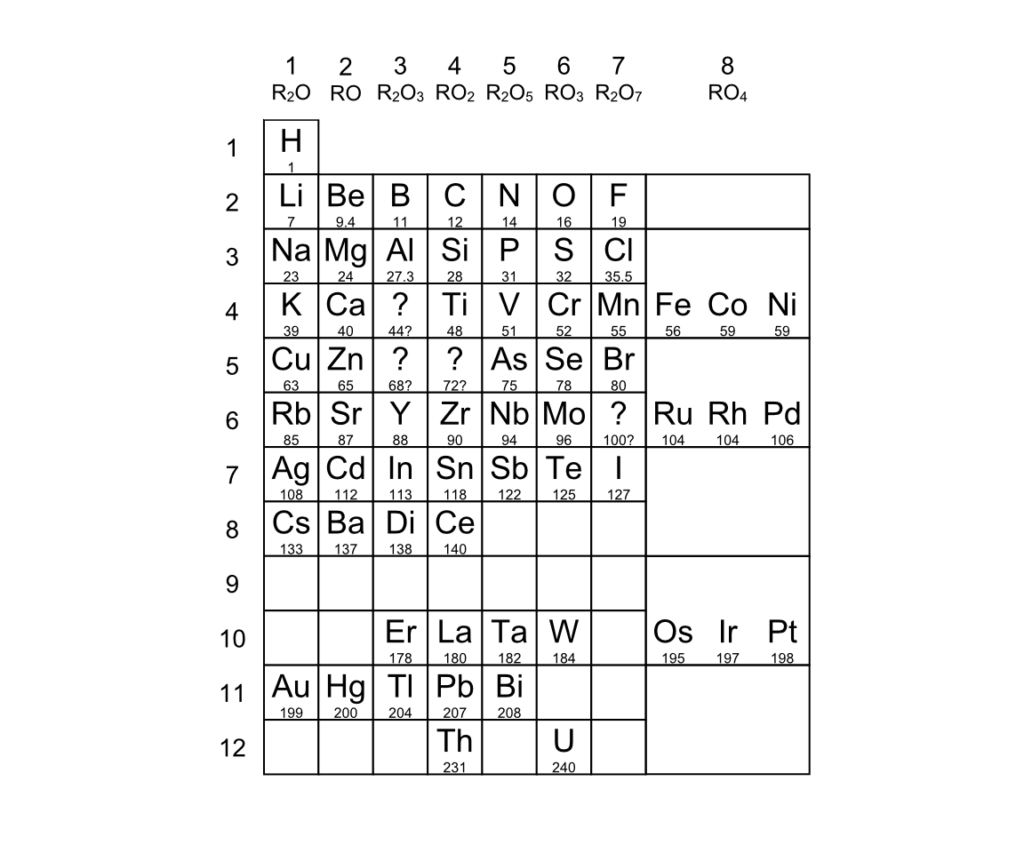
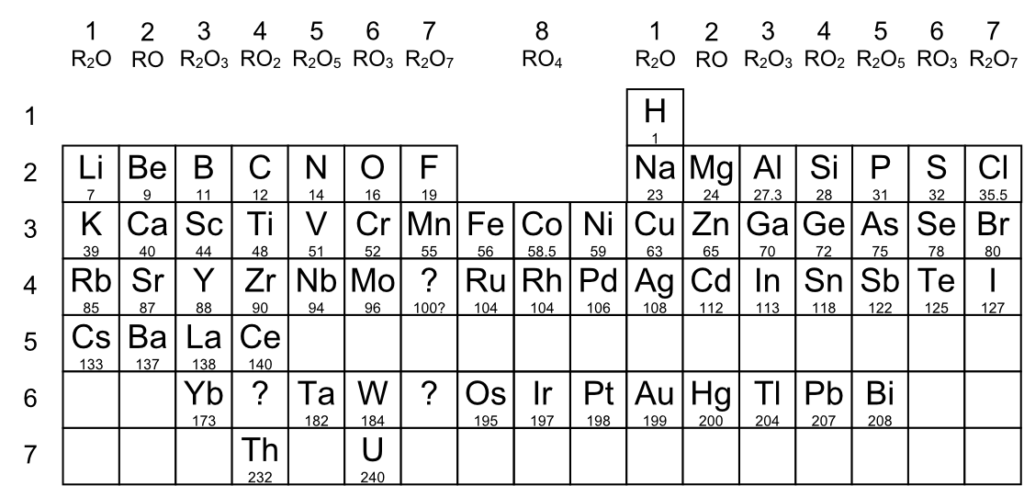
There seemed no rhyme or reason to it. Most of their masses were almost, but maddeningly not quite, integers, but even ignoring the tiny fractions, the numbers were chaotic. In order, hydrogen 1, lithium 7, beryllium 9.4, boron 11, carbon 12, nitrogen 14, oxygen 16, fluorine 19, sodium 23, magnesium 24 for the first ten.

What went into the holes? Was there something with an atomic weight of almost-but-not-quite 2, 3, 4, 5 or 6? What was up with beryllium?

Some chemists had begun to notice that some elements seemed chemically similar, for example, fluorine, chlorine and bromine, or copper, silver and gold, or chromium, molybdenum and tungsten. There seemed to be a lot of “triads” of elements like this.

But it was Dmitri Mendeleyev (1834-1907) who was the first to perceive the entire pattern…and to put a lot of confidence into it.

He sorted the elements according how they combined with oxygen. The first group (hydrogen, lithium, sodium, combined 2-1, two atoms of the element to one of oxygen. Each of these took up one of oxygen’s two bonds. You can write a generic formula, R2O for this. And to make the pattern clear, figure that an average atom of the first group combined with one half of an oxygen atom.

The second group was one-for-one. Beryllium, magnesium, calcium all took up both of oxygen’s bonds, generic formula RO.

Then there was a two-to-three group, boron, aluminum, etc, where two atoms of the element, with three bonds apiece, would combine with three atoms of oxygen, for a generic formula R2O3, or each atom combining with one and a half oxygen atoms.

This could be carried through until you got to elements that would combine with four full oxygen atoms (RO4), giving a total of eight possibilities, with elements sorted into eight groups.

Mendeleyev could sort these groups each by increasing atomic weight, then set these groups next to each other as columns in a grid. When he did that, he could read across, from group 1 to group 8, increasing atomic weights in the top row. Then the next row started in group 1 with a higher atomic weight and repeated the process. It was a periodic trend, every eighth element landed in the same group.

There were a few irregularities. For instance group eight, the one-to-four group, would either be empty on a given row, or hold three neighboring elements (iron-cobalt-nickel, ruthenium-rhodium-palladium, osmium-iridium-platinum), which was a bit of an irregularity, but it was a regular irregularity as every other row had one of these triples in column 8; the empty cells and the cells with three elements alternated.

That was far less interesting than some of the other irregularities in the sequence. For instance calcium belonged with beryllium and magnesium above it (and strontium and barium below it) in the one-to-one column, column 2. But the next element after that was titanium, which was a two-to-one which did not belong in the next three-to-two column which had boron and aluminum. Rather, it belonged better in column 4. So maybe this was all a waste of time?

Or maaaaybe the cell skipped over was a hitherto unknown element! So leave that spot open, and put titanium under carbon and silicon, the one to two column, where it belongs. (Titanium dioxide is a thing.)

There were two more holes between zinc and arsenic. And others, but Mendeleyev chose to focus on these three.

Figure 7-1 Adapted from Dmitri Mendeleyev’s First Periodic Table, 1871
He wrongly placed Di, Ce, Er, and La (rows 8 and 10). Di (didymium) turned out to be two different elements,
but really La (lanthanum) should go in that square, not either of the two hiding in “didymium.”

Mendeleyev predicted three new elements to fill these holes. The first one he predicted an atomic weight of 44, an oxide R2O3 weighing about 3.5 grams per cubic centimeter. He made other predictions for the other two elements.

All three of these elements were found in the next 20 years, they are scandium, gallium, and germanium respectively. And they matched up with Mendeleev’s predictions pretty damn well. Not exactly, but far too close to be random chance.

Mendeleyev was definitely onto something. Previously, elements had popped up at random, with no rhyme or reason, totally unpredictably. A bright chemist might have a hunch that some mineral (say) had something new in it, and might even be able to prove it without isolating the element, but one could never tell when such a thing would turn up, or what the new element would be like, until isolated.

But now Mendeleyev could tell you, before anyone else had so much of an inkling as to the existence of an element, what it would be like!

Because of this, it didn’t take long for chemists to accept this pattern. It’s now called the periodic table of the elements. It has gone through several changes (the most important going from 8 columns to 18, or actually, 32) but it traces right back to Mendeleyev. It became so deeply ingrained, that chemists were even willing to disregard atomic weights if they were out of the periodic table sequence. In particular, 1889 a chemist named Brauner measured the atomic weight of tellurium very carefully and got a higher value than before, 127.6. This was a group 6 element, in the column headed by oxygen. Its next door neighbor in group 7 was iodine, and iodine had an atomic weight of 127. So now all of the sudden, tellurium had a higher weight than the next element in the sequence.

Does this mean that iodine and tellurium should swap places? Nope. Leave them where they are. There must be some reason for the oddity, but matching group membership was more important than arranging things in order by atomic weight. (Mendeleyev’s attitude was a bit different. He apparnetly figured the new number for tellurium must be mistaken; he wasn’t willing to part with the assumption that the atomic weights had to increase as you read across the rows, but he clearly did think the periodic sequence was more important; given a “contradiction” he went with the periodic table, not the atomic weight data.)

But even as the periodic table was being accepted as an organizing principle, it looked like it was starting to unravel. In the early 1800s chemists started discovering “rare earth elements” with atomic weights between 138 and 175. (No other elements were in this big gap.) They found more and more of these elements…and they were similar to each other, enough so that they were hard to separate, and the similarities were in fact why newer elements were able to hide within older ones. It’s like they were all trying to cram into the square below scandium and yttrium! (Mendeleyev knew of four in 1871, there would ultimately turn out to be fifteen of them.)

Figure 7-2: Adapted from Mendeleyev’s 1891 table.
This is probably a bit more recognizable to modern eyes; rows 3 and 4 are almost dead-on as today’s rows 4 and 5.
The following rare earths are not included: Er (erbium), Tb (terbium), Ho (holmium), Tm (thulium,
Sm (samarium), Gd (gadolinium, Pr (praseodymium), Nd (neodymium), and Dy (dysprosium).
Nd and Pr are the two elements that had previously been combined as Di.
Ce and Yb are not on the right places (they are rare earth metals).

As more and more of these elements were discovered, Mendeleyev simply didn’t know what to do with them and just gave up trying to fit them in–leaving it for a future genius to solve. Other chemists tried to organize them and failed to do anything convincing with them. Since they didn’t follow the rules, there wasn’t even any way to know for certain how many of them there were!

So it was frustrating. There was only partial order to the elements, but then, where there was order, it was very, very useful. Call it a win, overall, even if it wasn’t a rout.

Sir William Ramsay

In fact, there wasn’t even any assurance that there wasn’t a totally unseen column in the table.

Wheatie asked me the question, once, as to whether there could be undiscovered elements between the ones we know about. Without pulling in a spoiler, the answer is basically “not no, but hell no!”

That’s the answer today, because of discoveries made in the 1910s. Back then, that was not the answer by a long shot; there were known holes in the table such as Mendeleyev’s three predictions. And who the heck knew how many of those damn rare earths there were, not to mention more holes like the one at atomic weight about-a-hundred.

Well, back up to 1785. Cavendish…remember him? G? Flammable air (i.e., phlogiston hydrogen)?

In a totally different experiment, Cavendish had reacted phlogisticated air (nitrogen) and dephlogisticated air (oxygen) with a spark, repeatedly, making niter. But some of the nitrogen just wouldn’t react. Since his source for these gases was the atmosphere, he was able to determine that this residue accounted for 1/120th of the atmosphere. (He was a very careful, meticulous and precise measurer, which is how he was able to determine G, a difficult thing to measure even today.)

And there that matter stood, basically forgotten, for almost a hundred years. Until 1882 when Lord Raleigh at Cambridge University’s Cavendish Laboratory (the irony!) was working with hydrogen, oxygen and nitrogen, trying to determine their densities and hence (thanks to Avogadro’s law) their atomic weights. He got good solid values for hydrogen and oxygen, but for nitrogen, he couldn’t get consistent results. If the nitrogen came from ammonia, his result was 1/2 of a percent lower than if the nitrogen came from the atmosphere. Raleigh was probably banging his head on the wall in frustration. He wrote to Nature, the preeminent scientific journal, asking if anyone else had any idea what was going on, just like today we might post on a chemistry forum online. He got a bunch of suggestions, including that the leftover gas might be N3, a hypothetical, less reactive form of nitrogen, just as oxygen could form O3 (ozone) instead of its usual O2.

Sir William Ramsay took another approach. He took some air, passed it over hot copper to remove the oxygen, hot magnesium to get rid of the nitrogen, soda lime to get rid of the carbon dioxide, and phosphorus pentoxide to get rid of the water vapor.

What he had left was about 1/80th of what he started with. At first he and others thought that this was indeed N3. But Sir William Crooks was able to prove that whatever this was, it wasn’t any kind of nitrogen.

In 1894, Ramsay realized the truth. This was a new element, one that didn’t react to oxygen at all. For that matter, it didn’t react with anything else either, including itself. This was argon, and it’s in every breath you take. An utterly non-reactive gas.

In addition to group 1, where every atom reacted with half an oxygen atom, through group 8, where every atom reacted with four oxygen atoms, in steps of half an oxygen atom, there was something one step to the left. Atoms that would react with no oxygen atoms.

This explained what Cavendish had seen.

There was a whole new column in the periodic table, call it Group 0.

Ramsay continued working into 1895 looking for other members of this column, unaware that he’d been partially scooped.

But 1895 is our line. We’re not quite yet ready to step across it.

Conclusion

There’s no new conservation law this time, rather a reinforcement of the conservation of mass and the conservation of energy, but we have plenty of mysteries.

Why are there so many different kinds of atoms? It’s nice that they form a pattern, but it’s not a perfect pattern, and those damnable rare earths really bork it in one place. Why is there a pattern, and why is it not perfect?

What is the relationship between atoms and electricity? We still don’t know what the electric fluid is. We have one tantalizing clue, that a bazillion coulombs (okay, 96,485.3 colombs, but that’s a lot) of charge seems able to bust up one mole of a single bonded molecule.

Remember, as far as we knew, an atom was an indivisible thing. Yet they seemed to be swapping electrical charges (or something) when forming compounds, with electrolysis somehow undoing that to break compounds apart.

All of which just pointed to a need to keep investigating atoms.

Obligatory PSAs and Reminders

China is Lower than Whale Shit

Remember Hong Kong!!!

Whoever ends up in the cell next to his, tell him I said “Hi.”

中国是个混蛋 !!!
Zhōngguò shì gè hùndàn !!!
China is asshoe !!!

China is in the White House

Since Wednesday, January 20 at Noon EST, the bought-and-paid for His Fraudulency Joseph Biden has been in the White House. It’s as good as having China in the Oval Office.

Joe Biden is Asshoe

China is in the White House, because Joe Biden is in the White House, and Joe Biden is identically equal to China. China is Asshoe. Therefore, Joe Biden is Asshoe.

But of course the much more important thing to realize:

Joe Biden Didn’t Win

乔*拜登没赢 !!!
Qiáo Bài dēng méi yíng !!!
Joe Biden didn’t win !!!
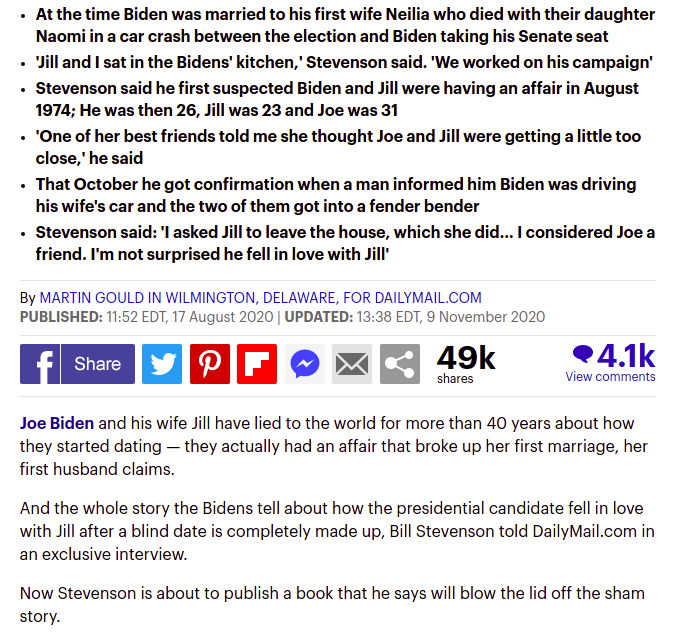
Dear KMAG: 20210607 Joe Biden Didn’t Win ❀ Open Topic

Joe Biden didn’t win. This is our Real President:

This Stormwatch Monday Open Thread is VERY OPEN – a place for everybody to post whatever they feel they would like to tell the White Hats, and the rest of the MAGA/KAG/KMAG world (with KMAG being a bit of both).

Yes, it’s Monday…again.

But it’s okay! We’ll get through it.

Free Speech is practiced here at the Q Tree. But please keep it civil. We’re on the same side here so let’s not engage in friendly fire.

If you find yourself in a slap fight, we ask that you take it outside to The U Tree…which is also a good place to report any technical difficulties, if you’re unable to report them here.

Please also consider the Important Guidelines, outlined here. Let’s not give the odious Internet Censors a reason to shut down this precious haven that Wolf has created for us.

Please pray for our real President, the one who actually won the election:


For your listening enjoyment, I offer this from Audiomachine, titled ‘Quintessence’:


Our beloved country is under Occupation by hostile forces.

We can give in to despair…or we can be defiant and fight back in any way that we can.

Joe Biden didn’t win.

I will keep saying Joe Biden didn’t win until we get His Fraudulency out of our White House.


Wheatie’s Word of the Day:

feck, feckless

Feck is a noun which means…strength, vigor; value, usefulness; effective. Feckless is an adjective which means…feeble, weak; careless and irresponsible; ineffective, useless, worthless.

Used in a sentence:

Having no feck, the Democrats put our country at risk with their feckless foreign policy.


2021·06·05 Joe Biden Didn’t Win Thread

His Fraudulency

Joe Biteme, properly styled His Fraudulency, continues to infest the White House, and hopium is still being dispensed even as our military appears to have joined the political establishment in knuckling under to the fraud.

All realistic hope lies in the audits, and perhaps the Lindell lawsuit (that will depend on how honestly the system responds to the suit).

One can hope that all is not as it seems.

I’d love to feast on that crow.

Physics?

I anticipate two more “pre 1895” posts after this one. This one is probably the most challenging to date, but you don’t have to be a math whiz to follow it. I don’t do a lot of math in this one, but I certainly describe it, a lot.

Justice Must Be Done.

The prior election must be acknowledged as fraudulent, and steps must be taken to prosecute the fraudsters and restore integrity to the system.

Nothing else matters at this point. Talking about trying again in 2022 or 2024 is hopeless otherwise. Which is not to say one must never talk about this, but rather that one must account for this in ones planning; if fixing the fraud is not part of the plan, you have no plan.

Lawyer Appeasement Section

OK now for the fine print.

This is the WQTH Daily Thread. You know the drill. There’s no Poltical correctness, but civility is a requirement. There are Important Guidelines,  here, with an addendum on 20191110.

We have a new board – called The U Tree – where people can take each other to the woodshed without fear of censorship or moderation.

And remember Wheatie’s Rules:

1. No food fights
2. No running with scissors.
3. If you bring snacks, bring enough for everyone.
4. Zeroth rule of gun safety: Don’t let the government get your guns.
5. Rule one of gun safety: The gun is always loaded.
5a. If you actually want the gun to be loaded, like because you’re checking out a bump in the night, then it’s empty.
6. Rule two of gun safety: Never point the gun at anything you’re not willing to destroy.
7. Rule three: Keep your finger off the trigger until ready to fire.
8. Rule the fourth: Be sure of your target and what is behind it.

(Hmm a few extras seem to have crept in.)

(Paper) Spot Prices

Last week:

Gold $1904.50
Silver $28.03
Platinum $1187.00
Palladium $2878.00
Rhodium $24,400.00

This week, 3PM Mountain Time, markets have closed for the weekend.

Gold $1893
Silver $27.91
Platinum $1172
Palladium $2890
Rhodium $21,000

(Be advised that if you want to go buy some gold, you will have to pay at least $200 over these spot prices. They represent “paper” gold, not “physical” gold, a lump you can hold in your hand. Incidentally, if you do have a lump of some size, doesn’t it give you a nice warm feeling to heft it?)

Very little change to most of these, a slight downward movement (though all except rhodium are up for the day, so we’re seeing prices recovering to previous levels now). Rhodium is getting hit hard, down $3,400 per ounce. Perhaps the bubble is finally bursting.

The Rest of Electricity and Magnetism (Part VI of a Long Series)

Introduction

If you’ve been here a while, you might remember two postings I did on stars. These were independent posts, having nothing to do with politics (poly = many, ticks = blood sucking bugs) and at least some people enjoyed them. I wanted to go to the opposite end of the scale and talk about a certain sub-atomic particle, but then I realized that the best way to do that would be a very, very, very long post. (And yes, it’s a subatomic particle, but it has a lot to do with stars.) A huge part of it would be explaining where physics stood in 1895, and how three discoveries in the next four years basically overturned things, and eventually led to that subatomic particle, the real star (ahem) of the whole series.

So I decided to break this story up into pieces. And this is the sixth of those pieces, and really it’s a continuation of Part IV, which just got to be too long.

And here is the caveat: I will be explaining, at first, what the scientific consensus was in 1895. So much of what I have to say is out of date, and I know it…but going past it would be a spoiler. So I’d appreciate not being “corrected” in the comments when I say things like “mass is conserved.” I know that that isn’t considered true any more, but the point is in 1895 we didn’t know that. I will get there in due time. (On the other hand, if I do misrepresent the state of understanding as it was in 1895, I do want to know it.)

Also, to avoid getting bogged down in Spockian numbers specified to nine decimal places, I’m going to round a lot of things off.

Fields

A lot of what I’ve covered in the past, 4 of the 5 pieces, in fact, have been what physicists call “mechanics” or “kinetics.”

I think we’re finally done with that. Kinetics had to be covered because a lot of its concepts underlie everything else (so you’ll see constant reminders), but I don’t think I need to bring up new kinetics any more (not that there isn’t plenty that hasn’t been covered, including simple harmonic motion, the most likely candidate for a future apologetic go-back).

We are going to pick up on our discussion of electricity and magnetism where we left off, just before Faraday.

(“But these posts are on Saturday,” you say. No, I didn’t say Friday, I said Faraday.)

One important disclaimer here:

Everything I talk about today is assuming our scenarios happen in a perfect vacuum. When not dealing with a perfect vacuum, adjustments must be made which would make things even more complicated than they already are.

So to begin, or actually resume the tale from two weeks ago, let’s back up a bit.

Isaac Newton, when he was formulating the law of universal gravitation, was bothered by something. The way the law works, one mass is affecting another, without touching it. Pretty much everything else one sees, billiard balls, hammers hitting rocks, Antifa beating down regular people, involves some form of direct contact. Action at a distance was odd to him, counter-intuitive. And he was also assuming that gravity was instantaneous. If the sun were to vanish, the earth would immediately begin to move in a straight line, since its primary was now gone, even before the last light from the now-vanished sun reached the earth.

Yet it seemed to be happening, and he could write math to describe it very well. Newton confessed that he couldn’t explain gravity, only describe it.

Now we have electricity and magnetism doing the same thing, and in damn near the same way!

The real answer to this had to wait until the mid 20th century and it’s headache-inducing. But there was an earlier effort in the early nineteenth century, put forward first by Michael Faraday.

Enter field theory, which applies in all three cases. According to this, there is an intangible, massless, motionless “field” for each of these three forces, covering the entire universe, and any mass, electric charge, or magnetic pole basically adds to this field. It’s not action at a distance, because an object out there in the field acts according to the value of the field right where it is, and can be oblivious to what is causing it. Nor does the effect of moving a mass, or charge, or magnet propagate through the field instantaneously: it takes time for the effects of such a thing to be felt on the field.

Nor is this just a semantic change; there will be an actual consequence of the electrical and magnetic fields as such brought up later in this post.

To see how this works, let’s take the simplest one first.

Gravitational Field

Picture some mass, out in the middle of intergalactic space somewhere, quadrillions of miles from anyplace, the corner of “no” and “where.” If that mass were not there, the gravitational field would be very weak or “flat.” But it is there, and its mass causes the gravitational field to “point” toward it. That influence will ultimately extend clear to the edge of the universe, because gravity goes on forever, though in many places it will be overwhelmed by other masses’ effects. This mass’s influence gets weaker and weaker, but never drops to true zero. Sure, at extreme distances it’s a very, very small force, and this contribution to the field would be very tenuous, but it’s still there and as we saw, we can even figure out that if some small body is infinitely far from a large body, we know how fast it will be going when it finally, under the relentless tug of the big body’s gravity, hits it.

(I am, from now on, going to talk as if whatever objects I am considering are alone in the universe. This actually isn’t a bad approximation as long as other things are relatively far away, and it’s a lot easier to get concepts across that way. But someone doing precise measurements in a lab must account for those other things and often they introduce too many external effects for the experiment to be useful.)

There are two ways to picture this field. One is as a bunch of lines radiating out from the object, going off to infinity, with little arrowheads pointing inwards to show the direction of the force. As they get further out, the lines of course get further apart, and there are fewer of them in some given place, and that decrease represents the decrease in strength of the field. In fact it does so perfectly, since the density of lines is going to drop off as the square of the distance, just like the forces of gravity, electricity, and magnetism do. That’s in 3-D; on a 2-D sheet of paper they drop off as the inverse of the distance. That shows there is a geometric basis for the inverse square law.

The actual field strength at any one location is newtons per kilogram. However, the newton already has a kilogram built into it (1N = 1kg•m/s2) so the kilograms cancel and you’re left with a bare acceleration, m/s2.

The other way to pictorially represent a field is to place a little vector arrow at every point in space, making them shorter where the field is weaker.

They’re equivalent, but sometimes one method of visualization is markedly more useful than the other.

Figure 6-1

Electric Field

Now let’s move on to the next simplest case, electricity.

Every positive charge will, just like gravity, have lines running out of it. Out, this time, because two like charges repel (rather than two masses attracting with gravity). But in the case of electricity, there’s also a negative charge, and lines will run into those charges.

In fact, most of the time, the lines don’t go out to infinity (though they certainly could) but instead end at some negative charge. With gravity, the lines are straight, going out forever, with electricity they will bend towards, and into, a negative charge, and they will be repelled by the lines coming out of some other positive charge. Positive charges are sources, negative charges are sinks.

So even though the electrical force is much, much much stronger than the gravitational one, and it falls off at the same rate (inverse square), electrical forces tend not to be extremely long range. We can certainly see them, but on a cosmic scale they don’t matter nearly as much as gravity, which never gets canceled out.

Figure 6-2

If you let a stationary electric charge go and leave it free to do what it wants, it will follow the field line it’s on, all the way to that line’s end. A negative charge, of course, will go against the arrow, but it will follow the line. If the charge is moving as you turn it loose, it might cross to other field lines depending on which way it’s going when you release it, because the field can’t damp motion perpendicular to the field lines.

There is a special symbol, E, to denote the electrical field. Visually, of course, you can use the diagrams to picture it. Mathematically, it represents the direction and magnitude of the electric force applied by the field. Well, almost. It’s on a per-coulomb basis. A one coulomb charge at a certain point will feel a certain force, a two coulomb charge will feel twice as much force, but the field strength is per coulomb so as to make the field independent of how much it is acting upon. (Of course, the source of the field can have more or less of a charge, but that clearly should change the strength of the field, since it is, after all, the source of the field.) Thus the electric field’s strength is in newtons per coulomb, N/C.

Note that I wrote “direction and magnitude.” Yes, it’s a field of vectors. Every point in space has a specific vector associated with it, and it’s very likely not the same as the vector at some other point just a little ways away.

But we’ve already seen how to represent that. Newton’s law of gravitation and Coulomb’s law give you a vector answer for the force between two objects. Remove one object from the equation and just imagine a measuring device there instead. You get a vector that is the strength of the force. With gravity it’s an induced acceleration on a mass, and that’s analogously true with electricity too, it being an induced force on a charge.

Magnetic Field

Finally, the trickiest one is the magnetic field.

Like electricity, the north pole of a magnet (mathematically represented as positive) is the source of a lot of magnetic field lines, and the south pole of a magnet is a sink for them.

Since there is no such thing as a bare magnetic monopole, with a magnet, even an isolated magnet, all of the magnetic force lines will loop around and hit the south pole of that magnet. And it makes no difference how short the magnet is; every north pole has a south pole of equal strength glued to its backside; actually it might be better to deem the south pole as being the north pole’s backside…and vice versa. Perhaps the best mythic image is that of Janus, the Roman god who had two faces, each on the back of the other. Or perhaps in slightly more modern terms, your average RINO, who is as two-faced as anything in Roman mythology.

Any sort of visible magnet is just a bunch of these magnetic dipoles stacked together, north to south, north to south, with one open-to-the-world north pole at one end and a south pole at the other end.

In fact it’s common to imagine magnetic field lines forming a closed loop, since there’s no distance between the north and south poles of a dipole. Even with two distinct magnets, the field line goes from the first magnet’s north pole, to the second magnet’s south pole, then through that magnet’s body to that magnet’s north pole, then back to the first magnet’s south pole, where it then goes through the first magnet to meet the north pole again, forming, again, a closed loop.

Given that magnets always have a south pole near a north pole, it’s hard to show that the magnetic force is an inverse-square law, because anywhere you measure you’ll be under the influence of both, but it’s true.

The magnetic field is represented by B. Its strength is represented in teslas, yes, named after that Tesla. I’ll hold off on the formal definition of the tesla for a bit since it contains spoilers.

It is with magnets that it’s easiest to actually see the field lines and not just in some cheesy diagram I draw for you. It’s corny but it works: put a magnet under a thin sheet of cardboard, dump some iron filings onto the cardboard, tap it a few times so the filings move, and they will arrange themselves in lines just like these field illustrations.

Figure 6-3

Gauss’s Laws

We’re now going to take up a bunch of laws concerning electricity and magnetism that were uncovered in the first half of the 1800s. But they all describe the behavior of the fields, not of the charges or poles, so all that stuff up until now has been necessary.

By the very early 1800s, something had become clear about electricity, and that was that the number of field lines that went through any arbitrary surface, was always proportional to the amount of net charge inside that surface. (That’s if you’re using the kind of diagram where the field lines are continuous and the strength is represented by how far apart the lines are. If, on the other hand, you’re using the other kind of diagram…well, I’ll get to that.)

We assume that a line going into the surface is viewed as canceling out a line leaving through the surface.

But that’s almost intuitively obvious with field diagrams. For example picture a positive charge, with some arbitrary surface around it, let’s make it an ellipsoid. All of the lines go through it, outward. See Figure 6-4.

Figure 6-4

But now draw a second, larger surface (Figure 6-4B). All of the lines go through that, too. The same number of lines go through both spheres, and that number of lines corresponds to the strength of the charge.

But we know the field is weaker, so how does this make sense? Remember that the increasing space between the lines represents the diminishing strength of the field, but the sphere is getting larger. The larger area of the sphere counters the decreasing strength of the field.

Imagine several charges, all positive, inside those spheres. Although the lines will take on an interesting configuration, you’ll see that they all go through both spheres, since they cannot go from one positive charge to another, as in Figure 6-4C.

In fact you can smear the charges out so they all occupy some space, and in fact you can even imagine one large charge spread out over the entire space and the result is the same.

OK, now what happens if there is a small negative charge inside that sphere as well? Some of the field lines from the positive charge(s) will end at the negative charge. If they never cross through our imaginary surface, then clearly there’s no effect. But if they do cross through, then they go back through going back inside to meet their eventual fate in the negative charge. Either way, however many of those lines are collected by the negative charge, they’re subtracted from whatever would go outside and stay outside if there were no negative charge. See figure 6-5.

Figure 6-5 Left, small negative charge cancelling part of the positive charges inside a surface,
Right, field lines exiting and reentering a surface.

So, basically, if you sum up all of the charges inside the surface, the total number of field lines is proportional to that result.

And this is true for any surface you could draw, anywhere. Even with no charge inside the surface, you could have lines entering from some nearby charge, but they will all leave, net zero.

Of course there’s a weakness to this; because different people are going to draw different numbers of lines for fields of the same strength, or looking at it another way, each person will draw one line for a different amount of charge. So the more mathematically rigorous way is to go over the entire surface and measure the electric field strength at that point, then you have to compensate for cases where the field goes out the surface at a slant. This is for the same reason that an equally bright sun low in the sky won’t heat the ground as that same sun high in the sky–the oblique angle intercepts less sunlight per square meter.

A Whiff of Integration

This is taken care of in the mathematically rigorous form of Gauss’s law for electricity:

Equation 6-1, Gauss’s Law,
the First Maxwell Equation.

The left side is fancy mathematics speak, it’s actually calculus, but in somewhat-plain English the ∯ and the dS mean, “go over the entire surface, S, bit by bit, and evaluate what’s in between these two pieces at every single point, then add them up.” The two tall s-like things mean a surface, and the oval on top of them means it has to be a closed surface, no openings in it. The En just mean to take the dot product of E, and a unit vector perpendicular to the surface at this point. This compensates for any “slant” to the vector (and also turns it negative if it’s diving inside the surface). It’s a convention to label such a unit vector n because “normal to” is another way of saying “perpendicular to” in mathematics. But what is that cute little ε0? It’s our fudge factor. It converts the electric charge into the strength of the field.

Q on the right hand side is the total charge inside the surface. (Sometimes this is written as taking the sum of the charge inside the volume, calculus style, but this is good enough.)

We had a fudge factor k in Coulomb’s equation back in Part IV. Why not use that one here? Because we want to sum up the entire force (per coulomb) over the entire sphere surrounding the charge. The sphere’s area is 4πr2 times its radius, and there’s already an r2 in the denominator of Coulomb’s law, so basically this ε0 is equal to 1/4πk. Or k = 1/4πε0, take your pick.

This new symbol is called the “permittivity of free space” and obviously directly affects the strength of the electric field.

ε0 = 8.8541878128×10⁻¹² C2/Nm2.

This maybe makes more sense if you represent the field with arrows rather than lines, and pick some sort of irregular surface.

This is all advanced calculus and though I’ve tried to explain what it means, I am not going to drag you through an example (even though there are “trivial” ones, like spheres centered on a charge).

OK, that’s Gauss’s law for electric fields (usually just called Gauss’s law). For magnetic fields, there is Gauss’s law for magnetic fields. It’s exactly the same situation, but with magnetic poles inside the surface instead of electric charges, so your mental picture should be almost the same. Here it is:

Equation 6-2 Gauss’s Law of Magnetism,
The second Maxwell Equation

Zero!!! We do NOT bother to sum up the magnetic poles inside the surface because we already know there will be an equal number of north and south poles (since they’re literally front and back of the same thing) and the net will be zero! Or you can look at it another way; this law is a positive statement that the sum total will always be zero. There is no way for some spare, bare magnetic monopole to be inside the surface. Any surface, any size, any where.

These two equations are two of Maxwell’s four equations.

Those four equations are one of the most important achievements of mankind’s intellect, ever.

The reason why these are called Maxwell’s equations even though every one of the formulae individually are named for someone else, is that he did the heavy mathematical lifting to bring all the disparate experimental data together to express them into the relatively neat and tidy form you see here.

The two equations I’ve shown are actually one of two forms they can appear in. These are called the “integral forms” and there are equivalent “differential forms.” They’re a lot less intuitive, but much more useful most of the time since they address what’s going on at a single point in space, rather than forcing you to go off and compute or measure things all over some surface or throughout a volume.

Just for completeness, I will present the differential forms, but I’m not going to try to explain them. Ultimately, they mean the same thing as the integral forms, anyway.

Equations 6-3 Differential forms of Gauss’s laws.

They’re much more compact than the integral forms, and you may have seen me quoting one of these to Wolf in a comment here or there, trying to say “no magnetic monopoles.”

The Connection Between Electricity and Magnetism: Ampere’s Law

The other two of Maxwell’s equations are actually much more interesting for a host of reasons, and in fact modern life would be impossible without them.

But it is going to take a little while to get there.

The next step in our story is the discovery by Hans Christian Oersted in 1820 that an electric current would deflect a compass needle.

So wait a minute. An electric current applying a force to a magnet. Up until now electricity and magnetism had been considered two totally different things. Now, it seems, there is a connection.

In fact, by placing numerous magnets (like compasses) around a wire carrying a current, it can be demonstrated that there is a magnetic field around the wire, in fact it literally runs rings around the wire.

Figure 6-6

The created magnetic field lines form a closed loop. Even one of these “artificial” magnetic fields that didn’t come from an actual magnet, doesn’t have start and stop points! To a magnet on the field lines, it’s as if there’s a phantom north pole, and a phantom south pole, somewhere else on the ring, but they’re not really there because this field is created by a current, not a magnet.

Here is a drawing of the situation.

Figure 6-7 magnetic field running rings around a current.

Orient your right thumb in the direction of the current, and your fingers will point in the direction of the magnetic field loops. Yet another right hand rule.

OK, so we now have a closed loop magnetic field line running through empty space. What would happen if we could put a magnetic north pole, by itself, into that field? It would be pushed, repelled by a phantom north pole, around and around and around, speeding up forever, because the line has no end! Of course, there is no such thing as a monopole; a real magnet would basically just swing until the north pole pointed “downstream” towards the phantom south pole of the field and the south pole pointed towards the north phantom pole. They’d both be attracted in their respective directions, but by exactly equal amounts so the magnet would stay motionless.

There is in fact a general law here, Ampere’s law. Draw some kind of closed loop around the wire. Stretch a surface across that loop–it doesn’t have to be flat, any shape of surface will do. Note that this time it’s not a closed surface, far from it! This surface is how the mathematicians “capture” the current through the wire, because in reality, it could be going through several wires, or it could be a bolt of lighting with no wire at all! The net current going through the surface is what counts.

If you walk around that loop, the net magnetic force going around that loop is directly proportional to the amount of current going through the surface.

Here’s the equation.

Equation 6-4 Ampere’s Law,
part of Maxwell’s 4th Equation

Now on the left we are adding up around a loop, in other words following a line, l, which is one dimensional so only one ∫. It’s a closed loop, hence the circle. We again dot B with the line of the loop; we get to add more to that total if we are walking along B than if we’re walking at some slant to it.

We again see ourselves multiplying by a fudge factor, this is a new one, μ0.

This one is called the permeability of free space (not to be confused with the permittivity of free space, above). Its value is:

μ0 = 4 π x 10-7 N/A2.

Note that it’s defined in terms of amperes!

This law, by the way, is a case where the strength drops off, not as 1/r2 as you get further away from the wire, but as 1/r. But this makes some sense if you think about it. If you walk in a perfect circle one meter from the wire, you’ll cover a certain distance (2π meters) and total up some certain amount of magnetic field times length. Walk further away, 2 meters, and you’ve now walked a total of 4π meters, but according to this law, you’ve encountered the same total. But the only way that can be is if B is half as strong, not a quarter as strong.

This law, including the concentric rings of the magnetic field, can be demoed with the same iron filing trick as was used with the bar magnet. Just remember that the wire has to be perpendicular to the plane of the cardboard the iron filings are on (best to make it vertical so the cardboard lies flat.

This law is what allows one to create an electromagnet, most effectively with a coil of wire. If you draw a closed loop through the center of the coil, and then around the outside of the coil, every single turn in that coil runs through the closed loop in the same direction, and the current each time can add up (even though it’s the same current “circling back”).

Electromagnets are the heart of many electric motors, and many loudspeakers. So this law is of very great importance in our modern lives.

But this is only part of this law. Ampere didn’t recognize the other factor involved. I’ll get to it in due course. So what I’ve shown is only part of the fourth Maxwell equation.

Faraday’s Law

Yes, I skipped over number 3, because I’m saving the best for last! (Of course, I didn’t really skip over it because I didn’t actually present the fourth equation, did I?)

Now we get to the really important one. It’s so important, it’s one of the most important facts out there.

Up until Faraday’s work, there were only two ways to generate electricity as a current so it could do some work. One was to arrange to continuously produce static electricity and draw it off as it was being created. The other was to build a battery. But when the battery ran down, there was no way to recharge it, other than to take it apart, replace the wet cardboard and build it again.

The fact that an electric current–a flow of the electric fluid–could create a magnetic field made just about everyone involved wonder if there was a way to create an electric current using a magnet.

Early experiments were disappointing. Simply setting a magnet near a wire, or even a coil of wire, did nothing. Michael Faraday, however, in the early 1830s discovered that a moving magnet would cause an electric current in a nearby wire, and the effect was stronger moving the magnet into and out of a coil of wire. The key was the change in the magnetic field (getting stronger as the magnet approached the wire, or getting weaker as it moved away), more than it was the mere fact of the magnet moving. This is known as Faraday’s Law. The current would flow in one direction while the magnetic field was getting stronger, then flow in the other direction when it got weaker.

Upon this discovery, modern life is utterly dependent.

Any electrical generator uses this fact, from your backup generator to hydroelectric dams to coal fired plants to nuclear power. And yes, even the bird-killer wind turbines. All generate electricity via this principle. If we did not have this, everything electrical or electronic would depend on batteries, which might not sound so bad until you realize there would be no way to recharge the battery.

The only exception to this is solar electric power (i.e., photovoltaics), and that is a much newer innovation, so imagine where we would have been without the generator!

We owe Faraday a YUUUUGE debt. Thank him the next time you flip a light switch. Or hit any power button on anything.

Well, this led to Faraday’s law, which got bundled up with Maxwell’s Equations as the third such equation.

Equation 6-5 Faraday’s Law,
Maxwell’s Third Equation.

That right hand side looks a bit odd, because it has a d/dt in it. We’re used to summing things up over surfaces (closed and partial), and around closed loops, but this is a new wrinkle. But it’s not bad, conceptually. Basically, the d/dt means “the rate of change of” what follows it. And what follows it is the magnetic field going through the surface enclosed by a loop. So: as the magnetic field changes, it creates an electric field, if it changes fast it creates a stronger electric field. If that electric field is near a wire, it will make a current flow. Voila! Now there is a negative sign, so basically, a positive change in the magnetic field will produce a negative current through the wire, by the time you figure out all the directions involved.

That’s the third of Maxwell’s equations.

Maxwell’s Fourth Equation, Completed

Now let’s pick up where we left off with the fourth one.

It turns out that when dealing with the magnetic current around a current, there is also a term for a changing electrical field.

Now any small electrical field associated with the current isn’t going to matter, if the current is constant, it’s because the electric fluid in the wire is being driven by a constant electric field.

But if the electric field through that surface changes, then we get an additional contribution to the magnetic field, in a mirror image of the way changing magnetic field inducing an electric field (and causing a current).

So here is the fourth of Maxwell’s equations, in full.

Equation 6-6 Ampere’s Law (complete),
the Fourth Maxwell Equation

Nothing new here; if you can get the gist of the others through my attempts to explain them you should have this one knocked.

The third and fourth of Maxwell’s Equations also have their differential forms, which I am going to present without explanation.

Equations 6-7, the third and fourth Maxwell Equations in differential form.

We now have four equations that completely describe the behavior of electricity and magnetism.

In fact it should be plain by now that electricity and magnetism are joined at the hip. We should, in fact, be speaking of “electromagnetism” not “electricity and magnetism.”

Work can be done to describe them with alternating fields, i.e., where the fields flip back and forth. In fact if this is done it’s possible to set up a situation where the E and B fields propagate each other across space, since each can be generated by a change in the other. But hold that thought.

James Clerk Maxwell

(Clerk is pronounced British-style, as “clark.”)

You might have noticed that every single one of the four of Maxwell’s equations is named after someone else, Gauss, Ampere, or Faraday. Does this make him a Joe Biden-level plagiarist? (Remember in 1988 when Biden’s campaign for the Democrat nomination was sunk because he turned out to be a plagiarist? It’s now much more difficult to sink a Democrat, isn’t it?)

No, it doesn’t. Because Maxwell (1831-1879, a disappointingly short life) was the person who did the math that tied these laws together. In particular, Faraday could do his experiments and could verbally describe what he had seen, but he had no formal mathematics background to speak of. He would never have understood his own law, in the form I wrote it above.

Not that it was easy, even for Maxwell; he published his big work tying everything together mathematically in 1865. At the time, this was second only to Newton as a grand unification of a bunch of different physical phenomena. I was not kidding when I said Maxwell’s Equations were one of the most important achievements of human intellect, ever. Imagine your life without electricity, ever (and not just for a power outage), and you will see the practical importance of these laws even if you can’t (yet) visualize their mathematical elegance.

Magnetic Deflection of an Electric Charge

There’s another connection between electricity and magnetism I want to bring up.

What happens to an electric charge in a magnetic field?

Well, nothing. Magnets respond to magnetic fields, electric charges respond to electric fields.

Ah, but what if the electric charge is moving? (It does seem as if something has to be moving, or at least changing, for the connection between electricity and magnetism to manifest.)

In that case a force is generated by the magnetic field. But that depends on the direction of the motion of the charge and the direction of the magnetic field.

In fact, here’s our cross product again!

F = qv × B

If a particle is moving up, and the magnetic field points into the computer screen, the force pulls the particle to the left. After a split second of this, the particle is now moving slightly to the left of upward, and the force is left and a little bit downwards. After a bit of that the particle has turned some more. In fact it will start to go around and around in circles.

It won’t do this forever, it will lose velocity to various effects I’m not going to get into (even if it’s not meeting any air resistance). But if you can figure out how to pump energy into the particle you can keep it going round and round for as long as you do that. An electric field can be used to pump the particle up, just be sure to switch it off just as the particle passes it so the field doesn’t put the brakes on the particle. (This is how cyclotrons work; why you need a cyclotron, however, is post 1895. This is also how mass spectrometers work, but again…post 1895.)

I didn’t define the tesla, the unit of magnetic field strength, before. And that’s because it relies on this fact, which wasn’t actually formulated until well after Maxwell put forward his equations; it’s a part of the Lorentz equation.

A one tesla field is one where a charge of one coulomb, moving at one meter per second experiences a force of one newton. Or, it generates one newton per coulomb, per meter per second. Thus:

1 T = 1N/(C•m/s) = 1N•s/(C•m).

If you look at that you have s/C, which is the same as 1/A. So most usually,

1 T = 1 N/A•m

Note that the magnetic field strength is defined based on electrical stuff using the electrical current unit.

A lot of these physical laws have “fudge factors” in them. Many of the others really also have fudge factors too, but the units are defined in such a way as to cause those fudge factors to be 1. The fudge factors depend on our choice of units. For example, remember that:

ε0 = 8.8541878128×10⁻¹² C2/Nm2.

Part of the definition of this is the coulomb, squared. What if a coulomb were half as big as it actually is? Then we’d have to multiply the number by four to make up for it!

If we had defined a tesla independently of the ampere, there would be a fudge factor involved getting from there to amperes, and the μ0 fudge factor would be different too.

But we defined the tesla based on the ampere, so the fudge factor μ0 is based on the ampere. Of course the ε0 fudge factor was also based on the ampere.

So any relationship between or involving these two numbers is probably not a coincidence, because they’re both based on the same thing.

Let There Be Light

Look again at Maxwell’s fourth law. There’s a μ0ε0 in it. We have to multiply the two together to apply that law (in either form).

Well, let’s do that. Let’s multiply them together!

The value of ε0 is: 8.8541878128x 10⁻¹² C2/Nm2

The value of μ0 is: 4π x 10-7 N/A2

So, combining the two actual numbers (well, just their exponents), we have:

ε0μ0 = 4π•8.8541878128 x 10⁻¹⁹ NC2/A2Nm2

The newtons cancel.

ε0μ0 = 4π•8.8541878128 x 10⁻¹⁹ C2/A2m2

Amperes are simply coulombs per second, or to put it another way, coulombs are amp-seconds. So replace C2 and A2s2 and then cancel the amperes.

ε0μ0 = 4π•8.8541878128 x 10⁻¹⁹ A2s2/A2m2

ε0μ0 = 4π•8.8541878128 x 10⁻¹⁹ s2/m2

Now we finally have to do the arithmetic.

ε0μ0 = 1.11265005544 x 10⁻¹⁷ s2/m2

Let’s take the square root of that. s2/m2 will become s/m.

sqrt(ε0μ0) = 3.3356440951 x 10⁻⁹ s/m

That looks like it’s the inverse of a velocity. Seconds per meter instead of meters per second. So divide into 1, and get:

1/sqrt(ε0μ0) = 299,792,458 m/s.

That should be familiar to a great many of you as…the speed of light. (Which is presently, by definition, exactly this number of meters per second. The meter, in fact is defined in terms of the speed of light. Why this makes sense…is a topic for a future post.)

So basically,

ε0μ0 = 1/c2

where c is customarily the speed of light.

But, what the heck is the speed of light doing showing up in Maxwell’s equations?

Remember when I said that under the right circumstances, a varying electrical field could produce a varying magnetic field, which could produce a varying electric field, and they could propagate through space? It takes a lot of math that I won’t dive into here to show it, but if you can arrange for an electric field to oscillate in a sine wave (so that E is proportional to the sine of the time), you will get a companion magnetic field doing the same thing, and they will propagate in a direction perpendicular to both fields.

Figure 6-8 Electromagnetic Wave

And they will propagate at the speed of light.

And light is what you get when this happens.

Maxwell’s equations turn out not just to be about electric current and magnets, they turn out to be about light.

Who’da thunk?

And this is why I said, early in this post, that fields are not just a semantic thing. You cannot get from action-at-a-distance Newtonian style physics to light as an electromagnetic wave, but you can if you start with fields.

In fact, I’m going to share with you a bit of geek humor. It goes:

Geek humor

Conclusion

As we continue this series, it’s going to turn out that as far as anyone in 1895 could tell, the combined “electromagnetic force” underlies every physical phenomenon in our daily lives, other than gravity, which we already understood.

I wasn’t kidding about Maxwell’s Equations.

(There was one very big fact that they took for granted that isn’t due to electromagnetism nor gravity. Something they probably hadn’t bothered to ask.)

So, to someone in 1895, it really was starting to look like we had reality knocked. Yeah, there were a few mysteries out there, but we’d figure them out or reconcile them.

The last time we talked about electricity and magnetism, I brought up a conservation law, the conservation of electric charge. Since this is really a two-piece part to this whole thing, I mentioned that there was also a mystery which I would defer until now. So here it is, our 1895 mystery.

I’ve talked about electrical fluid. But what, exactly, is it? And really, do we know whether Franklin or DuFey was right about it? Are there two fluids, or one?

As 1895 dawned, we had one tantalizing clue, and a bunch of other info that would turn out to be important in answering the question.

And that came from the study of atoms.

Obligatory PSAs and Reminders

China is Lower than Whale Shit

Remember Hong Kong!!!

Whoever ends up in the cell next to his, tell him I said “Hi.”

中国是个混蛋 !!!
Zhōngguò shì gè hùndàn !!!

China is asshoe !!!

China is in the White House

Since Wednesday, January 20 at Noon EST, the bought-and-paid for His Fraudulency Joseph Biden has been in the White House. It’s as good as having China in the Oval Office.

Joe Biden is Asshoe

China is in the White House, because Joe Biden is in the White House, and Joe Biden is identically equal to China. China is Asshoe. Therefore, Joe Biden is Asshoe.

But of course the much more important thing to realize:

Joe Biden Didn’t Win

乔*拜登没赢 !!!

Qiáo Bài dēng méi yíng !!!

Joe Biden didn’t win !!!