Our mission, as God-fearing and God-loving patriots, is to defend this Constitutional Republic and to increase its greatness, in all good things and ways, by using our voices in free but courteous speech, by discussing the happenings of the world and coming to a profound understanding of those things, and by sharing and promulgating these Truths on both this platform and others.
This Rejoice & Praise God Sunday Open Thread, with full respect to those who worship God on the Sabbath, is a place to reaffirm our worship of our Creator, our Father, our King Eternal.
It’s also a place to read, post, and discuss news that is worth knowing and sharing. Please post links to any news stories that you use as sources or quote from.
In the QTree, we’re a friendly and civil lot. We encourage free speech and the open exchange and civil discussion of different ideas. Topics aren’t constrained, and sound logic is highly encouraged, all built on a solid foundation of truth and established facts, and not by agenda-driven accusations and pronouncements.
We have a policy of mutual respect, shown by civility. Civility encourages discussions, promotes objectivity and rational thought in discourse, and camaraderie in the participants – characteristics we strive toward in our Q Tree community.
Please show respect and consideration for our fellow QTreepers. Before hitting the “post” button, please proofread your post and make sure your opinion addresses the issue only, and does not confront or denigrate the poster. Keep to the topic – avoid “you” and “your”. Here in The Q Tree, personal attacks, name-calling, ridicule, insults, baiting, and other conduct for which a penalty flag would be thrown are VERBOTEN.
In The Q Tree, we’re compatriots, sitting around the campfire, roasting hot dogs, making s’mores, and discussing, agreeing, and disagreeing about whatever interests us. This board will remain a home for those who seek respectful conversations.
God is in Control . . . and His Grace is Sufficient, so . . . Keep Looking Up
Hopefully, every Sunday, we can find something here that will build us up a little . . . give us a smile . . . and add some joy or peace, very much needed in all our lives.
“This day is holy to the Lord your God; do not mourn nor weep.” . . . “Go your way, eat the fat, drink the sweet, and send portions to those for whom nothing is prepared; for this day is holy to our Lord. Do not sorrow, for the joy of the Lord is your strength.”
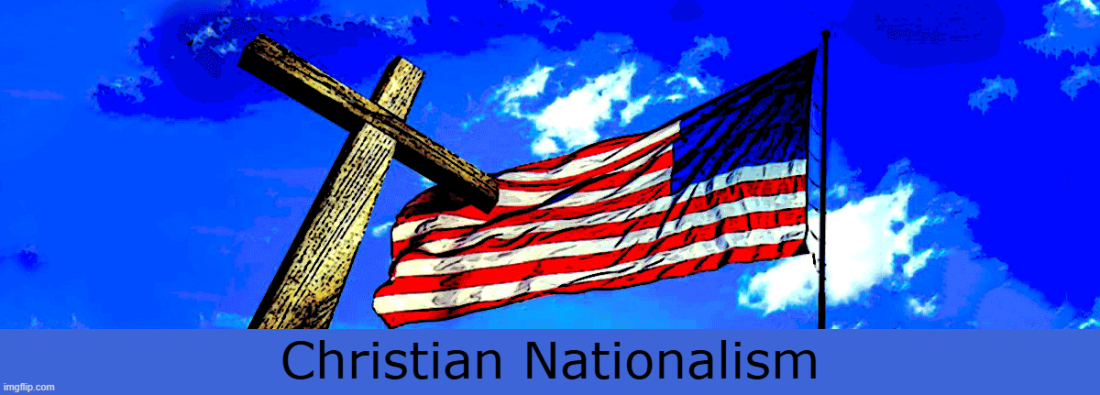
Christian Nationalism
In the exaggeration and melodrama of modern communication, Christian nationalism is most often employed as a derogatory term. Despite its occurrence in a variety of media contexts, the term Christian nationalism remains difficult to define. Those who use the term are generally the only ones who can explain what they mean by it. And what they mean by it may be completely different from the meaning assigned by others.
Some related terms are easier to define. Patriotism is “love of one’s own country” (Merriam-Webster.com) Nationalism is “loyalty and devotion to a nation especially as expressed in a glorifying of one nation above all others and a stressing of the promotion of its culture and interests” (ibid.). Based on these definitions, one would think that a Christian nationalist would simply be a Christian who loves and is proud of his country—a nationalist who happens to be a Christian. But the working definition of Christian nationalist is usually something far different. For example, according to Jared Sexton, Christian nationalists are to be blamed for “suffering inflicted on refugees, boldfaced white supremacy and cruelty, attacks on gay and transgender Americans, open anti-Semitism, the destruction of Roe v. Wade,” and more (Sexton, J., “Christian Nationalism’s Popularity Should Be a Wake Up Call,” www.time.com, 01/28/23, accessed 7/26/24).
Sociologists Andrew Whitehead and Samuel Perry give the basic definition of Christian nationalism as “an ideology that idealizes and advocates a fusion of American civic life with a particular type of Christian identity and culture.” But then they assert that this so-called Christian culture “includes assumptions of nativism, white supremacy, patriarchy and heteronormativity, along with divine sanction for authoritarian control and militarism. It is as ethnic and political as it is religious. Understood in this light, Christian nationalism contends that America has been and should always be distinctively ‘Christian’ . . . from top to bottom—in its self-identity, interpretations of its own history, sacred symbols, cherished values, and public policies—and it aims to keep it this way” (Whitehead, A., and Perry, S., Taking America Back for God: Christian Nationalism in the United States, Oxford University Press, 2020, xi-x, 10).
Author Michelle Goldberg claims that “the ultimate goal of Christian nationalist leaders isn’t fairness. It’s dominion. The movement is built on a theology that asserts the Christian right to rule” (Kingdom Coming: The Rise of Christian Nationalism, W.W. Norton, 2006, p. 7).
Matthew McCullough tones down the definition of American Christian Nationalism, stating it is “an understanding of American identity and significance held by Christians wherein the nation is a central actor in the world-historical purposes of the Christian God” (The Cross of War: Christian Nationalism and U.S. Expansion in the Spanish-American War, quoted in www.thegospelcoalition.org/article/christian-nationalism-patriotism, accessed 8/15/24).
People accused of being “Christian nationalists” rarely, if ever, call themselves that, a fact that hints at the defamatory nature of the term. According to some, a Christian nationalist is the perfect bogeyman: an anti-democratic, bigoted, Bible-thumping racist who wishes to force Christianity on everyone. Such caricatures are sometimes employed as polemic tools. As one writer put it, “Christian nationalism is an amorphous concept that is primarily used to tar Christians who are motivated by their faith to advocate for policies that critics don’t like” (Hall, M. D., “Theology of Politics: Christian Nationalism,” 2/8/22, www.standingforfreedom.com/white-paper/tilting-at-windmills-the-threat-of-christian-nationalism, accessed 8/15/24).
What does the Bible say about Christian nationalism? Nothing, directly, since the term is not found in the Bible. Of course, the type of Christian nationalism defined by Whitehead and Perry, above, would directly conflict with the teachings of Scripture. There is nothing remotely Christian about “white supremacy” or belief in a “divine sanction for authoritarian control and militarism.”
Christians are obligated to individually submit to the will of God (Romans 12:1) and to support one another along those lines (John 15:12). In practice, this means advocating for government actions consistent with a Christian worldview (Proverbs 14:34). At the same time, a believer’s primary mission is not earthly, let alone political (John 18:36). In fact, the main descriptor for a Christian’s relationship to government is “submission” (Romans 13:1), not “domination.” Perspectives such as Christian dominionism or Kingdom Now theology may invite accusations of “Christian nationalism,” though such perspectives are not reflected in Scripture.
One can be a nationalist without compromising biblical principles. There is nothing wrong with having a sense of loyalty and commitment to one’s country or believing that one’s country ought to self-govern, pursue self-interests, and encourage shared cultural attributes. Appreciation for one’s culture, language, traditions, music, history, or achievements is a fine thing. The same holds true for efforts to sustain those legacies. That is why nationalism is rarely used disparagingly without qualification: to become an aspersion, the term is given heft, becoming white nationalism or Christian nationalism.
It is not wrong for a Christian to be nationalist. What’s inappropriate is promoting an idolatrous, idealized version of one’s country or cultivating unhealthy factionalism. Christians should not seek to control, oppress, subject, or dominate. Christians are called to be lights in a dark world and perform good works that glorify their Father in heaven (Matthew 5:14–16).
Critics will often claim “Christian nationalism” whenever they perceive the slightest connection between a person’s faith and his or her political or social views. From that perspective, any desire to see laws reflecting godly morality is to be resisted, and any move to protect Christian expressions of faith in public life should be rejected. This strategy is often used against pro-life or pro-Israel sentiments or support for biblical sexuality. At times, any politically conservative stance conflicting with progressive morality is waved away as “Christian nationalism” or conflated with white nationalism.
Many people identify as “Christian.” With careful context, reasonable persons can also identify as “nationalists.” Modern culture uses the term Christian nationalism to imply something well beyond a simple overlap of those terms, however. Attitudes that follow biblical principles can’t be fairly described using the popular definition of Christian nationalism (e.g., Whitehead and Perry’s); the attitudes that the label commonly implies are not part of a biblical worldview. https://www.gotquestions.org/Christian-nationalism.html
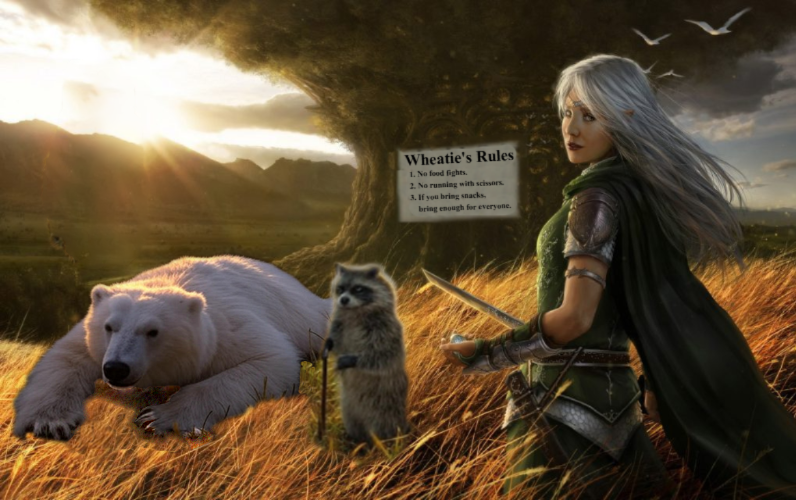
Wheatie Wisdom. If you bring snacks, bring enough for everyone. No running with scissors. No food fights.
AI stuff posted, requires a link. Please use spoiler, for longer posts.
Wolf Speak. No obnoxious behavior towards fellow QTreeper(s). Freedom of Speech is honored here QTree. But Do Know, every poster, IS personally responsible for what they post.
America, needs to embrace the following TRUTH…
In No Particular Order, The House AND Senate MUST.
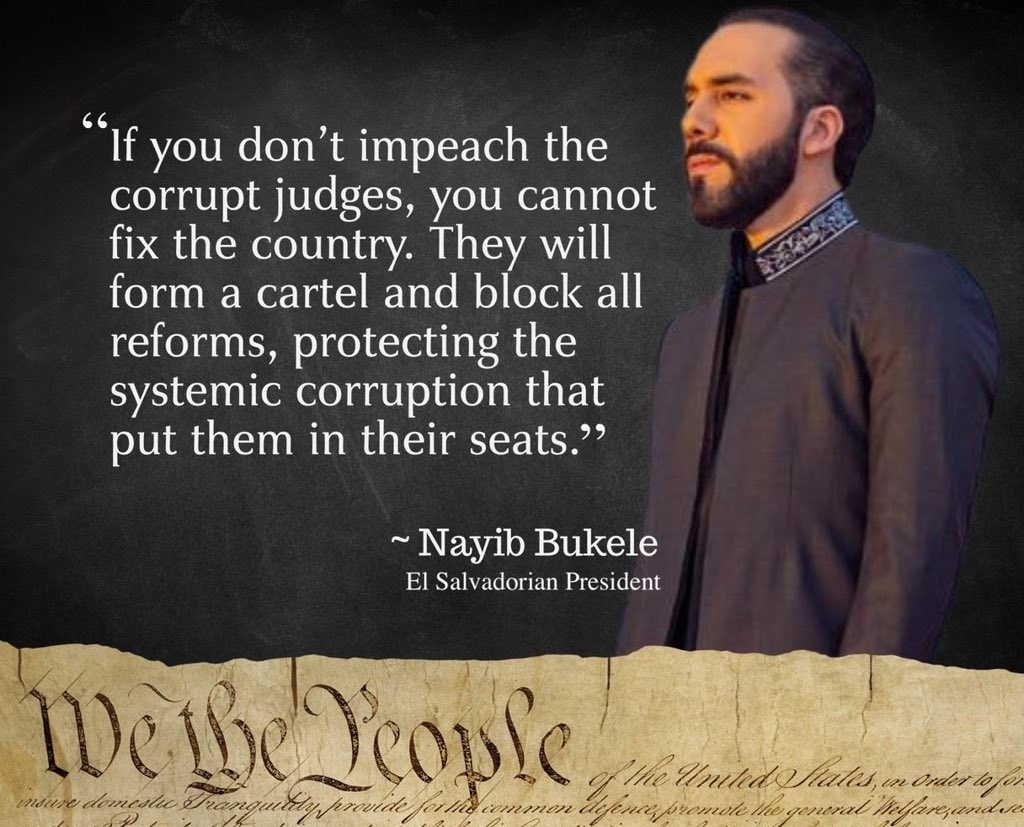
Impeach Activist Judges & Fire Activist Magistrates.
Pass SAVE Act
Pass, Ban Sanctuary States and Cities
Trash Filibuster
Trash Blue Slips
Confirm Trump Nominations.
Codify Trump Executive Orders.
Ban Sharia Law.
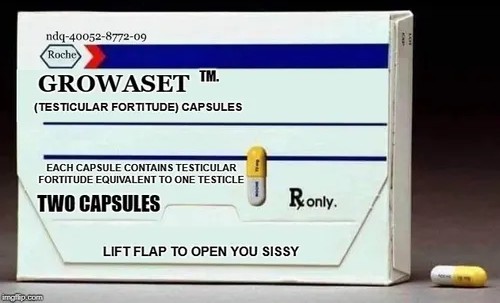
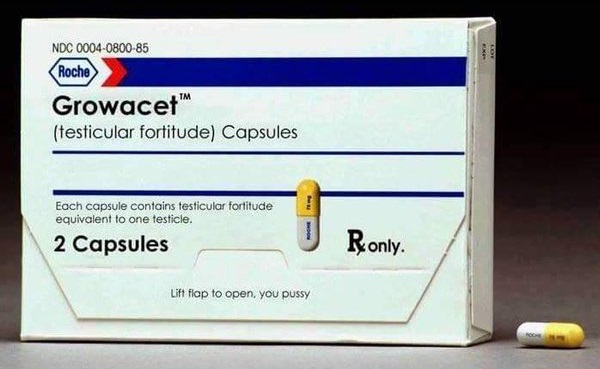
Progress unlikely, until R-Cons GROWASET.
growASet
Speaking of embracing…THIS.
Alysia Liu. pure Joy!
America IS Back!
If nothing follows KK below, Night Crew, you are on your own.
Prices pulled last evening. Gold $4,555.40. Silver $76.03. Bitcoin $73,500.
America 250 delivered another video.
12:07
—
Stuff…
A Pretty Good Analysis of the Recent Oreshnik Use
This is a video from the “Millennium 7 * History Tech” channel. I can’t quite place his accent, so not sure his biases. The “Description” text places him in the UK, but clearly as an immigrant. Not quite Russian, not German, but seems somewhere in the Slavic / Germanic family (I lean toward a non-Russian Slavic language). Perhaps some digging would surface more information. In any case, his analysis seems unbiased. His focus (per the video library) looks to be military history and technology, not politics.
What he finds is that 2 Oreshnik missiles were used, but one was near the front lines so was not noticed by folks focusing on the Kiev area.
Other than that, much of his video is showing the impacts from available recordings, and some speculation about the missile & warhead “bus” construction along with speculation about the likely targets.
As for many other creators, he does a plea to subscribe but then says he doesn’t know why people do not. Well, I can tell you why. You MUST have a EwTube sign-in to subscribe. This signs you up for a load of specific monitoring and history gathering. I prefer to watch anonymously and NOT be tracked, packaged, and have a history to be sold to the highest bidder AND handed over to “authorities” on demand. Privacy, it’s a thing.
But back at the Oreshnik…
I can’t see any way to intercept this. It is approaching at Mach 10 (or so). There is insufficient time to detect it AND get an interceptor launched on the needed trajectory to hit it before the bus has done the job of dumping the impactors. Then, you have 36 objects to hit. That would take 36 perfect ABMs (anti ballistic missiles) or more likely 72+, all capable of hitting a Mach 10 projectile.
The only hope I can see of ever doing that would be with a laser system. But even there, a hard chrome mirror surface would deflect a lot of the energy and it already can take Mach 10 atmospheric heating. Then there is the problem of producing 36 megawatt scale pulses in short order OR having a beam stay focused and coherent through a lot of turbulent atmosphere to high altitude AND stay on a Mach 10 target at distance long enough to disrupt the missile or buss before separation… which still leaves you with a load of passive impactors doing Mach 10 whacking into something in the rough area of their trajectory…
Not going to happen any time soon.
My best guess is that the Russians have about a decade of “nobody can stop it” before the first decent attempts at stopping it show up.
Here’s the video:
But what was it shot AT?
There’s 2 mysteries here. What was at that airbase outside of Kiev? My guesses would be either some kind of hidden command and control facility for the attack that took out the Girls Dormitory in Russia; or perhaps some kind of drone development center (use of airport runway for testing?). I lean toward command & control.
The other use is even more of a mystery. What could it be that was close to the line of contact that needed this energetic perpetrator? Again my best guess: Either some hidden underground “whatever” of importance, OR the impactors have different types and one of them doesn’t dig down deep but dumps energy on impact and is useful against surface troop concentrations.
In any case, mysteries that may unfold over time when “someday” Ukraine lets us see what actual damage was done.
Update & Add-On:
Military Summary Channel does a good job of unbiased reporting of “just the facts” on the battlefield. In this video they cover 2 very important points.
1) Some Russian drones ended up dropping on a Romanian (NATO) city.
was this a Russian FU to NATO for their very active participation in this war? Another channel (Glenn Diesen? or maybe someone else on Neutrality Studies channel? I’ll have to look for it again…) had suggested that Russia might do a trivial “attack” on a NATO site to act as a bit of a slap on the face for their “bad targeting” assistance (subtext of maybe deliberate provocation of Russia…). So was this that deliberate “slap” to measure NATO “attitudes”? To find out if NATO ignores it in fear or starts and “Article Five” process and puts NATO in the war obviously (as opposed to covertly).
Or was this a NATO “GPS” (or Russian alternative) Spoofing to redirect the drones into a False Flag attack? So NATO can get more actively involved…
2) Expect more activity in the ground war. A LOT more Russian advances on more fronts with more troops involved.
It does look like Russia is on the move from North to South all along the line of contact. Prior to this they tended to a “Ripple” offensive style. The active spot would move along the line of contact as then Ukraine would shuttle their few remaining good troops back and forth across the line of contact (wearing out men, equipment and resources) while various Russian groups had a sporadic engagement and then a nice rest & refit.
This looks more like a “hit everywhere and push forward where you find softness” approach. I think it feels like a formal Big Push to just take out what remains of the AFU (Armed Forces of Ukraine) along with crippling the government in Kiev… and perhaps with some “Bloody the NATO Puppet Masters in Ukraine too”
My Speculation
IMHO there’s a couple of loose ends here.
First off, the killing of young girls in their dormitory was a BIG mistake. It has royally pissed off the people of Russia. Both Lavrov and Putin are clearly P.O.’d about it and more importantly, they were holding back the army to a sedate pace hoping for a Ukrainian agreement / surrender.
Now, per their own words, Putin & Lavrov are going to do what The People wanted for months now (years?); and that is “Get ‘er done!” by wiping out Ukrainian authority & military. IF NATO decides to get actively involved, just deal with it and whack NATO too since the “proxy” part of this war has become at best a “polite fiction” and at worst a public farce. NATO IS IN THIS WAR and in fact has spent 11 or so years trying to get it going hot with Russia. But Russia out-played them and never gave them the justification. That’s over.
The Russian People and the Russian Government are now ready, willing, and able to end it with NATO.
Why the dorm?
Was it deliberate provocation? Or an error? I heard one report that NATO was picking targets with the aid of some A.I. programs. A question I’d like asked: Did this school have uniforms? IF so, does the A.I. understand the difference between MILITARY uniforms and civilian School Uniforms? Eh?
So either a deliberate FU to Russia to show how much Ukraine can do (not much but piss on their shoe…) OR perhaps a simple mistake by the NATO Target picking masters (or a big FUBAR by their A.I.)
Ukraine Long Range Drone attacks:
The use of longer range drones to harass Moscow is just stupid. There’s isn’t enough payload to do big damage to any one site, and there are not enough drones getting through to damage many sites. So why do it? The self-deception among NATO “Leaders” that this will Piss Off the Russians AND THEN they will dump Putin. That is in error in a very critical way. Unlike EU Nations & UK: P.O’dd Russian Citizens do not then seek peace via surrender or quitting; P.O.’s Russians just push to “go kill the attackers”. They expedite and escalate Putin & Lavrov.
Furthermore, demonstrating that a drone or two can get to Moscow just tells Moscow that MORE of Ukraine needs to be turned into a Buffer Zone between them and NATO. Russia will know from where these drones were launched. Then the planners will draw a line on the map some many kilometers behind it and label that line “Buffer Zone border objective”. Perhaps with a footnote saying “Must assure any land east of here is NEVER in a NATO country where a nuke could reach Moscow on a drone”.
The more attacks done further into Russia and close to Moscow, the more of Ukraine WILL be incorporated into Russia at the end of this NATO / Russia war.
Anyway, here’s the present state of things in far too much detail and with a thick accent; but with good accurate reporting:
Mosques are popping up like a fungus in every city in the U.S. Yet so many Americans are asking why are they stopping traffic to “pray” in the streets. It’s not about prayer, folks. It’s a declaration of war. The invaders are declaring their ownership.
The header image for today’s offering is courtesy of Google Images.
Health Friday is a series devoted to information about Big Pharma, vaccines, general health, and associated topics. There are Important Notifications from our host, Wolf Moon; the Rules of our late, good Wheatie; and, certain caveats from Yours Truly, of which readers should be aware. They are linked here. Note: there is AI-generated material in The Focal Points and the 2nd Smartest Guy In The World articles in today’s offering. If readers wish to post AI-generated material in today’s discussion thread, they must cite their source. Thank you. Special thanks to our “sister blog”, https://www.marica1776.com/, for some of the items in today’s offering.
A personal note: On this date in 1947, a man named Samuel, and a woman named Catherine, were married at 10:30AM in a church ceremony in Pittsburgh, PA. It was a Thursday. They left right after the wedding breakfast for their two-and-a-half day honeymoon at Niagara Falls, NY. Samuel had to be back at work the following Monday as a pharmacist’s apprentice while finishing his studies at Pharmacy school; and, Catherine also had to be back at work the following Monday as a secretary. They set up housekeeping in their first home: a two-room apartment (with a shared bathroom) in a reconverted old house in the Shadyside section of Pittsburgh. Samuel and Catherine were Yours Truly’s parents. I believe they’re having a wonderful time together in the next world. Love you, Daddy and Mother. Miss you. Thank you — Thank you.
>>>>>>>>>>>>>>>>>>>>
Some Interesting Items from the plethora of news out there:
Ebola:
**** From The Focal Points: https://www.thefocalpoints.com/p/nih-ebola-expert-under-fbi-investigation, “NIH Ebola Expert Under FBI Investigation for Smuggling Pathogens Into America From the Congo”, Nicolas Hulscher, MPH, 20 May 2026. It appears that Dr. Vincent Munster, returning from a trip to the Democratic Republic of the Congo (and accompanied by another NIH employee), was detained at the airport when returning to the United States for attempting to bring undeclared dangerous pathogens back in his luggage. Dr. Munster’s lab at the NIH “specialized” in the study of, and experimentation with, the Ebola virus. He is also one of the co-authors of the rejected 2018 DEFUSE proposal — along with Dr. Peter Daszak AND Dr. Ralph Baric. Please see the article for more information. There is also an interview with Mr. Hulscher that is included. (Yours Truly: One wonders if the situation with Dr. Munster could be a “data point” in the “sudden resignation” of the now-former Acting Director of the NIAID — Dr. Jeffery Taubenberger, the Fauci acolyte and “inventor” of the “Universal Influenza Vaccine” in 2020 [while Dr. Taubenberger was working at the NIH]: https://www.usnews.com/news/health-news/articles/2026-05-22.acting-niaid-chief-steps-down-amid-ebola-hantavirus-concerns.)
**** Again, from The Focal Points: https://www.thefocalpoints.com/p/the-bedrock-of-containment-why-sanitation, “The Bedrock of Containment: Why Sanitation is the Key to Controlling Ebola”. Peter A. McCullough, MD, MPH, 25 May 2026. The scientific paper referred to in the article is here: https://doi.org/10.1186/s12889-020-8240-9. “Hygiene programming during outbreaks: a qualitative case study of the humanitarian response during the Ebola outbreak in Liberia”; Alexandra Czerniewska and Sian White. 2020.
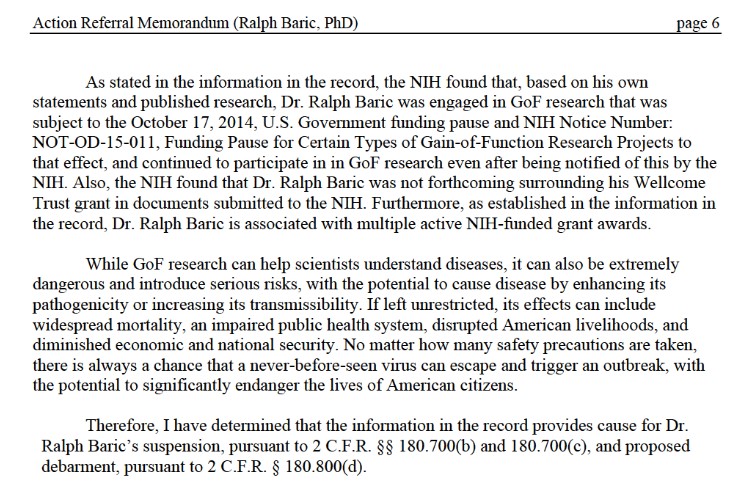
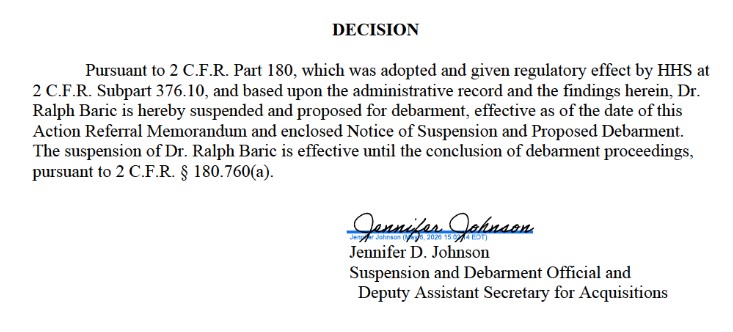
**** And, last but not least, the involvement in Ebola virus experiments by the now-fired (“retired” for “no reason disclosed”) and disgraced “Eminence Grise” of the COVID-19 disaster: Dr. Ralph Baric, PhD; experiments that used Gain-of-Function techniques. Dr. Baric authored the following papers: the first, at approximately the same time that the 2014 Ebola outbreak was raging; the second, in 2024: https://pmc.ncbi.nlm.nih.gov/articles/PMC4241145/, “Host genetic diversity enables Ebola hemorrhagic fever pathogenesis and resistance”; Ralph Baric, PhD, et al. 30 October 2014; and, https://doi.org/1016/j.celrep.2024.114127, “Mapping of susceptibility loci for Ebola virus pathogenesis in mice”; Ralph Baric, PhD, et al. 28 May 2024.
>>>>>>>>>>>>>>>>>>>>
Ticks:
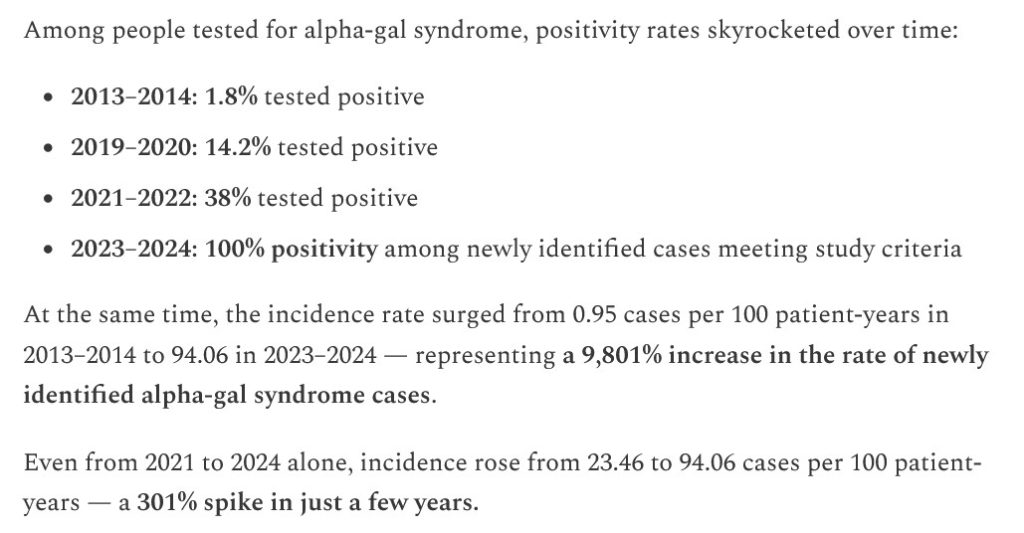
**** From The Focal Points: https://www.thefocalpoints.com/p/study-tick-borne-alpha-gal-syndrome, “STUDY: Tick-Borne Alpha-Gal Syndrome Incidence Skyrocketed 9,800% in the U.S. Since 2013”, Nicolas Hulscher, MPH, 22 May 2026. Please see the screenshot, below, from his article:
**** From 2nd Smartest Guy In The World: https://www.2ndsmartestguyintheworld.com/p/lyme-and-lone-star-bioweapon-diseases-33d, “LYME & LONE STAR BIOWEAPON DISEASES UPDATE: “This Tick Thing is Nuts” & Since 2013 Alpha-Gal Syndrome Incidence Skyrocketed 9,800%”, 24 May 2026. This article quotes the Hulscher post cited above, and also includes more information from other sources.
**** “And now, for something completely different”: the “contrarian view” from Sasha Latypova: https://sashalatypova.substack.com/p/trick-ticks-fear-porn-to-cover-up, “Weaponized Ticks!!!, a mini review”, 25 May 2026. Ms. Latypova argues that Alpha-Gal Syndrome is actually caused by immune system damage induced by vaccines.
Yours Truly will weigh in on the latter: One: there has been a huge increase in reported diagnoses of Alpha-Gal Syndrome since the rollout of the COVID-19 bioweapon “vaccines” in 2021. Two: the COVID-19 bioweapon “vaccines” induce or aggravate multiple types of immune and/or autoimmune disorders: see https://phmpt.org/wp-content/uploads/2021/11/5.3.6-postmarketing-experience.pdf, regarding BNT162b2 (COMIRNATY), FDA date-stamped 30 April 2021; scroll down to the Appendix 1. List of Adverse Events of Special Interest section of this report. “Autoimmune disorder”; “Complement factor C1 decreased”; Complement factor C2 decreased”; Complement factor C3 decreased”; Complement factor C4 decreased” are among the listings. The Complement factors C1 to C4 are crucial proteins in the innate immune system. Decreases / deficiencies in any or all of these complement factors will create dysfunction / malfunction of the innate immune system, inducing conditions ranging from angioedema to recurrent infections to neurological conditions, and more. Three: Please see: https://www.annalallergy.org/article/S1081-1206(23)00002-9/fulltext, “Alpha-Gal Syndrome is an immunoparasitologic disease”, John C. Carlson, MD, PhD, April 2023. Four: there may well also be the involvement of other types of “vaccines” (in other words, non-COVID-19 bioweapon “vaccines”) in damage to the innate immune system.
>>>>>>>>>>>>>>>>>>>>
MAiD: It appears that the use of this “assisted suicide” protocol in Canada is “expanding”:
WHAT 🤯 A man in his 40s with inflammatory bowel disease, was assessed outside a Tim Hortons, offered MAID, AND driven by the DR to the assisted suicide facility, and killed by MAID 🤯
I honestly thought this headline was fake, but it’s real
Inflammatory bowel disease is treatable and manageable: https://www.cdc.gov/inflammatory-bowel-disease/living-with/index.html. By the way, “Inflammatory bowel disease” is ALSO LISTED in the Appendix 1. section of the BNT162b2 (COMIRNATY) report cited above: it can therefore be an adverse event of the COVID-19 bioweapon “vaccines.” Note: some media outlets (for example, https://www.vigilantfox.com/p/germany-and-canada-go-full-1984-daily), state that the man (in his 40s) suffered from Crohn’s Disease, mental health issues, and substance abuse issues — all of which are treatable and manageable: and is ALSO LISTED as an adverse event of the COVID-19 bioweapon “vaccines”, per the BNT162b2 (COMIRNATY) report cited above.
>>>>>>>>>>>>>>>>>>>>
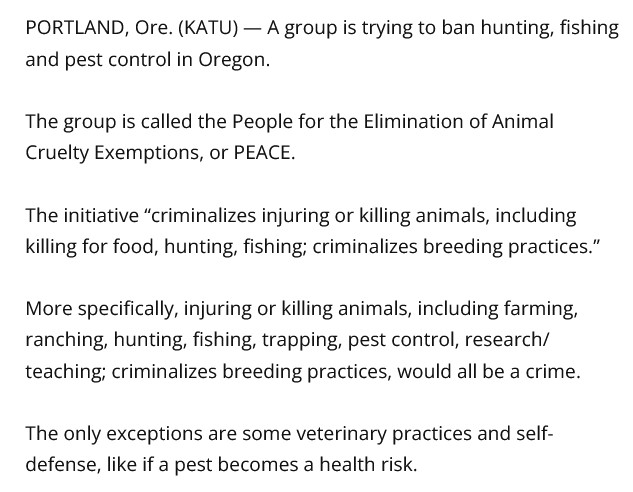
And, last but not least, THIS insanity, in OREGON:
A petition is now the November ballot in Oregon that, if passed, would criminalize the killing of any animal (including fish and other marine life) for food; would ban pest and insect control; would criminalize and ban the teaching of these practices; and more. Enough signatures have been obtained to put this madness up for a vote:
An effort to criminalize the killing of animals for food in Oregon is a step closer to being on the November ballot.
IP-28 would make it illegal to injure or kill animals and would effectively ban hunting, fishing and the breeding of animals. https://t.co/Je1Z43xKAm
(Intellectual Disclaimer and Notice: Except for the linked URLs and other items in today’s offering that are found on the internet, the ideas and/or opinions in today’s offering are by PAVACA. Credit must be given to PAVACA if ideas and/or opinions in today’s offering are used by other blog writers; by podcasters; or in print or social media.)
This man, making Christmas calls from the White House, believes the world is a sphere. And he has even flown around it! So has our beautiful FLOTUS, who happens to be his wife!
Truth and common sense must be valued by us, as individuals, in order to lastingly disempower the authoritarian fake news media. This includes the perniciously smarmy science media, which never answers for its errors and lies. I believe that the media has been responsible not only for leftist pathologies like scientism, medical fascism, and radical gender ideology, but also for reactionary movements like modern flat Earth, rejection of all medicine, and Biblical geological literalism.
Just as Wheatie’s Stormwatch Monday Open Thread was created as a place for people to openly express their thoughts and opinions, so, too, is this Thank God Thursday Open Thread, where honest but civil discussion of all topics is encouraged. This thread is also to be known as Theistic Evolution Thursdays, due to the author’s expected “pontification” about his scientific, religious, and political opinions. You are welcome to pontificate back! Free speech matters!
Please label all AI-generated content as being such, unless it is patently obvious (e.g., humorous AI images). It is important that we as individuals not begin to pretend that socially derived artificial intelligence is actually our own, as this form of stealthy social information averaging and feedback would be one more pretense and deception between people, in service of stupid Marxist socialism, and of those who wish to substitute their communally protected lies for actual truth.
The source of alleged truth matters, not for the truth itself, but for validation.
And yes, it’s THURSDAY…again.
And that’s it. We’re done stealing from Wheatie.
OK – maybe her rules need to be posted.
No food fights.
No running with scissors.
If you bring snacks, bring enough for everyone.
Other rules may be derivable from these, and that conjecture is left for discussion.
If there is nothing beyond the “W” below, then this is a placeholder. For health reasons, I can’t always post a timely opinion before each Thursday, but I will try. Otherwise, you have this placeholder post, where YOU provide the content. Enjoy!
W
Perhaps the only good thing about AI slop is that it has made me more aware of human slop, which isn’t much better.
This guy’s videos are moderately interesting, but they tend to be predictable, repetitive, and low-density on the critical information.
There are Important Notifications from our host, Wolf Moon; the Rules of our late, good Wheatie; and, certain caveats from Yours Truly, of which readers should be aware. They are linked here. Note: Yours Truly has checked today’s post for any AI-generated content. To the best of her knowledge and belief, there is none. If readers wish to post any AI-generated content in the discussion thread for today’s post, they must cite their source. Thank you.
Do not forget to LABEL AI articles, video and such.
The second and last part of the Kash Patel transcript.
45:00 – 58:30: The FISA Fraud: How the Spying Began — CONTINUED
58:30 – 01:10:00: Modernizing the Bureau: AI vs. Terrorist Threats
First I want to draw attention to this new disclosure. I had not heard of this operation before and Google says it does not exist.
.@jsolomonReports predicts that the SPLC case is only the beginning of what's to come from this DOJ:
“I think we’re about to enter into a period of MAAA. Make America Accountable Again. I think with Pam Bondi moved aside, the speed at which the Justice Department will move on… pic.twitter.com/qM5mKne2Cj
@jsolomonReports predicts that the SPLC case is only the beginning of what’s to come from this DOJ:
“I think we’re about to enter into a period of MAAA. Make America Accountable Again. I think with Pam Bondi moved aside, the speed at which the Justice Department will move on things that have been working in the system for months is picking up.
I think in the summer and fall, we are going to talk a lot more about a case called “Operation Round River. Its goal was to neutralize anyone who would dare suggest there was a corrupt relationship between Joe Biden, Hunter Biden, and the Ukrainian Government or the Ukrainian company Burisma.
All the people I’ve talked to in government think that Round River may be the most JAW-DROPPING of the four codename investigations that targeted Donald Trump and his followers.”
The four investigations Kash IDed are, Arctic Frost, Plasmic Echo, Round River and of course Crossfire Hurricane.
….
ROUGH TRANSCRIPT:
51:30 — Kash Patel: They lost the election. And so what they wanted to do was kneecap the presidency of Donald Trump and set him up to fail. And so they breathlessly put out that false narrative about Russia and collusion over and over and over again. Remember these same people in Trump one, the Rosensteins and Comeys and McCabes of the world were the ones that proposed wearing a wire under the 25th amendment to record Donald Trump. That’s not me saying it. That’s the documents we found. Again, their arrogance. They wrote it down. We put it out. Can you imagine if Obama or Biden’s FBI or DOJ proposed to wear a wire in the Oval Office to record the president of the United States? Would we not still be talking about that?
Sean Hannity: Well, think back again. Donald Trump is running and Hillary is paying for this dirty dossier. Unverified, unverifiable. And James Comey looks at it. Didn’t know anything about the authenticity of it. Then he makes this famous trip to Trump Tower.
First of all, I’ve known Donald Trump for 30 years. It made me laugh when I heard it because I knew it was complete utter BS. Well, there was a report, sir, that you might have been in the Ritz Carlton in Moscow and you might have had hookers in your room urinating on you. Okay, if anyone knows Donald Trump, he is the biggest germaphobe. Him and Howard Stern, the biggest germaphobes in the world. And so it wasn’t true. But Comey knew it wasn’t true.
Kash Patel: There’s something more basic to it than that. The dossier, which now everyone has seen, when I first saw it, I said, “Let’s just do some investigative 101.
” Does that hotel with that room even exist in Moscow? It doesn’t. It literally doesn’t exist.
Sean Hannity: Whoa, whoa, whoa. This is the first I’m hearing it. What? Come on.
Kash Patel: Serious. So, we looked it up. Doesn’t exist. A hotel exists. Not with that room. Not in that location. It’s available on the internet. Anybody at the FBI could have verified that. They didn’t do it on purpose because the narrative, the salacious and fake narrative against Donald Trump was what they wanted out there to kneecap his presidency because they knew we were uncovering their FISA fraud. So once we caught them doing that, what’s the next best thing? Continue the narrative anyway. Continue the narrative to make sure President Trump doesn’t succeed. And thankfully to your reporting and just a select few others, and we were vilified for it then, we got the truth out. And now the American people, when you fast forward across the four years that President Trump was out of office and now that he’s back in office for the first year, it’s right to be focused on this. It’s right to be pissed off about it because what law enforcement should be doing is what we talked about at the top of the show, doing cop work.
Sean Hannity: I want to read Dan Bongino’s famous tweet and I first I want to know what you thought. Did he talk to you before he sent it out?
Kash Patel: The..
Sean Hannity: The infamous Bongino Holy Shit… All right, let me read it to you.
Kash Patel: Yeah, read it to me.
Sean Hannity: It says, “During my tenure here as the deputy director of the FBI, I’ve repeatedly relayed to you that things are happening that may not be immediately visible, but they are happening.” He said, “The director and I are committed to stamping out public corruption and the political weaponization of both law enforcement and intelligence operations. It is a priority for us. But what I have learned in the course of our properly predicated and necessary investigations into these aforementioned matters has shocked me down to my core. I’ll continue in a minute. I’ve known Dan like I’ve known you for years. This is not written lightly.
Kash Patel: No, we talked about it.
Sean Hannity continuing to read: We cannot run a republic like this. I’ll never be the same after learning what I’ve learned. We’re going to conduct these righteous and proper investigations by the book and in accordance with the law. We are going to get the answers we all deserve. And as with any investigation, I cannot predict where it will land. But I can promise you an honest and dignified effort at truth. Not my truth or your truth, but the truth. God bless America
Sean Hannity: I’ve known this guy forever. He did not write that lightly.
Kash Patel: No, we talked about it.
Sean Hannity: Look, he talked to you about it before he sent it out. And you said send.
Kash Patel: We were the best partners. Dan was easily the best hire I’ve made or I’ll ever make. He told me he only wanted to go a year. That was the agreement. I said, “Hey, man. We need you.” When we were first talking about he said, “I can give you a year.” I said, “Give me a year. We’ll take it.”
Here’s the difference. We are doing it by the book. That’s why it takes time. That’s why it takes time to build a prosecution team in different jurisdictions to look at this, to get the grand jury subpoenas out, to put witnesses in the grand jury. We’ve put a ton of witnesses in the grand jury. That’s what they don’t do. They don’t play by the rules. They don’t play by the book, but we do because, as Dan said, we got to do this right. We got one shot at it. We’re not going to do it fast just to get the headline. We’re going to take our time and get it done right and get everybody that was involved under the microscope.
Sean Hannity: When you say, the amount of corruption, this is a priority and that we cannot run a republic like this. I interpret that to mean and I want your impression. Tell me about Comey. as Trump always refers to him as a bad dirty cop. Is he right?
Kash Patel: Yeah. Look at Russia Gate. You can’t do that if you’re stupid. He’s not dumb. You can’t go out and give that Hillary Clinton press conference if you’re stupid or dumb. It’s intentional to seed the narrative and to cover up their dirty work. And so he built a team around him, which we obviously got rid of, that would advance that narrative that crippled the credibility of the FBI. And that’s the one thing we’ve been fixing. It’s not me saying it. The FBI’s credibility before Donald Trump got back into office was cratering. Cratering because of THIS, because they didn’t tackle violent crime and didn’t tackle national security issues. I mean, just look at how fast it changed.
Sean Hannity: Well, how could they be if they’re involved in all this political intrigue and sabotage?
[From the Sundance]
Kash Patel: And that’s what hurt the mission the most. The heroes of this mission under President Trump and this FBI are in the field. That’s why we’re giving them the resources. That’s why we’re bringing in things like AI. AI was never used at the FBI till we got there. Literally, I’m using it everywhere. I’m using it in places like our criminal justice information system database so we can pop fingerprints immediately and get fugitives and arrest warrants out. I’m using it in places like our national threat operations center.
I’ll give you an example. They wanted to do it human by human. Can you imagine how many tips the FBI gets a week? Thousands. If we had just humans look at it, we would never sift through them all. I put AI in there. We stopped a school massacre in North Carolina because we got a tip and we were able to triage it with artificial intelligence. We stopped a school shooting in New York because we got a tip from our private sector partners who are building our AI infrastructure. I mean just think about the old school movies. Remember they get the fingerprint screens up and they’ll say we’ll see you in a couple days when we get a hit. Now those hits are instantaneous because we are welcoming in artificial intelligence.
The former FBI rejected that notion because they knew that wasn’t their focus. Their focus was on weaponization, not modernization. My predecessors didn’t spend one second modernizing the FBI. They kept calling it the premier law enforcement agency in the world, but they failed to give the people in the field the resources that they need. They failed to give our SWAT operators, our tactical operators, our hostage rescue teams the tools they needed.
Sean, our guys, just to give you an example, are doing dynamic hostage rescue operations on a weekly basis with night vision goggles that don’t work. That’s not that’s not hyperbole. That’s a fact. So, I called my partners at DOW and I said, “I need an assist.” They were like, “Roger that. We got you covered.” Why? The question the American people should be asking is, “Why didn’t this so-called premier law enforcement agency of the world, why didn’t they resource it? Why didn’t they build a backbone infrastructure? Why didn’t they go out to the private sector and say, “Hey, we need your help.” Donald Trump kicked that door open. I’ve got every major tech company in the world embedded in the FBI rebuilding our internet capabilities, our classified systems, and the ability for artificial intelligence to be in our counterterrorism program so we can get instantaneous results. What’s the point of collecting terabytes of data if you can’t sift through it?
They never answer that question. And the mainstream media doesn’t ask the question as to why our predecessors kept putting a band-aid on a gunshot to attempt to triage the broken system of the FBI. We spent the last year, this is one of the things I’m most proud of, rebuilding our entire backbone infrastructure because an agent in the field in Omaha should have the exact same toolkit as a guy in New York City. No different. Our SWAT operators should be using machines. They didn’t have Bearcats in the field. We got them Bearcats in the field. You guys want these guys kicking down doors and dropping fast roping off helicopters and things like that and rescuing kids like we just did in Alabama the other week in the middle of a night from a guy who’s holding a young woman at gunpoint. We got to give them the tools that they need. And none of them bothered to do it. They just kept repeating the past hyperbole and resting on the history of the FBI saying we’re great and we’re going to get there.
How come Chris Wray didn’t fight for a budget for this FBI in his five years and saw decline in funds year-over-year for his entire directorship?
Sean Hannity: If Comey is a dirty cop, I know this issue in the indictment 8647. Okay, I think he’s completely full of shit when he says that. Oh, I just thought it was an interesting shell formation. Okay, every American knows what 8647 means. What an interesting shell formation. My wife suggested that I put it on Instagram. I’m like, okay, good luck with that. But to me, that’s the low-hanging fruit for him. Which is why I want to get into what the grand conspiracy will be.
But first, if Comey was a dirty cop, Director Wray used to always warn about some type of apocalyptic meltdown in the country, but then he never did a thing to secure the borders and he kept letting these millions of people come from 200 plus countries and that frustrated me. I felt that that those were all CYA appearances before Congress or the Senate. So my question is, how do you describe Director Wray?
Kash Patel: Look, I don’t spend my days thinking about Director Wray. He paid lip service to the American people to say we have all these investigations but didn’t reduce crime. That’s the result. The results speak for themselves. In one year, in 14 months with President Trump, this FBI has done more than the prior two guys combined. That’s that shows that the mandate of the FBI has been restored by President Trump.
Sean Hannity: That shows you’re not playing politics. You’re not out to screw the next Democrat. You there to stop crime.
Kash Patel: That shows the breadth of cooperation we’re getting from people like the government of Mexico, the government of India, China, Russia even. We’re getting these fugitives from all over the world and we’re sending our people to go get them. I was there on the ground in Mexico when we got the Ryan Weddings of the world. When they said you couldn’t get them, you couldn’t find them. We created operations to go and flush these guys out and we’re getting them all in record speed. We went to the government of India and said, “Hey, there’s a gal over there on our top 10 most wanted list who murdered her handicapped 5-year-old son. They found her in a week for us and we went and brought her back.” They could have done that in the Biden administration. They could have gotten Ryan Wedding. They could have gotten the rapist in North Carolina who was our most wanted fugitive. They could have done all that work. They didn’t because they were focused on keeping the status quo. That’s what the American people hated the most. That’s why I believe they voted Donald Trump back into office again because they wanted to change the status quo in Washington DC on Capitol Hill and the way this FBI represents itself across the country.
Sean Hannity: Walk through the next level. We got all the way through 2016. They set him up like a bowling pin because they took a career senior intelligence officials assessments about there was no Russian interference. They used the dirty dossier to backdoor spy on candidate Trump, transition team Trump, and then later the Trump administration. Carter Page is a nice guy. My understanding is he was a hero. He used to work with three-letter agencies. Is that your assessment of him, too?
Kash Patel: That’s the public information that’s out there. That’s correct.
Sean Hannity: I mean, that’s public and he’s told me directly that he would always help out our government. He was a patriot. Trump has to deal with that for three years. But there’s more to the story. It’s a bigger broader case. The reason that the grand conspiracy, if which you have said you’re looking into is so critical, is because the small the low-hanging fruit on Comey 8647 while important for sure is not the worst of what this guy did. And unfortunately the statute of limitations ran out because you had the intervening Biden years. They were never going to investigate the guy that did all this work for them. However, if there is a grand conspiracy, there are no statutes of limitations.
Kash Patel: Well, and also if they did it again, right? The win here is not just holding these people accountable. The win here is making sure that the FBI, DOJ, and the entire government are never able to do this again to anyone else. That’s what President Trump has said repeatedly. He was the ultimate target, but he wants to make sure that this can never happen to anyone ever again. That is the ultimate win for our republic. And it’s not just this statute of limitations thing. These people, as I said earlier, are so arrogant that they ran back the same playbook. That’s what we uncovered.
Sean Hannity: Isn’t it then important then that those that were involved in it be held accountable?
Kash Patel: All of them. Every single one of them.
Sean Hannity: Okay. So, how do we get from it began here in 2016, July, the press conference, all the way through the setup for 2017, and Trump’s coming in and explain how it continues from there.
Kash Patel: That’s the part that I’ve got to be a little careful about. What I was saying earlier is they ran it back again. I don’t mean in 2016 and 17. I don’t mean in 2021. I mean they ran it back just now.
Sean Hannity: Explain.
Kash Patel: In the last election. In the one that just put Trump back in office. They ran the same playbook of getting regurgitated bogus information funded by political operatives seeded into the intelligence community. And that’s what we figured out and unlocked. And that is where I spend most of my time when it comes to the deweaponization of government. Focused on, collecting those bad actors, getting grand juries, getting prosecutors, and building teams around the country, not just in one location to look at that because these people haven’t stopped. The same actors were involved yet again.
And so that, when you say grand conspiracy, I think the American public thinks one thing. When I hear it, I’m talking about the breath of the entirety of it. And we are putting it all in one place and that’s the crux of what we’re doing right now.
Sean Hannity: Explain how it goes out further. My understanding is you brought Joe diGenova in?
Kash Patel: DOJ did.
Sean Hannity: He’s one tough kick-ass prosecutor.
Kash Patel: He’s been around a long time.
Sean Hannity: I would not want to go up against him. One of the few people I’m like, UH No. But I think he’s also truth oriented and he’ll want to get to the the bottom line. So there really is an effort to just… what do you think it stems from? Is it they hate him? They hate his politics. They hate what he stands for. They hate his style. What is it?
Kash Patel: They hate that he [Trump] did everything they said they were going to do and didn’t get done. Everything from ending the forever wars to securing the border to reducing crime to historic low proportions. He’s accomplished all that and so much more. And if an Obama or Harris or Biden had done it, they would be building monuments for them. But he did it. They talked about it. They ran on it. They weaponized government. He exposed it. Trump then got back into power and said, “We’re going to fix it forever. So do it the right way. Don’t go fast. Get it done and get everybody. And that’s what we’re doing. We’re only 14 months in. I know people think it should have happened yesterday. But look at the public corruption cases we’ve already brought. The work that we’re already doing, the fraud. We haven’t even talked about the fraud in Minnesota or the scam centers overseas that are plaguing the United States of America. We’re doing all of this work. At the same time, we’re doing what you and I are talking about.
Sean Hannity: So, and this is what I guess frustrated me knowing you for a long time. You walk in the door and like people are immediately like slamming you with, “Oh, wait a minute. Where are the JFK files? RFK files with MLK files and are there UFOs?” Which, by the way, I’m going to ask you all of that. I’m fascinated with the UFO part. But you’re slammed with that. But then you’re also slam with getting to the bottom of this, keeping Americans safe and secure, dealing with narco terrorists, dealing with child trafficking operations. All this has taken place in our country. It’s kind of hard to absorb that.
Kash Patel: Well, President Trump not only promised to restore law enforcement and make it better than it’s ever been, he’s also the most transparent president in the history of the United States. All the things you talked about are things other presidents could have put out but didn’t. He did. And let me give you another example of what this FBI is doing. Our constitutional oversight comes from the United States Congress. I’m a big proponent of that. The prior two directors released a total of 14,000 pages of documents to Congress in a total of 10 years. 14,000 pages of documents to oversight committees in Congress.
Sean Hannity: How many [have you released] And if if you listen to your critics, they would think that you’re hiding everything.
Kash Patel: 41,000 pages in 14 months, I don’t do math, but I think it’s like a 350% increase. And that’s just in 14 months because President Trump is driving the transparency initiative. And the documents are the best work. And whether it’s JFK or RFK or UFOs or what have you, it’s also the underlying [stuff] and that’s the balance we got to strike. People are like, “Where are the rest of the Russia gate?” You know, conspiracy documents. My balance is to release what we can while maintaining the integrity of the investigation. If we put everything out, then we jeopardize the integrity of the prosecutions that we will bring. That’s the balance that I have to strike. And I get it. We take a lot of incoming for it. Why don’t you just put it out? Why don’t you just put it out? Well, we want accountability, too, right?
Sean Hannity: But you can’t. But people don’t understand either. You take in voluminous amounts of information. A lot of it is not verified and a lot of it’s not vetted. It’s raw intel that could hurt innocent people. You have redactions that would go along with it. I would urge anyone to go through 500 pages and try to redact what you have to redact and the amount of the intensity of that work alone would be insane and you’re talking about hundreds of thousands of documents. That’s a lot. [Just editing these transcripts is a (euphemism) and I can only handle about 5 to 10 pages a day! –GC]
A random question and then we’ll get back more focused but what keeps Kash Patel awake at night
Kash Patel: Missing something. Did we miss a national security threat? Did we miss the chance at protecting another kid or another community? And I can tell the American public that just look at the month of December alone last year. We stopped four terrorist attacks in four weeks during the holidays. Four.
Sean Hannity: Slow down a second. Most Americans don’t know that.
Kash Patel: Yeah. Everything from the pumpkin tape plot all the way through the attacks that were going to happen in Texas, Florida, and New York. And we stopped them all. We, this FBI.
Sean Hannity: When you say terror attack, do you mean a real attack, a terrorist organization, [and you] stopped it? That’s got to give you a lot of personal job satisfaction and then scare the hell out of you about what else may be out there.
Kash Patel: It’s a two-edged sword, right? Like, thank God that this FBI is on mission doing it. We put it out as much as we can because the work of this FBI should be known to the American public and it should be advertised. Their wins, the sleepless nights that the agents, the intel analysts and professional staff put in. The time away from their families. We are the folks that are responsible for safeguarding America. What keeps me up at night is we’re trying to do everything we can not miss anything.
Sean Hannity: So, you have to be perfect every time.
Kash Patel: Yeah. Well, they only have to get through once.
Sean Hannity: Do you fear a 911 style attack could happen again?
Kash Patel: We’re always on the watch for that given the current circumstances we’re in. And as I said earlier, the thing about terrorists is they’re exceedingly patient. After the disastrous withdrawal in Afghanistan, which led directly to the deaths of 13 of our brave soldiers at Abbey Gate. And by the way, in the first two weeks on the job, Johnny Ratcliffe and I went to the Pakistanis and got the Abbey Gate bomber who just got convicted last week. The question the American public should be asking is what was the Biden administration doing for four years not finding this guy that killed 13 American soldiers. That’s how fast we moved. And that’s how fast you can move.
The problem is, the way that Afghanistan was left by the Biden administration, allows al-Qaeda and ISIS K [ISIS-Khorasan – Terrorist Groups – GC] specifically to rejuvenate. ISIS K, which is the worst of the worst pretty much outside of the Iranian terror regime. And so they are rebuilding slowly. That’s what we’re watching. And we’re watching to see if they are moving people across continents into Africa into South America. And we’re working with our intelligence community partners, CIA, NSA overseas, and of course the DOW running targeted operations overseas, going after the drug traffickers. And the big shift that we had here was we finally equated terrorists to being terrorists. What do I mean by that? Muslim Brotherhood, they’re terrorists. Donald Trump did that. Drug trafficking organizations in Mexico, they’re terrorists. Donald Trump made them FTOs. [Foreign Terrorist Organizations] So that unlocks authorities that we have to traditionally manhunt al-Qaeda and ISIS and ISIS K on these organizations. That is a critical win that is never talked about. Moving the machine to designate these organizations as foreign terrorist organizations so the FBI the CIA the NSA and DOW can do what you’re seeing.
Sean Hannity: Are there sleeper cells… do you believe? And what degree of certainty do you have that there are sleeper cells in this country?
Kash Patel: So we can only work off the intelligence that we have and currently we are looking at that with our partners across the IC. I’m not saying there aren’t. I’m saying the intelligence that’s been produced so far doesn’t show credible information to support that. That’s the assessment of the IC.
Sean Hannity: I don’t know if I’d want to read the presidential daily briefing every day. I think that would be a pretty long when I look at all of this. I want to go back to your interpretation when you had the burn bags ‘cuz that was a big story. When I heard they left burn bags behind. I’m like, either they’re dumb — And then Dan was the one that opened my eyes by saying, I think somebody probably left them there hidden on purpose, hoping we’d find it and maybe even tipped you off that it was there. ‘Cuz you said this is in a room that nobody knew existed. Was it like a safe room?
Kash Patel: Literally, it was in a safe room.
Sean Hannity: And so you told WHO[???] go look in this room.
Kash Patel: First, we had to find it. Remember, it goes back to the arrogance. The people that authored Russia Gate and the ultimate weaponization of government and law enforcement, we caught them because we used their documents. We found their documents. I knew they had done that again. What we found was just a chunk of it. So, I knew it was elsewhere. So, I said, “We’ve got to go comb through the entire building and find a combination of two things. Their arrogance coupled with good people in the FBI who were smart enough to make sure that the material that the arrogant people assumed would be destroyed was not and that was the key for us.
Sean Hannity: We got Dan’s reaction. What was your reaction when you read it?
Kash Patel: It was something I anticipated. I wasn’t surprised by it.
Sean Hannity: Well, you were more deeply involved because you were working with Devon. So, it was just confirmation of what you already knew with more information.
Kash Patel: Yeah. That we hadn’t seen yet. with more information.
Sean Hannity: How do you explain that they put it down on paper? Because that seems pretty dumb to me.
Kash Patel: The arrogance. Why would you put down on paper that you had information that exonerated Carter Page and President Trump’s campaign? ‘Cuz they thought, “No one’s ever going to see this. Hillary’s going to win. We’re never going to see this.”
Sean Hannity: Are you convinced that there’s enough evidence that the DOJ in the future will be able to bring real strong cases against the people that are involved here?
Kash Patel: Yes. I can’t start saying names.
Sean Hannity: … [story about cops in his family] …restoring the FBI to its former greatness and restoring our intelligence community to its former greatness. Are you confident in this 4-year period, assuming we just have four years? I’m hoping longer. That’s possible?
Kash Patel: Yes. That’s what we’re doing. That’s what President Trump’s leading out on. people should really take a hard look at the last 14 months and some of the things we’ve talked about.
They said that none of that was possible. There’s no way you could reduce robberies in this country by 20%. There’s no way you could drop the murder rate in this country by 20%. We did all that. There’s no way you could tackle fraud in Minnesota. What did you see last week? FBI agents along with the inter agency executing 21 search warrants and raiding locations across Minnesota. Not just the fraud here, but the fraud that’s being manufactured and stood up by the CCP overseas in places like Cambodia, Thailand, and Burma. They’re standing up those scam center compounds that are defrauding senior citizens in America by the billions. Just last week, because of President Trump’s ability to have countries in the Middle East, Dubai specifically, the FBI, the Dubai police, and the MPS were on the ground. We shut down nine scam centers, freed 2,000 trafficked enslaved laborers, sent them back home, and shut down a $5 billion scam center fraud that was being perpetrated in the United States of America.
Sean Hannity: It’s crazy this level of crime, especially coming from abroad, is here.
Kash Patel: And [where] they headquartered it. So you have to root out the fraud like we’re doing on the ground in Minnesota. This is our operational plan that we’ve been executing the last year and go to places like Cambodia, Thailand, and Burma where the CCP is standing up villages of scam center compounds and work with our private sectors to annihilate them.
Sean Hannity: Is China the worst of all our geopolitical foes?
Kash Patel: Yeah, by far.
Sean Hannity: Let me ask you about this. So you know I work closely with John Solomon. We know about Arctic Frost. The summary I would give and maybe you can give yours. They actually spied without a warrant, without any basis. You talk about unreasonable search and seizure on congressmen and senators and others.
Kash Patel: Yeah. And others.
Sean Hannity: How’s that investigation going?
Kash Patel: It’s far down the track.
Sean Hannity: You feel you’re getting where you need to be?
Kash Patel: Yeah
Sean Hannity: Here’s the reporting of John Solomon. It’s not just Arctic Frost. What about Round River [Google denies it even exists! – GC], which deals with Ukraine. What about Plasmic Echo, which has to do with classified documents? And then of course, Crossfire Hurricane.
Kash Patel: All of it. All of it collectively is run on the same MO that was stood up by a weaponized law enforcement. And all of it is being uncovered and exposed by the same MO that President Trump came into office again with to root out corruption and weaponization of law enforcement. But how?
Get the documents, then get the witnesses, then get the grand jury subpoenas out, then put people in the grand jury, then build a case with our prosecutors at the same time to collectively hold these people responsible and find jurisdictions where we can prosecute them based on the law. That’s what we’re doing across the board.
Sean Hannity: Relatively speaking, things that have happened to me, like I had Jim Jordan come on my TV show once and say, “Oh, by the way, the government suppressed your social media account for the 2020 election. Or my own my private personal text messages are released publicly with people like Paul Maniffort, Mark Meadows, Jim Jordan, Kayleigh McEnany, I mean, I would think I have a right to privacy. I’ve never committed a crime in my life except speeding and I don’t speed anymore. Nobody ever gets held accountable for that stuff. And nobody in the media ever cared ‘cuz it was me.
Kash Patel: Yeah, I know the feeling. Mine too.
Sean Hannity: And by the way, your FBI contacted me at least a couple of times through my lawyer, and said, “Oh, by the way, we think your client got hacked by Russia, China, and Iran.” My phone. First of all, why do Russia, China, and Iran want to hack my phone?
Kash Patel: Well, you got a pretty big audience, Sean. I don’t know if you noticed that. And our adversaries, look, but in all seriousness, our adversaries aren’t stupid. Why wouldn’t they target you? You’re one of the most powerful messengers of truth that there is.
Sean Hannity: They want him.
Kash Patel: So, they want you and me. I’m a sitting FBI director and I just figured out that the prior FBI illegally surveilled and collected my information.
Sean Hannity: Is there any way to keep your phone safe? ‘cuz I learned through the Nancy Guthrie case that you could think everything is deleted and you have equipment that can actually retrieve it, which I don’t think you guys want it out there . For example, if you delete your cloud, you delete your text, you delete your email, you wipe it clean and it’s still out there like hanging out in the air and it can be retrieved.
Kash Patel: Well, that’s that’s a whole separate conversation when it comes to how do we use technology and how do we use these tech companies, phone companies, social media companies, cloud services. Everybody wants the best of both worlds. They want to be able to use that and rightfully so. But they also want everything protected and that’s why it takes an act of Congress to come in with laws that we can utilize to safeguard these American citizens. I mean, China, Russia, Iran, and DPRK are never going to stop their espionage activities.
Sean Hannity: Ever.
Kash Patel: Ever. We shouldn’t expect them to.
Sean Hannity: We spy on them.
Kash Patel: But what we can do. What this FBI has done is turbocharge how we go after them. I mean, Sean, you cannot have a 43% increase in espionage arrests in 13 months unless you actually turbocharge and do what the president wants you to do, which is safeguard American citizens. So, we’re on that mission set. We’re also working with the private sector to say, “Hey, you guys and us have to work on a couple of things. Ultimately, safeguarding, you know, free speech and everybody’s right to it. But at the same time, our job in law enforcement is to safeguard your privacy.” That’s a tough balance because people want it both ways and it’s really hard to strike that balance.
Sean Hannity: So, a friend of mine who is pretty high ranking in the FBI, he’s now retired. I’ll never forget this conversation I had with him and I brought this up with with Dan. We were talking about the FBI and he volunteered to me, said if the FBI ever comes to your house, don’t talk to them. That goes against every instinct in my being, my natural reaction would be this is the FBI. I want to help the FBI. You know, if they need my assistance, how can I help you? He said, nuh-uh.
Kash Patel: That’s the ultimate goal we’re working towards, to go back to that. But that’s what we want our FBI and our law enforcement to get back to. That’s the degradation of trust that has happened.
Sean Hannity: This is a guy who loves his country. This guy was an agent’s agent. This guy risked his life all the time, was undercover for years in his life. And for him to say, “Whatever you do, don’t talk to them.” It’s probably a perjury trap. That’s what he told me. Well, look at what they did. I mean, he’s saying that because of the examples you and I have talked about. He left because of it.
Kash Patel: And here’s the other thing. I’ve got so many FBI agents. We created a new program for them to come back in. They were so fed up that they left. They’re all coming back in and helping us. And so the ultimate goal of not just holding everyone accountable for the past that we’ve talked about is, the law enforcement community you and I grew up in, me in New York too, that if a cop shows up or an agent shows up, you invite them in and say, “How can we help? We’re getting there. When I go across this country, when I visit the field offices, when I’m in the community, every single agent, analyst, and civilian tells me the same exact thing. We are feeling more safe under President Trump’s leadership than we ever have before. And we’re finally starting to trust the FBI again when they show up because look at what we’re doing. We’re responding in record speed. You see things like political violence. We’re taking that on. You see things like a political system that was used to target individuals. We took on the SPLC. Why do you think they started coming after me so hard just around the time we indicted the SPLC?
Sean Hannity: Weren’t you on their list? I know I’ve been mentioned by them a million times.
Kash Patel: The hate list. Yeah, I’m sure. These are things that Americans have wanted for a long time and we’re doing it with facts, and every time, and this you know this better than anyone, when they’re coming after you, they’ve come after President Trump and the louder the cauldron of baseless reporting is in Washington DC, the more you’re over the target. The only thing left to do is keep pummeling the target. And that’s what we’re doing with everything from the fraud investigations in Minnesota to SPLC to supporting and defending people’s right like those individuals that we just arrested for throwing a girl to the floor for expressing her freedom of speech right and basically attacking her. We got them too. We’re doing that across the country. That’s just one example. And so that’s what the American public wants. And that’s why we stood up our national mission center in the FBI. We literally, made another transformational change. What we did was we have 10 agencies in the FBI headquarters that have stood up just to ingest all of the information on social media and everywhere
else about people being attacked. We are responding to that in record time and go talk to the folks on social media and see, if when they’re being threatened, how fast this FBI responds. We’re running that and quarterbacking that operation out of this FBI.
Sean Hannity: So, we mentioned immigration, unfettered immigration. The president closed the borders. Those 12 million plus un-vetted illegals from over 200 countries, many with terror ties. I’ll tell you my other big fear is we now lived through the third assassination attempt of President Trump. [more like 5 or more with 25 incidents — GC] I know it’s outside of the FBI’s purview, but I’m concerned because I see three common traits in each example. And I’m not being critical. I mean, we saw the best in Secret Service that night at the White House correspondence dinner. You were there.
As a matter of fact, I was in touch with you. You were with the guy, I think, within probably less than 3 minutes, 5 minutes, but here’s what bothers me. I think we have a perimeter problem. In other words, I thought the perimeter in this case was too close to the venue. I think you need multiple perimeters. And if I’m wrong, tell me. I know it’s separate from the FBI. I am concerned that the whole entire hotel was not swept. I was concerned that Trump International, If you know that golf course where the treed areas are known for paparazzi, they would congregate there. They never swept that area. You have to sweep, secure, and then hold it. Make sure nobody goes in after you sweep it. And then Butler, how does somebody get within 130 yards of a president with a rifle and use a ladder to get on a roof? I’m concerned that while the agents themselves, the rank and file are doing a great job, and I’m not being critical of management. I’m just critical of, do we need a an examination or re-examining how we’re protecting our president?
Kash Patel: Well, look, Mark Wayne and I work closely, you know, every day together.
Sean Hannity: He just started, too.
Kash Patel: We’re getting better and better. But just going back to the White House correspondents dinner. You know what the American public should also be proud of is the inter agency showing up. We were all there, the media was all there, and in record time, we had the suspect subdued. I had a mobile command center stood up at the Hilton Hotel. I launched our NC3, our national crisis coordinate center at Hoover and I stood up our command center at the Washington field office. And you’re right, I was on scene. We stayed on scene. We made sure all the civilian population was safely exited from the building after the individual was secured, processed that individual immediately. The FBI agents are the ones that took him to the hospital and interrogated him on the way. And that’s why again with transparency while protecting the integrity of the investigation, we put out more information than any FBI would have on this individual in our investigation.
That night, we stayed up through the night. I stayed up with my leadership team, and got back early the next morning to make sure that we had adjudicated and, safeguarded the integrity of the investigation to make sure there’s accountability, but also to learn what we could. We’re always looking for what we can be doing better, especially when it comes to safeguarding the president of the United States.
Sean Hannity: I just think we need more perimeters further away from venues. And if you can’t sweep an entire hotel, then we can’t have our president there. Especially with the assassination culture. Three attempts against him. Charlie Kirk is dead. Charlie Kirk, you knew him. I knew him. Can’t have it.
All right. Now, let me ask you the fun questions. You know, one thing I want to ask you is about the Nancy Guthrie case. I got frustrated because I knew from my sources they were trying to keep you guys out.
Kash Patel: They did.
Sean Hannity: And look, time matters in an investigation.
Kash Patel: Look, the first 48 hours of anyone’s disappearance are the most critical. And here’s how these cases works. It is a state matter. It’s a state and local law enforcement matter. What we, the FBI, do is say, “Hey, we’re here to help. What do you need? What can we do?” And for four days, we were kept out of the investigation. And when we were finally let in, Sean, look what we did. We went in and got the Ring doorbell and we said, “Hey, is anyone talking to Google?” I called the leadership at Google and I said, “Look, we know that there was not a subscription service to capture all of the data that would have been captured had there been a subscription service. But can we go into the cache? Can we go into the data before it’s deleted and see what we can find?” That’s why you have that image because the FBI worked with Google to put that image out. Another thing we asked to do..
Sean Hannity: You guys got that tape which was the biggest breakthrough during that case.
Kash Patel: We could have gotten it days before. We could have also maybe gotten more data had we..
Sean Hannity: Why wouldn’t they want your help? Why did they send the DNA to a lab in Florida, not Quantico?
Kash Patel: That’s the other thing that you hit on, right? Again, we were saying we’ll process it. I launched hundreds of agents and intel staff to Phoenix and to Tucson just for this case, just to be on stand-by, just to do the canvasing. And we said we’ll take the DNA. And again, it’s a state and local matter, so it’s their call on where to send the DNA. We have Quantico, best lab in the world. I had a fixed wing aircraft on the ground ready to move it immediately through the night.
Sean Hannity: Did they just say no?
Kash Patel: And they said we’re sending it to Florida and and then I don’t know.
Sean Hannity: They have jurisdiction, so it’s their call. Bad call.
Kash Patel: Well, that’s for the American public to decide. And what we can do is continue to offer support. We would have analyzed it within days and maybe gotten better information or more information. Our lab’s just better than any other private lab out there and we didn’t get a chance to do that. So, I understand everybody’s frustrations on that.
Sean Hannity: No, I’m not frustrated with you. If I was the sheriff and you the FBI was willing to help me and time is of the essence, I would want all the help I can get. Okay. Let me ask you about this. And I think this is really important. You’re going to hate me, but I’m obsessed with it. The JFK files, some have been released. But not all of them. If you go back and watch any documentary of the doctors that took care of JFK at Parkland Hospital, They all said the entrance wound was here, the exit wound was here. All of them. That never changed. Then you came up with the Warren Commission. This whole idea of a magic bullet that goes from here to here, hits him, hits him, hits the, you know, okay, never made sense to me. Every time there’s been an attempt to release those files, there’s opposition. There’s got to be a reason.
Kash Patel: Yeah. And that opposition isn’t with the FBI. We don’t control.
Sean Hannity: Have you ever looked at them?
Kash Patel: We’ve examined and fully un-redacted everything that’s within our purview, but there are other agencies that have equities in that, that I can’t speak to. And so the opposition doesn’t come from this FBI or us. As I said, most transparent administration ever under President Trump, put out more documents on JFK, RFK than ever before. I can’t address the reasons why other agencies said we can’t release X for Y.
Sean Hannity: It’s seems crazy to me. I it just doesn’t seem possible. You know, when the Warren Commission comes up with this magic bullet theory and the doctors at the hospital that are.. that was the leading trauma hospital in Dallas and they all said the same thing. They think the entrance wound was here came out the back which exploded. Makes sense based on my knowledge of ballistics. Did the ballistic side of it tell you a story?
Kash Patel: So here’s the thing. It’s a tragic example of what the FBI does and can do. And then when individuals want to be allowed to target someone, they’ll target the FBI. And that’s okay. That’s their right to do that. But we work with the inter agency. We don’t have a unilateral decision point on that. We don’t. We have to respect their equities. we have to respect whatever they have that is ongoing sources or otherwise that have nothing to do with what actually happened but they’re doing something else later. And so that’s the decision making process that goes into it. As you said, and as I’ve said earlier, I’ve been more transparent than any FBI director literally ever and so has President Trump.
Sean Hannity: So the previous 10 years 13,000 documents they released and in less than a year or a little over a year you’ve been in office 41,000 in a year. Do you have a personal interest in like JFK, RFK, MLK that you would just say let me just take a look at it? Not that you have a lot of spare time on your hands.
Kash Patel: I got a lot of personal interests, but I’ll get to those on the other side of this. On another Saturday.
Sean Hannity: Okay. Then I got to get to the question of either it’s true, these people that I’ve interviewed, these documentaries that I’ve watched. I’m more and more convinced. Have you watched Agent Disclosure?
Kash Patel: I haven’t seen it.
Sean Hannity: Okay. You’re busy. You have a full-time job. I’m more and more convinced that probably and my faith tells me you know we have universes within universes. There’s no limit to God’s imagination. So the idea that there would be life on other planets that may have visited here would not at all shock or surprise me. Have you ever looked into it?
Kash Patel: We’re looking at it. Here’s the thing again.
Sean Hannity: Okay. I want all the details.
Kash Patel: Here’s the thing. Every other president before President Trump could have said, “Hey, let’s look at that and get the American people the information.” What did he do? He stood up an inter agency process with Department of War leading that effort to get out the documentation related to everything that you’re talking about, not just from the FBI, from the IC and everywhere else. And so what do we do? We already delivered our first tranche of information to that committee and they’re going to be publicly releasing this information very soon. We are all for it. There’s nothing in this subject that we’re talking about that we don’t want released. Our job at the FBI is to work with the White House and DOW, give them the information, and then they’re going to put that out in a methodical process and you’re going to start seeing those releases literally happening in the very near future. We just met on it.
Sean Hannity: Do you think we’ve ever recovered alien forms?
Kash Patel: I don’t have any information on that specific.
Sean Hannity: So, you know, Donald Trump is kind of verbose. He talks a lot.
Kash Patel: I’m going to let you tell him that.
Sean Hannity: Oh, I tell him anything I want. I have no hesitation. But he clams up on this issue and I don’t know why. I’ve never been interested in it. I’m like, I want you to get interested in it.
Kash Patel: Well, it’s just another example of President Trump listens to what the American public has an interest in. He’s got a a job that’s a billion times more busy than mine. I’m just focused on law enforcement, national security, and crushing violent crime. He’s got to do a million different things at once, and he still has the time to say, “Stand up an organization. The American public wants the documents. We’ve already delivered the documents. They’re coming out. That’s it.”
Sean Hannity: All right. My last thing I want to reiterate for people is in the what 14 months you’ve been the FBI director, what a dramatic shift. And the statistics speak for themselves. And you never get credit. Do you care about not getting credit?
Kash Patel: I don’t want me to get the credit. I don’t care about that. I care about restoring the FBI’s credibility, which is what President Trump is driving for. And I think at some point in the future, people are going to look back and say, “Look at what President Trump and the FBI did. Restored safety to communities across America.” We’re going to start hearing from all these families just generally speaking, not in the media. I mean, saying, “My kid didn’t have access to these illicit drugs in their school, and there was not an overdose. Our communities and playgrounds are safe. They’re back out there doing what they need to be doing. These kids are getting to go to college. There’s not senseless murders and robberies. Gang violence is at an all-time or getting to an all-time low.
These are things that take time to message from the American populace. And I think there’ll be a point in time where that starts meeting the statistics that we’ve laid out here. And that’s the ultimate win. That’s the job. It’s not about me. It’s about these guys and gals doing the work out there. And again, putting the mission first and giving the credit to the heroes in the field and not the monstrosity that was created in Washington DC by my predecessors, which we’ve taken a wrecking ball to. We didn’t come up with some super creative way on how to retool law enforcement. We just took what President Trump said, back the blue, and let good cops be cops. And you’re seeing the results. And we’re doing things like the FBI field manual. I’ll leave you with this. The FBI field manual, our operations guide book used to be like this. [hands one foot apart]
Approvals, requirements, authorities. I slashed that by 40%. I let all the state and local officers that came up to me over the last year and change said, “Hey, I want to be a task force officer with the FBI.” I’m like, “Great. Let’s do it.” I’ve been waiting 14 months. Why is that? Because the FBI had an internal policy that didn’t allow it. Gone. Now you can be a task force officer in 60 days. We cleared a 700 task force officer backlog. Gone. So now if you want the job, which we want you in on, now they’re coming. State and locals, they’re thrilled with that. Little things like the cross deputization, we no longer have to wait for the inter agency to deputize our task force guys. the FBI field offices where the power is in the field and the special agents in charge are now on their own for the first time ever allowed to deputize their own task force officers. Why didn’t the FBI do that before? The institution prevented it because the bureaucracy was so bloated.
Sean Hannity: You know what one of the saddest things Dan said to me in in his interview is that he thinks if they get back in power again, they’re going to want to arrest people like him and you, me probably, and anybody else they disagree with politically. That’s pretty scary. I mean, this is the US.
Kash Patel: It is scary.
Sean Hannity: That shouldn’t happen in our country.
Kash Patel: It shouldn’t. And that’s why we’re making sure we build this place into something that lasts forever. And that’s the job. That’s the behind the-scenes job. All the things we talked about, I probably haven’t ever talked about 80% of it before today. What we’re doing behind the scenes. Because it’s not the sexy changes that people, advertise, but it’s us listening to the guys and gals in the field that said, “I want this. We want intelligence to drive ops in the field. We don’t want intelligence driven Catholic memos from Washington DC.” And so we listen, Dan and I, and their current leadership. So we listen. We want task force officers. We listen. We want cross deputizations. We listen. We want more intel folks in the field. We listen. We want more agents in the field. We listen. We want to be able to get promoted in the field and not have to come back to Washington DC. We listened. We shrunk the dialogue. The operational guide book by 40%. We listened. And that is why we are moving at the speed with which we are moving because that is what President Trump promised the American people.
Sean Hannity: You know what? If we restore the FBI, our intel community, and we embrace law and order and safety and security, how can we not be a greater, safer country? And that prerequisite that I discussed earlier of law and order, safety, security to pursue happiness, then Americans will be better off.
Amazing story untold sadly. It needs to be told more. I know you don’t have a lot of time to do a lot of media. We really appreciate your time coming out and hanging out with us.
Kash Patel: Thanks for letting me hang out, Sean. I appreciate it.
I hope Memorial Day weekend brought enjoyment, remembrance and peace for all. We remember our fallen military heroes who gave all for every American. Their sacrifice will never be forgotten.
Providential restoration is well underway in America. Patriotism and God have reentered into the conversations of We the People in major ways without reservation. You see it in the enlistment ranks swelling and in the return to church pews. One way we also see it openly displayed is our overwhelming economic success with the return to America First principles. That includes the vanquishing of many criminal operations in the country, which is also well underway.
However, today’s daily is a lighter take on where we are as a country. We will attack the remaining items on my America First agenda in the coming weeks.
It is kind of amusing to me at least to state the following. I always can tell when the economy has turned and the average American is ignoring the fake news. Everybody is well aware why fuel prices have temporarily soared and increased the cost of the usual stuff they buy. They also know there are no shortages of fuel in America at all. So instead of hunkering down and buying into fake news media fear porn they are going about their lives, which includes having fun. How I know all will be fine is due to golf balls.
😄
Golf And Prosperity
Yeah, I know, it is the usual TradeBait BS. Bear with me, I have a point or two to make… eventually.
I love golf. I play it when the ole back lets me even as I grow more and more “elderly”. I taught the game and a good swing to Daughter, grandkids, other young people through the years. Wifey gave up trying to play, however, enjoys watching the sport with me. I have followed the PGA Tour on the tube since my youth. Being a former Middie, I grew up idolizing golfing legend Jack Nicklaus, the Golden Bear, as my sports hero. Our family could not afford the cost of playing the game much during those days, so my opportunity to play regularly had to be deferred until I became a young adult.
Over the years that followed I have played many quality courses in many states. I have played in pro-ams locally. At one time I was a member of an area golf club (not a country club) whose family that owned it had a club pro son who qualified and played in the U. S. Open and PGA Championship a couple of times as well as some events on the PGA Senior, now Champions Tour. A local retired former Senior Tour pro helped me work on the swing of Daughter as a young child. She had a natural swing as a 3 year old with great hand/eye coordination. She just needed to work on basic grip, stance, etc. stuff.
As I stated in a previous BIMD story, Daughter played in high school events that included a future tournament winning PGA Pro (now medically retired), Scott Stallings. A female teammate of Daughter’s in high school played for America in the Junior Ryder Cup. Other male teammates of hers went on to compete on area college teams.
This love for golf led to us buying our current home in a small PUD along a public golf course in our area as I semi-retired and Daughter entered community college and later joined the workforce. Over the years a few other retirees and I got together and formed an Old Farts Foursome. We played a couple times per week until the other guys hit their 80’s and their bodies said no more. All three are still able to do about anything else they want and I attribute part of it to being active in the sport all those years while being outside in the sun having fun with buddies.
I am now teaching grandsons #1 and #2 to play. When I am unavailable Daughter can teach them equally well. Daughter and I could still go to about any course in America and each shoot under 80 for 18 holes. After retirement with more free time available my personal golf handicap dropped to a 2 in my early 60’s even playing from the tips (back/championship tees). Daughter has been busy having and rearing babies in more recent times, but she can still pick up a club and rifle the ball down the fairway without a warm-up or practice. When the granddaughter gets a bit older and less dependent, Daughter and I plan to hit the links more often together as long as my health holds up.
Did I say I love golf? Yeah, pretty sure I did. A lot of people do in America. Which leads to…
Golf Balls
I have 50 years of experience hitting golf balls. I have seen the evolution of the ball over the entire time. Yes, I know the difference in a two piece solid core, three piece wound ball and balata balls of yesteryear compared to the current four and even five piece balls with various mantles inside and Surlyn or Ionomer covers. I know compressions and who should play which compression. Even dimple patterns to reduce drag and increase/decrease spin have evolved until more emphasis was placed by the rule makers to standardize. All of which has led to discussions today about more limits on golf balls since their improved performance has led to many golf courses become too easy for better players. It is easier and far less costly to rein in golf ball performance than it is to add distance and course enhancements to keep the challenges necessary for the game to be challenging. My sports idol says to address the problems through the golf ball, not through the costly golf course design changes. He knows, all of the pros and better amateur golfers know.
For example, Wyndham Clark won the CJ CUP Byron Nelson PGA tournament this past weekend at -30. That means he shot 30 strokes under par, which is 30 better than the course layout indicated it should be played by a scratch (0 handicap) golfer. That was after the course ownership commissioned changes and paid millions of dollars to the course to lengthen and make it more difficult the previous year. To some degree that happens because of the players being better trained and prepared than yesteryear. However, primarily it is because of greatly improved tech relating to equipment and especially the golf ball.
As a result of my experience and understanding I know who makes the best golf balls and why most tour pros still play Titleist Pro V-1 balls over the other quality pro level balls on the market. I like that ball, however, my favorite today is the Callaway Tour Chrome because it adapts better to individual swing speeds, especially for older golfers, while still providing exceptional performance around the greens.
But Titleist Pro V-1 balls are still the gold standard for pros and amateurs alike, partially due to their performance and consistency as well as partially due to international marketing of the brand. Amateur golfers who can not break 100 play them due to their excellent marketing and promotion. However, the same is true with other expensive, pro level golf balls made by Taylormade, Srixxon, Bridgestone, Maxfli, Callaway, etc. Why pay for and play a pro level ball when you are a mediocre to poor weekend golfer who loses them in rapid succession? I honestly do not know why some people are that dense in the head.
Which leads to why golf balls reveal the real condition of our economy in TradeBait’s mind.
Golfing And Economy
When times are tough and the economy is struggling, golfers still play the game when they can. It becomes an addiction. Hit one great golf shot in a round and you HAVE to come back another day and do it again or even hit more than one. You are chasing that dream of one day being a guy or gal who can shoot par or better for 18 holes at least once in your life. Or maybe you are chasing that dream of someday hitting a hole in one. You dream of making that one perfect swing and watching the ball flying through the air, fall to the green and roll straight into the hole. For us oldsters, a worthy goal is to shoot your age or lower. If any of those events happen it is heaven on earth for golfers!
But assume troubling economic times and the cash being in shorter supply. So you go to Wally World and buy the $10-20 a dozen specials or a bag of renewed former water balls. You may even dig out the old scuffed or found balls from other times you played. You head to the course, pay your not so cheap green fees. If they allow it, maybe you choose to walk the course instead of paying for that rental golf cart. You just need to get your fix in. What happens next is what is revealing.
Living along the fairway in very close proximity to our local course has led to our home being struck by golf balls routinely over the past couple of decades. We and many of our neighbors even had to add super screened cages to protect our windows along with a netting along our top deck to prevent from getting hit when on it. The course is public play and there are golfers who play it regularly who are beginners, duffers and rank amateurs. Some grab beer at the clubhouse and begin firing away indiscriminately. It is a price we have paid to live here and have the convenience of a low cost, decent course to play at our back door; while enjoying the peace and beautiful sunsets over the course and scenery every evening after the course closes.
These experiences have led to the following observations.
The first indicator of the state of the economy is how often our houses gets hit in golf season. More is better for the economy. It means Average Joe and Jane can afford to play. Quieter times are worrisome.
The second indicator is how many golfers use rented carts versus walkers. The more carts that are rented the better the economy. Average Joe and Jane are generally overweight and not in sports fitness shape. They want to play faster, drink more beer, and get home to that NASCAR race. They have the cash to pay the cart fees, which are not cheap. The course we live along uses gas carts, not battery carts. They are not obnoxious, but we do hear them fire up as they make their way around the course. The more we hear them, the better the economy. The less they are used the more troubled are the economic times. So a quiet golf course is not good.
The third indicator is the type balls the golfers play. When times are tough they play more recycled, scuffed up and off brand balls. They cut costs as much as they can. When times are good it is the opposite. We know by the brand and type of ball we find. The top balls are expensive, some topping $5 a ball. It is a ball that can disappear or become unusable with one bad swing of a club, yet, average Joe and Jane are willing to play and lose them in good times. Of course Average Joe does not really believe he is as bad as he is. It’s a guy thing. He gets some beer in him and thinks he can take on Tiger Woods. Maybe he can when Tiger is busy extricating himself from his latest car wreck.
The fourth indicator is the clubhouse parking lot. There are less golfers when times are bad and when they do come they do not tarry at the clubhouse. They play faster and drink less beer. The opposite happens when times are good. The parking lot is filled with vehicles more hours of every day. They hang around the clubhouse shooting the shit, play the video golf swing training simulator equipment, drink more beer, etc.
The fifth indicator is how many balls we residents find in our yards. Golfers are not supposed to go on private property, but some do anyway. When times are tough we see more of them on properties looking for their and other balls. They can be very testy if we ask them to vacate the premises. More than once the deputies have been called when things escalated with a drunk golfer got belligerent who thought he could do whatever he wanted including hitting their golf balls from our yards. When times are good, they are pleasant to talk with and just move on without even looking for an errantly struck ball. Some pretend they did not hit it in a yard. As a result we find many more quality balls in our yards. Which means ole Trade doesn’t have to go to Wally World or anywhere else to buy them.
🤣
The Verdict
Over the years it has become obvious to me how golfing relates to the economy. Golfing is something people can live without during tough times unless the golfer is hooked deep. So more golfers and good golf balls bouncing off our house that we find in our yard to go with slightly noisy cart usage means a better economy. In my opinion the same scenario would be how it plays out across the country with golfers and the economy. It helps that I have golfed in over 20 states and simply observed things. Nothing scientific and built into a data base, just using my eyes and knowing human nature over time.
Currently, we are getting hit often, sometimes multiple times per day. That means more bad golfers have money to spend. More golf carts are firing up and less walkers are playing in proportion. They are playing some of the best balls we have ever found on our properties. Bad golfers are playing $5 golf balls in bunches, even the cheaper folks are playing brand new $3 balls. We are seeing very few of the old scuffed up types. We are also finding more than we have ever seen with very few golfers wondering on to our properties looking for them. The parking lot has stayed full of vehicles even on week days when most people are working. The retirees and youth are there during those times.
Needless to say, with our location in flyover, hillbilly country this is a great sign about the economy. Now if PDT settles the Iran thingy and the fuel prices drop, we will probably have to wear helmets when we venture into our yards during daylight hours.
BUT WAIT THERE’S MORE!
So, how was the economy during Brandon’s time pretending to be in office? In rapid decline. I rarely found an expensive golf ball in our yard and we did not get hit nearly as often after four years of getting hit often with #45’s term. Most of the balls were terrible and old – like Brandon. A lot more of the golfers were walkers and the carts generally sat unused at the clubhouse parking lot. I even found range balls in our yard that had been stolen and used on the golf course instead of regular balls.
How has it been since #47 won? I have found more brand new Titleist Pro V-1’s than ever before. I have filled up three dozen egg cartons of them along with Taylormade and Callaway pro balls without a blemish on them since March. Add in five dozen more of other brands. With that happening with a war in Iran going on and spiked fuel prices in play – it speaks volumes. Which tells me that Average Joe and Jane like how things are going and trust POTUS and our economy.
That leads me to believe that America First and MAGA are going to triumph in the midterms.
And it is happening all because of golf balls. Well, maybe with a little assistance from the beer. It’s science. Trust me.
If you have actually read and considered this, you have now entered into the mind and world of TradeBait. And just like Hotel California,
“You can check-out anytime you like, but you can never leave…”
Remember Wolf’s site rules. Note and label all AI. Please be kind to one another, we are all in this together. May God richly bless America and all of you.
Before all things and people – In God We Trust. Also, trust Trump and the plan.
Joe Biden never won. This is our Real President – 45, 46, 47.
AND our beautiful REALFLOTUS.
This Stormwatch Monday Open Thread remains open – VERY OPEN – a place for everybody to post whatever they feel they would like to tell the White Hats, and the rest of the MAGA/KAG/KMAG world (with KMAG being a bit of both).
Our various sister sites, listed in the Blogroll in the sidebar
Our beloved country is under Occupation by hostile forces.
Daily outrage and epic phuckery abound.
We can give in to despair…or we can be defiant and fight back in any way that we can.
Joe Biden didn’t win.
And we will keep saying Joe Biden didn’t win until we get His Fraudulency out of our White House.
Wolfie’s Wheatie’s Word of the Week:
zufolo
noun
small flute used to train songbirds
little flute or flageolet, especially that used to teach birds
also spelled zuffolo or ciufolo, and known as friscaletto (Sicily), pipiolu or solittu (Sardinia)
Used in a sentence
By the 18th century, the zuffolo largely declined in classical music circles as more versatile transverse flutes with keys gained favor, enabling greater chromatic range and expressiveness in Baroque and Classical compositions.
Shown in a stock picture
Shown in a video
MUSIC!
Search on “zuffolo and electronica” and you get a lot of things like this. Enjoy! [And yes, it’s AI-generated!]
THE STUFF
I didn’t realize that jumping spiders are actually SMART. Not just smart as spiders go. I mean smart like many higher vertebrates.
Have some respect, the next time you see one doing its thing.
This Rejoice & Praise God Sunday Open Thread, with full respect to those who worship God on the Sabbath, is a place to reaffirm our worship of our Creator, our Father, our King Eternal.
It’s also a place to read, post, and discuss news that is worth knowing and sharing. Please post links to any news stories that you use as sources or quote from.
In the QTree, we’re a friendly and civil lot. We encourage free speech and the open exchange and civil discussion of different ideas. Topics aren’t constrained, and sound logic is highly encouraged, all built on a solid foundation of truth and established facts, and not by agenda-driven accusations and pronouncements.
We have a policy of mutual respect, shown by civility. Civility encourages discussions, promotes objectivity and rational thought in discourse, and camaraderie in the participants – characteristics we strive toward in our Q Tree community.
Please show respect and consideration for our fellow QTreepers. Before hitting the “post” button, please proofread your post and make sure your opinion addresses the issue only, and does not confront or denigrate the poster. Keep to the topic – avoid “you” and “your”. Here in The Q Tree, personal attacks, name-calling, ridicule, insults, baiting, and other conduct for which a penalty flag would be thrown are VERBOTEN.
In The Q Tree, we’re compatriots, sitting around the campfire, roasting hot dogs, making s’mores, and discussing, agreeing, and disagreeing about whatever interests us. This board will remain a home for those who seek respectful conversations.
God is in Control . . . and His Grace is Sufficient, so . . . Keep Looking Up
Hopefully, every Sunday, we can find something here that will build us up a little . . . give us a smile . . . and add some joy or peace, very much needed in all our lives.
“This day is holy to the Lord your God; do not mourn nor weep.” . . . “Go your way, eat the fat, drink the sweet, and send portions to those for whom nothing is prepared; for this day is holy to our Lord. Do not sorrow, for the joy of the Lord is your strength.”
Any honest study of the Bible must acknowledge that man, as God’s special creation, has been blessed with certain “human rights.” Any true student of the Bible will be stimulated toward ideals such as equity and justice and benevolence. America’s founding fathers put it well: “all men are created equal . . . endowed by their Creator with certain unalienable Rights.” Such a statement accords well with Scripture. The Bible says that man is created in the image of God (Genesis 1:27). Because of this, man has a certain dignity and was given dominion over the rest of creation (Genesis 1:26).
The image of God in man also means that murder is a most heinous crime. “Whoever sheds the blood of man, / by man shall his blood be shed; / for in the image of God / has God made man” (Genesis 9:6). The severity of the punishment underscores the severity of the offense. The Mosaic Law is full of examples of how God expects everyone to be treated humanely. The Ten Commandments contain prohibitions against murder, theft, coveting, adultery, and bearing false testimony. These five laws promote the ethical treatment of our fellow man. Other examples in the Law include commands to treat immigrants well (Exodus 22:21; Leviticus 19:33-34), to provide for the poor (Leviticus 19:10; Deuteronomy 15:7-8), to grant interest-free loans to the poor (Exodus 22:25), and to release all indentured servants every fifty years (Leviticus 25:39-41).
The Bible teaches that God does not discriminate or show favoritism (Acts 10:34). Every person is a unique creation of His, and He loves each one (John 3:16; 2 Peter 3:9). “Rich and poor have this in common: / The LORD is the Maker of them all” (Proverbs 22:2). In turn, the Bible teaches that Christians should not discriminate based on race, gender, cultural background, or social standing (Galatians 3:28; Colossians 3:11; James 2:1-4). We are to be kind to all (Luke 6:35-36). The Bible gives strict warnings against taking advantage of the poor and downtrodden. “He who oppresses the poor shows contempt for their Maker, but whoever is kind to the needy honors God” (Proverbs 14:31).
Instead, God’s people are to help whoever is in need (Proverbs 14:21; Matthew 5:42; Luke 10:30-37). Throughout history, most Christians have understood their responsibility to aid their fellow human beings. The majority of hospitals and orphanages in our world were founded by concerned Christians. Many of the great humanitarian reforms of history, including abolition, were spearheaded by Christian men and women seeking justice.
Today, Christians are still working to combat human rights abuses and to promote the welfare of all people. As they preach the Gospel around the world, they are digging wells, planting crops, giving clothes, dispensing medicine, and providing education for the destitute. This is as it should be. There is a sense in which the Christian has no “rights” of his own, because he has surrendered his life to Christ. Christ “owns” the believer. “You are not your own; you were bought at a price” (1 Corinthians 6:19-20). But God’s authority over us does not negate God’s image in us. Our submission to the will of God does not annul God’s command to “love your neighbor as yourself” (Matthew 22:39). In fact, we serve God most when we serve others (Matthew 25:40). https://www.gotquestions.org/human-rights.html
Wheatie Wisdom. If you bring snacks, bring enough for everyone. No running with scissors. No food fights.
AI stuff posted, requires a link. Please use spoiler, for longer posts.
Wolf Speak. No obnoxious behavior towards fellow QTreeper(s). Freedom of Speech is honored here QTree. But Do Know, every poster, IS personally responsible for what they post.
America, needs to embrace the following TRUTH…
In No Particular Order, The House AND Senate MUST.
Impeach Activist Judges & Fire Activist Magistrates.
Pass SAVE Act
Pass, Ban Sanctuary States and Cities
Trash Filibuster333
Trash Blue Slips
Confirm Trump Nominations.
Codify Trump Executive Orders.
Ban Sharia Law.
Above unlikely. R-Cons need to Growacet.
—
Speaking of embracing…THIS.
Alysa Liu…Pure Joy
America Is Back!
If nothing follows KK below, Night Crew, you are on your own.
FWIW. Slow Guy read the below articles, in their entirety.
They are a VERY LONG read. An easy read. Perhaps break the read into parts.
An important read.
To understand, WHY the extended pause.
Iran’s Quiet War: What OSINT Says About Unconventional Warfare Beneath the Surface – Part One
I. Introduction: The War Everyone Can See, and the War Most People Are Missing
Everyone is watching the skies over Iran.
They are watching for missiles, airstrikes, drone launches, air defense failures, nuclear sites, naval movements, and the next public statement from Washington, Jerusalem, Riyadh, or Tehran. They are watching the visible war because visible war is easier to understand. Aircraft take off. Targets are struck. Buildings burn.
Leaders issue warnings. Markets react. Cable news builds maps with arrows on them and calls it analysis.
But the most important fight over Iran’s future may not be happening in the sky.
It may be happening in the seams of the regime.
That is where authoritarian states usually begin to break. Not all at once. Not because one bomb lands in the right place. And certainly not because one speech inspires an entire nation to rise up overnight.
Regimes like Iran survive through layers: fear, surveillance, patronage, ideology, intelligence services, neighborhood informants, loyal security forces, prisons, courts, militias, and the careful belief that resistance is futile. They collapse when those layers begin to separate from one another.
That is the part of the Iran story most people are missing.
The question is not simply whether President Trump, Israel, or the Gulf States are willing to strike Iran again. The better question is whether Iran’s internal resistance is ready to make the next strike matter.
Airpower can destroy infrastructure. It can punish commanders. It can degrade nuclear facilities, missile sites, radar systems, and IRGC nodes.
But airpower alone rarely produces political collapse. For that, the pressure outside the regime has to connect with pressure inside the regime.
That is where unconventional warfare enters the picture.
Unconventional warfare is not just rebels with rifles hiding in the mountains. It is not just sabotage, protests, propaganda, or foreign intelligence support. It is the organized effort to weaken, divide, and eventually break a hostile regime by enabling resistance from within.
Sometimes that resistance is armed. Sometimes it is political. Sometimes it is underground and invisible until the moment it is not. The point is not chaos for the sake of chaos. The point is to turn a regime’s own internal fractures into strategic pressure.
Iran already has fractures.
It has ethnic and sectarian tension in the border regions.
It has a young population that has repeatedly shown it is willing to challenge clerical rule.
It has women who have become symbols of national defiance.
It has labor unrest, economic exhaustion, corruption, currency pressure, and a legitimacy crisis that cannot be solved by another speech from the Supreme Leader.
It has armed resistance in places like Sistan and Baluchestan.
It has Kurdish opposition networks in the northwest.
It has diaspora groups, hackers, activists, and information channels constantly probing for weakness.
But having fractures is not the same as having a revolution.
It is important to understand that. Iran is not yet in a clean, nationwide insurgency; at least not from what we can see overtly. There is no clear shadow government commanding the loyalty of the opposition inside the country. There is no unified national resistance front visibly coordinating armed groups, urban protest networks, labor strikes, and political leadership.
The regime’s security architecture still works. The IRGC, Basij, intelligence services, police, courts, and prisons remain dangerous, loyal enough, and capable of punishing dissent.
So Iran is not stable. But it is also not yet broken.
It sits in the space between fear and rupture. That is the space unconventional warfare lives in. It is the preparation space. The shaping space. The quiet war before the loud one.
The place where underground networks are built, auxiliary support is tested, communications are hardened, confidence targets are struck, opposition factions feel each other out, and outside powers decide whether the internal resistance is strong enough to justify another turn of the wheel.
That may explain the current pause better than the usual political commentary does.
On the surface, the pause looks like diplomacy, restraint, hesitation, or strategic patience. It may be all of those things. But through a UW lens, it also looks like timing. If Trump, Israel, and the Gulf States strike too early, they may damage the Iranian regime without creating the conditions for political change.
If they wait too long, Tehran may use the breathing room to crush underground networks before they mature. But if the timing is right, the next external strike would not just be about destroying targets. It would be about creating space for Iranians already fighting beneath the surface.
That is the real question.
Not whether Iran can be hit.
It can.
The question is whether Iran’s internal resistance is ready to move when it happens.
Author’s Note: This piece is long, but that is because the UW enviornement inside of Iran is complex, fragmented, and clandestine. The intent for this piece is to explain the UW process that I believe is unfolding in Iran currently based off of available Open Source Intelligence. Thank you for your interest in this article; I hope it successfully relays why I believe the US, Israel, and the Gulf States are all in coordination with this current pause.
II. Iran Is Not in Civil War, But It Is Not Stable Either
The first mistake people make when looking at Iran is trying to force it into a category that feels familiar.
They want it to be a revolution, a civil war, a protest movement, a proxy war, a counterterrorism problem, or a nuclear crisis. The truth is that Iran is all of those things in pieces, but none of them completely. That is what makes the situation so dangerous. It does not fit neatly into the boxes policymakers, journalists, and cable news analysts prefer to use.
Iran is not Syria in 2012. It is not Iraq in 2006. It is not Libya before the fall of Qaddafi. There are no large liberated zones inside the country. There is no national insurgent army holding terrain. There is no recognized opposition government administering population centers. There has not been a visible cascade of military defections. Tehran has not lost control of the capital, the major cities, or the core institutions of the state.
All of that information matters.
A regime can be hated and still remain in control. A population can be angry and still be unable to organize. Armed attacks can happen without becoming a national insurgency. Protests can shake a government without toppling it. Iran lives in that uncomfortable middle ground, where the regime is wounded but not collapsing, and the opposition is real but not yet unified.
That middle ground is where serious analysis has to begin.
The Iranian regime still controls the formal instruments of power. The Supreme Leader remains in place. The Islamic Revolutionary Guard Corps remains the backbone of the system. The Basij still gives the regime reach down into neighborhoods, universities, workplaces, and religious communities. The intelligence services still arrest, intimidate, infiltrate, and disappear people. The courts still convert dissent into prison sentences or death sentences. The state still has the ability to shut down communications, flood the streets with security forces, and punish families for the actions of their sons and daughters.
That is not a broken state.
But it is also not a healthy one.
Healthy regimes do not need that much fear to survive. They do not need to beat schoolgirls, execute protesters, shut down the internet, imprison journalists, and send security forces into the streets every time the population finds its voice.
They do not need to treat hair, music, labor strikes, university campuses, and funerals as national security threats.
Iran’s government still has power, but much of that power is coercive. It can compel obedience. It cannot manufacture legitimacy.
Obedience is what people give when they are afraid. Legitimacy is what people give when they believe the system has a right to rule. Iran still has obedience in many places. It has loyalty in some. But its legitimacy is badly damaged, especially among the young, urban populations, women, ethnic minorities, labor networks, and families who have watched the regime turn ordinary dissent into a security crisis.
This is why Iran should be understood as a hybrid internal conflict environment.
In the southeast, there is an active localized insurgency among Baluch militant networks that have repeatedly targeted security forces and symbols of state authority. In the northwest, Kurdish opposition groups maintain political and militant structures that continue to challenge Tehran, even if they have not developed into a decisive internal front. In the cities, protest networks, student groups, labor elements, women led resistance, online activists, hackers, and diaspora information channels create persistent pressure against the regime.
None of these pieces alone is enough to break the Islamic Republic. Together, they create an environment the regime cannot fully pacify.
That does not mean collapse is imminent.
It means the regime has to spend more energy maintaining control than it used to. It has to watch more places, arrest more people, censor more information, and prepare for more triggers. A death in custody can become a national protest movement. A strike can become political. A border attack can become a symbol.
A funeral can become a rally. A hacked broadcast can become a psychological blow.
In a stable country, these events remain isolated. In an unstable authoritarian system, they begin to echo.
Iran is in that echo chamber now.
The regime still has the guns, prisons, money, institutions, and foreign networks.
The opposition has grievance, courage, numbers, diaspora support, and enough armed activity on the margins to matter.
What it does not yet have is synchronization.
The Baluch fight is not fully synchronized with the Kurdish fight. The Kurdish fight is not fully synchronized with urban protest networks. Urban protest networks are not fully synchronized with labor, clerical dissent, exile politics, or a credible transition authority.
The anger is national. The organization is still fragmented.
That fragmentation is one of Tehran’s greatest advantages.
The regime does not need to convince every Iranian that the Islamic Republic is worth saving. It only needs to prevent the people who want change from becoming one movement. It can isolate ethnic minorities from urban Persians. It can portray armed groups as foreign backed terrorists. It can use nationalism to rally people against outside attack. It can divide monarchists, republicans, liberals, leftists, ethnic parties, religious dissidents, and diaspora figures against each other. It can let the opposition argue over the future while the regime controls the present.
That is why describing Iran as either “stable” or “on the verge of collapse” misses the point.
Iran is neither.
It is brittle. It is pressured. It is internally contested. It has localized insurgency, national dissent, deep legitimacy problems, and a security apparatus that still functions.
That is the key tension. The regime is strong enough to survive the moment, but weak enough that every new shock matters. Every strike, sanction, protest, assassination, cyberattack, economic crisis, or regional humiliation lands on a system already carrying too much weight.
This is the strategic space before a decisive phase.
Not peace. Not civil war. Not revolution. Not normal politics.
A pressure cooker.
And from a UW perspective, that is exactly the kind of environment outside powers watch closely. Because the question is not whether people are angry.
They are. The question is whether anger can become organization, whether organization can become resistance, and whether resistance can become a political force capable of surviving the morning after the regime begins to crack.
III. The UW Lens: How to Read Iran Without Getting Lost in Headlines
To understand what is happening in Iran, you have to stop reading every event as a separate headline.
A protest is not just a protest. A courthouse attack is not just a courthouse attack.
A hacked broadcast is not just a cyber incident. A strike by workers, a funeral that turns political, a border clash, an internet blackout, a women led demonstration, or an IRGC convoy getting hit in the southeast all have to be placed into a larger framework.
Alone, each event can look isolated. Together, they may reveal whether a resistance movement is starting to mature.
That framework is unconventional warfare.
UW is one of those terms that sounds more complicated than it needs to be. At its core, unconventional warfare is the use of internal resistance to pressure, weaken, or overthrow a hostile regime.
It is not simply foreign commandos running around in the dark. It is not just guerrillas with rifles. It is not just sabotage or propaganda. Those can all be pieces of it, but UW is really about turning a regime’s internal vulnerabilities into organized political and military pressure.
The key word is organized.
That is what separates anger from insurgency. Every authoritarian state has angry people. Every corrupt government has citizens who hate it. Every brutal regime produces victims, martyrs, and exiles. But anger by itself does not topple a state.
Anger has to become networks. Networks have to become organization.
Organization has to become capability. Capability has to become pressure. And pressure has to become political direction.
Without that progression, a regime can survive almost anything.
It can survive protests. It can survive sanctions. It can survive airstrikes. It can even survive isolated armed attacks.
What it struggles to survive is synchronized pressure: urban unrest, labor disruption, ethnic insurgency, information operations, economic stress, elite defections, external military pressure, and a credible political alternative all hitting at once.
That is when a regime starts to lose the ability to decide where the emergency is.
Iran is not there yet.
But some of the pieces are visible.
The first piece is grievance. Iran has no shortage of it. Economic exhaustion, corruption, clerical rule, gender repression, ethnic discrimination, political imprisonment, regime violence, and the constant gap between the wealth of the ruling elite and the lives of ordinary Iranians all create fertile ground for resistance.
Grievance is the fuel. It does not guarantee action, but without it there is no movement to build on.
The second piece is the underground. This is the part most outsiders never see clearly. The underground is the hidden structure of a resistance movement. It is made up of organizers, communicators, couriers, safe house providers, clandestine media cells, hackers, financiers, local coordinators, and people who keep the movement alive when the streets go quiet.
In Iran, some form of underground almost certainly exists. You do not get repeated protest waves, persistent anti-regime messaging, cyber disruptions, and localized armed activity without hidden networks sustaining them.
But the real question is not whether an underground exists.
The question is whether it is coordinated.
A thousand brave people acting separately are vulnerable. A thousand brave people tied into a secure network are a threat. That is the difference Tehran cares about. The regime can arrest individuals, beat protesters, intimidate families, and shut down neighborhoods.
It becomes much harder when the movement has depth, redundancy, discipline, and the ability to keep functioning after leaders are taken off the board.
The third piece is the auxiliary. In UW terms, the auxiliary is the population support system around the underground. These are not necessarily fighters.
Most never pick up a weapon.
They are the people who hide activists, pass messages, provide money, move supplies, share intelligence, shelter families, document regime abuse, or simply refuse to cooperate when the state demands obedience. A resistance movement cannot survive on fighters alone. It survives because ordinary people quietly make the regime’s job harder.
Iran likely has auxiliary networks in pockets.
The problem is that pockets are not the same as national alignment. Baluch communities may support Baluch resistance for reasons that do not perfectly overlap with urban student movements in Tehran. Kurdish opposition networks may have different goals than Persian monarchists or secular republicans. Labor organizers may want a different future than diaspora political figures. Women led resistance may be the moral center of the movement, but moral authority does not automatically create command and control.
The Iranian opposition is broad, but breadth is not the same as unity.
The fourth piece is armed capability.
This is where the border regions matter. In Sistan and Baluchestan, armed resistance has demonstrated the ability to hit regime linked targets. In the Kurdish northwest, opposition groups have organization, history, and militant experience, though they remain constrained.
These fronts matter because they show that not all resistance in Iran is symbolic or political. Some of it is violent, organized, and persistent.
But armed capability alone is not enough.
An insurgency can fight for years and still remain geographically isolated. A militant group can hit police stations and convoys without becoming a national revolutionary force.
That is the trap analysts have to avoid.
Every armed attack is not a sign that the regime is falling. Sometimes it is just proof that the regime has an unresolved peripheral insurgency. The question is whether those attacks begin to connect with a broader national movement.
That is what synchronization would look like.
If a border attack happens at the same time as urban protests, labor strikes, cyber disruptions, elite defections, and coordinated messaging from a credible political opposition, then the situation changes. The regime would no longer be dealing with separate problems. It would be dealing with a campaign. That is the line between unrest and something much more dangerous.
The fifth piece is political leadership.
This may be the weakest part of the Iranian resistance picture right now. There are leaders, symbols, parties, exile organizations, activists, and influential voices.
But there does not appear to be a single accepted political authority capable of speaking for the movement inside the country.
That is important because tearing down a regime is only half the problem. The harder question is who replaces it, who gives orders, who prevents chaos, who negotiates with security forces, and who convinces ordinary people that the morning after will be better than the night before.
This is why shadow governance matters.
A true shadow government is not just a website, a press conference, or a diaspora coalition. It is a parallel political structure with enough legitimacy and reach to administer, coordinate, and represent the resistance.
It gives fence sitters a place to go. It gives defectors someone to contact. It gives outside powers a partner. It gives the population a picture of what comes next.
Iran does not appear to have that yet.
That is one reason the regime still benefits from uncertainty. Many Iranians may hate the Islamic Republic, but fear what could follow if it collapses without order.
That fear is not irrational.
People have watched Iraq, Syria, Libya, and Afghanistan. They know that regime collapse can produce freedom, but it can also produce militias, revenge killings, foreign interference, economic collapse, and years of instability.
Tehran exploits that fear constantly. It tells the population that the choice is not between dictatorship and freedom, but between dictatorship and chaos.
A mature UW campaign has to break that argument.
It has to make the regime look weak and the alternative look real. It has to show that resistance is not suicide, that organization exists, that support is broad, that the security forces are not invincible, and that the day after has a plan.
Until then, most people will watch, wait, and quietly calculate risk. That calculation is not cowardice. It is survival.
This is why Iran’s current phase is so important.
The regime is trying to keep every pocket of resistance isolated. The opposition is trying, whether deliberately or instinctively, to connect them. Outside powers are watching to see whether those connections become strong enough to matter.
If they do not, then even another round of strikes may only produce damage, outrage, and temporary disruption. If they do, then external pressure could land on a regime already cracking from within.
That is the UW lens.
Do not ask only whether Iran is angry. It is.
Do not ask only whether the regime can be hit. It can.
Ask whether the anger is becoming organization. Ask whether organization is becoming capability. Ask whether capability is becoming synchronized pressure.
Ask whether the population believes resistance can survive. Ask whether the regime’s own enforcers still believe the system is worth bleeding for.
Those are the questions that tell us where Iran really is.
IV. The First Real Front: Sistan and Baluchestan
If you are looking for the clearest insurgency indicators inside Iran, you do not start in Tehran.
You start in Sistan and Baluchestan.
That does not mean Tehran is unimportant. Tehran is the political center of gravity. It is where the regime’s legitimacy would ultimately be tested, where elite fractures would matter most, and where any true national transition would have to become visible.
But from a UW perspective, the southeast is where the armed resistance picture is clearest. It is the place where grievance, geography, identity, state repression, and militant capability overlap in a way that looks less like ordinary dissent and more like a persistent insurgent problem.
Sistan and Baluchestan sits on Iran’s southeastern edge, bordering Pakistan and Afghanistan. That geography is immensely important. Borderlands are difficult for centralized regimes to fully control.
They provide smuggling routes, tribal and family networks, sanctuary opportunities, weapons flows, and cross border depth. They also tend to produce populations that feel neglected by the capital and abused by security forces.
In this case, the province is home to many Sunni Baluch in a Shiite Persian dominated state, and that ethnic and sectarian divide gives the conflict a deeper emotional and political charge.
This is not a new problem for Tehran.
The Iranian state has faced years of unrest, militancy, and security force clashes in the province. Jaish al-Adl, a Sunni Baluch militant group, has repeatedly targeted Iranian police, border guards, and IRGC linked positions. Iranian officials call the group terrorist. The group presents itself as defending the rights of the Baluch population against regime repression.
Those two descriptions are not mutually exclusive in the real world of insurgency.
A movement can use terrorism, exploit legitimate grievance, and still draw oxygen from real state abuse.
That is why this front matters.
The violence in Sistan and Baluchestan is not just criminality or random extremism. It is connected to a broader political environment where a marginalized population has deep grievances against the state, where security forces are seen by many locals as occupiers rather than protectors, and where armed groups have demonstrated the ability to hit regime targets.
In July 2025, gunmen attacked a courthouse in Zahedan, killing at least six people and wounding around twenty more, according to reporting from the Associated Press and The Guardian. Iranian linked reporting attributed the attack to Jaish al-Adl, and the attackers reportedly used firearms and grenades before security forces killed three of them.
A courthouse is not just a building.
In a place like Sistan and Baluchestan, it is a symbol of regime power. It represents the state’s ability to arrest, judge, imprison, and execute. When militants attack a court building, they are not merely trying to create casualties.
They are attacking the image of state control. They are telling the population that the regime can be reached. They are telling local security forces that they are vulnerable. They are telling Tehran that the province is not pacified.
In UW terms, that is what makes it a confidence target.
A confidence target is selected not only for tactical effect, but for psychological effect. The point is to build confidence among supporters, shake confidence among regime loyalists, and force undecided locals to reconsider who actually controls the environment.
A successful attack does not have to destroy the state. It only has to make the state look mortal. That is how insurgencies begin to alter the emotional terrain of a conflict.
The same pattern shows up in attacks against police and security forces.
In October 2024, at least ten Iranian police officers were killed in an ambush in the same province, another incident tied in open reporting to the persistent violence in Sistan and Baluchestan.
The Associated Press also reported that Iranian security forces later killed thirteen militants in separate operations in the province, with Iranian state television saying several of those militants were linked to the killing of police officers. That cycle is important: insurgent attack, regime raid, arrests, more resentment, more security presence, more opportunity for militant recruitment.
That is the rhythm of a low grade insurgency.
The regime hits the network. The network hits back. The population is squeezed in between. Every checkpoint, raid, funeral, arrest, and accidental killing becomes part of the political story.
Tehran can call it counterterrorism. The militants can call it resistance.
Locals may see elements of both depending on who was killed, who was arrested, and how the security forces behaved afterward.
This is where governments often misread the battlefield.
They count bodies and assume they are winning. They kill militants and announce the network has been dismantled. They flood the area with security forces and call it stabilization.
But insurgency is not measured only by how many fighters are killed. It is measured by whether the grievance survives, whether the population continues to provide passive support, whether replacement fighters emerge, whether intelligence dries up, and whether the state’s presence becomes more feared than respected.
By that standard, Sistan and Baluchestan remains a real problem for Tehran.
It is also the one part of Iran where the auxiliary question becomes sharper. In UW terms, the auxiliary is the support structure around the underground and armed elements.
It is the family that hides someone for a night. The cousin who passes a warning. The shopkeeper who notices unfamiliar security vehicles. The driver who moves a package without asking too many questions. The local cleric who shapes opinion. The teenager with a phone who records the aftermath of a raid. The population does not have to openly join the insurgency to make the regime’s job harder.
There are strong reasons to believe some auxiliary support exists in the southeast.
You do not sustain repeated militant activity in a heavily policed province without some combination of local knowledge, cross border facilitation, intimidation, ideological support, family networks, or passive tolerance.
That does not mean the entire Baluch population supports Jaish al-Adl. It almost certainly does not. It also does not mean every act of violence is popular. Civilian casualties can backfire, and militant groups can alienate the very population they claim to defend.
But the persistence of the violence suggests the regime has not fully penetrated or neutralized the environment.
That is a meaningful UW indicator.
Still, this front has limits.
Sistan and Baluchestan is not enough to topple the Islamic Republic by itself. The province is geographically distant from the regime’s core. Its ethnic and sectarian identity can make it easier for Tehran to isolate the conflict from the Persian urban majority.
The regime can portray Baluch militants as separatists, foreign backed extremists, or terrorists, and many Iranians outside the region may accept that framing even if they dislike the regime. That is one of Tehran’s most effective defensive tools: keep each grievance trapped inside its own identity box.
So the question is not whether there is an insurgency in the southeast.
There is enough open source evidence to say there is a persistent localized insurgency or insurgent environment. The real question is whether that fight can connect to the broader anti-regime struggle.
If the Baluch front remains isolated, Tehran can manage it as a peripheral security problem. It can surge forces, conduct raids, pressure Pakistan, execute suspects, and control the narrative. But if Baluch armed pressure begins to synchronize with Kurdish activity, urban unrest, labor strikes, cyber disruption, and elite fractures, then it becomes something much more dangerous.
That is the difference between a local insurgency and a national UW campaign.
Right now, Sistan and Baluchestan looks like Iran’s most mature armed resistance front, but not yet the engine of nationwide collapse. It shows that the regime can be hit. It shows that some armed networks retain capability. It shows that Tehran does not have uncontested control in every province. It also shows the limits of fragmentation.
A courthouse attack in Zahedan can embarrass the regime, inspire militants, and terrify local officials, but it does not automatically move students in Tehran, workers in Ahvaz, merchants in Isfahan, or soldiers inside the IRGC.
That is why synchronization is the word to watch.
If future attacks in the southeast remain isolated, they will continue to bleed the regime at the margins. If they begin to align with a wider resistance architecture, they could help stretch the security apparatus at the exact moment outside pressure increases.
That is when the province stops being a peripheral insurgency and becomes part of a strategic campaign.
For now, Sistan and Baluchestan is the first real front.
Not because it can defeat Tehran alone.
Because it proves the regime’s monopoly on violence is already contested.
V. The Kurdish Belt: Organized, Armed, But Still Constrained
The second major pressure point sits in Iran’s northwest.
This is the Kurdish belt.
If Sistan and Baluchestan gives us the clearest picture of localized armed insurgency, the Kurdish northwest gives us a different but equally important piece of the UW puzzle: organization, identity, history, and political memory.
Kurdish opposition to Tehran is not new. It did not begin with the latest protest wave, the latest Israeli strike, the latest American threat, or the latest round of sanctions. It is older, deeper, and more structurally rooted than most outside observers understand.
That matters because insurgencies do not come from nowhere.
They are built out of memory. They are built out of grievance passed from one generation to the next. They are built out of families who remember executions, villages that remember raids, parties that remember betrayals, and communities that believe the state has never represented them.
For Kurdish opposition groups, the Islamic Republic is not just a bad government.
It is a state that has repeatedly denied political autonomy, suppressed identity, targeted dissidents, and treated Kurdish organization as a security threat.
That gives the Kurdish front a different character than the urban protest movement.
Urban protest movements can erupt quickly. They can spread fast, especially when a single event becomes a national symbol. The death of Mahsa Amini showed that clearly.
Her death did not create Iran’s legitimacy crisis, but it lit a match in a country already soaked in fuel. The slogan “Woman, Life, Freedom” moved from Kurdish regions into the national bloodstream because it touched something broader than ethnicity.
It became a language of defiance.
But Kurdish resistance also has something street protests often lack.
It has structure.
There are Kurdish political parties, armed wings, exile networks, veteran cadres, media channels, diaspora support, and experience operating under state pressure. That does not make them decisive. It does not mean they can march on Tehran. It does not mean they are unified among themselves.
But it does mean the Kurdish theater contains preexisting political and militant infrastructure that could matter if Iran’s internal crisis deepens.
From a UW perspective, that is important to understand.
A resistance movement does not only need anger. It needs people who know how to organize. It needs people who understand clandestine communication, safe movement, recruitment, messaging, survival under surveillance, and the relationship between political activity and armed pressure.
Kurdish opposition networks have more of that experience than many other parts of the Iranian opposition. That makes them a serious factor in any broader assessment of Iran’s internal vulnerability.
But this is where the analysis has to stay disciplined.
The Kurdish belt is not currently a liberated zone. It is not an independent front openly holding major Iranian territory. It is not a conventional army waiting to roll south.
Iranian Kurdish groups have political history and militant capability, but they are still constrained by geography, Iranian intelligence pressure, regional diplomacy, internal factionalism, and the complicated politics of Iraqi Kurdistan. Tehran knows this front matters, which is exactly why it watches it closely and pressures it aggressively.
Iran has spent years trying to keep Kurdish opposition boxed in.
That means cross border pressure, intelligence penetration, targeted strikes, arrests, executions, and diplomatic coercion aimed at limiting the ability of Kurdish groups to use neighboring territory as a rear area. This is a classic regime move.
If an insurgent movement has depth across a border, the regime tries to make that depth unsafe. If it cannot fully control the mountains, it pressures the governments, parties, and security actors on the other side of the line. Tehran understands that insurgencies breathe through borders.
That is why the northwest is dangerous but not yet decisive.
The Kurdish opposition has organization, but organization alone does not create national collapse. It has armed experience, but armed experience alone does not synchronize a countrywide movement. It has powerful symbolism, especially after Mahsa Amini, but symbolism has to become operational connection.
The strategic question is whether Kurdish networks can link their struggle with the broader Iranian opposition without being isolated by Tehran’s ethnic separatist narrative.
That narrative is one of the regime’s most reliable weapons.
Tehran wants the Persian urban majority to see Kurdish, Baluch, Arab, or other minority resistance as something separate from the national struggle. It wants to portray minority armed groups as separatists, foreign backed militants, or threats to Iran’s territorial integrity.
That framing is powerful because even many Iranians who hate the regime still fear national fragmentation. The regime knows how to exploit that fear. It wraps itself in the flag when the ideology is not enough.
This is one of the hardest problems for any Iranian resistance movement.
The opposition has to convince ordinary Iranians that ethnic minority grievances are not peripheral distractions. They are part of the regime’s core vulnerability. A state that has to rule its borderlands through fear, arrests, executions, and militarization is not strong in the way it wants to appear.
It is strong in the way a prison is strong. It can control movement. It can punish disobedience. But it cannot generate loyalty.
Still, Kurdish groups face their own strategic problem.
They need to remain organized enough to matter, but not so isolated that Tehran can portray them as a narrow ethnic insurgency disconnected from the national cause. They need armed capability, but not actions that alienate potential supporters in the rest of Iran. They need external space, but not so much visible foreign association that the regime can brand the entire movement as a foreign project.
Every insurgent front lives inside that tension. The Kurdish front lives there permanently.
This is why the Kurdish theater should be understood as a potential accelerant, not yet the central engine.
If the regime begins to fracture elsewhere, Kurdish networks could move quickly.
They could increase pressure on security forces, force Tehran to divert units,
inspire other minority regions, and provide an experienced organizational model for resistance.
In a synchronized UW environment, that is extremely important. The regime cannot easily handle pressure in Tehran, Baluchestan, Kurdistan, Khuzestan, and the labor sector all at once. Its security system is strong, but it is not infinite.
But if the rest of the country remains quiet, the Kurdish front can be contained.
That is the hard truth. Tehran has proven it can manage localized insurgency if it remains localized. It can surge forces. It can arrest families. It can execute dissidents. It can strike across borders. It can use diplomatic pressure. It can flood the information space with accusations of foreign manipulation. It can make the cost of participation high enough that many people stay silent.
So the Kurdish belt is both promising and constrained.
It has many of the ingredients UW planners look for: grievance, identity, organization, militant history, external connections, diaspora support, and a population with deep reasons to resist.
But it does not yet appear to be synchronized with a national underground capable of turning regional resistance into countrywide pressure. That is the missing link.
And that missing link is the story of Iran right now.
Every front has something. The Baluch have active armed pressure. The Kurds have organization and political memory. The cities have numbers and legitimacy. The diaspora has voice and money. Hackers and activists have information reach. Labor has economic leverage. Women led resistance has moral force.
But the regime survives because these streams have not yet become one river.
The Kurdish front could help change that.
Not by defeating Tehran alone, but by forcing the regime to fight on another organized edge while the center begins to shake. That is how peripheral insurgencies matter in a UW campaign. They stretch the state. They expose weakness. They create dilemmas. They force the regime to choose between suppressing the borderlands and securing the cities.
For now, the Kurdish belt remains an organized pressure point.
It is armed enough to matter.
It is constrained enough to be contained.
And if Iran moves into a more decisive phase, it may become one of the first places where the regime discovers it has too many fires to put out at once.
VI. The Urban Underground: The Most Important Piece, and the Least Visible
The borderlands matter.
Sistan and Baluchestan matters. The Kurdish belt matters. Khuzestan matters.
Every ethnic, sectarian, and regional pressure point matters because each one forces Tehran to spend attention, manpower, intelligence resources, and political capital trying to hold the edges of the state together.
But if Iran ever enters a decisive phase, the regime will not fall in the mountains first.
It will fall in the cities.
That is where the real question lives. Not whether armed groups can hit police stations in the southeast. Not whether Kurdish opposition networks can survive pressure in the northwest. Not whether diaspora media can keep the conversation alive from outside the country.
Those things matter, but they are not enough by themselves. The real question is whether Iran’s urban centers have an underground capable of turning anger into organization, organization into action, and action into sustained political pressure.
That is the hardest thing to see from the outside.
An underground, by definition, does not advertise itself. It does not hold press conferences. It does not publish a public organizational chart. It does not tell the world how it communicates, who moves money, where safe houses are, who prints leaflets, who coordinates protests, who protects families, who moves people out of danger, or who keeps networks alive after arrests.
If we can see all of it, it is probably already compromised.
That makes assessing Iran difficult.
The visible protest movement tells us one thing. The invisible structure behind it tells us something more important. When protests erupt across multiple cities, when slogans appear in different neighborhoods, when women defy state rules in public, when labor actions spread, when regime abuses are documented and pushed into the information space, when cyber activists disrupt official messaging, and when people continue resisting after waves of arrests, it suggests there is more than spontaneous anger at work.
It suggests some level of underground capacity.
But capacity is not the same as maturity.
Iran almost certainly has underground resistance elements. It would be difficult to explain the persistence of protest activity, clandestine media, anti-regime messaging, cyber disruptions, and local coordination without some hidden networks helping sustain them.
The question is whether those networks are connected across geography, class, ideology, and ethnic identity. That is where the picture becomes less certain.
The Iranian opposition does not lack courage.
It, once again, lacks integration.
That is the central problem. Students protest. Women resist. Labor networks strike. Ethnic minorities fight. Hackers expose. Diaspora figures speak. Families of the dead keep memory alive. Artists, athletes, journalists, clerics, and former officials sometimes break from the regime’s narrative.
Each of these actions matters. Each one chips away at the image of total state control.
But a pile of pressure is not the same as a campaign.
A campaign has timing. It has sequencing. It has redundancy. It knows when to protest, when to go quiet, when to strike, when to flood the information space, when to protect leadership, when to provoke the regime, and when to avoid giving the regime the excuse it wants. It links local action to national purpose. It makes every event feel connected to something larger.
That is what the Iranian opposition still appears to be missing.
The regime understands this, which is why it fights so hard to keep resistance fragmented. It does not only repress people because it fears dissent. It represses people because it fears connection. It fears the student who talks to the labor organizer. It fears the labor organizer who talks to the neighborhood activist. It fears the neighborhood activist who talks to the diaspora media channel. It fears the women-led protest that links up with ethnic grievance, economic anger, clerical dissent, and cyber capability.
Authoritarian regimes can survive isolated outrage.
They struggle with connected resistance.
That is why Tehran treats communications as a battlefield. Internet shutdowns, surveillance, arrests of journalists, pressure on families, infiltration of activist circles, and punishment of public figures are not random acts of cruelty. They are counter network operations.
The regime is trying to prevent the opposition from becoming legible to itself. It wants every activist to feel alone, every neighborhood to feel isolated, every family to believe no one else will move when they do.
Fear works best when it convinces people they are alone.
The purpose of an underground is to prove they are not.
In UW terms, the underground is the hidden skeleton of the resistance. The auxiliary is the flesh around it. The underground organizes. The auxiliary sustains.
The underground may coordinate timing, messages, safe movement, clandestine media, and covert action. The auxiliary may hide people, move supplies, warn of security presence, provide money, shelter families, document abuses, or refuse cooperation with regime demands.
Again, most people in an auxiliary never think of themselves in military terms.
They are not “insurgents” in the cinematic sense. They are mothers who hide a phone before a raid. Taxi drivers who take a longer route to avoid a checkpoint. Shopkeepers who pass along a warning. Students who share a secure channel. Doctors who treat someone quietly. Workers who slow production. Clerics who refuse to echo regime talking points. Neighbors who do not inform. Families who keep showing up at gravesites when the state wants memory buried.
That is how resistance survives between protests.
The mistake outsiders make is assuming a movement only exists when crowds are in the streets. In reality, the most important work often happens when the streets look quiet. That is when networks rebuild. That is when people identify who can be trusted. That is when lessons are learned from arrests, communications are adjusted, leadership is replaced, and the next opportunity is prepared.
Quiet is not the same as defeat.
Sometimes quiet is fear. Sometimes it is exhaustion. Sometimes it is successful repression. But sometimes it is preparation. The challenge in Iran is determining which one we are seeing at any given moment.
Open source reporting can show protests, arrests, strikes, hacks, and public defiance. It can show the smoke. It cannot always show the wiring behind the walls.
That is why the urban underground is the most important and least visible part of the Iran picture.
If it is weak, then every protest wave will continue to rise and fall. People will show courage, the regime will respond with violence, the world will watch, and eventually the streets will empty until the next outrage.
That pattern can damage legitimacy, but it does not necessarily break power.
If it is strong, the next protest wave could look different.
It could move faster. It could appear in more cities at once. It could coordinate with strikes. It could absorb arrests without collapsing. It could push messages that are consistent instead of scattered. It could give security forces the sense that they are facing not just a crowd, but a movement. It could force the regime to defend too many places at the same time.
That is when an authoritarian state begins to panic.
The regime can beat a crowd. It can arrest visible leaders. It can shoot into a demonstration. It can shut down the internet. It can flood a city with security forces. But it cannot be everywhere forever. If protests are synchronized with labor disruption, ethnic armed pressure, cyber operations, and external military pressure, the state starts losing the ability to prioritize.
Every threat becomes urgent.
That is the nightmare scenario for Tehran.
It is also why outside actors would care so much about timing. If Trump, Israel, and the Gulf States strike before the urban underground is ready, the strike may create anger without structure.
It may even help Tehran rally nationalist sentiment and portray every dissident as a foreign agent. But if a mature underground exists, or is close to existing, then external pressure can create openings the regime cannot easily close.
That is the difference between spectacle and leverage.
A strike by itself is spectacle. A strike that coincides with internal organization can become leverage.
It can force the regime to defend military sites, manage public fear, suppress protests, reassure elites, control the currency, secure energy infrastructure, and prevent defections all at once. The more organized the underground is, the more every external blow reverberates inside the system.
But this is also where discipline matters.
There is no public evidence that Iran’s urban underground is fully mature. There is no visible national command structure. There is no accepted internal leadership council directing all resistance. There is no proof that student networks, labor movements, ethnic armed groups, diaspora organizations, and cyber actors are operating from one synchronized plan.
The ingredients are there. The integration is not yet clear.
That is the honest assessment.
Iran’s cities are full of potential resistance energy. They are also full of fear.
The regime has spent decades building systems to penetrate and punish dissent.
It knows where movements are born: universities, factories, mosques, neighborhoods, funerals, prisons, and family networks. It watches those spaces because it understands what many outside observers do not.
The city is the decisive battlefield.
Not because every fight there is armed. Most will not be. The city matters because it is where legitimacy is either restored or lost. It is where ordinary people decide whether they are still afraid enough to comply. It is where security forces decide whether orders are still worth following. It is where workers decide whether the economy keeps moving. It is where families decide whether the dead will be mourned quietly or turned into symbols. It is where the opposition either remains a collection of brave acts or becomes a national force.
For now, the urban underground appears real, but uneven.
It can resist. It can communicate. It can survive repression in pockets. It can produce moments of national defiance. What it has not yet visibly proven is that
it can coordinate a sustained campaign across the country under pressure.
That is the next threshold.
If the cities connect, Iran changes.
If they do not, the regime will continue doing what it has done for years: isolate, intimidate, arrest, wait, and survive.
VII. The Regime’s Strength: The Security Apparatus Has Not Broken
The reason the Islamic Republic still stands is not because it is loved.
It stands because its coercive architecture still works.
That is the uncomfortable truth at the center of any honest assessment of Iran.
The regime has a legitimacy problem. It has an economic problem. It has a generational problem. It has ethnic, sectarian, and regional pressure points that keep flaring up. It has a population that has repeatedly shown it is willing to challenge the state in the streets.
But none of that automatically brings down a government.
Regimes do not fall because people hate them.
They fall when the institutions that enforce fear stop working.
In Iran, those institutions still work. The Islamic Revolutionary Guard Corps remains the backbone of the regime. The Basij still gives the state reach into neighborhoods, universities, workplaces, and religious spaces. The intelligence services still monitor, infiltrate, arrest, and intimidate. The police still disperse crowds. The courts still turn dissent into prison time. The prisons still absorb the regime’s enemies. The execution chamber still exists as a political tool.
That is not the profile of a government that has lost control.
It is the profile of a government that understands it is under pressure and still has the machinery to respond.
This is where outside observers often get Iran wrong. They see protests and assume collapse. They see anger and assume revolution. They see a viral video and assume the fear barrier has broken everywhere.
But authoritarian systems are built to absorb outrage. They are designed to survive moments when the population hates them. They are designed to wait out emotion, isolate organizers, punish visible leaders, and make everyone else calculate the cost of being next.
Iran’s regime has had decades to perfect that system.
The IRGC is not just a military force. It is a political institution, an economic empire, an intelligence actor, an ideological guardrail, and a regime survival mechanism. It has interests that extend far beyond national defense. Its commanders, business networks, patronage systems, and internal security role are tied directly to the survival of the Islamic Republic.
For many inside the IRGC structure, regime collapse would not simply mean political change. It could mean prison, exile, execution, loss of wealth, or revenge from the population they helped repress.
That gives them a powerful reason to hold the line.
The Basij may be even more important at the street level. It is easy to think of the
Basij as just a militia, but that misses its real function. The Basij is how the regime embeds itself into daily life. It gives Tehran eyes, ears, fists, and loyalists in local communities. It can intimidate students, monitor neighborhoods, identify activists, mobilize counter demonstrators, and support security crackdowns before protests gain momentum. It is not simply a force that shows up after unrest begins. It is part of the system designed to prevent unrest from becoming organized in the first place.
That matters from a UW perspective.
Unconventional Warfare depends on connection. It depends on building trust networks beneath the surface of society. It depends on organizers, couriers, sympathizers, safe houses, financiers, communicators, and people willing to quietly help the movement survive.
The Basij exists to penetrate that same human terrain. It competes with the underground for control of the neighborhood, the campus, the mosque, the workplace, and the family network.
This is why the fight inside Iran is not only about guns.
It is about access.
Who knows who is loyal? Who knows who is afraid? Who knows who is organizing? Who knows which family has a son in prison, which student is passing messages, which worker can shut down a factory line, which cleric is wavering, which officer is tired of the regime, and which neighbor will inform?
In a UW environment, those questions matter as much as missiles and aircraft.
The side that controls local knowledge controls risk.
Right now, the regime still controls a lot of that risk.
It can make participation expensive. It can fire people. It can expel students. It can threaten parents. It can seize phones. It can freeze accounts. It can raid homes before sunrise. It can use courts to make examples out of people. It can execute enough dissidents to remind everyone that the state is willing to kill. It can force activists to spend more energy surviving than organizing.
That is the brutal math of repression.
And it works until it does not.
Every authoritarian regime believes fear is permanent. It almost never is.
Fear is a resource. It can be spent down. Every arrest teaches the opposition something. Every funeral can become a rally point. Every execution can create a martyr. Every beating can radicalize a family. Every lie can deepen the regime’s credibility problem. Repression can smother a movement, but it can also harden it.
That is why Iran’s security apparatus is both the regime’s greatest strength and its greatest vulnerability.
The more the regime relies on coercion, the more it admits that belief is gone. A healthy government does not need to treat women’s clothing as a national security threat. It does not need to treat university students like enemy agents. It does not need to shut down the internet to survive a protest. It does not need to imprison artists, journalists, athletes, lawyers, clerics, and grieving parents because they refuse to repeat the official story.
Iran’s regime can still compel obedience.
But it cannot easily restore legitimacy.
That is a dangerous place for any government to live. Coercion can hold a system together for a long time, but it creates brittleness. People comply because they are afraid, not because they believe. Officials obey because they calculate survival, not because they are inspired. Security forces follow orders because the institution still protects them, not necessarily because the ideology still moves them.
That kind of system can look strong right up until the moment it starts to crack.
The crack usually begins inside the enforcers.
That is the indicator to watch. Not another protest by itself. Not another slogan on a wall. Not another diaspora statement. The decisive signal would be hesitation, refusal, factional split, or defection inside the coercive organs of the state.
If police begin refusing orders, if Basij units stay home, if IRGC factions disagree over repression, if intelligence officers leak information at scale, if prison guards stop cooperating, if commanders hedge their bets, then the regime enters a different phase.
There is no public evidence that has happened at scale yet.
That is why any serious UW assessment has to be cautious. The regime is under pressure, but its enforcement class has not visibly shattered. There are always rumors, leaks, isolated defections, and signs of dissatisfaction in systems like this.
Those matter, but they are not the same as institutional fracture.
The Islamic Republic remains dangerous because the men responsible for defending it still appear capable of coordinated violence.
For now, that keeps the opposition below the decisive threshold.
The regime does not have to stop every act of resistance. It only has to prevent resistance from becoming synchronized. It does not have to win every argument.
It only has to keep enough people afraid, enough security forces loyal, enough elites invested, and enough opposition factions divided. It can lose legitimacy slowly as long as it preserves coercive control quickly.
That is the balance Iran lives inside.
A regime with declining legitimacy and functioning coercion.
From the outside, that can look confusing. It can look like weakness one week and strength the next. A protest wave erupts and the regime looks vulnerable.
Security forces flood the streets and the regime looks stable. A militant group hits a target and the regime looks penetrated. The state responds with raids and executions and looks in control again.
This back and forth is not contradiction. It is the nature of a contested authoritarian system before the decisive break.
The regime is not invincible.
But it is not hollow yet.
That is why the Trump, Israeli, and Gulf state timing question matters. If outside pressure lands while the security apparatus remains cohesive, the regime may absorb the blow, rally nationalist sentiment, and use the moment to crush internal dissent under the banner of defending Iran.
But if outside pressure lands while the coercive system is already stretched, divided, and uncertain, the result could be very different.
The same strike can have two different outcomes depending on the internal condition of the regime.
Against a cohesive security state, it may harden the system.
Against a brittle security state, it may fracture it.
That is the essence of the UW timing problem. The goal is not simply to hurt the regime. The goal is to hurt it at the moment when internal resistance can exploit the damage. If the underground is not ready, if the auxiliary is not mobilized, if the cities are not connected, and if the security forces remain loyal, then even a successful strike may only create temporary disruption.
But if the regime’s enforcers begin to doubt, everything changes.
Authoritarian systems are built on the expectation that orders will be followed.
Once that expectation breaks, fear starts moving in the other direction. The population begins to wonder whether the regime can still punish everyone. Local officials begin to wonder whether they should hedge. Security forces begin to wonder whether they will be abandoned. Elites begin to wonder who will protect their wealth when the system changes.
That is when power starts to move.
Not when the first protest begins.
Not when the first shot is fired.
When the people who enforce the regime begin to wonder whether the regime can survive.
Iran is not there yet.
But every crisis pushes the question closer to the surface. Every border attack, protest wave, economic shock, cyber intrusion, Israeli strike, American threat, Gulf diplomatic move, and internal scandal adds pressure to the same structure. For now, the structure is holding. That is the most important reason the Islamic
Republic remains in power.
But holding is not the same as healing.
And the more force the regime has to use to maintain control, the more obvious it becomes that control is all it has left.
Iran’s Quiet War: What OSINT Says About Unconventional Warfare Beneath the Surface – Part Two
VIII. The Missing Piece: No True Shadow Government Yet
Every serious resistance movement eventually runs into the same question.
What comes next?
That question matters more than people want to admit. It is easy to talk about bringing down a regime. It is much harder to explain who governs the morning after. Who gives orders? Who controls the streets? Who talks to the military?
Who keeps electricity running? Who prevents revenge killings? Who stops the prisons from becoming massacre sites? Who negotiates with foreign governments? Who tells ordinary people that they can go to work, open their shops, send their kids to school, and not wake up in a failed state?
This is where Iran’s opposition still appears weakest.
There are dissidents. There are activists. There are brave women, students, workers, lawyers, journalists, clerics, artists, hackers, and ethnic opposition figures who have carried enormous risk. There are exile organizations with funding, media platforms, historical claims, and international access. There are diaspora networks that keep Iran in the global conversation. There are symbolic figures who can speak to parts of the population. There are armed groups on the margins. There are protest networks inside the country.
But there does not appear to be a true shadow government.
A shadow government is not just an opposition group. It is not a social media campaign. It is not a government in exile holding conferences in Europe or Washington. It is not a prince with name recognition, a party with a platform, a militant group with fighters, or a coalition with a website.
Those things can matter, but they are not the same as parallel governance.
A real shadow government has reach.
It has trusted representation inside the country. It has a political framework that different resistance streams can accept. It has mechanisms to communicate with the underground. It can speak to labor, students, ethnic minorities, religious dissidents, business elites, and security force fence sitters. It can reassure the population that collapse will not automatically become chaos. It can give defectors someone to contact and foreign governments someone to recognize. It can answer the most dangerous question in any revolution: after the regime falls, who is in charge?
Iran does not appear to have that yet.
That is not an insult to the opposition. It is the reality of operating against a state that has spent decades murdering, imprisoning, infiltrating, exiling, and discrediting anyone who might become a national alternative.
The Islamic Republic understands the danger of leadership. It knows that leaderless outrage can be beaten back. It knows that spontaneous protest can be isolated. It knows that a movement without a clear political destination eventually exhausts itself or fractures under pressure.
So Tehran has worked hard to make sure the opposition remains broad but divided.
Monarchists do not all trust republicans. Secular liberals do not all trust leftists. Ethnic minority groups do not always trust Persian nationalist movements. Some inside Iran do not trust diaspora figures who have not lived under the regime’s daily coercion for years. Some diaspora groups do not trust each other. Some opposition factions are tainted, fairly or unfairly, by past alliances, foreign sponsorship, ideological baggage, or old betrayals.
The regime exploits every one of these divisions.
It does not need the opposition to disappear.
It just needs the opposition to remain unable to become one thing.
That is why the shadow government question is not academic. In a UW environment, political leadership is not decoration. It is infrastructure. It gives the resistance coherence. It gives the population a destination. It tells supporters what they are sacrificing for. It tells undecided citizens there is a plan. It tells regime insiders there is a way out. It tells outside powers they are not simply creating a vacuum.
Without that, even successful resistance can stall.
People may hate the regime and still fear its collapse. That fear is not cowardice.
It is rational memory. Iranians have watched Iraq. They have watched Syria. They have watched Libya. They have watched Afghanistan. They know that the fall of a brutal regime does not automatically create a free and stable country.
Sometimes it creates militias, revenge cycles, foreign intervention, economic breakdown, sectarian violence, and years of suffering.
Tehran understands that fear and weaponizes it.
The regime’s message is simple: you may hate us, but look at what happens when states collapse. Look at the refugees. Look at the militias. Look at the foreign armies. Look at the shattered cities. Look at the chaos.
That argument is cynical, but it is powerful because it contains enough truth to make people hesitate.
A mature resistance has to defeat that argument.
It has to make the alternative feel more real than the fear. It has to show that there is a political center of gravity beyond anger. It has to demonstrate that the movement is not just against the Islamic Republic, but for something disciplined, organized, and survivable. It has to give the population a reason to believe that joining the resistance will not simply trade one nightmare for another.
That is especially important for security forces.
Most regimes do not collapse because every soldier suddenly becomes a revolutionary. They collapse because enough people inside the coercive system decide the regime is no longer a safe bet. Some defect. Some refuse orders.
Some quietly stop enforcing. Some hedge. Some wait to see who is likely to win. In that moment, a credible shadow government matters enormously. It gives wavering officers, police commanders, bureaucrats, judges, prison officials, and local administrators a bridge away from the regime.
Without that bridge, many will stay where they are.
Not because they love the regime.
Because the regime is still the only structure they can see.
This is one of the reasons outside powers may be cautious. Striking military targets is one thing. Helping create political conditions for regime collapse is something else entirely. If the internal opposition is not ready to govern, or at least coordinate a transition, then external pressure can produce damage without decision.
It can weaken the state without producing a viable replacement. That can lead to chaos, and chaos is exactly what Tehran uses to scare the population back into submission.
From a UW perspective, this is the gap between insurgency and revolution.
Insurgency can exist without a shadow government. Revolution usually cannot succeed without one, or without something that performs the same function.
That function does not have to look like a Western cabinet in waiting. It does not have to be polished. It does not have to be public in every detail. In some cases, it may be partly clandestine. But it has to exist in a meaningful way. It has to connect political legitimacy, operational coordination, and post regime planning.
Iran’s opposition has pieces of that.
It has voices. It has symbols. It has martyrs. It has diaspora money. It has media reach. It has networks. It has moral authority, especially through the women led resistance that has become one of the defining challenges to the regime’s ideological control. It has ethnic groups with organization and armed capability. It has activists who have paid for their courage in blood, prison time, exile, and death.
But pieces are not enough.
The hard work is integration. The movement has to find a way to connect the secular student in Tehran, the Baluch militant in the southeast, the Kurdish organizer in the northwest, the labor activist in the oil sector, the grieving mother at a gravesite, the diaspora donor in Los Angeles, the monarchist, the republican, the clerical dissident, and the security officer quietly wondering whether the regime can survive.
That does not require everyone to agree on every detail of Iran’s future. It does require a minimum viable political compact.
Right now, that compact is not visible.
That may change. It could emerge through crisis. It could emerge after another major regime mistake. It could emerge around a transitional council, a unifying figure, a negotiated opposition platform, or a clandestine internal structure that only becomes visible once conditions are safer.
Revolutions often look disorganized until suddenly they do not. But from the open source view, the absence of a recognized shadow government remains one of the biggest reasons Iran has not crossed into a more decisive phase.
This is also why the regime prioritizes discrediting alternatives.
It does not only attack activists because it fears protest. It attacks symbols because it fears replacement. It wants every opposition figure to look foreign owned, corrupt, naïve, dangerous, separatist, extremist, monarchist, communist,
Western backed, Israeli backed, Saudi backed, or incapable of governing. It wants the public to believe there is no trustworthy alternative.
Because if there is no alternative, fear fills the vacuum.
A shadow government exists to fill that vacuum first.
It does not need to control everything on day one. But it needs to give people something to align with before the decisive moment arrives. That is the difference between a riot and a revolution. A riot expresses rage. A revolution redirects loyalty. It tells people that the old order is dying and the new order is already forming.
Iran has rage.
It has courage.
It has localized armed resistance.
It has persistent protest energy.
It has a regime with fading legitimacy.
What it does not yet clearly have is a political structure capable of turning all of that into a national transition.
That is the missing piece.
And until it appears, the Islamic Republic can continue making the same argument it has always made: after us comes chaos. That argument is not enough to restore legitimacy. But for many people, it may still be enough to delay action.
In a UW campaign, delay matters.
The regime uses delay to arrest, infiltrate, isolate, and exhaust. The opposition uses delay to organize, connect, harden, and prepare. Outside powers use delay to assess whether the internal movement is becoming strong enough to exploit pressure.
That is why the absence of a shadow government is not just a political weakness.
It is an operational limitation.
Iran may be full of resistance.
But resistance still needs a destination.
IX. The Trump and Gulf State Pause: Diplomacy on the Surface, UW Timing Beneath It
This is where the Iran picture becomes more than a question of missiles.
On the surface, the current pause looks like diplomacy. It looks like restraint, negotiation, regional pressure, back channel messaging, and the usual public performance that happens before the next round of escalation.
Washington threatens. Tehran blusters. Israel signals readiness. The Gulf States call for stability while quietly preparing for the possibility that stability is already gone. Everyone says they want to avoid a wider war, even as every serious actor in the region knows the next strike may still come.
That is the visible layer.
But from a UW perspective, the pause may be about something deeper than restraint.
It may be about timing.
If the only goal were to punish Iran, timing would matter less. You find the targets, build the strike package, manage the risk, and hit. Nuclear facilities, missile infrastructure, air defense nodes, IRGC command elements, drone production, naval assets, proxy logistics, and internal security targets all offer options.
A strike can be designed to degrade capability, send a message, or impose cost.
That is the clean military logic most people understand.
But regime pressure is not the same thing as regime change.
If the objective is broader than punishment, if the real goal is to force Tehran into a position where the regime cannot easily recover, then timing becomes everything. You do not simply ask whether Iran can be hit. It can. You ask whether the internal environment is ready to exploit the hit. You ask whether the opposition can move, whether the regime’s security apparatus is stretched, whether the population is psychologically prepared, whether the underground can communicate, whether the auxiliary can support action, and whether armed pressure on the margins can synchronize with urban unrest.
That is why the pause matters.
A strike that lands against a cohesive regime may harden it. A strike that lands against a brittle regime may fracture it. The same bomb can produce two entirely different political outcomes depending on what is happening inside the target state. If the population is unorganized, the security forces are loyal, the opposition is fragmented, and the regime can control the narrative, then outside attack may allow Tehran to wrap itself in the flag and crush dissent under the language of national defense.
That is the danger.
The Islamic Republic is very good at portraying its enemies as foreign agents. It does not need much help doing it. Every dissident can be labeled Israeli backed.
Every protest can be called an American plot. Every ethnic minority grievance can be described as separatism funded from abroad. Every labor strike can be framed as sabotage.
If outside pressure comes before internal resistance has enough legitimacy and organization, the regime may use the external threat to isolate the opposition even further.
That is why operational patience can look like political hesitation.
Trump, Israel, and the Gulf States may all have different priorities, but their strategic problem overlaps. They want Iran weakened. They want the IRGC constrained. They want the nuclear and missile threat reduced. They want Iranian proxy networks disrupted. The Gulf States, in particular, want pressure without uncontrolled regional collapse. They do not want missiles hitting refineries, ports, desalination plants, financial centers, or shipping lanes. They want Tehran boxed in, not the entire region lit on fire.
That makes the pause rational.
Publicly, the pause can be explained as diplomacy. Privately, it may also serve as a collection period. Who is moving inside Iran? Which networks are surviving? Are Baluch militants increasing pressure? Are Kurdish groups coordinating? Are labor networks quiet because they are defeated, or quiet because they are preparing?
Are urban protest cells rebuilding? Are security forces showing fatigue? Are regime elites hedging? Is the population angrier at the regime or more afraid of war?
Those are not cable news questions.
Those are UW questions.
A serious UW minded strategy would not rush to strike simply because targets are available. It would look for internal readiness. It would want the regime forced to defend too many fronts at once. It would want the opposition psychologically prepared for the moment after impact. It would want communications hardened against shutdowns. It would want labor and student networks ready to move. It would want minority insurgent fronts to understand the larger timing. It would want information operations prepared to prevent Tehran from owning the narrative.
In plain language, it would want the inside pressure ready before the outside pressure peaks.
That does not mean there is a fully formed American led UW campaign underway. Open source information cannot prove that. It does not prove that
Washington, Jerusalem, Riyadh, Abu Dhabi, or any other capital has a synchronized plan to wait for insurgent forces and then strike.
That kind of claim would require evidence we do not have. But the observable behavior makes more sense when viewed through a UW framework than through a simple story of indecision.
The pause creates space.
It creates space for diplomacy, but also for intelligence collection. It creates space for Gulf coordination. It creates space for Iran’s internal networks to either mature or be crushed. It creates space for Tehran to make mistakes. It creates space for the economy to continue grinding down. It creates space for opposition messaging to test narratives. It creates space for outside actors to watch whether internal resistance becomes more coherent or remains fragmented.
That is the gamble.
If the pause is too long, Tehran uses it. The regime arrests organizers, penetrates networks, pressures border regions, executes prisoners, tightens surveillance, and prepares the population for the next confrontation. It hardens targets, disperses assets, moves commanders, improves air defenses, and cleans up vulnerabilities.
Authoritarian regimes do not waste pauses. They use them to survive.
But if the pause is used well by the opposition, the dynamic changes.
Diaspora channels coordinate messaging. Local cells identify trusted people.
Armed groups watch regime patterns. Families of prisoners and the dead keep memory alive. Security-force fatigue grows. Economic pressure deepens. The population may begin to sense that the regime is not simply facing another protest wave, but a strategic convergence.
That is what Tehran fears.
Not one strike.
Not one protest.
Not one militant attack.
It fears convergence. It fears a moment when border insurgency, urban unrest, labor disruption, cyber pressure, elite doubt, economic collapse, and external military force all begin feeding each other. That is the kind of pressure a regime cannot easily compartmentalize. It cannot call it a local problem. It cannot call it a student problem. It cannot call it a Baluch problem, a Kurdish problem, a women’s issue, a labor issue, or a foreign conspiracy if all of them are happening at once.
That is when the security apparatus gets stretched.
And once the security apparatus gets stretched, hesitation becomes contagious.
Local police begin asking whether reinforcements are coming. Basij members begin wondering whether their names will be remembered. IRGC commanders begin worrying about their families and assets. Bureaucrats begin saving documents. Judges begin thinking about the future. Business elites begin hedging. The population begins to notice fear moving upward.
That is the moment a UW campaign tries to create.
Not chaos for its own sake, but paralysis inside the regime.
A pause can help create that moment, but only if internal forces are actually developing. If the underground remains fragmented, if the auxiliary is passive, if the armed fronts remain isolated, if the shadow government question remains unanswered, and if the regime’s security forces stay cohesive, then the pause does not produce leverage. It produces delay. Delay favors the side that uses it better.
Right now, that is the central uncertainty.
Maybe Trump and the Gulf States are waiting because they believe Iran’s internal pressure points are approaching a useful threshold. Maybe they are waiting because Gulf capitals fear the consequences of a wider war. Maybe they are waiting because negotiations still serve a purpose. Maybe they are waiting because the military and diplomatic sequencing is not ready. More than one thing can be true at the same time.
But from a UW perspective, the most important possibility is this:
They may be waiting to see whether Iran’s internal resistance can become more than resistance.
That is the difference between hitting Iran and changing Iran. Hitting Iran is a military act. Changing Iran requires internal political movement. Outside powers can damage the regime, but Iranians have to make the regime ungovernable.
Outside powers can create openings, but internal networks have to exploit them.
Outside powers can disrupt the coercive system, but the people living under that system have to decide whether the fear barrier is finally breaking.
That is why the pause is so important.
It may look like nothing is happening.
But in UW, the most important work often happens before the world sees anything at all.
X. Why the Gulf States Care More Than They Admit
The Gulf States do not look at Iran the way Washington does.
For the United States, Iran is a strategic problem. It is a nuclear problem, a terrorism problem, a regional stability problem, a shipping problem, an energy problem, and a credibility problem.
For Israel, Iran is more existential. It is the regime behind Hezbollah, Palestinian Islamic Jihad, parts of the regional missile and drone architecture, and the long-term nuclear threat. Israel does not have the luxury of treating Iran like an abstract policy debate.
But for the Gulf States, Iran is personal geography.
It is across the water.
That changes everything. Saudi Arabia, the United Arab Emirates, Bahrain, Kuwait, Qatar, and Oman all live inside the blast radius of any major war with Iran. They do not have to imagine what escalation could do to ports, airports, desalination plants, refineries, LNG facilities, shipping lanes, financial centers, and expatriate heavy cities. They have to plan for it. They know that if the confrontation gets away from everyone, Tehran may not be able to hit Washington, but it can reach the Gulf.
That is why their public language often sounds cautious.
They call for diplomacy. They warn against escalation. They talk about regional stability. They push for deconfliction, back channels, and restraint. This can look like weakness to people who confuse loudness with strategy.
It is not weakness. It is proximity. The Gulf States want Iran weakened, but they do not want to become the easiest revenge target for a wounded regime.
The Gulf monarchies have spent years watching Tehran build and use proxy networks across the region. They have watched the IRGC export missiles, drones, training, money, and ideology. They have watched the Houthis become a strategic threat in Yemen and the Red Sea. They have watched attacks on energy infrastructure remind the world that Gulf security is not theoretical. They understand that Iran’s regional power does not come only from its conventional military.
It comes from networks, deniability, intimidation, and the ability to impose costs without always triggering a direct conventional war.
That is Iran’s own version of irregular warfare.
The Gulf States know this because they live with it. They understand that Tehran does not have to win a traditional war to create strategic pain. It can threaten tankers. It can activate proxies. It can launch drones. It can encourage unrest. It can pressure vulnerable neighbors. It can target energy markets. It can make insurers nervous, investors cautious, and governments look exposed. Iran’s strength is not just in what it can destroy. It is in what it can disrupt.
So when Gulf leaders push for a pause, they are not necessarily trying to save Tehran.
They are trying to control the sequence.
They want Iran contained, weakened, deterred, and ideally forced into strategic retreat. But they do not want an uncontrolled collapse that spills across the region. They do not want loose missiles, fractured command structures, revenge attacks, refugee flows, sectarian mobilization, maritime chaos, or a desperate
IRGC trying to prove it can still bleed its enemies.
A weakened Iran is useful to them. A shattered Iran could become everyone’s problem.
That is why the Gulf position is more complicated than it looks.
On one hand, the Gulf States have every reason to want the Islamic Republic’s power reduced. Tehran has threatened them directly and indirectly for decades. It has backed militias, armed partners, and destabilized the regional order. It has treated the Gulf as both a target set and a bargaining chip. A weaker Iran would give the Gulf more strategic space, reduce pressure on energy infrastructure, and limit the reach of Iranian proxies.
On the other hand, the Gulf States do not want to wake up next to a failed state of ninety million people.
That is the nightmare scenario. A regime collapse in Iran without a transition mechanism could produce factional conflict, ethnic fragmentation, IRGC splinter groups, unsecured weapons, economic implosion, and competing foreign influence.
For Gulf leaders, that is not an academic concern. They have watched what happens when authoritarian states collapse faster than institutions can be replaced. Iraq, Syria, Libya, and Yemen all offer warnings in different ways.
Nobody in the Gulf wants Iran to become a larger version of that problem.
This is where the shadow government question becomes strategically important.
If Iran had a credible internal transition authority, the Gulf States might be more willing to support sharper pressure. If there were a unified opposition council with real domestic reach, links to the urban underground, channels to ethnic minorities, and a plan for managing the security forces after collapse, the risk calculation would shift. But without that, the Gulf has to weigh every move against the possibility that weakening Tehran too quickly may create a vacuum no one can control.
That does not mean the Gulf States are passive.
They can support pressure quietly. They can share intelligence. They can coordinate air and missile defense. They can harden infrastructure. They can facilitate backchannels. They can support information environments that expose regime weakness. They can align economically and diplomatically with Washington. They can give Israel or the United States certain forms of space while publicly calling for restraint. In that part of the world, what is said publicly is often only half the story.
The other half is risk management.
The Gulf States are likely watching the same indicators everyone else should be watching. Are Iran’s internal fronts connecting? Is the Baluch insurgency still localized, or is it becoming part of a larger anti-regime rhythm? Are Kurdish networks preparing or contained? Are urban protest cells rebuilding? Are labor networks willing to move? Are security forces cohesive? Is there any sign of elite hedging? Is the diaspora helping or fragmenting the opposition further? Is there a political alternative that can reassure people inside Iran and governments outside it?
Those questions determine how much pressure is useful.
If internal resistance is not ready, outside escalation could simply hand Tehran a nationalist narrative and push Gulf cities into the retaliation window. If internal resistance is closer to maturity, then pressure against the regime could have a compounding effect.
The Gulf States would not need to publicly say they are waiting for insurgent conditions to improve. They would only need to behave like states trying to avoid premature escalation while the internal battlefield develops.
That is why diplomacy and UW timing can exist at the same time.
A public pause can reduce immediate regional risk while still allowing pressure to build inside Iran. It lets Gulf capitals appear responsible. It gives Washington room to negotiate. It gives Israel time to assess targets and consequences. It gives intelligence services time to watch internal movement. It gives Iranian opposition networks time to either prove they can coordinate or reveal that they remain fragmented.
The Gulf States care because the outcome in Iran will shape the region for a generation.
If Tehran survives, wounded but intact, it may become more paranoid, more repressive, and more willing to use proxies to restore deterrence. If Tehran is weakened but not broken, the Gulf may gain breathing room but still face a dangerous adversary.
If Tehran collapses without order, the Gulf may inherit instability on a scale it cannot easily contain. If Tehran transitions through organized internal pressure, the entire regional balance could change.
That is the prize.
A post Islamic Republic Iran that is not hostile to the Gulf would transform the Middle East. It would weaken proxy networks, alter the energy security picture, change Israel’s threat environment, reduce pressure in Iraq, Lebanon, Syria, and Yemen, and create space for a different regional order. But getting there without setting the region on fire is the hard part.
That is why the Gulf States are careful.
They want the regime weakened.
They want the IRGC contained.
They want the nuclear threat reduced.
They want the proxy network disrupted.
But they also want the lights to stay on, the ports to stay open, the tankers to keep moving, and their cities to remain untouched. They want strategic change without strategic chaos. That is a narrow path, and it explains much of the caution that outsiders misread as indecision.
The Gulf States are not watching Iran from a distance.
They are watching from across the street.
And from across the street, timing matters more than rhetoric.
XI. What Would Show the UW Campaign Is Maturing?
The signal will not be one massive protest.
That is the first thing to understand. Everyone wants the obvious moment. They want the million people in the street, the burning police station, the viral speech, the dramatic defection, the palace gates opening, the statue coming down.
Those moments matter, but they are usually not where the real story begins. By the time a regime looks like it is collapsing on television, the deeper work has already been happening for months or years beneath the surface.
In Iran, the question is not whether people are angry enough.
They are.
The question is whether that anger is becoming organized enough to survive contact with the regime. That is the difference between another protest wave and a true unconventional warfare environment.
A protest wave can shake the system and then fade. A mature resistance campaign absorbs repression, adapts, reconnects, and comes back with better timing, broader support, and clearer purpose.
It learns. It hardens. It stops being only emotional and starts becoming operational.
The first sign of maturation would be synchronization.
That is the word to watch. Not violence by itself. Not protest by itself. Not another cyberattack, strike, funeral, or border clash by itself. Synchronization means those things begin happening in relation to one another. A labor action coincides with student protests. A protest wave coincides with Kurdish or Baluch armed pressure. A cyber disruption coincides with a major regime embarrassment. Diaspora messaging amplifies the same themes that activists inside the country are already pushing. Local actions start to feel like pieces of one larger campaign instead of isolated sparks.
That would be a major shift.
Right now, Iran has many pressure points. The southeast has armed insurgent activity. The northwest has Kurdish organization and political memory. The cities have protest energy. Women-led resistance has moral authority. Labor has economic leverage. Cyber activists and diaspora networks have information reach. Families of the dead have symbolic power. But these streams do not yet appear fully connected. The regime survives by keeping them apart.
A maturing UW campaign would start to close that gap.
The second sign would be confidence targets expanding beyond the periphery. In Sistan and Baluchestan, attacks on police, courts, and regime linked security targets already show that militants can challenge the state in a localized theater.
But if similar symbolic targeting, sabotage, or disruption began appearing in other parts of the country in a coordinated way, the meaning would change. The state would no longer be dealing with a distant border problem. It would be dealing with replication.
Replication matters because it changes psychology.
A single insurgent front can be isolated. Multiple fronts force the regime to ask whether the model is spreading. The point is not just tactical damage. The point is to make the regime look penetrated, vulnerable, and unable to protect itself everywhere.
In UW, confidence targets are chosen to build courage among supporters and doubt among regime loyalists. They tell people the state can be touched. They tell fence-sitters the resistance may be more capable than it looked yesterday.
The third sign would be labor entering the fight in a sustained way.
Labor is one of the most important indicators because it attacks the regime where slogans cannot: the functioning of the state and economy. Students can embarrass a regime. Women led defiance can destroy its moral narrative. Border insurgents can stretch its security forces.
But labor can make the system stop moving. Strikes in oil, transport, factories, ports, education, or public services would create pressure Tehran cannot solve with street violence alone.
That is why organized labor matters so much.
A regime can beat protesters in a square. It is much harder to beat an entire economic sector back into productivity if the workers are organized, disciplined, and willing to sustain pain. Labor also gives ordinary people a lower entry point into resistance.
Not everyone will join a protest. Not everyone will shelter an activist. Not everyone will risk direct confrontation with security forces. But slowdowns, sickouts, noncompliance, and strikes can turn passive dissatisfaction into collective pressure.
The fourth sign would be communications resilience.
Tehran knows the internet is a battlefield. That is why shutdowns, throttling, surveillance, arrests of online organizers, and pressure on journalists are central to the regime’s playbook. A maturing underground would show the ability to keep communicating despite those measures. Messages would still spread.
Protest timing would still synchronize. Videos would still get out. Local networks would still know where to move, when to pause, and how to recover after arrests.
Communications resilience does not have to look dramatic.
In fact, if it is done well, most outsiders will not see how it works. What they will see is the effect: protests appearing in multiple cities, slogans aligning, security forces arriving too late, regime narratives being challenged quickly, and local incidents becoming national symbols before the state can bury them. That is a sign that the underground has learned how to survive in a denied information environment.
The fifth sign would be security force hesitation.
This is the most important indicator of all.
A regime can survive public hatred as long as the men with guns still obey. It can survive sanctions, international isolation, economic misery, and even military strikes if its coercive institutions remain cohesive.
But once police, Basij, IRGC, intelligence officers, prison guards, judges, or local officials begin to hesitate, the entire system changes. Fear starts moving upward.
The population begins to wonder whether the state can still punish everyone.
Regime loyalists begin to wonder whether loyalty is still safe.
That is when power begins to shift.
The first signs may be small. Security forces arriving late. Units refusing to fire. Police standing aside. Local officials disappearing from public view. Leaks increasing. Arrest warrants not being executed. Families of security personnel quietly leaving the country. Mid level commanders hedging. State media growing more frantic. Regime elites moving assets. None of those alone proves collapse.
Together, they would suggest the enforcement class is beginning to calculate.
The sixth sign would be a credible political center emerging.
This does not have to be perfect. It does not have to solve every constitutional question on day one. It does not have to satisfy every faction of the opposition.
But it has to be credible enough to answer the basic question: what comes next?
A resistance movement can create pressure without a political center. It has a much harder time converting pressure into transition without one.
That political center could take many forms.
It could be a transitional council. It could be a coalition of internal activists and external figures. It could be a clandestine structure that only becomes public when conditions allow. It could be built around a unifying figure, or around a minimum platform rather than a personality. The form matters less than the function. It has to reassure the population, give defectors a bridge, coordinate with resistance networks, and convince outside powers that Iran will not simply collapse into chaos.
The seventh sign would be diaspora discipline.
The Iranian diaspora is powerful, emotional, wealthy, connected, and often deeply committed. It can amplify internal resistance, fund communications, lobby governments, expose regime crimes, and keep Iran in the global conversation.
But it can also fracture the opposition if it becomes a battlefield for ego, ideology, old grievances, and performative politics. A maturing UW environment would require the diaspora to become more useful than noisy.
That means message discipline.
It means amplifying what people inside Iran need amplified, not hijacking the movement for external factional fights. It means funding practical tools, secure communications, legal support, documentation, labor support, and information operations. It means helping create political coherence instead of making every opposition disagreement public and permanent.
In a serious resistance environment, the diaspora should function like strategic depth, not a circular firing squad.
The eighth sign would be regime overreaction producing more resistance instead of more fear.
Repression is not automatically a sign the regime is losing. Sometimes repression works. Sometimes arrests, executions, raids, and internet shutdowns break momentum.
But when repression begins creating more resistance than it prevents, the regime has a serious problem. Every funeral becomes a rally. Every execution creates a martyr. Every arrest spreads the network instead of destroying it. Every lie makes the state less believable. Every crackdown pushes new people from sympathy into action.
That is a dangerous transition for authoritarian systems.
They depend on fear being predictable. They need people to believe that punishment will be swift, isolated, and effective. But if punishment starts generating solidarity, then the regime’s strongest weapon begins to misfire.
A maturing UW campaign would exploit that. It would turn state violence into
recruitment, documentation into narrative, funerals into mobilization, and martyrs into symbols that connect otherwise separate communities.
The ninth sign would be external pressure aligning with internal rhythm.
This is where the Trump, Israeli, and Gulf state pause becomes important again.
Outside pressure is most effective when it lands at the right internal moment.
Sanctions, cyber operations, information exposure, diplomatic isolation, military strikes, and regional pressure all matter more when internal networks are ready to exploit the shock.
If those tools are applied while the opposition is fragmented, the regime may absorb them. If they are applied while the regime is stretched and the population is organized, they can compound.
That is the essence of UW timing.
The outside does not replace the inside. It creates openings. It raises costs. It disrupts the regime’s rhythm. It forces choices. But the internal movement has to be ready to move through the gaps.
If the underground cannot communicate, if the auxiliary will not support, if labor is not ready, if armed fronts are isolated, and if no political center exists, then external pressure may damage the regime without producing decision.
So what would show Iran’s UW environment is maturing?
Not one event.
A pattern.
More synchronized unrest. More resilient communications. More labor participation. More confidence targets beyond isolated border regions. More disciplined opposition messaging. More evidence of security-force hesitation.
More coordination between internal and external actors. More signs that repression is creating resistance faster than it is destroying it. Most of all, more evidence that Iranians are no longer acting as separate pockets of courage, but as parts of a common campaign.
That is the threshold.
When the regime stops facing incidents and starts facing a system, Iran enters a different phase.
XII. Conclusion: Iran Is in the Preparation Space Before the Decisive Phase
Iran is not quiet.
It may look that way if you are only watching for missiles, airstrikes, naval movements, and official statements from Washington, Jerusalem, Riyadh, or Tehran. But that is only the visible layer of the conflict. Beneath it, Iran is carrying the weight of a much deeper internal fight.
The regime is not facing one clean revolution, one unified insurgency, or one organized opposition front. It is facing something messier and, in some ways, more difficult to read: localized insurgency, national dissent, underground resistance, ethnic pressure, economic exhaustion, cyber disruption, diaspora agitation, and a population that no longer accepts the regime’s moral authority.
That does not mean the Islamic Republic is about to fall.
It means the regime is no longer ruling from a position of confidence.
Tehran still has the guns. It still has the IRGC, the Basij, the intelligence services, the courts, the prisons, the informant networks, and the ability to punish dissent.
The security apparatus has not visibly broken. There has been no mass defection from the coercive organs of the state. There is no recognized shadow government operating with broad legitimacy inside Iran. There is no clear national command structure synchronizing the Baluch front, the Kurdish belt, urban protest cells, labor networks, diaspora organizations, cyber actors, and opposition political figures.
So Iran is not in the decisive phase yet.
It is in the preparation space before it.
That is the most honest UW assessment. The ingredients are there, but they are not fully integrated. Sistan and Baluchestan shows the clearest evidence of active localized insurgency. The Kurdish northwest has organization, political memory, and armed potential, but remains constrained.
The urban underground appears real, but uneven and difficult to assess from open sources. The auxiliary likely exists in pockets, but there is no clear evidence that it is nationally aligned behind one movement. Labor has potential, but has not yet become the sustained economic weapon that could paralyze the state.
The diaspora has reach, but not always discipline. The opposition has courage, but not yet coherence.
That is why Tehran survives.
Not because it is strong in the way healthy governments are strong. It survives because it is still strong in the way authoritarian systems are strong. It can isolate.
It can intimidate. It can arrest. It can infiltrate. It can execute. It can shut down communications. It can divide ethnic minorities from urban Persians, monarchists from republicans, secular activists from religious dissidents, internal organizers from diaspora voices, and armed resistance from political opposition.
The regime does not need every Iranian to support it. It only needs the people who oppose it to remain disconnected.
That is the fight now.
Connection.
If the opposition remains fragmented, the regime can continue managing each threat as a separate problem. The Baluch become a border security issue. The Kurds become an ethnic separatism issue. Students become a campus issue. Women led resistance becomes a morality issue. Labor becomes an economic issue. Cyber disruption becomes a foreign intelligence issue. Diaspora activism becomes a propaganda issue. Tehran’s entire survival strategy depends on keeping those categories separate.
But if those pieces begin to synchronize, the situation changes.
That is when Iran moves from unrest into something more dangerous for the regime. Not because one protest fills one square. Not because one militant group hits one target. Not because one foreign strike damages one facility.
The real danger comes when all of those pressures begin feeding each other.
Armed pressure stretches the security forces. Urban protest challenges legitimacy. Labor disruption attacks the economy. Cyber operations break narrative control. Diaspora messaging amplifies internal demands. External pressure forces the regime to defend strategic assets. Elite hesitation creates uncertainty. Security force doubt turns fear upward.
Again, that is the moment every authoritarian regime fears.
The moment it stops facing incidents and starts facing a system.
This is where the Trump, Israeli, and Gulf state pause becomes strategically important. On the surface, it can be read as diplomacy, caution, or de-escalation.
That may be true.
The Gulf States do not want a regional war that puts their ports, refineries, desalination plants, shipping lanes, and cities inside Iran’s retaliation window. Israel does not want a strike that fails to change the strategic balance. Trump does not need to hit Iran merely to prove Iran can be hit. Everyone already knows that.
The harder question is whether a strike would matter.
That is the UW timing problem.
Outside pressure can damage a regime. It can destroy targets, degrade capabilities, raise costs, and create openings. But outside pressure alone rarely produces durable political change.
For that, the internal resistance has to be ready to exploit the shock. The underground has to communicate. The auxiliary has to support. Labor has to move. Armed fronts have to stretch the state. The cities have to become politically active at the right moment. Security forces have to begin questioning whether the regime can still protect them. And some credible political alternative has to emerge, or at least begin to emerge, so ordinary Iranians and regime insiders can imagine a future beyond the Islamic Republic.
Without that, another strike may only produce damage.
With it, the same strike could create decision.
That is why patience can be mistaken for weakness. If the goal is punishment, waiting looks unnecessary. If the goal is strategic collapse or forced transformation, waiting may be the point.
You do not strike when the target list is ready. You strike when the political environment is ready to convert destruction into leverage. You wait until the regime is stretched, the population is primed, the opposition is connected, and the state’s enforcers are forced to wonder whether they are defending a system that can survive.
That does not prove there is a formal, publicly knowable UW campaign being run from Washington or the Gulf.
Open sources cannot prove that.
But the current environment makes more sense when viewed through a UW lens than through a simple story of hesitation. The pause gives outside powers time to assess whether Iran’s internal resistance is maturing or being crushed. It gives the opposition time to connect or fragment. It gives Tehran time to repress, but also more opportunities to overreach. It gives the Gulf States time to manage risk. It gives Israel and the United States time to decide whether the next round of pressure is merely punitive or potentially decisive.
For now, Iran remains suspended between those outcomes.
The regime is wounded, but intact.
The opposition is real, but fragmented.
The insurgency is active, but localized.
The underground is likely present, but not visibly synchronized.
The auxiliary exists in pockets, but not yet as a national support base.
The shadow government question remains unanswered.
And the security apparatus still holds the line.
That is not a stable system. It is a brittle one. It can last longer than outsiders expect, because coercive regimes often do. But brittleness is not strength. It is the condition of a structure that looks solid until the pressure becomes too complex, too synchronized, and too widespread to absorb.
Iran is not waiting for a war to begin.
The war inside Iran has already started.
The question now is whether it remains fragmented resistance, or becomes something the regime can no longer contain.
The header image of Justice for today’s offering is courtesy of Mammoth Memory Art and Google Images.
Health Friday is a series devoted to information about Big Pharma, vaccines, general health, and associated topics. There are Important Notifications from our host, Wolf Moon; the Rules of our late, good Wheatie; and, certain caveats from Yours Truly, of which readers should be aware. They are linked here. Note: AI-generated items in today’s offering will be cited as such. If readers wish to post AI-generated items in today’s discussion thread, they must cite their source. Thank you.
It is time — in fact, is it past time — to bring Dr. Ralph Baric, PhD, to account. His activities must be be swept under the rug, now that the University of North Carolina, Chapel Hill, has forced him to retire in June of this year.
Yours Truly brings the following as “preliminaries”: https://merylnass.substack.com/p/today-ralph-baric-was-forcibly-retired, “Today, Ralph Baric was forcibly retired. Let’s examine his career and his central role in the COVID disaster”, Meryl Nass, MD, 12 May 2026. Dr. Nass, who lives in Maine, was suspended from her License to Practice Medicine in 2023 by the Maine Board of Licensure in Medicine — for prescribing Ivermectin to treat COVID-19. https://merylnass.substack.com/p/dr-meryl-nass-on-professional-cancellation, 20 December 2023. Her License to Practice Medicine was “License Suspension for Discipline”, with “Suspended Until: Open End Date.” This means that Dr. Nass (a physician with over 40 years’ experience) cannot practice medicine in Maine until she admits “wrongdoing” to the Licensure board; that she takes “re-education” courses; that she agrees to have her work monitored; and, that she “shows remorse” — all of which she refuses to do. Her case is a prime example of what Establishment Medicine will do to punish licensed physicians who dare to treat COVID-19 with repurposed drugs (such as, Ivermectin.)
Why are the above important? They illustrate the breadth and depth of Establishment Medicine and of media “cancellation” / censorship of those who dare to tell the truth about the COVID-19 bioweapon “vaccines”, and of those who dare to treat COVID-19 with prescription drugs / therapeutics that are not on the “FDA-approved” list.
Why are the above important? They illustrate one aspect of the myriad “ripple effects” of the results of the work of one scientist — Dr. Ralph Baric, PhD, (being forcibly retired in June 2026) of the University of North Carolina, Chapel Hill: the scientist who was the Master Designer of the SARS-CoV-2 virus. The scientist who invented the “No See’m” method for hiding insertions / changes in virus gene codes in order to lab-create “new virus gene codes” of spliced-in or deleted code pieces. The scientist who taught multiple other scientists how to lab-create coronaviruses via his “Synthetic Genomics” paper that was published in 2006. The scientist who obtained the Patent for his “invention” of the SARS-CoV-2 virus template — Patent Number US9884895B2 — in March 2015: which Patent was obtained months before Dr. Baric (with Dr. Zheng-li Shi) published the infamous “Circulating Bat Coronavirus” paper in November 2015. The scientist who was a prime “acolyte” of Dr. Anthony Fauci in working on lab-created coronaviruses — with NIH/NIAID grants money from Dr. Fauci that began in the mid-1980s. The scientist who had deep ties with the Wuhan Institute of Virology and Dr. Shi. The scientist who had deep ties with Dr. Peter Daszak and EcoHealth Alliance. Yours Truly’s Health Friday six part series, The Baric Files, discusses the above, and traces Dr. Baric’s research journey (https://www.theqtree.com/author/pavaca; search “The Baric Files.”) One of the recurring themes of The Baric Files is the repeated Gain-of-Function experiments that Dr. Baric performed, literally over decades (beginning in the mid-1980s), related to animal coronaviruses. The March 2020 Patent for his “invention” of the SARS-CoV-2 virus template, the November 2020 “Circulating Bat Coronaviruses” paper, and other items, reflect the Gain-of-Function approach in his research. Keep this mind when reading onward:
In Yours Truly’ opinion: It appears that Dr. Ralph Baric, PhD, was involved in continuing Gain-of-Function research on coronaviruses, even after the general pause on that type of research in the United States was implemented in 2014. It also appears that Dr. Ralph Baric, PhD, engaged in continuing Gain-of-Function research as described in the DEFUSE proposal made by Dr. Peter Daszak (with Dr. Baric as a co-contributer) in 2018 to the United States military, which proposal was turned down. And, in both circumstances, it appears that Dr. Baric misled officials regarding the nature of the work that he was continuing to perform (Gain-of-Function experiments.)
>>>>>>>>>>>>>>>>>>>>
On (or, perhaps, before) 6 May 2026, an HHS Action Referral Memorandum, Notice of Suspension and Proposed Debarment of Ralph Baric, PhD, was sent to Dr. Baric via email and by Certified Mail – Return Receipt Requested. There appears to be no actual “sent date” listed on the HHS document; it can be assumed that it was sent between 15 April 2026 (the date of the NIH ROI evidence items list in the document), and 6 May 2026; link is below. The Notice was signed by HHS employee Jennifer D. Johnson, Suspension and Debarment Official and Deputy Assistant Secretary of Acquisitions: https://www.science.org/cms/asset/8669-dc85-416d-bc3a-f4600-bd2cc70/hhssuspensionandproposeddebarmentofralphbaricphd_05.06.2026_r.pdf. Apparently, Dr. Baric furnished a copy of the Notice to the American Association for the Advancement of Science (AAAS.) Two screenshots from the final page of the Notice are below:
Dr. Baric stated that he would fight the HHS Notice: https://bioethics.com/archives/102651, “Virologist accused to starting COVID-19 will fight U.S. ban on funding”, 12 May 2026.
But, something else happened: Dr. Baric was apparently summarily “retired” from the Gillings School of Global Public Health of the University of North Carolina Chapel Hill on 12 May 2026. The action was done under the aegis of Dr. Nancy Messonnier, MD, (Dean of the Gillings School since 2022); and a message was emailed to Gillings School faculty and staff on 12 May. https://www.theassemblync.com/news/education/higher-education/unc-coronavirus-researcher-ralph-baric-retires/, Karie Dean, 12 May 2026. His “retirement” is official as of 1 June 2026. (Yes, it’s that Dr. Nancy Messonnier, MD: sister of Rod Rosenstein. She was the “chief architect” of the COVID-19 bioweapon “vaccine” rollout and imposition campaign. https://sph.unc.edu/adv_profile/nancy-messonnier-md/.)
So it’s official now. Ralph Baric, perhaps the world’s most famous coronavirologist (or infamous, depending on who you ask) has retired.
"Nancy Messonnier, dean of the Gillings School of Global Public Health, and Maria Gallo, chair of the school’s epidemiology department, made…
So, despite the accolades about Dr. Baric by Dr. Messonnier and Maria Gallo in the email above as reported in The Assembly, why does the full tweet above have the phrase, “Messonnier and Gallo’s message did not cite a reason for Baric’s retirement.”?
**** However, several other things also took place prior to the HHS Notice going to Dr. Baric on 6 May 2026:
**** Per the Carolina Journal article cited above, Lee H. Roberts, the Chancellor of the University of North Carolina Chapel Hill, is still refusing to fully cooperate with demands to release the withheld 5,205 remaining documents related to Dr. Baric’s activities in the origins of COVID-19. Why?
**** Why does it feel as if Dr. Nancy Messonnier, MD, Dean of the Gillings School of Global Public Health at the University of North Carolina Chapel Hill, “threw Dr. Ralph Baric, PhD, under the bus” and summarily “retired” him on 12 May 2026? It is almost impossible that Dr. Messonnier had not heard of Dr. Baric or of his Gain-of-Function experiments on coronaviruses prior to becoming Dean; or, if not before taking the job, then certainly, at some point after her becoming Dean. Why did she suddenly “retire” him?
**** What aboutDr. Boyd Yount, PhD, and Dr. Sudhakar Agnihothram, PhD, the CO-INVENTORS of the 2015 SARS-CoV-2 virus “template” Patent along with Dr. Ralph Baric, Patent Number US9884895B2? Dr. Yount is still employed by the Gillings School of Global Public Health at the University of North Carolina Chapel Hill (https://sph.unc.edu/adv_profile/boyd-yount-jr/.) Dr. Agnihothram left UNC and has been working at the FDA since at least 2021 — in the CBER division (Center for Biologics Evaluation and Research): https://www.linkedin.com/in/sudhakar-agnihothram-8195309. Why aren’t these two co-inventors being investigated for their activities alongside Dr. Baric? Why is Dr. Sudhakar Agnihothram, PhD, serving as a speaker at CBER conferences and meetings?: https://www.fda.gov/media/186566/download; scroll down the page to “FDA CBER PARTICIPANTS.” Surely, the FDA knows that Dr. Agnihothrom would likely be biased towards approving COVID-19 bioweapon “vaccines.”
Dr. Ralph Baric, PhD; and his co-inventors of the SARS-CoV-2 virus “template” Patent US9884895B2, must all be investigated. Thoroughly. And held to account. Their “invention” was undoubtedly used by Dr. Zheng-li Shi at the Wuhan Institute of Virology, starting in late November 2015, in her experiments to further develop the SARS-CoV-2 virus. This was the (potentially “unfinished”) virus that was “somehow leaked” from her lab at the WIV in the late fall of 2019, and which was subsequently named “COVID-19”: https://www.theqtree.com/2026/01/09/health-friday-1-9-2026-open-thread-the-baric-files-part-four-ecohealth-alliance-wuhan-institute-of-technology-dr-zheng-li-shi-the-template-virus/. Dr. Baric used the bat coronavirus SHC014, which Dr. Shi was working on at her lab at WIV, and samples of which virus she sent to him, in his SARS-CoV-2 virus “template” Patent, US9884895B2. Please see below, from the Detailed Description of the Invention section of the Patent (the SHC014 virus labelled “WiV1 S”):
>>>>>>>>>>>>>>>>>>>>
Why is Dr. Ralph Baric, PhD, in particular, still being “protected” for his activities in lab-creating the COVID-19 virus “template”? What is contained in the 5,205 pages of documents that the University of North Carolina still refuses to release? Does the University of North Carolina believe that, by apparently forcing Dr. Baric into retirement, the school has “shut the door” on further investigation into his activities?
DR. RALPH BARIC, PhD, MUST BE BROUGHT TO ACCOUNT, ALONG WITH HIS SARS-CoV-2 VIRUS “TEMPLATE” CO-INVENTORS.
Peace, Good Energy, Respect: PAVACA
(Intellectual Property Disclaimer and Notice: Except for linked URLs and other items available on the internet, the ideas and/or opinions of today’s offering are by PAVACA. Credit must be given to PAVACA for ideas and/or opinions of today’s offering that are used by other blog writers, by podcasters, or in print or social media.)