Our mission, as God-fearing and God-loving patriots, is to defend this Constitutional Republic and to increase its greatness, in all good things and ways, by using our voices in free but courteous speech, by discussing the happenings of the world and coming to a profound understanding of those things, and by sharing and promulgating these Truths on both this platform and others.
This Stormwatch Monday Open Thread is VERY OPEN – a place for everybody to post whatever they feel they would like to tell the White Hats, and the rest of the MAGA/KAG/KMAG world (with KMAG being a bit of both).
Yes, it’s Monday…again.
But it’s okay! We’ll make our way through it.
Free Speech is practiced here at the Q Tree. But please keep it civil. We’re on the same side here so let’s not engage in friendly fire.
If you find yourself in a slap fight, we ask that you take it outside to The U Tree…which is also a good place to report any technical difficulties, if you’re unable to report them here.
Please also consider the Important Guidelines, outlined here. Let’s not give the odious Internet Censors a reason to shut down this precious haven that Wolf has created for us.
Please pray for our real President, the one who actually won the election:
For your listening enjoyment, I offer this from Philip Rey Gibbons, titled ‘Dragon Slayer’:
And ‘She Began To Lie’ by Gregory Hale Jones:
Our beloved country is under Occupation by hostile forces.
We can give in to despair…or we can be defiant and fight back in any way that we can.
I will keep saying Joe Biden didn’t win until we get His Fraudulency out of our White House.
Wheatie’s Word of the Day:
hissy
Often combined with ‘fit’ as hissy fit, it is a noun which means…an outburst of rage, frustration; temper tantrum. It is thought to originate from contraction of “hysterical fit.”
Used in a sentence:
It is amusing when a Democrat has a hissy after being presented with facts that prove them wrong.
Okay you knuckledragging ChiComs trying to take us down…here’s a history lesson for you.
For millennia, you had to suffer from this:
Yep. Steppe Nomads. They laid waste to your country, burned, raped and pillaged (but not in that order–they’re smarter than you are) for century after century.
You know who figured out how to take them on and win? The Russians.
Not you, the Russians. And it took them less than two centuries. And Oh By The Way they were among the most backward cultures in Europe at the time.
You couldn’t invent an alphabet, you couldn’t take care of barbarians on horseback, and you think you can take this board down?
HAHAHAHAHAHAHA!!!! We’re laughing at you, you knuckledragging dehumanized communists…worshipers of a mass-murderer who killed sixty million people!
I mean, you still think Communism is a good idea even after having lived through it!
By my reckoning that makes you orders of magnitude more stupid than AOC, and that takes serious effort.
His Fraudulency
Joe Biteme, properly styled His Fraudulency, continues to infest the White House, and hopium is still being dispensed even as our military appears to have joined the political establishment in knuckling under to the fraud.
All realistic hope lies in the audits, and perhaps the Lindell lawsuit (that will depend on how honestly the system responds to the suit).
One can hope that all is not as it seems.
I’d love to feast on that crow.
Justice Must Be Done.
The prior election must be acknowledged as fraudulent, and steps must be taken to prosecute the fraudsters and restore integrity to the system.
Nothing else matters at this point. Talking about trying again in 2022 or 2024 is hopeless otherwise. Which is not to say one must never talk about this, but rather that one must account for this in ones planning; if fixing the fraud is not part of the plan, you have no plan.
Lawyer Appeasement Section
OK now for the fine print.
This is the WQTH Daily Thread. You know the drill. There’s no Poltical correctness, but civility is a requirement. There are Important Guidelines, here, with an addendum on 20191110.
We have a new board – called The U Tree – where people can take each other to the woodshed without fear of censorship or moderation.
And remember Wheatie’s Rules:
1. No food fights 2. No running with scissors. 3. If you bring snacks, bring enough for everyone. 4. Zeroth rule of gun safety: Don’t let the government get your guns. 5. Rule one of gun safety: The gun is always loaded. 5a. If you actually want the gun to be loaded, like because you’re checking out a bump in the night, then it’s empty. 6. Rule two of gun safety: Never point the gun at anything you’re not willing to destroy. 7. Rule three: Keep your finger off the trigger until ready to fire. 8. Rule the fourth: Be sure of your target and what is behind it.
Remember when rhodium was pushing $30K an ounce? And palladium was on the verge of $3000? Maybe I should have sold my palladium back then! I’ve now “lost” over 900 dollars per ounce. On the other hand I paid much less than $1000 an ounce for it, decades ago. I’m still way ahead. [Full disclosure, my luck with platinum hasn’t been as good.]
But my purpose with precious metals is to buy and hold them. I’m not going to freak out if gold drops 30 cents. There are large commodity traders who make their living buying and selling on the short term–those are mostly the paper gold people–and they have to worry about that sort of thing. A wrong move at the wrong time could cost them everything. But I don’t worry. If you believe precious metals are worth having, this is an increasingly good time to buy…not sell and punch out.
Which is why I am not forecasting DOOM for precious metals right now. And if you’re still building your stock up, you’re presented with an opportunity that might make up for whatever you “lost” buying a few weeks ago. (It’s not a true loss until you sell and “realize” it. And that doesn’t mean “realize” like “I realized voting for Biden was a mistake” but the much older original meaning: real-ize…to make real.)
XIX Antimatter
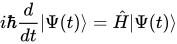
In 1928 British physicist Paul Dirac (1902-1984 [Wow, he was still alive when I was in college!]) noted that Schroedinger’s equation did not account for relativistic effects. If the charged particle was traveling at close to the speed of light, Schroedinger’s Equation wouldn’t work.
Hoping that a properly written equation would explain a few puzzling things about energy levels, and hence spectral lines, Dirac eventually derived:
Which is now known as Dirac’s Equation.
One thing to note is that β and α are actually fourth order tensors (I think), not just simple scalar numbers. And furthermore there are three α’s, α1 α2 and α3, each multiplied by a corresponding pn. (That’s what that large capital sigma is telling you to do.)
I once saw another form of this equation, a very different looking form:
∫∫∫ [∣Ψ1∣2+∣Ψ2∣2+∣Ψ3∣2+∣Ψ4∣2] dx dy dz = 1
(The three symbols at the left should be larger, but apparently you can’t change the font size of only part of a paragraph.) You’re squaring the wave function Ψ along four different directions, then doing “triple integration” to the result…and getting 1.
The four squares have to add up to something, and that something, triple integrated, will be one.
But for every solution to this, there is an equal-but-opposite solution. If ∣Ψ1∣2 equals a certain value, then so does ∣−Ψ1∣2, in exactly the same way that 3 and −3 both square to equal 9. And so the whole mess will have the same total, 1, as it did before.
The implication is that something the exact opposite of an already-known particle, one that behaves as described by this equation, could also exist.
In 1930, Paul Dirac predicted antimatter on the basis of this fact.
According to this concept, for every type of particle, there is an opposite particle. For an electron, there would be an anti-electron. It would the opposite charge (positive instead of negative) but that’s not the only thing that would be opposite; it’s just the most obvious thing. One thing that is the same is the mass.
There would also be an anti-proton, of negative charge, and an anti-neutron…well, of no charge, but still an anti-neutron, somehow on a quantum level the opposite of a neutron despite there being no electric charge to serve as a “marker.”
This doesn’t seem to apply to particles that carry a force; a photon is its own anti-particle, as are other force carrying particles totally unknown in the 1920s.
One could imagine an anti-hydrogen atom consisting of an antiproton being orbited by an antielectron. You’d not be able to tell it was anti-hydrogen from the outside, though; the mass would be the same as hydrogen’s, and the anti-electron would jump to different energy levels by absorbing or emitting regular photons.
But, as it turns out, if an electron meets an anti-electron, both are instantly and completely converted to energy in the form of gamma rays, following E=mc2. A single electron’s mass is equivalent to 511 thousand electron volts (511 keV), so a bit more than one million electron volts is released when both of the electron/anti-electron pair annihilate. If a proton (or neutron) meets an anti-proton (or antineutron), then there is a big burst of energy but at least some of the debris is other sorts of particles (particles not yet known in 1930), which will themselves decay to other things, releasing a lot of energy. The total energy of two protons is about two billion electron volts.
On the face of it this was a pretty outrageous prediction, one which was largely ignored.
But then, like a thunderbolt hurled by Zeus, the evidence came out of the sky.
Cosmic Rays
Back in 1909 Theodor Wulf had developed a device called an electrometer. It consisted of a hermetically sealed container, with a vertical conducting rod piercing the barrier. On the inside of the container, there was a swinging needle, attached to the rod. If the rod picked up an electric charge then so would the needle, and the needle and the rod would repel each other. The needle’s angle was an indication of the strength of the charge; it could even be put against a curved scale and read like the needle in any old analog voltmeter.
Wulf claimed that an electrometer at the top of the Eiffel Tower picked up more of a charge than one at its base. There were issues with his data, so it wasn’t taken quite as seriously as it should have been, nonetheless others were inspired to investigate.
In 1911 Domenico Pacini took electrometers over lakes and seas, and also three meters below the surface. He concluded, based on the lower readings underwater, that the radiation that was causing the charges wasn’t coming from the Earth.
In 1912 Victor Hess carried four improved electrometers to 5300 meters in a balloon, and they picked up four times as much charge as ones left at ground level. Could this be coming from the Sun? Probably not, because he repeated the experiment during a near-total eclipse, and that made no difference even though the moon would have been blocking most radiation from the sun at that time. This was confirmed by other researchers, and Victor Hess won the 1936 Nobel Prize for Physics as a result (yes, twenty four years later).
The rays were coming from space–deep space. Robert Millikan (who earlier had measured the charge of an electron) dubbed them “cosmic rays.”
These turned out to be very energetic protons, for the most part, smashing into something in the upper atmosphere and creating a cascade of secondary and tertiary particles. It’s nature’s particle accelerator.
Physicists continued to investigate cosmic rays, often by taking a “cloud chamber” aloft. This was a device with gas supersaturated, so that any charged particle passing through leaves a contrail. If the chamber is placed within a magnetic field, then any charged particles would be bent. And experiments in the late 1920s and 1930 started revealing curved traces.
On August 2, 1932, Carl Anderson caught an anti-electron in the act, a curve like a beta particle (electron) but in the opposite direction.
The first track of a nositron. It entered the field of view from the bottom, moving quickly, then plowed through a 6 mm lead plate, which slowed it down, increasing the curvature of its path in the magnetic field. That’s how we know the particle was travelling upward. Knowing for certain the direction of motion, Anderson could see that the curvature matched a particle the mass of an electron, but with a positive charge.
The outrageous prediction had proved true, only two years later.
The new particle was named the positron. And it is indeed antimatter.
If you’ve ever had a PET scan, PET stands for Positron Emission Tomography. And that means you got subjected to positron radiation. You survived your encounter with antimatter.
Antimatter/Matter annihilation is the only known means of completely converting mass into energy. A half a kilogram (a bit over a pound) of antimatter, dropped on the floor, would annihilate itself and half a kilogram of matter and produce a 21 megaton blast. (That is about a thousand times as much as hit either Nagasaki or Hiroshima). (One megaton is 4.184 petajoules or 4,184,000,000,000,000 joules.)
It’s Real
Antimatter is essentially a mirror image of matter. As far as we can tell, the universe could just as easily have been made of antimatter instead of matter…but of course the anti-scientists in such an anti-universe wouldn’t call that stuff antimatter, they’d call our matter “antimatter.”
One of the ongoing mysteries of physics is why our universe isn’t half-and-half matter and antimatter. That’s not an 1894 mystery, that’s a 2021 mystery.
Another loose end, is that based on theory, antimatter ought to behave exactly like matter in a gravitational field. In other words, it should fall, and at the same rate. (Which is fine until it impacts, then KABOOM!!!!! doesn’t begin to cover it.) But this really should be confirmed; the problem is it’s hard to make antimatter, then slow it down (since it generally comes out of particle accelerators), then keep it from touching anything [or kaboom!] long enough to see if it will fall when the magnetic containment is released. This would have to be done in a vacuum, of course, lest the antimatter simply collide with an air molecule and annihilate.
I mentioned anti-scientists above; this should not be confused with the likes of Fauci, the Climate Research Unit, etc.
Also, apparently the most that can happen combining antipasta and pasta is indigestion or weight gain (it creates mass!).
And of course, Joe Biden didn’t win.
Obligatory PSAs and Reminders
China is Lower than Whale Shit
Remember Hong Kong!!!
Whoever ends up in the cell next to his, tell him I said “Hi.”
中国是个混蛋 !!! Zhōngguò shì gè hùndàn !!! China is asshoe !!!
China is in the White House
Since Wednesday, January 20 at Noon EST, the bought-and-paid for His Fraudulency Joseph Biden has been in the White House. It’s as good as having China in the Oval Office.
Joe Biden is Asshoe
China is in the White House, because Joe Biden is in the White House, and Joe Biden is identically equal to China. China is Asshoe. Therefore, Joe Biden is Asshoe.
But of course the much more important thing to realize:
Joe Biden Didn’t Win
乔*拜登没赢 !!! Qiáo Bài dēng méi yíng !!! Joe Biden didn’t win !!!
This Stormwatch Monday Open Thread is VERY OPEN – a place for everybody to post whatever they feel they would like to tell the White Hats, and the rest of the MAGA/KAG/KMAG world (with KMAG being a bit of both).
Yes, it’s Monday…again.
But it’s okay! We’ll make our way through it.
Free Speech is practiced here at the Q Tree. But please keep it civil. We’re on the same side here so let’s not engage in friendly fire.
If you find yourself in a slap fight, we ask that you take it outside to The U Tree…which is also a good place to report any technical difficulties, if you’re unable to report them here.
Please also consider the Important Guidelines, outlined here. Let’s not give the odious Internet Censors a reason to shut down this precious haven that Wolf has created for us.
Please pray for our real President, the one who actually won the election:
For your listening enjoyment, I offer this from David Eman, titled ‘Resolute’:
And this from Phil Rey Gibbons, titled ‘Winter Ranger’:
Our beloved country is under Occupation by hostile forces.
We can give in to despair…or we can be defiant and fight back in any way that we can.
I will keep saying Joe Biden didn’t win until we get His Fraudulency out of our White House.
Wheatie’s Word of the Day:
inimical
Inimical is an adjective which means…hostile; adverse; harmful in effect; unfriendly; antagonistic.
Used in a sentence:
The ChiComs and their Demoncrat toadies are inimical to our values of individual freedom and liberty.
SPECIAL SECTION: Message For Our “Friends” In The Middle Kingdom
You knuckle-dragging barbarians are still trying to muck with this site, so I’ll just repeat what I said last time.
Up your shit-kicking barbarian asses. Yes, barbarian! It took a bunch of sailors in Western Asia to invent a real alphabet instead of badly drawn cartoons to write with. So much for your “civilization.”
Yeah, the WORLD noticed you had to borrow the Latin alphabet to make Pinyin. Like with every other idea you had to steal from us “Foreign Devils” since you rammed your heads up your asses five centuries ago, you sure managed to bastardize it badly in the process.
Have you stopped eating bats yet? Are you shit-kickers still sleeping with farm animals?
Or maybe even just had the slightest inkling of treating lives as something you don’t just casually dispose of?
中国是个混蛋 !!! Zhōngguò shì gè hùndàn !!! China is asshoe !!!
And here’s my response to barbarian “asshoes” like you:
OK, with that rant out of my system…
20 Years Since 9/11
I’ve got only three minutes left, so I am going to have to jump to my conclusion.
Over three thousand people died 20 years ago today, they must not be forgotten. There are memorials at three sites; I’ve been to the one in Pennsylvania. Plenty of people were there, including a large group of very patriotic, Q-following bikers.
The deed was done by very evil men, almost certainly Islamic jihadis, but…aided and abetted by whom? Do we really know that yet? Were they acting only with other jihadis’ support, or was someone behind the scenes, pulling the strings? If the latter (and I have no real opinion of this, though I do have one on the physical cause of the buildings’ collapse–let’s leave that aside), then they STILL need to be punished.
After all, justice must be done.
Justice Must Be Done
The prior election must be acknowledged as fraudulent, and steps must be taken to prosecute the fraudsters and restore integrity to the system.
Nothing else matters at this point. Talking about trying again in 2022 or 2024 is hopeless otherwise. Which is not to say one must never talk about this, but rather that one must account for this in ones planning; if fixing the fraud is not part of the plan, you have no plan.
The Audit
The Audit is definitely heating up. Let’s see if the Opposition manages to squelch it and its consequences. I’ll be honest; I expect it to be ignored by anyone capable of ordering Biden/Harris to step down.
Nevertheless, anything that can be done to make Biden look less legitimate is a worthy thing!
Lawyer Appeasement Section
OK now for the fine print.
This is the WQTH Daily Thread. You know the drill. There’s no Poltical correctness, but civility is a requirement. There are Important Guidelines, here, with an addendum on 20191110.
We have a new board – called The U Tree – where people can take each other to the woodshed without fear of censorship or moderation.
And remember Wheatie’s Rules:
1. No food fights 2. No running with scissors. 3. If you bring snacks, bring enough for everyone. 4. Zeroth rule of gun safety: Don’t let the government get your guns. 5. Rule one of gun safety: The gun is always loaded. 5a. If you actually want the gun to be loaded, like because you’re checking out a bump in the night, then it’s empty. 6. Rule two of gun safety: Never point the gun at anything you’re not willing to destroy. 7. Rule three: Keep your finger off the trigger until ready to fire. 8. Rule the fourth: Be sure of your target and what is behind it.
Wow, they’ve ALL taken a thumping! Is this a buying opportunity or are we watching a bubble burst? Well I’m not one of those kinds of prognosticator.
To be honest, I don’t buy this stuff for the short term. I buy it for the long term, and pretty much everything I hold in precious metals (except for the small amount of platinum I have) is higher than I paid for it.
That will probably be true for anyone buying today, twenty years from now. Assuming western civilization is still running twenty years from now.
Part XVIII – Quantum Weirdness Explained by Richard Feynman
A couple of weeks ago I embedded a video of a lecture by Richard Feynman on just how weird quantum mechanics is.
Heres a (slightly different) version of the same video. (This one has a short introductory shot of the campus of Cornell U, and a title graphic.)
the Messenger Lectures, PROBABILITY & UNCERTAINTY–the quantum mechanical view of nature
This weeks physics article is going to be me paralleling what is said in this video. I may sometimes duplicate Dr. Feynmans wording, but mostly I will not. Why am I doing this? Because this is the best explanation I’ve ever seen for just how whacky quantum mechanics is. And I know many don’t have the patience to watch a video…I’m one of those people, 99% of the time.
My summary/regurgitation/mangling of what’s in the video starts in the next paragraph. Things that are purely my own comments rather than me paraphrasing or summarizing Feynman are [in brackets].
When we first began using scientific observation, it largely started with intuition, but that is actually based on our experiences with every day objects. These largely suggest “reasonable” explanations for things. As we continued pursuing scientific knowledge, we observed more phenomena and created generalizations we call laws. But we also are seeing a situation where the laws become more and more unreasonable, more and more intuitively far from obvious.
With twenty-twenty hindsight, there was no reason this shouldn’t be the case. Our everyday lives involve large numbers of particles (even a dust mote has billions of billions of atoms in it), objects moving slowly (compared to how fast they could be moving), or other very special conditions. Our direct view of the world is actually very limited; all we can see is a narrow set of cases. But with refined and careful measurements using instruments that extend our sensory reach we get a more complete picture and we start seeing unexpected things. We see things that are far from what we would guess. We see things that are far from what we could have imagined. Our imagination is stretched, not to create or follow fiction, but just to understand what is actually there.
[Feynman gave the example of special relativity and its conclusion that simultaneity–which we intuitively think is an absolute in that if I see two events as simultaneous, so will you–depends on the observers situation.]
It’s this kind of unexpected thing that is our topic.
Let’s start with light. At first it was seen to behave as a rain of particles, corpuscles, like rain, like bullets from a gun. Then with further research that turned out to be wrong. Instead light behaved like a wave, water waves for instance. This seemed absolutely solid, thanks to various experiments that could only work for waves, and Maxwell’s equations. Then at the beginning of the 20th century after more research, it looked once again like light was made up of particles, for example with the photoelectric effect, and the particles are now called photons. Electrons were first believed to be particles, but further experimentation with electron diffraction shows that they behave like waves. There was a lot of confusion until 1925-26 when the correct quantum mechanical equations were written. [Much of this was covered in prior installments.]
Unfortunately there just isn’t a word for what photons and electrons really are. Particle doesn’t fit, wave doesn’t fit. You cant use either of these because you give the wrong impression. They behave a third way, a way like nothing you’ve ever seen before.
[My flip joke about this is when someone asks if light (or electrons) is a particle or a wave, I reply, yes.]
Well there is one thing that makes the situation simpler than it otherwise could be. Electrons and photons behave the same, that is theyre both screwy, but in exactly the same way. (After all they could have turned out to have been screwy in different ways.)
The newspapers say there was a time when only twelve people understood relativity. [Feynman] doesn’t believe there was ever such a time. There was a time when ONE person understood it, but once he published, a number of people were able to understand it, at least sort of.
But, [Feynman says] no one understands quantum mechanics. [Good then I have plenty of company.]
So we are going to describe the behavior of electrons and photons by a mixture of contrast and analogy. Pure analogy would break down, of course, since theyre not like anything in our normal experience.
Bullets
So were going to compare and contrast particles, for which we will use bullets [no PC woke stuff then!], and waves, for which well use water waves. Were going to describe an experiment run on bullets, then water waves, then electrons or photons. This one experiment will encapsulate everything weird about quantum mechanics. Any other weird thing about quantum mechanics, you can say you remember the experiment with the two holes? Its the same thing.
For bullets, our experimental apparatus is as shown below. This is a view from above. On your left there’s a source (machine gun) firing through a hole in armor plate. The gun is a bit wobbly, so the bullets don’t all follow the same trajectory. To your right from this, is another piece of armor plate, with two holes in it, a bit to the left or right as seen from the source, but from your point a bit above and below the center line, symmetrically situated–number these 1 and 2 since they’ll be talked about a lot. This plate is a ways to your right from the first plate, but just to fit it on the blackboard I’ll draw them close together [and so will I, below]. Also, this is really three dimensions. The plates extend into and out of your monitor, and to repeat you’re looking down on the thing from above, with the plates edge on. Finally at your far right is a line of bullet detectors (a backstop with sand), so we can see where the bullets went.
[Note: I did not have time to draw the diagrams. So unfortunately, I’m going to use a generic diagram I found on line, and modified, quickly! It’s going to have its shortcomings.]
The results of our lumpy bullet experiment. The total distribution is missing, it would look like a double hump with the center not all the way at zero. What IS shown is the two individual slit patterns, for one or the other slit closed, which will be described below.
There are a couple of key differences between this scenario and actual reality. First, these bullets can ricochet off the edges of the holes, so that will tend to spread their impact points out a bit. But if they hit a barrier head on and dont go through the holes, they stop, rather than ricocheting. They’re also indestructible (not liable to break in half on impact).
So we run the experiment and the first thing we notice is something obvious but we need to take note of it. Bullets are lumps, all the same size (one bullet each). The bullets have distinct locations where they hit the sand at the backstop. Also, we never get two bullets impacting at the same time. If the machine gun is firing slowly you hear plink, plink plink rather than plink, plink, plinkety plink. These are all aspects of a characteristic that Feynman labels “comes in lumps.”
So say you let the machine gun fire for an hour, then you go from top to bottom on the diagram, (or left to right as seen from the machine gun) along the backstop and plot how many bullets you find in the sand.
You end up with a double-humped distribution (imagine a Bactrian camel). And you can say that this double hump is proportional to the probability that the next bullet will hit at that location. At the tops of the humps it is most likely. Let’s call that distribution N12 because it results from both holes being open. You can run this experiment for even longer and come up with good average figures, even if its 2 1/2 bullets hitting a particular spot per hour. (Just like you hear about the average family having 2.4 kids. But no family has .4 kids in it; children come in lumps. Some families have more, some have less.) [Feynman actually brought that up, not me.] You can also run the experiment again but this time covering one or the other hole, in which case you get two different single-hump distributions, N1 and N2. And then you’ll notice a key fact; if you add N1 and N2, you get N12. It works this way because there is, as Feynman says, no interference between the two holes.
Water Waves
Okay, we’re done with bullets. Now place this exact layout in a pool or lake. Instead of armor plate, we’re talking breakwaters or jetties or lines of barges. And instead of a machine gun, theres some big massive object being moved up and down in a regular fashion to make waves, which then pass through the slit in the left hand barrier, then through the two slits in the middle barrier, to reach measuring devices at the third barrier (instead of a sand trap, though if the barrier is the beach, there might still be sand involved). The measuring devices measure the amplitude (height) of the wave that arrives at that point, which is proportional to the energy carried by the waves.
When you do this, whatever arrives at the detectors can have any size at all. It doesn’t come in lumps. [The waves can be a meter high, a centimeter, a micron…] What’s measured is the intensity, not a count of lumps.
The result is a curve like this. [Note, Feynman actually drew the wrong curve in the lecture at about 21 minutes. He later noticed that he had drawn the wrong curve (at about 21:30). “Which is the exact opposite of this curve..” and he did a quick fix.]
Waves. Notice the interference pattern.
The reason for this rather complicated curve is that when the source wave hits the two openings in the middle barrier, it reaches them at the same time, and those two openings themselves act like sources, and waves ripple outwards from them. The two sets of waves will add together. Along the center line the peak of the wave from opening 1 arrives at the same time as the peak from opening 2, so the waves add together to make something twice as tall, or twice the energy. A bit off the center line, the trough from wave 1 will hit the spot at the same time as the peak from wave 2, or vice versa, resulting in canceling out. A measurement here will see no wave height at all and an energy of zero. Even further off the center line, a peak from one opening will arrive at the same time as the following peak from the other opening, and they will add to each other rather than canceling out. (However one of those waves will have traveled farther and will be weaker, so this peak will not be as high as the one on the center line.)
The waves interfere with each other. This is used in science in a funny way because sometimes the interference from a wave strengthens the other wave (“constructive interference”) and sometimes it cancels (“destructive interference”); in ordinary language interference always works against someone, never with them.
The interference creates the complex pattern shown, I12 (I for intensity). If you close one hole or the other, you get a smooth curve, just like you did with the bullets. In fact the patterns are basically identical, N1 looks like I1, and N2 looks like I2. But these two patterns, I1 and I2 do not add up to make I12.
This distribution is known as an interference pattern.
So we see several key differences between particles and waves: lumpiness/non-lumpiness, discrete/continuous values, non-simultaneous/simultaneous arrival times, and the lack/presence of interference.
Electrons
OK now for electrons (metal plates). Or photons (for which the barriers are made out of black paper). But I’m only going to discuss electrons. [But remember, they’re both screwy in the same way.]
What we receive at the detector are lumps. Click, click, click, all the same size, like small bullets. If the source of electrons is made weaker, you hear the clicks further apart, but each individual click remains the same size, just like slowing down the machine gun for the bullets. And no two electrons arrive at the same time, because they aren’t emitted at the same time, again like the machine gun firing one bullet at a time. The key here is that the electrons come to one place, one at a time.
So we can now play the same game we did with the bullets, let the emitter rip for a while and then look at the distribution and equate it to a probability curve, with high areas corresponding to a greater probability of receiving the next electron fired.
We should expect to see the double humped N12 curve, right? That’s how our lumpy bullets behave.
But (@27:20)…we get a probability curve looking like the multiple humped I12 intensity curve, the interference pattern.
THAT is weird. These things are lumpy, and behave just like lumps…except for how they are distributed, where the distribution shows wave interference. But what would a wave have to do with particles? Or vice versa?
[Yes, it makes no sense. But it does work this way, we’ve never seen it not work this way. And this is why light was confusing around the turn of the 20th century. When experimenting with its distribution it appeared like a wave. But when we did things with the photoelectric effect that would actually depend on the lumps, we got lumpy behavior.]
[Ok, it’s mad. Stark raving mad, But this is the way things work.]
Some Additional Subtleties
There are some subtleties.
One might state as “obvious” that an electron–which is a “lump”–has to have gone through hole #1 or hole #2. Call that “Proposition A”
That of course would imply that the total number of electrons that reach the detector is the sum of those which go through hole #1, and those which go through hole #2. But you can’t sum the two one-hole distributions to get the interference pattern, so Proposition A would appear to be false; the electrons must be splitting up, somehow.
This is science, we test it even though it seems like ironclad logic.
So we set up lights over each hole to watch the electrons.
Lo and behold, you will see a flash in one hole, or the other hole, and these match the times of hits on the detector, so Proposition A appears to be true after all!
And it is true. But you can’t add the distributions together to get the interference pattern!
Well, I haven’t told you the whole story. Because when you set people to watching the holes and reporting, for each hit on the detector, which hole the electron went through…the distribution on the detector switches from being the interference pattern to the double hump pattern! So now that you know what I1 and I2 are…I12 is equal to their sum!
So, obviously, the light is doing something to the electrons. This is not surprising, after all, light has enough energy to shove electrons around (hence emission and absorption lines in spectra), so we decide to turn the intensity of the light down enough to have less of an effect.
But light, too, is “lumpy.” Turning down the light reduces the number of lumps or photons. If you reduce the light enough, electrons might get through the hole without running into a photon at all, in which case the guy monitoring the holes will say he didn’t see the electron at all.
Guess what? If you plot the electrons that didn’t get seen, and ignore the rest, you get the multiple hump distribution. If you look only at the ones that were seen, you get the double hump distribution. If you look at them all, you get some sort of weighted sum of the two, depending on what fraction of electrons were or were not seen.
Other methods can be arranged to determine which hole an electron goes through, and they all lead to the same result. If you make the sensor too gentle to muck with the electron…you end up not seeing the electron. There is no way to detect an electron without disturbing it and wrecking the interference pattern.
[Feynman summarizes the way scientists describe the situation:] If you set up an apparatus to monitor the holes, then you can say that it goes through one hole or the other (and Proposition A is true). If you don’t have such an apparatus, then you cannot say that it goes through one hole or the other, because when you’re not looking, electrons don’t behave as if they do go through one hole or the other.
No one can give you a deeper explanation of this than [Feynman] has given you. They might come up with more examples, but this is the basic conundrum of quantum mechanics.
Another subtlety. We use probability in daily life for things like, say, the throw of a dice. We shouldn’t have to do this. We should be able to calculate how the die will land, given its orientation, speed, the nature of the surface it will land on, and so forth. Straight mechanics, even if very, very complicated. But since we don’t know the initial conditions well enough, the die toss appears to be a random event, we can’t predict what it’s going to do. But again that’s because we don’t know the initial conditions and haven’t the skill to do the computation fast enough.
With these electrons, one might think if they behave as though they have a probability of doing something, we could somehow write laws that would tell us where the electron will be. But this turns out not to be the case. True randomness–the randomness we don’t actually see in our macroscopic world–is built into it. We can’t know the state of the electron and be able to compute what it will do; if we could, we’d lose the interference pattern. “Nature herself doesn’t know which way the electron is going to go.”
Feynman’s Concluding Rant
[nearly verbatim]
[Feynman puts on a pompous voice and quotes a philosopher as saying “It is necessary for the very existence of science that the same conditions always produce the same result.”] Well, they don’t. And yet the science goes on. [So much for that philosopher.]
What is necessary for the very existence of science and so forth and what the characteristics of nature are not to be determined by pompous preconditions, they are determined always by the material with which we work, by Nature herself. We look and we see what we find and we cannot say ahead of time what it’s going to look like. The most “reasonable” possibilities turn out often not to be the situation.
What [actually] is necessary for the very existence of science is just the ability to experiment, the honesty in reporting results (the results must be reported without somebody [instead] saying what they’d like the results to have been), and finally an important thing is the intelligence to interpret the results. [Take THAT, Climate Research Unit!]
But an important thing about this intelligence is that it should not be sure ahead of time about what must be. Now it can be prejudiced and say “that’s very unlikely, I don’t like that.” Prejudice is different than absolute certainty, I don’t mean absolute prejudice, just bias, not complete prejudice. Even if you’re strongly biased, the experiments will pile up until you cannot ignore them any longer.
In fact the only thing needed is that minds exist that do not demand that nature must satisfy some preconceived conditions, like those of our philosopher.
[Oh, and we need to fix elections, too. And we need bacon.]
Obligatory PSAs and Reminders
China is Lower than Whale Shit
Remember Hong Kong!!!
Whoever ends up in the cell next to his, tell him I said “Hi.”
中国是个混蛋 !!! Zhōngguò shì gè hùndàn !!! China is asshoe !!!
China is in the White House
Since Wednesday, January 20 at Noon EST, the bought-and-paid for His Fraudulency Joseph Biden has been in the White House. It’s as good as having China in the Oval Office.
Joe Biden is Asshoe
China is in the White House, because Joe Biden is in the White House, and Joe Biden is identically equal to China. China is Asshoe. Therefore, Joe Biden is Asshoe.
But of course the much more important thing to realize:
Joe Biden Didn’t Win
乔*拜登没赢 !!! Qiáo Bài dēng méi yíng !!! Joe Biden didn’t win !!!
This Stormwatch Monday Open Thread is VERY OPEN – a place for everybody to post whatever they feel they would like to tell the White Hats, and the rest of the MAGA/KAG/KMAG world (with KMAG being a bit of both).
Yes, it’s Monday…again.
But it’s okay! It’s a Holiday, so you can go back to bed.
Free Speech is practiced here at the Q Tree. But please keep it civil. We’re on the same side here so let’s not engage in friendly fire.
If you find yourself in a slap fight, we ask that you take it outside to The U Tree…which is also a good place to report any technical difficulties, if you’re unable to report them here.
Please also consider the Important Guidelines, outlined here. Let’s not give the odious Internet Censors a reason to shut down this precious haven that Wolf has created for us.
Please pray for our real President, the one who actually won the election:
For your listening enjoyment, I offer this from Phil Rey Gibbons, titled ‘The Road to Freedom’:
And this from Gibbons, titled ‘Flight of Pegasus’:
_______________________________________________
Our beloved country is under Occupation by hostile forces.
We can give in to despair…or we can be defiant and fight back in any way that we can.
I will keep saying Joe Biden didn’t win until we get His Fraudulency out of our White House.
_____________________________________
Wheatie’s Word of the Day:
fudgel
Fudgel is a verb which means…pretending to work when you’re not actually accomplishing anything at all.
Used in a sentence:
He spent Friday afternoon fudgeling at the computer on his desk, counting down the hours until the weekend.
SPECIAL SECTION: Message For Our “Friends” In The Middle Kingdom
I normally save this for near the end, but…basically…up your shit-kicking barbarian asses. Yes, barbarian! It took a bunch of sailors in Western Asia to invent a real alphabet instead of badly drawn cartoons to write with. So much for your “civilization.”
Yeah, the WORLD noticed you had to borrow the Latin alphabet to make Pinyin. Like with every other idea you had to steal from us “Foreign Devils” since you rammed your heads up your asses five centuries ago, you sure managed to bastardize it badly in the process.
Have you stopped eating bats yet? Are you shit-kickers still sleeping with farm animals?
Or maybe even just had the slightest inkling of treating lives as something you don’t just casually dispose of?
中国是个混蛋 !!! Zhōngguò shì gè hùndàn !!! China is asshoe !!!
And here’s my response to barbarian “asshoes” like you:
OK, with that rant out of my system…
False Flag?
I think in some cases people on our side misuse False Flag. Unless, of course “FF” stands for something else.
This became apparent to me when I had a very valuable conversation with DePat and FG&C about the notion that the Arizona Audit people were waiting for a “FF” before dropping their results. Once FG&C explained what he meant by FF, it made a LOT more sense than it did with my reading of the term.
I first heard the term False Flag many, many years ago in an intelligence context. It’s a method of recruiting spies. The signature example is the KGB “handler” who finds someone in his host country who has access to classified information and is sympathetic to Israel, then arranges to meet the Israel sympathizer “by chance.” Once he does so he lets slip that he is an agent…but not for the USSR, rather for the Mossad. He’ll even explain that he knows government employees aren’t supposed to leak sensitive stuff but if the sympathizer could just alert him to harmless stuff, it’d help Israel out.
Before the Israel sympathizer knows it, he’s “helping Israel” a lot more than that, but in fact he’s really passing stuff on to the Soviet Union.
The thing that makes it “false flag” is that the Soviet agent, whose flag SHOULD be red with a yellow hammer and sickle in the upper left, is (figuratively) displaying a false flag–that of Israel.
In the more modern United States Cold Civil War context, a false flag is when some leftist does something while pretending to be on the Right, in the hopes that it will damage the Right politically. This is everything from posting a bunch of stereotypical “right wing hate” on the internet then going off and shooting up a black church (to prove “right wingers are racists”) to…well, January 6 with Antifa pretending to be “right wing militia” types–which was very damaging to us.
Just like the Soviet agent was pretending to be an Israeli agent, the leftist douchebag(s) is (are) pretending to be on the Right politically.
I can’t be certain but I suspect some conflate this with something different: A big spectacular event staged to distract from something they don’t want you to notice. False flags can certainly do this (have some “right wing nut” shoot up a school and that will indeed saturate the media for a few days) but not all such things are “false flags” because many of these events don’t try to discredit the Right.
Now the Opposition does pull that trick too, and quite often, but when they do so, it’s not a “false flag,” it’s something else with a name that may just be best described as “distraction” or “misdirection” (the magician’s term for such a tactic). Basically the staged event sucks all of the oxygen out of the media room and nothing else gets looked at for some short period of time (a day to a week). It doesn’t matter if it ends up making the Right look bad (though if it does, bonus!!!), if it keeps people from noticing something else that happened, the operation was a success.
In this particular instance, the suggestion was that the Audit Results We Have All Been Waiting For are being timed to drop when disgust with Biden reaches a (new) all time high. This is certainly plausible though I would have a multitude of detail questions about it before I’d go beyond that. But what this scenario does NOT describe is a “false flag.”
OK, that off my chest…lets hope that Arizona Audit drops soon. If that implies something else must happen first, then let THAT happen, already! Too much death and destruction is being meted out by the Biden Facade Administration and the people behind it.
Justice Must Be Done.
The prior election must be acknowledged as fraudulent, and steps must be taken to prosecute the fraudsters and restore integrity to the system.
Nothing else matters at this point. Talking about trying again in 2022 or 2024 is hopeless otherwise. Which is not to say one must never talk about this, but rather that one must account for this in ones planning; if fixing the fraud is not part of the plan, you have no plan.
Kamala Harris has a new nickname since she finally went west from DC to El Paso Texas: Westward Hoe.
Lawyer Appeasement Section
OK now for the fine print.
This is the WQTH Daily Thread. You know the drill. There’s no Poltical correctness, but civility is a requirement. There are Important Guidelines, here, with an addendum on 20191110.
We have a new board – called The U Tree – where people can take each other to the woodshed without fear of censorship or moderation.
And remember Wheatie’s Rules:
1. No food fights 2. No running with scissors. 3. If you bring snacks, bring enough for everyone. 4. Zeroth rule of gun safety: Don’t let the government get your guns. 5. Rule one of gun safety: The gun is always loaded. 5a. If you actually want the gun to be loaded, like because you’re checking out a bump in the night, then it’s empty. 6. Rule two of gun safety: Never point the gun at anything you’re not willing to destroy. 7. Rule three: Keep your finger off the trigger until ready to fire. 8. Rule the fourth: Be sure of your target and what is behind it.
(Hmm a few extras seem to have crept in.)
Spot Prices
All prices are Kitco Ask, 3PM MT Friday (at that time the markets close for the weekend).
Gold broke out and up into the 1830s this week but much of that gain was lost by close on Friday. Silver is up a bit too, the PGMs however are down (or steady).
I attended a talk about the silver market last week; the speaker actually alluded to the folks who pushed the price of the gaming company in order to try to bankrupt a bunch of institutional traders, and then went on to try the same with silver. He described their effort as a failure (and from what I’ve seen so far, their effect on silver prices was, in fact, minimal). However one effect that they did have was they got me to post articles on the nine precious metals AND give these updates every week.
Part XVII: Nuclear Physics Finds A Hammer
Introduction
Today, there is a subdiscipline of physics called “nuclear physics.” It deals with the nucleus of the atom, but does not typically dive any deeper than that (and there is most assuredly a “deeper than that” today known as “particle physics,” though there was no hint of its existence in the 1920s).
The sorts of investigations Rutherford and Co. performed in the first two decades of the 20th century were the very beginning of nuclear physics, though it’s often not considered to have been founded until 1932.
Why 1932? That’s the subject of today’s story.
There’s a modern trope among nuclear physicists. Someone asks “how do you find out what’s inside an atom” and the response is: “Just like a toddler trying to figure out what’s inside an alarm clock. He gets a hammer, smacks it, and sees what flies out of it.”
When we left off the physicist’s best subatomic hammer was the alpha particle, known to be a bare helium nucleus, mass number A = 4, electric charge +2. This would come flying out of certain atoms (like those of uranium and thorium) when they underwent what is called “alpha decay.” This process would reduce the atomic number (i.e., the element number, Z) of the parent nucleus by 2, and reduce its mass number, A, by 4. So uranium-238 (the isotope of uranium, Z=92, A=238) would become thorium-234; the mass number has decreased by four, and thorium is element #90, so the atomic number has dropped by 2.
Physicists used these alpha particles with some limited success as hammers to hurl at nuclei. In fact, that was how the nucleus had actually been discovered; Rutherford used alpha particles as a hammer on gold atoms and found there was a lot of empty space in an atom, but a very small hard kernel in the middle that would cause the alpha particles to ricochet. Physicists had even figured out how to give alpha particles more energy, by using electrically charged plates and so forth to get them to speed up.
But here’s the problem. The nucleus has a positive electrical charge, a substantial one. And an alpha particle, also a nucleus, has its positive electrical charge, too. And like charges repel each other.
Imagine if your hammer, and the nail you were trying to hit with it, strongly repelled each other. That’s a recipe for deciding a hammer is for hitting your thumb with, isn’t it? (Or perhaps your wrist, or even your face if the hammer bounces back at a sharp angle.)
Alpha particles were, to put it mildly, suboptimal as nuclear hammers.
There was also another glaring mystery in the early 1920s. What actually held a nucleus together?
As far as they knew back then, the nucleus of (say) oxygen-16 (Z=8, A=16) held a mixture of protons and electrons, 16 relatively heavy protons to give it the 16 mass number, and eight very light electrons (1/1836th the mass of a proton) to cancel out the charge of eight of the protons, leaving a net charge of 8, which was recently understood to be the very definition of an oxygen nucleus–a charge of eight.
It certainly looked as if there were electrons in a nucleus; consider beta decay. This is when the nucleus spits out an electron and goes up one in charge. For instance, the thorium-234 I referenced will spit out an electron (in this context, it’s known as a “beta particle”), uncovering another proton, raising the atomic number, therefore. from thorium’s Z=90 to Z=91, which means it’s now a protactinium-234 nucleus. So it certainly seemed as if nuclei had electrons in them; otherwise how on earth do electrons end up coming out of the nucleus during beta decay?
So let’s consider a helium-4 nucleus; under this model it contains four protons and two electrons. Those four protons can actually all touch each other (you can convince yourself of this with marbles, ping pong balls, or billiard balls). What keeps them from flying apart? The protons are all positively charged; and there are only two electrons to cancel that repulsion out.
Well, let’s list what we know about protons:
mass = 1.672×10⁻²⁷ kg electric charge, e = 1.602×10⁻¹⁹ C radius = 0.8414 fm
[e is the symbol used for the electrical charge of a proton in particular; an electron has charge –e.]
[“fm” is “femtometer,” a femtometer is 10-15 meters, or a quadrillionth of a meter. Most people have heard the “nano” prefix, meaning one billionth; fewer have heard of pico (one trillionth), femto (one quadrillionth) or atto (one quintillionth).]
We can get an appreciation of the size of the problem by simply computing the electrical repulsive force between two protons that are touching each other. Their center-to-center distance is double the radius, or 1.6828×10⁻¹⁵ m, so we can plug everything into Coulomb’s Law to see how big the force is:
The vertical bars stand for “magnitude” (in other words, drop the vector stuff and just deal with the scalar values, because we want a size, not a direction.)
both Q values are the charge of the proton, e, and K = 8.988×10⁹ Nm2/C2. You can do the math.
The answer I got is 81.456 newtons.
NOT 81.456 billionths of a newton, or trillionths of a newton, but 81.456 newtons. That’s the weight of 8.3 kilograms (81.456 N/(g=9.8 m/s2)) under Earth gravity.
This much force, between two itty, bitty, teensy, tiny particles!!! It’s an actual macroscopic amount of force. It’d be as if a proton could hit you so hard it’d be like taking a 60 mph pitch on the chin.
(Actually, now that you mention it: https://en.wikipedia.org/wiki/Oh-My-God_particle.)
The force is enormous compared to the size of the particles.
Since all four of the protons in the alpha particle touch each other, each proton is being repelled by three times this much force (244+ newtons). The two electrons that are attached to two of the protons attract with 167 newtons, but that still leaves 81 1/2 newtons of repulsion unbalanced, and that’s simply yuge.
Well, that’s the electromagnetic force. There’s one other force that could come into play: Gravity.
Now a physicist would know, instantly, that gravity doesn’t matter more than a mouse fart in a hurricane here, but many of you don’t, so let’s just check that.
The radius is the same, but the numbers of the masses are much lower than the numbers of the charges, roughly 1/100,000,000 as much. And G is only 6.67×10⁻¹¹, much much less than K was, very roughly 1/100,000,000,000,000,000,000 as much.
I get 6.59 x 10⁻³⁵ newtons.
“Drop in the bucket” doesn’t begin to describe that number in comparison to 81.456 newtons. Basically a quintillionth of a quintillionth the amount.
Nuclear physicists generally ignore gravity as a force between the objects they study. There’s no way its effect could even be measured as a fraction of the electromagnetic effect.
So, by everything known in the 1920s, nuclei should simply fly apart, in a nanojiffy. Or perhaps an attojiffy. The two fundamental forces act in opposite directions, but gravity shows up like Biden’s rally crowds showed up last year (and gravity can’t cheat to make up for that).
So by rights any nucleus bigger than hydrogen’s one-proton nucleus should simply fly apart. It should never have formed to begin with.
Since we’re still here, and not simply big Swalwellian clouds of hydrogen gas, clearly something else, something new, is at work.
And that is today’s story.
Can Nuclear Electrons Actually Exist?
Leaving aside the fact that the nuclear electrons can’t, all by themselves, keep a nucleus together, there was plenty of reason to question whether nuclear electrons even existed at all. There are, essentially, three reasons that I could explain to you. Number Three had to do with Dirac’s Equation which came along in 1928 and I want to save for another column. So going back to the other two reasons…
Issue #1: Binding Energy
In the introduction I described the prevailing model of the atomic nucleus as of the 1920s. Ernest Rutherford made the suggestion around 1919, but he decided shortly afterwards that it didn’t make sense; and this is one reason why.
One of the still-standing 1895 puzzles has to do with atomic weights. The atomic weight of, say, carbon is not quite twelve times that of hydrogen. Even after accounting for the presence of atoms with different mass numbers (uncommon isotopes of the same element), it still doesn’t quite work out; even accounting for all those nuclear electrons…it doesn’t work out.
In fact, heavier atoms (i.e., heavier than hydrogen) are always lighter than they would be if they were simple multiples of the proton’s mass, much less including some nuclear electrons as well. Even hydrogen-2 (deuterium) is less than twice the mass of hydrogen-1 (protium).
This, it turns out is due to something called binding energy. It’s the energy required to pull the protons apart.
This is directly analogous to the binding energy between, say, you and the earth. How much energy would it take to separate you from earth? At least as much as it would take to accelerate you to escape velocity. This is gravitational binding energy, because it’s the force of gravity that creates the potential difference between you standing on the surface of the earth, and you out in interstellar space.
It takes, very roughly, 7 million electron volts (MeV) to pull a proton out of a nucleus. Alternatively, if a proton is shoved into a nucleus, 7 MeV is released (just like, as you fall from a great height, you release a lot of kinetic energy).
That energy actually shows up on the books as missing mass. E = mc2, after all. So the particles in a large nucleus are all just a bit lighter in weight than they would be if they were separated; to separate them you have to add enough energy to make up the mass deficit.
If you were able to convert an entire proton to energy, it’d yield 938 MeV. The binding energy is therefore about seven tenths of one percent of the total mass/energy of the nucleus. We can actually measure that shortage…and, it turns out, had been measuring it for decades. This is the reason for the discrepant atomic masses.
Another sort of binding energy is the electromagnetic binding energy, keeping electrons in atoms. This ranges from a fraction of a single electron volt, to a bit over a dozen electron volts, for hydrogen. Is some fraction of the mass of an atom disappearing during chemical reactions, when chemical energy is released? The theory says yes. But it’s a small enough change (roughly one millionth the size of the nuclear binding energy) we haven’t actually measured it…yet.
I tried to discover exactly when this was first explained. It was sometime before the 1920s. Wikipedia says Einstein did it in 1905, but it simply points to the fact that he derived E=mc2 that year; I can’t quite nail down that he said, in that paper, that this is why nuclei heavier than protium are all lighter than they “should” be. If he did say that then, then I should have crossed off yet another mystery the week I talked about the incredible year Einstein had in 1905. If someone else (or Einstein himself) put two and two together after the fact…well, it certainly happened by the 1920s.
The reason I bring this up right now, is that it ties to the first issue with nuclear electrons. Ny Heisenberg’s uncertainty principle, an electron bouncing around in something as tiny as a nucleus must have a kinetic energy of at least 40 MeV (its position is very well defined, its momentum therefore isn’t going to be anywhere close to zero). Not only is this a lot more than the energy of beta radiation (presumed to be one of these electrons escaping the nucleus), it’s more than the binding energy of the protons; one bound electron bouncing around in there contains enough energy to kick five or six protons out of a nucleus! And what would keep it from flying out as super-energetic beta radiation?
Issue #2: Spin
Probing into quantum mechanics eventually established that protons and electrons have a spin of 1/2. Or, alternatively, -1/2.
But the term “spin” is misleading. The particles don’t actually spin like a top. They do something else that’s pretty whacky and has no sensible referent in day to day life. Nuclear and particle physicists will hijack an everyday term to describe these phenomena, however, so they speak of “spin.” They picked this word because it is measured in the same units as angular momentum. The actual value is 1/2 of ℏ, so the physicists simply label it “1/2.” It can point in two opposite directions, so the “other” direction is labeled -1/2.
If you have some even number of electrons or protons, they could be any combination of 1/2 and -1/2 spins, but since there is an even number of them, you can pair particles with 1/2 spin with particles of -1/2 spin, cancelling each other out, and some even number of particles will be an excess of 1/2 spin (or -1/2) spin particles. The excess will always be an integer, if there is no excess the total spin is zero–which is also an integer. (In practice, the + and – 1/2 spins will cancel each other as much as possible, in this case leaving a total spin of zero.)
An odd number, n of electrons or protons will always have 1/2 or -1/2 spin left over, on top of the integer spin that the even number n-1 of the particles will give.
So let us consider the nitrogen-14 nucleus (Z=7, A=14). It should have 14 protons and 7 electrons in it, which total to 21. Thus if the spin is measured, the net spin should have a 1/2 (or -1/2) fraction in it.
They did measure the spin of nitrogen-14 nuclei, and it always came out to integer spins. So there have to be an even number of protons plus electrons in that nucleus.
Therein lies an apparent contradiction, and there are no actual contradictions in reality; there must be some unknown fact or bad assumption that when identified, will resolve the apparent contradiction.
The Nuclear Force
I’ve described two issues with the concept of nuclear electrons. But I kind of skated past something in my discussion of binding energy. As I said, you are bound to the earth by gravity. Electrons are bound to atoms by the electromagnetic force. Protons are bound to a nucleus by…anyone? Anyone?
Clearly there’s some other force out there. A force strong enough to overpower the eighty newtons of force between adjacent protons. But weak enough that we’d otherwise never have noticed it–because we hadn’t noticed it. It should have been about as conspicuous as AOC in front of a TV camera, yet we never noticed it.
It seems odd to postulate a force that’s very strong at close quarters, yet unnoticeable at a distance. If were anything like electromagnetism or gravity, it should drop off as the square of the distance…twice as far away, you feel 1/4th the force, three times as far away, you feel 1/9th of the force. So if this hypothetical force is an attractive force stronger than the electromagnetic repulsion at some distance, it ought to still be stronger than the electromagnetic force twice as far away–both forces are a quarter as strong at that location as they were before, so the one that was larger before, should still be larger here.
But we all know of something that doesn’t behave that way, and that is magnets. Sure, one pole of a magnet has a force that drops off as the square of the distance, but there’s always a nearby opposite pole. If you’re right up against a north pole, the south pole of that magnet is, say ten times further away, and only cancels out 1/100th of the force. But double your distance from the north pole, and now the south pole is about five times further away and cancels out 1/25th of the force, as you move further and further away the two poles are (propotionally) closer to being the same distance away from you and cancel each other out quickly.
So magnetic forces appear to drop off as the cube of the distance from the magnet.
In order to match what we see, this hypothetical force should be almost nothing at 2.5 femtometers’ distance, strongly attractive at about 1 femtometer, and actually be repulsive at distances less than 0.7 femtometers. In other words, two protons would have to be almost touching for this force to become a factor.
The repulsion at very close distances actually puts a lower bound on the size of nuclei, since the protons can’t get closer than that without being pushed apart. That’s the effective size of a proton. And indeed these distances are roughly the size of a proton.
This force turns out to be very, very complex computationally, but it was consistent with everything they saw at the time, so, just like gravitational and electromagnetic forces, it was accepted as being true even if a lot of details needed to be ironed out. (And even though we know a lot more about it today (1920s physicists had no idea), there are still issues.)
Enter: the Neutron
I mentioned that even though Rutherford had originally suggested the nuclear electron, he grew dissatisfied with it for many of the reasons already mentioned, and a year later, in 1920, had come up with another idea. Perhaps, instead of proton/electron pairs, the extra, dead-weight mass of a nucleus that doesn’t contribute to its electrical charge was due to a neutral single particle about the mass of a proton. He even gave it a name, the neutron. This rather neatly solved the spin issue: If a nitrogen-14 nucleus contained 7 protons and 7 neutrons, the spins would add to zero. Repulsive forces would still be about the same, though: too much without positing a “nuclear force.”
But most physicists didn’t accept this conjecture. Though it solved a lot of the issues that the nuclear electron hypothesis introduced, physicists weren’t going to accept that this “neutron” thingie existed until someone actually detected one. Throughout the entire decade of the 1920s, most physicists continued to accept the nuclear electron hypothesis as being likeliest to be true, despite all the problems it seemed to raise.
If it seemed like this attitude was inconsistent with their fairly ready acceptance of the nuclear force, well…no. A force is intangible, but you can see its effects. You write some equations to build a model of how the force works, and if all of the effects match, you’ve probably got a good description of a real force, at least until you learn more. But if you posit a particle, you’ve posited something tangible that you should be able to detect in a much more direct way. And so far, the neutron had not been.
So we need to detect a neutron. But how? Protons and electrons are easy to detect, and relatively easy to manipulate, because they had electrical charges. One could see the effect of the electrostatic force, both caused by the particles, and also the effect of the force on the particles…in particular being able to deflect them to measure their mass, but also to accelerate them, like happened to electrons in a Crookes tube.
A totally neutral particle would be invisible based on these methods of detection…and impervious to being manipulated by electromagnetism.
But the first crack in this problem appeared in 1930. Walter Bothe and Herbert Becker, in Giessen, Germany, were using alpha particles from polonium (Z=94) in an experiment. They picked polonium because it spits out particularly energetic alpha particles (in other words, the alpha particles are moving faster than usual), and they wanted those energetic particles to use as a hammer on light elements, like beryllium (Z=4), boron (Z=5), and lithium (Z=3). When the alpha particles hit these light nuclei, an unusually penetrating radiation was produced. It couldn’t be deflected, so they tentatively concluded that these were very strong gamma rays. But it was hard to interpret the results definitively.Two years later, in Paris, Irene Joliot-Curie (the daughter of Marie and Pierre Curie) and her husband Frederic Joliot sicced this radiation on paraffin, a compound of carbon and hydrogen. It resulted in protons being ejected from the sample; the protons had kinetic energy of 5 MeV. This radiation, if it were gamma rays, would have to be 50MeV gamma rays, much stronger than anything seen to date.
Ettore Majorana, a young physicist in Rome, analyzed all this data and announced his conclusion: This radiation had to consist of neutral particles.
When Rutherford, and his Cavendish laboratories colleague James Chadwick had heard about the Paris experiments and they, too didn’t believe this radiation was any kind of gamma ray. Chadwick devised a bunch of experiments to prove it wasn’t gamma radiation, then went on to subject more materials to the mystery rays, and eventually demonstrated that whatever it was, it consisted of neutral particles about the mass of a proton.
In other words, Chadwick had found Rutherford’s neutron.
Now that the neutron had been found…whoosh!!! the nuclear electron hypothesis was discarded; the notion that a nucleus contained protons and (except for hydrogen-1) neutrons now made a lot of sense and we could be sure that neutrons actually existed rather than being a convenient shorthand.
Back to Binding Energy and the Nuclear Force
With the correct understanding of a nucleus consisting of protons and neutrons, things become a bit clearer. In many ways these particles are a lot alike, and collectively, they’re called nucleons. They are of almost identical mass, and both are subject to the nuclear force.
The mass number (A) of an isotope is now understood to be how many nucleons it contains. Atomic number (Z) is now strictly equal to the number of protons in the nucleus, since we no longer have additional protons masked by nuclear electrons. We now have a new number N, the number of neutrons, and N + Z = A.
Nucleons are bound together by the nuclear force, which is very short range, its maximum strength basically covers the distance from one nucleon to the next.
So picture a nucleus with (say) about sixty nucleons in it. A nucleon near the center of the nucleus is completely surrouned by other nucleons and they each exert a strong attractive force on it; the forces balance, that nucleon is pretty happy where it is. But note, this nucleon does not feel any attraction from a nucleon that is two nucleons away, rather than adjacent.
Nucleons near the surface of the nucleus only experience about half as much nuclear force, because they’re not surrounded by nucleons, they just see a few to one side of them…and again, no effect from the nucleons further away.
A very small nucleus, say carbon-12, has a large percentage of its nucleons at the surface of the nucleus, maybe a handful in the center are surrounded by other nucleons. This means that the average nuclear force on a nucleon is less than it is in larger nuclei, where most of the nucleons are surrounded by other nucleons.
Now, going to a very large nucleus, like that of uranium-238, the vast majority of nucleons are surrounded and thus tightly bound. But those near the surface, just like those on the surface of carbon-12, feel half of the nuclear force attraction. But the protons there actually feel more electrical repulsion, because that force is long range and there are a lot of other protons in that nucleus, all pushing them away. So that particular nucleus is teetering on the edge of falling apart. Indeed, given a few billion years, it will fall apart.
This is sort of a hand-wavy argument that the most stable nuclei are the medium size ones; ones where a large number of nucleons are completely surrounded (maximizing the attractive force they feel) but also where ones near the surface don’t get repelled by so many distant nucleons. Either side of that happy middle ground, the average nucleon either just feels less attractive force (smaller nuclei, fewer near neighbors on average to attract), or feels more repulsive electromagnetic force (larger nuclei, lots of protons repelling the nucleon).
The total nuclear binding energy of a nucleus can be plotted versus the number of nucleons; when you do this you get a diagonal line, down to the lower left, up to the upper right. It’s almost a straight line, but if you look closely, there’s a slight bend to it. (I’d show you but I can’t find that plot on line…and it’s not nearly as illuminating as the one I’m about to describe.)
If you then go through and plot the average binding energy per nucleon, you now get a very striking curve, like this:
Nuclear binding energy per nucleon, versus number of nucleons. The line jumps up from zero to 7 going from hydrogen-1 to helium-4 (7 MeV each); it then drops going through lithium, beryllium and boron, then climbs through carbon and oxygen, eventually reaching almost 9 MeV at iron-56. From there it’s a slow decline to uranium-238 at about 7 1/2 MeV.
Now you can see that at about 56 nucleons, the binding energy per nucleon is highest; it takes more to pull one of those nuclei apart than any other nucleus. There’s a huge jump from hydrogen-1 (zero binding energy) to helium-4 (alpha particle).
Conversely, if you can build up to iron-56, you can release about 8 1/2 MeV per nucleon, which is a huge amount of energy. You can get most of that just going from hydrogen to helium-4.
Alternatively, if you can pull nucleons away from uranium-238, you can release about 1 MeV for each nucleon by the time you bring it down to iron-56. Uranium will actually help you get started on this by undergoing five alpha decays spontaneously as it decays to lead.
This was to have explosive implications. Quite literally.
But in the meantime, in 1920 Arthur Eddington–the same astronomer/physicist/mathematician who had measured the sun’s bending of the light from distant stars to prove general relativity correct just the year before–put forward the suggestion that perhaps this is what powered the stars…specifically the fusion of hydrogen into helium-4. In 1928 George Gamow did a lot of the math to figure out just what it would take to get this to happen. But hydrogen wasn’t thought to be any more common on stars than it is on earth. (The earth as a whole has little hydrogen in it; we think it’s common because there’s a lot of water up here on the surface). Cecilia Payne-Gaposhkin had, in her doctoral thesis in 1925, proposed that the sun was mostly hydrogen, but this was largely ignored because the prevailing theory was that the sun’s composition was similar to that of the earth. Eventually she was proved right, and Eddington, too was proved right. Most of the energy of stars does indeed come from hydrogen fusion; the rest comes from fusion of helium and heavier nuclei, releasing 7 MeV per nucleon. Further fusion happens in heavier stars to get that last 1 1/2 MeV / nucleon out of the “stuff” stars are made of. I discuss this in my older articles on stars, and we’ll be coming back to this in a future installation of this series.
[Semi-personal note: Gamow spent the last part of his career, 1956-1968, at the University of Colorado in Boulder (a/k/a “Berkeley by the Mountains”). This tower (physics faculty offices, one of the two or three tallest structures on the main campus with eight floors)…
…is named after him. (The physics lecture halls and labs are in the building at the bottom, and it looks like the picture was taken from a similar looking tower within which a lot of work is done for NASA–perhaps including the New Horizons probe that visited Pluto. I would cut through these buildings often going from one end of the campus to the other, particularly in bad weather. Football stadium in the background.)
The Neutron Hammer
Imagine that you are a lone proton, a/k/a an H+ ion, and you are headed directly towards, say, a carbon-12 nucleus. As you approach, you are slowed down by the repulsion of the six positively charged protons in that nucleus. If you aren’t moving very fast, you will eventually stop and be pushed away. If you are moving quite fast, you will get very close to that nucleus before stopping. If you are moving fast enough, you’ll manage to get close enough that suddenly, you’ll feel the nuclear force and now you’re caught–you just became part of a nitrogen-13 nucleus (which, by the way, is unstable and will want to decay–but not by either of the radioactive decay modes known so far).
Imagine a proton coming in from the side, towards the nucleus (not shown) at center. It has to have enough velocity to travel over the “coulomb barrier” (repulsion from electrostatic forces), after which it can drop into the well because it is attracted by the nuclear force. This is actually a very good analogy because gravitational potential barriers are actual hills you’d have to be able to coast over. This one is a combination of the electrostatic and nuclear forces as they act on protons. In red is shown the situation for neutrons, which only respond to the nuclear force.
Now imagine you are a neutron. You don’t feel any force at all, either repulsive or attractive, until just before impact, you feel the nuclear force, and now you’re caught like a fly on flypaper…you are now part of a carbon-13 nucleus (which is stable).
If you are a scientist looking to hit atomic nuclei with things, do you see that it might be fairly easy to hit nuclei with neutrons? Both protons and neutrons need to hit almost head on, but at least the neutron doesn’t need to be given a good hard shove just to get past the electrostatic repulsion.
Suddenly, it became very easy to take some perfectly ordinary, stable nucleus, like, for instance, calcium-42 (Z=20, A=42) and hit it with neutrons to make Ca-43, Ca-44 and so on. Eventually, you’ll get to a nucleus that’s unstable, Ca-45, which will beta decay to scandium-45 (Z=21, A=44).
There’s no calcium-45 found in nature on earth. It has to be made in a laboratory. But by irradiating various things with neutrons, isotopes like this, and literally thousands of others, were discovered, and their radioactivity studied. It turns out that every isotope that beta-decays releases a characteristic amount of energy when it beta decays, and usually the half lives are fairly short (days or years at most).
(Occasionally it turns out the half life is ridiculously long–quintillions of years, trillions of times the age of the universe, and it’s very hard to even tell that that isotope is radioactive. Only fairly recently, in fact, has it been proved that bismuth 209 (Z-83) is actually radioactive with a half life of 20 quintillion years; it had been considered a stable element, the heaviest one in fact, before then.)
In fact, you can turn this around. If you have a sample of unknown composition that has a lot of beta decay going on in it, you can measure the beta decay energy (or energies) and get a good idea what’s in the sample.
Which is well and good, but in most cases, your unknown sample will not consist of a bunch of these short-lived beta-decaying isotopes. They don’t exist in nature, unless they’re part of a uranium or thorium decay chain.
There’s a way around this. You can expose your sample to a strong beam of neutrons. Some of the atoms in it will capture the neutrons, become unstable isotopes, and reveal what they are. For instance, if you irradiate a sample with neutrons, and then detect Ca-45 decays, you know the sample must have a lot of Ca-44 in it (some of which captured neutrons and became Ca-45). Only a vanishingly tiny fraction of the atoms are altered by this treatment, but you do have the issue of your sample being radioactive for a while after the analysis is performed. This technique is effectively non-destructive since only a small fraction of the nuclei end up moving to the right one on the periodic table, and does see use, it’s called “Neutron Activation Analysis” (the neutrons are deemed to “activate” the nuclei by making them radioactive).
Neutron activation analysis will not tell you about what molecules a sample is made of, only what elements. So, for instance, if it detects some small amount of lead in a rock, you can’t know which ore of lead it is (though you might be able to infer it from what else is in the sample). An atom’s being in or out of a molecule has no effect on its radioactivity, which is what this analysis looks at.
Conclusion
The nuclear force is, today, considered the force that governs alpha decay, as well as nuclear fusion. As well as nuclear fission, but that had not been discovered yet. The neutron was going to be a very useful tool for nuclear physicists, and only thirteen years after it was discovered, the world would be slapped across the face with the realization that it had very practical applications as well.
We can cross a few 1894 mysteries off our list. But we have a new one to take their places.
If there are no electrons in the nucleus, what the heck is up with beta decay? Where does that zippy little beta particle, i.e., electron, come from?
Plus the mystery of the current age: Who the hell actually intentionally voted for Biden?
Obligatory PSAs and Reminders
China is Lower than Whale Shit
Remember Hong Kong!!!
Whoever ends up in the cell next to his, tell him I said “Hi.”
中国是个混蛋 !!! Zhōngguò shì gè hùndàn !!! China is asshoe !!!
China is in the White House
Since Wednesday, January 20 at Noon EST, the bought-and-paid for His Fraudulency Joseph Biden has been in the White House. It’s as good as having China in the Oval Office.
Joe Biden is Asshoe
China is in the White House, because Joe Biden is in the White House, and Joe Biden is identically equal to China. China is Asshoe. Therefore, Joe Biden is Asshoe.
But of course the much more important thing to realize:
Joe Biden Didn’t Win
乔*拜登没赢 !!! Qiáo Bài dēng méi yíng !!! Joe Biden didn’t win !!!
I think it’s important for people to realize that blaming Biden feels good, momentarily, but it has no effect for a REASON.
Blame is simply being directed to the wrong person. It will NEVER result in any change.
It’s not Biden.
It’s Obama. Barack HUSSEIN Obama.
Biden will NOT resign until Obama tells him to. It’s THAT simple.
Biden is just a figurehead – a punching bag – a LIFE INSURANCE POLICY that was converted into a rather cunning SHADOW PRESIDENCY.
Almost EVERYBODY in the Biden administration is an Obama retread. What does that tell you?
It’s OBAMA’S THIRD TERM. Won by Eric Holder’s four years of setting up a magnificent CHEAT.
Why did every Dem BOW OUT to let Biden win? BECAUSE THEY KNEW IT WAS REALLY OBAMA.
We knew that Obama and Jarrett were a shadow “alternate” presidency of the Deep State during Trump’s four years. And they are the REAL government now.
The good mother’s screed to Biden was well-intentioned, but it was delivered to a FRONT – to a FACADE – to a STAND-IN – the “old white guy” – who takes the heat for a lying, Muslim, communist traitor.
Take a long, good look.
This is Obama’s work.
W
PS – yeah, you can fight over whether Obama himself is just a puppet, but there is no better representation of the political cabal behind Biden, IMO, than Barack HUSSEIN Obama.
“Obamaism” is what drives this White House.
You want to say it’s somebody else? You want to prove to me that this is not SIGNATURE Obama?
This Stormwatch Monday Open Thread is VERY OPEN – a place for everybody to post whatever they feel they would like to tell the White Hats, and the rest of the MAGA/KAG/KMAG world (with KMAG being a bit of both).
Yes, it’s Monday…again.
But it’s okay! We’ll make our way through it.
Free Speech is practiced here at the Q Tree. But please keep it civil. We’re on the same side here so let’s not engage in friendly fire.
If you find yourself in a slap fight, we ask that you take it outside to The U Tree…which is also a good place to report any technical difficulties, if you’re unable to report them here.
Please also consider the Important Guidelines, outlined here. Let’s not give the odious Internet Censors a reason to shut down this precious haven that Wolf has created for us.
Please pray for our real President, the one who actually won the election:
For your listening enjoyment, I offer this from Fearless Motivation Instrumentals, titled ‘Guided’:
And this from FMI, titled ‘Hope Ascend’:
Our beloved country is under Occupation by hostile forces.
We can give in to despair…or we can be defiant and fight back in any way that we can.
I will keep saying Joe Biden didn’t win until we get His Fraudulency out of our White House.
Wheatie’s Word of the Day:
conglomerate
As an ɪɴᴛʀᴀɴsɪᴛɪᴠᴇ ᴠᴇʀʙ, conglomerate means…to form or gather into a mass or whole. As a ɴᴏᴜɴ, a conglomerate refers to…a collected heterogeneous mass; a cluster; a corporation made up of a number of different companies that operate in diversified fields; a conglomeration.
As an ᴀᴅᴊᴇᴄᴛɪᴠᴇ, conglomerate describes…something that has been gathered into a mass. In ɢᴇᴏʟᴏɢʏ, a conglomerate refers to rock that is composed of stones, pebbles, or fragments of rocks, cemented together.
Used in a sentence:
There has been so much conglomerating going on in the world of business and finance, that today there are huge multi-national conglomerates that threaten the sovereignty of nations.
The Marines, Sailors, and Soldiers Who Died in Afghanistan
Unless otherwise mentioned, these people are Marines.
All died in Afghanistan, serving us, their lives expended stupidly by His Fraudulency.
That does not take away from the debt we owe them, in fact it increases it. We owe it to them to remove His Fraudulency and his cohorts from power.
Justin Allen, 23
Brett Linley, 29
Matthew Weikert, 29
Justus Bartett, 27
Dave Santos, 21
Jesse Reed, 26
Matthew Johnson, 21
Zachary Fisher, 24
Brandon King, 23
Christopher Goeke, 23
Sheldon Tate, 27
Max Soviak (USN)
Rylee McCollum, Wyoming
David Lee Espinoza, 20, Texas
Sgt. Nicole Gee
SSGT Ryan Knauss (USA)
Normal Introduction
Another week, another deluge of BS from the White House and from the Controlled Opposition.
The Audit continues.
The collapse of the Covidschina continues.
No doubt much will be said about those today. (And I have missed a lot this past week.)
To my mind the audits are the last hope for a within-the-system fix to what happened last November. “Within the system” meaning the audits find fraud, the various states decertify the results, and some dang judge rules that Biden must step down and Trump must be installed.
That last step is crucial. The way our system works, “fraud” isn’t a fact until some “competent authority” (i.e., meaning “one that has jurisdiction,” not “one that won’t end up with an ice cream cone on its forehead”) rules it is so. That must happen before the system will accept that the election is vitiated by fraud. No finding of fraud means, as far as they are concerned no fraud, no fraud means nothing vitiated. We sit and fume, because the system has failed.
I’ll leave it to you to decide how likely you think it is that a judge will rule against the Left given the riots that would likely endanger his/her family.
As for the military stepping forward and doing the job instead? Well, that’s technically “outside of the system” and besides…this military, that’s being made woke as we speak?
What do we do in the likely event that fraud is found, but no judge will find it to be “fact” as far as the Federal Government is concerned? I keep hoping someone will come up with a suggestion, and so far “general strike” (H/T Scott) is the only one I’ve seen.
Justice Must Be Done.
The prior election must be acknowledged as fraudulent, and steps must be taken to prosecute the fraudsters and restore integrity to the system. (This doesn’t necessarily include deposing Joe and Hoe and putting Trump where he belongs, but it would certainly be a lot easier to fix our broken electoral system with the right people in charge.)
Nothing else matters at this point. Talking about trying again in 2022 or 2024 is pointless otherwise. Which is not to say one must never talk about this, but rather that one must account for this in ones planning; if fixing the fraud in the system is not part of the plan, you have no plan.
This will necessarily be piecemeal, state by state, which is why I am encouraged by those states working to change their laws to alleviate the fraud both via computer and via bogus voters. If enough states do that we might end up with a working majority in Congress and that would be something Trump never really had.
Lawyer Appeasement Section
OK now for the fine print.
This is the WQTH Daily Thread. You know the drill. There’s no Poltical correctness, but civility is a requirement. There are Important Guidelines, here, with an addendum on 20191110.
We have a new board – called The U Tree – where people can take each other to the woodshed without fear of censorship or moderation.
And remember Wheatie’s Rules:
1. No food fights 2. No running with scissors. 3. If you bring snacks, bring enough for everyone. 4. Zeroth rule of gun safety: Don’t let the government get your guns. 5. Rule one of gun safety: The gun is always loaded. 5a. If you actually want the gun to be loaded, like because you’re checking out a bump in the night, then it’s empty. 6. Rule two of gun safety: Never point the gun at anything you’re not willing to destroy. 7. Rule three: Keep your finger off the trigger until ready to fire. 8. Rule the fourth: Be sure of your target and what is behind it.
Everything was much lower this week (except for rhodium and palladium which had been creeping upward), but suddenly on Friday, gold jumped 24 bucks, silver 44 cents, platinum $33, palladium $22, and rhodium $100 (that’s a very small move for rhodium, by the way; it usually moves a lot more in whatever direction it is going). So now it’s a net improvement for the week.
Part XVI – De Broglie, Schrödinger, and Heisenberg
Very flaky connection. Who knows whether I’ll be able to finish this.
I can’t figure out a coherent history of the 1920s; apparently a lot of stuff was happening simultaneously. So I will treat three different threads as though they were independent. They weren’t.
De Broglie
(Which is pronounced “Deh Broil-ee” or at least was by my physics professor–the four alternatives given for pronunciation in Wikipoo are different from this), put 2 and 2 together.
We had already established that light, even though a wave of energy, has particle behavior (that was largely Einstein in 1905). And we also knew, thanks to Max Planck (1905), that the particles (“photons”) had energy proportional to their frequency.
But we also knew that matter is basically equivalent to energy, that thanks to Einstein as well in 1905.
Since light was energy and could behave as both a particle and a wave, could matter, which was equivalent to energy, also behave as both a particle (which you’d expect from matter) and a wave (which you would not expect)?
De Broglie said, in essence, “yes,” in his doctoral thesis in 1924.
Here is the Planck-Einstein relation:
E = h ν
…which relates the energy of the photon to its frequency ν (Greek letter nu) and Planck’s constant, h.
And light turned out to have momentum (p), too, based on the energy E or wavelength λ:
p = E / c = h / λ
You can simply rearrange this last to get:
λ=h / p
And of course p is mass times velocity, mv.
The implication is that any chunk of matter is a wave, at least while it is in motion. However, if you consider the very tiny size of Planck’s constant, 6.6 x 10⁻³⁴, and realize it is being divided by, say 100 (a 100 kg object moving at one meter per second, for instance) for any sort of object you will deal with in your daily life, the wavelength (6.6 x 10-36 meters) isvery, very small, much, much smaller than an atomic nucleus (roughly 10-15 m). Immeasurably small. The wavelength is about the same size, in relation to that nucleus, as the nucleus is in relation to the Earth.
But for something very, very light, like, say, an electron…you might get a reasonable wavelength. If de Broglie isn’t just talking out his ass.
An electron’s mass is about 9.1 x 10⁻³¹ kg. So assume (for the sake of example) one is travelling roughly at one hundredth the speed of light ( 3 x 10⁶ m/s, and plug that into λ=h / p and you get:
λ= 6.6×10⁻³⁴ / ( 3 x 106 * 9.1 x 10-31 ) = 242 x 10-12 meters
Now the diameter of a hydrogen atom is about 62 x 10-12 meters. Its circumference is therefore roughly 195 x 10-12 meters…which is pretty doggone close to this wavelength actually, considering I just made a guess as to how fast an electron might be moving.
Standing Waves (Not Really a Digression)
If you have ever plucked a guitar (or violin) string, you’ll have noticed it moves in a certain fashion, the top left in the diagram below:
Standing waves
It turns out that the other modes shown in the diagram also exist to a certain extent. You can also have standing waves (of sound) in an organ pipe or any other wind instrument.
Now back to the electron. If it is a wave, and it’s orbiting around a nucleus, the wave has to mesh cleanly with itself after one orbit around the nucleus. Look at the top right string, which is a full wavelength. So if that string was actually arranged around a circle, instead of a straight line, at any given point it would look like a smooth wave; because the end of the wave would be consistent with the beginning of the wave where it joins, it’d be a smooth wave travelling in a circle. But if the electron were to have a different wavelength, it couldn’t be in that orbit, because the wave wouldn’t be smooth–there’d be a “break” in it somewhere along the circumference.
That’s only the beginning of the argument, but it will eventually turn out that de Broglie’s hypothesis, that an electron is a wave as well as a particle, ends up explaining why electrons can only assume certain orbits in an atom. We knew, thanks to Bohr and the spectroscopists, that it did do so, but didn’t know why it followed the rule. Remember that the quantum theory was just an arbitrary-seeming restriction on various processes that seemed to work out. Now we had some hint as to why the restriction exists. It was the only way for electrons to form standing waves.
Of course it’s all very well for him to propose a hypothesis that seems whacky but seems to match the facts. But it’d be nice to do an experiment that proves that electrons can behave as waves, and Clinton Davisson and Lester Germer did so at Western Electric (later Bell Labs) in 1927, sending a beam of electrons through a sample of nickel and seeing a diffraction pattern form.
A diffraction pattern is a property of waves.
De Broglie won the 1929 Nobel Prize for Physics.
Erwin Schrödinger
But this tidy little solution was way oversimplified.
An electron is not a one-dimensional string, tied down at two points, but left free to vibrate. It instead is a wave free to move in three dimensions, but caught in a potential well, attracted to a nucleus, the more strongly the closer it got.
It’s possible to write the equations of those strings’ waves, and doing so gets you a nasty mess full of trigonometry. (Nasty, that is, to the mathematically dis-inclined.)
It’s also possible to write a three dimensional equation, using complex variables, to describe the waves an electron can make when bound to a nucleus by the electrical force.
It’s even possible to write yet a different equation, which the first equation must satisfy in order to work. That may have made your head spin just a bit, so let me back off and explain something about higher mathematics.
Arithmetic and algebra deal with functions, you plug a number in and out comes another number, that is termed “a function of” the first number. f(x) = x2 is one example; plug 3 in and out comes 9.
Calculus, and even higher forms of math, actually works on functions, not on numbers; giving you another function (which you can then plug a number into).
For example, if you want to know how fast f(x) = x2 changes as you change x, you can do something called “taking the derivative” to the first function, and you get another function, f'(x) = 2x. You can then plug your number into that equation, and know that not only is x2 = 9 when x is 3, but you know how fast x2 is increasing at that point: it’s increasing at a rate of 6 for every 1 increase in x.
In 1925 Schrödinger postulated, then in 1926 published an equation, which involves a lot of calculus, into which you plug your proposed equation for an electron wave. If it balances out, you have the equation for a wave an electron might assume. There are many possibilities for what the electron is actually doing (depending on its energy, for instance), and yours might just be the one it’s following.
[Linguistic aside: Schrödinger is sometimes spelled Schroedinger, where oe is an acceptable substitute for ö. Sometimes it’s rendered “Schrodinger” which is technically incorrect. To form the sound the Germans mean when they write ö, prepare to say “eh” as in bet but round the lips (like you do when saying “oooh”) when you say it. To some people it sounds a bit like “er” and I’ve even see “teach yourself” books that said that was how to do it. Cuppa Covfefe will no doubt amplify or correct me. Meanwhile, the same physics prof who taught me how to butcher de Broglie pronounced it “shraydinger” which would make sense…if his name was Schrädinger/Schraedinger.]
So here it is. I had to work with a simplified version of this back in college, and I do not remember how to do it; in fact certain aspects of the notation don’t make sense to me at all, so I’ve forgotten much.
Schrödinger’s equation, time dependent form
Note that i, the square root of minus one, (the unit “imaginary” number) appears at the left hand side of the thing. Ψ is the actual electron wave equation, if it meets the condition shown, it’s a possible equation for an electron.
Remember that this is being done in three dimensions, and that the value of the wave function Ψ is itself a complex number, i.e., the sum of a real number and an imaginary number, a+bi. (Yes, we did a lot with complex numbers…in fact electrical engineering would be damned near impossible without them.)
In college, I had to work with a problem called “particle in a box” where the particle had free reign of a small region of space (in one dimension); at the edges of the region the potential went up to infinity, meaning the particle couldn’t go past those points. The answer was a standing wave, just like the ones in the diagram above.
When solved in three dimensions, for electrons orbiting a nucleus, you get these possibilities:
Electron orbitals. Note there is 1 s orbital, 3 p orbitals, 5 d orbitals, and 7 f orbitals. Not shown are the different possible sizes of s, p, d and f orbitals for electrons with more energy. Because of the Pauli Exclusion Principle, only two electrons can occupy each orbital, but that means an S orbital can hold 2 electrons, the p orbitals (at a specific energy) can hold 6 electrons, the d orbitals 10, and then f orbitals 14. These correspond to (and explain) the lengths of the blocks on the periodic table.
Schrödinger is most famous for his cat. Well, actually, it wasn’t his actual cat (I don’t know if he even owned any, or served as staff for any), but it was a facetious thought experiment he proposed to ridicule a certain interpretation of quantum mechanics. But that was in 1935, far in the future, but it does touch on quantum uncertainty, which brings us to…
Werner Heisenberg
In 1927, Werner Heisenberg put forward the uncertainty principle. It states that even in principle it is impossible to know a particle’s position and momentum perfectly. You could know one of them very accurately, but then you’d know the other one quite imperfectly. You can multiply the two uncertainties together, and the product will be greater than h/4π, or ℏ/2. Even if your measuring apparatus is very accurate the uncertainty cannot be less than ℏ/2.
This introduced some spookiness into quantum mechanics.
Up until now, everything physics had produced was fundamentally deterministic. If you knew the state of a system at a certain time, you could, in principle (though it would take a YUGE computer a YUGE amount of time) figure out what state it would be in at some time in the future…or what state it had been at some time in the past. it would be like playing a movie forward and backward.
Along comes Heisenberg, and says you cannot know the state of a system at a certain time. If you know where the constituents are, you don’t know how fast they are moving. If you know how fast they are moving, you don’t know where they are.
And it turns out, even the particles themselves don’t “know.”
The electron wave, it turns out, actually describes the probability of the electron particle being at various places. According to one interpretation (the one that is dominant today) called the “Copenhagen Interpretation”, the electron can be anywhere that wave function says, but at some point it will interact with something, and then it will assume a definite position. (Please note, not the same as “assum[ing] the position.”)
This is seriously weird stuff. And I’m going to leave it to a competent physicist to talk about some of the ramifications. Richard Feynman was once voted (by currently practicing physicists) as the 7th greatest physicist of all time. And his lectures are famous…they used to be for sale at dead tree bookstores (e.g., Borders), and I’m sure they’re available in printed form on the web. (I’d look but it’s already nine minutes before 10 PM my time.) This video is almost an hour long, but good.
https://www.youtube.com/watch?v=citY6G8ePJw
It was this sort of thing that brought about Einstein’s quote that God does not play dice with the universe, and also led Schrödinger to propose the cat experiment, which purported to show that the Copenhagen interpretation of quantum mechanics led to a situation where a cat was neither dead nor alive but both but neither until you opened the box and looked.
But we do not need to open the box to know that Saturday is bacon day around here.
And that Joe Biden didn’t win.
[I must apologize for this article; I doubt it made anything clear at all. However, there’s an old saw about how anyone who thinks they understand quantum mechanics just shows his ignorance. I don’t know that there is actually any way at all to make this stuff clear; it’s utterly counter to anyone’s intuition to the point where intelligent/geeky people just flatly refuse to accept it, despite the fact that it has been experimentally verified again, and again, and again….]
Obligatory PSAs and Reminders
China is Lower than Whale Shit
To conclude: My standard Public Service Announcement. We don’t want to forget this!!!
Remember Hong Kong!!!
If anyone ends up in the cell right next to him, tell him I said “hi.”
中国是个混蛋 !!! Zhōngguò shì gè hùndàn !!! China is asshoe !!!
China is in the White House
Since Wednesday, January 20 at Noon EST, the bought-and-paid for Joseph Biden has been in the White House. It’s as good as having China in the Oval Office.
Joe Biden is Asshoe
China is in the White House, because Joe Biden is in the White House, and Joe Biden is identically equal to China. China is Asshoe. Therefore, Joe Biden is Asshoe.
But of course the much more important thing to realize:
Joe Biden Didn’t Win
乔*拜登没赢 !!! Qiáo Bài dēng méi yíng !!! Joe Biden didn’t win !!!
This Stormwatch Monday Open Thread is VERY OPEN – a place for everybody to post whatever they feel they would like to tell the White Hats, and the rest of the MAGA/KAG/KMAG world (with KMAG being a bit of both).
Free Speech is practiced here at the Q Tree. But please keep it civil. We’re on the same side here so let’s not engage in friendly fire.
If you find yourself in a slap fight, we ask that you take it outside to The U Tree…which is also a good place to report any technical difficulties, if you’re unable to report them here.
Please also consider the Important Guidelines, outlined here. Let’s not give the odious Internet Censors a reason to shut down this precious haven that Wolf has created for us.
Please pray for our real President, the one who actually won the election:
For your listening enjoyment, I offer this from Fearless Motivation, titled ‘Different Breed’:
And this from Fearless Motivation, titled ‘Next Level’:
Our beloved country is under Occupation by hostile forces.
We can give in to despair…or we can be defiant and fight back in any way that we can.
https://gfycat.com/coordinateddiscretehornshark
I will keep saying Joe Biden didn’t win until we get His Fraudulency out of our White House.
https://gfycat.com/deficientverifiablegrizzlybear
Wheatie’s Word of the Day:
sempiternal
Sempiternal is an adjective which means…everlasting; endless; having no end; seemingly eternal; enduring forever.
Used in a sentence:
DonkeyComs and their ChiCom overlords are control freaks and have a sempiternal desire to control us and control everything in our lives.


























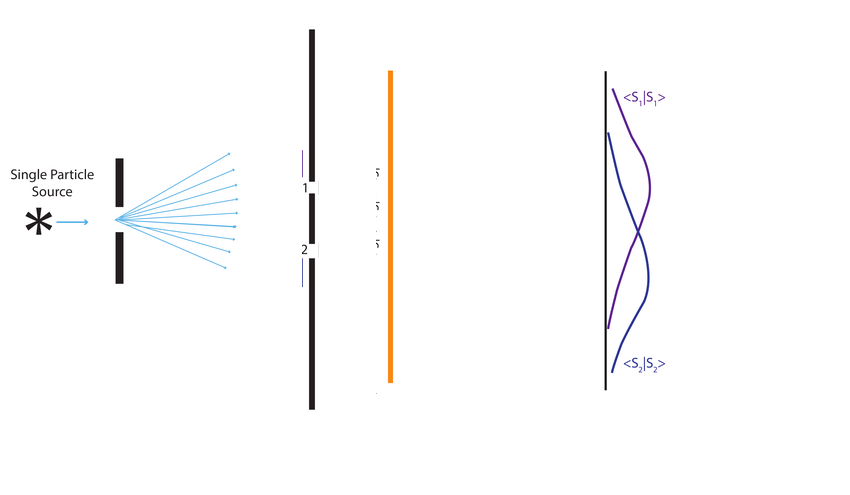
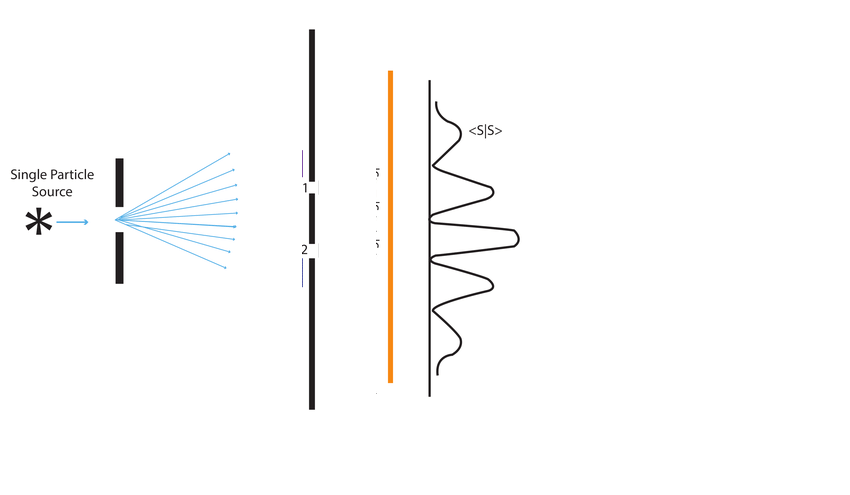
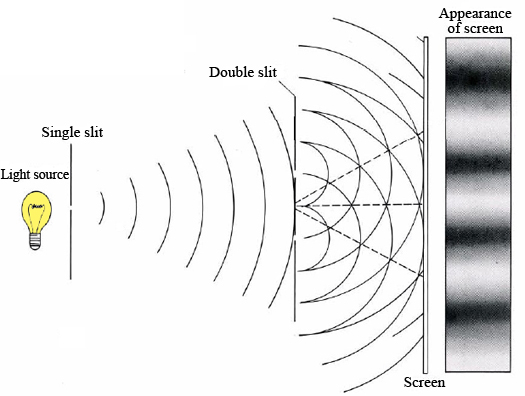






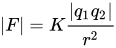
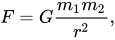
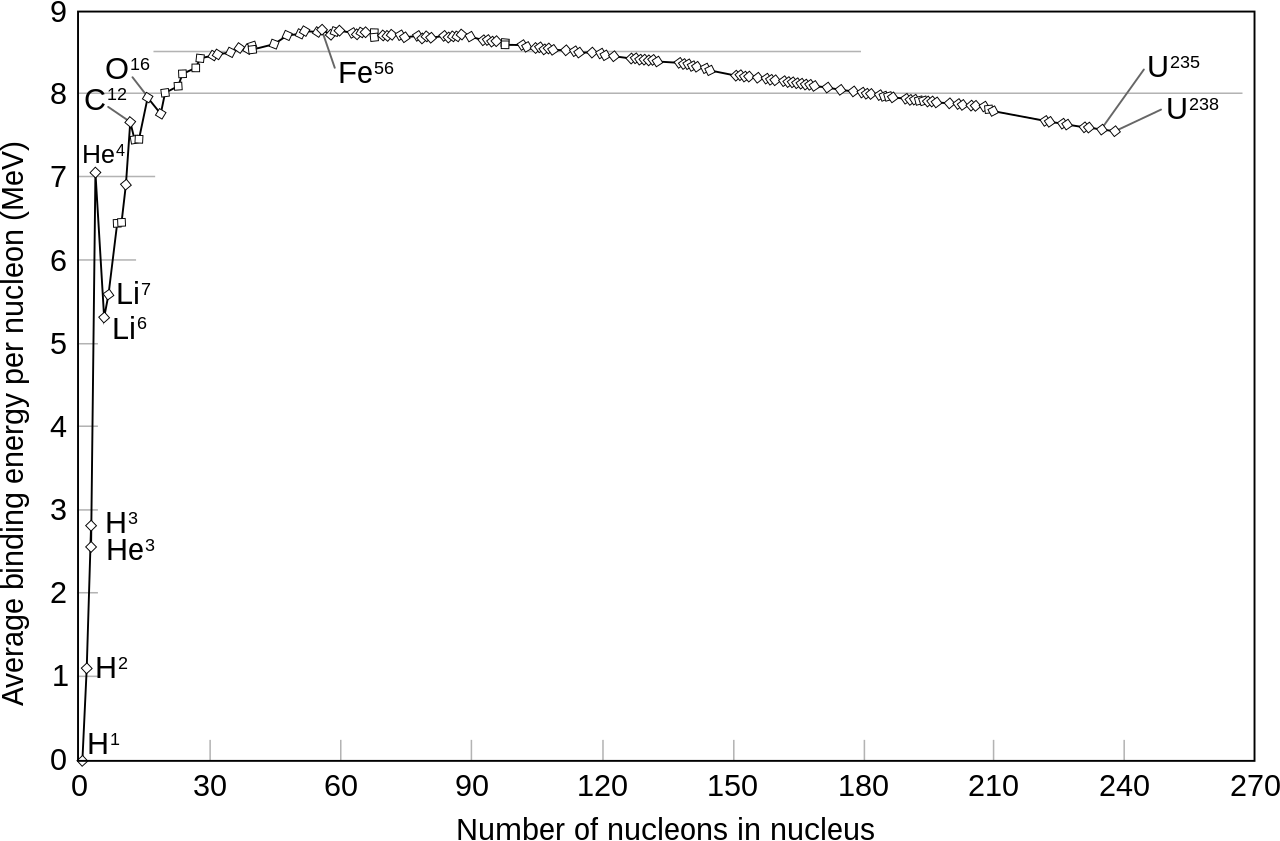

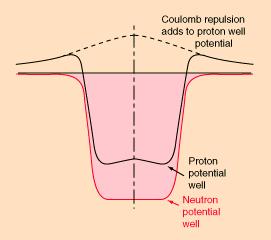
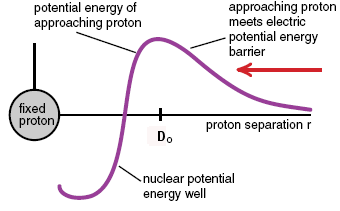 Imagine a proton coming in from the side, towards the nucleus (not shown) at center. It has to have enough velocity to travel over the “coulomb barrier” (repulsion from electrostatic forces), after which it can drop into the well because it is attracted by the nuclear force. This is actually a very good analogy because gravitational potential barriers are actual hills you’d have to be able to coast over. This one is a combination of the electrostatic and nuclear forces as they act on protons. In red is shown the situation for neutrons, which only respond to the nuclear force.