
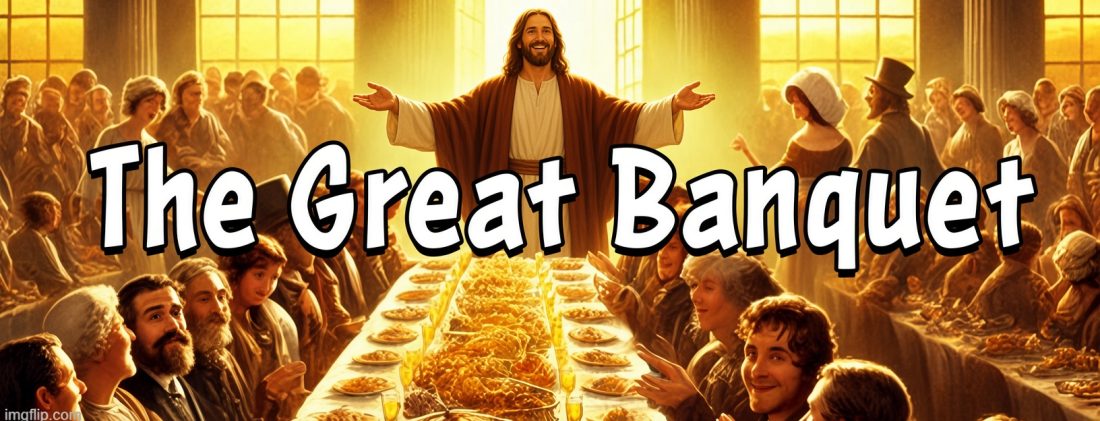
This Rejoice & Praise God Sunday Open Thread, with full respect to those who worship God on the Sabbath, is a place to reaffirm our worship of our Creator, our Father, our King Eternal.
It’s also a place to read, post, and discuss news that is worth knowing and sharing. Please post links to any news stories that you use as sources or quote from.
In the QTree, we’re a friendly and civil lot. We encourage free speech and the open exchange and civil discussion of different ideas. Topics aren’t constrained, and sound logic is highly encouraged, all built on a solid foundation of truth and established facts, and not by agenda-driven accusations and pronouncements.
We have a policy of mutual respect, shown by civility. Civility encourages discussions, promotes objectivity and rational thought in discourse, and camaraderie in the participants – characteristics we strive toward in our Q Tree community.
Please show respect and consideration for our fellow QTreepers. Before hitting the “post” button, please proofread your post and make sure your opinion addresses the issue only, and does not confront or denigrate the poster. Keep to the topic – avoid “you” and “your”. Here in The Q Tree, personal attacks, name-calling, ridicule, insults, baiting, and other conduct for which a penalty flag would be thrown are VERBOTEN.
In The Q Tree, we’re compatriots, sitting around the campfire, roasting hot dogs, making s’mores, and discussing, agreeing, and disagreeing about whatever interests us. This board will remain a home for those who seek respectful conversations.
Please also consider the Guidelines for posting and discussion printed here:
https://www.theqtree.com/2019/01/01/dear-maga-open-topic-20190101/
On this day and every day –
God is in Control
. . . and His Grace is Sufficient, so . . .
Keep Looking Up

Hopefully, every Sunday, we can find something here that will build us up a little . . . give us a smile . . . and add some joy or peace, very much needed in all our lives.
“This day is holy to the Lord your God;
do not mourn nor weep.” . . .
“Go your way, eat the fat, drink the sweet,
and send portions to those for whom nothing is prepared;
for this day is holy to our Lord.
Do not sorrow,
for the joy of the Lord is your strength.”


The Great Banquet
The Parable of the Great Banquet is found in Luke 14:15-24. It is similar to the Parable of the Wedding Feast (Matthew 22:1-14), but with some significant differences. The story in Luke’s Gospel was told at a dinner that Jesus attended. Jesus had just healed a man with dropsy and taught a brief lesson on serving others. Jesus then says that those who serve others “will be repaid at the resurrection of the righteous” (Luke 14:14). At the mention of the resurrection, someone at the table with Jesus said, “Blessed is the man who will eat at the feast in the kingdom of God” (verse 15). In reply, Jesus tells the Parable of the Great Banquet.
In the parable, a man planned a large banquet and sent out invitations. When the banquet was ready, he sent his servant to contact each of the invited guests, telling them that all was ready and the meal was about to start (verses 16-17). One after another, the guests made excuses for not coming. One had just bought a piece of land and said he had to go see it (verse 18). Another had purchased some oxen and said he was on the way to yoke them up and try them out (verse 19). Another gave the excuse that he was newly married and therefore could not come (verse 20).
When the master of the house heard these flimsy excuses, he was angry. He told his servant to forget the guest list and go into the back streets and alleyways of the town and invite “the poor, the crippled, the blind and the lame” (verse 21). The servant had already brought in the down-and-out townspeople, and still there was room in the banquet hall. So the master sent his servant on a broader search: “Go out to the roads and country lanes and make them come in, so that my house will be full” (verses 22-23).
Jesus ends the parable by relating the master’s determination that “not one of those men [with excuses] who were invited will get a taste of my banquet” (verse 24).
The statement that prompted the parable is key. The man who, in verse 15, looks forward to dining in the Messianic kingdom probably subscribed to the popular notion that only Jews would be part of that kingdom. The parable Jesus tells is aimed at debunking that notion, as the following explanation makes clear:
The master of the house is God, and the great banquet is the kingdom, a metaphor that was suggested by the speaker at the table. The invited guests picture the Jewish nation. The kingdom was prepared for them, but when Jesus came preaching that “the kingdom of heaven is near” (Matthew 4:17), He was rejected. “He came to that which was his own, but his own did not receive him” (John 1:11).
The excuses for skipping the banquet are laughably bad. No one buys land without seeing it first, and the same can be said for buying oxen. And what, exactly, would keep a newly married couple from attending a social event? All three excuses in the parable reveal insincerity on the part of those invited. The interpretation is that the Jews of Jesus’ day had no valid excuse for spurning Jesus’ message; in fact, they had every reason to accept Him as their Messiah.
The detail that the invitation is opened up to society’s maimed and downtrodden is important. These were the types of people that the Pharisees considered “unclean” and under God’s curse (cf. John 9:1-2, 34). Jesus, however, taught that the kingdom was available even to those considered “unclean” (cf. Acts 10). His involvement with tax collectors and sinners brought condemnation from the Pharisees, yet it showed the extent of God’s grace (Matthew 9:10-11). The fact that the master in the parable sends the servant far afield to persuade everyone to come indicates that the offer of salvation would be extended to the Gentiles and “to the ends of the earth” (Acts 1:8). “Rejoice, O Gentiles, with his people” (Romans 15:10).
The master is not satisfied with a partially full banquet hall; he wants every place at the table to be filled. John MacArthur’s comment on this fact is that “God is more willing to save sinners than sinners are to be saved.”
Those who ignored the invitation to the banquet chose their own punishment—they missed out. The master respects their choice by making it permanent: they would not “taste of my banquet.” So it will be with God’s judgment on those who choose to reject Christ: they will have their choice confirmed, and they will never taste the joys of heaven.
The basic message of the Parable of the Great Banquet could be stated this way: “The tragedy of the Jewish rejection of Christ has opened the door of salvation to the Gentiles. The blessings of the kingdom are available to all who will come to Christ by faith.”
The inclusion of the Gentiles is a fulfillment of Hosea 2:23, “I will say to those called ‘Not my people,’ ‘You are my people’; and they will say, ‘You are my God.’” God is “not willing that any should perish but that all should come to repentance” (2 Peter 3:9), and “Everyone who calls on the name of the Lord will be saved” (Romans 10:13).
https://www.gotquestions.org/parable-great-banquet.html
Oh, the depth of the riches of the wisdom and knowledge of God!
How unsearchable His judgments, and His paths beyond tracing out!
“Who has known the mind of the Lord? Or who has been His counselor?”
“Who has ever given to God, that God should repay them?”
For from Him and through Him and for Him are all things.
To Him be the glory forever! Amen.
Romans 11:33-36
Post about God – comments or articles
– whenever and wherever you desire.
FEAR NOT. God is with us,
because we make sure He is WELCOME.
At all times, remember.
The QTree is a House of the Lord.
NEVER be afraid to speak His name.
Shalom! May God’s PEACE be upon this House.
