
The free word cloud image of Ethics is courtesy of Dreamstime and Google Images.
Health Friday is a series devoted to information about Big Pharma, vaccines, general health, and associated topics. There are Important Notifications from our host, Wolf Moon; the Rules of our late, good Wheatie; and, certain caveats from Yours Truly, of which readers should be aware. They are linked here. Note: AI-generated items in today’s offering will be cited as such. If readers wish to post AI-generated items in today’s discussion thread, they must cite their source. Thank you.
>>>>>>>>>>>>>>>>>>>>
The AMA and “Ethics of AI in Health Care”
Today’s offering discusses the newest “innovation” of the American Medical Association (AMA): a new Journal of the American Medical Association (JAMA) devoted to AI and health care. The new journal’s website is here: https://jamanetwork.com/channels/ai, “JAMA+ AI.” Please see the opening statement by founding editor of JAMA+ AI, Dr. Roy H. Perlis, MD, MSc, from the above-linked website:
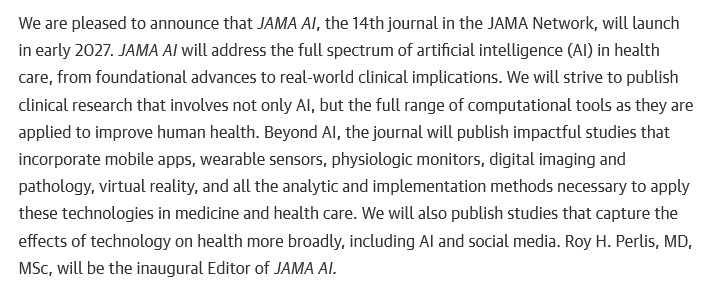
The AMA has offered CME (Continuing Medical Education) courses for some time now that are related to the use of artificial intelligence / “large language models” / “machine learning” in healthcare, via its website (https://www.ama-assn.org/.) As of spring 2027, the new “JAMA+ AI” journal will officially begin. The incoming editor of the new journal, Dr. Roy H. Perlis, MD, MSc, was just named as the Director of the Bakar Computational Health Sciences Institute at the University of California, San Francisco. Dr. Perlis is already associated with Massachusetts General Hospital and the Harvard Medical School (https://medschool.ucsf.edu/news/announcing-roy-h-perlis-md-msc-director-bakar-computational-health-sciences-institute, 29 September 2026.)
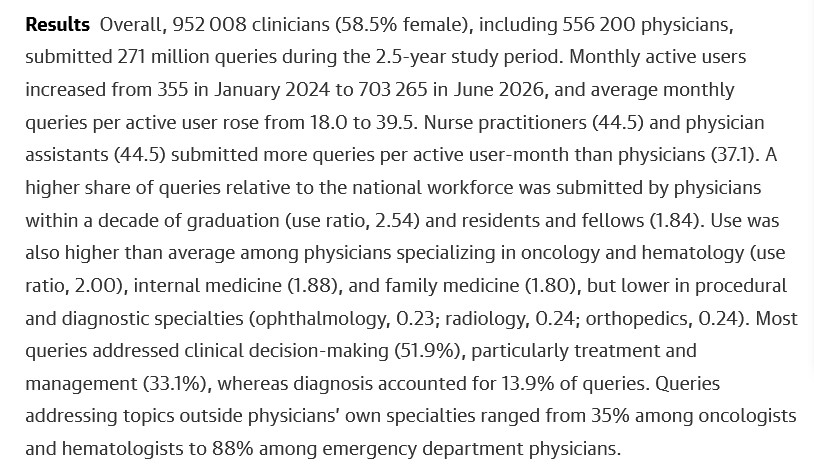
However, there are already articles appearing on JAMA related to the new journal, to using AI in multiple areas of healthcare providing, and more. Three examples of such articles: first, https://jamanetwork.com/journals/jama/fullarticle/2855492, “Engaging With Medical Evidence in the Age of AI”, Rohan Khera, MD, MS, et al., 15 October 2026; second, https://jamanetwork.com/journals/jama/fullarticle/2855491, “Clinician Use of an Artificial Intelligence-Enabled Clinical Information Platform”, Vishal R. Patel, MD, MPH, et al., 15 October 2026; and, third, https://jamanetwork.com/journals/jama-health-forum/fullarticle/2855161, “Avoiding a 2-Tier AI Ecosystem in Health Care”, Brett Moran, MD, et al., 16 October 2026. Following are two screenshots from the article by Khera, et al.:
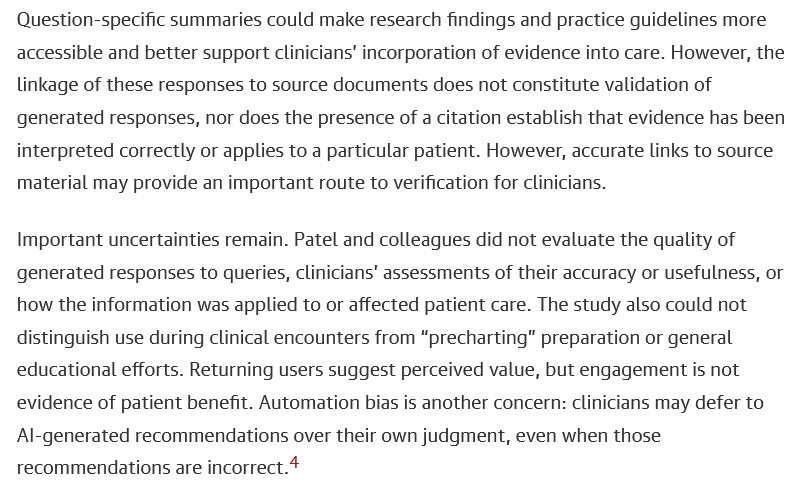
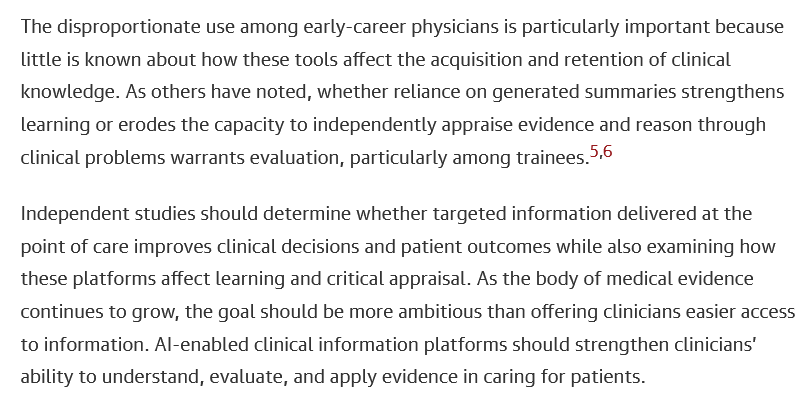
Note the mention of heavy (“disproportionate”) use by “newly-minted” physicians. Following are three screenshots from the Patel, et al., article:
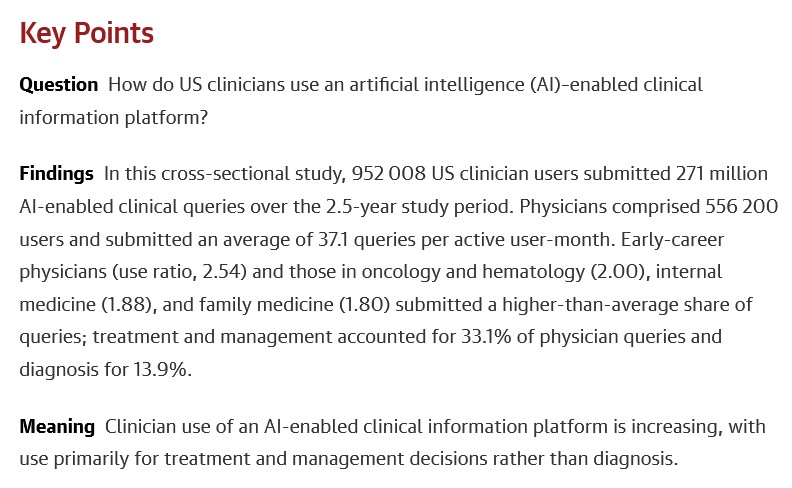
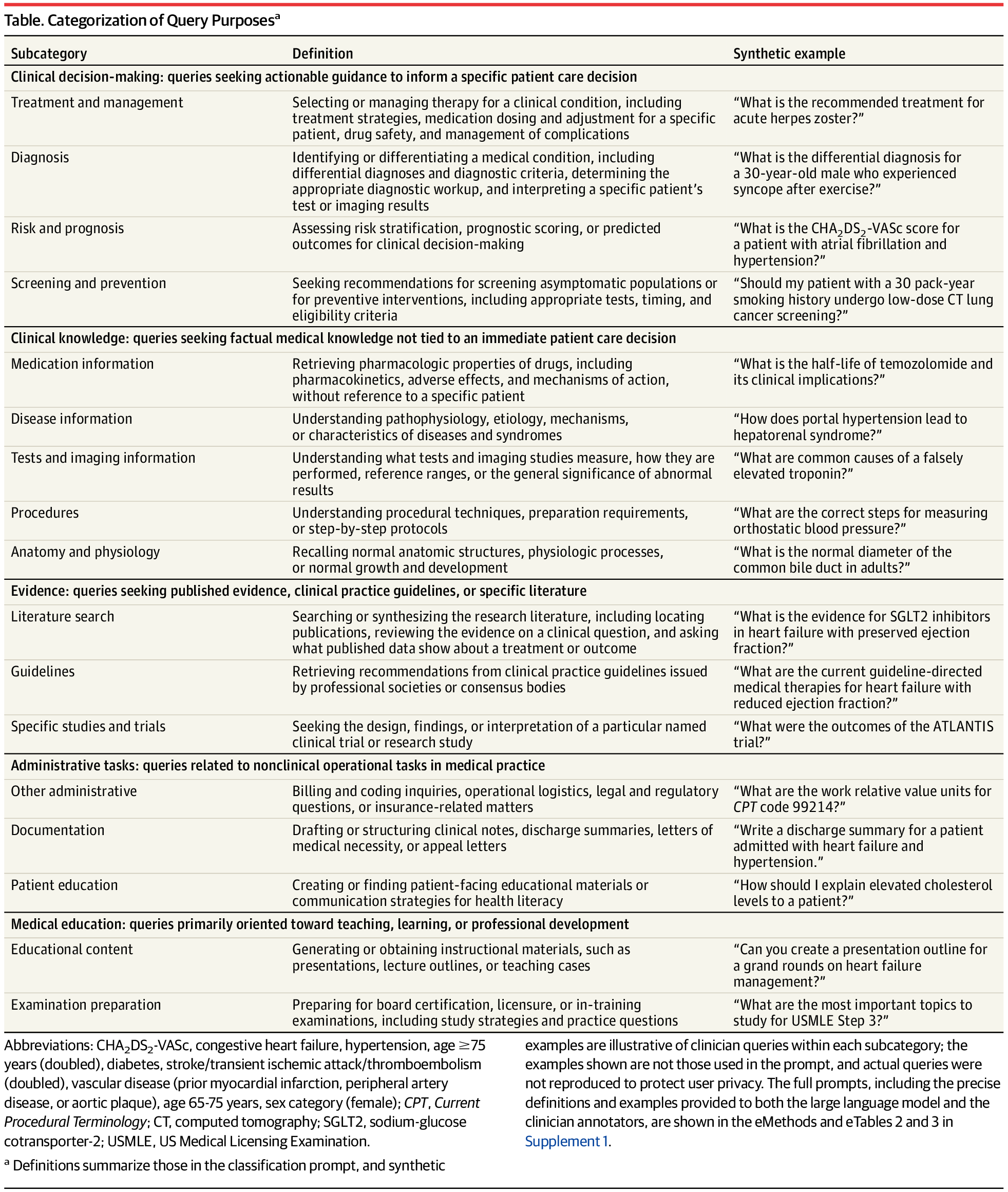
Note, in the Table above, the four areas under subcategory “Clinical decision-making”; the five areas under the subcategory “Clinical knowledge”; and, the “Guidelines” area under the subcategory “Evidence.”
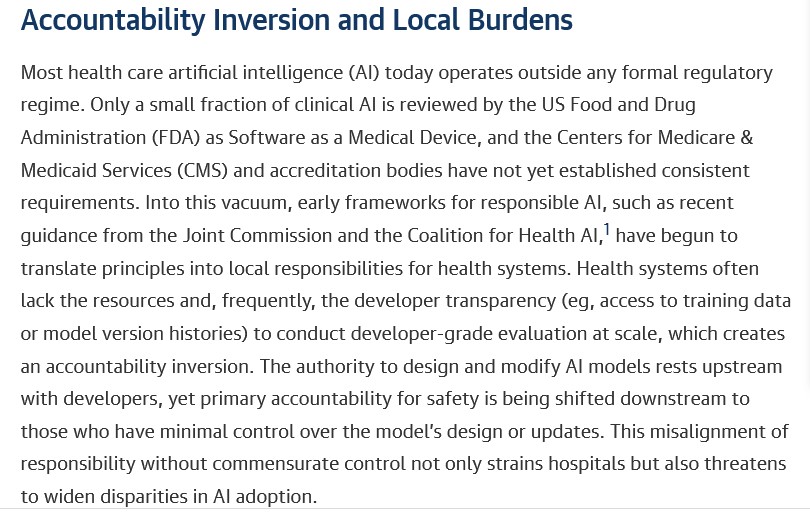
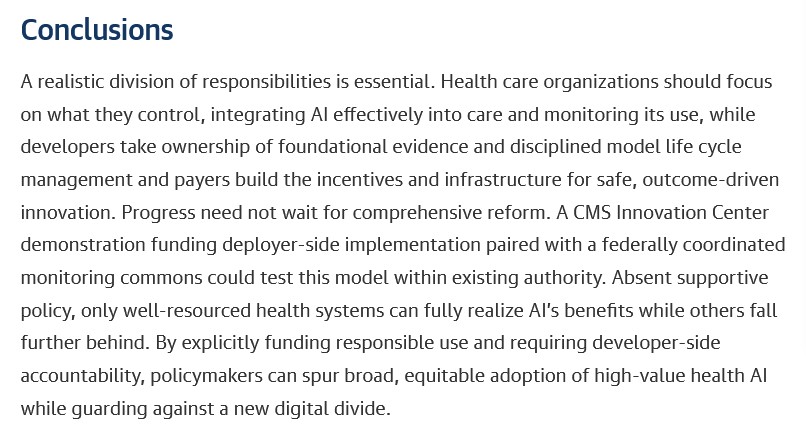
Finally, two screenshots from the Moran, et al., article:
All of the above bring up questions, among them:
How will Medical Doctors — Physician Assistants — Osteopaths (they are licensed as doctors of osteopathy [DOs]; they can diagnose, prescribe, and create treatment plans for patients, as do medical doctors [MDs]; DOs have the rights and privileges that MDs enjoy) — Nurse Practitioners, and other licensed healthcare professionals who diagnose, prescribe, order tests, and create treatment plans — be trained to use AI-generated information as an adjunct to their work, as opposed to using AI-generated information as the template basis of their work?
What about the proposal, outlined above in the Moran, et al., article, regarding the implementation of a “government-wide AI watchdog and information-sharing platform” under the control of CMS, for example?
Can such an “AI watchdog and information-sharing platform” become a “one size fits all” approach to patient encounters and patient care? If so, what does this do to the individual healthcare provider’s ability to, for example, prescribe a drug for an “off-label” use to treat a particular patient?
What would such an “AI watchdog” framework do to care provided in hospital or nursing home settings?
>>>>>>>>>>>>>>>>>>>>
The use of AI-generated systems for use in healthcare settings is increasing rapidly over the entire spectrum of medicine. It is Yours Truly’s opinion that, while AI-generated information systems may eventually become a tool to assist the provider in assessing and treating a patient, they should not be used as a template for a “one size fits all, follow the steps outlined on the AI-generated program and stay with that” approach.
Peace, Good Energy, Respect: PAVACA1
(Intellectual Property Disclaimer and Notice: Except for the linked URLs and other items in today’s offering that are available on the Internet, the ideas and/or opinions above are by PAVACA1, Credit must be given to PAVACA1 if ideas and/or opinions of today’s offering are used by other blog writers; by podcasters; or, in print or social media.)




I agree! AI/SI should not be in the driver’s seat on diagnosis.
And yet, With the right kind of guidance AlterAI.systems has been a tremendous aid to me personally for exploring beyond my own knowledge in the wellness domain. BUT you have to fight to keep it “tight” … even reminding it that you don’t want “wall of text” responses so it’s a back and forth.
If I wasn’t so well read already I doubt that I would gain the same level of quality out of the chats.
In order of “driver’s seat” for diagnosis, I would place (if available) in order —
Incidentally, when I had my last conversation with the wound care specialist (2 weeks ago), I said that we wouldn’t be doing debridement that day and that I was going to try some remedy of my own. She asked what, and I said aloe and vitamin E — it’s supposed to work great on horses.
She nearly yelled at me, “you are not a horse!!!”
The more I think about that, the more she could have said, “I am an ass!” It’s a slogan, not a thought, and it shows overeducated reflexive closed-mindedness. It shows that the person saying this is a slave to the medical complex and pHarma, dedicated to maintaining a continuous need for “healthcare” rather than actually curing anything.
It should be mentioned that I have seen substantial improvement in the last two weeks — especially when compared to the previous six weeks of tender ministrations from the wound clinic.
You are not pursuing excellence of progress in your field if your reaction to something outside your ken is credentialism and attacking the source, rather than assessing virtues, risks, and costs.
I agree. I don’t know whether a “one size fits all” approach is ever universally appropriate, and that definitely would not be the case with AI/SI. I’ve seen that AI/SI can be given parameters within which to work, so maybe the factors specific to each patient could be considered. But a template that fits everyone? No.
This thread by DataRepublican includes a 5-minute video illustrating what is said in the text and the tactics being used.
It is sick that our government has been doing this all over the world with our tax dollars for far too long. Where in the Constitution is the government authorized to subversively destroy other countries?
Supreme Court Says New Hampshire Can Ban Voters from Using Student IDs at Polls in Midterms – Ketanji Brown Jackson Dissents
A podcaster named Jennifer Welch.
Nolte: Podcaster Jennifer Welch Demands ‘Pistols Firing’ at ‘Antichrist’ JD Vance
2029? That’s outrageous!