“We do not believe any group of men adequate enough or wise enough to operate without scrutiny or without criticism. We know that the only way to avoid error is to detect it, that the only way to detect it is to be free to inquire. We know that in secrecy error undetected will flourish and subvert.” –J. Robert Oppenheimer
What is it that feeds our battle, yet starves our victory?
Do We Still Need the Kang (Mis)Quote?
I’m still using the quote about winning the battles but losing the war. It seems like this doesn’t make sense right now given that we seem to be going from triumph to triumph.
On the contrary. This is the exception that proves the rule. The quote isn’t just a lament, it’s to point out why we can never seem to win.
You see, the RINOs cannot interfere and that is why, just for once, we are actually winning. And that is just one more piece of evidence (for the willfully blind) as to what I have been saying with that quote.
It stays.
Speaker Johnson Pinging you on January 6 Tapes
Just a friendly reminder Speaker Johnson. You’re doing some good things–or at least trying in the case of the budget–but this is the most important thing out there still hanging. One initial block released with the promise of more…and?
We have American patriots being held without bail and without trial, and the tapes almost certainly contain exculpatory evidence. (And if they don’t, and we’re all just yelling in an echo chamber over here, we need to know that too. And there’s only one way to know.)
Either we have a weaponized, corrupt government or we have a lot of internet charlatans. Let’s expose whatever it is. (I’m betting it’s the corrupt weaponized government, but if I am wrong, I’d like to see proof.)
Justice Must Be Done.
The 2020 election must be acknowledged as fraudulent, and steps must be taken to prosecute the fraudsters and restore integrity to the system.
Yes this is still true in spite of 2024. Fraud must be rooted out of our system and that hasn’t changed just because the fraud wasn’t enough to stop Trump winning a second term. Fraud WILL be ramped up as soon as we stop paying attention.
Otherwise, everything ends again in 2028. Or perhaps earlier if Trump is saddled with a Left/RINO congress in 2026, via fraud.
Small Government?
Many times conservatives (real and fake) speak of “small government” being the goal.
This sounds good, and mostly is good, but it misses the essential point. The important thing here isn’t the size, but rather the purpose, of government. We could have a cheap, small tyranny. After all our government spends most of its revenue on payments to individuals and foreign aid, neither of which is part of the tyrannical apparatus trying to keep us locked down and censored. What parts of the government would be necessary for a tyranny? It’d be a lot smaller than what we have now. We could shrink the government and nevertheless find it more tyrannical than it is today.
No, what we want is a limited government, limited not in size, but rather in scope. Limited, that is, in what it’s allowed to do. Under current circumstances, such a government would also be much smaller, but that’s a side effect. If we were in a World War II sort of war, an existential fight against nasty dictatorships on the brink of world conquest, that would be very expensive and would require a gargantuan government, but that would be what the government should be doing. That would be a large, but still limited government, since it’d be working to protect our rights.
World War II would have been the wrong time to squawk about “small government,” but it wasn’t (and never is) a bad time to demand limited government. Today would be a better time to ask for a small government–at least the job it should be doing is small today–but it misses the essential point; we want government to not do certain things. Many of those things we don’t want it doing are expensive but many of them are quite eminently doable by a smaller government than the one we have today. Small, but still exceeding proper limits.
So be careful what you ask for. You might get it and find you asked for the wrong thing.
Political Science In Summation
It’s really just a matter of people who can’t be happy unless they control others…versus those who want to be left alone. The oldest conflict within mankind. Government is necessary, but government attracts the assholes (a highly technical term for the control freaks).
His Truth?
Again we saw an instance of “It might be true for Billy, but it’s not true for Bob” logic this week.
I hear this often, and it’s usually harmless. As when it’s describing differing circumstances, not different facts. “Housing is unaffordable” can be true for one person, but not for another who makes ten times as much.
But sometimes the speaker means it literally. Something like 2+2=4 is asserted to be true for Billy but not for Bob. (And when it’s literal, it’s usually Bob saying it.) And in that sense, it’s nonsense, dangerous nonsense. There is ONE reality, and it exists independent of our desires and our perceptions. It would go on existing if we weren’t here. We exist in it. It does not exist in our heads. It’s not a personal construct, and it isn’t a social construct. If there were no society, reality would continue to be what it is, it wouldn’t vanish…which it would have to do, if it were a social construct.
Now what can change from person to person is the perception of reality. We see that all the time. And people will, of course, act on those perceptions. They will vote for Trump (or try to) if their perception is close to mine, and vote against Trump (and certainly succeed at doing so) if their perception is distant from mine (and therefore, if I do say so, wrong). I have heard people say “perception is reality” and usually, that’s what they’re trying to say–your perception of reality is, as far as you know, an accurate representation of reality, or you’d change it.
But I really wish they’d say it differently. And sometimes, to get back to Billy and Bob, the person who says they have different truths is really saying they have different perceptions of reality–different worldviews. I can’t argue with the latter. But I sure wish they’d say it better. That way I’d know that someone who blabbers about two different truths is delusional and not worth my time, at least not until he passes kindergarten-level metaphysics on his umpteenth attempt.
Lawyer Appeasement Section
OK now for the fine print.
This is the Q Tree Daily Thread. You know the drill. There’s no Political correctness, but civility is a requirement. There are Important Guidelines, here, with an addendum on 20191110.
We have a new board – called The U Tree – where people can take each other to the woodshed without fear of censorship or moderation.
And remember Wheatie’s Rules:
1. No food fights 2. No running with scissors. 3. If you bring snacks, bring enough for everyone. 4. Zeroth rule of gun safety: Don’t let the government get your guns. 5. Rule one of gun safety: The gun is always loaded. 5a. If you actually want the gun to be loaded, like because you’re checking out a bump in the night, then it’s empty. 6. Rule two of gun safety: Never point the gun at anything you’re not willing to destroy. 7. Rule three: Keep your finger off the trigger until ready to fire. 8. Rule the fourth: Be sure of your target and what is behind it.
Gold has been trending down ever since the cease fire, and on Friday it dropped $53.70. Other PMs followed suit, platinum dropped over five and a half percent on Friday. Silver dropped but it is in general holding its ground better than gold, as you can see from the gold:silver price ratio.
*The SteveInCO Federal Reserve Note Suckage Index (FRNSI) is a measure of how much the dollar has inflated. It’s the ratio of the current price of gold, to the number of dollars an ounce of fine gold made up when the dollar was defined as 25.8 grains of 0.900 gold. That worked out to an ounce being $20.67+71/387 of a cent. (Note gold wasn’t worth this much back then, thus much gold was $20.67 71/387ths. It’s a subtle distinction. One ounce of gold wasn’t worth $20.67 back then, it was $20.67.) Once this ratio is computed, 1 is subtracted from it so that the number is zero when the dollar is at its proper value, indicating zero suckage.
What is it that feeds our battle, yet starves our victory?
Do We Still Need the Kang (Mis)Quote?
I’m still using the quote about winning the battles but losing the war. It seems like this doesn’t make sense right now given that we seem to be going from triumph to triumph.
On the contrary. This is the exception that proves the rule. The quote isn’t just a lament, it’s to point out why we can never seem to win.
You see, the RINOs cannot interfere and that is why, just for once, we are actually winning. And that is just one more piece of evidence (for the willfully blind) as to what I have been saying with that quote.
It stays.
Speaker Johnson Pinging you on January 6 Tapes
Just a friendly reminder Speaker Johnson. You’re doing some good things–or at least trying in the case of the budget–but this is the most important thing out there still hanging. One initial block released with the promise of more…and?
We have American patriots being held without bail and without trial, and the tapes almost certainly contain exculpatory evidence. (And if they don’t, and we’re all just yelling in an echo chamber over here, we need to know that too. And there’s only one way to know.)
Either we have a weaponized, corrupt government or we have a lot of internet charlatans. Let’s expose whatever it is. (I’m betting it’s the corrupt weaponized government, but if I am wrong, I’d like to see proof.)
Justice Must Be Done.
The 2020 election must be acknowledged as fraudulent, and steps must be taken to prosecute the fraudsters and restore integrity to the system.
Yes this is still true in spite of 2024. Fraud must be rooted out of our system and that hasn’t changed just because the fraud wasn’t enough to stop Trump winning a second term. Fraud WILL be ramped up as soon as we stop paying attention.
Otherwise, everything ends again in 2028. Or perhaps earlier if Trump is saddled with a Left/RINO congress in 2026, via fraud.
Small Government?
Many times conservatives (real and fake) speak of “small government” being the goal.
This sounds good, and mostly is good, but it misses the essential point. The important thing here isn’t the size, but rather the purpose, of government. We could have a cheap, small tyranny. After all our government spends most of its revenue on payments to individuals and foreign aid, neither of which is part of the tyrannical apparatus trying to keep us locked down and censored. What parts of the government would be necessary for a tyranny? It’d be a lot smaller than what we have now. We could shrink the government and nevertheless find it more tyrannical than it is today.
No, what we want is a limited government, limited not in size, but rather in scope. Limited, that is, in what it’s allowed to do. Under current circumstances, such a government would also be much smaller, but that’s a side effect. If we were in a World War II sort of war, an existential fight against nasty dictatorships on the brink of world conquest, that would be very expensive and would require a gargantuan government, but that would be what the government should be doing. That would be a large, but still limited government, since it’d be working to protect our rights.
World War II would have been the wrong time to squawk about “small government,” but it wasn’t (and never is) a bad time to demand limited government. Today would be a better time to ask for a small government–at least the job it should be doing is small today–but it misses the essential point; we want government to not do certain things. Many of those things we don’t want it doing are expensive but many of them are quite eminently doable by a smaller government than the one we have today. Small, but still exceeding proper limits.
So be careful what you ask for. You might get it and find you asked for the wrong thing.
Political Science In Summation
It’s really just a matter of people who can’t be happy unless they control others…versus those who want to be left alone. The oldest conflict within mankind. Government is necessary, but government attracts the assholes (a highly technical term for the control freaks).
His Truth?
Again we saw an instance of “It might be true for Billy, but it’s not true for Bob” logic this week.
I hear this often, and it’s usually harmless. As when it’s describing differing circumstances, not different facts. “Housing is unaffordable” can be true for one person, but not for another who makes ten times as much.
But sometimes the speaker means it literally. Something like 2+2=4 is asserted to be true for Billy but not for Bob. (And when it’s literal, it’s usually Bob saying it.) And in that sense, it’s nonsense, dangerous nonsense. There is ONE reality, and it exists independent of our desires and our perceptions. It would go on existing if we weren’t here. We exist in it. It does not exist in our heads. It’s not a personal construct, and it isn’t a social construct. If there were no society, reality would continue to be what it is, it wouldn’t vanish…which it would have to do, if it were a social construct.
Now what can change from person to person is the perception of reality. We see that all the time. And people will, of course, act on those perceptions. They will vote for Trump (or try to) if their perception is close to mine, and vote against Trump (and certainly succeed at doing so) if their perception is distant from mine (and therefore, if I do say so, wrong). I have heard people say “perception is reality” and usually, that’s what they’re trying to say–your perception of reality is, as far as you know, an accurate representation of reality, or you’d change it.
But I really wish they’d say it differently. And sometimes, to get back to Billy and Bob, the person who says they have different truths is really saying they have different perceptions of reality–different worldviews. I can’t argue with the latter. But I sure wish they’d say it better. That way I’d know that someone who blabbers about two different truths is delusional and not worth my time, at least not until he passes kindergarten-level metaphysics on his umpteenth attempt.
Lawyer Appeasement Section
OK now for the fine print.
This is the Q Tree Daily Thread. You know the drill. There’s no Political correctness, but civility is a requirement. There are Important Guidelines, here, with an addendum on 20191110.
We have a new board – called The U Tree – where people can take each other to the woodshed without fear of censorship or moderation.
And remember Wheatie’s Rules:
1. No food fights 2. No running with scissors. 3. If you bring snacks, bring enough for everyone. 4. Zeroth rule of gun safety: Don’t let the government get your guns. 5. Rule one of gun safety: The gun is always loaded. 5a. If you actually want the gun to be loaded, like because you’re checking out a bump in the night, then it’s empty. 6. Rule two of gun safety: Never point the gun at anything you’re not willing to destroy. 7. Rule three: Keep your finger off the trigger until ready to fire. 8. Rule the fourth: Be sure of your target and what is behind it.
Gold has been trending down ever since the cease fire, and on Friday it dropped $53.70. Other PMs followed suit, platinum dropped over five and a half percent on Friday. Silver dropped but it is in general holding its ground better than gold, as you can see from the gold:silver price ratio.
*The SteveInCO Federal Reserve Note Suckage Index (FRNSI) is a measure of how much the dollar has inflated. It’s the ratio of the current price of gold, to the number of dollars an ounce of fine gold made up when the dollar was defined as 25.8 grains of 0.900 gold. That worked out to an ounce being $20.67+71/387 of a cent. (Note gold wasn’t worth this much back then, thus much gold was $20.67 71/387ths. It’s a subtle distinction. One ounce of gold wasn’t worth $20.67 back then, it was $20.67.) Once this ratio is computed, 1 is subtracted from it so that the number is zero when the dollar is at its proper value, indicating zero suckage.
Place Holder Under Arrest
TBH I might not do anything significant before August.
My schedule has been hectic, so an on-topic breather is in order. I am going with a subject that relates to the subject period in history as well as today. Since it is in the news at times, let’s discuss the filibuster. What the heck is it and why should we care?
This definition per clown provided Wiki is as good as any…
A filibuster is a political procedure in which one or more members of a legislative body prolong debate on proposed legislation so as to delay or entirely prevent a decision. It is sometimes referred to as “talking a bill to death” or “talking out a bill”, and is characterized as a form of obstruction in a legislature or other decision-making body.
However, its noted origin as a procedure (not the name) appears to trace back to ancient Rome in 60 and 59 BC when Cato the Younger conducted it in opposition to Caesar’s desires in the ancient Roman Empire. The Roman Senate had a rule that all daily work had to be completed by nightfall. Cato was noted for his long winded speeches, so in two instances he got up and spoke until nightfall to foil Caesar’s plans. It worked the first time, but Caesar had a work around ready the second time as he took the measure he wanted passed to the Tribal Assembly and got it done.
There are numerous countries in which this procedure has been done in their legislative assemblies. As an example, the first time it appears to have been done in Great Britain was in Parliament in 1874. It first entered into U. S. Club Senate rules in 1806, but not used until 1837.
The filibuster was not used frequently until the 1970’s. In more recent times it has become more of a threatened use, especially since the 2010’s. It has also become watered down as a procedure to the point it is mostly only used to counter new legislation today, which is bad enough when the legislation that could pass would help We the People instead of the Uniparty and globalists.
However, the big thing is that it is not a product of the Constitution.It is in the Club Senate’s “rulebook”.
So, why does it continue to exist? Better yet, why do we need an obstruction to the usual “majority rules” method of determining the fate of legislation? We need to understand the history to know the answers to those questions, well, at least more official answers. TradeBait’s response that follows is probably a bit less tactful. 😂
To cut to the chase It is just another contrived rule that We the People had no voice in determiningits existence and use. As posted in previous Dailies they do the same garbage in the judiciary. They build in rules of engagement, practices, procedural hoops, and standing that are not enumerated or codified into law by the legislature. They are inserted at the discretion of the involved parties and frequently used as weapons to achieve goals in conflict with the intent of the Constitution, laws, and will of We the People. They grant permissions to positions and bodies to do so that have never been legally authorized by our system of government. They then hide behind the rules they create.
The Senate politicians sell filibuster presence as a tool to prevent unthrottled and dangerous control by legislators of the “political process” that could abuse citizen voters. They use fear porn induced warnings in serious tones of voice to make their points. Sometimes, I am convinced the real boogeyman or Sasquatch will run out from behind them to threaten us all.
One thing is true, the threat of the use of this tool has kept even a unified House, Senate and POTUS from achieving their fake media described scary agendas despite having received control from the popular vote. How convenient that the GOP or Dems cannot seem to get that important piece of legislation across the finish line that benefits We the People more than the politicians and globalists. With it available the Uniparty continues its reign.
Instead, we get Obamacare and such, right McShame? Oh yeah, you are no longer here to undercut the will of We the People. 👍 But just as a reminder, if Harry Reid followed by Turtle did not permit its nuking in regard to confirmations; PDT would have never received approval for any judges, SCOTUS justices, or cabinet selections. Who knew in advance we would thank two Uniparty henchmen for their efforts to release us from that bondage one day? Of course, doing so was met with wailing and gnashing of teeth by media and the Uniparty faithful. Much fear porn was broadcast and now we know why. SCOTUS leaned back toward the right over time and some honest judges were added to the federal court rosters.
In Club Senate the filibuster is still a game maneuver the majority can also use to not move forward with popular legislation that they would ordinarily have the votes to pass, especially with the Uniparty in control. Instead they can hide behind the perceived threat of a filibuster. Rarely do filibusters actually happen, the vast majority of the time their use is just threatened or “understood” to be possible. All of it is theater to keep the public fooled and sidetracked, just like the non-election elections.
There is no point in addressing cloture to end debate. The majority still needs 60 votes to invoke it to end the show. In the political environment of today, rarely would there be any Dems willing to join with the GOP to do so. That makes it easy for GOP Senators to grandstand and gaslight the public on their “conservative” values and standing “with” POTUS Trump against the big, bad Dems.
Conditions Today
Let’s take a look at what MTG thinks of the Club Senate and the filibuster.
If you are an optimist you will respond to this situation with a desire to get rid of it so you can get done what needs to be done. If you are a pessimist you want to keep the filibuster as a tool to keep the leftists from ruining the country should they return to power. However, that may turn out to be a less than accurate analysis if indeed, POTUS Trump and patriots are cleaning the election system and taking back control of the federal government swamp.
Do you really believe the Democrat Party has over 70 million real life voters? If you do, you will be more likely to want to retain the filibuster. If you don’t, you will be more likely to want it terminated providing the election system is cleaned up and fair for all voters.
Next, do you believe in DOGE and their efforts or not? I did not say Elon, I said DOGE. Their efforts are helping to clean the system along with ICE and Homeland Security. Add in the Civil Rights division of the DOJ which is now playing hardball as you saw in Part 2. Evidence is being introduced into the courts on hacking election systems, fraudulent ballot harvesting, and fraudulent voter registration activities. Lies are being exposed that claimed no internet connectivity, when in fact the voting machines were connected. More legal actions are underway on clamping down on ID requirements as well as illegals having access to voter registrations.
I don’t believe the Dems have the votes even if it not totally cleaned yet. My gut says they have less than 50 million. They have no message, no inspiring leaders, no bench to sway the majority of the eligible voters. The longer that America First MAGA can dominate the more the judiciary will become Constitutionalist in nature. That realization is contingent on the current administration and leadership knowing that the Democrat Party does not now have or will have anywhere near the votes they manufactured in 2020 with the election steal.
PDT suggested doing away with the filibuster at least a dozen times in his first term. Contrast that viewpoint with that of a Uniparty Senator. From a 9/26/24 USA Today article on the subject comes this quote, “The day Republicans vote to nuke the filibuster is the day I walk out the door,” said Sen. Thom Tillis, R-N.C., who noted that the party repeatedly resisted Trump’s calls to end the filibuster for legislation while he was president.
Sounds like a really good reason for it to be nuked to me, Thommy Turd.
That leads this author to suggest that it is time to kill the filibuster dead as a doornail. Just the threat of its use stops good legislation that We the People support. With its termination the remaining RINO’s will have to openly state their positions for or against a measure – no more hiding. We the People can then primary them out and replace with America First.
If we truly want to end the RINO species, we have to eliminate their habitat. Thommy Turd told everybody where he hides. Remove the ability to hide and openly expose them. Playing defense all the time plays into the Uniparty’s hands. If we go on offense on this, they will either fight to survive or run away scared. We the People then know where they stand and what to do.
However, none of that is the primary reason to terminate the use of the filibuster. The primary reason to get rid of it is the same as with the other contrived rules, procedures and practices in every area of government. There is no provision for it in the Constitution. Assuming honest elections, the threat and the use of it circumvents the will of We the People.
Remember what Alexander Hamilton, John Adams and a handful of other revered founding fathers wanted to do to circumvent the will of We the People when the Constitution was constructed? They were fearful of We the People and the popular vote as it had been a major problem to the new nation due to States’ Rights and its inability to pay military pensions. Thanks to Thomas Jefferson and a large majority of founders they did not get what they wanted. The popular vote was supported in the end result. However, that did not stop those at our nation’s founding that did not like that result. Instead, less than 20 years later, the pro-filibuster crowd in Club Senate began making rules that worked around the issue just a Caesar’s opponents did with the ancient Roman Senate.
The specific problems from our founders’ days no longer exist. In my opinion, it is time for We the People to go boldly into the Golden Age and terminate the filibuster.
Or we can continue looking around for the boogeyman and Sasquatch.
Please remember Wolf’s rules for our community. In general that means to be respectful to each other and to pull no shenanigans that your mom might find offensive or otherwise cause jail time. That said, free speech is honored here.
What is it that feeds our battle, yet starves our victory?
Do We Still Need the Kang (Mis)Quote?
I’m still using the quote about winning the battles but losing the war. It seems like this doesn’t make sense right now given that we seem to be going from triumph to triumph.
On the contrary. This is the exception that proves the rule. The quote isn’t just a lament, it’s to point out why we can never seem to win.
You see, the RINOs cannot interfere and that is why, just for once, we are actually winning. And that is just one more piece of evidence (for the willfully blind) as to what I have been saying with that quote.
It stays.
Speaker Johnson Pinging you on January 6 Tapes
Just a friendly reminder Speaker Johnson. You’re doing some good things–or at least trying in the case of the budget–but this is the most important thing out there still hanging. One initial block released with the promise of more…and?
We have American patriots being held without bail and without trial, and the tapes almost certainly contain exculpatory evidence. (And if they don’t, and we’re all just yelling in an echo chamber over here, we need to know that too. And there’s only one way to know.)
Either we have a weaponized, corrupt government or we have a lot of internet charlatans. Let’s expose whatever it is. (I’m betting it’s the corrupt weaponized government, but if I am wrong, I’d like to see proof.)
Justice Must Be Done.
The 2020 election must be acknowledged as fraudulent, and steps must be taken to prosecute the fraudsters and restore integrity to the system.
Yes this is still true in spite of 2024. Fraud must be rooted out of our system and that hasn’t changed just because the fraud wasn’t enough to stop Trump winning a second term. Fraud WILL be ramped up as soon as we stop paying attention.
Otherwise, everything ends again in 2028. Or perhaps earlier if Trump is saddled with a Left/RINO congress in 2026, via fraud.
Small Government?
Many times conservatives (real and fake) speak of “small government” being the goal.
This sounds good, and mostly is good, but it misses the essential point. The important thing here isn’t the size, but rather the purpose, of government. We could have a cheap, small tyranny. After all our government spends most of its revenue on payments to individuals and foreign aid, neither of which is part of the tyrannical apparatus trying to keep us locked down and censored. What parts of the government would be necessary for a tyranny? It’d be a lot smaller than what we have now. We could shrink the government and nevertheless find it more tyrannical than it is today.
No, what we want is a limited government, limited not in size, but rather in scope. Limited, that is, in what it’s allowed to do. Under current circumstances, such a government would also be much smaller, but that’s a side effect. If we were in a World War II sort of war, an existential fight against nasty dictatorships on the brink of world conquest, that would be very expensive and would require a gargantuan government, but that would be what the government should be doing. That would be a large, but still limited government, since it’d be working to protect our rights.
World War II would have been the wrong time to squawk about “small government,” but it wasn’t (and never is) a bad time to demand limited government. Today would be a better time to ask for a small government–at least the job it should be doing is small today–but it misses the essential point; we want government to not do certain things. Many of those things we don’t want it doing are expensive but many of them are quite eminently doable by a smaller government than the one we have today. Small, but still exceeding proper limits.
So be careful what you ask for. You might get it and find you asked for the wrong thing.
Political Science In Summation
It’s really just a matter of people who can’t be happy unless they control others…versus those who want to be left alone. The oldest conflict within mankind. Government is necessary, but government attracts the assholes (a highly technical term for the control freaks).
His Truth?
Again we saw an instance of “It might be true for Billy, but it’s not true for Bob” logic this week.
I hear this often, and it’s usually harmless. As when it’s describing differing circumstances, not different facts. “Housing is unaffordable” can be true for one person, but not for another who makes ten times as much.
But sometimes the speaker means it literally. Something like 2+2=4 is asserted to be true for Billy but not for Bob. (And when it’s literal, it’s usually Bob saying it.) And in that sense, it’s nonsense, dangerous nonsense. There is ONE reality, and it exists independent of our desires and our perceptions. It would go on existing if we weren’t here. We exist in it. It does not exist in our heads. It’s not a personal construct, and it isn’t a social construct. If there were no society, reality would continue to be what it is, it wouldn’t vanish…which it would have to do, if it were a social construct.
Now what can change from person to person is the perception of reality. We see that all the time. And people will, of course, act on those perceptions. They will vote for Trump (or try to) if their perception is close to mine, and vote against Trump (and certainly succeed at doing so) if their perception is distant from mine (and therefore, if I do say so, wrong). I have heard people say “perception is reality” and usually, that’s what they’re trying to say–your perception of reality is, as far as you know, an accurate representation of reality, or you’d change it.
But I really wish they’d say it differently. And sometimes, to get back to Billy and Bob, the person who says they have different truths is really saying they have different perceptions of reality–different worldviews. I can’t argue with the latter. But I sure wish they’d say it better. That way I’d know that someone who blabbers about two different truths is delusional and not worth my time, at least not until he passes kindergarten-level metaphysics on his umpteenth attempt.
Lawyer Appeasement Section
OK now for the fine print.
This is the Q Tree Daily Thread. You know the drill. There’s no Political correctness, but civility is a requirement. There are Important Guidelines, here, with an addendum on 20191110.
We have a new board – called The U Tree – where people can take each other to the woodshed without fear of censorship or moderation.
And remember Wheatie’s Rules:
1. No food fights 2. No running with scissors. 3. If you bring snacks, bring enough for everyone. 4. Zeroth rule of gun safety: Don’t let the government get your guns. 5. Rule one of gun safety: The gun is always loaded. 5a. If you actually want the gun to be loaded, like because you’re checking out a bump in the night, then it’s empty. 6. Rule two of gun safety: Never point the gun at anything you’re not willing to destroy. 7. Rule three: Keep your finger off the trigger until ready to fire. 8. Rule the fourth: Be sure of your target and what is behind it.
I’m making a minor change here. Before, I quoted “ask” prices; i.e., the spot price corresponding to what you would pay a precious metal seller (if they actually paid attention to the spot price). The other price is “bid,” what they nominally pay you. The “bid” prices are what usually show up in the news. So from here on out it will be bid/ask, with the part after the slash corresponding to what I used to post. I’ll still use the ask prices to compute gold:silver and FRNSI.
Gold is still jumping around a lot but on the whole it had a good week and so did silver (though not as good as gold, the ratio has again slipped to over 100). Even platinum had a good week! (I guess zombies do exist!) Palladium is up for the week (but went down on Friday), rhodium is down, down, down. Those last two are almost purely industrial metals so that may not be good news for the economy.
*The SteveInCO Federal Reserve Note Suckage Index (FRNSI) is a measure of how much the dollar has inflated. It’s the ratio of the current price of gold, to the number of dollars an ounce of fine gold made up when the dollar was defined as 25.8 grains of 0.900 gold. That worked out to an ounce being $20.67+71/387 of a cent. (Note gold wasn’t worth this much back then, thus much gold was $20.67 71/387ths. It’s a subtle distinction. One ounce of gold wasn’t worth $20.67 back then, it was $20.67.) Once this ratio is computed, 1 is subtracted from it so that the number is zero when the dollar is at its proper value, indicating zero suckage.
Memorial Day
Memorial Day is intended to honor those American servicemen and women who died while serving in the United States Armed Forces. It has an incredibly complicated history (which I had to skim for lack of time), but it appears that at one key point it was commemorated by placing flags on the graves of those interred in military cemeteries for those who had died in the Civil War. Later on it expanded (at least informally–the purpose I stated above is still the nominal purpose of the holidy) to include any deceased military veteran whether or not they had died while serving–likely because many of them are now interred in military cemeteries as well.
Regardless of that, I think we can all agree it’s not just a day to fire up the barbecue. Unfortunately it became such a day in the minds of many when it became one of those holidays observed on a Monday, instead of being observed on May 30 regardless what day of the week it fell on. Moving it to the “Last Monday in May” turned it into a convenient three day weekend (most businesses observe it because of that) marking the unofficial beginning of summer, a time to go on a camping trip and/or fire up the barbecue.
When the change was made in 1968 (taking effect in 1971) many complained and as recently as 2002 the VFW stated: “Changing the date merely to create three-day weekends has undermined the very meaning of the day. No doubt, this has contributed a lot to the general public’s nonchalant observance of Memorial Day.”
I can’t disagree.
No Science Post
Sorry had no time. I imagine many will be relieved not to be reading about volcanoes, which is what I had planned to do now that we’re at a point in the narrative where it becomes possible to talk about them intelligently.
What is it that feeds our battle, yet starves our victory?
Do We Still Need the Kang (Mis)Quote?
I’m still using the quote about winning the battles but losing the war. It seems like this doesn’t make sense right now given that we seem to be going from triumph to triumph.
On the contrary. This is the exception that proves the rule. The quote isn’t just a lament, it’s to point out why we can never seem to win.
You see, the RINOs cannot interfere and that is why, just for once, we are actually winning. And that is just one more piece of evidence (for the willfully blind) as to what I have been saying with that quote.
It stays.
Speaker Johnson Pinging you on January 6 Tapes
Just a friendly reminder Speaker Johnson. You’re doing some good things–or at least trying in the case of the budget–but this is the most important thing out there still hanging. One initial block released with the promise of more…and?
We have American patriots being held without bail and without trial, and the tapes almost certainly contain exculpatory evidence. (And if they don’t, and we’re all just yelling in an echo chamber over here, we need to know that too. And there’s only one way to know.)
Either we have a weaponized, corrupt government or we have a lot of internet charlatans. Let’s expose whatever it is. (I’m betting it’s the corrupt weaponized government, but if I am wrong, I’d like to see proof.)
Justice Must Be Done.
The 2020 election must be acknowledged as fraudulent, and steps must be taken to prosecute the fraudsters and restore integrity to the system.
Yes this is still true in spite of 2024. Fraud must be rooted out of our system and that hasn’t changed just because the fraud wasn’t enough to stop Trump winning a second term. Fraud WILL be ramped up as soon as we stop paying attention.
Otherwise, everything ends again in 2028. Or perhaps earlier if Trump is saddled with a Left/RINO congress in 2026, via fraud.
Small Government?
Many times conservatives (real and fake) speak of “small government” being the goal.
This sounds good, and mostly is good, but it misses the essential point. The important thing here isn’t the size, but rather the purpose, of government. We could have a cheap, small tyranny. After all our government spends most of its revenue on payments to individuals and foreign aid, neither of which is part of the tyrannical apparatus trying to keep us locked down and censored. What parts of the government would be necessary for a tyranny? It’d be a lot smaller than what we have now. We could shrink the government and nevertheless find it more tyrannical than it is today.
No, what we want is a limited government, limited not in size, but rather in scope. Limited, that is, in what it’s allowed to do. Under current circumstances, such a government would also be much smaller, but that’s a side effect. If we were in a World War II sort of war, an existential fight against nasty dictatorships on the brink of world conquest, that would be very expensive and would require a gargantuan government, but that would be what the government should be doing. That would be a large, but still limited government, since it’d be working to protect our rights.
World War II would have been the wrong time to squawk about “small government,” but it wasn’t (and never is) a bad time to demand limited government. Today would be a better time to ask for a small government–at least the job it should be doing is small today–but it misses the essential point; we want government to not do certain things. Many of those things we don’t want it doing are expensive but many of them are quite eminently doable by a smaller government than the one we have today. Small, but still exceeding proper limits.
So be careful what you ask for. You might get it and find you asked for the wrong thing.
Political Science In Summation
It’s really just a matter of people who can’t be happy unless they control others…versus those who want to be left alone. The oldest conflict within mankind. Government is necessary, but government attracts the assholes (a highly technical term for the control freaks).
His Truth?
Again we saw an instance of “It might be true for Billy, but it’s not true for Bob” logic this week.
I hear this often, and it’s usually harmless. As when it’s describing differing circumstances, not different facts. “Housing is unaffordable” can be true for one person, but not for another who makes ten times as much.
But sometimes the speaker means it literally. Something like 2+2=4 is asserted to be true for Billy but not for Bob. (And when it’s literal, it’s usually Bob saying it.) And in that sense, it’s nonsense, dangerous nonsense. There is ONE reality, and it exists independent of our desires and our perceptions. It would go on existing if we weren’t here. We exist in it. It does not exist in our heads. It’s not a personal construct, and it isn’t a social construct. If there were no society, reality would continue to be what it is, it wouldn’t vanish…which it would have to do, if it were a social construct.
Now what can change from person to person is the perception of reality. We see that all the time. And people will, of course, act on those perceptions. They will vote for Trump (or try to) if their perception is close to mine, and vote against Trump (and certainly succeed at doing so) if their perception is distant from mine (and therefore, if I do say so, wrong). I have heard people say “perception is reality” and usually, that’s what they’re trying to say–your perception of reality is, as far as you know, an accurate representation of reality, or you’d change it.
But I really wish they’d say it differently. And sometimes, to get back to Billy and Bob, the person who says they have different truths is really saying they have different perceptions of reality–different worldviews. I can’t argue with the latter. But I sure wish they’d say it better. That way I’d know that someone who blabbers about two different truths is delusional and not worth my time, at least not until he passes kindergarten-level metaphysics on his umpteenth attempt.
Lawyer Appeasement Section
OK now for the fine print.
This is the Q Tree Daily Thread. You know the drill. There’s no Political correctness, but civility is a requirement. There are Important Guidelines, here, with an addendum on 20191110.
We have a new board – called The U Tree – where people can take each other to the woodshed without fear of censorship or moderation.
And remember Wheatie’s Rules:
1. No food fights 2. No running with scissors. 3. If you bring snacks, bring enough for everyone. 4. Zeroth rule of gun safety: Don’t let the government get your guns. 5. Rule one of gun safety: The gun is always loaded. 5a. If you actually want the gun to be loaded, like because you’re checking out a bump in the night, then it’s empty. 6. Rule two of gun safety: Never point the gun at anything you’re not willing to destroy. 7. Rule three: Keep your finger off the trigger until ready to fire. 8. Rule the fourth: Be sure of your target and what is behind it.
Gold went ballistic earlier this week and fell back a bit Thursday (markets closed Friday because it’s good, apparently). Up 91 bucks over the course of the week!
Silver continues to be lackluster. This 100+ to 1 ratio is ridiculous.
*The SteveInCO Federal Reserve Note Suckage Index (FRNSI) is a measure of how much the dollar has inflated. It’s the ratio of the current price of gold, to the number of dollars an ounce of fine gold made up when the dollar was defined as 25.8 grains of 0.900 gold. That worked out to an ounce being $20.67+71/387 of a cent. (Note gold wasn’t worth this much back then, thus much gold was $20.67 71/387ths. It’s a subtle distinction. One ounce of gold wasn’t worth $20.67 back then, it was $20.67.) Once this ratio is computed, 1 is subtracted from it so that the number is zero when the dollar is at its proper value, indicating zero suckage.
Apollo 13
This video is actually intended as an argument against those who think the moon landings were faked. However, it has a TON of information on the Apollo 13 mission, and a lot of the options NASA considered–it’s worth watching for all of that.
A Quick Guide to Wavelengths.
Optical astronomers think in wavelengths. Radio astronomers think in frequencies. (This is logical because circuits such as those used in receivers are designed in frequencies.) Sometimes it’s helpful to bridge that gap.
Approximating the speed of light as 300,000,000 meters per second (it’s actually 299,792,458 meters per second):
300 MHz is a one meter wavelength (and recall the FM band runs from 87-108 Mhz).
3 GHz (gigahertz=one billion cycles per second) is a ten centimeter wavelength (microwave ovens operate at 2.45 GHz).
30 GHz is a one centimeter wavelength.
300 GHz is a one millimeter wavelength.
Moving up to terahertz (trillion cycles per second)
300 THz is one micrometer wavelength. This is definitely an infrared frequency. (0.7 to 0.4 micrometers is visible light running from red to violet.)
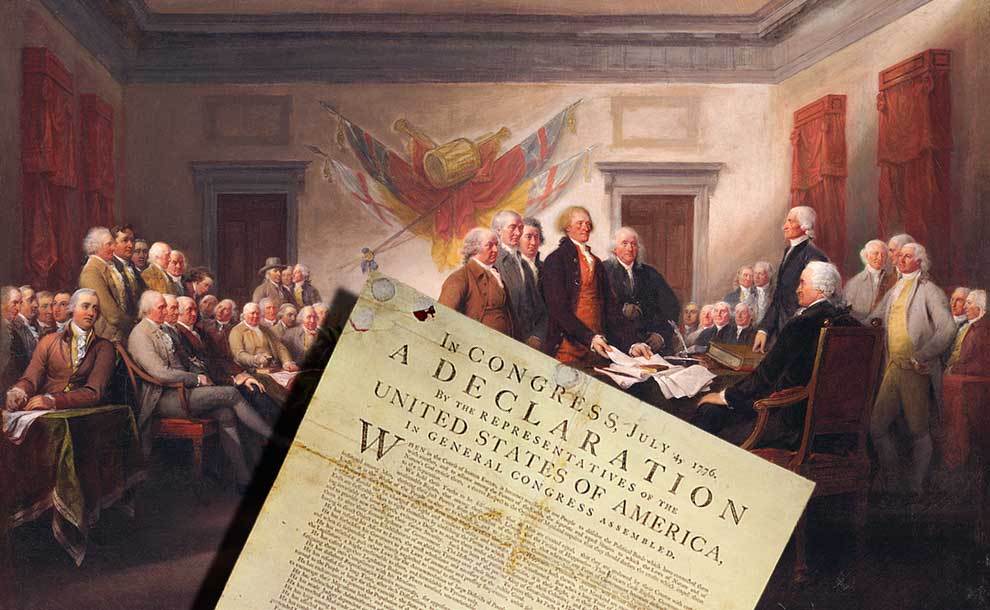
A BIG Anniversary
I was halfway through writing about carbon dating but A) I could think of a joke to make about it for Pat F., but it wasn’t particularly racy, so she’d have been bored. B) This morning I realized what day this was. And that it’s the 250th anniversary of that date.
A quarter of a millennium.
If I can memorialize the 2500th anniversary of Thermopylae and Salamis, I can and absolutely should do THIS.
I have to apologize in advance; I had little time to do this and essentially just summarized what I was reading in Wikipedia. It might not “flow” well in many places.
Wikipedia dates the American Revolution as running from 1765 to 1783. Not 1775. And that’s because the Revolution began in the culture before it began on the battlefield.
Discontent began in 1763 shortly after France was defeated in the “French and Indian War” (which was a small piece of the Seven Years War, which, it could be argued was the actual first world war). American colonists had fought in the war, but that wasn’t good enough for the British Parliament, which imposed taxes to pay for the war. They also closed off the newly-won lands (in essence everything between the Appalachians and the Mississippi River) for settlement, turning over control of those lands to British officials in Montreal.
One of the most infamous of the taxes was the Stamp Tax, which passed in 1765. Printed matter (newspapers, magazines, legal documents, and even playing cards) had to produced on stamped paper produced in London, which included an embossed revenue stamp. So the tax itself was bad enough, but you had to donkey with importing paper from England. Oh, and the tax had to be paid in British currency, which was scarce in the colonies. (The idea was for money to flow from the colonies to Britain…not the other way around.)
The colonists hated this tax, and considered being taxed by a Parliament that they had no representation in to be a violation of their rights as Englishmen. The counterargument was that 90 percent of people living in Britain owned no property and thus had no vote, but were “virtually” represented by land owners who had common interests with them. This was a pretty stupid argument, because what does some guy in Virginia have in common with a land owner in England? One could argue that some unlanded Brit in Bumphucqueshire was represented in Parliament via a landowner in Bumphucqueshire but that works poorly for an American colonist who is 3000 miles away from the nearest land owner with a vote. Besides which even American landowners weren’t represented in Parliament.
There was enough upset over this that individual colonial legislatures (all except Georgia and North Carolina) passed resolutions, and then from October 7-25 of 1765, the Stamp Act Congress convened. Delegates from 9 of the colonies ( Massachusetts, Rhode Island, Connecticut, New York, New Jersey, Pennsylvania, Delaware, Maryland, and South Carolina) attended. Why did the other four not attend? Virginia and Georgia’s assemblies were prevented from meeting by their governors (who, remember, were shills of the Crown). New Hampshire had some sort of financial crisis going on, and took no action, but after adjourning the legislature wanted to reconsider–the governor refused to call it back into session. North Carolina’s assembly had been prorogued by the lieutenant governor for other reasons. Nova Scotia (which included Prince Edward Island and New Brunswick) declined to send delegates. Quebec, Newfoundland, and East and West Florida did not have assemblies.
This congress produced the Declaration of Rights and Grievances. This document proclaimed loyalty to the crown, but insisted that only representatives chosen by the colonists could levy taxes. The document lauded the King; the complaints were about Parliament.
This was rejected by Parliament. However, the Stamp Act was repealed on March 18, 1766 due to pressure from within England. Merchants there were afraid of colonial boycotts. But note Parliament did not concede that they had no right to tax the colonies, and they would try again.
The Stamp Act Congress was the first significant organized political action of the American Revolution…though at that time, almost no one in the colonies was seeking independence.
Tensions flared again in 1767 with the passage of the Townshend Acts. This is actually an umbrella term for about five (historians differ on which ones should be included) acts: The Revenue Act of 1767 (the assholes were trying again), The Commissioners of Customs Act 1769, the Indemnity Act 1767, The New York Restraining Act 1767, and the Vice Admiralty Court Act 1768.
(The second to last might not be a bad idea today, at least as applied to their federal prosecutors.)
The idea was to raise revenue in America to pay judges and governors (all royal appointees), enforce trade regulations (which favored Britain), punish New York for not complying with the Quartering Act, and of course to ensure that there was precedent for Parliament to tax the colonies.
This was a HUGE shove towards the war. Colonists opposed to the acts gradually got violent, leading to the Boston Massacre (1770). American ports refused to import British goods. This was enough to get Parliament to repeal most of the taxes, with the prominent exception of the one on tea, retained mainly to demonstrate that Parliament was allowed to tax the colonies. Resenment continued, exacerbated by corrupt British officials. Colonials started attacking British ships, burning the Gaspee in 1772.
Parliament passed the Tea Act in 1773, granting the British East India Company a tea monopoly (and saving it from bankruptcy), which led to the Boston Tea Party that year.
Parliament passed the “Intolerable Acts” (the Brits called them the “Coercive Acts” which is at least an honest description) in 1774, in retaliation. These were five punitive laws. The first four targeted Massachusetts: Boston Port, Massachusetts Government, Impartial Administration of Justice [so much for honest descriptions], and Quartering Act. Massachusetts lost much of its self-government. The fifth act expanded Quebec further south into the Ohio country…which is now American territory.
Said Lord North (Prime Minister) on 22 April 1774:
The Americans have tarred and feathered your subjects, plundered your merchants, burnt your ships, denied all obedience to your laws and authority; yet so clement and so long forbearing has our conduct been that it is incumbent on us now to take a different course. Whatever may be the consequences, we must risk something; if we do not, all is over.
The fuckwit Lord North
Although the acts targeted Massachusetts, colonists in the other twelve colonies were outraged. Committees of correspondence formed in the Thirteen Colonies, the First Continental Congress met in September 1774 to coordinate a protest. And militias began drilling.
It was only a matter of time, now. Americans by and large were loyal to the Crown even at this time, their complaint was with Parliament. (Only sometime after shooting started did it become plain that the Crown was siding with Parliament–and that, combined with writing by Thomas Paine vastly better than this ramble you’re reading right now, is what shoved our founders over the edge.)
Fast forward to 1775, and once again Massachusetts is front and center. (They were as annoying to tyrants back then as they are to Patriots now.)
Massachusetts patriots had formed the Massachusetts Provincial Congress in opposition to the co-opted Massachusetts colonial government, and of course the militias were drilling. The Provincial Congress effectively controlled all of Massachusetts outside of Boston (which was effectively occupied by Britain).
In February 1775, the British Government declared Massachusetts to be in a state of rebellion. (Not quite, assholes…but you’d make it come true…)
700 British Army regulars under Lieutenant Colonel Francis Smith were secretly ordered to capture and destroy Colonial military supplies stored in Concord by the militia. On the evening of April 18th the Colonials somehow found out that the seizure would happen the very next day: April 19th 1775, two hundred fifty years ago today. This was quite an intelligence coup; most of the British officers had not been told yet. There is speculation that General Gage’s wife (born in New Jersey) was the leaker.
Between 9 and 10 pm Joseph Warren (a friend of Margaret Gage) told Paul Revere and William Dawes that the Brits were embarking on boats from Boston to Cambridge, there to pick up the road to Lexington and Concord. Warren believed based on his sources (whoever they were) that the main objective was to arrest Adams and Hancock. They weren’t too worried about Concord; the supplies had long since been moved elsewhere. But they were concerned that the Colonial leaders in Lexington were unprepared. Revere and Dawes were sent out to warn Lexington and the militia in nearby towns.
Revere gave instructions to send a signal to Charlestown using lanterns hung in the steeple of Boston’s Old North Church. (Yes, you read that right. The lanterns were a signal from Paul Revere.) Revere then sailed north out of Boston, evading the HMS Somerset which was anchored nearby. (Crossings were banned at that hour.) He then rode on to Lexington, warning almost every house along the way.
In Lexington, Dawes, Revere, Adams and Hancock met with the militia and concluded that the force being sent was too big to be just for arresting Adams and Hancock; they concluded that Concord was the main target. Revere and Dawes continued on to Concord, accompanied by Samuel Prescott. They ran into a British patrol led by Major Mitchell at Lincoln; Revere was captured, Dawes was thrown from his horse. Prescott was the only one to reach Concord.
The warnings brought by Revere, Dawes, and Prescott triggered a system of “alarm and muster” that had been worked out in response to a prior seizure of powder from a militia near Boston. (These people knew not to give up their guns.) Dozens of eastern Massachusetts militias mustered in response to over 500 British regulars leaving Boston.
Those early warnings were the key to success.
The Brits disembarked near Phipps Farm in Cambridge, and began the 17 mile march to Concord at 2 am. They had had to wade ashore, so their uniforms and shoes were wet and muddy. They overheard the Colonial alarms and knew they had lost the element of surprise.
At 3 am Colonel Smith sent Major Pitcairn ahead with six companies of light infantry to quick march to Concord. En route an hour later Smith decided to send a message back to Boston to request reinforcements.
PItcairn’s advance guard entered Lexington at sunrise on April 19. About 80 Lexington militiamen under the command of Captain John Parker emerged from Buckman Tavern and stood in ranks on Lexington Common watching the Brits. This militia was not one of the “minuteman” companies, but rather a unit that trained other militias. There were also between 40 and 100 spectators along the side of the road.
Parker knew he was outmatched. He wasn’t about to sacrifice his men for no reason…and there was no reason. The supplies in Concord had already been removed to safety. There was no war, not yet (wait a few hours). Also the British had gone on such missions before and usually found nothing and simply went back to Boston. Parker figured that would happen this time; the Brits would go back to Boston, with nothing to show about it other than a day’s exercise.
Parker put his men into parade ground formation. They were in plain sight, not blocking the Brits. He is recorded as ordering, “Stand your ground; don’t fire unless fired upon, but if they mean to have a war, let it begin here.” His deposition from shortly after the battle:
I … ordered our Militia to meet on the Common in said Lexington to consult what to do, and concluded not to be discovered, nor meddle or make with said Regular Troops (if they should approach) unless they should insult or molest us; and, upon their sudden Approach, I immediately ordered our Militia to disperse, and not to fire:—Immediately said Troops made their appearance and rushed furiously, fired upon, and killed eight of our Party without receiving any Provocation therefor from us.
Captain John Parker of the Lexington Militia
But I get ahead of myself.
The Brits arrived, and an officer (probably Pitcairn) rode forward, ordering the militia to disperse. He may have also ordered them to lay down their arms. Parker ordered his men to disperse. Unfortunately his voice was injured by tuberculosis, and few heard him. Those that did, dispersed slowly taking their guns with them.
Both sides ordered their men to hold their fire…but someone fired a shot.
We’ll never know who.
Some claimed one of the onlookers fired the shot from concealment (if not cover). Some said it was a mounted British officer. There’s general agreement that the shots did not come from the front lines.
We like to call it a battle, but objectively it was a skirmish. That states its scale accurately, but hugely understates its importance.
The British had no trouble gaining control in Lexington, after some chaos.
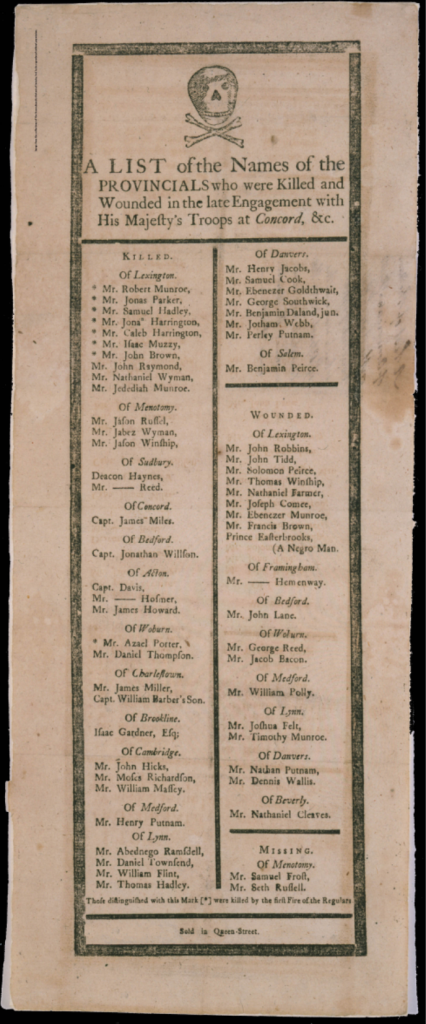
Let us note the names of the eight Lexington men who perished in this skirmish. These were the first eight Americans to die in the American Revolutionary War.
John Brown, Samuel Hadley, Caleb Harrington, Jonathon Harrington, Robert Munroe, Isaac Muzzey, Asahel Porter, and Jonas Parker.
Jonathon Harrington, fatally wounded by a British musket ball, managed to crawl back to his home, and died on his own doorstep. Jonas Parker (cousin to John Parker) was run through by bayonet. One wounded man, Prince Estabrook, was a black slave who was serving in the militia.
There was one British casualty, shot in the thigh.
The Brits got out of control largely because they didn’t know what they were supposed to be doing there. Colonel Smith, when he arrived, had a drummer beat assembly, ending the fiasco. The light infantry were permitted to fire a victory volley, then the column reformed and marched on towards Concord.
The Concord militia (and militias from neighboring villages) was unsure what to do; a column of 250 militia marched out to meet the Brits on their way, but seeing they were outnumbered, turned around and went back. The militia then assembled on a hill about a mile north of the North Bridge.
The British arrived, and divided; some went to secure South Bridge, 100 or so to secure North Bridge. Another group went two miles further than the North Bridge to Barrett’s Farm, which was believed to be one of the places supplies had been cached. Some more regulars guarded the return route. Captain Walter Laurie, in charge of the North Bridge and Barret forces was uncomfortably aware that he was outnumbered by the Colonials and requested reinforcements.
The grenadiers searched the town of Concord. Some of them focused on Ephraim Jones’s tavern, because they had intel that cannon were buried there. Jones at first wouldn’t let them in, but at gunpoint revealed where three 24 lb cannon were located. (These were yuuuge cannon, better at battering fortifications than for defense.) The trunnions of the cannons were smashed, making it impossible to mount them. Some gun carriages were found at the village meetinghouse and burned. Provisions and 550 pounds of musket balls were thrown into a millpond.
Then the Brits left. In fact they had been scrupulous in their treatment of the people; they even paid for food and drink they consumed. The locals took advantage of this, giving bad directions and saving several smaller caches of supplies.
Nothing was found at the Barrett farm. (That doesn’t mean there wasn’t anything there; far from it.)
The Brits stationed at the North Bridge retreated and the colonials under the command of Barret (as in “farm”) advanced toward the bridge, with orders not to fire unless fired upon. British captain Laurie ordered a retreat across the bridge, and then he made a mistake. He ordered his men to form positions for “street firing” in a column perpendicular to the river. This was a weird call (this formation was appropriate for firing down a street, but this was a rural setting) and there was a lot of confusion.
Then a shot rang out, likely a panic shot from a tired British soldier.
Two more Brits fired into the river, and others, thinking they had been ordered to fire, did so in a volley.
Two minutemen from Acton were hit and killed instantly. Let us note their names: Private Abner Hosmer and Captain Isaac Davis.
Major Buttrick then ordered the militia to return fire. At this point the opposing lines were 50 yards apart. The first volley by the Militia killed three British privates, injured eight officers and sergeants and nine privates.
The regulars, outnumbered, poorly led, and quite possibly having no experience in combat, retreated in panic, abandoning their fallen. They met the grenadiers coming from town toward the North bridge to reinforce them (in response to Laurie’s request).
The Brits at Barret’s Farm were cut off. When they later marched back to Concord, they walked right through the battlefield, seeing dead and wounded comrades.
The Brits in Concord finished their search, ate lunch, and left Concord after noon, heading for Boston. This allowed more militia to arrive from outlying towns, lining the road to Boston.
Initially, Lieutenant Colonel Smith sent flankers to follow a ridge and protect his forces.
(Side note: The common mental image of the British mindlessly marching in formation doing nothing at all to counter pot shots from the Americans is a false one; it was the job of flankers to move along the flanks and take on anyone inclined to do this.)
Unfortunately for the Brits that ridge ended about a mile east of Concord at Meriam’s Corner, where there was a bridge across Elm Brook. The British had to pull the flankers back into the main column and march three abreast to cross that bridge. The militia leaders could see this would have to happen and they converged on that bridge.
Nevertheless the Brits crossed the bridge unmolested except by intermittent distant and ineffective fire. However the British rear guard turned about and fired a volley at the militia which had closed towithin musket range. The colonists returned fire, killing two and wounding six Brits and taking no casualties. The British flankers were sent out again after crossing the bridge.
Another mile to Brooks hill, where 500 militiamen had assembled on the south side of the road waiting to fire down upon the Brits. Smith’s leading forces charged the hill to drive them away, but the colonists stood their ground and inflicted significant casualties.
Another bridge into Lincoln, and more militia. And then things got worse. The road rose and curved sharply left through a wooded area. The Woburn militia had positioned themselves to the southeast of the bend in a rocky lightly wooded area. More militia, coming in from Meriam’s Corner, set up on the other side of the bend, and the Brits got caught in a crossfire. More militia were coming up on the column from behind. Five hundred yards after this, the road bent sharply to the right and the Brits got caught in another crossfire. Casualties in this double-bend were about 30 (killed and wounded combined) for the Brits, and four militia killed, among them Captain Jonathan Wilson of Bedford, Captain Nathan Wyman of Billerica, Lt. John Bacon of Natick, and Daniel Thompson of Woburn.
The British soldiers escaped by breaking into a trot, a pace that the colonials (who weren’t on a road) could not match through the woods and swamps. Unfortunately the militia on the road in pursuit were too densely packed and disorganized to do much more than harass the Brits.
Anyhow, you can see how this is going, and I’m running short on time. The Brits used their flankers where possible oftentimes getting behind the militias and inflicting casualties, but this was the death of a thousand cuts for the Brits.
Nearing Lexington, the Lexington militia–that had lost eight people earlier in the day–laid an ambush. Lt. Colonel Smith was wounded in the thigh and knocked from his horse. Pitcairn assumed command and sent light infantry to clear the militia forces.
They weren’t even halfway back. So here I really must cut it short and leap to the end–except to note that the worst was yet to come for the Brits: Menotony and Cambridge. And as the day wore on they became more and more likely to commit atrocities in spite of the best efforts of their officers.
The Brits made it back to Boston. Colonials: 49 killed, 39 wounded, 5 missing. Brits: 73 killed, 174 wounded, 53 missing. Considering this was militia against regulars…that’s a much more lopsided loss than it looked. It’s primarily the result of the Brits suddenly finding themselves deep inside enemy territory; territory of the enemies they had spent the last ten years making.
The next morning Boston was surrounded by fifteen thousand militia, and it was a war now. Boston was under siege. The forces surrounding it grew over the next few days.
Those forces would soon become the Continental Army, by resolution of the Second Continental Congress, on June 14th.
Militarily this wasn’t a huge battle, but strategically it was a huge faceplant for the British. The point of the Intolerable Acts was to prevent fighting, the expedition was supposed to prevent fighting as well, and instead it had touched off a war.
Now there was a war for British political opinion. The Provincial Congress collected scores of sworn testimonies from militiamen and British prisoners. A week after the battle, word got to the Colonials that Gage was sending his official description of events to London; the Provincial Congress sent a packet of over 100 depositions to London by a faster ship. They ended up printed in London newspapers two weeks before Gage’s report arrived. It turned out his report was vague. Even George Germain (no friend of the colonists) stated that the Bostonians were in the right. Gage was made a scapegoat, when the real problem was British policy. The British troops in Boston blamed either Gage or Colonel Smith.
The day after the battle, John Adams rode along the battlefields and declared that the Rubicon had been crossed. Thomas Paine had up to then considered the argument “a kind of law-suit” but now he “rejected the hardened, sullen-tempered Pharoah of England forever.” (And remember this was the man whose essay did more than anything else to convince Americans that they should pursue independence, not reconciliation.)
On hearing the news, George Washington at Mount Vernon said:
the once-happy and peaceful plains of America are either to be drenched in blood or inhabited by slaves. Sad alternative! But can a virtuous man hesitate in his choice?
Two hundred and fifty years later, we know the choice that was made. And we know that we made it stick.
And we must never forget that this work is never done.
What is it that feeds our battle, yet starves our victory?
Do We Still Need the Kang (Mis)Quote?
I’m still using the quote about winning the battles but losing the war. It seems like this doesn’t make sense right now given that we seem to be going from triumph to triumph.
On the contrary. This is the exception that proves the rule. The quote isn’t just a lament, it’s to point out why we can never seem to win.
You see, the RINOs cannot interfere and that is why, just for once, we are actually winning. And that is just one more piece of evidence (for the willfully blind) as to what I have been saying with that quote.
It stays.
Speaker Johnson Pinging you on January 6 Tapes
Just a friendly reminder Speaker Johnson. You’re doing some good things–or at least trying in the case of the budget–but this is the most important thing out there still hanging. One initial block released with the promise of more…and?
We have American patriots being held without bail and without trial, and the tapes almost certainly contain exculpatory evidence. (And if they don’t, and we’re all just yelling in an echo chamber over here, we need to know that too. And there’s only one way to know.)
Either we have a weaponized, corrupt government or we have a lot of internet charlatans. Let’s expose whatever it is. (I’m betting it’s the corrupt weaponized government, but if I am wrong, I’d like to see proof.)
Justice Must Be Done.
The 2020 election must be acknowledged as fraudulent, and steps must be taken to prosecute the fraudsters and restore integrity to the system.
Yes this is still true in spite of 2024. Fraud must be rooted out of our system and that hasn’t changed just because the fraud wasn’t enough to stop Trump winning a second term. Fraud WILL be ramped up as soon as we stop paying attention.
Otherwise, everything ends again in 2028. Or perhaps earlier if Trump is saddled with a Left/RINO congress in 2026, via fraud.
Small Government?
Many times conservatives (real and fake) speak of “small government” being the goal.
This sounds good, and mostly is good, but it misses the essential point. The important thing here isn’t the size, but rather the purpose, of government. We could have a cheap, small tyranny. After all our government spends most of its revenue on payments to individuals and foreign aid, neither of which is part of the tyrannical apparatus trying to keep us locked down and censored. What parts of the government would be necessary for a tyranny? It’d be a lot smaller than what we have now. We could shrink the government and nevertheless find it more tyrannical than it is today.
No, what we want is a limited government, limited not in size, but rather in scope. Limited, that is, in what it’s allowed to do. Under current circumstances, such a government would also be much smaller, but that’s a side effect. If we were in a World War II sort of war, an existential fight against nasty dictatorships on the brink of world conquest, that would be very expensive and would require a gargantuan government, but that would be what the government should be doing. That would be a large, but still limited government, since it’d be working to protect our rights.
World War II would have been the wrong time to squawk about “small government,” but it wasn’t (and never is) a bad time to demand limited government. Today would be a better time to ask for a small government–at least the job it should be doing is small today–but it misses the essential point; we want government to not do certain things. Many of those things we don’t want it doing are expensive but many of them are quite eminently doable by a smaller government than the one we have today. Small, but still exceeding proper limits.
So be careful what you ask for. You might get it and find you asked for the wrong thing.
Political Science In Summation
It’s really just a matter of people who can’t be happy unless they control others…versus those who want to be left alone. The oldest conflict within mankind. Government is necessary, but government attracts the assholes (a highly technical term for the control freaks).
His Truth?
Again we saw an instance of “It might be true for Billy, but it’s not true for Bob” logic this week.
I hear this often, and it’s usually harmless. As when it’s describing differing circumstances, not different facts. “Housing is unaffordable” can be true for one person, but not for another who makes ten times as much.
But sometimes the speaker means it literally. Something like 2+2=4 is asserted to be true for Billy but not for Bob. (And when it’s literal, it’s usually Bob saying it.) And in that sense, it’s nonsense, dangerous nonsense. There is ONE reality, and it exists independent of our desires and our perceptions. It would go on existing if we weren’t here. We exist in it. It does not exist in our heads. It’s not a personal construct, and it isn’t a social construct. If there were no society, reality would continue to be what it is, it wouldn’t vanish…which it would have to do, if it were a social construct.
Now what can change from person to person is the perception of reality. We see that all the time. And people will, of course, act on those perceptions. They will vote for Trump (or try to) if their perception is close to mine, and vote against Trump (and certainly succeed at doing so) if their perception is distant from mine (and therefore, if I do say so, wrong). I have heard people say “perception is reality” and usually, that’s what they’re trying to say–your perception of reality is, as far as you know, an accurate representation of reality, or you’d change it.
But I really wish they’d say it differently. And sometimes, to get back to Billy and Bob, the person who says they have different truths is really saying they have different perceptions of reality–different worldviews. I can’t argue with the latter. But I sure wish they’d say it better. That way I’d know that someone who blabbers about two different truths is delusional and not worth my time, at least not until he passes kindergarten-level metaphysics on his umpteenth attempt.
Lawyer Appeasement Section
OK now for the fine print.
This is the Q Tree Daily Thread. You know the drill. There’s no Political correctness, but civility is a requirement. There are Important Guidelines, here, with an addendum on 20191110.
We have a new board – called The U Tree – where people can take each other to the woodshed without fear of censorship or moderation.
And remember Wheatie’s Rules:
1. No food fights 2. No running with scissors. 3. If you bring snacks, bring enough for everyone. 4. Zeroth rule of gun safety: Don’t let the government get your guns. 5. Rule one of gun safety: The gun is always loaded. 5a. If you actually want the gun to be loaded, like because you’re checking out a bump in the night, then it’s empty. 6. Rule two of gun safety: Never point the gun at anything you’re not willing to destroy. 7. Rule three: Keep your finger off the trigger until ready to fire. 8. Rule the fourth: Be sure of your target and what is behind it.
Gold blooped up over the 3000 dollar mark briefly Friday, but retreated a bit and closed at the level shown above (it actually closed a bit higher than that on Thursday). So of course the FRNSI is at an all-time weekly high. Silver did very well this last week; long overdue; gold is now worth over an ounce less silver than last week. Platinum shows some signs of life. Maybe it is only mostly dead.
*The SteveInCO Federal Reserve Note Suckage Index (FRNSI) is a measure of how much the dollar has inflated. It’s the ratio of the current price of gold, to the number of dollars an ounce of fine gold made up when the dollar was defined as 25.8 grains of 0.900 gold. That worked out to an ounce being $20.67+71/387 of a cent. (Note gold wasn’t worth this much back then, thus much gold was $20.67 71/387ths. It’s a subtle distinction. One ounce of gold wasn’t worth $20.67 back then, it was $20.67.) Once this ratio is computed, 1 is subtracted from it so that the number is zero when the dollar is at its proper value, indicating zero suckage.
The Ides of March
Yes, our calendar is a direct descendant of the Roman calendar, particularly after Julius Caesar’s reforms.
That doesn’t mean we’d have any idea WTF we were looking at when looking at a Roman Calendar. They didn’t lay out months in tidy little rectangles like we do, with days numbered from 1-31. (Or 30, or 28 or fairly rarely 29.)
Nope they did something totally wacky, at least from our point of view.
The Kalends was the first day of the month. The Nones was the ninth day before the Ides. The Ides were, in turn the 15th day of full months (months of 31 days), or the 13th day of hollow months (months of 30 days) [Before Julius and Augustus Caesar, February had 30 days.] After some reforms months could have four different lengths and even the 31 day months were handled two different ways.
Counting through the days of the month, the 1st was “on the Kalends”. the 2nd was “the day after the Kalends” OR it could be called (in March, May, July and October–MMJO) the “Sixth day before the Nones” and for every other month the “Fourth day before the Nones”. Then count down each subsequent day until on the 7th (MMJO) or 5th (all others), was “On the Nones.” But beware because the “Third day before the Nones” was followed by “the day before the Nones” (there was no “second day before the Nones). The next day (8th or 6th) was “The day after the Nones.” OR that day could be called the 8th day before the Ides. Then the 7th, 6th, 5th, 4th, 3rd days before the Nones…and then skipping over “the second day before the Ides” to “the day before the Ides.” Then the Ides…which was on the 15th (MMJO) or 13th (all other months).
Then it gets tricky. For MMJO, the day after the Ides (the 16th) could be called “The day after the ides” or “the 17th day before the Kalends” Note, though that (for example) March 16 was called “the 14th day before the Kalends of April.” So April was being named…even though it was really still March! For January, August, and December, the “day after the Ides” (the 14th) was also “the 19th day before the Kalends”. For April, June, September, and November (all 30 days at the time), the “Day after the Ides” (the 14th) was “the 18th day before the Kalends”. For February (28 or 29 days) the “Day after the Ides” (the 14th) was either the 16th or 17th day before the Kalends of March”.
You would then count down to the second-to-last-day of the month and that would be the 3rd day of the Kalends, and the last day would be “the day before the kalends.”
Of course they did this in Latin, not English, so for example, they’d say “ante diem tertium decimum Kalendas” (the 13th day before the Kalends) and write it down as “a.d. XIII Kal.” since who wants to write all that out?
The day after Kalends, Nones, or Ides were considered “black” days and unlucky. (Though they were off one day for Julius Caesar.)
[Note before the Julian reforms, there were no thirty day months; there were MMJO (31 days), February (28 days) and everything else (29 days) and they followed the rules for MMJO, 28 day Februaries, and the 29 day February, respectively). When the caesars made January, August and December into 31 day months, they actually left the Ides in the same place relative to the Kalends (i.e., on what we call the 13th of the month) rather than moving the Ides to the 15th, to avoid messing up festival days.]
Somehow, they were able to use this insanely complex system and still have enough brainpower left to conquer the entire Mediterranean world.
And NO I don’t have this memorized, I had to look it up. https://en.wikipedia.org/wiki/Roman_calendar. Otherwise I’d not have the brainpower left to butcher the topic of geology.
A Deeper Dive on Isotopes
Last time I described the atomic nucleus as it came to be known during the early 20th century, and I discussed radioactivity. I touched on isotopes a bit; time for a deeper dive.
As chemists worked to measure atomic weights for all known elements (painstaking and unglamorous work; the ones doing this are the unsung heroes of chemistry) it became apparent that most elements had atomic weights that were almost an integer multiple of the element with the lightest atomic weight: hydrogen (for example, taking hydrogen as 1 (not the currently used value!), helium comes in at 3.971, very close to 4. But there were a few oddballs, too, elements with a not-very-close multiple, like (and now I’ll use the current values, with hydrogen at 1.008, not 1.000) boron (10.81), neon (20.18), chlorine (35.45). Just eyeballing the list it looks like about a quarter of all elements are “off” like this.
It wasn’t until people started ionizing elements and sending the ions through a magnetic field to see how much their trajectories bent that we started to understand this. This was first done by J. J. Thomson (who had discovered the electron, and loved to play with magnets and charged particles) in 1912 with neon gas. Neon is atomic number 10, ten protons, and as I mentioned its atomic weight is 20.18. Thomson discovered that neon is actually mixture of two different things, one with an atomic weight of 20, another with an atomic weight of 22. The signal was weaker for 22, so he figured it neon was mostly the atomic-weight-twenty stuff.
These were both undeniably neon; there was no way to separate them chemically because they both behaved the same (which is to say, being totally unwilling to engage in chemical reactions; neon is a noble gas). They just weighed different. Thomson however had been brought up believing that atomic weight was an inherent property of an element, so he thought of it as two separate gases. We don’t think this any more. They’re both neon. And we now know there’s a very small amount of neon atoms with a mass of 21.
As more and more of these experiments happened, it became clear; if an element’s atomic weight was far off from an integer, it was a mix of these “isotopes.” Aston (who formulated the “whole number rule” for isotopic masses) showed in 1920 that chlorine’s 35.45 atomic weight was due to being a mixture of atoms with mass 35 and mass 37 units.
When talking about just the nucleus of an atom, we often use the term nuclide instead of isotope (which is the whole atom). It’s not a hard and fast rule but chemists will tend to use “isotope” and nuclear physicists including those researching fusion will be a bit more likely to say “nuclide.”
Again, the chemical behavior is nearly identical. In principle a heavier isotope should be slightly slower to react than an lighter one, but the practical difference is nil except in one case. Thus when it matters (and it usually doesn’t), chemists and physicists will write something like neon-20 or neon-22. When they can do so they will follow the formal convention: 20Ne or 22Ne. I am able to do that here (writing the post) but not in comments; but it’s such a pain to do so (wordpiss), that I will stick with writing either neon-20 or Ne-20.
And by the way, for our purposes here, it does matter. Quite a lot.
The one exception regarding chemical differences is the case of hydrogen, which usually has mass number of 1, but some few atoms have a mass number of 2. If you concentrate the mass-2 stuff, and use it to make water, you have heavy water, which even though it’s technically hydrogen monoxide just like tap water is, will kill you. (It also melts at 4 degrees Celsius so it’s possible to put a heavy water ice cube in a glass of water at 1 degree Celsius and it won’t melt. It will sink to the bottom, too, which is even weirder.) In fact for hydrogen and hydrogen alone, there are “special” names for the heavier isotopes; hydrogen-2 is called deuterium and (in this context) hydrogen-1 is called protium. There is also hydrogen-3, which is radioactive and is called tritium.
Once the neutron was discovered by James Chadwick in 1932, we got some clarity as to what was going on. Neutrons, it turns out are very slightly more massive than protons, We now know that neon-20, neon-21 and neon-22 all contain ten protons (neon has ten protons, by definition), but they contain 10, 11, and 12 neutrons, respectively, the total of the two numbers 10+10, 10+11, 10+12 gives you the mass number.
So what happens when you do this sort of analysis on other elements as found in nature? Fluorine (#9) has one isotope, F-19. Tin (#50) has no less than ten isotopes: Sn-112, 114, 115, 116, 117, 118, 119, 120, 122, and 124. The natural proportion for each of these ranges from 0.34 percent to 33 percent.
It is possible to create isotopes in the lab. So long as the number of neutrons isn’t too high or low, you’ll get a nucleus that hangs together for a while, perhaps even permanently. Otherwise the excess neutrons will “drip” off (fail to stick even momentarily) or if there are too few neutrons, a proton will “drip” off.
Between these bounds, the isotope will be intensely radioactive, less intensely radioactive, even less intensely radioactive, dang near stable, or actually stable. (Those are not “official” terms by the way.) And if you include all those made-in-a-lab-and-very-unstable isotopes the isotope counts go way up. Tritium is one of them for instance, and tin actually has isotopes ranging from 99 through 140.
Why do we need to make those highly radioactive isotopes in a lab? Because if there were any on earth originally, they have long since decayed away and none are left.
[If you poke around on wikipedia you may see references to something being “observationally stable.” That means an isotope that they believe on theoretical grounds is almost stable but it’s so close to stable they haven’t caught it decaying yet. In other words “we think this ought to be very very mildly radioactive–so mild we haven’t detected it yet so maybe it’s really stable after all.” Three of the ten tin isotopes I mentioned are “observationally stable”]
Because we are able to produce almost-arbitrary nuclides in the lab, we have pretty complete tables of nuclides–both a table with columns and a bunch of numbers in them, like you see here: https://en.wikipedia.org/wiki/Isotopes_of_tin, or nice graphical ones like this:
Going across the bottom, you have the number of neutrons, going up you have the number of protons, as shown in this excerpt from the very lower left corner. Note that the same isotope number for different elements lie on a diagonal. (They also threw in a bare neutron, mass number 1, element zero.)
The colors indicate how the isotopes decay; black is a stable isotope. Blue is a β+ (positron) decay (or capturing an electron), orange is losing a proton (technically it’s “dripping” the proton), deep purple is dripping a neutron, yellow is alpha decay (note that 8Be alpha decays–and what’s left over is a helium nucleus, which is itself an alpha particle; so really it just splits in two). Green (visible at the other end of the chart) is spontaneous fission where a nucleus splits into two or more large pieces. Finally the pink or light purple squares like 3H are β– (ordinary beta decay).
If you paid attention last time, you should be able to figure out what the isotope will turn into. For example 10Be undergoes beta decay, so it goes up one in charge (it now has 5 protons) but stays the same mass. It becomes boron-10, which is stable.
This chart also indicates half life. And I will more than likely be pasting in other pieces of it in future posts.
OK, so we have this list of all possible isotopes (and ones that arguably shouldn’t be considered isotopes because they “drip” when you try to create them). What do we see when we look “out there” on Earth? This is, after all, supposedly a series on geology, right?
The isotopes we see fall into three broad categories.
Stable isotopes. Every single stable isotope is found on Earth. Every last one.
Long lived isotopes. Isotopes over a certain half-life (which I will discuss below) will be found on Earth too. Again, every last one. (And by the way some of those half lives exceed present day estimates of the age of the earth by millions or even billions of times. And “observationally stable” isotopes, if they turn out to be radioactive, will have even longer half lives.)
Short lived isotopes. Some of the known short-lived isotopes can be found in nature. Here’s the thing though. In all of these cases, we can identify a natural process that is creating those isotopes, even at the present moment. For example, carbon-14 with a half life of about 5,760 years is being produced in the upper atmosphere by cosmic rays impacting nitrogen-14 nuclei. Uranium-234 has a half life of 245,500 years, and is created by uranium-238 decay (U-238 becomes thorium-234 due to an alpha decay, then Th-234 becomes protactinium-234 via beta decay, then Pa-234 becomes U-234 after another beta decay). All of those intermediate products, of course, we also detect in nature (and they have very short half lives of days or hours) so they fall into this category too. But, very important: We do not have any short lived isotopes we cannot account for this way.
This actually paints a picture: We have a situation where we have primordial isotopes–ones that apparently were always here on Earth, and the others, that weren’t. Since anything that could be a primordial nuclide based on being stable or having a long half life, is here, there’s no reason to suppose that some other nuclide that is now not found in nature wasn’t actually once here–only to have decayed completely away. Which means the Earth would have to be old enough for them to be gone by now.
OK, so what’s the dividing line between short lived and long lived isotopes? Somewhere between 100 and 700 million years.
Uranium-236 is listed twice (I just noticed). The 234,200,000 figure should not be there, so I crossed it out.
We cannot find plutonium-244 in nature. We’ve tried, some claim to have found it, but it’s inconclusive. Likewise with samarium-146. But we have no trouble finding uranium-235…and were even able to send Hiroshima, Japan a care package of the stuff on August 6 of 1945, the first nuclear bomb to be detonated in anger.
As it happens, samarium-146, if any were present on our Earth 4.5 billion years ago, would have gone through over 40 half lives, which is to say less than a trillionth of it would be left today. Uranium-235 (which we know was here) has gone through six half lives, so over one percent of it is still left.
In other words, this situation is consistent with Earth being 4.5 billion or so years old, as dated by other methods. If there were significant amounts of Pu-244 or Sm-146 around, the Earth would have to be considerably younger than this (though it could still be in the billions of years) for that to make sense.
All told, there are 251 stable nuclides, and 35 long-lived primordial nuclides.
As it happens many of the primordial nuclides can be of use in radiometric dating. We’ll dive into that next time. It’s now 10:16 PM here and I’m sure people are getting antsy.
What is it that feeds our battle, yet starves our victory?
First Things First
Today sees two memorial services for “Sam”: Susan P Sampson (Deplorable Patriot) at 10 AM CST (at St. Roch Roman Catholic Church in St. Louis) and Sam, PAVACA’s brother at 2PM EST (Peeples Valley Baptist Church in Cartersville, Georgia).
RIP
We carry on the fight, in memory of the fallen.
Do We Still Need the Kang (Mis)Quote?
I’m still using the quote about winning the battles but losing the war. It seems like this doesn’t make sense right now given that we seem to be going from triumph to triumph.
On the contrary. This is the exception that proves the rule. The quote isn’t just a lament, it’s to point out why we can never seem to win.
You see, the RINOs cannot interfere and that is why, just for once, we are actually winning. And that is just one more piece of evidence (for the willfully blind) as to what I have been saying with that quote.
It stays.
Speaker Johnson Pinging you on January 6 Tapes
Just a friendly reminder Speaker Johnson. You’re doing some good things–or at least trying in the case of the budget–but this is the most important thing out there still hanging. One initial block released with the promise of more…and?
We have American patriots being held without bail and without trial, and the tapes almost certainly contain exculpatory evidence. (And if they don’t, and we’re all just yelling in an echo chamber over here, we need to know that too. And there’s only one way to know.)
Either we have a weaponized, corrupt government or we have a lot of internet charlatans. Let’s expose whatever it is. (I’m betting it’s the corrupt weaponized government, but if I am wrong, I’d like to see proof.)
Justice Must Be Done.
The 2020 election must be acknowledged as fraudulent, and steps must be taken to prosecute the fraudsters and restore integrity to the system.
Yes this is still true in spite of 2024. Fraud must be rooted out of our system and that hasn’t changed just because the fraud wasn’t enough to stop Trump winning a second term. Fraud WILL be ramped up as soon as we stop paying attention.
Otherwise, everything ends again in 2028. Or perhaps earlier if Trump is saddled with a Left/RINO congress in 2026, via fraud.
Small Government?
Many times conservatives (real and fake) speak of “small government” being the goal.
This sounds good, and mostly is good, but it misses the essential point. The important thing here isn’t the size, but rather the purpose, of government. We could have a cheap, small tyranny. After all our government spends most of its revenue on payments to individuals and foreign aid, neither of which is part of the tyrannical apparatus trying to keep us locked down and censored. What parts of the government would be necessary for a tyranny? It’d be a lot smaller than what we have now. We could shrink the government and nevertheless find it more tyrannical than it is today.
No, what we want is a limited government, limited not in size, but rather in scope. Limited, that is, in what it’s allowed to do. Under current circumstances, such a government would also be much smaller, but that’s a side effect. If we were in a World War II sort of war, an existential fight against nasty dictatorships on the brink of world conquest, that would be very expensive and would require a gargantuan government, but that would be what the government should be doing. That would be a large, but still limited government, since it’d be working to protect our rights.
World War II would have been the wrong time to squawk about “small government,” but it wasn’t (and never is) a bad time to demand limited government. Today would be a better time to ask for a small government–at least the job it should be doing is small today–but it misses the essential point; we want government to not do certain things. Many of those things we don’t want it doing are expensive but many of them are quite eminently doable by a smaller government than the one we have today. Small, but still exceeding proper limits.
So be careful what you ask for. You might get it and find you asked for the wrong thing.
Political Science In Summation
It’s really just a matter of people who can’t be happy unless they control others…versus those who want to be left alone. The oldest conflict within mankind. Government is necessary, but government attracts the assholes (a highly technical term for the control freaks).
His Truth?
Again we saw an instance of “It might be true for Billy, but it’s not true for Bob” logic this week.
I hear this often, and it’s usually harmless. As when it’s describing differing circumstances, not different facts. “Housing is unaffordable” can be true for one person, but not for another who makes ten times as much.
But sometimes the speaker means it literally. Something like 2+2=4 is asserted to be true for Billy but not for Bob. (And when it’s literal, it’s usually Bob saying it.) And in that sense, it’s nonsense, dangerous nonsense. There is ONE reality, and it exists independent of our desires and our perceptions. It would go on existing if we weren’t here. We exist in it. It does not exist in our heads. It’s not a personal construct, and it isn’t a social construct. If there were no society, reality would continue to be what it is, it wouldn’t vanish…which it would have to do, if it were a social construct.
Now what can change from person to person is the perception of reality. We see that all the time. And people will, of course, act on those perceptions. They will vote for Trump (or try to) if their perception is close to mine, and vote against Trump (and certainly succeed at doing so) if their perception is distant from mine (and therefore, if I do say so, wrong). I have heard people say “perception is reality” and usually, that’s what they’re trying to say–your perception of reality is, as far as you know, an accurate representation of reality, or you’d change it.
But I really wish they’d say it differently. And sometimes, to get back to Billy and Bob, the person who says they have different truths is really saying they have different perceptions of reality–different worldviews. I can’t argue with the latter. But I sure wish they’d say it better. That way I’d know that someone who blabbers about two different truths is delusional and not worth my time, at least not until he passes kindergarten-level metaphysics on his umpteenth attempt.
Lawyer Appeasement Section
OK now for the fine print.
This is the WQTH Daily Thread. You know the drill. There’s no Poltical correctness, but civility is a requirement. There are Important Guidelines, here, with an addendum on 20191110.
We have a new board – called The U Tree – where people can take each other to the woodshed without fear of censorship or moderation.
And remember Wheatie’s Rules:
1. No food fights 2. No running with scissors. 3. If you bring snacks, bring enough for everyone. 4. Zeroth rule of gun safety: Don’t let the government get your guns. 5. Rule one of gun safety: The gun is always loaded. 5a. If you actually want the gun to be loaded, like because you’re checking out a bump in the night, then it’s empty. 6. Rule two of gun safety: Never point the gun at anything you’re not willing to destroy. 7. Rule three: Keep your finger off the trigger until ready to fire. 8. Rule the fourth: Be sure of your target and what is behind it.
Gold got into the 2870s range Wednesday, dropped then recovered some on Friday. Silver, of course succeeds in going down even on days when gold went up–down 40+cents on, Friday: a day when gold went up.
*The SteveInCO Federal Reserve Note Suckage Index (FRNSI) is a measure of how much the dollar has inflated. It’s the ratio of the current price of gold, to the number of dollars an ounce of fine gold made up when the dollar was defined as 25.8 grains of 0.900 gold. That worked out to an ounce being $20.67+71/387 of a cent. (Note gold wasn’t worth this much back then, thus much gold was $20.67 71/387ths. It’s a subtle distinction. One ounce of gold wasn’t worth $20.67 back then, it was $20.67.) Once this ratio is computed, 1 is subtracted from it so that the number is zero when the dollar is at its proper value, indicating zero suckage.
A Bit More Geology
I’ve talked about stratigraphy quite a lot in this series so far, and plan to move on to very different aspects of geology for a while…but I’m going to start by a review or summing up or practical application.
Here’s a diagram Valerie brought to the comments last week, as referenced by a YEC site which then went on to disparage it.
This is a cross section of the Grand Canyon, which is everybody’s favorite illustration of stratigraphy in action.
On the right are the attributions to different systems (periods) including the “Precambrian” which isn’t really a period (it’s the bucket they put the first three entire eons into sometimes). If you remember the names from last time (and I would be surprised if you did), there’s some missing names here.
Digression on how I remember them:
I’ve heard names like Cambrian, Ordovician, Silurian, etc., enough to recognize them; but I could never remember the order they appear. I could remember Cambrian being the first Paleozoic period and the Permian being the last one, but Ordovician, Silurian, Devonian, Carboniferous (here divvied up into Mississippian and Pennsylvanian, as is often done in America), I could never remember. Until I looked at the initials: COS is of course the Colorado Springs airport code and living near there that’s easy for me to remember: Cambrian, Ordovician, Silurian. I could force myself to remember the Carboniferous is right before the Permian, which leaves (by elimination) the Devonian as the fourth period right after the Silurian.
I have no difficulty with the Mesozoic because I grew up with a dinosaur nut as a kid; I got exposed to this a lot. Triassic (lame), Jurassic (cool dinosuars), Creataceous (really cool dinosaurs).
The Cenozoic is both easier and harder. Easier because Paleogene obviously comes before Neogene (Paleo = old, Neo = new), so you can list off Paleogene and Neogene (and then just remember Quaternary–note not Quarternary), but harder because this one usually gets subdivided all the way down to epochs, one level further, even in children’s books! I didn’t talk about that at all last time except mentioning that in passing, but those all have names ending in -cene and I can’t ever remember them. (I’ll write them out here just for grins: Paleocene, Eocene and Oligocene (subdivisions of the Paleogene) and Miocene and Pliocene in the Neogene. The Quaternary gets broken down into the Pleistocene and Holocene–the Holocene is everything since the last ice age. Seven of these epochs and they rhyme and I can’t remember their ordering for nuthin.
Anyhow returning to the diagram, the entire Ordovician and Silurian, plus who knows how much late Cambrian and early Devonian, is completely missing from the sequence shown. And nothing after the Permian. In fact for all we know from looking at the diagram the last part of the Permian is missing too. What gives?
I’ve talked a lot about rock layers being laid down, and you might have got the impression this happens all the time everywhere, but that’s not true. In many cases nothing gets laid down for millions of years (imagine, for instance, a desert, or mountains, or the land under an icecap or glacier). And in many cases, something already laid down gets removed by erosion. Here what we see is a nice thick Cambrian layer followed immediately by a thin Devonian layer.
For all we know, there may have once been more Cambrian rock here, then some amount of Ordovician rock, then some Silurian rock…and then deposition stopped, and a bunch of stuff got eroded away until resuming near the end of the Devonian.
Or maybe none of that ever got laid down; deposition stopped right where we see it, then resumed late in the Devonian. We can’t tell–not from this diagram at least–we just know those layers aren’t there now.
(If you dig deeper you can learn a bit more. The Muav Limestone is the top Cambrian layer shown, and you can look that up in Wikipedia (and then chase down the sources if you really want to be thorough). In addition to describing the limestone as fine-grained and gray, it goes on to describe the extent of the formation. It turns out the Muav Limestone was laid down in the mid-to-late Cambrian, not at the very end (dates are given), and extends into Utah, Nevada and California…and it is of different thicknesses in different areas. In most places what lies on top of it is Mississippian rock, but in some areas (like the Grand Canyon) where it’s a bit thinner there’s Devonian rock there. Now you can reconstruct a bit what happened: The Muav was laid down. Then parts of it were eroded and there was a Devonian deposit, which probably got planed off by erosion but it lived on in places where the Muav was lower and it filled in deeper areas.
[When I think about the sheer amount of field work it takes to map these things, I am staggered. Geologists basically have to go everywhere to do this to this level of detail.]
The dividing line is labeled as a “disconformity.” It turns out that a disconformity is a specific type of unconformity. And an unconformity is any sort of gap in the stratigraphic sequence, which indicates a gap in deposition of sediment.
I can’t say it better than Wikipoo does so I’ll just quote it: “The rocks above an unconformity are younger than the rocks beneath (unless the sequence has been overturned). An unconformity represents time during which no sediments were preserved in a region or were subsequently eroded before the next deposition. The local record for that time interval is missing and geologists must use other clues to discover that part of the geologic history of that area. The interval of geologic time not represented is called a hiatus. It is a kind of relative dating.”
It’s called a “disconformity” when the unconformity is between parallel layers of sedimentary rock…as is the case here.
It is called a “nonconformity” when the upper layer is sedimentary and what is below is igneous or metamorphic rock, presumably partially eroded away before the sediments were deposited.
Also showing up in that diagram is an “angular unconformity” where the rocks below the unconformity are angled. There are parallel layers there but the layers are at a steep tilt. This usually happens because after the layers were deposited there was a mountain building episode that tilted the landscape. Then part was eroded away and the overlying sediment was deposited.
And of course at the very top, nothing above the Kaibab limestone, which (I went and looked) is early-to-mid Permian, so the late Permian either was never deposited here, or was and has been eroded away. But one shouldn’t judge such things from one location. Before we start looking elsewhere though, I’m going to paste in a different diagram of the Grand Canyon layers, one from the National Park Service:
Some occasional bluffs appear on top of the Kaibab that are of the “Moenkopi” formation.
But let’s look further afield, and if we do so we’ll be rewarded. Because the Kaibab is under many additional layers in Zion National Park. That nails it down; the Kaibab was once under a lot more rock than it is today. Here are the layers that appear above it in Zion:
The Dakota formation spreads all over the Intermountain Western United States and further, it is seen in Kansas as well as the Dakotas. (And I can guess what I am going to find when I go look: YUP, it’s Cretaceous; the last period/system of the Mesozoic. (And the Dakota formation is mid-Cretaceous at that, not late Cretaceous). That’s because there was an “inland sea” called the Western Interior Seaway in the Western United States until then, and I’ve known about that since childhood. Yes, a shallow arm of the ocean where there are now highlands and even mountains.)
From Ellis County, Kansas (which is Western Kansas on or near I-70) we have this imprint fossil of a leaf; the rock contains significant iron. Apparently when this leaf got buried, the area was boggy sand near deciduous (leafy) trees. Other nearby areas have fossilized mollusc shells so there was also a beach near here at one point in time.
(You may have noticed a lot of those Zion Park formation names are quite redolent of the Southwest: Kaibab, Moenkopi, Chinle, Moenave, Keyenta, and Navajo. All were discovered on the Colorado Plateau, largely by watching the rock layers fly by as Wile E. Coyote fell thousands of feet whilst trying to get away from the anvil that was his traveling companion. Really, really, he should never have looked down.)
So what forces erode rocks? Or (by the way) the soil before it becomes a rock?
Many different things. But number one is:
Erosion by Water
And there are many ways for water to do this. Rainfall and surface runoff are what I (sometimes) see where I live, far away from the World Sump known as the ocean, so I’ll cover that one first.
The mere act of a raindrop hitting the ground can sometimes eject particles of soil. But much more dramatic erosion results from runoff; it can go downslope as sheet erosion, form rills, or even create gullies. Rills and gullies are qualitatively the same, but a rill is small enough that you can (if you are farming the land) fill it in just through normal tilling the soil.
Continuous water flow occurs in rivers and streams. Given time they can wear down rocks; rocks in the bed of a stream eventually become smoothed down into pebbles. Streams can not be fed by rainfall but also snow melt and springs.
Entire mountain ranges can, and will, be removed by these processes though it takes millions of years. Streams will first cut narrow, v-shaped canyons; as time progresses and the mountains erode away the channels will get more of a U profile, and eventually the stream ends up moving slowly through a broad river valley. Or one can often see such a progression following a stream downhill today. (Geologists even talk of “young” streams (the ones cutting narrow valleys) versus “mature” streams, with more rounded beds, and then finally “old age”, which are more like:
A stream in a wide flood plain, moving slowly, will eventually start to meander (look at a map of the lower Mississippi to see this in action today). The stream can cut across the meanders especially during a flood, and leave behind oxbow lakes as seen in this picture of the Nowitna River in Alaska.
Water flowing in a stream will pick up more “stuff” the faster it is flowing; when it’s a flash flood it can remove boulders. Slower moving streams will pick sand up off their beds and move it downstream. Fine Silt can stay suspended even along slow-moving nearly-flat rivers.
Of course it’s easiest for streams to pick up loose material like sand than to actually grind down rock, but the latter does happen…assisted some by the loose stuff the stream is carrying. (It is a mistake to compare a gully cut through soil to a canyon cut through rock and assume they are both being cut at the same rate.)
Where does it all go? Downstream of course, and the sediment carried off can be deposited a couple of different ways.
One is the “alluvial fan” where water can emerge from a narrow canyon into a larger valley. The water will spread out and slow down; These are plainly visible in the Basin and Range province of Nevada and California; here is an overhead picture of one in Death Valley:
And from ground level, also in Death Valley (but I don’t know if it’s the same one):
Alluvial fans can be many square kilometers in size and tend to have gentle slopes up to where the stream emerges from its canyon (and nothing says the stream has to run full time; it certainly doesn’t do so here). The deposited stuff tends to be coarser nearer the source, which makes sense: as the water exiting the canyon fans out, it slows down, as it slows down the bigger stuff will be deposited first, closest to where the water exited the canyon.
Alluvial fans have even been seen on Mars, an indication that water used to flow there. They also appear on Titan, but this isn’t due to water flow but rather liquid methane and ethane. As you might expect given the examples I’ve shown, these tend to show up in mountainous, arid places, though by no means must the place be as arid as Death Valley. Buried alluvial fans underlie Denver, Salt Lake City and Los Angeles and often contain groundwater. They also underlie the Ganges valley in India, being fed from the Himalayas. And of course ancient fans often end up becoming sedimentary rock and end up in the geologic column.
River deltas are another obvious destination. The Mississippi delta deposit is tens of thousands of feet thick; it’s so heavy it pushes the bedrock down into the Earth. But in less extreme cases, smaller streams dump sediment into ponds, swamps and oceans…and these could eventually end up becoming rocks in the geologic column.
Below is the mouth of the Amazon river, in Brazil. This river is titanic; it may not be the longest in the world (the other possibility being the Nile) but no other river can hold a candle to it in terms of volume–in fact its total discharge is greater than the next seven rivers on that list, combined. It is mostly in Brazil, but even way upstream where it enters Brazil, it’s carrying more water than any other river on Earth.
But most relevantly here, notice the water is tan–that’s silt, being washed out into the ocean to settle as sediment and eventually show up in a geologic column. (What the geologist who studies it (if any) will look like is another question entirely.)
Those white things on the picture are clouds, which should give you an idea of the sheer scale of the picture.
Streams can empty out into a bog or swamp, too…to say nothing of lakes and endorheic basins. That last sounds truly awful, but that’s any inland basin with no outlet to the ocean. Probably the most famous example of such a thing to Americans is the Great Salt lake, but there are many others in North America, and Eurasia has vast endorheic basins. The map below shows endorheic basins in dark gray (as well as divides separating flows between various oceans).
These tend to be in desert regions; with more water erosion will eventually cut a channel or lower the rims of the basins. This can often happen from outside of the basin, as streams flowing away from it slowly wear down the ridges separating the basin from the outside.
Endorheic lakes have no outflow, so what happens to the water in them? Evaporation. The lake will grow until the evaporation on the surface cancels out the water flowing into the lake. Of course, the rivers flowing into the lake don’t have a constant flow, meaning that the lake can–and does–vary in size. This can be an issue with the Great Salt Lake, which has often flooded during El Nino seasons which tend to dump a lot of rain in the Western US. But when the levels are low there is a lot of evaporite, mostly salt, left behind. This happens at many such lakes including the Dead Sea between Israel and Jordan, and there are many dry lake beds in the Basin and Range Province centered on Nevada but including parts of Utah, California, and Oregon. (Why is this area called the basin and range province? It has mountain ranges…and it’s an endorheic basin.)
I feel as if I haven’t covered this adequately, but I’m simply out of time.
Wolf here, getting ready (shortly after the Wolf Moon + Mars) to head to Washington, DC for the Trump-Vance 2025 Inauguration, otherwise known by the shorthand “T47 Inaugural” – or just T47 for short.
TL;DR- if you’re not in the mood to celebrate, then you need a dose of Patriot Realism, to get over your Battered Patriot Syndrome, which we are all suffering. Go check out TradeBait’s post HERE, and wake up to LIBERTY!
I had long told myself that I would be going to Trump’s second inauguration, as I had been to the first one in 2017, and really enjoyed it. With the stolen election of 2020, I ended up going to J6 instead of J20 in 2021, and – well – that was interesting, too.
When Trump managed to beat the cheat on 5 November 2024, I reconfirmed my commitment to attend the T47 inauguration. However, as the time approached, a combination of finicky health and iffy finances had me on the edge of saying “no mas!” Then, when I looked at hotel prices – roughly three times what I had paid in 2017 – I simply couldn’t afford it. I decided not to bother. I would watch the inauguration on TV with all of you, online at The Q Tree.
And it would have been great fun, too. But sitting it out was not to be.
As I began preparing future posts, in my usual “modified placeholder” manner, I wrote a very special and heartfelt post for the January 20th Inauguration Day open thread, as the 2025 Inauguration happens to fall on my usual Monday daily thread. You will see that special post on Monday.
The thing is, some friends of ours apparently saw that post, too. They let me know they were watching, much like they let Wheatie know, back in 2019. If you recall that incident…..
So yeah – that got my attention. All very deniable – but all very convincing.
A lot has changed since 2021, including the passing of Wheatie, whose final battle began late in 2021 and ended in spring of 2022. I think Wheatie was very disappointed to know that she would never see Trump’s second term. Realizing this, and knowing that our old friends from T45 were still keeping an eye on us, I began to change my mind about going to the Inauguration. Others were keeping the faith – why not me? Yes, I’m growing old and tired, but I’ve still got some sense of duty in me.
And then an invitation came. Not only was I invited – my wife was, too. Yeah, it wasn’t one of the gold-encrusted invitations to sit up on the balcony with all the important stiffs like Al Gore and Tim Walz, but it was still an official invitation, and it was made in the name of our once-again Commander In Chief.
That was it. I told my wife we were going. And when I looked at hotel prices again, some of them actually looked reasonable. With a little bit of shopping, it was going to happen.
So, as you read this, during the next few days, I may be preparing to depart for Washington, DC, am already on my way there, or am there as you read this. I will put this up as a sticky thread, so it’s easy for me to find, as well as others who may stumble upon the site. I am hoping to post journalistic updates from the inauguration. Yes, I’m putting my journalist cap on, which may or may not come in Dark MAGA!!!
This thread will be a place to post about all events connected to the T47 Inauguration – including the MAGA Rally on January 19, the Inauguration Festivities and Swearing-In on January 20, and the Inaugural Parade down Pennsylvania Avenue, shortly after the Swearing-In.
There is a great website connected to the Inauguration.
I will go over some of the important information on the site, below. In the meanwhile, I simply want to give my best wishes to all you QTreepers, and to all our friends and allies out there.
Are you ready to Make America Great Again? I AM!
W
T47 Topic – Weather
Scratch all of the following section – the inauguration has WISELY been moved indoors.
I will keep the old text for historic interest, but you can skip ahead to the comments now.
W
Right now, things are looking VERY cold in DC for the inauguration. Part of me wonders whether this is an anti-Trump psy-op by Club Climate Change, but I have seen nothing to convince me that such a thing is happening.
I’m not sure if this incredibly cold inaugural weather should be classified as something like JUSTICE BEING A DISH BEST SERVED COLD, but in any case, I am expecting things to be frigid. EvenTeam Trump is advising weather sense.
Guest Attire
Please dress warmly and wear comfortable shoes. Washington D.C is expecting cold temperatures. Attendees will have limited access to heated tents on a first-come, first-served basis.
I have been to an inauguration before, when the weather was much better (40s and 50s, IIRC) than is currently expected this year (teens and 20s for Inauguration Day). Dressing appropriately makes the whole thing more enjoyable, I can assure you. Last time, as I layered down from a quality trench coat, I was dressed well enough to look good on TV, if I was interviewed by anybody (I think I did talk to a print journalist or political blogger of some kind, IIRC).
This time, for me, “stylish” will be SKIWEAR and basically outdoor winter fashion. In fact, I am advising all others who are going, to DRESS FOR THE SKI LIFTS.
North Face and Columbia – not Dior and Prada.
Why do I say that? Because people who have seats will be sitting for THREE TO SIX HOURS OR LONGER in temperatures in the upper teens to low 20s.
Cross-reference weather with logistics, and it’s time to get VERY REAL.
People need to dress to be sitting comfortably in what are normally wind chill conditions on a ski lifts, where one cannot “walk around to warm up” or otherwise fight hypothermia.
Teens and twenties are January skiing conditions. Get real, people!
Last time, I was running, walking, and standing near the Washington Memorial, thanks to sabotage by the Obama administration, which forced as many people as they could off the main mall, back to the far side of the Washington Memorial, where they would not appear in aerial photos which begin at the Capitol Building.
It was a sneaky move, slow-walking admissions to the mall, while letting people in where they could not be seen. I would not put this past the Biden administration. Note what is being said about arrival times.
Guest Arrival Information
The security line to enter the National Mall will begin to form early. Driving/parking is stronglydiscouraged, please utilize the Washington Metro System (WMATA) to arrive/depart the mall.
U.S.S.S. guest screening will open at 6:00 AM. The inaugural program will start at 9:30 AM; the Swearing-In Ceremony will start at 11:00 AM. To guarantee a spot, please arrive no later than 9:00 AM.
There WILL be food and drink concessions (see below), but the bottom line is that some people will be on the site from 6 AM until 12:30 AM, after the swearing-in.
If the temperatures are actually that cold, it will be like being STUCK ON A SKI LIFT.
Dress warmly. Your goal is to be TOASTY WARM WHILE SITTING STILL.
Now – here is what the situation will actually look like, logistically.
There is seating in the first FIVE of the EIGHT mall blocks. There are also plenty of rest rooms, warming tents, food tents, and medical stations.
Once you’re in the mall, it’s basically like a Trump rally. But if you want to get a seat, you’ve got to get there early. And it will be EVEN COLDER at 6:00 AM on Monday, if the weather predictions are correct.
Thankfully, the MAGA RALLY on January 19 will have better weather, and will be indoors to boot. I view it as good preparation for Inauguration Day. Temperatures are predicted to drop all day, and are looking to be thirtyish by the rally time. There is also a high chance of precipitation, which is probably snow, but could be rain. I will be prepared for either one.
BOY SCOUT MOTTO – BE PREPARED
So – it’s time to get this thing scheduled. Talk to you later!!!
As of desired publication time, 12:01 AM on January 4, there are 16 days, 11 hours and 59 minutes before our Once and Future President, Donald John Trump, is restored to his rightful office.
Not that I’m counting, mind you.
What is it that feeds our battle, yet starves our victory?
Speaker Johnson Pinging you on January 6 Tapes
Just a friendly reminder Speaker Johnson. You’re doing some good things–or at least trying in the case of the budget–but this is the most important thing out there still hanging. One initial block released with the promise of more…and?
We have American patriots being held without bail and without trial, and the tapes almost certainly contain exculpatory evidence. (And if they don’t, and we’re all just yelling in an echo chamber over here, we need to know that too. And there’s only one way to know.)
Either we have a weaponized, corrupt government or we have a lot of internet charlatans. Let’s expose whatever it is. (I’m betting it’s the corrupt weaponized government, but if I am wrong, I’d like to see proof.)
Justice Must Be Done.
The prior election must be acknowledged as fraudulent, and steps must be taken to prosecute the fraudsters and restore integrity to the system.
Nothing else matters at this point. Talking about trying again in 2022 or 2024 is hopeless otherwise. Which is not to say one must never talk about this, but rather that one must account for this in ones planning; if fixing the fraud is not part of the plan, you have no plan.
Small Government?
Many times conservatives (real and fake) speak of “small government” being the goal.
This sounds good, and mostly is good, but it misses the essential point. The important thing here isn’t the size, but rather the purpose, of government. We could have a cheap, small tyranny. After all our government spends most of its revenue on payments to individuals and foreign aid, neither of which is part of the tyrannical apparatus trying to keep us locked down and censored. What parts of the government would be necessary for a tyranny? It’d be a lot smaller than what we have now. We could shrink the government and nevertheless find it more tyrannical than it is today.
No, what we want is a limited government, limited not in size, but rather in scope. Limited, that is, in what it’s allowed to do. Under current circumstances, such a government would also be much smaller, but that’s a side effect. If we were in a World War II sort of war, an existential fight against nasty dictatorships on the brink of world conquest, that would be very expensive and would require a gargantuan government, but that would be what the government should be doing. That would be a large, but still limited government, since it’d be working to protect our rights.
World War II would have been the wrong time to squawk about “small government,” but it wasn’t (and never is) a bad time to demand limited government. Today would be a better time to ask for a small government–at least the job it should be doing is small today–but it misses the essential point; we want government to not do certain things. Many of those things we don’t want it doing are expensive but many of them are quite eminently doable by a smaller government than the one we have today. Small, but still exceeding proper limits.
So be careful what you ask for. You might get it and find you asked for the wrong thing.
Political Science In Summation
It’s really just a matter of people who can’t be happy unless they control others…versus those who want to be left alone. The oldest conflict within mankind. Government is necessary, but government attracts the assholes (a highly technical term for the control freaks).
His Truth?
Again we saw an instance of “It might be true for Billy, but it’s not true for Bob” logic this week.
I hear this often, and it’s usually harmless. As when it’s describing differing circumstances, not different facts. “Housing is unaffordable” can be true for one person, but not for another who makes ten times as much.
But sometimes the speaker means it literally. Something like 2+2=4 is asserted to be true for Billy but not for Bob. (And when it’s literal, it’s usually Bob saying it.) And in that sense, it’s nonsense, dangerous nonsense. There is ONE reality, and it exists independent of our desires and our perceptions. It would go on existing if we weren’t here. We exist in it. It does not exist in our heads. It’s not a personal construct, and it isn’t a social construct. If there were no society, reality would continue to be what it is, it wouldn’t vanish…which it would have to do, if it were a social construct.
Now what can change from person to person is the perception of reality. We see that all the time. And people will, of course, act on those perceptions. They will vote for Trump (or try to) if their perception is close to mine, and vote against Trump (and certainly succeed at doing so) if their perception is distant from mine (and therefore, if I do say so, wrong). I have heard people say “perception is reality” and usually, that’s what they’re trying to say–your perception of reality is, as far as you know, an accurate representation of reality, or you’d change it.
But I really wish they’d say it differently. And sometimes, to get back to Billy and Bob, the person who says they have different truths is really saying they have different perceptions of reality–different worldviews. I can’t argue with the latter. But I sure wish they’d say it better. That way I’d know that someone who blabbers about two different truths is delusional and not worth my time, at least not until he passes kindergarten-level metaphysics on his umpteenth attempt.
Lawyer Appeasement Section
OK now for the fine print.
This is the WQTH Daily Thread. You know the drill. There’s no Poltical correctness, but civility is a requirement. There are Important Guidelines, here, with an addendum on 20191110.
We have a new board – called The U Tree – where people can take each other to the woodshed without fear of censorship or moderation.
And remember Wheatie’s Rules:
1. No food fights 2. No running with scissors. 3. If you bring snacks, bring enough for everyone. 4. Zeroth rule of gun safety: Don’t let the government get your guns. 5. Rule one of gun safety: The gun is always loaded. 5a. If you actually want the gun to be loaded, like because you’re checking out a bump in the night, then it’s empty. 6. Rule two of gun safety: Never point the gun at anything you’re not willing to destroy. 7. Rule three: Keep your finger off the trigger until ready to fire. 8. Rule the fourth: Be sure of your target and what is behind it.
(Hmm a few extras seem to have crept in.)
(Paper) Spot Prices
[EDIT: Forgot to do this, as of 2:50 AM I have edited it to actually mean something]
Gold went up nicely on Thursday (possibly responses to those attacks that aren’t terrorist attacks, oh no they aren’t!) but lost a lot of those gains on Friday. Still, it’s a bit up this week. Silver managed to gain a little bit of ground against it. On the whole, though, things seem pretty stable as we head for 47.
*The SteveInCO Federal Reserve Note Suckage Index (FRNSI) is a measure of how much the dollar has inflated. It’s the ratio of the current price of gold, to the number of dollars an ounce of fine gold made up when the dollar was defined as 25.8 grains of 0.900 gold. That worked out to an ounce being $20.67+71/387 of a cent. (Note gold wasn’t worth this much back then, thus much gold was $20.67 71/387ths. It’s a subtle distinction. One ounce of gold wasn’t worth $20.67 back then, it was $20.67.) Once this ratio is computed, 1 is subtracted from it so that the number is zero when the dollar is at its proper value, indicating zero suckage.
Flat Earthers Strike Back
The guru or pope of the Flat Earth movement–the man who produced those “200 Proofs” videos–has now spoken about the Final Experiment.
According to him it was shot in a studio, one of those fancy 360 dome studios like they use for Mandalorian. (Whatever that is–Star Wars? I stopped following Star Wars after those horrifically bad prequels, Episodes I – III. I honestly should have stopped after Episode I.)
I hate like hell to give this lying turd any views, but here’s his video:
The first point is that he complains the sun in the timelapse changes shape. As if the (alleged) special effects team behind his (alleged) dome studio would be too stupid to not do it that way (heck, it’s more work to do it that way). But okay maybe they did it like that deliberately to double fake us, so that people like me would use the “they wouldn’t be that incompetent” argument. But in fact this shot shows a lot of glare from the sun, and the glare is what is changing shape. Eric Dubay knows this. I know he knows this, because the jackass uses this effect in his own videos!!
In their Gleason’s Map model which many are abandoning (but apparently not Dubay), the Sun never actually dips below the horizon plane since it is always roughly 3000 miles above the flat Earth. Instead it just gets further and further away and eventually we just can’t see it any more; they will invoke “perspective” to explain why it seems to be getting lower and lower in the sky. But getting further and further away would imply that the Sun should look smaller and smaller the closer you are to sunrise and sunset. How does Dubay handle that in his 200 proofs videos? He shows shots of the Sun where the glare orb is of different sizes because of differing atmospheric conditions; he just had to find one with a small glare orb near sunset or sunrise, and one with a bigger glare orb closer to midday.
If you photograph the Sun with a strong enough filter (20 or so stops does it; even seventeen might do it), you know, like I did, you will see it’s always the same actual size. There’s an exceedingly tiny variation over the course of a year because of the Earth’s elliptical orbit, but basically nothing over the course of a day. (This is evidence that the sun is far away compared to distances on Earth.)
Dave McKeegan did a second timelapse of the Sun, tracking it with a filter on. No change in sizes either. Oh, wait. That’s fake. Are my photos also fake? Or the ones taken by many other people around the globe?
The next point is the behavior of shadows. He shows McToon walking around (this is actually the “Where are the Guns, Nathan!?!?!” video, and his shadow apparently changing length and direction, which obviously wouldn’t happen if the object casting the light were far enough away you could treat the light rays as parallel. Well, for someone who likes to invoke “perspective” to explain sun angles, he sure has forgotten the concept here. The man taking the video (McKeegan) was walking around, McToon was walking around; this will cause shadows to appear to pivot. McToon was also getting closer to and further from the camera, and this will make shadows get foreshortened when the object casting them is far enough away. That is actual perspective in action, and Dubay is hoping to find marks too stupid to understand this.
Next, footprints in the snow. Well, you’ll actually see SOME footprints in the snow in the shots Dubay is selecting; but the real issue here is that this snow has been compacted by heavy vehicles driving over it to make a flat area to work in (this space was also used by the Antarctic marathon runners…who of course never saw a sunset either.
No wind? There was wind in other videos.
No visible breath? You don’t get visible breath in dry air. I know this personally since humidity is often quite low here, though not nearly as dry as Way Down Under at Union Glacier.
The bit about the snow is easily explained: Witsit wanted to make sure the camera could see him pick up the snow, so he couldn’t be accused of just picking powder out of an (off camera) bucket. Funny that his due dilligence is being used against him.
A not unrelated rant: One thing a couple of Flerfers have accused me of is believing that the Earth is round solely because I was taught that in school. No. I’ve seen actual evidence for it outside of school, and of course as described above I have evidence that the Sun is far away (which wouldn’t rule out the ancient flat earth theories, but does rule out this stupid pizza world with a firmament model–sort of like a snow globe–that the current crop of FEs is fond of).
Remember, you’re simply watching the behavior of grifters dancing as the evidence that they are full of shit keeps piling up.
No Science Section
Neither the time nor the energy. Last week I divided the post in two and saved the other half off; but it needs fleshing out, a lot of it. I thought about covering a workaday-geology topic (e.g., streams), but it’s almost 9 PM.
As of desired publication time, 12:02 AM on November 29th, there are 51 days, 11 hours and 58 minutes before our Once and Future President, Donald John Trump, is restored to his rightful office.
Not that I’m counting, mind you.
What is it that feeds our battle, yet starves our victory?
Speaker Johnson Pinging you on January 6 Tapes
Just a friendly reminder Speaker Johnson. You’re doing some good things–or at least trying in the case of the budget–but this is the most important thing out there still hanging. One initial block released with the promise of more…and?
We have American patriots being held without bail and without trial, and the tapes almost certainly contain exculpatory evidence. (And if they don’t, and we’re all just yelling in an echo chamber over here, we need to know that too. And there’s only one way to know.)
Either we have a weaponized, corrupt government or we have a lot of internet charlatans. Let’s expose whatever it is. (I’m betting it’s the corrupt weaponized government, but if I am wrong, I’d like to see proof.)
Justice Must Be Done.
The prior election must be acknowledged as fraudulent, and steps must be taken to prosecute the fraudsters and restore integrity to the system.
Nothing else matters at this point. Talking about trying again in 2022 or 2024 is hopeless otherwise. Which is not to say one must never talk about this, but rather that one must account for this in ones planning; if fixing the fraud is not part of the plan, you have no plan.
Small Government?
Many times conservatives (real and fake) speak of “small government” being the goal.
This sounds good, and mostly is good, but it misses the essential point. The important thing here isn’t the size, but rather the purpose, of government. We could have a cheap, small tyranny. After all our government spends most of its revenue on payments to individuals and foreign aid, neither of which is part of the tyrannical apparatus trying to keep us locked down and censored. What parts of the government would be necessary for a tyranny? It’d be a lot smaller than what we have now. We could shrink the government and nevertheless find it more tyrannical than it is today.
No, what we want is a limited government, limited not in size, but rather in scope. Limited, that is, in what it’s allowed to do. Under current circumstances, such a government would also be much smaller, but that’s a side effect. If we were in a World War II sort of war, an existential fight against nasty dictatorships on the brink of world conquest, that would be very expensive and would require a gargantuan government, but that would be what the government should be doing. That would be a large, but still limited government, since it’d be working to protect our rights.
World War II would have been the wrong time to squawk about “small government,” but it wasn’t (and never is) a bad time to demand limited government. Today would be a better time to ask for a small government–at least the job it should be doing is small today–but it misses the essential point; we want government to not do certain things. Many of those things we don’t want it doing are expensive but many of them are quite eminently doable by a smaller government than the one we have today. Small, but still exceeding proper limits.
So be careful what you ask for. You might get it and find you asked for the wrong thing.
Political Science In Summation
It’s really just a matter of people who can’t be happy unless they control others…versus those who want to be left alone. The oldest conflict within mankind. Government is necessary, but government attracts the assholes (a highly technical term for the control freaks).
His Truth?
Again we saw an instance of “It might be true for Billy, but it’s not true for Bob” logic this week.
I hear this often, and it’s usually harmless. As when it’s describing differing circumstances, not different facts. “Housing is unaffordable” can be true for one person, but not for another who makes ten times as much.
But sometimes the speaker means it literally. Something like 2+2=4 is asserted to be true for Billy but not for Bob. (And when it’s literal, it’s usually Bob saying it.) And in that sense, it’s nonsense, dangerous nonsense. There is ONE reality, and it exists independent of our desires and our perceptions. It would go on existing if we weren’t here. We exist in it. It does not exist in our heads. It’s not a personal construct, and it isn’t a social construct. If there were no society, reality would continue to be what it is, it wouldn’t vanish…which it would have to do, if it were a social construct.
Now what can change from person to person is the perception of reality. We see that all the time. And people will, of course, act on those perceptions. They will vote for Trump (or try to) if their perception is close to mine, and vote against Trump (and certainly succeed at doing so) if their perception is distant from mine (and therefore, if I do say so, wrong). I have heard people say “perception is reality” and usually, that’s what they’re trying to say–your perception of reality is, as far as you know, an accurate representation of reality, or you’d change it.
But I really wish they’d say it differently. And sometimes, to get back to Billy and Bob, the person who says they have different truths is really saying they have different perceptions of reality–different worldviews. I can’t argue with the latter. But I sure wish they’d say it better. That way I’d know that someone who blabbers about two different truths is delusional and not worth my time, at least not until he passes kindergarten-level metaphysics on his umpteenth attempt.
Lawyer Appeasement Section
OK now for the fine print.
This is the WQTH Daily Thread. You know the drill. There’s no Poltical correctness, but civility is a requirement. There are Important Guidelines, here, with an addendum on 20191110.
We have a new board – called The U Tree – where people can take each other to the woodshed without fear of censorship or moderation.
And remember Wheatie’s Rules:
1. No food fights 2. No running with scissors. 3. If you bring snacks, bring enough for everyone. 4. Zeroth rule of gun safety: Don’t let the government get your guns. 5. Rule one of gun safety: The gun is always loaded. 5a. If you actually want the gun to be loaded, like because you’re checking out a bump in the night, then it’s empty. 6. Rule two of gun safety: Never point the gun at anything you’re not willing to destroy. 7. Rule three: Keep your finger off the trigger until ready to fire. 8. Rule the fourth: Be sure of your target and what is behind it.
Gold took a ninety dollar thumping on Monday, seemed to be going nowhere the rest of the week, but has recovered a little bit on Friday. The same is pretty much true of the other precious metals, though one will note rhodium actually dropped a bit. The gold:silver ratio still sucks (if you’re a silver fan).
*The SteveInCO Federal Reserve Note Suckage Index (FRNSI) is a measure of how much the dollar has inflated. It’s the ratio of the current price of gold, to the number of dollars an ounce of fine gold made up when the dollar was defined as 25.8 grains of 0.900 gold. That worked out to an ounce being $20.67+71/387 of a cent. (Note gold wasn’t worth this much back then, thus much gold was $20.67 71/387ths. It’s a subtle distinction. One ounce of gold wasn’t worth $20.67 back then, it was $20.67.) Once this ratio is computed, 1 is subtracted from it so that the number is zero when the dollar is at its proper value, indicating zero suckage.
Flat Earth Cowards
Just remember that David Weiss, Eric Dubay, Mark Sargent, Nathan Oakley, Dean Odle, and Volker Meyer, all Flat Earth proponents on the internet, are intellectual cowards at best, and knowing fraudsters (politespeak for motherfucking liars) at worst, and I am in this case inclined to believe the worst.
After years of maintaining that the Sun does indeed set in Antarctica during the southern summer, but then claiming people aren’t allowed to go look, they’ve turned down the opportunity to go look. Worse, many of them condemn Jeranism, Whitsit Gets It, and Lisbeth Acosta for going.
Any reasonable person looking at this behavior should see the hallmarks of a fraudster. The fraudster wants you to believe what he says unconditionally. The fraudster wants you to 1) ignore the lack of evidence for his position and 2) the actual evidence against his position. This is a system for protecting lies.
Would someone condemn people for going and looking, if they sincerely thought their position was true?
These people are pushing bullshit and they know they are pushing bullshit. These people are lying turds.
By contrast, eight of the globers who spend time debunking flerfers are going, one is paying for himself, one is getting the free ride offered as part of TFE, the other six are crowd funded. Globers also crowdfunded Lisbeth to go when the anonymous donor who funded a drawing for the flerfers turned out to himself be a flerfer fraud. Globers crowd funding her, not flerfers. All of the globers (and many who are not going, such as Professor Dave Explains) have vowed to remove their anti-flat earth content and post a statement that the earth is flat, if the sun actually sets for those at the Final Experiment.
Who is acting confident in their position…and who is acting like they are afraid this whole thing will make it obvious they are simply worthless shitbag liars?
On The Fringes? The Trans-Neptunian Worlds
There are nine objects that are likely “dwarf planets” (i.e. objects too small to be “real” planets, but which are nevertheless rounded by their own gravity and orbit the Sun directly). It’s difficult to confirm the roundness of many of these as all we can see of them is a fuzzy blob, even with the Hubble Space Telescope.
Here they are:
Name Minor Planet Number
min, max distances, (mean) (in AUs)
Eccentricity (0=circular, 1=parabola)
Inclination to ecliptic (degrees)
Period (years)
Year Discovered
Precovery Date
Ceres 1
2.55- 2.98 (2.77)
0.0785
10.6
4.60
1801
–
Pluto 134340
29.658- 49.305 (39.482)
0.2488
17.16
247.94
1930
1909
Quaoar 50000
41.900- 45-488 (43.694)
0.04106
7.9895
288.83
2002
1954
Sedna 90377
76.19- 937 (506)
0.8496
11.9307
11,390
2003
1990
Orcus 90482
30.281- 48.067 (39.174)
0.22701
20.592
245.19
2004
1951
Haumea 136108
34.647- 51.585 (43.116)
0.19642
28.2137
283.12
2003
1955
Eris 136199
38.271- 97.457 (67.864)
0.43607
44.040
559.07
2005
1954
MakeMake 136472
38.104- 52.786 (45.430)
0.16126
28.9835
306.21
2005
1955
Gonggong 225088
33.781- 101.190 (67.485)
0.49943
30.6273
554.37
2007
1985
Orbital Parameters of the nine likely dwarf planets
A word of explanation: The “precovery” date is the oldest image found of the object, when they go back looking to see if anyone ever accidentally photographed it. This seems like a bit of trivia, but those images can be extremely useful for determining the orbit of the object (not just the semi major axis, inclination and eccentricity but also the longitude of the ascending node, argument of perihelion and time of perihelion–those three orient the orbit (along with the inclination) and put the object at a certain spot in the orbit). This is why astronomers never throw away an astrophotograph; it may be beneficial decades later.
It should be noted that the full list of possible dwarf planets is 28 objects long, based on estimated diameters, though some have no names (just minor planet numbers). For the sheer sake of self-preservation, one should probably hope that 229762 Gǃkúnǁʼhòmdímà does not make the list, as !Kung words are notoriously hard to pronounce. (No, I am not making that up.)
By the opposite token, only Ceres and Pluto are absolutely solidly confirmed to be dwarf planets; it pretty much takes a spacecraft mission to confirm it.
Ceres is an outlier, obviously, because it’s the only object in the table that isn’t a trans-Neptunian object. I’ve covered asteroids already, so from this point forward I am going to ignore the world Ceres. (Never was much into baseball anyway.) Aside from Ceres the other oddball is Sedna, with a huge eccentricity and a huge orbit; it makes all of the others pale in comparison.
What would a well behaved full-blown classical planet look like in that table? It would have a low eccentricity and a low inclination. Quaoar actually behaves more like a planet than any of the others in the table (even including Ceres).
Here is another diagram, showing relative sizes, shapes, colors and brightnesses of these and some other objects. The color is of course an average color. In some cases there’s uncertainty as to size (as with Sedna), in which case a half-arc is shown at the maximum diameter. This one might reward a right-click-and-open-in-new-tab.
So now let’s take a look at these in more detail; I’m going to save Sedna and Pluto for last (and not bother at all with Ceres).
Quaoar
Quaoar (pronounced kwah-wahr, though more strictly speaking it should be “kwa’uwar” with the ‘ representing a glottal stop as you hear in the Hawaiian pronunciation of Hawai’i) is named after a deity of the Tongva people, and for me at least that answers nothing until I go look up “Tongva people.” It turns out they were a tribe in what is now the Los Angeles basin. (They also call themselves the Kizh.) Their language is distantly related to Aztec.
Quaoar was discovered 4 June 2002 by Chadwick A. Trujillo and Michael E. Brown at the Palomar Observatory (they were not using the big 200 incher but one of the smaller (but still big) instruments, the Samuel Oschin telescope. They were running a survey looking for Kuiper belt objects (little did they know…). Once it was determined that Quaoar was not in a resonance with Neptune (making it a qubewano-class TNO), the naming convention dictated it be named after a creation deity; Brown and Trujillo consulted with some present-day Tongvas to be sure it was an appropriate name.
Quaoar is an elongated ellipsoidal shape averaging 1090 km across, making it less than half the size of Pluto (2,376.6 km). (We know it’s not perfectly spherical because its brightness varies over a span of 17.68 hours–which we infer is its day. This could just be brightness differences, like with Iapetus, but we’ve also watched Quaoar cross in front of stars and timing the length of the blackouts leads to different estimates of the diameter.) Quaoar is also a very dark object reflecting only 12% of the light it gets from the Sun (which ain’t much to begin with!) It’s somewhat reddish, like 20000 Varuna and 28978 Ixion (both objects that are on the “long list” of possible dwarf planets).
So if it’s not really round, what’s the deal with it being considered a dwarf planet? Normally any rocky body over 900km or so, or any icy body between 200-400 km across should go round. If it’s slowly rotating it should be a bit oblate (wider at the equator than through the poles). A faster rotation should resemble Haumea’s case (see below). So how can Quaoar not be round? It’s absolutely big enough. It’s possible that Quaoar used to rotate more quickly, froze into shape and then Weymot slowed its rotation down due to tidal effects. (Saturn’s moon Iapetus has a similar situation going on but is not as extreme.)
Here are the discovery images put together as a GIF. It’s easy to spot when there’s an arrow, isn’t it?
And now (drumroll) our best image, from the Hubble space telescope:
And yes, Quaoar has a moon, Weywot, discovered by Brown in February 2007; Weywot is the son of Quaoar in Tongva mythology. Weywot is about 200 km across (though some places in Wikipoo show it as smaller), which makes it too small to be rounded (the smallest rounded object known is Mimas (Saturn’s “Death Star” moon), at 396.4 km; there is at least one non-rounded objects that are larger: Neptune’s moon Proteus). Quaoar also has a ring.
Here are a couple more diagrams, the first being a picture of Quaoar’s orbit (in cyan and blue) compared to Neptune (white) and Pluto (red). The two spheres are not only about the right sizes, comparatively speaking (but not compared to the size of the orbits!), but they are correctly colored (an average color) and even the brightness (albedo) is correct.
And another, an “overhead” view with Quaoar in yellow, Pluto in magenta/pink, Neptune in blue, and a few other TNOs in a drab green.
On the whole, we know next to nothing about this one…and that’s pretty much going to be true of most of the others. They’re just too doggone far away.
Orcus
Orcus is estimated to be anywhere from 870-960 km across, thus about the size of Ceres. It’s fairly bright, neutral in color and largely made of water ice; apparently the ice is mostly crystalline so maybe sometime in the past there was cryovolcanism (i.e., water volcanoes).
Orcus was discovered by Michael Brown, Chad Trujillo and David Rabinowitz on 17 February 2004 (note that two of these astronomers also discovered Quaoar). In this case, Orcus got named after one of the Roman gods of the underworld, because it’s a plutino.
What is a plutino? Plutinos are objects that, like Pluto, are in a 2:3 orbital resonance with Neptune, orbiting twice in the time it takes Neptune to orbit three times. (Note in the chart above it has nearly the same year, and mean orbital distance, as Pluto.) But Orcus tends to be furthest away from the Sun when Pluto is closest, and vice versa.
Here we see a Hubble Space telescope image of Orcus, and its moon Vanth. Vanth is estimated to be 475 km across by some, which is easily large enough to end up in that “Medium Small” 250-500km size bucket with Mimas, Hyperion, Proteus and Nereid, but other estimates put it below that 400 km line yet still in that bucket. Considering it’s likely frozen solid, and how rigid ice is at those temperatures, it’s not expected to be a round moon. (Note that I made a point to talk about any moon in that size bucket, and above, as I went through the 8 big planets.)
Vanth was named after an Etruscan deity, a “psychopomp” who guides the deceased to the underworld.
It is, however, big enough that the center of gravity of the Orcus-Vanth system is actually outside of Orcus, making it a double object. Vanth orbits Orcus in 9.54 days, and appears to rotate in the same amount of time. The rotation of Orcus, on the other hand, has been harder to nail down, so we don’t know if both bodies are tidally locked or just Vanth.
All in all, Orcus is often thought of as an “anti Pluto” since it’s phased the opposite of Pluto and has a (proportionately) large moon like Pluto. It’s even more striking when you see the visual of the orbit (Neptune’s orbit in white, Pluto’s orbit in red, Orcus in cyan and blue–note the color changes when the object crosses the ecliptic, and note the spheres are to scale with each other, the correct colors and albedos, again):
Haumea
Haumea is named after the Hawai’ian goddess of childbirth. It was discovered by Mike Brown at Caltech, but announced by a team headed by Jose Luis Ortiz Moreno at the Sierra Nevada Observatory…not our Sierra Nevadas, but rather the ones in Spain. There’s controversy over who should get the credit for this one. It’s the third largest TNO after Pluto and Eris. Here’s a picture, again from the Hubble Space Telescope:
This one’s a bit odd. Based on watching it fluctuate in brightness, it’s a very elongated triaxial ellipsoid, meaning it has a long axis, a medium axis at right angles to that, and a short axis at right angles to the other two. Here’s an artist’s rendering of Haumea:
But this is actually the shape one would expect of a rapidly rotating object under hydrostatic equilibrium; Haumea rotates in about four hours.
So how long are the axes? Haumea is roughly 2100 by 1680 x 1074 kilometers. Or perhaps 2322 x 1704 x 1026. Depending on whose numbers you believe. Either way, it’s a sizeable object.
Haumea has moons, as you likely noticed…not just one but two of them known so far. Hi’iaka (upper right in the picture) is a medium-small moon about 310 km across, in that same “bucket” as Mimas, but probably not rounded. Namaka (lower left) is roughly 170 km across. They are named after two daughters of Haumea, the patron goddesses of the Big Island of Hawai’i, and the sea, respectively.
(That brings us, by the way, to the end of the list of medium-small moons: Mimas, Hyperion, Miranda, Proteus, Nereid, Vanth, and Hi’iaka… or does it? It turns out ttwo additional objects on the long list of possible dwarf planets, Salacia and Varda, also have moons in this size bucket. And there’s an almost perfectly-matched double body, Lempo (at 272 km) and Hiisi, with the best estimate for Hiisi being 251km (just squeaking by). If there’s one thing about TNOs, it’s that they tend to have comparatively large moons!)
Haumea is as bright as snow, with an albedo of 0.73…meaning that 73 percent of the light that hits it is reflected back. It seems to have crystalline ice on it, which is puzzling, because crystalline ice should only form above 100 K, and Haumea is at 50K, and only amorphous ice should form at that temperature. Furthermore once it forms, cosmic rays plus what’s left of the solar wind out there should degrade it to amorphous ice in about 10 million years. On top of that, old surfaces out there end up covered in tholins (“star tar”), making them appear red. So it seems that Haumea’s surface is new, but we don’t know how that could have happened. (I could spitball it, but that would be worth less than you paid for this article.)
Haumea appears to have a ring, discovered as it passed in front of a star.
Haumea turns out to be the largest member of a family of objects that have similar orbits and it appears they may all be remnants of a larger body that broke apart due to a collision. But it appears to have happened at least a billion years ago based on orbital dynamics considerations, so that won’t explain the white, crystalline ice surface of Haumea.
The New Horizons probe that went to Pluto actually took some pictures of Haumea on three different occasions…from quite a distance however. The 2007 shots were from 49 AUs away, others were in 2017 at 59 AU and in 2023 at 63 AU. Still, being able to compare the “side view” from what we see on Earth has been helpful.
Haumea’s orbit turns out to resemble Makemake’s (see below). As a bonus Quaoar is also shown:
Eris
We talked about Eris a lot last time. With a diameter of 2326 km it’s a smidge smaller than Pluto, but it’s denser (more rocks, less ice) but is considerably more massive than Pluto, 27% more in fact. As pointed out last time, if Pluto is a planet, Eris is too.
Here are Eris and Dysnomia photographed in 2006, and we’re lucky to have this, because at the moment Eris is 96.3 AUs from the Sun.
Here’s the same sort of orbital diagram I’ve showed for the others…but note in this one Neptune’s orbit is quite small.
MakeMake
Makemake (MAH-ke-MAH-ke) is comparable in size to Saturn’s moon Iapetus, or 60% the diameter of Pluto. From what little of it we see, it may actually have geothermal activity, even though it’s one of the coldest bodies in the solar system at 40K. (When you see the words “possibly nitrogen ices” in a wikipoo article, you know the place is colder than Hitlary Klinton’s lap.) It’s named after a creator god in the Rapa Nui mythology of Easter Island. Again, Michael Brown is on the list of discoverers. And again we have a fuzzy image from Hubble Space Telescope.
And yet again, we have a moon, one that hasn’t been named yet.
Makemake is bright enough–brighter than any TNO other than Pluto–that perhaps it should have been discovered much sooner (maybe even by Clyde Tombaugh). There are even claims that Tombaugh in fact should have seen it, but it was buried right in the Milky Way and with all those stars around it, it would have been hard to spot. However, it hasn’t been spotted in any of his photographs, so it’s not that he photographed it and didn’t notice. It turns out the earliest precovery date is 1955 and Tombaugh stopped looking for additional objects in 1943.
Here’s another one of those graphics of the orbits, as usual the ecliptic in white, Pluto in red. Haumea is in green and MakeMake is on the blue line. The closest and farthest approaches to the sun (the perihelia and aphelia are given. The spheres are correctly sized, the correct colors and the correct albedos.
Gonggong
Discovered by Megan Schwamb, Michael Brown and David Rabinowitz on 17 July 2007, again as part of that Palomar Distant Solar System Survey. Megan Schwamb actually was the first to spot it with the blinking technique that Tombaugh used to discover Pluto. Gonggong is a water god in Chinese mythology, usually depicted as having a copper and iron human head on a serpent’s body. Gonggong is often accompanied by Xiangliu, his minister, a nine-headed poisonous snake. Both are associated with flooding catastrophes.
But enough about the Deep State.
Gonggong is 1230 km across (give or take 50 km), about half the width of Pluto, and a fairly dark body. Here is another Hubble Space telescope image:
And yes, there’s a moon, named Xiangliu, of course.
Gonggong is very red, so almost certainly covered in tholins. There is some water ice, so maybe there was some cryovulcanism in the distant past.
It’s a lot like Eris in having a large orbit, as seen in this polar view (view from above) in which both it and Eris are shown:
And the same thing, seen from the side:
Gonggong and Eris seem to have similarly-extreme orbits (but not nearly the same orbit). Right now Gonggong is 88 AUs distant. Based on color and brightness it’s likely made of the same stuff as Quaoar.
Sedna
And now to go back to Sedna. Sedna is just…different from the rest. It’s red, it’s far, far away, and it’s going to get a lot farther away, eventually. It’s also the only one of these nine with no known moon. It’s very roughly 1000 km across. And because it has no moon whose orbit we can measure and time, we have only the vaguest notion of its mass. And now for a smashingly spectacular picture from Hubble Space Telescope:
Although I was flippant when I said that, if you think about it, it’s a huge acheivement to be able to take even this picture. Sedna is presently 83.55 AUs or 12.5 billion kilometers away. Right now Eris and Gonggong are further away, but that won’t remain true forever, since Sedna’s aphelion is 937 AU, not only busting into triple digits for the first time, but nearly reaching four digits.
Sedna is not the furthest though. There is a smaller object with and even more extreme orbit, 541132 Leleakohonua, perihelion 65.16 AU and aphelion…are you sitting down? of 2106 AU, with an orbital period of 35,760 years. However, this object is maybe 110 km across and in no way a dwarf planet. Right now it’s about 78 AUs out, getting closer to perihelion in 2078. (As a bonus the eccentricity actually busts the 0.900 mark at 0.93997.)
Neither of these objects would ever have been found if they didn’t happen to be at the near part of their orbits. Given that objects like this spend a lot less time near the sun than they do further away, there are probably a lot of them out there, simply too far away for us to detect.
Objects like this are so extreme, there’s now a new class of objects, “Sednoids” including these two plus one other (a bit less extreme than Sedna). Some have suggested that they’re really members of the inner Oort Cloud. (I haven’t talked about the Oort cloud…yet.)
There is also speculation that these crazy orbits are caused by encounters with a full planet out there somewhere, perhaps 400AU out. The fact that a lot of aphelions seem to be in very roughly the same place lends credence to this. Here are the three “Sednoid” objects (2015 TG387 is Leleakohonua’s provisional number):
Pluto (Finally)
An Ode to New Horizons
Until the Hubble space telescope, a typical photo of Pluto showed a bunch of white dots on a black background, and an arrow pointing to one of them. Pluto was only distinguishable from stars by its motion, which took days to become obvious.
Then Hubble Space Telescope took a look in 2003, and what it gave us, was used to make this animation, as Pluto did a full rotation in 6.4 days…retrograde, apparently:
Then suddenly in 2015…you could buy a fricking globe of Pluto. I saw one for sale in the observatory store at Griffith Park playing tourist one evening while on a business trip and there was no way it wasn’t coming home with me. That simple metal sphere encapsulated everything about our planetary space program…from a dot on a page to a real world, within my lifetime.
So what happened?
THIS happened:
The New Horizons probe went to Pluto.
We first had to get permission. According to Wikipedia:
In 1992 JPL scientist Robert Staehle called Clyde Tombaugh, requesting permission to visit his planet. “I told him he was welcome to it,” Tombaugh later remembered, “though he’s got to go one long, cold trip.”
Tombaugh passed away in 1997. A small portion of his ashes were on the New Horizons spacecraft. He got to go along for the ride. On the container is inscribed, “Interred herein are remains of American Clyde W. Tombaugh, discoverer of Pluto and the Solar System’s ‘third zone’ Adelle and Muron’s boy, Patricia’s husband, Annette and Alden’s father, astronomer, teacher, punster and friend: Clyde W. Tombaugh (1906-1997)”.
Could he have possibly imagined back in 1930 that in a very real sense, he’d get to go there?
By the time New Horizons launched in 2006, mere months before Pluto got “demoted” to dwarf planet, we had known (since 1978) that Pluto had a large moon, Charon, one large enough to qualify Pluto as a double planet. And we had found two others, Nix and Hydra, though they are much smaller. At the time, Pluto + Charon was the only known case of a moon that was so large in comparison to its primary that the barycenter (center of gravity) of the system was outside of the primary. As such both the planet and moon orbit a point out in space. Here is a series of pictures taken by New Horizons quite some time before closest approach.
New Horizons did something that back in the 1970s was deemed nearly impossible, a direct trip to Pluto. Back then Jupiter was just barely reachable by a probe of useful size; we could (and did: Pioneer 11, Voyager 1 and Voyager 2) get to Saturn, Uranus and Neptune by first going to Jupiter and getting a gravitational assist (a/k/a slingshot) from it.
But this time we went directly to Pluto. Actually, we did use a gravitational assist from Jupiter, but we didn’t have to. We’d have got there without it, albeit after three more years.
This involved launching the probe directly into a solar escape trajectory. How fast is that? At Earth’s distance from the Sun, it’s a bit over 42 kilometers per second. We had to break free of Earth’s gravity and then still be doing 42 km/sec with respect to the Sun, at which point, it doesn’t matter which direction you’re going, you’re never coming back to the Solar System. Of course in this case the direction did matter, we wanted to go to Pluto in particular. And also, we got 30 km/second of that 42 km/second from Earth’s speed around the sun, by launching in exactly the direction Earth was moving.
And to do this we made the probe as small as possible (the size of a desk) and put it on the biggest effing rocket we had, including special upper stages to push the thing harder once in space. It was the fastest thing we ever launched.
And now for the NASA animations. No audio in the first one (and note Pluto doesn’t look right–the animation was produced before the mission):
The second one is more “loaded” technically showing what the instruments are doing every moment, as well as spacecraft orientation. (It also has a music track.)
As you can see, Pluto’s moons were in orbits that made it look like a big target, but the object is to not hit the bullseye. New Horizons had to spend the entire time on July 14, 2015 looking at Pluto and its moons, without stopping to transmit to Earth (it would have to turn around to do that, pointing the big dish antenna basically towards the Sun and losing absolutely irreplaceable time). Only after collecting 6GB of data and with Pluto, Charon, and the other four moons in the rear view mirror, could the spacecraft contact Earth…and then spend the next eighteen months transmitting all of that data.
You can imagine the people at mission control bit their nails clean off, waiting. But then New Horizons phoned home. It had come through just fine and it had goodies to send us.
So what did we get?
1. This:
2. And this:
3. And this:
4. And this:
5. And this:
6. And this:
7. And this (ice volcanos highlighted in blue:
8. And finally (but not really, I could keep going on) this:
And that’s Pluto, yet more pictures and data were taken of its largest moon Charon:
And the other four moons; it’s probably easiest to just throw a composite image at you:
So needless to say we know a lot more about Pluto than we do about all of the other TNOs I’ve talked about, put together.
NASA does engage in CGI sometimes (in spite of the fact that the Flerfers claim it does–they’re generally completely wrong but not in this case) and they produced this video of what a flyby would look like, based on what New Horizons returned:
Pluto Itself
So…here we go.
Pluto was named after the Roman god of the Underworld, the corresponding Greek god was Hades. It’s 2,376.6 km across, give or take 1.6 km. And 0.2 percent as massive as the Earth or 17.7 percent as massive as the Moon. It orbits the Sun in 248 years, rotates once on its axis in 6.38680 days…but with an axial tilt of 122.53 degrees, it’s considered a retrograde rotation. (These numbers are awfully precise, on account of New Horizons.) At this particular time Pluto’s northern hemisphere is pointed towards the Sun, and New Horizons thus was unable to get the very southernmost part of Pluto, it was in darkness during the entire time of the encounter.
Pluto’s rotation is the same as Charon’s orbital period, which means that not only does Charon always show the same face to Pluto (as is true with every other major moon in the Solar System), but Pluto always shows the same face to Charon. Scientists will invent coordinate systems at the drop of a hat, and the line directly facing Charon is the 0 degree longitude line on any map of Pluto.
Geology and Geography
Oh, that reminds me:
Composite “Mercator” image of Pluto (it’s not really a Mercator projection when the latitude lines are equally spaced). Note that a lot of regions are named after spacecraft (Venera, Voyager, Pioneer, Viking) or astronomers (Lowell gets a Regio too). But also notice that a lot of the names come from fantasy and science fiction, like Balrogs and of all things, Cthulhu–though that one was often called “the whale” too. (Bad news on that last, it got renamed Belton Regio.)
Pluto has mountains and plains, and the first picture plainly shows the “Heart of Pluto” which simply had to be named Tombaugh Regio after Clyde Tombaugh. Tombaugh Regio is a plain, and by the way, is on the side of Pluto that faces away from Charon. The plains are mostly nitrogen ice (brrrr), with some methane and carbon monoxide, all in solid form of course.
The western and more distinct lobe of the “Heart” is Sputnik Planitia, a 1000 km wide basin of frozen ice, but as the second image shows it’s divided into polygonal cells, almost certainly convection cells that carry floating blocks of water ice crust and sublimation pits at the margins. There are signs of glacial flows both into and out of the basin. Furthermore, not one single crater was spotted, which indicates that Sputnik Planitia’s surface is less than ten million years old; in fact the latest work claims 140,000-270,000 years. There are also transverse dunes in Sputnik Planitia, which are formed by wind-blown particles, in this case of frozen methane.
What are the mountains made of? Water ice. When you order something “on the rocks” here, you mean it literally. The color ranges from charcoal black to dark orange and white; Pluto has as much contrast as Iapetus.
The fifth “This” above shows lots of 500 m high mountains from Tartarus Dorsa, the spacing reminds people of scales or tree bark. This doesn’t appear anywhere else we know of, except maybe on the unseen side of Triton…or perhaps in the Atacama desert. These are likely penitentes, icy spires that form in deserts, so named because they resemble large numbers of people at prayer.
Cutting through Tartarus Dorsa and Pluto’s heavily cratered northern terrain (and therefore younger than either) are a set of six canyons radiating from a single point; the longest is Sleipnir Fossa which is at least 580 km long.
And cryovolcanos. We’ve identified two possible cryovolcanos, Wright Mons and Piccard Mons. Piccard Mons is not named after Star Trek’s Jean Luc Picard but rather the French ballooning pioneer (two C’s, see?).
Pluto, in short shows an absolutely stunning variety of geology. Glaciological, surface-atmosphere (the dunes), impact (craters), tectonic, likely cryovolcanic, and mass-wasting (rocks falling down hill), it’s all there. This world turns out to be much more interesting than I expected back then.
Internal Structure
We know Pluto’s size. We know its mass. That means we know its average density; divide the mass by the volume. And we get 1.853 g/cm3. That means it’s a mix of rocks (things we think of as rocks) and ice, and it’s roughly 70/30 rock/ice. So we believe Pluto has a silicate (rock) core, surmounted by a mostly-water ice mantle and crust. It may even have a subsurface ocean like Europa and Enceladus. Though some think it may now be frozen, it’s just barely possible it was inhabited at one point. (This is one place where Wikipedia is a bit frustrating. The text makes it sound like no one believes there’s still liquid water down there, but the diagram indicates otherwise.)
Atmosphere
Pluto has an atmosphere as is quite evident in pictures 3 and 8 above. In fact getting New Horizons out there quickly rather than waiting a few more decades was partially motivated by this; Pluto is fairly close to the Sun right now, and that, we thought, would make the atmosphere more active. As Pluto got further from the Sun, its atmosphere might freeze out.
The atmosphere is made up of nitrogen, methane, and carbon monoxide, all sublimated from the surface ices, and in equilibrium with them (if any of them “snow” out of the atmosphere, then ices elsewhere on Pluto will sublimate to restore them). The pressure is anywhere from 1 millionth to 1/100,000th that of Earth.
Since New Horizons was launched, however, we’ve determined the atmosphere might actually thicken as it gets colder.
In any case, New Horizons‘s parting shot at Pluto was a backlit shot, used to image the atmosphere. Scientists have learned to take a “backlit shot” opportunity when it presents itself.
Moons
Pluto has five moons. And all of them are regular, orbiting in the plane of Pluto’s equator. Here’s a scale diagram…full scale, distances and diameters shown accurately (you rarely see those in astronomy!).
First up is Charon. Orbiting at 19,595.764 km from Pluto (give or take 7 or 8 meters!) and at 1212 km across, it’s a medium size moon according to the terminology I’ve been using, so now we have nine: Rhea, Iapetus, Dione and Tethys at Saturn, Ariel, Umbriel, Oberon and Titania at Uranus, and now Charon.
Pluto is 2376.6 km across. Compared to it Charon is huge. No, wait, yuge. It’s bigger than Ceres.
Charon was discovered in 1978, and named after the ferryman of the underworld in Greek mythology. (You had to pay him a coin to get ferried across. No word on what people who died in the Trojan war (centuries before coinage) had to do.) But that brings up a question. How do you pronounce “Charon”? The Greeks spell it Χάρων, and that X is like the ch in Bach. But no one in English-speaking countries says that, it’s either “Sharon” or “Karon.” The discoverer, James W. Christy (born 1938), maintains that he named it after both Χάρων and his wife Charlene, who was nichnamed “Char” (pronounced Shar), so he goes with “Sharon.” (I’m just insane enough I’d probably try to pronounce it with the ch in Bach if I ever had the chance to talk to someone about it. Y’all are both doing it wrong!)
Christy saw a bulge on the side of blobs taken of Pluto from the Naval observatory at Flagstaff. It would disappear and reappear regularly, indicating something in orbit about Pluto. In the image below (which is a photographic negative) there’s a bulge at the top on the left hand side, and no bulge on the right hand side. And so here’s an example of what Pluto looked like before HST looked at it.
Needless to say we have better pictures now.
A few years after Charon’s discovery, its orbit was edge on to us here on Earth and we could study the light curve and prove an object was transiting in front of Pluto, then behind it, even if we couldn’t resolve it as a separate fuzzy blob.
Charon is yuge compared to Pluto, and it’s the first case of a moon large enough that the center of gravity of the system is outside of the primary. Back before Pluto got demoted from planet status, many proposed that Pluto and Charon be considered a binary or double planet. And if Alan Stern succeeds in convincing people he was right, it might become one again.
In the following animation, you can see Pluto actually swinging around an imaginary point just outside of itself (and as seen above New Horizons confirmed this). There’s a black dot marking the barycenter, you’ll see it in front of Pluto when the moon is at the bottom of the image (the dot is apparently visible through Pluto in the animation). Note that Charon is closest to the viewer when it is at the top of the image. I was momentarily confused by this.
Which means that when I gave you Charon’s distance from Pluto, that was actually not the appropriate number. Its average distance from the barycenter, and thus the true size of its orbit (semimajor axis) is 17,181.0 km. It’s actually moving at a comparatively sedate 210 meters per second, and the orbit is almost perfectly circular. (The difference between the minimum and maximum distance from Pluto (not the barycenter) is a mere 6.31 kilometers.)
Charon’s density is known, 1.7 g/cm3, making it 55% rock to 45% ice (give or take 5 percent). We’re pretty sure the moon is differentiated (i.e., it has a distinct core) and may have once had a subsurface ocean. Here we have two distinct models of what Charon might look like on the inside:
…and…
And…we have a map.
Informal names given to the various canyons included Nostromo, Serenity, Argo, and so on, named after fictional ships including recent ones like from Alien and Firefly. The northern dark area was originally named Mordor. It appears to be formed from gases that escaped Pluto’s atmosphere and blew over to Charon, carried by the solar wind. The temperature here can get as low as 15K during winter, and some tholins will form. When it gets warmer, a balmy 60K, anything that’s still an ice will boil away, leaving the pole dark.
The Other Moons
The other moons, Styx, Nix, Kerberos, and Hydra, all named after creatures and features of the Underworld in Greek mythology, all have nice tidy circular orbits in Pluto’s equatorial plane. So they’re regular moons. All are less than 51 km across. The innermost, Styx, orbits 48,694 km out…considerably further from Charon. But this makes sense. It would have to be far away from the binary object Pluto/Charon or Charon would perturb Styx’s orbit as it swept by Styx on closest approach.
One more “Moon” is Pluto itself. Since it orbits the barycenter at a distance of 2035 kilometers, which puts the barycenter outside of Pluto’s 1188 km radius, Pluto, not Charon, is actually the closest orbiting body of the whole system.
Arrokoth
New Horizons was able to visit one more object beyond Pluto (blue), shown in green.
It’s 486958 Arrokoth (formerly nicknamed Ultima Thule). We didn’t know about it when New Horizons launched, but the pace of discovery of TNOs was so great we figured something would be out there we could visit with some expenditure of propellant, and Arrokoth (discovered in 2014, a bit over a year before the Pluto encounter) was chosen.
As a result, the second best known Kuiper Belt object is none of the ones I’ve mentioned so far, it’s this otherwise insignificant bit of ice and rock.
It appears to be made out of two smaller bodies, planetesimals that never became part of a planet, touching each other. The two small bodies are roughly 21 and 15 km across, for a total of 36 km along the long axis. Arrokoth orbits the Sun in 298 years. So we have our first high resolution picture of a small TNO.
We got enough data to create a geologic map:
It largely consists of a mix, a solid mix of amorphous water ice and rocky material. (It is not, unlike some objects of similar size, simply a clustering of gravel that is barely stuck together.)