This Sanctuary Sunday Open Thread, with full respect to those who worship God on the Sabbath, is a place to reaffirm our worship of our Creator, our Father, our King Eternal.
It is also a place to read, post and discuss news that is worth knowing and sharing. Please post links to any news stories that you use as sources or quote from.
In the QTree, we’re a friendly and civil lot. We encourage free speech and the open exchange and civil discussion of different ideas. Topics aren’t constrained, and sound logic is highly encouraged, all built on a solid foundation of truth and established facts.
We have a policy of mutual respect, shown by civility. Civility encourages discussions, promotes objectivity and rational thought in discourse, and camaraderie in the participants – characteristics we strive toward in our Q Tree community.
Please show respect and consideration for our fellow QTreepers. Before hitting the “post” button, please proofread your post and make sure you’re addressing the issue only, and not trying to confront the poster. Keep to the topic – avoid “you” and “your”. Here in The Q Tree, personal attacks, name calling, ridicule, insults, baiting and other conduct for which a penalty flag would be thrown are VERBOTEN.
In The Q Tree, we’re compatriots, sitting around the campfire, roasting hot dogs, making s’mores and discussing, agreeing, and disagreeing about whatever interests us. This board will remain a home for those who seek respectful conversations.
Please also consider the Guidelines for posting and discussion printed here: https://www.theqtree.com/2019/01/01/dear-maga-open-topic-20190101/
Palm Sunday
When Jesus was about thirty years old, He started His three year ministry to the Jewish people. During His ministry He traveled extensively through what should be called Israel, and also into southern Lebanon and western Syria.
He performed many miracles: healing the deaf, blind and dumb, lepers, paralytics and the diseases of a very large number of people that the ensuing crowds brought to him. He ordered demons out of people and raised several others from the dead. He turned water into wine, calmed the storm, walked on water, fed thousands from a few loaves and fish, and caused large catches of fish. As per John, Jesus performed many other signs in the presence of his disciples, which are not recorded in this book.
But Jesus did not come just to perform miracles.
Preaching the truth about the kingdom of God and how one may receive it by trusting only in Christ formed the bulk of His message, and this message of faith and repentance surpassed all of Jesus’ miracles in terms of importance. Note, however, that this message cannot be separated from His work of atonement. Jesus “came to seek and to save the lost” (Luke 19:1–10), and this salvation comes through the pouring out of His blood “for many for the forgiveness of sins” (Matt. 26:26–29). In coming to preach the gospel of God, Jesus came to preach Himself. He came as both the messenger and the message—without the atonement, there is no good news to proclaim.
Jesus purpose in coming, then, was to proclaim that the kingdom of God has come near, and so all should repent and believe the good news. What good news? The news that God so loved the world that He gave His only begotten Son, that whosoever trusts in Him should not perish, but have everlasting life. And He came to be rejected and die as a sacrifice for the forgiveness of our sin, and then rise again on the third day to give us our hope for our eternal future. Or, again, as reported by John, these are written that you may believe that Jesus is the Messiah, the Son of God, and that by believing you may have life in his name.
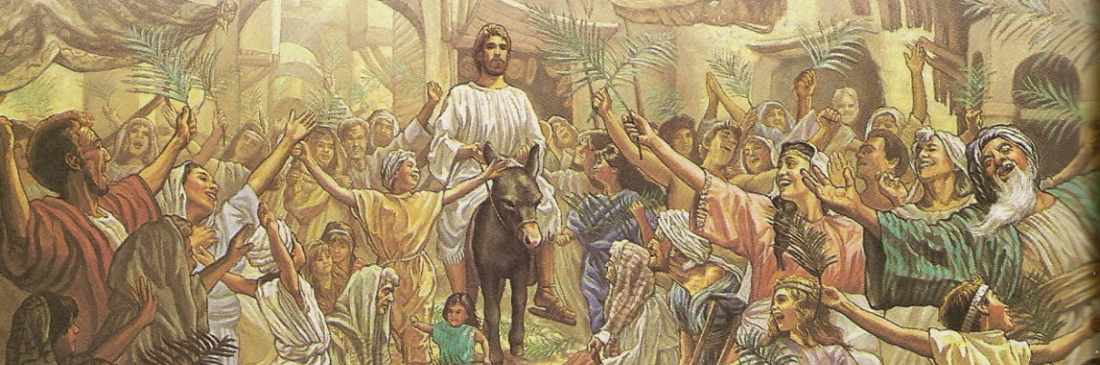
Palm Sunday is the day we celebrate the triumphal entry of Jesus into Jerusalem, one week before His resurrection (Matthew 21:1–11). As Jesus entered the holy city, He neared the culmination of a long journey toward Golgotha. He had come to save the lost (Luke 19:10), and now was the time—this was the place—to secure that salvation. Palm Sunday marked the start of what is often called “Passion Week,” the final seven days of Jesus’ earthly ministry. Palm Sunday was the “beginning of the end” of Jesus’ work on earth.
Palm Sunday began with Jesus and His disciples traveling over the Mount of Olives. The Lord sent two disciples ahead into the village of Bethphage to find an animal to ride. They found the unbroken colt of a donkey, just as Jesus had said they would (Luke 19:29–30). When they untied the colt, the owners began to question them. The disciples responded with the answer Jesus had provided: “The Lord needs it” (Luke 19:31–34). Amazingly, the owners were satisfied with that answer and let the disciples go. “They brought [the donkey] to Jesus, threw their cloaks on the colt and put Jesus on it” (Luke 19:35).
As Jesus ascended toward Jerusalem, a large multitude gathered around Him. This crowd understood that Jesus was the Messiah; what they did not understand was that it wasn’t time to set up the kingdom yet—although Jesus had tried to tell them so (Luke 19:11–12). The crowd’s actions along the road give rise to the name “Palm Sunday”: “A very large crowd spread their cloaks on the road, while others cut branches from the trees and spread them on the road” (Matthew 21:8). In strewing their cloaks on the road, the people were giving Jesus the royal treatment—King Jehu was given similar honor at his coronation (2 Kings 9:13). John records the detail that the branches they cut were from palm trees (John 12:13).
On that first Palm Sunday, the people also honored Jesus verbally: “The crowds that went ahead of him and those that followed shouted, ‘Hosanna to the Son of David!’ / ‘Blessed is he who comes in the name of the Lord!’ / ‘Hosanna in the highest heaven!’” (Matthew 21:9). In their praise of Jesus, the Jewish crowds were quoting Psalm 118:25–26, an acknowledged prophecy of the Christ. The allusion to a Messianic psalm drew resentment from the religious leaders present: “Some of the Pharisees in the crowd said to Jesus, ‘Teacher, rebuke your disciples!’” (Luke 19:39). However, Jesus saw no need to rebuke those who told the truth. He replied, “I tell you . . . if they keep quiet, the stones will cry out” (Luke 19:40).
Some 450 to 500 years prior to Jesus’ arrival in Jerusalem, the prophet Zechariah had prophesied the event we now call Palm Sunday: “Rejoice greatly, Daughter Zion! / Shout, Daughter Jerusalem! / See, your king comes to you, / righteous and victorious, / lowly and riding on a donkey, / on a colt, the foal of a donkey” (Zechariah 9:9). The prophecy was fulfilled in every particular, and it was indeed a time of rejoicing, as Jerusalem welcomed their King. Unfortunately, the celebration was not to last. The crowds looked for a Messiah who would rescue them politically and free them nationally, but Jesus had come to save them spiritually. First things first, and mankind’s primary need is spiritual, not political, cultural, or national salvation.
Even as the coatless multitudes waved the palm branches and shouted for joy, they missed the true reason for Jesus’ presence. They could neither see nor understand the cross. That’s why, “as [Jesus] approached Jerusalem and saw the city, he wept over it and said, ‘If you, even you, had only known on this day what would bring you peace—but now it is hidden from your eyes. The days will come upon you when your enemies . . . will not leave one stone on another, because you did not recognize the time of God’s coming to you” (Luke 19:41–47). It is a tragic thing to see the Savior but not recognize Him for who He is. The crowds who were crying out “Hosanna!” on Palm Sunday were crying out “Crucify Him!” later that week (Matthew 27:22–23).
There is coming a day when every knee will bow and every tongue confess that Jesus Christ is Lord (Philippians 2:10–11). The worship will be real then. Also, John records a scene in heaven that features the eternal celebration of the risen Lord: “There before me was a great multitude that no one could count, from every nation, tribe, people and language, standing before the throne and before the Lamb. They were wearing white robes and were holding palm branches in their hands” (Revelation 7:9, emphasis added). These palm-bearing saints will shout, “Salvation belongs to our God, who sits on the throne, and to the Lamb” (verse 10), and who can measure sum of their joy?
*https://www.gotquestions.org/Palm-Sunday.html
Something I’d like to emphasize here from the above: Jesus came to save man spiritually. Mankind’s primary need is spiritual, not political, cultural, or national salvation. Jesus did not come to restore the political power that the Romans had wrested from the rulers of Israel. He did not come to restore and ensure the cultural heritage of the Jewish people. He did not come to save Israel as a nation and restore her to a place of prominence among the nations. Jesus came to reconcile sinful man with a holy God and to give man hope for his eternal future.
And so it is today. Jesus’ purpose does not include the correction of a fraudulent election that has stolen the political power that was intended to be of the people, by the people and for the people. He did not come to ensure the continuation of freedom, justice and what we have come to call the American Way. He did not come to restore America’s position as a leader for what’s right and good among the world’s nations . . . a position that the traitors in charge are trying to subvert to globalism and leftist corruption. God may yet have America’s political, cultural, and national restoration in His plan, but Jesus came to reconcile sinful man with a holy God and to give man hope for his eternal future.
And, as given in Matthew 6:33, we are to seek God’s kingdom and His righteousness first, and what we need in life will be given to us as well. God must come first and God, at the last, wins!
On this day and every day –
God is in Control
. . . and His Grace is Sufficient, so . . .
Keep Looking Up

Hopefully, every Sunday, we can find something here that will build us up a little . . . give us a smile . . . and add some joy or peace, very much needed in all our lives.
“This day is holy to the Lord your God;
do not mourn nor weep.” . . .
“Go your way, eat the fat, drink the sweet,
and send portions to those for whom nothing is prepared;
for this day is holy to our Lord.
Do not sorrow,
for the joy of the Lord is your strength.”