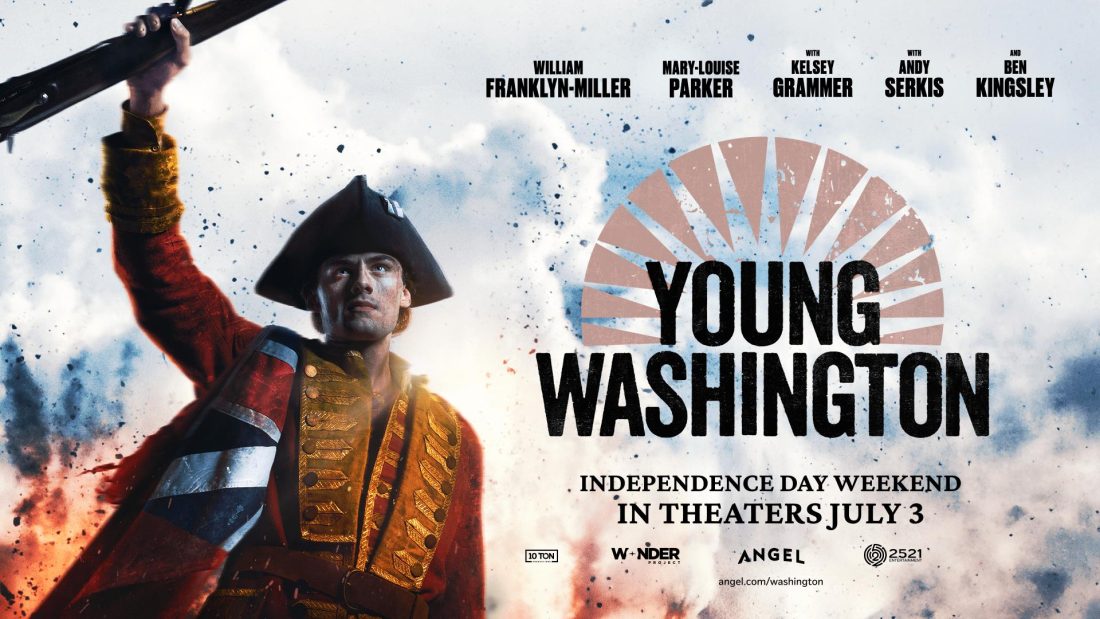
I haven’t done a movie review in a while, so it’s a pleasure to begin with, but it’s an even greater pleasure, as you will see.
I’m going to do this review in multiple stages, each one getting more revealing. When things reach a spoiler level you find regrettable, just stop – go see the movie – and be done with it.
1. TL;DR with No Details
Go see the movie.
2. TL;DR with Spoilerless Details
Go see the movie.
The fact that both my wife and I enjoyed it, despite a vast difference in our knowledge of that period of American history, tells me that you are likely to enjoy it, too.
In my opinion, it was well-directed, well-acted, well-scripted, and all that jazz, but at an even deeper level, it was insightful into the forces that made Washington the man who he was – perhaps the most honorable founder of this nation.
While being absolutely free of wokeness, the movie still has elements of revelation that will honestly tug at the heartstrings of all Americans, liberal and conservative. Even the British will love this, IMO. It is an honest depiction of that era, not only showing me the history I had read about fairly recently, but confirming, to my satisfaction, some of my theories about the build-up to the American Revolution. Thus, I think all those interested in history, will find this movie fascinating and enjoyable.
I must caution, however, that the realism extends to battle scenes. Indeed, the complete absence of phony and gratuitous violence makes the remaining realistic, momentary violence even more haunting and powerful. However, I think you will agree, once you see the movie, that it was necessary to show us the things that truly created an actual hero and military genius.
At the end of the film, our audience was too stunned to rise – and then – when I thought that the credits were going to roll, there was something more. That is necessary, too. People literally need a moment to come back to this century. It’s that powerful.
I repeat – go see the movie.
3. Review with Some Minor Spoilers
I am still uncertain whether I enjoyed this movie as much as I did, because I already knew the surprising history of Young Washington, or in spite of knowing that history. For me, it helps to know more, because I love details. It is a tribute to the movie that those who made it were able to weave an amazing amount of historical teaching into the screenplay. However, even if you are not familiar with the French and Indian War, and the history of the Ohio Territory, then you should not feel compelled to prepare for the movie. Just go see it and have fun. See it again if you miss a few things.
Let me just list some of the wonderful things you can expect to see.
- Washington’s loyalty to friends, and respect for enemies
- His resolve to let failure ALWAYS teach and NEVER demoralize
- His family’s morality and wisdom, and how these reached their pinnacle in that family’s least likely member
- The weaving together of the dying of empires and the birth of nations
- How Washington was a TITAN, just like Trump, Musk, the Signers, and the great explorers
- How Washington was utterly enthralled by the American frontier
- How Washington loved both the elite and the common man, and was at ease with both
- How every failure in life was the lesson he needed to reach the next level
- How technology is something we must deal with, but how it is NOT what defines us, or makes men great
- How surprisingly SMART the medicine of Washington’s time was, despite technological limitations
- How similar these people were to us, and how foolish we are to criticize them from the safety THEY gave us
- Love scenes that are easily as good as cinema classics – effective in their restraint
One last point, which shocks me even more, after the movie.
I have had the privilege of knowing several centenarians. Let’s call one of them “Peggy”. Well, 250 years is only two and a half “peggies” ago. Think how little time that is – and yet – yes – that is when America was founded. Take an old person you know – take one more before her – and her mother – and there is George Washington.
Jesus walked 20 peggies ago. It’s NOTHING.
You need to see Young Washington, to understand the predicament we are in. Forget that you might enjoy it. You NEED to see it.
WE are still dealing with Britain. Britain is still dealing with US. This is the slap in the face that says “Did you read what Gail just posted?”
Go see it. Please. For everybody’s sake.
4. Review with Blunt Spoilers
Part of the reason I wanted to see Young Washington, is that I had seen a trailer for it at a previous movie, and it struck me as surprisingly good. But I was very lucky – I had forgotten everything in the trailer, by the time I saw the movie!
Thus, I don’t know whether it’s a good idea to show you this very “spoilery” trailer. You may just want to stop now, and resume here AFTER you see the movie. You may want to experience the full surprise.
If so, then “see you later!”
W
OK – so you’re going to see the trailer now.
It really does convey the excitement of the movie – but without the build-up scenes that make it even more exciting. And perhaps that’s a good thing – because you’ll bring some extra doses of any needed blood pressure or cardiac medicines with you!
I found myself on the edge of my seat for most of the movie, from the very beginning. I found that my adrenaline really kicked in. Maybe it’s because I don’t get out and watch much “fake entertainment” anymore, but for whatever reason, I got a real workout watching this – even just the trailer, and even now!
I found the acting really good – particularly William Franklyn-Miller (young adult George Washington) and Mia Rodgers (love interest Sally Cary). The British society scenes are actually rather enjoyable, and more than just a diversion from the action – they really help to explain why revolution was inevitable.

Truthfully, the rest of the cast were really good, too. The older, famous actors all do a great job of portraying famous and important people, as one might expect, and the younger actors all do an excellent job of portraying Washington’s peers.
The battle scenes are gritty, and remind me of many of the better war movies that I’ve seen, which is rather surprising for a smaller movie of this budget. Even the Wikipedia accounts of the battles are violent enough to make one cringe, and the movie neither backs off from the history, nor embellishes. Much of this frontier violence was alluded to in Mel Gibson’s “The Patriot” – well, here you get to see it. This teaser shows it well, though significantly tamer than the movie itself.
I think that there is a visible improvement in the editing from the teaser to the trailer, and whatever it cost, it was worth the money.
Pay special attention to the names of everybody when they’re introduced – it makes things easier. Also, when the lighting is bad in the taverns and whatnot, you need to listen closely. Getting old is a pain in the ass – even just watching movies.
The movie is not perfect – there are a few cliche scenes that fail to impress, and I can see spots here and there which could stand some polishing. None of these would stop me from seeing the film. They are certainly not enough to make me regret buying tickets.
I suspect that few careers will be launched by the success of this movie, and that’s a good thing. There will also be many more movies from this studio, too.
Good.
In summary, I heartily recommend seeing “Young Washington”. There is supposedly a sequel coming, and I will definitely be interested in that. If the cast and crew work as hard as they did here, and with God’s providence, it should be a success, too.
W