2021·10·09 Joe Biden Didn’t Win Daily Thread


SPECIAL SECTION: Message For Our “Friends” In The Middle Kingdom

I normally save this for near the end, but…basically…up your shit-kicking barbarian asses. Yes, barbarian! It took a bunch of sailors in Western Asia to invent a real alphabet instead of badly drawn cartoons to write with. So much for your “civilization.”

Yeah, the WORLD noticed you had to borrow the Latin alphabet to make Pinyin. Like with every other idea you had to steal from us “Foreign Devils” since you rammed your heads up your asses five centuries ago, you sure managed to bastardize it badly in the process.

Have you stopped eating bats yet? Are you shit-kickers still sleeping with farm animals?

Or maybe even just had the slightest inkling of treating lives as something you don’t just casually dispose of?

中国是个混蛋 !!!
Zhōngguò shì gè hùndàn !!!
China is asshoe !!!

And here’s my response to barbarian “asshoes” like you:

OK, with that rant out of my system…

Justice Must Be Done.

The prior election must be acknowledged as fraudulent, and steps must be taken to prosecute the fraudsters and restore integrity to the system.

Nothing else matters at this point. Talking about trying again in 2022 or 2024 is hopeless otherwise. Which is not to say one must never talk about this, but rather that one must account for this in ones planning; if fixing the fraud is not part of the plan, you have no plan.

Kamala Harris has a new nickname since she finally went west from DC to El Paso Texas: Westward Hoe.

Lawyer Appeasement Section

OK now for the fine print.

This is the WQTH Daily Thread. You know the drill. There’s no Poltical correctness, but civility is a requirement. There are Important Guidelines,  here, with an addendum on 20191110.

We have a new board – called The U Tree – where people can take each other to the woodshed without fear of censorship or moderation.

And remember Wheatie’s Rules:

1. No food fights
2. No running with scissors.
3. If you bring snacks, bring enough for everyone.
4. Zeroth rule of gun safety: Don’t let the government get your guns.
5. Rule one of gun safety: The gun is always loaded.
5a. If you actually want the gun to be loaded, like because you’re checking out a bump in the night, then it’s empty.
6. Rule two of gun safety: Never point the gun at anything you’re not willing to destroy.
7. Rule three: Keep your finger off the trigger until ready to fire.
8. Rule the fourth: Be sure of your target and what is behind it.

(Hmm a few extras seem to have crept in.)

Spot Prices

All prices are Kitco Ask, 3PM MT Friday (at that time the markets close for the weekend).

Last week:

Gold $1762.00
Silver $22.65
Platinum $981.00
Palladium $2000.00
Rhodium $14,050.00

This week, markets closed for the weekend at 3:00 PM Mountain Time

Gold $1758.00
Silver $22.75
Platinum $1031.00
Palladium $2167.00
Rhodium $14,850.00

Gold and Silver are holding steady…ridiculously so in fact. I read speculation that they’re going to bust out and surge. Why shouldn’t they? Inflation is galloping, the economy is headed for trouble once (some of) the companies out there actually stick to the jab mandate.

Platinum and palladium have taken decent jumps. Rhodium is up $800. That’s not too shabby either.

Personally? I’m liable to end up unemployed. I should buy a “I can’t afford to fix or replace this because of J** B*d*n” bumper sticker for my rear-ended car.

Part XXI: Nuclear Physics Uses The Hammer

Introduction

Last time I said that this time I’d take up stars. But I did some preliminary research on the history, and realized that we’re not quite there from a historical standpoint as our narrative is basically in the 1930s (except when I run ahead to finish something that started in the 1930s, like I did with neutrinos).

So I’m going to pick up the story of neutrons. Discovered in 1932 by James Chadwick, they turn out to be the “other” nucleon in the nucleus, supplementing protons. Similar in mass but with no electric charge, they were the actual occupants of the place in the nucleus that we had imagined held proton-electron pairs.

Because a neutron bears no electric charge, it has no trouble getting close to a nucleus and sticking to it, whereas a proton is repelled by any nucleus it approaches. If it can get close enough it will stick…but first it has to get close enough, and that’s a challenge. The same is true of alpha particles (which are bundles of two protons and two neutrons).

The “sticking” is provided by the strong nuclear force.

It’s as if you had two magnets, and were trying to bring the north poles close together. They push each other apart pretty hard, but if the magnets were covered with velcro, they’d stick together…once you overcame that repulsion.

Free neutrons are basically a new form of radiation, by the way; we have alpha and beta radiation (that bundle of four nucleons, and an electron, respectively), gamma radiation (a very high energy photon, X-rays on steroids), and now, we have free neutrons.

Free neutrons are scary. They’ll simply wander around until they find a nucleus to stick to…and they will more than likely make that nucleus radioactive. I don’t mind being around alpha and beta sources (so long as they’re not inside of me); they’re trivial to shield against. Gamma rays are intimidating because they penetrate very thick shielding. All three of these, if they get to you, will blast some chemical bond to smithereens which can either mean nothing or cause big problems, depending on what it was they hit. They won’t make you radioactive. But the neutrons just sort of wander aimlessly through matter, unaffected by very much until they find a nucleus–and nuclei don’t take up much space, in fact they take up virtually none of it. Whatever nucleus they hit becomes a new (and likely radioactive) isotope.

That nucleus, with the extra neutron, may find itself with “too many” neutrons, and one of the neutrons will then change into a proton, via the weak force. This has the effect of making that atom a different element, the one next over to the right on your handy-dandy periodic table. That increases the atomic number, Z, by 1, while leaving the mass number (the total number of protons and neutrons) the same.

OK, that’s the end of the review. Now on with the story, which is complicated. I apologize in advance if this is completely un-followable. And if I somehow managed to garble it in trying to simplify it, I apologize for that as well. [Most of this is from the Wikipedia article on Lise Meitner, and the article on the discovery of fission.]

Transmutation

Nuclear physicists had all kinds of fun playing with neutrons through the 1930s (and beyond). Enrico Fermi, in Rome, made a hobby of bombarding different elements with neutrons to see what would happen; first creating a more neutron rich isotope of the starting element, then monitoring the beta decay, determining half lives and energies, which are different for each isotope. Sometimes there’d be multiple decays, because one wasn’t enough to get to a stable isotope.

Remember, each such beta decay moves you one to the right, to the next higher atomic number. This led to an irresistibly tantalizing question.

What happens if you pick the element with the highest atomic number, uranium with Z=92, and bombard it with neutrons?

Shouldn’t you get element 93, previously utterly unknown, in fact, previously nonexistent?

Fermi tried it. And he got a whole bunch of different kinds of beta radiation out of it. He concluded that he had created a “transuranic” element. Not so fast though. Aristid von Grosse suggested that what Fermi had found was a new isotope of protactinium (element 91, not 93). This “wait a minute” wasn’t enough to prevent Fermi’s winning the 1938 Nobel Prize for Physics for this work, not just with uranium but the other elements as well.

But there was enough controversy that someone needed to dig in and figure out if we were looking at element 93 or protactinium.

And who better to do that than Lise Meitner and Otto Hahn, the discoverers of protactinium? Their collaboration at Kaiser Wilhelm institute in Berlin had lapsed, but this question got the two of them back together. From 1934-1938 the two of them, along with Otto Frisch, dug into the matter.

Initially, Meitner and Hahn believed they had created elements 93, 94, 95 and even 96. But as time went on Meitner became less certain.

Part of the muddle came from the fact that it was wrongly believed that only the lanthanide elements had that special row at the bottom of the table, pulled out from the main body so it would fit nicely on a landscape piece of paper. Actinium was placed two spots below yttrium, thorium below hafnium, protactinium below tantalum and uranium below tungsten (or as the Germans called it, “wolfram”). Indeed the chemical behavior of these elements could be a bit confusing, but it would eventually turn out that that stopped with element 93, which behaved more like a lanthanide. That whole sequence of elements in fact belonged in a second footnote row below the lanthanides.

For example, Fermi had found a rhenium-like element in his experiments and, in the belief that element 93 was directly below rhenium in the periodic table, concluded that that is what he had found. (In fact, he had found technetium, the then-undiscovered element above rhenium in the table, and didn’t realize it–but I’m getting ahead of myself here.)

This mistaken belief, at the time, bunged up any attempt to chemically analyze the products of the neutron bombardment. When element 93 is expected to behave like rhenium, for instance, rather than like a rare earth, it’s kind of difficult to figure out what’s going on.

One thing Meitner and Hahn wer fairly confident of: when they bombarded uranium, which was mostly uranium-238 (92 protons and 146 neutrons), they were indeed getting, as step one, uranium-239, with a 23 minute half life. They were able to do chemistry on it and prove that it was, indeed uranium.

After that it was a muddle. There seemed to be three different reactions, all from uranium-239, one with a ten second half life, one with a twenty second half life, and one with a 23 minute half life.

In 1937 Meitner and Hahn each published a report. Hahn was emphatic that they had found transuranic elements (“Above all, their chemical distinction from all previously known elements needs no further discussion”); Meitner was pretty certain almost everything was a product of uranium-238, somehow, but figured the three most prominent products were isomers.

Er, what’s an isomer?

As if it isn’t difficult enough to recall that elements come in isotopes, with the same number of protons but different number of neutrons, it turns out that some of the isotopes themselves come in different forms, some more energetic than others, and that the more energetic form eventually just blasts out pure energy (a gamma ray photon) and settles down to become the less energetic, and (usually) more stable form, having kept all of its protons and neutrons intact (but, likely, having dropped mass a bit). An isotope like this gets an “m” after the number.

For example, consider protactinium-234m, which has a 1.17 minute half life, and ejects a photon as it settles down to become protactinium-234, with a half life of 6.70 hours. When Pa-234m was discovered in 1913, we weren’t clear on the concept of isotopes, so it was considered a new element and named brevium for its brief half life.

When “regular” Pa-234 was discovered in 1921, that marked the discovery of nuclear isomers; it was the first such distinction between an “m” isotope and a “regular” isotope. And, interestingly, the discoverer was Otto Hahn, who later on in 1937 found his colleague using the concept to argue against his interpretation of the U-239 decay products!

[Side note: Probably the most useful isomer today is technetium-99m. It’s a decay product of molybdenum-99, which has about a 30 hour half life. Mo-99 is sent to hospitals, which extract the Tc-99m chemically, embed it in larger molecules, perhaps favored by muscles, then inject that into patients and watch where the gamma rays come from. This can be used to diagnose heart problems, though it does mean the patient is a source of gamma rays for a while. Tc-99m has a six hour half life, after which it blasts out a fairly weak gamma ray and settles down to Tc-99, which has a much longer half life (hundreds of thousands of years) and will ultimately beta decay and become ruthenium-99. The patient generally gets rid of the technetium-99 within days, so no digging up bodies to try to get the ruthenium, please.]

Meitner concluded her report with the following:  “The process must be neutron capture by uranium-238, which leads to three isomeric nuclei of uranium-239. This result is very difficult to reconcile with current concepts of the nucleus.”

Another group in Paris decided to investigate as well. They ultimately found a product that was chemically very similar to lanthanum (element 57). (It turned out it couldn’t be more similar, as it was lanthanum, but I get ahead of myself again.)

Did I just almost forget to mention Meitner was Jewish?

What does that matter? Normally it wouldn’t matter in the slightest, but in mid 1930s Berlin, it mattered a great deal. And it was mattering more and more as time passed.

Meitner Has To Flee

Meitner had been kept safe, somewhat, by the fact that she was an Austrian, but on March 12, 1938, Austria was annexed by Germany. Her Austrian citizenship was moot as there was no Austria to be a citizen of. Niels Bohr and Paul Scherrer invited her to take positions in Denmark and Switzerland, respectively, but Carl Bosch at KWI said she could remain. By May, though, Meitner learned that her situation was being looked at by the no-doubt misnamed Reich Ministry of Science, Education and Culture.

Although many people outside of Germany wanted to give her refuge, there were all sorts of bureaucratic snafus. For instance, she couldn’t go to Denmark no matter how much Niels Bohr wanted her there, because Denmark considered Austrian passports to be invalid. Germany also forbade academics to leave the country.

By July the situation was critical. Dirk Coster, a Dutch scientist, convinced the Netherlands to accept Meitner, and on July 12, she showed up for work at KWI as usual, staying late to mark up an associate’s paper for publication. The next day she and Coster took a train on a lightly used rail line to the Dutch border. Otto Hahn had given her his mother’s ring and “Frau Professor” was apparently thought to be the wife of the Dutch professor, so the German border guards didn’t stop her. She got out, with ten marks and her summer clothes, and the ring she could sell for money if needed. (The story is much more complex, and given in the Wikipedia article on Meitner.)

Once Meitner was safely out of Nazi Germany, work continued long-distance. Hahn and Strassman at KWI decided to try to replicate the Paris group’s results, and found what they thought was radium (element 88).

Figuring that the neutron hitting uranium-238 was creating uranium-239, which then gave up two alpha particles to become radium-231, they dug a little more carefully, and decided to extract the radium from the sample.

Radium lies directly under barium (element 56) on the periodic table (it was properly understood back then, unlike uranium), and the two elements have an affinity with each other. If there was any radium in the products, barium could be used to draw it out, then it could be separated from the barium without interference from all the other “stuff” in the sample.

Indeed, the barium came out radioactive, indicating that there was radium in it. So it looked like they had found their radium, and the two alpha decays.

But then they couldn’t separate the radium from the barium.

The extraction process used was tested by putting known samples of radium into the barium, and they were separated out without any trouble.

The Light Dawns

Finally they were forced to conclude that the reason they couldn’t find any radium in the barium, is that it was barium.

A radioactive isotope of element 56 was coming out of uranium-239.

Meitner and Frisch finally realized that what was happening. They had gotten together for Christmas in 1838, and were out cross-country skiing having a rather atypical conversation.

What if, they thought, the uranium nucleus were simply splitting? The prevailing model of the nucleus was called the “liquid drop” model, treating it as similar to a drop of liquid; if it were under enough tension that it wanted to break up, a neutron could add just enough “oomph” to happen, just like a very large drop of water wants to split into smaller drops. (Incidentally the liquid drop model, though not the most advanced model, is still good enough to be of some use today.)

However the two pieces would find themselves outside the range of the strong nuclear force, and repel each other quite forcefully. About 200 million electron volts–about a fifth the mass/energy of a proton–would be released as the two pieces flew apart. Where would it come from?

Meitner was able to figure out that the two pieces’ binding energy was high enough compared to the uranium’s binding energy that the 200 MeV would be supplied by that.

It fit.

Nuclear fission was real.

Uranium could be induced to split and release a lot of energy. The lanthanum, technetium and barium were real. It just depended on exactly how the split happened, which particular smaller elements you’d get.

When Frisch told Niels Bohr of this, Bohr literally smacked his own forehead and exclaimed, “What idiots we have been!”

Fermi was also embarrassed; that part of his work bombarding things with neutrons that had to do with uranium turned out to be misinterpreted, and the 1938 Nobel prize he had just been told he would receive was in part awarded for his transuranium “discoveries.” Just in time though; he added a footnote to his acceptance speech to explain what they had just figured out.

In the fullness of time, it developed that those 10 and 20 second reactions Meitner, Hahn and Frisch were seeing were fission products. But the 23 minute reaction really was a decay into element 93, isotope 239.

And it was the small amount of uranium-235 that was fissioning, not the uranium-238.

And we now had a new form of radioactive decay: fission, spontaneous fission. Uranium 236’s most common decay mode is this.

The Bomb

The rest of the story is much more famous, though at the time it was shrouded in secrecy. The US government, alerted by none other than Albert Einstein’s letter to FDR concerning the potential of such massive releases of energy, created the Manhattan Project to build a nuclear bomb.

Much of this early research had been done in Nazi Germany. What if they, too, were working on The Bomb?

It turns out that when uranium-235 is hit by a fairly slow moving neutron, it becomes, for just an instant, uranium-236, which is what fissions into two large pieces. But there are also two or three bare neutrons released; if they can be slowed down and then induced to hit more uranium-235, you can have a chain reaction, each step doubling or even tripling the energy release as more and more uranium-235 catches neutrons and releases yet more neutrons.

However, you need a fairly substantial amount of U-235 for this to work. If it’s a small lump of the stuff, the freed neutrons will probably exit the sample before they find a nucleus to hit. There’s a critical mass that must be brought together for the chain reaction to take off.

The bigger difficulty, of course was that uranium-235 is only a small fraction, less than one percent, of uranium.

So one of the two approaches taken was to try to extract “enriched” uranium-235 from uranium by reacting the uranium with fluorine to create uranium hexafluoride gas, which could then be centrifuged to separate out the slightly lighter U-235. This work was done at Oak Ridge, Tennessee. Once you have the enriched uranium-235, it’s dead easy to make a bomb. Bring two small masses together, enough to make a critical mass, make sure there’s a neutron source nearby, and, KABOOM!!

The other approach involved those transuranics. Uranium-239 was beta decaying into neptunium-239; neptunium 239 was in turn beta decaying into plutonium-239. The two new elements were named to continue the series. Uranium had been named after the planet uranus; the next two elements were named after neptune and pluto (then believed to be a planet).

And it turns out that plutonium-239 is easy to produce; just bombard regular uranium with neutrons–and it too will fission when struck by a neutron. The trick is to get enough of it together close enough that the excess neutrons will find another plutonium-239 atom before exiting the mass. As it happens, Pu-239 must be compressed for it to work. And getting that to happen precisely right was a challenge.

It’s a good thing that the easy-to-make bomb requires the hard-to-make material, and the easy to make material is hard to make a bomb out of.

But we did both.

The U-235 bomb was deemed so simple it wouldn’t need a test. Thus it was dropped on Hiroshima on August 6, 1945 (Germany had surrendered in May of that year, after millions had given their lives to put the mad dictator Hitler down). It worked beautifully, releasing energy equivalent to about 20 thousand tons of TNT, all at once.

The Pu-239 bomb, however, was the first nuclear detonation. It was tested at Trinity site in New Mexico on July 16th, then a second example was dropped on Nagasaki on August 9th.

The bombs killed tens of thousands of people, but likely saved at least ten times as many lives. Had the United States needed to invade the Japanese home islands, there likely would have been two million casualties.

The neutron had gone from being an abstract thing cared about only by some physicists trying to figure out what keeps atoms together…to something as impossible to ignore as a slap across the face.

And this wasn’t even the end of that road.

Obligatory PSAs and Reminders

China is Lower than Whale Shit

Remember Hong Kong!!!

Whoever ends up in the cell next to his, tell him I said “Hi.”

中国是个混蛋 !!!
Zhōngguò shì gè hùndàn !!!
China is asshoe !!!

China is in the White House

Since Wednesday, January 20 at Noon EST, the bought-and-paid for His Fraudulency Joseph Biden has been in the White House. It’s as good as having China in the Oval Office.

Joe Biden is Asshoe

China is in the White House, because Joe Biden is in the White House, and Joe Biden is identically equal to China. China is Asshoe. Therefore, Joe Biden is Asshoe.

But of course the much more important thing to realize:

Joe Biden Didn’t Win

乔*拜登没赢 !!!
Qiáo Bài dēng méi yíng !!!
Joe Biden didn’t win !!!
2021·09·04 Joe Biden Didn’t Win Daily Thread


SPECIAL SECTION: Message For Our “Friends” In The Middle Kingdom

I normally save this for near the end, but…basically…up your shit-kicking barbarian asses. Yes, barbarian! It took a bunch of sailors in Western Asia to invent a real alphabet instead of badly drawn cartoons to write with. So much for your “civilization.”

Yeah, the WORLD noticed you had to borrow the Latin alphabet to make Pinyin. Like with every other idea you had to steal from us “Foreign Devils” since you rammed your heads up your asses five centuries ago, you sure managed to bastardize it badly in the process.

Have you stopped eating bats yet? Are you shit-kickers still sleeping with farm animals?

Or maybe even just had the slightest inkling of treating lives as something you don’t just casually dispose of?

中国是个混蛋 !!!
Zhōngguò shì gè hùndàn !!!
China is asshoe !!!

And here’s my response to barbarian “asshoes” like you:

OK, with that rant out of my system…

False Flag?

I think in some cases people on our side misuse False Flag. Unless, of course “FF” stands for something else.

This became apparent to me when I had a very valuable conversation with DePat and FG&C about the notion that the Arizona Audit people were waiting for a “FF” before dropping their results. Once FG&C explained what he meant by FF, it made a LOT more sense than it did with my reading of the term.

I first heard the term False Flag many, many years ago in an intelligence context. It’s a method of recruiting spies. The signature example is the KGB “handler” who finds someone in his host country who has access to classified information and is sympathetic to Israel, then arranges to meet the Israel sympathizer “by chance.” Once he does so he lets slip that he is an agent…but not for the USSR, rather for the Mossad. He’ll even explain that he knows government employees aren’t supposed to leak sensitive stuff but if the sympathizer could just alert him to harmless stuff, it’d help Israel out.

Before the Israel sympathizer knows it, he’s “helping Israel” a lot more than that, but in fact he’s really passing stuff on to the Soviet Union.

The thing that makes it “false flag” is that the Soviet agent, whose flag SHOULD be red with a yellow hammer and sickle in the upper left, is (figuratively) displaying a false flag–that of Israel.

In the more modern United States Cold Civil War context, a false flag is when some leftist does something while pretending to be on the Right, in the hopes that it will damage the Right politically. This is everything from posting a bunch of stereotypical “right wing hate” on the internet then going off and shooting up a black church (to prove “right wingers are racists”) to…well, January 6 with Antifa pretending to be “right wing militia” types–which was very damaging to us.

Just like the Soviet agent was pretending to be an Israeli agent, the leftist douchebag(s) is (are) pretending to be on the Right politically.

I can’t be certain but I suspect some conflate this with something different: A big spectacular event staged to distract from something they don’t want you to notice. False flags can certainly do this (have some “right wing nut” shoot up a school and that will indeed saturate the media for a few days) but not all such things are “false flags” because many of these events don’t try to discredit the Right.

Now the Opposition does pull that trick too, and quite often, but when they do so, it’s not a “false flag,” it’s something else with a name that may just be best described as “distraction” or “misdirection” (the magician’s term for such a tactic). Basically the staged event sucks all of the oxygen out of the media room and nothing else gets looked at for some short period of time (a day to a week). It doesn’t matter if it ends up making the Right look bad (though if it does, bonus!!!), if it keeps people from noticing something else that happened, the operation was a success.

In this particular instance, the suggestion was that the Audit Results We Have All Been Waiting For are being timed to drop when disgust with Biden reaches a (new) all time high. This is certainly plausible though I would have a multitude of detail questions about it before I’d go beyond that. But what this scenario does NOT describe is a “false flag.”

OK, that off my chest…lets hope that Arizona Audit drops soon. If that implies something else must happen first, then let THAT happen, already! Too much death and destruction is being meted out by the Biden Facade Administration and the people behind it.

Justice Must Be Done.

The prior election must be acknowledged as fraudulent, and steps must be taken to prosecute the fraudsters and restore integrity to the system.

Nothing else matters at this point. Talking about trying again in 2022 or 2024 is hopeless otherwise. Which is not to say one must never talk about this, but rather that one must account for this in ones planning; if fixing the fraud is not part of the plan, you have no plan.

Kamala Harris has a new nickname since she finally went west from DC to El Paso Texas: Westward Hoe.

Lawyer Appeasement Section

OK now for the fine print.

This is the WQTH Daily Thread. You know the drill. There’s no Poltical correctness, but civility is a requirement. There are Important Guidelines,  here, with an addendum on 20191110.

We have a new board – called The U Tree – where people can take each other to the woodshed without fear of censorship or moderation.

And remember Wheatie’s Rules:

1. No food fights
2. No running with scissors.
3. If you bring snacks, bring enough for everyone.
4. Zeroth rule of gun safety: Don’t let the government get your guns.
5. Rule one of gun safety: The gun is always loaded.
5a. If you actually want the gun to be loaded, like because you’re checking out a bump in the night, then it’s empty.
6. Rule two of gun safety: Never point the gun at anything you’re not willing to destroy.
7. Rule three: Keep your finger off the trigger until ready to fire.
8. Rule the fourth: Be sure of your target and what is behind it.

(Hmm a few extras seem to have crept in.)

Spot Prices

All prices are Kitco Ask, 3PM MT Friday (at that time the markets close for the weekend).

Last week:

Gold $1817.80
Silver $24.08
Platinum $1016.00
Palladium $2498.00
Rhodium $18,400.00

This week, markets closed for the weekend at 3:00 PM Mountain Time

Gold $1828.60
Silver $24.77
Platinum $1032.00
Palladium $2506.00
Rhodium $17,750.00

Gold broke out and up into the 1830s this week but much of that gain was lost by close on Friday. Silver is up a bit too, the PGMs however are down (or steady).

I attended a talk about the silver market last week; the speaker actually alluded to the folks who pushed the price of the gaming company in order to try to bankrupt a bunch of institutional traders, and then went on to try the same with silver. He described their effort as a failure (and from what I’ve seen so far, their effect on silver prices was, in fact, minimal). However one effect that they did have was they got me to post articles on the nine precious metals AND give these updates every week.

Part XVII: Nuclear Physics Finds A Hammer

Introduction

Today, there is a subdiscipline of physics called “nuclear physics.” It deals with the nucleus of the atom, but does not typically dive any deeper than that (and there is most assuredly a “deeper than that” today known as “particle physics,” though there was no hint of its existence in the 1920s).

The sorts of investigations Rutherford and Co. performed in the first two decades of the 20th century were the very beginning of nuclear physics, though it’s often not considered to have been founded until 1932.

Why 1932? That’s the subject of today’s story.

There’s a modern trope among nuclear physicists. Someone asks “how do you find out what’s inside an atom” and the response is: “Just like a toddler trying to figure out what’s inside an alarm clock. He gets a hammer, smacks it, and sees what flies out of it.”

When we left off the physicist’s best subatomic hammer was the alpha particle, known to be a bare helium nucleus, mass number A = 4, electric charge +2. This would come flying out of certain atoms (like those of uranium and thorium) when they underwent what is called “alpha decay.” This process would reduce the atomic number (i.e., the element number, Z) of the parent nucleus by 2, and reduce its mass number, A, by 4. So uranium-238 (the isotope of uranium, Z=92, A=238) would become thorium-234; the mass number has decreased by four, and thorium is element #90, so the atomic number has dropped by 2.

Physicists used these alpha particles with some limited success as hammers to hurl at nuclei. In fact, that was how the nucleus had actually been discovered; Rutherford used alpha particles as a hammer on gold atoms and found there was a lot of empty space in an atom, but a very small hard kernel in the middle that would cause the alpha particles to ricochet. Physicists had even figured out how to give alpha particles more energy, by using electrically charged plates and so forth to get them to speed up.

But here’s the problem. The nucleus has a positive electrical charge, a substantial one. And an alpha particle, also a nucleus, has its positive electrical charge, too. And like charges repel each other.

Imagine if your hammer, and the nail you were trying to hit with it, strongly repelled each other. That’s a recipe for deciding a hammer is for hitting your thumb with, isn’t it? (Or perhaps your wrist, or even your face if the hammer bounces back at a sharp angle.)

Alpha particles were, to put it mildly, suboptimal as nuclear hammers.

There was also another glaring mystery in the early 1920s. What actually held a nucleus together?

As far as they knew back then, the nucleus of (say) oxygen-16 (Z=8, A=16) held a mixture of protons and electrons, 16 relatively heavy protons to give it the 16 mass number, and eight very light electrons (1/1836th the mass of a proton) to cancel out the charge of eight of the protons, leaving a net charge of 8, which was recently understood to be the very definition of an oxygen nucleus–a charge of eight.

It certainly looked as if there were electrons in a nucleus; consider beta decay. This is when the nucleus spits out an electron and goes up one in charge. For instance, the thorium-234 I referenced will spit out an electron (in this context, it’s known as a “beta particle”), uncovering another proton, raising the atomic number, therefore. from thorium’s Z=90 to Z=91, which means it’s now a protactinium-234 nucleus. So it certainly seemed as if nuclei had electrons in them; otherwise how on earth do electrons end up coming out of the nucleus during beta decay?

So let’s consider a helium-4 nucleus; under this model it contains four protons and two electrons. Those four protons can actually all touch each other (you can convince yourself of this with marbles, ping pong balls, or billiard balls). What keeps them from flying apart? The protons are all positively charged; and there are only two electrons to cancel that repulsion out.

Well, let’s list what we know about protons:

mass = 1.672×10⁻²⁷ kg
electric charge, e = 1.602×10⁻¹⁹ C
radius = 0.8414 fm

[e is the symbol used for the electrical charge of a proton in particular; an electron has charge –e.]

[“fm” is “femtometer,” a femtometer is 10-15 meters, or a quadrillionth of a meter. Most people have heard the “nano” prefix, meaning one billionth; fewer have heard of pico (one trillionth), femto (one quadrillionth) or atto (one quintillionth).]

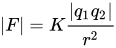
We can get an appreciation of the size of the problem by simply computing the electrical repulsive force between two protons that are touching each other. Their center-to-center distance is double the radius, or 1.6828×10⁻¹⁵ m, so we can plug everything into Coulomb’s Law to see how big the force is:

{\displaystyle |F|=K{\frac {|q_{1}q_{2}|}{r^{2}}}}

The vertical bars stand for “magnitude” (in other words, drop the vector stuff and just deal with the scalar values, because we want a size, not a direction.)

both Q values are the charge of the proton, e, and K = 8.988×10⁹ Nm2/C2. You can do the math.

The answer I got is 81.456 newtons.

NOT 81.456 billionths of a newton, or trillionths of a newton, but 81.456 newtons. That’s the weight of 8.3 kilograms (81.456 N/(g=9.8 m/s2)) under Earth gravity.

This much force, between two itty, bitty, teensy, tiny particles!!! It’s an actual macroscopic amount of force. It’d be as if a proton could hit you so hard it’d be like taking a 60 mph pitch on the chin.

(Actually, now that you mention it: https://en.wikipedia.org/wiki/Oh-My-God_particle.)

The force is enormous compared to the size of the particles.

Since all four of the protons in the alpha particle touch each other, each proton is being repelled by three times this much force (244+ newtons). The two electrons that are attached to two of the protons attract with 167 newtons, but that still leaves 81 1/2 newtons of repulsion unbalanced, and that’s simply yuge.

Well, that’s the electromagnetic force. There’s one other force that could come into play: Gravity.

Now a physicist would know, instantly, that gravity doesn’t matter more than a mouse fart in a hurricane here, but many of you don’t, so let’s just check that.

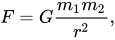
{\displaystyle F=G{\frac {m_{1}m_{2}}{r^{2}}},}

The radius is the same, but the numbers of the masses are much lower than the numbers of the charges, roughly 1/100,000,000 as much. And G is only 6.67×10⁻¹¹, much much less than K was, very roughly 1/100,000,000,000,000,000,000 as much.

I get 6.59 x 10⁻³⁵ newtons.

“Drop in the bucket” doesn’t begin to describe that number in comparison to 81.456 newtons. Basically a quintillionth of a quintillionth the amount.

Nuclear physicists generally ignore gravity as a force between the objects they study. There’s no way its effect could even be measured as a fraction of the electromagnetic effect.

So, by everything known in the 1920s, nuclei should simply fly apart, in a nanojiffy. Or perhaps an attojiffy. The two fundamental forces act in opposite directions, but gravity shows up like Biden’s rally crowds showed up last year (and gravity can’t cheat to make up for that).

So by rights any nucleus bigger than hydrogen’s one-proton nucleus should simply fly apart. It should never have formed to begin with.

Since we’re still here, and not simply big Swalwellian clouds of hydrogen gas, clearly something else, something new, is at work.

And that is today’s story.

Can Nuclear Electrons Actually Exist?

Leaving aside the fact that the nuclear electrons can’t, all by themselves, keep a nucleus together, there was plenty of reason to question whether nuclear electrons even existed at all. There are, essentially, three reasons that I could explain to you. Number Three had to do with Dirac’s Equation which came along in 1928 and I want to save for another column. So going back to the other two reasons…

Issue #1: Binding Energy

In the introduction I described the prevailing model of the atomic nucleus as of the 1920s. Ernest Rutherford made the suggestion around 1919, but he decided shortly afterwards that it didn’t make sense; and this is one reason why.

One of the still-standing 1895 puzzles has to do with atomic weights. The atomic weight of, say, carbon is not quite twelve times that of hydrogen. Even after accounting for the presence of atoms with different mass numbers (uncommon isotopes of the same element), it still doesn’t quite work out; even accounting for all those nuclear electrons…it doesn’t work out.

In fact, heavier atoms (i.e., heavier than hydrogen) are always lighter than they would be if they were simple multiples of the proton’s mass, much less including some nuclear electrons as well. Even hydrogen-2 (deuterium) is less than twice the mass of hydrogen-1 (protium).

This, it turns out is due to something called binding energy. It’s the energy required to pull the protons apart.

This is directly analogous to the binding energy between, say, you and the earth. How much energy would it take to separate you from earth? At least as much as it would take to accelerate you to escape velocity. This is gravitational binding energy, because it’s the force of gravity that creates the potential difference between you standing on the surface of the earth, and you out in interstellar space.

It takes, very roughly, 7 million electron volts (MeV) to pull a proton out of a nucleus. Alternatively, if a proton is shoved into a nucleus, 7 MeV is released (just like, as you fall from a great height, you release a lot of kinetic energy).

That energy actually shows up on the books as missing mass. E = mc2, after all. So the particles in a large nucleus are all just a bit lighter in weight than they would be if they were separated; to separate them you have to add enough energy to make up the mass deficit.

If you were able to convert an entire proton to energy, it’d yield 938 MeV. The binding energy is therefore about seven tenths of one percent of the total mass/energy of the nucleus. We can actually measure that shortage…and, it turns out, had been measuring it for decades. This is the reason for the discrepant atomic masses.

Another sort of binding energy is the electromagnetic binding energy, keeping electrons in atoms. This ranges from a fraction of a single electron volt, to a bit over a dozen electron volts, for hydrogen. Is some fraction of the mass of an atom disappearing during chemical reactions, when chemical energy is released? The theory says yes. But it’s a small enough change (roughly one millionth the size of the nuclear binding energy) we haven’t actually measured it…yet.

I tried to discover exactly when this was first explained. It was sometime before the 1920s. Wikipedia says Einstein did it in 1905, but it simply points to the fact that he derived E=mc2 that year; I can’t quite nail down that he said, in that paper, that this is why nuclei heavier than protium are all lighter than they “should” be. If he did say that then, then I should have crossed off yet another mystery the week I talked about the incredible year Einstein had in 1905. If someone else (or Einstein himself) put two and two together after the fact…well, it certainly happened by the 1920s.

The reason I bring this up right now, is that it ties to the first issue with nuclear electrons. Ny Heisenberg’s uncertainty principle, an electron bouncing around in something as tiny as a nucleus must have a kinetic energy of at least 40 MeV (its position is very well defined, its momentum therefore isn’t going to be anywhere close to zero). Not only is this a lot more than the energy of beta radiation (presumed to be one of these electrons escaping the nucleus), it’s more than the binding energy of the protons; one bound electron bouncing around in there contains enough energy to kick five or six protons out of a nucleus! And what would keep it from flying out as super-energetic beta radiation?

Issue #2: Spin

Probing into quantum mechanics eventually established that protons and electrons have a spin of 1/2. Or, alternatively, -1/2.

But the term “spin” is misleading. The particles don’t actually spin like a top. They do something else that’s pretty whacky and has no sensible referent in day to day life. Nuclear and particle physicists will hijack an everyday term to describe these phenomena, however, so they speak of “spin.” They picked this word because it is measured in the same units as angular momentum. The actual value is 1/2 of ℏ, so the physicists simply label it “1/2.” It can point in two opposite directions, so the “other” direction is labeled -1/2.

If you have some even number of electrons or protons, they could be any combination of 1/2 and -1/2 spins, but since there is an even number of them, you can pair particles with 1/2 spin with particles of -1/2 spin, cancelling each other out, and some even number of particles will be an excess of 1/2 spin (or -1/2) spin particles. The excess will always be an integer, if there is no excess the total spin is zero–which is also an integer. (In practice, the + and – 1/2 spins will cancel each other as much as possible, in this case leaving a total spin of zero.)

An odd number, n of electrons or protons will always have 1/2 or -1/2 spin left over, on top of the integer spin that the even number n-1 of the particles will give.

So let us consider the nitrogen-14 nucleus (Z=7, A=14). It should have 14 protons and 7 electrons in it, which total to 21. Thus if the spin is measured, the net spin should have a 1/2 (or -1/2) fraction in it.

They did measure the spin of nitrogen-14 nuclei, and it always came out to integer spins. So there have to be an even number of protons plus electrons in that nucleus.

Therein lies an apparent contradiction, and there are no actual contradictions in reality; there must be some unknown fact or bad assumption that when identified, will resolve the apparent contradiction.

The Nuclear Force

I’ve described two issues with the concept of nuclear electrons. But I kind of skated past something in my discussion of binding energy. As I said, you are bound to the earth by gravity. Electrons are bound to atoms by the electromagnetic force. Protons are bound to a nucleus by…anyone? Anyone?

Clearly there’s some other force out there. A force strong enough to overpower the eighty newtons of force between adjacent protons. But weak enough that we’d otherwise never have noticed it–because we hadn’t noticed it. It should have been about as conspicuous as AOC in front of a TV camera, yet we never noticed it.

It seems odd to postulate a force that’s very strong at close quarters, yet unnoticeable at a distance. If were anything like electromagnetism or gravity, it should drop off as the square of the distance…twice as far away, you feel 1/4th the force, three times as far away, you feel 1/9th of the force. So if this hypothetical force is an attractive force stronger than the electromagnetic repulsion at some distance, it ought to still be stronger than the electromagnetic force twice as far away–both forces are a quarter as strong at that location as they were before, so the one that was larger before, should still be larger here.

But we all know of something that doesn’t behave that way, and that is magnets. Sure, one pole of a magnet has a force that drops off as the square of the distance, but there’s always a nearby opposite pole. If you’re right up against a north pole, the south pole of that magnet is, say ten times further away, and only cancels out 1/100th of the force. But double your distance from the north pole, and now the south pole is about five times further away and cancels out 1/25th of the force, as you move further and further away the two poles are (propotionally) closer to being the same distance away from you and cancel each other out quickly.

So magnetic forces appear to drop off as the cube of the distance from the magnet.

In order to match what we see, this hypothetical force should be almost nothing at 2.5 femtometers’ distance, strongly attractive at about 1 femtometer, and actually be repulsive at distances less than 0.7 femtometers. In other words, two protons would have to be almost touching for this force to become a factor.

The repulsion at very close distances actually puts a lower bound on the size of nuclei, since the protons can’t get closer than that without being pushed apart. That’s the effective size of a proton. And indeed these distances are roughly the size of a proton.

This force turns out to be very, very complex computationally, but it was consistent with everything they saw at the time, so, just like gravitational and electromagnetic forces, it was accepted as being true even if a lot of details needed to be ironed out. (And even though we know a lot more about it today (1920s physicists had no idea), there are still issues.)

Enter: the Neutron

I mentioned that even though Rutherford had originally suggested the nuclear electron, he grew dissatisfied with it for many of the reasons already mentioned, and a year later, in 1920, had come up with another idea. Perhaps, instead of proton/electron pairs, the extra, dead-weight mass of a nucleus that doesn’t contribute to its electrical charge was due to a neutral single particle about the mass of a proton. He even gave it a name, the neutron. This rather neatly solved the spin issue: If a nitrogen-14 nucleus contained 7 protons and 7 neutrons, the spins would add to zero. Repulsive forces would still be about the same, though: too much without positing a “nuclear force.”

But most physicists didn’t accept this conjecture. Though it solved a lot of the issues that the nuclear electron hypothesis introduced, physicists weren’t going to accept that this “neutron” thingie existed until someone actually detected one. Throughout the entire decade of the 1920s, most physicists continued to accept the nuclear electron hypothesis as being likeliest to be true, despite all the problems it seemed to raise.

If it seemed like this attitude was inconsistent with their fairly ready acceptance of the nuclear force, well…no. A force is intangible, but you can see its effects. You write some equations to build a model of how the force works, and if all of the effects match, you’ve probably got a good description of a real force, at least until you learn more. But if you posit a particle, you’ve posited something tangible that you should be able to detect in a much more direct way. And so far, the neutron had not been.

So we need to detect a neutron. But how? Protons and electrons are easy to detect, and relatively easy to manipulate, because they had electrical charges. One could see the effect of the electrostatic force, both caused by the particles, and also the effect of the force on the particles…in particular being able to deflect them to measure their mass, but also to accelerate them, like happened to electrons in a Crookes tube.

A totally neutral particle would be invisible based on these methods of detection…and impervious to being manipulated by electromagnetism.

But the first crack in this problem appeared in 1930. Walter Bothe and Herbert Becker, in Giessen, Germany, were using alpha particles from polonium (Z=94) in an experiment. They picked polonium because it spits out particularly energetic alpha particles (in other words, the alpha particles are moving faster than usual), and they wanted those energetic particles to use as a hammer on light elements, like beryllium (Z=4), boron (Z=5), and lithium (Z=3). When the alpha particles hit these light nuclei, an unusually penetrating radiation was produced. It couldn’t be deflected, so they tentatively concluded that these were very strong gamma rays. But it was hard to interpret the results definitively.Two years later, in Paris, Irene Joliot-Curie (the daughter of Marie and Pierre Curie) and her husband Frederic Joliot sicced this radiation on paraffin, a compound of carbon and hydrogen. It resulted in protons being ejected from the sample; the protons had kinetic energy of 5 MeV. This radiation, if it were gamma rays, would have to be 50MeV gamma rays, much stronger than anything seen to date.

Ettore Majorana, a young physicist in Rome, analyzed all this data and announced his conclusion: This radiation had to consist of neutral particles.

When Rutherford, and his Cavendish laboratories colleague James Chadwick had heard about the Paris experiments and they, too didn’t believe this radiation was any kind of gamma ray. Chadwick devised a bunch of experiments to prove it wasn’t gamma radiation, then went on to subject more materials to the mystery rays, and eventually demonstrated that whatever it was, it consisted of neutral particles about the mass of a proton.

In other words, Chadwick had found Rutherford’s neutron.

Now that the neutron had been found…whoosh!!! the nuclear electron hypothesis was discarded; the notion that a nucleus contained protons and (except for hydrogen-1) neutrons now made a lot of sense and we could be sure that neutrons actually existed rather than being a convenient shorthand.

Back to Binding Energy and the Nuclear Force

With the correct understanding of a nucleus consisting of protons and neutrons, things become a bit clearer. In many ways these particles are a lot alike, and collectively, they’re called nucleons. They are of almost identical mass, and both are subject to the nuclear force.

The mass number (A) of an isotope is now understood to be how many nucleons it contains. Atomic number (Z) is now strictly equal to the number of protons in the nucleus, since we no longer have additional protons masked by nuclear electrons. We now have a new number N, the number of neutrons, and N + Z = A.

Nucleons are bound together by the nuclear force, which is very short range, its maximum strength basically covers the distance from one nucleon to the next.

So picture a nucleus with (say) about sixty nucleons in it. A nucleon near the center of the nucleus is completely surrouned by other nucleons and they each exert a strong attractive force on it; the forces balance, that nucleon is pretty happy where it is. But note, this nucleon does not feel any attraction from a nucleon that is two nucleons away, rather than adjacent.

Nucleons near the surface of the nucleus only experience about half as much nuclear force, because they’re not surrounded by nucleons, they just see a few to one side of them…and again, no effect from the nucleons further away.

A very small nucleus, say carbon-12, has a large percentage of its nucleons at the surface of the nucleus, maybe a handful in the center are surrounded by other nucleons. This means that the average nuclear force on a nucleon is less than it is in larger nuclei, where most of the nucleons are surrounded by other nucleons.

Now, going to a very large nucleus, like that of uranium-238, the vast majority of nucleons are surrounded and thus tightly bound. But those near the surface, just like those on the surface of carbon-12, feel half of the nuclear force attraction. But the protons there actually feel more electrical repulsion, because that force is long range and there are a lot of other protons in that nucleus, all pushing them away. So that particular nucleus is teetering on the edge of falling apart. Indeed, given a few billion years, it will fall apart.

This is sort of a hand-wavy argument that the most stable nuclei are the medium size ones; ones where a large number of nucleons are completely surrounded (maximizing the attractive force they feel) but also where ones near the surface don’t get repelled by so many distant nucleons. Either side of that happy middle ground, the average nucleon either just feels less attractive force (smaller nuclei, fewer near neighbors on average to attract), or feels more repulsive electromagnetic force (larger nuclei, lots of protons repelling the nucleon).

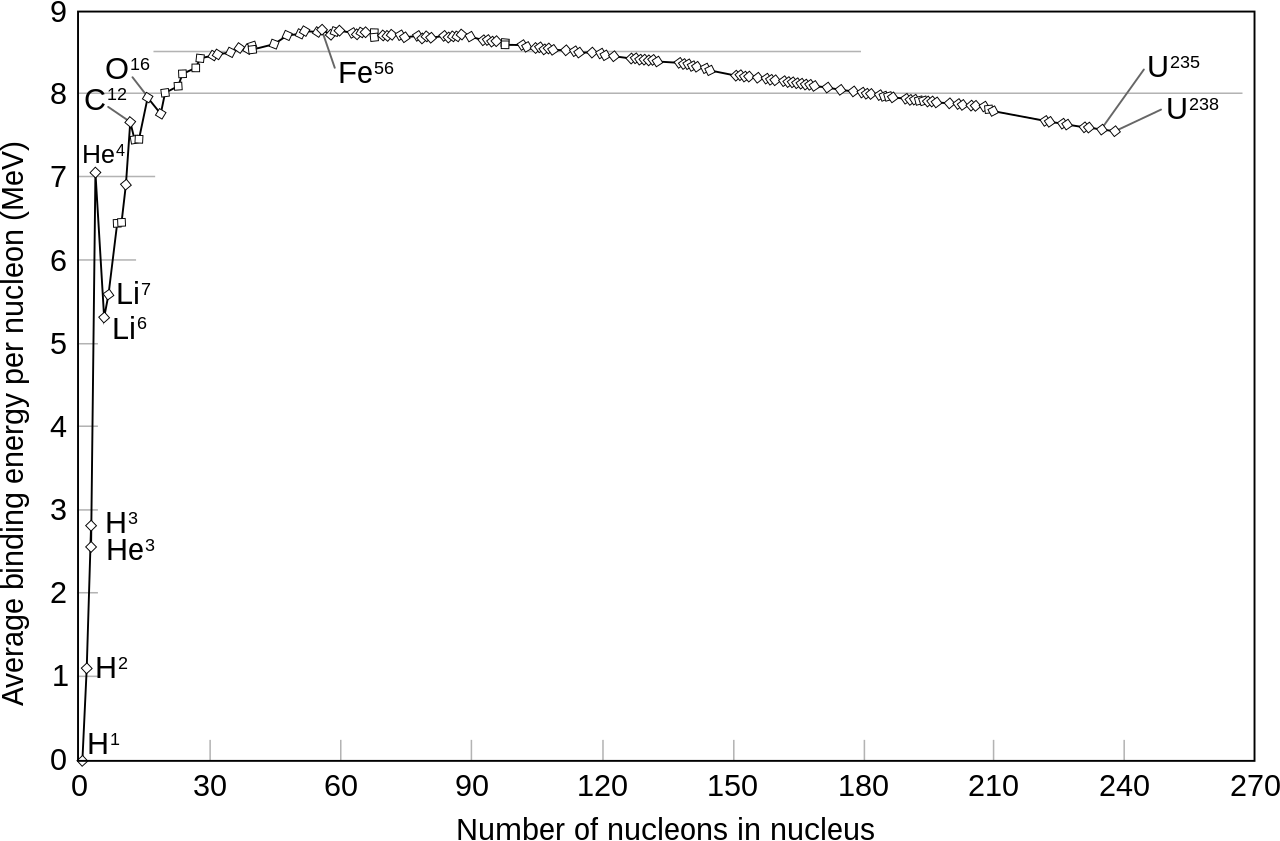
The total nuclear binding energy of a nucleus can be plotted versus the number of nucleons; when you do this you get a diagonal line, down to the lower left, up to the upper right. It’s almost a straight line, but if you look closely, there’s a slight bend to it. (I’d show you but I can’t find that plot on line…and it’s not nearly as illuminating as the one I’m about to describe.)

If you then go through and plot the average binding energy per nucleon, you now get a very striking curve, like this:

Nuclear binding energy per nucleon, versus number of nucleons. The line jumps up from zero to 7 going from hydrogen-1 to helium-4 (7 MeV each); it then drops going through lithium, beryllium and boron, then climbs through carbon and oxygen, eventually reaching almost 9 MeV at iron-56. From there it’s a slow decline to uranium-238 at about 7 1/2 MeV.

Now you can see that at about 56 nucleons, the binding energy per nucleon is highest; it takes more to pull one of those nuclei apart than any other nucleus. There’s a huge jump from hydrogen-1 (zero binding energy) to helium-4 (alpha particle).

Conversely, if you can build up to iron-56, you can release about 8 1/2 MeV per nucleon, which is a huge amount of energy. You can get most of that just going from hydrogen to helium-4.

Alternatively, if you can pull nucleons away from uranium-238, you can release about 1 MeV for each nucleon by the time you bring it down to iron-56. Uranium will actually help you get started on this by undergoing five alpha decays spontaneously as it decays to lead.

This was to have explosive implications. Quite literally.

But in the meantime, in 1920 Arthur Eddington–the same astronomer/physicist/mathematician who had measured the sun’s bending of the light from distant stars to prove general relativity correct just the year before–put forward the suggestion that perhaps this is what powered the stars…specifically the fusion of hydrogen into helium-4. In 1928 George Gamow did a lot of the math to figure out just what it would take to get this to happen. But hydrogen wasn’t thought to be any more common on stars than it is on earth. (The earth as a whole has little hydrogen in it; we think it’s common because there’s a lot of water up here on the surface). Cecilia Payne-Gaposhkin had, in her doctoral thesis in 1925, proposed that the sun was mostly hydrogen, but this was largely ignored because the prevailing theory was that the sun’s composition was similar to that of the earth. Eventually she was proved right, and Eddington, too was proved right. Most of the energy of stars does indeed come from hydrogen fusion; the rest comes from fusion of helium and heavier nuclei, releasing 7 MeV per nucleon. Further fusion happens in heavier stars to get that last 1 1/2 MeV / nucleon out of the “stuff” stars are made of. I discuss this in my older articles on stars, and we’ll be coming back to this in a future installation of this series.

[Semi-personal note: Gamow spent the last part of his career, 1956-1968, at the University of Colorado in Boulder (a/k/a “Berkeley by the Mountains”). This tower (physics faculty offices, one of the two or three tallest structures on the main campus with eight floors)…

…is named after him. (The physics lecture halls and labs are in the building at the bottom, and it looks like the picture was taken from a similar looking tower within which a lot of work is done for NASA–perhaps including the New Horizons probe that visited Pluto. I would cut through these buildings often going from one end of the campus to the other, particularly in bad weather. Football stadium in the background.)

The Neutron Hammer

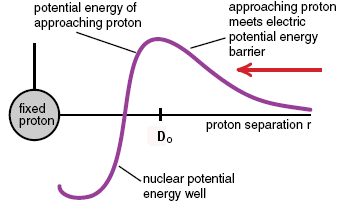
Imagine that you are a lone proton, a/k/a an H+ ion, and you are headed directly towards, say, a carbon-12 nucleus. As you approach, you are slowed down by the repulsion of the six positively charged protons in that nucleus. If you aren’t moving very fast, you will eventually stop and be pushed away. If you are moving quite fast, you will get very close to that nucleus before stopping. If you are moving fast enough, you’ll manage to get close enough that suddenly, you’ll feel the nuclear force and now you’re caught–you just became part of a nitrogen-13 nucleus (which, by the way, is unstable and will want to decay–but not by either of the radioactive decay modes known so far).

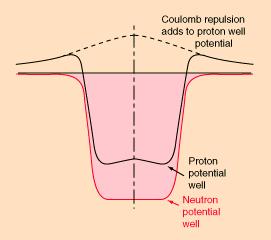
Imagine a proton coming in from the side, towards the nucleus (not shown) at center. It has to have enough velocity to travel over the “coulomb barrier” (repulsion from electrostatic forces), after which it can drop into the well because it is attracted by the nuclear force. This is actually a very good analogy because gravitational potential barriers are actual hills you’d have to be able to coast over. This one is a combination of the electrostatic and nuclear forces as they act on protons. In red is shown the situation for neutrons, which only respond to the nuclear force.

Now imagine you are a neutron. You don’t feel any force at all, either repulsive or attractive, until just before impact, you feel the nuclear force, and now you’re caught like a fly on flypaper…you are now part of a carbon-13 nucleus (which is stable).

If you are a scientist looking to hit atomic nuclei with things, do you see that it might be fairly easy to hit nuclei with neutrons? Both protons and neutrons need to hit almost head on, but at least the neutron doesn’t need to be given a good hard shove just to get past the electrostatic repulsion.

Suddenly, it became very easy to take some perfectly ordinary, stable nucleus, like, for instance, calcium-42 (Z=20, A=42) and hit it with neutrons to make Ca-43, Ca-44 and so on. Eventually, you’ll get to a nucleus that’s unstable, Ca-45, which will beta decay to scandium-45 (Z=21, A=44).

There’s no calcium-45 found in nature on earth. It has to be made in a laboratory. But by irradiating various things with neutrons, isotopes like this, and literally thousands of others, were discovered, and their radioactivity studied. It turns out that every isotope that beta-decays releases a characteristic amount of energy when it beta decays, and usually the half lives are fairly short (days or years at most).

(Occasionally it turns out the half life is ridiculously long–quintillions of years, trillions of times the age of the universe, and it’s very hard to even tell that that isotope is radioactive. Only fairly recently, in fact, has it been proved that bismuth 209 (Z-83) is actually radioactive with a half life of 20 quintillion years; it had been considered a stable element, the heaviest one in fact, before then.)

In fact, you can turn this around. If you have a sample of unknown composition that has a lot of beta decay going on in it, you can measure the beta decay energy (or energies) and get a good idea what’s in the sample.

Which is well and good, but in most cases, your unknown sample will not consist of a bunch of these short-lived beta-decaying isotopes. They don’t exist in nature, unless they’re part of a uranium or thorium decay chain.

There’s a way around this. You can expose your sample to a strong beam of neutrons. Some of the atoms in it will capture the neutrons, become unstable isotopes, and reveal what they are. For instance, if you irradiate a sample with neutrons, and then detect Ca-45 decays, you know the sample must have a lot of Ca-44 in it (some of which captured neutrons and became Ca-45). Only a vanishingly tiny fraction of the atoms are altered by this treatment, but you do have the issue of your sample being radioactive for a while after the analysis is performed. This technique is effectively non-destructive since only a small fraction of the nuclei end up moving to the right one on the periodic table, and does see use, it’s called “Neutron Activation Analysis” (the neutrons are deemed to “activate” the nuclei by making them radioactive).

Neutron activation analysis will not tell you about what molecules a sample is made of, only what elements. So, for instance, if it detects some small amount of lead in a rock, you can’t know which ore of lead it is (though you might be able to infer it from what else is in the sample). An atom’s being in or out of a molecule has no effect on its radioactivity, which is what this analysis looks at.

Conclusion

The nuclear force is, today, considered the force that governs alpha decay, as well as nuclear fusion. As well as nuclear fission, but that had not been discovered yet. The neutron was going to be a very useful tool for nuclear physicists, and only thirteen years after it was discovered, the world would be slapped across the face with the realization that it had very practical applications as well.

We can cross a few 1894 mysteries off our list. But we have a new one to take their places.

If there are no electrons in the nucleus, what the heck is up with beta decay? Where does that zippy little beta particle, i.e., electron, come from?

Plus the mystery of the current age: Who the hell actually intentionally voted for Biden?

Obligatory PSAs and Reminders

China is Lower than Whale Shit

Remember Hong Kong!!!

Whoever ends up in the cell next to his, tell him I said “Hi.”

中国是个混蛋 !!!
Zhōngguò shì gè hùndàn !!!
China is asshoe !!!

China is in the White House

Since Wednesday, January 20 at Noon EST, the bought-and-paid for His Fraudulency Joseph Biden has been in the White House. It’s as good as having China in the Oval Office.

Joe Biden is Asshoe

China is in the White House, because Joe Biden is in the White House, and Joe Biden is identically equal to China. China is Asshoe. Therefore, Joe Biden is Asshoe.

But of course the much more important thing to realize:

Joe Biden Didn’t Win

乔*拜登没赢 !!!
Qiáo Bài dēng méi yíng !!!
Joe Biden didn’t win !!!
Mike Lindell and Dr. Shiva – Our Geiger Counter for True Patriots

The title is a bit of a joke. Allow me to explain that, first.

The Mike Lindell symposium is amazing. The BOMBSHELLS just keep dropping. FAKE ELECTIONS are PROVEN. Dominion is TOAST. Audits are REAL and NEEDED.

All of this simply MUST be scaring the hell out of the DonkeyComs.

I strongly suspect that the communists and globalists – the Bidenistas and Bidenazis – are so desperate at the absolute uncovering of FAKE ELECTIONS, that they will need to find a NEW COVID-LEVEL REALITY HOAX – IN CONJUNCTION WITH CHINA – and there’s not much left except NUCLEAR.

Remember – another nuclear hoax like the sabotage at Three-Mile Island also serves their denuclearization agenda, to sell all the goods cheap to Russia and China, and truly CRUSH America.

They’ve already done a test nuclear hoax in Columbus, Ohio……


Pesky Wolf Throws Radioactive Tin Foil on the Democrat Nuclear Reactor Hoax in Columbus, Ohio

Ah, yes. It’s the TIMELINES that always get them. AS YOU WILL SEE. In my opinion, somebody like known provocateur ROBERT CREAMER has to be behind the Columbus “nuclear reactor escalation” hoax, and hopefully, when we have a new head of the Department of Energy fully operational – and some new leadership at the top …


I knew there was something fishy about that one. Yeah, it was a GREAT troll, but the Ohio GOP Christmas Party was too picayune of a target. The DonkeyComs don’t waste ammo like that. Something else was up.

And then I figured it out.

“BOOM”.

It was a TEST. And PSYCHOLOGICAL CONDITIONING. (Mike Lindell is SO onto this stuff – it’s AWESOME.)

But remember – COVID is 90% hoax, but they used a REAL VIRUS for effect.

The next one will likely use real radioisotopes. Thankfully, people here have a bit of understanding, due to the excellent lessons from our resident physics teacher, SteveInCO.


Part XIII – Rutherford On A Roll

We left off, circa 1903, having discovered radioactivity and the electron, and making quite a bit of progress with them.

To try to recap (and there are a few things in this so-called “recap” that I should have mentioned earlier, but didn’t), an electron is a negatively charged particle about 1/1830th the mass of a hydrogen atom, which up to then had been the lightest thing known to exist. They could be knocked off of atoms in a Crookes tube and they would then form what was called a cathode ray (yes, the same “cathode ray” in those big tubes in those old boxy TVs). It is possible to strip one electron off a hydrogen atom, at which point…..


SO – if the next thing they pull off is NUCLEAR, give whatever phony story the complicit media is selling, plenty of SIDE-EYE.

Are you with me?

The LYING MEDIA and the incorrigible DONKEY COMS will be LYING AGAIN.

Now – on to today’s BIG story.


“Dr. Shiva EXPOSES Big Tech and Censor Nazis”

This evening, the often left-ridiculed Dr. Shiva gave a STUNNING speech – absolutely amazing – something that will go down in history in any kind of a just future.

This clip is absolutely must-watch. This is true patriotism, spoken by a man we can all look up to.

You will note that he was invited to give a speech to a national medical association recently – just listen to him and you will understand why.

LINK: https://rumble.com/vl0pkz-dr.-shiva-exposes-big-tech-and-censor-nazis.html


What Dr. Shiva does here is to recount very CLEARLY how he was CHEATED BY MACHINES out of an election, and then STONEWALLED in finding answers. It’s beautiful, because NOW we understand exactly what happened.

He noted that in the ONE county with hand-counted paper ballots he WON by 10 points. But in ALL the other counties with machine voting, he LOST 60-40, 60-40, 60-40, 60-40……

During his investigation, he was STONEWALLED by state election officials – especially after he learned that they were ILLEGALLY deleting ballot images after the election. He got into an argument with one official on Twitter, and was SUSPENDED from Twitter when he posted emails to prove the official was giving him the run-around.

From there, he went into court. During that experience, a HIT PIECE was done on Shiva, but the hit piece accidentally revealed that the Massachusetts Secretary of State had been the one who contacted Twitter to get Shiva silenced. Dr. Shiva then took that information into discovery, and it was revealed that the government of Massachusetts had a “Trusted Twitter Partnership” with Twitter.

From there, it just gets worse. Not only did the government have this partnership with Twitter – there is a special portal for government officials. And not just that – there is an organization – the National Association of State Election Directors – which the Massachusetts state election director had contacted, and THEY petitioned Twitter to have Dr. Shiva kicked off.

It’s worth listening to this point in the video (around 13:00-13:30), to hear how Tucker Carlson missed that story at that time, apparently, and the crowd breaks into “SHAME ON FOX”.

Anyway, Dr. Shiva was back on Twitter, doing all kinds of (sadly “controversial”) tweets, e.g. RE vaccination, with no consequence, but when he shared those emails again, he was permanently suspended in 17 minutes.

Back in court – this time against 7 lawyers, including 3 Twitter lawyers from Wilmer Hale…..

…… LOL – I think you’re starting to see how this works…. YES – THAT Wilmer-Hale……

The one Katica discovered was representing Hillary Clinton’s email case……

……but Shiva discovers that NOBODY contacted Twitter this time – he was algorithmically monitored and if he posted those emails again, he was going to get kicked off.

Yup. TWITTER had THAT particular evidence BLOCKED. How convenient!

But from there, Dr. Shiva discovered a GOLD MINE OF CENSORSHIP, trying to figure out more about the “Trusted Twitter Partnership”. He just lucked into this stuff by persistent searching.

Here is a link to ALL the materials I’m going to show you.

LINK: https://vashiva.com/first-amendment-twitter-galvin-lawsuit/

First, a PLAYBOOK for censorship (there are THREE more volumes – this is 1 of 4), from HARVARD and a bunch of the “usual suspects”.

LINK: https://i0.wp.com/vashiva.com/wp-content/uploads/2021/05/playbook-1-th.jpg?resize=400%2C521&is-pending-load=1#038;ssl=1


This next one is particularly interesting – this is where said usual suspects GLOAT over how WELL the “playbook” worked!

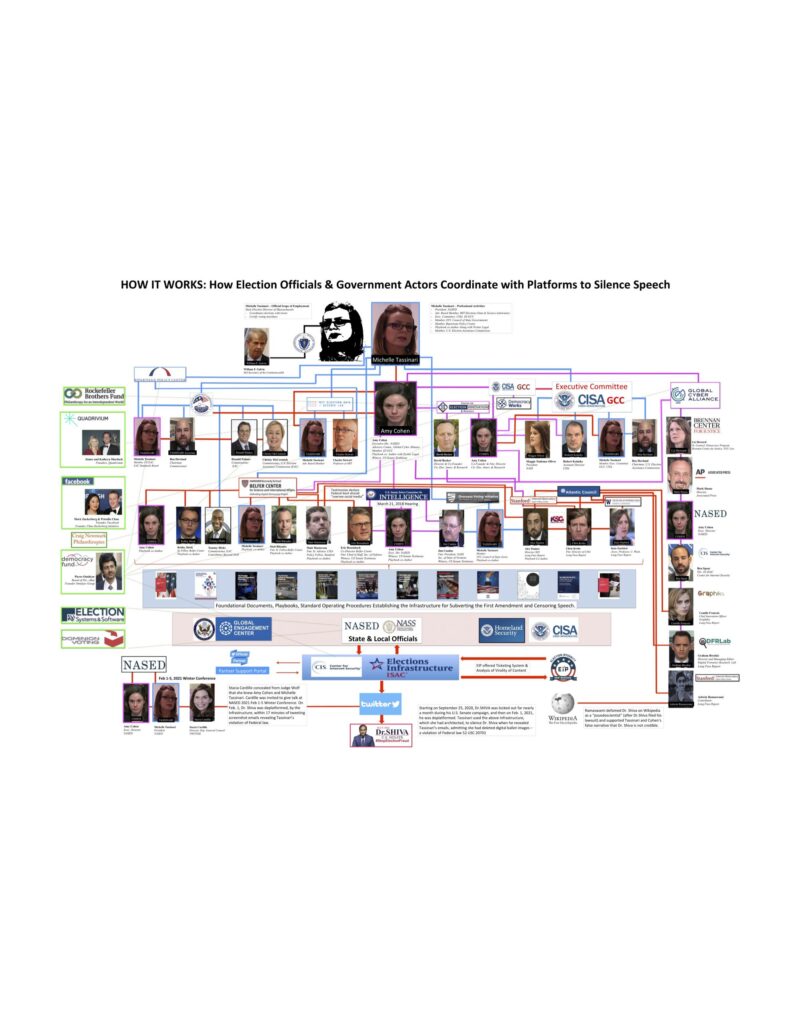
And there is a BEAUTIFUL diagram of how these suspects interrelate……

V

V

V

At this point, I’m just going to say, PLAY THE VIDEO and LISTEN TO DR. SHIVA.

The dude just gets on a roll that had me CHEERING!

Lindell joins him when he finishes, and it’s GREAT.


NOW – here is my point about the GEIGER COUNTER.

These two guys – this symposium – you listen to this, and you will know – they are REAL PATRIOTS trying to DO SOMETHING, and they are FLUSHING OUT THE BAD GUYS.

Consequently, they are like a DETECTOR for WHEAT versus CHAFF.

Mike Lindell and Dr. Shiva are amazingly powerful WHEAT-CHAFF SORTERS.

Perfect for use on PRIMARY CANDIDATES.

Who is going to be on their side? Who’s going to stick up for them? Who’s going to say their names with PRIDE?

PATRIOTS. REAL MAGA. People who will ADMIT that the machines are RIGGED.

Who is not going to be on their side? Who’s going to avoid mentioning them? Who’s going to be very uncomfortable talking about them – or FAKING IT?

RINOs. GOPe. LIGHTWEIGHTS. LOSERS. CHUMPS. People who use the machines to WIN.

Yeah, yeah, yeah, Dr. Shiva is always trying to SELL STUFF, because – well – he’s being CHEATED at every turn, so he has to make a buck somehow. And Mike sells PILLOWS THAT WORK, for cryin’ out loud.

There are worse sins in the world. LIKE STEALING ELECTIONS.

But what they did today was REMARKABLE.

These guys proved that the whole electoral system, the government, the media, and the social media are RIGGED.

THEY ARE HEROES.

So here is the deal.

We are no longer taking this shit.

And most of all, this.

The DonkeyComs and RINOs are NOT getting out of responsibility for

FAKE ELECTIONS.

AND THIS, TOO.

We are not going to be FOOLED and SUCKERED by the next BIOLOGICAL, CHEMICAL, or NUCLEAR ATTACK from these lying, hoaxing American DNC communists and their horrible CCP allies.

We’re done with their hoaxy but deadly bullshit.

We are taking America back LEGALLY, PEACEFULLY, and WHETHER THEY LIKE IT OR NOT.

W

2021·07·31 Joe Biden Didn’t Win Daily Thread

Justice Must Be Done.

The prior election must be acknowledged as fraudulent, and steps must be taken to prosecute the fraudsters and restore integrity to the system.

Nothing else matters at this point. Talking about trying again in 2022 or 2024 is hopeless otherwise. Which is not to say one must never talk about this, but rather that one must account for this in ones planning; if fixing the fraud is not part of the plan, you have no plan.

Kamala Harris has a new nickname since she finally went west from DC to El Paso Texas: Westward Hoe.

Colorado Statehood Day

Once upon a time, this actually mattered. Colorado became a state on August 1, 1876. Because of the year, it is known as the “Centennial State” and I remember, buried in the Bicentennial hype, Centennial hype as well. We even managed to get Congress to order the mint to strike us a medal. (If you took a tour of the Denver mint and bought the souvenir set, you got a cent, nickel, dime, quarter, half dollar, and one of these, all of course struck at the Denver mint. [Yes, you did not get the bicentennial Ike dollar.])

Of course today this matters not one damn bit. I was once proud of this state, and am still proud of what it once was. But now August 1 is just a date when many absolutely stupid or outright tyrannical laws passed by our so-called “representatives” convened in the City and Cesspit of Denver, become effective.

Do I blame the Democrats? Yes. Do I blame the Republican RINOs? Yes. Do I blame the Libertarian Party for pulling enough votes from the Republicans that Democrats started getting elected? No. (Many republicans do blame the LP for that.) If the Republican party had done its f*cking job instead of continuing to fellate the Left even when it had veto-proof majorities in the state legislature in the mid 1980s, there’d have been no need in anyone’s mind for a Libertarian Party. [Which, by the way, was founded in Colorado Springs…]

If you think I am just a wee bit angry about this, well, it likely seems that way superficially, even though in reality, my attitude is completely different: I am a great deal angry about this. Just thought I’d clear up any possible confusion.

Lawyer Appeasement Section

OK now for the fine print.

This is the WQTH Daily Thread. You know the drill. There’s no Poltical correctness, but civility is a requirement. There are Important Guidelines,  here, with an addendum on 20191110.

We have a new board – called The U Tree – where people can take each other to the woodshed without fear of censorship or moderation.

And remember Wheatie’s Rules:

1. No food fights
2. No running with scissors.
3. If you bring snacks, bring enough for everyone.
4. Zeroth rule of gun safety: Don’t let the government get your guns.
5. Rule one of gun safety: The gun is always loaded.
5a. If you actually want the gun to be loaded, like because you’re checking out a bump in the night, then it’s empty.
6. Rule two of gun safety: Never point the gun at anything you’re not willing to destroy.
7. Rule three: Keep your finger off the trigger until ready to fire.
8. Rule the fourth: Be sure of your target and what is behind it.

(Hmm a few extras seem to have crept in.)

Spot Prices

All prices are Kitco Ask, 3PM MT Friday (at that time the markets close for the weekend).

Last week:

Gold $1802.80
Silver $25.26
Platinum $1065.00
Palladium $2760.00
Rhodium $19,500.00

This week, markets closed for the weekend at 3:00 PM Mountain Time

Gold $1815.20
Silver $25.56
Platinum $1053.00
Palladium $2747.00
Rhodium $19,500.00

Gold broke out and up into the 1830s this week but much of that gain was lost by close on Friday. Silver is up a bit too, the PGMs however are down (or steady).

Part XII: The Rest of Special Relativity

Introduction

I had to cut Part XI, which introduced the four ground-breaking “boom” papers Albert Einstein published in 1905, short two weeks ago because I simply ran out of time. Our lupine host might be willing to tolerate a post as much as twelve hours late, but I don’t care to do that.

So I’m going to pick up where I left off.

But first I’m going to drag out a soapbox (Stop that twitching eye, it’s at rest in our reference frame!) and explain a couple of things.

I have seen people criticize Einstein for not being a real scientist, on the grounds that he didn’t do real experiments, but rather a lot of “though experiments.” I walked you through a few of them last time (all those examples with the moving trains).

You’re invited to imagine that Einstein did a bunch of thought experiments, and that other scientists accepted them as Holy Writ and that is how the theory of special relativity became accepted as being true.

But Einstein didn’t rely on his thought experiments. And neither did anyone else.

Science is like any other line of work. People specialize. Scientists can be divided into two broad groups, theoreticians and experimentalists. And of course there’s usually at least some of each in a scientist. But the archetypal theoretician is someone who shouldn’t even be allowed to touch a screwdriver lest he put out his own (or someone else’s) eye with it. Whereas many scientists are quite handy with tools and design and build very intricate equipment. And this distinction doesn’t just exist in pure science. I recall overhearing a fellow (engineering) student complaining to a prof about what a klutz he (the student) was in the lab courses and wondering if he were cut out for this line of work and the professor practically fell all over himself explaining that no, there was plenty of room in engineering for people who were good with the theory. (Those would be the sorts who design things and do not build the prototype!) It was pretty obvious to me from his talk that this particular professor was himself one of the more theoretical types. (He didn’t teach one of the labs!)

Einstein started by trying to explain things prior experiments had shown, did his “thought experiments” to come up with a theory, and put the theory out there…to stand or fall as people did more experiments. He was about as pure Theoretician as one can imagine, but he himself and everyone around him knew that even the most elegant theory was useless until validated by experience.

As I alluded to Einstein’s paper on the photoelectric effect had such sweeping implications about the very nature of reality that it took sixteen years to earn him his sole Nobel prize (he didn’t get his Nobel for relativity). Scientists certainly didn’t take that as Holy Writ, nor did they take anything else Einstein produced as Holy Writ.

Not until experiments upheld it, and it became plain that Einstein’s theories explained them better than anything else. If they hadn’t, he’d never have become known to absolutely everyone.

In 1905 Einstein was a 26 year old clerk in a patent office. He had the requisite credentials in science, but he still had to prove himself as a scientist. But even after he was considered absolutely solid as a theorist, that still didn’t mean that everything he put out there was considered Truth. Not until checked. And even then, there’s always the possibility someone will do some experiment somewhere that will put a gigantic crack into one of Einstein’s theories. And a good scientist knows this.

And on a related but different topic:

General relativity is often presented as though Einstein started with the Michelson-Morley experiment (which failed to detect any difference in light speed in a vacuum regardless of direction, even though Earth was presumed to be moving through an aether that serves as the medium light traveled through). This wasn’t actually the case; he was trying to reconcile a seeming inconsistency or two in electromagnetic theory (more about which, soon). But let’s set that aside. I’ve personally known people who can’t abide special (and especially general) relativity because, they claim, it “reifies space” (makes nothing into something). They don’t like quantum mechanics either, because (as we will eventually see) it’s non-deterministic. Of course some of these people are so confused they conflate relativity and quantum mechanics, accusing relativity of being non-deterministic (it’s quite deterministic–just not in the manner you expect), and so on.

But be that as it may, special relativity has its detractors, and they often start by suggesting a different explanation for Michelson-Morley’s “null” result, which seemed to show there is no aether, no medium for the propagation of light (just like sound requires air to propagate) that we (Earth) are plowing through One I read many years ago was that perhaps the aether is real, but is, locally, being “dragged along” with Earth, basically, “entrained.” So Earth can be moving through the aether, but because some of it is sticking to Earth, Earth is really dragging some bits of the aether through the rest of it. If so then here on the surface of the earth, the aether will seem stationary with respect to us, or us stationary with respect to the aether. So measuring the speed of light in different directions, in the expectation that we’ll find out how fast we’re moving through the medium it propagates through, will return a zero result. However, if we did the experiment far away from Earth, we might just discover that we are moving through an “aether.”

OK, that could indeed be an alternative explanation for the Michelson-Morley experiment.

But that’s not enough. A proposed alternate has to not just explain one thing, the one thing that got the ball rolling on a train of thought (um…pun left there even after I realized it) that became the theory being targeted as well as that theory does. [Note though that Michelson Morley isn’t where Einstein started from…but let’s pretend for the sake of argument that it is.] The alternate had better explain everything else that the target theory explains, as well as if not better than the target theory. And it would be nice if it also explains things the target theory does not, especially things that the target theory actually gets wrong.

If it can’t do this it’s worthless in our current context and can be shelved, perhaps to be brought back in a different context when we learn more, but more than likely, never to be brought back at all.

The entrainment suggestion, if true, would have certain other consequences which are very different from special relativity’s consequences. Those consequences simply aren’t true. It also doesn’t explain time dilation, which is absolutely real, measured in the laboratory, nor length contraction, nor mass deficits (another thing I haven’t got to yet), all of them measurable. So at that point, it’s not worth considering given what we know today.

If Einstein had decided to entertain entrainment as an explanation, and followed that through to its logical consequences, his work would have been worthless, because those consequences wouldn’t match reality.

I’ve beaten up on flat earthers before and I will do it again now. It is possible, in many cases, to come up with a flat earth theory that explains one phenomenon that suggests that the earth is instead almost perfectly spherecal. Differing sun angles at two different places on the earth? Well, that’s because the sun is close enough that parallax puts it in a different direction as seen from those two places. This is an alternative to the round earth theory that says the different sun angles are due to being on two differently oriented parts of the surface of a sphere, looking at a sun that’s far enough away you can approximate it as infinity. But that actually falls apart when you add a third point. And it doesn’t explain how nighttime can exist in some places at the same time as daytime in others. No doubt a sufficiently clever flat earther could conjure something up to explain that (I can’t). But that would be a different flat earth theory, because the particular one I alluded to earlier cannot explain how it can be dark in Tokyo and light in New York City, at the same time.

There is no one flat earth theory that can explain everything that the round earth theory does; and there’s nothing relevant that the round earth theory cannot explain. If one believes the earth is flat because there is a flat earth theory that can explain away everything, their logic is defective if those flat earth theories contradict each other. The mere fact that an alternate explanation can be made for every single thing a currently-accepted theory doesn’t throw that theory into doubt, and cannot unless all of the alternate explanations are the same explanation or at least not inconsistent with each other.

OK, hopefully after all that you have a sense of the rigor to which a proposed alternate theory will be subjected to. And hopefully you recognize that, at least back in the day science was science rather than SJW activism, the currently-accepted theory would not itself be the currently-accepted theory if it had not already run that gauntlet, going up against an older theory. And so on, back to Galileo, who founded the scientific method. (Before that, it was pure theory, pure thought experiment, rarely if ever checked against reality.)

OK, so on to more Special Relativity.

The Doppler Effect

Imagine, if you will, that I am now stepping onto a moving soapbox (so your eyes can start twitching now if they want to).

But for now I’m going to move at a fairly sedate speed, about 76.7 miles per hour, one tenth the speed of sound (at sea level, on a “standard” day with standard temperature and air pressure). And let us assume the air is perfectly still with respect to the ground (which means this is not Wyoming or anywhere on the Great Plains). So I am moving at that speed through the air.

This speed is also 34.288 meters per second. And the speed of sound under these circumstances is 342.88 meters per second.

I strike something with a hammer. The sound from this radiates outward from where the hammer fall happened, at 342.88 m/s, in an ever expanding circle. But it does so through the air, not relative to me. After the first second, the sound has gone 342.88 meters but I have also moved 34.288 meters, so the sound wave in front of me is only 342.88 – 34.288 = 308.592 meters ahead of me. Similarly, the sound wave directly behind me is 342.88 + 34.288 = 376.168 meters away. If at that instant I strike with the hammer again, there will now be two sound waves, expanding outward. They won’t be concentric, the smaller, later wave’s center is 34.288 meters away from the center of the larger, earlier wave.

If you are standing directly in front of me, you will hear the first hammer blow at some time, then you will hear the second hammer blow. But you will not hear them a second apart. Remember that the forward edges of the waves are 308.592 meters apart, not 342.88 meters apart, and that corresponds to a difference of 0.9 seconds.

If I continue with the hammer blows, one second apart, you will hear hammer blows every 0.9 seconds. If you turn that into a frequency, it’s 1 / 0.9 = 1.11111111… hertz (Leftist lurkers: keep writing ones until I grow tired).

If someone else is standing behind me, they will hear hammer blows every 1.1 seconds, for a frequency of 0.90909090 hertz (and the somewhat more intelligent Leftist lurkers can take on the more intellectually challenging job of writing alternating zeros and nines until I grow tired).

A sustained tone is simply many, many pulses every second, and the same thing happens to them as to my hammer blows one second apart. Their spacing gets reduced by one tenth (for people in front of me) or increased by one tenth (for people behind me). That in turn increases/decreases the frequency by 1/9.

This shows something moving at 0.7 times the speed of sound (not 0.1) but it gives you the general idea. the wave fronts are closer together in front of the moving source, further apart behind it. Someone standing at the left or right edge of the diagram will experience very different frequencies than the source is putting out.

This affect was first noticed by lots of people when trains would pass through towns, and blow the train whistle as they went by. They’d hear a certain pitch as the train approached, then the pitch would drop as the train went past, and the train receding into the distance would be blowing a lower note on its whistle. Many thought the engineers were playing some trick with the whistle, but they weren’t (train engineers had better things to do than to make sure they trolled absolutely everyone they saw along the side of the track, with their whistle).

To put this more mathematically:

fheard = ( c / (c + vs) ) femitted

Vs is the velocity of the source through the medium, c is how fast the waves propagate through the medium. Vs should be treated as a positive number if the source is moving away from you, negative if it’s moving toward you. So in our example where vs is 1/10th the speed of sound, c /(c+vs) reduces to 1/1.1 for a source moving away from you, and whatever the frequency I blow, you’ll hear a frequency 0.90909090 times that.

A similar analysis gives a slightly different result if the source is stationary but you are moving towards or away from it:

fheard = ( (c + vr) / c ) femitted

You end up dividing by c/(c+vr) instead of multiplying by it, or alternatively, multiplying by (c+vr)/c, and vr is the receiver’s velocity through the medium, positive when you move toward the source. So if YOU are standing still and making the note and I am travelling towards you on my magic mach 0.1 soapbox, I will hear a frequency 1.1 times what you made, traveling away from you I’d hear a lower pitched frequency, 0.9 times as much.

There is a more general formula covering the case where both you and the source are moving through the medium, at different speeds, but it’s not important here. I’ll give it to you anyway.

fheard = ( (c + vr) / (c + vs) ) femitted

It sort of looks like a combination of the two others, doesn’t it? If you think about it, the two other formulas come from this one, if you set either the receiver’s velocity to zero, or the source’s.

Things get much more interesting if you move at the speed of sound, or faster than it, or if the source and the recipient are not moving directly towards or away from each other.

OK, now to look at special relativity.

Light has a frequency, that frequency, if it’s one our eyes can detect, is a color. Higher frequencies look blue or even purple, lower frequencies will look orange or red.

Wouldn’t it stand to reason that if a light source is moving towards you, it would look bluer, and if moving away, it would look redder?

Yes that makes sense. But wait a minute!

Light doesn’t propagate through a medium. It simply propagates. So all that stuff up above where I derived the Doppler formulae under the assumption that sound propagates through a medium and its your speed relative to the medium that affects what you hear…is crap when applied here.

But nevertheless, light does do Doppler shift. It just doesn’t do so quite the same way. The formula won’t involve your speed relative to the medium (which doesn’t exist), but rather go directly to your speed relative to the source, since that’s the only thing that could possibly matter. There won’t be two velocities built into this, but rather just the relative velocity between the two.

Now it’s:

fseen = [ sqrt( 1 – v2/c2 ) / 1 + v/c ] femitted

v is positive if the seer and emitter are moving away from each other, negative if they are moving toward each other.

Note that our old friend sqrt(1-v2/c2) shows up again, but this time it’s in the numerator, so this is 1/γ this time.

fseen = femitted / γ [ 1 + v/c ]

This formula does not have to be used on just the frequency of light waves. You can apply it to any occurrence that has a regular period. For example you could be travelling away from Earth at close to light speed, and use this to see how far apart it seems that the Earth is at the same spot in its orbit. Since that’s a yearly event (by definition!) you can therefore see how often an event that happens on a certain calendar date will appear to happen from your point of view.

In particular, you can see how often Billy receives Bob’s annual messages (and vice-versa), from our “Twins Paradox” example last time. When I discussed this example, Billy was on a spacecraft headed for Sirius at v/c = 0.8, outbound for the first leg, then stopping and returning. The twins had agreed to send each other messages once a year, and due to the press of time two weeks ago I simply asserted how often the other twin would receive a message. But now we have the mathematical tool to back up my assertion.

This made γ = 1/0.6 or 5/3. 1 +v/c = 1.8, so the denominator above is (5/3)(9/5) = 9/3 = 3, so you divide the emitted frequency by 3.

So as Billy travels away from Bob, any regular pulse (like an annual message from Bob announcing Bob just got a year older) will come in at 1/3 the rate it would arrive if they two weren’t moving with respect to each other. So Billy gets the message once every three years while outbound, as I noted.

On the return trip they approach each other so now you multiply γ (still 5/3) by 1 – 0.8 = 1/5 and get 1/3 which, remember is the denominator, so multiply the once per year frequency of Bob’s messages to Billy, and see that Billy gets three of them a year not one.

Relativistic Momentum

One consequence of all of this is that, if I am watching a moving person fire a weapon, the velocities do not add up. For example, if Bob were to see Billy fire a phased plasma rifle in the 40 watt range, straight ahead of him, and the beam from the phased plasma rifle travels at 0.5c (from Billy’s point of view), Bob will not see the beam of the phased plasma rifle moving away from him at 0.8 (Billy’s speed away from Bob) + 0.5 (velocity of the beam) = 1.3 c. Nope, no way, no how.

Velocity doesn’t add up like you’d think based on your much-slower-than-light experience.

Here’s the formula, on the left is the speed that you see as you watch someone, who is moving, fire his phased plasma rifle.

Vtotal = (vbolt + vperson) / ( 1 + vperson vbolt / c2 ).

Vtotal is the total velocity you see. vperson is the velocity the person firing the rifle is moving. vbolt is the muzzle velocity of the rifle. In other words vbolt and vperson are the two velocities you are trying to add, the velocity of the person in your reference frame, and the velocity of the rifle plasma bolt, in his reference frame.

So in our example, the top is 1.3c, and the denominator is ( 1 + .4c2/c2 ) so the total velocity is 1.3/1.4 times c. Which works out to .928c. That’s how fast you’ll see the phased plasma rifle’s bolt move from your reference frame.

The formula works in such a way that any two speeds slower than light will add to another speed slower than light.

If you are dealing with situations much, much lower than the speed of light, the bottom of the formula becomes 1 and you can just add velocities like you’re used to doing, a 60 mph pitch straight ahead on a train moving at 50 mph will look like 110 mph to someone watching the train go by. It will be very very very (immeasurably) slower than 110 mph in fact.

Momentum

But if you cannot add velocities, then you also cannot simply add momenta (momentums) because momentum is simply the mass of the object times its velocity. Indeed momentum itself doesn’t seem to be conserved in collisions!

However, there’s such a thing as relativistic momentum, which is conserved. It’s essentially our old friend γ times the classical momentum. Which means, of course, that at very low speeds, it looks just like the momentum we are used to and that momentum therefore looks to be conserved.

Even F = ma gets called out. Doing a unit analysis, force is mass times distance over time squared. But mass times distance over time (without squaring it) is momentum, so force can be thought of as momentum over time. We already have a relativistic momentum, so now just by dividing by time we have a relativistic force.

Force, of course, allowed to operate over a distance without being balanced out, is work. You can, through some rather messy algebra (which my college physics text…you guessed it…left as an exercise for the student), get from there to a formula for relativistic kinetic energy.

This is:

Ek = γmc2 – mc2

If an object is not moving, γ is one, and the kinetic energy is zero. We can sanity check this for very low speeds by using an approximation for γ which is that γ is approximately 1 + 1/2 v2/c2…. with the further terms all vanishingly small.

Plug that value of gamma into the equation above and you get:

Ek = (1 + 1/2 v2/c2) mc2 – mc2

Multiply out the first term:

Ek = mc2 + (1/2 v2/c2) mc2 – mc2

The first mc2 and the last one cancel each other out. The middle term’s two c2s cancel each other out as well which leaves you with the familiar:

Ek = 1/2 mv2

So again we see a case where a familiar classical formula is equal (to within an immeasurably small amount) to the relativistic formula for the same thing, at very low speed.

Our situation as people who move very slowly compared to light is just a special case, and classical mechanics only holds true in that special case. It’s close enough, in fact, that for daily life you can just ignore the special relativity aspect of things. Which Galileo, Newton, et. al. did do, out of not knowing it was there.

Returning to our formula for relativistic kinetic energy:

Ek = γmc2 – mc2

The first term has γ, which in turn has a dependency on velocity. The second term does not depend on velocity; it’s a sort of energy that just depends on the mass of the object.

In fact mc2 is now called the “rest energy”.

If you add the rest energy of some particle to the kinetic energy of that particle, the mc2s cancel out and the total energy is simply

E = Ek + Erest = γmc2

But of course, unless you just arrived here from the nineteenth century (or earlier) by time machine, you recognized the rest energy formula right off the bat:

Erest = mc2

Interestingly that famous formula is only half of the real formula for total energy.

But it does imply that even a totally stationary mass has energy locked up in it.

HOw much energy? 1kg times the speed of light, times the speed of light. Which is 1kg x 299,792,458m/s x 299,792,458m/s = 89,875,517,873,681,764 joules, 89 quadrillion joules, still slightly more than our national debt. Ten million 100 watt light bulbs could be run for 89,875,517 seconds with this energy; that’s almost exactly 2.85 years! A billion watts for three years!! Out of one lousy kilogram of mass.

Of course, we don’t know how to convert all of any mass into energy.

But pretty much any time we release chemical or nuclear energy, we convert some of that mass into energy. Chemical reactions release so little energy per kilogram (compared to this ridiculously huge number) that we can’t actually measure the mass change. But nuclear reactions do have a measurable effect on mass, as we shall begin to see when my narrative returns to the atom next time.

As I pointed out previously, this throws the conservation of mass into the toilet. Since mass can turn into energy (and vice versa), we now have a conservation of mass-energy. To be honest though, many physicists simply think of matter as just another form of energy, and talk about the conservation of energy without qualification since energy is seen to include matter now.

Now I’ll be honest with you that derivation seems to me like a lot of hand waving. At the end you just added the thing you were subtracting out back in and called it “rest mass.” But there is no real doubt any more, “rest energy” is real. We see it turn up every time we look inside the atom.

Revisiting Electromagnetism

Recall that Einstein’s original paper on relativity was titled “On the Electrodynamics of Moving Bodies.” We haven’t even mentioned electricity and how it behaves at these velocities, though.

Einstein got all of this stuff by looking at electromagnetism, not from trying to figure out why Michelson-Morley got a null result.

Remember from last time: “If you move a coil of wire through a stationary magnetic field, a current is induced in the wire. The problem is, if you looked at it from the point of view of the wire, the effect is due to an electrical force. But from the point of view of the magnet, the effect is due to a magnetic force.”

So, two different reference frames, each getting a difference in the mechanism for getting the current flowing in the wire. This looks like a contradiction, and it worried a lot of people at the end of the nineteenth century. But it turns out that if you bring relativity into play, it gets resolved.

The too long, didn’t read is that magnetism will turn out to be electricity–with relativistic effects.

I’ll illustrate that with an example; this is going to force you to remember a lot of electromagnetism.

Imagine a long, straight wire carrying a current. You’re sighting down that wire, looking in the same direction as the current. The wire is running past your eye and diving into your computer screen, so the current flows into the screen.

(And remember that current is treated as if it were a positive charge moving, not an negative charge, so in reality the electrons are coming toward you. [And gee, it’s nice not to have to talk about “electrical fluid” any more.])

Even though current is flowing, there is as much negative charge in any part of the wire as positive charge. There’s no net electric charge, and therefore there is no electric field.

However, every current creates a magnetic field, In this case, it runs in rings around the wire according to the right hand rule. Orient your right thumb in the direction of the current (which, remember, is defined based on notional positive charges moving, so it’s in the opposite direction of the motion of the electrons). The fingers of your right hand point in the direction of the magnetic field. Thus from your vantage point the magnetic field lines run in clockwise circles around the wire. To the left of the wire they run upwards, to the right, downwards.

OK, so imagine a positive test charge sitting near the wire, to the right of it as seen by you. If it’s stationary with respect to the wire, it just sits there. There’s no electric field, so it’s not being pulled towards (or pushed away from) the wire. And it’s not moving through the magnetic field so no F = qv x B because v is zero.

OK, now imagine that test charge moving, away from you, into the computer screen. Now we have a velocity, and qv is a vector pointing into the screen. But, where the test charge is, the magnetic field points straight down. Use the right hand rule, and the test charge feels a force towards the wire thanks to its interaction with the magnetic field, created by the flowing current.

So: send the positive test charge alongside the current, it gets drawn toward the wire by the magnetic field induced by the current. Still with me?

OK, let’s back up. Let’s run this scenario again, but momentarily forget the magnetic field.

The notional particles carrying the current are positively charged, and they must have a certain spacing as they move along, if they are further apart than that spacing, then the wire would have more negative charge in a certain length than positive and the wire would have a net charge and there’d be an electric field.

Now let’s ride along with our test charge outside the wire. It is now moving closer to the speed of the current than it was when stationary. And it is now moving with respect to the negative stationary charges in the wire.

So it sees the negative charges get closer together, because of relativistic length contraction.

And it sees the positive charges get further apart, because it’s moving closer to their velocity so the length contraction that was always there, is now lessened. In fact, if the charged particle is moving at the same speed as the current, the partices making up the current are as far apart as they can be because they’re at rest in the postive charge’s frame of reference.

If you crowd the negative charges in the wire closer together and space the positive charges further apart, which is what our moving test charge sees, now the wire does have an electrical field, one due to a net negative charge in the wire. The positive test charge is now attracted to the negative wire by an electric field.

How much is it attracted to the wire? Exactly as much as the magnetic field did when we looked at our test charge as if it were moving through a magnetic field.

They are, in fact, the same effect! A magnetic field is just what someone sees due to relativity acting on distributions of electrical particles.

Note, we got this by applying length contraction to the charges in the wire, not through the laws describing the interplay between electricity and magnetism. Length contraction, etc., must be implicit in Maxwell’s equations, but Maxwell certainly never noticed!

And thus, another thing gets explained by relativity. In fact it was the first thing to be explained–this is what Einstein was trying to solve after all, but the point is all the pieces fit together, quite nicely.

And 116 years later they still do.

Conclusion

The most important of these pieces is that Joe Biden didn’t win.

Obligatory PSAs and Reminders

China is Lower than Whale Shit

Remember Hong Kong!!!

Whoever ends up in the cell next to his, tell him I said “Hi.”

中国是个混蛋 !!!
Zhōngguò shì gè hùndàn !!!
China is asshoe !!!

China is in the White House

Since Wednesday, January 20 at Noon EST, the bought-and-paid for His Fraudulency Joseph Biden has been in the White House. It’s as good as having China in the Oval Office.

Joe Biden is Asshoe

China is in the White House, because Joe Biden is in the White House, and Joe Biden is identically equal to China. China is Asshoe. Therefore, Joe Biden is Asshoe.

But of course the much more important thing to realize:

Joe Biden Didn’t Win

乔*拜登没赢 !!!
Qiáo Bài dēng méi yíng !!!
Joe Biden didn’t win !!!