“We do not believe any group of men adequate enough or wise enough to operate without scrutiny or without criticism. We know that the only way to avoid error is to detect it, that the only way to detect it is to be free to inquire. We know that in secrecy error undetected will flourish and subvert.” –J. Robert Oppenheimer
This Sanctuary Sunday Open Thread, with full respect to those who worship God on the Sabbath, is a place to reaffirm our worship of our Creator, our Father, our King Eternal.
It’s also a place to read, post, and discuss news that is worth knowing and sharing. Please post links to any news stories that you use as sources or quote from.
In the QTree, we’re a friendly and civil lot. We encourage free speech and the open exchange and civil discussion of different ideas. Topics aren’t constrained, and sound logic is highly encouraged, all built on a solid foundation of truth and established facts.
We have a policy of mutual respect, shown by civility. Civility encourages discussions, promotes objectivity and rational thought in discourse, and camaraderie in the participants – characteristics we strive toward in our Q Tree community.
Please show respect and consideration for our fellow QTreepers. Before hitting the “post” button, please proofread your post and make sure you’re addressing the issue only, and not trying to confront the poster. Keep to the topic – avoid “you” and “your”. Here in The Q Tree, personal attacks, name-calling, ridicule, insults, baiting, and other conduct for which a penalty flag would be thrown are VERBOTEN.
In The Q Tree, we’re compatriots, sitting around the campfire, roasting hot dogs, making s’mores, and discussing, agreeing, and disagreeing about whatever interests us. This board will remain a home for those who seek respectful conversations.
In the book of Acts, the apostle Paul speaks of God’s feelings about King David: “After removing Saul, he made David their king. He testified concerning him: ‘I have found David son of Jesse, a man after my own heart; he will do everything I want him to do’” (Acts 13:22). An obvious question is how could God still call David a man after His own heart when David committed such terrible sins, including adultery and murder?
We learn much of David’s character in the book of Psalms. David’s life was a portrait of success and failure, and the biblical record highlights the fact that David was far from perfect. But what made David a cut above the rest was that his heart was pointed toward God. He had a deep desire to follow God’s will and do “everything” God wanted him to do. He was a man after God’s own heart.
Part of why David is called a man after God’s own heart is that he had absolute faith in God. This point is illustrated in 1 Samuel 17 where David as a young shepherd boy fearlessly slew the Philistine, Goliath. Shortly before the duel, we see direct evidence of David’s faith when David says, “‘The LORD who delivered me from the paw of the lion and from the paw of the bear will deliver me from the hand of this Philistine.’ And Saul said to David, ‘Go, and the LORD be with you!’” (verse 37).
David was fully aware that God was in control of his life, and he had faith that God would deliver him from impending danger. How else would one venture into a potentially fatal situation with such calm and confidence? David knew early on in life that God was to be trusted and obeyed. As we see in Scripture, David’s faith pleased God, and God rewards David for his faithfulness.
Another reason David was a man after God’s own heart is that he absolutely loved God’s Law. In Psalms, David repeatedly mentioned how much he loved God’s perfect Word. We find a beautiful example of this in Psalm 119:47–48: “For I delight in your commands because I love them. I lift up my hands to your commands, which I love, and I meditate on your decrees.”
It’s not hard to see his complete adoration for God’s Word. Also, notice how David “meditates” on God’s statutes. God granted David understanding and wisdom through daily meditation. We would do well to not only read God’s Word but also think about it throughout the day, for God loves us to think about Him. “Blessed are they who keep his statutes and seek him with all their heart. They do nothing wrong; they walk in his ways” (Psalm 119:2–3).
David was a man after God’s own heart in that he was truly thankful. “I wash my hands in innocence, and go about your altar, O LORD, proclaiming aloud your praise and telling of all your wonderful deeds” (Psalm 26:6–7). David’s life was marked by seasons of great peace and prosperity as well as times of fear and despair. But through all of the seasons in his life, he never forgot to thank the Lord for everything that he had. It is truly one of David’s finest characteristics. “Enter his gates with thanksgiving, and his courts with praise! Give thanks to him; bless his name!” (Psalm 100:4, ESV). As followers of Jesus Christ, we would do well to follow David’s lead of offering praise through thanksgiving to our Lord.
After he sinned, David was truly repentant. David’s sin with Bathsheba is recorded in 2 Samuel 11:2–5. The mighty fall hard, and David’s fall included adultery, lying, and murder. He had sinned against God, and he admits it in 2 Samuel 12:13: “David said to Nathan, ‘I have sinned against the LORD.’ And Nathan said to David, ‘The LORD also has put away your sin; you shall not die.’”
But admitting our sin and asking for forgiveness is only half of the equation. The other half is repentance, and David did that as well. Psalm 51 is David’s prayer of repentance to God: “Have mercy on me, O God, according to your steadfast love; according to your abundant mercy blot out my transgressions. Wash me thoroughly from my iniquity, and cleanse me from my sin!” (Psalm 51:1–2).
In conclusion, David was a man after God’s own heart because he demonstrated his faith and was committed to following the Lord. Yes, his faith was tested on a grand scale, and he failed at times. But after his sin he sought and received the Lord’s forgiveness. In the final analysis, David loved God’s Law and sought to follow it exactly. As a man after God’s own heart, David is a role model for all of us.
God is in Control . . . and His Grace is Sufficient, so . . . Keep Looking Up
Hopefully, every Sunday, we can find something here that will build us up a little . . . give us a smile . . . and add some joy or peace, very much needed in all our lives.
“This day is holy to the Lord your God; do not mourn nor weep.” . . . “Go your way, eat the fat, drink the sweet, and send portions to those for whom nothing is prepared; for this day is holy to our Lord. Do not sorrow, for the joy of the Lord is your strength.”
Or rather, “Hey Chinese Communist Party and your entire array of servitors, ass-wipers, and fellators!”
You’re not even worth my time this week. When you decide to act like civilized people, maybe I’ll give you a lesson or two in how non-barbarians behave.
Hey BiteMe! (Or, Whoever Has Their Hand Rammed Up That Putrefying Meat Puppet’s Ass)
[Language warning]
You and yours have caused a lot of injury. Literal injury with your war on people who don’t want to take an untested vaccine. When people die in an emergency room because a hospital won’t admit them because they haven’t had their clot shot, that’s a crime.
I’m going to address here the insult on top of the injury, because I am among the insulted. I still have my health but apparently you want me to live under the 8th Street Bridge (which actually isn’t on 8th Street, but whatever, that’s what the I-25 overpass over Cimarron is called), so maybe if you have your way that won’t be true for long. Dreadful time of year to become homeless.
No, you’re just trying to make me unemployed, because I won’t take your fucking shots.
Well, that threat is NOT going to work. I. Won’t. Take. Your. Fucking. Shots.
And neither will any of my coworkers who haven’t already had them…and those people who got the shots are a small minority. Most of those got the shots before we began to understand how nasty they truly are.
One of my coworkers was thinking he might have to knuckle under at least until he found another job…but don’t you even think (you do sometimes think, don’t you?) of finding that encouraging.
Don’t think that, because his resolve has hardened.
You’re LOSING.
You LOSER.
You Chinese-bought ratfucking traitor.
I would love to see you die an agonizing, humiliating death. (This isn’t a threat, because I am not threatening to cause that death. I am just announcing my intention to party if it happens.) It would be just recompense for the way you’re killing America…and millions of Americans.
Anti-Science?
So you think I’m anti-science for refusing the “vaccine”?
Uh, you do know who you’re talking about, right? The guy who writes the physics posts?
His Fraudulency
Joe Biteme, properly styled His Fraudulency, continues to infest the White House, we haven’t heard much from the person who should have been declared the victor, and hopium is still being dispensed even as our military appears to have joined the political establishment in knuckling under to the fraud.
One can hope that all is not as it seems.
I’d love to feast on that crow.
(I’d like to add, I find it entirely plausible, even likely, that His Fraudulency is also His Figureheadedness. (Apparently that wasn’t a word; it got a red underline. Well it is now.) Where I differ with the hopium addicts is on the subject of who is really in charge. It ain’t anyone we like.)
Justice Must Be Done.
The prior election must be acknowledged as fraudulent, and steps must be taken to prosecute the fraudsters and restore integrity to the system.
Nothing else matters at this point. Talking about trying again in 2022 or 2024 is hopeless otherwise. Which is not to say one must never talk about this, but rather that one must account for this in ones planning; if fixing the fraud is not part of the plan, you have no plan.
The Audit
On that note, reading comments on the Friday thread, there seems to be mixed opinions on whether the audit was good news, bad news, and if good news, exactly what could be done with it.
I suspect a lot of discussion will be going on today, as we digest what we’ve seen and read.
But at least it finally is out.
Lawyer Appeasement Section
OK now for the fine print.
This is the WQTH Daily Thread. You know the drill. There’s no Poltical correctness, but civility is a requirement. There are Important Guidelines, here, with an addendum on 20191110.
We have a new board – called The U Tree – where people can take each other to the woodshed without fear of censorship or moderation.
And remember Wheatie’s Rules:
1. No food fights 2. No running with scissors. 3. If you bring snacks, bring enough for everyone. 4. Zeroth rule of gun safety: Don’t let the government get your guns. 5. Rule one of gun safety: The gun is always loaded. 5a. If you actually want the gun to be loaded, like because you’re checking out a bump in the night, then it’s empty. 6. Rule two of gun safety: Never point the gun at anything you’re not willing to destroy. 7. Rule three: Keep your finger off the trigger until ready to fire. 8. Rule the fourth: Be sure of your target and what is behind it.
Gold at least seems to have pulled out of the 1750s. The PGMs are basically going nowhere, perhaps because their demand largely rests on cars and no one can build cars right now because of the supply chain blah blah blah.
Extreme Stars
Last week, I mentioned in passing several kinds of what one might think of as “extreme” stars.
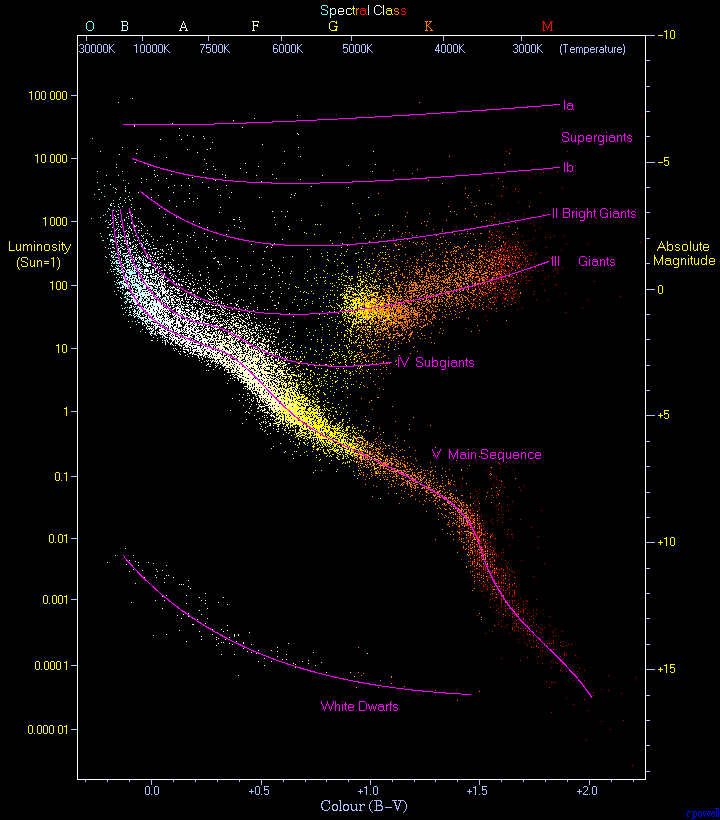
Ordinary stars are fusing hydrogen to make helium. Astronomers call them “main sequence stars” and they range from large, hot, very luminous (and hence short-lived) blue stars all the way down through small, faint, cool, dim (and hence long-lived, none have died of old age yet) red stars called “red dwarfs.”
Stars go “extreme” when they run out of hydrogen fuel. Red dwarfs, we believe, will simply turn into white dwarfs–stars that consist of the “ash” of nuclear fusion, and are no longer generating heat…rather, they radiate their residual heat, albeit at very high temperatures. Medium-sized stars like our sun will become red giant stars that fuse the helium ash of their prior main sequence lives, then after running out of helium while making carbon and oxygen, they too will become white dwarfs.
Red Giants and Supergiants
Red giant stars are pretty extreme…in physical size, at least; when the sun goes red giant it will swell up immensely. It may well swallow up the earth, and certainly will swallow up Mercury and Venus.
Red giant phases are the common denominator, for stars about 30% of sun-mass and up. (A star about ten times the mass of the sun becomes a ‘supergiant’ but that’s essentially the same thing, just much bigger. Examples are Betelegeuse and Antares.) All such stars swell up and burn helium; the more massive ones will continue past that, burning carbon, oxygen and eventually silicon; then they will start on iron.
White Dwarfs
White dwarfs are even more extreme. They’re about the size of the earth (and remember they’re the corpses of something a few tens or even hundreds of thousand times the mass of earth), so they are very dense, many tons per teaspoonful. There’s basically nothing to stop the star from collapsing once it no longer generates energy and heat from nuclear fusion, so it does precisely that: collapses. The end result is a star corpse, held “up” purely by the repulsion of the electrons in it. It does, of course grow hotter as the pressure increases during the collapse, so this corpse glows white hot. But that heat simply radiates away, never to be replaced. White dwarfs will cool off and stop radiating visible light…eventually.
Heavier stars go through all of this, but at the end, the electron repulsion won’t stop the collapse. The star is simply too massive, the self-gravitation of all that mass is just…too much.
This sort of star shows up after a core-collapse supernova, which isn’t just a Boom! or even a KaBoom!!! It’s most assuredly an earth-shattering kaboom.
Literally. If our sun were to do this, Earth would be literally blown to bits. Not just “oh all the life on the surface got wiped out,” I mean blown to bits. Fortunately our Sun isn’t nearly massive enough for this to happen…and it won’t even get to white dwarf status for another five billion years or so. (So no, you shouldn’t skip paying your bills.)
Neutron Stars (Pulsars)
In a neutron star the pressure is so great that the electrons are forced into the nuclei. They combine with the protons, and the star simply turns into a big mass of neutrons.
Neutron stars will form whenever the leftover remnant of the star is more than 1.4 times the mass of the sun. This number is known as Chandrasekhar’s limit because was calculated in 1931 by Subrahmanyan Chandrasekhar. At that time, though, he had simply calculated when the electron pressure would fail; he didn’t realize that a ball of neutrons would form if, say, the star’s mass was just above his number. (The neutron hadn’t been discovered yet.)
A neutron star is roughly ten miles across.
Compressing the star into something that small makes for a very dense object. Imagine the weight of the Great Pyramid in a teaspoon. It also does two other things: First, remember your angular momentum. As a rotating object shrinks, it rotates faster and faster. And stars do rotate.
The typical neutron star rotates a couple of thousand times per second.
Also, the star had a magnetic field. Concentrating that into a smaller star simply makes it more intense. More than likely the poles of the magnet won’t be lined up with the axis of rotation, so as the star rotates, its magnetic poles sweep across the sky like a lighthouse. A lighthouse on your washing machine’s spin cycle. (Though even that isn’t nearly fast enough.) The star ejects all sorts of particles along its magnetic axes, and over time it slows down.
These stars were first discovered via radio telescope in 1967 by Jocelyn Bell. The signals from them are so regular that at first some thought we might finally have found little green men. Eventually we figured out what was going on and they were dubbed “pulsars” (from pulsating stars).
This video is audio of a few pulsars, first ones rotating slowly enough we perceive the individual pulses. But at higher frequencies we simply hear a tone of the matching frequency.
https://www.youtube.com/watch?v=j_3sHeUNn1k
But even this is not as extreme as it gets.
Black Holes
If the star’s core remnant (after large parts of it get blown away) is sufficiently massive, even the neutrons are crushed.
As far as we know, there’s nothing to stop complete collapse at this point. And by complete, I mean collapse until the star has zero diameter. And I do mean zero. Which also means an infinite density.
An infinite density doesn’t seem physically possible–nature abhors infinities–but if there’s anything to prevent it, it’s beyond the ken of present day physics.
Or perhaps it’s not an issue at all.
Yes, I am talking about black holes.
Why is it called a black hole?
As you might imagine, these extreme stars (even the relatively un-extreme white dwarf) have very high surface gravities. After all that’s part-and-parcel of crushing matter down to such small sizes.
The sun’s surface gravity is about 28 times that of earth. That’s 28 g. An object that weighs one pound on earth would weigh 28 pounds on the sun.
A white dwarf might have the same mass as the sun but be far more compact, that means the radius is smaller and the strength of the force of gravity goes up as the radius goes down. In fact, half the radius is four times the strength. So a white dwarf might have a surface gravity of 100,000 g.
A neutron star typically has a surface gravity of 100 billiong.
Each of these implies a surface escape velocity. The earth’s escape velocity is about 11 km/second, the sun’s escape velocity is 617 kilometers per second. That white dwarf will come in at about 3000 kilometers per second. A neutron star will come in at 100,000 kilometers per second.
That’s about a third of the speed of light.
Well, that should bring up the question: Can something exist where the surface gravity is so high that the escape velocity is the speed of light? Or higher?
If so it’d be impossible to escape that object. You can’t launch a rocket that fast, because any object with mass can’t even reach the speed of light–let alone exceed it.
This idea isn’t particularly new. John Michel, in 1784, wondered if there might be stars so massive their light couldn’t escape them. He called them dark stars. He imagined an object the same density as the sun, but perhaps 500 times the diameter.
Of course he didn’t understand that an object so massive would simply crush itself down to a denser, smaller object, even going past the neutron star limit. He had no idea what neutrons were; no one did.
The critique his idea faced wasn’t on that basis. A couple of decades after his suggestion, light became understood as a wave with no mass, and by Newtonian theory the force of gravity requires an object with mass, acting on another object with mass. The two masses are multiplied together (then multiplied and divided by other things) to compute the force
If one of the two objects has no mass, the force is zero. According to the Newtonian understanding of gravity, therefore, light should be totally unaffected by gravity, and it would still escape the so-called “dark star” which wouldn’t, therefore, be dark at all.
But then the idea became worth taking seriously again after 1915, when Albert Einstein’s theory of general relativity was put forth. And even more so after general relativity was bolstered by Arthur Eddington’s measurements of apparent star positions during a solar eclipse.
Gravity now was understood not as a force between two masses, which had to be proportional to their product, but rather as distortions in spacetime caused by any mass.
So a high-mass star bends spacetime. And any object travelling freely, without any acceleration being applied to it, would try to follow those bends. Even an object with no mass at all, because the object’s mass plays no role in determining its path. It’s not experiencing a force at all.
This is not to say there isn’t a force involved when standing, say, on a planet. The Newtonian understanding is that an object is being pulled toward another object by a force, and (if it’s an apple and a planet) the surface of the planet is acted upon by the force on the apple, giving the sensation that the apple has weight. The Einsteinian understanding is that the apple is trying to travel a straight line in space time, because that’s what all things do, but the surface of the planet is pushing the apple off the path, applying a force to it, and thereby presenting the sensation of weight.
Once the idea of a dark star became reasonable again, the theory guys got back to work.
The Tolman-Oppenheimer-Volkoff limit, about 2.17 solar masses (though it’s a lot harder to nail down this value, so don’t hold me to it), is the upper limit of neutron star mass. Past that, the neutrons can’t hold the star “up” and it just keeps collapsing.
There’s nothing known that can prevent it from collapsing down to an infinitely dense mathematical point. Which is a physical absurdity. But of course, we don’t know everything, and as I hinted at above, it might not even be an issue.
What would one of these objects look like?
It would emit absolutely no light. Or anything else. (It might emit Hawking radiation, which I’ll hopefully remember to explain a bit later.)
Regardless of the actual size of the object, there is a certain radius from the center, above which the escape velocity is below the speed of light, and below which, the escape velocity is above the speed of light.
Because of that anything below that radius, is invisible to us, it’s gone from the universe, never to return. This level is called the event horizon, or sometimes the Schwarzschild surface, after the man who first did this particular computation, characterizing a non-rotating black hole. And the radius of that surface is called the Schwarzschild radius.
And its blackness led to the name “black hole,” which was coined by a student of John Wheeler’s in 1967. Wheeler decided it was perfect and used it himself and it caught on.
The only way we can tell anything is there is from the object’s gravitation. The black hole has two other properties: if the stuff inside the event horizon has a net electrical charge, so will the black hole, and also, the black hole might rotate, which could change the shape of the event horizon.
A black hole formed from a collapsing star will certainly be rotating, even faster than the pulsars do because the radius is that much smaller.
If we can’t see one of these things, how will we ever detect one?
I dropped a couple of hints above, but there’s also another way, and that’s to detect the matter falling into a black hole before it crosses the event horizon.
Consider a binary star system. The two stars are formed at the same time, but the more massive of the pair ultimately goes supernova and ends up being a black hole. The black hole and what’s left of the other star after the big kaboom will continue orbiting each other. If the distance between the two is small enough, then an interesting thing occurs. Ordinary stars constantly lose some mass through their “solar wind” and coronal mass ejections. In this case, some of that mass will hit the black hole, or come very close to it. It can be gravitationally captured by the black hole, resulting in a spinning disc of gas.
Gas, in orbit, will eventually collapse into the black hole. This wouldn’t necessarily be true of a single discrete object, but the gas consists of individual atoms that bump into each other, and some of those particles lose velocity as a result. Over time, the gas spirals inward, at faster and faster speeds: its temperature can reach millions of degrees, and it will emit X-rays due to its black body radiation.
We can see those X rays.
The very first black hole to be seen is known as Cygnus X-1, because it was the first X-ray source discovered in the constellation Cygnus (which contains the northern cross–at this time of year it’s in the western sky immediately after sunset). This source was discovered in 1964, and by the mid 1970s it was accepted as being a black hole, with a companion star losing mass through the “accretion disc.”
The amount of energy lost by matter in the accretion disc is about a third of the energy of the mass of that material from E=mc2. If we could actually “tame” a black hole and feed anything, even garbage into it, then harness the radiation output from the accretion disc, it’d be a fantastic source of energy.
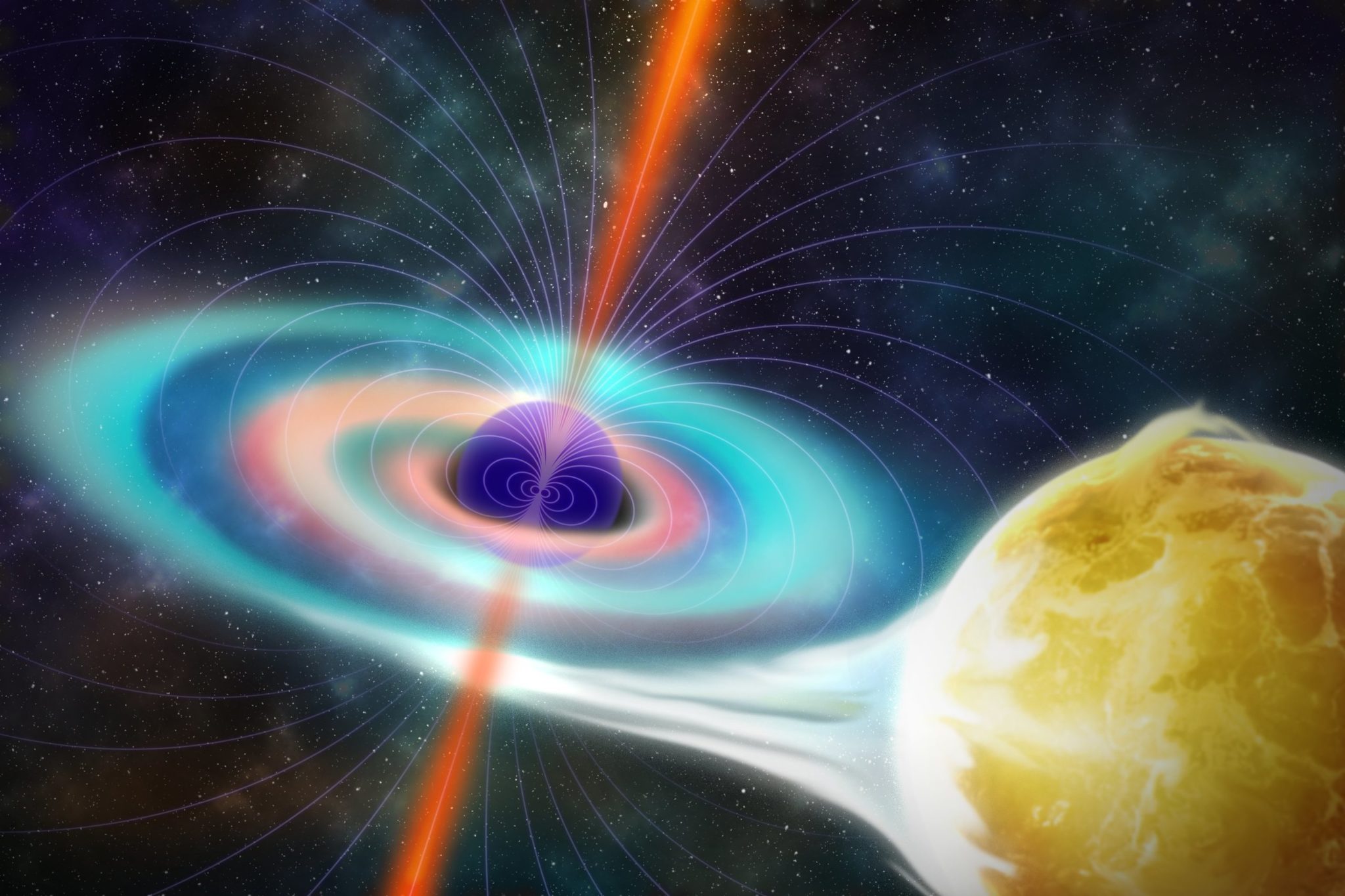
For reasons that (as I understand it) are still unclear, there are often two jets of energy coming out from near the event horizon perpendicular to the accretion disk, too. Below is an artist’s conception:
There was, however, another surprise in store for astronomers. When they began using radio telescopes in the 1950s, they identified a number of point-like radio sources, and by analyzing their spectra they were able to tell that these objects were very, very, very distant (I’ll discuss that some more next time). They were named “Quasi Stellar radio sources” which got shortened to “quasar.” For many years these were a mystery. It turned out that these things were belting out truly enormous amounts of energy, far more so entire galaxies. And we had every reason to believe they were small.
We now believe we understand these objects.
It turns out that every galaxy has, at its center, a supermassive black hole, one with anywhere from ten thousand to billions of times the mass of the sun. The one at the center of the galaxy M-87 is particularly enormous, about 6.5 billion solar masses, and we’ve been able to image its accretion disc with radio telescopes; below is a false color image based on that data:
With M-87’s central black hole we can even see one of the jets being shot out of the thing. Below is a picture of the core of M-87 taken by the Hubble Space Telescope; the blue is a false color rendering of one of the jets.
Quasars are far away, which means we are seeing the light that left them a long time ago, many billions of years. It seems that young galaxies go through a phase where vast quantities of matter is falling into their central black holes, and that accounts for the astounding amount of energy blasting out of these things.
What about our galaxy, the Milky Way? Though we can’t see, with visible light, the center of our galaxy–there’s too much dust and gas in the line of sight–we can see the stars near the center with infrared light.
And after watching them for about ten or fifteen years, it became clear they were orbiting something invisible. They were orbiting close enough that that put an upper constraint on that object’s size, and their orbital speed showed the mass of the object: four million times the mass of the sun. This object is known as Sagittarius A* (pronounced “A-star”) because it too is a radio source; it’s constantly sucking in small amounts of debris and gas.
One of these central stars has been rather imaginitively named S2 and its motion over the past couple of years is practically iconic to astronomers:
S2, near Sagittarius A* (Sagittarius is commonly abbreviated “Sgr” by astronomers.) S2 is a B0 class star, blue hot, and orbits in just over 16 years.
Here is plot of S2’s position over time:
And a plot of the orbits of dozens of stars shows them in orbit about something. Here are a few prominent ones including S2.
[If you remember that objects orbiting much more massive ones do so in ellipses, with the primary object at one of the foci of the ellipse, you might object to what you’re seeing in this last diagram. The black dot represents the black hole, and it’s clearly not at the focus of many of those ellipses. (The foci of an ellipse are both on the center-line, drawn along the long axis of the ellipse, called the major axis; in the case of S2 that centerline is to the right of the black dot.) This difficulty is overcome, though, when we realize we’re not looking at those ellipses face on. We’re looking at them at some sort of oblique angle. What you see when you look at an ellipse at an oblique angle is always a different ellipse with different (apparent) foci. Think of looking at the outline of a circular manhole cover from, say 30 feet away and five or six feet above the roadway; that outline appears elliptical. If the manhole cover itself were elliptical, you’d see some different ellipse, depending on its orientation from your point of view it might appear skinnier (more eccentric) or rounder (less eccentric) than the actual ellipse is.]
The conclusion that the dark object at the center of this mess has the mass of four million suns came from determining, based on the speed of the objects at different points on the ellipses, the actual orientation of their orbits (if an object moves most quickly at a certain point on the ellipse, you know that, whatever the ellipse looks like to us, that point is actually the point nearest the primary), and from this the actual lengths of the axes of these ellipses, and hence going from there to the mass of the primary. (The period of the orbit depends on the mass of the primary and the major axis, only–though astronomers’ formulae actually work with half the length of the major axis, called the “semi-major axis.”)
It should be a source of amazement that we can collect this data from so far away (approximately 30,000 light years or 180 quadrillion miles) and infer there is a nearly invisible object there, at the very center of our galaxy, and figure out its mass.
But in telling you this, I’ve actually gotten ahead of myself.
We really need to go back to the 1920s again. And explain galaxies and those staggering distances to the quasars.
But before I conclude, there’s a lot I did not say here. I didn’t discuss wormholes and using black holes to get into hyperspace, and all of that. Largely because all of that is very, very speculative and even if true, would probably destroy any spaceship that tried it.
As you get close to a black hole you feel very high tidal stresses. If you’re going in foot first, your feet feel considerably more gravity than your head, because they’re closer to the source of the gravity. (This effect exists even here, but is unnoticeable because the difference in force between your feet and your head is small.) This results in a net force that tries to stretch you out; if it’s strong enough it will stretch you out, it will be stronger than the bonds between the molecules that make you up. And the closer you get the stronger this tidal stress gets.
People who study black holes actually, and I am not making this up, call it “spaghettification.” Any solid object gets stretched into something looking like spaghetti.
If it were you, you’d feel this happen very quickly.
If someone were well outside the black hole watching, though, he’d never see the process end. Remember that under general relativity, lower objects’s clocks run slower than higher objects’ clocks do. And you can’t get any lower than the event horizon of a black hole. The observer far away will see you come to a standstill as your clock gets slower and slower, never quite reaching the time at which you cross the event horizon.
This might be the answer to the objection that an infinitely dense mass at a point is physically absurd. The collapse of the black hole itself might not ever complete because the clock runs slower and slower. This is actually speculation too; the math is extremely difficult and as far as I know no one has managed to solve the problem yet.
Well, that’s my rather over-simplified and under-coherent account of black holes. If you want a much more complete treatment, I suggest you go to the Wikipoo article on black holes.
Obligatory PSAs and Reminders
China is Lower than Whale Shit
Remember Hong Kong!!!
Whoever ends up in the cell next to his, tell him I said “Hi.”
中国是个混蛋 !!! Zhōngguò shì gè hùndàn !!! China is asshoe !!!
China is in the White House
Since Wednesday, January 20 at Noon EST, the bought-and-paid for His Fraudulency Joseph Biden has been in the White House. It’s as good as having China in the Oval Office.
Joe Biden is Asshoe
China is in the White House, because Joe Biden is in the White House, and Joe Biden is identically equal to China. China is Asshoe. Therefore, Joe Biden is Asshoe.
But of course the much more important thing to realize:
Joe Biden Didn’t Win
乔*拜登没赢 !!! Qiáo Bài dēng méi yíng !!! Joe Biden didn’t win !!!
“I’m not here to awaken the sheep. I’m here to awaken the lions!”
Dr. Simone Gold, Founder, America’s Front Line Doctors
It’s Friday and the winds of change are blowing hard. The question seems to be in which direction. Personally, I think they are blowing in the direction of a Great Awakening and freedom from tyranny. Of course, those don’t happen without a fight.
LEVIATHAN SURFACES
“The hidden is becoming the seen.”
David Icke
I was listening to a David Icke interview the other dayj (I think it was with Alex Jones but not sure and can’t find at the moment). Very interesting conversation. He believes that Mr. Global is attempting to rush through their power grab because they “have broken the surface” and are exposed.
He says the rush is to get technological power over us before everyone wakes up.
Too late. Enough of us are awake.
I WILL NOT COMPLY
“They can’t deliver without the acquiescence of the people.”
David Icke
Moreover, Icke gives a glimpse about global Covid restrictions. He says Mr. Global is having to back off on restrictions to pretend they are authorizing what people are already doing.
Icke further says the system is beginning to unravel. He implied there are those within the system who are just waiting to come forward.
Mass non-compliance is key to furthering the winds of freedom. I will say, right here, that the Covax being mandated on children, ages 5 to 11, is another nail in the coffin of the globalist dream of world domination.
PARENT POWER!
Sorry, but America’s mamas are vicious enemies of those who seek to harm their children. Trust me, you do not want to tangle with them. Just ask the local school boards across America. The local commies can’t even stand up to bosom-heaving moms, let alone ticked-off dads. You can take your mRNA shots and shove them where the sun don’t shine.
Go here to watch a single mom in Beverly Hills who isn’t backing down. She knows what we are up against, but she loves freedom and understands the stakes.
DID I SAY NAIL?
That gets me to today’s drink special, the Rusty Nail. A concoction from 1937, the Rusty Nail is one of the world’s most famous after dinner drinks. Ya gotta watch the bartender below. He’s got a rollicking good story about his run-in with a World War 2 vet who ordered a Rusty Nail.
Drambuie, which is a scotch whiskey liqueur with heather honey and some other herbs (of course it’s a closely-guarded secret), is a major player in this two-ingredient drink. Yes, just two ingredients: Scotch whiskey and Drambuie.
Love the name, which is Gaelic for “the drink that satisfies.” My in-laws were known for knocking back a couple Rusty Nails in their day. The Breakfast at Tiffany’s and Rat Pack crowd kept the Rusty Nail as a Thing well into the 1970s. It’s fallen into disfavor now, but I think we could all use a little nostalgia. I sure do miss those loved ones who have passed beyond our sight.
Let’s raise a glass to the man (or woman)!
HOUSE RULES
“Useful,” and “necessity” was always “the tyrant’s plea.”
C. S. Lewis
There’s useful and necessary. The Covax is not useful or necessary. Wolf’s rules of civility are both. Go here to review them. It’s the guide that keeps us able to disagree, even vociferously, and still remain united. If you need to brawl, the Utree is the place to go. To reconvene if this site hits a wall, go here.
Wolf has our bases covered. God bless him. God keep him. God make His face to shine upon him!
THE DEVIL HAS NO KNEES
We have an ace in the hole regarding those who bow down to and serve the devil:
“In fighting those who serve devils one always has this on one’s side, their masters hate them as much as they hate us.”
C. S. Lewis
The likes of Fauci and Soros and Schwab are fast losing the use they served for the devil. Watch them be eaten up. As the saying goes, “The devil eats his own.” Ask Herod.
The threatened Dark Winter (again) is nearly upon us. We will link arms and meet it together and watch history being made upon this world stage. We may be bit players (and thank God for that) but we have a front row seat.
Justice will be served.
The tech dystopia will crumble and those who attempted to bring it forth will crumble with it. They will be ground to dust as Providence dictates.
ODDS AND ENDS
Here’s an upcoming strike against vaccine mandates. Let’s participate and show our support for those like our own Steve who are struggling with possible job termination over the Covax.
“RELIGIOUS SERVICES, protected by the 1st amendment, are NOT provided to Jan 6ers. Neither are in person classes or other activities available to the rest of the jail. An inmate named Ryan Samsel, instead attempted to organize his own bible study inside the pod, until he was viciously BEATEN and LEFT FOR DEAD by correctional officers. He suffered a broken eye socket and brain damage as a result of the vicious attack. He’s now permanently blind in one eye. On another occasion, Scott Fairlamb was confronted by an officer in the middle of the night, and his life was threatened, once the officer’s body cam was disabled. Many, like myself, are afraid they could be the next victim.
And last but not least, we experience racism from many guards on a daily basis, being the ONLY WHITE REPUBLICANS in the entire jail. The false narrative is has been passed around the jail and to corrections officers that we are “white supremacists” (we are NOT). The inmate population is predominantly black, so we are at risk being here because of this false narrative. The guards are mostly liberal migrants from Africa who have been conditioned to hate us, and hate America. Jan 6ers have been mocked, beaten and ridiculed by guards for singing the National Anthem. The Corrections Officers despise our politics and the love we have for this country. At one point, an officer even yelled “FUCK AMERICA!”, and threatened to lock us down FOR A WEEK if we attempted to sing the National Anthem again.“
Here’s a 5-part series on the art of brainwashing by Randi Engel. Meticulous research. Part 1 here.
A short but thorough explication of Brainwashing tactics. Can share with normies.
OK, to be honest I had Zero plans to write this post when I woke up “today”. In fact I’d been hoping to take advantage of my solo weekend to wrap up a post or two I’ve had in draft mode for months, but it appears that they’ll have to still wait. My hunters will be home soon…
This journey started out by reading Carl’s beautiful Sunday post.
Being very moved by the teaching he shared I wanted to look up the source material by John Piper AND finally came to a page that appears to contain much, or even all, that Carl shared, here:
In the course of searching for the actual message, & not just other people’s blog posts about Piper’s teaching that was apparently given at some type of conference, a few interesting links popped up. One looked to be addressing how seemingly Piper weighed in on the 2020 election & from the couple lines of text visible at the search may have spoken against Trump. I was curious so went to read that article too.
What a surprise to discover that the article was more about promoting the vax from the pulpit rather than steering people away from Trump during the stolen election. Hmmm
OK, so this post is NOT trying to attack John Piper as a man, a Christian, nor as a theologian. I’m trying to steer clear of my own biases, which is obviously impossible. In reading the search engine thumbnail descriptions it appears that Piper is affiliated with the Baptist church, which makes my “legalism radar” perk up. I’m just being honest, I have issues with legalism that go way back & have a (possibly misplaced) perception that Baptist takes might hover in the legalism domain…so grain of salt going forward here…
Here are a couple places where I’ve addressed legalism, & the other end of the spectrum, the prosperity gospel, for context on some of my thinking in these arenas…
So, back to the issue at hand. I like to think of myself as a Truth-seeker AND a Truth-teller. So let’s see if we can unearth some Truth in the controversy before us, namely shilling for the vax from the pulpit. Whom the Son sets free is Free indeed!
Let’s look into John Knox’s Not The Bee article a bit first. Per his opening remarks he appears to be a Conservative Christian, who is perhaps comfortable with MAGA & Trump’s leadership.
“I’m not here to slander John Piper. He’s a brother-in-Christ and a man who has, by all accounts, picked up his cross daily to preach the hope of Christ and Christ crucified to a broken world.
With that being said, Piper has come to some odd conclusions in recent years, starting most notably with the idea that voting for the worldly bravado of Donald Trump was just a [sic] morally wrong as the utter institutional corruption, unfettered support of abortion, and woke totalitarianism of Joe Biden.”
Let’s dive into Piper’s perspective without immediately referring to Knox’s take & see what might jump out…
Here is his opening & yikes he’s seeming like a Pro-vaxer from the outset, not just pro-freedom (in Christ).
“My aim in this article is to encourage Christians to be vaccinated, if they can do so with a good conscience and judicious medical warrant.
The people I have especially in view are those who are not vaccinated because of fear of being out of step withpeople they respect, and in step with people they don’t admire. My message to them is simple: You are free.
So, I am not talking directly to everybody. If the shoe fits, put it on, check your conscience, consult your doctor, and go get vaccinated. If it doesn’t, go tearfully and cheerfully on your way. Tearfully, because over 4.5 million people have died from COVID-19 worldwide (including over 700,000 Americans). And cheerfully, because Christ makes it miraculously possible to love people by being “sorrowful yet always rejoicing” (2 Corinthians 6:10).”
So I’m pretty close to an anti-vaxer for numerous reasons now. It would be nearly impossible to read consistently here at The Q Tree & not be Extremely Concerned about the many & manifold dangers of the so-called Covid vaccine. Obviously Piper is coming from a very different worldview, though we Might be somewhat similar in our Christian biblical foundational viewpoints. Some of what he said above strikes me as manipulative, which is a big red flag to me!
Below is a comment written before the Plannedemic was on the scene with some vaccine concerns I expressed elsewhere, for perspective, but we’ll just stick with the Covid “vax” concerns today:
So Piper cites a number of sources that all seem to show that being unvax’d is Way more dangerous than being vax’d. Obviously here at the Q-Tree we consider material much more wider afield & also take into account the numerous reports, medical, scientific, & anecdotal that expose Much of the danger of the clot shots. It appears that Piper is unaware of this alternative & alarming material. Here’s his take, shudder:
When people respond to this increasingly clear reality by pointing to untrustworthy and disreputable government and medical leaders, I respond, “That’s a non sequitur.” The team called “vaccination” just made a first down, even if monkeys are holding the chains. For friends around the world who don’t know American football, that means a win is a win even if all the coaches and referees are incompetent.
Piper’s take on freedom is interesting & I encourage you to read it for yourself. He then lists a series of considerations to ponder as one decides for the shot or not. He doesn’t elaborate on those issues, even the implications of fetal cell lines, though he does link to a YouTube video on the topic. I have no idea if Piper is a pro-lifer or not, but at least he brings up that fetal tissue issue, though by implication doesn’t apparently consider it an impediment to Christians taking the “vax”. He appears to have made up his mind to take the shot & seems to be freeing, or even persuading, his parishioners to do the same–concerning!
Now let’s consider Knox’s other cited material that is opposed to Piper’s take before returning to Knox.
James White, the author of the above, pulls no punches & calls Piper out for his writings AND remarks on the election & the shot! Here is White pointing out what many Q-Treepers might consider to be quite obvious.
God’s ownership of our bodies implies our own stewardship thereof, which is why many of us take serious issue with experimental genetic therapies with record-breaking reports of adverse reactions, including death, with no long-term studies relating to safety (cancers, fertility), for a disease with an average mortality age above life expectancy and a mortality rate of less than 0.5%.
Further from White, bold is my take:
…there is the arrogance of the secular worldview that actually leads man to believe he is wise enough, while remaining in rebellion against his Creator, to meddle with the very essence of his being (genetics). When such arrogance is joined with a lust for power and dominion, it becomes deadly.
So the bulk of the article, comprising numerous biblical citations about freedom, is not the issue. Instead, the problem is found in the section that reads like a Pfizer promotional advertisement, and then the application portion at the end.
White’s wisdom & Piper’s naivety are on display in this next quote from White (not italicised to preserve his presentation):
“From late October of 2020, as word about the technology that is behind the Pfizer and Moderna vaccines came out, I have stated that I would consider use of these vaccine [sic] once three and five year safety studies had been completed. Prior to 2020, this would have been considered a sober, even mundane position to take. You do not do genetic manipulation at “warp speed,” especially when the threat you are seeking to counteract is one that almost always requires multiple co-morbidities and results in an age of death equal to or above life expectancy. But we do not have such data, and with how this one particular disease has been handled, we have good grounds to wonder if we will ever have geniune [sic] data in the future. The VAERS database, maintained by the CDC, has catalogued record numbers of negative results from the vaccines, so it is now regularly dismissed as “untested” (the irony is palpable) by the media. The amazing reality that we are now counting deaths with the Covid-19 as the same as deaths from Covid-19 has resulted in massively inflated numbers, numbers Dr. Piper repeats without comment, and uses in his final argumentation as well. The fact is we are playing with dangerous and unknown long-term impacts with these types of experimental1 therapies. Dr. Piper does not even acknowledge this reality.”
Here is the material for the footnote #1 above & a reference to further work by White (an 8 page pdf). This appears to be a level of truth AND integrity to be much admired & emulated, yet too rarely seen!
1 Yes, they remain experimental. The FDA approved the Pfizer jab without public comment, fundamentally altering the entire process. Video exists of Anthony Fauci in 2019 (Milken Institute found on CSPAN2) lamenting how long it would take to get these kinds of vaccines approved. Given his own role in the Wuhan lab, gain-of-function funding, etc., the reality of the situation is clear.
“Many studies are now showing efficacy rates below 50% and dropping for these vaccines. But the UK report is even more dangerous. We are now seeing that the vaccines are inhibiting the natural ability to produce antibodies against not just the well-known “spike protein,” but against the shell of the virus as well. Our bodies provide not only a much more robust immunity (as all studies are showing, and which Dr. Piper misrepresented when he said natural immunity is “as effective as vaccination immunity” when it is actually 13 to 27 times greater), but it is a much wider immunity, responding to more of the structure of the virus. This study is telling us that vaccination degrades our natural immunity, leaving us even more exposed to future infection.”
And this treat from White on Piper!
“He then provides one of the most disappointing lines in the article: “You have pondered the likelihood and unlikelihood of conspiratorial conjectures.” Without defining his meaning, or providing examples, Piper does us no favors. Is the recognition of the cooperation of Big Tech and Big Pharma with the extreme leftists in political power resulting in the transfer of literally trillions of dollars of wealth a “conspiratorial conjecture”? Are the banishments from social media of medical experts who are warning about dangers fictional? We are not told.”
Winding down toward his conclusion White displays both insight AND wisdom:
“It is undeniable that the vaccines are not a solo issue. They are coming to us after mask mandates and church closures and pastoral imprisonments and before the next onerous demands from governments drunk on the power that inevitably comes from the rise of secularism. The secular state is far worse than the ancient pagan context of Rome (which was bad enough), for by its very definition it must be ultimate in all things as there is no Creator. Why Piper does not see the role the vaccines play in the overall demands of the newly empowered totalitarianism I cannot say, but it is not the first time he has missed the role a particular element plays in the whole. Mean, arrogant tweets are, in the overall scheme of things, significantly less important than the fact that the Biden regime is intent upon forcing your children to celebrate drag queens and likewise just as intent upon taking control of every aspect of your life to force you to live in denial of the lordship of Christ. What Piper has missed, badly, is the role these vaccinations play in a much bigger, much more basic movement into a technologically based, chemically and medically controlled secular totalitarianism.”
Obviously it is easier to resonate with White, at least for me. So let’s return to Knox. Piper is presented as
“…either unable or unwilling to see past the veneer of Everything is Fine™ that’s been peddled by the leftist politicians, the woke media, the “progressive” academy, and the neo-Marxist Big Tech offices.”
Knox reminds us to consider the source AND question conclusions drawn from faulty data & assumptions:
“As a math professor once told me, even if your calculations are 100% correct, your solution will be insanely wrong if your starting premises are off!”
Honestly I did enjoy reading all three pieces. Knox was my intro to the other two & his framing & take is invaluable. Piper was who I’d been searching for in appreciation of the Wonderful Teaching Carl shared with us today (now yesterday). Piper was shallow on facts but deeper on scripture in his writing compared to what the other two shared, but both Knox & White were addressing Piper’s factual fallacies more than his biblical prowess. Because I was reading Piper’s article as more of a vax skeptic, I found some of his scriptural insights to work on me in the opposite way than where he was going in his applications. White was factual, truthful, & masterfully insightful on both human nature & the creeping totalitarianism in our societies. I resonated with his take & hope to read further of how he also might “rightly divide the Word of Truth”!
I guess I would prefer to just hear from Piper on scripture, not social issues. Because White & Knox are seemingly aligned with my worldview they are more comfortable reads to me when addressing social &/or cultural concerns. Knox is an easier, quicker read, so he’s a good place to start. White dives in deep & dispenses truth, wisdom, & integrity quite liberally. Piper would do well to stick to biblical truth & could expand his sources of information so he has a better grasp of what is Really happening in the world today.
Now let’s turn to the reason for this post’s title, since many Shepherds (pastors & other leaders) are seemingly leading their flocks of Sheep to the metaphorical, if not literal, slaughter.
I’m going to share Ezekiel 34 in a moment, but this is how thinking along those lines developed, in the comments section on this excellent post by Wolfmoon:
There are markers in the vaccine, AND they are testing (using useless PCR) for infection, AND they are taking DNA.
All bases are covered. The sheep will see the “testing for viruses” part and be satisfied. The lions will see the markers and the DNA theft and walk majestically away.
They are flailing around trying anything they can think of to trick the lions into submission.
But I am a lion, and not subject to such gaslighting trickery.11 Reply
EXACTLY! That’s what I’m thinking. The small cheese was the vaccine in as many as possible. The BIG CHEESE was “everybody gives their DNA to the globonazis just to travel”. The really big cheese behind the scenes is “now we can modify and study every single person like a lab animal”. When we talked about being “controls”, they rubbed their hands in glee. “We can use that! We can surely use that!” The trick THERE is to foil that plan – to say “No, KlauSS. No DNA for you!”
One of the things they would surely be testing for would be immune function. Shedding. OMG. There is so much modification and study of us possible.
cleverly disguised as “peace and safety” for all !
and coming soon…
marker
sounds like mark.
but we’re not quite there just yet.
the UN’s Sustainablity crap + the 2030 Agenda + the WEF + the Vatican + the Covid/Climate Change tyranny…and the global compliance to all of that…is creating Alinsky style chaos.
they will need all the chaos they can manufacture…so that…
the machiavellian psychopath man of universal “peace” can show up, and quell all the chaos…
by then, ppl of the global village will have become rendered compliant enough so as to readily take the mark which will require, not just relinquishing our privacy, but something much worse : our souls.
to worship that man of lawlessness, perversion & lies.Last edited 7 days ago by smiley29 Reply
We would be stronger if the Church leaders around the globe including Pop would stand with God’s people. They are not for a second time in history the past 80 years. They failed God and humanity and will be judged more harshly for selling out God and Christ for a lousy bag of silver.4 Reply
The whole 34th chapter of Ezekiel is profoundly applicable Right Now!
Ezekiel 34 New International Version The Lord Will Be Israel’s Shepherd 34 The word of the Lord came to me: 2 “Son of man, prophesy against the shepherds of Israel; prophesy and say to them: ‘This is what the Sovereign Lord says: Woe to you shepherds of Israel who only take care of yourselves! Should not shepherds take care of the flock? 3 You eat the curds, clothe yourselves with the wool and slaughter the choice animals, but you do not take care of the flock. 4 You have not strengthened the weak or healed the sick or bound up the injured. You have not brought back the strays or searched for the lost. You have ruled them harshly and brutally. 5 So they were scattered because there was no shepherd, and when they were scattered they became food for all the wild animals. 6 My sheep wandered over all the mountains and on every high hill. They were scattered over the whole earth, and no one searched or looked for them.
7 “‘Therefore, you shepherds, hear the word of the Lord: 8 As surely as I live, declares the Sovereign Lord, because my flock lacks a shepherd and so has been plundered and has become food for all the wild animals, and because my shepherds did not search for my flock but cared for themselves rather than for my flock, 9 therefore, you shepherds, hear the word of the Lord: 10 This is what the Sovereign Lord says: I am against the shepherds and will hold them accountable for my flock. I will remove them from tending the flock so that the shepherds can no longer feed themselves. I will rescue my flock from their mouths, and it will no longer be food for them.
Let’s add the rest of Ezekiel 34 (that wasn’t included in my original comment above) for perspective:
11 “‘For this is what the Sovereign Lord says: I myself will search for my sheep and look after them. 12 As a shepherd looks after his scattered flock when he is with them, so will I look after my sheep. I will rescue them from all the places where they were scattered on a day of clouds and darkness. 13 I will bring them out from the nations and gather them from the countries, and I will bring them into their own land. I will pasture them on the mountains of Israel, in the ravines and in all the settlements in the land. 14 I will tend them in a good pasture, and the mountain heights of Israel will be their grazing land. There they will lie down in good grazing land, and there they will feed in a rich pasture on the mountains of Israel. 15 I myself will tend my sheep and have them lie down, declares the Sovereign Lord. 16 I will search for the lost and bring back the strays. I will bind up the injured and strengthen the weak, but the sleek and the strong I will destroy. I will shepherd the flock with justice.
17 “‘As for you, my flock, this is what the Sovereign Lord says: I will judge between one sheep and another, and between rams and goats. 18 Is it not enough for you to feed on the good pasture? Must you also trample the rest of your pasture with your feet? Is it not enough for you to drink clear water? Must you also muddy the rest with your feet? 19 Must my flock feed on what you have trampled and drink what you have muddied with your feet?
20 “‘Therefore this is what the Sovereign Lord says to them: See, I myself will judge between the fat sheep and the lean sheep. 21 Because you shove with flank and shoulder, butting all the weak sheep with your horns until you have driven them away, 22 I will save my flock, and they will no longer be plundered. I will judge between one sheep and another. 23 I will place over them one shepherd, my servant David, and he will tend them; he will tend them and be their shepherd. 24 I the Lord will be their God, and my servant David will be prince among them. I the Lord have spoken.
25 “‘I will make a covenant of peace with them and rid the land of savage beasts so that they may live in the wilderness and sleep in the forests in safety. 26 I will make them and the places surrounding my hill a blessing.[a] I will send down showers in season; there will be showers of blessing. 27 The trees will yield their fruit and the ground will yield its crops; the people will be secure in their land. They will know that I am the Lord, when I break the bars of their yoke and rescue them from the hands of those who enslaved them. 28 They will no longer be plundered by the nations, nor will wild animals devour them. They will live in safety, and no one will make them afraid. 29 I will provide for them a land renowned for its crops, and they will no longer be victims of famine in the land or bear the scorn of the nations. 30 Then they will know that I, the Lord their God, am with them and that they, the Israelites, are my people, declares the Sovereign Lord. 31 You are my sheep, the sheep of my pasture, and I am your God, declares the Sovereign Lord.’”
Footnotes
Ezekiel 34:26 Or I will cause them and the places surrounding my hill to be named in blessings (see Gen. 48:20); or I will cause them and the places surrounding my hill to be seen as blessed
VC housekeeping note, footnotes from Bible Gateway show up as numbered here though they are lettered within the biblical text, please make adjustments (a=1, etc.).
I was going to expound on that passage but I think at this point it might be best for the Word of God to speak to your own heart as He wills…
Here is an example of a church that has gone overboard in the wrong direction, way beyond Piper’s vax persuasion. They wouldn’t allow the unvax’d to enter nor apparently work there, even those with medical or religious exemptions. I really hope the majority of the remaining flock got saline instead of the real clot shot!
Closer to home there have been disturbing trends. Our old home church seemed to go pretty overboard on Covid craziness. Earlier we visited to support a family member’s music ministry. At that time masks were strictly & personally enforced by deacons or elders, significantly impeding worship AND fellowship. They had Covid stations w/ hand sanitizer & masks positioned by entrances & strategically elsewhere in the building. Thankfully, over the summer the restrictions were relaxed as in people were encouraged to wear masks rather than “required”. At our daughter’s wedding there in August only a very small minority, like 2% of attendees, were pretty consistently masking.
My parents’ very large & prosperous church went through a season of only having online services. They spent exorbitant amounts of money to install various health measures including outfitting multiple gathering rooms w/ microbe killing lights, I believe. Since they also operate a Christian School they may have been proceeding with an abundance of caution. The online services were a blessing to my parents who may continue to do church that way when health or weather issues make attendance an hour away from home much more challenging. More churches having an online presence AND broadcasting services can be one of the seeming few positive changes since Covidiocy has mesmerized global sheep & tantalized totalitarians!
My husband has been very activie in music & leadership in a local church that might best be described as “seeker-friendly” & more youth oriented. This church is part of an extended church plant ministry in Michigan & most of the leadership are on the young side too. Michael, my husband, got one of our sons involved in music ministry there & our daughter-in-law was active in the children’s ministry. M & son got quite close to a Conservative Christian church employee who grew increasingly frustrated with various “woke” aspects of leadership that he was unable to sway whatsoever, even though he was on the church board. He finally moved out of state, largely to escape what was becoming toxic church culture.
Our son chose to leave because he couldn’t stand the mask mandates that were pretty heavy-handed for many months. Our daughter-in-law lost her motivation when they shut down all of the children’s ministry areas due to Covid lies. This church has had an extensive youth & children’s ministry & much outreach to the community. What had been a welcoming atmosphere, complete w/ complementary coffee & treats, turned into a desert of fear, in so many ways. Talk about serious mixed messaging…
My husband’s experiences with music there were becoming so frustrating compared to pre-covid freedoms. Significant enforced masking. No access to normal musician hang out rooms before or between services–much interpersonal ministry had occurred spontaneously in that environment previously. No longer were refreshments provided for the worship team (nor the church at large, for that matter). In fact they often had to wait in their cars when they weren’t on stage or in the service. Michael would hit a nearby drive-through & pick up cheap breakfast food to share with his team but it wasn’t even close to the same.
I attended service there at Easter & M had to RSVP so the church would have a head count & not get overcrowded. I’m not sure if they were attempting to limit numbers due to “social distancing” or what. Our son wasn’t able to make the RSVP cut so he stayed home on Easter, again. I refused to wear a mask & nobody called me on it, which was a relief. There were Many empty chairs so our son could likely have come too but the “restrictions” made the concept of joyfully coming into the House of the Lord pretty foreign–Tragic! Compared to the previous Easter, when virtually All Michigan churches were closed, this was an “improvement”. What a very twisted way to disrupt the celebration of Jesus’ Resurrection, the very lynchpin of the Church’s existence. Surely just accidental tyranny–NOT!
Although my husband Loves being a part of that music ministry AND has developed a number of quality relationships that have extended beyond just fellowship within the church walls, he has stated on numerous occasions that if that church ramps up the Covid crap again he is going to have to leave.
Churches bowing to government lies, tyranny, AND deception is transforming the natural areas of ministry that should be unfettered and subject to the leading of the Holy Spirit, Not the permission of The State! To see a pastor, like Piper, shilling for the death shots is beyond horrifying to me. Having ubiquitous masking & promoting fears & isolation & a lack of human contact (touch, hugging, holding hands to pray, shaking hands to greet others, laying hands on others in prayer &/or fellowship, facial expressions, etc.) are all destructive of the church & in effect are putting the Light of Christ under a metaphorical bushel.
Early in the Scamdemic when our dictator in the Governor’s mansion (Gretchen Half-Whitmer, to quote Trump) banned churches from being opened, or even people leaving their own households, we had a House Church service in our home. People from Four different households attended (family & pending family) and we were technically in violation of some illegitimate “mandate”. It was joyful, liberating, moving, godly, AND surreal. I wondered if we were, as a society, on the cusp of seeing the church driven underground, like in China or ancient Rome. Honestly our home church service was more meaningful & powerful with God’s presence than Any church building service I’d experienced in Many Years (my issues, not necessarily the church’s “fault”).
If driven underground The Church, The True Bride of Christ, will survive AND thrive…& suffer significantly…
In contrast to some of the above, other family members have been blessed to discover a vibrant & growing church about an hour away that did not bow the knee at Any level to the “pandemic” paralysis. Apparently this church has been on the front lines in fighting against illegitimate powers & even has some legal eagles in the congregation that have contributed significantly to clipping the Nazgul’s wings (Gretchen Whitmer). Standing up to tyranny may be One of the key factors why this church is growing so much right now.
I went to the church’s website to see if any of their Covid “activism” featured prominently, and it did not. Here is a link to an article from earlier in the scamdemic that quotes the pastor & gives context to his decision to keep their church open against manifest pressure from the system. It’s interesting given our hindsight view on much of what was happening then.
Another distant family member, on the other side of the state, has recounted how her small community church has fared during the Covid manufactured “crisis”. Her church stayed mostly open, didn’t mask, & didn’t do social distancing. Many people got sick AND now have natural immunity. Many congregants are well-versed in alternative healing approaches to Covid & have been helping to bring healing to their community whenever the illness kicks in. I’ve shared some of her approaches here before & hope to do so more fully in another post…eventually.
Alarmingly on Detroit area TV there are a number of pastors featured prominently in Michigan propaganda pieces trying to still convince the masses of the importance of taking the clot shot. Every time I see one I think of Margaret Sanger’s desire to keep the “uppity” “undesirables” from thinking for themselves & not getting abortions. Basically the de-population agenda is still finding “spiritual shills” to sell their snake oil!
OK I went looking at Michigan.gov to see if I could find an example commercial featuring a faith leader & found this document on fetal cells & the “vax”. At the bottom are links to various faith organizations statements on the topic. I would guess the state isn’t linking to anyone who objects to the “vax” but am not taking the time to check. All of the links say Catholic or Vatican except the Charlotte Lozier Institute.
It looks like in order to view one needs to download the file. The top one tries to convince pregnant women the shot is safe. The seventh video features one of the pastors lamenting people dying alone. From the second from the bottom on page 2, link below, there is a spot on “keeping the faith”.
Just even considering this material makes me feel like I need to take a shower. This is like the PR campaign to convince people to willingly enter the Nazi cattle cars & showers, bringing about their own destruction!
Here’s an example of the kind of pastoral leadership I would much rather see!
Here’s the larger scene preceding that one:
I’ve spoken/written numerous times about movie-quoting as a language in our family, including at my inaugural Q-Tree post immediately below. Comments are closed now, but well worth reading. If someone might care to comment there is a copy of that post on my main blog, Special Connections, also below.
Oh for a protective, patriotic pastor’s heart to arise in these dark days! Here is a possibility. I haven’t watched this video in full just share it for your consideration…It’s almost 2 hours & from earlier this month. Interestingly You Tube won’t allow that video to embed…hmm…just a glitch in the matrix surely!
Here is an appropriate warning from scripture for those who presume to teach others.
James 3:1 Not many of you should become teachers, my fellow believers, because you know that we who teach will be judged more strictly
I went looking for some scriptures that might be applicable & encouraging in these dark days, here is truth!
2 Samuel 22 New International Version
David’s Song of Praise
22 David sang to the Lord the words of this song when the Lord delivered him from the hand of all his enemies and from the hand of Saul. 2 He said:
“The Lord is my rock, my fortress and my deliverer; 3 my God is my rock, in whom I take refuge, my shield[a] and the horn[b] of my salvation. He is my stronghold, my refuge and my savior— from violent people you save me.
4 “I called to the Lord, who is worthy of praise, and have been saved from my enemies. 5 The waves of death swirled about me; the torrents of destruction overwhelmed me. 6 The cords of the grave coiled around me; the snares of death confronted me.
7 “In my distress I called to the Lord; I called out to my God. From his temple he heard my voice; my cry came to his ears. 8 The earth trembled and quaked, the foundations of the heavens[c] shook; they trembled because he was angry. 9 Smoke rose from his nostrils; consuming fire came from his mouth, burning coals blazed out of it. 10 He parted the heavens and came down; dark clouds were under his feet. 11 He mounted the cherubim and flew; he soared[d] on the wings of the wind. 12 He made darkness his canopy around him— the dark[e] rain clouds of the sky. 13 Out of the brightness of his presence bolts of lightning blazed forth. 14 The Lord thundered from heaven; the voice of the Most High resounded. 15 He shot his arrows and scattered the enemy, with great bolts of lightning he routed them. 16 The valleys of the sea were exposed and the foundations of the earth laid bare at the rebuke of the Lord, at the blast of breath from his nostrils.
17 “He reached down from on high and took hold of me; he drew me out of deep waters. 18 He rescued me from my powerful enemy, from my foes, who were too strong for me. 19 They confronted me in the day of my disaster, but the Lord was my support. 20 He brought me out into a spacious place; he rescued me because he delighted in me.
21 “The Lord has dealt with me according to my righteousness; according to the cleanness of my hands he has rewarded me. 22 For I have kept the ways of the Lord; I am not guilty of turning from my God. 23 All his laws are before me; I have not turned away from his decrees. 24 I have been blameless before him and have kept myself from sin. 25 The Lord has rewarded me according to my righteousness, according to my cleanness[f] in his sight.
26 “To the faithful you show yourself faithful, to the blameless you show yourself blameless, 27 to the pure you show yourself pure, but to the devious you show yourself shrewd. 28 You save the humble, but your eyes are on the haughty to bring them low. 29 You, Lord, are my lamp; the Lord turns my darkness into light. 30 With your help I can advance against a troop[g]; with my God I can scale a wall.
31 “As for God, his way is perfect: The Lord’s word is flawless; he shields all who take refuge in him. 32 For who is God besides the Lord? And who is the Rock except our God? 33 It is God who arms me with strength[h] and keeps my way secure. 34 He makes my feet like the feet of a deer; he causes me to stand on the heights. 35 He trains my hands for battle; my arms can bend a bow of bronze. 36 You make your saving help my shield; your help has made[i] me great. 37 You provide a broad path for my feet, so that my ankles do not give way.
38 “I pursued my enemies and crushed them; I did not turn back till they were destroyed. 39 I crushed them completely, and they could not rise; they fell beneath my feet. 40 You armed me with strength for battle; you humbled my adversaries before me. 41 You made my enemies turn their backs in flight, and I destroyed my foes. 42 They cried for help, but there was no one to save them— to the Lord, but he did not answer. 43 I beat them as fine as the dust of the earth; I pounded and trampled them like mud in the streets.
44 “You have delivered me from the attacks of the peoples; you have preserved me as the head of nations. People I did not know now serve me, 45 foreigners cower before me; as soon as they hear of me, they obey me. 46 They all lose heart; they come trembling[j] from their strongholds.
47 “The Lord lives! Praise be to my Rock! Exalted be my God, the Rock, my Savior! 48 He is the God who avenges me, who puts the nations under me, 49 who sets me free from my enemies. You exalted me above my foes; from a violent man you rescued me. 50 Therefore I will praise you, Lord, among the nations; I will sing the praises of your name.
51 “He gives his king great victories; he shows unfailing kindness to his anointed, to David and his descendants forever.”
8 “But if I were you, I would appeal to God; I would lay my cause before him. 9 He performs wonders that cannot be fathomed, miracles that cannot be counted. 10 He provides rain for the earth; he sends water on the countryside. 11 The lowly he sets on high, and those who mourn are lifted to safety. 12 He thwarts the plans of the crafty, so that their hands achieve no success. 13 He catches the wise in their craftiness, and the schemes of the wily are swept away. 14 Darkness comes upon them in the daytime; at noon they grope as in the night. 15 He saves the needy from the sword in their mouth; he saves them from the clutches of the powerful. 16 So the poor have hope, and injustice shuts its mouth.
17 “Blessed is the one whom God corrects; so do not despise the discipline of the Almighty.[a] 18 For he wounds, but he also binds up; he injures, but his hands also heal. 19 From six calamities he will rescue you; in seven no harm will touch you. 20 In famine he will deliver you from death, and in battle from the stroke of the sword. 21 You will be protected from the lash of the tongue, and need not fear when destruction comes. 22 You will laugh at destruction and famine, and need not fear the wild animals. 23 For you will have a covenant with the stones of the field, and the wild animals will be at peace with you. 24 You will know that your tent is secure; you will take stock of your property and find nothing missing. 25 You will know that your children will be many, and your descendants like the grass of the earth. 26 You will come to the grave in full vigor, like sheaves gathered in season.
27 “We have examined this, and it is true. So hear it and apply it to yourself.”
I’m searching for scriptures based on the word “rescue” AND there are Many. Here are more that leap out to me: Psalm 18; Isaiah 35; & II Peter 2. Also the many shared below!
Psalm 35:10My whole being will exclaim, “Who is like you, Lord? You rescue the poor from those too strong for them, the poor and needy from those who rob them. ”In Context | Full Chapter | Other Translations
Isaiah 46:4Even to your old age and gray hairs I am he, I am he who will sustain you. I have made you and I will carry you; I will sustain you and I will rescue you. In Context | Full Chapter | Other Translations
Isaiah 50:2When I came, why was there no one? When I called, why was there no one to answer? Was my arm too short to deliver you? Do I lack the strength to rescue you? By a mere rebuke I dry up the sea, I turn rivers into a desert; their fish rot for lack of water and die of thirst. In Context | Full Chapter | Other Translations
Isaiah 51:11Those the Lord has rescued will return. They will enter Zion with singing; everlasting joy will crown their heads. Gladness and joy will overtake them, and sorrow and sighing will flee away. In Context | Full Chapter | Other Translations
Jeremiah 15:20I will make you a wall to this people, a fortified wall of bronze; they will fight against you but will not overcome you, for I am with you to rescue and save you,” declares the Lord. In Context | Full Chapter | Other Translations
Ezekiel 34:10This is what the Sovereign Lord says: I am against the shepherds and will hold them accountable for my flock. I will remove them from tending the flock so that the shepherds can no longer feed themselves. I will rescue my flock from their mouths, and it will no longer be food for them. In Context | Full Chapter | Other Translations
Ezekiel 34:12As a shepherd looks after his scattered flock when he is with them, so will I look after my sheep. I will rescue them from all the places where they were scattered on a day of clouds and darkness. In Context | Full Chapter | Other Translations
Ezekiel 34:27The trees will yield their fruit and the ground will yield its crops; the people will be secure in their land. They will know that I am the Lord, when I break the bars of their yoke and rescue them from the hands of those who enslaved them. In Context | Full Chapter | Other Translations
Daniel 3:28Then Nebuchadnezzar said, “Praise be to the God of Shadrach, Meshach and Abednego, who has sent his angel and rescued his servants! They trusted in him and defied the king’s command and were willing to give up their lives rather than serve or worship any god except their own God. In Context | Full Chapter | Other Translations
Zephaniah 3:19At that time I will deal with all who oppressed you. I will rescue the lame; I will gather the exiles. I will give them praise and honor in every land where they have suffered shame. In Context | Full Chapter | Other Translations
Acts 12:11Then Peter came to himself and said, “Now I know without a doubt that the Lord has sent his angel and rescued me from Herod’s clutches and from everything the Jewish people were hoping would happen.” In Context | Full Chapter | Other Translations
Acts 26:16-18 New International Version
16 ‘Now get up and stand on your feet. I have appeared to you to appoint you as a servant and as a witness of what you have seen and will see of me. 17 I will rescue you from your own people and from the Gentiles. Iam sending you to them 18 to open their eyes and turn them from darkness to light, and from the power of Satan to God, so that they may receive forgiveness of sins and a place among those who are sanctified by faith in me.’
As you can see from the numerous scriptures shared above God’s Word is full of hope for us all! Please dive in for yourself & see how God might speak directly to you in your hour of need from His Word!!!
Here is the passage I was originally searching for, Absolutely Applicable to pastors, leaders, AND to us all!
Proverbs 24:10-12 New International Version
Saying 25
10 If you falter in a time of trouble, how small is your strength! 11 Rescue those being led away to death; hold back those staggering toward slaughter. 12 If you say, “But we knew nothing about this,” does not he who weighs the heart perceive it? Does not he who guards your life know it? Will he not repay everyone according to what they have done?
God grant us the wisdom, grace, AND strength to speak the truth in love AND to rescue those who are “staggering toward slaughter”.
Well God Bless you AND thank you for reading along with these thoughts today. I hope you are encouraged, inspired, AND challenged to go forth boldly proclaiming grace And truth. In Jesus Love, Valerie
VC note on use of AND throughout. This is a bit of an inside joke at The Q-Tree as Wolfmoon is fond of using the term “AND logic”, as in many times things aren’t either or but more like both AND…
PS, if this post has blessed you an earlier post reflecting on God’s intervention in our battles is below:
This Sanctuary Sunday Open Thread, with full respect to those who worship God on the Sabbath, is a place to reaffirm our worship of our Creator, our Father, our King Eternal.
It’s also a place to read, post, and discuss news that is worth knowing and sharing. Please post links to any news stories that you use as sources or quote from.
In the QTree, we’re a friendly and civil lot. We encourage free speech and the open exchange and civil discussion of different ideas. Topics aren’t constrained, and sound logic is highly encouraged, all built on a solid foundation of truth and established facts.
We have a policy of mutual respect, shown by civility. Civility encourages discussions, promotes objectivity and rational thought in discourse, and camaraderie in the participants – characteristics we strive toward in our Q Tree community.
Please show respect and consideration for our fellow QTreepers. Before hitting the “post” button, please proofread your post and make sure you’re addressing the issue only, and not trying to confront the poster. Keep to the topic – avoid “you” and “your”. Here in The Q Tree, personal attacks, name-calling, ridicule, insults, baiting, and other conduct for which a penalty flag would be thrown are VERBOTEN.
In The Q Tree, we’re compatriots, sitting around the campfire, roasting hot dogs, making s’mores, and discussing, agreeing, and disagreeing about whatever interests us. This board will remain a home for those who seek respectful conversations.
Doxologies refer first to something that God has done or will do, and then they ascribe attributes to God that account for that action, or are expressed in the action. So, for example, we might say, “Now to Him who fashioned the intricacies of the human eye and every molecule and atom in it — to Him belong infinite, inscrutable wisdom and skill.” Or we might say, “Now to Him who adopts dirty, abandoned, rebellious children into his family — to Him belong compassion and boundless mercy.”
In other words, the attributes that we ascribe to God are the ones that account for the action we are praising, or that come to expression in the action we are praising. His wisdom and skill are expressed in making the eye. His compassion and mercy are expressed in adopting of unworthy foundlings. These attributes account for the actions we are celebrating. So it is in Jude 1:24-25.
“Now to Him who is able to keep you from stumbling and to present you blameless before the presence of His glory with great joy, to the only God, our Savior, through Jesus Christ our Lord, be glory, majesty, dominion, and authority, before all time and now and forever. Amen.”
Jude is celebrating three things:
God keeps us from stumbling.
He presents us before the glory of God blameless.
And He presents us before the glory of God with great happiness.
And then Jude says: What came to expression in these three acts of God was God’s glory and majesty and power and authority. That’s what it takes to keep us as Christians for our years. This perseverance was the effect of God’s glory and majesty and power and authority.
Considering the Measurement
Do we have any idea of the degree (the measure) of divine glory and majesty and power and authority that it took to give us spiritual life when we were dead (Ephesians 2:5), and to keep us spiritually alive moment by moment for our years, and to stir up that spiritual life in such ways that it resisted sins and loved holiness and pursued spiritual fruit in the life of the church?
Do we know the degree of glory and majesty and power and authority that took? No. We don’t. We have no terms of measurement for such glory and majesty and power and authority. How do we quantify a Spirit creating and sustaining spirit? Or a Spirit acting on spirit to sustain the life of that spirit?
God creates spiritual life when we are dead. “That which is born of the Spirit is spirit” (John 3:6). We had no spiritual life. Then the Spirit acted in us. And now we are spiritually alive. We are spirit. This is not spirit like the demons are spirit. This is Holy Spirit. This is eternal, spiritual, God-created, and God-sustained spiritual life.
Our Life Is God’s Work
This spiritual life that we have is not ours intrinsically. It is not ours autonomously. We have this life to the degree that we have the Holy Spirit in us, and to the degree that we are united to Christ — which are interwoven realities. It is not the kind of spiritual life that we would have if the Spirit left us or we were not united to Christ. We would not be alive if we were not united to Christ by the Spirit. Our life is Christ’s life. The Spirit’s life.
The giving of this life, and the moment by moment sustaining and keeping of this life, and the stirring up of this life so that it treasures holiness and ministry is a work of God. If the decisive cause of our faithfulness to Christ must come from us, it will not come, because it is not there.
We bring nothing decisive to our creation. And we bring nothing decisive to the ongoing existence of this divine spiritual life in us. We exist as Christians by it. We did not create it. We don’t keep it in being. Not any more than the universe came into existence by its own power or is upheld by its own power (Hebrews 1:3).
Jude is clearly amazed at what it takes to sustain spiritual life — to keep it from collapsing and to bring it to glory blameless and happy. He must sense that what it takes to keep us believing — to keep us alive — is very great. So how do we join him in this God-exalting amazement?
Two Ways to Measure What It Takes
How do we then measure what it took for God to bring my spiritual life into being and keep me alive and holy and happy to the day of Christ? There are only two ways that I can see that we can measure what it takes to accomplish the preservation of our spiritual life?
One is to think about the fact that creating and sustaining spiritual life is something we cannot do at all, and that God alone does it. And the difference between nothing and anything is infinite. Let me put it this way: If God says to us: Create a being with divine spiritual life and sustain it, we will say, “We can’t.” And we will be right. We absolutely can’t. Then He does it with a word or a thought.
The difference between our absolute inability — our nothing — and His absolute ability — His everything — is immeasurable. Indeed it is immeasurably great. That’s the first way we can measure what it took to give us life and preserve it blameless and joyful to the day of Christ. We know we can’t do it and He can. The measurement of what it took to create us and keep us alive is the distance between us and God. It is an infinite wonder that God creates and sustains our spiritual life — that we are still Christians.
And the second way we know the measurement of what it took for God to sustain our spiritual life blameless and joyful before the glory of God is that He reveals it to us in verse 25: it took glory and majesty and power and authority. If the first computation of the infinite difference between our contribution and God’s contribution to our spiritual life does not make sense, then just take God’s word for it. Our creation and our preservation takes divine glory and majesty and power and authority. And any amount of divine glory and majesty and power and authority is infinitely greater than what we bring to our creation and preservation.
How God Keeps Us
How does God keep us
when Paul’s strategies of not losing heart (2 Corinthians 4) seem remote,
and when the language to articulate the gospel with words one more time won’t come,
and when we’re depressed not just because our church has false converts, but you fear you may be one,
and when you can remember countless times when you gave no evidence of trusting the power of the gospel to convert a neighbor, let alone a terrorist,
and when Spirit-empowered, gospel-driven, faith-fueled effort seems as likely as flying by flapping your arms,
and when the fuel tank of death-defying devotion to world missions seems empty,
and when your treasure is held out to you and God says, “You can’t have it,”
and when the crown jewel of the new Jerusalem that you are trying to lead is cut in slivers by an airplane propeller, or by the seduction of the prophetess Jezebel?
How does God keep us — keep us alive, keep us believing, keep us serving?
Called, Loved, Kept
Notice that Jude’s letter begins and ends with the assurance that God is decisively our keeper. We have already seen the end. Verse 24: “Now unto him who is able (who is strong) to keep you. . . .” Now look at the beginning: Verse 1: “Jude, a servant of Jesus Christ and brother of James, to those who are called, beloved in God the Father, and kept for Jesus Christ.” We are called. We are loved. And we are kept. The love of God moves him to call his elect to himself out of death and unbelief. And those whom he calls he keeps.
This is exactly what Paul teaches: God keeps those whom he calls. None is lost. “He will sustain you to the end, guiltless in the day of our Lord Jesus Christ. God is faithful, by whom you were called” (1 Corinthians 1:8-9). The called are sustained guiltless in the last day. The keeping is implicit in the call. That is what Jude means in verse 24. Then Paul says it again in Romans 8:30: “Those whom he predestined he also called, and those whom he called he also justified, and those whom he justified he also glorified.” None of the called is lost. The called are kept. That is a rock-solid teaching of Paul and Jude.
Jude’s Warning
So Jude establishes first and last the decisive work of God in keeping his own. And in between, he warns against the false teachers (verse 4) who “pervert the grace of our God into sensuality,” and who presume that they are saved but (verse 5) are “destroyed because they don’t believe.” So these professing Christians are not called and they are not kept. And the evidence that they are not called and not kept is that don’t crave Christ, they crave physical sensations. They don’t prize the God of grace; they prostitute the grace of God.
Then after those many warnings, Jude tells us what we must do for ourselves (verses 20–21) and for those we love (verses 22–23), in order to go on being kept by God. I’m only going to deal with what we do for ourselves because this brings out the paradox of the Christian life most clearly. Verses 20–21:
“But you, beloved, building yourselves up in your most holy faith and praying in the Holy Spirit, keep yourselves in the love of God, waiting for the mercy of our Lord Jesus Christ that leads to eternal life.”
“I worked harder than any of them, though it was not I, but the grace of God that is with me” (1 Corinthians 15:10). Or as Paul says in Philippians 2:12-13, “Work out your own salvation with fear and trembling, for it is God who works in you, both to will and to work for His good pleasure.”
Keep Yourselves in the Love of God
Here in Jude, it goes like this: “Keep yourselves in the love of God (verse 21), for God is the One who keeps you in His love.” The order and logic are supremely important. Verse 1: the love of God called us; the love of God will keep us. Therefore, keep ourselves in the love of God. Keep ourselves in God’s prior commitment to keep us.
And what does that mean? “Keep yourselves in the love of God” (verse 21) is the main verb — the only imperative verb in verses 20–21, and the other three verbs are supporting participles — they define how Jude understands keeping ourselves in the love of God. Verse 20: 1) “building yourselves up in your most holy faith;” 2) “praying in the Holy Spirit;” 3) (verse 21) “waiting for the mercy of our Lord Jesus Christ that leads to eternal life.”
The key words in those phrases are “faith,” “prayer,” and “waiting.” So, keep ourselves in the love of God — keep ourselves in the omnipotent commitment of God’s love to keep us, by trusting that omnipotent commitment, by praying for its daily application to the specifics of our lives, and by waiting patiently for God to finish His merciful work. We pray for God to keep us (“Preserve me O God!”). We trust the promise that He will (“for in you I take refuge”). And we wait for His mercy.
God Is Not Robbed
And in none of this do we rob Him of the glory and majesty and power and authority by which He decisively, faithfully, omnipotently keeps us. Because even our praying is His doing — it is by the Spirit that you pray (verse 20). And our faith is His doing, not our own, “it is the gift of God” (Ephesians 2:8). Our praying for His keeping, and our trusting in His keeping, is His keeping.
The glory and the majesty of His keeping consists very much in the power and the authority that He has to keep us through the means of our keeping ourselves in the love of God. We are not robots. And we are not autonomous. We are a new creation, a new race. Our coming into being and our being sustained is unlike anything the world can ever experience. It is a mystery. A daily miracle. We are those who by prayer and trust keep ourselves in the commitment of God’s love to keep us praying and trusting.
God Fulfills the New Covenant
God’s act to keep you praying and trusting so that you remain in his love and are kept blameless and joyful for the glory of God — that act is the fulfillment of the new covenant. “I will make with them an everlasting covenant, that I will not turn away from doing good to them. And I will put the fear of me in their hearts, that they may not turn from me” (Jeremiah 32:40). The new-covenant promise is that God will act so decisively for his newborn elect that they will not turn from him. They will be kept. They will pray and they will trust and they will keep themselves in the love of God. He will see to it. Our praying and trusting him to keep us is His keeping us. This is God’s new-covenant promise.
And this new-covenant fulfillment in our lives was secured, purchased by the blood of Jesus Christ. “This cup is the new covenant in my blood” (1 Corinthians 1:25). When Jesus died for us, all the promises of God became Yes in him (2 Corinthians 1:20). “I will see to it that my own will not turn from me into destruction (Jeremiah 32:40). I will keep them from falling.” That is a blood-bought, new-covenant promise.
And that is the ultimate reason why Jude 25 says, “To the only God, our Savior, through Jesus Christ our Lord, be glory, majesty, dominion, and authority.” The glory and majesty and power and authority that it takes to keep you and me alive in Christ — to keep us praying and trusting, to keep us in the love of God — was secured for us sinners, when Christ died for us. Therefore the glory and majesty and dominion and authority that keeps us from falling and presents us blameless and joyful to God is through the blood of Jesus Christ — the blood of the covenant. And therefore when we ascribe glory and majesty and dominion and authority to God we do it through Jesus Christ.
Don’t Underestimate the Power of the Gospel
We must not underestimate the power of the blood of Christ to keep us from falling. It’s power was at work “before all time” (Revelation 13:8), it is at work “now,” and it will be at work “forever.” Our keeping began before creation, it is happening now, and it will never end.
He will not let your foot be moved; he who keeps you will not slumber. Behold, he who keeps Israel will neither slumber nor sleep.
The Lord is your keeper; the Lord is your shade on your right hand. The sun shall not strike you by day, nor the moon by night.
The Lord will keep you from all evil; he will keep your life. The Lord will keep your going out and your coming in from this time forth and forevermore.” (Psalm 121:3-8)
He sealed that promise with the blood of his Son. Therefore, keep ourselves in the love of God.
Resource by John Piper
On this day and every day –
God is in Control . . . and His Grace is Sufficient, so . . . Keep Looking Up
Hopefully, every Sunday, we can find something here that will build us up a little . . . give us a smile . . . and add some joy or peace, very much needed in all our lives.
“This day is holy to the Lord your God; do not mourn nor weep.” . . . “Go your way, eat the fat, drink the sweet, and send portions to those for whom nothing is prepared; for this day is holy to our Lord. Do not sorrow, for the joy of the Lord is your strength.”
Okay you knuckledragging ChiComs trying to take us down…here’s a history lesson for you.
For millennia, you had to suffer from this:
Yep. Steppe Nomads. They laid waste to your country, burned, raped and pillaged (but not in that order–they’re smarter than you are) for century after century.
You know who figured out how to take them on and win? The Russians.
Not you, the Russians. And it took them less than two centuries. And Oh By The Way they were among the most backward cultures in Europe at the time.
You couldn’t invent an alphabet, you couldn’t take care of barbarians on horseback, and you think you can take this board down?
HAHAHAHAHAHAHA!!!! We’re laughing at you, you knuckledragging dehumanized communists…worshipers of a mass-murderer who killed sixty million people!
I mean, you still think Communism is a good idea even after having lived through it!
By my reckoning that makes you orders of magnitude more stupid than AOC, and that takes serious effort.
His Fraudulency
Joe Biteme, properly styled His Fraudulency, continues to infest the White House, and hopium is still being dispensed even as our military appears to have joined the political establishment in knuckling under to the fraud.
All realistic hope lies in the audits, and perhaps the Lindell lawsuit (that will depend on how honestly the system responds to the suit).
One can hope that all is not as it seems.
I’d love to feast on that crow.
Justice Must Be Done.
The prior election must be acknowledged as fraudulent, and steps must be taken to prosecute the fraudsters and restore integrity to the system.
Nothing else matters at this point. Talking about trying again in 2022 or 2024 is hopeless otherwise. Which is not to say one must never talk about this, but rather that one must account for this in ones planning; if fixing the fraud is not part of the plan, you have no plan.
Political Science In Summation
It’s really just a matter of people who can’t be happy unless they control others…versus those who want to be left alone. The oldest conflict within mankind. Government is necessary, but government attracts the assholes (a highly technical term for the control freaks).
(A comment I wrote last week that garnered some praise.)
Lawyer Appeasement Section
OK now for the fine print.
This is the WQTH Daily Thread. You know the drill. There’s no Poltical correctness, but civility is a requirement. There are Important Guidelines, here, with an addendum on 20191110.
We have a new board – called The U Tree – where people can take each other to the woodshed without fear of censorship or moderation.
And remember Wheatie’s Rules:
1. No food fights 2. No running with scissors. 3. If you bring snacks, bring enough for everyone. 4. Zeroth rule of gun safety: Don’t let the government get your guns. 5. Rule one of gun safety: The gun is always loaded. 5a. If you actually want the gun to be loaded, like because you’re checking out a bump in the night, then it’s empty. 6. Rule two of gun safety: Never point the gun at anything you’re not willing to destroy. 7. Rule three: Keep your finger off the trigger until ready to fire. 8. Rule the fourth: Be sure of your target and what is behind it.
Nice moves upward for gold and silver, but the platinum group metals are considerably mixed.
XXII Powering Stars
One of the things that was puzzling physicists and astronomers in the late 1800s and even into the early 1900s is how stars could continue to belt out such phenomenal amounts of energy every second, year in, year out for millions and even billions of years.
Our sun, for instance, has been pumping out 3.828 x 1026 watts, continuously, for billions of years. To be sure the current conclusion is that this number is actually increasing slowly so that in the past, say a billion years ago, it might have been ten percent less.
To put that into some sort of context, the best estimate we can make is that the entire human race uses 15 terawatts, that’s 1.5 x 10¹³ watts. The sun belts out ten trillion times as much power as we consume.
That power goes out in all directions from the sun, and only a tiny fraction of it hits the earth. By my calculations, the earth catches about 1/2 of one billionth of all of that energy, because that’s the fraction of the possible directions for light shining from the sun, that is covered by the disc of the earth as seen from the sun. (I may very well have dropped a decimal somewhere.) If that number is right, the Earth absorbs solar energy at a rate of 176,000 terawatts.
Where does this energy come from?
In the 1800s the only imaginable energy sources were combustion (like burning coal), the sun getting hotter as it shrank, and objects striking the sun. These were all unsatisfactory answers. A sun-sized pile of coal (never mind the oxygen needed to burn it) would have run out in a couple of thousand years [not long enough even to account for history since Caesar, much less all of recorded history]. The other two sources would last less than a million years at most (and there’s simply not enough junk in the solar system to hit the sun and supply the energy that way, or we ourselves would be getting bombarded by it).
We had every reason back then to believe the Earth is tens of millions of years old, though many argued it had to be much older. They were correct. We now have every reason to believe it’s roughly 4.5 billion years old. (Anyone disagreeing today is either simply ignorant of the evidence in favor of this statement and the massive preponderance of evidence in favor of earth being billions of years old (without putting a precise number on it), or is (in rare cases) quite aware of the evidence and is lying.)
So we need a way to power the Sun–and other stars–that can keep them going for billions of years.
And indeed Arthur Eddington–he is the astronomer who measured the deflection of starlight by the sun in 1919, which was strong evidence in favor of Einstein’s theory of General Relativity, which in turn had been published in 1915–well, Arthur Eddington suggested in 1920 that perhaps it was nuclear energy that powered the stars.
Nuclear energy had not been known in the 1800s, but it was now apparent that nuclear energy could supply roughly a million times as much energy as coal, per unit mass.
Fission of uranium would be plentiful, if only the sun were made of uranium, but honestly the biggest yield would come from the fusion of hydrogen into helium. If only the sun were made of hydrogen.
We know today that it is roughly 3/4 hydrogen, but that was not clear in 1920. We had spectroscopic evidence that the Sun contained certain ingredients (most of the elements are in the Sun at some concentration or another) but it wasn’t clear how much of anything there was. The proportions were a mystery. In fact the consensus at the time was that the Sun was pretty much made up of the same sorts of things, in the same proportion, as Earth. There was some reason to believe this, but we didn’t have all the facts.
Enter Cecilia Payne (later Ceclia Payne-Gaposhkin) (1900-1979).
Classifying Stars
But first, let’s go back a bit further to Annie Jump Cannon (1863-1941).
Annie Jump Cannon, along with Edward Pickering, was responsible for the current scheme by which stars are classified. She did most of the grunt work, he got most of the credit (though that is changing). This current scheme is known as the Harvard classification because, well, they were working at Harvard (pronounced HAH-vahd).
How do you classify stars? The same way you classify anything else: on the basis of what you can perceive about the objects. And with stars, that’s very confined. You have the star’s direction in the sky, its brightness, and its color. With telescopes, and some very specialized accessories, you can get the star’s spectrum, which is actually very useful since it can tell us what the star is made of, how fast it’s moving radially (towards or away from us–but this won’t include any sideways motion as seen from Earth), and even how fast it’s rotating in absolute terms. Today we can even use those spectra to detect planets orbiting those stars.
We truly didn’t have a science of astrophysics until we got a good close look at those spectra.
All of those things I mentioned as being able to be determined from spectra depend on absorption lines. These had first been noticed by Joseph von Fraunhofer (1787-1826) in the Sun’s spectrum (and so they are called “Fraunhofer lines”). They are dark bands visible in star spectra.
Fraunhofer lines in the sun’s spectrum, with labels. The bottom scale is the wavelength of the light of that color, in nanometers (billionths of a meter, millionths of a millimeter). Short wavelengths are more energetic and have higher frequencies.
(Incidentally, astronomers who deal with visible light talk in wavelengths; radio astronomers talk in frequencies; and gamma ray astronomers talk in energies measured in mega electron volts…so when these guys get together at a conference it’s hard for them to relate to each other.)
Later on in the 1800s it was realized that these lines were actually characteristic of different elements in the Sun. Different atoms would either absorb or emit certain wavelengths of light under differing circumstances. For instance if you heat a sample in a Bunsen burner flame, the atoms in the sample will emit only certain frequencies of light, creating an emission spectrum; under other circumstances those atoms will absorb those same frequencies from “white” light, leaving dark bands in the spectrum.
It turns out the Fraunhofer lines were due to the Sun’s atmosphere absorbing some of the light emitted by the photosphere (which is the part of the sun we actually see if we are so foolish as to look directly at it).
And indeed helium was detected in the sun’s atmosphere by this means decades before it was discovered on earth. The name “helium” comes from Helios, the Greek god of the Sun who rode his very bright chariot across the sky every day.
When we turned telescopes to look at (other) stars, they too exhibited absorption lines, but they didn’t all exhibit the same absorption lines.
And those differences gave way to a variety of classification systems.
Annie Jump Cannon looked at hundreds of thousands of spectra and could classify them on sight, according to systems then in use, and eventually according to the system she refined in 1901-1912.
One thing that had been noticed, certainly by her and probably by others before her, was that there was a strong correlation between the color of a star, and which spectral lines were prominent.
And we already knew from studying blackbody radiation that the color of a star was determined by its temperature. Blue stars are hot, at least ten thousand Kelvins. White stars are hotter than our sun, which is a yellow-white and therefore has a temperature of 5,772K–or rather the other way around.
(And this is why you can’t buy a light bulb any more without selecting its “color temperature,” you’re picking the color of the light according to the temperature it simulates. A true tungsten light bulb filament actually did get as hot as its color temperature, and the light it emitted tended to be quite yellowish in color. And of course this is a “thing” in photography since the camera cannot adjust what it sees, but our eyes can, based on ambient color temperature.)
Annie Jump Cannon divided stars into classes with letter names (holdovers from older systems) O, B, A, F, G, K, M. Type O stars were the bluest (and hottest) of stars, down through G (like our sun) to M (reddish color).
Why these particular colors? A “white” star has the peak of its black body emission curve in the middle of the visible part of the spectrum, so the curve is about the same height at both the purple and red ends of the spectrum. It’s fairly uniform across that range, and we perceive that mixture as “white.” A cooler star has its peak somewhere below the red end of the spectrum so what we see contains more red light than yellow or blue light–so we see orange or red. And blue stars are so hot most of their radiation is ultraviolet; the visible light part has much more blue than red in it.
Cannon actually subdivided each of those letters into ten sub-types, numbered from 0-9 with zero being the hottest. Since these plots always put the hot end of the spectrum at the left (which is counterintuitive, but the habit formed, and once formed, stuck, and we are stuck with it today), you’d see a progression from O0 to O9, then B0 through B9, and so on.
Another useful thing to consider is how bright the star is, intrinsically. Not just how bright it looked, but how much light did it actually emit, compared to our sun? But in order to know that, we have to know two things: how bright it appeared to be here on Earth, and how far away it was. The first was easy, the second very hard, and in fact impossible to determine much of the time because the star was too far away for our measuring methods to work.
Nevertheless, when plotting luminosity against temperature, we saw some clear trends, and not entirely what was expected.
Most stars ran along a diagonal line that got named the “Main Sequence.” Other stars were of similar colors but much, much brighter intrinsically. And a few were obviously very hot, but also very dim. In particular, Sirius B was one of the latter (I described it in my second post on stars).
This is a Hertzprung Russel diagram, plotting stars based on their “absolute magnitude” (intrinsic brightness, on the right hand side) and color temperature (across the top). The big diagonal line running from upper left to lower right is the “main sequence.”
Once we had absolute luminosities in hand, something became apparent. You would expect a hotter star to be brighter, just as white hot coals in your fireplace are brighter than redder coals. And we could indeed calculate how bright they should be compared to cooler stars from the Stefan-Boltzmann equation. (An object twice as hot as another object emits sixteen times the energy as that other one does.)
When we looked at the luminosity of hotter stars, though, they were even brighter than they should have been. But there was a very simple answer to that. They were brighter than one would expect, because they were physically larger than the dimmer stars, just as a coal twice the size as another coal will emit twice as much light as the other, even at the same temperature.
So combine the two: Imagine a white hot coal twice the size of a red hot coal, and the white hot coal is now 32 times brighter than the red coal; more than can be accounted for just by its temperature or by its size.
Eventually we were even able to figure out the mass of these stars (especially when they were parts of binary star systems–we could determine the mass by watching how fast the stars orbited each other), and all of this was confirmed.
And all this largely from the data that Annie Jump Cannon meticulously collected, analyzed and cataloged.
Cecilia Payne Fills the Gas Tank
OK, now we are ready for Cecilia Payne-Gaposhkin.
She was at Harvard (yes, HAHvuhd again) in 1924, working on her doctoral thesis–she would go on to become the first female given a doctorate in astronomy by HAHvuhd…though it was actually Radcliffe, the associated womens’ college.
She took up an issue, that being what stars are made of.
That should have been pretty easy, right? We had their spectra with all of those wonderful absorption lines, after all. O stars had lots of helium in then. A stars had lots of iron and magnesium and silicon in them. And so on, down to M stars that had spectra of molecules in them like TiO2. That was how we divided them into their classes, after all!
But it turns out that many of these absorption lines weren’t from (say) ordinary iron or ordinary helium. They were from ionized iron, iron that had lost a couple of electrons. What difference does that make? The absorption lines (or emission lines under other circumstances) are caused by electrons absorbing (emitting) that precise wavelength of light in order to jump to a higher (lower) orbit.
When an atom is ionized, it has lost some electrons, and it hangs on to the remaining electrons more strongly, so it takes more energy for them to jump to higher orbits. This changes the absorption spectrum of that atom.
One way to knock those electrons off in the first place is to heat the atoms; that makes them move faster and when they slam into each other it could be hard enough to knock some electrons away. Thus the amount of ionized substances depends on their temperature.
This had first been realized by the Indian physicist Megnad Saha, but Cecilia Payne (she married Gaposhkin in 1934, so she was still Cecilia Payne in 1924) was the first to try to apply it to stars.
The prevailing theory at the time was that our Sun was made up of pretty much the same things as the Earth. All that calcium in the spectrum seemed to fit (there is a lot of calcium in the Earth’s rocks), as do other spectral lines from unionized (i.e., not ionized, rather than not a member of the UAW or Teamsters) elements. Meanwhile the hydrogen lines are very weak, especially compared to bigger stars.
Payne corrected for all those temperature effects, and came to the realization that the Sun…and other stars as well…were mostly hydrogen and helium. In fact the Sun is 74.9 percent hydrogen, 23.8 percent helium, and only 1.8 percent everything else.
This is so striking that astrophysicists today call everything that isn’t hydrogen and helium “metals” as a short hand. Since most of the elements in the periodic table are metals, that’s not a bad bit of scientific slang.
When Payne submitted her dissertation for review, it was criticized severely. She (unfortunately) backed down and wrote a paragraph into it dismissing her own data as spurious.
By 1929 her main critic, Henry Norris Russel, came to the same conclusion by a different method. He had the integrity to mention in his paper that Payne had got there first, but he still often gets the credit for discovering the stars are mostly hydrogen.
Mostly hydrogen.
So maybe (getting back, at last, to where we started) stars really did get their energy from fusing hydrogen. They certainly had the raw ingredient for it. The sun has the mass of 333,000 Earths, and three quarters of that is hydrogen. That is an absolute shitload of the stuff.
We knew from the binding energy curve how much energy is released (how much mass is converted to energy) per hydrogen atom, when four of them are brought together to form helium. We know the power output of the sun. Given those numbers it’s simple arithmetic to figure out how much the sun would have to “burn” and that amount is 620 million metric tons per second (a metric ton is a thousand kilograms, which on earth weighs roughly 2200 lbs).
4.26 million metric tons of this mass is converted to energy. That is a LOT of energy. And this happens every second. When you plug that into E=mc2, you get that number I quoted above, 3.838×1026 joules, and since that’s every second, that’s the number of Watts as well.
Divide that 620 million metric tons into the mass of the sun, and it’s clear that there’s enough fuel in the Sun to last billions of years–and indeed it has; we are about midway through that phase of the Sun’s life.
Tunneling Through Hurdles
But I am getting ahead of myself.
There was an additional hurdle the hydrogen fusion suggestion (not even really a hypothesis even now) had to clear before it could be taken seriously. And it was a difficulty Arthur Eddington had recognized clear back in 1920.
In order to fuse hydrogen into helium, you have to bring two protons together close enough that the strong nuclear force (which is so short range the protons have to be almost touching each other for it to take effect) overwhelms the electrical repulsion of the protons…which, if you’ll remember is a strong enough that we people could feel it (even out of those dinky little protons).
This can be done by making the protons move fast enough right toward each other. The repulsion causes them to slow down, stop, and reverse course…but if they’re moving so fast that they don’t stop until they get close enough, then they’ve climbed over the so-called “Coulomb barrier” (named after Coulomb, who first discovered the law of electrostatic forces) and can stick to each other.
How to make protons move fast? Heat them up. Temperature, after all, is simply a measure of the average kinetic energy of the atoms in a substance. Hotter temperatures mean higher speed of the atoms, particularly in a gas or superheated plasma.
At the kinds of temperatures we’re talking about, the electrons are stripped off the atoms, completely. You have bare protons zipping around in a swarm of loose electrons. (This is called a plasma, and it’s a fourth state of matter: solid, liquid, gas, plasma.)
The problem was, the interior of the Sun was believed to be at 17 million K, and even that temperature simply isn’t high enough.
But there actually is a way, and it’s supplied by quantum mechanics. Because of the Heisenberg uncertainty principle, the speed and position of particles isn’t precisely set at any given time, and if the speed isn’t set, the kinetic energy isn’t either. A particle with not enough energy (one would think) to jump over a potential “barrier” therefore gets to do so sometimes anyway. It’s much more likely if the particle is close to having enough, than if it is not.
This bit of quantum strangeness is called “quantum tunneling” and allows a particle which has no business jumping over a barrier to do so anyway, and physicists likened it to “tunneling” through the wall.
At the temperatures inside the sun, the probability of this happening is small, but not so small it never happens (as you see in the more familiar world where you fail to tunnel through blank walls unless you’re in a Road Runner cartoon).
If it were hotter inside the sun, the energy levels would be higher and the probability of tunneling through the barrier would be higher. But even as it is, it’s high enough that a tiny fraction of the protons do manage to “tunnel” through the barrier, and fusion can then happen.
But there is yet another hurdle, if you will pardon the expression.
When those two protons do glom onto each other, the resulting “diproton” is so unstable it simply falls apart right away.
But every once in a while, at the exact moment the diproton forms, one of the protons undergoes positive beta decay and becomes a neutron. In the process it releases a positron (anti-electron) and a neutrino. The positron finds an electron (they’re everywhere and literally anywhere in a plasma), they mutually annihilate and release a gamma ray–pure energy.
(The neutrino is a matter neutrino, not an antimatter antineutrino, because it counterbalances the antimatter positron, unlike in nuclear reactors here on earth where an antineutrino is created to counterbalance the electron produced by “regular” beta decay.)
A proton and a neutron will stick together. In fact this is hydrogen-2 or deuterium. Or rather, it’s a deuterium nucleus, known as a deuteron. (And yes, the joke is that the study of deuterons is known as deuteronomy.)
This beta decay at exactly the right time is a very rare event. And this is a good thing! Consider all those protons slam-dancing at 17 million degrees K for billions of years. If this event wasn’t rare, they’d be used up quickly rather than the supply lasting for billions of years. It’s not as if hydrogen is in a fuel tank until the sun is ready to burn it. No, it’s sitting on the fire, and has been sitting on the fire all along. It’s just that it’s burning very, very slowly.
The average survival time of a lone proton in the center of the sun is nine billion years. Yet it collides with a lot of protons at the temperature and pressure at the core of the Sun.
This was all outlined by Hans Bethe in 1939, at a Nobel lecture he gave.
The next step is for the deuteron to glom onto another proton. This takes, on average, about a second. The result is a helium-3 nucleus, two protons and one neutron.
After an average time of 400 years, two helium-3 nuclei will collide, and the result will be one helium-4 nucleus, and two freed-up protons, ready for another nine billion years on average of bachelorhood.
Six protons in, two protons out, plus one helium nucleus, plus gamma rays, plus two neutrinos. And a lot of energy. This is called the proton-proton chain.
Bethe also outlined another process, which involves four protons being added to carbon nuclei successively, with a couple of beta decays along the way, until an oxygen nucleus is created, which then spits out an alpha particle and reverts back to being the original carbon nucleus. This method is called the carbon-nitrogen-oxygen chain, or CNO chain, and it nets a helium-4 nucleus after consuming four protons.
It turns out that in stars more massive than the sun, this is the dominant mode. The temperatures are high enough to support it more readily than the proton-proton chain.
I’m now going to jump ahead to the modern understanding rather than going through the detailed history of how it was hashed out.
We know, now, that intergalactic gas consists of about three quarters hydrogen and one quarter helium. This gas is hot enough to radiate in X rays, but we can analyze the spectra.
There is only a trace of lithium in this gas, maybe a tiny bit of beryllium, and absolutely nothing else.
This is gas that was never part of a star. This is the original composition of the universe. [At least, as far as ordinary matter goes…but THAT is a future story.]
All of the “metals” we see today have to have come from somewhere. And indeed stars made them.
Because fusing hydrogen to helium isn’t the only way stars can make energy.
The Life of A Star
So let’s walk through this.
A cloud of (mostly) hydrogen gas…a very big cloud, trillions of miles across…contracts under its own gravity. As it contracts, it heats up (just like any other gas). But that’s no problem, gravity continues to crunch the cloud down.
The only thing that will stop the contraction is an equal but opposite pressure coming from the inside of the cloud. The pressure from the cloud depends on its size, a smaller cloud has less mass, less gravitation, and less pressure, so it will take less of this hypothetical internal pressure to get it to stop contracting.
I called it a hypothetical internal pressure, but it’s actually real. As the pressure and temperature at the center of the cloud go up, the hydrogen gas loses its electrons, the protons start slamming into each other, and at a temperature somewhat lower than at the center of the sun, some nuclear fusion begins to occur. If it’s a small cloud, that releases enough energy to heat the core up enough to stop the contraction. A bigger cloud will continue to contract, raising the temperature higher, to the point where more fusion happens, and then finally a balance is struck.
This balance is when the star becomes a well behaved, ordinary star, and it is now a “main sequence” star.
The main sequence is where all the hydrogen-burning stars go.
When I say “more fusion happens” I mean that more fusion happens for each ton of the star’s mass. In other words, it burns its fuel faster.
The bigger the star, the faster it burns its fuel, not just in absolute terms but in proportion to its mass. Bigger stars thus live much shorter lives than smaller ones.
It happens they are also a lot rarer than small stars.
One star in ten million is an O type star. These are 15 – 90 times as massive as the sun, but they are anywhere from 30,000 to a million times as luminous. If a star 90 times the size of the sun burns its fuel a million times as fast…well, you can see that it’s going to run out about 10000 times faster. Indeed they live only a few million years. Almost every O type star that has ever existed is long gone.
On the other end of the scale are the M type stars. About 75 percent of all stars are M type main sequence stars (at least, judging from the stars near the Sun). They are anywhere from 8% to 57% the mass of the sun, but even the biggest ones emit 7% of the light of the Sun. (The smallest emits 0.03% the light of the sun.) They’re cool and consequently reddish; they’re called “red dwarfs”.
(Red dwarfs may be 75 percent of all stars, but if you step outside at night and look up, you won’t see any red dwarfs. They’re simply too faint to be seen by the naked eye. The nearest star to us (other than the Sun, of course) is a red dwarf and cannot be seen without a telescope. This is not to say that you won’t see red stars…but those will be red giants. Which I’ll get to below.)
Red dwarf stars are long lived. It is estimated that one 16% the mass of the sun will last 2.5 trillion years. That’s an estimate, of course, because no one has seen one die. The universe isn’t even 1/100 th that age yet. Every red dwarf that has ever formed is still with us. (Even a “big” red dwarf 57% the mass of the sun should last at least 30 billion years, also older than the universe.)
OK, this is well and good. We have a pretty thorough description here of how hydrogen is made into helium. But not only is it still bottled up in a star…it’s also still not metals.
Remember that the material of the universe originally contained no metals, except maybe a smidge of lithium and beryllium. Yet we have these elements today…if not, you wouldn’t be reading this and I’d never have written it, because we would not exist.
Where did the metals come from? If they come from stars, how do they get out of the stars?
Well we need to follow this story further. (Kids, stop asking “are we there yet?” after every paragraph.)
What happens when a star runs out of hydrogen fuel?
It depends on the star. Those tiny red dwarfs, less than 25% the mass of the sun, are simply done. They shrink until the only thing holding them up is the mutual repulsion of the electrons. At this point they weigh maybe a million tons per cubic meter. They’re very hot, but that’s residual heat that slowly radiates away–no new energy is being created. Because they’re hot–hotter than they were as living stars, they are now known as white dwarfs, and are approximately the size of the Earth. Sirius B is a notable example of a white dwarf (I talked about it in one of my “stars” articles).
But wait.
Didn’t I say that no M stars had died yet? If so how do we have white dwarfs?
Because bigger stars also become white dwarfs. They take a more indirect route, but get there faster.
Stars bigger than 25 percent the mass of the sun follow a different path when they run out of hydrogen. They also begin to contract once again, but the temperatures in their interiors climb a lot higher.
They climb high enough, to 100 million K, that helium begins to fuse, three nuclei at a time, into carbon. (This is called the triple alpha process, because the three helium nuclei are three alpha particles.)
This happens at much higher temperatures. Under all of this heat the star expands. It gets downright bloated.
When the sun hits this phase it will probably bloat enough to swallow the earth.
That huge surface is actually rather cool for a star, it’s a hundred million miles (or more, for bigger stars) away from the raging inferno where carbon is being made.
The star is a giant, but it is red, hence the name “red giant.” It puts out a LOT more light than a red dwarf, in fact it puts out much more light than it did before. That pushes it up out of the “main sequence” and into the territory of the “giant” stars, to the top and right of that Hertzsprung-Russel diagram. These are giants in size, not mass…they’re no more massive than main sequence stars.
Helium converting to carbon produces less energy, kilogram for kilogram, than does hydrogen fusing to helium. Yet the giant star doing so must produce more energy to produce all that heat that makes it bloat.
In other words, all that helium “ash” from the hydrogen fusion, is going to itself be burned much faster than the hydrogen was. The star will get hot enough to do so, because it seeks balance.
Red giant phases don’t last very long compared to the time the star spent on the main sequence, happily burning their birthright of hydrogen.
If the star is the size of the sun, this is the end of the line. During this phase the star is a bit unstable, and may blow off some of its outer layers, producing a “planetary nebula” (called that because they used to be mistaken for planets in telescopes), and so a star like this might return some of the carbon it produced to space. But then the star dies, and it shrinks into a white dwarf. This white dwarf will contain carbon in it–a lot of carbon, but it does no good; it’s stuck in the white dwarf.
Of course, now when stars are formed from gas that already has metal in it, they return some of that too, but that’s not where that stuff came from. So where did it come from?
Big Stars are Metal Factories–complete with a shipping department.
Kids, we’re not there yet.
Stars considerably larger than the Sun, when they run out of helium in their cores, start to fuse the carbon. Again, this is at even higher temperatures. And again, this is a diminishing return. Less energy from the fusion, with a higher temperature having to be maintained, means this phase is short.
Also, around the core there is still some helium, and even the layers immediately outside the core are hot enough to fuse helium to helium, making more carbon, or helium to carbon making oxygen.
The star turns into a giant onion, each layer going inwards making bigger and bigger nuclei, and this (at last) is where all the good stuff forms, all the elements up to iron, in point of fact the elements that make up us.
Cooked in the centers of massive stars.
The only thing we need to close the loop, now, is to explain how all that stuff gets out of the stars. That would explain where all the metals that already exist in the Sun came from. Somehow, those metals were made in long-dead massive stars, then ended up in the cloud that contracted to form the Sun.
So here it is. The massive star eventually has a core of silicon, and there’s not enough other stuff in the core (though there is in layers surrounding the core) to keep going. The star heats up again, and commences to fuse the silicon into iron.
There are vast amounts of silicon in there, many times the weight of the earth.
The star rips through it in a day. Yes, a day.
It now has a core made of iron.
And now it cannot make energy any more. Because fusing iron consumes energy.
So the core collapses.
There’s a bit of a rebound effect. I say a bit. That rebound is actually one of the biggest explosions there is, a “core collapse supernova.”
The explosion is so bright, it outshines the other 100 billion (or so) stars in that galaxy, for a few weeks.
The last time one of these happened in our galaxy where we could see it was in the 1600s, just before the invention of the telescope, and the supernova was visible during the daytime.
Supermassive stars live fast and die hard. Bruce Willis has nothing on them.
That big explosion flings vast quantities of all the stuff the star has been brewing out into space, later to coalesce into new stars…and planets. And in the case of some star that blew itself to bits over four and a half billion years ago, the stuff eventually made us.
In the process, a lot of neutrons are created, and glom onto existing atoms, making heavier atoms, and until recently, it was believed that even gold, lead, and uranium were primarily produced this way. What an image: all the gold in your jewelry was once hurtling through space at a tenth the speed of light, blasted out of the guts of a star bigger than the sun.
What a pretty story. So pretty a lot of people like to say “we are made of star stuff.”
It is a fact that we owe our very existence to the death of big stars. Our bodies are made of atoms flung from their funeral pyres.
The Neutrinos Prove It
What’s the evidence?
There’s a lot of evidence, in fact, including the composition of nebulae (gas clouds), and especially the nebulae that have been blown out of supernovae. Stellar compositions are the evidence that started the whole thing, but shouldn’t be forgotten. A lot of “little things” all consistent with this framework.
But I want to focus on neutrinos.
In fact, this is why I undertook this whole damn series.
I wanted to talk about neutrinos. And connect them to stars…remember I talked about stars in the two science posts before this series. I was going to tie the smallest known particle of matter to the biggest discrete objects out there: stars (galaxies and galaxy clusters are bigger, but they don’t strike us as being objects but rather groups of objects).
But they are so ghostly, so non-reactive, that I would need to really justify their existence and tell the story of how they were discovered. And that entailed yet more background. I was going to just explain how they solved some problems with conservation laws…but then that meant I needed to explain those.
I thought maybe I’d write four parts. Then the doggone thing took on a life of its own. It ended up being twenty parts before I got to neutrinos. And another two before I connected them to stars.
So here I finally am.
One of the most important pieces of evidence that stars are, indeed, fusing hydrogen into helium, and so on as appropriate, is the neutrinos.
Those two protons coming together to make a deuteron, release a positron and a neutrino in the accompanying beta decay. This means that IF nuclear fusion powers stars, then ordinary stars are sources of neutrinos, and that most definitely includes our sun.
But also, a supernova, a dying star, gigantic numbers of neutrinos all at once in the fury of nuclear reactions going on all at once in the explosion–the reactions that give us all those heavy elements, elements heavier than iron.
There was a supernova of this kind 168,000 years ago in the Large Magellanic Cloud. The light reached us in 1987. A star known as Sanduleak -69 202 had just died.
It is estimated that this supernova released 1058 neutrinos. All at once.
I’ve thrown some big numbers at you over the course of this series, but that number is staggering. I’m not going to pretend to imagine how much that is.
Divide it by a trillion…it’s still 1046. Still a staggeringly huge number beyond our experience. And a hundred billion billion times as much as that ridiculously huge number I used for the power output of the sun.
If you had been a billion miles from that star when it blew up, here’s what you would have seen. The neutrinos hitting almost instantly–they were made in the core at the moment of the explosion but just zipped right on through everything. Then the light, actually delayed by all that matter being blasted out. Then the matter would have reached you as a blast wave to end all blast waves.
Except that you wouldn’t have seen the light or the matter, because you’d have been killed instantly by the neutrinos. There were so many of them that even at their ridiculously low likelihood of interacting with you rather than passing right on through, enough of them would have interacted with you to kill you instantly from the radiation.
It’s estimated that the light from the explosion–which, remember, outshines billions of stars–is one percent of the energy contained from the actual material blast. And that is one percent of the energy carried off by the neutrinos.
The light, bright enough to be seen from earth that far away (one of the first people to see the supernova was an astronomer at a major observatory in the Andes, outside taking a smoke break; he noticed that the Large Magellanic Cloud had a “new” star in it), was a sideshow.
So why are the neutrinos from the sun and exploding blue supergiants such a big deal?
Because we can detect neutrinos. And therefore, if we don’t see these neutrinos, something is wrong with our theory.
Large tanks of water, deep underground in mines so that nothing can get to them other than neutrinos, can be surrounded by flash detectors, which will register a hit every now and again. We can even tell, from the direction of motion of the products of the reaction, what direction the neutrinos came from. (And it’s a neutrino detector–we don’t have to wait for daytime or nighttime, it runs 24/7, and it doesn’t matter whether the sun or the supernova is “up” or not.
Twenty five neutrinos (a big signal for neutrinos) were detected from the supernova.
More importantly, these tanks have been detecting neutrinos from the Sun for years. That is a sure sign that nuclear fusion is happening there. And, they are of precisely the energy one would expect from the creation of deuterium from regular hydrogen.
There was just one hitch, with regard to the Sun’s neutrinos. We can calculate, from the power output of the sun, how many fusion reactions must be happening each second inside the sun, because we know how much energy each individual reaction releases. (It’s a geek’s story problem.) That gives us the number of neutrinos. We can figure out how many of them must be going through the detectors. And we know how likely it is that any given neutrino will be stopped inside the detector, letting us detect it. In other words, we know how many neutrinos should be detected coming from the sun, on average, during a given time period.
The number we detected was 1/3rd as much as it should be.
Ah, well, you solve one mystery (what makes the sun and other stars shine?) and you get presented with another mystery (where are the neutrinos?).
This is science moving forward.
And now, I think, I’m going to continue this series, even though it has reached the original planned conclusion.
I’m going to step from the neutrino, to something very, very big….much bigger than stars.
And then I’ll tell the story of that missing third…but that’s going to take a few installments.
Bonus Stuff
You put out more energy than the sun…sort of
The core of the Sun is at 17 million K, but what is its energy density?
How much energy is being generated in each cubic meter? The very high temperature has no bearing on this; some particular cubic meter of the sun stays at 17 million K because its surroundings are at that temperature. Heat leaks out of the core only where it meets the higher layers of the Sun. In fact it takes tens of thousands of years for a photon in the sun’s core to make it to the surface.
Energy density is how much energy is generated per…kilogram or cubic meter depending. Gasoline has a higher energy density than car batteries (even the ones for electric cars), for instance.
The energy density of the core of the sun turns out to be…wait for it…about 276.5 watts per cubic meter.
That is not a typo. Yes, we think of the core of the sun as a raging inferno, because there’s a lot of energy trapped in there. But as to how much new energy it generates every second, it’s actually quite sparse.
YOU produce 100-150 Watts just sitting on your butt reading this (more if you’re scratching your head really hard), because you have to keep your body temperature above room temperature. And your volume is a LOT less than a cubic meter. In other words, you generate more energy than a same-sized piece of the Sun’s core.
In fact a cubic meter of compost generates about the same amount of power as a cubic meter of sun’s core. (It just can’t do it for billions of years, so no, the sun isn’t a big compost heap.)
The reason the sun puts out so much power is that the core of the Sun is huge, roughly 200,000 miles across. That is a lot of cubic meters!!
So where did the gold come from?
I alluded to the belief that gold primarily came out of supernovas being an “until recently” sort of thing. So what’s the current theory? Core collapse supernovas leave behind either (for stars a couple of times more massive than the sun) a neutron star) or (very massive stars) a black hole.
What is a neutron star? It’s almost the ultimate collapse. It is what happens when even electron-to-electron repulsion can’t stop a star from collapsing, and the star doesn’t stop collapsing at white dwarf levels. Much of the star in a supernova gets blown away, but the remainder is usually much more massive than the sun. That remnant collapses. The electrons are forced into the nuclei, and combine with the protons to make neutrons. The entire remnant becomes one big ball of neutrons, with maybe a surface layer of white dwarf-style matter. The entire mass of the thing ends up in a ball perhaps ten miles across, weighing billions of tons per teaspoon.
When two of these neutron stars happen to collide–perhaps because two massive stars both went supernova and the neutron stars eventually lost all of their orbital energy to gravitational waves and then collided with each other–a lot of neutron debris splashes out there, decays and becomes heavy atoms, like gold. Entire earth-masses of gold are produced in this way and scattered across the cosmos. Now that we have observed neutron star collisions, we realize that most of the really heavy elements out there came from neutron star collisions, not from supernovae.
Obligatory PSAs and Reminders
China is Lower than Whale Shit
Remember Hong Kong!!!
Whoever ends up in the cell next to his, tell him I said “Hi.”
中国是个混蛋 !!! Zhōngguò shì gè hùndàn !!! China is asshoe !!!
China is in the White House
Since Wednesday, January 20 at Noon EST, the bought-and-paid for His Fraudulency Joseph Biden has been in the White House. It’s as good as having China in the Oval Office.
Joe Biden is Asshoe
China is in the White House, because Joe Biden is in the White House, and Joe Biden is identically equal to China. China is Asshoe. Therefore, Joe Biden is Asshoe.
But of course the much more important thing to realize:
Joe Biden Didn’t Win
乔*拜登没赢 !!! Qiáo Bài dēng méi yíng !!! Joe Biden didn’t win !!!
“Rightful liberty is unobstructed action according to our will within limits drawn around us by the equal rights of others. I do not add ‘within the limits of the law’ because law is often but the tyrant’s will, and always so when it violates the rights of the individual.”
Thomas Jefferson
Welcome back! Wolf’s Pub is open for business, and it’s a smart crowd we have today…and every day.
Today I honor my son-in-law, a hard-working and all-around great guy who happens to have had a birthday yesterday. Though he’s a Scotch man, he also enjoys gin, and his favorite is Bombay, that iconic British gin that was launched in 1960 but has roots in the 18th century.
Now, I’m a Beefeaters partisan, but Bombay is more than acceptable. Here’s a history of gin in general, and then here’s a nice little riff about the original Bombay gin. It’s a lovely and smooth gin, wonderful with tonic or in a Gimlet or Martini.
As I’ve noted before, gin puts me in a nice cellophane bubble. And honest-to-God, the times we are living in is enough to drive the best of us to find refuge in a bubble. Now, it’s okay to pop into a bubble on occasion, so let’s enjoy a Bombay gin in whatever cocktail we prefer. The bar is open, the company is stellar, and I heard there’s some appetizers floating around somewhere.
POPPING THE CELLOPHANE BUBBLE
“Those who deny freedom to others, deserve it not for themselves.”
Abraham Lincoln
It’s time. We’re not gonna take it anymore. Klaus Baby and his CCP attack dogs have underestimated the American people. Our DNA cannot be corrupted. It’s 100% Grade A FREEDOM. Fauci can stuff it.
Do you remember when Tipper Gore and her sidekick, Al, went after rock music? Here’s a little history. Fun to watch Dee Snider take those POS to the cleaners.
Here’s the full hearing in Congress with Dee Snider. In light of what is happening today, I am soundly on the side of Twisted Sister. 😊
This is how we take them on. They deserve to be mocked and ridiculed and outed as the insufferable tyrants they are. Snider had it right.
HOUSE RULES
I feel very little obligation to give the time of day to our foreign and domestic enemies. They will see justice. We will not forget. Every big business that fired one of us for choosing to remain unvaxxed will be remembered. Every business that forced their employees to be masked and vaxxed will be remembered. Every doctor and nurse and hospital that pushed the deadly Covid protocol and denied therapeutics to patients will be remembered.
It is not going to go well for any of them.
This is America. And we are a genial and friendly lot. We have a long fuse. We forgive easily. We do our best to be polite and open-minded, just like here at the Qtree. Wolf’s rules are helpful to review.
But there comes a time when blatant evil and greed must be confronted. The Utree is just such the place to confront others. It’s also a place to reconvene when the enemies of mankind attack us here. We make nice here and we make war over at the Utree.
THEY SEEK TO DEMORALIZE OUR CHILDREN
I went Christmas shopping the other day. The scuttlebutt is that the shelves will be empty and stock low for the holiday season. I wanted to get a jump on it. Here’s a few of the ways that the enemies of our people seek to corrupt our children and shove their attacks in our face.
Let’s concentrate on dolls. First, note the eyes in the following dolls. Unnaturally large and vacant. There’s even dolls that have crossed out eyes, as if the doll is dead or almost like a zombie.
Fishnet stockings and a corset???
Notice the little doll that looks hypnotized or traumatized.
Have you noticed the fishnet stockings and corset on the little girl figure?
I wonder if there is some significance to the dots we can see reflected in the dolls’ eyes?
The features and clothes and expressions are all…off. It seems subtle until you actually take a moment to really study these toys. Degradation. Sexualization. Objectification.
Tip of the iceberg.
Just take a stroll down the toy isles. The occult is staring us in the face. It’s everywhere. Zombie dolls. Transhumanism, cyborgs, and on and on.
Walk through the kid section at a bookstore. There is more about witchcraft there than in the adult section.
IT’S TIME
“Cowardice is the most terrible of vices.”
Mikhail Bulgakov
We all know it. This cannot continue. We have to get involved. I’m going to begin raising a stink with the retailers like Walmart who carry these toys. The toys and the ideology behind them are disgusting and anti-human.
What shall I say?
They are designed to demoralize and corrupt our children, to hand them over to the devil. Parents in our public schools are also aware of what is going on with the curriculum. Our precious children are being taught Critical Race Theory (CRT) and introduced to perverted sex, and their parents are being attacked by our own government for opposing the evil teaching. Children are being taught to look at everything through a godless, satanic and communist lens.
I’ve decided I’m going to make a stink. I’d rather sit in my garden, but in all good conscience, I cannot.
This Sanctuary Sunday Open Thread, with full respect to those who worship God on the Sabbath, is a place to reaffirm our worship of our Creator, our Father, our King Eternal.
It’s also a place to read, post, and discuss news that is worth knowing and sharing. Please post links to any news stories that you use as sources or quote from.
In the QTree, we’re a friendly and civil lot. We encourage free speech and the open exchange and civil discussion of different ideas. Topics aren’t constrained, and sound logic is highly encouraged, all built on a solid foundation of truth and established facts.
We have a policy of mutual respect, shown by civility. Civility encourages discussions, promotes objectivity and rational thought in discourse, and camaraderie in the participants – characteristics we strive toward in our Q Tree community.
Please show respect and consideration for our fellow QTreepers. Before hitting the “post” button, please proofread your post and make sure you’re addressing the issue only, and not trying to confront the poster. Keep to the topic – avoid “you” and “your”. Here in The Q Tree, personal attacks, name-calling, ridicule, insults, baiting, and other conduct for which a penalty flag would be thrown are VERBOTEN.
In The Q Tree, we’re compatriots, sitting around the campfire, roasting hot dogs, making s’mores, and discussing, agreeing, and disagreeing about whatever interests us. This board will remain a home for those who seek respectful conversations.
John 3:16 King James: For God so loved the world, that he gave his only begotten Son, that whosoever believeth in him should not perish, but have everlasting life. Douay-Rheims: For God so loved the world, as to give his only begotten Son; that whosoever believeth in him, may not perish, but may have life everlasting. New Revised Standard: For God so loved the world that he gave his only Son, so that everyone who believes in him may not perish but may have eternal life.
“Do you believe in Jesus?” is asking far more than “Do you believe that Jesus Christ existed/exists?” The true meaning of the question is “Do you believe Jesus Christ is who the Bible says He is, and are you trusting Him as your Savior?”
So, do you believe in Jesus?
Do you believe that Jesus is God in human form (John 1:1, 14)? Do you believe that Jesus died on the cross to pay the penalty for your sins (1 Corinthians 15:3; 2 Corinthians 5:21), for which you deserve eternal separation from God (Romans 6:23)? Do you believe that the sacrifice of Jesus, God incarnate, is the only adequate payment for your sins (1 John 2:2; John 14:6; Acts 4:12)?
Do you believe these things? If so, great, but believing the facts about Jesus is only part of the equation. Biblical faith/belief is far more than believing certain things to be true. Biblical saving faith is also trusting/relying on those facts.
A chair is a good illustration. You can look at a chair and believe it is made of materials strong enough to support your weight, and you can believe that it was assembled correctly. But that is not biblical faith. Biblical faith is sitting in the chair. It is actually relying on the chair to hold your weight off the ground.
Are you trusting that Jesus is your Savior? Are you relying on His death as the full payment for your sin debt? Are you depending on His resurrection as the guarantee that you, too, will be raised to eternal life after death? Not that it could ever happen, but if the “chair” of Jesus Christ were pulled out from beneath you, spiritually speaking, would you hit the ground, or are you also relying on things in addition to the chair?
If you understand and believe what the Bible says about Jesus, and if you are trusting in those truths as the basis for salvation—you are saved! You “believe in Jesus” in the biblical sense.
Trusting . . . A Closer Look.
The expression “trust in Jesus” holds a multi-layered meaning. In one sense, trusting in Jesus means believing in Him for salvation (John 3:16). We believe who He is—God in human form—and put our faith in Him as Savior. And we believe what He has done—that He died for our sins and rose from the dead. Since we cannot save ourselves from sin and death (Romans 3:10–20), we trust in Jesus to save us (John 11:25). We cannot receive eternal life and live forever in the presence of God until we’ve trusted in Jesus as Savior and accepted His forgiveness (Ephesians 1:7).
Subsequent to salvation, trusting in Jesus means committing or dedicating ourselves entirely to Him. When we are born again, we become followers of Jesus Christ. As His followers, we put complete confidence in Him and His Word. To trust in Jesus means to believe everything He said and accept His Word as true: “So Jesus said to the Jews who had believed him, ‘If you abide in my word, you are truly my disciples, and you will know the truth, and the truth will set you free’” (John 8:31–32, ESV). The more we know and abide in the words of Jesus, the more we will obey Him, and the more our confidence in Him will grow as we experience freedom in Christ.
A trustworthy promise Jesus gave us in His Word was to come to Him to find rest: “Come to me, all you who are weary and burdened, and I will give you rest. Take my yoke upon you and learn from me, for I am gentle and humble in heart, and you will find rest for your souls. For my yoke is easy and my burden is light” (Matthew 11:28–30). A yoke is a wooden harness used to join the necks of two draft animals. Together, the beasts can more effectively pull a heavy load. In the time when Jesus spoke these words, farmers would often pair a young, inexperienced, but vigorous animal with an older, weaker, but seasoned animal. The younger animal would learn from the more experienced one, and the older would benefit from the younger one’s strength to help carry the load.
Resting in Jesus, another way of expressing trust, is a state of leaning on Jesus for strength and learning from Him. He shares the load as we journey together. When we are tired and overburdened, we can come alongside Jesus and find rest for our souls. In this way, we trust in Jesus, by relying on Him for everything in our lives, especially when we are weary and burdened down. Jesus is the believer’s Sabbath-rest (Hebrews 4:1–11).
Jesus understands our weaknesses and knows we will struggle to trust in Him. That is why Scripture says, “Do not be anxious about anything, but in every situation, by prayer and petition, with thanksgiving, present your requests to God. And the peace of God, which transcends all understanding, will guard your hearts and your minds in Christ Jesus” (Philippians 4:6–7). When we take our anxious hearts to God in prayer, He offers us peace. His presence is peace. The passage does not say He’ll always give us what we’re asking for, but it does promise peace to guard our hearts and minds. To trust in Jesus means to come to Him and believe He has good and trustworthy plans for our lives and our future. We don’t have to fret about tomorrow. When we trust in Jesus, He pours out His peace on us.
Our trust in Jesus grows through experience (2 Corinthians 1:10) as we see God working all things in our lives—both the good and bad—for His purpose (Romans 8:28). Jesus wants us to live by faith in Him (2 Corinthians 5:7; Galatians 2:20), and so the Christian life becomes a testing and training ground in trust: “Consider it pure joy, my brothers and sisters, whenever you face trials of many kinds, because you know that the testing of your faith produces perseverance. Let perseverance finish its work so that you may be mature and complete, not lacking anything” (James 1:2-4).
Jesus said, “Do not let your hearts be troubled. Trust in God; trust also in me” (John 14:1). We may know that Jesus loves us and promises always to be with us (Matthew 28:20), but we can’t see Him, and, during times of trouble, doubt and fear can creep in and make it difficult to apply that knowledge. Peter encourages us that we can trust in Jesus even when we cannot see Him: “In all this you greatly rejoice, though now for a little while you may have had to suffer grief in all kinds of trials. These have come so that the proven genuineness of your faith—of greater worth than gold, which perishes even though refined by fire—may result in praise, glory and honor when Jesus Christ is revealed. Though you have not seen him, you love him; and even though you do not see him now, you believe in him and are filled with an inexpressible and glorious joy” (1 Peter 1:6–8).
Even though we can’t see Jesus with our physical eyes, the Holy Spirit enables us to see Jesus with the eyes of our hearts (Ephesians 1:18–20). Ultimately, our inability to see Jesus physically makes our trust in Him even more secure. That is why Jesus said, “Blessed are those who have not seen and yet have believed” (John 20:29).
The apostle Paul captured what it means for a believer to trust in Jesus: “For our light and momentary troubles are achieving for us an eternal glory that far outweighs them all. So we fix our eyes not on what is seen, but on what is unseen, since what is seen is temporary, but what is unseen is eternal” (2 Corinthians 4:17–18).
Jesus is teaching us to trust Him in all things at all times with all of our heart (Proverbs 3:5–6) so that our faith becomes unshakable: “Trust in the LORD forever, for the LORD, the LORD himself, is the Rock eternal” (Isaiah 26:4). As we learn to trust in Jesus more, we identify more with the psalmist’s description of a believer at rest in the arms of God: “I have calmed and quieted myself, I am like a weaned child with its mother; like a weaned child I am content” (Psalm 131:2).
On this day and every day –
God is in Control . . . and His Grace is Sufficient, so . . . Keep Looking Up
Hopefully, every Sunday, we can find something here that will build us up a little . . . give us a smile . . . and add some joy or peace, very much needed in all our lives.
“This day is holy to the Lord your God; do not mourn nor weep.” . . . “Go your way, eat the fat, drink the sweet, and send portions to those for whom nothing is prepared; for this day is holy to our Lord. Do not sorrow, for the joy of the Lord is your strength.”
SPECIAL SECTION: Message For Our “Friends” In The Middle Kingdom
You knuckle-dragging barbarians are still trying to muck with this site, so I’ll just repeat what I said last time.
Up your shit-kicking barbarian asses. Yes, barbarian! It took a bunch of sailors in Western Asia to invent a real alphabet instead of badly drawn cartoons to write with. So much for your “civilization.”
Yeah, the WORLD noticed you had to borrow the Latin alphabet to make Pinyin. Like with every other idea you had to steal from us “Foreign Devils” since you rammed your heads up your asses five centuries ago, you sure managed to bastardize it badly in the process.
Have you stopped eating bats yet? Are you shit-kickers still sleeping with farm animals?
Or maybe even just had the slightest inkling of treating lives as something you don’t just casually dispose of?
中国是个混蛋 !!! Zhōngguò shì gè hùndàn !!! China is asshoe !!!
And here’s my response to barbarian “asshoes” like you:
OK, with that rant out of my system…
Justice Must Be Done
The prior election must be acknowledged as fraudulent, and steps must be taken to prosecute the fraudsters and restore integrity to the system.
Nothing else matters at this point. Talking about trying again in 2022 or 2024 is hopeless otherwise. Which is not to say one must never talk about this, but rather that one must account for this in ones planning; if fixing the fraud is not part of the plan, you have no plan.
The Audit
The Audit is definitely heating up. Let’s see if the Opposition manages to squelch it and its consequences. I’ll be honest; I expect it to be ignored by anyone capable of ordering Biden/Harris to step down.
Nevertheless, anything that can be done to make Biden look less legitimate is a worthy thing!
Lawyer Appeasement Section
OK now for the fine print.
This is the WQTH Daily Thread. You know the drill. There’s no Poltical correctness, but civility is a requirement. There are Important Guidelines, here, with an addendum on 20191110.
We have a new board – called The U Tree – where people can take each other to the woodshed without fear of censorship or moderation.
And remember Wheatie’s Rules:
1. No food fights 2. No running with scissors. 3. If you bring snacks, bring enough for everyone. 4. Zeroth rule of gun safety: Don’t let the government get your guns. 5. Rule one of gun safety: The gun is always loaded. 5a. If you actually want the gun to be loaded, like because you’re checking out a bump in the night, then it’s empty. 6. Rule two of gun safety: Never point the gun at anything you’re not willing to destroy. 7. Rule three: Keep your finger off the trigger until ready to fire. 8. Rule the fourth: Be sure of your target and what is behind it.
A bit of a break out upward earlier this week, things looked good early Thursday for gold. But it took a major hit Friday. Palladium dropped 65 bucks on Friday.
Sorry No Physics Today
Too much going on in my life right now. I might get to it next week. I might not.
Obligatory PSAs and Reminders
China is Lower than Whale Shit
Remember Hong Kong!!!
Whoever ends up in the cell next to his, tell him I said “Hi.”
中国是个混蛋 !!! Zhōngguò shì gè hùndàn !!! China is asshoe !!!
China is in the White House
Since Wednesday, January 20 at Noon EST, the bought-and-paid for His Fraudulency Joseph Biden has been in the White House. It’s as good as having China in the Oval Office.
Joe Biden is Asshoe
China is in the White House, because Joe Biden is in the White House, and Joe Biden is identically equal to China. China is Asshoe. Therefore, Joe Biden is Asshoe.
But of course the much more important thing to realize:
Joe Biden Didn’t Win
乔*拜登没赢 !!! Qiáo Bài dēng méi yíng !!! Joe Biden didn’t win !!!
This Sanctuary Sunday Open Thread, with full respect to those who worship God on the Sabbath, is a place to reaffirm our worship of our Creator, our Father, our King Eternal.
It’s also a place to read, post, and discuss news that is worth knowing and sharing. Please post links to any news stories that you use as sources or quote from.
In the QTree, we’re a friendly and civil lot. We encourage free speech and the open exchange and civil discussion of different ideas. Topics aren’t constrained, and sound logic is highly encouraged, all built on a solid foundation of truth and established facts.
We have a policy of mutual respect, shown by civility. Civility encourages discussions, promotes objectivity and rational thought in discourse, and camaraderie in the participants – characteristics we strive toward in our Q Tree community.
Please show respect and consideration for our fellow QTreepers. Before hitting the “post” button, please proofread your post and make sure you’re addressing the issue only, and not trying to confront the poster. Keep to the topic – avoid “you” and “your”. Here in The Q Tree, personal attacks, name-calling, ridicule, insults, baiting, and other conduct for which a penalty flag would be thrown are VERBOTEN.
In The Q Tree, we’re compatriots, sitting around the campfire, roasting hot dogs, making s’mores, and discussing, agreeing, and disagreeing about whatever interests us. This board will remain a home for those who seek respectful conversations.
Follow my Heart? Well, as any deep thinker knows, it’s impossible for me to follow my heart unless I know who I am. Let’s start there.
So, who am I? This question was bandied about by a number of people I came in contact with in the ‘60s and early ‘70s. Apparently, there is someone buried deep within me who is my true or authentic self and I must devote very serious consideration in finding out just who that is, otherwise, I’ll never be able to discover and navigate my way through real life.
“Who am I?” is a question still being pondered. From an article I’m not going to cite, I discovered that this absolutely required process of self-discovery is a process fraught with impediments. You see, our minds will make up stuff all on their own, and even the very desire for self-discovery can interfere with the self-discovery process. And, if that isn’t enough, who we are is so complex that the mind can’t conceive it.
So, are we doomed to founder on the rocks of life? Thankfully, no, we’re not. All we have to do is switch off our minds and experience the state of no mind to perceive reality as it really is . . . that’s the only way to know for sure . . . and then, to thine own self be true.
Well, now that that’s cleared up and we now know who we are . . . it’s merely a matter of following our hearts to experience the sublime satisfaction of living life to its fullest.
Ummmm. Right!?!
In spite of the obvious difficulties in knowing “who we are”, movies, novels, slogans, blogs, and memes continue to call for us to “follow your heart”. Related pieces of advice are “trust yourself,” “follow your instincts,” and “your heart will never lead you astray.”
The problem here is that not a bit of this advice is supported from God’s Word.
Rather than trust our hearts, we are to commit our hearts to God: “Trust in the Lord with all your heart and lean not on your own understanding; in all your ways submit to him, and he will make your paths straight” (Proverbs 3:5–6). This passage gives an explicit command not to trust ourselves. And it gives the promise of guidance to those who choose to follow the Lord.
For anything to provide proper direction it must be based on objective truth. That is to say that whatever is consulted for guidance must reach a conclusion based on objective truth and not subjective, emotional inference.
The Bible teaches that man is to follow God. God declares, “Blessed is the one who trusts in the LORD, whose confidence is in him” (Jeremiah 17:7). God has perfect knowledge of everything (1 John 3:20), a trait often called omniscience. God’s knowledge is not limited in any way. God is aware of all events that have ever transpired, are currently occurring, and will ever happen (Isaiah 46:9–10). God’s knowledge goes beyond mere events and extends to thoughts and intentions (John 2:25; Acts 1:24).
It is not all this knowledge, however, that makes God a perfectly reliable source of guidance. God is also aware of every possibility, every eventuality, every imaginable outcome of any series of events (Matthew 11:21). That ability, combined with God’s goodness, enables God to give the best possible direction for people to follow.
God says this about the unregenerate heart: “The heart is deceitful above all things and beyond cure. Who can understand it?” (Jeremiah 17:9). This passage makes clear two reasons why no one should bind himself to following his heart when making decisions. First, there is nothing more deceitful in all of creation than the heart of man because of his inherited sin nature. If we follow our heart, we follow an untrustworthy guide.
We are, in fact, blinded to our own heart’s deceitful nature. As the prophet asks, “Who can understand it?” When we rely on ourselves for wisdom, we end up unable to tell right from wrong. The hit song of 1977, “You Light Up My Life,” contains these unfortunate words: “It can’t be wrong / When it feels so right.” Determining right from wrong based on “feelings” is a dangerous (and unbiblical) way to live.
Second, Jeremiah 17:9 teaches that the heart is desperately sick. There is no way to fix the heart. Rather, man needs a new heart. That is why, when a person comes to faith in Christ, he is made a new creation (2 Corinthians 5:17). Jesus does not fix the heart; instead, He replaces it with a new one.
But that does not mean that we can rely on our hearts after we come to faith in Christ. Even as believers, we are encouraged to follow God’s will over our own desires. The Bible teaches that “the flesh desires what is contrary to the Spirit, and the Spirit what is contrary to the flesh. They are in conflict with each other, so that you are not to do whatever you want” (Galatians 5:17).
We have an omniscient, benevolent Lord who promises to give us wisdom (James 1:5); we have His inspired, inerrant Word written down for us (2 Timothy 3:16). Why would we turn our backs on God and His eternal promises in order to pursue the whimsical impulses of the heart?
God is in Control . . . and His Grace is Sufficient, so . . . Keep Looking Up
Hopefully, every Sunday, we can find something here that will build us up a little . . . give us a smile . . . and add some joy or peace, very much needed in all our lives.
“This day is holy to the Lord your God; do not mourn nor weep.” . . . “Go your way, eat the fat, drink the sweet, and send portions to those for whom nothing is prepared; for this day is holy to our Lord. Do not sorrow, for the joy of the Lord is your strength.”