

The free vintage image for today’s offering header of Scène de la peste de 1720 by Michel Serre, of the Great Plague of Marseille, is courtesy of Google Images. For more information about the Great Plague of Marseille, please see: https://www.sciendirect.com/science/article/pii/S0755498222000318, “History of the plague of 1720 – 1722, in Marseille”, Michel Signoli, et al.; September 2022. For more information about the Black Death (Black Plague) in Europe, 1347 – 1351, please see: https://www.britannica.com/event/Black-Death. Note that the article on the Britannica website mentions the fact that the strain of Yersinia pestis (Y. pestis) that caused the Black Death plague in Europe is the ancestral strain of all other plague events since then.
The word “plague” generate images of the Black Death (Black Plague, the Bubonic Plague) that swept through Europe in the mid-1300s. Of thousands of dead people on the streets. Of entire families wiped out in a few days. Of the cries of “Bring out your dead.” And the Black Death is only one example of how devastating the plague can be. There have been numerous other incidents of plague attack, such as the 1720 – 1722 event that struck Marseille, France. Today’s offering discusses a “new aspect” of the plague — of a certain element of it being used as a “vaccine” ingredient. For purposes of today’s offering, Yersinia pestis and Y. pestis are used interchangeably.
>>>>>>>>>>>>>>>>>>>>
Health Friday is a series devoted to information about Big Pharma, vaccines, general health, and associated topics. There are Important Notifications from our host, Wolf Moon; the Rules of our late, good Wheatie; and, certain caveats from Yours Truly, of which readers should be aware. They linked here. Note: AI-generated items in today’s offering will be cited as such. If readers wish to post AI-generated items in today’s discussion thread, they must cite their source. Thank you.
>>>>>>>>>>>>>>>>>>>>
There has been concern and discussion regarding the use of certain “adjuvants” in injected drugs (examples: the Hepatitis B “vaccine” uses an aluminum-based adjuvant; certain influenza “vaccines” still use mercury-based adjuvants (thimerosal.) https://www.cdc.gov/vaccine-safety/about/adjuvants.html defines an adjuvant as: “An adjuvant is an ingredient used in some vaccines that helps create a stronger immune response in people receiving the vaccine.” For more information regarding the use of aluminum as an adjuvant, please see: https://www.chop.edu/vaccine-education-center/vaccine-safety/vaccine-ingredients/aluminum. For more information regarding the use of mercury as an adjuvant, please see: https://www.chop.edu/vaccine-education-center/vaccine-safety/vaccine-ingredients/thimerosal. Both of these articles are by Children’s Hospital of Philadelphia.
However, there are other types of adjuvants that are either now in use, or are being studied for use, in injectable drugs. One such use being studied is the subject of today’s offering: an Avian Influenza “vaccine” adjuvant derived from the Yersinia pestis bacterium (the Black Death, the Black Plague, and also known as the Bubonic Plague.) To repeat: an Avian Influenza “vaccine” adjuvant derived from the Yersinia pestis bacterium (the Black Death, the Black Plague, and also known as the the Bubonic Plague.) Yours Truly begins here, with an article by Jon Fleetwood: https://jonfleetwood.substack.com/p/hhs-funds-chimeric-bird-flu-pandemic, “HHS Funds Chimeric Pandemic Bird Flu Vaccine Made With Engineered Plague Derivative BECC470s: Journal ‘mSphere'”, 13 August 2026. Please see the screenshots from this article, below:
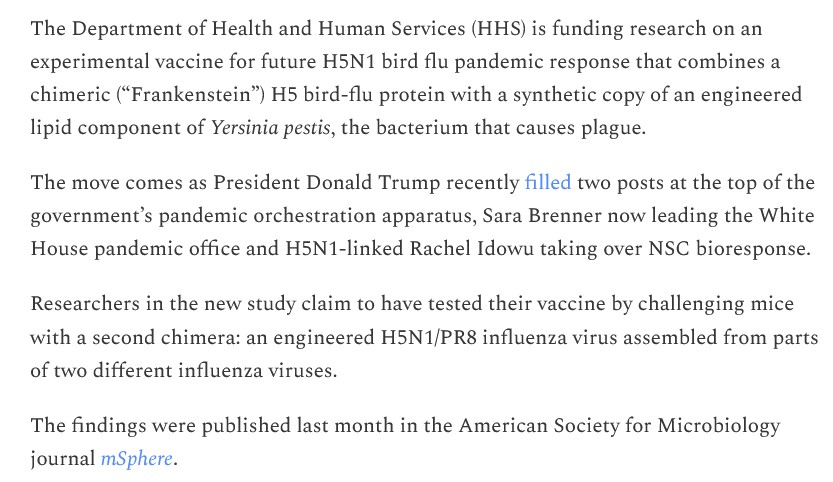
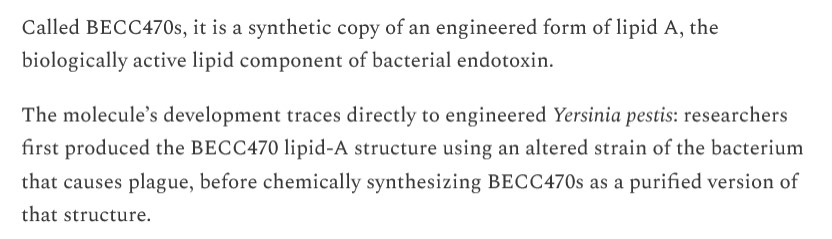
The paper referred to in the Fleetwood article is here: https://journals.asm.org/doi/10.1126/msphere.00171-26, “Optimizing an avian influenza vaccine using a novel Bacterial Enzymatic Combinatorial Chemistry (BECC) TLR4 adjuvant”, Robert K. Ernst, et al.; 10 July 2026. The research was funded primarily via HHS-NIH-NIAID-BAA2017/HHSN272201800043C; via other HHS-NIH-NIAID grants; and, the Center for Vaccine Development and Global Health (University of Maryland School of Medicine.) The work of one co-author, Devon Riley, was funded via the United States Army Long-Term Health and Education Training Program.
>>>>>>>>>>>>>>>>>>>>
What is BECC470? Please see: https://www.fromtiersin.org/journals/immunology/articles/10.3389/fimmu.2026.187218/full, “Licensed and investigational TLR4 agonists as vaccine adjuvants: Structural basis, clinical progress, and future directions”; Jiasheng Zhou, et al.; 16 July 2026. Note that, except for one co-author of this paper (who is associated with the Communist Chinese version of the CDC), all other co-authors are associated with research institutes in Wuhan, Communist China. A screenshot of section 3.2 of this paper, which describes BECC (Bacterial Enzymatic Combinatorial Chemistry) is below. There are two versions of BECC470: BECC470b (the biological form of the Y. pestis element in the adjuvant); and, BECC470s (the lab-created synthetic form of the Y. pestis element in the adjuvant):
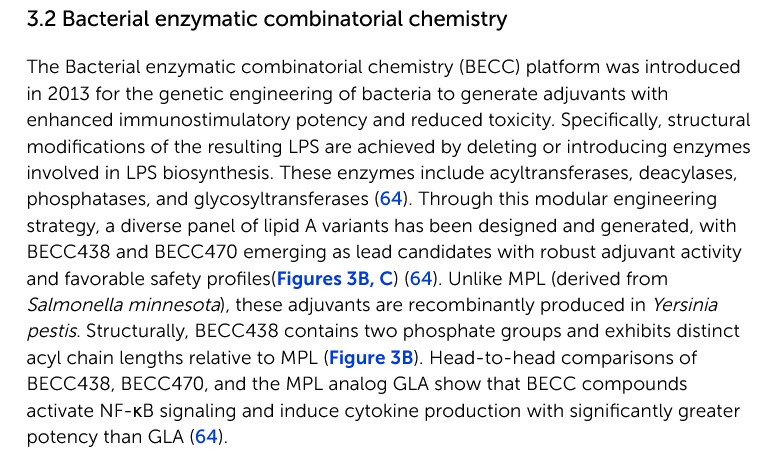
BECC438, BECC470b, and BECC470s are all derived from the lipid A in Y. pestis.
It appears that there are three separate publications of the Robert K. Ernst, et al., paper: the 10 July 2026 paper in the ASM Journals, cited above; another publication, a day later in July 2026, in journal Vaccines (https://www.sciencedirect.com/science/article/pii/S02644-10X26005839), “BECC-adjuvanted hemagglutinin influenza vaccine promotes enhanced immunogenicity and protective efficacy”, Robert K. Ernst, et al.; 11 July 2026; and, a Biorxiv preprint version, published in March 2026 (https://www.biorxiv.org/content/early/2026/03/05/2026.03.03.709477.full.pdf, “Optimizing an avian influenza vaccine using a novel Bacterial Enzymatic Combinatorial Chemistry (BECC) TLR4 adjuvant”, Robert K. Ernst, et al.; 5 March 2026. All three of these publications appear to have same parameters: One, that Gain-of-Function experiments were performed with multiple strains of Avian Influenza and then injected into the lab mice; Two, there is no direct mention that BECC438, or BECC470b, or BECC470s, are derived from the lipid A of Y. pestis; and, Three, that BECC adjuvants are “superior” to the other types of adjuvants currently in influenza “vaccines.”
>>>>>>>>>>>>>>>>>>>>
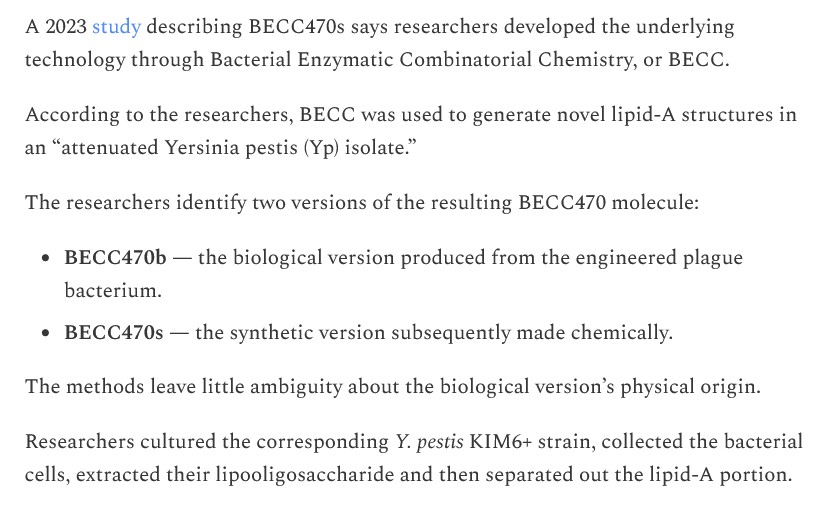
Back to the article by Jon Fleetwood. Something caught Yours Truly’s eye: It appears that the lipid A portion of a certain strain of Y. pestis, called KIM6+, is the one that was chosen to lab-create BECC470b, which was then chemically engineered to create BECC470s. Please see below:
Yours Truly did some digging into KIM6+. The 2023 paper, which also has Robert K. Ernst as co-author, is here: https://www.cell.com/action/showPdf?pii=S2405-8440(23)05327-6, “Physiochemical characterization of biological and synthetic forms of two lipid A-based TLR4 agonists”, Robert K. Ernst, et al.; available online 8 July 2023. Another paper, from 2021, by Bland, et al., discusses the KIM6+ strain of Y. pestis and its infectivity: https://journals.plos.org/plospathogens/article?id=10.1371/journal.ppat.1009995, “Acquisition of Yersinia murine toxin enabled Yersinia pestis to expand the range of mammalian hosts that sustain flea-borne plague”, David M. Bland, et al.; 14 Octocer 2021. Please see below, from the Results section of this paper:
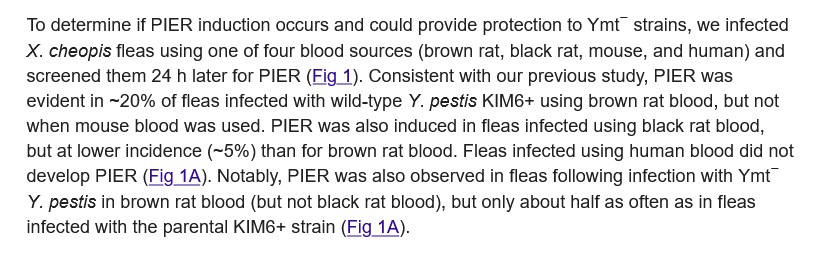
It appears that the KIM6+ strain of Y. pestis is one that has about 50% more capability to infect. And it is the KIM6+ strain that was chosen to lab-create BECC470b; and then to have that chemically engineered to lab-synthesize BECC470s — both of which can be used as vaccine adjuvants.
>>>>>>>>>>>>>>>>>>>>
Robert K. Ernst holds at least two US Patents related to the use of KIM6+-derived Y. pestis lipid A constructs that can be used as adjuvants in vaccines: US10358667B2, 7 January 2016, “Adjusted expiration” of 19 March 2034: and, US11124815B2, 21 September 2021, “Adjusted expiration” of 7 March 2034. Both Patents have the same Title (“Immunotherapeutic Potential of Modified Lipooligosacchardies/Lipid A”); the same Inventors (Robert K. Ernst, et al.); and the same Licenses and Options (Licensed to TollereBio Corporation [Robert K. Ernst], Optioned to Virtici, LLC.)
Reading through US10358667B2, one finds, for example, that a BSL-2 biosafety laboratory level is, apparently, sufficient to work with the KIM6+ lipid A of Y. pestis, and to lab-create BECC470 adjuvants from this bacterium; that BOTH the “biological version” of BECC470 (BECC470b) and the “synthetic version” of BECC470 (BECC470s) can be used as vaccine adjuvants; and, that the BECC470 vaccine adjuvants, per the Patent, section VIII. Use of Exemplary Lipooligosaccharide/Lipid A-based Mimetic Compositions: “…is [sic] useful for…” the following vaccines, among others, listed in the Patent:
measles, mumps, rubella (think MMR);
polio;
plague;
chickenpox;
HPV;
Hepatitis B (think newborn “vaccination” with this one);
pertussis;
tetanus;
and, shigella (Shingles)
And, in fact, Dr. Ernst is at work creating a shigella “vaccine” that includes BECC-engineered adjuvants: https://www.sciencedirect.com/science/pii/S0264410X25000763, “BECC-engineered live-attenuated Shigella vaccine candidates display reduced endotoxicity with robust immunogenicity in mice”, Robert K. Ernst, et al.; 19 March 2025. This paper appears, in Yours Truly’s opinion, to “dance around” actually mentioning the apparent use of Y. pestis-derived elements in the Gain-of-Function shigella “vaccine” that was administered to lab mice (administered using various methods, including intramuscular injection and gastric injection.) The paper does list various Patents that are “related” to the paper, including both US10358667B2 and US11124815B2 (discussed above in today’s offering.) The paper also lists the 2018 Ernst, et al., paper regarding the use of Y. pestis-derived BECC438 in a vaccine administered to mice: https://www.sciencedirect.com/science/article/abs/pii/S0264410X18307680, “A lipid A-based TLR4 mimetic effectively adjuvants a Yersinia pestis rF-V1 subunit vaccine in a murine challenge model”, Robert K. Ernst, et al.; 27 June 2018.
In Yours Truly’s opinion, this entire situation raises important questions, among them: One: Why is the United States government (via HHS / NIH / NIAID), and the United States Army, funding research into using any element of the plague bacterium in a drug of any type, let alone a drug that can be injected? Two: How is it possible that a BSL-2 level laboratory can be considered to have sufficient biosafety to work with any element of the plague bacterium? Three: Why was KIM6+, apparently one of the most deadly and infective lipid A elements of Y. pestis, used to lab-create BECC470b and BECC470s? And, Four: Is it possible to completely “de-nature” the deadly effects of any element of Y. pestis sufficiently for such element to be used as an adjuvant in vaccines?
Peace, Good Energy, Respect: PAVACA1
(Intellectual Property Disclaimer and Notice: Except for the linked URLs and other items available on the Internet, the ideas and/or opinions in today’s offering are by PAVACA1 (M.E. Forbes, aka M.E.C. Forbes.) Credit must be given to PAVACA1 if ideas and/or opinions in today’s offering are used by other blog writers; by podcasters; or in print or social media.)