Our mission, as God-fearing and God-loving patriots, is to defend this Constitutional Republic and to increase its greatness, in all good things and ways, by using our voices in free but courteous speech, by discussing the happenings of the world and coming to a profound understanding of those things, and by sharing and promulgating these Truths on both this platform and others.
There are Important Notifications from our host, Wolf Moon; the Rules of our late, good Wheatie; and, certain caveats from Yours Truly, of which readers should be aware. They are linked here. Note: Yours Truly has checked today’s post for any AI-generated content. To the best of her knowledge and belief, there is none. If readers wish to post any AI-generated content in the discussion thread for today’s post, they must cite their source. Thank you.
Do not forget to LABEL AI articles, video and such.
Just for fun:
I told Wolf that I would capture the information on boron and put it into an article so it was easy to access. I have added other information too. I was already aware of the low soil boron = arthritis correlation and had been taking a Move Free boron supplement for years along with a glucosamine, chondrotin, hyaluronic acid & MSM supplement.
The following article goes into the active suppression of boron for arthritis. In the 1960s Rex Newnham discovered boron ‘cured’ arthritis. This is the same time period when my doctor developed rheumatoid arthritis, went up to Canada and took something that ‘cured’ her pain. She fought tooth & nail with the FDA to get trials run and even went on the Joe Pyne show (1965-68) trying to drum-up public support. So with this new evidence, I think it was a boron supplement that she was taking.
by Walter Last Nexus Newsfeed Wed, 05 Jul 2017 00:01 UTC
You may not be able to imagine that borax, this humble insecticide and laundry detergent, has the potential of singlehandedly bringing down our entire economic system. But you do not need to worry, the danger has been recognised and the necessary steps are already being taken to defuse the situation… [But the FDA sure did! -GC]
👉Formerly boric acid was widely used as a preservative in foods but is now banned for this purpose in most countries, and is also banned from public sale in Australia.
According to conventional medicine it is not known if boron is essential for humans but research shows that we do need it. The reason why it was difficult to answer this question is the presence of boron in all plants and unprocessed foods. Diets with a fair amount of fruit and vegetables provide about 2 to 5 mg of boron per day, but this also depends on the region where the food was grown and how it was grown.
In reality the average intake in developed countries is 1-2 mg of boron per day. Institutionalized patients may receive only 0.25 mg of daily boron. 👉Chemical fertilizers inhibit the uptake of boron from the soil: an organic apple grown in good soil may have 20 mg boron, but if grown with fertilizer it may have only 1 mg of boron. Fertilizers combined with poor food choices have greatly reduced our boron intake compared to 50 or 100 years ago…
The Arthritis Cure of Rex Newnham
In the 1960’s Rex Newnham, Ph.D., D.O., N.D, developed arthritis. At that time he was a soil and plant scientist in Perth, Western Australia. Conventional drugs did not help, so he looked for the cause into the chemistry of plants. He realized that plants in that area were rather mineral deficient. Knowing that boron aids calcium metabolism in plants he decided to try it. He started taking 30 mg of borax a day, and in three weeks all pain, swelling and stiffness had disappeared.
He told public health and medical school authorities about his discovery but they were not interested….
BRAVE AI
Borax is banned from sale to general consumers for household use in the European Union (since 2010) and the United Kingdom (post-Brexit). It is also banned as a food additive in the United States, Australia, China, and Thailand.
In the EU and UK, the ban stems from the European Chemicals Agency (ECHA) classifying borates as potentially harmful to reproductive health and the unborn child.
Why Ban a Fertility Enhancer and Label It a Reproductive Toxin?
Human Data: No Reproductive Harm, Even at High Occupational Exposure
It’s worth noting that virtually all human research on boron and reproduction has been designed to detect toxicity or harm, not to identify or measure potential fertility benefits. In spite of this, at least one such study reviewed below still picked up an improved fertility trend at moderate exposure levels.
Occupational borax miners are exposed to boron at roughly a tenth to a thirtieth of the dose that causes reproductive harm in animal studies, and even at these real-world exposure levels, they show no reproductive damage.
A small amount of Borax in your coffee every morning is a lot less expensive. However, if you don’t drink coffee, then you have to consider what in your routine works for you. I’m making mocha, adding the Borax and some quality omega-3 rich fish oil, so I’m still spending some $, but it does seem to be helping some things.
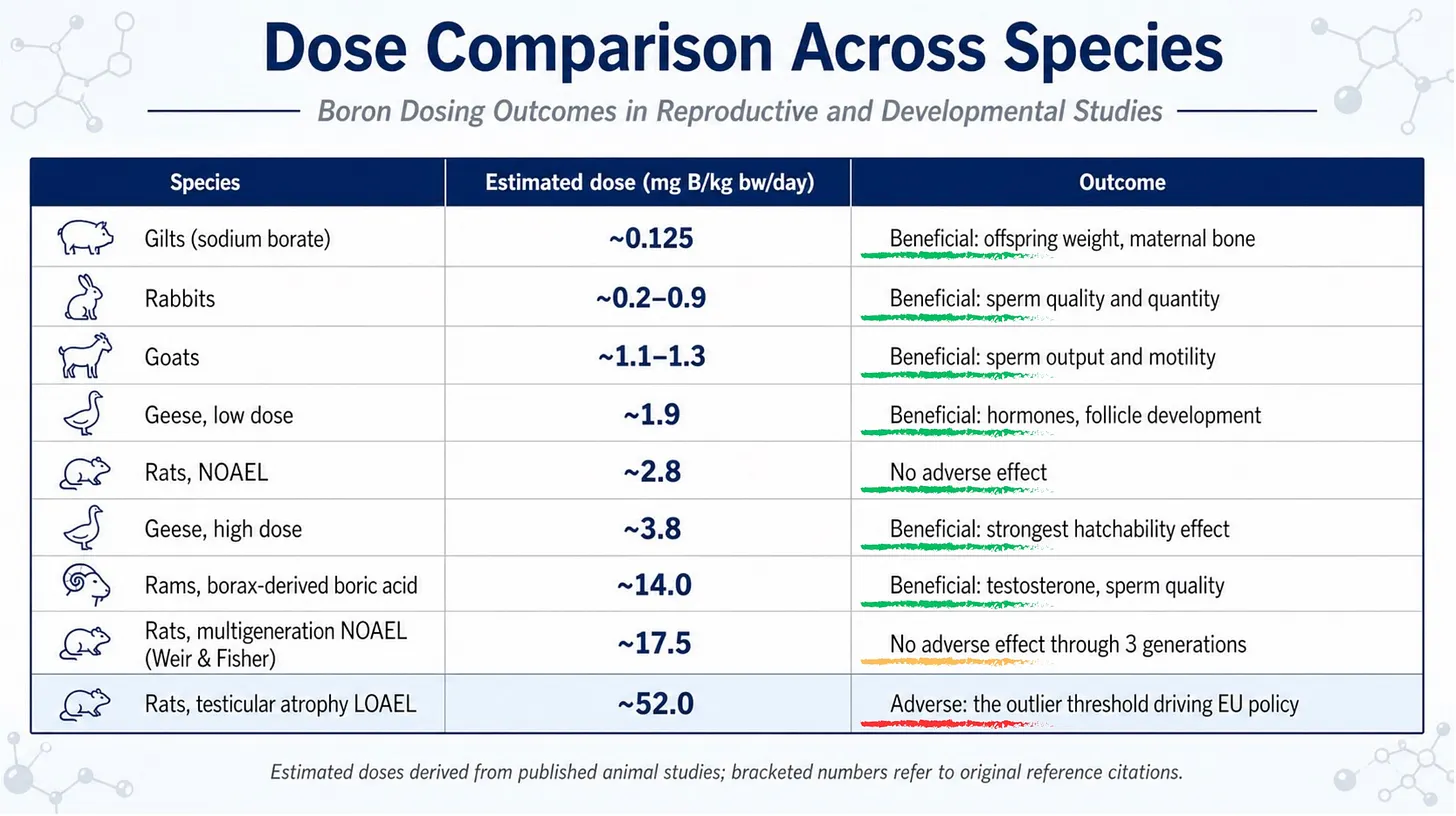
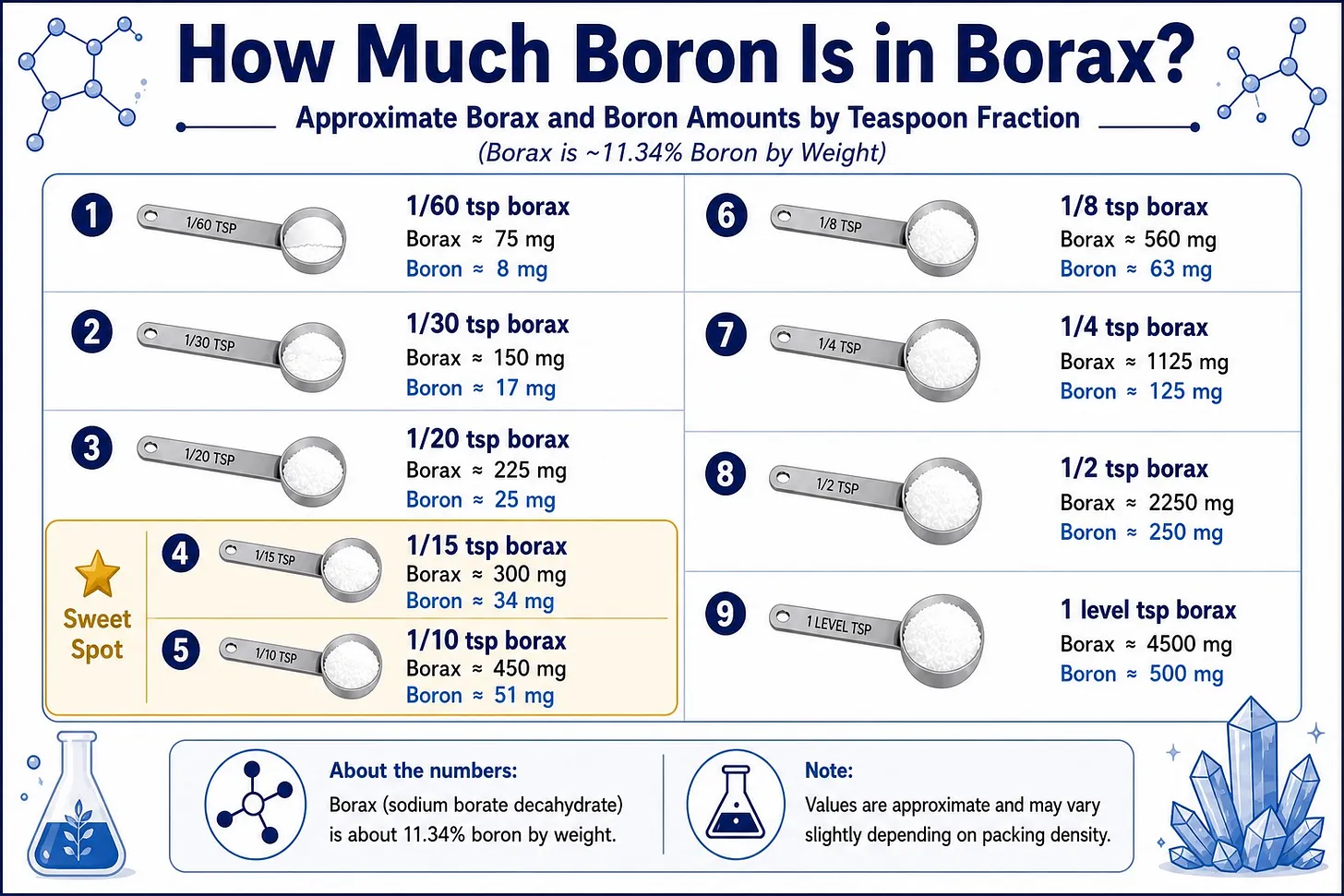
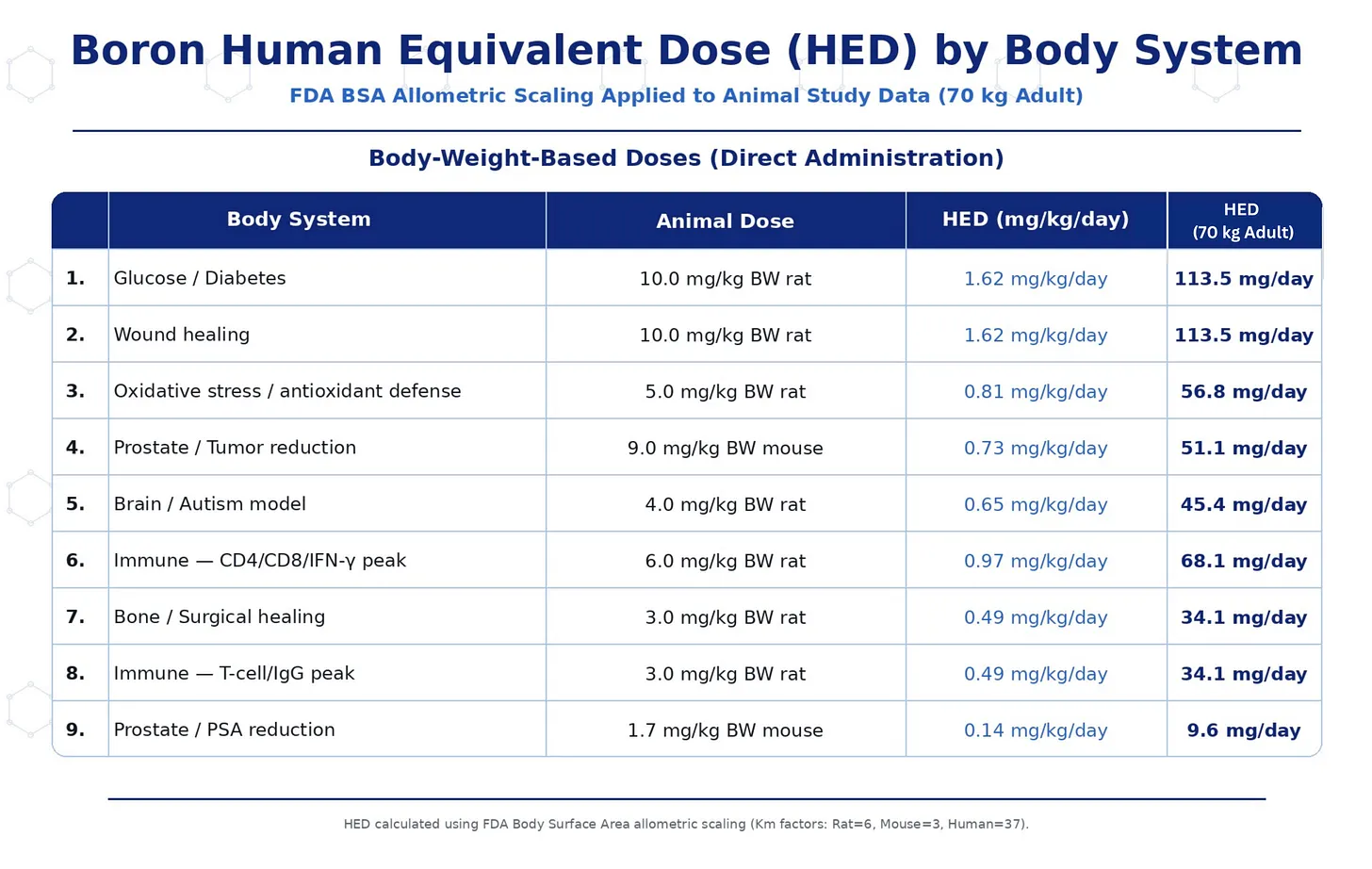
Curious has an entire post going into the published (animal) research and giving conversions for human use. I’m going to start with his final conversion chart:
Buried in a peer-reviewed paper on boron’s important roles in biochemistry is a passage most readers would scroll past:
“Administration of boron 5, 10, and 20 mg/kg/d reversed malathion-induced oxidative stress, lipid peroxidation, and suppression of antioxidant enzyme activity.
Boron decreased malathion-induced oxidative stress, enhanced antioxidant defense mechanisms, and regenerated damaged liver, kidney, and brain tissues in rats.”
Wolf Moon
…..and regenerated damaged liver, kidney, and brain tissues in rats.
None of the doses in his chart have been found to be unsafe. 👉The human limit was achieved by taking a possible/maybe impactful dose and DIVIDING BY 100 to get their “precautionary” safe dose.👈
Notice in the effects chart that 113mg is the human equivalent dose for effects on wound healing and diabetes.
I started with 1/16 tsp and after his last article I increased to 1/8 tsp in my mocha. Plus adding liquid omega-3.
As I understand it, the combination of the polyphenols in the mocha, the boron and the omega-3 creates complexes that the body can use effectively.
Cocoa [alone] has some great polyphenols. Should still work.
What Boron Actually Does Boron is not classified as an essential nutrient in humans. There is no Recommended Daily Allowance. There is no established deficiency disease with a name. Yet the research literature, accumulated over four decades, led largely by USDA researcher Dr. Forrest Nielsen and colleagues, paints a picture of a mineral with extraordinarily wide metabolic reach.
Boron has been shown in animal and human studies to affect: [2]
Brain electrical activity and cognitive performance, including manual dexterity, attention, short-term memory, and long-term memory [2]
Bone formation, mineralization, and fracture healing [2]
The methylation cycle, specifically SAM-e (S-adenosylmethionine) production and homocysteine regulation [2]
Steroid hormone metabolism including testosterone, estradiol, and vitamin D activation [2, 3]
Mitochondrial function, specifically uncoupling proteins that regulate thermogenesis and oxidative stress [2]
This is not a short list. It spans virtually every major domain of human physiological optimization. And in every single case, the literature carefully reports the effective animal dose in milligrams per kilogram and then stops.
And he gives an explanation of why researchers only talk about animal studies…
Why The Scientists Can’t State What Is Obvious
How is it that we’ve found over 5,000+ planets outside our solar system and we’ve sequenced the entire human genome in the last 25 years, yet we still can’t give boron the essential mineral status it likely deserves?
To understand the significance of the weight-based dosages, you need to understand what prevents researchers from simply stating their implications outright.
First, the regulatory status problem. Establishing essentiality requires proving that one specific enzyme or biochemical reaction depends entirely on a substance which is the equivalent of proving a single missing musician silences an entire orchestra. Orchestra’s do not work that way and neither does boron. It behaves more like a conductor subtly adjusting the tempo across every section of the orchestra at once. No instrument stops playing. No section goes silent. But take the conductor away, and the whole performance noticeably loses its precision. Boron’s actions are broad and pleiotropic. It modulates multiple pathways rather than serving a single defined function. Without essentiality status, no regulatory body will issue a formal recommended intake above minimal amounts. [2]
Second, the GRAS (Generally Regarded As Safe) and UL problem. The established Tolerable Upper Intake Level (UL) for boron in adults is 20 mg/day, derived from reproductive toxicity studies in rats and rabbits. This regulatory ceiling prevents researchers from recommending or stating higher doses than 20 mg of elemental boron per day could be beneficial. Any researcher who formally recommends human doses near or above it, without controlled human clinical trial data, faces institutional and legal exposure. [4]
Third, the funding problem. Boron cannot be patented. There is no pharmaceutical or commercial engine to fund the large-scale, dose-escalation human trials that would be required to formally establish higher optimal intakes. The research that does exist is largely government-funded and deliberately conservative in its clinical recommendations.
So researchers do something elegant and, once you see it, it’s hard to miss: they publish the animal mg/kg data in full detail, embed it in papers targeted at human nutrition audiences, surround it with mechanistic human-relevance context (SAM-e depletion, homocysteine elevation, brain electrical activity, PSA suppression), and leave the conversion to the attentive reader.
Dr. Nielsen spent a career doing exactly this. His repeated framing of boron as “of more practical nutritional importance than currently acknowledged” is the scientific literature’s equivalent of stating that which is obvious. Boron at higher amounts than the 20 mg per day UL could potentially optimize human health and prevent certain disease processes.[2]
One problem is many soils are boron poor so adding borax to the soil may be a good idea. However it is also a broad leaf weed killer. As a weed killer, http://www.yellowfarmhousegarden.com/?p=2577says:
The problem with this solution is the amount of borax needed to work varies with soil type. Certain soils neutralize boron more efficiently than others.
A Systematic Breakdown of How Much I Am Taking From Now On
Note: This is for educational purposes. This is not medical advice, and I am not telling you what you should do. Every person is or should be in control of their own health in spite of what the current medical establishment would like you to believe.
[This of course also goes for any of our discussions here on the Qtree. GC]
Curious Note: Most vitamin and mineral recommended intakes are set to prevent deficiency, not to optimize health, performance, or longevity. This article addresses boron specifically, and what the research suggests about dosing for optimized human health, rather than for the mere absence of deficiency.
Over the past year, I have spent at least 100 hours trying to build a comprehensive understanding of boron and its effects on human health and disease. The focus of that work has been on elemental boron as provided by borax, and the process has involved reading across a large and scattered literature that spans over 100 years of food science, nutrition, toxicology, endocrinology, bone biology, neurology, immunology, and cancer research…
So Curious, like MidWesternDoctor, has done an extensive study of past research that was bury as ‘inconvenient’ for Big Pharma’s profit maximizing strategy. As E.M. Smith (Chiefio) Said,
Realize that the corporate urge is not toward a competitive market. It’s the very LAST thing any corporate wants. What a corporate wants is a monopoly where they can achieve the profit maximizing price point. Not competition. No “market” with many sellers.
So watch what GE does, as an example. It is always on the hunt for a market it can “dominate”. It uses political leverage to get its products mandated and the competition banned. It doesn’t want a market, it wants a ‘company store’.
Internalize that, and a lot of things “fit” better…
Monsanto pushing legislation to ban private traditional seeds and seed sharing, and promoting GMO products. (Why would a seed company want to ‘destroy’ a seed market? So you must come to the company store…)
EPA is used to forbid all sorts of things that can be done easily and cheaply, and where the alternative is very expensive ….
Once corporations figure out that it is cheaper and easier to get the competition banned and them mandated, than to create new products; and that they can make lots of money as the sole provider of a crappy product but not that much making good products in a competitive market; well, lets just say that the campaign contributions flow…
What Boron Actually Does Boron is not classified as an essential nutrient in humans. There is no Recommended Daily Allowance. There is no established deficiency disease with a name. Yet the research literature, accumulated over four decades, led largely by USDA researcher Dr. Forrest Nielsen and colleagues, paints a picture of a mineral with extraordinarily wide metabolic reach.
Boron has been shown in animal and human studies to affect: [2]
Brain electrical activity and cognitive performance, including manual dexterity, attention, short-term memory, and long-term memory [2]
Bone formation, mineralization, and fracture healing [2]
The methylation cycle, specifically SAM-e (S-adenosylmethionine) production and homocysteine regulation [2]
Steroid hormone metabolism including testosterone, estradiol, and vitamin D activation [2, 3]
Mitochondrial function, specifically uncoupling proteins that regulate thermogenesis and oxidative stress [2]
This is not a short list. It spans virtually every major domain of human physiological optimization. And in every single case, the literature carefully reports the effective animal dose in milligrams per kilogram and then stops.
He gives an explanation of why researchers only talk about animal studies…
Why The Scientists Can’t State What Is Obvious How is it that we’ve found over 5,000+ planets outside our solar system and we’ve sequenced the entire human genome in the last 25 years, yet we still can’t give boron the essential mineral status it likely deserves?
To understand the significance of the weight-based dosages, you need to understand what prevents researchers from simply stating their implications outright.
First, the regulatory status problem. Establishing essentiality requires proving that one specific enzyme or biochemical reaction depends entirely on a substance which is the equivalent of proving a single missing musician silences an entire orchestra. Orchestra’s do not work that way and neither does boron. It behaves more like a conductor subtly adjusting the tempo across every section of the orchestra at once. No instrument stops playing. No section goes silent. But take the conductor away, and the whole performance noticeably loses its precision. Boron’s actions are broad and pleiotropic. It modulates multiple pathways rather than serving a single defined function. Without essentiality status, no regulatory body will issue a formal recommended intake above minimal amounts. [2]
Second, the GRAS (Generally Regarded As Safe) and UL problem. The established Tolerable Upper Intake Level (UL) for boron in adults is 20 mg/day, derived from reproductive toxicity studies in rats and rabbits. This regulatory ceiling prevents researchers from recommending or stating higher doses than 20 mg of elemental boron per day could be beneficial. Any researcher who formally recommends human doses near or above it, without controlled human clinical trial data, faces institutional and legal exposure. [4]
Third, the funding problem. Boron cannot be patented. There is no pharmaceutical or commercial engine to fund the large-scale, dose-escalation human trials that would be required to formally establish higher optimal intakes. The research that does exist is largely government-funded and deliberately conservative in its clinical recommendations.
So researchers do something elegant and, once you see it, it’s hard to miss: they publish the animal mg/kg data in full detail, embed it in papers targeted at human nutrition audiences, surround it with mechanistic human-relevance context (SAM-e depletion, homocysteine elevation, brain electrical activity, PSA suppression), and leave the conversion to the attentive reader.
Dr. Nielsen spent a career doing exactly this. His repeated framing of boron as “of more practical nutritional importance than currently acknowledged” is the scientific literature’s equivalent of stating that which is obvious. Boron at higher amounts than the 20 mg per day UL could potentially optimize human health and prevent certain disease processes.[2]
Due to their content of boron, borax and boric acid have basically the same health effects, with good antiseptic, antifungal, and antiviral properties but only mild antibacterial action. In plants as well as animals boron is essential for the integrity and function of cell walls, and the way signals are transmitted across membranes.
Boron is distributed throughout the body with the highest concentration in the parathyroid glands, followed by bones and dental enamel.
It is essential for healthy bone and joint function, regulating the absorption and metabolism of calcium, magnesium and phosphorus through its influence on the parathyroid glands. With this boron is for the parathyroids what iodine is for the thyroid.
Boron deficiency causes the parathyroids to become overactive, releasing too much parathyroid hormone which raises the blood level of calcium by releasing calcium from bones and teeth. This then leads to osteoarthritis and other forms of arthritis, osteoporosis and tooth decay. With advancing age high blood levels of calcium lead to calcification of soft tissues causing muscle contractions and stiffness; calcification of endocrine glands, especially the pineal gland and the ovaries; arteriosclerosis, kidney stones, and calcification of the kidneys ultimately leading to kidney failure. Boron deficiency combined with magnesium deficiency is especially damaging to the bones and teeth…