American Stores: When in the Course of human events – Part 4

This series is now dedicated to DeplorablePatriot, Susie Sampson. RIP and enjoy the company of Heaven, friend. We will carry on here and try to do you proud.

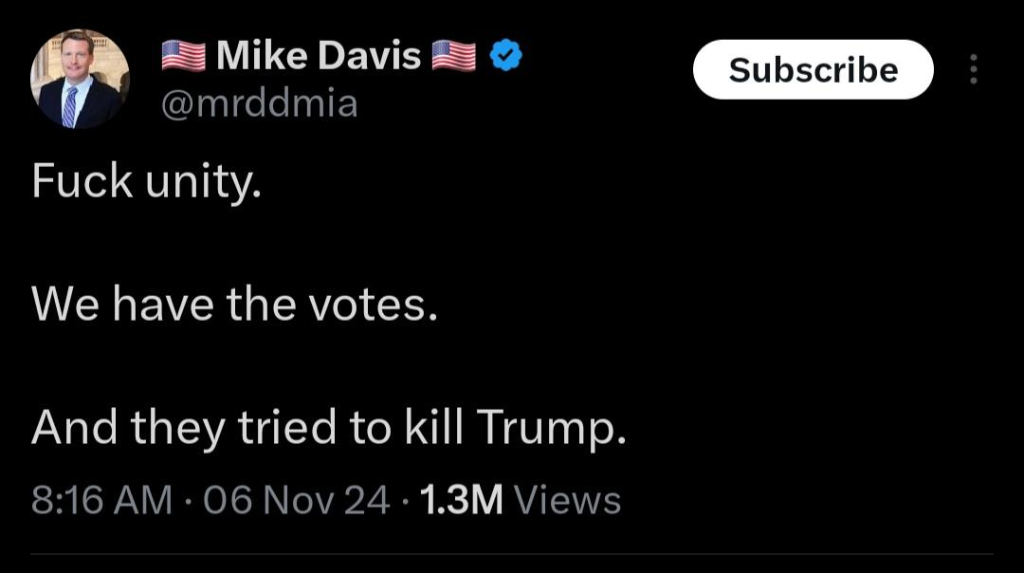
The post below probably reflects the more crude sentiments of most of the 77+ million voters for President Trump, which was probably over 90 million if all of his votes were actually counted.

Pardon me as I leave my Christian virtue outside the door. It will return after my next statements.

Our righteous anger has consequences. That summarizes how my current day fellow Sons and Daughters of Liberty feel. That unity and mercy shiz at the enemy’s request and terms ends now. There must be full compliance with the principles of the Declaration of Independence and provisions in the Constitution or GTFO to every person within our borders from this point on.

The scoundrels said and did what they said and did. Even with that President Trump is reaching across the aisle to encourage working together, just on our terms and not theirs. It will not work and he can say he tried. They will only do so reluctantly and will return to their evil ways at the first opportunity. l much prefer we move on to the obvious conclusion. They have no remorse for what they have done to him or us. They will continue to obstruct, lie and deceive. Yet, it will not stop what is coming.

Judgment Day.

Now, back to our regularly scheduled, but applicable, programming. Well, maybe after one more discussion. As you will probably figure out, I have clearly gone off the rails with this posted story. 😂

Coincidently

Was Inauguration Day great or what?! That day is one for the ages, it will likely never be topped. Celebration with each statement he made and EO he signed. Inspiring speeches. meaningful prayers and fun music abounded. The wonderful happy faces of people celebrating filled me with joy. Patriotism and expressions of faith are returning in full force. The majority of Americans have hungered for this day and were sick of the dangerous, corrupted, woke nanny state we had become. For psychological effects, nothing tops J6 for rebellion against Americans by the feds and their minions. Yet, we patriots know that all of the power plays by the leftists and cabal have been illegal and treasonous in nature. When many of the cops and judges break bad, it is a painfully hard thing to return the law and order of the American Way. That begins in earnest now.

EO after EO. Confirmation after confirmation of meaningful actions to come. Reconciliation bill(s) on tap per Speaker Johnson that will codify Execrative Orders and Actions into law with a united GOP paving the way for a change is what will benefit We the People the most. Thank you POTUS! 🇺🇸

Now, let’s get the election system in order so that cheating ends forever.

Treaties, Pacts And Deceptions

The following is one man’s observations and opinions in just one major aspect of our rights as citizens. The reader is free to agree or disagree, it is the American Way and your right to do so thanks to the founding fathers and now, President Trump. I encourage it. Regardless of your position, the subject is one of major focus by POTUS and his cabinet. Treaties and trade pacts will be up for constant withdrawal, negotiation, execution and discussion. America is going to be aggressive economically as well as geographically. With multi polarity the topic of international discussions, expect the first step to be toward a lockdown control of North America with inroads of increased relations in Central and South America. The Abraham Accords will also return to the stage soon.

As a result it seems appropriate to begin this part on Declaration signers with a summary discussion of treaties and pacts. Many folks ignore or forget that treaties and bi/multi lateral pacts are legal and binding between peoples and nations only as long as they are honored by all parties. They die in value the very second a party(ies) violates regardless of legal language in the treaty or pact that provides remedies. The reason is the violators nearly always know they are violating. The violated can never fully trust the violators again. There are no independent, neutral arbiters of violated treaties and pacts that have the ability and authority to enforce. For the most part there are no real “mistakes” or “errors of omission or commission”. The documents are negotiated and reviewed in great detail before execution. The parties know what they are doing.

Violations of treaties and pacts lead to all types of conflicts and wars on the battlefields, economically, with terrorism, with criminal activities and so on. Honoring a legal agreement that has been violated by a party to it is foolishness. The violator has openly provided a sign of a lack of respect and honorable intent. For an example, who first violated provisions of the NATO/Russia Founding Act of 1997 when each party stated they did not consider the other adversaries? Who violated the Minsk Accords in 2014 with a color revolution? Now look where things are today in the subject nation of Ukraine. Why bother signing agreements when neither party can trust the other to hold up their end of the deal? It is lipstick on the pig and We the People need to wise up to not fall for political maneuvering and theater.

Next, drill down to the individual rights of all people in the above referenced comments. You have now entered into the “natural rights” of all people individually to which our American founding fathers speak in the Declaration. In fact, it is the basis for everything that comes thereafter in our nation’s history. Those same rights were granted at the dawn of creation by the Creator. OUR collective American nation is governed by that principle and law per the Declaration and Constitution that followed. It was the understanding of our founding fathers and all American patriots. It has been in our governing documents since execution.

As a result, anything or anybody operating outside of those documents; any laws or regulations that violate that understanding; any foreign interests that impose their wills against it; even Satan himself doing his thing: None have any authority to act opposed to those governed by the founding document and resulting Constitution. We have the natural rights to toss any conflicting statute, law, rule, regulation, etc. out and overthrow anybody that attempts to enforce them. In fact, our founding documents indicate it is our responsibility to do so.

To illustrate the point of the intertwining of our nation’s formation and Christianity, what is the first sentence in the 1783 Treaty of Paris that officially brought an end to Revolutionary War hostilities and freed the states from British oppression?

In the Name of the most Holy & undivided Trinity.

The Treaty was willingly executed by both nations to end the conflict. They each acknowledged the above reference quote. They agreed the document was being executed in good faith in the presence of the most high, holy God in the form of the Trinity. Anytime a person or entity tells you that America was not founded on Christianity or is not a Christian nation, tell them to go pound sand and to read the Declaration of Independence and the Treaty of Paris. You have seen the references to the Creator and His providence in the Declaration and its affirmation in the Constitution. Now you see it and a direct reference to the Trinity in the Treaty that granted America its full independence. So enough with the lies and propaganda. Full stop. The Holy Word of God is the final authority on all matters.

Further…

“His Brittanic Majesty acknowledges the said United States, viz., New Hampshire, Massachusetts Bay, Rhode Island and Providence Plantations, Connecticut, New York, New Jersey, Pennsylvania, Delaware, Maryland, Virginia, North Carolina, South Carolina and Georgia, to be free sovereign and Independent States; that he treats with them as such, and for himself his Heirs & Successors, relinquishes all claims to the Government, Propriety, and Territorial Rights of the same and every Part thereof.”

Freedom.

We see that the Constitution that was subsequently executed a few years later is valid in that Americans had treaty granted rights to do as they pleased in terms of government and national formation. Great Britain was out. At least until they tried to force their way in again in 1812, which led to the Treaty of Ghent two years later.

Which is a major point. Treaties are good until they aren’t. But know this, no amount of deception such as was performed in 1913 is legal per the founding documents. They are direct violations of established principles in the Declaration and law in the Constitution. For example, there is no legitimate national indebtedness to the City of London as some supposed, just like there is no legitimate national indebtedness to the Federal Reserve. Americans are about to get educated if I read the tea leaves right. President Trump and fellow patriots are going to rip down the veil and tear it to shreds.

To summarize, our elected leaders and their appointees have no authority to enter into any treaty or pact that does not have America First. America was not first with the Paris Agreement on climate, the funding of WHO through the UN and many others in recent memory. We should sign nothing that does not have America and its citizens first. If our government does not do that they are operating in opposition to the law from the founding documents that rule our nation. If there is a need of We the People that is pressing, the governing officials have no legal right to give the funding to any foreign nation or interests before us. Every Congress critter and POTUS who has done that is corrupted and violated their oaths of office.

The Declaration of Independence is the vision and authority for the American experience, the American Way. It also provided a citation of violations of the King and Great Britain against the colonies. Do the listed violations sound familiar? Many are similar to what we have experienced currently from our own government that has pushed down heavily on We the People. Many of our leaders and citizens are still connected to the Crown and other blood suckers just as they were in the Revolutionary War period.

The Constitution is the modus operandi for how we live and operate as a nation. The statutes, laws, rules and regulations that flow from it must be in accordance and also be in sync with the Declaration. Even SCOTUS rulings that violate the goals, intentions and mission of those documents are null and void. Any legal precedents they establish that violate natural laws are invalid. We only have to look to the recent COVID related mandates to understand how and why. For example, Roe v. Wade was finally seen by the SCOTUS to be an unconstitutional violation that a previous SCOTUS made and others upheld through the decades that followed. The more current court chose to honor the founding documents that established a republic in opposition to the new age Federalists that pushed for central governance and control. This recent decision led to the people in each state being able to legally determine to honor or not honor the natural rights of the conceived, but not yet born; which is how this republic is supposed to work.

All people are acknowledged as being created equally by the Bible as well as in the Declaration of Independence. The Constitution is written to reflect that understanding. Again…

“We hold these truths to be self-evident, that all men are created equal, that they are endowed by their Creator with certain unalienable Rights, that among these are Life, Liberty and the pursuit of Happiness.”

Knowing that even some of the same patriots who brought us that language permitted slavery of “equal” men and women with certain “unalienable Rights” to exist in the new nation. If the quoted language is to be believed, which it should be, the view of many of We the People that slaves were property was obviously dead wrong. It is no wonder that as soon as America officially existed, it had internal strife that culminated in a horrific, bloody war less than a century later that had slavery as well as other major issues attached such as banking wars, industrialist control issues, treatment of native American Indians, misuse of central government over states’ rights, buying religious endorsements from the pulpits, corrupting higher education, and so on.

All of the deception can throw individuals and nations off track. The saboteurs and evil doers know that and use it to gain an upper hand. Because America is dedicated to God clearly in the Declaration and affirmed in the Constitution as well as the Treaty of Paris, eventually slavery would cease to exist. It was inevitable. But flawed leaders and parts of society resisted as people are want to do just as they do today. In the early days of our nation the existence of slavery in the United States led to their using it as an excuse for starting another war to reclaim their still perceived possession of the colonies in violation of the Treaty of Paris that they previously signed “In the Name of the most Holy & undivided Trinity.

And the circle goes round and round and…

It is my personal belief that the Declaration is one of the greatest documents ever produced in human existence and that it was guided by the hand of God. Many of the expressions contained within reflect related messages of the Bible.

With this understanding and in contrast, what would you do if opposed to our founding documents? If war did not work; infiltrate and circumvent, of course.

That has been what has happened to America since it won the Revolutionary War. Do you want to know the primary reasons why Sons of Liberty wild men John Hancock, Samuel Adams and others had voiced concerns and reservations about approving the Constitution after winning the war? After much consternation and debate, consider that that those two finally agreed to go along and vote to approve it. Their influence swung the state’s vote to approval in Boston, the Cradle of Liberty. The short Wiki link below is accurate and briefly explains this compromise. You can find numerous historical accounts if you want to dig deeper.

https://en.wikipedia.org/wiki/Massachusetts_Compromise

The actual vote was 187 – 168 in favor. If only 10 people had voted differently things would have been messier. Hancock and Adams were deeply concerned that the young nation would descend into chaos and ruin without its ratification even though they believed parts of it were flawed. So they forced a compromise with the central government supporters, the Federalists, that formed our Bill of Rights and many of the legal principles and related provisions that provide individual freedoms associated with natural rights.

Failure to approve would have been worrisome since they had just led a bloody, destructive revolution that was based on and assured those rights for the colonists. Logically, all should have been unanimously voting in support of the natural rights of the people in a republican form of government. I guess liberty and freedom is never fully understood and accepted even by all who benefit.

Basically we have been at some form of war since the revolution. The battlefronts and war types have changed, but the worldly and fallen angel heavenly forces allied against us are still the same. If we had no value, were of no consequence to the world or Heaven, I dare say we would not be at war continuously. Apparently, we are very valuable to both camps.

So as Joshua said in Joshua 24:15 and I have repeated often in my stories, “But if it is disagreeable in your sight to serve the LORD, choose for yourselves today whom you will serve: whether the gods which your fathers served, which were beyond the Euphrates River, or the gods of the Amorites in whose land you are living; but as for me and my house, we will serve the LORD.” (NASB)

Sounds like a Godly version of what Samuel Adams might say.

Now on to two more of our Declaration signers.

William Elery

Born in Newport, RI in 1727, William Elery was the second son of a merchant father of the same name along with his wife, Elizabeth. His father educated him until he entered Harvard at age 16, graduating four years later while excelling in Greek and Latin. For many years afterwards he tried to find a career that suited him. At first he was a merchant, then collector of Custom taxes, and eventually the recording clerk of the General Assembly. Finally at age 43, after his parents were deceased and he had received a large estate, he found his calling and became an attorney and judge. He joined the Sons of Liberty in Rhode Island and became a representative at the Continental Congress when the previous representative, Samuel Ward died. When it came time to sign the Declaration he boldly approached. “I watched everyone sign, as I was determined to see how they looked as they gave their names to what might be their death warrant.” He had been moved by their “undaunted resolution” while doing so.

Just like many of the patriot founding fathers and signers of the Declaration, he found his home had been ransacked and burned during the Revolutionary War.

In 1785 he became a strong, vocal advocate for the abolition of slavery. He was appointed Commissioner of The Continental Loan Office a year later. He served there until appointed by POTUS Washington to be Customs Collector in Newport in 1791. He passed away in 1820 at the age of 92.

Though lower in profile than many of the other founding fathers, Ellery made other inspiring, resolute, patriotic statements that have been quoted by historians. In addition to the previous quote, the following was written in a letter to his brother, Benjamin.

“We have lived to see a Period which a few years ago no human forecast could have imagined – to see these Colonies shake off and declare themselves independent of a State which they once gloried to call Parent …”

Later, Ellery wrote to Reverend Ezra Stiles and said, “We have been driven into a Declaration of Independency & must forget our former love of our British brethren. The Sword must determine our quarrel.”

These quotes are strong reminders to us today. Never accept less than America First and forge forward regardless of the opposition. Be bold and be strong for liberty and freedom for all.

Ellery was married to Ann Remington until her death in 1764. He later married Abigal Cary who bore them seven children that survived to adulthood. One of his children became a noted Universalist theologian and another, Henry Dana, became a noted poet and essayist. William Ellery was a devoted American Patriot.

Lyman Hall

Lyman Hall was born in Wallingford, CT in 1724. He was the son of a local minister, John Hall and mother, Mary Hall, who was the daughter of Rev. Samuel Street. He was educated by his uncle, Samuel Hall. He went on to graduate from Yale. He attempted to become a minister, which was met with trouble within the congregation. He began studying medicine and two years later became a physician. He married Abigali Burr of CT, but she died a year later. Five years later he married Mary Osborne. They had two sons together, one of whom died as at age 11.

The couple moved to Charleston, SC and Lyman opened a medical office. In 1760 he purchased land in Georgia and started a plantation operation there. He joined the radical patriots in the Sunbury, GA area, which is now a ghost town. He prevailed in being elected to the Continental Congress despite a predominance of Georgians who were loyalists at the time. He became active in the Revolutionary Armies provisioning medical supplies and food. He remained in the Congress for five years until 1780, however, he returned to GA for a period in 1777 to attend to plantation operations and to help with the personal and legal situation of his friend and fellow Declaration signer, Button Gwinnett. Gwinnett later died in a dual with his rival and fellow patriot, Lachlan McIntosh. Hall was devastated by the loss of his friend and attempted without success to have McIntosh arrested.

A short time after his return he learned the British had taken Savannah and had burned down his home and property. They charged him with treason. He and his family fled to Charleston and realized the British had control. They continued on to Connecticut and possibly later, Virginia. Finally, in 1782 they were able to return to the Savannah, Georgia area to reclaim their property and resume their lives.

A year later he was elected Governor of GA. He never left his religious roots and began efforts to charter a college level school that provided a good education, especially in religious education that would help deliver a more virtuous society with less vice. The University of Georgia was chartered in 1785 as a result. After serving one year as Governor he returned to his medical practice. Through the years he experienced financial challenges and hardships that originated from the war. In 1790 he sold his plantation and moved to a different one in Burke County, GA to retire. He passed away that same year at age 66. His wife passed away three years later. Hall County, GA bears his name.

Lyman Hall was a dignified, affable, intelligent, considerate American Patriot who took up the challenges of gaining freedom and liberty from the oppressors no matter the personal cost.

Conclusion

The better we understand our history the more we realize this great nation has been established through the blood, sweat and tears of patriots over many years. I still hear Elery’s words in my head and heart relating to the signers standing on principles and purpose unto the point of their willingness to die for the good of fellow Americans. Most could have chosen to continue in their high social standing and not risk it all. Yet, they exhibited the spirit that John F. Kennedy conveyed with his famous quote, “Ask not what your country can do for you, ask what you can do for your country.”

The founding patriots did it to establish a free republic for We the People.

We do it to preserve and strengthen the greatest nation on earth.

God bless America.

American Stories: When in the Course of human events – Part 3

Before we begin this inspiring part of our signers of the Declaration of Independence series, I have one more note for the readers on the research involved in this series. Many of the historical accounts disagree with each other on specifics. For example some may have a person leaving a town for another in one year and others in a different year. Some may include career details in one place or another doing one one thing or another that are different than other accounts. Some of our subject signers left journals, letters and other accounts for posterity; while others left nothing, just the accounts of supporters and detractors. I have one account of a person dying in one year, but attending a gala later that same year. Details matter, however, in doing these summarized accounts of American Patriot lives going back over three centuries, I reserve the right to miss the mark in the minor details as I am working from other people’s sources and works. I consider numerous accounts before I write. I attempt to ferret through the details and determine what I believe best summarizes the truth and message learned from their lives. I also want to represent them as real people like all of us, not some gods whose actions or words cannot be questioned. After all, there is only the one I AM that holds that title.

It is now time for us to review the role of an important group of patriot trouble makers toward the British Crown. Their role is unquestioned in moving the needle toward independence for the colonists.

The Sons of Liberty

We started this series with John Hancock, a card carrying member of the Sons of Liberty if there ever was one. We can easily see how he would be associated with this loosely organized group of patriots who were antagonists to the Brits. He was proud of his role in the early days of the independence movement. To learn more about this group please read the link below.

https://www.history.com/news/sons-of-liberty-members-causes

Not much else needs said about them. You did not want to cross them, they would make your life miserable if you were an American loyalist Tory or sympathizer. They were some of the most important founding fathers of our nation. One Son of Liberty may have been the most important in the movement and I have briefly discussed him previously.

Samuel Adams

From the link above…

“The Sons’ most prominent leader was Samuel Adams, the son of a wealthy brewer who was more interested in radical rabble-rousing than commerce. Adams wrote his masters thesis at Harvard on the lawfulness of resisting British rule. While George Washington eventually led the war effort against the British, “the truth is that there might not have been a fight to begin with had it not been for the work of Sam Adams,” writes historian Les Standiford.”

Both Adams and Hancock were hated and feared by the Brits as will be discussed later in this story. Samuel Adams was so outspoken about independence that he put the world on notice while a student at Harvard, a college that was filled with loyalist students sent there by their aristocratic, Tory parents. It is no wonder that fellow average colonists who desired independence joined in with the Sons of Liberty’s exploits to push the Brits beyond their limits.

Samuel Adams was born in 1722 in Boston. He was the son of Samuel and Mary Adams, Sr. He was one of twelve children, however, only three survived past the age of three. His father was a wealthy merchant and deacon in the Puritan Church. His father became active in Boston politics and eventually rose to elected office in the MA House of Representatives. Integrity was instilled in the couple that passed to their son. Adams, Sr. was active in the town meetings and sided with the popular party, which was the precursor to the Whigs, or, Patriot party.

His parents hoped young Samuel would gravitate more toward ministry in the church, but as time passed Samuel became more involved in politics. After Harvard, Samuel became a partner in his father’s malthouse business. He was not a good businessman at all and it eventually was closed. During the period the local economy began experiencing a cash shortage. His father became involved with other business leaders in creating a local land bank that included the creation of paper currency in 1739 by using borrower mortgages as security. Most of the area citizens fully supported it, which concerned the loyalists. The aristocratic, Court Party held control over governance and used the Brits to dissolve the bank through an act of Parliament. Directors of the bank who included young Samuel’s father were held personally liable for all of the currency outstanding, which had to be repaid in gold and silver. Lawsuits continued over the years even after his father’s death. As Samuel dealt with them it remained a constant reminder to him of the untrustworthy Brits and loyalists, the Tories. It became fuel for his patriot fire.

Meanwhile Samuel’s interest and influence in politics and independence continued to grow. He was elected to a clerk position of the Boston market in 1747. To understand more about the market, Faneuil Hall, its origin and place in the American revolution, please read the link below.

https://citydays.com/places/faneuil-hall-market

At that point Samuel also assumed control over his family’s affairs when his father passed away a year later. A year after that he married Elizabeth Checkley, his pastor’s daughter. She bore them six children over the next seven years, but only two survived to adulthood. Elizabeth passed away with the stillbirth of their last child. Some years later he married Elizabeth Wells and they had no children.

As his prominence and popularity grew, in 1756 he was elected into the position of tax collector. The problem was he could not always force himself to collect taxes from some of the people. However, that did make him even more popular with the people. By 1765 the deficit in collections had risen significantly and become a governmental problem. His political opponents used it against him and by 1768 he was forced to pay a large judgment. Friends helped raise funds and a portion was written off. Yet, it did nothing to reduce his popularity with the people and the “popular party” of patriots.

The Brits had incurred huge debts in the winning of the French and Indian War. They looked to the colonies as a source of taxation to repay much of it, rationalizing their victory helped the colonies. Through the years leading up to the Declaration of Independence, Adams contested every move and interpretation taken by the Brits and loyalists. He led boycotts to counter. This led to confrontations over the Sugar Act, the Stamp Act, the Townshends Act, and more. Many times his arguments and boycotts were successful. However, it did not stop the Brits from overreach. Finally, with the British occupation of Boston by four regiments of troops in 1768, Adams gave up any hope of reconciliation.

Adams continued to try to get the Brits to remove their regiments without full success. This culminated in the Boston Massacre of 1770 when five colonists were killed. Through his efforts this led to the remaining regiments being withdrawn from Boston even if the Brits resisted allowing trials of their murdering soldiers. In a compromise he arranged for his cousin, John Adams, to defend the accused to present a more balanced view of the hearings to both colonists and Brits. Six of the eight soldiers involved were acquitted of charges. The other two received reduced sentences for manslaughter with a simple branding on a hand.

Please note that despite many other depictions and representations, Samuel and John Adams were cousins, not brothers. They also became political opponents later in life.

The resolution of the Boston Massacre led to a “quiet” period of a couple of years. After losing an election for Register of Deeds, Samuel won another term to the MA House of Representatives. When the Brits took over the colonists’ role of paying the Governor, Lt. Governor and Superior Court Justices; Adams and supporters felt the Brits had overstepped their legal authority once again. Adams and associates devised a system of Committees of Correspondence to circulate information throughout the colony about the British activities. Loyalist Governor Hutchinson became concerned and entered into this discourse, which gave Adams an opening to make his points for the colonists and in support of independence. In mid 1773 Adams and associates seized the opportunity and published the widely circulated Boston Pamphlet that addressed colonist rights along with the past written statements from letters of the loyalist Governor to Adams. This effectively ended Hutchinson’s political career.

When Parliament passed the Tea Tax later in 1773 the colonies went into a rage due to the effect it would have on the economy of the colonies. This soon led to the often referenced Boston Tea Party and the Brits’ responses through the Coercive Acts. As they say, the rest is history; all of which Adams was in the middle of as a charismatic, rebel leader of the colonists along with John Hancock.

The events leading to the Revolutionary War began to happen at an increasing pace. After attending the First Continental Congress, Hancock and Adams decided to stay at Hancock’s Lexington home when they were informed by fellow patriots that British General Gage had been dispatched from Boston with troops for their capture. They escaped, but this move by Gage incited the American militia in Lexington and Concord to battle them in the start of the Revolutionary War.

As the Second Continental Congress met and the Declaration of Independence was introduced and signed by Adams and the others, he began a crusade against American loyalists. In a 1776 speech in Philadelphia, he went after all who sided with the Crown. “If ye love wealth better than liberty, the tranquility of servitude than the animating contest of freedom—go from us in peace,” Adams said. “We ask not your counsels or arms. Crouch down and lick the hands which feed you.” A few years later he pushed for exiling all loyalists as well as the payment of reparations through confiscating their properties. He considered them traitors to the America he loved.

He helped draft the Articles of Confederation and in 1781 returned to Boston where he entered state politics. He was elected to the MA Senate, Lt. Governor and later Governor for three, one year terms after Hancock passed away. He remained a man of the people and supported free education for all including women, which was considered highly controversial. He tried to return to national politics as he had concerns about the soon to be enacted Constitution, but was not successful. In the end he signed along with Hancock to ratify the Constitution, which was approved by a narrow majority in MA. His influence began to wane and he lost a vote in 1796 for a potential VP position to his cousin, John Adams, on the Thomas Jefferson ticket. He was pleased when his cousin lost a run for POTUS four years later.

At that point he retired. He and his wife had no financial issues as he had received income from his surgeon son who had served in the Revolutionary War when he passed away at age 37. The couple had always lived modestly, so they had enough. He passed away in 1803 at the age of 81 from Essential Tremors that had plagued him the last decade of his life.

Samuel Adams was a political firebrand with Puritan ethics and integrity that influenced legions of moderate colonists to embrace independence. He had been deeply influenced in his younger years during his education and from literature that held the view and belief that all people are born with specific rights and that governments exist by consent of the people. It fit his worldview as a Puritan and patriot. This was imprinted even more deeply into his being when he observed what the Brits and American Tories did to the land bank. The resulting legal hardships it caused his father and later, himself, as he handled the family affairs after his father died were never forgotten. He wanted all Americans who sought independence to be free of the oppressors.

There may never have been a Revolutionary War and our independence without patriots such as Samuel Adams and the Sons of Liberty.

Charles Carroll

Seemingly entering the scene of patriots as a dignified wealthy aristocrat, Charles Carroll proved to have a steely resolve that was no less strong than that of John Hancock or Samuel Adams. Given his family’s background and circumstances one would think he would have sided with the Tories or otherwise taken a life of neutral, non-commitment to patriot causes. Perhaps his learned appreciation for all things French through the years influenced his future thoughts about British rule.

Charles “Charley” Carroll was born in Annapolis, MD in 1737 into a mega wealthy plantation family. At the time of the Revolution he was likely the wealthiest of all American colonists as he inherited a fortune of land and assets that was the equivalent of $375 million even then, the equivalent of multi billions today. His father’s side descended from Irish rulers and his mother’s side was English. Since they were Catholics, he attended Jesuit prep school until age 11 when he was sent to France where he was educated by Jesuits at St. Omer, France; at seminary in Rheims; as a graduate at the College of Louis the Grande in Bourges; as well as other studies in Paris and finally, an apprenticeship in law in London. He returned to Maryland in 1765 in the middle of the rancor of the Stamp Act that he adamantly opposed. He became involved immediately as his dignified manner and intelligence helped bring order to the response. He enthusiastically joined a group of patriots and fully supported independence even if it meant armed conflict. He made himself quite clear with the quote, “Neither my millions nor my writing will settle this just cause, but the bayonet will.”

Carroll was elected to represent Maryland on the 4th of July and was too late to vote for the Declaration, however he arrived in time to sign it. Since Carroll was a common surname, he signed it Charles Carroll of Carrollton. At which time he told Hancock, “Let there be no doubt there is only one Carrollton.” Throughout the period leading up to the signing Carroll had been a tireless promoter of independence and debated frequently with great eloquence and skill from his religious and law background. He represented Maryland within the Samuel Adams promoted Committees of Correspondence. Due to his fluency in the language he was chosen along with Benjamin Franklin, Samuel Chase and his cousin John Carroll to visit with French Canadian Catholics to seek assistance for the colonies. The effort was unsuccessful. This lack of success only strengthened his patriotic resolve.

He served on the Board of War during some of the darkest years for the colonies. He remained a staunch defender of George Washington as well as a close friend. Both were like-minded conservatives by nature from planters backgrounds and opposed the confiscation of Tory land that Samuel Adams and others proposed. They both fought against the enlistment of slaves into the army without there being adequate compensation to slave owners.

He served two years in the Continental Congress before returning to his native Maryland to assist in state government, where he was elected into the Maryland Senate and for a brief period as a U. S. Senator. He resigned the latter when he was prohibited by law from serving both roles as he much preferred serving his state. He did so in the MD Senate for nearly 25 years until retirement.

He was somewhat ambivalent about the issue of slavery. The Carroll family owned the most slaves of anybody at the start of the Revolution. He personally owned 400 – 500 at one point. Yet, he stated frequently his desire for slavery to end and even introduced a bill to gradually do so, which failed. Even with his beliefs on the issue he still did not release his own. In the later years of his life he supported and led the movement to return slaves to a free status in the nation of Liberia and other African nations.

He retired from public life and politics in 1801. He would occasionally be seen in ceremonial roles through the years. Much of his time was spent operating his many businesses. He lived the longest of all Declaration signers and passed away at age 95 in 1832.

His story could have stopped there. Most historical accounts of him do.

However, at this point in my research I noticed little had been stated about Carroll’s personal and family life in historical accounts other than his early years and his wife’s name, who passed away sometime around the end of the Revolutionary War. I searched deeper and found two sites dedicated to telling more of his personal story. The one quoted and linked below probably reveals why many historians did not go “there”…

His family had become a wreck during his continued absences. His wife was addicted to opium before her death and his son, Charles Carroll of Homewood, soon became a miserable alcoholic. Carroll tried to intervene to save his family, but more often than not, his efforts were futile.

His record as a slave owner and early abolitionist is a testament to his faith. He sold slaves, but avoided breaking up families, and he offered weekly religious instruction. He once presented a bill in the Maryland Senate for the gradual abolition of slavery which required all slave girls to be educated and then freed at twenty-eight so they could in turn educate their husbands and children. When several proposals for abolition failed, he joined the American Colonization Society and in 1830 was elected president of that organization. Three older slaves kneeled at his bedside the night of his death, practicing the Catholic faith his religious instruction provided them.

This was found on the other site:

On his return to Maryland in 1765, Charles Carroll was given a 10,000-acre land tract called Carrollton, located in Frederick County.  Although he would never live there, Carroll added the word “Carrollton” to his signature to distinguish himself from other Charles Carrolls. In 1768, he married his cousin, Mary “Molly” Darnall, and began major improvements to his family’s urban home and gardens in Annapolis. They had seven children, only three of whom lived to adulthood. Charles, their only son, would later live at Homewood, now located on the Baltimore campus of Johns Hopkins University.

The Carrolls were busy and gracious hosts to such dignitaries and governmental leaders as George Washington and the Marquis de Lafayette. The house and grounds were the scenes for many social events, “humble feasts” and after-the-races dinners. Politics kept the family busy through the Revolutionary War and in 1783, the Annapolis house and grounds were the sites of the Official State Celebration for Peace and Independence:

“Elegant and plentiful dinner provided for the celebration of Peace on Carroll’s Green; … sheep, calves, and whole ox were roasted, liquor in proportion … A convenient, extensive building was erected sufficient for the accommodations of many hundreds. Patriotic toasts were drunk, each attended with thirteen cannon.  After dinner at night, the Statehouse, a superb building, was beautifully and magnificently illuminated and an elegant entertainment given to the ladies at the ball-room …” April 24, 1783, Maryland Gazette

Conclusion

No person, even the mega wealthy, is exempt from toil, trouble, and personal issues in the struggle of living well. Charles Carroll was another legendary patriot who overcame many challenges and America was the better for it. Despite being raised in wealth, Samuel Adams battled through numerous hardships that would have destroyed lesser men and lived in very modest conditions in retirement with serious physical limitations and far less popularity.

These men, their families, and supporters serve as reminders that freedom is not free for us. Do you count yourself as a modern day Son or Daughter of Liberty? We the People need you.

God bless America.

American Stories: When in the Course of human events – Part 2

Before we go farther, I want to inform readers about the sourcing of my information, which should have been done in the opening story. All of the content is in the public record and accessible via the internet. As a result I am not listing the individual sources in my stories with one exception. I am also utilizing a special edition insert from The Sun newspaper of the Conway/Myrtle Beach area of SC from the 1990’s titled “The 56 Signers of the Declaration of Independence”. While on vacation there about 30 years ago I picked up this wonderful supplement to that newspaper and retained it in my files. It has been very helpful.

Our first three American patriot heroes were from the colonies of Massachusetts, New York and South Carolina. In our minds we can picture them in the assembly of many others from the colonies who were there to discuss their situations and the possible path forward. As they gathered there would be small group breakouts and much discussion, laughter, contentiousness, toasting, yawns, speech making, anger, joking, and even prayer. We tend to forget they were people just like us. Some slept well and others did not. Some were constipated, had colds, were stroke victims, walked with canes and so on. Some were healthy, near death, or somewhere in between. Some had alcohol addictions or drank socially while others abstained. Some had personality disorders. Some were loud braggarts and others were humble in spirit. Some were hawks and others were doves. They were all adult ages. There were the wealthy and those of more modest means. Some were reconciliatory toward the Brits and others could not rest until the last one on American soil was dead or back in England. Most missed their families, friends and life’s work at home while doing the work of We the People. They all had concerns and fears.

Most importantly, they all knew the magnitude of what they were doing.

When it came time for making decisions on the direction of the colonies and the formation of the new nation they were all focused on the task at hand to achieve consensus. As you will learn, many times the votes were split between the representatives within a state. These votes had consequences back home and some lost reelection for voting in ways that were against the will of the people. For the Declaration and Constitution that followed the war’s conclusion to come to fruition required divine inspiration and a guiding hand. As a result, God’s wisdom is interwoven into the document intentionally. The participants knew they were dependent upon God’s providence to succeed as they were going against the most formidable opponent in the world that they knew all too well. They demonstrated that understanding by referencing God multiple times in the documents.

Americans – Who Are We?

It is such a basic question, yet, I am afraid most people cannot answer adequately. For this part and those to come we need to review a foundational truth about America and being an American citizen. In my opinion it is most accurately reflected in something written by the great, great grandson of the next patriot I will feature. You may or may not be familiar with it, although it should be something imprinted in our heads and hearts as Americans. It was presented and accepted by the U. S. House of Representatives in 1917. As you read the words that follow, you will sense the passion and commitment. The statements may appear familiar, similar to those you see and hear that are associated with the America First MAGA movement today. Anybody or anything that seeks to change the definition of the following must do so within Constitutionally provided confines. Which is why the globalist criminals and other enemies of our nation work to corrupt and circumvent the Constitution at every opportunity. So as you read transport yourself back in time to the origin of it and understand the words contained within are in their purest form, uncorrupted by current times.

The American’s Creed

I believe in the United States of America as a government of the people, by the people, for the people; whose just powers are derived from the consent of the governed, a democracy in a republic, a sovereign Nation of many sovereign States; a perfect union, one and inseparable; established upon those principles of freedom, equality, justice, and humanity for which American patriots sacrificed their lives and fortunes.

I therefore believe it is my duty to my country to love it, to support its Constitution, to obey its laws, to respect its flag, and to defend it against all enemies.

God Save the United States

William Tyler Page

https://www.loc.gov/resource/gdcmassbookdig.americanscreed00morr/

Beginning at age 13 in the role of a page in the U. S. Capitol, Page had a 61 year career in public service. In the middle of that career at age 49 he entered the above Creed in a nationwide patriotism contest and won. He drew his inspiration and wording from a wide variety of documents including the Declaration, the preamble to the Constitution, and Lincoln’s Gettysburg Address.

Patriot William Tyler Page probably did not know at that time that some political and business globalist leaders had taken steps to completely undermine the very foundation of America and its Constitution four years previous to his Creed being accepted by the House. We can only speculate on how many of those elected representatives were in on that treason and sedition that ensued over the next century. The Creed is inscribed on a bronze tablet and displayed in the Capitol. How many of our current elected officials and administrative staffers even know it exists, much less believe the foundational truths it states?

What if those words that were written over a century ago by a descendent of a patriot signer of the Declaration of Independence have become the current marching orders for our America First MAGA movement that is led by President Donald J. Trump? We know our roles are to restore the republic and the American Way. The Creed is representative of the American Way. It is with it in mind that we turn to learning more about other Declaration signers.

Mr. Page descended from…

Carter Braxton

Carter Braxton was born into wealth on the Newington Plantation in King and Queen County, VA, east of Richmond in 1736. His maternal grandfather, King Carter, was the wealthiest man in VA at the time. Carter went to the College of William & Mary in the state and returned to be a planter. He married into wealth as well, wedding first the niece, Judith Robinson, of the Speaker of the House of Burgesses in the state. She later died during the birth of their second child. After she passed away he journeyed to England for two years before returning and later marrying his second wife, Elizabeth Corbin, who was also from a family of wealth and governance in VA. He is known to have a minimum of 16 children from the two marriages.

When his older brother died in 1761, Braxton became the wealthiest man in Virginia and of all of the signers of the Declaration. His holdings were so large that even after selling off large amounts of land for the war effort he still owned over 12,000 acres of farmland and 165 slaves after the Revolutionary War ended. With more land than cash to fund operations, he sold off 3500 acres over the next half dozen years and gave away many of his slaves to other family members and farmers. By the time of his death he had sold off or gave away more land to the point he only owned about 3900 acres. He differed from the other grandsons of his maternal grandfather as he wanted to continue slavery while they did not.

During his life he became very involved in politics and served in various roles from The House of Burgesses to county sheriff to colonel of a local militia. Considered a moderate to conservative in politics he was personally conflicted about independence and the war. Prior to the Declaration he served as intermediary when the Brits stole gunpowder owned by the colonists in VA. He negotiated a compromise financial settlement between Patrick Henry and his father in law who was a loyalist in government, Corbin, to settle it without conflict. For many years he could work in both worlds of the colonists and Brits while trying to bring compromise and mediate disputes.

However, the time came when he had to choose.

When Peyton Randolph of VA died in 1775 and John Hancock stepped into his role as President of the Continental Congress, Braxton was chosen to replace Randolph. It was in that role in 1776 that he signed the Declaration. It was an act that he took despite misgivings. He felt it was premature and had issued a pamphlet of his views to counter those of John Adams in his “Thoughts on Government”. However, he valued the unity of the colonists and agreed in consensus with the other signers. He then returned to his home soon afterwards and resumed roles in VA government, politics and with his plantation holdings.

No serious historian would question his commitment to the war efforts after signing. He gave and loaned a large amount of his wealth to the effort. During the war he lost half of his shipping interests and racked up large war debts that he struggled to repay. At one point he was even censured by the Continental Congress when his men illegally seized a neutral Portuguese vessel. He was constantly involved in business disputes and lawsuits. He basically was a royal pain in the azz from life’s challenges. The Brits inflicted great damage to many of his plantation holdings. His own business operations practices also created hardships as he made many mistakes. After the war he eventually moved to Richmond and more modest housing as he worked through his many financial mishaps. It is there where he is believed to have died after suffering a stroke that paralyzed him in 1797 at the age of 61. He was buried at his beloved Chericoke Plantation that is still owned by his descendants today.

He had outlived all five of his sons. However, there were many grandchildren that were produced from his children. A number of his descendants fought in the Confederate Army during the Civil War. A great grandson, John W. Stevenson served terms in the U. S House of Representatives, as a Senator, and as Governor of KY.

The years that followed his death have helped enhance his legacy. He is now seen as instrumental in winning the war, that his financial commitment to the cause was critical to the victory. During the gunpowder theft scandal it was his negotiation that kept Patrick Henry and men from engaging in a poorly thought out attack that would have caused the destruction of the town in the British response. In much the same manner he acted as a moderate to negotiate a resolution over unpopular duty taxes charged by the British before the war in VA.

Braxton was sympathetic toward the British and their interests often, but would never be considered a loyalist. He wanted to exhaust all avenues of compromise before resulting to more extreme measures. It is in that willingness to negotiate and seek common ground that he excelled. He became a legendary American hero despite being a large slave owner because he was willing to put all of his wealth on the line and work in government roles for the America he loved.

Thomas McKean

This one will take awhile. The historian and media focus seems to be on other founding fathers more often. But there are some real jewels for those who enjoy researching parallels and interconnections like I do. Hold on to your hats.

Thomas McKean was born in New London, PA in 1734. His father immigrated to America in 1720 and was a tavern owner. Thomas’ mother, Letitia, passed away when he was still a child in 1742. This led to his father becoming an alcoholic and incapable of raising their three children, so Thomas’ sister went to live with an uncle and aunt while he and his older brother, Robert, were taken into a school operated by Presbyterian minister Francis Alison in New Castle, DE. It was there he grew in all aspects of being a boy as well as in his studies. A noted Latin scholar, Rev. Alison was a leader of the Old Side (order and tradition) versus New Side (Great Awakening/Whitefield) struggle within the Presbyterian Church during the period. With the two sides reconciling in 1758, Rev. Alison continued to take the Old Side interpretation of theology.

At this point it is important to note that Thomas McKean is not the only signer of the Declaration of Independence that directly studied under Rev. Francis Alison in New Castle. It seems signers George Read and James Smith were his students as well. In addition the Secretary of the Continental Congress, Charles Thomson, also studied under Rev. Alison. Their foundational understanding of life and its application as well as education were rooted in the mentorship and teachings of one of the greats of the Presbyterian faith.

Funny, those truths never seem to make it into many of the historical accounts, publications and media reports about the clear interconnections of many of our patriot founders and their adherence to Christian principles in how they led and governed our nation. Rev. Alison was also a noted leader in the Philadelphia Synod of the American Presbyterian Church. He was a close friend of Benjamin Franklin who took a special assignment from same to assist in teaching and the development of the College of Philadelphia, which is now known as Ivy League school Penn. This is the school that educated eight future signers of the Declaration and twelve future signers of the Constitution, including Gouvenor Morris, the brother of Lewis Morris we discussed in the previous part. See link below.

Rev. Alison was a defender of Presbyterian theology in opposition to the influence of the Church of England. He stood with both feet firmly planted with American patriots. Finally, he was the founder of New Ark Academy that eventually merged into the institution that later became the University of Delaware. It is clear that Rev. Alison was a man of great accomplishment and value for the kingdom of God as well as this nation.

Among other connections through the years there is a major current connection, Donald J. Trump. The same Donald Trump that attended Penn University and graduated from its Wharton School of Business in 1968. The same Donald Trump whose mother was a Gaelic speaking Scottish Presbyterian who had immigrated to the States in 1930 and married Donald’s father, Fred, in 1936 at the Madison Avenue Presbyterian Church with its Old Side theology and connections decades before to member, Andrew Carnegie.

Fred Trump was already established as a real estate developer in the Queens area. Mary Anne MacLeod Trump became a naturalized citizen in 1942. Donald and all of his siblings were raised in the Old Side Presbyterian faith. A Christian worldview that has been expanded with his political career as POTUS that has introduced him to more evangelical elements of Christianity that would have common interests with the Presbyterian New Side and George Whitefield. Benjamin Franklin had commissioned a great preaching hall at the school where he wanted his close friend Whitefield to preach while there at Penn. Until 2020, Penn displayed a statute of Whitefield on its grounds. They placed it in storage to accommodate the woke cancel culture at that point.

Is it any wonder that Donald J. Trump is a flag loving American patriot with a historically rich Christian background? What Rev. Alison helped start at the behest of the American patriot great, Benjamin Franklin, is flowing through his veins. We see our heritage unfolding before us and why Donald Trump is willing to take a bullet for all of us. I dare say that no POTUS has ever worked harder for his country with more focus and dedication to American values than him.

Knowing this history, it is then no surprise that Thomas McKean was known to work harder and in more positions of service than any other signer of the Declaration. He learned at the feet of a master, which continued into the practice of law. After he finished school with Rev. Alison in 1750 he left and moved in with his uncle, John Finney, a wealthy attorney. He studied law there and passed the Delaware bar four years later. In 1753 he married his first wife, Mary Borden of Bordentown. Once again we find connections to the Revolutionary War era with local Bordentown resident Francis Hopkinson signing the Declaration along with Thomas Paine living there. Thomas McKean and his wife had six children together in the years that followed until her passing in 1763. A year later Thomas reconnected with a woman from his youth, Sarah Armitage, who was a toddler friend before he had been taken in by Rev. Alison. They married and moved to Philadelphia where they had four children together.

McKean was active in many roles throughout the region that ranged from law to holding government offices as well as in the military. He identified as a Country Party member in Delaware that supported independence from the British. The Court Party were loyalists. McKean’s family arrived from Britain as Irish Presbyterian refugees known as Scotch-Irish (Scots-Irish). The slogan “no taxation without representation ” originated with northern Irish Presbyterians and Catholics who were not allowed to vote in Parliament. McKean became a noted leader and represented Delaware in the Stamp Act Congress of 1765 along with Caesar Rodney. This work eventually led to the Continental Congress accepting the recommendation of McKean on voting procedures. The Congress of the Articles of Confederation adopted the practice and as a result, the young nation established the value of the equality of states in the composition of the U. S. Senate.

Despite living in Philadelphia, McKean remained a delegate to the First and Second Continental Congress representing Delaware. When it came time to vote for independence, the vote was split with McKean for it and George Read against it, which meant a tie for the state and no agreement. This led to McKean sending word to Caesar Rodney, the third DE delegate, to ride all night to come vote and break the tie. He did so and Delaware voted for independence. A few days later McKean joined the Fourth Battalion militia of the Philadelphia Associators that had been created by Benjamin Franklin, rising to the rank of colonel. The battalion joined in Gen. Washington’s defense in battles in New York and New Jersey. Having left soon after the vote to join the military, McKean did not sign the Declaration initially. It is speculated he signed after certification, possibly as late as 1781.

Not all went well in Delaware when other officials learned of the independence vote as the Court Party stood in direct opposition and all citizens were wary. McKean and Rodney were not reelected to their roles in the Congress as many sided with the loyalists or were fearful. That is until the Brits occupation of the colony/state after the Battle of Brandywine. Moods and attitudes changed quickly and McKean was reelected back to Congress in 1777. However, McKean and his family remained on the move as he was a top target of British forces. He and his family relocated five times in just a few years to stay out of their reach.

He served in Congress throughout the war and drafted The Articles of Confederation in 1783. He served in Delaware’s House of Assembly for several years beginning in 1776. For a brief period he was chosen as President of the Congress for an interim period. He also worked on keeping civic order and recruiting militia in Delaware during the period.

While all that was going on in the Congress and Delaware, McKean was also Chief Justice in Pennsylvania. Yup, he served in that capacity for 22 years. This service led to him being elected Governor of Pennsylvania from 1799 to 1808. He was noted for expanding free education and leading the local war effort in the War of 1812 at age 80. He spent his retirement in Philadelphia writing, talking politics, and enjoying the wealth he had gained with business and real estate investments. He passed away in 1817 at age 83 and is buried in Philadelphia. He was honored by many and there were probably just as many detractors at various points in his productive life. He had served an Assemblyman, Judge, Delegate, President of Congress, State Representative, Chief Justice, and Governor for a total of 36 terms over 42 years in three states (PA, DE, NJ), often holding office or acting in an official capacity in more than one state at the same time.

During his time as Chief Justice of PA, his decisions became part of the basis of the future ruling of Chief Justice John Marshall in Marbury vs. Madison that freed the way for SCOTUS to overturn an unconstitutional law. It is a basic legal principle that applies to this day.

It is mind boggling that he survived all of his experiences and had time to be married and have ten children. I have linked a bullet point style summary of the man, events and his many accomplishments for those who want to know more.

Our government and judiciary today use principles and conduct business using practices that Thomas McKean established prior to, during and after the signing of the Declaration of Independence and Revolutionary War. He is a legendary American patriot.

Conclusion

There is only time to discuss two signers and the great grandson of one to keep this part from running too long. As we read we need to think about their actual lives. For example, we can clearly see that Thomas McKean was a workaholic that operated at a furious pace with a quick, highly intelligent mind that could accomplish many great things. We also see that he did so with zero concern for the potential personal repercussions. He did what he thought was right and damn the consequences. He seem to have developed this disciplined approach to life as a child and young adult from the mentorship of Rev. Alison and his uncle.

With Carter Braxton we see a man of great wealth and historical standing in the colonies with loyalist friends. He felt pulled between two worlds, yet, knew that what the King and Brits were doing was wrong and harmful to the colonists and their families. He saw the need to act as an intermediary attempting to find compromise to help prevent harm to either side, but in the end chose the way of freedom for the nation even if he did see that as something his slaves might be worthy of as well. When he committed, it was all in and the treasury of America was the beneficiary when they needed it most to battle the oppressors. He died with far less than he had, having given away much to the war effort as well as to family members during the last years of his life.

Both of these signers were larger than life figures. They had many people who thought highly of them as well as many detractors. However, the war results hung in the balance and may never have tipped in the colonists favor without them.

There is ample history to write about concerning the signers’ achievements and failures. Whereas the great, great grandson of Carter Braxton, William Tyler Page, served as a humble civil servant in a support role of a government apparatus that grew into the one we MAGA types abhor today. He worked most of his career as a clerk in the House of Representatives with involvement in the U. S. Flag Association. He married, had five children and passed away at age 74 in 1942. Yet, he left Americans with something we should all ascribe to believe and be for as long as America exists. He is also an America patriot, just like so many people who serve America without fanfare today.

God bless America.

American Stories: When in the Course of human events…

November 5, 2024 happened. It is time. God answered the prayers and groanings of His faithful as well as all MAGA supporters with an intervention. We start this story by going back in history to build the foundation. It was also a time of God’s intervention into human events.

Most people ignore or gloss over what transpired with the negotiations and collective agreement of the content that is stated in the Declaration of Independence. They acknowledge its importance, just do not really pay much attention to how it came to be. The vast majority of Americans are clueless as to its content and relevance to life in America today, nearly 250 years later.

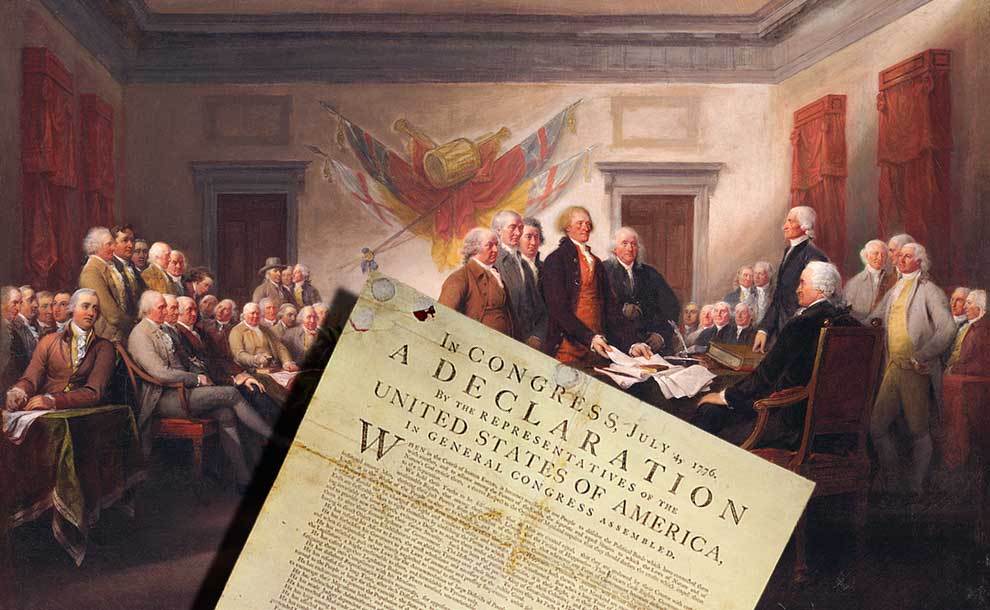
Instead of spending time on discussing the Declaration’s content, I have posted a link below. As an American you owe it to yourself and your country to study the Declaration of Independence and Constitution as if your life on this planet depended upon it. Your children and grandchildren should be taught its content and importance; do not count on the schools to do so. If you are unfamiliar or need a reminder, please read it because my story is about some of the people who conceived, executed and risked all for the contents of that critical document that led to the establishment of the United States of America.

https://www.archives.gov/founding-docs/declaration-transcript

What was the foundational concept of the Declaration? It was a Biblically inspired belief in the natural rights of mankind as expressed in the document itself. What was the background of the signers in regards to this belief system? From the following link,

comes this statement.

Of the 56 men who signed the Declaration, the great majority, perhaps all, identified themselves as Christians, and all but one were Protestants. Four were either present or former ministers, and a number of the signers were the sons of clergy. At least half of them had studied “divinity” at their various universities.  The denominations breakdown runs as follows: 32 of the signers, well over half, were Episcopalians, or Anglicans, the old state Church of England. There were 13 Congregationalists, 12 were Presbyterians. There were two Quakers, two Unitarians, and one Roman Catholic.

If that statement is correct and I have no reason to believe it is not, we can clearly determine that Biblical faith formed the basis of their world view as well as that of the future nation.

The ensuing implementation of the Declaration led to war, lost battles and this…

https://www.nps.gov/vafo/learn/historyculture/valley-forge-history-and-significance.htm

Which eventually led to this…

https://www.gilderlehrman.org/history-resources/spotlight-primary-source/surrender-british-general-cornwallis-americans-october

I hope you have reacquainted yourself with the document and the period in this brief tour of American history at its founding. I contend that it is that same American spirit that charges through the words of the Declaration of Independence that led to the greatest, ongoing experiment in national governance in world history. It is a spirit that is very much alive and expressed by the massive America First MAGA movement today, whose spirit is spreading like wildfire worldwide.

Not all of the 56 signers were present during the discussions and negotiations that surrounded the production of the document. They signed on anyway. They knew what was at stake and agreed in principle with the contents of the document. In this series we are going to dig down into understanding their roles and who many of them were as human beings. We need to personally identify with their commitment such that we may be emboldened to go and do likewise. This series will focus on many of these brave patriots.

Hint: They acted a lot like many America First MAGA patriots do today. Quite a few were from wealth and dignified. A handful were truly messed up people. Others were heroic and inspirational. Some were bombastic and others were pensive. A large number were highly educated and accomplished. Others were less educated, yet enlightened and committed to the cause. Blended together they gave us the foundational start for a truly blessed nation.

John Hancock

The signature of the first to execute it, John Hancock from Massachusetts, was the most flamboyant and recognizable of all. It reflected his popularity during that day. He was orphaned as a youth and adopted by a wealthy merchant uncle. He interned in the business, graduated from Harvard College at 17 and eventually inherited a vast wealth when his uncle died in 1763. The assets were said to be the largest in all of New England. Prior to the rise of the American patriots; that wealthy, elite standing would have placed him in the midst of the society of British loyalists in the colonies. However, John Hancock rejected that standing as time moved on and joined the independence movement. He was in the company of John and Samuel Adams, the latter being a political mentor, while becoming deeply involved in the republican movement in New England. In 1768, his sloop the Liberty was impounded by the British for allegedly carrying contraband. This accusation inspired a large group of local patriots to storm the customs post, burn the government’s boat and beat up its officers. The officers retreated to a British ship offshore. It was not long afterwards that Hancock helped lead and strongly support the Boston Tea Party.

When Peyton Randolph resigned from the Continental Congress in 1776, Hancock became President. England decreed a large reward for his capture and other patriot leaders later that year. Hancock’s comments upon signing the Declaration with large, easy to read handwriting were, “The British ministry can read that name without spectacles, let them double their reward.” One who had so much to lose, who could have easily gone along to get along; gave without reservation to America and his fellow patriots.

It was a big 🖕 you to the oppressors of the colonists. A spirit that has long prevailed in our nation.

What is not discussed much in historical accounts is all of the relationships, entanglements, misfortunes, twists and turns of the life of this as well as many other patriots. Some historians suggest Hancock was disappointed that Washington was given command of the Continental Army. Yet, we know that he held great respect for Washington and the two worked well together in the affairs of the young nation. What was true by this point was that his mentor from the early days, Samuel Adams, had soured on Hancock as he considered him vain and extravagant, unbecoming of a republican leader. Despite his wealth suffering from the war, Hancock always gave greatly to the poor and needy. He was generous to so many and the people idolized him.

His political career was a picture of ups and downs, as were his military leadership skills during the war. Yet, his reputation and support never really suffered for it. Throughout the war period he was loved and was elected governor of Massachusetts in 1780 with over 90% of the vote. He served terms there as well as being elected as a delegate to the Philadelphia Convention among other elected posts.

There have been many supporters and many detractors of Hancock that continued over the 2+ centuries that have followed; owed in large part because he did not leave much in the way of journals or letters for historians to use to make their assessments. Obviously, too much that has been stated about him came from information gained from his detractors as they were not shy in writing their commentaries (much like today). What he did have that could never be discarded or ignored was the overwhelming support of We the People (sound familiar?).

Despite his wealth and societal acceptance, he chose to give his all for America. He cast off the British crown and became an American patriot. Well before the war he had married into the politically prominent Quincy family with whom he had two children. He died in 1793 at 56 years old with his loyal wife, Dorothy, by his bedside. He had suffered from gout most of his life and it eventually led to his death. Even Samuel Adams, the acting Governor, reconciled to the greatness of the man as he led the efforts to provide a lavish funeral and declared its day a state holiday.

Guess Who?

Shall we step into the shoes of the next founding father?

You have lived a life of wealth and privilege as a 4th generation colonist with deep British roots. You are a graduate of Yale and have numerous real estate and business holdings that you received as inheritance. Your ancestors had immigrated to America and built the family’s business empire as loyal British subjects. Over the years as they passed away this led to you assuming control as an adult. You marry Mary Walton of the prominent merchant Walton family. You expand your family’s holdings and eventually become the 8th colonial governor of New Jersey. Local residents in one area even name a town after you. Life has been exceptionally good, but now you are faced with a difficult decision that will have lasting consequences on not only you and your family, but on your fellow colonists. The rulers of the colonies have ordered your vast property holdings and real estate development interests to be seized. However, they tell you that if you decline to vote for liberty that your holdings will be spared and life can go on as it has been. This is an offer that is extended as a courtesy due to your great grandfather and his brother having served with honor and high rank in Cromwell’s army in the English Civil War in the previous century; which eventually led to similar military involvement currently with a brother and half brother located in the colonies. They know your decision will be one of great influence on your fellow restless, angry colonists.

With all of this family history, work, and social standing you respond to the offer with, “There are plenty of homes but only one country.” To summarize – 🖕Brits.

It does not stop there. Your brother who is a General in the British army follows up and tells you not to not sign that document or you will lose everything. Your half-brother, Gouverneur Morris, does likewise even though he sides with the colonists. You hesitate after the safety of your family becomes a question. Once reassured by General Washington that they will be safe and it comes time to sign or walk away you respond with, “Damn the consequences. Give me the pen.” Once again – a big🖕Brits. Your family of a wife and ten children are driven into exile.

You then proceed to lose all of your property holdings and money in the exchange from the sacrifices of war.

Over time you become a hero and icon in the Revolutionary War and legislature that leads to your nation’s founding. You first give up your seat in the Continental Congress to your brother, Gouverneur, and become a General in the Continental Army under Washington. In 1777 you also return to roles in governance in the New York legislature and later become a county judge. After the war you return to your 2000 acre farm and begin the process of restoring what had been burned down by the Brits. Over time three of your sons join the military and become officers; a General, a Colonel and a Lieutenant. They later go on to serve with honor and distinction in the War of 1812.

You continue to serve your nation until your death in 1798 at age 71. Prior to your death in 1790 you offer your land as the site to house the U. S. Capital. It is now part of the South Bronx neighborhood known as Morrisania. Upon your death you are buried in the family vault on the property of St. Anne’s Church in the Bronx.

Your name is Lewis Morris of Bronx County, New York, a legendary American patriot.

Thomas Lynch, Jr.

I am sure some are asking, “Who?” Other than reading his signature on the document, most probably know very little about him. Yet, this young patriot contributed during a critical time in the lead up to the war in important ways that cannot be easily measured. His efforts had very little to do with military exploits on the battlefield. His gifts were of persuasion and concern for family and countrymen. He did his thing, after which, he disappeared.

Yes, there is more, a mixed bag like all of us. Privilege, good deeds and decisions, love, suffering, sorrow, poor decisions, and tragedy are in his story.

Thomas Lynch, Jr. was born in the Georgetown, SC area in 1749 on the Hopsewee Plantation his family owned. He was sent to England to study at Cambridge University, graduated and stayed to study law. After eight years away he returned home in 1772 and married Paige Shubrick, whom he courted prior to going to England. He was active in the family’s plantation operations as a planter, having no interest in going into law despite his education. He became politically engaged immediately as his father was a noted patriot in the independence movement who later signed on the Continental Association. His father had a serious stroke while serving in this role, so at age 26, young Lewis stepped in as a representative of the Continental Congress.

Upon his return to South Carolina and with independence in the wind, he was soon commissioned a captain and company commander in the South Carolina First Regiment under famous Col. Thomas Pinckney. He recruited men from his region to join the unit.

https://www.carolana.com/SC/Revolution/patriots_sc_capt_thomas_lynch_jr.html

Unfortunately, while in his role with the regiment he soon fell ill from bilious fever (tick bite) before he could take full command of the unit he had recruited for the war effort. He never fully recovered. News soon came that his father’s health was again severely declining and he received permission to go to Philadelphia as a representative of the state where his father was serving in the Continental Congress. This led to him at age 27 to become the youngest signer on the Declaration of Independence as he stepped into his father’s role once again. While still there he made a fierce defense for the use of slaves on the plantations and threatened South Carolina’s secession if there were illegal attempts to end the practice. Later that year as he and his father made their way home, his father passed away from a second stroke.

Lynch stayed in South Carolina and lived with his wife at their Peachtree Plantation in the South Santee River area, one of three he owned. His health continued to be a lingering, serious problem. He and his wife took the advice of friends to relocate to Europe to see if a different environment might help. With the young nation still at war they could not leave through normal sea routes, so they chose to travel to the West Indies first. From there they planned to travel to Europe. They left for the destination on the brigantine, Polly, on December 17, 1779. They never arrived. The ship, crew and passengers were never heard from again. After becoming the youngest of the Declaration signers, at age 30, Thomas Lynch, Jr. became the youngest of the signers to die.

Lynch’s contributions beyond those stated above were his passion and ability to encourage others in the patriotic pursuit of independence. He was a brilliant orator and motivator of the people. He was aware of his impact on others and served as an inspiration to the people who knew him during the fight for independence.

Common Themes

Throughout this series you will note common themes. In this part and as will also be present in others; each of these colonists became American heroes at a critical juncture in our nation’s formation. These and many other signers first arrived on this planet from families that came from wealth and strongly rooted British backgrounds. They were privileged with strong educational training. They were disciplined in their pursuits. They had advantages that average colonists would never experience. However, this was important in the organization of the young nation. Their understanding of law, governance and industry while embracing the principles of natural rights, liberty and freedom would serve the needs of We the People well.

Yet, all three in this story as well as the other signers rejected the haughty attitudes of the Brits and loyalists with whom they had lived for so long and maintained relations. The interconnections from long held family relationships had proven very difficult to navigate. All three in this story chose a different path for themselves and their fellow colonists. They did so without reservation and remained faithful to the pursuit of freedom until death. Their devoted spouses were at their side when each passed away. The newly formed states of their origins proudly memorialized their contributions, which still affect the course of our nation today.

These were three American heroes who gave their all for their fellow Americans in the spirit of the words in the founding document they all signed in defiance of their oppressors. May we go and do likewise.

God bless America.