“We do not believe any group of men adequate enough or wise enough to operate without scrutiny or without criticism. We know that the only way to avoid error is to detect it, that the only way to detect it is to be free to inquire. We know that in secrecy error undetected will flourish and subvert.” –J. Robert Oppenheimer
THE SWAMP RUNS DEEP. Sometimes you cannot tell people the truth. You must show them. Only then, at the PRECIPICE, will people find the will to change [to participate]. We, the People, have been betrayed for a very long time. WILL YOU STAND? FOR GOD AND COUNTRY. FOR FREEDOM. FOR HUMANITY. WHERE WE GO ONE WE GO ALL !!! Q
Given the events of the week, both real and invented narratives, it’s a good time for a rally.
For those feeling the weight of the world given what we are seeing and hearing, here’s a reminder that we are America.
America really needs to save herself. We need a leader to remind us how.
Hopefully, the boss will lower some sort of boom tonight.
51 hours until President Trump's Save America Rally in Cullman Alabama. Already about 20 people camped out and waiting. #SaveAmericapic.twitter.com/5CAuzInS6C
Before European settlement, the area that today includes Cullman was originally in the territory of the Cherokee Nation. The region was traversed by a trail known as the Black Warrior’s Path, which led from the Tennessee River near the present location of Florence, Alabama, to a point on the Black Warrior River south of Cullman. This trail figured significantly in Cherokee history, and it featured prominently in the American Indian Wars prior to the establishment of the state of Alabama and the relocation of several American Indian tribes, including the Creek people westward along the Trail of Tears. During the Creek War in 1813, General Andrew Jackson of the U.S. Army dispatched a contingent of troops down the trail, one of which included the frontiersman Davy Crockett.[5]
In the 1820s and the 1830s, two toll roads were built linking the Tennessee Valley to present-day Birmingham. In 1822, Abraham Stout was given a charter by the Alabama Legislature to open and turnpike a road beginning from Gandy’s Cove in Morgan County to the ghost town of Baltimore on the Mulberry Fork near Colony. The road passed near present-day Vinemont through Cullman, Good Hope, and down the current Interstate 65 corridor to the Mulberry Fork. The road was later extended to Elyton (Birmingham) in 1827. It then became known as Stout’s Road. Mace Thomas Payne Brindley was given a charter in 1833 to turnpike two roads, one running between Blount Springs to Somerville by way of his homestead in present-day Simcoe, and the second road passing west of Hanceville and east of Downtown Cullman to join Stout’s Road north of the city. What later became the Brindley Turnpike became an extension of Stout’s Road to Decatur. Cullman later became located between the juncture of the two roads, and they predated the corridor of U.S. Route 31.
During the Civil War, the future location of Cullman was the site of the minor Battle of Day’s Gap. On April 30, 1863, Union forces under the command of Colonel Abel Streight won a victory over forces under Confederate General Nathan Bedford Forrest. This battle was part of a campaign and chase known collectively as Streight’s Raid. Although Streight got the upper hand in this battle, Forrest would have the last laugh. In one of the more humorous moments of the war, Streight sought a truce and negotiations with Forrest in present-day Cherokee County near present-day Gaylesville. Although Streight’s force was larger than Forrest’s, while the two were negotiating, Forrest had his troops march repeatedly in a circuitous route past the site of the talks. Thinking himself to be badly outnumbered, Streight surrendered to Forrest.[6]Colonel John G. Cullmann, founder of Cullman (1823–1895)
Cullman itself was founded in 1873 by Colonel John G. Cullmann, a German immigrant.[7] Cullmann had been an advocate of democratic reforms in his native Bavaria, having fought and acquired his honorific title “Colonel” during the Revolutions of 1848–49. After the failure of the revolution, Cullmann found himself in financial ruin. In the years to follow, he would try to re-establish himself in business, but after several setbacks, including a great financial loss in the First Schleswig War, he would remain unsuccessful. As time went on and Prussia, under King Wilhelm I and his Minister President Otto von Bismarck, began to exert more influence in the German region (eventually unifying Germany under Prussian rule in 1871), Cullmann began to believe that his political ideals were fundamentally incompatible with those of the German Government. As a result, he decided to emigrate from his homeland. Settling first in London due to fears that he would be forced to join in the ongoing American Civil War, Cullman eventually came to America in 1865. He moved to Alabama in 1871 and, in 1873, negotiated an agreement to act as agent for a tract of land 349,000 acres (1,410 km2) in size, owned by the Louisville and Nashville Railroad Company, on which he established a colony for German immigrants.[8][9]
Five German families moved to the area in March 1873; in 1874, the town was incorporated and named after Colonel Cullmann (with the town name being Americanized to ‘Cullman’ with one ‘n’). Over the next 20 years, Cullmann encouraged around 100,000 Germans to immigrate to the United States, with many settling in the Cullman area. Cullmann drew on his military engineering training in laying out and planning the town. During this period, Cullman underwent considerable growth. German continued to be widely spoken, and Cullmann himself was the publisher of a German-language newspaper. When Cullmann died in 1895, at the age of 72, his funeral was marked by the attendance of Governor William C. Oates.[8] The site Cullmann selected for his headquarters is now his gravesite.
German immigrants also founded St. Bernard’s Monastery, on the grounds of which is the Ave Maria Grotto, containing 125 miniature reproductions of some of the most famous religious structures of the world. It is Cullman’s principal tourist attraction.[10]
During the 1890s, and still to this day, Cullman was reported to be a sundown town, where African Americans were not allowed to live.[11][12][13] The Ku Klux Klan would maintain a presence in the county throughout the civil rights movement, erecting signs that deterred African Americans from being within the county at night. This subsequently led to a rise in population of Colony, Alabama which was a safe haven for the discriminated.
For many years Cullman was a college town, with Saint Bernard College serving as the home of several hundred students. In the mid-1970s, St. Bernard briefly merged with Sacred Heart College (a two-year Benedictine women’s college), to become Southern Benedictine College. That college closed in 1979, and it now operates as St. Bernard Preparatory School. The former site of Sacred Heart College is now the Sacred Heart Monastery, which serves as a retreat center operated by the Benedictine Sisters of Sacred Heart Monastery.[14]
During the 20th century, Cullman developed a more diverse economy, including several manufacturing and distribution facilities. The City of Cullman regularly ranks as a top ‘micropolitan’ city in the nation.[15]
Cullman gained national attention in early 2008, when a special election was held to fill a vacancy in the Alabama House of Representatives. The district that included Cullman elected James C. Fields, an African-American, in that special election.[16]
Cullman’s German heritage was repressed during World War I and World War II, while the United States was fighting Germany. This was reversed in the 1970s, with renewed interest in the city’s history and heritage. Today, Cullman holds an annual Oktoberfest.[17] An honorary “Bürgermeister” is elected for each Oktoberfest. For many years the Oktoberfest did not include alcohol because Cullman was dry, but starting in 2011 the Oktoberfest was able to offer beer.[18]2011 tornado damage
Downtown was significantly damaged by an EF4 tornado during the 2011 Super Outbreak. Hitting on April 27, it destroyed many buildings in downtown and in an east-side residential area, but causing no fatalities. The twister moved northeast towards Arab and Guntersville, killing two Cullman County residents and at least four others.[19] Cullman has since rebuilt and revitalized the downtown area. New zoning laws and alcohol ordinances have allowed for greater expansion and growth in the downtown Cullman area.[15]
Over the past four years, President Donald Trump’s administration delivered for Americans of all backgrounds like never before. Save America is about building on those accomplishments, supporting the brave conservatives who will define the future of the America First Movement, the future of our party, and the future of our beloved country. Save America is also about ensuring that we always keep America First, in our foreign and domestic policy. We take pride in our country, we teach the truth about our history, we celebrate our rich heritage and national traditions, and of course, we respect our great American Flag.
We are committed to defending innocent life and to upholding the Judeo-Christian values of our founding.
We believe in the promise of the Declaration of Independence, that we are all made EQUAL by our Creator, and that must all be TREATED equal under the law.
We know that our rights do not come from government, they come from God, and no earthly force can ever take those rights away. That includes the right to religious liberty and the right to Keep and Bear Arms.
We believe in rebuilding our previously depleted military and ending the endless wars our failed politicians of the past got us into for decades.
We embrace free thought, we welcome robust debate, and we are not afraid to stand up to the oppressive dictates of political correctness.
We know that the rule of law is the ultimate safeguard of our freedoms, and we affirm that the Constitution means exactly what it says AS WRITTEN.
We support fair trade, low taxes, and fewer job-killing regulations, and we know that America must always have the most powerful military on the face of the Earth.
We believe in Law and Order, and we believe that the men and women of law enforcement are HEROES who deserve our absolute support.
We believe in FREE SPEECH and Fair Elections. We must ensure fair, honest, transparent, and secure elections going forward – where every LEGAL VOTE counts.
Plans at this time are that I will be away from the keyboard when the rally happens, so please keep the thread lively. I’ll put some links here for better viewing as the day goes on and they become available.
Joe Biteme, properly styled His Fraudulency, continues to infest the White House, we haven’t heard much from the person who should have been declared the victor, and hopium is still being dispensed even as our military appears to have joined the political establishment in knuckling under to the fraud.
One can hope that all is not as it seems.
I’d love to feast on that crow.
Justice Must Be Done.
The prior election must be acknowledged as fraudulent, and steps must be taken to prosecute the fraudsters and restore integrity to the system.
Nothing else matters at this point. Talking about trying again in 2022 or 2024 is hopeless otherwise. Which is not to say one must never talk about this, but rather that one must account for this in ones planning; if fixing the fraud is not part of the plan, you have no plan.
Lawyer Appeasement Section
OK now for the fine print.
This is the WQTH Daily Thread. You know the drill. There’s no Poltical correctness, but civility is a requirement. There are Important Guidelines, here, with an addendum on 20191110.
We have a new board – called The U Tree – where people can take each other to the woodshed without fear of censorship or moderation.
And remember Wheatie’s Rules:
1. No food fights 2. No running with scissors. 3. If you bring snacks, bring enough for everyone. 4. Zeroth rule of gun safety: Don’t let the government get your guns. 5. Rule one of gun safety: The gun is always loaded. 5a. If you actually want the gun to be loaded, like because you’re checking out a bump in the night, then it’s empty. 6. Rule two of gun safety: Never point the gun at anything you’re not willing to destroy. 7. Rule three: Keep your finger off the trigger until ready to fire. 8. Rule the fourth: Be sure of your target and what is behind it.
Gold has actually moved around a bit, but the end result was a tiny gain over the week. Silver has dropped significantly (about 3 percent by eyeball). Platinum was well under a thousand yesterday, and has recovered…some. Palladium is down over ten percent. And Rhodium is getting its ass kicked; it dropped 1900 dollars on Friday alone.
From Special to General
Introduction
Let us start off by recapping our list of “as of 1894” mysteries and conservation laws, and bring things up to date including the Bohr atom and the work done on justifying the periodic table (much of which happened well beyond 1913). Otherwise, we’re at about 1913 now.
Let’s recap/update those lists.
Conservation of mass
Conservation of momentum
Conservation of energy
Conservation of electric charge
Conservation of angular momentum
(ADD:) Conservation of mass-energy
The following mysteries were unanswered at the end of 1894.
Why was the long axis of Mercury’s orbit precessing more than expected, by 43 arcseconds every century? Was it, indeed, a planet even closer to the sun? If so, it’d have been nice to actually see it.
Why was Michelson unable to measure any difference in speed of light despite the fact we, being on planet Earth that is orbiting the sun, had to be moving through the medium in which it propagates?
What makes the sun (and other stars) shine (beyond the obvious “they shine because they’re hot” answer). What keeps the sun hot, what energy is it harnessing?
How did the solar system form? Any answer to this must account for how the planets, only a tiny fraction of the mass of the solar system, ended up with the vast majority of the angular momentum in the system.
What is the electrical “fluid” that moves around when there is an electric current, and that somehow seems imbalanced when we perceive that an object has a charge? Were there both negative and positive fluids, or just one fluid that had a natural neutral level; below it was negative (deficit), above it was positive (excess)?
Why are there so many different kinds of atoms? How did electrical charges relate to chemistry? How is it that 94 thousand coulombs of charge are needed to bust apart certain molecules (though it often had to be delivered at different voltages depending on the molecule)?
Why were the atomic weights almost always a multiple of hydrogen’s? Why was it never quite a perfect multiple? Why was it sometimes nowhere near to being a multiple?
Why does the photoelectric effect work the way it does, where it depends on the frequency of the light hitting the object, not the intensity?
Why does black body radiation have a “hump” in its frequency graph?
In just 20 years we had come a long way. Out of nine mysteries, only three were completely left open, and another was mostly solved. And even mystery number 3 had tantalizing hints.
More Developments in Special Relativity
A few weeks ago–actually the last time I used this particular eagle–I described the four Big Papers Einstein published in 1905. Two of them had to do with what today we call “Special Relativity.”
What made it “special”? Did it ride the short bus to school?
What made it special was that it only applied to a very specific case, the case where the frames of reference are not accelerating. Constant speed, even high speed, isn’t an issue, but if there’s any sort of acceleration, it’s a different ball game.
General relativity doesn’t have this restriction. Special relativity turns out to be a special case of general relativity.
1915 was the year Einstein first put forward general relativity, which means that historically speaking, with the last article taking us up to that about then dealing with subatomic physics, this is the right time to take up general relativity.
But there had been some developments in special relativity in the meantime. Einstein hadn’t really thought about relativity from a geometric point of view, but many others, including his former math professor Hermann Minkowski, did. They pointed out that if you simply consider time as being a fourth dimension, a lot of things fell into place.
This does make some sense. After all, if you and I agree to meet at the corner of Pikes Peak and Cascade on the 14th floor of the Holly Sugar Building (which isn’t called that any more), we’ve specified a meeting place in three dimensions…latitude, longitude (the streets run north/south east/west in that part of town), and elevation (14th floor). Or coordinates…a triplet of them…can be used to define any location in space once you’ve defined the coordinate system (and it doesn’t even have to be a cubical grid either; cylindrical or spherical coordinates can work). You need three coordinates, though, because space is three dimensional. You can get by with two if you implicitly specify the third (in this case, surface level could be assumed; that’s probably a good idea when dealing with ships).
But if you and I arrange a meeting place in this manner, we’re committing a Bidenesque screwup: Because we also need to specify a time. So really, you need four coordinates, three space coordinates x, y, and z, and a time coordinate, t.
When you specify all four, you’ve defined what physicists call an event. And you’re doing it in terms of spacetime.
And so, it turns out that special relativity fits well with the concept of spacetime and works in four dimensions. This was pointed out by Minkowski.
But there was a difference! And it becomes most manifest when considering interval. The interval is the distance between two events.
If you are using a “Cartesian” (cubic grid) coordinate system, the difference between two points in space is an extension of Pythagoras. In two dimensions, on a Cartesian grid, the distance between two points is simply the difference between their x-coordinates, squared, plus the difference between their y coordinates, squared, then take the square root of all that.
It’s precisely equivalent to a2+b2=c2. (And note, it doesn’t make any difference whether you subtract point 1 from point 2, or vice versa. Sure, you will get opposite signs depending on the order, but those get wiped out when you square the differences.)
To move up to three dimensions, you can square the two dimensional distance again, then square the difference in the third coordinate. But when you do that, it’s algebraically equivalent to just squaring all three differences, adding them together, then taking the square root:
First there’s one issue to clear out of the way: time is measured in seconds and distance is measured in meters; by simply taking a difference in time and jumbling it in with three differences in meters, you are mixing apples and roadcones.
It turns out that with spacetime, a distance of d = ct is equivalent to a duration of t. In other words a one second time difference is equivalent to a distance of 299,792,458 meters. So when doing this computation, if you divide your space distances by the speed of light, you get units of seconds, and now the four “pieces” of the equation all match units. You’ll have to multiply the result by c again to get back to meters.
So let’s imagine two events at the same x and y, but with z differing by 299,792.458 meters, and t differing by one second. Dividing all of the space coordinates by c, you get the x and y differences = 0, the z difference being 1 second, and of course the t difference is 1 second.
Incidentally a difference is often denoted by Δ, the Greek letter delta, so we can say Δx=0, Δy=0, Δz=1, and Δt=1. It’s a lot more convenient, and amongst techie types “delta” is often slang for “change” or “difference.” (“What’s the delta in the cost of gas switching from the orange guy with the mean tweets to His Fraudulency?” for instance.)
So square everything and get 0, 0, 1, 1, add them together to get 2, take the square root, and the interval is 1.414 seconds, or about 424 million meters, right?
Well, no. The BIG difference is that with space time you subtract the space components from the time component!
Note that the time difference is first and all the space differences are subtracted from it.
So in this case the interval is zero seconds; the two ones cancel.
(Equivalently, you could multiply the time by c and work entirely in meters, rather than seconds…but that would have made the arithmetic ugly.)
Now there’s only one thing that can get from that first event, to that second event. The one thing that can move 299,792,458 meters in one second, and that, of course, is light in a vacuum.
But the light, in doing so, covers no interval. Which means that the light beam perceives no distance traveled and no time elapsed! But if you remember the time and distance dilation formulas from the last time we talked about special relativity, that’s what we would expect. At light speed, both effects cause the elapsed time and traveled distance (from the point of view of the light beam) to reach zero.
So what we have here is a geometric model of special relativity.
OK, let’s play another game here. Let’s make the space distance twice as much as it was before, while leaving the time distance 1. You end up with Δx=0, Δy=0, Δz=2, Δt=1.
Plugging that in, we get sqrt( 12 – 02 – 02 – 22 ) = sqrt( 1 – 4 ) = sqrt( -3 ).
Now you can’t take the square root of -3 and get a meaningful distance (or time) out of it. What the spacetime model is telling you is you cannot get from one event to the other. If you could, it would be by traveling faster than the speed of light. So the spacetime model has built into it a rationale for not being able to exceed the speed of light in a vacuum.
Einstein didn’t use this in 1905, but he adopted it shortly thereafter. (I wonder if Minkowski ever told his former student how proud he was of him.)
Minkowski invented the spacetime diagram, where the vertical axis is time, and the horizontal axis is space. Objects traveling on this diagram cannot do so at a slant of less than 45 degrees (that implies traveling faster than c), light itself moves at a 45 degree slant on the diagrams.
An interesting consequence of spacetime is that everything moves at exactly the same speed through it. You, sitting in your chair reading this are traveling through time purely, at one second every second. Move fast enough, and your motion becomes predominantly through space and you are moving slower through time. The second motion is called spacelike because most of the motion is through space, and time slows down signficantly, the first motion is called timelike not because it’d be snarky to refer to it as “sitting on your ass” but because most of the motion is along the time axis.
More Einsteinian Thought Experiments
Spacetime, it turns out, is the easiest way of dealing with general relativity. Not that it’s easy.
I actually wasn’t that far off when I talked about special relativity riding the short bus. The math involved with it is an absolute breeze compared with the math in general relativity. It’s a major event when someone is able to solve the general relativity equation for a certain specific scenario. In fact, I will be honest with you: I don’t understand the math. I never got exposed to tensors; I just have a vague idea that they’re sort of like matrices (which are a power tool in mathematics I do know something about), but not quite.
So with that, I can’t comprehend the real situation then try to explain it to you. I have to rely on the same science-for-senators handwaving that you’ve probably already seen. As such, I’ve been half-dreading writing this post.
But, it does start with Einstein’s doing thought experiments, so at least that part should be comprehensible if I am doing my job right. [Only later will you see the wild leap I can’t justify.]
The supposition this time is that if you were in a locked chamber, no way to see in or out, and were feeling earth-normal gravity, you’d be unable to distinguish it from being in a room that is being accelerated ‘upward’ at g, the acceleration due to gravity. The rules of physics would be the same; any experiment you could carry out would have the same result.
That doesn’t seem too unreasonable. If you drop your four hundred ounce gold brick on your foot in either scenario, it will hurt just as much, just as quickly.
But this does lead to differences with the conventional understanding when you deal with light.
The conventional understanding is that light has no mass, so gravity should not act on it. A beam off your laser pointer should travel in a straight line no matter how strong the gravity is.
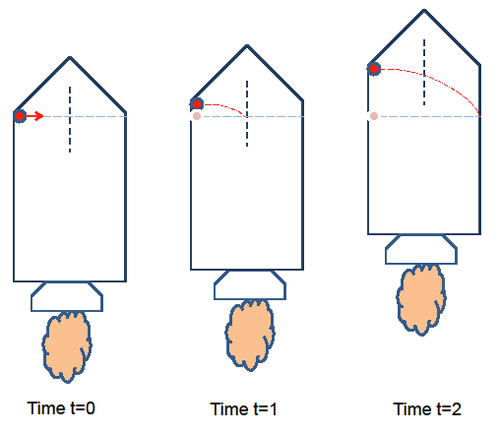
On the other hand, if you’re in a room that’s under acceleration, it feels like gravity, there’s an obvious up and a down. But you should be able to tell the difference between an accelerating room and one experiencing gravity, because if you fire your laser pointer horizontally, and the room is accelerating, you should see the beam bend. That is because the beam of light is moving vertically at the same speed you are, but once it has left the laser pointer, it doesn’t speed up in the vertical direction, but you and the room do, so you see the beam drop.
So if the room is feeling gravity, the beam shouldn’t bend because the force of gravity on a massless object should be zero, but if the room is being accelerated, the beam should bend, because the room is moving faster than it was before, by the time the beam hits the wall.
On the left, the light source (and you) are moving at the same speed as the rocket. Middle diagram, but the rocket is speeding up, it’s pulling ahead, so you see it higher. The beam of light, though, can’t speed up in the vertical direction so it seems to trace a curve inside the rocket. Finally it hits the far wall of the rocket. From inside the rocket, the beam appears to have dropped due to gravity.
But if Einstein is right and there really is no way to tell the difference, then either both beams need to move in a straight line, or both beams need to bend. In the second case, light is affected by gravity even though it has no mass.
You need really strong gravity to see this, though. Or a long distance. Because light crosses any normal everyday distance in microseconds or even nanoseconds, and if it’s going to “drop” due to gravity, well, gravity only gets to act on it for a few billionths of a second. Plug that in to d=1/2at2 and it’s almost nothing.
OK, but there is a concrete prediction. A light beam going by a massive object, should bend a bit. This is testable with great difficulty.
Here’s another: If light is affected by gravity, light traveling upward has to lose energy, just like a thrown baseball loses kinetic energy (trading it for potential energy) and slowing down. But light cannot lose energy by slowing down, its speed in any particular medium is a constant.
It can lose energy another way, however. Remember E = hv? (Where ν is the frequency?)
So the light, climbing in a gravity field, should decrease in frequency. That’s the only way it can lose energy. Similarly, light going “downhill” should increase in frequency to gain energy.
There’s an alternative way of looking at this though. Imagine that light beam in the accelerating room, firing upward from the floor. By the time the beam reaches the ceiling, the ceiling has sped up, so there’s a doppler shift in the wavelength, towards the red. Since you can’t tell this case from a room feeling “real” gravity, in that room the light has to redshift too.
This is gravitational red shift. Visible light becomes redder as it moves uphill. Again, this effect is tiny on Earth, but it’s measurable today (I don’t think it was measurable using 1915 equipment).
Hiding inside that effect is another.
Imagine someone on the surface of earth, shining a light straight up. He blinks, and then a second later he blinks again. In the meantime, about 600 trillion wavelengths of the light are emitted.
Someone, up in space, will see the same sequence of events. Blink, 600 trillion wavelengths, then a blink. But the light is red shifted when he sees it. 600 trillion wavelengths takes more than a second to pass by him, because the frequency has dropped.
Therefore he sees it take more than a second between the two blinks. From his point of view, time is running slower down on earth than it is for him in space.
This is gravitational time dilation.
So these are concrete, comprehensible predictions to see whether an accelerating reference frame, where effects happen due to inertia, is truly the same as one with gravity (effects due to mass).
But when Einstein followed the math…it got interesting. And I’m going to have to state it without trying to justify it. Sorry. Complicated business!
Gravity, it turns out, isn’t a “force” like electromagnetism is. It turns out that any object not being accelerated by a real force (like a rocket motor), travels a straight line in space time, the shortest distance between two events. If you think it’s curving because, for instance it’s a space probe doing a “flyby” of Jupiter, it’s because spacetime is curved.
OK, now this takes time to wrap one’s brain around, and if you fail at it you’re in very good company. How does space itself actually bend? Objects bend in space, space itself, can’t bend, there’s nothing to bend.
Nevertheless it does. Not just in Einstein’s thought experiments, but in reality.
Einstein used his new concepts to compute the orbit of Mercury.
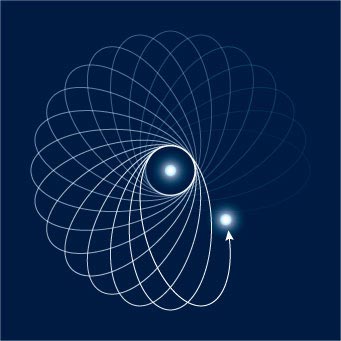
Remember there had been a long-standing mystery about Mercury. It orbits the sun in a markedly elliptical orbit, and under Newtonian two-body gravity, the long (or “major”) axis of the ellipse should never change direction. But in fact it does change direction. Some of this can be shown to be due to the other planets’ pulling on Mercury constantly. But not all. After subtracting all of that out, the major axis still shifts by 43 arc seconds every century. That’s an angle about three quarters the width of a quarter set out at a hundred yards, and it takes a century (about 400 revolutions of Mercury about the sun) for it to make that shift.
Precession of Mercury’s orbit. This is empahtically not to scale. Even 4000 orbits wouldn’t show a shift visible at this size.
People had theorized that an undiscovered planet closer to the Sun than Mercury could be perturbing Mercury’s orbit, but it would be frustratingly difficult to see such a planet so close to the Sun.
But when Einstein did the computation with his modified law of gravity, he found that an object orbiting that close to a very massive object like the sun…would see a shift of exactly this amount!
The net effect of Einstein’s new law of gravity is that near very massive objects, gravity’s effect is slightly greater than an inverse square law. Which means that at perihelion (closest approach) gravity is a bit stronger than Newton would expect. However, Kepler’s second law still applies (a line from the sun to the planet sweeping out equal areas in equal times) because it depends on the conservation of angular momentum. So this manifests itself as the elliptical orbit behaving like something out of a Spirograph set.
OK, so Einstein had made one prediction he could test himself. But to be really solid science, predicting new phenomena (rather than just being a possible explanation of a known phenomenon) would be good.
Testing General Relativity
The light bending, doppler effect, and time dilation effects were something that had not been seen before, had not been predicted by any other theory, and if seen would be otherwise unexpected; i.e., a successful prediction by this theory…three successful predictions, actually.
As it turned out, the light bending was the easiest. For this you can use a large massive body that’s between you and stuff of known position, if the position of those background objects appears shifted near the body, you have gravity (from the massive body) bending the light coming to you from the background objects.
This is a job for the Sun. As seen from earth, it moves against the background (it’s really the Earth moving), which is a known pattern of stars. We’ve got plenty of star maps taken when the sun is nowhere along the line of sight (in fact when the sun is behind the mapper, because he’s doing this at night and the sun is below his feet somewhere). So we just need to see if the stars seem shifted (away from the sun as it turns out) when the sun is on the line of sight to the stars.
Did I mention earlier the sun is bright? This makes it impossible to see stars that are almost behind it.
Except during a solar eclipse, when the moon neatly covers the sun!
There was a solar eclipse in 1919. Astronomer Arthur Eddington took photographs, not of the corona (as people usually do during eclipses) but of the stars near the Sun. The elegant mathematical reasoning of Albert Einstein was put to the test. (If you don’t find it elegant, it’s because you haven’t seen and understood the math; I haven’t understood it myself, so I’m taking other peoples’ word for it that its elegant.)
It was hard to measure accurately enough to truly nail it down, but the stars’ apparent position had indeed shifted and the measured effect was consistent with General Relativity.
This was big news. I mean, really big news. It made the newspapers read by regular people. This was when Einstein became famous outside of scientific circles.
Today, we can see entire galaxies bending the light of galaxies behind them. In fact, there’s a spectacular instance of two almost-perfectly-lined up galaxies causing the background galaxy to look like a ring, known as an Einstein Ring:
The blue arc, almost a complete ring, is a background galaxy distorted by the gravity of the yellowish orange elliptical galaxy in front of it.
The gravitational redshift took longer. For this, the ideal situation is a bright, massive, small object (small is better because the gravity is more intense, and a white dwarf, which is a sun-sized star that has run out of nuclear fuel and collapsed down to the size of the earth, is ideal. It still shines brightly because it will take millions or even billions of years to cool off, but it has a very strong gravitational field. As early as 1925, someone attempted to measure the gravitational redshift off of the star Sirius B (see my article on Sirius A and B: https://www.theqtree.com/2020/01/01/another-sirius-tale-of-two-stars/), but other scientists pointed out there was too much glare from Sirius A (which is, after all the brightest star in the nighttime sky). Finally in 1954 Popper got a good measurement off of 40 Eridani B and confirmed this prediction. It’s also possible now to measure the shift in frequency of gamma rays going up several stories here on Earth.
The gravitational time dilation can be measured by two different atomic clocks at different elevations. Eventually, the lower one will fall behind the upper one.
Most famously, the GPS constellation of satellites demonstrates both special relativity time dilation, and general relativity time dilation.
The GPS system works by having each satellite sending out time signals. Their position at any time can be computed by your GPS receiver, so it’s just a matter of comparing the signals from at least four (but even more is better), noticing the differences of the times in the signals, turning that into different distances from the satellites, then doing a lot of geometry to triangulate, and figure out where the receiver must be.
Extremely accurate time sources on the satellites are an absolute necessity. If one is off by ten nanoseconds, your position will be off by ten feet (light travels roughly a foot per nanosecond).
The satellites are moving quickly, which means a clock on that satellite will seem, from down here on earth, to be ticking more slowly due to special relativity time dilation. (Not much more slowly, but enough to be measurable with modern atomic clocks.) They are also higher so due to gravitational time dilation, our clocks should run more slowly than the GPS satellite ones. The two effects are in opposite directions, so they will tend to cancel each other out. The gravitational effect is the larger of the two, so from our standpoint the GPS clocks look like they’re running faster than they would to someone actually on one of the satellites. In fact, it will run 38 microseconds per day faster than you’d expect without either time dilation effect. That would be enough to throw position calculations off by several miles…after one day.
This effect is real, it does happen. What the GPS engineers do is slow the satellites’ clocks down to compensate. That way in orbit when they speed up (as seen by us), we see the clocks ticking off normal seconds, and so if you drive your car into the Mississippi river when trying to get to Pikes Peak, it’s not the fault of GPS.
GPS wasn’t designed for the purpose of testing general relativity, but there are a couple of rather more detailed predictions involving a phenomenon called “frame dragging” (which I am not even going to try to explain, because I want to publish this this week, not sometime in October) that have been confirmed by satellites deliberately launched to test general relativity.
General relativity has met every test thrown at it. It’s real. Spacetime bends. And objects move along the shortest possible path through spacetime.
As famously put by John Archibald Wheeler (1911-2008, a veteran of the Manhattan Project) in 2000, “Spacetime tells matter how to move; matter tells spacetime how to curve.”
I debated whether to put a “rubber sheet” diagram in this post. They’re very problematic. Yes, you can see how an object might follow a curved path on the rubber sheet, which is supposed to be how gravity works, but the rubber sheet is itself bent by gravity pulling on an object. If you can’t ignore that, you’re going to be hung up on the fact that (demoed) “gravity” is caused by (real) gravity. I decided, ultimately, not to do it even though I could write disclaimer after disclaimer that it’s a visualization tool only, not an explanatory one. (And I believe I hear Wolf breathing a sigh of relief.)
But one doesn’t need a rubber sheet diagram to know that Joe Biden didn’t win.
And, in case you didn’t notice…we can cross mystery number one off the list. Thanks, Herr Doktor Einstein!
Obligatory PSAs and Reminders
China is Lower than Whale Shit
Remember Hong Kong!!!
Whoever ends up in the cell next to his, tell him I said “Hi.”
中国是个混蛋 !!! Zhōngguò shì gè hùndàn !!! China is asshoe !!!
China is in the White House
Since Wednesday, January 20 at Noon EST, the bought-and-paid for His Fraudulency Joseph Biden has been in the White House. It’s as good as having China in the Oval Office.
Joe Biden is Asshoe
China is in the White House, because Joe Biden is in the White House, and Joe Biden is identically equal to China. China is Asshoe. Therefore, Joe Biden is Asshoe.
But of course the much more important thing to realize:
Joe Biden Didn’t Win
乔*拜登没赢 !!! Qiáo Bài dēng méi yíng !!! Joe Biden didn’t win !!!
Welcome back to Wolf’s Pub! What a week. It’s a flood now. The information war is heating up on all fronts. Fascist Big Business is wrenching down on the working man/woman. YOU WILL WEAR THE MASK. YOU WILL GET VACCINATED.
The persecutions will not stop. Even if they manage to get all us masked and vaccinated (they won’t) the persecutions will continue. They enjoy it. And now we are finding out how that local store manager you know is one of Them. He enjoys the power of making you submit.
Now is the time to speak up and out. Now is the time to take your stand. Now is the time for ALL OF US to take a stand.
It’s hitting close to home now. A relative of mine was just fired today. She was fired for not wearing a face muzzle at one of Warren Buffet’s mobile home manufacturing plants.
It’s 99 degrees in that plant. No air conditioning. She tried to wear the mask, but using saws and drills in the extreme heat while also exhaling in the mask caused her safety glasses to fog up.
She couldn’t hear instructions or people speaking because of the masks, let alone the noise in the plant. It is DANGEROUS to force employees to wear a mask in an active manufacturing environment with heavy equipment and tools.
At a plant meeting earlier in the day, the management announced that all employees had to mask up again. Previously, employees who were not vaccinated had to wear a Yellow Star, I mean a Red Dot on their work helmets. The vaxxed crowd got to wear a Green Dot on their helmets. You can’t make this stuff up.
The new rules at the meeting included a policy that any new employees HAD TO BE VACCINATED, as well as all upline managers, effective immediately.
Additionally, un-vaccinated employees who contract Covid-19 would not have their sick-time covered, though vaccinated employees would be given PTO. This is out-and-out discrimination, Mr. Buffet.
Real people are being persecuted for a virus with a 99% + survival rate. Again, this ain’t about the Covid, as everyone here knows. It’s about the “Great” reset. Not so great, eh?
I was on the road recently. Back to some old haunts. Watched a demonstration of glass blowing at the Hot Shop at the Corning Museum of Glass (as in Corning, Incorporated). Although I was pleased to see that there was a sizeable amount of people unmasked, the employees were all forced to wear masks.
The gaffers (glass-blowers) were masked. By the end of the Hot Shop demonstration, the one who spoke to the audience was so out of breath that you could hear it in her voice as she literally gasped for breath. The microphone picked it all up and broadcast it for the audience. She actually had to lean against a wall to try and catch her breath. Yes, masking around ovens with temperatures of up to 2,000 degrees is DANGEROUS for the workers.
This is what these FASCIST BUSINESSES are doing to the American people. In concert with federal and some state and local governments, US businesses are forcing American citizens to participate in COVIDISM, the Official Medical Religion of the United States of America.
And, oh are they inconsistent! Was at a Tractor Supply Company in Texas and the employees are all masked. Funny that COVIDISM has a different application in upstate New York where the Tractor Supply Company employees are NOT masked.
No rhyme or reason to COVIDISM if you think it’s about safety, security, and your health. What is it really all about?
MONEY SUBMISSION CONTROL INDOCTRINATION DOMINATION SLAVERY DEPOPULATION
Nuts! People, we need to call out and name these companies. They need to feel the HEAT of their indulgence in fascism. Bad press is their nightmare.
This is war. And Big Business is proving to be traitors on the wrong side of their customers’ best interests, namely FREEDOM. We aren’t going to forget what y’all did during this time. You will have no excuse for participating in the destruction of our nation, our freedoms, and our health. It will be on you, Big Business, and not just the government and medical establishments.
Something must be done.
BUT FIRST LET US TOAST TO GLASS AND WINE
From the Corning Museum of Glass
Today’s special is Dr. Frank’s Cabernet Franc. Dr. Frank took Bordeaux grapes from the Loire Valley in France and proved that great wines can be crafted in New York. Do enjoy the patriotic fervor of Dr. Frank in this short video. Dr. Frank was a true American patriot:
The bartenders have a haul of Finger Lakes wines at the bar. Freedom and patriots abound in New York, even though that beleaguered state has been under the control of evil communists for many years. Patriots are everywhere. New York City is NOT New York State.
I raise my glass to the quiet strength of patriots everywhere. We are rising up. And we will be the victors. “It’s not what you make. It’s what you can fix.”
We can fix this.
THE PLAN
Patriots are fighting back. Let’s focus on Lin Wood’s Strike Back For Freedom. This site should be up today or very soon. According to Lin:
“We are working on the website for the Strike for Freedom. The domain is now set. It is http://StrikeBackForFreedom.com (keeps the enemy from attacking us based on a misrepresentation of the site name!). We hope to have a basic structure in place by tomorrow. We want to keep it simple. We want the content to be provided by We The People. I do not want you to feel that I am telling you what to do but rather providing a marketplace for your ideas to be conveyed to others so The People can make their own decisions. We need to be bold. As I said, courage is contagious. We need to be prepared to help others. Content provided by We The People will get us off to a good start in that direction. Stay tuned…”
Lin Wood
Lin talks about his Strike plan on this video. Go to the 10-minute mark to start. Lin is fired up! Let him get you fired up.
I have a suggestion for Lin’s new site: Advocate for employees at businesses who force their workers to wear masks and get vaccinated. Complain vociferiously to the management. Write letters to the Corporate Office. Post on their social media. Put the heat on them. And stop buying their products.
It’s time to do our part. It may cost us friends, even family relationships, jobs and comfort. But if we don’t have freedom, we have nothing.
HOUSE RULES
The nitty-gritty. Make nice to patriots. All others can take their chances (wink wink). To review the rules, go here. If someone wants to land a verbal punch, take it over to the Utree. Also a good place to reconvene if this site gets knocked out for a time.
AUDITS! AU-DITS! AUUUU-DITTTS!
The Arizona audit will be released any time! Now this is how you fix our country. Take back our elections!
I believe the audits are key to everyday Americans rising up and claiming back their power. We are the government. Our representatives work for us. They are answerable to us.
This Sanctuary Sunday Open Thread, with full respect to those who worship God on the Sabbath, is a place to reaffirm our worship of our Creator, our Father, our King Eternal.
It’s also a place to read, post, and discuss news that is worth knowing and sharing. Please post links to any news stories that you use as sources or quote from.
In the QTree, we’re a friendly and civil lot. We encourage free speech and the open exchange and civil discussion of different ideas. Topics aren’t constrained, and sound logic is highly encouraged, all built on a solid foundation of truth and established facts.
We have a policy of mutual respect, shown by civility. Civility encourages discussions, promotes objectivity and rational thought in discourse, and camaraderie in the participants – characteristics we strive toward in our Q Tree community.
Please show respect and consideration for our fellow QTreepers. Before hitting the “post” button, please proofread your post and make sure you’re addressing the issue only, and not trying to confront the poster. Keep to the topic – avoid “you” and “your”. Here in The Q Tree, personal attacks, name-calling, ridicule, insults, baiting, and other conduct for which a penalty flag would be thrown are VERBOTEN.
In The Q Tree, we’re compatriots, sitting around the campfire, roasting hot dogs, making s’mores, and discussing, agreeing, and disagreeing about whatever interests us. This board will remain a home for those who seek respectful conversations.
Guilt, the condition, not the feeling, is the result of having violated a specific rule or law. When we cross a moral, ethical, or legal line, we are guilty. This is true even if we did not know a line was crossed. According to the Bible, we are all guilty before God (Romans 3:10, 23). The fact that a person may not “feel guilty” does not affect his or her guilty status legally or morally.
From the moment Adam and Eve broke God’s law against eating the forbidden fruit, guilt entered human history (Genesis 3). With that guilt came a feeling of being guilty. They knew they had violated a specific law. They were guilty, and they felt guilty. God demonstrated His plan to cover human guilt with the shedding of innocent blood (Genesis 3:21; cf. Hebrews 9:22). What God did in the garden was a picture of what He would do thousands of years later to cover the guilt of everyone who trusts in His only begotten Son (John 1:12; 3:16–18; Romans 10:9–10).
Guilty feelings are useful when they drive us to repentance. However, Satan can also use guilty feelings to drive us away from God. Second Corinthians 7:10 says, “Godly sorrow brings repentance that leads to salvation and leaves no regret, but worldly sorrow brings death.” Worldly guilt is filled with condemnation and hopelessness. It tells us that we are bad and nothing will make us good enough. It lies to us about the character of God, insisting that we must try to earn the favor of a God who will never give it. Worldly sorrow hangs over our heads and colors our attitudes toward God.
Unbelievers stand guilty before God in that they have not trusted Christ as Savior (John 3:18–19). Unbelievers experiencing feelings of guilt should let those feelings lead them toward the only One who can absolve them—Jesus Christ. Their guilty feelings are accurate and are designed to create in them a desire for forgiveness. Believers—children of God who have trusted in Christ’s death and resurrection for their salvation—have been declared not guilty before God (Romans 8:1). We have been justified (Romans 5:1). God has placed all our sin on His own Son (2 Corinthians 5:21). He has taken the righteousness of Christ and granted it to us. That divine exchange guarantees our acceptance by God and eternal life with Him (2 Corinthians 5:18–19; Romans 5:9–10). When we fail, we have God’s promise that, if we confess our sins to Him, He will forgive us and wipe away all traces of guilt (1 John 1:9).
Many struggle with false guilt. They are forgiven, yet they still feel guilty. They feel stuck in guilt. They may think, “I know God has forgiven me, but I can’t forgive myself.” They have prayed, confessed their sin, and believe that God has granted them forgiveness because of Jesus. Yet they continue to beat themselves up. The reason for false guilt might not be what we think. Satan whispers into our souls that we don’t deserve full pardon until we prove to God how sorry we are. We must continue to carry the load of shame; we deserve it. We are not worthy to accept God’s pardon until we have punished ourselves, Satan says. And then he lies some more, telling us that, in hanging on to guilt, we are being humble.
Not so. Humility gratefully accepts a pardon it can never earn and lives to demonstrate that gratefulness. Don’t think, “God may forgive me, but my standard is higher than God’s. What Jesus did on the cross may be sufficient to cover other sins, but not mine. I must help Jesus pay for this sin by punishing myself. I will continue to carry my shame until I decide I have paid for it.” In clinging to false guilt, we are not fully grasping that Christ’s death on the cross was powerful enough to cover every sin. False guilt can keep us from growing into the mature Christians God wants us to be.
True feelings of guilt keep us humble as we recognize no one can be good enough to earn God’s favor. A recognition of guilt should drive us to gratefully receive all God has done on our behalf. True guilt propels us toward God; false guilt drives us away. False guilt sees failure as a life sentence; true guilt sees failure as another opportunity to experience more of God’s mercy and grace. True guilt is erased by repentance and restoration; false guilt continues to cling to us even after we’ve repented. When we learn to recognize the difference, guilt does not have to dominate our lives.
God paid a high price so we could walk in freedom (2 Corinthians 9:15). Justification nullifies guilt. For those in Christ, guilty feelings can be a wake-up call that something isn’t right, and we have the opportunity to confess our sin and turn from it. Guilty feelings are simply a tool God uses to reveal sin. When no sin is present, guilt is being misused by our enemy and needs to be renounced. We were not designed to carry guilt; Jesus did that for us (Colossians 2:14; 1 Peter 2:24). Because of Christ, we can walk in the light and never again suffer under the burden of guilt.
REMEMBER . . .
Rejoice in the Lord always. I will say it again: Rejoice! Let your gentleness be evident to all. The Lord is near. Do not be anxious about anything, but in every situation, by prayer and petition, with thanksgiving, present your requests to God. And the peace of God, which transcends all understanding, will guard your hearts and your minds in Christ Jesus. (Philippians 4:4-7)
On this day and every day –
God is in Control . . . and His Grace is Sufficient, so . . . Keep Looking Up
Hopefully, every Sunday, we can find something here that will build us up a little . . . give us a smile . . . and add some joy or peace, very much needed in all our lives.
“This day is holy to the Lord your God; do not mourn nor weep.” . . . “Go your way, eat the fat, drink the sweet, and send portions to those for whom nothing is prepared; for this day is holy to our Lord. Do not sorrow, for the joy of the Lord is your strength.”
Joe Biteme, properly styled His Fraudulency, continues to infest the White House, and hopium is still being dispensed even as our military appears to have joined the political establishment in knuckling under to the fraud.
All realistic hope lies in the audits, and perhaps the Lindell lawsuit (that will depend on how honestly the system responds to the suit).
One can hope that all is not as it seems.
I’d love to feast on that crow.
The Lindell Reports
It sounds worse that most of us imagined. And we have good evidence (if placed before a judge who understands probability, combinatorics, and statistics (three closely-connected branches of mathematics).
The question is, now that we have this, what’s next?
Can we get more states to do forensic audits? It will be tougher in states where the auditors themselves ended up in their positions of authority through cheating!
Even if not, it’s good to go into whatever comes next with the certitude that we were and are right about…
Joe Biden Didn’t Win. And neither did Hoe, and neither did half the craptastic Dems out there. RINOs might have won the general because at that point voters had a choice between a definite Dem and a maybe-not-as-bad “Republican.” But how many got in due to a corrupted primary?
We have to do our best to force this to stick and force “them” to pay attention to it!
Justice Must Be Done.
The prior election must be acknowledged as fraudulent, and steps must be taken to prosecute the fraudsters and restore integrity to the system.
Nothing else matters at this point. Talking about trying again in 2022 or 2024 is hopeless otherwise. Which is not to say one must never talk about this, but rather that one must account for this in ones planning; if fixing the fraud is not part of the plan, you have no plan.
Lawyer Appeasement Section
OK now for the fine print.
This is the WQTH Daily Thread. You know the drill. There’s no Poltical correctness, but civility is a requirement. There are Important Guidelines, here, with an addendum on 20191110.
We have a new board – called The U Tree – where people can take each other to the woodshed without fear of censorship or moderation.
And remember Wheatie’s Rules:
1. No food fights 2. No running with scissors. 3. If you bring snacks, bring enough for everyone. 4. Zeroth rule of gun safety: Don’t let the government get your guns. 5. Rule one of gun safety: The gun is always loaded. 5a. If you actually want the gun to be loaded, like because you’re checking out a bump in the night, then it’s empty. 6. Rule two of gun safety: Never point the gun at anything you’re not willing to destroy. 7. Rule three: Keep your finger off the trigger until ready to fire. 8. Rule the fourth: Be sure of your target and what is behind it.
This might be a good time to buy silver. On the other hand it could drop even m0re.
Electrons Get Quanta
If you’ll recall, last time I mentioned that in 1911 van den Broek suggested that an atom’s place in the periodic table depended on the positive charge of the nucleus; when that charge was expressed as a positive-signed multiple of e, you had a simple integer number which is that atom’s atomic number. I then said it was merely an idea for about two years, and then I left you hanging.
I’m going to pick up that thread, but I’m going to do it my way: I’m going to back up a bit and follow another thread to that same place.
As of 1900, chemists were pretty sure they were missing eight elements on the periodic table. Because they didn’t know how many lanthanides (“rare earths”) actually existed (some guesses ran as high as 25) and simply had no idea what was going on there, they didn’t know how many they were missing. (We now know that lanthanum through lutetium is fifteen elements inclusive; chemists back then knew twelve in that range, and suspected there were more.)
Remember in 1900 they didn’t know about atomic number. They did have the periodic table, and it had holes in it that were clearly missing elements, but the lanthanides didn’t seem to fit into that scheme at all so they were a big question mark.
In 1901, europium–a lanthanide whose atomic weight was between samarium and gadolinium–was discovered, and then in 1902-03 actinium was discovered during investigations of the radioactive decay chains. (From the radioactive decay series, astatine, francium and protactinium were not known yet as of 1911, but the first two were “known” holes in the table, below iodine and cesium, and protactinium was probably suspected–it’s hard to tell because back then chemists didn’t realize the actinides were like the lanthanides. My extensive discussion last week was based largely on current knowledge.)
1906 saw the discovery of lutetium, at the time the heaviest of the rare earths.
So in 1911, van den Broek came up with the concept of the atomic number. And the periodic table was pretty “tidy” right up through barium, but after barium were the lanthanides. So I believe they were able to assign every element up to barium atomic numbers, with barium at Z=56. There was a gap at Z=43. Then with an unknown number of lanthanides, it would be impossible to assign an actual number to the first known element after the lanthanides, tantalum, but we knew what group tantalum was in, so we could basically restart counting from there, identifying more holes. Two spaces to the right, under that hole for Z=43, was another hole. Then a hole under iodine and a hole under cesium, as previously mentioned.
Protactinium was discovered in 1913, so we may not have realized it at the time but everything from radium (directly below barium) on up was known.
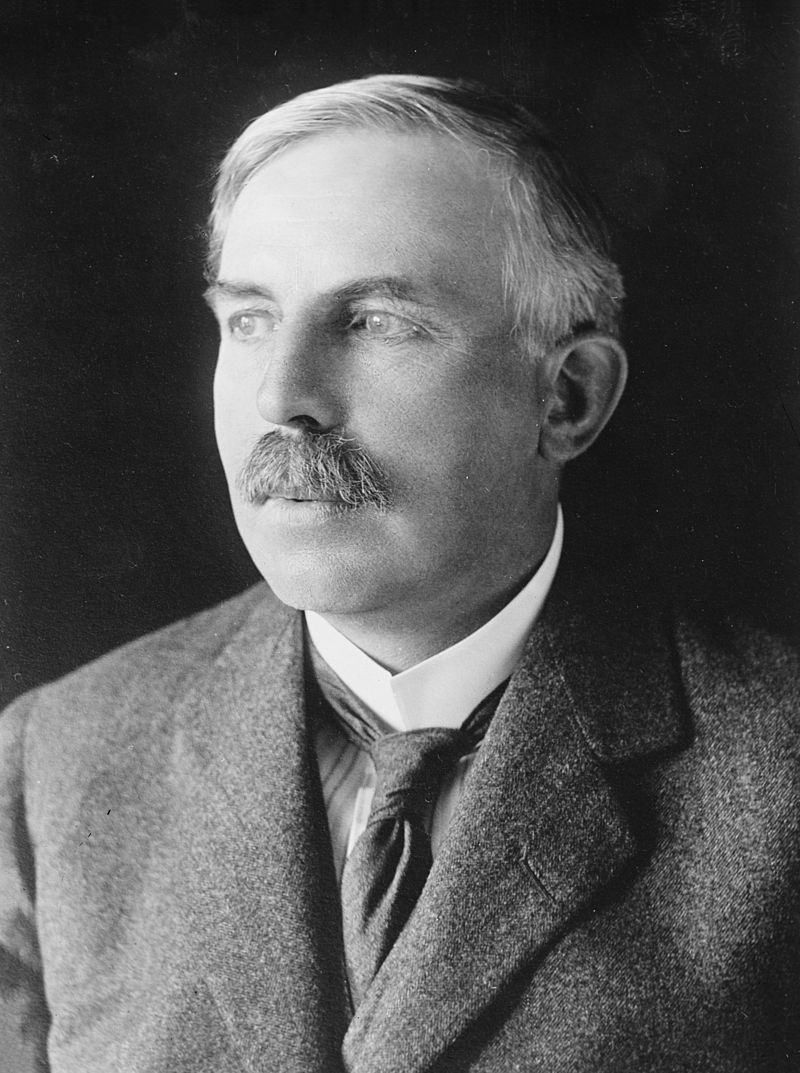
In 1913 the picture became a lot clearer. Henry Moseley (a student of Rutherford’s), in 1913 was doing x-ray spectroscopy on a variety of elements and measuring the wavelengths. He noticed a fairly simple mathematical relationship between the atomic number (where known) and at least one of the x-ray wavelengths. From this he formulated Moseley’s law. (I’d quote the law here, but although the formula is simple, explaining what the symbols meant would be a royal pain.)
So now the guesswork was gone. Moseley could zap even a rare earth metal with his x ray device, and calculate its atomic number. Lanthanum was 57. Lutetium was Z=71. We had, without realizing it, already nearly completed the list in between: Cerium (58), praseodymium (59), neodymium (60), samarium (62), europium (63), gadolinium (64), terbium (65), dysprosium (66), holmium (67), erbium (68), thulium (69), ytterbium (70), and lutetium (71). Only #61 was missing. {Yes I am enough of a geek to known those by heart.)
So now that numbers could be assigned to every element and not just the first 56, we knew we were missing #43 (right below manganese), #61 (a rare earth), #72, #75 (below #43), #85 and #87. Uranium came in at #92 and was the last element.
Moseley’s law was consistent with the Bohr model of the atom, which was put forward that year (just two years after the Rutherford model).
And the Bohr model is our main topic today, but I will finish Moseley’s story first. Sadly, it won’t take long.
It sure looked like Moseley was destined for bigger and better things, and he had certainly earned himself a Nobel Prize for putting the atomic number on a solid footing. But World War I broke out the next year and Moseley volunteered. He was sent to Gallipoli in modern day Turkey and was killed on August 10, 1915. The Nobel Prize committee gave no award for physics in 1916. We can only speculate, but it seems as if they intended to give that award to Moseley but as they do not give posthumous awards, had to change their plans.
Henry Moseley, 1887-1915, holding an x ray tube.
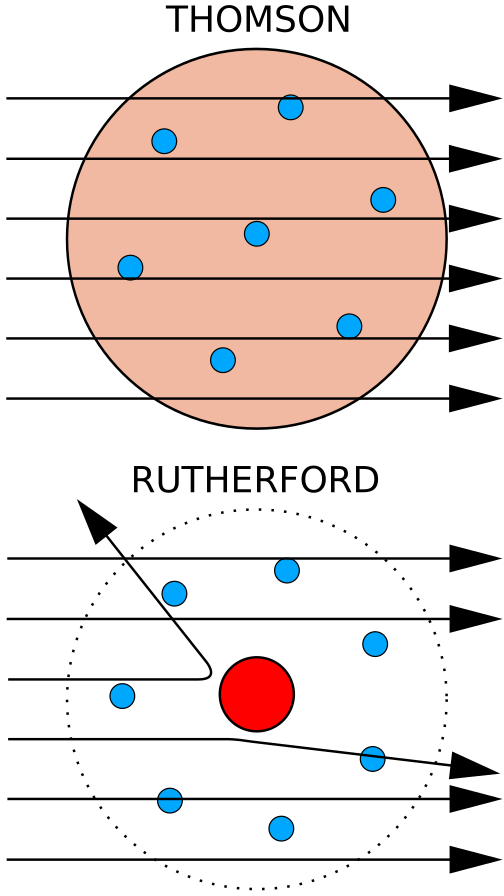
The Bohr model of the atom is actually considered a modification of the prior Rutherford model, which was unsatisfactory for a number of reasons. So it’s technically the “Bohr-Rutherford” model, but most just call it the Bohr model, after the Danish physicist Neils Bohr (1885-1962).
Why was the Rutherford model unsatisfactory? Chief among the issues was that if it were accurate, no atom would last more than about ten billionths of a second. Since I am writing this, and you will soon be reading this, and you and I are both made up of atoms that haven’t collapsed yet, there’s clearly a disconnect.
The Rutherford model supposed that the negatively charged, light electrons orbited the much more massive and very tiny positively charged nucleus. It didn’t discuss orbital periods of the electrons, or anything like that, so it wasn’t very specific. But that wasn’t the big issue.
The problem is that any electric charge that is being accelerated will emit electromagnetic energy. And electrons in orbit about a nucleus are constantly being accelerated. Remember that an object in motion will continue moving at that speed and direction unless acted on by an outside force (this goes back to part 1). An outside force, of course, will cause an acceleration. Since the electrons are following a curved path, they are being accelerated.
Calculations at the time based on Maxwell’s equations showed that it would take about ten billionths of a second for an orbiting electron to radiate away all of its kinetic energy, causing it to spiral in and plow into the nucleus.
How to solve this problem?
Well, there was a sketchy tool in the physicist’s tool kit that essentially functioned by forbidding certain values of energy, or momentum. If this tool could be applied here, then an electron in an orbit would be unable to drop downward, unless it took a big step downward all at once. And there’d be a minimum orbital energy it could not drop below.
That tool was quantum theory. It’s not the same quantum theory that we have today. As I hinted, it basically functioned as an overlay on classical physics, forbidding certain values of some parameters. It had been used by Max Planck to explain the black body spectrum in 1900, and it had been invoked by Albert Einstein to explain the photoelectric effect in 1905 (for which he eventually won the Nobel prize–for this, not for relativity!).
Energy came in fixed quanta, and these quanta’s sizes were always related somehow to Planck’s constant, which is:
h = 6.62607015×10⁻³⁴ J⋅Hz−1
Or equivalently (since a hertz is a “per second”):
h = 6.62607015×10⁻³⁴ J⋅s
This turns out to have the same dimensions as angular momentum. A joule is a kg⋅m2/s2, or as a dimension rather than units, m⋅d2/t2. Multiply that by time to match Planck’s constant and it’s m⋅d2/t. Angular momentum is speed, times mass, times the distance from the central point around which angular momentum is being measured, or (d/t⋅m⋅d) which is also m⋅d2/t.
However h is defined in terms of full revolutions, and angular momentum operates in radians, so we really need h/2π, a number that turns up so often, it has it’s own symbol, ħ, pronounced “H-bar” and often known as the “reduced Planck constant.” It’s equal to 1.054571817…×10−34 J⋅s. Or, since we are talking about atoms here, the preferred units are in terms of electron volts, so the reduced Planck constant is 6.582119569…×10−16 eV⋅s
So if the angular momentum of electrons in an atom were restricted to multiples of ħ, it could keep the main descriptive feature of the Rutherford model (electrons orbiting about the nucleus) while solving the problem of having them spiral into the nucleus, radiating energy all the while. The lowest possible orbit would be the one where the angular momentum was equal to ħ, the next one up (higher energy), 2ħ, and so on.
Well, it’s a fine idea, but does it actually make things look the way they really are?
Let’s work with hydrogen. One electron, one proton. No other electrons to cause complications because they repel the first electron.
Assuming a circular orbit (so that the requisite cross product becomes equal to multiplying distance by velocity), the angular momentum of the electron is going to equal its mass, times its velocity in orbit, times its distance from the nucleus:
mevr = nħ
The n is the integer multiplier and is now known as the principal quantum number.
Well, we know one of these, the mass. But we can actually express the velocity needed to maintain a circular orbit, in terms of distance and the attractive force between the proton and the electron (which we know), so that gets us down to one unknown. And we can eventually work our way down to figuring that when n is 1, the orbital radius is 0.0529 nanometers (billionths of a meter) for a hydrogen atom (one electron orbiting one proton).
OK, so by analogy with orbital mechanics, the lowest energy orbit is indeed this n = 1 orbit. What could make the electron move out of that orbit?
The hydrogen atom could actually hit another hydrogen atom, transferring kinetic energy to the electron, enough that it could jump to n=2. Thus a hot hydrogen gas, where the kinetic energy of the atoms is higher, could result in electrons being “jumped up” to higher orbits. So, basically, heat can do it.
Or the electron could absorb a photon with enough energy to make the jump.
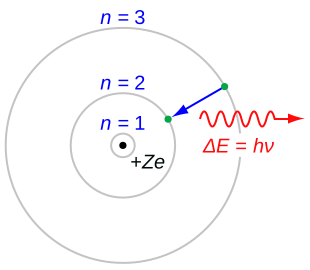
And if in a higher orbit, how could an electron drop? It could do so by emitting a photon. But it would be a photon that contains precisely the energy difference between the two orbits! .
The Bohr model, showing an electron dropping from n=3 to n=2, and emitting a photon to get rid of the energy difference.
Remember that E = h ν for light (that last letter being Greek “nu” not a “vee”). So if we know the energy difference, we should be able to figure out the frequency, ν of the photon, then get to its wavelength in nanometers. For wavelengths between 400 and 770 nanometers, the photon will be visible to our eyes and will have a certain exact color.
The lowest orbit has the minimum energy. Just like with astrodynamic orbits, the energy is set to zero at a distance of infinity, and becomes more and more negative the closer the orbit gets to the nucleus, so the energy of the minimum orbit (n=1) is -13.6 eV. The second orbit (n=2) is at -3.4 eV, the third (n=3) is -1.51 eV, and so on, approaching but never equaling zero. So an electron in the third orbit can shed a photon and drop all the way down from -1.51 eV to -13.6 eV, a difference of 12.1 eV. This corresponds to a wavelength of 102.57 nm. That’s an ultraviolet wavelength.
But how about dropping from n=3 to n=2? That difference is about 1.9 eV. And that corresponds to a wavelength of 656.3 nm, which is visible light.
That number no doubt leaped out at someone. And when they computed the numbers for jumping from n=4 to n=2, then n=5 to n=2, and so on, those numbers looked familiar, too.
They were the wavelengths of light in the hydrogen emission spectrum. This is known as the Balmer series, all the lines you get from dropping from some higher n down to 2.
The series of lines corresponding to dropping down to n=1 is called the Lyman series, and as previously indicated, they’re all ultraviolet.
So now we have an explanation of the hydrogen emission spectrum.
Maybe there was something “real” behind this quantum buggery!
The Bohr atom model stopped here. It explained hydrogen very well, but it couldn’t, by itself, cope with more than one electron. However its underlying principles do hold for other cases.
What Moseley had done was identify, via his X ray work, the transition down to n=1, which in heavier atoms is in the x-ray band. This gets progressively more energetic as the charge in the nucleus increases, such that one can actually tell what the nuclear charge is from the x ray wavelength. So this, too, validated the Bohr model in principle, at least insofar as the Bohr model assumes quantum effects are in play.
I’m going to carry this story through (in a grossly oversimplified way) to the present day, except I won’t delve too deeply into the quantum mechanical aspects of it–quantum theory turns out to be seriously weird but this wouldn’t begin to become apparent until about 1925. So far (as of the 1910s), this bowdlerized version where it just arbitrarily restricts what can happen in an otherwise classical physics realm was working pretty well (this is now called “old quantum theory”).
The n=1, n=2, n=3 and so on principal quantum numbers were named electron shells. It became apparent as time went on, though, that each of these shells contained subshells, according to a simple rule: The 1st shell consisted of one subshell, the second shell had two subshells, and so on. The subshells got labeled s, p, d, and f. This arose from quantum mechanical considerations.
Each subshell can only hold a certain number of electrons. An s subshell could hold 2 electrons, a p subshell 6 electrons, a d subshell 10 electrons, and an f subshell 14 electrons. We’ve never dealt with a fifth subshell, but it would probably be labeled g, with 18 electrons. Each goes up four electrons. This, too, arose from quantum mechanical considerations.
The subshells are in turn divided into orbitals holding 2 electrons each, but I won’t tread there. (And again, quantum mechanical considerations).
So, the following subshells exist: 1s, 2s, 2p, 3s, 3p, 3d, 4s, 4p, 4d, 4f, and so on.
Electrons are added to the lowest energy shell that isn’t already full. That’s whether you’re creating an ion by adding extra electrons, or just trying to get a large atom up to its normal complement.
Let’s take oxygen as an example. It has eight protons in its nucleus, it will want eight electrons in its shells.
So the first two electrons go into the 1s subshell. Then the 2s subshell gets the next two electrons. Finally, the four remaining electrons go into the 2p subshell, which could accept another two electrons if they were available.
Now let us consider iron, Z=26. The first eight electrons go like oxygen’s. The next two fill up the remainder of the 2p subshell, after which we move on to the 3s subshell, which takes two more electrons (12 so far). 3p takes up another six electrons (18 so far). You might expect that now we will move to the 3d subshell…but that turns out to be wrong. The 3d subshell’s energy is actually slightly higher than the 4s subshell, so we will fill the 4s before the 3d. Electrons 19 and 20 go into the 4s subshell, then the last six electrons do go into the 3d subshell. If we were to continue, the next subshell to fill would be the 4p subshell.
On the left, the principal quantum number. On the right, the branches indicate the energy of each subshell. Electrons fill in the subshells from bottom to top, so 1s (2 electrons) fills first, then 2s (2 more), then 2p (6 more), then 3s and 3p (another 8), but then 4s fills before 3d. The last element known in 1913 (uranium) get partway into the 5f subshell. Today, we’ve filled up not just 5f, but 6d and 7p, completely, all the way through Z=118. No 8s elements have been generated.
So we’re seeing at the end a sequence where we fill a 2 electron s subshell, a 10 electron d one, then a six electron p one. If we were to carry on to lead (Z=82), we’d encounter our first f subshell, 4f, right after the 6s subshell but before the 5d subshell; lead takes us into the 6p subshell.
If it’s difficult to see (or remember) a pattern to which subshells overlap in energy with parts of other shells, you can write them out in a triangle like this, all nicely ordered, then use diagonal lines from top right down to bottom left to read them off in the order they fill. This is called the “aufbau principle.”
Based on this the next two elements (Z=119 and 120) will be 8s subshell, then there will be a 5g subshell (the first g subhsell) with space for 18 electrons.
The numbers 2, 6, 10, and 14 might be tickling your brain trying to be noticed. If not, perhaps their successive sums will: 2, 8 (2+6), 18 (2+6+10) and 32 (2+6+10+14).
These are the lengths of the rows on the periodic table. In fact, if you look at the table, the left hand side is a “tower” two elements wide–corresponding to the s subshell. The left side is a block six elements wide–corresponding to the p subshell. The central skinny part is ten elements wide, and corresponds to the d subshell. Looking at the two rows that are “footnoted” below the main body of the table, those are usually depicted as 15 units wide, but they are supposed to tuck into a square in the third column, so one of those 15 squares really belongs to the d block. The other 14 are the f subshell. (By the way, chemists argue over whether the first or last of the fifteen is the one in the d-block; they seem to have recently decided to go with the last one of the fifteen.)
The periodic table, with the f block brought into the main diagram rather than relegated to footnotes. The second element in the 1s subshell is helium, which chemically behaves like the other elements with a finished p subshell, so it’s generally moved over from the upper left to the upper right (hence the one red square out of place).
This diagram shows the exact number of elements known today 118, 26 of them after uranium (Z=92) the highest known in 1913.
So the very shape of the periodic table reflects the shells and subshells, which in turn derive from quantum principles.
The periodic table is on a firm footing now. Atomic number is on a secure footing, We now even understand those elements whose atomic weights aren’t close to integers. We just don’t know why they aren’t exact integers yet.
Obligatory PSAs and Reminders
China is Lower than Whale Shit
Remember Hong Kong!!!
Whoever ends up in the cell next to his, tell him I said “Hi.”
中国是个混蛋 !!! Zhōngguò shì gè hùndàn !!! China is asshoe !!!
China is in the White House
Since Wednesday, January 20 at Noon EST, the bought-and-paid for His Fraudulency Joseph Biden has been in the White House. It’s as good as having China in the Oval Office.
Joe Biden is Asshoe
China is in the White House, because Joe Biden is in the White House, and Joe Biden is identically equal to China. China is Asshoe. Therefore, Joe Biden is Asshoe.
But of course the much more important thing to realize:
Joe Biden Didn’t Win
乔*拜登没赢 !!! Qiáo Bài dēng méi yíng !!! Joe Biden didn’t win !!!
“The people have a vested interest in hearing the truth.”
Arizona Rep. Mark Finchem
Wolf’s Pub is open! It’s Friday the 13th. Eeeks.
–20210813–
Yawn.
–2+0+2+1+0+8+1+3=17—
But, let’s dispense with superstition. Let us seek the truth, the whole truth, and nothing but the truth, so help us God.
What a week. I don’t know about you, but I feel like a Suffering Bastard. The good news is really just the bad news getting exposed, and it’s awful and depressing. It should be abundantly clear by now that our election system was captured some time ago, and it is possible our votes have not counted for years.
The Cyber Symposium started and ended with more bangs than I can count. Let me digress for just a moment. I’m sure most of us have already noticed that there are a great number of Christians presenting at the Symposium.
This is no fluke.
When we let Him, God will use us to accomplish His will. I thank God for all those who stood up and stood strong at the Cyber Symposium, premier among them the Pillow Man:
“We cannot live in fear. We all have to get engaged.”
Mike Lindell
FEAR NOT
Every day I have to beat back fear. It wants to creep up on me and burrow in. It makes me shrink away from looking at the truth, because the truth at this moment in time is so heinous and terrifying that I don’t want to face it.
“I must not fear. Fear is the mind-killer. Fear is the little-death that brings total obliteration. I will face my fear. I will permit it to pass over me and through me. And when it is has gone past I will turn the inner eye to see its path. Where the fear has gone there will be nothing. Only I will remain.”
Frank Herbert, Dune
It is a daily battle for me. But whenever I square off with fear and face it down, my outlook improves. I refuse to let fear overcome me.
“A coward dies a thousand times before his death, but the valiant taste of death but once.”
William Shakespeare, Julius Caesar
I’m looking forward to the growing swell of We the People taking back our republic. It is going to happen. We have no choice. Our “ace in the hole” (thanks for that, Wolf!) is a supernatural power Who is Omnipresent, Omnipotent, and Omniscient. God is present everywhere, He is all powerful, and He is all-knowing. Quantum computing is nothing compared to Him.
And the likes of George Soros are, quite frankly, piffle to Him. Speaking of Soros, I was watching that interview again, the one where he is asked by Steve Kroft if he believes in God. Watch it over a few times (it’s prompted to a minute or so before). Notice the split second of pause and the look and direction of his eyes before he responds with “No.”
Do you believe him? I don’t. Soros believes. But Soros hates God to the point that he won’t even admit that God is real. At some point he must’ve internalized that hatred until it consumed his humanity. And now we are dealing with him and other maniacs as we attempt to hold onto our republic.
Well, I have to go back to That Hideous Strength, and quote a scene where one of the most evil characters knows all is lost.
John Wither, the deputy director of the N.I.C.E., approaches his final damnation:
“It is incredible how little this knowledge moved him. It could not, because he had long ceased to believe in knowledge itself. What had been in his far-off youth a merely aesthetic repugnance to realities that were crude or vulgar, had deepened and darkened, year after year, into a fixed refusal of everything that was in any degree other than himself. He had passed from Hegel into Hume, thence through Pragmatism, and thence through Logical Positivism, and out at last into the complete void. The indicative mood now corresponded to no thought that his mind could entertain. He had willed with his whole heart that there should be no reality and no truth, and now even the imminence of his own ruin could not wake him. The last scene of Dr. Faustus where the man raves and implores on the edge of Hell is, perhaps, stage fire. The last moments before damnation are not often so dramatic. Often the man knows with perfect clarity that some still possible action of his own will could yet save him. But he cannot make this knowledge real to himself. Some tiny habitual sensuality, some resentment too trivial to waste on a blue-bottle, the indulgence of some fatal lethargy, seems to him at that moment more important than the choice between total joy and total destruction. With eyes wide open, seeing that the endless terror is just about to begin and yet (for the moment) unable to feel terrified, he watches passively, not moving a finger for his own rescue, while the last links with joy and reason are severed, and drowsily sees the trap close upon his soul. So full of sleep are they at the time when they leave the right way.”
C. S. Lewis, That Hideous Strength
This is a potent warning to all those who desire to stand in the place of the LORD GOD ALMIGHTY. It is also a potent warning to the traitors within our government.
They should study Antenora, the second level in the Ninth Circle of Hell, according to Dante’s Inferno, reserved for those who betray their party and homeland. Satan resides in the Ninth Circle with those who commit treason. And that goes for Dan Crenshaw, who WILL be voted out of office:
Dan Crenshaw shows his true colors: Commie Red
HOUSE RULES
The battle is getting thick. Let our tendency be one of kindness to one another and forgiving of each other’s errors. A good guide is here for your review. Brawling is reserved for the Utree, also a place to reconvene when the attacks come.
Who’s ready for a drink?
THE SUFFERING BASTARD—TODAY’S SPECIAL
It was hell during World War Two. The Brits in the African theater were suffering. The troops were drinking what poor-quality alcohol was out there. Hangovers abounded. But one intrepid bartender in a bar in Cairo took it upon himself to concoct a “Hair of the Dog” drink for the poor suffering bastards.
And doesn’t it seem like we’ve had a bad news and information hangover? The unfolding of the ELECTION STEAL just does something to your inner patriot. Read a little here, and then I’ve included a couple videos.
The soldiers and officers apparently loved the Suffering Bastard, but one bartender in one of the videos had a bit of an issue with mixing bourbon, gin, lime juice, bitters and ginger ale.
Bottoms up and may the Suffering Bastard bring us some relief from the bad news hangover. The good news is, we now know the bad news. A big step to taking back our republic.
CYBER SYMPOSIUM HERO
Professor David Clements
I stuck pretty close to Mike Lindell’s symposium. It was riveting. The howling and deflection by the media is really proof that this symposium is the beginning of the Patriot Offensive, and what an offensive it is. Wasn’t Professor David Clement’s closing statement just the BEST? If I can find it somewhere other than Telegram I will post it. If you have Telegram you can view it here: https://t.me/theprofessorsrecord/1943
I believe Lindell TV is playing the whole symposium for awhile, too.
This whole thing is HUGE. This Colorado SuperMom in the audience is DESTROYING Dominion, Jenna Griswold, and the DNC.
The CONSCIOUSNESS OF GUILT. IT BURNS.
It is very clear that this woman Jenna Griswold is an unqualified HACK who was put in BY FAKE ELECTIONS precisely for FAKE ELECTIONS and to protect FAKE ELECTIONS.
I will add more as this BLOWS UP.
I will add video as soon as I can get it.
W
Updates
I’m going to begin adding coverage to the downfall of Jenna Griswold and the Colorado Fake Elections plot HERE.
(1) Gonna cut to the chase here – I think we have George Soros on RICO. If we had a real DOJ/FBI.
(4) This is before the news broke. Short story – the “Antrim County” forensic dissection of a Dominion machine from Mesa Country, Colorado was begun LIVE on the internet, and it was immediately clear that Dominion has VIOLATED FEDERAL LAW to cover up, IN CAHOOTS with the Colorado Secretary of State AND the rotten DOJ/FBI.
(N) – This explains everything. This woman is an utterly unqualified Soros hack. She was put in BY what was most likely a FAKE, Dominion-mediated election. One of her then missions – PROTECT fake elections, as we’re seeing with her raid.
This Sanctuary Sunday Open Thread, with full respect to those who worship God on the Sabbath, is a place to reaffirm our worship of our Creator, our Father, our King Eternal.
It’s also a place to read, post, and discuss news that is worth knowing and sharing. Please post links to any news stories that you use as sources or quote from.
In the QTree, we’re a friendly and civil lot. We encourage free speech and the open exchange and civil discussion of different ideas. Topics aren’t constrained, and sound logic is highly encouraged, all built on a solid foundation of truth and established facts.
We have a policy of mutual respect, shown by civility. Civility encourages discussions, promotes objectivity and rational thought in discourse, and camaraderie in the participants – characteristics we strive toward in our Q Tree community.
Please show respect and consideration for our fellow QTreepers. Before hitting the “post” button, please proofread your post and make sure you’re addressing the issue only, and not trying to confront the poster. Keep to the topic – avoid “you” and “your”. Here in The Q Tree, personal attacks, name-calling, ridicule, insults, baiting, and other conduct for which a penalty flag would be thrown are VERBOTEN.
In The Q Tree, we’re compatriots, sitting around the campfire, roasting hot dogs, making s’mores, and discussing, agreeing, and disagreeing about whatever interests us. This board will remain a home for those who seek respectful conversations.
As we look around at the corruption and anarchy that seems to be everywhere, we should be mindful of what God’s Word says about the people during what it refers to as the last or latter days. These days are the times preceding what will be the most perilous times ever on this planet . . . the times immediately preceding Christ’s return.
But mark this: There will be terrible times in the last days. People will be lovers of themselves, lovers of money, boastful, proud, abusive, disobedient to their parents, ungrateful, unholy, without love, unforgiving, slanderous, without self-control, brutal, not lovers of the good, treacherous, rash, conceited, lovers of pleasure rather than lovers of God – having a form of godliness but denying its power. Have nothing to do with such people. (2 Timothy 3:1-5)
And it will get worse . . .
[The beast] was given power to wage war against the saints and to conquer them. And it was given authority over every tribe, people, language and nation. All inhabitants of the earth will worship the beast – all whose names have not been written from the creation of the world in the book of life belonging to the Lamb who was slain. (Revelation 13:7-8)
Until . . .
For then there will be great distress, unequaled from the beginning of the world until now – and never to be equaled again. If those days had not been cut short, no one would survive, but for the sake of God’s chosen ones, those days will be shortened. (Matthew 24:21-22)
We have a choice. We can be caught up in the events of these last days, possibly immersed in a dreadful fear for our families and ourselves, or we can take advantage of the rest that God has provided in Christ.
Rest in the Lord is a frequently used expression in the Bible. When the psalmist says, “Rest in the LORD, and wait patiently for Him” (Psalm 37:7, NKJV), he’s not talking about physical rest that involves taking a break from activity, relaxing, napping, or stopping to gather strength to continue or complete some physical undertaking. Rest in the Lord refers to a spiritual rest from confusion, worry, stress, useless human effort, and a break from all internal, external, mortal, and spiritual enemies.
The Hebrew word translated as “rest” means “to be at peace,” “to be still,” “to be quiet or calm.” In place of “rest in the Lord,” some Bible translations say, “Be still before the Lord” (ESV and NIV), “Be silent before the Lord”(CSB), “Surrender yourself to the Lord” (GW), and “Be still in the presence of the Lord” (NLT). These versions convey the essential idea that to rest and be at peace, one must dwell in the presence of the Lord, surrendered to His lordship.
In the Old Testament, God promised the people of Israel a life of peace in the Promised Land and rest in His presence (Exodus 33:14; Joshua 1:13 – 15). But this restful, peaceful living depended on the Israelites remaining faithful and obedient to God alone by keeping their covenant with Him. To those whose hearts strayed from Him, God said they would never enjoy His rest (Psalm 95:7 – 11).
Eventually, because of widespread disobedience and unfaithfulness, the nation of Israel was taken into captivity in Babylon. After returning from exile, once again, the promise of rest in the Lord’s presence was presented: “So do not be afraid, Jacob, my servant; do not be dismayed, Israel . . . For I will bring you home again from distant lands, and your children will return from their exile. Israel will return to a life of peace and quiet, and no one will terrorize them” (Jeremiah 30:10, NLT).
But, again, the people failed to learn that resting in the Lord meant surrendering wholly to the Lord in righteous living: “The fruit of that righteousness will be peace; its effect will be quietness and confidence forever” (Isaiah 32:17).
In the New Testament, the book of Hebrews declares the good news that those who believe in Jesus Christ can enter His rest: “God’s promise of entering his rest still stands, so we ought to tremble with fear that some of you might fail to experience it. For this good news – that God has prepared this rest – has been announced to us just as it was to them. But it did them no good because they didn’t share the faith of those who listened to God. For only we who believe can enter his rest” (Hebrews 4:1 – 3, NLT).
As believers, we are not granted immunity from life’s storms, but we have a choice about how we react to those storms. Our natural tendency might be to run around frantically looking for help, trying to save ourselves from trouble. We can either respond frenetically or rest in the Lord’s presence. We can either waste our time worrying or trust in the Lord to take care of us.
Jesus said, “Come to me, all of you who are weary and carry heavy burdens, and I will give you rest. Take my yoke upon you. Let me teach you, because I am humble and gentle at heart, and you will find rest for your souls. For my yoke is easy to bear, and the burden I give you is light” (Matthew 11:28 – 30, NLT).
The writer of Hebrews also tells us that there is a future, final rest for believers in heaven (Hebrews 4:9–11). In the meantime, we can rest in the Lord by taking everything – all our burdens, problems, and anxieties—to Him in prayer. We can tell God what we need even as we remember and thank Him for all that He has done for us already.
As we do this – as we abide in Jesus Christ and God’s presence – He promises to pour into us a supernatural, incomprehensible peace to guard our hearts and minds (Philippians 4:6 – 7).
Right here and now, we can quiet ourselves, be still, and surrender ourselves to the Lord. We can see Him as Isaiah did, high and lifted up (Isaiah 6:1). He is Sovereign over the whole earth, over our lives, and over every enemy, both internal and external, human and spiritual (Isaiah 46:9 – 11). We can peacefully wait for Him. We can be steadfast, longing, and always looking to Him for help. This is how we rest in the Lord.
We all need short vacations In life’s fast and maddening race – An interlude of quietness From the constant, jet-age pace. So when your day is pressure-packed And your hours are all too few, Just close your eyes and meditate And let God talk to you . . . For when we keep on pushing, We’re not following in God’s way – We are foolish, selfish robots Mechanized to fill each day With unimportant trivia That makes life more complex And gives us greater problems To irritate and vex. So when your nervous network Becomes a tangled mess, Just close your eyes in silent prayer And ask the Lord to bless Each thought that you are thinking Each decision you must make, As well as every word you speak And every step you take – For only by the grace of God Can you gain self-control, And only meditative thoughts Can restore your peace OF soul.
– Helen Steiner Rice
On this day and every day –
God is in Control . . . and His Grace is Sufficient, so . . . Keep Looking Up
Hopefully, every Sunday, we can find something here that will build us up a little . . . give us a smile . . . and add some joy or peace, very much needed in all our lives.
“This day is holy to the Lord your God; do not mourn nor weep.” . . . “Go your way, eat the fat, drink the sweet, and send portions to those for whom nothing is prepared; for this day is holy to our Lord. Do not sorrow, for the joy of the Lord is your strength.”
The prior election must be acknowledged as fraudulent, and steps must be taken to prosecute the fraudsters and restore integrity to the system.
Nothing else matters at this point. Talking about trying again in 2022 or 2024 is hopeless otherwise. Which is not to say one must never talk about this, but rather that one must account for this in ones planning; if fixing the fraud is not part of the plan, you have no plan.
The Audit
The Audit is definitely heating up. Let’s see if the Opposition manages to squelch it and its consequences. I’ll be honest; I expect it to be ignored by anyone capable of ordering Biden/Harris to step down.
Nevertheless, anything that can be done to make Biden look less legitimate is a worthy thing!
Lawyer Appeasement Section
OK now for the fine print.
This is the WQTH Daily Thread. You know the drill. There’s no Poltical correctness, but civility is a requirement. There are Important Guidelines, here, with an addendum on 20191110.
We have a new board – called The U Tree – where people can take each other to the woodshed without fear of censorship or moderation.
And remember Wheatie’s Rules:
1. No food fights 2. No running with scissors. 3. If you bring snacks, bring enough for everyone. 4. Zeroth rule of gun safety: Don’t let the government get your guns. 5. Rule one of gun safety: The gun is always loaded. 5a. If you actually want the gun to be loaded, like because you’re checking out a bump in the night, then it’s empty. 6. Rule two of gun safety: Never point the gun at anything you’re not willing to destroy. 7. Rule three: Keep your finger off the trigger until ready to fire. 8. Rule the fourth: Be sure of your target and what is behind it.
Gold was up in the 1810s all week up to Friday morning, but tanked HARD on that day, down $41.20. Everything took a beating, honestly, except rhodium which went up.
Part XIII – Rutherford On A Roll
We left off, circa 1903, having discovered radioactivity and the electron, and making quite a bit of progress with them.
To try to recap (and there are a few things in this so-called “recap” that I should have mentioned earlier, but didn’t), an electron is a negatively charged particle about 1/1830th the mass of a hydrogen atom, which up to then had been the lightest thing known to exist. They could be knocked off of atoms in a Crookes tube and they would then form what was called a cathode ray (yes, the same “cathode ray” in those big tubes in those old boxy TVs). It is possible to strip one electron off a hydrogen atom, at which point the remaining piece of the hydrogen atom (called an ion) had a positive charge that balanced the electron’s negative charge. The atom as a whole was neutral, charge 0; the individual pieces also added up to 0. Even though there was plenty of mass left in the ion, easily enough for hundreds more electrons, no one could get a second electron to come out of a hydrogen atom.
Thomson, the discoverer of the electron, suggested that atoms were fairly solid spheres of positive electrical charge with little electron inclusions that could be knocked out to ionize the atom; this was called the plum pudding model of the atom.
Radioactivity had been discovered in 1896. Uranium and thorium, it turns out, are radioactive. Radioactivity turned out to consist of three types of rays, alpha, beta, and gamma.
Alpha rays turned out to be identical to doubly-ionized helium, i.e., helium from which two electrons had been stripped (and there was no sign of being able to strip away a third electron from helium). Helium itself had been discovered on Earth back in 1895, trapped in a uranium ore; its atomic mass was four times that of hydrogen. Clearly the helium had begun as alpha particles, then combined with electrons in the ore to become helium gas. The charge of an alpha particle is 2e.
Beta rays turned out to be high-speed electrons. Their charge, of course, is –e.
Gamma rays turned out to be electromagnetic radiation, extremely strong electromagnetic radiation, like X-rays on steroids. Gamma rays, like all photons, have no electrical charge at all.
Alpha rays could be stopped by a sheet of paper. Beta rays could penetrate many sheets of paper, but would be stopped by a thin sheet of metal. Gamma rays required a lot of shielding to stop.
Uranium (atomic weight ~238) and thorium (atomic weight ~232), which had just been discovered to be radioactive, were the heaviest known elements, roughly 238 and 232 times as massive, atom for atom, as hydrogen. The Curies discovered that uranium ore was four times as radioactive as the ores it contained; they were able to isolate two new elements, radium (atomic weight 226) and polonium (atomic weight 210), by processing tons of the ore pitchblende.
It was also clear that a pure block of refined uranium would grow more radioactive over time, eventually reaching a level significantly higher than before, but not nearly as high as the ores.
In radioactive decay, the total amount of energy released, relative to the mass, turned out to be staggeringly huge, thousands if not millions of times more than what was released by burning chemicals. In 1904 Ernest Rutherford (who had named the three types of radiation, and who is the star of today’s story) suggested that radioactivity could provide enough energy to power the sun for the many millions of years necessary for Darwinian evolution to take place. (Previously known sources of energy were woefully inadequate; it was one of the 1895 mysteries I listed.)
At the time atomic weight was considered to be a defining characteristic of an element. This would cause some confusion for a few years.
Some stuff I should have covered previously, but didn’t:
The electric charge of an electron is about -1.602 x 10⁻¹⁹ coulombs. This is a negative number (because Benjamin Franklin arbitrarily picked one kind of charge to be positive and the other negative, and when the electron was discovered, it happened to be the one he tagged as negative), so, perhaps a bit counterintuitively, physicists define the minimum charge e to be +1.602 x 10⁻¹⁹ coulombs, i.e., -1 times the charge of an electron. Physicists, in fact, find it far more convenient to use e as the unit of electric charge when talking about atoms, that way they don’t have to sling 10-19s everywhere.
And they do something similar for energy. Just like a falling weight generates kinetic energy (a mass being attracted to another mass by gravity, speeds up that mass), an electron responding to one volt of electrical potential generates a certain amount of energy, which is defined to be an “electron volt.” This is abbreviated eV (which spell checkers will try to “fix” the capitalization of). This ends up being 1.602 x 10⁻¹⁹ joules. (Notice it’s the same factor, 1.602 x 10⁻¹⁹. This is a consequence of the way the joule, coulomb, and volt are defined.) Energy at the atomic level, particularly when dealing with chemical energy, tends to be a convenient, human-relatable number of electron volts.
And a reminder: An atomic mass unit was defined, in 1898, as 1/16th the mass of an oxygen molecule. This was very close to the mass of a hydrogen atom, but because oxygen reacted with more things, it was easier to use it as a yardstick. [This definition has since been modified, for reasons I’ll explain below.] It was equal to 1.6604675209 x 10⁻²⁷ kilograms. (This is slightly different from today’s value.) It was abbreviated “amu.” Atomic weights were expressed in amu’s, so oxygen’s atomic weight was 16.0000, and hydrogen’s was almost exactly 1.0: In 1949, under this definition, it was measured at 1.008 amu. (At least, according to a 1951-52 CRC handbook–well, it’s a book that fits King Kong’s hand–that I happen to own.)
OK, so that, I believe, catches us up.
Ernest Rutherford, 1871-1937 I’ll be honest, as I was researching this, I was surprised how many times Rutherford’s name kept coming up. I had known about a few of the things he had done (the gold foil experiment being the most famous) but in fact he was all over everything that happened, it seems. It seems he was at least in the room for a lot of things I talked about last time (like the discovery of the elctron). He fully deserved having an element named after him (Z=104). If parts of this caption make no sense…read on.
A Plethora of Radioactive Elements?
Scientists continued to investigate radioactivity. They would find more and more elements, distinguished by their atomic masses, in both uranium and thorium ores.
Even as early as 1900-1903 Rutherford was involved in this effort. Looking at thorium “emanations” with his student Frederick Soddy, they discovered thorium x and a gas, thoron. At first they thought these were special forms of thorium, but then they realized these were not thorium. By 1903 they had concluded that these emanations were the result of thorium changing into another element. This was a very bold conclusion, since chemists up to now had believed elements were immutable, that such things were alchemist balogna. (And under normal circumstances this was true…but radioactivity was something fundamentally new, and certainly nothing like what the alchemists had thought of.)
So perhaps these new elements could fill in the large gap between bismuth and thorium in the periodic table? Well, they could, but it turned out that in fact, there were way too many of them. Realistically between lead and uranium there was room for nine elements, and we already had five of them: bismuth, polonium, radium, radon (which was basically the thoron gas) and thorium. But just in uranium ore there seemed to be about thirty of them (based on my count looking at a chart in Wikipoo–perhaps they had found fewer than that before they figured out what was actually going on). Thorium ores brought in another ten or so.
But it was very, very difficult to separate out these putative elements. For instance Soddy in 1910 showed that mesothorium, atomic weight 228, radium, atomic weight 226, and thorium X, atomic weight 224, were impossible to separate chemically, as if they were the same element. But how could that be so when the atomic weights were different? Trying to place these elements in the table led Soddy and Kazimierz Fajans to independently come up with the notion of radioactive displacement in 1913. Basically, this stated that an alpha decay reduced an atom’s mass by about four amu (the mass of the alpha particle), and also moved it two places to the left on the periodic table. (If such a thing were to happen to (say) nickel, it would become iron, which is two spots to the left of nickel. But it won’t.) A beta decay left the mass almost unchanged (the mass of the electron that gets kicked out is relatively insignificant), but moved the element one place to the right. (If an atom of palladium were to undergo a beta decay, it would become silver. This has happened under very special circumstances, ones that won’t affect the palladium bullion I hope you own.) Gamma decay had no such effect; apparently it was just a way to get rid of energy.
For this work Rutherford won the 1908 Nobel Prize for Physics.
But he hadn’t even got started yet.
The Isotope
Now if one used the radioactive displacement principle, it appeared that two or more different “elements” could occupy the same place on the periodic table. The three I named above all fit in the same square, directly under barium. Because they occupied the same place, they were termed isotopes, from Greek for “the same place.”
So you had “elements” of different mass that otherwise behaved identically. At this point chemists decided that the mass wasn’t as important as the behavior, and swallowed the concept of two different atomic weights representing the same element, rather than insisting they must be different elements solely because of different atomic weights. Atomic weight wasn’t necessarily a crucial characteristic of an element, particularly when it came to ones extracted from radioactive ones.
In 1912, meanwhile, J. J. Thomson, who had discovered the electron in 1897 (with some help from Rutherford, it turns out) wasn’t done yet, had ionized neon (which was the tenth element listed on the periodic table at the time) in a Crookes tube and magnetically and electrically deflected its ions, the same way that he had deflected electrons in 1897, to determine the ions’ charge to mass ratio. He was quite surprised to see these ions, which should have weighed in at about 21.18 amus, went to two different locations! Some were deflecting more than others, because they were lighter than those others.
Assuming that they were singly ionized, with one electron removed (it takes a lot more energy to take the second electron off than it did the first), one group of ions had an atomic weight of almost exactly 20, the other had an atomic weight of almost exactly 22. The atomic weight of neon had been measured as 20.179, which made it one of those cases where the atomic weight was not almost a whole number, but now it looked like that was actually an average value. Most neon had atomic weight of almost exactly 20, but some came in at about 22, and the weighted (ahem) average was 20.179.
So now, even perfectly ordinary stable elements had isotopes, and this time no one thought these must be two different elements because the weights are different. In modern terms neon consists of a mix of neon-20 and neon-22.
I have mentioned in the past that many elements had “atomic weights” or “atomic masses” that were almost a perfect multiple of hydrogen’s. These mostly turn out to be elements with exactly one isotope in nature, or perhaps more than one isotope but one of them is much, much more common than the other(s).
Hydrogen, it turns out, has two isotopes found in nature, hydrogen-1 and hydrogen-2. Hydrogen-1 is overwhelmingly common, hydrogen-2 is rare, a bit more than one atom in ten thousand hydrogen atoms is hydrogen-2.
For various reasons, the isotopes of hydrogen actually ended up with “real” names–not true for any other element! Hydrogen-1 is called protium and hydrogen-2 is called deuterium.
The actual atomic mass of hydrogen is a bit higher than the atomic weight of pure protium expressed in kilograms, because the tiny amount of deuterium pulls the average up.
If, in an alternate universe, the atomic mass unit had been defined differently so that hydrogen–mixed hydrogen–got an atomic mass of 1 unit, this would actually have been slightly higher than the atomic mass of pure protium, because the occasional deuterium atom pulls the average up.
But in the real world, the atomic mass unit was defined to be 1/16th the atomic weight of oxygen. So oxygen was 16.0000 by definition. Hydrogen ended up being a hair more than 1.008. Could the excess be due to the deuterium? Not so fast. Oxygen, it turned out in 1919, consists of three isotopes. Oxygen-16 is overwhelmingly more common than oxygen-17 and oxygen-18. But even if you set pure oxygen-16’s atomic weight to 16.00 by definition, and then look at the atomic weight of pure protium, pure protium doesn’t come in at precisely 1.000. There’s still this slight tendency to be off just a bit from integers. At the time no one knew why, but they knew about it well enough to talk about a mass defect. But at least now, we understood the elements that were way off from being whole integer atomic weights–they were mixtures of isotopes. So this is a partial answer to one of our mysteries.
Physicists often discussed different isotopes of the same element. Chemists rarely did back then. Physicists used the whole number to label them, rather than the exact number. This whole number was termed the “mass number” and had the symbol A (from German Atomgewicht). I’ve been using these mass numbers a lot so far, and will continue to do so.
So we have three things with similar-sounding names. There’s the atomic mass unit (amu), almost (but not quite) equal to the mass of a hydrogen atom. There’s an atomic weight, measured in atomic mass units, which represents the mass of the atom. But there is also a mass number, which is a rounded version of the atomic weight, for a specific isotope. Hydrogen’s atomic weight is 1.0008, but the mass number of its most common isotope was just simply 1. When doing ordinary chemistry weighing out reactants the atomic weight is used to compute the number of moles of each reactant. When talking about isotopes, the mass number is used, without fail.
(Looking ahead a little: In the 1920s physicists began using a physical atomic mass unit, that really was based on oxygen-16 rather than mixed oxygen. To distinguish it from the other one, the prior one was called the chemical atomic mass unit–which the chemists kept on using. And then it turned out that oxygen obtained from water had a slightly different isotope mixture and hence real atomic weight, than oxygen extracted from the air. So the chemists’ unit was based on a foundation of quicksand. But even using the physical amu, the atomic weight of a pure isotope was still never a clean, perfect integer, except for oxygen-16.
(But now we had two slightly different units with very similar names. In 1961 they compromised, and created the “unified atomic mass unit” (symbol u, also called the dalton, symbol Da) that was 1/12th of the mass of a carbon-12 atom. This was closer to the chemists’ standard than to the physicists’.
(No matter what standard was chosen, however, the only isotope that had a perfect integer mass was the reference isotope. All others were off, just a bit.
(But that was all in the future. Let’s return to our story, back to 1912.)
The Nucleus
Backing up just a couple of years from there, there had been another very important discovery in 1909 by Ernest Rutherford. He was collaborating with Hans Geiger (who is definitely a counter) and Ernest Marsden.
They used a beam of alpha rays (which, as a reminder, are heavy and positively charged) to bombard a very thin layer of gold foil. They were pretty much expecting those alpha particles to plow through the “plum pudding” atoms. Instead, though most indeed cruised right through the gold atoms as if nothing were there, a very few of them bounced away at sharp angles, repelled by an intense and concentrated positive charge. Some even bounced back towards the beam source! Rutherford said, in a very famous quote: “It was quite the most incredible event that has ever happened to me in my life. It was almost as incredible as if you fired a 15-inch shell at a piece of tissue paper and it came back and hit you.”
In 1911 Rutherford argued that those alpha particles were bouncing off an atomic nucleus. This meant that an atom consisted almost entirely of empty space. All of that positive charge (and almost all of the mass of the atom) was in a tiny, tiny, very dense body about 1/10,000th the width of the atom; the rest of the space was the domain of the electrons, which orbited the nucleus much like planets orbit the sun, except in this case the attractive force wasn’t gravity, but the attraction between the positively charged nucleus and the negatively charged electrons. This was a new model of the atom, called the “Rutherford Model.” Rutherford is credited with discovering the atomic nucleus.
The differences between the Thomson model of the atom and the Rutherford model, and how they imply the alpha scattering experiment would turn out. The top, “plum pudding” model is of an atom that has a uniform density with electrons imbedded; the overwhelming majority of the alpha particles would have no trouble plowing straight through the “goop.” The bottom shows that all the mass (other than orbiting electrons, which are less than a thousandth of the mass) is concentrated in a nucleus that is much denser than anything we see in our daily lives, and the alpha rays will bounce off of it if they get anywhere close to it. Which was rare but happened. The red “nucleus” in the diagram is drawn far, far larger than it should be (a mere dot would still be too large).
And in fact that number understates things; according to modern measurements entire atoms can be anywhere from 26,000 to 60,000 times as wide as their nuclei. Which works to to be anywhere from 17.6 – 216 trillion times the volume.
Atomic Number
Later that year, Antonius van den Broek proposed that the sequential location of each element in the periodic table was equal to its nuclear charge, this charge (in units of e) was the atom’s atomic number. This fit well for hydrogen, which could only have one electron stripped off, leaving a +1e charged nucleus behind. And for helium, which could be ionized twice leaving a +2e charged nucleus behind. They were the first and second elements listed in the table. However, we couldn’t strip every atom down to a bare nucleus to see its charge; the heavier the atom the harder it was to do that.
This was a new concept. Chemists had talked about the atomic weight of an atom, never its number. You could list the elements in the order they appeared in the periodic table, of course (accounting for the very few unfilled “holes” in the grid), but the place on the list wasn’t considered terribly significant. But now it appeared as if charges came in discrete quantities, and given that one could only remove one electron from a hydrogen atom, and two from the atom with the next higher weight, the implication was that this nucleus had a specific charge, an integer multiple of the charge of an electron (but with the opposite sign). So hydrogen’s atomic number was 1, helium’s was 2. Lithium’s was 3. And so on, through carbon (6), oxygen (8), aluminum (13), iron (26), zinc (30), rhodium (45), silver (47), tin (50), platinum (78), gold (79), lead (82), thorium (90), and uranium (92), to give some examples. (However the exact numbers for anything above the upper fifties really weren’t certain at this point.)
This was only a suggestion…until about two years later. I will pick that story up next time, because it actually ties in more with electrons, and this week I want to concentrate on the nucleus. Suffice it for now to say that van den Broek was absolutely right. I’m going to reference the concept of atomic number, abbreviated Z (from German Zahl, ‘number’), from here forward.
The Proton
So, let’s continue Rutherford’s story. In 1917 he ran some more experiments. He fired alpha beams into air (which is mostly nitrogen), and detected hydrogen ions. After refining his experiment, he realized that the alpha particles were reacting with the nitrogen. When he reported his results in 1919, he claimed that the alpha particle had simply knocked a hydrogen nucleus out of a nitrogen nucleus, reducing the nitrogen nucleus’ charge (and atomic number) and weight by one and thereby turning it into carbon. Nitrogen-14 was seemingly becoming carbon-13, a rare (but stable) isotope of carbon, which is mostly carbon-12.
But by then we had cloud chambers and could see some forms of radioactivity and ions leaving trails through the chamber. In 1925, Rutherford examined some cloud chamber tracks of this reaction, and he realized he was totally wrong about what was happening. The alpha particle wasn’t bouncing off the nitrogen nucleus after knocking one proton out of it. No, it was disappearing. What was in fact happening was the nitrogen nucleus, 7 positive charges, total mass 14, was absorbing the alpha particle.
I mentioned, up above, the principle of radioactive displacement. An atom, spitting out an alpha particle moves two places to the left on the periodic table. That means its atomic number decreases by two. The atomic mass drops by four.
Absorbing an alpha particle has exactly the opposite effect. The atomic number increases by two, and the atomic mass increases by four. So the nitrogen-14 was becoming fluorine-18.
Immediately upon becoming fluorine-18, the nucleus then shed a proton, which was the hydrogen ion that Rutherford saw. This turned it into oxygen-17, stable but uncommon (most oxygen being oxygen-16).
But in the meantime, people had decided that that hydrogen nucleus was a basic particle, and it was named the proton. It’s regarded as having been discovered in 1919, since that was the first time it was seen to exist having come from some source other than hydrogen gas. or in 1920 when someone suggested it might be an elementary particle. Rutherford, as the discoverer, got to name it.
William Prout, clear back in 1815, had suggested that the other elements might be built up, somehow, from hydrogen, and now it looked like he was at least partly right. Hydrogen indeed consisted of a single proton, mass 1, and an electron, and other elements apparently had 2, 3, 4 or more protons, all the way up to uranium with 92 of them–each with a matching electron. You couldn’t just bundle hydrogen atoms together to get other kinds of atoms, but conceivably, if you separated the electrons and protons, then combined the protons, and put the electrons back in place, you could get larger atoms.
In fact, Rutherford had suggested both the name “proton” and the name “prouton” for this particle, the latter to honor Prout. (The English would have pronounced “prouton” as if it rhymed with “grout on”, and the French would have made it rhyme with “crouton” so we dodged a bullet of linguistic confusion there.)
The proton’s mass is 1.007 amus (using the modern AMU scale). Again, maddeningly close to a whole number. But because of this, the proton looked like the underpinning for atomic number but it couldn’t be the underpinning of atomic mass. That’s because, to take an example, oxygen’s nucleus has eight protons in it, but a mass of sixteen, twice as much as the protons. Uranium is even more out of whack. It has 92 protons, but its most common isotope has a mass of 238, leaving 146 mass units unaccounted for! Why? We didn’t know, yet.
In 1920, Rutherford voiced a suggestion. He thought that the excess mass consisted of a number of protons and electron pairs, bound to each other to make a net neutral bundle. So an oxygen-16 nucleus actually contained sixteen protons, but eight of them were bundled with, and masked by, electrons. The net positive charge is eight, and that’s critical because it requires eight orbiting electrons to balance out, and those eight orbiting electrons are responsible for oxygen’s chemical properties. So the chemical nature of an atom ultimately depended on the number of protons not in these bundles.
This actually made quite a bit of sense. Remember beta decay? This is where a nucleus can spit out an electron. The electron has a single negative charge. In order to make up for that loss, the nucleus has to gain a positive charge; it’s as if a new proton were appearing. But if Rutherford’s idea were correct, rather than a proton and an electron being magically created, one of these bound pairs was breaking apart, freeing the electron and unmasking the hidden proton.
Another thing arguing in Rutherford’s favor was the fact that whatever-it-is that was left over in the nucleus had a mass that was nearly that of a whole number of protons; it would make sense for the missing ingredient to be that number of “masked” protons.
Physicists would spend the 1920s thinking that the nucleus consisted of a number of protons equal to the mass number A, plus a bunch of nuclear electrons, which left a net number of “unmasked” protons equal to Z. With some mysterious “mass defect” making the total mass slightly off.
But there were some theoretical difficulties with this…which I will take up in a future installment.
Who Cares About Isotopes?
Until late in the last century, chemists almost never concerned themselves with differing isotopes. That’s because oxygen-16’s chemical behavior is nearly indistinguishable from oxygen-17’s. Because the oxygen-17 is a bit heavier, it’s perhaps a tiny bit slower to react than oxygen-16, but not much. If you were to liquefy oxygen-16 and oxygen-17, then measure their boiling points, the oxygen-17 would require a slightly higher temperature to boil, because it would take just a little bit more energy to kick those heavier oxygen-17 atoms into vapor. Melting and boiling points are in fact the biggest difference a chemist might see…if he had separated samples to work with in the first place. And chemical means of separation were simply untenable; they were too much alike.
Water made with oxygen-17 and oxygen-18 evaporates a bit less readily than water with oxygen-16, so rainwater tends to be slightly richer in oxygen-16 than seawater (and this is part of the reason we had to stop defining the atomic mass unit as 1/16th of mixed oxygen–the mix could differ depending on where you got the oxygen from).
The chemical differences between protium (hydrogen-1) and deuterium (hydrogen-2) are actually significant, due to the fact that proportionally, the difference is greater than for any other pair of isotopes. Water made out of deuterium (“heavy water”) instead of protium actually melts at 4C, rather than 0C. I’ve seen a video of a heavy water ice cube sunk to the bottom of a glass of cold (regular) water. It’s not going to melt as long as that water is properly chilled. Note that I said the bottom of a glass of cold water. It doesn’t float because it’s heavier than regular ice and heavier even than regular water. (Now, if it were in a glass of heavy water, it would float.)
And of course, heavy water, because of its significantly different chemical behavior, is toxic when pure.
Other than that, for “traditional” chemistry, isotopes just didn’t matter.
Today things are a bit different. Mass spectrometers–which are the descendant of Crookes tubes, designed to ionize, accelerate, and deflect atoms and molecules to see how much they deflect and thus figure out the masses–are relatively cheap, and they can read out absolute numbers of “hits” at each possible mass. So one can run a sample of water through one of these and get a very precise notion of the isotopic composition. Now, you can tell whether a sample of water was rain water or ground water. Or you can analyze a sample of metal and be able to tell where it was mined, because it turns out each mine has a slightly different isotopic mix of the metal. Or one can prove that CO2 was added to champagne artificially, because the CO2 used has no carbon-14 in it (whereas the carbon dioxide in fermentation does).
Incidentally, if you’ve ever had TSA swab your luggage then stuff the swab into a machine which tells them you aren’t carrying explosives–that device is a mass spectrometer.
That’s today. But back in 1910, chemists didn’t give a rip about isotopes. Physicists studying radioactivity, on the other hand, knew that “which isotope is this?” could make all the difference in the world. And that’s even more true today too, now that we can artificially make all sorts of radioactive isotopes that don’t exist in nature. We now have to concern ourselves with radioactive hydrogen-3 (“tritium”), cesium-137, iodine-131 and strontium-90…and these were elements that were never radioactive in the days of the Model T and the Wright Flyer.
In 1910 we were just starting down this road. Remember, Rutherford had made fluorine-18 and oxygen-17 artificially.
Decay Chains
Keep this in mind as we go back now to uranium (atomic number Z=92) and thorium (Z=90). Remember that whole process of figuring out the pieces of an atom started in part because of the discovery of radioactivity, a property of these two elements in particular.
At the time of today’s story, had become quite clear that when there was radioactivity, one kind of atom was changing into another, this is called “decay.”
Uranium and thorium decay very slowly, or I should say, uranium-235, uranium-238, and thorium-232 decay very slowly (as I said, the isotope matters). It’s a statistical process. When you are looking at one uranium-235 atom, it could decay a second from now…or it could wait a billion years. There’s no way to know when it will happen, but it’s almost a stable nucleus; it’s very, very unlikely to blow in the next second. And if that atom is still around in a billion years, someone watching it then is just as unlikely to see it go kablooey in the next second as you are today.
I’m going to get on a soap box here, for just a minute. Let’s say you watch someone flip a coin 20 times and it comes up tails each time. Do you think, “wow, it’s overdue to come up heads, I’ll bet it comes up heads next time?” If so, you have a “naive” view of probability. The more sophisticated view is that, since the tosses are independent events they aren’t affected by each other. The chance is 50/50 of heads next time, no matter how many times in a row it has come up tails just now. But then, there is the cynic’s view. He doesn’t believe the odds are fifty/fifty either. But he doesn’t figure it’s overdue to come up heads; he figures the coin probably is crooked; perhaps tails on both sides! And he might have a point there. The smart bet, if you’re not allowed to examine the coin, is probably to bet on “tails.” But, if the coin really is fair, the 50/50 view is correct.
Similarly, for the chances of an unstable nucleus going kablooey in the next second, or minute. A billion years from now, provided your unstable nucleus hasn’t gone kablooey in the meantime and it’s still around, it’s just as likely to not go kablooey in the next second, as it is to not go kablooey in the next second today.
At an individual atom level, radioactivity isn’t predictable. But, if you take a large number of atoms of one of these three isotopes (or of any unstable isotope for that matter), you can make some predictions.
You can say, for instance, that any large sample of uranium-235 will be half gone in about 700 million years. Half of the atoms (no way to predict beforehand which specific ones) will have decayed to something else. Does that mean that the other half will decay in another 700 million years? Absolutely not. If you start with a pound sample of uranium-235, after 700 million years, you now have a half-pound sample of uranium-235, now mixed in with a bunch of impurities to be sure, but a half pound sample nonetheless, and half of that sample will decay in the next 700 million years.
700 million years is the half life of uranium-235. Similarly, uranium-238 has a 4.5 billion year half life, and thorium-232 comes in at 14 billion years.
You get one guess as to who discovered the concept of a half life in 1907. I’ll give you a tiny hint: He did it using one of the short-lived isotopes in the thorium decay chain, one that was deposited by decaying radon gas.
Thorium-232’s half life is about three times that of uranium-238. As you can imagine, given a godzillion uranium-238 atoms, and a godzillion thorium-232 atoms, you’ll see three times as many decays in a day from the uranium as from the thorium. But it also scales by quantity; two godzillion thorium-232 atoms will produce twice as many decays in a day as one godzillion will. And three godzillion thorium-232 atoms will produce as many decays in a day as one godzillion uranium-238 atoms. Keep this in mind–the ratio of the half lives is same as the ratio of quantity, for the same number of decays to occur from samples of two different isotopes.
[A “godzillion” is a highly technical word someone made up once for a really large number. He used it to describe the national debt when it was a lot smaller than it is now. However, even today’s national debt pales next to the number of atoms in a mole (which would be 600 sextillion or so). I decided to adapt the term rather than just say “zillions” or “jillions.”]
When an atom of (say) thorium spits out an alpha particle, it actually changes to another element and another isotope; it is decaying. If the new isotope is also unstable, it too will decay, again and again until the result is a stable nucleus. Eventually the starting thorium-232 nucleus will have become a lead-208 nucleus.
OK, with thorium being Z=90 and lead being Z=82, we can do a little bit of accounting-style sleuthing. The difference between these two masses–the change in A–is 24. That’s the equivalent of six alpha particles. In fact, since the only mode of decay that changes an atomic weight is alpha decay, we expect exactly six alpha decays to occur during this process.
But going from thorium to lead would involve changing Z by eight, which is something you’d get from four alpha decays at two apiece. Six alpha decays, absolutely required by the mass change, give you a reduction of Z by 12, and so it looks like you’d end not with lead-208 but rather platinum-208 (which if it even exists, surely isn’t stable).
Beta decays come to the rescue. They move you one element to the right, without changing the mass. So if you figure that the total number of alpha decays is six, reducing Z by 12, but then throw four beta decays into the mix, increasing Z by four, it balances; the net reduction of Z is 8. The total set of reactions boils down to:
(Remember when subtracting the four betas, you are subtracting a negative number, which means to add the opposite positive number.)
If you look at the detailed sequence of events, this is exactly what happens. Thorium-232 decays by alpha particle to radium 228 (Z=88, A=228 one alpha decay so far). Radium-228 then undergoes a beta decay to get actinium-228 (Z=89, A=228, alpha, one beta so far). Actinium-228 undergoes another beta decay to get thorium-228 (Z=90, A=228; one alpha, two betas so far).
Let’s pause here to look at the half lives. The original thorium-232 has a fourteen billion year half life. That means that (on a percentage basis) very, very little of it decays in (say) one day. The radium-228 has a 5.7 year half life. The actinium-228 has a 6.1 hour half life. The thorium-228 has a … wait for it! … 1.9 year half life. (It’s thorium, but it’s not thorium-232 and that makes all the difference in the world when it comes to half lives.)
If you started with a pure thorium-232 sample and waited about ten years, a certain amount of radium-228 has accumulated. As it accumulates, you can detect more and more decays of it (because there is more and more of it over time. But it won’t accumulate forever: It turns out that after a few years of building up, there’s now enough of it that it’s decaying about as fast as it’s being created. So you should be able to see based on our discussion above that, given thorium-232’s half life is three billion times as long as radium-228’s, when there is one radium-228 atom for every three billion thorium-232 atoms, then they’ll both produce the same number of decays. But the radium-228 doesn’t go away, because it’s being replenished by the thorium-232 decays. Since the amount isn’t changing over time the radium-228 is in equilibrium with the thorium-232. (The thorium-232 is slowly going away, of course, as it does so it will produce slightly less radium-228 during a given time, so the radium-228 will decline at the same percentage rate. But people don’t live long enough to see this happen, not with a 14 billion year half life!) Equilibrium is reached in something like 1 1/2 or two half lives of the daughter isotope.
Similarly for the actinium-228–because it has a much shorter half life than radium-228, it reaches equilibrium with the radium-228 almost instantly. And so on down the chain. Once everything is at equilibrium, there is one decay of each daughter isotope, for each decay of a thorium-232 atom. This is why a “pure” sample of thorium actually grows more radioactive right after it’s made.
So back to that chain. It continues. Thorium-228 alpha decays to radium-224 (Z=88, A=224, two alphas, two betas so far). Radium-224 alpha decays to radon-220 (Z=86, A=220, three alphas, two betas so far). Radon-220 alpha decays to polonium-216 (Z=84, A=216, four alphas, two betas so far). Polonium-216 alpha decays to lead-212 (Z=82, A=212, now five alphas and two betas so far).
Lead-212 is lead, and lead dug out of the ground is stable, but lead-212 is not stable. It’s an unstable isotope, a very unstable one in fact. Its half life is 10.6 minutes.
The next step is a beta decay, lead-212 becomes bismuth-212 (Z=93, A=212, five alphas, three betas). We now have just one alpha and one beta decay left to get to lead-208. But now, the path splits. We can either do the alpha decay first then the beta decay (thallium-208 (Z=81), then lead-208) or the other way round (polonium-212 (Z=84), then lead-208).
All of these decays from thorium-228 onwards have half lives of days or less, one even has a half life of less than a millionth of a second. So once the thorium-228 reaches equilibrium with its great-grandparent thorium-232, the rest of the chain ends up in equilibrium in just a few days.
The diagram below summarizes this whole process. And it uses a notation I haven’t used yet. So far when I’ve named an isotope, I’ve done it as [element name]-[mass number]. But you can also use a superscript before the element symbol like this: 232Th. Superscripting is a bit of a pain in the ass in the WordPus editor (and besides you might not know all the symbols), so I didn’t do it this way. It can even be taken a step further (and is, in the diagram below). You can put the atomic number Z as a subscript before the symbol, like this: 90Th. (Or you can do both. And I do mean you can do both. I can’t. If I try, I get something like this: 23290Th. I can’t get the super and subscripts one over the other.)
Technically the atomic number is superfluous, thorium is by definition atomic number Z=90. But it’s helpful for all the non-geeks out there who don’t have the numbers memorized.
The Thorium decay series
(Even chemists don’t usually know all of the atomic numbers, nor do they know all of the symbols; I watched one give a lecture on this very sort of thing, and when he showed the symbol Pa, he called it “palladium” (it’s actually protactinium, atomic number Z=91; palladium’s symbol is Pd and its atomic number is Z=46 and its price is almost three thousand dollars an ounce. The symbol was right, his verbal reading was wrong). Chemists will know the common elements like sulfur (16, S), plus ones they themselves are personally working with…unless they’re complete geeks, in which case they’ve memorized them all. By the way, if you ever run into someone claiming to be an organic chemist and they don’t know that carbon’s atomic number is Z=6, he’s a faker. Actually, he’s a lying sack of bearded dragon shit. Run, do not walk, away, from this person, and do not believe him if he tells you that the sky is blue; don’t even believe him if he says that Joe Biden lost.)
One last thing to note about the thorium decay series. Every single isotope on it has a mass number A that divides by four. The starting number divides by four, and any time the mass number changes, it changes by four, so it will always be divisible by four.
The other two decay series have uranium in them. Uranium has two long-lived isotopes, and they are each at the beginning of their own decay chains. You can walk through them if you so desire, but I’m just going to put up the diagrams. The first is the “Uranium decay series” starting with uranium-238:
The uranium decay series
Every one of these isotopes’ mass numbers, when divided by four, leaves a remainder of 2. Therefore, none of these isotopes appears in the thorium decay series, and none of these appear there either. Never the twain shall meet.
Note that one of the intermediates is uranium-234 with 245,000 year half life. If you (personally) start out with pure uranium-238, you won’t live long enough to see it come into equilibrium with its daughter isotopes, because uranium-234 decays too slowly. Over about the next half million years, 234U will build up in the sample and then be in equilibrium. Everything downstream from it is much faster. You will see, rather quickly, the intermediate thorium and protactinium 234 isotopes reach equilibrium, though.
The uranium-235 series is actually called the “actinium decay series” to avoid confusion with the other uranium decay series. It includes the longest-lived actinium isotope, actinium-227.
The Actinium Decay Series
All of these isotope mass numbers, when divided by four, leave a remainder of 3. They therefore won’t appear in either of the first two series, or vice versa.
There ought to be a fourth series, one where all the mass numbers leave a remainder of one when divided by four. Right?
Well, there was. A long time ago. The problem is no isotope in that series (which we can reconstruct today since we can make artificial isotopes) has more than a 2,140,000 year half life. That’s much shorter than the uranium and thorium isotopes in the other series. That isotope is neptunium-237 (Z=93). One of its daughters is uranium-233, with a half life of 159,200 years. Everything else in that series is shorter, much shorter.
If there was any neptunium-237 on earth when it first formed, ten half lives (21.4 million years) would have reduced it to 1/1024th of its original amount. Another ten half lives would have reduced it to less than a thousandth of a thousandth, or less than a millionth of the original amount. A total of eighty half lives would be enough to reduce an entire mole of neptunium to less than one atom on average, an undetectably small concentration, especially since the neptunium probably started out as a minor constituent of whatever rock it was in, to begin with. (Realistically, fifty half lives is probably enough to escape detection by modern equipment.) Seventy half lives is about 170 million years.
There was either never any neptunium-237 when the earth formed, or the earth is at least 170 million years old. In fact, there are a lot of isotopes with even longer half lives (like plutonium-244, half life roughly 80 million years) that do not exist in nature, and the same logic applies: either that isotope was never around, or the earth is hundreds of millions of years old, or even older–plutonium-244’s absence implies billions of years.
Returning to the “neptunium decay series,” because it has no sufficiently long lived isotope, it is extinct. When we started making isotopes artificially, we eventually found neptunium-237, and uranium-233, and all the others, and could then figure out what the neptunium decay series looked like. But back in the 1910s, this was all well in the future.
[Actually, oddball nuclear reactions sometimes create a trace of these isotopes in uranium ore, but that’s an almost immeasurable trace, and clearly not remnants of an original stock.]
The second to last product of the neptunium decay series is bismuth-209. It was long thought to be a stable isotope, but fairly recently it was discovered to have a half life of 19 quintillion years-almost a million years for every dollar of our national debt. It is so weakly radioactive that it might as well be stable, and its radioactivity is consequently almost impossible to measure. When it bestirs itself to do so, it decays to thallium-205, which is unfortunately quite stable. I say unfortunately, because thallium is extremely toxic. There is actually plenty of thallium-205 out there already, but it has to almost all be original or primordial stock, because hardly any bismuth-209 has decayed in a mere few billions of years.
Summing it up
Radioactivity was discovered in 1896. At that time, the words electron and proton didn’t exist. Atoms were indivisible things. Twenty years later, we knew that last bit was wrong, and we were well on our way to knowing the real nature of matter. In large part thanks to Ernest Rutherford.
OK. Next time, we take one step out, back into the realm of the electrons.
Obligatory PSAs and Reminders
China is Lower than Whale Shit
Remember Hong Kong!!!
Whoever ends up in the cell next to his, tell him I said “Hi.”
中国是个混蛋 !!! Zhōngguò shì gè hùndàn !!! China is asshoe !!!
China is in the White House
Since Wednesday, January 20 at Noon EST, the bought-and-paid for His Fraudulency Joseph Biden has been in the White House. It’s as good as having China in the Oval Office.
Joe Biden is Asshoe
China is in the White House, because Joe Biden is in the White House, and Joe Biden is identically equal to China. China is Asshoe. Therefore, Joe Biden is Asshoe.
But of course the much more important thing to realize:
Joe Biden Didn’t Win
乔*拜登没赢 !!! Qiáo Bài dēng méi yíng !!! Joe Biden didn’t win !!!
This Sanctuary Sunday Open Thread, with full respect to those who worship God on the Sabbath, is a place to reaffirm our worship of our Creator, our Father, our King Eternal.
It’s also a place to read, post, and discuss news that is worth knowing and sharing. Please post links to any news stories that you use as sources or quote from.
In the QTree, we’re a friendly and civil lot. We encourage free speech and the open exchange and civil discussion of different ideas. Topics aren’t constrained, and sound logic is highly encouraged, all built on a solid foundation of truth and established facts.
We have a policy of mutual respect, shown by civility. Civility encourages discussions, promotes objectivity and rational thought in discourse, and camaraderie in the participants – characteristics we strive toward in our Q Tree community.
Please show respect and consideration for our fellow QTreepers. Before hitting the “post” button, please proofread your post and make sure you’re addressing the issue only, and not trying to confront the poster. Keep to the topic – avoid “you” and “your”. Here in The Q Tree, personal attacks, name-calling, ridicule, insults, baiting, and other conduct for which a penalty flag would be thrown are VERBOTEN.
In The Q Tree, we’re compatriots, sitting around the campfire, roasting hot dogs, making s’mores, and discussing, agreeing, and disagreeing about whatever interests us. This board will remain a home for those who seek respectful conversations.
The saying “my yoke is easy and my burden is light” is part of a larger passage (Matthew 11:28–30), in which Jesus tells all who are weary and burdened to come to Him for rest. He isn’t speaking here of physical burdens. Rather, it was the heavy burden of the system of works that the Pharisees laid on the backs of the people that Jesus was offering to relieve. Later on in Matthew’s Gospel, Jesus will rebuke the Pharisees for laying heavy burdens on the shoulders of the people (Matthew 23:4).
The “yoke of the Pharisees” is the burdensome yoke of self-righteousness and legalistic law-keeping. It has been said by biblical scholars that the Pharisees had added over 600 regulations regarding what qualified as “working” on the Sabbath. That is a heavy burden! Recall the story of the lawyer who asked Jesus what was the greatest commandment of the Law (Matthew 22:36). You can almost read between the lines of the man’s question: “What law, of all the laws we have, do I absolutely have to keep?”
Jesus was saying that any kind of law-keeping is burdensome and amounts to a “heavy yoke” of oppression because no amount of law-keeping can bridge the gap between our sinfulness and God’s holiness. God says through the mouth of the prophet Isaiah that all of our righteous deeds are like a “polluted garment,” and Paul reiterated to the Romans that “no one will be declared righteous in his sight by observing the law” (Romans 3:20).
The good news is that Jesus promises to all who come to Him that He will give them rest from the heavy burden of trying to earn our way into heaven and rest from the oppressive yoke of self-righteousness and legalism. Jesus encourages those who are “heavy laden” to take His yoke upon them, and in so doing they will find rest for their souls. The yoke of Jesus is light and easy to carry because it is the yoke of repentance and faith followed by a singular commitment to follow Him. As the apostle John says, “For this is the love of God, that we keep his commandments. And his commandments are not burdensome” (1 John 5:3).
This is what Jesus says in Matthew 11:30. His yoke is easy and His burden light. Now, we might think that there is really no difference between the commandments of Jesus and the Jewish Law. Isn’t the same God responsible for both? Technically speaking, yes. If anything, one might argue that the commands of Jesus are even more burdensome because His reformulation of the Mosaic Law in the Sermon on the Mount (Matthew 5-7) actually goes above and beyond a mere outward conformity to the Law and deals instead with the inner person.
What makes Jesus’ yoke easy and His burden light is that in Jesus’ own active obedience (i.e., His perfect fulfillment of the Law of God), He carried the burden that we were meant to carry. His perfect obedience is applied (imputed) to us through faith, just as His righteousness was exchanged for our sin at the cross (2 Corinthians 5:21). Our obedience to Jesus then becomes our “spiritual worship” (Romans 12:1).
Furthermore, we are indwelt by the Holy Spirit who works in our lives to mold us into the image of Christ, thereby making the yoke of Jesus easy and His burden light. The life lived by faith is a much lighter yoke and a much easier burden to carry than the heavy and burdensome yoke of self-righteousness under which some continually strive to make themselves acceptable to God through works.
“One might argue that the commands of Jesus are even more burdensome ” . . . and they could be considered so if we looked at being a Christian as a great number of things that we should do or shouldn’t do. Being a Christian, however, is all about our relationship to God . . . the Father, the Son and the Holy Spirit . . . and, from a personal development viewpoint, who we are becoming. It’s not what we do, it’s our characteristics as a child of God . . . and what we do will flow naturally from who we are.
An example is needed here. God’s Word says “Husbands, love your wives . . .” (Ephesians 5:25). So, some super-duper relational expert grabs onto that and writes a book containing all the things husbands must do if they love their wives. The book is entitled “The 3,471 Things Husbands Must Do” and it becomes the Behavior Bible for husbands throughout the nation . . . the runaway best seller of all time. Well, that certainly would be a great example of a difficult yoke and a heavy burden.
From God’s Word, however, we get a different perspective. 1 Corinthians 13:4-7 tells us what God wants when He says “Husbands, love your wives . . .”. He is saying “Husbands, this is the kind of person I want you to be.”
God doesn’t want you to be envious, boastful, proud, easily angered, bringing shame to others, delighting in evil, being self-absorbed or keeping a list of things you think your wife did wrong. God wants you to be patient, kind, truthful, protective, trusting, and hopeful . . . and stick with those things! God wants us to be that kind of person and to make sure our actions conform to those characteristics, and not to work off a huge, long list of things we should and shouldn’t do.
And, as noted earlier, as Christians God has given us His Holy Spirit to work within us to make us loving, joyful, peaceful, patient, kind, good, faithful, gentle, and under self-control.
He was in the world, and the world was made through Him, and the world did not know Him. He came to His own, and His own did not receive Him. But as many as received Him, to them He gave the right to become children of God, to those who believe in His name: who were born, not of blood, nor of the will of the flesh, nor of the will of man, but of God. (John 1:10-13)
On this day and every day –
God is in Control . . . and His Grace is Sufficient, so . . . Keep Looking Up
Hopefully, every Sunday, we can find something here that will build us up a little . . . give us a smile . . . and add some joy or peace, very much needed in all our lives.
“This day is holy to the Lord your God; do not mourn nor weep.” . . . “Go your way, eat the fat, drink the sweet, and send portions to those for whom nothing is prepared; for this day is holy to our Lord. Do not sorrow, for the joy of the Lord is your strength.”