
Site rules stolen from our good friend PAVACA
There are Important Notifications from our host, Wolf Moon; the Rules of our late, good Wheatie; and, certain caveats from Yours Truly, of which readers should be aware. They are linked here. Note: Yours Truly has checked today’s post for any AI-generated content. To the best of her knowledge and belief, there is none. If readers wish to post any AI-generated content in the discussion thread for today’s post, they must cite their source. Thank you.
Do not forget to LABEL AI articles, video and such.
For fun, from one half of the Prussiagate team known as Will Zol.
Trump’s “Oranges” Slip Was A Clue – Nobody Caught It For 7 Years (43 minutes)
Tim Burn’s X account & Substack
https://prussiagate.substack.com
….
I am going to start with how things stand today. In reading X-22 on Wednesday I realized there was a tweet that fits very well with this article so I am adding it here at the top of the page.
TEXT:
Tell people they’re going to die.
Then tell them only you can save them.
That’s the oldest trick in the book, and the AI doom machine is running it at full throttle.
First comes the extinction warning: greater than a 10% chance AI kills humanity within a decade.
Then comes the amplification.
A near-empty account detonates across X. Aligned groups pile on.
The press lights up.
Politicians rush to the cameras.
Then comes the panic.
Bernie Sanders points to the hysteria and demands a halt.
Regulators smell jurisdiction.
Washington starts reaching for the leash.
And then the real product appears.
A federal AI regulator.
Central monitoring.
Mandatory controls.
Rollback requirements.
Compliance regimes so expensive and bureaucratic that only the richest frontier labs can survive them.
Open source gets strangled first.
Why? Because once open weights are released, they cannot be recalled.
They cannot be shoved back into a corporate vault.
They cannot be centrally controlled by decree.
So “safety” becomes the velvet glove around the choke chain. Government gets the power.
The biggest labs get the moat. The public gets fewer choices.
And the same companies screaming that AI could end civilization get to sit inside the regulatory fortress they helped justify.
What a fucking coincidence.
Create the nightmare. Amplify the nightmare.
Turn the nightmare into policy. Use the policy to crush the decentralized alternative.
Then consolidate the technology in the hands of the people who spent the last year warning us they might destroy the world with it.
They feed the machine apocalypse and harvest power from the panic.
Fear is the sales pitch. Control is the product. (article below)
….
The Network of Global Corporate Control
…we find that only 737 top holders accumulate 80% of the control over the value of all TNCs [Trans National Corporations] …This means that network control is much more unequally distributed than wealth. In particular, the top ranked actors hold a control ten times bigger than what could be expected based on their wealth…
…In detail, nearly 4/10 of the control over the economic value of TNCs in the world is held, via a complicated web of ownership relations, by a group of 147 TNCs in the core, which has almost full control over itself. The top holders within the core can thus be thought of as an economic “super-entity” in the global network of corporations. A relevant additional fact at this point is that 3/4 of the core are financial intermediaries….
FORBES: The 147 Companies That Control Everything
and
FORBES: 𝗧𝗵𝗲 𝗙𝗼𝘂𝗿 𝗖𝗼𝗺𝗽𝗮𝗻𝗶𝗲𝘀 𝗧𝗵𝗮𝘁 𝗖𝗼𝗻𝘁𝗿𝗼𝗹 𝘁𝗵𝗲 𝟭𝟰𝟳 𝗖𝗼𝗺𝗽𝗮𝗻𝗶𝗲𝘀 𝗧𝗵𝗮𝘁 𝗢𝘄𝗻 𝗘𝘃𝗲𝗿𝘆𝘁𝗵𝗶𝗻𝗴
There may be 147 companies in the world that own everything, as colleague Bruce Upbin points out and they are dominated by investment companies as Eric Savitz rightly points out. But it’s not you and I who really control those companies, even though much of our money is in them. Given the nature of how money is invested, there are four companies in the shadows that 𝗿𝗲𝗮𝗹𝗹𝘆 control those companies that own everything.
Before I reveal them, some light math:
According to the 2011 annual factbook from the Investment Company Institute, there is $24.7 trillion in all the mutual funds in the world (a little less than half from the US). Based on data from the ICI, $1.24 trillion of this is directly invested in index funds, plus another $992 billion in assets beyond that $24.7 trillion in Exchange Traded Funds, which aren’t mutual funds but are index funds. That means the bulk of that money is in “active” managed funds or fund of funds.
.the chief of hedge funds at a very large asset manager told me last week (alas, I cannot identify either) that an internal study his firm recently performed found that the vast majority of mutual funds defined as actively managed see 95% of the assets they hold determined by an index. That means just 5% of actively managed funds really are driven by the active manager’s judgment….
So of the $25.69 trillion in worldwide assets we’ve identified, $2.23 trillion are directly in indexes (ETFs and index mutual funds) with another $22.3 trillion indirectly beholden to indexes (that 95% of actively managed fund holdings said to be determined by an index).
You can see where I’m headed here. That means the real power to control the world lies with four companies: McGraw-Hill, which owns Standard & Poor’s, Northwestern Mutual, which owns Russell Investments, the index arm of which runs the benchmark Russell 1,000 and Russell 3,000, CME Group which owns 90% of Dow Jones Indexes, and Barclay’s, which took over Lehman Brothers and its Lehman Aggregate Bond Index, the dominant world bond fund index. Together, these four firms dominate the world of indexing. And in turn, that means they hold real sway over the world’s money…
And FYI from Brave AI:
Robert Maxwell, the late British media tycoon and father of Ghislaine Maxwell, did not own McGraw-Hill but formed a major joint venture with the company in 1989. Through his U.S. subsidiary Macmillan Inc., Maxwell merged his educational publishing assets with McGraw-Hill’s to create Macmillan/McGraw-Hill School Publishing Co., which became the nation’s largest or second-largest textbook publisher depending on the source.
Small world… Does all the Corporate Woke Schiff now make sense?
The financiers then made the next move. Using corporate money to influence the US elections. I very much disagree with this SCOTUS decision. Corporations ARE NOT PEOPLE!
Citizens United v. Federal Election Commission (2010) — Federalist Society
By a 5-to-4 vote along ideological lines, the majority held that under the First Amendment corporate funding of independent political broadcasts in candidate elections cannot be limited. Justice Anthony M. Kennedy wrote for the majority joined by Chief Justice John G. Roberts and Justices Antonin G. Scalia, Samuel A. Alito, and Clarence Thomas. Justice John Paul Stevens dissented, joined by Justices Ruth Bader Ginsburg, Stephen G. Breyer, and Sonia Sotomayor. The majority maintained that political speech is indispensable to a democracy, which is no less true because the speech comes from a corporation. The majority also held that the BCRA’s disclosure requirements as applied to The Movie were constitutional, reasoning that disclosure is justified by a “governmental interest” in providing the “electorate with information” about election-related spending resources. The Court also upheld the disclosure requirements for political advertising sponsors and it upheld the ban on direct contributions to candidates from corporations and unions. In a separate concurring opinion, Chief Justice Roberts, joined by Justice Alito, emphasized the care with which the Court handles constitutional issues and its attempts to avoid constitutional issues when at all possible. Here, the Court had no narrower grounds upon which to rule, except to handle the First Amendment issues embodied within the case. Justice Scalia also wrote a separate concurring opinion, joined by Justices Alito and Thomas in part, criticizing Justice Stevens’ understanding of the Framer’s view towards corporations. Justice Stevens argued that corporations are not members of society and that there are compelling governmental interests to curb corporations’ ability to spend money during local and national elections.
Citizens United | Brennan Center for Justice
In 2010, the Supreme Court ruled that corporations and others have a First Amendment right to raise and spend unlimited money on elections. Few modern Supreme Court decisions have received as much public attention, or backlash, as Citizens United v. FEC. The U.S. has since seen a surge in megadonors and a rise in dark money, or undisclosed campaign donations. A tiny sliver of Americans now wield more power than at any time since Watergate, too often at the expense of ordinary citizens whose needs are not prioritized.
On top of influencing elections, corporations (and NGOs) use their large amounts of cash to lobby Congress.

Lobbying America: The Politics of Business from Nixon to NAFTA
CHAPTER 6 Uncertain Victory: BIG BUSINESS AND THE POLITICS OF REGULATORY REFORM (pp. 174-200)
The Business Roundtable [a nonprofit association of 200+ CEOs of major U.S. companies, founded in 1972 in Washington, D.C.- GC] helped define corporate lobbying in Washington, D.C., in the 1970s, but for twenty years the group also maintained an office in New York City, where it kept its administrative and strategic planning functions geographically separate from its lobbying. From its prehistory at the Links Club on 62nd Street, the Roundtable bounced around Manhattan’s hot real estate locations, including stints on Wall Street, Broad Street, and Lexington Avenue. From 1978 until its final move south in 1993, member CEOs and professional staff members, particularly those who worked on nonlobbying issues like construction industry negotiations..
….
The author of the following article is Stephen D. Foster, Jr., a flaming liberal who holds a Bachelor’s Degree in History and Political Science from Missouri University of Science and Technology. However I do think he has a point. Given the East India Company, I do not think corporations were looked on with favor by the Founding Fathers.
How would the Founding Fathers feel about corporations?
…To say that the founding fathers supported corporations is very absurd. Its quite the opposite in fact. Corporations like the East India Trading Company were despised by the founding fathers and they were just one reason why they chose to revolt against England. Corporations represented the moneyed interests much like they do today and they often wielded political power, sometimes to the point of governing a colony all by themselves like the Massachusetts Bay Company did.
… At the time, in Britain, large corporations funded elections generously and its stock was owned by nearly everyone in parliament. The founding fathers did not think much of these corporations that had great wealth and great influence in government. And that is precisely why they put restrictions upon them after the government was organized under the Constitution…
After the nation’s founding, corporations were granted charters by the state as they are today. Unlike today, however, corporations were only permitted to exist 20 or 30 years and could only deal in one commodity, could not hold stock in other companies, and their property holdings were limited to what they needed to accomplish their business goals. And perhaps the most important facet of all this is that most states in the early days of the nation had laws on the books that made any political contribution by corporations a criminal offense. When you think about it, the regulations imposed on corporations in the early days of America were far harsher than they are now. That is hardly proof that the founding fathers supported corporations. In fact its quite the opposite…
Was Foster making this up out of whole cloth? Or was there truth in what he wrote?
Unequal Protection: The Early Role of Corporations in America
Jane Anne Morris is a corporate anthropologist and writer…
In researching nineteenth-century laws regulating corporations, Morris found that in Wisconsin, as in most other states at that time:
- Corporations were required to have a clear purpose, to be fulfilled but not exceeded.2
- Corporations’ licenses to do business were revocable by the state legislature if they exceeded or did not fulfill their chartered purpose(s).3
- The state legislature could revoke a corporation’s charter if it misbehaved.4
- The act of incorporation did not relieve corporate management or stockholders/owners of responsibility or liability for corporate acts.5
- As a matter of course, corporation officers, directors, or agents couldn’t break the law and avoid punishment by claiming they were “just doing their job” when committing crimes but instead could be held criminally liable for violating the law.6
- State (not federal) courts heard cases where corporations or their agents were accused of breaking the law or harming the public.7
- Directors of the corporation were required to come from among stockholders.8
- Corporations had to have their headquarters and meetings in the state where their principal place of business was located.9
- Corporation charters were granted for a specific period of time, such as twenty or thirty years (instead of being granted “in perpetuity,” as is now the practice).10
- Corporations were prohibited from owning stock in other corporations, to prevent them from extending their power inappropriately.11
- Corporations’ real estate holdings were limited to what was necessary to carry out their specific purpose(s).12
- Corporations were prohibited from making any political contributions, direct or indirect.13
- Corporations were prohibited from making charitable or civic donations outside of their specific purposes.14
- State legislatures could set the rates that some monopoly corporations could charge for their products or services.15
- All corporation records and documents were open to the legislature or the state attorney general.16
Similar laws existed in most other states. It is important to understand that tens of thousands of entrepreneurs did business in the early colonies and continue to do so today without being incorporated—the proverbial butcher, baker, and candlestick maker. To do business in America or most of the world does not require a corporate structure—people can run partnerships, individual proprietorships, or simply manufacture and sell products or offer services without any business structure whatsoever other than keeping track of the money for the Internal Revenue Service….
It’s only when a group of people get together and put capital (cash) at risk and want to seek from the government legal limits on their liability, and to legally limit their possible losses, that a corporate form becomes necessary. In exchange for these limitations on liability, governments demand certain responsibilities from corporations.
The oldest historic one was that corporations “operate in the public interest” or “to the public benefit.” After all, if the people, through their elected representatives, are going to authorize a legal limitation of liability for a group of people engaged in the game of business, it’s quite reasonable to ask that the game be played in a way that throws off some benefit to the government’s citizens or at least doesn’t operate counter to the public welfare...
E. M. Smith aka ChiefIO is a trained economist. This is what he had to say back in 2011.
Evil Capitalism vs Evil Socialism
Realize that the corporate urge is not toward a competitive market. It’s the very LAST thing any corporate wants. What a corporate wants is a monopoly where they can achieve the profit maximizing price point. Not competition. No “market” with many sellers.
So watch what GE does, as an example. It is always on the hunt for a market it can “dominate”. It uses political leverage to get its products mandated and the competition banned. It doesn’t want a market, it wants a ‘company store’.
Internalize that, and a lot of things “fit” better…
Monsanto pushing legislation to ban private traditional seeds[saving] and seed sharing, and promoting GMO products. (Why would a seed company want to ‘destroy’ a seed market? So you must come to the company store…)
EPA is used to forbid all sorts of things that can be done easily and cheaply, and where the alternative is very expensive ….
Once corporations figure out that it is cheaper and easier to get the competition banned and them mandated, than to create new products; and that they can make lots of money as the sole provider of a crappy product but not that much making good products in a competitive market; well, lets just say that the campaign contributions flow…
Oddly, you can look at Communism as the “limit case” where there is ONE corporation and it IS the government. At the other extreme is “laissez faire” with huge numbers of competitors. As you move toward Communism you pass through stages of ever more “concentration” of control. Just shy of communism is Classical Socialism with it’s state planning boards and commissions. A bit more toward L.F. you get “Market Socialism” (with some sub-types in between).
The USA until about 1990 was a “Mixed Economy” with some “natural monopolies” under government “control” via “regulation”; and with many competitive markets. We’ve moved to more central planning and more central “regulation” (in some cases as a cover for the “planning” word that has gotten tied to Socialism… so is political to some extent). With the nationalization of GM and the bank “bailout” / “rescue” that was really more of a ‘take-under’ in some ways; we moved to a Lange Type Socialism.
The result of the last 50 years has been more companies in markets with Oligopolies that are essentially guaranteed by the government. Who dominates the Home Mortgage Market? Fanny & Freddy – Gov’t Corporations. Who dominates the Student Loan Market? Sally Mae – a Gov’t Corporation. Who dominates US Autos? GM – a Gov’t Corporation via Nationalization, but now being sold off. (Though Ford is doing well too.) And who “Calls the Tune” for the Banks in America? ALL of them? The Federal Reserve Bank – a Gov’t sponsored corporation. And there are a whole lot more of them. Try taking a train from coast to coast for example…
At the next tier down, we have Gov’t dependent Oligopolies. Say you wanted to make airplanes. First off, you need that dozen lawyers to work the FAA for you. Next up, you need some friends in the Military to feed you contracts. Don’t think so? When Boeing gets a $B contract to ‘study’ or ‘develop’ and you need to design your new tech from scratch on your own money: Who do you think will win? So the government basically decides how many companies it wants, and who they will be, then funds them “to plan” with contracts. (This is NOT a hypothetical… I’ve watched them flat out announce “We’d like Lockheed and Martin to merge” or “we don’t want…” usually when one of them is ‘having issues’ and the topic is raised. Then the gov’t casts the one vote that matters…)
And so it goes…
This is, dare I say it…. basically the same way the Fascist “Third Way” worked. (And it DOES work). FDR and Wilson both had high praise for The Third Way and you can see how they shifted America from a ‘free market’ toward “Third Way” government – corporation “cooperation” … It was this same process / tendency that Ike warned about in the “Military Industrial Complex” speech.
So we’ve moved away from straight up competition (and with good reasons… it is less profitable and more destructive in some ways and it is prone to monopoly practices) and toward that Classical Socialist end of things; with exact placement varying over time. And we called it a “Mixed Economy” at the ‘tepid’ end; as the name “fascist Third Way” got a bit tainted during W.W.II …. that tendency for Mussolini and Hitler to stir in a load of Nationalism and for the Nazi’s a double helping of Racism spoiled the soup for the Third Way “Socialist Lite” folks like FDR.
And the propaganda worked.
We’ve now got a “Progressive” and a “Third Way” government that IS a form of Socialism. (Now being rebranded as “Market Socialism” in the Eastern Block and Euro zones; called “Regulation” in the USA and sometimes poking it’s head up under “Rescue” as well with the most recent bits called “Social Justice”… all the pieces as slices of salami, but no overall Big Picture of it… we like to keep our socialism hidden in tiny bites with different names.) But just don’t ever point out that it’s basically the same “Third Way” process, using what’s properly called “Corporatism”, to achieve the Socialist agenda; that was first innovated by the Fascists… After all, it doesn’t fit the propaganda paradigm “Fascists bad, WORLD Socialists good” put out by Stalin…
And that is the root cause of your pondering. Corporations are very happy under a Socialist Third Way / Progressive / Market Socialism / Fascist / “Government regulated Coopertition” (whatever you name you like to apply to the same beast) system. They are not very happy with wide open competitive markets. See all of Europe for an example of “Managed Markets” (yet another name…) The French are masters of this technique, and the Germans not far behind. The Japanese innovated the Keiretsu as a way to limit competition to manageable chunks with government supervision.
Like I said, it DOES work. What galls me is just that we run around putting 20 different names on the same process and that just hides what’s really going on. All for political reasons. Very “un-tidy”… You’d think these folks had something to hide…
At any rate, I’d like our economy to move back more toward a “Mixed Economy” with less of it “regulated and rescued” and be a bit further from a Lange Type Socialism and more like the Socialism Lite we used to be. Somehow some folks think that means I want laissez faire (which is prone to other evil failures); even more folks think Corporations must be laissez faire machines and tools of the Evil Right Wing; when the reality is that they are much more useful to the Third Way Socialists of the world… and make much more stable profits under them.
Hope that helps you see why “corporations would want to destroy their own markets”… Just need to change it around a little and it makes a lot of sense:
“Why would corporations want to destroy the competitive nature of their own markets?”…
THE COST OF REGULATIONS, CORPORATIONS FAVORITE WEAPON
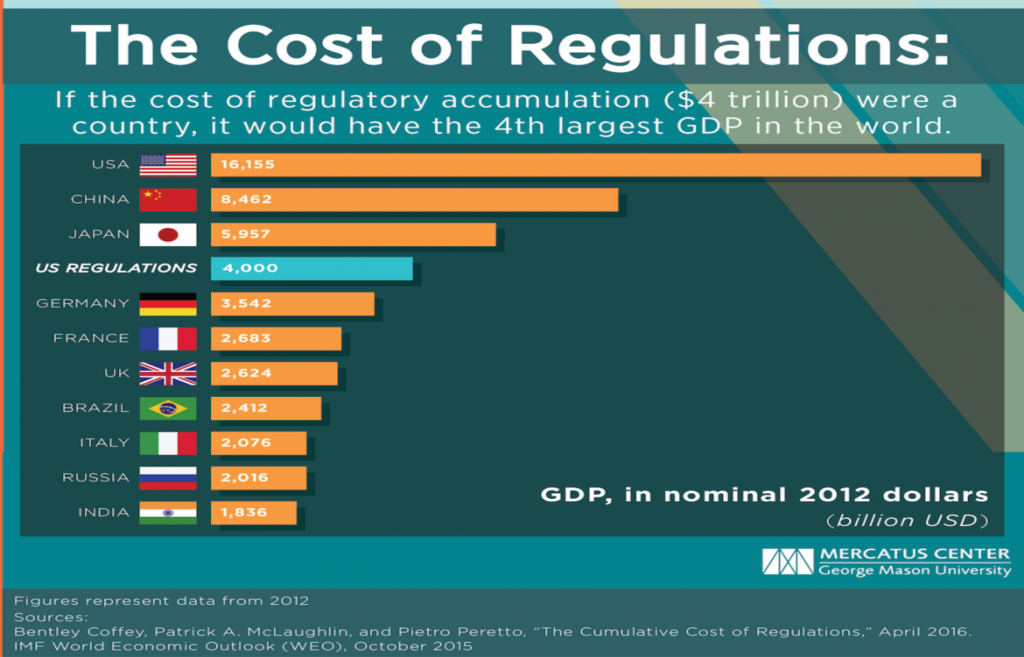
Federal regulations cost every U.S. resident $6,000 in 2019
…..
The Daily Chart: Applying the McGovern Lesson
“This is a good time to recall the lesson George McGovern learned when he started a boutique hotel after his political career ended, only to learn the bitter lessons of the heavy foot of government regulation. This led McGovern to express a heresy:
I also wish that during the years I was in public office, I had had this firsthand experience about the difficulties business people face every day. That knowledge would have made me a better U.S. senator and a more understanding presidential contender…
[M]y business associates and I also lived with federal, state and local rules that were all passed with the objective of helping employees, protecting the environment, raising tax dollars for schools, protecting our customers from fire hazards, etc. While I never have doubted the worthiness of any of these goals,👉the concept that most often eludes legislators is: “Can we make consumers pay the higher prices for the increased operating costs that accompany public regulation and government reporting requirements with reams of red tape.” It is a simple concern that is nonetheless often ignored by legislators.👈
And to go with it.
2013 Federal Regulations Have Made You 75 Percent Poorer
U.S. GDP is just $16 trillion instead of $54 trillion
The growth of federal regulations over the past six decades has cut U.S. economic growth by an average of 2 percentage points per year, according to a new study in the Journal of Economic Growth. As a result, the average American household receives about $277,000 less annually than it would have gotten in the absence of six decades of accumulated regulations—a median household income of $330,000 instead of the $53,000 we get now.
The researchers, economists John Dawson of Appalachian State University and John Seater of North Carolina State, constructed an index of federal regulations by tracking the growth in the number of pages in the Code of Federal Regulations since 1949. The number of pages, they note, has increased six-fold from 19,335 in 1949 to 134,261 in 2005. (As of 2011, the number of pages had risen to 169,301.) They devise a pretty standard endogenous growth theory model and then insert their regulatory burden index to calculate how federal regulations have affected economic growth. (Sometimes deregulation extends rather than shortens the number of pages in the register; they adjust their figures to take this into account.)…
Federal regulations have lowered real GDP growth by 2% per year since 1949 and made America 72% poorer

People esp ‘economists’ forget small business. There are a LOT of one to ten person shops out there. They hire a person or two even if it is just casual labor for a day or two or a week.
April 29, 2013 What America’s $2 Trillion Underground Economy Says About Jobs
…. most of these new participants in the underground economy are ordinary hard-working Americans who are increasingly taking jobs that pay “under the table” either because nothing else is available or they need a second source of income to make ends meet.
America’s underground economy is nothing new, but since the Great Recession hit,[The Obummer years] experts estimate it has doubled in size, driven by unemployed or underemployed people desperate for income….
US gov Small Business Website: 2010 LINK
Small firms accounted for 65 percent (or 9.8 million) of the 15 million net new jobs created between 1993 and 2009…. An estimated 552,600 new employer firms opened for business in 2009, and 660,900 firms closed….
How important are small businesses to the U.S. economy?
Small firms:
• Represent 99.7 percent of all employer firms.
• Employ half of all private sector employees.
• Pay 44 percent of total U.S. private payroll.
• Generated 65 percent of net new jobs over the past 17 years.
• Create more than half of the nonfarm private GDP.
• Hire 43 percent of high tech workers ( scientists, engineers, computer programmers, and others).
• Are 52 percent home-based and 2 percent franchises.
• Made up 97.5 percent of all identified exporters and produced 31 percent of export value in FY 2008.
• Produce 13 times more patents per employee than large patenting firms.
Small businesses losing out to red tape
….cities and states stifle new small businesses at every turn, burying them in mounds of paperwork; lengthy, expensive and arbitrary permitting processes; pointless educational requirements for occupations; or even just outright bans. Today, the Institute for Justice released a series of studies documenting government-imposed barriers to entrepreneurship in eight cities. In every city studied, overwhelming regulations destroyed or crippled would-be businesses at a time when they are most needed.
Time and again, these reports document how local bureaucrats believe they should dictate every aspect of a person’s small business. They want to choose who can go into which business, where, what the business should look like, and what signs will be put in the windows. And if that means that businesses fail, or never open, or can operate only illegally, or waste all their money trying to get permits so they have nothing left for actual operations, that’s just too bad. This attitude would be bad enough in prosperous times, but in a period of financial strain and high unemployment, it’s almost suicidally foolish…..
April 13, 2017 Red Tape Burdens on Small Businesses
It’s well-known the regulatory burden falls disproportionately on small business. American Action Forum (AAF) research has discovered they are shedding jobs and wages are falling because of the Affordable Care Act. In addition, as regulation increases, the number of small business establishments decreases, while the largest businesses grow more numerous. Based on AAF’s latest research, the paperwork and compliance burdens alone total more than 3.3 billion hours and $64.6 billion. Given that compliance affects small businesses more acutely, each new hour of paperwork means less productivity, fewer profits, and diminished competitiveness, relative to larger competitors….
Now if we can get the states, towns and cities to give small businesses relief from idiotic regulations some of those underground businesses can come back into the regular economy. [This is what POTUS Trump is trying to do to unleash the US Economy.]
The 2013 Federal Register contains over 80,000 pages of new rules. As the Dollarhites showed only a large corporation that hires a full time legal staff has any hope of steering clear of traps in those new rules and in the new laws with completely off topic amendments attached. The Dollarhites, whose kids raised pet rabbits and sold them, fell foul of a one liner in an unrelated bill that amended the Animal Welfare Act years after the original law was passed.
That one liner is why I sold off my petting farm animals.
USDA fines family up to four million dollars for selling bunny rabbits
…the Dollarhite family of Nixa, Mo., first started raising and selling bunnies as part of a lesson to teach their teenage son about responsibility and hard work, they had no idea they would eventually meet the heavy hand of the US Department of Agriculture (USDA). According to a recent article covered in Breitbart’s
Big Government, the USDA recently ordered the Dollarhite family to pay more than $90,000 in fines because they sold more than $500 worth of rabbits in a year — and if they fail to pay the fine by Monday, May 23, the fine will multiply to nearly $4 million….
On top of that you need a compliance staff. I worked for a company with a small thirty man staff. After a new law was passed we had to add 3 more people, 10% of the employees, to do nothing except deal with the additional paperwork required. That cost YOU money.
Red Tape Rising: A 2011 Mid-Year Report
Abstract:
Following a record year of rulemaking, the Obama Administration is continuing to unleash more costly red tape. In the first six months of the 2011 fiscal year, 15 major regulations were issued, with annual costs exceeding $5.8 billion and one-time implementation costs approaching $6.5 billion. No major rulemaking actions were taken to reduce regulatory burdens during this period. Overall, the Obama Administration imposed 75 new major regulations from January 2009 to mid-FY 2011, with annual costs of $38 billion. There were only six major deregulatory actions during that time, with reported savings of just $1.5 billion. This flood of red tape will undoubtedly persist, as hundreds of new regulations stemming from the vast Dodd–Frank financial regulation law, Obamacare, and the EPA’s global warming crusade advance through the regulatory pipeline—all of which further weakens an anemic economy and job creation, while undermining Americans’ fundamental freedoms. Action by Congress as well as the President to stem this regulatory surge is essential.
October 2011 Argument for what’s certain: regulations hurting economy
It’s clear the Barack Obama White House ranks as one of the most activist regulatory administrations in history. Consequently, it’s not surprising the administration argues that regulatory costs and uncertainty aren’t hurting the economy.
Jan Eberly, assistant treasury secretary on economic policy, recently tried to make the case for an-all-is-well position on regulation in a Treasury Department blog. The piece opened by quoting Treasury Secretary Tim Geithner in his recent Senate testimony: “I’m very sympathetic to the argument you want to be careful to get the rules better and smarter, but I don’t think there’s good evidence in support of the proposition that it’s regulatory burden or uncertainty that’s causing the economy to grow more slowly than any of us would like.”
Eberly goes on to make various points that supposedly undercut the argument regulation hurts business, the economy and jobs.
She cites a recovery in corporate profits. But that ignores where profits should or could be. In fact, corporate profits only climbed above their 2006 levels last year. For good measure, Eberly ignores that as of the second quarter of this year, proprietors’ income had still failed to climb back to its 2006 level. [Proprietors are small business owners.]
Eberly asserts that a flat workweek for private workers and low capacity utilization point to poor demand, not fear of regulation…
As a private citizen do YOU have the time to read 80,000 pages of new regs a year, not to mention court cases? (Courts can make laws. It is called case law.) These regulations make it almost impossible for people to start and grow a small business.
And that brings us back to the attack on AI. Regulations are the best way to pick winners and losers AND to manage the decline of the USA while making people nothing but wage slaves.


































It’s Thor’s Day. Beware of Thor’s thrown hammer!!!
New Schlichter —
https://townhall.com/columnists/kurtschlichter/2026/09/17/how-are-we-doing-with-the-midterms-seven-weeks-out-n2682946
Female Clancy Juror Cries During Another Interview Amid Media Tour
She needs to be constantly reminded that:
• As a juror, it was not her role to find “the solution to killing children” or “postpartum improvements.”
• It was not the jury’s job to “effect change.”
• “Justice for those children” would be for their murderer to be held accountable.
It seems to me that the female jurors who agreed with her were the ones who were not following the judge’s instructions. They called their misplaced compassion and desire for social change “reasonable doubt.”
Spencer Pratt:
Referring to:
I can’t post the two magazine covers because Xcancel is suspended again.
Nick Sortor:
One of the fundamental issues when discussing governmental interference in the economy is that when and employer and a worker shake hands at $10 per hour, a best-case scenario is that the employer pays $14 and the worker takes home $7.