“We do not believe any group of men adequate enough or wise enough to operate without scrutiny or without criticism. We know that the only way to avoid error is to detect it, that the only way to detect it is to be free to inquire. We know that in secrecy error undetected will flourish and subvert.” –J. Robert Oppenheimer
With Trump now FINALLY restored to his Rightful Office, I was wondering what to name my posts. Continuing to complain that Biden didn’t win when Biden no longer effing matter any more than roadkill seen in the rearview mirror, seemed pointless. Even if it was a monument to Wheatie.
This should have been a week of joy. And indeed much good has happened, a wonderful start!
And then we found out that DePat…Susie…had taken her leave, very much before time. In fact just before she could see Trump restored to office.
DePat and I clashed loudly from time to time but I have nothing but respect for the time and effort she put in on her posts. (This is something I know about being one of the other authors.) To be sure she didn’t do much of the kind of writing she was certainly capable of, but the time it must have taken to gather all of those memes, articles and what-not is substantial. (Seriously when did she find the time?) And she would be visibly frustrated when she couldn’t throw a big pile of them together. Me, I’ll just say “no science post” and move on.
I suppose we can’t know DePat was killed by the Covid Vax in super-hyperdrive reach-out-and-kill-someone mode, though it certainly seems very likely indeed that it found DePat worn out and pounced.
That damned jab has killed hundreds of thousands if not millions…and it’s the “gift” that keeps on giving. If they never gave another slab jab from this moment forward, it would continue killing for years.
What we can know is that this was way too damned early. And for it to happen just before the inauguration she had been waiting for would strike me as incredibly “in-your-face, fuck you” injustice if I were to believe it was done by agency. (And yes, I’ve read the flip side of that viewpoint a lot here, so no need to explain it (again) on my account.)
Perhaps DePat can serve as a symbol of those it killed, even if it were to turn out that she wasn’t one of its victims.
And we should all remember her, and Wheatie, as we push forward with the fight. This is NOT over by any means.
Fight! Fight! Fight! Because JUSTICE must be served on those who foisted that shit on us. And for all the other things they have done to this country.
You failed to pay attention to this advice. You went out of your way to do the opposite. You chose to rub our faces in it, imprison those who dared complain, and even to kill our people. Now you shall pay just a tiny fraction of the real price, Ratfuckers.
Welcome Back, 4GodandCountry
I have no idea if you enjoyed my science posts before you went on sabbatical (I do remember you were enthusiastic about my post on the 50th anniversary of the first moon landing). If so you have plenty of catchup. Largely on physics, but a few side excursions, lately a walk through the solar system and I’ve just started on geology (if I can quit slacking and put out part II).
What is it that feeds our battle, yet starves our victory?
RINO scum. Like Murkowski and Collins.
That’s OK. We go around ’em for now.
January 6 Tapes Reminder
OK…I’m sick and tired of reminding you to no effect, Speaker Johnson, so I’ll do the more emotionally satisfying thing and call you a cowardly, lying, fraudulent sack of diarrhetic monkey shit.
Johnson, you are a cowardly, lying, fraudulent sack of diarrhetic monkey shit!
A Caution
Just remember…we might replace the RINO candidates. (Or we might not. The record is mixed even though there is more MAGA than there used to be.) But that will make no difference in the long run if the party officials, basically the Rhonna McDaniels (or however that’s spelled–I suspect it’s RINO), don’t get replaced.
State party chairs, vice chairs, secretaries and so on, and the same at county levels, have huge influence on who ultimately gets nominated, and if these party wheelhorses are RINOs, they will work tirelessly to put their own pukey people on the ballot. In fact I’d not be surprised if some of our “MAGA” candidates are in fact, RINO plants, encouraged to run by the RINO party leadership when they realized that Lyn Cheney (and her ilk) were hopelessly compromised as effective candidates. The best way for them to deal with the opposition, of course, is to run it themselves.
Running good candidates is only HALF of the battle!
Biden Gives Us Too Much Credit
…we can move on to the next one.
Apparently Biden (or his puppeteer) has decided we’re to blame for all of the fail in the United States today.
Sorry to disappoint you Joe (or whoever), but you managed to do that all on your own; not only that, you wouldn’t let us NOT give you the chance because you insisted on cheating your way into power.
Yep, you-all are incompetent, and so proud of it you expect our applause for your sincerity. Fuck that!!
It wouldn’t be so bad, but you insist that everyone else have to share in your misery. Nope, can’t have anyone get out from under it. Somehow your grand vision only works if every single other person on earth is forced to go along. So much as ONE PERSON not going along is enough to make it all fail, apparently.
In engineering school we’re taught that a design that has seven to eight billion single points of failure…sucks.
Actually, we weren’t taught that. Because it would never have occurred to the professors to use such a ridiculous example.
Justice Must Be Done.
The prior election must be acknowledged as fraudulent, and steps must be taken to prosecute the fraudsters and restore integrity to the system.
Nothing else matters at this point. Talking about trying again in 2022 or 2024 is hopeless otherwise. Which is not to say one must never talk about this, but rather that one must account for this in ones planning; if fixing the fraud is not part of the plan, you have no plan.
Kamala Harris has a new nickname since she finally went west from DC to El Paso Texas: Westward Hoe.
Lawyer Appeasement Section
OK now for the fine print.
This is the WQTH Daily Thread. You know the drill. There’s no Poltical correctness, but civility is a requirement. There are Important Guidelines, here, with an addendum on 20191110.
We have a new board – called The U Tree – where people can take each other to the woodshed without fear of censorship or moderation.
And remember Wheatie’s Rules:
1. No food fights 2. No running with scissors. 3. If you bring snacks, bring enough for everyone. 4. Zeroth rule of gun safety: Don’t let the government get your guns. 5. Rule one of gun safety: The gun is always loaded. 5a. If you actually want the gun to be loaded, like because you’re checking out a bump in the night, then it’s empty. 6. Rule two of gun safety: Never point the gun at anything you’re not willing to destroy. 7. Rule three: Keep your finger off the trigger until ready to fire. 8. Rule the fourth: Be sure of your target and what is behind it.
(Hmm a few extras seem to have crept in.)
Spot Prices
All prices are Kitco Ask, 3PM MT Friday (at that time the markets close for the weekend). (Note: most media quotes are for the bid…the price paid by the market makers, not the ask, which is what they will sell at. I figure the ask is more relevant to people like us who wish we could afford to buy these things. In the case of gold the difference is usually about a dollar, for the PGMs the spread is much wider.)
Gold went up nicely. While it was climbing, silver struggled to keep its head above the water and finally went up 17 cents on Friday–which was most of its gain for the week. So it now takes over ninety ounces of silver to buy an ounce of gold, and that’s assuming of course you don’t have to give the moneychanger a cut.
Silver is on sale right now folks!
*The SteveInCO Federal Reserve Note Suckage Index (FRNSI) is a measure of how much the dollar has inflated. It’s the ratio of the current price of gold, to the number of dollars an ounce of fine gold made up when the dollar was defined as 25.8 grains of 0.900 gold. That worked out to an ounce being $20.67+71/387 of a cent. (Note gold wasn’t worth this much back then, thus much gold was $20.67 71/387ths. It’s a subtle distinction. One ounce of gold wasn’t worth $20.67 back then, it was $20.67.) Once this ratio is computed, 1 is subtracted from it so that the number is zero when the dollar is at its proper value, indicating zero suckage.
Wolf here, getting ready (shortly after the Wolf Moon + Mars) to head to Washington, DC for the Trump-Vance 2025 Inauguration, otherwise known by the shorthand “T47 Inaugural” – or just T47 for short.
TL;DR- if you’re not in the mood to celebrate, then you need a dose of Patriot Realism, to get over your Battered Patriot Syndrome, which we are all suffering. Go check out TradeBait’s post HERE, and wake up to LIBERTY!
I had long told myself that I would be going to Trump’s second inauguration, as I had been to the first one in 2017, and really enjoyed it. With the stolen election of 2020, I ended up going to J6 instead of J20 in 2021, and – well – that was interesting, too.
When Trump managed to beat the cheat on 5 November 2024, I reconfirmed my commitment to attend the T47 inauguration. However, as the time approached, a combination of finicky health and iffy finances had me on the edge of saying “no mas!” Then, when I looked at hotel prices – roughly three times what I had paid in 2017 – I simply couldn’t afford it. I decided not to bother. I would watch the inauguration on TV with all of you, online at The Q Tree.
And it would have been great fun, too. But sitting it out was not to be.
As I began preparing future posts, in my usual “modified placeholder” manner, I wrote a very special and heartfelt post for the January 20th Inauguration Day open thread, as the 2025 Inauguration happens to fall on my usual Monday daily thread. You will see that special post on Monday.
The thing is, some friends of ours apparently saw that post, too. They let me know they were watching, much like they let Wheatie know, back in 2019. If you recall that incident…..
So yeah – that got my attention. All very deniable – but all very convincing.
A lot has changed since 2021, including the passing of Wheatie, whose final battle began late in 2021 and ended in spring of 2022. I think Wheatie was very disappointed to know that she would never see Trump’s second term. Realizing this, and knowing that our old friends from T45 were still keeping an eye on us, I began to change my mind about going to the Inauguration. Others were keeping the faith – why not me? Yes, I’m growing old and tired, but I’ve still got some sense of duty in me.
And then an invitation came. Not only was I invited – my wife was, too. Yeah, it wasn’t one of the gold-encrusted invitations to sit up on the balcony with all the important stiffs like Al Gore and Tim Walz, but it was still an official invitation, and it was made in the name of our once-again Commander In Chief.
That was it. I told my wife we were going. And when I looked at hotel prices again, some of them actually looked reasonable. With a little bit of shopping, it was going to happen.
So, as you read this, during the next few days, I may be preparing to depart for Washington, DC, am already on my way there, or am there as you read this. I will put this up as a sticky thread, so it’s easy for me to find, as well as others who may stumble upon the site. I am hoping to post journalistic updates from the inauguration. Yes, I’m putting my journalist cap on, which may or may not come in Dark MAGA!!!
This thread will be a place to post about all events connected to the T47 Inauguration – including the MAGA Rally on January 19, the Inauguration Festivities and Swearing-In on January 20, and the Inaugural Parade down Pennsylvania Avenue, shortly after the Swearing-In.
There is a great website connected to the Inauguration.
I will go over some of the important information on the site, below. In the meanwhile, I simply want to give my best wishes to all you QTreepers, and to all our friends and allies out there.
Are you ready to Make America Great Again? I AM!
W
T47 Topic – Weather
Scratch all of the following section – the inauguration has WISELY been moved indoors.
I will keep the old text for historic interest, but you can skip ahead to the comments now.
W
Right now, things are looking VERY cold in DC for the inauguration. Part of me wonders whether this is an anti-Trump psy-op by Club Climate Change, but I have seen nothing to convince me that such a thing is happening.
I’m not sure if this incredibly cold inaugural weather should be classified as something like JUSTICE BEING A DISH BEST SERVED COLD, but in any case, I am expecting things to be frigid. EvenTeam Trump is advising weather sense.
Guest Attire
Please dress warmly and wear comfortable shoes. Washington D.C is expecting cold temperatures. Attendees will have limited access to heated tents on a first-come, first-served basis.
I have been to an inauguration before, when the weather was much better (40s and 50s, IIRC) than is currently expected this year (teens and 20s for Inauguration Day). Dressing appropriately makes the whole thing more enjoyable, I can assure you. Last time, as I layered down from a quality trench coat, I was dressed well enough to look good on TV, if I was interviewed by anybody (I think I did talk to a print journalist or political blogger of some kind, IIRC).
This time, for me, “stylish” will be SKIWEAR and basically outdoor winter fashion. In fact, I am advising all others who are going, to DRESS FOR THE SKI LIFTS.
North Face and Columbia – not Dior and Prada.
Why do I say that? Because people who have seats will be sitting for THREE TO SIX HOURS OR LONGER in temperatures in the upper teens to low 20s.
Cross-reference weather with logistics, and it’s time to get VERY REAL.
People need to dress to be sitting comfortably in what are normally wind chill conditions on a ski lifts, where one cannot “walk around to warm up” or otherwise fight hypothermia.
Teens and twenties are January skiing conditions. Get real, people!
Last time, I was running, walking, and standing near the Washington Memorial, thanks to sabotage by the Obama administration, which forced as many people as they could off the main mall, back to the far side of the Washington Memorial, where they would not appear in aerial photos which begin at the Capitol Building.
It was a sneaky move, slow-walking admissions to the mall, while letting people in where they could not be seen. I would not put this past the Biden administration. Note what is being said about arrival times.
Guest Arrival Information
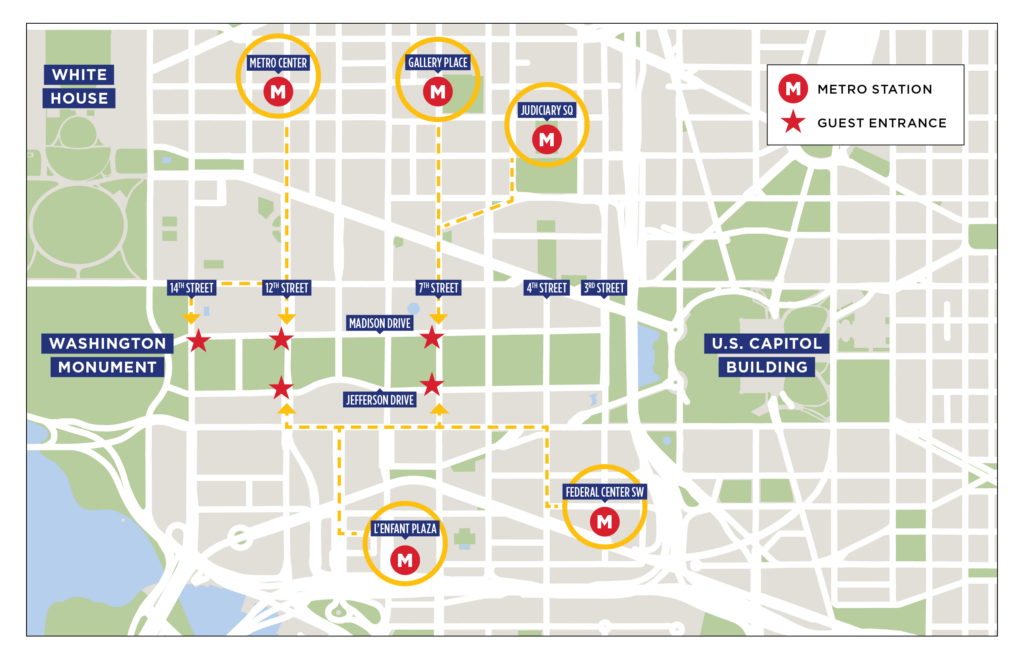
The security line to enter the National Mall will begin to form early. Driving/parking is stronglydiscouraged, please utilize the Washington Metro System (WMATA) to arrive/depart the mall.
U.S.S.S. guest screening will open at 6:00 AM. The inaugural program will start at 9:30 AM; the Swearing-In Ceremony will start at 11:00 AM. To guarantee a spot, please arrive no later than 9:00 AM.
There WILL be food and drink concessions (see below), but the bottom line is that some people will be on the site from 6 AM until 12:30 AM, after the swearing-in.
If the temperatures are actually that cold, it will be like being STUCK ON A SKI LIFT.
Dress warmly. Your goal is to be TOASTY WARM WHILE SITTING STILL.
Now – here is what the situation will actually look like, logistically.
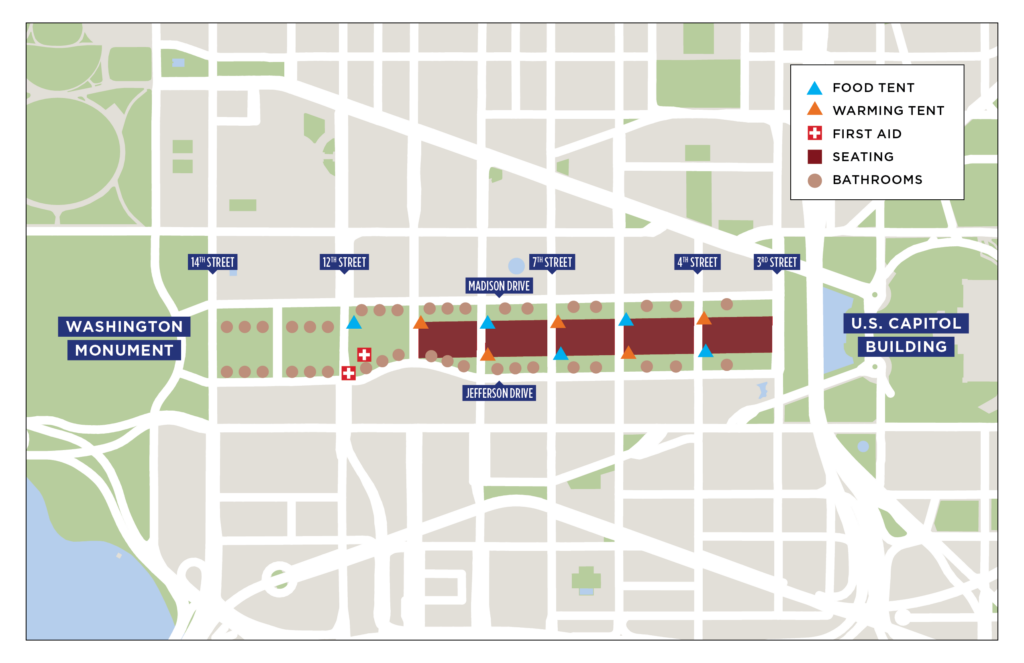
There is seating in the first FIVE of the EIGHT mall blocks. There are also plenty of rest rooms, warming tents, food tents, and medical stations.
Once you’re in the mall, it’s basically like a Trump rally. But if you want to get a seat, you’ve got to get there early. And it will be EVEN COLDER at 6:00 AM on Monday, if the weather predictions are correct.
Thankfully, the MAGA RALLY on January 19 will have better weather, and will be indoors to boot. I view it as good preparation for Inauguration Day. Temperatures are predicted to drop all day, and are looking to be thirtyish by the rally time. There is also a high chance of precipitation, which is probably snow, but could be rain. I will be prepared for either one.
BOY SCOUT MOTTO – BE PREPARED
So – it’s time to get this thing scheduled. Talk to you later!!!
As of desired publication time, 12:01 AM on January 4, there are 16 days, 11 hours and 59 minutes before our Once and Future President, Donald John Trump, is restored to his rightful office.
Not that I’m counting, mind you.
What is it that feeds our battle, yet starves our victory?
Speaker Johnson Pinging you on January 6 Tapes
Just a friendly reminder Speaker Johnson. You’re doing some good things–or at least trying in the case of the budget–but this is the most important thing out there still hanging. One initial block released with the promise of more…and?
We have American patriots being held without bail and without trial, and the tapes almost certainly contain exculpatory evidence. (And if they don’t, and we’re all just yelling in an echo chamber over here, we need to know that too. And there’s only one way to know.)
Either we have a weaponized, corrupt government or we have a lot of internet charlatans. Let’s expose whatever it is. (I’m betting it’s the corrupt weaponized government, but if I am wrong, I’d like to see proof.)
Justice Must Be Done.
The prior election must be acknowledged as fraudulent, and steps must be taken to prosecute the fraudsters and restore integrity to the system.
Nothing else matters at this point. Talking about trying again in 2022 or 2024 is hopeless otherwise. Which is not to say one must never talk about this, but rather that one must account for this in ones planning; if fixing the fraud is not part of the plan, you have no plan.
Small Government?
Many times conservatives (real and fake) speak of “small government” being the goal.
This sounds good, and mostly is good, but it misses the essential point. The important thing here isn’t the size, but rather the purpose, of government. We could have a cheap, small tyranny. After all our government spends most of its revenue on payments to individuals and foreign aid, neither of which is part of the tyrannical apparatus trying to keep us locked down and censored. What parts of the government would be necessary for a tyranny? It’d be a lot smaller than what we have now. We could shrink the government and nevertheless find it more tyrannical than it is today.
No, what we want is a limited government, limited not in size, but rather in scope. Limited, that is, in what it’s allowed to do. Under current circumstances, such a government would also be much smaller, but that’s a side effect. If we were in a World War II sort of war, an existential fight against nasty dictatorships on the brink of world conquest, that would be very expensive and would require a gargantuan government, but that would be what the government should be doing. That would be a large, but still limited government, since it’d be working to protect our rights.
World War II would have been the wrong time to squawk about “small government,” but it wasn’t (and never is) a bad time to demand limited government. Today would be a better time to ask for a small government–at least the job it should be doing is small today–but it misses the essential point; we want government to not do certain things. Many of those things we don’t want it doing are expensive but many of them are quite eminently doable by a smaller government than the one we have today. Small, but still exceeding proper limits.
So be careful what you ask for. You might get it and find you asked for the wrong thing.
Political Science In Summation
It’s really just a matter of people who can’t be happy unless they control others…versus those who want to be left alone. The oldest conflict within mankind. Government is necessary, but government attracts the assholes (a highly technical term for the control freaks).
His Truth?
Again we saw an instance of “It might be true for Billy, but it’s not true for Bob” logic this week.
I hear this often, and it’s usually harmless. As when it’s describing differing circumstances, not different facts. “Housing is unaffordable” can be true for one person, but not for another who makes ten times as much.
But sometimes the speaker means it literally. Something like 2+2=4 is asserted to be true for Billy but not for Bob. (And when it’s literal, it’s usually Bob saying it.) And in that sense, it’s nonsense, dangerous nonsense. There is ONE reality, and it exists independent of our desires and our perceptions. It would go on existing if we weren’t here. We exist in it. It does not exist in our heads. It’s not a personal construct, and it isn’t a social construct. If there were no society, reality would continue to be what it is, it wouldn’t vanish…which it would have to do, if it were a social construct.
Now what can change from person to person is the perception of reality. We see that all the time. And people will, of course, act on those perceptions. They will vote for Trump (or try to) if their perception is close to mine, and vote against Trump (and certainly succeed at doing so) if their perception is distant from mine (and therefore, if I do say so, wrong). I have heard people say “perception is reality” and usually, that’s what they’re trying to say–your perception of reality is, as far as you know, an accurate representation of reality, or you’d change it.
But I really wish they’d say it differently. And sometimes, to get back to Billy and Bob, the person who says they have different truths is really saying they have different perceptions of reality–different worldviews. I can’t argue with the latter. But I sure wish they’d say it better. That way I’d know that someone who blabbers about two different truths is delusional and not worth my time, at least not until he passes kindergarten-level metaphysics on his umpteenth attempt.
Lawyer Appeasement Section
OK now for the fine print.
This is the WQTH Daily Thread. You know the drill. There’s no Poltical correctness, but civility is a requirement. There are Important Guidelines, here, with an addendum on 20191110.
We have a new board – called The U Tree – where people can take each other to the woodshed without fear of censorship or moderation.
And remember Wheatie’s Rules:
1. No food fights 2. No running with scissors. 3. If you bring snacks, bring enough for everyone. 4. Zeroth rule of gun safety: Don’t let the government get your guns. 5. Rule one of gun safety: The gun is always loaded. 5a. If you actually want the gun to be loaded, like because you’re checking out a bump in the night, then it’s empty. 6. Rule two of gun safety: Never point the gun at anything you’re not willing to destroy. 7. Rule three: Keep your finger off the trigger until ready to fire. 8. Rule the fourth: Be sure of your target and what is behind it.
(Hmm a few extras seem to have crept in.)
(Paper) Spot Prices
[EDIT: Forgot to do this, as of 2:50 AM I have edited it to actually mean something]
Gold went up nicely on Thursday (possibly responses to those attacks that aren’t terrorist attacks, oh no they aren’t!) but lost a lot of those gains on Friday. Still, it’s a bit up this week. Silver managed to gain a little bit of ground against it. On the whole, though, things seem pretty stable as we head for 47.
*The SteveInCO Federal Reserve Note Suckage Index (FRNSI) is a measure of how much the dollar has inflated. It’s the ratio of the current price of gold, to the number of dollars an ounce of fine gold made up when the dollar was defined as 25.8 grains of 0.900 gold. That worked out to an ounce being $20.67+71/387 of a cent. (Note gold wasn’t worth this much back then, thus much gold was $20.67 71/387ths. It’s a subtle distinction. One ounce of gold wasn’t worth $20.67 back then, it was $20.67.) Once this ratio is computed, 1 is subtracted from it so that the number is zero when the dollar is at its proper value, indicating zero suckage.
Flat Earthers Strike Back
The guru or pope of the Flat Earth movement–the man who produced those “200 Proofs” videos–has now spoken about the Final Experiment.
According to him it was shot in a studio, one of those fancy 360 dome studios like they use for Mandalorian. (Whatever that is–Star Wars? I stopped following Star Wars after those horrifically bad prequels, Episodes I – III. I honestly should have stopped after Episode I.)
I hate like hell to give this lying turd any views, but here’s his video:
The first point is that he complains the sun in the timelapse changes shape. As if the (alleged) special effects team behind his (alleged) dome studio would be too stupid to not do it that way (heck, it’s more work to do it that way). But okay maybe they did it like that deliberately to double fake us, so that people like me would use the “they wouldn’t be that incompetent” argument. But in fact this shot shows a lot of glare from the sun, and the glare is what is changing shape. Eric Dubay knows this. I know he knows this, because the jackass uses this effect in his own videos!!
In their Gleason’s Map model which many are abandoning (but apparently not Dubay), the Sun never actually dips below the horizon plane since it is always roughly 3000 miles above the flat Earth. Instead it just gets further and further away and eventually we just can’t see it any more; they will invoke “perspective” to explain why it seems to be getting lower and lower in the sky. But getting further and further away would imply that the Sun should look smaller and smaller the closer you are to sunrise and sunset. How does Dubay handle that in his 200 proofs videos? He shows shots of the Sun where the glare orb is of different sizes because of differing atmospheric conditions; he just had to find one with a small glare orb near sunset or sunrise, and one with a bigger glare orb closer to midday.
If you photograph the Sun with a strong enough filter (20 or so stops does it; even seventeen might do it), you know, like I did, you will see it’s always the same actual size. There’s an exceedingly tiny variation over the course of a year because of the Earth’s elliptical orbit, but basically nothing over the course of a day. (This is evidence that the sun is far away compared to distances on Earth.)
Dave McKeegan did a second timelapse of the Sun, tracking it with a filter on. No change in sizes either. Oh, wait. That’s fake. Are my photos also fake? Or the ones taken by many other people around the globe?
The next point is the behavior of shadows. He shows McToon walking around (this is actually the “Where are the Guns, Nathan!?!?!” video, and his shadow apparently changing length and direction, which obviously wouldn’t happen if the object casting the light were far enough away you could treat the light rays as parallel. Well, for someone who likes to invoke “perspective” to explain sun angles, he sure has forgotten the concept here. The man taking the video (McKeegan) was walking around, McToon was walking around; this will cause shadows to appear to pivot. McToon was also getting closer to and further from the camera, and this will make shadows get foreshortened when the object casting them is far enough away. That is actual perspective in action, and Dubay is hoping to find marks too stupid to understand this.
Next, footprints in the snow. Well, you’ll actually see SOME footprints in the snow in the shots Dubay is selecting; but the real issue here is that this snow has been compacted by heavy vehicles driving over it to make a flat area to work in (this space was also used by the Antarctic marathon runners…who of course never saw a sunset either.
No wind? There was wind in other videos.
No visible breath? You don’t get visible breath in dry air. I know this personally since humidity is often quite low here, though not nearly as dry as Way Down Under at Union Glacier.
The bit about the snow is easily explained: Witsit wanted to make sure the camera could see him pick up the snow, so he couldn’t be accused of just picking powder out of an (off camera) bucket. Funny that his due dilligence is being used against him.
A not unrelated rant: One thing a couple of Flerfers have accused me of is believing that the Earth is round solely because I was taught that in school. No. I’ve seen actual evidence for it outside of school, and of course as described above I have evidence that the Sun is far away (which wouldn’t rule out the ancient flat earth theories, but does rule out this stupid pizza world with a firmament model–sort of like a snow globe–that the current crop of FEs is fond of).
Remember, you’re simply watching the behavior of grifters dancing as the evidence that they are full of shit keeps piling up.
No Science Section
Neither the time nor the energy. Last week I divided the post in two and saved the other half off; but it needs fleshing out, a lot of it. I thought about covering a workaday-geology topic (e.g., streams), but it’s almost 9 PM.
What is it that feeds our battle, yet starves our victory?
This post is scheduled to go “live” at 10:01PM MST on Friday, December 20, 2024. That’s 00:01 EST on Saturday, December 21, 2024 for those of you in that benighted timezone near the Atlantic Ocean.
As of that moment, there are 30 days, 11 hours, and 59 minutes until our rightful President of the United States is restored to office.
Not that I’m counting, mind you.
January 6 Tapes Reminder
OK…I’m sick and tired of reminding you to no effect, Speaker Johnson, so I’ll do the more emotionally satisfying thing and call you a cowardly, lying, fraudulent sack of diarrhetic monkey shit.
Johnson, you are a cowardly, lying, fraudulent sack of diarrhetic monkey shit!
A Caution
Just remember…we might replace the RINO candidates. (Or we might not. The record is mixed even though there is more MAGA than there used to be.) But that will make no difference in the long run if the party officials, basically the Rhonna McDaniels (or however that’s spelled–I suspect it’s RINO), don’t get replaced.
State party chairs, vice chairs, secretaries and so on, and the same at county levels, have huge influence on who ultimately gets nominated, and if these party wheelhorses are RINOs, they will work tirelessly to put their own pukey people on the ballot. In fact I’d not be surprised if some of our “MAGA” candidates are in fact, RINO plants, encouraged to run by the RINO party leadership when they realized that Lyn Cheney (and her ilk) were hopelessly compromised as effective candidates. The best way for them to deal with the opposition, of course, is to run it themselves.
Running good candidates is only HALF of the battle!
Biden Gives Us Too Much Credit
…we can move on to the next one.
Apparently Biden (or his puppeteer) has decided we’re to blame for all of the fail in the United States today.
Sorry to disappoint you Joe (or whoever), but you managed to do that all on your own; not only that, you wouldn’t let us NOT give you the chance because you insisted on cheating your way into power.
Yep, you-all are incompetent, and so proud of it you expect our applause for your sincerity. Fuck that!!
It wouldn’t be so bad, but you insist that everyone else have to share in your misery. Nope, can’t have anyone get out from under it. Somehow your grand vision only works if every single other person on earth is forced to go along. So much as ONE PERSON not going along is enough to make it all fail, apparently.
In engineering school we’re taught that a design that has seven to eight billion single points of failure…sucks.
Actually, we weren’t taught that. Because it would never have occurred to the professors to use such a ridiculous example.
Justice Must Be Done.
The prior election must be acknowledged as fraudulent, and steps must be taken to prosecute the fraudsters and restore integrity to the system.
Nothing else matters at this point. Talking about trying again in 2022 or 2024 is hopeless otherwise. Which is not to say one must never talk about this, but rather that one must account for this in ones planning; if fixing the fraud is not part of the plan, you have no plan.
Kamala Harris has a new nickname since she finally went west from DC to El Paso Texas: Westward Hoe.
Lawyer Appeasement Section
OK now for the fine print.
This is the WQTH Daily Thread. You know the drill. There’s no Poltical correctness, but civility is a requirement. There are Important Guidelines, here, with an addendum on 20191110.
We have a new board – called The U Tree – where people can take each other to the woodshed without fear of censorship or moderation.
And remember Wheatie’s Rules:
1. No food fights 2. No running with scissors. 3. If you bring snacks, bring enough for everyone. 4. Zeroth rule of gun safety: Don’t let the government get your guns. 5. Rule one of gun safety: The gun is always loaded. 5a. If you actually want the gun to be loaded, like because you’re checking out a bump in the night, then it’s empty. 6. Rule two of gun safety: Never point the gun at anything you’re not willing to destroy. 7. Rule three: Keep your finger off the trigger until ready to fire. 8. Rule the fourth: Be sure of your target and what is behind it.
(Hmm a few extras seem to have crept in.)
Spot Prices
All prices are Kitco Ask, 3PM MT Friday (at that time the markets close for the weekend). (Note: most media quotes are for the bid…the price paid by the market makers, not the ask, which is what they will sell at. I figure the ask is more relevant to people like us who wish we could afford to buy these things. In the case of gold the difference is usually about a dollar, for the PGMs the spread is much wider.)
Silver down over a dollar…which sounds bad until I tell you it went up fifty cents on Friday, and is still down over a dollar. So Thursday, it really sucked. And the gold:silver ratio is getting really, really bad.
The only thing that went up is…miracle of miracles…platinum, which is still on fricking sale.
*The SteveInCO Federal Reserve Note Suckage Index (FRNSI) is a measure of how much the dollar has inflated. It’s the ratio of the current price of gold, to the number of dollars an ounce of fine gold made up when the dollar was defined as 25.8 grains of 0.900 gold. That worked out to an ounce being $20.67+71/387 of a cent. (Note gold wasn’t worth this much back then, thus much gold was $20.67 71/387ths. It’s a subtle distinction. One ounce of gold wasn’t worth $20.67 back then, it was $20.67.) Once this ratio is computed, 1 is subtracted from it so that the number is zero when the dollar is at its proper value, indicating zero suckage.
It Sucks To Be A Flat Earth Charlatan
If you are a flat earth charlatan, my just telling you you suck would be the LEAST bad aspect of your life. How can you look at yourself in the mirror?
As for everyone else (including Flat Earth true believers–i.e., the victims of the charlatans), you all likely know that The Final Experiment (TFE) happened this last week. At this point the participants are on their way home, except for Critical Think, whose flight from Punta Arenas to Santiago Chile isn’t for another day or two. Then he flies directly from Santiago to Sydney Australia…oh, wait, I forgot, that flight doesn’t exist according to Flat Earthers.
In many cases they collected terabytes of data. (“tera” is what comes after “giga” if you don’t know. “Tera” equals “trillion” (twelve zeroes) and that should be easy to remember because both start with t.) One person recorded over 24 hours of 11K video (not a time lapse, full time video) of the sun. Others took numerous sun spot shots (and they have thousands of emails from people like me waiting for them, for comparison). But it’s taking them days to get back, and now they have to deal with the holidays. So don’t expect much out of them before New Year’s. As for the documentary the one flat-earther professional is putting together, who knows how long that will take. They have all kinds of stuff, that should sink this bullshit once and for all, but won’t, because many of their followers are having cult psychology kick in. “Terabytes of evidence against my position? It must be fake. I can’t possibly just be…wrong about this.”
I’ll post a couple of videos here, some of them are repeats. This one is SciManDan, a Glober who was not part of TFE, talking about various types of copium being taken by the Flerfs:
Here’s something new I found. Lots of clips up front of the Flerfer charlatans insisting that what was seen could not possibly exist–which to me would mean that what was seen invalidates the Flat Earth. But these people move the goal posts. Once that evidence comes up, they need something else…yeah, that is what you need to disprove flat earth. (Marred by the fact that Peterson confuses Ushuaia Argentina with Punta Arenas, Chile):
And this is one I posted earlier. McToon (Glober) is letting Nathan Oakley (Flerfer Charlatan) have it with both barrels.
Wolf took exception to this, thinking McToon was over the top. I disagree. Oakley is a fraudster. This is the least of what that species of “human” deserves. They should have “CON MAN” tattooed on their foreheads.
I will, nevertheless post a Nathan Oakley response:
Precession of the Equinoxes
We’ve got a lot of prerequisites fresh in our minds, so let’s take up precession of the equinoxes, a subject that seems to come up frequently. And I’d normally not touch it with a ten foot pole or a lot of graphics. An animation would be best honestly, and I found one but I wish it showed a bit more (like relation with the Earth’s orbit).
Remember this from last week?
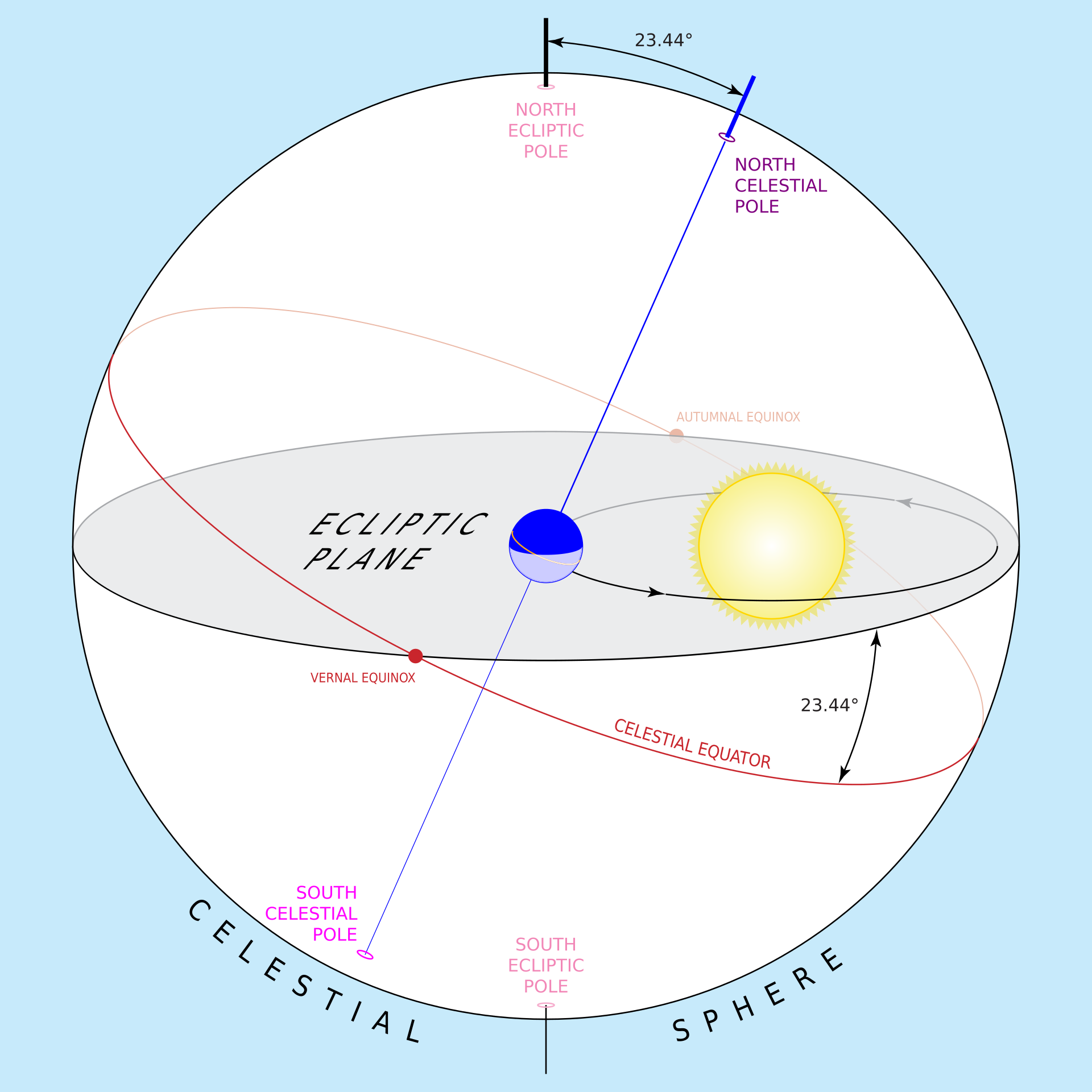
Since the Earth’s axis of rotation is tilted about 23.5 degrees with respect to its orbit, the celestial equator is tilted 23.5 degrees with respect to the ecliptic, as shown below.
Last Week
But then I went on to say:
But since we’re thinking in a set of coordinates that goes from the celestial equator, we think of it the other way around: we think of the ecliptic being tilted with respect to the celestial equator.
Me rambling on more, last week
Well this time we are going to think the the way the diagram shows; the ecliptic will be the basis of another coordinate system, known as…drumroll…the ecliptic coordinate system.
There are actually two ecliptic coordinate systems, one centered on the Sun (heliocentric), the other on the Earth (geocentric). Since the planets generally orbit in planes almost aligned with the Earth’s orbital plane (which is the ecliptic plane), and the Sun is the center of gravity of the solar system, the sun-centered system is very useful for talking about the solar system. Indeed, even though I didn’t mention it at all in the recent series on the planets, I have used it here–go back to the articles on the great conjunction almost exactly four years ago; I did those plots in that system.
But we’ll focus on the Earth centered (geocentric) version this time.
For both systems (as well as the equatorial system I talked about) the primary line is the one pointing towards the vernal equinox (or March equinox, or (sometimes) the “first point of Aries”). It lies in the “reference plane” of all systems. For the ecliptic system, the “poles” are simply a line perpendicular to the ecliptic plane; in the diagram above they are called the north and south ecliptic poles.
In the ecliptic system, the two coordinates are called ecliptic longitude and ecliptic latitude and both are measured in degrees; no mucking around with hours of right ascension and minutes and seconds of arc that aren’t the same kind of minutes and seconds as the other minutes and seconds.
In the heliocentric system longitude is represented by l (italic lower case L) while in the geocentric system it’s represented by Greek letter lambda, λ. Latitude is represented by b (heliocentric) or β (geocentric).
Or, if you know the distance to whatever it is you’re considering, you can go Cartesian, a grid instead of spherical coordinates:
x = r cos β cos λ y = r cos β sin λ z = r sin β
The x axis points towards the first point of Aries, the y axis is 90 degrees counterclockwise from it in the ecliptic plane, and z points toward the north ecliptic pole. The formula is the same for the heliocentric system (swapping b for β and l for λ) and it was the Cartesian version of the helicentric system I worked with in those old posts from four years ago. (And similar conversions can be done with equatorial coordinates.)
[Digression: Both equatorial and ecliptic coordinates are considered “right handed” coordinate systems. Why? Imagine pointing the fingers of your right hand along the x axis, then bending them to point along the y axis (or, if in spherical coordinates, curling the fingers in increasing longitude or right ascension). Raise your thumb like “thumbs up” and it points along the z axis. On a left handed system, this works for the left hand instead. I find this easier than whiddershins and diesel or whatever those words were.]
Imagine a line drawn from “Autumnal Equinox” through the Earth to “Vernal Equinox.” It’s the intersection of the celestial equatorial plane and the ecliptic plane. (Two planes that aren’t parallel and aren’t the same plane, will intersect in a line.) It just happens to be the case that Earth is tilted in such a way that this particular line represents the intersection (and is the X axis in both the equatorial and ecliptic systems).
What if it were in a different place? It’s pretty arbitrary, isn’t it? Why couldn’t it be in a different place?
It would be, if the Earth’s equator were oriented differently–meaning, also, “if the earth’s axis were pointed differently.” Oh, I suppose the Earth’s orbital plane could shift, but that’s much harder than shifting the poles.
I can say this with confidence because the Earth’s axis does indeed shift direction! It does so without changing the angle between the celestial equator and ecliptic. Over the course of some 26,000 years the line of intersection shifts through a full 360 degrees. (And unlike almost everything else…it goes clockwise.) The first point of Aries precesses and the line points to the two equinoxes, so this is precession of the equinoxes.
If you are having trouble visualizing this, well, we’re both in luck. I found a good animation.
By about 30 seconds in you can see how it works.
The effect of this is to move the first point of Aries (represented with that ♈ symbol) around the ecliptic…which means it moves through the Zodiac. The first point of Aries was actually in Aries from about 2000 BCE to 1 CE, then it was in Pisces. It’s about to leave Pisces and shift into Aquarius (“the Age of Aquarius” actually means something…but nothing magic here).
As the first point of Aries moves, the Earth’s axis draws a cone through space, scribing circles on the celestial sphere centered on the ecliptic poles.
There are two other effects of this.
First off, it mucks up both equatorial and ecliptic coordinate systems, because the x axis, the primary axis…is moving! With ecliptic coordinates, you could probably just ignore this…and say we’re going to use the x axis direction from (say) 2000 and just leave it there. Big deal. The fundamental plane doesn’t change. Even if you let the X axis change, the Z axis does not, and you can just add or subtract a correction from ecliptic longitude and be current.
But this precession of the equinoxes absolutely hoses the equatorial coordinate system, because the fundamental plane itself shifts. And we can’t just go on using an old set of axes; the point of the equatorial system is so that you can be assured that if you set a telescope to a certain declination, it will stay at that declination as the earth rotates (even if you don’t have the telescope track whatever you’re looking at). So we issue new charts every fifty years ago, epoch 1950, epoch 2000; with all star coordinates shifted. At some point we will need to switch to something newer–or perhaps they’ll just let computers do the work of listing coordinates according to where the equinoxes are right now.
The other effect is on our year. Just like we have sidereal and solar days, the first being one rotation as seen from the stars, the other being one rotation as seen from the Sun, we have sidereal and tropical years.
A sidereal year is how long it takes for Earth to return to the same spot in its orbit, as seen from far away, in the stars (a sort of “God’s Eye View” of the situation). But our calendar does not track the stars, it tracks the seasons, and the interval between two crossings of the March equinox is called the “tropical year.” We set our calendar up so that the average length of a year (in whole days) is as close to one tropical year as possible. Otherwise, our calendar shifts with respect to the seasons. (We had trouble with that while following the “every four years is a leap year” rule. The calendar would slip against the seasons about 3 days every four hundred years. So we changed the calendar to drop three leap years out of every four centuries. The old schema is called the “Julian calendar” while the new one is the “Gregorian calendar”, each named after the person who instituted the system.)
A calendar year is the interval between one equinox and the next time we’re at that equinox, not (quite) the amount of time it takes for the sun to (apparently) return to the exact same place in the sky.
Actually since a calendar year is a whole number of days, we want the average length of a calendar year to be equal to the amount of time it takes to return to the same equinox (or solstice).
Since, as seen from either the north celestial pole or the north ecliptic pole, the Earth orbits counterclockwise but the equinoxes shift slowly clockwise, the effect is that one tropical year elapses just before the Earth can finish a full orbit with respect to the stars. How much before? About 1,224.5 seconds faster, roughly 20 minutes, 24.5 seconds. You can estimate the exact amount of time it will take the equinoxes to precess by dividing the number of seconds in a sidereal year by 1,224.5 and you get 25,772 years–which invariably gets rounded to 26,000 when you see this talked about in science popularizations. And this makes sense because it happens that the rate itself does vary; it’s not always 1,224.5 seconds per sidereal year.
13,000 years or so from now, Earth will be on the other side of its orbit when springtime hits the Northern hemisphere…but even though the Earth will be on the other side of its orbit, it will still be called March 21, because the calendar tracks the seasons, not the stars.
Speaking Of Earth
Go back through my series of articles on planets, moons, comets, asteroids and the Sun, and it appears I left one thing out, something fairly high up on the list.
The sixth largest body in the solar system.
Yep. I never talked about the third round rock from the Sun, Earth.
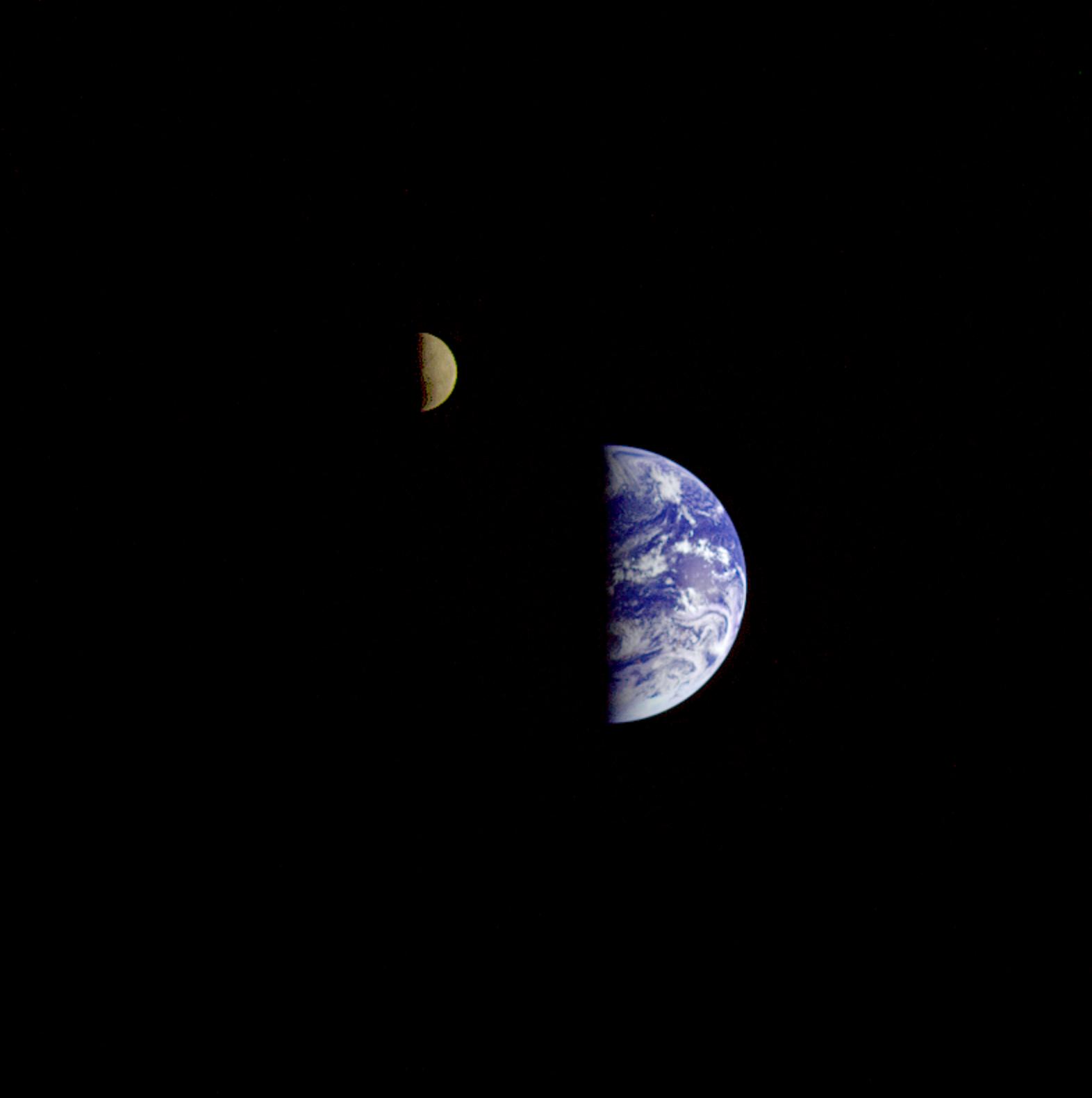
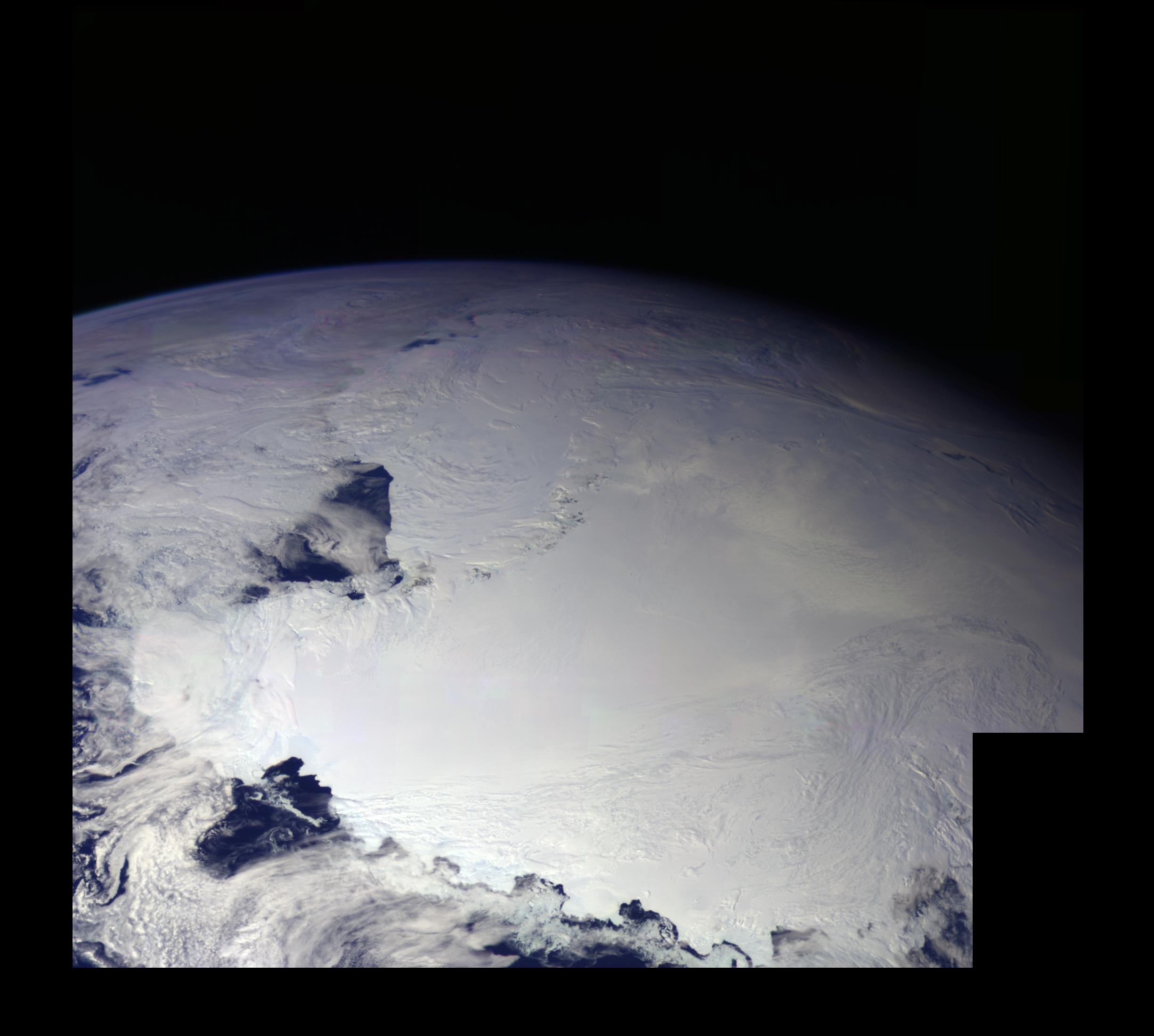
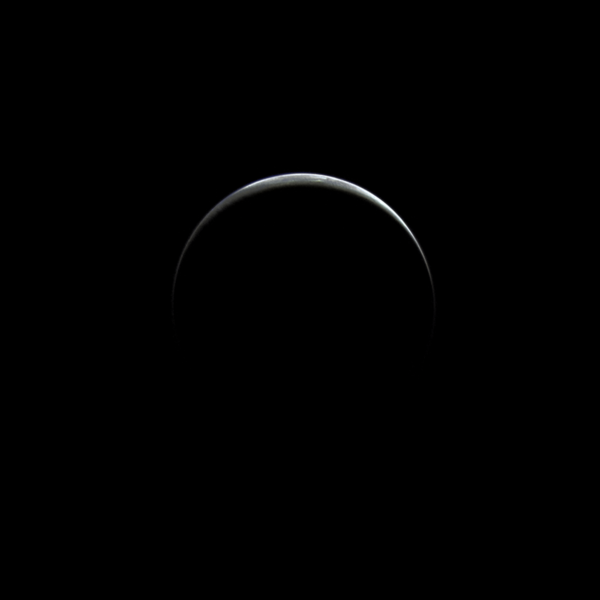
I picked that picture because it was taken from the Galileo space probe. The one that went to Jupiter. Before it got to Jupiter, it played gravity assist pinball, getting a boost from Venus then two assists from Earth. It was the first interplanetary probe to return to Earth (though it didn’t linger).
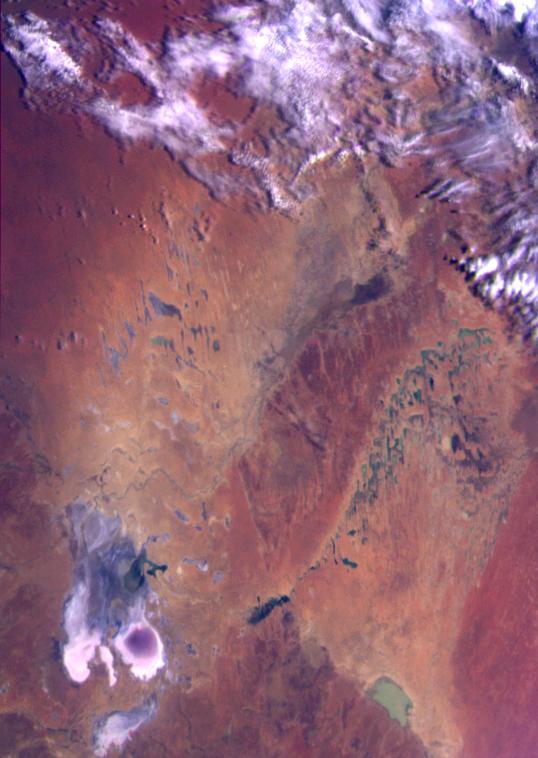
It also took pictures of the Simpson desert in Australia and the Ross ice shelf in Antarctica (the latter is a mosaic assembled from smaller images).
It was useful to see how Galileo’s cameras would behave taking pictures of a known target.
And the Earth is well known; we’ve been stomping around on it for millennia.
So: the basics.
Earth has a radius of 6,371 kilometers. (Try to take so much as one orbital dynamics class without having that number burned into your brain by the time of the final exam.) That is an average. Through the poles, it’s 6356.752 kilometers, through the equator, it’s 6378.137 kilometers. The mean density is 5.513 grams per cubic centimeter…and that is a record for any round body in the solar system. (Metallic asteroids will be higher of course.) It even beats out Mercury which has a large (for its size) core.
Density is useful for helping to figure out what something is made of. A lot of those outer planet moons have very low densities, indicating they’re mostly ice; others have slightly higher densities, indicating they’re more rock than ice…and so on. A typical rock has a density of about 3, and ice is just below 1.
I’ve often talked about the average density of different bodies in the solar system, and you may have wondered how we could possibly know this. It’s not as if we’ve sampled Earth at all depths, much less any of the other bodies we’ve only flown by once.
It turns out we can know this, relatively easily in fact. The average density of some planet or moon is its mass, divided by its volume, so we need to know two other things to get the density. Volume is easy: once you have a radius, r, you can compute the volume of the object via (4/3)πr3. Mass is a little trickier, but we can get most of the way there if something is in orbit around the body. The orbital speed for a circular orbit is v = √(μ/R). Since we’re after the mass, let’s rearrange that a bit: v2R = μ This time R stands for the orbital radius (not the radius of the planet). That other letter, Greek mu (μ), is the gravitational parameter of the body–that’s different for every body. So if we know the distance between the satellite and its primary, and we time how long it takes to orbit (T), we can get the velocity readily (2πR/T). We can substitute into the first formula and get μ = 4π2R3/T2 And then we have this “gravitational parameter” thingie, based totally on the orbital radius and the time it takes the satellite to orbit.
(Gravitational parameter is another thing we had burned into our brains…but at least I’ve managed to forget its value since then. I just looked it up, Earth’s gravitational parameter is 3.986 x 10¹⁴ m3/s2. Except I was used to deal with kilometers per second, so I used 3.986 x 10⁵.
But we wanted mass. Well it turns out that μ is equal to the mass of the primary, M, times the gravitational constant, G. But that’s as far as we could go for about a hundred years; we could measure μ, but we actually had no idea what G was, so we couldn’t get from μ to M. In the late 1790s Henry Cavendish was able to measure the gravitational force between known masses, so this time, he knew the mass, and could compute G. As soon as he did that, every known value of μ, be it for Earth, the Sun, Jupiter, Saturn, could be used to compute a mass. So.
Earth is being orbited by the Moon, so we could do the calculations above and arrive at the total mass of the Earth, then divide by the volume. If a body didn’t have a satellite, though, we were SOL. So we found ourselves in the situation where we knew Uranus’s mass better than we knew the mass of Venus, even though Venus is much closer. Uranus has moons, Venus does not. And of course moons themselves didn’t have anything orbiting around them, so we couldn’t determine their masses, except in the case of our Moon, which is big enough to have a noticeable effect on the Earth.
Once we could send spacecraft out there, though, we could determine masses, by watching how much their trajectories bent as they flew by. That’s a hyperbolic orbit, and the formulae for it also contain μ.
So with Earth being far denser than typical rocks, what’s inside of it? One cause of higher density might just be that rocks deep down might compress some under the weight of the rocks above them, and we now know that this is part of it. But we still need Earth to be largely made of stuff quite a bit denser than average ol’ rocks.
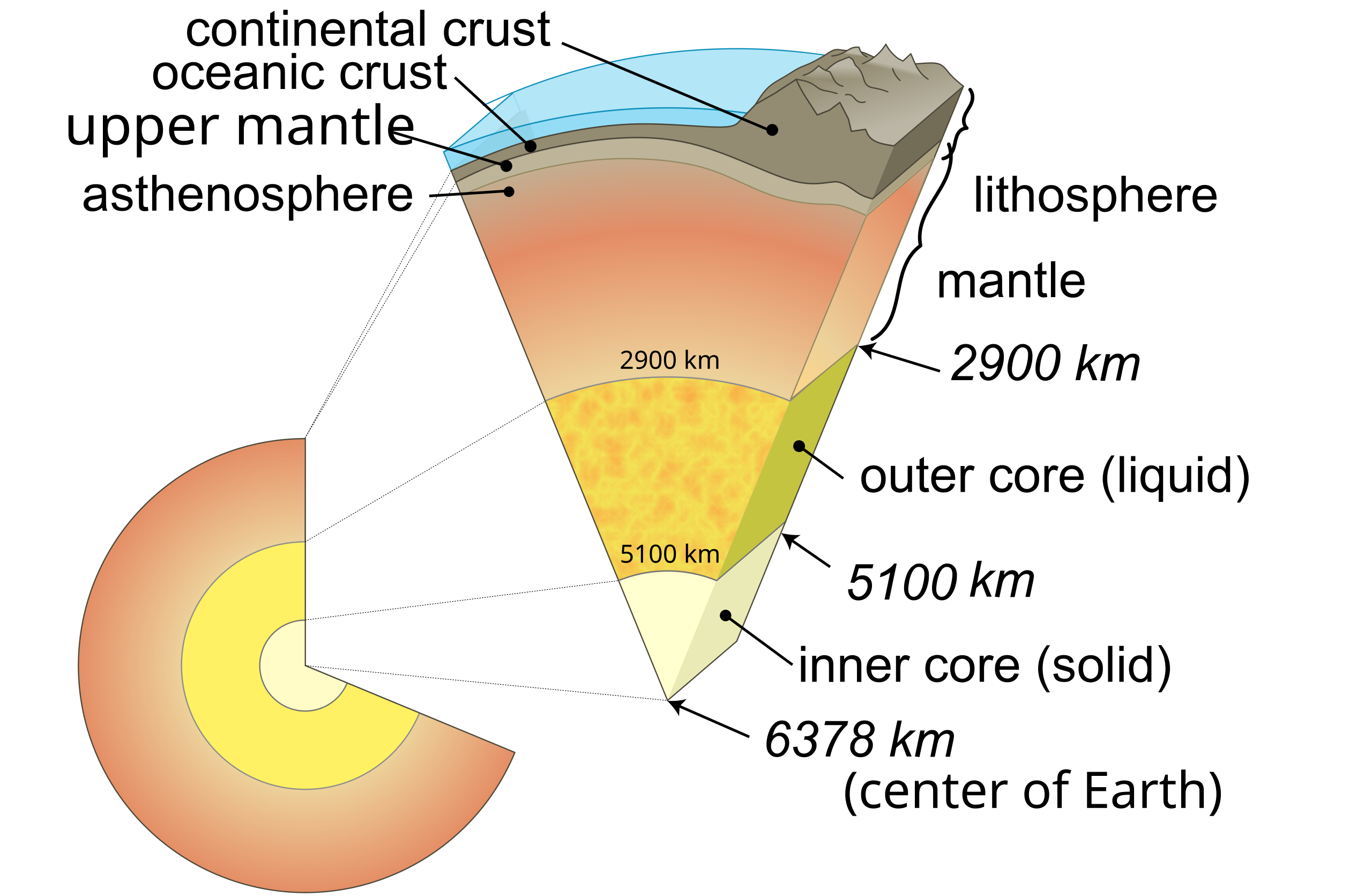
And so we get something like this diagram (which is not to scale, the ocean and crust are drawn much too thick):
The liquid outer core and solid inner core are believed to be composed mostly of iron, with densities ranging from 9.9 to 13.1 grams/cubic centimeter. (Iron on the surface has a density of 7.874–clearly the iron in the core is compressed.) But given that we can’t drill down even to the mantle, much less down to the core, how do we know this? We can kind of guess that the innards are iron, since iron is very common in the universe (supernovas happen when stars try to fuse iron; the supernovas end up basically barfing the iron out into space). And we get meteorites consisting of mostly iron, to reinforce that. But liquid? How much?
That one’s a bit harder than computing average density. But the answer, in one word, is “seismology.”
If you think I’m just going to leave it there…you don’t know me very welly.
Seismic waves are waves through the solid material of Earth, resulting from earthquakes, volcanoes, movements of magma underground, and even man-made explosions. There are all sorts of different kinds of seismic waves, and different ways to divvy them up.
One is surface waves vs. Body waves. Surface waves travel along the surface of Earth, while body waves travel through the whole body of earth. Surface waves will tend to get weaker in proportion to distance, while body waves will get weaker in proportion to distance squared. (There’s a good intuitive reason for this. Think about a surface wave traveling away from its source ten kilometers. The entire energy of the wave is contained along a circle 2π x 10 km in circumference. Wait for the wave to reach a 20 km distance, all of the energy is distributed along 2π x 20 km of line. Twice as much, so the wave will be half as strong. Body waves travel outwards along consistent hemispheres, not circles, and the hemisphere’s area multiplies by four when the radius doubles.)
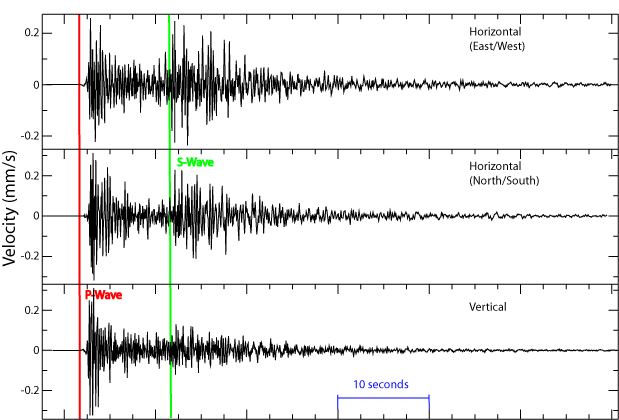
Body waves, in turn, come in two types: P (or primary) waves, and S (or secondary) waves. These names come from the fact that the P waves move faster, so they reach seismographs first. Below is an example, the P wave hits, then the S wave.
The two types are fundamentally different. P waves are longitudinal…which means that the medium the wave is traveling through moves in the same direction the wave is moving. This is very much the way sound works; the sound wave consists of denser and less dense atmosphere and the air molecules move towards and away from the sound source to build up bands of compression and rarefaction. Below is a diagram of a longitudinal wave traveling from left to right.
I said they are much like sound waves, and in fact when a P wave reaches the surface, it will often make a noise. Travel speeds are 330 m/s in air, 1450 m/s in water and 5000 m/s in granite.
Secondary waves are transverse (like light waves).
They take roughly 1.7 times as long to cover the same distance as a P wave, and there is one other key difference: They don’t go through fluids. P waves do but they will bend. In fact both will curve when the density of the medium changes (this is another example of refraction).
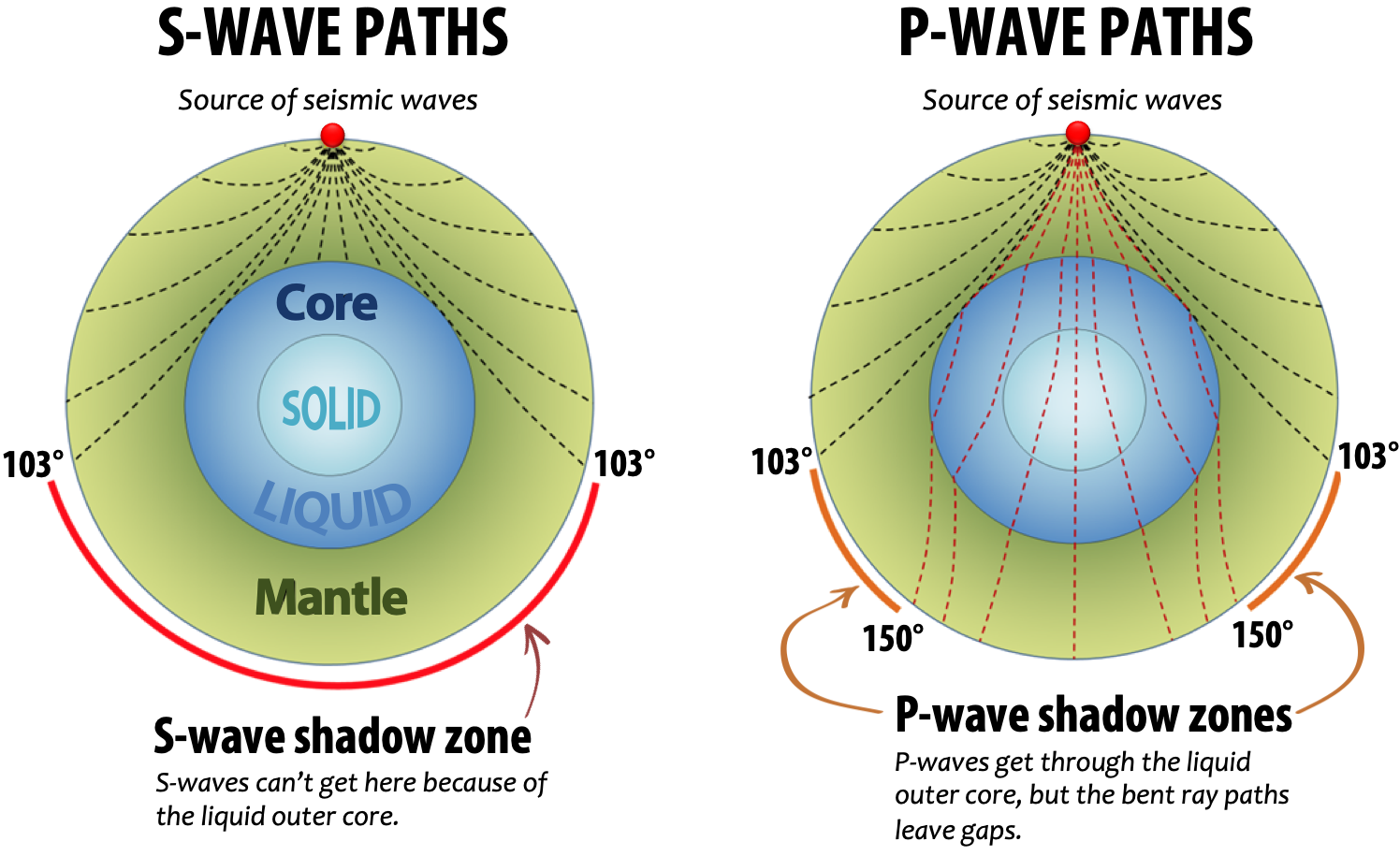
So we can glean some information about what’s inside the Earth just by looking at how seismometers in different parts of the world react to strong earthquakes. S waves never show up more than 103 degrees away from the epicenter of an earthquake, beyond that, you are in the S wave “shadow”–a shadow cast by a liquid layer deep inside the Earth. P waves have a much complex shadow pattern, as seen below, caused by an abrupt bend in the wave at the core boundary. The core doesn’t stop P waves, but it does bend them sharply.
So we know we have a liquid core outer core. How do we know what it’s made of? It does cause Earth’s magnetic field so we know it’s a metal. Meteorites (which came off other bodies of the solar system) come in many different types but occasionally one will show up that is almost pure metal, and that will be roughly 90 percent iron, ten percent nickel. (In fact the meteor that created the Barringer or “Meteor” crater in Arizona was an iron-nickel type.)
So that’s the beginning of how we know what’s inside there. We get the occasional mantle rock brought up by geologic processes, too.
[It just occurred to me this is another bit of evidence for a globe shaped earth. S wave shadows exist. Plot them on a globe, and compare to the origin of the waves. Then do the same on the flat earth disc. Which of the two patterns is symmetric and simple to explain, and which is just some random-seeming curve-bounded area with no obvious physical explanation? I don’t think I’ve ever seen anyone else bring this up.]
I’m going to leave it there.
“But Steve, you skipped over Earth in your series on the planets, and this is all we get?”
You proceed from a false premise. This isn’t part of the series on the planets and moons and other stuff in our Solar System. That series is over.
This is the first part of a new series, on geology. There will be more, lots more.
As of desired publication time, 12:02 AM on November 29th, there are 51 days, 11 hours and 58 minutes before our Once and Future President, Donald John Trump, is restored to his rightful office.
Not that I’m counting, mind you.
What is it that feeds our battle, yet starves our victory?
Speaker Johnson Pinging you on January 6 Tapes
Just a friendly reminder Speaker Johnson. You’re doing some good things–or at least trying in the case of the budget–but this is the most important thing out there still hanging. One initial block released with the promise of more…and?
We have American patriots being held without bail and without trial, and the tapes almost certainly contain exculpatory evidence. (And if they don’t, and we’re all just yelling in an echo chamber over here, we need to know that too. And there’s only one way to know.)
Either we have a weaponized, corrupt government or we have a lot of internet charlatans. Let’s expose whatever it is. (I’m betting it’s the corrupt weaponized government, but if I am wrong, I’d like to see proof.)
Justice Must Be Done.
The prior election must be acknowledged as fraudulent, and steps must be taken to prosecute the fraudsters and restore integrity to the system.
Nothing else matters at this point. Talking about trying again in 2022 or 2024 is hopeless otherwise. Which is not to say one must never talk about this, but rather that one must account for this in ones planning; if fixing the fraud is not part of the plan, you have no plan.
Small Government?
Many times conservatives (real and fake) speak of “small government” being the goal.
This sounds good, and mostly is good, but it misses the essential point. The important thing here isn’t the size, but rather the purpose, of government. We could have a cheap, small tyranny. After all our government spends most of its revenue on payments to individuals and foreign aid, neither of which is part of the tyrannical apparatus trying to keep us locked down and censored. What parts of the government would be necessary for a tyranny? It’d be a lot smaller than what we have now. We could shrink the government and nevertheless find it more tyrannical than it is today.
No, what we want is a limited government, limited not in size, but rather in scope. Limited, that is, in what it’s allowed to do. Under current circumstances, such a government would also be much smaller, but that’s a side effect. If we were in a World War II sort of war, an existential fight against nasty dictatorships on the brink of world conquest, that would be very expensive and would require a gargantuan government, but that would be what the government should be doing. That would be a large, but still limited government, since it’d be working to protect our rights.
World War II would have been the wrong time to squawk about “small government,” but it wasn’t (and never is) a bad time to demand limited government. Today would be a better time to ask for a small government–at least the job it should be doing is small today–but it misses the essential point; we want government to not do certain things. Many of those things we don’t want it doing are expensive but many of them are quite eminently doable by a smaller government than the one we have today. Small, but still exceeding proper limits.
So be careful what you ask for. You might get it and find you asked for the wrong thing.
Political Science In Summation
It’s really just a matter of people who can’t be happy unless they control others…versus those who want to be left alone. The oldest conflict within mankind. Government is necessary, but government attracts the assholes (a highly technical term for the control freaks).
His Truth?
Again we saw an instance of “It might be true for Billy, but it’s not true for Bob” logic this week.
I hear this often, and it’s usually harmless. As when it’s describing differing circumstances, not different facts. “Housing is unaffordable” can be true for one person, but not for another who makes ten times as much.
But sometimes the speaker means it literally. Something like 2+2=4 is asserted to be true for Billy but not for Bob. (And when it’s literal, it’s usually Bob saying it.) And in that sense, it’s nonsense, dangerous nonsense. There is ONE reality, and it exists independent of our desires and our perceptions. It would go on existing if we weren’t here. We exist in it. It does not exist in our heads. It’s not a personal construct, and it isn’t a social construct. If there were no society, reality would continue to be what it is, it wouldn’t vanish…which it would have to do, if it were a social construct.
Now what can change from person to person is the perception of reality. We see that all the time. And people will, of course, act on those perceptions. They will vote for Trump (or try to) if their perception is close to mine, and vote against Trump (and certainly succeed at doing so) if their perception is distant from mine (and therefore, if I do say so, wrong). I have heard people say “perception is reality” and usually, that’s what they’re trying to say–your perception of reality is, as far as you know, an accurate representation of reality, or you’d change it.
But I really wish they’d say it differently. And sometimes, to get back to Billy and Bob, the person who says they have different truths is really saying they have different perceptions of reality–different worldviews. I can’t argue with the latter. But I sure wish they’d say it better. That way I’d know that someone who blabbers about two different truths is delusional and not worth my time, at least not until he passes kindergarten-level metaphysics on his umpteenth attempt.
Lawyer Appeasement Section
OK now for the fine print.
This is the WQTH Daily Thread. You know the drill. There’s no Poltical correctness, but civility is a requirement. There are Important Guidelines, here, with an addendum on 20191110.
We have a new board – called The U Tree – where people can take each other to the woodshed without fear of censorship or moderation.
And remember Wheatie’s Rules:
1. No food fights 2. No running with scissors. 3. If you bring snacks, bring enough for everyone. 4. Zeroth rule of gun safety: Don’t let the government get your guns. 5. Rule one of gun safety: The gun is always loaded. 5a. If you actually want the gun to be loaded, like because you’re checking out a bump in the night, then it’s empty. 6. Rule two of gun safety: Never point the gun at anything you’re not willing to destroy. 7. Rule three: Keep your finger off the trigger until ready to fire. 8. Rule the fourth: Be sure of your target and what is behind it.
Gold took a ninety dollar thumping on Monday, seemed to be going nowhere the rest of the week, but has recovered a little bit on Friday. The same is pretty much true of the other precious metals, though one will note rhodium actually dropped a bit. The gold:silver ratio still sucks (if you’re a silver fan).
*The SteveInCO Federal Reserve Note Suckage Index (FRNSI) is a measure of how much the dollar has inflated. It’s the ratio of the current price of gold, to the number of dollars an ounce of fine gold made up when the dollar was defined as 25.8 grains of 0.900 gold. That worked out to an ounce being $20.67+71/387 of a cent. (Note gold wasn’t worth this much back then, thus much gold was $20.67 71/387ths. It’s a subtle distinction. One ounce of gold wasn’t worth $20.67 back then, it was $20.67.) Once this ratio is computed, 1 is subtracted from it so that the number is zero when the dollar is at its proper value, indicating zero suckage.
Flat Earth Cowards
Just remember that David Weiss, Eric Dubay, Mark Sargent, Nathan Oakley, Dean Odle, and Volker Meyer, all Flat Earth proponents on the internet, are intellectual cowards at best, and knowing fraudsters (politespeak for motherfucking liars) at worst, and I am in this case inclined to believe the worst.
After years of maintaining that the Sun does indeed set in Antarctica during the southern summer, but then claiming people aren’t allowed to go look, they’ve turned down the opportunity to go look. Worse, many of them condemn Jeranism, Whitsit Gets It, and Lisbeth Acosta for going.
Any reasonable person looking at this behavior should see the hallmarks of a fraudster. The fraudster wants you to believe what he says unconditionally. The fraudster wants you to 1) ignore the lack of evidence for his position and 2) the actual evidence against his position. This is a system for protecting lies.
Would someone condemn people for going and looking, if they sincerely thought their position was true?
These people are pushing bullshit and they know they are pushing bullshit. These people are lying turds.
By contrast, eight of the globers who spend time debunking flerfers are going, one is paying for himself, one is getting the free ride offered as part of TFE, the other six are crowd funded. Globers also crowdfunded Lisbeth to go when the anonymous donor who funded a drawing for the flerfers turned out to himself be a flerfer fraud. Globers crowd funding her, not flerfers. All of the globers (and many who are not going, such as Professor Dave Explains) have vowed to remove their anti-flat earth content and post a statement that the earth is flat, if the sun actually sets for those at the Final Experiment.
Who is acting confident in their position…and who is acting like they are afraid this whole thing will make it obvious they are simply worthless shitbag liars?
On The Fringes? The Trans-Neptunian Worlds
There are nine objects that are likely “dwarf planets” (i.e. objects too small to be “real” planets, but which are nevertheless rounded by their own gravity and orbit the Sun directly). It’s difficult to confirm the roundness of many of these as all we can see of them is a fuzzy blob, even with the Hubble Space Telescope.
Here they are:
Name Minor Planet Number
min, max distances, (mean) (in AUs)
Eccentricity (0=circular, 1=parabola)
Inclination to ecliptic (degrees)
Period (years)
Year Discovered
Precovery Date
Ceres 1
2.55- 2.98 (2.77)
0.0785
10.6
4.60
1801
–
Pluto 134340
29.658- 49.305 (39.482)
0.2488
17.16
247.94
1930
1909
Quaoar 50000
41.900- 45-488 (43.694)
0.04106
7.9895
288.83
2002
1954
Sedna 90377
76.19- 937 (506)
0.8496
11.9307
11,390
2003
1990
Orcus 90482
30.281- 48.067 (39.174)
0.22701
20.592
245.19
2004
1951
Haumea 136108
34.647- 51.585 (43.116)
0.19642
28.2137
283.12
2003
1955
Eris 136199
38.271- 97.457 (67.864)
0.43607
44.040
559.07
2005
1954
MakeMake 136472
38.104- 52.786 (45.430)
0.16126
28.9835
306.21
2005
1955
Gonggong 225088
33.781- 101.190 (67.485)
0.49943
30.6273
554.37
2007
1985
Orbital Parameters of the nine likely dwarf planets
A word of explanation: The “precovery” date is the oldest image found of the object, when they go back looking to see if anyone ever accidentally photographed it. This seems like a bit of trivia, but those images can be extremely useful for determining the orbit of the object (not just the semi major axis, inclination and eccentricity but also the longitude of the ascending node, argument of perihelion and time of perihelion–those three orient the orbit (along with the inclination) and put the object at a certain spot in the orbit). This is why astronomers never throw away an astrophotograph; it may be beneficial decades later.
It should be noted that the full list of possible dwarf planets is 28 objects long, based on estimated diameters, though some have no names (just minor planet numbers). For the sheer sake of self-preservation, one should probably hope that 229762 Gǃkúnǁʼhòmdímà does not make the list, as !Kung words are notoriously hard to pronounce. (No, I am not making that up.)
By the opposite token, only Ceres and Pluto are absolutely solidly confirmed to be dwarf planets; it pretty much takes a spacecraft mission to confirm it.
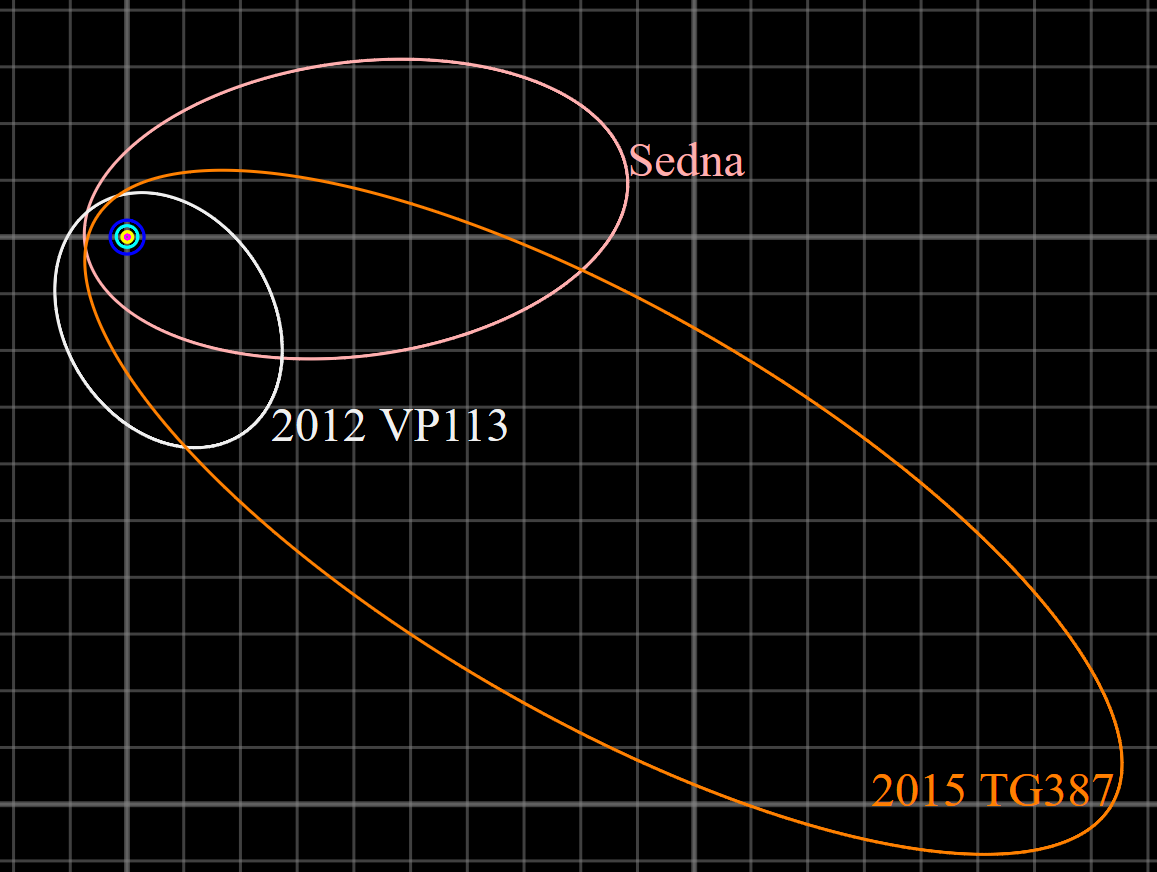
Ceres is an outlier, obviously, because it’s the only object in the table that isn’t a trans-Neptunian object. I’ve covered asteroids already, so from this point forward I am going to ignore the world Ceres. (Never was much into baseball anyway.) Aside from Ceres the other oddball is Sedna, with a huge eccentricity and a huge orbit; it makes all of the others pale in comparison.
What would a well behaved full-blown classical planet look like in that table? It would have a low eccentricity and a low inclination. Quaoar actually behaves more like a planet than any of the others in the table (even including Ceres).
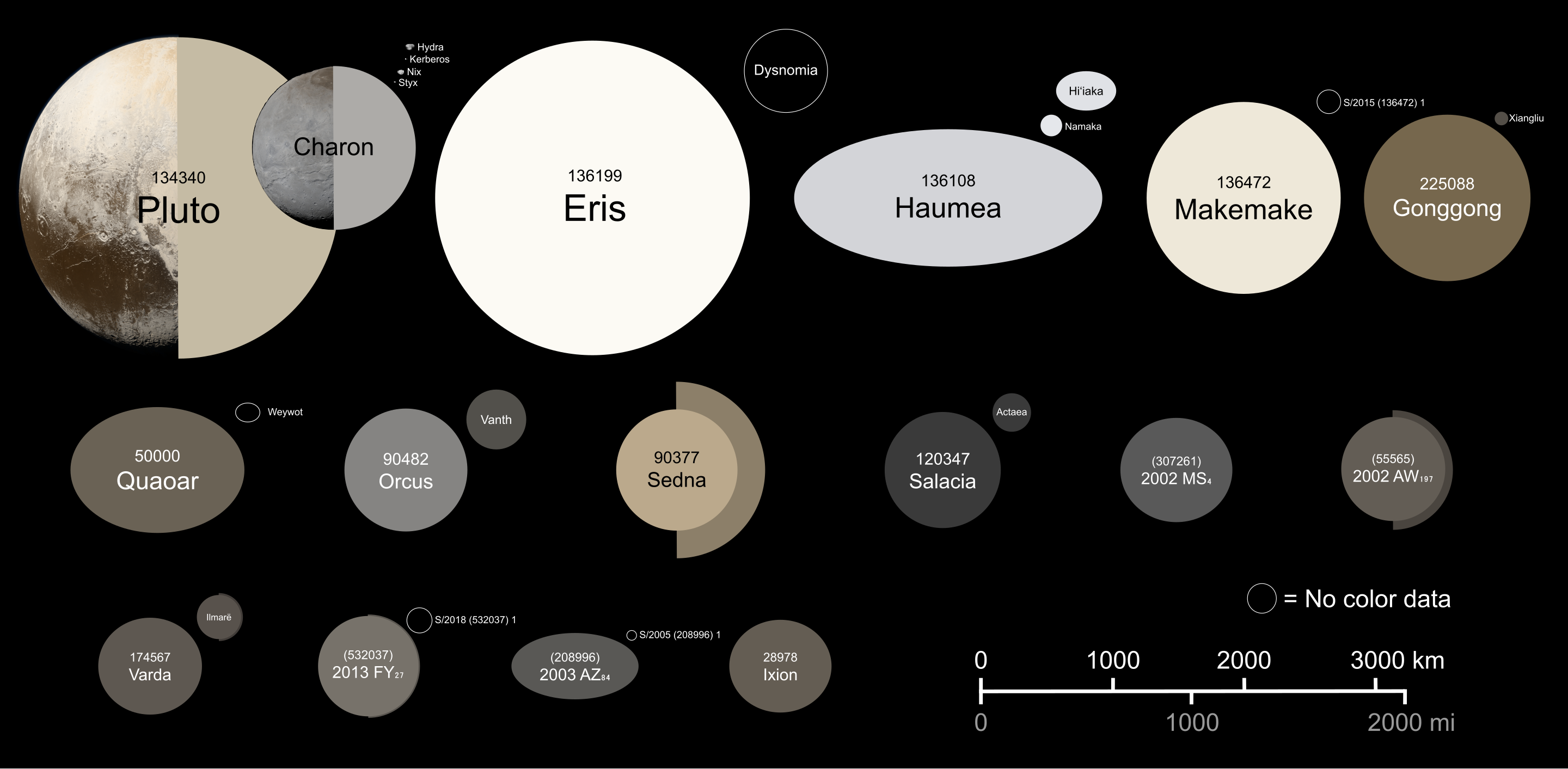
Here is another diagram, showing relative sizes, shapes, colors and brightnesses of these and some other objects. The color is of course an average color. In some cases there’s uncertainty as to size (as with Sedna), in which case a half-arc is shown at the maximum diameter. This one might reward a right-click-and-open-in-new-tab.
So now let’s take a look at these in more detail; I’m going to save Sedna and Pluto for last (and not bother at all with Ceres).
Quaoar
Quaoar (pronounced kwah-wahr, though more strictly speaking it should be “kwa’uwar” with the ‘ representing a glottal stop as you hear in the Hawaiian pronunciation of Hawai’i) is named after a deity of the Tongva people, and for me at least that answers nothing until I go look up “Tongva people.” It turns out they were a tribe in what is now the Los Angeles basin. (They also call themselves the Kizh.) Their language is distantly related to Aztec.
Quaoar was discovered 4 June 2002 by Chadwick A. Trujillo and Michael E. Brown at the Palomar Observatory (they were not using the big 200 incher but one of the smaller (but still big) instruments, the Samuel Oschin telescope. They were running a survey looking for Kuiper belt objects (little did they know…). Once it was determined that Quaoar was not in a resonance with Neptune (making it a qubewano-class TNO), the naming convention dictated it be named after a creation deity; Brown and Trujillo consulted with some present-day Tongvas to be sure it was an appropriate name.
Quaoar is an elongated ellipsoidal shape averaging 1090 km across, making it less than half the size of Pluto (2,376.6 km). (We know it’s not perfectly spherical because its brightness varies over a span of 17.68 hours–which we infer is its day. This could just be brightness differences, like with Iapetus, but we’ve also watched Quaoar cross in front of stars and timing the length of the blackouts leads to different estimates of the diameter.) Quaoar is also a very dark object reflecting only 12% of the light it gets from the Sun (which ain’t much to begin with!) It’s somewhat reddish, like 20000 Varuna and 28978 Ixion (both objects that are on the “long list” of possible dwarf planets).
So if it’s not really round, what’s the deal with it being considered a dwarf planet? Normally any rocky body over 900km or so, or any icy body between 200-400 km across should go round. If it’s slowly rotating it should be a bit oblate (wider at the equator than through the poles). A faster rotation should resemble Haumea’s case (see below). So how can Quaoar not be round? It’s absolutely big enough. It’s possible that Quaoar used to rotate more quickly, froze into shape and then Weymot slowed its rotation down due to tidal effects. (Saturn’s moon Iapetus has a similar situation going on but is not as extreme.)
Here are the discovery images put together as a GIF. It’s easy to spot when there’s an arrow, isn’t it?
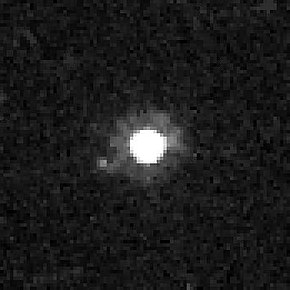
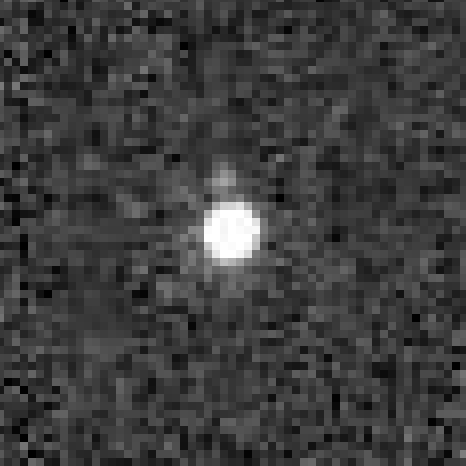
And now (drumroll) our best image, from the Hubble space telescope:
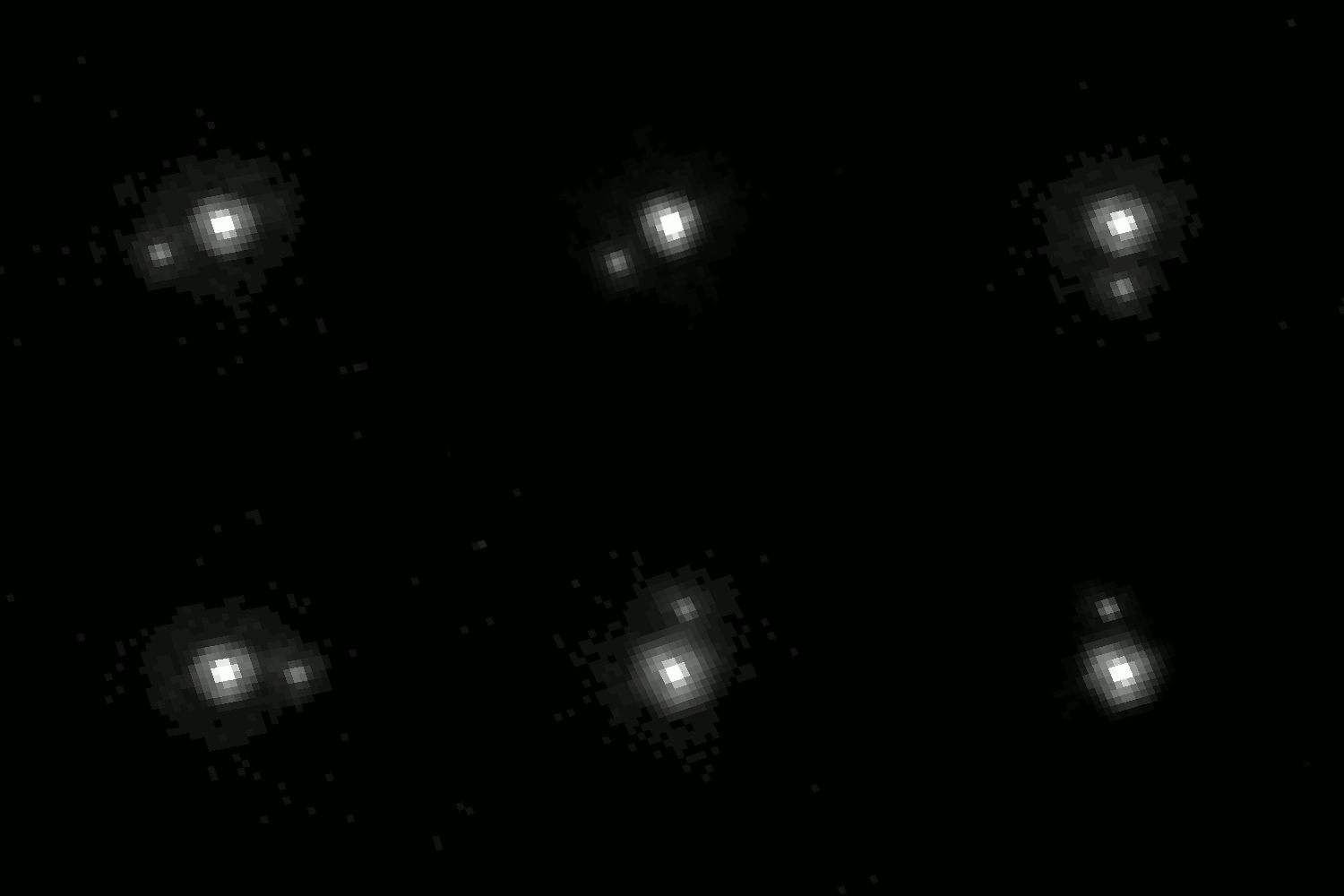
And yes, Quaoar has a moon, Weywot, discovered by Brown in February 2007; Weywot is the son of Quaoar in Tongva mythology. Weywot is about 200 km across (though some places in Wikipoo show it as smaller), which makes it too small to be rounded (the smallest rounded object known is Mimas (Saturn’s “Death Star” moon), at 396.4 km; there is at least one non-rounded objects that are larger: Neptune’s moon Proteus). Quaoar also has a ring.
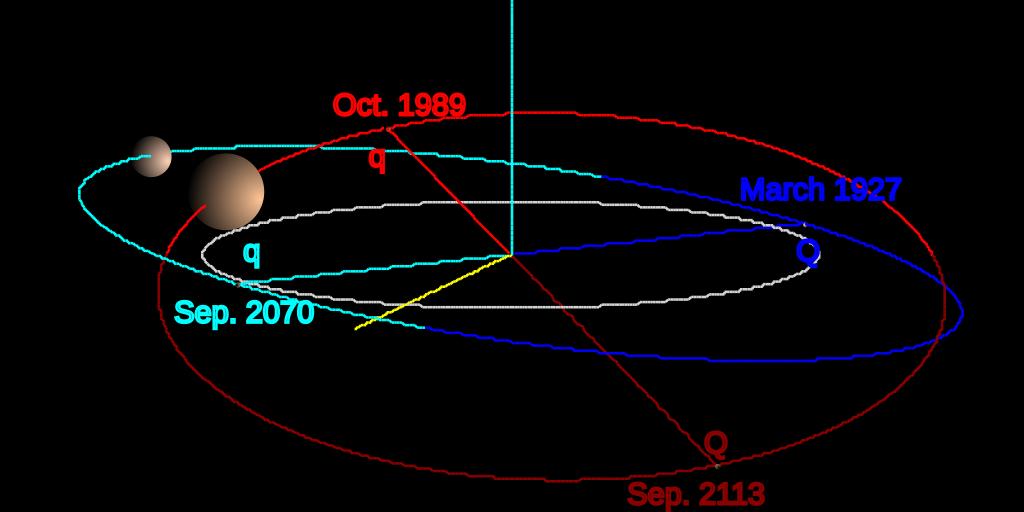
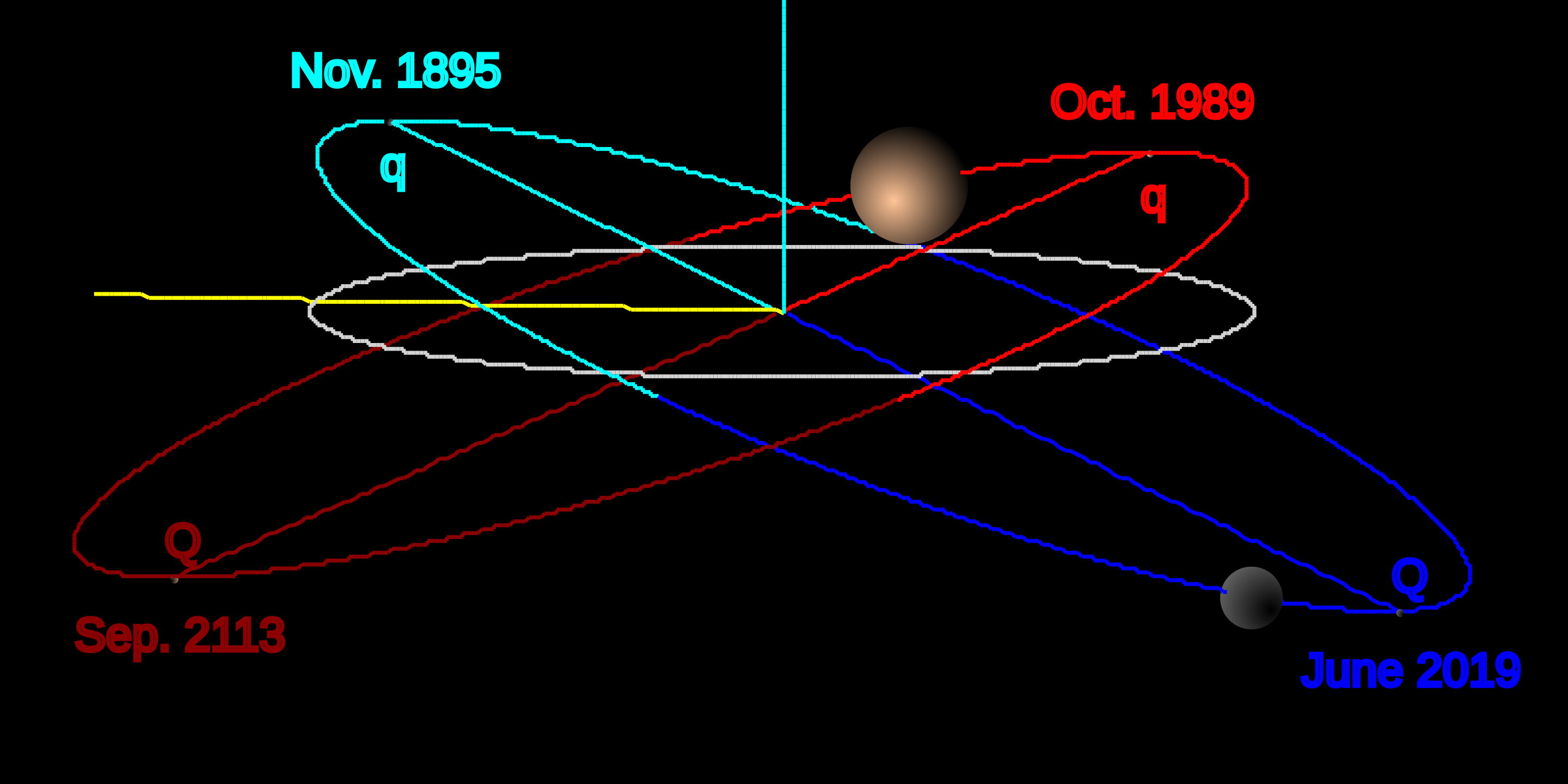
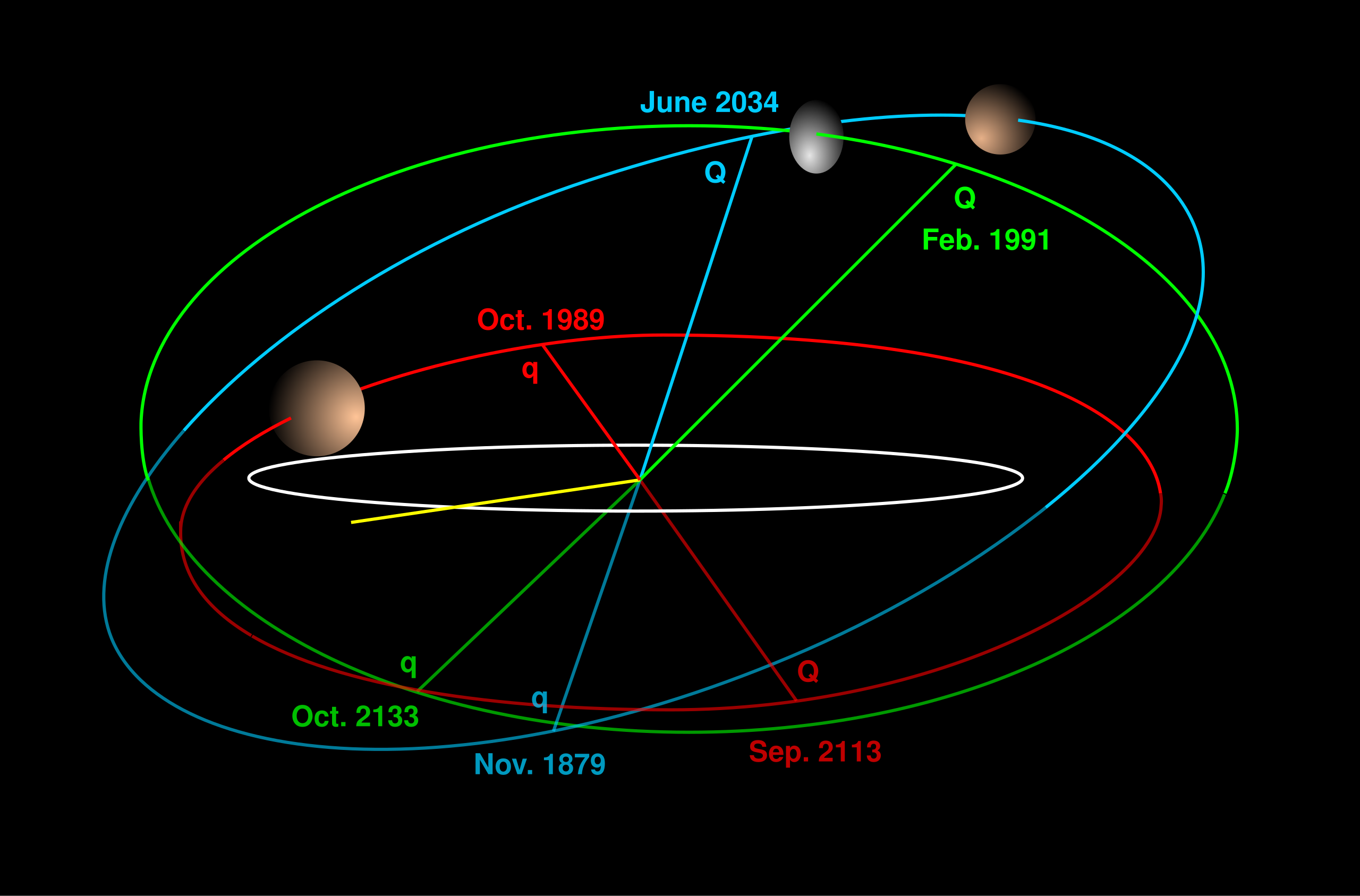
Here are a couple more diagrams, the first being a picture of Quaoar’s orbit (in cyan and blue) compared to Neptune (white) and Pluto (red). The two spheres are not only about the right sizes, comparatively speaking (but not compared to the size of the orbits!), but they are correctly colored (an average color) and even the brightness (albedo) is correct.
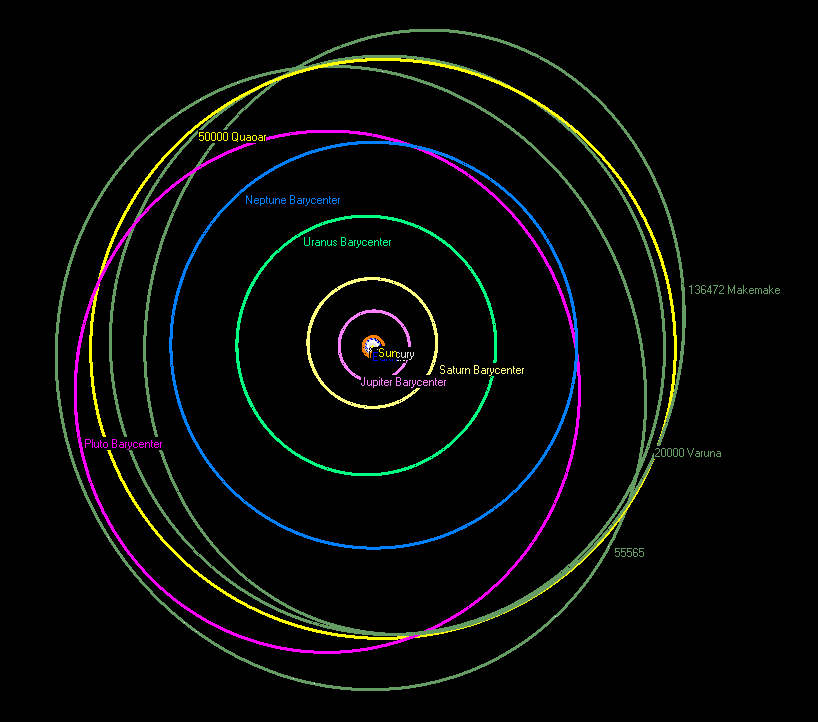
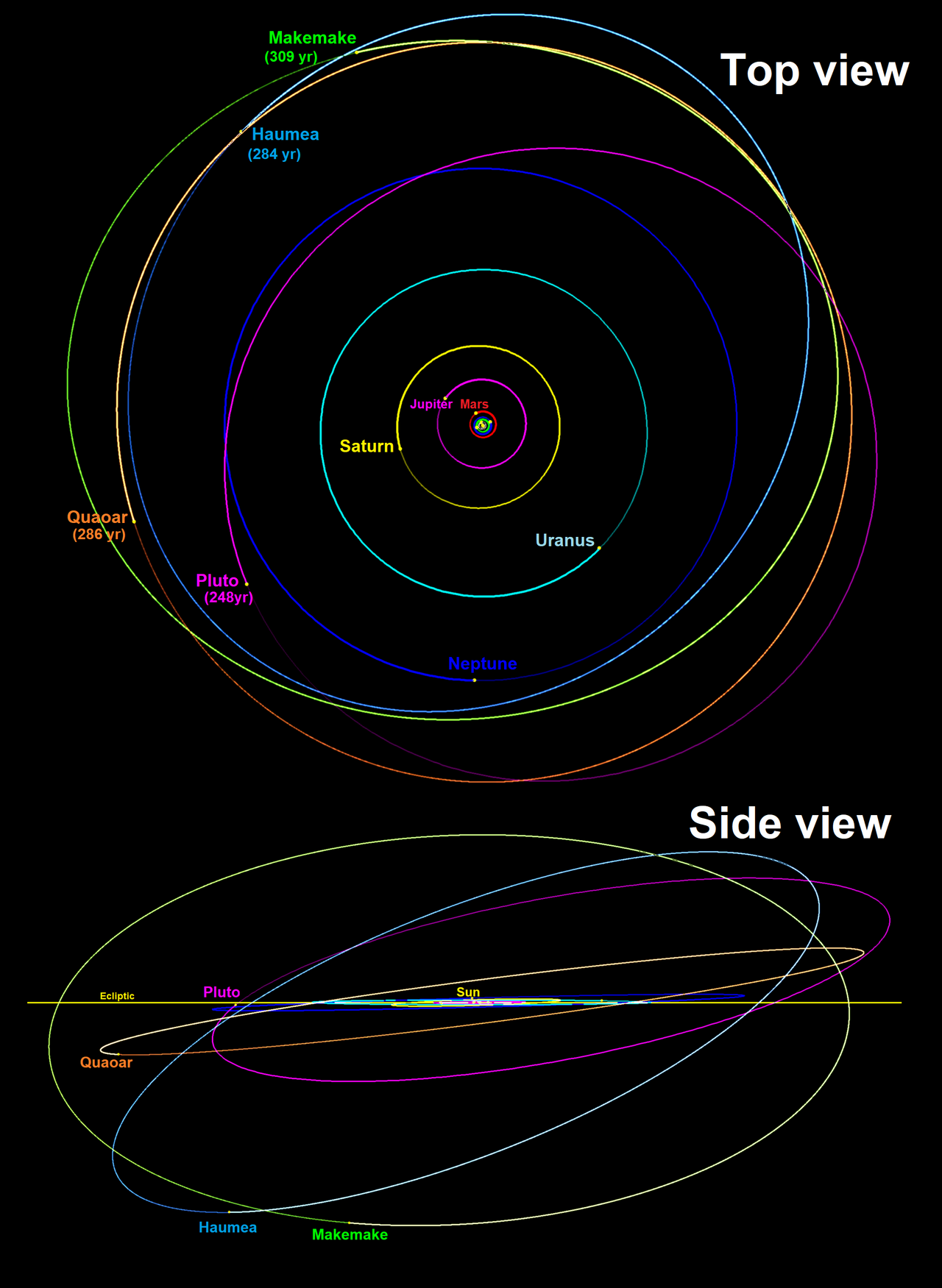
And another, an “overhead” view with Quaoar in yellow, Pluto in magenta/pink, Neptune in blue, and a few other TNOs in a drab green.
On the whole, we know next to nothing about this one…and that’s pretty much going to be true of most of the others. They’re just too doggone far away.
Orcus
Orcus is estimated to be anywhere from 870-960 km across, thus about the size of Ceres. It’s fairly bright, neutral in color and largely made of water ice; apparently the ice is mostly crystalline so maybe sometime in the past there was cryovolcanism (i.e., water volcanoes).
Orcus was discovered by Michael Brown, Chad Trujillo and David Rabinowitz on 17 February 2004 (note that two of these astronomers also discovered Quaoar). In this case, Orcus got named after one of the Roman gods of the underworld, because it’s a plutino.
What is a plutino? Plutinos are objects that, like Pluto, are in a 2:3 orbital resonance with Neptune, orbiting twice in the time it takes Neptune to orbit three times. (Note in the chart above it has nearly the same year, and mean orbital distance, as Pluto.) But Orcus tends to be furthest away from the Sun when Pluto is closest, and vice versa.
Here we see a Hubble Space telescope image of Orcus, and its moon Vanth. Vanth is estimated to be 475 km across by some, which is easily large enough to end up in that “Medium Small” 250-500km size bucket with Mimas, Hyperion, Proteus and Nereid, but other estimates put it below that 400 km line yet still in that bucket. Considering it’s likely frozen solid, and how rigid ice is at those temperatures, it’s not expected to be a round moon. (Note that I made a point to talk about any moon in that size bucket, and above, as I went through the 8 big planets.)
Vanth was named after an Etruscan deity, a “psychopomp” who guides the deceased to the underworld.
It is, however, big enough that the center of gravity of the Orcus-Vanth system is actually outside of Orcus, making it a double object. Vanth orbits Orcus in 9.54 days, and appears to rotate in the same amount of time. The rotation of Orcus, on the other hand, has been harder to nail down, so we don’t know if both bodies are tidally locked or just Vanth.
All in all, Orcus is often thought of as an “anti Pluto” since it’s phased the opposite of Pluto and has a (proportionately) large moon like Pluto. It’s even more striking when you see the visual of the orbit (Neptune’s orbit in white, Pluto’s orbit in red, Orcus in cyan and blue–note the color changes when the object crosses the ecliptic, and note the spheres are to scale with each other, the correct colors and albedos, again):
Haumea
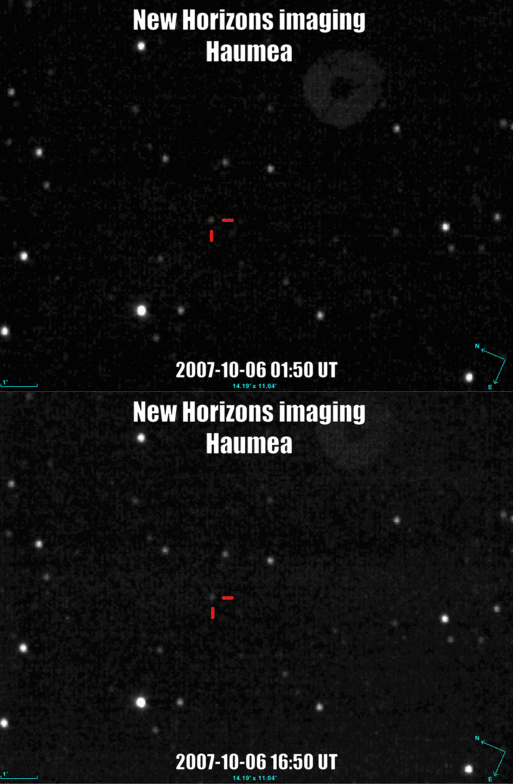
Haumea is named after the Hawai’ian goddess of childbirth. It was discovered by Mike Brown at Caltech, but announced by a team headed by Jose Luis Ortiz Moreno at the Sierra Nevada Observatory…not our Sierra Nevadas, but rather the ones in Spain. There’s controversy over who should get the credit for this one. It’s the third largest TNO after Pluto and Eris. Here’s a picture, again from the Hubble Space Telescope:
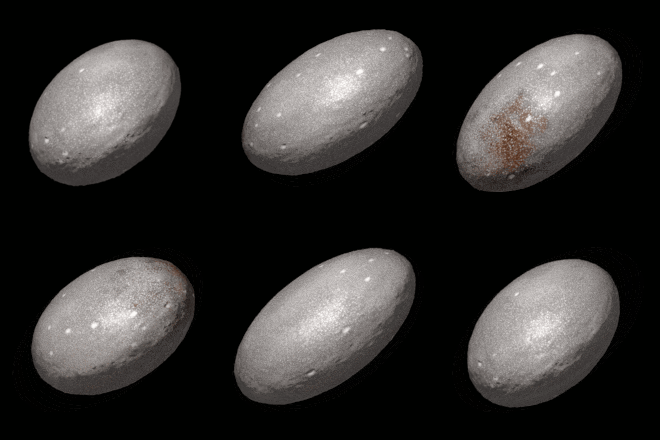
This one’s a bit odd. Based on watching it fluctuate in brightness, it’s a very elongated triaxial ellipsoid, meaning it has a long axis, a medium axis at right angles to that, and a short axis at right angles to the other two. Here’s an artist’s rendering of Haumea:
But this is actually the shape one would expect of a rapidly rotating object under hydrostatic equilibrium; Haumea rotates in about four hours.
So how long are the axes? Haumea is roughly 2100 by 1680 x 1074 kilometers. Or perhaps 2322 x 1704 x 1026. Depending on whose numbers you believe. Either way, it’s a sizeable object.
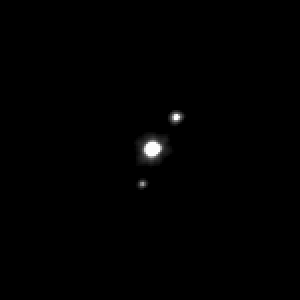
Haumea has moons, as you likely noticed…not just one but two of them known so far. Hi’iaka (upper right in the picture) is a medium-small moon about 310 km across, in that same “bucket” as Mimas, but probably not rounded. Namaka (lower left) is roughly 170 km across. They are named after two daughters of Haumea, the patron goddesses of the Big Island of Hawai’i, and the sea, respectively.
(That brings us, by the way, to the end of the list of medium-small moons: Mimas, Hyperion, Miranda, Proteus, Nereid, Vanth, and Hi’iaka… or does it? It turns out ttwo additional objects on the long list of possible dwarf planets, Salacia and Varda, also have moons in this size bucket. And there’s an almost perfectly-matched double body, Lempo (at 272 km) and Hiisi, with the best estimate for Hiisi being 251km (just squeaking by). If there’s one thing about TNOs, it’s that they tend to have comparatively large moons!)
Haumea is as bright as snow, with an albedo of 0.73…meaning that 73 percent of the light that hits it is reflected back. It seems to have crystalline ice on it, which is puzzling, because crystalline ice should only form above 100 K, and Haumea is at 50K, and only amorphous ice should form at that temperature. Furthermore once it forms, cosmic rays plus what’s left of the solar wind out there should degrade it to amorphous ice in about 10 million years. On top of that, old surfaces out there end up covered in tholins (“star tar”), making them appear red. So it seems that Haumea’s surface is new, but we don’t know how that could have happened. (I could spitball it, but that would be worth less than you paid for this article.)
Haumea appears to have a ring, discovered as it passed in front of a star.
Haumea turns out to be the largest member of a family of objects that have similar orbits and it appears they may all be remnants of a larger body that broke apart due to a collision. But it appears to have happened at least a billion years ago based on orbital dynamics considerations, so that won’t explain the white, crystalline ice surface of Haumea.
The New Horizons probe that went to Pluto actually took some pictures of Haumea on three different occasions…from quite a distance however. The 2007 shots were from 49 AUs away, others were in 2017 at 59 AU and in 2023 at 63 AU. Still, being able to compare the “side view” from what we see on Earth has been helpful.
Haumea’s orbit turns out to resemble Makemake’s (see below). As a bonus Quaoar is also shown:
Eris
We talked about Eris a lot last time. With a diameter of 2326 km it’s a smidge smaller than Pluto, but it’s denser (more rocks, less ice) but is considerably more massive than Pluto, 27% more in fact. As pointed out last time, if Pluto is a planet, Eris is too.
Here are Eris and Dysnomia photographed in 2006, and we’re lucky to have this, because at the moment Eris is 96.3 AUs from the Sun.
Here’s the same sort of orbital diagram I’ve showed for the others…but note in this one Neptune’s orbit is quite small.
MakeMake
Makemake (MAH-ke-MAH-ke) is comparable in size to Saturn’s moon Iapetus, or 60% the diameter of Pluto. From what little of it we see, it may actually have geothermal activity, even though it’s one of the coldest bodies in the solar system at 40K. (When you see the words “possibly nitrogen ices” in a wikipoo article, you know the place is colder than Hitlary Klinton’s lap.) It’s named after a creator god in the Rapa Nui mythology of Easter Island. Again, Michael Brown is on the list of discoverers. And again we have a fuzzy image from Hubble Space Telescope.
And yet again, we have a moon, one that hasn’t been named yet.
Makemake is bright enough–brighter than any TNO other than Pluto–that perhaps it should have been discovered much sooner (maybe even by Clyde Tombaugh). There are even claims that Tombaugh in fact should have seen it, but it was buried right in the Milky Way and with all those stars around it, it would have been hard to spot. However, it hasn’t been spotted in any of his photographs, so it’s not that he photographed it and didn’t notice. It turns out the earliest precovery date is 1955 and Tombaugh stopped looking for additional objects in 1943.
Here’s another one of those graphics of the orbits, as usual the ecliptic in white, Pluto in red. Haumea is in green and MakeMake is on the blue line. The closest and farthest approaches to the sun (the perihelia and aphelia are given. The spheres are correctly sized, the correct colors and the correct albedos.
Gonggong
Discovered by Megan Schwamb, Michael Brown and David Rabinowitz on 17 July 2007, again as part of that Palomar Distant Solar System Survey. Megan Schwamb actually was the first to spot it with the blinking technique that Tombaugh used to discover Pluto. Gonggong is a water god in Chinese mythology, usually depicted as having a copper and iron human head on a serpent’s body. Gonggong is often accompanied by Xiangliu, his minister, a nine-headed poisonous snake. Both are associated with flooding catastrophes.
But enough about the Deep State.
Gonggong is 1230 km across (give or take 50 km), about half the width of Pluto, and a fairly dark body. Here is another Hubble Space telescope image:
And yes, there’s a moon, named Xiangliu, of course.
Gonggong is very red, so almost certainly covered in tholins. There is some water ice, so maybe there was some cryovulcanism in the distant past.
It’s a lot like Eris in having a large orbit, as seen in this polar view (view from above) in which both it and Eris are shown:
And the same thing, seen from the side:
Gonggong and Eris seem to have similarly-extreme orbits (but not nearly the same orbit). Right now Gonggong is 88 AUs distant. Based on color and brightness it’s likely made of the same stuff as Quaoar.
Sedna
And now to go back to Sedna. Sedna is just…different from the rest. It’s red, it’s far, far away, and it’s going to get a lot farther away, eventually. It’s also the only one of these nine with no known moon. It’s very roughly 1000 km across. And because it has no moon whose orbit we can measure and time, we have only the vaguest notion of its mass. And now for a smashingly spectacular picture from Hubble Space Telescope:
Although I was flippant when I said that, if you think about it, it’s a huge acheivement to be able to take even this picture. Sedna is presently 83.55 AUs or 12.5 billion kilometers away. Right now Eris and Gonggong are further away, but that won’t remain true forever, since Sedna’s aphelion is 937 AU, not only busting into triple digits for the first time, but nearly reaching four digits.
Sedna is not the furthest though. There is a smaller object with and even more extreme orbit, 541132 Leleakohonua, perihelion 65.16 AU and aphelion…are you sitting down? of 2106 AU, with an orbital period of 35,760 years. However, this object is maybe 110 km across and in no way a dwarf planet. Right now it’s about 78 AUs out, getting closer to perihelion in 2078. (As a bonus the eccentricity actually busts the 0.900 mark at 0.93997.)
Neither of these objects would ever have been found if they didn’t happen to be at the near part of their orbits. Given that objects like this spend a lot less time near the sun than they do further away, there are probably a lot of them out there, simply too far away for us to detect.
Objects like this are so extreme, there’s now a new class of objects, “Sednoids” including these two plus one other (a bit less extreme than Sedna). Some have suggested that they’re really members of the inner Oort Cloud. (I haven’t talked about the Oort cloud…yet.)
There is also speculation that these crazy orbits are caused by encounters with a full planet out there somewhere, perhaps 400AU out. The fact that a lot of aphelions seem to be in very roughly the same place lends credence to this. Here are the three “Sednoid” objects (2015 TG387 is Leleakohonua’s provisional number):
Pluto (Finally)
An Ode to New Horizons
Until the Hubble space telescope, a typical photo of Pluto showed a bunch of white dots on a black background, and an arrow pointing to one of them. Pluto was only distinguishable from stars by its motion, which took days to become obvious.
Then Hubble Space Telescope took a look in 2003, and what it gave us, was used to make this animation, as Pluto did a full rotation in 6.4 days…retrograde, apparently:
Then suddenly in 2015…you could buy a fricking globe of Pluto. I saw one for sale in the observatory store at Griffith Park playing tourist one evening while on a business trip and there was no way it wasn’t coming home with me. That simple metal sphere encapsulated everything about our planetary space program…from a dot on a page to a real world, within my lifetime.
So what happened?
THIS happened:
The New Horizons probe went to Pluto.
We first had to get permission. According to Wikipedia:
In 1992 JPL scientist Robert Staehle called Clyde Tombaugh, requesting permission to visit his planet. “I told him he was welcome to it,” Tombaugh later remembered, “though he’s got to go one long, cold trip.”
Tombaugh passed away in 1997. A small portion of his ashes were on the New Horizons spacecraft. He got to go along for the ride. On the container is inscribed, “Interred herein are remains of American Clyde W. Tombaugh, discoverer of Pluto and the Solar System’s ‘third zone’ Adelle and Muron’s boy, Patricia’s husband, Annette and Alden’s father, astronomer, teacher, punster and friend: Clyde W. Tombaugh (1906-1997)”.
Could he have possibly imagined back in 1930 that in a very real sense, he’d get to go there?
By the time New Horizons launched in 2006, mere months before Pluto got “demoted” to dwarf planet, we had known (since 1978) that Pluto had a large moon, Charon, one large enough to qualify Pluto as a double planet. And we had found two others, Nix and Hydra, though they are much smaller. At the time, Pluto + Charon was the only known case of a moon that was so large in comparison to its primary that the barycenter (center of gravity) of the system was outside of the primary. As such both the planet and moon orbit a point out in space. Here is a series of pictures taken by New Horizons quite some time before closest approach.
New Horizons did something that back in the 1970s was deemed nearly impossible, a direct trip to Pluto. Back then Jupiter was just barely reachable by a probe of useful size; we could (and did: Pioneer 11, Voyager 1 and Voyager 2) get to Saturn, Uranus and Neptune by first going to Jupiter and getting a gravitational assist (a/k/a slingshot) from it.
But this time we went directly to Pluto. Actually, we did use a gravitational assist from Jupiter, but we didn’t have to. We’d have got there without it, albeit after three more years.
This involved launching the probe directly into a solar escape trajectory. How fast is that? At Earth’s distance from the Sun, it’s a bit over 42 kilometers per second. We had to break free of Earth’s gravity and then still be doing 42 km/sec with respect to the Sun, at which point, it doesn’t matter which direction you’re going, you’re never coming back to the Solar System. Of course in this case the direction did matter, we wanted to go to Pluto in particular. And also, we got 30 km/second of that 42 km/second from Earth’s speed around the sun, by launching in exactly the direction Earth was moving.
And to do this we made the probe as small as possible (the size of a desk) and put it on the biggest effing rocket we had, including special upper stages to push the thing harder once in space. It was the fastest thing we ever launched.
And now for the NASA animations. No audio in the first one (and note Pluto doesn’t look right–the animation was produced before the mission):
The second one is more “loaded” technically showing what the instruments are doing every moment, as well as spacecraft orientation. (It also has a music track.)
As you can see, Pluto’s moons were in orbits that made it look like a big target, but the object is to not hit the bullseye. New Horizons had to spend the entire time on July 14, 2015 looking at Pluto and its moons, without stopping to transmit to Earth (it would have to turn around to do that, pointing the big dish antenna basically towards the Sun and losing absolutely irreplaceable time). Only after collecting 6GB of data and with Pluto, Charon, and the other four moons in the rear view mirror, could the spacecraft contact Earth…and then spend the next eighteen months transmitting all of that data.
You can imagine the people at mission control bit their nails clean off, waiting. But then New Horizons phoned home. It had come through just fine and it had goodies to send us.
So what did we get?
1. This:
2. And this:
3. And this:
4. And this:
5. And this:
6. And this:
7. And this (ice volcanos highlighted in blue:
8. And finally (but not really, I could keep going on) this:
And that’s Pluto, yet more pictures and data were taken of its largest moon Charon:
And the other four moons; it’s probably easiest to just throw a composite image at you:
So needless to say we know a lot more about Pluto than we do about all of the other TNOs I’ve talked about, put together.
NASA does engage in CGI sometimes (in spite of the fact that the Flerfers claim it does–they’re generally completely wrong but not in this case) and they produced this video of what a flyby would look like, based on what New Horizons returned:
Pluto Itself
So…here we go.
Pluto was named after the Roman god of the Underworld, the corresponding Greek god was Hades. It’s 2,376.6 km across, give or take 1.6 km. And 0.2 percent as massive as the Earth or 17.7 percent as massive as the Moon. It orbits the Sun in 248 years, rotates once on its axis in 6.38680 days…but with an axial tilt of 122.53 degrees, it’s considered a retrograde rotation. (These numbers are awfully precise, on account of New Horizons.) At this particular time Pluto’s northern hemisphere is pointed towards the Sun, and New Horizons thus was unable to get the very southernmost part of Pluto, it was in darkness during the entire time of the encounter.
Pluto’s rotation is the same as Charon’s orbital period, which means that not only does Charon always show the same face to Pluto (as is true with every other major moon in the Solar System), but Pluto always shows the same face to Charon. Scientists will invent coordinate systems at the drop of a hat, and the line directly facing Charon is the 0 degree longitude line on any map of Pluto.
Geology and Geography
Oh, that reminds me:
Composite “Mercator” image of Pluto (it’s not really a Mercator projection when the latitude lines are equally spaced). Note that a lot of regions are named after spacecraft (Venera, Voyager, Pioneer, Viking) or astronomers (Lowell gets a Regio too). But also notice that a lot of the names come from fantasy and science fiction, like Balrogs and of all things, Cthulhu–though that one was often called “the whale” too. (Bad news on that last, it got renamed Belton Regio.)
Pluto has mountains and plains, and the first picture plainly shows the “Heart of Pluto” which simply had to be named Tombaugh Regio after Clyde Tombaugh. Tombaugh Regio is a plain, and by the way, is on the side of Pluto that faces away from Charon. The plains are mostly nitrogen ice (brrrr), with some methane and carbon monoxide, all in solid form of course.
The western and more distinct lobe of the “Heart” is Sputnik Planitia, a 1000 km wide basin of frozen ice, but as the second image shows it’s divided into polygonal cells, almost certainly convection cells that carry floating blocks of water ice crust and sublimation pits at the margins. There are signs of glacial flows both into and out of the basin. Furthermore, not one single crater was spotted, which indicates that Sputnik Planitia’s surface is less than ten million years old; in fact the latest work claims 140,000-270,000 years. There are also transverse dunes in Sputnik Planitia, which are formed by wind-blown particles, in this case of frozen methane.
What are the mountains made of? Water ice. When you order something “on the rocks” here, you mean it literally. The color ranges from charcoal black to dark orange and white; Pluto has as much contrast as Iapetus.
The fifth “This” above shows lots of 500 m high mountains from Tartarus Dorsa, the spacing reminds people of scales or tree bark. This doesn’t appear anywhere else we know of, except maybe on the unseen side of Triton…or perhaps in the Atacama desert. These are likely penitentes, icy spires that form in deserts, so named because they resemble large numbers of people at prayer.
Cutting through Tartarus Dorsa and Pluto’s heavily cratered northern terrain (and therefore younger than either) are a set of six canyons radiating from a single point; the longest is Sleipnir Fossa which is at least 580 km long.
And cryovolcanos. We’ve identified two possible cryovolcanos, Wright Mons and Piccard Mons. Piccard Mons is not named after Star Trek’s Jean Luc Picard but rather the French ballooning pioneer (two C’s, see?).
Pluto, in short shows an absolutely stunning variety of geology. Glaciological, surface-atmosphere (the dunes), impact (craters), tectonic, likely cryovolcanic, and mass-wasting (rocks falling down hill), it’s all there. This world turns out to be much more interesting than I expected back then.
Internal Structure
We know Pluto’s size. We know its mass. That means we know its average density; divide the mass by the volume. And we get 1.853 g/cm3. That means it’s a mix of rocks (things we think of as rocks) and ice, and it’s roughly 70/30 rock/ice. So we believe Pluto has a silicate (rock) core, surmounted by a mostly-water ice mantle and crust. It may even have a subsurface ocean like Europa and Enceladus. Though some think it may now be frozen, it’s just barely possible it was inhabited at one point. (This is one place where Wikipedia is a bit frustrating. The text makes it sound like no one believes there’s still liquid water down there, but the diagram indicates otherwise.)
Atmosphere
Pluto has an atmosphere as is quite evident in pictures 3 and 8 above. In fact getting New Horizons out there quickly rather than waiting a few more decades was partially motivated by this; Pluto is fairly close to the Sun right now, and that, we thought, would make the atmosphere more active. As Pluto got further from the Sun, its atmosphere might freeze out.
The atmosphere is made up of nitrogen, methane, and carbon monoxide, all sublimated from the surface ices, and in equilibrium with them (if any of them “snow” out of the atmosphere, then ices elsewhere on Pluto will sublimate to restore them). The pressure is anywhere from 1 millionth to 1/100,000th that of Earth.
Since New Horizons was launched, however, we’ve determined the atmosphere might actually thicken as it gets colder.
In any case, New Horizons‘s parting shot at Pluto was a backlit shot, used to image the atmosphere. Scientists have learned to take a “backlit shot” opportunity when it presents itself.
Moons
Pluto has five moons. And all of them are regular, orbiting in the plane of Pluto’s equator. Here’s a scale diagram…full scale, distances and diameters shown accurately (you rarely see those in astronomy!).
First up is Charon. Orbiting at 19,595.764 km from Pluto (give or take 7 or 8 meters!) and at 1212 km across, it’s a medium size moon according to the terminology I’ve been using, so now we have nine: Rhea, Iapetus, Dione and Tethys at Saturn, Ariel, Umbriel, Oberon and Titania at Uranus, and now Charon.
Pluto is 2376.6 km across. Compared to it Charon is huge. No, wait, yuge. It’s bigger than Ceres.
Charon was discovered in 1978, and named after the ferryman of the underworld in Greek mythology. (You had to pay him a coin to get ferried across. No word on what people who died in the Trojan war (centuries before coinage) had to do.) But that brings up a question. How do you pronounce “Charon”? The Greeks spell it Χάρων, and that X is like the ch in Bach. But no one in English-speaking countries says that, it’s either “Sharon” or “Karon.” The discoverer, James W. Christy (born 1938), maintains that he named it after both Χάρων and his wife Charlene, who was nichnamed “Char” (pronounced Shar), so he goes with “Sharon.” (I’m just insane enough I’d probably try to pronounce it with the ch in Bach if I ever had the chance to talk to someone about it. Y’all are both doing it wrong!)
Christy saw a bulge on the side of blobs taken of Pluto from the Naval observatory at Flagstaff. It would disappear and reappear regularly, indicating something in orbit about Pluto. In the image below (which is a photographic negative) there’s a bulge at the top on the left hand side, and no bulge on the right hand side. And so here’s an example of what Pluto looked like before HST looked at it.
Needless to say we have better pictures now.
A few years after Charon’s discovery, its orbit was edge on to us here on Earth and we could study the light curve and prove an object was transiting in front of Pluto, then behind it, even if we couldn’t resolve it as a separate fuzzy blob.
Charon is yuge compared to Pluto, and it’s the first case of a moon large enough that the center of gravity of the system is outside of the primary. Back before Pluto got demoted from planet status, many proposed that Pluto and Charon be considered a binary or double planet. And if Alan Stern succeeds in convincing people he was right, it might become one again.
In the following animation, you can see Pluto actually swinging around an imaginary point just outside of itself (and as seen above New Horizons confirmed this). There’s a black dot marking the barycenter, you’ll see it in front of Pluto when the moon is at the bottom of the image (the dot is apparently visible through Pluto in the animation). Note that Charon is closest to the viewer when it is at the top of the image. I was momentarily confused by this.
Which means that when I gave you Charon’s distance from Pluto, that was actually not the appropriate number. Its average distance from the barycenter, and thus the true size of its orbit (semimajor axis) is 17,181.0 km. It’s actually moving at a comparatively sedate 210 meters per second, and the orbit is almost perfectly circular. (The difference between the minimum and maximum distance from Pluto (not the barycenter) is a mere 6.31 kilometers.)
Charon’s density is known, 1.7 g/cm3, making it 55% rock to 45% ice (give or take 5 percent). We’re pretty sure the moon is differentiated (i.e., it has a distinct core) and may have once had a subsurface ocean. Here we have two distinct models of what Charon might look like on the inside:
…and…
And…we have a map.
Informal names given to the various canyons included Nostromo, Serenity, Argo, and so on, named after fictional ships including recent ones like from Alien and Firefly. The northern dark area was originally named Mordor. It appears to be formed from gases that escaped Pluto’s atmosphere and blew over to Charon, carried by the solar wind. The temperature here can get as low as 15K during winter, and some tholins will form. When it gets warmer, a balmy 60K, anything that’s still an ice will boil away, leaving the pole dark.
The Other Moons
The other moons, Styx, Nix, Kerberos, and Hydra, all named after creatures and features of the Underworld in Greek mythology, all have nice tidy circular orbits in Pluto’s equatorial plane. So they’re regular moons. All are less than 51 km across. The innermost, Styx, orbits 48,694 km out…considerably further from Charon. But this makes sense. It would have to be far away from the binary object Pluto/Charon or Charon would perturb Styx’s orbit as it swept by Styx on closest approach.
One more “Moon” is Pluto itself. Since it orbits the barycenter at a distance of 2035 kilometers, which puts the barycenter outside of Pluto’s 1188 km radius, Pluto, not Charon, is actually the closest orbiting body of the whole system.
Arrokoth
New Horizons was able to visit one more object beyond Pluto (blue), shown in green.
It’s 486958 Arrokoth (formerly nicknamed Ultima Thule). We didn’t know about it when New Horizons launched, but the pace of discovery of TNOs was so great we figured something would be out there we could visit with some expenditure of propellant, and Arrokoth (discovered in 2014, a bit over a year before the Pluto encounter) was chosen.
As a result, the second best known Kuiper Belt object is none of the ones I’ve mentioned so far, it’s this otherwise insignificant bit of ice and rock.
It appears to be made out of two smaller bodies, planetesimals that never became part of a planet, touching each other. The two small bodies are roughly 21 and 15 km across, for a total of 36 km along the long axis. Arrokoth orbits the Sun in 298 years. So we have our first high resolution picture of a small TNO.
We got enough data to create a geologic map:
It largely consists of a mix, a solid mix of amorphous water ice and rocky material. (It is not, unlike some objects of similar size, simply a clustering of gravel that is barely stuck together.)
This Stormwatch Monday Open Thread remains open – VERY OPEN – a place for everybody to post whatever they feel they would like to tell the White Hats, and the rest of the MAGA/KAG/KMAG world (with KMAG being a bit of both).
Gail Combs can’t get into the WordPiss editor – it’s some kind of browser/WordPiss compatibility problem. Doesn’t matter – we shall overcome. I am able to get past the problem, thankfully. Thus, this PLACE HOLDER UNDER ARREST post, which is a tweaked copy of a post I made on 20240403, which included the notorious PLACE HOLDER UNDER ARREST-ORAMA image and Word Of The Week.
So here we go. Start thinking about Trump’s inauguration.
Who here is going? Any plans being made? Time to start thinking about it!
So now we return to this lightly updated “vintage” post. Enjoy!
W
Joe Biden didn’t win, and neither did Hillary Clinton or Kamala Harris. This is our Real President:
U.S. President Donald Trump prepares to board Marine One with first lady Melania Trump en route to his Mar-a-Lago estate in West Palm Beach, Florida following the release of the Mueller report at the White House in Washington, U.S., April 18, 2019. REUTERS/Carlos Barria – RC1F20A769B0
AND our beautiful REALFLOTUS.
This Stormwatch Monday Open Thread remains open – VERY OPEN – a place for everybody to post whatever they feel they would like to tell the White Hats, and the rest of the MAGA/KAG/KMAG world (with KMAG being a bit of both).
Please forgive us, Wheatie, we did not know That you had left us with armor in tow We had no idea with what you dealt We did not know the pain you felt And now we can only imagine With you what really did happen Cause rarely did you complain And/or share your personal pain Of one thing we are most certain You are flying high behind the curtain Watching over us above the crowds Our Warrior Angel above the clouds Thank You, Wheatie, for caring for us While you were here among the fuss We miss you dear you have no idea Since time began in the pangaea With you there was no time In your wisdom you would chime To clarify and magnify The what where how and why We did not question when you left We were not slightly bereft But over time we wondered why You did not at least stop by Now we know where you have gone With the break of this new dawn We could be angry but are not Tho with an arrow we’ve been shot Rest peacefully Warrior Angel dear Send us a sign that you are near A butterfly a flower a kiss of rain From your love do not refrain God sends Angels to watch over us And now we have an Angel Plus A Warrior Angel of Magnificence From today and forward hence
Boilerplate, more or less, but worth reading again and again, if only for the minor changes, and to stay out of moderation.
MINOR CHANGE NUMBER 1 – RETRACTED!
No reasons for you not to joke about Team Harpies On Pedestals, now that the nation has voted overwhelmingly for FREE SPEECH. Just remember that I really avoid deleting posts, so if you say something stupid, and you regret it later, you will need to add a clarification comment, as opposed to deleting it.
OK? Them’s the rules.
OTHER THAN THAT…….
The bottom line is Free Speech. Theories and ideas you don’t agree with must be WELCOME here, and you must be part of that welcoming. But you do NOT need to be part of any agreement.
Bottom line – respect other people’s FIRST AMENDMENT RIGHTS.
Our only additional requirement is that you do so NICELY. Or at least try to make some effort in that direction.
SO….. [ENGAGE BOILERPLATE…..]
We must endeavor to persevere to love our frenemies – even here.
Those who cannot deal with this easy requirement will be forced to jump the hoops of moderation, so that specific comments impugning other posters and violating the minimal rules can be sorted out and tossed in the trash.
In Wheatie’s words, “We’re on the same side here so let’s not engage in friendly fire.”
That includes the life skill of just ignoring certain other posters.
We do have a site – The U Tree – where civility is not a requirement. Interestingly, people don’t really go there much. Nevertheless, if you find yourself in an “argument” that can’t really stay civil, please feel free to “take it to the U Tree”. The U Tree is also a good place to report any technical difficulties, if you’re unable to report them here. Please post your comment there on one of Wolf’s posts, or in reply to one of Wolf’s comments, to make sure he sees it (though it may take a few hours).
We also have a backup site, called The Q Tree as well, which is really The Q Tree 579486807. You might call it “Second Tree”. The URL for that site is https://theqtree579486807.wordpress.com/. If this site (theqtree.com) ever goes down, please reassemble at the Second Tree.
If the Second Tree goes down, please go to The U Tree, or to our Gab Group, which is located at https://gab.com/groups/4178.
We also have some “old rules” and important guidelines, outlined here, in a very early post, on our first New Year’s Day, in 2019. The main point is not to make violent threats against people, which then have to be taken seriously by law enforcement, and which can be used as a PRETEXT by enemies of this site.
In the words of Wheatie, “Let’s not give the odious Internet Censors a reason to shut down this precious haven that Wolf has created for us.”
A Moment of Prayer
Our policy on extreme religious freedom on this site is discussed HERE. Please feel free to pray and praise God anytime and anywhere.
Thus, please pray for our real President, the one who actually won the 2016, 2020, and 2024 elections.
You may also pray for our nation, our world, and even our enemies.
Musical Interlude
In honor of dear Wheatie, we now present some music to soothe, inspire, invigorate, or relax.
Here are three “placeholder” videos, selected from old Wheatie posts.
This Stormwatch Monday Open Thread remains open – VERY OPEN – a place for everybody to post whatever they feel they would like to tell the White Hats, and the rest of the MAGA/KAG/KMAG world (with KMAG being a bit of both).
Our various sister sites, listed in the Blogroll in the sidebar
Our beloved country is under Occupation by hostile forces.
Daily outrage and epic phuckery abound.
We can give in to despair…or we can be defiant and fight back in any way that we can.
Joe Biden didn’t win.
And we will keep saying Joe Biden didn’t win until we get His Fraudulency out of our White House.
Wolfie’s Wheatie’s Word of the Week:
volacious
adjective
able, apt or fit to fly
Shown in a picture
Used in a sentence
It’s not a question of whether or not to toss the toxic dwarf into GITMO – the question is whether he is sufficiently volacious to make it there intact without bubble wrap.
MUSIC!
Speaking of volcano sacrifices, as a belated Halloween offering, and with EPIC musical character beloved by Wheatie, we bring you this little number…..
And now for…..
THE STUFF
Thank you, Elon! You did it!
SO, in honor of Senator “Lurch” Thune, we have this!
And if that’s not enough Lurch, here’s more than you can handle!
What is it that feeds our battle, yet starves our victory?
This post is scheduled to go “live” at 10:01PM MST on Friday, November 15, 2024. That’s 00:01 EST on Saturday, November 16, 2024 for those of you in that benighted timezone near the Atlantic Ocean.
As of that moment, there are 65 days, 11 hours, and 59 minutes until our rightful President of the United States is restored to office.
Not that I’m counting, mind you.
January 6 Tapes Reminder
After the first release, we were supposed to get more, every week.
As far as I know it hasn’t happened.
Speaker Johnson, please follow through!
A Caution
Just remember…we might replace the RINO candidates. (Or we might not. The record is mixed even though there is more MAGA than there used to be.) But that will make no difference in the long run if the party officials, basically the Rhonna McDaniels (or however that’s spelled–I suspect it’s RINO), don’t get replaced.
State party chairs, vice chairs, secretaries and so on, and the same at county levels, have huge influence on who ultimately gets nominated, and if these party wheelhorses are RINOs, they will work tirelessly to put their own pukey people on the ballot. In fact I’d not be surprised if some of our “MAGA” candidates are in fact, RINO plants, encouraged to run by the RINO party leadership when they realized that Lyn Cheney (and her ilk) were hopelessly compromised as effective candidates. The best way for them to deal with the opposition, of course, is to run it themselves.
Running good candidates is only HALF of the battle!
Biden Gives Us Too Much Credit
…we can move on to the next one.
Apparently Biden (or his puppeteer) has decided we’re to blame for all of the fail in the United States today.
Sorry to disappoint you Joe (or whoever), but you managed to do that all on your own; not only that, you wouldn’t let us NOT give you the chance because you insisted on cheating your way into power.
Yep, you-all are incompetent, and so proud of it you expect our applause for your sincerity. Fuck that!!
It wouldn’t be so bad, but you insist that everyone else have to share in your misery. Nope, can’t have anyone get out from under it. Somehow your grand vision only works if every single other person on earth is forced to go along. So much as ONE PERSON not going along is enough to make it all fail, apparently.
In engineering school we’re taught that a design that has seven to eight billion single points of failure…sucks.
Actually, we weren’t taught that. Because it would never have occurred to the professors to use such a ridiculous example.
Justice Must Be Done.
The prior election must be acknowledged as fraudulent, and steps must be taken to prosecute the fraudsters and restore integrity to the system.
Nothing else matters at this point. Talking about trying again in 2022 or 2024 is hopeless otherwise. Which is not to say one must never talk about this, but rather that one must account for this in ones planning; if fixing the fraud is not part of the plan, you have no plan.
Kamala Harris has a new nickname since she finally went west from DC to El Paso Texas: Westward Hoe.
Lawyer Appeasement Section
OK now for the fine print.
This is the WQTH Daily Thread. You know the drill. There’s no Poltical correctness, but civility is a requirement. There are Important Guidelines, here, with an addendum on 20191110.
We have a new board – called The U Tree – where people can take each other to the woodshed without fear of censorship or moderation.
And remember Wheatie’s Rules:
1. No food fights 2. No running with scissors. 3. If you bring snacks, bring enough for everyone. 4. Zeroth rule of gun safety: Don’t let the government get your guns. 5. Rule one of gun safety: The gun is always loaded. 5a. If you actually want the gun to be loaded, like because you’re checking out a bump in the night, then it’s empty. 6. Rule two of gun safety: Never point the gun at anything you’re not willing to destroy. 7. Rule three: Keep your finger off the trigger until ready to fire. 8. Rule the fourth: Be sure of your target and what is behind it.
(Hmm a few extras seem to have crept in.)
Spot Prices
All prices are Kitco Ask, 3PM MT Friday (at that time the markets close for the weekend). (Note: most media quotes are for the bid…the price paid by the market makers, not the ask, which is what they will sell at. I figure the ask is more relevant to people like us who wish we could afford to buy these things. In the case of gold the difference is usually about a dollar, for the PGMs the spread is much wider.)
There’s no sugar coating it…the precious metals except for platinum are taking a beating. (Platinum was already on sale anyway.) Silver at least didn’t take quite as much of a beating as gold. The FRNSI, when I calculated it, turned out to be 122.9996 which rounds up to 123.000, which is why it looks suspiciously “round” at the moment. (Like the time twenty years or so ago when I bought a bunch of random things, and the total at the cash register, including sales tax, was exactly $100.00. I told the cashier to get the machine checked.)
*The SteveInCO Federal Reserve Note Suckage Index (FRNSI) is a measure of how much the dollar has inflated. It’s the ratio of the current price of gold, to the number of dollars an ounce of fine gold made up when the dollar was defined as 25.8 grains of 0.900 gold. That worked out to an ounce being $20.67+71/387 of a cent. (Note gold wasn’t worth this much back then, thus much gold was $20.67 71/387ths. It’s a subtle distinction. One ounce of gold wasn’t worth $20.67 back then, it was $20.67.) Once this ratio is computed, 1 is subtracted from it so that the number is zero when the dollar is at its proper value, indicating zero suckage.
Neptune
We now reach the last full planet. But is it the end of the road?
History
Neptune’s discovery was a triumph of Newtonian theory.
Newton in the mid-late 1600s was pondering the forces that make the planets move, as opposed to forces we see on Earth. Apparently he saw an apple fall (it did not bonk him on the noggin), and it occurred to him that the force that made the apple fall might be the same force that makes the Moon orbit the Earth. Newton knew how far away the Moon was, he knew how much it would have to accelerate to remain in its orbit about the Earth. (If there was no acceleration, it would just go in a straight line and eventually disappear from sight from becoming too faint to see.) He also knew how far he and the apple were from the center of the Earth, and already knew how fast the apple accelerated.
He was able to determine that if the acceleration induced by gravity dropped off as the square of the distance, the number for the Moon’s distance actually matched what the Moon was doing.
Twenty years later after a lot of refining and elaboration, well…For the first time we knew that the stuff “up there” follows the same rules as the stuff “down here.” It’s not a special realm, as the ancients believed.
Newton did not discover gravity. Gravity was known to Og the caveman especially after he did a faceplant tripping over something while chasing game, nor was Og the first to notice it. What Newton did do was to show that gravity is universal, it applies everywhere not just here on Earth. And he was able to write equations that described it quite accurately.
Newton, during those 20 years, had gone on to prove that such a force would cause things to orbit other things in ellipses…which matched what we already knew; Johannes Kepler had in the early 1600s proved with meticulously collected data spanning decades and years of his own skull sweat that the orbits of the planets around the Sun (and the Moon around the Earth) were ellipses. Newton also was able to show that Kepler’s other two laws of planetary motion applied. Better, one could apply his laws to the Galilean moons (as well as Titan orbiting Saturn) and show that they, too followed Newtonian mechanics and gravity.
Over the next decades astronomers refined their data on the planets and had more and more accurate data to “plug into” their equations and predicting where planets and the Moon would be became an exact science; instead of being off by five degrees (the width of you three big fingers (not the thumb and not the pinky) held at arms length), we were much less than half a degree.
Then Uranus was discovered in 1781, and that was one more thing to track on top of the other planets, known moons of planets, and so on. (Starting in 1650, we discovered binary stars orbiting each other and could track them too.) Alexis Bouvard published tables of Uranus’s ephemerides (predictions of future predctions) in 1821.
Except there was a problem, one which became apparent over the next few decades (it takes a long time, when the planet has an 84 year orbital period or “year”). Uranus was being an ass…not behaving. It was traveling too fast for a while…then too slow.
Was Newton wrong after all? In spite of his stuff having worked so well for over a century?
Bouvard didn’t think so. He speculated that some unknown body was perturbing Uranus’s orbit, pulling on it and either making it speed up or slow down, depending on where it was in relation to Uranus. In 1843 John Couch Adams began trying to figure out where this unknown body was, and by 1845-6 had generated several predictions; he was continually refining them because his method was iterative. He’d guess, run the numbers, adjust his guess, and repeat. Then repeat again.
But Adams had competition; Urbain Le Verrier was also working on the problem. He came up with similar answers. The Astronomer Royal of England, Sir George Airy, persuaded James Challis to actually look through a telescope and try to find the planet. Challis tried through August and September 1846, and failed. (However he realized much later that he had actually seen it a couple of times in July and August 1845 (a year before his search) and not recognized it for what it was, because he had poor observing techniques and old star charts. D’oh!)
Le Verrier wasn’t going to wait on the Brits to get their act together; he wrote to Johan Gottfried Galle in Berlin, and asked him to look. Galle received the lettter on the 23rd of September, 1846. Heinrich d’Arrest, a student at the observatory, pointed out that they had just made a chart of that part of the sky recently. So all Galle had to do was point his telescope and look for something that wasn’t on the chart. That would be a moving object…a planet. Galle looked that evening with a nine inch refractor telescope (one with lenses at both ends of the tube), and found it almost immediately, less than a degree away from where Le Verrier had said it would be, and twelve degrees away from Adam’s prediction. However…the old chart could just be missing the object by mistake. Galle looked at the object over the next few days and satisfied himself that it wasn’t a mistake. It was indeed a moving object.
Another planet had been found!
Newton in trouble? No way! This was actually a triumph for Newtonian mechanics because it had been used to find a planet!
(As a footnote…Galileo saw Neptune, diagrammed its position in his notes, not once but twice when it was near Jupiter on 28 December 1612 and 27 January 1613 [both dates New Style] but didn’t realize it was a moving object. So, although interesting, it isn’t enough to give him credit for the discovery. However, “In 2009, a study suggested that Galileo was at least aware that the “star” he had observed had moved relative to fixed stars.” [From Wikipedia])
Voyager 2, 25 August 1989
This is a collection of official NASA animations depicting the sole spacecraft encounter (so far) with Neptune. These videos were made before the encounter, so Neptune’s and Triton’s appearances are just guesses. They also show the rings as arcs, because that’s what they thought back then (it turns out that they’re full rings, with some thicker sections we mistook for partial arcs).
Basic Info
For a while, it was simply called “the planet exterior to Uranus” or “Le Verrier’s Planet”. Galle suggested calling it Janus, which fortunately didn’t happen or it would be confused with the Hugh Janus of the solar system. Le Verrier said, since he had discovered it, he should be able to name it and he suggested “Neptune.” And that’s the name that ultimately “stuck.” The planet had a bluish tinge and Neptune was the Roman god of the sea (corresponding to the Greek Poseidon).
Neptune orbits the Sun in 164.8 years, almost twice as long as Uranus (84.02 years). Its average distance from the sun is 30.07 AUs (30.07 times as much as Earth’s average disance). That puts it at 4.5 billion kilometers from the Sun. That means that radio signals to and from Voyager 2 took over four hours each way!
Here it is in true color, with the Earth photoshopped in for comparison.
It’s roughly the same size as Uranus…just a bit smaller, but it is considerably denser than Uranus and notably more massive (Uranus is 14.536 times the mass of the Earth, Neptune is 17.147 times.)
Neptune rotates in 16 hours, 6 minutes; that’s its day. Its axis is tilted 28.2 degrees, a bit more than Earth’s but not ridiculous like with Uranus or Venus. The temperature is 55-72 Kelvins (-218 to -201 C) depending on how deep into the atmosphere you measure it. The latter number is measured where the atmospheric pressure is the same as Earth’s at sea level. The atmosphere consists of 80 percent hydrogen, 19 percent helium and 1.5 percent methane by volume, with traces of ethane, ammonia, water ice, and ammonium hydrosulfide. The methane gives Neptune its bluish tinge.
Innards
Deeper down the methane, ammonia and water ices become more prevalent, earning Neptune its place among the ice giants. One thing I just spotted is the speculation that at a depth of 7000km, methane might decompose with the carbon forming diamond crystals that rain downwards like hailstones; this would be true on Jupiter, Saturn and Uranus as well.
Whoops, spoiler…Rings.
You’re probably used to seeing this picture of Neptune:
But if you scroll back to the earlier picture, it’s the same picture of Neptune, just rendered in different colors. This one exaggerated the colors for contrast, and in it you can see the “Great Dark Spot” which means I can now segue to discussing the weather.
Weather
The “Great Dark Spot” is similar to Jupiter’s Great Red Spot. It’s 13,000km x 6,600 km or so…which means that measured the long way it’s slightly broader than Earth! However, it wasn’t nearly as permanent as the Red Spot. By the time Hubble looked at Neptune eight years later in 1994, it was gone. But a new dark spot had appeared in Neptune’s northern hemisphere.
The white smudge is called “Scooter” because it moved more rapidly than the Great Dark Spot
Neptune has the most extreme winds in the solar system…at least, as far as we can tell. The prevailing winds on the equator are 400 m/s, dropping to a “mere” 250 m/s at the poles. In the storms the velocity can reach 600 m/s. That’s roughly 2,200 kph or 1,300 mph, well over the speed of sound. This is a stark contrast to Uranus, which had no obvious storms when Voyager 2 flew by. The concentration of methane, ethane, and acetylene at the equator is 100 times that at the poles, so it seems that at the equator the atmosphere is upwelling, bringing that stuff from down deeper where it is more common. It subsides near the poles.
Neptune, like Uranus, has a multi pole magnetic field, indicating its dynamo is probably in a relatively thin layer of the planet–much as is thought with Uranus.
Rings
Neptune has rings, but not very substantial ones. In this case it’s likely to be tiny ice particles coated with carbon-based material. And here, we came up with cool names: the most important rings are named Adams, Le Verrier, and Galle. The best way to view them is in infrared..and well guess what we just put up there that sees really, really well in infrared?
None other than the James Webb Space Telescope, of course!
Before the Voyager 2 encounter, we thought the rings were partial arcs rather than full circles; we eventually figured out those arcs were actually thicker parts of full rings.
And what a nice segue into the moons, since we can see some of them here.
Moons
You might expect the same progression of small, inner moons, nice and regular in circular orbits, then major moons (either large and planetary sized, or medium or medium-small but still round, or a mix), also in nice tidy regular orbits, then irregular satellites, that we saw with Jupiter, Saturn, and Uranus. Surely with a pattern like this three times running, we can expect more of the same here?
You might expect it, but that ain’t what you’re gonna get!
Neptune has 16 known moons, with a naming theme of water deities and one water critter out of Greek mythology.
First we have seven small regular satellites…in other words, inner moons. Some of them orbit among Neptune’s rings, as seen in the JWST photo above. Five of them were discovered by Voyager 2 in 1989, and of course the best photos we have of any of them are from that spacecraft, the only one ever to visit Neptune. Larissa was actually discovered in 1981, while Hippocamp was first spotted in 2013.
The largest of these is Proteus, with a diameter of 420 km. That puts it in the same size range as Mimas and Miranda, those smallest round moons, but it’s not round! It’s more like Hyperion in that regard, but unlike Hyperion, it’s not a gigantic sponge.
A craptastic picture like this is the best we can do when only Voyager 2 ever got close to it. Proteus, 420 km or so in diameter, orbiting at 117,646 km in 1.12 (Earth) days.
It is remarkable Proteus was discovered well after Larissa (which is much smaller) and Nereid, which is also smaller and has been known for decades–we’ll get to that.
So far so good, right? Inner moons.
Next should be large, planetary-sized moons and/or medium moons, all nice and regular.
Well, we do get a large moon. But it’s not regular. Not even close!
Triton is 2,705 km (give or take about 5 km) orbiting at 352,759 km in 5.87 days. It’s in a nice circular equatorial orbit…but it’s not in Neptune’s equatorial plane; it’s inclined at 23 degrees. Well, no, actually, it’s inclined at 157 degrees. Yes, it’s retrograde.
Triton’s orbit in red, compared to a “normal” moon’s orbit in green. Note the opposite directions of motion.
What the Biden is going on here? We’ll come back to that. And we’ll hit Triton in more detail shortly. Meanwhile, I’ll point out that it was discovered weeks after Neptune itself, by the English astronomer William Lassell.
A black and white picture of Triton–it’s actually a mosaic pieced together from smaller pictures. Triton looks a lot like a cantaloupe in places.
Next out is Nereid, discovered in 1949 by Gerard Peter Kuiper (you may recall I warned you that you’d be seeing his name again! And I wasn’t thinking about this when I said so). Nereid is 357 km across (give or take 13 km), and another non-round, but medium small moon. And now we see the suckage we have to deal with when only one spacecraft has ever spent any time at all near Neptune, and that only a few hours. Here is our absolute best picture of Nereid (out of 83 that Voyager took):
Nereid is another one of those “medium small” moons that didn’t quite become rounded. It got discovered before Proteus (which is larger) because it has a high albedo, reflecting most of the light that hit it.
And Nereid’s orbit is wacky. Its average distance from Neptune is 5,513,900 km–a huge jump up from Triton (it takes 360 days to orbit Neptune). But it’s at a relatively sane inclination of 5 degrees…very small for an irregular moon. But here’s the big surprise: the eccentricity is a whopping 0.75! That’s extremely elliptical. Its closest approach to Neptune is 1,381,500 km and its furthest distance is 9,626,500 km.
Next out is Halimede, about 62 km across, at 16,590,500 km, orbiting in 1879 days (almost five years), it’s retrograde and has an eccentricity of 0.521. It looks like it’s made out of the same stuff as Nereid, and there’s a 41 percent chance that at sometime in the past, it actually collided with Nereid. Or rather, that it broke off of Nereid (when you “run that tape backwards” that looks like a collision).
There are then two groups of three, the Sao group (inclined 36-50 degrees) and the Neso group (inclined 127-135 degrees), all of them 25-60km in diameter.
Halimede on out are clearly outer, irregular moons so here at least the usual pattern fits.
OK, we’ve got some crazy stuff going on here.
Triton
There are seven “large” or “planetary sized” moons in our Solar System (the Moon, Io, Europa, Ganymede, Callisto, Titan and Triton) and Triton is the smallest of them. It’s the only moon in the Solar System with a diameter in the 2,000-3,000 km range. Even so, it’s larger than all of the smaller moons in the Solar System, put together.
Before Voyager 2 flew by, we knew very little about Triton; Kuiper tried to measure its diameter in 1954 (well over a century after its discovery) and got 3,800 km. Others got values anywhere from 2500 to 6000km; that last is almost half the diameter of Earth and would have made Triton the largest moon in the solar system, beating out even Ganymede. The answer turned out to be 2706 km as measured by Voyager 2 on August 25, 1989.
Triton has a density of about 2 grams per cubic centimeter, which indicates that unlike many moons of the outer solar system, it’s more rock than ice. Its surface temperature is 38 K (-235C), slightly colder than Hitlary Klinton’s lap.
In the 1990s an atmosphere was detected (by watching stars fade as Triton passed in front of them). This is a very thin atmosphere, 0.02 millibar at most (Earth’s atmosphere is close to 1013 millibars). Nonetheless, clouds were photographed by Voyager (look at the horizon)
And also in this picture, a “parting shot” at Triton from the opposite side from the Sun (backlit pictures like this one can be very useful when studying atmospheres):
Triton also has geysers, this time of nitrogen. Triton is cold enough to have nitrogen ice on it (and remember that liquid nitrogen is stereotypically very cold stuff), but below the surface it’s warmer and you can have nitrogen geysers. The black smudges are thought to be downwind of them.
And finally we have this picture of the south polar ice cap (yes, “upside down” with south at the top):
Away from the cap we see more cantaloupe terrain. This feature is unique to Triton, so far as we know, and consists mostly of dirty water ice. They might be caused by lumps of less-dense material slowly rising to the surface, or perhaps flooding from cryovulcanism.
What’s with the red color? We’ve seen this a lot and it’s time I discussed it a bit. All of these outer moons have some amount of hydrocarbons on them (especially Titan), things like methane, ethane, and so forth. There’s zero protection from ultraviolet light on any of these moons (except maybe Titan), so the UV acts on the hydrocarbons and any sulfur that’s around and produces tholins, which are pretty much random goo formed of polymers. The term tholin was coined by Carl Sagan, who wrote:
For the past decade we have been producing in our laboratory a variety of complex organic solids from mixtures of the cosmically abundant gases CH4, C2H6, NH3, H2O, HCHO, and H2S [methane, ethane, ammonia, water, formaldehyde and hydrogen sulfide, respectively–SteveInCO]. The product, synthesized by ultraviolet (UV) light or spark discharge, is a brown, sometimes sticky, residue, which has been called, because of its resistance to conventional analytical chemistry, “intractable polymer”. […] We propose, as a model-free descriptive term, ‘tholins’ (Greek Θολός, muddy; but also Θόλος, vault or dome), although we were tempted by the phrase ‘star-tar’.[3][1]
We’ve only seen 40 percent of Triton, because that’s what Voyager photographed as it sped by. The other side might very well be a gigantic billboard reading “For a Good Time Call…” with Kamala Harris’s phone number, for all we know.
Here’s a geological map of Triton, based on what we have seen.
Triton orbits closer to Neptune than the Moon does to Earth, yet it is highly inclined and retrograde. Its orbit is nearly circular, and it has become tidally locked to Neptune (as would be expected).
Earth’s moon is slowly receding from Earth at a few centimeters per year. Triton is getting closer. In fact, in about three and a half billion years, it will probably get close enough to Neptune that tidal forces will pull it apart and we’ll have an absolutely killer set of rings to admire. (Book your travel plans now!)
But why is it getting closer to Neptune, when our Moon is getting further from Earth? Let’s look at why our Moon is getting further from Earth. It’s both raising and pulling at our tidal bulges, and our tidal bulges are pulling on the moon. The bulges precede the moon (because the rotation of the Earth shoves them ahead of where they “should” be directly under the Moon), which means the moon is pulling back on them and slowing the rotation of the Earth (which is why we keep having to add leap seconds). Conversely the bulges pull the Moon forward and cause it to speed up in its orbit. Speeding up raises the orbit. The Moon slowly recedes.
The same thing happens with Neptune and Triton…except that now the tidal bulges try to pull Triton “forward” in its orbit…but Triton is moving backward in its orbit, so pulling it forward actually cancels part of the backwards motion and slows Triton down. So, slowly but surely Triton’s orbit gets smaller and smaller.
OK So What Happened That Left This Trainwreck?
Neptune’s moon system is radically different from the others. There’s simply no way Triton could have formed where it did.
Astronomers are fairly certain that Triton is actually a captured object. And when it was captured, it wreaked havoc with the rest of Neptune’s moon system. Nereid, for instance is either also a captured object, or got put into its oddball orbit by Triton during the capture–if so it’s probably the only original Neptunian regular moon that survived, though it’s not regular any more. Any other moon that Neptune had at the time is long gone.
Adding to the pile of evidence for Triton being captured: it turns out to have a very similar chemical composition to Pluto, suggesting that they formed near each other.
Another Visit?
Will we ever visit Neptune again? Obviously the next step is an orbiter. Multiple concepts, both orbiters and more flybys, have been proposed and rejected. There’s some thought of doing things under the New Frontiers program, perhaps orbiters that would spend a lot of time on Triton, but these would be launching in 2031 or 2041 and arriving in 2047 and 2056 (note the fifteen or sixteen year travel times!). I’ll be a geezer by 2056; older than my parents lived. Failing that, the Chinese might put something at Neptune by 2058. So it looks like, not in my lifetime.
Neptune, the Mystic
Gustav Holst (1874-1934) composed an orchestral suite called The Planets in 1914-1917, with movements for Mars, Venus, Mercury, Jupiter, Saturn, Uranus and Neptune. (It’s one of the few “classical” works from the 20th century that I like.) Although he tried to evoke the mythological figures the planets are named after, I find the Neptune movement evocative of the vast distance that Neptune is, and its extreme isolation.
The slow fading out makes one think of journeying off into the stupendous void that is beyond Neptune.
The sun is 30 times further away from Neptune than it is from Earth. It’s half a degree across as seen from earth (30 minutes of arc), which means it’s one minute of arc across at Neptune. It looks the size of a quarter at 100 yards. No wonder it gives such little warmth, 1/900th of what it gives to us. And also the same tiny fraction of light. Cold and Dark, and it’s hard to imagine it getting colder and darker. Surely we are at the corner of “no” and “where.”
And yet, though we are out of planets, we are not done.
This Stormwatch Monday Open Thread remains open – VERY OPEN – a place for everybody to post whatever they feel they would like to tell the White Hats, and the rest of the MAGA/KAG/KMAG world (with KMAG being a bit of both).
Our various sister sites, listed in the Blogroll in the sidebar
Our beloved country is under Occupation by hostile forces.
Daily outrage and epic phuckery abound.
We can give in to despair…or we can be defiant and fight back in any way that we can.
Joe Biden didn’t win.
And we will keep saying Joe Biden didn’t win until we get His Fraudulency out of our White House.
Wolfie’s Wheatie’s Word of the Week:
xenocracy
noun
government by a body of foreigners
Shown in a picture
Used in a sentence
It’s hard to say who has been in charge of the intermittent American xenocracy, but we know for sure that it has not been Americans. They do prefer to rule us through “quasi-Americans” like Osatan , Kakula, and even Lyin’ Ted Cruz.
MUSIC!
Have some random previously unknown (to me) country music!
Has anybody here ever heard of this woman before?
THE STUFF
Thank you, Elon!
Fake science is real. But we’re starting to take it on.