“We do not believe any group of men adequate enough or wise enough to operate without scrutiny or without criticism. We know that the only way to avoid error is to detect it, that the only way to detect it is to be free to inquire. We know that in secrecy error undetected will flourish and subvert.” –J. Robert Oppenheimer
This Sanctuary Sunday Open Thread, with full respect to those who worship God on the Sabbath, is a place to reaffirm our worship of our Creator, our Father, our King Eternal.
It is also a place to read, post and discuss news that is worth knowing and sharing. Please post links to any news stories that you use as sources or quote from.
In the QTree, we’re a friendly and civil lot. We encourage free speech and the open exchange and civil discussion of different ideas. Topics aren’t constrained, and sound logic is highly encouraged, all built on a solid foundation of truth and established facts.
We have a policy of mutual respect, shown by civility. Civility encourages discussions, promotes objectivity and rational thought in discourse, and camaraderie in the participants – characteristics we strive toward in our Q Tree community.
Please show respect and consideration for our fellow QTreepers. Before hitting the “post” button, please proofread your post and make sure you’re addressing the issue only, and not trying to confront the poster. Keep to the topic – avoid “you” and “your”. Here in The Q Tree, personal attacks, name calling, ridicule, insults, baiting and other conduct for which a penalty flag would be thrown are VERBOTEN.
In The Q Tree, we’re compatriots, sitting around the campfire, roasting hot dogs, making s’mores and discussing, agreeing, and disagreeing about whatever interests us. This board will remain a home for those who seek respectful conversations.
Living with eternity in mind is the wisest way to live. An eternal perspective keeps us from chasing empty dreams and material gratification. It keeps us from wasting our years pursuing temporal things that we can’t take with us when we die. We gain an eternal perspective when we think of our lives as a 1000-foot rope with a black tip on one end: the rope symbolizes our existence; the black tip is our life on earth. We tend to focus all our passion and energy on the black tip while giving little thought to the rest of the rope.
There are several ways to develop and maintain an eternal perspective on life:
1. Make certain you have been born again (John 3:3). Eternity awaits all of us, but the only way to ensure that we spend eternity in heaven with God is to be born again. That new birth results in a renewed spirit and a new desire to please God. When we accept by faith the death and resurrection of Jesus Christ on our behalf, the Holy Spirit moves into our spirits and births us into God’s forever family (Romans 8:15-17). It’s at that point that we begin to gain an eternal perspective.
2. Be filled with the Holy Spirit (Acts 4:31; Ephesians 5:18). We receive the Holy Spirit as a gift the moment we are saved (Acts 2:38), and He continues to work in our lives. However, the degree to which we submit ourselves to His transforming work is the degree to which we can live with an eternal perspective. When we are “filled” with the Spirit, we are totally yielded to Him. He has control of us. Galatians 5:16 says that, if we walk by the Spirit, we will not gratify the lusts of our flesh. Sinful self-gratification, focused on the things of this world, cannot coexist with an eternal perspective. The solution for self-centeredness is to surrender to the Holy Spirit (Galatians 2:20).
3. Store up treasure in heaven. Jesus said, “Do not store up for yourselves treasures on earth, where moths and vermin destroy, and where thieves break in and steal. But store up for yourselves treasures in heaven, where moths and vermin do not destroy, and where thieves do not break in and steal. For where your treasure is, there your heart will be also” (Matthew 6:19:21). The treasures we store for eternity are the things done for Christ on earth. Even offering a cup of cold water to a servant of the Lord is cause for reward (Matthew 10:42). An eternal perspective is one that has shifted from earthly concerns to heavenly ones and invests time, energy, and resources in God’s kingdom.
4. Spend time with God and His Word (Psalm 119:11). We would not expect our cars to go a thousand miles on a single tank of gas. Yet, we think a quick prayer or a tweeted Bible verse is sufficient to sustain an eternal perspective for weeks or months. We need continual refilling of truth. Romans 12:1-2 calls it the “renewing” of the mind. Spending time in the presence of God invites Him to reveal areas of our lives that are not surrendered to Him. We acknowledge and confess those and then replace the lies we’ve believed with truths from His Word. This continual “washing” of the Word (Ephesians 5:26) keeps our priorities in agreement with God’s and helps maintain an eternal perspective.
5. Stay conscious of the fact that this world is not all there is. It is easy to lose ourselves in daily cares and desires. But those who live with an eternal perspective are equally aware that every day counts down toward our final journey. Second Corinthians 4:17-18 says, “For our light and momentary troubles are achieving for us an eternal glory that far outweighs them all. So we fix our eyes not on what is seen, but on what is unseen, since what is seen is temporary, but what is unseen is eternal.” We must intentionally redirect our thoughts toward that which is eternal, judging the value of decisions based on their eternal significance. Colossians 3:1:3 says, “Since, then, you have been raised with Christ, set your hearts on things above, where Christ is, seated at the right hand of God. Set your minds on things above, not on earthly things. For you died, and your life is now hidden with Christ in God.”
God has commanded that we live with an eternal perspective. If holding an eternal perspective came naturally, He would not need to command it. So we choose to continually set our minds on things above. As we develop a habit of setting our minds on eternal things, we begin to handle things differently from those with earth-bound perspectives. As the eternal mindset becomes part of us, other people notice and one day may ask, “How can I, too, gain an eternal perspective on life?”
The world treasures wealth, power and fame, But we’re not citizens of this sphere. We won’t win, playing the world’s games; Our future’s above and not down here.
We can’t take it with us, that is true. Earthly goods stay here while we go on. Store riches above, that’s what we do, To wait for us at eternity’s dawn.
But how can we do this from below, With heaven’s delights so far away? What can we do here so that we know Our treasure waits on that Glorious Day?
God never tells us something to do Without telling or showing us how. It’s in God’s Word, both tried and true, All of the blessings God will allow.
God’s first command, above all the rest, Is love Him with all our heart and soul. That is the way we will be blest; That is the way to all of life’s goals.
When we love God, we live to please Him, And want His will to direct our ways. We are led by His Spirit within, Teaching and guiding us through our days.
When we follow God’s will in our walk, Doing good deeds God prepared before, Or using our talents to build up His flock, We’re putting treasure safely in store.
Praising, thanking, giving glory to God, Worshiping, praying and minding His Word – All are treasured. Though we live lives flawed, His mercy and grace are freely conferred.
God made us and chose us to be with Him. He gave us His Son and gave our faith, too. He gave us His Spirit and made us kin. He did this for us, for me and you.
One day, could be soon, He’ll bring us home, Our treasure, bestowed, at Christ’s Bema Seat. And ever we’ll live with delights unknown, But leaving our treasure at Christ’s pierced feet.
This World Is Not My Home Anon/Unk 1919
This world is not my home, I’m just a-passing through, My treasures are laid up somewhere beyond the blue; The angels beckon me from heaven’s open door, And I can’t feel at home in this world anymore.
They’re all expecting me, and that’s one thing I know— My Savior pardoned me, and now I onward go; I know He’ll take me through though I am weak and poor, And I can’t feel at home in this world anymore.
I have a loving Savior up in glory-land, I don’t expect to stop until I with Him stand; He’s waiting now for me in heaven’s open door, And I can’t feel at home in this world anymore.
Just up in glory-land we’ll live eternally, The saints on every hand are shouting victory, Their songs of sweetest praise drift back from heaven’s shore, And I can’t feel at home in this world anymore.
Refrain: O Lord, You know I have no friend like You, If heaven’s not my home, then, Lord, what will I do? The angels beckon me from heaven’s open door, And I can’t feel at home in this world anymore.
On this day and every day –
God is in Control . . . and His Grace is Sufficient, so . . . Keep Looking Up
Hopefully, every Sunday, we can find something here that will build us up a little . . . give us a smile . . . and add some joy or peace, very much needed in all our lives.
“This day is holy to the Lord your God; do not mourn nor weep.” . . . “Go your way, eat the fat, drink the sweet, and send portions to those for whom nothing is prepared; for this day is holy to our Lord. Do not sorrow, for the joy of the Lord is your strength.”
The prior election must be acknowledged as fraudulent, and steps must be taken to prosecute the fraudsters and restore integrity to the system.
Nothing else matters at this point. Talking about trying again in 2022 or 2024 is hopeless otherwise. Which is not to say one must never talk about this, but rather that one must account for this in ones planning; if fixing the fraud is not part of the plan, you have no plan.
Lawyer Appeasement Section
OK now for the fine print.
This is the WQTH Daily Thread. You know the drill. There’s no Poltical correctness, but civility is a requirement. There are Important Guidelines, here, with an addendum on 20191110.
We have a new board – called The U Tree – where people can take each other to the woodshed without fear of censorship or moderation.
And remember Wheatie’s Rules:
1. No food fights 2. No running with scissors. 3. If you bring snacks, bring enough for everyone. 4. Zeroth rule of gun safety: Don’t let the government get your guns. 5. Rule one of gun safety: The gun is always loaded. 5a. If you actually want the gun to be loaded, like because you’re checking out a bump in the night, then it’s empty. 6. Rule two of gun safety: Never point the gun at anything you’re not willing to destroy. 7. Rule three: Keep your finger off the trigger until ready to fire. 8. Rule the fourth: Be sure of your target and what is behind it.
Unfortunately, when looking at the prices only on Friday, you lose some things. Rhodium took a hard hit during the week, dropping below $20,000. At least, according to Kitco. A different site I sometimes check never noticed that drop, so when rhodium came right back up again the downward plunge disappeared, for them. Gold definitely seems to be on an uptrend, and perhaps silver is too. Rhodium is off its all time high, but I am waiting to see if it will truly start to go down.
Torque and Angular Momentum (Part V of a Long Series)
Introduction
Having run out of precious metals to babble about, I’m going to change tacks. If you’ve been here a while, you might remember two postings I did on stars. These were independent posts, having nothing to do with politics (poly = many, ticks = blood sucking bugs) and at least some people enjoyed them. I wanted to go to the opposite end of the scale and talk about a certain sub-atomic particle, but then I realized that the best way to do that would be a very, very, very long post. (And yes, it’s a subatomic particle, but it has a lot to do with stars.) A huge part of it would be explaining where physics stood in 1895, and how three discoveries in the next four years basically overturned things, and eventually led to that subatomic particle, the real star (ahem) of the whole series.
So I decided to break this story up into pieces. And this is the fifth of those pieces.
And here is the caveat: I will be explaining, at first, what the scientific consensus was in 1895. So much of what I have to say is out of date, and I know it…but going past it would be a spoiler. So I’d appreciate not being “corrected” in the comments when I say things like “mass is conserved.” I know that that isn’t considered true any more, but the point is in 1895 we didn’t know that. I will get there in due time. (On the other hand, if I do misrepresent the state of understanding as it was in 1895, I do want to know it.)
Also, to avoid getting bogged down in Spockian numbers specified to nine decimal places, I’m going to round a lot of things off. I use 9.8, below, for a number that’s actually closer to 9.80665, for instance, similarly for the number 32.
Dimensions and Units
I have another go-back.
I’ve been re-educating myself on a lot of this stuff, and I find I’ve been glossing over some critical distinctions.
In particular I’ve been sloppy about the one between dimensions and units. I may very well have never misused the one word to refer to the other thing, but even if not, I haven’t clearly drawn the distinction, and it may have led to some confusion (or at least the sense that I am switching my terminology without any particular reason).
To try to make it clear, let’s take as an example something that, though we’ve not covered it here, is something quite visual. Area. We all know about the area of a room in a house, and we typically measure it in “square feet” which is to say, how many squares a foot on a side will fit into the area. (If it’s irregular, or has fractional measurements, obviously we can cut up our squares into pieces to fit them in.)
The units of area here are in square feet, or feet•feet or ft2. But an area could just as easily be measured in square inches, or square yards, or square centimeters, or square meters. There is also the acre (which is 1/640th of a square mile), and the hectare (10,000 square meters or one square hectometer (100 meters on a side), roughly 2 1/2 acres). Those would all be different units for area. But the dimensions of area are length x length. Length is the thing a foot, or a meter, or a furlong, or a light year, actually measures, just as an acre measures area. When we go to talking about dimensions, we’ve divorced ourselves from any particular measuring system, and we’re talking in the abstract.
So, looking at work, in metric the unit of measurement is the joule, which is a newton-meter, which in turn is a kilogram-meter/second2 • meter, or abbreviating, kg•m2/s2. But the dimensions of work are mass•length2/time2, or abbreviating, m•d2/t2. (Unfortunately m can stand for the dimension mass, as well as the unit meter, adding to potential confusion.)
Physicists–and hard scientists in general, actually, engage in something called dimensional analysis from time to time. If they’re working on proving a relationship between two different things, the dimensions had better match up properly, or they’d know to go back to the begining and start again. For example, if Einstein, while writing that famous equation, E = mc2, had not had the dimensions match up, he’d have wadded up the paper he was writing on and started over.
But there’s also unit analysis. And chemists do this a lot because they have all sorts of specialized units of convenience (like the calorie) and often have to convert from one unit to another. Of course we do this all the time as well, just rather informally, but there’s a way to lay things out so they come out right and we don’t just have to guess.
Let’s say you own a large warehouse, 330 x 660 feet. You want to brag about how big it is because you want to sell it to someone. How many acres does it cover?
As I mentioned above a square mile is 640 acres. We also know that there are 1760 yards to the mile and three feet to the yard. (Pretend you don’t know anything else, in particular forget the number 5,280.)
So you can get the right answer, guaranteed, by doing something like this:
The last two are the two numbers that go into your area, when you multiply them together you’re multiplying two lengths to get an area. So from a dimension analysis standpoint we’re good with those, but multiplying them together gives you 217,800 ft2 and we don’t know how to relate that to acres. So for now let’s not multiply them!
That’s where the rest of the crap I told you to write comes in. Look at each one. They’re all fractions equal to one. In the first case both top and bottom are equal to a square mile (or they’re both equal to 640 acres), so that first term is equal to 1. That’s true for the other four terms too.
So you can take your 330ft x 660ft and multiply it by all five of these and not change it, since they’re all equal to 1.
The first thing you can do is cancel out the units. Feet, for instance, appears on the top twice, and on the bottom twice. Remove them all! The same with yards (twice on top and bottom). And mile shows up twice too, so remove them all.
Now you’re left with nothing but “acre” in the numerator, and a bunch of numbers.
This means when you do that arithmetic, you will have your answer in acres.
You can do some cancelling, you can divide the 330 and 660 by 3 and get 110 and 220. Then it turns out that 1760 is 16•110 (and therefore 8•220) so you can do some more canceling and get 640 acres / ( 16•8 ). This should be readily digestible as 5 acres.
This sort of procedure can be used to convert from metric to US customary, too, provided you know a conversion factor somewhere. For example, I know the metric system weights fairly well, and I also know something about the US customary system weights, but the only conversion factor I can remember is that 31.1035 grams makes up a troy ounce. I know for regular grocery ounces it’s 28-point-something but can never remember. So if I have 500 grams of something, how many grocery ounces does that weigh?
OK, working “backwards” from the desired answer to what we have, start with 16 oz / 1 lb. Then get there from grains, and get to grains from troy ounces, and get to troy ounces from grams:
When you go through and cancel out all the units, you’re left with oz as the sole standing unit. You can then multiply and divide all those numbers and get that 500 grams weighs 17.63696+ grocery ounces. I only have to remember ONE conversion facter from US customary to metric, so long as I know the conversion factors within the US customary system. (The internal metric ones are much easier to remember!)
OK, that’s out of the way. On we go.
Torque
Up until now we’ve been working with forces that go entirely into making the object move from one place to another.
That’s because we’ve implicitly assumed the force was directed through the center of mass of the object.
However, you know, and have probably known since the first time you tried to push on an object as a baby, what happens when you don’t line up with the object’s center of mass: The object does some combination of turning and moving, and that motion isn’t in the direction you pushed!
Let us, for now, pretend we’re on a frictionless surface (or, perhaps, in orbit, freefall, which for complicated reasons is called “microgravity” by sticklers).
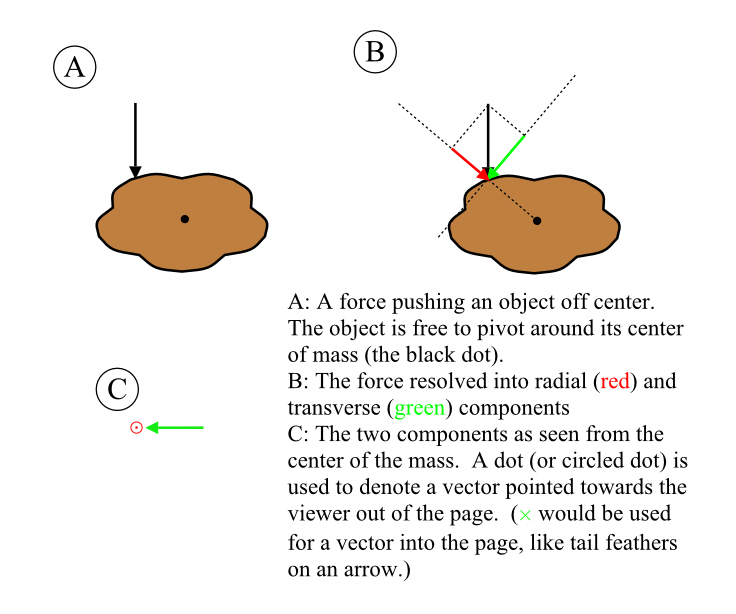
Figure 1A shows an object, and a vector representing a force applied to the object. The dot is the center of mass of the object. The force does not go through that center of mass.
Figure 1B shows the vector resolved into two components, a radial component (through the center of mass) and a transverse component, perpendicular to the radial component.
If your point of view is the center of mass, the transverse component is the one you see as a vector against the background. The radial component looks like a vector pointed right at you. (Figure 1C)
Figure 5-1 Off-center orce applied to an object.
As it turns out the radial component goes into pushing the object, and the radial component’s direction, not the direction of the original force is the direction of the shove, the sort of shove we talked about way back in part 1 when we talked about mass and force.
The transverse component will set the object to turning around its center of mass. (Or, if the object is fixed to a pivot, the object turns about the pivot.) This action is called torque.
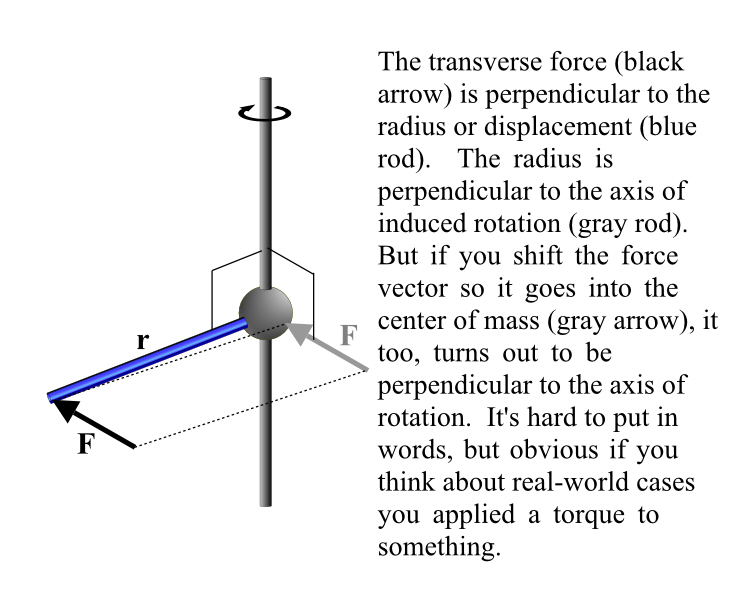
Not only that, the induced rotation will be around an axis that’s perpendicular to the radial component of the force. And it will also be perpendicular to the transverse component. (That sounds complex, it really isn’t. It’s definitely one of those picture-equals-a-kiloword things. See Figure 2.)
Figure 5-2: A force off center causes a rotation around a an axis both perpendicular to the force, and to the vector from the center of mass to the point the force is applied.
Different objects will, depending on not just their mass, but also their shape (sphere, donut, cylinder, cube, flat sheet), orientation (it makes a difference whether a cylinder is oriented so the ends are on the axis of rotation, versus whether the axis passes through the “wall” of the cylinder), and mass distribution (is the mass uniformly distributed or is, say, most of it near the center of the object), resist the torque trying to get it to turn. These factors would be multiplied by the mass of the object to come up with something called the “moment of inertia.”
(If you see the word “moment” in a physics term, it has to do with getting something to rotate, either something like this, or, say, a magnet wanting to swing to point towards/away from a magnetic pole somewhere–that’s a magnetic moment.)
The moment of inertia of a point mass, m, at a distance r from the center of rotation (the pivot point), is mr2. You can determine the moment of inertia of actual, real shapes (not point masses) either around their own center of gravity or a pivot point elsewhere, by breaking the object up into infinitesimal (almost zero size) pieces, computing each piece’s moment of inertia, then adding them up again. This can be “automated” in large part by using calculus.
Note that moment of inertia seems to have dimensions mass • distance-squared.
For example, a solid, uniform sphere had a moment of inertia about its center of I = 2/5mr2, m being the mass of the sphere and r being its radius. And of course the center of gravity is the center of the sphere. But if it’s a spherical shell (where the thickness of the shell is very small compared to the radius), it’s 2/3mr2. If it’s a thin rod of length L, spinning around a perpendicular line through the center, it’s 1/12mL2. And moment of inertia doesn’t just apply to objects completely free to move. If that rod is attached to a pivot at one end, like (say) the arm of a wrench, the moment of inertia is 1/3mL2—four times as much.
Tedious stuff and I had to memorize it then (of course) forget it.
OK, here’s an application. You’re driving down the road and have a blowout. You now have the task of loosening the lug nuts on the wheel so you can change to the spare. Out comes the lug wrench, and you push on it to loosen the nut.
The handle of the wrench is a radial (displacement) vector, and you know, intuitively, that you get the most leverage if you push on it at a right angle, as far out as possible. You’re trying to loosen the nut which not only has a (very small!) moment of inertia but a lot of friction.
If it doesn’t want to come loose, you need more torque. There are two ways to increase the torque: Apply more force to the end of the wrench (making sure it’s perpendicular), or get a longer wrench.
By now you’ll have noticed a pattern. Any time doubling some piece of the puzzle doubles the effect, the formula is going to involve multiplying by that factor. In this case this happens to both the the force and the distance (length of the wrench). We use the Greek letter tau, τ, to denote the torque. Then, if Ft is the transverse component of the force:
τ = Ftl
So you can imagine applying three newtons of force to the end of a two meter wrench (if you can imagine a wrench that long!) or twelve newtons to the end of a half meter wrench, and getting exactly the same torque either way.
Note this isn’t a vector…but really, it should be! Torque absolutely has direction! Not only righty-tighty, lefty-loosey, but you’d never try to remove the lug nut by pushing toward the car or away from it, even though that’s also perpendicular to the wrench. You’re applying a torque by doing this, but it’s not in a useful direction. (In fact if you manage to bend or snap the lug, it’s worse than useless.)
So we have two obvious vectors, a displacement (length) vector, and the direction of the force. We also know from our personal experience that a perpendicular force exerts the most torque because the entire force is transverse. Other angles exert less.
So our vector formula should depend on the angle between the vectors.
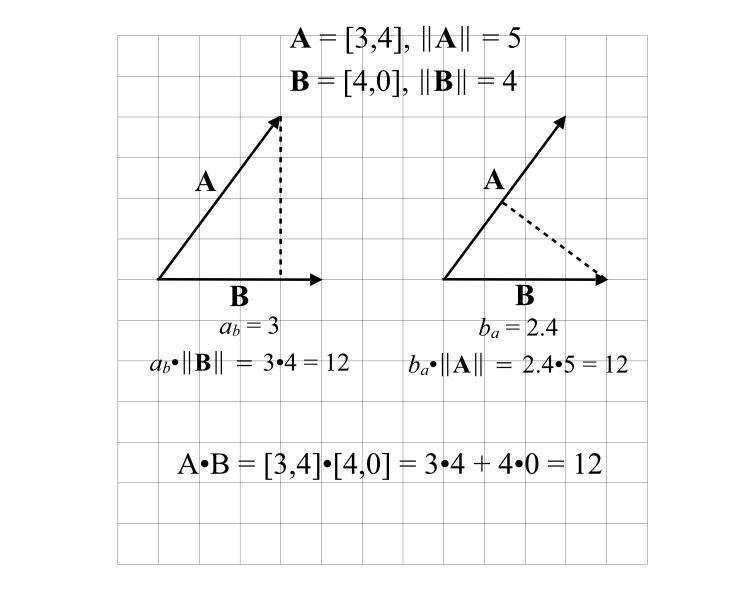
Well, we have the dot product. Is that what we want?
No, it’s not. First, the dot product does not give you a vector…and torque absolutely has direction, not just amount (magnitude).
But the second shortcoming is worse. A dot product is zero when the two vectors are perpendicular, and is maximized when the vectors are parallel (and minus that same maximum when the vectors point in exactly opposite directions). That’s the exact opposite of what we want.
The Cross Product
So pardon me for just a few seconds while I bust out in those peals of evil laughter once again. Bwahahahaha!!!
We need the other way to multiply vectors. We need the cross product.
The cross product, represented with ×, is maximized for perpendicular vectors, is zero when the vectors are parallel (or point in opposite directions) and gives you a vector answer. Perfect! It behaves exactly like torque with force vectors in various directions.
And now you know why the dot product is always written with a dot, never a “multiplication sign” like you saw in elementary school. Because when it comes to vectors, those two symbols do not mean the same thing.
First the pictorial description. Then the trig. Then how to compute it given some vectors.
First, a cross product only exists in 3D space. It won’t show up in the Donald Trump 64D Chess Open Championship. Nor will it show up in your 2D diagrams, unless you’re really showing a slice of 3D space, in which case it still won’t show up in your diagram because it will point straight up out of the diagram (or into it).
The result of a cross product between A and B, A×B, will be a vector that is perpendicular to bothA and B. To visualize this, make a fat L with your right hand (your right hand, not your left hand), with the thumb sticking out from the hand at a 90 degree angle. Now point the fingers along vector A. Now bend the fingers in the direction of vector B. (Hopefully you don’t have to contort yourself too much for this part. Figure 3 is safe, as long as you follow directions and use your right hand.) Your thumb points in the direction of the cross product, so long as the angle you sweep through is less than 180 degrees. (And for that matter, more than zero–angles less than zero would bend your fingers backwards, anyways.) If it is more than that, the cross product points the opposite way.
Figure 5-3: (Lifted from Wikipedia). The right hand rule for cross products.
This is called the right hand rule. You use your right hand to determine the direction of the cross product.
OK, now here’s a thing about cross products that will seem kind of odd. Do the same thing, only do B×A. Start with your fingers along B, turn your hand around so that you can sweep towards A. Now your thumb is pointed in the opposite direction from before.
Well, now, that’s odd! A×B actually is the opposite of B×A.
A×B = – B×A.
This GIF shows the cross product of two vectors in an animation, it pauses at 0, 90, 180, and 270 degrees but watch the cross product vector grow or shrink when it sweeps through the other angles.
FIgure 5-4: Again from wikipedia. Watch this GIF to see how the cross product changes with the angle between a the blue vector and b the red vector. Watch, in particular how the purple cross product arrow grows and shrinks while red vector sweeps through angles.
Now for the trigonometric interpretation. The magnitude of the cross product AxB is equal to the sine of the angle between them, times the magnitude of both vectors.
∥A×B∥ = ∥A∥ ∥B∥ sinθ
If A and B are unit vectors, it reduces to just plain sinθ.
Here, if you look at the angle from B to A as the opposite of angle from A to B, you can see why AxB = –BxA, because the sine of a negative angle is the same as the sine of the positive angle—except for a minus sign.
OK, now, if you’re dealing with two “raw” vectors, triplets of numbers, how do you compute their cross product?
It’s quite a bit more complicated than a dot product. However, there are a number of gimmicks to help you remember, and I’ll share my personal favorite.
Let’s take the vectors A = [2,7,3] and B = [5, 4, 6]. Let’s also take three vectors, i, j, and k. These three vectors are a physicist’s best friends, they’re unit vectors along the X, Y and Z axes. In other words, i = [1, 0, 0], j = [0, 1, 0], and k = [0, 0, 1]. (Note: I know I should put hats on them…but those characters are unavailable, so I’m settling for just using lowercase to denote a unit vector.)
Arrange things like this:
i j k 2 7 3 5 4 6
In other words, our unit vector friends, then vector A, then vector B.
Now repeat the first two columns:
i j k i j 2 7 3 2 7 5 4 6 5 4
Now start with the first i and run down and to the right, multiplying: i•7•6, which is to say 42i. This is a vector of length 42 along the X axis.
Do the same for j and k, you should get 15j and 8k.
Add these together, and get 42i + 15j + 8k. But, if you think of it, that’s just the vector [42, 15, 8], isn’t it? OK, save that off, we have to go on to the next step.
Start with k. Run down and to the left and multiply. k•7•5 = 35k. Move to the second i and do the same thing, then the final j. You should get 12i and 12j. You can add these up and get 12i + 12j + 35k. But that’s just [12,12,35], right?
OK, last step. Take the second vector and subtract it from the first:
[42, 15, 8] – [12, 12, 35] = [30, 3, -27]
Now I can say that (unless I made a boo-boo), [30, 3, -27] is perpendicular to both [2, 7, 3] and [5, 4, 6]. Which also means it’s perpendicular to the plane those two vectors are in (two vectors that aren’t parallel or antiparallel define a plane, but if the two vectors are like that then the cross product is zero).
Of course I can check that statement, and so can you. I can dot [30, 3, -27] with each of those vectors, if they are perpendicular the dot product will be zero.
[2, 7, 3] • [30, 3, -27] = 60 + 21 – 81 = 0
and
[5, 4, 6 ] • [30, 3, -27 ] = 150 + 12 – 162 = 0.
(So I guess I didn’t make a boo-boo.)
OK, that’s a kind of lengthy process. If you don’t like that, please, just remember the right hand rule and remember the gif. Those will tell you the direction, and give you a qualitative understanding of what’s going on.
Torque as a Vector
Okay, with that out of the way, back to torque. It’s the cross product of the force and the displacement vector, r, from the center of mass to where the force is being applied.
τ = r × F
We no longer need to specify the transverse component of F, the cross-producting takes care of that.
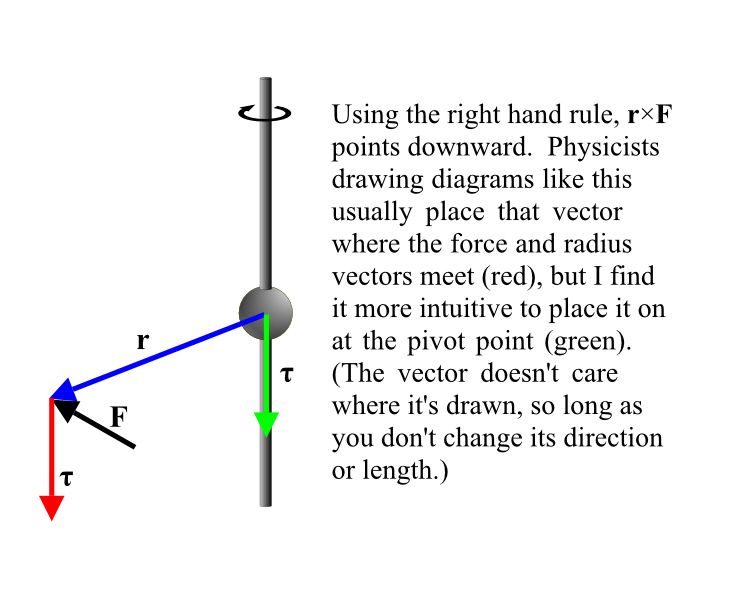
Let’s re-use the picture from Figure 5-2 and show you the torque vector.
Figure 5-5: The torque vector.
What about the units? F is a force and is in newtons, and r is a distance and is in meters. So torque is measured in newton-meters. Note this is the same units as work, but we don’t ever describe a torque in joules.
In the US customary system energy is sometimes measured in foot-pounds, and torque is quoted in pound-feet, just to keep them distinct.
And remember the direction of the torque is along the axis of rotation it’s trying to create. (In fact, it’s away from the car when loosening a lug nut, try the right hand rule to see.) If you find that counter-intuitive, you’re not alone. You might think the direction of torque ought to be the same direction as the force, or at least the transverse component of it. But on further reflection, that won’t work. In trying to loosen that rusted lug nut, I can be pushing down on a wrench sticking to the left, or I can be pulling up on the wrench while it sticks to the right. Those would be opposite torques if the direction of the torque were the same as the direction of the force. But they’re intuitively the same torque. If that isn’t so intuitive to you, then consider the case where you’re using one of those X shaped tire irons and you are pushing down on the left and pulling up on the right at the same time. The forces should cancel each other out, but clearly the torques they cause do not, they add together.
If you take both cross products left × down and right × up, both give you a vector pointing away from the car, and they add to each other.
Another way to look at is, the force, no matter where it is, is in a certain plane, the plane of the lug nuts. One way to specify a plane is to specify a line perpendicular to it. Of course, this is a vector, and can be anywhere so long as you don’t change its direction or magnitude, so a vector specifies any of a number of parallel planes (like pages in a closed book) depending on where you put it. A vector specifies a specific orientation of a plane, then,
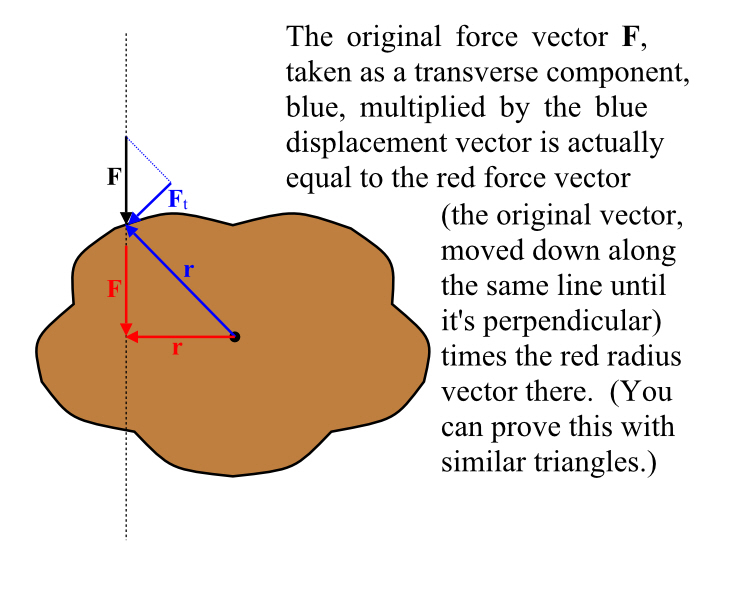
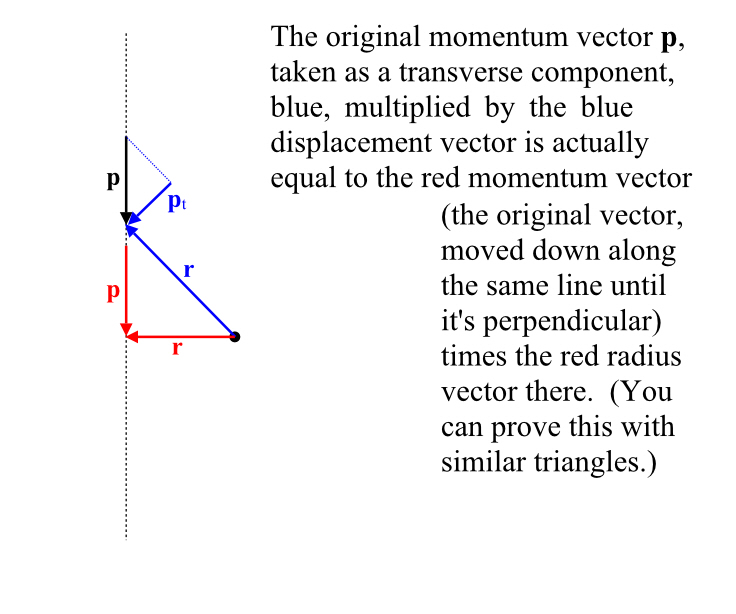
There is actually another way to analyze a torque when you are forced to push on the lever at an angle that isn’t perpendicular. Extend the line of the force, either forward or backward. Find the point where it’s closest to the center of rotation. Use the full force at that point and the distance to that point, and simply multiply (the angle is 90 degrees, so the sine factor is 1). This works because the length reduces by the same factor as you lost by not applying the force perpendicularly; you can prove that geometrically.
Figure 5-6: By projecting the line of an off-perpendicular force, you can find a spot where it’s perpendicular (against a shorter radius vector) and that torque is the same, so it may be another method to visualize torque resulting from an odd-angled force.
Angular Displacement, Velocity, and Acceleration
Imagine a wheel, free to turn, frictionless. You push on the outer rim. That’s a torque. How much does the wheel speed up?
As you might guess, it won’t turn at a high RPM immediately but will speed up as you continue to apply the torque.
You can actually draw a useful analogy here. We talked in Part I about applying a force to am object with a certain mass, causing it to speed up and, given a certain amount of time, covering a certain distance or displacement.
For rotations, we can apply a torque to an object with a certain moment of inertia, causing it to speed up in angular velocity (RPM is a measure of angular velocity) and eventually turn through a certain angle.
It’s actually a pretty tight analogy, everything “works.”
Distance (displacement) is represented by d. Angle, as you’ve already seen, is represented by lower case Greek theta, θ. But here’s the schiff in the punchbowl: the angle isn’t measured in degrees, it’s measured in radians.
A radian is 57.295779513082320876798 degrees.
Approximately.
Where the heck did that number come from? Okay, imagine you’re at a Biden rally, there to heckle, and you’re standing on the edge of one of those silly-ass social distancing circles. And the circle has a radius of 6 feet.
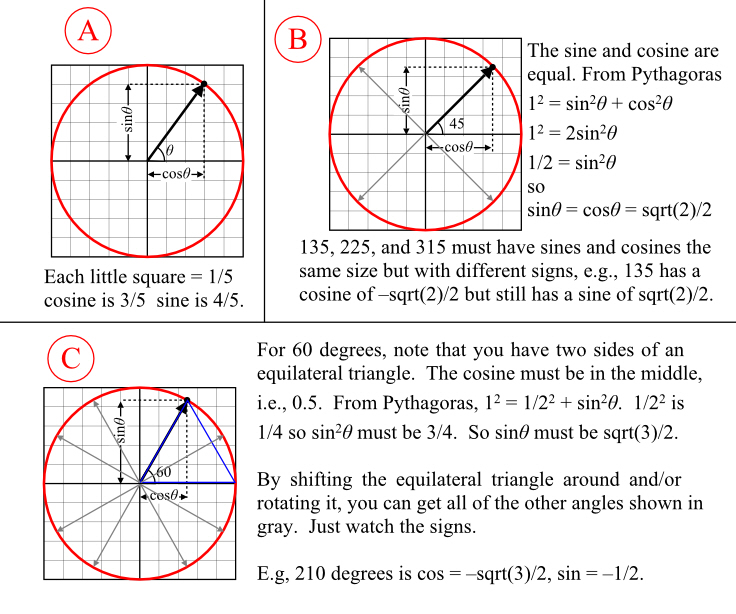
Now walk along the arc of the circle exactly six feet. The angle you covered is one radian. If you were to walk completely around the circle (why not? It’s not as if Biden is worth listening to) you’d cover 6 × 2π feet (approximately 37.699111843 feet), because the circumference of a circle is 2πr. That’s 2π radians. In other words, if you’ve expressed an angle in radians, you’re giving the ratio between the distance along the arc and the radius of the circle. And for reasons I long ago forgot (if I ever truly understood them) this is the most “natural” way to measure an angle, from a mathematical standpoint. (If you take a trig class you will learn like Pavlov’s dogs to recognize, for example, π/6 as being 30 degrees [with a sine of 0.5 and a cosine of 0.866+].)
Since an angle measured in radians is distance along the arc divided by the radius, you’re dividing length by length and a radian is actually a dimensionless value.
Velocity in a straight line is represented by v, the dimensions are distance/time Angular velocity, measured in radians per second, is represented by lower case Greek omega, ω. The units are 1/s, because the angle is dimensionless. Physicists usually write it as s-1, but I’ve avoided that so far and actually written fractions.
It’s possible to think of ω as a vector! It’s circular motion, though, so we cannot use the instantaneous regular velocity, just like we couldn’t define the torque vector as being in the same direction as the force producing the torque. You can define it as r × v or you can visualize it with a variation of the right hand rule. If the fingers of the right hand are curled in the direction of the circular motion, your thumb points in the direction of the vector. So if something is rotating counterclockwise (as seen by you), the angular velocity vector points towards you. [However, do not think of an angle as a vector; it doesn’t follow certain laws of vector addition. A long story…]
Mass is represented by m. Moment of inertia is represented by capital I: I.
Acceleration (in a line) is a. Angular acceleration is represented by lower case Greek letter α. And is in radians per second squared, i.e., 1/s2 or s-2.
And we’ve already seen F (linear force) and τ (torque).
You can follow through the analogy quite well. But I want to get to a specific destination, angular momentum.
But before we go there, if you’re really alert, you may have noticed one bit of the analogy doesn’t seem like the others.
Angular displacement, angular velocity, and angular acceleration are “sort of” like their linear counterparts, but in all cases, the displacement dimension disappears in the angular quantities.
But with torque, the displacement unit doesn’t disappear, it gets worse! Force is measured in newtons, kg m/s2. Torque is measured in newton-meters, kg m2/s2. There is a distance-squared in there, versus a distance, not the no-distance-at-all we’d expect from the analogy.
But in fact this is not a problem. A torque acts to accelerate an object with a moment of inertia at a certain angular acceleration. A torque, by analogy with F=ma, ought to be:
τ = Iα
I has units kg•m2 and α has dimensions 1/s2, combined they are kg m2/s2. This turns out to be newton-meters. So the analogy actually continues to hold, thanks to the fact that the mass-analog includes d2 in its dimensions.
And this is the case for momentum, and its analog, angular momentum as well.
Momentum is p = mv, yes, it’s a vector. Angular momentum is the same sort of thing, for a spinning object. It’s symbolized by L.
And you might expect angular momentum to be the mass-analog times the velocity analog. And indeed, it is:
L = Iω
This has dimension mass•distance2/time, md2/t or in MKS units, kg•m2/s.
You can rearrange this a tiny bit, and get L = md/t • d.
Notice, though, the first part of that has the same dimensions as momentum. And d of course is the distance.
It’s almost as if angular momentum is just regular momentum, times the distance from somewhere.
And indeed, the formal definition of angular momentum of a particle of mass m at a distance d from some point is:
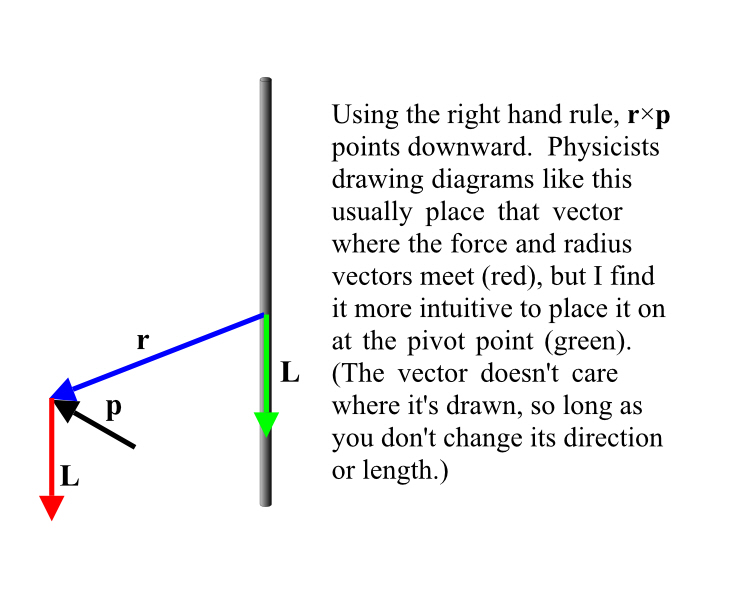
L = r × p
It’s back!!! Here’s the cross product, again, and I could even just recycle some of my figures from earlier on by changing F to p and τ to L. In fact, what the heck, here’s figure five with the central mass removed.
Figure 5-8: Figure 5, adapted to display angular momentum since the math is very similar.
People have a tendency to think of angular momentum as having to do with spinning objects only, or maybe their outlook is a little broader and they’ll give an angular momentum to one object running in rings around another.
But actually, angular momentum applies to everything. If you’re standing by a highway, and a car goes whizzing past, then from your standpoint the car has angular momentum, even on a dead-straight highway!
That definition above doesn’t say a single solitary thing about angular velocity. It does have linear velocity built into p, however! And the car certainly has a lot of that and a lot of mass so p is huge.
When the car was a mile away, it was headed almost directly at you. The radial component was almost as big as its total speed, and there was almost no transverse component. As it drives by, it’s closer, but all of the motion is transverse. This should sound familiar.
Figure 5-8: A redo of figure 6, noting a similarity between torque and angular momentum, this is very significant for angular momentum.
Here, I recycled figure 6, same substitutions. Instead of this being about the torque for a force applied anywhere on a straight line being the same, it’s the angular momentum that’s the same anywhere along a straight line, so long as the object is moving along with constant momentum.
I remember a story problem from a physics book (I cannot find it in my old college textbook, though). A child in a playground is running in a straight line, fixing to jump onto the edge of one of those rotating platforms that have probably been banned from playgrounds now because some idiot thinks they’re white heterosexual male. He has a constant angular momentum (seen from anywhere, but in particular the axis of the platform), then at the instant he jumps onto the platform, his motion is all transverse, and now that he’s revolving about the center of the platform, his motion will remain perfectly transverse. You can mentally relate angular momentum from rotation to angular momentum of an object moving in a straight line this way.
And, here is the freaky thing. You could pick any point on the diagram, and moving objects anywhere on the diagram would maintain the same angular momentum as they move along, relative to that point, as long as they don’t interfere with each other.
Conservation of Angular Momentum
You know, if momentum is conserved in a closed system, maybe angular momentum is also conserved. And indeed that turns out to be the case! Without exception, angular momentum in a closed system, relative to a point in that system, is conserved, and that includes objects in the system spinning about an axis. So even if objects interfere with each other by colliding, or whatever), the total angular momentum will remain the same.
The almost cliche illustration of the conservation of angular momentum is to watch a figure skater spin. When her arms are outstretched, she’s turning slowly, perhaps skating through a turn. Then she brings her arms in, raising them above her head, and suddenly she’s spinning, fast. Then she puts her arms out again and slows down. She’s reducing (and then increasing) the size of the displacement, so the rotation must increase (then decrease) so that the angular momentum will stay the same.
Figure 5-9: The inevitable figure skater angular momentum demo
I also remember, but cannot find, a video of an astronaut on Skylab. He’s “standing” perfectly straight, perfectly still. His angular momentum is zero. He then kicks one leg forward, and one leg back, he then sweeps them around 90 degrees–which makes his body turn, but only while he is sweeping his feet around in arcs. Then he returns to standing. He’s managed to turn himself 90 degrees to the right, but he is again motionless. It’s a demo of the conservation of angular momentum because while his feet were moving in arcs, his body had to rotate in the opposite direction to keep his net angular momentum at zero.
And of course there is the gyroscope, but that one is complicated…and I’m going to skip it. Suffice it to say that the force pulling on the axis of the gyroscope is being crossed with the angular momentum vector (which is through the axis), and a vector in a totally different direction results. Optional homework, go find some youtube videos of gyroscopes and see what they have to say.
Applications
But now, let’s apply this to something a lot cooler than lug nuts and kids in a playground and an ice skater. How about an object in orbit around the Earth?
If it’s in a circular orbit, then it’s going to remain moving at the same speed and it’s a no-brainer, the angular momentum won’t change because neither the angular velocity nor the distance will change, and you don’t even need the vector form of the equation, because in a circle the two are at right angles, always. (Of course to verify that the direction doesn’t change, go ahead and take the cross product.)
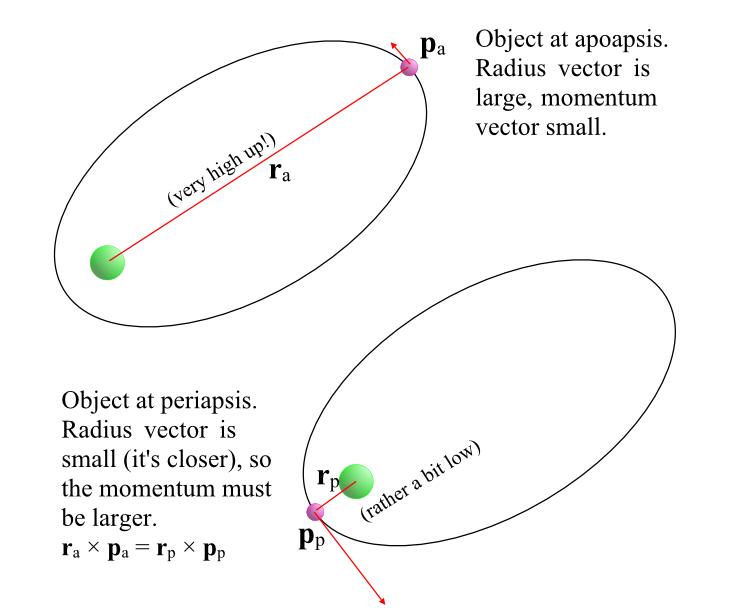
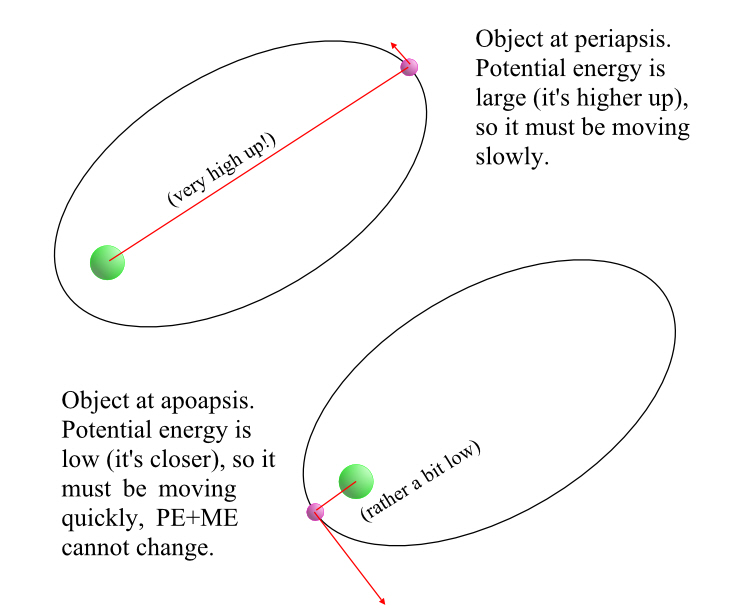
But what about in an elliptical orbit? At one end of the ellipse, the satellite is closer than at the other end. At periapsis (closest point) and apoapsis (furthest point), furthermore, the motion at these two points is all transverse. So if angular momentum is conserved, the satellite must be moving slower at apoapsis than it does at periapsis. At any other place on the ellipse the satellite has some radial motion, it’s either climbing to its apoapsis or descending to periapsis. So those are harder to analyze.
Figure 5-10 Angular momentum is conserved even when things don’t touch as seen in a satellite orbiting a primary.
Kepler’s second law, put forward in the late 1500s (!) describes the motion of a satellite in an elliptical orbit. But it doesn’t just say the satellite slows down the higher it goes, it goes further. It says if you draw a line from the primary through the satellite, and look at the area it sweeps out in some time interval, it’s constant! A fat wedge when the satellite is close in, a skinny one when the satellite is further out.
I always wondered how the heck Kepler figured that out.
I’ve seen how it’s done today; you do some calculus on the r and p vectors after setting their cross product to a constant (because angular momentum is conserved) and it pops out, very readily, in less than five minutes of chalkboard time. (And I don’t remember exactly how, just that I was surprised how readily it occured.)
But that’s not how Kepler did it. He didn’t know about the conservation of momentum, and he didn’t know calculus. No one did at that time, because Newton wasn’t even a gleam in his father’s eye.
So I’m still wondering how Kepler did it.
Another cool application of what we learned today to the orbiting satellite, is that it’s very easy to compute the orbital inclination. The orbit is in a plane. The primary is on that plane too, it’s at one focus of the ellipse. But the plane could have any arbitrary tilt. Maybe it sits right over the equator, and maybe it’s at some tilt (like the tilted circle on a globe that’s supposed to represent the ecliptic somehow–I always thought those were silly because as soon as the Earth rotates a tiny bit, that line is wrong).
If you have a measurement of the satellite’s position at a certain point in time and its velocity (including the direction!) at that same time, and they’re vectors in the right coordinate system (one where x and y point at two places over the equator and z points through the north pole), you can take the cross product. Both of those vectors are in the plane of the satellite’s orbit. so the cross product is perpendicular to that plane.
You can then turn that cross product into a unit vector. Take the dot product of it and the k unit vector (usually taken as pointing through the earth’s axis. (Actually you can save yourself some time. Just grab the third element of the unit vector). That’s the cosine of an angle, take the arccosine to get the angle. You now have the angle between a line perpendicular to the plane of the orbit and the earth’s axis, which is the same as the angle between the plane of the orbit, and the earth’s equatorial plane. Easy peasy, doable with almost no data.
This Week’s Mystery
We have a conservation law. I usually try to come up with an 1895 mystery too. Well we have one.
Consider the solar system. 99.9 percent of the mass is in the Sun, which is about 800,000 miles across, and rotates in about 28 days. That’s a certain amount of angular momentum.
The other 0.1 percent of the mass is in the planets (with a small fraction of that small fraction in asteroids, comets, etc). They’re light weight compared to the sun, but they are far out there, and remember there is an r2 term in angular momentum. Mercury, the closest one out, is roughly 100 times as far out from the sun as the sun’s radius. Neptune is almost 100 times as far as that.
It turns out that the vast majority of the solar system’s angular momentum resides in the planets. The Sun is the “one percent” when it comes to mass, but the planets are the “one percent” when it comes to angular momentum.
The mystery is how that came about. And any theory of how the solar system was formed has to explain how the heck all the angular momentum ended up out there in the planets, because angular momentum is conserved. You can’t have the sun just shed angular momentum, it has to be transferred. So if your theory can’t explain that…it can’t explain Jack.
A number of different ideas were proposed as early as the late 1700s, perhaps the most prominent of them is called the nebular hypothesis. It suggests that the solar system formed from a shrinking nebula of dust and gas. The nebula, when initially all spread out, is going to have some very small net rotation (it’s a random melange of particles moving at random velocities, after all; the chance of them all cancelling out perfectly is close to zero). As the nebula shrinks it’s going to spin faster, a disk will end up being formed and the disk will be clumpy and the clumps will eventually form planets because the clumps will tend to attract more matter to them.
Fairly elegant, but it could not explain the distribution of angular momentum, so by the end of the 1800s it had fallen out of favor. I had a book on the planets as a kid (which was probably about ten years old when I was born) that still considered it a mystery, and contained some of the alternatives that had been proposed, including one that suggested the planets had been pulled out of the sun by another passing star’s gravity. (If that one is true, then solar systems ought to be rare, rare, rare.)
Just this once, I’ll give it away now. Unlike back then, today we can actually see some stars forming, and they are surrounded by disks of gas and dust, exactly like the nebular hypothesis. Some astronomers have done a lot of work to refine the nebular hypothesis to make it more detailed and try to address the angular momentum problem…but they still haven’t succeeded. Yet we now know it must be correct, because we can see it happening right now. So the answer to this one is, we still don’t really know. It’s conceivable (though not bloody likely) that the conservation of angular momentum is broken (even though it has been reliably true every. single. time. we have looked at it). More likely, there’s some process at work we don’t understand, perhaps even transfer via magnetic fields.
But we haven’t got to magnetic fields yet…
Obligatory PSAs and Reminders
China is Lower than Whale Shit
Remember Hong Kong!!!
Whoever ends up in the cell next to his, tell him I said “Hi.”
中国是个混蛋 !!! Zhōngguò shì gè hùndàn !!! China is asshoe !!!
China is in the White House
Since Wednesday, January 20 at Noon EST, the bought-and-paid for His Fraudulency Joseph Biden has been in the White House. It’s as good as having China in the Oval Office.
Joe Biden is Asshoe
China is in the White House, because Joe Biden is in the White House, and Joe Biden is identically equal to China. China is Asshoe. Therefore, Joe Biden is Asshoe.
But of course the much more important thing to realize:
Joe Biden Didn’t Win
乔*拜登没赢 !!! Qiáo Bài dēng méi yíng !!! Joe Biden didn’t win !!!
It’s Food Fight Friday at Wolf’s Pub! Okay, it’s not the kind we usually think of, with teenagers flinging lunch trays and pudding all over the place. No, we’re in an existential fight for the integrity and plenitude of our food supply.
The globalist/communist elites both in our government and around the world are merrily working their plan to bring us into subjugation. Food is a big part of it. And we all know that, in the end, they will attempt to starve us into submission when all else fails.
I was going to do another marathon post with copious links and so forth, but the video I am sharing below pretty much sums up the ongoing globalist/communist revolution we’ve been seeing worldwide.
Since food is indispensable to life, it might be time to see what the crazy elites have been up to. Christian Westbrook, the Ice Age Farmer, has a conversation with Dr. Frédéric Leroy, who details the history of the elite obsession with controlling food consumption.
Btw, I highly recommend following Ice Age Farmer. He is the go-to source for what is news in the food and farming industry.
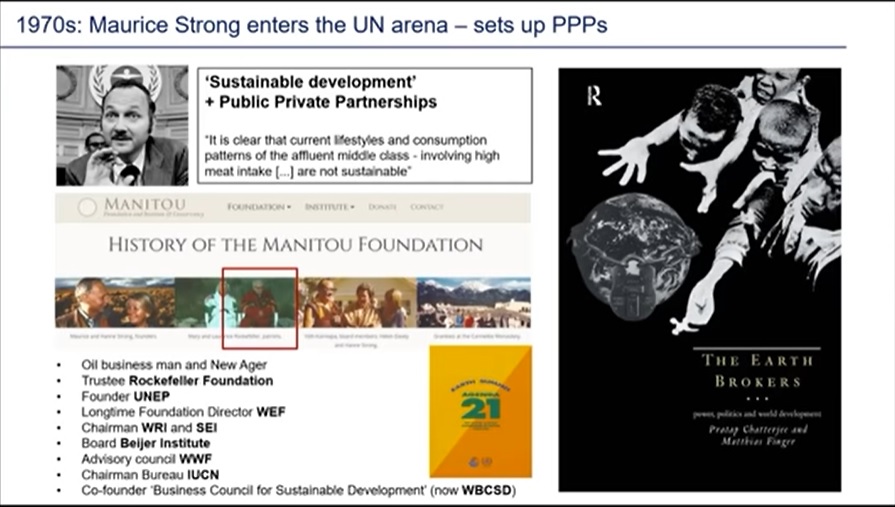
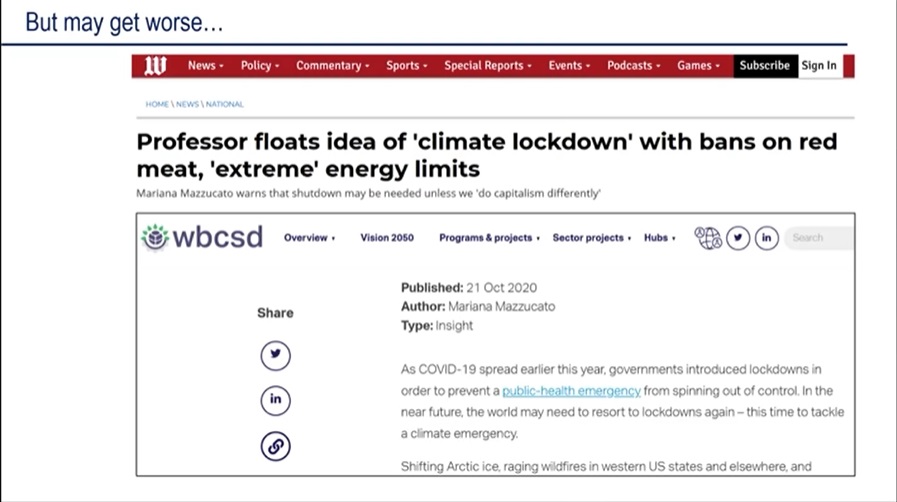
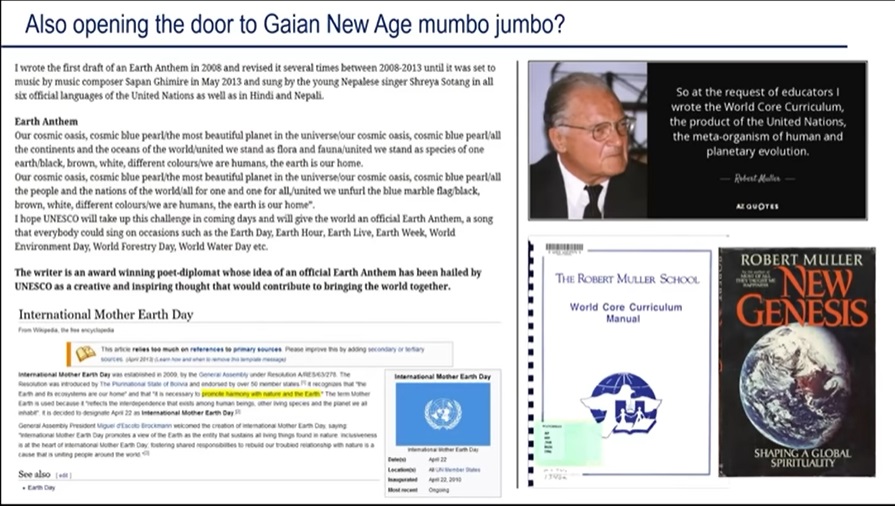
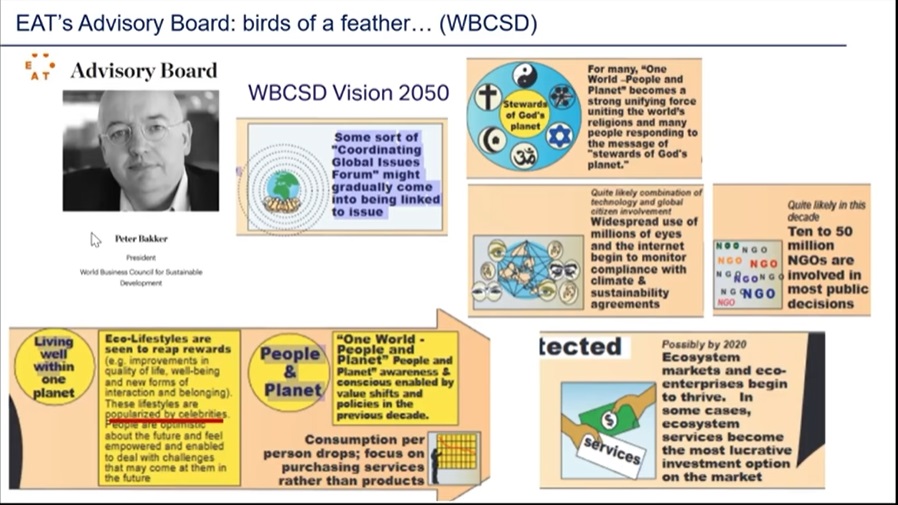
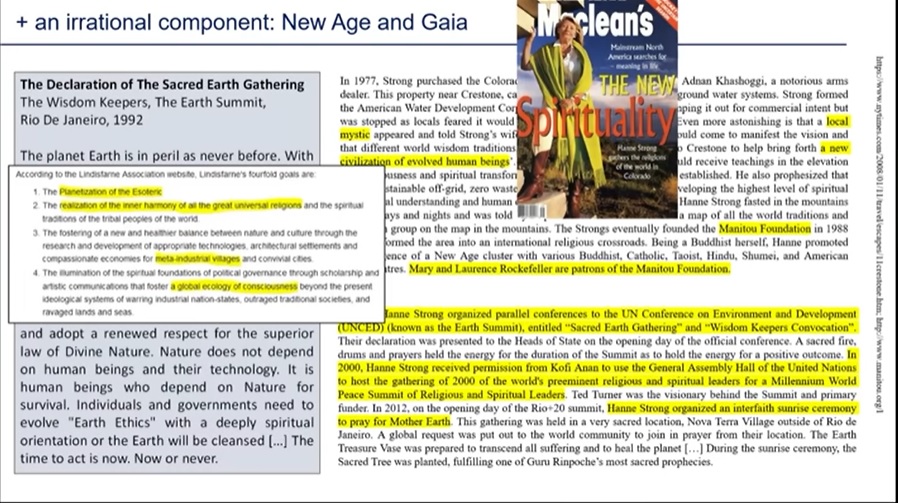
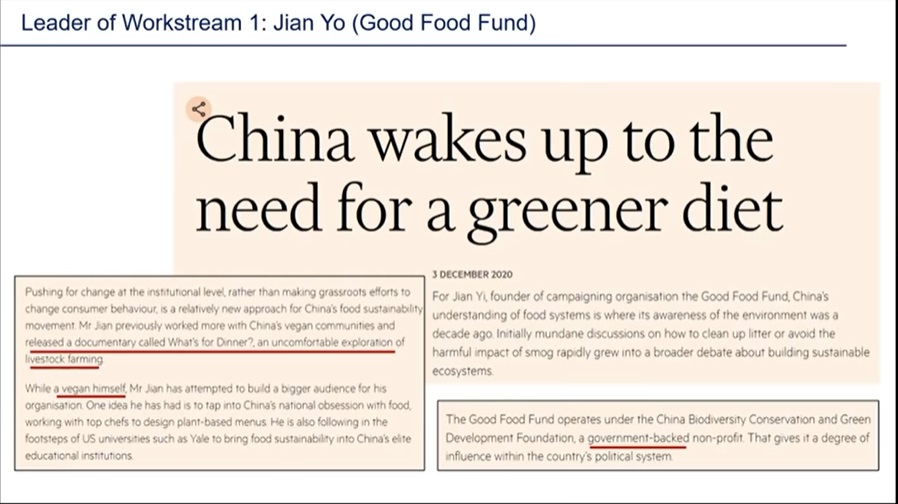
The video is almost two hours, which seems an eternity now. If you want the slideshow version, I’ll be posting many that were shared in the video. I doubt anyone here will be surprised at the deep interconnection between organizations like the UN, the World Economic Forum, Black Rock, the multinationals, and so on. It’s all here in the video.
CALVADOS!
Before we get to it, let’s enjoy a glass of Calvados, otherwise known as Apple Brandy. What a lovely drink and I had no idea that apple brandy was a big thing when our nation was young. Here’s a really nice video on how early Americans made apple brandy:
While we’re at it, let’s just get the niceties IN the way, shall we? Yep, rules of civil conduct here. Go to the Utree if you have a case of the nasties, or we somehow need to reconvene there.
A lovely glass of Calvados for everyone! We also have a lovely apple cider for those who don’t wish to indulge.
THE RESET OF OUR FOOD SUPPLY AND SYSTEMS
I’ll post the video just below, and then give you a good taste of the slideshow. And boy are you in for a show.
https://youtu.be/mVj5-95dkHY
The History: Yes, Rockefeller and Friends
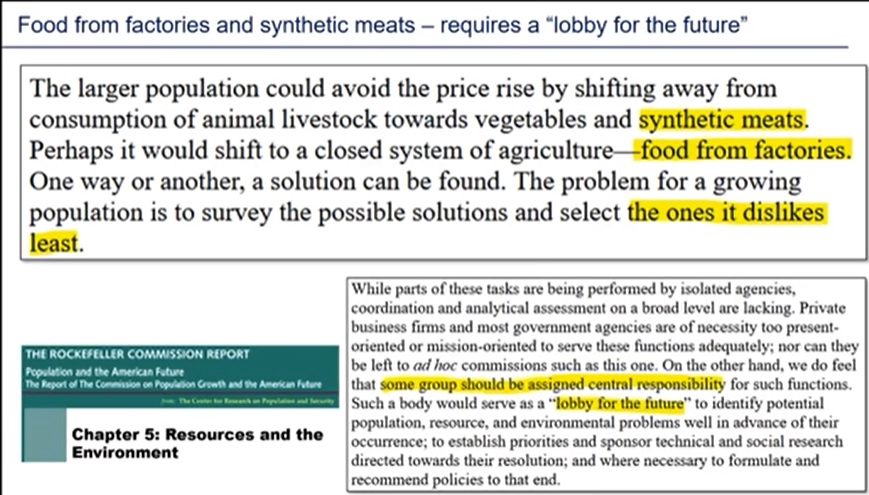
Way back in the 1960s we have the Rockefeller Commission Report that suggests “synthetic meats” and “food from factories.” Long-term planning, eh? Now, it’s coming to fruition unless we stop them. Christian and Dr. Leroy talk about the companies now producing fake meat and how intertwined they are with the organizations that are pushing for the NWO.
Interconnected Evil
As Dr. Leroy says in the video, it is a monolith.
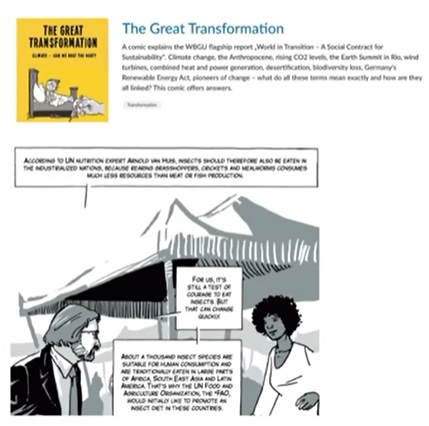
The Great Food Transformation???
What did that fellow just say?
Friends, they want the “affluent middle class” weak, hungry, and poisoned. The better to control us.
THEY WANT US EATING INSECTS
They want to do away with meat and dairy. They really, really do. Dr. Leroy discusses how cows use a lot of pasture land, and that gets in the way of the globalist plan of fake meat and insects for us. The cows have to go so the land has to go. Hmmmm, I wonder if that is why Bill Gates is buying farmland…
Who is that Saudi prince? Yep.
Did ya know they have a One-size-fits-all Planetary Diet proscribed for the entire world population? These people are so deeply mad that it hurts to think about it. They want to cut out starches and almost all meat and dairy. We’ll be eating lentils and veggies until the cows come home. Our protein will be lab “meat” or bugs. And they will force it on us if we don’t comply.
THE RELIGIOUS ANGLE
Dr. Leroy shows the religious element involved in the food takeover. It’s the Gaia, One World Religion thing and yes, they are stark raving mad!
Transhumanism is all mixed up in their bizarre universal consciousness weirdness.
WE CAN’T FORGET CHINA!
What’s in it for the CCP? Lots, I bet!
Did I mention Black Rock is all up in this stuff? The Council on Foreign Relations? All the usual suspects want to control what we eat and how that food reaches us. Don’t get me started on blockchain. We are already seeing how the elites are purposely disrupting the supply chain, and we are seeing an unprecendented rise in food costs for ourselves and for our livestock. How could chicken scratch rise 30% in just a few weeks?
WHAT CAN WE DO?
Christian asked Dr. Leroy what can be done to stop this global takeover. The good doctor was perplexed, but he did say that we need to get connected on the local level with our food. By that, he meant we need to seek out local food producers, since not all of us can grow gardens.
Blackberries are ripening!
He said we have become disconnected from our local food sources. He also said that he is faithful to the food traditions of his culture, which includes foods such as organ meats.
I fully agree with that statement. I have put off getting in touch with a local beef rancher because it is really expensive to buy grass fed beef. But guess what? Beef prices have skyrocketed. If I’m going to pay a premium for my food, it might as well be the nutritious stuff.
On a similar note, the grocery stores have whole isles of stuff that we’re told is food, but has been so processed that it hardly passes for food. So little old me has begun a campaign to move my household to a Traditional Foods home. One step and one skill at a time.
Sourdough bread
I found Mary of Mary’s Nest, who has an online traditional foods classroom. I adore this woman. She is so thorough and earnest about leading people to food freedom. I love her quirky style and how open she is to taking us step-by-step to learning the traditional ways of cooking. Here’s her video on making a sourdough starter:
ODDS AND ENDS
By the way, I spoke with a grocery store employee today who told me that both Kroger and her company are going to allow fully vaccinated employees to wear a button that states such, and they won’t have to wear the mask. Those who aren’t vaccinated will still have to wear masks. She said it is just rumor at this point. I say a couple lawsuits should fix that right up.
Let’s drink a toast to all the patriots in Arizona who are making that audit count in ways that could help save our republic! And may patriots in Georgia, Wisconsin, Pennsylvania and New Hampshire keep the pressure on. AUDIT! AUDIT! AUDIT!
This Sanctuary Sunday Open Thread, with full respect to those who worship God on the Sabbath, is a place to reaffirm our worship of our Creator, our Father, our King Eternal.
It is also a place to read, post and discuss news that is worth knowing and sharing. Please post links to any news stories that you use as sources or quote from.
In the QTree, we’re a friendly and civil lot. We encourage free speech and the open exchange and civil discussion of different ideas. Topics aren’t constrained, and sound logic is highly encouraged, all built on a solid foundation of truth and established facts.
We have a policy of mutual respect, shown by civility. Civility encourages discussions, promotes objectivity and rational thought in discourse, and camaraderie in the participants – characteristics we strive toward in our Q Tree community.
Please show respect and consideration for our fellow QTreepers. Before hitting the “post” button, please proofread your post and make sure you’re addressing the issue only, and not trying to confront the poster. Keep to the topic – avoid “you” and “your”. Here in The Q Tree, personal attacks, name calling, ridicule, insults, baiting and other conduct for which a penalty flag would be thrown are VERBOTEN.
In The Q Tree, we’re compatriots, sitting around the campfire, roasting hot dogs, making s’mores and discussing, agreeing, and disagreeing about whatever interests us. This board will remain a home for those who seek respectful conversations.
24 . . . “The kingdom of heaven is like a man who sowed good seed in his field; 25 but while men slept, his enemy came and sowed weeds among the wheat and went his way. 26 But when the grain had sprouted and produced a crop, then the weeds also appeared. 27 So the servants of the owner came and said to him, ‘Sir, did you not sow good seed in your field? How then does it have weeds?’ 28 He said to them, ‘An enemy has done this.’ The servants said to him, ‘Do you want us then to go and gather them up?’ 29 But he said, ‘No, lest while you gather up the weeds you also uproot the wheat with them. 30 Let both grow together until the harvest, and at the time of harvest I will say to the reapers, “First gather together the weeds and bind them in bundles to burn them, but gather the wheat into my barn.” ’ ” (Matthew 13:24-30)
In the agricultural society of Christ’s time, many farmers depended on the quality of their crops. An enemy sowing weeds would have sabotaged a business. The weeds in the parable were likely darnel because that weed, until mature, appears as wheat. What would a wise farmer do in such a dilemma? Instead of tearing out the wheat with the weeds, the landowner in this parable wisely waited until the harvest. After harvesting the whole field, the weeds could be separated and burned. The wheat would be saved in the barn.
In the explanation of parable, Christ declares that He Himself is the sower. He spreads His redeemed seed, true believers, in the field of the world. Through His grace, these Christians bear the fruit of the Spirit (Galatians 5:22-24). Their presence on earth is the reason the “kingdom of heaven” is like the field of the world. When Jesus said, “The kingdom of heaven is at hand” (Matthew 4:17; Mark 3:2), He meant the spiritual realm which exists on earth side by side with the realm of the evil one (1 John 5:19). When the kingdom of heaven comes to its fruition, heaven will be a reality and there will be no “weeds” among the “wheat.” But for now, both good and bad seeds mature in the world.
The enemy in the parable is Satan. In opposition to Jesus Christ, the devil tries to destroy Christ’s work by placing false believers and teachers in the world who lead many astray.
But we are not to pursue such people in an effort to destroy them. For one thing, we don’t know if immature and innocent believers might be injured by our efforts. Further, one has only to look at the Spanish Inquisition, the Crusades, and the reign of “Bloody Mary” in England to see the results of men taking upon themselves the responsibility of separating true believers from false, a task reserved for God alone. Instead of requiring these false believers to be rooted out of the world, and possibly hurting immature believers in the process, Christ allows them to remain until His return. At that time, angels will separate the true from false believers.
In addition, we are not to take it upon ourselves to uproot unbelievers because the difference between true and false believers isn’t always obvious. Weeds, especially in the early stages of growth, resemble wheat. Likewise, a false believer may resemble a true believer. In Matthew 7:22, Jesus warned that many profess faith but do not know Him. Thus, each person should examine his own relationship with Christ (2 Corinthians 13:5). First John is an excellent test of salvation.
Jesus Christ will one day establish true righteousness. After He raptures the true church out of this world, God will pour out His righteous wrath on the world. During that tribulation, He will draw others to saving faith in Jesus Christ. At the end of the tribulation, all unbelievers will be judged for their sin and unbelief; then, they will be removed from God’s presence. True followers of Christ will reign with Him. What a glorious hope for the “wheat”!
The track is all clear, the switches are thrown The Glory Train’s coming; we’re going home It may be soon or the sweet by and by We’ll not know the day; so don’t even try
Now, at the station, the platform is full But all is not quiet; some push, some pull Many evil men fight to be the king They want control over everything
Others wait patiently, doing good deeds Helping those that hurt and in great need They know the train will be coming for them And long for peace, not the platform’s mayhem
All ticketholders are ready to leave They’ll go aboard, all who truly believe They trusted God and God’s only Son Marked by God’s Spirit for when the train comes
Life on the platform goes on without end But one day the train speeds around the bend Many in the crowd raise a rousing cheer While others are shocked and cower in fear
The Conductor calls out “Welcome! Come aboard!” “All you who believe and trust in our Lord!” “By faith you believed, now God’s Day is come” “Your race is over, your victory’s won”
Then a strong voice, with trumpet and shout By God’s Holy Power calls the dead out They rise from their sleep and all board the train Wearing bright, white garments, freed from all stain
Then those here waiting respond to the call Tears flowing freely in wondrous thrall All climb aboard to their purchased place Paid for by Christ by God’s mercy and grace
The ones left on the platform weep and wail They put themselves first, now they know they’ve failed Their faith was only in the world and man They fought against God and ignored His plan
Now, without God, they must find their own way Living in sin until the Judgment Day When they’ll kneel to Christ, unable to stand And from God’s presence eternally banned
The doors all close and the train pulls away Oh, what a glorious sight on that Day! Up through the clouds in the blink of an eye Then huge Pearly Gates appear in the sky
Into Heaven’s Realm, we’re nearing our home Of perfect peace and joy, never to roam Just over the river, close by the shore There we’ll debark for our forever more
The train slows and stops, the golden bells ring What a great welcome as the angels sing! The old has all gone; we’re changed new and free All of us sing and shout the victory!
We now have arrived at our Promised Land With calm, deep blue seas and warm, white sands And across the river, green fields and hills With sparkling lakes , so peaceful and still
Oneness fills all, and love that doesn’t cease And abiding joy, and deep, heartfelt peace Giving God all the glory and our praise Throughout all time for Eternity’s days
On this day and every day –
God is in Control . . . and His Grace is Sufficient, so . . . Keep Looking Up
Hopefully, every Sunday, we can find something here that will build us up a little . . . give us a smile . . . and add some joy or peace, very much needed in all our lives.
“This day is holy to the Lord your God; do not mourn nor weep.” . . . “Go your way, eat the fat, drink the sweet, and send portions to those for whom nothing is prepared; for this day is holy to our Lord. Do not sorrow, for the joy of the Lord is your strength.”
The prior election must be acknowledged as fraudulent, and steps must be taken to prosecute the fraudsters and restore integrity to the system.
Nothing else matters at this point. Talking about trying again in 2022 or 2024 is hopeless otherwise. Which is not to say one must never talk about this, but rather that one must account for this in ones planning; if fixing the fraud is not part of the plan, you have no plan.
Not an Eagle
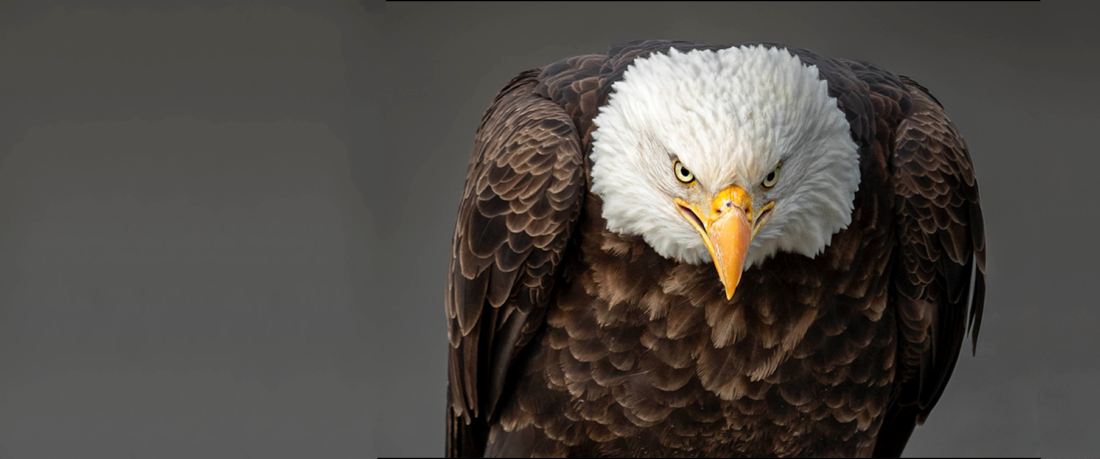
On my way to work there’s a large nest up in a half-dead tree, and I’ve been reminding myself to take pictures sometime. Well, I finally managed to do so and I established two things. 1) The autofocus on the camera I used sucks and 2) it’s not an eagle nest; it’s some sort of falcon with a white body. (The head is dark, even if it were an eagle it’d be a golden eagle, not a bald eagle.)
Postmodernism, a/k/a “Theory”
The other day I read a book review, regarding “Cynical Theories: How Activist Scholarship Made Everything about Race, Gender, and Why This Harms Everybody” by Helen Pluckrose and James Lindsay.
I must emphasize I have not read the book. According to the review, it doesn’t actually spend much time on many of the more politically noisome aspects of this latest version of “postmodernism,” but it is invaluable in going a step deeper in critiquing it than many others do.
A lot of the sheer nonsense pervading the Left is so crazy to anyone with a sane worldview that we find it hard to believe that the other side really believes this crap. But they do, because it is part and parcel of a nonsane worldview. And this broader worldview is discussed in the book. It makes Leftist nonsense seem at least somewhat sane within its own context.
We of course spend a lot of time here bashng “Critical Race Theory” (as it deserves) but other aspects of it are pernicious too and I thought I’d adapt the capsule summary of “Theory” I read in the review, here.
“Theory” apparently represents the latest wave of “postmodernism” which began in the 1960s with the work of Michel Foucalt. He argued that there is no such thing as objective truth. Or, if there is such a thing, it’s inaccessible to us because our knowledge is nothing but “narratives,” stories we tell each other and use to keep power.
Leaving aside the jokes playing off the fact that that statement itself is a claim to an objective truth, if there’s no such thing as objective truth, then basically anything goes.
Those two principles lie at the root of “Theory.” The next layer are four “attitudes” or methods.
the blurring of boundaries between intellectual and social categories. This can result in anything from men wearing dresses to scientists relying on anecdotes.
An emphasis on language as the tool that controls every aspect of life.
Cultural relativism–not just in morality (e.g., cultures where behaviors we consider corrupt are considered normal, for instance) but even in epistemology. In other words the methods we use for figuring out the world around us are only valid in our culture. Some other culture can adopt other rules for determining, say, if gravity works.
The lack of distinction between the individual and the universal. This means, among many other things, that “truths” (they insist on a plural there) have meaning only for a group. There aren’t any Steve truths, there are White Male truths. But there also isn’t a truth that is true for all of mankind either.
That’s the philosophic underpinning of today’s Left. No wonder they’ll believe such silly things.
It’s hard to predict what, exactly, the postmodernists will actually do with this, because as I said, these rules mean there are no rules for determining what is and isn’t true, much less what to do about a fact once it’s discovered. The PoMos themselves use bizarre jargon and revel in being incoherent. It’s a feature not a bug. And that’s a consequence of their basic beliefs. There’s no truth, “logic” is just one of many “ways of knowing” and one which must be tainted by racial/sexual/class bias…so what need to express oneself clearly or to give actual proof of one’s assertions?
Demanding that they be lucid is seen by them as a form of oppression; we’re trying to force them to use our standards.
Remember back in 1996 when Alan Sokal (a physicist) wrote a paper full of gibberish and it got accepted by a PoMo philosophy journal? The authors of this book repeated that in 2018, with over a dozen BS papers. One of those papers rephrased Mein Kampf in feminist jargon!
Cynical Theories makes the case that this stuff was apparently harmless up until the 1980s. The practitioners were unable to articulate an ideology, and couldn’t, therefore push to influence society. But in the 1990s they shifted gears. Keeping the two principles and four methods above, they fashioned a menu of separate specialist theories, e.g., “postcolonial,” “queer” and our current favorite, “critical race theory” among them, aimed at “deconstructing” things society used to take for granted, to show there was no objective truth there but just an attempt to hold power and oppress minorities. An example given in the review is “Disability and fat studies.” According to this even deaf or paralyzed people don’t suffer from their disabilities but rather from prejudice against them, held down by the network of power relations in society. So they argue that disabilities are yet another kind of “identity” and that trying to alleviate deafness or paralysis is actually oppressive and exploitative. And if a deaf or paralyzed person asks for help, he’s internalizing his own oppression.
Around about 2010 this garbage heap of “theories” coalesced into “Theory.” Collectivism is merged with the rejection of objectivity and now we have statements like “There’s no true truth but there are different truths for different categories of people.” Pluckrose and Lindsay explain “Having oppressed identities gives the oppressed a richer, more accurate view of reality-=hence we should listen to and believe their accounts of it.”
The dominant society, meaning, you guessed it, white male society, commits injustice against these groups when it fails to affirm their beliefs.
This is an inversion of Marxism, which claimed that the oppressed workers suffer from “false consciousness.” Now it’s the (alleged) oppressors who suffer from it, because they’ve been socialized to believe a certain set of “truths” that benefits them.
Special attention should be paid to the premise that language effectively constitutes reality, and blinds the majority to the fact that they are oppressing the minority. This accounts for one of the most aggravating aspects of the Left: They will insist on orthodoxy while simultaneously disowning their own efforts to enforce it.
And of course, this is why they conflate speech with violence. Because in their view, speech isn’t about reality, it is reality. A difference of opinion creates a power imbalance that threatens to erase a person’s only source of significance, which is other people “affirming” their “experience.” To listen, therefore, requires not just listening but actually affirming. Disagreement or criticism are inherently unjust.
There’s more, much more…I will probably be buying the book.
Lawyer Appeasement Section
OK now for the fine print.
This is the WQTH Daily Thread. You know the drill. There’s no Poltical correctness, but civility is a requirement. There are Important Guidelines, here, with an addendum on 20191110.
We have a new board – called The U Tree – where people can take each other to the woodshed without fear of censorship or moderation.
And remember Wheatie’s Rules:
1. No food fights 2. No running with scissors. 3. If you bring snacks, bring enough for everyone. 4. Zeroth rule of gun safety: Don’t let the government get your guns. 5. Rule one of gun safety: The gun is always loaded. 5a. If you actually want the gun to be loaded, like because you’re checking out a bump in the night, then it’s empty. 6. Rule two of gun safety: Never point the gun at anything you’re not willing to destroy. 7. Rule three: Keep your finger off the trigger until ready to fire. 8. Rule the fourth: Be sure of your target and what is behind it.
(Hmm a few extras seem to have crept in.)
Spot Prices
All prices are Kitco Ask, 3PM MT Friday (at that time the markets close for the weekend).
Gold is doing very well. Platinum took a big hit, palladium fell 76 bucks on Friday alone, it’s now far away from its $3000+ dollar high point.. Rhodium is down, too, $1200 on Friday alone. Perhaps the PGM bubble is bursting? Realistically, it’s too early to tell.
Electricity and Magnetism (First Half) (Part IV of a Long Series)
Introduction
The general outline of this story is to start off by putting you “in touch” with the state of physics at the beginning of 1895. Physicists were feeling pretty confident that they understood most everything. Sure there were a few loose ends, but they were just loose ends.
1895 marks the year when people began tugging at the loose ends and things unraveled a bit. In the next three years, three major discoveries made it plain there was still a lot to learn at the fundamental level.
Once I’m there I will concentrate on a very, very small object…that ties in with stars, arguably the biggest objects there are (galaxies are basically collections of stars). And we would never have seen this but for those discoveries in the 1890s.
It’s such a long story I decided to break it down into pieces, and this is the second of those pieces.
And here is the caveat: I will be explaining, at first, what the scientific consensus was in 1895. So much of what I have to say is out of date, and I know it…but going past it would be a spoiler. So I’d appreciate not being “corrected” in the comments when I say things like “mass is conserved.” I know that that isn’t considered true any more, but the point is in 1895 we didn’t know that. I will get there in due time. (On the other hand, if I do misrepresent the state of understanding as it was in 1895, I do want to know it.)
Also, to avoid getting bogged down in Spockian numbers specified to nine decimal places, I’m going to round a lot of things off. I used 9.8 kg m/s2 last time for a number that’s actually closer to 9.80665, for instance, similarly for the number 32.
A couple of go-backs.
I’m actually used to dealing with newtons, joules, and watts as abbreviations, N, J and W. Of course now I’m writing for an audience of about six people many of whom haven’t taken the same classes I have, and often spelling the units out. Ignorantly, I’ve capitalized them because their abbreviations are capitalized. That was wrong. Although the names of the people the units are named after are, of course, capitalized, the units themselves should not be. I knew this 40 years ago, I forgot. For example, “The metric unit of power, the watt (W), was named after James Watt.”
I beg your pardon for this error.
More substantively, I thought I’d say a bit more about the dot product.
And this time, I will reference trigonometry. Just a teeny bit. This won’t hurt…much.
Pictorially, a dot product of two vectors is equal to the magnitude of the perpendicular projection of one vector onto the other, times the magnitude of that other vector.
OK, that’s a mouthful! Let’s call our two vectors A and B. Last time around we defined a symbol for the magnitude of a vector, so that the magnitude of A is ∥A∥ and the magnitude of B is ∥B∥. But let’s also make one more convention, let ab be the magnitude of the projection of a onto b, and let ba be the magnitude of the projection of b onto a.
So a dot product of A and B is equal to ab∥B∥. But it works the other way, too, A•B = ba∥A∥.
Figure 4-1, graphical interpretation of the dot product.
If you drop a line from the end of A to B, so that that line hits B perpendicularly, you’re said to have projected A onto B. In this case, the length of A‘s projection onto B is ab=3.
But you can also project B onto A, as in the second part of the diagram. When you do that, the length of the projection, ba is 2.4. I didn’t measure that, but I used ratios. The length of A is 5 (it’s part of a 3:4:5 right triangle), and the length of B is very obviously 4. The two triangles formed by the vectors and the dashed “dropped” line are similar, they share one angle where the two vectors meet, and a right angle, so all of the angles have to be the same. So if the hypotenuse of one is 5, while the other is 4, the other two sides must also both be cut by 20 percent. The projection of B onto A must therefore be 20% less in length than the projection of A onto B (which we know is 3), so that length must be 2.4.
In the left hand diagram, “the magnitude of the perpendicular projection of one vector [A] onto the other [B]” is 3. The “magnitude of that other vector [B]” is 4. The product is 12.
In the right hand diagram, these numbers are 2.4 and 5, respectively. The product of these two is also 12.
The dot product of these vectors is: [3, 4]•[4,0] = 3•4+4•0 = 12+0 = 12. So it works, at least in this example. I’ll let you look up the proof; I’ve only told you what it means.
What if both vectors are unit vectors? Since the vectors are of exactly the same length, their projections onto each other are the same, and since the vectors are of length one, the lengths of their projection onto each other will be one (if they are pointing in the same direction), or -1 (if they are pointing in opposite directions) or some number in between.
That number is the cosine of the angle between them, abbreviated cos.
The usual way of teaching trigonometry, shown in the first part of figure 2, involves drawing a “unit circle” (one with a radius of one), sticking this circle onto a Cartesian grid, and then drawing a line at some angle from the center of the circle to a point on the circle. Obviously the coordinates of that last point are going to differ depending on the angle, but the x value is the cosine, and the y value is the sine, abbreviated sin.
Figure 4-2 A capsule lesson on Trig, from the first day of class.
But you can look at the cosine of the angle as being the same thing as the projection of a unit vector onto a unit vector lying along the x axis.
Go back to my prior statement, about what a dot product was:
Pictorially, a dot product of two vectors is equal to the magnitude of the perpendicular projection of one vector onto the other, times the magnitude of that other vector.
With a pair of unit vectors being “dotted” together, both magnitudes in that sentence are 1. So, for unit vectors, it’s equivalent to
“a dot product of two unit vectors is equal to the magnitude of the perpendicular projection of one vector onto the other.”
But we just saw that the projection of one unit vector onto the other is the cosine of the angle between them. So if both vectors are unit vectors, the dot product of those vectors is the cosine of the angle between them.
If the first vector is not a unit vector, but is, say, twice as long then the magnitude of its projection onto the other is simply twice as long as well. In other words, that projection length is the magnitude of the vector, times the cosine of that angle.
You can go back to the original statement. The dot product of two vectors is the cosine of the angle between the vectors, times the magnitude of the first vector, times the magnitude of the second vector.
So the formal definition of a dot product is:
A•B = ∥A∥∥B∥cosθ
where θ is the angle between the two vectors.
This gives you a sneaky way to figure out the angle between two vectors. Take their dot product. Then divide by the magnitude of the first vector, and divide again by the magnitude of the second vector. You now have the cosine of the angle between them. You can look up the “inverse cosine” (i.e., the reverse of taking the cosine). Today, you can use a calculator (or calculator app). A few decades ago, a fancy slide rule might have a scale on it for cosines, from there you can look up the angle. Also you could look it up in a table. Sines and cosines are actually very well known functions.
There are a number of angles with well-known cosines that are actually expressable as somewhat-sane numbers. 45 degrees, for instance, is an angle at which the sine and cosine are equal, (see part B of figure 2). You can draw a right isosceles triangle there, which means the two legs are equal. Using Pythagoras, c2 = b2 + a2 for right triangles (with c being the side opposite of the right angle), and knowing that c = 1, and a = b, 1 = 2a2. So a2 = 1/2. Now a is equal to the cosine, or the sine in this case, so both are equal to the square root of 1/2, sqrt(1/2) (sorry, I can’t do fancy square root signs here). That’s 1/sqrt(2), but mathematicians hate it when you put a radical in the denominator, so they multiply top and bottom by sqrt(2) and get sqrt(2)/2. This is roughly 0.707. Similar reasoning will get you the sines and cosines of 135, 225, and 315 degrees, you’ll have to put negative signs in as appropriate.
60 and 30 degrees are other convenient angles. For instance with 60, you can get the answer from realizing that you can draw an equilateral triangle here, as shown in part 3. The X line, the slanted line, and a third line are all length one, and that’s a 60 degree angle there. It’s a symmetrical triangle, so the cosine has to be 1/2. The sine can be had from Pythagoras, too: sqrt( 1 – (1/2)2) = sqrt( 3/4 ) = sqrt(3)/2. Sqrt(3) = 1.732 (remember, Washington’s birth year), sqrt(3)/2 = roughly 0.866.
You can use similar reasoning for 30, 120, 150, 210, 240, 300, and 330 degrees.
Thes are all “magic angles” (as I called them last week) because you just know the sine and cosine and in some cases it’s even a nice nifty fraction like 1/2.
Most angles in whole degrees give you absolutely ugly sines and cosines.
OK, with that exceedingly gentle intro to trigonometry and the additional info on dot products out of the way…
Electricity
It has been known since at least 600 BC that amber (fossilized tree sap), when rubbed, could attract light objects. This was noted by Thales of Miletus. (There is no extant record on whether Thales had difficulty with the sheets coming out of his clothes dryer.)
Sometime in the next 2000 years, someone noticed that glass exhibited the same behavior.
In 1723 Charles Francois Du Fay, a French physicist, realized that actually, glass and amber didn’t quite behave exactly the same way. Whatever it was they were doing was different in a rather interesting way.
Suspend two corks on silk threads. Buff up a piece of amber, touch one of the silk threads. The two corks are attracted to each other, somewhat. Buff up the piece of amber again, and touch the other silk thread. Now the corks actually repel each other, somewhat more strongly.
Whatever it is that’s in the amber that makes it attract small objects, when introduced to two different objects, caused them to repel each other, as if the whatever-it-is repels itself.
Repeat this experiment, but this time touch the second thread with a rubbed bit of glass. Now the two corks attract strongly. And if you repeat again, and touch both threads with the bit of rubbed glass, the corks repel each other again.
There is, in other word a resinous electricity (from amber) and a vitreous electricity, from glass, and they appear to be two different things, but able to interact with each other.
So vitreous electricity repels itself, but attracts resinous electricity (and vice versa), and resinous electricity repels itself too. They both seem to attract small things that don’t have any electricity in them at all. Like repels like and attracts the other.
Figure 4-3 The basic rules of Du Fey’s two electrical fluids.
At this point Du Fay came up with a fluid theory of electricity. Each kind of electricity was a different sort of fluid that would flow from solid object to solid object.
In the 1740s an otherwise obscure individual by the name of Benjamin Franklin in Pennsylvania did some more work. He was able to show that if you took an object with one of the two kinds of charge, and touched it with an object of the other kind, the charges disappeared, as if they had cancelled each other out.
Franklin came up with the single fluid theory. In this one electricity was a sort of fluid and under ordinary circumstances, an object would have a certain normal amount of it. But when it was in surplus, you saw one kind of charge, when it was in deficit, you saw the other kind. (In very similar fashion, surplus money can be used to pay off debt, a negative amount of money.)
And indeed this analogy suggests that the charge with the surplus of fluid could be considered positive, and the charge from a deficit of fluid could be called negative. This would be mathematically convenient. It wasn’t meant in any sort of pejorative way.
That is precisely what Franklin chose to do. However, he had no idea which kind was the surplus! He labeled the vitreous charge “positive” and the resinous charge “negative” and it has been this way ever since. His chances of getting it right (assuming a fluid was moving) were 50-50.
The charges could just as easily have been labeled black and white or red and green or yin and yang. But by Franklin’s time mathematical rigor had begun to pervade science, and so positive and negative, they were.
One difficulty with Franklin’s theory was that although one could imagine a fluid repelling itself (like two positive charges would do), but it was more difficult to imagine the lack of such a fluid in two objects creating a repelling force. Nonetheless, Franklin’s formulation was a lot more widely accepted than Du Fey’s.
One can also have different strengths of charges; one piece of rubbed glass might have twice as strong a charge as another. That, presumably, meant the first had twice as much of the fluid in it as did the second. Similarly, pieces of amber could have different deficits of the fluid. In order for charges to completely cancel out, it turns out, they must have equal magnitude but be opposite. If one is of greater magnitude than the other, then the result of the cancellation will be a slight amount of that charge, the leftover part that couldn’t be cancelled out by the other.
Imagine coming up with some way to measure charge, and you have a positive 3000 charge and another negative 2800 charge. Putting the two together, you’re left with a positive 200 electric charge, just like you’d get from adding the numbers +3000 and -2800.
There is in fact a unit of electric charge, the coulomb, named after Charles A. de Coulomb, and it seems to be a very large unit.
Who was Coulomb? He formulated the law of force between electric charges. This law superficially resembles Newton’s law of gravity. F12 is the force exerted by charge 1 on charge 2.
F12 = (kq1q2 / r2)•ȓ12.
As a reminder Newton’s law of gravity was
F12 = -(Gm1m2/r2)•ȓ12.
So instead of the masses, we have q, the electric charge of the objects, and we have a different constant, k. G was a small number, 6.67 x 10⁻¹¹, indicating that two one kilogram masses a meter apart would attract each other with a force of 6 trillionths of a Newton.
The k in Coulomb’s law is 8.99 x 10⁹. In other words, nine billion.
So two one Colomb charges a meter apart act upon each other with a force of nine billion Newtons. Which is almost the weight of a billion kilograms on earth, or about a million English-system tons. From one Coulomb acting on another.
As I said a Coulomb is a huge unit! The sheets in your dryer don’t stick to each other quite that hard, but when you remember static electricity can lift small objects against gravity, it’s pretty plain the electric force is likely inherently stronger than gravity.
Although Coulomb’s Law and Newton’s law of universal gravitation look a lot alike, with charge and mass filling in for each other, and different fudge factors, there’s one very important difference.
Newton’s law has a minus sign in it. Coulomb’s law does not. The minus sign serves to make gravity an attractive force, because it makes the force vector point the opposite way as the displacement unit vector. This doesn’t happen with electric charges.
But don’t we have situations where electric charges attract? Sure we do. And even though this formula describes a repulsive force, it does allow for this, because the result is negative when some part of the formula is negative; r2 must be positive, k is positive, so the only way that can be is if q1q2 is negative. If both charges are positive, the product is positive…and they will repel. If one is positive and the other negative, the product is negative, and it’s like gravity; they attract. Finally if both charges are negative the product is positive, and the two charges again repel each other.
So that’s how charges behave. It’s oddly like gravity and also oddly unlike gravity. And it’s a lot stronger than gravity.
Conservation of Electric Charge
It eventually became evident that electric charge is conserved. If your system starts out with 0 total, in other words, “electrically neutral,” you can create a charge somewhere in it, but always at the cost of creating an opposite charge somewhere else in the system–again, as if some amount of fluid had moved from one place to another. And if there is a charge somewhere in the system, it can only disappear if it’s combined with the opposite charge from somewhere else in the system.
What of the small objects…dog fur, scraps of paper, and so on, that are attracted to an electric charge, even though they’re neutral? For example, imagine dog hair stuck to positively charged glass.
We know the dog hair is not simply charged the other way. negatively, because it’s attracted to both kinds of charge.
As it turns out the electric fluid in the dog hair–it has some in it, just exactly enough to be neutral–is repelled by the glass’s positive charge, and ends up at the far end of the hair. Of course, this means the end of the hair closest to the glass now has a negative charge. And the negatively charged end is closer to the glass than the positively charged end is, so the attractive force is stronger than the repulsive force. Voila! The (overall) neutral object now sticks to the positive charge. Even if the hair is lying flat against the glass (and it probably is), the side touching the glass is closer than the side far away.
For the most part, the phenomena we’ve been talking about involves static electricity, electricity that is not moving. Sure, one of our experiments involved having it move along a silk thread. And there were also Leyden jars which could hold a substantial charge and would release it when the contacts were touched—sometimes enough charge to knock a man down. But for the most part, the charges didn’t move.
But electricity is much, muchMUCH more interesting when it is moving, especially either steadily or in an oscillating fashion! More on that later; I have to set this aside and start another “thread” of thought now.
Magnetism
Another phenomenon, very similar to electricity in some ways and rather different in others, also turned up in ancient times. There were occasional rocks that would attract iron. They would also attract each other. But sometimes they repelled each other. And it turned out that the SAME rock would have a part that would repel the other rock, and one that would attract it. On the other hand, this didn’t matter when the rock was interacting with iron; either end would attract it.
This, of course, is what we now know as magnetism. And those two ends that attract or repel each other became known as poles.
That’s because a magnet, left free to swivel, will always point one of its two poles roughly toward the Earth’s north pole, that’s called the north pole of the magnet. The other is the south pole of the magnet. When it becomes a matter of representing these things mathematically, the north pole is considered “positive.”
Very much like electricity, similar poles repel, opposite poles attract. (Ironically, this means the Earth must be a giant magnet, with that magnet’s south pole near the north (geographic) pole, so it can attract magnets’ north poles.)
What happens if you break a magnet in half to try to separate the north pole from the south pole? You get two smaller, weaker magnets, each with north and south poles. The broken end of the north side of the old magnet is now a south pole, and the other side of the break is now the north pole of the other new magnet.
In fact, no matter how small you break a magnet, you will never succeed in having just one pole. This sort of thing, if it existed, would be called a “magnetic monopole” and it’s a true unicorn.
Figure 4-4 Basic rules of magnetism
Magnets, too attract or repel each other in inverse propotion to the square of how far apart they are–which is mathematician speech for “there’s an r2 in the denominator.” This is hard to see or even use, though, because there’s always an opposite pole nearby which partially cancels things out.
Magnetic poles didn’t seem to move around within objects like electric charge does. But there was a sort of conservation law; in breaking a magnet in two, you still had equal numbers of north and south poles And the fact that there are no monopoles tells you that the total amount of “north pole” must be equal to the total amount of “south pole” because they always come in pairs.
Magnets, too, can be much more interesting when they’re moving.
Electricity Moving. Work and Potential
If there is a force, then work can be done.
Imagine an object, a kilogram in mass, with a coulomb of positive charge on it. Allow it the freedom to move. Put a fixed charge nearby, on an object that cannot move.
If you space things properly, that charged object will start to accelerate, at 1 meter per second per second. As if one newton of force were being applied to it.
That’s because there is a newton of force being applied to it, a newton of electrical force, not gravitational force, and not a solid thwack administered by an experimenter. And after a meter of this, the electrical force has done one joule of work, just like with every other kind of force.
In fact, you can draw an analogy here between the sort of potential we talked about, where the height of a cliff was related to how much work gravity would do on an object dropped off of it, to what the electrical force does to a charged object.
If, going from point A to point B, a coulomb charge has a joule of work done to it, the electrical (not gravitational) potential between A and B is one volt. Yes, that volt. Named after Allesandro Volta, about whom, more in a bit, and abbreviated with a capital V.
So the equation here is work = potential x charge. Double the potential, double the work; double the charge, double the work. Or 1J = 1V x 1C.
Equivalently 1V = 1J/C.
And similar to gravitational potential where twice as much work gets done by doubling the mass, you can get twice as much work out of a one volt potential, by having it operate on two coulombs.
Didn’t we just see that a coulomb is a gigantic charge? Or at least, that it exerts a very strong force, so big that no doubt we’ve never seen a coulomb out in the real world? What dang use is a volt? It must be pretty tiny to get only one joule out of a coulomb!
The fact of the matter is, though, that when electricity moves, a coulomb isn’t all that much, particularly if you can get it to move for a prolonged period of time.
This was quite a bit different from the static electricity games that people had been playing up to now. Sure, you could occasionally get static electricity to move (if not careful, it would move through you), but it would usually just do it all at once, and once it had moved there were no positive or negative charges. It was moving from a high voltage to a low voltage, all at once. Sort of like dropping a rock (hopefully not on your foot). Once the rock is at the bottom, you’re done getting work out of the system, and you’re done quite quickly.
Imagine, though, turning on a faucet and getting a continual stream of mass to fall. (Or imagine a waterfall.)
We figured out how to do this in the very late 1700s. The story starts with an Italian named Galvani in the late 1700s; he was dissecting frogs and noticed that a spark could make the leg muscles twitch, even though the frog was quite thoroughly dead. Then he noticed that if he touched it with two different metals, he could also make it twitch.
That was the clue that Allesandro Volta (1745-1827) needed. In 1799 he created something we now call a “voltaic pile.” Start with a disk of copper. Place on top of it a disk of cardboard soaked in salt water. Place on top of that a disk of zinc.
Run a metal wire from the copper plate to the zinc plate, and electricity will flow through it from the copper to the zinc. There’s clearly a “push” being given to the electrical fluid in the wire. That push is a potential of about 3/4 of a volt, but Allesandro Volta certainly didn’t call it that.
If you stack these, you can build up higher and higher voltages. Place another copper disk directly on the zinc one, another bit of salt-water-cardboard, another zinc disk, and the total is 1.5 volts. Do it again, and now you have 2.25 volts. And so on. As long as you put negative zinc right next to positive copper in your stack of these sandwiches, you build up voltage.
But the big thing is, electricity could now be generated chemically, and not just rubbing things together, and it was sustained for some period of time until this pile, what we now call a battery, ran down.
In just a few years, ending in 1808, Sir Humphry Davy was able to reverse things; instead of chemistry making electricity, he got electricity to do chemistry. He was able to isolate no less than seven elements from compounds that had previously proven to be too tightly bound to be broken by conventional chemical means. Up til then we were reasonably confident those elements were there; we just couldn’t actually prove it beyond a shadow of a doubt by getting those elements out of their compounds.
And as early as 1800 electricity from a voltaic pile was used to break down water into hydrogen and oxygen.
The thicker the wire, the faster the battery would run down. Almost as if more electrical fluid could “fit” in a thicker wire.
And now we have hit the concept of electric current. How much electricity is moving? That’s how much electric current there is.
One ampere is one coulomb flowing past a point, every second. It was named after Andre Marie Ampere (1775-1836). He did a lot of the early work on what he called “electrodynamics.”
If you look in your breaker box, you’ll likely see a lot of switches labeled 12, 15, 20 or even more “A”. That’s amperes, and when one of those breakers flips, you’ve drawn more than that many amperes through that switch. In a circuit whose breaker is labeled 12, twelve coulombs will pass through that breaker every second.
With all those coulombs moving around why hasn’t your house blown apart (or been sucked into a vortex) from all those coulombs attracting or repelling each other?
Because the electrical fluid moves, and it doesn’t accumulate anywhere. A coulomb flows from one side of the breaker to the other, but another coulomb of fluid is right behind it, so there’s no deficit to create a resinous/negative charge. And the fluid downstream from your breaker also moved on, leaving space for the coulomb that just flowed through the breaker. No accumulation, no net positive charge (and no places low on fluid to have a negative charge).
The wire forms a closed loop, with your house at one end, and a power source on the other, something that creates an electrical potential, so that current will flow from high to low. (This is sometimes called Electromotive Force, or EMF, and abbreviated with a script capital E: ℰ.)
In a battery the current is “pushed” by the battery through the wire, through whatever it is you’re using the electricity to operate, and back along another wire to the battery…which uses chemical energy to do work, and give it another push around the loop. So a battery converts chemical energy to electrical energy. Once it runs out of chemicals it can react, it’s dead. (This is another aspect of the conservation of energy.)
One difference between a battery and your house wiring is that in your house wiring the current switches direction, back and forth, sixty times a second (50 in Europe and some other parts of the world). This is called “alternating current.” A battery doesn’t switch back and forth, and it’s called “direct current.”
Digression
OK, I’m going to shift for a moment from physics to the metric system itself.
The newton, joule and watt are called “derived units.” They come from combinations of other, more fundamental units, the meter, the kilogram, and the second. Length, mass, and duration are very different things from each other, but force, for instance, has to do with mass, length and duration. But when it comes to electricity, we have yet another thing that’s different from everything else. So something having to do with electricity should be a fundamental unit. The metric system has seven fundamental units; we’ll probably only touch only two of the remaining three.
You would think that the fundamental unit for electrical things would be electric charge, but you’d actually be wrong. The “fundamental unit” having to do with electricity in the metric system is the ampere. The coulomb is defined as one ampere, flowing for one second (C = A•s); the volt is then defined as I stated above.
But it’s even a bit crazier than that. There are two metric systems! The one I’ve used all along is MKS, for “meter kilogram second” because that’s what it derives other units from. But there is an older, mostly disused system called “CGS” for “centimeter gram second,” it derives its unit of force, and energy and so on from centimeters, grams and seconds. Its unit of force is called the dyne—1 g cm/s2. When you consider that the gram is 1/1000th of a kilogram, and a centimeter is 1/100th of a meter, it should be no surprise that the dyne is 1/100,000 of a newton. The unit of energy is called the erg, and it is 1/10,000,000 of a joule. These are tiny, tiny units. The MKS units are easily “felt” by people: who hasn’t lifted 100 grams (weighing about one newton) about a meter and done a joule of work? But that’s ten million ergs!
Returning to Electricity…
OK, back to the main story.
Returning to our electrical circuit, from battery positive terminal through something that uses the electricity for energy, then back to the negative terminal of the battery, current is flowing.
What if there is a break in the wire? Won’t the electricity simply pile up?
Only the slightest, tiny bit. As more electrical fluid goes down the wire an unbalanced positive charge builds up, it begins to repel the fluid headed its way and forces it to a stop. This happens very quickly, effectlively, the current just comes to a screeching halt the instant the break happens. And if you measure the potential across both ends of the break, it’s now equal to the potential of the battery, whereas before the break, there was no potential difference at that point, but current was flowing through it.
Electricity is very eager to move, at least in good conductors; it really hates piling up, because a pile of it is a bunch of the same charge confined to a small space, and every bit of that repels every other bit, and hard.
Is there any constraint on how much current flows? Certainly. Every material, even a wire, has a resistivity to the flow of electricity. The more resistance, the less current will flow for the same voltage. On the other hand, if you double the voltage, that’s double the push, and twice as much current will flow through that same object. This works pretty consistently (until you reach the absolute carrying “ampacity” of the stuff and it heats up and melts or vaporizes, at which point, you’re done with that bit). Given a volt put across two opposite sides of a cube of the stuff, how much current will flow? Given that number, you can figure out how much resistance a certain object will have. It increases with length, and decreases with cross-section, so you can figure out the resistance of a wire, or any other object you want to carry a current, if you know the resistivity of the stuff it’s made of.
If the object the current is trying to flow through allows one amp through when it’s subjected to a volt, it has a resistance of one ohm, named after Georg Simon Ohm, who figured out that current flow was proportional to the applied voltage, and the proportion was different for every kind of material. In fact, it’s a law: the current through an object is equal to the voltage across the object, divided by the resistance.
I = E/R
I is current, don’t ask me why. E is from “Electromotive Force” and R is…wait for it…the resistance. Or to put it in metric units,
1 A = 1V/Ω
That funky symbol at the end is a capital Greek letter omega (as in “alpha and omega”), and perhaps it was selected to be the symbol for the derived unit ohm, as a sort of pun (ohm-ega).
If you have a circuit, from the positive end of a battery through three different resistances and back to the battery, you can measure the voltage across those three items and they will all have a pro-rata share of the voltage the battery is supplying. Say, for instance, it’s a 12V battery, and you have three lights hooked up to it, each light is 100 ohms. They’re all equal, and so the voltage across each light will be 4V.
Figure 4-5 Series circuit analysis
The current through any one of these lights will be 4V/100 ohms, or 0.04A. The same current goes first through one light, then the second, then the last, so it’s a good thing all of those currents are the same (or current would be coming in from nowhere).
By the way, on diagrams like this, for educational purposes, the wires are assumed to have zero resistance. So the voltage drop from the battery to the top terminal of the bulbs is E=IR = 0.4A • 0Ω = 0V. Likewise the wire between the bulbs has zero voltage drop.
Stringing a load end to end like that is known as wiring in series and usually is a stupid way to do things. (If one bulb blows out the circuit is broken and none of them work. Also, adding more bulbs increases the total resistance, reducing the current, and the total amount of light is actually less.)
Connect each of the three bulbs directly to the battery at both ends. This is parallel, because it splits the current into three separate streams. Each bulb now has 12 V across it, not 4, and the current through each bulb is 0.12A. Since each bulb gets a separate stream of current, the currents add up (instead of the voltages) and the battery is delivering 0.36A. Adding more bulbs adds more light, they each continue to use the same current as before.
Figure 4-6 Parallel circuit analysis
When wiring up a house, if there are, say, multiple lights controlled by one circuit, your electrician wired them in parallel, not in series. (Or he has made a rookie mistake.)
OK, one more thing, before we alas, must call it quits…prematurely.
Imagine a 1A current flowing. That’s one colomb/second (1 C/s). Imagine it’s flowing because of one volt of potential. A volt is 1 J/C.
What happens when you multiply current by potential?
C/s • J/C.
The coulombs cancel, and you’re left with J/s. Which is power, in watts. The same watts we had when we were playing with weights and forces.
(Incidentally, in the US, we tend to think of electrical things in watts–light bulbs especially. But with mechanical things, even an electric circular saw, we think of their power in horsepower. It’d be really odd for someone to brag about how many watts his car engine puts out, though he could. On the other hand, it’s perfectly normal in Europe though even they have a residual use of horsepower, judging at least from car marketing materials (though maybe that’s for the benefit of us Yanks). But just so you have a feel for the difference, one horsepower is 746 watts.)
But this shouldn’t be any surprise. Remember that a volt is what you needed to get a coulomb to do a joule’s worth of work. A current of 1 ampere means that a coulomb of electricity is having this done to it every second, in other words a joule of work is being done every second…which is a watt.
So P (for power) = I (for current…again, don’t ask me why) x E (for voltage).
We can now write many different equivalencies for the watt:
1W = 1J/s = 1V•A = 1 kg•m2/s2 = 1 V•C/s…
So we’ve figured out that electricity has potential, it has current, it has resistance and it has power, many of these analogous to gravity, many not really all that analogous at all.
Going back to those two diagrams above, the first has 0.04A flowing through a 12 V potential drop, that’s 0.48 W. The second has 0.36A flowing through a 12 V potential drop, for 4.32W. The latter circuit delivers nine times as much power as the former. Batteries are rated in A•h, not watt-hours, so what matters is how much current it delivers. Because it’s delivering nine times as much current (as well as nine times the power), that battery will die nine times faster.
Now going back to house breaker panels, we know the voltage (on average) is 120V. The breaker says it’s a 20A breaker. Multiply the two together, and the breaker carries 2,400 watts. Why not just label the breaker that way?
Because a breaker is designed to protect the circuit which has a limit on how much current it can carry. The circuit’s capacity is unaffected by the voltage of delivery but it had better not draw more than 20A. In fact the same breaker could conceivably be used in Europe, where the supply voltage is 220V, and therefore be able to pass 220V x 20A = 4,400 watts. (I don’t know if it’s physically compatible with the way their systems are laid out, though, so don’t go selling unused breakers to people in Europe to raise money when the Great Fiscal Apocalypse finally hits.)
There is much, much more to this story, we’re still in the early 1800s. I am sure Wolf will tell you I am quitting before the interesting part. And I am!
But I don’t want this to get overlong, and I still have to draw the diagrams, and it’s already 9PM in Wolf’s time zone.
I’m going to cover a totally different topic next week, then bounce back to this story the week after.
There is a mystery here, you might already see it, but it’s still a mystery in 1895, so let’s save it until we get there.
And Joe Biden didn’t win.
To Be Continued…
Obligatory PSAs and Reminders
China is Lower than Whale Shit
Remember Hong Kong!!!
Whoever ends up in the cell next to his, tell him I said “Hi.”
中国是个混蛋 !!! Zhōngguò shì gè hùndàn !!! China is asshoe !!!
China is in the White House
Since Wednesday, January 20 at Noon EST, the bought-and-paid for His Fraudulency Joseph Biden has been in the White House. It’s as good as having China in the Oval Office.
Joe Biden is Asshoe
China is in the White House, because Joe Biden is in the White House, and Joe Biden is identically equal to China. China is Asshoe. Therefore, Joe Biden is Asshoe.
But of course the much more important thing to realize:
Joe Biden Didn’t Win
乔*拜登没赢 !!! Qiáo Bài dēng méi yíng !!! Joe Biden didn’t win !!!
It’s Fight the Good Fight Friday at Wolf’s Pub. Welcome everyone.
Know your enemy is an important rule in spiritual warfare. The minions of Evil roam the earth, looking who they may devour.
We see this not only in our own lives when we are spiritually attacked, but in the lives of nations. Can you say ‘The Great Reset’?
The Occult is Out There
An individual in my extended family has been involved in the occult for many years. It has been an education, and for that I am grateful. Other aspects, not so much.
NOT THE PAINTING I WAS GIVEN
At any rate, years ago this person gave me a watercolor painting of an owl. The artist was obviously talented and I liked the painting, but I immediately saw there was an occult element to it, the all-seeing eye for one thing. My relative was adamant that I have the painting framed and hung on my wall. I was assured that I was being given a valuable item.
Needless to say, as soon as the relative left, I looked up the artist. Not a well-known artist, I was still able to access social media to find that this artist was a practicing witch. I knew the painting was a talisman or token of some type, which was meant to exert control, to gain knowledge, to basically have an occult tie to our household.
Pagan DOES NOT MEAN GODLESS or ATHEISTIC. Pagans worship and traffic with creatures (spiritual beings), not the Creator. Many spiritual creatures desire to be worshipped as gods. Unfortunately, there is no shortage of people who will comply.
In past times, I would’ve simply put the painting (it was rolled up like a scroll) in a drawer and forgotten about it. It would not have occurred to me that it might forge a tie or bridge of some sort. But I had learned the hard way (a story for another time) that these things should be disposed of properly so that any spiritual ties are completely severed.
The owl has a storied occult history in many cultures. It is associated with death, darkness, the hunt, the all-seeing eye, wisdom, hidden knowledge, etc. The Qtreepers had a little conversation about the owl the other day and provided some great links about the meaning of the owl in some systems.
We all have been lately introduced to the understanding that the elites who dominate this world are deeply involved in these esoteric systems. That said,
“There is nothing either good or bad but thinking makes it so.”
William Shakespeare
The owl is not intrinsically evil. It is merely a part of creation, a lovely creature. However, evil ensues when its personified characteristics are bent to malicious aims by those who traffic with demons.
I wanted the painting gone as soon as possible. I looked up how to destroy a talisman. Be careful, there is a lot of silly stuff out there. One certainly does not want to try and confront the demonic without being well prepared.
Many a worse entanglement has happened when an unprepared individual tries to take on the demonic. Even very experienced people stumble. Just as this world is carved up into hierarchies, so is the spiritual world. On the whole, I would say that one must understand it is the power of the Christ that does the work, and not any self-induced power. Even the Son of Man, while speaking of the Father’s judgment said, “I can of mine own self do nothing…” (John 5:30).
I followed a simple procedure that concurred with what a priest had shared with me, an exercise that a lay person could do.
Late the next afternoon I performed the little exercise (perhaps exorcise would also work): prayers to break the spiritual attack, burning the object, and scattering the ashes in running water. A stream down the road received the ashes of the painting.
I didn’t feel any sudden sense of freedom, but it did feel right to have that item out of our home and to have disposed of it through the elements of prayer and meaningful action. It was very satisfying to burn that thing to ashes and then disperse it in running water.
The next morning was beautiful and sunny. I glanced out the window and saw something at the end of our driveway. I called to my husband and we went out to investigate. There in the street, without a discernible injury, was a huge Great Horned Owl. It was dead as a doornail. It was still warm. Its wingspan was nearly five feet.
We looked at one another in wonder. We believed this was a sign that the evil intent had been destroyed. There was no tie between us and those who were desiring to gain some sort of occult power over us. To God belongs the glory. He it is that performs wonders. We are merely witnesses.
Now the modern rational mind, the scientific mind, if you will, can have a lot of issues with stories such as these. They may immediately begin calculating the odds of destroying an owl talisman one day and finding a dead owl at the end of your driveway the next day.
They may shrug off the incident as a coincidence. They may not believe the story. But those of us who have experienced such things throughout our lives, or even infrequently but with great impact, are not unduly shocked.
It is manifestly NOT SHOCKING to many Christians that there is an organized and devious movement to destroy Christendom and hence the western understanding of what it means to be human.
The machinations of Herod live on in those who desire power. What is Bill Gates but another Herod who desires to depopulate the world through birth control, abortions, and now vaccinations that cause sterility. Who was Jeffrey Epstein but another Herod type who thought of young girls as something to be used and discarded. There are many heinous things attributed to the elites and we don’t need to enumerate them here.
But, get a load of this. The elites have run mad (again) with the idea they are gods and have the power to build and create that which has already been done. Really, the whole paper below is full of this kind of stuff. It’s a gold mine of info about what They have in store for us:
As we continue to better understand and control the mechanisms that underlie biology, we could see a shift away from vitalism – the idea that living and nonliving organisms are fundamentally different because they are thought to be governed by different principles.12 Instead, the idea of biology as having predictable and digitally manageable characteristics may become increasingly common as a result of living in a biodigital age.” (Get it? You are no different than an inanimate object.)
“Digital technology can be embedded in organisms, and biological components can exist as parts of digital technologies. The physical meshing, manipulating, and merging of the biological and digital are creating new hybrid forms of life and technology, each functioning in the tangible world, often with heightened capabilities.”
“There is also the potential for malicious, reckless, or accidental release of deadly lab-made viruses. For example, a virologist at the University of Alberta was able to use synthetic biology techniques to recreate horsepox (a virus similar to smallpox) by stitching together DNA ordered by mail to match the horsepox genome sequence published in 2006.74“
“Maximizing healthiness could involve a broad array of more precise behavioural and nutrition-related interventions. As data becomes more widely accessible, health could become a status symbol. Access and funding for nootropics (drugs to improve brain function) could raise social policy issues.”
“63] Bioprospecting – the search for naturally occurring chemical compounds and biological material – is an activity currently applied to non-human organisms. The importance of large datasets related to the biology and behaviour of individuals means that bioprospecting could be extended to humans as well, with researchers and firms actively looking to sample specific racial, ethnic or cultural groups for specific genes or micro-biome characteristics.”
BACK TO THE HOOTS
Remember when Alex Jones infiltrated the Bohemian Grove? Good times, eh? Gosh, I was so innocent back then.
https://youtu.be/FpKdSvwYsrE
This slow reveal of the depths of evil that infect our world is a good thing. When evil is revealed it begins to lose power. Bill Gates has fallen from grace. Speaking of Alex Jones, here he is talking about the fall of Gates (video won’t embed, so click on the link).
The World Economic Forum has canceled its latest meeting. Dr. Fauci is going to take the fall for all his lies in service to the Pharmaceutical Industrial Complex. Let’s enjoy these small victories but prepare for the next onslaught. Time to fortify ourselves.
Sloe Gin is Back!
This spiritual war we’re in is slow going. Time for a drink as we contemplate this existential battle against evil. Today’s special is the Sloe Gin Fizz. Us Americans took this autumnal British alcohol (you can read about its history here) and ‘summer-ized’ it.
I admit to having fond memories of the Sloe Gin Fizz from my salad days. From what I’ve read, Sloe Gin had lost its popularity in the 70s, but I guess the small taverns and bars of rural Illinois were behind the times, because us girls drank an awful lot of those back then.
Well, it’s back. And there are a lot of distilleries offering Sloe Gin nowadays.
Basic recipe for a Sloe Gin Fizz:
HOUSE RULES
Thanks to Wolf, we have this lovely place to gather and converse upon the important topics of the day. Please honor him and each other and keep things civil here. We don’t know what this day will bring, but we can face the bad and laud the good with arms entwined and a toast on our lips.
Review the rules here. If you need to act out, the Utree is a great place to go, as well as if we need to reconvene there for some reason.
Let us consider an important thing: man is made in the image of God in the sense that he reflects, in his faculties, the attributes of the Most Holy Trinity: the power of the Father, the wisdom of the Son, the love of the Holy Spirit. The Great Reset wants to overturn this connatural correspondence of man with his Creator, Lord, and Redeemer in a blasphemous parody: unhinging his memory, distorting his intellect, and perverting his will.
Everything that is done in the name of globalist ideology has this unacknowledged but very evident purpose: we must no longer remember our past and our History, we must no longer know how to recognize Good and Evil, we must no longer desire virtue and reject vice; indeed, we are driven to condemn the Good as intolerant and to approve Evil as a liberation and redemption from Christian morality. And if God is rejected as Father, there must no longer be paternity even in the natural order, because natural fatherhood is a mirror of divine paternity. This is why there is this theological hatred against the natural family and against unborn life. If God did not die for us on the Cross, there must be no more suffering, no more pain, no more death, because in pain we are able to understand the meaning of sacrifice and accept it for love of Him who shed His Blood for us. If God is not Love, there must no longer be love among men but only fornication and the satisfaction of pleasures, because if we desire the good of others, we are led to share with them the most precious gift that we have, Faith, and we cannot abandon them to fall into the Abyss in the name of a perverse concept of freedom. They are not atheists; they do not deny that God exists; rather, they hate Him, just as Lucifer hates Him.”
Archbishop Vigano
Now for some interesting links and videos
Episode 962 on War Room. (Also, do take the time to watch Saturday morning’s War Room for more information on transhumanism).
This Sanctuary Sunday Open Thread, with full respect to those who worship God on the Sabbath, is a place to reaffirm our worship of our Creator, our Father, our King Eternal.
It is also a place to read, post and discuss news that is worth knowing and sharing. Please post links to any news stories that you use as sources or quote from.
In the QTree, we’re a friendly and civil lot. We encourage free speech and the open exchange and civil discussion of different ideas. Topics aren’t constrained, and sound logic is highly encouraged, all built on a solid foundation of truth and established facts.
We have a policy of mutual respect, shown by civility. Civility encourages discussions, promotes objectivity and rational thought in discourse, and camaraderie in the participants – characteristics we strive toward in our Q Tree community.
Please show respect and consideration for our fellow QTreepers. Before hitting the “post” button, please proofread your post and make sure you’re addressing the issue only, and not trying to confront the poster. Keep to the topic – avoid “you” and “your”. Here in The Q Tree, personal attacks, name calling, ridicule, insults, baiting and other conduct for which a penalty flag would be thrown are VERBOTEN.
In The Q Tree, we’re compatriots, sitting around the campfire, roasting hot dogs, making s’mores and discussing, agreeing, and disagreeing about whatever interests us. This board will remain a home for those who seek respectful conversations.
Yours, O Lord, is the greatness and the power and the glory and the victory and the majesty, indeed everything that is in the heavens and the earth; Yours is the dominion, O Lord, and You exalt Yourself as head over all. (1 Chronicles 29:11)
Robert D. Wilson (1856-1930) was a Presbyterian scholar who devoted his life to showing the Hebrew Bible’s reliability. In proving the accuracy of the Old Testament manuscripts, Wilson learned 45 languages, including all languages into which the Scriptures had been translated up to 600 AD. He was a Professor at Princeton Seminary and Westminster Seminary.
Wilson went to hear one of his students (Donald Barnhouse) preach and said, “I came to see if you are a Big-Godder or a little-godder, then I know how your life and ministry will unfold.” Wilson explained that people with a little god are always in trouble. Their god can’t create or do miracles. He can’t forgive big sins or help people change their lives in big ways. Their little god can’t take care of the Scriptures’ inspiration and transmission to us. He doesn’t intervene for His people or answer prayer. These people have a little god who is really no god at all.
Others have the great, awesome, almighty, invincible God—the Lord of the Bible—Father, Son, and Holy Spirit. This God speaks and it is done; He commands and it stands firm; He shows Himself strong on behalf of those who love, fear, trust, and obey Him. Dr. Wilson said, “You, young man are a Big-Godder, and the Lord will bless your life and ministry. He will use you for His praise.”
Christ can save, He can cleanse, He can keep, and He will. Christ can do anything but fail. He’s the Alpha and Omega, the beginning and the end. He’s the fairest of ten thousand to my soul. God can do anything, anything, anything. God can do anything but fail.
Near age 70, Wilson finished a lecture on the trustworthiness of Scripture and said to his students, tears streaming down his face: “There are many mysteries in life I can’t understand, many things hard to explain. But I can tell you with absolute assurance: Jesus loves me, this I know, for the Bible tells me so!”
God said, “I will cause all my goodness to pass in front of you, and I will proclaim my name, the Lord, in your presence. I will have mercy on whom I will have mercy, and I will have compassion on whom I will have compassion.” …And He passed in front of Moses, proclaiming, “The Lord, the Lord, the compassionate and gracious God, slow to anger, abounding in love and faithfulness, maintaining love to thousands, and forgiving wickedness, rebellion and sin….” (Exodus 33:19; 34:6-7)
How big is your God? How much is He in control? Does He have the whole world and you in His hands? Is He big enough to win against sin, Satan, death, disease, and all false religions?
Do you not know? Have you not heard? The LORD is the everlasting God, the Creator of the ends of the earth. He will not grow tired or weary, and His understanding no one can fathom. He gives strength to the weary and increases the power of the weak. Even youths grow tired and weary, and young men stumble and fall; but those who hope in the LORD will renew their strength. They will soar on wings like eagles; they will run and not grow weary, they will walk and not be faint. (Isaiah 40:28-31)
* https://wohbm.org/are-you-a-big-godder/
Well, then, if God is a Big God . . .
Why is it that bad things happen to good people?
We live in a world of pain and suffering. There is no one who is not affected by the harsh realities of life, and the question “why do bad things happen to good people?” is one of the most difficult questions in all of theology. God is sovereign, so all that happens must have at least been allowed by Him, if not directly caused by Him. At the outset, we must acknowledge that human beings, who are not eternal, infinite, or omniscient, cannot expect to fully understand God’s purposes and ways.
The book of Job deals with the issue of why God allows bad things to happen to good people. Job was a righteous man (Job 1:1), yet he suffered in ways that are almost beyond belief. God allowed Satan to do everything he wanted to Job except kill him, and Satan did his worst. What was Job’s reaction? “Though he slay me, yet will I hope in him” (Job 13:15). “The LORD gave and the LORD has taken away; may the name of the LORD be praised” (Job 1:21). Job did not understand why God had allowed the things He did, but he knew God was good and therefore continued to trust in Him. Ultimately, that should be our reaction as well.
Why do bad things happen to good people? As hard as it is to acknowledge, we must remember that there are no “good” people, in the absolute sense of the word. All of us are tainted by and infected with sin (Ecclesiastes 7:20; Romans 3:23; 1 John 1:8). As Jesus said, “No one is good—except God alone” (Luke 18:19). All of us feel the effects of sin in one way or another. Sometimes it’s our own personal sin; other times, it’s the sins of others. We live in a fallen world, and we experience the effects of the fall. One of those effects is injustice and seemingly senseless suffering.
When wondering why God would allow bad things to happen to good people, it’s also good to consider these four things about the bad things that happen:
1) Bad things may happen to good people in this world, but this world is not the end. Christians have an eternal perspective: “We do not lose heart. Though outwardly we are wasting away, yet inwardly we are being renewed day by day. For our light and momentary troubles are achieving for us an eternal glory that far outweighs them all. So we fix our eyes not on what is seen, but on what is unseen, since what is seen is temporary, but what is unseen is eternal” (2 Corinthians 4:16–18). We will have a reward some day, and it will be glorious.
2) Bad things happen to good people, but God uses those bad things for an ultimate, lasting good. “We know that in all things God works for the good of those who love him, who have been called according to his purpose” (Romans 8:28). When Joseph, innocent of wrongdoing, finally came through his horrific sufferings, he was able to see God’s good plan in it all (see Genesis 50:19–21).
3) Bad things happen to good people, but those bad things equip believers for deeper ministry. “Praise be to . . . the Father of compassion and the God of all comfort, who comforts us in all our troubles, so that we can comfort those in any trouble with the comfort we ourselves receive from God. For just as we share abundantly in the sufferings of Christ, so also our comfort abounds through Christ” (2 Corinthians 1:3–5). Those with battle scars can better help those going through the battles.
4) Bad things happen to good people, and the worst things happened to the best Person. Jesus was the only truly Righteous One, yet He suffered more than we can imagine. We follow in His footsteps: “If you suffer for doing good and you endure it, this is commendable before God. To this you were called, because Christ suffered for you, leaving you an example, that you should follow in his steps. ‘He committed no sin, and no deceit was found in his mouth.’ When they hurled their insults at him, he did not retaliate; when he suffered, he made no threats. Instead, he entrusted himself to him who judges justly” (1 Peter 2:20–23). Jesus is no stranger to our pain.
Romans 5:8 declares, “But God demonstrates his own love for us in this: While we were still sinners, Christ died for us.” Despite the sinful nature of the people of this world, God still loves us. Jesus loved us enough to die to take the penalty for our sins (Romans 6:23). If we receive Jesus Christ as Savior (John 3:16; Romans 10:9), we will be forgiven and promised an eternal home in heaven (Romans 8:1).
God allows things to happen for a reason. Whether or not we understand His reasons, we must remember that God is good, just, loving, and merciful (Psalm 135:3). Often, bad things happen to us that we simply cannot understand. Instead of doubting God’s goodness, our reaction should be to trust Him. “Trust in the LORD with all your heart and lean not on your own understanding; in all your ways acknowledge Him, and He will make your paths straight” (Proverbs 3:5–6). We walk by faith, not by sight.
God is in Control . . . and His Grace is Sufficient, so . . . Keep Looking Up
“This day is holy to the Lord your God; do not mourn nor weep.” . . . “Go your way, eat the fat, drink the sweet, and send portions to those for whom nothing is prepared; for this day is holy to our Lord. Do not sorrow, for the joy of the Lord is your strength.”
If you keep your feet from breaking the Sabbath and from doing as you please on my holy day, if you call the Sabbath a delight and the Lord’s holy day honorable, and if you honor it by not going your own way and not doing as you please or speaking idle words, then you will find your joy in the Lord, and I will cause you to ride in triumph on the heights of the land and to feast on the inheritance of your father Jacob. For the mouth of the Lord has spoken. Isaiah 58:13-14
Another week, another deluge of BS from the White House and from the Controlled Opposition. Not much has really happened, so with that noted, on we go.
On the plus side it looks like the Covid mask is slipping. A lot of places here are now saying no mask if you’ve been “vaccinated.” (And that’s based on the CDC, the governor has not dropped the mask mandate.) The COVIDschina goes on.
Justice Must Be Done.
The prior election must be acknowledged as fraudulent, and steps must be taken to prosecute the fraudsters and restore integrity to the system.
Nothing else matters at this point. Talking about trying again in 2022 or 2024 is hopeless otherwise. Which is not to say one must never talk about this, but rather that one must account for this in ones planning; if fixing the fraud is not part of the plan, you have no plan.
Lawyer Appeasement Section
OK now for the fine print.
This is the WQTH Daily Thread. You know the drill. There’s no Poltical correctness, but civility is a requirement. There are Important Guidelines, here, with an addendum on 20191110.
We have a new board – called The U Tree – where people can take each other to the woodshed without fear of censorship or moderation.
And remember Wheatie’s Rules:
1. No food fights 2. No running with scissors. 3. If you bring snacks, bring enough for everyone. 4. Zeroth rule of gun safety: Don’t let the government get your guns. 5. Rule one of gun safety: The gun is always loaded. 5a. If you actually want the gun to be loaded, like because you’re checking out a bump in the night, then it’s empty. 6. Rule two of gun safety: Never point the gun at anything you’re not willing to destroy. 7. Rule three: Keep your finger off the trigger until ready to fire. 8. Rule the fourth: Be sure of your target and what is behind it.
Gold has broken out, but seems content to stay at this new higher level. Silver has not gone much of anywhere, down one cent. Platinum down (and it had to climb to close at this level today!). Palladium didn’t stay above 3000 for long, but perhaps it will punch through decisively soon, it too was climbing today.
Energy and Potential (Part III of a Long Series)
Introduction
The general outline of this story is to start off by putting you “in touch” with the state of physics at the beginning of 1895. Physicists were feeling pretty confident that they understood most everything. Sure there were a few loose ends, but they were just loose ends.
1895 marks the year when people began tugging at the loose ends and things unraveled a bit. In the next three years, three major discoveries made it plain there was still a lot to learn at the fundamental level.
Once I’m there I will concentrate on a very, very small object…that ties in with stars, arguably the biggest objects there are (galaxies are basically collections of stars). And we would never have seen this but for those discoveries in the 1890s.
It’s such a long story I decided to break it down into pieces, and this is the second of those pieces.
And here is the caveat: I will be explaining, at first, what the scientific consensus was in 1895. So much of what I have to say is out of date, and I know it…but going past it would be a spoiler. So I’d appreciate not being “corrected” in the comments when I say things like “mass is conserved.” I know that that isn’t considered true any more, but the point is in 1895 we didn’t know that. I will get there in due time. (On the other hand, if I do misrepresent the state of understanding as it was in 1895, I do want to know it.)
Also, to avoid getting bogged down in Spockian numbers specified to nine decimal places, I’m going to round a lot of things off. I used 9.8 kg m/s2 last time for a number that’s actually closer to 9.80665, for instance, similarly for the number 32.
Revisiting Gravity with Vectors.
We now know something about vectors, and in light of that, we can go back a ways now to gravitation and take a look at it again.
The law of gravitation we discussed looked like this:
F = Gm1m2/r2
But force is actually a vector because it has a direction. This formula is full of nothing but scalars, so it only tells you the magnitude or size of the force vector, not its direction.
If you have a magnitude without a vector, then if you use it to scalar-multiply ia vector of length exactly one, you now have a vector of the right magnitude, because scalar multiplication changes the magnitude of the vector. And if that one-length vector pointed in the right direction, the new vector does too, because multiplying a vector by a scalar does not change its direction.
A vector of length 1 is called a “unit vector” and is a very useful part of the toolkit.
Sometimes it’s necessary to take a vector that isn’t a unit vector and determine the unit vector that matches it.
As you might have guessed, the way to do that is to take your vector, call it V, determine its magnitude, and divide it by the magnitude of V, which is to say, to multiply it by 1-divided-by-the-magnitude. (If multiplication is defined, so is division.)
There’s a symbol for the magnitude of V, and that’s to surround the vector by pairs of vertical lines, like this:
∥V∥
If you’re looking at a diagram, you can measure the vector off the diagram, but if you’re looking at something like [5,-12] how do you know its magnitude?
The answer is you square every element, add them together, and take the square root.
In this case, you’ll want the square root of 5•5 + -12•-12. Doing the arithmetic, you’ll want the square root of 25+144=169, which happens to be 13. So ∥[5,-12]∥ = 13.
This also works in three dimensions, consider [3,4,12], whose magnitude is the square root of 3•3+4•4+12•12 = square root of 9 + 16 + 144 = square root of 169 = 13 (again).
If you noticed something eerily familiar about this, that’s because this is also the Pythagorean theorem, the one about the square of the lengths of the legs of a right triangle equaling the square of the length of the hypotenuse. This makes sense, because the individual pieces of a vector are at right angles to each other.
Figure 3-1 determining the magnitude of a vector, and its relationship to the Pythagorean Theorem
Now that you have your magnitude, you can divide your original vector by it to get a unit vector. So [5,-12], turned into a unit vector is [5/13, -12/13]. That vector has a length/magnitude of 1. A more common example is [3,4] which has a magnitude of 5. The unit vector is a nice tidy [0.6, 0.8].
So a unit vector corresponding to some vector V is V/∥V∥. Usually physicists and mathematicians will write the letter with a “hat” on it (for example, Â) to denote it’s a unit vector, but unfortunately not every letter has a version with a hat on it available in unicode (at least not on this machine), so I’m a bit constrained here. You might have to get used to the V/∥V∥ long form.
So let’s get back to gravity. We have the formula for the magnitude, how do we turn that into a vector? We multiply by some unit vector. Which unit vector? The one pointing in the right direction of course. (OK, smartass, what’s that?) We know that the direction of the force on an object due to gravity is towards the attracting object.
Let’s call the force by body 1 on body 2 F12. (Note the order of the subscripts, the first is the attracting body, the second is the attracted body.) The direction of that force is from body 2 back to body 1. So you can draw a vector, r21 from body 2 to body 1, unit-ize it, and you have your unit vector.
Actually, typically the vector is drawn from body 1 to body 2, the opposite direction, so we will write the formula in terms of r12. That vector is simply the opposite of the first one, it’s equal to -1 times the first vector.
r12 = –r21. Which of course means that r21 = –r12.
Figure 3-2 The Universal Law of Gravitation, as vectors.
So we can write our vector version of Newton’s Law of Gravitation at last. (Edit: found an r-hat character!)
F12 = -(Gm1m2/r2) ȓ12
Notice the minus sign, which points the force vector back at the first object.
Energy
OK, so now we’re ready to proceed on to the subject of energy.
This is actually a concept that turns up again and again (and again, and Joe Biden didn’t win), in many different forms, the most basic of which is “work.”
Work, to a physicist, is what is done by a force acting on a body through a certain distance.
If I push on some object (on a frictionless surface, or out in space) and it moves some certain while I’m doing it, the work I’ve done is equal to the force I applied, times the distance.
W = Fd
Note that the distance traveled might not be due entirely to the push I gave the object. If it was already moving in that direction before I pushed on it, I’m still doing work on it by applying a force to it, even if most of the distance it traveled while I was pushing was due to the speed it already had.
(The key words are “in that direction”. If it’s moving at a 90 degree angle to the push I gave it, it has zero effect on the work done. I will have lots more to say about this, further on.)
So as a scalar, that’s just Work = Force x distance. But force is measured in Newtons or kg•m/s2. Working with metric units, that’s N•m, pronounced “Newton meters.” You can break it down further, since a Newton is a “kilogram meter per second-squared”, multiply that by “meter” again for the distance, and show that a “Newton meter” is also a “kilogram meter squared per second squared:
Work is measured in: kg•m2/s2
This is another named unit, the Joule, after James Prescott Joule, who in the 1840s performed a number of experiments showing that the sorts of energy we’re talking about today could be converted to heat (more on that later). The Joule in fact is the standard metric unit of energy.
So here’s a simple example. On Earth, a one kilogram object falling one meter, has 9.8 Joules of work done to it by the force of gravity. Let me back that up with the math. The force of gravity on that one kilogram object must equal its mass times the acceleration (F=ma); the acceleration due to gravity on Earth is g = 9.8 m/s2. (Little g is often used as a symbol for Earth gravity. Don’t confuse it with Big G, the gravitational constant or fudge factor from the first post in this series.) The mass is 1kg, so multiplying 1kg•9.8m/s2, the force is 9.8 Newtons, pointing straight down. (In fact, “down” is defined as the direction gravity pulls, so no coincidence.)
This is acting on the object over a distance of one meter, straight down, so it’s 9.8N x 1m = 9.8 N•m = 9.8 J.
It’s not just gravity. As alluded to earlier, you can push on an object, a rocket can push on an object. So long as it moves in that direction while you’re doing it, you’re doing work.
If you start at a standstill, and continuously apply the same force to an object, its acceleration stays the same. F=ma, or more to the point, a=F/m. The distance covered, d is equal to ½at2 (where t is the time you spent pushing it).
d=½at2
So if a is one meter per second per second, after you’ve spent one second applying the force, you’ve moved that object half a meter (½•1 m/s2 • 1•1s2 = 1m) = 1. After two seconds, you’ve moved the object two meters (½•1 m/s2 • 2•2s2 = 4/2 =2m). After three seconds, you’ve moved four and a half meters (½•1 m/s2 • 3•3s2 = 9/2 =4.5m). And so on. Basically, in this case square the number of seconds and divide by two.
If your object has a mass of one kilogram, the work done in the first second is 1m/s2 x 1kg x 0.5m = ½ of a Joule. In the second second, though, you travel one and a half meters (bringing the total up to 2 meters). So now the work done in that 2nd second is 1m/s2 x 1kg x 1.5m = 1½ Joules. So it seems like the longer you push the more work you do every second!
That moving object is now moving at 2 meters every second. And you’ve dumped a total of two Joules into it, working on it.
After three seconds, the total is 3 meters per second, and the work is 4½ Joules.
The work you’ve done on the object is manifesting itself as motion. Work is a form of energy, so is motion. Both are measured in Joules.
So let’s look at this again, cumulative totals:
t = 1 s d = 0.5 m speed = 1 m/s work done and KE = 0.5 J. t = 2 s d = 2.0 m speed = 2 m/s work done and KE = 2.0 J. t = 3 s d = 4.5 m speed = 3 m/s work done and KE = 4.5 J.
Notice the KE and speed match up like this: KE = ½v2. But actually, that doesn’t account for the mass. If you were to push a 2 kilogram mass with twice the force, the acceleration would be the same, but the work would double, and the kinetic energy the work does would also double. So the correct formula is:
KE = ½mv2
OK, a quick sanity check. I’m saying that kinetic energy and work are both forms of energy. One way to check that, is to look at the units. Actually, more precisely, the dimensions (distance, mass, time, rather than meters, kilograms and seconds). If the dimensions are different, they can’t be the same thing.
So: Work is force times distance. Force is mass times distance divided by time squared. So, combining, work is mass x distance / ( time x time ) x distance, or more compactly, md2/t2.
And kinetic energy is mass times speed squared, speed is distance over time, so combining, KE is mass x distance x distance / ( time x time ). Gathering things together, it’s md2/t2.
They match, so they could be equivalent.
And indeed they are, though I won’t be proving that here!
One thing I haven’t mentioned is whether energy is a scalar or a vector. It happens to be a scalar.
OK, let’s go back to that other 1kg object, the one that fell one meter and thudded onto the ground.
Let’s lift it back up one meter, back to where it fell from. Let’s do it smoothly.
While the object is being lifted, its speed does not change. Which is to say, it’s not accelerating. So the net force is zero.
But we know that gravity is always pulling down on that kilogram with a force of 9.8 Newtons. So for the net force to be zero, we must be applying a 9.8 Newton force upward.
Since we’re lifting the object one meter, the work we’re doing on it is
W = 1m • 9.8N = 9.8 Joules.
None of this is kinetic energy, though. What happened to the hard work? I’ll tell you presently.
In this specialized case of working against gravity, you can use a fairly simple formula for the work done:
W = mgd
Where g is the acceleration due to earth’s gravity, m is the mass, and d is the distance. But that’s not quite right.
To see why, let’s go to another scenario.
You’re pulling an object, say a hundred kilograms, up a very slick (frictionless) ramp (you’re doing this because lifting the dang thing straight up is hard!).
And you’re doing it smoothly, like with the lift of the one kilogram object, neither accelerating nor slowing down on the ramp.
If the ramp is 2 meters long, can’t you go back to your formula and figure out the work?
W = mgd W = 100kg • 9.8 m/s2 • 2 m = 1960 J.
But that seems wrong. What if the ramp is almost flat? Versus a ramp that is almost vertical? If those are both 2 meters long, the vertical ramp is obviously more work!
If the 2 meter ramp is at a 30 degree slope, it turns out that the top end of it is 1 meter higher than the bottom end. (Thirty degrees is a “magic angle” in trigonometry. And if that means nothing to you just ignore it, as I’m trying to avoid trigonometry in these articles.)
Intuitively, what matters is the vertical distance traveled. Not the horizontal distance. And if you think about what work is, it’s applying a force. No force is being applied in the horizontal direction, because the object isn’t speeding up or slowing down and there’s no external force in that direction either, gravity points Straight Down.
So you need a way to take your motion as a vector, and use only the component of the motion vector in the same direction as the force to compute the work.
Because your motion and the force you’re countering are both vectors.
So what is the vertical height of the ramp? I just told you, it’s 1 meter. So 1 meter times the force of gravity gives you the right answer.
Figure 3-3 Dragging a block up a ramp, analyzed by breaking down the slope of the ramp in terms of the force.
But there’s another way to analyze this! In fact, it’s probably a bit better. You could instead take the component of the force of gravity, in the direction of the slope of the ramp! After all that’s what you’re actually countering by pulling on the rope.
Figure 3-4 Dragging a block up a slope, analyzed with the components of force in terms of the ramp
Note in red, the vertical vector is now broken down into an up-the-ramp component and a perpendicular-to-the-ramp component. Because 30 degrees is a magic angle, I know the force up the ramp is half the total, or 490N.
Now it is entirely appropriate to use the 2 meter length of the ramp, because it’s in the same direction as the force you are applying. 2m x 490N = 980J of work.
This is why ramps are useful, by the way. You can counter the force of gravity by applying very little force. In this case, half as much. The price you pay is you have to apply that force over greater distance, in this case twice as much. You could reduce the force as much as you want, if you have room and material for a longer and longer ramp.
Dot Products
Gee, it’d sure be nice if you could do this computationally. Well, you can. You can do trigonometry to determine that 1/2 factor for 30 degrees, or whatever it is for any other angle.
Gee, it’d sure be nice if you could do this computationally, without trigonometry. (After all, you don’t want to have to pester a geek and OMG! make him feel useful doing the trig for you.) Well, you can, if you have the vectors!
We do have them. The force we have to apply is [0, 980]N. The amount of distance is 2 meters, but we need the rise and run from the first diagram to be in vector form: [1.732, 1.0]m
[Trivia note: 1.732 is the square root of three (rounded to three decimal digits). Like I said, 30 degrees is a magic angle, the legs with a hypotenuse of 2 are 1 and sqrt(3). It’s easy to remember the square root of three because its digits spell out Washington’s birth year, 1732. If you’re a coin geek you can remember that because the Washington Quarter we use today began to be issued in 1932, his bicentennial. If you’re just a regular geek, you probably don’t know Washington’s birth year, but you probably do have 1.732 memorized and can use it to remember that Washington was born in 1732.]
OK, we have our two vectors, F=[0, 980]N and d=[1.732, 1.0]m
Here’s what you do. Multiply the first elements together, then the second elements, then the third elements (if you’re working in 3D), and if you’re playing 64 D chess, do the same for elements 4 through 64. Just keep going until you’re out of vector.
In this case, I end up with first elements: zero, and second elements: 980N•m. Done.
Add those numbers (all two of them here, all sixty four of them if you’re Donald Trump) and get, 980N•m.
You didn’t have to do any trigonometry! You didn’t have to break the vectors down into components, not in x-y or even along some cockeyed slant!
What we just did was to take the dot product of the two vectors, in other words we computed F∙d. That’s the real, vector form of the formula for work.
W = F∙d
Now I sometimes use a dot to show multiplication, particularly when I’m showing multiplying two actual numbers, or units. I’m having to use a big fat dot here, to distinguish the vector dot product from the just ordinary multiplier dot. (Note: It shows on my computer doing edits in a file, it isn’t showing up in the post editor, and may not show up as a big dot when it posts. We’ll find out, sometime before you read this!)
There are two things you may have noticed.
One, I’m talking about the dot product, not just the product; as if there were some other kind of product. With vectors, there is. Don’t worry…you’ll find out some future week! (Evil laugh!)
And another thing…the result of a dot product, is a scalar.
Work is a scalar. Kinetic energy is therefore also a scalar. Energy has no direction.
OK, let’s have a little more fun with the dot product. Take some vector, like v = [3, 4, 12]. Let’s take the dot product of it with itself, v∙v
That’s 3•3 + 4•4 + 12•12.
Does this seem familiar? Like maybe we did the exact same thing earlier in this marathon of post, while figuring out the magnitude of that exact same vector?
Except that when getting the magnitude we went on to take the square root. With the dot product we don’t do the square root. So the dot product of a vector by itself is the square of the magnitude. So, here’s a rule:
For any vector v: v∙v = ∥v∥2
Another rule. If two vectors are perpendicular, their dot product is zero!
I’m going to make up a four dimensional vector off the top of my head (I promise, I just made it up off the top of my head):
[12, -7, 9, -15]
I can make up another four dimensional vector and know that it’s perpendicular to this one, without having to draw a diagram. Which is good because my supply of four dimensional paper is a bit low right now. (The COVIDschina has caused all kinds of supply chain havoc.)
OK, let’s just make the first element of the second vector 9, and the second one 9 as well. You could literally pick any numbers for all but the last one. Make the third element -20. Let’s hold off a bit on the fourth one, and call it x.
[9, 9, -20, x]
I can take the dot product of this, it’s 108 + -63 + -180 + -15x, combining I get -135 + -15x, which has to equal zero if the vectors are to be perpendicular. It turns out if the last element is -9, the last bit of the cross product is +135 and the total is zero. (I was lucky, I didn’t end up having to multiply by an ugly fraction at the end.)
So even though I can’t draw a diagram of these two vectors, I know, like I know that 2+2=4, that [12, -7, 9, -15] and [9, 9, -20, -9] are perpendicular, because their dot product is zero.
If two vectors are parallel, but of different sizes, the dot product will be the product of their magnitudes. For example, [3, 4] and [6, 8] are parallel, because the second one is just 2 times the first one. Take the dot product, 3•6 + 4•8 = 18 + 32 = 50. If you do Pythagoras on those two vectors, their magnitudes are 5 and 10, which multiply together to make 50.
And that’s as far as I can take you without trig. There is a rule that tells you how big the cross product will be in terms of the two vector magnitudes and the angle between them…but, trig. (Fortunately the geeks here who know trig probably already know the rule.)
Potential Energy
OK, let’s return to the 100 kilogram block we pulled up the ramp, lifting it a meter, doing 980J of work.
In this case once we stop lifting the object isn’t moving. So our work didn’t become kinetic energy. What happened to it? It became potential energy. It’s basically stored in the object, as if it were a battery. To get it back, we drop the object, pretending to do so on some deserving Deep State puke’s head. (Maybe we can lay their picture flat on the ground.)
On earth, at least, we already have a formula for potential energy. It’s the work we put into it, the mass times the acceleration due to gravity times the distance. Only instead of d let’s use h for height, because that’s in the same direction as the force.
PE = mgh
where h is the height above the ground. Its distance times force, and force is in turn mass times acceleration due to gravity, g (9.8 m/s2).
So the object has potential energy. If you want the kinetic energy back, drop it, but then the object is back on the ground and the potential energy is gone.
(Note that we’ve been behaving as if the ground is the place where potential energy is zero. In fact, your choice of where zero is, is completely arbitrary. Imagine dropping the object down a well. If the potential energy is zero at ground level, it’s actually a negative number at the bottom of the well. As it turns out physicists like to put the zero point at infinity, and you’ll see why in a moment.)
It’s almost as if you can swap kinetic and potential energy freely.
Indeed, in many circumstances you can. If you don’t have to deal with friction, and other objects getting in the way, you can do it. One place where this is true is in space, there you only have to deal with gravity. In our discussion so far we’ve ignored everything else, so it won’t be quite accurate–you won’t quite get all the energy back when you drop the object, because of air resistance, no ramp is frictionless, and so on, but in space, there actually is nothing else.
An object’s kinetic energy, plus its potential energy, put together are called the mechanical energy and in space, for some given object in orbit, this is a constant.
So let’s look at kinetic versus potential energy in space.
Kinetic energy, we know how to deal with. But there’s a bit of a wrinkle with potential energy. On earth we deal with lifting an object a short distance, and the force of gravity is effectively constant over that distance. But when in space, you are not dealing with a constant force. Gravity measurably weakens the further you get away from Earth. So PE=mgh won’t work as a formula for potential energy. Instead, when dealing with potential energy with respect to the Earth, it’s –mmeG/r, with me being the mass of the Earth, G being the gravitational constant/”fudge factor” and r being the distance from the center of the earth. And as always, our object’s mass is m. If r is set to infinity, the potential energy is zero. As you get closer to the Earth, the number becomes more and more negative, reflecting less and less potential energy. This formula is only valid above the surface of the earth. Below the surface gravity again decreases. If the earth were a point mass, the formula would be perfect (and the Earth would be a black hole).
meG is also known as μe, the gravitational parameter of the earth, and that is 3.98×10¹⁴ m3/s2. So our potential energy formula is now:
PE = –mμe/r = – 3.98×10¹⁴ m/r
The earth’s radius is 6,378 km (through the equator, not elsewhere, but let’s use it), that’s 6,378,000 meters. So at the surface of the earth, the potential energy of a one kilogram object will be -62,402,000 Joules.
So it stands to reason that if you can give a one kilogram object 62.4 million Joules of kinetic energy, it will keep going until it’s an infinite distance away, having traded all of its kinetic energy for potential energy and bringing the potential energy up from looking like a millionth of the national debt all the way to zero.
Whatever that speed is, it’s the escape velocity of Earth. Impart it to an object on the surface, and it ain’t ever coming back!
Remember:
KE = ½mv2
But this time we know the kinetic energy and we want the velocity. So doing a bit of rearranging:
v2 = 2 KE/m
So simply multiply the 62.4 million Joules by two and divide by our mass of one kilogram, then take the square root. The square root of 124.8 million is 11,171.4 meters/second. That works out to 6.94 miles per second. And that’s our escape velocity, at least as seen from the surface of the Earth.
You can do this whole thing again with, say, a 57 kilogram object. The potential energy on the surface is 57 times as much (a bigger negative number), the KE is 57 times as much, but you divide out the mass. So the escape velocity is the same.
Now, let’s consider an object in a perfectly circular orbit. It will have a certain potential energy. It will also be moving at a constant speed. The sum of the potential energy and the kinetic energy, therefore will remain a constant.
But this is true in an elliptical orbit, too!
With an elliptical orbit, one end of the ellipse is as far away as the orbiting object ever gets away from Earth (the apogee, or more generically for any body, the apoapsis), the maximum potential. The other end is as close to the Earth as the object ever gets, the perigee or periapsis. It has a lower potential, which means the kinetic energy must be higher to make up for it. And indeed, if you’re in an elliptical orbit (around anything) you will speed up the closer you get to the object you are orbiting.
Figure 3-5 Conservation of mechanical energy in an elliptical orbit
And in space, with no friction and no objects getting in the way, provided nothing comes along and disturbs that orbit, the object will go on circling, swapping potential for kinetic energy and back again, with perfect efficiency, forever. The mechanical energy, PE + KE, equals some constant. In fact, it’s zero if the object is moving at escape velocity, since PE + KE cancel each other out perfectly at that speed.
Something that doesn’t occur to most people. If the mechanical energy is zero, it will always be zero, and the object is always moving at escape velocity, no matter how far away it gets from Earth; it’s just that escape velocity is lower the further away you get. It also doesn’t matter which direction it’s going. It could even be going almost directly towards Earth. It’s still never coming back, as long as it doesn’t come so close to Earth that it collides with Earth. The one other thing you can say is that the path it traces will be a parabola.
When someone asks “what’s the Earth’s escape velocity?” they almost certainly mean “at the Earth’s surface.” So give them that 11 thousand something. But it’s different if you’re already ten thousand miles up!
If the mechanical energy is greater than zero, it’s not only going fast enough to escape Earth, it’s got surplus velocity to boot. (And it will travel in a hyperbola.) If the mechanical energy is less than zero, it will eventually reach a maximum distance and start coming back. It’s in a closed orbit, which will be an ellipse of some kind, a circle being the limiting case (all circles are also ellipses). The lower the total energy, the smaller the ellipse.
So under a certain idealized set of circumstances, mechanical energy is conserved.
What about other circumstances? Mechanical tends to bleed off, and decrease, especially that part of it that is in the form of kinetic energy. Think of a pendulum, that’s another “ideal” case of swapping kinetic for potential energy; the pendulum swings fastest at its low point, and is motionless at the top of its swing for a split second. It’s clearly trading potential and kinetic energy back and forth, over and over. But a pendulum is moving through the air, and air resistance will take a little bit of speed off that pendulum, so it won’t rise quite as far on the upswing. Over and over again, the pendulum swings less and less and eventually stops. It would go on longer in a vacuum, but the pivot point introduces some friction, too.
Friction is the nemesis of mechanical energy. The more friction, the more energy bleeds out of the system (unless it has no kinetic energy to begin with, think of a rock on a mountain top).
What happens to things when friction is going on? They heat up. So mechanical energy is being turned to heat.
Heat and Chemical Energy
As it turns out, heat is yet another form of energy. Our friend James Joule helped figure that out.
Heat, it turns out, is measured a bunch of different ways. The amount of heat necessary to raise the temperature of water one degree Celsius/Kelvin is defined as a calorie; a thousand of those is a kilocalorie (kcal), or sometimes Calorie with a capital C. That “big C” calorie is what you count when you’re on a diet, a food Calorie, and since heat is energy, it turns out that a Calorie of heat is 4,184 Joules. Chemists tend to use calories and kcal because they heat water a lot, then convert at the very end to Joules. They have 4,184 memorized. (I had to look it up.) It’s easy to work with calories when dealing with water. How many grams of water times how many degrees C you heated it up.
Not only is heat another form of energy, it’s the garbage can of energy. You can convert kinetic energy into heat, like by the energy of impact heating up whatever got hit, but you cannot convert all heat back into kinetic or potential, or any other kind of energy, only some of it. So energy tends to accumulate as heat over time, and this process is not completely reversible, so eventually all energy in the universe will be unharnessable heat. This is a consequence of thermodynamics. We’ll be out of usable energy. That is an energy crisis! Fortunately this is trillions of trillions of years off in the future, so you’d better do your taxes, but still, thermodynamics is the real “dismal science” because it tells us the universe is running down. You can’t win, you can’t break even, and you can’t quit the game.
This is also why any generating plant that relies on heat is not perfectly efficient. You burn the coal to heat the water into steam, you use the steam to turn a generator…but you can’t harness all the energy you put into the water and turn it into electricity, because that energy is all heat. Some is lost to practical use…forever. In fact a coal plant engineer would do cartwheels down the hall if he could get the plant to 35% efficiency. Two thirds of every pound of coal burned is wasted.
There is also energy in chemicals. That should be obvious by now since food contains kilocalories. Obviously, you can get that energy out by burning things. But it comes into play in another way. If you are James Comey, and you finally got your comeuppance and you’re having to make little ones out of big ones while waiting for your date with the executioner, you’re taking a big honkin’ sledge hammer, giving it a lot of kinetic energy, and smacking it into a rock, which breaks.
It take energy to break a rock. And that’s because the rock is full of chemical bonds that have to be broken, that’s a facet of chemical energy. The rock lost energy being formed, you’re resupplying it to break it back apart.
And when you eat bacon, you end up “burning” a lot of that fat for energy, and that is a chemical process.
A huge part of chemistry is tracking the energy through chemical reactions, supplying some where needed, using it where it’s given off. And reactions that give off energy and leave the reactants with less total energy tend to be favored; chemicals like having very little energy bottled up inside them. (There are plenty of added complications here; I won’t trouble you with them, but they are the reason paper doesn’t just burn spontaneously at room temperature.)
Conservation of Energy
OK, let’s take these other forms of energy into account (and others I haven’t even mentioned). What then?
You find that energy is conserved. In a closed system it is never created from nothing nor is it destroyed, though it can be converted from one form to another. So we have our third conservation law. We now have mass, momentum and energy conserved.
And that is another part of the state of physics in 1895.
Potential
I want to drop one more concept on you. The concept of potential. Not potential energy, just potential.
Consider a rock at the top of a cliff. It has a decent amount of potential energy, right? Another rock right next to it twice as massive has twice the potential energy. Or you could find a rock of the same size on a cliff twice as high. The point being that the potential energy depends on the vertical distance and the mass of the object.
Sometimes it’s very convenient to divide by the mass. When you do that with potential energy, you get potential energy per unit mass, also known as specific potential energy, or just plain potential. The two rocks at the top of the same cliff have the same specific potential energy, the same potential. But the rock at the top of the other cliff has twice the specific potential energy, because the cliff is twice as high.
You can turn potential into “how fast will that rock be going when it hits the ground, if it falls off the cliff” because that does not depend on the mass of the rock. Gravity accelerates all things equally, because the more massive the object, the more the force increases.
And with orbital mechanics, the satellite is usually such a tiny fraction of the primary’s mass, we divide the mass out of everything, turn the forces into accelerations, the potential energy into potential, and just square the velocity and divide by 2, because the mass of the satellite never changes, and if it does, so do the forces on it, it’s kinetic energy, and potential energy all in proportion. You’ve seen a hint of this in g being the acceleration due to gravity, not the force due to gravity. It’s more convenient to work with since the mass really doesn’t affect velocity, acceleration, or position.
I didn’t bring this up gratuitously. Potential will turn ot to be an important concept down the road, particularly when we look at electricity.
OK, now on to our 1895 mystery:
What makes the stars shine? (Introducing Power)
This is a big one. Almost everything we can see in the universe is a star. The planets here and out there are an insignificant fraction of the visible matter in the universe.
So if we can’t figure out the stars, in one respect we don’t know Jacques Schitt (or Adam Schiff) about the universe.
OK, so let me try to summarize what they had figured out in 1895. The stars shine, actually, because they’re hot. In the same way that embers in a fireplace glow. But stars are much hotter, the light they put out is whiter (true even for “red dwarfs”), and they put out a lot more of it. Physicists had done work on this “black body” radiation and could describe it really well, though they couldn’t figure out just yet why stars (and embers) didn’t radiate more at even higher frequences (bluer light and even ultraviolet)
But something that is glowing because it is hot, is actually shedding heat that way. Eventually it will cool off, stop glowing and assume ambient temperature.
So really, the question is what makes the stars continue to shine.
And that is a very good question. In order for a star to not just go dark, it must be accessing the same amount of energy every second that it puts out in that second. If it’s getting less energy, it will start to cool off, if it’s getting more, it will heat up. Most stars are fairly stable, so there must be a balance: energy radiated must equal “fresh” energy used to heat up the star.
We are talking about a rate of energy consumption, naturally expressed in Joules per second (J/s). That, folks, is power, and is measured in Watts. Yes, the Watts you know from light bulbs. Chances are good you didn’t know Watts are a metric unit!
The sun, to take a well known example, is pumping out 3.828 x 1026 watts. It’s doing so in all directions, so our little dinky Earth 150 million kilometers away gets only a minuscule fraction of it. Some of it hits other planets, the rest just blasts off into space, a ridiculously tiny fraction of it will hit other stars and their planets and maybe be seen by aliens.
Where does the sun get the 3.828 x 1026 Joules it needs every second to sustain this?
Let’s go over the possibilities that people had come up with. Chemical energy? What if the sun were a gigantic sphere of coal and it were being burned?
Well, we know how big the sun is, and we know its mass. We know how much energy coal releases when it burns. (We know that very well, since our economy largely depends on it.) If the whole thing were coal and were burning to pump out that kind of wattage, it would last 1500 years.
Which means the sun wouldn’t last the span of time since the fall of the Western Roman empire. Well, we have daylight now, and had it back then, so…scratch chemical energy. There are things that release more energy than coal, but not that much more; we can’t get from the pyramids to today.
But we already know kinetic energy can turn into heat, so what if a lot of meteors are hitting the sun, continuously? As it happens, if 1.2 x 10¹⁷ kg of meteorites were to hit the sun at its escape velocity every second, that would be enough to do it. That’s 120 trillion tonnes of stuff, every second!
But there’s no evidence that there’s that much junk hitting the Sun. Some of it would surely hit Earth and meteor strikes would be a lot more common than they are. Besides, this much mass falling on the sun would add one percent to its mass every 300,000 years. Increasing the mass of the sun increases its gravity, and we, monitoring planets orbiting the sun, would definitely know if this were happening, because the planets would gradually get closer to the sun and speed up in response to the mass change. Each year would be two seconds shorter than the year before, and there’s no way we’d miss that.
Finally, the best suggestion…though not good enough…came from Herman L. von Helmholtz in 1853. He was one of the people who first formulated the law of conservation of energy, so you can be sure he took that into account when making his suggestion. Why use meteorites, when the sun itself could be contracting and not gaining mass? If the material at the surface of the sun is in fact still falling towards the center, it’s converting potential energy to kinetic energy which can heat the sun up.
Helmholtz calculated that if the sun were shrinking 0.014 centimeters every minute, that would actually release the energy needed.
That works out to a mere 560 miles (out of a total diameter of 864,000 miles) in the roughly 6000 years of recorded human history, and again, this does not involve altering the mass of the sun at all. That total is a lot less since the invention of the telescope; small enough we could not have measured it as of 1895. (We’ve had more time since then, and our tech is better. Maybe we could do it today.)
So it looks promising. But running the clock backwards, the sun would have been big enough to swallow up the earth in its orbit at some time in the past, and that was calculated to be 18 million years ago. That’s a maximum age for the sun and especially the Earth, if that’s how the sun gets its energy. If it were any older than that, Earth wouldn’t exist today.
And that’s not nearly long enough. Geologists had plenty of compelling arguments that the earth must be hundreds of millions of years old, if not billions. And evolution needed time to act too. The theory had been put forward in 1859, and biologists were becoming convinced. Those were two independent arguments against a less-than-eighteen-million-year-old Earth.
So we have astronomers saying the sun can’t be that old, and geologists and biologists saying it must be that old. Who was wrong? Well, there was tangible evidence for the old earth, against physicists and astronomers not knowing how it could work; they were basically arguing from ignorance, and they knew it.
So they were willing to believe it was old, but that meant they had no idea what was powering the sun.
And that applied to all the other stars in the universe, too.
What’s powering the sun and every other star in the universe?
No one had any real idea, as of 1895. And remember, most of the visible universe is stars, and we didn’t understand them, so we really didn’t understand much, on a weight basis.
Obligatory PSAs and Reminders
China is Lower than Whale Shit
To conclude: My standard Public Service Announcement. We don’t want to forget this!!!
Remember Hong Kong!!!
If anyone ends up in the cell right next to him, tell him I said “hi.”
中国是个混蛋 !!! Zhōngguò shì gè hùndàn !!! China is asshoe !!!
China is in the White House
Since Wednesday, January 20 at Noon EST, the bought-and-paid for Joseph Biden has been in the White House. It’s as good as having China in the Oval Office.
Joe Biden is Asshoe
China is in the White House, because Joe Biden is in the White House, and Joe Biden is identically equal to China. China is Asshoe. Therefore, Joe Biden is Asshoe.
But of course the much more important thing to realize:
Joe Biden Didn’t Win
乔*拜登没赢 !!! Qiáo Bài dēng méi yíng !!! Joe Biden didn’t win !!!
Wolf’s Pub is open for business. We’re gonna concentrate on the good news today and enjoy an Elderflower Fizzy (aka Elderflower champagne or wine) a beloved summer drink in the UK. We’ll get to that in a moment.
Can you feel the change? Our President is BACK and his “From the Desk of” comments are lighting up the political scene again. Thank you, Mr. President! We missed you very much.
The establishment Republicans are going down like bowling pins in a strike. Lib Cheney had her sorry butt kicked to the curb, and wasn’t it so satisfying? Kevin McCarthy is now in line for retirement. Asa Hutchinson, we’re coming for y’all. Your time “serving” in government is almost up. MAGA is here to stay.
And yes, Texas RINOs, we are coming for you too! Hear that, Jared Patterson? LOL.
That duplicitous Michigan GOP chair, Heider Kazim, had his clock cleaned the other day. Adios, buddy. Don’t let the door hit ya where the Good Lord split ya.
MAGA is a juggernaut. It won’t be stopped. Nothing can stop what is coming.
Here’s one of our favorite MAGA fighters. This woman has more fight in her pinky finger then a bear. The Washington Post had a hissy fit because Mighty Marjorie confronted that buck-toothed AOC. AOC ran for the hills. See folks, that’s how you do it. CONFRONT THE LIES AND THE LIARS. Call a spade a spade.
Since we’re in a garden party mood, let’s all lift our pinkies in the air and be extra civil today. The sun is shining, the weather is warming, and the good news is flowing. Wolf’s rules are here. The Utree is here for any brawling, and in case we need to reconvene for some reason.
“We are proud to be flag-waving American patriots, and we could not care less about what they say and think. Also, we will continue to recite the Pledge of Allegiance with the phrase “one nation under God.” As Americans, we will not shut up and quit. We will be victorious over the Marxist insurrectionists in this country. We will never wave the white flag of surrender to the Marxist cancel culture movement, but we will keep our God, Constitution, guns, and freedom of speech. To say less than the truth is not the truth. The truth cannot be compromised or negotiated.”
Add to that, a plethora of independent blogs, conservative political sites and websites where patriots are fighting the good fight. Our duty is to pass them along to friends, family and frenemies. I know I’m driving a few people nuts, but I’m not giving up.
Now to our fizzy summer drink, Elderflower Champagne. This refreshing drink weighs in at a light 3-5% alcohol content, unless you are using an Elderflower liqueur. But today, we are working with the old-fashioned elderflower fizz, which countless UK households have been making for generations:
Good Ol’ Traditional Elderflower Wine (this is a simple recipe although you can find recipes that do NOT use the yeast and nutrients). Many home brewers simply use the wild yeasts present on the elderflowers themselves to begin the fermentation process. Using wine yeast will ensure fermentation and a higher alcohol content. Watch here for the simplest of recipes, using only the wild yeasts on the flowers:
Here’s another video with some different techniques. There is a plethora of recipes to brew your own Elderflower Champagne.
In addition to Elderflower wine (champagne, fizz) there are Elderflower cordials, liqueurs and cocktails.
Here is a nice video by Lady Carnarvon of Highclere Castle (not up on the Fine Folk but she seems delightful) making elderflower cordial:
In honor of our growing gardens, today’s drink special is an English Garden:
And just for nice, here’s an article about the wonderful things you can do with elderflowers for food and meds.
CCP/FAUCI VIRUS NEWS
They are having to give away money, food, hunting licenses, college tuition and gift cards to get people to submit to the jab. Simple desperation. I’m almost embarrassed for them, if they weren’t such evil eugenic jackasses. The side effects up to and including death are turning people away in droves from taking the experimental shot.
Dr. Fauci is headed for justice. He is a murderous traitor. Do you think he’ll turn before he’s arrested, or will he stay loyal to his Big Pharma masters and the CCP scientists?
Unequivocal evidence that Anthony Fauci's NIAID, as of 2020, has been funding an entirely separate "gain of function" Zika virus research program with the Wuhan Institute of Virology and linked to the People's Liberation Army. pic.twitter.com/5KSWjTUoAv
— Dr. Lawrence Sellin (@LawrenceSellin) May 12, 2021
I think the whole insurrection thing died right there.
Grandmaintexas
HERE COME THE WARRIORS
The military (at least the retired officers) are speaking out. They are being blunt. Finally. Ya gotta know it’s not just the retired officers. Let’s leave it at that.
“The flag officers take aim at the Democrats’ “tyrannical government,” their “full-blown assault on our Constitutional rights in a dictatorial manner,” and their “population control actions,” including “censorship of written and verbal expression.” After enumerating what can only be called “a long train of abuses,” including the government’s intentional creation of a crisis at the southern border and intentional destruction of America’s newly won energy independence, the administration’s decision to give aid and comfort to Iran’s regime of terror, and the Democrats’ use of the military as “pawns” to intimidate conservatives while coddling Antifa and Black Lives Matter insurrectionists, the retired U.S. generals and admirals warn Americans as bluntly as the French generals warned France: “The survival of our Nation and its cherished freedoms, liberty, and historic values are at stake.”
HIS FRAUDULENCY’S FIRST 100 DAYS
Epic fail.
The discredited fact-checkers, pretend journalists and assorted Deep State propaganda outlets are lauding Joe’s glorious first three months as Resident of the United States. What buffoons they’ve all turned out to be. They can’t stop lying.
From America First to America Last. Read it and rejoice that the Trump Curse remains powerful. Scroll down for a LONG LIST of Puppet Biden’s strings being pulled every which way but loose.
In order to tamp down the outrage over the Biden-induced border crisis, Uncle Joe had to pretend to start up the wall construction again. LOL. What a guy.
QTREE FORUMS ARE UP AND RUNNING
Go here and take a look around. Pretty durned nice, eh?
I’m gearing up to start the Pub Club. The Great Books await. The Iliad first? Meet at the forum one day a week? Suggestions, please.
PATRIOTS AND PRAYER WARRIORS
Last, but not least, our prayers are music to God’s ears. Like a sweet savor that rises heavenward, our petitions and praise please Him. Let’s not forget to keep praying for our nation, the White Hats wherever they may be, and each other. Special prayers for those going through physical, financial, and emotional struggles right now. God bless and keep us and make His face to shine upon us.
This Sanctuary Sunday Open Thread, with full respect to those who worship God on the Sabbath, is a place to reaffirm our worship of our Creator, our Father, our King Eternal.
It is also a place to read, post and discuss news that is worth knowing and sharing. Please post links to any news stories that you use as sources or quote from.
In the QTree, we’re a friendly and civil lot. We encourage free speech and the open exchange and civil discussion of different ideas. Topics aren’t constrained, and sound logic is highly encouraged, all built on a solid foundation of truth and established facts.
We have a policy of mutual respect, shown by civility. Civility encourages discussions, promotes objectivity and rational thought in discourse, and camaraderie in the participants – characteristics we strive toward in our Q Tree community.
Please show respect and consideration for our fellow QTreepers. Before hitting the “post” button, please proofread your post and make sure you’re addressing the issue only, and not trying to confront the poster. Keep to the topic – avoid “you” and “your”. Here in The Q Tree, personal attacks, name calling, ridicule, insults, baiting and other conduct for which a penalty flag would be thrown are VERBOTEN.
In The Q Tree, we’re compatriots, sitting around the campfire, roasting hot dogs, making s’mores and discussing, agreeing, and disagreeing about whatever interests us. This board will remain a home for those who seek respectful conversations.
One of the major problems with Liberals in politics and government is that they act as if they intuitively know the solution to every problem they address. It doesn’t matter at all if their solution flies in the face of fact, logic, practicality, common sense or the will of the people. Liberal government officials are not servants of the people . . . they rule the people. It’s their will that will be done and they will use the power of their office to ignore, redefine or selectively apply the law to create an agenda to implement their infallible intuitive solutions.
So it is with Liberals in Christianity . . . after all they have the same type character and hold the same type of beliefs as the Liberals in politics and government. They know better than God’s Word and aren’t afraid to ignore or redefine parts of God’s Word to suit their personal interpretations.
Give Liberals in politics and government some authority and some time and they will ruin our country. And so it is in Christianity with Liberals. Some are in positions they recognize as authority and with the time they have had, they’re doing their best to attempt to ruin Christianity.
Liberal Theology
In liberal Christian teaching, which is not Christian at all, man’s reason is stressed and is treated as the final authority. Liberal theologians seek to reconcile Christianity with secular science and modern thinking. In doing so, they treat science as all-knowing and the Bible as fable-laden and false. Genesis’ early chapters are reduced to poetry or fantasy, having a message, but not to be taken literally (in spite of Jesus’ having spoken of those early chapters in literal terms). Mankind is not seen as totally depraved, and thus liberal theologians have an optimistic view of the future of mankind. The social gospel is also emphasized, while the inability of fallen man to fulfill it is denied. Whether a person is saved from his sin and its penalty in hell is no longer the issue; the main thing is how man treats his fellow man. “Love” of our fellow man becomes the defining issue. As a result of this “reasoning” by liberal theologians, the following doctrines are taught by liberal quasi-Christian theologians:
1) The Bible is not “God-breathed” and has errors. Because of this belief, man (the liberal theologians) must determine which teachings are correct and which are not. Belief that the Bible is “inspired” (in that word’s original meaning) by God is only held by simpletons. This directly contradicts 2 Timothy 3:16-17: “All Scripture is God-breathed and is useful for teaching, rebuking, correcting and training in righteousness, so that the man of God may be thoroughly equipped for every good work.”
2) The virgin birth of Christ is a mythological false teaching. This directly contradicts Isaiah 7:14 and Luke 2.
3) Jesus did not rise again from the grave in bodily form. This contradicts the resurrection accounts in all four Gospels and the entire New Testament.
4) Jesus was a good moral teacher, but His followers and their followers have taken liberties with the history of His life (there were no “supernatural” miracles), with the Gospels having been written many years later and merely ascribed to the early disciples in order to give greater weight to their teachings. This contradicts the 2 Timothy passage and the doctrine of the supernatural preservation of the Scriptures by God.
5) Hell is not real. Man is not lost in sin and is not doomed to some future judgment without a relationship with Christ through faith. Man can help himself; no sacrificial death by Christ is necessary since a loving God would not send people to such a place as hell and since man is not born in sin. This contradicts Jesus Himself, who declared Himself to be the Way to God, through His atoning death (John 14:6).
6) Most of the human authors of the Bible are not who they are traditionally believed to be. For instance, they believe that Moses did not write the first five books of the Bible. The book of Daniel had two authors because there is no way that the detailed “prophecies” of the later chapters could have been known ahead of time; they must have been written after the fact. The same thinking is carried over to the New Testament books. These ideas contradict not only the Scriptures but historical documents which verify the existence of all the people whom the liberals deny.
7) The most important thing for man to do is to “love” his neighbor. What is the loving thing to do in any situation is not what the Bible says is good but what the liberal theologians decide is good. This denies the doctrine of total depravity, which states that man is incapable of doing anything good and loving (Jeremiah 17:9) until He has been redeemed by Christ and given a new nature (2 Corinthians 5:17).
There are many pronouncements of Scripture against those who would deny the deity of Christ (2 Peter 2:1)—which liberal Christianity does. Scripture also denounces those who would preach a different gospel from what was preached by the apostles (Galatians 1:8)—which is what the liberal theologians do in denying the necessity of Christ’s atoning death and preaching a social gospel in its place. The Bible condemns those who call good evil and evil good (Isaiah 5:20)—which some liberal churches do by embracing homosexuality as an alternative lifestyle while the Bible repeatedly condemns its practice.
Scripture speaks against those who would cry “peace, peace” when there is no peace (Jeremiah 6:14)—which liberal theologians do by saying that man can attain peace with God apart from Christ’s sacrifice on the cross and that man need not worry about a future judgment before God. The Word of God speaks of a time when men will have a form of godliness, but deny the power thereof (2 Timothy 3:5)—which is what liberal theology does in that it says that there is some inner goodness in man that does not require a rebirth by the Holy Spirit through faith in Christ. And it speaks against those who would serve idols instead of the one true God (1 Chronicles 16:26)—which liberal Christianity does in that it creates a false god according to its own liking rather than worshiping God as He is described in the whole of the Bible.
I am astonished that you are so quickly deserting the one who called you to live in the grace of Christ and are turning to a different gospel – which is really no gospel at all. Evidently some people are throwing you into confusion and are trying to pervert the gospel of Christ. But even if we or an angel from heaven should preach a gospel other than the one we preached to you, let them be under God’s curse! As we have already said, so now I say again: If anybody is preaching to you a gospel other than what you accepted, let them be under God’s curse! (Galatians 1:6-9)
On this day and every day –
God is in Control . . . and His Grace is Sufficient, so . . . Keep Looking Up
“This day is holy to the Lord your God; do not mourn nor weep.” . . . “Go your way, eat the fat, drink the sweet, and send portions to those for whom nothing is prepared; for this day is holy to our Lord. Do not sorrow, for the joy of the Lord is your strength.”
If you keep your feet from breaking the Sabbath and from doing as you please on my holy day, if you call the Sabbath a delight and the Lord’s holy day honorable, and if you honor it by not going your own way and not doing as you please or speaking idle words, then you will find your joy in the Lord, and I will cause you to ride in triumph on the heights of the land and to feast on the inheritance of your father Jacob. For the mouth of the Lord has spoken. Isaiah 58:13-14