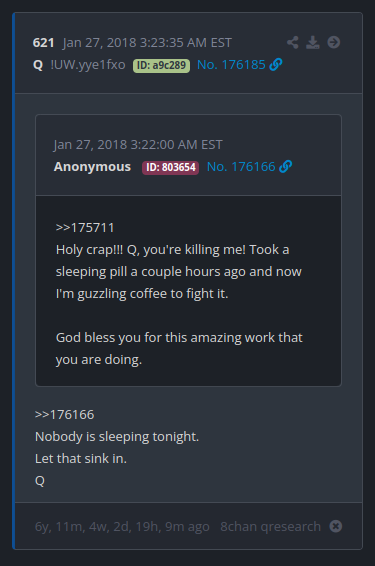
Our mission, as God-fearing and God-loving patriots, is to defend this Constitutional Republic and to increase its greatness, in all good things and ways, by using our voices in free but courteous speech, by discussing the happenings of the world and coming to a profound understanding of those things, and by sharing and promulgating these Truths on both this platform and others.
This Stormwatch Monday Open Thread remains open – VERY OPEN – a place for everybody to post whatever they feel they would like to tell the White Hats, and the rest of the MAGA/KAG/KMAG world (with KMAG being a bit of both).
Our various sister sites, listed in the Blogroll in the sidebar
Our beloved country is under Occupation by hostile forces – but not for long!
Daily outrage and epic phuckery still abound.
We can give in to despair…or we can be defiant and fight back in any way that we can.
Joe Biden didn’t win.
And we will keep saying Joe Biden didn’t win – even after we get His Fraudulency out of our White House.
Wolfie’s Wheatie’s Word of the Week:
ombrophobia
noun
fear of rain
not to be confused with ombrophobe, which can mean either a person who suffers from ombrophobia, or a plant or other organism with a low tolerance for rain. Ombrophobe is similar to xerophile, but not identical.
Used in a sentence
Ombrophobia often originates from a traumatic experience involving rain.
Shown in a picture – OK – not really shown, but yeah
As the name of a video by a Burmese hip-hop artist, OASIX
MUSIC!
As opposed to AI country, here’s some actual US rock!
OK – let’s go back even further…..
Now forward in time again – 1978…..
THE STUFF
I’ll be blunt. The mathematics of WGTTs is messing up Newtonian physics, and the usual suspect troublemakers, Einstein and Schroedinger, are laughing!
Darren Beattie broke more important J6 stories than almost anybody. He and Julie Kelly grabbed the J6 narrative out of the hands of the left, and beat the Biden administration into defeat with it.
This Stormwatch Monday Open Thread remains open – VERY OPEN – a place for everybody to post whatever they feel they would like to tell the White Hats, and the rest of the MAGA/KAG/KMAG world (with KMAG being a bit of both).
Our various sister sites, listed in the Blogroll in the sidebar
Our beloved country is still under Occupation by hostile forces, but we are evicting those forces!
Daily outrage and epic phuckery still abound.
We can give in to despair…or we can be defiant and fight back in any way that we can.
Joe Biden didn’t win.
And we will keep saying Joe Biden didn’t win, long after we got His Fraudulency out of our White House.
Wolfie’s Wheatie’s Word of the Week:
damoiseau
noun
male form of damsel
a young man not yet dubbed a knight
a young gentleman who was not yet a knight but aspired to be one
a young nobleman accompanying his lord or lady to hunt, walk, travel, etc.
a young nobleman or squire
Used in a sentence
The word damoiseau appears to be related to the word mademoiselle.
Shown in a picture by Gab’s Watercolor AI
Video of a rum distillery named Damoiseau.
MUSIC!
What kind of music do you get back when you search on “damoiseau”? Well, somewhere down the page you get one of cthulhu’s favorite bands – “Pample Moose” or whatever. So let’s just go with it!
THE STUFF
In honor of my former colleague, who was SEMPER FIDELIS in all matters of Q, it is my plan to make sure that certain touches of what she regarded as important are not forgotten.
Trump world problems! Almost as bad as too much winning!
Susie Q is right. Something is going on here. And it’s good!
Remember Kary Mullis? Establishment popularization science remembers him, and while Veritasium keeps the expected diss of this gnarly dissident fairly gentle, their coverage fills in a lot of blanks, and is appreciated by this more lupine dissident. Don’t worry – you’ll still like Kary – maybe even a little more after watching this.
A toast to Kary! And today, we’ll skip the LSD, but maybe rum is appropriate.
It is with extreme sadness that I announce news, brought to us by DePat’s loving and faithful friend, For God & Country (FG&C).
Rather than simply approving FG&C’s comment, I decided to make it a full post. I will add my own comments afterward.
Dear Qtree,
I profoundly regret and sorrowfully bring you the sad news of our dear friend Susie “Depat” Sampson’s unexpected and sudden passing.
Susie was a fierce, albeit petite, Gen X MAGA warrior and patriot who dearly loved our American Republic. Highly intelligent, insightful, articulate, loyal, kind, and sweet are just a few of the accurate adjectives which describe this truly amazing, deeply committed and Christ-focused Christian lady.
A dedicated animal lover and dog owner, she was an alto singer by profession, performing her craft in the theatre as well as in various parish churches in the St. Louis area. She was also a blogger, self-published author, and unapologetic conservative.
7-8 weeks ago Susie attended a choir rehearsal, during which she had stood right next to a fellow choir member who she learned afterwards had been Covid vax-boosted for the 4th time that day. Perhaps she mentioned at some point in these pages that in the time since that night she believed she had contracted “long Covid”, experiencing physical weakness, insomnia, a persistent cough, and low appetite. She believed she had inhaled “spike proteins” shedding from the woman she stood next to that night at rehearsal, stating that had she known the woman had been so recently vaxxed she would never have gotten so close to her.
Recently, she had stated she was feeling better, the cough all but gone, and in the past week felt she had gotten over the insomnia hump and was getting good rest. I was optimistic. However, on Monday AM….inauguration day….her brother discovered her in her bedroom, unresponsive, after becoming concerned he had not heard her moving about and she had not come downstairs. Paramedics were subsequently unable to resuscitate her, and it is currently believed she suffered a heart attack and passed away in her sleep. After many attempts to reach her (we texted daily), her brother called me this afternoon with the news. I knew you would want to know as well.
I am aware of how this news will hit the Qtree community, and how loved and appreciated she was here. She loved being a part of this group as much as she loved the MAGA movement and President Trump. In particular, she was a longtime fan and admirer of the impossibly great “Gail Combs”, of whom we often laughed over the thought she must be a “deep MAGA” AI. 😁
It was through this very forum that I got to know her, and in the years after leaving here grew close with her, and I visited her in St. Louis many times. On her behalf, with complete confidence she would approve of this message below, let me say a few words for her to each of you…
My dear friends and fellow Qtree patriots, We did it! Going all the way back these now many years to the time when most (if not all) of us originally came together at Conservative Treehouse, and later here at Qtree after Wolf created this space for those of us daring to believe in Q-Anon and subsequently being exiled from CTH for doing so, we have stood the test of time and proved resolute and firm with one another in our belief in God, his providence, and our beloved Republic. We, along with tens of millions of our fellow patriots, and God’s blessings, have successfully taken on the almost impossible power and reach of the corrupt and evil globalist deep state, and we have once again elected our lion, President Donald J Trump to a historic and almost unprecedented non-concurrent term. I am confident that Trump 2.0 will prove as day is to night in comparison to his first term! It has been the honor of a lifetime to share in this struggle with all of you; to pass through the many trials, uncertainties, set-backs, and victories together. We never gave up, never gave in, and never wavered. We ran the good race! It has been an incredible journey which we have chronicled together on these pages over all these many years. I know that each of you will continue the good and holy fight, and I will be watching and praying for you, your individual and collective success, and the reestablishment of our Republic as the founder’s envisioned and ordained by God. Do not be afraid, and never fear. Our sovereign Lord and Almighty God is firmly in control, and all is unfolding according to his design! This is not “good-bye”, this is only a “see you later!”, and while parting is sorrowful, the joy of our reunion in the presence of our mighty and loving King will so overwhelm the sadness as to render it entirely moot and inconsequential. I love you all, carry each of you in my heart, and reluctantly take my leave from you with this… “The Lord bless you and keep you; the Lord make his face shine on you and be gracious to you; the Lord turn his face toward you and give you peace.” See you on the other side! Susie
I will begin by thanking For God & Country for this desperately needed but sad news, as well as for his wonderful message from DePat, which I will admit made me cry.
As I know for certain that DePat’s final wish for me would be to remove FG&C from moderation, I will do that immediately after publishing this. If we cannot all lay down our swords in DePat’s honor, then we have no business being here.
I will add more information about DePat’s last comments and posts in the comments.
Thank you ALL for being good friends of Susie, and for your concern as she battled recent health issues, and then as she vanished from the site.
To say DePat will be greatly missed is an almost appalling understatement. She was, if not the heart and soul of this site, at least a huge portion of it. Her influence on me was as profound as any teacher I ever had – and I had some great ones.
There will be a time that I will fully discuss my scientific opinion about what happened to Susie. I may say some things now, but I will definitely say more later. There are things that MUST be said.
Finally, let me add this. Susie was one of the greatest defenders of the Catholic Church that I have ever known. While I do not consider myself to be Catholic, she made me a great ally of “The Church” – as she called it. She remains, in my opinion, one of the greatest servants of The Lord that I have ever had the honor of knowing.
In God I trust – that Susie is now exactly where God wants her, and where she wants to be.
Joe Biden never won. This is our Real President – 45, 46, 47.
AND our beautiful REALFLOTUS.
This Stormwatch Monday Open Thread remains open – VERY OPEN – a place for everybody to post whatever they feel they would like to tell the White Hats, and the rest of the MAGA/KAG/KMAG world (with KMAG being a bit of both).
Our various sister sites, listed in the Blogroll in the sidebar
Our beloved country is under Occupation by hostile forces.
Daily outrage and epic phuckery abound.
We can give in to despair…or we can be defiant and fight back in any way that we can.
Joe Biden didn’t win.
And we will keep saying Joe Biden didn’t win until we get His Fraudulency out of our White House.
Wolfie’s Wheatie’s Word of the Week:
viricide
noun
alternate spelling of virucide
killing of viruses
killing of men or of husbands
substance or agent that inactivates viruses
substance that destroys or inactivates viruses
act of killing one’s husband
Used in a sentence
While hydroxychloroquine may be an atypical viricide, it has an excellent safety record and an acceptable therapeutic ratio.
Used conceptually in a meme
Underlying a bigger message which helps us understand where we are today
MUSIC!
On Inauguration Day, I am reminded of an old song we used to love on the radio. It’s been a while, but the song seems remarkably relevant now. Here is a version that’s easier to hear the lyrics.
Here’s a live version from 1986. Keep your eye on the flags.
THE STUFF
It’s time to recall Trump Gravity and “the roller coaster”!
Well, I don’t really have to do any holding together, now that I figured out what Trump is up to. He is shaking things out, but counting on Trump gravity to pull things back together as he moves along. He is moving “forward” at speeds Obama could not even dream of.
You and I will be anti-Trump trolls one day and MAGA heroes the next. Get used to it. Trump speed is the new normal. Some will call it flip-flopping, but that’s not what it is. Trump is dodging and weaving through reality faster than the reality can react to disrupt his plans.
I was explaining this to my wife. This is a roller-coaster now. Trump is no longer waiting for people to keep up. He is taking his bewildering art-of-the-deal campaign schtick into geopolitics, and for a lot of people who can’t keep up or hold on, it will be a rough ride.
Trump is no longer playing only with evil and cunning players who are still predictable, easily beatable dopes, like Hillary. He is playing against killers, with his own team of killers, and all the while he has scheming creeps like Hillary, BGI, SPLC, and the neocons gunning for him. Snake Ryan ready to bite when nobody is looking. “Warhead” McCain screaming for Russian blood. Psycho Kim and Samoa Obama plotting some kind of intrigue to take him down. And THOSE are the lightweights.
This is the majors now. Trump has to outwit world-class adversaries and “frenemies” by defining the deals that they will agree to. One minute they will think Trump is their friend – the next minute, a cunning, bitter foe. And he has to do this with evil cheerleaders like Warhead, Linderace, Dipsy Dowd, Maggie Haterman, and Fake Yapper trashing him or praising him alternately, no matter which way he goes. They can’t keep up, either.
Neither can many around him. I think that half of the problem with advisers crashing into each other is they don’t realize what Trump is doing.
And people will trash you, and they will trash me. Get used to it. I’ve already caught plenty of people mocking me. Well, just wait a week in Trump time. Look stupid and conned by Trump one minute, and you look like a sage three days later.
Trump will not find perfect solutions. He will find OPTIMAL solutions. We cannot ask for more. Trump has stood by and watched Perfect murder Good for 8 years – maybe longer. He’s not gonna do it. He’s going to deliver the best outcome possible, and he’s not waiting for us to feel relaxed about it.
Best presidency ever! Just hang on. More winning is coming, but a lot of people are going to scream that it’s all over at EVERY turn.
The best way through this is to define viewpoints, not people, because people will shift as they change position and velocity in Trump gravity. Bash the neocon, warmonger, and dopey globalist positions – not the people who are going to hold them one moment and come loose from them later. Trump is Jupiter moving through the asteroid belt. He is going to pull people into his orbit. A few will get slung off into space, but most will come along for the ride of their lives.
I am ON the Trump Train for good, even if I scream that I want off and can’t take it. In the end, I only want to scream “TOO MUCH WINNING!!!” 😀
Wolf’s 2024 Comment
If you are not seeing just how remarkably similar things are right now, to the way they were at the end of 2016 and beginning of 2017, then please re-read the above post ONE MORE TIME. While you do so, think about all that Trump is doing now – before he has even taken office.
Think of what he is preparing to do – that you know about. Think of what he is preparing to do that you DON’T know about. Ask yourself which part of that iceberg is bigger.
Think of how President Trump is going to Make America Great Again – and BEYOND. Far, far beyond.
Trump is literally bringing TITANS into his orbit. And I mean BIG titans.
Stars rapidly orbiting the giant black hole at the center of the Milky Way galaxy.
But Trump doesn’t just care about the physical realm. Consider how Trump is always aligning himself with the forces of good, of love, and of peace in this world.
It was a privilege to host Mrs. Akie Abe at Mar-a-Lago once again. We fondly remembered her late husband, former Prime Minister Abe, and honored his remarkable legacy.
213.7K Views
Watch how Trump is skillfully working around corrupted, broken, and ossified government processes. Watch how Trump is dealing with world problems already, despite all the forces, both at home and abroad, which are allied against him.
We are experiencing Trump Gravity in ways that I simply could not have predicted in 2017. Trump is beyond a mere TITAN at this point. He is GARGANTUAN. He is stretching, compressing, and shifting SPACE AND TIME THEMSELVES. And yet – it’s OK.
In God We Trust – as we enjoy this amazing ride in His loving universe.
Live your best life. All around the world the Communist Left and their insufferable foot soldiers are in retreat and crisis mode. Their world is shrinking. They are becoming irrelevant. We are everywhere. Nimble, snarky, fast and with the sunlight arguments that defeat them. Live your very best life. Ignore the dark imaginings they attempt to present in their last desperate effort to remain relevant.
Joe Biden never won. This is our Real President – 45, 46, 47.
AND our beautiful REALFLOTUS.
This Stormwatch Monday Open Thread remains open – VERY OPEN – a place for everybody to post whatever they feel they would like to tell the White Hats, and the rest of the MAGA/KAG/KMAG world (with KMAG being a bit of both).
Our various sister sites, listed in the Blogroll in the sidebar
Our beloved country is under Occupation by hostile forces.
Daily outrage and epic phuckery abound.
We can give in to despair…or we can be defiant and fight back in any way that we can.
Joe Biden didn’t win.
And we will keep saying Joe Biden didn’t win until we get His Fraudulency out of our White House.
Wolfie’s Wheatie’s Word of the Week:
vituperation
noun
abuse
rejection
sustained, harshly critical language
invective
severe censure
blame
vehemently expressed condemnation or disapproval
formal language that is full of hate
angry criticism
Used in a sentence by the Fake News (two examples)
(One will notice that most examples of this word in use on Merriam-Webster are against Trump and conservatives.)
Flash forward 92-plus years to Donald Trump’s rally Sunday at New York’s Madison Square Garden, a bleak, lurid festival of racist hate and profane vituperation so vile that even fellow Republicans, who have turned a blind eye to Trump’s character for years, are distancing themselves from the event. —Michael Hiltzik, Los Angeles Times, 29 Oct. 2024
The politicization of the COVID response has only worsened this trend, likely resulting in part from Trump’s vituperation. —Matt Motta, Scientific American, 29 Oct. 2024
Yeah, well, stuff it, you commies. Your pre-election biased writings FAILED. Trump is still your President.
Shown in a picture in a dictionary
Used in a “black metal” song title, shown in an artistic music video
Melancholic metal; interesting use of dance and B/W film, but these people need Jesus badly.
Well, Netflix, that CIA cultural corruption project, seems to finally be good for something. Enjoy this weird music, which is either a corruption of classical music, or a correction of pop music – take your pick. (PS – I know nothing about this series.)
https://youtu.be/XXmqfu0ZJWo
THE STUFF
“What is best in life? Conan! Tell us!”
“Yes, but what is life?”
“To crush protons, to see higher nuclei driven before you, and to hear the calculations of their women!”
Joe Biden never won. This is our Real President – 45, 46, 47.
AND our beautiful REALFLOTUS.
This Stormwatch Monday Open Thread remains open – VERY OPEN – a place for everybody to post whatever they feel they would like to tell the White Hats, and the rest of the MAGA/KAG/KMAG world (with KMAG being a bit of both).
Our various sister sites, listed in the Blogroll in the sidebar
Our beloved country is under Occupation by hostile forces.
Daily outrage and epic phuckery abound.
We can give in to despair…or we can be defiant and fight back in any way that we can.
Joe Biden didn’t win.
And we will keep saying Joe Biden didn’t win until we get His Fraudulency out of our White House.
Wolfie’s Wheatie’s Word of the Week:
ingluvies
noun
a crop or craw of birds
a dilation or pouch in the esophagus of certain animals that receives food prior to the main stomach, esp a bird’s craw, or the first stomach of a cow or other ruminating animal
the widened portion of the esophagus of birds and lower animals
a crop or pouch in the esophagus of many birds, in which food is stored or partially digested before passing to the stomach
Used in a sentence with bad American English and Russian accent
“Moose ingluvies, but squirrel not having!”
Ridiculous misleading example of usage generated by bad AI
You don’t have to understand the math, to follow along and understand why light and atoms end up being a lot like vibrating musical strings.
Basically, Erwin Schrödinger plugged a simple but weird equation by Louis de Broglie, which said that matter has a frequency just like light, into the existing wave equation, and he got a matter wave equation.
And all of THAT is revealed on the way to answering, what in the heck is an imaginary number doing in there?
Joe Biden never won. This is our Real President – 45, 46, 47.
AND our beautiful REALFLOTUS.
This Stormwatch Monday Open Thread remains open – VERY OPEN – a place for everybody to post whatever they feel they would like to tell the White Hats, and the rest of the MAGA/KAG/KMAG world (with KMAG being a bit of both).
Recently, I accidentally discovered that a long-held belief of mine was very likely untrue! As I sure you all can identify with, this was somewhat disconcerting. Who likes to be wrong? But I am a researcher, and accepting what one finds when researching is imperative. I thought I would share what I found out with you all, since it is Christmas, and that is crux of the matter.
I thought for many years that Jesus was not really born on Christmas Day. That day was chosen, I believed, because pagan cultures already celebrated on that day, and Christianity wanted to include (subsume, some would say) those religions. This is called the “History of Religions” theory.
There was Saturnalia, for example, celebrated originally on December 17, and later from the 17th through the 23rd; and the December 25 holiday Sol Invictus (the Unconquered or Invincible Sun). The earliest reference I had seen to the celebration of Jesus birth on December 25 was in 354 AD. It is from Depositio Martirum of the Chronography of 354, and reads:
‘December 25, Christ is born in Bethlehem of Judea.’
However, I was to find that this is NOT the earliest that such a thing was suggested, by a long shot!
I stumbled across this reference to Hippolytus, who in his day attempted to date every Passover all the way back to the date of the Creation, and the first Passover full moon (he believed God created the moon in the “full” phase). To do this, Hippolytus created a “lunar table.” A statue of him was discovered in Rome in 1551 AD and now sits in front of the Vatican Library. On the right side of the statue is a carving of this lunar table, taken from Hippolytus’ Canon, written in 222 AD.
This lunar table was designed to calculate the dates of past and future Passover full moons, by determining the date of the full moon occurring on the Vernal Equinox. The date of this Equinox was fixed on March 25 in the Julian Calendar. This turned out to be more difficult than Hippolytus thought, and his calculations went awry within just three years of calculating the dates.
However, that is not the point of discussion here. The point is, Hippolytus noted two things in his Canon; one, that the Passion of Jesus occurred on Friday, March 25, 29 AD. The second is, he wrote that the “genesis” of Christ occurred on April 2, 2 B.C. The word for “genesis” here is γένεσις. There is debate on whether this word means conception or birth, but given what I have read in the last week, I am strongly inclined to the former meaning. Researcher Thomas C. Schmidt has done a fantastic study of this. You can read the research here; I highly recommend it:
This was my starting point, but I branched out when I realized there were others who believed early on that Jesus was conceived on or about March 25. In 221, Julius Africanus, the Roman Christian historian, wrote that Jesus was conceived on March 25, the anniversary of the day Africanus believed God created the Earth. This would logically, given a nine-month gestation period, put Jesus’ birth on December 25.
So, there are now two sources who believed Jesus was born on December 25, as early as 221 AD. Is there an even earlier source? Turns out, it looks like there is!
Clement of Alexandria calculated Jesus birth backwards (what a way to figure, but whatever) from the death of the Emperor Commodus, thusly:
From the birth of Christ, therefore, to the death of Commodus are, altogether, 194 years, 1 month, 13 days.
This would put Jesus’ birth on January 6. It is still celebrated on that date by the Armenian Apostolic Church.
Clement continues:
“And there are those who have determined our Savior’s genesis not only the year, but even the day, which they say took place in the twenty-eighth year of Augustus on the 25th of Pachon…
And treating of his passion, with very great accuracy, some say that it took place in the sixteenth year of Tiberius, on the 25th of Phamenoth, but others the 25th of Pharmuthi and others say on the 19th of Pharmuthi the Savior suffered.
Indeed, others say that he came to be on the 24th or 25th of Pharmuthi.”
The important word in there is “genesis,” most likely meaning conception. The translation of “genesis” as conception is consistent with Clement’s usage of this word in other contexts, for example:
“It is not therefore frequent intercourse by the parents, but the reception of it [the seed] in the womb which corresponds with genesis.” (Clement of Alexandria Stromata 3.12.83.2)
The 25th of Pharmuthi coincides with the Vernal Equinox in the Egyptian calendar and also matches one of the possible dates which Clement gives for the Passover of Jesus’ crucifixion.
This shows that in the time Clement wrote his Stromata, between 198 and 203 AD, where this information appears, there were already people who believed that Jesus was conceived on or about March 20-21, or on the Vernal Equinox.
What we know about the pagan holiday Saturnalia is, it was originally a one-day celebration on December 17. It was later extended to December 17-23. This is one celebration that has been suggested as a reason why Christians decided to put Jesus’ nativity on December 25, but this holiday never fell on that date.
A December 25th holiday, Sol Invictus, was instituted in 274 AD by the Emperor Aurelian, who made this the primary god of Rome.
“The festival of Sol Invictus on the 25th December in the later Roman empire combined the festivals of both the old sun god (Sol Indiges) and the new official sun god (Deus Sol Invictus). The Circus Maximus had been dedicated to Sol Indiges since ancient times, and then was dedicated to Sol Invictus. The Roman emperor Aurelian created the cult of Sol Invictus during his reign in AD 270-275 (in the 3rd century) and, on his coins, Sol was described as ‘Dominus Imperii Romani’, the official deity of the Roman empire.”
It has been suggested over the centuries that the “chosen” date of December 25 as the birth of Jesus was in response to the imposition of Sol Invictus. However, given that we know that 75-50 years PRIOR to Sol Invictus being instituted, Christian leaders believed Jesus was born on December 25, it is just as likely that Aurelian instituted the holiday against the Christian belief! This is actually more likely in my opinion, given the facts that: a) Romans were inclined to incorporate the gods of conquered cultures into their belief systems and had done so for centuries; and b) by the time of Jesus, Jews had been admonished against the practice of including foreign gods in their culture for literally thousands of years. This was almost the entire background cause of sin in the Old Testament.
This theory, that Jesus’ birth date was not chosen to subsume another religion’s holiday, but was instead “calculated” by early Church leaders from the Creation of the world, or from the dates of Passover full moons, is called the “Calculation Theory.”
This theory does not prove that Jesus was actually born on December 25, but rather it does strongly suggest, at least to me, that the date of his birth was NOT chosen in response to a foreign religion, but in accordance with the beliefs and dates spelled out in God’s Word, the Old Testament. Hippolytus used the dates in the Old Testament to calculate the years from the Creation to the birth of Jesus, as did Clement of Alexandria.
From Hippolytus Chronicon:
(§686) . . . from Adam until the transmigration into Babylon under Jeconiah, 57 generations, 4,842 years, 9 months. (§687) And after the transmigration into Babylon until the generation [generatio] of Christ, there were 14 generations, 660 years, and from the generation [generatio] of Christ until the Passion there were 30 years and from the Passion up until this year which is year 13 of the Emperor Alexander, there are 206 years. (§688) Therefore all the years from Adam up until year 13 of the Emperor Alexander make 5,738 years. Chronicon §686-688
It is quite notable to me that there is a “9 months” period stated in this calculation, the span of human gestation. From Schmidt:
“Hippolytus only gives extraneous months on two occasions, once in §654 where he adds six months to David’s reign, and in §675 where he states that Jehoahaz reigned three months.”
So it is a rare case in his calculations to include months at all. The possible reasons for the nine month addition, how the translation of one word [generatio] affects the interpretation of it, and much more is found in Thomas C. Schmidt’s excellent research linked up above, if you want to read it.
I still don’t know for certain that Jesus was actually born on December 25. But I DO know that early Christians, based on their calculations of when God created the Earth, and when Passover full moons occurred and their dates, almost certainly believed that He was. And for now, that is good enough for me!
Joe Biden never won. This is our Real President – 45, 46, 47.
AND our beautiful REALFLOTUS.
This Stormwatch Monday Open Thread remains open – VERY OPEN – a place for everybody to post whatever they feel they would like to tell the White Hats, and the rest of the MAGA/KAG/KMAG world (with KMAG being a bit of both).
Our various sister sites, listed in the Blogroll in the sidebar
Our beloved country is under Occupation by hostile forces.
Daily outrage and epic phuckery abound.
We can give in to despair…or we can be defiant and fight back in any way that we can.
Joe Biden didn’t win.
And we will keep saying Joe Biden didn’t win until we get His Fraudulency out of our White House.
Wolfie’s Wheatie’s Word of the Week:
vicegerent
noun
acting in place of another
having delegated authority
not the same as a viceregent, although similar
Used in a sentence
A viceregent is a ruler acting in place of a monarch, while a vicegerent is an appointed representative of a higher authority, often with broader administrative duties.
Now I seem to recall Rand Paul’s name associated with Festivus, and I never quite got it, until this news report. Stay with it for at least a minute. LMAO!!!
Well, DOGE-GONE, it’s BARBIE!
I’m sorry, but Festivus has me in the mood to play my favorite song!
In case you’re wondering what a “ferrocell” is, there’s a fascinating paper describing how one works.
The beauty of this song – other than simply being well-done, is that in some pleasing ways, the actual science of sunlight shining on the orbiting moon, blocked by its own orbiting mass, corresponds with, and maybe even transforms through the “crackpot matrix” to, the dithering of Mr. (at)witsit about ferrocells and whatnot.
Between “real” science and “pseudo” science, I’m falling in love with the crazy beauty of this universe!
Good night, good morning, good day, and MERRY CHRISTMAS!
Joe Biden never won. This is our Real President – 45, 46, 47.
AND our beautiful REALFLOTUS.
This Stormwatch Monday Open Thread remains open – VERY OPEN – a place for everybody to post whatever they feel they would like to tell the White Hats, and the rest of the MAGA/KAG/KMAG world (with KMAG being a bit of both).
Our various sister sites, listed in the Blogroll in the sidebar
Our beloved country is under Occupation by hostile forces.
Daily outrage and epic phuckery abound.
We can give in to despair…or we can be defiant and fight back in any way that we can.
Joe Biden didn’t win.
And we will keep saying Joe Biden didn’t win until we get His Fraudulency out of our White House.
Wolfie’s Wheatie’s Word of the Week:
coprophagous
Yes, this word randomly came up in my word source, and I decided to tough it out and keep it. I have never wimped out on a word, and I’m not starting now. So YES. And YUCK.
adjective
eating feces
Used in a sentence
To the AWFULs who destroy innocent patriotic families – Don’t just “be offended”, as Matt Gaetz would say. Be coprophagous!
Shown in a picture (in as “purty” a fashion as possible)
Shown in a video
MUSIC!
DePat said something about she and others all yelling “the cranberries” at the same time.
Well – SOMEBODY was listening!
AND – just for the heck of it – I have to add my new favorite song!
Yes, I may be a hillbilly, and I may have voted for the outlaw and the hillbilly, but I can take a joke, and this song, like Elon Musk, has…..