
Site rules stolen from our good friend PAVACA
There are Important Notifications from our host, Wolf Moon; the Rules of our late, good Wheatie; and, certain caveats from Yours Truly, of which readers should be aware. They are linked here. Note: Yours Truly has checked today’s post for any AI-generated content. To the best of her knowledge and belief, there is none. If readers wish to post any AI-generated content in the discussion thread for today’s post, they must cite their source. Thank you.
Do not forget to LABEL AI articles, video and such.
I want to do a few quick and dirty hits on a couple of subjects.
From WIKI:
America PAC is a “Super PAC created by Elon Musk with the backing of a number of prominent tech businessmen to support Donald Trump’s 2024 presidential campaign, and later used to support other conservative candidates and causes. The group’s primary purpose is to finance canvassing operations. Musk is the primary donor, with his contributions making up 91% of the declared contributions as of December 2024.”
VOTESAFE: Check your Voter Registration Paid for by America PAC.
CNN HOAXES aka Psychological warfare
(Sorry for the bafflegab Word Piss refuses to allow me to delete it.)
@page { size: 8.5in 11in; margin: 0.79in }
p { line-height: 115%; margin-bottom: 0.1in; background: transparent }
a:visited { color: #800000; text-decoration: underline }
a:link { color: #000080; text-decoration: underline }

At 21 minutes to 33 minutes LT of X-22 Reports goes over the CNN hoaxes. I do not have time to do a transcription plus many are video clips.
It was not until I did a bit of research on hemp, that I realized the anti-hemp rules probably originate in the EU/Cabal!
CORN & BIO-FUEL
2008 The Clean Energy Scam — TIME in parnership with CNN
(Time & CNN, ROTFLMAO!)
The Clean Energy Scam – The U.S. quintupled its production of ethanol–ethyl alcohol, a fuel distilled from plant matter–in the past decade, and Washington has just mandated another fivefold increase in renewable fuels over the next decade. Europe has similarly aggressive biofuel mandates and subsidies, and Brazil’s filling stations no longer even offer plain gasoline. Worldwide investment in biofuels rose from $5 billion in 1995 to $38 billion in 2005 and is expected to top $100 billion by 2010, thanks to investors like Richard Branson and George Soros, GE and BP, Ford and Shell, Cargill and the Carlyle Group.
2011 Industrial Agriculture’s Water Use: It’s Time for Change. Mother Earth News
Much of the water used to irrigate corn and refine ethanol is drawn from the ever-threatened Ogallala aquifer, which runs beneath eight western U.S. states and provides nearly a third of all U.S. irrigation water…
The handful of giant agribusinesses and food processing companies that dominate the food chain keep farm prices low, which only pushes farmers to produce more. Most farmers resort to water-intensive and chemical-dependent practices to sell enough farm products to make a living.
In the United States and around the world, only a few companies sell the seeds, buy the harvests, slaughter the livestock, and turn farm products into the food consumers buy. Farms that are far away from wealthy metropolitan areas are especially dependent on agribusiness buyers. The four largest firms in the United States slaughter 84 percent of the cattle, crush 80 percent of the soybeans and process 66 percent of the hogs. Even in recent years, when prices were higher, the few companies that sold seeds, fertilizers and fuel could jack up their prices, so higher production costs gobbled most of the gains from increased farm prices. Two corn seed firms (Monsanto and DuPont’s Pioneer Hi-Bred) control about 60 percent of the seed market and 80 percent of U.S. corn is grown from Monsanto-patented seed traits. In 2009 and 2010, the leading corn seed companies raised prices between 20 and 40 percent…
I could write an entire article on the bio-fuel scam and WHO benefits. Instead a few points. Fruits and veggies do not get USDA subsidies grains do. That means feed lot cows are subsidized by US tax payers making feed lots cheaper than grass. Many grains are GMO so the seed has to be bought each season, as well as the fertilizer & insecticides. Again ALL is tax payers funding Big Ag with the farmer as the conduit.
Understanding Nutrient Requirements for High-Yielding Corn
Typical fertilization for corn in the United States is 180 lbs of N, 90 lbs of P 2 O 5 and 160 lbs of K 2 0 per acre, with no S or micronutrients.

Hemp is a alternative source of bio-fuel.
Hemp Biofuel: Is This the Answer to Environmental Crisis? Royal Queen Seeds
…Using hemp for ethanol production curbs the potential problem of using too many food sources like corn and wheat. Ultimately, this makes food production more efficient while also minimising its disruption.
At the same time, hemp is much easier to grow compared to other food crops. They’re like weeds that can thrive in lower-quality conditions.
Hemp biodiesel also has a higher flash point, aka the temperature at which it ignites. Because of this, it is much easier to store, transport, and handle overall…
When it comes to hemp, there is a lot of conflict about fertilizers. Probably because it has a variety of uses.
Hemp Fertilizers – Do You Need a Special Kind?
Hemp is not a particularly demanding crop when it comes to fertilizer requirements. In fact, hemp is known to be quite tolerant of poor soil conditions.
Growing Industrial Hemp as an Organic – Rodale Institute
The use of no-tillage strategies without any weed control measures can be detrimental to hemp stand establishment. Nitrogen fertilization up to 150 kg ha–1 can increase fiber and seed yield. Leguminous cover crops can supply adequate nitrogen to hemp without supplemental fertilization as indicated by similar yields among nitrogen rates in treatments that included hairy vetch and winter pea. Although hemp density was low in the no-till cover crop treatment, greater bast fiber yield per stalk significantly increased the total fiber yield, making it comparable to conventional tillage treatments. This suggests that cover crops can be considered a positive investment for hemp production…
The crop is photoperiod sensitive and is typically a short-day plant. Hemp responds well to elevated CO2 and temperature levels in the context of current climate change scenarios and is a water-efficient crop…
Growers can take herbicides and other costly weed control measures off their inventory because hemp is a smoother crop and rapidly produces a dense canopy that suppresses weeds. This makes it a perfect choice for organic production.
Let’s save American hemp
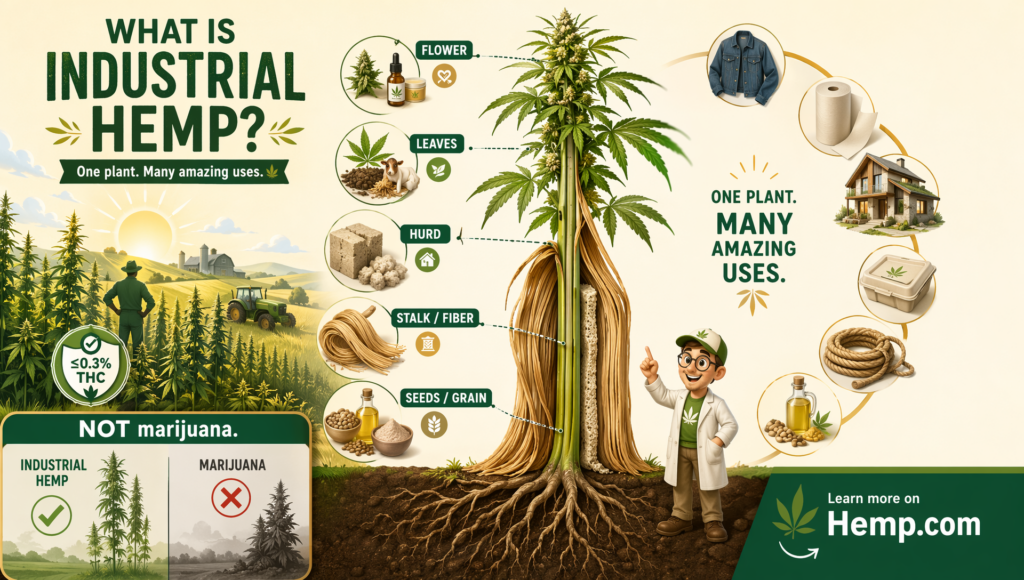
What Is Industrial Hemp? Definition, Uses & U.S. Rules
Industrial hemp is Cannabis sativa L. grown commercially for fiber, grain/seed, and other lawful products, with U.S. federal law defining compliance through THC testing and licensing. USDA hemp production · Hemp vs. marijuana vs. CBD · Hemp University
An exceptionally versatile plant, industrial hemp has a wide range of industrial and everyday household uses, and the commercial market for hemp products is booming worldwide. Products made from hemp are considered long-lasting and eco-friendly. Hemp derived CBD products are also proving to be incredible for our health and well being. It is not What is Hemp but what can hemp do for us in our quest for sustainability!…
With the passage of the Farm Bill in 2018, hemp cultivation has commenced in numerous states. Yet, the question extends beyond mere definition; it’s now about understanding what hemp can do for individuals and our environment, and what we can do to harness its potential. Now, hemp oils, CBD, hemp plastics, hemp building materials, and various hemp fiber products are readily available in the market.
Hemp is the low tetrahydrocannabinol (THC) variety of the Cannabis Sativa plant, containing minimal THC content as mandated by federal law—specifically less than 0.3% THC by dry weight. This distinction ensures that industrial hemp does not induce any psychoactive effects associated with marijuana. However, hemp and marijuana often face confusion, which can be clarified through our hemp vs. marijuana page….
Dec 19, 2025 — President Trump’s Executive Order to Save Hemp
PRESIDENT TRUMP DIRECTED CONGRESS TO FIX HEMP. NOW THEY MUST ACT.
President Trump issued an executive order directing Congress to reconsider the classification of hemp-derived products to ensure Americans, like our seniors, can access hemp-derived products they have found beneficial while still protecting children. The President gave clear direction. Now Congress must follow through. The McConnell-Harris hemp restrictions threaten to destroy 325,000 American jobs, devastate thousands of farmers and small businesses, and deny seniors access to CBD products that President Trump wants them to have. President Trump provided the solution: protect children through regulation while preserving consumer access to beneficial CBD and hemp-derived products. The hemp industry has offered exactly the common-sense regulations President Trump’s order calls for: -Age restrictions (21+) to protect children -Mandatory third-party laboratory testing for safety -Clear, uniform labeling for informed choices -Child-resistant packaging standards Contact your Representative and Senators today. Tell them to immediately act on President Trump’s executive order, fix the McConnell-Harris hemp ban, and implement the common-sense regulations that protect farmers, small business owners, consumers, and children. Let’s save American hemp and tell Congress to act on President Trump’s directive.
This excerpt is direct from HIFA. Please click the link to sign the next petition to move forward with a two year extension. https://hifa.health/contact-your-lawmakers/
Congress pushes hemp crackdown after pressure from states
A provision significantly limiting the sale of intoxicating hemp products made its way into legislation to reopen the federal government just a day before the Senate approved the bill. Its inclusion follows years of pressure from states and the marijuana industry.
While states continue to expand access to legal marijuana, a separate market of hemp-derived intoxicants has blossomed. The products, from drinks to gummies, are sold in gas stations and smoke shops. Critics say some companies have exploited a legal loophole from 2018 to manufacture products that get people high — without the safety regulations and taxes facing the legal marijuana industry.
That’s led dozens of states to limit or ban certain intoxicating hemp products. Most states also have pushed for federal changes, though some farm states worry the pending federal bill — which the House is expected to vote on as soon as today — goes too far.
A bipartisan group of 39 state attorneys general recently urged Congress to clarify the federal definition of hemp, arguing that the underregulated industry threatens public health and undermines law enforcement…
Senate Rejects Attempt To Save Hemp Industry
The Senate has rejected an amendment to a critical spending bill that would have removed language to ban hemp products containing THC.
After the chamber cleared the appropriations minibus package for floor consideration on Sunday, senators on Monday took up the measure from Sen. Rand Paul (R-KY) that he said would prevent the eradication of the hemp market that’s matured since the crop’s federal legalization under the 2018 Farm Bill.
The amendment was killed in a 76-24 vote on a motion to table.
“My amendment would strip the provision designed to regulate the hemp industry to death. The bill, as it now stands, overrides the regulatory frameworks of several states, cancels the collective decisions of hemp consumers and destroys the livelihoods of hemp farmers,” Paul said on the floor ahead of the vote. “And it couldn’t come at a worse time for America’s farmers. Times are tough for our farmers.”…
How about we outlaw the Senate instead? They certainly have been ANTI-AMERICAN!
Cannabis as a treatment for COVID-19
(I used to have the scientific study but brave bookmarks lost it.)
CBD Oil: What are 9 Proven or Possible Health Benefits
Cannabis is a plant, and there are two main types, Cannabis Indica and Cannabis Sativa. Both marijuana and CBD can be derived from both types, but hemp is only derived from Cannabis Sativa. By law, hemp must contain no more than 0.3% THC…
CBD has been credited with relieving numerous medical conditions, such as epilepsy, anxiety, inflammation, insomnia, and pain. Although “credited” does not mean proven. Because of the historical regulatory landscape, there are hardly any well-conducted trials backing up those claims, although research is expected to ramp up now that laws distinguish between hemp and marijuana.
We look at nine medical conditions where CBD may be, or, has already proven to be, beneficial.
1. Epilepsy
In June 2018, the FDA approved Epidiolex (a plant-based formulation of CBD) to treat seizures for people 2 years of age and older with Dravet syndrome and Lennox-Gastaut syndrome (LGS), which are two rare forms of epilepsy… [ I have 2 friends that use it for epilepsy with sucess]
2. Pain
Animal studies have shown that CBD has anti-inflammatory effects and works on the endocannabinoid and pain-sensing systems to relieve pain… [I got off of NSAIDs by using CBD oil.]
3. Arthritis
Animal studies showed that topical CBD applications relieve pain and inflammation associated with arthritis with few side effects…
4. Anxiety
Pretreatment with 300mg CBD significantly relieved anxiety in 57 healthy males who undertook a simulated public speaking test. However, dosages of 150mg CBD and 600mg CBD did not make any difference to the men’s anxiety levels.7
So CBD threatens Big Pharma. However I found this part of my research ‘interesting’
Industrial uses of Hemp
The Wonders of Industrial Hemp: Versatile and Eco-Friendly — Amsterdammarijuanaseeds.com
Amstedam is the Capital of the Netherlands
The versatility of industrial hemp extends beyond its use as a raw material.
Unleashing a New Wave of Sustainable Practices with Industrial Hemp
Industrial hemp, this incredible plant, stands tall as an embodiment of versatility. A crop whose potential extends far beyond its rustic exterior, transforming into an eco-friendly powerhouse with an impressive array of applications spanning numerous industries…
Industrial hemp, scientifically known as Cannabis sativa L., has served humanity for centuries, providing fiber, food, and medicinal benefits. Today, its role has expanded, becoming increasingly important as a sustainable and eco-friendly solution within various industries.
By integrating hemp into numerous manufacturing processes, industries can lessen their dependence on non-renewable resources and significantly reduce their environmental footprint. The inherent versatility and functional characteristics of hemp make it an ideal candidate for substitution, driving it to the forefront of sustainable development.
Moreover, hemp cultivation offers additional benefits such as soil remediation. By absorbing toxins and replenishing soil nutrients, hemp promotes healthier soils, which in turn, benefit subsequent crops…
Corporate giants such as Ford Motors, Patagonia, and The Body Shop have already recognized the profound potential of this sustainable resource, utilizing hemp seed, fiber, and oil as fundamental raw materials in their product lines. This level of corporate adoption serves as a testament to the staggering potential that industrial hemp offers as an environmentally conscious substitute for other resources.
Below are a few ways industrial hemp is already making its mark across industries:
- Automotive, Railway, Aviation, and Aerospace: These industries are progressively embracing hemp-derived products as substitutes for traditional plastic materials. Hemp’s lightweight yet durable nature and biodegradable properties position it as a superior alternative to conventional plastics.
- Cosmetics and Personal Care: The nutritive richness of hemp seed oil has found applications in numerous industrial and cosmetic products. From soaps and shampoos to other personal care items, the moisturizing properties and skin-nourishing abilities of hemp seed oil make it a coveted ingredient within the cosmetics and personal care sectors.
- Textiles, Fabrics, and Paper Manufacturing: Hemp fiber’s application in the production of textiles, fabrics, and paper is truly a game-changer. It offers an eco-friendly alternative to traditional textile materials, requiring less water and fewer pesticides during cultivation, with the added advantage of being easily recyclable…
…
Industrial Hemp Uses: Fibre, Paper, Materials — Justbob Lyon France.
Reading industrial hemp uses across fibre, paper and materials
Industrial hemp is one of the oldest agricultural crops on the European continent. Beyond the modern cannabinoid catalog, the plant supplies fibre for textiles and ropes, hurd for construction biocomposites, paper for specialty applications and seed fractions for the wider agricultural framework. This Justbob guide walks through industrial hemp uses sector by sector, with the regulatory framework that connects the cultivation side to each application…
Industrial hemp uses cover the non-cannabinoid applications of Cannabis sativa L. cultivated under the EU industrial hemp framework. The main categories include textiles (canvas, rope, twine and modern fabrics), paper (specialty applications), construction biocomposites (hempcrete walls, insulation panels), automotive components (door panels and trim parts), agricultural substrates (animal bedding and horticulture) and biorefinery feedstock…
Textile applications: from canvas to modern fabrics
Textile production is one of the oldest documented uses of hemp fibre in European industry. Canvas, the heavy fabric traditionally used for sails, tents, and painting supports; rope, widely used in maritime, agricultural, and construction settings; twine, commonly found in packaging, gardening, and crafts; and modern technical fabrics all rely on the bast fibre extracted from the hemp stem.
The mechanical properties of hemp textile fibre are well documented. The tensile strength supports applications where durability matters more than a fine weave, while its natural resistance to mildew and pests adds value in maritime and outdoor settings. Its breathability and moisture handling propriety make hemp textile interesting for modern clothing and home textiles.
Paper applications: specialty papers and durability
Paper applications represent another long-standing industrial use of hemp. The long bast fibres give hemp paper a stronger tensile profile and a longer fibre length than typical wood-pulp paper, making it suitable for specialty applications where these properties are particularly valuable.
Documented use cases include banknotes, where the strong tensile profile and the resistance to repeated handling are well suited to the application; archival papers (the low lignin content supports long-term stability; and technical papers, including filter papers, art papers, and thin technical papers. Hemp paper is also a feedstock for some specialty paper producers in France and Italy that supply niche markets.
The USDA published the foundational bulletin Hemp Hurds as Paper-Making Material in 1916, documenting the technical feasibility of hemp paper at industrial scale. The bulletin is still referenced in contemporary hemp economy literature as one of the early modern studies on this application.
Hempcrete and construction biocomposites
Hempcrete is the most visible modern application of hemp hurd in construction. This biocomposite combines hemp hurd with a lime binder to produce wall infill, insulation and structural-light applications. The French Isochanvre product was introduced around 1986 as one of the first commercial hempcrete formulations…
There is a LOT more…
WHY THE ORIGINAL ATTACK ON HEMP?
There was a comment about Hemp on WUWT by Dr Brown in August of 2013. He refers to something Dr Judith Curry said that I can no longer find.
[I do not have the origin of this quote]
The story goes …Dupont had patented nylon, and wanted hemp removed as competition….
Why is Marijuana Illegal?Its said that industrial hemp converts CO2 to oxygen better than trees.
‘Do you have a link?’
[Hemp “more effective than trees” at carbon storage –2021Cambridge Univ]
I havn’t come across anything tangible (of an academic nature) but there must be tons out there. I’ll keep looking, but in the meantime here are some numbers from HempNews.
‘It follows that every tonne of industrial hemp stems contains 0.445 tonnes Carbon absorbed from the atmosphere (44.46% of stem dry weight).
‘Converting Carbon to CO2 (12T of C equals 44T of CO2(IPCC)), that represents 1.63 tonnes of CO2 absorption per tonne of UK Hemp stem harvested. On a land use basis, using Hemcore’s yield averages (5.5 to 8 T/ha), this represents 8.9 to 13.4 tonnes of CO2 absorption per hectare of UK Hemp Cultivation.
‘For the purposes estimation, we use an average figure of 10T/ha of CO2 absorption, a figure we hold to be a reasonably conservative estimate. This is used to predict carbon yields, but CO2 offsets will be based on dry weight yields as measured at the weighbridge.
‘The roots and leaf mulch (not including the hard to measure fibrous root material) left in situ represented approximately 20% of the mass of the harvested material in HGS’ initial field trials. The resulting Carbon content absorbed but remaining in the soil, will therefore be approximately 0.084 tonnes per tonne of harvested material. (42% w/w) (5).
‘Using Hemcore’s UK yield estimates (5.5 – 8 T/ha) this represents 0.46 to 0.67 tonnes of Carbon per hectare (UK) absorbed but left in situ after Hemp cultivation.’ [So in 2013 the UK was growing hemp but it was banned in the USA.]
Dr Brown rgbatduke said on August 22, 2013 at 5:44 am
Judith Curry’s remarks, as usual, are dead on the money. Here’s an almost perfectly analogous problem: CNN recently completely reversed its editorial policy and now calls for the legalization of Marijuana. Sanjay Gupta, its “resident physician editorialist”, who had previously somewhat vigorously led this opposition from the scientific point of view completely reversed his own position, and explained why in considerable detail both in text and in online video.
Historically, marijuana was both legal and considered to be a useful medicine all the way up through the beginning of the twentieth century. At that point, William Randolph Hearst had invested heavily in pine forests in Mexico, intending to sell them to his own newspapers to make newsprint. The Dupont family were discovering petrochemicals including plastic and oil-derived pharmaceuticals. A machine was invented that was the equivalent of a “cotton gin” for hemp — it mechanically stripped down the hemp plant and turned it into useful fiber, oil, and vegetable waste that could be used as an animal fodder (yes, we can imagine some very happy cows, can’t we?:-). One of many uses for the now inexpensive hemp fiber was to make equally inexpensive newsprint paper that was clearly superior in quality and cost to wood pulp paper. Another was that the oils and fiber could be used to synthesize various chemical products. Both Dupont and Hearst were suddenly hundreds of millions of dollars at risk.
They turned to Harry Anslinger, who happened to be Hearst’s brother in law. Anslinger was a suddenly idle ex-prohibitionist working for the FBI, and he created a propaganda campaign that portrayed hemp as literally maddening those that actually smoked it, leading them to commit acts of rape and robbery and moral turpitude. At the same time, political revolutions in Mexico (funded and fought by a private army belonging to Hearst) and a negative portrayal of blacks and mexicans as common users of hemp for recreation purposes added a useful racist hook. Between these, congress outlawed hemp.
So matters remained until the Viet Nam war and the 1960s and early 70s. As part of the quiet “revolution” against what many perceived as a military-industrial complex with a life of its own that was fighting a series of expensive and pointless wars, pot had become “the” recreational drug of choice among young hippies and freaks as well as the military draftees who fought the war. Its use was so prevalent that Texas dropped the question about cannabis use from its entrance exam to police academy, because “asking a vet of they had ever smoked pot was like asking them if they smoked Camels”. Suddenly a large fraction of an entire generation of U.S. citizens had smoked pot and discovered that no, it does not turn you into a crazed rapist, and usually does not make you insane unless you are most of the way there on your own already. They also discovered that it is neither physically addictive nor dangerous in the sense that it is literally impossible to overdose on marijuana — it is literally one of the safest compounds we know of, with no meaningful fatal dose.
However, Ronald Reagan took office in the 80’s, an immediately declared a “War on Drugs”. Marijuana was reclassified as a schedule 1 narcotic by the federal government, trumping communities that had already begun to experiment with decriminalization or even legalization. This once again gave law enforcement agencies lots of useful work (helpful if you are trying to build a police state), gave cops everywhere the ability to selectively enforce drug laws and thereby control the populace, and caused us to rather suddenly need to build enormous numbers of prisons because it rapidly turned out that by making marijuana trafficking a felony and putting even mere users in jail (just like heroin, cocaine, and actually dangerous drugs) somewhere between 1/3 and 1/2 of all prison sentences were being handed down for low grade drug offenses. Our expenditure on controlling pot went from next to nothing to tens of billions of dollars a year. Obviously, many profited from this, including (as usual) the money launderers and organized criminals that made fortunes providing marijuana on the black market, and the politicians and bankers that provided well-paid-for top cover.
And now to the interesting bit (although I think all of the above is interesting:-). One of the reasons given for making marijuana a schedule 1 felony class drug was that we didn’t know about the harm it might cause, and there was no known medical benefit. Yes, it had been used as a medicine for centuries, the founding fathers literally “mandated” the growing of hemp on American farms because it was so useful a plant both industrially and medicinally, but we had entered the era of double blind placebo controlled drug trials, and there were now enormous pharmaceutical companies whose billion-dollar products were at risk, dwarfing even the Duponts’ complaint back in the 30’s. Its risks were similarly unstudied.
A period of research then ensued. If you wanted to study pot, you had to both get funded and get the experimental marijuana from a single, small farm in Mississippi that grew “legal” pot for this purpose. The government itself was in complete control, in other words of what research got conducted, because even if you could find outside funding, you couldn’t get legal pot to do the research with without approval.
Gupta initially opposed marijuana legalization because a review of the medical literature showed him that 96% of all published articles found some sort of negative effect of marijuana, and almost no articles showed a benefit, especially compared to existing approved medications. However, a couple of anecdotal cases coming out of the states that had legalized medicinal marijuana in SPITE of the federal governments laws caused him to go back and reexamine the funding model. In retrospect it shouldn’t have been surprising, but he learned that 96% of all funded research was to look for negative effects of marijuana, and that to get funded and permission to get government grown pot was so difficult that there simply weren’t all that many papers in the first place. In well over thirty years of intensive examination, all of the examination was literally preselected to find problems, almost none to find benefits, and one had to walk on water and push much paper to do either one (and relatively few scientists had bothered).
That caused him to examine the body of emerging, still anecdotal, evidence from the states that had legalized medical marijuana. They showed that — again unsurprisingly — marijuana is a rich pharmacopeia with multiple legitimate medical uses that could survived double blind placebo controlled investigation, while at the same time having minimal side effects and no known lethal dose. Perhaps he came to realize that its negative effects might, conceivably, have been a bit exaggerated or might arise from confounding uncontrolled elements. Confirmation bias is, after all, the bete noir of science.
This situation almost perfectly matches the evolution of “climate science”. Nobody cared about it for decades, but suddenly a group of individuals emerged that all benefited from the demonization of carbon. This included environmental groups, that hated civilization itself and the burning of anything (as long, of course, as their own lifestyle was preserved), energy producers that saw in this the opportunity to triple or quadruple their profits by creating artificial scarcity of a plentiful resource, politicians that saw in this the opportunity to raise taxes, get elected on a world-saving “issue”, and perhaps line their own pockets along the way, and a United Nations that saw an opportunity to transform it into a way to tax the rich nations and transfer money to developing nations (while again lining various pockets along the way). The role of Anslinger was admirably met by one James Hansen, a True Believer who never stinted and does not stint today in exaggerating the data and claims of disaster (five meter sea level rise! temperatures like that on Venus!). And suddenly, quite literally all funded research was on how burning carbon was bad for the climate.
Even completely ethical scientists have to eat, and if the only way they can eat is to get funded, and the only way they can get funded is to submit proposals that seek to prove that CO_2 is bad, guess what they will propose to study? And if they want to get funded AGAIN, guess what they will find? Climate science has been effectively corrupted beyond any hope of objectivity.
On the good side of things, scientists are actually usually pretty ethical. Also, in the end data talks, bullshit walks. The hypothesis of CAGW or CACC could, in fact, be true (across a wide spectrum of the meaning of “true”, in fact). However, recent data is not in good correspondence with the theories that have predicted it, and many good scientists are in the process of reassessing their conclusions. As is the almost simultaneous case with regard to marijuana, the confounding evidence is starting to overwhelm to narrowly funded and directed arguments to date. We will see where the future takes us, in both cases.
rgb
mikerossander says on August 22, 2013 at 12:40 pm
re: rgbatduke’s extended history at August 22, 2013 at 5:44 am:
One correction – Nixon is the moron who declared a “War on Drugs”. Congress made marijuana into a Schedule I narcotic in 1970. Pres Reagan may be guilty of a lot but he is innocent of that particular charge above.
Other items of interest from my notes.
Pot Shrinks Tumors; Government Knew in ’74
In 1974 researchers learned that THC, the active chemical in marijuana, shrank or destroyed brain tumors in test mice. But the DEA quickly shut down the study and destroyed its results, which were never replicated — until now.
The term medical marijuana took on dramatic new meaning in February, 2000 when researchers in Madrid announced they had destroyed incurable brain tumors in rats by injecting them with THC, the active ingredient in cannabis.
The Madrid study marks only the second time that THC has been administered to tumor-bearing animals; the first was a Virginia investigation 26 years ago. In both studies, the THC shrank or destroyed tumors in a majority of the test subjects.
Most Americans don’t know anything about the Madrid discovery. Virtually no major U.S. newspapers carried the story, which ran only once on the AP and UPI news wires, on Feb. 29, 2000…
2008 — The Greatest Story Never Told
Smoking Cannabis Does Not Cause Cancer
Of Lung or Upper Airways, Tashkin Finds;
Data Suggest Possible Protective EffectThe story summarized by that headline ran in O’Shaughnessy’s (Autumn 2005), CounterPunch, and the Anderson Valley Advertiser. Did we win Pulitzers, dude? No, the story was ignored or buried by the corporate media. It didn’t even make the “Project Censored” list of under-reported stories for 2005. “We were even censored by Project Censored,” said Tod Mikuriya, who liked his shot of wry.
It’s not that the subject is trivial. One in three Americans will be afflicted with cancer, we are told by the government (as if it’s our immutable fate and somehow acceptable). Cancer is the second leading cause of death in the U.S. and lung cancer the leading killer among cancers. You’d think it would have been very big news when UCLA medical school professor Donald Tashkin revealed that components of marijuana smoke -although they damage cells in respiratory tissue- somehow prevent them from becoming malignant. In other words, something in marijuana exerts an anti-cancer effect.
Tashkin has special credibility. He was the lead investigator on studies dating back to the 1970s that identified the components in marijuana smoke that are toxic. It was Tashkin et al who published photomicrographs showing that marijuana smoke damages cells lining the upper airways. It was the Tashkin lab reporting that benzpyrene -a component of tobacco smoke that plays a role in most lung cancers- is especially prevalent in marijuana smoke. It was Tashkin’s data documenting that marijuana smokers are more likely than non-smokers to cough, wheeze, and produce sputum.
Tashkin reviewed his findings April 4 at a conference organized by “Patients Out of Time,” a reform group devoted to educating doctors and the public (as opposed to lobbying politicians). Some 30 MDs and nurses got continuing medical education credits for attending… [long article]
Cannabinoids: potential anticancer agents
Published: December 2003. Cannabinoids: potential anticancer agents. … Other potential palliative effects of cannabinoids in cancer patients — supported by Phase III clinical trials — include appetite stimulation and pain inhibition.


































Legality of cannabis in the United States
Teal – Legal for recreational use
Green – Legal for medical use
Gray – No comprehensive medical program
● Decriminalized
I bet they don’t block political robocalls, which are the ones I mostly get.
You’re probably right. I haven’t thoroughly explored those guidelines, but a problem with blocking all unknown callers occurs when communicating with a tradesman; a doctor’s office that has multiple phone lines, not all of which one is privy to; and many other scenarios.
Gail, a lot of people in my cancer group used CBD oil and found it helped a lot. It was part of the anti-cancer protocol I used.