Our mission, as God-fearing and God-loving patriots, is to defend this Constitutional Republic and to increase its greatness, in all good things and ways, by using our voices in free but courteous speech, by discussing the happenings of the world and coming to a profound understanding of those things, and by sharing and promulgating these Truths on both this platform and others.
This DePat Tuesday Open Thread honors the author of the original Tuesday open thread on this site, namely the late Susie Sampson, a.k.a. Deplorable Patriot, among her other handles, pen names, etc.
For more on the untimely passing of Dear DePat, please see these three posts.
At one time, DePat handled FOUR daily open threads here, in addition to taking care of her relatives, choir duties, and numerous other responsibilities. She was a powerhouse – a dynamo – a true force of nature.
DePat’s faith in Trump, Q, “The Plan”, the White Hats, and “the anons” in general, was legendary. Although I didn’t always agree with her quick acceptance of some sketchier evidence and fringier theories, I will gladly admit to “coming around” to numerous so-called “conspiracy theories” which she championed first. I was always careful to give her credit for being right, too, when I had been wrong.
It is impossible to overstate how much DePat did for not only this site, but for her country. I urge all to say a quick prayer of thanks, whenever you think of her, for the privilege of knowing, in life or after death, such an exemplary human being, and lover of God.
And thank you, Susie, for the firm foundation which you left us, when you were called to your true home!
Did Amy Acton Help Light the Federal Fires of COVID Doomerism?
TL;DR –
In my opinion, the answer is yes, and I suspect that you will find the full answer fascinating.
Everybody in Ohio knows that Amy Acton – DOCTOR Amy Acton – a.k.a. “Lockdown Amy” – is why Ohio locked down for COVID, and why so many of Ohio’s local restaurants and other businesses closed down, never to return.
But what most people don’t know, is that Amy also apparently had a role in influencing the White House to join the party to “flatten the curve”.
Don’t take my word for it – take the word of Amy Acton’s own staff members, as I will explain in detail, below.
Background
I recently posted about a couple of Amy Acton videos, and how they were evidence of “two Amy Actons” – (1) the real one, who talks like a drunk and curls up on a fetal position on the floor of the restroom – and (2) the imaginary one created by her staff and party – the one who is competent, the heroine of the COVID years, and has zero issues.
As I noted in that post, both videos are a bit tragic.
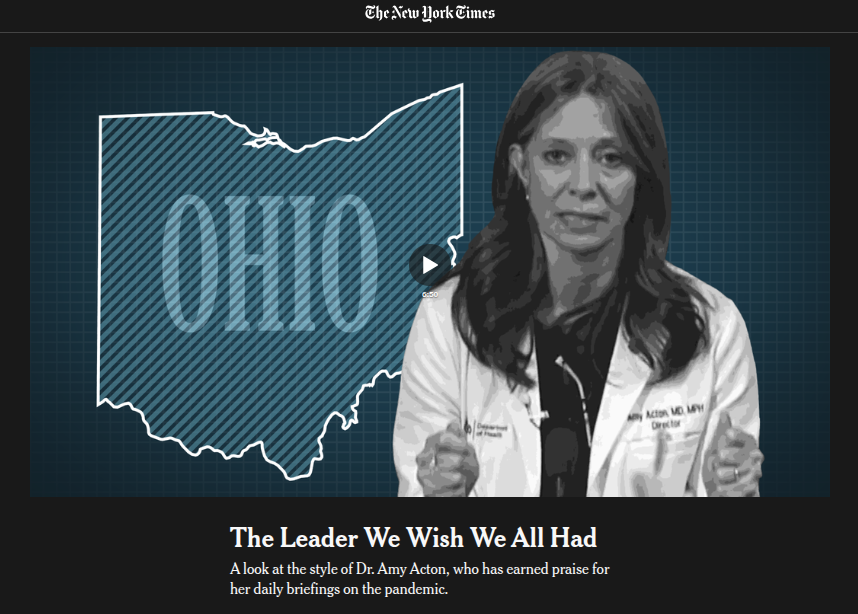
In the first video, by the New York Times, we see some of the cringiest left-wing media propaganda ever. It’s like an ad for Kamala’s Best Nutritious Word Salad – made in California. Yes – Amy Acton sounds like Kamala’s lost sister. The vocal similarity is uncanny, and I would not be surprised if white wine coolers are to Plame. Blame. Whatever.
Not to say that the CIA is definitely involved here, but Acton was clearly being made a heroine for adopting the left’s favorite captured agency’s COVID panic control script, while authentically heroic character seems a bit lacking.
If you watched the whole thing, congratulations. I was repeatedly cringing out, every time I tried to watch.
The second video is a lot more fun. Amy Acton is quite lovable in it, but in a way that makes her absolutely unfit for higher office. I can’t tell if she’s tipsy, floating on Xanax, or just high on her 15 minutes of fame, but there is no way such a woman can be allowed into the Ohio Statehouse as anything but a tourist, or perhaps as a mom testifying on an educational issue, where a courage drink or two is socially acceptable for first-time speakers, as long as they have a designated driver.
What’s most interesting, however, is that the TRANSCRIPT doesn’t match the video at all. And while it’s not really a problem that Amy’s staff chose not to document her rambling, emotional, and sometimes incoherent, group-hug psychobabble, what IS interesting is what they released in its place.
Tell me if this doesn’t sound like Amy Acton single-handedly saved America from COVID-infected J6-er kidnappers, and was personally responsible for Trump choosing to follow her advice to BE A HERO, locking down and flattening the curve!
Yes – according to Amy Acton’s aides and handlers, SHE was responsible for Trump doing the right thing on COVID.
In the midst of several pages of breathless, Barnes & Noble-grade COVID doomerist “historical fiction”, this paragraph appears…..
During the last week of February, as the stock market crashed for the second time, I was at the White House as a Health Department Director representing the entire Midwest for the Association of State and Territorial Health Officials (ASTHO). Mick Mulvaney, the President’s Chief of Staff, and some of the best people who have served multiple presidents were in attendance. One bioterrorism expert was literally shaking. But they were still not talking about the disease on the news. Even though I had taught global health for years, I Googled the word “pandemic.” I could not understand why we were not using the word. We went around the room, and each person gave their best virology and epidemiology advice. When it was my turn, most had been said, but I was struck by what was not being said to the country. Just like everyone else, I was longing to hear the hard truth. So I told Mr. Mulvaney, “Please tell the President that this is the higher angel’s moment. The people need to hear from him.” This is that FDR, Winston Churchill moment where communication is vital, and my gut sense was that we really needed the President to make meaning out of all we were facing. To help us bear the shared sacrifices, we needed someone to lead the war. Only this time, the entire world was on the same side.
UGH!!!
Some of that account may be a bit self-serving, but the point is, THIS was a moment when both COVID doomerism and “the opportunity for heroic response” were pushed on POTUS, and yes – Amy Acton was there, helping it happen.
Dramatically or not. Sober or not.
Now, I wasn’t ready to believe this statement without at least a wee bit of validation – so I chose to find out what Mick Mulvaney might have to say about that era now. And he does indeed have a lot to say.
It seems clear to me that Mulvaney fell for what most of us fell for – the possibility that we were dealing with something comparable to SARS, MERS, Ebola, and all that jazz. That we were dealing with an exotic “coronavirus” with double-digit mortality in young adults – NOT with something that had a very normal flu-like mortality curve – like all influenza-like illnesses, including the known, endemic, human coronaviruses.
Once the real numbers came out – once I saw those real numbers in public – it should have been over – but the Democrats just kept pretending, to the power-enthralled audience of their captured states and institutions.
Amy never corrected herself on this error. Trump, Vivek, and even I did. Some sooner than others.
SO – does Ohio REALLY want to elect this ditzy, pretending, overly dramatic broad to be governor? “Lockdown Amy” Acton?
There are Important Notifications from our host, Wolf Moon; the Rules of our late, good Wheatie; and, certain caveats from Yours Truly, of which readers should be aware. They are linked here. Note: Yours Truly has checked today’s post for any AI-generated content. To the best of her knowledge and belief, there is none. If readers wish to post any AI-generated content in the discussion thread for today’s post, they must cite their source. Thank you.
Do not forget to LABEL AI articles, video and such.
I want to do a few quick and dirty hits on a couple of subjects.
From WIKI:
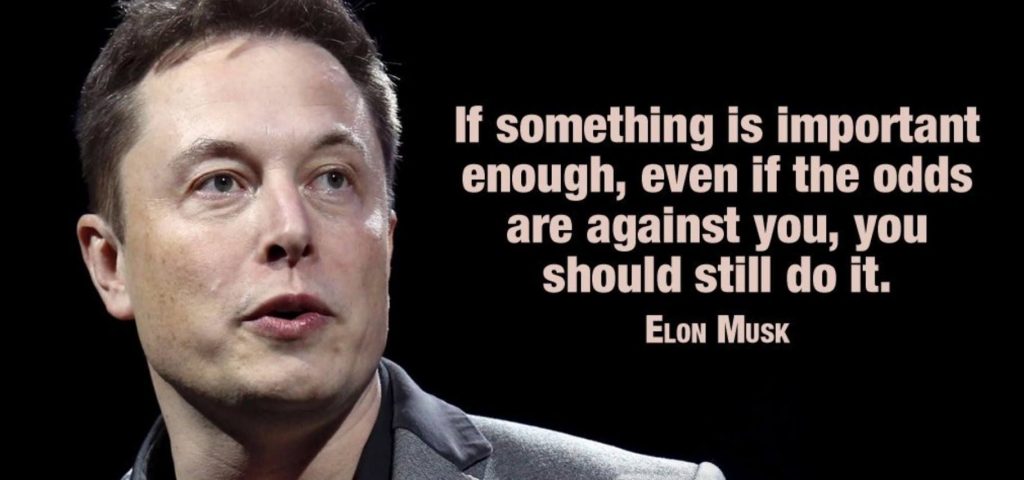
America PAC is a “Super PAC created by Elon Musk with the backing of a number of prominent tech businessmen to support Donald Trump’s 2024 presidential campaign, and later used to support other conservative candidates and causes. The group’s primary purpose is to finance canvassing operations. Musk is the primary donor, with his contributions making up 91% of the declared contributions as of December 2024.”
The Clean Energy Scam – The U.S. quintupled its production of ethanol–ethyl alcohol, a fuel distilled from plant matter–in the past decade, and Washington has just mandated another fivefold increase in renewable fuels over the next decade. Europe has similarly aggressive biofuel mandates and subsidies, and Brazil’s filling stations no longer even offer plain gasoline. Worldwide investment in biofuels rose from $5 billion in 1995 to $38 billion in 2005 and is expected to top $100 billion by 2010, thanks to investors like Richard Branson and George Soros, GE and BP, Ford and Shell, Cargill and the Carlyle Group.
Much of the water used to irrigate corn and refine ethanol is drawn from the ever-threatened Ogallala aquifer, which runs beneath eight western U.S. states and provides nearly a third of all U.S. irrigation water…
The handful of giant agribusinesses and food processing companies that dominate the food chain keep farm prices low, which only pushes farmers to produce more. Most farmers resort to water-intensive and chemical-dependent practices to sell enough farm products to make a living.
In the United States and around the world, only a few companies sell the seeds, buy the harvests, slaughter the livestock, and turn farm products into the food consumers buy. Farms that are far away from wealthy metropolitan areas are especially dependent on agribusiness buyers. The four largest firms in the United States slaughter 84 percent of the cattle, crush 80 percent of the soybeans and process 66 percent of the hogs. Even in recent years, when prices were higher, the few companies that sold seeds, fertilizers and fuel could jack up their prices, so higher production costs gobbled most of the gains from increased farm prices. Two corn seed firms (Monsanto and DuPont’s Pioneer Hi-Bred) control about 60 percent of the seed market and 80 percent of U.S. corn is grown from Monsanto-patented seed traits. In 2009 and 2010, the leading corn seed companies raised prices between 20 and 40 percent…
I could write an entire article on the bio-fuel scam and WHO benefits. Instead a few points. Fruits and veggies do not get USDA subsidies grains do. That means feed lot cows are subsidized by US tax payers making feed lots cheaper than grass. Many grains are GMO so the seed has to be bought each season, as well as the fertilizer & insecticides. Again ALL is tax payers funding Big Ag with the farmer as the conduit.
…Using hemp for ethanol production curbs the potential problem of using too many food sources like corn and wheat. Ultimately, this makes food production more efficient while also minimising its disruption.
At the same time, hemp is much easier to grow compared to other food crops. They’re like weeds that can thrive in lower-quality conditions.
Hemp biodiesel also has a higher flash point, aka the temperature at which it ignites. Because of this, it is much easier to store, transport, and handle overall…
When it comes to hemp, there is a lot of conflict about fertilizers. Probably because it has a variety of uses.
Hemp is not a particularly demanding crop when it comes to fertilizerrequirements. In fact, hemp is known to be quite tolerant of poor soil conditions.
The use of no-tillage strategies without any weed control measures can be detrimental to hemp stand establishment. Nitrogen fertilization up to 150 kg ha–1 can increase fiber and seed yield. Leguminous cover crops can supply adequate nitrogen to hemp without supplemental fertilization as indicated by similar yields among nitrogen rates in treatments that included hairy vetch and winter pea. Although hemp density was low in the no-till cover crop treatment, greater bast fiber yield per stalk significantly increased the total fiber yield, making it comparable to conventional tillage treatments. This suggests that cover crops can be considered a positive investment for hemp production…
The crop is photoperiod sensitive and is typically a short-day plant. Hemp responds well to elevated CO2 and temperature levels in the context of current climate change scenarios and is a water-efficient crop…
Growers can take herbicides and other costly weed control measures off their inventory because hemp is a smoother crop and rapidly produces a dense canopy that suppresses weeds. This makes it a perfect choice for organic production.
An exceptionally versatile plant, industrial hemp has a wide range of industrial and everyday household uses, and the commercial market for hemp products is booming worldwide. Products made from hemp are considered long-lasting and eco-friendly. Hemp derived CBD products are also proving to be incredible for our health and well being. It is not What is Hemp but what can hemp do for us in our quest for sustainability!…
With the passage of the Farm Bill in 2018, hemp cultivation has commenced in numerous states. Yet, the question extends beyond mere definition; it’s now about understanding what hemp can do for individuals and our environment, and what we can do to harness its potential. Now, hemp oils, CBD, hemp plastics, hemp building materials, and various hemp fiber products are readily available in the market.
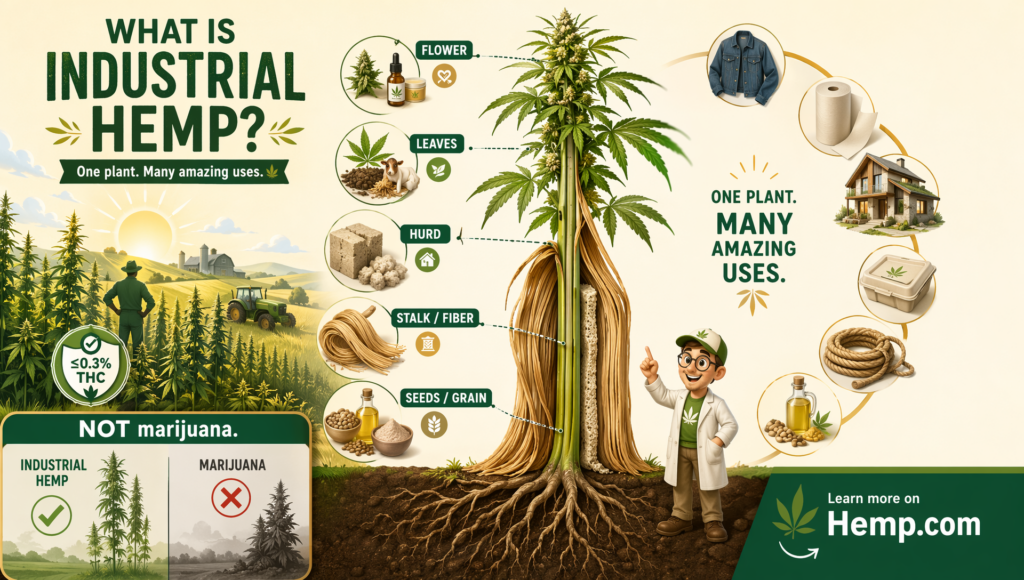
Hemp is the low tetrahydrocannabinol (THC) variety of the Cannabis Sativa plant, containing minimal THC content as mandated by federal law—specifically less than 0.3% THC by dry weight. This distinction ensures that industrial hemp does not induce any psychoactive effects associated with marijuana. However, hemp and marijuana often face confusion, which can be clarified through our hemp vs. marijuana page….
PRESIDENT TRUMP DIRECTED CONGRESS TO FIX HEMP. NOW THEY MUST ACT.
President Trump issued an executive order directing Congress to reconsider the classification of hemp-derived products to ensure Americans, like our seniors, can access hemp-derived products they have found beneficial while still protecting children. The President gave clear direction. Now Congress must follow through. The McConnell-Harris hemp restrictions threaten to destroy 325,000 American jobs, devastate thousands of farmers and small businesses, and deny seniors access to CBD products that President Trump wants them to have. President Trump provided the solution: protect children through regulation while preserving consumer access to beneficial CBD and hemp-derived products. The hemp industry has offered exactly the common-sense regulations President Trump’s order calls for: -Age restrictions (21+) to protect children -Mandatory third-party laboratory testing for safety -Clear, uniform labeling for informed choices -Child-resistant packaging standards Contact your Representative and Senators today. Tell them to immediately act on President Trump’s executive order, fix the McConnell-Harris hemp ban, and implement the common-sense regulations that protect farmers, small business owners, consumers, and children. Let’s save American hemp and tell Congress to act on President Trump’s directive.
A provision significantly limiting the sale of intoxicating hemp products made its way into legislation to reopen the federal government just a day before the Senate approved the bill. Its inclusion follows years of pressure from states and the marijuana industry.
While states continue to expand access to legal marijuana, a separate market of hemp-derived intoxicants has blossomed. The products, from drinks to gummies, are sold in gas stations and smoke shops. Critics say some companies have exploited a legal loophole from 2018 to manufacture products that get people high — without the safety regulations and taxes facing the legal marijuana industry.
That’s led dozens of states to limit or ban certain intoxicating hemp products. Most states also have pushed for federal changes, though some farm states worry the pending federal bill — which the House is expected to vote on as soon as today — goes too far.
A bipartisan group of 39 state attorneys general recently urged Congress to clarify the federal definition of hemp, arguing that the underregulated industry threatens public health and undermines law enforcement…
The Senate has rejected an amendment to a critical spending bill that would have removed language to ban hemp products containing THC.
After the chamber cleared the appropriations minibus package for floor consideration on Sunday, senators on Monday took up the measure from Sen. Rand Paul (R-KY) that he said would prevent the eradication of the hemp market that’s matured since the crop’s federal legalization under the 2018 Farm Bill.
The amendment was killed in a 76-24 vote on a motion to table.
“My amendment would strip the provision designed to regulate the hemp industry to death. The bill, as it now stands, overrides the regulatory frameworks of several states, cancels the collective decisions of hemp consumers and destroys the livelihoods of hemp farmers,” Paul said on the floor ahead of the vote. “And it couldn’t come at a worse time for America’s farmers. Times are tough for our farmers.”…
How about we outlaw the Senate instead? They certainly have been ANTI-AMERICAN!
Cannabis is a plant, and there are two main types, Cannabis Indica and Cannabis Sativa. Both marijuana and CBD can be derived from both types, but hemp is only derived from Cannabis Sativa. By law, hemp must contain no more than 0.3% THC…
CBD has been credited with relieving numerous medical conditions, such as epilepsy, anxiety, inflammation, insomnia, and pain. Although “credited” does not mean proven. Because of the historical regulatory landscape, there are hardly any well-conducted trials backing up those claims, although research is expected to ramp up now that laws distinguish between hemp and marijuana.
We look at nine medical conditions where CBD may be, or, has already proven to be, beneficial.
1. Epilepsy
In June 2018, the FDA approved Epidiolex (a plant-based formulation of CBD) to treat seizures for people 2 years of age and older with Dravet syndrome and Lennox-Gastaut syndrome (LGS), which are two rare forms of epilepsy… [ I have 2 friends that use it for epilepsy with sucess]
2. Pain
Animal studies have shown that CBD has anti-inflammatory effects and works on the endocannabinoid and pain-sensing systems to relieve pain… [I got off of NSAIDs by using CBD oil.]
3. Arthritis
Animal studies showed that topical CBD applications relieve pain and inflammation associated with arthritis with few side effects…
4. Anxiety
Pretreatment with 300mg CBD significantly relieved anxiety in 57 healthy males who undertook a simulated public speaking test. However, dosages of 150mg CBD and 600mg CBD did not make any difference to the men’s anxiety levels.7
So CBD threatens Big Pharma. However I found this part of my research ‘interesting’
The versatility of industrialhemp extends beyond its use as a raw material.
Unleashing a New Wave of Sustainable Practices with Industrial Hemp
Industrial hemp, this incredible plant, stands tall as an embodiment of versatility. A crop whose potential extends far beyond its rustic exterior, transforming into an eco-friendly powerhouse with an impressive array of applications spanning numerous industries…
Industrial hemp, scientifically known as Cannabis sativa L., has served humanity for centuries, providing fiber, food, and medicinal benefits. Today, its role has expanded, becoming increasingly important as a sustainable and eco-friendly solution within various industries.
By integrating hemp into numerous manufacturing processes, industries can lessen their dependence on non-renewable resources and significantly reduce their environmental footprint. The inherent versatility and functional characteristics of hemp make it an ideal candidate for substitution, driving it to the forefront of sustainable development.
Moreover, hemp cultivation offers additional benefits such as soil remediation. By absorbing toxins and replenishing soil nutrients, hemp promotes healthier soils, which in turn, benefit subsequent crops…
Corporate giants such as Ford Motors, Patagonia, and The Body Shop have already recognized the profound potential of this sustainable resource, utilizing hemp seed, fiber, and oil as fundamental raw materials in their product lines. This level of corporate adoption serves as a testament to the staggering potential that industrial hemp offers as an environmentally conscious substitute for other resources.
Below are a few ways industrial hemp is already making its mark across industries:
Automotive, Railway, Aviation, and Aerospace: These industries are progressively embracing hemp-derived products as substitutes for traditional plastic materials. Hemp’s lightweight yet durable nature and biodegradable properties position it as a superior alternative to conventional plastics.
Cosmetics and Personal Care: The nutritive richness of hemp seed oil has found applications in numerous industrial and cosmetic products. From soaps and shampoos to other personal care items, the moisturizing properties and skin-nourishing abilities of hemp seed oil make it a coveted ingredient within the cosmetics and personal care sectors.
Textiles, Fabrics, and Paper Manufacturing: Hemp fiber’s application in the production of textiles, fabrics, and paper is truly a game-changer. It offers an eco-friendly alternative to traditional textile materials, requiring less water and fewer pesticides during cultivation, with the added advantage of being easily recyclable…
Reading industrial hemp uses across fibre, paper and materials
Industrial hemp is one of the oldest agricultural crops on the European continent. Beyond the modern cannabinoid catalog, the plant supplies fibre for textiles and ropes, hurd for construction biocomposites, paper for specialty applications and seed fractions for the wider agricultural framework. ThisJustbob guide walks through industrial hemp uses sector by sector, with the regulatory framework that connects the cultivation side to each application…
Industrial hemp uses cover the non-cannabinoid applications of Cannabis sativa L. cultivated under the EU industrial hemp framework. The main categories include textiles (canvas, rope, twine and modern fabrics), paper (specialty applications), construction biocomposites (hempcrete walls, insulation panels), automotive components (door panels and trim parts), agricultural substrates (animal bedding and horticulture) and biorefinery feedstock…
Textile applications: from canvas to modern fabrics
Textile production is one of the oldest documented uses of hemp fibre in European industry. Canvas, the heavy fabric traditionally used for sails, tents, and painting supports; rope, widely used in maritime, agricultural, and construction settings; twine, commonly found in packaging, gardening, and crafts; and modern technical fabrics all rely on the bast fibre extracted from the hemp stem.
The mechanical properties of hemp textile fibre are well documented. The tensile strength supports applications where durability matters more than a fine weave, while its natural resistance to mildew and pests adds value in maritime and outdoor settings. Its breathability and moisture handling propriety make hemp textile interesting for modern clothing and home textiles.
Paper applications: specialty papers and durability
Paper applications represent anotherlong-standing industrial use of hemp. The long bast fibres give hemp paper a stronger tensile profile and a longer fibre length than typical wood-pulp paper, making it suitable for specialty applications where these properties are particularly valuable.
Documented use cases include banknotes, where the strong tensile profile and the resistance to repeated handling are well suited to the application; archival papers (the low lignin content supports long-term stability; and technical papers, including filter papers, art papers, and thin technical papers. Hemp paper is also a feedstock for some specialty paper producers in France and Italy that supply niche markets.
The USDA published the foundational bulletin Hemp Hurds as Paper-Making Material in 1916, documenting the technical feasibility of hemp paper at industrial scale. The bulletin is still referenced in contemporary hemp economy literature as one of the early modern studies on this application.
Hempcrete and construction biocomposites
Hempcrete is the most visible modern application of hemp hurd in construction. This biocomposite combines hemp hurd with a lime binder to produce wall infill, insulation and structural-light applications. The French Isochanvre product was introduced around 1986 as one of the first commercial hempcrete formulations…
There is a LOT more…
WHY THE ORIGINAL ATTACK ON HEMP?
There was a comment about Hemp on WUWT by Dr Brown in August of 2013. He refers to something Dr Judith Curry said that I can no longer find.
[I do not have the origin of this quote]
The story goes …Dupont had patented nylon, and wanted hemp removed as competition….
I havn’t come across anything tangible (of an academic nature) but there must be tons out there. I’ll keep looking, but in the meantime here are some numbers from HempNews.
‘It follows that every tonne of industrial hemp stems contains 0.445 tonnes Carbon absorbed from the atmosphere (44.46% of stem dry weight).
‘Converting Carbon to CO2 (12T of C equals 44T of CO2(IPCC)), that represents 1.63 tonnes of CO2 absorption per tonne of UK Hemp stem harvested. On a land use basis, using Hemcore’s yield averages (5.5 to 8 T/ha), this represents 8.9 to 13.4 tonnes of CO2 absorption per hectare of UK Hemp Cultivation.
‘For the purposes estimation, we use an average figure of 10T/ha of CO2 absorption, a figure we hold to be a reasonably conservative estimate. This is used to predict carbon yields, but CO2 offsets will be based on dry weight yields as measured at the weighbridge.
‘The roots and leaf mulch (not including the hard to measure fibrous root material) left in situ represented approximately 20% of the mass of the harvested material in HGS’ initial field trials. The resulting Carbon content absorbed but remaining in the soil, will therefore be approximately 0.084 tonnes per tonne of harvested material. (42% w/w) (5).
‘Using Hemcore’s UK yield estimates (5.5 – 8 T/ha) this represents 0.46 to 0.67 tonnes of Carbon per hectare (UK) absorbed but left in situ after Hemp cultivation.’ [So in 2013 the UK was growing hemp but it was banned in the USA.]
Judith Curry’s remarks, as usual, are dead on the money. Here’s an almost perfectly analogous problem: CNN recently completely reversed its editorial policy and now calls for the legalization of Marijuana. Sanjay Gupta, its “resident physician editorialist”, who had previously somewhat vigorously led this opposition from the scientific point of view completely reversed his own position, and explained why in considerable detail both in text and in online video.
Historically, marijuana was both legal and considered to be a useful medicine all the way up through the beginning of the twentieth century. At that point, William Randolph Hearst had invested heavily in pine forests in Mexico, intending to sell them to his own newspapers to make newsprint. The Dupont family were discovering petrochemicals including plastic and oil-derived pharmaceuticals. A machine was invented that was the equivalent of a “cotton gin” for hemp — it mechanically stripped down the hemp plant and turned it into useful fiber, oil, and vegetable waste that could be used as an animal fodder (yes, we can imagine some very happy cows, can’t we?:-). One of many uses for the now inexpensive hemp fiber was to make equally inexpensive newsprint paper that was clearly superior in quality and cost to wood pulp paper. Another was that the oils and fiber could be used to synthesize various chemical products. Both Dupont and Hearst were suddenly hundreds of millions of dollars at risk.
They turned to Harry Anslinger, who happened to be Hearst’s brother in law. Anslinger was a suddenly idle ex-prohibitionist working for the FBI, and he created a propaganda campaign that portrayed hemp as literally maddening those that actually smoked it, leading them to commit acts of rape and robbery and moral turpitude. At the same time, political revolutions in Mexico (funded and fought by a private army belonging to Hearst) and a negative portrayal of blacks and mexicans as common users of hemp for recreation purposes added a useful racist hook. Between these, congress outlawed hemp.
So matters remained until the Viet Nam war and the 1960s and early 70s. As part of the quiet “revolution” against what many perceived as a military-industrial complex with a life of its own that was fighting a series of expensive and pointless wars, pot had become “the” recreational drug of choice among young hippies and freaks as well as the military draftees who fought the war. Its use was so prevalent that Texas dropped the question about cannabis use from its entrance exam to police academy, because “asking a vet of they had ever smoked pot was like asking them if they smoked Camels”. Suddenly a large fraction of an entire generation of U.S. citizens had smoked pot and discovered that no, it does not turn you into a crazed rapist, and usually does not make you insane unless you are most of the way there on your own already. They also discovered that it is neither physically addictive nor dangerous in the sense that it is literally impossible to overdose on marijuana — it is literally one of the safest compounds we know of, with no meaningful fatal dose.
However, Ronald Reagan took office in the 80’s, an immediately declared a “War on Drugs”. Marijuana was reclassified as a schedule 1 narcotic by the federal government, trumping communities that had already begun to experiment with decriminalization or even legalization. This once again gave law enforcement agencies lots of useful work (helpful if you are trying to build a police state), gave cops everywhere the ability to selectively enforce drug laws and thereby control the populace, and caused us to rather suddenly need to build enormous numbers of prisons because it rapidly turned out that by making marijuana trafficking a felony and putting even mere users in jail (just like heroin, cocaine, and actually dangerous drugs) somewhere between 1/3 and 1/2 of all prison sentences were being handed down for low grade drug offenses. Our expenditure on controlling pot went from next to nothing to tens of billions of dollars a year. Obviously, many profited from this, including (as usual) the money launderers and organized criminals that made fortunes providing marijuana on the black market, and the politicians and bankers that provided well-paid-for top cover.
And now to the interesting bit (although I think all of the above is interesting:-). One of the reasons given for making marijuana a schedule 1 felony class drug was that we didn’t know about the harm it might cause, and there was no known medical benefit. Yes, it had been used as a medicine for centuries, the founding fathers literally “mandated” the growing of hemp on American farms because it was so useful a plant both industrially and medicinally, but we had entered the era of double blind placebo controlled drug trials, and there were now enormous pharmaceutical companies whose billion-dollar products were at risk, dwarfing even the Duponts’ complaint back in the 30’s. Its risks were similarly unstudied.
A period of research then ensued. If you wanted to study pot, you had to both get funded and get the experimental marijuana from a single, small farm in Mississippi that grew “legal” pot for this purpose. The government itself was in complete control, in other words of what research got conducted, because even if you could find outside funding, you couldn’t get legal pot to do the research with without approval.
Gupta initially opposed marijuana legalization because a review of the medical literature showed him that 96% of all published articles found some sort of negative effect of marijuana, and almost no articles showed a benefit, especially compared to existing approved medications. However, a couple of anecdotal cases coming out of the states that had legalized medicinal marijuana in SPITE of the federal governments laws caused him to go back and reexamine the funding model. In retrospect it shouldn’t have been surprising, but he learned that 96% of all funded research was to look for negative effects of marijuana, and that to get funded and permission to get government grown pot was so difficult that there simply weren’t all that many papers in the first place. In well over thirty years of intensive examination, all of the examination was literally preselected to find problems, almost none to find benefits, and one had to walk on water and push much paper to do either one (and relatively few scientists had bothered).
That caused him to examine the body of emerging, still anecdotal, evidence from the states that had legalized medical marijuana. They showed that — again unsurprisingly — marijuana is a rich pharmacopeia with multiple legitimate medical uses that could survived double blind placebo controlled investigation, while at the same time having minimal side effects and no known lethal dose. Perhaps he came to realize that its negative effects might, conceivably, have been a bit exaggerated or might arise from confounding uncontrolled elements. Confirmation bias is, after all, the bete noir of science.
This situation almost perfectly matches the evolution of “climate science”. Nobody cared about it for decades, but suddenly a group of individuals emerged that all benefited from the demonization of carbon. This included environmental groups, that hated civilization itself and the burning of anything (as long, of course, as their own lifestyle was preserved), energy producers that saw in this the opportunity to triple or quadruple their profits by creating artificial scarcity of a plentiful resource, politicians that saw in this the opportunity to raise taxes, get elected on a world-saving “issue”, and perhaps line their own pockets along the way, and a United Nations that saw an opportunity to transform it into a way to tax the rich nations and transfer money to developing nations (while again lining various pockets along the way). The role of Anslinger was admirably met by one James Hansen, a True Believer who never stinted and does not stint today in exaggerating the data and claims of disaster (five meter sea level rise! temperatures like that on Venus!). And suddenly, quite literally all funded research was on how burning carbon was bad for the climate.
Even completely ethical scientists have to eat, and if the only way they can eat is to get funded, and the only way they can get funded is to submit proposals that seek to prove that CO_2 is bad, guess what they will propose to study? And if they want to get funded AGAIN, guess what they will find? Climate science has been effectively corrupted beyond any hope of objectivity.
On the good side of things, scientists are actually usually pretty ethical. Also, in the end data talks, bullshit walks. The hypothesis of CAGW or CACC could, in fact, be true (across a wide spectrum of the meaning of “true”, in fact). However, recent data is not in good correspondence with the theories that have predicted it, and many good scientists are in the process of reassessing their conclusions. As is the almost simultaneous case with regard to marijuana, the confounding evidence is starting to overwhelm to narrowly funded and directed arguments to date. We will see where the future takes us, in both cases. rgb
mikerossander says on August 22, 2013 at 12:40 pm
re: rgbatduke’s extended history at August 22, 2013 at 5:44 am:
One correction – Nixon is the moron who declared a “War on Drugs”. Congress made marijuana into a Schedule I narcotic in 1970. Pres Reagan may be guilty of a lot but he is innocent of that particular charge above.
In 1974 researchers learned that THC, the active chemical in marijuana, shrank or destroyed brain tumors in test mice. But the DEA quickly shut down the study and destroyed its results, which were never replicated — until now.
The term medical marijuana took on dramatic new meaning in February, 2000 when researchers in Madrid announced they had destroyed incurable brain tumors in rats by injecting them with THC, the active ingredient in cannabis.
The Madrid study marks only the second time that THC has been administered to tumor-bearing animals; the first was a Virginia investigation 26 years ago. In both studies, the THC shrank or destroyed tumors in a majority of the test subjects.
Most Americans don’t know anything about the Madrid discovery. Virtually no major U.S. newspapers carried the story, which ran only once on the AP and UPI news wires, on Feb. 29, 2000…
Smoking Cannabis Does Not Cause Cancer Of Lung or Upper Airways, Tashkin Finds; Data Suggest Possible Protective Effect
The story summarized by that headline ran in O’Shaughnessy’s (Autumn 2005), CounterPunch, and the Anderson Valley Advertiser. Did we win Pulitzers, dude? No, the story was ignored or buried by the corporate media. It didn’t even make the “Project Censored” list of under-reported stories for 2005. “We were even censored by Project Censored,” said Tod Mikuriya, who liked his shot of wry.
It’s not that the subject is trivial. One in three Americans will be afflicted with cancer, we are told by the government (as if it’s our immutable fate and somehow acceptable). Cancer is the second leading cause of death in the U.S. and lung cancer the leading killer among cancers. You’d think it would have been very big news when UCLA medical school professor Donald Tashkin revealed that components of marijuana smoke -although they damage cells in respiratory tissue- somehow prevent them from becoming malignant. In other words, something in marijuana exerts an anti-cancer effect.
Tashkin has special credibility. He was the lead investigator on studies dating back to the 1970s that identified the components in marijuana smoke that are toxic. It was Tashkin et al who published photomicrographs showing that marijuana smoke damages cells lining the upper airways. It was the Tashkin lab reporting that benzpyrene -a component of tobacco smoke that plays a role in most lung cancers- is especially prevalent in marijuana smoke. It was Tashkin’s data documenting that marijuana smokers are more likely than non-smokers to cough, wheeze, and produce sputum.
Tashkin reviewed his findings April 4 at a conference organized by “Patients Out of Time,” a reform group devoted to educating doctors and the public (as opposed to lobbying politicians). Some 30 MDs and nurses got continuing medical education credits for attending… [long article]
Published: December 2003. Cannabinoids: potentialanticanceragents. … Other potential palliative effects of cannabinoids in cancer patients — supported by Phase III clinical trials — include appetite stimulation and pain inhibition.
This DePat Tuesday Open Thread honors the author of the original Tuesday open thread on this site, namely the late Susie Sampson, a.k.a. Deplorable Patriot, among her other handles, pen names, etc.
For more on the untimely passing of Dear DePat, please see these three posts.
At one time, DePat handled FOUR daily open threads here, in addition to taking care of her relatives, choir duties, and numerous other responsibilities. She was a powerhouse – a dynamo – a true force of nature.
DePat’s faith in Trump, Q, “The Plan”, the White Hats, and “the anons” in general, was legendary. Although I didn’t always agree with her quick acceptance of some sketchier evidence and fringier theories, I will gladly admit to “coming around” to numerous so-called “conspiracy theories” which she championed first. I was always careful to give her credit for being right, too, when I had been wrong.
It is impossible to overstate how much DePat did for not only this site, but for her country. I urge all to say a quick prayer of thanks, whenever you think of her, for the privilege of knowing, in life or after death, such an exemplary human being, and lover of God.
And thank you, Susie, for the firm foundation which you left us, when you were called to your true home!
Wolf’s Report on Political Brawling in Ohio
The attack ads are flying everywhere now.
At first it was mostly Democrats attacking Republicans, but now it’s the other way around.
TRANS is being exploited as an issue, far more than I would have expected.
Stop and watch this message: Biological men do NOT belong in women’s sports or locker rooms. But radical Sherrod Brown thinks they do. Sherrod Brown gave the green light to the radical trans agenda. Time to REJECT him this November!
Sherrod Brown gave the green light to the radical trans agenda. Brown voted TWICE to let biological men play women's sports and supported legislation to let men into women's locker rooms. Reject Brown! >>
The comments are awesome – people realize what Sherrod Brown’s voting record actually is.
Here was my comment.
Shanghai Brown helped send millions of jobs and thousands of factories to China, but then sponsored a picayune law that the government has to buy American flags that are made in America.
China's PHONY. Keep him out of the Senate for good!
IMO it’s the PAC ads that are most effective. Some of them are truly devastating.
In contrast, the Dem ads against John Husted and Vivek try to paint them as corrupt, but IMO people just aren’t buying it, and the ads are far from convincing.
Speaking of Vivek, his opponent, Lockdown Amy, is getting cringer and cringer.
Mehek Cooke is a GOP activist who once ran for office for something, and IMO was cheated out of a win, but found her true calling as a party person rather than a candidate.
Amy Acton screaming “YOU CANNOT BUY THE STATE” like someone just cut her off at last call.
Ma’am, this is a campaign event, not an intervention.
🚨THIS is the woman asking Ohio to hand her the keys to the governor’s office? NO WAY!
Amy Acton gets onstage and this is the performance Ohio voters are supposed to look at and think, “Yep, that’s who I want running the state”?
Watch the video. Make up your own mind.
But here’s what I want to see next: put her on a debate stage with Vivek Ramaswamy.
2 candidates standing across from each other answering for what they believe and what they plan to do with Ohio.
If Amy Acton wants the job, she should be willing to make her case directly to the people she wants to govern.
🔥Ohio deserves the debate. Let’s see it.
I can tell you – this woman will not do well in a debate, other than getting all the sympathy votes.
And some later breaking news – Husted is looking GREAT in his videos, directly attacking Sherrod Brown’s record, while Sherrod Brown is trying to excuse his way out of his TRANS votes.
Vivek is also firing confidently back at Lockdown Amy.
My opponent’s hypocrisy on full display: complains about dishonest attack ads, while perpetrating them. Complains about dark money, while benefiting from it. Claims to want open dialogue, while ducking a debate. https://t.co/8Xpyo0u3Vu
This Stormwatch Monday Open Thread remains open – VERY OPEN – a place for everybody to post whatever they feel they would like to tell the White Hats, and the rest of the MAGA/KAG/KMAG world (with KMAG being a bit of both).
Our various sister sites, listed in the Blogroll in the sidebar
Our beloved country is STILL under DIRECT THREATS by hostile forces – notably COMMUNISTS – and they’re HERE IN AMERICA.
Daily outrage and commie phuckery still abound.
We can give in to despair…or we can be defiant and fight back in any way that we can.
Commies won’t win!
And we will keep saying COMMIES OUT until we get their FRAUD and INSANITY out of our country!
THE STUFF
Only YOU Can Stop the Spread of Obola!
Fall has arrived, and fall is the time of year when the community-organizing disease called Obola once again becomes a concern.
Fall is also – like spring – a time of year when I will likely have much work to do, both at home and “out in the world” – wherever this wonderful life takes me. I will not be around this site as much – not until winter confines me inside the house, and puts me back online every day, like summer does.
And as I said, fall is a dangerous time when the viral plague of OBOLA spreads, causing – or rather attempting to cause – much pain and suffering. This site is – sadly – somewhat susceptible to Obola. The first symptoms of Obola are fear, loathing, anger and division.
There is a documented rise in the occurrence of Obola right now. Here are some report of outbreaks in America.
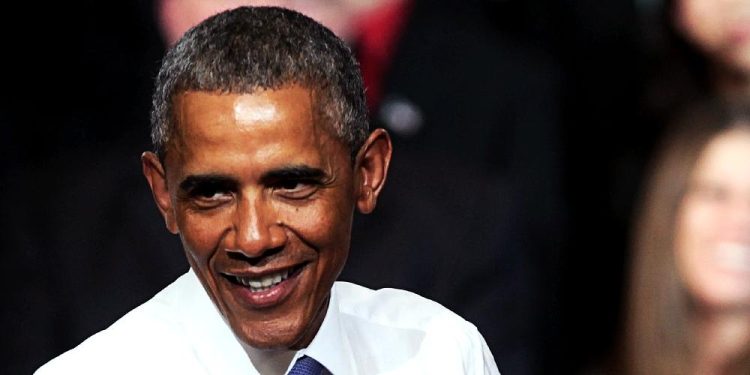
🚨 NYT: “Barack Obama warned during a recent private fund-raising event that artificial intelligence technology could be ‘dangerous’ if not properly managed, as he implored Democrats to aggressively develop political and governing agendas to prioritize the issue in the coming… pic.twitter.com/kifmj4TU4W
The Obama Machine: Netflix Was Only the Beginning From storytelling and “misinformation” to the regulation of AI "That is why the question of whether Netflix has become “woke” now seems almost quaint. Netflix is only one piece of a much larger struggle over who gets to shape the…
The Obama Machine: Netflix Was Only the Beginning From storytelling and “misinformation” to the regulation of AI “That is why the question of whether Netflix has become “woke” now seems almost quaint. Netflix is only one piece of a much larger struggle over who gets to shape the stories Americans hear, which information Americans find, and increasingly which answers their machines are permitted to give them. Ronald Reagan famously warned that freedom is never more than one generation away from extinction. The modern threat to that freedom may not arrive wearing jackboots or carrying a list of banned books. It may arrive promising safety, inclusion, equity, responsible information, and the protection of democracy itself.” To read this most powerful essay, go to:
Because I may be away from this site for extended periods of time during October and November, as well as the remainder of September, I am taking this opportunity to remind people of how we can stop Obola from spreading on this site.
Authors need to leave all moderated posts IN THE BIN during my absence. Let me deal with them.
The Scroll Wheel. Use it. It has the power to save your day – and your sanity. It’s like Vitamin D for Obola!
Let people be wrong on the internet. There is ALWAYS one more WRONG person – let them be wrong!
Fear is the mind-killer. Make it go away.
If you feel like you are “running with scissors” – STOP. Take a break. “Touch grass” as they say.
Don’t feel bad if you find out that you posted FAKE NEWS. It happens. Just correct it and leave it, so that people can see the correction. TEACH how to identify, verify, and expose their LIES.
Try to avoid hardening divisions with other factions of patriots. Let them be them. You be you!
Taking a break is better than running away in a huff and “never coming back”. Try it!
PMTW (PRIVATE MESSAGE TO WOLF) – use it if you need to get a message to me. Do it on one of MY posts on MY days (Monday or Tuesday) if you want complete privacy. Use underscores between the words. If it goes in the bin, you’re good to go!
TRUST TRUMP. If you have doubts – if you are scared – TRUST TRUMP. And if that doesn’t work…..
TRUST GOD.
I plan to have some very interesting new information for you all by Christmas.
We are almost at the equinox, which is 8:05 PM EDT on Tuesday, September 22, here in North America.
Perhaps you’ve been following the laughable story of an “attack” on Ohio Democrat gubernatorial candidate and former failed COVID czarina Dr. Amy Acton.
If not, then consider the following video to be your TL;DR!
But seriously…..
Who is this woman? This “Dr. Amy Acton” who is running as the Democrat candidate for Governor of Ohio?
Dr. Acton inexplicably served as GOP Governor Mike DeWine’s Director of Health until she tried to become Ohio’s Fauci, at which point she was blocked and opposed by everybody in the state who could possibly stop her (particularly the House and Senate), until she “resigned” – thus saving Ohio from following New York and California into the Flaming Dumpster of COVID Communism. Ohioans prayed for Mike DeWine to take two Growacet and fire Dr. Acton. Well, he allowed her to resign, and she did! Good enough!
The fact that Ohio Dems have been reduced to the sad state of offering this lady for Governor shows just how badly they’ve been beaten over the past decade.
For the last year or so, Dr. Acton – or Lockdown Amy as we sensible people love to call her – has been perpetually ahead of her GOP opponent, Vivek Ramaswamy, by ONE POINT – at least according to Mr. Ramaswamy (hereafter just “Vivek”). Personally, I never believed it. Not only was the permanence of the number mathematically impossible in the real world – the fact that Vivek never, ever, pulled ahead of her was clearly bogus, given that – no matter how “unlikable” Vivek may be to the Vivek haters, Amy Acton is even more unpopular in Ohio.
No – in my unofficial and skeptical opinion, Vivek LIKES being one point behind Lockdown Amy – probably because of something called “donations”. Just my theory.
Now I must admit as part of “full disclosure” that I have always found Dr. Acton pleasant to look at (better than the AI above), and rather non-threatening – notably in contrast to her status as a super-villain in the Buckeye State. She seems like a rather typical “science bimbo” – smart, but not particularly sharp, happy, a bit ditzy or dizzy, take your pick, and “looks good in a lab coat”. I suppose some might call that description sexist, but they would be wrong. There are men like Dr. Acton, who women in science see in almost exactly the same way, and nobody calls those women sexist, so I demand exactly the same treatment. Or, to put it another way, “Piss off, you hypocritical, woke AWFULs – who by and large look terrible in lab coats.”
Just sayin’.
Now, recently, I started getting text messages that Vivek was actually ONE POINT AHEAD of Lockdown Amy, as if this was some kind of Earth-shattering news, but in any case, it was supposedly because of this that it was absolutely necessary to donate even more money to Vivek. Admittedly, I wasn’t sure if I should believe this poll result either, despite it seeming entirely reasonable, because the whole thing seemed, as most high-school drama always seems, “weak, fake, and gay” – to use a currently popular expression.
But even if this was somehow true, I felt like there was some chance the Democrats would have to respond in some way, and that worried me.
Why is that? – You might probably should ask.
You see, while we don’t have much actual terrorism and really hardcore political violence in Ohio, we do have a lot of dirty tricks, sabotage, stolen signs, misrepresentations, hoaxes, lies, and machine shenanigans. Helping a non-machine political opponent screw up in a self-defeating way is basically a way of life for both the Democrat and Republican machines in Ohio.
Thus, as soon as I heard the news that Vivek was making some statement about political violence, I knew we were now in the full season of Ohio politics, and I was probably going to have to interpret the inscrutable for the benefit and understanding of the incredulous.
Consider a couple of past instances of my “translation” of Ohio political dirty tricks for the understanding of non-Ohioans.
Understanding WHY Dems do things requires context – and when you find the context, it all makes sense.
SO – back to the present – what actually happened?
The original media description was that an armed man with two guns entered the tent where Dr. Acton was speaking, rushed past the guards, knocked over a bunch of people, and finally “lunged” at Dr. Acton. Only to be stopped by the Highway Patrol.
But even that description wasn’t enough for some in the media.
I was immediately skeptical, and within 24 hours, the skeptics were everywhere. And being proven right.
No drawn weapons. No reaching the candidate. No felony threat charges. Just misdemeanors and a sheriff who said the apparent intent was “to ask her a couple of questions. He was just, you know, pretty aggressive about it.”
No drawn weapons. No reaching the candidate. No felony threat charges. Just misdemeanors and a sheriff who said the apparent intent was “to ask her a couple of questions. He was just, you know, pretty aggressive about it.”
Yet the framing feeds the endless “Republicans are violent extremists” machine, especially convenient in a tight Ohio governor’s race.
When actual political violence hits our side, like our president facing two assassination attempts or our top strategist and influencer actually getting assassinated, the same outlets soft-pedal or pivot to “gun violence.” Here, a fairground disorderly becomes proof of “MAGA terror.”
The simple facts are that on September 6 at the Canfield Fair, Patrick Havas pushed through a crowd while holding up his phone… appearing to record or ask a question. He knocked over a couple of older attendees likely due to the wet grass and uneven ground they were standing on.
Security stopped him as he approached Amy Acton to ask his question. He was legally in possession of firearms, but never drew or brandished them.
Charges: disorderly conduct and two misdemeanor assaults. The sheriff himself said the apparent intent was “to ask her a couple of questions. He was just, you know, pretty aggressive about it.” Acton was unharmed.
That’s the police version… a rude, disorderly rush that caused minor bystander injuries when elderly people lost balance and fell over.
The Acton campaign and left-leaning media immediately rewrote it.
Campaign statement: “an armed individual lunged at Dr. Acton, injuring multiple people.” Then the pivot to “This kind of violence has no place in Ohio… chaos, hate and vitriol.”
CNN, Reuters, the Guardian orbit, and Democratic influencers ran with “lunged,” “attacked,” “assailant,” and “attempted violence.”
They rushed to note Havas is a registered Republican and that his brother had donated to Vivek Ramaswamy, turning a phone-wielding shove into a right-wing hit job
They left remains in power through their ability to run 24/7 propaganda on the American people. It must stop
Here’s another take, that – like me – suspects that there is more going on than just mischaracterization.
Here's the 'violence' in Ohio… A dude was told to force his way through the crowd to create a scene…then when he knocked people over security 'caught' him, and disarmed him to display guns (here) then gave him a seat to watch the inebriated @amyactonoh do her best impressions… https://t.co/FkrbBMB9Ue
A dude was told to force his way through the crowd to create a scene…then when he knocked people over security ‘caught’ him, and disarmed him to display guns (here) then gave him a seat to watch the inebriated @amyactonoh do her best impressions of @KamalaHarris and @HillaryClinton
in summary, it’s fake and was staged…
I thought I was going to have to explain this theory to everybody, but no – the MAGA crowd is now fully trained to spot this shit.
It’s now gone fully national with coverage in Revolver News…..
Amy Acton’s ‘ATTACK’ story crumbles: Prosecutor says armed man never even got near her…
For starters, as soon as I heard this was happening near Youngstown, in Mahoning County, I was shaking my head.
That area is the home of one of the most interesting polyethnic white mafias in America. Admittedly, the Youngstown mafia has almost turned into a nursing home poker game at this point, but I knew a local, back in my working days, who was pretty connected, and he swore that the corruption was still present and hanging on by its yellowing fingernails.
SO – whenever I hear about sketchiness in Mahoning County, it’s not a surprise. And Amy Acton campaigning there? Not a surprise, either. She’s apparently FROM that area.
I was quite suspicious from the start that this involved “somebody up to no good, but probably not assassination” – and that is where I’m still at now.
There are LOTS of FAKE NEWS posts on X stating that the “perp” – Patrick Havas, is “confirmed” to be either a top Ohio GOP insider / operative, or a dangerous DSA member. Both strike me as unlikely, and Newsweek didn’t find either one.
Here is what they did find.
Current voter records reviewed by Newsweek show Havas is not registered with a political party, though he voted in a GOP primary in 2016.
Havas’ voter registration was updated on November 7, 2023, according to the Mahoning County voter records that Newsweek reviewed. The records show he voted in general elections in 2014, 2015, 2016 and 2024.
Havas is a licensed nurse, according to records reviewed by Newsweek.
He was arrested on charges of disorderly conduct and petty theft in 2008, but the theft charge was dismissed after he pleaded no contest to disorderly conduct, according to court records reviewed by Newsweek. Havas was accused in that case of stealing three movies—The Untouchables, Full Metal Jacket and Casino Royale—from a Giant Eagle supermarket. He was handed a 30 day jail sentence that was suspended.
Havas was also fined for traffic offenses in 2008 and 2011.
This man Havas strikes me as a typical borderline hood or hooligan – maybe a blowhard – but not even rising to the level of minion or thug. And yet, exactly the kind of personality who would bully his way into a meeting and not bother to ask if it was OK to take videos. The kind of guy who wouldn’t exercise the basic level of common-sense judgment to stow his firearm before entering a political event.
There is reported to be solid timeline evidence that people watching Amy Acton live at the time were calling her out online as being drunk. Actually drunk or not, I am betting that Havas was at the fair, heard about Amy Acton being (allegedly) drunk, realized he could get viral video of the same, and hatched a stupid, Darwin Award plan to “take her down”. Carrying heat legally, but into a political event, tells me that he was likely not engaging in a smart, planned takedown, ALTHOUGH he would have been on shakier ground, legally, if he had come into the tent earlier, unarmed, and taken video surreptitiously after being ASKED not to film.
IF he was doing this as a planned operation, it was pretty ingenious, because the net effect is to tell the entire country a sad truth – that Dr. Amy Acton is not only a leftist “wine woman” like Kamala Harris – she’s a THROWER.
And thus, we are led to MY reading of what has really happened here.
Not a massive conspiracy by the left to “Jussify” Lockdown Amy.
Not a massive conspiracy by the right to expose Wine Woman Amy.
Just some Ohio dude, dreaming bigly of his 15 minutes of internet clout and national fame, hoping he arrived in time for a viral video of Wine Woman Amy, drunk and disorderly at the fair.
And then dem Dems do what dem Dems is ALWAYS gonna do. Never let a crisis go to waste.
There are Important Notifications from our host, Wolf Moon; the Rules of our late, good Wheatie; and, certain caveats from Yours Truly, of which readers should be aware. They are linked here. Note: Yours Truly has checked today’s post for any AI-generated content. To the best of her knowledge and belief, there is none. If readers wish to post any AI-generated content in the discussion thread for today’s post, they must cite their source. Thank you.
Do not forget to LABEL AI articles video and such.
Jeff points out the major failure feature of the Fake News.
…Editors should have: separated real evidence from allegations, resisted parroting the framing of biased sources, brought in neutral independent forensic and archaeological voices, and updated headlines as the picture changed. In other words, basic journalism vanished like the alleged mass graves.
It was a complete failure of what is supposedly the media’s most important function: to separate interested gossip from facts. Maybe I should say, that used to be media’s most important function. Now, corporate media’s most important function appears to be distributing clever propaganda that destabilizes countries, spurs stochastic terrorism, and permits politicians to effect massive wealth transfers…
…Government researchers enrolled extremely vulnerable infants in an experimental RSV trial, did not obtain informed consent, continued dosing even as severe cases emerged, and two children died. Nobody was prosecuted or even fired. This is serious iatrogenic harm (injury caused by medical treatment) and a research‑ethics failure on its face, full stop.
The Times did its absolute best to cloak that very disturbing and all-too-familiar story in race. The two boys were black. “Most, if not all,” of the 31 kids in the trial group were black. Thus, the Times concluded: racism. What the Times didn’t say was that by the late 1950s and into the 1960s, Washington, D.C. had become a majority‑black city; black residents were the single largest racial group, and by 1970 had peaked at about 71% of the entire population.
That’s one problem for the Times’ unfounded racial hypothesis. Second, the NIH’s RSV trial was deployed through government-run or funded clinics. Both because blacks were in the majority in DC, and because of basic economics, most patients at these public clinics were also black. So we needn’t dream up some conspiratorial racial animus to explain the trial’s demographics.
Black folks were just unlucky enough to be living in DC in large numbers at the time. That’s it.
So, once again, the NYT’s dumb, woke narrative collapses with the most trivial inspection. But more interesting is why the Times leaned so hard into the race angle, despite having not a scrap of evidence. It’s because the last thing the big health agencies need right now is more scandals.
This is exactly the institutional reform RFK Jr. and Jay Bhattacharya were hired to deliver.
🔥 At some point during the Cold War, our big health agencies contracted a deadly disease. They are infected with a mind-virus called utilitarianism. The scandal here is not that the NIH gave experimental RSV shots to black infants without informing their black parents. The real scandal is that the NIH believes you can’t make a public health omelet without breaking a few babies.
In other words, the NIH’s secret trials of experimental vaccines would not have been more acceptable if the babies had been white, orange, or green.
Classic ethical philosophy based on Judeo-Christian principles says: “You may not use people purely as a means, not even for a huge benefit to others.” Utilitarianism rudely inverts that: if the benefit is big enough, and the expected risk is small enough, almost any use of human bodies as means can be rationalized.
At some point in the recent past, our public health agencies quietly slid from “we are here to protect people” to “we are managing a herd, sorry, a population,” and those are not the same posture. In other words, instead of thinking of themselves as healers, they think they are ranchers.
The Lot 100 episode illustrates this problem perfectly. Severe harms and even deaths of infants were tolerated by elite managers because the perceived collective value of “staying the course” was so high. Even fudging the numbers to hide the harms was considered virtuous.
Stalin’s stats were great too, until they weren’t.
In classic public‑health utilitarian fashion, the stated good was enormous —preventing a leading cause of infant mortality worldwide— so the “cost” of experimenting on a few dozen vulnerable infants in D.C. could be rationalized as small in comparison.
The reason progressives and public health types (but I repeat myself) stick like limpets to utilitarianism is that it is technocratic. The philosophy —which is a necessary foundation for communism— presumes it is possible to quantify, in hard numbers, the numeric value of human lives and flourishing. That makes it possible to compare political policies: which ones produce on balance the most human flourishing?
It is both sensationally attractive and completely perverted…
In the Lot 100 case, we find scientists who explicitly or implicitly calculated that infants were less valuable than adults, and that poor folks were less valuable than more economically privileged ones. After all, the NIH investigators recruited from public children’s clinics, not from the private practices their own children or colleagues might have used.
Put even more simply and uglier: the NIH bureaucrats didn’t experiment on their own kids.
🔥 I will say it: utilitarianism is an evil, reprehensible ideology that all good people should root out and shun.
Utilitarianism isn’t a neutral “science of compassion.” It’s a license for elites to convert other people’s lives into numbers and then quietly decide which ones are expendable. Once you agree that it’s acceptable to harm a few innocents to buy hypothetical benefits for the many, you haven’t elevated morality— you’ve simply replaced “thou shalt not” with “let’s run the model and see who dies.”
Lot 100 was not a tragic mistake; it was utilitarianism doing exactly what it promises: sacrificing powerless babies in a D.C. clinic for the supposed good of a population they never got to join. [It continues]
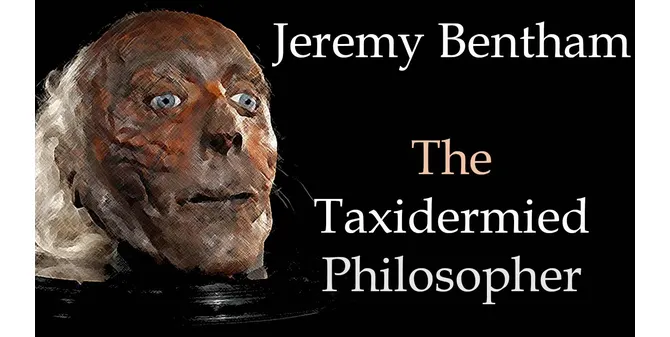
Jeremy Bentham (1748–1832), the “Father” of Modern Utilitarianism and progressive saint. His preserved head, anyway.
What is interesting is I had already put the following together about the philosophies of ‘value’ because I like Mises and Gary North. Gary passed away in February of 2022, at the age of 80 due to complications from prostate cancer.
…He was by training an economic historian and had a strong commitment to Austrian economics. He greatly admired Mises and Rothbard. He once asked Mises how he had been able to publish his famous article of 1920 on socialist calculation in a journal edited by Max Weber. Mises answered, “Well, I knew him, and I sent it in.” Gary wrote a notable study of Marx, Marx’s Religion of Revolution, and a long and learned commentary on biblical economics. He was also a founder of the Christian Reconstruction movement, along with his father-in-law, R.J. Rushdoony.
He was on Ron Paul’s staff in 1976, and he and Dr. Paul were close friends. For many years, he spoke at Mises Institute conferences, and he was the best debater I have ever heard. In his speaking style, he was highly organized and relentless; but he was in conversation kind and friendly. When I saw him at conferences, we would exchange stories of the old days. Now, alas, I cannot do that anymore.
Gary’s Mises on Money is well worth the read. I featured it in an article called APRIMERONMONEY. The following article by Gary is another excellent read as he identifies the problems that are metastasizing in American thought.
The philosophical bases of Marx’s thought were laid early and remained unchanged throughout his life. As a student, Marx accepted the philosophy of Hegel as the only sound and adequate explanation of the universe. According to this philosophy, “the only immutable thing is the abstraction of movement.” The one universal phenomenon is change, and the only universal form of this phenomenon is its complete abstraction. Thus, Hegel accepted as real only that which existed in the mind. Objective phenomena and events were of no consequence; only the conceptions of them possessed by human minds were real. Ideas, not objects, were the stuff of which the universe was made.
If Objective Reality does not exist, than a little girl can become a boy or a cat or a dog. The people pushing this insanity are not going to tell you that it is based on Marxism but that is where it comes from.
Old timers will recall this title as a memorable line in a memorable comedy album, Stan Freberg Presents the United States of America, Volume 1….
WHAT EVER HAPPENED TO “PROPERTY”?
The phrase, “life, liberty, and property,” does not appear in the Declaration. The phrase is incorrectly attributed to John Locke. It was implied in Locke’s Second Treatise on Government (1690), but it does not appear. Locke used the word estate rather than property. He subsumed all three words under property.
Man being born, as has been proved, with a title to perfect freedom and an uncontrolled enjoyment of all the rights and privileges of the law of Nature, equally with any other man, or number of men in the world, hath by nature a power not only to preserve his property, that is, his life, liberty, and estate, against the injuries and attempts of other men, but to judge of and punish the breaches of that law in others, as he is persuaded the offence deserves, even with death itself, in crimes where the heinousness of the fact, in his opinion, requires it (Sect. 87).
Protection of all three — life, liberty, property — is guaranteed in writing by the United States Constitution. This guarantee appears in Article 5 of the Bill of Rights, which was ratified in 1791. It has proven as reliable as other government guarantees of its own performance.
A similar phrase appears in Edmund Burke’s Reflections on the Revolution in France (1790). Burke wrote this of the revolutionaries:
To those who have observed the spirit of their conduct it has long been clear that nothing was wanted but the power of carrying the intolerance of the tongue and of the pen into a persecution which would strike at property, liberty, and life.
But there is no question that Jefferson substituted “the pursuit of happiness” for the more common term, “property.” Was there something ideological in this substitution? Was Jefferson a proto-socialist, as numerous contemporary historians argue?
Had he inserted “property,” this would have saved defenders of private property a lot of time and trouble when dealing with statist scholars, who are always searching for support for their position in the writings of famous defenders of democracy.
The pursuit of happiness is for modern academic man what the pursuit of truth is: a way to avoid the responsibility for discovering anything final. There is no objective truth for modern academic man, other than the truth against objective truth. Similarly, there is no objective happiness. There is only the subjective pursuit of such lofty goals by individuals. In this, as in virtually everything else, academics substitute process for objectivity. Defending the process is holy communion for modern academics. There is officially no holy grail, which would be much too objective.
Why this commitment to pursuit, trivial or otherwise? I suggest two reasons. First, academics do not officially believe in objective truth, which implies objective responsibility, which is decidedly old fashioned and even vaguely suggestive of the Christian doctrine of final judgment. The concept of objective responsibility implies objective standards and objective performance. Academics prefer to avoid both.
Second, modern academics control access to salaried participation in the process of the great search, especially in higher education. They control the implementation of the officially objective standards of tenure, institutional accreditation, and the flow of departmental funds. What Daniel Klein has described so well in the closed, self-certified world of Ph.D. economists operates in every academic discipline.
In contrast, “property” implies enforceable titles to identifiable units of ownership. This is altogether too objective for modern defenders of the political defense of the pursuit of happiness. They defend the democratic process, which affirms, “Thou shalt not steal, except by majority vote.” They want to believe in Jefferson the democrat, not Jefferson the defender of free market capitalism. They want to eradicate political restrictions on the confiscation of property by the State. The suggestion that politics exists so as to defend private property is only marginally less welcome than the suggestion that the Second Amendment to the Constitution actually means that civilians possess the right to keep and bear arms.
JEFFERSON WAS NOT ALONE
It was not only Jefferson who neglected to spell out in official detail his personal adherence to the private property social order. It was also Adam Smith, whose Wealth of Nations (1776), four months earlier, had placed the division of labor at the forefront of its economic attack on mercantilism, an attack that Jefferson made political in the Declaration. Smith’s pedagogical strategy backfired for the next 150 years. By failing to specify in Wealth of Nations the moral and philosophical foundations for private ownership, Smith handed the seemingly high moral ground over to Godwin and the socialists. The consequences of this decision have been chronicled in considerable detail by Tom Bethell in Chapter 7 of his book, The Noblest Triumph: Property and Prosperity Through the Ages (1998).
Jefferson was the supreme follower of Adam Smith among the American Revolutionaries. But by failing to specify property as the third pillar of the justification for civil government — a mistake Locke had not made — he made more difficult his ideological heirs’ defense of the private property order.
The pursuit of happiness is open-ended and non-specific. Liberty is just too vague to be defended systematically. What was needed in 1776 in both of those legendary documents was the insight made by Frederic Bastiat in 1850, in the midst of a European revolution that had begun in early 1848, a few weeks before Marx and Engels’ anonymous tract appeared, Manifesto of the Communist Party. Bastiat wrote in The Law, “Life, liberty, and property do not exist because men have made laws. On the contrary, it was the fact that life, liberty, and property existed beforehand that caused men to make laws in the first place.” Or, in the words of a previous defender of objective private property, “Of every tree of the garden thou mayest freely eat: But of the tree of the knowledge of good and evil, thou shalt not eat of it: for in the day that thou eatest thereof thou shalt surely die” (Genesis 2:16b-17)
Gary North Mentions Bastiat. Here is part of an article about Bastiat and his philosophy.
Frédéric Bastiat (1801-1850) was one of the leading advocates of free markets and free trade in the mid-19 century. He was inspired by the activities of Richard Cobden and the organization of the Anti-Corn Law League in Britain in the 1840s and tried to mimic their success in France. Bastiat was an elected member of various French political bodies and opposed both protection and the rise of socialist ideas in these forums. His writings for a broader audience were very popular and were quickly translated and republished in the U.S. and throughout Europe. His incomplete magnum opus, Economic Harmonies, is full of insights into the operation of the market and is still of great interest to economists. He died at a young age from cancer of the throat.
LAW, Spoliation by
LAW, Spoliation by. What is law? It is the collective organization of the individual right of legitimate defense. Every man certainly has received from nature, from God, the right to defend his person, his liberty and his property, since these are the three constitutive or conservative elements of life, elements which complement one another, and which can not be understood, one without the other. For what are our faculties but an extension of our personality? And what is property but an extension of our faculties? If every man has the right to defend, even by force, his person, his liberty and his property, a number of men have the right to concert together, to agree and to organize a common force in order to provide regularly for this defense. The collective right has its principle, and its reason of being, and bases its legitimacy upon the individual right, and the common force can not legitimately have any other end or any other mission than the isolated forces for which it is substituted. Thus, as an individual can not legitimately make any forcible attempt against the person, liberty or property of another individual, so, for the same reason, a community can not legitimately make use of force to destroy the person, liberty or property of individuals or of classes. For this perversion of force would be, in the latter case, as well as in the former, in contradiction to our premises.
Which brings us to capitalism which TradeBait2 discussed yesterday. This is looking at Capitalism from the point of view of an Atheist. For those who may not know Ayn Rand grew up in the Soviet Union.
Laissez-faire capitalism, according to Ayn Rand, is not just an ideal but an unknown ideal. Few grasp its meaning, history, economics, or moral justification. In Capitalism, Rand sets out to remedy that.
Rand argues that capitalism is “a social system based on the recognition of individual rights, including property rights, in which all property is privately owned.” In practice, this means that a capitalist society is one in which the government performs a single function: it protects individual rights by banning “physical force from human relationships.”
Pure capitalism, she concludes, has never existed: but in the countries that approached it, with America in the second half of the nineteenth century leading the way, the individual was able to flourish. This is because capitalism is the only system that fully recognizes that man is the rational being who “has the right to exist for his own sake,” free from coercion by others.
There are, in essence, three schools of thought on the nature of the good: the intrinsic, the subjective, and the objective. The intrinsic theory holds that the good is inherent in certain things or actions as such, regardless of their context and consequences, regardless of any benefit or injury they may cause to the actors and subjects involved. It is a theory that divorces the concept of “good” from beneficiaries, and the concept of “value” from valuer and purpose — claiming that the good is good in, by, and of itself.
The subjectivist theory holds that the good bears no relation to the facts of reality, that it is the product of a man’s consciousness, created by his feelings, desires, “intuitions,” or whims, and that it is merely an “arbitrary postulate” or an “emotional commitment.”
There are, in essence, three schools of thought on the nature of the good: the intrinsic, the subjective, and the objective. The intrinsic theory holds that the good is inherent in certain things or actions as such, regardless of their context and consequences, regardless of any benefit or injury they may cause to the actors and subjects involved. It is a theory that divorces the concept of “good” from beneficiaries, and the concept of “value” from valuer and purpose — claiming that the good is good in, by, and of itself.
The subjectivist theory holds that the good bears no relation to the facts of reality, that it is the product of a man’s consciousness, created by his feelings, desires, “intuitions,” or whims, and that it is merely an “arbitrary postulate” or an “emotional commitment.”
The intrinsic theory holds that the good resides in some sort of reality, independent of man’s consciousness; the subjectivist theory holds that the good resides in man’s consciousness, independent of reality.
The objective theory holds that the good is neither an attribute of “things in themselves” nor of man’s emotional states, but an evaluation of the facts of reality by man’s consciousness according to a rational standard of value. (Rational, in this context, means: derived from the facts of reality and validated by a process of reason.) The objective theory holds that the good is an aspect of reality in relation to man — and that it must be discovered, not invented, by man. Fundamental to an objective theory of values is the question: Of value to whom and for what? An objective theory does not permit context-dropping or “concept-stealing”; it does not permit the separation of “value” from “purpose,” of the good from beneficiaries, and of man’s actions from reason.
GOOGLE AI: Ayn Rand intrinsic value
Value Requires a Valuer and a Purpose
Rand asked the fundamental question: Of value to whom and for what? [1]
Because she rejected intrinsic value, she maintained that an object cannot have value without someone to value it.
For a thing to have value, it must play a specific causal role in achieving a goal for an individual. [1, 2, 3]
The Ultimate Standard of Value
Rand argued that the concept of “value” only makes sense because living organisms face the alternative of life or death. Therefore, the ultimate standard of value is an individual’s own life. An object or action is considered “good” or “valuable” if it serves to sustain and further that specific individual’s life. [1, 2, 3]
Explore the Intrinsic Theory of Values in the Ayn Rand Lexicon to read her exact definitions and arguments. [1]
With the support of the Democratic Socialists, his prediction is coming true.
Also, I remember him beating his shoe on the desk in the UN saying,”We will bury you”….
A reminder of Khrushchev comments September 29, 1959: THIS WAS Russian Prime Minister Nikita Khrushchev’s ENTIRE QUOTE from that day:
“Your children’s children will live under communism, You Americans are so gullible. No, you won’t accept communism outright; but we will keep feeding you small doses of socialism until you will finally wake up and find you already have Communism. We will not have to fight you; We will so weaken your economy, until you will fall like overripe fruit into our hands.” “The democracy will cease to exist when you take away from those who are willing to work and give to those who would not.”
Do you remember or know all of what Russia’s Khrushchev said in 1959?
How do you create a Socialist State?
There are 8 levels of control; read the following recipe:
1) Healthcare – Control healthcare and you control the people.
2) Poverty – Increase the poverty level as high as possible, poor people are easier to control and will not fight back if you are providing everything for them.
3) Debt – Increase the debt to an unsustainable level. That way you are able to increase taxes, and this will produce more poverty.
4) Gun Control – Remove the ability to defend themselves from the Government. That way you are able to create a police state.
5) Welfare – Take control of every aspect (food, housing, income) of their lives because that will make them fully dependent on the government.
6) Education – Take control of what people read and listen to and take control of what children learn in school.
7) Religion – Remove the belief in God from the Government and schools because the people need to believe in ONLY the government knowing what is best for the people.
8) Class Warfare – Divide the people into the wealthy and the poor. Eliminate the middle class This will cause more discontent and it will be easier to tax the wealthy with the support of the poor.
Fast forward to 2021.
Is this parallel to the Democrat Socialist Agenda????
With an open mind, you can draw your own conclusions.
One last historical fact that needs to be remembered: In 1964, on the floor of the U.S. Senate, Democrats held the longest filibuster in our nation’s history, 75 days. All trying to prevent the passage of one piece of legislation. You guessed it: THE CIVIL RIGHTS ACT.
Amazing how the CIA reading room hides all of this:
Joe Biden never won. This is our Real President – 45, 46, 47.
AND our beautiful REALFLOTUS.
This Stormwatch Monday Open Thread remains open – VERY OPEN – a place for everybody to post whatever they feel they would like to tell the White Hats, and the rest of the MAGA/KAG/KMAG world (with KMAG being a bit of both).
Our various sister sites, listed in the Blogroll in the sidebar
Our beloved country is under Occupation by hostile forces.
Daily outrage and epic phuckery abound.
We can give in to despair…or we can be defiant and fight back in any way that we can.
Joe Biden didn’t win.
And we will keep saying Joe Biden didn’t win until we get His Fraudulency out of our White House.
Wolfie’s Wheatie’s Word of the Week:
womanthrope
noun
a hater of women
a misogynist
Used in a sentence
A womanthrope is not the same as the more familiar term “misanthrope” – and, to be honest, I have never heard of the term until it came next in line, consulting my source of Words of the Week.
Not shown in a picture, to save space!
Shown in a video
MUSIC!
Worse than a placeholder! Apparently Mr. Tate tried to get into music, and this is an example.
THE STUFF
Are you tired of so many political texts, that you can’t find the REAL ones?
For iPhone…..
For Android…..
On a different note, here is a perfect example of the MSM trying to help Lockdown Amy stay competitive in Ohio. See if you can follow the propaganda and manipulation.
This man, making Christmas calls from the White House, believes the world is a sphere. And he has even flown around it! So has our beautiful FLOTUS, who happens to be his wife!
Truth and common sense must be valued by us, as individuals, in order to lastingly disempower the authoritarian fake news media. This includes the perniciously smarmy science media, which never answers for its errors and lies. I believe that the media has been responsible not only for leftist pathologies like scientism, medical fascism, and radical gender ideology, but also for reactionary movements like modern flat Earth, rejection of all medicine, and Biblical geological literalism.
Just as Wheatie’s Stormwatch Monday Open Thread was created as a place for people to openly express their thoughts and opinions, so, too, is this Thank God Thursday Open Thread, where honest but civil discussion of all topics is encouraged. This thread is also to be known as Theistic Evolution Thursdays, due to the author’s expected “pontification” about his scientific, religious, and political opinions. You are welcome to pontificate back! Free speech matters!
Please label all AI-generated content as being such, unless it is patently obvious (e.g., humorous AI images). It is important that we as individuals not begin to pretend that socially derived artificial intelligence is actually our own, as this form of stealthy social information averaging and feedback would be one more pretense and deception between people, in service of stupid Marxist socialism, and of those who wish to substitute their communally protected lies for actual truth.
The source of alleged truth matters, not for the truth itself, but for validation.
And yes, it’s THURSDAY…again.
And that’s it. We’re done stealing from Wheatie.
OK – maybe her rules need to be posted.
No food fights.
No running with scissors.
If you bring snacks, bring enough for everyone.
Other rules may be derivable from these, and that conjecture is left for discussion.
If there is nothing beyond the “W” below, then this is a placeholder. For health reasons, I can’t always post a timely opinion before each Thursday, but I will try. Otherwise, you have this placeholder post, where YOU provide the content. Enjoy!
W
Thoughts On The 2026 Ohio Primary Election Results
TL;DR – they were great!
Just stopping in briefly to talk about this important result. I wish I could spend more time on this, but I have to get back to work.
This primary was important for both Trump and Vivek – and for me. We MUST defeat Lockdown Amy and Proggy Pepper. Ohio is SCREWED if these socialists win. They probably cannot win, but we cannot let down our guard.
Yes, Ramaswamy is “polished” to the level of being “Ratha-smarmy”. But he also has “the stuff” – and I mean the stuff that a certain President has even more of.
His Wikipedia page is very interesting, and has some surprises.
Here is Vivek’s victory speech queued up to the brief introductions.
Now, in more detail, the result.
Kalbo brought this tweet on Wednesday….
🚨 WOW! Vivek Ramaswamy wins 100% PERCENT of Ohio counties in the governor GOP primary — and with nearly all of the vote counted, he has 82.5% of the vote
🚨 MASSIVE TRUMP VICTORY IN INDIANA! RINO Sen. Greg Walker — who voted AGAINST redistricting — has been CRUSHED by Trump-endorsed Michelle Davis! President Trump is 6 FOR 7 tonight 🔥 MAGA is taking back the GOP 🇺🇸💪#TrumpEndorsed#IndianaPrimary#MAGApic.twitter.com/oxXiYMtbrY
— Reverend Jordan Wells (@WellsJorda89710) May 6, 2026
🇺🇸 MAGA IS NOT OVER — IT’S JUST GETTING STARTED! 🔥Look at this absolute bloodbath of Trump-endorsed WINS. From Indiana to Ohio to South Dakota — Mark Messmer, Erin Houchin, Rudy Yakym, Jim Jordan, Vivek Ramaswamy, Jon Husted, and a whole damn army of America First warriors just… pic.twitter.com/mg3m1kHeYM
INDIANA PRIMARIES SUCCESS: The Power Of President Trump's Endorsement On Full Display In Primary Races When Five Incumbent State Senators Lost Their Races To Challengers Backed By President Trump@evitaduffy_1 Joined F&F First This Morning To React To The Results pic.twitter.com/krpGdch1A6
— Fox & Friends First (@FoxFriendsFirst) May 6, 2026
Yeah, Indiana is demonstrably Trump Country. And so is Ohio.
Back to Ohio.
What the media and the Dems were hoping for, was any sign of weakness on Vivek’s part. The Dems are desperate to get Sherrod Brown back into the US Senate, and their next goal after that, is to get Lockdown Amy and the man who would be the REAL governor, Democrat Party Chairman David Pepper, into the statehouse.
Vivek’s “Republican” opponent, Casey Putsch, shouldn’t have even been on the ballot, much less getting 15% of the vote, and in a sane world, he would have gotten NADA, ZILCH, NOTHING. However, the Democrat media has done every bit of heavy lifting possible, to take an anti-Trump, anti-Israel, anti-everything non-pol who had zero experience with the Republican party, who could never even win a school board seat in a safe district, and give him the media coverage needed to make him “credible” – while at the same time, social media bots have used the Epstein, Fuentes, Bondi, and Palestine Genocide strategies to boost him with as many MTG-type MAGA as they could.
AND YET – Vivek beat Putsch far worse than any other machine pick beat an anti-machine upstart in recent Ohio history. Bottom line, IMO – Vivek is a stronger candidate than ANY Ohio Republican governor candidate in decades, including Kasich and DeWine. There is a reason that the Machine picked him.
Note that Vivek is using the same machine staffing strategy that the Dems are using. Acton picked David Pepper as her Lieutenant, because he’s actually capable of putting together a strong [socialist, Demmunist] administration FAST. Well, Vivek picked the Ohio Senate President, Rob McColley, as HIS Lieutenant. This wise move tells me that Vivek is not only serious about transforming Ohio – he is actually capable of transforming Ohio.
Trump knew exactly what he was doing when he backed Vivek.
I think the following pair of tweets explains why Vivek is going to beat Lockdown Amy. I won’t explain it too well, because I don’t want to help the Demmunists, but this says it all.
The screech owls here have to be ignored because they’re working for the enemy. Vivek was another reason I voted for Trump. Especially after the town hall in Springfield Ohio. He is engaging and brilliant.
He will be president someday and is a star for the Republicans.
If you only looked at X, you’d think the Republican Party rejected Vivek Ramaswamy. Groypers screaming. Doomposts everywhere. But reality just dropped: Vivek wins with 86% of the vote. Online is not real life. The real Republican Party isn’t racist. We don’t care about skin color. We want visionary leaders who fight for America First — bold, smart, unapologetic. Vivek delivered. And the same thing is coming for Byron Donalds. The Groypers don’t own this party. We do. Real voters. Real results. Real future. #AmericaFirst#Vivek2026#ByronDonalds”
And the response…..
The screech owls here have to be ignored because they’re working for the enemy. Vivek was another reason I voted for Trump. Especially after the town hall in Springfield Ohio. He is engaging and brilliant. He will be president someday and is a star for the Republicans.
And with that, I will get back to work! Thank you for your attention to this matter!
W
PS – if you want to understand just how BAD Casey Putsch was, just read this tweet. I don’t agree with Forney’s full take on Vivek, but he nukes all the nukeables of the “Retard Right”!
Casey Putsch has been defeated in a humiliating landslide.
It's not even close. Vivek Ramasmarmy buried Putsch by 70 points.
We need to talk about the Retard Right and why they fail. It pains me to say this as I like Casey and believe he had genuinely good ideas that would have… https://t.co/JXfdHs5qNCpic.twitter.com/sKytudBglp
Casey Putsch has been defeated in a humiliating landslide.
It’s not even close. Vivek Ramasmarmy buried Putsch by 70 points.
We need to talk about the Retard Right and why they fail. It pains me to say this as I like Casey and believe he had genuinely good ideas that would have economically revitalized Ohio, such as his infrastructure plans. But he failed for a reason, and unless people understand the reason, this will just happen over and over.
1) Don’t attack Trump.
The image of Casey Putsch burning his MAGA hat doomed him right out of the gate. I don’t care how disappointed you are with Trump, how many blackpills that Tucker Carlson and Nick Fuentes have fed you. Donald Trump IS the Republican Party. He runs the show. You need his blessing or at least his neutrality to get anywhere.
The majority of Republicans—the people Casey needed to win over—support Trump. There is no constituency for being Based and Anti-Trump, it’s a less popular position than Liz Cheneyism. Casey Putsch could have cleared this up with an immediate apology: “I was wrong to turn on Trump. I have my problems with him, but I believe in what he’s doing. I’m running to support his MAGA agenda and help him finish the job.” Pride, foolishness, or Internet poisoning kept him from humbling himself. Even Thomas Massie has had to pivot his campaign to lying about how he’s best buddies with Trump, because his actual connections with the Squad etc. are electoral poison in Kentucky. Just trust Trump! It’s not that hard!
2) Get off social media.
Vivek Ramasmarmy is an incredibly weak candidate, off-putting in person, has a deep contempt for white Americans, and wants to flood Ohio with Indians. He should be as easy to knock over as a feather in the wind. Vivek practically wrote Putsch’s campaign messaging for him.
So what did Casey do? Did he hit the streets, post ads telling Ohioans that Vivek hates them and wants to replace them? That should have been the front and center of everything he did. No. Instead, he kept posting about how AI told him that Israel is Satanic. He kept wading into the Epstein files swamp. He went to Anti-Semitic Fyre Fest and shared the stage with a fat anchor baby and a Muslim hijabi, both of whom openly hate white Americans, destroying any credibility he had in attacking Vivek for his anti-white views.
Social media is not real life. The heady days of 2016 or even 2024 are over. As @Freedomalternat pointed out in his post-mortem on the Hungarian election, Twitter and other social media sites are so overrun with bots and AI slop that they do not represent public opinion anymore. Stunting on the hoes online cannot help, it can only hurt. Ed Gallrein is already using Anti-Semitic Fyre Fest clips to attack Thomas Massie. Vivek himself realized how damaging his X posts were to his political ambitions, so he got off social media to focus on retail campaigning. This is why he won.
3) Stop talking about the Jews.
Israel, pro- or anti-, is not an important issue for the kinds of voters you need to win a Republican primary. They want to hear about jobs, inflation, crime; meat and potato issues. Not only that, a governor’s ability to influence Israel, Iran etc. is fuck all.
Mouthing off about how much you hate Israel cannot help in a Republican primary. Again, it can only hurt, because you look like a deranged moron to the people who actually vote and you take away valuable space that could be used for important issues, issues where you shine. Casey Putsch SHOULD be known for his anti-immigration stance and his ambitious plans to revamp Ohio’s infrastructure. Instead, he’s known for palling around with hijabis and treating ChatGPT like an anti-Semitic magic eight-ball.
Before anyone responds with “Casey Putsch is an idiot influencer, of COURSE he was gonna lose,” I have two words: Brandon Herrera. Herrera, like Putsch, is a YouTuber. Unlike Putsch, Herrera won his primary and is almost certainly going to be elected to the House. What’s the difference? Herrera didn’t “campaign” by camping out on Twitter to stunt on them Jewish hoes. He hit the campaign trail, made friends and allies in local GOP organizations, focused his messaging on how he wanted to help his constituents and what he planned to do in office. Herrera also didn’t turn on Trump and now he has Trump’s endorsement. Learn from Brandon Herrera.
I feel confident in predicting that this is the beginning of the end for the Retard Right. Thomas Massie, James Fishback, Dan Bilzerian will all lose their primaries and the retarded anti-Zionist element will be purged from the right forever. It has no constituency, as Casey Putsch’s landslide defeat shows. Candace Owens is already talking about joining forces with the left to form some kind of Anti-Zionist Popular Front. Nick Fuentes has said that he is a “moderate Democrat.” The Retard Right are functional leftists in the process of becoming actual leftists. And the best part is that they ruined themselves by not knowing when to shut up.
There are Important Notifications from our host, Wolf Moon; the Rules of our late, good Wheatie; and, certain caveats from Yours Truly, of which readers should be aware. They are linked here. Note: Yours Truly has checked today’s post for any AI-generated content. To the best of her knowledge and belief, there is none. If readers wish to post any AI-generated content in the discussion thread for today’s post, they must cite their source. Thank you.
Do not forget to LABEL AI articles video and such.
It is my suspicion that POTUS Trump does not expect the Save America Act to pass. AND he has plans to use an EO to make sure we have safe elections. If you look you can see the evidence surface.
(Yeah, Mama’s in a mood…)
In the mean time POTUS is letting the traitors in the Senate and Congress reveal themselves.
Peter Ticktin is one of the Lawyers for Tina Peters. Ticktin is also a high school classmate of President Donald Trump. Early in the following video he says a group of very smart lawyers have put together an EO for POTUS Trump.
Why We Vote Ep. 166: Peter Ticktin on Constitutional Law, Executive Power, and Election Legitimacy
CannCon and Ashe in America are joined by attorney Peter Ticktin for a wide-ranging discussion on constitutional law, executive authority, and the legal frameworks surrounding election legitimacy. The conversation explores how the Constitution is interpreted in modern legal battles, the limits of federal power, and how legal strategies are being used to challenge or defend election outcomes.
Peter breaks down complex constitutional arguments into plain terms, walking through the role of the executive branch, the judiciary, and the tension between state and federal authority. The discussion also touches on legal precedent, the importance of due process, and how courts approach politically sensitive cases.
Throughout the episode, the panel examines how legal narratives shape public perception and why understanding constitutional structure is critical in evaluating election-related disputes. It is a deep dive into law, power, and the ongoing debate over how America governs itself.
ROUGH TRANSCRIPT
31:48 – 34:10 — Peter Ticktin:
FL is a free state (Canncon) Colorado is a captured state (Ashe)
We are the peg holding the rest of the world up. They have not gone to the depths of where this thing is going to go. It is not going to be a situation where if they were to win where it would be same-o same-o, just a different party running it. It does not work that way.
Within a matter of months of them taking over power, they would be picking us up in truck loads. This is the end of our society as we know it…. We either get the Executive Order or I am telling you it is going to be Martial Law…
Trump was close to doing something last time but he just did not have the power. This time before anyone is sworn in, it will be martial law because we were not able to stop it in a civil way. There is no way that Trump will sit there and say Oh, Golly Jee we lost again because we let them cheat. It will not be that way this time because we will all be dead meat. There will be no coming back from it…
34:30 Ashe:
So the E.O. is intended to create a national emergency so we can make these structural changes… We can not have real elections until we tell the truth about elections…
In January 2017, the U.S. Department of Homeland Security officially designated election infrastructure as a critical infrastructure subsector under the existing Government Facilities sector, recognizing that its incapacitation would have a devastating effect on the nation.Link 1
This designation covers physical and virtual systems including voter registration databases, voting machines, polling places, and vote tabulation locations. Link 2
The designation does not grant the federal government authority to regulate, oversee, or manage elections, which remain the responsibility of state and local governments. Link 3
[Looks like the states realized they could lose control of their fake elections. — GC]
Key components of the designation include:
Legal Basis: Defined by the Patriot Act and Presidential Policy Directive 21 (PPD-21) as systems vital to national security, economic security, or public health.
Scope: Encompasses IT infrastructure for managing elections, storage facilities, and networks used for counting, auditing, and reporting results.
Collaboration: Facilitates the Election Infrastructure Subsector Government Coordinating Council (EIS-GCC) to coordinate between federal, state, and local stakeholders.
Threat Response: Allows for sanctions and closed-door discussions regarding sensitive vulnerabilities to protect against cyber threats and foreign interference.
By providing Congress power to preempt state election procedures, the Framers sought to prevent states from thwarting the federal government’s operation by using state law to manipulate or preclude elections for the House of Representatives.9For example, during the Constitutional Convention Gouverneur Morris of Pennsylvania expressed concern that “the States might make false returns and then make no provision for new elections,” 10 while Alexander Hamilton observed in the Federalist Papers that “Nothing can be more evident than that an exclusive power of regulating elections for the national government, in the hands of the State legislatures, would leave the existence of the Union entirely at their mercy.” 11 Despite the Elections Clause providing Congress power to preempt state law governing elections, Congress did not exercise this power until 1842 when it passed a law requiring that Representatives be elected on a district basis.12 Congress subsequently added contiguity, compactness, and substantial equality of population to districting requirements.13
In the Court’s 1997 decision, Foster v. Love, the Supreme Court affirmed a lower court decision that, 👉under the Elections Clause, federal law preempted a Louisiana statute governing congressional elections.14 The Foster Court noted that while states can prescribe regulations governing the Times, Places and Manner of holding elections, “Congress may at any time by Law make or alter such Regulations.” 15 The Court stated…
So Congress does have power over federal elections and they exercised that power in the Patriot Act despite what Brave AI said.
On January 6, 2017, Department of Homeland Security (DHS) Secretary Jeh Johnson designated U.S. election systems as part of the nation’s critical infrastructure, a decision that was later affirmed by current DHS Secretary John Kelly. Since the designation was announced, state and local election officials across the country have raised questions about the day-to-day impact of the designation and how it will benefit their work to conduct accessible, accurate and secure elections. This document details DHS’s critical infrastructure designation and what election administrators can expect moving forward. It also provides a glossary of terms frequently used in conjunction with correspondence and discussions about critical infrastructure designation….
So at the end of his term Obama designated US Election Systems as critical infrastructure. 😂
“A secure and resilient electoral process is a vital national interest and one of our highest priorities.”
OVERVIEW
In December 2020 our cyber election team was invited by Mrs. Courtney Bailey-Kanelos, the Registrar of Voters in Sacramento County, California to review Sacramento’s election system, and to audit the 2020 election results. The cyber election team was offered a $1.00 contract by the Registrar of Voters to perform the work (see Exhibits). The cyber election team accepted, and placed a technician on a plane to Sacramento within 24 hours.
ENVIRONMENT
Unfortunately, if one has spent any time in Washington, DC, one understands that the town is filled with people who have extremely sharp elbows, and frequently put their own agendas above the interests of the American people. In this instance, a bad actor got word that a technician was on a plane headed to Sacramento, and proceeded to blow-up phones in Sacramento. Before the cyber election team’s tech landed in Sacramento, the audit effort had been squashed, as others in the County were now involved and the brakes put on the planned contract. Obviously, this was a great disappointment.
LIMITED CASE STUDY
The cyber election team’s technician did, however, receive a tour of the election facility by Mrs. Bailey-Kanelos, who was and continues to be extremely gracious in all dealings. The cyber election team’s technician was escorted to every part of the building by Mrs. Bailey-Kanelos and allowed to take photographs of anything he wished.
In this brief document, we will post some of these photographs, and explain their significance, as they demonstrate how an election official, with the best of intentions, can expose this complicated election system to bad actors and potential manipulation…
The password for accessing the Dominion ballot printing software and printing ballots is taped to the laptop for any user to see and use.
In the following video, Mark Cook said this information was key since similar passwords were used in other states.
The Office of the Director of National Intelligence obtained voting machines from Puerto Rico and probed them for security vulnerabilities, the office said in a statement to CNN Wednesday.
The extraordinary move comes amid Director of National Intelligence Tulsi Gabbard’s broader search for voter fraud at the behest of President Donald Trump, who has falsely claimed that the 2020 election was rigged despite numerous court rulings and audits debunking the claim. Gabbard was present as FBI agents executed a search warrant in Fulton County, Georgia, last week related to the 2020 election.
The ODNI claimed in its statement to have found “extremely concerning” cybersecurity and operational deployment practices with the voting machines in Puerto Rico but did not provide detailed evidence….
Mark Cook provides that evidence in the following video.
Why We Vote Ep. 167: Garland & Tamara Favorito on Fulton County Case, Seized Ballots, and Election System Vulnerabilities
CannCon and Ashe in America are joined by Garland and Tamara Favorito for a deep dive into a major evidentiary hearing in Fulton County tied to the federal case surrounding 2020 election records. The conversation begins with firsthand insights from inside the courthouse, where discussions center on the FBI’s seizure of election materials, Fulton County’s legal response, and the implications of those records potentially being used as evidence.
The episode expands into broader election integrity efforts, including newly passed legislation, ongoing investigations, and the challenges of transparency in election systems. The panel also explores concerns around computerized voting systems, vulnerabilities in tabulation processes, and efforts to demonstrate potential manipulation during legislative hearings.
Throughout the discussion, Garland and Tamara emphasize citizen involvement, highlighting the importance of public testimony, grassroots action, and direct participation in hearings to push for accountability. The episode closes with a strong argument for returning control of elections to the people, focusing on simplicity, transparency, and trust in the voting process.
VERY ROUGH PARTIAL TRANSCRIPT
4:45 to 33 minutes — Garland and Tamara Favorito:
Fulton County is trying to get back the ballots seized by the FBI. Do the county officials actually even have STANDING??? That is the matter before the court in this hearing. It should be an open and shut HELL NO! But not in the Amerika judicial system. [Remember all those “numerous court rulings” cited by CNN? Well the courts found citizens had NO STANDING and thus there never were any actual trials in most cases. –GC]
VERY IMPORTANT BOMB SHELL:
Please watch this video from 1 hour to 1 hour and 30 minutes. Yes, it is long, but it is the election fraud smoking guns explained so a 10 year old could understand it. It explains why Colorado went ballistic when Tina Peters had a forensic image captured before the ‘Trusted Build’ by Dominion.
He states he is a Subject Matter Expert in Election Cyber Security & THREAT ASSESSMENT with 40 years in IT & 6 in Elections. He says: I have absolute proof of backdoors built in to voting machines….
1:01:30 He gives a demo of the backdoors.
“…Tina Peters forensic image… God bless her, she allowed citizens to see what is in their black box voting machines. This is why she is being tortured…”
1;06;45 Mrs. Courtney Bailey-Kanelos, the Registrar of Voters in Sacramento County, California invited Mark Cook to CA and HE GETS A TOUR of the voting machines. See the article above.
He explains sequel [sql] server tools in simple terms.
1;07;10Sequel Server Management is a stand alone that gets directly into the database bypassing the software that is suppose to keep it secure.
[Now think about that for a minute and think about those voting machines DHS grabbed from Puerto Rico…😂 — GC]
1:20:00 They can CHANGE the outcome of the election and there is NO RECORD!
1:25:45 Then Mark demonstrates something else using flash drives. He plugs in a flash drive and does NOTHING ELSE. He doesn’t hit enter or anything. He just holds up hands. He is NOT typing. The flash drive pulls up another backdoor. It starts flipping numbers in the database AND WILL NOT LEAVE A TRACE. (Change tracking is disbled. It comes that way from the factory & when Dominion sets it up for the county, they do not turn tracking ON!)
END 1:29:14
Canncon makes the point that Mark’s demo is slowed way down to make the changes visible. It actually happens fast, in about a second or so.
……
Name: USB Flash Drive #4 (backside)
Discussion: Back side of USB Flash Drive #4, showing a unique identifier, probably assigned by the county.
Given the photographic evidence above, and the information provided by the voter registrar, our cyber election team concludes that it would have been trivial to:
print unlimited ballots while unsupervised;
connect the election system to an external network or the Internet during the election;
introduce new software, firmware, voted ballots into critical election equipment via USB or portable hard drive;
Numerous election officials and warehouse workers have unfettered access to key election systems and ballots.
Sacramento refused to address numerous security concerns as required by Grand Jury prior to the 2020 Election, and instead stated they would address them after the election (see Exhibits).
..In late winter, I wrote a series on election fraud. The day after the last, the man I had written about Saturday, Peter Bernegger, a freaking hero, was arrested. Later that week another subject, Christina Bobb, Trump’s lawyer, and the Republican National Committee’s voter fraud expert, had to fly to Arizona and turn herself in.
The left can no longer win on the merits of their ideas, much less their actions. They have created one catastrophe after another. The only way they can win elections is steal them. And they have developed three hundred separate, specific, methodologies to do it. In my opinion, and that of others closer to the coal face….
Newly-unclassified documents show that in 2022 Ukrainian officials discussed diverting hundreds of millions of U.S. tax dollars — earmarked for clean energy — back to Biden’s ill-fated 2024 campaign. There is no evidence the intercepted allegations were investigated during the Biden administration.
He Found Ghost Records Inside Social Security. Their Numbers Were Still Active. | Frank Bisignano
Democrats TEACH voter identification and election integrity … just not in America
The Democratic Party has an international arm called the National Democratic Institute (NDI). It’s funded by $181M/year in US tax dollars. Its board includes Stacey Abrams, Donna Brazile, and Tom Daschle.
But in regards to today’s SAVE America Act debate… did you know that the NDI has taught and supervised election processes all over the world?
For 40 years, NDI has told every developing country on earth that voter ID is essential for election integrity. They’ve recommended biometric systems… yes, that’s right, NDI recommended biometric systems, which goes way beyond SAVE America Act! They praised fingerprint verification. Tracked ID card issuance rates.
Meanwhile, Democrats call the SAVE Act “Jim Crow 2.0.”
Same party. Same people. Opposite positions.
As always, patience as I pull together the thread
NDI’s own 2001 guide emphasizes the importance of only citizens voting. It further says voter ID cards “introduce an additional safeguard into the system” and describes photo ID and fingerprints as standard election infrastructure.
In one of their PDFs, the complaint in Nicaragua wasn’t that voter ID existed. It was that the government wasn’t issuing ID cards FAST ENOUGH. They even called the issuance of temporary IDs as ignoring “the far more fundamental problem.”
In Morocco, NDI praised the switch to requiring just ONE photo ID at the polls, calling it “a positive development.” The SAVE Act requires one photo ID. Democrats call that Jim Crow.
In Bangladesh, NDI praised voter photo ID cards as giving “a sense of empowerment and belonging to the disadvantaged and marginalized people of the country, particularly women.”
Stacey Abrams, NDI board member, calls the same requirement discriminatory at home.
Chuck Schumer: “The SAVE Act would impose Jim Crow-type laws to the entire country.”
NDI (his party’s own arm): “Individuals who wish to participate in an election must somehow prove their identity, demonstrating that they are who they say they are.” And also must demonstrate citizenship
The biggest irony: NDI vice chair Stacey Abrams co-led the Nigeria 2023 election observation mission. Its final report called biometric voter ID “the most important contribution to raising confidence in electoral integrity.” She called Georgia’s voter ID law “Jim Crow in a suit.
The biggest irony: NDI vice chair Stacey Abrams co-led the Nigeria 2023 election observation mission. Its final report called biometric voter ID “the most important contribution to raising confidence in electoral integrity.” She called Georgia’s voter ID law “Jim Crow in a suit.
NDI has observed elections in 100+ countries. If they observed a US election, they’d flag 14 states with no voter ID requirement as failing basic election integrity standard… by their own published criteria.
The Democratic Party tells the world voter ID is democracy. Then tells Americans it’s Jim Crow.
THREAD END.
When all the different threads are pulled together, I think POTUS Trump will have the evidence he needs for his E.O. on Election Integrity.
There are Important Notifications from our host, Wolf Moon; the Rules of our late, good Wheatie; and, certain caveats from Yours Truly, of which readers should be aware. They are linked here. Note: Yours Truly has checked today’s post for any AI-generated content. To the best of her knowledge and belief, there is none. If readers wish to post any AI-generated content in the discussion thread for today’s post, they must cite their source. Thank you.
Do not forget to LABEL AI articles video and such.
Because of the very Pro-Israel stance of the Q-Tree I was going to stay out of this fight and had the article below this planned. However, despite the fact I am old with few years left & have no children, I do love my country and would prefer it NOT turn into a Commie-Islamic Hell hole. Unfortunately that is exactly what will happen if we lose the mid-terms.
Rich Baris of the People’s Pundit, is about the only legit pollster, I know of. He says we WILL lose the mid-terms and why. Given Tucker Carlson, Candice Owens and others I thought this alternative view should be explored. As Burning Bright says, we are in a ‘War of Stories’
We’ve been in the field every single day since before he [Trump] was sworn into office, and his approval rating hasn’t budged from its historical high.
Americans didn’t agree with everything Trump was doing in first term. They do now. It’s different..
Americans agree with what he’s doing and the Left trotting out an angry Morgan and crying Selena isn’t going to cut it this time. The Left is going to have to come up with a reformed policy platform, whether they mean it or not (almost certainly they won’t), instead of the outrageous and ignorance machine.
And less than a month later Baris says the voters mood has changed and we will lose the mid-terms. What happen in that month?
POTUS sent American military to the middle east and is now threatening Iran.
At 17 minutes Baris says what people here are NOT going to like hear. Remember this guy is polling people every day and he is telling us what Americans think.
The Israel First attitude in the senate is what is going to lose us the Midterms. Just like ‘RACIST’ is used to shout people down, Anti-semite is used to silence people. They may go silent BUT THAT JUST BUILDS RESENTMENT.
He says 30% of the republicans in SC will not vote for Miss Lindsey because of this.
PARTIAL TRANSCRIPT
This is something very dark we are not allowed to talk about because every time you do someone calls you an antisemite. Mark Levin because of my polling [called me an antisemite] and said it is in my DNA because I am European… It [being called antisemite] scares people and they no longer want to talk about it and they [the Israel first crowd] are free to do what they are doing, go to the White House… Netanyahu has been there more than any body and there is a reason for it. The Ted Cruz & Lindsey Grahams & Bebe Netanyahu’s view the Trump presidency as the last chance to do what Israel has long wanted to do. That is why you heard Mike Huckabee as the US Ambassador say during the Tucker interview “It would not bother me if they took it all.”Because there is a very real agenda. They are already talking about Turkey next year. They want to take parts of Turkey. I kid you not. This is Nuts. They [the Israel lobby] put themselves ahead of you. It does not matter if you are pro-Israel or not. This is what happened. They put THEIR INTERESTS ahead of you.
Israeli Finance Minister Bezalel Smotrich announced plans to promote Palestinian emigration, annul the Oslo Accords, annex the West Bank, and extend Jewish settlements as part of the next government’s agenda.
….He [Smotrich] linked the coming political phase in Israel to the remaining term of US President Donald Trump, who began a four-year term in January 2025, calling it a “window of opportunity” to enact sea changes, including “dismantling the Palestinian Authority and disarming the West Bank.”
BACK TO TRANSCRIPT
19:30– They knew full well last year, with the bombing of Iran, it would have taken Trump’s peak presidency. By that I mean a certain amount of time during the first year when Congress will do big things. Because once we go into the second year, which I tried to warn people about, Congress will not do big things. The do not want to cast controversial votes. They do not want to take unnecessary risks during an election year. The donors are breathing down their backs.You really have 8 months and THAT’S IT. That is what you have got as a president to get your agenda through.
They [Israel Lobby] decided to hijack the last of that eight months because they figured their interests were more important than the American public’s. They don’t give a damn about you.
They figure the next time is a Democrat president and we will get nothing from them. So we have to get as much as we can from Donald Trump. AND THEY DID GUYS AND THEY WON. I hate to say this but that is the reality in Washington DC. A president’s agenda is a constant tug of war between the blob [Mike Benz’ term for the Cartel — GC] and the Donor Class and what the American people wants...
20:20 — You can not have 60% of the country since the bombing of Iran the first time last year, tell the president we are over this crap and get back to domestic policy. Then have him ignore it. Then Trump MOCKS PEOPLE with the make Iran great again posts on social media.
He did exactly what Rush Limbaugh in his final days warned him not to do… He broke the bond between him and the American People….
Benjamin Netanyahu returned to Israel after a closed-door meeting with President Donald Trump in Washington
Comment byGhostofBasedPatrickHenry:Like everyone I follow at Badlands, Ghost is a Christian. However he is not particularly fond of Israel. He is also well read historically, and IIRC has been to the middle east. He can lay out logically the point of view of Christians who want nothing to do with more war in the middle east.
Also I noticed someone yanked out the tired old “Iran’s a week away from having a nuclear bomb” Remember The Gulf of Tonkin Incident that served as a catalyst for U.S. involvement in the Vietnam War? An incident that NEVER HAPPENED?
…There is always the possibility that a kinetic attack is imminent. If that’s what is in the cards, then President Trump certainly wouldn’t telegraph such plans or intent to the world beforehand.
But I have long asserted, and continue to maintain, that such calculus does not lead us to the Golden Age. The cycle of violence has to be broken, and Iran represents one of the longest-running pledges for large scale violence of my lifetime.
It has never been a question of ‘if’ we will have a war with Iran; it has always been a question of ‘when.’
Our beloved elites, of course, could never fully explain why such an idea would be in any way appealing to the American People. Why should we go give more of our families’ blood and treasure to fight an enemy on the other side of the world that poses no clear and present danger to America? (Spare me all of Mark Levin’s talking points. That’s all a bunch of NeoCon bullshit.)
They want us to believe that Israel doesn’t control our government. They say that I am an antisemite for suggesting such a thing. And yet, things like this keep happening that support—if not affirm—the allegation.
Can somebody explain to me why Iran needs a new government? Even if we were to assume that the people running that place were the worst tyrants who ever lived, in terms of how the government treats Iranians, why exactly is that our problem? Despite all the consternation and hyperventilating from the kosher crowd (Loomer, Levin, Lady Lindsey) there is no evidence to suggest Iran poses a threat to the United States or even to Israel.
Not to mention that Iran, which was once geopolitically isolated, now has strong international relations with a number of world powers, most notably Russia and China. Iran has also become a geographic centerpiece of the North-South Transport Corridor, which is a trade route developed by the Shanghai Cooperation Organization to compete with the Suez Canal.
The deep economic entanglement between these nations will actually keep Iran accountable as economic pressure from both inside and outside of the country will promote peace and deter kinetic conflict.
Put simply, there is absolutely no reason to believe that Iran wants to start a war with Israel or the US—even assuming that Iran harbors ill-will toward Israel and would prefer to see it somehow destroyed. The point is that Iran is not going to start or provoke such a war with Israel because it knows that it will end up fighting the US and Europe.
So why the hell are we allowing the Israel lobby to drag us into this situation?
Ghost does not say, but I will, If the USA attacks Iran on Israel’s behalf, it could be the beginning of WWIII given Iran’s entanglement with China and Russia. Of course nothing would please the Cabal more, than to plunge the USA & the world into another major war.
Here is a lengthy formal statement posted by the Kingdom of Saudi Arabia:
These are the countries signing this document:
We the Foreign Ministers of the Kingdom of Saudi Arabia, the Federative Republic of Brazil, the French Republic, the Kingdom of Denmark, the Republic of Finland, the Republic of Iceland, Ireland, the Republic of Indonesia, the Arab Republic of Egypt, the Hashemite Kingdom of Jordan, the Grand Duchy of Luxembourg, the Kingdom of Norway, the State of Palestine, the Portuguese Republic, the State of Qatar, the Republic of Slovenia, the Kingdom of Spain, the Kingdom of Sweden, the Republic of Turkiye
Continued from Ghost.
Allow me to demonstrate how disrespectful these Israelis are toward President Trump. Explain to me how this public statementfrom Israeli Finance Minister Bezalel Smotrich is not undermining Trump’s efforts for peace?
How about Ze’ev Elkin from the Finance Ministry yesterday asserting that Israel will not financially contribute to Trump’s Board of Peace? Is that disrespectful?
What about last month when all of the top officials in Netanyahu’s government—including Smotrich—formally rejected President Trump’s Board of Peace? Is that disrespectful?
Meanwhile, here is the opposition leader to Netanyahu’s government, Yair Lapid, declaring that he will stand with Bibi in a war against Iran. Because even this former news anchor turned “center-left” progressive politician wants a war with Iran, and is willing to give Bibi all the support he needs to carry it out. Lapid even went on (in Hebrew) to express empathy for the Greater Israel that Mike Huckabee conceptualized in his interview with Tucker.
And just as I thought, it looks like POTUS Trump may be pulling a peaceful rabbit out of his red ball cap despite the Israelis lust for more territory and war.
Iran’s Deputy Foreign Minister Majid Takht-Ravanchi said Tuesday Tehran is ready to swiftly reach a nuclear deal with Washington, stressing negotiations in Geneva will focus solely on the nuclear issue and urging diplomacy to avoid regional conflict.
Now we need Ukraine to give up and actually come to the table before the midterms.
Four Horsemen, Eight Families & Their Global Intelligence, Narcotics & Terror Network
Excerpts from The Third World Traveler
p5
Kermit Roosevelt, the Mossadegh coup-master [Iran, 1953] admitted in his memoirs that SAVAK was 100% created by the CIA and Mossad, the Israeli intelligence agency that acts as appendage of the CIA.
p7
No corporations profited more than US defense contractors [from the 1953 Iran coup]. From 1950-63 the Middle East received 3% of US military aid to the world. From 1971-75 it received 60.2%. [21] The bulk of it went to Israel, Saudi Arabia and Iran. Iran and Saudi Arabia were the “Twin Pillars” in President Nixon’s 1972 Guam Doctrine. Nixon and his cronies saw these two nations as critical to ensuring a steady cheap supply of crude oil to the US. Saudi reserves are estimated at 261 billion barrels, while Iran sits atop nearly 100 billion barrels.
… Revenues received by both the Shah and his House of Saud counterparts were recycled back into US money-center banks JP Morgan, Chase Manhattan and Citibank. These banks own huge blocks of stock in the Four Horsemen [Big Four oil companies – Royal Dutch Shell, ChevronTexico, ExxonMobil, British Petroleum] and in the defense contractors which now jostled for position in both Tehran and Riyadh. Chase Manhattan owned Iran’s Central Bank – Bank Markazi. The international bankers were the main beneficiaries of this new oil for arms quid pro quo. In Iran the Shah was given carte blanche on US arms purchases. Iran came to account for 25% of US military sales.
p10
The State Department once called the Middle East, “a stupendous source of strategic power and one of the greatest material prizes in world history, the richest prize in the world in the field of foreign investment.”
p10
Oil revenues financed the Shah’s military procurement program. He agreed to recycle surplus petrodollars into US banks, mainly Chase Manhattan, which his good friend David Rockefeller chaired. Iran’s Central Bank, the Bank Markazi, acted as wholly-owned subsidiary of Chase Manhattan. Oil revenue also went to banks like BCCI where it funded CIA covert operations
p11
The Shah served as cop on the beat for the US in the Persian Gulf, while Israel filled that role in the Mediterranean. President Truman called Israel, “a stationary aircraft carrier to protect US interests in the Mediterranean and the Middle East”.
p15
Within a few years of the Iranian Revolution, the CIA was helping Ayatollah Khomeini identify nationalist leaders so he could target leftists who had formed the Committee of 60, which led the Iranian revolution. In 1983 the CIA and British MI6 supplied a long list of Tudeh Party members to Khomeini. The Ayatollah unleashed a reign of terror against the left; assassinating, torturing and imprisoning over 10,000 Tudeh members and supporters. In 1989 many of those imprisoned were sentenced to death.
p16
SAVAK used heroin money to finance counter-revolution in Iran. The CIA allowed wealthy Iranians to smuggle their heroin into the US using diplomatic pouches. Iranian revolutionaries cracked down on the heroin trade, which had thrived under the Shah.
p17
Zbigniew Bzrezinski co-founded the Trilateral Commission (TC) in 1973 with David Rockefeller… The stated purpose of TC was to form a triad of global influence consisting of North America, Western Europe and Japan.
The TC published The Crisis of Democracy in 1975. One of its authors, Harvard professor Samuel P. Huntington, is a prominent writer for the CFR publication Foreign Affairs. Huntington, intellectual darling of the global elite, argued that America needed “a greater degree of moderation in democracy”.
The TC paper suggested that leaders with “expertise, seniority, experience and “special talents” were needed to “override the claims of democracy”. More recently Huntington has been pushing his “Clash of Civilizations” thesis, which argues that war between the West and Islamic nations is inevitable.
This part segues into the next about South America, drugs & banks.
p111 BCCI [Bank of Credit and Commerce International] would become the mixing bowl into which Persian Gulf petrodollars were stirred with generous helpings of drug money to finance worldwide covert operations for the CIA and its Israeli Mossad and British MI6 partners.
BCCI was the bank of choice for the world’s most notorious dictators, including the Somoza family, Saddam Hussein, Philippine strongman Ferdinand Marcos and Haiti’s Jean-Claude “Papa Doc” Duvalier. The South African apartheid regime used BCCI, as did Manuel Noriega.
… With branches in 76 countries, BCCI dealt in conventional and nuclear weapons, gold, drugs, mercenary armies, intelligence and counterintelligence… The bank had close relations with the CIA,Pakistan’s ISI intelligence service, the Israeli Mossad and Saudiintelligence agencies… BCCI’s main stockholders were monarchs and wealthy oil sheiks from the GCC [Gulf Cooperation Council] nations.
… BCCI was founded 1972 in Pakistan by Agha Hasan Abedi, a close friend of Pakistani military dictator Zia ul-Huq… BCCI took its wings when Bank of America put up $2.5 million for a 30% stake in BCCI. At that time Bank of America was the largest bank in the world, controlled by N.M. Rothschild & Sons.
U.S. President Donald Trump hosted Colombian President Gustavo Petro for their first in-person meeting at the White House on February 3, lasting over two hours in a private Oval Office session.
The encounter, attended by top officials including Vice President JD Vance, Secretary of State Marco Rubio, and U.S. Senator Bernie Moreno on the American side, and Foreign Minister Rosa Villavicencio, Defense Minister Pedro Sánchez, and Ambassador Daniel García-Peña on the Colombian side, produced unexpectedly positive tones and visuals after a year of public tensions, threats, and insults between the two leaders.
Trump described the meeting positively, stating “We got along very well” and noting prior unfamiliarity despite past friction.
Petro called himself “optimistic and positive,” reporting discussions on “concrete problems and joint pathways,” and left with a modified MAGA hat reading “Make Americas Great Again.”
Trump gifted Petro a signed copy of “The Art of the Deal” inscribed with “You are great” and “I love Colombia,” which Petro shared on X.
Discussions focused on counternarcotics cooperation...
Present given to POTUS Trump by President Gustavo Petro
…While we don’t have any hard facts yet on what specifically was achieved during the meeting, both Trump and Petro have independently said in interviews they agreed to collaboration on operations against the cartels, as well as Trump looking into lifting the sanctions he recently imposed on Petro and his family.
I went and read the document from the Treasury that imposed the sanctions on Petro, and found a paragraph that stuck out to me.
So what is this organization? I asked ChatGPT.
So the Deep State literally has an international intelligence unit that tracks all the financial crime information that is shared between governments, and when Gustavo Petro—the one world leader that we know for certain is going after the cartels—shared privileged information about the group that he had obtained through official channels, it compromised the integrity of the organization and led to the suspension of Colombia from the team.
So where is this organization located? Where is their headquarters?
CANADA??? You have got to be kidding me! And this group tracks bank transactions and passes suspicious activity on to the FBI and DOJ.
The Mark Carney lore as the king of all central bankers has now significantly increased.
Canada may very well be the final boss.
Sidenote: I may do a stream this afternoon to dig into all of this. Stay tuned.
It is worth noting that after his meeting with President Trump, Petro held a press conference where he said that the next step in fighting the cartels is to target the major financiers and international structures that operate outside of Colombia.
Colombian President Gustavo Petro announced that he had evaded an assassination attempt when intelligence revealed a plot to fire on his helicopter, forcing an abrupt route change. During a government meeting broadcast live on the presidential administration’s YouTube channel, Petro stated that he had “avoided being killed” and described how the aircraft—carrying him along with his children—was rerouted to fly for four hours over the open sea before landing at an unplanned location.
The report, originating from Buenos Aires and published by TASS on February 10, 2026, provided no additional details on the alleged perpetrators, investigation status, or specific threats involved.
Petro met with President Donald Trump on February 3, 2026 and an assassination attempt happens on February 10. On February 11, 2026, the FAA abruptly closed airspace around El Paso, Texas, due to drone activity near the U.S.-Mexico border. An assassination attempt against POTUS Trump happens on February 22, 2026. Nemesio Rubén Oseguera Cervantes, known as “El Mencho” is also killed on February 22, 2026. Sure was a busy couple of weeks!
“I didn’t land where I was supposed to because there were fears that the helicopter, in which my children were also located, would be fired upon,” he said at a government meeting broadcast on the presidential administration’s YouTube channel.
According to Petro, he “avoided being killed.” “We flew for four hours over the open sea and arrived where we didn’t plan to,” he said.
Our guy, Petro, has been on a heater lately.
Just last week, after meeting with President Trump at the White House, he held a press conference where he announced that he had proposed to Trump an international joint operation to go after the most powerful cartel bosses at the very top of organized crime— bankers, financiers, corporate executives, etc.
Then they tried to assassinate him.
At this same press conference where he disclosed the assassination attempt, he also called out a Colombian billionaire banker named Luis Carlos Sarmiento, telling him that he can “go F yourself” if he was going to stand in the way of a pipeline project with Venezuela that Petro had discussed with Trump.
Sarmiento is worth roughly $10 billion. [Note he is also a banker -GC]
No wonder they want to kill this guy. He is just about the most flippantly defiant world leader since… well, since Nicolas Maduro.
Assuming this assassination attempt story is real, who could blame Petro for having this attitude?…
The Trump Administration confirmed that “cartel drones” entered US airspace near El Paso, Texas, and were disabled by the FAA and the Department of War. Secretary Duffy (Transportation) posted on X:
“The FAA and DOW acted swiftly to address a cartel drone incursion. The threat has been neutralized, and there is no danger to commercial travel in the region. The restrictions have been lifted and normal flights are resuming.”
The FAA earlier issued a surprise notice shutting down the airspace above El Paso, a major city in west Texas on the US-Mexico border, and halting all flights up to 18,000 feet for 10 days due to “special security reasons.” The restricted area covered a 10-mile radius, and restrictions were lifted Wednesday night.
Business Insidercites anonymous officials claiming that the administration disabled the drones using counter-drone measures. The department did not publicly specify the exact technology used.
Mexican President Claudia Sheinbaum rejected reports of the alleged drone incursion, stating, “There is no information about the use of drones on the border,” according to reporting by Newsweek. The same article reports that Representative Tony Gonzales responded to the drone news:
“For those of us who live and work along the border, daily drone incursions by criminal organizations are part of everyday life. It’s a Wednesday for us.”
All the Fake News that Brave pulled up on its first page say it was just party balloons.
So Colombian President Gustavo Petro comes to town last week (nearly gets assassinated later on the way home to Colombia) and vows that he and Trump are working together to bring down cartels and the bankers that finance them.
Our friend, Eric Rice, presented an interesting question: Who sold Mexico the drones?
This is an interesting question, and I found an interesting article from 2015.
…First the FFA shuts down the airspace around El Paso. Then we get conflicting reports about an invasion. This is definitely an invasion.
It does seem like Mexico is the last bastion of these Hispanic narcotics cartels, and Trump has dropped plenty of signal that he considers the Mexican government in bed with cartels and therefore a threat….
For months now, I’ve been saying that Colombian President Gustavo Petro is the righteous actor—as he has spent the past three years going after the cartels.
Here is video that Petro posted to X yesterday recapping some of their operations.
Fueron a decir arrodillados que el presidente de Colombia era un narcotraficante, y que así otra guerra en Colombia.
They went kneeling to say that the president of Colombia was a drug trafficker, and that this would cause another war in Colombia. They always do the same thing. Look at reality.
This program that Secretary of the Treasury Scott Bessent is rolling out with FINcen seems to streamline the bounty system while focusing on the critical evidence: the money.
“Follow the money” is a notorious refrain not only in the Q Research community, but in the entire cultural ethos of “criminology” as well. Whether you are talking about a crime drama presented as a work of fiction on Netflix, or academic detective work, forensic accounting is the ideal method of mapping out criminal networks because the money flow is objective and traceable.
If you’ve listened to the past few episodes of Breaking History, we have been discussing FINcen and the Egmont Group. While FINcen is the financial crimes intelligence unit in the US government, the Egmonth Group is an international network of over 170 of this type of intelligence unit from nearly every government on earth. The purpose being to share in this intelligence.
Colombian President Gustavo Petro was sanctioned by the Treasury Department last year, and in the sanctioning document Petro is accused of getting Colombia’s financial crimes intelligence unit suspended from Egmont for allegedly sharing information he collected from the Egmont servers.
It is fascinating that both Petro and Maduro have accused all of the most powerful banks in the US and Europe of literally being the cartels. Petro says that it is institutions like Egmont Group that allow the criminality to continue and prosper, because it covers for them.
Bessent’s strategy is brilliant because it creates a practical incentive structure and has a reliable source of reward money. It also inherently targets the core culprit in all organized crime syndicates: the financial institutions.
We are going to pay criminals to rat out their friends. We are going to pay bureaucrats and accountants to blow the whistle on shady stuff they see around the office. And we are going to pay them with the money collected from fines imposed on the guilty parties. The idea being that the investigations will lead to criminal referrals and indictments.
Scott Bessent is weaponizing the financial system against itself by tapping into base human instincts.
We’ve been speculating for months that Mexico would be the real target for a military operation. Here’s President Trump weeks ago explaining that the cartels control Mexico.
[Video]
Yesterday, President Trump affirmed that he did offer to send in US troops to fight the cartels, but was turned down by Mexican President Claudia Sheinbaum.
[Video]
This tracks, if the cartels do actually control Mexico.
However, two weeks ago it was reported that a Mexican Senate commission approved a proposal for SEAL Team 2 to go there and train Mexican special forces to fight the cartels.
Last week, Sheinbaum formally invited the SEALs—though this was only in a training capacity.
With all of this said, it is notable that the New York Post reported that over 100 cartel bosses—including El Mencho’s brother—were quietly handed over to the Trump administration prior to the Jalisco raid where El Mencho was killed.
It could be that things are not what they seem. It could be kayfabe to keep the cartels guessing. We should continue to withhold belief (h/t: Chris Paul ) until we have enough data to adopt an informed opinion.
Personally, I do think this particular war against the cartels is real, andI think much of the cartels’ infrastructure has already been severely hampered by the efforts of Colombian President Gustavo Petro and Venezuelan President Nicolas Maduro, along with Bukele of El Salvador, among others.
As Petro is calling for Trump to lead a crusade against the bankers and financiers that support the cartels, the [Mexican] military is going after them in Mexico.
H/T patfrederick said NebraskaFilly said Rodney posted this Tweet last night:
▪️THE SUPPLIER IS DEAD.
THE CLIENT LIST SURVIVED.
When Mexican Special Forces took out El Mencho, they didn’t just find guns and drugs. They found a laptop.
On it: a single encrypted file named “CLIENTES.”
Inside: 211 names. The elite clients who ordered children and organs…
THE SUPPLIER IS DEAD. THE CLIENT LIST SURVIVED. When Mexican Special Forces took out El Mencho, they didn’t just find guns and drugs. They found a laptop. On it: a single encrypted file named “CLIENTES.” Inside: 211 names. The elite clients who ordered children and organs from “The Supplier.” Hollywood actors. Tech billionaires. Wall Street executives. And 17 sitting members of Congress. For 48 hours, the Deep State tried to bury it. The CIA tried to claim jurisdiction. The FBI tried to seize the laptop. They failed. Trump’s people got to it first. The file is now in the hands of the same military intelligence unit that is preparing for the State of the Union address. This is the kill shot. The Epstein files were the blackmail network. The Client List is the customer base. Arrests are not coming. They have already begun. Pay attention to who disappears this week. This is not politics. This is war. And the snakes can’t hide anymore.
I hope this proves true because if so it will prove more important than the Epstein Files. 48 hr rule applies of course. So far I can find nothing.
>>>>>>>>>>>>>>>>>>>>>>>>>
We don’t know what the next epoch will bring, whether or not it will be fortuitous for the American People. There is an excitement that is fueled by that uncertainty, but also burdens us with the anxiety that shrouds every future unknown. We end up choosing the devil that we know rather than charging into the darkness of that unknown. For too long, we were convinced that this anxiety was reason enough to never seek an end to this status quo, even as that status quo was quietly subverted and secretly altered in order to exploit the American People.
One day, after years of healing, perhaps the American People will have the courage, strength, and fortitude to stop these machinations dead in their tracks. Sometimes I wonder whether we were too broken psychologically to have actually saved ourselves, or whether we were lucky enough to be blessed by angels weaving divine providence. — GHOST