Our mission, as God-fearing and God-loving patriots, is to defend this Constitutional Republic and to increase its greatness, in all good things and ways, by using our voices in free but courteous speech, by discussing the happenings of the world and coming to a profound understanding of those things, and by sharing and promulgating these Truths on both this platform and others.
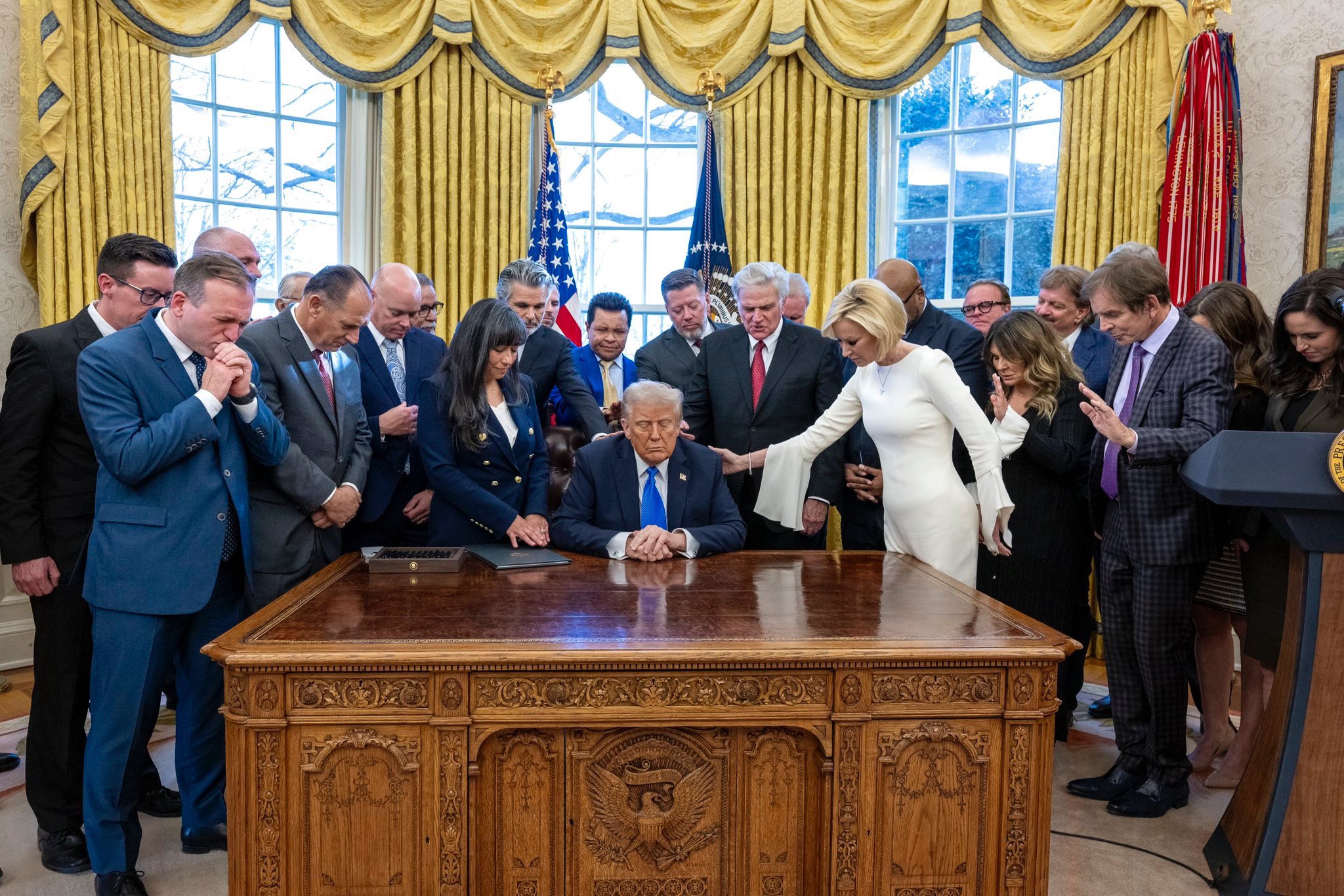
This man, making Christmas calls from the White House, believes the world is a sphere. And he has even flown around it! So has our beautiful FLOTUS, who happens to be his wife!
Truth and common sense must be valued by us, as individuals, in order to lastingly disempower the authoritarian fake news media. This includes the perniciously smarmy science media, which never answers for its errors and lies. I believe that the media has been responsible not only for leftist pathologies like scientism, medical fascism, and radical gender ideology, but also for reactionary movements like modern flat Earth, rejection of all medicine, and Biblical geological literalism.
Just as Wheatie’s Stormwatch Monday Open Thread was created as a place for people to openly express their thoughts and opinions, so, too, is this Thank God Thursday Open Thread, where honest but civil discussion of all topics is encouraged. This thread is also to be known as Theistic Evolution Thursdays, due to the author’s expected “pontification” about his scientific, religious, and political opinions. You are welcome to pontificate back! Free speech matters!
Please label all AI-generated content as being such, unless it is patently obvious (e.g., humorous AI images). It is important that we as individuals not begin to pretend that socially derived artificial intelligence is actually our own, as this form of stealthy social information averaging and feedback would be one more pretense and deception between people, in service of stupid Marxist socialism, and of those who wish to substitute their communally protected lies for actual truth.
The source of alleged truth matters, not for the truth itself, but for validation.
And yes, it’s THURSDAY…again.
And that’s it. We’re done stealing from Wheatie.
OK – maybe her rules need to be posted.
No food fights.
No running with scissors.
If you bring snacks, bring enough for everyone.
Other rules may be derivable from these, and that conjecture is left for discussion.
If there is nothing beyond the “W” below, then this is a placeholder. For health reasons, I can’t always post a timely opinion before each Thursday, but I will try. Otherwise, you have this placeholder post, where YOU provide the content. Enjoy!
W
We’re almost done clearing YouTube tabs!
Here are a couple from a rather friendly Indian physics student who does the scientific equivalent of music reaction videos, when he finally figures something out.
Enjoy!
(1) The Speed of Light – Could it be Even More WTF Than We Thought? Yes!
(2) What the Heck is the Heisenberg Uncertainty Principle?
How about some smart kid math problems? You remember those gangling geeks with their Brillo-pad hair, buck teeth, pop-bottle-bottom glasses, high-water pants, and out-of-date dresses. Let’s look at what they did for fun!
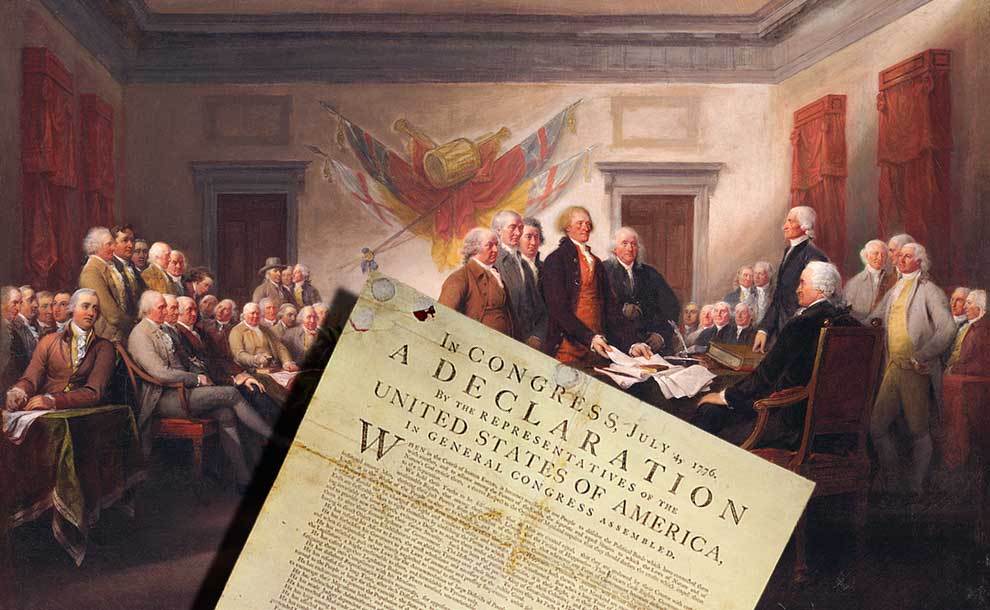
After the miscue and recall of this post a few weeks ago, it is now time to return to the mission. Today we will spend all of our time on one of the key Declaration signers and founding fathers in our nation’s history, John Adams.
John Adams
Much time has already been spent in this series on the person, importance, events, and interactions of the great American Patriot, John Adams. There are loads of historical articles and biographies that readers can source to learn more. I will only hit on a handful of the major points of his biographical information. Instead, I will focus some of the information on his interactions, observations he made, and quotes of interest.
Adams was born in 1735 in Braintree, MA to John, Sr. and Susanna Boylston and two brothers. John, Sr. came from a long line of Adams that immigrated to America in 1638 from England. His father was a deacon in the Congregationalist Church and was a farmer, cordwainer (shoemaker) and officer in the militia. Susanna was from an area family that were leaders in the medical field. John had a good relationship with his family and great respect for his father.
He was first educated in a “dame” school, which were private schools for children aged 2-5. He then went to a local Latin school that focused on the language, logic, rhetoric and math. John ran into truancy problems with a dislike for his teacher partially because he preferred to farm with his father, but his he made him stay in school. At age sixteen he entered Harvard College, graduating at age twenty. During the period he developed a fire for studying the works of ancient writers in their languages. He became a teacher for four years as he personally debated his future profession. His father desired he enter the clergy, however, over time he felt the honor and respect earned in the practice of the law to be his calling. From Wiki there is this interesting quote from that time period, “He decided to become a lawyer, writing his father that he found among lawyers “noble and gallant achievements” but, among the clergy, the “pretended sanctity of some absolute dunces”. He had reservations about his self-described “trumpery” and failure to share the “happiness of [his] fellow men”. He even felt guilty at age nineteen when the French and Indian War began that he was not a soldier in the militia like his family members had been as he found it to be more fitting to him than even being a lawyer.
He began law studies in 1756, earned an A. M. in 1758, and was admitted to the bar a year later. He was quite good at his profession and was a leader for the colonists when the Stamp Act was imposed. His points were simple and applied to all British subjects – taxation only by consent and that all were entitled to a jury of their peers if charged with an offense.
He first met his future wife who was a cousin, Abigail, when she was fifteen years old. It was not love at first sight. However, over time they grew very close and married in 1764 when he was 29 and she was 19 years of age despite her mother’s objections. Adams’ father had died in 1761 and left him a small farm with a home. The couple moved in and lived there until 1783. They had six children together and four survived to adulthood. They had three sons, two became alcoholics, but one was successful and a future POTUS, John Quincy Adams.
The legal career of Adams was hugely successful with many notable cases during the period that included successfully representing John Hancock and the British soldiers in the Boston Massacre. Despite that he was an antagonist against the British Parliament ‘s Acts as well as moves of the Crown at every turn. He found the Boston Tea Party to be the “grandest event” in the history of the colonist independence movement. Yet, he was constantly struggling with living arrangements. He found the rural area of the Braintree farm and home to be filled with vulgar people unacceptable to raising his family, so he moved them to a home in Boston near his law practice; only to move them back to the farm a couple of years later due to the turmoil in Boston.
His activities during the Continental Congresses, votes and signing of the Declaration of Independence are well documented, sourced and legendary. I will not repeat them here as it would take too much time. However, none are more explanatory of his thoughts and devotions than the following letter to his wife, Abigail, dated July 3, 1776.
He knew what it all meant and the risks. He knew our nation was dependent on God’s Providence as written in the Declaration document he and the others signed. He was willing to risk it all for what would come of it.
For more detail of his life, including those of his person versus accomplishments, please read the following link,
It is remarkable to me that many of our founders soon visited the nation that oppressed them after the war. Adams was no exception to this as he returned there for health reasons and because he could not get along with Benjamin Franklin in France the year the Treaty of Paris was signed ending the war. He even attended a meeting in Parliament and heard King George III recognize the independence of America. He brought his wife and family there and became the first minister (ambassador) to Great Britain from 1785-88.
As a result he desired to stay neutral with the war between Great Britain and France. However, he felt it necessary to achieve what we now know as “peace through strength” with a military build up in our homeland as well as strengthening our central government through the new Constitution and increased revenues to support it all. That would become very important with the War of 1812 looming in the not too distant future.
With his coziness with Great Britain, being a perceived antagonist of France, and the passage of the highly unpopular Alien and Sedition Acts that he promoted; it all eventually cost his political career. With his fall, the Federalist Party generally disappeared from existence after the War of 1812. In his later years, Adams reconciled with Anti-Federalist Thomas Jefferson as we discussed in a previous Part, thanks to the efforts of their mutual founding father friend, Benjamin Rush. The scars of politics and governance had healed enough for both to find perspective, put aside differences, and rekindle their friendship.
Quotes
Nothing sheds more light on the life of this patriot than his personal quotes. However, if you expect consistency in thought and word, you probably need to move on to future Parts and other signers. Nobody could flip flop better that John Adams in my opinion. He was always quick with a remark and had an opinion on every subject or person. The problem was that at times his opinion changed depending on the audience, interactions, and season. That being said, many are memorable and relevant to patriotism. Below is a sampling of quotes on various subjects.
Quotes on Government,
“Our Constitution was made only for a moral and religious people”. It is wholly inadequate to the government of any other.”
“The government of the United States is not, in any sense, founded on the Christian religion.”
“When legislature is corrupted, the people are undone.”
On Freedom and Democracy,
“Posterity! You will never know how much it cost the present Generation to preserve your Freedom! I hope you will make good use of it. If you do not, I shall repent in Heaven, that I ever took half the Pains to preserve it.”
“Democracy never lasts long. It soon wastes, exhausts and murders itself. There was never a democracy that did not commit suicide.”
“Liberty cannot be preserved without a general knowledge among the people.”
“Liberty, according to my metaphysics is a self-determining power in an intellectual agent. It implies thought and choice and power.”
On the Constitution,
“But a Constitution of Government once changed from Freedom, can never be restored. Liberty, once lost, is lost forever.”
“Human passions unbridled by morality and religion…would break the strongest cords of our Constitution as a whale goes through a net.”
On Power,
“Power always thinks it has a great soul and vast views beyond the comprehension of the weak; and that it is doing God’s service when it is violating all his laws.”
There is danger from all men. The only maxim of a free government ought to be to trust no man living with power to endanger the public liberty.
On Law and Politics,
“Facts are stubborn things; and whatever may be our wishes, our inclinations, or the dictates of our passion, they cannot alter the state of facts and evidence.”
“It is more important that innocence be protected than it is that guilt be punished, for guilt and crimes are so frequent in this world that they cannot all be punished. But if innocence itself is brought to the bar and condemned, perhaps to die, then the citizen will say, “whether I do good or whether I do evil is immaterial, for innocence itself is no protection,” and if such an idea as that were to take hold in the mind of the citizen that would be the end of security whatsoever.”
“In politics the middle way is none at all.”
On Religion,
(The next two are dandies 😂 – TB2)
”Without religion this world would be something not fit to be mentioned in polite company, I mean Hell.”
“This would be the best of all possible worlds, if there were no religion in it.”
“Now I will avow, that I then believe, and now believe, that those general Principles of Christianity, are as eternal and immutable, as the Existence and Attributes of God; and that those Principles of Liberty, are as unalterable as human Nature and our terrestrial, mundane System.”
I could go on and on as he had quotes for years. Just one more, it is well noted, and is 100% truth.
“There are two ways to conquer and enslave a country. One is by the sword. The other is by debt.”
America will not be enslaved by sword anytime soon. It was being enslaved by debt. Which is a Biblical statement of truth (Proverbs 22:7) that John Adams may have agreed with (or not) depending on situation, audience, day of the week, weather forecast… 🤪
Conclusion
Normally, I would end there. I would stay on topic, which in this case would be about John Adams and something he did or said. This great patriot achieved the highest office in the land and risked everything for liberty. He lived to 91 years of age and had a very close relationship with his wife, family and many contemporaries. As previously stated he had son who became a POTUS as well. However, I am not sure he had the relationship I would have wanted for him to have with Jesus Christ. I believe his life would have played out somewhat differently and he would not have been so polarizing and sharp of tongue. That would have led to reason and less contentiousness that sank his career in public service. I contrast him with another fiery founding father below, who was a contemporary of Adams, and who made the statement below. From the Trumpet Voice of Freedom,
“It cannot be emphasized too strongly or too often that this great nation was founded, not by religionists, but by Christians; not on religions, but on the gospel of Jesus Christ. For this very reason peoples of other faiths have been afforded asylum, prosperity, and freedom of worship here.”
– Patrick Henry –
May it always be so.
Please remember Wolf’s rules for our community. In general that means to be respectful to each other and to pull no shenanigans that your mom might find offensive or otherwise cause jail time. That said, free speech is honored here.
Joe Biden never won. This is our Real President – 45, 46, 47.
AND our beautiful REALFLOTUS.
This Stormwatch Monday Open Thread remains open – VERY OPEN – a place for everybody to post whatever they feel they would like to tell the White Hats, and the rest of the MAGA/KAG/KMAG world (with KMAG being a bit of both).
Our various sister sites, listed in the Blogroll in the sidebar
Our beloved country is under Occupation by hostile forces.
Daily outrage and epic phuckery abound.
We can give in to despair…or we can be defiant and fight back in any way that we can.
Joe Biden didn’t win.
And we will keep saying Joe Biden didn’t win until we get His Fraudulency out of our White House.
Wolfie’s Wheatie’s Word of the Week:
procerity
noun
tallness
loftiness
height of stature
an archaic word meaning height or tallness, derived from Latin procerus, meaning high or tall
Used in a sentence
Procerity Inc. is a company that provides strategic and financial consulting services to senior levels of client organizations. Some of their clients include Royal Bank of Canada, Marsulex Inc., Ontario Provincial Police and private clients.
Shown in a picture
MUSIC!
Always remember Sunday!
THE STUFF
Patience is a thing, if you want to work in the mines of Neutrinoville. Welcome to the job. Take a seat and relax. You’re gonna be here a while.
This video may be three years old, but in Neutrinoville, that’s like yesterday. Speaking of which, what’s up, down at the mine?
This man, making Christmas calls from the White House, believes the world is a sphere. And he has even flown around it! So has our beautiful FLOTUS, who happens to be his wife!
Truth and common sense must be valued by us, as individuals, in order to lastingly disempower the authoritarian fake news media. This includes the perniciously smarmy science media, which never answers for its errors and lies. I believe that the media has been responsible not only for leftist pathologies like scientism, medical fascism, and radical gender ideology, but also for reactionary movements like modern flat Earth, rejection of all medicine, and Biblical geological literalism.
Just as Wheatie’s Stormwatch Monday Open Thread was created as a place for people to openly express their thoughts and opinions, so, too, is this Thank God Thursday Open Thread, where honest but civil discussion of all topics is encouraged. This thread is also to be known as Theistic Evolution Thursdays, due to the author’s expected “pontification” about his scientific, religious, and political opinions. You are welcome to pontificate back! Free speech matters!
Please label all AI-generated content as being such, unless it is patently obvious (e.g., humorous AI images). It is important that we as individuals not begin to pretend that socially derived artificial intelligence is actually our own, as this form of stealthy social information averaging and feedback would be one more pretense and deception between people, in service of stupid Marxist socialism, and of those who wish to substitute their communally protected lies for actual truth.
The source of alleged truth matters, not for the truth itself, but for validation.
And yes, it’s THURSDAY…again.
And that’s it. We’re done stealing from Wheatie.
OK – maybe her rules need to be posted.
No food fights.
No running with scissors.
If you bring snacks, bring enough for everyone.
Other rules may be derivable from these, and that conjecture is left for discussion.
If there is nothing beyond the “W” below, then this is a placeholder. For health reasons, I can’t always post a timely opinion before each Thursday, but I will try. Otherwise, you have this placeholder post, where YOU provide the content. Enjoy!
W
This is an X thread that I told Aubergine about a while back, which I thought would be of interest to her because it borders on her metaphysical beliefs about time, God, and the universe.
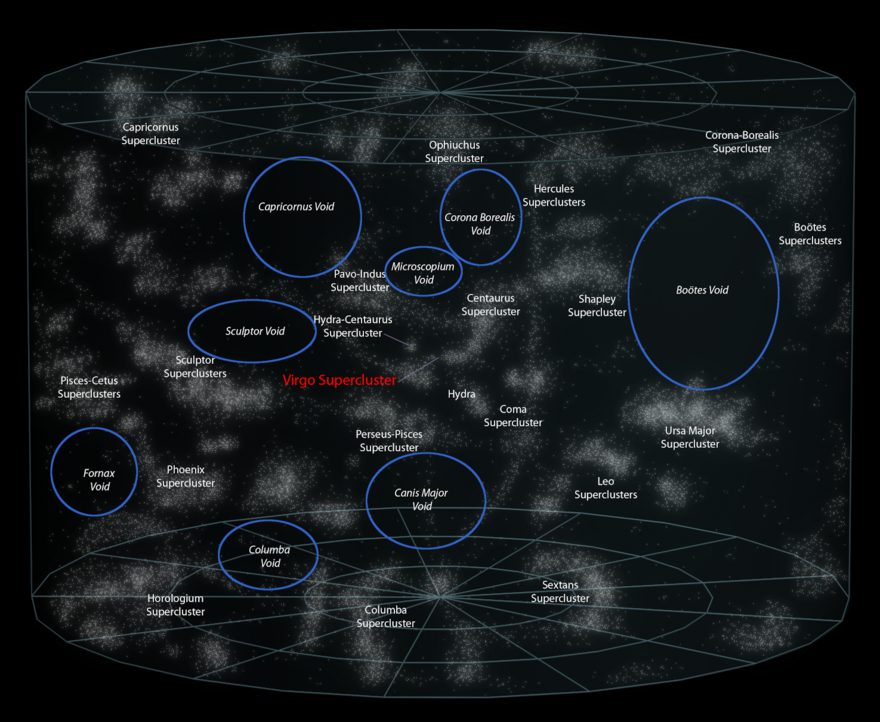
The thread concerns a cosmological hypothesis which demonstrates that not only is time not absolute in our universe – the relativistic nature of time has resulted in UNEVEN AGING within the universe, due to the uneven nature of matter. There appear to be differences of age of billions of years between different parts of the universe, just according to their own clocks.
To be clear, the ages are still billions of years everywhere, but they’re different billions. Time has run faster (more billions) in the voids, and slower (fewer billions) near concentrations of matter, like clusters of galaxies.
Not only does this finer-grained look at time offer more physical and cosmological certainty about the rate of expansion of the universe – it helps us think more precisely about time at a metaphysical level. When we realize that time isn’t even homogeneous within our universe, it helps us to break free from the assumption that any kind of time, corresponding to our own, much less an absolute time similar to our own natural reckoning, necessarily exists beyond or outside of our own universe. When we try to consider a God capable of existing “outside of time”, we should consider the possibility that “time” itself may not even apply.
Try to follow along with this fascinating thread, which has sat in a long-preserved tab which I can now close!
(1)
This could be an incredible revolution in Cosmology.
The Dark Energy model of the universe, which won a Nobel Prize in 2011, may be completely wrong.
The accelerating expansion instead is simply because time runs faster in the voids between galaxies.
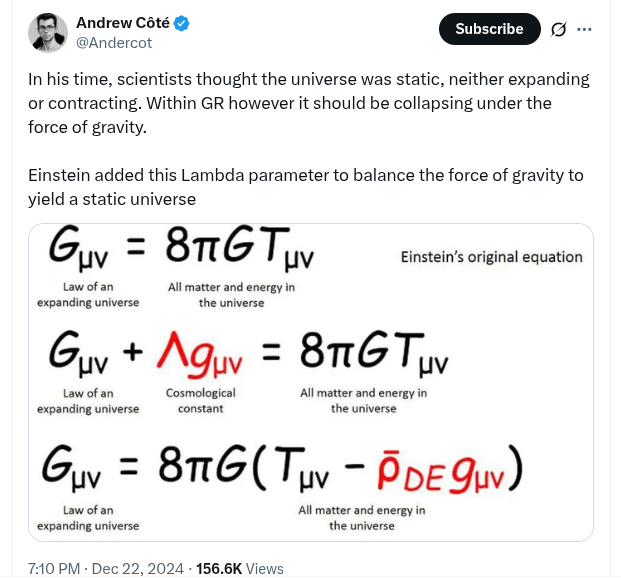
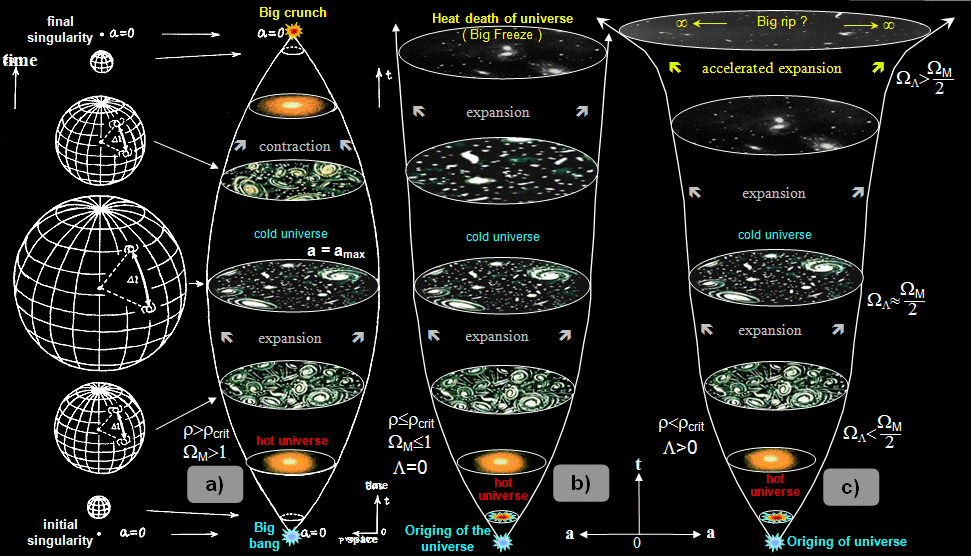
The standard workhorse of cosmology for the last 25 years has been the Lambda Cold Dark Matter (ΛCDM) which assumes the universe is roughly homogenous.
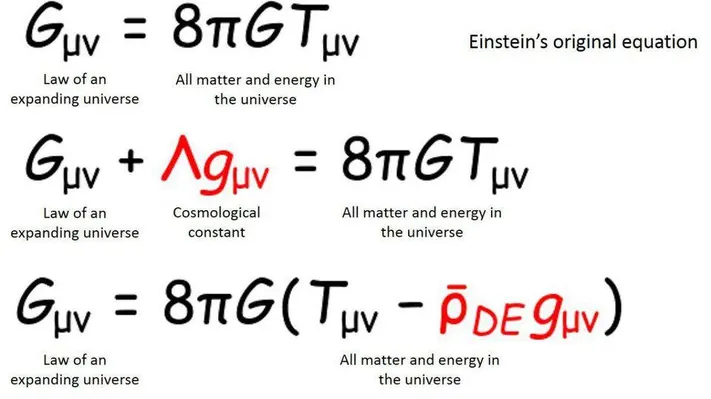
Originally Lambda was Einsteins 'fudge factor' to explain why the universe wasn't collapsing under its own weight pic.twitter.com/vyHS4eUoxh
In 1929 Edwin Hubble made an incredible discovery: the further away a galaxy was, the faster it appeared to be moving away from this.
He was able to determine this by measuring Cepheid variable stars, which have a consistent relationship between their brightness and pulsation… pic.twitter.com/T3kucYJacc
In 1929 Edwin Hubble made an incredible discovery: the further away a galaxy was, the faster it appeared to be moving away from this. He was able to determine this by measuring Cepheid variable stars, which have a consistent relationship between their brightness and pulsation period, and so they can act as excellent distance markers. Using these markers Hubble found that the more distant a galaxy was, the more red-shifted its spectrum of light became, meaning it was moving away from us at a higher velocity. The further the distance to a galaxy, the faster it was receding. Therefore, the universe was expanding.
(5)
The fact the universe was expanding meant Lambda was no longer necessary to balance out gravity, and Einstein called it his 'greatest blunder' pic.twitter.com/haDwARAwDk
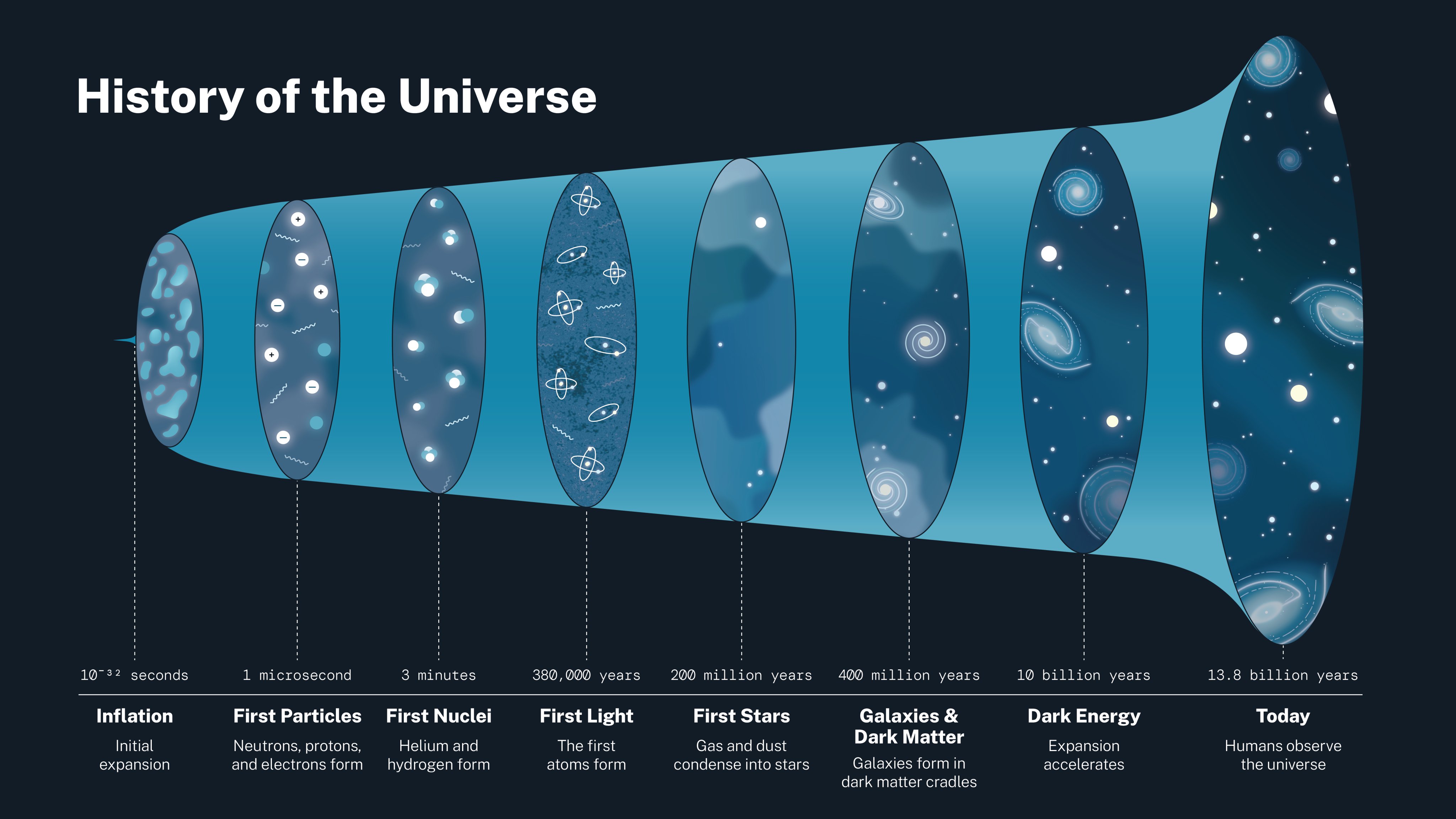
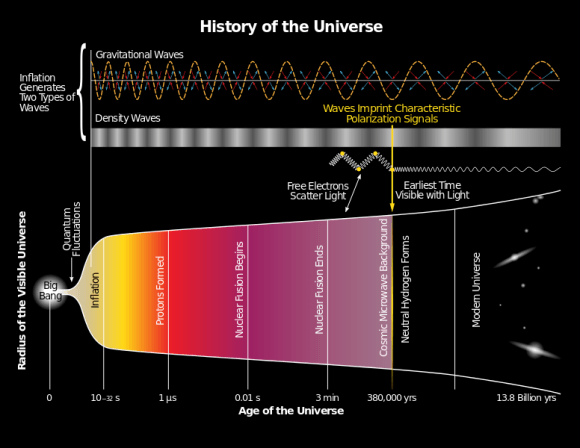
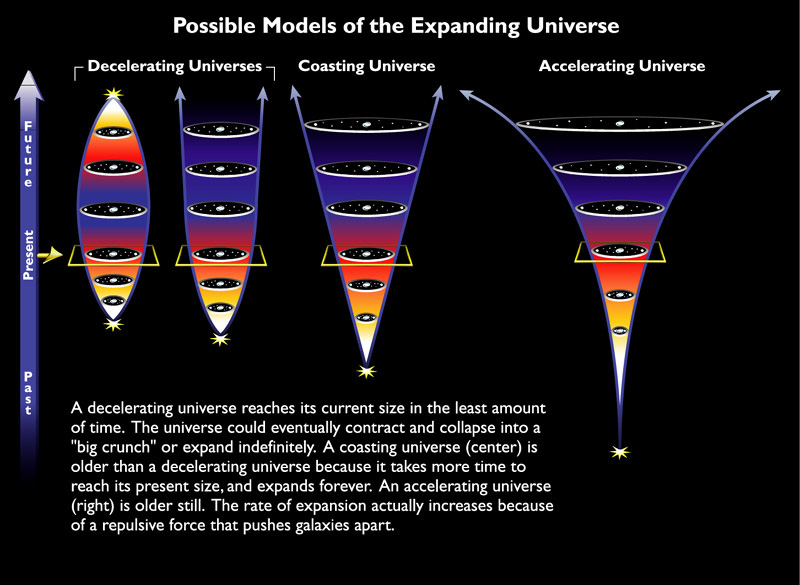
If you run this expanding universe backwards in time, it seems like everything is expanding from a single origin point, and in the 1960s astronomers detected faint radio signals coming from all directions in space.
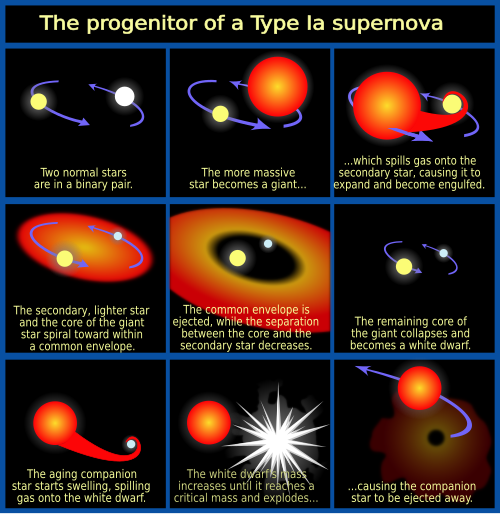
This model of the universe, where things started from a single origin and uniformly expanded outwards, dominated for decades until the 1990s. Astronomers were looking at Type Ia supernova at high redshift to see how the expansion of the universe was slowing down over time Type 1a supernova are useful as ‘standard candles’ because they have constant brightness, since they form by a star stripping mass from its neighboring binary partner until they reach the Chanradesekar limit from below, at which point they expldoe. So, they always explode with the same energy and brightness.
(8)
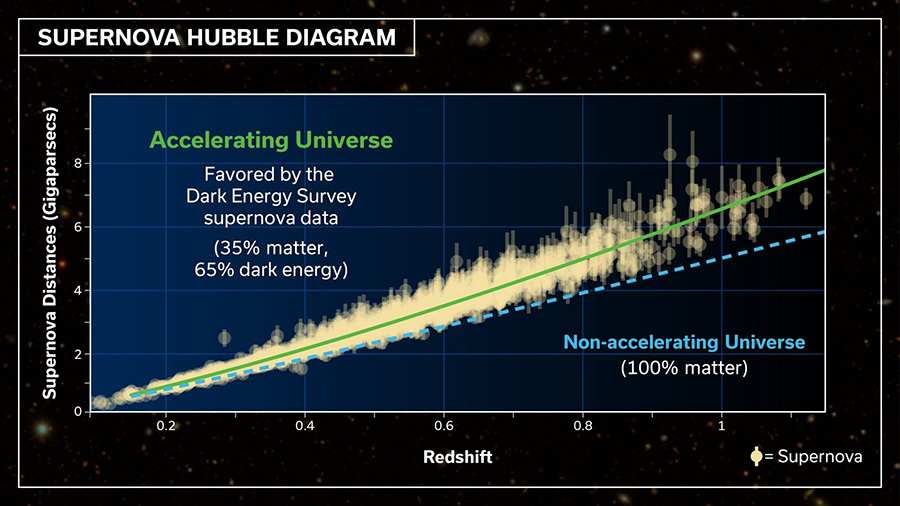
Instead, at high redshift they found that supernova were much dimmer than expected than if the expansion had been slowed down by gravity.
On the contrary, the rate of expansion appeared to be accelerated. Lambda, the cosmological constant, was so back. pic.twitter.com/X4wZI3iVmo
This is the current mainstream cosmological model. Dark Energy, a mysterious unknown entity that makes accounts for 69% of the total energy constant, drives a constant volumetric expansion of space. More space means more expansion, which is why the size is accelerating. pic.twitter.com/1sLWsMTmn0
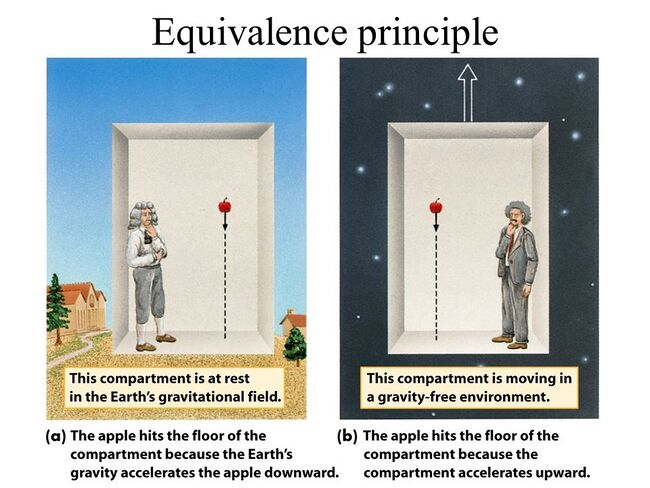
Mass curves spacetime to produce gravity. But, there's no difference between being accelerated by gravity or accelerating from a rocket.
This is called Einsteins Equivalence principle, and applying it to inhomogenous cosmology may eliminate Dark Energy altogether pic.twitter.com/dfmnphnf7n
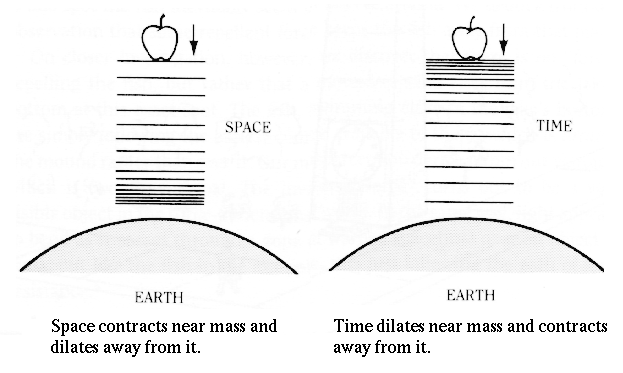
This is because the further down a gravitational well you are, the slower clocks run compared to clocks further up-well.
You can reason this yourself if you consider bouncing a photon between two mirrors at the top and bottom of an accelerating rocket. Exercise for the reader pic.twitter.com/eSry9h7vdu
The important thing is this: In the voids between large galaxies time runs much faster than inside galaxies, and these voids are inhomogenous.
If you had an initial expansion of the universe from the Big Bang, more time has elapsed in the voids – possibly billions of years more pic.twitter.com/WqzWAccwtu
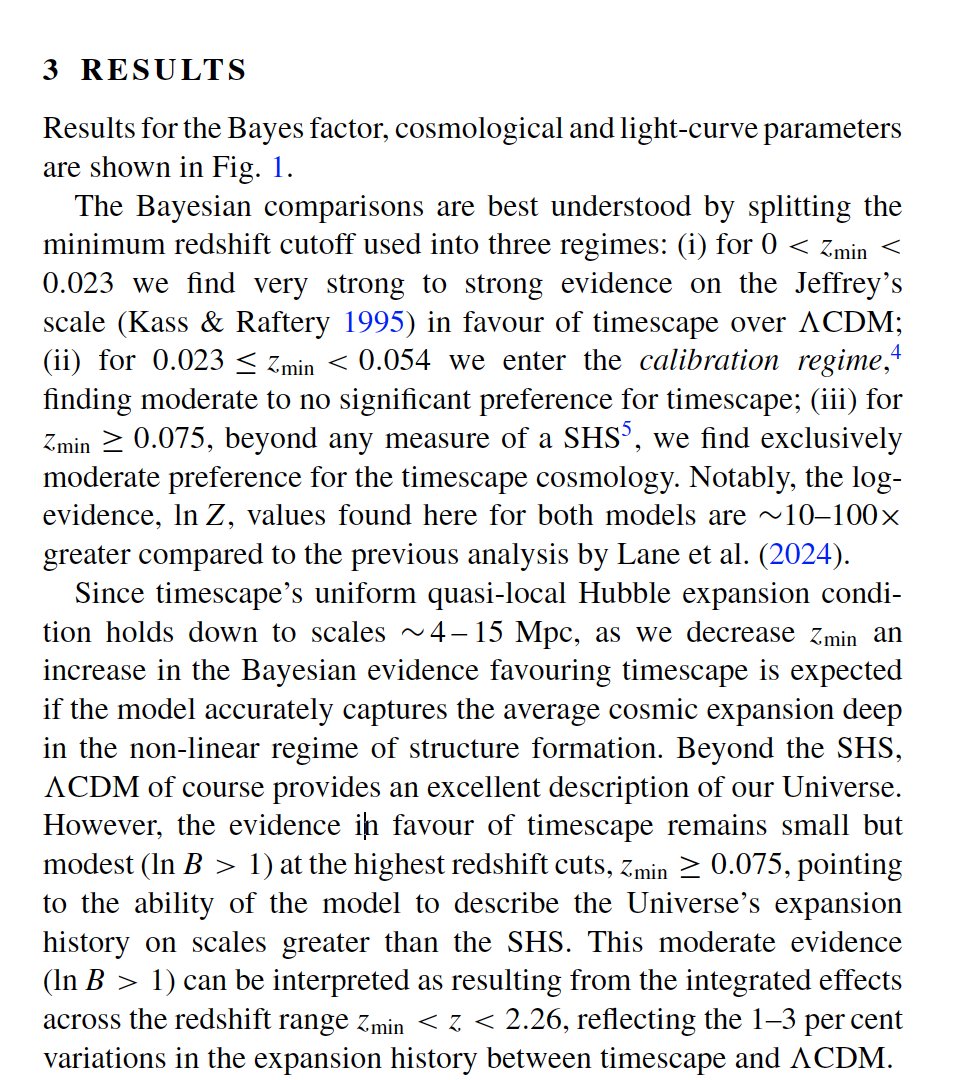
The researchers behind the Timescape model, as its known, used the familiar Type 1a supernova as standard candles and compared a goodness-of-fit Bayesian statistics to assess how timescape versus LCDM model can explain the observed redshift pic.twitter.com/WHoqjkz4x9
Now, you can do a lot of statistical trickery to get a favored result to your own pet theory. Why should Timescape model be taken seriously? Two big reasons:
– The universe is emphatically not homogenous, and so void regions DO have a faster clock-rate than galactic… pic.twitter.com/KIBHAxUqwT
Now, you can do a lot of statistical trickery to get a favored result to your own pet theory. Why should Timescape model be taken seriously? Two big reasons: – The universe is emphatically not homogenous, and so void regions DO have a faster clock-rate than galactic superclusters and filaments and this should be accounted for in any model of expansion. – Dark Energy is supposed to make up ~2/3rds of the universe’s energy content yet doesn’t correspond to anything we’ve ever observed experimentally. It solely exists to explain this anomaly of distant supernova redshift. In the timescape model, the universe very well may be slowing down in expansion after some initial Big Bang event – its yet to be determined. The future fate of the cosmos seems still to be determined as advances in cosmology regularly demand we revisit our models.
So there you have it. Does it make sense?
W
PS – something extra.
Aubergine posted this tweet…..
NEW: The man with the world's highest recorded IQ says he believes Jesus Christ is God and is "the way and the truth and the life."
"I believe that Jesus Christ is God, the way and the truth and the life."
NEW: The man with the world’s highest recorded IQ says he believes Jesus Christ is God and is “the way and the truth and the life.” “I believe that Jesus Christ is God, the way and the truth and the life.” YoungHoon Kim of South Korea is pointing to quantum physics to support his belief in God and afterlife. Kim was recognized by the Giga Society in April 2024 as having the highest IQ in the world at 276.
One of the replies included this image, alleging that it was from Werner Heisenberg.
Having been made too dubious by so many liars, I tracked that down to a source, which includes even more interesting material.
This man, making Christmas calls from the White House, believes the world is a sphere. And he has even flown around it! So has our beautiful FLOTUS, who happens to be his wife!
Truth and common sense must be valued by us, as individuals, in order to lastingly disempower the authoritarian fake news media. This includes the perniciously smarmy science media, which never answers for its errors and lies. I believe that the media has been responsible not only for leftist pathologies like scientism, medical fascism, and radical gender ideology, but also for reactionary movements like modern flat Earth, rejection of all medicine, and Biblical geological literalism.
Just as Wheatie’s Stormwatch Monday Open Thread was created as a place for people to openly express their thoughts and opinions, so, too, is this Thank God Thursday Open Thread, where honest but civil discussion of all topics is encouraged. This thread is also to be known as Theistic Evolution Thursdays, due to the author’s expected “pontification” about his scientific, religious, and political opinions. You are welcome to pontificate back! Free speech matters!
Please label all AI-generated content as being such, unless it is patently obvious (e.g., humorous AI images). It is important that we as individuals not begin to pretend that socially derived artificial intelligence is actually our own, as this form of stealthy social information averaging and feedback would be one more pretense and deception between people, in service of stupid Marxist socialism, and of those who wish to substitute their communally protected lies for actual truth.
The source of alleged truth matters, not for the truth itself, but for validation.
And yes, it’s THURSDAY…again.
And that’s it. We’re done stealing from Wheatie.
OK – maybe her rules need to be posted.
No food fights.
No running with scissors.
If you bring snacks, bring enough for everyone.
Other rules may be derivable from these, and that conjecture is left for discussion.
If there is nothing beyond the “W” below, then this is a placeholder. For health reasons, I can’t always post a timely opinion before each Thursday, but I will try. Otherwise, you have this placeholder post, where YOU provide the content. Enjoy!
W
Time for more dumping of tabs!
(1) The Hafnium Bomb and/or the Nuclear Battery
A nice explanation of nuclear isomerism and why some people like DERPA are interested in it.
(2) Chess Game Reported Like College Football
You may have never seen anything like this. That’s OK – stick with it – it’s fun! The “sports reporter” is a hoot! I had no idea these people existed.
(3) Gravity, Inertia, and the Gravitational Constant
TL;DR – The gravitational constant pops out of the theory and I love it, but I still have to be skeptical that it might be an artifact.
Did we actually miss the solution to “what is gravity?” and “what is inertia?” when they were solved in the 1950s? Just listen to the guy – the equations are too small to read, but the explanations start to gel. At the very least, the opening / final cartoon is readily understood when you get to the end!
(4) Enjoy Some Relaxing Math & Fiddle Music
This is supposedly an exam question for Haaaaaahvaaaaaahd. Or you can just listen to the calming folk violin.
(5) Two Solutions to the Three-Body Problem
First, the no-solution solution, presented by that annoyingly perky British chick who is not Veritasium or the German one.
Now, Valerie Curren’s solution using string theory.
Joe Biden never won. This is our Real President – 45, 46, 47.
AND our beautiful REALFLOTUS.
This Stormwatch Monday Open Thread remains open – VERY OPEN – a place for everybody to post whatever they feel they would like to tell the White Hats, and the rest of the MAGA/KAG/KMAG world (with KMAG being a bit of both).
This man, making Christmas calls from the White House, believes the world is a sphere. And he has even flown around it! So has our beautiful FLOTUS, who happens to be his wife!
Truth and common sense must be valued by us, as individuals, in order to lastingly disempower the authoritarian fake news media. This includes the perniciously smarmy science media, which never answers for its errors and lies. I believe that the media has been responsible not only for leftist pathologies like scientism, medical fascism, and radical gender ideology, but also for reactionary movements like modern flat Earth, rejection of all medicine, and Biblical geological literalism.
Just as Wheatie’s Stormwatch Monday Open Thread was created as a place for people to openly express their thoughts and opinions, so, too, is this Thank God Thursday Open Thread, where honest but civil discussion of all topics is encouraged. This thread is also to be known as Theistic Evolution Thursdays, due to the author’s expected “pontification” about his scientific, religious, and political opinions. You are welcome to pontificate back! Free speech matters!
Please label all AI-generated content as being such, unless it is patently obvious (e.g., humorous AI images). It is important that we as individuals not begin to pretend that socially derived artificial intelligence is actually our own, as this form of stealthy social information averaging and feedback would be one more pretense and deception between people, in service of stupid Marxist socialism, and of those who wish to substitute their communally protected lies for actual truth.
The source of alleged truth matters, not for the truth itself, but for validation.
And yes, it’s THURSDAY…again.
And that’s it. We’re done stealing from Wheatie.
OK – maybe her rules need to be posted.
No food fights.
No running with scissors.
If you bring snacks, bring enough for everyone.
Other rules may be derivable from these, and that conjecture is left for discussion.
If there is nothing beyond the “W” below, then this is a placeholder. For health reasons, I can’t always post a timely opinion before each Thursday, but I will try. Otherwise, you have this placeholder post, where YOU provide the content. Enjoy!
W
Like highly welcomed but ultimately skimpy food on a woke airline, we are giving you three choices in random videos that were suggested by YouTube. Each video is interesting at first, but we’re not sure you’ll make it to the end of any of them.
Take your pick! And come back for seconds or thirds if you dare.
Too-Mild Chicken Wings – a somewhat tasty but incompletely breaded explanation of how an airplane wing REALLY works (Steve’s further explanations and corrections are welcome)
Crispy Crunchy Pork Rinds – a young anthropologist offers 5 MOAR reasons why there are massive problems with young-Earth creationism
Overpriced Mass-Produced Seafood – a fascinating documentary on the gnarly but tasty King Crab’s Atlantic invasion. NOT KOSHER!
Before we return to the remaining signers of our Declaration of Independence we need to move the ball down the field more on the present subject that originated with Scott’s and Wolf’s posts of May 3.
Put simply, why has the statutory nature of the Constitution and law been abused so radically by those who give their oaths to defend it? The creation of shadow governments and legal systems that sustain them appears to be the vehicles used to do the dirty deeds. The instigators apparently want undeserved, unearned, and unauthorized power over the assets and people of our nation.
The use of rules, procedures and practices that they develop, sell to the public at large as necessary for the safety and/or prosperity of citizens, and then implement with colluding enforcement arms is what keeps them in power and control. With the current version of swamp critters, they added illegal invaders and provided access to the rights of citizens to insure their continued dominance of our nation. This corrupted the election system even worse to go with everything else in society, which was the primary purpose of COVID and the jabs in addition to depopulation efforts. The propagandists lied their ways into the heads of sheeple to move the needle toward accepting the unacceptable that has been tanking our society.
We can continue to discuss how it all is rectified, however, it will not change a basic, historical truth. What has happened in the past 250 years in America is not new to the world stage. It has happened in other civilizations who turned their faces from God and/or righteous living since the beginning of time. Some of those civilizations never recovered and disappeared from the planet. Others were reduced to a remnant. Some of those remnants never regained their prominence, while others went on to become even more prominent and dominate segments of the world. For this latter group, the common factor contributing to success seems to be a return to more equitable treatment of their populations. It usually took the common people coming together to force the replacement of their former leaders or when God otherwise directly intervened through events of nature. Remember, even the insurance industry calls them “acts of God” in their contract provisions.
Just like Biblical accounts of the ancient nation of Israel, this concept of the righteous remnant surviving and rebuilding is also built into the fabric of America. It is expected of us to do so and has been stated within our founding documents. How else can you explain our recovery and development into a great, superpower nation after the horrible Civil War that erupted some 70 years after the ratification of the Constitution, which was followed by WW I, the Great Depression and WW II? How else could it possibly be explained when the America First MAGA movement led by a bullet dodging brilliant patriot changes the world for the betterment of all mankind?
Judicial Discretion
Nothing makes my point better about judicial rules, procedures and practices than the following recent post from Covid & Covid with Jeff Childers. It truly is an interesting read anytime, but especially so with the current subject matter and ongoing events within our government. The article to read is the first on Blind Justice.
Did you spot all of the judicial discretion that was employed? Jeff Childers is an experienced, accomplished attorney who has taken on an unenviable task of challenging the PREP Act successfully. The weight of the federal government as well as Big Pharm is aligned against all challenges. Even with that situation, the judge chose not to shut this one down. In fact, he handed Jeff the ticket to use to attend the show. To say Jeff was pleasantly surprised is an understatement.
What is most interesting to me is the approach Judge Young used in questioning counsel of both sides from the outset is one that could be used by all judges, but rarely is. Why? Unless you are into performance art and deception as a judge; it would seem that if you truly desire to make an honest, legally correct ruling you would use all avenues of inquiry to reach a solid decision. Which tells me that in all of the previously unsuccessful challenges, there probably was no judge who was serious in their consideration of the merits of the PREP challenges. They went along with what the government wanted to not rock the boat. Anybody who has ever sat in pre-trial conferences knows exactly to what I am referring. The rules of the game (trial) are set by the judge after input from the opposing attorneys representing sides in the case.
Now, I could be a conspiracist and tell you that frequently those rules have already been worked out (as well as the decision) in advance over a meal or drinks at a bar together beforehand, but that would just be speculation, right? That never actually happens, does it? Justice is always blind like it was in all of those Perry Mason TV shows, right? The attorneys from both sides give their best efforts and whoever wins, wins. The decision always represents what the law states.
😂
Granted that latter statement does happen in some higher profile cases that attract widespread attention from the general public and media. Sometimes rules, procedures and practices are insufficient to blunt the will of the We the People and law. But what about those cases of We the People that are ongoing in lesser courts all across America every day that are similar to what Geddes described? For that matter, what about J6 cases that were high profile? Whatever little credibility the feds and DC legal system had prior to that event has been totally washed away by their violations of the law through obvious corruption and oppression.
The aftermath of J6 is the very definition of politicization of the judiciary and legal system followed by weaponization. Add in the usual skullduggery with rules, procedures and practices with the courts that Jeff Childers discusses and you can see how hard it is to break through when the shadow government and judiciary are aligned against We the People.
We need to keep a watch on this one from Jeff. Removing Big Pharm’s liability protections is a game changer.
Good Stuff Happens At The Right Time In America
The recently released interview below discloses more than the average person knows about how things really work in and around the current federal government. If you have not done so, watch it and think about the insiders in DC and our federal government going back centuries. Then consider the magnitude of POTUS Trump’s undertaking. Skip it ahead to the actual interview a few minutes in if you want to conserve time.
In particular there is very interesting commentary starting around the 51 minute mark. Some of the pertinent discussion topics will ring bells relating to the Information War. They discuss many current topics we hit hard on here such as…
Wiki is a weapon and the IC is involved. Weaponization of the government against the citizens has been underway. It is not about the information you have they let you see, it’s about what you have to find (Ed Martin’s paraphrased words that means they intentionally withhold or hide it). Certifications of elections systems – fraud and money rule. Election in Poland soon – Obama is there. Why? The fed system used to be politicized and now it is weaponized. It started big with Obama and accelerated with Biden. Jack Smith under the microscope. All the big cases recently including cases related to Trump, IRS against citizens, school boards, IC, Crossfire Hurricane – all Bondi ordered investigations. Elections – aspects of things did not make sense in their construct.
Ed Martin stated, “I don’t think there is a way for the people to petition…”as it applies to forcing release of information regarding any of the on-going “investigations” or even past classified events that have been declassed like the JFK assassination from 62 years ago. No way to petition for judicial relief even when POTUS Trump declassified all of the documents? No standing as American citizens whose lives have been hugely negatively impacted by the events? Is that like having no standing to file a lawsuit against proven election fraud? Really?
🤫 😡
Which leads to where are the releases of the rest of the Kennedy, MLK, and Epstein docs? How about the J6 tapes and some honesty on 911? For goodness sakes, how about a real accounting of what happened in Butler less than a year ago that was witnessed on live TV? Nope, even PDT’s handpicked top cops from FIB will not go there.
Besides the usual criminal corruption, these events and people are all hidden behind rules, procedures and practices. Ed Martin would not even go there in response to many of Tucker’s questions. He knows the issues, yet skirted around answers with his responses. Why? An answer of “dunno” does not work for us. We know better. An answer of it being classified does not work for us either. We saw many of the events in real time as they occurred. Years have gone by and nothing is disclosed officially. We know what that means.
Just the content in this one interview reveals a depth of criminality and corruption that is mind blowing. It is also clear that Ed Martin believes people were more honorable in their personal conduct 100 years ago as he stated. If true, it indicates the primary problem today is the breakdown of morality, ethics and personal integrity within our society as it has become more politicized and now, weaponized. Personally, I don’t think his belief is true. I believe people have been equally corrupt and criminal in their activities throughout human history. The farther back you go the more the official history is cleaned by the corrupt. My brief FIRE! series highlighted some of that going back into the 1800’s.
We do not have to look far to see even more current abuse through rules, procedures and practices; this time in civil rights. Tucker’s interview of Harmeet Dhillon is a major eye opener of their use in destroying the quality of life in many cities, racism in colleges, religious persecution, elections steals and so on.
I confess the leftist pity parties as they exited that department would have been great fun to observe.
But it does not stop there, stories come out multiple times per week to substantiate what is now obvious. If you have not followed, read this short article.
If you have never been employed in the legal industry or interacting branches of government you probably never knew that the ABA was used by our elected federal officials for ratings of judicial nominees. It has been used for decades despite the org being a private, non-government controlled organization of over 400,000 legal worker members. So, the federal government authorized and utilized rules, procedures and practices associated with this proven partisan org that led to the confirmation support from azzhat elected officials/staffs for the corrupt, wacko federal judges we have seen circumventing the will of We the People this entire time. How convenient.
Oh yeah, did you notice that the ABA was formed in the late 1800’s? Folks – the ABA and many other divisive, anti-patriot orgs are nothing more than NGO’s that have been funded and weaponized by subversive globalists and wannabe dictators from times long ago. Many trace their lineages back post Civil War, some before. As an example you will find names of major industrialists with deep pockets such as Rockefeller who seeded them into American society. The AMA is another one as Gail has posted. This is the same org that walked lock step with Fauxi’s NIH and the CDC. Next, think about all of the NGO’s that trace back their funding back to subversive globalists that brought us the alien invasion.
Don’t get me started (yet) on the World Council of Churches or even the National Council of Churches. That will be a segment I address down the road as well, God willing.
😡
If you have not I highly advise deeper dives into Gail’s research. I also advise you to focus on the results of the globalist cabal’s seed planting as WW I and WW II ended. What orgs and acts were undertaken during and immediately following? Where did the funding of same come from as well as what elected officials and globalists were in their corner? We are in the middle of the exposure and destruction of some that occurred at the end of WW II over 75 years ago; whose seeds were actually planted leading up to WW I.
All of the corruption, manipulation and circumvention links together, just find the connecting dots. There are not multiple movies. There are many scenes that tie together in a blockbuster movie that has gone on in America since the Declaration of Independence was signed.
The situation is and remains as described below in the immortal words of 81 year old Benjamin Franklin:
“A republic, if you can keep it.”
We will return to this in future parts detailing the signers of our founding documents.
Steve/Wolf’s Solution Confirmed
The evidence has been presented. The verdict will be decided by a jury of We the People and not some idgit leftist judge placed in a position of fake authority by corrupted politicians and swamp. We the People who are America First still desire the republic that our founding fathers provided.
We are not going to solve the lack of ethics and deterioration of morals of our nation and world on here, much less within our intentionally polarized American society. However, the practical answer to it all has actually been by initiated by PDT subject to being fully supported by We the People and not stalled by the globalists and swamp. That gives hope. Reducing and defanging government means there are less azzhats in positions of authority to screw things up and mess with We the People. That has to be the current and most focused approach to solving the weaponization that was actually seeded through politicization first beginning with the strong central government backers’ efforts to create and pass the Constitution while building on the British legal system that the colonies employed here in America.
We will never know, but would we have been better off with the previous Articles of Confederation and any amendments as needed for enumerated powers, handling Treasury needs and military preparedness?
As discussed in previous Parts, we see how it happened in ancient Israel through the time of Christ just as it has in other civilizations in world history. Keeping things simple is just not normal behavior for many humans. The problem the power hungry as well as We the People have in America is that our nation has been dedicated to God and His providence from its founding. As a people we can stray from that and attempt to take things over on our own. However, until the Lord returns it will always be met by His discipline until a God fearing patriot remnant persevere through the fires and rebuild in accordance with His will. Again.
The better, most fulfilling American Way is to do things His way from the onset. Which means the manipulation, corruption and deception built into the rules, procedures and practices need to be practically and firmly eliminated.
I repeat for emphasis this statement from a great American we all dearly love on here,
So we wreck them by seriously cutting government and giving them fewer places to exist. Among all of the other benefits, the body politic would have fewer sociopaths and parasites in it.
– Steve–
Edited 1:23 PM, 6-3-25
Please remember Wolf’s rules for our community. In general that means to be respectful to each other and to pull no shenanigans that your mom might find offensive or otherwise cause jail time. That said, free speech is honored here.
Joe Biden never won. This is our Real President – 45, 46, 47.
AND our beautiful REALFLOTUS.
This Stormwatch Monday Open Thread remains open – VERY OPEN – a place for everybody to post whatever they feel they would like to tell the White Hats, and the rest of the MAGA/KAG/KMAG world (with KMAG being a bit of both).
This man, making Christmas calls from the White House, believes the world is a sphere. And he has even flown around it! So has our beautiful FLOTUS, who happens to be his wife!
Truth and common sense must be valued by us, as individuals, in order to lastingly disempower the authoritarian fake news media. This includes the perniciously smarmy science media, which never answers for its errors and lies. I believe that the media has been responsible not only for leftist pathologies like scientism, medical fascism, and radical gender ideology, but also for reactionary movements like modern flat Earth, rejection of all medicine, and Biblical geological literalism.
Just as Wheatie’s Stormwatch Monday Open Thread was created as a place for people to openly express their thoughts and opinions, so, too, is this Thank God Thursday Open Thread, where honest but civil discussion of all topics is encouraged. This thread is also to be known as Theistic Evolution Thursdays, due to the author’s expected “pontification” about his scientific, religious, and political opinions. You are welcome to pontificate back! Free speech matters!
Please label all AI-generated content as being such, unless it is patently obvious (e.g., humorous AI images). It is important that we as individuals not begin to pretend that socially derived artificial intelligence is actually our own, as this form of stealthy social information averaging and feedback would be one more pretense and deception between people, in service of stupid Marxist socialism, and of those who wish to substitute their communally protected lies for actual truth.
The source of alleged truth matters, not for the truth itself, but for validation.
And yes, it’s THURSDAY…again.
And that’s it. We’re done stealing from Wheatie.
OK – maybe her rules need to be posted.
No food fights.
No running with scissors.
If you bring snacks, bring enough for everyone.
Other rules may be derivable from these, and that conjecture is left for discussion.
If there is nothing beyond the “W” below, then this is a placeholder. For health reasons, I can’t always post a timely opinion before each Thursday, but I will try. Otherwise, you have this placeholder post, where YOU provide the content. Enjoy!
W
A Tab-Clearing Selection of Videos
OK, people, listen up.
I have collected WAY too many videos in my tabs, with the intent of using one every week in the Monday open thread. The trouble is, I collect them much faster than I am using them.
Well, I’m going to FLUSH some of them. Right now. And every week. Until I have a more manageable number.
Find what you like – play what you like – ignore the rest.
Thank you for your consideration of this matter.
W
(1) The Nancy Mace Allegations
Nancy Mace makes explosive allegations on the floor of the House. Go to 19:00 minutes where it begins (it should be queued up).
(2) Einstein, Emmy Noether, and General Relativity
Is Veritasium a heavy metal? If so, I maintain that it is still good for you! This is fascinating history about Einstein, even if you ignore the science. It’s basically about a woman mathematician who came up with some math and science that saved Albert’s butt!
(3) Barbara Corcoran On Donald Trump
I’m not saying she’s right about WHY Trump is the GOAT, but she is right THAT Trump is the GOAT, and her little story here is fascinating. You’ve seen this before – still – worth another watching!
(4) The World’s Dumbest Calculator For Pi
This is actually kinda cool, but in the end, you will feel the dumbness, and it burns! “Moar Maker Madness!”
(5) Pyromaniacs, Clickety-Clacks, and the Thermite Welding of Railroad Tracks
Veritasium with all the fireworks and none of the equations. OK, maybe just a few equations. But still, it’s all worth it. Enjoy!
Stay tuned for the next five tabs to escape though this page!