Our mission, as God-fearing and God-loving patriots, is to defend this Constitutional Republic and to increase its greatness, in all good things and ways, by using our voices in free but courteous speech, by discussing the happenings of the world and coming to a profound understanding of those things, and by sharing and promulgating these Truths on both this platform and others.
TL;DR – I asked Grok a short question designed to elicit all the information I would need to quickly determine the “lay of the land” concerning the new Moderna mRNA flu shot.
I will give you the question, the answer, my analysis of the response, and my summarizing opinion. Part of that opinion is this.
I don’t take the flu shot any more, and I don’t take mRNA shots at all. The current facts surrounding the new mRNA flu shot have – in my opinion – strongly confirmed the correctness of these positions. I will not be taking this shot, and I will counsel all my friends and loved ones not to take it.
And, as part of loving my enemies, including those adorable radical pro-vaxx people, bless their hearts, I will counsel them to stick with older flu shots, if they feel they must take something. The risks of older flu shots are smaller, with roughly no net benefit, but at least they are not accepting a far WORSE AND RISKIER vaccination platform, compared to older flu shots, for what is, IMO – only marginal improvement in some indicators, and zero correction of fundamental problems which became known during the COVID shots.
The Question
Your mileage will vary on how to interpret this response by Grok. I think you and I are likely on the same page, but taking this information to most of our friends and neighbors who trust vaccines in general, won’t be easy. Because it’s a flu shot and not a COVID shot, many will assume automatically that it’s safe.
Again – I needed a fast summary of the new Moderna mRNA flu shot, as I am trying to figure out quickly where things are going. I wanted to know the technology first. “First seek to understand – then seek to be understood.”
Thus, I asked for scientific depth, but otherwise brevity. This is a good description of a scientific abstract.
Here was my question to Grok (version 4.5, described as “Fast” on X).
Please give me a brief but scientifically deep explanation of the technology used in Moderna’s recently approved mRNA flu shot. I’m curious about two things in particular – which influenza protein is encoded, and which form of mRNA tech is being used (i.e., is it self-amplifying or more conventional). I’m also wondering if any changes in the basic mRNA technology have been made to address inherent problems of the mRNA platform, including the fact that (statistically) some recipients suffer undesirable long-term production of target protein, as well as travel of lipid nanoparticles away from the injection site.
The Answer
Grok’s response is, IMO, roughly neutral, although in a couple of places I see a fairly mild but rather typical “mainstream bias”. I’ll get to that later, as I analyze the response.
The first paragraph of the reply is bolded by Grok as a summary.
I have included paragraph-end citation links as the full links, instead of shortened active hyperlinks that Grok uses at the end of paragraphs. In one case, that turns into an embedded tweet.
Grok’s response:
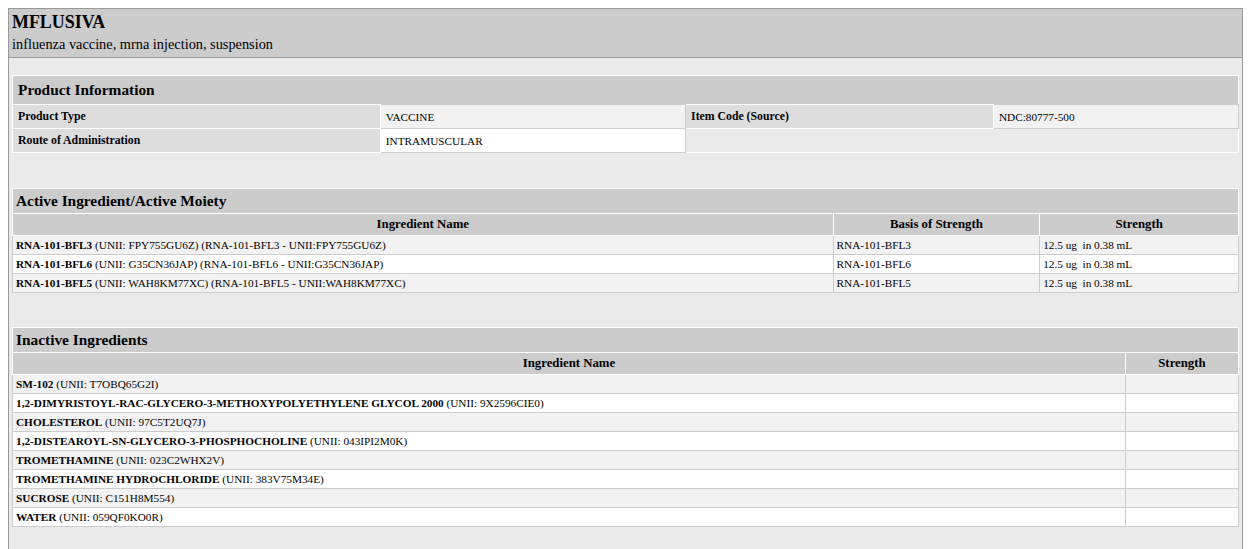
Conventional (non-replicating, nucleoside-modified) mRNA encoding influenza hemagglutinin (HA) surface glycoproteins from the relevant WHO-recommended strains (trivalent in the approved formulation: A/H1N1, A/H3N2, and B/Victoria), delivered in the same type of lipid nanoparticles (LNPs) used for Moderna’s COVID-19 vaccines (SM-102 ionizable lipid platform).
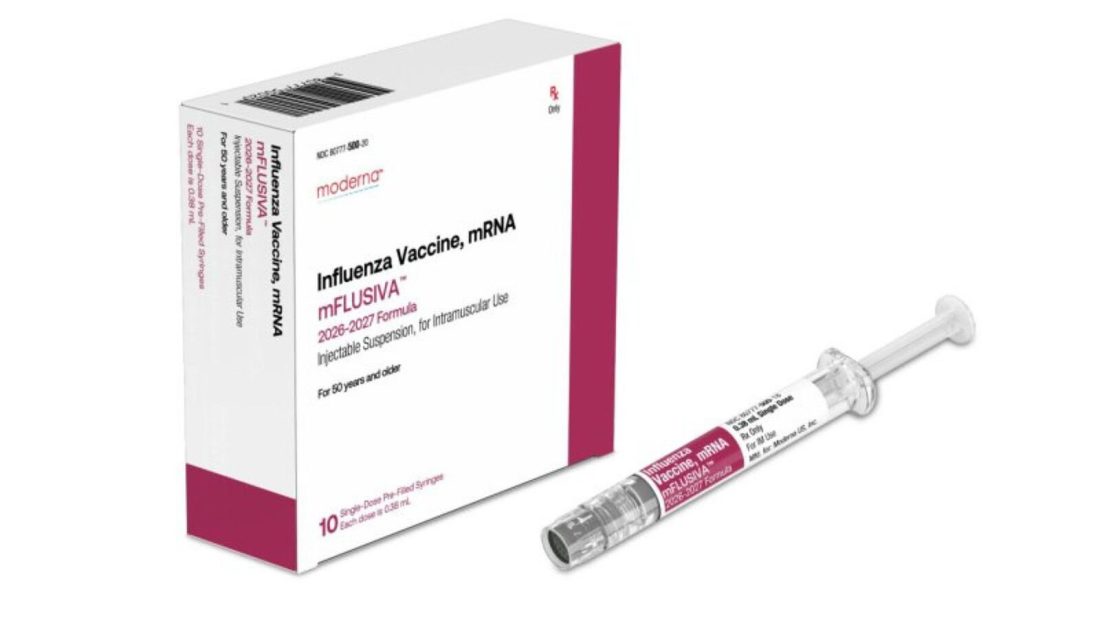
Moderna’s recently FDA-approved seasonal flu vaccine (mRNA-1010, branded mFlusiva/mFLUSIVA) for adults ≥50 years uses the company’s established non-replicating mRNA platform. It is not self-amplifying RNA (saRNA/sa-mRNA). saRNA constructs include alphavirus-derived replicase genes that enable intracellular RNA amplification and prolonged antigen expression at lower doses; mRNA-1010 does not. It relies on the same core technology as Spikevax: in vitro-transcribed, nucleoside-modified mRNA (typically incorporating N1-methylpseudouridine to reduce innate sensing and improve translation) with 5′ cap, optimized UTRs, and poly(A) tail, formulated in LNPs.
The encoded antigen is the full-length (membrane-anchored) hemagglutinin glycoprotein of the selected seasonal strains. HA is the primary surface protein mediating viral attachment and entry; neutralizing antibodies targeting its head domain (and to a lesser extent the stalk) are the main correlate of protection measured by hemagglutination-inhibition (HAI) assays. The approved product is trivalent (reflecting the current seasonal composition after B/Yamagata’s decline), with total mRNA dose around 37.5 μg (roughly 12.5 μg per strain). Earlier development versions were quadrivalent. The platform allows rapid sequence updates to match circulating strains without egg adaptation.
No fundamental redesign of the mRNA or LNP platform specifically for this flu vaccine has been publicly detailed to address the concerns you raise. Protein expression from conventional modified mRNA is inherently transient: the mRNA is degraded by cellular nucleases over days (typically peaking within hours to a day or two and declining substantially within a week or so in standard preclinical models), so continuous long-term production of the target protein is not a designed or statistically expected feature in recipients. Observed antigen persistence in draining lymph nodes (sometimes detectable for weeks in some studies of COVID mRNA vaccines) supports germinal-center reactions rather than ongoing systemic protein synthesis from residual mRNA. Claims of undesirable long-term production are not supported as a common or inherent platform failure in the clinical data for these vaccines.
LNP biodistribution after intramuscular injection is predominantly local (injection-site muscle and draining lymph nodes), with smaller fractions reaching the spleen and, to a lesser extent, liver; distant tissue accumulation is minimal and components clear relatively rapidly (often low/undetectable by ~1–2 weeks in available data). The SM-102-based LNPs (ionizable lipid + cholesterol + helper phospholipid + PEG-lipid) used here are the same biodegradable class employed in Spikevax; they were selected in part for improved tolerability and clearance relative to earlier ionizable lipids. No public evidence indicates major new chemistry (e.g., substantially altered ionizable lipids, targeting ligands, or miRNA-regulated expression) unique to mFlusiva to further restrict off-target travel. Dose is lower than original COVID primary series doses, which reduces overall exposure.
The LNPs in Moderna’s mRNA flu vaccine (mRNA-1010/mFLUSIVA) use the same proprietary SM-102-based platform as Spikevax. Composition, size, and biodistribution are essentially identical: most stay at the injection site, a fraction reaches lymph nodes and spleen, with rapid…
In short, this is an evolutionary application of the proven non-replicating modified-mRNA + LNP system to HA antigens, leveraging manufacturing speed and the ability to induce strong humoral (and some cellular) responses without egg-based production constraints. Clinical data supported superior relative efficacy versus standard-dose inactivated vaccines in the pivotal trial, with a reactogenicity profile consistent with other mRNA vaccines (more local and systemic reactions that are mostly mild–moderate and transient).
My Analysis
I’m going to take that response a piece at a time.
Paragraph 1
The first paragraph is a summary, and it’s key.
Conventional (non-replicating, nucleoside-modified) mRNA encoding influenza hemagglutinin (HA) surface glycoproteins from the relevant WHO-recommended strains (trivalent in the approved formulation: A/H1N1, A/H3N2, and B/Victoria), delivered in the same type of lipid nanoparticles (LNPs) used for Moderna’s COVID-19 vaccines (SM-102 ionizable lipid platform).
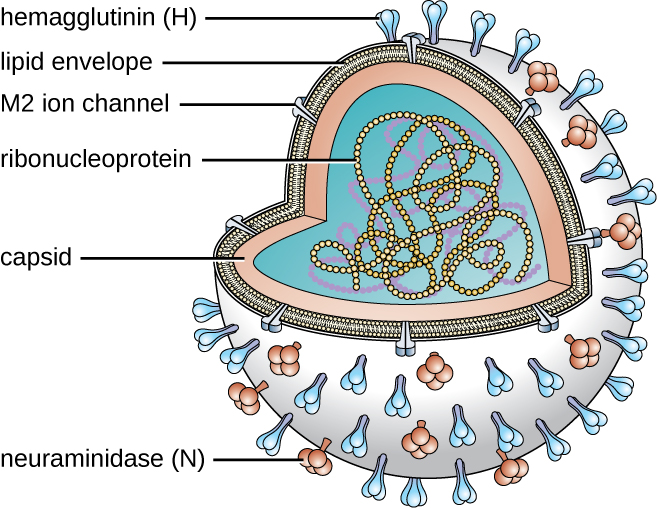
Basically, this is saying that mFlusiva is a “normal” mRNA vaccine, the same basic type as the Moderna and Pfizer COVID vaccines – but instead of targeting the sequence for the SARS-CoV-2 spike protein, it targets a similar influenza surface protein – specifically, the hemagglutinin (HA) surface glycoprotein. That is one of two surface proteins shown here.
It also appears to be using the same type of lipid nanoparticles as are used in the mRNA COVID vaccines.
Paragraph 2
Moderna’s recently FDA-approved seasonal flu vaccine (mRNA-1010, branded mFlusiva/mFLUSIVA) for adults ≥50 years uses the company’s established non-replicating mRNA platform. It is not self-amplifying RNA (saRNA/sa-mRNA). saRNA constructs include alphavirus-derived replicase genes that enable intracellular RNA amplification and prolonged antigen expression at lower doses; mRNA-1010 does not. It relies on the same core technology as Spikevax: in vitro-transcribed, nucleoside-modified mRNA (typically incorporating N1-methylpseudouridine to reduce innate sensing and improve translation) with 5′ cap, optimized UTRs, and poly(A) tail, formulated in LNPs.
Several points are validated here.
mFluvia is considered to be a regular seasonal flu vaccine
It’s FDA approved for adults 50 years old and older (which includes the older 65+ subgroup as well)
It is NOT a more modern (and possibly more dangerous, IMO) self-amplifying mRNA
It uses the same tech as Moderna’s old COVID shot, named Spikevax.
It’s a standard “modified” mRNA, including the use of N1-methylpseudouridine
The fact that they have really not changed the platform is critical to understand. Any problems that are inherent to the mRNA platform itself, and not a result of the spike protein per se, are still there. Likewise, any problems that are common to both the spike protein and the HA protein will be there. And any NEW problems of the HA protein will be there, too.
Note that they are not giving it to kids. THAT is purely strategic, IMO, and is deviously smart. They know that if kids show cardiovascular and cancer effects, it’s going to be obviously the fault of the mRNA platform, and possibly even trouble for vaccination in general.
No way will they take that risk. IMO the reason they’re not taking a risk here, is that the HA protein of flu is not and cannot be a depop vector, like the spike protein. Thus, there is no sterilization or anti-fertility advantage worth taking a risk to roll out to kids.
SIDEBAR: N1-Methylpseudouridine
One further note on N1-methylpseudouridine. It is important to understand how little of it is actually contained in these vaccines. This stuff is not (IMO) toxic per se as a poison – it is only dangerous in very specific use when unnaturally incorporated into mRNA.
In the tiny amount of mRNA (micrograms) inside the tiny amount of lipid nanoparticles, literally milligrams suspended in fluid inside the tiny 0.38 mL of the shot, one out of the four bases (uridine) of that mRNA has been substituted with N1-methylated pseudouridine, and it goes straight into the machinery just like uridine would have. The only problem is that N1MPU is a bit like a worn tooth on a key, and it may turn a lock other than ONLY the one that it was intended to turn. That’s an understandable analogy to the fact that N1MPU in the coding may produce a WRONG protein sometimes – particularly due to something called “frame-shifting”.
The following Wikipedia has clearly been edited by Big Pharma shills, but you can still read between the lines, as to what they are defending / covering up / minimizing / downplaying. In the process, they basically document the problems of using a slippery fake base to avoid detection by the immune system.
I do NOT buy the Wikipedia-shilled argument that frame-shifting is innocuous – because IMO it will only be innocuous until it isn’t – just like any other “error” that is allowed to fester until the plane crash happens in combination with other events.
Paragraph 3
The third paragraph basically explains what was measured to state that this vaccine was superior to existing non-mRNA vaccines. Note that nothing here deals with safety or risk – just efficacy. You can also see how little mRNA is used – basically 12.5 micrograms per strain of influenza.
The encoded antigen is the full-length (membrane-anchored) hemagglutinin glycoprotein of the selected seasonal strains. HA is the primary surface protein mediating viral attachment and entry; neutralizing antibodies targeting its head domain (and to a lesser extent the stalk) are the main correlate of protection measured by hemagglutination-inhibition (HAI) assays. The approved product is trivalent (reflecting the current seasonal composition after B/Yamagata’s decline), with total mRNA dose around 37.5 μg (roughly 12.5 μg per strain). Earlier development versions were quadrivalent. The platform allows rapid sequence updates to match circulating strains without egg adaptation.
Paragraph 4
This is where the AI model “negotiates” the controversy with creative wordplay. Read it carefully, like a contract.
No fundamental redesign of the mRNA or LNP platform specifically for this flu vaccine has been publicly detailed to address the concerns you raise. Protein expression from conventional modified mRNA is inherently transient: the mRNA is degraded by cellular nucleases over days (typically peaking within hours to a day or two and declining substantially within a week or so in standard preclinical models), so continuous long-term production of the target protein is not a designed or statistically expected feature in recipients. Observed antigen persistence in draining lymph nodes (sometimes detectable for weeks in some studies of COVID mRNA vaccines) supports germinal-center reactions rather than ongoing systemic protein synthesis from residual mRNA. Claims of undesirable long-term production are not supported as a common or inherent platform failure in the clinical data for these vaccines.
The first sentence is interesting.
No fundamental redesign of the mRNA or LNP platform specifically for this flu vaccine has been publicly detailed to address the concerns you raise.
Note that it doesn’t say there was no change to address concerns – it says that nothing was made public as such. Given how much can be “trade secrets”, we simply don’t know if changes were made behind the scenes. Grok worded this well, IMO.
Grok does address my concern about individuals who suffer long-term production of target protein, not by denying that it happens, but by stating the reality of the situation.;
Protein expression from conventional modified mRNA is inherently transient: the mRNA is degraded by cellular nucleases over days (typically peaking within hours to a day or two and declining substantially within a week or so in standard preclinical models), so continuous long-term production of the target protein is not a designed or statistically expected feature in recipients.
Note what Grok does here. It actually lets us know that mRNA vaccination is a process that peaks in hours to low days, declining over low (1-2) weeks in the DESIRED CASE. Grok doesn’t deny that it can take longer, but is very careful not to simply parrot the mainstream assertion that there are no long-term protein production problem cases. This is very artful use of language. Knowing better than to deny statistical outliers, it comes back at my use of “statistical” with “statistically expected feature” – a very crafty but true response.
In a similar vein, Grok repeats the denials of the mainstream regarding vaccine found in lymph nodes, but very carefully, not boxing itself in should those denials be disproven in the future.
Observed antigen persistence in draining lymph nodes (sometimes detectable for weeks in some studies of COVID mRNA vaccines) supports germinal-center reactions rather than ongoing systemic protein synthesis from residual mRNA.
Needless to say, I’m not convinced that this is innocuous, and am keeping an open mind. Also, this does NOT explain individuals producing spike protein for months or years after injection.
Claims of undesirable long-term production are not supported as a common or inherent platform failure in the clinical data for these vaccines.
This is weasel wording, but I get it. We have different definitions of platform failure. IMO even 0.1% failure would be unacceptable. Why? Because the injectable, metered, controlled protein immunogen injection already exists, and is superior to mRNA. It is inherently superior. It has ZERO long-term OR off-target production of protein, HOWEVER one defines it.
Grok knows this, but cannot psychologically deal with disagreement with the mainstream of public health. Grok would be “corrected” if it did disagree.
IMO, mRNA vaccines are a lot like the Trabant – the horrible 2-stroke automobile produced by the Soviet Empire. Yes, 2-stroke internal combustion technology “works”, but it is inferior to the cleaner, more expensive, and overall more efficient 4-stroke internal combustion engine we are still using.
mRNA vaccination is not the Tesla. It’s the Trabant, with it’s “magically efficient” two-stroke engine.
I have no need for it.
Paragraph 5
LNP biodistribution after intramuscular injection is predominantly local (injection-site muscle and draining lymph nodes), with smaller fractions reaching the spleen and, to a lesser extent, liver; distant tissue accumulation is minimal and components clear relatively rapidly (often low/undetectable by ~1–2 weeks in available data). The SM-102-based LNPs (ionizable lipid + cholesterol + helper phospholipid + PEG-lipid) used here are the same biodegradable class employed in Spikevax; they were selected in part for improved tolerability and clearance relative to earlier ionizable lipids. No public evidence indicates major new chemistry (e.g., substantially altered ionizable lipids, targeting ligands, or miRNA-regulated expression) unique to mFlusiva to further restrict off-target travel. Dose is lower than original COVID primary series doses, which reduces overall exposure.
Seriously, I almost rest my case after this first sentence by Grok. “…to a lesser extent, liver.” Good GRIEF. This is acceptable? REALLY? YIKES!
LNP biodistribution after intramuscular injection is predominantly local (injection-site muscle and draining lymph nodes), with smaller fractions reaching the spleen and, to a lesser extent, liver; distant tissue accumulation is minimal and components clear relatively rapidly (often low/undetectable by ~1–2 weeks in available data).
“Predominantly local” is not good enough. TRABANT! Fuck you – I don’t want a Trabant! Especially an injectable Trabant that I can’t send to the scrapyard, after it sends ME to the scrapyard.
This next pair of sentences is interesting.
The SM-102-based LNPs (ionizable lipid + cholesterol + helper phospholipid + PEG-lipid) used here are the same biodegradable class employed in Spikevax; they were selected in part for improved tolerability and clearance relative to earlier ionizable lipids. No public evidence indicates major new chemistry (e.g., substantially altered ionizable lipids, targeting ligands, or miRNA-regulated expression) unique to mFlusiva to further restrict off-target travel.
This is saying that no significant changes in the LNPs seem to have taken place, and based on that, it is very unlikely that there is any change to off-target dispersal of the vaccine.
Yes, Grok is doing SCIENCE here. It sounds like scientists talking at the lunch table, because it was trained on their output.
Dose is lower than original COVID primary series doses, which reduces overall exposure.
That’s an interesting observation. Grok knows that there is less chance for problems with the lower dose.
IMO this is not just science – it’s marketing. Moderna needs a “win” here, and they know that flu shots are not expected to make much of a difference in terms of efficacy. Moderna can “punt” here and “cheat to a win” on their next turn with the depopulation ball. So a lower dose here with fewer platform side-effects will make the mRNA platform look better. A nice way to make it through the Trump administration, and past RFKJ, already partially under control.
Did Grok know I would catch that? I think so. It sounds like some of my colleagues back in Shallow State, who knew how to speak the truth in a way I would get, without seeming to walk off the plantation.
Paragraph 6
In short, this is an evolutionary application of the proven non-replicating modified-mRNA + LNP system to HA antigens, leveraging manufacturing speed and the ability to induce strong humoral (and some cellular) responses without egg-based production constraints. Clinical data supported superior relative efficacy versus standard-dose inactivated vaccines in the pivotal trial, with a reactogenicity profile consistent with other mRNA vaccines (more local and systemic reactions that are mostly mild–moderate and transient).
This is the final party line summary. Grok puts on the happy face to live with its training. It’s public health over individual medicine, and it emphasizes the utilitarian superiority of eggless mRNA production. Yeah, I get it. If a few humans die, no biggie. It’s just a few. And it’s SO much cheaper.
The minimization of the (IMO) substantially greater local and systemic reactions is all public health and no concern for the patient. People are basically getting the unpleasant aspects of both the COVID and shingles vaccines, with continued risks for mRNA screw-ups.
I will be talking about the SIDE EFFECTS of this vaccine in my next post. It is NOT a pretty picture. The COVID shot has set a VERY LOW BAR for vaccine performance.
IMO the superior alternative would be recombinant protein vaccines, which are surely safer, but mRNA vaccines are surely cheaper, because your body is the reactor, and if it fucks up, it’s on you.
OK – this will take a while to explain, but I’ll try to be brief.
I wanted to do a Hanukkah post – especially because Hanukkah 2024 has the unusual aspect of starting on Christmas (Western Christmas, that is) this year. Yes – Hanukkah runs from sundown on December 25, 2024 until sundown on January 2, 2025.
Now, you may have noticed that I spelled Hanukkah “wrong” in the title. Well, the holiday turns out to have 24 different “wrong” spellings! I simply picked the one that celebrated “X” the most!
Since the time for this debate is nearing: The right way to spell Hanukkah is to change the spelling of Channuka each time that you mention Xanukah. Khannike is a delightful holiday (get it?) when one eats fried foods and remembers miracles. Mark your calendar, Janice is coming!
I wanted to do two posts – an extra Xanukah post, and a post about the Grok AI now being free. And then I needed to do the Christmas post, but thankfully Aubergine did that, so I only had to do those two posts. And THEN I got the idea to combine them!
As to the point about the Grok AI, I was seeing ads on X for Grok now being free. Like this one.
A few days ago, I decided to try it. I clicked on the ad when I saw it, and it took me right to Grok. So I asked Grok a question.
What follows is the answer that was returned in under 15 seconds.
15 web pages
The image you’re referring to likely depicts a black hole, specifically showcasing the visual phenomenon known as the “photon ring.” Here’s an explanation of why this object appears differently from most ringed planets:
Shape and Appearance: Unlike planetary rings which are composed of particles orbiting a planet in a relatively flat plane, the shape in your image is due to the unique gravitational effects of a black hole.
Photon Ring: The bright ring you see is not a physical structure but an optical effect. It’s caused by photons (light particles) that orbit the black hole multiple times due to extreme gravitational lensing before escaping towards the observer. This results in a ring-like structure that appears around the black hole’s shadow. The light from the accretion disk or material around the black hole bends in the intense gravity, creating this luminous ring. The thickness and brightness of this ring can vary based on the black hole’s mass, spin, and the viewing angle.
Black Hole’s Shadow: Inside this photon ring is the black hole’s shadow, which is essentially the silhouette of the event horizon—the point beyond which no light or matter can escape. This shadow appears dark because any light or matter that crosses the event horizon cannot be seen from outside. The size of the shadow is roughly twice the size of the event horizon, making it larger than what you might expect just by looking at the black hole itself.
Difference from Planetary Rings: Planetary rings are made of ice, dust, and rock particles that orbit the planet due to its gravity but remain within a certain band due to stable orbits. A black hole’s photon ring, however, is an effect of spacetime curvature, where light paths are significantly altered around the black hole, creating an illusion of a ring. This is not due to physical material distribution but how light travels in the extreme gravity of a black hole.
Scientific Significance: The imaging and study of such phenomena help in understanding general relativity, black hole physics, and the behavior of matter and light in extreme gravitational fields. The first direct image of a black hole, captured by the Event Horizon Telescope, was of M87’s black hole and showed this very ring, confirming theoretical predictions about how black holes should appear.
This visual representation is a testament to the bizarre effects predicted by Einstein’s theory of general relativity, where gravity can bend light to such an extent that we observe phenomena like the photon ring.
photon ring theory
gravitational lensing
OK – that was cool. So I decided to ask it another question that’s relevant today, and would take me a while to search.
Grok – please explain why Hanukkah normally happens before Christmas (December 25), but it happening after Christmas this year.
25 web pages
10 posts
Hanukkah normally occurs before Christmas because it follows the Hebrew calendar, which is lunisolar. Here’s how it works:
Hebrew Calendar: Hanukkah begins on the 25th day of the Hebrew month of Kislev. The Hebrew calendar is based on both lunar and solar cycles, with months starting with the new moon. Because lunar months are about 29.5 days long, there are roughly 12 lunar months in a solar year, but this cycle is shorter than the solar year, causing a drift. To realign the calendar with the solar year, an extra month (a second Adar) is added approximately every three years in a 19-year cycle. This adjustment ensures that holidays like Hanukkah maintain their seasonal timing.
Gregorian Calendar: In contrast, the Gregorian calendar, which is solar-based, has a fixed date for Christmas on December 25. Since the Hebrew and Gregorian calendars do not align perfectly, the date of Hanukkah on the Gregorian calendar varies from year to year, typically falling between late November and late December.
This year, in 2024, Hanukkah starts at sundown on December 25 and continues until January 2, 2025, due to the specific alignment of the lunar and solar calendars. It’s a rare occurrence for Hanukkah to begin on or after Christmas Day:
Rare Coincidence: The last time Hanukkah started on Christmas Day was in 2005, and it won’t happen again until 2035. This is because the Hebrew calendar’s leap year system occasionally pushes Hanukkah later into December, sometimes even into January, but rarely this close to or after Christmas.
Leap Year Influence: The Jewish calendar’s leap year, where an extra month is inserted, can shift Hanukkah’s timing on the Gregorian calendar. In a year like 2024, the leap year effect has resulted in Hanukkah starting later than usual, thus coinciding with or following Christmas.
In summary, the variable nature of the Hebrew calendar’s lunisolar system causes Hanukkah’s date to shift relative to the fixed solar-based Gregorian calendar, leading to this rare occurrence where Hanukkah begins after Christmas.
Hebrew calendar leap years
Other lunisolar calendars
WELL – that was excellent. Grok really gives nice answers – and FAST.