Our mission, as God-fearing and God-loving patriots, is to defend this Constitutional Republic and to increase its greatness, in all good things and ways, by using our voices in free but courteous speech, by discussing the happenings of the world and coming to a profound understanding of those things, and by sharing and promulgating these Truths on both this platform and others.
This Rejoice & Praise God Sunday Open Thread, with full respect to those who worship God on the Sabbath, is a place to reaffirm our worship of our Creator, our Father, our King Eternal.
It’s also a place to read, post, and discuss news that is worth knowing and sharing. Please post links to any news stories that you use as sources or quote from.
In the QTree, we’re a friendly and civil lot. We encourage free speech and the open exchange and civil discussion of different ideas. Topics aren’t constrained, and sound logic is highly encouraged, all built on a solid foundation of truth and established facts, and not by agenda-driven accusations and pronouncements.
We have a policy of mutual respect, shown by civility. Civility encourages discussions, promotes objectivity and rational thought in discourse, and camaraderie in the participants – characteristics we strive toward in our Q Tree community.
Please show respect and consideration for our fellow QTreepers. Before hitting the “post” button, please proofread your post and make sure your opinion addresses the issue only, and does not confront or denigrate the poster. Keep to the topic – avoid “you” and “your”. Here in The Q Tree, personal attacks, name-calling, ridicule, insults, baiting, and other conduct for which a penalty flag would be thrown are VERBOTEN.
In The Q Tree, we’re compatriots, sitting around the campfire, roasting hot dogs, making s’mores, and discussing, agreeing, and disagreeing about whatever interests us. This board will remain a home for those who seek respectful conversations.
God is in Control . . . and His Grace is Sufficient, so . . . Keep Looking Up
Hopefully, every Sunday, we can find something here that will build us up a little . . . give us a smile . . . and add some joy or peace, very much needed in all our lives.
“This day is holy to the Lord your God; do not mourn nor weep.” . . . “Go your way, eat the fat, drink the sweet, and send portions to those for whom nothing is prepared; for this day is holy to our Lord. Do not sorrow, for the joy of the Lord is your strength.”
For God”s Glory
In the first section of Colossians 3 (1–17) Paul writes to encourage his readers in their general mindset and behavior. Concluding that section, Paul writes that whatever we do in word or deed is for God’s glory (Colossians 3:17). This is the overarching principle that should govern the life of the believer.
Paul provides specific descriptions of what doing all for God’s glory should look like in how we think (Colossians 3:1–4), how we handle the desires of the flesh (Colossians 3:5), and how we should care for and treat one another (Colossians 3:12–15). He then identifies the basis for empowering that kind of thought and conduct (Colossians 3:16). Paul concludes the section with the exhortation that we make sure that whatever we do in word or deed is for God’s glory (Colossians 3:17). Following those general instructions, Paul offers specific ways believers can faithfully steward the various relationships God provides (Colossians 3:18—4:6).
Because of the work God has done to make us alive in Christ, we should be focused on things above where Christ is (Colossians 3:1–4). Because of the future return of Christ in glory and the associated glorification of believers, we should put on the new self—walking in the newness of life and avoiding the idolatry of focusing on things that serve the flesh (Colossians 3:5–11).
An important aspect of walking in this newness of life is in how believers treat one another, and that should be characterized by love and its specific expressions like compassion, kindness, humility, gentleness, and patience (Colossians 3:12–14). Those expressions of love ought to be based on the peace that God has provided us through Christ, and that peace of Christ should be a controlling factor in how we think and act within the body—because we have been called to be part of that body with other believers. We ought also to be grateful for this (Colossians 3:15).
The key is to diligently allow the word of Christ to be at home in us—to dwell richly in us (Colossians 3:16a). As His Word shapes us, we can be sure that whatever we do in word or deed is for God’s glory. The Word should change how we talk to each other, providing us avenues to build one another up and to teach each other—again, this is always to be accompanied by gratitude and thankfulness to God (Colossians 3:16b).
After providing these directions, and before discussing the expectations of our conduct in specific relationships (Colossians 3:18—4:6), Paul covers overarching principles that help us make sure that whatever we do in word or deed is for God’s glory (Colossians 3:17). In this also we are to express thankfulness.
We are given important tools that enable us to make sure that whatever we do in word or deed is for God’s glory (Colossians 3:17). Those tools include a heavenly focused mindset (Colossians 3:2), considering the “old self” to be dead and putting on the new self (Colossians 3:5–10), putting on a heart that expresses love and its individual characteristics (Colossians 3:11–14), allowing His peace to govern our hearts (Colossians 3:15), immersing ourselves in the Bible, which is allowing His word to be at home in us (Colossians 3:16), and being constantly filled with and focused on gratitude and thanksgiving (Colossians 3:15, 16, 17). When we are putting these tools to use, we are more likely to ensure that whatever we do in word or deed is for God’s glory (Colossians 3:17). xhttps://www.gotquestions.org/whatever-you-do-word-deed.html
Isaiah 43:7 – “Even every one that is called by My Name: for I have created him for my glory, I have formed him; yea, I have made him.”
Ephesians 2:10 – “For we are His workmanship, created in Christ Jesus unto good works, which God hath before ordained that we should walk in them.”
Post about God – comments or articles – whenever and wherever you desire. FEAR NOT. God is with us, because we make sure He is WELCOME.
At all times, remember. The QTree is a House of the Lord. NEVER be afraid to speak His name.
Wheatie Wisdom. If you bring snacks, bring enough for everyone. No running with scissors. No food fights. AI stuff posted, requires a link. Please use spoiler, for longer posts. Wolf Speak. No obnoxious behavior towards fellow QTreeper(s). Freedom of Speech is honored here QTree. But Do Know, every poster, IS personally responsible for what they post.
A Feud between Micro$oft & A Security Guy going hot…
This is a fun one…
Has everything from corporate intrigue to morality play, big corp crushing small guys who keep fighting, and just to round it out, a zero day exploit that looks a lot like a “backdoor” (or could just be stupid programmer games).
I’d worry if I ran anything Microsoft, but I don’t, so I don’t 😉
Yes, it is a couple of months old, but I don’t usually follow M.S. stuff closely. The White hat “Nightmare Eclipse” is having a bit of a feud with M.S. over their ‘bug bounty’ program. Having not been paid for turning in some serious exploits, Nightmare Eclipse then started dropping “zero day” exploits on public servers. M.S. responded by getting them banned from Git Hub and Git Lab (so a bit of “whack a mole” going on). That won’t end well as the more they push the disclosure toward dark web / mesh network tech, the more exploits will be zero-day for the Black Hat community and hidden from the White Hats & the company.
Yes, a ZERO DAY exploit is bad. Yes having it quarantined with the company until a fix is published is better. BUT when the company goes all Pissy Dissy at the folks notifying them, the company can expect lack of cooperation in return. Companies can play nice or have Dark Web Exploits floating around for weeks or months before they find out. M.S. is not known for playing nice, IMHO.
FWIW: I survived all sorts of zero day exploits for years (decades…) via other site sanitation measures. Just because a given computer has an exploit doesn’t mean you can’t protect it. Isolation of critical systems from communications networks (i.e. not everything needs to be on the internet all the time…), very tight isolating firewalls, network architecture that prevents some kinds of access, access control facilities and more. They all work.
For example: I have a lot of data on disk. It is absolutely safe from attack from the internet. Why? Because the disk is not plugged into a computer, it is locked in a drawer. Also, the computer is left turned off and without power 99%+ of the time (that computer is only used when I want to access those disks) and, unless I’m actively downloading data from the internet, it doesn’t need an internet connection. I can download things (on a different system / uSD chip) that that gets moved to the archival system, maintaining isolation.
Bit of a PITA for things like system updates and adding data? Yeah, but a lot less trouble than getting shut down or data corrupted / stolen. Also note that I have copies of my various computer builds in the archive. IF one of my systems got corrupted or “locked” for ransom: I just remove the media with the locked OS on it, flash a new one from the saved image using my offline system builder system, and I’m back in business. All the important offline data is still secure and the online system recovered. Maximum loss is whatever I’ve done very recently, not backed up, and usually that’s easily recreated or just not important to me.
So yes, were I running a live on-line corporate center, some of those zero day exploits would matter to me a lot more (they did back when was doing that for a living). BUT, I find it a lot easier to have a dedicated system for personal web / on-line stuff that is semi-disposable, AND separate systems used only for things like financials, archives, and building systems. Compromising an exposed system doesn’t compromise anything important. With a separate computer costing in the $100 range, and uSD cards for an isolated system down around $10, running multiple computer images is very cheap and easy. Add that the Raspberry Pi 4 & 5 are enough for common web browsing stuff, and the barriers to entry for isolating “random browsing” from “important stuff” drops to the cost of a fancy coffee or at most a tank of gasoline.
Yes, that also involves avoiding the Microsoft Tax on the systems (one licence each) via Linux, but I’m fine with that 😉
So, here’s the Soap Opera Story, along with the tech of the exploit(s) involved:
Yes, this “exploit” requires access to the hardware. That’s one of the first big barriers to protect yourself. Keep your hardware / systems away from physical access by randoms. The laptop I use “on the road” at public WiFi has NOTHING on it of importance. No financials. No email archive. At most, a couple of days of “on the road” email reading records (email left on the server when on the road). Isolating use cases, it’s a good thing.
Also note that at about 11 minutes, there’s a ‘letter’ from Nightmare Eclipse stating that M.S. patched a vulnerability under active exploit without telling anyone (a bad behaviour). Once you push the patch, you notify everyone so they can assure they patch it AND find out if they were hacked.
For this particular bug, I don’t see it as a major risk for most users / use cases. For secure sites depending on disk encryption? Yeah, it would be an issue. OTOH, as someone who has needed to use “exploits” to recover other folks systems sometimes: To me it looks more like a way to recover an encrypted disk when the employee left the company or the PIN was lost… not all “security bypasses” are bad all the time…
Why? Because the path forward now sucks. Management at Canonical has made a series of “corporate friendly user hostile” decisions. SNAP is obligatory, which also means loss of control of YOUR code as it self updates “packages”. The inherent code bloat has pushed memory demand to levels higher than Microsoft Windows(!). Wayland is now obligatory so kiss off any old Xorg applications or recovery methods. Want to remove SNAP? Then you also lose sound as computer sound now depends on it. Kernel stable? Maybe, maybe not, as the Long Term Support version release may happen before kernel stability date. Then there is Uutils, the Rusty re-write of well tested well proven Gnu Coreutils pretty much guaranteed to induce bugs, script failures, downtime and commands that do not act as they did before.
I also have several very old PC boxes that I like to keep in service. Keeps e-waste down and old hardware useful. Canonical is abandoning old hardware, so abandoning me.
The “good news” is that the only system I’ve regularly used with Ubuntu was an Asus Laptop that came with it pre-installed. After some effort, I’ve reached the point where I can manage EUFI well enough to swap the OS on it – just as the keyboard and power connection have started being flaky… so I bought a new Think Penguin laptop with Devuan pre-installed. My only other Ubuntu systems tend to be alternative uSD cards for various Single Board Computers since many vendors supported Ubuntu first or only. Odroid, for example, liked to support it. For them, I’ve generally gotten a Devuan or Armbian alternative running as the main OS. I’ll now be “not bothering” to use the alternative Ubuntu, and actively replacing it.
Some of the boards (Odroid N2) were purchased with a pre-installed Ubuntu on an emmc chip. I’ll be putting the main OS on that chip instead… Devuan where possible, Void sometimes,others as interesting. Slackware runs on some of them too.
Canonical has embraced “The Microsoft Way” and abandoned The Unix Way, so I’m abandoning them. Here’s a nice 17 minute summary of why Ubuntu 26.04 LTS sucks:
A Minor Rant about Huge Corporations trying to “enclose the commons”
Over the last couple of decades, a growing trend in Linux has been Big Corporate “Support” in the form of Money, Programmers on Staff, and Membership In Governance Boards.
This has been very helpful in that resources have been provided to what had been a “Potluck Programming by The Little Guys” process without much funding or resources at all. This has been bad to the extent that the Big Corporate Players gain power over the direction of Linux, and then use it to capture it, and remove the very freedom that created it in the first place.
Microsoft has long had a known strategy of “Embrace and extend” (to capture and kill…). So they would “embrace” a proposed Standard, but then extend it in proprietary ways that were not compatible. Due to their size, they could do this with impunity, but it also prevented Other People and Other Companies from running on their “stuff” and ‘encouraging’ you to Buy Micro$oft products…
RedHat rose to dominate a lot of the Userland Codebase, so what RedHat did got propagated out to many (most?) other distributions. SystemD is a good example. Now owned by IBM (since 2019). Note that IBM has a long history of attempted monopoly practices in various markets. (Disclosure: At one time I worked for Amdahl Corp. who made “IBM compatible” mainframe computers, so saw this up close.) IBM does not care, at all, about Open Source or keeping free software free. ANY “new and improved” way of doing things from RedHat / IBM is something I will suspect of being directed at capturing control of the commons.
Canonical (Ubuntu) is also a large corporation and mostly cares about making an OS Release that works well and is easy for them to maintain. Your control and your choices and machine efficiency not so much. So they embrace SNAPS despite resources that uses and despite putting the package run (and updates to it) beyond your control. (SNAPS are automatically updated when Canonical feels like it, on your machine, for example.) Canonical is also making somewhat incompatible changes to their version of Linux, pushing you into being tied to their way of doing things – like forcing the use of the Rust based uutils instead of the GNU CoreUtils.
Mozilla (the FireFox browser) is pushing their creation of the Rust computer language. Supposedly for the “memory safety”, but that is only one type of bug and is NOT concerned with memory footprint or efficiency on small machines (like the Single Board Computers -SBCs- I like). After the re-write in Rust, FireFox tended to keep hold of more memory when a lot of tabs were kept open. I like to keep a lot of tabs open, even if inactive. This eventually had me move from FireFox to Brave (that seems to understand a page cached to disk doesn’t need to stay in memory). Do I really want ever more chunks of my Rusty-Linux system to demand memory residency?
Somewhere in my Bone Yard is an old Hitachi Laptop from about 1988? that has 8 MB of memory. Yes MEGAbytes. It has a RedHat Linux on it (from that era, not updated). I “inherited it” for free when it could no longer run Windows (so I don’t really know how old it is…). I turned it into a firewall / router for my office when I was the Build Master & IT Guy for a small software company of about 50 people. All MY traffic went through it to the corporate network. (Why? Because the Systems Admin AND a guy in charge of defending the sanctity of a build chain MUST protect against all kinds of things, even folks inside the company). The point?
Re-purposing old small memory & CPU equipment is of no interest to Major Corporations (selling new equipment is), but it IS in the interest of small corporations, independent developers, students, anyone who is poor and living in the 3rd World, and folks interested in reducing the tonnage of resources hitting landfills as eWaste.
A large part of the Linux World population has goals and values that do not align with those of the Major Corporations. Major Corporations want to control the commons and exploit it for their profit and gain. Not necessarily a bad thing (I’m all for profit in corporations, as long as it is not evil in execution). The problem comes with the “Enclosure of the commons”. A problem defined since before Medieval times. When there was a “commons” where everyone could chop wood or hunt food, then The King (or other local Lord) would claim it was for his private use alone. Under his rules. Kind of like saying: You Must use SystemD, Gnome & Wayland…
Also note, that the Rusting of various packages often comes with a licence change from GPL (GNU Public Licence that is “copyleft” and requires changes be published) to MIT (“permissive” that lets you keep changes a hidden secret). The point of a copyleft license is to prevent “Embrace and extend” as a way to “enclose the commons”. The move away from GPL to MIT helps big corporations, but endangers the Open Source Community and encourages making Variations Of Linux that are NOT compatible with others, that are proprietary and tied to one vendor.
I choose to stay in the GPL License world. Not as energetic about it as Richard Stallman, I’ll accept proprietary driver code for some odd peripheral, but aware of the risks of Corporate Capture, Enclosure of The Commons, and Proprietary incompatibility risks “going forward”. So I will run Wayland sometimes, but encourage Xlibre. I’d try to avoid SystemD, and I’ll not use Gnome at all. Ubuntu is on my “walk away and avoid” list due to their changes over the last few years, and Void is coming on board.
Embrace those Linux distributions who recognize these Corporate Capture Risks. Stay free.
May be wise to share with siblings, children, grands, friends…
An Inconvenient Study
MarieUrsula dropped off a link for one of the best documentaries I’ve seen in years – and IMO you would do well to watch this, too.
Her comment:
MarieUrsula (@guest_1644157) Online
August 25, 2026 00:55
#1644157
Found on my trapline a few hours ago, on a related subject:
“Here’s a story about vaccines with danger, deception, and intrigue, like a thriller. It’s an important piece of the vaccine puzzle. Produced by Del Bigtree, it’s essential for anyone still considering the validity of vaccines.” c. 1 hour 22 minutes.
This movie explains a whole bunch of things – even more than they intended to explain. The logic is beautiful. Del Bigtree is a truly excellent journalist. He understands exactly how to make things make sense with zero ambiguity.
This movie explains…..
numerous problems with vaccines
a critical study which went unpublished because it gave the wrong finding, but had a “plausible” exit for the author and institution
why RFKJ wants to do placebo studies
how the vaxxbots skate out of placebo studies on bogus ethics grounds
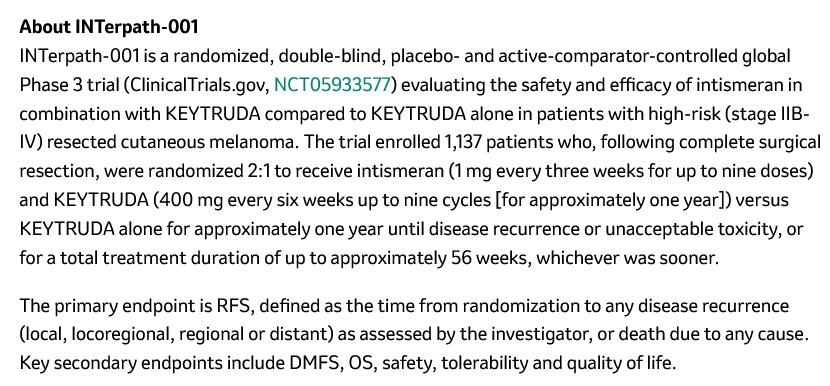
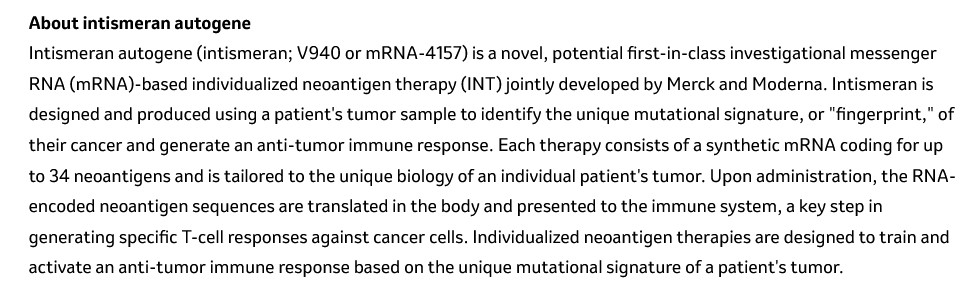
The general summary: Moderna’s “on-demand cancer vaccine”, mRNA-4157, takes the concept of modRNA to a new, and potentially dangerous, level. There are no published results for the most-recent clinical trial for this “vaccine”, NCT05933577; Moderna states it will release the “topline results” of this study “at a medical meeting.” The results of the previous clinical trial for mRNA-4157, NCT03897881, were not “stellar”, to say the least. The 2020 Patent for mRNA-4157, WO2020097291, discussed below, states that this “cancer vaccine” is apparently to be primarily used as a preventative measure in healthy persons, with the “option” to also use it for a treatment of diagnosed cancer in persons. mRNA-4157 is formulated using potentially multiple types of lipid nanoparticles. mRNA-4157 is formulated using potentially multiple types of uracil RNA destroyers, chief among them, the N1-methylpseudouridine already in use in the company’s COVID-19 bioweapon “vaccines.” Moderna has partnered with Merck, Sharp and Dohme, in the development and clinical trials for mRNA-4157. These two companies have a 50/50 partnership agreement in place. Moderna has also borrowed $1.5 Billion dollars from Ares Capital Corporation for more funding.
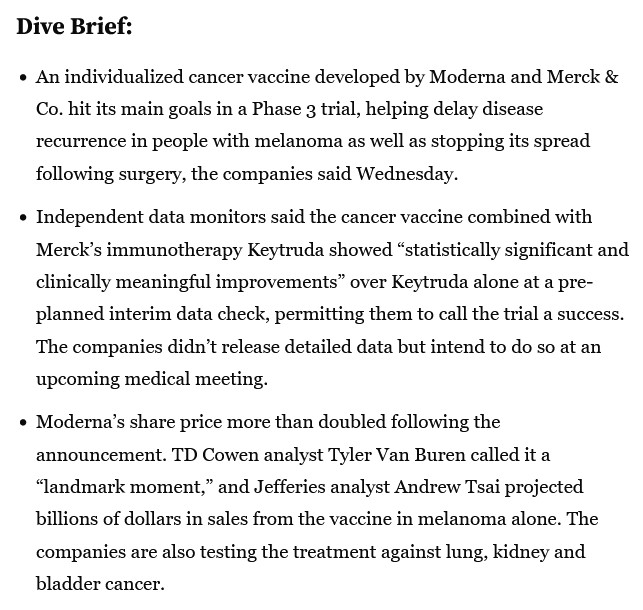
However, no results have been publishedfor Phase 3 of NCT0593577 — more on that below. Here is the announcement by Moderna, covered in BioPharmaDive: https://www.biopharmadive.com/news/moderna-merck-cancer-vaccine-landmark-result-melanoma/828238/, “Moderna and Merck cancer vaccine returns ‘landmark’ result in melanoma”, Jonathan Gardner, 19 August 2026. Please see the screenshot, below:
So, Team Merck and Moderna have no plans to release these “topline results” of NCT05933577 to the general public — but, instead, “intend” to release these “topline results” at a “medical meeting.” How “interesting.”
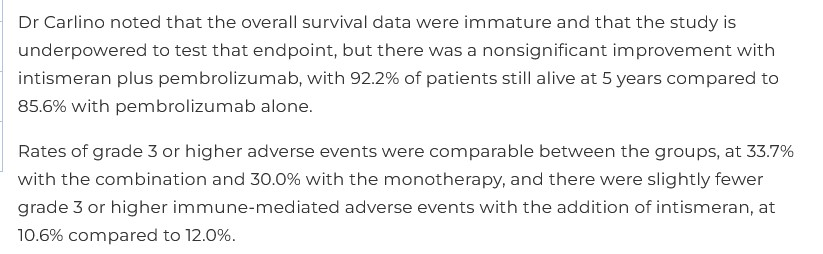
Look at what Dr. Carlino states: non-significant improvement in the study subjects who were taking mRNA-4157 + pembro; and, more risk of Grade 3 or higher adverse events in study subjects who were taking mRNA-4157 + pembro. Grade 3 adverse events “are serious” and interfere with the person’s ability to do normal activities such as, eating (https://dipg.org/treatment/clinical-trials/side-effects/, “Side Effects in Clinical Trials.”)
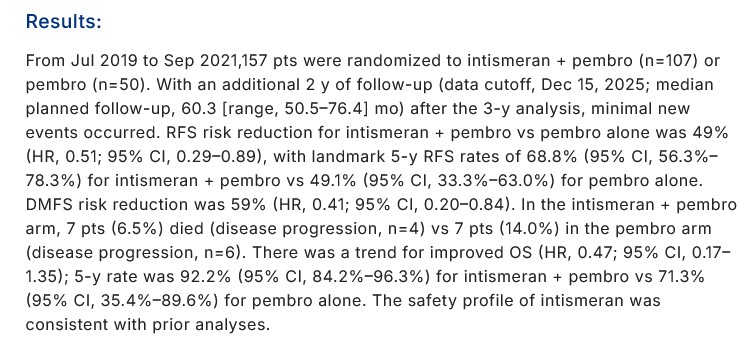
Look at the Results section above: less than 50% RFS risk reduction for mRNA-4157 + pembro compared to pembro use alone; SEVEN study patients died after taking the mRNA-4157 + pembro, and SEVEN patients died after taking pembro alone: in other words, no reduction of risk of death from the mRNA-4157 + pembro “conbo drug treatment.” The website for NCT03897881 are here: https://clinicaltrials.gov/study/NCT03897881. In the “Reseacher View” details of this clinical trial, the only results are those in the two scientific papers that are cited; there is nothing in the “Results Posted” section on the clinical trial “Overview” webpage.
BUT, despite this set of results for NCT03897881, the FDA granted “breakthrough therapy designation” for the mRNA-4157 + pembrolizumab “combo cancer vaccine treatment”: https://www.onclive.com/view/fda-grants-breakthrough-therapy-designation-to-mrna-4157-v940-plus-pembrolizumab-in-high-risk-melanoma, Chris Ryan, 23 February 2023. Not a bad “return on investment” for Moderna on this one — even though the results of the NCT03897881 clinical trial appear to be “less than stellar.” A perfect example, in Yours Truly’s opinion, of how Big Pharma controls the FDA.
>>>>>>>>>>>>>>>>>>>>
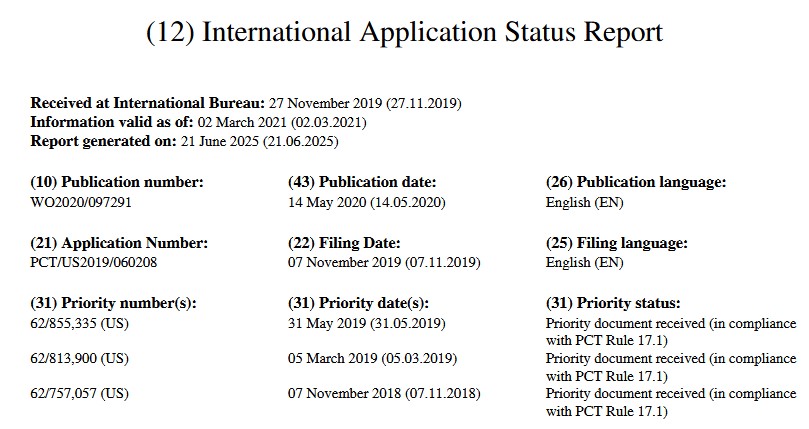
Yours Truly now turns to a major “source document” for mRNA-4157: the Patent for this “cancer vaccine”, found here: https://patentscope.wipo.int/search/en/WO2020097291, “RNA Cancer Vaccines”, publication date 14 May 2020; the Applicant is: ModernaTX, Inc., 200 Technology Square, Cambridge MA 02139. The following exhibits are from the Patent document; summaries are by Yours Truly. To begin: first, the Publication page; then, second, a portion of the Status Report page:
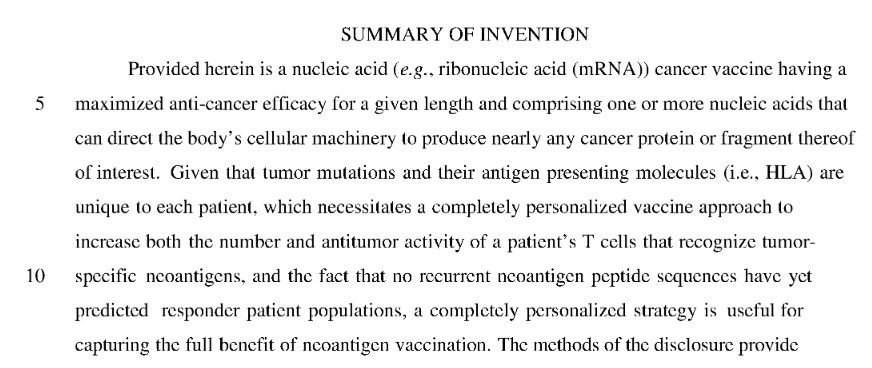
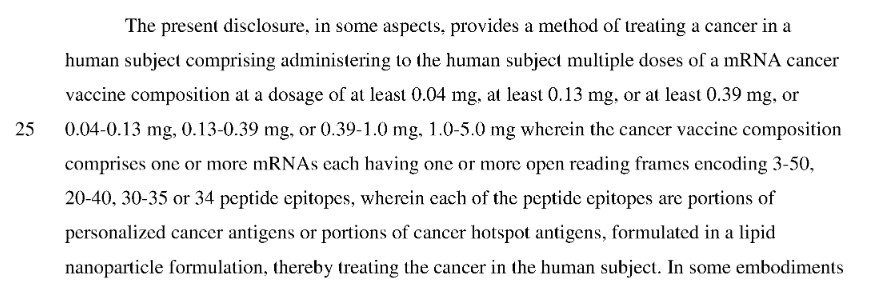
From the Summary of Invention, page 2: first, lines 5 – 11; then, lines 22 – 29. Notice that the “invention” is intended to stimulate the body to produce cancer proteins or parts thereof. This appears to be the “autogene” part of the “invention.” Notice also that the “invention” is to be administered multiple times to the patient. Notice also that mRNA-4157 can contain one or more mRNAs, each with one or more ORFs (Open Reading Frames):
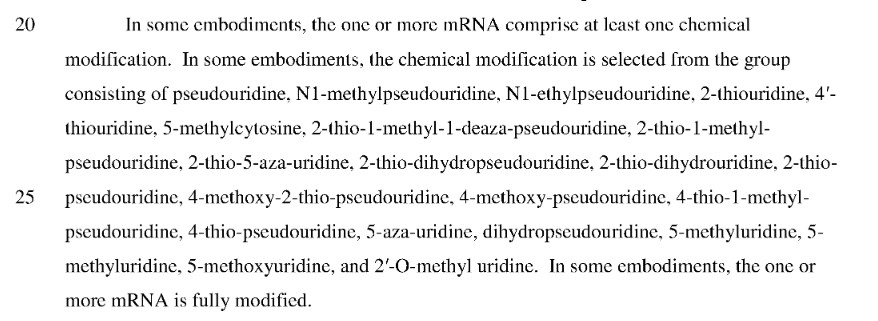
Page 4, lines 20 – 28: the Patent’s inventors waste no time in making sure that N1-methylpseudouridine, among other uracil (RNA) destroyers (“modifiers”) can be used in mRNA-4157:
**** Page 5, lines 15 – 17: the basic mechanism of mRNA-4157 — to “provoke” a “memory immune response” in the patient’s body. Shades of the “immune memory response” that is supposedly “taught” to the body of the person who takes Moderna’s COVID-19 bioweapon “vaccines” SPIKEVAX or mNEXSPIKE, perhaps?:
**** Page 5, lines 25 – 27: It appears that either cancer tumor DNA, or blood sample DNA, from the patient, can be used to lab-generate the peptide epitopes in mRNA-4157:
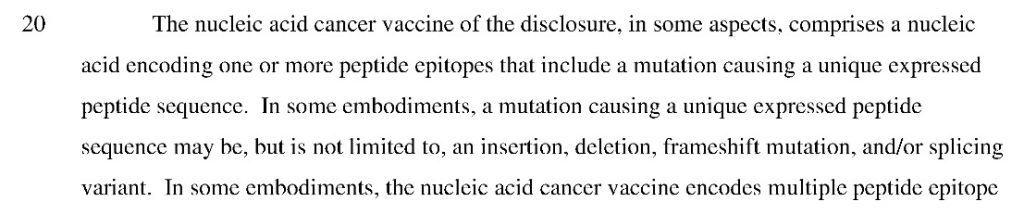
**** Page 17, lines 20 – 24: mutations; look at the mention of frameshifting. A tacit admission that mRNA-4157, as do the modRNA COVID-19 bioweapon “vaccines”, induce frameshifting in the body:
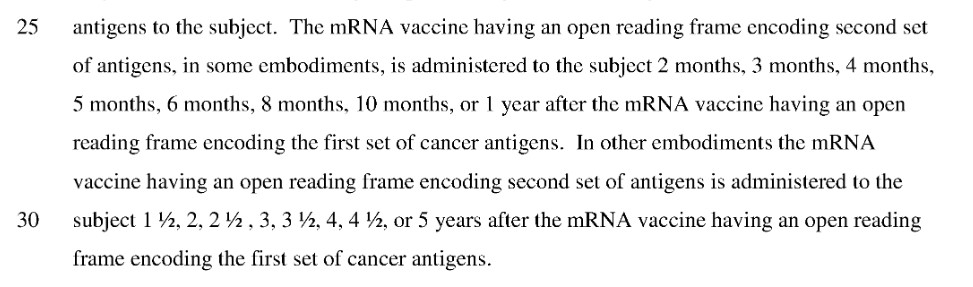
Page 31, lines 25 – 31: Depending on the ORF (Open Reading Frame) used, the treatment with mRNA-4157 can go on for up to 5 years:
There is extensive mention in the Patent of the use of N1-methylpseudouridine to completely replace (“uniformly modify” or “fully modify” are the terms used in the Patent) the uracil RNA of Uridine in the patient’s body. Example: please see Page 42, lines 8 – 14.
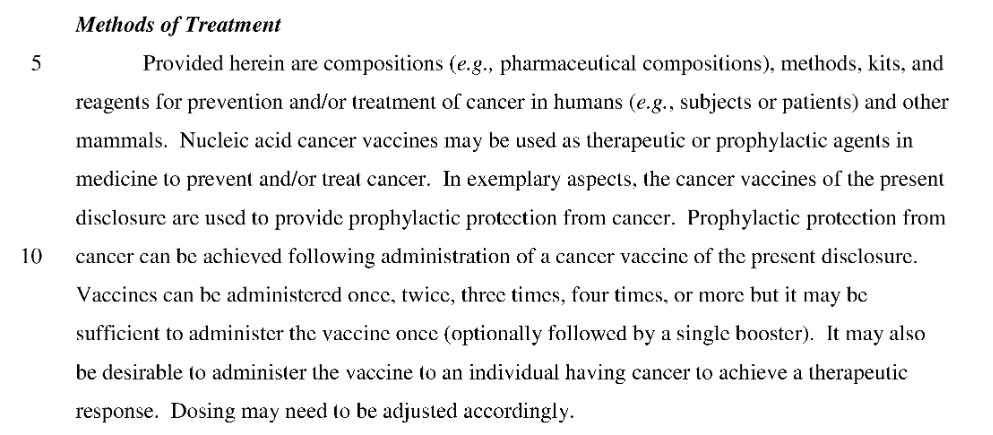
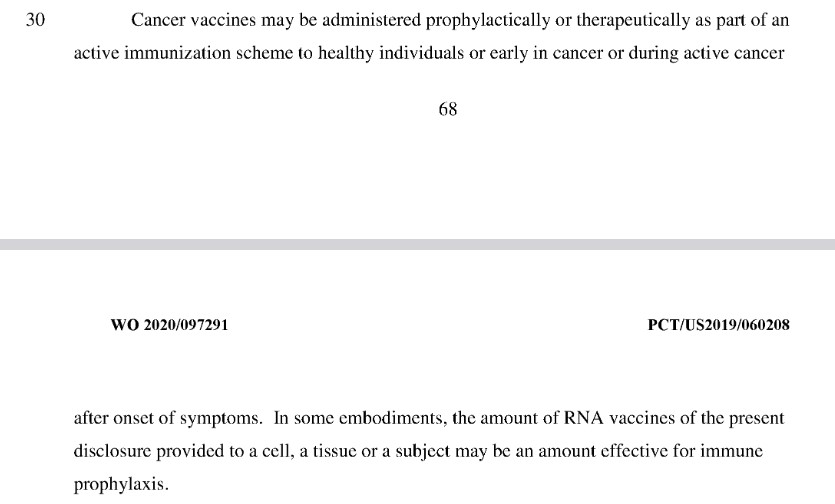
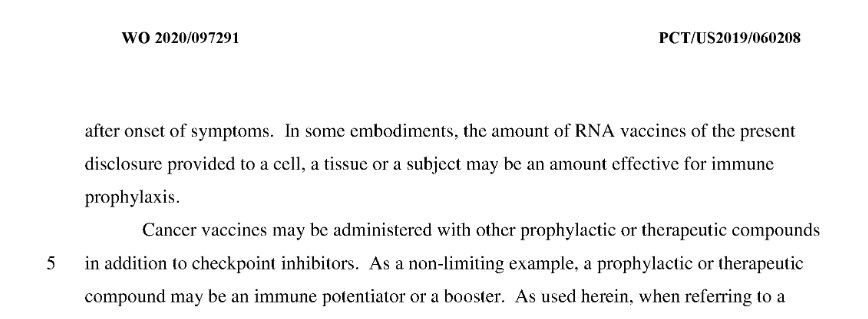
**** Methods of Treatment section: Page 67, lines 5 – 14: It appears that, in reality, mRNA-4157 is to be used as PROPHYLACTIC PROTECTION from cancer. Look at the language, “It may be reasonable” to use the “vaccine” ALSO as a treatment for a person who already has cancer. Also — Page 68, lines 30 – 31, and Page 69, lines 1 – 6: the mRNA-4157 “cancer vaccine” can ALSO be used in HEALTHY PERSONS as a “primer” and/or as a “booster shot”:
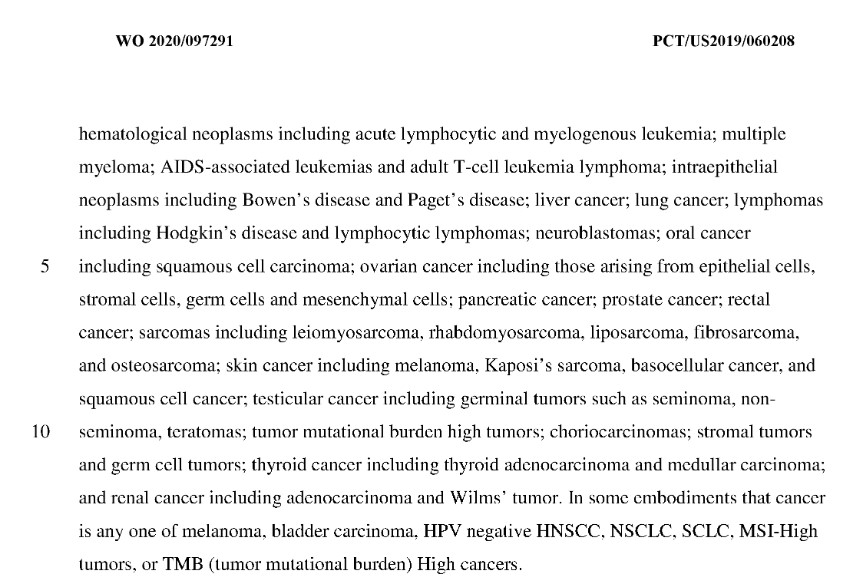
**** Page 70, lines 28 – 31, through Page 71, lines 1 – 14: the list of cancers that the Patent claims can be treated by mRNA-4157. This list includes dozens of types of cancer. The list from Page 71 is below:
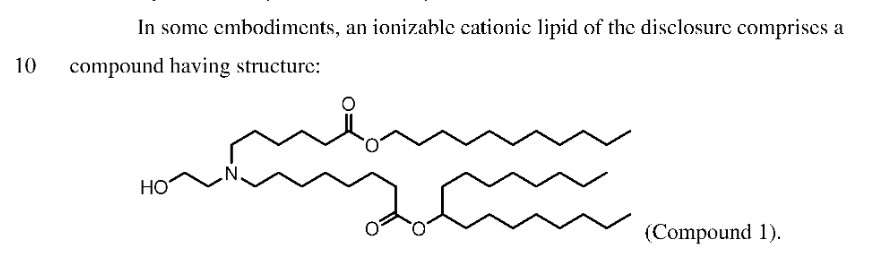
Page 82 through Page 90: Discussion and description of the “Formula (1)”, aka “Compound 1” (which appears to be at least one of the mRNA-4157 “formulas” that is being used in the clinical trials); discussion and description of “Formula 1A”; discussion and description of “Formula II.”
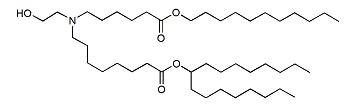
Page 91, lines 9 – 11: What looks like the chemical schema of the lipid nanoparticle SM-102 being used in the “Compound 1” of mRNA-4157:
Or, that Moderna modified the “backbone” of the SM-102 lipid nanoparticle that is used in the company’s COVID-19 modRNA bioweapon “vaccines” for use in mRNA-4157.
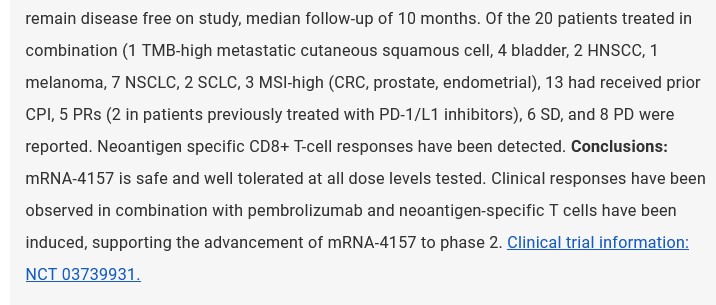
**** Page 105: Phase 1 clinical trial for mRNA-4157 + pembro, “Combination arm” results. “Compound 1” (“C1” — see above in the Patent presentation) was used. Table 6, included on Page 105, indicates that, of the 20 advanced metatastic / advanced cancer patients in the study, 8 then presented with Progressive Disease. This appears to mean an almost 50% risk of presenting with progressive cancer while taking mRNA-4157 + pembro. The results of this 2019 Phase 1 clinical trial (https://clinicaltrials.gov/study/NCT03739931) are summarized here: https://ascopubs.org/doi/10.1200/JGO.2019.5.suppli.93. From the Abstract of this paper, the Results section, which equates to the Table 6 on Page 105 of the Patent:
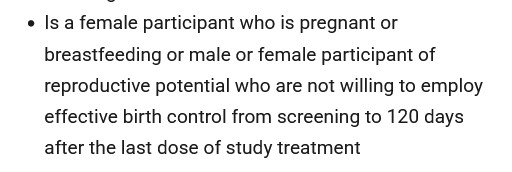
**** Team Merck and Moderna KNOW that mRNA-4157 CAN SHED. Please see: https://clinicaltrials.gov/study/03739931, the “Researcher View”; scroll down to the subsection “Exclusion Criteria”. BOTH male and female study subjects in this Phase 1 clinical trial had to agree TO USE BIRTH CONTROL:
The above is not an exhaustive analysis of the cited Patent for mRNA-4157. In fact, there are multiple other Patents listed for mRNA-4157, per Page 30 of the above cited Patent. What the exhibits and summaries of the above cited Patent do indicate, however, are:
That Moderna is using the “framework” of their COVID-19 modRNA bioweapon “vaccines” to move on to the next step: the lab-creation of “on-demand” cancer treatment “vaccines” that would be tailored to the individual patient, and lab-created from various types of samples from the patient;
That Moderna is potentially including MULTIPLE TYPES of lipid nanoparticles in the potential “compositions” of the “cancer vaccines” that the company is using mRNA-4157 as the “template” for;
That Moderna is taking the concept of “modRNA” to a different — and, in Yours Truly’s opinion, a potentially dangerous level, absent YEARS of intense research and clinical trials — “modRNA” that is lab-created using an “automated one-demand” process from the cells of an individual person (blood; tumor; urine; sweat; saliva, etc.);
That Moderna is making the claim that a “cancer treatment vaccine” lab-created from the patient’s own DNA can be, almost literally, be produced “on the spot” for near-real time, “instant’ treatment use; and has built an entire “automated facility” to produce this “vaccine”;
That it appears Moderna intends for mRNA-4157 to be used in healthy persons as a PREVENTATIVE “vaccine” for cancer, in addition to the product being used to treat persons who ALREADY HAVE cancer; and,
That Moderna appears to be using persons who already have cancer as “human lab rats” to see if mRNA-4157 has any real benefit as a cancer treatment;
That Moderna may be using these “human lab rats” in mRNA-4157 clinical trials as “proof” of “If cancer can be cured with a modRNA “vaccine”, and cancer being something that people never want to have: then, taking mRNA-4157 as a cancer preventative can erase cancer from humankind.”
Page 10: the “surface properties” regarding the lipid nanoparticle (LNP) platform systems.
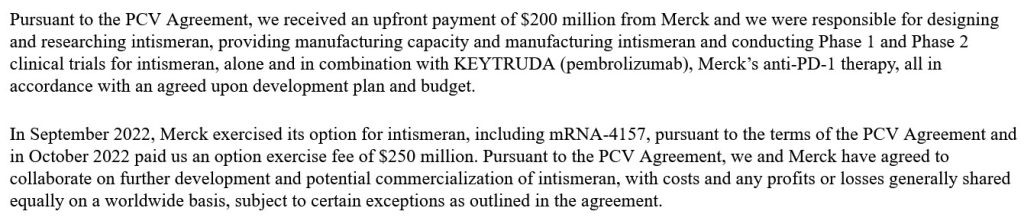
**** Page 19: the mRNA-4157 “Intismeran autogene” targets the CD4 and CD8 cells of the body (shades of the attack on the CD4 and CD8 cells that occurs from the modRNA COVID-19 bioweapon “vaccines.”) Also: Moderna will share 50% with Merck regarding the costs, profits and losses worldwide for mRNA-4157. Please see the screenshot, below, from Page 19 of the SEC filing:
Page 22: Moderna has built an entire “dedicated” facility in Marlborough, MA, devoted solely for the lab-creation and processing of mRNA-4157.
**** Page 26, section THIRD-PARTY STRATEGIC ALLIANCES: Merck has paid Moderna a total of $450 million in research and development costs for mRNA-4157. This is pursuant to a third-party strategic alliance agreement that was signed by Moderna and Merck in January 2015, for the development, approval, and marketing of “cancer vaccines.” (Recall that Moderna also has a STILL-EXISTING third-party strategic alliance agreement with NIAID regarding the development, approval, and marketing of mSPIKEVAX and mNEXSPIKE. Moderna is paying royalty payments for NIAID for every dose of these “vaccines.” This particular third-party strategic alliance agreement began in 2015, with Moderna and NIAID agreeing to co-develop and co-own the Patent for mRNA-1273. This is discussed in the SEC filing of 31 December 2025, on Page 31) Please see the screenshot below, regarding mRNA-4157 and Merck:
**** Page 43 et seq., Item 1A. Risk Factors section of the Moderna SEC filing of 31 December 2025: the following, from Page 44: “The commercial success of our products depends on the degree of market acceptance by physicians, patients, third-party payors and others in the medical community.” From Page 46: “If we cannot obtain, or are delayed in obtaining, regulatory approvals and advisory committee recommendations, we will be unable to effectively commercialize, or be delayed in commercializing, our product candidates.” In Yours Truly’s opinion, Moderna is stating that its products are “successful” if they have “market acceptance”; and, that Moderna needs to have swift regulatory approval of its products to get them on the market as soon as possible.
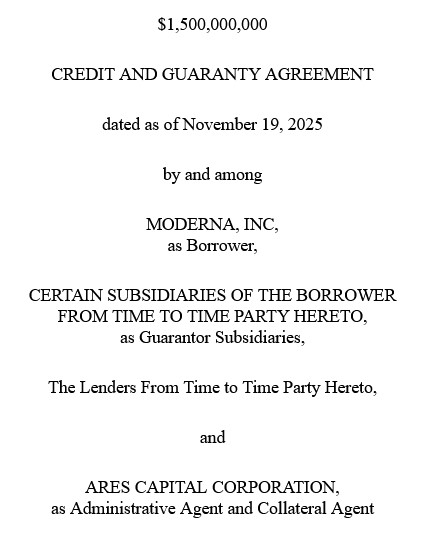
**** Page 144, Exhibit 10.7 (title hyperlinked): Moderna borrowed $1.5 Billion dollars from Ares Capital Corporation on 19 November 2025. The lender(s), of course, will be looking for a “full return” of the loan. Please see below:
>>>>>>>>>>>>>>>>>>>>
Yours Truly turns to one more aspect of modRNA “vaccines”: the potential that they will shed onto other people. This phenomenon is likely, as most vaccines can shed, at least for a limited time; however, in the case of the modRNA “vaccines” (and this now includes modRNA “cancer vaccines”, such as mRNA-4157), the potential for “vaccine” shedding is ALSO brought to a new, and possibly very dangerous, level. If a modRNA COVID-19 bioweapon “vaccine” can shed, what about the potential for an “individualized cancer vaccine” to ALSO shed? For more information regarding COVID-19 “vaccine” shedding, please see: https://www.thefocalpoints.com/p/inadvertent-exposure-to-pharmacologically, “Inadvertent Exposure to Pharmacologically Designed Lipid Nanoparticles Via Bodily Tissues: Biologic Plausibility and Potential Consequences”, Peter A. McCullough, MD, MPH, 3 March 2024. The three types of exposure are: “vaccine” biodistribution within the body of the “vaccinated” person; Two, via “secondary exposure” (skin-to-skin contact, sexual intercourse, bodily fluids, etc.); and, Three, via contaminated blood in blood transfusions. The paper referred to in the McCullough article, of the same title as his article, is here: https://doi.org/10.20944/preprints202402.1267.v1, T.J. Halma, Jessica Rose, Peter A. McCullough; 22 February 2024.
>>>>>>>>>>>>>>>>>>>>
Gentle reader, does one see how the game is played by Moderna? In November 2015, Moderna and NIAID signed a CONFIDENTIAL DISCLOSURE AGREEMENT regarding development of injectable drugs. NIAID (NIH) would pay Moderna as part of this “collaborative” agreement. Amendment No. 5, of April 2019, is the first mention of mRNA technology being co-developed by Moderna and NIAID; Amendment No. 6, of February 2020, extends this “collaboration.” In addition to these, Moderna and NIAID signed a COOPERATIVE RESEARCH AND DEVELOPMENT AGREEMENT (“CRADA”) in August 2016. The above documents are found here: https://www.documentcloud.org/doceuments/6935295-NIH-Moderna-Condifential-Agreements/.
So, Step One is in place: Moderna and the US government agree to co-develop, co-own, and share royalty payments for certain vaccines, including mRNA-based bioweapon “vaccines.” Step Two: between April 2019 and November 2020, the “collaborators” work on the lab-creation of mRNA-1273. Step Three: the COVID-19 disaster begins, late fall of 2019. Step Four: the FDA grants the initial EUA for mRNA-1273 on 11 December 2020. Step Five: millions of Americans are gaslighted, coerced, or “mandated” to take COVID-19 bioweapon “vaccines” — such as, mRNA-1273 and its “descendant clone vaccines.” Step Six: hundreds of types of serious adverse reactions and adverse effects begin to present. These adverse effects include cancer.
Meanwhile, Moderna and Merck, in January 2016, sign an agreement to “collaborate” on the lab-creation of an modRNA-based “cancer vaccine”, (which would eventually be called mRNA-4157 (Intismeran)), and get this injectable to the clinical trials stage. Moderna and Merck agree to share 50 / 50 the costs, profits, and losses regarding this “cancer vaccine.” The Patent for mRNA-4157, described above, specifically states that mRNA-4157 is to be used as a preventative for cancer, with the “option” for it to also be used as a cancer treatment (with another cancer drug as an “adjunct”; in the case of mRNA-4175, it is pembrolizumab.) Moderna has several “bases” covered at the same time: create a “vaccine” that can (and does) induce cancer in the body; then treat that cancer with another modRNA-based “vaccine” (mRNA-4157) that is coupled with pembrolizumab; while, at the same time, keeping mRNA-4157 “under wraps”, so to speak, in the Patent for this “cancer vaccine”, for future use as a preventative for cancer.
Moderna is already moving along in the mRNA-4157 trajectory. There are two other clinical trials using this “cancer vaccine”: NCT06307431, for persons with renal cell carcinoma; and, NCT06961006, for persons with advanced melanoma. The clinical trials cited in today’s offering were / are sponsored either by Moderna or by Merck.
Peace, Good Energy, Respect: PAVACA1
(Intellectual Property Disclaimer and Notice: Except for the linked URLs and other items above that are available on the Internet, the ideas and/or opinions in today’s offering are by PAVACA1 (M.E. Forbes, aka M.E.C. Forbes.) Credit must be given to PAVACA1 if ideas and/or opinions from today’s offering are used by other blog writers; by podcasters; or in print or social media.)
Wheatie Wisdom. If you bring snacks, bring enough for everyone. No running with scissors. No food fights. AI stuff posted, requires a link. Please use spoiler, for longer posts. Wolf Speak. No obnoxious behavior towards fellow QTreeper(s). Freedom of Speech is honored here QTree. But Do Know, every poster, IS personally responsible for what they post.
Lawrence Reed’s new book, “Born of Ideas: How Principles, Faith, and Courage Forged America,” is out September 1, and every American thinker will appreciate it.
At a time when universities are shuttering their presses, Grove City College has launched Faith & Freedom Press through publisher Whitaker House. Their inaugural book, “Born of Ideas,” written by distinguished author, academic and historian Lawrence W. Reed, frames how our nation’s founding was “born of ideas” through the lens of faith, personal responsibility and divine purpose.
Rather than reiterating the more conventional Revolutionary yarns, Reed commences his dissertation not in 1776 but with the Mayflower Compact in 1620. Reed is a learned student of the genre and devotes nearly a quarter of his tome explaining why the Mayflower Compact is not merely a political agreement but was rooted in the Pilgrims’ religious conviction that they were acting under God’s providence.
Reed, the author of more than a dozen books that blend liberty, economic history and political philosophy, underscores how America emerged first not from battlefields or politics, but from covenantalism that shaped much of freedom’s prevailing rise.
Divine Providence is a partner to the covenant. It is with the whole of the people not just between leaders covering the whole of life and the consent of the governed mentioned in the Declaration of Independence. Historically, it dates back to the book of Exodus that many scholars argue influenced the development of self-government and the later American doctrine of the consent of the governed.
Reed acknowledges America’s founding was first “a revolution of ideas” while still emphasizing the extraordinary nature of the American Revolution. As he writes in the Introduction, “Ours was first a revolution of ideas that produced a revolution in governance accomplished by heroes and ordinary Americans.”
The brevity of the 32 chapters does not diminish its clarity. Rather, it sharpens Reed’s argument and keeps the narrative moving into a fast read of 143 pages that can be accomplished in one sitting that delivers a fresh look at what makes the American experiment exceptional.
It is this mosaic approach that is the book’s defining strength. The chapters are historical vignettes that are crisp, thematic and tightly focused that absorb the founding era and its moral, philosophical and economic foundations. These engaging essays Reed says, “tells a particular story about a key figure or an aspect of the Revolution.”
Reed introduces readers to both the known and unsung heroes whose convictions shaped a nation. Samuel Adams, Patrick Henry and Thomas Paine appear, but Reed also devotes space to lesser-known contributors: Pelatiah Webster, “America’s First Economist”; Mercy Otis Warren, “The Conscience of a Great Cause” and Joseph Warren the fallen hero of Bunker Hill that made the American experience unique and yet remain essential today.
Whether discussing paper money, Native American alliances, Lafayette’s contributions, or the Roman influence on American republicanism, Reed returns repeatedly to the same core ideas: liberty, moral courage, personal responsibility and the belief that ideas, not accidents, forged the nation.
One of Trump’s biggest campaign promises was that he would close our borders to illegal immigration and remove those illegal aliens already here. He has indeed almost completely closed America’s southern border, but the Democrats then managed to turn deportation into a cause célèbre that seemed to derail that effort. It didn’t occur to them that Trump would find another way to accomplish the goal, or that Democrat politicians in blue states would help him.
Early this year, the headwinds seemed to be blowing in the Democrats’ direction. When Rebecca Good was killed while aiming a car at an ICE agent and a (legally) armed Alex Pretti was killed while violently resisting ICE agents, they seemed like the perfect poster children for the Democrats’ anti-ICE and anti-deportation push. Democrats thought it helped that there were other incidents in which illegal aliens confronting ICE also managed to get killed.
But somehow, despite the Democrat base’s hysteria, the American public didn’t rally to the cause. Those illegal immigrants who were killed turned out to have been engaged in violent actions against ICE agents or had heinous personal records. There were no George Floyd-style marches and riots. Without COVID lockdowns to make people desperate for any reason to get out of the house, and with most Americans happy to see the last of violent illegal aliens in their communities, this was not going to be a winning cause.
Trump then wisely removed the grandstanding Kristi Noem as Secretary of Homeland Security, replacing her with the ostensibly low-key but incredibly effective Tom Homan. With that, the air really went out of the Democrat anti-ICE balloon.
Sure, the Democrats are still agitating over ICE. It’s their cause, and the Democratic Socialists’ cause. Indeed, the DNC, reflecting the DSA’s power within the party, just approved competing resolutions about ICE. One demands that ICE reform, while the other wants to abolish it entirely.
However, while Democrats at the national level are fighting over the finer details of leaving tens of millions of illegal aliens in America, Benny Johnson reports that ICE is going about its work with Homan-esque low-key efficiency:
Something big is about to happen with deportations in America. You should be ready for this…
I just spoke with a senior DHS official. They shared deportation numbers with me that frankly stunned me.
+69,000 illegals are in DHS jails waiting to be deported at this moment.
And you haven’t heard a blip about it in the corporate press. Why? My DHS source says “stealth tactics.”
“We’re everywhere in every major city. We tell no one. Plain clothes. Beat up old cars. Quick work. Tactical strikes. No one sees anything. No drama. No tears. No media circus. You’re just going back home where you belong.”
And here’s where it gets insane…
DHS tells me blue states are quietly and very secretly working with the Trump administration to assist in the mass deportation of criminals. The criminal alien issue has become so “politically toxic” and “costly” that Democrat Governors have given the green light to Sheriffs and Police Chiefs in major blue cities to drop their illegals off with undercover ICE for removal.
It’s happening. You just don’t see it.
We can track if these numbers hold, but as for now this is a historic white pill and exactly what MAGA voted for.
This is great news. We are a country of people whose forebears immigrated here legally and promised when they arrived never to become a charge on the American people (a promise my hard-working parents kept).
It is absolutely unsustainable for a nation to be flooded with people whose first act is to violate the law, who immediately suck on the government teat (whether federal, state, or local), who are often criminally inclined, and who do not share our values and cannot or will not assimilate. If you want to see how that story ends, just look at Europe and the UK, which may be majority Muslim in the next 10 or 15 years.
There’s one more thing I like about the tweet, and that’s the bit about the blue state politicians assisting ICE. They’re cowards for refusing to do this openly, and they’re hypocrites for aiding deportations but not speaking out against their party’s stance on illegal aliens in America. And of course, we know that, once the illegal aliens are gone, leading to an inevitable decrease in crime rates and a drop in housing costs, they’ll claim that it was their leftist policies that made the difference.
For that reason, I sincerely hope that, once ICE drains a blue city or state of its illegal aliens, Tom Homan turns around and thanks those Democrat politicians for all their help with getting the job done.
As I wrote at the time, Pres. Trump made a good deal in June, got the oil flowing, and left the Iranians with no leverage and few benefits. So the IRGC reneged on it in a few weeks and started shooting.
Now we learn the U.S. Navy has set up a stealth convoy system for Hormuz that is taking 9-15 million barrels a day out of the Gulf, according to Energy Sec. Chris Wright. When you combine that with the 7-8 million barrels from the Hormuz bypass pipes, we are getting back to the pre-war normal of 20 million barrels from the Gulf.
Wright was bitterly mocked by the MSM when he announced this last week, but further mainstream reporting is now conceding this is basically true. While all the national and international media obsessed about the hopeless position the United States had reached, the stalemate was carefully being reversed.
It seems our military specifically targeted Iran’s anti-ship capacity, including coastal radars and look-out boats, over the last two months. It is very much harder to hit fast-moving tankers with a missile than a fixed land target. Especially if it is being protected by Navy jammers and interceptors.
The ball is in the Iranian court. We can now move a lot of oil without them being able to do much about it. Complicating things further, while the IRGC is firmly in control of the country, apparently each commander has near autonomy for his own forces. That leaves decision-making slow, and the guys in charge of the dwindling missile forces may not be in agreement with Tehran on what to do next.
While they figure it out, we might see a big drop in oil prices. This may lead to a situation like 1988, when the Iranians threw in the towel after President Reagan destroyed their navy and ended Iran’s first attempt to block the Gulf.
On the other hand, if the IRGC wants to keep playing a losing hand, they can strike the oil fields and desalination plants of their neighbors and try to take everyone down with them.
So far, they talk like that, but I wonder if that is more for show. All-out war would, in the end, leave Pres.. Trump and the Arab states no choice but some kind of Allied ground invasion to end the regime; much like Pres. Trump did in 2017 with ISIS in Iraq and Syria. I suspect the Iranian regime knows whose side most ordinary Iranians will be on if it comes to that.
New tire regulations will add hundreds of dollars to tire costs and drive 70 percent of tire manufacturers out of the market.
So what happens under solid blue rule when the budget gets blown out, the taxes hit the limit, the billionaires flee, and the government appetite for spending just gets bigger?
In California, they start to eye the things that make California California: Cars, freedom, houses, prosperity. It’s not just necessity, of course. They also long to make it Not California.
We’re seeing these kinds of new developments, and none of them are good.
Sacramento just dropped another regulatory bomb on everyday Californians.
The California Energy Commission unanimously approved the nation’s first replacement tire efficiency standards on Monday, setting strict limits on rolling resistance for tires sold in the state. Phase 1 kicks in for tires manufactured starting in 2029. The tougher Phase 2 hits in 2033.
Tire industry representatives say the 2033 standards would eliminate roughly 70% of the replacement tires currently on the market from being sold in California. Goodyear and America’s Tire have warned that applying the Phase 2 limits to today’s inventory would knock out the majority of available options.
The rules require lower rolling resistance (less energy lost as heat when the tire rolls) and a minimum wet-grip standard so replacement tires match the efficiency of the ones that come on new cars. Specialty tires – deep-tread off-road, certain winter/all-weather, competition, and some others – get carve-outs.
The Energy Commission insists the changes will save drivers nearly $1 billion a year in fuel and electricity costs statewide and cut 2 million metric tons of CO2 annually. It pegs the extra cost to consumers at just $1.50 per tire in Phase 1 and $6.50 in Phase 2, with fuel savings quickly offsetting that.
State officials claim it will add just $6.50 to the cost of a tire, a veritable nothingburger, not explaining why they needed to use an obscure 2003 law to justify it, or why they need to do it in phases. After all, why not do it all at once and reap the tax benefits if it’s just the little piddly thing they claim it is? We all know this story.
Here’s the lie sheet from the California Energy Commission, no guaranteed refunds offered when the opposite of what they promise actually happens, and it will. Many have noted that tire manufacturers are not at all onboard with this bad idea, and the supposed support from the big ones is the equivalent of CostCo getting its shops open during the lockdowns while everyone else had theirs closed, they stand to benefit from all the small fry shutting down. Meanwhile, if you like to stick your head into a live volcano, read the comments section:
Let’s set the record straight on California’s tire efficiency standard.
This very odd bird who is now regulating what tires you can get in CA just gave away the whole scam. She cites high gas prices to justify it: "If we can bring down those costs even a little bit, why wouldn't we do it?" Of course, no mention of reducing CA's self-imposed gas taxes… pic.twitter.com/Ua3NZiOwfK
⛽️ DO NOT FORGET! This is the SAME @GavinNewsom Energy Commission that has a WRITTEN plan to TAKE OVER REFINERIES: make it impossible to operate refineries in California, then have state purchase & run refineries, controlling the supply and cost of gasoline. In plain English👇… https://t.co/l3odJcfkfnpic.twitter.com/VKk0YcoJF3
— Houman David Hemmati, MD, PhD (@houmanhemmati) August 18, 2026
California just mandated what tires you're allowed to buy. Their own numbers say it costs you more. Analysts say up to $365 a set.
Gas tax. Registration. Paid parking at Balboa. Now tires.
They're not banning your car. They're pricing you out of it. One fee at a time. pic.twitter.com/hMmm07URZN
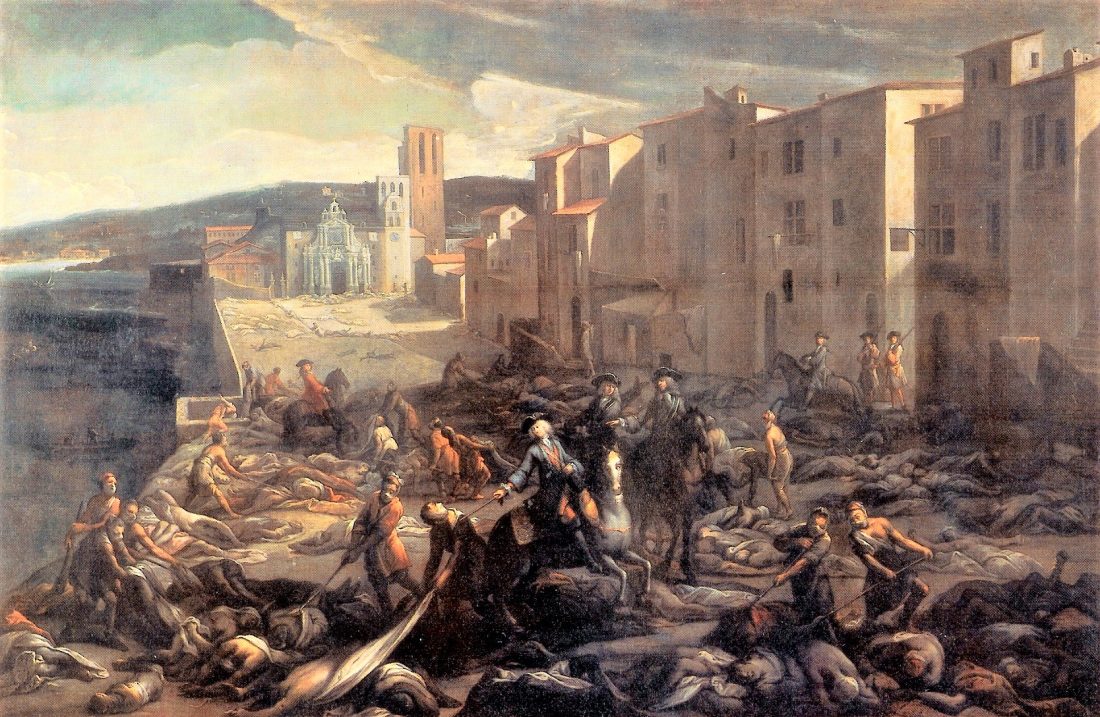
The free vintage image for today’s offering header of Scène de la pestede 1720 by Michel Serre, of the Great Plague of Marseille, is courtesy of Google Images. For more information about the Great Plague of Marseille, please see: https://www.sciendirect.com/science/article/pii/S0755498222000318, “History of the plague of 1720 – 1722, in Marseille”, Michel Signoli, et al.; September 2022. For more information about the Black Death (Black Plague) in Europe, 1347 – 1351, please see: https://www.britannica.com/event/Black-Death. Note that the article on the Britannica website mentions the fact that the strain of Yersinia pestis (Y. pestis) that caused the Black Death plague in Europe is the ancestral strain of all other plague events since then.
The word “plague” generate images of the Black Death (Black Plague, the Bubonic Plague) that swept through Europe in the mid-1300s. Of thousands of dead people on the streets. Of entire families wiped out in a few days. Of the cries of “Bring out your dead.” And the Black Death is only one example of how devastating the plague can be. There have been numerous other incidents of plague attack, such as the 1720 – 1722 event that struck Marseille, France. Today’s offering discusses a “new aspect” of the plague — of a certain element of it being used as a “vaccine” ingredient. For purposes of today’s offering, Yersinia pestis and Y. pestis are used interchangeably.
>>>>>>>>>>>>>>>>>>>>
Health Friday is a series devoted to information about Big Pharma, vaccines, general health, and associated topics. There are Important Notifications from our host, Wolf Moon; the Rules of our late, good Wheatie; and, certain caveats from Yours Truly, of which readers should be aware. They linked here. Note: AI-generated items in today’s offering will be cited as such. If readers wish to post AI-generated items in today’s discussion thread, they must cite their source. Thank you.
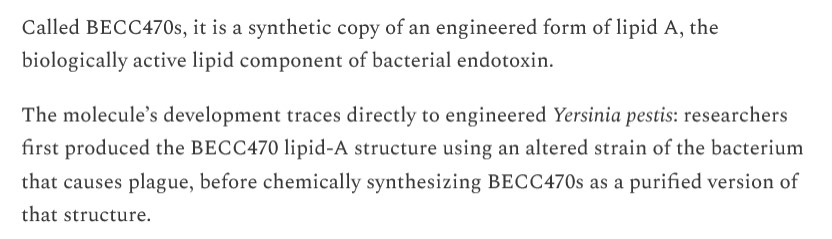
However, there are other types of adjuvants that are either now in use, or are being studied for use, in injectable drugs. One such use being studied is the subject of today’s offering: an Avian Influenza “vaccine” adjuvant derived from the Yersinia pestis bacterium (the Black Death, the Black Plague, and also known as the Bubonic Plague.) To repeat: an Avian Influenza “vaccine” adjuvant derived from the Yersinia pestis bacterium (the Black Death, the Black Plague, and also known as the the Bubonic Plague.) Yours Truly begins here, with an article by Jon Fleetwood: https://jonfleetwood.substack.com/p/hhs-funds-chimeric-bird-flu-pandemic, “HHS Funds Chimeric Pandemic Bird Flu Vaccine Made With Engineered Plague Derivative BECC470s: Journal ‘mSphere'”, 13 August 2026. Please see the screenshots from this article, below:
The paper referred to in the Fleetwood article is here: https://journals.asm.org/doi/10.1126/msphere.00171-26, “Optimizing an avian influenza vaccine using a novel Bacterial Enzymatic Combinatorial Chemistry (BECC) TLR4 adjuvant”, Robert K. Ernst, et al.; 10 July 2026. The research was funded primarily via HHS-NIH-NIAID-BAA2017/HHSN272201800043C; via other HHS-NIH-NIAID grants; and, the Center for Vaccine Development and Global Health (University of Maryland School of Medicine.) The work of one co-author, Devon Riley, was funded via the United States Army Long-Term Health and Education Training Program.
>>>>>>>>>>>>>>>>>>>>
What is BECC470? Please see: https://www.fromtiersin.org/journals/immunology/articles/10.3389/fimmu.2026.187218/full, “Licensed and investigational TLR4 agonists as vaccine adjuvants: Structural basis, clinical progress, and future directions”; Jiasheng Zhou, et al.; 16 July 2026. Note that, except for one co-author of this paper (who is associated with the Communist Chinese version of the CDC), all other co-authors are associated with research institutes in Wuhan, Communist China. A screenshot of section 3.2 of this paper, which describes BECC (Bacterial Enzymatic Combinatorial Chemistry) is below. There are two versions of BECC470: BECC470b (the biological form of the Y. pestis element in the adjuvant); and, BECC470s (the lab-created synthetic form of the Y. pestis element in the adjuvant):
BECC438, BECC470b, and BECC470s are all derived from the lipid A in Y. pestis.
It appears that there are three separate publications of the Robert K. Ernst, et al., paper: the 10 July 2026 paper in the ASM Journals, cited above; another publication, a day later in July 2026, in journal Vaccines (https://www.sciencedirect.com/science/article/pii/S02644-10X26005839), “BECC-adjuvanted hemagglutinin influenza vaccine promotes enhanced immunogenicity and protective efficacy”, Robert K. Ernst, et al.; 11 July 2026; and, a Biorxiv preprint version, published in March 2026 (https://www.biorxiv.org/content/early/2026/03/05/2026.03.03.709477.full.pdf, “Optimizing an avian influenza vaccine using a novel Bacterial Enzymatic Combinatorial Chemistry (BECC) TLR4 adjuvant”, Robert K. Ernst, et al.; 5 March 2026. All three of these publications appear to have same parameters: One, that Gain-of-Function experiments were performed with multiple strains of Avian Influenza and then injected into the lab mice; Two, there is no direct mention that BECC438, or BECC470b, or BECC470s, are derived from the lipid A of Y. pestis; and, Three, that BECC adjuvants are “superior” to the other types of adjuvants currently in influenza “vaccines.”
>>>>>>>>>>>>>>>>>>>>
Back to the article by Jon Fleetwood. Something caught Yours Truly’s eye: It appears that the lipid A portion of a certain strain of Y. pestis, called KIM6+, is the one that was chosen to lab-create BECC470b, which was then chemically engineered to create BECC470s. Please see below:
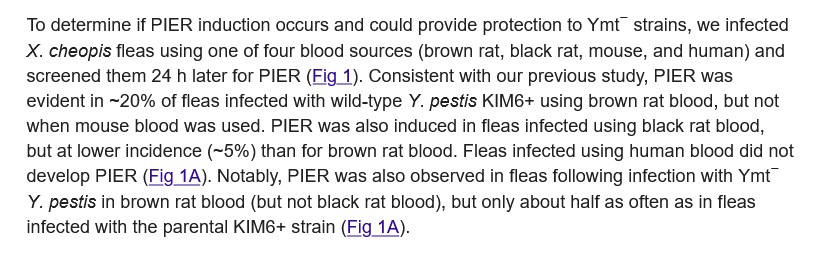
Yours Truly did some digging into KIM6+. The 2023 paper, which also has Robert K. Ernst as co-author, is here: https://www.cell.com/action/showPdf?pii=S2405-8440(23)05327-6, “Physiochemical characterization of biological and synthetic forms of two lipid A-based TLR4 agonists”, Robert K. Ernst, et al.; available online 8 July 2023. Another paper, from 2021, by Bland, et al., discusses the KIM6+ strain of Y. pestis and its infectivity: https://journals.plos.org/plospathogens/article?id=10.1371/journal.ppat.1009995, “Acquisition of Yersinia murine toxin enabled Yersinia pestis to expand the range of mammalian hosts that sustain flea-borne plague”, David M. Bland, et al.; 14 Octocer 2021. Please see below, from the Results section of this paper:
It appears that the KIM6+ strain of Y. pestis is one that has about 50% more capability to infect. And it is the KIM6+ strain that was chosen to lab-create BECC470b; and then to have that chemically engineered to lab-synthesize BECC470s — both of which can be used as vaccine adjuvants.
>>>>>>>>>>>>>>>>>>>>
Robert K. Ernst holds at least two US Patents related to the use of KIM6+-derived Y. pestis lipid A constructs that can be used as adjuvants in vaccines: US10358667B2, 7 January 2016, “Adjusted expiration” of 19 March 2034: and, US11124815B2, 21 September 2021, “Adjusted expiration” of 7 March 2034. Both Patents have the same Title (“Immunotherapeutic Potential of Modified Lipooligosacchardies/Lipid A”); the same Inventors (Robert K. Ernst, et al.); and the same Licenses and Options (Licensed to TollereBio Corporation [Robert K. Ernst], Optioned to Virtici, LLC.)
Reading through US10358667B2, one finds, for example, that a BSL-2 biosafety laboratory level is, apparently, sufficient to work with the KIM6+ lipid A of Y. pestis, and to lab-create BECC470 adjuvants from this bacterium; that BOTH the “biological version” of BECC470 (BECC470b) and the “synthetic version” of BECC470 (BECC470s) can be used as vaccine adjuvants; and, that the BECC470 vaccine adjuvants, per the Patent, section VIII. Use of ExemplaryLipooligosaccharide/Lipid A-based Mimetic Compositions: “…is [sic] useful for…” the following vaccines, among others, listed in the Patent:
measles, mumps, rubella (think MMR);
polio;
plague;
chickenpox;
HPV;
Hepatitis B (think newborn “vaccination” with this one);
pertussis;
tetanus;
and, shigella (Shingles)
And, in fact, Dr. Ernst is at work creating a shigella “vaccine” that includes BECC-engineered adjuvants: https://www.sciencedirect.com/science/pii/S0264410X25000763, “BECC-engineered live-attenuated Shigella vaccine candidates display reduced endotoxicity with robust immunogenicity in mice”, Robert K. Ernst, et al.; 19 March 2025. This paper appears, in Yours Truly’s opinion, to “dance around” actually mentioning the apparent use of Y. pestis-derived elements in the Gain-of-Function shigella “vaccine” that was administered to lab mice (administered using various methods, including intramuscular injection and gastric injection.) The paper does list various Patents that are “related” to the paper, including both US10358667B2 and US11124815B2 (discussed above in today’s offering.) The paper also lists the 2018 Ernst, et al., paper regarding the use of Y. pestis-derived BECC438 in a vaccine administered to mice: https://www.sciencedirect.com/science/article/abs/pii/S0264410X18307680, “A lipid A-based TLR4 mimetic effectively adjuvants a Yersinia pestis rF-V1 subunit vaccine in a murine challenge model”, Robert K. Ernst, et al.; 27 June 2018.
In Yours Truly’s opinion, this entire situation raises important questions, among them: One: Why is the United States government (via HHS / NIH / NIAID), and the United States Army, funding research into using any element of the plague bacterium in a drug of any type, let alone a drug that can be injected? Two: How is it possible that a BSL-2 level laboratory can be considered to have sufficient biosafety to work with any element of the plague bacterium? Three: Why was KIM6+, apparently one of the most deadly and infective lipid A elements of Y. pestis, used to lab-create BECC470b and BECC470s? And, Four: Is it possible to completely “de-nature” the deadly effects of any element of Y. pestis sufficiently for such element to be used as an adjuvant in vaccines?
Peace, Good Energy, Respect: PAVACA1
(Intellectual Property Disclaimer and Notice: Except for the linked URLs and other items available on the Internet, the ideas and/or opinions in today’s offering are by PAVACA1 (M.E. Forbes, aka M.E.C. Forbes.) Credit must be given to PAVACA1 if ideas and/or opinions in today’s offering are used by other blog writers; by podcasters; or in print or social media.)
Homeschooling is going great! #1 is turning into a rock star. Almost literally, as his music voice lessons are also paying off. He’s got talent and loves to sing for the Lord. We just need him to finish puberty and the voice change. At his annual physical his pediatrician decided it was time to be tested for food allergies, celiac disease, etc. to learn more about what we need to do to increase his weight. He is super skinny and not even on the weight chart for a 13 year old. What we learned was enlightening and reassuring.
Since handling all of his other issues including spinal alignment, vision, dyspraxia, schooling, etc.; we have been making marginal progress on his remaining two issues – weight/strength and sensory. The tests revealed he has zero food allergy issues, no evidence of celiac, and so on. As a baby and toddler he was somewhat lactose intolerant, but grew out of it. Fit as a fiddle. So being extremely underweight has not harmed his overall health and has led us back to what we have suspected and claimed as his primary health issue since birth – sensory. His finicky eating and food choices are directly related to sensory issues, which creates great anxiety. The anxiety causes the eye focal issues that resemble short term absence seizures, that are now making even him annoyed (good sign). No more guesswork, no more what ifs, no more sleepless nights trying to figure it all out.
It is time to focus entirely on what it is and how to remedy to the best extent possible. This process starts and ends with prayer and lifting him up to the Great Physician to help him be his best self to glorify Him. By our submission to His answers and will, #1 will be made whole in the image God wants him. Our role is to simply pay attention and do our parts as He leads us. Psalm 146:5, 6 tells us,
“Blessed is he whose help is the God of Jacob, whose hope is in the Lord his God,who made heaven and earth, the sea, and all that is in them, who keeps faith forever;“
Practically speaking we have noted that when he starts having excessive sensory related episodes he is in need of a spinal adjustment from the chiro, in particular in the cervical spine area of the neck. The chiro works him in quickly every time and his stress goes down immediately afterwards.
This discussion leads to our church breaking ground this week on its long planned Next Generation (Youth) Center that will provide a community center type place for children, youth and young adults to come and enjoy fellowship and training together. This will include long sought homeschooling group support. It will provide another much needed Pre-K/Parents Day Out school and program for our community. It will also serve as critically needed Sunday School and small group meeting space for our congregation.
This project was supposed to break ground in 2020. Then COVID hit. Then costs spiraled out of sight under Chyna Joe. Finally the ship was righted and we have arrived – the Lord provides within His timing, which is perfect. It all fits the needs of both #1 and #2 along with granddaughter. But not only them, it meets the need to use the gifts of teaching and service of Daughter to develop and love on children as well as my own recently discovered calling relating to homeschooling activities. Thank you, Jesus!
Now, For The Rest Of The Story
Don’t worry, the following is not just about geoengineering. However, it is a good place to start as you will learn. As a short reminder…
To beat an old horse, not a dead one, I have a simple question.
Who authorized these wannabe environmental terrorists to screw with nature and all life on this planet? Probably some of the same demons who executed the great COVID caper that is killing million worldwide. I am quite sure the God of Creation is not amused.
The first glaring evidence that geoengineering is a real concern is that the usual subjects dismiss consideration and relegate it to conspiracy status. This attitude occurs within the related scientific academia, media, research, application, manufacturing, distribution and environmental restoration of the various industries making money off of it; from which the elected and unelected authorities gain power and influence. That creates major red flags!
🚩🚩🚩
You always see defenses, rationalizations, and excuses instead of challenges to the related narratives of the day. The activities are represented as “settled science” and soft pedaled by media lackeys; that is until the truth is revealed. We also know why they do what they do – money and power. Jeff Childers had a good recent article on the six step process associated with the liars of science doing what they do as the process works its eventual way toward revealed truth.
Since chemtrails and such were banned in Tennessee a couple of years ago interesting things have happened. It was like walking up to a big switch and flipping it. For the past couple of years we have become much more predictable on temps and precipitation; less radical fluctuations. The blue skies and clouds are back to normal and can be quite magnificent to observe at times during out daily fitness walks. It is like the environment has exhaled a giant sigh of relief.
Animal life abounds again. We are back to seeing deer wander about as well as watching out for bear in our strolls in our rural community. Have not seen them in this manner for a couple of decades. The wild turkey have become obnoxious along the backroads. Flocks of various birds have returned big time while nesting for longer periods well into the summer, not just for a brief period in early spring. This has helped keep the insect population under control. During our walks it can get quite amusing as the birds dive bomb us in their attempts to “steer” us away from their nests.
Most importantly and a great indicator of the before and after effects of geoengineering; the feared demise of the honey bees population has disappeared. They were greatly impacted by the spraying. Now, anything that has flowers has bees everywhere you go. There is a crescendo of bee buzzing sounds in every patch. More and more area residents are taking up beekeeping as a hobby. The local senior center has a program with brood boxes for the hives and is teaching seniors how to do it on their properties while sharing the product with seniors at the center. In general, I have not seen grass, shrubbery and trees this green this time of year for 30+ years. The farmers markets have been booming with great local produce.
Despite the explosion of pollen related allergens that come with the improvements, wifey and I no longer experience miserable reactions that forced us inside during this time of year. Improved gut health may be part of the reason, however, there is no question that living in a cleaner, more natural environment is contributing greatly.
Post Helene
For those traveling Interstate 40 at the TN/NC border through “the gorge”, there is a planned late 2027 reopening of the fully rebuilt section destroyed by the flooding effects of Helene. According to federal highway officials it is the largest in scope and most expensive project of its type in our nation’s history. Picture in your mind a 12 mile long dam being constructed to endure whatever gets thrown at it short of a nuke or direct meteor hit.
😄
Presently one side is still used as a lower speed, two lane road with larger sized tractor trailer rigs being prohibited and rerouted. It will be a few more years before all of the Helene related road infrastructure in the area will be rebuilt.
Now where were those large lithium deposits located again? Who purchased the related properties and rights?
Which properties did the leftist controlled City of Asheville file imminent domain to take or acquire by other means at depressed prices to do repairs and long desired infrastructure while using federal grants and FEMA funding? Have doubts? It is in the City’s minutes. Even AI discusses the property acquisitions. An example is below,
Nah, the Dem crims would have no reasons or ability to enhance a lower Gulf of America tropical depression less than two months before a strongly contested general election for POTUS and Congressional seats by negatively impacting two southern states that could swing said elections through mail-in ballots and conservative voter suppression. sarc/
I am sure it is just a coincidence that the massive number of recon flights in the southern Caribbean before the tropical disturbance even became a tropical storm included not only NOAA Hurricane Hunter planes, but also the Air Force Reserves. sarc/
Go to Figure 6 a little over halfway into the report below to see for yourselves.
Trust me, that amount and related patterns of flights do not appear or discussed in other archived reports anything like Helene’s. Ask yourselves why the NOAA Hurricane Hunters and Air Force Reserves would be flying that close to the Mexican, Honduran, and Guatemalan coasts for an undeveloped, routine tropical depression? That is not something that is typically done. Not only did the flights cross into the airspace of those nations, they also crossed over communist enemy Cuba and its airspace. These flights happen to be around and over the same countries that were sending their drug cartel crud, trafficked kids, thugs, and other assorted deadbeats across our southern border by the millions. All of it being authorized by Dem controlled government actors to supposedly recon a tropical depression a thousand miles away from our coastline a crazy number of times, a storm that grew and made its way to landfall at the Big Bend in FL.
Now which related military and federal agency leaders have been terminated or forced into retirement in the past 18 months?
But nah, move on, nothing to see here. Yeah, ok.
You gotta keep digging and asking questions long after the fake media and general public interest is gone to find the truth. We learned that up front and personal locally with the Great Smoky Mountains Fire a decade ago, whose effects are still felt. But let’s take it a step farther. Some of us were around for the Vietnam War days. We know much of what our military did to the environment there to root out the enemy- the burnouts, Agent Orange, etc. If you do not know, simply use your search engine. The methods have likely been used here as well. It is not a conspiracy theory to be explained away as the facts are the methods have been used before over 50 years ago. Here is just one exposé from a declassified document from 1970.
Rather sobering to consider, don’t you think? Now, about all those western U. S. wildfires…
Ground Report
Shifting gears, I like to give an east TN ground report this time of year. Average Americans, mostly MAGA types, come here in droves to the land of Dolly, mountains, lakes, and bears. So far the total visitation is down slightly due primarily to fuel and food costs. Tourists have been coming as usual, just staying for shorter visits due to higher costs. As a result it has been somewhat easier to travel around the area than usual for this time of year. Add in the obvious decrease in hispanic population. Subject to the Iran War ending, the rebound of empty nesters and leafers visiting will be really strong this fall.
As stated the hispanic population has been greatly reduced in the public eye. Don’t know if they are still in hiding or have left. The Honduran vape and smoke shop center of drug trafficking and FedEx delivery fame from my previous dailies is still closed. Local law enforcement has gone silent over the incidents, however, our family friend is elated that there have been no surprise pallets of “products” from Honduras being delivered to her driveway lately. We can only surmise that the misdirects accomplished the intended purposes of the federal authorities, such as ATF and ICE, that may have been arranged to corral the traffickers. We do note the questionable contract FedEx delivery person from the last event is no longer making deliveries in the area. Funny, that.
Employment is still strong with rising wages. Less people working in stores and restaurants, yet, generally well trained and better performers to offset. Many more older workers than in the past. It appears there are many who “retired” to this area are picking up some income being employed at least part-time. Industrial and residential construction is everywhere. The residential projects are primarily the national D. R. Horton spec plain box type – basically – tract housing. Grab some land, get the approvals, send in the excavation and road building crews, slap up 50-150 houses as quickly as possible and move on. Some better built apartment and condo complexes are underway or recently completed in the area as well. Other than automotive related, most of the industrial growth is tied to the federal facilities and related contractors in Oak Ridge. The new nuclear power plant there is under construction. When complete it will easily be enough to supplement the growth for the federal reservation and essential operations along with an AI expansion.
Marsha and team got it done in the primary for governor despite not having much time to campaign due to her Senator duties. She will win the general easily, probably by around 30 points. She will also keep the conservative train rolling smoothly down the tracks in TN as she has been a noted GOP operator behind the scenes for decades. Based on recent interviews, all will be well under her watch and may actually be improved from a conservative wish list perspective.
The GOP will have her replacement at Senator lined up ready to go, but ultimately it will be Marsha’s choice. Tim Burchett is a solid contender and if selected the “dadgum” Club Senate will never be the same once he gets done with it. Marsha and Tim go back a lot of years to their state senator days and are good friends. There are some solid MAGA House replacement options to replace Tim if she does pick him. TN would then have the polished, internationally experienced Bill Hagerty to go with a man of the people as our Trump endorsed Senators. Tim is the same former small business owner hillbilly, who as County Mayor ran the state’s third most populated county’s government better than it ever had for eight years with zero tax increases and balanced budgets annually during the period. Hope it happens.
For what it is worth, Trump supporting House Rep Andy Ogles lost because he is a bit too brash for some folks in his district, the GOP machine trotted out well respected Charlie Hatcher as his opponent, and because TN has open primaries. The Dems showed up to vote against Andy to push Charlie over the top. So, Charlie Hatcher it is and he will win the general. He had the endorsement of current Governor Lee (MAGA lite). The good news is he has been the state Dept. Of Agriculture Commissioner for 6 years under Lee, so he knows how government works. He is a dairy farmer who can help USDA with practical experience. He is strongly pro Trump, pro guns, pro life. He will vote how the Speaker tells him to vote. No worries, just not a change agent.
In closing: John 8:32 – “And you will know the truth, and the truth will set you free.” (ESV)
This Rejoice & Praise God Sunday Open Thread, with full respect to those who worship God on the Sabbath, is a place to reaffirm our worship of our Creator, our Father, our King Eternal.
It’s also a place to read, post, and discuss news that is worth knowing and sharing. Please post links to any news stories that you use as sources or quote from.
In the QTree, we’re a friendly and civil lot. We encourage free speech and the open exchange and civil discussion of different ideas. Topics aren’t constrained, and sound logic is highly encouraged, all built on a solid foundation of truth and established facts, and not by agenda-driven accusations and pronouncements.
We have a policy of mutual respect, shown by civility. Civility encourages discussions, promotes objectivity and rational thought in discourse, and camaraderie in the participants – characteristics we strive toward in our Q Tree community.
Please show respect and consideration for our fellow QTreepers. Before hitting the “post” button, please proofread your post and make sure your opinion addresses the issue only, and does not confront or denigrate the poster. Keep to the topic – avoid “you” and “your”. Here in The Q Tree, personal attacks, name-calling, ridicule, insults, baiting, and other conduct for which a penalty flag would be thrown are VERBOTEN.
In The Q Tree, we’re compatriots, sitting around the campfire, roasting hot dogs, making s’mores, and discussing, agreeing, and disagreeing about whatever interests us. This board will remain a home for those who seek respectful conversations.
God is in Control . . . and His Grace is Sufficient, so . . . Keep Looking Up
Hopefully, every Sunday, we can find something here that will build us up a little . . . give us a smile . . . and add some joy or peace, very much needed in all our lives.
“This day is holy to the Lord your God; do not mourn nor weep.” . . . “Go your way, eat the fat, drink the sweet, and send portions to those for whom nothing is prepared; for this day is holy to our Lord. Do not sorrow, for the joy of the Lord is your strength.”
One Nation . . . Blessed
In Western nations, America especially, we can see the Bible’s influence on many aspects of society. Everything from our laws to our work ethic to our view of marriage has been molded by a Judeo-Christian worldview. It has always been the case that the Word of God makes a difference in cultures where it is introduced. In first-century Thessalonica, a mob dragged some Christians through the streets shouting, “These men who have turned the world upside down have come here also” (Acts 17:6, ESV). It is only right that the Bible should have an influence on society, as it has an influence on the individuals within society.
God is the Creator of the world and the humans who inhabit it (Genesis 1). From the very beginning, God designed the world and people to “function” a certain way. When society doesn’t follow the principles that God gives us in the Bible, life simply doesn’t work as well. God’s the only One with the insight into how life functions to our best benefit, and He shares that wisdom with us in His Word. The Bible is described in Hebrews 4:12 as “alive and active.” This means, in part, that the Bible is as applicable and relevant today as it was when it was first written.
Looking back at the early stages of America, it is impossible not to see the influence the Bible had. Our government structure, laws, morality, education, and family values were all founded on principles that came directly from the Bible. The Founding Fathers, Presidents, and foreigners visiting a young America identified the key to the nation’s success as the biblical influence embraced by its society. When a nation honors God, it develops a respect for all of God’s creation. Where there is no honor of God, a society will fail to respect His creation, and people will suffer as a result.
From the beginning, people have had a choice whether to follow God’s way. But choices always carry consequences. The Old Testament history of Israel documents the societal laws and precepts God gave them. When Israel lived by God’s laws, their society functioned well, but when they deviated from God’s design, their society always went downhill. Attempts today to remove the Bible’s influence from society or to marginalize a biblical worldview reveal the pride of mankind that says, “We know better than the One who created us.”
None of this is to say that we should establish a theocracy such as ancient Israel had. God’s purposes in that system of government were for a certain time and place. However, when the Bible is properly understood, its influence on society can only lead to less crime, less divorce, less sloth, and more charity. As John Adams, the second President of the United States, wrote, “Suppose a nation in some distant Region should take the Bible for their only law Book, and every member should regulate his conduct by the precepts there exhibited! Every member would be obliged in conscience, to temperance, frugality, and industry; to justice, kindness, and charity towards his fellow men; and to piety, love, and reverence toward Almighty God . . . What a Eutopia, what a Paradise would this region be” (Diary and Autobiography of John Adams, Vol. III, p. 9). Scripture says it best: “Blessed is the nation whose God is the Lord” (Psalm 33:12).
At all times, remember.
THIS [The QTree] is a House of the Lord.
NEVER be afraid to speak His name.
Post about God – comments or articles – whenever and wherever you desire. FEAR NOT. God is with us, because we make sure He is WELCOME.
Wheatie Wisdom. If you bring snacks, bring enough for everyone. No running with scissors. No food fights. AI stuff posted, requires a link. Please use spoiler, for longer posts. Wolf Speak. No obnoxious behavior towards fellow QTreeper(s). Freedom of Speech is honored here QTree. But Do Know, every poster, IS personally responsible for what they post.
February 2021 marks the clear inflection. The rate of increase shifted to a new, steeper trajectory, a 3-to-4 sigma departure from the prior trend. In the years since, the survey has added seven million people. Growth of that magnitude in a mature population is not normal aging, not “long COVID” in isolation, and not some gradual sociological shift. It was sudden. It has persisted. And it continues to be treated as background noise by the same public health authorities who spent years obsessed with every other metric.
Let me address the predictable objections, because they surface every time these numbers are posted. First: “It’s just fraud. People are gaming disability benefits.” That claim collapses under basic scrutiny of the data source. This is not Social Security Disability Insurance claims. It is not SSDI awards, which lag, require medical determinations, and are subject to administrative backlogs and incentive effects. This is the Current Population Survey, the same monthly household survey that produces the unemployment rate and labor-force participation numbers. Roughly 60,000 households are contacted each month. Six simple questions are asked about serious difficulty hearing, seeing, concentrating/remembering/making decisions, walking or climbing stairs, dressing or bathing, and doing errands alone. Any “yes” classifies the person as having a disability for statistical purposes.
I laid this out in detail years ago in threads that are still easy to find. The series is real-time, not claims-driven, and has nothing to do with benefit eligibility. The questions have been consistent since 2008. Response patterns do not suddenly invent millions of new disabled respondents because the political winds shifted. When the same survey that markets, banks, and the Federal Reserve rely upon for labor-market signals produces a multi-year, multi-sigma break in disability prevalence, the responsible reaction is investigation, not dismissal.
Second: “It’s illegal aliens flooding the numbers.” This one is equally weak. Undocumented immigrants have long been known to under-respond or avoid government surveys altogether out of fear of detection, deportation risk, or general distrust of authorities. They are not lining up to answer detailed questions about household members’ health limitations over the phone or in person. If anything, the survey systematically undercounts this population relative to reality. The sharp, sustained rise in reported disability began in February 2021, well before the largest recent surges in border encounters, and has continued in a manner inconsistent with simple demographic inflows. The data do not support the claim that the disability spike is an artifact of illegal immigration.
Public health agencies and the media have largely ignored the signal. There has been no serious, transparent inquiry into why the disability rate changed slope so sharply in early 2021 and has remained elevated. Temporary explanations such as COVID itself, lockdowns, mental-health effects of isolation all fail the timing and magnitude tests. The virus was already circulating in 2020 without producing this sustained break. The sharpest acceleration aligned with the mass rollout and subsequent workplace mandates. Correlation is not causation; we are constantly reminded. Fair enough, but when a novel medical intervention is administered to hundreds of millions of working-age adults on an accelerated timeline, and the independent, high-frequency survey of population health then records a multi-sigma regime change precisely then, the burden of proof shifts. Authorities who spent years demanding every other correlation be investigated suddenly lose interest.
The economic implications are not abstract. More than 37 million people reporting disability means a permanently larger share of the population facing barriers to full participation. Labor-force participation among the disabled remains far lower than among those without disability. Employers face higher absence rates and higher costs. Insurance pools absorb elevated claims. The fiscal pressure on entitlement programs grows even if this particular survey is not the claims pipeline. All of it is occurring against a backdrop of demographic aging that was already expected to raise disability prevalence gradually but not at the abrupt rate observed since early 2021.
I have posted the charts for years: total population 16+, the civilian labor force subset, men, women, employed versus not. The pattern is consistent. Rate-of-change moderation appears occasionally, then another leg higher. The February 2021 inflection remains the defining feature. A 3-to-4 sigma shift in trend is not something serious analysts discard. It is the kind of signal that, in any other domain…markets, epidemiology, engineering…would trigger immediate forensic review.
Health authorities have chosen another path. The data continues to accumulate. The total population survey keeps printing higher numbers. The questions asked of households have not changed. The methodology is the same one used for the official employment statistics that move markets every month. Yet the disability series is treated as an inconvenience rather than a red flag.
The conclusion from the data is straightforward. The timing, the magnitude, the concentration among the previously healthy working age population, and the failure of alternative explanations all point to the COVID vaccine campaign as one of the primary driver of the excess disability. That is the assessment I have maintained as the numbers have updated. Ignoring a sustained, multi-sigma break in a core government survey does not make the break disappear. It only guarantees that the consequences continue to compound while institutions look the other way.
The July 2026 print at 37 million is simply the latest confirmation. The trend that began in February 2021 has not been explained by health authorities, has not been investigated with appropriate rigor, and has not been reversed. Until that changes, the data will keep speaking whether anyone in authority cares to listen or not.
Through my piss poor administrative skills, Slow Guy lost the link. Good news, Google will have it via basic search.
—
ht Wolf.
A few days back, Wolf posted this video. To REFRESH our memories, of the Covidiot nightmare we lived through.
100% well worth revisiting The J A B S.
Inside mRNA Vaccines – The Movie
The Bastards Have Doubled Down.
14 of 15 Must Go.
R E S I S T We Must!
—
Trump sparing lives on all sides… (Bonus. Conserving high tech ordnance.)
Trump is Using “Siege Tactics” on Iran
POTUS is perfectly content in our current position. He is utilizing a modern day version of siege tactics.
Rather than utilizing ground troops and mass casualties, he neutralized Iran from range, surrounded them, cut off their imports/exports, and is squeezing them economically.
So for those saying nothing is happening, or that Trump needs to hurry up, that we need a full-scale invasion, etc., you need to understand the approach. Trump is saving countless lives, while restructuring the global flow of energy, and waiting for Iran to collapse economically.
The only thing Iran have going for them, is that their handlers also control the US/Global media. Iran and global media, are both assets of the transnational criminal organization, known as the Deep State.
As Trump highlights below, “all they have is FAKE NEWS”. This is the only arrow left in their quiver, so to speak. Their only way to fight back is on the information battlefield, because they have already been destroyed on the kinetic battlefield. All they can do is try to convince the American People that Trump is a failure, the US MIL are losing, Iran is awesome, yada yada yada.
Health Friday is a series devoted to information about Big Pharma, vaccines, general health, and associated topics. There are Important Notifications from our host, Wolf Moon; the Rules of our late, good Wheatie; and, certain caveats from Yours Truly, of which readers should be aware. They are linked here. Note: AI-generated items in today’s offering will be cited as such. If readers wish to post AI-generated items in today’s discussion thread, they must cite their source. Thank you.
In Yours Truly’s opinion: Dr. Anthony Fauci; Dr. Rochelle Walensky; and, Dr. Vivek Murthy — all knew what they were doing in privately recognizing to each other that the modRNA COVID-19 bioweapon “vaccines” were dangerous to pregnant women; to the child they were carrying; and, that these “vaccines” could cause the death of the fetus in a “vaccinated” pregnant woman: while, at the same time, each of them were stating that these same “vaccines” were “safe and effective”, and that they would not pose harm to a pregnant woman or to her unborn child. There is no excuse for, no “qualifying explanation” for, no running away from, the fact that the lies these three physicians spread resulted in the miscarriage — the stillbirth — the death inside the womb, of thousands of babies due to the their expectant mothers getting COVID-19 “vaccinated.” The miscarriages — stillbirths — deaths of these children are on their hands.
The Shimabukuro, et al., paper of April 2021, attempted to gloss over the dangers of the COVID-19 bioweapon “vaccines” to pregnant women (https://nejm.org/doi/full/10.1056/NEJMoa2104983, “Preliminary Findings of mRNA Covid-19 Vaccine Safety in Pregnant Persons”, Tom Shimabukuro, et al; April 2021. At the time this paper was published, Dr. Shimabukuro was the director of the Immunization Safety Office of the CDC. Please see the screenshot of the “Results” section of the Abstract from the original April 2021 paper; followed by the screenshot of the “Correction” version of the same “Results” that was published on 8 September 2021:
However, neither the original Shimabukuro, et al., paper, nor the “corrected” paper, apparently mention the fact that, of the 3958 reported pregnancies in COVID-19 bioweapon “vaccinated” women (“pregnant persons”), only 827 pregnancies were “completed.” Which leaves 3,131 reported pregnancies that were NOT “completed” in these “vaccinated” women; in other words, about a 79.2% non-completed pregnancy rate in these “vaccinated” women — not the 12.6% negative pregnancy outcomes rate stated in the paper.
Yours Truly now turns to US9884859B2, the Patent granted in October 2015 to Dr. Ralph Baric, PhD, of the University of North Carolina, Chapel Hill, for his “invention” of the “template virus” for SARS-CoV-2. The following screenshots, below, are from this Patent: the Title and Dates Summary; the Figure 1; the paragraph from the Detailed Description of the Invention regarding the use of subgroup 1a-type viruses in the “invention”; the citations from the Patent for viruses used in the subgroup 1a section on the Figure 1 “virus tree chart”
Look at the phrase from the paragraph regarding subgroup 1a viruses that can be used in Dr. Baric’s “invention”: “…, as well as any other subgroup 1a coronavirus now known (e.g., as can be found in the GenBank (R) Database or later identified, and any combination thereof.” This means that ANY subgroup 1a-type of coronavirus can be used in the SARS-CoV-2 “template virus” that Dr. Baric “invented.” How does this tie into the miscarriages, the stillbirths, the live births of infants who are weak / low weight, and so on, to expectant mothers who were “vaccinated” with a COVID-19 bioweapon “vaccine”? First: Yours Truly believes that Dr. Ralph Baric shared information contained in US9884895B2 with Dr. Zheng-li Shi of the Wuhan Institute of Virology (as she was working on various coronaviruses, including SARS-CoV); and/or, he shared samples of certain subgroup 1a viruses with Dr. Shi. Second: Yours Truly believes that US9884895B2 was the “template virus” for SARS-CoV-2 “foundation” that ultimately became the “modRNA” (aka “mRNA”) used in the COVID-19 bioweapon “vaccines.” Regarding the citation in the Patent above, about Porcine Respiratory and Reproductive Virus (also called Porcine Reproductive and Respiratory Syndrome), please see the following screenshot from this website: https://www.merckvetmanual.com/generalized-conditions/porcine-reproductive-and-respiratory-sundrome/porcine-reproductive-and-respiratory-syndrome:
Regarding the Figure 1 of the Patent, please refer to the “1a” portion of the “virus tree.” There are three viruses listed: FCoV (Feline coronavirus); TGEV (Transmissible Gastroenteritis virus [swine]);, and, PRV (Pseudorabies virus [swine].) Please see the screenshot about PRV, below, from this website: https://merckvetmanual.com/nervous-system/pseudorabies/pseudorabies-in-pigs:
Why was Dr. Baric including at least two viruses that cause reproductive failure in swine in his Patented “template virus” for SARS-CoV-2 “invention” — Porcine Reproductive and Respiratory Virus (PRRV, aka PRRS); and, Pseudorabies virus (PRV)? Why was Pseudorabies virus (PRV) the only one listed on Fig. 1 from the Patent US9884895B2, unless this entire “virus tree” graphic is only listing examples of the various subgroup viruses that could be utilized in Dr. Baric’s Patent “template virus” for SARS-CoV-2 “invention”?
Yours Truly turns to one final item: Page 8 of the Pharmacokinetics Tabulated Summary report on BNT162b2 (COMIRNATY) given to the FDA by Pfizer-BioNTech in 2021 (https://icandecide.org/wp-content/uploads/2022/03/125742_S1_M2_26_pharmkin-tabulated-summary.pdf. Look at the BNT162b2 accumulations (assisted by the ALC-0159 and ALC-0315 lipid nanoparticles in this “vaccine”) in the Ovaries (12.3) and in the Uterus (0.456) in the Wistar lab rats.) [Note: this is aside from the fact that the COVID-19 bioweapon virus itself, as “invented” by Dr. Baric, has these two female fertility and pregnancy killers included in it — meaning that a female of childbearing age could, in theory, become infected with the virus itself, recover, but potentially have problems in terms of conception, carrying the fetus through pregnancy, and delivering a healthy child. The difference here, in Yours Truly’s opinion, is that if the female is non-COVID-19 bioweapon “vaccinated”, that person still has a relatively intact natural immune system to help fight off the virus itself and its negative effects. A “vaccinated” female’s natural immune system is damaged or destroyed by the COVID-19 bioweapon “vaccines” that she took. The mechanism of these “vaccines” is to induce a constant state of “fake COVID-19 virus infection” in the “vaccinated” persons’ body. In addition, the lipid nanoparticles ALC-0159 and ALC-0315 (in the Pfizer-BioNTech “vaccines”); and, the SM-102 (in the Moderna “vaccines”) move the ingredients of these injectables into every cell in the “vaccinated” person’s body.)] Page 8 is below:
Now, tie these accumulations in with the information above regarding the inclusion of at least two types of swine virus that cause reproductive failure (PRRV, aka PRRS; and, PRV) into Dr. Baric’s “template virus” Patent for SARS-CoV-2, US9884895B2. To Yours Truly, the combination of these inclusions; plus, the documented accumulations in the ovaries and the uteruses of the Wistar lab rats injected with BNT162b2 (COMIRNATY); and which version, by the way, was the same version for which the FDA granted the initial EUA for use in the United States on 11 December 2020, and which version is still the “foundational version” still used in all “descendant versions” of COMIRNATY since then; plus, the documented reports of miscarriages — stillbirths — live births with weak and/or low weight infants, involving pregnant females who were injected with modRNA COVID-19 bioweapon “vaccines”: all add to up something that is not a “coincidence.” It is, instead, a situation that cannot be ignored or minimized. It is, instead, a situation that must be fully investigated by the highest levels of government. In Yours Truly’s opinion: Pfizer-BioNTech; Moderna; and, Novavax, MUST be compelled to disclose the EXACT ingredients of the modRNA in their respective COVID-19 bioweapon “vaccines”, the AMOUNTS of these ingredients, and the EXACT formulations of their respective COVID-19 bioweapon “vaccines.” In addition, the above manufacturers MUST be compelled to disclose any and all communications with Dr. Baric regarding US9884895B2, and the use of any of the information in that Patent in their respective COVID-19 bioweapon “vaccines” formulations and manufacture.
THE USE OF ANY COVID-19 BIOWEAPON “VACCINE” ON PREGNANT FEMALES, AND ON FEMALES OF CHILDBEARING AGE, MUST STOP IMMEDIATELY.
Peace, Good Energy, Respect: PAVACA
(Intellectual Property Disclaimer and Notice: Except for the linked URLs and other items available on the Internet, the ideas and/or opinions in today’s offering are by PAVACA (M.E. Forbes, aka M.E.C. Forbes.) Credit must be given to PAVACA if ideas and/or opinions in today’s offering are used by other blog writers; by podcasters; or in print or social media.)
This Rejoice & Praise God Sunday Open Thread, with full respect to those who worship God on the Sabbath, is a place to reaffirm our worship of our Creator, our Father, our King Eternal.
It’s also a place to read, post, and discuss news that is worth knowing and sharing. Please post links to any news stories that you use as sources or quote from.
In the QTree, we’re a friendly and civil lot. We encourage free speech and the open exchange and civil discussion of different ideas. Topics aren’t constrained, and sound logic is highly encouraged, all built on a solid foundation of truth and established facts, and not by agenda-driven accusations and pronouncements.
We have a policy of mutual respect, shown by civility. Civility encourages discussions, promotes objectivity and rational thought in discourse, and camaraderie in the participants – characteristics we strive toward in our Q Tree community.
Please show respect and consideration for our fellow QTreepers. Before hitting the “post” button, please proofread your post and make sure your opinion addresses the issue only, and does not confront or denigrate the poster. Keep to the topic – avoid “you” and “your”. Here in The Q Tree, personal attacks, name-calling, ridicule, insults, baiting, and other conduct for which a penalty flag would be thrown are VERBOTEN.
In The Q Tree, we’re compatriots, sitting around the campfire, roasting hot dogs, making s’mores, and discussing, agreeing, and disagreeing about whatever interests us. This board will remain a home for those who seek respectful conversations.
God is in Control . . . and His Grace is Sufficient, so . . . Keep Looking Up
Hopefully, every Sunday, we can find something here that will build us up a little . . . give us a smile . . . and add some joy or peace, very much needed in all our lives.
“This day is holy to the Lord your God; do not mourn nor weep.” . . . “Go your way, eat the fat, drink the sweet, and send portions to those for whom nothing is prepared; for this day is holy to our Lord. Do not sorrow, for the joy of the Lord is your strength.”
Is God Silent?
In answering this question, we are reminded of Elijah and his flight from Jezebel. Elijah was a man of God whom God used to do some mighty things. However, when word reached him that Jezebel had threatened his life, he ran (1 Kings chapter 19). Elijah prayed to the Lord and in effect complained about how he was being treated: “He replied, ‘I have been very zealous for the Lord God Almighty. The Israelites have rejected your covenant, torn down your altars, and put your prophets to death with the sword. I am the only one left, and now they are trying to kill me too’” (1 Kings 19:10). The Lord’s answer to Elijah is thrilling: “The Lord said, ‘Go out and stand on the mountain in the presence of the Lord, for the Lord is about to pass by.’ Then a great and powerful wind tore the mountains apart and shattered the rocks before the Lord, but the Lord was not in the wind. After the wind there was an earthquake, but the Lord was not in the earthquake. After the earthquake came a fire, but the Lord was not in the fire. And after the fire came a gentle whisper” (1 Kings 19:11-12).
We see in this passage of Scripture that what Elijah thought was not true. Elijah thought God was silent and that he was the only one left. God was not only “not silent,” but He had an army waiting in the wings so that Elijah was not alone: “Yet I reserve seven thousand in Israel—all whose knees have not bowed down to Baal and whose mouths have not kissed him” (1 Kings 19:18).
In our walk as born-again believers, it may seem that God is silent, but God is never silent. What looks like silence and inactivity to us is God allowing us the opportunity to listen to “the still small voice” and to see the provisions that He has made for us by faith. God is involved in every area of a believer’s life–the very hairs on our heads are numbered (Mark 10:30; Luke 12:7). However, there are times when we have to walk in obedience to the light that God has given us before He sheds more light on our path, because in this age of grace God speaks to us through His Word.
“‘For my thoughts are not your thoughts, neither are your ways my ways,’ declares the Lord. ‘As the heavens are higher than the earth, so are my ways higher than your ways and my thoughts than your thoughts. As the rain and the snow come down from heaven, and do not return to it without watering the earth and making it bud and flourish, so that it yields seed for the sower and bread for the eater, so is my word that goes out from my mouth: It will not return to me empty, but will accomplish what I desire and achieve the purpose for which I sent it’” (Isaiah 55:8-11).
Therefore, when God seems silent to us as born-again believers, it may mean that we have stopped listening to His voice, we have allowed the cares of this world to plug our spiritual ears, or we have neglected His Word. God does not speak to us today in signs, wonders, fire, or wind. His Spirit speaks to us through the Word, and in that Word we have the “words of life.” xhttps://www.gotquestions.org/God-silent-absent.html