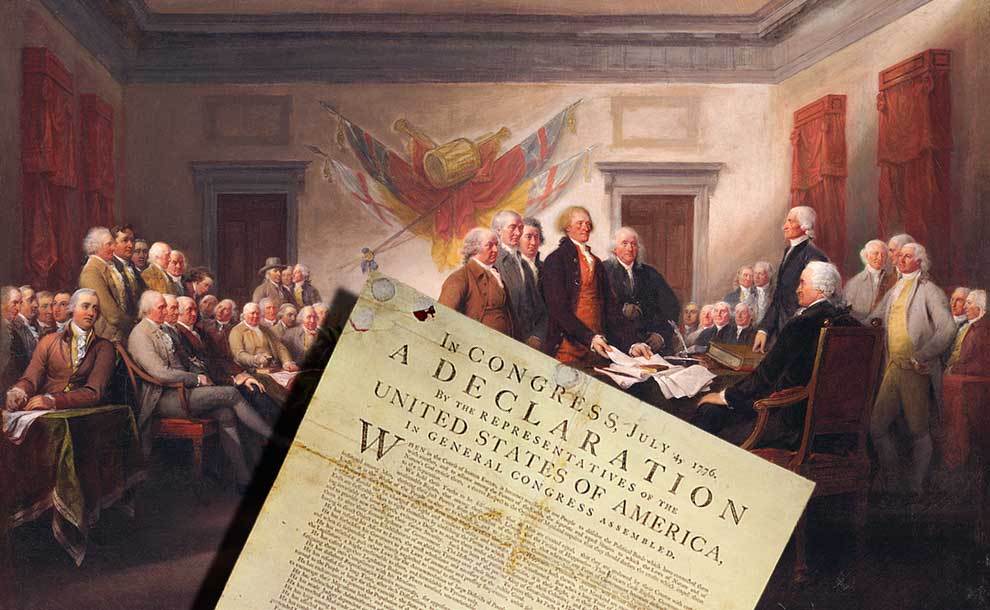
American Stories: When in the Course of human events – Part 8

Stories about the signing of the Declaration of Independence and the Revolutionary War period would not be complete without a discussion about one of greatest speeches ever made in a public setting by an American colonist. Yet, it was made by a leader who refused to sign the Declaration as he was fearful that signing it or the Constitution would lead to a central government that overrode the rights of the states.

His fears were eventually realized.

Give Me Liberty, or Give Me Death!

Patrick Henry will be forever known as a major influencer and leader for independence. He was born in 1736 and raised in Hanover County, VA. His father was a farmer who was college educated in Scotland. Patrick was educated primarily by his father at home. He tried and failed to be a store keeper and a planter. He finally found employment as a tavern keeper for his father-in-law and began to study law. He progressed to being able to open his own law practice in 1760.

His first major legal case was called Parson’s Cause in 1763. It became a major issue that helped fuel the patriot cause. We might consider it trivial today, but back then it was a big deal. The ministers of the Church of England in VA were paid their annual salaries with tobacco. There had been a drought in the 1750’s that had reduced the crop yields and caused a shortage that drove up prices. So the VA legislature passed a bill that set the salary at two pennies per pound of tobacco rather than at the drought affected current price of six pennies per pound. The clergy appealed to King George III who overturned the law and encouraged the clergy to sue for damages.

Patrick Henry was a somewhat unknown attorney representing Virginia. He delivered a passionate speech and answer to the King’s actions claiming Crown overreach. He left little doubt about his and the state’s position with, “that a King by annulling or disallowing acts of so salutary a nature, from being Father of his people degenerated into a Tyrant, and forfeits all rights to his subjects’ obedience.”

It was clear at this point that Patrick Henry had found his voice and his calling as a patriot. His contemporaries said he spoke with the authority of the Great Awakening pastors from previous decades.

When the Stamp Act was passed on to the colonies that forced them to pay a tax on every piece of paper they used, the colonists reacted bitterly. Henry led the VA legislature into a series of “resolves” that rejected taxation without representation. This led to one of the most famous speeches in American history in March 1775 at St. John’s Church in Richmond in the Second Virginia Convention. The Virginia House was undecided on whether to organize for military action against the encroaching British army. Henry argued in favor of mobilizing for war.

Henry rarely, if ever, utilized notes for his speeches. His first biographer, William Wirt, worked from oral histories to reconstruct a text of Henry’s most memorable and perhaps most influential speech. Below is a link to Wirt’s work and the speech.

https://www.historicstjohnschurch.org/the-speech/

Consider some of the excerpts from the speech below;

“They tell us, sir, that we are weak; unable to cope with so formidable an adversary. But when shall we be stronger? Will it be the next week, or the next year? Will it be when we are totally disarmed, and when a British guard shall be stationed in every house?

“Shall we gather strength by irresolution and inaction? Shall we acquire the means of effectual resistance, by lying supinely on our backs, and hugging the delusive phantom of hope, until our enemies shall have bound us hand and foot?

“Sir, we are not weak if we make a proper use of those means which the God of nature hath placed in our power. Three millions of people, armed in the holy cause of liberty, and in such a country as that which we possess, are invincible by any force which our enemy can send against us.

“Besides, sir, we shall not fight our battles alone. There is a just God who presides over the destinies of nations; and who will raise up friends to fight our battles for us. The battle, sir, is not to the strong alone; it is to the vigilant, the active, the brave.

“It is in vain, sir, to extenuate the matter. Gentlemen may cry, Peace, Peace but there is no peace. The war is actually begun! The next gale that sweeps from the north will bring to our ears the clash of resounding arms!

“Our brethren are already in the field! Why stand we here idle? What is it that gentlemen wish? What would they have? Is life so dear, or peace so sweet, as to be purchased at the price of chains and slavery? Forbid it, Almighty God! I know not what course others may take; but as for me, give me liberty or give me death!”

Score one for truth, again. The liars and deceivers would have Americans today to believe there was no love of the Christian God or of country, that the founders were deists and atheists. They would have you believe our founders and their fellow citizens were the real oppressors, just looking out for their own gain. Your only valid response as a patriot to these lies and attacks are to confront and conquer with truth and facts like those provided here.

Henry was a follower of Christ and a man of faith. A variety of sources confirm the following incidents from his life.

He once said to a neighbor:

“This book [the Bible] is worth all the books that ever were printed, and it has been my misfortune that I never found time to read it with the proper attention and feeling till lately. I trust in the mercy of heaven that it is not too late.”

In a letter to his daughter dated August 20, 1796, he wrote:

“Amongst other strange things said of me, I hear it is said by the deists that I am one of their number; and indeed, that some good people think I am no Christian. This thought gives me much more pain than the appellation of Tory; because I think religion of infinitely higher importance than politics; and I find much cause to reproach myself that I have lived so long, and have given no decided and public proofs of my being a Christian. But, indeed, my dear child, this is a character which I prize far above all this world has, or can boast.”

On his deathbed, Patrick Henry was reported to have said:

“Doctor, I wish you to observe how real and beneficial the religion of Christ is to a man about to die…. I am … much consoled by reflecting that the religion of Christ has, from its first appearance in the world, been attacked in vain by all the wits, philosophers, and wise ones, aided by every power of man, and its triumphs have been complete.”

On November 20, 1798, in his Last Will and Testament, Patrick Henry wrote:

“This is all the inheritance I give to my dear family. The religion of Christ will give them one which will make them rich indeed.”

He died from stomach cancer at the age of 63.

We should always remember that our founders were men who believed that liberty was a precious right that flowed from God. In Patrick Henry’s life God was preeminent, personal and the provider of salvation through His Son, Jesus Christ.

Time to discuss more signers.

Stephen Hopkins

Born in the Providence, RI area in 1707, Hopkins was from a wealthy, prestigious Quaker family. His great grandfather was among the first settlers in the Providence area and his grandfather was an influential politician in the state. His parents were William and Ruth Hopkins with his mother having descended from the famous Whipple family.

He was educated at home into the sciences, mathematics, and literature. He became a surveyor and astronomer. He married Sarah Scott in 1726 and the couple had seven children together, five of whom survived to adulthood. She passed away at age 46 in 1753. He became a justice of the peace at 23 years old and not long after, a justice in the Court of Common Pleas. He was also part owner of a local iron foundry as well as a successful merchant. He was named to the state Supreme Court in 1747 and was Chief Justice for a handful of years before being elected Governor in 1755. He served in that role for 9 of the next 15 years.

He and fellow Declaration signer Samuel Ward were at political odds with one another for years in Rhode Island. Ward was a backer of hard currency while Hopkins supported paper. Hopkins became a major leader of the independence movement in the state when his pamphlet The Rights of Colonies Examined was published and distributed. It addressed taxation and Parliament actions. A link to this is below.

To summarize the essence of its content in one sentence from this publication, Hopkins said, “Liberty is the greatest blessing that men enjoy, and slavery the heaviest curse that human nature is capable of;”. Historian Thomas Bicknell called it “the most remarkable document that was issued during the period preceding the War of the Revolution.” It established Hopkins as one of the leaders of public opinion throughout the colonies.

He and his political adversary, Samuel Ward, were selected to represent RI at the Continental Congress. At age 68 he was the oldest there. Only he and Benjamin Franklin had attended the Albany Congress twenty years before. When it came time to sign the Declaration, he had to hold his right writing hand steady with his left hand as he suffered from palsy. He stated, “My hand trembles, but my heart does not.”

John Adams had this to say about Hopkins,

Governor Hopkins of Rhode Island, above seventy Years of Age kept us all alive. Upon Business his Experience and judgment were very Useful. But when the Business of the Evening was over, he kept Us in Conversation till Eleven and sometimes twelve O Clock. His Custom was to drink nothing all day nor till Eight O Clock, in the Evening, and then his Beveredge was Jamaica Spirit and Water. It gave him Wit, Humour, Anecdotes, Science and Learning. He had read Greek, Roman and British History: and was familiar with English Poetry particularly Pope, Tompson and Milton. And the flow of his Soul made all his reading our own, and seemed to bring to recollection in all of Us all We had ever read. I could neither eat nor drink in those days. The other Gentlemen were very temperate. Hopkins never drank to excess, but all he drank was immediately not only converted into Wit, Sense, Knowledge and good humour, but inspired Us all with similar qualities.

His knowledge and experience in shipping made him invaluable to the naval committee during the war. He was instrumental in drafting naval legislation including rules and regulations for the Continental Navy. His younger brother, Esek, became the commander in chief of the first continental naval squadron in the Revolutionary War. Unfortunately, things did not go well for him in the role due to a series of missteps and misperceptions about his leadership that led to polarization within the Congress and military over his leadership. Despite having the support of John Adams he was forced to resign in January 1778. John Paul Jones who reported to him assumed the role. However, Jones continued to successfully utilize a defensive method Esek Hopkins had used against the overwhelming force of the British Navy.

Poor health led Stephen Hopkins to resign from the Continental Congress later in 1776 to return home where he continued to serve in the state legislature until retiring in 1779. During the years that followed he released a few slaves and provided for others to the point of listing in his will. In some cases he felt it unwise to fully release as he determined they were ill prepared for what would be entailed in doing so.

He passed away at age 78 in 1785. Prior to his death he had helped establish the predecessor school to Brown University having served as the school’s first chancellor from 1764 until the year of his death. He survived his second wife, Anne Smith Hopkins, who had passed away in 1782.

As is the case with many of the Declaration signers, I have only briefly touched on the accomplishments, involvements and personal interconnections of this great Patriot. We all owe him a debt of gratitude even today. The following is inscribed on the west side of the memorial at his burial site,

“Sacred to the memory of the illustrious Stephen Hopkins, of revolutionary fame, attested by his signature to the Declaration of our National Independence, Great in Council from sagacity of mind; Magnanimous in sentiment, firm in purpose, and good, as great, from benevolence of heart; He stood in the front rank of statesmen and patriots. Self-educated, yet among the most learned of men; His vast treasury of useful knowledge, his great retentive and reflective powers, combined with his social nature, made him the most interesting of companions in private life.”

Button Gwinnett

We go from a polished and dignified uniter with great knowledge and wisdom to a man who was a lightning rod for controversy. Button Gwinnett was born in Down Hatherley, England in the 1732-35 range. He was the third of seven children of the Welsh minister, Rev. Samuel Gwinnett and wife, Anne. He was raised and educated there, being baptized at St. Catherine’s Church. He later married Ann Bourne in 1757, the daughter of a greengrocer (seller of vegetables and fruits), an occupation he had apprenticed in previously. They had three daughters together before deciding to leave for America in 1762. They arrived in Newfoundland and soon chose to go to Jamaica. He was not successful as a merchant there so they left for Savannah, GA where he also failed. So he purchased St. Catherine’s Island and a large group of slaves on credit to try to be a planter, an occupation he never really succeeded at as well. However, the associations led him into local politics and the Provincial Assembly.
It was not until 1775 that he became active in the independence movement in the area. St. John’s Parish where his plantation was located threatened to secede from the colony as they valued independence from the Crown versus so many other loyalists in the state. His political rival in the Assembly was Lachlan McIntosh and his biggest supporter was future Declaration signer Lyman Hall. Gwinnett was later appointed to be a delegate to the Continental Congress and subsequently voted to adopt the Declaration of Independence and signed it. He became a candidate to become a brigadier general to lead the First Regiment of the Continental Army, but lost out to his rival Lachlan McIntosh. The decision left him bitter and angry.

He return to the GA Assembly and helped write the state’s Constitution. He soon became Speaker of the Assembly. This led to further tensions between McIntosh as he sought to undermine his rival. When Gwinnett succeeded in having the Assembly approve a measure to attack the British in eastern FL to protect the state’s southern border, it all came to a head. From georgiaencyclopedia.org;

Disappointed in his military ambitions, Gwinnett continued to lead the opposition to the Christ Church Parish coalition, and when his followers gained control of Georgia’s Provincial Congress, they succeeded in electing him Speaker. He played a key role in the passage of the Constitution of 1777 and began to purge the military of officers whom he and his followers deemed less than zealous in their enthusiasm for the Whig cause. This brought him into conflict with Lachlan McIntosh. After the death of Georgia’s president and commander-in-chief, Archibald Bulloch, in February 1777, the Council of Safety appointed Gwinnett to succeed him.

Gwinnett proposed a military foray into British East Florida, a defensive measure that he argued would secure Georgia’s southern border. McIntosh and his brother George (who had opposed Gwinnett’s election as president and subsequently had been arrested for treason) condemned the scheme as politically motivated. The expedition failed, and though he was not elected governor when the new legislature met in the spring of 1777, Gwinnett was exonerated of any misconduct in carrying out the campaign.

McIntosh was furious. He publicly denounced Gwinnett in the harshest terms, and Gwinnett challenged him to a duel. Though each man shot the other, only Gwinnett’s wound proved fatal. He died on May 19, 1777, and was buried in Savannah’s Colonial Park Cemetery, though the exact location of his grave is unknown. Gwinnett County was named for him when it was established in 1818.

Gwinnett left behind a wife and several young children with his death. Gwinnett’s long held hatred of a fellow patriot had led his demise. McIntosh recovered from his wounds from the duel and went on to serve with distinction under George Washington including leading units at Valley Forge. He was later captured in the British siege of Charleston and was a prisoner for two years before an exchange one year before the end of the war. He returned home to his destroyed plantation and lived in relative poverty the rest of his life although he remained active in the affairs of the state until his death in 1806.

Still yet, we remember Gwinnett as a charismatic leader of the Independence movement and his place in history as a backer and signer of our Declaration of Independence. It is notable that both Gwinnett and McIntosh have counties named after them and their families within the state of GA.

Robert Treat Paine

Robert Treat Paine was born in 1731 in Boston, MA. His father was a minister, Rev. Thomas Paine in the Congregational church in Weymouth and mother, Eunice Treat Paine, was daughter of Rev. Samuel Treat. Both fathers of the couple were educated at Harvard College. Robert was the fourth of five children and expected by the family to also become a minister. Both families had storied histories going back to England. In 1730 Robert’s father left full time ministry to also become a merchant. He was educated at Boston Latin School and went on to graduate from Harvard College at the age of 18. For a couple of years he taught school before going to law school in 1755. He briefly served as a chaplain during the French and Indian War.

After completing law school he eventually opened a practice in Taunton, MA in 1761. He went on to be chosen as a delegate to the provincial convention in Boston 1767. He and Samuel Quincy, who was the MA Solicitor General prosecuted the British soldiers involved in the Boston Massacre. John Adams represented the soldiers and was credited with winning the overall cases in their favor. Up to this point Paine believed that the colonists and the British could work out their differences and compromise on the contentious issues. These events removed that consideration from his mind and he became a sold out patriot seeking independence.

Paine was a devout Christian and Congregationalist, although he later followed his church, First Church in Boston, into Unitarianism when they changed. He married Sally Cobb in 1770 and they had eight children together, a number of which went on to graduate from Harvard College.

Paine served two years in the MA General Court, two years in the Provincial Congress and from 1774-76 in the Continental Congress representing the state. He signed the final appeal to the King in the Olive Branch Petition in 1775. He then framed the rules of debate and helped secure gunpowder the following year after signing the Declaration. Leading up to the signing, he was noted for his objections during debates and proceedings. Per revolutionary-war.net, fellow delegate Benjamin Rush called him “The Objection Maker” in reference to his objections to the proposals of others; “He seldom proposed anything, but opposed nearly every measure that was proposed by other people…”

Sounds like he could be a pain in the azz to me. 😂

After the signing and follow up work in the Congress he returned to MA and served in the state legislature before becoming its Attorney General after helping draft the state’s Constitution. At one point he prosecuted participants for treason in Shay’s Rebellion. This subject will be briefly discussed in a future part.

Paine finished his career as a justice on the state’s Supreme Court, serving 14 years. He passed away in 1814 with his wife passing away two years later. We are thankful for the contributions of this devoted Patriot who contributed greatly to the law and fabric of America.

Conclusion

A uniter, a divider and an objector walk into a bar…

And so it was within the congressional hall with three of the signers of the Declaration of Independence. Three very different men with the common purpose of giving freedom and liberty to all Americans.

DEAR MAGA: Open Thread 20250227 & Can We Watch?


Welcome.
Please visit this January 1st daily thread for the rules of the road,
which are few but important.


2024 Presidential Election Map by County.
Let us Never Forget: our VOTES gave the Trump Administration a Mandate to FIX IT ALL.

Do not submit again to a yoke of slavery.

For freedom Christ has set us free. Stand firm, therefore,
and do not submit again to a yoke of slavery. — Galatians 5:1


We got our miracle.
America is back.

Let us dedicate ourselves to the cleansing, healing, and rebuilding of our beautiful nation.

God will guide us.
Prayers and thanks to God for President Donald J. Trump.


Can We Watch?

The ability to watch the process of an election–from beginning to end–MUST be intentionally designed into the process. Otherwise, it’s just as prone to sleight-of-hand as a magician’s trick.

As Bev Harris (BlackBoxVoting.org) explained, we want to validate who can vote, who did vote, what each voter marked on each ballot, and how all elections materials are tracked and secured.

Provision for observers at each stage of the process is part of what gives legitimacy to our elections.

Election Observers, the Theory.

In theory, at every step of the process, open and transparent access for observers from each interested party should be expected and provided for. Not just when it’s convenient for the elections officials and their staff.

Any resistance to making provision for observers MUST be considered as suspicious at best, possibly a sign of guilt, and always an indication of maladministration of the election process.

You may remember poll workers taping up sheets of cardboard to block the view of the poll during the 2020 elections. I’ve heard reports of similar behavior in other places since then. Didn’t some group have a way to send on the spot reports to them when these types of things were happening during the 2024 election?

Voter Rolls.

If voter rolls are not freely visible to every citizen, if there is not an audit trail for how rolls change over time, if list maintenance procedures are not transparent, then there is room for hidden fraud. You might just want to check what level of access and transparency your state provides for your voter rolls.

“Maintaining an accurate voter registration list is essential to protecting election integrity. Keeping voter registration lists up to date is a continual process that includes adding new eligible voters, updating voter registration information when a voter moves and removing ineligible voters. The process of adding, updating and removing voters is referred to as list maintenance.”
Election Assistance Commission

As mundane as keeping a list up to date would seem, apparently even a lowly voter roll can aid and abet rigging an election. Or elections. Lots of elections.

As documented by Andrew Paquette in the paper, “The Caesar cipher and stacking the deck in New York State voter rolls” someone was clever enough to encode into the rolls a veritable army of zombie voters to be conjured up when needed to tip the scales for an election.

From the abstract:

Voters in New York State are identified by two identification numbers. This study has discovered strong evidence that both numbers have been algorithmically manipulated to produce steganographically concealed record attribute information. One of the several algorithms discovered has been solved. It first utilizes a mechanism nearly identical to the simple ‘Caesar Cipher’ to change the order of a group of ID numbers. Then, it interlaces them the way a deck of cards is arranged to create a ‘stacked deck’. The algorithmic modifications create hidden structure within voter ID numbers. The structure can be used to covertly tag fraudulent records for later use.

Election Observers, state-by-state.

The National Conference of State Legislatures (NCSL) provides a brief, “Policies for Election Observers.” You can find just about everything you would want to know about your own state’s policies at this link.

Political parties, candidates, citizen groups and independent organizations may deploy observers or watchers to witness election processes in the U.S. Generally, the purpose for these observers is to provide a layer of protection or transparency and to learn from and improve processes, which vary considerably by state. This webpage covers relevant laws and practices for multiple types of election observers nationwide.

In reviewing this brief, I didn’t see anything about allowing observers or insight into mail-in ballot drop boxes, or handling by the USPS. Seems like a problem. As President Trump reminds us all the time, mail-in ballots are “not good.”

Recent Changes to State Laws.

I found the list of recent legislative actions regarding election observers to be an interesting way to get a sampler of what states are focused on these days. Here they are:

Modifications to who can be an election observer of any kind:

  • South Dakota HB 1182 (2024) allows members of the public to observe voting and counting processes at polling places and requires that polling places be arranged so that poll watchers can see and hear what is going on.  
  • North Dakota SB 2292 (2023) clarifies that any individual beside a candidate on the ballot may be an election observer if they inform the election inspector of their intent to serve.  
  • Louisiana SB 74 (2022) clarifies that those who require assistance with voting may serve as poll watchers. 
  • Oklahoma HB 3321 (2022) requires poll watchers to serve in person and not via electronic devices. 
  • Utah HB 387 (2022) Permits preregistered voters (those who are under 18 years old) to serve as poll watchers, permits poll watchers to observe the ballot curing process and requires ballot adjudication in larger cities to be projected on a screen large enough to be viewed by watchers.  
  • Arizona SB 1835  (2021) requires poll watchers to be registered voters in the state. 
  • Texas SB 1 (2021) requires a training program for poll watchers and requires watchers to present a certificate of completion when reporting for observation. The law adds to the list of processes that poll watchers can observe all activities relating to closing a polling place, ballot signature verification, ballot curing and voter assistance efforts. SB 1 also requires poll watchers to take an oath, establishes a penalty for election officials who knowingly refuse to accept a valid certificate for observation, permits election officials to call law enforcement for the removal of a poll watcher who is in violation of the law, and establishes legal remedies for watchers who believe they were unlawfully prevented from observing election processes. 
  • Nebraska LB 1055 (2020) established the role of a poll watcher as either a registered voter of the state or an individual representing a state-based, national or international election monitoring organization. The bill went into effect after the November 2020 elections. 
  • New York AB 1525 (2019) permitted any political committee supporting or proposing a ballot proposal to have watchers in any general, special, town or village election and any party committee and any candidate on the ballot to have three watchers for each election district in a primary election. 
  • Utah SB 94 (2018) consolidated multiple terms for poll watcher (voting poll watchers, counting poll watchers and inspecting poll watchers) to the generic term “poll watcher” and permitted poll watchers to observe various aspects of the process. 
  • Arkansas HB 2138 (2017) prohibited a member of the state or county board of election commissioners from serving as a poll watcher. 
  • California AB 2021 (2016) clarified that international election observers may have uniform and nondiscriminatory access to all stages of the election process that are open to the public. 
  • Tennessee SB 1945 (2016) prohibited the appointment of a candidate’s spouse to serve as an election observer. 
  • Montana HB 529 (2015) prohibited a candidate from serving as a poll watcher. 
  • New York AB 5075 (2014) prohibited candidates for public office in a given election from acting as poll watchers. 
  • Alaska HB 104 (2013) required that poll watchers be U.S. citizens.

Modifications to the process of becoming an observer:

  • Arkansas HB 1457 (2023) establishes a poll watcher bill of rights, requires poll watchers to be qualified electors of the state and receive training before an election.  
  • New Mexico SB 180 (2023) requires poll watchers to attend training before accepting appointment.  
  • Nebraska LB 1055 (2020) established an accreditation process for observers. The bill went into effect after the November 2020 elections. 
  • Arizona SB 1054 (2019) increased the amount of time before an election for nonpartisan observers to apply to observe at a counting center. Only three persons or groups may observe activities at the counting center and are chosen by lot from those who apply. 
  • Louisiana HB 563 (2019) required that a list of watchers be filed with the clerk of the court in each parish where a candidate will have watchers if the office is in more than one parish. 
  • New Mexico HB 407 (2019) amended the definition of watchers to include an election-related organization or any group of three candidates for election in a statewide election and outlines which aspects of the process may be observed. 
  • Mississippi HB 467 (2017) added a credentialing process and code of conduct for partisan poll watchers. 
  • Virginia HB 1333 (2015) specified that the state or district chairman may designate authorized representatives of political parties if the county or city chairman is unavailable to do so. 
  • Wisconsin AB 202 (2014) required all authorized observers to sign in at the polling place and provided for observation areas of not less than 3 feet or more than 8 feet from the voter check-in table. 
  • Arkansas HB 1551 (2013) required the state board of elections to certify at least one state election monitor for each congressional district, and HB 1551 (2013) required training for certified state election monitors. 
  • Texas SB 160 (2013) required election officials to provide poll watchers with identification to be displayed by the watcher at the polling place. 

Modifications to which aspects of the election process may be observed:

  • Colorado SB 276 (2023) establishes poll watcher guidelines for primary and special elections and prohibits poll watchers from taking photos and recording inside the election office or polling place.  
  • Montana SB 93 (2021) permits poll watchers to observe at mail ballot deposit locations (drop boxes). 
  • Texas HB 1128 (2021) clarifies that poll watchers may be present in polling places, at meetings of early voting ballot boards and in central counting stations. 
  • Arkansas SB 488 (2021) allows poll watchers to inspect voter statements and ballots during an election, even though these documents are protected under the state’s public records law. 
  • Florida SB 90 (2021) requires poll watchers to wear identification badges while observing and allows each political party and each candidate to have one watcher with viewing access to ballot signature verification. 
  • Hawaii HB 1248 (2019) enacted mail voting across all counties for all elections and included a section allowing poll watchers to be present at voter service centers. 
  • Maryland SB 5 (2015) permitted authorized partisan and nonpartisan observers, and any others who wish to be present, to observe the canvass process. 
  • Virginia HB 319/SB 537 (2012) specified that partisan observers may be close enough to the voter check-in table to be able to hear what is being said, but that observation shall not violate the secret vote or otherwise interfere with the election. 

Our Turn.

We can’t leave this to others. We can at least try and get informed on what has been found, what has been done about it, and what more needs to be done.

We can make a difference.
And we must make a difference.

If you care about building a lasting and resilient nation, consider yourself on the job.
What would be the 5 bullet points in your status report for this week?


Twitterati, etc.

Andrew Paquette (mentioned above) is a refreshingly creative mind to engage with. His latest substack, “X marks the spot,” about trying to get to X, then Grok, might be an interesting read for those of us still trying to get in the gate. One of the replies also gives more ideas for what to try when wanting to open the door into their walled garden.


Prayer.

God Bless America,
Land that I love.
Stand beside her, and guide her
Thru the night with a light from above.
From the mountains, to the prairies,
To the oceans, white with foam
God bless America, My home sweet home.


KMAG 20250226 Open Thread, Mad Cows & Raw Milk

I wrote this almost 2 decades ago. Most of the reference documents have been removed, archived or changed. However the basics remain the same.

Raw milk is a product whose safety CAN be assured by means other than pasteurization. The first is herd isolation and constant testing of the herd for diseases such as tuberculosis and brucellosis. The second is a very high standard of cleanliness during milking, the third is the testing of the milk itself. If you wish to drink raw milk, as some do then you KNOW the seller and check his facilities and testing procedures.

Unfortunately this type of program would uncover a whole can of worms the USDA/FDA and more importantly the International Corporate Cartel wants buried very DEEP. It is for that same reason the USDA and the Bush Admin. squashed the attempts of Creekstone to do its own BSE testing for Mad Cow disease.


Here is a bit about the BSE cover-up most people are unaware of and why the USDA/FDA want NO TESTING.

…Before the BSE crisis about 350,000 tons of MBM feed was sold in Britain a year, and relatively little was exported. After the ban the UK government did inform the EU, but there was a surge in exports to Europe. Then, as European states – informed of the danger – banned British feed, exporters opened up new markets, including North America, the Middle East and Asia.

Dr Stephen Dealler, a microbiologist and BSE expert, said: “It was a terrible mistake… Look at the controls they are now trying to apply to stop BSE in France and other EU countries. It is going to be much harder in African and Middle Eastern countries.”

Evidence to the British BSE inquiry headed by Lord Phillips shows that British officials washed their hands of moral responsibility over the dangers of MBM spreading BSE to infection-free countries, the approach was to inform international bodies, leaving it to member states to decide whether to import UK feed and prevent it being fed to cattle.…

Report: BSE contaminated feed exported for Eight years after UK ban

Page not archived. http://www.independent.co.uk/life-style/health-and-wellbeing/health-news/exports-of-bsecontaminated-cattle-feed-continued-for-eight-years-after-uk-ban-626507.html

While danger spread; government response is marked by denial and delay as new diseases tear through cattle, wildlife – and people

June 1, 2002 Rocky Mountain News (Denver, CO) by Lou Kilzer

… It took the United States 10 years to follow Britain’s lead and ban the feeding of cattle-derived meat and bone meal (MBM) back to cattle. But the U.S. allows – indeed, actively promotes – the export of MBM to other countries. The Food and Drug Administration (FDA) makes no requirement that warning labels against feeding it to cattle be placed on the product.

One country that exports over a million cattle a year to the United States – Mexico – is just now adopting the ban on MBM as cattle feed. And the enforcement of that ban is suspect.

The FDA has allowed hundreds of meat-processing facilities to fudge on its MBM rules, handing out a handful of warning letters and taking little action to force compliance…

There is a small chance that mad cow disease.. (BSE), is already in this country, according to a risk assessment released today by Harvard University. The risk assessment concluded that even if BSE had entered this country, it wouldn’t become a major public health problem, although human illnesses could occur”.Harvard Risk Assessment 12/3/2001 http://www.organicconsumers.org/madcow/danger6102.cfm

Quantitative assessment of the BSE risk from meat and bone meal in MBM export, pet food, etc. non-ruminant feed mill mixed feed mill non-ruminant: http://www.svepm.org.uk/posters/2007/De%20Vos.pdf — Page not archived

After disease detectives in Great Britain determined that mad cow (BSE), was spread by feeding cattle infected meal, British officials banned the practice. But they didn’t ban the export of feed, spreading BSE to continental Europe and Japan…At the height of the BSE epidemic, the UK exported 500,000 tons, including 168,000 metric tons of MBM (meat and bone meal) between 1990 and 1996. It also exported 3.2 million cattle to 36 countries. A Harvard study said that the exact amount sent to the U.S. was unknown, but it noted that at least 69 tons of “mammalian meal and flour” and 334 cattle were shipped here during the period. https://web.archive.org/web/20020813043834/http://www.organicconsumers.org/madcow/danger6102.cfm

Back to why the USDA/FDA does not want raw milk.


AOL September 30, 2024 
Why Are People Drinking Raw Milk? Experts Explain The Benefits—And Extreme Risks

by Susan Choung

….is raw milk safe to drink even? The FDA and food safety experts caution against consuming unpasteurized dairy but that doesn’t stop A-list celebs, like Gwyneth Paltrow from adding raw cream to her coffee every morning.

She lives in California, where the sale of raw milk is legal, provided it has a warning label. (FYI: Her purveyor for raw milk has been linked to at least 165 salmonella cases, the largest outbreak in the U.S. in over a decade.) [So why in hades has it not been shut down? – GC]

And talk about politics making strange bedfellows: Former presidential candidate Robert F. Kennedy Jr.said, “I only drink raw milk,” in a video clip that made rounds on Twitter/X. Pesky government food regulations be damned!….

Here are some of the pros (notice the fight has been a very long one)


published in Magazine Digest – June 1938 Armchair Science is a British Medical Journal

Raw Milk Vs. Pasteurized Milk

Pasteurization’s great claim to popularity is the widespread belief, fostered by its supporters, that tuberculosis in children is caused by the harmful germs found in raw milk. Scientists have examined and tested thousands of milk samples, and experiments have been carried out on hundreds of animals in regard to this problem of disease-carrying by milk. But the one vital fact that seems to have been completely missed is that it is CLEAN, raw milk that is wanted. If this can be guaranteed, no other form of food for children can, or should, be allowed to take its place.

Dirty milk, of course, is like any other form of impure food — a definite menace. But Certified Grade A Milk, produced under Government supervision and guaranteed absolutely clean, is available practically all over the country and is the dairy-farmer’s answer to the pasteurization zealots.

Recent figures published regarding the spread of tuberculosis by milk show, among other facts, that over a period of five years, during which time 70 children belonging to a special organization received a pint of raw milk daily. One case only of the disease occurred. During a similar period when pasteurized milk had been given, 14 cases were reported.

Besides destroying part of the vitamin C contained in raw milk and encouraging growth of harmful bacteria, pasteurization turns the sugar of milk, known as lactose, into beta-lactose — which is far more soluble and therefore more rapidly absorbed in the system, with the result that the child soon becomes hungry again.

Probably pasteurization’s worst offence is that it makes insoluable the major part of the calcium contained in raw milk. This frequently leads to rickets, bad teeth, and nervous troubles, for sufficient calcium content is vital to children; and with the loss of phosphorus also associated with calcium, bone and breain formation suffer serious setbacks.

Pasteurization also destroys 20 percent of the iodine present in raw milk, causes constipation and generally takes from the milk its most vital qualities

Looks like pasteurized milk is great news for Big Pharma and the supplement manufacturers.

The Health Benefits of Raw Milk from Grass-Fed Animals

By naturopathic physician, Ron Schmid, ND 2002

My testimony was framed to respond to objections to raw milk raised by the state health department and to document the benefits of raw milk. To quote from that testimony:

“The state epidemiologist writes that ‘It has yet to be demonstrated that raw milk has any beneficial health effects. . . ‘ He cites articles attached to his letter. In one article, ‘Unpasteurized Milk, The Hazards of a Health Fetish’ (Journal of the American Medical Association, 10/19/84), the authors make a series of misstatements about the research of Francis Pottenger before concluding that raw milk has no health benefits. I detail these charges as follows in the paper I’ve given the members of the Committee.

“Now what Pottenger actually did in some of his experiments is this. He used four groups of cats. All received for one-third of the diet raw meat. The other two-thirds of the diet consisted in either raw milk or various heat-treated milks. The raw milk/raw meat diet produced many generations of healthy cats. Those fed pasteurized milk showed skeletal changes, decreased reproductive capacity and infectious and degenerative diseases.

“Now just who was Francis Pottenger? He was the son of the physician who founded the once famous Pottenger Sanatorium for treatment of tuberculosis in Monrovia, California. He completed his residency at Los Angeles County Hospital in 1930 and became a full-time assistant at the Sanatorium. From 1932 to 1942, he also conducted what became known as the Pottenger Cat Study.

“In 1940, he founded the Francis M Pottenger, Jr. Hospital at Monrovia. Until closing in 1960, the hospital specialized in treating non-tubercular diseases of the lung, especially asthma.

“Dr. Pottenger was a regular and prolific contributor to the medical and scientific literature. He served as president of several professional organizations, including the Los Angeles County Medical Association, the American Academy of Applied Nutrition and the American Therapeutic Society. He was a member of a long list of other professional organizations.

“Pottenger’s experiments met the most rigorous scientific standards. His outstanding credentials earned him the support of prominent physicians. Alvin Foord, MD, Professor of Pathology at the University of Southern California and pathologist at the Huntington Memorial Hospital in Pasadena, co-supervised with Pottenger all pathological and chemical findings of the study.

“One particular question that Pottenger addressed in his study is one that modern science has largely ignored. It has to do with the nutritive value of heat-labile elements-nutrients destroyed by heat and available only in raw foods.

“In his article ‘Clinical Evidences of the Value of Raw Milk,’ Pottenger writes: ‘Some of the factors transmitted by milk are thermo-labile [sensitive to heat]. Though their destruction may not produce death, their deficiency may prevent proper development of the child. This may show in the development of an inadequate skeleton or a decrease in resistance. . . . delay in development of osseous centers is noted more frequently in those children. . . receiving heat treated milk. It is particularly absent from the raw milk fed children. . . . I am basing this discussion on analysis of 150 children whose parents have consulted me because of respiratory allergies. Many other workers. . . have also shown that treating milk by heating interferes with its proper assimilation and nutritional qualities. . . . The best milk from a nutritional standpoint is raw milk. . . . Heat-treating milk interferes with calcium metabolism causing. . . delay in bone age and small bones. . . . The interference with calcium metabolism as shown in the bones is only a physiological index of disturbed metabolism throughout the body.’

“I have prescribed raw milk from grass-fed animals to my patients for nearly fifteen years. Time and again I have seen allergies clear up and dramatically improved health. Particularly in children, middle ear infections usually disappear and do not recur on raw milk. Both children and adults unable to drink pasteurized milk without problems have thrived on raw milk. In hundreds-perhaps thousands-of my patients using raw milk, not one has ever developed a salmonella, campylobacter, or other raw-milk-related infection.

“In the letter cited above, the state epidemiologist states that ‘The processes of certification and/or inspection do not guarantee that raw milk will not be contaminated with pathogenic organisms.’ He also lists a host of microorganisms that are alleged to be transmitted by raw milk, not mentioning that, as the literature accompanying his letter makes clear, the only organisms even potentially associated with the consumption of certified raw milk are salmonella and campylobacter. And in one of the articles he cites, ‘The Hazard in Consuming Raw Milk’ (in The Western Journal of Medicine), the authors actually state that ‘Salmonella and campylobacter diseases in humans are generally not serious. But in persons with compromised health (particularly those with malignant conditions and immunosuppressed by disease or therapy), these infections may be serious.’

“So, the gist of the state’s argument against certified raw milk is that it might possibly on isolated occasions cause serious disease in some people whose immune systems have been compromised by the toxic effects of chemotherapy. And because of this very slight risk, those of us who might choose to drink certified raw milk for the benefits I have catalogued should be denied that right.”

Here is the REASON the FDA went on the attack.


Please read the whole thing because it is really eye opening what has been done to the actual safety of our food.

“…While I believe a meaningful, uniform, universal ID system for all livestock with adequate tracking will evolve, as a state animal health official, I would be less than responsible if I did not encourage industry and government to move quickly to get a handle on our ability to traceback animals today for diseases such as brucellosis, tuberculosis, and others that present risks of exacerbation and the extreme costs associated with such…” Dr. Sam Holland, State Veterinarian, South Dakota from REPORT OF THE COMMITTEE ON LIVESTOCK IDENTIFICATION – 2005

Why the sudden need to stampede the USA into a track back system?

This is an example of the USDA’s response to one disease over the last decade. The chart shows how USDA cut back testing after WTO was created and the VP of Cargill wrote the WTO Agreement on Agriculture 1995.

Note the significant drop in Government testing!

UCD VET VIEWS CALIFORNIA CATTLEMAN,  JULY-AUGUST 2002

Summary of Tuberculosis Surveillance in California Cattle

Number of Cattle Tested……..1995…..1996…..1997…….1998…….1999……2000…..2001
By Animal Health Officials…10,576…5,100 ….2,861 …..3,530…..1,425 ….1,967…..2,500
By Private Veterinarians …15,921…17,100…19,930…18,189…22,863…19,930…19,587
Submissions at Slaughter……….39……….58 ………64………..39………..58……….64………385

What about the danger of Bovine Tuberculosis in the USA since the passage of WTO and the lifting of tariffs and quarrantine mandated by WTO?

Bovine TB was confirmed in three dairy herds during 2002-2003.[California] ….Although the source of the infections was not confirmed, the investigations indicate TB was most likely imported in infected cattle…. http://www.cdfa.ca.gov/ahfss/Animal_Health/pdfs/Tb_in_California_2006.pdf — archived page removed

“The high prevalence of bovine tuberculosis in Mexican cattle was discussed. A multiagency investigation in New York city identified 35 cases of human M. bovis infection. Fresh cheese from Mexico was identified as the likely source of infection” (Winters et al., 2005). http://www.nzfsa.govt.nz/science/riskprofiles/FW0320_Mbovis_in_meat_final_May_2006.pdf — archived page removed


What was the USDA’s response to “The high prevalence of bovine tuberculosis in Mexican cattle”

in April 2001, the USDA’s Veterinary Services published an interim rule requiring Mexican feeder steers to originate from herds that had recently been tested for TB. The USDA then agreed to grant waivers to the whole-herd testing…http://www.boergoats.com/clean/articles/texasanimalhealthcommission/mexicancattle2002-03-07.htm

Page not found. Updated to: Federal Import Requirements for Mexican Feeder Cattle in Effect April 1, 2002: USDA Increases Mexican Cattle Surveillance https://web.archive.org/web/20040929195955/http://www.boergoats.com/clean/articles/texasanimalhealthcommission/mexicancattle2002-03-07.htm

(I guess we did enough screaming.)


Texas imports a million cattle a year from Mexico. The cattle port-of-entry at Santa Teresa, NM is the largest entry.

Cattle crossing facilities on the U.S. side of the border are operated primarily by private firms… at Santa Teresa, NM, Chihuahuan cattle producers [Mexican] operate both sides of the cattle port-of-entry… https://web.archive.org/web/20011117084712/http://www.ers.usda.gov/publications/Agoutlook/june2001/AO282d.pdf

SO what happened after the waivers of whole herd testing was granted”

For Mexican Feeder Cattle in Effect April 1, 2002… Dr. Logan… said, the disease is extremely rare in U.S. herds. However, more TB-lesioned cattle are being detected at slaughter, and ear tags indicate that many of these animals are of Mexican origin. https://web.archive.org/web/20030413013230/http://www.tahc.state.tx.us/news/pr/2002/302TBMx.pdf

Summary of Selected Disease Events April–June 2007

Oklahoma
On May 1, 2007, the Oklahoma Department of Agriculture reported a case of bovine tuberculosis (TB) discovered as a result of slaughter surveillance…. Subsequent testing of the index herd identified a TB- positive cow with a Colorado ID tag… The herd has been depopulated…Bovine TB was last reported in Oklahoma in 1982, and Oklahoma has been classified by the USDA as tuberculosis-free since 1984.

New Mexico
On June 14, 2007, the State of New Mexico confirmed that a dairy herd in Curry County was infected with bovine tuberculosis…Two infected herds were confirmed with TB in late 2002, .

Additionally, it is anticipated that both New Mexico and California will lose their TB “free” status in 2008, from AGENCY STRATEGIC PLAN: FOR THE FISCAL YEARS 2009-2013 BY TEXAS ANIMAL HEALTH COMMISSION

What is the USDA/FDA position on testing by non-government (or non corporate cartel) entities???

The USDA is abandoning a known effective method of disease prevention, the first-point testing program, where the live cows in a herd are tested, in favor of a method that allows the disease more time to spread since the cows are at the end of their life before testing is done. Also Texas complains of the USDA shutting down disease testing labs by withdrawing funding. This is in line with the USDA’s refusal to allow Creekstone to test 100% of their slaughtered cattle for BSE and Japan’s response of increasing their cattle herds. See: http://www.cornucopia.org/2008/09/appeals-court-prevents-company-from-testing-for-mad-cow-disease/

Government targeting of independents.

The Henshaws were not allowed to test their animals or to even SEE the government test results.

….The claim is that the USDA did this because of Pseudorabies, yet the government did not follow it’s own standard operating procedures of testing as outlined in the USDA’s own documents. The USDA spilled bodily fluids from the slaughtered pigs all over the road where any disease could be transmitted to other farms and other animals. Slaughter is not required for testing for Pseudorabies. These issues seriously puts into question the validity of the disease claim and/or the competence of the government officials involved…. https://web.archive.org/web/20080922034213/http://nonais.org/2006/09/29/henshaw-incident/

The Faillice family had similar treatment from the USDA. When the standard test results were all negative and the animals had all been slaughtered, an experimental testing procedure was used and then the samples “lost” and “Destroyed” Of interest was the fact the Faillice family lived in England and were Experts on Mad Cow disease. (sorry about no direct link you would have to read the book Mad Sheep

https://web.archive.org/web/20081012080005/http://www.chelseagreen.com/bookstore/item/mad_sheep:hardcover/reviews

There is a darn good reason to bury this report because it gives very good evidence that the USDA and FDA are intentionally allowing disease into this country and ALLOWING it to go unchecked by shutting down testing labs and NOT testing at farms.

Without the increase in food borne disease and the media’s propaganda spreading fear, there would be not reason to implement the new “Food Safety” law passed Congress during the December 2010 lameduck session. Senator Burr, after promising NC farmers he would not vote for the bill, was a co-sponsor. The new Law is specifically designed to wipe out independent farmers as similar laws have done in the European Union. The FDA has already stated it will “harmonize” with EU and other international laws per an agreement signed by Bush and the WTO AoA treaty.

Those treaties and the NEW Law are NOT designed to do a blasted thing about actual food safety. They are only there to help the International Cartels remove “barriers” to trade…. and to remove the independent farmer competition.

From the original before it was modified under the same date of course

TEXAS ANIMAL HEALTH COMMISSION 2009 – 2013 AGENCY STRATEGIC PLAN

https://web.archive.org/web/20080821223653/http://www.tahc.state.tx.us/agency/TAHC_Strategic_Plan_2009-2013.pdf

The surveillance element or function is the most intensive of the six functions with respect to resources and personnel. Surveillance includes all activities designed and implemented to identify and locate any possible focus of infection or exposure to diseases of animal/poultry health significance in the livestock, poultry and exotic animal population. TAHC surveys animal populations for possible disease problems by collecting blood samples at livestock markets, on farms or ranches, and at slaughter plants…. Additionally, TAHC foreign animal disease diagnosticians investigate all reports of potential foreign animal diseases in order to achieve early diagnosis of a foreign animal disease, should it be introduced into the state.

USDA is moving toward supporting fewer labs nationwide, with the remaining labs serving as regional labs and supporting larger geographic areas….. If this funding is not maintained, this lab will be closed and the out-of-state samples will not be processed by remaining TAHC laboratories….

The first-point testing program is the “early warning system” for the brucellosis program, enabling detection of infection prior to sale of cattle within the state. With the discontinuation of first-point testing, slaughter testing will become the primary method for brucellosis surveillance. There is a key difference between first-point testing and slaughter testing. An animal identified through first-point testing as possibly infected is alive. This allows the agency to collect additional samples (blood, milk and tissue) and conduct additional diagnostic serologic and culture tests to determine if the animal is in fact infected with Brucella abortus. An animal identified through slaughter testing as possibly infected is no longer living and therefore additional testing of that animal is not possible. As a result, the process to be followed requires the identification of the herd the animal came from and conducting a whole herd test to determine whether or not infection is present in the herd. The traceability back to the original owner or farm of origin is also much higher in a first-point test positive versus a slaughter positive, because the animals are individually identified with permanent identification devices, are identified to an owner at the time of testing and market records improve traceability of the animals. …


..All states are expected to collaboratively participate in cooperative disease control and eradication programs or face significant animal movement restrictions from USDA and other states. Movement restrictions would significantly reduce the marketability of Texas animals and increase the cost of market access.

[NAFTA and WTO trade agreements impact]
…New national disease control programs, emergency management responsibilities, and trade agreements with foreign countries have a significant impact on TAHC. These new or expanded programs continue to stretch TAHC’s already stressed resources to their limits.

[foreign diseases  imported due to trade agreements  and  the Agreement on the Application of Sanitary and Phytosanitary Measures]

…The responsibilities of TAHC have significantly increased as programs for disease control and surveillance have expanded, animal and premises identification systems have been initiated, and participation in emergency planning and response activities impacting animal health require more agency resources. Additionally, new disease challenges are emerging. Some are domestic diseases that are increasing in significance. Others are foreign diseases that may be imported as result of the exponential increases in international importations of animals and animal products. Our industries and our economy are threatened by diseases and pests that heretofore we only read about in disease text books or heard about in lectures….

Since 1999, there have been seven foreign animal diseases diagnosed within the United States (West Nile Virus, Exotic Newcastle Disease, High Pathogenic Avian Influenza, Hemorrhagic Disease of Rabbits, Monkey Pox, Bovine Spongiform Encephalopathy, and Wildebeest Associated Malignant Catarrhal Fever). Unfortunately, there does not appear to be an end in sight for outbreaks of foreign or domestic diseases and these diverse activities related to disease control and eradication….

As usual the situation is not nearly as cut and dried as the government and its propaganda arm, the Mass Media would paint it.

Analysis of the real problems with US food safety:


Peanut Quality – How did the Food Inspection Fail?


Legislators overlook serious flaw in USDA’s HACCP food – Policy


See John Munsell’s comment in this article: “Who needs Al-Qaeda when you have got E. coli?


One E. coli O157:H7 Outbreak I Think I could have Prevented

As Robert Kennedy has pointed out, it is not just vaccines that are a problem.

Dear KMAG: 20250224 Trump Won Three Times ❀ Open Topic


Joe Biden never won. This is our Real President – 45, 46, 47.

AND our beautiful REALFLOTUS.


This Stormwatch Monday Open Thread remains open – VERY OPEN – a place for everybody to post whatever they feel they would like to tell the White Hats, and the rest of the MAGA/KAG/KMAG world (with KMAG being a bit of both).

And yes, it’s Monday…again.

But we WILL get through it!

We will always remember Wheatie,

Pray for Trump,

Yet have fun,

and HOLD ON when things get crazy!


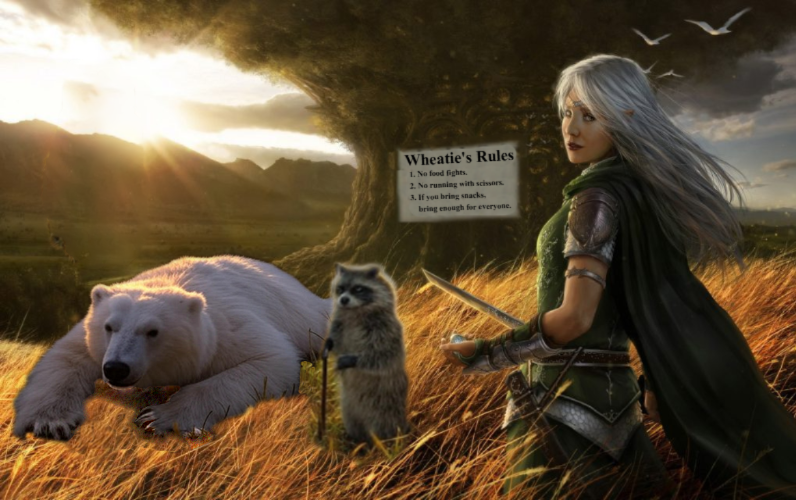
We will follow the RULES of civility that Wheatie left for us:

Wheatie’s Rules:

  1. No food fights.
  2. No running with scissors.
  3. If you bring snacks, bring enough for everyone.

And while we engage in vigorous free speech, we will remember Wheatie’s advice on civility, non-violence, and site unity:

“We’re on the same side here so let’s not engage in friendly fire.”

“Let’s not give the odious Internet Censors a reason to shut down this precious haven that Wolf has created for us.”

If this site gets shut down, please remember various ways to get back in touch with the rest of the gang:

Our beloved country is under Occupation by hostile forces.

Daily outrage and epic phuckery abound.

We can give in to despair…or we can be defiant and fight back in any way that we can.

Joe Biden didn’t win.

And we will keep saying Joe Biden didn’t win until we get His Fraudulency out of our White House.


Wolfie’s Wheatie’s Word of the Week:

yoni

noun

  • symbol representing female genitals
  • a stylized representation of a vulva worshiped as a symbol of a goddess, in particular the Hindu goddess Shakti.
  • the symbol under which Shakti, or the personification of the female power in nature, is worshiped
  • The female sexual organs, or a symbol of them, especially as an object of veneration within certain types of Hinduism, Buddhism, and other cultures
  • concept applicable to female vaginal treatments, exercises, massages, and other focuses

As I have said, I don’t back down on ANY word that comes next in my list of “needful words” that don’t get enough usage. HOWEVER…..

Used in a sentence

I’m not going to show all the things I’ve read regarding yoni. I encourage interested readers to explore on their own. And as for pictures…..

Used in a picture

No. Just no. And the good pictures include symbolic representation of the male counterpart, too. Yikes. Interesting, but…..


MUSIC!

LOL! OK – I am simply not going to promote “yoni” music – this is classified as “women’s health” in my world, and even the less “anatomically technical” music videos are likely to be a bit too pagan and new-age for this site.

On the other hand, being only a bit new-age and globalist (“world music”), Greek instrumental and electronic artist Yanni is somebody my father enjoyed during his sunset years, and Yanni’s music brings back good memories of my mother and father enjoying their retirement, so here you go. Twenty of Yanni’s greatest hits.

https://youtu.be/MKaDLtMkn5I

THE STUFF

Flying insects the size of a hawk or an eagle?

OK – this video is actually some interesting science wrapped in click-bait advertising and bad AI narration. The critters aren’t all THAT bad – although they seem pretty nasty by today’s standards.

Bottom line – kinda happy all these bugs got smaller.

Just sayin’!

And remember…….

Until victory, have faith!

And trust the big plan, too!

And as always….

ENJOY THE SHOW

W


PS – Hint about Tuesday’s post – it’s spherical!

DEAR MAGA: Open Thread 20250220 & Handling Gold


Welcome.
Please visit this January 1st daily thread for the rules of the road,
which are few but important.


Header Image: 2024 Presidential Election Map by County

Do not submit again to a yoke of slavery.

For freedom Christ has set us free. Stand firm, therefore,
and do not submit again to a yoke of slavery. — Galatians 5:1


We got our miracle.
America is back.

Let us dedicate ourselves to the cleansing, healing, and rebuilding of our beautiful nation.

God will guide us.
Prayers and thanks to God for President Donald J. Trump.


Handling Gold.

Well, not really gold. But a process that is even more critical than handling precious metals, but let’s start there. The other day Steve was explaining how registered mail is handled and why precious metals dealers used registered mail due to the strict processes that are followed. The USPS handbook DM-901 covers all the details. It’s a nice document. Covers all the procedures, chain of custody, proper storage, how to document if seals are broken, etc. It’s almost like they are serious about handling registered mail.


What is more important than gold?

How about true and accurate elections that put into power those who legislate whether you get to keep your gold or not? Seems important.

Chain of Custody.

A key feature of the process of handling things of great value is called the Chain of Custody. Whether it is registered mail, election materials (ballots, equipment), or even evidence to be used in prosecuting a criminal case, unimpeachable Chain of Custody is essential.

The National Voting Rights Task Force says:

According to experts, the only way to know if an electronic vote total has been hacked is for voters to have separately recorded their intended selections on paper and for jurisdictions to then use the paper in a manual audit or recount, the results of which can be compared to the electronic total.

But even manual audits or recounts can be “hacked” if the selections on the paper have been marked by a machine, rather than the voter’s own hand.  And no matter how that paper is marked, manual audits and recounts can be gamed if the chain of custody between election night and the audit or recount has been compromised.

There are many resources for elections. One resource, the Election Assistance Commission (EAC) is an independent, bipartisan commission whose mission is to help election officials improve the administration of elections and help Americans participate in the voting process. Their guidance, “Best Practices: Chain of Custody,” gives recommendations to election officials. “The chain of custody of ballots, voting equipment, and associated data is essential to ensure the election system remains trustworthy. Documentation of the chain of custody also provides evidence that all voting procedures were followed. It is a best practice for chain of custody procedures to be clearly defined in advance of every election, well documented and followed consistently throughout the entire election lifecycle or process. The key to an effective chain of custody is to have a set of procedures which are followed in practice. The procedures should be in writing with all steps documented.”

It may be important to note that I have yet to find any federal laws with guidance on the specifics of election materials chain of custody. A search of the Help America Vote Act (HAVA) of 2002 for the term “custody” does not yield any results. An internet search of “election laws chain-of-custody” provides guidance from various organizations (a good example here) and some links to individual Secretary of State websites. If there are federal laws, they are not easily found. Time didn’t permit for me to survey each state for specific chain of custody laws related to elections. It appears that a good number of groups that have public-facing sites with material related to the need for and the development of good practices for managing chain-of-custody.

However, when you get into actual county-by-county execution of these procedures the failures are all to common and even shocking. When regular citizens, concerned about their own local county’s handling of election materials simply asked for a copy of the chain of custody procedures in use during a specific election, the response was far from uniform. As anyone in any type of mission-critical work effort would expect, there needs to a least be: (1) a dated, documented procedure that is signed off before it is to be followed for a specific election and (2) checklists with spaces for signing off for the handling of items requiring chain of custody.

Even when a county is required by their state government to provide these prior to an election, the local elections offices sometimes could not provide these procedures when asked. One particular county office provided a non dated, unsigned document and stated that they weren’t sure which election it was for. Either they didn’t know what they were doing, they didn’t have the right person fulfilling the request, or something else. It seems like this would be posted right on their county elections office website (along with all the other elections documents!). In a number of counties that I know of, the elections office claimed there were “no records responsive to the request.” In other words, they are saying that they didn’t have the state mandated chain of custody procedures. How did they get the election certified without it? How did their Secretary of State sign off on the election without it?

Asking for public records, usually referred to as a freedom of information act (FOIA) request can be done by anyone. More recently the number of people taking it upon themselves to get involved in “citizen oversight” has grown to the point that some public officials have started complaining that all these requests are a form of harassment. Really? Why not just publicly publish all of it?

In one state it seems that a number of counties have hired the same particular law firm as “County Counsel” to advise on the handling of election matters. Unfortunately that liberal law firm seems to have been assisting counties to stone-wall access to public records. And in some cases the guidance given to the county board of supervisors was in fact unlawful. I’m not giving examples to prove my point, I’m just offering information that might be helpful to know if someone reading here is considering looking into how their elections are being handled where they live and vote.

In 2016 Bev Harris explained at her site, BlackBoxVoting.org:

Elections chain of custody refers to physical and electronic evidence controls for:

– who can vote
– who did vote
– actual ballots as marked by each voter, and
– evidence transfer and storage

:

Legitimate elections require public “right to know” (freedom of information) to allow the public and the media to authenticate truth of results. Proper chain of custody safeguards are part of the larger concept of political legitimacy.

:

Incurable uncertainty

Handling election records and data must be scrupulously careful in order to demonstrate to the public that there has been no tampering or contamination.

In court cases, chain of custody violations can result in refusal to admit evidence or even throwing a case out. In elections, chain of custody violations can result in “incurable uncertainty” and court orders to redo elections.

Bev Harris discovered election theft in 2002, wrote a book on it (download it here), advocated for change, and now others have carried on her work. The problems are not new, and they have probably grown worse. But now is the time for us to make our own local governments-that oversee the execution of elections–take note that we are asking questions, seeing problems and expecting better oversight. And for those who have been running elections, just knowing that more people are looking into their work appears to have led to some unexpected early retirements. I can’t say that is an indication of guilt, but it does seem significant.

We can’t leave this to others. We can at least try and get informed on what has been found, what has been done, and what more needs to be done. What do you know about elections and chain of custody. Please post your thoughts in the comments. Thanks

We can make a difference.
And we must make a difference.

If not us, who? If not now, when?
There has never been a better time.


Twitterati.

General Mike Flynn (@GEnFlynn) has been talking about citizen oversight for as long as I’ve been paying attention.

Gail and PAVACA are going to love this one (link):


Prayer.

God Bless America,
Land that I love.
Stand beside her, and guide her
Thru the night with a light from above.
From the mountains, to the prairies,
To the oceans, white with foam
God bless America, My home sweet home.


Dear KMAG: 20250217 Trump Won Three Times ❀ Open Topic


Joe Biden never won. This is our Real President – 45, 46, 47.

AND our beautiful REALFLOTUS.


This Stormwatch Monday Open Thread remains open – VERY OPEN – a place for everybody to post whatever they feel they would like to tell the White Hats, and the rest of the MAGA/KAG/KMAG world (with KMAG being a bit of both).

And yes, it’s Monday…again.

But we WILL get through it!

We will always remember Wheatie,

Pray for Trump,

Yet have fun,

and HOLD ON when things get crazy!


We will follow the RULES of civility that Wheatie left for us:

Wheatie’s Rules:

  1. No food fights.
  2. No running with scissors.
  3. If you bring snacks, bring enough for everyone.

And while we engage in vigorous free speech, we will remember Wheatie’s advice on civility, non-violence, and site unity:

“We’re on the same side here so let’s not engage in friendly fire.”

“Let’s not give the odious Internet Censors a reason to shut down this precious haven that Wolf has created for us.”

If this site gets shut down, please remember various ways to get back in touch with the rest of the gang:

Our beloved country is under Occupation by hostile forces.

Daily outrage and epic phuckery abound.

We can give in to despair…or we can be defiant and fight back in any way that we can.

Joe Biden didn’t win.

And we will keep saying Joe Biden didn’t win until we get His Fraudulency out of our White House.


Wolfie’s Wheatie’s Word of the Week:

voile

noun

  • a soft, fine, sheer fabric
  • a light, plain-weave, sheer fabric of cotton, rayon, silk, or wool used especially for making dresses and curtains
  • a light, translucent cotton fabric used for making curtains and dresses
  • a light, semitransparent fabric

Used in a sentence

Like many lightweight fabrics, voile cloth is ideal for spring and summer outfits.

More about voile

The term comes from the French word meaning ‘veil’. When made of 100% cotton or cotton and linen blended together, it allows the air to pass through, providing comfort even on the most scorching day. Due to its fine texture, voile fabric can also be used to line garments.

What are the key features of high quality voile?

  • Plain, tight weave
  • Silky soft finish
  • Light drape
  • No stretch
  • Slightly transparent (lining is optional)
  • Crisp and sometimes wiry
  • Stiff but flexible

Voile fabric is versatile, which means it is great both for apparel and home décor. You’ll often find voile in craft projects such as pillowcases, cushions, doilies, doll’s dresses and more. This gauzy material is also one of the favourites when it comes to creating lightweight curtains. It filters the sunlight and floods any room with natural light.

Shown in a picture

Discussed in a video


MUSIC!

A search on “voile” brought back “Voilà” – so enjoy this song, even though you likely have seen this performance before.


THE STUFF

Dating methods.

The basics. Including limitations.

No, we’re not talking about Brylcream and hot cars – chocolates and roses – BMOC / “wingman” – websites, matchmakers, singles groups – or any of the other methods of “dating success”! Although YES, those do work!

These work, too!

Just sayin’!

And yet remember…….

Until victory, have faith!

And trust the big plan, too!

And as always….

ENJOY THE SHOW

W


American Stories: When in the Course of human events – Part 7

Wait a minute. I just remembered that I told readers that Benjamin Rush was a hero for helping Federalist John Adams and Anti-Federalist Thomas Jefferson to reconcile. That must mean those two strong willed, highly intelligent American patriots had a falling out? I thought they were great friends? What gives?

Continental Congress

The two first met at the Continental Congress and began working together in the Committee of Five that wrote the Declaration of Independence. There was a strong mutual respect as each saw the strengths of the other. The tall, handsome, wordsmith Jefferson and the short, more portly, born leader, extroverted Adams hit it off. Per worldhistoryedu.com,

Adams admired Jefferson’s eloquence and writing skills, and Jefferson respected Adams’s fierce advocacy and leadership. Their collaboration during the drafting of the Declaration of Independence in 1776 marked a high point in their relationship. Adams even suggested Jefferson for the task of writing the Declaration because of his “masterly pen.” This period of cooperation laid the foundation for their future interactions, though the seeds of their eventual rivalry were already present in their differing temperaments and political philosophies.

Per historyhit.com,

When Jefferson’s wife, Martha, died in 1782, Jefferson became a frequent guest at the home of John and Abigail Adams. Abigail said of Jefferson that he was “the only person with whom my companion could associate with perfect freedom and reserve”.

During the war both were sent as diplomats to Europe. For a time Adams worked with Benjamin Franklin in France, but they grew to despise each other. Franklin had decades of experience and a polished ease in social situations that fit in well in Europe while Adams was brash and direct. They separated and Adams was sent to Holland. Meanwhile, Jefferson served as Governor of VA and was nearly captured at his home in Monticello. Over time and as the war ended, Adams resumed the lead role in negotiating the Treaty of Paris.

The tensions between the two began well after the war was won and the Treaty of Paris signed. After signing Adams headed to London and Jefferson was dispatched to Paris to begin efforts to restore normalized relations for the new nation. From the time they had first met through their years in Europe, they exchanged many of the 380 letters accorded them in their lifetimes. It was what happened when they returned to America with the finalizing of the Constitution that caused the rift.

Both had very different views over the primary role of a federal government. As noted previously, Adams was a Federalist who strongly believed in a dominant centralized government and was very suspicious of the French Revolution. He was a student of classical world history and saw how great nations fell when they lost order and experienced chaos. He feared the people having too much freedom from democracy. He was also more oriented to populated urban areas.

On the other hand Jefferson was Anti-Federalist who believed in decentralization of government, who saw no reason to abandon relations with the French. He preferred an agrarian based nation and was all in on democracy for all. He believed in the basic goodness and wisdom of the common man from his experiences within the Enlightenment period. A link to an explanation of that is below.

https://www.history.com/topics/european-history/enlightenment

As both Adams and Jefferson dug in deeper in their beliefs and actions, their letter writing to each other slowed dramatically. With the POTUS election of 1788 each battled for the role of VP under President George Washington. Adams was the victor. At that point the publicly drawn battle lines between the two became more pronounced. The respect and friendship they once shared soured.

Adams and Jefferson ran against each other for POTUS in 1796 after Washington’s retirement. Once again Adams was the narrow victor. However, the rules provided for Jefferson to be the VP.

Awkward! 😆

Undeterred with the loss, Jefferson and his Democratic Republican party supporters stayed on the offensive and used the passage of the Alien and Sedition Acts of 1798 by the Federalists as proof of how removed Adams and his party had become from the will of the people. SOUND FAMILIAR?

So what were the Acts all about that caused the ruckus?

https://www.archives.gov/milestone-documents/alien-and-sedition-acts

At this point, please do not make the mistake of drawing a parallel of the Federalists kicking out the aliens as the same as what is happening today. The aliens of yesteryear were not here to overturn the government and were in fact here legally. They were invited here to become citizens in a young country bursting with opportunities that was expanding westward in need of workers and settlers. This is why the period of residency before becoming a citizen was only 5 years. The fearful reaction of the Federalists to this population growth in other regions of the country drove the passage of the Acts that increased the residency requirement to 14 years among other onerous, controlling provisions. They knew the newer citizens would not be interested in more control from a central government and would be attracted to the Democratic Republicans’ promise of liberty and a decentralized government. It was an attempt to keep the status quo and the Federalists in power. SOUND FAMILIAR?

Today’s Uniparty throws in millions of illegal ballots in key races and areas. It is a current version of the Federalist operatives who gamed the system to stay in power. Different method, same result. The parallel you can draw effectively is that the will of the people won out in 1800 just as it did on November 5, 2024. Thomas Jefferson won the POTUS role in 1800 and Adams was defeated. It was called The Revolution of 1800 as it was a dogfight between the two camps. Personal attacks and partisanship ruled the campaigns. It got ugly. At one point James Madison joined forces with Jefferson to promote states rights.

The election actually ended in a tie between Jefferson and Aaron Burr. It was finally determined in the House of Representatives for Jefferson. The oppressive Acts subsequently expired or were repealed. With the loss Adams retreated from government and politics. He returned to his farm in Quincy, MA and largely withdrew from public life.

Jefferson went on to served two terms successfully. Both Adams and Jefferson had very little contact with each other and held resentments. In 1812, the friend of both, Declaration signer Benjamin Rush, took the big step to restore their relationship. He had been saddened by their lack of communications as well as the effects it had on the nation as a whole. After conversations with both over the years he took it upon himself to approach Adams about the prospects of reconciling with Jefferson. Adams agreed and sent a short cordial letter to Jefferson. That was all it took for the two to resume their friendship. Over the next 14 years they wrote each other often, discussing a wide variety of subjects that included politics, philosophy and personal matters.

Their words revealed a deep mutual respect and a shared sense of history and their involvement in it. They discussed their disagreements and were even humorous about their past behavior. They bridged their divide and reconciled as people. It was a very meaningful event for America that these two patriot giants could settle their differences and remain bonded in friendship and love of country. Again, it may have been the most important act Benjamin Rush took out of an incredible number of important acts he undertook in his storied life.

How appropriate that both Adams and Jefferson died on the same day; July 4 ,1826 – Independence Day. The last words of Adams were, “Thomas Jefferson still survives.” He was mistaken: Jefferson had died five hours earlier at Monticello at the age of 83.

Shivers.

Let’s move on to more signers.

John Hart

I am going to go with 1713 as John Hart’s birth year primarily because it is the year Congress officially recognized, although other sources state 1711 and other years. In reality they do not know with certainty. What they do know is that his father was Captain Edward Hart and that John was born in Stonington, CT. His father was in the local militia that was active in the French and Indian War as well as being a farmer, public assessor and justice of the peace. The family relocated to New Jersey early in his life and he was baptized in a local meeting house that is now a Presbyterian Church, although it appears his family had some association with Baptists as John deeded some land to them to build a church on in 1747.

John married Deborah Scudder in 1741. They went on to have 13 children together. He held a county position beginning in 1750 and by 1761 was elected to the NJ Colonial Assembly where he served for ten years. His primary occupation was a farmer and earned the name “Honest John Hart” from within the state. As a patriot he was appointed the state’s Committee of Safety as well as the Committee of Correspondence. As the First Continental Congress was formed he was chosen as one of the representatives of the state. That led to him being one of the first sent to the Second and as a result an approver and signer of the Declaration of Independence.

As the war came to New Jersey, The British sought him out as a signer as well as Speaker of the Assembly in NJ. As this was happening his wife lay dying in their home. He refused to leave until she breathed her last, then departed for the nearby Sourland Mountains he had hunted for many years even though he was well into his sixties by that time. He remained for a year until the threat of the British had passed there before returning home and finding that they had severely damaged his property. In the summer of 1778 he offered his farm along with other local farm owners to become the staging and planning area for General Washington’s 12,000 man army. He and Washington dined together while camped there. However, before the year was out he experienced life threatening kidney stone attacks that left him in great pain until his death six months later in 1779.

Honest John Hart literally gave all of himself and his possessions for the cause of liberty without regard to its cost. He was a great America Patriot.

Thomas Heyward, Jr.

Born St. Luke’s Parish, SC in 1746, Thomas Heyward. Jr., was from a wealthy plantation owning family that were known for growing tidal rice. His father was Col. Daniel Heyward. He was educated at home in classical studies and Latin, while later being trained in law locally and in England. While in England he observed that the Brits there viewed the colonists as their lessers, which angered him. He continued to travel Europe and saw that the lives of luxury around him stood in contrast to the simple lives of the farmers he liked at home. It made a distinct impression on him.

When he returned in 1772 he soon married Elizabeth Matthews, daughter of Col. John and Sarah Matthews. The couple had six children together although she passed away in childbirth in 1782. Only one survived to adulthood.

When the Stamp Act was passed Heyward was its most vocal critic. He began to rise in patriot circles, much to his loyalist father’s dismay. At one time the Heyward family were the largest slaveholders in America, so his beliefs about independence ran contrary to long held family interests. In 1775 he was elected to the General Assembly and subsequently to represent the state in the First Continental Congress. His father warned him of the consequences, but was unable to dissuade him. However, prior to his father’s death in 1777, the two reconciled.

He became a Declaration signer as well as later, a signer of the Articles of Confederation. In 1778 he returned home to take over operations of the family plantation after his father’s death the previous year. He assumed control of a small artillery militia and was wounded in battle, from which he recovered. He was subsequently captured in the Battle of Charleston and sent to St. Augustine with other officers. He was later sent to Philadelphia in a prisoner exchange near the end of the war and was nearly killed when he fell over board of the prison ship. After the exchange, it was not long until his wife died during childbirth. He had lost his wife, his plantation had been destroyed, his slaves ad other possessions taken away, and yet, he continued to serve as a judge and in the affairs of his state including the writing of the state Constitution until his retirement in 1798. His personal life recovered with his second marriage to Elizabeth Thomas, daughter of Col. Thomas and Mary Elliot Savage of Charleston. They had three children together. Heyward passed away in 1809 having fulfilled his life’s mission of serving his country as a great American Patriot.

Lessons From The Life Of Thomas Heyward

Picture yourself as a young man born into southern plantation society and wealth, whose family is aligned with the Crown. Life has been plentiful. Your family is highly respected in the community and state. Slaves work the fields and serve throughout the mansion and grounds. You have been afforded an elite classical education at home that has led to an apprenticeship and training into the law. Your parents see your abilities and send you to England to complete your education and training in law. You spend the next five years traveling Europe and then realize as you set sail for home that you do not care for those people or the lives they represent.

This leads to getting sideways with your father as you have determined that liberty is the only path for the colonies. You go your own way, though fortunately reconciling with him before he passes. Over the ensuing years you give your all for the cause that includes your freedom as a prisoner of war and nearly your life on multiple occasions. You go from being shot to being imprisoned to nearly drowning from going overboard on the voyage that was to take you to freedom. Then you lose your wife in the childbirth of one of your six children, only one of whom survived. All of this only to return home after the war to find your family’s plantation in ruins and all of the slaves gone, most of whom having been sent to Jamaica.

Instead of throwing your hands up in surrender, you rebuild your life. You become a judge and continue to be active in state affairs. You marry again and have children. And the one constant through it all remains your commitment to the service of your country and your memories of having signed the greatest document in American history.

Thomas Heyward was a man of qualities and flaws like all of us. However, his life illustrates his commitment to our nation no matter the cost. It is a strong lesson for all who would be patriots.

Conclusion

I only have time for two signers this week. I have finally recovered from Flu A and much work remains on the project for the kids’ house. I will likely skip a week before restarting the series as I want the content to continue to reflect our nation’s return to its patriot roots with the Golden Age upon us.

I am in awe over what PDT, JD, Elon, cabinet members and supporters are delivering. It is literally a long held dream come true for this old head and heart. I wanted it so badly for the children and grandchildren, so they could carry the day and fight well into the future. Our America First MAGA leaders get it. They have the spirit and the will of our 1776 Sons of Liberty coursing through their veins. I am so proud to be an American again.

May God continue to bless our united efforts to restore and lift up the republic for His glory and the good of His people.

DEAR MAGA: Open Thread 20250213 & Remembering


Welcome.
Please visit this January 1st daily thread for the rules of the road,
which are few but important.


Header Image: 2024 Presidential Election Map by County

Do not submit again to a yoke of slavery.

For freedom Christ has set us free. Stand firm, therefore,
and do not submit again to a yoke of slavery. — Galatians 5:1


We got our miracle.
America is back.

Let us dedicate ourselves to seeking our place in the cleansing, healing, and rebuilding of this beautiful, resource-rich nation. God will guide us.

Prayers and thanks to God for our 47th President, Donald J. Trump.


Remembering.

With gratitude to our own kind Wolf for reminding us of DePat’s recommended prayers for times of spiritual warfare, let us consider praying this one today.


Litany of Humility

O Jesus, meek and humble of heart,
Hear me.

From the desire of being esteemed,
Deliver me, O Jesus.
From the desire of being loved,
Deliver me, O Jesus.

From the desire of being extolled,
Deliver me, O Jesus.
From the desire of being honored,
Deliver me, O Jesus.

From the desire of being praised,
Deliver me, O Jesus.
From the desire of being preferred to others,
Deliver me, O Jesus.

From the desire of being consulted,
Deliver me, O Jesus.
From the desire of being approved,
Deliver me, O Jesus.

From the fear of being humiliated,
Deliver me, O Jesus.
From the fear of being despised,
Deliver me, O Jesus.

From the fear of suffering rebukes,
Deliver me, O Jesus.
From the fear of being calumniated,
Deliver me, O Jesus.


From the fear of being forgotten,
Deliver me, O Jesus.
From the fear of being ridiculed,
Deliver me, O Jesus.

From the fear of being wronged,
Deliver me, O Jesus.
From the fear of being suspected,
Deliver me, O Jesus.

That others may be loved more than I,
Jesus, grant me the grace to desire it.
That others may be esteemed more than I,
Jesus, grant me the grace to desire it.

That, in the opinion of the world,
others may increase and I may decrease,
Jesus, grant me the grace to desire it.
That others may be chosen and I set aside,
Jesus, grant me the grace to desire it.

That others may be praised and I go unnoticed,
Jesus, grant me the grace to desire it.
That others may be preferred to me in everything,
Jesus, grant me the grace to desire it.

That others may become holier than I,
provided that I may become as holy as I should,
Jesus, grant me the grace to desire it.

Author: Rafael Cardinal Merry del Val y Zulueta


Charity

Charity is patient, is kind; charity does not envy, is not pretentious, is not puffed up, is not ambitious, is not self-seeking, is not provoked; thinks no evil, does not rejoice over wickedness, but rejoices with the truth, bears with all things, believes all things, hopes all things, endures all things. (1 Cor. 13:4-7).

To have Charity is to love God above all things for Himself and be ready to renounce all created things rather than offend Him by serious sin. (Matt. 22:36-40)


Twitterati.

Our J6 P.O.W.s are always in our hearts with the fervent desire that all wrongs would be undone and each target and their families be made stronger and more whole than ever.

Trisha Hope has been providing important updates. And this story

She asks lot of good questions.


Prayer.

God Bless America,
Land that I love.
Stand beside her, and guide her
Thru the night with a light from above.
From the mountains, to the prairies,
To the oceans, white with foam
God bless America, My home sweet home.


Dear KMAG: 20250210 Trump Won Three Times ❀ Open Topic


Joe Biden never won. This is our Real President – 45, 46, 47.

AND our beautiful REALFLOTUS.


This Stormwatch Monday Open Thread remains open – VERY OPEN – a place for everybody to post whatever they feel they would like to tell the White Hats, and the rest of the MAGA/KAG/KMAG world (with KMAG being a bit of both).

And yes, it’s Monday…again.

But we WILL get through it!

We will always remember Wheatie,

Pray for Trump,

Yet have fun,

and HOLD ON when things get crazy!


We will follow the RULES of civility that Wheatie left for us:

Wheatie’s Rules:

  1. No food fights.
  2. No running with scissors.
  3. If you bring snacks, bring enough for everyone.

And while we engage in vigorous free speech, we will remember Wheatie’s advice on civility, non-violence, and site unity:

“We’re on the same side here so let’s not engage in friendly fire.”

“Let’s not give the odious Internet Censors a reason to shut down this precious haven that Wolf has created for us.”

If this site gets shut down, please remember various ways to get back in touch with the rest of the gang:

Our beloved country is under Occupation by hostile forces.

Daily outrage and epic phuckery abound.

We can give in to despair…or we can be defiant and fight back in any way that we can.

Joe Biden didn’t win.

And we will keep saying Joe Biden didn’t win until we get His Fraudulency out of our White House.


Wolfie’s Wheatie’s Word of the Week:

statoscope

noun

  • instrument for measuring small changes in atmospheric pressure
  • a barometer for recording small variations in atmospheric pressure
  • a device for indicating small changes in the altitude of an airplane
  • an instrument used for indicating or recording small changes in barometric pressure or in the altitude of an aircraft

Used in a sentence

I’m curious what sort of statoscope was in the Blackhawk helicopter involved in the crash in Washington, DC.

Shown (antique) in a picture from here

Discussed in a useful beginner video


MUSIC!

These gals still rock! More HEART – from less than a year ago.


THE STUFF

Many may find the following discussion of thyroid treatment boring, but endocrine pharmacology is still a bit of a mystery to science. I found this “laid-back” conversation between two health hippie MAHA types to be really enjoyable, as they go down many rabbit holes.

This lady is a pharmacist who worked as a case consultant figuring out why people were having medical conflicts and side-effects. Her insights into polypharmacy (people taking too many drugs) are quite interesting.

The guy is a veteran of every medical fad on earth – so what he has distilled his health approach down to is also fascinating. Enjoy!

So if you sat through all of that, and still have confidence in alternative medicine, then you are SOLID as an explorer of difficult terrain, and my hat is off to you!

Just sayin’!

And remember…….

Until victory, have faith!

And trust the big plan, too!

And as always….

ENJOY THE SHOW

W


American Stories: When in the Course of human events – Part 6

Now would be an excellent time to pay honor to a great American who is probably enjoying the show in our nation from Heaven.

America is back! God bless America and all freedom loving people worldwide.

Time To Get Into The Weeds

This is an appropriate time to discuss Federalism versus Anti-Federalism. Since our leaders in the national experiment called the United States of America back in the day were playing hard, fast and for keeps; we should be made very aware of what was involved. If you have not spotted the truth of this issue still being in play today along with a nasty fight between the political forces aligned with PDT versus the Uniparty, then you need to take a dose of cold reality. The parallels are amazingly similar. Below is a primer to get you started.

https://thisvsthat.io/anti-federalists-vs-federalists

For more detailed information,

https://constitutioncenter.org/media/files/4.5_Primary_Source__Who_were_the_Federalists_and_the_Anti-Federalists__.docx_.pdf

Now, extend what you learned or were reminded of and apply it to America today.

Do you consider the federal government your friend and partner, or, the potential usurper of God and/or Constitution granted rights as an American?

If you believe the former, you are probably a Federalist. If you believe the latter, you are probably an Anti-Federalist.

Do you believe the federal government should be involved in curing the perceived weaknesses of society and righting perceived wrongs of equal rights for all classes of citizens, or, do you believe that responsibility to redress should be left to local citizens and/or related state and local authorities?

The former is Federalist, the latter is Anti-Federalist.

If a power or authority has not been assigned by the Constitution to handle a subject or concern of importance to the nation, do you believe it is a federal or a state responsibility per the Constitution to address?

Yup, Federalist or Anti-Federalist.

We could continue the game, but you probably get the point. The founding fathers worked through the subjects between them and delivered our Constitution and Bill of Rights as the answer to the desires of both sides. Which is the exact same positions we still fight over today for many of the same reasons they did. Let’s review the officially long deceased Federalist Party and what it represented per an accurate Wiki description. Who does that party resemble today?

https://en.wikipedia.org/wiki/Federalist_Party

Yup, it describes the current Democrats and Uniparty in general.

Now lets look at the Anti-Federalist movement as it never officially became a political party.

https://en.wikipedia.org/wiki/Anti-Federalis

Backers of the Anti-Federalist movement formed a political party called the Democratic Republican Party with Thomas Jefferson as its leader. These Anti-Federalist influenced backers were for smaller central government, states rights, less regulation, lower taxes and the abolition of slavery. As the years passed the Federalist Party became the limited party of the elites in the New England and eventually died. With Andrew Jackson’s rise to power and the Presidency, the Democratic-Republican Party split with Jackson on the Democratic party side supporting individual and states rights rivaling a coalition formed primarily of remaining Republicans and Anti-Mason Party supporters into the Whig Party. It was led by Henry Clay supporting Federalism and greater power of Congress over the President.

The 1850’s brought the demise of the Whig Party with their support of slavery and elitism. That led to the rise of the Republican Party and eventually Abraham Lincoln and the anti-slavery forces. This Grand Old Party (GOP) as it became known, arose from the Union’s victory in the Civil War. The party typically dominated federal politics for several decades afterward. The Democratic Party became the broad based party of conservatives and agriculture rooted in the “solid south” as well as other scattered segments. As backers of states rights, they generally opposed the anti-slavery changes. They would occasionally win control of houses of Congress along the way.

Fast forward to today. My, oh, my how things change!

We are back to Federalists being Uni-party elitists with cobbled together minority segments in the Democrat Party and RINO’s versus the Anti-Federalists being the rapidly growing, populist America First MAGA segment of the GOP that is all about operating as a republic with states rights being important.

What has happened since our nation’s founding and today is a continuous morphing between these primarily Federalist versus Anti-Federalist viewpoints. America and its politics have never been one thing or the other throughout its history. Yet, the tension remains from the negotiations surrounding the interpretation of the Constitution and with the accommodation provided by the Bill of Rights.

As things stand today, did the Democrat and RINO Uniparty exceed their authority by claiming powers over subjects, issues and people that are not enumerated in the Constitution? Of course they did and still attempt to do. That is why EO’s and EA’s have been flying out of the Oval Office in droves under President Trump already. To increase their power and reach, central governments tend to naturally grow and extend their tentacles increasingly into the business of the people. That is not a question, it is a fact demonstrated over thousands of years in governments all around the globe.

Can a fully decentralized republic adequately defend itself against foreign and domestic forces and enemies without central governance and leadership? Probably not very well in America as the independent states may opt out of their responsibilities and enter into disputes with each other as well as the federal government. There would be no hammer to cover all aspects of government in place to force them back into compliance. Our strength as a nation against foreign powers is in unity, not division.

As a result the pendulum of change has swung both right and left since the Constitution’s ratification in 1788 and implementation in 1789. The excesses of the Uniparty activities in our times are obvious and the reason Donald Trump is POTUS. Very few are willing to admit it, but the Constitution still has problems that the Anti-Federalists foresaw. The compromise over the Bill of Rights did not go far enough. It addressed some of the major issues of the day that would probably survive as time passed. But as we have subsequently learned over time it left gaping holes of how to prevent and penalize federal government overreach when they venture into powers and authorities that are not enumerated. When transparency is the law, those in federal authority have rarely provided it without prodding, outright threats or legal actions. Attempts to permanently change the responses have been unsuccessful at times, just as Anti-Federalists predicted could happen.

The truth is the development and use of political parties has stymied our nation’s progress frequently. The tension of partisanship that is built into the system can help, but it also can hinder as we have seen repeatedly in our times. We will touch more on this and the life of James Monroe in particular down the road in this series.

The partisanship has led our nation into the long overdue corrective phase today that Anti-Federalists of old would celebrate. We populist, American First, MAGA, states rights, kill the Fed, modern day Anti-Federalists won the election despite the current day, Federalist, Uniparty cheating the elections as they have for at least a century. Too big to rig got it done, however, that should not have been required. As a law abiding nation our citizens could choose to be honorable and have integrity. Unfortunately, the past 235+ years years since Constitution implementation reveals the truth that honesty and honor are not always present or enough. One of the primary reasons for that is radical partisanship. Many throw up their middle finger on reasoning and consensus building, two ingredients that are required for effective leadership.

Which is why the theme of the POTUS Trump administration has been “common sense“.

Strengthening constitutional enforcement issues could be a meaningful answer as well as satisfying the obvious need for honest, accurate elections. When one side or the other goes rogue or overreach becomes the modus operandi while in control, they can choose to enforce or not enforce the provisions of the Constitution and related law with minimal blow back because of the mockery they have made of law enforcement activities and the judiciary. We have seen this blatantly demonstrated in the past three decades with the weaponization of the DOJ and Intelligence Community (IC). Political gain replaced bipartisan administration of the law in the highest offices of our land.

President Trump and America First supporters aim to change all of that. We are already seeing a great deal of Anti-Federalist approaches to powers not enumerated and a great deal of leverage applied. President Trump, cabinet, and all supporters are going back to the original intent of the Massachusetts Compromise we discussed in a previous part. That compromise led to that key state’s ratification of the Constitution and Bill of Rights. Some of the actions President Trump is intentionally taking will end up on the desks of the SCOTUS due to lawfare by the Uniparty if they are not codified through actions of Congress. We will have clarity on which to base future steps soon. As that happens it will be critical to gain even more patriot control over Congress in the future as the Uniparty will be fighting against us with all they have. There are more amendments to the Constitution that are necessary to assure our nation’s viability for centuries to come.

If history is our guide, political parties based on partisanship control will eventually die and morph into something else. That is exactly where the Democrat Party finds itself today. The GOP through POTUS Trump and supporters morphed from the party of big business to the party of the people over a couple of decades. What signaled that change was coming was when the Democrats lurched left. The Solid South left the party and have become GOP stalwarts.

Given a personal choice of one side or the other, I think readers know I am an Anti-Federalist in my core. Power and money corrupt and nowhere is that seen in a greater display than in our nation’s Capitol. I have personal experiences during my career on which to base my position. I also recognize that in regard to the powers that are enumerated to the federal government, we all must support without reservation as long as the activities are legally conducted. They are not mutually exclusive positions.

On we go to discuss more signers of the Declaration of Independence. We will look at a leader of both the Federalists and the Anti-Federalists as well as one who help reconcile both sides to make it all happen as it did.

George Read

Born in 1733 in North East, MD, George Read was born to John and Mary Howell Read. His father was an Englishman from a family of great wealth. He moved to the colonies and bought a large estate in Cecil County, MD. With six others he went on to found the City of Charleston on the Chesapeake Bay. While there he held numerous military offices.

Soon after his birth, George’s family moved to an estate in New Castle, DE. He went to school with American Patriot Thomas McKean at Rev. Francis Allison’s Academy in New London, PA at age 15. He then studied law in Philadelphia, passed the bar in 1753, and moved back to New Castle to establish his law practice. In 1763 he married the daughter of an Anglican Church rector, Gertrude Ross. They joined the Episcopal Church there. They had three sons; George Jr., William and John.

He was appointed as the Crown Attorney General of three counties in DE by the governor. He remained in that position until he joined the first Continental Congress in 1774. Read preferred that the colonists find common ground with the British and loyalists. When it became time to vote on the Declaration of Independence he voted against it. This caused Rep. Caesar Rodney from the state to ride all night to break the tie for DE to approve the Declaration. However, when it came time to sign it, George Read did so in support.

With the future of the United States on the line in the Revolutionary War. He returned to serve in DE, but soon learned of the capture of the Continental Congress President John McKinley. He was nearly captured himself in Philadelphia, but escaped and served as President of the Congress for six months. He recruited men for the military and helped in the defense of the colonists during the period wile serving in the Legislative Council after the end of his term. He then returned to his home and activities in the state legislature. He took one year away to recover his health.

He was called into service again by DE with the work towards the approval of the Constitution. He was a leader in the fight for a strong federal government, advocating at one point for the abolition of states altogether. None of his fellow representatives agreed with him, so he moved on to protecting the rights of small states versus their larger neighbors. Once those rights were assured he led the approval of the vote for the Constitution for which DE was the first to ratify. In leading these efforts Read became a major voice in the Federalist Party.

The DE General Assembly elected Read to be a U. S Senator in 1789. He served there until 1793. He strongly supported George Washington and believed in centralization, including the creation of a national bank. He left the Senate when appointed the Chief Justice of the DE Supreme Court and served there until his death from heart problems in 1798. His wife passed away five years later. His son George Read, Jr. became the first U. S. Attorney for DE. His grandson, Read III, became the second. He had two brothers serve as officers in the Continental Army and Navy respectively.

George Read was a highly influential American Patriot who gave his all and left a family legacy of doing likewise.

Richard Henry Lee

In addition to prominent Anti-Federalists John Hancock and Samuel Adams, there was Richard Henry Lee. Born in Westmoreland County, VA in 1732, Lee came from a long line of aristocratic military officers, diplomats and politicians in his family. His parents were Colonel Thomas Lee and Hannah Harrison Ludwell Lee. Lee was sent to England to study and during the period both of his parents died in 1750. He continued in Europe until 1752 when he returned home to settle the estate of his parents with his siblings. In 1757 he was appointed justice of the peace and a year later elected into the House of Burgesses, serving until 1775. Also in 1757 he married his first wife, Anne Aylett, with whom he had six children with four surviving. After her death in 1768 he married Anne Gaskins Pinckard a year later. The couple had seven children together of whom five survived.

Lee was strongly in favor of independence and was a founder of the VA Committees of Correspondence. However, he was not in the tar and feathers promoters. He preferred boycotts and verbal persuasion in a gentlemanly manner. In 1766 he authored the Westmoreland Resolution that was against the enforcement of the British Stamp Act. Among those who signed it were several of George Washington’s family members. He was even more actively opposed to the Townshend Acts. He was selected by VA to attend the First Continental Congress. It was Lee who brought the motion for independence in the Second Continental Congress is 1776. The key part of his resolution read,

“Resolved: That these united colonies are, and of right ought to be, free and independent States, that they are absolved from all allegiance to the British crown, and that all political connection between them and the state of great Britain is, and ought to be, totally dissolved.”

He had returned to VA prior to the actual vote, but returned in time to sign the Declaration. Later in 1783 he was selected as the President of the Congress. He served for a year and was selected as U. S. Senator from 1789-1792.

Lee strongly supported states rights and a reduced presence of the federal government. He was very active in the Anti-Federalist movement and instrumental in the inclusion of the Bill of Rights. His proposal of the language of the 10th Amendment was adopted substantially as he presented it. With the compromise, he backed the ratification of the Constitution and had high regard for the performance of George Washington through the years. He soon grew to appreciate the Constitution as he saw how it actually performed. He passed away in 1794 at age 62 with his wife passing away two years later at age 48. He never fully recovered from an overturned carriage accident in 1791. Within the founding fathers as a group, he was considered as important as the bigger names of Jefferson, Adams and Franklin.

Richard Henry Lee was a great American Patriot.

Roger Sherman

One of the patriots who was critical to building consensus between Federalists and Anti-Federalists, large states and small states, providing a compromise that led to the House and Senate structures as well as other meaningful agreements was Roger Sherman. Born in Newton, MA in 1721, Sherman was the son of farmers. His parents, William and Mehetabel Sherman, moved when he was two years old to Stoughton. Sherman had little formal education outside of grammar school and his father’s library. He was also taught by his Harvard educated parish minister, Rev. Samuel Dunbar. His first job was as a shoemaker.

After his father died in 1743, he moved to New Milford, CT with his mother and siblings. He opened a cobbler store with a brother. He became the county’s surveyor two years later. This helped him save money to later purchase land and earn a good reputation among county residents. He married Elizabeth Hartwell in 1749. She passed away in 1760. He then married Rebecca Prescott in 1763. Between the two wives they had 15 children, 13 of whom lived to adulthood. He published a successful almanac for eleven years as well as studied law. He passed the bar exam in 1754. He became very involved in church and civic affairs, resulting in his election as town clerk of New Milford. He was also elected to the CT House of Representatives for several terms during the period. He was named a justice of the peace in 1762 and a judge in 1765. From that position he was named Justice of the CT Superior Court for the next 23 years. During this time he was also appointed Treasurer of Yale College and taught religious studies there for years.

He represented CT in both the first and second Continental Congress. He was one of the Committee of Five who drafted the Declaration of Independence. His involvement continued into the production of the Articles of Confederation and a member of the related Congress. As such he also became a signer on the Treaty of Paris that ended the Revolutionary War.

Sherman attended the Constitution Convention with no preconceived positions. He actually preferred amending the Articles of Confederation as he saw the problem with it being primarily the lack of the ability to enforce its provisions. (SOUND FAMILIAR?) 😂

Sherman was the definition of a nationalist and viewed his state in isolationist ways. He saw it being essentially self sufficient and aligned with his religious (Puritan) views. Even then he foresaw the future end to slavery in America (SOUND FAMILIAR?) So, he worked to encourage compromises between the two sides even though he was personally anti-slavery. He was a very active participant in legislative and development sessions no matter the project or meeting. He was not an eloquent speaker as he was described as being very direct and terse in his many presentations. This led to him not being quoted as much as others as well as the fact he did not keep extensive journals of his activities.

He was also an opponent of “paper” money. He saw a national currency of same being a future problem to the individual states.

Roger Sherman was largely responsible for the current organization and voting functions of Congress. He forged a compromise, the Connecticut Compromise, through the Grand Committee he formed to deliver a compromise between the large and small states that would balance the interests of both more fairly. He went on to serve as a U. S. Representative and later, as a U. S Senator of his state until his passing from typhoid in 1793. The great American theologian Jonathon Edwards preached his funeral. His wife, Rebecca, passed away in 1813.

Roger Sherman was the only person in our history to sign all four major documents of the United States from our period of founding; the Articles of Association, the Declaration of Independence, the Articles of Confederation, and the U. S. Constitution. His more famous contemporaries Jefferson, Adams and Madison had deep admiration for the man and held all of his works in high regard.

Conclusion

A Federalist, an Anti-Federalist, and a Consensus Builder walk into a bar…

OK, start to a bad joke. However, this has been how America has evolved over many years by building consensus among dissimilar individuals who are linked by the common bonds formed from our great Declaration of Independence.

May God bless America.